WO2012173111A1 - ポリカーボネート樹脂組成物及びそれを用いた成形体 - Google Patents
ポリカーボネート樹脂組成物及びそれを用いた成形体 Download PDFInfo
- Publication number
- WO2012173111A1 WO2012173111A1 PCT/JP2012/065005 JP2012065005W WO2012173111A1 WO 2012173111 A1 WO2012173111 A1 WO 2012173111A1 JP 2012065005 W JP2012065005 W JP 2012065005W WO 2012173111 A1 WO2012173111 A1 WO 2012173111A1
- Authority
- WO
- WIPO (PCT)
- Prior art keywords
- polycarbonate resin
- resin composition
- mass
- group
- carbon atoms
- Prior art date
- Legal status (The legal status is an assumption and is not a legal conclusion. Google has not performed a legal analysis and makes no representation as to the accuracy of the status listed.)
- Ceased
Links
- 0 CC1(C=CC(*c(cc2)ccc2OC)=CC1)O*(C)=O Chemical compound CC1(C=CC(*c(cc2)ccc2OC)=CC1)O*(C)=O 0.000 description 1
Classifications
-
- C—CHEMISTRY; METALLURGY
- C08—ORGANIC MACROMOLECULAR COMPOUNDS; THEIR PREPARATION OR CHEMICAL WORKING-UP; COMPOSITIONS BASED THEREON
- C08L—COMPOSITIONS OF MACROMOLECULAR COMPOUNDS
- C08L69/00—Compositions of polycarbonates; Compositions of derivatives of polycarbonates
-
- C—CHEMISTRY; METALLURGY
- C08—ORGANIC MACROMOLECULAR COMPOUNDS; THEIR PREPARATION OR CHEMICAL WORKING-UP; COMPOSITIONS BASED THEREON
- C08J—WORKING-UP; GENERAL PROCESSES OF COMPOUNDING; AFTER-TREATMENT NOT COVERED BY SUBCLASSES C08B, C08C, C08F, C08G or C08H
- C08J5/00—Manufacture of articles or shaped materials containing macromolecular substances
-
- C—CHEMISTRY; METALLURGY
- C08—ORGANIC MACROMOLECULAR COMPOUNDS; THEIR PREPARATION OR CHEMICAL WORKING-UP; COMPOSITIONS BASED THEREON
- C08K—Use of inorganic or non-macromolecular organic substances as compounding ingredients
- C08K3/00—Use of inorganic substances as compounding ingredients
- C08K3/02—Elements
- C08K3/04—Carbon
- C08K3/042—Graphene or derivatives, e.g. graphene oxides
-
- C—CHEMISTRY; METALLURGY
- C08—ORGANIC MACROMOLECULAR COMPOUNDS; THEIR PREPARATION OR CHEMICAL WORKING-UP; COMPOSITIONS BASED THEREON
- C08L—COMPOSITIONS OF MACROMOLECULAR COMPOUNDS
- C08L27/00—Compositions of homopolymers or copolymers of compounds having one or more unsaturated aliphatic radicals, each having only one carbon-to-carbon double bond, and at least one being terminated by a halogen; Compositions of derivatives of such polymers
- C08L27/02—Compositions of homopolymers or copolymers of compounds having one or more unsaturated aliphatic radicals, each having only one carbon-to-carbon double bond, and at least one being terminated by a halogen; Compositions of derivatives of such polymers not modified by chemical after-treatment
- C08L27/12—Compositions of homopolymers or copolymers of compounds having one or more unsaturated aliphatic radicals, each having only one carbon-to-carbon double bond, and at least one being terminated by a halogen; Compositions of derivatives of such polymers not modified by chemical after-treatment containing fluorine atoms
- C08L27/18—Homopolymers or copolymers or tetrafluoroethene
-
- C—CHEMISTRY; METALLURGY
- C08—ORGANIC MACROMOLECULAR COMPOUNDS; THEIR PREPARATION OR CHEMICAL WORKING-UP; COMPOSITIONS BASED THEREON
- C08L—COMPOSITIONS OF MACROMOLECULAR COMPOUNDS
- C08L83/00—Compositions of macromolecular compounds obtained by reactions forming in the main chain of the macromolecule a linkage containing silicon with or without sulfur, nitrogen, oxygen or carbon only; Compositions of derivatives of such polymers
- C08L83/10—Block- or graft-copolymers containing polysiloxane sequences
-
- C—CHEMISTRY; METALLURGY
- C08—ORGANIC MACROMOLECULAR COMPOUNDS; THEIR PREPARATION OR CHEMICAL WORKING-UP; COMPOSITIONS BASED THEREON
- C08J—WORKING-UP; GENERAL PROCESSES OF COMPOUNDING; AFTER-TREATMENT NOT COVERED BY SUBCLASSES C08B, C08C, C08F, C08G or C08H
- C08J2369/00—Characterised by the use of polycarbonates; Derivatives of polycarbonates
-
- C—CHEMISTRY; METALLURGY
- C08—ORGANIC MACROMOLECULAR COMPOUNDS; THEIR PREPARATION OR CHEMICAL WORKING-UP; COMPOSITIONS BASED THEREON
- C08J—WORKING-UP; GENERAL PROCESSES OF COMPOUNDING; AFTER-TREATMENT NOT COVERED BY SUBCLASSES C08B, C08C, C08F, C08G or C08H
- C08J2383/00—Characterised by the use of macromolecular compounds obtained by reactions forming in the main chain of the macromolecule a linkage containing silicon with or without sulfur, nitrogen, oxygen, or carbon only; Derivatives of such polymers
- C08J2383/10—Block- or graft-copolymers containing polysiloxane sequences
-
- C—CHEMISTRY; METALLURGY
- C08—ORGANIC MACROMOLECULAR COMPOUNDS; THEIR PREPARATION OR CHEMICAL WORKING-UP; COMPOSITIONS BASED THEREON
- C08J—WORKING-UP; GENERAL PROCESSES OF COMPOUNDING; AFTER-TREATMENT NOT COVERED BY SUBCLASSES C08B, C08C, C08F, C08G or C08H
- C08J2427/00—Characterised by the use of homopolymers or copolymers of compounds having one or more unsaturated aliphatic radicals, each having only one carbon-to-carbon double bond, and at least one being terminated by a halogen; Derivatives of such polymers
- C08J2427/02—Characterised by the use of homopolymers or copolymers of compounds having one or more unsaturated aliphatic radicals, each having only one carbon-to-carbon double bond, and at least one being terminated by a halogen; Derivatives of such polymers not modified by chemical after-treatment
- C08J2427/12—Characterised by the use of homopolymers or copolymers of compounds having one or more unsaturated aliphatic radicals, each having only one carbon-to-carbon double bond, and at least one being terminated by a halogen; Derivatives of such polymers not modified by chemical after-treatment containing fluorine atoms
- C08J2427/18—Homopolymers or copolymers of tetrafluoroethylene
-
- C—CHEMISTRY; METALLURGY
- C08—ORGANIC MACROMOLECULAR COMPOUNDS; THEIR PREPARATION OR CHEMICAL WORKING-UP; COMPOSITIONS BASED THEREON
- C08K—Use of inorganic or non-macromolecular organic substances as compounding ingredients
- C08K2201/00—Specific properties of additives
- C08K2201/002—Physical properties
-
- C—CHEMISTRY; METALLURGY
- C08—ORGANIC MACROMOLECULAR COMPOUNDS; THEIR PREPARATION OR CHEMICAL WORKING-UP; COMPOSITIONS BASED THEREON
- C08K—Use of inorganic or non-macromolecular organic substances as compounding ingredients
- C08K2201/00—Specific properties of additives
- C08K2201/002—Physical properties
- C08K2201/005—Additives being defined by their particle size in general
-
- C—CHEMISTRY; METALLURGY
- C08—ORGANIC MACROMOLECULAR COMPOUNDS; THEIR PREPARATION OR CHEMICAL WORKING-UP; COMPOSITIONS BASED THEREON
- C08K—Use of inorganic or non-macromolecular organic substances as compounding ingredients
- C08K2201/00—Specific properties of additives
- C08K2201/011—Nanostructured additives
Definitions
- the present invention relates to a polycarbonate resin composition and a molded body using the same. More specifically, a polycarbonate resin composition that gives a molded article excellent in flame retardancy, rigidity, impact resistance, electrical conductivity and molded appearance, and further in thermal conductivity, and the resin composition, The present invention relates to a molded article having properties.
- a conductive polymer material in which a conductive filler or the like is blended with a low-conductivity polymer material has been widely used.
- the conductive filler metal fiber, metal powder, carbon black, carbon fiber and the like are generally used.
- the metal fiber and metal powder are used as the conductive filler, there is an excellent conductivity imparting effect, but the corrosion resistance. There is a disadvantage that the mechanical strength is difficult to obtain.
- carbon black is used as a conductive filler, conductive carbon black such as ketjen black, Vulcan XC72, and acetylene black, which can obtain high conductivity with a small amount of addition, is used. Is bad.
- Patent Document 1 discloses a technique for improving conductivity and flame retardancy by blending a carbon nanotube with a polycarbonate-polyorganosiloxane copolymer (may be abbreviated as PC-PDMS).
- PC-PDMS polycarbonate-polyorganosiloxane copolymer
- Patent Document 3 disclose a technique for blending functional graphene with a resin.
- Patent Document 2 is a technique of blending graphite with polycarbonate to impart thermal conductivity. However, unless it is used in combination with a flame retardant, flame retardancy is not manifested, and description of conductivity and rigidity is provided. There is no. In Patent Document 2, there is no description of graphene having a nano-order thickness, and dispersion of graphene having a nano-order thickness is difficult to produce using an ordinary extruder. The performance has not been fully developed.
- patent document 3 is a technique which mix
- the present invention has been made under such circumstances, and a polycarbonate resin composition that gives a molded article excellent in flame retardancy, rigidity, impact resistance, conductivity and molded appearance, and further in thermal conductivity and the like, and It is an object of the present invention to provide a molded article having the above-mentioned properties formed by molding the resin composition.
- the present inventor has obtained a polycarbonate organosiloxane copolymer containing a polyorganosiloxane block composed of a specific structural unit at a predetermined ratio, and other aromatic polycarbonates. It has been found that a resin composition containing a predetermined amount of a graphene sheet can be adapted to the purpose with respect to a polycarbonate-based resin contained at a specific ratio. The present invention has been completed based on such findings.
- the present invention provides the following (1) to (8).
- a polycarbonate resin composition comprising (A) 70 to 99.5% by mass and graphene sheet (B) 30 to 0.5% by mass.
- the polycarbonate-polyorganosiloxane copolymer (A-1) includes a structural unit having a main chain represented by the general formula (I) and a structural unit represented by the general formula (II),
- R 1 and R 2 are each independently an alkyl or alkoxy group having 1 to 6 carbon atoms
- X is a single bond, an alkylene group having 1 to 8 carbon atoms, an alkylidene group having 2 to 8 carbon atoms, carbon A cycloalkylene group having 5 to 15 carbon atoms, a cycloalkylidene group having 5 to 15 carbon atoms, —S—, —SO—, —SO 2 —, —O— or —CO—
- R 3 to R 6 are each independently Represents a hydrogen atom, a halogen atom or an alkyl group having 1 to 6 carbon atoms, an alkoxy group having 1 to 6 carbon atoms or an aryl group having 6 to 12 carbon atoms
- Y represents an organic residue containing an aliphatic group or an aromatic group.
- N is an average number of repetitions and represents an integer of 1 to 600, and a and b represent integers of 0 to 4.
- Y is an organic residue from allylphenol or eugenol.
- the structural unit represented by the general formula (I) is a structural unit derived from bisphenol A.
- R 3 and R 4 in the structural unit represented by the general formula (II) are both methyl groups.
- the polytetrafluoroethylene (C) is further contained in an amount of 0.01 to 1 part by mass with respect to 100 parts by mass of the total amount of the component (A) and the component (B).
- a polycarbonate resin composition that gives a molded article excellent in flame retardancy, rigidity, impact resistance, electrical conductivity and molded appearance, as well as thermal conductivity, and the above-mentioned molded resin composition.
- a molded body having properties can be provided.
- the molded body of the present invention has the above-mentioned properties and does not cause contamination of semiconductors and the like due to the dropping of carbon. Therefore, the housing of electrical / electronic equipment such as OA equipment, information equipment, home appliances, The application fields such as parts, films, and automobile parts are expected to expand.
- the polycarbonate resin composition of the present invention will be described.
- the mass ratio of the polycarbonate-polyorganosiloxane copolymer (A-1) to the aromatic polycarbonate (A-2) other than (A-1) is 5:95 to 100: It comprises 70 to 99.5% by mass of a polycarbonate resin (A) consisting of 0 and 30 to 0.5% by mass of a graphene sheet (B).
- A polycarbonate resin
- B graphene sheet
- the polycarbonate-polyorganosiloxane copolymer (A-1) used in the present invention includes a structural unit represented by the following general formula (I) and a structural unit represented by the following general formula (II) in the main chain, Further, those containing 2 to 40% by mass of a polyorganosiloxane block composed of the structural unit represented by the general formula (II) are preferable.
- the polycarbonate-polyorganosiloxane copolymer is sometimes referred to as “PC-PDMS copolymer”.
- R 1 and R 2 are each independently an alkyl group or alkoxy group having 1 to 6 carbon atoms
- X is a single bond, an alkylene group having 1 to 8 carbon atoms, an alkylidene group having 2 to 8 carbon atoms, or a carbon number
- R 3 to R 6 are each independently A hydrogen atom, a halogen atom or an alkyl group having 1 to 6 carbon atoms, an alkoxy group having 1 to 6 carbon atoms or an aryl group having 6 to 12 carbon atoms
- Y represents an organic residue containing aliphatic or aromatic
- n is an average number of repetitions and represents an integer of 1 to 600
- a and b represent integers of 0 to 4.
- Y is
- the content of the polyorganosiloxane block is preferably 2 to 40% by mass from the viewpoint of flame retardancy and impact resistance. More preferably, it is 25 mass%.
- the structural unit represented by the general formula (I) is preferably a structural unit derived from bisphenol A, and represented by the general formula (II).
- R 3 and R 4 are preferably both methyl groups.
- the viscosity average molecular weight of the PC-PDMS copolymer (A-1) is large.
- the viscosity average molecular weight of the PC-PDMS copolymer (A-1) is preferably 15000 to 24000, more preferably 16000 to 22500, and further preferably 17000 to 21000.
- the viscosity average molecular weight is 15000 or more, the strength of the molded product is sufficient.
- the viscosity average molecular weight is 24000 or less, the viscosity of the copolymer becomes small, so that the productivity during production is good and the thin-wall molding is also good. .
- the PC-PDMS copolymer (A-1) includes a dihydric phenol represented by the following general formula (1), a polyorganosiloxane represented by the following general formula (2), phosgene, carbonate, or chloro It is obtained by using a formate and a molecular weight regulator used as necessary.
- R 1 and R 2 , X, a and b are the same as those in the general formula (I).
- R 3 to R 6 , Y, n Is the same as in the general formula (II)
- m is 0 or 1
- Z is halogen, —R 7 OH, —R 7 COOH, —R 7 NH 2 , —COOH or —SH
- 7 represents a linear, branched or cyclic alkylene group, an aryl-substituted alkylene group, an aryl-substituted alkylene group which may have an alkoxy group on the ring, or an arylene group.
- the dihydric phenol represented by the general formula (1) used as a raw material for the PC-PDMS copolymer (A-1) is not particularly limited, but 2,2-bis (4-Hydroxyphenyl) propane (common name: bisphenol A) is preferred.
- bisphenol A 2,2-bis (4-Hydroxyphenyl) propane
- dihydric phenols other than bisphenol A include bis (4-hydroxyphenyl) methane, 1,1-bis (4-hydroxyphenyl) ethane, 2,2-bis (4-hydroxyphenyl) butane, 2,2 -Bis (4-hydroxyphenyl) octane, bis (4-hydroxyphenyl) phenylmethane, bis (4-hydroxyphenyl) diphenylmethane, 2,2-bis (4-hydroxy-3-methylphenyl) propane, bis (4- Hydroxyphenyl) naphthylmethane, 1,1-bis (4-hydroxy-t-butylphenyl) propane, 2,2-bis (4-hydroxy-3-bromophenyl) propane, 2,2-bis (4-hydroxy-) 3,5-tetramethylphenyl) propane, 2,2-bis (4-hydroxy-3-chlorofe) Bis (hydroxyaryl) alkanes such as propane, 2,2-bis (4-hydroxy-3,5-dichlorophenyl) propane, 2,2-bis (4-hydroxy-3,5-d
- the polyorganosiloxane represented by the general formula (2) is a phenol having an olefinically unsaturated carbon-carbon bond, preferably vinylphenol, allylphenol, eugenol, isopropenylphenol or the like having a predetermined polymerization degree n. It can be easily produced by hydrosilation reaction at the end of the polyorganosiloxane chain.
- the phenols are more preferably allylphenol or eugenol.
- Y in the general formula (II) of the component (A-1) is an organic residue derived from allylphenol or eugenol.
- R 3 to R 6 are each independently a hydrogen atom, a halogen atom or an alkyl group having 1 to 6 carbon atoms, 6 represents an alkoxy group having 6 carbon atoms or an aryl group having 6 to 12 carbon atoms, and n represents an average number of repeating units of the organosiloxane constituent unit and represents a number of 1 to 600.
- R 8 represents an alkyl, alkenyl, aryl or aralkyl group, c represents a positive integer, and is usually an integer of 1 to 6.
- a phenol-modified polyorganosiloxane represented by the general formula (3) is preferable.
- ⁇ , ⁇ -bis [3- (o-hydroxyphenyl) propyl] polydimethylsiloxane which is one of the compounds represented by the general formula (4), is represented by the general formula (5): ⁇ , ⁇ -bis [3- (4-hydroxy-2-methoxyphenyl) propyl] polydimethylsiloxane, which is one of the compounds shown, is preferred.
- the phenol-modified polyorganosiloxane can be produced by a known method. As a manufacturing method, the method shown below is mentioned, for example. First, cyclotrisiloxane and disiloxane are reacted in the presence of an acidic catalyst to synthesize ⁇ , ⁇ -dihydrogenorganopolysiloxane. At this time, ⁇ , ⁇ -dihydrogenorganopolysiloxane having a desired average repeating unit can be synthesized by changing the charging ratio of cyclotrisiloxane and disiloxane.
- this ⁇ , ⁇ -dihydrogenorganopolysiloxane is subjected to an addition reaction with a phenol compound having an unsaturated aliphatic hydrocarbon group such as allylphenol or eugenol, to thereby obtain a desired compound.
- a phenol compound having an unsaturated aliphatic hydrocarbon group such as allylphenol or eugenol
- a phenol-modified polyorganosiloxane having an average repeating unit can be produced.
- the component (A-2) which is an aromatic polycarbonate other than the above (A-1) is a dihydric phenol compound and an organic solvent inert to the reaction, in the presence of an alkaline aqueous solution.
- interfacial polymerization method in which polymerization catalyst such as tertiary amine or quaternary ammonium salt is added to polymerize, or dihydric phenol compound is dissolved in pyridine or mixed solution of pyridine and inert solvent
- polymerization catalyst such as tertiary amine or quaternary ammonium salt
- dihydric phenol compound is dissolved in pyridine or mixed solution of pyridine and inert solvent
- the dihydric phenol compound used in the production of the component (A-2) aromatic polycarbonate is 2,2-bis (4-hydroxyphenyl) propane (common name: bisphenol A), bis (4-hydroxyphenyl). Methane, 1,1-bis (4-hydroxyphenyl) ethane, 2,2-bis (4-hydroxyphenyl) butane, 2,2-bis (4-hydroxyphenyl) octane, bis (4-hydroxyphenyl) phenylmethane Bis (4-hydroxyphenyl) diphenylmethane, 2,2-bis (4-hydroxy-3-methylphenyl) propane, bis (4-hydroxyphenyl) naphthylmethane, 1,1-bis (4-hydroxy-3-t -Butylphenyl) propane, 2,2-bis (4-hydroxy-3-bromophenyl) propane, 2 , 2-bis (4-hydroxy-3,5-dimethylphenyl) propane, 2,2-bis (4-hydroxy-3-chlorophenyl) propane, 2,2-bis (4-hydroxy-3,5-dichlor
- a molecular weight regulator In the production of the aromatic polycarbonate component (A-2), a molecular weight regulator, a terminal terminator, and the like may be used as necessary. Any of these can be used as long as they are usually used for polymerization of polycarbonate resin.
- Specific molecular weight regulators include monohydric phenols such as phenol, on-butylphenol, mn-butylphenol, pn-butylphenol, o-isobutylphenol, m-isobutylphenol, and p-isobutylphenol.
- monovalent carboxylic acid and derivatives thereof, and monovalent phenol can be used.
- a branched polycarbonate can be obtained by using a branching agent for the above dihydric phenol compound.
- the amount of the branching agent added is preferably 0.01 to 3 mol%, more preferably 0.1 to 1.0 mol%, based on the dihydric phenol compound.
- branching agent examples include 1,1,1-tris (4-hydroxyphenyl) ethane, 4,4 ′-[1- [4- [1- (4-hydroxyphenyl) -1-methylethyl] phenyl ] Ethylidene] bisphenol, ⁇ , ⁇ ′, ⁇ ′′ -tris (4-hydroxyphenyl) -1,3,5-triisopropylbenzene, 1- [ ⁇ -methyl- ⁇ - (4′-hydroxyphenyl) ethyl]- Examples thereof include compounds having three or more functional groups such as 4- [ ⁇ ′, ⁇ ′-bis (4 ′′ -hydroxyphenyl) ethyl] benzene, phloroglysin, trimellitic acid, and isatin bis (o-cresol).
- the content of (A-1) is 5 to 100% by mass, preferably 70 to 100% by mass, The content is preferably 50 to 100% by mass, and the content of (A-2) is 95 to 0% by mass, preferably 30 to 0% by mass, and more preferably 50 to 0% by mass.
- the content of (A-1) is 5% by mass or more, or the content of (A-2) is 95% by mass or less, the content of the polyorganosiloxane block portion in the polycarbonate resin (A) is increased.
- the content of the polyorganosiloxane block portion having the structural unit of the general formula (II) is preferably 0.1 to 40 in the polycarbonate resin (A) comprising the components (A-1) and (A-2).
- % By mass, more preferably 0.5 to 25% by mass, still more preferably 0.5 to 15% by mass, and still more preferably 0.5 to 10% by mass. If it is 0.1 mass% or more, the effect of improving impact strength is sufficient, while if it is 40 mass% or less, it has sufficient flame retardancy and heat resistance.
- Graphene sheet (B) In the polycarbonate resin composition of the present invention, in order to impart properties such as flame retardancy, conductivity, rigidity, molded appearance, and thermal conductivity to the molded body, it is necessary to contain a graphene sheet as the component (B). Cost.
- a graphene sheet is a graphene plate having one or more layers of graphene surfaces, and is usually sliced using ultrasonic energy, and the level of flaking is to adjust the sound generation time (sonification) time Can be controlled by.
- the graphene sheet used in the present invention preferably has a thickness of 5 to 10 nm and a size of 3 ⁇ m or more.
- the thickness of the graphene sheet used in the present invention is 5 to 10 nm and the size is 3 ⁇ m or more, the dispersibility of the graphene sheet is improved, and it is easy to be combined with the resin, flame retardancy, conductivity, rigidity, molded appearance, Furthermore, a molded body having excellent thermal conductivity can be obtained.
- the thickness of the graphene sheet is preferably 6 to 8 nm, and the size of the graphene sheet is preferably 3 to 30 ⁇ m, more preferably 5 to 25 ⁇ m, still more preferably 5 to 20 ⁇ m.
- the size of the graphene sheet is preferably 5 to 30 ⁇ m, and more preferably 5 to 20 ⁇ m.
- the graphene sheet has a plate-like shape, and its thickness is the size in the thickness direction formed by overlapping the graphene sheets.
- the size is the size of the graphene structure itself. It can be measured by the method described in 1. Products include “xGnP” (graphene nanoplatelet) manufactured by XG Sciences. In contrast to carbon nanotubes, it has an open and flat shape, so it is possible to introduce functional groups at the peripheral edges and to apply an interfacial treatment to the surface.
- the above-mentioned polycarbonate resin (A) is added in an amount of 70 to 99.5% by mass and the graphene in order to impart properties such as conductivity, rigidity, flame retardancy, and thermal conductivity. It is necessary to contain the sheet (B) in a proportion of 30 to 0.5% by mass. When the content of the graphene sheet (B) is less than 0.5% by mass, the effect of imparting the properties is difficult to be exhibited. From the above viewpoint, the preferable content of the graphene sheet (B) is 1 to 30% by mass, and more preferably 1 to 20% by mass with respect to the total amount with the polycarbonate resin (A).
- Polytetrafluoroethylene (C) In the polycarbonate resin composition of the present invention, it is preferable to contain polytetrafluoroethylene as the component (C) in order to have a melt dripping preventing effect and to impart high flame retardancy.
- the polytetrafluoroethylene (C) is polytetrafluoroethylene (hereinafter abbreviated as PTFE) having a fibril forming ability and an average molecular weight of 500,000 or more, and has an effect of preventing melt dripping and has high flame retardancy. Can be granted.
- the average molecular weight must be 500,000 or more, preferably 500,000 to 10,000,000, more preferably 1,000,000 to 10,000,000.
- PTFE having fibril-forming ability is not particularly limited, and specifically, “Teflon (registered trademark)” 6-J (manufactured by Mitsui DuPont Fluorochemical Co., Ltd.), Polyflon D-1, Polyflon F-103, Polyflon F201, Polyflon MPA FA-100 (manufactured by Daikin Industries), CD076 (manufactured by Asahi Glass Fluoropolymers), Argoflon F5 (manufactured by Montefluos), and the like.
- Teflon registered trademark
- 6-J manufactured by Mitsui DuPont Fluorochemical Co., Ltd.
- Polyflon D-1 Polyflon F-103
- Polyflon F201 Polyflon MPA FA-100
- CD076 manufactured by Asahi Glass Fluoropolymers
- Argoflon F5 manufactured by Montefluos
- PTFE having the fibril-forming ability as described above is, for example, tetrafluoroethylene in an aqueous solvent in the presence of sodium, potassium or ammonium peroxydisulfide, at a pressure of 7 to 700 kPa, at a temperature of 0 to 200 ° C., preferably Can be obtained by polymerization at 20 to 100 ° C.
- the content of PTFE is usually 0.01 to 1 part by mass, preferably 0.05 to 1 part by mass with respect to 100 parts by mass of the total amount of the polycarbonate resin (A) and the graphene sheet (B). 0.9 parts by mass, more preferably 0.1 to 0.8 parts by mass. When the content of the PTFE is within the above range, the melt dripping prevention property in the intended flame retardancy is sufficient.
- a mixed powder composed of polytetrafluoroethylene particles and organic polymer particles can be contained instead of the PTFE.
- the polytetrafluoroethylene particles in the mixed powder usually have a particle size of 10 ⁇ m or less, preferably 0.05 to 1.0 ⁇ m.
- the polytetrafluoroethylene particles are prepared, for example, as an aqueous dispersion dispersed in water containing an emulsifier and the like. This aqueous dispersion of polytetrafluoroethylene particles is obtained by emulsion polymerization of a tetrafluoroethylene monomer using a fluorine-containing surfactant.
- Fluorine-containing olefins such as hexafluoropropylene, chlorotrifluoroethylene, fluoroalkylethylene and perfluoroalkyl vinyl ether as copolymerization components, as long as the properties of polytetrafluoroethylene are not impaired during the emulsion polymerization of polytetrafluoroethylene particles, Fluorine-containing alkyl (meth) acrylates such as perfluoroalkyl (meth) acrylate can be used.
- the content of the copolymer component is preferably 10% by mass or less with respect to tetrafluoroethylene in the polytetrafluoroethylene particles.
- the organic polymer particles in the mixed powder are not particularly limited, but are compatible with the polycarbonate resin from the viewpoint of dispersibility of the polytetrafluoroethylene particles when blended with the polycarbonate resin (A). It is preferable that it has.
- the content of the mixed powder composed of the polytetrafluoroethylene particles and the organic polymer particles is usually 0.1 to 1 with respect to 100 parts by mass of the total amount of the polycarbonate resin (A) and the graphene sheet (B). Parts by mass, preferably 0.1 to 0.9 parts by mass, more preferably 0.2 to 0.8 parts by mass. When the content of the mixed powder is 0.1 parts by mass or more, drip performance is good and flame retardancy can be achieved. On the other hand, if it is 1 mass part or less, the ratio of the organic polymer in a composition does not increase too much, and a flame retardance can be achieved.
- additives include phosphorus antioxidants, alkali (earth) metal salts of organic sulfonic acids as flame retardants, reinforcing materials, fillers, hindered amine light stabilizers, and oxidations other than phosphorus. Inhibitors, ultraviolet absorbers, antistatic agents, lubricants, mold release agents, dyes, pigments, elastomers for improving impact resistance, and the like.
- phosphorus antioxidant there is no restriction
- Representative examples include tris (nonylphenyl) phosphite, 2-ethylhexidiphenyl phosphite, trimethyl phosphite, triethyl phosphite, tributyl phosphite, trioctyl phosphite, trinonyl phosphite, tridecyl Trialkyl phosphites such as phosphite, trioctadecyl phosphite, distearyl pentaerythryl diphosphite, tris (2-chloroethyl) phosphite, tris (2,3-dichloropropyl) phosphite, and tricyclohexyl phosphite Tricycloalkyl phosphite, triphenyl phosphite,
- these phosphorus antioxidants may be used alone or in combination of two or more.
- the content of the phosphorus antioxidant in the polycarbonate resin composition is preferably 0.1 to 1 part by mass with respect to 100 parts by mass of the polycarbonate resin (A). By containing the phosphorus antioxidant in the above range, a sufficient antioxidant effect can be obtained.
- Alkali (earth) metal salt of organic sulfonic acid In the polycarbonate resin composition of the present invention, in order to improve flame retardancy, an alkali metal salt and / or alkaline earth metal salt of organic sulfonic acid (hereinafter also referred to as alkali (earth) metal salt of organic sulfonate). ) Can be contained.
- the organic sulfonic acid include perfluoroalkane sulfonic acid and polystyrene sulfonic acid.
- Various organic sulfonic acid alkali (earth) metal salts include organic sulfonic acid alkali metal salts and alkaline earth metal salts having at least one carbon atom.
- alkali metal examples include sodium, potassium, lithium and cesium
- alkaline earth metal examples include magnesium, calcium, strontium and barium. Of these, sodium, potassium and cesium salts are preferred.
- component (C) an alkali metal salt and / or an alkaline earth metal salt of perfluoroalkanesulfonic acid or polystyrenesulfonic acid is preferable.
- alkali (earth) metal salt of perfluoroalkanesulfonic acid examples include those represented by the following general formula (12). (C d F 2d + 1 SO 3 ) e M (12)
- d represents an integer of 1 to 10
- M represents an alkaline metal such as lithium, sodium, potassium and cesium, or an alkaline earth metal such as magnesium, calcium, strontium and barium
- e represents M The valence of is shown.
- these metal salts for example, those described in Japanese Patent Publication No. 47-40445 are applicable.
- examples of perfluoroalkanesulfonic acid include perfluoromethanesulfonic acid, perfluoroethanesulfonic acid, perfluoropropanesulfonic acid, perfluorobutanesulfonic acid, perfluoromethylbutanesulfonic acid, perfluoro Examples include hexanesulfonic acid, perfluoroheptanesulfonic acid, and perfluorooctanesulfonic acid. In particular, these potassium salts are preferably used.
- alkylsulfonic acid alkylsulfonic acid, benzenesulfonic acid, alkylbenzenesulfonic acid, diphenylsulfonic acid, naphthalenesulfonic acid, 2,5-dichlorobenzenesulfonic acid, 2,4,5-trichlorobenzenesulfonic acid, diphenylsulfone-3-sulfonic acid
- examples thereof include diphenylsulfone-3,3′-disulfonic acid, naphthalenetrisulfonic acid and their fluorine-substituted products, and alkali metal salts and alkaline earth metal salts of organic sulfonic acids such as polystyrene sulfonic acid.
- perfluoroalkanesulfonic acid and diphenylsulfonic acid are particularly preferable as the organic sulfonic acid.
- alkali (earth) metal salt of polystyrene sulfonic acid examples include an alkali (earth) metal salt of a sulfonate group-containing aromatic vinyl resin represented by the following general formula (13).
- Q represents a sulfonate group
- R 9 represents a hydrogen atom or a hydrocarbon group having 1 to 10 carbon atoms.
- s represents an integer of 1 to 5
- t represents a mole fraction
- the sulfonate group of Q is an alkali metal salt and / or alkaline earth metal salt of sulfonic acid, and the metals include sodium, potassium, lithium, rubidium, cesium, beryllium, magnesium, calcium, strontium and barium.
- R 9 is a hydrogen atom or a hydrocarbon group having 1 to 10 carbon atoms, preferably a hydrogen atom or a methyl group.
- s is an integer of 1 to 5, and t has a relationship of 0 ⁇ t ⁇ 1. Therefore, the sulfonate group (Q) may include a fully substituted or partially substituted aromatic ring.
- the content of the alkali (earth) metal salt of the organic sulfonic acid is preferably 0.01 to 0.15 parts by mass, more preferably 100 parts by mass of the polycarbonate resin (A).
- the amount is 0.02 to 0.13 parts by mass, more preferably 0.03 to 0.12 parts by mass.
- the flame retardancy can be sufficiently improved.
- the polycarbonate resin composition of the present invention does not substantially contain any of an organic halogen flame retardant and an organic phosphate ester flame retardant. For this reason, there is no fear of generation of harmful gas, contamination of the molding machine, burning of the resin, and deterioration of heat resistance.
- the polycarbonate resin composition of the present invention comprises the above-mentioned components (A) [(A-1) and (A-2)], (B) component and (C) component or mixed powder used as necessary, Can be prepared by blending various components at a predetermined ratio and kneading.
- blending and kneading are premixed with commonly used equipment such as a ribbon blender, a drum tumbler, etc., and then a Henschel mixer, a Banbury mixer, a single screw extruder, a twin screw extruder, a multi screw screw. It can be carried out by a method using an extruder, a kneader or the like.
- the heating temperature at the time of kneading is usually appropriately selected within the range of 240 to 300 ° C.
- the components other than the polycarbonate-based resin can be added in advance as a master batch with melt-kneading with the polycarbonate-based resin.
- the polycarbonate resin composition of the present invention uses the above-mentioned melt-kneading molding machine, or using the obtained pellets as a raw material, an injection molding method, an injection compression molding method, an extrusion molding method, a blow molding method, a press molding method, a vacuum
- Various molded articles can be produced by a molding method, a foam molding method, or the like.
- a pellet-shaped molding raw material can be produced by the melt kneading method, and then the pellet can be used suitably for production of an injection molded product by injection molding or injection compression molding.
- a gas injection molding method for preventing the appearance of sink marks or for reducing the weight can be adopted.
- the molded article of the present invention produced in this way is excellent in flame retardancy, rigidity, impact resistance, conductivity, molded appearance, thermal conductivity, and the like, and may cause contamination of semiconductors and the like due to carbon falling off. Therefore, it is suitably used for housings, parts, films, and automobile parts of electrical / electronic equipment such as OA equipment, information equipment, and home appliances.
- PC composition ⁇ Performance evaluation of polycarbonate resin composition (hereinafter sometimes abbreviated as PC composition)> (Test piece preparation method)
- PC composition polycarbonate resin composition
- Tables 1 to 3 supplied to an extruder (model name: VS40, manufactured by Tanabe Plastic Machine Co., Ltd.), melt-kneaded at 240 ° C., and pelletized.
- Irganox 1076 manufactured by BASF Japan Ltd.
- the obtained pellets were dried at 120 ° C. for 12 hours, and then injection molded under the conditions of an injection molding machine (manufactured by Toshiba Machine Co., Ltd., model: IS100N) cylinder temperature 260 ° C. and mold temperature 80 ° C. Obtained.
- an injection molding machine manufactured by Toshiba Machine Co., Ltd., model: IS100N
- IZOD Izod impact strength
- Flexural modulus conforms to ASTM D-790 (test conditions, etc .: 23 ° C., 4 mm)
- Volume resistivity value Conforms to JIS K6911 (test plate: 80 ⁇ 80 ⁇ 3 mm)
- Molding appearance Evaluated according to the following criteria. ⁇ : Good, ⁇ : Defect appearance such as bumps on the surface
- ⁇ Thickness and size of graphene sheet> The thickness and size of the graphene sheet were measured by observation with an electron microscope.
- the tubular reactor used here was a double tube, and the discharge temperature of the reaction solution was maintained at 25 ° C. through the jacket portion through cooling water.
- the pH of the effluent was adjusted to 10-11.
- the reaction solution thus obtained was allowed to stand to separate and remove the aqueous phase, and the methylene chloride phase (220 liters) was collected to obtain a PC oligomer (concentration 317 g / liter).
- the degree of polymerization of the PC oligomer obtained here was 2 to 4, and the concentration of the chloroformate group was 0.7 mol / L.
- Production Example 3 [Production of PC-PDMS copolymer] 182 g of reactive PDMS obtained in Production Example 2 was dissolved in 2 liters of methylene chloride, and 10 liters of PC oligomer obtained in Production Example 1 were mixed. Thereto, 26 g of sodium hydroxide dissolved in 1 liter of water and 5.7 cm 3 of triethylamine were added, and the mixture was stirred and reacted at room temperature at 500 rpm for 1 hour.
- the PDMS content is determined based on the intensity ratio between the isopropyl methyl group peak of bisphenol A found at 1.7 ppm by 1 H-NMR and the methyl group peak of dimethylsiloxane found at 0.2 ppm. It was.
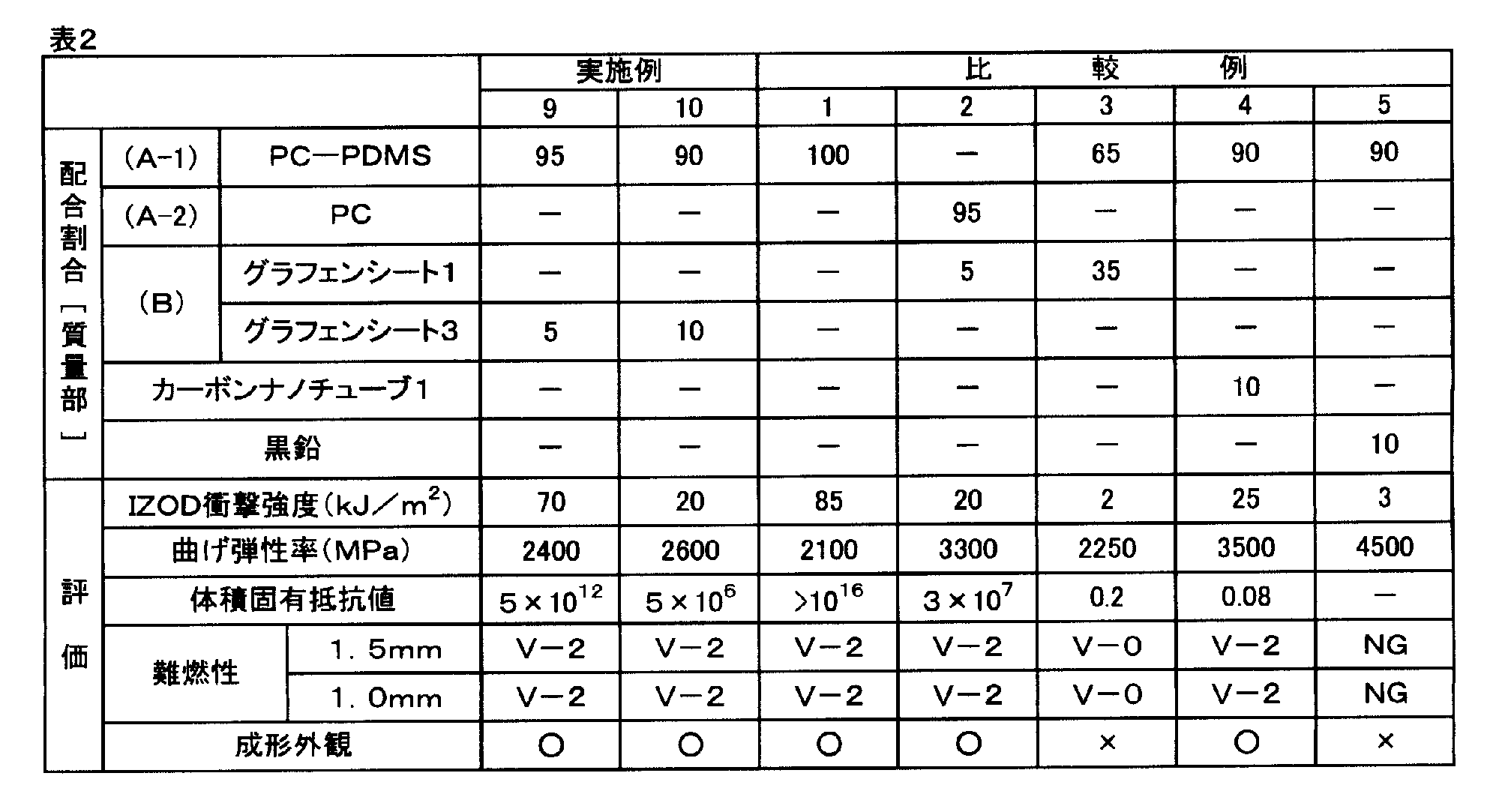
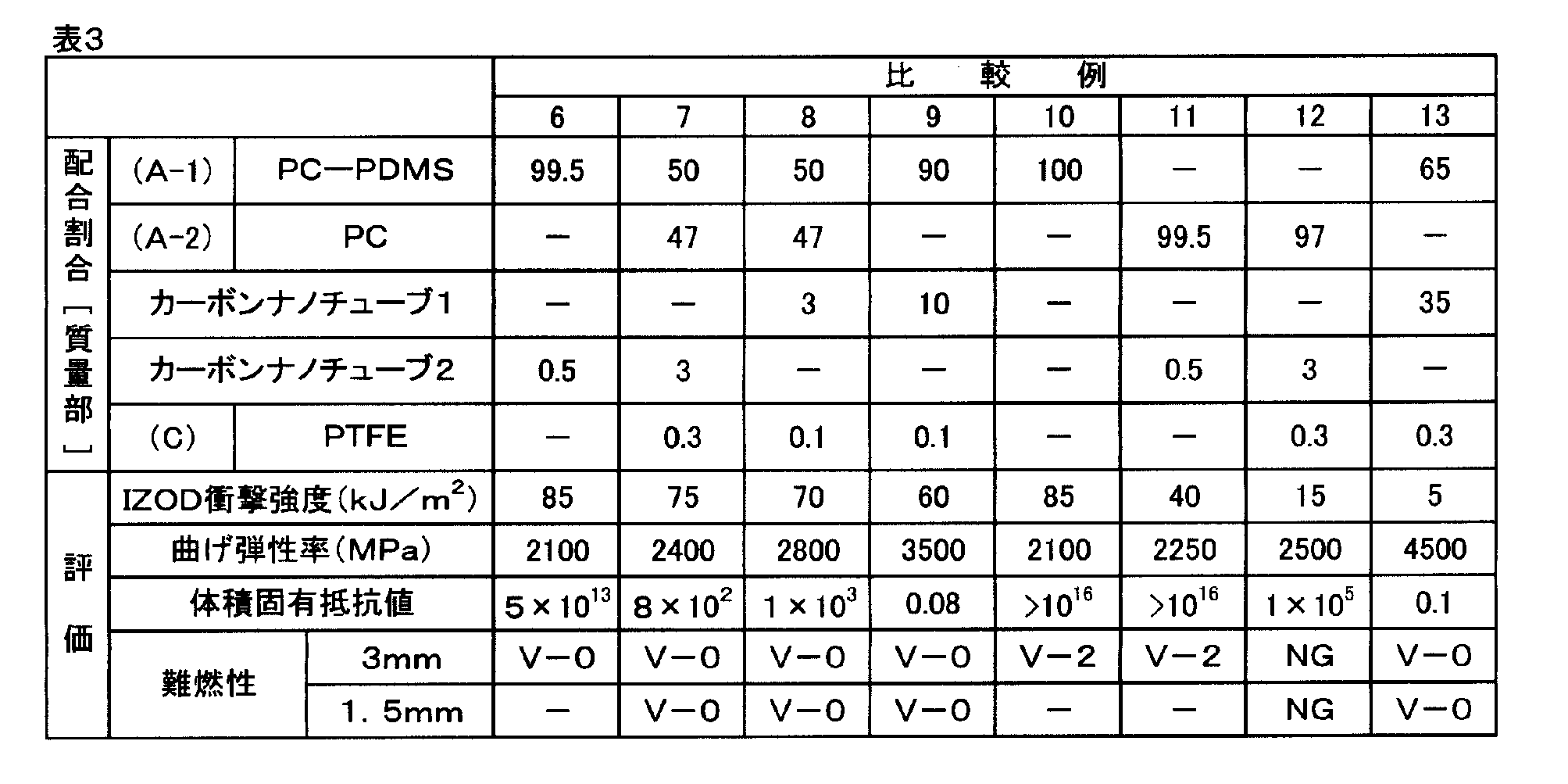
- the polycarbonate resin composition belonging to the present invention contains a graphene sheet at a specific ratio, so that high flame retardancy is obtained and a reduction in impact strength is reduced. It is also excellent in rigidity, conductivity and molded appearance.
- the impact strength and flame retardancy are excellent.
- the flame retardance of a thin wall is attained.
- the carbon nanotubes used in the comparative examples are inferior in rigidity and flame retardancy compared with the graphene sheet, and the micro-order graphite not only significantly reduces the impact strength but also reduces the flame retardancy. End up.
- the polycarbonate resin composition of the present invention can give a molded article excellent in flame retardancy, rigidity, impact resistance, conductivity, molded appearance, and thermal conductivity.
- This molded body is expected to expand its application fields such as housings, parts, films, and automobile parts of electrical / electronic equipment such as OA equipment, information equipment, and home appliances.
Landscapes
- Chemical & Material Sciences (AREA)
- Health & Medical Sciences (AREA)
- Chemical Kinetics & Catalysis (AREA)
- Medicinal Chemistry (AREA)
- Polymers & Plastics (AREA)
- Organic Chemistry (AREA)
- Engineering & Computer Science (AREA)
- Manufacturing & Machinery (AREA)
- Materials Engineering (AREA)
- Compositions Of Macromolecular Compounds (AREA)
Abstract
Description
また、炭素繊維を導電性フィラーして使用する場合、一般の補強用炭素繊維により、所望の強度、弾性率を得ることができるが、導電性を付与するには高充填を必要とし、樹脂本来の物性が低下する。
また、特許文献2は、ポリカーボネートに黒鉛を配合し、熱伝導性を付与する技術であるが、難燃剤の併用でなければ、難燃性は発現せず、また、導電性や剛性についての記載はない。特許文献2には、ナノオーダーの厚さであるグラフェンについての記載はなく、ナノオーダーの厚さであるグラフェンの分散は、通常の押出機を使った製造では困難であり、グラフェンの持つ優れた性能を十分に発現するには到っていない。さらに、特許文献3は、官能性グラフェンを配合する技術であるが、ポリカーボネート材料において、難燃性や導電性に最適なグラフェンについての記載はない。
本発明は、このような状況下になされたものであり、難燃性、剛性、耐衝撃性、導電性及び成形外観、さらには熱伝導性などに優れた成形体を与えるポリカーボネート樹脂組成物及び該樹脂組成物を成形してなる上記性状を有する成形体を提供することを目的とするものである。
(1)ポリカーボネート-ポリオルガノシロキサン共重合体(A-1)と、(A-1)以外の芳香族ポリカーボネート(A-2)との質量比が5:95~100:0からなるポリカーボネート系樹脂(A)70~99.5質量%、及びグラフェンシート(B)30~0.5質量%を含むことを特徴とするポリカーボネート樹脂組成物。
(2)グラフェンシート(B)の厚さが5~10nmであり、かつ大きさが3μm以上である上記(1)に記載のポリカーボネート樹脂組成物。
(3)ポリカーボネート-ポリオルガノシロキサン共重合体(A-1)は、主鎖が一般式(I)で表される構造単位及び一般式(II)で表される構造単位を含み、かつ該一般式(II)で表される構造単位からなるポリオルガノシロキサンブロックを2~40質量%含むものである上記(1)又は(2)に記載のポリカーボネート樹脂組成物。
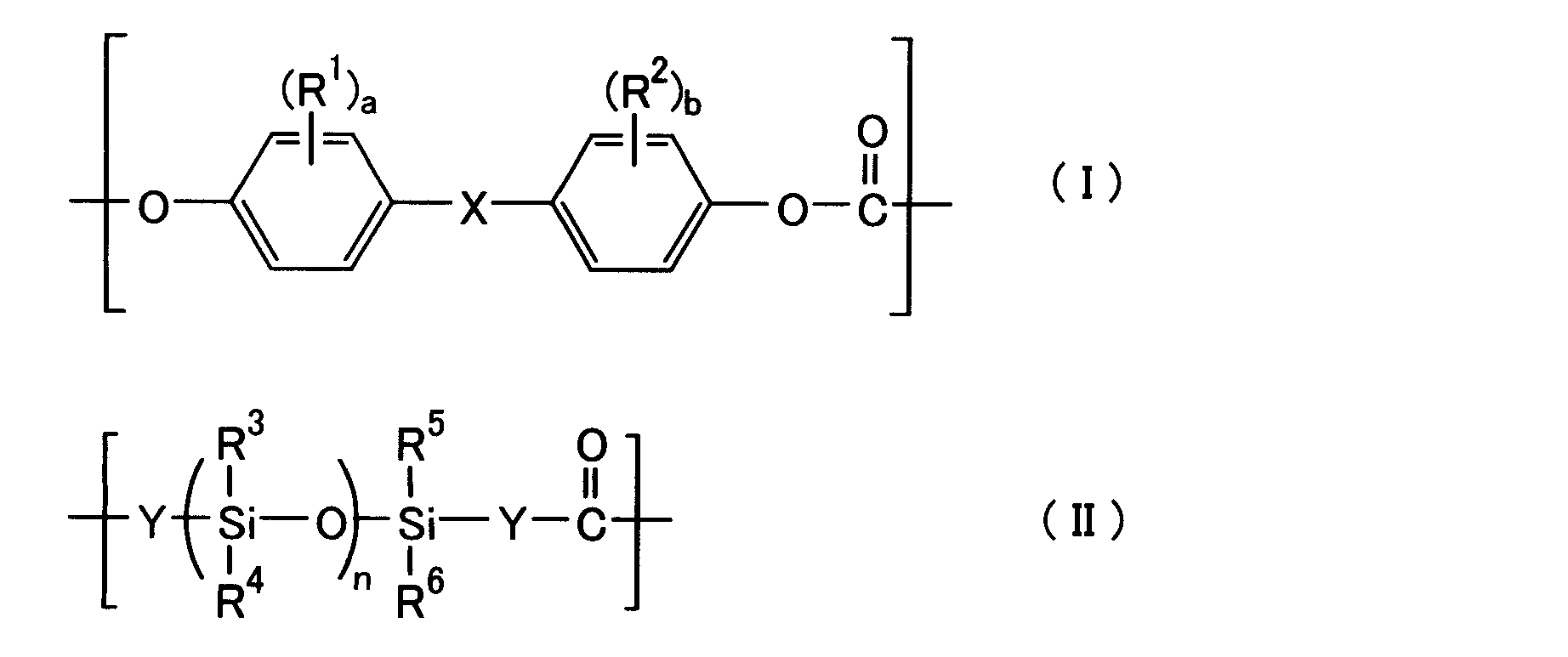
(4)Yがアリルフェノールまたはオイゲノールからの有機残基である上記(3)に記載のポリカーボネート樹脂組成物。
(5)一般式(I)で表される構造単位が、ビスフェノールAから誘導された構造単位である上記(3)又は(4)に記載のポリカーボネート樹脂組成物。
(6)一般式(II)で表される構造単位中のR3及びR4が共にメチル基である上記(3)~(5)のいずれかに記載のポリカーボネート樹脂組成物。
(7)更に、ポリテトラフルオロエチレン(C)を(A)成分と(B)成分との合計量100質量部に対して0.01~1質量部を含有してなる上記(1)~(6)のいずれかに記載のポリカーボネート樹脂組成物。
(8)上記(1)~(7)のいずれかに記載のポリカーボネート樹脂組成物を成形してなる成形体。
また、本発明の成形体は、上記の性状を有すると共に、カーボンの脱落による半導体等の汚染を起こすことがないことから、OA機器、情報機器、家庭電化機器等の電気・電子機器のハウジング、部品、フィルム、さらには自動車部品等その応用分野の拡大が期待される。
[ポリカーボネート樹脂組成物]
本発明のポリカーボネート樹脂組成物は、ポリカーボネート-ポリオルガノシロキサン共重合体(A-1)と、(A-1)以外の芳香族ポリカーボネート(A-2)との質量比が5:95~100:0からなるポリカーボネート系樹脂(A)70~99.5質量%及びグラフェンシート(B)30~0.5質量%を含むことを特徴とする。
以下、本発明のポリカーボネート樹脂組成物中の各成分について説明する。
本発明で用いるポリカーボネート-ポリオルガノシロキサン共重合体(A-1)は、主鎖が下記一般式(I)で表される構造単位及び下記一般式(II)で表される構造単位を含み、かつ該一般式(II)で表される構造単位からなるポリオルガノシロキサンブロックを2~40質量%含むものが好ましい。なお、本明細書において、ポリカーボネート-ポリオルガノシロキサン共重合体を「PC-PDMS共重合体」ということがある。

また、得られるポリカーボネート樹脂組成物の性能の観点から、前記一般式(I)で表される構造単位が、ビスフェノールAから誘導される構造単位であるものが好ましく、前記一般式(II)で表される構造単位中のR3及びR4が共にメチル基であるものが好ましい。
成形温度を上げることにより、樹脂組成物の粘度を下げることも可能であるが、その場合、成形サイクルが長くなり経済性に劣るほか、温度を上げすぎると樹脂組成物の熱劣化により生産安定性が低下する。
したがって、PC-PDMS共重合体(A-1)の粘度平均分子量は、好ましくは15000~24000、より好ましくは16000~22500、更に好ましくは17000~21000である。
粘度平均分子量が15000以上であると成形品の強度が十分であり、24000以下であると共重合体の粘度が小さくなるため製造時の生産性が良好であるほか、薄肉の成形も良好となる。

ビスフェノールA以外の二価フェノールとしては、例えば、ビス(4-ヒドロキシフェニル)メタン、1,1-ビス(4-ヒドロキシフェニル)エタン、2,2-ビス(4-ヒドロキシフェニル)ブタン、2,2-ビス(4-ヒドロキシフェニル)オクタン、ビス(4-ヒドロキシフェニル)フェニルメタン、ビス(4-ヒドロキシフェニル)ジフェニルメタン、2,2-ビス(4-ヒドロキシ-3-メチルフェニル)プロパン、ビス(4-ヒドロキシフェニル)ナフチルメタン、1,1-ビス(4-ヒドロキシ-t-ブチルフェニル)プロパン、2,2-ビス(4-ヒドロキシ-3-ブロモフェニル)プロパン、2,2-ビス(4-ヒドロキシ-3,5-テトラメチルフェニル)プロパン、2,2-ビス(4-ヒドロキシ-3-クロロフェニル)プロパン、2,2-ビス(4-ヒドロキシ-3,5-ジクロロフェニル)プロパン、2,2-ビス(4-ヒドロキシ-3,5-ジブロモフェニル)プロパン等のビス(ヒドロキシアリール)アルカン類、1,1-ビス(4-ヒドロキシフェニル)シクロペンタン、1,1-ビス(4-ヒドロキシフェニル)シクロヘキサン、1,1-ビス(4-ヒドロキシフェニル)-3,5,5-トリメチルシクロヘキサン、2,2-ビス(4-ヒドロキシフェニル)ノルボルナン、1,1-ビス(4-ヒドロキシフェニル)シクロドデカン等のビス(ヒドロキシアリール)シクロアルカン類、4,4’-ジヒドロキシフェニルエーテル、4,4’-ジヒドロキシ-3,3’-ジメチルフェニルエーテル等のジヒドロキシアリールエーテル類、4,4’-ジヒドロキシジフェニルスルフィド、4,4’-ジヒドロキシ-3,3’-ジメチルジフェニルスルフィド等のジヒドロキシジアリールスルフィド類、4,4’-ジヒドロキシジフェニルスルホキシド、4,4’-ジヒドロキシ-3,3’-ジメチルジフェニルスルホキシド等のジヒドロキシジアリールスルホキシド類、4,4’-ジヒドロキシジフェニルスルホン、4,4’-ジヒドロキシ-3,3’-ジメチルジフェニルスルホン等のジヒドロキシジアリールスルホン類、4,4’-ジヒドロキシジフェニル等のジヒドロキシジフェニル類、9,9-ビス(4-ヒドロキシフェニル)フルオレン、9,9-ビス(4-ヒドロキシ-3-メチルフェニル)フルオレン等のジヒドロキシジアリールフルオレン類、ビス(4-ヒドロキシフェニル)ジフェニルメタン、1,3-ビス(4-ヒドロキシフェニル)アダマンタン、2,2-ビス(4-ヒドロキシフェニル)アダマンタン、1,3-ビス(4-ヒドロキシフェニル)-5,7-ジメチルアダマンタン等のジヒドロキシジアリールアダマンタン類、4,4’-[1,3-フェニレンビス(1-メチルエチリデン)]ビスフェノール、10,10-ビス(4-ヒドロキシフェニル)-9-アントロン、1,5-ビス(4-ヒドロキシフェニルチオ)-2,3-ジオキサペンタエン等が挙げられる。
これらの二価フェノールは、単独で又は二種以上を混合して用いてもよい。
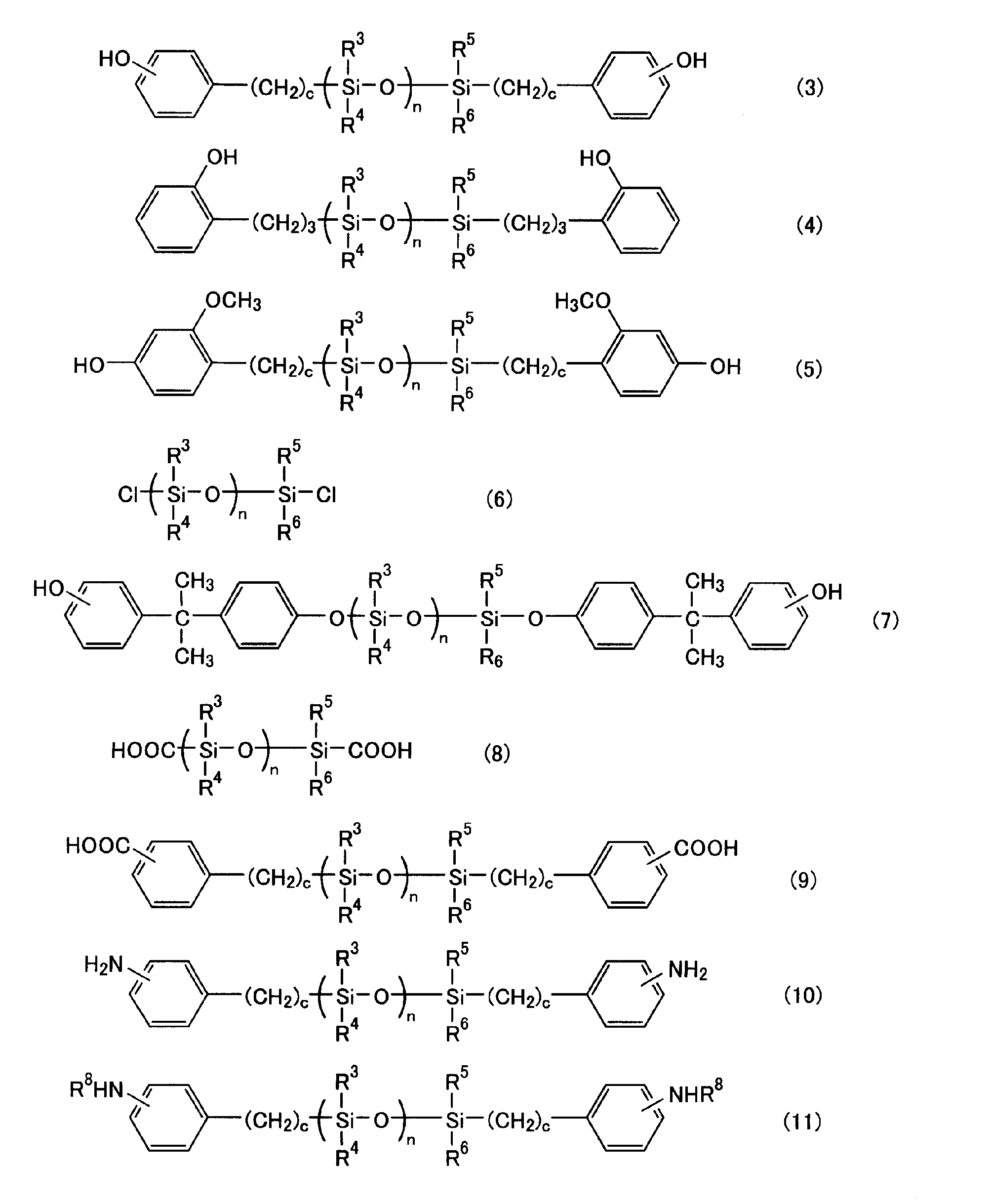
これらの中でも、重合の容易さの観点においては、一般式(3)に示すフェノール変性ポリオルガノシロキサンが好ましい。また、入手の容易さの観点においては、一般式(4)に示す化合物中の一種であるα,ω-ビス[3-(o-ヒドロキシフェニル)プロピル]ポリジメチルシロキサン、一般式(5)に示す化合物中の一種であるα,ω-ビス[3-(4-ヒドロキシ-2-メトキシフェニル)プロピル]ポリジメチルシロキサンが好ましい。
まず、シクロトリシロキサンとジシロキサンとを酸性触媒存在下で反応させ、α,ω-ジハイドロジェンオルガノポリシロキサンを合成する。このとき、シクロトリシロキサンとジシロキサンとの仕込み比を変えることで所望の平均繰り返し単位を持つα,ω-ジハイドロジェンオルガノポリシロキサンを合成することができる。次いで、ヒドロシリル化反応用触媒の存在下に、このα,ω-ジハイドロジェンオルガノポリシロキサンにアリルフェノールやオイゲノール等の不飽和脂肪族炭化水素基を有するフェノール化合物を付加反応させることで、所望の平均繰り返し単位を有するフェノール変性ポリオルガノシロキサンを製造することができる。
また、この段階では、低分子量の環状ポリオルガノシロキサンや過剰量の上記フェノール化合物が不純物として残存するために、減圧下で加熱し、これらの低分子化合物を留去することが好ましい。
本発明のポリカーボネート樹脂組成物において、前記(A-1)以外の芳香族ポリカーボネートである(A-2)成分は、反応に不活性な有機溶媒、アルカリ水溶液の存在下、二価フェノール系化合物及びホスゲンと反応させた後、第三級アミンもしくは第四級アンモニウム塩等の重合触媒を添加して重合させる界面重合法や、二価フェノール系化合物をピリジン又はピリジンと不活性溶媒の混合溶液に溶解し、ホスゲンを導入し直接製造するピリジン法等従来の芳香族ポリカーボネートの製造法により得られるものが使用できる。
具体的な分子量調節剤としては、一価フェノールとして、例えば、フェノール、o-n-ブチルフェノール、m-n-ブチルフェノール、p-n-ブチルフェノール、o-イソブチルフェノール、m-イソブチルフェノール、p-イソブチルフェノール、o-t-ブチルフェノール、m-t-ブチルフェノール、p-t-ブチルフェノール、o-n-ペンチルフェノール、m-n-ペンチルフェノール、p-n-ペンチルフェノール、o-n-ヘキシルフェノール、m-n-ヘキシルフェノール、p-n-ヘキシルフェノール、p-t-オクチルフェノール、o-シクロヘキシルフェノール、m-シクロヘキシルフェノール、p-シクロヘキシルフェノール、o-フェニルフェノール、m-フェニルフェノール、p-フェニルフェノール、o-n-ノニルフェノール、m-ノニルフェノール、p-n-ノニルフェノール、o-クミルフェノール、m-クミルフェノール、p-クミルフェノール、o-ナフチルフェノール、m-ナフチルフェノール、p-ナフチルフェノール、2,5-ジ-t-ブチルフェノール、2,4-ジ-t-ブチルフェノール、3,5-ジ-t-ブチルフェノール、2,5-ジクミルフェノール、3,5-ジクミルフェノール、p-クレゾール、ブロモフェノール、トリブロモフェノール、平均炭素数12~35の直鎖状又は分岐状のアルキル基をオルト位、メタ位又はパラ位に有するモノアルキルフェノール、9-(4-ヒドロキシフェニル)-9-(4-メトキシフェニル)フルオレン、9-(4-ヒドロキシ-3-メチルフェニル)-9-(4-メトキシ-3-メチルフェニル)フルオレン、4-(1-アダマンチル)フェノール等が挙げられる。
これらの一価フェノールの中では、p-t-ブチルフェノール、p-クミルフェノール、p-フェニルフェノール等が好ましい。また、これらの化合物は、単独で又は二種以上の化合物を併用して用いることができる。
分岐化剤としては、例えば、1,1,1-トリス(4-ヒドロキシフェニル)エタン、4,4’-[1-[4-[1-(4-ヒドロキシフェニル)-1-メチルエチル]フェニル]エチリデン]ビスフェノール、α,α’,α”-トリス(4-ヒドロキシフェニル)-1,3,5-トリイソプロピルベンゼン、1-[α-メチル-α-(4’-ヒドロキシフェニル)エチル]-4-[α’,α’-ビス(4”-ヒドロキシフェニル)エチル]ベンゼン、フロログリシン、トリメリト酸、イサチンビス(o-クレゾール)等の官能基を3つ以上有する化合物が挙げられる。
(A-1)の含有量が5質量%以上、もしくは(A-2)の含有量が95質量%以下である場合、ポリカーボネート系樹脂(A)中のポリオルガノシロキサンブロック部分の含有量を多くし、低温衝撃強度を向上させるために、(A-1)成分の製造時に、一般式(II)で表される構造単位を含むポリオルガノシロキサンブロック部分の含有量を多くする必要がなく、したがって、(A-1)成分の製造時において、重合工程で反応の均一性が低下することがなく、また重合物の洗浄工程で重合物と洗浄水との分離性が悪化することがないため、(A-1)成分の生産性が良好となる。
一般式(II)の構造単位を有するポリオルガノシロキサンブロック部分の含有量は、(A-1)成分及び(A-2)成分からなるポリカーボネート系樹脂(A)中、好ましくは0.1~40質量%、より好ましくは0.5~25質量%、更に好ましくは0.5~15質量%、より更に好ましくは0.5~10質量%である。0.1質量%以上であれば耐衝撃強さ向上の効果が十分であり、一方、40質量%以下であれば十分な難燃性、耐熱性を有する。
本発明のポリカーボネート樹脂組成物においては、成形体に難燃性、導電性、剛性、成形外観、及び熱伝導性などの性状を付与するために、(B)成分としてグラフェンシートを含有することを要する。
グラフェンシートとは、1つまたは複数層のグラフェン面を有するグラフェン板のことであり、通常、超音波エネルギーを用いて薄片状にされ、薄片化のレベルは音波発生(sonification)時間を調整することによって制御することができる。
本発明に用いるグラフェンシートは、厚さが5~10nmであることが好ましく、大きさが3μm以上であることが好ましい。本発明に用いるグラフェンシートの厚さが5~10nm及び大きさが3μm以上であれば、グラフェンシートの分散性が向上し、樹脂と複合化しやすく、難燃性、導電性、剛性、成形外観、さらには熱伝導性に優れる成形体が得られる。上記の観点から、グラフェンシートの厚さは、6~8nmが好ましく、グラフェンシートの大きさは、3~30μmが好ましく、5~25μmがより好ましく、5~20μmが更に好ましい。上記で述べた性状の中で、より高い導電性を付与させる観点からは、グラフェンシートの大きさが5~30μmであることが好ましく、5~20μmであることがより好ましい。
本発明において、グラフェンシートは板状の形状をしており、その厚さとは、グラフェンシートが重なってできる厚み方向の大きさであり、大きさとは、グラフェン構造そのものの大きさであり、実施例に記載の方法により測定することができる。
製品としては、XG Sciences社製造の「xGnP」(グラフェン・ナノプレートレット)などがある。カーボンナノチューブと対照的にオープンでフラットな形状の為、周囲のエッジ部に官能基を導入したり、表面に界面処理剤を施すことも可能である。
本発明のポリカーボネート樹脂組成物においては、溶融滴下防止効果を有し、高い難燃性を付与するために、(C)成分としてポリテトラフルオロエチレンを含有することが好ましい。
当該ポリテトラフルオロエチレン(C)は、フィブリル形成能を有する平均分子量500,000以上のポリテトラフルオロエチレン(以下、PTFEと略称する。)であり、溶融滴下防止効果を有し、高い難燃性を付与することができる。その平均分子量は500,000以上であることが必要であり、好ましくは500,000~10,000,000、さらに好ましくは1,000,000~10,000,000である。
フィブリル形成能を有するPTFEとしては、特に制限はないが、具体的には、“テフロン(登録商標)”6-J(三井・デュポンフロロケミカル社製)、ポリフロンD-1、ポリフロンF-103、ポリフロンF201、ポリフロンMPA FA-100(ダイキン工業社製)、CD076(旭硝子フロロポリマーズ社製)及びアルゴフロンF5(モンテフルオス社製)等を挙げることができる。
当該PTFEの含有量は、前述したポリカーボネート系樹脂(A)と、グラフェンシート(B)との合計量100質量部に対して、通常0.01~1質量部であり、好ましくは0.05~0.9質量部、より好ましくは0.1~0.8質量部である。当該PTFEの含有量が上記範囲にあれば、目的とする難燃性における溶融滴下防止性が十分となる。
当該混合粉体におけるポリテトラフルオロエチレン粒子は、粒子径が、通常10μm以下であり、好ましくは0.05~1.0μmである。
ポリテトラフルオロエチレン粒子は、例えば乳化剤等を含んだ水に分散した、水性分散液として調製される。このポリテトラフルオロエチレン粒子の水性分散液は、含フッ素界面活性剤を用い、テトラフルオロエチレンモノマーを乳化重合することにより得られる。
共重合成分の含有量は、好ましくは、ポリテトラフルオロエチレン粒子中のテトラフルオロエチレンに対して10質量%以下である。
当該混合粉体における有機系重合体粒子としては、特に制限されるものではないが、ポリカーボネート系樹脂(A)に配合する際のポリテトラフルオロエチレン粒子の分散性の観点から、ポリカーボネート樹脂に親和性を有するものであることが好ましい。
ポリテトラフルオロエチレン粒子及び有機系重合体粒子からなる混合粉体の含有量は、ポリカーボネート系樹脂(A)とグラフェンシート(B)との合計量100質量部に対して、通常0.1~1質量部であり、好ましくは0.1~0.9質量部、より好ましくは0.2~0.8質量部である。
上記混合粉体の含有量が0.1質量部以上ではドリップ性能が良好であり、難燃性が達成できる。一方、1質量部以下であれば、組成物中の有機系重合体の割合が増加しすぎることがなく、難燃性が達成できる。
本発明のポリカーボネート樹脂組成物においては、前述した(A)成分、(B)成分、及び(C)成分又は混合粉体以外に、本発明の効果が損なわれない範囲で、必要に応じて、従来ポリカーボネート樹脂組成物に添加される公知の各種添加成分を含有することができる。このような添加成分としては、例えばリン系酸化防止剤、難燃向上剤としての有機スルホン酸のアルカリ(土類)金属塩、補強材、充填剤、ヒンダードアミン系光安定剤、リン系以外の酸化防止剤、紫外線吸収剤、帯電防止剤、滑剤、離型剤、染料、顔料、耐衝撃性改良用のエラストマー等が挙げられる。
本発明で用いるリン系酸化防止剤としては、特に制限はない。代表的な例としては、トリス(ノニルフェニル)ホスファイト、2-エチルヘキシジフェニルホスファイトの他、トリメチルホスファイト、トリエチルホスファイト、トリブチルホスファイト、トリオクチルホスファイト、トリノニルホスファイト、トリデシルホスファイト、トリオクタデシルホスファイト、ジステアリルペンタエリスチルジホスファイト、トリス(2-クロロエチル)ホスファイト、トリス(2,3-ジクロロプロピル)ホスファイト等のトリアルキルホスファイト、トリシクロヘキシルホスファイト等のトリシクロアルキルホスファイト、トリフェニルホスファイト、トリクレジルホスファイト、トリス(エチルフェニル)ホスファイト、トリス(ブチルフェニル)ホスファイト、トリス(ヒドロキシフェニル)ホスファイト、トリス(2,4-ジ-tert-ブチルフェニル)ホスファイト等のトリアリールホスファイト、トリメチルホスフェイト、トリエチルホスフェイト、トリブチルホスフェイト、トリオクチルホスフェイト、トリデシルホスフェイト、トリオクタデシルホスフェイト、ジステアリルペンタエリスリチルジホスフェイト、トリス(2-クロロエチル)ホスフェイト、トリス(2,3-ジクロロプロピル)ホフェイト等のトリアルキルホスフェイト、トリシクロヘキシ-1-ホスフェイト等のトリシクロアルキルホスフェイト、トリフェニルホスフェイト、トリクレジルホスフェイト、トリス(ノニルフェニル)ホスフェイト、2-エチルフェニルジフェニルホスフェイト等のトリアリールホスフェイトなどが挙げられる。この中では、トリアリールホスファイト及びトリアリールホスフェイトが好適に用いられる。
本発明のポリカーボネート樹脂組成物においては、難燃性を向上させるために、有機スルホン酸のアルカリ金属塩及び/又はアルカリ土類金属塩(以下、有機スルホン酸アルカリ(土類)金属塩、ともいう)を含有することができる。
有機スルホン酸としては、パーフルオロアルカンスルホン酸やポリスチレンスルホン酸等が挙げられる。
有機スルホン酸アルカリ(土類)金属塩としては、種々のものが挙げられるが、少なくとも一つの炭素原子を有する有機スルホン酸アルカリ金属塩やアルカリ土類金属塩である。
アルカリ金属としては、ナトリウム、カリウム、リチウム及びセシウム等が挙げられ、アルカリ土類金属としては、マグネシウム、カルシウム、ストロンチウム及びバリウム等が挙げられる。これら中でも、ナトリウム、カリウム及びセシウムの塩が好ましい。
(C)成分としては、パーフルオロアルカンスルホン酸又はポリスチレンスルホン酸のアルカリ金属塩及び/又はアルカリ土類金属塩が好ましい。
(CdF2d+1SO3)eM ・・・(12)
式(12)中、dは1~10の整数を示し、Mはリチウム、ナトリウム、カリウム及びセシウム等のアリカリ金属、又はマグネシウム、カルシウム、ストロンチウム及びバリウム等のアルカリ土類金属を示し、eはMの原子価を示す。
これらの金属塩としては、例えば、特公昭47-40445号公報に記載されているものが該当する。
その他、アルキルスルホン酸、ベンゼンスルホン酸、アルキルベンゼンスルホン酸、ジフェニルスルホン酸、ナフタレンスルホン酸、2,5-ジクロロベンゼンスルホン酸、2,4,5-トリクロロベンゼンスルホン酸、ジフェニルスルホン-3-スルホン酸、ジフェニルスルホン-3,3’-ジスルホン酸、ナフタレントリスルホン酸及びこれらのフッ素置換体並びにポリスチレンスルホン酸等の有機スルホン酸のアルカリ金属塩やアルカリ土類金属塩等を挙げられる。これらの中でも、特に、有機スルホン酸として、パーフルオロアルカンスルホン酸及びジフェニルスルホン酸が好ましい。

ここで、Qのスルホン酸塩基は、スルホン酸のアルカリ金属塩及び/又はアルカリ土類金属塩であり、金属としては、ナトリウム、カリウム、リチウム、ルビジウム、セシウム、ベリリウム、マグネシウム、カルシウム、ストロンチウム及びバリウム等が挙げられる。
また、R9は、水素原子又は炭素数1~10の炭化水素基であるが、好ましくは水素原子又はメチル基である。
sは1~5の整数であり、tは、0<t≦1の関係である。そのため、スルホン酸塩基(Q)は、芳香環に対して、全置換したもの、部分置換したものを含んでもよい。
本発明のポリカーボネート樹脂組成物は、前述した(A)成分[(A-1)及び(A-2)]、(B)成分及び必要に応じて用いられる(C)成分又は混合粉体、さらには各種任意成分を所定の割合で配合し、混練することにより、調製することができる。
この際の配合及び混練は、通常用いられている機器、例えば、リボンブレンダー、ドラムタンブラー等で予備混合して、ヘンシェルミキサー、バンバリーミキサー、単軸スクリュー押出機、二軸スクリュー押出機、多軸スクリュー押出機、コニーダ等を用いる方法で行うことができる。
混練の際の加熱温度は、通常240~300℃の範囲で適宜選択される。
尚、ポリカーボネート系樹脂以外の含有成分は、予め、ポリカーボネート系樹脂と溶融混練、即ち、マスターバッチとして添加することもできる。
特に、上記溶融混練方法により、ペレット状の成形原料を製造し、次いで、このペレットを用いて、射出成形、射出圧縮成形による射出成形品の製造に好適に用いることができる。
尚、射出成形方法としては、外観のヒケ防止のため、又は、軽量化のためのガス注入成形方法を採用することもできる。
なお、各例における特性値は、以下に示す要領に従って求めた。
これらの粘度平均分子量(Mv)は、ウベローデ型粘度計を用いて、20℃における塩化メチレン溶液の粘度を測定し、これより極限粘度[η]を求め、次式にて算出するものである。
[η]=1.23×10⁻⁵Mv0.83
(試験片の作製方法)
第1表~第3表に示す割合で各成分を配合し、押出機(機種名:VS40、田辺プラスチック機械(株)製)に供給し、240℃で溶融混練し、ペレット化した。なお、すべての実施例及び比較例において、酸化防止剤としてイルガノックス1076(BASFジャパン(株)製)0.2質量部を配合した。得られたペレットを、120℃で12時間乾燥させ後、射出成形機(東芝機械(株)製、型式:IS100N)シリンダー温度260℃、金型温度80℃の条件で射出成形して試験片を得た。得られた試験片を用いて、以下の測定を行い、性能を評価した。
(2)曲げ弾性率:ASTM D-790に準拠(試験条件等:23℃、4mm)、単位:MPa
(3)体積固有抵抗値:JIS K6911に準拠(試験平板:80×80×3mm)、単位:Ω・cm
(4)難燃性UL94燃焼試験に準拠(試験片厚み:1.5mm、1.0mm、又は3.0mm)
(5)成形外観;以下の基準にて評価した。
○:良好、×:表面にブツ等不良外観有り
グラフェンシートの厚さ及び大きさは、電子顕微鏡の観察により測定した。
400リットルの5質量%水酸化ナトリウム水溶液に、60kgのビスフェノールAを溶解させ、ビスフェノールAの水酸化ナトリウム水溶液を調製した。
次いで、室温に保持したこのビスフェノールAの水酸化ナトリウム水溶液を138リットル/時間の流量で、また、塩化メチレンを69リットル/時間の流量で、内径10mm、管長10mの管型反応器にオリフィス板を通して導入し、これにホスゲンを並流して10.7kg/時間の流量で吹き込み、3時間連続的に反応させた。ここで用いた管型反応器は二重管となっており、ジャケット部分には冷却水を通して反応液の排出温度を25℃に保った。また、排出液のpHは10~11となるように調整した。
このようにして得られた反応液を静置することにより、水相を分離、除去し、塩化メチレン相(220リットル)を採取して、PCオリゴマー(濃度317g/リットル)を得た。ここで得られたPCオリゴマーの重合度は2~4であり、クロロホーメイト基の濃度は0.7モル/Lであった。
1,483gのオクタメチルシクロテトラシロキサン、96gの1,1,3,3-テトラメチルジシロキサン及び35gの86質量%硫酸を混合し、室温で17時間攪拌した。その後、オイル相を分離し、25gの炭酸水素ナトリウムを加え1時間攪拌した。濾過した後、150℃、3torr(4×10²Pa)で真空蒸留し、低沸点物を除きオイルを得た。
60gの2-アリルフェノールと0.0014gの塩化白金-アルコラート錯体としてのプラチナとの混合物に、上記で得られたオイル294gを90℃の温度で添加した。この混合物を90~115℃の温度に保ちながら3時間攪拌した。生成物を塩化メチレンで抽出し、80質量%の水性メタノールで3回洗浄し、過剰の2-アリルフェノールを除いた。その生成物を無水硫酸ナトリウムで乾燥し、真空中で115℃に加熱して溶剤を留去した。得られた末端フェノールPDMSは、NMRの測定により、ジメチルシラノオキシ単位の繰り返し数は30であった。
製造例2で得られた反応性PDMS182gを塩化メチレン2リットルに溶解させ、製造例1で得られたPCオリゴマー10リットルを混合した。そこへ、水酸化ナトリウム26gを水1リットルに溶解させたものと、トリエチルアミン5.7cm3を加え、500rpmで室温にて1時間攪拌、反応させた。
反応終了後、上記反応系に、5.2質量%の水酸化ナトリウム水溶液5リットルにビスフェノールA600gを溶解させたもの、塩化メチレン8リットル及びp-t-ブチルフェノ-ル96gを加え、500rpmで室温にて2時間攪拌、反応させた。
反応後、塩化メチレン5リットルを加え、さらに、水5リットルで水洗、0.03モル/L水酸化ナトリウム水溶液5リットルでアルカリ洗浄、0.2モル/L塩酸5リットルで酸洗浄、及び水5リットルで水洗2回を順次行い、最後に塩化メチレンを除去し、フレーク状のPC-PDMS共重合体を得た。得られたPC-PDMS共重合体を120℃で24時間真空乾燥した。粘度平均分子量は17,000であり、PDMS含有率は4.0質量%であった。
なお、PDMS含有率は、1H-NMRで1.7ppmに見られるビスフェノールAのイソプロピルのメチル基のピークと、0.2ppmに見られるジメチルシロキサンのメチル基のピークとの強度比を基に求めた。
前述した「試験片の作製方法」に従って、各例における試験片をそれぞれ作製し、この試験片を用いて性能を各種試験によって評価した。その結果を第1表~第3表に示す。

(A)成分:
(A-1)PC-PDMS:製造例3で得られた、粘度平均分子量が17,000、PDMS含有率が4.0質量%のPC-PDMS共重合体
(A-2)PC:「FN1900A」(出光興産(株)製)、粘度平均分子量19,500
(B)成分:
グラフェンシート1:「グラフェン・ナノプレートレットxGnP」(XG Sciences社製)、厚さ6~8nm、大きさ(シートサイズ)5μm
グラフェンシート2:「グラフェン・ナノプレートレットxGnP」(XG Sciences社製)、厚さ6~8nm、大きさ(シートサイズ)15μm
グラフェンシート3:「グラフェン・ナノプレートレットxGnP」(XG Sciences社製)、厚さ2~4nm、大きさ(シートサイズ)2μm
(C)成分:
PTFE:PTFE「CD076」(旭硝子フロロポリマーズ(株)製)
その他の成分:
カーボンナノチューブ1:マルチウォール直径50~100nm、長さ1~10μm、両端開口、アモルファスカーボン量15質量%(サンナノテック社製)
カーボンナノチューブ2:マルチウォール直径10~30nm、長さ1~10μm、両端開口、アモルファスカーボン量15質量%(サンナノテック社製)
黒鉛:「PC99-300M」(伊東黒鉛工業(株)製)、平均粒径56μm、厚さ1.7μm
一方、比較例で用いたカーボンナノチューブでは、グラフェンシートと比較し、剛性と難燃性に劣り、また、マイクロオーダーの黒鉛では、衝撃強度が著しく低下するだけではなく、難燃性が低下してしまう。
Claims (8)
- ポリカーボネート-ポリオルガノシロキサン共重合体(A-1)と、(A-1)以外の芳香族ポリカーボネート(A-2)との質量比が5:95~100:0からなるポリカーボネート系樹脂(A)70~99.5質量%、及びグラフェンシート(B)30~0.5質量%を含むことを特徴とするポリカーボネート樹脂組成物。
- グラフェンシート(B)厚さが5~10nmであり、かつ大きさが3μm以上である請求項1に記載のポリカーボネート樹脂組成物。
- ポリカーボネート-ポリオルガノシロキサン共重合体(A-1)は、主鎖が一般式(I)で表される構造単位及び一般式(II)で表される構造単位を含み、かつ該一般式(II)で表される構造単位からなるポリオルガノシロキサンブロックを2~40質量%含むものである請求項1又は2に記載のポリカーボネート樹脂組成物。

- Yがアリルフェノールまたはオイゲノールからの有機残基である請求項3に記載のポリカーボネート樹脂組成物。
- 一般式(I)で表される構造単位が、ビスフェノールAから誘導された構造単位である請求項3又は4に記載のポリカーボネート樹脂組成物。
- 一般式(II)で表される構造単位中のR3及びR4が共にメチル基である請求項3~5のいずれかに記載のポリカーボネート樹脂組成物。
- 更に、ポリテトラフルオロエチレン(C)を(A)成分と(B)成分との合計量100質量部に対して0.01~1質量部を含有してなる請求項1~6のいずれかに記載のポリカーボネート樹脂組成物。
- 請求項1~7のいずれかに記載のポリカーボネート樹脂組成物を成形してなる成形体。
Priority Applications (3)
| Application Number | Priority Date | Filing Date | Title |
|---|---|---|---|
| KR1020137033336A KR101903214B1 (ko) | 2011-06-17 | 2012-06-12 | 폴리카보네이트 수지 조성물 및 그것을 사용한 성형체 |
| JP2013520555A JP5988971B2 (ja) | 2011-06-17 | 2012-06-12 | ポリカーボネート樹脂組成物及びそれを用いた成形体 |
| CN201280029564.7A CN103608404B (zh) | 2011-06-17 | 2012-06-12 | 聚碳酸酯树脂组合物及使用其的成形体 |
Applications Claiming Priority (2)
| Application Number | Priority Date | Filing Date | Title |
|---|---|---|---|
| JP2011135663 | 2011-06-17 | ||
| JP2011-135663 | 2011-06-17 |
Publications (1)
| Publication Number | Publication Date |
|---|---|
| WO2012173111A1 true WO2012173111A1 (ja) | 2012-12-20 |
Family
ID=47357098
Family Applications (1)
| Application Number | Title | Priority Date | Filing Date |
|---|---|---|---|
| PCT/JP2012/065005 Ceased WO2012173111A1 (ja) | 2011-06-17 | 2012-06-12 | ポリカーボネート樹脂組成物及びそれを用いた成形体 |
Country Status (4)
| Country | Link |
|---|---|
| JP (1) | JP5988971B2 (ja) |
| KR (1) | KR101903214B1 (ja) |
| CN (1) | CN103608404B (ja) |
| WO (1) | WO2012173111A1 (ja) |
Cited By (4)
| Publication number | Priority date | Publication date | Assignee | Title |
|---|---|---|---|---|
| WO2013141058A1 (ja) * | 2012-03-22 | 2013-09-26 | 出光興産株式会社 | ポリカーボネート樹脂組成物及びそれを用いた成形体 |
| CN104990022A (zh) * | 2015-05-27 | 2015-10-21 | 安徽博昌电子科技股份有限公司 | 吸附式应急指示灯 |
| CN105829447A (zh) * | 2013-12-26 | 2016-08-03 | 出光兴产株式会社 | 屋外设置用成形体 |
| WO2023017131A3 (en) * | 2021-08-13 | 2023-04-06 | Jt International Sa | Electronic smoking device with a battery housing |
Families Citing this family (7)
| Publication number | Priority date | Publication date | Assignee | Title |
|---|---|---|---|---|
| KR101714739B1 (ko) * | 2014-04-16 | 2017-03-09 | 주식회사 엘지화학 | 신규한 폴리오르가노실록산, 이를 포함하는 코폴리카보네이트 수지 및 이의 성형품 |
| CN105038285A (zh) * | 2014-04-18 | 2015-11-11 | 台湾奈米碳管股份有限公司 | 含碳的高分子复合颗粒的制造方法 |
| CN104693772A (zh) * | 2015-03-04 | 2015-06-10 | 安徽科聚新材料有限公司 | 一种玻纤云母混合增强聚碳酸酯材料及其制备方法 |
| CN106800765B (zh) * | 2017-01-21 | 2018-06-08 | 郑州人造金刚石及制品工程技术研究中心有限公司 | 一种用于智能手机外壳的聚碳酸酯材料及其制备方法和应用 |
| CN111621133B (zh) * | 2020-06-30 | 2022-11-08 | 万华化学集团股份有限公司 | 一种高介电低损耗的聚碳酸酯组合物及其制备方法与用途 |
| CN115286915A (zh) * | 2022-08-31 | 2022-11-04 | 河南德利新能源材料有限公司 | 一种聚碳酸酯组合物制备方法 |
| CN119752147B (zh) * | 2025-03-06 | 2025-05-13 | 江西塑高新材料有限公司 | 一种石墨烯抗静电pc复合材料及其制备方法 |
Citations (6)
| Publication number | Priority date | Publication date | Assignee | Title |
|---|---|---|---|---|
| JP2003221508A (ja) * | 2002-01-30 | 2003-08-08 | Idemitsu Petrochem Co Ltd | ポリカーボネート樹脂組成物および成形体 |
| JP2009191392A (ja) * | 2008-02-13 | 2009-08-27 | Teijin Ltd | ピッチ系炭素繊維フィラー及びそれを用いた成形体 |
| WO2010038784A1 (ja) * | 2008-09-30 | 2010-04-08 | 保土谷化学工業株式会社 | 炭素繊維を含有する複合材料 |
| JP2010233429A (ja) * | 2009-03-30 | 2010-10-14 | Institute Of National Colleges Of Technology Japan | ポリウレタンエラストマー・アクチュエータ |
| JP2011032156A (ja) * | 2009-07-06 | 2011-02-17 | Kaneka Corp | グラフェンまたは薄膜グラファイトの製造方法 |
| JP2012136712A (ja) * | 2010-09-03 | 2012-07-19 | Sekisui Chem Co Ltd | 樹脂複合材料及び樹脂複合材料の製造方法 |
Family Cites Families (7)
| Publication number | Priority date | Publication date | Assignee | Title |
|---|---|---|---|---|
| ATE368080T1 (de) * | 2002-01-30 | 2007-08-15 | Idemitsu Kosan Co | Thermoplastharzzusammensetzung, polycarbonatharzzusammensetzung und formkörper daraus |
| US8110026B2 (en) * | 2006-10-06 | 2012-02-07 | The Trustees Of Princeton University | Functional graphene-polymer nanocomposites for gas barrier applications |
| JP2009197056A (ja) * | 2008-02-19 | 2009-09-03 | Teijin Chem Ltd | 導電性樹脂成形用材料 |
| KR101600108B1 (ko) * | 2008-02-28 | 2016-03-04 | 바스프 에스이 | 흑연 나노판 및 조성물 |
| JP5296622B2 (ja) * | 2009-07-08 | 2013-09-25 | 帝人株式会社 | 導電性樹脂組成物からなる成形品 |
| JP2011016937A (ja) * | 2009-07-09 | 2011-01-27 | Mitsubishi Engineering Plastics Corp | 高熱伝導性熱可塑性樹脂組成物及び成形品 |
| CN102040761A (zh) * | 2011-01-14 | 2011-05-04 | 华南理工大学 | 高导热复合材料及其制备方法 |
-
2012
- 2012-06-12 CN CN201280029564.7A patent/CN103608404B/zh active Active
- 2012-06-12 JP JP2013520555A patent/JP5988971B2/ja active Active
- 2012-06-12 KR KR1020137033336A patent/KR101903214B1/ko active Active
- 2012-06-12 WO PCT/JP2012/065005 patent/WO2012173111A1/ja not_active Ceased
Patent Citations (6)
| Publication number | Priority date | Publication date | Assignee | Title |
|---|---|---|---|---|
| JP2003221508A (ja) * | 2002-01-30 | 2003-08-08 | Idemitsu Petrochem Co Ltd | ポリカーボネート樹脂組成物および成形体 |
| JP2009191392A (ja) * | 2008-02-13 | 2009-08-27 | Teijin Ltd | ピッチ系炭素繊維フィラー及びそれを用いた成形体 |
| WO2010038784A1 (ja) * | 2008-09-30 | 2010-04-08 | 保土谷化学工業株式会社 | 炭素繊維を含有する複合材料 |
| JP2010233429A (ja) * | 2009-03-30 | 2010-10-14 | Institute Of National Colleges Of Technology Japan | ポリウレタンエラストマー・アクチュエータ |
| JP2011032156A (ja) * | 2009-07-06 | 2011-02-17 | Kaneka Corp | グラフェンまたは薄膜グラファイトの製造方法 |
| JP2012136712A (ja) * | 2010-09-03 | 2012-07-19 | Sekisui Chem Co Ltd | 樹脂複合材料及び樹脂複合材料の製造方法 |
Cited By (5)
| Publication number | Priority date | Publication date | Assignee | Title |
|---|---|---|---|---|
| WO2013141058A1 (ja) * | 2012-03-22 | 2013-09-26 | 出光興産株式会社 | ポリカーボネート樹脂組成物及びそれを用いた成形体 |
| CN105829447A (zh) * | 2013-12-26 | 2016-08-03 | 出光兴产株式会社 | 屋外设置用成形体 |
| CN104990022A (zh) * | 2015-05-27 | 2015-10-21 | 安徽博昌电子科技股份有限公司 | 吸附式应急指示灯 |
| CN104990022B (zh) * | 2015-05-27 | 2017-08-08 | 明光泰源安防科技有限公司 | 吸附式应急指示灯 |
| WO2023017131A3 (en) * | 2021-08-13 | 2023-04-06 | Jt International Sa | Electronic smoking device with a battery housing |
Also Published As
| Publication number | Publication date |
|---|---|
| JP5988971B2 (ja) | 2016-09-07 |
| JPWO2012173111A1 (ja) | 2015-02-23 |
| KR20140041554A (ko) | 2014-04-04 |
| CN103608404A (zh) | 2014-02-26 |
| KR101903214B1 (ko) | 2018-10-01 |
| CN103608404B (zh) | 2016-03-09 |
Similar Documents
| Publication | Publication Date | Title |
|---|---|---|
| JP5988971B2 (ja) | ポリカーボネート樹脂組成物及びそれを用いた成形体 | |
| US8044127B2 (en) | Thermoplastic resin composition, polycarbonate resin composition, and molded article thereof | |
| JP5706667B2 (ja) | ポリカーボネート系樹脂組成物、成形品、及び太陽光発電用構造部材 | |
| JP5877098B2 (ja) | ポリカーボネート樹脂組成物及びそれを用いた成形体 | |
| JP5755226B2 (ja) | ポリカーボネート系樹脂組成物及びその成形品 | |
| JP4700770B2 (ja) | ポリカーボネート樹脂組成物及び成形体 | |
| JP6106593B2 (ja) | ポリカーボネート系樹脂組成物 | |
| JP5374023B2 (ja) | ポリカーボネート樹脂組成物及びそれから得られた成形体 | |
| WO2015122493A1 (ja) | ポリカーボネート樹脂組成物 | |
| JP2005298562A (ja) | ポリカーボネート樹脂組成物およびその成形体 | |
| JP4746891B2 (ja) | 難燃性樹脂組成物及びその成形体 | |
| JP6173906B2 (ja) | 熱伝導性ポリカーボネート樹脂組成物及び成形品 | |
| JP5264586B2 (ja) | ポリカーボネート樹脂組成物 | |
| JP4275278B2 (ja) | ポリカーボネート樹脂組成物 | |
| JP4275279B2 (ja) | ポリカーボネート樹脂組成物 |
Legal Events
| Date | Code | Title | Description |
|---|---|---|---|
| WWE | Wipo information: entry into national phase |
Ref document number: 201280029564.7 Country of ref document: CN |
|
| 121 | Ep: the epo has been informed by wipo that ep was designated in this application |
Ref document number: 12800942 Country of ref document: EP Kind code of ref document: A1 |
|
| ENP | Entry into the national phase |
Ref document number: 20137033336 Country of ref document: KR Kind code of ref document: A |
|
| ENP | Entry into the national phase |
Ref document number: 2013520555 Country of ref document: JP Kind code of ref document: A |
|
| NENP | Non-entry into the national phase |
Ref country code: DE |
|
| 122 | Ep: pct application non-entry in european phase |
Ref document number: 12800942 Country of ref document: EP Kind code of ref document: A1 |