WO2012165547A1 - ピラゾール誘導体の製造方法 - Google Patents
ピラゾール誘導体の製造方法 Download PDFInfo
- Publication number
- WO2012165547A1 WO2012165547A1 PCT/JP2012/064075 JP2012064075W WO2012165547A1 WO 2012165547 A1 WO2012165547 A1 WO 2012165547A1 JP 2012064075 W JP2012064075 W JP 2012064075W WO 2012165547 A1 WO2012165547 A1 WO 2012165547A1
- Authority
- WO
- WIPO (PCT)
- Prior art keywords
- general formula
- salt
- compound represented
- chemical
- compound
- Prior art date
- Legal status (The legal status is an assumption and is not a legal conclusion. Google has not performed a legal analysis and makes no representation as to the accuracy of the status listed.)
- Ceased
Links
- 0 *NCC(CC(CC1)C[C@@]1C(N1CSCC1)=O)=O Chemical compound *NCC(CC(CC1)C[C@@]1C(N1CSCC1)=O)=O 0.000 description 9
- MJLYUJULOMVVKC-UHFFFAOYSA-N CCCCOC(N(CC1)CCN1C(CC(C)=N)=O)=O Chemical compound CCCCOC(N(CC1)CCN1C(CC(C)=N)=O)=O MJLYUJULOMVVKC-UHFFFAOYSA-N 0.000 description 1
- HEGGHBXYHUEJGY-UHFFFAOYSA-N CCOC(N(CC1)CCN1C(CC(C)=O)=O)=O Chemical compound CCOC(N(CC1)CCN1C(CC(C)=O)=O)=O HEGGHBXYHUEJGY-UHFFFAOYSA-N 0.000 description 1
- LNOQURRKNJKKBU-UHFFFAOYSA-N CCOC(N1CCNCC1)=O Chemical compound CCOC(N1CCNCC1)=O LNOQURRKNJKKBU-UHFFFAOYSA-N 0.000 description 1
- QFMJWRMKUHVXQR-SFTDATJTSA-N CCc(cc1N(CC2)CCN2[C@@H](C2)CN[C@@H]2C(N2CSCC2)=O)n[n]1-c1ccccc1 Chemical compound CCc(cc1N(CC2)CCN2[C@@H](C2)CN[C@@H]2C(N2CSCC2)=O)n[n]1-c1ccccc1 QFMJWRMKUHVXQR-SFTDATJTSA-N 0.000 description 1
- RFIOZSIHFNEKFF-UHFFFAOYSA-N OC(N1CCNCC1)=O Chemical compound OC(N1CCNCC1)=O RFIOZSIHFNEKFF-UHFFFAOYSA-N 0.000 description 1
Classifications
-
- C—CHEMISTRY; METALLURGY
- C07—ORGANIC CHEMISTRY
- C07D—HETEROCYCLIC COMPOUNDS
- C07D231/00—Heterocyclic compounds containing 1,2-diazole or hydrogenated 1,2-diazole rings
- C07D231/02—Heterocyclic compounds containing 1,2-diazole or hydrogenated 1,2-diazole rings not condensed with other rings
- C07D231/10—Heterocyclic compounds containing 1,2-diazole or hydrogenated 1,2-diazole rings not condensed with other rings having two or three double bonds between ring members or between ring members and non-ring members
- C07D231/14—Heterocyclic compounds containing 1,2-diazole or hydrogenated 1,2-diazole rings not condensed with other rings having two or three double bonds between ring members or between ring members and non-ring members with hetero atoms or with carbon atoms having three bonds to hetero atoms with at the most one bond to halogen, e.g. ester or nitrile radicals, directly attached to ring carbon atoms
- C07D231/38—Nitrogen atoms
-
- A—HUMAN NECESSITIES
- A61—MEDICAL OR VETERINARY SCIENCE; HYGIENE
- A61P—SPECIFIC THERAPEUTIC ACTIVITY OF CHEMICAL COMPOUNDS OR MEDICINAL PREPARATIONS
- A61P3/00—Drugs for disorders of the metabolism
- A61P3/08—Drugs for disorders of the metabolism for glucose homeostasis
- A61P3/10—Drugs for disorders of the metabolism for glucose homeostasis for hyperglycaemia, e.g. antidiabetics
-
- A—HUMAN NECESSITIES
- A61—MEDICAL OR VETERINARY SCIENCE; HYGIENE
- A61P—SPECIFIC THERAPEUTIC ACTIVITY OF CHEMICAL COMPOUNDS OR MEDICINAL PREPARATIONS
- A61P43/00—Drugs for specific purposes, not provided for in groups A61P1/00-A61P41/00
-
- C—CHEMISTRY; METALLURGY
- C07—ORGANIC CHEMISTRY
- C07D—HETEROCYCLIC COMPOUNDS
- C07D417/00—Heterocyclic compounds containing two or more hetero rings, at least one ring having nitrogen and sulfur atoms as the only ring hetero atoms, not provided for by group C07D415/00
- C07D417/14—Heterocyclic compounds containing two or more hetero rings, at least one ring having nitrogen and sulfur atoms as the only ring hetero atoms, not provided for by group C07D415/00 containing three or more hetero rings
Definitions
- the present invention relates to a novel method for producing a piperazinyl pyrazole compound useful as a pharmaceutical intermediate or the like.
- the present invention also relates to a method for producing a proline amide compound useful as a therapeutic agent for diabetes, etc., using the novel method for producing the compound.
- Proline amide compounds having a side chain containing a piperazinylpyrazole moiety show DPP-IV inhibitory activity and are reported to be useful in the treatment or prevention of diabetes and the like (see Patent Documents 1 and 2).
- a target piperazinyl pyrazole compound is obtained by reacting a ⁇ -hydrazone amide compound produced from a ⁇ -ketoamide compound with phosphorus oxychloride in the presence of pyridine.
- the piperazinyl pyrazole compound can be obtained only in a low yield, and further improvement has been desired for use as an industrial production method.
- Patent Document 1 International Publication No. 2002/014271 Pamphlet
- Patent Document 2 International Publication No. 2006/088129 Pamphlet
- the present inventors have found that the target piperazinylpyrazole compound can be suitably produced in high yield by using phosphorus pentasulfide instead of phosphorus oxychloride, and completed the present invention. . That is, the present invention relates to the general formula (3):
- the present invention provides a compound represented by the general formula (2) or a salt thereof by the above production method, and removes the amino-protecting group R 2 of the compound to obtain the general formula (6):
- the carboxylate salt of the compound represented by the general formula (6) is a novel compound, and the compound is also included in the present invention. Moreover, this invention manufactures the compound represented by General formula (2), its salt, or the carboxylate of the compound represented by General formula (6) by the said manufacturing method, This is converted.
- a piperazinylpyrazole compound represented by the general formula (2) or a salt thereof, and a carboxylate of the compound represented by the general formula (6) are efficiently and industrially produced. be able to.
- the proline amide compound represented by the general formula (1) or a salt thereof useful as a pharmaceutical or the like can be produced efficiently and industrially advantageously.
- the compound represented by the general formula (2) or a salt thereof can be obtained in high yield from the ⁇ -hydrazone amide compound represented by the general formula (3).
- the compound represented by the general formula (6) is not crystallized, purification is difficult on a large scale.
- the method of the present invention by converting the compound represented by the general formula (6) into its carboxylate, a crystal having high purity, excellent operability, storage stability, etc. can be obtained. , Advantageous for industrial production.
- alkyl examples include linear or branched groups having 1 to 6 carbon atoms (C 1-6 ). Specific examples include methyl, ethyl, n-propyl, isopropyl, n-butyl, isobutyl, s-butyl, t-butyl, n-pentyl, isopentyl and n-hexyl.
- cycloalkyl examples include cyclic groups having 3 to 8 carbon atoms (C 3-8 ). Specific examples of the cycloalkyl include cyclopropyl, cyclobutyl, cyclopentyl, and cyclohexyl. Cycloalkyl includes those having 1-2 alkyl substituents in the cyclic portion.
- alkoxy examples include a group having 1 to 8 carbon atoms (C 1-8 ) in which the above alkyl or cycloalkyl and an oxygen atom are bonded. Specific examples include methoxy, ethoxy, n-propoxy, isopropoxy, t-butoxy, cyclopropoxy, and cyclobutoxy.
- the alkyl or cycloalkyl represented by R 1 is preferably alkyl. More preferred is methyl, ethyl, n-propyl or isopropyl, and methyl is particularly preferred.
- Examples of the aryl represented by Ar include a monocyclic aromatic hydrocarbon group having 6 carbon atoms and a bicyclic aromatic hydrocarbon group having 9 to 11 carbon atoms. Specific examples include phenyl, naphthyl, and indenyl.
- the heteroaryl represented by Ar is a 5- to 6-membered monocyclic aromatic heterocyclic group containing 1 to 4 heteroatoms (oxygen, sulfur or nitrogen), 1 to 4 heteroatoms (oxygen, And an 8- to 10-membered bicyclic aromatic heterocyclic group containing sulfur or nitrogen).
- Specific examples include imidazolyl, thiazolyl, pyrazolyl, pyridyl, pyrimidinyl, pyridazinyl, indolyl, indolinyl, isoquinolyl or quinolyl.
- aryl is preferable, specifically, phenyl or naphthyl is preferable, and phenyl is more preferable.
- the protecting group for the amino group represented by R 2 and R 3 may be any protecting group that does not interfere with the reaction.
- the protecting group for the amino group include alkoxycarbonyl groups (methoxycarbonyl, ethoxycarbonyl, n- Propoxycarbonyl, t-butoxycarbonyl and the like) and substituted alkoxycarbonyl groups (benzyloxycarbonyl, 2,2,2-trichloroethoxycarbonyl, 9-fluorenylmethoxycarbonyl and the like) can be preferably used.
- R 2 is preferably an alkoxycarbonyl group, and particularly preferably ethoxycarbonyl.
- R 3 is preferably an alkoxycarbonyl group, and particularly preferably t-butoxycarbonyl.
- Phosphorus pentasulfide is a compound represented by the molecular formula P 4 S 10 and is synonymous with phosphorous pentasulfide and phosphorous sulfide (V).
- carboxylic acid examples include an optionally substituted linear or branched carboxylic acid having 1 to 7 carbon atoms (C 1-7 ).
- C 1-7 formic acid, C 2-7 (C 2-7 ) alkyl carboxylic acid (such as acetic acid, propionic acid, butyric acid or isobutyric acid), C 2-7 (C 2-7 ) substitution Alkyl carboxylic acids (such as trifluoroacetic acid).
- alkylcarboxylic acids are preferred, and acetic acid is particularly preferred.
- the raw material compound can be easily obtained as a commercial product, can be produced by the production method shown below or a method known per se, or can be produced according to a method analogous thereto.
- the compound used in each of the following reactions is an inorganic acid salt (for example, hydrochloride, hydrobromide, sulfate, nitrate, phosphate), organic acid salt (to the extent that does not interfere with the reaction)
- organic acid salt for example, acetate, tartrate, citrate, fumarate, maleate, toluenesulfonate, methanesulfonate
- metal salt eg sodium salt, potassium salt, calcium salt, aluminum salt
- a salt such as a salt with a base (for example, ethylamine salt, guanidine salt, ammonium salt, hydrazine salt, quinine salt, cinchonine salt) may be formed.
- the compound obtained in each of the following reactions may be used in the next reaction without being isolated from the reaction mixture or as a crude product.
- the compound may be isolated from the reaction mixture according to a generally known method, or may be easily purified by a usual separation means such as recrystallization, distillation, chromatography or the like.
- the compound may be isolated as a salt such as an inorganic acid salt, an organic acid salt, a metal salt, or a salt according to a generally known method.
- the compound used in the present invention and the obtained compound, or a salt thereof include those solvates or hydrates.
- the reaction (pyrazole ring formation reaction) between the compound represented by the general formula (3) ( ⁇ -hydrazone amide compound) and phosphorus pentasulfide can be carried out as follows. That is, the reaction of the compound represented by the general formula (3) and phosphorus pentasulfide can be performed in the presence or absence of a base, in a suitable solvent or without a solvent.
- the amount of phosphorus pentasulfide used is, for example, 0.2 to 0.8 mol, preferably 0.25 to 0.35 mol of phosphorus pentasulfide with respect to 1 mol of the compound represented by the general formula (3). Is preferred.
- This reaction is preferably performed in the presence of a base.
- the base used include inorganic bases such as potassium carbonate, sodium carbonate, lithium carbonate, potassium hydrogen carbonate or sodium hydrogen carbonate, or organic bases such as pyridine, picoline, lutidine, triethylamine or N, N-diisopropylethylamine.
- inorganic bases such as potassium carbonate, sodium carbonate, lithium carbonate, potassium hydrogen carbonate, or sodium hydrogen carbonate, are mentioned, More preferably, sodium carbonate is mentioned.
- the base is generally used in an amount of 0.7 to 10 mol, preferably 0.8 to 2 mol, per 1 mol of the compound represented by the general formula (3).
- This reaction is preferably performed in an appropriate reaction solvent.
- the reaction solvent for example, tetrahydrofuran (hereinafter referred to as THF), 1,4-dioxane, 1,2-dimethoxyethane, dichloromethane, chloroform, toluene, acetonitrile or propionitrile, or a mixed solvent thereof should be used.
- THF tetrahydrofuran
- 1,4-dioxane 1,2-dimethoxyethane
- dichloromethane dichloromethane
- chloroform chloroform
- toluene acetonitrile or propionitrile
- acetonitrile or propionitrile or a mixed solvent thereof
- THF tetrahydrofuran
- the reaction temperature can usually be arbitrarily selected from 0 to 110 ° C., and the reaction time is usually about 10 minutes to 2 days. Furthermore, this reaction is preferably carried out in an inert gas atmosphere such as nitrogen or argon.
- the compound (piperazinylpyrazole compound) represented by the general formula (2) obtained as described above or a salt thereof is a carboxylic acid of the compound represented by the general formula (6) as follows. Can be converted to salt.
- the compound represented by the general formula (2) or the amino group protecting group R 2 of the salt thereof is removed to produce the compound represented by the general formula (6), and then the compound is formed with a carboxylic acid.
- the carboxylate of the compound represented by the general formula (6) can be produced.
- deprotection can be performed by reacting with an acid in a suitable solvent or without a solvent.
- the acid include trifluoroacetic acid, hydrogen chloride, hydrogen bromide, sulfuric acid, and the like, and preferably trifluoroacetic acid.
- This reaction is preferably performed in an appropriate reaction solvent.
- the reaction solvent for example, dichloromethane, chloroform, methanol, ethanol, 2-propanol, THF, 1,4-dioxane, acetonitrile, toluene or water, or the above acid as a solvent, or a mixed solvent thereof may be used.
- the acid can be used as a solvent.
- deprotection can be performed by reacting with a base in a suitable solvent or without solvent.
- a base include lithium hydroxide, sodium hydroxide, potassium hydroxide, and the like, and preferably potassium hydroxide.
- the concentration of the base is 0.1 to 100 mol / L, preferably 1 to 10 mol / L with respect to the reaction mixture.
- This reaction is preferably performed in an appropriate reaction solvent.
- the reaction solvent for example, methanol, ethanol, 2-propanol, THF, acetonitrile or water, or a mixed solvent thereof can be used, and preferably a mixed solvent of methanol and water can be used.
- the reaction temperature can usually be arbitrarily selected from 0 to 100 ° C., and the reaction time is usually about 10 minutes to 2 days.
- deprotection can be performed in a suitable solvent in a hydrogen atmosphere in the presence of a palladium carbon catalyst or a palladium hydroxide carbon catalyst.
- deprotection can be performed by reacting with zinc powder in an appropriate solvent.
- deprotection can be performed by reacting with pyrrolidine, piperidine or morpholine in a suitable solvent or without solvent.
- a generally known method can be used for the salt formation treatment of the compound represented by the general formula (6) and the carboxylic acid. For example, it can be carried out by subjecting the compound represented by the general formula (6) and the carboxylic acid to salt formation in an appropriate solvent. Specifically, for example, 0.7 to 3 mol, preferably 0.9 to 1.1 mol of carboxylic acid is reacted with 1 mol of the compound represented by the general formula (6). A carboxylate salt of the compound represented by the formula (6) can be produced.
- reaction solvent for example, dichloromethane, chloroform, methanol, ethanol, 2-propanol, THF, 1,4-dioxane, acetonitrile or toluene, or a mixed solvent thereof can be used, and preferably toluene is used. be able to.
- the reaction temperature can usually be arbitrarily selected from 0 to 100 ° C., and the reaction time is usually about 10 minutes to 1 day.
- the compound represented by the general formula (2) or a salt thereof obtained as described above, or the carboxylate of the compound represented by the general formula (6) is appropriately obtained by a known method or a combination thereof.
- the compound can be converted into a compound represented by the general formula (1) (proline amide compound) or a salt thereof. Or it can convert suitably to the compound represented by General formula (1), or its salt by the method as described below.
- R 3 represents an amino-protecting group, and the others are as defined above
- reaction for the reductive amination reaction of the compound represented by the general formula (9) in the presence of the carboxylate salt of the compound represented by the general formula (6), a generally known method can be used. Specifically, the reaction can be performed by reacting the carboxylate of the compound represented by the general formula (6), the compound represented by the general formula (9), and a reducing agent in a suitable solvent.
- sodium borohydride sodium triacetoxyborohydride, dimethylamine borane, triethylamine borane, trimethylamine borane, t-butylamine borane, N, N-diethylaniline borane or 2-picoline borane are preferable.
- sodium triacetoxyborohydride sodium triacetoxyborohydride.
- reaction solvent for example, dichloromethane, methanol, ethanol, 2-propanol, THF, acetonitrile, toluene, dimethylformamide, or a mixed solvent thereof can be used, and preferably, toluene can be used.
- the reaction temperature can usually be arbitrarily selected from ⁇ 20 to 100 ° C., and the reaction time is usually about 10 minutes to 1 day.
- deprotection can be performed by reacting with an acid in a suitable solvent or without a solvent.
- the acid include trifluoroacetic acid, hydrogen chloride, hydrogen bromide, sulfuric acid, and the like, and preferably hydrogen bromide.
- the acid concentration is 0.01 to 10 mol / L, preferably 0.1 to 4 mol / L, based on the reaction mixture.
- This reaction is preferably performed in an appropriate reaction solvent.
- the reaction solvent for example, dichloromethane, chloroform, methanol, ethanol, 2-propanol, THF, 1,4-dioxane, acetonitrile, toluene or water, or a mixed solvent thereof can be used, preferably 2- A mixed solvent of propanol and water can be used.
- the reaction temperature can usually be arbitrarily selected from 0 to 100 ° C., and the reaction time is usually about 10 minutes to 2 days.
- deprotection can be performed by reacting with a base in a suitable solvent or without solvent.
- a base include lithium hydroxide, sodium hydroxide, potassium hydroxide, and the like, and preferably potassium hydroxide.
- the concentration of the base is 0.1 to 100 mol / L, preferably 1 to 10 mol / L with respect to the reaction mixture.
- This reaction is preferably performed in an appropriate reaction solvent.
- the reaction solvent for example, methanol, ethanol, 2-propanol, THF, acetonitrile or water, or a mixed solvent thereof can be used, and preferably a mixed solvent of methanol and water can be used.
- the reaction temperature can usually be arbitrarily selected from 0 to 100 ° C., and the reaction time is usually about 10 minutes to 2 days.
- deprotection can be performed in a suitable solvent in a hydrogen atmosphere in the presence of a palladium carbon catalyst or a palladium hydroxide carbon catalyst.
- deprotection can be performed by reacting with zinc powder in an appropriate solvent.
- deprotection can be performed by reacting with pyrrolidine, piperidine or morpholine in a suitable solvent or without solvent.
- the salt formation treatment with an acid of the compound represented by the general formula (1) can be performed by treating with a corresponding acid according to a generally known method. For example, it can be carried out by subjecting the compound represented by the general formula (1) and the acid to salt formation in an appropriate solvent.
- the acid examples include inorganic acids such as hydrogen chloride, hydrogen bromide or nitric acid, or p-toluenesulfonic acid, methanesulfonic acid, besylic acid, naphthalene-1-sulfonic acid, naphthalene-2-sulfonic acid, gallic acid Or organic acids, such as camphorsulfonic acid, are mentioned,
- hydrogen bromide is mentioned.
- 1 to 10 mol, preferably 2 to 5 mol of an acid is reacted with 1 mol of the compound represented by the general formula (1) to thereby represent the general formula (1). Salts of compounds can be produced.
- reaction solvent for example, dichloromethane, chloroform, methanol, ethanol, 2-propanol, THF, acetonitrile, toluene or water, or a mixed solvent thereof can be used, preferably a mixed solvent of 2-propanol and water. Can be used.
- the reaction temperature can usually be arbitrarily selected from 0 to 100 ° C., and the reaction time is usually about 10 minutes to 2 days.
- the compound represented by the general formula (3) as a raw material compound in the present invention can be appropriately produced by a known method or a combination thereof.
- it can be suitably produced by the following method. it can.
- the compound represented by the general formula (4) (piperazine compound) or a salt thereof is reacted with the ⁇ -ketocarboxylic acid represented by the general formula (a) or a reactive derivative thereof to give a general formula ( 5) is produced, and the compound is then reacted with a hydrazine compound represented by the formula Ar—NH—NH 2 or a salt thereof to produce a compound represented by the general formula (3).
- a compound represented by the general formula (3) can be produced.
- ⁇ -ketocarboxylic acid represented by the general formula (a) for example, alkyl esters or diketenes of ⁇ -ketocarboxylic acid represented by the general formula (a) can be used.
- diketene is preferable.
- the general formula (a) used is used as a method of reacting the compound represented by the general formula (4) or a salt thereof with the ⁇ -ketocarboxylic acid represented by the general formula (a) or a reactive derivative thereof.
- a known method suitable for the ⁇ -ketocarboxylic acid represented by the formula (1) or a reactive derivative thereof can be appropriately used.
- the reaction between the compound represented by the general formula (4) or a salt thereof and the ⁇ -ketocarboxylic acid represented by the general formula (a) uses a condensing agent in the presence of a base or In the absence, a condensation reaction carried out in a suitable solvent or without a solvent can be used. Examples of the condensation reaction include a method using carbodiimide and a mixed acid anhydride method.
- Specific condensing agents include N- (3-dimethylaminopropyl) -N′-ethylcarbodiimide, dicyclohexylcarbodiimide, methyl chloroformate, ethyl chloroformate, propyl chloroformate, isopropyl chloroformate, butyl chloroformate, isobutyl chloroformate. Etc.
- alkyl ester of ⁇ -ketocarboxylic acid represented by general formula (a) When an alkyl ester of ⁇ -ketocarboxylic acid represented by general formula (a) is used as the reactive derivative of ⁇ -ketocarboxylic acid represented by general formula (a), the compound represented by general formula (4) Or a salt thereof and an alkyl ester of ⁇ -ketocarboxylic acid represented by the general formula (a) in the presence or absence of a suitable catalyst, in the presence or absence of a base, in a suitable solvent or It can be made to react with a solvent.
- Specific examples of the alkyl ester of ⁇ -ketocarboxylic acid represented by general formula (a) include methyl ester of ⁇ -ketocarboxylic acid represented by general formula (a) and ⁇ -keto represented by general formula (a). Examples thereof include ethyl esters of ketocarboxylic acids and t-butyl esters of ⁇ -ketocarboxylic acids represented by the
- diketene When diketene is used as the reactive derivative of ⁇ -ketocarboxylic acid represented by general formula (a), the compound represented by general formula (4) or a salt thereof and diketene are used in the presence or absence of a base.
- the reaction can be carried out in a suitable solvent or without a solvent.
- a generally known condensation reaction can be used as a method of reacting the compound represented by the general formula (5) with the hydrazine compound represented by the formula Ar—NH—NH 2 or a salt thereof.
- a condensation reaction of the compound represented by the general formula (5) and the hydrazine compound or a salt thereof is performed in the presence or absence of an acid or a base in a suitable solvent or without a solvent. Can do.
- the compound represented by the general formula (9) as a raw material compound in the present invention can be appropriately produced by a known method or a combination thereof. For example, it can be suitably produced by the following method. .
- the condensation reaction of the compound represented by the general formula (8) or a salt thereof with thiazolidine can be carried out using a condensing agent, in the presence or absence of a base, in a suitable solvent or without solvent. .
- condensation reaction examples include a mixed acid anhydride method and a method using a phosphonic anhydride derivative.
- the condensing agent include chloroformic acid alkyl ester, substituted arylcarboxylic acid chloride, substituted arylcarboxylic acid anhydride or phosphonic anhydride cyclic trimer, preferably methyl chloroformate, ethyl chloroformate, chloroformic acid.
- n-propylphosphonic anhydride More preferably, n-propylphosphonic anhydride (cyclic trimer) is used.
- the base include pyridine, picoline, lutidine, triethylamine, N, N-diisopropylethylamine, and preferably N, N-diisopropylethylamine.
- reaction solvent examples include THF, 1,4-dioxane, 1,2-dimethoxyethane, dichloromethane, chloroform, toluene, methyl acetate, ethyl acetate, propyl acetate, acetonitrile, or propionitrile, or a mixed solvent thereof.
- THF 1,4-dioxane
- 1,2-dimethoxyethane 1,2-dimethoxyethane
- dichloromethane chloroform
- toluene methyl acetate
- ethyl acetate propyl acetate
- acetonitrile or propionitrile
- the reaction temperature can usually be arbitrarily selected from ⁇ 20 to 110 ° C., and the reaction time is usually about 10 minutes to 2 days.
- R 1 is alkyl (especially methyl, etc.)
- R 2 is substituted or unsubstituted alkoxycarbonyl
- R 3 is substituted or unsubstituted alkoxycarbonyl
- Ar is aryl (especially phenyl, etc.)
- alkylcarboxylic acid especially acetic acid etc.
- a salt with the compound represented by the general formula (1) it is preferable to apply a salt of an inorganic acid (particularly a hydrobromide).
- the compound represented by General formula (1), or its salt may form those solvates or hydrates.
- Examples of the compound suitably produced by the production method of the present invention include 3- ⁇ (2S, 4S) -4- [4- (3-methyl-1-phenyl-1H-pyrazol-5-yl) piperazine-1 -Yl] pyrrolidin-2-ylcarbonyl ⁇ thiazolidine, or a salt thereof.
- Me represents a methyl group
- Et represents an ethyl group
- Ph represents a phenyl group
- Ac represents an acetyl group
- t-Bu represents a tertiary butyl group.
- w% represents wt%.
- the obtained toluene layer was washed with 5 w% aqueous sodium bicarbonate (158 kg) and water (150 L) in this order, then concentrated under reduced pressure and evaporated to dryness. Solidified. To this residue was added 2-propanol (375 L), the temperature was raised, and 48 w% hydrobromic acid (42.14 kg) was added dropwise at 75 to 77 ° C., followed by refluxing for 2.5 hours. The reaction mixture was cooled, and seed crystals prepared by sampling the reaction mixture were inoculated at 58 ° C., then crystallized at 58 ° C. for 1 hour, then at 33-40 ° C. for 1 hour, and further at 17-25 ° C. for 1 hour. I left it overnight.
- Ethanol (144 L) was added to the crude product (24.0 kg), heated and dissolved (73 ° C.), filtered while hot, and washed with ethanol (24 L). The filtrate and the washing solution were combined, water (3.4 L) was added at 67 ° C., and crystallization was performed at 49 to 55 ° C. for 2 hours and then at 19 to 25 ° C. for 1 hour. The precipitated crystals were collected by filtration and washed with ethanol (24 L). The obtained crystals were dried under reduced pressure at 45 ° C. for 19 hours, and then dried with hot air at 50 ° C.
- the obtained ethyl acetate layers were mixed and washed sequentially with a 10 w% aqueous diammonium hydrogen phosphate solution (600 kg) and water (300 kg). After the ethyl acetate layer was concentrated to a residual volume of 300 L, n-heptane (739 kg) was added at 23-25 ° C., and the mixture was stirred at 23-25 ° C. for 1 hour and 1-5 ° C. for 2 hours. The precipitated crystals were collected by filtration, washed with n-heptane (164 kg), and then dried under reduced pressure to give 3-[(2S) -1-t-butoxycarbonyl-4-oxopyrrolidin-2-ylcarbonyl] thiazolidine.
- the target compound (compound 2b) is produced in a significantly higher yield as described in Example 1 when compared with the method using Lawson's reagent. I was able to.
- a piperazinylpyrazole compound useful as a pharmaceutical intermediate or the like, or a salt thereof can be produced industrially and efficiently.
- a proline amide compound or a salt thereof useful as a pharmaceutical or the like can be produced efficiently and industrially advantageously.
Landscapes
- Organic Chemistry (AREA)
- Chemical & Material Sciences (AREA)
- Health & Medical Sciences (AREA)
- Diabetes (AREA)
- Chemical Kinetics & Catalysis (AREA)
- Public Health (AREA)
- General Chemical & Material Sciences (AREA)
- Medicinal Chemistry (AREA)
- Nuclear Medicine, Radiotherapy & Molecular Imaging (AREA)
- Pharmacology & Pharmacy (AREA)
- Life Sciences & Earth Sciences (AREA)
- Animal Behavior & Ethology (AREA)
- General Health & Medical Sciences (AREA)
- Bioinformatics & Cheminformatics (AREA)
- Veterinary Medicine (AREA)
- Engineering & Computer Science (AREA)
- Emergency Medicine (AREA)
- Endocrinology (AREA)
- Hematology (AREA)
- Obesity (AREA)
- Plural Heterocyclic Compounds (AREA)
- Pharmaceuticals Containing Other Organic And Inorganic Compounds (AREA)
Abstract
本発明は、医薬等として有用なプロリンアミド化合物、及びその製造中間体であるピペラジニルピラゾール化合物の工業的に有利な製造方法を提供する。すなわち、本発明は、以下の式:(式中の各記号は、明細書中の定義と同義である)で表される一般式(1)で表される化合物、又はその塩の製造方法であって、一般式(3)で表される化合物と五硫化リンとの反応によりピラゾール環を形成させる一般式(2)で表される化合物の製造、並びに一般式(2)で表される化合物を脱保護後、カルボン酸と塩形成させてなる一般式(6)で表される化合物のカルボン酸塩の製造を経由する、製造方法である。
Description
本発明は、医薬の合成中間体等として有用なピペラジニルピラゾール化合物の新規製造方法に関する。また、当該化合物の新規製造方法を利用して、糖尿病治療薬等として有用なプロリンアミド化合物を製造する方法に関する。
ピペラジニルピラゾール部分を含んだ側鎖を有するプロリンアミド化合物(例えば、3-{(2S,4S)-4-[4-(3-メチル-1-フェニル-1H-ピラゾール-5-イル)ピペラジン-1-イル]ピロリジン-2-イルカルボニル}チアゾリジン等)は、DPP-IV阻害活性を示し、糖尿病等の治療又は予防において有用であることが報告されている(特許文献1、2参照)。
また、かかるプロリンアミド化合物については、その製造方法及びその合成中間体であるピペラジニルピラゾール化合物の製造方法が開示されている(特許文献1参照)。
当該製造方法は、ピリジン存在下に、β-ケトアミド化合物から製造したβ-ヒドラゾンアミド化合物と、オキシ塩化リンを反応させ、目的とするピペラジニルピラゾール化合物を得るものである。しかしながら、この製造方法では当該ピペラジニルピラゾール化合物は低収率でしか得られず、工業的製造方法として利用する上ではさらなる改良が望まれていた。
一般に、置換ピラゾール化合物を製造する方法としては、以下のような方法が知られている。例えば、β-ヒドラゾンアミド化合物とオキシ塩化リンを反応させ、ピラゾール化合物を製造する他の方法が報告されている(非特許文献1参照)が、当該報告におけるピラゾール化合物の収率は十分なものではない。
また、別の方法として、テトラヒドロフラン中、ピリジン存在下に、反応系内でβ-ケトアミド化合物とヒドラジン化合物から生成したβ-ヒドラゾンアミド化合物と、ローソン試薬(Lawesson’s reagent、2,4-ビス(4-メトキシフェニル)-1,3,2,4-ジチアジホスフェタン-2,4-ジスルフィド)を反応させて、5-(置換アミノ)ピラゾール化合物を製造する方法が報告されている(非特許文献2参照)。しかしながら、この報告における置換ピラゾール化合物の製造例は、いずれも数10mg規模であり、この方法を工業的な規模においても利用できるかどうか不明である。
特許文献1:国際公開第2002/014271号パンフレット
特許文献2:国際公開第2006/088129号パンフレット
特許文献2:国際公開第2006/088129号パンフレット
:H.G.Viehe等、"Trifluoromethylated Heterocycles from β-Trifluoroacetyl-Lactams and -Benzolactams"、テトラへドロン・レターズ(Tetrahedron Letters)、1993年、34巻、32号、p.5075-5078
:D.S.Dodd等、"One-pot synthesis of 5-(substituted-amino) pyrazoles"、テトラへドロン・レターズ(Tetrahedron Letters)、2004年、45巻、22号、p.4265-4267
本発明の目的は、工業的な製造に適した効率的で優れたピペラジニルピラゾール化合物の製造方法を提供することにある。また、医薬等として有用なプロリンアミド化合物の工業的製造に適した効率的で優れた製造方法を提供することにある。
前記の通り、ピペラジニルピラゾール化合物を製造するためにオキシ塩化リンを用いた場合、当該化合物は低収率でしか得られない。また、オキシ塩化リンに代えローソン試薬を用いても、十分な収率で当該化合物を得ることができず、工業的製造方法としては満足できるものではなかった。
本発明者等は、鋭意研究した結果、オキシ塩化リンに代えて五硫化リンを用いることで、目的とするピペラジニルピラゾール化合物が高い収率で好適に製造できることを見出し、本発明を完成した。
すなわち、本発明は、一般式(3):
すなわち、本発明は、一般式(3):
[化1]
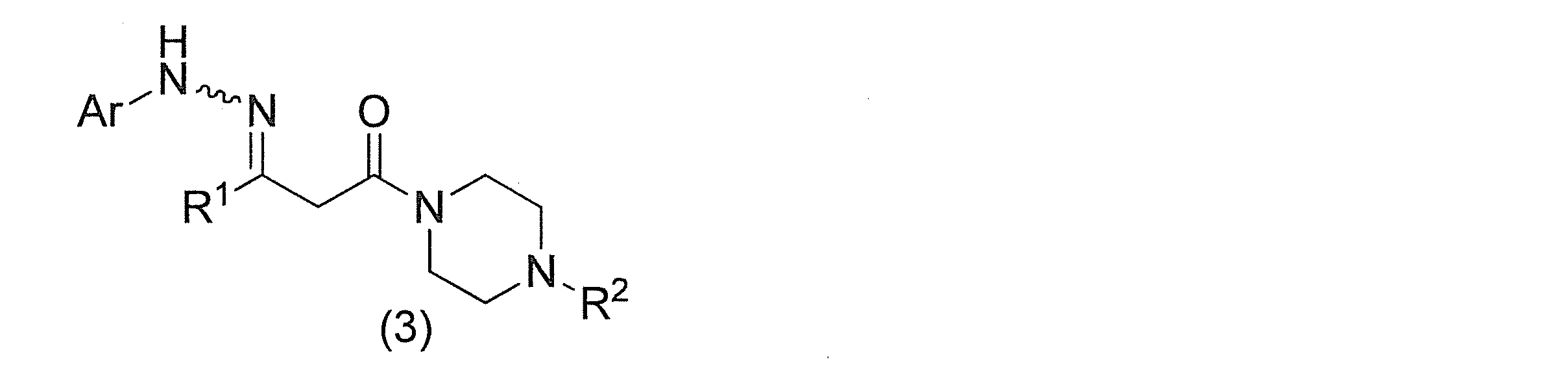
(式中、R1はアルキル又はシクロアルキルを示し、R2はアミノ基の保護基を示し、Arはアリール又はヘテロアリールを示す)で表される化合物と五硫化リンとの反応によりピラゾール環を形成させることを特徴とする、一般式(2):
[化2]

(式中、各記号は前記と同義である)で表される化合物、又はその塩の製造方法である。
また、本発明は、前記製造方法により一般式(2)で表される化合物、又はその塩を製造し、当該化合物のアミノ基の保護基R2を除去して、一般式(6):
[化3]

(式中、各記号は前記と同義である)で表される化合物とした後、該化合物をカルボン酸の塩とすることを特徴とする、一般式(6)で表される化合物のカルボン酸塩の製造方法である。
一般式(6)で表される化合物のカルボン酸塩は、新規な化合物であり、当該化合物もまた本願発明に包含される。
また、本発明は、前記の製造方法により、一般式(2)で表される化合物、又はその塩、或いは、一般式(6)で表される化合物のカルボン酸塩を製造し、これを変換して一般式(1):
また、本発明は、前記の製造方法により、一般式(2)で表される化合物、又はその塩、或いは、一般式(6)で表される化合物のカルボン酸塩を製造し、これを変換して一般式(1):
[化4]

(式中、各記号は前記と同義である)で表される化合物、又はその塩を得ることからなる、一般式(1)で表される化合物、又はその塩の製造方法である。
本発明によれば、一般式(2)で表されるピペラジニルピラゾール化合物、又はその塩、及び一般式(6)で表される化合物のカルボン酸塩を工業的有利に効率的に製造することができる。また、医薬等として有用な一般式(1)で表されるプロリンアミド化合物、又はその塩を工業的有利に効率的に製造することができる。
本発明によれば、一般式(3)で表されるβ-ヒドラゾンアミド化合物から一般式(2)で表される化合物、又はその塩を高収率で得ることができる。
また、一般式(6)で表される化合物は結晶化しないため、大量規模では精製に困難を伴うこととなる。しかし、本発明の方法によれば、一般式(6)で表される化合物をそのカルボン酸塩に変換することにより、高純度で、操作性、保存安定性等に優れた結晶が得られるので、工業的な生産に有利となる。
また、一般式(6)で表される化合物は結晶化しないため、大量規模では精製に困難を伴うこととなる。しかし、本発明の方法によれば、一般式(6)で表される化合物をそのカルボン酸塩に変換することにより、高純度で、操作性、保存安定性等に優れた結晶が得られるので、工業的な生産に有利となる。
(定義)
本発明において、アルキルとしては、炭素数1~6(C1-6)の直鎖状又は分岐鎖状の基が挙げられる。具体的には、例えば、メチル、エチル、n-プロピル、イソプロピル、n-ブチル、イソブチル、s-ブチル、t-ブチル、n-ペンチル、イソペンチル、n-ヘキシルが挙げられる。
シクロアルキルとしては、炭素数3~8(C3-8)の環状の基が挙げられる。該シクロアルキルとしては、具体的には、例えば、シクロプロピル、シクロブチル、シクロペンチル、シクロヘキシルが挙げられる。シクロアルキルには、その環状部分において1~2個のアルキル置換基を有するものが含まれる。
アルコキシとしては、上記アルキル又は上記シクロアルキルと酸素原子が結合した炭素数1~8(C1-8)の基が挙げられる。具体的には、例えば、メトキシ、エトキシ、n-プロポキシ、イソプロポキシ、t-ブトキシ、シクロプロポキシ、シクロブトキシが挙げられる。
R1で表されるアルキル又はシクロアルキルとしては、アルキルが好ましい。より好ましくは、メチル、エチル、n-プロピル又はイソプロピルが挙げられ、とりわけメチルが好ましい。
Arで表されるアリールとしては、炭素数6の単環式の芳香族炭化水素基、炭素数9~11の二環式の芳香族炭化水素基等が挙げられる。具体的には、例えば、フェニル、ナフチル又はインデニルが挙げられる。
Arで表されるヘテロアリールとしては、1~4個のヘテロ原子(酸素、硫黄又は窒素)を含む5~6員の単環式芳香族複素環基、1~4個のヘテロ原子(酸素、硫黄又は窒素)を含む8~10員の二環式芳香族複素環基等が挙げられる。具体的には、例えば、イミダゾリル、チアゾリル、ピラゾリル、ピリジル、ピリミジニル、ピリダジニル、インドリル、インドリニル、イソキノリル又はキノリルが挙げられる。
Arで表されるアリール又はヘテロアリールとしては、アリールが好ましく、具体的には、フェニル又はナフチルが好ましく、フェニルがさらに好ましい。
R2及びR3で表されるアミノ基の保護基は、反応を妨げない保護基であればよく、かかるアミノ基の保護基としては、例えば、アルコキシカルボニル基(メトキシカルボニル、エトキシカルボニル、n-プロポキシカルボニル、t-ブトキシカルボニル等)並びに置換アルコキシカルボニル基(ベンジルオキシカルボニル、2,2,2-トリクロロエトキシカルボニル、9-フルオレニルメトキシカルボニル等)が好適に使用できる。R2としては、これらのうち、アルコキシカルボニル基が好ましく、とりわけエトキシカルボニルが好ましい。また、R3としては、これらのうち、アルコキシカルボニル基が好ましく、とりわけt-ブトキシカルボニルが好ましい。
五硫化リンとは、分子式P4S10で表される化合物であり、五硫化二リン及び硫化リン(V)と同義である。
カルボン酸としては、置換されていてもよい直鎖状又は分岐鎖状の炭素数1~7(C1-7)のカルボン酸が挙げられる。具体的には、例えば、ギ酸、炭素数2~7(C2-7)のアルキルカルボン酸(酢酸、プロピオン酸、酪酸又はイソ酪酸等)、炭素数2~7(C2-7)の置換されたアルキルカルボン酸(トリフルオロ酢酸等)が挙げられる。これらのうち、アルキルカルボン酸が好ましく、とりわけ酢酸が好ましい。
(本発明の製造方法)
以下、本発明の製造方法についてさらに詳細に説明する。
以下、本発明の製造方法についてさらに詳細に説明する。
原料化合物は、市販品として容易に入手できるか、以下に示す製造方法若しくは自体公知の方法により製造することができるか、又はこれらに準ずる方法に従って製造することができる。
以下の各反応で用いられる化合物は、反応に支障を来たさない範囲において、無機酸塩(例えば、塩酸塩、臭化水素酸塩、硫酸塩、硝酸塩、リン酸塩)、有機酸塩(例えば、酢酸塩、酒石酸塩、クエン酸塩、フマル酸塩、マレイン酸塩、トルエンスルホン酸塩、メタンスルホン酸塩)、金属塩(例えば、ナトリウム塩、カリウム塩、カルシウム塩、アルミニウム塩)、又は塩基との塩(例えば、エチルアミン塩、グアニジン塩、アンモニウム塩、ヒドラジン塩、キニーネ塩、シンコニン塩)等の塩を形成していてもよい。
また、以下の各反応で得られた化合物は、反応混合物から単離せずに又は粗生成物として次の反応に用いられてもよい。あるいは、当該化合物は通常公知の方法に従って反応混合物から単離されてもよく、再結晶、蒸留、クロマトグラフィー等の通常の分離手段により容易に精製されてもよい。さらに、当該化合物は、通常公知の方法に従って、無機酸塩、有機酸塩、金属塩、又は塩基との塩等の塩として単離されてもよい。
本発明に用いられる化合物及び得られた化合物、又はそれらの塩は、それらの溶媒和物、又は水和物を含むものである。
本発明において、一般式(3)で表される化合物(β-ヒドラゾンアミド化合物)と五硫化リンとの反応(ピラゾール環形成反応)は、以下のようにして実施できる。すなわち、一般式(3)で表される化合物と五硫化リンとの反応は、塩基の存在下又は非存在下、適当な溶媒中又は無溶媒で行なうことができる。
五硫化リンの使用量は、例えば、一般式(3)で表される化合物1モルに対して五硫化リン0.2~0.8モル、好ましくは、0.25~0.35モルとするのが好適である。
五硫化リンの使用量は、例えば、一般式(3)で表される化合物1モルに対して五硫化リン0.2~0.8モル、好ましくは、0.25~0.35モルとするのが好適である。
本反応は、塩基の存在下に行なうことが好ましい。用いる塩基としては、炭酸カリウム、炭酸ナトリウム、炭酸リチウム、炭酸水素カリウム若しくは炭酸水素ナトリウム等の無機塩基、又は、ピリジン、ピコリン、ルチジン、トリエチルアミン若しくはN,N-ジイソプロピルエチルアミン等の有機塩基が挙げられ、好ましくは、炭酸カリウム、炭酸ナトリウム、炭酸リチウム、炭酸水素カリウム又は炭酸水素ナトリウム等の無機塩基が挙げられ、より好ましくは、炭酸ナトリウムが挙げられる。当該塩基は、一般式(3)で表される化合物1モルに対して、通常、0.7~10モル、好ましくは、0.8~2モルを使用することができる。
本反応は、適当な反応溶媒中で行なうことが好ましい。反応溶媒としては、例えば、テトラヒドロフラン(以下、THFと記す)、1,4-ジオキサン、1,2-ジメトキシエタン、ジクロロメタン、クロロホルム、トルエン、アセトニトリル若しくはプロピオニトリル、又はこれらの混合溶媒を使用することができ、好ましくは、THFを使用することができる。
反応温度としては、通常、0~110℃から任意に選択することができ、反応時間は、通常、10分~2日程度である。さらに、本反応は、窒素やアルゴン等の不活性ガス雰囲気下で行うことが好ましい。
前記のようにして得られた一般式(2)で表される化合物(ピペラジニルピラゾール化合物)、又はその塩は、以下のようにして、一般式(6)で表される化合物のカルボン酸塩に変換することができる。
[化5]

(式中、各記号は前記と同義である)
すなわち、一般式(2)で表される化合物、又はその塩のアミノ基の保護基R2を除去して一般式(6)で表される化合物を製造し、次いで同化合物をカルボン酸と造塩処理させることにより一般式(6)で表される化合物のカルボン酸塩を製造することができる。
一般式(2)で表される化合物、又はその塩のアミノ基の保護基R2を除去する方法としては、用いられた保護基に応じて適した公知の方法を適宜使用しうる。
具体的には、例えば、保護基としてt-ブトキシカルボニルが用いられている場合は、適当な溶媒中又は無溶媒で、酸と反応させて脱保護を行うことができる。酸としては、トリフルオロ酢酸、塩化水素、臭化水素又は硫酸等が挙げられ、好ましくは、トリフルオロ酢酸が挙げられる。
本反応は、適当な反応溶媒中で行なうことが好ましい。反応溶媒としては、例えば、ジクロロメタン、クロロホルム、メタノール、エタノール、2-プロパノール、THF、1,4-ジオキサン、アセトニトリル、トルエン若しくは水、若しくは、上記酸を溶媒として、又はこれらの混合溶媒を使用することができ、好ましくは、上記酸を溶媒として使用することができる。
保護基としてメトキシカルボニル、エトキシカルボニル又はn-プロポキシカルボニル等が用いられている場合は、適当な溶媒中又は無溶媒で、塩基と反応させて脱保護を行うことができる。塩基としては、水酸化リチウム、水酸化ナトリウム又は水酸化カリウム等が挙げられ、好ましくは、水酸化カリウムが挙げられる。当該塩基の濃度は反応混合物に対し、0.1~100mol/L、好ましくは、1~10mol/Lである。
本反応は、適当な反応溶媒中で行なうことが好ましい。反応溶媒としては、例えば、メタノール、エタノール、2-プロパノール、THF、アセトニトリル若しくは水、又はこれらの混合溶媒を使用することができ、好ましくは、メタノール及び水の混合溶媒を使用することができる。
反応温度は、通常、0~100℃から任意に選択することができ、反応時間は、通常、10分~2日程度である。
保護基として、ベンジルオキシカルボニルが用いられている場合は、適当な溶媒中、水素雰囲気下で、パラジウム炭素触媒又は水酸化パラジウム炭素触媒の存在下で脱保護を行なうことができる。
保護基として、2,2,2-トリクロロエトキシカルボニルが用いられている場合は、適当な溶媒中で亜鉛粉末と反応させることで脱保護を行なうことができる。
保護基として、9-フルオレニルメトキシカルボニルが用いられている場合は、適当な溶媒中又は無溶媒で、ピロリジン、ピペリジン又はモルホリンと反応させることで脱保護を行なうことができる。
一般式(6)で表される化合物とカルボン酸との造塩処理は、通常公知の方法を使用できる。例えば、一般式(6)で表される化合物とカルボン酸を、適当な溶媒中、造塩処理させることにより実施できる。具体的には、例えば、一般式(6)で表される化合物1モルに対し、0.7~3モル、好ましくは、0.9~1.1モルのカルボン酸を反応させることで、一般式(6)で表される化合物のカルボン酸塩を製造することができる。
反応溶媒としては、例えば、ジクロロメタン、クロロホルム、メタノール、エタノール、2-プロパノール、THF、1,4-ジオキサン、アセトニトリル若しくはトルエン、又はこれらの混合溶媒を使用することができ、好ましくは、トルエンを使用することができる。
反応温度は、通常、0~100℃から任意に選択することができ、反応時間は、通常、10分~1日程度である。
前記のようにして得られる一般式(2)で表される化合物若しくはその塩、又は一般式(6)で表される化合物のカルボン酸塩は、適宜、既知の方法又はそれらを組み合わせることにより、一般式(1)で表される化合物(プロリンアミド化合物)、又はその塩に変換することができる。或いは、以下に記載の方法により、一般式(1)で表される化合物、又はその塩へと好適に変換することができる。
[化6]
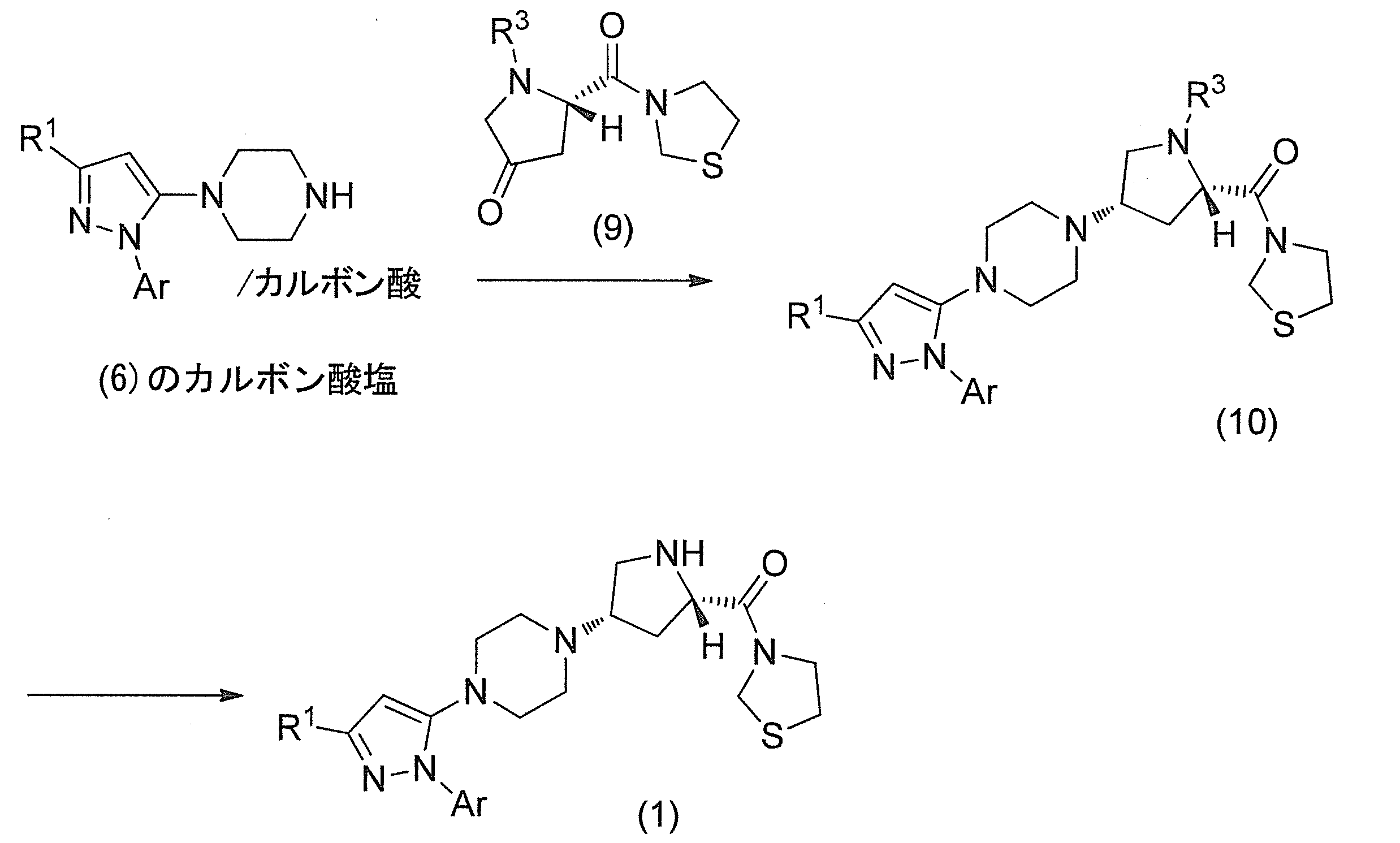
(式中、R3はアミノ基の保護基を示し、他は前記と同義である)
すなわち、一般式(6)で表される化合物のカルボン酸塩存在下、一般式(9)で表される化合物(4-オキソプロリンアミド化合物)を還元的アミノ化反応に付すことにより、一般式(10)で表される化合物、又はその塩を製造し、次いで同化合物のアミノ基の保護基R3を除去して一般式(1)で表される化合物(ピペラジニルプロリンアミド化合物)を製造できる。さらに所望によりこれを酸による造塩処理に付すことにより、その塩に変換できる。
一般式(6)で表される化合物のカルボン酸塩存在下での、一般式(9)で表される化合物の還元的アミノ化反応には、通常公知の方法を使用しうる。具体的には、適当な溶媒中、一般式(6)で表される化合物のカルボン酸塩、一般式(9)で表される化合物及び還元剤を反応させることにより行なうことができる。
例えば、還元剤としては、水素化ホウ素ナトリウム、ナトリウムトリアセトキシボロヒドリド、ジメチルアミンボラン、トリエチルアミンボラン、トリメチルアミンボラン、t-ブチルアミンボラン、N,N-ジエチルアニリンボラン又は2-ピコリンボランが挙げられ、好ましくは、ナトリウムトリアセトキシボロヒドリドが挙げられる。
反応溶媒としては、例えば、ジクロロメタン、メタノール、エタノール、2-プロパノール、THF、アセトニトリル、トルエン若しくはジメチルホルムアミド、又はこれらの混合溶媒を使用することができ、好ましくは、トルエンを使用することができる。
反応温度は、通常、-20~100℃から任意に選択することができ、反応時間は、通常、10分~1日程度である。
一般式(10)で表される化合物、又はその塩のアミノ基の保護基R3を除去する方法としては、用いられた保護基に応じて適した公知の方法を適宜使用しうる。
具体的には、例えば、保護基としてt-ブトキシカルボニルが用いられている場合は、適当な溶媒中又は無溶媒で、酸と反応させて脱保護を行うことができる。酸としては、トリフルオロ酢酸、塩化水素、臭化水素又は硫酸等が挙げられ、好ましくは、臭化水素が挙げられる。当該酸の濃度は反応混合物に対し0.01~10mol/L、好ましくは、0.1~4mol/Lである。
本反応は、適当な反応溶媒中で行なうことが好ましい。反応溶媒としては、例えば、ジクロロメタン、クロロホルム、メタノール、エタノール、2-プロパノール、THF、1,4-ジオキサン、アセトニトリル、トルエン若しくは水、又はこれらの混合溶媒を使用することができ、好ましくは、2-プロパノール及び水の混合溶媒を使用することができる。
反応温度は、通常、0~100℃から任意に選択することができ、反応時間は、通常、10分~2日程度である。
保護基としてメトキシカルボニル、エトキシカルボニル又はn-プロポキシカルボニル等が用いられている場合は、適当な溶媒中又は無溶媒で、塩基と反応させて脱保護を行うことができる。塩基としては、水酸化リチウム、水酸化ナトリウム又は水酸化カリウム等が挙げられ、好ましくは、水酸化カリウムが挙げられる。当該塩基の濃度は反応混合物に対し、0.1~100mol/L、好ましくは、1~10mol/Lである。
本反応は、適当な反応溶媒中で行なうことが好ましい。反応溶媒としては、例えば、メタノール、エタノール、2-プロパノール、THF、アセトニトリル若しくは水、又はこれらの混合溶媒を使用することができ、好ましくは、メタノール及び水の混合溶媒を使用することができる。
反応温度は、通常、0~100℃から任意に選択することができ、反応時間は、通常、10分~2日程度である。
保護基として、ベンジルオキシカルボニルが用いられている場合は、適当な溶媒中、水素雰囲気下で、パラジウム炭素触媒又は水酸化パラジウム炭素触媒の存在下で脱保護を行なうことができる。
保護基として、2,2,2-トリクロロエトキシカルボニルが用いられている場合は、適当な溶媒中で亜鉛粉末と反応させることで脱保護を行なうことができる。
保護基として、9-フルオレニルメトキシカルボニルが用いられている場合は、適当な溶媒中又は無溶媒で、ピロリジン、ピペリジン又はモルホリンと反応させることで脱保護を行なうことができる。
一般式(1)で表される化合物の酸による造塩処理は、通常公知の方法に従って対応する酸と処理することで行うことができる。例えば、一般式(1)で表される化合物と酸を、適当な溶媒中、造塩処理させることにより行なうことができる。
酸としては、例えば、塩化水素、臭化水素若しくは硝酸等の無機酸、又は、p-トルエンスルホン酸、メタンスルホン酸、ベシル酸、ナフタレン-1-スルホン酸、ナフタレン-2-スルホン酸、没食子酸若しくはカンファースルホン酸等の有機酸が挙げられ、好ましくは、臭化水素が挙げられる。具体的には、一般式(1)で表される化合物1モルに対して、1~10モル、好ましくは、2~5モルの酸を反応させることで、一般式(1)で表される化合物の塩を製造することができる。
反応溶媒としては、例えば、ジクロロメタン、クロロホルム、メタノール、エタノール、2-プロパノール、THF、アセトニトリル、トルエン若しくは水、又はこれらの混合溶媒を使用することができ、好ましくは、2-プロパノール及び水の混合溶媒を使用することができる。
反応温度は、通常、0~100℃から任意に選択することができ、反応時間は、通常、10分~2日程度である。
一般式(1)で表される化合物の酸との塩を製造する場合においては、一般式(10)で表される化合物、又はその塩のアミノ基の保護基R3としてt-ブトキシカルボニル等の酸で除去できる保護基を用いると、保護基R3の除去反応と次の造塩処理とを同時に行うことができるので、より好ましい。
本発明において原料化合物となる一般式(3)で表される化合物は、適宜、既知の方法、又はそれらを組み合わせることにより製造することができるが、例えば、以下の方法により好適に製造することができる。
[化7]

(式中、各記号は前記と同義である)
すなわち、一般式(4)で表される化合物(ピペラジン化合物)、又はその塩と、一般式(a)で表されるβ-ケトカルボン酸、又はその反応性誘導体とを反応させて、一般式(5)で表される化合物(β-ケトアミド化合物)を製造し、次いで同化合物を式Ar-NH-NH2で表されるヒドラジン化合物、又はその塩と反応させることにより一般式(3)で表される化合物を製造することができる。
一般式(a)で表されるβ-ケトカルボン酸の反応性誘導体としては、例えば、一般式(a)で表されるβ-ケトカルボン酸のアルキルエステルやジケテンを用いることができる。
一般式(a)で表されるβ-ケトカルボン酸、又はその反応性誘導体としては、ジケテンが好ましい。
一般式(4)で表される化合物、又はその塩と、一般式(a)で表されるβ-ケトカルボン酸、又はその反応性誘導体とを反応させる方法としては、用いられる一般式(a)で表されるβ-ケトカルボン酸、又はその反応性誘導体に応じて適した公知の方法を適宜使用しうる。
具体的には、一般式(4)で表される化合物、又はその塩と、一般式(a)で表されるβ-ケトカルボン酸との反応としては、縮合剤を用い、塩基の存在下又は非存在下、適当な溶媒中又は無溶媒で行なう、縮合反応を使用できる。縮合反応としては、例えば、カルボジイミドを用いる方法及び混合酸無水物法が挙げられる。具体的な縮合剤としては、N-(3-ジメチルアミノプロピル)-N’-エチルカルボジイミド、ジシクロヘキシルカルボジイミド、クロロギ酸メチル、クロロギ酸エチル、クロロギ酸プロピル、クロロギ酸イソプロピル、クロロギ酸ブチル、クロロギ酸イソブチル等が挙げられる。
一般式(a)で表されるβ-ケトカルボン酸の反応性誘導体として、一般式(a)で表されるβ-ケトカルボン酸のアルキルエステルを用いる場合は、一般式(4)で表される化合物、又はその塩と、一般式(a)で表されるβ-ケトカルボン酸のアルキルエステルを、適当な触媒の存在下又は非存在下、塩基の存在下又は非存在下、適当な溶媒中又は無溶媒で反応させることができる。具体的な一般式(a)で表されるβ-ケトカルボン酸のアルキルエステルとしては、一般式(a)で表されるβ-ケトカルボン酸のメチルエステル、一般式(a)で表されるβ-ケトカルボン酸のエチルエステル、一般式(a)で表されるβ-ケトカルボン酸のt-ブチルエステル等が挙げられる。
一般式(a)で表されるβ-ケトカルボン酸の反応性誘導体としてジケテンを用いる場合は、一般式(4)で表される化合物、又はその塩と、ジケテンを、塩基の存在下又は非存在下、適当な溶媒中又は無溶媒で反応させることができる。
一般式(5)で表される化合物と、式Ar-NH-NH2で表されるヒドラジン化合物、又はその塩とを反応させる方法としては、通常公知の縮合反応を使用しうる。具体的には、一般式(5)で表される化合物と、ヒドラジン化合物、又はその塩の縮合反応は、酸又は塩基の存在下又は非存在下、適当な溶媒中又は無溶媒で実施することができる。
本発明において原料化合物となる一般式(9)で表される化合物は、適宜、既知の方法又はそれらを組み合わせることにより製造することができるが、例えば、以下の方法により好適に製造することができる。
[化8]

(式中、記号は前記と同義である)
すなわち、一般式(8)で表される化合物、又はその塩と、チアゾリジンとを縮合させることにより好適に製造することができる。
一般式(8)で表される化合物、又はその塩と、チアゾリジンとの縮合反応は、縮合剤を用い、塩基の存在下又は非存在下、適当な溶媒中又は無溶媒で実施することができる。
かかる縮合反応としては、例えば、混合酸無水物法及び無水ホスホン酸誘導体を用いる方法が挙げられる。具体的な縮合剤としては、クロロギ酸アルキルエステル、置換アリールカルボン酸クロリド、置換アリールカルボン酸無水物又は無水ホスホン酸環状三量体が挙げられ、好ましくは、クロロギ酸メチル、クロロギ酸エチル、クロロギ酸プロピル、クロロギ酸イソプロピル、クロロギ酸ブチル、クロロギ酸イソブチル、2,4,6-トリクロロベンゾイルクロリド、2-メチル-6-ニトロ安息香酸無水物又はn-プロピルホスホン酸無水物(環状三量体)が挙げられ、より好ましくは、n-プロピルホスホン酸無水物(環状三量体)が挙げられる。塩基としては、ピリジン、ピコリン、ルチジン、トリエチルアミン、N,N-ジイソプロピルエチルアミン等が挙げられ、好ましくは、N,N-ジイソプロピルエチルアミンが挙げられる。
また、反応溶媒としては、例えば、THF、1,4-ジオキサン、1,2-ジメトキシエタン、ジクロロメタン、クロロホルム、トルエン、酢酸メチル、酢酸エチル、酢酸プロピル、アセトニトリル若しくはプロピオニトリル、又はこれらの混合溶媒を使用することができ、好ましくは、酢酸エチルを使用することができる。
反応温度は、通常、-20~110℃から任意に選択することができ、反応時間は、通常、10分~2日程度である。
本発明においては、R1がアルキル(特にメチル等)であり、R2が置換又は無置換のアルコキシカルボニルであり、R3が置換又は無置換のアルコキシカルボニルであり、Arがアリール(特にフェニル等)であるような各化合物を用いることにより本発明の製法をより好適に実施することができる。また、一般式(6)で表される化合物との塩を製造するカルボン酸としてはアルキルカルボン酸(特に酢酸等)を適用することが好ましい。さらにまた、一般式(1)で表される化合物との塩としては無機酸の塩(特に臭化水素酸塩など)を適用することが好ましい。なお、一般式(1)で表される化合物、又はその塩は、それらの溶媒和物又は水和物を形成していてもよい。
本発明の製法により好適に製造される化合物としては、例えば、3-{(2S,4S)-4-[4-(3-メチル-1-フェニル-1H-ピラゾール-5-イル)ピペラジン-1-イル]ピロリジン-2-イルカルボニル}チアゾリジン、又はその塩が挙げられる。
かかる化合物として、より詳細には、例えば、3-{(2S,4S)-4-[4-(3-メチル-1-フェニル-1H-ピラゾール-5-イル)ピペラジン-1-イル]ピロリジン-2-イルカルボニル}チアゾリジンの2.5臭化水素酸塩が挙げられる。さらに詳細には、3-{(2S,4S)-4-[4-(3-メチル-1-フェニル-1H-ピラゾール-5-イル)ピペラジン-1-イル]ピロリジン-2-イルカルボニル}チアゾリジンの2.5臭化水素酸塩の1~2水和物が挙げられる。
本明細書中、略号、「Me」はメチル基、「Et」はエチル基、「Ph」はフェニル基、「Ac」はアセチル基、「t-Bu」は第三級ブチル基を、各々表す。
以下に、実施例を挙げて本発明をさらに具体的に説明するが、本発明はこれらに限定されるものではない。実施例中、「w%」とは、重量%を表す。
実施例1
5-(4-t-ブトキシカルボニルピペラジン-1-イル)-3-メチル-1-フェニルピラゾールの製造
5-(4-t-ブトキシカルボニルピペラジン-1-イル)-3-メチル-1-フェニルピラゾールの製造
[化9]

4-t-ブトキシカルボニル-1-[3-(2-フェニルヒドラゾノ)ブチリル]ピペラジン(化合物3b)(721mg)と炭酸ナトリウム(254mg)のTHF(10mL)溶液に、五硫化リン(267mg)を加え、30分間加熱還流した。減圧下で溶媒を留去し、残渣にジエチルエーテル(30mL)を加え、濾過した。濾液に水(20mL)を加え分液した。得られた有機層を飽和食塩水にて洗浄し、無水硫酸マグネシウムで乾燥し、濾過した。この濾液を減圧下で濃縮することにより5-(4-t-ブトキシカルボニルピペラジン-1-イル)-3-メチル-1-フェニルピラゾール(化合物2b)を580mg得た。(収率85%)
1H-NMR(500MHz,DMSO-d6)δ1.39(9H,s),2.15(3H,s),2.73(4H,m),3.37(4H,m),5.83(1H,s),7.28(1H,t,J=7.4Hz),7.46(2H,t,J=7.4Hz),7.76(2H,d,J=7.4Hz).
1H-NMR(500MHz,DMSO-d6)δ1.39(9H,s),2.15(3H,s),2.73(4H,m),3.37(4H,m),5.83(1H,s),7.28(1H,t,J=7.4Hz),7.46(2H,t,J=7.4Hz),7.76(2H,d,J=7.4Hz).
実施例2
3-メチル-1-フェニル-5-(1-ピペラジニル)ピラゾール酢酸塩の製造
3-メチル-1-フェニル-5-(1-ピペラジニル)ピラゾール酢酸塩の製造
[化10]
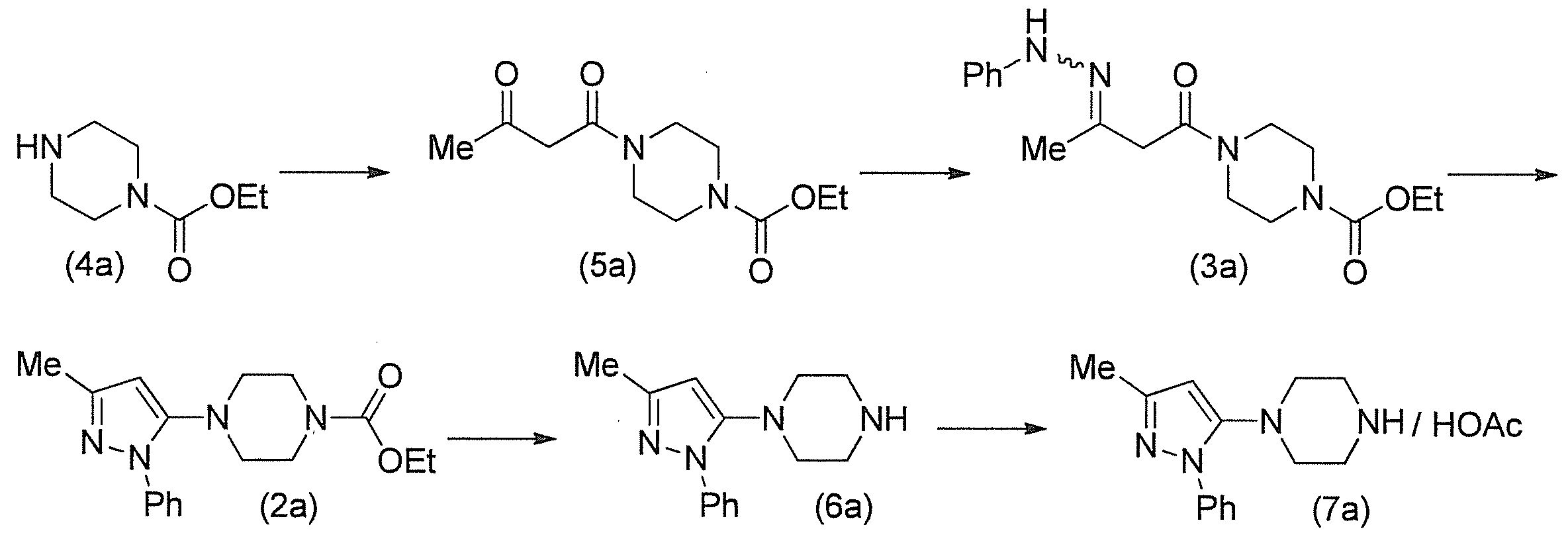
THF(550L)に1-エトキシカルボニルピペラジン(化合物4a)(37.5kg)を溶解した。この溶液を冷却し、0~7℃でジケテン(19.9kg)を滴下後、1~5℃で1.5時間攪拌した。この反応混合物にフェニルヒドラジン(25.6kg)のTHF(10L)溶液を滴下し、20~26℃で7時間攪拌させた。反応混合物を残量が100Lとなるまで減圧下で濃縮し、残った反応混合物にTHF(260L)を加えた。この反応混合物に炭酸ナトリウム(25.1kg)及び五硫化リン(26.3kg)を加えた後、36~44℃で1.5時間、45~52℃で3時間撹拌した。反応混合物を冷却し、五硫化リン(5.3kg)を追加し、45~51℃で1時間攪拌し、反応混合物を冷却した。この反応混合物にトルエン(375L)、水(375L)を加え分液した。得られた有機層を水(375L)で洗浄し、減圧濃縮した後、残渣にメタノール(190L)を加え、減圧濃縮した。この残渣にメタノール(260L)、水(110L)を加え、冷却下で水酸化カリウム(112.6kg)を投入した。反応混合物を2.5時間還流後、51℃まで冷却し、トルエン(260L)、水(55L)を加えて分液した。得られた有機層を20w%食塩水(75kg)で3回、水(38L)で1回それぞれ洗浄した。有機層を常圧下で濃縮し、溶媒を210L留去した。残った反応混合物に、55℃で酢酸(10.7kg)を滴下し、51~56℃で1時間、次いで17~25℃で1.5時間晶析した。析出した結晶を濾取し、トルエン(40L)で洗浄した。得られた結晶を15時間温風乾燥(40~46℃)し、3-メチル-1-フェニル-5-(1-ピペラジニル)ピラゾールの酢酸塩(化合物7a)を47.4kg得た。(収率66%)
1H-NMR(500MHz,DMSO-d6)δ1.90(3H,s),2.14(3H,s),2.70(8H,m),5.77(1H,s),7.37(1H,t),7.45(2H,t),7.75(2H,d).
1H-NMR(500MHz,DMSO-d6)δ1.90(3H,s),2.14(3H,s),2.70(8H,m),5.77(1H,s),7.37(1H,t),7.45(2H,t),7.75(2H,d).
実施例3
4-t-ブトキシカルボニル-1-[3-(2-フェニルヒドラゾノ)ブチリル]ピペラジンの合成
4-t-ブトキシカルボニル-1-[3-(2-フェニルヒドラゾノ)ブチリル]ピペラジンの合成
[化11]

1-t-ブトキシカルボニルピペラジン(化合物4b)(80g)のN,N-ジメチルホルムアミド(256mL)溶液に氷冷下でジケテン(34.7mL)を滴下し、室温で1時間攪拌した。この反応混合物にフェニルヒドラジン(48.7g)のエタノール(192mL)及び水(192mL)の混合溶液を水冷下で滴下し、室温で1時間攪拌した。この反応混合物に水(320mL)を滴下し、室温で1時間攪拌した。析出物を濾取し、メタノールと水の1:1の混合液で洗浄し、真空下で乾燥し、4-t-ブトキシカルボニル-1-[3-(2-フェニルヒドラゾノ)ブチリル]ピペラジン(化合物3b)を149g得た。(収率97%、幾何異性体比1:1)
1H-NMR(300MHz,CDCl3)δ1.46,1.48(9H,s),1.95(1.5H,s),2.11(1.5H,s),2.88(0.5H,s),2.96(0.5H,s),3.35-3.64(10H,m),6.80-7.32(5H,m).
1H-NMR(300MHz,CDCl3)δ1.46,1.48(9H,s),1.95(1.5H,s),2.11(1.5H,s),2.88(0.5H,s),2.96(0.5H,s),3.35-3.64(10H,m),6.80-7.32(5H,m).
実施例4
3-{(2S,4S)-4-[4-(3-メチル-1-フェニル-1H-ピラゾール-5-イル)ピペラジン-1-イル]ピロリジン-2-イルカルボニル}チアゾリジン化合物の製造
3-{(2S,4S)-4-[4-(3-メチル-1-フェニル-1H-ピラゾール-5-イル)ピペラジン-1-イル]ピロリジン-2-イルカルボニル}チアゾリジン化合物の製造
[化12]
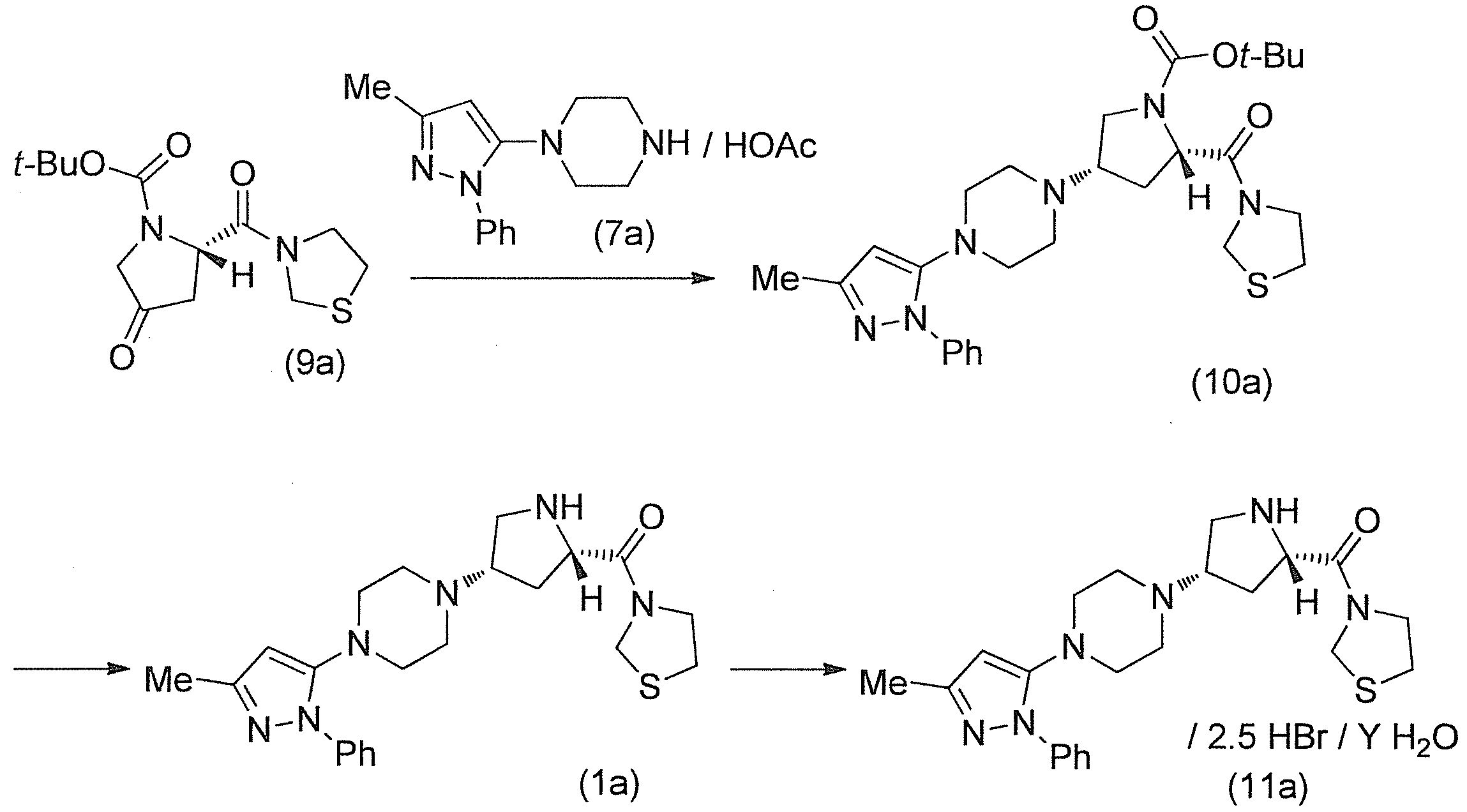
(式中、Yは1~2を示す)
3-メチル-1-フェニル-5-(1-ピペラジニル)ピラゾールの酢酸塩(化合物7a)(25.2kg)、3-[(2S)-1-t-ブトキシカルボニル-4-オキソピロリジン-2-イルカルボニル]チアゾリジン(化合物9a)(25.0kg)にトルエン(425L)を加え、更にナトリウムトリアセトキシボロヒドリド(23.0kg)のトルエン(75L)スラリーを8℃で加えた後、20~28℃で3時間撹拌した。この反応混合物に、水(150L)を加え、分液した。得られたトルエン層を5w%重曹水(158kg)、水(150L)の順で洗浄後、減圧濃縮、乾固し、得られた残渣に2-プロパノール(125L)を加えて再度減圧濃縮、乾固した。この残渣に2-プロパノール(375L)を加え、昇温し、48w%臭化水素酸(42.14kg)を75~77℃で滴下後、2.5時間還流した。反応混合物を冷却し、反応混合物をサンプリングして作成した種晶を58℃で接種後、58℃で1時間、次いで33~40℃で1時間、更に17~25℃で1時間晶析し、一夜静置した。析出した結晶を濾取し、2-プロパノール(50L)で結晶を洗浄した。得られた結晶を18時間温風乾燥(40~47℃)し、3-{(2S,4S)-4-[4-(3-メチル-1-フェニル-1H-ピラゾール-5-イル)ピペラジン-1-イル]ピロリジン-2-イルカルボニル}チアゾリジンの臭化水素酸塩(50.0kg)を粗生成物として得た。
当該粗生成物(24.0kg)にエタノール(144L)を加え、加熱溶解(73℃)後、熱時濾過し、エタノール(24L)で洗浄した。この濾液及び洗液を合わせ、67℃で水(3.4L)を加えた後、49~55℃で2時間、次いで19~25℃で1時間晶析した。析出した結晶を濾取し、エタノール(24L)で洗浄した。得られた結晶を45℃で19時間減圧乾燥した後、50℃で18時間温風乾燥することにより、精製物として、3-{(2S,4S)-4-[4-(3-メチル-1-フェニル-1H-ピラゾール-5-イル)ピペラジン-1-イル]ピロリジン-2-イルカルボニル}チアゾリジンの2.5臭化水素酸塩の1~2水和物(化合物11a)を20.9kg得た。(収率79%、収率は2水和物とみなして計算した値)
1H-NMR(400MHz,C5D5N)δ2.02-2.14(1H,m),2.33(3H,m),2.46-2.56(4H,m),2.87(4H,m),2.91-3.12(3H,m),3.45-3.51(1H,m),3.63-3.67(1H,m),3.80-3.90(1.4H,m),4.08(0.6H,m),4.11-4.16(1H,m),4.68(0.6H,d,J=10.1Hz),4.72(0.6H,d,J=10.1Hz),4.80(0.4H,d,J=8.8Hz),4.96(0.4H,d,J=8.8Hz),5.42(0.6H,dd,J=8.8,8.8Hz),5.52(0.4H,dd,J=8.8,8.8Hz),5.76(0.4H,s),5.77(0.6H,s),7.32(1H,t=7.8Hz),7.53(2H,dd,J=8.8,7.8Hz),8.07(2H,d=8.8Hz).
1H-NMR(400MHz,C5D5N)δ2.02-2.14(1H,m),2.33(3H,m),2.46-2.56(4H,m),2.87(4H,m),2.91-3.12(3H,m),3.45-3.51(1H,m),3.63-3.67(1H,m),3.80-3.90(1.4H,m),4.08(0.6H,m),4.11-4.16(1H,m),4.68(0.6H,d,J=10.1Hz),4.72(0.6H,d,J=10.1Hz),4.80(0.4H,d,J=8.8Hz),4.96(0.4H,d,J=8.8Hz),5.42(0.6H,dd,J=8.8,8.8Hz),5.52(0.4H,dd,J=8.8,8.8Hz),5.76(0.4H,s),5.77(0.6H,s),7.32(1H,t=7.8Hz),7.53(2H,dd,J=8.8,7.8Hz),8.07(2H,d=8.8Hz).
実施例5
3-[(2S)-1-t-ブトキシカルボニル-4-オキソピロリジン-2-イルカルボニル]チアゾリジン化合物の製造
3-[(2S)-1-t-ブトキシカルボニル-4-オキソピロリジン-2-イルカルボニル]チアゾリジン化合物の製造
[化13]

(2S)-1-t-ブトキシカルボニル-4-オキソピロリジン-2-カルボン酸(化合物8a)(60.0kg)、チアゾリジン(30.3kg)、N,N-ジイソプロピルエチルアミン(118kg)の酢酸エチル(595kg)溶液に、28w%プロピルホスホン酸無水物(環状三量体)酢酸エチル溶液(446kg)を2~7℃で加えた後、反応混合物を2~4℃で2時間撹拌した。この反応混合物に、15w%クエン酸水溶液(600kg)を加え分液し、水層を酢酸エチル(271kg)で抽出した。得られた酢酸エチル層を混合し、10w%リン酸水素二アンモニウム水溶液(600kg)と水(300kg)で順次洗浄した。酢酸エチル層を濃縮し残量を300Lにした後、n-ヘプタン(739kg)を23~25℃で添加し、混合物を23~25℃で1時間、1~5℃で2時間撹拌した。析出した結晶を濾取し、n-ヘプタン(164kg)で洗浄した後、減圧乾燥することにより、3-[(2S)-1-t-ブトキシカルボニル-4-オキソピロリジン-2-イルカルボニル]チアゾリジン(化合物9a)を67.8kg得た。(収率86%)
1H-NMR(500MHz,DMSO-d6)δ1.36,1.40(9H,s),2.36-2.45(1H,m),2.97-3.12(3H,m),3.62-3.71(2H,m),3.74-3.94(2H,m),4.33-4.80(2H,m),4.91-5.04(1H,m).
1H-NMR(500MHz,DMSO-d6)δ1.36,1.40(9H,s),2.36-2.45(1H,m),2.97-3.12(3H,m),3.62-3.71(2H,m),3.74-3.94(2H,m),4.33-4.80(2H,m),4.91-5.04(1H,m).
比較例1
ローソン試薬を用いた5-(4-t-ブトキシカルボニルピペラジン-1-イル)-3-メチル-1-フェニルピラゾールの製造
ローソン試薬を用いた5-(4-t-ブトキシカルボニルピペラジン-1-イル)-3-メチル-1-フェニルピラゾールの製造
[化14]
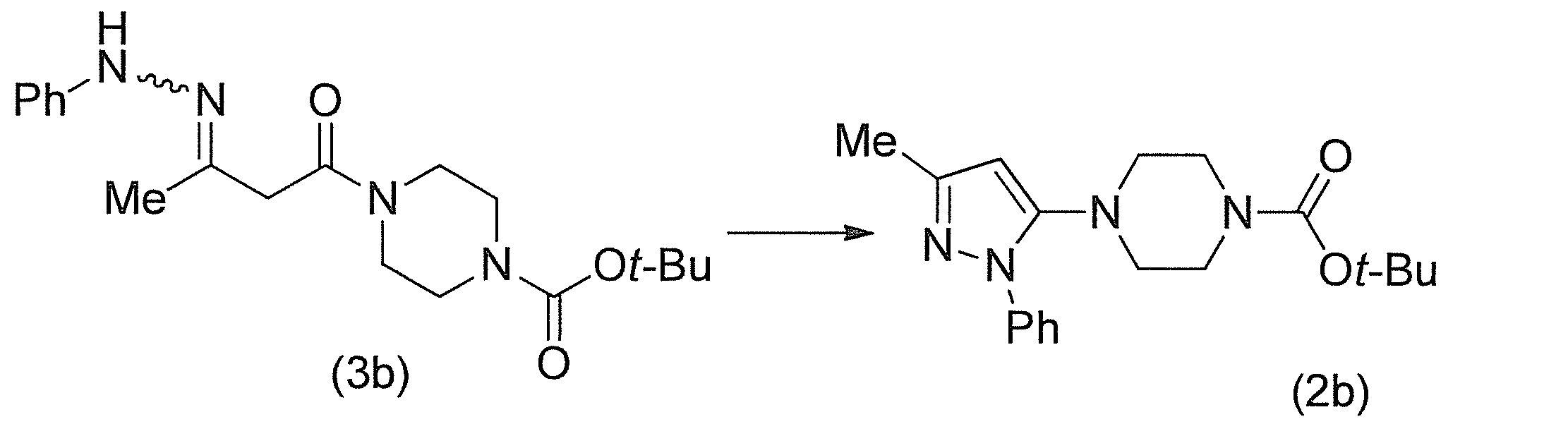
4-t-ブトキシカルボニル-1-[3-(2-フェニルヒドラゾノ)ブチリル]ピペラジン(化合物3b)(1.00g)のトルエン(18mL)溶液に、ローソン試薬(674mg)を加え、80℃で1.5時間加熱した。原料の消失を確認した後、減圧下溶媒を留去し、残渣をカラムクロマトグラフィーにて精製することにより5-(4-t-ブトキシカルボニルピペラジン-1-イル)-3-メチル-1-フェニルピラゾール(化合物2b)を551mg得た。(収率58%)
1H-NMR(500MHz,DMSO-d6)δ1.39(9H,s),2.15(3H,s),2.73(4H,m),3.37(4H,m),5.83(1H,s),7.28(1H,t,J=7.4Hz),7.46(2H,t,J=7.4Hz),7.76(2H,d,J=7.4Hz).
1H-NMR(500MHz,DMSO-d6)δ1.39(9H,s),2.15(3H,s),2.73(4H,m),3.37(4H,m),5.83(1H,s),7.28(1H,t,J=7.4Hz),7.46(2H,t,J=7.4Hz),7.76(2H,d,J=7.4Hz).
このようにローソン試薬を用いる方法と比較して、本発明の方法を用いて製造した場合には、前記実施例1に記載の通り、顕著に高い収率で目的化合物(化合物2b)を製造することができた。
本発明の製造方法によれば、医薬の合成中間体等として有用なピペラジニルピラゾール化合物、又はその塩を工業的有利に効率的に製造することができる。また、医薬等として有用なプロリンアミド化合物、又はその塩を工業的有利に効率的に製造することができる。
以上、本発明の具体的な態様のいくつかを詳細に説明したが、当業者であれば示された特定の態様には、本発明の教示と利点から実質的に逸脱しない範囲で様々な修正と変更をなすことは可能である。従って、そのような修正および変更も、すべて特許請求の範囲で請求される本発明の精神と範囲内に含まれるものである。
本出願は、特願2011-123819を基礎としており、その内容は本明細書に全て包含されるものである。
Claims (15)
- 一般式(3):
[化1]
(式中、R1はアルキル又はシクロアルキルを示し、R2はアミノ基の保護基を示し、Arはアリール又はヘテロアリールを示す)で表される化合物と五硫化リンとの反応によりピラゾール環を形成させることを特徴とする、一般式(2):
[化2]
(式中、各記号は前記と同義である)で表される化合物、又はその塩の製造方法。
- 請求項1に記載の製造方法により一般式(2):
[化3]
(式中、各記号は請求項1と同義である)で表される化合物、又はその塩を製造し、当該化合物のアミノ基の保護基R2を除去して、一般式(6):
[化4]
(式中、各記号は前記と同義である)で表される化合物とした後、該化合物をカルボン酸の塩とすることを特徴とする、
一般式(6)で表される化合物のカルボン酸塩の製造方法。 - 請求項1に記載の製造方法により一般式(2):
[化5]
(式中、各記号は請求項1と同義である)で表される化合物、又はその塩を製造し、これを変換して一般式(1):
[化6]
(式中、各記号は前記と同義である)で表される化合物、又はその塩を得ることからなる、一般式(1)で表される化合物、又はその塩の製造方法。
- 請求項2に記載の製造方法により一般式(6):
[化7]
(式中、各記号は請求項2と同義である)で表される化合物のカルボン酸塩を製造し、これを変換して一般式(1):
[化8]
(式中、各記号は前記と同義である)で表される化合物、又はその塩を得ることからなる、一般式(1)で表される化合物、又はその塩の製造方法。
- 請求項2に記載の製造方法により一般式(6):
[化9]
(式中、各記号は請求項2と同義である)で表される化合物のカルボン酸塩を製造し、当該カルボン酸塩存在下、一般式(9):
[化10]
(式中、R3はアミノ基の保護基を示す)で表される化合物を還元的アミノ化反応に付すことにより、一般式(10):
[化11]
(式中、各記号は前記と同義である)で表される化合物、又はその塩を製造し、次いで一般式(10)で表される化合物、又はその塩のアミノ基の保護基R3を除去することからなる、
一般式(1):
[化12]
(式中、各記号は前記と同義である)で表される化合物、又はその塩の製造方法。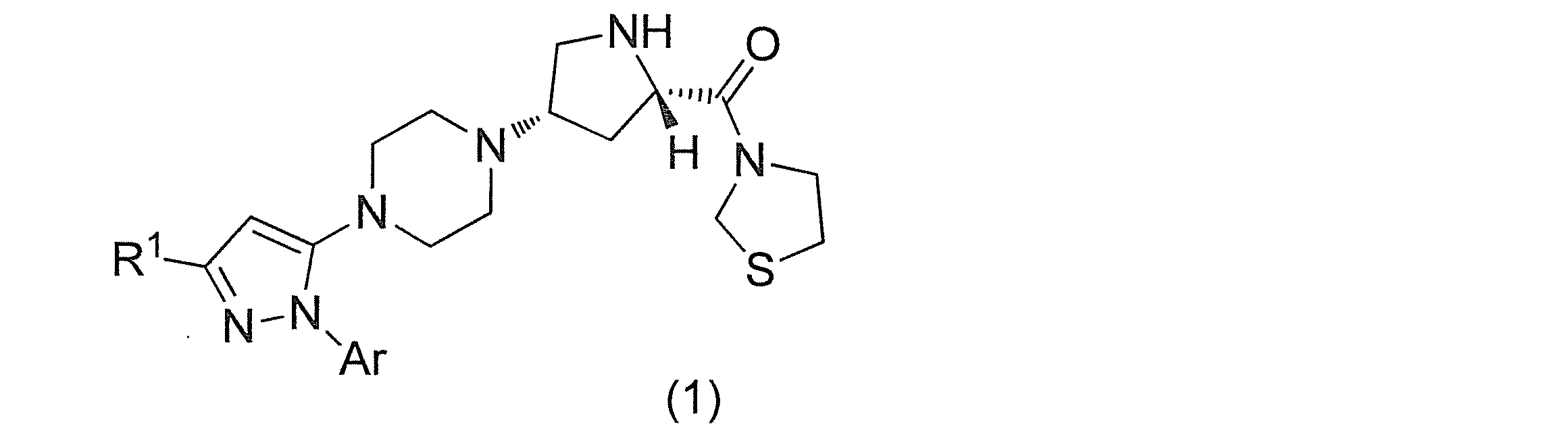
- 請求項5に記載の製造方法により一般式(1):
[化13]
(式中、各記号は請求項5と同義である)で表される化合物を製造し、次いで酸による造塩処理に付すことからなる、一般式(1)で表される化合物の塩の製造方法。
- 下記一般式(6):
[化14]
(式中、各記号は請求項1と同義である)で表される化合物のカルボン酸塩。
- 一般式(3)で表される化合物が、
一般式(4):
[化15]
(式中、R2は請求項1と同義である)で表される化合物、又はその塩と、一般式(a):
[化16]
(式中、R1は請求項1と同義である)で表されるβ-ケトカルボン酸、又はその反応性誘導体とを反応させて、一般式(5):
[化17]
(式中、各記号は前記と同義である)
で表される化合物を製造し、次いで該化合物を、式:
[化18]
Ar-NH-NH2
(式中、Arは請求項1と同義である)で表されるヒドラジン化合物、又はその塩と反応させることにより製造されたものである、請求項1又は2に記載の製造方法。 - 一般式(9)で表される化合物が、
一般式(8):
[化19]
(式中、R3は請求項5と同義である)で表される化合物、又はその塩と、チアゾリジンとを縮合させることにより製造されたものである、請求項5に記載の製造方法。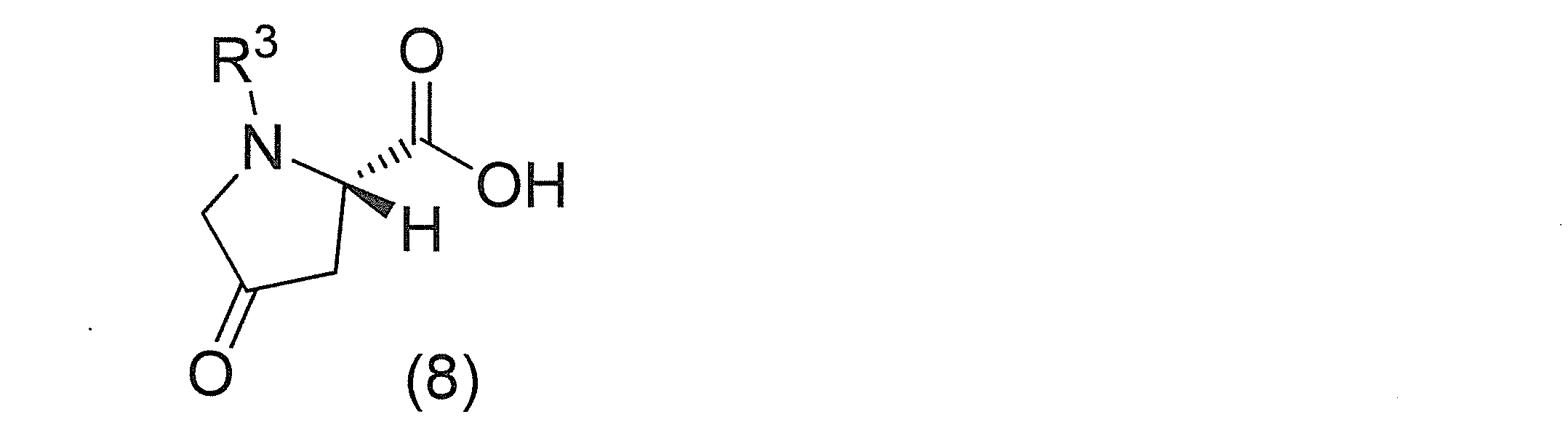
- R1がメチルであり、R2が置換又は無置換のアルコキシカルボニルであり、Arがフェニルである請求項1又は2に記載の製造方法。
- R1がメチルであり、R3が置換又は無置換のアルコキシカルボニルであり、Arがフェニルである請求項5又は6に記載の製造方法。
- 一般式(1)で表される化合物、又はその塩が、3-{(2S,4S)-4-[4-(3-メチル-1-フェニル-1H-ピラゾール-5-イル)ピペラジン-1-イル]ピロリジン-2-イルカルボニル}チアゾリジンの塩である請求項3~6のいずれか1項に記載の製造方法。
- 一般式(1)で表される化合物、又はその塩が、3-{(2S,4S)-4-[4-(3-メチル-1-フェニル-1H-ピラゾール-5-イル)ピペラジン-1-イル]ピロリジン-2-イルカルボニル}チアゾリジンの2.5臭化水素酸塩である請求項3~6のいずれか1項に記載の製造方法。
- 一般式(1)で表される化合物、又はその塩が、3-{(2S,4S)-4-[4-(3-メチル-1-フェニル-1H-ピラゾール-5-イル)ピペラジン-1-イル]ピロリジン-2-イルカルボニル}チアゾリジンの2.5臭化水素酸塩・水和物である請求項3~6のいずれか1項に記載の製造方法。
- R1がメチルであり、Arがフェニルであり、且つカルボン酸が酢酸である請求項7記載の化合物。
Priority Applications (2)
| Application Number | Priority Date | Filing Date | Title |
|---|---|---|---|
| CN201280027128.6A CN103649055B (zh) | 2011-06-01 | 2012-05-31 | 用于制备吡唑衍生物的方法 |
| JP2013518161A JP5863789B2 (ja) | 2011-06-01 | 2012-05-31 | ピラゾール誘導体の製造方法 |
Applications Claiming Priority (2)
| Application Number | Priority Date | Filing Date | Title |
|---|---|---|---|
| JP2011-123819 | 2011-06-01 | ||
| JP2011123819 | 2011-06-01 |
Publications (1)
| Publication Number | Publication Date |
|---|---|
| WO2012165547A1 true WO2012165547A1 (ja) | 2012-12-06 |
Family
ID=47259399
Family Applications (1)
| Application Number | Title | Priority Date | Filing Date |
|---|---|---|---|
| PCT/JP2012/064075 Ceased WO2012165547A1 (ja) | 2011-06-01 | 2012-05-31 | ピラゾール誘導体の製造方法 |
Country Status (3)
| Country | Link |
|---|---|
| JP (1) | JP5863789B2 (ja) |
| CN (1) | CN103649055B (ja) |
| WO (1) | WO2012165547A1 (ja) |
Cited By (6)
| Publication number | Priority date | Publication date | Assignee | Title |
|---|---|---|---|---|
| CN103275010A (zh) * | 2013-05-30 | 2013-09-04 | 上海皓元生物医药科技有限公司 | 一种1-(3-甲基-1-苯基-1h-吡唑-5-基)哌嗪的制备方法 |
| CN104177295A (zh) * | 2013-05-24 | 2014-12-03 | 南京华威医药科技开发有限公司 | 替格列汀关键中间体1-(3-甲基-1-苯基-5-吡唑基)哌嗪的制备方法 |
| WO2015019238A1 (en) * | 2013-08-06 | 2015-02-12 | Ranbaxy Laboratories Limited | Process for the preparation of n-protected (5s)-5-(1,3-thiazolidin-3-ylcarbonyl)pyrrolidin-3-one |
| JP2019147763A (ja) * | 2018-02-27 | 2019-09-05 | 田辺三菱製薬株式会社 | プロリンアミド化合物の製造方法 |
| JP2024074935A (ja) * | 2020-04-03 | 2024-05-31 | 金剛化学株式会社 | テネリグリプチンの新規結晶形及びその製造方法 |
| JP2024150777A (ja) * | 2021-11-02 | 2024-10-23 | 田辺三菱製薬株式会社 | プロリンアミド化合物の製造方法 |
Families Citing this family (4)
| Publication number | Priority date | Publication date | Assignee | Title |
|---|---|---|---|---|
| CN105294673B (zh) * | 2014-06-18 | 2018-04-13 | 四川科伦药物研究院有限公司 | 一种氢溴酸替格列汀的合成方法 |
| CN105085510B (zh) * | 2015-09-11 | 2018-03-02 | 沧州那瑞化学科技有限公司 | 一种(s)‑4‑氧代‑2‑(噻唑烷‑3‑羰基)吡咯烷‑1‑羧酸叔丁酯的制备方法 |
| CN108727364A (zh) * | 2017-04-18 | 2018-11-02 | 乳源东阳光药业有限公司 | 一种氢溴酸替格列汀无定型及其制备方法 |
| WO2019205021A1 (zh) * | 2018-04-25 | 2019-10-31 | 乳源东阳光药业有限公司 | 一种氢溴酸替格列汀无定型及其制备方法 |
Citations (4)
| Publication number | Priority date | Publication date | Assignee | Title |
|---|---|---|---|---|
| WO2002014271A1 (en) * | 2000-08-10 | 2002-02-21 | Mitsubishi Pharma Corporation | Proline derivatives and use thereof as drugs |
| WO2003024942A1 (en) * | 2001-09-14 | 2003-03-27 | Mitsubishi Pharma Corporation | Thiazolidine derivative and medicinal use thereof |
| WO2006088129A1 (ja) * | 2005-02-18 | 2006-08-24 | Mitsubishi Pharma Corporation | プロリン誘導体の塩、またはその溶媒和物、及びその製造方法 |
| JP2012102092A (ja) * | 2010-10-15 | 2012-05-31 | Dainippon Sumitomo Pharma Co Ltd | 5−ジ置換アミノピラゾール−3−カルボン酸エステルの製造方法 |
Family Cites Families (1)
| Publication number | Priority date | Publication date | Assignee | Title |
|---|---|---|---|---|
| RU2259356C2 (ru) * | 1999-12-09 | 2005-08-27 | Зингента Партисипейшнс Аг | Пиразолкарбоксамидные и пиразолтиоамидные производные в качестве фунгицидов |
-
2012
- 2012-05-31 JP JP2013518161A patent/JP5863789B2/ja active Active
- 2012-05-31 WO PCT/JP2012/064075 patent/WO2012165547A1/ja not_active Ceased
- 2012-05-31 CN CN201280027128.6A patent/CN103649055B/zh active Active
Patent Citations (4)
| Publication number | Priority date | Publication date | Assignee | Title |
|---|---|---|---|---|
| WO2002014271A1 (en) * | 2000-08-10 | 2002-02-21 | Mitsubishi Pharma Corporation | Proline derivatives and use thereof as drugs |
| WO2003024942A1 (en) * | 2001-09-14 | 2003-03-27 | Mitsubishi Pharma Corporation | Thiazolidine derivative and medicinal use thereof |
| WO2006088129A1 (ja) * | 2005-02-18 | 2006-08-24 | Mitsubishi Pharma Corporation | プロリン誘導体の塩、またはその溶媒和物、及びその製造方法 |
| JP2012102092A (ja) * | 2010-10-15 | 2012-05-31 | Dainippon Sumitomo Pharma Co Ltd | 5−ジ置換アミノピラゾール−3−カルボン酸エステルの製造方法 |
Non-Patent Citations (3)
| Title |
|---|
| BOUILLON JEAN-PHILIPPE ET AL.: "Trifluoromethylated Heterocycles from Beta-Trifluoroacetyl-Lactams and -Benzolactams", TETRAHEDRON LETTERS, vol. 34, no. 32, 1993, pages 5075 - 5078 * |
| DIMITROWA K. ET AL.: "Biphenyl- and terphenylanaloge 1,3,4-Thiadiazole", J.PRAKT. CHEM., vol. 322, no. 6, 1980, pages 933 - 944 * |
| DODD DHARMPAL S. ET AL.: "One-pot synthesis of 5-(substituted-amino)pyrazoles", TETRAHEDRON LETTERS, vol. 45, no. 22, 2004, pages 4265 - 4267 * |
Cited By (8)
| Publication number | Priority date | Publication date | Assignee | Title |
|---|---|---|---|---|
| CN104177295A (zh) * | 2013-05-24 | 2014-12-03 | 南京华威医药科技开发有限公司 | 替格列汀关键中间体1-(3-甲基-1-苯基-5-吡唑基)哌嗪的制备方法 |
| CN104177295B (zh) * | 2013-05-24 | 2016-08-17 | 南京华威医药科技开发有限公司 | 替格列汀关键中间体1-(3-甲基-1-苯基-5-吡唑基)哌嗪的制备方法 |
| CN103275010A (zh) * | 2013-05-30 | 2013-09-04 | 上海皓元生物医药科技有限公司 | 一种1-(3-甲基-1-苯基-1h-吡唑-5-基)哌嗪的制备方法 |
| WO2015019238A1 (en) * | 2013-08-06 | 2015-02-12 | Ranbaxy Laboratories Limited | Process for the preparation of n-protected (5s)-5-(1,3-thiazolidin-3-ylcarbonyl)pyrrolidin-3-one |
| JP2019147763A (ja) * | 2018-02-27 | 2019-09-05 | 田辺三菱製薬株式会社 | プロリンアミド化合物の製造方法 |
| JP2024074935A (ja) * | 2020-04-03 | 2024-05-31 | 金剛化学株式会社 | テネリグリプチンの新規結晶形及びその製造方法 |
| JP2024150777A (ja) * | 2021-11-02 | 2024-10-23 | 田辺三菱製薬株式会社 | プロリンアミド化合物の製造方法 |
| JP7693921B2 (ja) | 2021-11-02 | 2025-06-17 | 田辺三菱製薬株式会社 | プロリンアミド化合物の製造方法 |
Also Published As
| Publication number | Publication date |
|---|---|
| JP5863789B2 (ja) | 2016-02-17 |
| CN103649055A (zh) | 2014-03-19 |
| CN103649055B (zh) | 2016-04-13 |
| JPWO2012165547A1 (ja) | 2015-02-23 |
Similar Documents
| Publication | Publication Date | Title |
|---|---|---|
| JP5863789B2 (ja) | ピラゾール誘導体の製造方法 | |
| AU2015414743B2 (en) | Process for the preparation of kinase inhibitors and intermediates thereof | |
| EP2346850A1 (en) | A method for the preparation of dabigatran and its intermediates | |
| US20170204065A1 (en) | Process for the preparation of kinase inhibitors and intermediates thereof | |
| JP6985179B2 (ja) | プロリンアミド化合物の製造方法 | |
| EP2608791B1 (en) | A process for the preparation of imatinib base | |
| US20260103451A1 (en) | Process for preparing pyrimidinyl bipyridine compound and intermediate therefor | |
| CA2787427C (en) | Process for the preparation of 2-(cyclohexylmethyl)-n-{2-[(2s)-1-methylpyrrolidin-2-yl]ethyl}-1,2,3,4-tetrahydroisoquinoline-7-sulfonamide | |
| JP7252978B2 (ja) | 2-(1-(tert-ブトキシカルボニル)ピペリジン-4-イル)安息香酸を調製するためのプロセス | |
| AU775413B2 (en) | Process for preparing (S-(R*,S*)) -beta -(((1-(1-oxo-3- (4-piperidinyl) propyl) -3-piperidinyl) carbonyl) amino) -3- pyridinepropanoic acid and derivatives | |
| HU231050B1 (hu) | Eljárás gyógyszerhatóanyag előállítására | |
| JP7693921B2 (ja) | プロリンアミド化合物の製造方法 | |
| JP7279134B2 (ja) | プロリンアミド化合物の製造方法 | |
| JP4768109B2 (ja) | 1h−2−置換−4(5)−アミノ−5(4)−カルボキサミド−イミダゾールの製造方法 | |
| JP5080050B2 (ja) | 光学活性なピペラジン化合物の製造方法 | |
| EA049781B1 (ru) | Способ получения авапритиниба и его промежуточных соединений | |
| WO2019098551A1 (ko) | 의약품 합성용 중간체 화합물의 제조 방법 | |
| WO2002008184A1 (en) | Process for preparing distamycin derivatives | |
| JPWO2001096332A1 (ja) | ピペラジン誘導体の製造方法 |
Legal Events
| Date | Code | Title | Description |
|---|---|---|---|
| 121 | Ep: the epo has been informed by wipo that ep was designated in this application |
Ref document number: 12792664 Country of ref document: EP Kind code of ref document: A1 |
|
| ENP | Entry into the national phase |
Ref document number: 2013518161 Country of ref document: JP Kind code of ref document: A |
|
| NENP | Non-entry into the national phase |
Ref country code: DE |
|
| 122 | Ep: pct application non-entry in european phase |
Ref document number: 12792664 Country of ref document: EP Kind code of ref document: A1 |