WO2012165413A1 - エポキシ樹脂組成物、硬化物及び光半導体封止材料 - Google Patents
エポキシ樹脂組成物、硬化物及び光半導体封止材料 Download PDFInfo
- Publication number
- WO2012165413A1 WO2012165413A1 PCT/JP2012/063723 JP2012063723W WO2012165413A1 WO 2012165413 A1 WO2012165413 A1 WO 2012165413A1 JP 2012063723 W JP2012063723 W JP 2012063723W WO 2012165413 A1 WO2012165413 A1 WO 2012165413A1
- Authority
- WO
- WIPO (PCT)
- Prior art keywords
- epoxy resin
- resin composition
- vinyl polymer
- polymer particles
- mass
- Prior art date
- Legal status (The legal status is an assumption and is not a legal conclusion. Google has not performed a legal analysis and makes no representation as to the accuracy of the status listed.)
- Ceased
Links
Classifications
-
- H—ELECTRICITY
- H10—SEMICONDUCTOR DEVICES; ELECTRIC SOLID-STATE DEVICES NOT OTHERWISE PROVIDED FOR
- H10W—GENERIC PACKAGES, INTERCONNECTIONS, CONNECTORS OR OTHER CONSTRUCTIONAL DETAILS OF DEVICES COVERED BY CLASS H10
- H10W76/00—Containers; Fillings or auxiliary members therefor; Seals
- H10W76/60—Seals
-
- C—CHEMISTRY; METALLURGY
- C08—ORGANIC MACROMOLECULAR COMPOUNDS; THEIR PREPARATION OR CHEMICAL WORKING-UP; COMPOSITIONS BASED THEREON
- C08G—MACROMOLECULAR COMPOUNDS OBTAINED OTHERWISE THAN BY REACTIONS ONLY INVOLVING UNSATURATED CARBON-TO-CARBON BONDS
- C08G59/00—Polycondensates containing more than one epoxy group per molecule; Macromolecules obtained by polymerising compounds containing more than one epoxy group per molecule using curing agents or catalysts which react with the epoxy groups
- C08G59/18—Macromolecules obtained by polymerising compounds containing more than one epoxy group per molecule using curing agents or catalysts which react with the epoxy groups ; e.g. general methods of curing
- C08G59/20—Macromolecules obtained by polymerising compounds containing more than one epoxy group per molecule using curing agents or catalysts which react with the epoxy groups ; e.g. general methods of curing characterised by the epoxy compounds used
- C08G59/22—Di-epoxy compounds
- C08G59/24—Di-epoxy compounds carbocyclic
-
- C—CHEMISTRY; METALLURGY
- C08—ORGANIC MACROMOLECULAR COMPOUNDS; THEIR PREPARATION OR CHEMICAL WORKING-UP; COMPOSITIONS BASED THEREON
- C08G—MACROMOLECULAR COMPOUNDS OBTAINED OTHERWISE THAN BY REACTIONS ONLY INVOLVING UNSATURATED CARBON-TO-CARBON BONDS
- C08G59/00—Polycondensates containing more than one epoxy group per molecule; Macromolecules obtained by polymerising compounds containing more than one epoxy group per molecule using curing agents or catalysts which react with the epoxy groups
- C08G59/18—Macromolecules obtained by polymerising compounds containing more than one epoxy group per molecule using curing agents or catalysts which react with the epoxy groups ; e.g. general methods of curing
- C08G59/40—Macromolecules obtained by polymerising compounds containing more than one epoxy group per molecule using curing agents or catalysts which react with the epoxy groups ; e.g. general methods of curing characterised by the curing agents used
- C08G59/42—Polycarboxylic acids; Anhydrides, halides or low molecular weight esters thereof
- C08G59/4215—Polycarboxylic acids; Anhydrides, halides or low molecular weight esters thereof cycloaliphatic
-
- C—CHEMISTRY; METALLURGY
- C08—ORGANIC MACROMOLECULAR COMPOUNDS; THEIR PREPARATION OR CHEMICAL WORKING-UP; COMPOSITIONS BASED THEREON
- C08L—COMPOSITIONS OF MACROMOLECULAR COMPOUNDS
- C08L33/00—Compositions of homopolymers or copolymers of compounds having one or more unsaturated aliphatic radicals, each having only one carbon-to-carbon double bond, and only one being terminated by only one carboxyl radical, or of salts, anhydrides, esters, amides, imides or nitriles thereof; Compositions of derivatives of such polymers
-
- C—CHEMISTRY; METALLURGY
- C08—ORGANIC MACROMOLECULAR COMPOUNDS; THEIR PREPARATION OR CHEMICAL WORKING-UP; COMPOSITIONS BASED THEREON
- C08L—COMPOSITIONS OF MACROMOLECULAR COMPOUNDS
- C08L63/00—Compositions of epoxy resins; Compositions of derivatives of epoxy resins
-
- G—PHYSICS
- G02—OPTICS
- G02F—OPTICAL DEVICES OR ARRANGEMENTS FOR THE CONTROL OF LIGHT BY MODIFICATION OF THE OPTICAL PROPERTIES OF THE MEDIA OF THE ELEMENTS INVOLVED THEREIN; NON-LINEAR OPTICS; FREQUENCY-CHANGING OF LIGHT; OPTICAL LOGIC ELEMENTS; OPTICAL ANALOGUE/DIGITAL CONVERTERS
- G02F1/00—Devices or arrangements for the control of the intensity, colour, phase, polarisation or direction of light arriving from an independent light source, e.g. switching, gating or modulating; Non-linear optics
- G02F1/01—Devices or arrangements for the control of the intensity, colour, phase, polarisation or direction of light arriving from an independent light source, e.g. switching, gating or modulating; Non-linear optics for the control of the intensity, phase, polarisation or colour
- G02F1/13—Devices or arrangements for the control of the intensity, colour, phase, polarisation or direction of light arriving from an independent light source, e.g. switching, gating or modulating; Non-linear optics for the control of the intensity, phase, polarisation or colour based on liquid crystals, e.g. single liquid crystal display cells
- G02F1/133—Constructional arrangements; Operation of liquid crystal cells; Circuit arrangements
- G02F1/1333—Constructional arrangements; Manufacturing methods
- G02F1/1339—Gaskets; Spacers; Sealing of cells
-
- H—ELECTRICITY
- H10—SEMICONDUCTOR DEVICES; ELECTRIC SOLID-STATE DEVICES NOT OTHERWISE PROVIDED FOR
- H10F—INORGANIC SEMICONDUCTOR DEVICES SENSITIVE TO INFRARED RADIATION, LIGHT, ELECTROMAGNETIC RADIATION OF SHORTER WAVELENGTH OR CORPUSCULAR RADIATION
- H10F77/00—Constructional details of devices covered by this subclass
-
- H—ELECTRICITY
- H10—SEMICONDUCTOR DEVICES; ELECTRIC SOLID-STATE DEVICES NOT OTHERWISE PROVIDED FOR
- H10F—INORGANIC SEMICONDUCTOR DEVICES SENSITIVE TO INFRARED RADIATION, LIGHT, ELECTROMAGNETIC RADIATION OF SHORTER WAVELENGTH OR CORPUSCULAR RADIATION
- H10F77/00—Constructional details of devices covered by this subclass
- H10F77/50—Encapsulations or containers
-
- H—ELECTRICITY
- H10—SEMICONDUCTOR DEVICES; ELECTRIC SOLID-STATE DEVICES NOT OTHERWISE PROVIDED FOR
- H10W—GENERIC PACKAGES, INTERCONNECTIONS, CONNECTORS OR OTHER CONSTRUCTIONAL DETAILS OF DEVICES COVERED BY CLASS H10
- H10W74/00—Encapsulations, e.g. protective coatings
- H10W74/10—Encapsulations, e.g. protective coatings characterised by their shape or disposition
-
- H—ELECTRICITY
- H10—SEMICONDUCTOR DEVICES; ELECTRIC SOLID-STATE DEVICES NOT OTHERWISE PROVIDED FOR
- H10W—GENERIC PACKAGES, INTERCONNECTIONS, CONNECTORS OR OTHER CONSTRUCTIONAL DETAILS OF DEVICES COVERED BY CLASS H10
- H10W74/00—Encapsulations, e.g. protective coatings
- H10W74/40—Encapsulations, e.g. protective coatings characterised by their materials
-
- H—ELECTRICITY
- H10—SEMICONDUCTOR DEVICES; ELECTRIC SOLID-STATE DEVICES NOT OTHERWISE PROVIDED FOR
- H10W—GENERIC PACKAGES, INTERCONNECTIONS, CONNECTORS OR OTHER CONSTRUCTIONAL DETAILS OF DEVICES COVERED BY CLASS H10
- H10W74/00—Encapsulations, e.g. protective coatings
- H10W74/40—Encapsulations, e.g. protective coatings characterised by their materials
- H10W74/47—Encapsulations, e.g. protective coatings characterised by their materials comprising organic materials, e.g. plastics or resins
-
- H—ELECTRICITY
- H10—SEMICONDUCTOR DEVICES; ELECTRIC SOLID-STATE DEVICES NOT OTHERWISE PROVIDED FOR
- H10H—INORGANIC LIGHT-EMITTING SEMICONDUCTOR DEVICES HAVING POTENTIAL BARRIERS
- H10H20/00—Individual inorganic light-emitting semiconductor devices having potential barriers, e.g. light-emitting diodes [LED]
- H10H20/80—Constructional details
- H10H20/85—Packages
- H10H20/852—Encapsulations
- H10H20/854—Encapsulations characterised by their material, e.g. epoxy or silicone resins
-
- Y—GENERAL TAGGING OF NEW TECHNOLOGICAL DEVELOPMENTS; GENERAL TAGGING OF CROSS-SECTIONAL TECHNOLOGIES SPANNING OVER SEVERAL SECTIONS OF THE IPC; TECHNICAL SUBJECTS COVERED BY FORMER USPC CROSS-REFERENCE ART COLLECTIONS [XRACs] AND DIGESTS
- Y10—TECHNICAL SUBJECTS COVERED BY FORMER USPC
- Y10T—TECHNICAL SUBJECTS COVERED BY FORMER US CLASSIFICATION
- Y10T428/00—Stock material or miscellaneous articles
- Y10T428/29—Coated or structually defined flake, particle, cell, strand, strand portion, rod, filament, macroscopic fiber or mass thereof
- Y10T428/2982—Particulate matter [e.g., sphere, flake, etc.]
Definitions
- the present invention relates to an epoxy resin composition, a cured product, and an optical semiconductor sealing material.
- Epoxy resin is a material excellent in mechanical properties, electrical insulation and adhesiveness, and has characteristics such as low shrinkage at the time of curing, so various types of semiconductor sealing materials, various insulating materials, adhesives, etc. It is widely used for applications.
- epoxy resins epoxy resins that are liquid at room temperature are used as various pasty materials or thin film forming materials because they can be cast or applied at room temperature.
- liquid material is precisely injected and applied by a dispenser, liquid pattern is precisely applied by screen printing, and liquid material is coated on a film with high film thickness accuracy.
- liquid material is precisely injected and applied by a dispenser, liquid pattern is precisely applied by screen printing, and liquid material is coated on a film with high film thickness accuracy.
- the conventional epoxy resin composition has a high temperature dependency of the viscosity, the viscosity is remarkably lowered due to the temperature rise until curing, so that it is unsuitable as the above-described liquid material for precision processing.
- the demand for high-precision processing that is increasing year by year, there is a strong demand for an epoxy resin composition that does not decrease in viscosity even when the temperature rises and an epoxy resin composition whose shape is stabilized at an early stage.
- Patent Document 2 a rubber particle specific to an alicyclic epoxy resin as a resin composition for encapsulating an optical semiconductor from which a cured product excellent in transparency, heat resistance and crack resistance is obtained.
- An epoxy resin composition in which is dispersed is proposed.
- the epoxy resin composition blended with the pregel agent disclosed in Patent Document 1 shows good gelling properties
- the resulting cured product is not sufficiently transparent, and has high transparency such as an optical semiconductor material. It is not suitable for applications that require high performance.
- high light resistance is required, but the light resistance is not particularly mentioned.
- the epoxy resin composition proposed in Patent Document 2 can provide a cured product having excellent heat resistance and transparency, but the viscosity is remarkably reduced due to the temperature rise of the epoxy resin composition during curing of the epoxy resin composition. In some cases, it is difficult to perform highly accurate application and pattern formation using an epoxy resin composition.
- An object of the present invention is to provide an epoxy that can quickly bring an epoxy resin composition into a gel state by heating for a short time and can improve the transparency and light resistance of the resulting cured product.
- a resin composition, a cured product thereof, and an optical semiconductor sealing material using the cured product are provided.
- the present invention relates to the following epoxy resin composition, cured product, and optical semiconductor sealing material.
- An epoxy resin composition containing an alicyclic epoxy resin (A) and vinyl polymer particles (B), wherein the acetone soluble content of the vinyl polymer particles (B) is 30% by mass or more, An epoxy resin composition having an acetone-soluble mass average molecular weight of 100,000 or more and a volume average primary particle diameter (Dv) of 200 nm or more.
- the alicyclic epoxy resin (A) is at least one selected from 3,4-epoxycyclohexylmethyl-3 ′, 4′-epoxycyclohexanecarboxylate and bisphenol A-type hydrogenated alicyclic epoxy resin
- the epoxy resin composition according to (1) is at least one selected from 3,4-epoxycyclohexylmethyl-3 ′, 4′-epoxycyclohexanecarboxylate and bisphenol A-type hydrogenated alicyclic epoxy resin
- (11) Contains vinyl polymer particles (B) having an acetone-soluble content of 30% by mass or more, an acetone-soluble content having a mass average molecular weight of 100,000 or more, and a volume average primary particle diameter (Dv) of 200 nm or more.
- Pregel agent for alicyclic epoxy resin is a silicone resin.
- This composition can quickly bring the epoxy resin composition into a gel state by heating for a short time, and can improve the transparency and light resistance of the resulting cured product.
- Coating materials used in the coating field by knife coaters, doctor coaters, etc., precise injection and application of liquid materials by dispensers, precise pattern application of liquid materials by screen printing, high film thickness on film It is suitable for various materials such as highly integrated circuits that require precision processing of liquid materials such as coating of liquid materials, and sealing materials in the field of electronic materials such as optical semiconductors.
- Alicyclic epoxy resin (A) The alicyclic epoxy resin (A) used in the present invention is an epoxy resin that is liquid at room temperature or solid at room temperature, but cures sufficiently when heated, in terms of imparting gelling properties to the composition. It is preferable to use an epoxy resin that is liquefied before the main component. By using the alicyclic epoxy resin (A), the light resistance of the resulting cured product can be improved.
- alicyclic epoxy resin examples include 3,4-epoxycyclohexylmethyl-3 ′, 4′-epoxycyclohexanecarboxylate (manufactured by Daicel Chemical Industries, Ltd., trade name: Celoxide 2021), 3,4-epoxy.
- Dimer adduct of cyclohexylmethyl-3 ′, 4′-epoxycyclohexanecarboxylate and ⁇ -caprolactone (manufactured by Daicel Chemical Industries, Ltd., trade name: Celoxide 2081), 1,2,8,9-diepoxy Limonene (manufactured by Daicel Chemical Industries, Ltd., trade name: Celoxide 3000), bisphenol A type hydrogenated alicyclic epoxy resin (manufactured by Mitsubishi Chemical Corporation, trade name: YX-8000, manufactured by Mitsubishi Chemical Corporation), Product name: YX-8034, manufactured by Dainippon Ink & Chemicals, Inc., product name: EPICLON 750), etc. That.
- Vinyl polymer particles (B) The vinyl polymer particles (B) of the present invention are obtained by polymerizing a vinyl monomer capable of radical polymerization. By using the vinyl polymer particles (B), it is possible to impart gelling properties to the resulting epoxy resin composition and to improve the light resistance of the resulting cured product.
- Examples of the radically polymerizable vinyl monomer include methyl (meth) acrylate, ethyl (meth) acrylate, n-propyl (meth) acrylate, i-propyl (meth) acrylate, n-butyl (meth) acrylate, t -Butyl (meth) acrylate, i-butyl (meth) acrylate, n-hexyl (meth) acrylate, n-octyl (meth) acrylate, 2-ethylhexyl (meth) acrylate, cyclohexyl (meth) acrylate, benzyl (meth) acrylate , Phenyl (meth) acrylate, nonyl (meth) acrylate, decyl (meth) acrylate, dodecyl (meth) acrylate, stearyl (meth) acrylate, t-butylcyclohexy
- Aromatic vinyl monomer hydroxymethyl (meth) acrylate, 2-hydroxyethyl (meth) acrylate, 2-hydroxypropyl (meth) acrylate, 2-hydroxybutyl (meth) acrylate, 4-hydroxybutyl (meth) acrylate, Hydroxyl groups such as glycerol mono (meth) acrylate Vinyl monomers; acrylic acid, methacrylic acid, crotonic acid, maleic acid, itaconic acid, fumaric acid, isocrotonic acid, salicylic acid vinyloxyacetic acid, allyloxyacetic acid, 2- (meth) acryloylpropanoic acid, 3- (meth) acryloylbutane Carboxyl group-containing vinyl monomers such as acid and 4-vinylbenzoic acid; (meth) acrylamide; vinyl monomers such as vinyl pyridine, vinyl alcohol, vinyl imidazole, vinyl pyrrolidone, vinyl acetate and 1-vinyl imidazole; monomethyl itaco It
- (meth) acrylate is preferable because radical polymerization is easy and emulsion polymerization is easy. Furthermore, it is preferable to contain an acrylate from the viewpoint of suppressing thermal decomposition of the vinyl polymer particles (B).
- "(meth) acryl ! indicates "acryl ## or "methacryl !.
- the vinyl polymer particle (B) is a monomer containing 1% by mass or more of at least one functional group-containing monomer selected from a carboxyl group-containing vinyl monomer and a hydroxyl group-containing vinyl monomer. Particles obtained by polymerizing raw materials are preferred. Thereby, transparency of the hardened
- the content of at least one functional group-containing monomer selected from a carboxyl group-containing vinyl monomer and a hydroxyl group-containing vinyl monomer in the monomer raw material is more preferable in terms of transparency of the cured product. Is 3% by mass or more, more preferably 4% by mass or more, and particularly preferably 6% by mass or more. Moreover, Preferably it is 40 mass% or less.
- methacrylic acid is preferable because radical polymerization is easy and emulsion polymerization is easy.
- 2-hydroxyethyl methacrylate is preferable because radical polymerization is easy and emulsion polymerization is easy.
- a carboxyl group-containing vinyl monomer and a hydroxyl group-containing vinyl monomer are used as monomer raw materials in each stage. It is preferable to use a monomer containing 1% by mass or more of at least one functional group-containing monomer selected from a monomer.
- the composition of the monomer raw material in each stage in the multistage polymerization may be the same or different.
- the vinyl polymer particles (B) used in the present invention are particles having an acetone-soluble component of 30% by mass or more, an acetone-soluble component mass average molecular weight of 100,000 or more, and a volume average primary particle size of 200 nm or more. is there.
- This vinyl polymer particle (B) functions as a pregel agent for the alicyclic epoxy resin (A).
- the “pre-gel agent” is a component that imparts gelling properties by blending with a liquid resin having fluidity, for example, an epoxy resin. When the resin composition containing the pregel agent is heated, for example, it quickly becomes a gel state.
- acetone soluble content of the vinyl polymer particles (B) By setting the acetone soluble content of the vinyl polymer particles (B) to 30% by mass or more, sufficient gelling properties can be imparted to the composition, and the flow of the epoxy resin can be suppressed even at high temperatures. it can. Moreover, sufficient gelling properties are imparted to the present composition by setting the acetone soluble content of the vinyl polymer particles (B) to 40% by mass or more, preferably 50% by mass or more, more preferably 80% by mass or more. In addition, the transparency of the cured product tends to be improved.
- the acetone-soluble component can be appropriately set by adjusting the content of the crosslinkable monomer in the monomer raw material.
- the acetone soluble content of the vinyl polymer particles (B) is a value obtained by the following measurement method.
- the present composition in applications where the present composition is used in a low-viscosity state, it is required that a high gelation property can be imparted with a small amount of addition. Therefore, the wider the acetone-soluble content of the vinyl polymer particles (B), the wider the range. Can be used for applications.
- the mass average molecular weight of the acetone soluble part of the vinyl polymer particles (B) By setting the mass average molecular weight of the acetone soluble part of the vinyl polymer particles (B) to 100,000 or more, preferably 400,000 or more, more preferably 600,000 or more, and particularly preferably 750,000 or more, it is high with a small addition amount. Gelling properties can be imparted and epoxy resin flow can be suppressed even at high temperatures. Further, the mass average molecular weight of the acetone-soluble component of the vinyl polymer particles (B) is 2,000 in that a decrease in solubility in the epoxy resin is suppressed and the epoxy resin can be sufficiently gelled in a short time. Is preferably 10,000 or less, more preferably 10 million or less, and even more preferably 5 million or less.
- the mass average molecular weight of the acetone-soluble component of the vinyl polymer particles (B) is obtained by the following method.
- Acetone is distilled off from the acetone-soluble component obtained by measuring the acetone-soluble component to obtain a solid matter of acetone-soluble component.
- the mass average molecular weight of the solid is measured under the following conditions using gel permeation chromatography.
- Apparatus HLC8220 manufactured by Tosoh Corporation Column: TSKgel Super HZM-M (inside diameter 4.6 mm ⁇ length 15 cm) manufactured by Tosoh Corporation; 4; exclusion limit: 4 ⁇ 10 6 Temperature: 40 ° C
- Carrier liquid Tetrahydrofuran Flow rate: 0.35 ml / min Sample concentration: 0.1%
- Sample injection volume 10 ⁇ l Standard: Polystyrene
- gelation characteristics can be evaluated by gelation temperature and gelation performance obtained by the measurement method described later.
- the total surface area of the vinyl polymer particles (B) can be sufficiently reduced by setting the volume average primary particle diameter of the vinyl polymer particles (B) to 200 nm or more, preferably 500 nm or more, the present composition The increase in viscosity can be suppressed.
- the vinyl polymer particles (B) preferably have a volume average primary particle diameter of 8 ⁇ m or less, more preferably 5 ⁇ m or less, and more preferably 1 ⁇ m or less in terms of enabling the cured product to cope with fine pitch and thin film. Is more preferable. Particles having a volume average primary particle diameter of 200 nm or more can be obtained by an emulsion polymerization method or the like.
- Particles having a volume average primary particle size of 500 nm or more are polymerized by polymerizing a monomer mixture without using an emulsifier at the initial stage of emulsion polymerization to form seed particles, and then dropping the monomer mixture containing the emulsifier dropwise. It can be obtained by growing seed particles.
- the vinyl polymer particles (B) can be obtained as an aggregated powder in which a large number of primary particles are aggregated. By setting the volume average primary particle diameter of the vinyl polymer particles (B) to 200 nm or more, the aggregated powder is primary. It is easy to disperse in the particles, and the dispersibility of the vinyl polymer particles (B) in the alicyclic epoxy resin (A) becomes good.
- the monodispersity (Dv / Dn) represented by the ratio between the volume average primary particle diameter (Dv) and the number average primary particle diameter (Dn) of the vinyl polymer particles (B) is 3.0 or less. Is preferable, 2.0 or less is more preferable, and 1.5 or less is particularly preferable.
- the content of alkali metal ions in the vinyl polymer particles (B) is preferably 10 ppm or less, more preferably 5 ppm or less, and particularly preferably 1 ppm or less.
- the composition can be used in applications requiring high electrical characteristics such as semiconductor wafers and thin electronic devices, that is, a small amount of ions. There is a tendency that it can be widely used in applications where it is required to prevent insulation failure due to the presence of conductive impurities.
- the content of alkali metal ions in the vinyl polymer particles (B) is the total amount of Na ions and K ions, and is obtained by a method for measuring the content of alkali metal ions described later. Say.
- the content of sulfate ions (SO 4 2 ⁇ ) in the vinyl polymer particles (B) is preferably 20 ppm or less.
- the present composition can be used in an environment where it comes into contact with a metal wire such as copper or aluminum, circuit wiring, or the like. In the case where is used, there is a tendency that it is possible to prevent conduction failure and malfunction caused by metal corrosion due to residual sulfate ions in the vinyl polymer particles (B).
- an emulsifier or dispersion stabilizer that does not contain sulfonate ions, sulfinate ions, and sulfate ester ions when polymerizing the vinyl polymer particles (B).
- a true spherical shape is preferable from the viewpoint of suppressing the increase in viscosity of the composition and obtaining the composition having good fluidity.
- the vinyl polymer particles (B) can be used in combination with a plurality of vinyl polymer particles (B) having different gelation temperatures in order to develop the desired gelation characteristics.
- emulsion polymerization method As a polymerization method for obtaining the vinyl polymer particles (B), emulsion polymerization method, soap-free emulsion polymerization method, swelling polymerization method, mini-polymerization method, and the like in terms of ease of obtaining spherical particles and control of particle morphology.
- An emulsion polymerization method, a dispersion polymerization method and a fine suspension polymerization method are preferred.
- the soap-free emulsion polymerization method is more preferable in that a polymer having excellent dispersibility and a particle size corresponding to fine pitch can be easily obtained.
- the internal morphology of the primary particles of the vinyl polymer particles (B) is not particularly limited, and examples thereof include a single structure, a core-shell structure, and a gradient structure.
- the primary particles of the vinyl polymer particles (B) are multi-layer structured particles, and the solubility parameter and molecular weight are different between the inside and the outside of the particles.
- the method of controlling to a state is mentioned. This method is preferable in that both the storage stability (pot life) of the composition and the gelation rate can be easily achieved.
- the particle diameter of the polymer particles sampled in the polymerization process is surely grown. And a method of confirming that the minimum film-forming temperature (MFT) of the polymer particles sampled in the polymerization process and the solubility in various solvents are satisfied at the same time.
- MFT minimum film-forming temperature
- a section of the vinyl polymer particles (B) recovered as an aggregate is analyzed with a transmission electron microscope (TEM) to observe the presence or absence of concentric structures, or a section of the vinyl polymer particles (B) recovered as freeze-fractured aggregates is observed with a scanning electron microscope (cryo SEM).
- TEM transmission electron microscope
- cryo SEM scanning electron microscope
- a polymerization raw material such as a polymerization initiator, an emulsifier, a dispersion stabilizer, or a chain transfer agent can be contained. .
- polymerization initiator examples include persulfates such as potassium persulfate, sodium persulfate, and ammonium persulfate; azobisisobutyronitrile, 2,2′-azobis (2-methylbutyronitrile), 2,2 ′.
- a polymerization initiator not containing an alkali metal ion is preferable, and ammonium persulfate and an azo compound are more preferable.
- an azo compound containing no chloride ion in combination with ammonium persulfate since the content of sulfate ion (SO 4 2 ⁇ ) in the vinyl polymer particles (B) can be reduced.
- a reducing agent such as sodium formaldehyde sulfoxylate, L-ascorbic acid, fructose, dextrose, sorbose, inositol, ferrous sulfate and ethylenediaminetetraacetic acid may be used without departing from the object.
- a redox initiator combining a disodium salt and a peroxide can be used.
- emulsifier examples include an anionic emulsifier, a cationic emulsifier, a nonionic emulsifier, a betaine emulsifier, a polymer emulsifier, and a reactive emulsifier.
- anionic emulsifier examples include alkyl sulfonates such as sodium alkyl sulfonate; alkyl sulfate salts such as sodium lauryl sulfate, ammonium lauryl sulfate, and triethanolamine; alkyl phosphates such as potassium polyoxyethylene alkyl phosphate.
- Ester salts such as sodium alkylbenzenesulfonate, sodium dodecylbenzenesulfonate, sodium alkylnaphthalenesulfonate; and dialkylsulfosuccinates such as sodium dialkylsulfosuccinate and ammonium dialkylsulfosuccinate.
- cationic emulsifiers examples include alkylamine salts such as stearylamine acetate, coconutamine acetate, tetradecylamine acetate, octadecylamine acetate; and lauryltrimethylammonium chloride, stearyltrimethylammonium chloride, cetyltrimethylammonium chloride. And quaternary ammonium salts such as distearyldimethylammonium chloride and alkylbenzylmethylammonium chloride.
- Nonionic emulsifiers include, for example, sorbitan monolaurate, sorbitan monopalmitate, sorbitan monostearate, sorbitan tristearate, sorbitan monooleate, sorbitan trioleate, sorbitan monocaprylate, sorbitan monomyristate, sorbitan monobehehe Sorbitan fatty acid esters such as nates; polyoxyethylene sorbitan monolaurate, polyoxyethylene sorbitan monopalmitate, polyoxyethylene sorbitan monostearate, polyoxyethylene sorbitan tristearate, polyoxyethylene sorbitan monooleate, polyoxyethylene Polyoxyethylene sorbitan fatty acid esters such as sorbitan triisostearate; polyoxyethylene sorbitol tetra Polyoxyethylene sorbitol fatty acid esters such as reate; polyoxyethylene lauryl ether, polyoxyethylene cetyl ether, polyoxyethylene stearyl ether, poly
- betaine emulsifier examples include alkylbetaines such as laurylbetaine and stearylbetaine; and alkylamine oxides such as lauryldimethylamine oxide.
- polymer emulsifier examples include polycarboxylic acid sodium salt, polycarboxylic acid ammonium salt, and polycarboxylic acid.
- Examples of the reactive emulsifier include polyoxyalkylene alkenyl ethers such as polyoxyalkylene alkenyl ether ammonium sulfate.
- Emulsifiers can be used alone or in combination of two or more.
- emulsifiers containing no alkali metal ions are preferable, and dialkylsulfosuccinates and polyoxyalkylene derivatives are more preferable.
- dialkylsulfosuccinate and a polyoxyalkylene derivative it is more preferable to use a dialkylsulfosuccinate and a polyoxyalkylene derivative in combination because the amount of the sulfonic acid compound and the like can be reduced.
- dispersion stabilizer examples include poorly water-soluble inorganic salts such as calcium phosphate, calcium carbonate, aluminum hydroxide, and starch silica; nonionic polymer compounds such as polyvinyl alcohol, polyethylene oxide, and cellulose derivatives; and polyacrylic acid or a salt thereof. And anionic polymer compounds such as polymethacrylic acid or a salt thereof, and a copolymer of a methacrylic acid ester and methacrylic acid or a salt thereof. These can be used alone or in combination of two or more. Of these, nonionic polymer compounds are preferred because of their excellent electrical characteristics.
- chain transfer agents examples include mercaptans such as n-dodecyl mercaptan, t-dodecyl mercaptan, n-octyl mercaptan, t-octyl mercaptan, n-tetradecyl mercaptan, n-hexyl mercaptan, and n-butyl mercaptan; carbon tetrachloride And halogen compounds such as ethylene bromide; and ⁇ -methylstyrene dimer. These can be used alone or in combination of two or more.
- mercaptans such as n-dodecyl mercaptan, t-dodecyl mercaptan, n-octyl mercaptan, t-octyl mercaptan, n-tetradecyl mercaptan, n-hexyl mercaptan, and
- the fine particle dispersion obtained by suspension polymerization is filtered, washed and dried. Can be recovered.
- the vinyl polymer particles (B) are obtained by an emulsion polymerization method
- a method for recovering the vinyl polymer particles (B) for example, an electrolyte is added to the latex obtained by the emulsion polymerization to obtain a latex.
- the water is removed by a wet coagulation method in which the agglomerates are washed and dried after being washed and recovered as powder of vinyl polymer particles (B), and a drying apparatus such as a spray drier is used to remove the vinyl polymer (B ) Is powdered and recovered.
- the method of recovering using the spray dryer has a small heat history, so that the compound is incorporated into the alicyclic epoxy resin (A). Since the dispersibility becomes good and it is easy to disperse in the alicyclic epoxy resin (A) in the state of primary particles of the vinyl polymer particles (B), optical properties such as transparency like an optical semiconductor material are required. This is advantageous for use.
- the spray drying method is a method in which the latex of the vinyl polymer particles (B) is sprayed in the form of fine droplets and dried while hot air is applied thereto.
- Examples of the method for generating droplets in the spray drying method include a rotating disk type, a pressure nozzle type, a two-fluid nozzle type, and a pressurized two-fluid nozzle type.
- the capacity of the dryer may be any capacity from a small scale used in a laboratory to a large scale used industrially.
- the position of the inlet part which is the supply part of the heating gas for drying and the outlet part which is the outlet for the heating gas and powder for drying can be set to the same conditions as those of a spray drying apparatus which is usually used.
- a latex of vinyl polymer particles (B) may be used alone or a mixture of a plurality of latexes may be used.
- inorganic fillers such as silica, talc, and calcium carbonate in the latex of the vinyl polymer particles (B), polyacrylate
- This composition is a composition containing an alicyclic epoxy resin (A) and vinyl polymer particles (B).
- the compounding amount of the vinyl polymer particles (B) in the composition is preferably 1 part by mass or more and more preferably 3 parts by mass or more with respect to 100 parts by mass of the alicyclic epoxy resin (A).
- the present composition having excellent gelling properties can be obtained, and the present material for producing various materials using the present composition. There is a tendency that bleeding of the composition and pattern disturbance can be suppressed.
- the blending amount of the vinyl polymer particles (B) in the present composition is preferably 50 parts by mass or less, more preferably 30 parts by mass or less with respect to 100 parts by mass of the alicyclic epoxy resin (A).
- the blending amount of the vinyl polymer particles (B) is preferably 50 parts by mass or less, more preferably 30 parts by mass or less with respect to 100 parts by mass of the alicyclic epoxy resin (A).
- the total light transmittance at 23 ° C. and 400 nm of a cured product having a thickness of 3 mm obtained by curing the present composition is preferably 50% or more, and more preferably 80.0% or more.
- the total light transmittance refers to that obtained by the method for measuring the total light transmittance described later. By using this range, it can be used even in applications requiring high transparency such as optical semiconductor materials.
- the acetone soluble content of the vinyl polymer particles (B) is set to 30% by mass or more, and is selected from a carboxyl group-containing vinyl monomer and a hydroxyl group-containing vinyl monomer. It can adjust by using the vinyl polymer particle (B) obtained by superposing
- PET polyethylene terephthalate
- a mold is prepared by sandwiching a Teflon (registered trademark) spacer having a thickness of 3 mm between tempered glass plates.
- the epoxy resin composition containing the above curing agent and curing accelerator is poured into the mold, fixed with a clamp, precured at 100 ° C. for 3 hours, and then cured at 120 ° C. for 4 hours. Then, a cured product having a thickness of 3 mm is produced from the mold.
- a test piece having a length of 30 mm, a width of 30 mm and a thickness of 3 mm was cut out from the obtained cured product and evaluated for haze, transmittance and light resistance.
- YI after a light resistance test in which a cured product having a thickness of 3 mm obtained by curing the composition was continuously irradiated for 96 hours at a test temperature of 60 ° C. using a dew panel light control weather meter. Is preferably 10.0 or less.
- the YI value after the weather resistance test refers to that obtained by the weather resistance test method and the YI value measurement method described below for the test piece used for measuring the total light transmittance. By setting it as this range, it can be used in applications requiring high light resistance such as optical semiconductor materials.
- the value of YI 10.0 or less it can be adjusted by using the alicyclic epoxy resin (A) and the vinyl polymer particles (B).
- various additives can be blended within a range not impairing the effects of the present invention.
- additives include conductive fillers such as silver powder, gold powder, nickel powder, and copper powder; insulating fillers such as aluminum nitride, calcium carbonate, silica, and alumina; thixotropic agents, fluidity improvers, flame retardants, and heat-resistant stability Agents, antioxidants, ultraviolet absorbers, ion adsorbents, coupling agents, mold release agents and stress relaxation agents.
- Examples of the flame retardant include known ones such as phosphorus, halogen, and inorganic flame retardants as long as they do not depart from the object of the present invention.
- heat resistant stabilizers examples include phenolic antioxidants, sulfur antioxidants, and phosphorus antioxidants. Each of the antioxidants can be used alone, but it is preferable to use two or more kinds in combination such as phenol / sulfur or phenol / phosphorus.
- a known kneading apparatus When preparing the composition, a known kneading apparatus can be used.
- the kneading apparatus for obtaining the present composition include a raider, an attritor, a planetary mixer, a dissolver, a three-roll, a ball mill, and a bead mill. These can be used alone or in combination of two or more.
- the blending order is not particularly limited, but the vinyl polymer particles (B) are preferably kneaded at the end as much as possible in order to sufficiently exert the effects of the present invention.
- the temperature in the system increases due to shearing heat generation or the like due to kneading, it is preferable to devise a technique not to increase the temperature during kneading.
- This composition is a primary sealing underfill material, a secondary mounting underfill material, a liquid sealing material such as a grab top material in wire bonding; a sealing sheet that collectively seals various chips on a substrate; Pre-dispensed underfill material; sealing sheet for encapsulating at wafer level; adhesive layer for 3-layer copper-clad laminate; adhesive layer for die bond film, die attach film, interlayer insulation film, coverlay film, etc .; die bond Adhesive paste such as paste, interlayer insulating paste, conductive paste, anisotropic conductive paste; light-emitting diode sealing material; optical adhesive; used for various flat panel display sealing materials such as liquid crystal and organic EL be able to.
- Main cured product The main cured product is obtained by curing the present composition.
- the curing conditions of the composition for obtaining the cured product are appropriately determined depending on the type and content of each component constituting the composition, but the curing temperature is generally 80 to 180 ° C.
- a curing agent can be used when curing the composition.
- curing agent an acid anhydride, an amine compound, and a phenol compound are mentioned, for example.
- Examples of the acid anhydride include phthalic anhydride, methyltetrahydrophthalic anhydride, methylhexahydrophthalic anhydride, hexahydrophthalic anhydride, tetrahydrophthalic anhydride, trialkyltetrahydrophthalic anhydride, methyl hymic anhydride, methylcyclohexene.
- Tetracarboxylic anhydride trimellitic anhydride, pyromellitic anhydride, benzophenonetetracarboxylic anhydride, ethylene glycol bistrimellitate, glycerol trislimitate, dodecenyl succinic anhydride, polyazeline anhydride and poly (ethyl octadecane) And diacid) anhydride.
- methylhexahydrophthalic anhydride and hexahydrophthalic anhydride are preferred for uses that require weather resistance, light resistance, heat resistance, and the like.
- amine compound examples include aliphatic polyamines such as ethylenediamine, diethylenetriamine, triethylenetetramine, tetraethylenepentamine, hexamethylenediamine, trimethylhexamethylenediamine, m-xylenediamine, 2-methylpentamethylenediamine, and diethylaminopropylamine; Isophoronediamine, 1,3-bisaminomethylcyclohexane, methylenebiscyclohexanamine, norbornenediamine, 1,2-diaminocyclohexane, bis (4-amino-3-methyldicyclohexyl) methane, diaminodicyclohexylmethane, 2,5 (2 , 6) -alicyclic polyamines such as bis (aminomethyl) bicyclo [2,2,1] heptane; and diaminodiethyldiphenylmethane, diaminophenylmeta , Diaminodiphen
- phenol compound examples include phenol novolac resins, cresol novolac resins, bisphenol A, bisphenol F, bisphenol AD, and derivatives of diallysates of these bisphenols. These can be used alone or in combination of two or more. Among these, bisphenol A is preferable in terms of curability of the composition and mechanical strength of the cured product.
- the curing agent when used as a sealing resin for an optical semiconductor material, those having relatively little color are preferable.
- an acid anhydride curing agent is preferably used, and an alicyclic acid anhydride curing is used.
- An agent is more preferable.
- alicyclic acid anhydride curing agent examples include hexahydrophthalic anhydride, methylhexahydrophthalic anhydride, tetrahydrophthalic anhydride, and hydrogenated methylnadic acid anhydride. These can be used alone or in combination of two or more.
- the amount of the curing agent used is preferably 50 to 150 parts by mass, more preferably 60 to 140 parts by mass with respect to 100 parts by mass of the alicyclic epoxy resin (A) in terms of heat resistance and curability of the cured product.
- the acid anhydride group equivalent per equivalent of epoxy group is preferably 0.7 to 1.3 equivalent, more preferably 0.8 to 1.1 equivalent.
- the active hydrogen equivalent per equivalent of epoxy group is preferably 0.3 to 1.4 equivalent, more preferably 0.4 to 1.2 equivalent.
- the active hydrogen equivalent per equivalent of epoxy group is preferably 0.3 to 0.7 equivalent, more preferably 0.4 to 0.6 equivalent.
- a curing accelerator can be used when the composition is cured.
- the curing accelerator has an action of promoting the reaction between the alicyclic epoxy resin (A) and the curing agent, and when the composition is used as a sealing resin, the cured product is less colored.
- a curing accelerator is preferred.
- the curing accelerator examples include organic phosphine curing accelerators such as triphenylphosphine and diphenylphosphine; imidazole curing accelerators such as 2-methylimidazole, 2-phenyl-4-methylimidazole and 2-phenylimidazole; , 8-diazabicyclo (5,4,0) undecene-7, tertiary amine curing accelerators such as triethanolamine and benzylmethylamine; and tetraphenylborate curing accelerators such as tetraphenylphosphonium and tetraphenylborate Can be mentioned. These can be used alone or in combination of two or more.
- the mixing ratio of the curing accelerator is preferably 0.05 to 5 parts by mass with respect to 100 parts by mass of the alicyclic epoxy resin (A).
- This composition is particularly useful as an optical semiconductor sealing material.
- the method of using this composition as a sealing agent after filling this composition in an optical semiconductor can be mentioned.
- optical semiconductors include optical semiconductor electronic components such as photodiodes and phototransistors; and electronic components such as integrated circuits, large-scale integrated circuits, transistors, thyristors, and diodes.
- the particle diameter and monodispersity of the vinyl polymer particles in the vinyl polymer latex, the acetone-soluble component in the vinyl polymer particle, and the mass average molecular weight of the polymer in the acetone-soluble component (Mw) and number average molecular weight (Mn), alkali metal ion content in vinyl polymer particles, dispersibility of vinyl polymer particles in epoxy resin composition, gelation temperature and gelation characteristics of epoxy resin composition The gelling performance and the haze, transmittance and light resistance of the cured product of the epoxy resin composition were evaluated by the following methods.
- the refractive index of the vinyl polymer particles was the refractive index calculated from the monomer composition for obtaining the vinyl polymer. Further, when the vinyl polymer particles are a multi-layered polymer such as a core-shell structure, the refractive index of the polymer for each layer is calculated, and the average refractive index of the entire vinyl polymer particle is calculated based on the mass ratio of each layer. Was calculated as the refractive index of the vinyl polymer particles.
- the median diameter was used as the above particle diameter. Further, the sample concentration of the vinyl polymer latex was appropriately adjusted so as to be within an appropriate range in the scattered light intensity monitor attached to the apparatus.
- HLC8220 manufactured by Tosoh Corporation Column: TSKgel Super HZM-M (inside diameter 4.6 mm ⁇ length 15 cm) manufactured by Tosoh Corporation; 4; exclusion limit: 4 ⁇ 10 6 Temperature: 40 ° C Carrier liquid: Tetrahydrofuran Flow rate: 0.35 ml / min Sample concentration: 0.1% Sample injection volume: 10 ⁇ l Standard: Polystyrene
- the glass container is taken out of the oven and cooled, and then the dispersion is filtered through a 0.2 ⁇ m cellulose mixed ester membrane filter (manufactured by Advantech Toyo Co., Ltd., model number: A020A025A), and 100 ml of the filtrate is used as a vinyl polymer particle.
- the alkali metal ion content was measured under the following conditions. The alkali metal ion content was the total amount of Na ions and K ions.
- ICP emission analyzer manufactured by Thermo, IRIS “Intrepid II XSP" Quantitative method: Absolute calibration curve method using samples with known concentrations (4 points of 0 ppm, 0.1 ppm, 1 ppm and 10 ppm) Wavelength: 589.5 nm (Na ion) and 766.4 nm (K ion)
- Dispersibility The dispersion state of the vinyl polymer particles in the epoxy resin composition was measured according to JIS K-5600 using a particle gauge, and the vinyl polymer particles in the epoxy resin composition were measured according to the following criteria. Dispersibility was evaluated. ⁇ : 5 ⁇ m or less. X: Over 5 ⁇ m.
- a value of G ′ B / G ′ A of 1,000 or more is a value that can suppress a decrease in viscosity due to heating of the epoxy resin and enables high-precision coating and pattern formation.
- Haze cloudiness value
- a cured product having a thickness of 3 mm obtained by curing the epoxy resin composition the haze at 23 ° C. of the cured product was measured using a haze meter (trade name: “HR-100”, manufactured by Murakami Color Research Laboratory Co., Ltd.). And the transparency of the cured product was evaluated according to the following criteria. ⁇ : Haze is 3.0% or less. ⁇ : Haze is more than 3.0% and 10.0% or less. X: Haze exceeds 10.0%.
- the obtained vinyl polymer latex was spray-dried under the following conditions using an L-8 type spray dryer manufactured by Okawara Chemical Industries Co., Ltd. to obtain vinyl polymer particles (B-1).
- Table 1 shows the evaluation results of the acetone-soluble content, Mw and Mn of the acetone-soluble content, and alkali metal ion content of the obtained vinyl polymer particles (B-1).
- Spray system Rotating disk type Disk rotation speed: 25,000 rpm Hot air temperature: Inlet temperature: 145 ° C Outlet temperature: 65 ° C
- MMA Methyl methacrylate (Mitsubishi Rayon Co., Ltd., trade name: “Acryester M”)
- n-BMA n-Butyl methacrylate (Mitsubishi Rayon Co., Ltd., trade name: “Acryester B”)
- n-BA n-butyl acrylate (manufactured by Mitsubishi Chemical Corporation)
- MAA Methacrylic acid (Mitsubishi Rayon Co., Ltd., trade name: “Acryester MAA”)
- HEMA 2-hydroxyethyl methacrylate (Mitsubishi Rayon Co., Ltd., trade name: “Acryester HO”)
- AMA Allyl methacrylate (Mitsubishi Rayon Co., Ltd., trade name: “Acryester A”)
- Emulsifier ammonium di-2-ethylhexyl sulfosuccinate (manufactured by Toho
- the first stage polymerization liquid 23.70 parts by mass of methyl methacrylate, 2.20 parts by mass of n-butyl methacrylate, 0.25 parts by mass of n-butyl acrylate, 3.85 parts by mass of methacrylic acid, -2-ethylhexyl sulfosuccinate ammonium) 0.30 parts by mass and ion-exchanged water 15.00 parts by mass homogenizer (manufactured by IKA Japan, trade name: “Ultra Turrax T-25”, 25,000 rpm)
- the mixture used for the second-stage polymerization obtained by emulsifying with was added dropwise over 90 minutes and then held for 1 hour to complete the polymerization and obtain a vinyl polymer latex.
- Table 1 shows the evaluation results of the particle diameter of the vinyl polymer particles in the obtained vinyl polymer latex.
- the obtained vinyl polymer latex was spray-dried in the same manner as in Production Example 1 to obtain vinyl polymer particles (B-6).
- Table 1 shows the evaluation results of the acetone-soluble content, Mw and Mn of the acetone-soluble content, and alkali metal ion content of the obtained vinyl polymer particles (B-6).
- Example 1 100 parts by mass of bisphenol A type hydrogenated cycloaliphatic epoxy resin (Mitsubishi Chemical Co., Ltd., trade name: “YX-8000”) and 10 parts by mass of vinyl polymer particles (B-1) were weighed and planetary motion type Using a vacuum mixer (manufactured by Shinky Co., Ltd., trade name: “Nawataro Netaro ARV-310LED”), the mixture was kneaded for 3 minutes under atmospheric pressure at a rotational speed of 1,200 rpm to obtain a kneaded product.
- a vacuum mixer manufactured by Shinky Co., Ltd., trade name: “Nawataro Netaro ARV-310LED
- the obtained kneaded product was used in a 3-roll mill (manufactured by EXAKT, “M-80E”), with a roll rotation speed of 200 rpm, a roll interval of 20 ⁇ m ⁇ 10 ⁇ m, 1 pass, 10 ⁇ m / 5 ⁇ m, 1 pass, and 5 ⁇ m / 5 ⁇ m. 1 pass processing.
- the obtained kneaded product was again rotated at a rotational speed of 1,200 rpm under a reduced pressure of 3 KPa using a planetary motion vacuum mixer (manufactured by Shinky Co., Ltd., trade name: “Nentaro Awatake ARV-310LED”).
- the mixture was kneaded and defoamed for 2 minutes under the above conditions to obtain an epoxy resin composition.
- Example 10 Next, 77 parts by mass of 4-methylhexahydrophthalic anhydride (manufactured by Shin Nippon Rika Co., Ltd., trade name: “Licacid MH-700”) as a curing agent for the epoxy resin and a curing accelerator were added to the above epoxy resin composition.
- 4-methylhexahydrophthalic anhydride manufactured by Shin Nippon Rika Co., Ltd., trade name: “Licacid MH-700”
- PET polyethylene terephthalate
- a mold was produced by sandwiching a Teflon (registered trademark) spacer having a thickness of 3 mm between tempered glass plates.
- the epoxy resin composition containing the above curing agent and curing accelerator is poured into the mold, fixed with a clamp, precured at 100 ° C. for 3 hours, and then cured at 120 ° C. for 4 hours.
- the cured product having a thickness of 3 mm was taken out from the mold.
- a test piece having a length of 30 mm, a width of 30 mm and a thickness of 3 mm was cut out from the obtained cured product and evaluated for haze, transmittance and light resistance. The obtained results are shown in Table 3.
- Examples 2 to 6, Examples 11 to 15 and Comparative Examples 1 and 4 In the same manner as in Example 1 and Example 10 except that the vinyl polymer particles (B-2) to (B-6) and (B′-1) shown in Table 2 and Table 3 were used, A cured product was obtained. The evaluation results for the obtained epoxy resin composition and cured product are shown in Tables 2 and 3.
- Example 7 to 9, Examples 16 to 18 As the alicyclic epoxy resin (A), 100 parts by mass of “Celoxide 2021” manufactured by Daicel Chemical Industries, Ltd. was used, and vinyl polymer particles shown in Table 2 were used. Otherwise, the evaluation results for the epoxy resin composition are shown in Table 2 in the same manner as in Example 1.
- a cured product was prepared in the same manner as in Example 10 except that a curing agent and a curing accelerator were blended in the blending amounts shown in Table 3 into the epoxy resin composition, and the haze, transmittance, and light resistance were evaluated. .
- the obtained results are shown in Table 3.
- the epoxy resin composition of the present invention obtained by blending the vinyl polymer particles (B-1) to (B-6) used in the present invention has the dispersibility of the vinyl polymer particles. Excellent gelling performance. Moreover, the hardened
- the haze of a cured epoxy resin with a thickness of 3 mm is 3.0% or less and the transmittance of a cured epoxy resin with a thickness of 3 mm is 50.0% or more.
- the transmittance of a cured epoxy resin with a thickness of 3 mm is 50.0% or more.
- the epoxy resin composition obtained by blending vinyl polymer particles having an acetone-soluble content of less than 30% by mass has a low gelling performance, and is a cured product. Haze and transmittance were also inferior.
- the YI value after the light resistance test of Comparative Example 4 could not be measured by this measurement method (transmission mode) because the cured product was opaque.
Landscapes
- Chemical & Material Sciences (AREA)
- Health & Medical Sciences (AREA)
- Chemical Kinetics & Catalysis (AREA)
- Medicinal Chemistry (AREA)
- Polymers & Plastics (AREA)
- Organic Chemistry (AREA)
- Physics & Mathematics (AREA)
- Nonlinear Science (AREA)
- Crystallography & Structural Chemistry (AREA)
- Mathematical Physics (AREA)
- General Physics & Mathematics (AREA)
- Optics & Photonics (AREA)
- Epoxy Resins (AREA)
- Compositions Of Macromolecular Compounds (AREA)
- Structures Or Materials For Encapsulating Or Coating Semiconductor Devices Or Solid State Devices (AREA)
- Led Device Packages (AREA)
- Liquid Crystal (AREA)
- Electroluminescent Light Sources (AREA)
Abstract
Description
(1)脂環式エポキシ樹脂(A)及び、ビニル重合体粒子(B)を含有するエポキシ樹脂組成物であって、ビニル重合体粒子(B)のアセトン可溶分が30質量%以上で、アセトン可溶分の質量平均分子量が10万以上で、体積平均一次粒子径(Dv)が200nm以上であるエポキシ樹脂組成物。
(2)脂環式エポキシ樹脂(A)が、3,4-エポキシシクロヘキシルメチル-3’,4’-エポキシシクロヘキサンカルボキシレート及びビスフェノールA型の水素化脂環式エポキシ樹脂から選ばれる少なくとも一種である(1)に記載のエポキシ樹脂組成物。
(3)ビニル重合体粒子(B)が、カルボキシル基含有ビニル単量体及び水酸基含有ビニル単量体から選ばれる少なくとも1種の官能基含有単量体1質量%以上を含有する単量体原料を重合して得られた粒子である(1)又は(2)に記載のエポキシ樹脂組成物。
(4)単量体原料が官能基含有単量体3質量%以上を含有する(1)~(3)のいずれかに記載のエポキシ樹脂組成物。
(5)ビニル重合体粒子(B)が、エポキシ樹脂用プレゲル剤である(1)~(4)のいずれかに記載のエポキシ樹脂組成物。
(6)エポキシ樹脂組成物を硬化して得られる厚み3mmの硬化物の23℃、400nmにおける全光線透過率が50.0%以上である(1)~(5)のいずれかに記載のエポキシ樹脂組成物。
(7)全光線透過率が80.0%以上である(1)~(6)のいずれかに記載のエポキシ樹脂組成物。
(8)エポキシ樹脂組成物を硬化して得られる厚み3mmの硬化物を、デューパネル光コントロールウェザーメーターを用いて試験温度60℃、96時間連続照射を行った耐光性試験後のYIの値が10.0以下である(1)~(7)のいずれかに記載のエポキシ樹脂組成物。
(9)(1)~(8)のいずれかに記載のエポキシ樹脂組成物を硬化して得られる硬化物。
(10)(1)~(8)のいずれかに記載のエポキシ樹脂組成物を用いた光半導体封止材料。
(11)アセトン可溶分が30質量%以上で、アセトン可溶分の質量平均分子量が10万以上で、体積平均一次粒子径(Dv)が200nm以上であるビニル重合体粒子(B)を含む脂環式エポキシ樹脂用プレゲル剤。
本発明で使用される脂環式エポキシ樹脂(A)としては、本組成物にゲル化特性を付与する点で、常温で液体のエポキシ樹脂又は常温で固体であるが加熱時に硬化が充分に進行する前に液状化するエポキシ樹脂を主成分とするものが好ましい。脂環式エポキシ樹脂(A)を用いることにより、得られる硬化物の耐光性を良好にすることができる。
本発明のビニル重合体粒子(B)は、ラジカル重合可能なビニル単量体を重合して得られる。ビニル重合体粒子(B)を用いることにより、得られるエポキシ樹脂組成物にゲル化性を付与することができ、且つ得られる硬化物の耐光性を良好にすることができる。ラジカル重合可能なビニル単量体としては、例えば、メチル(メタ)アクリレート、エチル(メタ)アクリレート、n-プロピル(メタ)アクリレート、i-プロピル(メタ)アクリレート、n-ブチル(メタ)アクリレート、t-ブチル(メタ)アクリレート、i-ブチル(メタ)アクリレート、n-ヘキシル(メタ)アクリレート、n-オクチル(メタ)アクリレート、2-エチルヘキシル(メタ)アクリレート、シクロヘキシル(メタ)アクリレート、ベンジル(メタ)アクリレート、フェニル(メタ)アクリレート、ノニル(メタ)アクリレート、デシル(メタ)アクリレート、ドデシル(メタ)アクリレート、ステアリル(メタ)アクリレート、t-ブチルシクロヘキシル(メタ)アクリレート、イソボルニル(メタ)アクリレート、トリシクロ[5.2.1.02.6]デカン-8-イル-メタクリレート、ジシクロペンタジエニル(メタ)アクリレート、グリシジル(メタ)アクリレート、N,N-ジメチルアミノエチル(メタ)アクリレート、N-メチル-2,2,6,6-テトラメチルピペリジル(メタ)アクリレート等の(メタ)アクリレート;(メタ)アクリロニトリル等のシアン化ビニル単量体;スチレン、α-メチルスチレン、ビニルトルエン等の芳香族ビニル単量体;ヒドロキシメチル(メタ)アクリレート、2-ヒドロキシエチル(メタ)アクリレート、2-ヒドロキシプロピル(メタ)アクリレート、2-ヒドロキシブチル(メタ)アクリレート、4-ヒドロキシブチル(メタ)アクリレート、グリセロールモノ(メタ)アクリレート等の水酸基含有ビニル単量体;アクリル酸、メタクリル酸、クロトン酸、マレイン酸、イタコン酸、フマル酸、イソクロトン酸、サリチル酸ビニロキシ酢酸、アリロキシ酢酸、2-(メタ)アクリロイルプロパン酸、3-(メタ)アクリロイルブタン酸、4-ビニル安息香酸等のカルボキシル基含有ビニル単量体;(メタ)アクリルアミド;ビニルピリジン、ビニルアルコール、ビニルイミダゾール、ビニルピロリドン、酢酸ビニル、1-ビニルイミダゾール等のビニル単量体;モノメチルイタコネート、モノエチルイタコネート、モノプロピルイタコネート、モノブチルイタコネート、ジメチルイタコネート、ジエチルイタコネート、ジプロピルイタコネート、ジブチルイタコネート等のイタコン酸エステル;モノメチルフマレート、モノエチルフマレート、モノプロピルフマレート、モノブチルフマレート、ジメチルフマレート、ジエチルフマレート、ジプロピルフマレート、ジブチルフマレート等のフマル酸エステル;及びモノメチルマレート、モノエチルマレート、モノプロピルマレート、モノブチルマレート、ジメチルマレート、ジエチルマレート、ジプロピルマレート、ジブチルマレート等のマレイン酸エステルが挙げられる。これらの単量体は、1種を単独で又は2種以上を併用することができる。これらの中で、ラジカル重合が容易であり、且つ乳化重合が容易であることから、(メタ)アクリレートが好ましい。さらに、ビニル重合体粒子(B)の熱分解を抑制するという観点から、アクリレートを含有することが好ましい。尚、本発明において、「(メタ)アクリ…」は、「アクリ…」又は「メタクリ…」を示す。
(アセトン可溶分)=(1-アセトン不溶分の質量)×100
装置 :東ソー(株)製HLC8220
カラム:東ソー(株)製TSKgel Super HZM-M(内径4.6mm×長さ15cm)本数;4本、排除限界;4×10⁶
温度 :40℃
キャリアー液:テトラヒドロフラン
流量 :0.35ml/分
サンプル濃度 :0.1%
サンプル注入量:10μl
標準 :ポリスチレン
本組成物は脂環式エポキシ樹脂(A)及びビニル重合体粒子(B)を含有する組成物である。
上記のエポキシ樹脂組成物に、エポキシ樹脂用硬化剤として4-メチルヘキサヒドロ無水フタル酸(新日本理化(株)製、商品名:「リカシッドMH-700」)77質量部及び硬化促進剤としてテトラブチルホスホニウムジエチルホスホジチオネート(日本化学工業(株)製、商品名:「ヒシコーリンPX-4ET」)1質量部を加え、再び遊星運動式真空ミキサー((株)シンキー製、商品名:「泡取り練太郎ARV-310LED」)を使用して、3KPaの減圧下で回転数1,200rpmの条件で2分間混練・脱泡を行ない、硬化剤及び硬化促進剤を含有するエポキシ樹脂組成物を得る。
本硬化物は本組成物を硬化して得られるものである。
ビニル重合体ラテックスをイオン交換水で希釈し、レーザー回折/散乱式粒子径分布測定装置((株)島津製作所製、「SALD-7100」)を用い、ビニル重合体粒子のDv及びDnを測定し、Dv/Dnを求めた。
ビニル重合体粒子1gをアセトン50gに溶解させた溶液を70℃で6時間還流した後に、遠心分離装置((株)日立製作所製、「CRG SERIES」)を用いて、4℃にて14,000rpmで30分間遠心分離させた。分離されたアセトン可溶分をデカンテーションにより取り除き、アセトン不溶分を得た。
(アセトン可溶分)=(1-アセトン不溶分の質量)×100
上記のアセトン可溶分の測定で得られたアセトン可溶分からアセトンを留去してアセトン可溶分の固形物を得た。この固形物についてゲルパーミエーションクロマトグラフィを用いて下記の条件でMwを測定した。また、併せてMnも測定した。
カラム:東ソー(株)製TSKgel Super HZM-M(内径4.6mm×長さ15cm)本数;4本、排除限界;4×10⁶
温度 :40℃
キャリアー液:テトラヒドロフラン
流量 :0.35ml/分
サンプル濃度 :0.1%
サンプル注入量:10μl
標準 :ポリスチレン
ビニル重合体粒子20gをガラス製耐圧容器に量り取り、これにメスシリンダーを用いてイオン交換水200mlを加え、蓋をして強く振り混ぜて均一に分散させ、ビニル重合体の分散液を得た。この後、得られた分散液を95℃のギヤーオーブン内に20時間静置してビニル重合体粒子中のイオン成分の抽出を行なった。
定量法:濃度既知試料(0ppm、0.1ppm、1ppm及び10ppmの4点)による絶対検量線法
測定波長:589.5nm(Naイオン)及び766.4nm(Kイオン)
エポキシ樹脂組成物中のビニル重合体粒子の分散状態を粒ゲージを用いてJIS K-5600に準拠して測定し、下記の基準でエポキシ樹脂組成物中のビニル重合体粒子の分散性を評価した。
○:5μm以下。
×:5μmを超える。
エポキシ樹脂組成物を動的粘弾性測定装置(ユービーエム(株)製、「Rheosol G-3000」、パラレルプレート直径40mm、ギャップ0.4mm、周波数1Hz、捻り角度1度)を用い、開始温度40℃、終了温度200℃及び昇温速度4℃/分の条件で粘弾性の温度依存性を測定した。
上記のエポキシ樹脂組成物のゲル化温度の測定において、ゲル化温度-20℃での貯蔵弾性率G’をG’A、ゲル化温度+20℃での貯蔵弾性率G’をG’B(到達弾性率)とし、その比率(G’B/G’A)を求めて、下記の基準でゲル化性能を評価した。
○:G’B/G’Aが1,000以上。
△:G’B/G’Aが1,000未満。
エポキシ樹脂組成物を硬化して得られた厚み3mmの硬化物について、ヘイズメーター((株)村上色彩技術研究所製、商品名:「HR-100」)を用いて硬化物の23℃におけるヘイズを測定し、下記の基準で硬化物の透明性を評価した。
○:ヘイズが3.0%以下。
△:ヘイズが3.0%超、10.0%以下。
×:ヘイズが10.0%超。
エポキシ樹脂組成物を硬化して得られた厚み3mmの硬化物について、紫外可視分光光度計(日本分光(株)製、商品名:「V-630」)を用い、600nm、450nm及び400nmでの透過率を測定した。
エポキシ樹脂組成物を硬化して得られた厚み3mmの硬化物について、デューパネル光コントロールウエザーメーター(スガ試験機(株)製、商品名:「DPWL-5」)を用いて耐光性試験を行った。試験温度は60℃、96時間連続照射を行った。耐光性試験後のYI値を測定し、下記の基準で硬化物の耐光性を評価した。尚、YI値の測定は分光色差計(日本電色工業社製、「SE-2000」)を用いて、透過モードにて実施した。
○:耐光性試験後のYI値が10.0%以下。
×:耐光性試験後のYI値が10.0%超。
マックスブレンド攪拌機、還流冷却管、温度制御装置、滴下ポンプ及び窒素導入管を備えたセパラブルフラスコにイオン交換水78.00質量部、メチルメタクリレート2.83質量部及びn-ブチルメタクリレート2.17質量部を投入し、120rpmで攪拌しながら窒素ガスのバブリングを30分間行なった。
噴霧方式:回転ディスク式
ディスク回転数:25,000rpm
熱風温度:
入口温度;145℃
出口温度;65℃

MMA :メチルメタクリレート(三菱レイヨン(株)製、商品名:「アクリエステルM」)
n-BMA:n-ブチルメタクリレート(三菱レイヨン(株)製、商品名:「アクリエステルB」)
n-BA :n-ブチルアクリレート(三菱化学(株)製)
MAA :メタクリル酸(三菱レイヨン(株)製、商品名:「アクリエステルMAA」)
HEMA :2-ヒドロキシエチルメタクリレート(三菱レイヨン(株)製、商品名:「アクリエステルHO」)
AMA :アリルメタクリレート(三菱レイヨン(株)製、商品名:「アクリエステルA」)
乳化剤 :ジ-2-エチルヘキシルスルホコハク酸アンモニウム(東邦化学工業(株)製、商品名:「リカコールM-300」)
V-65 :2,2’-アゾビス(2,4-ジメチルバレロニトリル)(和光純薬(株)製、商品名:「V-65」、10時間半減期温度51℃)
重合体粒子を得るために使用される原料として表1に示す第1段目の組成のものを使用した。それ以外は製造例1と同様にしてビニル重合体粒子(B-2)~(B-5)及び(B’-1)を得た。評価結果を表1に示す。
マックスブレンド攪拌機、還流冷却管、温度制御装置、滴下ポンプ及び窒素導入管を備えたセパラブルフラスコにイオン交換水78.00質量部、メチルメタクリレート2.83質量部、及びn-ブチルメタクリレート2.17質量部を投入し、120rpmで攪拌しながら窒素ガスのバブリングを30分間行なった。
ビスフェノールA型水素化脂環式エポキシ樹脂(三菱化学(株)製、商品名:「YX-8000」)100質量部及びビニル重合体粒子(B-1)10質量部を計量し、遊星運動式真空ミキサー((株)シンキー製、商品名:「泡取り練太郎ARV-310LED」)を使用して、大気圧下で回転数1,200rpmの条件で3分間混練し、混練物を得た。
次いで、上記のエポキシ樹脂組成物に、エポキシ樹脂用硬化剤として4-メチルヘキサヒドロ無水フタル酸(新日本理化(株)製、商品名:「リカシッドMH-700」)77質量部及び硬化促進剤としてテトラブチルホスホニウムジエチルホスホジチオネート(日本化学工業(株)製、商品名:「ヒシコーリンPX-4ET」)1質量部を加え、再び遊星運動式真空ミキサー((株)シンキー製、商品名:「泡取り練太郎ARV-310LED」)を使用して、3KPaの減圧下で回転数1,200rpmの条件で2分間混練・脱泡を行ない、硬化剤及び硬化促進剤を含有するエポキシ樹脂組成物を得た。

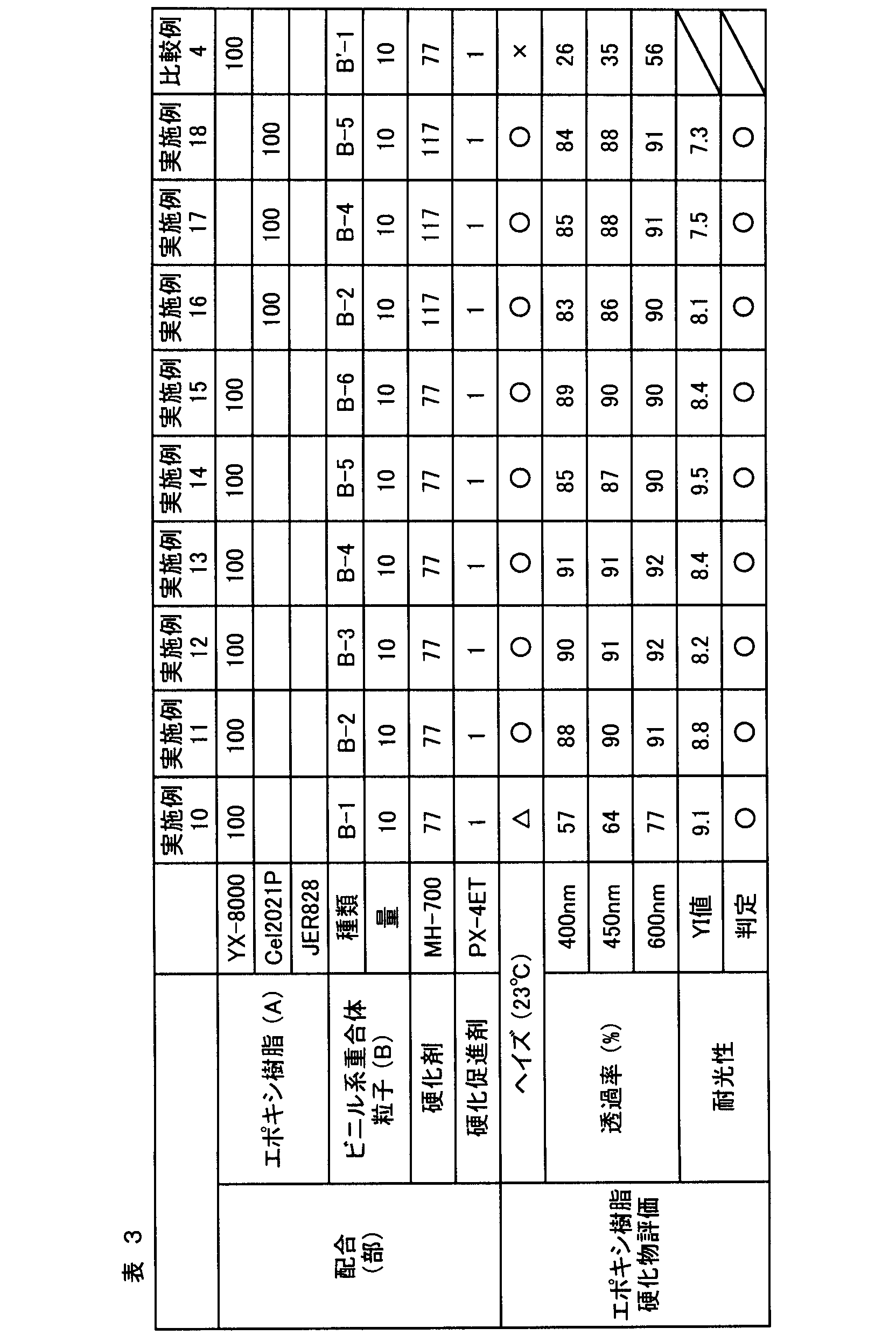
表2及び表3に示すビニル重合体粒子(B-2)~(B-6)及び(B’-1)を用いた以外は実施例1、実施例10と同様にしてエポキシ樹脂組成物及び硬化物を得た。得られたエポキシ樹脂組成物及び硬化物についての評価結果を表2及び表3に示す。
ビニル重合体粒子(B)を用いなかった以外は実施例1及び実施例10と同様にしてエポキシ樹脂組成物及び硬化物を得た。得られたエポキシ樹脂組成物及び硬化物についての評価結果を表2及び表3に示す。
脂環式エポキシ樹脂(A)としてダイセル化学工業(株)製、商品名:「セロキサイド2021」100質量部を用い、表2に示すビニル重合体粒子を使用した。それ以外は実施例1と同様にしてエポキシ樹脂組成物についての評価結果を表2に示す。
ビニル重合体粒子(B)を用いなかった以外は実施例7及び実施例16と同様にしてエポキシ樹脂組成物及び硬化物を得た。得られたエポキシ樹脂組成物及び硬化物についての評価結果を表2及び表3に示す。
脂環式エポキシ樹脂(A)の変わりにビスフェノールA型エポキシ樹脂(ジャパンエポキシレジン(株)製、「エピコート828」(商品名))、ビニル重合体粒子(B-2)を用いた以外は実施例1と同様にしてエポキシ樹脂組成物を得た。次いで、上記のエポキシ樹脂組成物に表3に示す配合量で硬化剤及び硬化促進剤を配合する以外は実施例10と同様にして硬化物を作製し、ヘイズ、透過率及び耐光性を評価した。得られた結果を表3に示す。
Claims (11)
- 脂環式エポキシ樹脂(A)及び、ビニル重合体粒子(B)を含有するエポキシ樹脂組成物であって、ビニル重合体粒子(B)のアセトン可溶分が30質量%以上で、アセトン可溶分の質量平均分子量が10万以上で、体積平均一次粒子径(Dv)が200nm以上であるエポキシ樹脂組成物。
- 脂環式エポキシ樹脂(A)が、3,4-エポキシシクロヘキシルメチル-3’,4’-エポキシシクロヘキサンカルボキシレート及びビスフェノールA型の水素化脂環式エポキシ樹脂から選ばれる少なくとも一種である請求項1に記載のエポキシ樹脂組成物。
- ビニル重合体粒子(B)が、カルボキシル基含有ビニル単量体及び水酸基含有ビニル単量体から選ばれる少なくとも1種の官能基含有単量体1質量%以上を含有する単量体原料を重合して得られた粒子である請求項1に記載のエポキシ樹脂組成物。
- 単量体原料が官能基含有単量体3質量%以上を含有する請求項3に記載のエポキシ樹脂組成物。
- ビニル重合体粒子(B)が、エポキシ樹脂用プレゲル剤である請求項1に記載のエポキシ樹脂組成物。
- エポキシ樹脂組成物を硬化して得られる厚み3mmの硬化物の23℃、400nmにおける全光線透過率が50.0%以上である請求項1に記載のエポキシ樹脂組成物。
- 全光線透過率が80.0%以上である請求項6に記載のエポキシ樹脂組成物。
- エポキシ樹脂組成物を硬化して得られる厚み3mmの硬化物を、デューパネル光コントロールウェザーメーターを用いて試験温度60℃、96時間連続照射を行った耐光性試験後のYIの値が10.0以下である請求項1に記載のエポキシ樹脂組成物。
- 請求項1に記載のエポキシ樹脂組成物を硬化して得られる硬化物。
- 請求項1に記載のエポキシ樹脂組成物を用いた光半導体封止材料。
- アセトン可溶分が30質量%以上で、アセトン可溶分の質量平均分子量が10万以上で、体積平均一次粒子径(Dv)が200nm以上であるビニル重合体粒子(B)を含む脂環式エポキシ樹脂用プレゲル剤。
Priority Applications (2)
| Application Number | Priority Date | Filing Date | Title |
|---|---|---|---|
| US14/123,141 US20140107295A1 (en) | 2011-05-30 | 2012-05-29 | Epoxy resin composition, cured object and optical semiconductor sealing material |
| KR1020137031333A KR101560075B1 (ko) | 2011-05-30 | 2012-05-29 | 에폭시 수지 조성물, 경화물 및 광 반도체 밀봉 재료 |
Applications Claiming Priority (2)
| Application Number | Priority Date | Filing Date | Title |
|---|---|---|---|
| JP2011120703 | 2011-05-30 | ||
| JP2011-120703 | 2011-05-30 |
Publications (1)
| Publication Number | Publication Date |
|---|---|
| WO2012165413A1 true WO2012165413A1 (ja) | 2012-12-06 |
Family
ID=47259267
Family Applications (1)
| Application Number | Title | Priority Date | Filing Date |
|---|---|---|---|
| PCT/JP2012/063723 Ceased WO2012165413A1 (ja) | 2011-05-30 | 2012-05-29 | エポキシ樹脂組成物、硬化物及び光半導体封止材料 |
Country Status (5)
| Country | Link |
|---|---|
| US (1) | US20140107295A1 (ja) |
| JP (1) | JPWO2012165413A1 (ja) |
| KR (1) | KR101560075B1 (ja) |
| TW (1) | TW201302909A (ja) |
| WO (1) | WO2012165413A1 (ja) |
Cited By (2)
| Publication number | Priority date | Publication date | Assignee | Title |
|---|---|---|---|---|
| WO2014109212A1 (ja) * | 2013-01-09 | 2014-07-17 | 株式会社ダイセル | 硬化性エポキシ樹脂組成物 |
| JP6039080B2 (ja) * | 2014-05-30 | 2016-12-07 | 積水化学工業株式会社 | 狭額縁設計表示素子用接着剤 |
Families Citing this family (3)
| Publication number | Priority date | Publication date | Assignee | Title |
|---|---|---|---|---|
| TWI532752B (zh) * | 2011-12-21 | 2016-05-11 | 三菱麗陽股份有限公司 | 聚合物粉體、硬化物、硬化性樹脂用應力緩和劑兼預膠化劑、硬化性樹脂組成物、半導體用密封材料、片材狀物品、液晶顯示元件用密封劑 |
| EP2980134B1 (en) * | 2013-03-29 | 2018-01-31 | JXTG Nippon Oil & Energy Corporation | Prepreg, fiber-reinforced composite material, and resin composition containing particles |
| US10421688B2 (en) | 2015-01-29 | 2019-09-24 | Flex-a-Rock Holdings, LLC | Latex-based formulations for coating and sculpting applications |
Citations (10)
| Publication number | Priority date | Publication date | Assignee | Title |
|---|---|---|---|---|
| JP2001164090A (ja) * | 1999-12-10 | 2001-06-19 | Techno Polymer Co Ltd | エポキシ樹脂組成物 |
| JP2001288336A (ja) * | 2000-04-06 | 2001-10-16 | Techno Polymer Co Ltd | エポキシ樹脂組成物 |
| JP2008189709A (ja) * | 2007-02-01 | 2008-08-21 | Daicel Chem Ind Ltd | 硬化性樹脂組成物及びその硬化物 |
| JP2008291152A (ja) * | 2007-05-25 | 2008-12-04 | Hitachi Chem Co Ltd | 熱硬化性樹脂組成物、コアシェルポリマ、硬化物 |
| WO2009096374A1 (ja) * | 2008-01-28 | 2009-08-06 | Kaneka Corporation | 脂環式エポキシ樹脂組成物、その硬化物、及びその製造方法、並びにゴム状重合体含有樹脂組成物 |
| JP2010053199A (ja) * | 2008-08-27 | 2010-03-11 | Daicel Chem Ind Ltd | 光半導体封止用樹脂組成物 |
| WO2010090246A1 (ja) * | 2009-02-05 | 2010-08-12 | 三菱レイヨン株式会社 | ビニル重合体粉体、硬化性樹脂組成物及び硬化物 |
| WO2011001912A1 (ja) * | 2009-07-01 | 2011-01-06 | 協立化学産業株式会社 | 深部硬化性に優れたエネルギー線硬化型エポキシ樹脂組成物 |
| JP2012077129A (ja) * | 2010-09-30 | 2012-04-19 | Namics Corp | 樹脂組成物、および、それを用いた封止材 |
| WO2012086463A1 (ja) * | 2010-12-20 | 2012-06-28 | 株式会社ダイセル | 硬化性エポキシ樹脂組成物及びこれを使用した光半導体装置 |
Family Cites Families (3)
| Publication number | Priority date | Publication date | Assignee | Title |
|---|---|---|---|---|
| JP2001196642A (ja) * | 2000-01-11 | 2001-07-19 | Toyoda Gosei Co Ltd | 発光装置 |
| WO2005028536A1 (ja) * | 2003-09-22 | 2005-03-31 | Mitsubishi Chemical Corporation | 脂環式エポキシ樹脂、その製造方法、その組成物、エポキシ樹脂硬化体および脂環式エポキシ樹脂組成物の用途 |
| JP2009249569A (ja) * | 2008-04-09 | 2009-10-29 | Japan Epoxy Resin Kk | 光学素子封止材用エポキシ樹脂組成物 |
-
2012
- 2012-05-29 KR KR1020137031333A patent/KR101560075B1/ko active Active
- 2012-05-29 JP JP2012526212A patent/JPWO2012165413A1/ja active Pending
- 2012-05-29 WO PCT/JP2012/063723 patent/WO2012165413A1/ja not_active Ceased
- 2012-05-29 US US14/123,141 patent/US20140107295A1/en not_active Abandoned
- 2012-05-30 TW TW101119344A patent/TW201302909A/zh unknown
Patent Citations (10)
| Publication number | Priority date | Publication date | Assignee | Title |
|---|---|---|---|---|
| JP2001164090A (ja) * | 1999-12-10 | 2001-06-19 | Techno Polymer Co Ltd | エポキシ樹脂組成物 |
| JP2001288336A (ja) * | 2000-04-06 | 2001-10-16 | Techno Polymer Co Ltd | エポキシ樹脂組成物 |
| JP2008189709A (ja) * | 2007-02-01 | 2008-08-21 | Daicel Chem Ind Ltd | 硬化性樹脂組成物及びその硬化物 |
| JP2008291152A (ja) * | 2007-05-25 | 2008-12-04 | Hitachi Chem Co Ltd | 熱硬化性樹脂組成物、コアシェルポリマ、硬化物 |
| WO2009096374A1 (ja) * | 2008-01-28 | 2009-08-06 | Kaneka Corporation | 脂環式エポキシ樹脂組成物、その硬化物、及びその製造方法、並びにゴム状重合体含有樹脂組成物 |
| JP2010053199A (ja) * | 2008-08-27 | 2010-03-11 | Daicel Chem Ind Ltd | 光半導体封止用樹脂組成物 |
| WO2010090246A1 (ja) * | 2009-02-05 | 2010-08-12 | 三菱レイヨン株式会社 | ビニル重合体粉体、硬化性樹脂組成物及び硬化物 |
| WO2011001912A1 (ja) * | 2009-07-01 | 2011-01-06 | 協立化学産業株式会社 | 深部硬化性に優れたエネルギー線硬化型エポキシ樹脂組成物 |
| JP2012077129A (ja) * | 2010-09-30 | 2012-04-19 | Namics Corp | 樹脂組成物、および、それを用いた封止材 |
| WO2012086463A1 (ja) * | 2010-12-20 | 2012-06-28 | 株式会社ダイセル | 硬化性エポキシ樹脂組成物及びこれを使用した光半導体装置 |
Cited By (3)
| Publication number | Priority date | Publication date | Assignee | Title |
|---|---|---|---|---|
| WO2014109212A1 (ja) * | 2013-01-09 | 2014-07-17 | 株式会社ダイセル | 硬化性エポキシ樹脂組成物 |
| JPWO2014109212A1 (ja) * | 2013-01-09 | 2017-01-19 | 株式会社ダイセル | 硬化性エポキシ樹脂組成物 |
| JP6039080B2 (ja) * | 2014-05-30 | 2016-12-07 | 積水化学工業株式会社 | 狭額縁設計表示素子用接着剤 |
Also Published As
| Publication number | Publication date |
|---|---|
| TW201302909A (zh) | 2013-01-16 |
| KR20140007944A (ko) | 2014-01-20 |
| KR101560075B1 (ko) | 2015-10-13 |
| US20140107295A1 (en) | 2014-04-17 |
| JPWO2012165413A1 (ja) | 2015-02-23 |
Similar Documents
| Publication | Publication Date | Title |
|---|---|---|
| CN102307918B (zh) | 乙烯基聚合物粉体、固化性树脂组合物及固化物 | |
| JP6086062B2 (ja) | 重合体粉体、硬化性樹脂組成物及びその硬化物 | |
| JP5979006B2 (ja) | ビニル重合体粉体、硬化性樹脂組成物及び硬化物 | |
| JP2013028813A (ja) | ビニル重合体粉体、エポキシ樹脂組成物及びその硬化物 | |
| WO2012165413A1 (ja) | エポキシ樹脂組成物、硬化物及び光半導体封止材料 | |
| CN103339193B (zh) | 环氧树脂用交联聚合物颗粒、环氧树脂组合物以及环氧树脂固化物 | |
| WO2010104055A1 (ja) | (メタ)アクリレート系重合体、樹脂組成物及び成形体 | |
| JP5760347B2 (ja) | グラフト共重合体の製造方法、樹脂組成物及び成形体 | |
| JP2013076092A (ja) | 光半導体用封止シート用エポキシ樹脂組成物、光半導体用封止シート及び光半導体装置 | |
| JP2013095860A (ja) | 硬化性樹脂用応力緩和剤、硬化性樹脂組成物及び成形体 |
Legal Events
| Date | Code | Title | Description |
|---|---|---|---|
| ENP | Entry into the national phase |
Ref document number: 2012526212 Country of ref document: JP Kind code of ref document: A |
|
| 121 | Ep: the epo has been informed by wipo that ep was designated in this application |
Ref document number: 12793091 Country of ref document: EP Kind code of ref document: A1 |
|
| ENP | Entry into the national phase |
Ref document number: 20137031333 Country of ref document: KR Kind code of ref document: A |
|
| WWE | Wipo information: entry into national phase |
Ref document number: 14123141 Country of ref document: US |
|
| NENP | Non-entry into the national phase |
Ref country code: DE |
|
| 122 | Ep: pct application non-entry in european phase |
Ref document number: 12793091 Country of ref document: EP Kind code of ref document: A1 |