WO2012157456A1 - 2-シアノアクリル酸の製造方法 - Google Patents
2-シアノアクリル酸の製造方法 Download PDFInfo
- Publication number
- WO2012157456A1 WO2012157456A1 PCT/JP2012/061649 JP2012061649W WO2012157456A1 WO 2012157456 A1 WO2012157456 A1 WO 2012157456A1 JP 2012061649 W JP2012061649 W JP 2012061649W WO 2012157456 A1 WO2012157456 A1 WO 2012157456A1
- Authority
- WO
- WIPO (PCT)
- Prior art keywords
- cyanoacrylic acid
- pyrolysis
- temperature
- raw material
- pyrolysis reactor
- Prior art date
- Legal status (The legal status is an assumption and is not a legal conclusion. Google has not performed a legal analysis and makes no representation as to the accuracy of the status listed.)
- Ceased
Links
Images

Classifications
-
- C—CHEMISTRY; METALLURGY
- C07—ORGANIC CHEMISTRY
- C07C—ACYCLIC OR CARBOCYCLIC COMPOUNDS
- C07C253/00—Preparation of carboxylic acid nitriles
- C07C253/30—Preparation of carboxylic acid nitriles by reactions not involving the formation of cyano groups
Definitions
- the present invention relates to a method for producing 2-cyanoacrylic acid.
- the cyanoacrylate adhesive mainly composed of 2-cyanoacrylate has the property that 2-cyanoacrylate is easily anionically polymerized and rapidly cured in the presence of a small amount of water or a basic substance. Therefore, it is widely used as an instant adhesive in various industries, medical fields, leisure fields, and even general households.
- the conventional cyanoacrylate adhesives are excellent in tensile adhesive strength at room temperature, but the peel adhesive strength and impact adhesive strength are not always sufficient, and more advanced performance in terms of heat resistance and water resistance. There is a need for further improvements.
- a conventional cyanoacrylate-based adhesive uses a polymer obtained by anionic polymerization of 2-cyanoacrylate ester for adhesion, and the polymer obtained by anionic polymerization has a linear shape without a cross-linked structure. Since it is a polymer, it is presumed that the above-mentioned characteristics are caused by it.
- 2-cyanoacrylic acid can be used in the production of these 2-cyanoacrylic acid esters or higher alkyl esters of 2-cyanoacrylic acid
- 2-cyanoacrylic acid and alcohol can be used in the same manner as in the production of ordinary acrylic acid esters.
- Various 2-cyanoacrylic acid esters can be easily obtained by producing 2-cyanoacrylic acid chloride from 2-cyanoacrylic acid and reacting it with an alcohol.
- Patent Document 3 describes a production method other than the thermal decomposition reaction, but there is a problem in productivity due to a long transesterification time.
- the present invention has been made in view of the above problems, and an object of the present invention is to provide a method for producing 2-cyanoacrylic acid, which can obtain 2-cyanoacrylic acid in a high yield.
- a method for producing 2-cyanoacrylic acid capable of obtaining 2-cyanoacrylic acid in high yield could be provided.
- the method for producing 2-cyanoacrylic acid according to the present invention comprises a gasification step of gasifying 2-cyanoacrylate in a raw material tank, and introducing the gas of 2-cyanoacrylate into a thermal decomposition reactor.
- a pyrolysis step for decomposing and a recovery step for recovering 2-cyanoacrylic acid produced in the pyrolysis step wherein the gas introduction rate in the pyrolysis step is 0 per 1 m 2 of the surface area of the inner surface of the pyrolysis reactor. 0.1 g / min or more and 80 g / min or less, and the pyrolysis temperature in the pyrolysis step is 550 to 850 ° C.
- the 2-cyanoacrylic acid obtained by the production method of the present invention is a 2-cyanoacrylic acid ester, particularly a polyfunctional 2-cyanoacrylic acid ester or a 2-cyanoacrylic acid higher alkyl ester, which is the main component of the cyanoacrylate adhesive. It is useful as a production raw material.
- X to Y representing a numerical range means “X or more and Y or less” unless otherwise specified. That is, it means a numerical range including X and Y as end points.
- the gasification step is a step of gasifying 2-cyanoacrylate in a raw material tank.
- the 2-cyanoacrylic acid ester used in the gasification step is a compound represented by the following formula (1).
- R is a saturated or unsaturated, straight chain hydrocarbon group, branched chain hydrocarbon group, or cyclic hydrocarbon having 1 to 20 carbon atoms which may have a halogen atom. Group or an aromatic hydrocarbon group.
- 2-cyanoacrylic acid ester examples include methyl, ethyl, chloroethyl, n-propyl, i-propyl, allyl, propargyl, n-butyl, i-butyl, n-pentyl, n- Hexyl, amyl, 2-methyl-3-butenyl, 3-methyl-3-butenyl, 2-pentenyl, n-hexyl, 6-chlorohexyl, cyclohexyl, phenyl, tetrahydrofurfuryl, 2-hexenyl, 4-methyl-pentenyl , 3-methyl-2-cyclohexenyl, norbornyl, heptyl, cyclohexanemethyl, cycloheptyl, 1-methyl-cyclohexyl, 2-methyl-cyclohexyl, 3-methyl-cyclohexyl, 2-ethylhexyl, n-octyl,
- 2-cyanoacrylic acid alkyl ester is preferable from the viewpoint of raw material cost, and 2-cyanoacrylic acid lower alkyl ester (having 1 to 6, preferably 2 to 6, more preferably 2 to 4 carbon atoms). More preferably, it has 2 or 3 carbon atoms, more preferably ethyl 2-cyanoacrylate.
- a polymerization inhibitor is preferably added to the 2-cyanoacrylic acid ester.
- a polymerization inhibitor an anionic polymerization inhibitor generally used for a cyanoacrylate adhesive or a radical polymerization inhibitor can be used.
- the anionic polymerization inhibitor include sulfur dioxide, acidic gas such as boron trifluoride, sulfonic acid compound such as methanesulfonic acid, hydroxypropanesulfonic acid, p-toluenesulfonic acid, boron trifluoride ethyl ether.
- radical polymerization inhibitor examples include hydroquinone, hydroquinone monomethyl ether, pyrogallol, di-t-butylphenol, and t-butylpyrocatechol.
- the addition amount of the polymerization inhibitor is not particularly limited, but is preferably 100 to 3,000 ppm, more preferably 200 to 2,500 ppm, and more preferably 300 to 2,000 ppm with respect to 2-cyanoacrylate. More preferably it is. The addition amount within the above range is preferable because the polymerization of 2-cyanoacrylate is sufficiently suppressed and economical.
- the 2-cyanoacrylate ester and, if necessary, a polymerization inhibitor are placed in a raw material tank and heated under reduced pressure to gasify the 2-cyanoacrylate ester.
- the degree of vacuum is preferably 10 to 1,000 Pa, more preferably 50 to 850 Pa, and still more preferably 100 to 700 Pa.
- the temperature of the raw material tank is preferably 40 to 80 ° C., more preferably 45 to 75 ° C., and further preferably 50 to 70 ° C. If the degree of vacuum and the temperature of the raw material tank are within the above ranges, polymerization of the raw material 2-cyanoacrylate can be suppressed, and gasification of the 2-cyanoacrylate can be performed efficiently. Further, by changing the degree of vacuum and the temperature of the raw material tank, the gas speed of 2-cyanoacrylate gas introduced into the thermal decomposition reactor can be adjusted.
- the thermal decomposition step is a step of introducing the 2-cyanoacrylic acid ester gas obtained in the above gasification step into a thermal decomposition reactor to obtain the desired 2-cyanoacrylic acid by thermal decomposition.
- the pyrolysis reactor used in the pyrolysis step is not particularly limited as long as it is a reactor that can withstand a reaction at a high temperature, but is preferably a reaction tube made of quartz, metal, or ceramics. Moreover, when enlarging a thermal decomposition reactor, it is preferable that it is a metal or ceramics reaction tube, and it is more preferable that it is stainless steel.
- the reason is that it is difficult to increase the size of the pyrolysis reactor made of quartz, and it is difficult to control the internal temperature because the thermal conductivity is low and the heat capacity is large compared to stainless steel. If the internal temperature control is insufficient, excessive decomposition and poor decomposition tend to occur, and the selectivity tends to be low. Furthermore, the pyrolysis reactor made of quartz has a large amount of incinerated 2-cyanoacrylate ester (ash content), and there is a concern that heat transfer may deteriorate due to a long-time reaction. On the other hand, the thermal decomposition reactor made of stainless steel is easy to increase in size and has a high thermal conductivity and a small heat capacity, so that the internal temperature can be easily controlled.
- the incinerated 2-cyanoacrylic acid ester hardly adheres, and even if it is reacted for a long time, the heat transfer is hardly lowered.
- the protrusion may be a convex shape, a cross shape, or the like, but a reactor with many protrusions such as a Vigreux column is difficult to increase in size and ash remains easily.
- the value obtained by dividing the amount of crude 2-cyanoacrylic acid produced by the pyrolysis reaction by the amount of 2-cyanoacrylic acid ester introduced into the pyrolysis reactor is called the conversion rate.
- the value obtained by dividing the amount of purified 2-cyanoacrylic acid by the amount of crude 2-cyanoacrylic acid before recrystallization is called selectivity.
- the value obtained by multiplying the conversion rate and the selectivity is defined as the yield. Details of the calculation method will be described later.
- the gas introduction rate of 2-cyanoacrylate needs to be 80 g / min or less per 1 m 2 of the surface area of the inner surface of the pyrolysis reactor. Moreover, it is preferable that it is 0.1 g / or more.
- the gas introduction rate is more preferably 3 to 65 g / min, and further preferably 5 to 50 g / min.
- the introduction speed can be adjusted by the degree of vacuum and the temperature of the raw material tank.
- a minimum is not specifically limited, From a viewpoint of productivity, it is preferable that it is 0.1 g / or more.
- the temperature of the pyrolysis reactor needs to be 550 to 850 ° C., preferably 600 to 800 ° C., and more preferably 650 to 800 ° C. If the temperature is less than 550 ° C., the thermal decomposition reaction does not proceed sufficiently. On the other hand, when the temperature exceeds 850 ° C., excessive decomposition tends to occur, and the yield of 2-cyanoacrylic acid is lowered.
- Pyrolysis reactors are SUS304 [Ni (8 to 10.5%), Cr (18 to 20%)], SUS316 [Ni (10 to 14%), Cr (16 to 18%), Mo (2 to 3%) )], Martensite such as SUS403 [Cr (11.5 to 13%)], SUS405 [Cr (11.5 to 14.5%), Al (0.1 to 0.3) %)], SUS630 [Ni (3-5%), Cr (15-17.5%), Cu (3-5%), Nb (0.15-0.45%)] Both precipitation hardening systems such as those described above, as well as Hastelloy (registered trademark of Haynes International Inc.) and Inconel (registered trademark of Special Matels Corporation) with Mo added to impart heat resistance can be used.
- those containing Ni are preferable.
- SUS304 and SUS316 which are relatively inexpensive and easy to process, are preferable, and when Ni removal occurs due to use at a high temperature for a long time, deterioration can be easily determined from the outside by magnetic measurement.
- the recovery process is a process of recovering 2-cyanoacrylic acid produced in the above thermal decomposition process.
- the temperature of the 2-cyanoacrylic acid receiver is preferably equal to or higher than the temperature of the raw material tank.
- the difference between the temperature of the receiver and the temperature of the raw material tank in the recovery process is preferably ⁇ (receiver temperature) ⁇ (temperature of the raw material tank) ⁇ is 0 ° C. or higher, and is 0 to 90 ° C. Is more preferable, 0 to 50 ° C.
- the crude 2-cyanoacrylic acid obtained in the above recovery step can be converted to purified 2-cyanoacrylic acid by recrystallization according to a conventional method. Specifically, the crude 2-cyanoacrylic acid is dissolved in toluene or the like and then filtered to remove the polymer of 2-cyanoacrylic acid, which is a byproduct of thermal decomposition. Thereafter, the filtrate is cooled to precipitate 2-cyanoacrylic acid crystals, which are washed with toluene or the like to obtain purified 2-cyanoacrylic acid.
- FIG. 1 schematically shows an example of a manufacturing apparatus suitably used in the present invention.
- the 2-cyanoacrylic acid production apparatus 100 shown in FIG. 1 includes at least a raw material tank 1, a pyrolysis reactor 5, and a receiver 8.
- the raw material tank 1 is heated to a desired temperature by the raw material tank heater 2.
- the receiver 8 is heated to a desired temperature by the receiver heater 9.
- the pyrolysis reactor 5 is heated to a desired temperature by a pyrolysis furnace (electric heater) 6.
- the raw material tank 1 and the pyrolysis reactor 5 are connected by a raw material tank-pyrolysis reactor connecting pipe 3.
- the pyrolysis reactor 5 and the receiver 8 are connected to the pyrolysis reactor-receiver connecting pipe 7.
- the pyrolysis reactor 5 is provided with a thermometer 4 for measuring the internal temperature, and the temperature in the pyrolysis reactor 5 can be measured.
- a trap 1 10 is connected to the receiver 8, and a trap 2 11 is further connected.
- the trap 1 10 and the trap 2 11 are cooled to a desired temperature.
- the temperature of the trap 1 10 is set to ⁇ 30 ° C.
- the trap 2 11 is cooled with liquid nitrogen.
- a vacuum pump 12 is connected to the trap 211, and by operating the vacuum pump 12, the whole of the raw material tank 1 to the trap 211 is decompressed.
- the raw material tank 1 is charged with 2-cyanoacrylic acid ester as a raw material. At this time, it is preferable to add a polymerization inhibitor to the raw material tank 1 simultaneously.
- the pyrolysis furnace 6 is heated to a desired temperature, and the raw material tank heater 2 and the receiver heater 9 are heated to a desired temperature.
- the 2-cyanoacrylic acid ester (compound represented by the above formula (1)) introduced into the thermal decomposition reactor 5 is thermally decomposed into 2-cyanoacrylic acid and alkene. Crude 2-cyanoacrylic acid is recovered in the receiver 8. Since 2-cyanoacrylic acid has a boiling point higher than that of 2-cyanoacrylic acid ester, 2-cyanoacrylic acid can be deposited even when the temperature of the receiver 8 is higher than the temperature of the raw material tank 1. On the other hand, the by-produced alkene and the raw material 2-cyanoacrylate are cooled in trap 1 10 and trap 2 11, and 2-cyanoacrylate is recovered in trap 1 10 and the alkene is recovered in trap 2 11. .
- Example 1 A raw material tank 1 shown in FIG. 1 was charged with 1,000 g of ethyl 2-cyanoacrylate and 1,000 ppm of p-toluenesulfonic acid as a polymerization inhibitor.
- a 300 mm long pyrolysis furnace (electric heater) 6 is loaded with a SUS316 pyrolysis reactor 5 (inner surface area 0.0202 m 2 ) having an inner diameter of 21.4 mm and heated to an internal temperature of 700 ° C. did.
- the temperature of the raw material tank 1 and the receiver 8 is set to 55 ° C.
- the vacuum pump 12 is started so that the internal pressure becomes 400 to 467 Pa. The degree of vacuum was adjusted. After a while, light yellow crude 2-cyanoacrylic acid was deposited on the inner wall of the receiver 8. After 5 hours of production, heating of the vacuum pump 12 and the pyrolysis reactor 5 was stopped, and the crude 2-cyanoacrylic acid produced in the receiver 8 was recovered.
- the rate of the gas led to the pyrolysis reactor 5 is 0.955 g / min. Asked.
- the gas introduction rate per 1 m 2 of the inner surface area was 47.3 g / min.
- the yield of crude 2-cyanoacrylic acid was 113.8 g.
- the pyrolysis reactor 5 was increased in weight by 0.13 g due to adhesion of polymer or ash. Using the amount of ethyl 2-cyanoacrylate introduced and the amount of crude 2-cyanoacrylic acid produced, the conversion rate was determined as follows.
- Example 2 The inner diameter of the pyrolysis reactor was 38.9 mm (inner surface area 0.0366 m 2 ), the temperature of the raw material tank 1 and the receiver 8 was 60 ° C., the inner pressure was 533 to 600 Pa, and the temperature of the pyrolysis reactor 5 was 800 ° C.
- the other operations were the same as in Example 1.
- the velocity of the gas led to the pyrolysis reactor was 0.814 g / min, and 22.2 g / min per 1 m 2 of the surface area of the inner surface of the pyrolysis reactor.
- the amount of crude 2-cyanoacrylic acid produced after 5 hours of manufacture was 109.7 g and the pyrolysis reactor was increased by 1.24 g.
- the amount of purified 2-cyanoacrylic acid obtained by recrystallization was 78.6 g. Conversion: 44.9%, selectivity: 71.7%, yield: 32.2%.
- Example 3 The same SUS316 pyrolysis reactor 5 having an inner diameter of 38.9 mm as in Example 2 was used, in which a SUS316 partition having a thickness of 2 mm was put in a cross (inner surface area 0.0833 m 2 ), and the internal pressure was 333 to 400 Pa. The same operation as in Example 1 was carried out except that.
- the velocity of the gas introduced into the pyrolysis reactor was 0.804 g / min, and 9.65 g / min per 1 m 2 of the surface area of the inner surface of the pyrolysis reactor 5.
- the amount of crude 2-cyanoacrylic acid produced after 5 hours of manufacture was 123.9 g and the pyrolysis reactor was increased by 0.09 g.
- the amount of purified 2-cyanoacrylic acid obtained by recrystallization was 95.4 g. Conversion: 51.4%, selectivity: 77.0% Yield: 39.6%.
- Example 4 The same operation as in Example 3 was performed except that the internal pressure was 267 to 333 Pa, and the production time was 20 hours.
- the velocity of the gas introduced into the pyrolysis reactor 5 was 1.06 g / min, and 12.7 g / min per 1 m 2 of the surface area of the inner surface of the pyrolysis reactor 5.
- the amount of crude 2-cyanoacrylic acid produced after 20 hours of production was 644.8 g, and pyrolysis reactor 5 was increased by 0.29 g.
- the amount of purified 2-cyanoacrylic acid obtained by recrystallization was 440.5 g. Conversion: 50.7%, selectivity: 68.3%, yield: 34.6%.
- Example 5 The pyrolysis reactor 5 of Example 1 was changed to a Vigreux column having an inner surface area of 0.0427 m 2 by providing protrusions inside a quartz reaction tube having an inner diameter of 33.6 mm. The same operation as in Example 1 was performed except that the raw material ethyl 2-cyanoacrylate was 1,000 g, the temperature of the raw material tank 1 and the receiver 8 was 60 ° C., and the internal pressure was 200 to 267 Pa. The velocity of the gas introduced into the pyrolysis reactor 5 was 0.980 g / min, and 23.0 g / min per 1 m 2 of the surface area of the inner surface of the pyrolysis reactor 5.
- the amount of crude 2-cyanoacrylic acid produced after 5 hours of manufacture was 134.9 g, and pyrolysis reactor 5 was increased by 1.35 g.
- the amount of purified 2-cyanoacrylic acid obtained by recrystallization was 99.0 g. Conversion: 45.9%, selectivity: 73.4%, yield: 33.7%.
- Example 6 The pyrolysis reactor 5 of Example 1 was changed to a mullite reaction tube having an inner diameter of 20.0 mm (inner surface area 0.0188 m 2 ), and the same operation as in Example 1 was performed except that the internal pressure was 533 to 600 Pa.
- the velocity of the gas introduced into the pyrolysis reactor 5 was 0.516 g / min, and 27.4 g / min per 1 m 2 of the surface area of the inner surface of the pyrolysis reactor 5.
- the amount of crude 2-cyanoacrylic acid produced after 5 hours of manufacture was 55.0 g, and pyrolysis reactor 5 was increased by 0.23 g.
- the amount of purified 2-cyanoacrylic acid obtained by recrystallization was 30.3 g. Conversion: 35.5%, selectivity: 55.0%, yield: 19.5%.
- Example 7 The same operation as in Example 1 was performed, except that the temperature of the raw material tank 1 of Example 1 was 55 ° C., the temperature of the receiver 6 was 45 ° C., and the internal pressure was 267 to 333 Pa.
- the velocity of the gas introduced into the pyrolysis reactor 5 was 0.94 g / min, and 46.5 g / min per 1 m 2 of the surface area of the inner surface of the pyrolysis reactor 5.
- the amount of crude 2-cyanoacrylic acid produced after 5 hours of manufacture was 164.0 g, and pyrolysis reactor 5 was increased by 0.13 g.
- the crude 2-cyanoacrylic acid was generally wet.
- the amount of purified 2-cyanoacrylic acid obtained by recrystallization was 47.7 g. Conversion: 58.2%, selectivity: 29.1%, yield: 16.9%.
- Comparative Example 1 The same operation as in Example 1 was performed except that the thermal decomposition temperature was 500 ° C.
- the velocity of the gas introduced into the pyrolysis reactor 5 was 0.139 g / min, and 3.3 g / min per 1 m 2 of the surface area of the inner surface of the pyrolysis reactor 5.
- the reaction was carried out for 5 hours, but no crude 2-cyanoacrylic acid was produced (conversion rate: 0%).
- Comparative Example 2 The same operation as in Example 1 was performed except that the temperature of the raw material tank 1 and the receiver 8 was 60 ° C., the internal pressure was 200 to 267 Pa, and the temperature of the pyrolysis reactor 5 was 550 ° C.
- the velocity of the gas introduced into the pyrolysis reactor 5 was 1.81 g / min, and 89.6 g / min per 1 m 2 of the surface area of the inner surface of the pyrolysis reactor.
- the amount of crude 2-cyanoacrylic acid produced after 5 hours of production was 1.6 g (conversion: 0.29%).
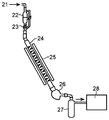
- Comparative Example 3 1,000 g of p-toluenesulfonic acid was mixed with 1,000 g of ethyl 2-cyanoacrylate and put in the dropping funnel 22 shown in FIG. The introduction of the raw material was adjusted by slightly opening the lower cock 23 of the dropping funnel 22. In addition, argon was introduced as a carrier gas 21 for the transfer of 2-cyanoacrylic acid gas generated by thermal decomposition.
- the pyrolysis reactor 24 was made of the same quartz as in Example 5, and was heated by the pyrolysis furnace 25 so that the internal temperature became 700 ° C. The inside of the reaction apparatus was depressurized by the vacuum pump 28.
- 2-Cyanoacrylic acid generated by thermal decomposition was collected in a receiver 26, and raw materials and by-products were collected in a trap 27 cooled with liquid nitrogen. After the production for 8 hours, heating of the vacuum pump 28 and the pyrolysis reactor 24 was stopped, and the crude 2-cyanoacrylic acid produced in the receiver 26 was recovered.
- the introduction rate of ethyl 2-cyanoacrylate introduced into the thermal decomposition reactor 24 was determined to be 0.09 g / min by subtracting the weight of the dropping funnel 22 whose tare was measured in advance from the weight after the test. Therefore, the introduction rate per 1 m 2 of the surface area of the inner surface of the pyrolysis reactor 24 was 2.1 g / min.
- Comparative Example 4 The same operation as in Example 1 was performed except that the thermal decomposition temperature was 870 ° C.
- the velocity of the gas introduced into the pyrolysis reactor 5 was 0.454 g / min, and 12.4 g / min per 1 m 2 of the surface area of the inner surface of the pyrolysis reactor 5.
- the amount of crude 2-cyanoacrylic acid produced was 14.8 g, and the brown coloration was very strong.
- the weight of the pyrolysis reactor 5 was increased by 0.24 g.
- the obtained crude product was recrystallized in the same manner as in Example 1. However, purified 2-cyanoacrylic acid was not obtained. That is, the product obtained in the pyrolysis step is judged to be a polymer of 2-cyanoacrylic acid and 2-cyanoacrylate. Conversion: 10.8%, selectivity: 0.0%, yield: 0.0%.
- Examples 1 to 5 the production methods of 2-cyanoacrylic acid shown in Examples 1 to 5 can obtain the target product in a relatively high yield and are excellent in productivity. Moreover, when the pyrolysis reactor is a reaction tube made of metal or ceramics, it can be seen that there are few incinerated residues and it is suitable for industrialization. Although the yield of Example 6 using the mullite pyrolysis reactor was low, the internal surface area was small, and it is possible to increase the yield by increasing the internal surface area. In Example 7, since the temperature of the 2-cyanoacrylic acid receiver is lower than the temperature of the raw material tank, undecomposed ethyl 2-cyanoacrylate is condensed in the receiver.
- the present invention is a method that can efficiently produce 2-cyanoacrylic acid and is also suitable for industrialization.
- the obtained 2-cyanoacrylic acid is particularly useful as a raw material for producing polyfunctional 2-cyanoacrylic acid esters or higher alkyl esters of 2-cyanoacrylic acid.
Landscapes
- Chemical & Material Sciences (AREA)
- Organic Chemistry (AREA)
- Chemical Kinetics & Catalysis (AREA)
- Organic Low-Molecular-Weight Compounds And Preparation Thereof (AREA)
Abstract
2-シアノアクリル酸を高い収率で得ることができる2-シアノアクリル酸の製造方法を提供すること。 原料槽で2-シアノアクリル酸エステルをガス化するガス化工程と、前記2-シアノアクリル酸エステルのガスを熱分解反応器に導入し熱分解する熱分解工程と、前記熱分解工程で生成した2-シアノアクリル酸を回収する回収工程とをこの順で含み、前記熱分解工程におけるガスの導入速度が、熱分解反応器内面の表面積1m2当たり0.1g/分以上80g/分以下であり、かつ、前記熱分解工程の熱分解温度が550~850℃であることを特徴とする2-シアノアクリル酸の製造方法。
Description
本発明は、2-シアノアクリル酸の製造方法に関するものである。
2-シアノアクリル酸エステルを主成分とするシアノアクリレート系接着剤は、2-シアノアクリル酸エステルが微量の水分又は塩基性物質の存在により、容易にアニオン重合して急速に硬化するという性質を有するため、瞬間接着剤として広く各種産業界、医療分野、レジャー分野、更には一般家庭においても使用されている。しかしながら、従来のシアノアクリレート系接着剤は、常温における引張り接着強さには優れているが、剥離接着強さや衝撃接着強さは必ずしも十分ではなく、また耐熱性、耐水性についてもより高度な性能が求められており、それらについての更なる改良が望まれている。これは、従来のシアノアクリレート系接着剤は、2-シアノアクリル酸エステルのアニオン重合により得られる重合体を接着に利用するものであり、該アニオン重合により得られる重合体は架橋構造の無い線状高分子であるため、それに起因して前記の特性がもたらされていると推定されている。
これらの欠点を解決する方法として、酸性物質や各種ポリアクリル酸エステル、ゴム、ポリマー変性物等を配合することが報告されているが、それらは2-シアノアクリル酸エステルと共重合するものではないため、本質的な物性改良をもたらすことは困難である。
そのため、2-シアノアクリル酸エステルと共重合可能な多官能2-シアノアクリル酸エステルを配合し、2-シアノアクリル酸エステルと共重合させることにより、2-シアノアクリル酸エステル重合体に架橋構造を付与して改質するという方法が報告されている。また、2-シアノアクリル酸高級アルキルエステルを用いて柔軟性を付与する方法も報告されている。しかしながら、それらの多官能2-シアノアクリル酸エステル又は2-シアノアクリル酸高級アルキルエステルは、現在の2-シアノアクリル酸エステルの工業的製造方法、すなわちシアノ酢酸エステルとホルムアルデヒドとの縮合反応、及びその縮合物を解重合するという方法からでは製造が困難なものである。そこで、アントラセンやシクロペンタジエンと2-シアノアクリル酸エステルとのディールズアルダー反応を利用した方法が、多官能2-シアノアクリル酸エステルの製造に利用されたこともあるが、製造工程における反応性は低く、生成物の分離も容易ではないため工業的方法としては不適当な方法である。
そのため、2-シアノアクリル酸エステルと共重合可能な多官能2-シアノアクリル酸エステルを配合し、2-シアノアクリル酸エステルと共重合させることにより、2-シアノアクリル酸エステル重合体に架橋構造を付与して改質するという方法が報告されている。また、2-シアノアクリル酸高級アルキルエステルを用いて柔軟性を付与する方法も報告されている。しかしながら、それらの多官能2-シアノアクリル酸エステル又は2-シアノアクリル酸高級アルキルエステルは、現在の2-シアノアクリル酸エステルの工業的製造方法、すなわちシアノ酢酸エステルとホルムアルデヒドとの縮合反応、及びその縮合物を解重合するという方法からでは製造が困難なものである。そこで、アントラセンやシクロペンタジエンと2-シアノアクリル酸エステルとのディールズアルダー反応を利用した方法が、多官能2-シアノアクリル酸エステルの製造に利用されたこともあるが、製造工程における反応性は低く、生成物の分離も容易ではないため工業的方法としては不適当な方法である。
一方、これらの2-シアノアクリル酸エステル又は2-シアノアクリル酸高級アルキルエステルの製造に、2-シアノアクリル酸が利用できれば、通常のアクリル酸エステルの製造と同様に、2-シアノアクリル酸とアルコールとのエステル化反応、あるいは2-シアノアクリル酸から2-シアノアクリル酸クロライドを製造し、これとアルコールとを反応させることによって種々の2-シアノアクリル酸エステルを容易に得ることができる。
2-シアノアクリル酸の製造方法として、特許文献1には、2-シアノアクリル酸エステルのモノマーを熱分解する方法が開示されている。また、特許文献2には、2-シアノアクリル酸エステルのポリマー又はオリゴマーを、200℃以上の温度で熱分解する方法が開示されている。これらの熱分解方法以外の方法として、特許文献3には、2-シアノアクリル酸エステルを有機酸とエステル交換反応させる方法が開示されている。
しかしながら、特許文献1に開示される2-シアノアクリル酸の製造方法は、生成する2-シアノアクリル酸の収率が低いという問題がある。また、特許文献2に開示される方法は、2-シアノアクリル酸エステルのポリマーを溶融等して、液体で熱分解反応器に滴下するため、生産性が低いという問題がある。更に、特許文献1及び2に記載の方法では、2-シアノアクリル酸エステルが高い反応性を有するため、熱分解反応器内で固化して反応器を閉塞させたり、灰化した残渣が熱分解反応器内に残るため、伝熱が悪くなり、熱分解効率が低下したりするという問題がある。また、これらを防止したり、過剰分解を抑えるために、多量のキャリヤーガスとして二酸化硫黄等を使用しなければならないことから、危険を伴う。加えて、熱分解反応器として高価な石英管を使用しているため、工業化に適さないという問題がある。
一方、特許文献3には、熱分解反応以外の製造方法が記載されているが、エステル交換反応の時間が長く、生産性に問題がある。
一方、特許文献3には、熱分解反応以外の製造方法が記載されているが、エステル交換反応の時間が長く、生産性に問題がある。
本発明は、上記問題点に鑑みなされたものであって、その目的は、2-シアノアクリル酸を高い収率で得ることができる2-シアノアクリル酸の製造方法を提供することにある。
本発明者らは、2-シアノアクリル酸エステルを熱分解する工程を含む2-シアノアクリル酸の製造方法において、原料槽で2-シアノアクリル酸エステルをガス化して熱分解反応器に導入し、特定のガスの導入速度と特定の温度で熱分解することにより、2-シアノアクリル酸を高い収率で得ることができ、かつ、生産性にも優れることを見出し、本発明を完成させるに至った。
すなわち、本発明は次の通りである。
<1> 原料槽で2-シアノアクリル酸エステルをガス化するガス化工程と、前記2-シアノアクリル酸エステルのガスを熱分解反応器に導入し熱分解する熱分解工程と、前記熱分解工程で生成した2-シアノアクリル酸を回収する回収工程とをこの順で含み、前記熱分解工程におけるガスの導入速度が、熱分解反応器内面の表面積1m2当たり0.1g/分以上80g/分以下であり、かつ、前記熱分解工程の熱分解温度が550~850℃であることを特徴とする2-シアノアクリル酸の製造方法、
<2> 前記回収工程において、2-シアノアクリル酸の受器の温度が、前記原料槽の温度以上である、<1>に記載の2-シアノアクリル酸の製造方法、
<3> 前記熱分解反応器が、金属製又はセラミックス製反応管である、<1>又は<2>に記載の2-シアノアクリル酸の製造方法、
<4> 前記金属製反応管が、ステンレス製反応管である、<3>に記載の2-シアノアクリル酸の製造方法、
<5> 前記熱分解工程の熱分解温度が、650~800℃である、<1>~<4>いずれか1つに記載の2-シアノアクリル酸の製造方法、
<6> 前記ガス化工程における原料槽の温度が40~80℃であり、圧力が10~1,000Paである、<1>~<5>いずれか1つに記載の2-シアノアクリル酸の製造方法、
<7> 前記熱分解工程におけるガスの導入速度が、熱分解反応器内面の表面積1m2当たり3~65g/分である、<1>~<6>いずれか1つに記載の2-シアノアクリル酸の製造方法。
<1> 原料槽で2-シアノアクリル酸エステルをガス化するガス化工程と、前記2-シアノアクリル酸エステルのガスを熱分解反応器に導入し熱分解する熱分解工程と、前記熱分解工程で生成した2-シアノアクリル酸を回収する回収工程とをこの順で含み、前記熱分解工程におけるガスの導入速度が、熱分解反応器内面の表面積1m2当たり0.1g/分以上80g/分以下であり、かつ、前記熱分解工程の熱分解温度が550~850℃であることを特徴とする2-シアノアクリル酸の製造方法、
<2> 前記回収工程において、2-シアノアクリル酸の受器の温度が、前記原料槽の温度以上である、<1>に記載の2-シアノアクリル酸の製造方法、
<3> 前記熱分解反応器が、金属製又はセラミックス製反応管である、<1>又は<2>に記載の2-シアノアクリル酸の製造方法、
<4> 前記金属製反応管が、ステンレス製反応管である、<3>に記載の2-シアノアクリル酸の製造方法、
<5> 前記熱分解工程の熱分解温度が、650~800℃である、<1>~<4>いずれか1つに記載の2-シアノアクリル酸の製造方法、
<6> 前記ガス化工程における原料槽の温度が40~80℃であり、圧力が10~1,000Paである、<1>~<5>いずれか1つに記載の2-シアノアクリル酸の製造方法、
<7> 前記熱分解工程におけるガスの導入速度が、熱分解反応器内面の表面積1m2当たり3~65g/分である、<1>~<6>いずれか1つに記載の2-シアノアクリル酸の製造方法。
本発明によれば、2-シアノアクリル酸を高い収率で得ることができる2-シアノアクリル酸の製造方法を提供することができた。
本発明に係る2-シアノアクリル酸の製造方法は、原料槽で2-シアノアクリル酸エステルをガス化するガス化工程と、前記2-シアノアクリル酸エステルのガスを熱分解反応器に導入し熱分解する熱分解工程と、前記熱分解工程で生成した2-シアノアクリル酸を回収する回収工程とを含み、前記熱分解工程におけるガスの導入速度が、熱分解反応器内面の表面積1m2当たり0.1g/分以上80g/分以下であり、かつ、前記熱分解工程の熱分解温度が550~850℃である。
本発明の製造方法により得られる2-シアノアクリル酸は、シアノアクリレート系接着剤の主成分である2-シアノアクリル酸エステル、特に多官能2-シアノアクリル酸エステル又は2-シアノアクリル酸高級アルキルエステルの製造原料として有用である。
本発明の製造方法により得られる2-シアノアクリル酸は、シアノアクリレート系接着剤の主成分である2-シアノアクリル酸エステル、特に多官能2-シアノアクリル酸エステル又は2-シアノアクリル酸高級アルキルエステルの製造原料として有用である。
本発明の2-シアノアクリル酸の製造方法は、2-シアノアクリル酸エステルをガス化して熱分解反応器に導入するため、熱分解反応器に付着する灰化した残渣が少なく、熱分解効率の低下が抑制される。また、2-シアノアクリル酸エステルのガスを直接そのまま熱分解反応器に導入するため、生産性に優れるという効果を奏する。更に、多量のキャリヤーガスを使用する必要がない。
上記回収工程において、2-シアノアクリル酸の受器の温度が、2-シアノアクリル酸エステルのガス化工程における原料槽の温度以上である場合は、より高い収率が得られる。
また、熱分解反応器が、金属製又はセラミックス製反応管である場合は、大型化が可能であり、工業化に適している。
以下に、本発明を詳細に説明する。なお、数値範囲を表す「X~Y」の記載は、特に断りのない限り、「X以上Y以下」を意味する。すなわち、端点であるX及びYを含む数値範囲を意味する。
上記回収工程において、2-シアノアクリル酸の受器の温度が、2-シアノアクリル酸エステルのガス化工程における原料槽の温度以上である場合は、より高い収率が得られる。
また、熱分解反応器が、金属製又はセラミックス製反応管である場合は、大型化が可能であり、工業化に適している。
以下に、本発明を詳細に説明する。なお、数値範囲を表す「X~Y」の記載は、特に断りのない限り、「X以上Y以下」を意味する。すなわち、端点であるX及びYを含む数値範囲を意味する。
1.ガス化工程
ガス化工程は、原料槽で2-シアノアクリル酸エステルをガス化する工程である。ガス化工程で用いられる2-シアノアクリル酸エステルは、下記式(1)で示される化合物である。式(1)において、Rはハロゲン原子を有していてもよい炭素数が1~20の飽和又は不飽和の、直鎖型鎖状炭化水素基、分岐型鎖状炭化水素基、環状炭化水素基、又は芳香族炭化水素基である。
ガス化工程は、原料槽で2-シアノアクリル酸エステルをガス化する工程である。ガス化工程で用いられる2-シアノアクリル酸エステルは、下記式(1)で示される化合物である。式(1)において、Rはハロゲン原子を有していてもよい炭素数が1~20の飽和又は不飽和の、直鎖型鎖状炭化水素基、分岐型鎖状炭化水素基、環状炭化水素基、又は芳香族炭化水素基である。

2-シアノアクリル酸エステルの具体例としては、2-シアノアクリル酸のメチル、エチル、クロロエチル、n-プロピル、i-プロピル、アリル、プロパギル、n-ブチル、i-ブチル、n-ペンチル、n-ヘキシル、アミル、2-メチル-3-ブテニル、3-メチル-3-ブテニル、2-ペンテニル、n-ヘキシル、6-クロロヘキシル、シクロヘキシル、フェニル、テトラヒドロフルフリル、2-ヘキセニル、4-メチル-ペンテニル、3-メチル-2-シクロヘキセニル、ノルボルニル、ヘプチル、シクロヘキサンメチル、シクロヘプチル、1-メチル-シクロヘキシル、2-メチル-シクロヘキシル、3-メチル-シクロヘキシル、2-エチルヘキシル、n-オクチル、シクロオクチル、シクロペンタンメチル、2,3-ジメチルシクロヘキシル、n-ノニル、イソノニル、オキソノニル、n-デシル、イソデシル、n-ドデシル、2-エトキシエチル、2-エトキシ-2-エトキシエチル、ブトキシ-エトキシ-エチル、2,2,2-トリフルオロエチル、ヘキサフルオロイソプロピル、ラウリル、イソトリデシル、ミリスチル、セチル、ステアリル、オレイル、ベヘニル、ヘキシルデシル、オクチルドデシル、ベンジル、クロロフェニル、2-ペンチルオキシエチル、2-ヘキシルオキシエチル、2-シクロヘキシルオキシエチル、2-(2-エチルヘキシルオキシ)エチル、及び2-フェノキシエチル等が挙げられる。これらの中でも、原料コストの面から2-シアノアクリル酸アルキルエステルが好ましく、2-シアノアクリル酸低級アルキルエステル(炭素数1~6、好ましくは炭素数2~6、より好ましくは炭素数2~4、更に好ましくは炭素数2又は3)であることがより好ましく、2-シアノアクリル酸エチルであることが更に好ましい。
上記2-シアノアクリル酸エステルには、原料槽中の重合を防止するために、重合禁止剤を配合することが好ましい。重合禁止剤としては、一般にシアノアクリレート系接着剤に使用されるアニオン重合禁止剤や、ラジカル重合禁止剤を用いることができる。
アニオン重合禁止剤の具体例としては、二酸化硫黄、三フッ化ホウ素のような酸性ガス、メタンスルホン酸、ヒドロキシプロパンスルホン酸、p-トルエンスルホン酸のようなスルホン酸化合物、三フッ化ホウ素エチルエーテル、三フッ化ホウ素フェノール、三フッ化ホウ素メタノール、三フッ化ホウ素n-ブチルエーテル、酢酸三フッ化ホウ素のような三フッ化ホウ素錯体、ポリリン酸、五酸化二リン、アルキルリン酸エステルのようなリン酸化合物、ピロメリット酸、アコニット酸、シアノ酢酸、カプリン酸のような有機酸等が挙げられる。これらの中でも、減圧下で良好な安定性を示すことから、スルホン酸化合物、リン酸化合物及び有機酸が好ましい。
また、ラジカル重合禁止剤の具体例としては、ハイドロキノン、ハイドロキノンモノメチルエーテル、ピロガロール、ジ-t-ブチルフェノール、及びt-ブチルピロカテコール等が挙げられる。
重合禁止剤の添加量は特に限定されないが、2-シアノアクリル酸エステルに対して100~3,000ppmであることが好ましく、200~2,500ppmであることがより好ましく、300~2,000ppmであることが更に好ましい。添加量が上記範囲内であると、2-シアノアクリル酸エステルの重合が十分に抑制され、また、経済的であるので好ましい。
アニオン重合禁止剤の具体例としては、二酸化硫黄、三フッ化ホウ素のような酸性ガス、メタンスルホン酸、ヒドロキシプロパンスルホン酸、p-トルエンスルホン酸のようなスルホン酸化合物、三フッ化ホウ素エチルエーテル、三フッ化ホウ素フェノール、三フッ化ホウ素メタノール、三フッ化ホウ素n-ブチルエーテル、酢酸三フッ化ホウ素のような三フッ化ホウ素錯体、ポリリン酸、五酸化二リン、アルキルリン酸エステルのようなリン酸化合物、ピロメリット酸、アコニット酸、シアノ酢酸、カプリン酸のような有機酸等が挙げられる。これらの中でも、減圧下で良好な安定性を示すことから、スルホン酸化合物、リン酸化合物及び有機酸が好ましい。
また、ラジカル重合禁止剤の具体例としては、ハイドロキノン、ハイドロキノンモノメチルエーテル、ピロガロール、ジ-t-ブチルフェノール、及びt-ブチルピロカテコール等が挙げられる。
重合禁止剤の添加量は特に限定されないが、2-シアノアクリル酸エステルに対して100~3,000ppmであることが好ましく、200~2,500ppmであることがより好ましく、300~2,000ppmであることが更に好ましい。添加量が上記範囲内であると、2-シアノアクリル酸エステルの重合が十分に抑制され、また、経済的であるので好ましい。
ガス化工程では、上記2-シアノアクリル酸エステルと、必要に応じて重合禁止剤とを原料槽に入れて、減圧下で加熱し、2-シアノアクリル酸エステルをガス化する。真空度は、10~1,000Paであることが好ましく、50~850Paであることがより好ましく、100~700Paであることが更に好ましい。また、原料槽の温度は、40~80℃であることが好ましく、45~75℃であることがより好ましく、50~70℃であることが更に好ましい。真空度と、原料槽の温度が上記範囲内であれば、原料の2-シアノアクリル酸エステルの重合が抑制され、また2-シアノアクリル酸エステルのガス化を効率的に行うことができる。また、真空度と、原料槽の温度を変化させることにより、熱分解反応器に導入する2-シアノアクリル酸エステルのガスの速度を調整することができる。
2.熱分解工程
熱分解工程は、上記ガス化工程で得られた2-シアノアクリル酸エステルのガスを熱分解反応器に導入し、熱分解により目的物である2-シアノアクリル酸を得る工程である。熱分解工程に用いられる熱分解反応器は、高温下の反応に耐えられる反応器であれば特に限定されないが、石英製、金属製、又はセラミックス製反応管であることが好ましい。また、熱分解反応器を大型化する場合には、金属製又はセラミックス製反応管であることが好ましく、ステンレス製であることがより好ましい。その理由は、石英製の熱分解反応器は大型化が難しく、またステンレス製に比べ、熱伝導率が低く熱容量が大きいため内温制御が難しいからである。内温制御が不十分であると、過剰分解や分解不良が起こり易く、選択率が低くなる傾向にある。更に、石英製の熱分解反応器は、灰化した2-シアノアクリル酸エステル(灰分)の付着が多く、長時間の反応により伝熱の悪化が懸念される。これに対し、ステンレス製の熱分解反応器は、大型化が容易であり、熱伝導率が高く熱容量が小さいため、内温制御がしやすい。その結果、過剰分解の発生が抑制され、高い選択率が得られる。更に、灰化した2-シアノアクリル酸エステルの付着が生じ難く、長時間反応させても伝熱の低下が生じ難い。
また、伝熱面積を大きくするために、上記熱分解反応器の内部に突起を設けることが好ましい。突起は、凸型、十字型等が挙げられるが、ビグリューカラムのような突起が多くついた反応器は大型化が難しく、かつ、灰分が残留し易い。
なお、本発明において、熱分解反応で生成した粗製2-シアノアクリル酸量を、熱分解反応器に導入した2-シアノアクリル酸エステル量で除した値を転化率という。また、精製2-シアノアクリル酸量を、再結晶化前の粗製2-シアノアクリル酸量で除した値を選択率という。転化率と選択率を乗じた値を収率とする。算出方法の詳細は後述する。
熱分解工程は、上記ガス化工程で得られた2-シアノアクリル酸エステルのガスを熱分解反応器に導入し、熱分解により目的物である2-シアノアクリル酸を得る工程である。熱分解工程に用いられる熱分解反応器は、高温下の反応に耐えられる反応器であれば特に限定されないが、石英製、金属製、又はセラミックス製反応管であることが好ましい。また、熱分解反応器を大型化する場合には、金属製又はセラミックス製反応管であることが好ましく、ステンレス製であることがより好ましい。その理由は、石英製の熱分解反応器は大型化が難しく、またステンレス製に比べ、熱伝導率が低く熱容量が大きいため内温制御が難しいからである。内温制御が不十分であると、過剰分解や分解不良が起こり易く、選択率が低くなる傾向にある。更に、石英製の熱分解反応器は、灰化した2-シアノアクリル酸エステル(灰分)の付着が多く、長時間の反応により伝熱の悪化が懸念される。これに対し、ステンレス製の熱分解反応器は、大型化が容易であり、熱伝導率が高く熱容量が小さいため、内温制御がしやすい。その結果、過剰分解の発生が抑制され、高い選択率が得られる。更に、灰化した2-シアノアクリル酸エステルの付着が生じ難く、長時間反応させても伝熱の低下が生じ難い。
また、伝熱面積を大きくするために、上記熱分解反応器の内部に突起を設けることが好ましい。突起は、凸型、十字型等が挙げられるが、ビグリューカラムのような突起が多くついた反応器は大型化が難しく、かつ、灰分が残留し易い。
なお、本発明において、熱分解反応で生成した粗製2-シアノアクリル酸量を、熱分解反応器に導入した2-シアノアクリル酸エステル量で除した値を転化率という。また、精製2-シアノアクリル酸量を、再結晶化前の粗製2-シアノアクリル酸量で除した値を選択率という。転化率と選択率を乗じた値を収率とする。算出方法の詳細は後述する。
2-シアノアクリル酸エステルのガスの導入速度は、上記熱分解反応器の内面の表面積1m2当たり80g/分以下である必要がある。また、0.1g/以上であることが好ましい。ガスの導入速度は、3~65g/分であることがより好ましく、5~50g/分であることが更に好ましい。前記ガスの導入速度が、80g/分を超えると、転化率が低くなり、結果的に2-シアノアクリル酸の収率が低下する。この導入速度は、前記した通り、真空度と原料槽の温度により調整することができる。また、下限は特に限定されないが、生産性の観点から0.1g/以上であることが好ましい。
熱分解反応器の温度は、550~850℃であることが必要であり、600~800℃であることが好ましく、650~800℃であることがより好ましい。前記温度が550℃に満たないと、熱分解反応が十分に進行しない。一方、前記温度が850℃を超えると、過剰分解が起こり易く、2-シアノアクリル酸の収率が低下する。
熱分解反応器はSUS304[Ni(8~10.5%)、Cr(18~20%)]、SUS316[Ni(10~14%)、Cr(16~18%)、Mo(2~3%)]のようなオーステナイト系、SUS403[Cr(11.5~13%)]のようなマルテンサイト系、SUS405[Cr(11.5~14.5%)、Al(0.1~0.3%)]のようなフェライト系、SUS630[Ni(3~5%)、Cr(15~17.5%)、Cu(3~5%)、Nb(0.15~0.45%)]のような析出硬化系、更には耐熱性を付与するためにMoを加えたハステロイ(Haynes International Inc.の登録商標)やインコネル(Special Matels Corporationの登録商標)のいずれも使用できるが、耐熱性を付与するためにNiを含んだものが好ましい。これらの中で比較的安価で加工し易いSUS304やSUS316が好ましく、長時間の高温下使用で脱Niが起こった場合には、外部から磁性測定で劣化を容易に判断できる。
熱分解反応器はSUS304[Ni(8~10.5%)、Cr(18~20%)]、SUS316[Ni(10~14%)、Cr(16~18%)、Mo(2~3%)]のようなオーステナイト系、SUS403[Cr(11.5~13%)]のようなマルテンサイト系、SUS405[Cr(11.5~14.5%)、Al(0.1~0.3%)]のようなフェライト系、SUS630[Ni(3~5%)、Cr(15~17.5%)、Cu(3~5%)、Nb(0.15~0.45%)]のような析出硬化系、更には耐熱性を付与するためにMoを加えたハステロイ(Haynes International Inc.の登録商標)やインコネル(Special Matels Corporationの登録商標)のいずれも使用できるが、耐熱性を付与するためにNiを含んだものが好ましい。これらの中で比較的安価で加工し易いSUS304やSUS316が好ましく、長時間の高温下使用で脱Niが起こった場合には、外部から磁性測定で劣化を容易に判断できる。
3.回収工程
回収工程は、上記熱分解工程で生成した2-シアノアクリル酸を回収する工程である。回収工程において、2-シアノアクリル酸の受器の温度は、原料槽の温度以上であることが好ましい。受器の温度を原料槽の温度以上とすることにより、未分解の2-シアノアクリル酸エステルを受器外で捕集することができるため、選択率を向上させることができる。
回収工程での受器の温度と原料槽の温度との差は、{(受器の温度)-(原料槽の温度)}が0℃以上であることが好ましく、0~90℃であることがより好ましく、0~50℃であることがより好ましく、0~25℃であることが更に好ましく、受器と原料槽の温度が同じであることが特に好ましい。
2-シアノアクリル酸を回収した後は、未分解の2-シアノアクリル酸エステル、及び熱分解で生成した副生成物(以下、代表例としてアルケンを例示することとする。)を回収することが好ましい。具体的には、図1では、トラップ1は-30℃で冷却して未分解の2-シアノアクリル酸エステルを捕集し、トラップ2は液体窒素で冷却してアルケンガス及び/又は過剰分解で生じたアクリロニトリルを回収する。
回収工程は、上記熱分解工程で生成した2-シアノアクリル酸を回収する工程である。回収工程において、2-シアノアクリル酸の受器の温度は、原料槽の温度以上であることが好ましい。受器の温度を原料槽の温度以上とすることにより、未分解の2-シアノアクリル酸エステルを受器外で捕集することができるため、選択率を向上させることができる。
回収工程での受器の温度と原料槽の温度との差は、{(受器の温度)-(原料槽の温度)}が0℃以上であることが好ましく、0~90℃であることがより好ましく、0~50℃であることがより好ましく、0~25℃であることが更に好ましく、受器と原料槽の温度が同じであることが特に好ましい。
2-シアノアクリル酸を回収した後は、未分解の2-シアノアクリル酸エステル、及び熱分解で生成した副生成物(以下、代表例としてアルケンを例示することとする。)を回収することが好ましい。具体的には、図1では、トラップ1は-30℃で冷却して未分解の2-シアノアクリル酸エステルを捕集し、トラップ2は液体窒素で冷却してアルケンガス及び/又は過剰分解で生じたアクリロニトリルを回収する。
4.粗製2-シアノアクリル酸の精製
上記回収工程で得られた粗製2-シアノアクリル酸は、常法に従い再結晶化することにより、精製2-シアノアクリル酸とすることができる。具体的には、粗製2-シアノアクリル酸をトルエン等に溶解した後、ろ過することにより、熱分解の副生成物である2-シアノアクリル酸の重合物を除去する。その後、ろ液を冷却して2-シアノアクリル酸の結晶を析出させ、これをトルエン等で洗浄して精製2-シアノアクリル酸を得る。
上記回収工程で得られた粗製2-シアノアクリル酸は、常法に従い再結晶化することにより、精製2-シアノアクリル酸とすることができる。具体的には、粗製2-シアノアクリル酸をトルエン等に溶解した後、ろ過することにより、熱分解の副生成物である2-シアノアクリル酸の重合物を除去する。その後、ろ液を冷却して2-シアノアクリル酸の結晶を析出させ、これをトルエン等で洗浄して精製2-シアノアクリル酸を得る。
図を参照しながら、本発明について更に説明する。
図1は、本発明に好適に用いられる製造装置の一例を模式的に示したものである。図1に示す2-シアノアクリル酸の製造装置100は、原料槽1、熱分解反応器5及び受器8を少なくとも備える。原料槽1は、原料槽加熱器2によって所望の温度に加熱される。また、受器8は、受器加熱器9によって所望の温度に加熱される。更に、熱分解反応器5は、熱分解炉(電気ヒーター)6によって所望の温度に加熱される。
原料槽1と熱分解反応器5とは、原料槽-熱分解反応器連結管3により連結されており、熱分解反応器5と受器8とは、熱分解反応器-受器連結管7によって連結されている。
また、熱分解反応器5には、内温測定用温度計4が備えられ、熱分解反応器5内の温度が測定できる。
受器8には、トラップ1 10が接続され、更に、トラップ2 11が接続されている。トラップ1 10及びトラップ2 11は、所望の温度に冷却されており、例えば、トラップ1 10の温度を-30℃とし、トラップ2 11を液体窒素で冷却することが例示される。また、トラップ2 11には、真空ポンプ12が接続されており、真空ポンプ12を稼働させることで、原料槽1~トラップ2 11の全体が減圧される。
図1は、本発明に好適に用いられる製造装置の一例を模式的に示したものである。図1に示す2-シアノアクリル酸の製造装置100は、原料槽1、熱分解反応器5及び受器8を少なくとも備える。原料槽1は、原料槽加熱器2によって所望の温度に加熱される。また、受器8は、受器加熱器9によって所望の温度に加熱される。更に、熱分解反応器5は、熱分解炉(電気ヒーター)6によって所望の温度に加熱される。
原料槽1と熱分解反応器5とは、原料槽-熱分解反応器連結管3により連結されており、熱分解反応器5と受器8とは、熱分解反応器-受器連結管7によって連結されている。
また、熱分解反応器5には、内温測定用温度計4が備えられ、熱分解反応器5内の温度が測定できる。
受器8には、トラップ1 10が接続され、更に、トラップ2 11が接続されている。トラップ1 10及びトラップ2 11は、所望の温度に冷却されており、例えば、トラップ1 10の温度を-30℃とし、トラップ2 11を液体窒素で冷却することが例示される。また、トラップ2 11には、真空ポンプ12が接続されており、真空ポンプ12を稼働させることで、原料槽1~トラップ2 11の全体が減圧される。
原料槽1に原料である2-シアノアクリル酸エステルを入れる。このとき、原料槽1に重合禁止剤を同時に添加することが好ましい。次に、熱分解炉6を所望の温度に加熱し、また、原料槽加熱器2及び受器加熱器9を所望の温度に加熱する。原料槽1、熱分解反応器5及び受器8の温度が安定した後、真空ポンプ12を起動させることが好ましい。
真空ポンプ12を起動することにより、反応装置内の圧力が下がり、原料槽1の2-シアノアクリル酸エステルがガス化し、熱分解反応器5に導入される。熱分解反応器5に導入された2-シアノアクリル酸エステル(前記式(1)で表される化合物)は熱分解し、2-シアノアクリル酸と、アルケンに分解される。粗製2-シアノアクリル酸は、受器8で回収される。なお、2-シアノアクリル酸は、2-シアノアクリル酸エステルよりも高い沸点を有するため、受器8の温度を原料槽1の温度以上としても、2-シアノアクリル酸を析出させることができる。一方、副生するアルケン及び原料である2-シアノアクリル酸エステルは、トラップ1 10及びトラップ2 11で冷却され、2-シアノアクリル酸エステルはトラップ1 10で、アルケンはトラップ2 11で回収される。
真空ポンプ12を起動することにより、反応装置内の圧力が下がり、原料槽1の2-シアノアクリル酸エステルがガス化し、熱分解反応器5に導入される。熱分解反応器5に導入された2-シアノアクリル酸エステル(前記式(1)で表される化合物)は熱分解し、2-シアノアクリル酸と、アルケンに分解される。粗製2-シアノアクリル酸は、受器8で回収される。なお、2-シアノアクリル酸は、2-シアノアクリル酸エステルよりも高い沸点を有するため、受器8の温度を原料槽1の温度以上としても、2-シアノアクリル酸を析出させることができる。一方、副生するアルケン及び原料である2-シアノアクリル酸エステルは、トラップ1 10及びトラップ2 11で冷却され、2-シアノアクリル酸エステルはトラップ1 10で、アルケンはトラップ2 11で回収される。
以下、実施例により、本発明を具体的に説明する。
実施例1
図1に示す原料槽1に2-シアノアクリル酸エチル1,000gと、重合禁止剤としてp-トルエンスルホン酸1,000ppmを入れた。長さ300mmの熱分解炉(電気ヒーター)6の中に、内径21.4mmのSUS316製熱分解反応器5(内表面積0.0202m2)を装填し、内温が700℃になるように加熱した。次に、原料槽1及び受器8の温度を55℃に設定し、原料槽1及び熱分解反応器5の温度が安定した後、真空ポンプ12を起動し、内圧が400~467Paになるように真空度を調整した。暫くして受器8の内壁に淡黄色の粗製2-シアノアクリル酸が析出してきた。5時間の製造後に真空ポンプ12及び熱分解反応器5の加熱を停止し、受器8に生成した粗製2-シアノアクリル酸を回収した。予め風袋を測定した原料槽1及び原料槽-熱分解反応器連結管3の重量を試験後の重量から引くことで、熱分解反応器5に導かれたガスの速度は0.955g/分と求めた。よって、内表面積1m2当たりのガスの導入速度は47.3g/分であった。熱分解反応器-受器連結管7及び受器8の重量から風袋を差し引くと、粗製2-シアノアクリル酸の収量は113.8gであった。また、熱分解反応器5は、重合物や灰化物の付着により、0.13g重量が増加していた。
導入した2-シアノアクリル酸エチル量と、生成した粗製2-シアノアクリル酸量を用いて、次のように転化率を求めた。
転化率=(粗製2-シアノアクリル酸量)÷(2-シアノアクリル酸エチル量)×100
=113.8g÷((0.955g/分)×60分×5時間)×100
=39.7%
次に、得られた粗製2-シアノアクリル酸を、80℃のトルエンに入れて30分間溶解した。溶解後、直ぐにMILLIPORE製孔径10μmのポリテトラフルオロエチレン(PTFE)メンブレンフィルターでろ過し、過剰の熱分解で生成した2-シアノアクリル酸の重合物を除去した。ろ液は5℃の冷蔵庫で1日保管し、2-シアノアクリル酸を再結晶化させた。再結晶化後、トルエンをデカンテーションで除去し、40℃、267Pa以下で乾燥させ、精製2-シアノアクリル酸36.3gを得た。得られた精製2-シアノアクリル酸をプロトンNMR分析した結果、純度は99.9%以上であった。
粗製2-シアノアクリル酸量と、精製2-シアノアクリル酸量から、次のように選択率を求めた。
選択率=(精製2-シアノアクリル酸量)÷(粗製2-シアノアクリル酸量)×100
=91.3g÷113.8g×100=80.2%
また、上記転化率と選択率を乗じた値を、収率とした。つまり、実施例1の収率は31.8%であった。
実施例1
図1に示す原料槽1に2-シアノアクリル酸エチル1,000gと、重合禁止剤としてp-トルエンスルホン酸1,000ppmを入れた。長さ300mmの熱分解炉(電気ヒーター)6の中に、内径21.4mmのSUS316製熱分解反応器5(内表面積0.0202m2)を装填し、内温が700℃になるように加熱した。次に、原料槽1及び受器8の温度を55℃に設定し、原料槽1及び熱分解反応器5の温度が安定した後、真空ポンプ12を起動し、内圧が400~467Paになるように真空度を調整した。暫くして受器8の内壁に淡黄色の粗製2-シアノアクリル酸が析出してきた。5時間の製造後に真空ポンプ12及び熱分解反応器5の加熱を停止し、受器8に生成した粗製2-シアノアクリル酸を回収した。予め風袋を測定した原料槽1及び原料槽-熱分解反応器連結管3の重量を試験後の重量から引くことで、熱分解反応器5に導かれたガスの速度は0.955g/分と求めた。よって、内表面積1m2当たりのガスの導入速度は47.3g/分であった。熱分解反応器-受器連結管7及び受器8の重量から風袋を差し引くと、粗製2-シアノアクリル酸の収量は113.8gであった。また、熱分解反応器5は、重合物や灰化物の付着により、0.13g重量が増加していた。
導入した2-シアノアクリル酸エチル量と、生成した粗製2-シアノアクリル酸量を用いて、次のように転化率を求めた。
転化率=(粗製2-シアノアクリル酸量)÷(2-シアノアクリル酸エチル量)×100
=113.8g÷((0.955g/分)×60分×5時間)×100
=39.7%
次に、得られた粗製2-シアノアクリル酸を、80℃のトルエンに入れて30分間溶解した。溶解後、直ぐにMILLIPORE製孔径10μmのポリテトラフルオロエチレン(PTFE)メンブレンフィルターでろ過し、過剰の熱分解で生成した2-シアノアクリル酸の重合物を除去した。ろ液は5℃の冷蔵庫で1日保管し、2-シアノアクリル酸を再結晶化させた。再結晶化後、トルエンをデカンテーションで除去し、40℃、267Pa以下で乾燥させ、精製2-シアノアクリル酸36.3gを得た。得られた精製2-シアノアクリル酸をプロトンNMR分析した結果、純度は99.9%以上であった。
粗製2-シアノアクリル酸量と、精製2-シアノアクリル酸量から、次のように選択率を求めた。
選択率=(精製2-シアノアクリル酸量)÷(粗製2-シアノアクリル酸量)×100
=91.3g÷113.8g×100=80.2%
また、上記転化率と選択率を乗じた値を、収率とした。つまり、実施例1の収率は31.8%であった。
実施例2
熱分解反応器の内径を38.9mm(内表面積0.0366m2)、原料槽1及び受器8の温度を60℃、内圧を533~600Pa、熱分解反応器5の温度を800℃とした以外は実施例1と同様に操作した。熱分解反応器に導かれたガスの速度は0.814g/分であり、熱分解反応器内面の表面積1m2当たり22.2g/分であった。5時間の製造後に生成した粗製2-シアノアクリル酸量は109.7gであり、熱分解反応器は1.24g増加していた。また、再結晶化で得られた精製2-シアノアクリル酸量は78.6gであった。
転化率:44.9%、選択率:71.7%、収率:32.2%であった。
熱分解反応器の内径を38.9mm(内表面積0.0366m2)、原料槽1及び受器8の温度を60℃、内圧を533~600Pa、熱分解反応器5の温度を800℃とした以外は実施例1と同様に操作した。熱分解反応器に導かれたガスの速度は0.814g/分であり、熱分解反応器内面の表面積1m2当たり22.2g/分であった。5時間の製造後に生成した粗製2-シアノアクリル酸量は109.7gであり、熱分解反応器は1.24g増加していた。また、再結晶化で得られた精製2-シアノアクリル酸量は78.6gであった。
転化率:44.9%、選択率:71.7%、収率:32.2%であった。
実施例3
実施例2と同じ内径38.9mmのSUS316製熱分解反応器5に、厚さ2mmのSUS316製の仕切りを十字に入れたものを用い(内表面積0.0833m2)、内圧を333~400Paとした以外は実施例1と同様に操作した。熱分解反応器に導かれたガスの速度は0.804g/分であり、熱分解反応器5内面の表面積1m2当たり9.65g/分であった。5時間の製造後に生成した粗製2-シアノアクリル酸量は123.9gであり、熱分解反応器は0.09g増加していた。また、再結晶化で得られた精製2-シアノアクリル酸量は95.4gであった。
転化率:51.4%、選択率:77.0% 収率:39.6%であった。
実施例2と同じ内径38.9mmのSUS316製熱分解反応器5に、厚さ2mmのSUS316製の仕切りを十字に入れたものを用い(内表面積0.0833m2)、内圧を333~400Paとした以外は実施例1と同様に操作した。熱分解反応器に導かれたガスの速度は0.804g/分であり、熱分解反応器5内面の表面積1m2当たり9.65g/分であった。5時間の製造後に生成した粗製2-シアノアクリル酸量は123.9gであり、熱分解反応器は0.09g増加していた。また、再結晶化で得られた精製2-シアノアクリル酸量は95.4gであった。
転化率:51.4%、選択率:77.0% 収率:39.6%であった。
実施例4
内圧を267~333Paとした以外は実施例3と同様に操作し、製造時間を20時間とした。熱分解反応器5に導かれたガスの速度は1.06g/分であり、熱分解反応器5内面の表面積1m2当たり12.7g/分であった。20時間の製造後に生成した粗製2-シアノアクリル酸量は644.8gであり、熱分解反応器5は0.29g増加していた。また、再結晶化で得られた精製2-シアノアクリル酸量は440.5gであった。
転化率:50.7%、選択率:68.3%、収率:34.6%であった。
内圧を267~333Paとした以外は実施例3と同様に操作し、製造時間を20時間とした。熱分解反応器5に導かれたガスの速度は1.06g/分であり、熱分解反応器5内面の表面積1m2当たり12.7g/分であった。20時間の製造後に生成した粗製2-シアノアクリル酸量は644.8gであり、熱分解反応器5は0.29g増加していた。また、再結晶化で得られた精製2-シアノアクリル酸量は440.5gであった。
転化率:50.7%、選択率:68.3%、収率:34.6%であった。
実施例5
実施例1の熱分解反応器5を内径33.6mmの石英製反応管の内部に突起を設けて内表面積0.0427m2としたビグリューカラムに変更した。また、原料の2-シアノアクリル酸エチルを1,000gとし、原料槽1及び受器8の温度を60℃とし、内圧を200~267Paとした以外は、実施例1と同様に操作した。熱分解反応器5に導かれたガスの速度は0.980g/分であり、熱分解反応器5内面の表面積1m2当たり23.0g/分であった。5時間の製造後に生成した粗製2-シアノアクリル酸量は134.9gであり、熱分解反応器5は1.35g増加していた。また、再結晶化で得られた精製2-シアノアクリル酸量は99.0gであった。
転化率:45.9%、選択率:73.4%、収率:33.7%であった。
実施例1の熱分解反応器5を内径33.6mmの石英製反応管の内部に突起を設けて内表面積0.0427m2としたビグリューカラムに変更した。また、原料の2-シアノアクリル酸エチルを1,000gとし、原料槽1及び受器8の温度を60℃とし、内圧を200~267Paとした以外は、実施例1と同様に操作した。熱分解反応器5に導かれたガスの速度は0.980g/分であり、熱分解反応器5内面の表面積1m2当たり23.0g/分であった。5時間の製造後に生成した粗製2-シアノアクリル酸量は134.9gであり、熱分解反応器5は1.35g増加していた。また、再結晶化で得られた精製2-シアノアクリル酸量は99.0gであった。
転化率:45.9%、選択率:73.4%、収率:33.7%であった。
実施例6
実施例1の熱分解反応器5を内径20.0mmのムライト製反応管に変更し(内表面積0.0188m2)、内圧を533~600Paとした以外は実施例1と同様に操作した。熱分解反応器5に導かれたガスの速度は0.516g/分であり、熱分解反応器5内面の表面積1m2当たり27.4g/分であった。5時間の製造後に生成した粗製2-シアノアクリル酸量は55.0gであり、熱分解反応器5は0.23g増加していた。また、再結晶化で得られた精製2-シアノアクリル酸量は30.3gであった。
転化率:35.5%、選択率:55.0%、収率:19.5%であった。
実施例1の熱分解反応器5を内径20.0mmのムライト製反応管に変更し(内表面積0.0188m2)、内圧を533~600Paとした以外は実施例1と同様に操作した。熱分解反応器5に導かれたガスの速度は0.516g/分であり、熱分解反応器5内面の表面積1m2当たり27.4g/分であった。5時間の製造後に生成した粗製2-シアノアクリル酸量は55.0gであり、熱分解反応器5は0.23g増加していた。また、再結晶化で得られた精製2-シアノアクリル酸量は30.3gであった。
転化率:35.5%、選択率:55.0%、収率:19.5%であった。
実施例7
実施例1の原料槽1の温度を55℃、受器6の温度を45℃とし、内圧を267~333Paとした以外は実施例1と同様に操作した。熱分解反応器5に導かれたガスの速度は0.94g/分であり、熱分解反応器5内面の表面積1m2当たり46.5g/分であった。5時間の製造後に生成した粗製2-シアノアクリル酸量は164.0gであり、熱分解反応器5は0.13g増加していた。粗製2-シアノアクリル酸は、全体的にウェット感があった。また、再結晶化で得られた精製2-シアノアクリル酸量は47.7gであった。
転化率:58.2%、選択率:29.1%、収率:16.9%であった。
実施例1の原料槽1の温度を55℃、受器6の温度を45℃とし、内圧を267~333Paとした以外は実施例1と同様に操作した。熱分解反応器5に導かれたガスの速度は0.94g/分であり、熱分解反応器5内面の表面積1m2当たり46.5g/分であった。5時間の製造後に生成した粗製2-シアノアクリル酸量は164.0gであり、熱分解反応器5は0.13g増加していた。粗製2-シアノアクリル酸は、全体的にウェット感があった。また、再結晶化で得られた精製2-シアノアクリル酸量は47.7gであった。
転化率:58.2%、選択率:29.1%、収率:16.9%であった。
比較例1
熱分解温度を500℃とした以外は、実施例1と同様に操作した。熱分解反応器5に導かれたガスの速度は0.139g/分であり、熱分解反応器5内面の表面積1m2当たり3.3g/分であった。5時間の反応を行ったが、粗製2-シアノアクリル酸は生成しなかった(転化率:0%)。
熱分解温度を500℃とした以外は、実施例1と同様に操作した。熱分解反応器5に導かれたガスの速度は0.139g/分であり、熱分解反応器5内面の表面積1m2当たり3.3g/分であった。5時間の反応を行ったが、粗製2-シアノアクリル酸は生成しなかった(転化率:0%)。
比較例2
原料槽1及び受器8の温度を60℃、内圧を200~267Pa、熱分解反応器5の温度を550℃とした以外は実施例1と同様に操作した。熱分解反応器5に導かれたガスの速度は1.81g/分であり、熱分解反応器内面の表面積1m2当たり89.6g/分であった。5時間の製造後に生成した粗製2-シアノアクリル酸量は1.6gであった(転化率:0.29%)。
原料槽1及び受器8の温度を60℃、内圧を200~267Pa、熱分解反応器5の温度を550℃とした以外は実施例1と同様に操作した。熱分解反応器5に導かれたガスの速度は1.81g/分であり、熱分解反応器内面の表面積1m2当たり89.6g/分であった。5時間の製造後に生成した粗製2-シアノアクリル酸量は1.6gであった(転化率:0.29%)。
比較例3
2-シアノアクリル酸エチル1,000gにp-トルエンスルホン酸1,000ppmを配合し、図2に示す滴下ロート22に入れた。原料の導入は、滴下ロート22の下部コック23をわずかに開いて調整した。また、熱分解で生成する2-シアノアクリル酸ガスの移動のために、アルゴンをキャリヤーガス21として導入した。熱分解反応器24は実施例5と同じ石英製を使用し、内温が700℃になるように熱分解炉25により加熱した。真空ポンプ28により反応装置内を減圧した。熱分解により生じた2-シアノアクリル酸は、受器26に回収し、原料及び副生成物は、液体窒素で冷却したトラップ27にて回収した。
8時間の製造後に真空ポンプ28及び熱分解反応器24の加熱を停止し、受器26に生成した粗製2-シアノアクリル酸を回収した。予め風袋を測定した滴下ロート22の重量を試験後の重量から引くことで、熱分解反応器24に導入された2-シアノアクリル酸エチルの導入速度は0.09g/分と求めた。よって、熱分解反応器24内面の表面積1m2あたりの導入速度は、2.1g/分であった。連結管及び受器26の重量から風袋を差し引くと、生成した粗製2-シアノアクリル酸量は20.4gであった。また、熱分解反応器24は0.35g重量が増加していた。
次に、得られた粗製物を実施例1と同様に再結晶化させ、精製2-シアノアクリル酸を得た。
転化率:47.4%、選択率:61.6%、収率:29.2%であった。
2-シアノアクリル酸エチル1,000gにp-トルエンスルホン酸1,000ppmを配合し、図2に示す滴下ロート22に入れた。原料の導入は、滴下ロート22の下部コック23をわずかに開いて調整した。また、熱分解で生成する2-シアノアクリル酸ガスの移動のために、アルゴンをキャリヤーガス21として導入した。熱分解反応器24は実施例5と同じ石英製を使用し、内温が700℃になるように熱分解炉25により加熱した。真空ポンプ28により反応装置内を減圧した。熱分解により生じた2-シアノアクリル酸は、受器26に回収し、原料及び副生成物は、液体窒素で冷却したトラップ27にて回収した。
8時間の製造後に真空ポンプ28及び熱分解反応器24の加熱を停止し、受器26に生成した粗製2-シアノアクリル酸を回収した。予め風袋を測定した滴下ロート22の重量を試験後の重量から引くことで、熱分解反応器24に導入された2-シアノアクリル酸エチルの導入速度は0.09g/分と求めた。よって、熱分解反応器24内面の表面積1m2あたりの導入速度は、2.1g/分であった。連結管及び受器26の重量から風袋を差し引くと、生成した粗製2-シアノアクリル酸量は20.4gであった。また、熱分解反応器24は0.35g重量が増加していた。
次に、得られた粗製物を実施例1と同様に再結晶化させ、精製2-シアノアクリル酸を得た。
転化率:47.4%、選択率:61.6%、収率:29.2%であった。
比較例4
熱分解温度を870℃とした以外は、実施例1と同様に操作した。熱分解反応器5に導かれたガスの速度は0.454g/分であり、熱分解反応器5内面の表面積1m2当たり12.4g/分であった。連結管及び受器8の重量から風袋を差し引くと、生成した粗製2-シアノアクリル酸量は14.8gであり、褐色の着色が非常に強かった。また、熱分解反応器5は0.24g重量が増加していた。
次に、得られた粗製物を実施例1と同様に再結晶化させたが、精製2-シアノアクリル酸は得られなかった。つまり、熱分解工程で得られたものは2-シアノアクリル酸及び2-シアノアクリル酸エステルの重合物と判断される。
転化率:10.8%、選択率:0.0%、収率:0.0%であった。
熱分解温度を870℃とした以外は、実施例1と同様に操作した。熱分解反応器5に導かれたガスの速度は0.454g/分であり、熱分解反応器5内面の表面積1m2当たり12.4g/分であった。連結管及び受器8の重量から風袋を差し引くと、生成した粗製2-シアノアクリル酸量は14.8gであり、褐色の着色が非常に強かった。また、熱分解反応器5は0.24g重量が増加していた。
次に、得られた粗製物を実施例1と同様に再結晶化させたが、精製2-シアノアクリル酸は得られなかった。つまり、熱分解工程で得られたものは2-シアノアクリル酸及び2-シアノアクリル酸エステルの重合物と判断される。
転化率:10.8%、選択率:0.0%、収率:0.0%であった。
実施例1~5に示した2-シアノアクリル酸の製造方法は、目的物を比較的高収率で得ることができ、生産性に優れた製造方法であることがわかる。また、熱分解反応器が、金属製又はセラミックス製反応管である場合は、灰化した残渣が少なく、工業化に適していることがわかる。ムライト製熱分解反応器を使用した実施例6の収率は低いが、内表面積が小さかったためであり、内表面積を大きくすることにより収率を上げることは可能である。実施例7では、2-シアノアクリル酸の受器の温度が、原料槽の温度以下であるために、当該受器内で未分解の2-シアノアクリル酸エチルが凝縮する。そのため、転化率は高いものの、全体的にウェット感があり、選択率は低い。
一方、熱分解温度が500℃の比較例1では、2-シアノアクリル酸が全く生成しなかった。また、比較例2のように、熱分解反応器内面の表面積1m2当たり80g/分を超える2-シアノアクリル酸エステルのガスを熱分解反応器内に導入した場合も、転化率が非常に低い。更に、比較例3のように、2-シアノアクリル酸エステルを液体で熱分解反応器に導入する方法では、導入速度が熱分解反応器内面の表面積1m2当たり2.1g/分となり、生産性に劣ることがわかる。また、熱分解反応器への灰分の付着が大きく、連続運転の工業化には適さないことがわかる。
また、熱分解温度が870℃の比較例4では、分解温度が高すぎて精製2-シアノアクリル酸が全く生成しない。
一方、熱分解温度が500℃の比較例1では、2-シアノアクリル酸が全く生成しなかった。また、比較例2のように、熱分解反応器内面の表面積1m2当たり80g/分を超える2-シアノアクリル酸エステルのガスを熱分解反応器内に導入した場合も、転化率が非常に低い。更に、比較例3のように、2-シアノアクリル酸エステルを液体で熱分解反応器に導入する方法では、導入速度が熱分解反応器内面の表面積1m2当たり2.1g/分となり、生産性に劣ることがわかる。また、熱分解反応器への灰分の付着が大きく、連続運転の工業化には適さないことがわかる。
また、熱分解温度が870℃の比較例4では、分解温度が高すぎて精製2-シアノアクリル酸が全く生成しない。
本発明は、2-シアノアクリル酸を効率よく製造することができ、更には、工業化にも適した方法である。得られた2-シアノアクリル酸は、特に多官能2-シアノアクリル酸エステル、又は2-シアノアクリル酸高級アルキルエステルの製造原料として有用である。
1:原料槽、2:原料槽加熱器、3:原料槽-熱分解反応器連結管、4:内温測定用温度計、5:熱分解反応器、6:熱分解炉(電気ヒーター)、7:熱分解反応器-受器連結管、8:受器、9:受器加熱器、10:トラップ1、11:トラップ2、12:真空ポンプ、21:キャリヤーガス、22:滴下ロート、23:下部コック、24:熱分解反応器、25:熱分解炉、26:受器、27:トラップ、28:真空ポンプ、100:製造装置
Claims (7)
- 原料槽で2-シアノアクリル酸エステルをガス化するガス化工程と、
前記2-シアノアクリル酸エステルのガスを熱分解反応器に導入し熱分解する熱分解工程と、
前記熱分解工程で生成した2-シアノアクリル酸を回収する回収工程とをこの順で含み、
前記熱分解工程におけるガスの導入速度が、熱分解反応器内面の表面積1m2当たり0.1g/分以上80g/分以下であり、かつ、
前記熱分解工程の熱分解温度が550~850℃であることを特徴とする
2-シアノアクリル酸の製造方法。 - 前記回収工程において、2-シアノアクリル酸の受器の温度が、前記原料槽の温度以上である、請求項1に記載の2-シアノアクリル酸の製造方法。
- 前記熱分解反応器が、金属製又はセラミックス製反応管である、請求項1又は2に記載の2-シアノアクリル酸の製造方法。
- 前記金属製反応管が、ステンレス製反応管である、請求項3に記載の2-シアノアクリル酸の製造方法。
- 前記熱分解工程の熱分解温度が、650~800℃である、請求項1~4のいずれか1項に記載の2-シアノアクリル酸の製造方法。
- 前記ガス化工程における原料槽の温度が40~80℃であり、圧力が10~1,000Paである、請求項1~5のいずれか1項に記載の2-シアノアクリル酸の製造方法。
- 前記熱分解工程におけるガスの導入速度が、熱分解反応器内面の表面積1m2当たり3~65g/分である、請求項1~6のいずれか1項に記載の2-シアノアクリル酸の製造方法。
Applications Claiming Priority (2)
| Application Number | Priority Date | Filing Date | Title |
|---|---|---|---|
| JP2011-111932 | 2011-05-19 | ||
| JP2011111932 | 2011-05-19 |
Publications (1)
| Publication Number | Publication Date |
|---|---|
| WO2012157456A1 true WO2012157456A1 (ja) | 2012-11-22 |
Family
ID=47176790
Family Applications (1)
| Application Number | Title | Priority Date | Filing Date |
|---|---|---|---|
| PCT/JP2012/061649 Ceased WO2012157456A1 (ja) | 2011-05-19 | 2012-05-07 | 2-シアノアクリル酸の製造方法 |
Country Status (2)
| Country | Link |
|---|---|
| TW (1) | TW201307261A (ja) |
| WO (1) | WO2012157456A1 (ja) |
Citations (4)
| Publication number | Priority date | Publication date | Assignee | Title |
|---|---|---|---|---|
| DE3415181A1 (de) * | 1984-04-21 | 1985-10-31 | Henkel KGaA, 4000 Düsseldorf | (alpha)-cyanacrylsaeure |
| WO1995023131A1 (en) * | 1994-02-23 | 1995-08-31 | Saldane Limited | Process for the preparation of 2-cyanoacrylic acid |
| WO1996014292A1 (en) * | 1994-11-04 | 1996-05-17 | Saldane Limited | Process for the purification of a non-enolisable ester with a metallic reagent selected from a metal, a metal oxide or a metal hydride |
| JPH08325219A (ja) * | 1995-03-27 | 1996-12-10 | Toagosei Co Ltd | 2−シアノアクリル酸の製造方法 |
-
2012
- 2012-05-07 WO PCT/JP2012/061649 patent/WO2012157456A1/ja not_active Ceased
- 2012-05-18 TW TW101117755A patent/TW201307261A/zh unknown
Patent Citations (4)
| Publication number | Priority date | Publication date | Assignee | Title |
|---|---|---|---|---|
| DE3415181A1 (de) * | 1984-04-21 | 1985-10-31 | Henkel KGaA, 4000 Düsseldorf | (alpha)-cyanacrylsaeure |
| WO1995023131A1 (en) * | 1994-02-23 | 1995-08-31 | Saldane Limited | Process for the preparation of 2-cyanoacrylic acid |
| WO1996014292A1 (en) * | 1994-11-04 | 1996-05-17 | Saldane Limited | Process for the purification of a non-enolisable ester with a metallic reagent selected from a metal, a metal oxide or a metal hydride |
| JPH08325219A (ja) * | 1995-03-27 | 1996-12-10 | Toagosei Co Ltd | 2−シアノアクリル酸の製造方法 |
Non-Patent Citations (1)
| Title |
|---|
| W.P.RATCHFORD ET AL.: "Preparation of Acrylic and Methacrylic Acid by Pyrolysis of Their Alkyl Esters", JOURNAL OF AMERICAN CHEMICAL SOCIETY, vol. 66, 1944, pages 1864 - 1866 * |
Also Published As
| Publication number | Publication date |
|---|---|
| TW201307261A (zh) | 2013-02-16 |
Similar Documents
| Publication | Publication Date | Title |
|---|---|---|
| EP3433222B1 (en) | Acrylic acid, and methods of producing thereof | |
| KR102094211B1 (ko) | 신규 알릴 화합물 및 그 제조방법 | |
| WO2024119744A1 (zh) | 亚磷酸酯类抗氧剂双(2,6-二叔丁基-4-甲基苯基)季戊四醇二亚磷酸酯的合成方法 | |
| KR102254089B1 (ko) | 시클로부탄테트라카르복실산 유도체의 제조 방법 | |
| WO2007119743A1 (ja) | 環状オレフィン化合物の製造方法 | |
| JP6876711B2 (ja) | (メタ)アクリルモノマーおよびその製造方法 | |
| KR20210149881A (ko) | 시클로부탄테트라카르복실산 유도체의 제조 방법 | |
| WO2012157456A1 (ja) | 2-シアノアクリル酸の製造方法 | |
| JP5359052B2 (ja) | 含フッ素モノマーの製造方法 | |
| JPWO2013141127A1 (ja) | アダマンチル(メタ)アクリレートの製造方法 | |
| EP1885690B1 (en) | Process for preparation of alkyl and alcoxyalkyl-alpha -cyanoacrylates by depolymerisation of poly(alkyl-alpha cyanoacrylates) or poly(alcoxyalkyl-alpha -cyanoacrylates) and its usage as technical and/or medical adhesive | |
| JP4963054B2 (ja) | アクリル系単量体 | |
| JP5561367B2 (ja) | アクリレートの製造方法、及び、アクリル酸の回収方法 | |
| JP2015042621A (ja) | ビニルベンジル(フルオロアルキル)エーテルの製造方法 | |
| CN110498776B (zh) | 以丙烯酰胺为原料制备丙烯酰吗啉的合成方法 | |
| JP2015205822A (ja) | ハロゲン化合物の製造方法、カリウム塩の製造方法、及びカリウム塩 | |
| CN115197116B (zh) | 一种n-苯基马来酰亚胺的制备方法 | |
| EP3725790A1 (en) | Manufacturing method for diol | |
| JP6113020B2 (ja) | 2−メチレングルタル酸ジエステルの製造方法および2−メチレングルタル酸ジエステル組成物 | |
| JP2011073974A (ja) | ノルボルネン誘導体およびその製造方法 | |
| CN111153812A (zh) | 一种4,6-二氨基间苯二酚盐酸盐的制备方法 | |
| JP2011051899A (ja) | α−置換アクリル酸ノルボルナニル類の製造方法 | |
| CA2940166C (en) | Process for making esters of 2-acetoxyalkanoic acids using an alpha-hydroxyalkanoic acid ester and an acetate ester as starting materials | |
| JP6001386B2 (ja) | 2−メチレングルタル酸ジエステルの製造方法 | |
| JP2009227614A (ja) | ノルボルネン誘導体の製造方法 |
Legal Events
| Date | Code | Title | Description |
|---|---|---|---|
| 121 | Ep: the epo has been informed by wipo that ep was designated in this application |
Ref document number: 12785003 Country of ref document: EP Kind code of ref document: A1 |
|
| NENP | Non-entry into the national phase |
Ref country code: DE |
|
| 122 | Ep: pct application non-entry in european phase |
Ref document number: 12785003 Country of ref document: EP Kind code of ref document: A1 |
|
| NENP | Non-entry into the national phase |
Ref country code: JP |