WO2012147952A1 - 空気二次電池用正極触媒及び空気二次電池 - Google Patents
空気二次電池用正極触媒及び空気二次電池 Download PDFInfo
- Publication number
- WO2012147952A1 WO2012147952A1 PCT/JP2012/061459 JP2012061459W WO2012147952A1 WO 2012147952 A1 WO2012147952 A1 WO 2012147952A1 JP 2012061459 W JP2012061459 W JP 2012061459W WO 2012147952 A1 WO2012147952 A1 WO 2012147952A1
- Authority
- WO
- WIPO (PCT)
- Prior art keywords
- group
- ring
- secondary battery
- positive electrode
- metal complex
- Prior art date
- Legal status (The legal status is an assumption and is not a legal conclusion. Google has not performed a legal analysis and makes no representation as to the accuracy of the status listed.)
- Ceased
Links
- 0 Cc1nc(c2c3nc(C)[n](*)c3ccc2cc2)c2[n]1* Chemical compound Cc1nc(c2c3nc(C)[n](*)c3ccc2cc2)c2[n]1* 0.000 description 17
- QGVHYMWWLYRZPJ-OSODFHRSSA-N C/C=C(\C(N)=C)/C(/C=C)=N/C Chemical compound C/C=C(\C(N)=C)/C(/C=C)=N/C QGVHYMWWLYRZPJ-OSODFHRSSA-N 0.000 description 1
- XWCZGNWSLUZPLS-HMMKTVFPSA-N C/C=N/c(ccnc1)c1/N=C/C Chemical compound C/C=N/c(ccnc1)c1/N=C/C XWCZGNWSLUZPLS-HMMKTVFPSA-N 0.000 description 1
- CUUTWLCTYWCZKA-HMMKTVFPSA-N C/C=N/c1cccc(/N=C/C)c1O Chemical compound C/C=N/c1cccc(/N=C/C)c1O CUUTWLCTYWCZKA-HMMKTVFPSA-N 0.000 description 1
- XCKZISZFRFUOBZ-JMQWPVDRSA-N C/N=C/c1nc(/C=N/C)ccc1 Chemical compound C/N=C/c1nc(/C=N/C)ccc1 XCKZISZFRFUOBZ-JMQWPVDRSA-N 0.000 description 1
- BFKUTDGAGSJUGH-UHFFFAOYSA-N CC(C)(C)c(cc1-c2ccc[n]2C(OC(C)(C)C)=O)cc(-c2ccc[n]2C(OC(C)(C)C)=O)c1OC Chemical compound CC(C)(C)c(cc1-c2ccc[n]2C(OC(C)(C)C)=O)cc(-c2ccc[n]2C(OC(C)(C)C)=O)c1OC BFKUTDGAGSJUGH-UHFFFAOYSA-N 0.000 description 1
- ZABMIETUNJAEKC-VYIQYICTSA-N CC(C)(C)c(cc1-c2nc(CC(N/C(/C)=C3/C=C)=C)ccc2)cc(c2cc(C(C)(C)C)c4)c1[nH]c2c4-c1cccc3n1 Chemical compound CC(C)(C)c(cc1-c2nc(CC(N/C(/C)=C3/C=C)=C)ccc2)cc(c2cc(C(C)(C)C)c4)c1[nH]c2c4-c1cccc3n1 ZABMIETUNJAEKC-VYIQYICTSA-N 0.000 description 1
- UDZXVHYIQLWLIX-UHFFFAOYSA-N CC(C)(C)c(cc1Br)cc(Br)c1OC Chemical compound CC(C)(C)c(cc1Br)cc(Br)c1OC UDZXVHYIQLWLIX-UHFFFAOYSA-N 0.000 description 1
- YGYHALZMXXKCLZ-UHFFFAOYSA-N CC(CNC12)(C1(C)NC=C2c1nc2c3ncccc3ccc2cc1)c(cc1)nc2c1ccc1ccc(-c3c[nH]c4c3NC=CC4)nc21 Chemical compound CC(CNC12)(C1(C)NC=C2c1nc2c3ncccc3ccc2cc1)c(cc1)nc2c1ccc1ccc(-c3c[nH]c4c3NC=CC4)nc21 YGYHALZMXXKCLZ-UHFFFAOYSA-N 0.000 description 1
- ZKCFBUHYJGHLJQ-IYOYZZHUSA-N CC(c1c(C=C)c2cc(C(C)(C)C)cc(-c3cc(BOC(C)(C)C(C)(C)O)cc(/C(/C=C)=C(/C)\NC(C4C)=C)n3)c2[nH]1)c1nc4cc(B2OC(C)(C)C(C)(C)O2)c1 Chemical compound CC(c1c(C=C)c2cc(C(C)(C)C)cc(-c3cc(BOC(C)(C)C(C)(C)O)cc(/C(/C=C)=C(/C)\NC(C4C)=C)n3)c2[nH]1)c1nc4cc(B2OC(C)(C)C(C)(C)O2)c1 ZKCFBUHYJGHLJQ-IYOYZZHUSA-N 0.000 description 1
- XPUBBTKDSNJNSA-AXPMFYHGSA-N CC/C=C(/C(/C=C)=C(/C)\NC(C)=C)\NC Chemical compound CC/C=C(/C(/C=C)=C(/C)\NC(C)=C)\NC XPUBBTKDSNJNSA-AXPMFYHGSA-N 0.000 description 1
- OYFBDTOEIZRBKA-UHFFFAOYSA-N CC1(C)OB(c2c3[nH]cc(C)c3c(B3OC(C)(C)C(C)(C)O3)c3c2c(C)c[nH]3)OC1(C)C Chemical compound CC1(C)OB(c2c3[nH]cc(C)c3c(B3OC(C)(C)C(C)(C)O3)c3c2c(C)c[nH]3)OC1(C)C OYFBDTOEIZRBKA-UHFFFAOYSA-N 0.000 description 1
- UCFSYHMCKWNKAH-UHFFFAOYSA-N CC1(C)OBOC1(C)C Chemical compound CC1(C)OBOC1(C)C UCFSYHMCKWNKAH-UHFFFAOYSA-N 0.000 description 1
- AEPSLPUHOAMEEX-UHFFFAOYSA-N CC1=NC2c3nc(C)ccc3CC2CC1 Chemical compound CC1=NC2c3nc(C)ccc3CC2CC1 AEPSLPUHOAMEEX-UHFFFAOYSA-N 0.000 description 1
- NPUBDPDASOEIOA-UHFFFAOYSA-N CCB1OC(C)(C)C(C)(C)O1 Chemical compound CCB1OC(C)(C)C(C)(C)O1 NPUBDPDASOEIOA-UHFFFAOYSA-N 0.000 description 1
- ZDQMAWSZYSLOMV-RAXLEYEMSA-N Cc([nH]1)ccc1/N=C1\N=C(C)C=C1 Chemical compound Cc([nH]1)ccc1/N=C1\N=C(C)C=C1 ZDQMAWSZYSLOMV-RAXLEYEMSA-N 0.000 description 1
- DQIWLXOUJWWYQQ-UHFFFAOYSA-N Cc(cc1)nc2c1[o]c1c2nc(C)cc1 Chemical compound Cc(cc1)nc2c1[o]c1c2nc(C)cc1 DQIWLXOUJWWYQQ-UHFFFAOYSA-N 0.000 description 1
- IYRGXJIJGHOCFS-UHFFFAOYSA-N Cc(cc1)nc2c1ccc1ccc(C)nc21 Chemical compound Cc(cc1)nc2c1ccc1ccc(C)nc21 IYRGXJIJGHOCFS-UHFFFAOYSA-N 0.000 description 1
- KUCQGRFBBSNBFJ-UHFFFAOYSA-N Cc1c(C(c2c(C)c3cccc-4c3[nH]2)c2ccccc2)[nH]c2c1cccc2-c1ccc2c3nc(c5ccc(-c6c7[nH]c(C(c8c(C)c(cccc9-%10)c9[nH]8)c8ccccc8)c(C)c7ccc6)nc5c5nc-%10ccc55)c5nc3c3ccc-4nc3c2n1 Chemical compound Cc1c(C(c2c(C)c3cccc-4c3[nH]2)c2ccccc2)[nH]c2c1cccc2-c1ccc2c3nc(c5ccc(-c6c7[nH]c(C(c8c(C)c(cccc9-%10)c9[nH]8)c8ccccc8)c(C)c7ccc6)nc5c5nc-%10ccc55)c5nc3c3ccc-4nc3c2n1 KUCQGRFBBSNBFJ-UHFFFAOYSA-N 0.000 description 1
- OWMABZCGYISGKS-XFFZJAGNSA-N Cc1c(C)[nH]c(/C=C2\N=C(C)C=C2)c1 Chemical compound Cc1c(C)[nH]c(/C=C2\N=C(C)C=C2)c1 OWMABZCGYISGKS-XFFZJAGNSA-N 0.000 description 1
- BHXFFSVIWGGQHE-UHFFFAOYSA-N Cc1c[nH]c2c1cccc2-c(ccc1c2nc(c3ccc(-c4c5[nH]cc(C)c5ccc4)nc3c3c4ccc(-c5c6[nH]cc(C)c6ccc5)n3)c4nc2c2cc3)nc1c2nc3-c1cccc2c1[nH]cc2C Chemical compound Cc1c[nH]c2c1cccc2-c(ccc1c2nc(c3ccc(-c4c5[nH]cc(C)c5ccc4)nc3c3c4ccc(-c5c6[nH]cc(C)c6ccc5)n3)c4nc2c2cc3)nc1c2nc3-c1cccc2c1[nH]cc2C BHXFFSVIWGGQHE-UHFFFAOYSA-N 0.000 description 1
- JBLUYCNPVKDYRS-UHFFFAOYSA-N Cc1ccc(Cc2ccc(C)[nH]2)[nH]1 Chemical compound Cc1ccc(Cc2ccc(C)[nH]2)[nH]1 JBLUYCNPVKDYRS-UHFFFAOYSA-N 0.000 description 1
- PIWQHPWDDGHIKG-UHFFFAOYSA-N Cc1nc(c2c(cc3)[o]c(C)n2)c3[o]1 Chemical compound Cc1nc(c2c(cc3)[o]c(C)n2)c3[o]1 PIWQHPWDDGHIKG-UHFFFAOYSA-N 0.000 description 1
- KGMDRBDBIJQAQL-UHFFFAOYSA-N Cc1nc(c2c(cc3)[s]c(C)n2)c3[s]1 Chemical compound Cc1nc(c2c(cc3)[s]c(C)n2)c3[s]1 KGMDRBDBIJQAQL-UHFFFAOYSA-N 0.000 description 1
- UNSVZTCQKHTEBU-UHFFFAOYSA-N Cc1nc2c(c3c(cc4)[o]c(C)n3)c4ccc2[o]1 Chemical compound Cc1nc2c(c3c(cc4)[o]c(C)n3)c4ccc2[o]1 UNSVZTCQKHTEBU-UHFFFAOYSA-N 0.000 description 1
- PTBZHJAKKLTCAQ-UHFFFAOYSA-N Cc1nc2c(c3c(cc4)[s]c(C)n3)c4ccc2[s]1 Chemical compound Cc1nc2c(c3c(cc4)[s]c(C)n3)c4ccc2[s]1 PTBZHJAKKLTCAQ-UHFFFAOYSA-N 0.000 description 1
- DNKGIDURJINUOA-UHFFFAOYSA-N Clc(ccc1ccc2cc3)nc1c2nc3Cl Chemical compound Clc(ccc1ccc2cc3)nc1c2nc3Cl DNKGIDURJINUOA-UHFFFAOYSA-N 0.000 description 1
- OOPPJTCDNMXHSK-UHFFFAOYSA-N O=C(c(cc1)c(-c2nc(Cl)ccc22)nc1Cl)C2=O Chemical compound O=C(c(cc1)c(-c2nc(Cl)ccc22)nc1Cl)C2=O OOPPJTCDNMXHSK-UHFFFAOYSA-N 0.000 description 1
Images


Classifications
-
- H—ELECTRICITY
- H01—ELECTRIC ELEMENTS
- H01M—PROCESSES OR MEANS, e.g. BATTERIES, FOR THE DIRECT CONVERSION OF CHEMICAL ENERGY INTO ELECTRICAL ENERGY
- H01M4/00—Electrodes
- H01M4/86—Inert electrodes with catalytic activity, e.g. for fuel cells
- H01M4/90—Selection of catalytic material
- H01M4/9008—Organic or organo-metallic compounds
-
- C—CHEMISTRY; METALLURGY
- C07—ORGANIC CHEMISTRY
- C07D—HETEROCYCLIC COMPOUNDS
- C07D241/00—Heterocyclic compounds containing 1,4-diazine or hydrogenated 1,4-diazine rings
- C07D241/02—Heterocyclic compounds containing 1,4-diazine or hydrogenated 1,4-diazine rings not condensed with other rings
- C07D241/10—Heterocyclic compounds containing 1,4-diazine or hydrogenated 1,4-diazine rings not condensed with other rings having three double bonds between ring members or between ring members and non-ring members
- C07D241/12—Heterocyclic compounds containing 1,4-diazine or hydrogenated 1,4-diazine rings not condensed with other rings having three double bonds between ring members or between ring members and non-ring members with only hydrogen atoms, hydrocarbon or substituted hydrocarbon radicals, directly attached to ring carbon atoms
-
- C—CHEMISTRY; METALLURGY
- C07—ORGANIC CHEMISTRY
- C07D—HETEROCYCLIC COMPOUNDS
- C07D257/00—Heterocyclic compounds containing rings having four nitrogen atoms as the only ring hetero atoms
- C07D257/10—Heterocyclic compounds containing rings having four nitrogen atoms as the only ring hetero atoms condensed with carbocyclic rings or ring systems
-
- C—CHEMISTRY; METALLURGY
- C07—ORGANIC CHEMISTRY
- C07D—HETEROCYCLIC COMPOUNDS
- C07D259/00—Heterocyclic compounds containing rings having more than four nitrogen atoms as the only ring hetero atoms
-
- C—CHEMISTRY; METALLURGY
- C07—ORGANIC CHEMISTRY
- C07D—HETEROCYCLIC COMPOUNDS
- C07D471/00—Heterocyclic compounds containing nitrogen atoms as the only ring hetero atoms in the condensed system, at least one ring being a six-membered ring with one nitrogen atom, not provided for by groups C07D451/00 - C07D463/00
- C07D471/02—Heterocyclic compounds containing nitrogen atoms as the only ring hetero atoms in the condensed system, at least one ring being a six-membered ring with one nitrogen atom, not provided for by groups C07D451/00 - C07D463/00 in which the condensed system contains two hetero rings
- C07D471/04—Ortho-condensed systems
-
- C—CHEMISTRY; METALLURGY
- C07—ORGANIC CHEMISTRY
- C07D—HETEROCYCLIC COMPOUNDS
- C07D471/00—Heterocyclic compounds containing nitrogen atoms as the only ring hetero atoms in the condensed system, at least one ring being a six-membered ring with one nitrogen atom, not provided for by groups C07D451/00 - C07D463/00
- C07D471/12—Heterocyclic compounds containing nitrogen atoms as the only ring hetero atoms in the condensed system, at least one ring being a six-membered ring with one nitrogen atom, not provided for by groups C07D451/00 - C07D463/00 in which the condensed system contains three hetero rings
- C07D471/18—Bridged systems
-
- C—CHEMISTRY; METALLURGY
- C07—ORGANIC CHEMISTRY
- C07D—HETEROCYCLIC COMPOUNDS
- C07D471/00—Heterocyclic compounds containing nitrogen atoms as the only ring hetero atoms in the condensed system, at least one ring being a six-membered ring with one nitrogen atom, not provided for by groups C07D451/00 - C07D463/00
- C07D471/22—Heterocyclic compounds containing nitrogen atoms as the only ring hetero atoms in the condensed system, at least one ring being a six-membered ring with one nitrogen atom, not provided for by groups C07D451/00 - C07D463/00 in which the condensed systems contains four or more hetero rings
-
- C—CHEMISTRY; METALLURGY
- C07—ORGANIC CHEMISTRY
- C07D—HETEROCYCLIC COMPOUNDS
- C07D487/00—Heterocyclic compounds containing nitrogen atoms as the only ring hetero atoms in the condensed system, not provided for by groups C07D451/00 - C07D477/00
- C07D487/12—Heterocyclic compounds containing nitrogen atoms as the only ring hetero atoms in the condensed system, not provided for by groups C07D451/00 - C07D477/00 in which the condensed system contains three hetero rings
- C07D487/16—Peri-condensed systems
-
- C—CHEMISTRY; METALLURGY
- C07—ORGANIC CHEMISTRY
- C07D—HETEROCYCLIC COMPOUNDS
- C07D487/00—Heterocyclic compounds containing nitrogen atoms as the only ring hetero atoms in the condensed system, not provided for by groups C07D451/00 - C07D477/00
- C07D487/22—Heterocyclic compounds containing nitrogen atoms as the only ring hetero atoms in the condensed system, not provided for by groups C07D451/00 - C07D477/00 in which the condensed system contains four or more hetero rings
-
- C—CHEMISTRY; METALLURGY
- C07—ORGANIC CHEMISTRY
- C07D—HETEROCYCLIC COMPOUNDS
- C07D498/00—Heterocyclic compounds containing in the condensed system at least one hetero ring having nitrogen and oxygen atoms as the only ring hetero atoms
- C07D498/22—Heterocyclic compounds containing in the condensed system at least one hetero ring having nitrogen and oxygen atoms as the only ring hetero atoms in which the condensed system contains four or more hetero rings
-
- C—CHEMISTRY; METALLURGY
- C07—ORGANIC CHEMISTRY
- C07D—HETEROCYCLIC COMPOUNDS
- C07D519/00—Heterocyclic compounds containing more than one system of two or more relevant hetero rings condensed among themselves or condensed with a common carbocyclic ring system not provided for in groups C07D453/00 or C07D455/00
-
- H—ELECTRICITY
- H01—ELECTRIC ELEMENTS
- H01M—PROCESSES OR MEANS, e.g. BATTERIES, FOR THE DIRECT CONVERSION OF CHEMICAL ENERGY INTO ELECTRICAL ENERGY
- H01M12/00—Hybrid cells; Manufacture thereof
- H01M12/08—Hybrid cells; Manufacture thereof composed of a half-cell of a fuel-cell type and a half-cell of the secondary-cell type
-
- Y—GENERAL TAGGING OF NEW TECHNOLOGICAL DEVELOPMENTS; GENERAL TAGGING OF CROSS-SECTIONAL TECHNOLOGIES SPANNING OVER SEVERAL SECTIONS OF THE IPC; TECHNICAL SUBJECTS COVERED BY FORMER USPC CROSS-REFERENCE ART COLLECTIONS [XRACs] AND DIGESTS
- Y02—TECHNOLOGIES OR APPLICATIONS FOR MITIGATION OR ADAPTATION AGAINST CLIMATE CHANGE
- Y02E—REDUCTION OF GREENHOUSE GAS [GHG] EMISSIONS, RELATED TO ENERGY GENERATION, TRANSMISSION OR DISTRIBUTION
- Y02E60/00—Enabling technologies; Technologies with a potential or indirect contribution to GHG emissions mitigation
- Y02E60/10—Energy storage using batteries
Definitions
- the present invention relates to a positive electrode catalyst for an air secondary battery and an air secondary battery using the catalyst.
- the present application claims priority based on Japanese Patent Application Nos. 2011-100165 and 2011-1000016 filed in Japan on April 27, 2011, the contents of which are incorporated herein by reference.
- an air battery using oxygen in the air as an active material can be increased in energy density, it is expected to be applied to various uses such as for electric vehicles.
- An air battery is a battery that uses a positive electrode catalyst having oxygen reducing ability and a negative electrode active material containing zinc, iron, aluminum, magnesium, lithium, hydrogen, or the like as an active material.
- a negative electrode active material containing zinc, iron, aluminum, magnesium, lithium, hydrogen, or the like
- the discharge reaction of the air battery under alkaline conditions is represented by the following formula.
- Negative electrode Zn + 2OH ⁇ ⁇ ZnO + H 2 O + 2e ⁇ Total reaction: 2Zn + O 2 ⁇ 2ZnO
- Non-Patent Document 1 As a conventional air battery, a battery using manganese dioxide as a positive electrode catalyst has been disclosed (see Non-Patent Document 1).
- batteries secondary batteries, rechargeable batteries, storage batteries that can store electricity by charging and can be used repeatedly.
- Development of batteries used as active materials is also underway.
- a battery that uses oxygen in the air as an active material and can be repeatedly charged and discharged is referred to as an “air secondary battery” in order to distinguish it from the above-described air battery.
- the positive electrode catalyst of the air secondary battery is required to have an oxidation activity of water at the time of charging in addition to the oxygen reduction activity required for the positive electrode catalyst of the air battery (primary battery) that performs only discharge.
- the positive electrode catalyst of a conventional air battery from this point of view, for example, the above-mentioned manganese dioxide has catalytic activity for oxygen reduction reaction, but has low activity for water oxidation reaction (oxygen generation). Therefore, it was difficult to use as a positive electrode catalyst for an air secondary battery.
- This invention is made
- one embodiment of the present invention provides a positive electrode catalyst for an air secondary battery using a polynuclear metal complex.
- the polynuclear metal complex has two or more central metals and a ligand coordinated to the central metal.
- the ligand has a space surrounded by four or more atoms that can coordinate with the central metal, and the four or more atoms are selected from the group consisting of a nitrogen atom, an oxygen atom, and a sulfur atom.
- It is an organic compound that is one or more kinds of atoms and has two or more structures in the molecule that can accommodate the central metal in the space, and the two or more structures may be the same or different. Those are preferred.
- the number of central metals of the polynuclear metal complex is preferably 2-6.
- the central metal of the polynuclear metal complex is preferably a transition metal atom belonging to the fourth to sixth periods of the periodic table or an ion thereof, and vanadium, chromium, manganese, iron, cobalt More preferably, it is at least one selected from the group consisting of nickel, copper and ions thereof, and more preferably at least one selected from the group consisting of vanadium, chromium, manganese, iron, cobalt, nickel and copper. .
- the polynuclear metal complex is preferably a polynuclear metal complex represented by the following general formula (A-1).
- A a polynuclear metal complex represented by the following general formula (A-1).
- Z 1 is a trivalent organic group, and two or more Z 1 may be the same as or different from each other.
- E is an oxygen atom or a sulfur atom, and two or more E may be the same as or different from each other.
- Q 1 is a divalent organic group having at least two nitrogen atoms.
- T 1 is an organic group having a nitrogen atom, and two or more T 1 may be the same or different from each other, and two or more T 1 may be bonded to each other.
- l is an integer of 1 or more, and when l is 2 or more, the two or more general formulas to which l is attached may be the same as or different from each other.
- M is a transition metal atom or transition metal ion, m is an integer of 2 or more, and 2 or more of M may be the same or different from each other.
- X 1 is a counter ion or a neutral molecule, n is an integer of 0 or more, and when n is 2 or more, 2 or more of X 1 may be the same or different from each other.
- T 1 is preferably an organic group having a nitrogen-containing aromatic heterocycle.
- the polynuclear metal complex represented by the general formula (A-1) is preferably a polynuclear metal complex represented by the following general formula (A-2).
- R 1 is a hydrogen atom or a substituent, and two or more R 1 s may be the same as or different from each other, and adjacent R 1 may be bonded to each other to form a ring together with the carbon atom to which each is bonded.
- Q 2 is a divalent organic group having at least two nitrogen atoms.
- T 2 is an organic group having a nitrogen atom. Two or more T 2 may be the same or different from each other, and two or more T 2 may be bonded to each other.
- l is an integer of 1 or more, and when l is 2 or more, the two or more general formulas to which l is attached may be the same as or different from each other.
- M is a transition metal atom or transition metal ion, m is an integer of 2 or more, and 2 or more of M may be the same or different from each other.
- X 1 is a counter ion or a neutral molecule, n is an integer of 0 or more, and when n is 2 or more, 2 or more of X 1 may be the same or different from each other.
- the T 2 is preferably an organic group having a nitrogen-containing aromatic heterocycle.
- the polynuclear metal complex represented by the general formula (A-2) is preferably a polynuclear metal complex represented by the following general formula (A-3).
- R 2 is a hydrogen atom or a substituent, and two or more R 2 s may be the same or different from each other, and adjacent R 2 may be bonded to each other to form a ring together with the carbon atom to which each is bonded.
- Q 3 and Q 4 are each independently represented by the following general formulas (A-3-1), (A-3-2), (A-3-3), (A-3-4), (A-3- 5) or a divalent group represented by (A-3-6).
- l is an integer of 1 or more, and when l is 2 or more, the two or more general formulas to which l is attached may be the same as or different from each other.
- M is a transition metal atom or transition metal ion, m is an integer of 2 or more, and 2 or more of M may be the same or different from each other.
- X 1 is a counter ion or a neutral molecule, n is an integer of 0 or more, and when n is 2 or more, 2 or more of X 1 may be the same or different from each other.
- R 3 , R 4 , R 5 , R 6 , R 7 and R 8 are each independently a hydrogen atom or a substituent, and two or more R 3 , R 4 , R 5 , R 6 , R 7 and R 8 Each may be the same or different from each other, and two or more of R 3 , R 4 , R 5 , R 6 , R 7 and R 8 are bonded to each other to form a ring together with the carbon atoms to which they are bonded. May be.
- a a is a divalent group represented by the following formula (A-3-a), (A-3-b) or the following general formula (A-3-c), and two or more A a are: They may be the same or different from each other.
- R 9 is a hydrogen atom or a hydrocarbyl group.
- M is one or more selected from the group consisting of vanadium, chromium, manganese, iron, cobalt, nickel, and copper.
- m is preferably 2.
- the polynuclear metal complex has two or more central metals and a ligand coordinated to the central metal.
- the ligand is preferably an aromatic compound that satisfies the following requirements (a) and (b).
- At least one of the nitrogen atoms constituting the structure is a nitrogen atom contained in the nitrogen-containing hetero 6-membered ring.
- the structure has a number n of nitrogen atoms constituting the structure and an average distance r ( ⁇ ) from the center of the space to the center of each nitrogen atom constituting the structure. What satisfies the requirements shown by the following formula (A) is preferable. 0 ⁇ r / n ⁇ 0.7 (A)
- the number n of nitrogen atoms and the average distance r satisfy the requirements represented by the following formula (B). 0.2 ⁇ r / n ⁇ 0.6 (B)
- the structure preferably has a number n of nitrogen atoms constituting the structure of 4 or more and 6 or less.
- the requirements which the mass W C of the total carbon atoms constituting the ligand, and the mass W N of the total nitrogen atoms constituting the ligand is represented by the following formula (C) Those satisfying these conditions are preferred. 0 ⁇ W N / W C ⁇ 1.1 (C)
- a structure having a space surrounded by four or more nitrogen atoms capable of coordinating with the central metal and capable of accommodating the central metal in the space has the following general formula (B Those which are aromatic compounds represented by -1) are preferred. (Where m is an integer of 1 or more. Q 1a , Q 1b and Q 1c are each independently a nitrogen-containing aromatic heterocyclic ring which may have a substituent, and each contains 4 or more nitrogen atoms capable of coordination. When Q 1b is 2 or more, they may be the same or different. However, at least one of Q 1a , Q 1b and Q 1c is a nitrogen-containing aromatic hetero 6-membered ring.
- Z 1a and Z 1b are each independently a direct bond or a linking group, and when Z 1b is 2 or more, they may be the same or different.
- Q 1a and Q 1b , and Q 1b and Q 1c may each form a polycyclic aromatic heterocycle together.
- m is an integer of 2 or more and Z 1b is a direct bond, two adjacent Q 1b's may together form a polycyclic aromatic heterocycle.
- Q 1a and Q 1c may be directly bonded to each other or may be bonded to each other via a linking group, and may form a polycyclic aromatic heterocycle together.
- n 2 or 4 in the formula (B-1).
- Q 1a , Q 1b and Q 1c are each independently a pyridine ring, pyrazine ring, pyrimidine ring, pyridazine ring, 1,3,5-triazine ring, 1,2,4-triazine.
- two nitrogen-containing aromatic heterocycles Q 1a and Q 1b or two nitrogen-containing aromatic heterocycles Q 1b and Q 1c and the two nitrogen-containing aromatic heterocycles And an organic group consisting of a direct bond or a linking group that binds to each other has the following formulas (B-4-a) to (B-4-c), (B-5-a) to (B-5-d)
- a divalent organic group represented by any one of (B-6-a) to (B-6-d) is preferable.
- Y is —N (H) — or ⁇ N—.
- R 4b , R 4c , R 5b , R 5c , R 5d , R 6b , R 6c , R 6d , R ⁇ and R ⁇ are each independently a hydrogen atom or a substituent, and adjacent substituents are mutually They may combine to form a ring with the carbon atoms to which they are attached.
- Two or more of X, Y, R 4b , R 4c , R 5b , R 5c , R 6b and R 6c may be the same or different.
- two nitrogen-containing aromatic heterocycles Q 1a and Q 1b or two nitrogen-containing aromatic heterocycles Q 1b and Q 1c and the two nitrogen-containing aromatic heterocycles And an organic group consisting of a direct bond or a linking group that binds to each other has the following general formulas (B-7-a) to (B-7-e), (B-8-a) to (B-8-e) ), (B-9-a) to (B-9-e) or (B-10-a) to (B-10-e) are preferred. .
- R 7a, R 7b, R 7c , R 7d, R 7e, R 8a, R 8b, R 8c, R 8d, R 8e, R 9a, R 9b, R 9c, R 9d, R 9e, R 10a, R 10b , R 10c , R 10d and R 10e are each independently a hydrogen atom or a substituent, and adjacent substituents may be bonded to each other to form a ring together with the carbon atom to which they are bonded.
- R 7a, R 7b, R 7c , R 7d, R 7e, R 8a, R 8b, R 8c, R 8d, R 8e, R 9a, R 9b, R 9c, R 9d, R 9e, R 10a , R 10b , R 10c , R 10d and R 10e may be the same or different.
- the ligand is preferably an aromatic compound represented by the following formula (XI).
- R ⁇ represents a hydrogen atom or a substituent.
- R ⁇ represents a hydrogen atom or a substituent.
- R ⁇ represents a hydrogen atom or a substituent.
- R ⁇ represents a hydrogen atom or a substituent.
- R ⁇ represents a hydrogen atom or a substituent.
- R ⁇ represents a hydrogen atom or a substituent.
- R ⁇ represents a hydrogen atom or a substituent.
- R ⁇ represents a hydrogen atom or a substituent.
- R ⁇ represents a hydrogen atom or a substituent.
- adjacent substituents may be bonded to each other to form a ring together with the carbon atoms to which they are bonded.
- a 1 , A 2 and A 3 are each independently represented by the following general formulas (B-7-a) to (B-7-e), (B-8-a) to (B-8-e), (B A divalent organic group represented by any of -9-a) to (B-9-e) or (B-10-a) to (B-10-e).
- R 7a, R 7b, R 7c , R 7d, R 7e, R 8a, R 8b, R 8c, R 8d, R 8e, R 9a, R 9b, R 9c, R 9d, R 9e, R 10a, R 10b , R 10c , R 10d and R 10e are each independently a hydrogen atom or a substituent, and adjacent substituents may be bonded to each other to form a ring together with the carbon atom to which they are bonded.
- R 7a, R 7b, R 7c , R 7d, R 7e, R 8a, R 8b, R 8c, R 8d, R 8e, R 9a, R 9b, R 9c, R 9d, R 9e, R 10a , R 10b , R 10c , R 10d and R 10e may be the same or different.
- the central metal is preferably a transition metal atom belonging to the fourth to sixth periods of the periodic table or an ion thereof.
- the number of the central metals is 2 to 4.
- composition containing the polynuclear metal complex and carbon it is preferable to use a composition containing the polynuclear metal complex and carbon.
- composition comprising a polymer having a residue of the polynuclear metal complex and carbon is preferable.
- the polynuclear metal complex, the composition containing the polynuclear metal complex and carbon, or the composition containing a polymer having a residue of the polynuclear metal complex and carbon is 300 ° C. or higher and 1200 ° C. It is preferable to use a modified product obtained by heating at a temperature of °C or less as a forming material.
- One embodiment of the present invention includes the above-described positive electrode catalyst for an air secondary battery in the positive electrode catalyst layer, and one or more selected from the group consisting of zinc, iron, aluminum, magnesium, lithium, hydrogen, and ions thereof An air secondary battery using as a negative electrode active material is provided.
- the present invention it is possible to provide a positive electrode catalyst for an air secondary battery that is excellent in both oxygen reduction activity and water oxidation activity, and an air secondary battery using the catalyst.
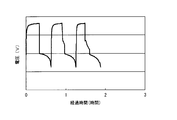
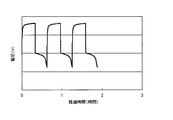
- FIG. 10 is a graph showing the results of a charge / discharge cycle test of an air secondary battery in Example 7. It is a graph which shows the result of the charging / discharging cycle test of the air secondary battery in Example 8. It is a graph which shows the result of the charging / discharging cycle test of the air secondary battery in Example 16. It is a graph which shows the result of the charging / discharging cycle test of the air secondary battery in Example 17. It is a graph which shows the result of the charging / discharging cycle test of the air secondary battery in Example 18. It is a graph which shows the result of the charging / discharging cycle test of the air secondary battery in Example 19.
- having a substituent means that “one or more hydrogen atoms are substituted with a group other than a hydrogen atom (substituent)” in the target group, unless otherwise specified.
- the number and position of the substituents are not limited, and all hydrogen atoms may be substituted with substituents.
- the positive electrode catalyst for an air secondary battery of the present embodiment uses a polynuclear metal complex.
- the polynuclear metal complex is a metal complex having two or more metal atoms or metal ions, and may have only a metal atom or may have only a metal ion. And may have metal ions.
- the metal atom or metal ion forms the polynuclear metal complex together with a ligand having one or more of a nitrogen atom, an oxygen atom, and a sulfur atom as an atom capable of coordination bonding.
- the polynuclear metal complex is excellent in both oxygen reduction activity and water oxidation activity, and is useful for application to an air secondary battery.
- the positive electrode catalyst for an air secondary battery is a polynuclear metal complex in which the polynuclear metal complex includes two or more central metals and a ligand that coordinates to the central metal.
- the ligand has a space surrounded by four or more atoms that can coordinate to the central metal, and the four or more atoms are selected from the group consisting of a nitrogen atom, an oxygen atom, and a sulfur atom.
- the molecule has two or more structures in the molecule that can accommodate the central metal in the space (the two or more structures may be the same or different).
- the number of atoms that can coordinate to the central metal surrounding the space is preferably 4 to 8, and more preferably 4 to 6.
- the structure is preferably 2-6 in the molecule, more preferably 2-5, and even more preferably 2-4.
- the molecular structure adjacent to such a space and forming the outer edge of the space is “having a space surrounded by four or more atoms capable of coordinating with the central metal, and the four or more atoms are “A structure that is one or more atoms selected from the group consisting of a nitrogen atom, an oxygen atom, and a sulfur atom and that can accommodate the central metal in the space”.
- the ligand used in the polynuclear metal complex of this embodiment has two or more of the structures in the molecule.
- the polynuclear metal complex is a polynuclear metal complex in which two or more metal atoms or metal ions are formed by the above ligand and a bond (usually a coordinate bond).
- the metal atom or metal ion may have a crosslinked structure.
- the partial structures are exemplified below (Ai) to (A-vi).
- M represents a metal atom or a metal ion, and two Ms may be the same or different.
- the number of central metals is preferably 2-6. In the polynuclear metal complex, the number of central metals is more preferably 2 to 5, and further preferably 2 to 4.
- the central metal of the polynuclear metal complex is preferably a transition metal atom belonging to the 4th to 6th periods of the periodic table or an ion thereof, vanadium, chromium, manganese, iron, cobalt, nickel, copper, and their It is more preferably at least one selected from the group consisting of ions, and even more preferably at least one selected from the group consisting of vanadium, chromium, manganese, iron, cobalt, nickel and copper.
- Examples of the polynuclear metal complex crosslinked with a nitrogen atom include a polynuclear metal complex represented by the following general formula (Aa). The charge of the polynuclear metal complex is omitted.
- polynuclear metal complex crosslinked with an oxygen atom examples include polynuclear metal complexes represented by the following general formulas (Ab) to (Ah). The charge of the polynuclear metal complex is omitted.
- polynuclear metal complexes crosslinked with sulfur atoms examples include polynuclear metal complexes represented by the following general formulas (AI) to (Al). The charge of the polynuclear metal complex is omitted.
- the ligand of the polynuclear metal complex of the present embodiment has a space surrounded by two nitrogen atoms and two oxygen atoms that can be coordinated to the central metal, and the central metal can be accommodated in the space.
- Examples of the polynuclear metal complex having the ligand include polynuclear metal complexes represented by the following general formulas (Am) and (An). The charge of the polynuclear metal complex is omitted.
- the ligand of the polynuclear metal complex of the present embodiment has a space surrounded by four nitrogen atoms that can coordinate with the central metal, and has a structure that can accommodate the central metal in the space. Two or more of them may be present (two or more of the structures may be the same or different).
- Examples of the polynuclear metal complex having the ligand include polynuclear metal complexes represented by the following general formulas (Ao) to (As). The charge of the polynuclear metal complex is omitted.
- the polynuclear metal complex is preferably one represented by the following general formula (A-1).
- A-1 a polynuclear metal complex that can be represented by the following general formula (A-1) may be referred to as a “first polynuclear metal complex”.
- Z 1 is a trivalent organic group, and two or more Z 1 may be the same as or different from each other.
- E is an oxygen atom or a sulfur atom, and two or more E may be the same as or different from each other.
- Q 1 is a divalent organic group having at least two nitrogen atoms.
- T 1 is an organic group having a nitrogen atom, and two or more T 1 may be the same or different from each other, and two or more T 1 may be bonded to each other.
- l is an integer of 1 or more, and when l is 2 or more, the two or more general formulas to which l is attached may be the same as or different from each other.
- M is a transition metal atom or transition metal ion
- m is an integer of 2 or more, and 2 or more of M may be the same or different from each other.
- X 1 is a counter ion or a neutral molecule
- n is an integer of 0 or more, and when n is 2 or more, 2 or more of X 1 may be the same or different from each other.
- Z 1 is a trivalent organic group, and two or more (two in the general formula to which 1 is attached) Z 1 may be the same or different.
- the trivalent organic group include an aromatic group which may have a substituent.
- the aromatic group in Z 1 is a trivalent group generated by removing three hydrogen atoms from an aromatic compound (preferably from a carbon atom constituting the ring of the aromatic compound).
- the aromatic compound preferably has a total number of carbon atoms such as benzene, naphthalene, anthracene, tetracene, biphenyl, binaphthyl, phenanthrene, dibenzofuran, thiophene, benzothiophene, dibenzothiophene, pyridine, pyrazine, pyrrole, etc. 60, more preferably 3 to 40 aromatic compounds may be mentioned, which may be monocyclic or polycyclic.
- the substituent that the aromatic group may have (hereinafter referred to as “substituent G”) is a group other than a hydrogen atom, and when the substituent G is 2 or more, these 2 or more substituents
- the groups G may be the same as or different from each other, and adjacent substituents G may be bonded to each other to form a ring together with the atoms to which they are bonded.
- Preferred examples of the substituent G include a hydroxyl group, an amino group, a nitro group, a cyano group, a carboxyl group, a formyl group, a hydroxysulfonyl group, a halogen atom, and an optionally substituted hydrocarbyl group (having a substituent.
- Monovalent hydrocarbon group which may have a substituent hydrocarbyloxy group which may have a substituent (hydrocarbonoxy group which may have a substituent), hydrocarbyl which may have a substituent Mercapto group (hydrocarbon mercapto group optionally having substituent), hydrocarbylcarbonyl group optionally having substituent (hydrocarbon carbonyl group optionally having substituent), having substituent Hydrocarbyloxycarbonyl group (hydrocarbonoxycarbonyl group which may have a substituent) which may be substituted, hydrocarbylo group which may have a substituent
- An amino group substituted with two hydrocarbyl groups which may have a substituent that is, an optionally substituted hydrocarbonsulfonyl group) (that is, an optionally substituted hydrocarbon sulfonyl group)
- a hydrocarbon disubstituted amino group hereinafter sometimes referred to as a “substituted amino group”
- the substituent G is substituted with two hydrocarbyl groups which may have a substituent, hydrocarbyloxy groups which may have a substituent, and two hydrocarbyl groups which may have a substituent. More preferred are an amino group, a hydrocarbyl mercapto group optionally having a substituent, a hydrocarbylcarbonyl group optionally having a substituent, and a hydrocarbyloxycarbonyl group optionally having a substituent.
- a hydrocarbyl group which may have, a hydrocarbyloxy group which may have a substituent, and an amino group which is substituted with two hydrocarbyl groups which may have a substituent are more preferable.
- a hydrocarbyl group which may be substituted and a hydrocarbyloxy group which may have a substituent are particularly preferred.
- the hydrogen atom when a nitrogen atom to which a hydrogen atom is bonded is present, the hydrogen atom is preferably substituted with a hydrocarbyl group.
- these two or more substituents may be the same or different from each other, and adjacent substituents are bonded to each other, and atoms to which each is bonded.
- a ring may be formed together.
- hydrocarbyl group in the substituent G examples include methyl group, ethyl group, n-propyl group, isopropyl group, n-butyl group, isobutyl group, tert-butyl group, pentyl group, hexyl group, heptyl group, octyl group, A linear or branched alkyl group having 1 to 50 carbon atoms, more preferably 1 to 20 carbon atoms, such as a nonyl group, a decyl group, an undecyl group, a dodecyl group, a pentadecyl group, an octadecyl group or a docosyl group; Cyclopropyl group, cyclobutyl group, cyclobutyl group, cyclopentyl group, cyclohexyl group, cyclononyl group, cyclododecyl group, norbornyl group, adamanty
- Cyclic or polycyclic cyclic alkyl group ethenyl group, propenyl group, 3-butenyl group, 2-butene group A linear, branched or cyclic group having 2 to 50 carbon atoms, more preferably 2 to 20 carbon atoms, such as an nyl group, a 2-pentenyl group, a 2-hexenyl group, a 2-nonenyl group, or a 2-dodecenyl group.
- alkenyl group in the case of cyclic, monocyclic or polycyclic
- phenyl group 1-naphthyl group, 2-naphthyl group, 2-methylphenyl group, 3-methylphenyl group, 4-methylphenyl group, 4-ethylphenyl group, 4-propylphenyl group, 4-isopropylphenyl group, 4-butylphenyl group, 4-tert-butylphenyl group, 4-hexylphenyl group, 4-cyclohexylphenyl group, 4-adamantylphenyl group, A monocyclic or polycyclic aryl group having preferably 6 to 50 carbon atoms, more preferably 6 to 20 carbon atoms, such as a 4-phenylphenyl group; Nylethyl group, 2-phenylethyl group, 1-phenyl-1-propyl group, 1-phenyl-2-propyl group, 2-phenyl-2-propyl group, 3-phenyl-1
- the hydrocarbyl group in the substituent G preferably has 1 to 20 carbon atoms, more preferably 2 to 12 carbon atoms, and still more preferably 3 to 10 carbon atoms.
- the hydrocarbyloxy group, hydrocarbyl mercapto group, hydrocarbylcarbonyl group, hydrocarbyloxycarbonyl group, and hydrocarbylsulfonyl group are the oxy group, mercapto group, carbonyl group, oxycarbonyl group, and sulfonyl group, respectively. It is a monovalent group formed by one bond.
- the substituted amino group and the substituted aminocarbonyl group each have two hydrogen atoms in an amino group (—NH 2 ) or an aminocarbonyl group (—C ( ⁇ O) —NH 2 ), and the hydrocarbyl group.
- the hydrocarbyl group is the same as the hydrocarbyl group as the substituent G.
- Examples of the substituent that the hydrocarbyloxy group, hydrocarbyl mercapto group, hydrocarbylcarbonyl group, hydrocarbyloxycarbonyl group, hydrocarbylsulfonyl group, substituted amino group and substituted aminocarbonyl group in the substituent G may have include a halogen atom and a hydroxyl group , Amino group, nitro group, cyano group, hydrocarbyl group which may have a substituent, hydrocarbyloxy group which may have a substituent, hydrocarbyl mercapto group which may have a substituent, substituent And a hydrocarbylcarbonyl group which may have a substituent, a hydrocarbyloxycarbonyl group which may have a substituent, and a hydrocarbylsulfonyl group which may have a substituent.
- halogen atom examples include a fluorine atom, a chlorine atom, a bromine atom, and an iodine atom.
- the optionally substituted hydrocarbyl group, optionally substituted hydrocarbyloxy group, optionally substituted hydrocarbyl mercapto group, optionally substituted hydrocarbylcarbonyl The hydrocarbyloxycarbonyl group which may have a group and a substituent, and the hydrocarbylsulfonyl group which may have a substituent are the same as those exemplified as the substituent G.
- Substituent G is, among the above, methyl, ethyl, n-propyl, isopropyl, n-butyl, isobutyl, tert-butyl, phenyl, methylphenyl, 1-naphthyl, 2- A naphthyl group and a pyridyl group are particularly preferable.
- substituents G When adjacent substituents G are bonded to each other to form a ring together with the atoms to which they are bonded, preferred examples of such a ring include a benzene ring, a cyclohexane ring, a pyridine ring, and a naphthalene ring. . Such a ring may have the substituent G described above as a substituent.
- E represents an oxygen atom or a sulfur atom, and two or more (two in the general formula to which 1 is attached) E may be the same as or different from each other.
- the E is preferably an oxygen atom.
- Q 1 is a divalent organic group having at least two nitrogen atoms, and is represented by the following general formula (A-4-1), (A-4-2) or (A- The group represented by 4-3) is preferred.
- R 10 and R 11 are each independently a hydrogen atom or a substituent, and two or more R 10 and R 11 may be the same as or different from each other.
- R 12 is a hydrogen atom or a hydrocarbyl group having 1 to 12 carbon atoms.
- Z 2 and Z 3 are each independently a divalent organic group.
- Y 1 and Y 2 are each independently a group represented by the formula “—N ⁇ ” or “—NH—”.
- P 1 is an atomic group that forms a heterocyclic ring together with two carbon atoms adjacent to Y 1 and Y 1 .
- P 2 is an atomic group that forms a heterocyclic ring together with two carbon atoms adjacent to Y 2 and Y 2 .
- D 1 is a single bond, a double bond or a divalent linking group.
- R 10 and R 11 are each independently a hydrogen atom or a substituent, and two or more R 10 and R 11 are It may be the same or different. Examples of the substituent for R 10 and R 11 are the same as those for the substituent G.
- R 12 is a hydrogen atom or a hydrocarbyl group having 1 to 12 carbon atoms.
- the hydrocarbyl group in R 12 is the same as the hydrocarbyl group in the substituent G except that it has 1 to 12 carbon atoms.
- Z 2 and Z 3 are each independently a divalent organic group.
- Preferred examples of Z 2 and Z 3 include an alkylene group which may be substituted with a substituent or a divalent aromatic group.
- the alkylene group in Z 2 and Z 3 is a divalent group generated by removing two hydrogen atoms from a saturated hydrocarbon, and may be linear, branched or cyclic. Specifically, methylene group, ethylene group, 1,1-propylene group, 1,2-propylene group, 1,3-propylene group, 2,4-butylene group, 2,4-dimethyl-2,4-butylene A linear or branched group having a total carbon number of preferably 1 to 20, more preferably 1 to 10, and further preferably 2 to 10, such as a group, 1,2-cyclopentylene group, 1,2-cyclohexylene group, etc. Examples thereof include a chain alkylene group and a cyclic alkylene group having preferably 3 to 20 carbon atoms.
- the alkylene group in Z 2 and Z 3 may have the same thing as the substituent G as a substituent.
- the divalent aromatic group in Z 2 and Z 3 is a divalent group generated by removing two hydrogen atoms from an aromatic compound (preferably from a carbon atom constituting the ring of the aromatic compound). , Either monocyclic or polycyclic.
- aromatic compound benzene, naphthalene, anthracene, tetracene, biphenyl, binaphthyl, phenanthrene, dibenzofuran, thiophene, benzothiophene, dibenzothiophene, pyridine, pyrazine, etc., preferably 3 to 60, more preferably Can be 3 to 40.
- the aromatic group in Z 2 and Z 3 may have the same thing as the substituent G as a substituent.
- Q 1 represented by the general formula (A-4-1) groups represented by the following formulas (A-4-1-1) to (A-4-1-11) are preferable.
- the groups represented by (A-4-1-1) to (A-4-1-6) are more preferable.
- Q 1 represented by the following formulas (A-4-1-1) to (A-4-1-11) may have the same substituent as the substituent G described above.
- Q 1 represented by the general formula (A-4-2) groups represented by the following general formulas (A-4-2-1) to (A-4-2-11) are preferable. Groups represented by the general formulas (A-4-2-1) to (A-4-2-6) are more preferable. Q 1 represented by the following general formulas (A-4-2-1) to (A-4-2-11) may have the same substituent as the substituent G.
- R 42 is a hydrogen atom or a hydrocarbyl group having 1 to 12 carbon atoms, and when R 42 is 2 or more, these 2 or more R 42 s may be the same as or different from each other.
- R 42 is a hydrogen atom or a hydrocarbyl group having 1 to 12 carbon atoms, and the hydrocarbyl group is the same as the hydrocarbyl group in R 12 . Moreover, when R42 is two or more, these two or more R42s may be the same as or different from each other.
- Y 1 and Y 2 are each independently a group represented by the formula “—N ⁇ ” or “—NH—”.
- a group represented by the formula “—N ⁇ ” the position of the double bond, that is, which side of the two carbon atoms adjacent to each of Y 1 and Y 2 is located , Not limited.
- P 1 represents an atomic group that forms a heterocyclic ring together with two carbon atoms adjacent to Y 1 and Y 1 .
- P 2 is an atomic group that forms a heterocyclic ring together with two carbon atoms adjacent to Y 2 and Y 2 .
- the heterocyclic ring formed by P 1 and the like and the heterocyclic ring formed by P 2 and the like may be either monocyclic or polycyclic, but are preferably aromatic heterocyclic rings, and nitrogen-containing aromatics More preferably, it is a heterocyclic ring.
- heterocyclic ring examples include pyrrole, pyridine, pyrazine, pyrimidine, pyridazine, thiazole, imidazole, oxazole, triazole, and indole, and pyrrole, pyridine, thiazole, imidazole, and oxazole are more preferable.
- the heterocyclic ring formed by P 1 and the like and the heterocyclic ring formed by P 2 and the like may have the same as the substituent G as a substituent.
- adjacent substituents may be bonded to each other to form a ring together with the atoms to which they are bonded.
- P 1 , P 2 and D 1 form a ring
- preferred examples of such a ring include a benzene ring, a cyclohexane ring, a pyridine ring and a naphthalene ring.
- such a ring may further have the substituent G described above as a substituent.
- D 1 is a single bond, a double bond or a divalent linking group.
- the linking group in D 1 is preferably an alkylene group, examples thereof being the same as the alkylene group in Z 2 and Z 3 may be the same as those in the substituent G.
- the heterocyclic ring formed by P 1 and the like, and the heterocyclic ring formed by P 2 and the like may be bonded to each other through a bond or linking group other than D 1 to form a polycyclic heterocyclic ring. .
- Q 1 represented by the general formula (A-4-3) groups represented by the following general formulas (A-4-3-1) to (A-4-3-3-13) are preferable. Groups represented by general formulas (A-4-3-1) to (A-4-3-6) are more preferable. Q 1 represented by the following general formulas (A-4-3-1) to (A-4-3-3-13) may have the same substituent as the substituent G described above.
- R 43 is a hydrogen atom or a hydrocarbyl group having 1 to 12 carbon atoms, and two or more R 43 may be the same as or different from each other.
- R 43 is the same as R 42 described above.
- T 1 is an organic group having a nitrogen atom, and two or more (two in the general formula to which 1 is attached) T 1 may be the same or different from each other. Two or more T 1 may be bonded to each other.
- T 1 examples include groups represented by the following general formula (A-5-a), (A-5-b), or (A-5-c).
- R 13 and R 14 are each independently a hydrogen atom or a substituent, and two or more R 13 and R 14 may be the same as or different from each other.
- R 15 is a hydrogen atom or a hydrocarbyl group having 1 to 12 carbon atoms.
- Y 3 is a group represented by the formula “—N ⁇ ” or “—NH—”.
- P 3 is an atomic group that forms a nitrogen-containing aromatic heterocycle together with two carbon atoms adjacent to Y 3 and Y 3 .
- R 13 and R 14 are each independently a hydrogen atom or a substituent, and the substituent is the same as the substituent G. The thing can be illustrated. Two or more of R 13 and R 14 may be the same as or different from each other.
- R 15 represents a hydrogen atom or a hydrocarbyl group having 1 to 12 carbon atoms, and is the same as R 42 described above.
- the nitrogen-containing aromatic heterocycle formed by P 3 or the like may be either monocyclic or polycyclic, and specific examples thereof include pyridine, pyrrole, pyrazine, pyrimidine, pyridazine, thiazole, imidazole, Examples include oxazole, triazole, indole, benzimidazole, quinoline, isoquinoline, cinnoline, phthalazine, quinazoline, quinoxaline, benzodiazine, pyridine, pyrrole, pyrazine, pyrimidine, pyridazine, thiazole, imidazole, oxazole, triazole, indole, benzimidazole, pyrrole Are more preferable, and pyridine, pyrrole, thiazole, imidazole, and oxazole are more preferable.
- the nitrogen-containing aromatic heterocyclic ring may have the same thing as the substituent G as
- Preferred examples of the divalent organic group formed by bonding two T 1 to each other include those represented by the following formulas (A-5-1) to (A-5-35).
- the organic groups represented by the following formulas (A-5-1) to (A-5-35) may have the same substituents as the substituent G.
- R 51 is a hydrogen atom or a hydrocarbyl group having 1 to 12 carbon atoms, and two or more R 51 s may be the same as or different from each other.
- R 51 is a hydrogen atom or a hydrocarbyl group having 1 to 12 carbon atoms, and two or more R 51 s may be the same as or different from each other.
- R 51 is a hydrogen atom or a hydrocarbyl group having 1 to 12 carbon atoms, and is the same as R 42 described above.
- l is an integer of 1 or more and represents the number of ligands constituting the polynuclear metal complex, preferably 1 to 4, more preferably 1 or 2, particularly preferably. 1.
- the 2 or more general formulas represented by l may be the same as or different from each other.
- M is a transition metal atom or a transition metal ion, and is coordinated or ionically bonded to at least E in the polynuclear metal complex. M is also coordinated to two or more nitrogen atoms of Q 1 in formula (A-1), and is coordinated to four or more atoms together with E. . Further, M is coordinated to the nitrogen atom of T 1 in the general formula (A-1), and is coordinated to four or more atoms together with E.
- the general formula (A-1) ligand in (Z 1, E, ligands containing Q 1 and T 1) is a space surrounded by coordinating four possible more atoms in M (2 A space surrounded by two E and two or more nitrogen atoms of Q 1 and a space surrounded by two E and two nitrogen atoms of T 1 ), and the central metal is placed in the space A structure that can be accommodated (a structure that forms a space surrounded by two E and two or more nitrogen atoms that Q 1 has, and a space that is surrounded by two E and two nitrogen atoms that T 1 has 2 or more in the molecule.
- the transition metal atom is preferably a transition metal atom belonging to the fourth to sixth periods of the periodic table. Specifically, scandium, titanium, vanadium, chromium, manganese, iron, cobalt, nickel, copper, yttrium, zirconium, niobium, molybdenum, ruthenium, rhodium, palladium, silver, lanthanum, cerium, praseodymium, neodymium, samarium, europium , Gadolinium, terbium, dysprosium, holmium, erbium, thulium, ytterbium, lutetium, hafnium, tantalum, tungsten, rhenium, osmium, iridium, platinum, and gold.
- scandium, titanium, vanadium, chromium, manganese, iron, cobalt, nickel, copper, yttrium, zirconium, niobium, molybdenum, silver, lanthanum, cerium, praseodymium, neodymium, samarium, europium, gadolinium are preferable.
- One or more selected from the group consisting of zirconium, niobium, molybdenum, tantalum, and tungsten is more preferable, and consists of vanadium, chromium, manganese, iron, cobalt, nickel, and copper. More preferably one or more kinds that are more selected, manganese, iron, cobalt, nickel, one or more members selected from the group consisting of copper is particularly preferred.
- the transition metal ion is preferably an ion of a transition metal atom belonging to the fourth to sixth periods of the periodic table.
- m is an integer of 2 or more, and represents the total number of transition metal atoms and transition metal ions constituting the polynuclear metal complex, preferably 2 to 6, more preferably 2 to 4. More preferably, it is 2 or 3, particularly preferably 2.
- the two or more Ms may be the same or different from each other, may be only a transition metal atom, may be only a transition metal ion, or a transition metal atom and a transition metal ion may coexist.
- Crosslinking coordination may be performed between Ms.
- At least one M is a cobalt atom or a cobalt ion. All M may be cobalt atoms or cobalt ions.
- X 1 is a counter ion or a neutral molecule, and the counter ion electrically neutralizes the polynuclear metal complex, and the neutral molecule is , Itself an electrically neutral molecule.
- neutral molecules include ammonia, pyridine, pyrrole, pyridazine, pyrimidine, pyrazine, 1,2,4-triazine, pyrazole, imidazole, 1,2,3-triazole, oxazole.
- preferred neutral molecules are ammonia, pyridine, pyrrole, pyridazine, pyrimidine, pyrazine, 1,2,4-triazine, pyrazole, imidazole, 1,2,3-triazole, oxazole, isoxazole, 1,3 , 4-oxadiazole, indole, indazole, quinoline, isoquinoline, phenanthridine, cinnoline, phthalazine, quinazoline, quinoxaline, 1,8-naphthyridine, acridine, 2,2'-bipyridine, 4,4'-bipyridine, 1 , 10-phenanthroline, ethylenediamine, propylenediamine, phenylenediamine, cyclohexanediamine, pyridine N-oxide, 2,2'-bipyridine N, N'-dioxide, oxamide, dimethylglyoxime, o-
- the counter ion may be either an anionic counter ion or a cationic counter ion.
- counter ions having anionic property include hydroxide ions; peroxides; superoxides; cyanide ions; thiocyanate ions; halide ions such as fluoride ions, chloride ions, bromide ions, iodide ions; sulfate ions; Nitrate ion; carbonate ion, perchlorate ion; tetrafluoroborate ion; tetraarylborate ion such as tetraphenylborate ion; hexafluorophosphate ion; methanesulfonate ion; trifluoromethanesulfonate ion; p-toluenesulfonate ion Benzene sulfonate ion; phosphate ion; phosphite
- Examples include lomethanesulfonate ion, p-toluenesulfonate ion, benzenesulfonate ion, phosphate ion, acetate ion, trifluoroacetate ion, hydroxide ion, sulfate ion, nitrate ion, carbonate ion, tetraphenylborate ion. More preferred are trifluoromethanesulfonate ion, p-toluenesulfonate ion, acetate ion, and trifluoroacetic acid.
- Examples of the counter ion having a cationic property include alkali metal ions; alkaline earth metal ions; tetraalkylammonium ions such as tetra (n-butyl) ammonium ion and tetraethylammonium ion; tetraarylphosphonium ions such as tetraphenylphosphonium ion. It can be illustrated.
- examples thereof include phenylphosphonium ion, more preferably tetra (n-butyl) ammonium ion, tetraethylammonium ion, and tetraphenylphosphonium ion, and still more preferably tetra (n-butyl) ammonium ion and tetraethylammonium ion.
- n is an integer of 0 or more, and represents the number of X 1 constituting the polynuclear metal complex.
- n is 2 or more, two or more X 1 s may be the same as or different from each other. Further, two or more X 1 may be a counter ion alone, a neutral molecule alone, or a counter ion and a neutral molecule may coexist.
- the polynuclear metal complex represented by the general formula (A-1) is preferably a polynuclear metal complex represented by the following general formula (A-2).
- R 1 is a hydrogen atom or a substituent, and two or more R 1 s may be the same as or different from each other, and adjacent R 1 may be bonded to each other to form a ring together with the carbon atom to which each is bonded.
- Q 2 is a divalent organic group having at least two nitrogen atoms.
- T 2 is an organic group having a nitrogen atom, and is the same group as T 1 .
- Two or more T 2 may be the same or different from each other, and two or more T 2 may be bonded to each other.
- l is an integer of 1 or more, and when l is 2 or more, the two or more general formulas to which l is attached may be the same as or different from each other.
- M is a transition metal atom or transition metal ion
- m is an integer of 2 or more, and 2 or more of M may be the same or different from each other.
- X 1 is a counter ion or a neutral molecule
- n is an integer of 0 or more, and when n is 2 or more, 2 or more of X 1 may be the same or different from each other.
- M, X 1, l, m and n are, M in the general formula (A-1), is the same as X 1, l, m and n.
- M in the general formula (A-1) is the same as X 1, l, m and n.
- the 2 or more general formulas (general formulas representing ligands including R 1 , Q 2, and T 2) to which l is attached may be the same as or different from each other.
- Q 2 is a divalent organic group having at least two nitrogen atoms, and is the same as Q 1 in the general formula (A-1).
- T 2 is an organic group having a nitrogen atom, and is the same as T 1 in the general formula (A-1). Accordingly, two or more T 2 may be the same or different from each other, and two or more T 2 may be bonded to each other.
- R 1 is a hydrogen atom or a substituent, two or more of R 1 may be the same or different, R 1 adjacent, taken together, each You may form a ring with the carbon atom to which it couple
- R 1 is the same as the substituent G except that R 1 may be a hydrogen atom. That is, the substituent in R 1 is the same as the substituent G.
- R 1 represents a hydrogen atom, a methyl group, an ethyl group, an n-propyl group, an isopropyl group, an n-butyl group, an isobutyl group, a tert-butyl group, a phenyl group, a methylphenyl group, a 1-naphthyl group, or a 2-naphthyl group. Or it is especially preferable that it is a pyridyl group.
- M is a coordinate bond between two or more nitrogen atoms of Q 2 in the general formula (A-2) and two oxygen atoms, and a total of four or more.
- Coordination bond is formed between the atoms of M is coordinated with the nitrogen atom of T 2 in the general formula (A-2) and two oxygen atoms, and is coordinated with four or more atoms in total. ing.
- the ligand in the general formula (A-2) is surrounded by a space surrounded by four or more atoms capable of coordinating with M (two oxygen atoms and two or more nitrogen atoms of Q 2).
- a space surrounded by two oxygen atoms and two nitrogen atoms included in T 2 and a structure that can accommodate the central metal in the space (two oxygen atoms and Q 2 have Two or more nitrogen atoms in the molecule having a structure surrounded by two or more nitrogen atoms and a structure surrounded by two oxygen atoms and two nitrogen atoms possessed by T 2 is doing.
- the polynuclear metal complex represented by the general formula (A-2) is preferably a polynuclear metal complex represented by the following general formula (A-3).
- R 2 is a hydrogen atom or a substituent, and two or more R 2 s may be the same or different from each other, and adjacent R 2 may be bonded to each other to form a ring together with the carbon atom to which each is bonded.
- Q 3 and Q 4 are each independently represented by the following general formulas (A-3-1), (A-3-2), (A-3-3), (A-3-4), (A-3- 5) or a divalent group represented by (A-3-6).
- l is an integer of 1 or more, and when l is 2 or more, the two or more general formulas to which l is attached may be the same as or different from each other.
- M is a transition metal atom or transition metal ion
- m is an integer of 2 or more, and 2 or more of M may be the same or different from each other.
- X 1 is a counter ion or a neutral molecule
- n is an integer of 0 or more, and when n is 2 or more, 2 or more of X 1 may be the same or different from each other.
- R 3 , R 4 , R 5 , R 6 , R 7 and R 8 are each independently a hydrogen atom or a substituent, and two or more R 3 , R 4 , R 5 , R 6 , R 7 and R 8 Each may be the same or different from each other, and two or more of R 3 , R 4 , R 5 , R 6 , R 7 and R 8 are bonded to each other to form a ring together with the carbon atoms to which they are bonded. May be.
- a a is a divalent group represented by the following formula (A-3-a) or (A-3-b) or the following general formula (A-3-c), and two or more A a are: They may be the same or different from each other. )
- R 9 is a hydrogen atom or a hydrocarbyl group.
- M, X 1, l, m and n are, M in the general formula (A-1), is the same as X 1, l, m and n.
- M in the general formula (A-1) is the same as X 1, l, m and n.
- l is 2 or more
- the two or more general formulas represented by l may be the same as or different from each other.
- R 2 is a hydrogen atom or a substituent, and is the same as R 1 in the general formula (A-2). Accordingly, two or more R 2 s may be the same as or different from each other, and adjacent R 2 may be bonded to each other to form a ring together with the carbon atom to which each is bonded.
- Q 3 and Q 4 are each independently the general formulas (A-3-1), (A-3-2), (A-3-3), (A- 3-4), a divalent group represented by (A-3-5) or (A-3-6).
- R 3 , R 4 , R 5 , R 6 , R 7 and R 8 are each independently a hydrogen atom or a substituent, The same as R 1 in the general formula (A-2). Accordingly, two or more R 3 , R 4 , R 5 , R 6 , R 7 and R 8 may be the same or different from each other, and two or more R 3 , R 4 , R 5 , R 6 , R 7 and R 8 may be bonded to each other to form a ring together with the carbon atom to which each is bonded.
- a a is a divalent group represented by the formula (A-3-a) or (A-3-b) or the general formula (A-3-c). And two or more A a may be the same or different from each other.
- R 9 is a hydrogen atom or a hydrocarbyl group.
- the hydrocarbyl group in R 9 is the same as the hydrocarbyl group in the substituent G.
- the ligand represented by the general formula including R 2 , Q 3 and Q 4 is represented by the formula (A-6-7) to
- the ligand represented by (A-6-14) is preferable, and the ligands represented by formulas (A-6-7) to (A-6-9) are more preferable.
- M is a coordinate bond between two nitrogen atoms of Q 3 in the general formula (A-3) and two oxygen atoms. There is a coordination bond between. M is coordinated with two nitrogen atoms and two oxygen atoms of Q 4 in formula (A-3), and is coordinated with four atoms in total. ing.
- the ligand in the general formula (A-3) is a space surrounded by four atoms capable of coordinating to M (a space surrounded by two oxygen atoms and two nitrogen atoms of Q 3 , And a structure surrounded by two oxygen atoms and two nitrogen atoms of Q 4 ), and a structure capable of accommodating the central metal in the space (two nitrogen atoms of two oxygen atoms and Q 3
- preferred examples of the ligand constituting the polynuclear metal complex include ligands represented by the following formulas (A-6-1) to (A-6-34).
- the ligands represented by the formulas (A-6-1) to (A-6-22) are more preferable, and the ligands represented by (A-6-1) to (A-6-14) are preferred.
- a ligand is particularly preferred.
- the charge is omitted.
- Me is a methyl group
- t Bu is a tert-butyl group.
- Me is a methyl group
- t Bu is a tert-butyl group.
- Me is a methyl group
- t Bu is a tert-butyl group.
- examples of preferable polynuclear metal complexes include polynuclear metal complexes represented by the following general formulas (A-7-1) to (A-7-34).
- A-7-1) to (A-7-34) electric charges, counter ions and neutral molecules (X 1 ) are omitted.
- M 1 and M 2 are each independently a transition metal atom or a transition metal ion, and t Bu is a tert-butyl group.
- M 1 and M 2 are each independently a transition metal atom or a transition metal ion, and t Bu is a tert-butyl group.
- M 1 , M 2 , M 3 and M 4 are each independently a transition metal atom or transition metal ion, Me is a methyl group, and t Bu is a tert-butyl group.
- M 1 and M 2 are each independently a transition metal atom or a transition metal ion, Me is a methyl group, and t Bu is a tert-butyl group.
- M 1 , M 2 , M 3 and M 4 are each independently a transition metal atom or a transition metal ion, and Me is a methyl group.
- M 1 , M 2 , M 3 and M 4 are each independently a transition metal atom or a transition metal ion, Same as M in A-1).
- the ligand in the polynuclear metal complex described above includes, for example, a phenol compound having an aldehyde group and a compound having an amino group, as described in “Journal of Organic Chemistry, 69, 5419” (2004). It can manufacture by the method of having the process made to react in solvents, such as alcohol. Further, for example, as described in “Australian Journal of Chemistry, 23, 2225 (1970)”, a metal salt may be added during the reaction to directly produce the target polynuclear metal complex.
- an addition of an organometallic reagent to a heterocyclic ring and an oxidation reaction were performed, followed by a halogenation reaction and then a transition metal catalyst. It can manufacture by the method which has the process of performing a cross coupling reaction. It can also be produced by a method having a step of performing a cross-coupling reaction stepwise using a heterocyclic halide.
- the ligand used in the polynuclear metal complex may be an aromatic compound that satisfies the following requirements (a) and (b).
- a polynuclear metal complex having a ligand that satisfies the above requirements (a) and (b) may be referred to as a “second polynuclear metal complex”.
- the nitrogen atom that can be coordinated to the central metal in the requirement (a) has one lone pair of electrons and can form a coordinate bond with the central metal (metal atom or metal ion). Is an atom.
- the nitrogen atom before coordination to the metal atom or metal ion may donate a lone pair of electrons to the proton to form an N—H bond.
- the ligand used in the polynuclear metal complex of this embodiment has two or more of the structures in the molecule.
- Each structure (that is, a space included in each structure) can preferably accommodate 1 to 3, more preferably 1 or 2, and particularly preferably 1 central metal.
- Such a structure is obtained by forming a polynuclear metal complex having a compound containing the above structure as a ligand and then performing structural analysis such as X-ray crystal structure analysis on a crystal obtained by a generally known method such as recrystallization. It can be confirmed by doing.
- all the nitrogen-containing aromatic hetero 6-membered rings contained in the ligand molecule may contain only one or two nitrogen atoms as hetero atoms. preferable.
- the “structure” in which the space accommodating the central metal is formed has any one of line symmetry, point symmetry, and rotational symmetry.
- the symmetry is the symmetry when focusing only on the above-mentioned “molecular structure forming the outer edge of the space in which the central metal is accommodated”, and regarding the substituents such as aromatic rings constituting the molecular structure. Is not considered.
- a molecular structure in which a hydrogen atom (proton) bonded to the nitrogen atom is eliminated from a nitrogen atom forming the structure is considered.
- the “structure” When the “structure” has rotational symmetry, it is 2 times symmetric (C 2 symmetry) or more, preferably 2 to 12 times symmetric, more preferably 2 to 6 times symmetric.
- aromatic compounds (ligands) having such a symmetrical structure in the molecule include compounds represented by the following general formulas (Ba) to (Bx).
- the ligand contained in the polynuclear metal complex of this embodiment has two or more such structures in the molecule.
- the ratio of the mass W N of all nitrogen atoms to the mass W C of all carbon atoms constituting the aromatic compound (W N / W C ) Is preferably greater than 0 and 1.1 or less (0 ⁇ W N / W C ⁇ 1.1).
- the value of W N / W C is more preferably 0.05 or more, and still more preferably 0.1 or more. Further, it is more preferably 1.0 or less, and still more preferably 0.9 or less.
- the upper limit value and the lower limit value can be arbitrarily combined.
- the number n of nitrogen atoms constituting each of the above structures, and the center of the space formed by the structure in each of the above structures is preferably such that the value of r / n is greater than 0 and 0.7 or less (0 ⁇ r / n ⁇ 0.7).
- the value of r / n is more preferably 0.1 or more, and still more preferably 0.2 or more. Further, it is more preferably 0.65 or less, and still more preferably 0.6 or less.
- the upper limit value and the lower limit value can be arbitrarily combined.
- the center of the space surrounded by four or more coordinating nitrogen atoms is defined as follows. That is, when the structure has line symmetry, the center is on the axis of symmetry and the average distance from each nitrogen atom is the shortest. When the structure has point symmetry, the center is a symmetry point. When the structure has rotational symmetry, the center is on the rotational symmetry axis, and the average distance from the center of each nitrogen atom is the shortest.
- n is preferably 4 to 10, more preferably 4 to 8, and particularly preferably 4 to 6.
- the lower limit value of r is preferably 1.5 ⁇ , more preferably 1.71, even more preferably 1.9 ⁇ , and the upper limit is preferably 3.5 ⁇ , more preferably 3. It is 3 ?, more preferably 3.1 ?.
- the aromatic compound that can be used as the ligand of the polynuclear metal complex of the present embodiment can further improve the catalytic activity, it preferably has a polycyclic aromatic heterocycle.
- a structure that has a space surrounded by four or more nitrogen atoms that can coordinate to the central metal and that can accommodate the central metal in the space is represented by the following general formula (B-1). It is preferably represented.
- the number of nitrogen atoms that can be coordinated to the central metal surrounding the space is preferably 4 to 8, and more preferably 4 to 6.
- Q 1a , Q 1b and Q 1c are each independently a nitrogen-containing aromatic heterocyclic ring which may have a substituent, and each contains 4 or more nitrogen atoms capable of coordination. When Q 1b is 2 or more, they may be the same or different. However, at least one of Q 1a , Q 1b and Q 1c is a nitrogen-containing aromatic hetero 6-membered ring.
- Z 1a and Z 1b are each independently a direct bond or a linking group, and when Z 1b is 2 or more, they may be the same or different.
- Q 1a and Q 1b , and Q 1b and Q 1c may each form a polycyclic aromatic heterocycle together.
- Q 1a and Q 1c may be directly bonded to each other or may be bonded to each other via a linking group, and may form a polycyclic aromatic heterocycle together.
- m in the general formula (B-1) is more preferably an integer of 1 to 5, still more preferably an integer of 2 to 4, and particularly preferably 2 or 4.
- Q 1a , Q 1b and Q 1c in the general formula (B-1) are each independently a nitrogen-containing aromatic heterocyclic ring which may have a substituent, and the following formulas (B-1-1) to The pyridine ring, pyrazine ring, pyrimidine ring, pyridazine ring, 1,3,5-triazine ring, 1,2,4-triazine ring, 1,2,4,5- Tetrazine ring, 1H-pyrrole ring, 2H-pyrrole ring, 3H-pyrrole ring, imidazole ring, pyrazole ring, 1,2,3-triazole ring, 1,2,4-triazole ring, oxazole ring, isoxazole ring, thiazole Ring, isothiazole ring, 1,3,4-oxadiazole ring, 1,2,5-oxadiazole ring, 1,3,4-thiadiazole ring, 1,2,5-thiadiazole ring
- Z 1a and Z 1b are each independently a direct bond or a linking group.
- Examples of the direct bond include a single bond and a double bond.
- Examples of the linking group include a divalent or trivalent linking group.
- Z 1a and Z 1b are a single bond, a double bond, and a linking group represented by —C (R ⁇ ) 2 —, ⁇ C (R ⁇ ) —, ⁇ N (R ⁇ ) — or ⁇ N—
- R ⁇ , R ⁇ and R ⁇ are each independently a hydrogen atom or a substituent, and adjacent substituents may be bonded to each other to form a ring together with the carbon atom to which they are bonded. Good.
- substituents examples include a halogeno group, a hydroxy group, a carboxyl group, a mercapto group, a sulfonic acid group, a nitro group, an amino group, a cyano group, a phosphonic acid group, a silyl group substituted with an alkyl group having 1 to 4 carbon atoms, A linear or branched alkyl group having 1 to 50 carbon atoms, a cyclic alkyl group having 3 to 50 carbon atoms, an alkenyl group, an alkynyl group, an alkoxy group, an aryl group having 6 to 60 carbon atoms, or 7 to 7 carbon atoms 50 aralkyl groups, monovalent heterocyclic groups and the like, preferably halogeno groups, mercapto groups, hydroxy groups, carboxyl groups, linear or branched alkyl groups having 1 to 20 carbon atoms, carbon numbers A cyclic alkyl group having 3 to 20 carbon atoms, an alkoxy
- halogeno group examples include a fluoro group, a chloro group, a bromo group, and an iodo group.
- Examples of the silyl group substituted with an alkyl group having 1 to 4 carbon atoms include a trimethylsilyl group, a triethylsilyl group, a tert-butyldimethylsilyl group, and a triisopropylsilyl group.
- linear or branched alkyl group examples include methyl, ethyl, propyl, isopropyl, butyl, isobutyl, tert-butyl, sec-butyl, pentyl, hexyl, and heptyl.
- cyclic alkyl group examples include cyclopropyl group, cyclobutyl group, cyclopentyl group, cyclohexyl group, cyclononyl group, cyclododecyl group, norbornyl group, adamantyl group and the like.
- alkenyl group examples include those in which the single bond (C—C) between any one carbon atom in the linear or branched alkyl group is substituted with a double bond.
- the position of the bond is not limited.
- Preferred examples of the alkenyl group include ethenyl group, propenyl group, 3-butenyl group, 2-butenyl group, 2-pentenyl group, 2-hexenyl group, 2-nonenyl group, 2-dodecenyl group and the like.
- alkynyl group examples include those in which a single bond (C—C) between any one carbon atom in the linear or branched alkyl group is substituted with a triple bond. The position is not limited.
- alkynyl group examples include ethynyl group, 1-propynyl group, 2-propynyl group, 1-butynyl group, 2-butynyl group, 1-pentynyl group, 2-pentynyl group, 1-hexynyl group, 2-hexynyl group, 1 An octynyl group is preferred, and an ethynyl group is more preferred.
- alkoxy group examples include a monovalent group in which the linear or branched alkyl group or the cyclic alkyl group is bonded to an oxygen atom.
- Preferred examples of the alkoxy group include methyl group, ethyl group, propyl group, isopropyl group, butyl group, isobutyl group, tert-butyl group, sec-butyl group, pentyl group, hexyl group, heptyl group, octyl group, Examples thereof include a monovalent group in which a nonyl group, a decyl group, a dodecyl group, a pentadecyl group, an octadecyl group, a cyclopropyl group, a cyclobutyl group, a cyclopentyl group, and a cyclohexyl group are bonded to an oxygen atom.
- aryl group examples include phenyl group, 1-naphthyl group, 2-naphthyl group, 1-anthracenyl group, 2-anthracenyl group, 9-anthracenyl group, 1-tetracenyl group, 2-tetracenyl group, 5-tetracenyl group, 1 -Pyrenyl group, 2-pyrenyl group, 4-pyrenyl group, 2-perenyl group, 3-perylenyl group, 2-fluorenyl group, 3-fluorenyl group, 4-fluorenyl group, 1-biphenylenyl group, 2-biphenylenyl group, 2 -Phenanthrenyl group, 9-phenanthrenyl group, 6-chrysenyl group, 1-coronenyl group and the like.
- the hydrogen atom in the aryl group includes a halogeno group, a hydroxy group, a carboxyl group, a mercapto group, a sulfonic acid group, a nitro group, an amino group, a cyano group, a phosphonic acid group, the alkyl group, the alkenyl group, the alkynyl group, and the above. It may be substituted with an alkoxy group, the aryl group, the aralkyl group, or the like.
- Examples of the monovalent heterocyclic group include pyridyl group, pyrazyl group, pyrimidyl group, pyridazyl group, pyrrolyl group, furyl group, thienyl group, imidazolyl group, pyrazolyl group, thiazolyl group, oxazolyl group and the like.
- the monovalent heterocyclic group means a remaining atomic group obtained by removing one hydrogen atom from a heterocyclic compound.
- a monovalent aromatic heterocyclic group is preferable.
- aralkyl group examples include benzyl group, 1-phenylethyl group, 2-phenylethyl group, 1-phenyl-1-propyl group, 1-phenyl-2-propyl group, 2-phenylpropyl group, 3-phenyl-1 -Propyl group and the like.
- R ⁇ , R ⁇ and R ⁇ may be bonded to each other or together with other bonds in the carbon atom or nitrogen atom to which the substituent is bonded to form a ring.
- ring cyclohexene ring, benzene ring, pyridine ring, pyrazine ring, pyrimidine ring, pyridazine ring, 1H-pyrrole ring, 2H-pyrrole ring, 3H-pyrrole ring, imidazole ring, pyrazole ring, 1,2, 3-triazole ring, 1,2,4-triazole ring, oxazole ring, isoxazole ring, thiazole ring, isothiazole ring, 1,3,4-oxadiazole ring, 1,2,5-oxadiazole ring, Examples include 1,3,4-thiadiazole ring, 1,2,5-thiadiazole ring, furan ring, thi
- Q 2a , Q 2b , Q 2c and Q 2d are each independently a nitrogen-containing aromatic heterocyclic ring which may have a substituent, and each contains 4 or more nitrogen atoms capable of coordination. However, at least one of Q 2a , Q 2b , Q 2c and Q 2d is a nitrogen-containing aromatic hetero 6-membered ring.
- Z 2a , Z 2b and Z 2c are each independently a direct bond or a linking group.
- Q 2a and Q 2b , Q 2b and Q 2c , and Q 2c and Q 2d may each together form a polycyclic aromatic heterocycle.
- Q 2a and Q 2d may be bonded to each other via a direct bond or a linking group, and may form a polycyclic aromatic heterocycle together.
- Q 3a , Q 3b , Q 3c , Q 3d , Q 3e, and Q 3f are each independently a nitrogen-containing aromatic heterocyclic ring that may have a substituent, Each contains a nitrogen atom. However, at least one of Q 3a , Q 3b , Q 3c , Q 3d , Q 3e and Q 3f is a nitrogen-containing aromatic hetero 6-membered ring.
- Z 3a , Z 3b , Z 3c , Z 3d and Z 3e are each independently a direct bond or a linking group.
- Q 3a and Q 3b , Q 3b and Q 3c , Q 3c and Q 3d , Q 3d and Q 3e , and Q 3e and Q 3f together form a polycyclic aromatic heterocycle. May be.
- Q 3a and Q 3f may be bonded to each other via a direct bond or a linking group, and may form a polycyclic aromatic heterocycle together.
- Q 2a in the general formula (B-2) corresponds to Q 1a in the general formula (B-1), and Q 2b and Q 2c in the general formula (B-2) are Q in the general formula (B-1).
- Q 2d in the general formula (B-2) corresponds to Q 1c in the general formula (B-1).
- Z 2a in the general formula (B-2) corresponds to Z 1a in the general formula (B-1), and Z 2b and Z 2c in the general formula (B-2) are represented by the general formula (B-1).
- Z 1b corresponds to Z 1b .
- Q 3a in the general formula (B-3) corresponds to Q 1a in the general formula (B-1)
- Q 3b to Q 3e in the general formula (B-3) are represented by the general formula (B-1 corresponding to Q 1b of)
- Q 3f of formula (B-3) corresponds to the Q 1c of the general formula (B-1).
- Z 3a in the general formula (B-3) corresponds to Z 1a in the general formula (B-1)
- Z 3b to Z 3e in the general formula (B-3) are represented by the general formula (B-1).
- Q 2a , Q 2b , Q 2c and Q 2d in the general formula (B-2) and Q 3a , Q 3b , Q 3c , Q 3d , Q 3e and Q 3f in the general formula (B-3) are independent of each other.
- a nitrogen-containing aromatic ring optionally having a substituent, and preferred examples thereof are the same as those of Q 1a , Q 1b and Q 1c in the above general formula (B-1).
- An organic group consisting of Q 3e and Q 3f which are heterocyclic rings and a direct bond or linking group which bonds the two nitrogen-containing aromatic heterocyclic rings to each other is represented by the following formulas (B-4-a) to (B— 4-c), (B-5-a) to (B-5-d) or (B-6-a) to (B-6-d)
- Two or more of X, R 4b , R 4c , R 5b , R 5c , R 6b and R 6c may be the same or different.
- Y is —N (H) — or ⁇ N—. Two or more Y may be the same or different.
- the dotted line of the straight line in the formula indicates that the dotted portion is coupled to Z 1a or the like in the general formulas (B-1), (B-2), and (B-3) described above. )
- R 4b , R 4c , R 5b , R 5c , R 5d , R 6b , R 6c , R 6d , R ⁇ and R ⁇ in the above formula are each independently a hydrogen atom or a substituent.
- a substituent is synonymous with the above-mentioned substituent.
- adjacent substituents may be bonded to each other to form a ring together with the carbon atoms to which they are bonded.
- R 7a to R 10e are each independently a hydrogen atom or a substituent, and adjacent substituents may be bonded to each other to form a ring together with the carbon atom to which each is bonded. Two or more of R 7a to R 10e may be the same or different.
- a substituent is synonymous with the above-mentioned substituent.
- the dotted line of the straight line in the formula indicates that the dotted portion is coupled to Z 1a or the like in the general formulas (B-1), (B-2), and (B-3) described above. )
- Examples of the ligand of the polynuclear metal complex of the present embodiment include compounds represented by the structural formulas represented by the following general formulas (BI-1) to (BI-41).
- the hydrogen atom in the formula may be substituted with the above-described substituent.
- Examples of the ligand of the polynuclear metal complex of this embodiment include aromatic compounds having unit structures represented by the following general formulas (BI-42) to (BI-62).
- the ligand has two or more of the following unit structures, and the two or more unit structures may be the same or different.
- the hydrogen atom in the formula may be substituted with the above-described substituent.
- the aromatic compounds having the above unit structure and usable as the ligand of the polynuclear metal complex of the present embodiment are represented by the following general formulas (BI-63) to (BI-97). Are exemplified.
- the hydrogen atom in the formula may be substituted with the above-described substituent, or two adjacent hydrogen bonds may be removed to form a direct bond or a linking group.
- examples of the ligand of the polynuclear metal complex of the present embodiment include polymer compounds having repeating units represented by the following general formulas (BI-98) to (BI-111). .
- the hydrogen atom in the formula may be substituted with the above-described substituent, or two adjacent hydrogen bonds may be removed to form a direct bond or a linking group.
- the number average molecular weight in terms of polystyrene of the polymer compound is preferably 1 ⁇ 10 3 to 1 ⁇ . 10 8 , more preferably 2 ⁇ 10 3 to 1 ⁇ 10 6 .
- the polystyrene equivalent weight average molecular weight of the polymer compound is preferably 2 ⁇ 10 3 to 1 ⁇ 10 8 , more preferably 3 ⁇ 10 3 to 2 ⁇ 10 6 .
- the polynuclear metal complex used for the positive electrode catalyst for an air secondary battery of the present embodiment has an aromatic compound represented by the following formula (XI) as a ligand.
- R ⁇ represents a hydrogen atom or a substituent. When two or more R ⁇ are substituents, they may be the same or different, and adjacent substituents may be bonded to each other to form a ring together with the carbon atoms to which they are bonded. Two or more R ⁇ s may be the same or different.
- a 1 , A 2 and A 3 are each independently represented by the general formulas (B-7-a) to (B-7-e), (B-8-a) to (B-8-e), (B A divalent organic group represented by any of -9-a) to (B-9-e) or (B-10-a) to (B-10-e).
- Examples of the aromatic compound represented by the formula (XI) include compounds represented by the following general formulas (BI-112) to (BI-116).
- the hydrogen atom in the formula may be substituted with the above-described substituent.
- any metal atom or ion of alkali metal, alkaline earth metal, or transition metal can be used. Is the transition metal or its ion of the 4th period to the 6th period of the periodic table.
- the valence of the metal ion is preferably 1 to 4, more preferably 2 to 4, particularly preferably 2 or 3.
- the polynuclear metal complex of this embodiment may include an anion that makes the polynuclear metal complex electrically neutral as a whole.
- Counter ions include fluoride ion, chloride ion, bromide ion, iodide ion, sulfide ion, oxide ion, hydroxide ion, hydride ion, sulfite ion, phosphate ion, cyanide ion, acetate ion , Carbonate ions, sulfate ions, nitrate ions, bicarbonate ions, inorganic ions, trifluoroacetate ions, thiocyanide ions, trifluoromethanesulfonate ions, acetylacetonate, tetrafluoroborate ions, hexafluorophosphate ions, tetra Examples thereof include organic acid ions such as phenyl bo
- Examples of the polynuclear metal complex of the present embodiment include polynuclear metal complexes represented by the following general formulas (B-II-1) to (B-II-76), and the following general formula (B-II-77) to Examples thereof include a polymer compound having a repeating unit represented by the formula (B-II-89).
- the hydrogen atom in the formula may be substituted with the above-described substituent.
- the molecular weight of the polynuclear metal complex of this embodiment is based on the molecular weight of the above-mentioned aromatic compound.
- M in the formula represents a metal atom.
- the metal atom represented by M is the same as the metal atom described above. When two or more M are present, they may be the same or different. Further, the charge of the polynuclear metal complex in the formula is omitted.
- the function of the polynuclear metal complex obtained can be controlled by adjusting the amount of metal atoms or metal ions reacted with the aromatic compound.
- a method for producing the polynuclear metal complex will be described later.
- the said aromatic compound may be manufactured by what kind of method, for example, it can manufacture by the condensation reaction in the acetic acid of the diamine compound and hexaketocyclohexane shown to following Reaction formula (100).
- a halogeno group such as a bromo group is introduced in advance as shown in the following reaction formula (101), You may make it.
- reaction formula (101) Yamamoto coupling and Ullmann coupling can be used.
- the aromatic compound that can be used as the ligand of the polynuclear metal complex of the present embodiment can also be produced using the Suzuki-Miyaura coupling reaction as shown in the following reaction formula (102).
- the aromatic compound that can be used as the ligand of the polynuclear metal complex of the present embodiment can also be produced using a reaction of a diketone compound and an ammonium salt as shown in the following reaction formula (103).
- a diketone compound and 1,2-diamino-1,2-dicyanoethylene can be reacted and then cyclized.
- the aromatic compound that can be used as the ligand of the polynuclear metal complex of the present embodiment is a condensation reaction product of a diamine compound having a halogeno group such as a bromo group and hexaketocyclohexane as shown in the following reaction formula (105) It can also be produced by introducing a boronic acid compound of a nitrogen-containing aromatic compound such as pyrrole into a product by a coupling reaction or the like.
- reaction formula (106) the compound obtained by the above reaction formula (105) may be reacted with an aldehyde to cause ring closure.
- the aromatic compound having the above structure can be oxidized using an appropriate oxidizing agent as shown in the following reaction formula (107).
- an appropriate oxidizing agent 2,3-dichloro-5,6-dicyano-p-benzoquinone (DDQ), oxygen, or the like can be used.
- the reaction stage can be adjusted by adjusting the amount of the oxidizing agent added and the reaction time.
- the aromatic compound that can be used as the ligand of the polynuclear metal complex of the present embodiment may have a reactive group such as an ethynyl group.
- Introduction of a reactive group is preferable because the catalytic activity of the polynuclear metal complex can be further improved.
- a reactive group can be introduced by reacting with an aldehyde having an ethynyl group.
- TMS trimethylsilyl
- TES triethylsilyl
- TBDMS tert-butyldimethylsilyl
- TIPS triisopropylsilyl
- tert-butyl The ethynyl group may be protected with a protecting group such as a diphenylsilyl (TBDPS) group and introduced into the nitrogen-containing aromatic compound, and then may be subjected to acidic conditions, or may be deprotected by reacting with a fluoride ion. .
- An aromatic compound that can be used as a ligand of the polynuclear metal complex of the present embodiment can also be produced as shown in the following reaction formula (109).
- reaction formula (110) it has one structure that forms a space surrounded by four or more nitrogen atoms capable of coordinating with a metal, and at least one of the nitrogen atoms is included.
- the compounds represented by the general formulas (B-11) to (B-20), (B-22), and (B-23) can be used as a raw material of an aromatic compound that becomes a ligand of the polynuclear metal complex of the present embodiment.
- the aromatic compound may be one of a hydrogen atom or a substituent in the structural formulas represented by the general formulas (B-11) to (B-20), (B-22), and (B-23) or It can also be produced by removing two or more and connecting them.
- coupling methods commonly used coupling reactions can be used, such as Suzuki / Miyaura coupling or Mikuroki / Heck reaction using palladium as a catalyst, Yamamoto coupling or Kumada / Tama using nickel as a catalyst. Examples are tail coupling and Ullmann reaction using copper as a catalyst.
- R 11 to R 20 , R 22 and R 23 are each independently a hydrogen atom or a substituent, and adjacent substituents may be bonded to each other to form a ring together with the carbon atom to which they are bonded.
- Q 11 is a nitrogen-containing aromatic heterocycle.
- T 12 is a bromo group, a chloro group or an iodo group.
- E 13 , E 20 and E 22 are each independently a hydrogen atom or a protecting group.
- X 16 and X 17 are each independently a hydrogen atom, a halogeno group, or a direct bond in which X 16 or X 17 are bonded to each other. Two or more of R 11 to R 20 , R 22 , R 23 , Q 11 , T 12 , E 13 , E 20 , E 22 , X 16 and X 17 may be the same or different.
- R 11 to R 20 , R 22 and R 23 are the same as those described and exemplified for the above substituents.
- Q 11 is a nitrogen-containing aromatic heterocycle, which is a pyridine ring, pyrazine ring, pyrimidine ring, pyridazine ring, 1,3,5-triazine ring, 1,2,4-triazine ring, 1,2,4,5 -Tetrazine ring, 1H-pyrrole ring, 2H-pyrrole ring, 3H-pyrrole ring, imidazole ring, pyrazole ring, 1,2,3-triazole ring, 1,2,4-triazole ring, oxazole ring, isoxazole ring, Thiazole ring, isothiazole ring, 1,3,4-oxadiazole ring, 1,2,5-oxadiazole ring, 1,3,4-thiadiazole ring, 1,2,5-thiadiazole ring and these rings Preferred are polycyclic aromatic heterocycles having a pyridine ring, pyrazine ring, pyrimidine ring
- T 12 is preferably a bromo group or a chloro group, and more preferably a bromo group.
- E 13 , E 20 and E 22 are each independently a hydrogen atom or a protecting group.
- the protecting group include methoxycarbonyl group, ethoxycarbonyl group, 2,2,2-trichloroethoxycarbonyl group, alkoxycarbonyl group such as tert-butoxycarbonyl (Boc) group, alkenyloxycarbonyl group such as vinyloxycarbonyl group, Aralkyloxycarbonyl group such as benzyloxycarbonyl group, 9-fluorenylmethoxycarbonyl group, aralkyl group which may be substituted such as benzyl group and 4-methoxybenzyl group, formyl group, acetyl group, trifluoroacetyl group, Examples thereof include acyl groups such as benzoyl group, arylsulfonyl groups such as p-toluenesulfonyl group and benzenesulfonyl group, alkylsulfonyl
- the compound represented by the general formula (B-11) can be produced, for example, by reacting an o-diaminobenzene derivative and hexaketocyclohexane in acetic acid as shown in the following reaction formula (111). it can.
- the compound represented by the general formula (B-12) can be produced, for example, by reacting an ortho-diaminobenzene derivative and hexaketocyclohexane in acetic acid as shown in the following reaction formula (112). it can.
- the compound represented by the general formula (B-13) includes, for example, as shown in the following reaction formula (113), a compound represented by the general formula (B-12) and 6 molecules of pyrrole boric acid. It can manufacture by connecting each. Examples of the linking method include a general cross coupling reaction, and Suzuki coupling is particularly preferable.
- the compound represented by the general formula (B-14) is produced, for example, by cyclically linking three molecules of 2,9-dihalogeno-1,10-phenanthroline as shown in the following reaction formula (114). can do.
- Examples of the connecting method include Yamamoto coupling using nickel as a catalyst, Kumada / Tamao coupling, and Ullmann reaction using copper as a catalyst.
- the compound represented by the general formula (B-15) is a cyclic form of three molecules of 2,9-dihalogeno-1,10-phenanthroline-5,6-dione as shown in the following reaction formula (115). It can manufacture by connecting to. Examples of the connecting method include Yamamoto coupling using nickel as a catalyst, Kumada / Tamao coupling, and Ullmann reaction using copper as a catalyst.
- the compound represented by the general formula (B-16) is obtained by linking 2,9-dihalogeno-1,10-phenanthroline and two molecules of a quinoline borate as shown in the following reaction formula (116), for example. Can be manufactured. Examples of the linking method include a general cross coupling reaction, and Suzuki coupling is particularly preferable.
- the compound represented by the general formula (B-17) links, for example, 2,9-dihalogeno-1,10-phenanthroline and two molecules of indole borate as shown in the following reaction formula (117). Can be manufactured.
- Examples of the linking method include a general cross coupling reaction, and Suzuki coupling is particularly preferable.
- the compound represented by the general formula (B-18) is obtained by reacting a derivative of the compound represented by the general formula (B-17) with an aldehyde or a ketone as shown in the following reaction formula (118), for example. Can be manufactured.
- the compound represented by the general formula (B-19) for example, as shown in the following reaction formula (119), is a derivative of the compound represented by the general formula (B-17) and an aldehyde in the presence of an oxidizing agent. It can manufacture by making it react.
- a method of oxidizing a derivative of the compound represented by the general formula (B-18) with an oxidizing agent can be used.
- the compound represented by the general formula (B-20) is obtained by cyclically forming two molecules each of 2,9-dihalogeno-1,10-phenanthroline and pyrrole boronic acid. It can manufacture by connecting to.
- the coupling method includes a cross coupling reaction, and Suzuki coupling is preferable.
- the compound represented by the general formula (B-22) can be produced, for example, by linking two molecules of a carbazole derivative and a pyrrole derivative in a cyclic manner.
- the coupling method includes a cross coupling reaction, and Suzuki coupling is preferable.
- the compound represented by the general formula (B-11) is used as a raw material, for example, as shown in the following reaction formula (122), the compound represented by the general formula (B-11) and the hexaketocyclohexane Can be reacted in acetic acid to produce an aromatic compound that can be used as a ligand of the polynuclear metal complex of the present embodiment.
- the compound represented by the general formula (B-12) When the compound represented by the general formula (B-12) is used as a raw material, for example, as shown in the following reaction formula (123), the compound represented by the general formula (B-12) contains six compounds.
- an aromatic compound that can be used as a ligand of the polynuclear metal complex of the present embodiment can be produced.
- a cross coupling reaction may be mentioned.
- Q is a nitrogen-containing aromatic heterocyclic ring
- Y a is a group suitable for cross-coupling such as a boryl group or a stannyl group.
- the nitrogen atom of the compound represented by the general formula (B-13) can be produced by deprotecting the bonded protecting group.
- a deprotection method a general deprotection operation, heating, microwave irradiation, or the like can be used.
- the compound represented by the general formula (B-17) is used as a raw material, for example, as shown in the following reaction formula (125), the compound represented by the general formula (B-17-a) is synthesized. Then, after making it into an oxo form with trifluoroacetic acid, an aromatic compound that can be used as a ligand of the polynuclear metal complex of the present embodiment can be produced by reacting two molecules with ammonium acetate. .
- the aromatic compound that can be used as the ligand of the polynuclear metal complex of the present embodiment may be further reacted to form a closed ring structure as shown in the following reaction formula (126).
- the aromatic compound that can be used as the ligand of the polynuclear metal complex of the present embodiment is, for example, a compound represented by the general formula (B-18-a) as shown in the following reaction formula (127). It can also be manufactured via.
- the aromatic compound that can be used as the ligand of the polynuclear metal complex of the present embodiment is 2,3-dichloro-5,6-dicyano-p-benzoquinone (DDQ) as shown in the following reaction formula (128). It is good also as an oxidant using oxidizing agents, such as).
- the aromatic compound that can be used as the ligand of the polynuclear metal complex of the present embodiment is, for example, a compound represented by the general formula (B-18-b) as shown in the following reaction formula (129) Can be produced by heat condensation.
- the aromatic compound that can be used as the ligand of the polynuclear metal complex of the present embodiment can be produced as a polymer compound in which two or more nitrogen-containing aromatic heterocycles are linked.
- An example thereof is shown in the following reaction formula (130).
- Q 4 in the above reaction formula is a nitrogen-containing aromatic heterocycle having two coordinating nitrogen atoms.
- the specific structural formula is shown below.
- the hydrogen atom in these structural formulas may be substituted with the above-described substituent.
- reaction formula (131) A more specific reaction formula of the reaction formula (130) exemplified as the method for producing an aromatic compound of the present embodiment is shown in the following reaction formula (131).
- the compounds used as raw materials for the above reaction can be synthesized according to the following reaction formulas (132) and (133), respectively.
- the obtained aromatic compound is reacted with an aldehyde to form a polymer compound in which the structure for forming the space for containing the central metal is a closed ring type. it can.
- the aromatic compound may be synthesized using a polymer compound produced according to the following reaction formulas (135) and (136).
- the aromatic compound that can be used as the ligand of the polynuclear metal complex of the present embodiment can also be produced by synthesizing a compound having one of the above structures and then linking them.
- the compound having the above structure is produced, for example, by linking two or more nitrogen-containing aromatic heterocycles to a compound having two nitrogen-containing aromatic heterocycles as shown in the following reaction formula (137).
- reaction formula (137) As a connection method, a general cross-coupling reaction can be mentioned.
- reaction formula (138) the compound obtained in the above reaction formula (137) may be further reacted to be cyclized.
- a compound having the above structure can also be produced by cyclizing two or more compounds having two nitrogen-containing aromatic heterocycles.
- the aromatic compound of this embodiment can also be produced by linking compounds having a structure that forms a space that accommodates the central metal.
- Examples of the linking method include a method of linking a compound having a halogeno group by Yamamoto coupling as shown in the following reaction formula (141).
- linking method as shown in the following reaction formula (142), for example, a method of linking a boric acid ester and a compound having a halogeno group by Suzuki coupling can be mentioned.
- the aromatic compound that can be used as the ligand of the polynuclear metal complex of the present embodiment includes the following formulas (B-24) to (B) in addition to the ligand that satisfies the above requirements (a) and (b): It may contain an organic group in which one or two or more hydrogen atoms have been removed from the compound having the molecular structure represented by B-29). A hydrogen atom in the compounds represented by the following structural formulas (B-24) to (B-29) may be substituted with the above-described substituent.
- the compound represented by the above formula (B-24) can be produced by linking two molecules of dihalogeno-carbazole and pyrrole boronic acid in a cyclic manner as shown in the following reaction formula (143).
- the coupling method can use a cross coupling reaction, and Suzuki coupling is particularly preferable.
- R 24 is a hydrogen atom or a substituent, and adjacent substituents may be bonded to each other to form a ring together with the carbon atoms to which they are bonded.
- Two or more E 24 s are the same. But it may be different.
- the polynuclear metal complex for example, organically synthesizes a ligand compound (hereinafter referred to as a “ligand compound”) as shown below, which is then transition metal atom or transition metal ion. It can manufacture by the method which has the process of mixing with the reaction agent (henceforth a "metal imparting agent”) which provides.
- a ligand compound organically synthesizes a ligand compound (hereinafter referred to as a “ligand compound”) as shown below, which is then transition metal atom or transition metal ion. It can manufacture by the method which has the process of mixing with the reaction agent (henceforth a "metal imparting agent”) which provides.
- the metal imparting agent a salt having the metal atom as a cation is used.
- chloride salt, bromide salt, iodide salt, acetate salt, nitrate salt, sulfate salt and carbonate salt are preferable.
- the metal-imparting agent is, for example, a transition metal atom M in the general formulas (A-1) to (A-3) and a counter ion X 1 .
- M and X 1 are as described above, but M which is manganese, iron, cobalt, nickel or copper and X 1 which is acetate ion, chloride ion or nitrate ion. And cobalt acetate is particularly preferred.
- the metal imparting agent may be an anhydride or a hydrate.
- the step of mixing the ligand compound and the metal imparting agent is performed in the presence of a suitable solvent.
- a solvent used in the reaction, water; organic acids such as acetic acid and propionic acid; amines such as aqueous ammonia and triethylamine; methanol, ethanol, n-propanol, isopropyl alcohol, 2-methoxyethanol, Alcohols such as 1-butanol and 1,1-dimethylethanol; ethylene glycol, diethyl ether, 1,2-dimethoxyethane, methyl ethyl ether, 1,4-dioxane, tetrahydrofuran (hereinafter referred to as “THF”), Aromatic hydrocarbons such as benzene, toluene, xylene, mesitylene, durene, decalin; halogen solvents such as dichloromethane, chloroform, carbon tetrachloride, chlorobenzene, 1,2-
- the mixing temperature of the ligand compound and the metal-imparting agent is preferably ⁇ 10 ° C. or higher and 250 ° C. or lower, more preferably 0 ° C. or higher and 200 ° C. or lower, and particularly preferably 0 ° C. or higher and 150 ° C. or lower.
- the mixing time of the ligand compound and the metal-imparting agent is preferably 1 minute or more and 1 week or less, more preferably 5 minutes or more and 24 hours or less, and particularly preferably 1 hour or more and 12 hours or less.
- the mixing temperature and mixing time are preferably adjusted in consideration of the types of the ligand compound and the metal-imparting agent.
- the produced polynuclear metal complex can be removed from the solvent by selecting and applying a suitable method from known recrystallization methods, reprecipitation methods, and chromatography methods. At this time, two or more of the methods are used. May be combined. Depending on the type of the solvent, the produced polynuclear metal complex may be precipitated. In this case, the precipitated polynuclear metal complex may be separated by filtration, and then washed, dried, or the like.
- the positive electrode catalyst for an air secondary battery of this embodiment is formed using the polynuclear metal complex.
- the said polynuclear metal complex may be used individually by 1 type, and may use 2 or more types together.
- the polynuclear metal complex may be used alone or in combination with other components as a composition.
- carbon can be exemplified.
- One of these other components may be used alone, or two or more thereof may be used in combination.
- Examples of the carbon include “NORIT” (manufactured by NORIT), “Ketjen Black” (manufactured by Lion), “Vulcan” (manufactured by Cabot), “Black Pearls” (manufactured by Cabot), “acetylene black” (electric) (Manufactured by Kagaku Kogyo Co., Ltd.) (all trade names) carbon black; fullerenes such as C60, C70; carbon nanotubes, multiwall carbon nanotubes, double wall carbon nanotubes, single wall carbon nanotubes, carbon fibers such as carbon nanohorns, graphene, Graphene oxide can be exemplified, and carbon black is preferable.
- the carbon may be used in combination with a conductive polymer such as polypyrrole or polyaniline.
- the composition containing the polynuclear metal complex and carbon can be prepared by mixing these components.
- the content of the polynuclear metal complex is preferably 1 part by mass or more, more preferably 5 parts by mass or more, when the amount of the composition is 100 parts by mass. Part or more is particularly preferable.
- the upper limit of the said content is 70 mass parts or less, It is more preferable that it is 60 mass parts or less, It is especially preferable that it is 50 mass parts or less.
- the upper limit value and the lower limit value can be arbitrarily combined.
- polynuclear metal complex polymer a polymer having a residue of a polynuclear metal complex (a structural unit derived from a precursor polynuclear metal complex) (hereinafter referred to as “polynuclear metal complex polymer”). May also be used.
- the polynuclear metal complex polymer means a polymer having a structure in which one or more hydrogen atoms are removed in the polynuclear metal complex described above, and all hydrogen atoms may be removed. Examples of the polynuclear metal complex include the polynuclear metal complexes described above.
- the polymer that is the main skeleton of the polynuclear metal complex polymer is not limited, but examples thereof include conductive polymers, dendrimers, natural polymers, solid polymer electrolytes, polyethylene, polyethylene glycol, and polypropylene. Molecular electrolytes are preferred.
- the conductive polymer is a general term for polymer substances exhibiting metallic or semi-metallic conductivity. Examples of the conductive polymer include polyacetylene as described in “Conductive Polymer” (Shinichi Yoshimura, Kyoritsu Publishing) and “Latest Application Technology of Conductive Polymer” (supervised by Masao Kobayashi, CMC Publishing).
- polyparaphenylene and derivatives thereof polyparaphenylene vinylene and derivatives thereof, polyaniline and derivatives thereof, polythiophene and derivatives thereof, polypyrrole and derivatives thereof, polyfluorene and derivatives thereof, polyfluorene and derivatives thereof, polycarbazole and derivatives thereof
- examples thereof include derivatives, polyindoles and derivatives thereof, and copolymers of two or more of these polymers.
- the solid polymer electrolyte include polymer compounds obtained by sulfonating perfluorosulfonic acid, polyether ether ketone, polyimide, polyphenylene, polyarylene, or polyarylene ether sulfone.
- the composition containing the polynuclear metal complex polymer and carbon can be prepared by mixing these components.
- the content of the polynuclear metal complex polymer is preferably 1 part by mass or more, more preferably 5 parts by mass or more, when the amount of the composition is 100 parts by mass. It is particularly preferable that the amount is at least part by mass.
- the upper limit of the said content is 70 mass parts or less, It is more preferable that it is 60 mass parts or less, It is especially preferable that it is 50 mass parts or less.
- the upper limit value and the lower limit value can be arbitrarily combined.
- Preferred positive electrode catalysts for air secondary batteries of the present embodiment include (1) those composed of the polynuclear metal complex, (2) those composed of a composition containing the polynuclear metal complex and carbon, and (3) the polynuclear metal.
- the composition include a polynuclear metal complex or a polynuclear metal complex and other components such as a composition comprising a complex polymer and carbon.
- a preferable positive electrode catalyst for an air secondary battery of the present embodiment (4) a heat treatment product of the polynuclear metal complex, and (5) a heat treatment product of a composition containing the polynuclear metal complex and carbon.
- a heat-treated product of a polynuclear metal complex or a composition comprising a polynuclear metal complex and other components, such as a heat-treated product of a composition containing the polynuclear metal complex polymer and carbon.
- a heat-treated product of a composition containing the polynuclear metal complex polymer and carbon examples thereof include those made of heat-treated products (the heat-treated products (1) to (3) above).
- the heat treatment is performed, for example, by heating an object.
- the heat treatment it is preferable to dry the object to be treated for 6 hours or more under the conditions of a temperature of 15 to 200 ° C. and a pressure of 1333.22 Pa or less.
- Such pretreatment can be performed using, for example, a vacuum dryer.
- the heat treatment includes a reducing gas atmosphere such as hydrogen and carbon monoxide; an oxidizing gas atmosphere such as oxygen, carbon dioxide, and water vapor; an inert gas atmosphere such as nitrogen, helium, neon, argon, krypton, and xenon; ammonia, acetonitrile, and the like It is preferable to carry out in a gas atmosphere such as a nitrogen-containing compound or a vapor thereof; and a mixed gas atmosphere composed of two or more of these gases. Among them, for example, under a reducing gas atmosphere, under a mixed gas atmosphere of hydrogen or hydrogen and the inert gas, under an oxidizing gas atmosphere, under a mixed gas atmosphere of oxygen or oxygen and the inert gas. In an inert gas atmosphere, nitrogen, neon, argon, or a mixed atmosphere composed of two or more of these gases is preferable.
- a reducing gas atmosphere such as hydrogen and carbon monoxide
- an oxidizing gas atmosphere such as oxygen, carbon dioxide, and water vapor
- the pressure at the time of the heat treatment is not limited, but normal pressure or a pressure in the vicinity thereof such as 50.7 to 152.0 kPa (0.5 to 1.5 atm) is preferable.
- the temperature during the heat treatment is preferably 250 ° C. or higher, more preferably 300 ° C. or higher, still more preferably 400 ° C. or higher, and particularly preferably 500 ° C. or higher. Moreover, this temperature becomes like this. Preferably it is 1500 degrees C or less, More preferably, it is 1200 degrees C or less, Most preferably, it is 1000 degrees C or less.
- the upper limit value and the lower limit value can be arbitrarily combined.
- the time for the heat treatment can be set according to the type, temperature, etc. of the gas. For example, in an environment in which the gas is filled and sealed, or in an environment in which the gas is vented, the temperature may be lowered immediately after the temperature is gradually raised from room temperature to reach the target temperature. However, after reaching the target temperature, it is preferable to gradually heat by maintaining the temperature or the vicinity thereof for a predetermined time. By carrying out like this, durability of the catalyst obtained can be improved more.
- the time for maintaining the temperature is preferably 1 hour to 100 hours, more preferably 1 to 40 hours, still more preferably 2 to 10 hours, and particularly preferably 2 to 3 hours.
- Examples of the apparatus for performing the heat treatment include an oven, a furnace (such as a tubular furnace), and an IH hot plate.
- the heat treatment may be performed by adding an organic compound having a boiling point or melting point of 250 ° C. or higher, or an organic compound having a thermal polymerization start temperature of 250 ° C. or lower.
- Examples of the organic compound having a boiling point or melting point of 250 ° C. or higher include perylene-3,4,9,10-tetracarboxylic dianhydride, 3,4,9,10-perylenetetracarboxylic acid diimide, 5,8-naphthalenetetracarboxylic dianhydride, 1,4,5,8-naphthalenetetracarboxylic acid diimide, 1,4,5,8-naphthalenetetracarboxylic acid, pyromellitic acid, dianhydropyromellitic acid, etc.
- carboxylic acid derivatives of aromatic compounds Examples of such compounds are shown below in (A-8-1) to (A-8-14).
- the organic compound having a thermal polymerization start temperature of 250 ° C. or lower is an organic compound having an aromatic ring and a double bond or triple bond, and examples thereof include acenaphthylene and derivatives thereof, vinyl naphthalene and derivatives thereof, and acenaphthylene and vinyl naphthalene. Is preferred.
- the positive electrode catalyst for an air secondary battery described above is excellent in both oxygen reduction activity and water oxidation activity.
- the air secondary battery of the present embodiment includes the positive electrode catalyst for the air secondary battery of the present embodiment in the positive electrode catalyst layer, and is selected from the group consisting of zinc, iron, aluminum, magnesium, lithium, hydrogen, and ions thereof.
- One or more selected from the group consisting of zinc, iron, aluminum, magnesium, lithium and hydrogen are preferably used as the negative electrode active material.
- the positive electrode catalyst may be used alone or in combination of two or more.
- FIG. 1 is a schematic cross-sectional view illustrating an embodiment of an air secondary battery according to this embodiment.
- the air secondary battery 1 shown here includes a positive electrode catalyst layer 11 including the positive electrode catalyst, a positive electrode current collector 12, a negative electrode active material layer 13, a negative electrode current collector 14, an electrolyte 15, and a container (not shown). ).
- the positive electrode current collector 12 is disposed in contact with the positive electrode catalyst layer 11 to constitute a positive electrode.
- the negative electrode current collector 14 is disposed in contact with the negative electrode active material layer 13, and these constitute a negative electrode.
- a positive electrode terminal (lead wire) 120 is connected to the positive electrode current collector 12, and a negative electrode terminal (lead wire) 140 is connected to the negative electrode current collector 14.
- the positive electrode catalyst layer 11 and the negative electrode active material layer 13 are disposed to face each other, and the electrolyte 15 is disposed so as to be in contact with them.
- the air secondary battery according to the present embodiment is not limited to the one shown here, and a part of the configuration may be changed as necessary.
- the positive electrode catalyst layer 11 preferably includes a conductive material and a binder in addition to the positive electrode catalyst.
- the conductive material may be any material that can improve the conductivity of the positive electrode catalyst layer 11, but carbon is preferable. Here, the carbon is the same as the carbon described and exemplified as the other components.
- the conductive material may be used in combination with a conductive polymer such as polypyrrole or polyaniline.
- the binder is for adhering the positive electrode catalyst, the conductive material and the like to the positive electrode current collector 12, and examples thereof include those that do not dissolve in the electrolytic solution used as the electrolyte 15, such as polytetrafluoroethylene (PTFE). , Tetrafluoroethylene / perfluoroalkyl vinyl ether copolymer, tetrafluoroethylene / hexafluoropropylene copolymer, tetrafluoroethylene / ethylene copolymer, polyvinylidene fluoride, polychlorotrifluoroethylene, chlorotrifluoroethylene / ethylene A fluororesin such as a copolymer is preferred.
- PTFE polytetrafluoroethylene
- the contents of the positive electrode catalyst, the conductive material and the binder in the positive electrode catalyst layer 11 are not limited. Since the catalytic activity of the positive electrode catalyst can be further improved, the blending amount of the conductive material is preferably 0.5 to 30 parts by mass with respect to 1 part by mass of the positive electrode catalyst, and 1 to 20 parts by mass. More preferably, the amount is 1 to 15 parts by mass, and the amount of the binder is preferably 0.1 to 10 parts by mass with respect to 1 part by mass of the positive electrode catalyst. It is more preferably 5 to 5 parts by mass, and particularly preferably 0.5 to 3 parts by mass.
- each of the constituent components such as the positive electrode catalyst, the conductive material, and the binder may be used alone or in combination of two or more.
- the material of the positive electrode current collector 12 may be conductive.
- Preferred examples of the positive electrode current collector 12 include a metal mesh, a metal sintered body, carbon paper, and carbon cloth.
- Examples of the metal in the metal mesh and the metal sintered body include simple metals such as nickel, chromium, iron, and titanium; examples include alloys containing two or more of these metals, nickel, stainless steel (iron-nickel-chromium alloy) Is preferred.
- the negative electrode active material in the negative electrode active material layer 13 is preferably zinc, iron, aluminum, magnesium, lithium, lithium ion, or hydrogen, more preferably zinc, iron, or hydrogen, and particularly preferably zinc.
- Negative electrodes using zinc, iron, aluminum, magnesium, and lithium as active materials include negative electrodes used in conventional zinc-air batteries, iron-air batteries, aluminum-air batteries, magnesium-air batteries, and lithium-air batteries. Can be illustrated. Moreover, as a negative electrode which uses hydrogen as an active material, the negative electrode which consists of a hydrogen storage alloy etc. which can occlude / release hydrogen can be illustrated.
- the constituent components such as the negative electrode active material may be used singly or in combination of two or more.
- the negative electrode current collector 14 may be the same as the positive electrode current collector 12.
- the electrolyte 15 is preferably used as an electrolytic solution by being dissolved in an aqueous solvent or a non-aqueous solvent.
- the electrolyte for the aqueous solvent is preferably sodium hydroxide, potassium hydroxide, or ammonium chloride.
- the concentration of the electrolyte in the electrolytic solution is preferably 1 to 99% by mass, more preferably 5 to 60% by mass, and particularly preferably 5 to 40% by mass.
- the container accommodates the positive electrode catalyst layer 11, the positive electrode current collector 12, the negative electrode active material layer 13, the negative electrode current collector 14, and the electrolyte 15.
- the material of the container include resins such as polystyrene, polyethylene, polypropylene, polyvinyl chloride, and ABS resin, and metals that do not react with the contents such as the positive electrode catalyst layer 11.
- an oxygen diffusion film may be separately provided.
- the oxygen diffusion film is preferably provided outside the positive electrode current collector 12 (on the opposite side of the positive electrode catalyst layer 11). By doing so, oxygen (air) is preferentially supplied to the positive electrode catalyst layer 11 through the oxygen diffusion film.
- the oxygen diffusion film may be a film that can suitably transmit oxygen (air), and examples thereof include a resin nonwoven fabric or a porous film. Examples of the resin include polyolefins such as polyethylene and polypropylene; polytetrafluoroethylene, A fluororesin such as polyvinylidene fluoride can be exemplified.
- a separator may be provided between them in order to prevent a short circuit due to contact between the positive electrode and the negative electrode.
- the separator may be made of an insulating material that can move the electrolyte 15, and examples thereof include a resin nonwoven fabric or a porous film.
- the resin include polyolefins such as polyethylene and polypropylene; polytetrafluoroethylene, polyfluoride, and the like. Examples thereof include fluororesins such as vinylidene chloride.
- the air secondary battery of the present embodiment is useful as a small power source for mobile devices such as an automobile power source, a household power source, a mobile phone or a portable personal computer.
- Boc is a tert-butoxycarbonyl group.
- the starting ligand compound was synthesized according to the method described in “Tetrahedron, Vol. 55, p. 8377 (1999)”. Next, after the reaction vessel was filled with a nitrogen gas atmosphere, a 200 mL solution of 2-methoxyethanol (MeOEtOH) containing 1.388 g of the ligand compound and 1.245 g of cobalt acetate tetrahydrate was added to a 500 mL eggplant flask. And stirred for 2 hours while heating to 80 ° C., a brown solid was formed. The brown solid was collected by filtration, washed with 20 mL of 2-methoxyethanol, and dried to obtain a polynuclear metal complex (E) (yield 1.532 g, yield 74%).
- MeOEtOH 2-methoxyethanol
- the positive electrode catalyst (1) was produced by supporting the polynuclear metal complex (D) on carbon. Specifically, 2 mg of the polynuclear metal complex (D) and 8 mg of carbon (trade name: Ketjen Black EC600JD, manufactured by Lion Corporation) are mixed in methanol, irradiated with ultrasonic waves for 15 minutes, and then the evaporator. The solvent was removed by evaporation and dried overnight under reduced pressure of 200 Pa to obtain a positive electrode catalyst (1).
- Example 2 (Production of positive electrode catalyst (2)) A polynuclear metal complex (E) and carbon (trade name: Ketjen Black EC600JD, manufactured by Lion Corporation) were mixed at a mass ratio of 1: 4, stirred in ethanol at room temperature for 15 minutes, and then at 200 Pa at room temperature. Dried for 12 hours under reduced pressure. The obtained composition is heated at 800 ° C. for 2 hours under a nitrogen stream of 200 mL / min using a tubular furnace having quartz as a furnace core tube to obtain a positive electrode catalyst (2) (heat-treated product). It was.
- E polynuclear metal complex
- carbon trade name: Ketjen Black EC600JD, manufactured by Lion Corporation
- Examples 3 to 7 (Production of positive electrode catalysts (3) to (7)) The same operation as in Example 1 was performed, and the positive electrode was obtained using the polynuclear metal complex (E), polynuclear metal complex (I), polynuclear metal complex (L), polynuclear metal complex (N), and polynuclear metal complex (O), respectively.
- Catalyst (3), positive electrode catalyst (4), positive electrode catalyst (5), positive electrode catalyst (6), and positive electrode catalyst (7) were obtained.
- the positive electrode catalysts (positive electrode catalysts (1) to (7) and (R1)) obtained above were evaluated for oxygen reduction activity using a rotating disk electrode. Specifically, it is as follows. As the electrode, a disk electrode having a disk portion made of glassy carbon (diameter 6.0 mm) was used. After adding 1 mL of a 0.5% by mass Nafion (registered trademark) solution (a solution obtained by diluting a 5% by mass Nafion (registered trademark) solution 10 times with ethanol) to a sample bottle containing 1 mg of the positive electrode catalyst, ultrasonic waves was dispersed for 15 minutes.
- a 0.5% by mass Nafion (registered trademark) solution a solution obtained by diluting a 5% by mass Nafion (registered trademark) solution 10 times with ethanol
- the electrode for measurement was obtained by drying in a dryer heated to 80 ° C. for 3 hours.
- the current value of the oxygen reduction reaction was measured under the following measurement apparatus and measurement conditions.
- the current value is measured in a state in which nitrogen gas is saturated (in a nitrogen gas atmosphere) and in a state in which oxygen gas is saturated (in an oxygen gas atmosphere), and the current value obtained by measurement in an oxygen gas atmosphere.
- the value obtained by subtracting the current value obtained by measurement under a nitrogen gas atmosphere was used as the current value of the oxygen reduction reaction.
- the current density was determined by dividing the current value by the surface area of the measurement electrode. The results are shown in Table 1.
- the current density is a value at ⁇ 0.8 V with respect to the silver / silver chloride electrode.
- the cathode catalysts (1) to (7) of the present invention were significantly superior in both oxygen reduction activity and water oxidation activity than the cathode catalyst (R1).
- Example 8 Manufacture of positive electrode for air secondary battery (1)
- the polynuclear metal complex (D) (1 part by mass) as a positive electrode catalyst
- acetylene black 10 parts by mass
- PTFE powder manufactured by Daikin 1 part by mass
- ethanol 5 drops with a pipette
- the obtained positive electrode catalyst layer (1) was sandwiched between a water-repellent PTFE sheet and a stainless mesh from both sides, and pressure-bonded with a press machine to obtain a positive electrode (1) for an air secondary battery.
- the hydrogen storage alloy used as the negative electrode was taken out by the following method.
- AA rechargeable nickel metal hydride battery (ENEROOP (registered trademark), Sanyo Electric Co., Ltd., HR-3UTGA) is connected to a charge / discharge tester (Toyo System Co., Ltd., product name TOSCAT-3000U), and the battery voltage is 1 The battery was discharged until 0V was reached.
- the nickel metal hydride battery was disassembled and the hydrogen storage alloy was taken out.
- the hydrogen storage alloy was sandwiched between porous metal bodies (Celmet # 8, manufactured by Toyama Sumitomo Electric Co., Ltd.) and pressed with a press to obtain a negative electrode (1).
- the air secondary battery (1) had sufficient charge / discharge performance.
- Example 9 Manufacture of positive electrode (2) for air secondary battery
- the positive electrode catalyst (2) (10 parts by mass) as the positive electrode catalyst and the conductive material
- PTFE powder manufactured by Daikin
- ethanol 5 drops by pipette
- the film was thinned to obtain a positive electrode catalyst layer (2).
- the obtained positive electrode catalyst layer (2) was sandwiched between a water-repellent PTFE sheet and a stainless mesh from both sides, and pressure-bonded with a press machine to obtain a positive electrode (2) for an air secondary battery.
- Example 8 an air secondary battery was produced and evaluated in the same manner as in Example 8 except that the positive electrode catalyst layer (1) was changed to the positive electrode catalyst layer (2).
- the air secondary battery (1) had sufficient charge / discharge performance.
- compound 1 as a raw material was synthesized by the following method.
- 1,4-Dibromo-2,3-diaminobenzene was synthesized according to the method described in the literature (Journal of Organic Chemistry, 2006, 71, 3350).
- 10 mL of acetic acid solution containing 0.600 g (2.256 mmol) of 1,4-dibromo-2,3-diaminobenzene was heated to 50 ° C. in the flask, and the gas in the flask was allowed to flow for 1 hour. And replaced with argon gas.
- Ligand compound 5 was synthesized according to the following reaction formula (303). And according to the following reaction formula (304), the polynuclear metal complex MC2 was synthesized using the ligand compound 5 and the metal-imparting agent.
- the ligand compound 5 was synthesized by the following method.
- 308.0 mg (0.40 mmol) of compound 3 and 683.3 mg (2.38 mmol) of 4-((triisopropyl) ethynyl) benzaldehyde were added to a mixed solution of 12 mL of dichloromethane and 4 mL of THF.
- 2 mL of trifluoroacetic acid was added, and the gas in the flask was replaced with argon gas.
- the obtained reaction solution was put into a microwave test tube and reacted at 85 ° C. and an output of 50 W for 6 hours using a microwave apparatus.
- the ligand compound 5 was obtained by refine
- Ligand compound 7 was synthesized according to the following reaction formulas (305), (306), and (307).
- the starting material 2,6-dibromo-4-chloropyridine was synthesized according to the following reaction formula (305) according to the method described in the literature (European Journal of Organic Chemistry, 2009, 1781-1795).
- the polynuclear metal complex MC3 was synthesized using the ligand compound 7 and the metal imparting agent.
- the obtained reaction solution was cooled to 0 ° C., 1 M aqueous hydrochloric acid solution was added for hydrolysis, and then ethyl acetate was added.
- the obtained organic layer was washed sequentially with 1M sodium hydroxide solution and 1M sodium hydrogen carbonate solution, and then dehydrated with magnesium sulfate.
- the solvent was distilled off with an evaporator and then recrystallized with warm hexane to obtain 3,6-di-tert-butyl-1,8-bis (4,4,5,5-tetramethyl-1,3, 2-Dioxaborolan-2-yl) -9H-carbazole was obtained.
- the yield was 2.7 g, and the yield was 50%. Identification data of the obtained compound is shown below.
- the crude product was purified with a silica gel column (developing solvent: hexane / dichloromethane) and recrystallized with warm hexane to obtain Compound 6.
- the yield was 40 mg and the yield was 5%. Identification data for the obtained compound 6 are shown below.
- Ligand compound 9 was synthesized via compound 8 according to the following reaction formula (309). And according to the following Reaction formula (310), the polynuclear metal complex MC4 was synthesize
- the obtained organic layer was filtered, and the solvent was distilled off from the obtained filtrate to obtain a crude product.
- the yield was 3.5 g, and the yield was 90%.
- Identification data for the obtained compound 8 are shown below.
- a ligand compound 9 was synthesized by the following operation.
- 100 mg (0.13 mmol) of compound 3 and 383 mg (0.56 mmol) of compound 8 are dispersed in a mixed solution of 4 mL of dichloromethane and 2 mL of THF, and 0.5 mL of trifluoroacetic acid is added.
- the gas in the flask was replaced with argon gas.
- the obtained reaction solution was put in a microwave test tube and reacted at 85 ° C. and an output of 50 W for 18 hours using a microwave apparatus. After concentrating the obtained reaction liquid, methanol was added to obtain a crude product as a precipitate.
- the ligand compound 9 was obtained by refine
- the yield was 250 mg, and the yield was 71%.
- Identification data for the obtained ligand compound 9 are shown below.
- Ligand compound 11 was synthesized via compound 10 according to the following reaction formula (311). And according to the following reaction formula (312), the polynuclear metal complex MC5 was synthesized using the ligand compound 11 and the metal-imparting agent.
- the obtained residue was extracted with dichloromethane, and the obtained organic layer was washed with water and brine, and then dehydrated with magnesium sulfate.
- the obtained organic layer was filtered, and the solvent was distilled off from the obtained filtrate to obtain a crude product.
- the yield was 817 mg, and the yield was 55%. Identification data for the obtained compound 10 are shown below.
- the ligand compound 11 was synthesized by the following operation.
- 120 mg (0.15 mmol) of compound 3 and 230 mg (0.85 mmol) of compound 10 are dispersed in a mixed solution of 4 mL of dichloromethane and 2 mL of THF, and 0.5 mL of trifluoroacetic acid is added.
- the gas in the flask was replaced with argon gas.
- the obtained reaction solution was put into a microwave test tube and reacted at 70 ° C. for 2 days using a microwave apparatus. After concentrating the obtained reaction liquid, methanol was added to the obtained concentrated liquid to obtain a crude product as a precipitate.
- the ligand compound 11 was obtained by refine
- the yield was 150 mg and the yield was 65%.
- Identification data for the obtained ligand compound 11 are shown below. MS (Maldi-Tof, TCNQ) measured value (m / z): 153.003 (M + ), theoretical value: 1530.56 (M + )
- Example 10 (Production of cathode catalyst 10) The polynuclear metal complex MC1 and carbon (trade name: Ketjen Black EC600JD, manufactured by Lion Corporation) were mixed at a mass ratio of 1: 4, stirred in methanol at room temperature for 15 minutes, and then stirred at room temperature under a reduced pressure of 200 Pa. It was made to dry for a time and the positive electrode catalyst 10 was obtained.
- the polynuclear metal complex MC1 and carbon (trade name: Ketjen Black EC600JD, manufactured by Lion Corporation) were mixed at a mass ratio of 1: 4, stirred in methanol at room temperature for 15 minutes, and then stirred at room temperature under a reduced pressure of 200 Pa. It was made to dry for a time and the positive electrode catalyst 10 was obtained.
- Example 11 (Production of cathode catalysts 11 to 15)
- the polynuclear metal complex MC1 was converted into the polynuclear metal complex MC2 (Example 11), the polynuclear metal complex MC3 (Example 12), the polynuclear metal complex MC4 (Example 13), and the polynuclear metal complex MC5 (Example), respectively. 14), except that the polynuclear metal complex MC6 (Example 15) was changed, in the same manner as in Example 10, a positive electrode catalyst 11, a positive electrode catalyst 12, a positive electrode catalyst 13, a positive electrode catalyst 14, and a positive electrode catalyst 15 were prepared. An electrode was prepared and evaluated for oxygen reduction activity. The obtained results are shown in Table 2.
- the oxygen reduction activity of the positive electrode catalysts (positive electrode catalysts 10 to 15 and positive electrode catalyst R2) obtained above was evaluated using a rotating disk electrode. Specifically, it is as follows.
- As the electrode a disk electrode having a disk portion made of glassy carbon (diameter 6.0 mm) was used. After adding 1 mL of a 0.5% by mass Nafion (registered trademark) solution (a solution obtained by diluting a 5% by mass Nafion (registered trademark) solution 10 times with ethanol) to a sample bottle containing 1 mg of the positive electrode catalyst, ultrasonic waves was dispersed for 15 minutes.
- a 0.5% by mass Nafion (registered trademark) solution a solution obtained by diluting a 5% by mass Nafion (registered trademark) solution 10 times with ethanol
- the electrode for measurement was obtained by drying in a dryer heated to 80 ° C. for 3 hours.
- the current value of the oxygen reduction reaction was measured under the following measurement apparatus and measurement conditions.
- the current value is measured in a state in which nitrogen gas is saturated (in a nitrogen gas atmosphere) and in a state in which oxygen gas is saturated (in an oxygen gas atmosphere), and the current value obtained by measurement in an oxygen gas atmosphere.
- the value obtained by subtracting the current value obtained by measurement under a nitrogen gas atmosphere was used as the current value of the oxygen reduction reaction.
- the current density was determined by dividing the current value by the surface area of the measurement electrode. The results are shown in Table 2.
- the current density is a value at ⁇ 0.8 V with respect to the silver / silver chloride electrode.
- the positive electrode catalyst layer J1 was sandwiched between a water-repellent PTFE sheet and a stainless mesh from both sides, and pressed with a press machine to obtain a positive electrode for an air secondary battery.
- the hydrogen storage alloy used as the negative electrode was taken out by the following method.
- AA rechargeable nickel metal hydride battery (ENEROOP (registered trademark), Sanyo Electric Co., Ltd., HR-3UTGA) is connected to a charge / discharge tester (Toyo System Co., Ltd., product name TOSCAT-3000U), and the battery voltage is 1 The battery was discharged until 0V was reached. The nickel metal hydride battery was disassembled and the hydrogen storage alloy was taken out.
- the hydrogen storage alloy is sandwiched between porous metal bodies (Celmet # 8, manufactured by Toyama Sumitomo Electric Co., Ltd.) and pressed with a press machine as a negative electrode, and a charge / discharge tester (manufactured by Toyo System Co., Ltd., product name: TOSCAT-3000U) ), And a charge / discharge cycle test was conducted using an 8.0 M aqueous potassium hydroxide solution as an electrolytic solution. In the charge / discharge cycle test, the following steps 1 to 4 were repeated 10 times. Step 1: Charge for 20 minutes at a constant current of 3 mA Step 2: Rest for 5 minutes Step 3: Discharge at a constant current of 3 mA When the voltage reaches 0.5V, go to Step 4. Step 4: Pause for 5 minutes
- FIG. 4 is a graph showing the results of a charge / discharge cycle test of an air secondary battery using the positive electrode for an air secondary battery of Example 16. As shown in the figure, in the air secondary battery using the polynuclear metal complex MC1 of the present invention, charging and discharging can be repeated satisfactorily, and further, no deterioration in physical properties was observed after repeated charging and discharging. .
- FIG. 5 and 6 are graphs showing the results of the charge / discharge cycle test of the air secondary batteries of Examples 17 and 18.
- FIG. As shown in the figure, in the air secondary battery using the polynuclear metal complex MC4 and the polynuclear metal complex MC5 of the present invention, charging and discharging can be favorably repeated, and further, physical properties are reduced even after repeated charging and discharging. Was not seen.
- Example 16 In the same manner as in Example 16, the evaluation was performed by setting the charge / discharge cycle to 3 times.
- FIG. 7 is a graph showing the results of a charge / discharge cycle test of the air secondary battery of Example 19. As shown in the figure, in the air secondary battery using both the polynuclear metal complex (D) and the polynuclear metal complex MC1 of the present invention, charging and discharging can be repeated satisfactorily, and further after charging and discharging are repeated. However, no physical property deterioration was observed.
- the present invention can be used in the energy field as an air secondary battery.
Landscapes
- Chemical & Material Sciences (AREA)
- Organic Chemistry (AREA)
- Engineering & Computer Science (AREA)
- Chemical Kinetics & Catalysis (AREA)
- Electrochemistry (AREA)
- General Chemical & Material Sciences (AREA)
- Materials Engineering (AREA)
- Manufacturing & Machinery (AREA)
- Inert Electrodes (AREA)
- Hybrid Cells (AREA)
- Catalysts (AREA)
Abstract
本発明により、酸素の還元活性と、水の酸化活性と、の両方に優れた空気二次電池用正極触媒、及び前記触媒を用いた空気二次電池が提供される。 本発明は、多核金属錯体を用いてなる空気二次電池用正極触媒に関する。
Description
本発明は、空気二次電池用正極触媒及び前記触媒を用いた空気二次電池に関する。
本願は、2011年4月27日に、日本に出願された特願2011-100165号及び特願2011-100166号に基づき優先権を主張し、その内容をここに援用する。
本願は、2011年4月27日に、日本に出願された特願2011-100165号及び特願2011-100166号に基づき優先権を主張し、その内容をここに援用する。
空気中の酸素を活物質として使用する空気電池は、高エネルギー密度化が可能であることから、電気自動車用等の種々の用途への応用が期待されている。
空気電池は、酸素還元能を有する正極触媒と、亜鉛、鉄、アルミニウム、マグネシウム、リチウム、水素等を活物質とする負極活物質を使用する電池である。例えば、負極活物質が亜鉛の場合、アルカリ性条件下での空気電池の放電反応は、以下の式で表される。
正極:O2+2H2O+4e- → 4OH-
負極:Zn+2OH-→ZnO+H2O+2e-
全反応:2Zn+O2 →2ZnO
正極:O2+2H2O+4e- → 4OH-
負極:Zn+2OH-→ZnO+H2O+2e-
全反応:2Zn+O2 →2ZnO
従来の空気電池としては、二酸化マンガンを正極触媒として用いたものが開示されている(非特許文献1参照)。
Journal of Power Sources,Volume 91,2000,Pages 83-85
従来、充電することにより電気を蓄え、繰り返し使用することができる電池(二次電池、充電式電池、蓄電池)が知られており、これは、上述の空気電池のような、空気中の酸素を活物質として使用する電池においても開発が進められている。以下の説明においては、空気中の酸素を活物質として使用し、充電及び放電が繰り返し可能な電池を、上述した空気電池と区別するために「空気二次電池」と称する。
空気二次電池の正極触媒には、放電のみを行う空気電池(一次電池)の正極触媒に求められる酸素の還元活性に加え、充電時に水の酸化活性が求められる。この観点から従来の空気電池の正極触媒を見ると、例えば、上述の二酸化マンガンは、酸素の還元反応に触媒活性を有するが、水の酸化反応(酸素発生)に対する活性が低い。そのため、空気二次電池の正極触媒としては使用が困難であった。
本発明はこのような事情に鑑みてなされたものであり、酸素の還元活性と、水の酸化活性と、の両方に優れた空気二次電池用正極触媒を提供することを課題とする。また、このような空気二次電池用正極触媒を用いた空気二次電池を提供することを課題とする。
上記課題を解決するため、本発明の一態様は、多核金属錯体を用いてなる空気二次電池用正極触媒を提供する。
本発明の一態様においては、前記多核金属錯体が、2つ以上の中心金属と、前記中心金属に配位結合する配位子と、を有するものであり、
前記配位子が、前記中心金属に配位可能な4つ以上の原子で囲まれた空間を有し、前記4つ以上の原子は、窒素原子、酸素原子及び硫黄原子からなる群から選ばれる1種以上の原子であり、前記空間に前記中心金属を収容可能とする構造を、分子内に2つ以上有し、2つ以上の前記構造は、同一でも異なっていてもよい有機化合物であるものが好ましい。
前記配位子が、前記中心金属に配位可能な4つ以上の原子で囲まれた空間を有し、前記4つ以上の原子は、窒素原子、酸素原子及び硫黄原子からなる群から選ばれる1種以上の原子であり、前記空間に前記中心金属を収容可能とする構造を、分子内に2つ以上有し、2つ以上の前記構造は、同一でも異なっていてもよい有機化合物であるものが好ましい。
本発明の一態様においては、前記多核金属錯体の中心金属の数が、2~6であることが好ましい。
本発明の一態様においては、前記多核金属錯体の中心金属が、周期表の第4周期から第6周期に属する遷移金属原子又はそのイオンであることが好ましく、バナジウム、クロム、マンガン、鉄、コバルト、ニッケル、銅及びそれらのイオンからなる群より選ばれる一種以上であることがより好ましく、バナジウム、クロム、マンガン、鉄、コバルト、ニッケル及び銅からなる群より選ばれる一種以上であることが更に好ましい。
本発明の一態様においては、前記多核金属錯体が、下記一般式(A-1)で表される多核金属錯体であるものが好ましい。

(式中、
Z1は3価の有機基であり、2以上のZ1は互いに同一でも異なっていてもよい。
Eは酸素原子又は硫黄原子であり、2以上のEは互いに同一でも異なっていてもよい。
Q1は少なくとも2つの窒素原子を有する2価の有機基である。
T1は窒素原子を有する有機基であり、2以上のT1は互いに同一でも異なっていてもよく、2以上のT1は互いに結合していてもよい。
lは1以上の整数であり、lが2以上の場合、lが付された2以上の前記一般式は互いに同一でも異なっていてもよい。
Mは遷移金属原子又は遷移金属イオンであり、mは2以上の整数であり、2以上のMは互いに同一でも異なっていてもよい。
X1は対イオン又は中性分子であり、nは0以上の整数であり、nが2以上の場合、2以上のX1は互いに同一でも異なっていてもよい。)
Z1は3価の有機基であり、2以上のZ1は互いに同一でも異なっていてもよい。
Eは酸素原子又は硫黄原子であり、2以上のEは互いに同一でも異なっていてもよい。
Q1は少なくとも2つの窒素原子を有する2価の有機基である。
T1は窒素原子を有する有機基であり、2以上のT1は互いに同一でも異なっていてもよく、2以上のT1は互いに結合していてもよい。
lは1以上の整数であり、lが2以上の場合、lが付された2以上の前記一般式は互いに同一でも異なっていてもよい。
Mは遷移金属原子又は遷移金属イオンであり、mは2以上の整数であり、2以上のMは互いに同一でも異なっていてもよい。
X1は対イオン又は中性分子であり、nは0以上の整数であり、nが2以上の場合、2以上のX1は互いに同一でも異なっていてもよい。)
本発明の一態様においては、前記T1が、含窒素芳香族複素環を有する有機基であることが好ましい。
本発明の一態様においては、前記一般式(A-1)で表される多核金属錯体が、下記一般式(A-2)で表される多核金属錯体であるものが好ましい。
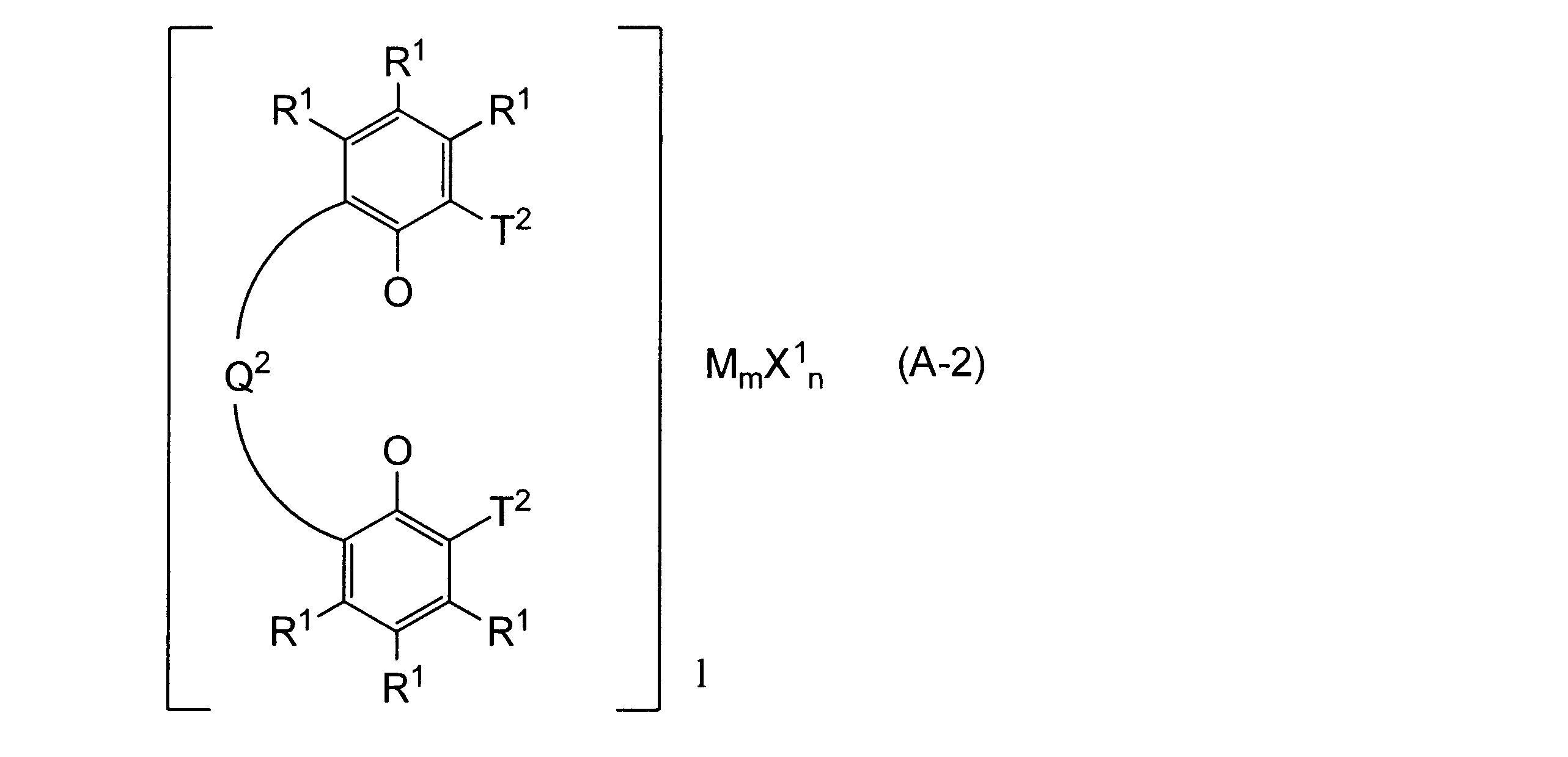
(式中、
R1は水素原子又は置換基であり、2以上のR1は互いに同一でも異なっていてもよく、隣り合うR1同士は互いに結合して、それぞれが結合する炭素原子とともに環を形成してもよい。
Q2は少なくとも2つの窒素原子を有する2価の有機基である。
T2は窒素原子を有する有機基である。2以上のT2は互いに同一でも異なっていてもよく、2以上のT2は互いに結合していてもよい。
lは1以上の整数であり、lが2以上の場合、lが付された2以上の前記一般式は互いに同一でも異なっていてもよい。
Mは遷移金属原子又は遷移金属イオンであり、mは2以上の整数であり、2以上のMは互いに同一でも異なっていてもよい。
X1は対イオン又は中性分子であり、nは0以上の整数であり、nが2以上の場合、2以上のX1は互いに同一でも異なっていてもよい。)
また、前記T2は、含窒素芳香族複素環を有する有機基であることが好ましい。
R1は水素原子又は置換基であり、2以上のR1は互いに同一でも異なっていてもよく、隣り合うR1同士は互いに結合して、それぞれが結合する炭素原子とともに環を形成してもよい。
Q2は少なくとも2つの窒素原子を有する2価の有機基である。
T2は窒素原子を有する有機基である。2以上のT2は互いに同一でも異なっていてもよく、2以上のT2は互いに結合していてもよい。
lは1以上の整数であり、lが2以上の場合、lが付された2以上の前記一般式は互いに同一でも異なっていてもよい。
Mは遷移金属原子又は遷移金属イオンであり、mは2以上の整数であり、2以上のMは互いに同一でも異なっていてもよい。
X1は対イオン又は中性分子であり、nは0以上の整数であり、nが2以上の場合、2以上のX1は互いに同一でも異なっていてもよい。)
また、前記T2は、含窒素芳香族複素環を有する有機基であることが好ましい。
本発明の一態様においては、前記一般式(A-2)で表される多核金属錯体が、下記一般式(A-3)で表される多核金属錯体であるものが好ましい。

(式中、
R2は水素原子又は置換基であり、2以上のR2は互いに同一でも異なっていてもよく、隣り合うR2同士は互いに結合して、それぞれが結合する炭素原子とともに環を形成してもよい。
Q3及びQ4は、それぞれ独立に下記一般式(A-3-1)、(A-3-2)、(A-3-3)、(A-3-4)、(A-3-5)又は(A-3-6)で表される2価の基である。
lは1以上の整数であり、lが2以上の場合、lが付された2以上の前記一般式は互いに同一でも異なっていてもよい。
Mは遷移金属原子又は遷移金属イオンであり、mは2以上の整数であり、2以上のMは互いに同一でも異なっていてもよい。
X1は対イオン又は中性分子であり、nは0以上の整数であり、nが2以上の場合、2以上のX1は互いに同一でも異なっていてもよい。)
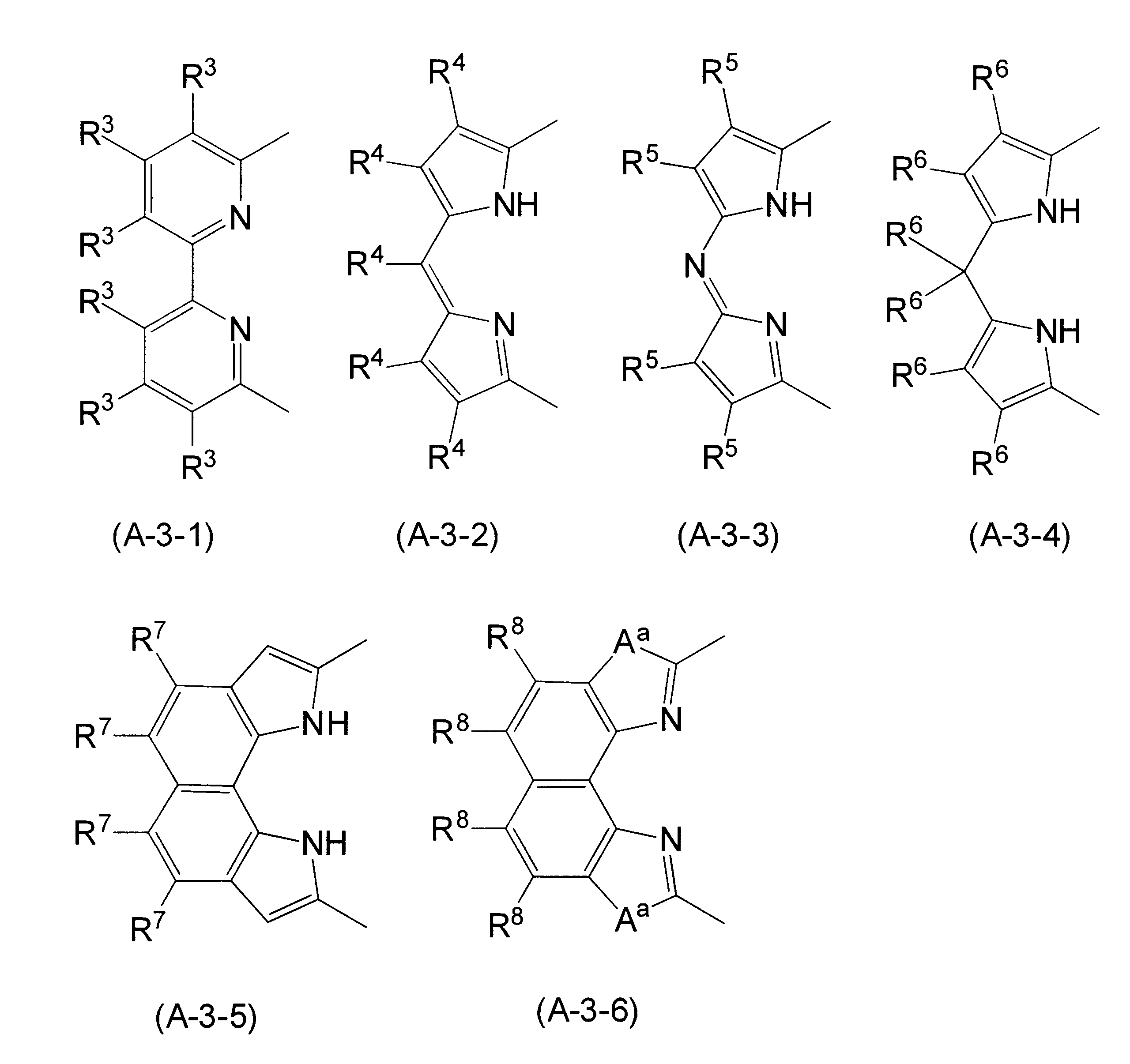
(式中、
R3、R4、R5、R6、R7及びR8は、それぞれ独立に水素原子又は置換基であり、2以上のR3、R4、R5、R6、R7及びR8は、それぞれ互いに同一でも異なっていてもよく、2以上のR3、R4、R5、R6、R7及びR8は、それぞれ互いに結合して、それぞれが結合する炭素原子とともに環を形成してもよい。
Aaは、下記式(A-3-a)、(A-3-b)又は下記一般式(A-3-c)で表される2価の基であり、2以上のAaは、互いに同一でも異なっていてもよい。)

(式中、R9は水素原子又はヒドロカルビル基である。)
R2は水素原子又は置換基であり、2以上のR2は互いに同一でも異なっていてもよく、隣り合うR2同士は互いに結合して、それぞれが結合する炭素原子とともに環を形成してもよい。
Q3及びQ4は、それぞれ独立に下記一般式(A-3-1)、(A-3-2)、(A-3-3)、(A-3-4)、(A-3-5)又は(A-3-6)で表される2価の基である。
lは1以上の整数であり、lが2以上の場合、lが付された2以上の前記一般式は互いに同一でも異なっていてもよい。
Mは遷移金属原子又は遷移金属イオンであり、mは2以上の整数であり、2以上のMは互いに同一でも異なっていてもよい。
X1は対イオン又は中性分子であり、nは0以上の整数であり、nが2以上の場合、2以上のX1は互いに同一でも異なっていてもよい。)
R3、R4、R5、R6、R7及びR8は、それぞれ独立に水素原子又は置換基であり、2以上のR3、R4、R5、R6、R7及びR8は、それぞれ互いに同一でも異なっていてもよく、2以上のR3、R4、R5、R6、R7及びR8は、それぞれ互いに結合して、それぞれが結合する炭素原子とともに環を形成してもよい。
Aaは、下記式(A-3-a)、(A-3-b)又は下記一般式(A-3-c)で表される2価の基であり、2以上のAaは、互いに同一でも異なっていてもよい。)
本発明の一態様においては、前記Mが、バナジウム、クロム、マンガン、鉄、コバルト、ニッケル及び銅からなる群より選ばれる一種以上であるものが好ましい。
本発明の一態様においては、前記mが2であるものが好ましい。
また、本発明の一態様においては、前記多核金属錯体が、2つ以上の中心金属と、前記中心金属に配位結合する配位子と、を有するものであり、
前記配位子が、下記(a)及び(b)の要件を満たす芳香族化合物であるものであっても好ましい。
(a)前記中心金属に配位可能な4つ以上の窒素原子で囲まれた空間を有し、前記空間に前記中心金属を収容可能とする構造を、分子内に2つ以上有する。2つ以上の前記構造は、同一でも異なっていてもよい。
(b)前記構造を構成する窒素原子のうち少なくとも1つが含窒素複素六員環に含まれる窒素原子である。
前記配位子が、下記(a)及び(b)の要件を満たす芳香族化合物であるものであっても好ましい。
(a)前記中心金属に配位可能な4つ以上の窒素原子で囲まれた空間を有し、前記空間に前記中心金属を収容可能とする構造を、分子内に2つ以上有する。2つ以上の前記構造は、同一でも異なっていてもよい。
(b)前記構造を構成する窒素原子のうち少なくとも1つが含窒素複素六員環に含まれる窒素原子である。
本発明の一態様においては、前記構造は、前記構造を構成する窒素原子の数nと、前記空間の中心から前記構造を構成する各窒素原子の中心までの平均距離r(Å)とが、下記式(A)で示される要件を満たすものが好ましい。
0<r/n≦0.7 …(A)
0<r/n≦0.7 …(A)
本発明の一態様においては、前記窒素原子の数nと前記平均距離rとが、下記式(B)で示される要件を満たすものが好ましい。
0.2≦r/n≦0.6 …(B)
0.2≦r/n≦0.6 …(B)
本発明の一態様においては、前記構造は、前記構造を構成する窒素原子の数nが4以上6以下であるものが好ましい。
本発明の一態様においては、前記配位子を構成する全炭素原子の質量WCと、前記配位子を構成する全窒素原子の質量WNとが、下記式(C)で示される要件を満たすものが好ましい。
0<WN/WC≦1.1 …(C)
0<WN/WC≦1.1 …(C)
本発明の一態様においては、前記中心金属に配位可能な4つ以上の窒素原子で囲まれた空間を有し、前記空間に前記中心金属を収容可能とする構造が、下記一般式(B-1)で表される芳香族化合物であるものが好ましい。

(式中、
mは1以上の整数である。
Q1a、Q1b及びQ1cは、それぞれ独立に、置換基を有していてもよい含窒素芳香族複素環であり、前記配位可能な4つ以上の窒素原子をそれぞれ含む。Q1bが2以上の場合は、それらは同一でも異なっていてもよい。ただし、Q1a、Q1b及びQ1cのうち少なくとも1つは、含窒素芳香族複素六員環である。
Z1a及びZ1bは、それぞれ独立に、直接結合又は連結基であり、Z1bが2以上の場合は、それらは同一でも異なっていてもよい。
Q1a及びQ1b、並びに、Q1b及びQ1cは、各々、一体となって多環式芳香族複素環を形成していてもよい。
mが2以上の整数であり、かつ、Z1bが直接結合である場合、隣り合う2つのQ1bは、一体となって多環式芳香族複素環を形成していてもよい。
Q1a及びQ1cは直接結合して、又は、連結基を介して互いに結合していてもよく、一体となって多環式芳香族複素環を形成していてもよい。)
mは1以上の整数である。
Q1a、Q1b及びQ1cは、それぞれ独立に、置換基を有していてもよい含窒素芳香族複素環であり、前記配位可能な4つ以上の窒素原子をそれぞれ含む。Q1bが2以上の場合は、それらは同一でも異なっていてもよい。ただし、Q1a、Q1b及びQ1cのうち少なくとも1つは、含窒素芳香族複素六員環である。
Z1a及びZ1bは、それぞれ独立に、直接結合又は連結基であり、Z1bが2以上の場合は、それらは同一でも異なっていてもよい。
Q1a及びQ1b、並びに、Q1b及びQ1cは、各々、一体となって多環式芳香族複素環を形成していてもよい。
mが2以上の整数であり、かつ、Z1bが直接結合である場合、隣り合う2つのQ1bは、一体となって多環式芳香族複素環を形成していてもよい。
Q1a及びQ1cは直接結合して、又は、連結基を介して互いに結合していてもよく、一体となって多環式芳香族複素環を形成していてもよい。)
本発明の一態様においては、前記式(B-1)において、mが2又は4であるものが好ましい。
本発明の一態様においては、前記Q1a、Q1b及びQ1cが、それぞれ独立にピリジン環、ピラジン環、ピリミジン環、ピリダジン環、1,3,5-トリアジン環、1,2,4-トリアジン環、1,2,4,5-テトラジン環、1H-ピロール環、2H-ピロール環、3H-ピロール環、イミダゾール環、ピラゾール環、1,2,3-トリアゾール環、1,2,4-トリアゾール環、オキサゾール環、イソオキサゾール環、チアゾール環、イソチアゾール環、1,3,4-オキサジアゾール環、1,2,5-オキサジアゾール環、1,3,4-チアジアゾール環、1,2,5-チアジアゾール環、及び、これらの環構造を有する多環式芳香族複素環、からなる群から選ばれる環であり、前記環は置換基を有していてもよいものが好ましい。
本発明の一態様においては、2つの含窒素芳香族複素環であるQ1aとQ1b又は2つの含窒素芳香族複素環であるQ1bとQ1cと、前記2つの含窒素芳香族複素環を互いに結合する直接結合又は連結基と、からなる有機基が、下記式(B-4-a)~(B-4-c)、(B-5-a)~(B-5-d)又は(B-6-a)~(B-6-d)のいずれかで表される2価の有機基であるものが好ましい。
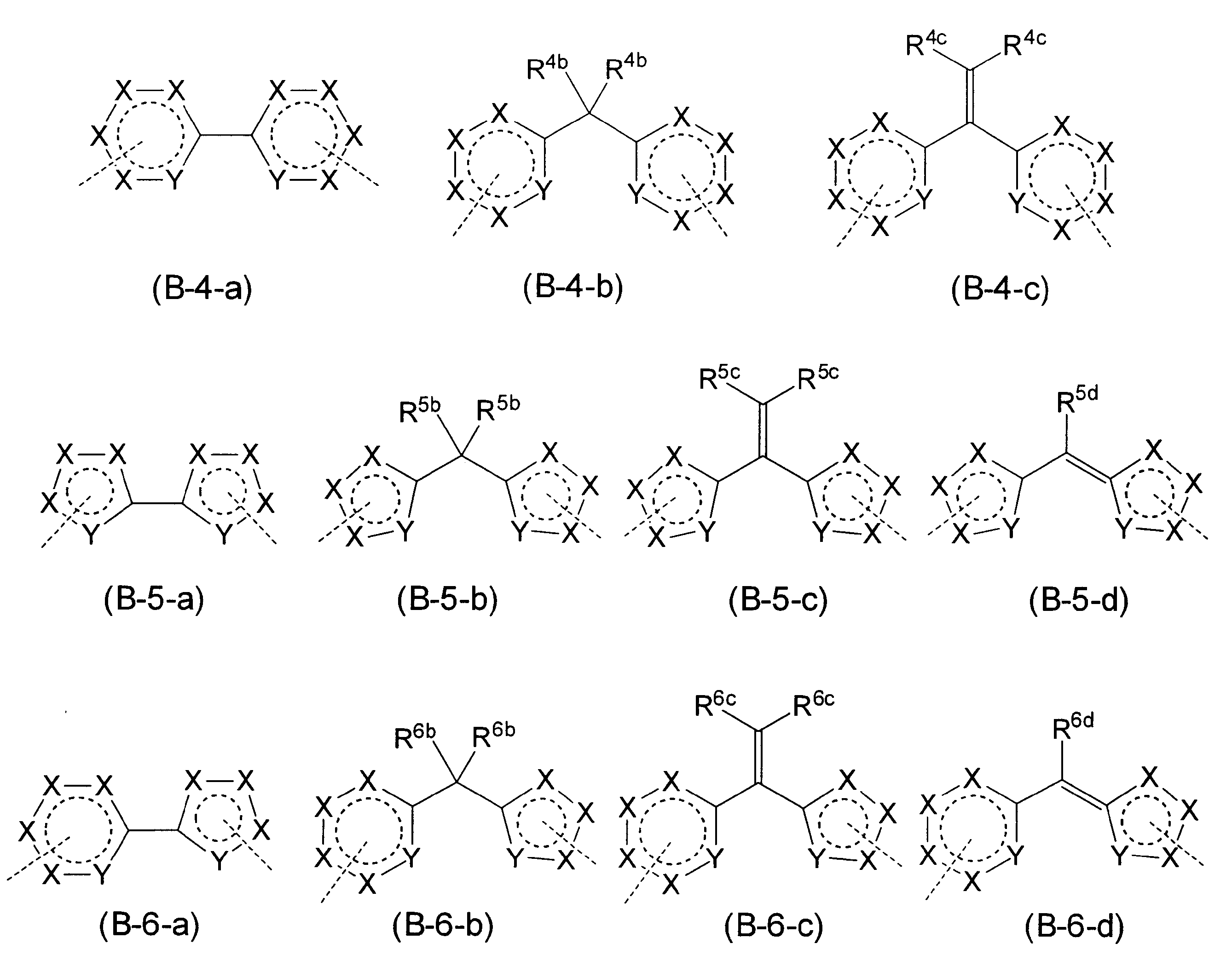
(式中、
Xは、=C(Rα)-、-N(Rβ)-、=N-、-O-、-S-又は-Se-である。
Yは、-N(H)-又は=N-である。
R4b、R4c、R5b、R5c、R5d、R6b、R6c、R6d、Rα及びRβは、それぞれ独立に、水素原子又は置換基であり、隣り合う置換基同士は互いに結合して、それぞれが結合する炭素原子とともに環を形成してもよい。
2以上のX、Y、R4b、R4c、R5b、R5c、R6b及びR6cは、各々、同一でも異なっていてもよい。)
Xは、=C(Rα)-、-N(Rβ)-、=N-、-O-、-S-又は-Se-である。
Yは、-N(H)-又は=N-である。
R4b、R4c、R5b、R5c、R5d、R6b、R6c、R6d、Rα及びRβは、それぞれ独立に、水素原子又は置換基であり、隣り合う置換基同士は互いに結合して、それぞれが結合する炭素原子とともに環を形成してもよい。
2以上のX、Y、R4b、R4c、R5b、R5c、R6b及びR6cは、各々、同一でも異なっていてもよい。)
本発明の一態様においては、2つの含窒素芳香族複素環であるQ1aとQ1b又は2つの含窒素芳香族複素環であるQ1bとQ1cと、前記2つの含窒素芳香族複素環を互いに結合する直接結合又は連結基と、からなる有機基が、下記一般式(B-7-a)~(B-7-e)、(B-8-a)~(B-8-e)、(B-9-a)~(B-9-e)又は(B-10-a)~(B-10-e)のいずれかで表される2価の有機基であるものが好ましい。
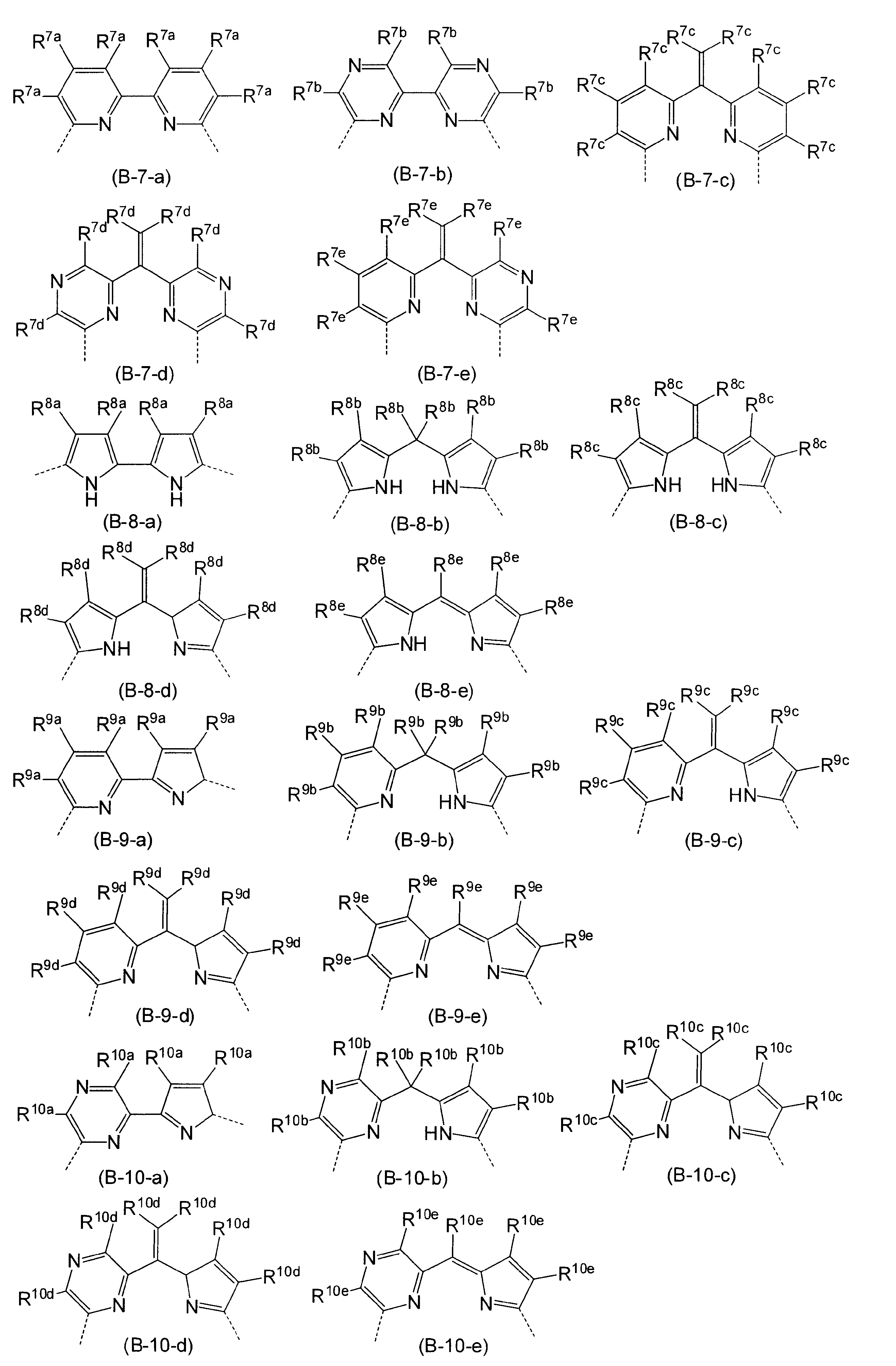
(式中、
R7a、R7b、R7c、R7d、R7e、R8a、R8b、R8c、R8d、R8e、R9a、R9b、R9c、R9d、R9e、R10a、R10b、R10c、R10d及びR10eは、それぞれ独立に、水素原子又は置換基であり、隣り合う置換基同士は互いに結合して、それぞれが結合する炭素原子とともに環を形成してもよい。
2以上のR7a、R7b、R7c、R7d、R7e、R8a、R8b、R8c、R8d、R8e、R9a、R9b、R9c、R9d、R9e、R10a、R10b、R10c、R10d及びR10eは、各々、同一でも異なっていてもよい。)
R7a、R7b、R7c、R7d、R7e、R8a、R8b、R8c、R8d、R8e、R9a、R9b、R9c、R9d、R9e、R10a、R10b、R10c、R10d及びR10eは、それぞれ独立に、水素原子又は置換基であり、隣り合う置換基同士は互いに結合して、それぞれが結合する炭素原子とともに環を形成してもよい。
2以上のR7a、R7b、R7c、R7d、R7e、R8a、R8b、R8c、R8d、R8e、R9a、R9b、R9c、R9d、R9e、R10a、R10b、R10c、R10d及びR10eは、各々、同一でも異なっていてもよい。)
本発明の一態様においては、前記配位子が、下記式(XI)で表される芳香族化合物であるものが好ましい。
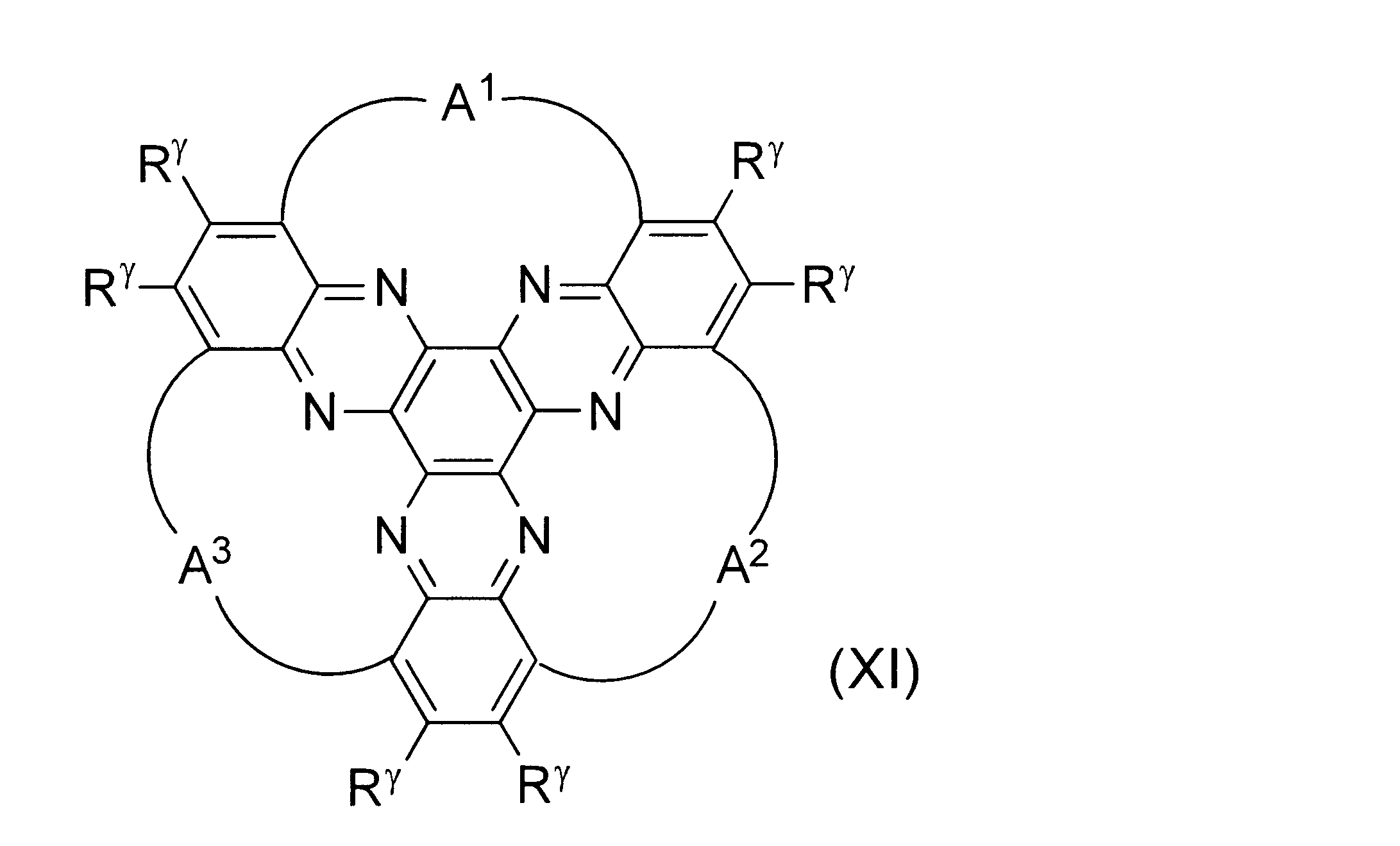
(式中、
Rγは、水素原子又は置換基を表す。2以上のRγは、それぞれ同一でも異なっていてもよい。2以上のRγが置換基である場合にはそれぞれ同一でも異なっていてもよく、隣り合う置換基同士は互いに結合して、それぞれが結合する炭素原子とともに環を形成してもよい。
A1、A2及びA3は、それぞれ独立に下記一般式(B-7-a)~(B-7-e)、(B-8-a)~(B-8-e)、(B-9-a)~(B-9-e)又は(B-10-a)~(B-10-e)のいずれかで表される2価の有機基である。
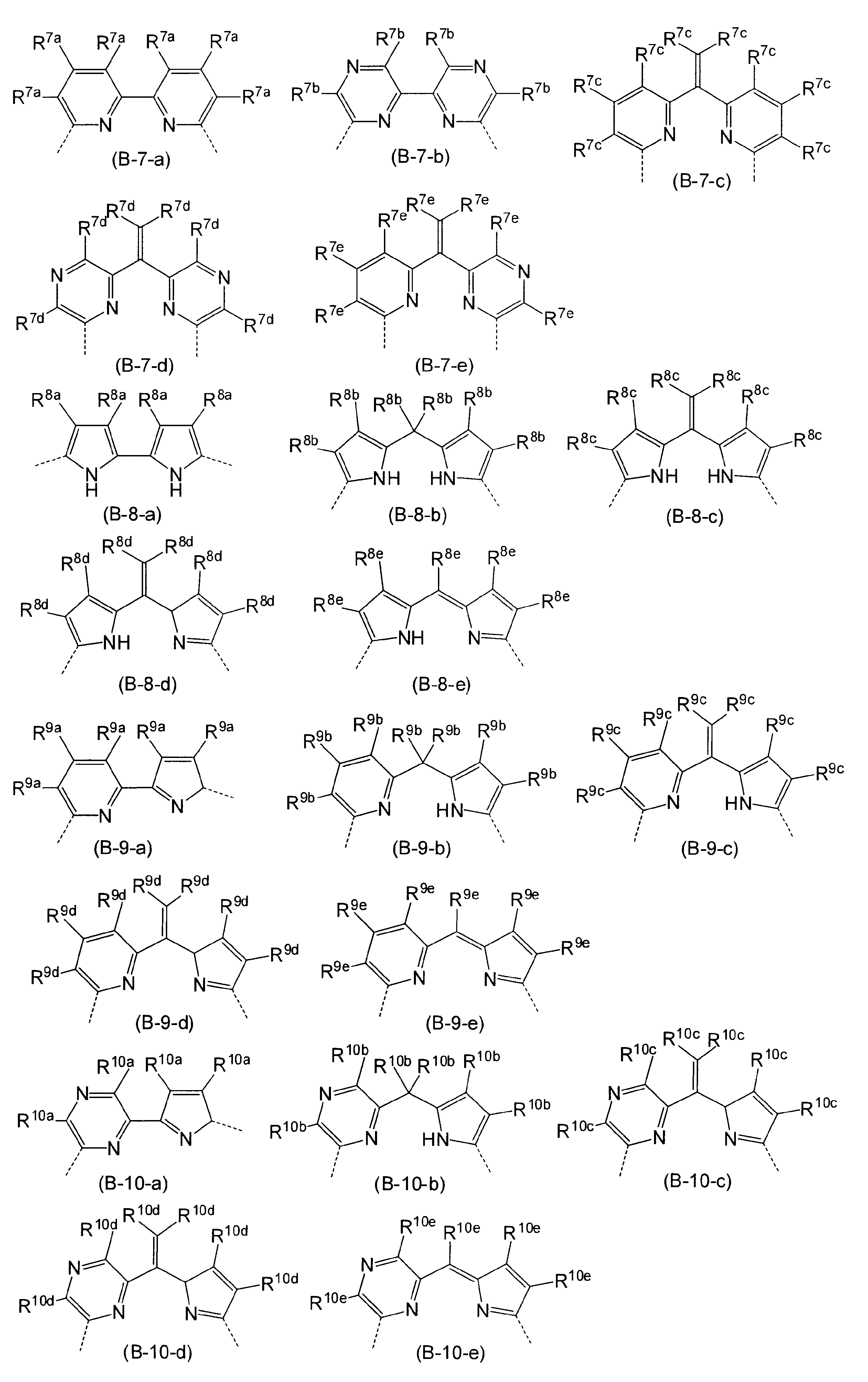
(式中、
R7a、R7b、R7c、R7d、R7e、R8a、R8b、R8c、R8d、R8e、R9a、R9b、R9c、R9d、R9e、R10a、R10b、R10c、R10d及びR10eは、それぞれ独立に、水素原子又は置換基であり、隣り合う置換基同士は互いに結合して、それぞれが結合する炭素原子とともに環を形成してもよい。
2以上のR7a、R7b、R7c、R7d、R7e、R8a、R8b、R8c、R8d、R8e、R9a、R9b、R9c、R9d、R9e、R10a、R10b、R10c、R10d及びR10eは、各々、同一でも異なっていてもよい。))
Rγは、水素原子又は置換基を表す。2以上のRγは、それぞれ同一でも異なっていてもよい。2以上のRγが置換基である場合にはそれぞれ同一でも異なっていてもよく、隣り合う置換基同士は互いに結合して、それぞれが結合する炭素原子とともに環を形成してもよい。
A1、A2及びA3は、それぞれ独立に下記一般式(B-7-a)~(B-7-e)、(B-8-a)~(B-8-e)、(B-9-a)~(B-9-e)又は(B-10-a)~(B-10-e)のいずれかで表される2価の有機基である。
R7a、R7b、R7c、R7d、R7e、R8a、R8b、R8c、R8d、R8e、R9a、R9b、R9c、R9d、R9e、R10a、R10b、R10c、R10d及びR10eは、それぞれ独立に、水素原子又は置換基であり、隣り合う置換基同士は互いに結合して、それぞれが結合する炭素原子とともに環を形成してもよい。
2以上のR7a、R7b、R7c、R7d、R7e、R8a、R8b、R8c、R8d、R8e、R9a、R9b、R9c、R9d、R9e、R10a、R10b、R10c、R10d及びR10eは、各々、同一でも異なっていてもよい。))
本発明の一態様においては、前記中心金属が、周期表の第4周期から第6周期に属する遷移金属原子又はそのイオンであるものが好ましい。
本発明の一態様においては、前記中心金属の数が2~4であるものが好ましい。
本発明の一態様においては、前記多核金属錯体とカーボンとを含む組成物を用いてなるものが好ましい。
本発明の一態様においては、前記多核金属錯体の残基を有するポリマーとカーボンとを含む組成物を用いてなるものが好ましい。
本発明の一態様においては、前記多核金属錯体、前記多核金属錯体とカーボンとを含む組成物、又は、前記多核金属錯体の残基を有するポリマーとカーボンとを含む組成物を、300℃以上1200℃以下の温度で加熱して得られた変性物を形成材料とすることが好ましい。
また、本発明の一態様は、上述の空気二次電池用正極触媒を正極触媒層に含み、亜鉛、鉄、アルミニウム、マグネシウム、リチウム、水素、及び、これらのイオンからなる群より選ばれる一種以上を負極活物質として用いた空気二次電池を提供する。
本発明によれば、酸素の還元活性と、水の酸化活性と、の両方に優れた空気二次電池用正極触媒、及び前記触媒を用いた空気二次電池を提供できる。
以下、本実施形態について詳細に説明する。本実施形態において「置換基を有する」とは、特に断りの無い限り、対象の基において、「1つ以上の水素原子が水素原子以外の基(置換基)で置換される」こと、そして「置換基の数及び位置は限定されず、すべての水素原子が置換基で置換されていてもよい」ことを意味するものとする。
<空気二次電池用正極触媒>
本実施形態の空気二次電池用正極触媒(以下、単に「正極触媒」と言うことがある。)は、多核金属錯体を用いてなる。ここで、多核金属錯体とは、2つ以上の金属原子又は金属イオンを有する金属錯体であり、金属原子のみを有していてもよいし、金属イオンのみを有していてもよく、金属原子及び金属イオンを有していてもよい。前記金属原子又は金属イオンは、配位結合可能な原子として、窒素原子、酸素原子及び硫黄原子の一種以上を有する配位子と共に、前記多核金属錯体を形成している。前記多核金属錯体は、酸素の還元活性及び水の酸化活性の両方に優れ、空気二次電池への適用に有用である。
本実施形態の空気二次電池用正極触媒(以下、単に「正極触媒」と言うことがある。)は、多核金属錯体を用いてなる。ここで、多核金属錯体とは、2つ以上の金属原子又は金属イオンを有する金属錯体であり、金属原子のみを有していてもよいし、金属イオンのみを有していてもよく、金属原子及び金属イオンを有していてもよい。前記金属原子又は金属イオンは、配位結合可能な原子として、窒素原子、酸素原子及び硫黄原子の一種以上を有する配位子と共に、前記多核金属錯体を形成している。前記多核金属錯体は、酸素の還元活性及び水の酸化活性の両方に優れ、空気二次電池への適用に有用である。
(多核金属錯体)
本実施形態の空気二次電池用正極触媒は、前記多核金属錯体が、2つ以上の中心金属と、前記中心金属に配位結合する配位子と、を有する多核金属錯体であり、前記配位子が、前記中心金属に配位可能な4つ以上の原子で囲まれた空間を有し、前記4つ以上の原子は、窒素原子、酸素原子及び硫黄原子からなる群から選ばれる1種以上の原子であり、前記空間に前記中心金属を収容可能とする構造を、分子内に2つ以上有する(2つ以上の前記構造は、同一でも異なっていてもよい。)。
前記空間を囲む前記中心金属に配位可能な原子は、4~8であることが好ましく、4~6であることがより好ましい。前記構造は分子内に、2~6であることが好ましく、2~5がより好ましく、2~4であることがさらに好ましい。
本実施形態の空気二次電池用正極触媒は、前記多核金属錯体が、2つ以上の中心金属と、前記中心金属に配位結合する配位子と、を有する多核金属錯体であり、前記配位子が、前記中心金属に配位可能な4つ以上の原子で囲まれた空間を有し、前記4つ以上の原子は、窒素原子、酸素原子及び硫黄原子からなる群から選ばれる1種以上の原子であり、前記空間に前記中心金属を収容可能とする構造を、分子内に2つ以上有する(2つ以上の前記構造は、同一でも異なっていてもよい。)。
前記空間を囲む前記中心金属に配位可能な原子は、4~8であることが好ましく、4~6であることがより好ましい。前記構造は分子内に、2~6であることが好ましく、2~5がより好ましく、2~4であることがさらに好ましい。
中心金属に配位可能な4つ以上の原子は、分子内に中心金属を収容可能とすることができる「空間」を形成している。このような空間に隣接し、前記空間の外縁を形成する分子構造が、「前記中心金属に配位可能な4つ以上の原子で囲まれた空間を有し、前記4つ以上の原子は、窒素原子、酸素原子及び硫黄原子からなる群から選ばれる1種以上の原子であり、前記空間に前記中心金属を収容可能とする構造」である。本実施形態の多核金属錯体に用いられる配位子は、分子内に前記構造を2つ以上有している。
多核金属錯体としては、2つ以上の金属原子又は金属イオンが前記配位子と、結合(通常、配位結合)により形成された多核金属錯体であるが、一つの金属原子又は金属イオンと他の金属原子又は金属イオンとが架橋された構造を有していてもよい。金属原子及び金属イオンが合計2個である場合について、その部分構造を、以下(A-i)~(A-vi)に例示する。
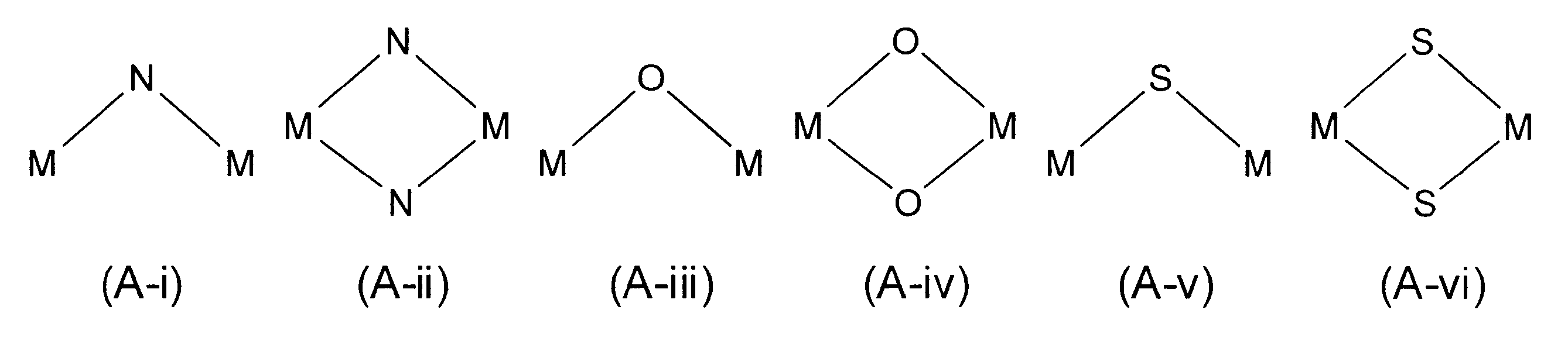
多核金属錯体においては、中心金属の数が、2~6であることが好ましい。多核金属錯体においては、中心金属の数が、2~5であることがより好ましく、2~4であることがさらに好ましい。
また、多核金属錯体の中心金属は、周期表の第4周期から第6周期に属する遷移金属原子又はそのイオンであることが好ましく、バナジウム、クロム、マンガン、鉄、コバルト、ニッケル、銅及びそれらのイオンからなる群より選ばれる一種以上であることがより好ましく、バナジウム、クロム、マンガン、鉄、コバルト、ニッケル及び銅からなる群より選ばれる一種以上であることが更に好ましい。
また、多核金属錯体の中心金属は、周期表の第4周期から第6周期に属する遷移金属原子又はそのイオンであることが好ましく、バナジウム、クロム、マンガン、鉄、コバルト、ニッケル、銅及びそれらのイオンからなる群より選ばれる一種以上であることがより好ましく、バナジウム、クロム、マンガン、鉄、コバルト、ニッケル及び銅からなる群より選ばれる一種以上であることが更に好ましい。
以下に、窒素原子で架橋された多核金属錯体として、下記一般式(A-a)で表される多核金属錯体を例示する。多核金属錯体の電荷は省略している。

以下に、酸素原子で架橋された多核金属錯体として、下記一般式(A-b)~(A-h)で表される多核金属錯体を例示する。多核金属錯体の電荷は省略している。

以下に、硫黄原子で架橋された多核金属錯体として、下記一般式(A-i)~(A-l)で表される多核金属錯体を例示する。多核金属錯体の電荷は省略している。

また、本実施形態の多核金属錯体の配位子は、中心金属に配位可能な2つの窒素原子と2つの酸素原子で囲まれた空間を有し、前記空間に前記中心金属を収容可能とする構造を、分子内に2つ以上有していてもよい(2つ以上の前記構造は、同一でも異なっていてもよい。)。前記配位子を有する多核金属錯体として、下記一般式(A-m)、(A-n)で表される多核金属錯体を例示する。多核金属錯体の電荷は省略している。
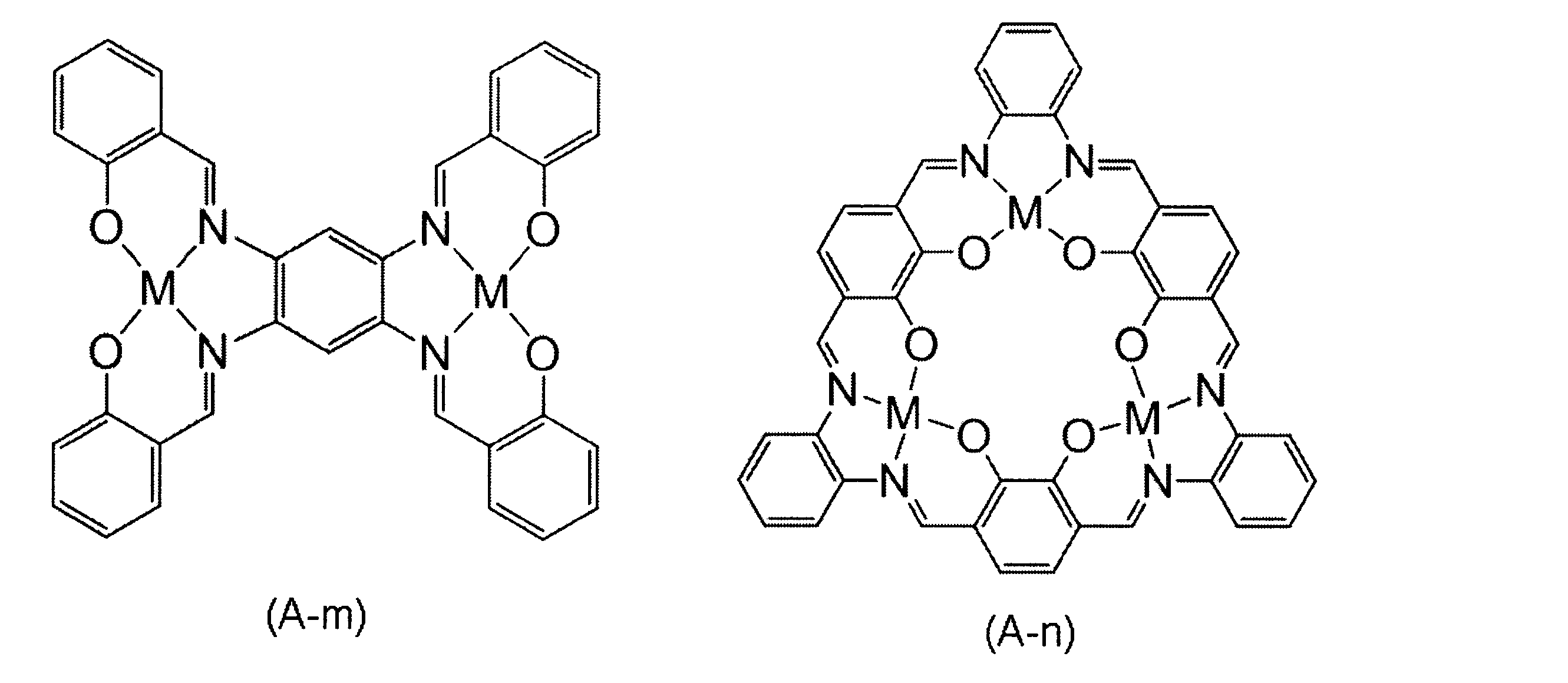
また、本実施形態の多核金属錯体の配位子は、中心金属に配位可能な4つの窒素原子で囲まれた空間を有し、前記空間に前記中心金属を収容可能とする構造を、分子内に2つ以上有していてもよい(2つ以上の前記構造は、同一でも異なっていてもよい。)。前記配位子を有する多核金属錯体として、下記一般式(A-o)~(A-s)で表される多核金属錯体を例示する。多核金属錯体の電荷は省略している。
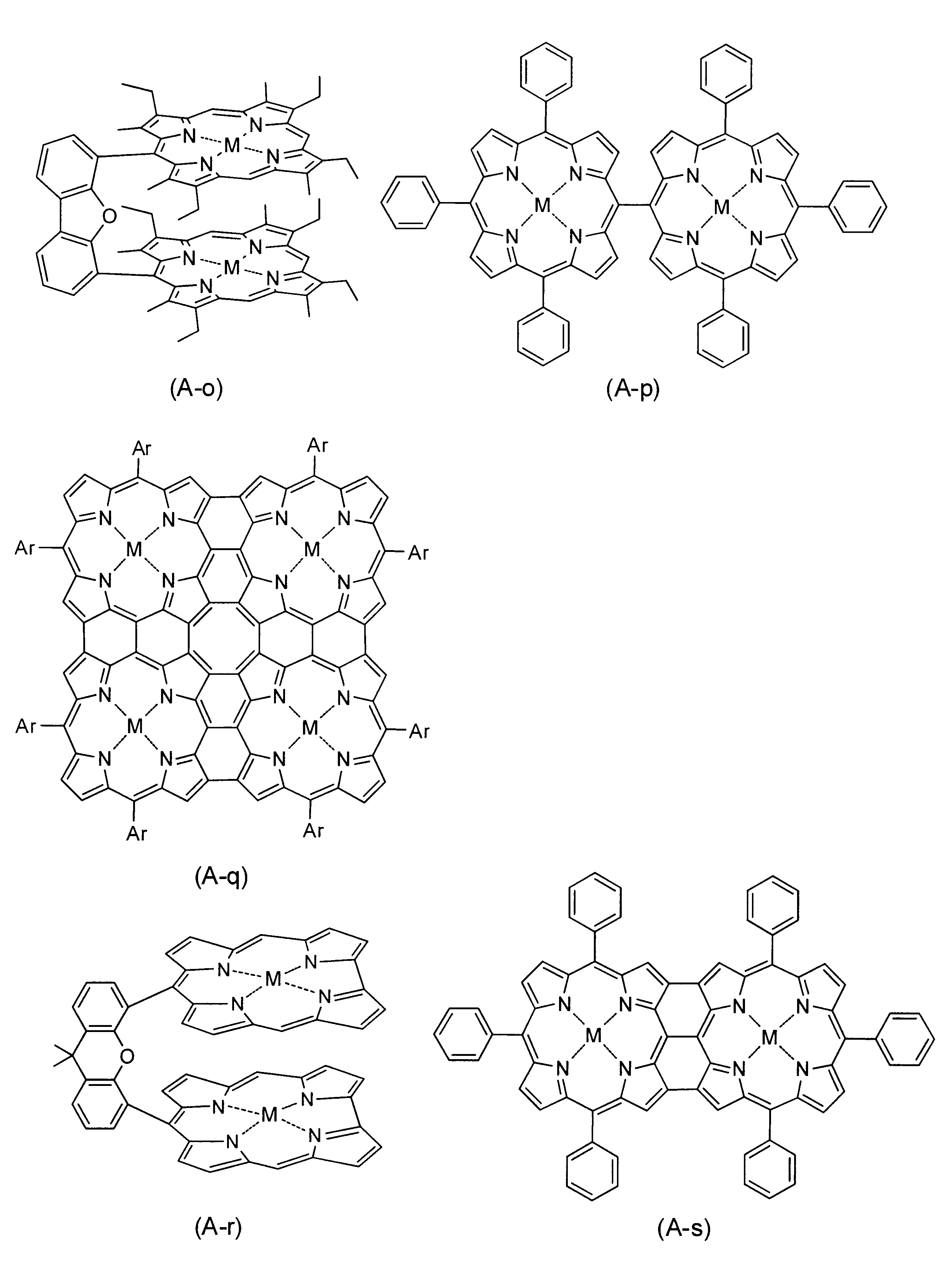
(第1の多核金属錯体)
本実施形態において、前記多核金属錯体は、下記一般式(A-1)で表されるものが好ましい。以下の説明においては、下記一般式(A-1)で表すことができる多核金属錯体を「第1の多核金属錯体」と称することがある。
本実施形態において、前記多核金属錯体は、下記一般式(A-1)で表されるものが好ましい。以下の説明においては、下記一般式(A-1)で表すことができる多核金属錯体を「第1の多核金属錯体」と称することがある。
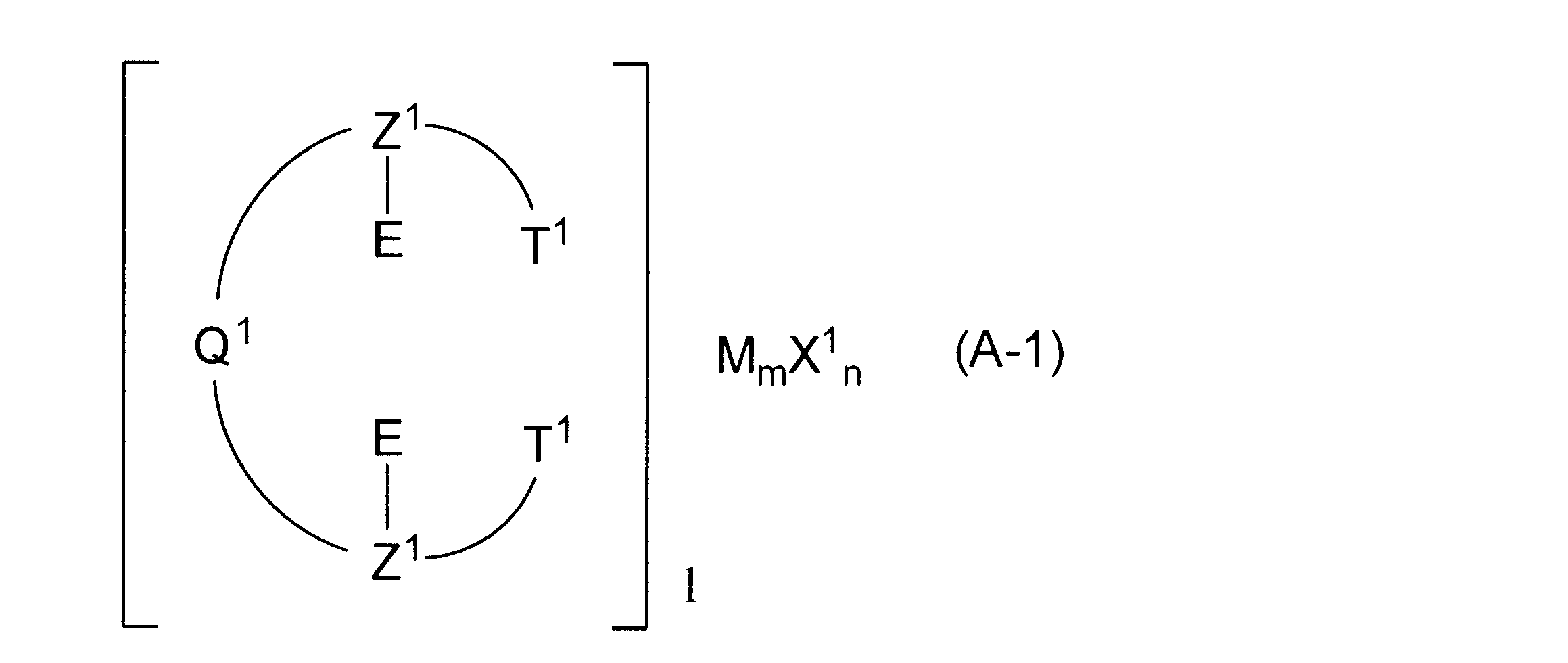
Z1は3価の有機基であり、2以上のZ1は互いに同一でも異なっていてもよい。
Eは酸素原子又は硫黄原子であり、2以上のEは互いに同一でも異なっていてもよい。
Q1は少なくとも2つの窒素原子を有する2価の有機基である。
T1は窒素原子を有する有機基であり、2以上のT1は互いに同一でも異なっていてもよく、2以上のT1は互いに結合していてもよい。
lは1以上の整数であり、lが2以上の場合、lが付された2以上の前記一般式は互いに同一でも異なっていてもよい。
Mは遷移金属原子又は遷移金属イオンであり、mは2以上の整数であり、2以上のMは互いに同一でも異なっていてもよい。
X1は対イオン又は中性分子であり、nは0以上の整数であり、nが2以上の場合、2以上のX1は互いに同一でも異なっていてもよい。)
前記一般式(A-1)中、Z1は3価の有機基であり、2以上(lが付された前記一般式中の2個)のZ1は互いに同一でも異なっていてもよい。
前記3価の有機基としては、置換基を有していてもよい芳香族基が例示される。
前記3価の有機基としては、置換基を有していてもよい芳香族基が例示される。
Z1における前記芳香族基とは、芳香族化合物から(好ましくは、芳香族化合物の環を構成する炭素原子から)水素原子を3個除去して生じる3価の基である。ここで芳香族化合物とは、例えば、ベンゼン、ナフタレン、アントラセン、テトラセン、ビフェニル、ビナフチル、フェナントレン、ジベンゾフラン、チオフェン、ベンゾチオフェン、ジベンゾチオフェン、ピリジン、ピラジン、ピロール等の全炭素原子数が好ましくは3~60、より好ましくは3~40の芳香族化合物が挙げられ、単環式及び多環式のいずれでもよい。
前記芳香族基が有していてもよい前記置換基(以下、「置換基G」と言う。)は、水素原子以外の基であり、置換基Gが2以上の場合、これら2以上の置換基Gは、互いに同一でも異なっていてもよく、隣り合う置換基G同士は互いに結合して、それぞれが結合する原子とともに環を形成してもよい。
好ましい置換基Gとしてとしては、水酸基、アミノ基、ニトロ基、シアノ基、カルボキシル基、ホルミル基、ヒドロシキスルホニル基、ハロゲン原子、置換基を有していてもよいヒドロカルビル基(置換基を有していてもよい1価の炭化水素基)、置換基を有していてもよいヒドロカルビルオキシ基(置換基を有していてもよい炭化水素オキシ基)、置換基を有していてもよいヒドロカルビルメルカプト基(置換基を有していてもよい炭化水素メルカプト基)、置換基を有していてもよいヒドロカルビルカルボニル基(置換基を有していてもよい炭化水素カルボニル基)、置換基を有していてもよいヒドロカルビルオキシカルボニル基(置換基を有していてもよい炭化水素オキシカルボニル基)、置換基を有していてもよいヒドロカルビルオキシスルホニル基(置換基を有していてもよい炭化水素スルホニル基)、置換基を有していてもよいヒドロカルビル基2つで置換されたアミノ基(すなわち、置換基を有していてもよい炭化水素二置換アミノ基であり、以下、「置換アミノ基」と言うことがある。)、置換基を有していてもよいヒドロカルビル基2つで置換されたアミノカルボニル基(すなわち、置換基を有していてもよい炭化水素二置換アミノカルボニル基であり、以下、「置換アミノカルボニル基」と言うことがある。)が例示できる。
好ましい置換基Gとしてとしては、水酸基、アミノ基、ニトロ基、シアノ基、カルボキシル基、ホルミル基、ヒドロシキスルホニル基、ハロゲン原子、置換基を有していてもよいヒドロカルビル基(置換基を有していてもよい1価の炭化水素基)、置換基を有していてもよいヒドロカルビルオキシ基(置換基を有していてもよい炭化水素オキシ基)、置換基を有していてもよいヒドロカルビルメルカプト基(置換基を有していてもよい炭化水素メルカプト基)、置換基を有していてもよいヒドロカルビルカルボニル基(置換基を有していてもよい炭化水素カルボニル基)、置換基を有していてもよいヒドロカルビルオキシカルボニル基(置換基を有していてもよい炭化水素オキシカルボニル基)、置換基を有していてもよいヒドロカルビルオキシスルホニル基(置換基を有していてもよい炭化水素スルホニル基)、置換基を有していてもよいヒドロカルビル基2つで置換されたアミノ基(すなわち、置換基を有していてもよい炭化水素二置換アミノ基であり、以下、「置換アミノ基」と言うことがある。)、置換基を有していてもよいヒドロカルビル基2つで置換されたアミノカルボニル基(すなわち、置換基を有していてもよい炭化水素二置換アミノカルボニル基であり、以下、「置換アミノカルボニル基」と言うことがある。)が例示できる。
これらの中でも、置換基Gは、置換基を有していてもよいヒドロカルビル基、置換基を有していてもよいヒドロカルビルオキシ基、置換基を有していてもよいヒドロカルビル基2つで置換されたアミノ基、置換基を有していてもよいヒドロカルビルメルカプト基、置換基を有していてもよいヒドロカルビルカルボニル基、置換基を有していてもよいヒドロカルビルオキシカルボニル基がより好ましく、置換基を有していてもよいヒドロカルビル基、置換基を有していてもよいヒドロカルビルオキシ基、置換基を有していてもよいヒドロカルビル基2つで置換されたアミノ基が更に好ましく、置換基を有していてもよいヒドロカルビル基、置換基を有していてもよいヒドロカルビルオキシ基が特に好ましい。
置換基Gにおいて、水素原子が結合した窒素原子が存在する場合、前記水素原子はヒドロカルビル基で置換されていることが好ましい。また、置換基Gが2以上の置換基を有する場合には、これら2以上の置換基は、互いに同一でも異なっていてもよく、隣り合う置換基同士が互いに結合して、それぞれが結合する原子とともに環を形成してもよい。
置換基Gにおいて、水素原子が結合した窒素原子が存在する場合、前記水素原子はヒドロカルビル基で置換されていることが好ましい。また、置換基Gが2以上の置換基を有する場合には、これら2以上の置換基は、互いに同一でも異なっていてもよく、隣り合う置換基同士が互いに結合して、それぞれが結合する原子とともに環を形成してもよい。
置換基Gにおける前記ヒドロカルビル基としては、メチル基、エチル基、n-プロピル基、イソプロピル基、n-ブチル基、イソブチル基、tert-ブチル基、ペンチル基、ヘキシル基、へプチル基、オクチル基、ノニル基、デシル基、ウンデシル基、ドデシル基、ペンタデシル基、オクタデシル基、ドコシル基等の、炭素数が好ましくは1~50、より好ましくは1~20の直鎖状又は分岐鎖状のアルキル基;シクロプロピル基、シクロブチル基、シクロブチル基、シクロペンチル基、シクロへキシル基、シクロノニル基、シクロドデシル基、ノルボルニル基、アダマンチル基等の、炭素数が好ましくは3~50、より好ましくは3~20の単環式又は多環式の環状のアルキル基;エテニル基、プロペニル基、3-ブテニル基、2-ブテニル基、2-ペンテニル基、2-ヘキセニル基、2-ノネニル基、2-ドデセニル基等の、炭素数が好ましくは2~50、より好ましくは2~20の直鎖状、分岐鎖状又は環状(環状の場合には、単環式又は多環式)のアルケニル基;フェニル基、1-ナフチル基、2-ナフチル基、2-メチルフェニル基、3-メチルフェニル基、4-メチルフェニル基、4-エチルフェニル基、4-プロピルフェニル基、4-イソプロピルフェニル基、4-ブチルフェニル基、4-tert-ブチルフェニル基、4-ヘキシルフェニル基、4-シクロヘキシルフェニル基、4-アダマンチルフェニル基、4-フェニルフェニル基等の、炭素数が好ましくは6~50、より好ましくは6~20の単環式又は多環式のアリール基;フェニルメチル基、1-フェニルエチル基、2-フェニルエチル基、1-フェニル-1-プロピル基、1-フェニル-2-プロピル基、2-フェニル-2-プロピル基、3-フェニル-1-プロピル基、4-フェニル-1-ブチル基、5-フェニル-1-ペンチル基、6-フェニル-1-ヘキシル基等の、炭素数が好ましくは7~50、より好ましくは7~20のアラルキル基が例示でき、炭素数3~10のアルキル基が好ましい。
置換基Gにおける前記ヒドロカルビル基は、炭素数が1~20のものが好ましく、炭素数が2~12のものがより好ましく、炭素数が3~10のものが更に好ましい。
置換基Gにおける前記ヒドロカルビルオキシ基、ヒドロカルビルメルカプト基、ヒドロカルビルカルボニル基、ヒドロカルビルオキシカルボニル基、ヒドロカルビルスルホニル基は、それぞれ、オキシ基、メルカプト基、カルボニル基、オキシカルボニル基、スルホニル基に、前記ヒドロカルビル基が1個結合してなる1価の基である。
置換基Gにおける前記置換アミノ基及び置換アミノカルボニル基は、それぞれアミノ基(-NH2)又はアミノカルボニル基(-C(=O)-NH2)中の2個の水素原子が、前記ヒドロカルビル基で置換された基である。ここでヒドロカルビル基は、置換基Gとしての前記ヒドロカルビル基と同じである。
置換基Gにおける前記ヒドロカルビルオキシ基、ヒドロカルビルメルカプト基、ヒドロカルビルカルボニル基、ヒドロカルビルオキシカルボニル基、ヒドロカルビルスルホニル基、置換アミノ基及び置換アミノカルボニル基が有していてもよい置換基としては、ハロゲン原子、水酸基、アミノ基、ニトロ基、シアノ基、置換基を有していてもよいヒドロカルビル基、置換基を有していてもよいヒドロカルビルオキシ基、置換基を有していてもよいヒドロカルビルメルカプト基、置換基を有していてもよいヒドロカルビルカルボニル基、置換基を有していてもよいヒドロカルビルオキシカルボニル基、置換基を有していてもよいヒドロカルビルスルホニル基が例示できる。
前記ハロゲン原子としては、フッ素原子、塩素原子、臭素原子、ヨウ素原子が例示できる。
前記置換基を有していてもよいヒドロカルビル基、置換基を有していてもよいヒドロカルビルオキシ基、置換基を有していてもよいヒドロカルビルメルカプト基、置換基を有していてもよいヒドロカルビルカルボニル基、置換基を有していてもよいヒドロカルビルオキシカルボニル基、置換基を有していてもよいヒドロカルビルスルホニル基は、置換基Gとして挙げたものと同じである。
前記ハロゲン原子としては、フッ素原子、塩素原子、臭素原子、ヨウ素原子が例示できる。
前記置換基を有していてもよいヒドロカルビル基、置換基を有していてもよいヒドロカルビルオキシ基、置換基を有していてもよいヒドロカルビルメルカプト基、置換基を有していてもよいヒドロカルビルカルボニル基、置換基を有していてもよいヒドロカルビルオキシカルボニル基、置換基を有していてもよいヒドロカルビルスルホニル基は、置換基Gとして挙げたものと同じである。
置換基Gは、上記の中でも、メチル基、エチル基、n-プロピル基、イソプロピル基、n-ブチル基、イソブチル基、tert-ブチル基、フェニル基、メチルフェニル基、1-ナフチル基、2-ナフチル基、ピリジル基であることが特に好ましい。
隣り合う置換基G同士が互いに結合して、それぞれが結合する原子とともに環を形成している場合、このような環で好ましいものとしては、ベンゼン環、シクロヘキサン環、ピリジン環、ナフタレン環が例示できる。また、このような環は、上記で説明した置換基Gを置換基として有していてもよい。
前記一般式(A-1)中、Eは酸素原子又は硫黄原子であり、2以上(lが付された前記一般式中の2個)のEは互いに同一でも異なっていてもよい。
前記Eは、酸素原子であることが好ましい。
前記Eは、酸素原子であることが好ましい。
前記一般式(A-1)中、Q1は少なくとも2つの窒素原子を有する2価の有機基であり、下記一般式(A-4-1)、(A-4-2)又は(A-4-3)で表される基が好ましい。
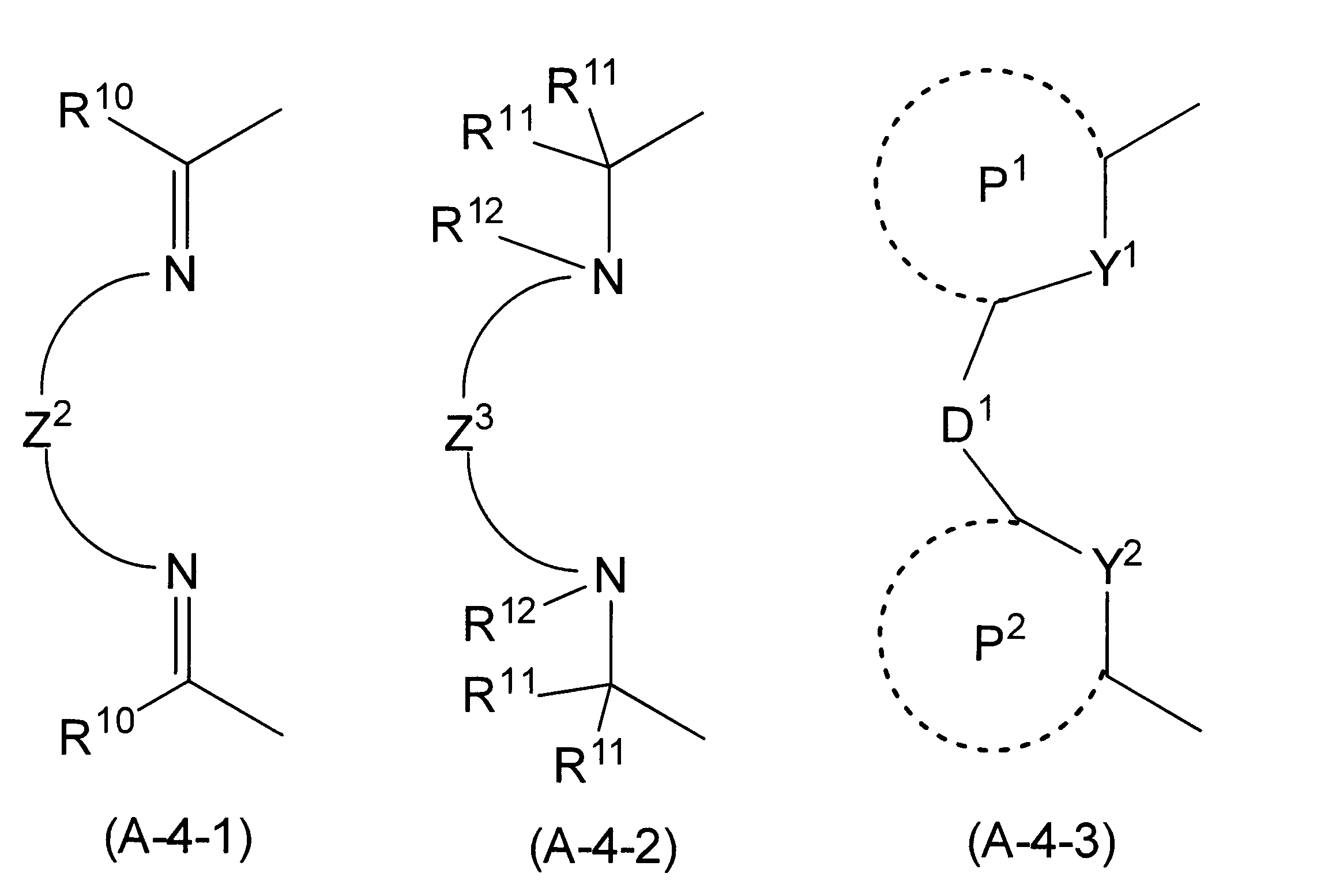
R10及びR11は、それぞれ独立に水素原子又は置換基であり、2以上のR10及びR11は、それぞれ互いに同一でも異なっていてもよい。
R12は水素原子又は炭素数1~12のヒドロカルビル基である。
Z2及びZ3は、それぞれ独立に2価の有機基である。
Y1及びY2は、それぞれ独立に式「-N=」又は「-NH-」で表される基である。
P1は、Y1とY1の隣接位の2つの炭素原子と一体となって複素環を形成する原子群である。P2は、Y2とY2の隣接位の2つの炭素原子と一体となって複素環を形成する原子群である。
D1は単結合、二重結合又は2価の連結基である。)
前記一般式(A-4-1)及び(A-4-2)中、R10及びR11は、それぞれ独立に水素原子又は置換基であり、2以上のR10及びR11は、それぞれ互いに同一でも異なっていてもよい。
R10及びR11における前記置換基としては、前記置換基Gと同じものが例示できる。
R10及びR11における前記置換基としては、前記置換基Gと同じものが例示できる。
前記一般式(A-4-2)中、R12は水素原子又は炭素数1~12のヒドロカルビル基である。
R12における前記ヒドロカルビル基は、炭素数が1~12である点以外は、置換基Gにおける前記ヒドロカルビル基と同じである。
R12における前記ヒドロカルビル基は、炭素数が1~12である点以外は、置換基Gにおける前記ヒドロカルビル基と同じである。
前記一般式(A-4-1)及び(A-4-2)中、Z2及びZ3は、それぞれ独立に2価の有機基である。好ましいZ2及びZ3としては、置換基で置換されていてもよいアルキレン基又は2価の芳香族基が例示できる。
Z2及びZ3における前記アルキレン基は、飽和炭化水素から水素原子を2個除去して生じる2価の基であり、直鎖状、分岐鎖状及び環状のいずれでもよい。具体的には、メチレン基、エチレン基、1,1-プロピレン基、1,2-プロピレン基、1,3-プロピレン基、2,4-ブチレン基、2,4-ジメチル-2,4-ブチレン基、1,2-シクロペンチレン基、1,2-シクロヘキシレン基等の、全炭素数が好ましくは1~20、より好ましくは1~10、更に好ましくは2~10の直鎖状又は分岐鎖状のアルキレン基、及び全炭素数が好ましくは3~20の環状のアルキレン基が例示できる。
Z2及びZ3における前記アルキレン基は、置換基として前記置換基Gと同じものを有していてもよい。
Z2及びZ3における前記アルキレン基は、置換基として前記置換基Gと同じものを有していてもよい。
Z2及びZ3における前記2価の芳香族基は、芳香族化合物から(好ましくは、芳香族化合物の環を構成する炭素原子から)水素原子を2個除去して生じる2価の基であり、単環式及び多環式のいずれでもよい。ここで芳香族化合物としては、ベンゼン、ナフタレン、アントラセン、テトラセン、ビフェニル、ビナフチル、フェナントレン、ジベンゾフラン、チオフェン、ベンゾチオフェン、ジベンゾチオフェン、ピリジン、ピラジン等の、全炭素数が好ましくは3~60、より好ましくは3~40のものが例示できる。
Z2及びZ3における前記芳香族基は、置換基として前記置換基Gと同じものを有していてもよい。
Z2及びZ3における前記芳香族基は、置換基として前記置換基Gと同じものを有していてもよい。
前記一般式(A-4-1)で表されるQ1としては、下記式(A-4-1-1)~(A-4-1-11)で表される基が好ましく、下記式(A-4-1-1)~(A-4-1-6)で表される基がより好ましい。下記式(A-4-1-1)~(A-4-1-11)で表されるQ1は、置換基として前記置換基Gと同じものを有していてもよい。
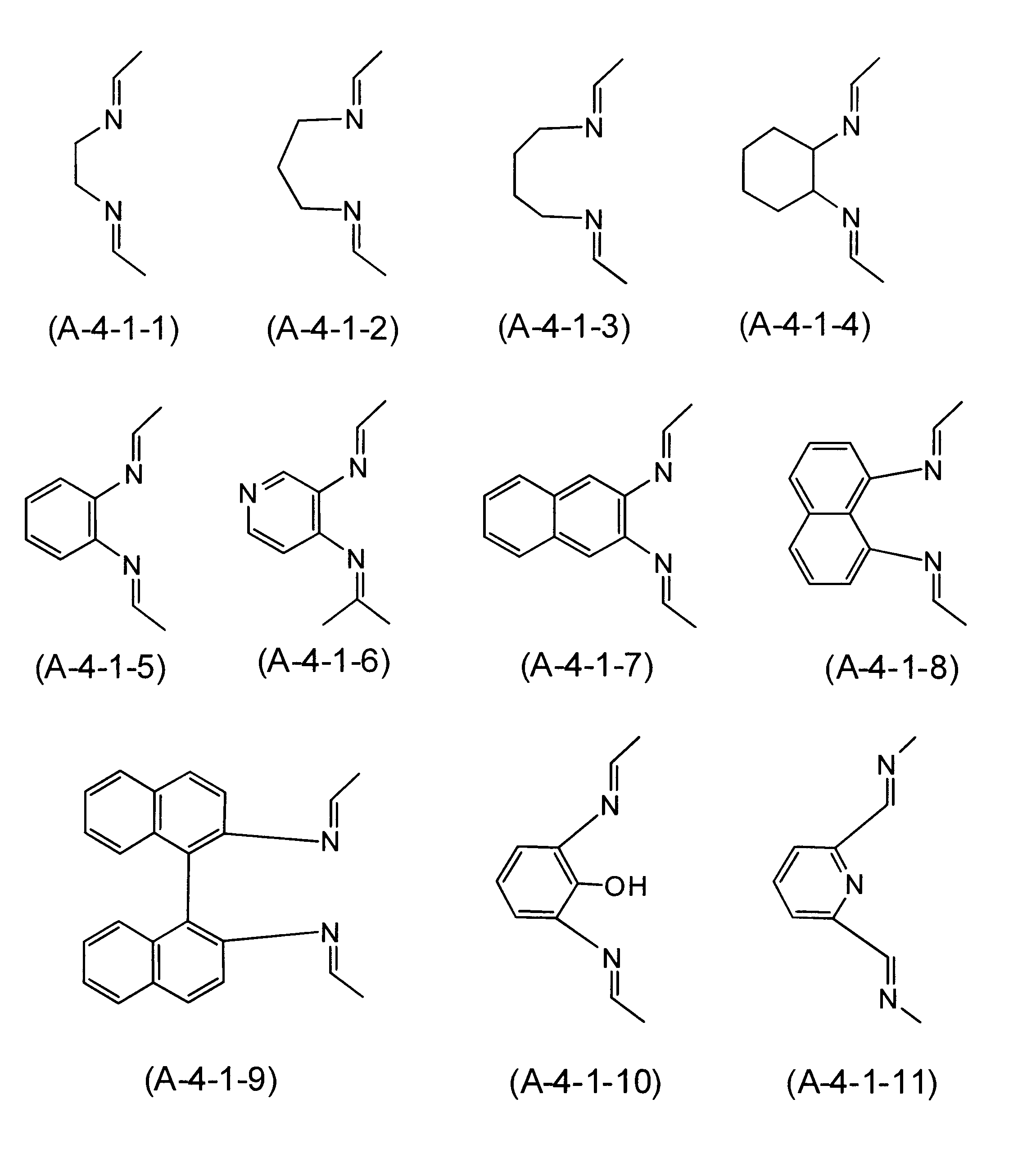
前記一般式(A-4-2)で表されるQ1としては、下記一般式(A-4-2-1)~(A-4-2-11)で表される基が好ましく、下記一般式(A-4-2-1)~(A-4-2-6)で表される基がより好ましい。下記一般式(A-4-2-1)~(A-4-2-11)で表されるQ1は、置換基として前記置換基Gと同じものを有していてもよい。
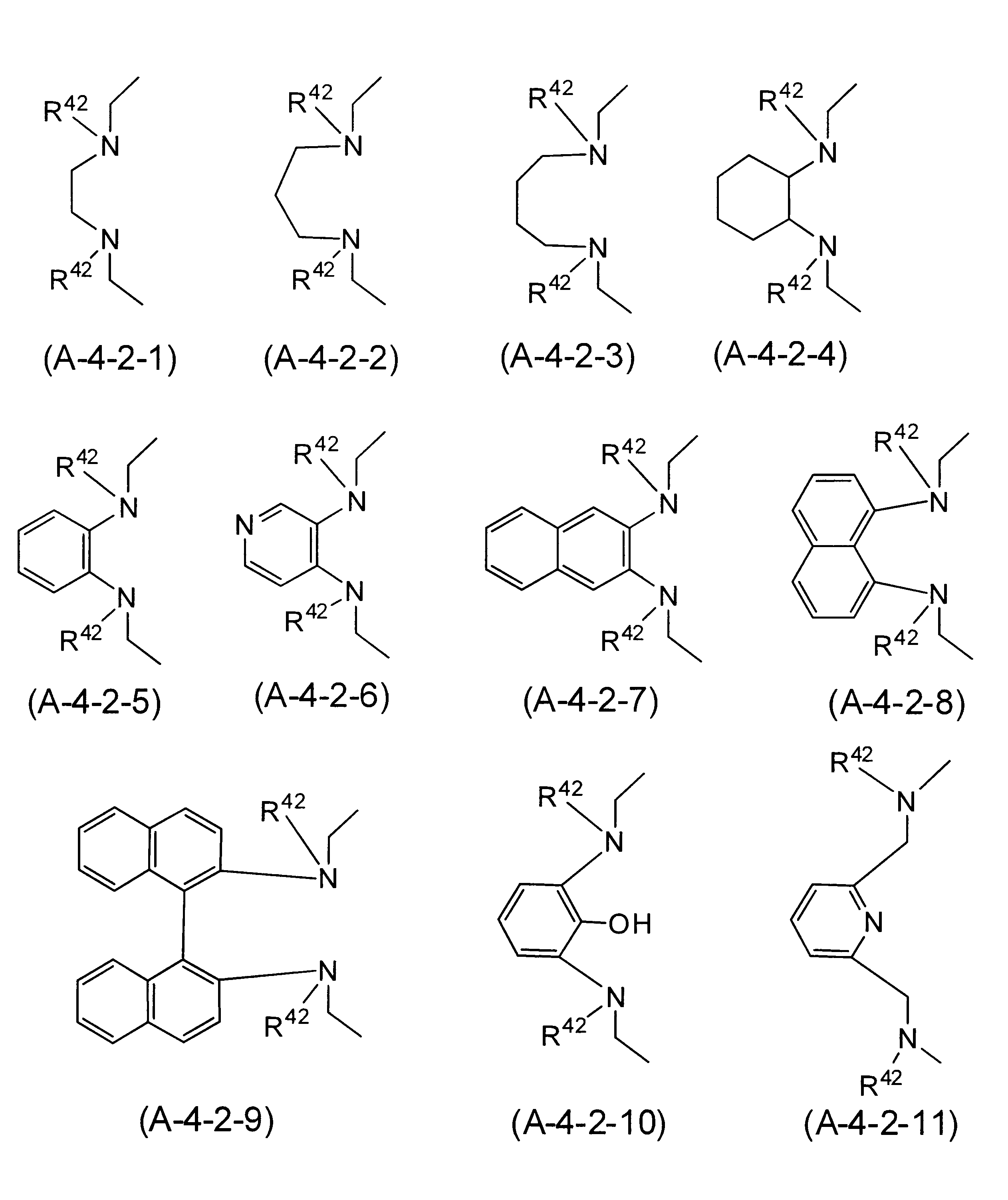
式中、R42は、水素原子又は炭素数1~12のヒドロカルビル基であり、前記ヒドロカルビル基は、R12における前記ヒドロカルビル基と同じである。
また、R42が2以上の場合、これら2以上のR42は互いに同一でも異なっていてもよい。
また、R42が2以上の場合、これら2以上のR42は互いに同一でも異なっていてもよい。
前記一般式(A-4-3)中、Y1及びY2は、それぞれ独立に式「-N=」又は「-NH-」で表される基である。式「-N=」で表される基である場合、その二重結合の位置、すなわち、Y1及びY2それぞれの隣接位の2つの炭素原子のどちら側に二重結合が位置するかは、限定されない。
前記一般式(A-4-3)中、P1は、Y1とY1の隣接位の2つの炭素原子と一体となって複素環を形成する原子群である。
前記一般式(A-4-3)中、P2は、Y2とY2の隣接位の2つの炭素原子と一体となって複素環を形成する原子群である。
P1等が形成する前記複素環、及び、P2等が形成する前記複素環は、単環式及び多環式のいずれでもよいが、芳香族複素環であることが好ましく、含窒素芳香族複素環であることがより好ましい。好ましい前記複素環として、具体的には、ピロール、ピリジン、ピラジン、ピリミジン、ピリダジン、チアゾール、イミダゾール、オキサゾール、トリアゾール、インドールが例示でき、ピロール、ピリジン、チアゾール、イミダゾール、オキサゾールがより好ましい。
前記一般式(A-4-3)中、P2は、Y2とY2の隣接位の2つの炭素原子と一体となって複素環を形成する原子群である。
P1等が形成する前記複素環、及び、P2等が形成する前記複素環は、単環式及び多環式のいずれでもよいが、芳香族複素環であることが好ましく、含窒素芳香族複素環であることがより好ましい。好ましい前記複素環として、具体的には、ピロール、ピリジン、ピラジン、ピリミジン、ピリダジン、チアゾール、イミダゾール、オキサゾール、トリアゾール、インドールが例示でき、ピロール、ピリジン、チアゾール、イミダゾール、オキサゾールがより好ましい。
P1等が形成する前記複素環、及び、P2等が形成する前記複素環は、置換基として前記置換基Gと同じものを有していてもよい。置換基が2以上の場合、隣り合う置換基同士が互いに結合して、それぞれが結合する原子とともに環を形成してもよい。これら置換基、P1、P2及びD1が環を形成している場合には、このような環で好ましいものとしては、ベンゼン環、シクロヘキサン環、ピリジン環、ナフタレン環が例示できる。また、このような環は、更に上記で説明した置換基Gを置換基として有していてもよい。
前記一般式(A-4-3)中、D1は単結合、二重結合又は2価の連結基である。
D1における前記連結基は、アルキレン基であることが好ましく、Z2及びZ3における前記アルキレン基と同じものが例示でき、置換基として前記置換基Gと同じものを有していてもよい。
D1における前記連結基は、アルキレン基であることが好ましく、Z2及びZ3における前記アルキレン基と同じものが例示でき、置換基として前記置換基Gと同じものを有していてもよい。
P1等が形成する前記複素環、及びP2等が形成する前記複素環は、前記D1以外の結合又は連結基を介して互いに結合し、多環式複素環を形成していてもよい。
前記一般式(A-4-3)で表されるQ1としては、下記一般式(A-4-3-1)~(A-4-3-13)で表される基が好ましく、下記一般式(A-4-3-1)~(A-4-3-6)で表される基がより好ましい。下記一般式(A-4-3-1)~(A-4-3-13)で表されるQ1は、置換基として前記置換基Gと同じものを有していてもよい。

式中、R43は、前記R42と同じである。
前記一般式(A-1)中、T1は窒素原子を有する有機基であり、2以上(lが付された前記一般式中の2個)のT1は互いに同一でも異なっていてもよく、2以上のT1は互いに結合していてもよい。
好ましい前記T1としては、下記一般式(A-5-a)、(A-5-b)又は(A-5-c)で表される基が例示できる。

R13及びR14は、それぞれ独立に水素原子又は置換基であり、2以上のR13及びR14は、それぞれ互いに同一でも異なっていてもよい。
R15は水素原子又は炭素数1~12のヒドロカルビル基である。
Y3は式「-N=」又は「-NH-」で表される基である。
P3は、Y3とY3の隣接位の2つの炭素原子と一体となって含窒素芳香族複素環を形成する原子群である。)
前記一般式(A-5-a)及び(A-5-b)中、R13及びR14は、それぞれ独立に水素原子又は置換基であり、前記置換基としては、前記置換基Gと同じものが例示できる。2以上のR13及びR14は、それぞれ互いに同一でも異なっていてもよい。
前記一般式(A-5-b)中、R15は水素原子又は炭素数1~12のヒドロカルビル基であり、前記R42と同じである。
前記一般式(A-5-b)中、R15は水素原子又は炭素数1~12のヒドロカルビル基であり、前記R42と同じである。
前記一般式(A-5-c)中、Y3は、式「-N=」又は「-NH-」で表される基であり、前記一般式(A-4-3)中のY1及びY2と同じである。したがって、Y3が式「-N=」で表される基である場合、その二重結合の位置、すなわち、Y3の隣接位の2つの炭素原子のどちら側に二重結合が位置するかは、限定されない。
P3等が形成する前記含窒素芳香族複素環は、単環式及び多環式のいずれでもよく、好ましいものとして、具体的には、ピリジン、ピロール、ピラジン、ピリミジン、ピリダジン、チアゾール、イミダゾール、オキサゾール、トリアゾール、インドール、ベンゾイミダゾール、キノリン、イソキノリン、シンノリン、フタラジン、キナゾリン、キノキサリン、ベンゾジアジンが例示でき、ピリジン、ピロール、ピラジン、ピリミジン、ピリダジン、チアゾール、イミダゾール、オキサゾール、トリアゾール、インドール、ベンゾイミダゾール、ピロールがより好ましく、ピリジン、ピロール、チアゾール、イミダゾール、オキサゾールが更に好ましい。前記含窒素芳香族複素環は、置換基として前記置換基Gと同じものを有していてもよい。
2つのT1が互いに結合して形成された2価の有機基で好ましいものとしては、下記式(A-5-1)~(A-5-35)で表されるものが例示できる。下記式(A-5-1)~(A-5-35)で表される有機基は、置換基として前記置換基Gと同じものを有していてもよい。
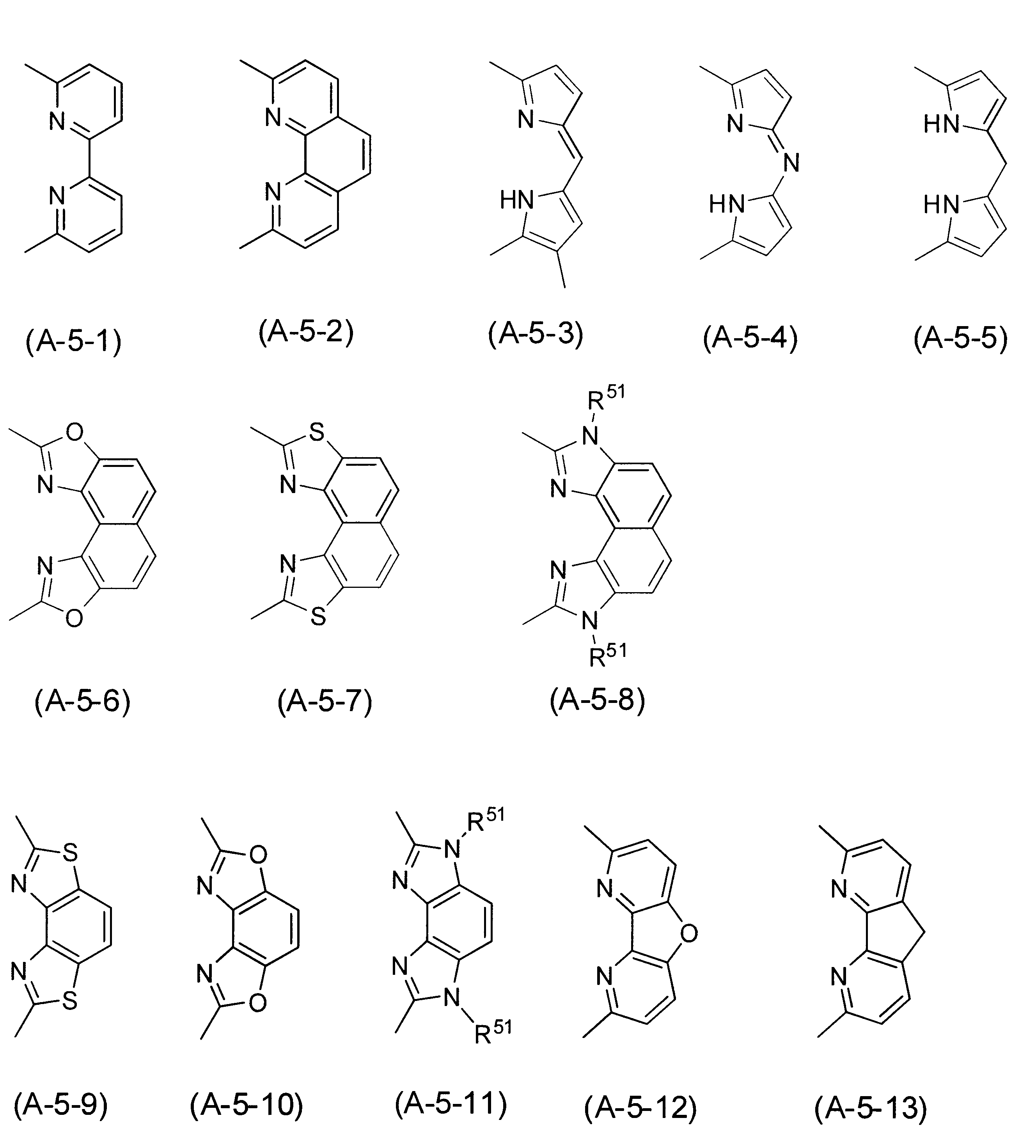

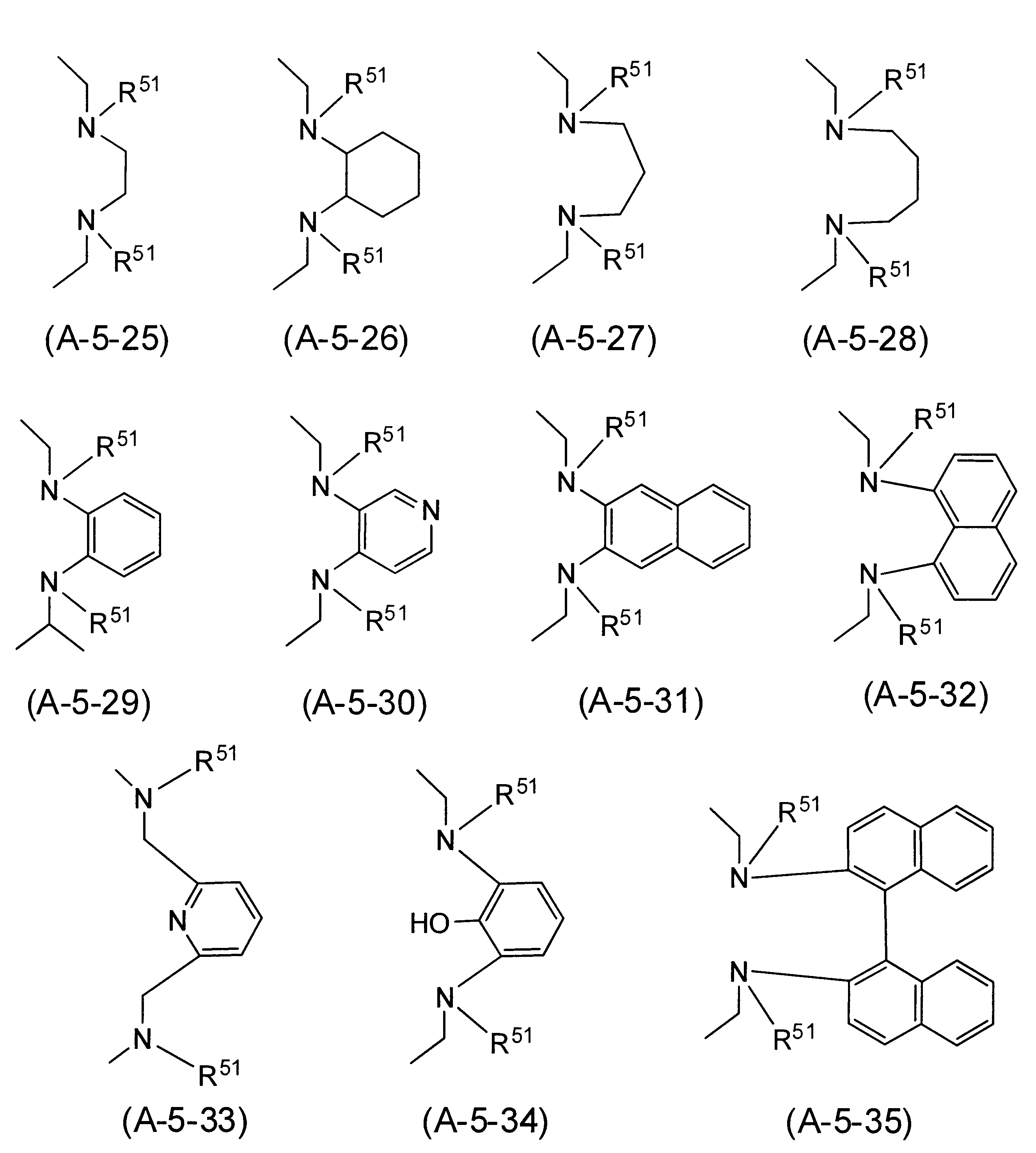
前記式中、R51は、水素原子又は炭素数1~12のヒドロカルビル基であり、前記R42と同じである。
前記一般式(A-1)中、lは1以上の整数であり、前記多核金属錯体を構成する配位子の数を表し、好ましくは1~4、より好ましくは1又は2、特に好ましくは1である。
lが2以上の場合、lが付された2以上の前記一般式(Z1、E、Q1及びT1を含む、配位子を表す一般式)は互いに同一でも異なっていてもよい。
lが2以上の場合、lが付された2以上の前記一般式(Z1、E、Q1及びT1を含む、配位子を表す一般式)は互いに同一でも異なっていてもよい。
前記一般式(A-1)中、Mは遷移金属原子又は遷移金属イオンであり、前記多核金属錯体において、少なくとも前記Eとの間で配位結合又はイオン結合している。また、Mは一般式(A-1)中のQ1が有する2以上の窒素原子との間でも配位結合し、Eと合わせて4つ以上の原子との間で配位結合している。さらに、Mは、一般式(A-1)中のT1が有する窒素原子との間でも配位結合し、Eと合わせて4つ以上の原子との間で配位結合している。
すなわち、一般式(A-1)における配位子(Z1、E、Q1及びT1を含む配位子)は、Mに配位可能な4つ以上の原子で囲まれた空間(2つのEとQ1が有する2以上の窒素原子とで囲まれた空間、及び2つのEと2つのT1が有する窒素原子とで囲まれた空間)を有し、前記空間に前記中心金属を収容可能とする構造(2つのEとQ1が有する2以上の窒素原子とで囲まれた空間を構成する構造、及び2つのEと2つのT1が有する窒素原子とで囲まれた空間を構成する構造)を、分子内に2つ以上有している。
前記遷移金属原子としては、周期表の第4周期から第6周期に属する遷移金属原子が好ましい。
具体的には、スカンジウム、チタン、バナジウム、クロム、マンガン、鉄、コバルト、ニッケル、銅、イットリウム、ジルコニウム、ニオブ、モリブデン、ルテニウム、ロジウム、パラジウム、銀、ランタン、セリウム、プラセオジム、ネオジム、サマリウム、ユウロピウム、ガドリニウム、テルビウム、ジスプロシウム、ホルミウム、エルビウム、ツリウム、イッテルビウム、ルテチウム、ハフニウム、タンタル、タングステン、レニウム、オスミウム、イリジウム、白金、金が例示できる。
これらの中でも、好ましいものとしては、スカンジウム、チタン、バナジウム、クロム、マンガン、鉄、コバルト、ニッケル、銅、イットリウム、ジルコニウム、ニオブ、モリブデン、銀、ランタン、セリウム、プラセオジム、ネオジム、サマリウム、ユウロピウム、ガドリニウム、テルビウム、ジスプロシウム、ホルミウム、エルビウム、ツリウム、イッテルビウム、ルテチウム、ハフニウム、タンタル、タングステンからなる群より選ばれる一種以上が例示でき、スカンジウム、チタン、バナジウム、クロム、マンガン、鉄、コバルト、ニッケル、銅、ジルコニウム、ニオブ、モリブデン、タンタル、タングステンからなる群より選ばれる一種以上がより好ましく、バナジウム、クロム、マンガン、鉄、コバルト、ニッケル、銅からなる群より選ばれる一種以上が更に好ましく、マンガン、鉄、コバルト、ニッケル、銅からなる群より選ばれる一種以上が特に好ましい。
具体的には、スカンジウム、チタン、バナジウム、クロム、マンガン、鉄、コバルト、ニッケル、銅、イットリウム、ジルコニウム、ニオブ、モリブデン、ルテニウム、ロジウム、パラジウム、銀、ランタン、セリウム、プラセオジム、ネオジム、サマリウム、ユウロピウム、ガドリニウム、テルビウム、ジスプロシウム、ホルミウム、エルビウム、ツリウム、イッテルビウム、ルテチウム、ハフニウム、タンタル、タングステン、レニウム、オスミウム、イリジウム、白金、金が例示できる。
これらの中でも、好ましいものとしては、スカンジウム、チタン、バナジウム、クロム、マンガン、鉄、コバルト、ニッケル、銅、イットリウム、ジルコニウム、ニオブ、モリブデン、銀、ランタン、セリウム、プラセオジム、ネオジム、サマリウム、ユウロピウム、ガドリニウム、テルビウム、ジスプロシウム、ホルミウム、エルビウム、ツリウム、イッテルビウム、ルテチウム、ハフニウム、タンタル、タングステンからなる群より選ばれる一種以上が例示でき、スカンジウム、チタン、バナジウム、クロム、マンガン、鉄、コバルト、ニッケル、銅、ジルコニウム、ニオブ、モリブデン、タンタル、タングステンからなる群より選ばれる一種以上がより好ましく、バナジウム、クロム、マンガン、鉄、コバルト、ニッケル、銅からなる群より選ばれる一種以上が更に好ましく、マンガン、鉄、コバルト、ニッケル、銅からなる群より選ばれる一種以上が特に好ましい。
前記遷移金属イオンとしては、周期表の第4周期から第6周期に属する遷移金属原子のイオンが好ましい。
前記一般式(A-1)中、mは2以上の整数であり、前記多核金属錯体を構成する遷移金属原子及び遷移金属イオンの総数を表し、好ましくは2~6、より好ましくは2~4、更に好ましくは2又は3、特に好ましくは2である。
2以上のMは互いに同一でも異なっていてもよく、遷移金属原子のみでもよいし、遷移金属イオンのみでもよく、遷移金属原子及び遷移金属イオンが共存してもよい。M同士の間で架橋配位していてもよい。
本実施形態においては、触媒活性がより向上するので、少なくとも1つのMがコバルト原子又はコバルトイオンであることが好ましい。すべてのMがコバルト原子又はコバルトイオンであってもよい。
前記一般式(A-1)中、X1は対イオン又は中性分子であり、前記対イオンとは、前記多核金属錯体を電気的に中性にするものであり、前記中性分子とは、それ自体が電気的に中性の分子である。
前記X1のうち、中性分子(中性化合物)としては、アンモニア、ピリジン、ピロール、ピリダジン、ピリミジン、ピラジン、1,2,4-トリアジン、ピラゾール、イミダゾール、1,2,3-トリアゾール、オキサゾール、イソオキサゾール、1,3,4-オキサジアゾール、チアゾール、イソチアゾール、インドール、インダゾール、キノリン、イソキノリン、フェナントリジン、シンノリン、フタラジン、キナゾリン、キノキサリン、1,8-ナフチリジン、アクリジン、2,2’-ビピリジン、4,4’-ビピリジン、1,10-フェナントロリン、エチレンジアミン、プロピレンジアミン、フェニレンジアミン、シクロヘキサンジアミン、ピリジンN-オキシド、2,2’-ビピリジンN,N’-ジオキシド、オキサミド、ジメチルグリオキシム、o-アミノフェノール等の窒素原子含有化合物;水、メタノール、エタノール、1-プロパノール、2-プロパノール、n-ブチルアルコール、イソブチルアルコール、sec-ブチルアルコール、tert-ブチルアルコール、2-メトキシエタノール、フェノール、シュウ酸、カテコール、サリチル酸、フタル酸、2,4-ペンタンジオン、1,1,1-トリフルオロ-2,4-ペンタンジオン、ヘキサフルオロペンタンジオン、1,3-ジフェニル-1,3-プロパンジオン、2,2’-ビナフトール等の酸素原子含有化合物;ジメチルスルホキシド、尿素等の硫黄原子含有化合物;1,2-ビス(ジメチルホスフィノ)エタン、1,2-フェニレンビス(ジメチルホスフィン)等のリン原子含有化合物が例示できる。
これらの中でも、好ましい中性分子は、アンモニア、ピリジン、ピロール、ピリダジン、ピリミジン、ピラジン、1,2,4-トリアジン、ピラゾール、イミダゾール、1,2,3-トリアゾール、オキサゾール、イソオキサゾール、1,3,4-オキサジアゾール、インドール、インダゾール、キノリン、イソキノリン、フェナントリジン、シンノリン、フタラジン、キナゾリン、キノキサリン、1,8-ナフチリジン、アクリジン、2,2’-ビピリジン、4,4’-ビピリジン、1,10-フェナントロリン、エチレンジアミン、プロピレンジアミン、フェニレンジアミン、シクロヘキサンジアミン、ピリジンN-オキシド、2,2’-ビピリジンN,N’-ジオキシド、オキサミド、ジメチルグリオキシム、o-アミノフェノール、水、フェノール、シュウ酸、カテコール、サリチル酸、フタル酸、2,4-ペンタンジオン、1,1,1-トリフルオロ-2,4-ペンタンジオン、ヘキサフルオロペンタンジオン、1,3-ジフェニル-1,3-プロパンジオン、2,2’-ビナフトールであり、より好ましくはアンモニア、ピリジン、ピロール、ピリダジン、ピリミジン、ピラジン、1,2,4-トリアジン、ピラゾール、イミダゾール、1,2,3-トリアゾール、オキサゾール、イソオキサゾール、1,3,4-オキサジアゾール、インドール、インダゾール、キノリン、イソキノリン、フェナントリジン、シンノリン、フタラジン、キナゾリン、キノキサリン、1,8-ナフチリジン、アクリジン、2,2’-ビピリジン、4,4’-ビピリジン、1,10-フェナントロリン、エチレンジアミン、プロピレンジアミン、フェニレンジアミン、シクロヘキサンジアミン、ピリジンN-オキシド、2,2’-ビピリジンN,N’-ジオキシド、o-アミノフェノール、フェノール、カテコール、サリチル酸、フタル酸、1,3-ジフェニル-1,3―プロパンジオン、2,2’-ビナフトールであり、ピリジン、ピロール、ピリダジン、ピリミジン、ピラジン、ピラゾール、イミダゾール、オキサゾール、インドール、キノリン、イソキノリン、アクリジン、2,2’-ビピリジン、4,4’-ビピリジン、1,10-フェナントロリン、フェニレンジアミン、ピリジンN-オキシド、2,2’-ビピリジンN,N’-ジオキシド、o-アミノフェノール、フェノールが更に好ましい。
前記X1のうち、対イオンは、アニオン性を有する対イオン及びカチオン性を有する対イオンのいずれでもよい。
アニオン性を有する対イオンとしては、水酸化物イオン;ペルオキシド;スーパーオキシド;シアン化物イオン;チオシアン酸イオン;フッ化物イオン、塩化物イオン、臭化物イオン、ヨウ化物イオン等のハロゲン化物イオン;硫酸イオン;硝酸イオン;炭酸イオン、過塩素酸イオン;テトラフルオロボレートイオン;テトラフェニルボレートイオン等のテトラアリールボレートイオン;ヘキサフルオロホスフェイトイオン;メタンスルホン酸イオン;トリフルオロメタンスルホン酸イオン;p-トルエンスルホン酸イオン;ベンゼンスルホン酸イオン;リン酸イオン;亜リン酸イオン;酢酸イオン;トリフルオロ酢酸イオン;プロピオン酸イオン;安息香酸イオン;金属酸化物イオン;メトキサイドイオン;エトキサイドイオンが例示できる。
これらの中でも、好ましいものとしては、水酸化物イオン、硫酸イオン、硝酸イオン、炭酸イオン、過塩素酸イオン、テトラフルオロボレートイオン、テトラフェニルボレートイオン、ヘキサフルオロホスフェイトイオン、メタンスルホン酸イオン、トリフルオロメタンスルホン酸イオン、p-トルエンスルホン酸イオン、ベンゼンスルホン酸イオン、リン酸イオン、酢酸イオン、トリフルオロ酢酸イオンが挙げられ、水酸化物イオン、硫酸イオン、硝酸イオン、炭酸イオン、テトラフェニルボレートイオン、トリフルオロメタンスルホン酸イオン、p-トルエンスルホン酸イオン、酢酸イオン、トリフルオロ酢酸がより好ましい。
アニオン性を有する対イオンとしては、水酸化物イオン;ペルオキシド;スーパーオキシド;シアン化物イオン;チオシアン酸イオン;フッ化物イオン、塩化物イオン、臭化物イオン、ヨウ化物イオン等のハロゲン化物イオン;硫酸イオン;硝酸イオン;炭酸イオン、過塩素酸イオン;テトラフルオロボレートイオン;テトラフェニルボレートイオン等のテトラアリールボレートイオン;ヘキサフルオロホスフェイトイオン;メタンスルホン酸イオン;トリフルオロメタンスルホン酸イオン;p-トルエンスルホン酸イオン;ベンゼンスルホン酸イオン;リン酸イオン;亜リン酸イオン;酢酸イオン;トリフルオロ酢酸イオン;プロピオン酸イオン;安息香酸イオン;金属酸化物イオン;メトキサイドイオン;エトキサイドイオンが例示できる。
これらの中でも、好ましいものとしては、水酸化物イオン、硫酸イオン、硝酸イオン、炭酸イオン、過塩素酸イオン、テトラフルオロボレートイオン、テトラフェニルボレートイオン、ヘキサフルオロホスフェイトイオン、メタンスルホン酸イオン、トリフルオロメタンスルホン酸イオン、p-トルエンスルホン酸イオン、ベンゼンスルホン酸イオン、リン酸イオン、酢酸イオン、トリフルオロ酢酸イオンが挙げられ、水酸化物イオン、硫酸イオン、硝酸イオン、炭酸イオン、テトラフェニルボレートイオン、トリフルオロメタンスルホン酸イオン、p-トルエンスルホン酸イオン、酢酸イオン、トリフルオロ酢酸がより好ましい。
カチオン性を有する対イオンとしては、アルカリ金属イオン;アルカリ土類金属イオン、;テトラ(n-ブチル)アンモニウムイオン、テトラエチルアンモニウムイオン等のテトラアルキルアンモニウムイオン;テトラフェニルホスホニウムイオン等のテトラアリールホスホニウムイオンが例示できる。
これらの中でも、好ましいものとしては、リチウムイオン、ナトリウムイオン、カリウムイオン、ルビジウムイオン、セシウムイオン、マグネシウムイオン、カルシウムイオン、ストロンチウムイオン、バリウムイオン、テトラ(n-ブチル)アンモニウムイオン、テトラエチルアンモニウムイオン、テトラフェニルホスホニウムイオンが挙げられ、テトラ(n-ブチル)アンモニウムイオン、テトラエチルアンモニウムイオン、テトラフェニルホスホニウムイオンがより好ましく、テトラ(n-ブチル)アンモニウムイオン、テトラエチルアンモニウムイオンが更に好ましい。
これらの中でも、好ましいものとしては、リチウムイオン、ナトリウムイオン、カリウムイオン、ルビジウムイオン、セシウムイオン、マグネシウムイオン、カルシウムイオン、ストロンチウムイオン、バリウムイオン、テトラ(n-ブチル)アンモニウムイオン、テトラエチルアンモニウムイオン、テトラフェニルホスホニウムイオンが挙げられ、テトラ(n-ブチル)アンモニウムイオン、テトラエチルアンモニウムイオン、テトラフェニルホスホニウムイオンがより好ましく、テトラ(n-ブチル)アンモニウムイオン、テトラエチルアンモニウムイオンが更に好ましい。
前記一般式(A-1)中、nは0以上の整数であり、前記多核金属錯体を構成するX1の数を表す。
nが2以上の場合、2以上のX1は互いに同一でも異なっていてもよい。また、2以上のX1は、対イオンのみでもよいし、中性分子のみでもよく、対イオン及び中性分子が共存してもよい。
nが2以上の場合、2以上のX1は互いに同一でも異なっていてもよい。また、2以上のX1は、対イオンのみでもよいし、中性分子のみでもよく、対イオン及び中性分子が共存してもよい。
前記一般式(A-1)で表される多核金属錯体は、下記一般式(A-2)で表される多核金属錯体であることが好ましい。
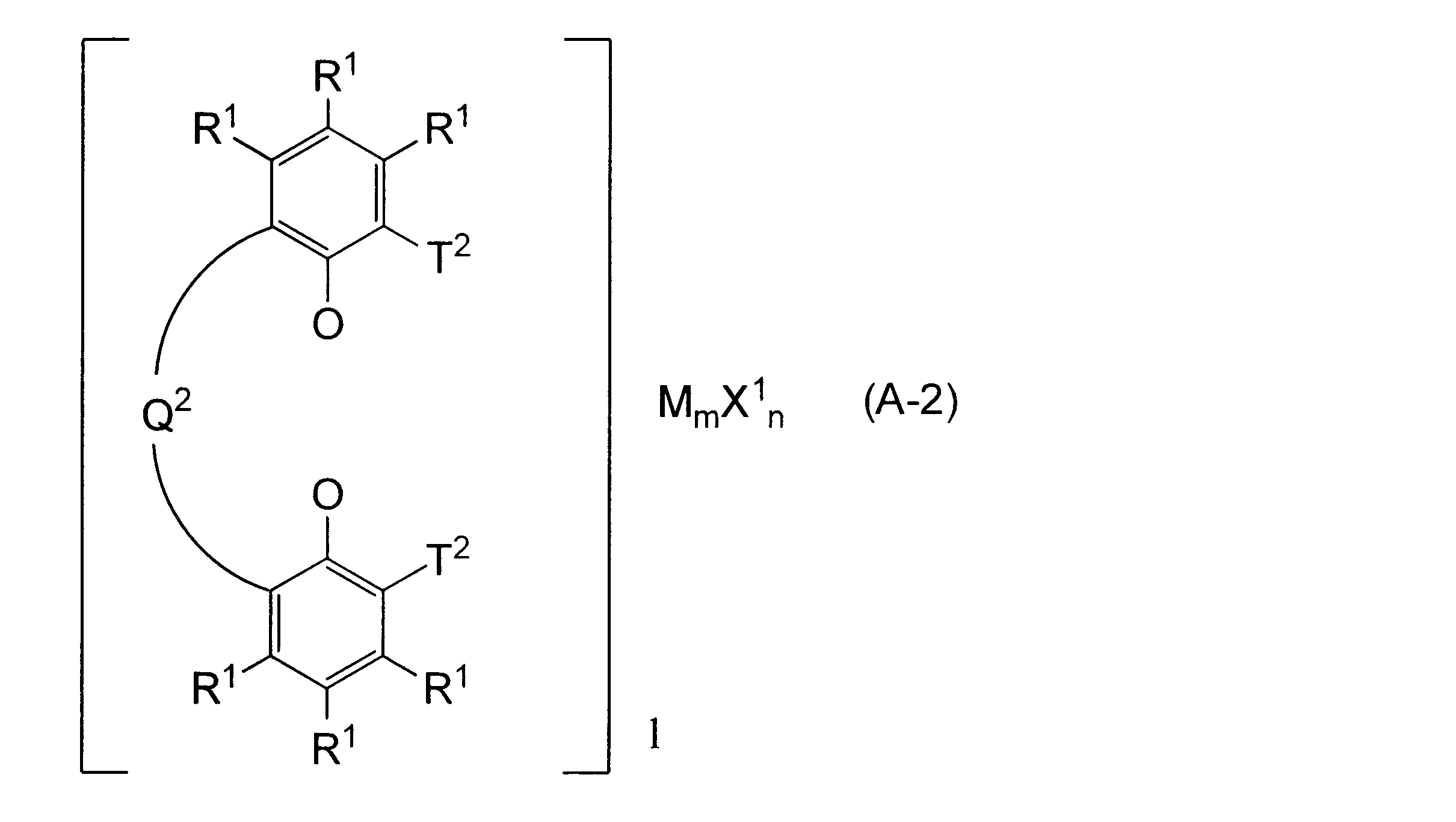
R1は水素原子又は置換基であり、2以上のR1は互いに同一でも異なっていてもよく、隣り合うR1同士は互いに結合して、それぞれが結合する炭素原子とともに環を形成してもよい。
Q2は少なくとも2つの窒素原子を有する2価の有機基である。
T2は窒素原子を有する有機基であり、前記T1と同じ基である。2以上のT2は互いに同一でも異なっていてもよく、2以上のT2は互いに結合していてもよい。
lは1以上の整数であり、lが2以上の場合、lが付された2以上の前記一般式は互いに同一でも異なっていてもよい。
Mは遷移金属原子又は遷移金属イオンであり、mは2以上の整数であり、2以上のMは互いに同一でも異なっていてもよい。
X1は対イオン又は中性分子であり、nは0以上の整数であり、nが2以上の場合、2以上のX1は互いに同一でも異なっていてもよい。)
前記一般式(A-2)中、M、X1、l、m及びnは、前記一般式(A-1)中のM、X1、l、m及びnと同じである。例えば、lが2以上の場合、lが付された2以上の前記一般式(R1、Q2及びT2を含む、配位子を表す一般式)は互いに同一でも異なっていてもよい。
前記一般式(A-2)中、Q2は少なくとも2つの窒素原子を有する2価の有機基であり、前記一般式(A-1)中のQ1と同じである。
前記一般式(A-2)中、T2は窒素原子を有する有機基であり、前記一般式(A-1)中のT1と同じである。したがって、2以上のT2は互いに同一でも異なっていてもよく、2以上のT2は互いに結合していてもよい。
前記一般式(A-2)中、T2は窒素原子を有する有機基であり、前記一般式(A-1)中のT1と同じである。したがって、2以上のT2は互いに同一でも異なっていてもよく、2以上のT2は互いに結合していてもよい。
前記一般式(A-2)中、R1は、水素原子又は置換基であり、2以上のR1は互いに同一でも異なっていてもよく、隣り合うR1同士は互いに結合して、それぞれが結合する炭素原子とともに環を形成してもよい。R1は、水素原子でもよい点を除けば、前記置換基Gと同じである。すなわち、R1における前記置換基は、前記置換基Gと同じである。
R1は、水素原子、メチル基、エチル基、n-プロピル基、イソプロピル基、n-ブチル基、イソブチル基、tert-ブチル基、フェニル基、メチルフェニル基、1-ナフチル基、2-ナフチル基又はピリジル基であることが特に好ましい。
前記一般式(A-2)中、Mは一般式(A-2)中のQ2が有する2以上の窒素原子、及び2つの酸素原子との間で配位結合し、合わせて4つ以上の原子との間で配位結合している。またMは、一般式(A-2)中のT2が有する窒素原子、及び2つの酸素原子との合いだで配位結合し、合わせて4つ以上の原子との間で配位結合している。
すなわち、一般式(A-2)における配位子は、Mに配位可能な4つ以上の原子で囲まれた空間(2つの酸素原子とQ2が有する2以上の窒素原子とで囲まれた空間、及び2つの酸素原子と2つのT2が有する窒素原子とで囲まれた空間)を有し、前記空間に前記中心金属を収容可能とする構造(2つの酸素原子とQ2が有する2以上の窒素原子とで囲まれた空間を構成する構造、及び2つの酸素原子と2つのT2が有する窒素原子とで囲まれた空間を構成する構造)を、分子内に2つ以上有している。
前記一般式(A-2)で表される多核金属錯体は、下記一般式(A-3)で表される多核金属錯体であることが好ましい。

R2は水素原子又は置換基であり、2以上のR2は互いに同一でも異なっていてもよく、隣り合うR2同士は互いに結合して、それぞれが結合する炭素原子とともに環を形成してもよい。
Q3及びQ4は、それぞれ独立に下記一般式(A-3-1)、(A-3-2)、(A-3-3)、(A-3-4)、(A-3-5)又は(A-3-6)で表される2価の基である。
lは1以上の整数であり、lが2以上の場合、lが付された2以上の前記一般式は互いに同一でも異なっていてもよい。
Mは遷移金属原子又は遷移金属イオンであり、mは2以上の整数であり、2以上のMは互いに同一でも異なっていてもよい。
X1は対イオン又は中性分子であり、nは0以上の整数であり、nが2以上の場合、2以上のX1は互いに同一でも異なっていてもよい。)

R3、R4、R5、R6、R7及びR8は、それぞれ独立に水素原子又は置換基であり、2以上のR3、R4、R5、R6、R7及びR8は、それぞれ互いに同一でも異なっていてもよく、2以上のR3、R4、R5、R6、R7及びR8は、それぞれ互いに結合して、それぞれが結合する炭素原子とともに環を形成してもよい。
Aaは、下記式(A-3-a)若しくは(A-3-b)又は下記一般式(A-3-c)で表される2価の基であり、2以上のAaは、互いに同一でも異なっていてもよい。)
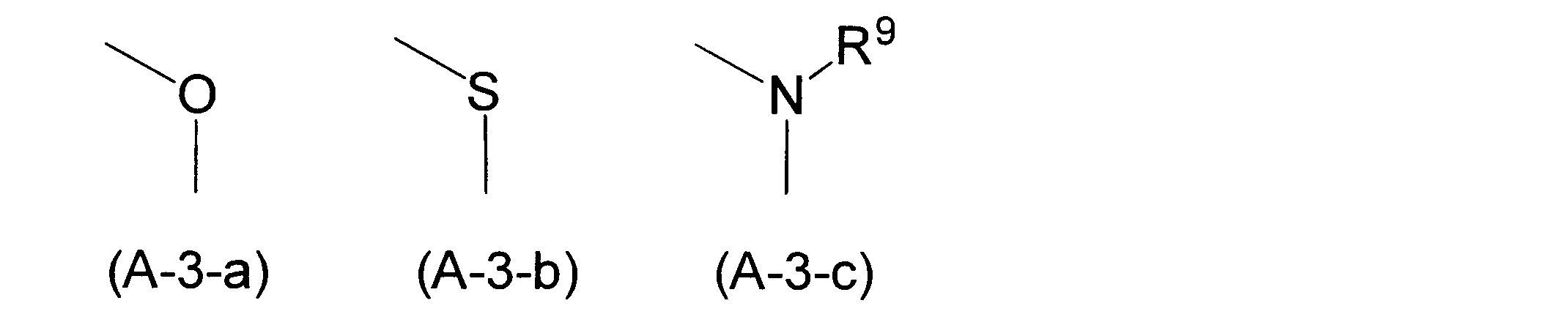
前記一般式(A-3)中、M、X1、l、m及びnは、前記一般式(A-1)中のM、X1、l、m及びnと同じである。例えば、lが2以上の場合、lが付された2以上の前記一般式(R2、Q3及びQ4を含む、配位子を表す一般式)は互いに同一でも異なっていてもよい。
前記一般式(A-3)中、R2は水素原子又は置換基であり、前記一般式(A-2)中のR1と同じである。したがって、2以上のR2は互いに同一でも異なっていてもよく、隣り合うR2同士は互いに結合して、それぞれが結合する炭素原子とともに環を形成してもよい。
前記一般式(A-3)中、Q3及びQ4は、それぞれ独立に前記一般式(A-3-1)、(A-3-2)、(A-3-3)、(A-3-4)、(A-3-5)又は(A-3-6)で表される2価の基である。
前記一般式(A-3-1)~(A-3-6)中、R3、R4、R5、R6、R7及びR8は、それぞれ独立に水素原子又は置換基であり、前記一般式(A-2)中のR1と同じである。したがって、2以上のR3、R4、R5、R6、R7及びR8は、それぞれ互いに同一でも異なっていてもよく、2以上のR3、R4、R5、R6、R7及びR8は、それぞれ互いに結合して、それぞれが結合する炭素原子とともに環を形成してもよい。
前記一般式(A-3-6)中、Aaは、前記式(A-3-a)若しくは(A-3-b)又は前記一般式(A-3-c)で表される2価の基であり、2以上のAaは、互いに同一でも異なっていてもよい。
前記一般式(A-3-6)中、Aaは、前記式(A-3-a)若しくは(A-3-b)又は前記一般式(A-3-c)で表される2価の基であり、2以上のAaは、互いに同一でも異なっていてもよい。
前記一般式(A-3-c)中、R9は水素原子又はヒドロカルビル基である。
R9における前記ヒドロカルビル基は、置換基Gにおける前記ヒドロカルビル基と同じである。
R9における前記ヒドロカルビル基は、置換基Gにおける前記ヒドロカルビル基と同じである。
前記一般式(A-3)で表される多核金属錯体において、R2、Q3及びQ4を含む前記一般式で表される配位子は、後述する式(A-6-7)~(A-6-14)で表される配位子が好ましく、式(A-6-7)~(A-6-9)で表される配位子がより好ましい。
前記一般式(A-3)中、Mは一般式(A-3)中のQ3が有する2つの窒素原子、及び2つの酸素原子との間で配位結合し、合わせて4つの原子との間で配位結合している。またMは、一般式(A-3)中のQ4が有する2つの窒素原子、及び2つの酸素原子との合いだで配位結合し、合わせて4つの原子との間で配位結合している。
すなわち、一般式(A-3)における配位子は、Mに配位可能な4つの原子で囲まれた空間(2つの酸素原子とQ3が有する2の窒素原子とで囲まれた空間、及び2つの酸素原子とQ4が有する2つの窒素原子とで囲まれた空間)を有し、前記空間に前記中心金属を収容可能とする構造(2つの酸素原子とQ3が有する2つの窒素原子とで囲まれた空間を構成する構造、及び2つの酸素原子とQ4が有する2つの窒素原子とで囲まれた空間を構成する構造)を、分子内に2つ有している。
本実施形態において、前記多核金属錯体を構成する配位子で好ましいものとしては、下記式(A-6-1)~(A-6-34)で表される配位子が例示でき、これらの中でも、式(A-6-1)~(A-6-22)で表される配位子がより好ましく、(A-6-1)~(A-6-14)で表される配位子が特に好ましい。下記式(A-6-1)~(A-6-34)において、電荷は省略している。
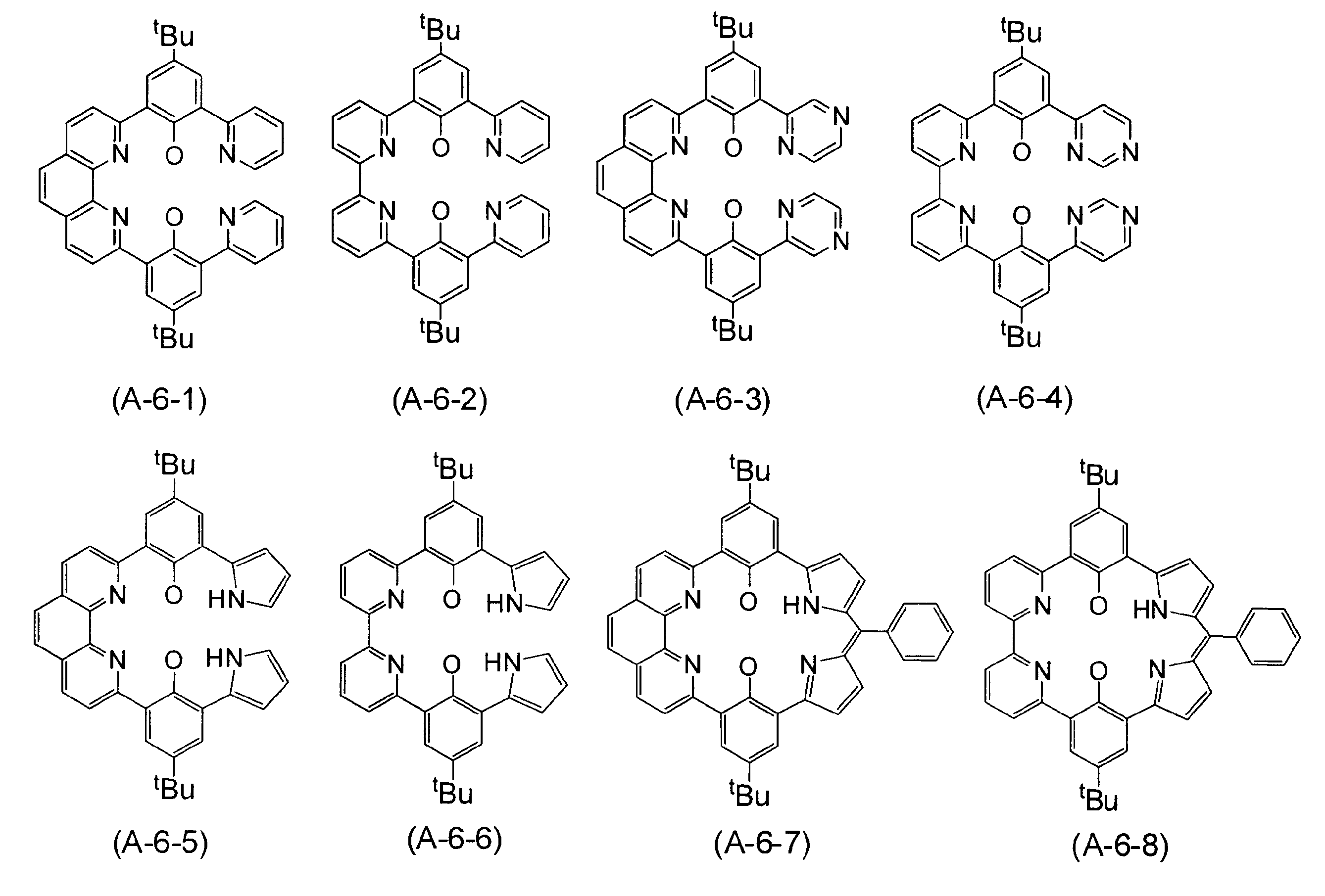

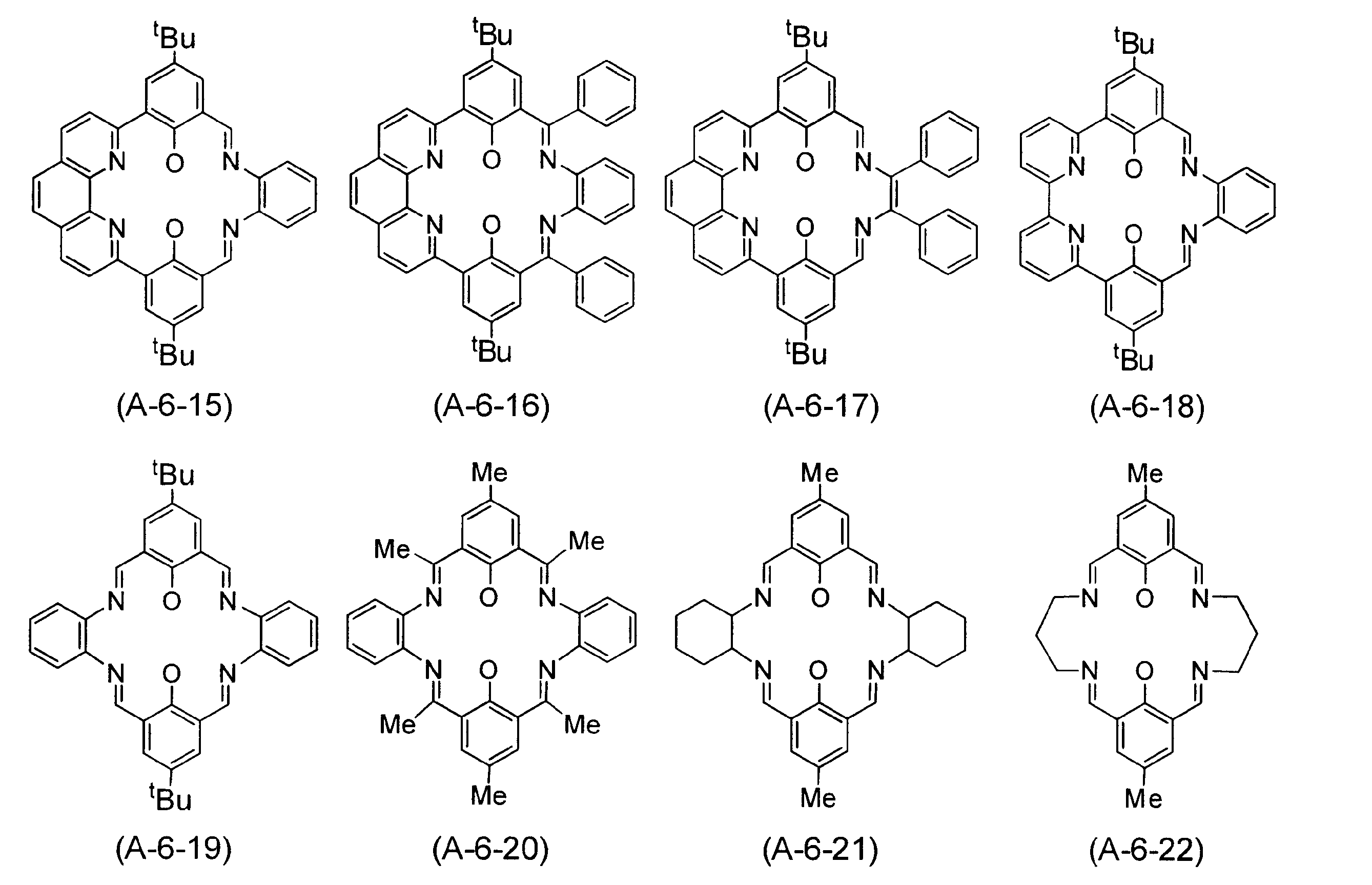
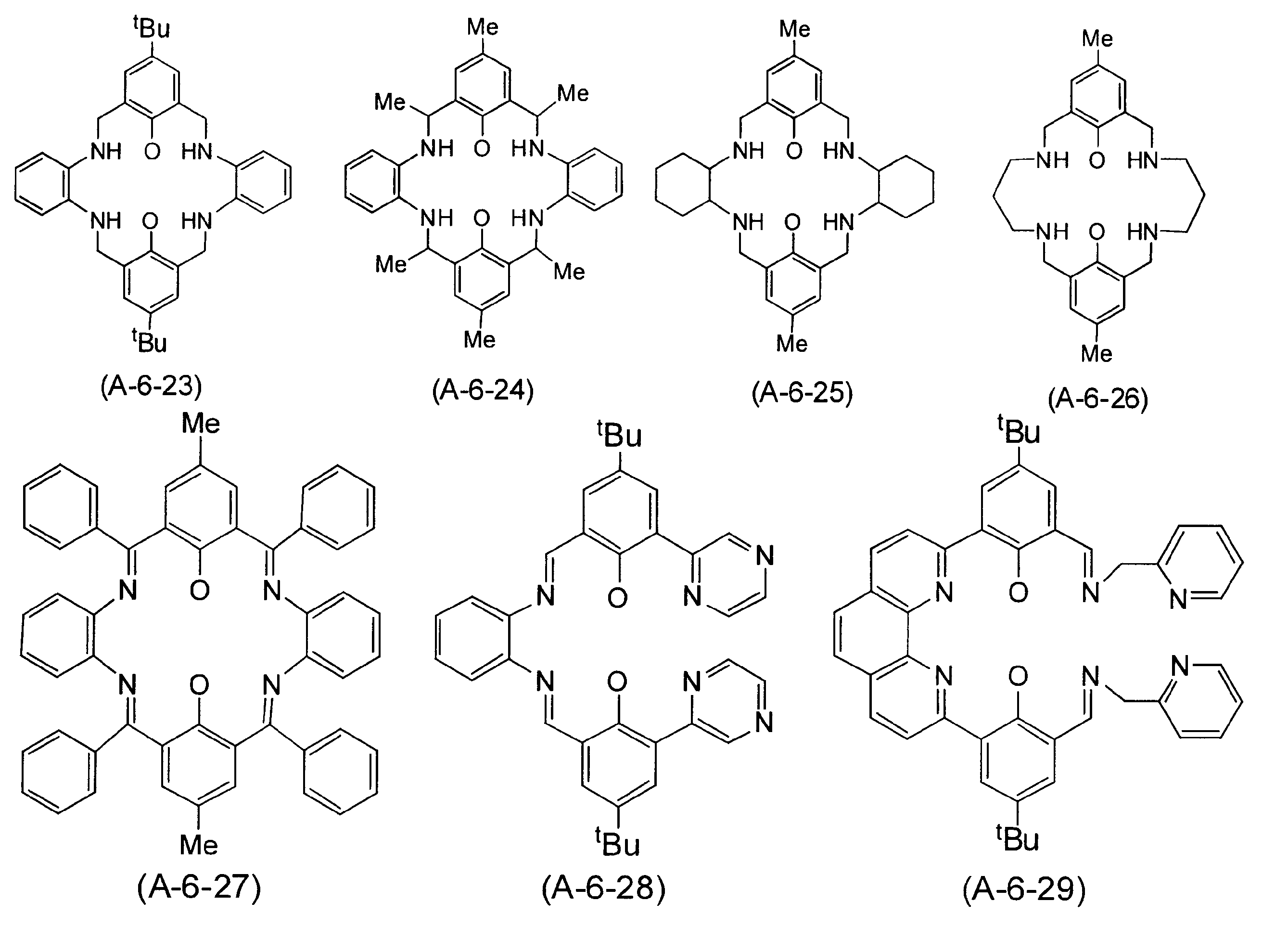
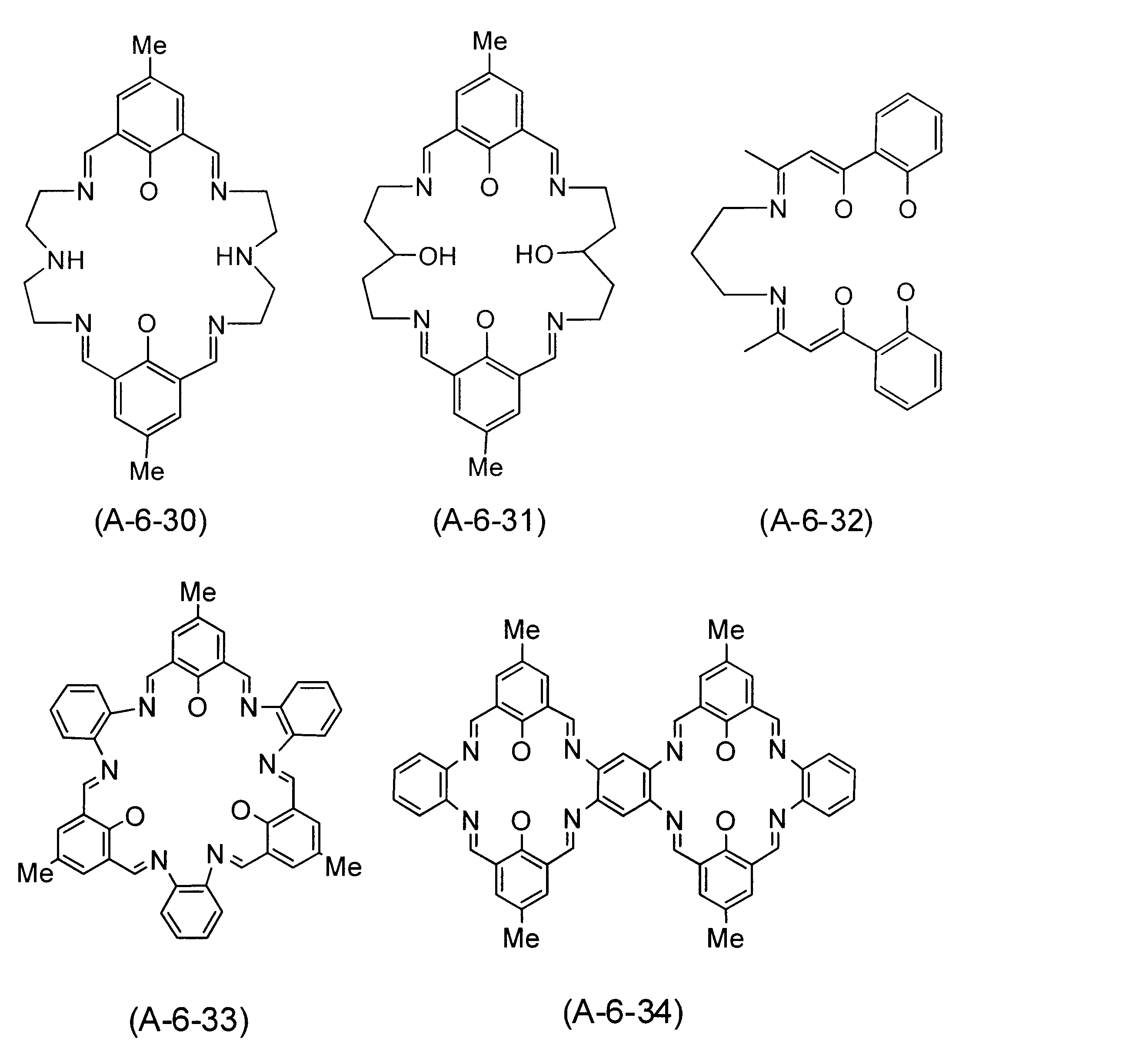
本実施形態において、好ましい前記多核金属錯体としては、下記一般式(A-7-1)~(A-7-34)で表される多核金属錯体が例示できる。下記一般式(A-7-1)~(A-7-34)において、電荷、並びに対イオン及び中性分子(X1)は省略している。

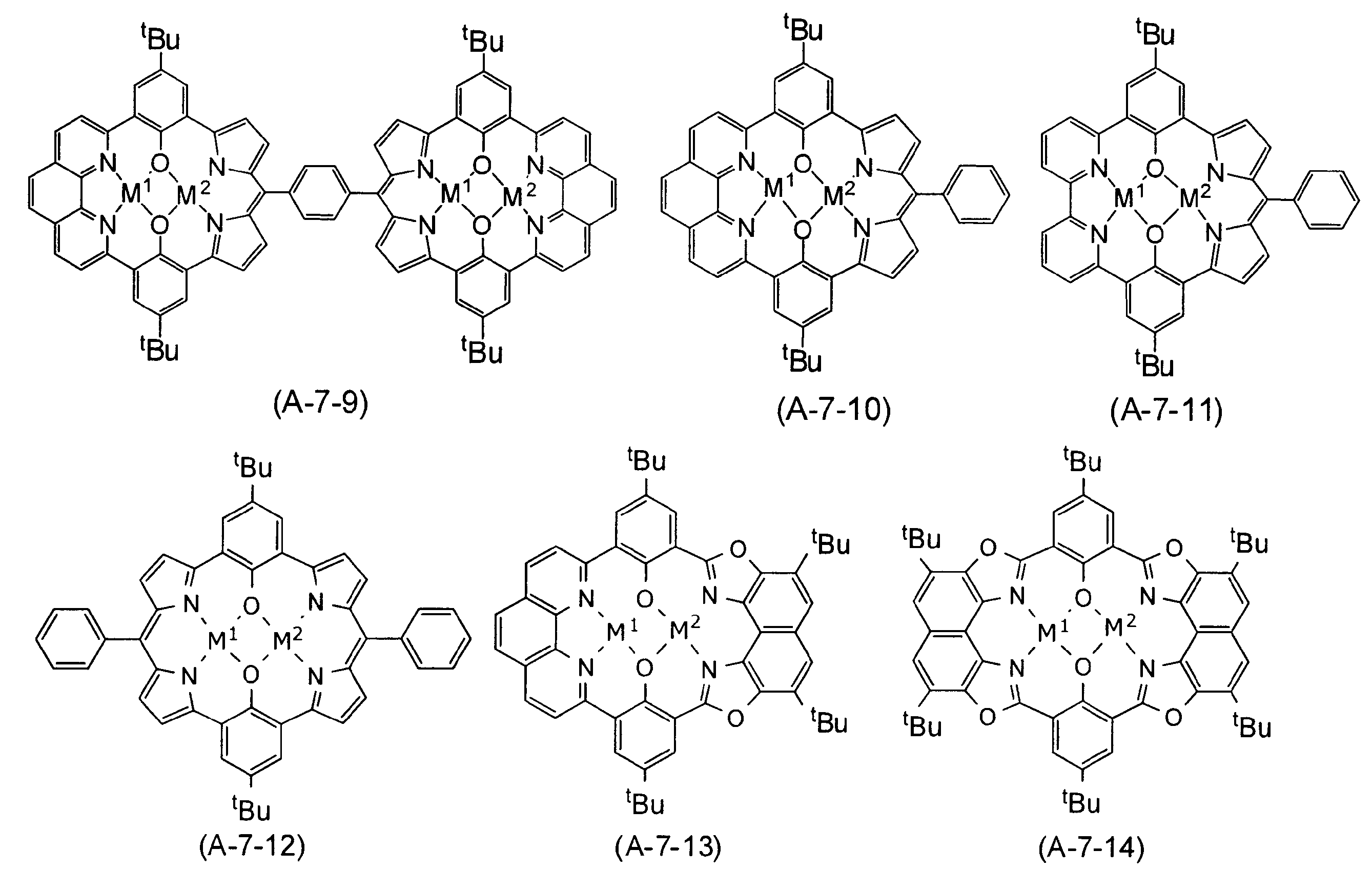


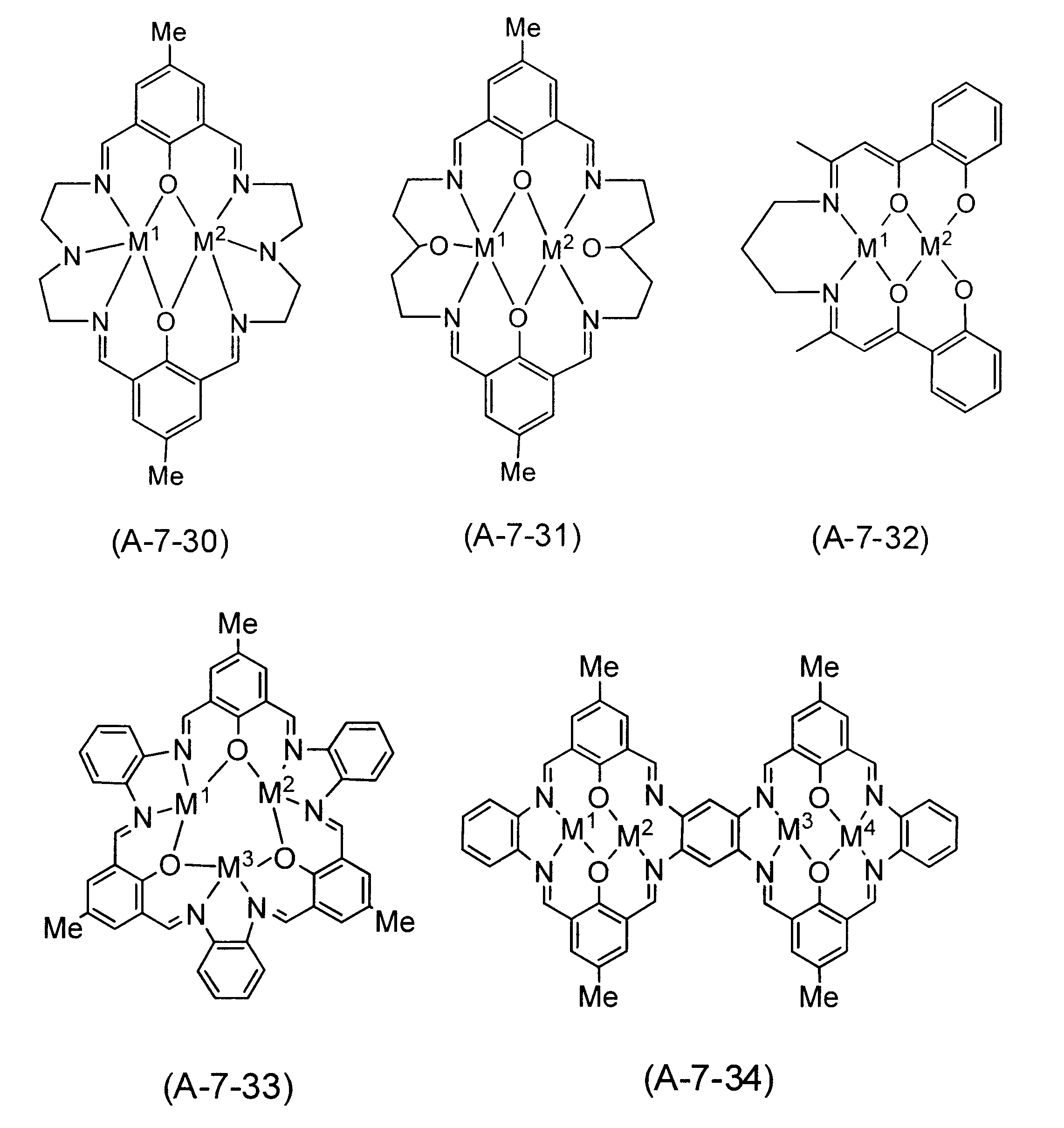
前記一般式(A-7-1)~(A-7-34)中、M1、M2、M3及びM4は、それぞれ独立に遷移金属原子又は遷移金属イオンであり、前記一般式(A-1)中のMと同じである。
上述した多核金属錯体における配位子は、例えば、「Journal of Organic Chemistry,69,5419(2004)」に記載されているように、アルデヒド基を有するフェノール化合物と、アミノ基を有する化合物とを、アルコール等の溶媒中で反応させる工程を有する方法で製造できる。また、例えば、「Australian Journal of Chemistry,23,2225(1970))に記載されているように、反応時に金属塩を添加しておく方法で、目的とする前記多核金属錯体を直接製造することもできる。また、「Tetrahedron.,1999,55,8377.」に記載されているように、有機金属反応剤の複素環への付加及び酸化反応を行い、ハロゲン化反応、次いで遷移金属触媒を用いたクロスカップリング反応を行う工程を有する方法で製造できる。また、複素環のハロゲン化物を用いて、段階的にクロスカップリング反応を行う工程を有する方法でも製造できる。
(第2の多核金属錯体)
また、前記多核金属錯体に用いられる配位子は、下記(a)及び(b)の要件を満たす芳香族化合物であってもよい。
(a)前記中心金属に配位可能な4つ以上の窒素原子で囲まれた空間を有し、前記空間に前記中心金属を収容可能とする構造を、分子内に2つ以上有する(2つ以上の前記構造は、同一でも異なっていてもよい。)。
(b)前記構造を構成する窒素原子のうち少なくとも1つが含窒素複素六員環に含まれる窒素原子である。
また、前記多核金属錯体に用いられる配位子は、下記(a)及び(b)の要件を満たす芳香族化合物であってもよい。
(a)前記中心金属に配位可能な4つ以上の窒素原子で囲まれた空間を有し、前記空間に前記中心金属を収容可能とする構造を、分子内に2つ以上有する(2つ以上の前記構造は、同一でも異なっていてもよい。)。
(b)前記構造を構成する窒素原子のうち少なくとも1つが含窒素複素六員環に含まれる窒素原子である。
以下の説明においては、上述の要件(a)及び(b)を満たす配位子を有する多核金属錯体を、「第2の多核金属錯体」と称することがある。
要件(a)における「中心金属に配位可能」な窒素原子とは、1つの孤立電子対を有しており、中心金属(金属原子又は金属イオン)と配位結合を形成することができる窒素原子である。金属原子又は金属イオンへ配位する前の窒素原子は、孤立電子対をプロトンへ供与してN-H結合を形成していてもよい。
中心金属に配位可能な4つ以上の窒素原子は、分子内に中心金属を収容可能とすることができる空間を形成している。このような空間に隣接し、前記空間の外縁を形成する分子構造が、要件(a)における「前記中心金属に配位可能な4つ以上の窒素原子で囲まれた空間を有し、前記空間に前記中心金属を収容可能とする構造」である。本実施形態の多核金属錯体に用いられる配位子は、分子内に前記構造を2つ以上有している。
各構造には(すなわち、各構造が有する空間には)、中心金属を好ましくは1~3個、より好ましくは1個又は2個、特に好ましくは1個収容することができる。
このような構造は、前記構造を含む化合物を配位子とする多核金属錯体を形成した後、再結晶等の通常知られた方法により得られた結晶についてX線結晶構造解析等の構造解析を行うことで確認することができる。
要件(b)における含窒素複素六員環としては、ピリジン環、ピラジン環、ピリミジン環、ピリダジン環、1,3,5-トリアジン環、1,2,4-トリアジン環、1,2,4,5-テトラジン環、ピペリジン環、ピペラジン環、モルホリン環が例示され、好ましくは、ピリジン環、ピラジン環、ピリミジン環、ピリダジン環、1,3,5-トリアジン環、1,2,4-トリアジン環、1,2,4,5-テトラジン環であり、より好ましくは、ピリジン環、ピラジン環、ピリミジン環、ピリダジン環である。
触媒活性をより向上させることができるので、配位子の分子内に含まれる全ての含窒素芳香族複素六員環には、ヘテロ原子としての窒素原子が1個又は2個のみ含まれることが好ましい。
このような配位子は、中心金属を収容する空間が形成された「構造」が、線対称、点対称、回転対称のいずれかの対称性を有することが好ましい。ここでいう対称性とは、上述した「中心金属が収容される空間の外縁を形成する分子構造」にのみ着目した場合の対称性であり、前記分子構造を構成する芳香環等の置換基については考慮しないものとする。また、構造の対称性は、構造を形成する窒素原子から、前記窒素原子に結合する水素原子(プロトン)が脱離した分子構造について検討するものとする。
「構造」が回転対称性を有する場合、2回対称(C2対称)以上であり、好ましくは2~12回対称であり、より好ましくは2~6回対称である。
このような対称性を有する構造を分子内に1つ有する芳香族化合物(配位子)として、下記一般式(B-a)~(B-x)で表される化合物が例示できる。本実施形態の多核金属錯体に含まれる配位子は、このような構造を分子内に2つ以上有する。
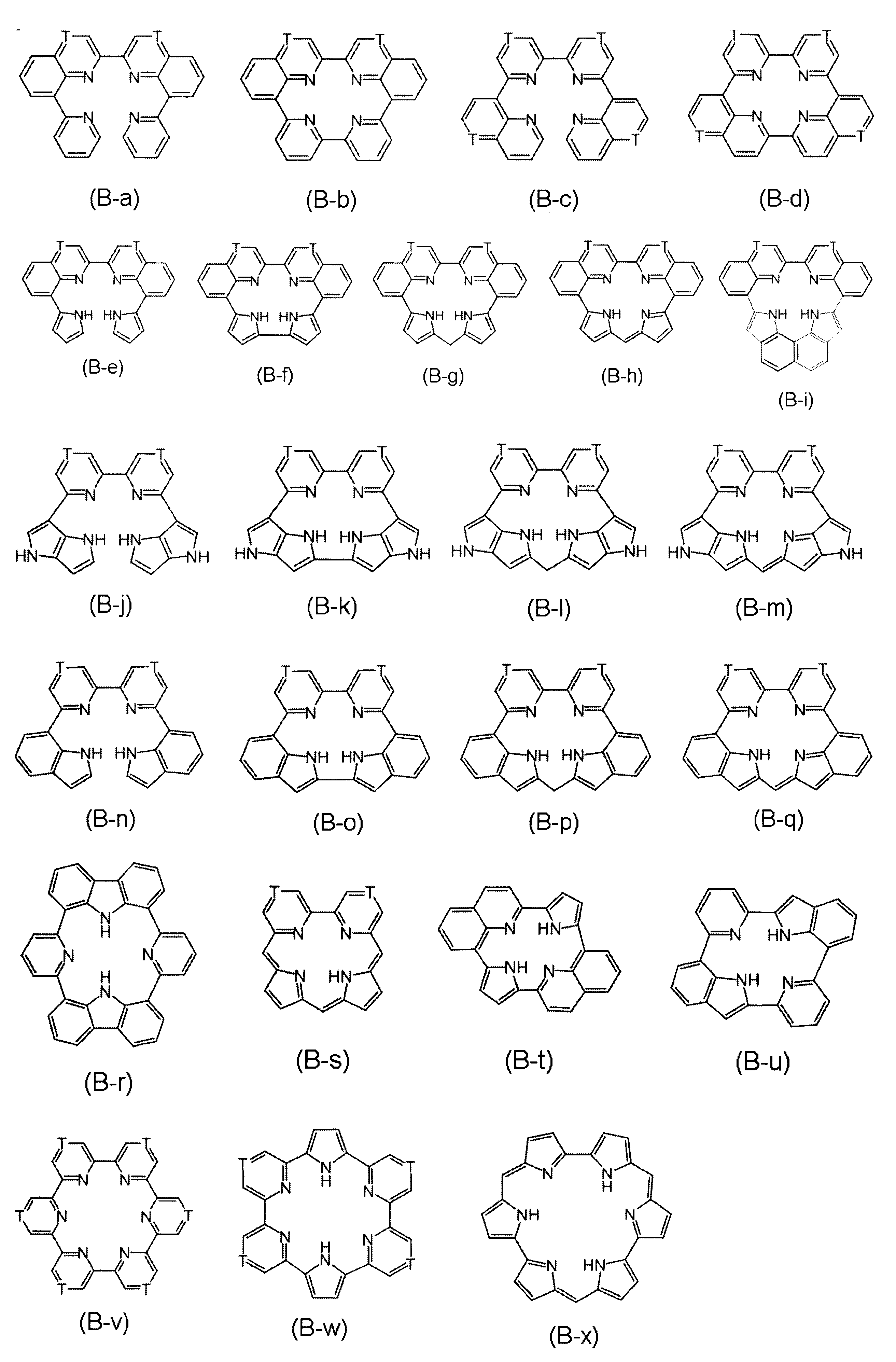
本実施形態の多核金属錯体の配位子として用いることのできる芳香族化合物において、芳香族化合物を構成する全炭素原子の質量WCに対する全窒素原子の質量WNの比(WN/WC)が、0より大きく1.1以下である(0<WN/WC≦1.1)と好ましい。WN/WCの値は、より好ましくは0.05以上、更に好ましくは0.1以上である。また、より好ましくは1.0以下であり、更に好ましくは0.9以下である。上限値と下限値は任意に組み合わせることができる。
本実施形態の多核金属錯体の配位子として用いることのできる芳香族化合物において、各々の上記構造を構成する窒素原子の数nと、各々の上記構造において、構造が形成する空間の中心から各窒素原子の中心までの平均距離r(Å)との関係は、r/nの値が0より大きく0.7以下である(0<r/n≦0.7)と好ましい。r/nの値は、より好ましくは0.1以上であり、更に好ましくは0.2以上である。また、より好ましくは0.65以下であり、更に好ましくは0.6以下である。上限値と下限値は任意に組み合わせることができる。
配位可能な4つ以上の窒素原子で囲まれた空間の中心は、以下のように定義される。
すなわち、上記構造が線対称性を有する場合、上記中心は、対称軸上にあり、各窒素原子からの平均距離が最も短くなる点である。
上記構造が点対称性を有する場合、上記中心は対称点である。
上記構造が回転対称性を有する場合、上記中心は、回転対称軸上にあり、各窒素原子の中心からの平均距離が最も短くなる点である。
すなわち、上記構造が線対称性を有する場合、上記中心は、対称軸上にあり、各窒素原子からの平均距離が最も短くなる点である。
上記構造が点対称性を有する場合、上記中心は対称点である。
上記構造が回転対称性を有する場合、上記中心は、回転対称軸上にあり、各窒素原子の中心からの平均距離が最も短くなる点である。
上記nは、好ましくは4~10であり、より好ましくは4~8であり、特に好ましくは4~6である。
上記rの下限値は、好ましくは1.5Åであり、より好ましくは1.7Åであり、更に好ましくは1.9Åであり、上限値は、好ましくは3.5Åであり、より好ましくは3.3Åであり、更に好ましくは3.1Åである。
本実施形態の多核金属錯体の配位子として用いることのできる芳香族化合物は、より触媒活性を向上させることができるので、多環式芳香族複素環を有することが好ましい。
以下、本実施形態の多核金属錯体の配位子として用いることのできる芳香族化合物について、分子構造を示しながら説明する。
本実施形態において、中心金属に配位可能な4つ以上の窒素原子で囲まれた空間を有し、前記空間に前記中心金属を収容可能とする構造が、下記一般式(B-1)で表されることが好ましい。前記空間を囲む前記中心金属に配位可能な窒素原子は、4~8であることが好ましく、4~6であることがより好ましい。
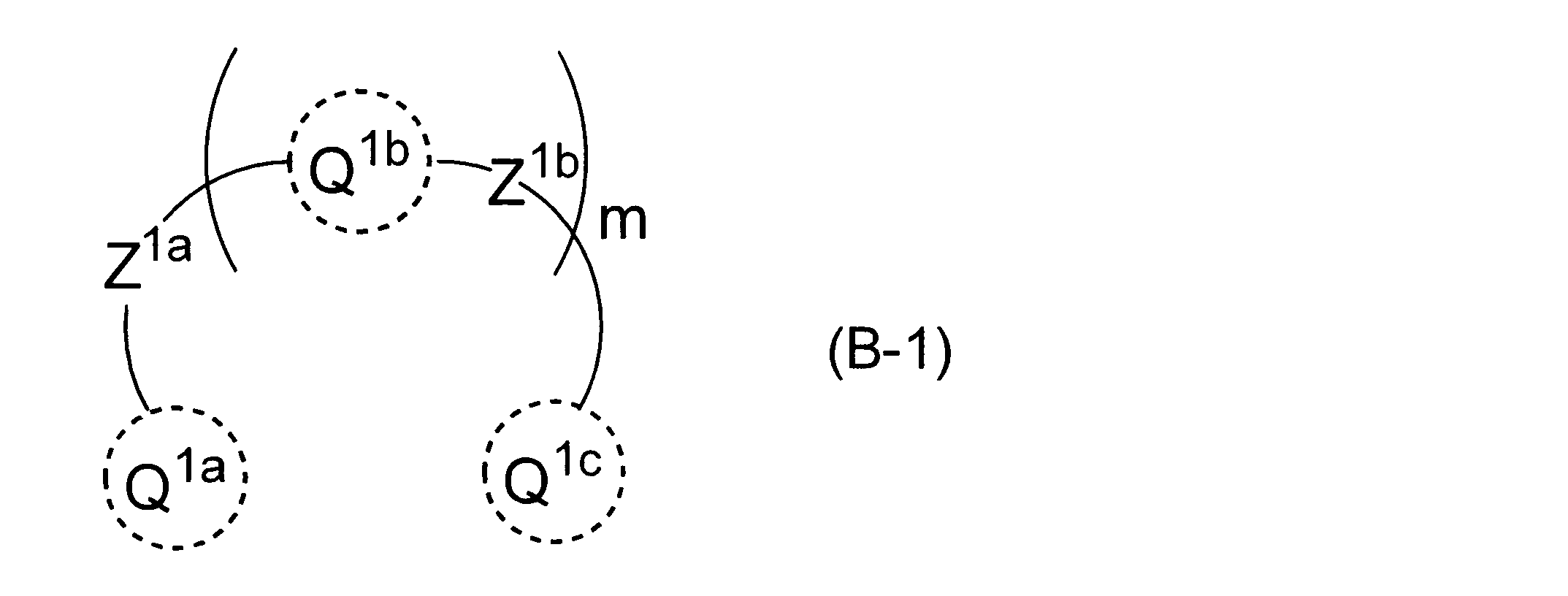
mは1以上の整数である。
Q1a、Q1b及びQ1cは、それぞれ独立に、置換基を有していてもよい含窒素芳香族複素環であり、前記配位可能な4つ以上の窒素原子をそれぞれ含む。Q1bが2以上の場合は、それらは同一でも異なっていてもよい。ただし、Q1a、Q1b及びQ1cのうち少なくとも1つは、含窒素芳香族複素六員環である。
Z1a及びZ1bは、それぞれ独立に、直接結合又は連結基であり、Z1bが2以上の場合は、それらは同一でも異なっていてもよい。
Q1a及びQ1b、並びに、Q1b及びQ1cは、各々、一体となって多環式芳香族複素環を形成していてもよい。
mが2以上の整数であり、かつ、Z1bが直接結合である場合、隣り合う2つのQ1bは、一体となって多環式芳香族複素環を形成していてもよい。
Q1a及びQ1cは直接結合して、又は、連結基を介して互いに結合していてもよく、一体となって多環式芳香族複素環を形成していてもよい。)
一般式(B-1)中のmの値は、より好ましくは1~5の整数であり、更に好ましくは2~4の整数であり、特に好ましくは2又は4である。
一般式(B-1)におけるQ1a、Q1b及びQ1cは、それぞれ独立に、置換基を有していてもよい含窒素芳香族複素環であり、下記式(B-1-1)~(B-1-22)で表される、ピリジン環、ピラジン環、ピリミジン環、ピリダジン環、1,3,5-トリアジン環、1,2,4-トリアジン環、1,2,4,5-テトラジン環、1H-ピロール環、2H-ピロール環、3H-ピロール環、イミダゾール環、ピラゾール環、1,2,3-トリアゾール環、1,2,4-トリアゾール環、オキサゾール環、イソオキサゾール環、チアゾール環、イソチアゾール環、1,3,4-オキサジアゾール環、1,2,5-オキサジアゾール環、1,3,4-チアジアゾール環、1,2,5-チアジアゾール環、及びこれらの環を有する多環式芳香族複素環からなる群から選ばれることが好ましく、より好ましくはピリジン環、ピラジン環、ピリミジン環、ピリダジン環、1,3,5-トリアジン環、1,2,4-トリアジン環、1,2,4,5-テトラジン環、1H-ピロール環、2H-ピロール環、3H-ピロール環、イミダゾール環、ピラゾール環、1,2,3-トリアゾール環、1,2,4-トリアゾール環、並びにこれらの環を有する多環式芳香族複素環であり、特に好ましくは、ピリジン環、ピラジン環、ピリミジン環、1H-ピロール環、2H-ピロール環、並びにこれらの環構造を有する多環式芳香複素環である。
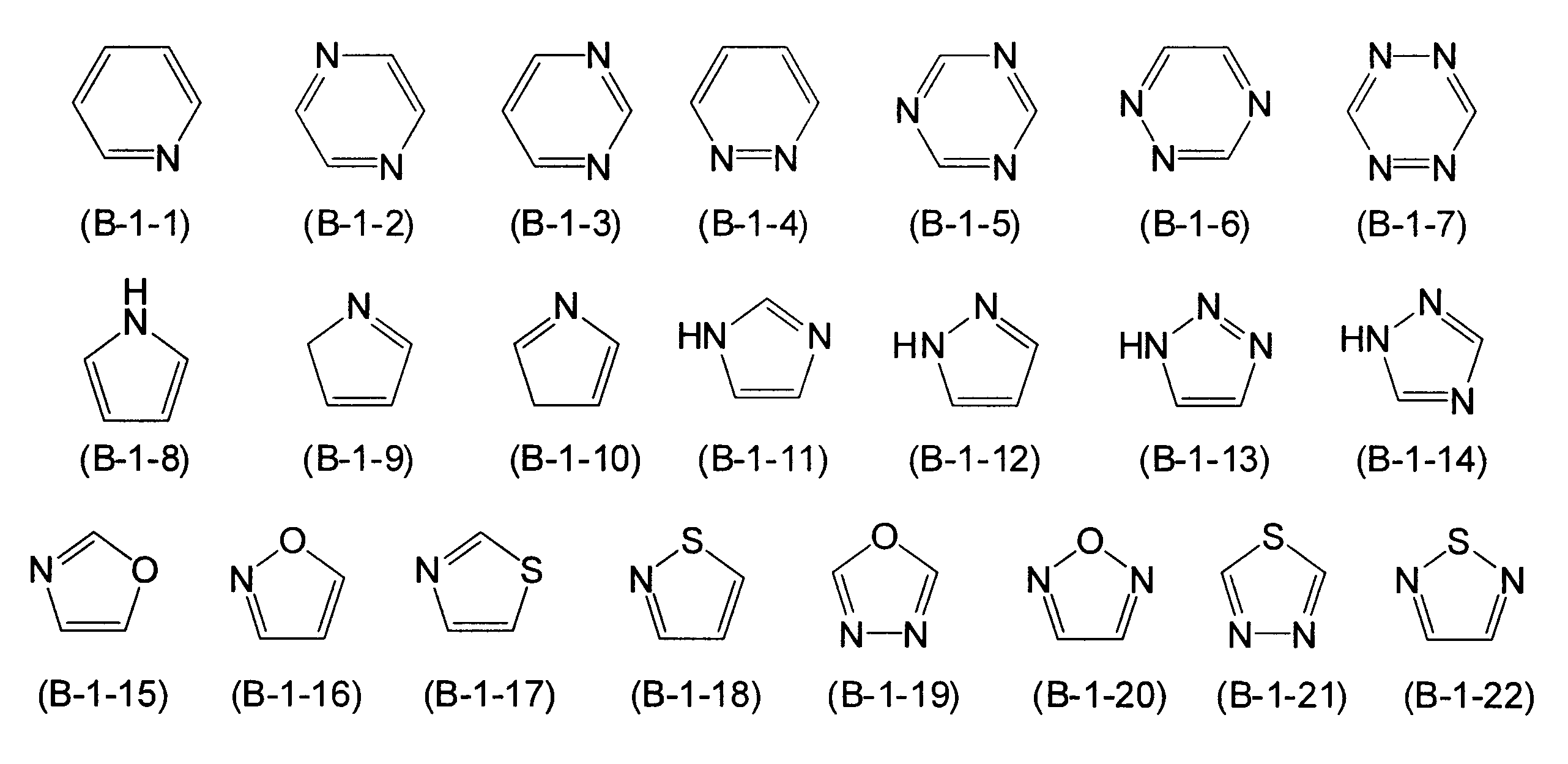
Z1a及びZ1bは、それぞれ独立に、直接結合又は連結基である。直接結合としては、単結合及び二重結合が挙げられる。連結基としては、2価又は3価の連結基が挙げられる。Z1a及びZ1bは、単結合、二重結合、及び-C(Rγ)2-、=C(Rδ)-、=N(Rε)-又は=N-で表される連結基(下記式(B-1-a)~(B-1-d)で表される連結基)であると好ましく、単結合、二重結合、-C(Rγ)2-又は=C(Rδ)-で表される連結基であると特に好ましい。

上記置換基としては、ハロゲノ基、ヒドロキシ基、カルボキシル基、メルカプト基、スルホン酸基、ニトロ基、アミノ基、シアノ基、ホスホン酸基、炭素数1~4のアルキル基で置換されたシリル基、炭素数1~50の直鎖状又は分岐鎖状のアルキル基、炭素数3~50の環状のアルキル基、アルケニル基、アルキニル基、アルコキシ基、炭素数6~60のアリール基、炭素数7~50のアラルキル基、1価の複素環基等が挙げられ、好ましくは、ハロゲノ基、メルカプト基、ヒドロキシ基、カルボキシル基、炭素数1~20の直鎖状又は分岐鎖状のアルキル基、炭素数3~20の環状のアルキル基、アルコキシ基、炭素数6~30のアリール基、1価の複素環基である。本明細書における置換基は、特記しない限り、上記と同様の基を示す。
上記ハロゲノ基としては、フルオロ基、クロロ基、ブロモ基、ヨード基が挙げられる。
上記炭素数1~4のアルキル基で置換されたシリル基としては、トリメチルシリル基、トリエチルシリル基、tert-ブチルジメチルシリル基、トリイソプロピルシリル基等が挙げられる。
上記直鎖状又は分岐鎖状のアルキル基としては、メチル基、エチル基、プロピル基、イソプロピル基、ブチル基、イソブチル基、tert-ブチル基、sec-ブチル基、ペンチル基、へキシル基、ヘプチル基、オクチル基、ノニル基、デシル基、ドデシル基、ペンタデシル基、オクタデシル基、ドコシル基等が挙げられる。
上記環状のアルキル基としては、シクロプロピル基、シクロブチル基、シクロペンチル基、シクロヘキシル基、シクロノニル基、シクロドデシル基、ノルボルニル基、アダマンチル基等が挙げられる。
上記アルケニル基としては、前記直鎖状又は分岐鎖状のアルキル基において、いずれか1つの炭素原子間の単結合(C-C)が、二重結合に置換されたものが例示でき、二重結合の位置は限定されない。上記アルケニル基の好ましいものとしては、エテニル基、プロペニル基、3-ブテニル基、2-ブテニル基、2-ペンテニル基、2-ヘキセニル基、2-ノネニル基、2-ドデセニル基等が挙げられる。
上記アルキニル基としては、前記直鎖状又は分岐鎖状のアルキル基において、いずれか1つの炭素原子間の単結合(C-C)が、三重結合に置換されたものが例示でき、三重結合の位置は限定されない。前記アルキニル基としては、エチニル基、1-プロピニル基、2-プロピニル基、1-ブチニル基、2-ブチニル基、1-ペンチニル基、2-ペンチニル基、1-ヘキシニル基、2-ヘキシニル基、1-オクチニル基が好ましく、エチニル基がより好ましい。
上記アルコキシ基としては、前記直鎖状又は分岐鎖状のアルキル基又は前記環状のアルキル基が酸素原子に結合した一価の基が例示できる。上記アルコキシ基の好ましいものとしては、メチル基、エチル基、プロピル基、イソプロピル基、ブチル基、イソブチル基、tert-ブチル基、sec-ブチル基、ペンチル基、へキシル基、ヘプチル基、オクチル基、ノニル基、デシル基、ドデシル基、ペンタデシル基、オクタデシル基、シクロプロピル基、シクロブチル基、シクロペンチル基、シクロヘキシル基が酸素原子に結合した一価の基が挙げられる。
上記アリール基としては、フェニル基、1-ナフチル基、2-ナフチル基、1-アントラセニル基、2-アントラセニル基、9-アントラセニル基、1-テトラセニル基、2-テトラセニル基、5-テトラセニル基、1-ピレニル基、2-ピレニル基、4-ピレニル基、2-ペリレニル基、3-ペリレニル基、2-フルオレニル基、3-フルオレニル基、4-フルオレニル基、1-ビフェニレニル基、2-ビフェニレニル基、2-フェナンスレニル基、9-フェナンスレニル基、6-クリセニル基、1-コロネニル基等が挙げられる。前記アリール基における水素原子は、ハロゲノ基、ヒドロキシ基、カルボキシル基、メルカプト基、スルホン酸基、ニトロ基、アミノ基、シアノ基、ホスホン酸基、上記アルキル基、上記アルケニル基、上記アルキニル基、上記アルコキシ基、上記アリール基、上記アラルキル基等で置換されていてもよい。
上記1価の複素環基としては、ピリジル基、ピラジル基、ピリミジル基、ピリダジル基、ピロリル基、フリル基、チエニル基、イミダゾリル基、ピラゾリル基、チアゾリル基、オキサゾリル基等が挙げられる。1価の複素環基とは、複素環式化合物から1個の水素原子を取り除いた残りの原子団を意味する。1価の複素環基としては、1価の芳香族複素環基が好ましい。
上記アラルキル基としては、ベンジル基、1-フェニルエチル基、2-フェニルエチル基、1-フェニル-1-プロピル基、1-フェニル-2-プロピル基、2-フェニルプロピル基、3-フェニル-1-プロピル基等が挙げられる。
上記Rγ、Rδ及びRεで表される置換基は互いに結合して、又は前記置換基の結合する炭素原子若しくは窒素原子における他の結合と一緒になって環を形成してもよい。ここで、環としては、シクロヘキセン環、ベンゼン環、ピリジン環、ピラジン環、ピリミジン環、ピリダジン環、1H-ピロール環、2H-ピロール環、3H-ピロール環、イミダゾール環、ピラゾール環、1,2,3-トリアゾール環、1,2,4-トリアゾール環、オキサゾール環、イソオキサゾール環、チアゾール環、イソチアゾール環、1,3,4-オキサジアゾール環、1,2,5-オキサジアゾール環、1,3,4-チアジアゾール環、1,2,5-チアジアゾール環、フラン環、チオフェン環等が挙げられる。これらの環を構成する水素原子の一部又は全部は、置換基を有していてもよく、また、それら置換基同士が結合して、それぞれが結合する炭素原子とともに更に環を形成してもよい。
本実施形態の中心金属に配位可能な4つ以上の窒素原子で囲まれた空間を有し、前記空間に前記中心金属を収容可能とする構造が、上述したように、上記一般式(B-1)においてmが2又は4である芳香族化合物、すなわち、下記一般式(B-2)(一般式(B-1)においてm=2)、又は一般式(B-3)(一般式(B-1)においてm=4)で表される芳香族化合物であると、好ましい。

Q2a、Q2b、Q2c及びQ2dは、それぞれ独立に、置換基を有していてもよい含窒素芳香族複素環であり、前記配位可能な4つ以上の窒素原子をそれぞれ含む。ただし、Q2a、Q2b、Q2c及びQ2dのうち少なくとも1つは、含窒素芳香族複素六員環である。
Z2a、Z2b及びZ2cは、それぞれ独立に、直接結合又は連結基である。
Q2a及びQ2b、Q2b及びQ2c、並びに、Q2c及びQ2dは、各々、一体となって多環式芳香族複素環を形成していてもよい。Q2a及びQ2dは直接結合又は連結基を介して互いに結合していてもよく、一体となって多環式芳香族複素環を形成していてもよい。)
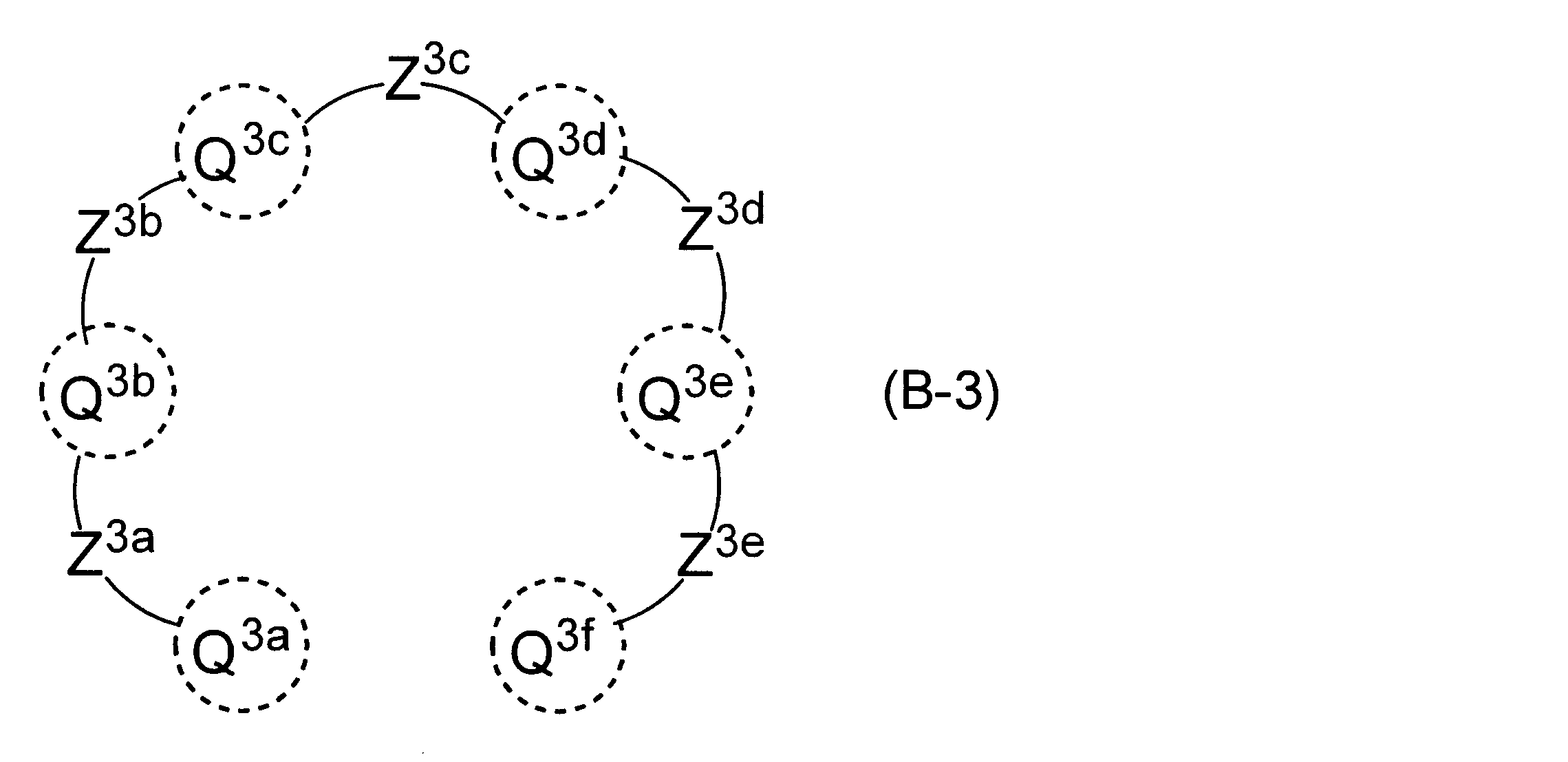
Q3a、Q3b、Q3c、Q3d、Q3e及びQ3fは、それぞれ独立に、置換基を有していてもよい含窒素芳香族複素環であり、前記配位可能な4つ以上の窒素原子をそれぞれ含む。ただし、Q3a、Q3b、Q3c、Q3d、Q3e及びQ3fのうち少なくとも1つは、含窒素芳香族複素六員環である。
Z3a、Z3b、Z3c、Z3d及びZ3eは、それぞれ独立に、直接結合又は連結基である。
Q3a及びQ3b、Q3b及びQ3c、Q3c及びQ3d、Q3d及びQ3e、並びに、Q3e及びQ3fは、各々、一体となって多環式芳香族複素環を形成していてもよい。Q3a及びQ3fは直接結合又は連結基を介して互いに結合していてもよく、一体となって多環式芳香族複素環を形成していてもよい。)
一般式(B-2)のQ2aは、一般式(B-1)のQ1aに対応し、一般式(B-2)のQ2b及びQ2cは、一般式(B-1)のQ1bに対応し、一般式(B-2)のQ2dは、一般式(B-1)のQ1cに対応する。また、一般式(B-2)のZ2aは、一般式(B-1)のZ1aに対応し、一般式(B-2)のZ2b及びZ2cは、一般式(B-1)のZ1bに対応する。
同様に、一般式(B-3)のQ3aは、一般式(B-1)のQ1aに対応し、一般式(B-3)のQ3b~Q3eは、一般式(B-1)のQ1bに対応し、一般式(B-3)のQ3fは、一般式(B-1)のQ1cに対応する。また、一般式(B-3)のZ3aは、一般式(B-1)のZ1aに対応し、一般式(B-3)のZ3b~Z3eは、一般式(B-1)のZ1bに対応する。
一般式(B-2)のQ2a、Q2b、Q2c及びQ2d、並びに一般式(B-3)のQ3a、Q3b、Q3c、Q3d、Q3e及びQ3fは、それぞれ独立に、置換基を有していてもよい含窒素芳香族環であり、好ましい例示は、上述の一般式(B-1)のQ1a、Q1b及びQ1cと同じである。
2つの含窒素芳香族複素環であるQ1aとQ1b、2つの含窒素芳香族複素環であるQ1bとQ1c、2つの含窒素芳香族複素環であるQ2aとQ2b、2つの含窒素芳香族複素環であるQ2bとQ2c、2つの含窒素芳香族複素環であるQ2cとQ2d、2つの含窒素芳香族複素環であるQ3aとQ3b、2つの含窒素芳香族複素環であるQ3bとQ3c、2つの含窒素芳香族複素環であるQ3cとQ3d、2つの含窒素芳香族複素環であるQ3dとQ3e又は2つの含窒素芳香族複素環であるQ3eとQ3fと、前記2つの含窒素芳香族複素環を互いに結合する直接結合又は連結基と、からなる有機基は、下記式(B-4-a)~(B-4-c)、(B-5-a)~(B-5-d)又は(B-6-a)~(B-6-d)のいずれかで表される2価の有機基であると好ましい。
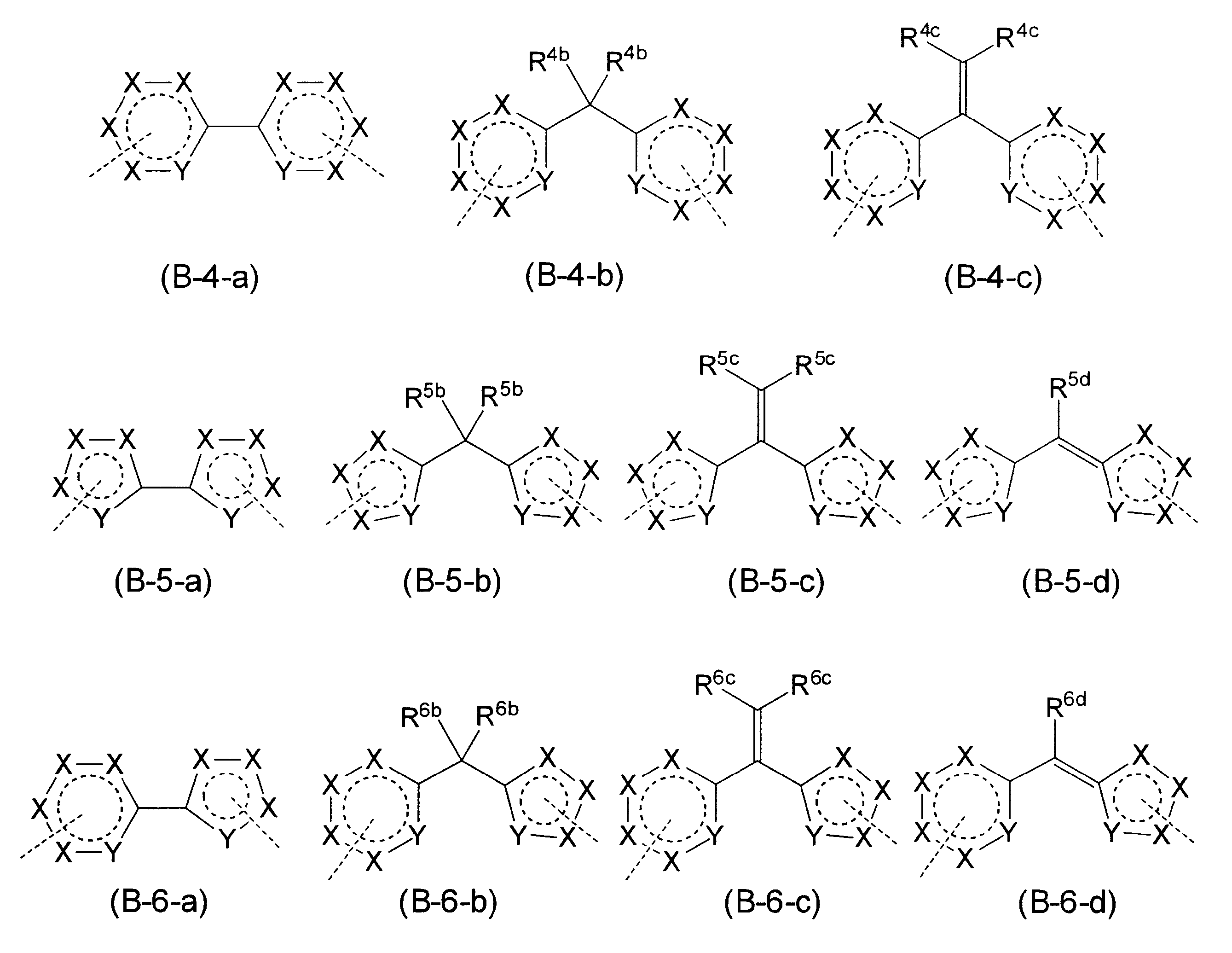
Xは、=C(Rα)-、-N(Rβ)-、=N-、-O-、-S-又は-Se-であり、好ましくは、=C(Rα)-、-N(Rβ)-、=N-、-O-、-S-であり、より好ましくは、=C(Rα)-、-N(Rβ)-、=N-である。
2以上のX、R4b、R4c、R5b、R5c、R6b及びR6cは、各々、同一でも異なっていてもよい。
Yは、-N(H)-又は=N-である。2以上のYは、それぞれ同一でも異なっていてもよい。
式中の直線の点線は、前記点線部分で上述した一般式(B-1)、(B-2)、(B-3)におけるZ1a等と結合していることを示す。)
上記式中のR4b、R4c、R5b、R5c、R5d、R6b、R6c、R6d、Rα及びRβは、それぞれ独立に、水素原子又は置換基である。置換基は、上述の置換基と同義である。また、隣り合う置換基同士は互いに結合して、それぞれが結合する炭素原子とともに環を形成してもよい。
更に、2つの含窒素芳香族複素環であるQ1aとQ1b、2つの含窒素芳香族複素環であるQ1bとQ1c、2つの含窒素芳香族複素環であるQ2aとQ2b、2つの含窒素芳香族複素環であるQ2bとQ2c、2つの含窒素芳香族複素環であるQ2cとQ2d、2つの含窒素芳香族複素環であるQ3aとQ3b、2つの含窒素芳香族複素環であるQ3bとQ3c、2つの含窒素芳香族複素環であるQ3cとQ3d、2つの含窒素芳香族複素環であるQ3dとQ3e又は2つの含窒素芳香族複素環であるQ3eとQ3fと、前記2つの含窒素芳香族複素環を互いに結合する直接結合又は連結基と、からなる有機基は、下記一般式(B-7-a)~(B-7-e)、(B-8-a)~(B-8-e)、(B-9-a)~(B-9-e)又は(B-10-a)~(B-10-e)のいずれかで表される2価の有機基であるとより好ましい。
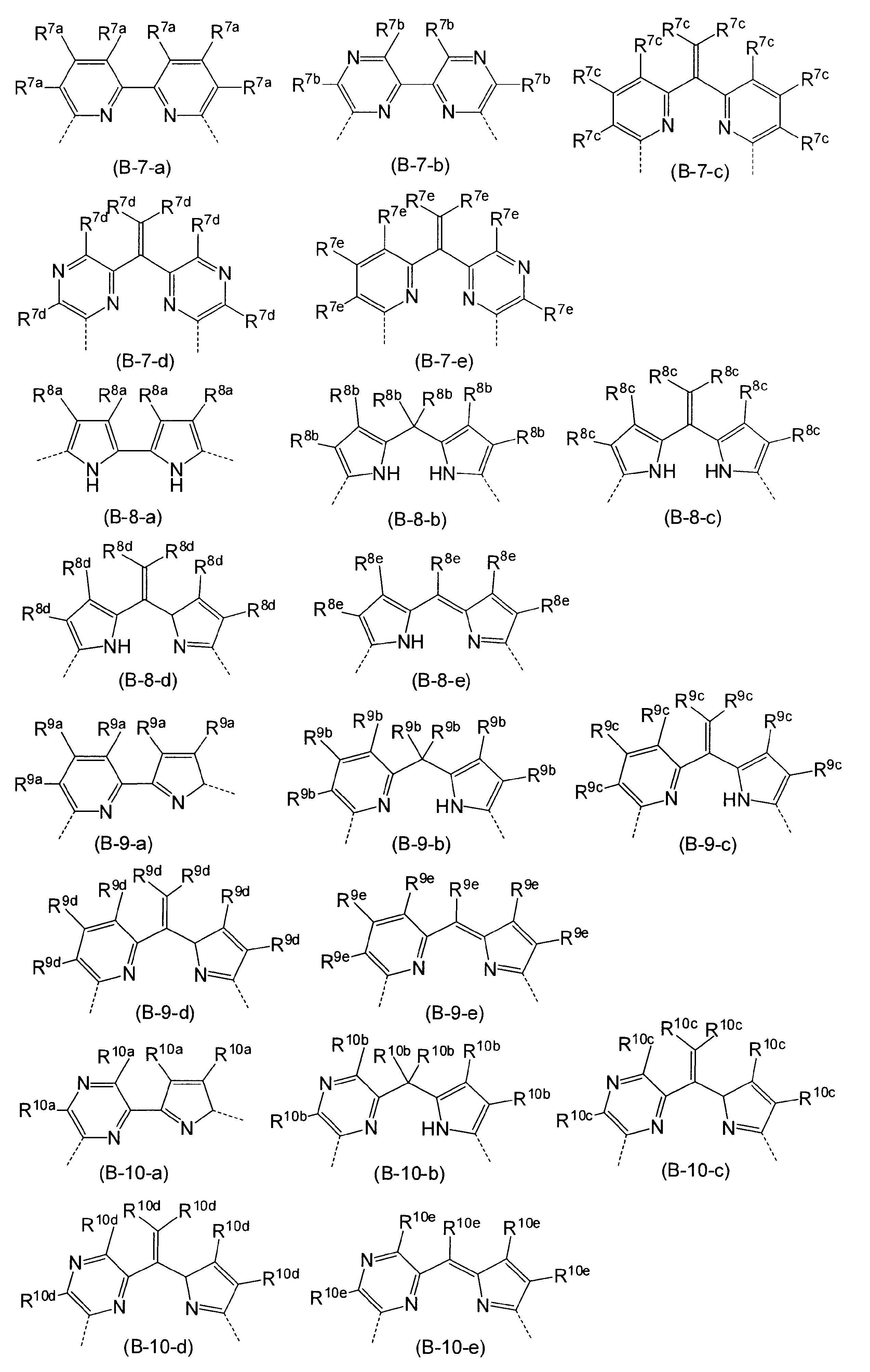
R7a~R10eは、それぞれ独立に、水素原子又は置換基であり、隣り合う置換基同士は互いに結合して、それぞれが結合する炭素原子とともに環を形成してもよい。2以上のR7a~R10eは、各々、同一でも異なっていてもよい。置換基は上述の置換基と同義である。
式中の直線の点線は、前記点線部分で上述した一般式(B-1)、(B-2)、(B-3)におけるZ1a等と結合していることを示す。)
本実施形態の多核金属錯体の配位子としては、以下の一般式(B-I-1)~(B-I-41)で表される構造式で表される化合物が例示される。式中の水素原子は、上述の置換基で置換されていてもよい。
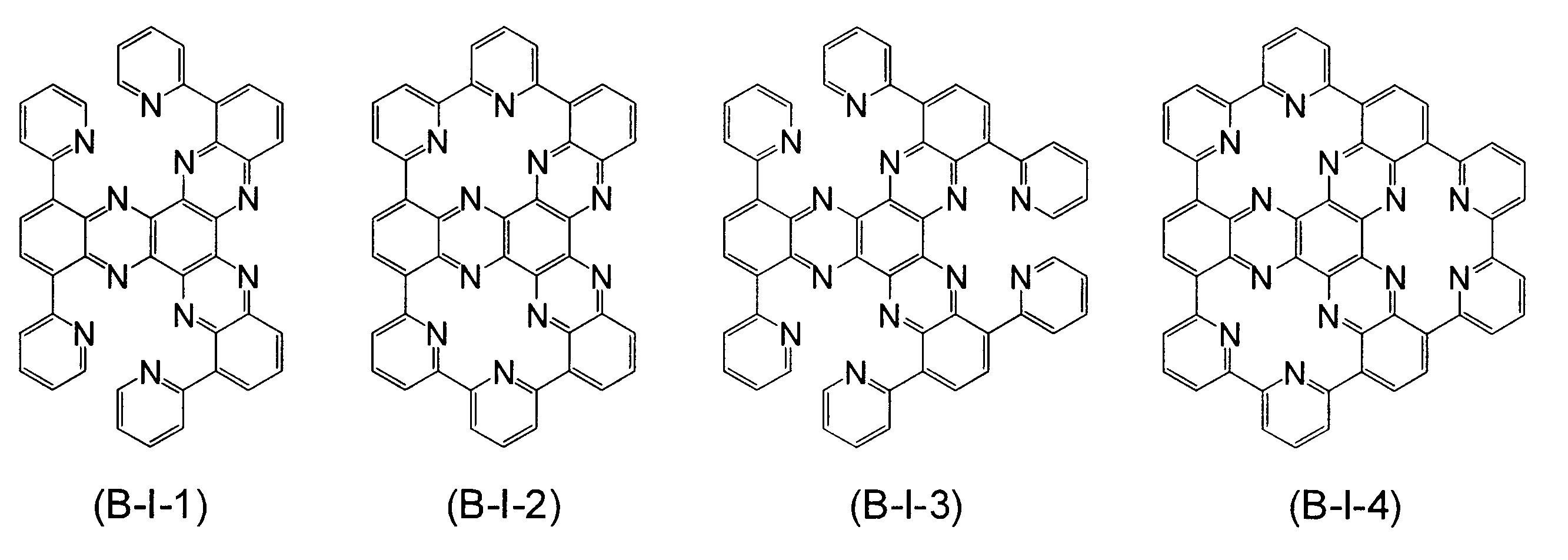
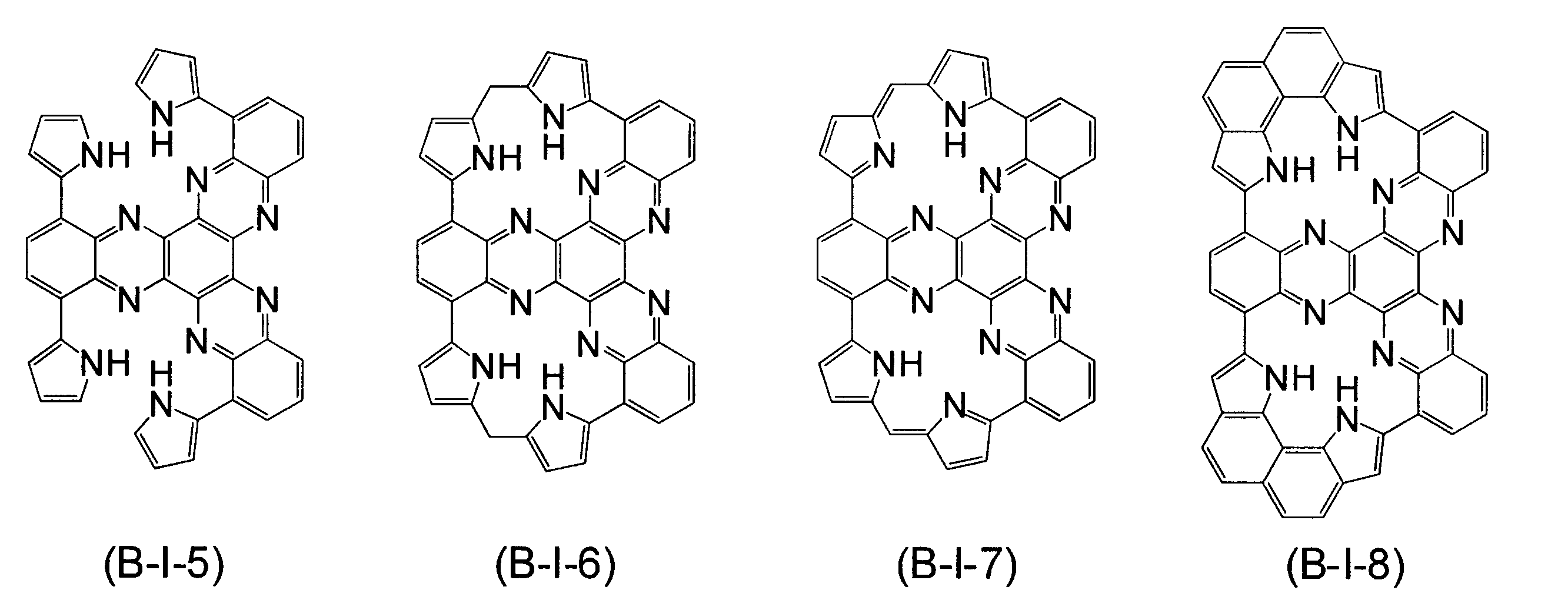

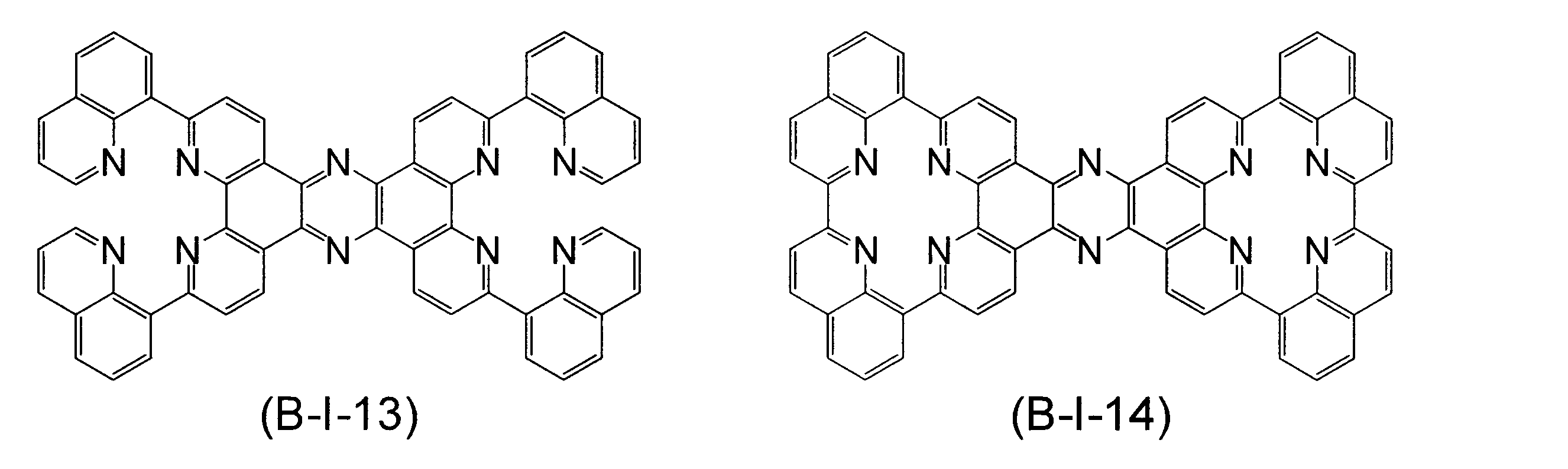
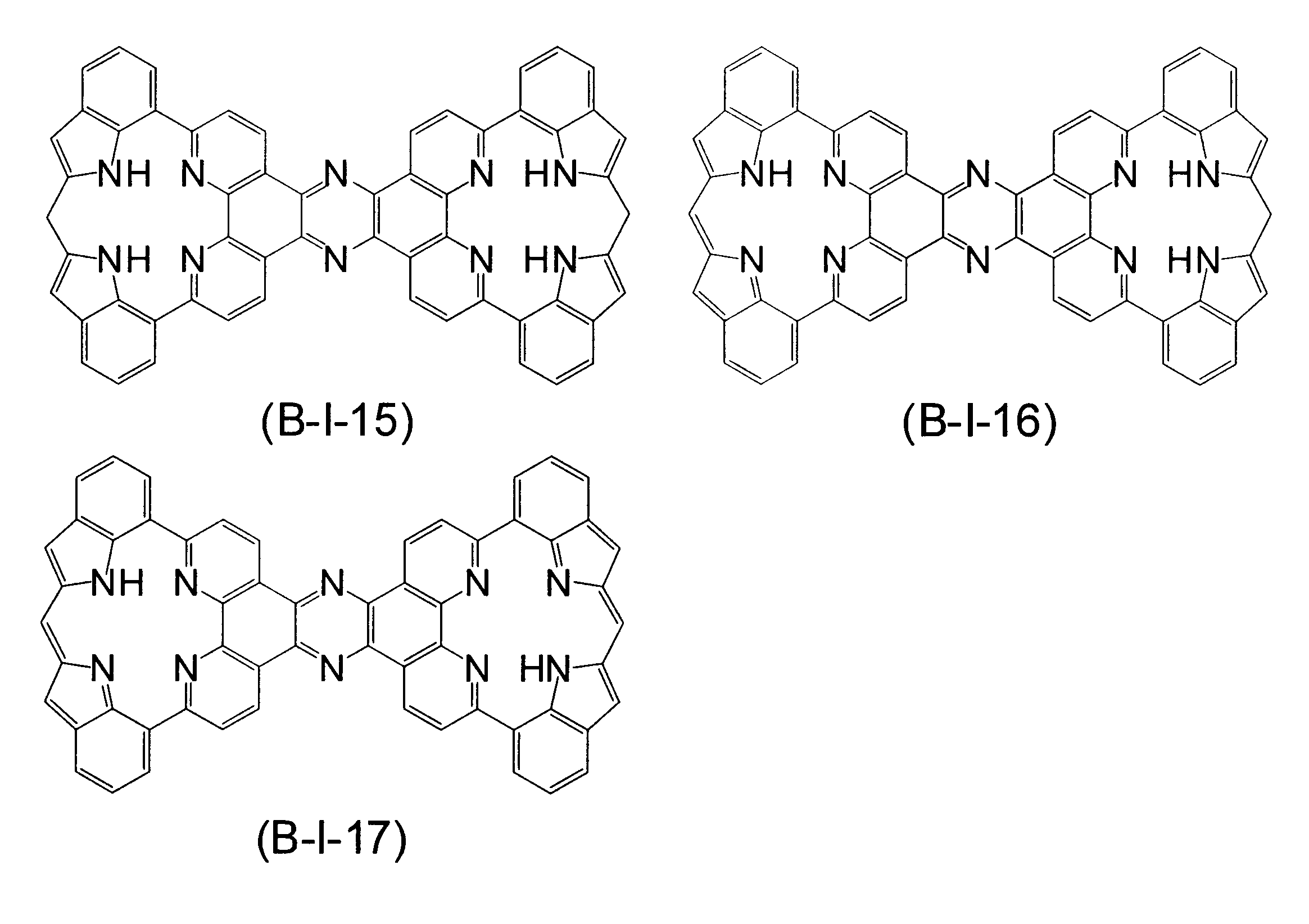
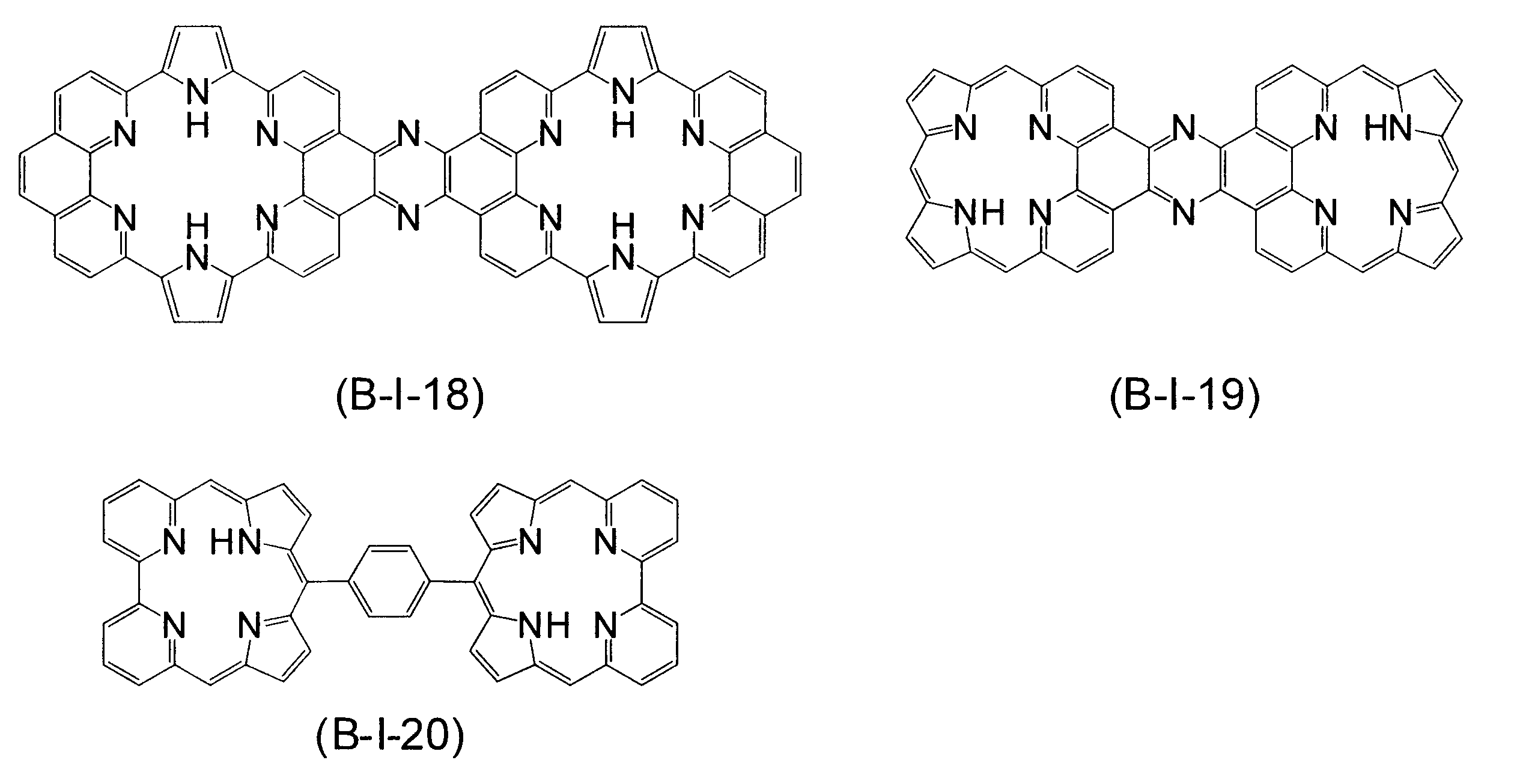

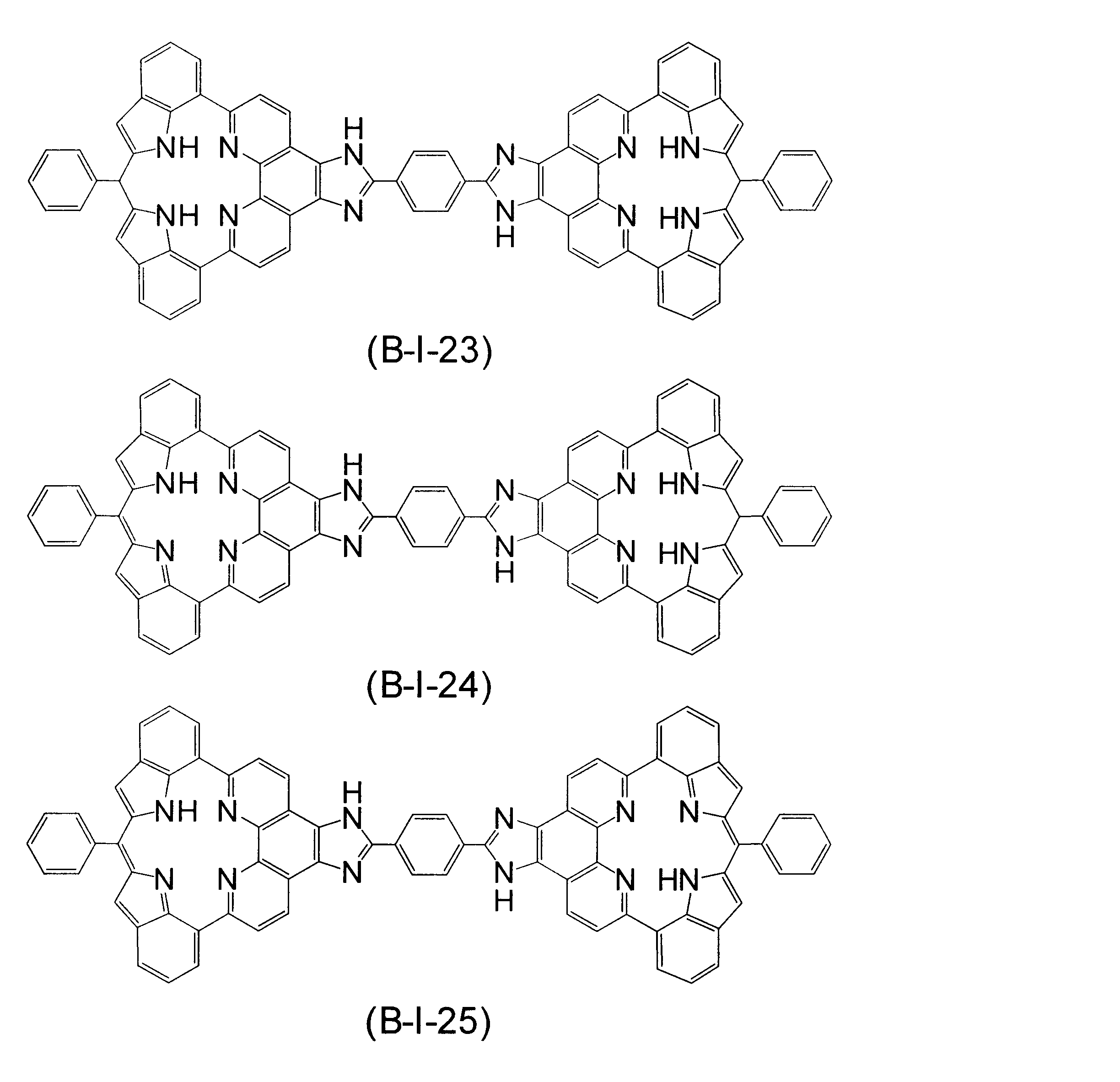

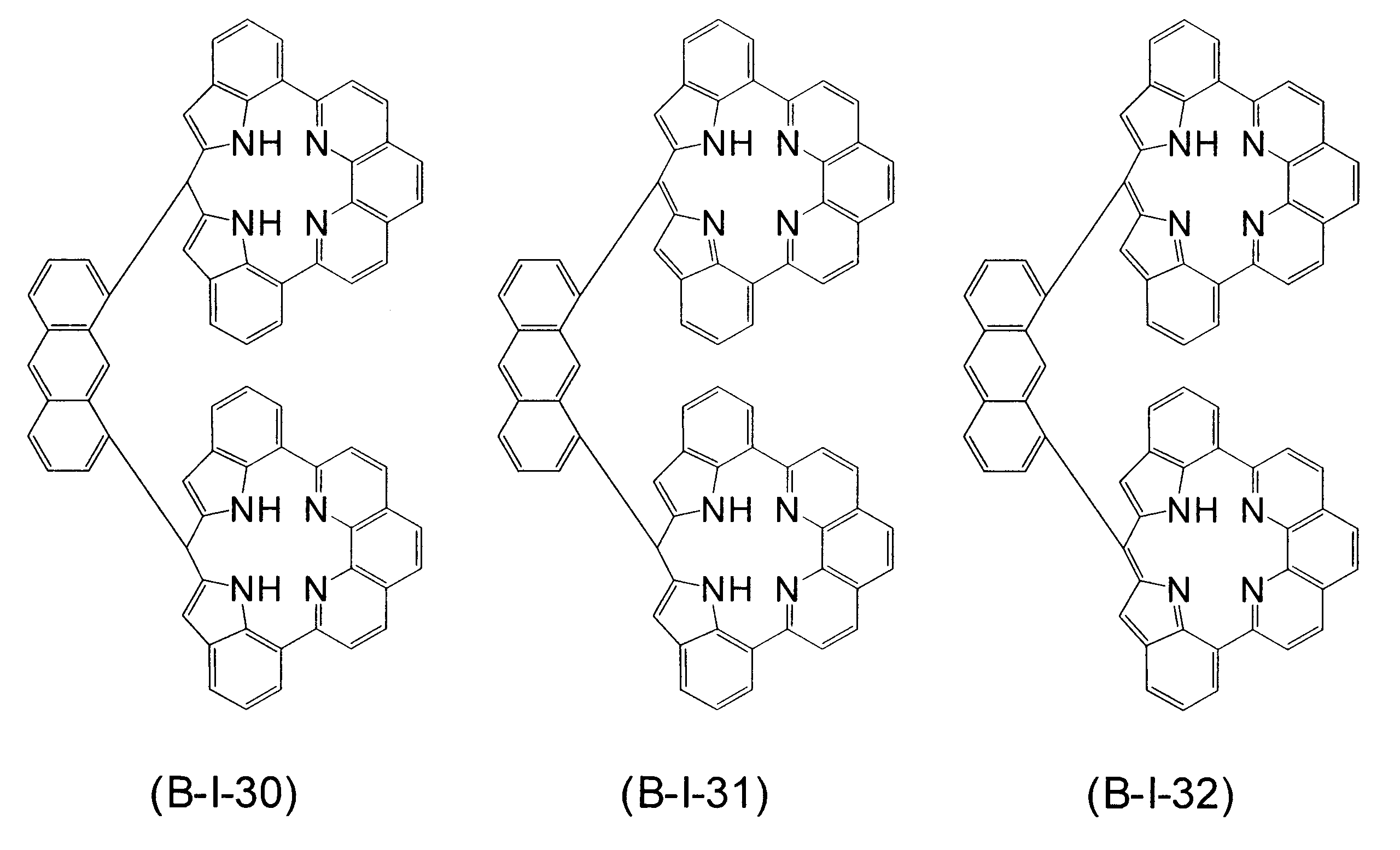
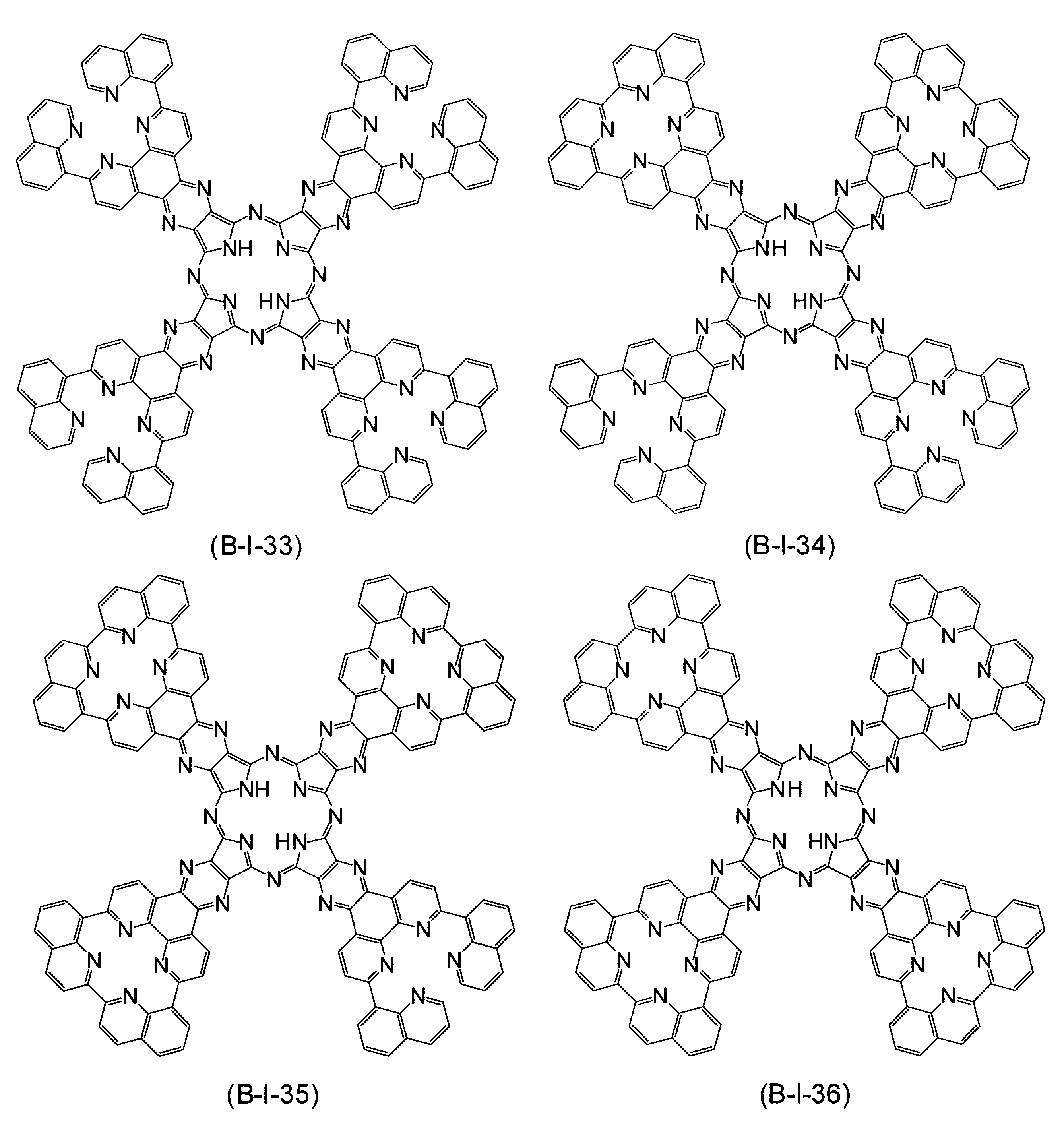

本実施形態の多核金属錯体の配位子としては、以下の一般式(B-I-42)~(B-I-62)で表される単位構造を有する芳香族化合物も例示される。配位子は、以下の単位構造を2つ以上有し、2つ以上の単位構造は同一でも異なっていてもよい。式中の水素原子は、上述の置換基で置換されていてもよい。
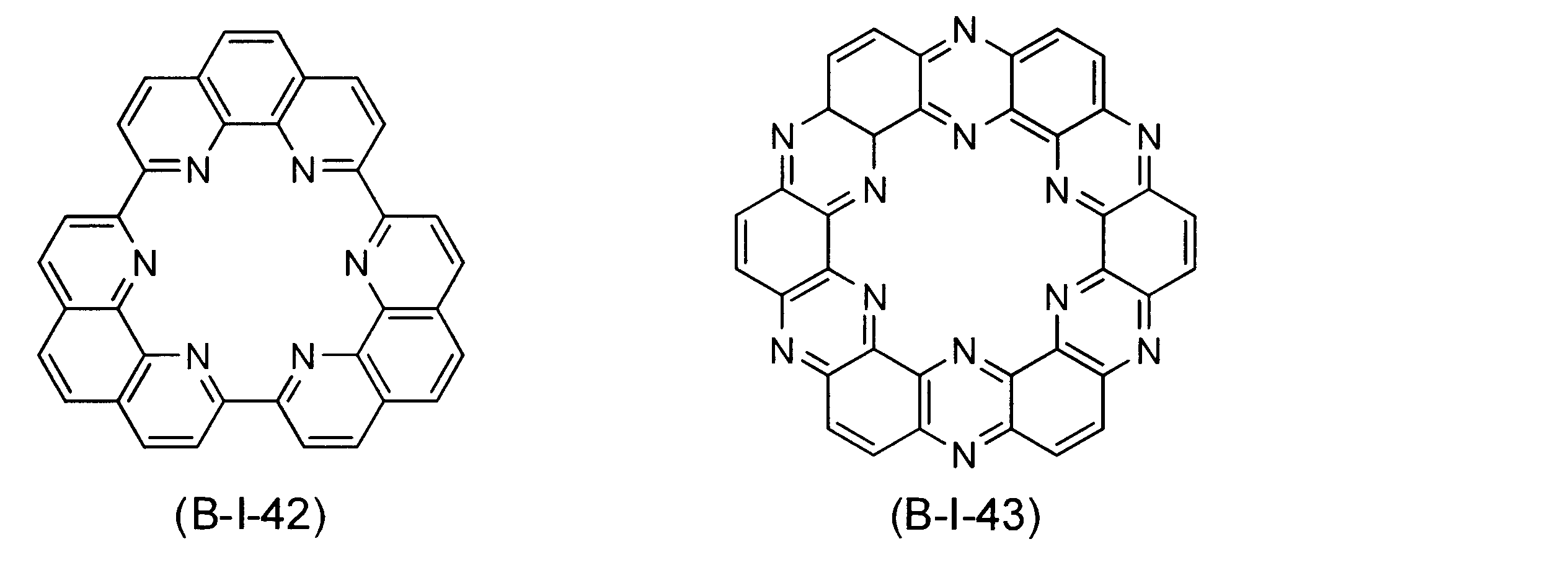


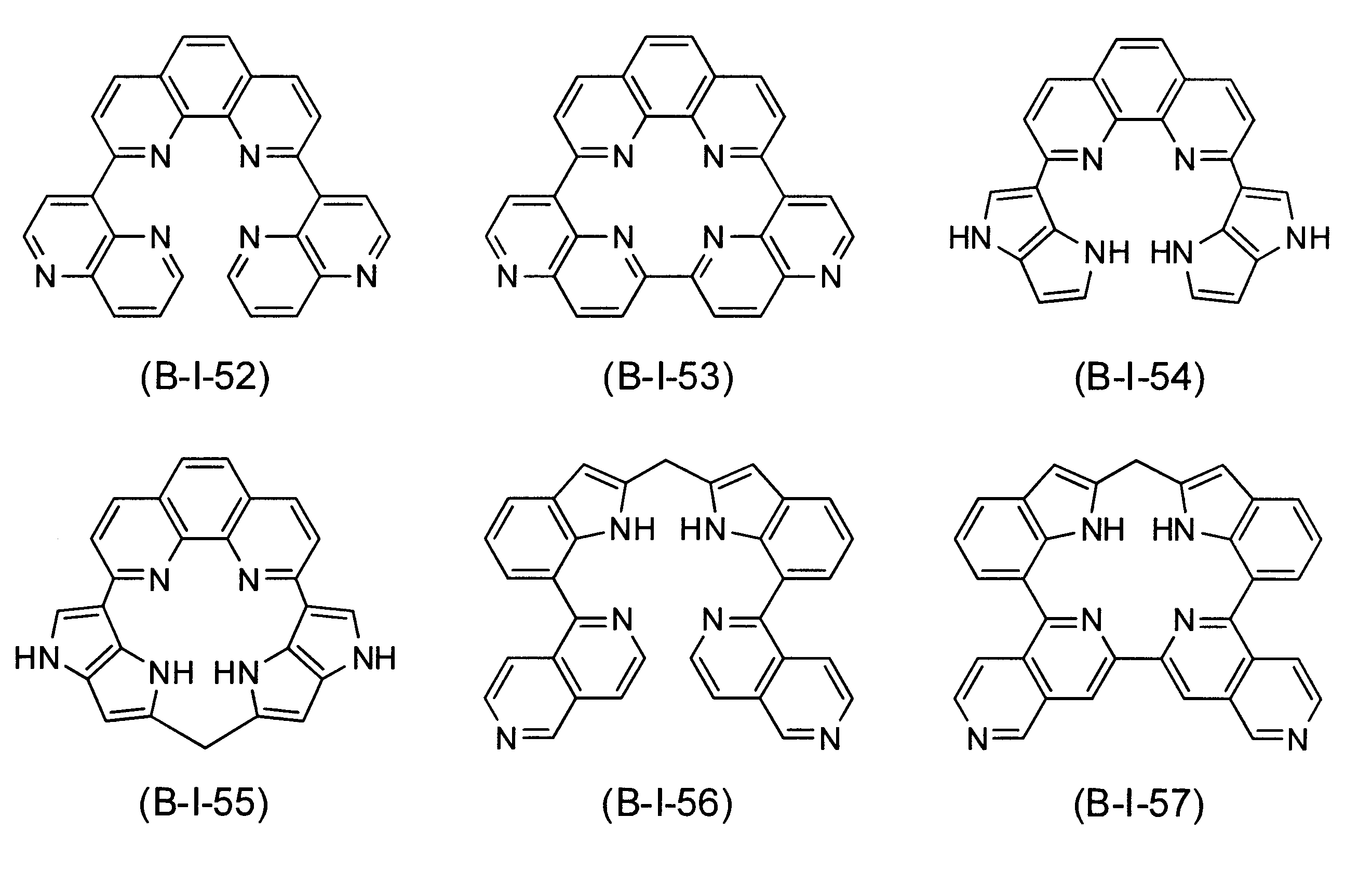
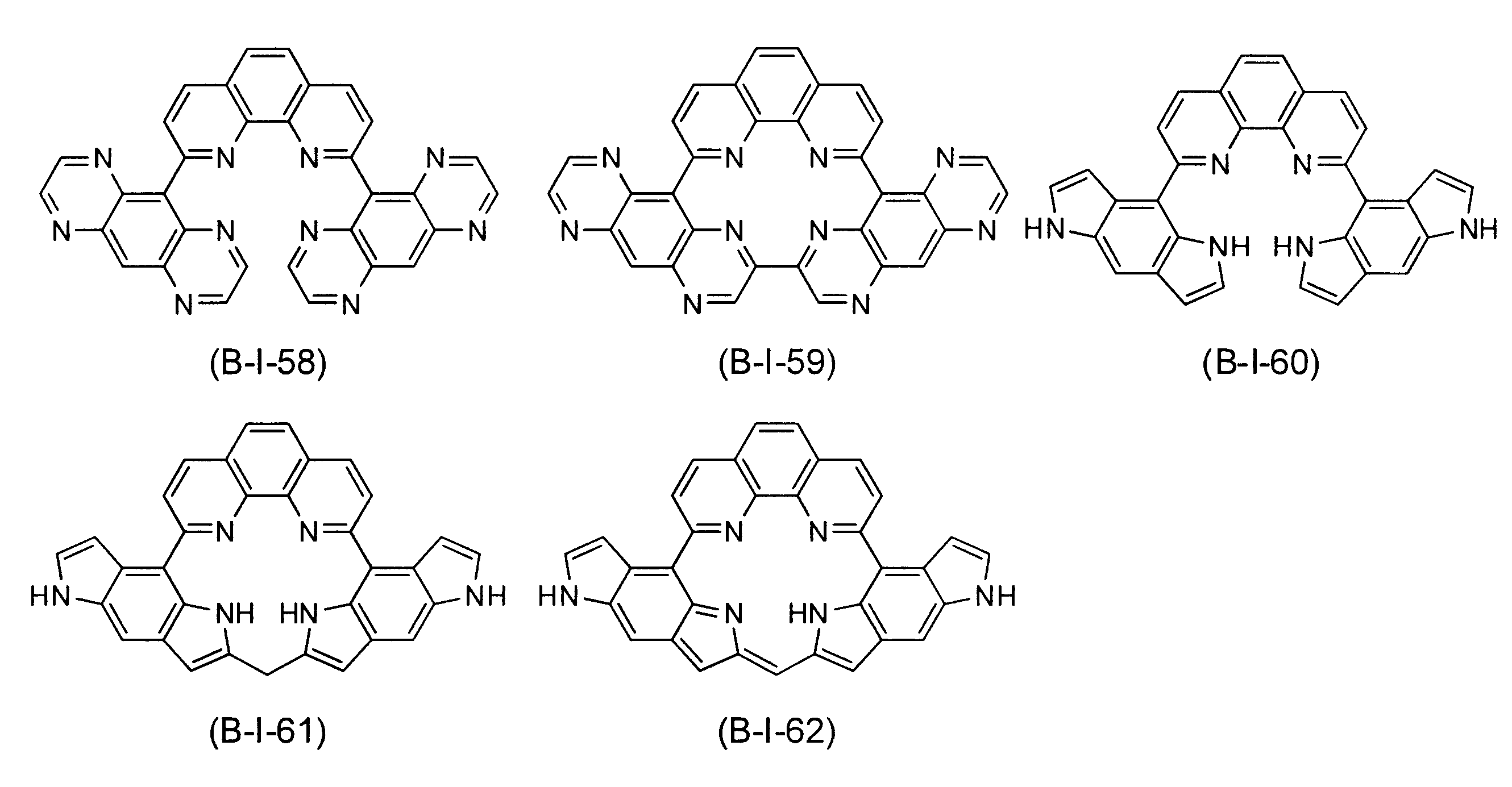
上記単位構造を有し、本実施形態の多核金属錯体の配位子として用いることができる芳香族化合物として、以下の一般式(B-I-63)~(B-I-97)で表される化合物が例示される。これらの化合物において、式中の水素原子は、上述の置換基で置換されていてもよく、近接する2つの水素結合を取り除いて直接結合又は連結基を形成してもよい。


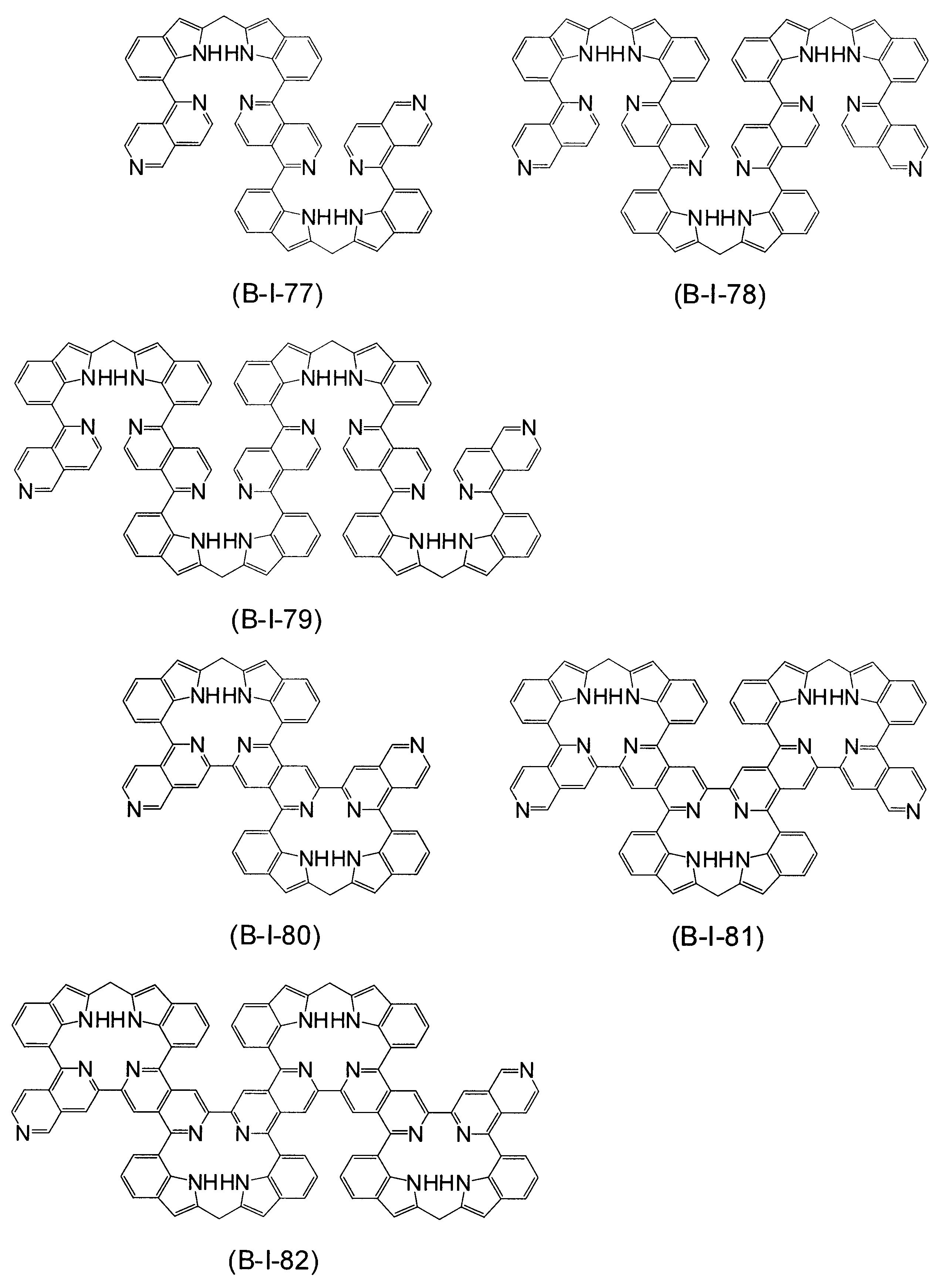
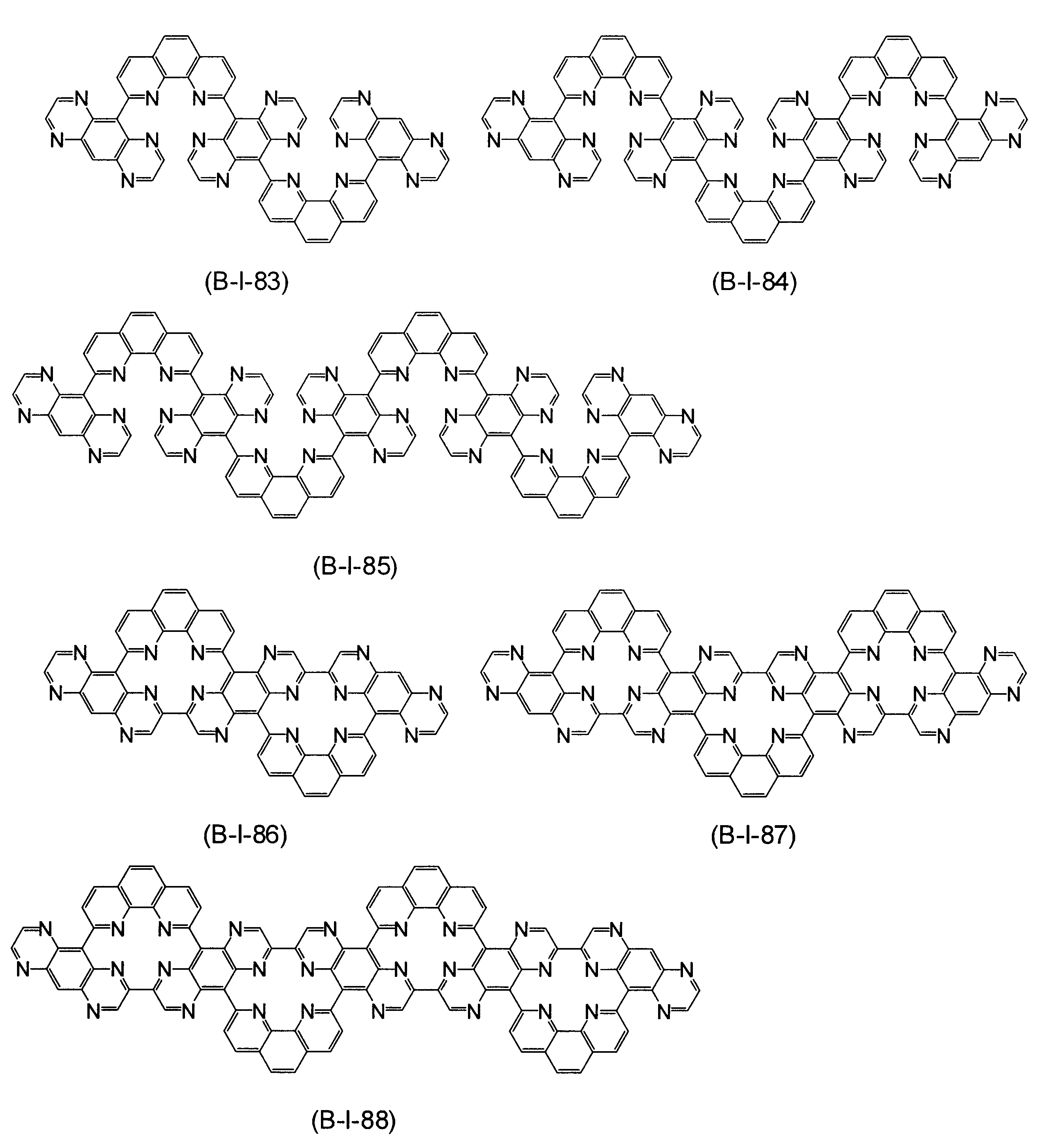
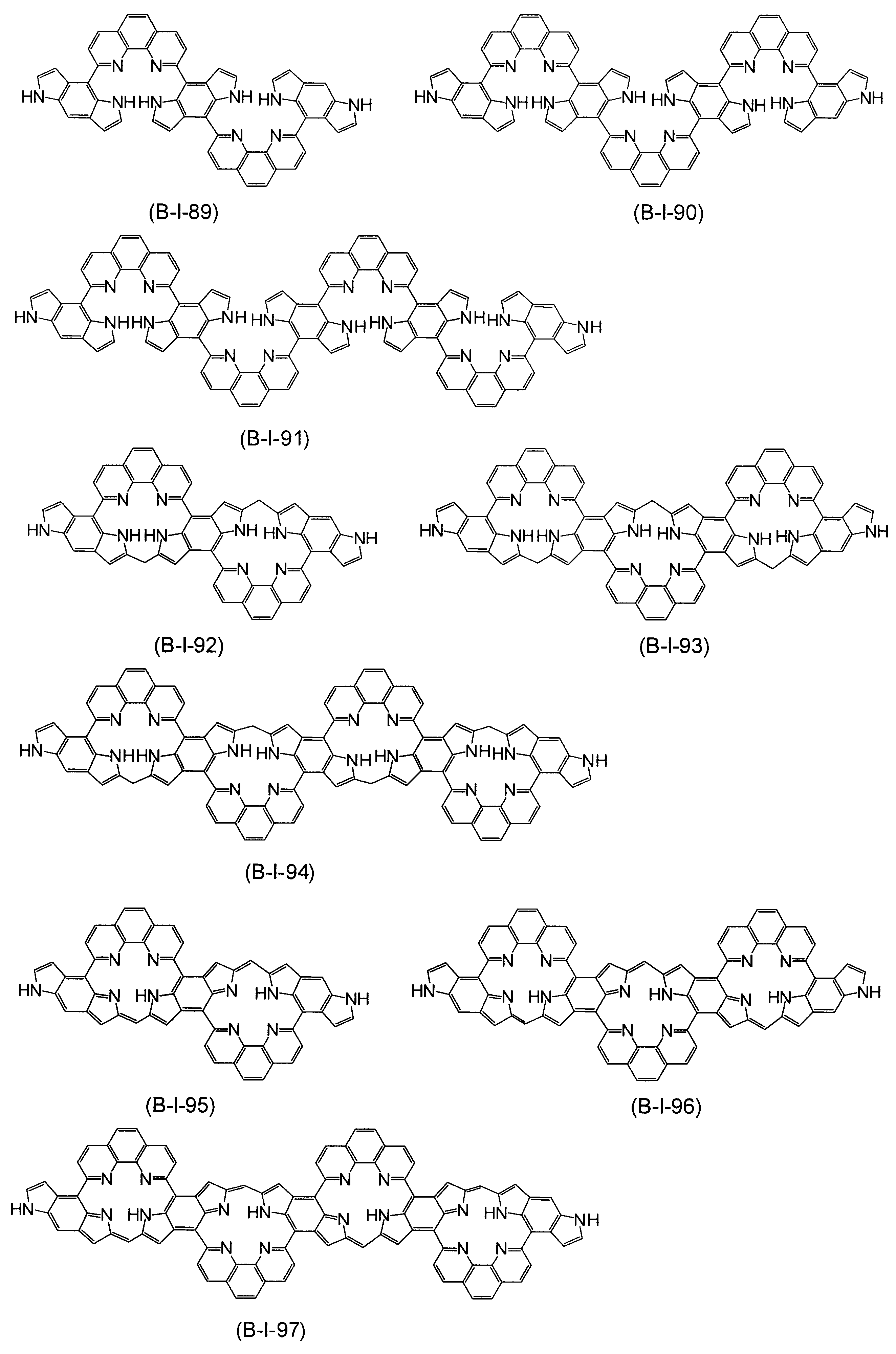
更に、本実施形態の多核金属錯体の配位子としては、以下の一般式(B-I-98)~(B-I-111)で表される繰り返し単位を有する高分子化合物も例示される。これらの高分子化合物において、式中の水素原子は、上述の置換基で置換されていてもよく、近接する2つの水素結合を取り除いて直接結合又は連結基を形成してもよい。
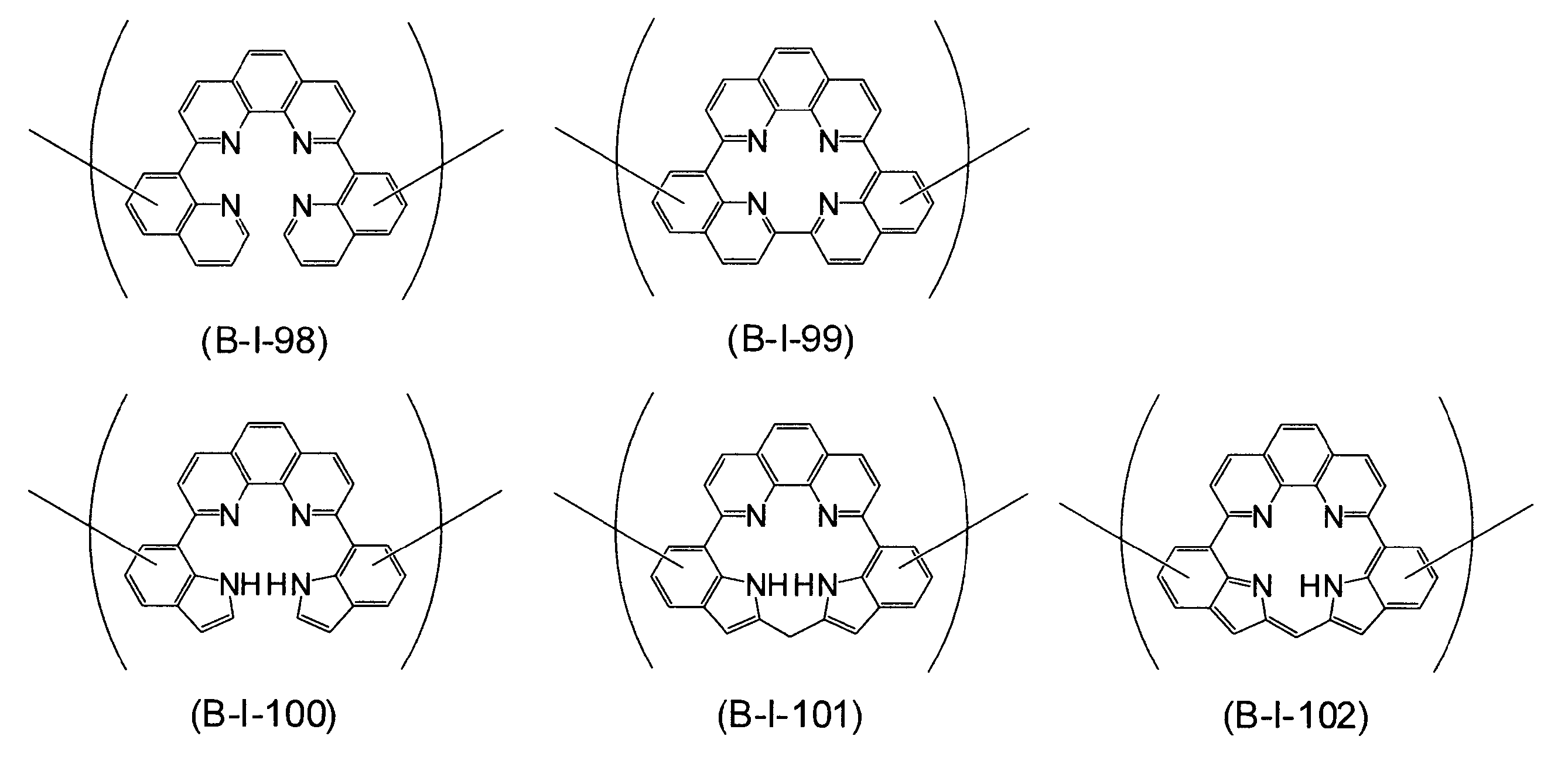


本実施形態の多核金属錯体の配位子が、上述のような繰り返し単位を有する高分子化合物である場合、前記高分子化合物のポリスチレン換算の数平均分子量は、好ましくは1×10³~1×10⁸であり、より好ましくは2×10³~1×10⁶である。また、前記高分子化合物のポリスチレン換算の重量平均分子量は、好ましくは2×10³~1×10⁸であり、より好ましくは3×10³~2×10⁶である。
更に、本実施形態の空気二次電池用正極触媒に用いる多核金属錯体は、下記式(XI)で表される芳香族化合物を配位子として有することが、特に好ましい。
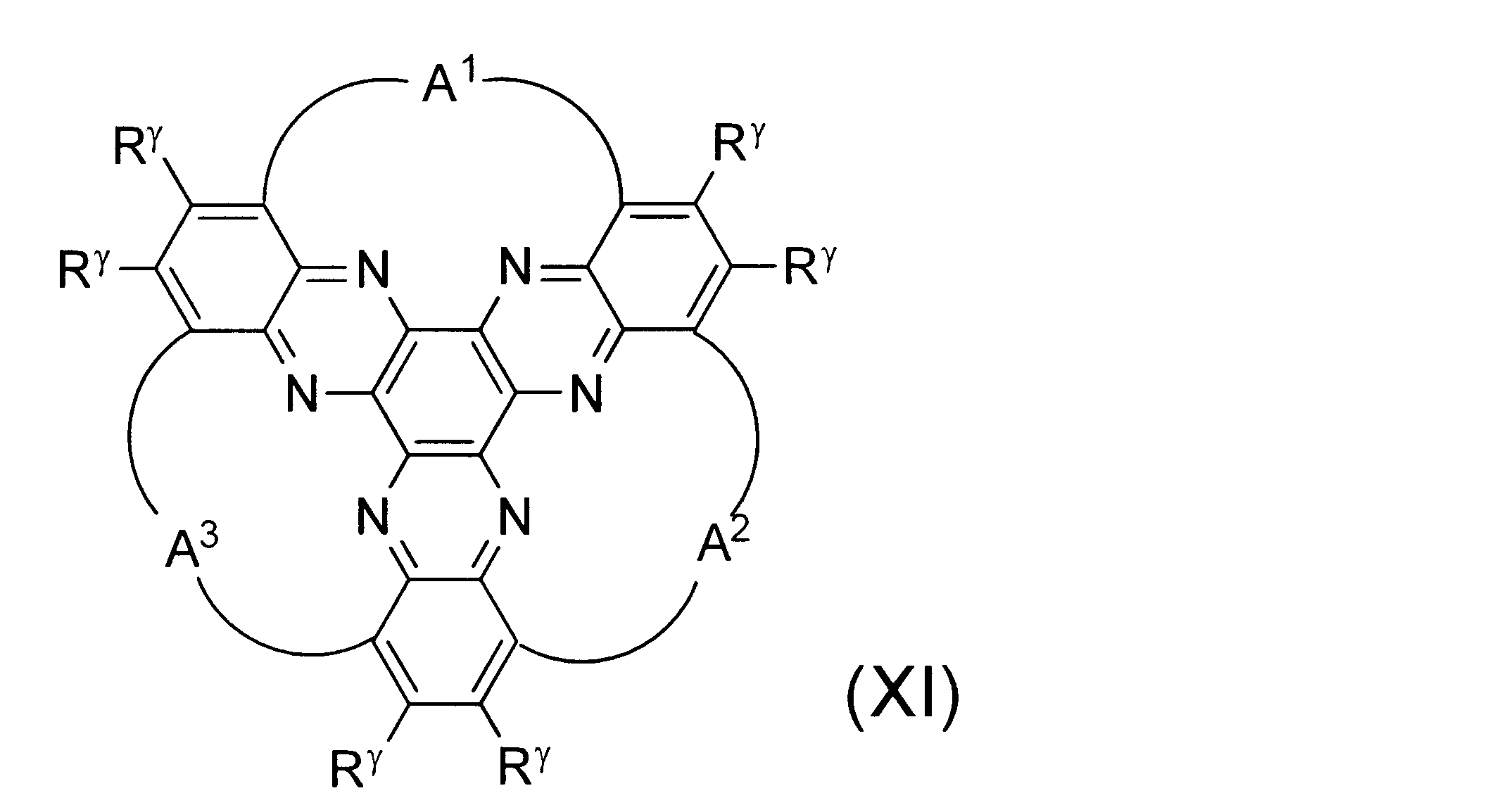
Rγは、水素原子又は置換基を表す。2以上のRγが置換基である場合にはそれぞれ同一でも異なっていてもよく、隣り合う置換基同士は互いに結合して、それぞれが結合する炭素原子とともに環を形成してもよい。2以上のRγは、それぞれ同一でも異なっていてもよい。A1、A2及びA3は、それぞれ独立に前記一般式(B-7-a)~(B-7-e)、(B-8-a)~(B-8-e)、(B-9-a)~(B-9-e)又は(B-10-a)~(B-10-e)のいずれかで表される2価の有機基である。
式(XI)で表される芳香族化合物としては、以下の一般式(B-I-112)~(B-I-116)で表される化合物が例示される。式中の水素原子は、上述の置換基で置換されていてもよい。
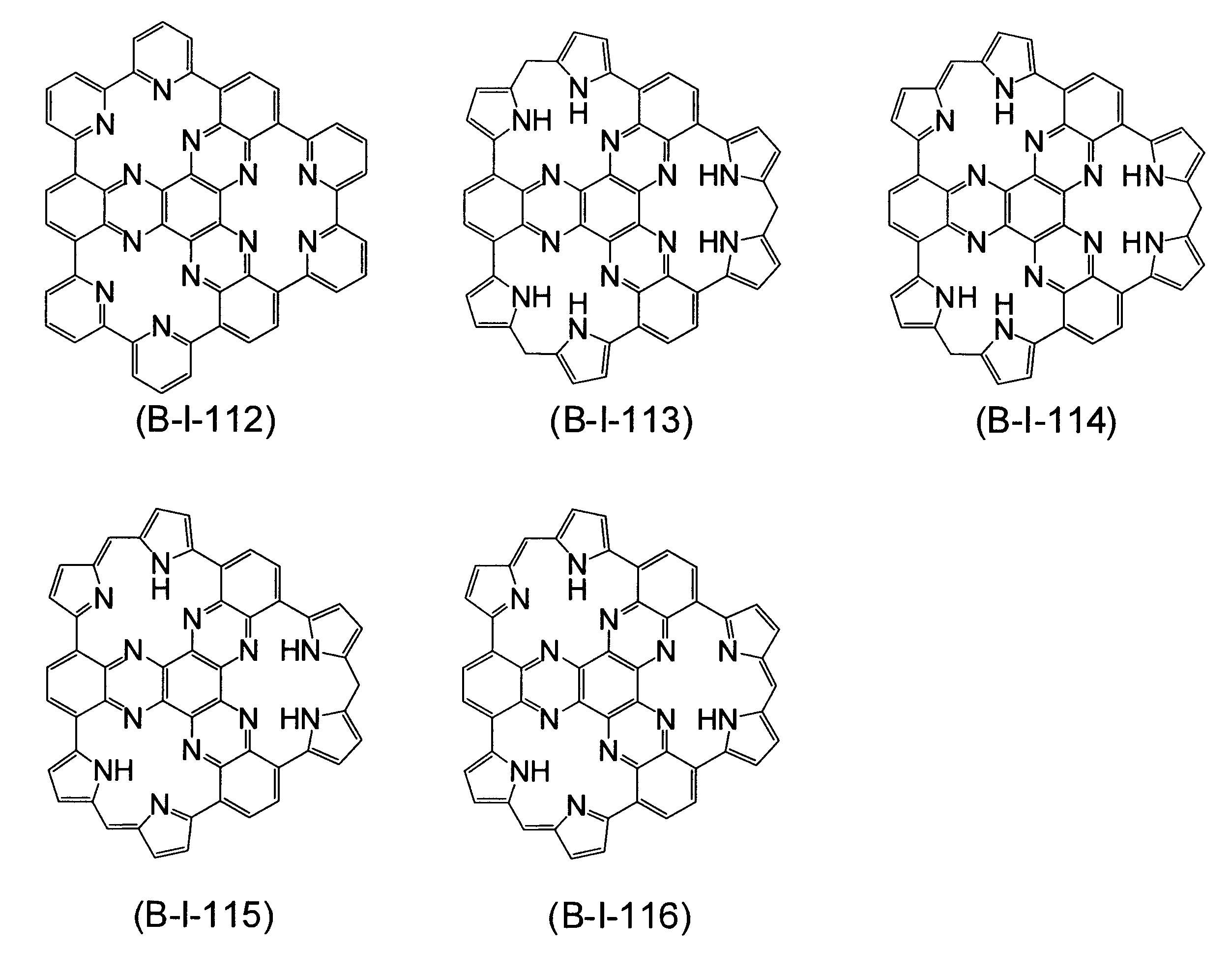
第2の多核金属錯体の中心金属として用いることができる金属原子又は金属イオンとしては、アルカリ金属、アルカリ土類金属、遷移金属のいずれかの金属原子又はそのイオンを用いることができるが、特に好ましくは、周期表第4周期から第6周期の遷移金属又はそのイオンである。
具体的には、スカンジウム、チタン、バナジウム、クロム、マンガン、鉄、コバルト、ニッケル、銅、亜鉛、イットリウム、ジルコニウム、ニオブ、モリブデン、テクネチウム、ルテニウム、ロジウム、パラジウム、銀、カドミウム、ハフニウム、タンタル、タングステン、レニウム、オスミウム、イリジウム、白金、金、水銀の原子及びそのイオンが挙げられ、好ましくは、チタン、バナジウム、クロム、マンガン、鉄、コバルト、ニッケル、銅、亜鉛、ジルコニウム、ニオブ、モリブデン、ルテニウム、ロジウム、パラジウム、銀、タンタル、タングステン、レニウム、オスミウム、イリジウム、白金、金の原子及びそのイオンであり、より好ましくは、チタン、バナジウム、クロム、マンガン、鉄、コバルト、ニッケル、銅、亜鉛、ジルコニウム、ニオブ、モリブデン、ルテニウム、ロジウム、パラジウム、銀等の原子及びそのイオンであり、特に好ましくは、バナジウム、クロム、マンガン、鉄、コバルト、ニッケル、銅、亜鉛の原子及びそのイオンである。また、金属原子又は金属イオンの種類は1種類であってもよいし、2種以上の金属原子又は金属イオンを組み合わせて用いてもよい。
中心金属が金属イオンである場合、金属イオンの価数は、好ましくは1~4、より好ましくは2~4、特に好ましくは2又は3である。
通常、金属イオンは、正の電荷を有するので、本実施形態の多核金属錯体は、前記多核金属錯体を全体として電気的に中性にする陰イオンを含んでいてもよい。対イオンとしては、フッ化物イオン、塩化物イオン、臭化物イオン、ヨウ化物イオン、硫化物イオン、酸化物イオン、水酸化物イオン、水素化物イオン、亜硫酸イオン、リン酸イオン、シアン化物イオン、酢酸イオン、炭酸イオン、硫酸イオン、硝酸イオン、炭酸水素イオン等の無機イオン、トリフルオロ酢酸イオン、チオシアン化物イオン、トリフルオロメタンスルホン酸イオン、アセチルアセトナート、テトラフルオロホウ酸イオン、ヘキサフルオロリン酸イオン、テトラフェニルホウ酸イオン、フェノレート、ピコリン酸及びそれらの誘導体のイオン等の有機酸イオンが挙げられ、好ましくは、塩化物イオン、臭化物イオン、ヨウ化物イオン、酸化物イオン、水酸化物イオン、水素化物イオン、リン酸イオン、シアン化物イオン、酢酸イオン、炭酸イオン、硫酸イオン、硝酸イオン、アセチルアセトナート、テトラフェニルホウ酸イオンである。対イオンが2以上存在する場合、それらは同一でも異なっていてもよい。
本実施形態の多核金属錯体としては、以下の一般式(B-II-1)~(B-II-76)で表される多核金属錯体、及び以下の一般式(B-II-77)~(B-II-89)で表される式で表される繰り返し単位を有する高分子化合物が例示される。式中の水素原子は、上述の置換基で置換されていてもよい。また、本実施形態の多核金属錯体の分子量は、上述の芳香族化合物の分子量に準ずる。
これらの多核金属錯体において、式中のMは金属原子を表す。Mで表される金属原子は、上述の金属原子と同じである。Mが2個以上存在する場合には、それらは同一であっても異なっていてもよい。また、式中の多核金属錯体の電荷は省略してある。
これらの多核金属錯体において、式中のMは金属原子を表す。Mで表される金属原子は、上述の金属原子と同じである。Mが2個以上存在する場合には、それらは同一であっても異なっていてもよい。また、式中の多核金属錯体の電荷は省略してある。

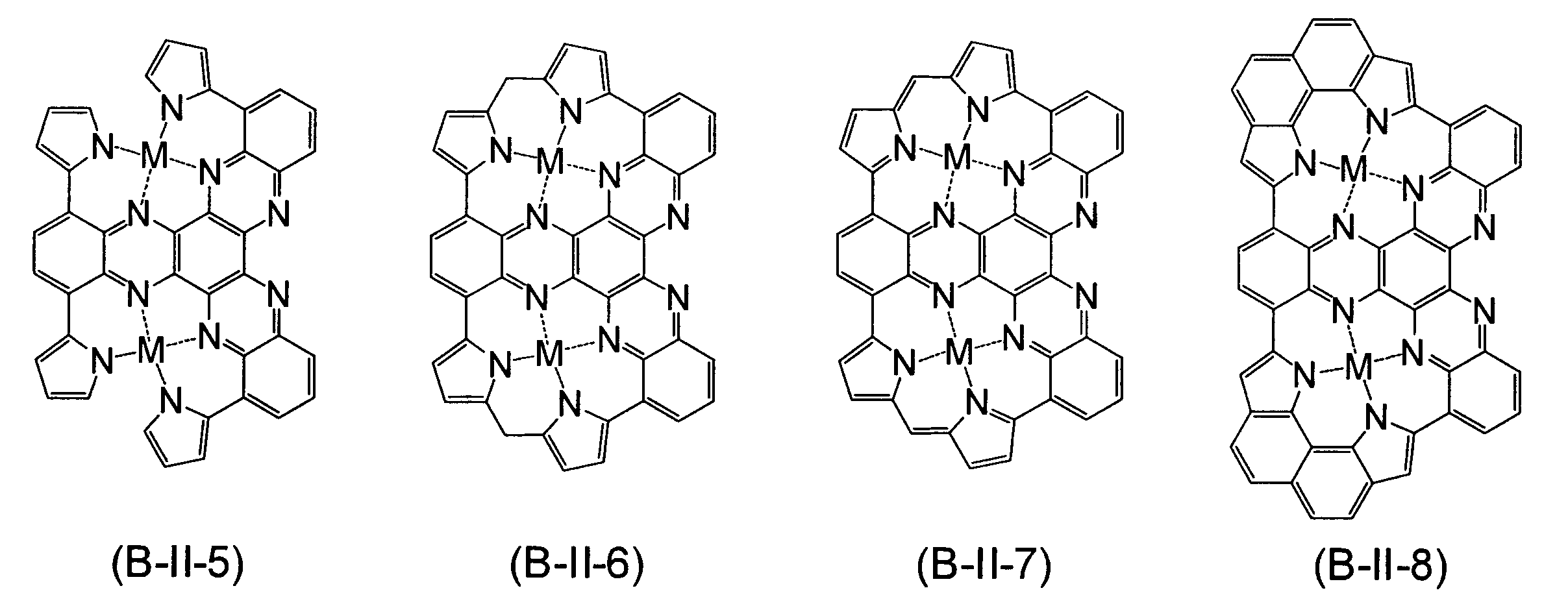
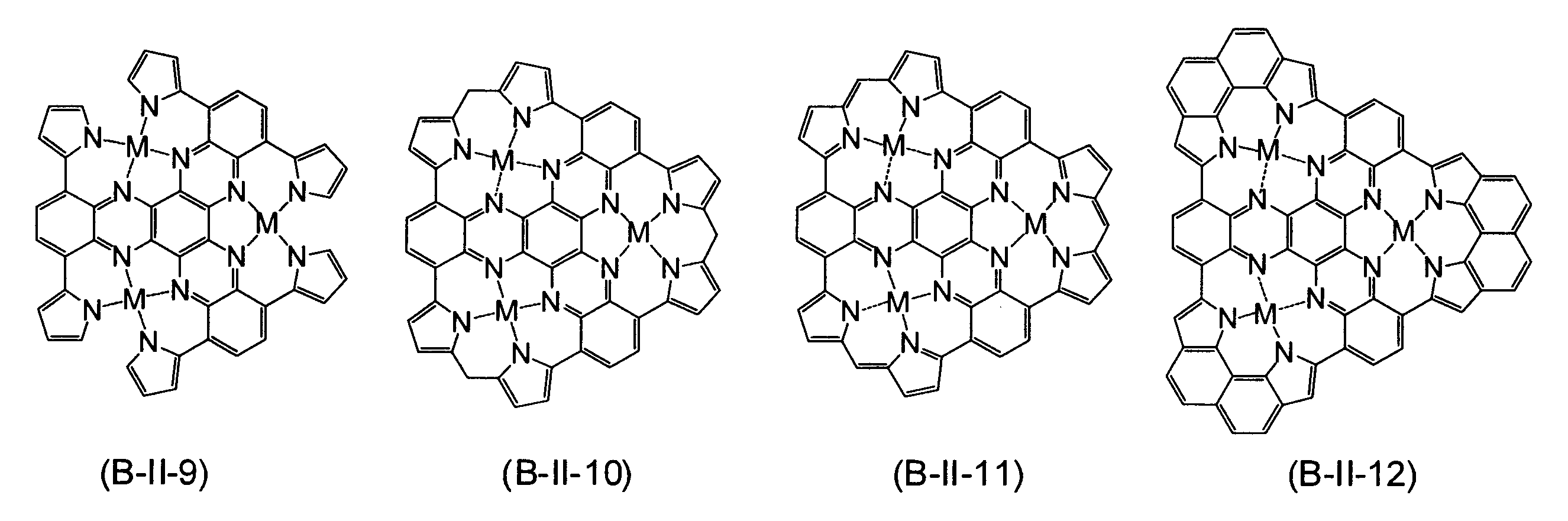

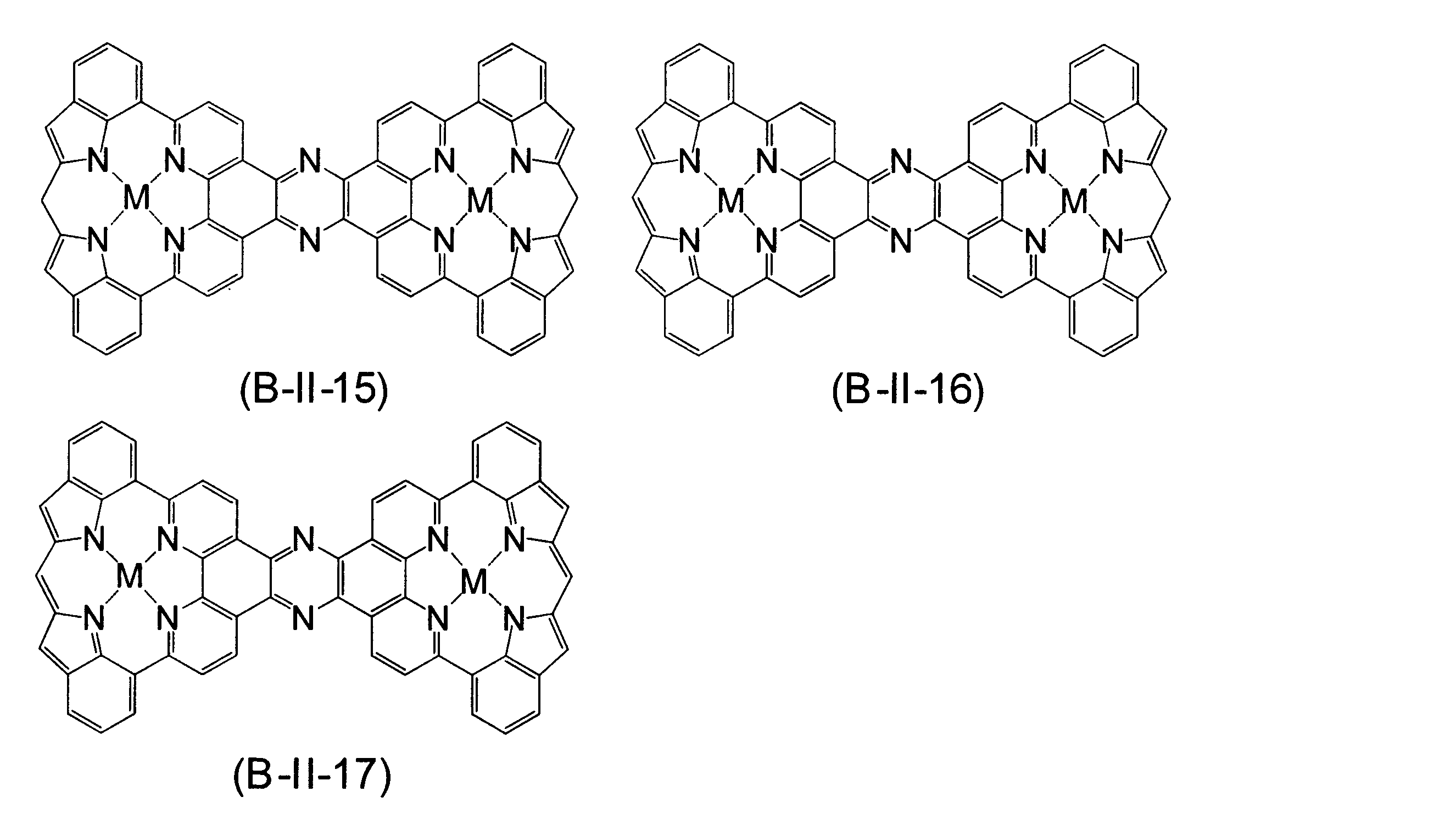

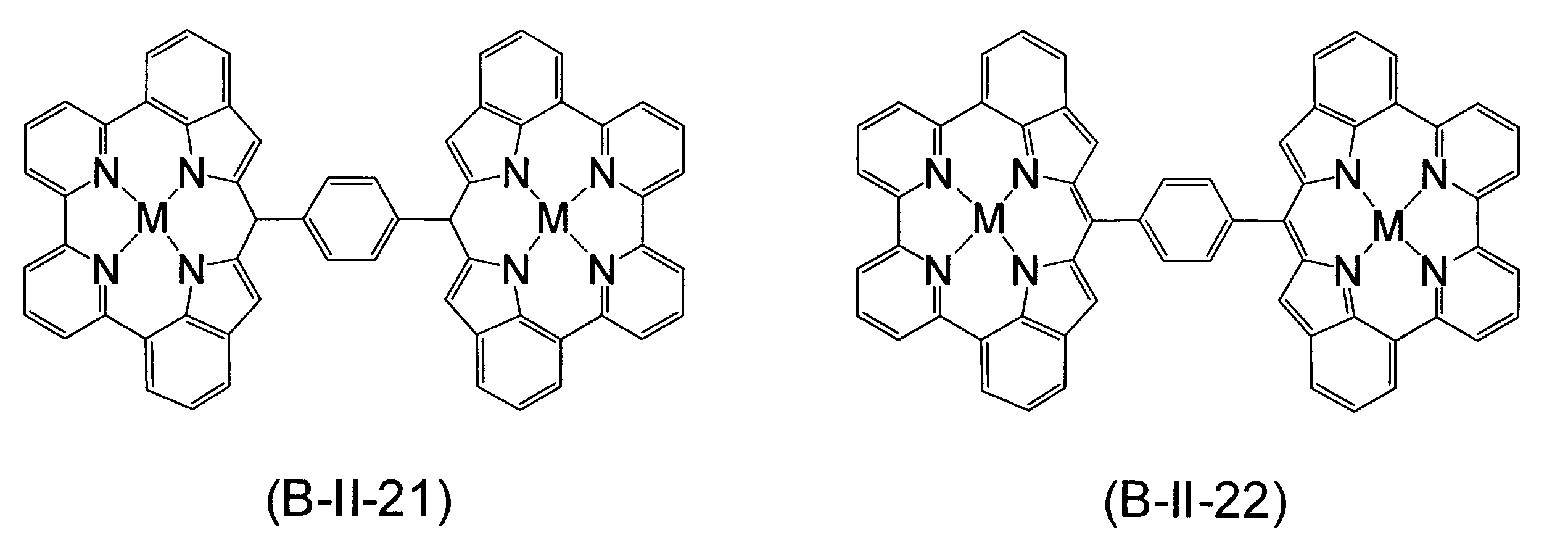

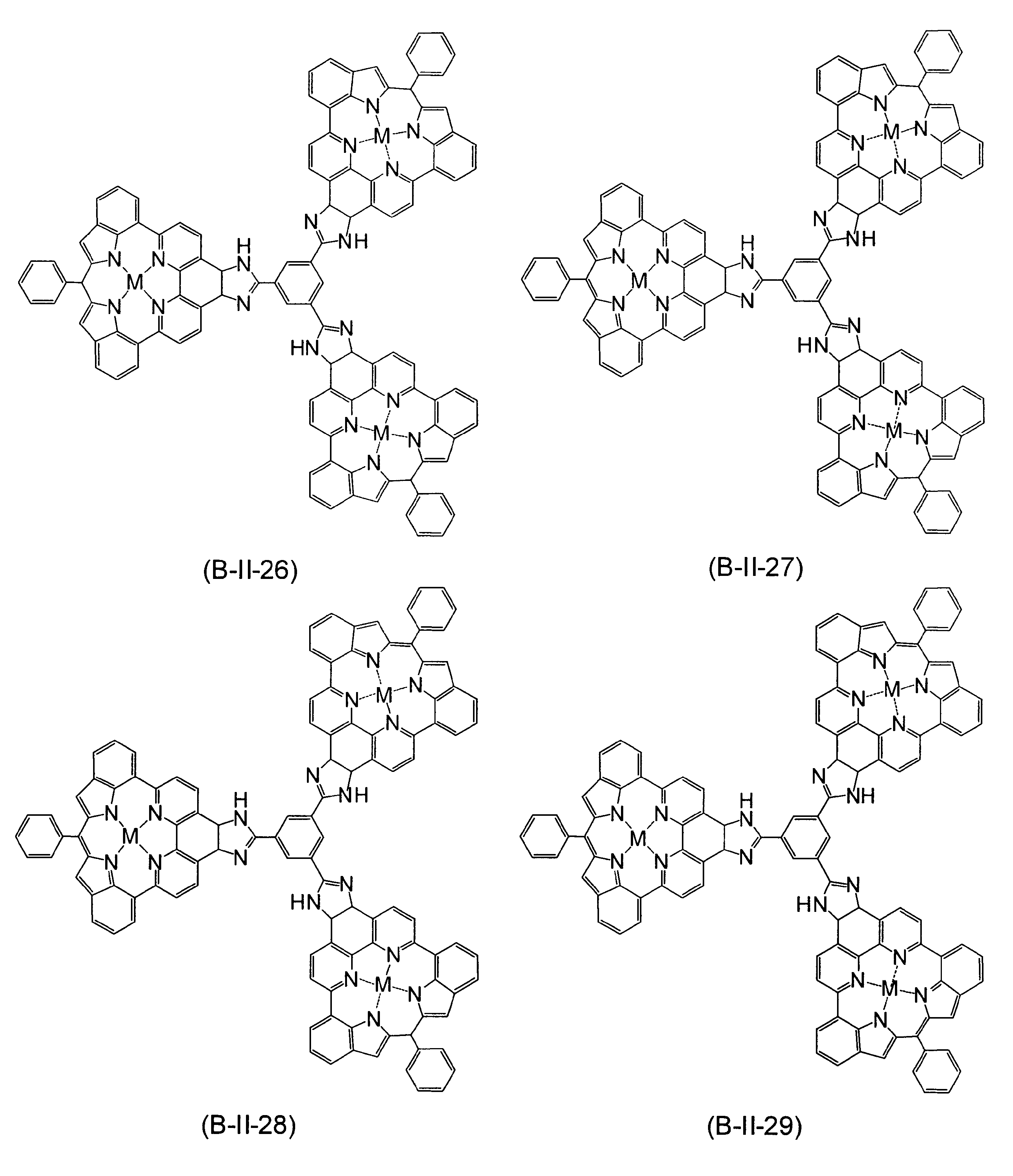
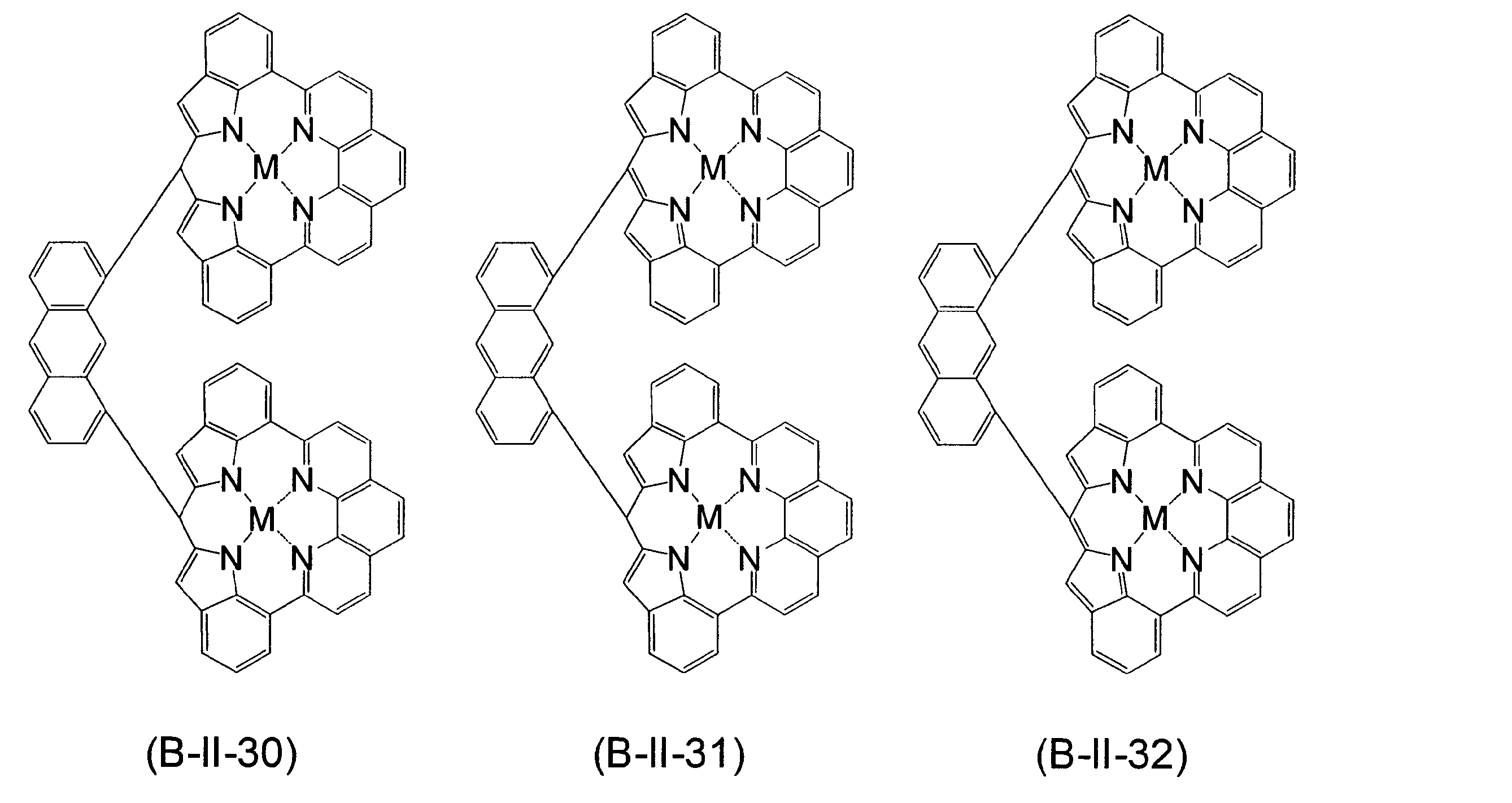
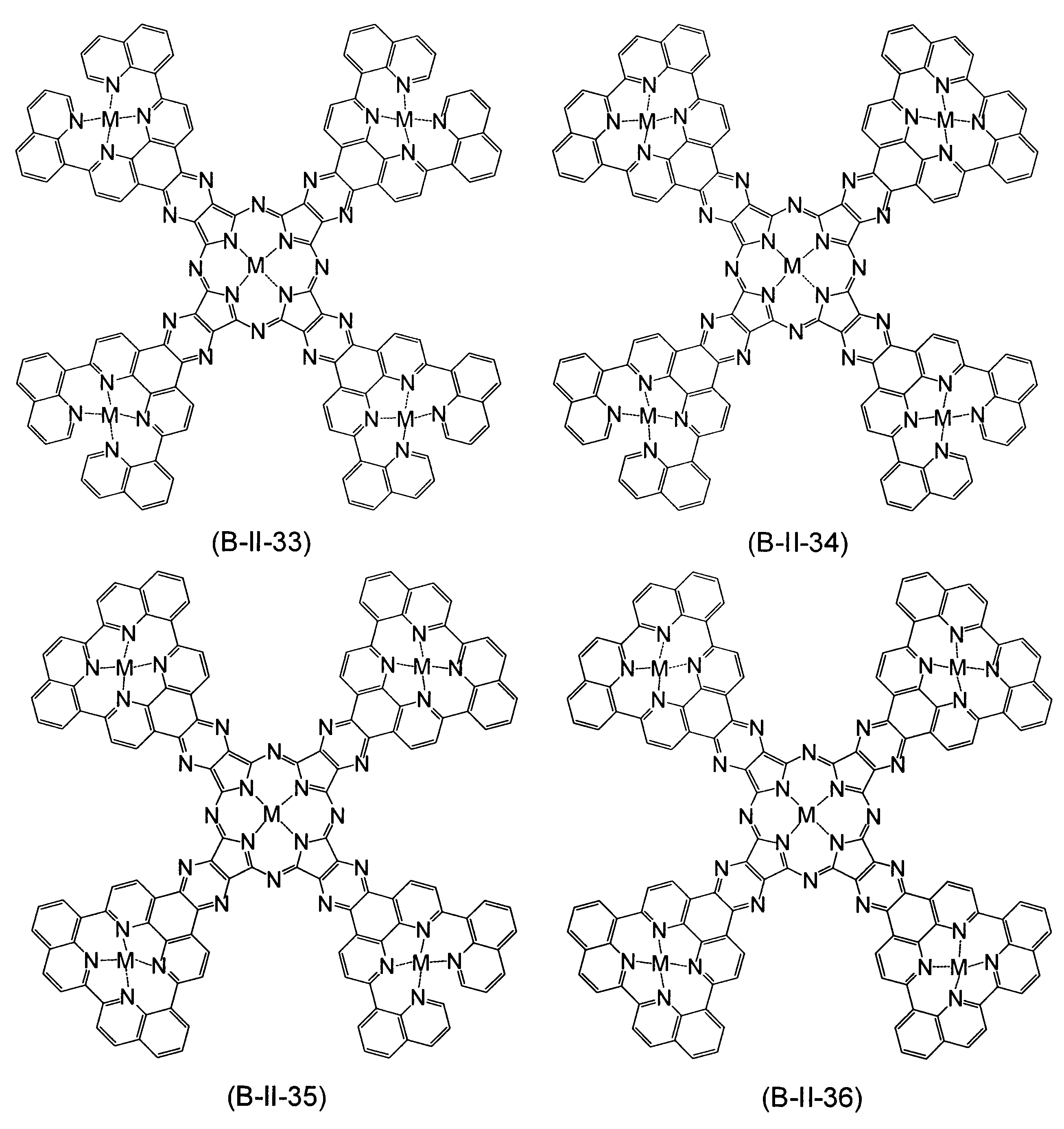

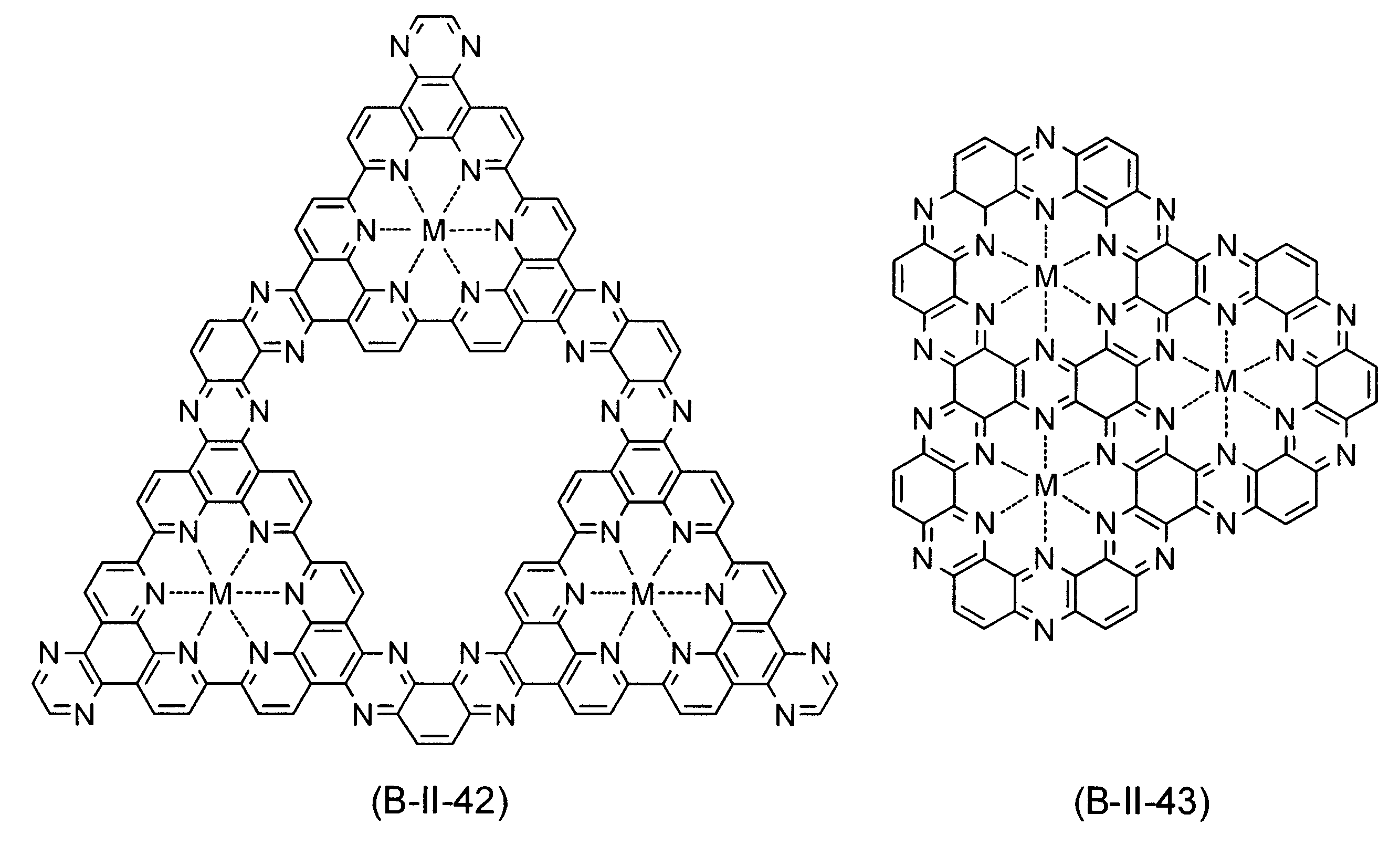
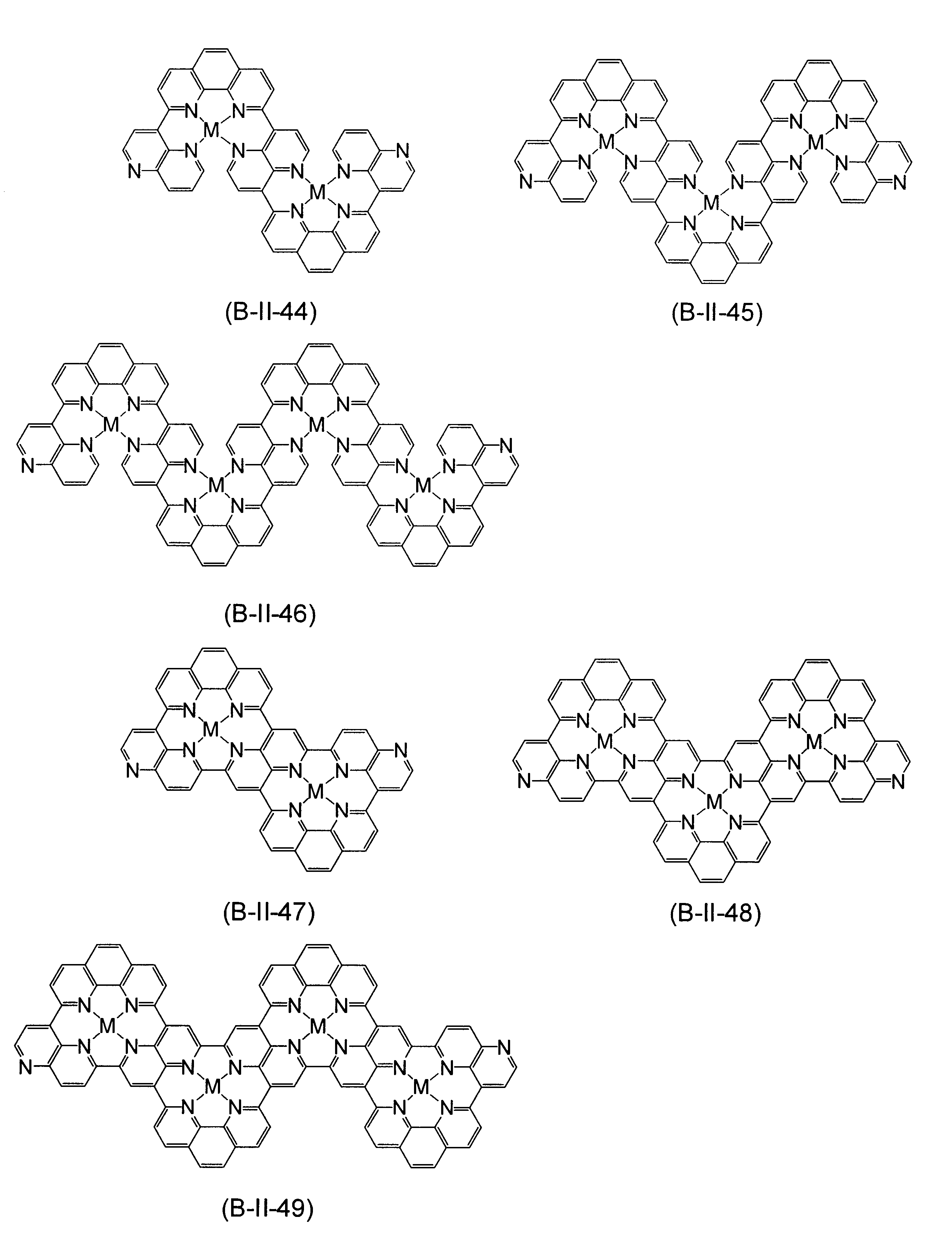


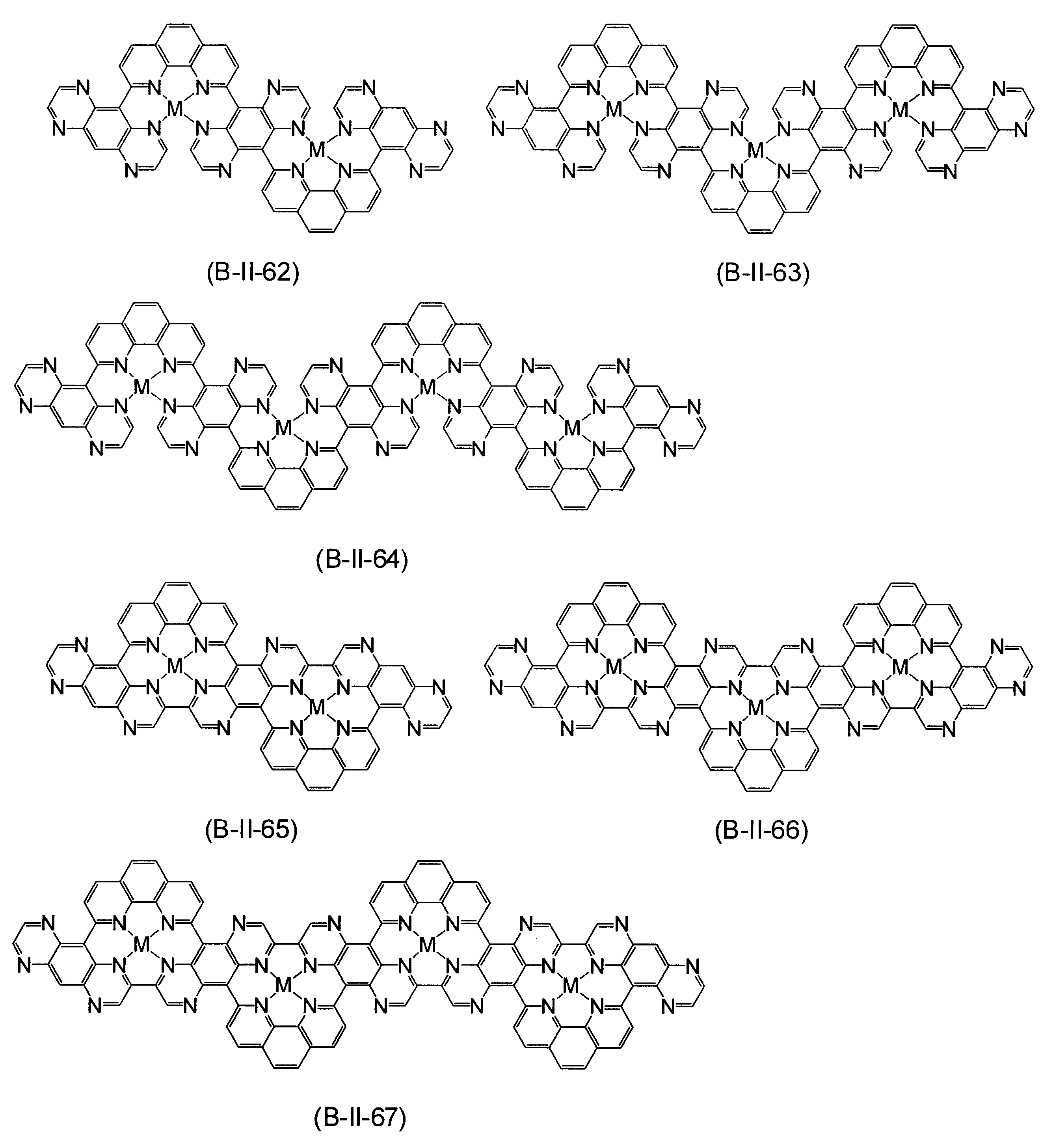
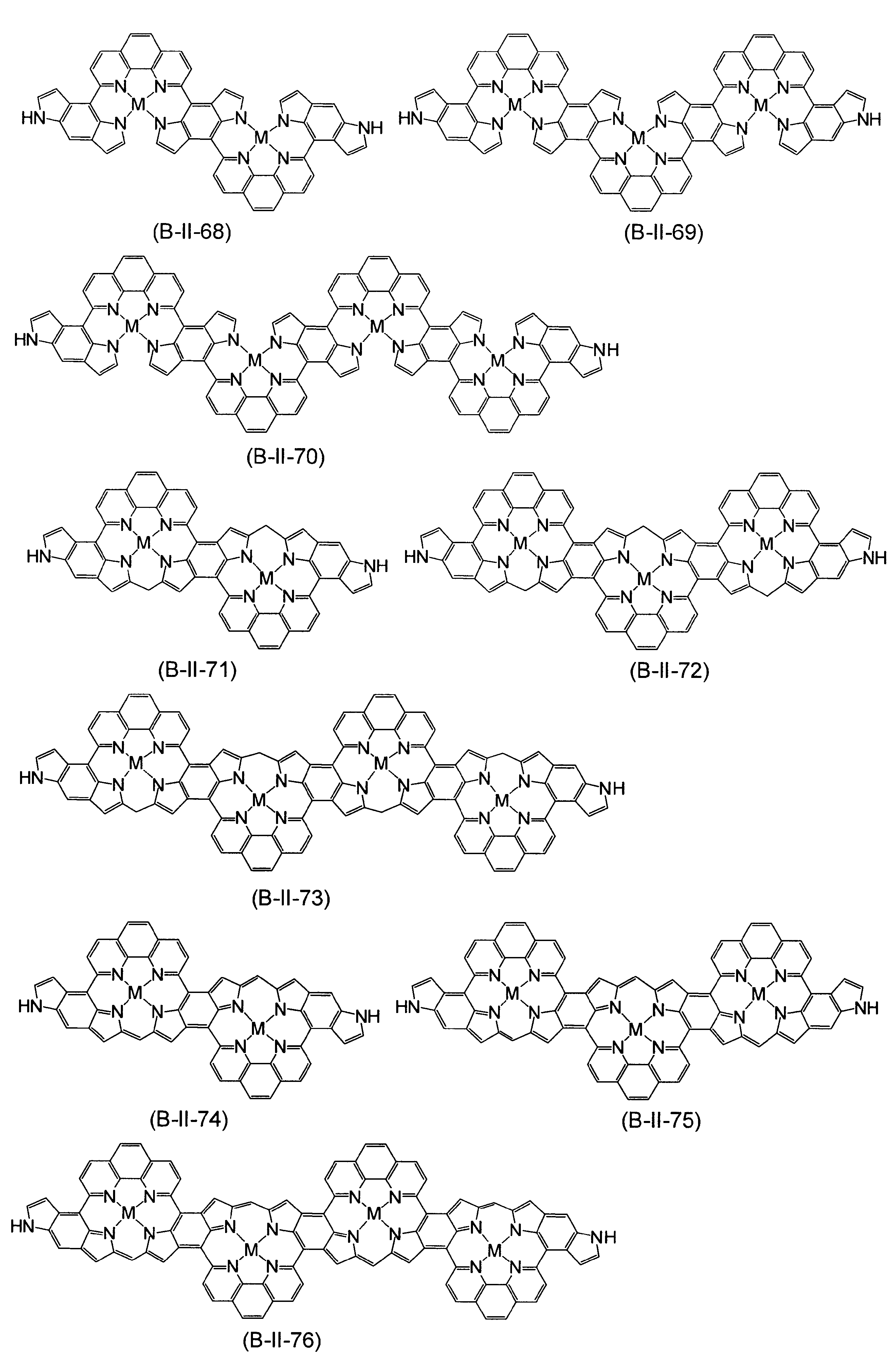

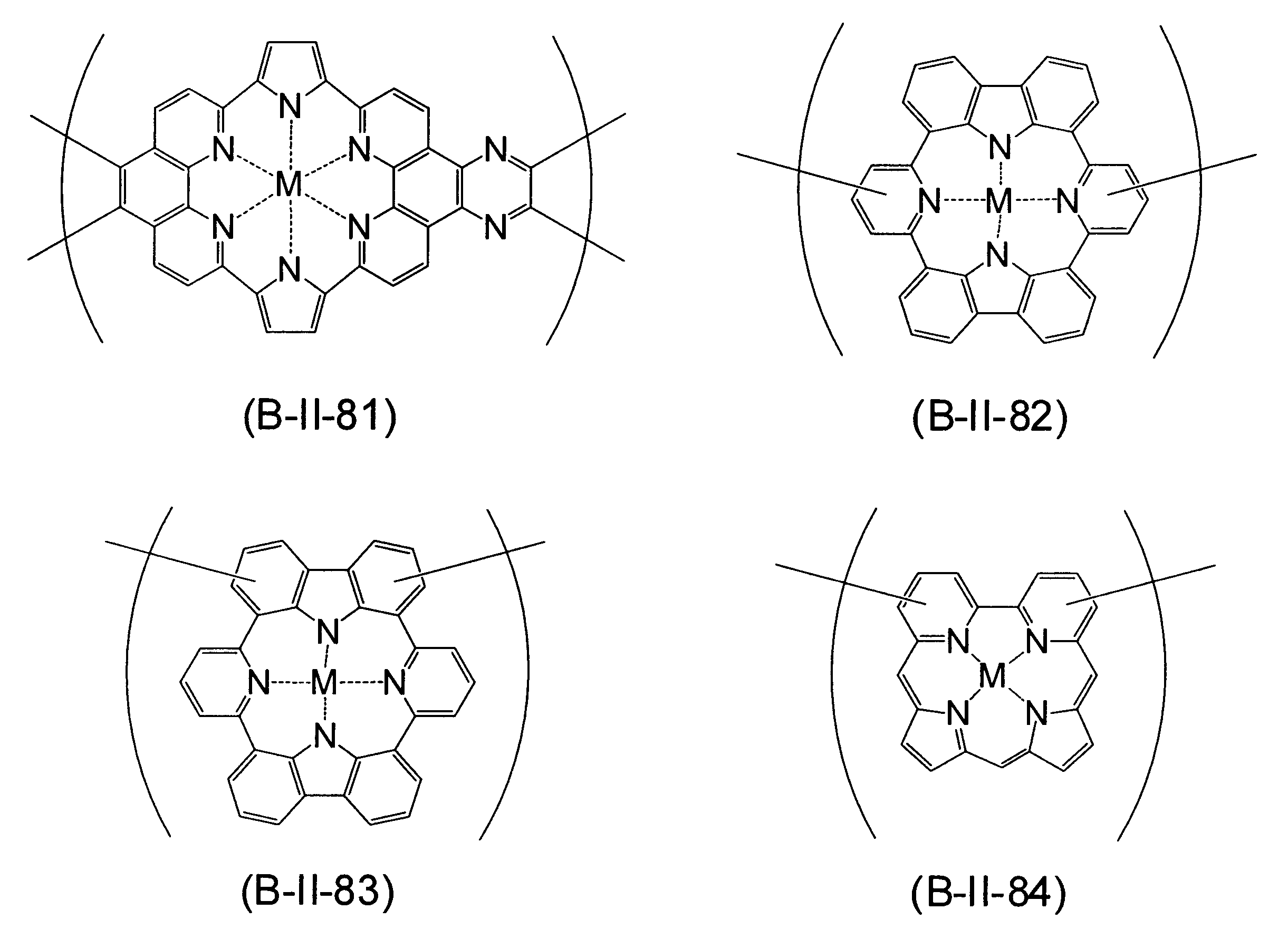
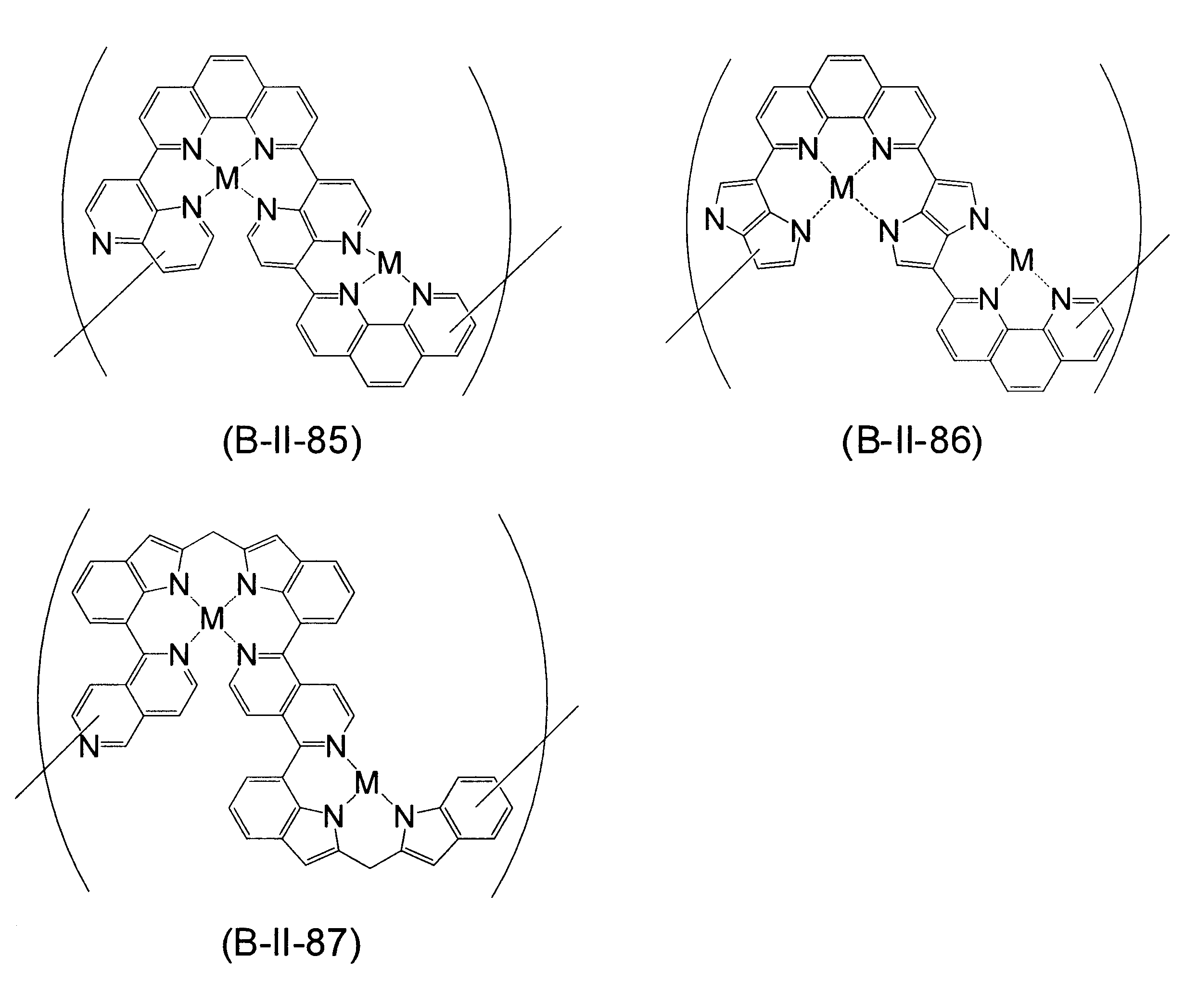
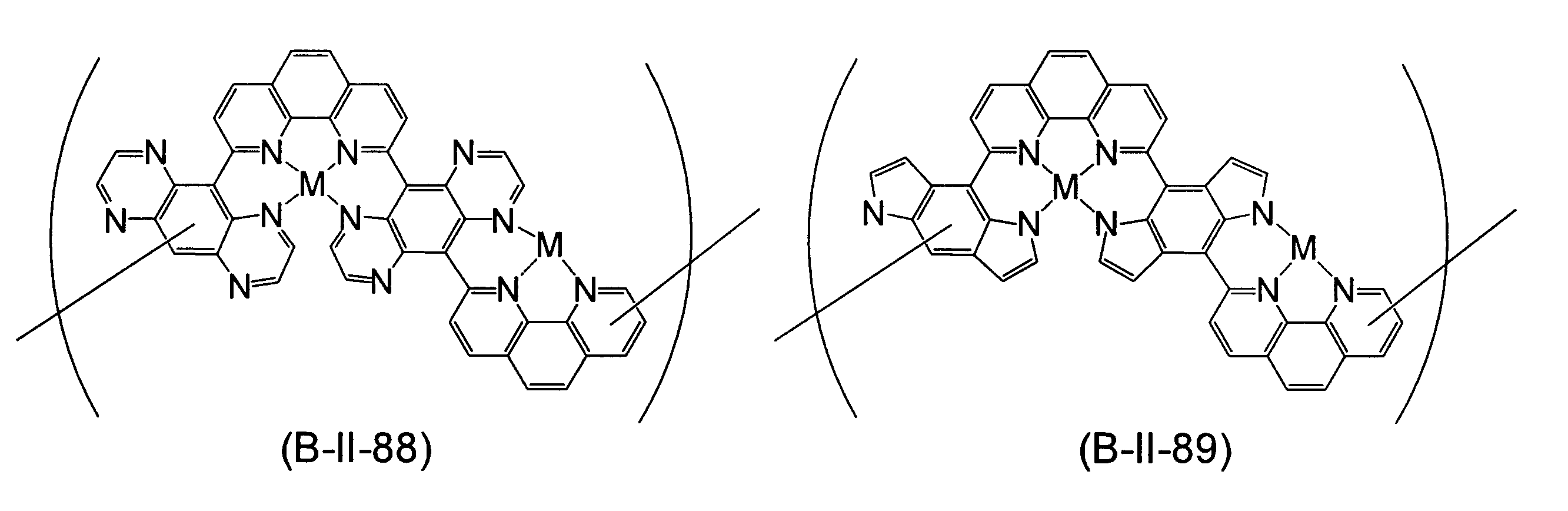
また、本実施形態の多核金属錯体を製造する時、前記芳香族化合物と反応させる金属原子又は金属イオンの量を調節し、得られる多核金属錯体の機能を制御することができる。多核金属錯体の製造方法については後述する。
次に、上述した第2の多核金属錯体の配位子として用いることのできる芳香族化合物の製造方法を説明する。前記芳香族化合物は、如何なる方法で製造してもよいが、例えば、下記反応式(100)に示すジアミン化合物とヘキサケトシクロヘキサンとの酢酸中における縮合反応により、製造することができる。

本実施形態の多核金属錯体の配位子として用いることのできる芳香族化合物の製造方法として、下記反応式(101)のように、あらかじめブロモ基等のハロゲノ基を導入しておき、その後、環化させてもよい。環化反応には、山本カップリングやウルマンカップリング等の反応を用いることができる。
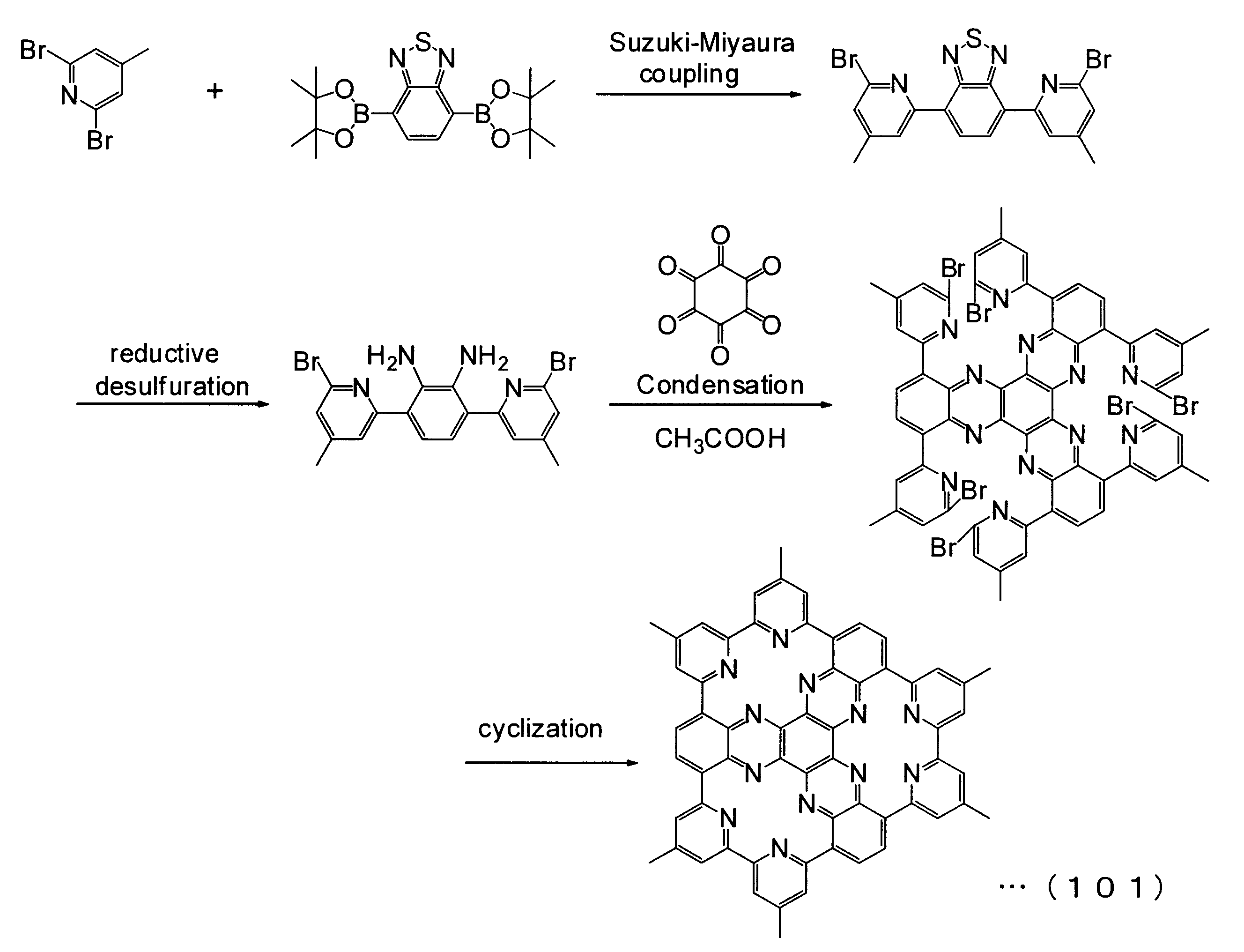
本実施形態の多核金属錯体の配位子として用いることのできる芳香族化合物は、下記反応式(102)のように、鈴木・宮浦カップリング反応を用いて製造することもできる。

本実施形態の多核金属錯体の配位子として用いることのできる芳香族化合物は、下記反応式(103)のように、ジケトン化合物とアンモニウム塩との反応を用いて製造することもできる。または、下記反応式(104)のように、ジケトン化合物と1,2-ジアミノ-1,2-ジシアノエチレンを反応させた後、環化反応させて製造することもできる。
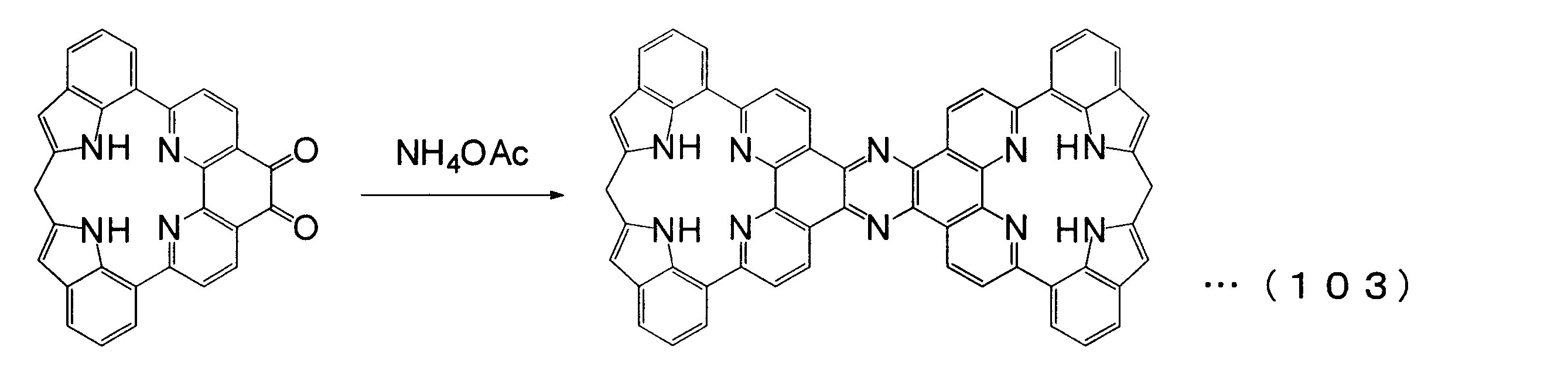
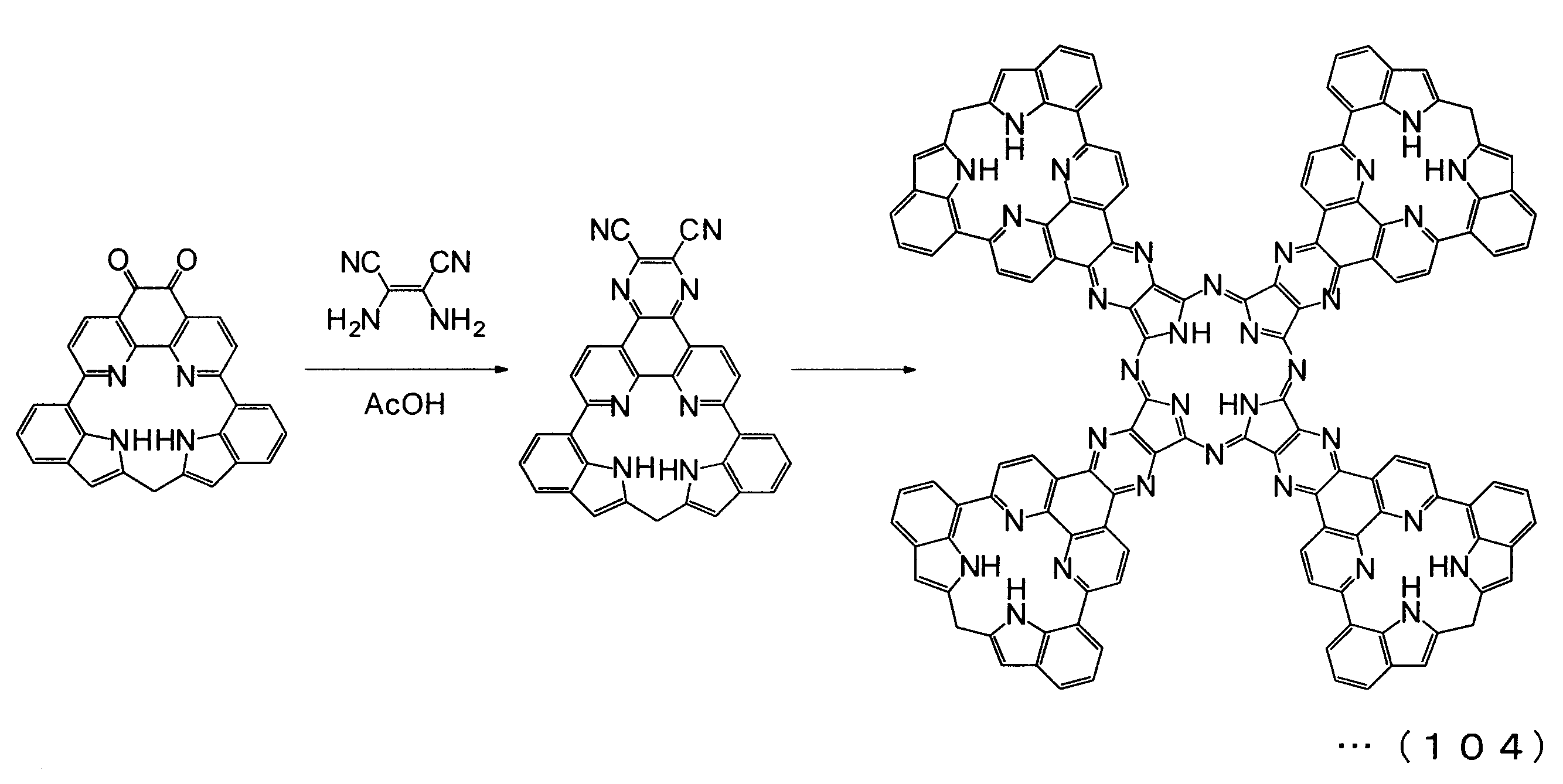
本実施形態の多核金属錯体の配位子として用いることのできる芳香族化合物は、下記反応式(105)に示すようにブロモ基等のハロゲノ基を有するジアミン化合物とヘキサケトシクロヘキサンとの縮合反応生成物へ、ピロール等の含窒素芳香族化合物のボロン酸体をカップリング反応等により導入することで製造することもできる。
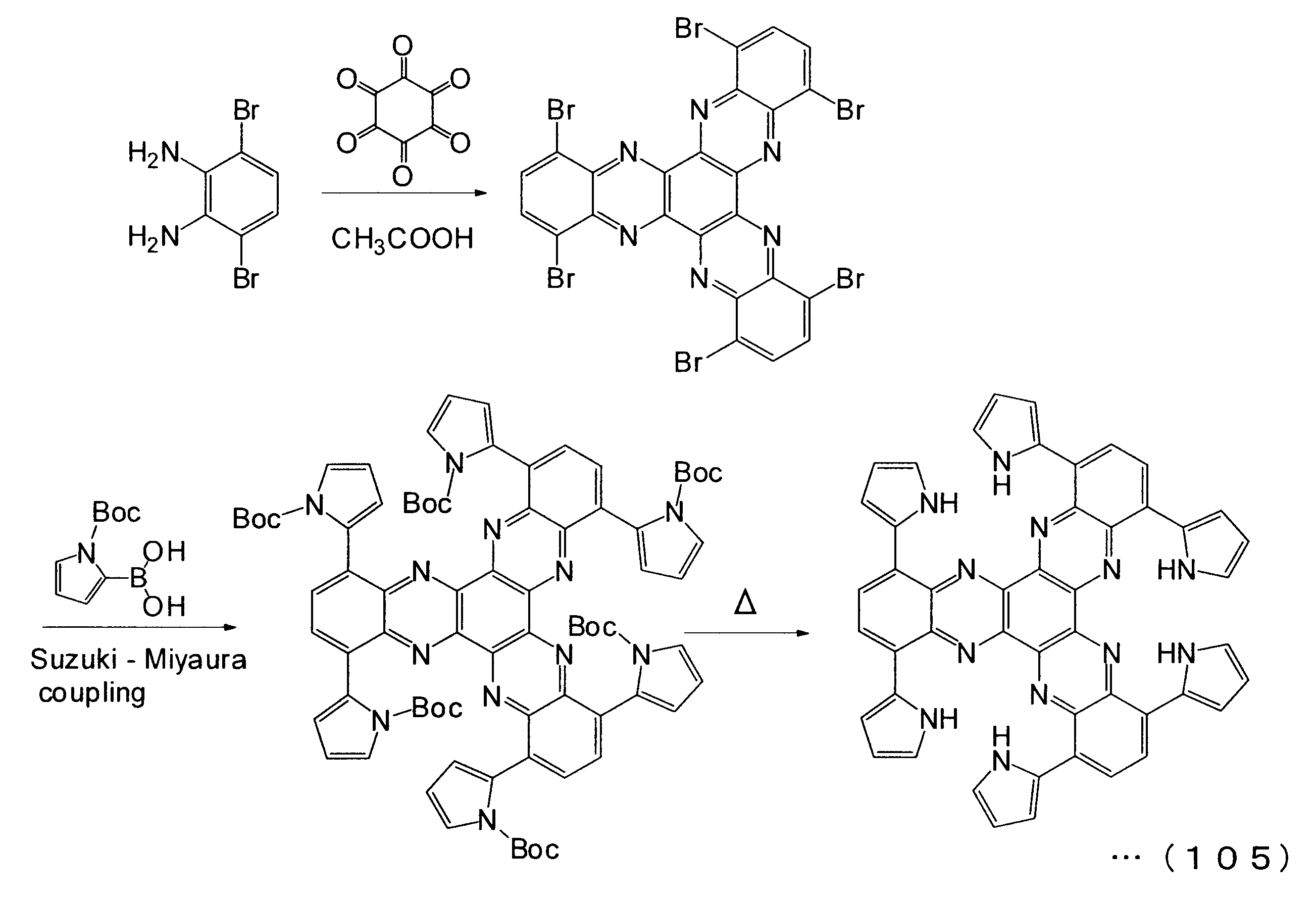
下記反応式(106)に示すように、上記反応式(105)で得られる化合物をアルデヒドと反応させて、閉環させてもよい。

上記のような構造を有する芳香族化合物は、下記反応式(107)に示すように、適当な酸化剤を用いて酸化させることができる。酸化剤としては、2,3-ジクロロ-5,6-ジシアノ-p-ベンゾキノン(DDQ)や酸素等を用いることができる。また、酸化剤の加える量や反応時間を調節することで、反応段階を調節することができる。

本実施形態の多核金属錯体の配位子として用いることのできる芳香族化合物が、エチニル基等の反応性基を有していてもよい。反応性基の導入は、多核金属錯体の触媒活性をより向上することができるので好ましい。例えば、下記反応式(108)に示すように、エチニル基を有するアルデヒドと反応させて反応性基を導入することができる。
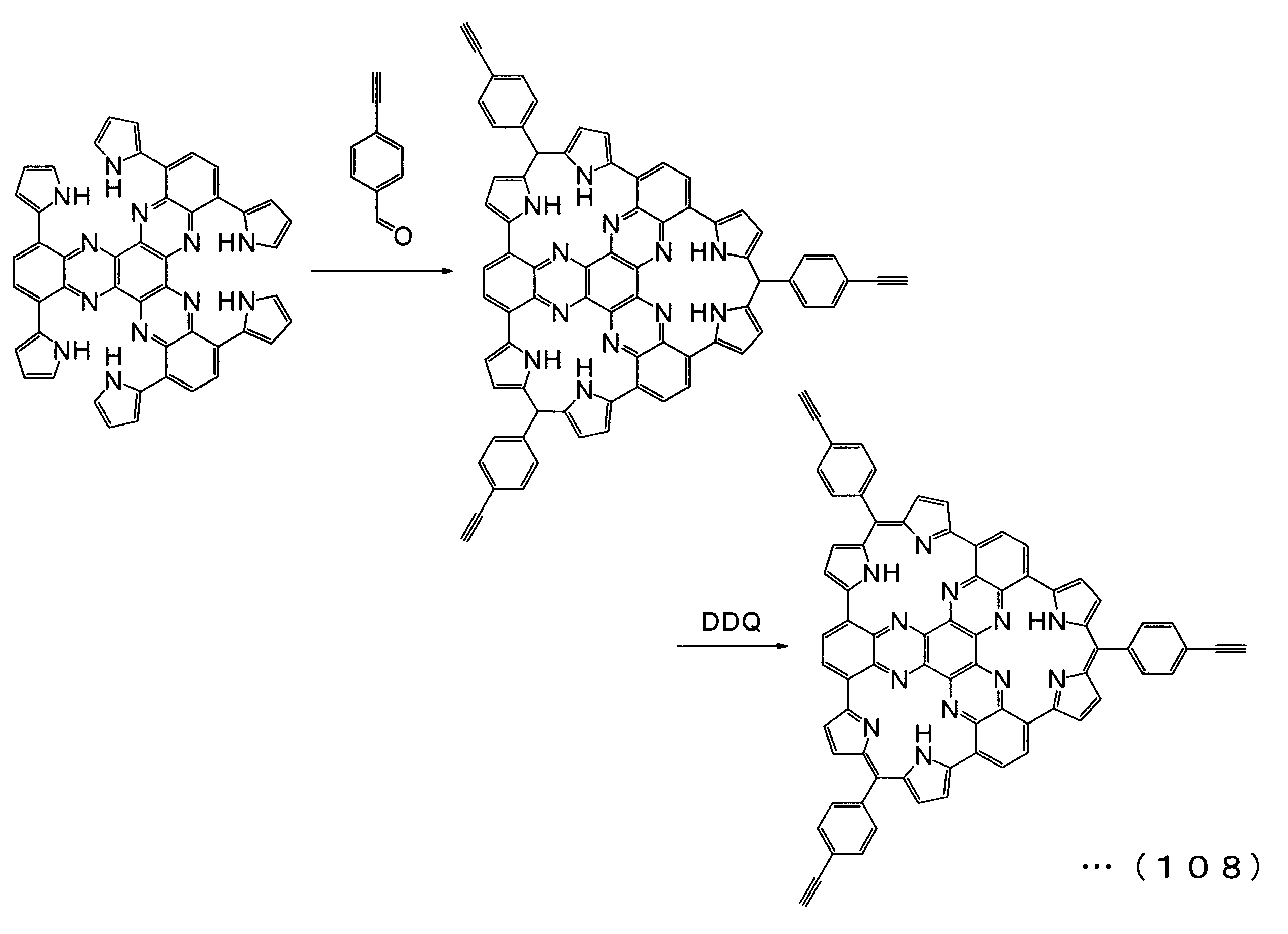
上記反応式(108)でエチニル基を導入する際、トリメチルシリル(TMS)基、トリエチルシリル(TES)基、tert-ブチルジメチルシリル(TBS又はTBDMS)基、トリイソプロピルシリル(TIPS)基、tert-ブチルジフェニルシリル(TBDPS)基等の保護基でエチニル基を保護しておき、含窒素芳香族化合物に導入後、酸性条件とするか、あるいは、フッ化物イオンを反応させることで脱保護してもよい。
本実施形態の多核金属錯体の配位子として用いることのできる芳香族化合物は、下記反応式(109)のように製造することもできる。

また、下記反応式(110)に示すように、金属に配位可能な4つ以上の窒素原子で囲まれた空間を形成する構造を1つ有し、かつ、前記窒素原子の少なくとも1つが含窒素複素六員環に含まれる窒素原子である芳香族化合物を原料として、本実施形態の多核金属錯体の配位子として用いることのできる芳香族化合物を製造してもよい。

本実施形態の多核金属錯体の配位子として用いることのできる芳香族化合物の製造方法において、一般式(B-11)~(B-20)、(B-22)、(B-23)で表される化合物は、本実施形態の多核金属錯体の配位子となる芳香族化合物の原料として用いることができる。また、前記芳香族化合物は、一般式(B-11)~(B-20)、(B-22)、(B-23)で表される構造式中の水素原子又は置換基の1つ又は2以上を取り去り連結させることで製造することもできる。連結させる方法としては、一般的に用いられているカップリング反応を用いることができ、パラジウムを触媒として用いる鈴木・宮浦カップリングや溝呂木・ヘック反応、ニッケルを触媒として用いる山本カップリングや熊田・玉尾カップリング、銅を触媒として用いるウルマン反応が例示される。
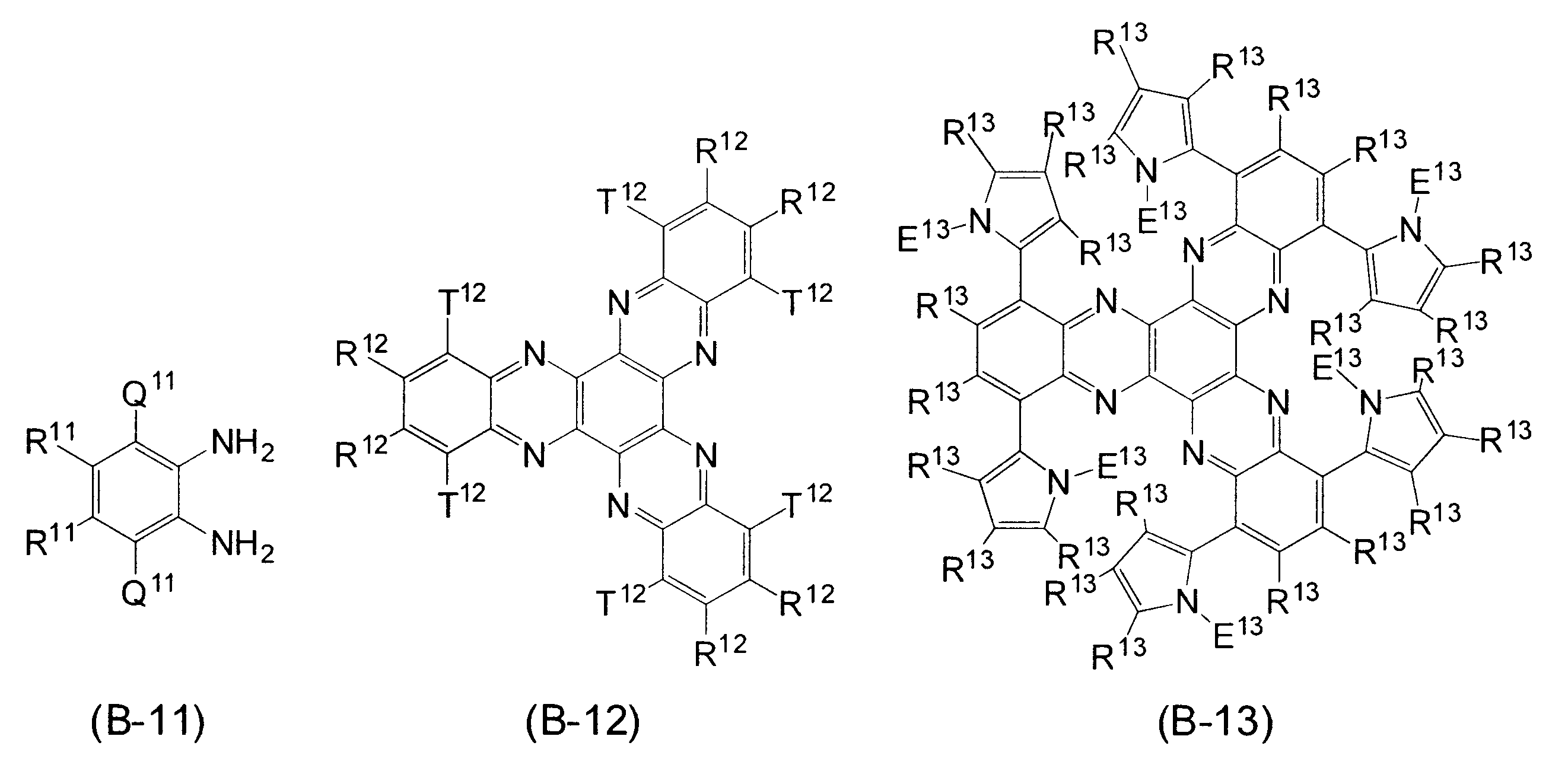
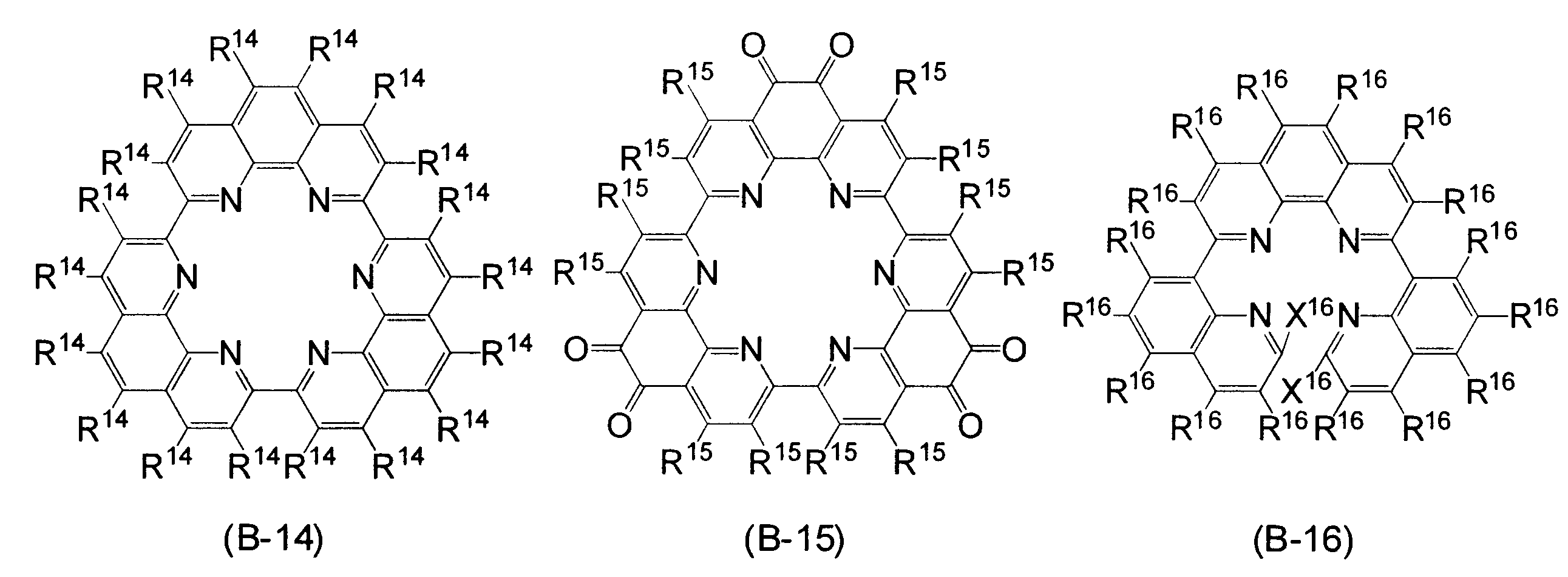
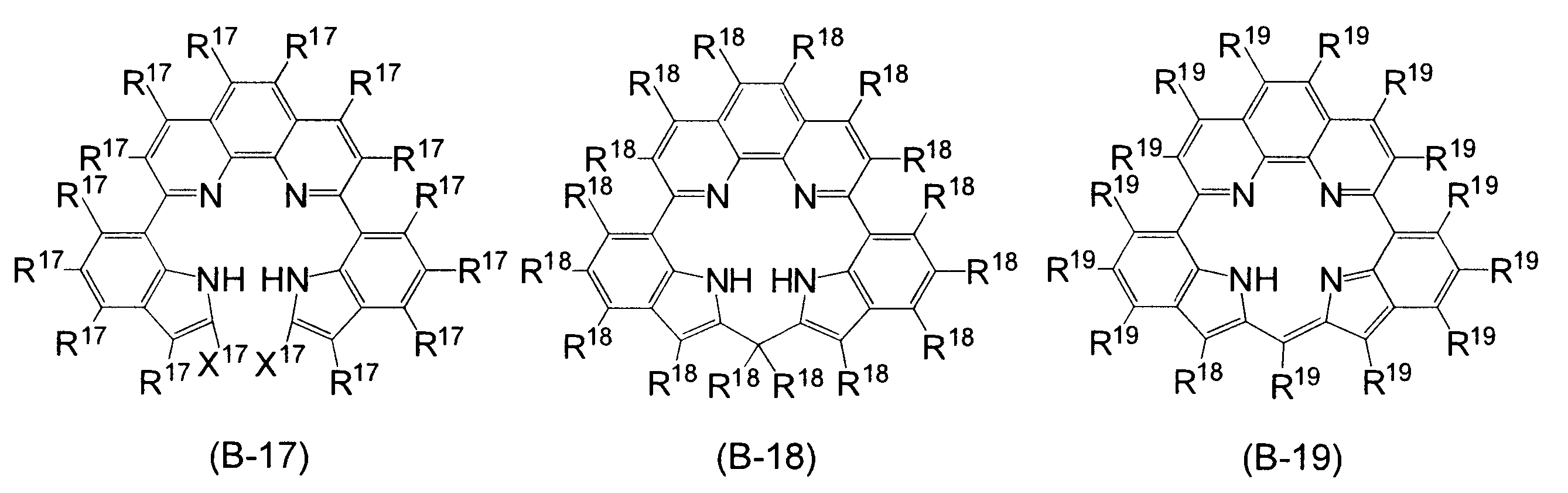

R11~R20、R22及びR23は、それぞれ独立に、水素原子又は置換基であり、隣り合う置換基は互いに結合して、それぞれが結合する炭素原子とともに環を形成してもよい。
Q11は、含窒素芳香族複素環である。
T12は、ブロモ基、クロロ基又はヨード基である。
E13、E20及びE22は、それぞれ独立に、水素原子又は保護基である。
X16及びX17は、それぞれ独立に、水素原子、ハロゲノ基、又は、X16同士若しくはX17同士が互いに結合した直接結合である。
2以上のR11~R20、R22、R23、Q11、T12、E13、E20、E22、X16及びX17は、各々、同一でも異なっていてもよい。)
R11~R20、R22及びR23で表される置換基は、上述の置換基の説明及び例示と同様である。
Q11は、含窒素芳香族複素環であり、ピリジン環、ピラジン環、ピリミジン環、ピリダジン環、1,3,5-トリアジン環、1,2,4-トリアジン環、1,2,4,5-テトラジン環、1H-ピロール環、2H-ピロール環、3H-ピロール環、イミダゾール環、ピラゾール環、1,2,3-トリアゾール環、1,2,4-トリアゾール環、オキサゾール環、イソオキサゾール環、チアゾール環、イソチアゾール環、1,3,4-オキサジアゾール環、1,2,5-オキサジアゾール環、1,3,4-チアジアゾール環、1,2,5-チアジアゾール環及びこれらの環を有する多環式芳香族複素環が好ましく、ピリジン環、ピラジン環、ピリミジン環、ピリダジン環、1H-ピロール環、2H-ピロール環、3H-ピロール環、イミダゾール環、ピラゾール環、1,2,3-トリアゾール環、1,2,4-トリアゾール環がより好ましく、ピリジン環、ピラジン環、ピリミジン環、ピリダジン環、1H-ピロール環が特に好ましい。
T12は、好ましくは、ブロモ基又はクロロ基であり、より好ましくは、ブロモ基である。
E13、E20及びE22は、それぞれ独立に、水素原子又は保護基である。
前記保護基としては、メトキシカルボニル基、エトキシカルボニル基、2,2,2-トリクロロエトキシカルボニル基、tert-ブトキシカルボニル(Boc)基等のアルコキシカルボニル基、ビニルオキシカルボニル基等のアルケニルオキシカルボニル基、ベンジルオキシカルボニル基、9-フルオレニルメトキシカルボニル基等のアラルキルオキシカルボニル基、ベンジル基、4-メトキシベンジル基等の置換されていてもよいアラルキル基、ホルミル基、アセチル基、トリフルオロアセチル基、ベンゾイル基等のアシル基、p-トルエンスルホニル基、ベンゼンスルホニル基等のアリールスルホニル基、メタンスルホニル基等のアルキルスルホニル基等が挙げられ、tert-ブトキシカルボニル基が好ましい。
前記保護基としては、メトキシカルボニル基、エトキシカルボニル基、2,2,2-トリクロロエトキシカルボニル基、tert-ブトキシカルボニル(Boc)基等のアルコキシカルボニル基、ビニルオキシカルボニル基等のアルケニルオキシカルボニル基、ベンジルオキシカルボニル基、9-フルオレニルメトキシカルボニル基等のアラルキルオキシカルボニル基、ベンジル基、4-メトキシベンジル基等の置換されていてもよいアラルキル基、ホルミル基、アセチル基、トリフルオロアセチル基、ベンゾイル基等のアシル基、p-トルエンスルホニル基、ベンゼンスルホニル基等のアリールスルホニル基、メタンスルホニル基等のアルキルスルホニル基等が挙げられ、tert-ブトキシカルボニル基が好ましい。
一般式(B-11)で表される化合物は、例えば、以下の反応式(111)に示すように、o-ジアミノベンゼン誘導体とヘキサケトシクロヘキサンとを酢酸中で反応させることにより製造することができる。

一般式(B-12)で表される化合物は、例えば、以下の反応式(112)に示すように、オルト-ジアミノベンゼン誘導体とヘキサケトシクロヘキサンとを酢酸中で反応させることにより製造することができる。

一般式(B-13)で表される化合物は、例えば、以下の反応式(113)に示すように、一般式(B-12)で表される化合物と6分子のピロールホウ酸体とを、それぞれ連結することにより製造することができる。連結方法としては、一般的なクロスカップリング反応が挙げられ、特に鈴木カップリングが好ましい。
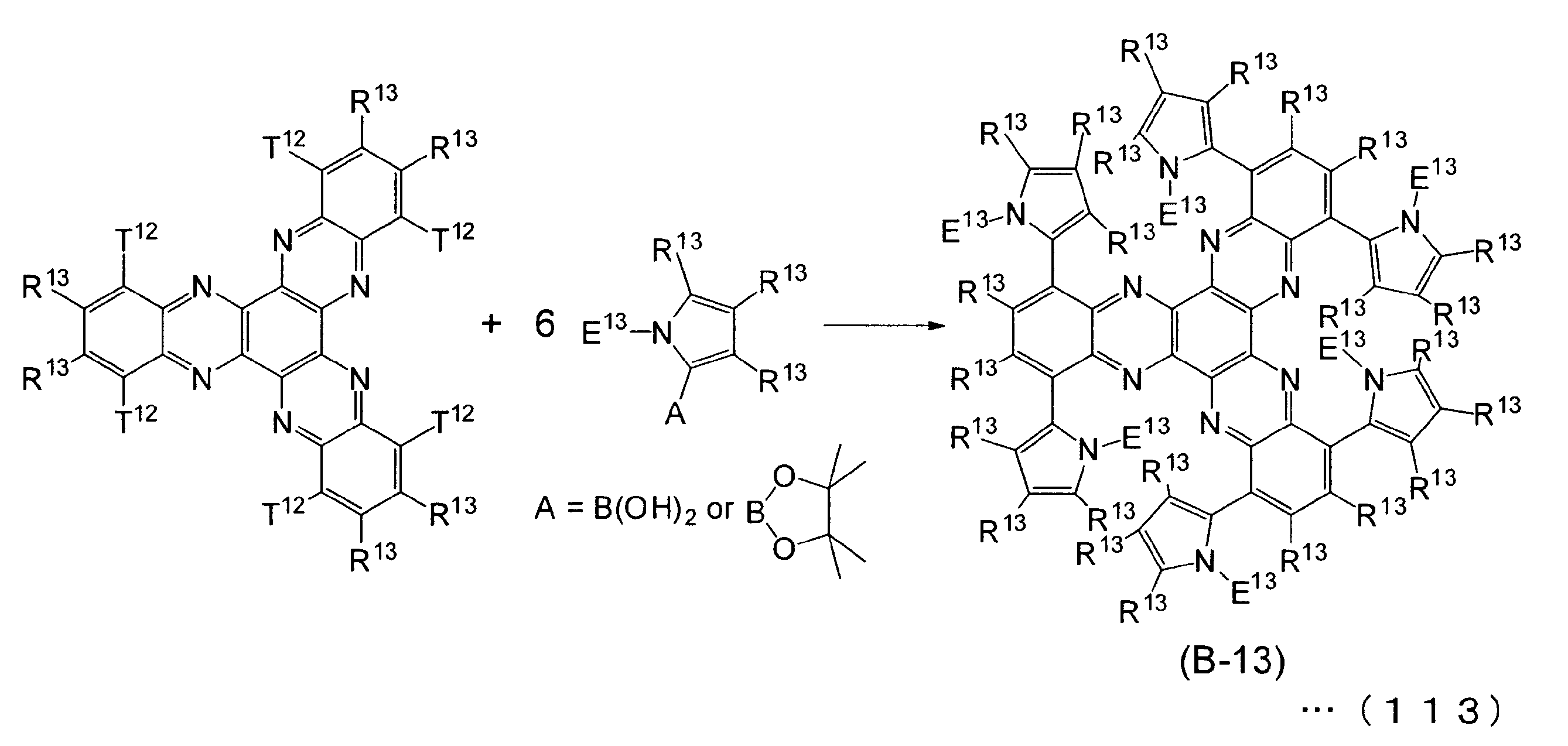
一般式(B-14)で表される化合物は、例えば、以下の反応式(114)に示すように、3分子の2,9-ジハロゲノ-1,10-フェナントロリンを環状に連結することで製造することができる。連結方法としては、ニッケルを触媒として用いる山本カップリングや熊田・玉尾カップリング、銅を触媒として用いるウルマン反応が例示される。

一般式(B-15)で表される化合物は、例えば、以下の反応式(115)に示すように、3分子の2,9-ジハロゲノ-1,10-フェナントロリン-5,6-ジオンを環状に連結することで製造することができる。連結方法としては、ニッケルを触媒として用いる山本カップリングや熊田・玉尾カップリング、銅を触媒として用いるウルマン反応が例示される。
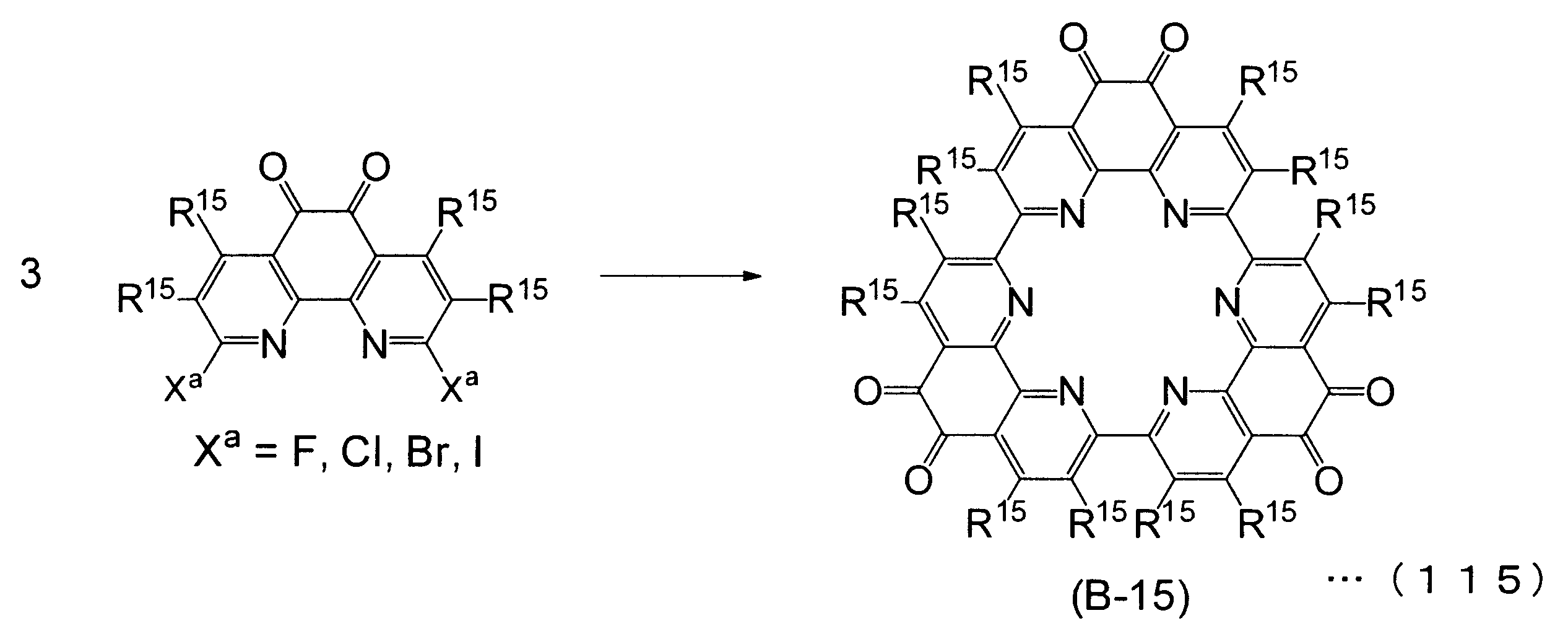
一般式(B-16)で表される化合物は、例えば、以下の反応式(116)に示すように、2,9-ジハロゲノ-1,10-フェナントロリンと2分子のキノリンホウ酸体を連結することで製造することができる。連結方法としては、一般的なクロスカップリング反応が挙げられ、特に鈴木カップリングが好ましい。

一般式(B-17)で表される化合物は、例えば、以下の反応式(117)に示すように、2,9-ジハロゲノ-1,10-フェナントロリンと2分子のインドールホウ酸体を連結することで製造することができる。連結方法としては、一般的なクロスカップリング反応が挙げられ、特に鈴木カップリングが好ましい。

一般式(B-18)で表される化合物は、例えば、以下の反応式(118)に示すように、一般式(B-17)で表される化合物の誘導体とアルデヒド又はケトンを反応させることで製造することができる。
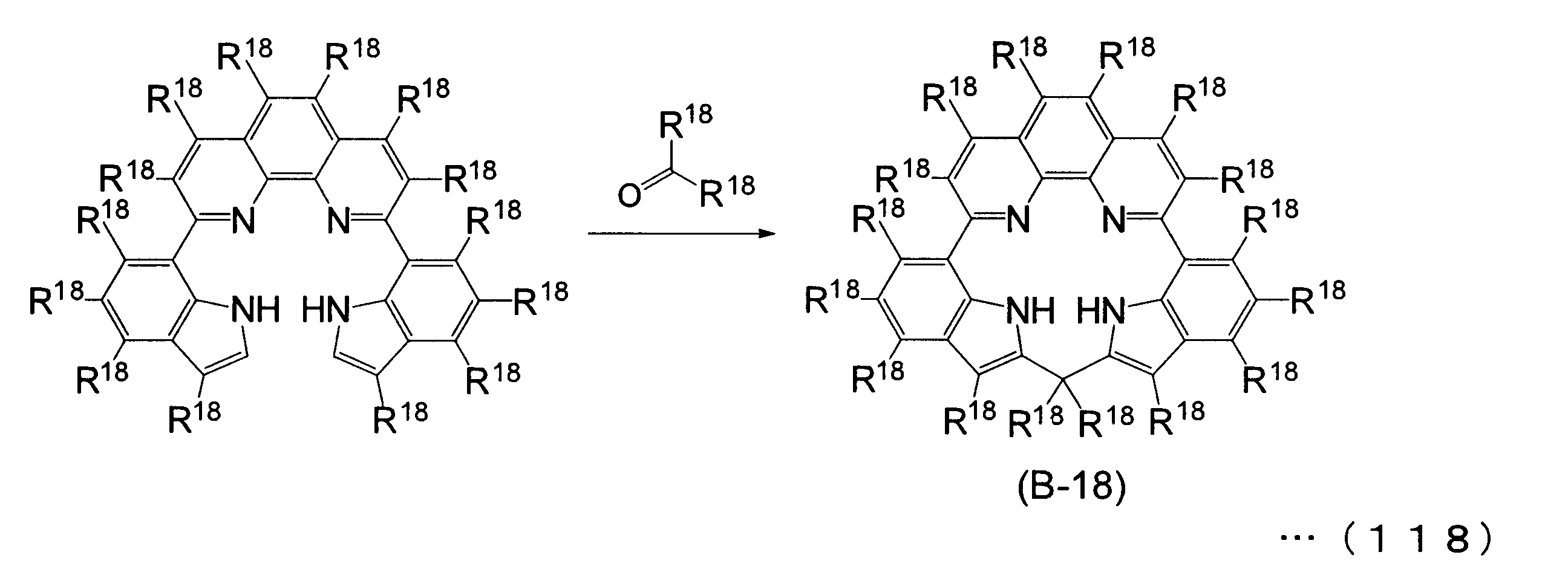
一般式(B-19)で表される化合物は、例えば、以下の反応式(119)に示すように、一般式(B-17)で表される化合物の誘導体とアルデヒドを、酸化剤存在下で反応させることで製造することができる。一般式(B-19)で表される化合物の別の製造方法としては、一般式(B-18)で表される化合物の誘導体を酸化剤で酸化する方法を用いることができる。
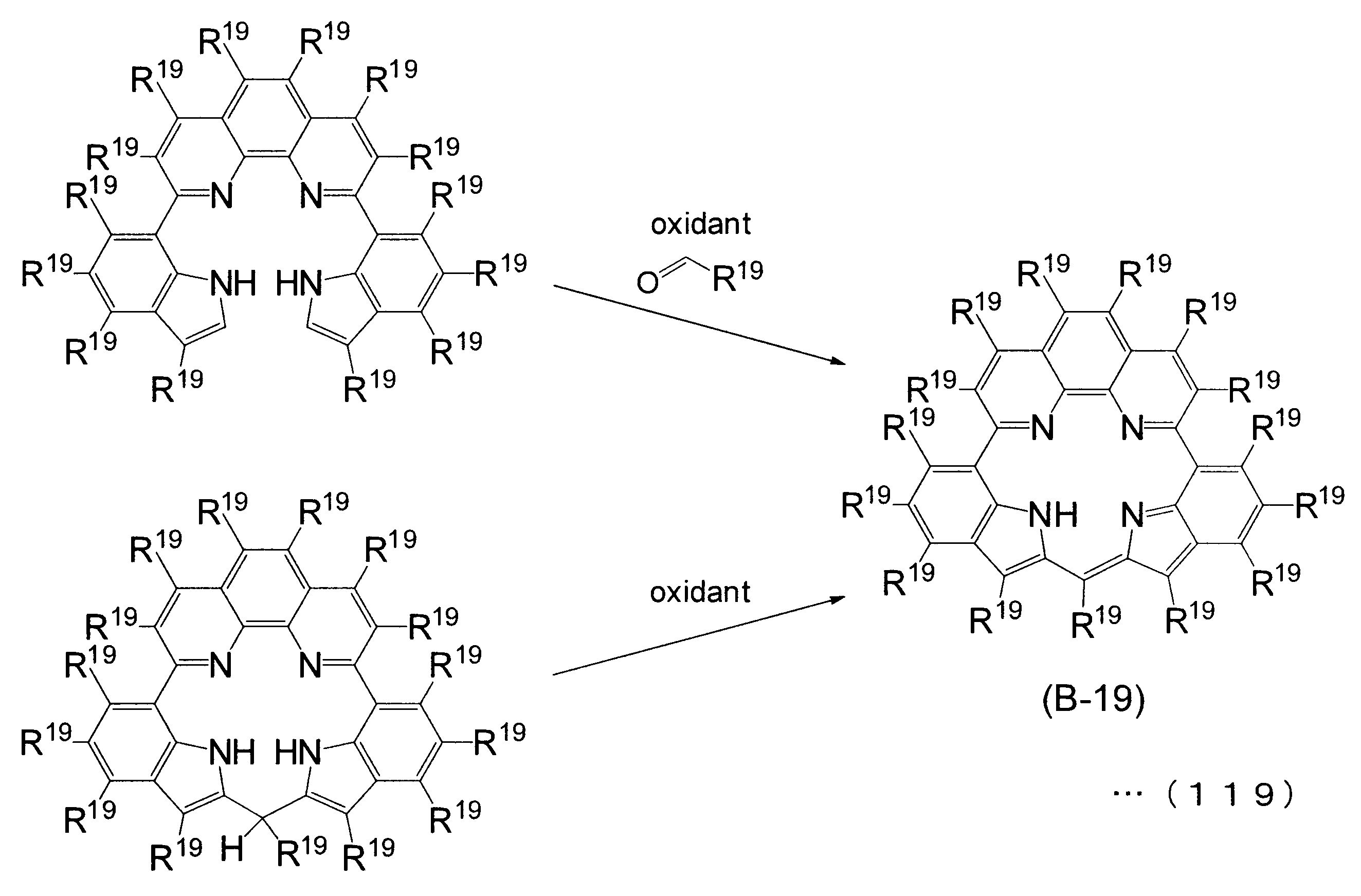
一般式(B-20)で表される化合物は、例えば、以下の反応式(120)に示すように、2,9-ジハロゲノ-1,10-フェナントロリンとピロールボロン酸との2分子ずつを環状に連結することで製造することができる。連結方法としては、クロスカップリング反応が挙げられ、鈴木カップリングが好ましい。
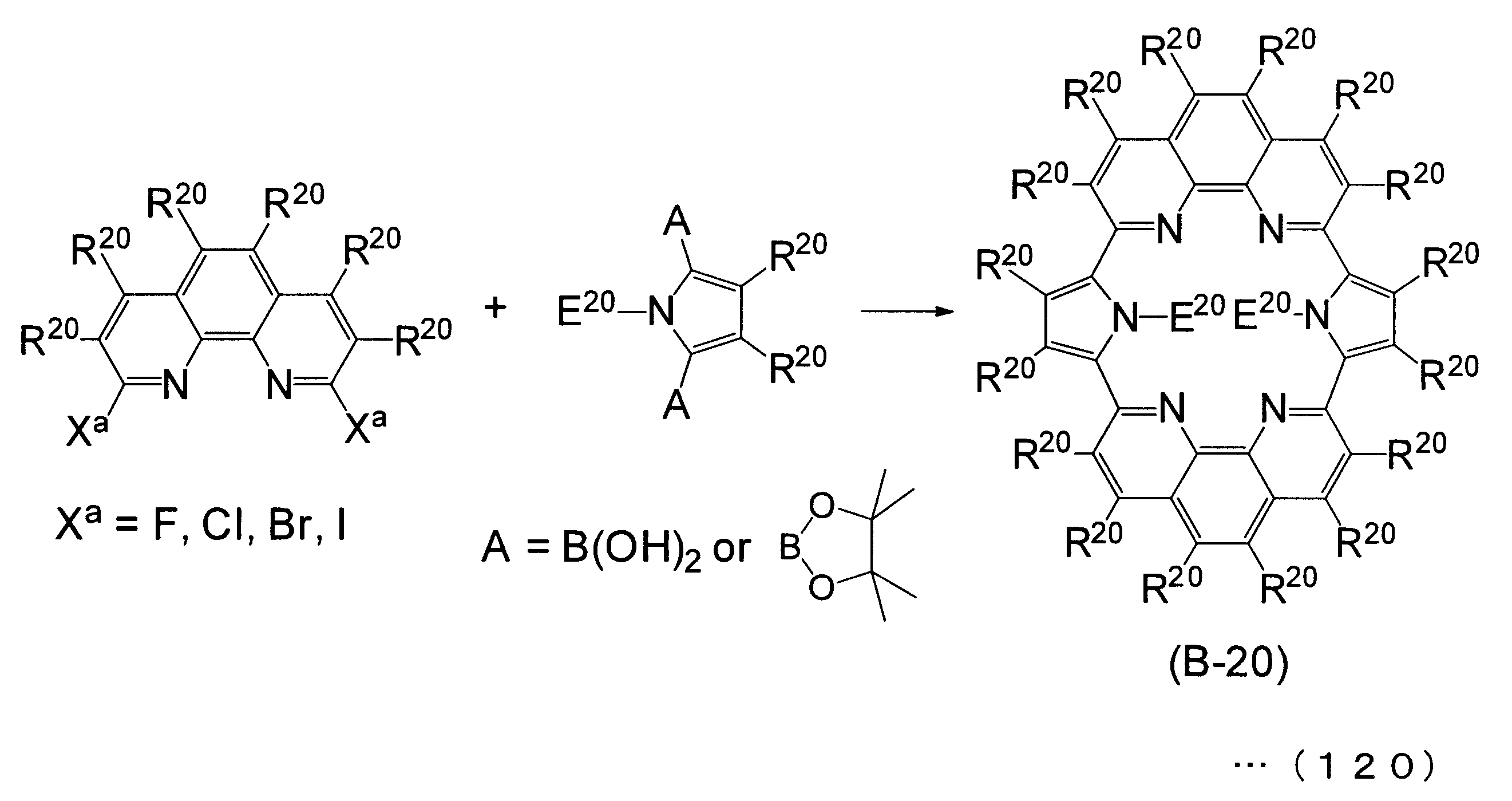
一般式(B-22)で表される化合物は、例えば、カルバゾール誘導体とピロール誘導体とを2分子ずつを環状に連結することで製造することができる。連結方法としては、クロスカップリング反応が挙げられ、鈴木カップリングが好ましい。
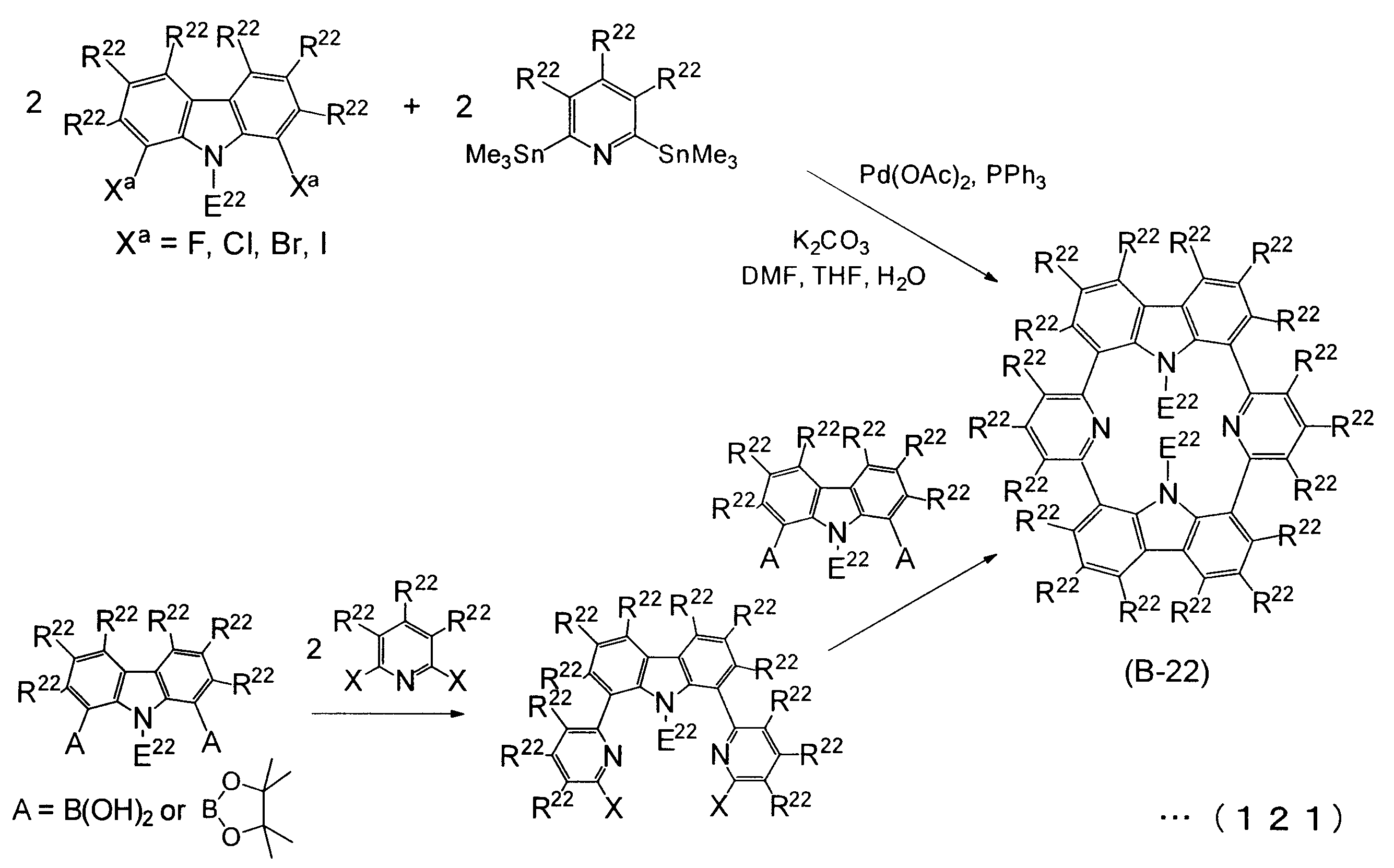
一般式(B-11)で表される化合物を原料とした場合には、例えば、以下の反応式(122)に示すように、一般式(B-11)で表される化合物とヘキサケトシクロヘキサンとを酢酸中で反応させることにより、前記本実施形態の多核金属錯体の配位子として用いることのできる芳香族化合物を製造することができる。

一般式(B-12)で表される化合物を原料とした場合には、例えば、以下の反応式(123)に示すように、一般式(B-12)で表される化合物に6つの含窒素芳香族複素環を結合させることで、前記本実施形態の多核金属錯体の配位子として用いることのできる芳香族化合物を製造することができる。結合させる方法としては、クロスカップリング反応が挙げられる。
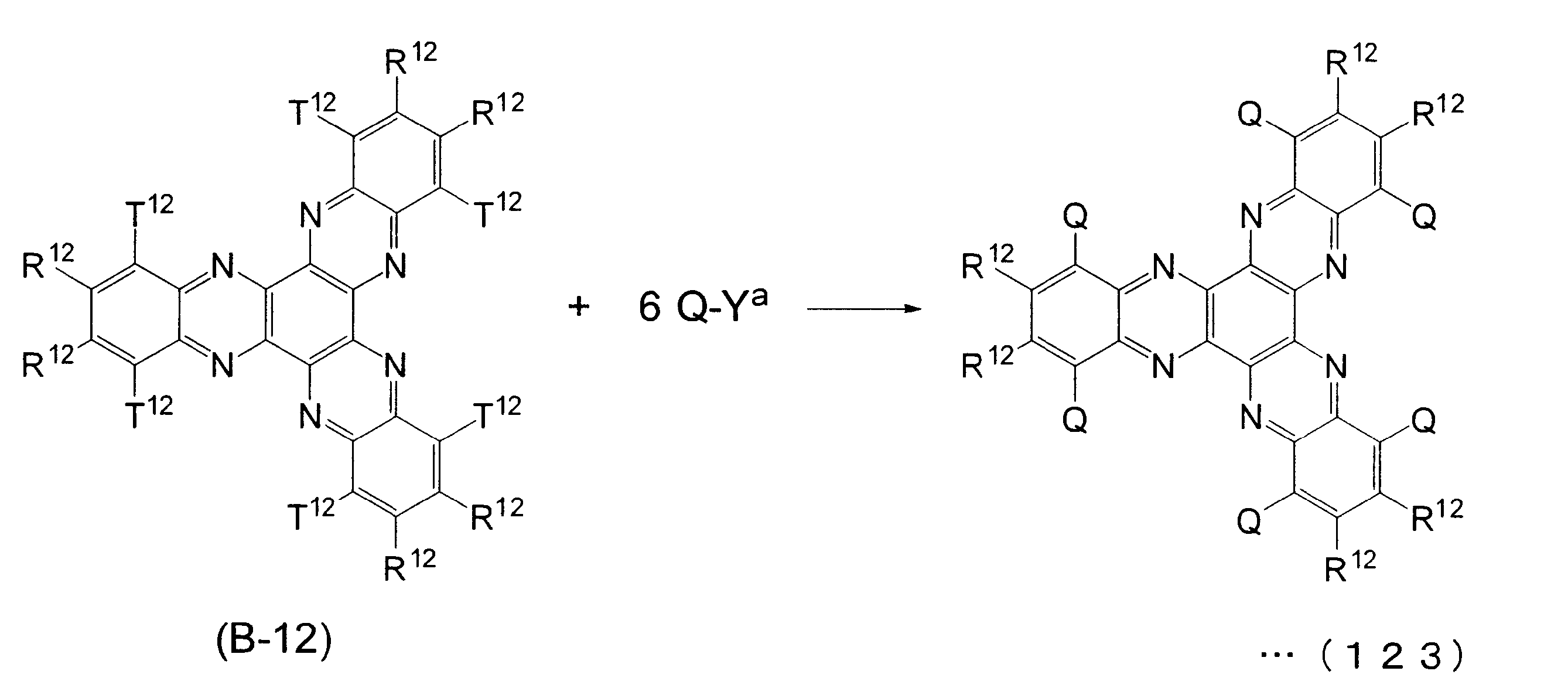
一般式(B-13)で表される化合物を原料とした場合には、例えば、以下の反応式(124)に示すように、一般式(B-13)で表される化合物の窒素原子に結合している保護基を脱保護することで、前記本実施形態の多核金属錯体の配位子として用いることのできる芳香族化合物を製造することができる。脱保護の方法としては、一般的な脱保護の操作、加熱、マイクロ波照射等を用いることができる。
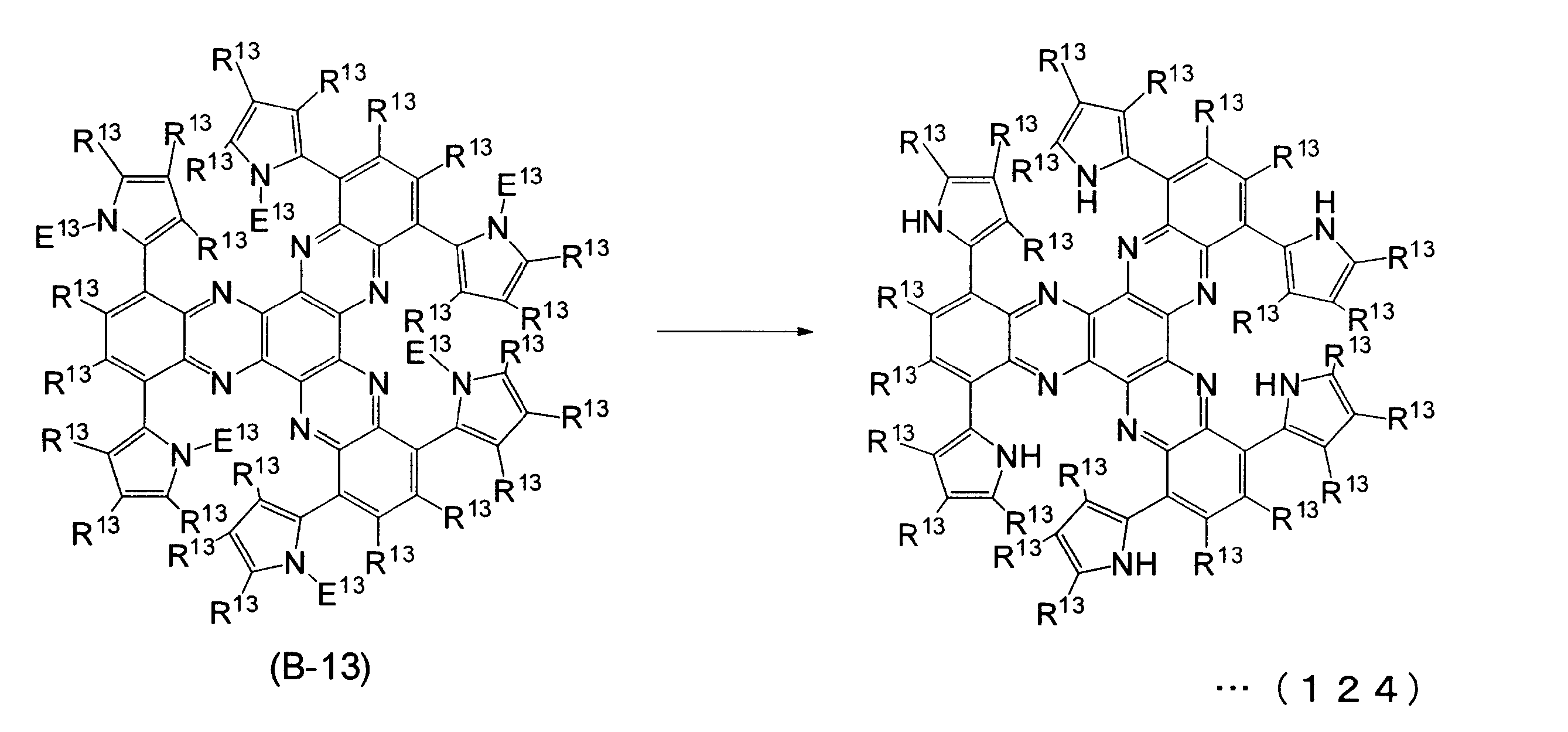
一般式(B-17)で表される化合物を原料とした場合には、例えば、以下の反応式(125)に示すように、一般式(B-17-a)で表される化合物を合成した後、トリフルオロ酢酸でオキソ体とした後、酢酸アンモニウムと共に二分子を反応させることで、前記本実施形態の多核金属錯体の配位子として用いることのできる芳香族化合物を製造することができる。

前記本実施形態の多核金属錯体の配位子として用いることのできる芳香族化合物は、以下の反応式(126)のように、更に反応させて閉環構造としてもよい。
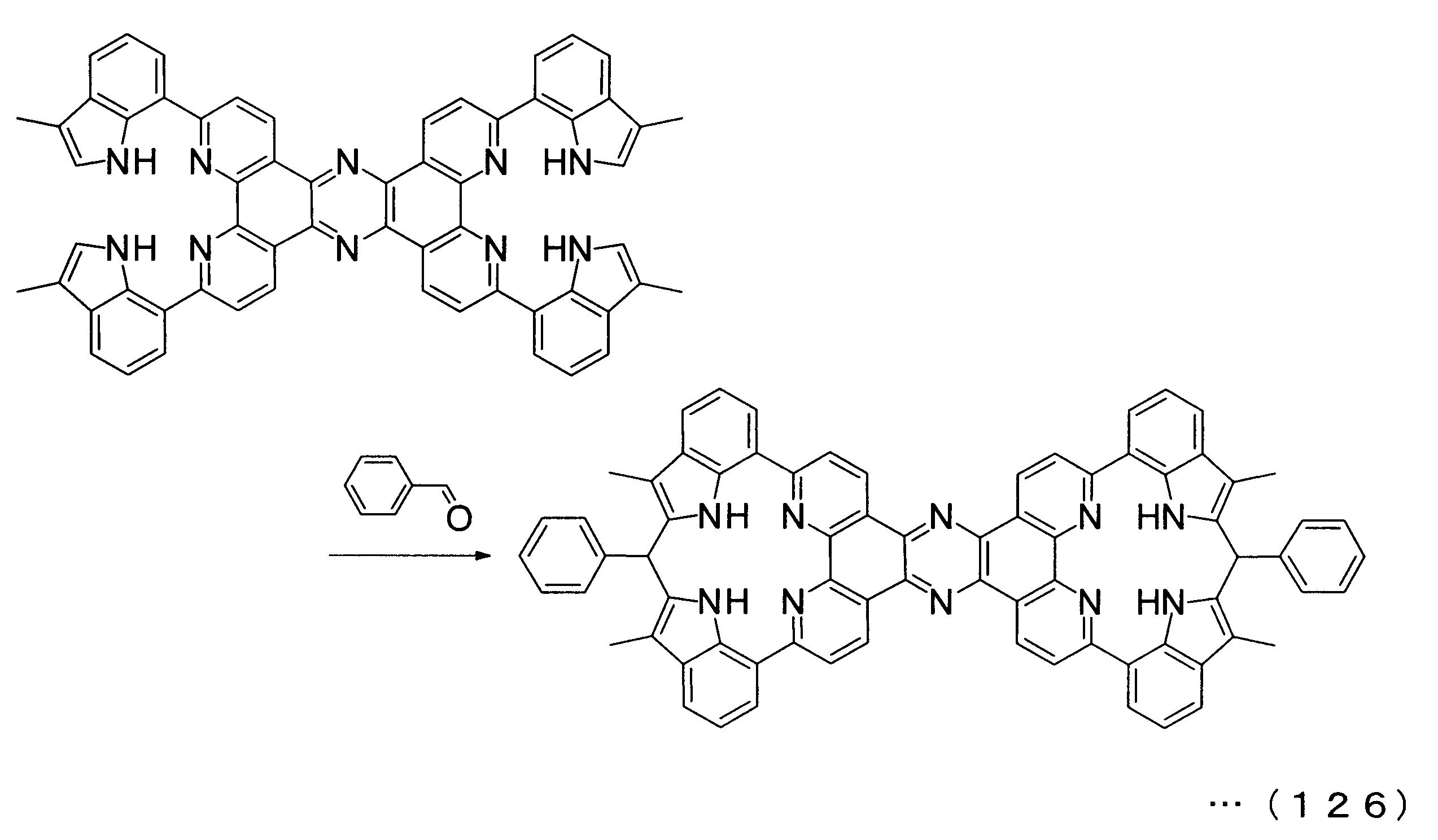
前記本実施形態の多核金属錯体の配位子として用いることのできる芳香族化合物は、例えば、以下の反応式(127)のように、一般式(B-18-a)で表される化合物を経由して製造することもできる。
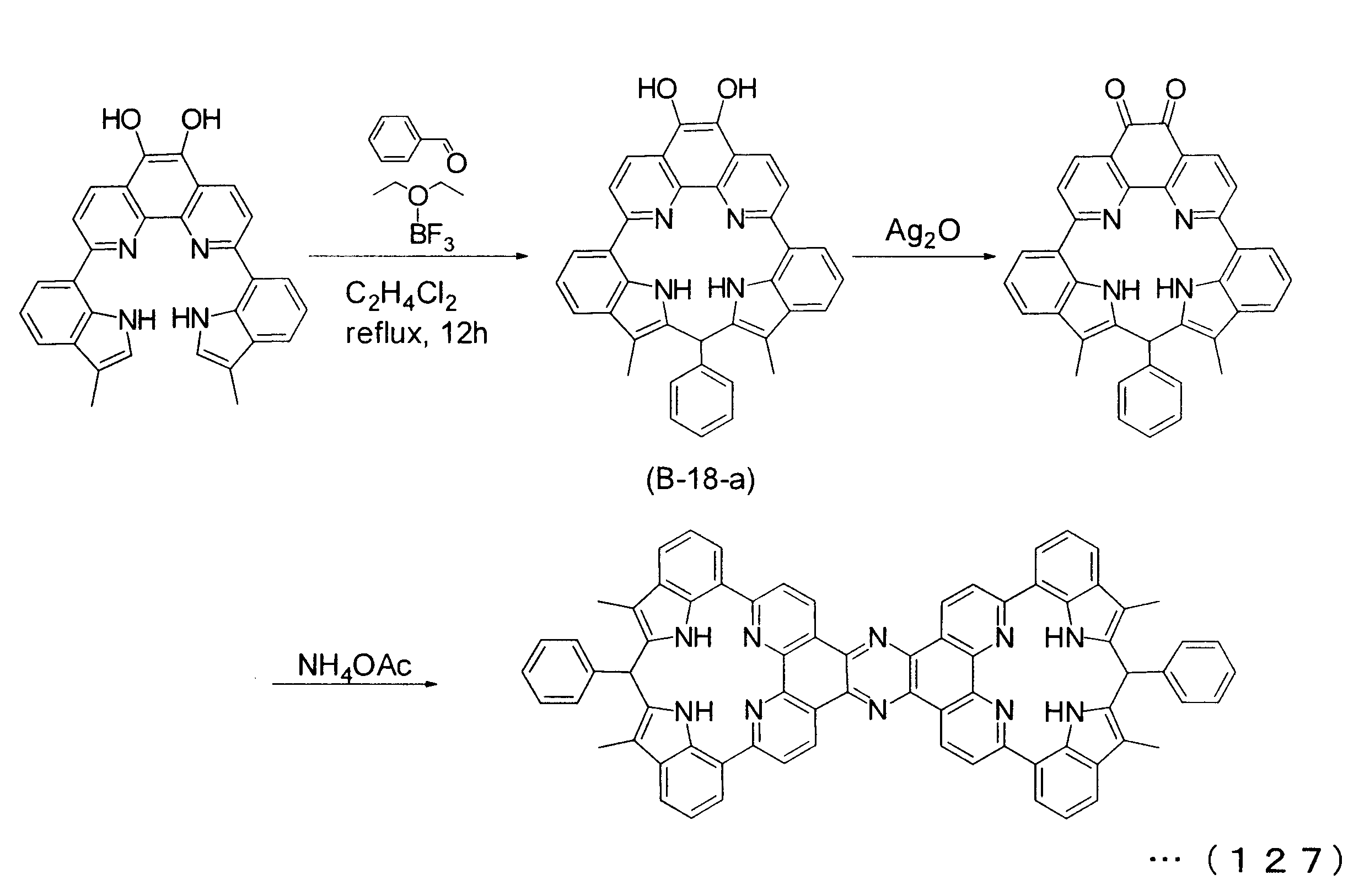
上記本実施形態の多核金属錯体の配位子として用いることのできる芳香族化合物は、以下の反応式(128)のように、2,3-ジクロロ-5,6-ジシアノ-p-ベンゾキノン(DDQ)等の酸化剤を用いて酸化体としてもよい。
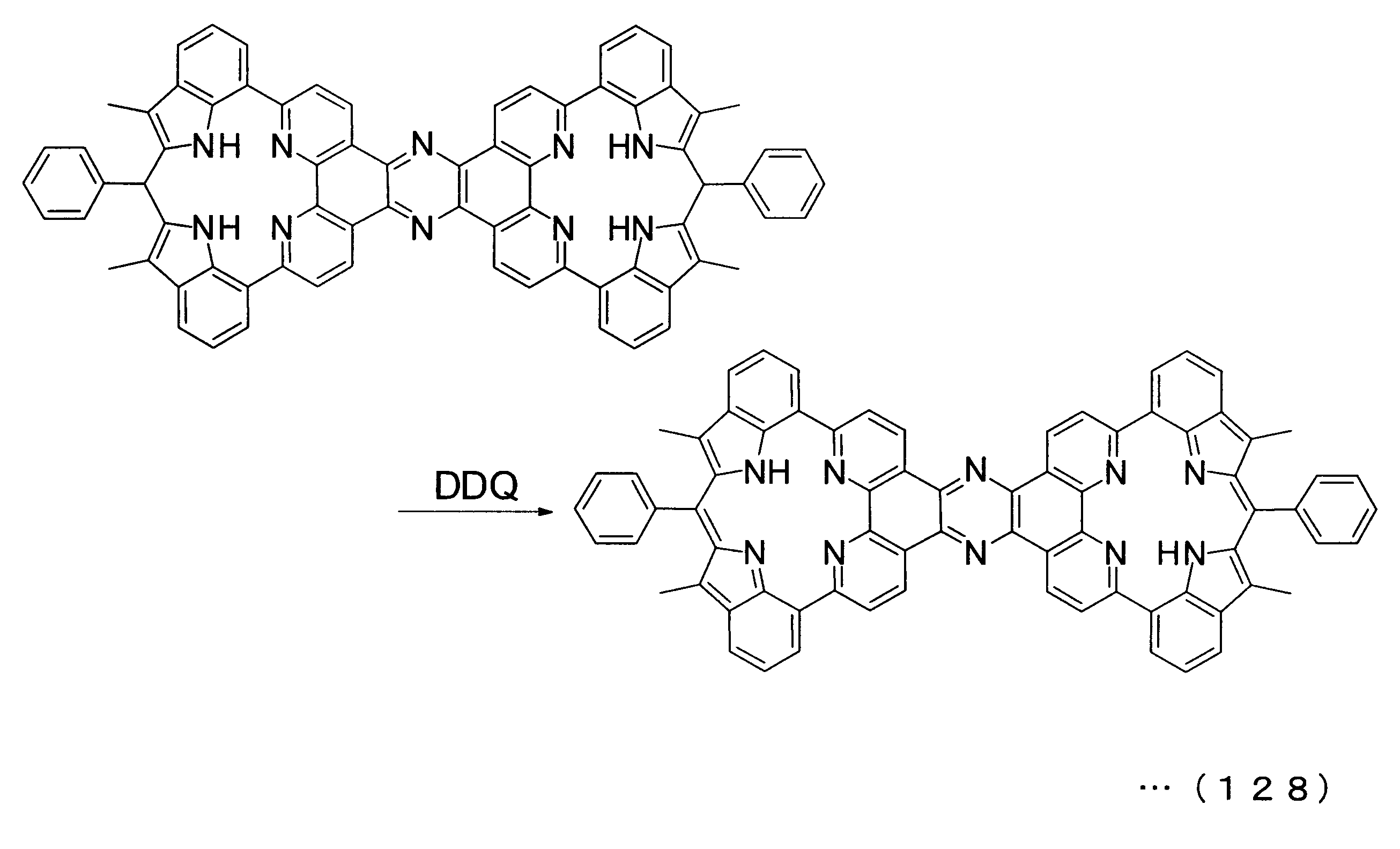
前記本実施形態の多核金属錯体の配位子として用いることのできる芳香族化合物は、例えば、以下の反応式(129)に示すように、一般式(B-18-b)で表される化合物を合成した後、加熱縮合により製造することができる。

前記本実施形態の多核金属錯体の配位子として用いることのできる芳香族化合物は、2以上の含窒素芳香族複素環を連結させた高分子化合物として製造することができる。その一例を下記反応式(130)に示す。

上記反応式中のQ4は、配位可能な窒素原子を2つ有する含窒素芳香族複素環である。
その具体的な構造式を以下に示す。これらの構造式における水素原子は上述の置換基で置換されてもよい。
その具体的な構造式を以下に示す。これらの構造式における水素原子は上述の置換基で置換されてもよい。

本実施形態の芳香族化合物の製造方法として例示した上記反応式(130)について、より具体的な反応式を以下の反応式(131)に示す。
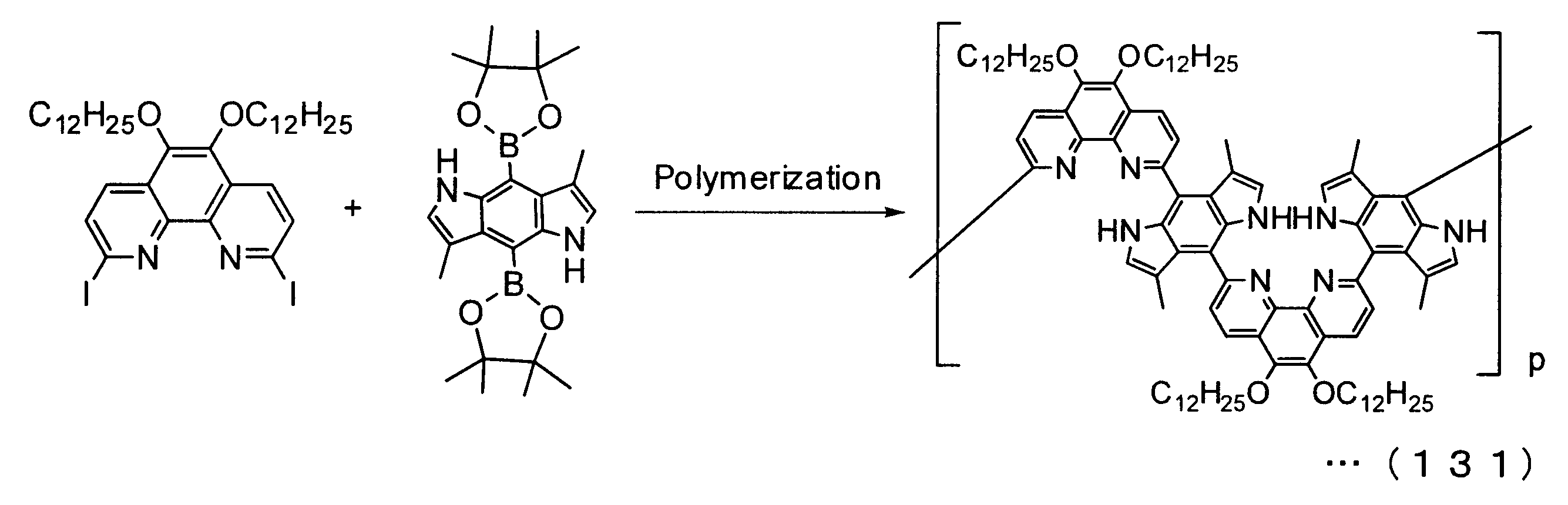
上記反応の原料となる化合物は、それぞれ以下の反応式(132)、(133)に従って、合成することができる。
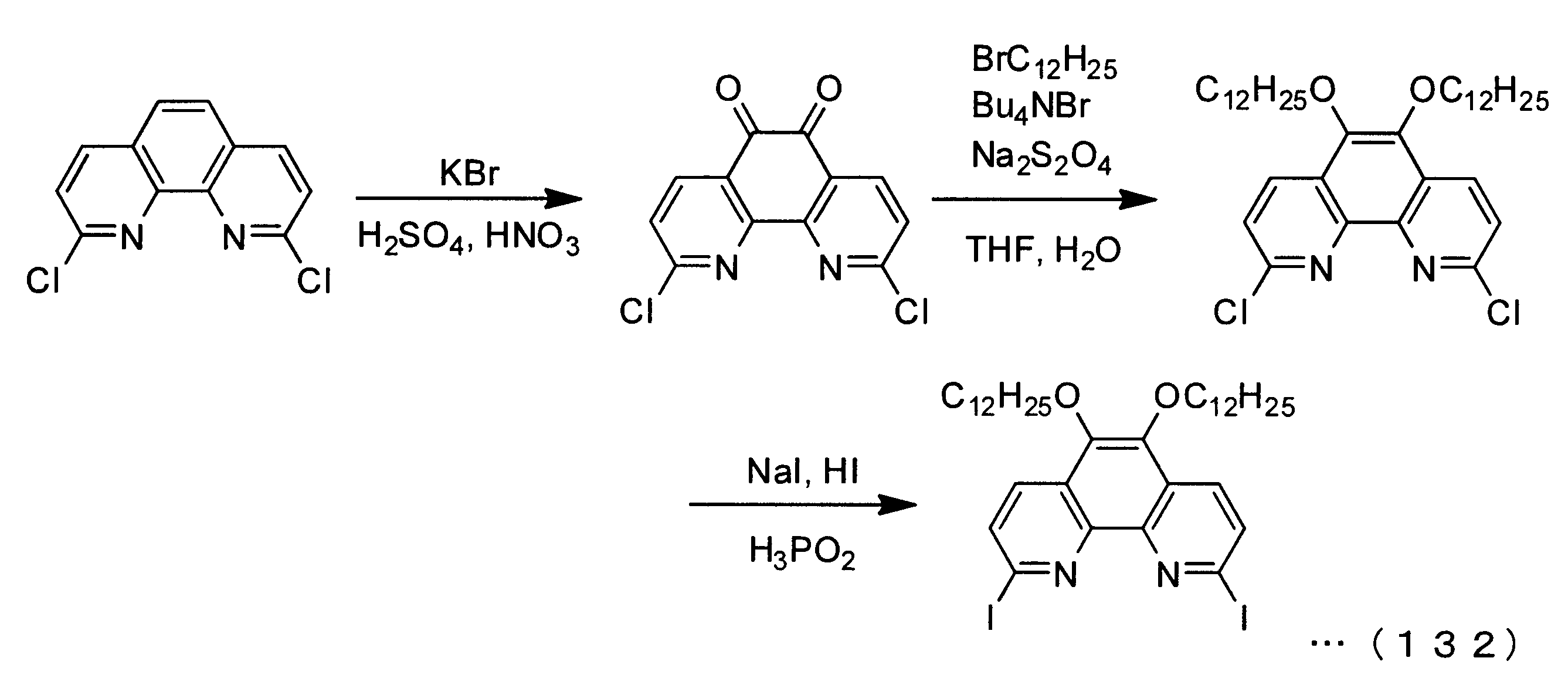

上記得られた芳香族化合物は、以下の反応式(134)に示すように、アルデヒド類と反応させて、中心金属を収容する空間を形成する構造が閉環型となる高分子化合物とすることができる。
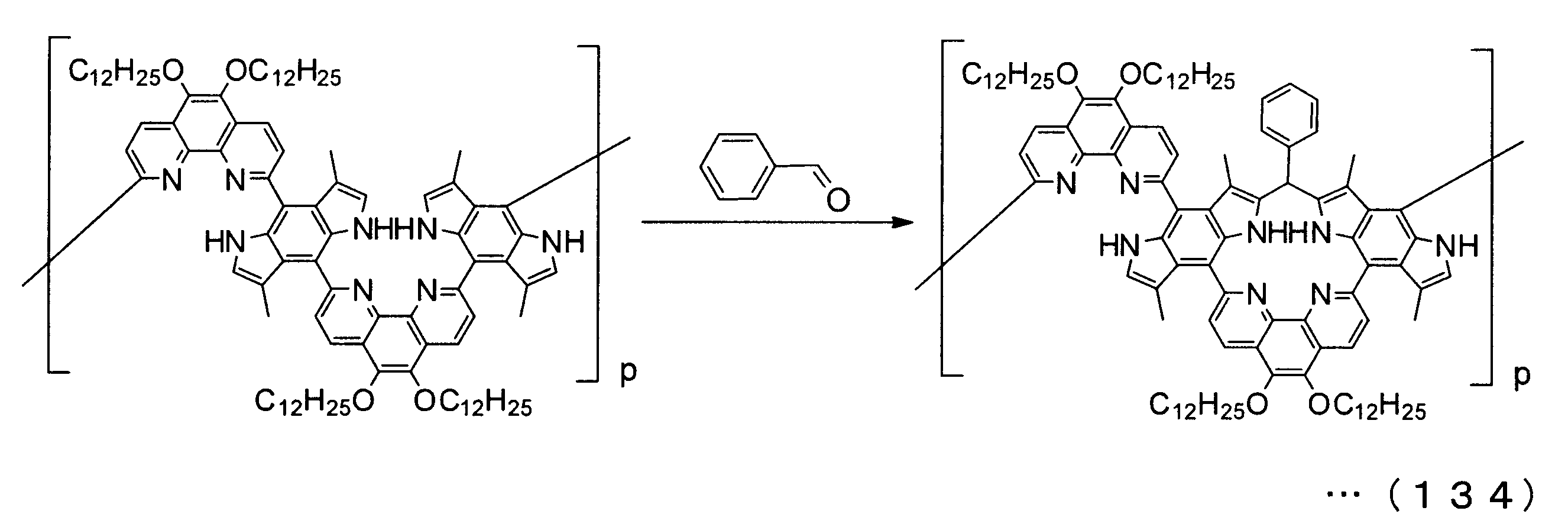
前記芳香族化合物は、以下の反応式(135)、(136)に従って製造される高分子化合物を用いて合成してもよい。


前記本実施形態の多核金属錯体の配位子として用いることのできる芳香族化合物は、上記構造を1つ有する化合物を合成した後、それらを連結することで製造することもできる。
上記構造を有する化合物は、例えば、下記反応式(137)に示すように、含窒素芳香族複素環を2つ有する化合物に、2つ以上の含窒素芳香族複素環を連結させることで製造することができる。連結方法としては、一般的なクロスカップリング反応が挙げられる。

また、下記反応式(138)に示すように、上記反応式(137)で得られた化合物を更に反応させて環化させてもよい。
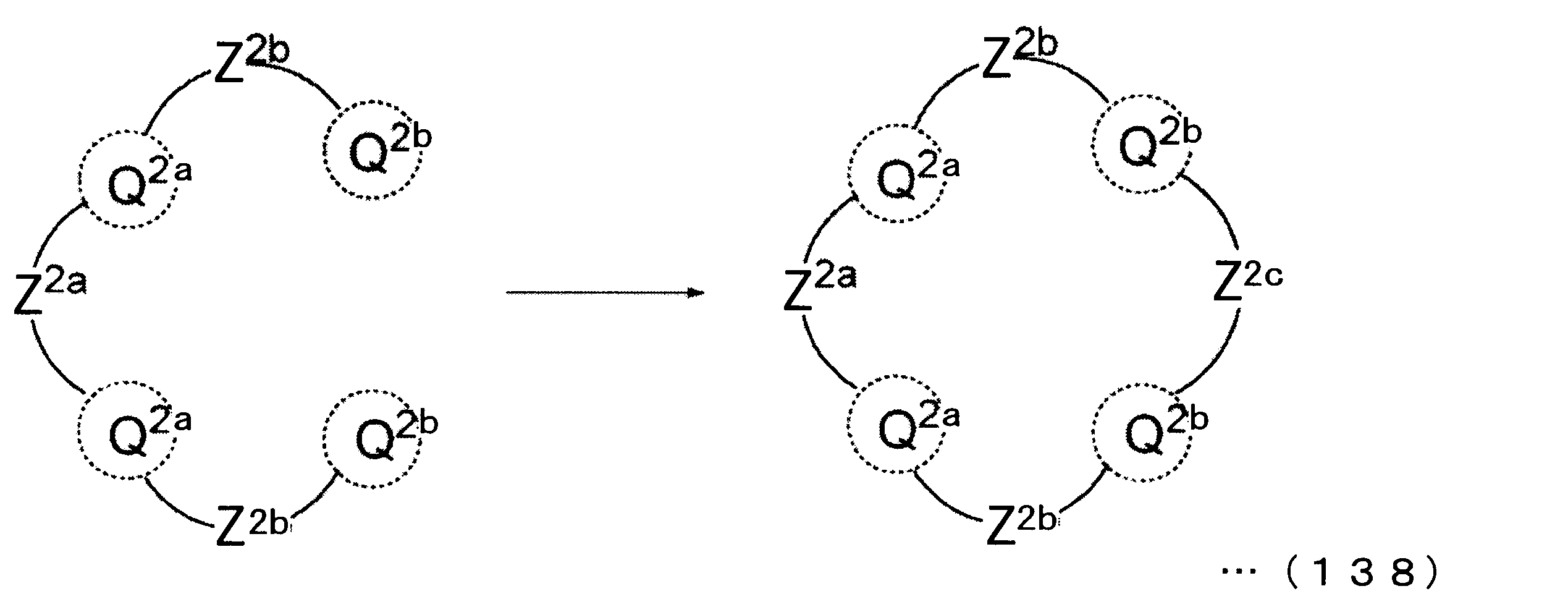
また、下記反応式(139)、(140)に示すように含窒素芳香族複素環を2つ有する2以上の化合物を、環化させることで上記構造を有する化合物を製造することもできる。


下記反応式に示すように、中心金属を収容する空間を形成する構造を有する化合物を連結することで本実施形態の芳香族化合物を製造することもできる。連結方法としては、例えば、以下の反応式(141)に示すような、ハロゲノ基を有する化合物を山本カップリングで連結する方法が挙げられる。
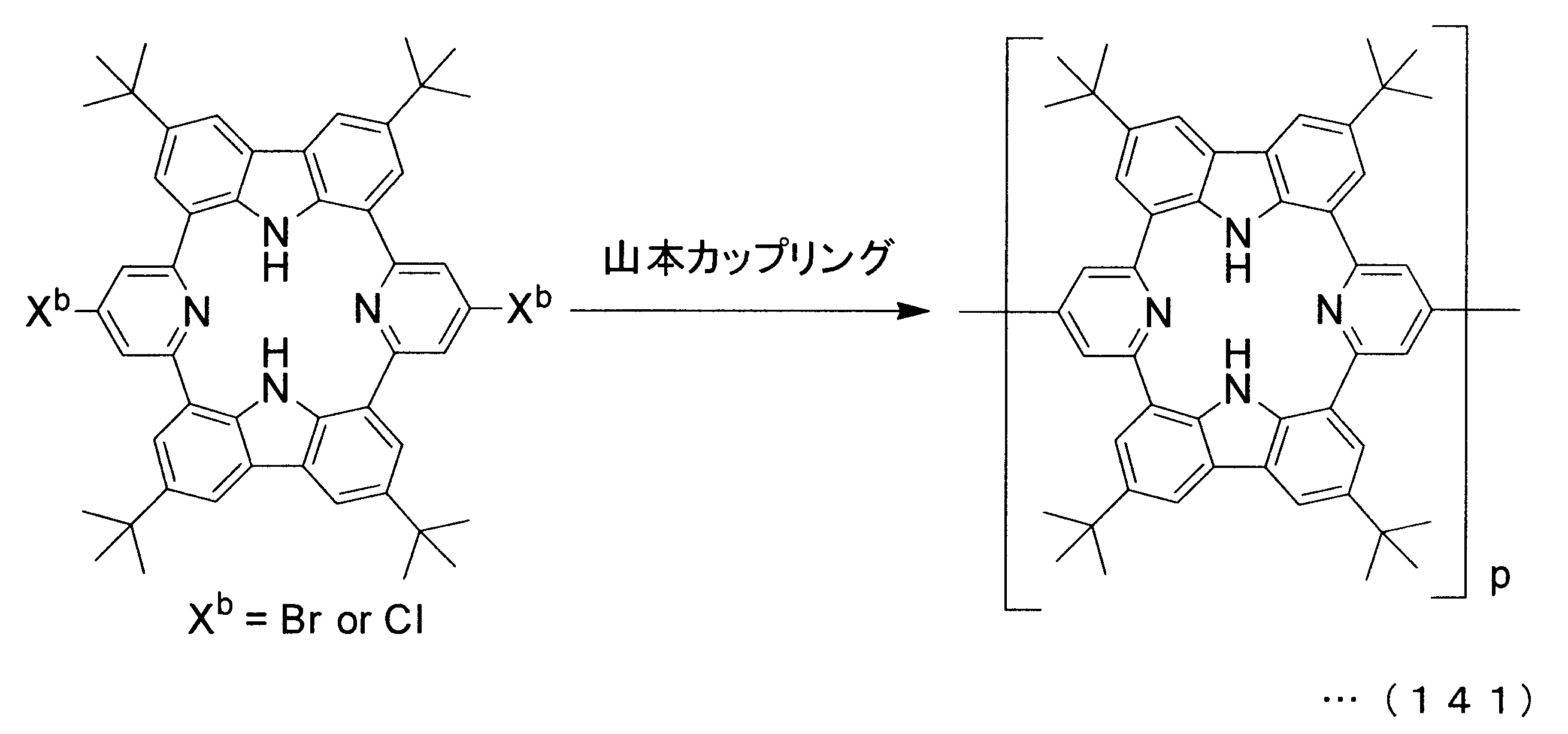
また、前記連結方法としては、以下の反応式(142)に示すように、例えば、ホウ酸エステル体とハロゲノ基を有する化合物をSuzukiカップリングで連結する方法が挙げられる。反応式(142)に示すホウ酸エステル体は、例えば、Journal of the American Chemical Society, 129,15434 (2007).に記載された方法を参考にして製造することができる。
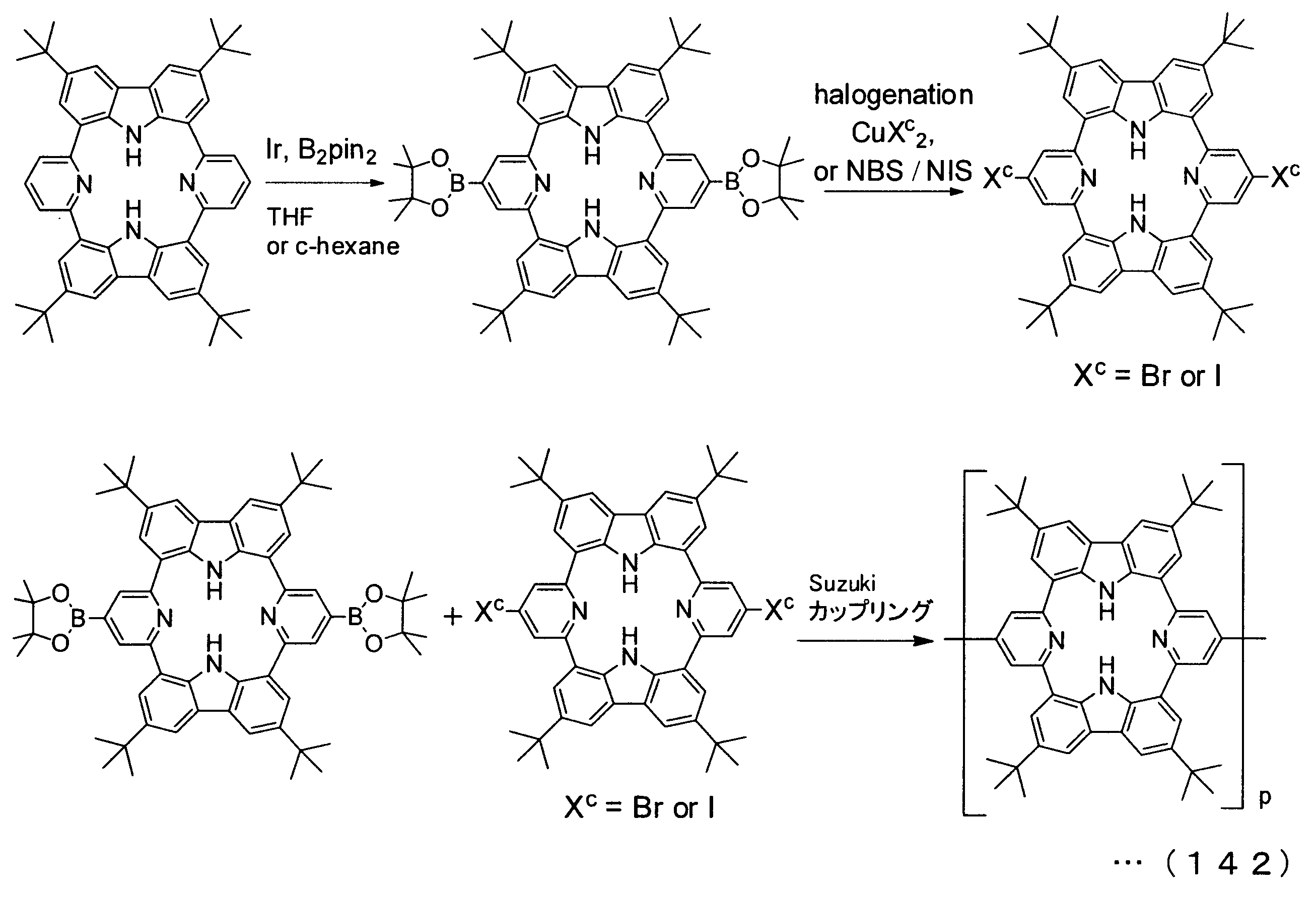
前記本実施形態の多核金属錯体の配位子として用いることのできる芳香族化合物は、上記要件(a)、(b)を満たす配位子に加えて、以下の式(B-24)~(B-29)で表される分子構造を有する化合物から1つ又は2以上の水素原子が取り除かれた有機基を含んでいてもよい。下記構造式(B-24)~(B-29)で表される化合物中の水素原子は、上述の置換基で置換されていてもよい。
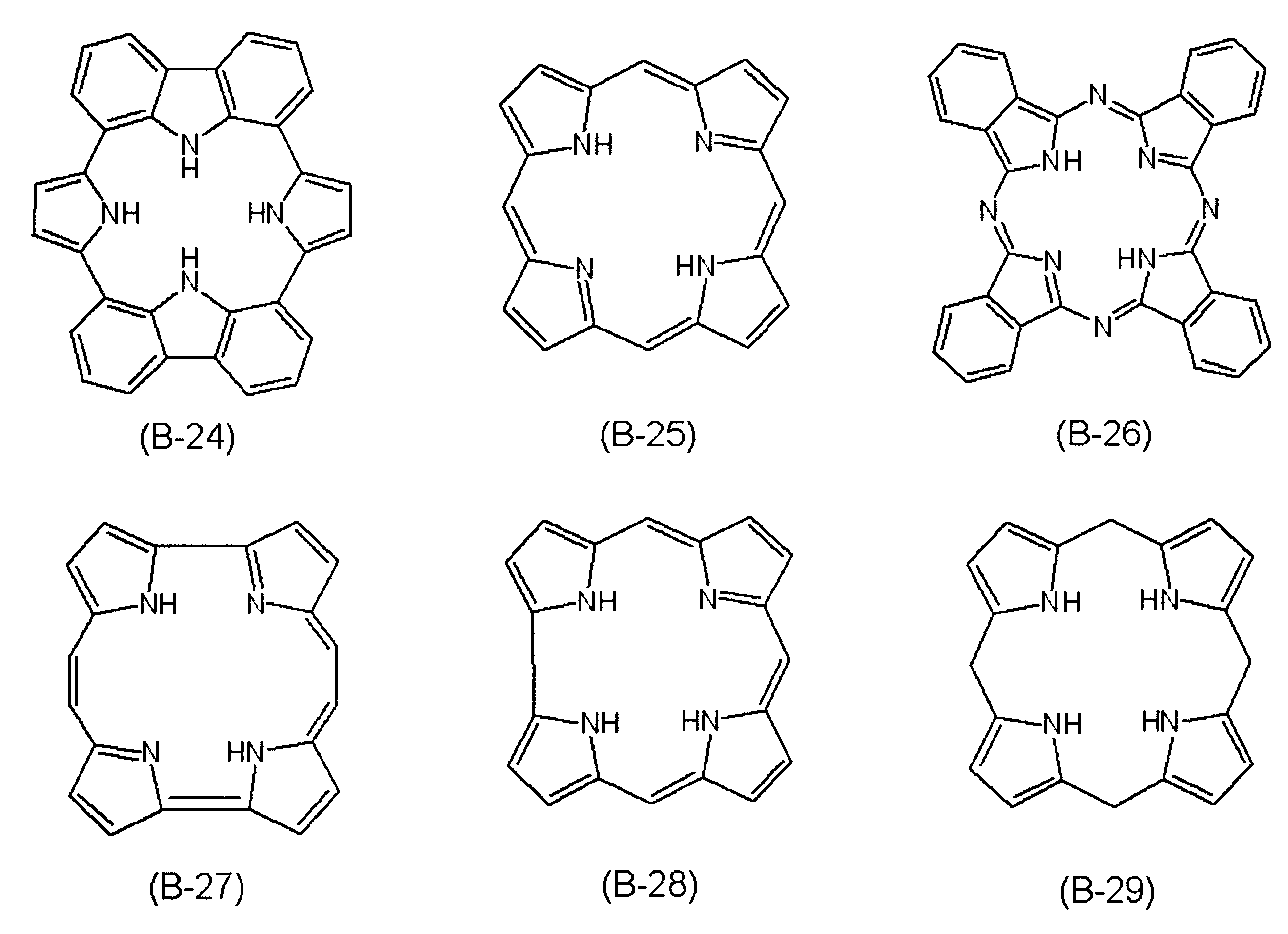
上記式(B-24)で示される化合物は、以下の反応式(143)に示すようにジハロゲノ-カルバゾールとピロールボロン酸との2分子ずつを環状に連結することで製造することができる。連結方法は、クロスカップリング反応を用いることができ、特に鈴木カップリングが好ましい。
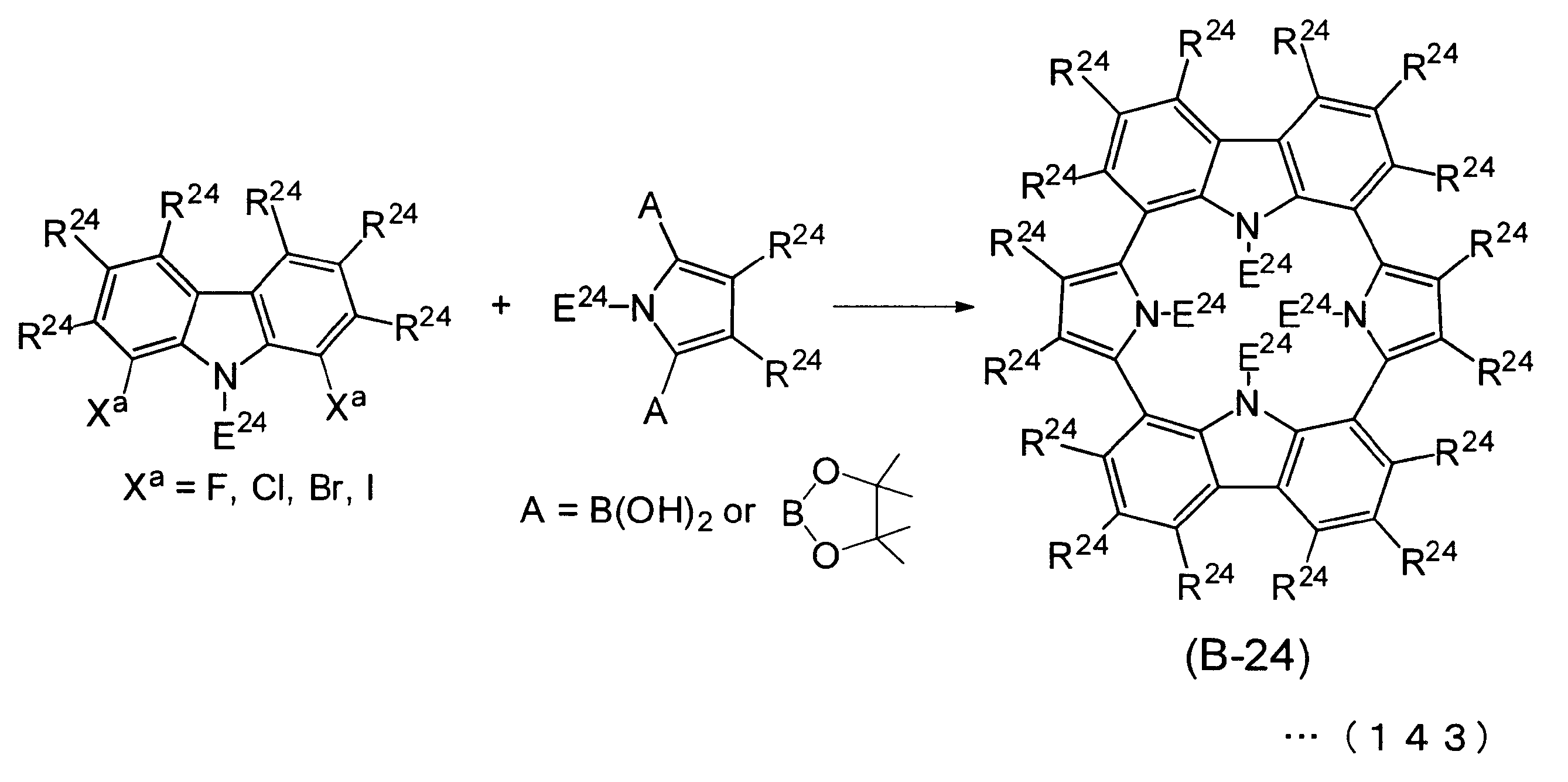
(多核金属錯体の製造方法)
前記多核金属錯体は、例えば、以下に示すように、配位子となる化合物(以下、「配位子化合物」と言う。)を有機化学的に合成し、これを遷移金属原子又は遷移金属イオンを付与する反応剤(以下、「金属付与剤」と言う。)と混合する工程を有する方法で製造できる。
前記多核金属錯体は、例えば、以下に示すように、配位子となる化合物(以下、「配位子化合物」と言う。)を有機化学的に合成し、これを遷移金属原子又は遷移金属イオンを付与する反応剤(以下、「金属付与剤」と言う。)と混合する工程を有する方法で製造できる。
前記金属付与剤は、前記金属原子を陽イオンとして有する塩が用いられる。金属付与剤としては、塩化物塩、臭化物塩、ヨウ化物塩、酢酸塩、硝酸塩、硫酸塩、炭酸塩が好ましい。
前記金属付与剤は、上述の第1の多核金属錯体においては、例えば、前記一般式(A-1)~(A-3)中の遷移金属原子であるMと対イオンであるX1との組み合わせからなる金属塩であり、好ましいM及びX1は先に説明した通りであるが、マンガン、鉄、コバルト、ニッケル又は銅であるMと、酢酸イオン、塩化物イオン又は硝酸イオンであるX1との組み合わせが好ましく、酢酸コバルトが特に好ましい。前記金属付与剤は、無水物であっても水和物であってもよい。
前記金属付与剤は、上述の第1の多核金属錯体においては、例えば、前記一般式(A-1)~(A-3)中の遷移金属原子であるMと対イオンであるX1との組み合わせからなる金属塩であり、好ましいM及びX1は先に説明した通りであるが、マンガン、鉄、コバルト、ニッケル又は銅であるMと、酢酸イオン、塩化物イオン又は硝酸イオンであるX1との組み合わせが好ましく、酢酸コバルトが特に好ましい。前記金属付与剤は、無水物であっても水和物であってもよい。
前記配位子化合物及び金属付与剤を混合する工程は、適当な溶媒の存在下で行う。
反応で用いられる溶媒(反応溶媒)としては、水;酢酸、プロピオン酸等の有機酸類;アンモニア水、トリエチルアミン等のアミン類;メタノール、エタノール、n-プロパノ-ル、イソプロピルアルコール、2-メトキシエタノール、1-ブタノール、1,1-ジメチルエタノール等のアルコール類;エチレングリコール、ジエチルエーテル、1,2-ジメトキシエタン、メチルエチルエーテル、1,4-ジオキサン、テトラヒドロフラン(以下、「THF」と言う。)、ベンゼン、トルエン、キシレン、メシチレン、デュレン、デカリン等の芳香族炭化水素;ジクロロメタン、クロロホルム、四塩化炭素、クロロベンゼン、1,2-ジクロロベンゼン等のハロゲン系溶媒、N,N’-ジメチルホルムアミド(以下、「DMF」と言う。)、N,N’-ジメチルアセトアミド、N-メチル-2-ピロリドン、ジメチルスルホキシド、アセトン、アセトニトリル、ベンゾニトリル、トリエチルアミン、ピリジン、ピラジン、ジアザビシクロ[2,2,2]オクタン等が挙げられる。これらの反応溶媒は、一種単独で用いても二種以上を併用してもよい。また、前記溶媒としては、配位子となる芳香族化合物及び金属付与剤が溶解し得る溶媒が好ましい。
反応で用いられる溶媒(反応溶媒)としては、水;酢酸、プロピオン酸等の有機酸類;アンモニア水、トリエチルアミン等のアミン類;メタノール、エタノール、n-プロパノ-ル、イソプロピルアルコール、2-メトキシエタノール、1-ブタノール、1,1-ジメチルエタノール等のアルコール類;エチレングリコール、ジエチルエーテル、1,2-ジメトキシエタン、メチルエチルエーテル、1,4-ジオキサン、テトラヒドロフラン(以下、「THF」と言う。)、ベンゼン、トルエン、キシレン、メシチレン、デュレン、デカリン等の芳香族炭化水素;ジクロロメタン、クロロホルム、四塩化炭素、クロロベンゼン、1,2-ジクロロベンゼン等のハロゲン系溶媒、N,N’-ジメチルホルムアミド(以下、「DMF」と言う。)、N,N’-ジメチルアセトアミド、N-メチル-2-ピロリドン、ジメチルスルホキシド、アセトン、アセトニトリル、ベンゾニトリル、トリエチルアミン、ピリジン、ピラジン、ジアザビシクロ[2,2,2]オクタン等が挙げられる。これらの反応溶媒は、一種単独で用いても二種以上を併用してもよい。また、前記溶媒としては、配位子となる芳香族化合物及び金属付与剤が溶解し得る溶媒が好ましい。
前記配位子化合物及び金属付与剤の混合温度は、好ましくは-10℃以上250℃以下、より好ましくは0℃以上200℃以下であり、特に好ましくは0℃以上150℃以下である。
また、前記配位子化合物及び金属付与剤の混合時間は、好ましくは1分間以上1週間以下、より好ましくは5分間以上24時間以下、特に好ましくは1時間以上12時間以下である。前記混合温度及び混合時間は、前記配位子化合物及び金属付与剤の種類を考慮して調節することが好ましい。
生成した前記多核金属錯体は、公知の再結晶法、再沈殿法、クロマトグラフィー法から適した方法を選択して適用することで、前記溶媒から取り出すことができ、この時、2以上の前記方法を組み合わせてもよい。前記溶媒の種類によっては、生成した前記多核金属錯体が析出することがあり、この場合には、析出した前記多核金属錯体を濾別等で分離した後、洗浄、乾燥等を行えばよい。
(空気二次電池用正極触媒及びその製造方法)
本実施形態の空気二次電池用正極触媒は、前記多核金属錯体を用いてなる。前記多核金属錯体は、一種を単独で用いてもよいし、二種以上を併用してもよい。また、前記多核金属錯体は、単独で用いてもよいし、その他の成分と併用し、組成物として用いてもよい。
本実施形態の空気二次電池用正極触媒は、前記多核金属錯体を用いてなる。前記多核金属錯体は、一種を単独で用いてもよいし、二種以上を併用してもよい。また、前記多核金属錯体は、単独で用いてもよいし、その他の成分と併用し、組成物として用いてもよい。
前記その他の成分としては、カーボンが例示できる。前記その他の成分は、一種を単独で用いてもよいし、二種以上を併用してもよい。
前記カーボンとしては、「ノーリット」(NORIT社製)、「ケッチェンブラック」(Lion社製)、「バルカン」(Cabot社製)、「ブラックパールズ」(Cabot社製)、「アセチレンブラック」(電気化学工業社製)(いずれも商品名)等のカーボンブラック;C60、C70等のフラーレン;カーボンナノチューブ、マルチウォールカーボンナノチューブ、ダブルウォールカーボンナノチューブ、シングルウォールカーボンナノチューブ、カーボンナノホーン等のカーボン繊維、グラフェン、グラフェンオキシドが例示でき、カーボンブラックが好ましい。
前記カーボンは、ポリピロール、ポリアニリン等の導電性高分子と組み合わせて用いてもよい。
前記カーボンは、ポリピロール、ポリアニリン等の導電性高分子と組み合わせて用いてもよい。
前記多核金属錯体とカーボンとを含む組成物は、これら成分を混合することで調製できる。
前記組成物において、前記多核金属錯体の含有量は、前記組成物の量を100質量部とした時に、1質量部以上であることが好ましく、5質量部以上であることがより好ましく、10質量部以上であることが特に好ましい。また、前記含有量の上限値は、70質量部以下であることが好ましく、60質量部以下であることがより好ましく、50質量部以下であることが特に好ましい。上限値と下限値は任意に組み合わせることができる。
前記組成物において、前記多核金属錯体の含有量は、前記組成物の量を100質量部とした時に、1質量部以上であることが好ましく、5質量部以上であることがより好ましく、10質量部以上であることが特に好ましい。また、前記含有量の上限値は、70質量部以下であることが好ましく、60質量部以下であることがより好ましく、50質量部以下であることが特に好ましい。上限値と下限値は任意に組み合わせることができる。
カーボンを含む前記組成物においては、前記多核金属錯体として、多核金属錯体の残基(前駆体となる多核金属錯体から誘導された構成単位)を有するポリマー(以下、「多核金属錯体ポリマー」と言うことがある。)を用いてもよい。
前記多核金属錯体ポリマーは、上記で説明した多核金属錯体において、1つ以上の水素原子を除去した構造の基を有するポリマーを意味し、すべての水素原子を除去してもよい。多核金属錯体としては、上記で説明した多核金属錯体が例示できる。
前記多核金属錯体ポリマーは、上記で説明した多核金属錯体において、1つ以上の水素原子を除去した構造の基を有するポリマーを意味し、すべての水素原子を除去してもよい。多核金属錯体としては、上記で説明した多核金属錯体が例示できる。
前記多核金属錯体ポリマーの主骨格となるポリマーは、限定されないが、導電性高分子、デンドリマー、天然高分子、固体高分子電解質、ポリエチレン、ポリエチレングリコール、ポリプロピレンが例示でき、導電性高分子、固体高分子電解質が好ましい。
前記導電性高分子とは、金属的又は半金属的な導電性を示す高分子物質の総称である。前記導電性高分子としては、「導電性ポリマー」(吉村進一著、共立出版)や「導電性高分子の最新応用技術」(小林征男監修、シーエムシー出版)に記載されているような、ポリアセチレン及びその誘導体、ポリパラフェニレン及びその誘導体、ポリパラフェニレンビニレン及びその誘導体、ポリアニリン及びその誘導体、ポリチオフェン及びその誘導体、ポリピロール及びその誘導体、ポリフルオレン及びその誘導体、ポリフルオレン及びその誘導体、ポリカルバゾール及びその誘導体、ポリインドール及びその誘導体、並びに二種以上のこれらポリマーの共重合体が例示できる。
前記固体高分子電解質としては、パーフルオロスルホン酸、ポリエーテルエーテルケトン、ポリイミド、ポリフェニレン、ポリアリーレン又はポリアリーレンエーテルスルホンをスルホン化した高分子化合物が例示できる。
前記導電性高分子とは、金属的又は半金属的な導電性を示す高分子物質の総称である。前記導電性高分子としては、「導電性ポリマー」(吉村進一著、共立出版)や「導電性高分子の最新応用技術」(小林征男監修、シーエムシー出版)に記載されているような、ポリアセチレン及びその誘導体、ポリパラフェニレン及びその誘導体、ポリパラフェニレンビニレン及びその誘導体、ポリアニリン及びその誘導体、ポリチオフェン及びその誘導体、ポリピロール及びその誘導体、ポリフルオレン及びその誘導体、ポリフルオレン及びその誘導体、ポリカルバゾール及びその誘導体、ポリインドール及びその誘導体、並びに二種以上のこれらポリマーの共重合体が例示できる。
前記固体高分子電解質としては、パーフルオロスルホン酸、ポリエーテルエーテルケトン、ポリイミド、ポリフェニレン、ポリアリーレン又はポリアリーレンエーテルスルホンをスルホン化した高分子化合物が例示できる。
前記多核金属錯体ポリマーとカーボンとを含む組成物は、これら成分を混合することで調製できる。
前記組成物において、前記多核金属錯体ポリマーの含有量は、前記組成物の量を100質量部とした時に、1質量部以上であることが好ましく、5質量部以上であることがより好ましく、10質量部以上であることが特に好ましい。また、前記含有量の上限値は、70質量部以下であることが好ましく、60質量部以下であることがより好ましく、50質量部以下であることが特に好ましい。上限値と下限値は任意に組み合わせることができる。
前記組成物において、前記多核金属錯体ポリマーの含有量は、前記組成物の量を100質量部とした時に、1質量部以上であることが好ましく、5質量部以上であることがより好ましく、10質量部以上であることが特に好ましい。また、前記含有量の上限値は、70質量部以下であることが好ましく、60質量部以下であることがより好ましく、50質量部以下であることが特に好ましい。上限値と下限値は任意に組み合わせることができる。
本実施形態の好ましい空気二次電池用正極触媒としては、(1)前記多核金属錯体からなるもの、(2)前記多核金属錯体とカーボンとを含む組成物からなるもの、(3)前記多核金属錯体ポリマーとカーボンとを含む組成物からなるもの等、多核金属錯体、又は多核金属錯体とその他の成分とを含む組成物が例示できる。
また、本実施形態の好ましい空気二次電池用正極触媒としては、(4)前記多核金属錯体の加熱処理物からなるもの、(5)前記多核金属錯体とカーボンとを含む組成物の加熱処理物からなるもの、(6)前記多核金属錯体ポリマーとカーボンとを含む組成物の加熱処理物からなるもの等、多核金属錯体の加熱処理物、又は多核金属錯体とその他の成分とを含む組成物の加熱処理物(前記(1)~(3)の加熱処理物)からなるものが例示できる。
前記加熱処理は、例えば、対象物を加熱することで行う。
また、本実施形態の好ましい空気二次電池用正極触媒としては、(4)前記多核金属錯体の加熱処理物からなるもの、(5)前記多核金属錯体とカーボンとを含む組成物の加熱処理物からなるもの、(6)前記多核金属錯体ポリマーとカーボンとを含む組成物の加熱処理物からなるもの等、多核金属錯体の加熱処理物、又は多核金属錯体とその他の成分とを含む組成物の加熱処理物(前記(1)~(3)の加熱処理物)からなるものが例示できる。
前記加熱処理は、例えば、対象物を加熱することで行う。
前記加熱処理を行う場合には、その前処理として、温度を15~200℃とし、圧力を1333.22Pa以下とした条件下で、処理対象物を6時間以上乾燥させることが好ましい。このような前処理は、例えば、真空乾燥機を用いて行うことができる。
前記加熱処理は、水素、一酸化炭素等の還元ガス雰囲気;酸素、二酸化炭素、水蒸気等の酸化ガス雰囲気;窒素、ヘリウム、ネオン、アルゴン、クリプトン、キセノン等の不活性ガス雰囲気;アンモニア、アセトニトリル等の含窒素化合物又はその蒸気等のガス雰囲気下;二種以上のこれらガスからなる混合ガス雰囲気下で行うことが好ましい。
なかでも、例えば、還元ガス雰囲気下であれば、水素、又は水素及び前記不活性ガスの混合ガス雰囲気下、酸化ガス雰囲気下であれば、酸素、又は酸素及び前記不活性ガスの混合ガス雰囲気下、不活性ガス雰囲気下であれば、窒素、ネオン、アルゴン、又は二種以上のこれらガスからなる混合雰囲気下が好ましい。
なかでも、例えば、還元ガス雰囲気下であれば、水素、又は水素及び前記不活性ガスの混合ガス雰囲気下、酸化ガス雰囲気下であれば、酸素、又は酸素及び前記不活性ガスの混合ガス雰囲気下、不活性ガス雰囲気下であれば、窒素、ネオン、アルゴン、又は二種以上のこれらガスからなる混合雰囲気下が好ましい。
前記加熱処理時の圧力は、限定されないが、50.7~152.0kPa(0.5~1.5気圧)等、常圧又はその近傍圧力が好ましい。
前記加熱処理時の温度は、好ましくは250℃以上、より好ましくは300℃以上、更に好ましくは400℃以上、特に好ましくは500℃以上である。また、かかる温度は、好ましくは1500℃以下、より好ましくは1200℃以下、特に好ましくは1000℃以下である。上限値と下限値は任意に組み合わせることができる。
前記加熱処理時の時間は、前記ガスの種類、温度等に応じて設定できる。例えば、前記ガスを充填して密閉した環境下、又は前記ガスを通気させた環境下では、室温から徐々に昇温させて目的温度に到達させた後、すぐに降温させてもよい。ただし、目的温度に到達させた後、前記温度又はその近傍温度を所定時間維持することで、徐々に加熱することが好ましい。こうすることで、得られる触媒の耐久性をより向上させることができる。この時、前記温度を維持する時間は、好ましくは1時間~100時間、より好ましくは1~40時間、更に好ましくは2~10時間、特に好ましくは2~3時間である。
前記加熱処理を行う装置としては、オーブン、ファーネス(管状炉等)、IHホットプレートが例示できる。
前記加熱処理は、沸点若しくは融点が250℃以上である有機化合物、又は熱重合開始温度が250℃以下である有機化合物を添加して、行ってもよい。
沸点若しくは融点が250℃以上である前記有機化合物としては、ペリレン-3,4,9,10-テトラカルボン酸二無水物、3,4,9,10-ペリレンテトラカルボン酸ジイミド、1,4,5,8-ナフタレンテトラカルボン酸二無水物、1,4,5,8-ナフタレンテトラカルボン酸ジイミド、1,4,5,8-ナフタレンテトラカルボン酸、ピロメリット酸、二無水ピロメリット酸等の、芳香族系化合物のカルボン酸誘導体が例示できる。以下(A-8-1)~(A-8-14)に、このような化合物を例示する。
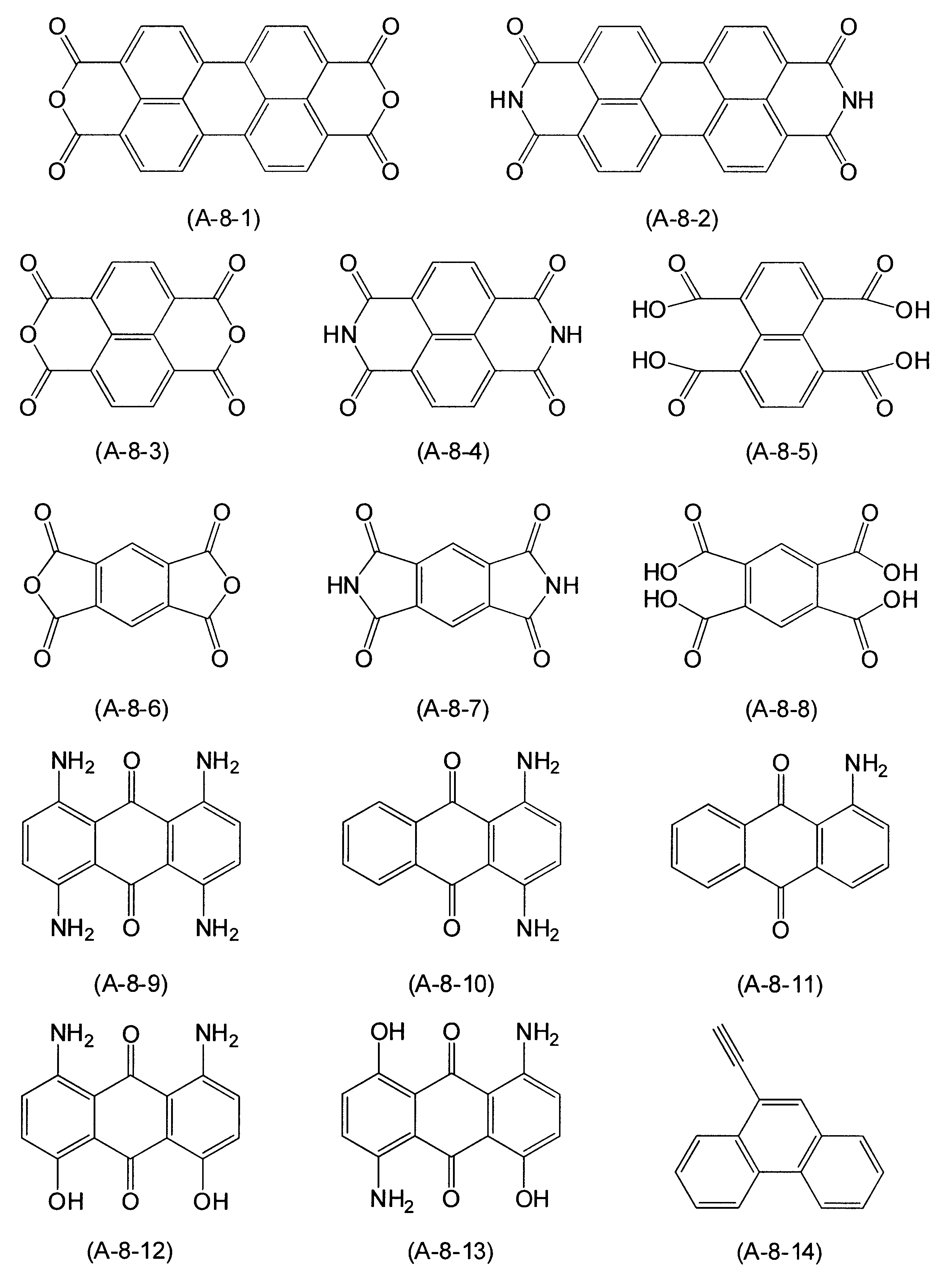
熱重合開始温度が250℃以下である前記有機化合物は、芳香環と二重結合又は三重結合とを有する有機化合物であり、アセナフチレン及びその誘導体、ビニルナフタレン及びその誘導体が例示でき、アセナフチレン及びビニルナフタレンが好ましい。
以上の空気二次電池用正極触媒は、酸素還元活性と水の酸化活性との両方に優れたものである。
<空気二次電池>
本実施形態の空気二次電池は、上記本実施形態の空気二次電池用正極触媒を正極触媒層に含み、亜鉛、鉄、アルミニウム、マグネシウム、リチウム、水素、及びこれらのイオンからなる群より選ばれる一種以上を負極活物質として用いたものであり、亜鉛、鉄、アルミニウム、マグネシウム、リチウム及び水素からなる群より選ばれる一種以上を負極活物質として用いたものが好ましい。
本実施形態の空気二次電池は、上記本実施形態の空気二次電池用正極触媒を正極触媒層に含み、亜鉛、鉄、アルミニウム、マグネシウム、リチウム、水素、及びこれらのイオンからなる群より選ばれる一種以上を負極活物質として用いたものであり、亜鉛、鉄、アルミニウム、マグネシウム、リチウム及び水素からなる群より選ばれる一種以上を負極活物質として用いたものが好ましい。
本実施形態の空気二次電池において、前記正極触媒は、一種を単独で用いてもよいし、二種以上を併用してもよい。
図1は、本実施形態に係る空気二次電池の一実施形態を例示する概略断面図である。
ここに示す空気二次電池1は、前記正極触媒を含む正極触媒層11、正極集電体12、負極活物質層13、負極集電体14、電解質15、及びこれらを収容する容器(図示略)を備える。
正極集電体12は正極触媒層11に接触して配置され、これらにより正極が構成されている。また、負極集電体14は負極活物質層13に接触して配置され、これらにより負極が構成されている。また、正極集電体12には正極端子(リード線)120が接続され、負極集電体14には負極端子(リード線)140が接続されている。
正極触媒層11及び負極活物質層13は、対向して配置され、これらの間にこれらに接触するように電解質15が配置されている。
本実施形態に係る空気二次電池は、ここに示すものに限定されず、必要に応じて一部構成が変更されていてもよい。
ここに示す空気二次電池1は、前記正極触媒を含む正極触媒層11、正極集電体12、負極活物質層13、負極集電体14、電解質15、及びこれらを収容する容器(図示略)を備える。
正極集電体12は正極触媒層11に接触して配置され、これらにより正極が構成されている。また、負極集電体14は負極活物質層13に接触して配置され、これらにより負極が構成されている。また、正極集電体12には正極端子(リード線)120が接続され、負極集電体14には負極端子(リード線)140が接続されている。
正極触媒層11及び負極活物質層13は、対向して配置され、これらの間にこれらに接触するように電解質15が配置されている。
本実施形態に係る空気二次電池は、ここに示すものに限定されず、必要に応じて一部構成が変更されていてもよい。
正極触媒層11は、前記正極触媒以外に、導電材及び結着材を含むものが好ましい。
前記導電材は、正極触媒層11の導電性を向上させることができるものであればよいが、カーボンが好ましい。ここでカーボンとは、前記その他の成分として説明及び例示したカーボンと同じである。
前記導電材は、ポリピロール、ポリアニリン等の導電性高分子と組み合わせて用いてもよい。
前記導電材は、正極触媒層11の導電性を向上させることができるものであればよいが、カーボンが好ましい。ここでカーボンとは、前記その他の成分として説明及び例示したカーボンと同じである。
前記導電材は、ポリピロール、ポリアニリン等の導電性高分子と組み合わせて用いてもよい。
前記結着材は、前記正極触媒、導電材等を正極集電体12に接着するものであり、例えば、電解質15として使用する電解液に溶解しないものが挙げられ、ポリテトラフルオロエチレン(PTFE)、テトラフルオロエチレン・パーフルオロアルキルビニルエーテル共重合体、テトラフルオロエチレン・ヘキサフルオロプロピレン共重合体、テトラフルオロエチレン・エチレン共重合体、ポリビニリデンフルオライド、ポリクロロトリフルオロエチレン、クロロトリフルオロエチレン・エチレン共重合体等のフッ素樹脂が好ましい。
正極触媒層11の前記正極触媒、導電材及び結着材の含有量は、限定されない。前記正極触媒の触媒活性をより向上させることができるので、導電材の配合量は、前記正極触媒1質量部に対して0.5~30質量部であることが好ましく、1~20質量部であることがより好ましく、1~15質量部であることが特に好ましく、結着材の配合量は、前記正極触媒1質量部に対して0.1~10質量部であることが好ましく、0.5~5質量部であることがより好ましく、0.5~3質量部であることが特に好ましい。
正極触媒層11において、前記正極触媒、導電材及び結着材等の各構成成分は、それぞれ一種を単独で用いてもよいし、二種以上を併用してもよい。
正極集電体12の材質は、導電性であればよい。好ましい正極集電体12としては、金属メッシュ、金属焼結体、カーボンペーパー、カーボンクロスが例示できる。
前記金属メッシュ及び金属焼結体における金属としては、ニッケル、クロム、鉄、チタン等の金属の単体;二種以上のこれら金属を含む合金が例示でき、ニッケル、ステンレス(鉄-ニッケル-クロム合金)が好ましい。
前記金属メッシュ及び金属焼結体における金属としては、ニッケル、クロム、鉄、チタン等の金属の単体;二種以上のこれら金属を含む合金が例示でき、ニッケル、ステンレス(鉄-ニッケル-クロム合金)が好ましい。
負極活物質層13における負極活物質は、亜鉛、鉄、アルミニウム、マグネシウム、リチウム、リチウムイオン、水素が好ましく、亜鉛、鉄、水素がより好ましく、亜鉛が特に好ましい。
亜鉛、鉄、アルミニウム、マグネシウム、リチウムを活物質とする負極としては、従来の亜鉛-空気電池、鉄-空気電池、アルミニウム-空気電池、マグネシウム-空気電池、リチウム-空気電池に用いられている負極が例示できる。また、水素を活物質とする負極としては、水素の吸蔵放出が可能な水素吸蔵合金等からなる負極が例示できる。
負極活物質層13において、負極活物質等の構成成分は、それぞれ一種を単独で用いてもよいし、二種以上を併用してもよい。
負極集電体14は、正極集電体12と同様のものでよい。
電解質15は、水系溶媒又は非水系溶媒に溶解されて電解液として用いることが好ましい。
水系溶媒に対する電解質は、水酸化ナトリウム、水酸化カリウム、塩化アンモニウムが好ましい。この場合、電解液中の電解質の濃度は、1~99質量%であることが好ましく、5~60質量%であることがより好ましく、5~40質量%であることが特に好ましい。
水系溶媒に対する電解質は、水酸化ナトリウム、水酸化カリウム、塩化アンモニウムが好ましい。この場合、電解液中の電解質の濃度は、1~99質量%であることが好ましく、5~60質量%であることがより好ましく、5~40質量%であることが特に好ましい。
容器は、正極触媒層11、正極集電体12、負極活物質層13、負極集電体14及び電解質15を収容するものである。容器の材質としては、ポリスチレン、ポリエチレン、ポリプロピレン、ポリ塩化ビニル、ABS樹脂等の樹脂や、前記正極触媒層11等の収容物とは反応しない金属が例示できる。
空気二次電池1においては、別途、酸素拡散膜を設けてもよい。酸素拡散膜は、正極集電体12の外側(正極触媒層11の反対側)に設けることが好ましい。こうすることで、酸素拡散膜を介して正極触媒層11に酸素(空気)が優先的に供給される。
前記酸素拡散膜は、酸素(空気)を好適に透過できる膜であればよく、樹脂製の不織布又は多孔質膜が例示でき、前記樹脂としては、ポリエチレン、ポリプロピレン等のポリオレフィン;ポリテトラフルオロエチレン、ポリフッ化ビニリデン等のフッ素樹脂が例示できる。
前記酸素拡散膜は、酸素(空気)を好適に透過できる膜であればよく、樹脂製の不織布又は多孔質膜が例示でき、前記樹脂としては、ポリエチレン、ポリプロピレン等のポリオレフィン;ポリテトラフルオロエチレン、ポリフッ化ビニリデン等のフッ素樹脂が例示できる。
空気二次電池1においては、正極と負極との接触による短絡を防止するために、これらの間にセパレータを設けてもよい。
セパレータは、電解質15の移動が可能な絶縁材料からなるものであればよく、樹脂製の不織布又は多孔質膜が例示でき、前記樹脂としては、ポリエチレン、ポリプロピレン等のポリオレフィン;ポリテトラフルオロエチレン、ポリフッ化ビニリデン等のフッ素樹脂が例示できる。また、電解質15を水溶液として用いる場合には、前記樹脂として、親水性化されたものを用いることが好ましい。
セパレータは、電解質15の移動が可能な絶縁材料からなるものであればよく、樹脂製の不織布又は多孔質膜が例示でき、前記樹脂としては、ポリエチレン、ポリプロピレン等のポリオレフィン;ポリテトラフルオロエチレン、ポリフッ化ビニリデン等のフッ素樹脂が例示できる。また、電解質15を水溶液として用いる場合には、前記樹脂として、親水性化されたものを用いることが好ましい。
本実施形態の空気二次電池は、例えば、自動車用電源、家庭用電源、携帯電話又は携帯用パソコン等のモバイル機器用小型電源として有用である。
以下、具体的実施例により、本発明について更に詳しく説明する。ただし、本発明は、以下に示す実施例に何ら限定されるものではない。
本実施例で用いた化合物は、以下の通りである。また、以下において、濃度の単位「M」は「mol/L」を表す。
プロピオン酸:Wako社製、メタノール無水物及びジクロロメタン無水物:Wako社製、酢酸コバルト4水和物:アルドリッチ社製、シリカゲル(ワコーゲルC300):Wako社製
本実施例で用いた化合物は、以下の通りである。また、以下において、濃度の単位「M」は「mol/L」を表す。
プロピオン酸:Wako社製、メタノール無水物及びジクロロメタン無水物:Wako社製、酢酸コバルト4水和物:アルドリッチ社製、シリカゲル(ワコーゲルC300):Wako社製
(水準1)
<多核金属錯体の合成>
[合成例1]
以下の反応式(200)~(202)に従い、化合物(A)、及び化合物(B)を経由して配位子化合物(C)を合成した。そして、以下の反応式(203)に従い、配位子化合物(C)と金属付与剤とを用いて、多核金属錯体(D)を合成した。
<多核金属錯体の合成>
[合成例1]
以下の反応式(200)~(202)に従い、化合物(A)、及び化合物(B)を経由して配位子化合物(C)を合成した。そして、以下の反応式(203)に従い、配位子化合物(C)と金属付与剤とを用いて、多核金属錯体(D)を合成した。
(化合物(A)の合成)

(式中、Bocはtert-ブトキシカルボニル基であり、dbaはジベンジリデンアセトンである。)
反応容器内をアルゴンガス雰囲気とした後、3.945gの2,9-(3’-ブロモ-5’-tert-ブチル-2’-メトキシフェニル)-1,10-フェナントロリン(Tetrahedron.,1999,55,8377.の記載に従って合成した。)、3.165gの1-N-Boc-ピロール-2-ボロン酸、0.138gのトリス(ベンジリデンアセトン)ジパラジウム、0.247gの2-ジシクロヘキシルホスフィノ-2’,6’-ジメトキシビフェニル、及び、5.527gのリン酸カリウムを、200mLのジオキサンと20mLの水との混合溶媒に加えて溶解させ、60℃にて6時間攪拌した。反応終了後、放冷して蒸留水及びクロロホルムを加えて、有機層を抽出した。得られた有機層を濃縮して、黒い残留物を得た。これを、シリカゲルカラムを用いて精製し、化合物(A)を得た。得られた化合物(A)の同定データを以下に示す。
1H-NMR(300MHz,CDCl3):δ(ppm)=1.34(s,18H),1.37(s,18H),3.30(s,6H),6.21(m,2H),6.27(m,2H),7.37(m,2H),7.41(s,2H),7.82(s,2H),8.00(s,2H),8.19(d,J=8.6Hz,2H),8.27(d,J=8.6Hz,2H).
(化合物(B)の合成)
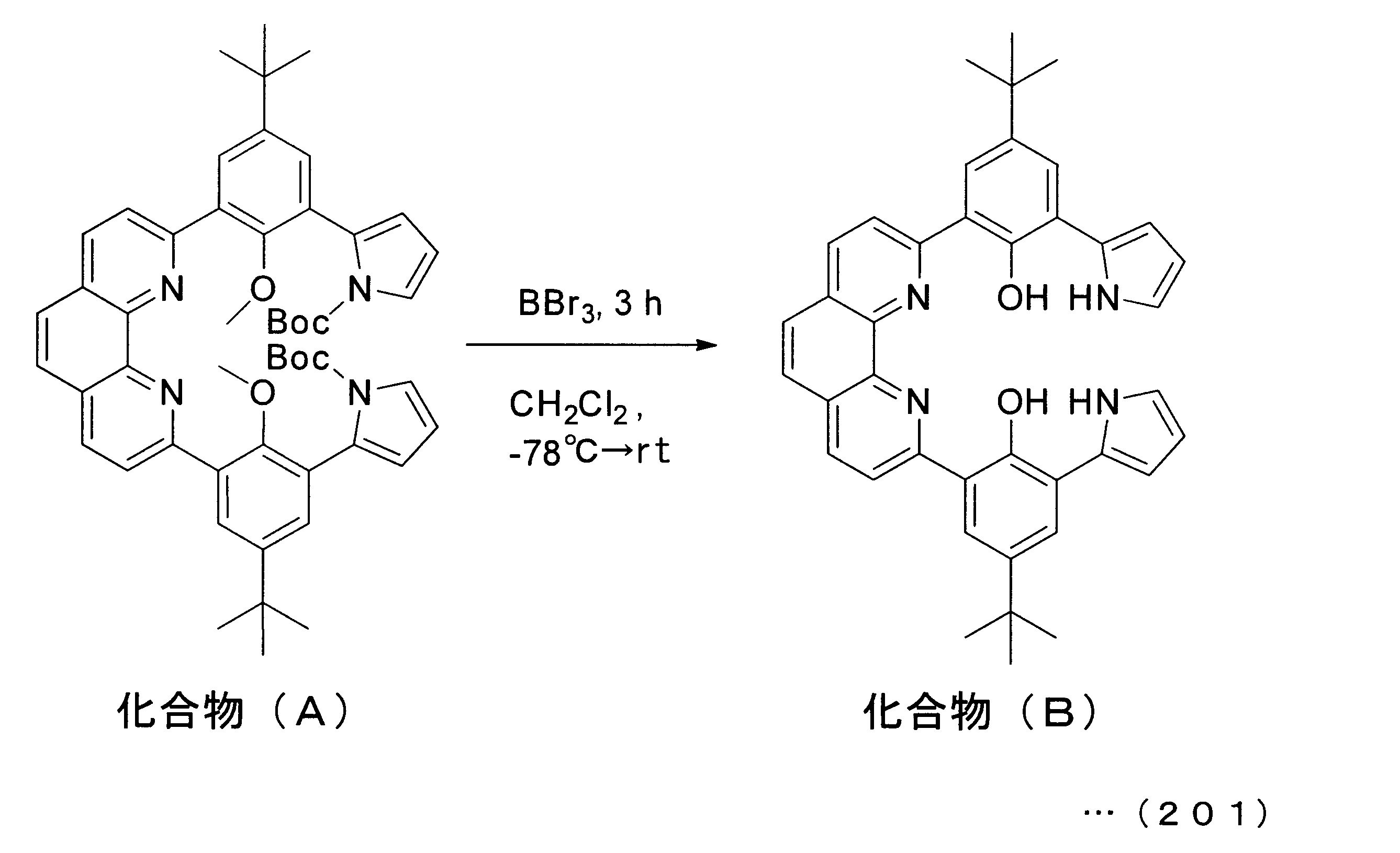
反応容器内を窒素ガス雰囲気とした後、0.904gの化合物(A)を10mLの無水ジクロロメタンに溶解させた。得られたジクロロメタン溶液を-78℃に冷却しながら、ここに8.8mLの三臭化ホウ素(1.0Mジクロロメタン溶液)をゆっくり滴下した。滴下後、10分間そのまま攪拌し、室温になるまでさらに攪拌しながら放置した。3時間後、反応液を0℃まで冷却し、飽和炭酸水素ナトリウム水溶液を加えた後、クロロホルムを加えて抽出し、有機層を濃縮した。得られた褐色の残留物を、シリカゲルカラムで精製し、化合物(B)を得た。得られた化合物(B)の同定データを以下に示す。
1H-NMR(300MHz,CDCl3):δ(ppm)=1.40(s,18H),6.25(m,2H),6.44(m,2H),6.74(m,2H),7.84(s,2H),7.89(s,2H),7.92(s,2H),8.35(d,J=8.4Hz,2H),8.46(d,J=8.4Hz,2H),10.61(s,2H),15.88(s,2H).
(配位子化合物(C)の合成)
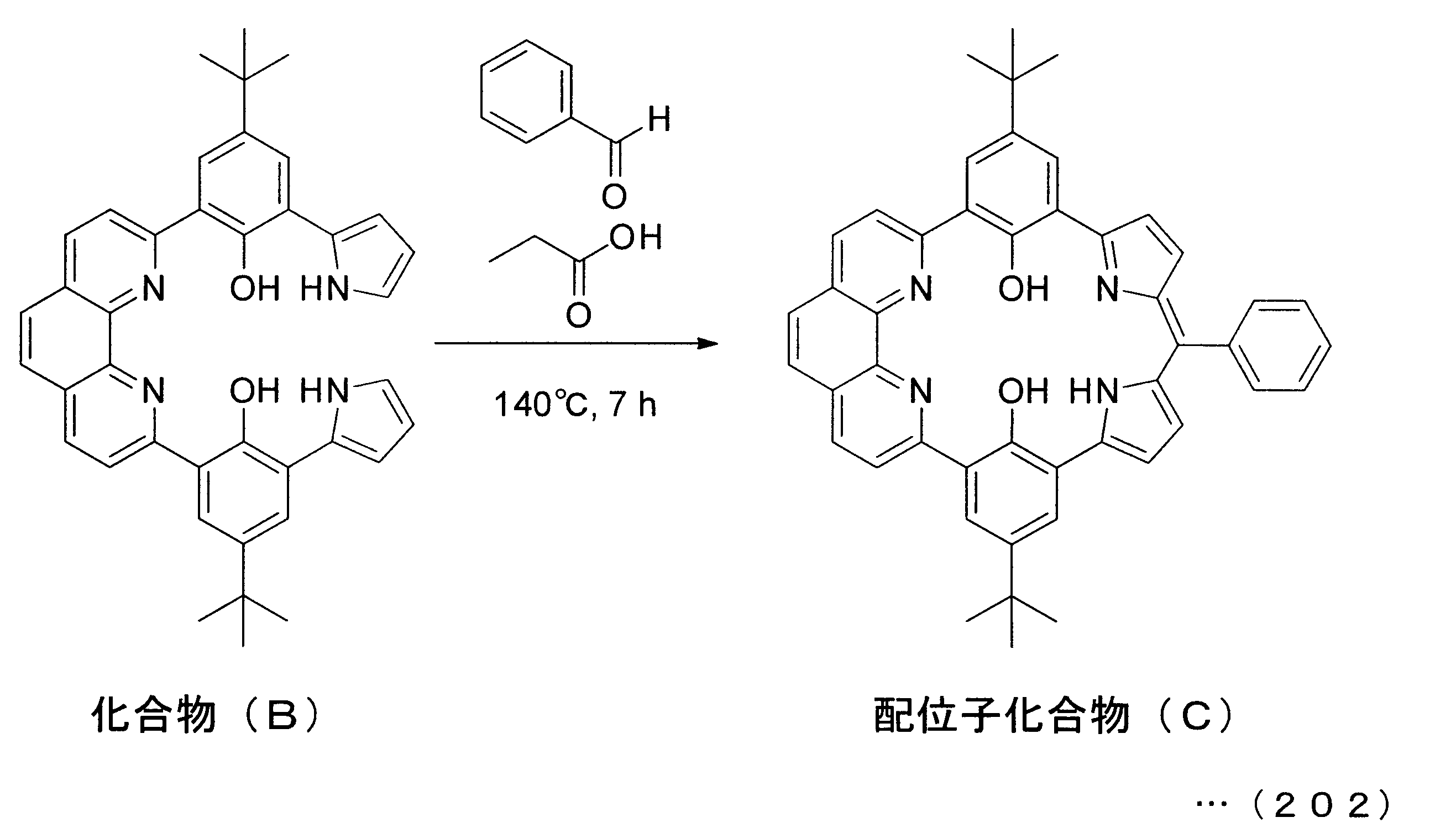
反応容器内において、0.061gの化合物(B)と0.012gのベンズアルデヒドを5mLのプロピオン酸に溶解させ、140℃で7時間加熱した。その後、得られた反応液からプロピオン酸を留去して、得られた黒い残渣をシリカゲルカラムで精製して、配位子化合物(C)を得た。得られた配位子化合物(C)の同定データを以下に示す。
1H-NMR(300MHz,CDCl3):δ(ppm)=1.49(s,18H),6.69(d,J=4.8Hz,2H),7.01(d,J=4.8Hz,2H),7.57(m,5H),7.90(s,4H),8.02(s,2H),8.31(d,J=8.1Hz,2H),8.47(d,J=8.1Hz,2H).
(多核金属錯体(D)の合成)

反応容器内を窒素ガス雰囲気とした後、0.045gの配位子化合物(C)と、0.040gの酢酸コバルト4水和物を含んだ3mLのメタノール及び3mLのクロロホルムの混合溶液とを混合し、80℃に加熱しながら5時間攪拌した。得られた溶液を濃縮乾固させて、青色固体を得た。これを水で洗浄することにより、多核金属錯体(D)を得た。前記反応式中の多核金属錯体(D)において、「(OAc)」は、1当量の酢酸イオンが対イオンとして存在することを示す。得られた多核金属錯体(D)の同定データを以下に示す。
ESI-MS[M+・]:m/z=866.0
ESI-MS[M+・]:m/z=866.0
[合成例2]
以下の反応式(204)に従って、多核金属錯体(E)を合成した。
以下の反応式(204)に従って、多核金属錯体(E)を合成した。
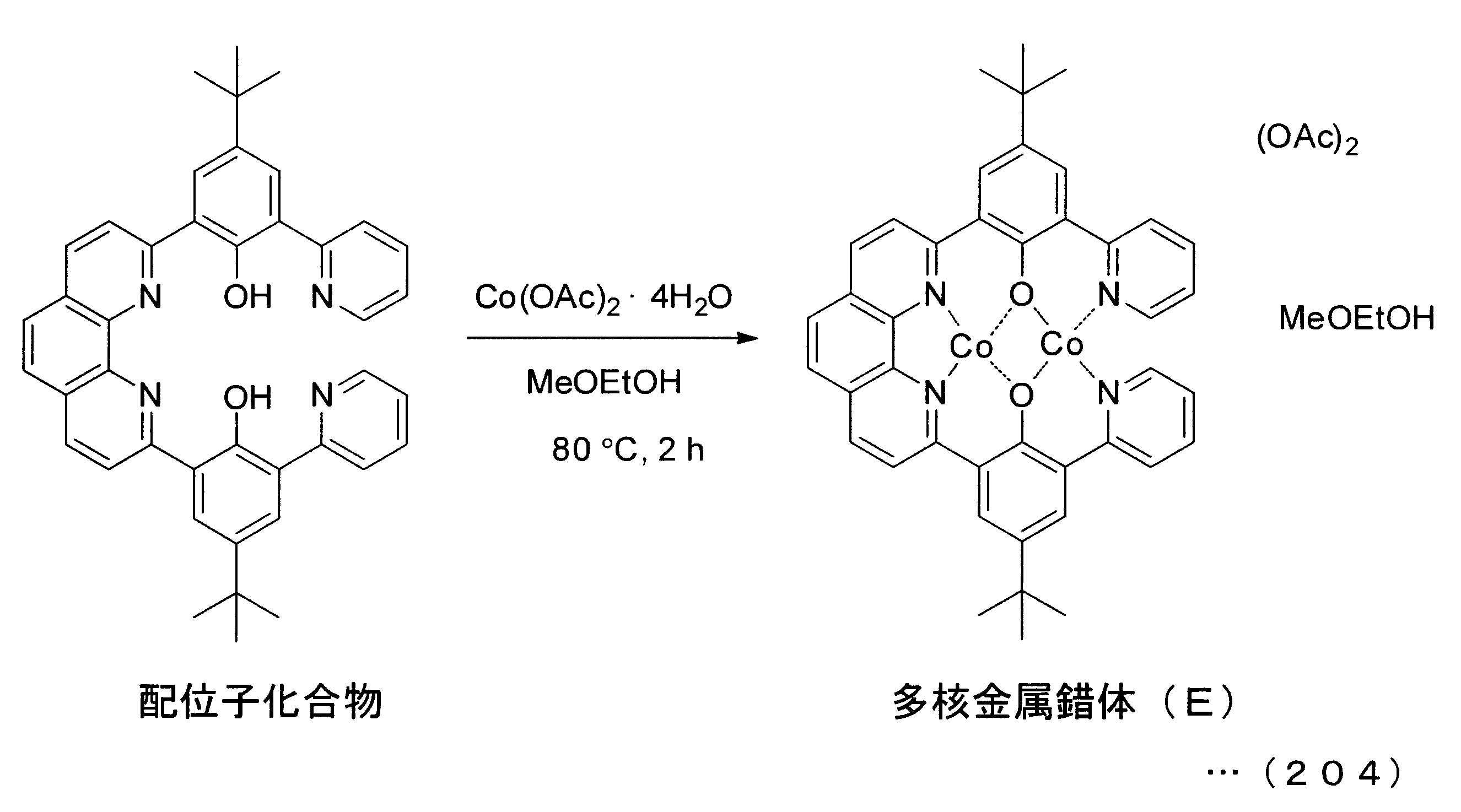
原料となる配位子化合物は、「Tetrahedron,Vol.55,p.8377(1999)」に記載の方法に従って合成した。
次いで、反応容器内を窒素ガス雰囲気とした後、1.388gの配位子化合物と1.245gの酢酸コバルト4水和物とを含む2-メトキシエタノール(MeOEtOH)200mL溶液を、500mLのナスフラスコに入れ、80℃に加熱しながら2時間攪拌したところ、褐色固体が生成した。この褐色固体を濾取し、2-メトキシエタノール20mLで洗浄した後、乾燥させることで、多核金属錯体(E)を得た(収量1.532g、収率74%)。前記反応式中の多核金属錯体(E)において、「(OAc)2」は、2当量の酢酸イオンが対イオンとして存在することを示し、「MeOEtOH」は、2-メトキシエタノール分子が配位子として存在することを示す。得られた多核金属錯体(E)の同定データを以下に示す。
元素分析値(%):C49H50Co2N4O8として
(計算値)C:62.56、H:5.36、N:5.96、Co:12.53
(実測値)C:62.12、H:5.07、N:6.03、Co:12.74
次いで、反応容器内を窒素ガス雰囲気とした後、1.388gの配位子化合物と1.245gの酢酸コバルト4水和物とを含む2-メトキシエタノール(MeOEtOH)200mL溶液を、500mLのナスフラスコに入れ、80℃に加熱しながら2時間攪拌したところ、褐色固体が生成した。この褐色固体を濾取し、2-メトキシエタノール20mLで洗浄した後、乾燥させることで、多核金属錯体(E)を得た(収量1.532g、収率74%)。前記反応式中の多核金属錯体(E)において、「(OAc)2」は、2当量の酢酸イオンが対イオンとして存在することを示し、「MeOEtOH」は、2-メトキシエタノール分子が配位子として存在することを示す。得られた多核金属錯体(E)の同定データを以下に示す。
元素分析値(%):C49H50Co2N4O8として
(計算値)C:62.56、H:5.36、N:5.96、Co:12.53
(実測値)C:62.12、H:5.07、N:6.03、Co:12.74
[合成例3]
以下の反応式(205)~(207)に従い、化合物(F)及び化合物(G)を経由して配位子化合物(H)を合成した。そして、以下の反応式(208)に従い、配位子化合物(H)と金属付与剤とを用いて、多核金属錯体(I)を合成した。
以下の反応式(205)~(207)に従い、化合物(F)及び化合物(G)を経由して配位子化合物(H)を合成した。そして、以下の反応式(208)に従い、配位子化合物(H)と金属付与剤とを用いて、多核金属錯体(I)を合成した。
(化合物(F)の合成)

反応容器内において、0.547gの2,6-ジブロモ-4-tert-ブチルアニソール、0.844gの1-N-Boc-ピロール-2-ボロン酸、0.138gのトリス(ベンジリデンアセトン)ジパラジウム、0.247gの2-ジシクロヘキシルホスフィノ-2’,6’-ジメトキシビフェニル、5.527gのリン酸カリウムを200mLのジオキサンと20mLの水の混合溶媒に溶解させ、60℃にて9時間攪拌した。反応終了後、放冷して蒸留水、クロロホルムを加えて、有機層を抽出した。得られた有機層を濃縮して、黒い残渣を得た。
これを、シリカゲルカラムを用いて精製し、化合物(F)を得た。得られた化合物(F)の同定データを以下に示す。
これを、シリカゲルカラムを用いて精製し、化合物(F)を得た。得られた化合物(F)の同定データを以下に示す。
1H-NMR(300MHz,CDCl3):δ(ppm)=1.30(s,18H),1.31(s,9H),3.19(s,3H),6.19(m,2H),6.25(m,2H),7.22(s,2H),7.38(m,2H).
(化合物(G)の合成)

反応容器内を窒素ガス雰囲気とした後、0.453gの化合物(F)を15mLの無水ジクロロメタンに溶解させた。得られたジクロロメタン溶液をドライアイス/アセトンバスで-78℃に冷却しながら、5.4mLの三臭化ホウ素(1.0Mジクロロメタン溶液)をゆっくり滴下した。滴下後、10分間そのまま攪拌させた後、ドライアイス/アセトンバスを取り除き、室温までさらに攪拌させながら放置した。1時間後、飽和NaHCO3水溶液を加えて中和し、クロロホルムを加えて3回抽出した。得られた有機層を濃縮して、得られた黒色の残渣を、シリカゲルで精製し、化合物(G)を得た。得られた化合物(G)の同定データを以下に示す。
1H-NMR(300MHz,CDCl3):δ(ppm)=1.34(s,9H),6.35(m,2H),6.40(s,1H),6.55(m,2H),6.93(m,2H),7.36(s,2H),9.15(s,2H).
(配位子化合物(H)の合成)

反応容器内において、0.051gの化合物(G)と0.019gのベンズアルデヒドとを20mLのプロピオン酸に溶解させ、140℃で7時間加熱した。その後、プロピオン酸を留去して、得られた黒い残渣をシリカゲルで精製して、配位子化合物(H)を得た。得られた配位子化合物(H)の同定データを以下に示す。
1H-NMR(300MHz,CDCl3):δ(ppm)=1.38(s,18H),6.58(d,J=3.8Hz,4H),6.92(d,J=3.8Hz,4H),7.49(m,10H),7.71(s,4H),12.75(br,4H).
(多核金属錯体(I)の合成)

反応容器内を窒素ガス雰囲気とした後、0.057gの配位子化合物(H)と0.047gの酢酸コバ
ルト4水和物を含んだ、メタノール4ml及びクロロホルム6mlの混合溶液を、80℃に加熱しながら5時間攪拌した。得られた溶液を濃縮乾固させると紫色固体を得た。これを水で洗浄することにより、多核金属錯体(I)を得た。得られた多核金属錯体(I)の同定データを以下に示す。
ESI-MS[M・]+:m/z=846.0
ルト4水和物を含んだ、メタノール4ml及びクロロホルム6mlの混合溶液を、80℃に加熱しながら5時間攪拌した。得られた溶液を濃縮乾固させると紫色固体を得た。これを水で洗浄することにより、多核金属錯体(I)を得た。得られた多核金属錯体(I)の同定データを以下に示す。
ESI-MS[M・]+:m/z=846.0
[合成例4]
以下の反応式(209)に従い、配位子化合物(K)を合成した。そして、以下の反応式(210)に従い、配位子化合物(K)と金属付与剤とを用いて、多核金属錯体(L)を合成した。
以下の反応式(209)に従い、配位子化合物(K)を合成した。そして、以下の反応式(210)に従い、配位子化合物(K)と金属付与剤とを用いて、多核金属錯体(L)を合成した。
(配位子化合物(K)の合成)
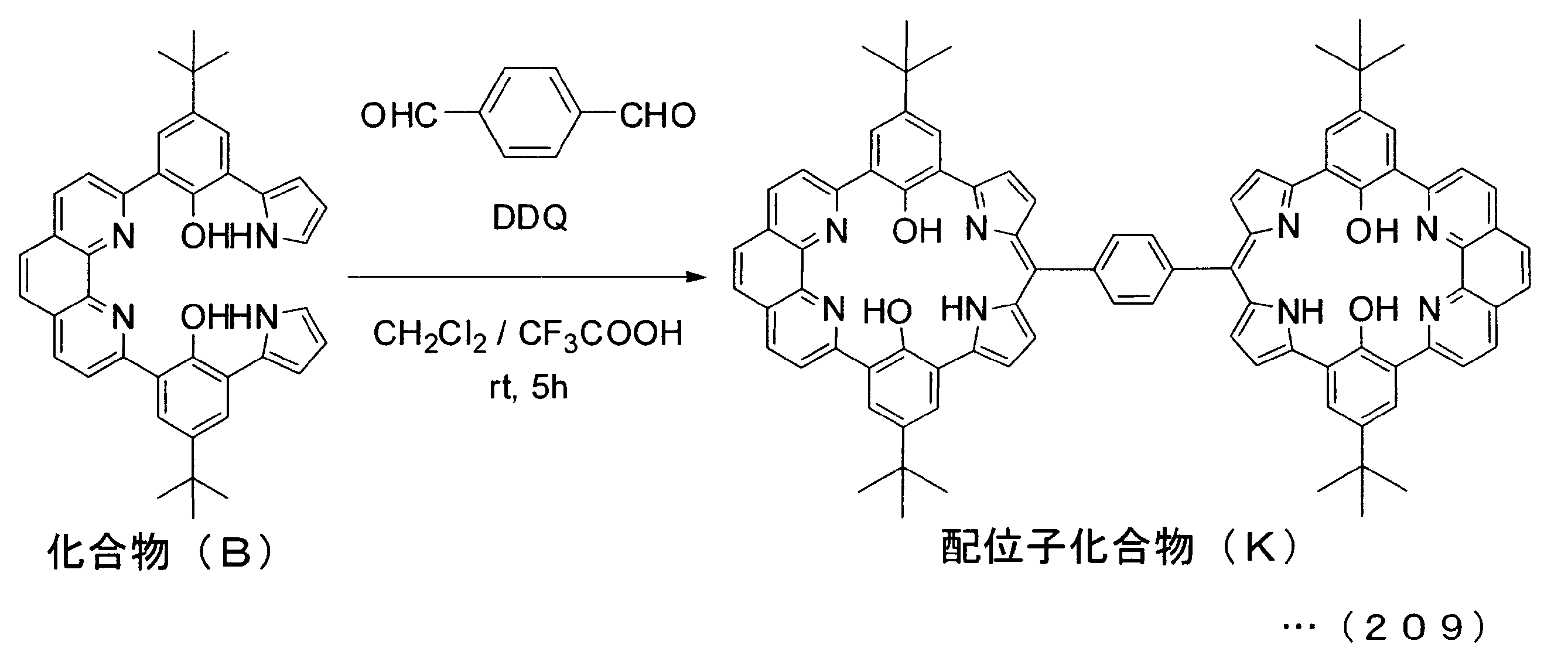
反応容器内において、0.13g(1mmol)のテレフタルアルデヒド、1.21g(2mmol)の化合物(B)を300mlのジクロロメタンに溶解し、トリフルオロ酢酸0.2mlを加えた。室温で20時間攪拌した後、0.49g(2mmol)のクロラニルを加え、室温で更に28時間攪拌した。得られた不溶物をろ取して、クロロホルム100mlで洗浄した後、得られた残渣をメタノール300mlに懸濁させ、得られた不溶物をろ取して粗生成物1.23gを得た。この粗生成物を400mlのジメチルホルムアミドに溶解し、メンブレンフィルターでろ過した後、真空ポンプで減圧し溶媒を留去した。得られた残渣にメタノール500mlを加え、超音波で分散させた後、不溶物をろ取し、配位子化合物(K)を得た。得られた配位子化合物(K)の同定データを以下に示す。
MS(FD)実測値(m/z):1307、理論値:1307
MS(FD)実測値(m/z):1307、理論値:1307
(多核金属錯体(L)の合成)

反応容器内を窒素ガス雰囲気とした後、0.040gの配位子化合物(K)と、0.040gの酢酸コバルト4水和物を含んだ20mLのジメチルホルムアミド溶液を、140℃に加熱しながら3時間攪拌した。得られた溶液を濃縮乾固させて、青色固体を得た。これを水で洗浄することにより、多核金属錯体(L)を得た。
[合成例5]
以下の反応式(211)に従い、フェノール化合物(M)、ジアミン、酢酸コバルト4水和物を含んだクロロホルム/エタノール混合溶液中で、60℃で3時間攪拌することにより、多核金属錯体(N)を合成した。
原料となる下記フェノール化合物(M)はTetrahedron.,1999,55,8377に基づき合成した。
以下の反応式(211)に従い、フェノール化合物(M)、ジアミン、酢酸コバルト4水和物を含んだクロロホルム/エタノール混合溶液中で、60℃で3時間攪拌することにより、多核金属錯体(N)を合成した。
原料となる下記フェノール化合物(M)はTetrahedron.,1999,55,8377に基づき合成した。
(多核金属錯体(N)の合成)
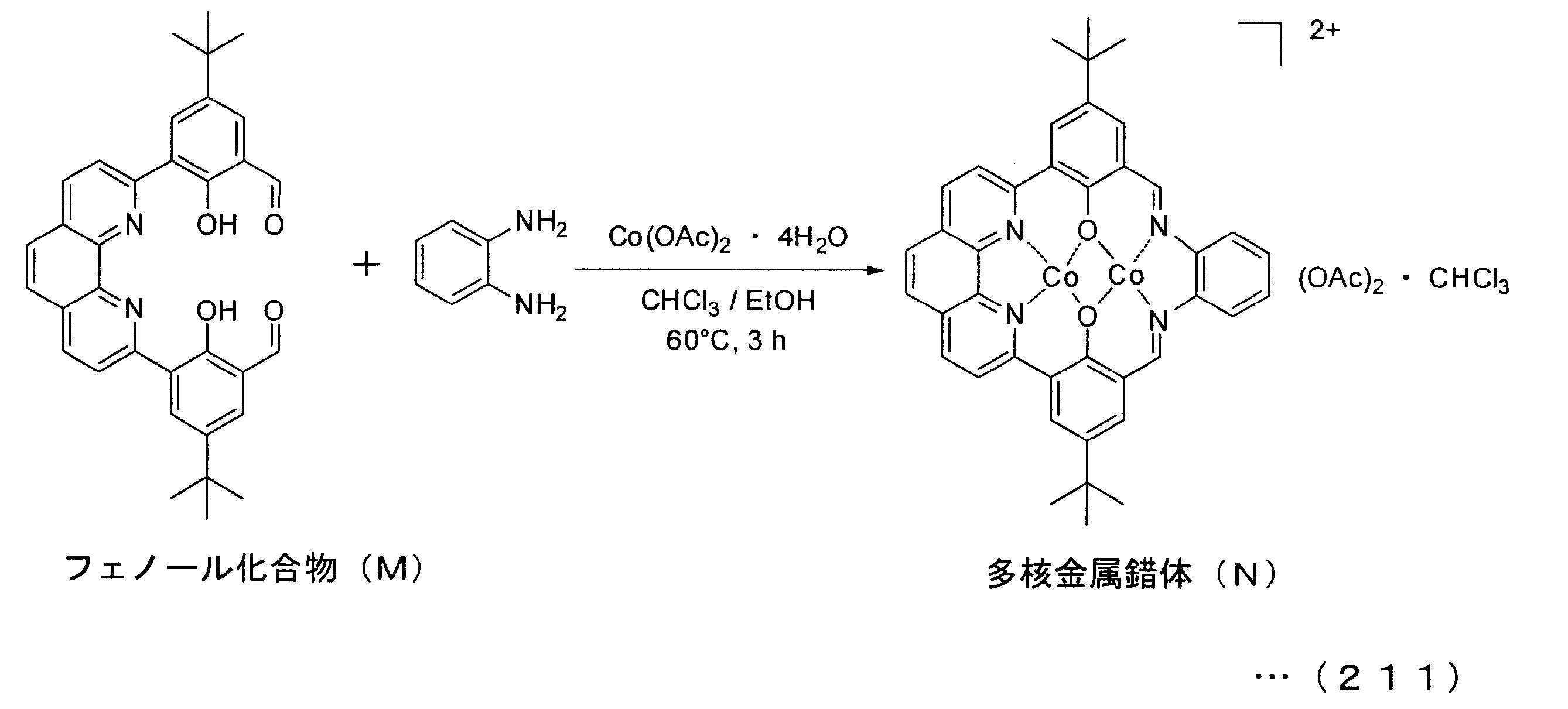
反応容器内を窒素ガス雰囲気とした後、0.199gの酢酸コバルト4水和物と0.213gのフェノール化合物(M)を含んだ、5mlのクロロホルムと5mlのエタノールの混合溶液を、50mlのナスフラスコに入れ、60℃にて攪拌した。この溶液に、0.043gのo-フェニレンジアミンを含んだ5mlエタノール溶液を徐々に添加した。得られた混合物を3時間還流することにより茶褐色沈殿が生成した。この沈殿を濾取し、乾燥することで多核金属錯体(N)を得た(収量0.109g:収率28%)。得られた多核金属錯体(N)の同定データを以下に示す。
元素分析値(%):C45H41Cl3Co2N4O6として
(計算値)C,56.41;H,4.31;N,5.85.
(実測値)C,58.28;H,4.81;N,5.85.
ESI-MS[M―CH3COO]+:779.0
(計算値)C,56.41;H,4.31;N,5.85.
(実測値)C,58.28;H,4.81;N,5.85.
ESI-MS[M―CH3COO]+:779.0
[合成例6]
以下の反応式(212)に従い、フェノール化合物、ジアミン、塩化コバルト6水和物を含んだエタノール溶液中で、2時間還流させながら攪拌することにより、多核金属錯体(O)を合成した。
以下の反応式(212)に従い、フェノール化合物、ジアミン、塩化コバルト6水和物を含んだエタノール溶液中で、2時間還流させながら攪拌することにより、多核金属錯体(O)を合成した。
(多核金属錯体(O)の合成)
反応容器内を窒素ガス雰囲気とした後、0.476gの塩化コバルト6水和物と0.412gの4―tert-ブチル-2,6-ジホルミルフェノールを含んだ10mlエタノール溶液を、50mlのナスフラスコに入れ、室温にて攪拌した。得られた溶液に、0.216gのo-フェニレンジアミンを含んだ5mlエタノール溶液を徐々に添加した。得られた混合物を2時間還流することにより茶褐色沈殿が生成した。この沈殿を濾取し、乾燥することで多核金属錯体(O)を得た(収量0.465g:収率63%)。得られた多核金属錯体(O)の同定データを以下に示す。
元素分析値(%):C36H38Cl2Co2N4O4として
(計算値)C,55.47;H,4.91;N,7.19.
(実測値)C,56.34;H,4.83;N,7.23.
(計算値)C,55.47;H,4.91;N,7.19.
(実測値)C,56.34;H,4.83;N,7.23.
<空気二次電池用正極触媒の製造>
[実施例1]
(正極触媒(1)の製造)
多核金属錯体(D)をカーボンに担持させることで正極触媒(1)を製造した。具体的には、2mgの多核金属錯体(D)と、8mgのカーボン(商品名:ケッチェンブラックEC600JD、ライオン社製)と、をメタノール中で混合し、15分間超音波を照射した後、エバポレーターで溶媒を留去し、200Paの減圧下で一晩乾燥させて、正極触媒(1)を得た。
[実施例1]
(正極触媒(1)の製造)
多核金属錯体(D)をカーボンに担持させることで正極触媒(1)を製造した。具体的には、2mgの多核金属錯体(D)と、8mgのカーボン(商品名:ケッチェンブラックEC600JD、ライオン社製)と、をメタノール中で混合し、15分間超音波を照射した後、エバポレーターで溶媒を留去し、200Paの減圧下で一晩乾燥させて、正極触媒(1)を得た。
[実施例2]
(正極触媒(2)の製造)
多核金属錯体(E)と、カーボン(商品名:ケッチェンブラックEC600JD、ライオン社製)と、を質量比1:4で混合し、エタノール中、室温にて15分間攪拌後、室温にて200Paの減圧下で12時間乾燥させた。得られた組成物を、石英を炉心管とする管状炉を用いて、200mL/分の窒素気流下において、800℃で2時間加熱することにより、正極触媒(2)(加熱処理物)を得た。
(正極触媒(2)の製造)
多核金属錯体(E)と、カーボン(商品名:ケッチェンブラックEC600JD、ライオン社製)と、を質量比1:4で混合し、エタノール中、室温にて15分間攪拌後、室温にて200Paの減圧下で12時間乾燥させた。得られた組成物を、石英を炉心管とする管状炉を用いて、200mL/分の窒素気流下において、800℃で2時間加熱することにより、正極触媒(2)(加熱処理物)を得た。
[実施例3~7]
(正極触媒(3)~(7)の製造)
実施例1と同様の操作を行い、多核金属錯体(E)、多核金属錯体(I)、多核金属錯体(L)、多核金属錯体(N)、多核金属錯体(O)を用いて、それぞれ正極触媒(3)、正極触媒(4)、正極触媒(5)、正極触媒(6)、正極触媒(7)を得た。
(正極触媒(3)~(7)の製造)
実施例1と同様の操作を行い、多核金属錯体(E)、多核金属錯体(I)、多核金属錯体(L)、多核金属錯体(N)、多核金属錯体(O)を用いて、それぞれ正極触媒(3)、正極触媒(4)、正極触媒(5)、正極触媒(6)、正極触媒(7)を得た。
[比較例1]
(正極触媒(R1)の製造)
二酸化マンガン(アルドリッチ社製、製品コード203750)と、カーボン(商品名:ケッチェンブラックEC600JD、ライオン社製)と、を質量比1:4で混合し、エタノール中、室温にて15分間攪拌後、室温にて200Paの減圧下で12時間乾燥させることにより、正極触媒(R1)を得た。
(正極触媒(R1)の製造)
二酸化マンガン(アルドリッチ社製、製品コード203750)と、カーボン(商品名:ケッチェンブラックEC600JD、ライオン社製)と、を質量比1:4で混合し、エタノール中、室温にて15分間攪拌後、室温にて200Paの減圧下で12時間乾燥させることにより、正極触媒(R1)を得た。
<空気二次電池用正極触媒の評価>
(酸素還元活性の評価)
上記で得られた正極触媒(正極触媒(1)~(7)及び(R1))について、回転ディスク電極により、酸素還元活性を評価した。具体的には、以下の通りである。
電極には、ディスク部がグラッシーカーボン(直径6.0mm)であるディスク電極を用いた。
正極触媒が1mg入ったサンプル瓶へ、0.5質量%のナフィオン(登録商標)溶液(5質量%ナフィオン(登録商標)溶液をエタノールにて10倍希釈した溶液)を1mL加えた後、超音波を照射して15分間分散させた。得られた懸濁液7.2μLを前記電極のディスク部に滴下して乾燥させた後、80℃に加熱した乾燥機にて3時間乾燥させることで、測定用電極を得た。
この測定用電極を用いて、下記測定装置及び測定条件において、酸素還元反応の電流値を測定した。電流値の測定は、窒素ガスを飽和させた状態(窒素ガス雰囲気下)、酸素ガスを飽和させた状態(酸素ガス雰囲気下)でそれぞれ行い、酸素ガス雰囲気下での測定で得られた電流値から、窒素ガス雰囲気下での測定で得られた電流値を引いた値を酸素還元反応の電流値とした。この電流値を測定用電極の表面積で除すことにより、電流密度を求めた。結果を表1に示す。
電流密度は、銀/塩化銀電極に対して-0.8Vのときの値である。
(酸素還元活性の評価)
上記で得られた正極触媒(正極触媒(1)~(7)及び(R1))について、回転ディスク電極により、酸素還元活性を評価した。具体的には、以下の通りである。
電極には、ディスク部がグラッシーカーボン(直径6.0mm)であるディスク電極を用いた。
正極触媒が1mg入ったサンプル瓶へ、0.5質量%のナフィオン(登録商標)溶液(5質量%ナフィオン(登録商標)溶液をエタノールにて10倍希釈した溶液)を1mL加えた後、超音波を照射して15分間分散させた。得られた懸濁液7.2μLを前記電極のディスク部に滴下して乾燥させた後、80℃に加熱した乾燥機にて3時間乾燥させることで、測定用電極を得た。
この測定用電極を用いて、下記測定装置及び測定条件において、酸素還元反応の電流値を測定した。電流値の測定は、窒素ガスを飽和させた状態(窒素ガス雰囲気下)、酸素ガスを飽和させた状態(酸素ガス雰囲気下)でそれぞれ行い、酸素ガス雰囲気下での測定で得られた電流値から、窒素ガス雰囲気下での測定で得られた電流値を引いた値を酸素還元反応の電流値とした。この電流値を測定用電極の表面積で除すことにより、電流密度を求めた。結果を表1に示す。
電流密度は、銀/塩化銀電極に対して-0.8Vのときの値である。
(測定装置)
日厚計測社製RRDE-1回転リングディスク電極装置
ALSモデル701Cデュアル電気化学アナライザー
(測定条件)
セル溶液:0.1mol/L水酸化カリウム水溶液(酸素飽和又は窒素飽和)
溶液温度:25℃
参照電極:銀/塩化銀電極(飽和塩化カリウム)
カウンター電極:白金ワイヤー
掃引速度:10mV/秒
電極回転速度:1600rpm
日厚計測社製RRDE-1回転リングディスク電極装置
ALSモデル701Cデュアル電気化学アナライザー
(測定条件)
セル溶液:0.1mol/L水酸化カリウム水溶液(酸素飽和又は窒素飽和)
溶液温度:25℃
参照電極:銀/塩化銀電極(飽和塩化カリウム)
カウンター電極:白金ワイヤー
掃引速度:10mV/秒
電極回転速度:1600rpm
(水の酸化活性の評価)
上記で得られた正極触媒(正極触媒(1)~(7)及び(R1))について、酸素還元活性の評価の場合と同様の測定用電極を作製し、これを用いて、下記測定装置及び測定条件において、水の酸化反応の電流値を測定した。電流値の測定は、窒素ガスを飽和させた状態で行い、この電流値を測定用電極の表面積で除すことにより、電流密度を求めた。結果を表1に示す。電流密度は、銀/塩化銀電極に対して1Vのときの値である。
上記で得られた正極触媒(正極触媒(1)~(7)及び(R1))について、酸素還元活性の評価の場合と同様の測定用電極を作製し、これを用いて、下記測定装置及び測定条件において、水の酸化反応の電流値を測定した。電流値の測定は、窒素ガスを飽和させた状態で行い、この電流値を測定用電極の表面積で除すことにより、電流密度を求めた。結果を表1に示す。電流密度は、銀/塩化銀電極に対して1Vのときの値である。
(測定装置)
日厚計測社製RRDE-1回転リングディスク電極装置
ALSモデル701Cデュアル電気化学アナライザー
(測定条件)
セル溶液:1mol/L水酸化ナトリウム水溶液(窒素飽和)
溶液温度:25℃
参照電極:銀/塩化銀電極(飽和塩化カリウム)
カウンター電極:白金ワイヤー
掃引速度:10mV/秒
電極回転速度:900rpm
日厚計測社製RRDE-1回転リングディスク電極装置
ALSモデル701Cデュアル電気化学アナライザー
(測定条件)
セル溶液:1mol/L水酸化ナトリウム水溶液(窒素飽和)
溶液温度:25℃
参照電極:銀/塩化銀電極(飽和塩化カリウム)
カウンター電極:白金ワイヤー
掃引速度:10mV/秒
電極回転速度:900rpm
(触媒活性の評価結果)

表1から分かるように、本発明の正極触媒(1)~(7)は、正極触媒(R1)よりも、酸素還元活性及び水の酸化活性のいずれにおいても顕著に優れていた。
<空気二次電池の製造>
[実施例8]
(空気二次電池用正極(1)の製造)
メノー乳鉢中で、正極触媒として多核金属錯体(D)(1質量部)、導電材としてアセチレンブラック(電気化学工業社製)(10質量部)、結着材としてPTFE粉末(ダイキン社製)(1質量部)、分散溶液としてエタノール(ピペットで5滴)を混合した後、薄膜化し、正極触媒層(1)を得た。
次いで、得られた正極触媒層(1)を、撥水性PTFEシートと、ステンレスメッシュとで両側から挟み、プレス機で圧着することで、空気二次電池用正極(1)を得た。
[実施例8]
(空気二次電池用正極(1)の製造)
メノー乳鉢中で、正極触媒として多核金属錯体(D)(1質量部)、導電材としてアセチレンブラック(電気化学工業社製)(10質量部)、結着材としてPTFE粉末(ダイキン社製)(1質量部)、分散溶液としてエタノール(ピペットで5滴)を混合した後、薄膜化し、正極触媒層(1)を得た。
次いで、得られた正極触媒層(1)を、撥水性PTFEシートと、ステンレスメッシュとで両側から挟み、プレス機で圧着することで、空気二次電池用正極(1)を得た。
(負極(1)の製造)
負極となる水素吸蔵合金を以下の方法で取り出した。単3形充電式ニッケル水素電池(エネループ(登録商標)、三洋電機株式会社製、HR-3UTGA)を充放電試験機(東洋システム社製、製品名TOSCAT-3000U)に接続し、電池電圧が1.0Vとなるまで放電した。前記ニッケル水素電池を解体し、水素吸蔵合金を取り出した。
前記水素吸蔵合金を多孔質金属体(セルメット#8、富山住友電工社製)で挟み、プレス機でプレスすることで、負極(1)を得た。
負極となる水素吸蔵合金を以下の方法で取り出した。単3形充電式ニッケル水素電池(エネループ(登録商標)、三洋電機株式会社製、HR-3UTGA)を充放電試験機(東洋システム社製、製品名TOSCAT-3000U)に接続し、電池電圧が1.0Vとなるまで放電した。前記ニッケル水素電池を解体し、水素吸蔵合金を取り出した。
前記水素吸蔵合金を多孔質金属体(セルメット#8、富山住友電工社製)で挟み、プレス機でプレスすることで、負極(1)を得た。
(空気二次電池(1)の製造)
上記で得られた空気二次電池用正極(1)及び負極(1)を容器内に設置した後、電解液として8.0Mの水酸化カリウム水溶液を注液することで、図1に示す構成の空気二次電池(1)を得た。
上記で得られた空気二次電池用正極(1)及び負極(1)を容器内に設置した後、電解液として8.0Mの水酸化カリウム水溶液を注液することで、図1に示す構成の空気二次電池(1)を得た。
<空気二次電池の性能評価>
(充放電サイクル試験)
上記で得られた空気二次電池(1)を充放電試験機(東洋システム社製、製品名TOSCAT-3000U)に接続し、充放電サイクル試験を行った。充放電サイクルは、以下のステップ1~4をこの順に10回繰り返すことで行った。この時の電圧の測定結果を図2に示す。
ステップ1:定電流3mAにて20分間充電。
ステップ2:5分間休止。
ステップ3:定電流3mAにて放電。電圧が0.5Vとなった時点でステップ4へ移る。
ステップ4:5分間休止。
(充放電サイクル試験)
上記で得られた空気二次電池(1)を充放電試験機(東洋システム社製、製品名TOSCAT-3000U)に接続し、充放電サイクル試験を行った。充放電サイクルは、以下のステップ1~4をこの順に10回繰り返すことで行った。この時の電圧の測定結果を図2に示す。
ステップ1:定電流3mAにて20分間充電。
ステップ2:5分間休止。
ステップ3:定電流3mAにて放電。電圧が0.5Vとなった時点でステップ4へ移る。
ステップ4:5分間休止。
図2に示すように、空気二次電池(1)は、十分な充放電性能を有していた。
[実施例9]
(空気二次電池用正極(2)の製造)
メノー乳鉢中で、正極触媒及び導電材として正極触媒(2)(10質量部)、結着材としてPTFE粉末(ダイキン社製)(1質量部)、分散溶液としてエタノール(ピペットで5滴)を混合した後、薄膜化し、正極触媒層(2)を得た。
次いで、得られた正極触媒層(2)を、撥水性PTFEシートと、ステンレスメッシュとで両側から挟み、プレス機で圧着することで、空気二次電池用正極(2)を得た。
(空気二次電池用正極(2)の製造)
メノー乳鉢中で、正極触媒及び導電材として正極触媒(2)(10質量部)、結着材としてPTFE粉末(ダイキン社製)(1質量部)、分散溶液としてエタノール(ピペットで5滴)を混合した後、薄膜化し、正極触媒層(2)を得た。
次いで、得られた正極触媒層(2)を、撥水性PTFEシートと、ステンレスメッシュとで両側から挟み、プレス機で圧着することで、空気二次電池用正極(2)を得た。
実施例8において、正極触媒層(1)を正極触媒層(2)に変更した以外は、実施例8と同様にして、空気二次電池を作製し、評価を行った。
図3に示すように、空気二次電池(1)は、十分な充放電性能を有していた。
(水準2)
<多核金属錯体の合成>
[合成例7]
以下の反応式(300)、(301)に従い、化合物1、化合物2、及び化合物3を経由して配位子化合物4を合成した。そして、以下の反応式(302)に従い、配位子化合物4と金属付与剤とを用いて、多核金属錯体MC1を合成した。
<多核金属錯体の合成>
[合成例7]
以下の反応式(300)、(301)に従い、化合物1、化合物2、及び化合物3を経由して配位子化合物4を合成した。そして、以下の反応式(302)に従い、配位子化合物4と金属付与剤とを用いて、多核金属錯体MC1を合成した。
(化合物3の合成)

まず、原料となる化合物1を以下の方法で合成した。
1,4-ジブロモ-2,3-ジアミノベンゼンは、文献(Journal of Organic Chemistry,2006,71,3350)記載の方法に従って合成した。次いで、フラスコ内において、0.600g(2.256mmol)の1,4-ジブロモ-2,3-ジアミノベンゼンを含んだ10mLの酢酸溶液を50℃に加熱後、前記フラスコ内の気体を1時間かけてアルゴンガスで置換した。得られた溶液へ0.234g(0.752 mmol)のヘキサケトシクロヘキサンを加えた後、110℃で10時間加熱した。得られた反応液を氷水へ注いだ後、水酸化ナトリウム水溶液で前記反応液をアルカリ性とした。その結果、薄緑色の生成物が沈殿物として得られ、沈殿物を濾取後、水とジクロロメタンで順番に洗浄することで、0.499gの化合物1を得た。
次の工程に必要な量を確保するために、前記操作を数回繰り返して行った。得られた化合物1の同定データを以下に示す。
1,4-ジブロモ-2,3-ジアミノベンゼンは、文献(Journal of Organic Chemistry,2006,71,3350)記載の方法に従って合成した。次いで、フラスコ内において、0.600g(2.256mmol)の1,4-ジブロモ-2,3-ジアミノベンゼンを含んだ10mLの酢酸溶液を50℃に加熱後、前記フラスコ内の気体を1時間かけてアルゴンガスで置換した。得られた溶液へ0.234g(0.752 mmol)のヘキサケトシクロヘキサンを加えた後、110℃で10時間加熱した。得られた反応液を氷水へ注いだ後、水酸化ナトリウム水溶液で前記反応液をアルカリ性とした。その結果、薄緑色の生成物が沈殿物として得られ、沈殿物を濾取後、水とジクロロメタンで順番に洗浄することで、0.499gの化合物1を得た。
次の工程に必要な量を確保するために、前記操作を数回繰り返して行った。得られた化合物1の同定データを以下に示す。
MS(FD,8kV)実測値(m/z):857.5(M+);429.7(M2+)、理論値:857.57(M+)
MS(Maldi-Tof,TCNQ):m/z858(M+)
MS(Maldi-Tof,TCNQ):m/z858(M+)
次に、上記で得られた化合物1を用いて、化合物2を合成した。
フラスコ内において、1.835g(2.140mmol)の化合物1を含んだ100mLのTHFと40mLのトルエンとの混合溶液へ、4.516g(21.4mmol)の1-N-Boc-ピロール-2-ボロン酸、0.048gのAliquat 336(登録商標、商品名)及び14.88g(0.107mol)の炭酸カリウムを加えた後、前記フラスコ内の気体を1時間かけてアルゴンガスで置換した。
得られた反応液へ0.890g(0.771mmol)のテトラキス(トリフェニルホスフィン)パラジウム(0)を加えた後、95℃で72時間加熱した後、12mLの脱気した水を加え、更に2日間加熱を続けることで粗生成物を得た。この粗生成物を、シリカゲルカラム(展開溶媒:酢酸エチル/ジクロロメタン/ヘキサン)により精製し、2.745gの化合物2を得た。得られた化合物2の同定データを以下に示す。
フラスコ内において、1.835g(2.140mmol)の化合物1を含んだ100mLのTHFと40mLのトルエンとの混合溶液へ、4.516g(21.4mmol)の1-N-Boc-ピロール-2-ボロン酸、0.048gのAliquat 336(登録商標、商品名)及び14.88g(0.107mol)の炭酸カリウムを加えた後、前記フラスコ内の気体を1時間かけてアルゴンガスで置換した。
得られた反応液へ0.890g(0.771mmol)のテトラキス(トリフェニルホスフィン)パラジウム(0)を加えた後、95℃で72時間加熱した後、12mLの脱気した水を加え、更に2日間加熱を続けることで粗生成物を得た。この粗生成物を、シリカゲルカラム(展開溶媒:酢酸エチル/ジクロロメタン/ヘキサン)により精製し、2.745gの化合物2を得た。得られた化合物2の同定データを以下に示す。
MS(FD,8kV)実測値(m/z):1374.5、理論値:1374.59
その後、上記で得られた化合物2を加熱してピロール基を脱保護することで、化合物3を得た。
0.340gの化合物2を20Paの減圧下において180℃で30分間加熱することにより、化合物3を得た。得られた化合物3の同定データを以下に示す。
0.340gの化合物2を20Paの減圧下において180℃で30分間加熱することにより、化合物3を得た。得られた化合物3の同定データを以下に示す。
MS(FD,8kV)実測値(m/z):386.6(M2+);774,0(M+)、理論値:387.14(M2+);774.27(M+)
MS(Maldi-Tof,TCNQ):m/z775(M+);1549(2M+)
MS(Maldi-Tof,TCNQ):m/z775(M+);1549(2M+)
(配位子化合物4の合成)

フラスコ内において、0.207g(0.267mmol)の化合物3を、1mLのトリフルオロメタンスルホン酸、1.5mLのp-n-オクチルベンズアルデヒド、及び、3mLのジクロロメタンの混合溶液へ加えた後、前記フラスコ内の気体をアルゴンガスで置換した。得られた溶液をマイクロウェーブ反応装置に入れ、50Wで2時間反応させた。得られた反応液へ水酸化アンモニウムを加え、水で有機層を洗浄し、得られた有機層をエバポレーターで乾固させ、更に、水とヘキサンで順番に洗浄することにより、0.349g(0.254 mmol)の配位子化合物4を95%の収率で得た。得られた配位子化合物4の同定データを以下に示す。
MS(FD,8kV)実測値(m/z):1375.5(M+)、理論値:1375.74(M+)
MS(Maldi-Tof,TCNQ):m/z1373(M+);2746(2M+)
MS(Maldi-Tof,TCNQ):m/z1373(M+);2746(2M+)
(多核金属錯体MC1の合成)
以下の反応式(302)に従って、多核金属錯体MC1を合成した。
以下の反応式(302)に従って、多核金属錯体MC1を合成した。

0.125g(0.091mmol)の配位子化合物4と0.079g(0.318mmol)の酢酸コバルト4水和物とをマイクロウェーブ用試験管に入れ、そこに、5mLのN,N’-ジメチルホルムアミド(以下、「DMF」ということがある。)を加え、マイクロウェーブ装置を用いて200℃、出力200Wにて2時間反応させた。得られた反応液を25mLの冷水に注ぎ、生成した沈殿を濾取し、水及びヘキサンで順番に洗浄して、多核金属錯体MC1を得た。得られた多核金属錯体MC1の同定データを以下に示す。
MS(Maldi-Tof,TCNQ)実測値(m/z):1543(M+);1569(M++CN-);1595(M++2CN-);1621(M++3CN-)、理論値:1543.5(M+)
[合成例8]
以下の反応式(303)に従い、配位子化合物5を合成した。そして、以下の反応式(304)に従い、配位子化合物5と金属付与剤とを用いて、多核金属錯体MC2を合成した。
以下の反応式(303)に従い、配位子化合物5を合成した。そして、以下の反応式(304)に従い、配位子化合物5と金属付与剤とを用いて、多核金属錯体MC2を合成した。
(配位子化合物5の合成)
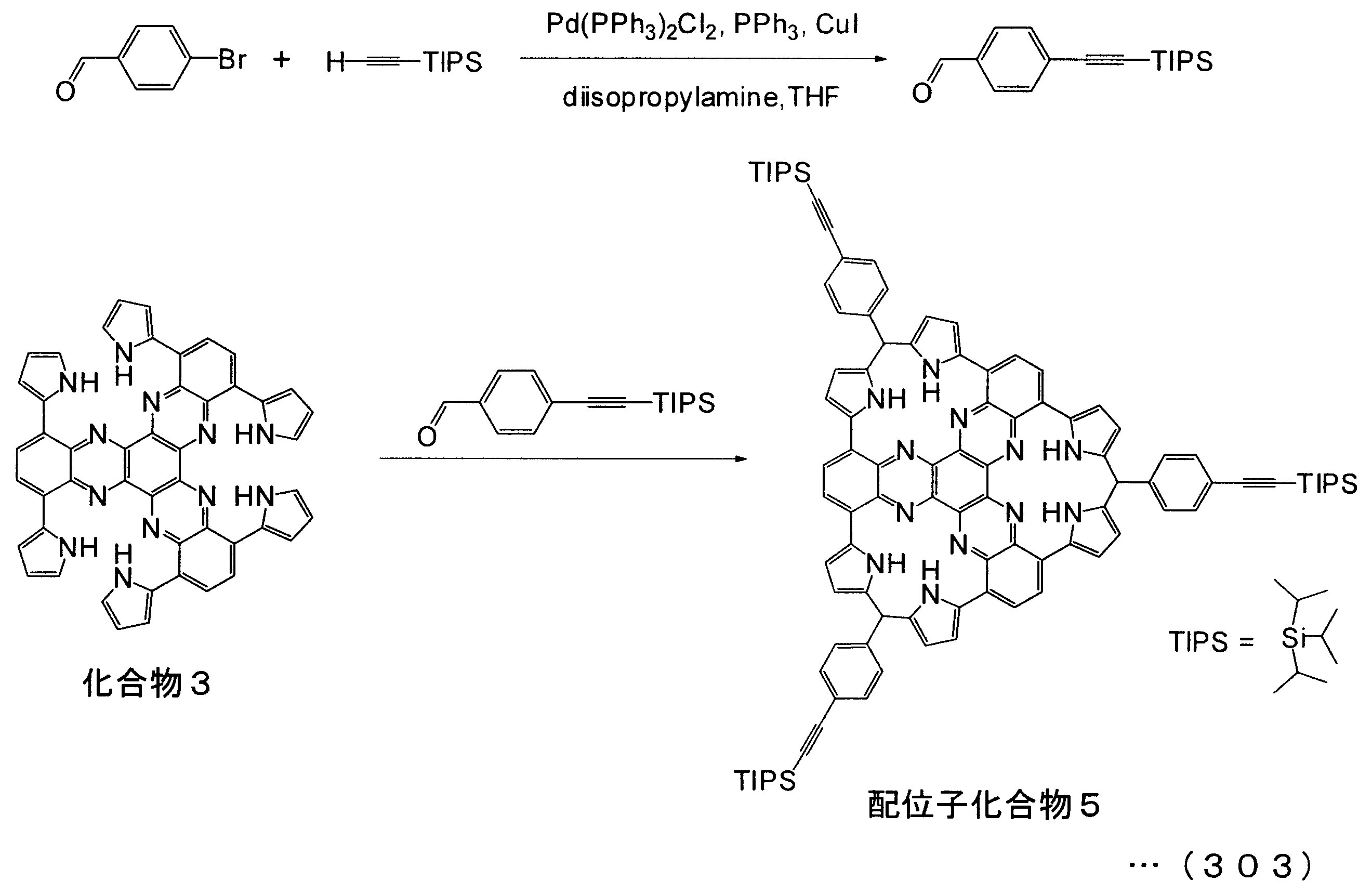
まず、原料となる4-((トリイソプロピル)エチニル)ベンズアルデヒドを、以下の方法で合成した。
反応容器内をアルゴンガス雰囲気とした後、1g(5.40mmol)の4-ブロモベンズアルデヒドと38mg(0.054 mmol)のジクロロビス(トリフェニルホスフィン)パラジウム(II)(「Pd(PPh3)2Cl2」で表される。)、10mg(0.054 mmol)のヨウ化銅(I)、及び、33mg (0.129 mmol)のトリフェニルホスフィン(「PPh3」で表される。)を4mLのTHFと16mLのジイソプロピルアミンの混合溶液に溶解させた。得られた反応混合物を60℃で30分間攪拌した後、1.45mL(6.49 mmol)のエチニルトリイソプロピルシランを加え、更に2時間攪拌した。得られた反応液から溶媒をエバポレーターで留去した後、粗生成物をシリカゲルカラム(展開溶媒:ヘキサン/ジクロロメタン)精製することで、4-((トリイソプロピル)エチニル)ベンズアルデヒドを得た。収量は1.3gであり、収率は84%であった。得られた4-((トリイソプロピル)エチニル)ベンズアルデヒドの同定データを以下に示す。
反応容器内をアルゴンガス雰囲気とした後、1g(5.40mmol)の4-ブロモベンズアルデヒドと38mg(0.054 mmol)のジクロロビス(トリフェニルホスフィン)パラジウム(II)(「Pd(PPh3)2Cl2」で表される。)、10mg(0.054 mmol)のヨウ化銅(I)、及び、33mg (0.129 mmol)のトリフェニルホスフィン(「PPh3」で表される。)を4mLのTHFと16mLのジイソプロピルアミンの混合溶液に溶解させた。得られた反応混合物を60℃で30分間攪拌した後、1.45mL(6.49 mmol)のエチニルトリイソプロピルシランを加え、更に2時間攪拌した。得られた反応液から溶媒をエバポレーターで留去した後、粗生成物をシリカゲルカラム(展開溶媒:ヘキサン/ジクロロメタン)精製することで、4-((トリイソプロピル)エチニル)ベンズアルデヒドを得た。収量は1.3gであり、収率は84%であった。得られた4-((トリイソプロピル)エチニル)ベンズアルデヒドの同定データを以下に示す。
1H-NMR(CD2Cl2,300MHz,25℃):δ(ppm)=1.14(s,21H),7.64(d,3J=8.3Hz,2H),7.81(d,3J=8.3Hz,2H),10.00(s,1H).
13C-NMR(CD2Cl2,75MHz,25℃):δ(ppm)=11.7,18.8,95.9,106.3,129.7,129.9,132.8,136.1,191.6.
13C-NMR(CD2Cl2,75MHz,25℃):δ(ppm)=11.7,18.8,95.9,106.3,129.7,129.9,132.8,136.1,191.6.
次に、配位子化合物5を以下の方法で合成した。
フラスコ内において、308.0mg(0.40mmol)の化合物3と、683.3mg(2.38mmol)の4-((トリイソプロピル)エチニル)ベンズアルデヒドと、を12mLのジクロロメタン及び4mLのTHFの混合溶液に分散させ、2mLのトリフルオロ酢酸を加え、前記フラスコ内の気体をアルゴンガスで置換した。得られた反応液を、マイクロウェーブ用試験管に入れ、マイクロウェーブ装置を用いて、85℃、出力50Wにて6時間反応させた。得られた反応液を濃縮後、得られた濃縮液にメタノールを加えることで粗生成物を沈殿物として得た。その後、アセトンを溶媒としたソックスレー抽出器を用いて得られた粗生成物を精製することにより、配位子化合物5を得た。収量は234mgであり、収率は45%であった。得られた配位子化合物5の同定データを以下に示す。
フラスコ内において、308.0mg(0.40mmol)の化合物3と、683.3mg(2.38mmol)の4-((トリイソプロピル)エチニル)ベンズアルデヒドと、を12mLのジクロロメタン及び4mLのTHFの混合溶液に分散させ、2mLのトリフルオロ酢酸を加え、前記フラスコ内の気体をアルゴンガスで置換した。得られた反応液を、マイクロウェーブ用試験管に入れ、マイクロウェーブ装置を用いて、85℃、出力50Wにて6時間反応させた。得られた反応液を濃縮後、得られた濃縮液にメタノールを加えることで粗生成物を沈殿物として得た。その後、アセトンを溶媒としたソックスレー抽出器を用いて得られた粗生成物を精製することにより、配位子化合物5を得た。収量は234mgであり、収率は45%であった。得られた配位子化合物5の同定データを以下に示す。
1H-NMR(C3D2F6O+0.1%C2DF3O2,500MHz,25℃):δ(ppm)=1.09(s,9H,),1.10(s,54H,),6.06(d,6H,3J=4.8Hz),6.15(d,6H,3J=4.8Hz),6.55(s,6H),7.00(d,6H,3J=8.2Hz),7.43(d,6H,3J=8.2Hz).
13C-NMR(C3D2F6O+0.1%C2DF3O2,125MHz,25℃):δ(ppm)=9.2,15.3,95.3,103.5,127.6,128.8,130.0,131.8,133.9,135.2,143.5,144.1,146.9,149.9.
MS(Maldi-Tof)実測値(m/z):1576.94、理論値:1578.77
13C-NMR(C3D2F6O+0.1%C2DF3O2,125MHz,25℃):δ(ppm)=9.2,15.3,95.3,103.5,127.6,128.8,130.0,131.8,133.9,135.2,143.5,144.1,146.9,149.9.
MS(Maldi-Tof)実測値(m/z):1576.94、理論値:1578.77
(多核金属錯体MC2の合成)
以下の反応式(304)に従って、多核金属錯体MC2を合成した。
以下の反応式(304)に従って、多核金属錯体MC2を合成した。

化合物5と、化合物5に対して3当量の酢酸コバルト4水和物と、をマイクロウェーブ用試験管に入れ、さらに5mLのDMFを加え、マイクロウェーブ装置を用いて200℃、出力200Wにて2時間反応させた。得られた反応液を25mLの冷水に注ぎ、生成した沈殿を濾取し、水及びヘキサンで順番に洗浄して、多核金属錯体MC2を得た。得られた多核金属錯体MC2の同定データを以下に示す。
MS(Maldi-Tof,TCNQ)実測値(m/z):1748(M+)、理論値:1747.5(M+)
MS(Maldi-Tof,TCNQ)実測値(m/z):1748(M+)、理論値:1747.5(M+)
[合成例9]
以下の反応式(305)、(306)、(307)に従って、配位子化合物7を合成した。
原料となる2,6-ジブロモ-4-クロロピリジンは、文献(European Journal of Organic Chemistry,2009,1781-1795)に記載されている方法に従って、以下の反応式(305)の通りに合成した。
そして、以下の反応式(308)に従い、配位子化合物7と金属付与剤とを用いて、多核金属錯体MC3を合成した。
以下の反応式(305)、(306)、(307)に従って、配位子化合物7を合成した。
原料となる2,6-ジブロモ-4-クロロピリジンは、文献(European Journal of Organic Chemistry,2009,1781-1795)に記載されている方法に従って、以下の反応式(305)の通りに合成した。
そして、以下の反応式(308)に従い、配位子化合物7と金属付与剤とを用いて、多核金属錯体MC3を合成した。


反応容器内をアルゴンガス雰囲気とした後、5g(21mmol)の2,6-ジブロモピリジンを脱水THF20mLに溶解させ、-30℃へ冷却した。この溶液へ2,2,6,6-テトラメチルピペリジニルマグネシウムクロライド・リチウムクロライドの1M THF溶液32mL(32mmol)を滴下して加え、-30℃において30分間攪拌した。得られた反応液に、7.5g(32mmol)のヘキサクロロエタンを溶解させた10mLのTHF溶液を加え、攪拌しながら溶液を室温まで温めた。得られた反応混合物に飽和塩化アンモニウム水溶液を加えて反応を停止させた後、酢酸エチルを加えた。得られた有機層を分取し、水層を酢酸エチルで2回抽出した溶液と合わせ、前記有機層を食塩水で洗浄した。次いで、洗浄した有機層を硫酸マグネシウムで脱水し、ろ過し、得られたろ液から溶媒を留去した。得られた残渣をシリカゲルカラム(展開溶媒:ヘキサン/ジクロロメタン)で精製し、エタノールで再結晶することで、2,6-ジブロモ-4-クロロピリジンを得た。収量は1.8gであり、収率は32%であった。得られた2,6-ジブロモ-4-クロロピリジンの同定データを以下に示す。
1H-NMR(CD2Cl2,300MHz,25℃):δ(ppm)=7.53(s,2H).
13C-NMR(CD2Cl2,75MHz,25℃:δ(ppm)=127.6,141.2,146.8.
MS(FD)実測値(m/z):268.9、理論値:268.8
13C-NMR(CD2Cl2,75MHz,25℃:δ(ppm)=127.6,141.2,146.8.
MS(FD)実測値(m/z):268.9、理論値:268.8
次に、3,6-ジ-tert-ブチル-1,8-ビス(4,4,5,5-テトラメチル-1,3,2-ジオキサボロラン-2-イル)-9H-カルバゾールを以下の方法で合成した。
5gの1,8-ジブロモカルバゾール(11.5mmol)を250mLの脱気されたTHFに溶解させた溶液へ、0℃において、7.8mLのn-ブチルリチウム(1.6Mヘキサン溶液、12.5mmol)を加えた。1時間攪拌した後、二酸化炭素ガスを通気しながら、反応液を室温まで温めた。得られた反応液から溶媒を留去した後、得られた残渣を脱気した250mLのTHFに溶解させた。得られた反応液に、29.4mLのtert-ブチルリチウム(1.7Mペンタン溶液、49.9mmol)を-78℃にてゆっくりと加えた後、0℃にて3時間攪拌した。得られた反応液を再び-78℃に冷却した後、11.6mLの2-イソプロピルオキシテトラメチルジオキサボロラン(57.5 mmol)を加え、得られた反応液をゆっくりと室温まで温めた。得られた反応液を0℃に冷却し、1M塩酸水溶液を加え、加水分解した後、酢酸エチルを加えた。得られた有機層を1M水酸化ナトリウム溶液及び1M炭酸水素ナトリウム溶液で順番に洗浄した後、硫酸マグネシウムで脱水した。溶媒をエバポレーターで留去した後、温めたヘキサンで再結晶することで、3,6-ジ-tert-ブチル-1,8-ビス(4,4,5,5-テトラメチル-1,3,2-ジオキサボロラン-2-イル)-9H-カルバゾールを得た。収量は2.7gであり、収率は50%であった。得られた化合物の同定データを以下に示す。
5gの1,8-ジブロモカルバゾール(11.5mmol)を250mLの脱気されたTHFに溶解させた溶液へ、0℃において、7.8mLのn-ブチルリチウム(1.6Mヘキサン溶液、12.5mmol)を加えた。1時間攪拌した後、二酸化炭素ガスを通気しながら、反応液を室温まで温めた。得られた反応液から溶媒を留去した後、得られた残渣を脱気した250mLのTHFに溶解させた。得られた反応液に、29.4mLのtert-ブチルリチウム(1.7Mペンタン溶液、49.9mmol)を-78℃にてゆっくりと加えた後、0℃にて3時間攪拌した。得られた反応液を再び-78℃に冷却した後、11.6mLの2-イソプロピルオキシテトラメチルジオキサボロラン(57.5 mmol)を加え、得られた反応液をゆっくりと室温まで温めた。得られた反応液を0℃に冷却し、1M塩酸水溶液を加え、加水分解した後、酢酸エチルを加えた。得られた有機層を1M水酸化ナトリウム溶液及び1M炭酸水素ナトリウム溶液で順番に洗浄した後、硫酸マグネシウムで脱水した。溶媒をエバポレーターで留去した後、温めたヘキサンで再結晶することで、3,6-ジ-tert-ブチル-1,8-ビス(4,4,5,5-テトラメチル-1,3,2-ジオキサボロラン-2-イル)-9H-カルバゾールを得た。収量は2.7gであり、収率は50%であった。得られた化合物の同定データを以下に示す。
1H-NMR(CD2Cl2,300MHz,25℃):δ(ppm)=1.47(s,42H),7.85(d,2H),8.24(d,2H),9.99(s,1H).
13C-NMR(CD2Cl2,75MHz,25℃):δ(ppm)=24.9,31.8,34.5,83.76,119.9,121.7,129.8,140.9,143.6.
13C-NMR(CD2Cl2,75MHz,25℃):δ(ppm)=24.9,31.8,34.5,83.76,119.9,121.7,129.8,140.9,143.6.
次に、以下の方法で、化合物6を合成した。
フラスコ内において、608.68mg(1.12mmol)の3,6-ジ-tert-ブチル-1,8-ビス(4,4,5,5-テトラメチル-1,3,2-ジオキサボロラン-2-イル)-9H-カルバゾール、307.93mg(1.12mmol)の2,6-ジブロモ-4-クロロピリジン、及び、25mg(0.02mmol)のPd(PPh3)4を、1000mLのトルエンに溶解させ、そこに、400mLのエタノール、及び、2M炭酸カリウム水溶液60mLを加えた後、前記フラスコ内の気体をアルゴンガスで3回置換した。得られた反応混合物を、85℃で3日間攪拌した。溶媒をエバポレーターで留去した後、得られた残渣をジクロロメタンに溶解させ、得られた有機層を水で洗浄し、続いて食塩水で洗浄した後、硫酸マグネシウムで脱水した。得られた有機層をろ過し、ろ液から溶媒を留去することで粗生成物を得た。この粗生成物についてシリカゲルカラム(展開溶媒:ヘキサン/ジクロロメタン)で精製し、温めたヘキサンで再結晶を行うことで、化合物6を得た。収量は40mgであり、収率は5%であった。得られた化合物6の同定データを以下に示す。
フラスコ内において、608.68mg(1.12mmol)の3,6-ジ-tert-ブチル-1,8-ビス(4,4,5,5-テトラメチル-1,3,2-ジオキサボロラン-2-イル)-9H-カルバゾール、307.93mg(1.12mmol)の2,6-ジブロモ-4-クロロピリジン、及び、25mg(0.02mmol)のPd(PPh3)4を、1000mLのトルエンに溶解させ、そこに、400mLのエタノール、及び、2M炭酸カリウム水溶液60mLを加えた後、前記フラスコ内の気体をアルゴンガスで3回置換した。得られた反応混合物を、85℃で3日間攪拌した。溶媒をエバポレーターで留去した後、得られた残渣をジクロロメタンに溶解させ、得られた有機層を水で洗浄し、続いて食塩水で洗浄した後、硫酸マグネシウムで脱水した。得られた有機層をろ過し、ろ液から溶媒を留去することで粗生成物を得た。この粗生成物についてシリカゲルカラム(展開溶媒:ヘキサン/ジクロロメタン)で精製し、温めたヘキサンで再結晶を行うことで、化合物6を得た。収量は40mgであり、収率は5%であった。得られた化合物6の同定データを以下に示す。
1H-NMR(CD2Cl2,300MHz,25℃):δ(ppm)=1.52(s,36H),7.61(d,4H,4J=1.79Hz),7.72(s,4H),8.28(t,4H,4J=1.69Hz),9.59(s,2H,-NH).
13C-NMR(CD2Cl2,75MHz,25℃):δ(ppm)=32.1,35.1,117.9,122.5,122.9,124.9,126.0,136.1,143.7,146.3,161.2.
MS(Maldi-Tof)実測値(m/z):776.90、理論値:776.34
13C-NMR(CD2Cl2,75MHz,25℃):δ(ppm)=32.1,35.1,117.9,122.5,122.9,124.9,126.0,136.1,143.7,146.3,161.2.
MS(Maldi-Tof)実測値(m/z):776.90、理論値:776.34
(配位子化合物7の合成)
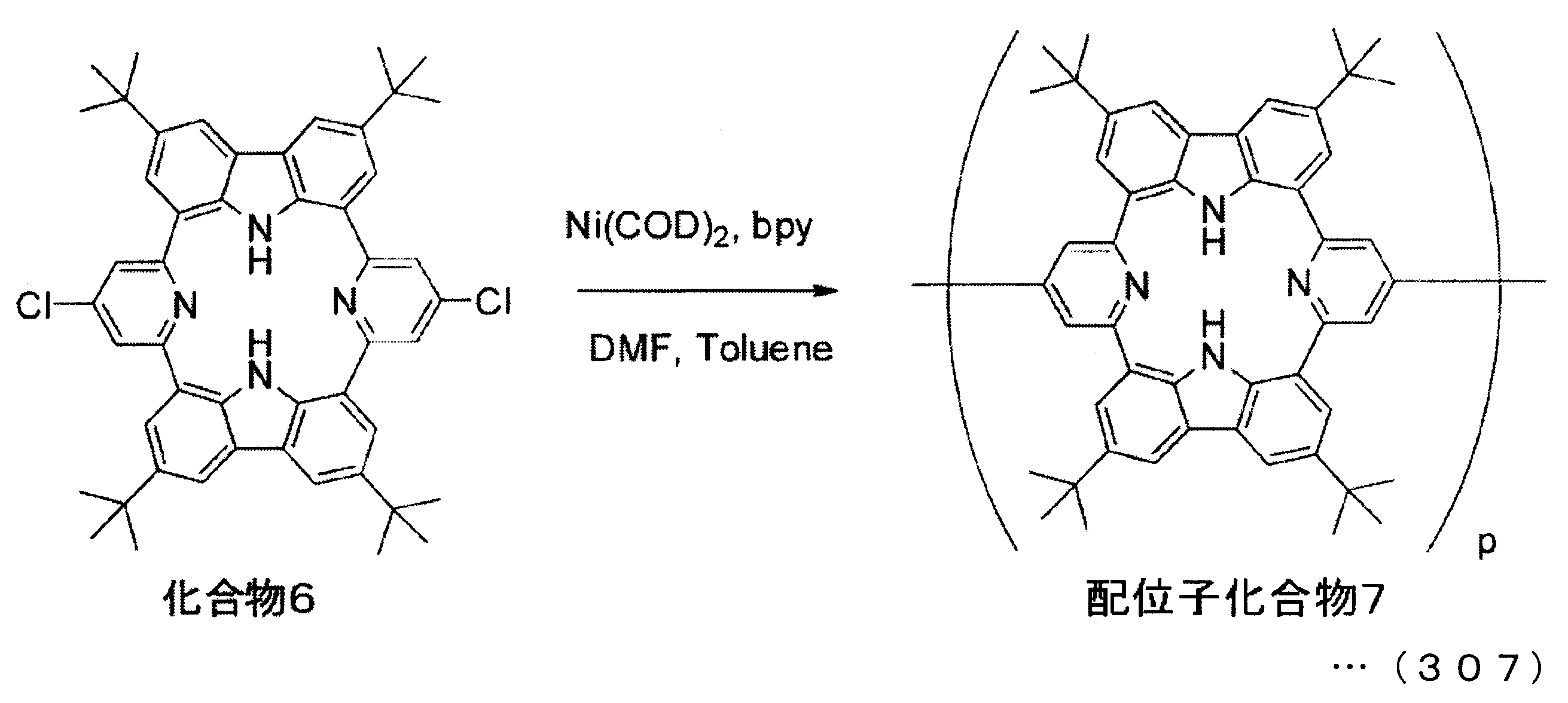
フラスコ内において、22mg(0.08mmol)のビス[1,5-シクロオクタジエン]ニッケル(0)(Ni(COD)2)、9mg(0.08mmol)の1,5-シクロオクタジエン、12mg(0.08mmol)の2,2-ビピリジン(bpy)を、0.3mLのDMF及び0.45mLのトルエン混合溶液へ溶解させ、60℃で30分間攪拌した。さらに30mg(0.04mmol)の化合物6を溶解させた0.2mLのトルエン溶液を加え、得られた反応液を60℃で3日間攪拌した。得られた反応液へメタノールを加え、生成した沈殿を濾取することで、配位子化合物7を得た。得られた配位子化合物7の同定データを以下に示す。
Mn(数平均分子量)=3272.83g/mol
Mw(重量平均分子量)=13693.00g/mol
PDI(多分散指数)=4.18
Mw(重量平均分子量)=13693.00g/mol
PDI(多分散指数)=4.18
(多核金属錯体MC3の合成)
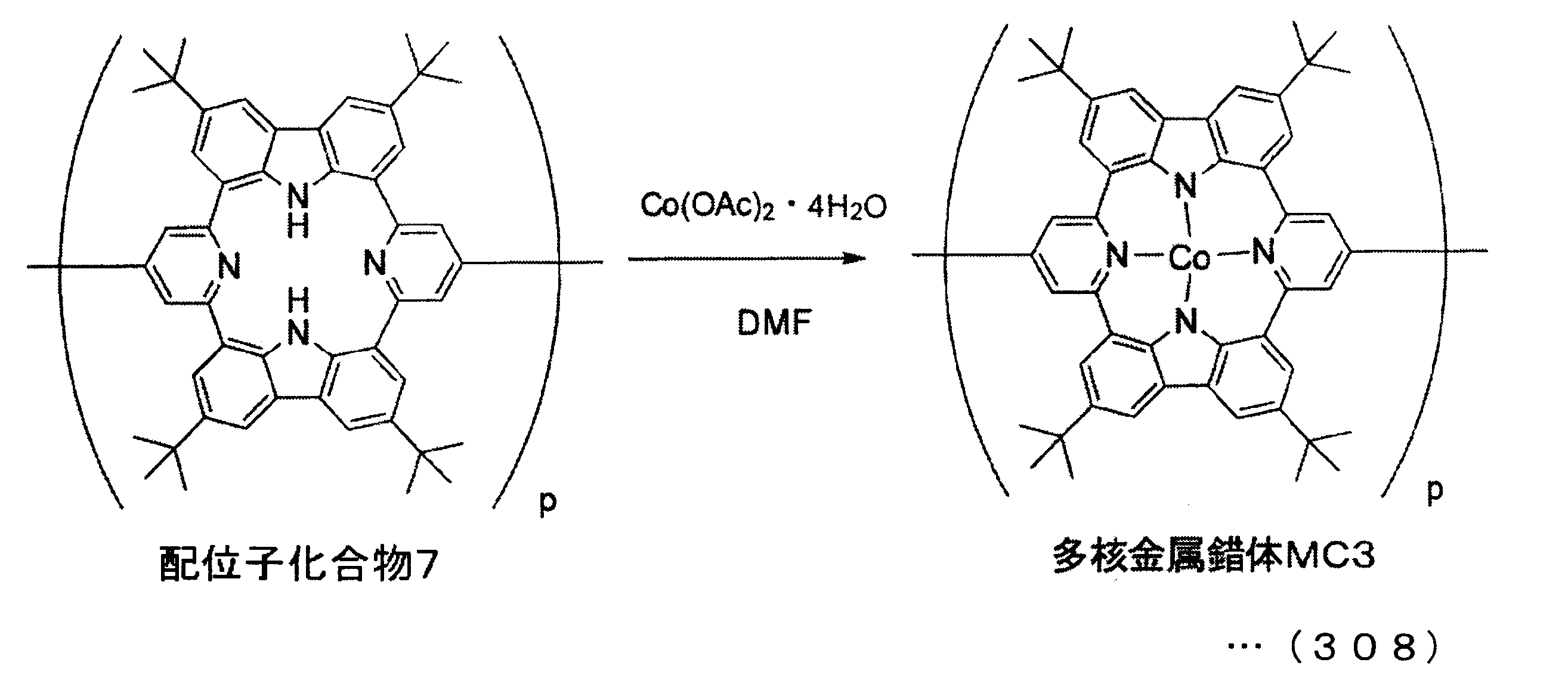
配位子化合物7に対して、過剰量の酢酸コバルト4水和物をDMF中で反応させた後、得られた反応液を冷水に注ぎ、生成した沈殿を濾取し、水及びヘキサンで順番に洗浄して、多核金属錯体MC3を得た。
[合成例10]
以下の反応式(309)に従い、化合物8を経由して配位子化合物9を合成した。そして、以下の反応式(310)に従い、配位子化合物9と金属付与剤とを用いて、多核金属錯体MC4を合成した。
以下の反応式(309)に従い、化合物8を経由して配位子化合物9を合成した。そして、以下の反応式(310)に従い、配位子化合物9と金属付与剤とを用いて、多核金属錯体MC4を合成した。
(配位子化合物9の合成)
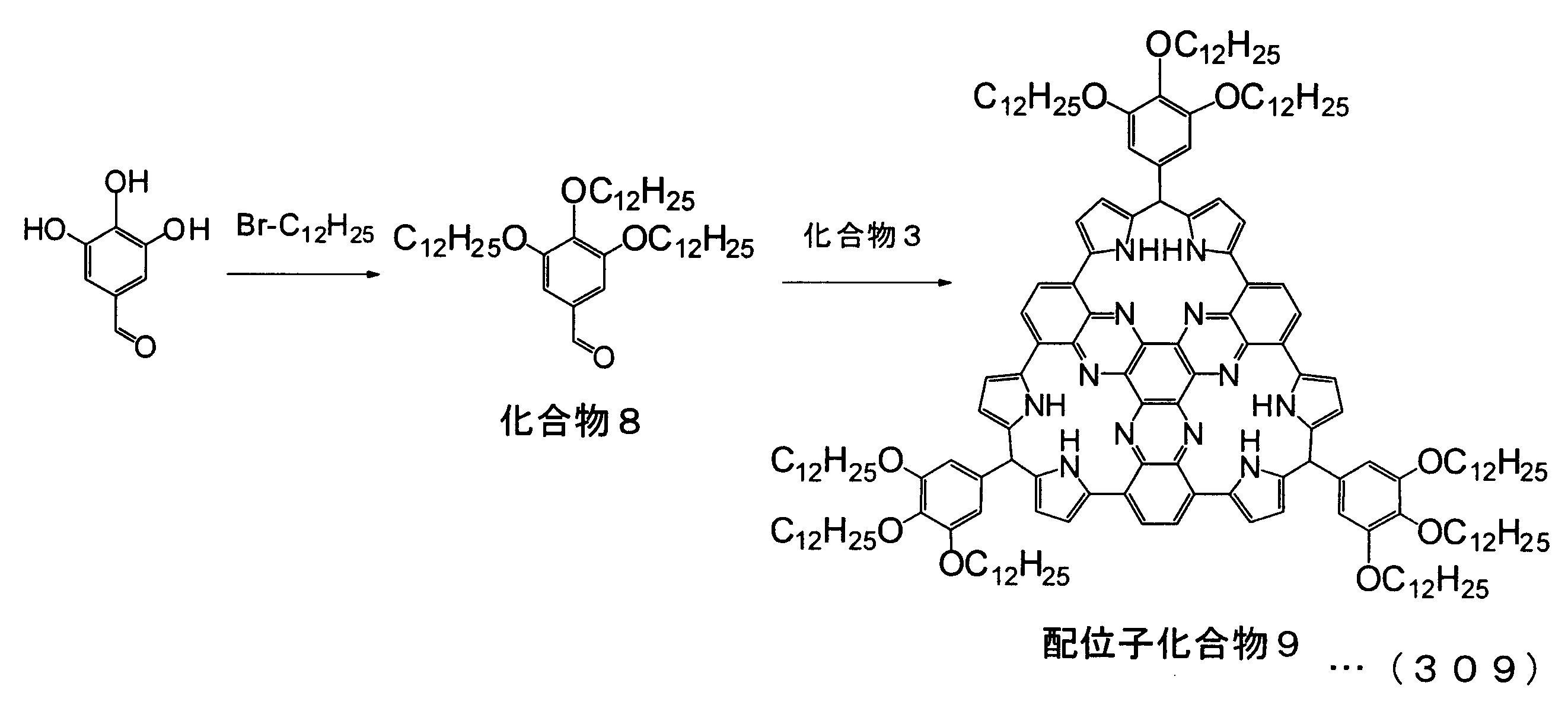
フラスコ内において、1.0g(5.9mmol)の3,4,5-トリヒドロシキベンズアルデヒド、8.7g(35mmol)の1-ブロモドデカン、2.4g(17.4mmol)の炭酸カリウム、及び、60mg(0.35mmol)のヨウ化カリウム、を35mLのジメチルホルムアミドに溶解させ、得られた反応混合物を、70℃で18時間攪拌した。得られた反応溶液を室温まで放冷した後、水を加えて反応を停止させた。その後、ジクロロメタンで抽出を行い、得られた有機層を硫酸マグネシウムで脱水した。得られた有機層をろ過し、得られたろ液から溶媒を留去することで粗生成物を得た。この粗生成物についてシリカゲルカラム(展開溶媒:ヘキサン/ジクロロメタン=3/1)で精製し、化合物8を得た。収量は3.5gであり、収率は90%であった。得られた化合物8の同定データを以下に示す。
1H-NMR(CD2Cl2,300MHz,25℃):δ(ppm)=0.89(t,9H,2J=6.7Hz),1.28(m,54H),1.77(m,6H),4.03(t,6H,2J=6.5Hz),J=6.4Hz),7.08(s,2H),9.82(s,1H).
13C-NMR(CD2Cl2,75MHz,25℃):δ(ppm)=14.2,23.0,29.4,30.8,30.9,32.01,122.1,126.1,126.9,130.7,135.5,140.6,142.5,145.4,191.6.
13C-NMR(CD2Cl2,75MHz,25℃):δ(ppm)=14.2,23.0,29.4,30.8,30.9,32.01,122.1,126.1,126.9,130.7,135.5,140.6,142.5,145.4,191.6.
続いて、以下の操作により、配位子化合物9を合成した。フラスコ内において、100mg(0.13mmol)の化合物3と、383mg(0.56mmol)の化合物8と、を4mLのジクロロメタン及び2mLのTHFの混合溶液に分散させ、0.5mLのトリフルオロ酢酸を加え、前記フラスコ内の気体をアルゴンガスで置換した。得られた反応液を、マイクロウェーブ用試験管に入れ、マイクロウェーブ装置を用いて、85℃、出力50Wにて18時間反応させた。得られた反応液を濃縮後、メタノールを加えることで粗生成物を沈殿物として得た。その後、アセトンを溶媒としたソックスレー抽出器を用いて得られた沈殿物を精製することにより、配位子化合物9を得た。収量は250mgであり、収率は71%であった。得られた配位子化合物9の同定データを以下に示す。
1H-NMR(C3D2F6O+0.1%C2DF3O2,500MHz,25℃):δ(ppm)=0.84(t,27H,2J=6.8Hz),1.24(m,144H),1.43(m,18H),1.75(m,18H),3.89(t,12H,2J=6.1Hz),4.12(t,6H,2J=6.8Hz),6.12(d,6H,3J=4.7Hz),6.18(d,6H,3J=4.7Hz),6.37(s,6H),6.59(s,6H).
MS(Maldi-Tof,TCNQ)実測値(m/z):2693.08(M+)、理論値:2696.01(M+)
MS(Maldi-Tof,TCNQ)実測値(m/z):2693.08(M+)、理論値:2696.01(M+)
(多核金属錯体MC4の合成)

0.305g(0.13mmol)の化合物8と0.14g(0.78mmol)の無水酢酸コバルトと、をマイクロウェーブ用試験管に入れ、そこに、8mLのDMFと4mlのTHFを加え、マイクロウェーブ装置を用いて180℃において2時間反応させた。得られた反応液を25mLの冷水に注ぎ、生成した沈殿を濾取し、乾燥させることで、0.35gの多核金属錯体MC4を得た。得られた多核金属錯体MC4の同定データを以下に示す。
MS(Maldi-Tof,TCNQ)実測値(m/z):2865.01(M+)、理論値:2866.76(M+)
MS(Maldi-Tof,TCNQ)実測値(m/z):2865.01(M+)、理論値:2866.76(M+)
[合成例11]
以下の反応式(311)に従い、化合物10を経由して配位子化合物11を合成した。そして、以下の反応式(312)に従い、配位子化合物11と金属付与剤とを用いて、多核金属錯体MC5を合成した。
以下の反応式(311)に従い、化合物10を経由して配位子化合物11を合成した。そして、以下の反応式(312)に従い、配位子化合物11と金属付与剤とを用いて、多核金属錯体MC5を合成した。
(配位子化合物11の合成)
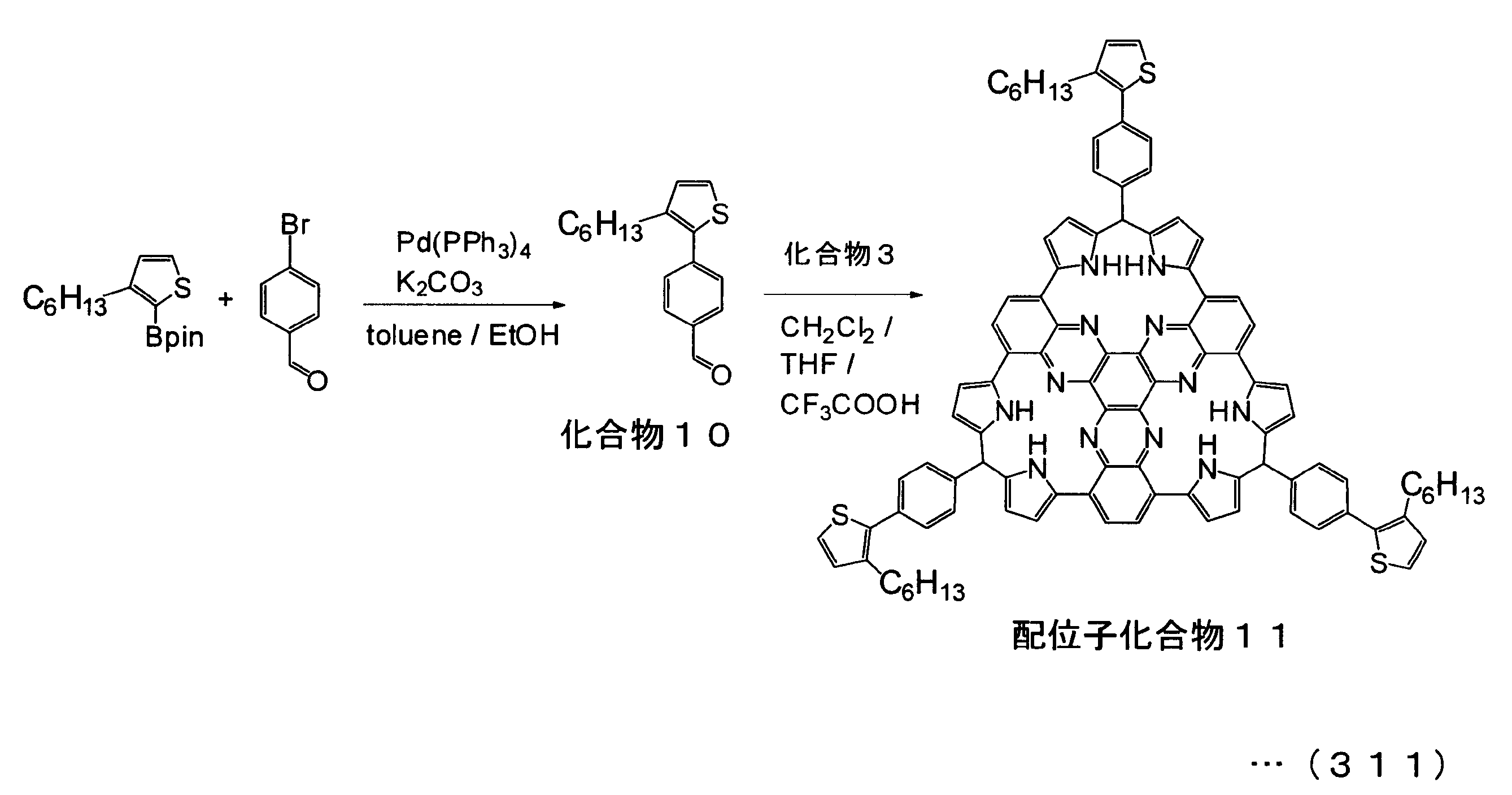
反応容器内をアルゴンガス雰囲気とした後、1.0g(5.4mmol)の4-ブロモベンズアルデヒド、1.4g(8.2mmol)の2-(3-ヘキシルチオフェン-2-イル)-4,4,5,5-テトラメチル-1,3,2-ジオキサボロランを、10mLの脱水トルエンに溶解させた後、5mlのエタノール、5mlの2M炭酸カリウム数溶液、300mgのパラジウムを加えた。得られた反応混合物を85℃で16時間攪拌した。得られた反応溶液を室温まで放冷した後、エバポレーターで溶媒を除去した。得られた残渣をジクロロメタンで抽出を行い、得られた有機層を水及び塩水で洗浄した後、硫酸マグネシウムで脱水した。得られた有機層をろ過し、得られたろ液から溶媒を留去することで粗生成物を得た。この粗生成物についてシリカゲルカラム(展開溶媒:ヘキサン/ジクロロメタン=3/1)で精製し、化合物10を得た。収量は817mgであり、収率は55%であった。得られた化合物10の同定データを以下に示す。
1H-NMR(CD2Cl2,300MHz,25℃):δ(ppm)=0.89(t,3H),1.23-1.41(m,6H),1.60-1.70(m,4H),1.75(m,18H),2.64(t,2H,3J=7.5Hz),7.02(s,1H),7.35(s,1H),7.75(d,2H,2J=8.4Hz),7.87(d,2H,2J=8.4Hz),9.97(s,1H).
13C-NMR(CD2Cl2,75MHz,25℃):δ(ppm)=14.2,23.0,29.4,30.8,30.9,32.01,122.1,126.1,126.9,130.7,135.5,140.6,142.5,145.4,191.6.
13C-NMR(CD2Cl2,75MHz,25℃):δ(ppm)=14.2,23.0,29.4,30.8,30.9,32.01,122.1,126.1,126.9,130.7,135.5,140.6,142.5,145.4,191.6.
続いて、以下の操作により、配位子化合物11を合成した。
フラスコ内において、120mg(0.15mmol)の化合物3と、230mg(0.85mmol)の化合物10と、を4mLのジクロロメタン及び2mLのTHFの混合溶液に分散させ、0.5mLのトリフルオロ酢酸を加え、前記フラスコ内の気体をアルゴンガスで置換した。得られた反応液を、マイクロウェーブ用試験管に入れ、マイクロウェーブ装置を用いて、70℃にて2日間反応させた。得られた反応液を濃縮後、得られた濃縮液にメタノールを加えることで粗生成物を沈殿物として得た。その後、メタノールを溶媒としたソックスレー抽出器を用いて得られた沈殿物を精製することにより、配位子化合物11を得た。収量は150mgであり、収率は65%であった。得られた配位子化合物11の同定データを以下に示す。
MS(Maldi-Tof,TCNQ)実測値(m/z):1533.03(M+)、理論値:1530.56(M+)
フラスコ内において、120mg(0.15mmol)の化合物3と、230mg(0.85mmol)の化合物10と、を4mLのジクロロメタン及び2mLのTHFの混合溶液に分散させ、0.5mLのトリフルオロ酢酸を加え、前記フラスコ内の気体をアルゴンガスで置換した。得られた反応液を、マイクロウェーブ用試験管に入れ、マイクロウェーブ装置を用いて、70℃にて2日間反応させた。得られた反応液を濃縮後、得られた濃縮液にメタノールを加えることで粗生成物を沈殿物として得た。その後、メタノールを溶媒としたソックスレー抽出器を用いて得られた沈殿物を精製することにより、配位子化合物11を得た。収量は150mgであり、収率は65%であった。得られた配位子化合物11の同定データを以下に示す。
MS(Maldi-Tof,TCNQ)実測値(m/z):1533.03(M+)、理論値:1530.56(M+)
(多核金属錯体MC5の合成)

0.203g(0.13mmol)の配位子化合物11と0.14g(0.78mmol)の無水酢酸コバルトとをマイクロウェーブ用試験管に入れ、そこに、10mLのDMFと3mlのTHFを加え、マイクロウェーブ装置を用いて60℃にて2日間反応させた。得られた反応液を25mLの冷水に注ぎ、生成した沈殿を濾取し、乾燥させることで、0.22gの多核金属錯体MC5を得た。得られた多核金属錯体MC5の同定データを以下に示す。
MS(Maldi-Tof,TCNQ)実測値(m/z):1703.77(M+)、理論値:704.34(M+)
MS(Maldi-Tof,TCNQ)実測値(m/z):1703.77(M+)、理論値:704.34(M+)
[合成例12]
以下の反応式(313)に従い、配位子化合物4と金属付与剤とを用いて、多核金属錯体MC6を合成した。
以下の反応式(313)に従い、配位子化合物4と金属付与剤とを用いて、多核金属錯体MC6を合成した。
(多核金属錯体MC6の合成)

0.133g(0.097mmol)の配位子化合物4と0.053g(0.304mmol)の酢酸鉄(II)とをマイクロウェーブ用試験管に入れ、そこに、5mLのDMFを加え、マイクロウェーブ装置を用いて200℃、出力200Wにて4時間反応させた。得られた反応液を25mLの冷水に注ぎ、生成した沈殿を濾取し、水、ヘキサン及びジエチルエーテルで順番に洗浄して、多核金属錯体MC6を得た。得られた多核金属錯体MC6の同定データを以下に示す。
MS(Maldi-Tof,TCNQ)実測値(m/z):1534(M+)、理論値:1534.48(M+)
MS(Maldi-Tof,TCNQ)実測値(m/z):1534(M+)、理論値:1534.48(M+)
0.10g(0.073mmol)の配位子化合物4と0.053g(0.21mmol)の酢酸マンガン(II)四水和物とをマイクロウェーブ用試験管に入れ、そこに、5mLのDMFを加え、マイクロウェーブ装置を用いて200℃、出力200Wにて4時間反応させた。反応液を25mLの冷水に注ぎ、生成した沈殿を濾取し、水及びヘキサンで順番に洗浄して、多核金属錯体MC7を得た。
<空気二次電池用正極触媒の製造>
[実施例10]
(正極触媒10の製造)
多核金属錯体MC1及びカーボン(商品名:ケッチェンブラックEC600JD、ライオン社製)を質量比1:4で混合し、メタノール中、室温にて15分間攪拌した後、室温にて200Paの減圧下で12時間乾燥させて正極触媒10を得た。
[実施例10]
(正極触媒10の製造)
多核金属錯体MC1及びカーボン(商品名:ケッチェンブラックEC600JD、ライオン社製)を質量比1:4で混合し、メタノール中、室温にて15分間攪拌した後、室温にて200Paの減圧下で12時間乾燥させて正極触媒10を得た。
[実施例11~15]
(正極触媒11~15の製造)
実施例10において、多核金属錯体MC1を、それぞれ、多核金属錯体MC2(実施例11)、多核金属錯体MC3(実施例12)、多核金属錯体MC4(実施例13)、多核金属錯体MC5(実施例14)、多核金属錯体MC6(実施例15)に変更したこと以外は、実施例10と同様にして、正極触媒11、正極触媒12、正極触媒13、正極触媒14、正極触媒15を調製し、電極を作製し、酸素還元活性の評価を行った。得られた結果を表2に示す。
(正極触媒11~15の製造)
実施例10において、多核金属錯体MC1を、それぞれ、多核金属錯体MC2(実施例11)、多核金属錯体MC3(実施例12)、多核金属錯体MC4(実施例13)、多核金属錯体MC5(実施例14)、多核金属錯体MC6(実施例15)に変更したこと以外は、実施例10と同様にして、正極触媒11、正極触媒12、正極触媒13、正極触媒14、正極触媒15を調製し、電極を作製し、酸素還元活性の評価を行った。得られた結果を表2に示す。
[比較例2]
二酸化マンガン(アルドリッチ社製、製品コード:203750)及びカーボン(商品名:ケッチェンブラックEC600JD、ライオン社製)を質量比1:4で混合し、エタノール中、室温にて15分間攪拌後、室温にて200Paの減圧下で12時間乾燥させて正極触媒R2を得た。
二酸化マンガン(アルドリッチ社製、製品コード:203750)及びカーボン(商品名:ケッチェンブラックEC600JD、ライオン社製)を質量比1:4で混合し、エタノール中、室温にて15分間攪拌後、室温にて200Paの減圧下で12時間乾燥させて正極触媒R2を得た。
<空気二次電池用正極触媒の評価>
(酸素還元活性の評価)
上記で得られた正極触媒(正極触媒10~15及び正極触媒R2)について、回転ディスク電極により、酸素還元活性を評価した。具体的には、以下の通りである。
電極には、ディスク部がグラッシーカーボン(直径6.0mm)であるディスク電極を用いた。
正極触媒が1mg入ったサンプル瓶へ、0.5質量%のナフィオン(登録商標)溶液(5質量%ナフィオン(登録商標)溶液をエタノールにて10倍希釈した溶液)を1mL加えた後、超音波を照射して15分間分散させた。得られた懸濁液7.2μLを前記電極のディスク部に滴下して乾燥させた後、80℃に加熱した乾燥機にて3時間乾燥させることで、測定用電極を得た。
この測定用電極を用いて、下記測定装置及び測定条件において、酸素還元反応の電流値を測定した。電流値の測定は、窒素ガスを飽和させた状態(窒素ガス雰囲気下)、酸素ガスを飽和させた状態(酸素ガス雰囲気下)でそれぞれ行い、酸素ガス雰囲気下での測定で得られた電流値から、窒素ガス雰囲気下での測定で得られた電流値を引いた値を酸素還元反応の電流値とした。この電流値を測定用電極の表面積で除すことにより、電流密度を求めた。結果を表2に示す。
電流密度は、銀/塩化銀電極に対して-0.8Vのときの値である。
(酸素還元活性の評価)
上記で得られた正極触媒(正極触媒10~15及び正極触媒R2)について、回転ディスク電極により、酸素還元活性を評価した。具体的には、以下の通りである。
電極には、ディスク部がグラッシーカーボン(直径6.0mm)であるディスク電極を用いた。
正極触媒が1mg入ったサンプル瓶へ、0.5質量%のナフィオン(登録商標)溶液(5質量%ナフィオン(登録商標)溶液をエタノールにて10倍希釈した溶液)を1mL加えた後、超音波を照射して15分間分散させた。得られた懸濁液7.2μLを前記電極のディスク部に滴下して乾燥させた後、80℃に加熱した乾燥機にて3時間乾燥させることで、測定用電極を得た。
この測定用電極を用いて、下記測定装置及び測定条件において、酸素還元反応の電流値を測定した。電流値の測定は、窒素ガスを飽和させた状態(窒素ガス雰囲気下)、酸素ガスを飽和させた状態(酸素ガス雰囲気下)でそれぞれ行い、酸素ガス雰囲気下での測定で得られた電流値から、窒素ガス雰囲気下での測定で得られた電流値を引いた値を酸素還元反応の電流値とした。この電流値を測定用電極の表面積で除すことにより、電流密度を求めた。結果を表2に示す。
電流密度は、銀/塩化銀電極に対して-0.8Vのときの値である。
(測定装置)
日厚計測社製RRDE-1回転リングディスク電極装置
ALSモデル701Cデュアル電気化学アナライザー
(測定条件)
セル溶液:0.1mol/L水酸化カリウム水溶液(酸素飽和又は窒素飽和)
溶液温度:25℃
参照電極:銀/塩化銀電極(飽和塩化カリウム)
カウンター電極:白金ワイヤー
掃引速度:10mV/秒
電極回転速度:1600rpm
日厚計測社製RRDE-1回転リングディスク電極装置
ALSモデル701Cデュアル電気化学アナライザー
(測定条件)
セル溶液:0.1mol/L水酸化カリウム水溶液(酸素飽和又は窒素飽和)
溶液温度:25℃
参照電極:銀/塩化銀電極(飽和塩化カリウム)
カウンター電極:白金ワイヤー
掃引速度:10mV/秒
電極回転速度:1600rpm
(水の酸化活性の評価)
上記で得られた正極触媒(正極触媒10~15及び正極触媒R2)について、酸素還元活性の評価の場合と同様の測定用電極を作製し、これを用いて、下記測定装置及び測定条件において、水の酸化反応の電流値を測定した。電流値の測定は、窒素ガスを飽和させた状態で行い、この電流値を測定用電極の表面積で除すことにより、電流密度を求めた。結果を表2に示す。電流密度は、銀/塩化銀電極に対して1Vのときの値である。
上記で得られた正極触媒(正極触媒10~15及び正極触媒R2)について、酸素還元活性の評価の場合と同様の測定用電極を作製し、これを用いて、下記測定装置及び測定条件において、水の酸化反応の電流値を測定した。電流値の測定は、窒素ガスを飽和させた状態で行い、この電流値を測定用電極の表面積で除すことにより、電流密度を求めた。結果を表2に示す。電流密度は、銀/塩化銀電極に対して1Vのときの値である。
(測定装置)
日厚計測社製RRDE-1回転リングディスク電極装置
ALSモデル701Cデュアル電気化学アナライザー
(測定条件)
セル溶液:1mol/L水酸化ナトリウム水溶液(窒素飽和)
溶液温度:25℃
参照電極:銀/塩化銀電極(飽和塩化カリウム)
カウンター電極:白金ワイヤー
掃引速度:10mV/秒
電極回転速度:900rpm
日厚計測社製RRDE-1回転リングディスク電極装置
ALSモデル701Cデュアル電気化学アナライザー
(測定条件)
セル溶液:1mol/L水酸化ナトリウム水溶液(窒素飽和)
溶液温度:25℃
参照電極:銀/塩化銀電極(飽和塩化カリウム)
カウンター電極:白金ワイヤー
掃引速度:10mV/秒
電極回転速度:900rpm
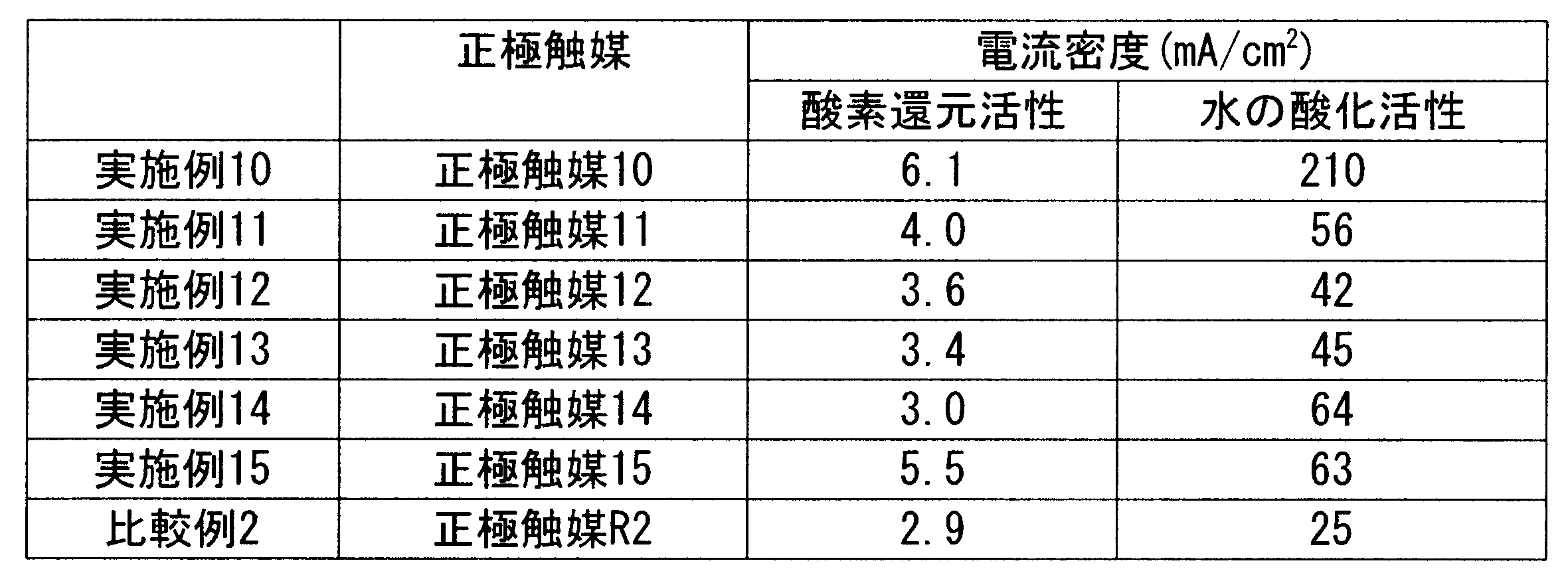
[空気二次電池での充放電試験]
[実施例16]
・正極触媒層J1の作製
正極触媒としての多核金属錯体MC1と、導電材としてのアセチレンブラックと、結着材としてのPTFE粉末とを、多核金属錯体MC1:アセチレンブラック:PTFE=1:10:1(質量比)で混合し、そこにエタノールをピペットで5滴加え、これらをメノー乳鉢で混合した後、薄膜化し、正極触媒層J1を得た。
[実施例16]
・正極触媒層J1の作製
正極触媒としての多核金属錯体MC1と、導電材としてのアセチレンブラックと、結着材としてのPTFE粉末とを、多核金属錯体MC1:アセチレンブラック:PTFE=1:10:1(質量比)で混合し、そこにエタノールをピペットで5滴加え、これらをメノー乳鉢で混合した後、薄膜化し、正極触媒層J1を得た。
上記正極触媒層J1を、撥水性PTFEシートと、ステンレスメッシュとで両側から挟み、プレス機で圧着することで、空気二次電池用正極を得た。
負極となる水素吸蔵合金を以下の方法で取り出した。単3形充電式ニッケル水素電池(エネループ(登録商標)、三洋電機株式会社製、HR-3UTGA)を充放電試験機(東洋システム社製、製品名TOSCAT-3000U)に接続し、電池電圧が1.0Vとなるまで放電した。前記ニッケル水素電池を解体し、水素吸蔵合金を取り出した。
前記水素吸蔵合金を多孔質金属体(セルメット#8、富山住友電工株式会社製)で挟み、プレス機でプレスしたものを負極とし、充放電試験機(東洋システム社製、製品名:TOSCAT-3000U)に接続し、電解液として8.0M水酸化カリウム水溶液を用いて、充放電サイクル試験を行った。
充放電サイクル試験は、以下のステップ1~4を10回繰り返して行った。
ステップ1:定電流3mAにて20分間充電
ステップ2:5分間休止
ステップ3:定電流3mAにて放電。電圧が0.5Vとなった時点でステップ4へ移る。
ステップ4:5分間休止
前記水素吸蔵合金を多孔質金属体(セルメット#8、富山住友電工株式会社製)で挟み、プレス機でプレスしたものを負極とし、充放電試験機(東洋システム社製、製品名:TOSCAT-3000U)に接続し、電解液として8.0M水酸化カリウム水溶液を用いて、充放電サイクル試験を行った。
充放電サイクル試験は、以下のステップ1~4を10回繰り返して行った。
ステップ1:定電流3mAにて20分間充電
ステップ2:5分間休止
ステップ3:定電流3mAにて放電。電圧が0.5Vとなった時点でステップ4へ移る。
ステップ4:5分間休止
図4は、実施例16の空気二次電池用正極を用いた空気二次電池の充放電サイクル試験の結果を示すグラフである。図に示すように、本発明の多核金属錯体MC1を用いた空気二次電池では、充電及び放電を良好に繰り返すことができ、更に、充放電を繰り返した後にも、物性低下が見られなかった。
[実施例17、実施例18]
正極触媒としての多核金属錯体MC4又は多核金属錯体MC5、導電材としてのケッチェンブラックと、結着材としてのPTFE粉末とを、多核金属錯体MC4又は多核金属錯体MC5:ケッチェンブラック:PTFE=1:10:1(質量比)で混合し、そこにエタノールをピペットで5滴加え、これらをメノー乳鉢で混合した後、薄膜化し、正極触媒層J2(実施例17)、正極触媒層J3(実施例18)を得た。
正極触媒としての多核金属錯体MC4又は多核金属錯体MC5、導電材としてのケッチェンブラックと、結着材としてのPTFE粉末とを、多核金属錯体MC4又は多核金属錯体MC5:ケッチェンブラック:PTFE=1:10:1(質量比)で混合し、そこにエタノールをピペットで5滴加え、これらをメノー乳鉢で混合した後、薄膜化し、正極触媒層J2(実施例17)、正極触媒層J3(実施例18)を得た。
実施例16と同様の測定法にて、充放電サイクルを3回に設定して評価を行った。
図5、図6は、実施例17、実施例18の空気二次電池の充放電サイクル試験の結果を示すグラフである。図に示すように、本発明の多核金属錯体MC4及び多核金属錯体MC5を用いた空気二次電池では、充電及び放電を良好に繰り返すことができ、更に、充放電を繰り返した後にも、物性低下が見られなかった。
[実施例19]
・正極触媒層J4の作製
正極触媒としての多核金属錯体(D)及び多核金属錯体MC1と、導電材としてのケッチェンブラックと、結着材としてのPTFE粉末とを、多核金属錯体(D):多核金属錯体MC1:ケッチェンブラック:PTFE=1:1:10:1(質量比)で混合し、そこにエタノールをピペットで5滴加え、これらをメノー乳鉢で混合した後、薄膜化し、正極触媒層J4を得た。
・正極触媒層J4の作製
正極触媒としての多核金属錯体(D)及び多核金属錯体MC1と、導電材としてのケッチェンブラックと、結着材としてのPTFE粉末とを、多核金属錯体(D):多核金属錯体MC1:ケッチェンブラック:PTFE=1:1:10:1(質量比)で混合し、そこにエタノールをピペットで5滴加え、これらをメノー乳鉢で混合した後、薄膜化し、正極触媒層J4を得た。
実施例16と同様にして、充放電サイクルを3回に設定して評価を行った。
図7は、実施例19の空気二次電池の充放電サイクル試験の結果を示すグラフである。図に示すように、本発明の多核金属錯体(D)及び多核金属錯体MC1の両方を用いた空気二次電池では、充電及び放電を良好に繰り返すことができ、更に、充放電を繰り返した後にも、物性低下が見られなかった。
以上により、本発明の有用性が確かめられた。
1・・・空気二次電池、11・・・正極触媒層、12・・・正極集電体、120・・・正極端子、13・・・負極活物質層、14・・・負極集電体、140・・・負極端子、15・・・電解質
本発明は、空気二次電池としてエネルギー分野で利用可能である。
Claims (28)
- 多核金属錯体を用いてなる空気二次電池用正極触媒。
- 前記多核金属錯体が、2つ以上の中心金属と、前記中心金属に配位結合する配位子と、を有するものであり、
前記配位子が、前記中心金属に配位可能な4つ以上の原子で囲まれた空間を有し、前記4つ以上の原子は、窒素原子、酸素原子及び硫黄原子からなる群から選ばれる1種以上の原子であり、前記空間に前記中心金属を収容可能とする構造を、分子内に2つ以上有し、2つ以上の前記構造は、同一でも異なっていてもよい有機化合物である請求項1に記載の空気二次電池用正極触媒。 - 前記多核金属錯体の中心金属の数が、2~6である請求項1又は2に記載の空気二次電池用正極触媒。
- 前記多核金属錯体の中心金属が、周期表の第4周期から第6周期に属する遷移金属原子又はそのイオンである請求項1~3のいずれか一項に記載の空気二次電池用正極触媒。
- 前記多核金属錯体が、下記一般式(A-1)で表される多核金属錯体である請求項1~4のいずれか一項に記載の空気二次電池用正極触媒。

Z1は3価の有機基であり、2以上のZ1は互いに同一でも異なっていてもよい。
Eは酸素原子又は硫黄原子であり、2以上のEは互いに同一でも異なっていてもよい。
Q1は少なくとも2つの窒素原子を有する2価の有機基である。
T1は窒素原子を有する有機基であり、2以上のT1は互いに同一でも異なっていてもよく、2以上のT1は互いに結合していてもよい。
lは1以上の整数であり、lが2以上の場合、lが付された2以上の前記一般式は互いに同一でも異なっていてもよい。
Mは遷移金属原子又は遷移金属イオンであり、mは2以上の整数であり、2以上のMは互いに同一でも異なっていてもよい。
X1は対イオン又は中性分子であり、nは0以上の整数であり、nが2以上の場合、2以上のX1は互いに同一でも異なっていてもよい。) - 前記T1が、含窒素芳香族複素環を有する有機基である請求項5に記載の空気二次電池用正極触媒。
- 前記一般式(A-1)で表される多核金属錯体が、下記一般式(A-2)で表される多核金属錯体である請求項5に記載の空気二次電池用正極触媒。
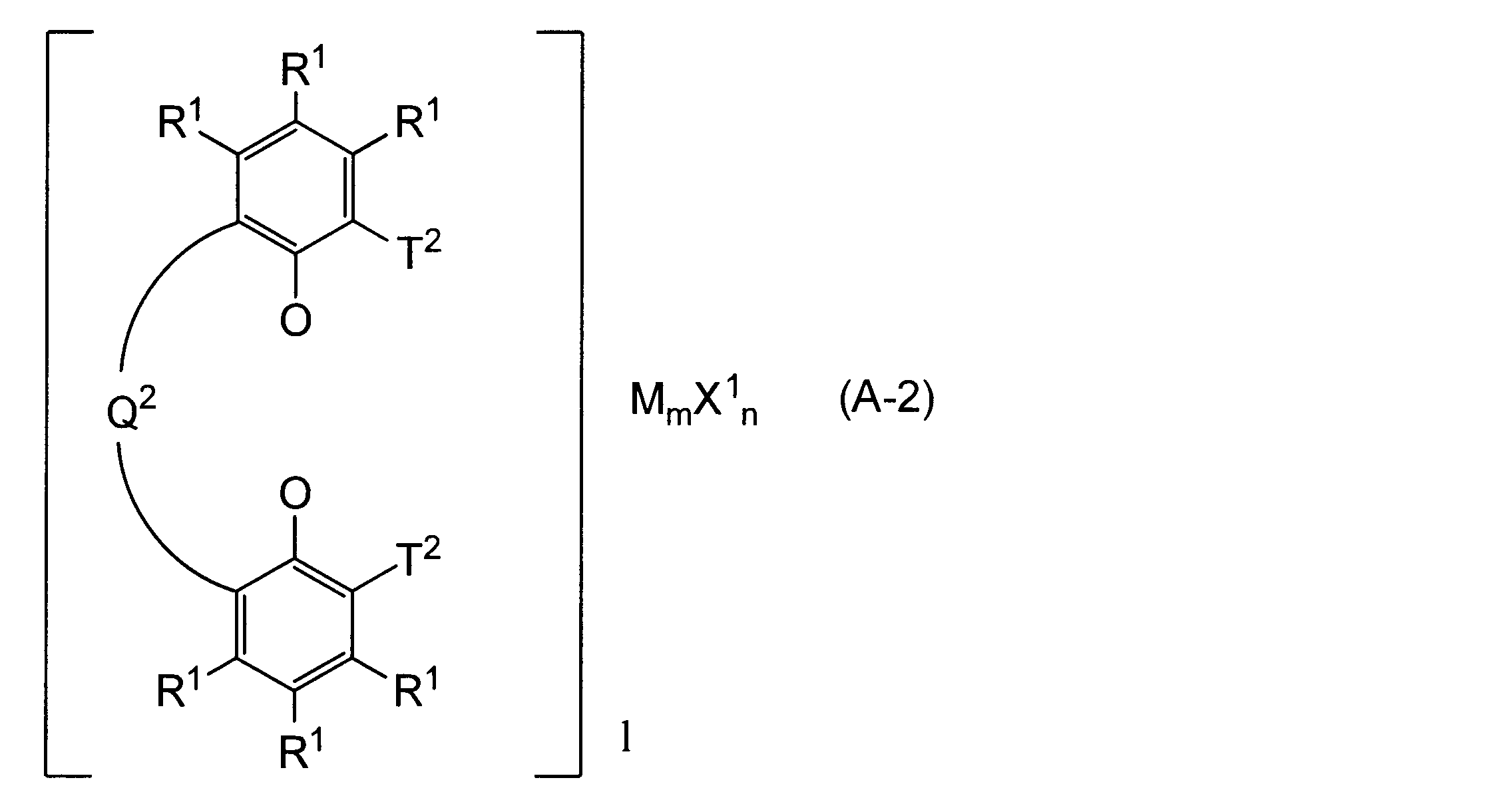
R1は水素原子又は置換基であり、2以上のR1は互いに同一でも異なっていてもよく、隣り合うR1同士は互いに結合して、それぞれが結合する炭素原子とともに環を形成してもよい。
Q2は少なくとも2つの窒素原子を有する2価の有機基である。
T2は窒素原子を有する有機基である。2以上のT2は互いに同一でも異なっていてもよく、2以上のT2は互いに結合していてもよい。
lは1以上の整数であり、lが2以上の場合、lが付された2以上の前記一般式は互いに同一でも異なっていてもよい。
Mは遷移金属原子又は遷移金属イオンであり、mは2以上の整数であり、2以上のMは互いに同一でも異なっていてもよい。
X1は対イオン又は中性分子であり、nは0以上の整数であり、nが2以上の場合、2以上のX1は互いに同一でも異なっていてもよい。) - 前記T2が、含窒素芳香族複素環を有する有機基である請求項7に記載の空気二次電池用正極触媒。
- 前記一般式(A-2)で表される多核金属錯体が、下記一般式(A-3)で表される多核金属錯体である請求項7に記載の空気二次電池用正極触媒。
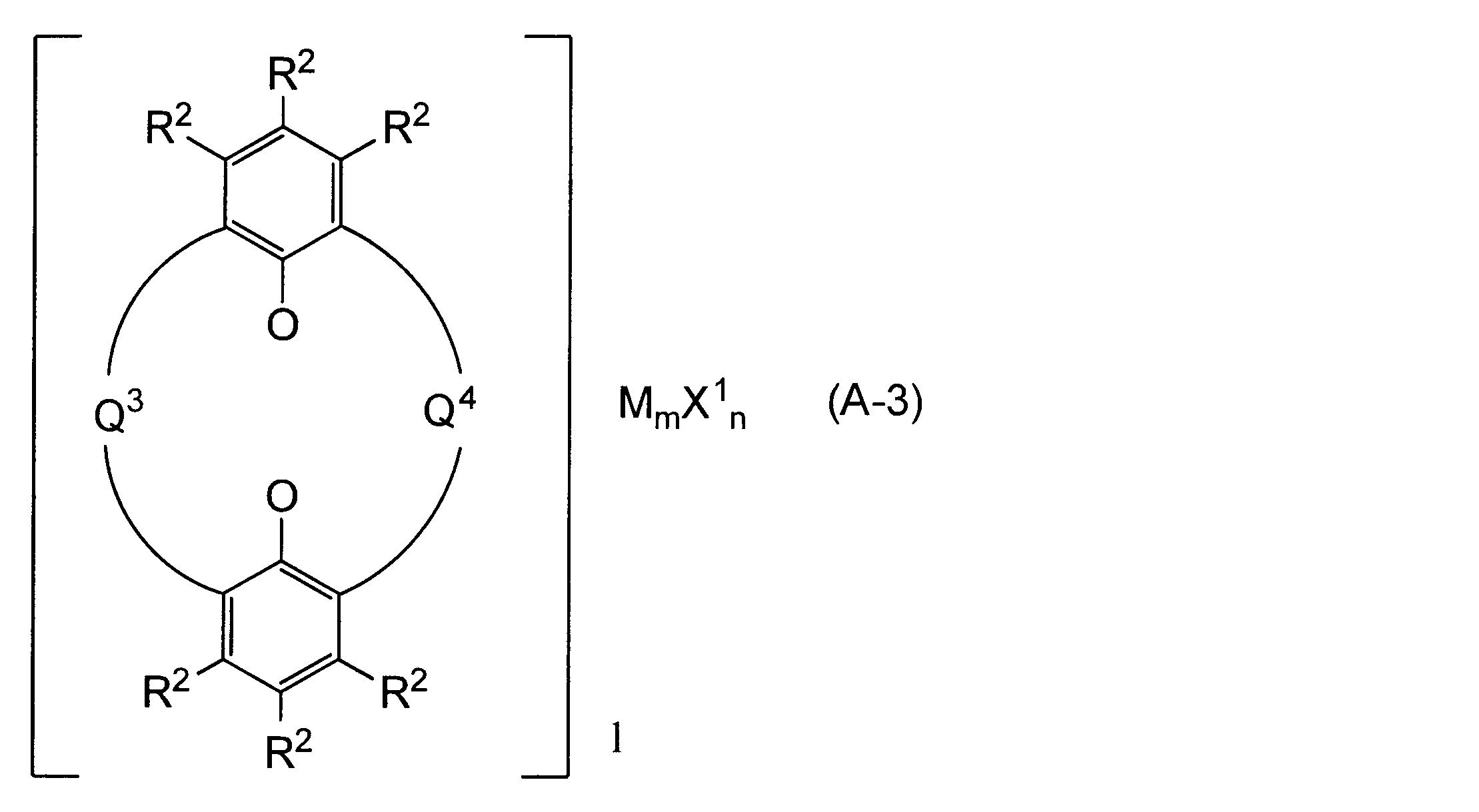
R2は水素原子又は置換基であり、2以上のR2は互いに同一でも異なっていてもよく、隣り合うR2同士は互いに結合して、それぞれが結合する炭素原子とともに環を形成してもよい。
Q3及びQ4は、それぞれ独立に下記一般式(A-3-1)、(A-3-2)、(A-3-3)、(A-3-4)、(A-3-5)又は(A-3-6)で表される2価の基である。
lは1以上の整数であり、lが2以上の場合、lが付された2以上の前記一般式は互いに同一でも異なっていてもよい。
Mは遷移金属原子又は遷移金属イオンであり、mは2以上の整数であり、2以上のMは互いに同一でも異なっていてもよい。
X1は対イオン又は中性分子であり、nは0以上の整数であり、nが2以上の場合、2以上のX1は互いに同一でも異なっていてもよい。)
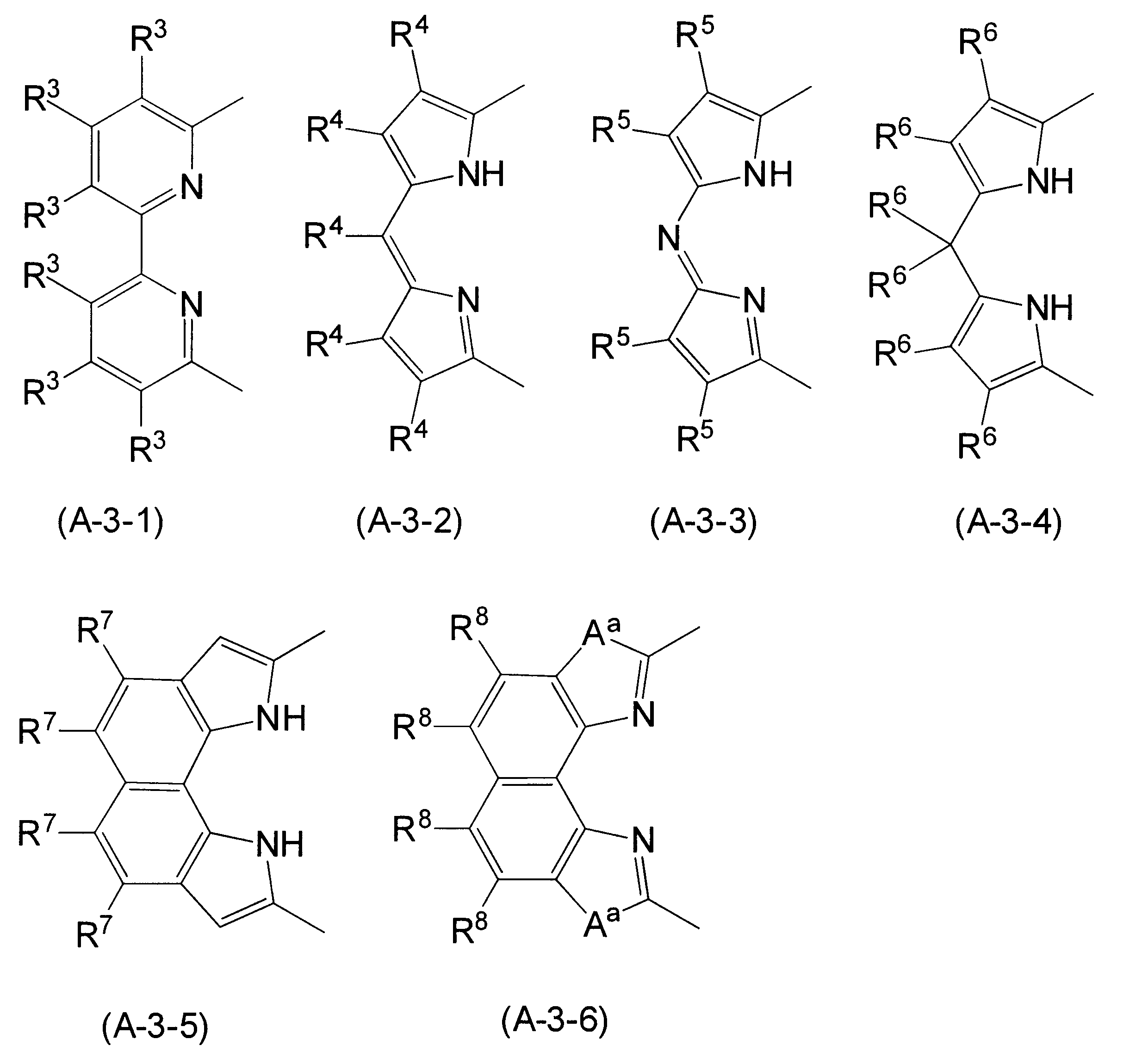
R3、R4、R5、R6、R7及びR8は、それぞれ独立に水素原子又は置換基であり、2以上のR3、R4、R5、R6、R7及びR8は、それぞれ互いに同一でも異なっていてもよく、2以上のR3、R4、R5、R6、R7及びR8は、それぞれ互いに結合して、それぞれが結合する炭素原子とともに環を形成してもよい。
Aaは、下記式(A-3-a)、(A-3-b)又は下記一般式(A-3-c)で表される2価の基であり、2以上のAaは、互いに同一でも異なっていてもよい。)
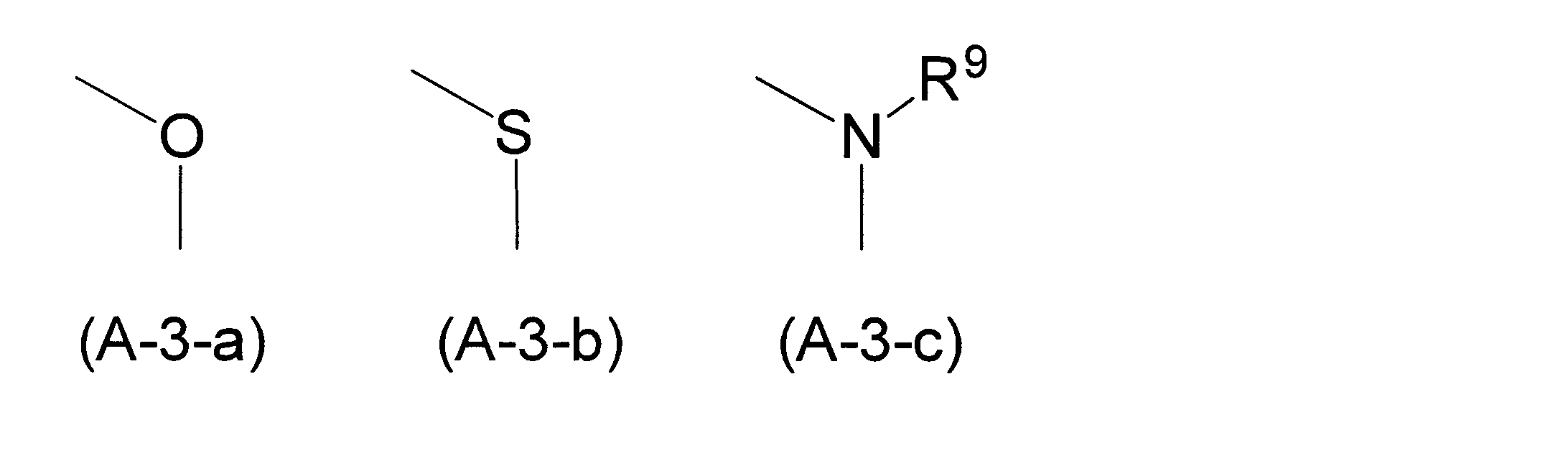
- 前記Mが、バナジウム、クロム、マンガン、鉄、コバルト、ニッケル及び銅からなる群より選ばれる一種以上である請求項5~9のいずれか一項に記載の空気二次電池用正極触媒。
- 前記mが2である請求項5~10のいずれか一項に記載の空気二次電池用正極触媒。
- 前記多核金属錯体が、2つ以上の中心金属と、前記中心金属に配位結合する配位子と、を有するものであり、
前記配位子が、下記(a)及び(b)の要件を満たす芳香族化合物である請求項1又は2に記載の空気二次電池用正極触媒。
(a)前記中心金属に配位可能な4つ以上の窒素原子で囲まれた空間を有し、前記空間に前記中心金属を収容可能とする構造を、分子内に2つ以上有する。2つ以上の前記構造は、同一でも異なっていてもよい。
(b)前記構造を構成する窒素原子のうち少なくとも1つが含窒素複素六員環に含まれる窒素原子である。 - 前記構造は、前記構造を構成する窒素原子の数nと、前記空間の中心から前記構造を構成する各窒素原子の中心までの平均距離r(Å)とが、下記式(A)で示される要件を満たす請求項12に記載の空気二次電池用正極触媒。
0<r/n≦0.7 …(A) - 前記窒素原子の数nと前記平均距離rとが、下記式(B)で示される要件を満たす請求項13に記載の空気二次電池用正極触媒。
0.2≦r/n≦0.6 …(B) - 前記構造は、前記構造を構成する窒素原子の数nが4以上6以下である請求項12~14のいずれか一項に記載の空気二次電池用正極触媒。
- 前記配位子を構成する全炭素原子の質量WCと、前記配位子を構成する全窒素原子の質量WNとが、下記式(C)で示される要件を満たす請求項12~15のいずれか一項に記載の空気二次電池用正極触媒。
0<WN/WC≦1.1 …(C) - 前記構造が、下記一般式(B-1)で表される芳香族化合物である請求項12~16のいずれか一項に記載の空気二次電池用正極触媒。
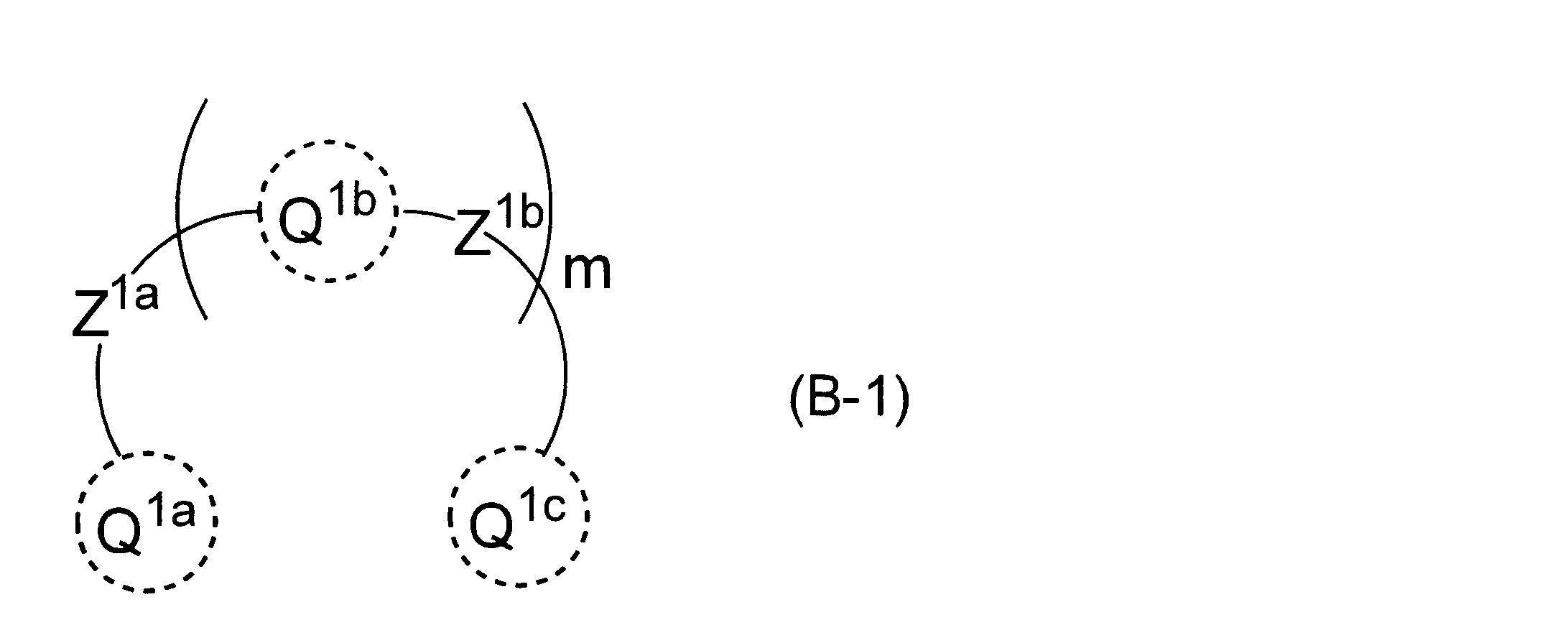
mは1以上の整数である。
Q1a、Q1b及びQ1cは、それぞれ独立に、置換基を有していてもよい含窒素芳香族複素環であり、前記配位可能な4つ以上の窒素原子をそれぞれ含む。Q1bが2以上の場合は、それらは同一でも異なっていてもよい。ただし、Q1a、Q1b及びQ1cのうち少なくとも1つは、含窒素芳香族複素六員環である。
Z1a及びZ1bは、それぞれ独立に、直接結合又は連結基であり、Z1bが2以上の場合は、それらは同一でも異なっていてもよい。
Q1a及びQ1b、並びに、Q1b及びQ1cは、各々、一体となって多環式芳香族複素環を形成していてもよい。
mが2以上の整数であり、かつ、Z1bが直接結合である場合、隣り合う2つのQ1bは、一体となって多環式芳香族複素環を形成していてもよい。
Q1a及びQ1cは直接結合して、又は、連結基を介して互いに結合していてもよく、一体となって多環式芳香族複素環を形成していてもよい。) - 前記式(B-1)において、mが2又は4である請求項17に記載の空気二次電池用正極触媒。
- 前記Q1a、Q1b及びQ1cが、それぞれ独立にピリジン環、ピラジン環、ピリミジン環、ピリダジン環、1,3,5-トリアジン環、1,2,4-トリアジン環、1,2,4,5-テトラジン環、1H-ピロール環、2H-ピロール環、3H-ピロール環、イミダゾール環、ピラゾール環、1,2,3-トリアゾール環、1,2,4-トリアゾール環、オキサゾール環、イソオキサゾール環、チアゾール環、イソチアゾール環、1,3,4-オキサジアゾール環、1,2,5-オキサジアゾール環、1,3,4-チアジアゾール環、1,2,5-チアジアゾール環、及び、これらの環構造を有する多環式芳香族複素環、からなる群から選ばれる環であり、前記環は置換基を有していてもよい請求項17又は18に記載の空気二次電池用正極触媒。
- 2つの含窒素芳香族複素環であるQ1aとQ1b又は2つの含窒素芳香族複素環であるQ1bとQ1cと、前記2つの含窒素芳香族複素環を互いに結合する直接結合又は連結基と、からなる有機基が、下記式(B-4-a)~(B-4-c)、(B-5-a)~(B-5-d)又は(B-6-a)~(B-6-d)のいずれかで表される2価の有機基である請求項17~19のいずれか一項に記載の空気二次電池用正極触媒。

Xは、=C(Rα)-、-N(Rβ)-、=N-、-O-、-S-又は-Se-である。
Yは、-N(H)-又は=N-である。
R4b、R4c、R5b、R5c、R5d、R6b、R6c、R6d、Rα及びRβは、それぞれ独立に、水素原子又は置換基であり、隣り合う置換基同士は互いに結合して、それぞれが結合する炭素原子とともに環を形成してもよい。
2以上のX、Y、R4b、R4c、R5b、R5c、R6b及びR6cは、各々、同一でも異なっていてもよい。) - 2つの含窒素芳香族複素環であるQ1aとQ1b又は2つの含窒素芳香族複素環であるQ1bとQ1cと、前記2つの含窒素芳香族複素環を互いに結合する直接結合又は連結基と、からなる有機基が、下記一般式(B-7-a)~(B-7-e)、(B-8-a)~(B-8-e)、(B-9-a)~(B-9-e)又は(B-10-a)~(B-10-e)のいずれかで表される2価の有機基である請求項20に記載の空気二次電池用正極触媒。
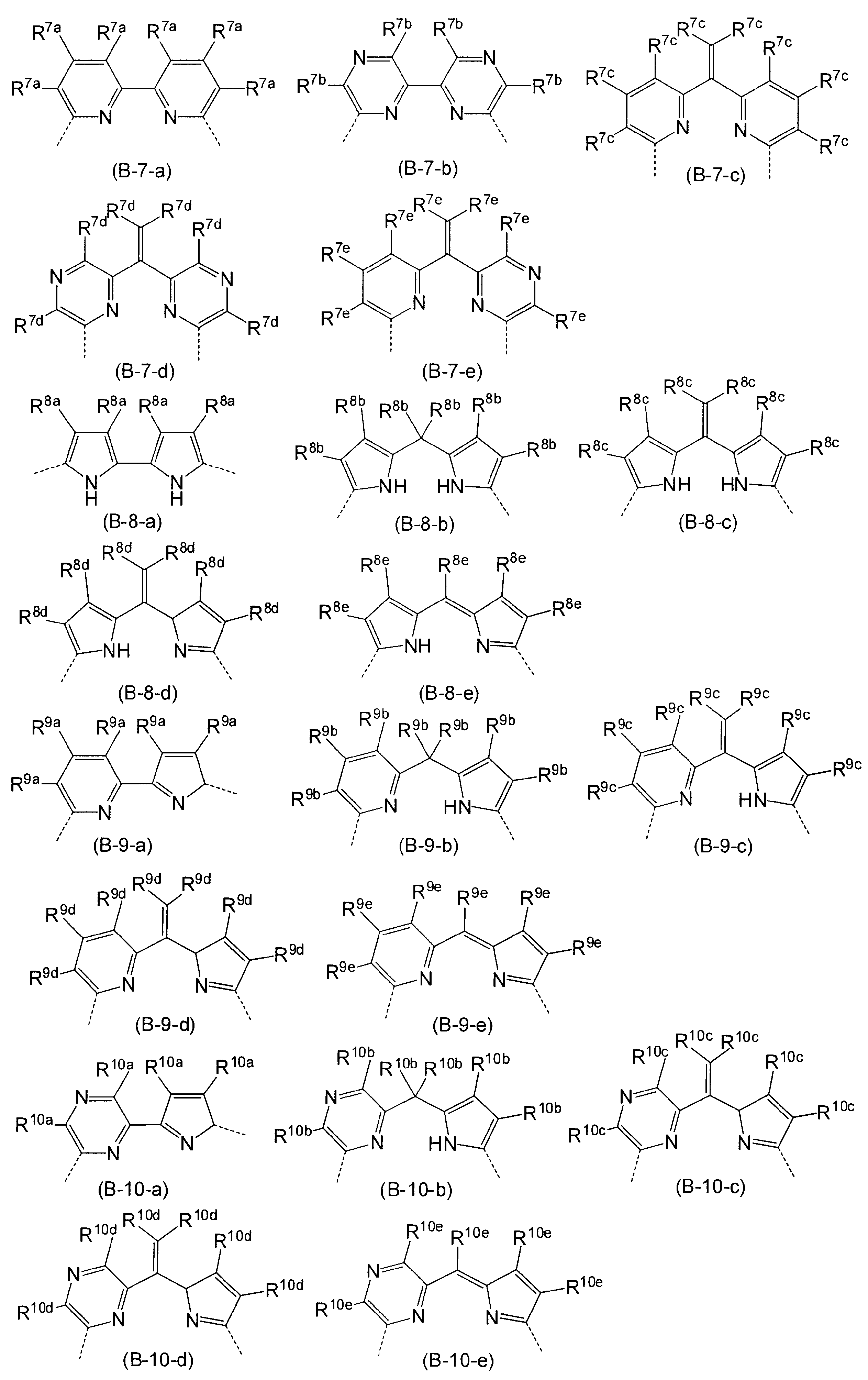
R7a、R7b、R7c、R7d、R7e、R8a、R8b、R8c、R8d、R8e、R9a、R9b、R9c、R9d、R9e、R10a、R10b、R10c、R10d及びR10eは、それぞれ独立に、水素原子又は置換基であり、隣り合う置換基同士は互いに結合して、それぞれが結合する炭素原子とともに環を形成してもよい。
2以上のR7a、R7b、R7c、R7d、R7e、R8a、R8b、R8c、R8d、R8e、R9a、R9b、R9c、R9d、R9e、R10a、R10b、R10c、R10d及びR10eは、各々、同一でも異なっていてもよい。) - 前記配位子が、下記式(XI)で表される芳香族化合物である請求項12~21のいずれか一項に記載の空気二次電池用正極触媒。
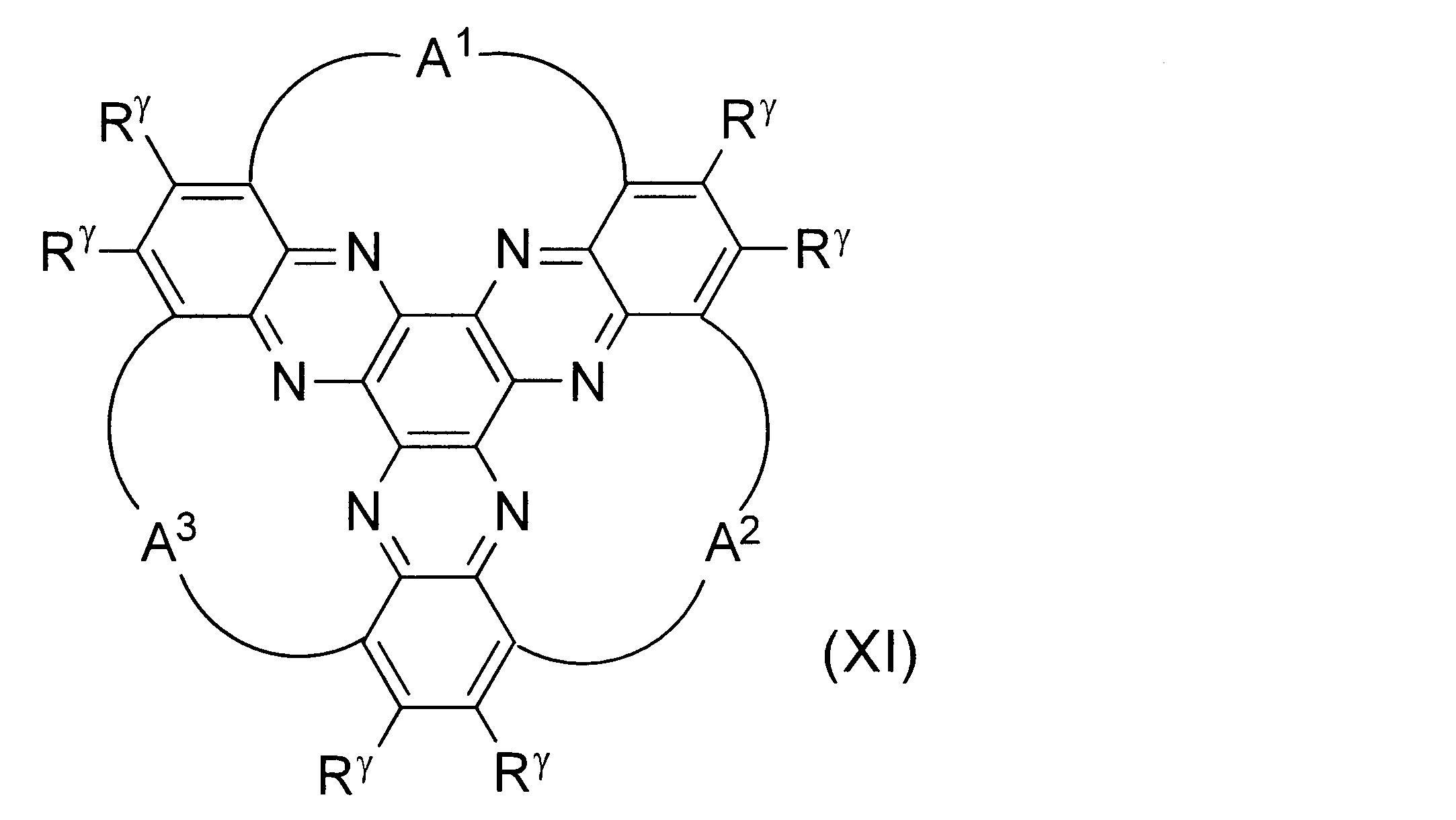
Rγは、水素原子又は置換基を表す。2以上のRγは、それぞれ同一でも異なっていてもよい。2以上のRγが置換基である場合には、それぞれ同一でも異なっていてもよく、隣り合う置換基同士は互いに結合して、それぞれが結合する炭素原子とともに環を形成してもよい。
A1、A2及びA3は、それぞれ独立に下記一般式(B-7-a)~(B-7-e)、(B-8-a)~(B-8-e)、(B-9-a)~(B-9-e)又は(B-10-a)~(B-10-e)のいずれかで表される2価の有機基である。

R7a、R7b、R7c、R7d、R7e、R8a、R8b、R8c、R8d、R8e、R9a、R9b、R9c、R9d、R9e、R10a、R10b、R10c、R10d及びR10eは、それぞれ独立に、水素原子又は置換基であり、隣り合う置換基同士は互いに結合して、それぞれが結合する炭素原子とともに環を形成してもよい。
2以上のR7a、R7b、R7c、R7d、R7e、R8a、R8b、R8c、R8d、R8e、R9a、R9b、R9c、R9d、R9e、R10a、R10b、R10c、R10d及びR10eは、各々、同一でも異なっていてもよい。)) - 前記中心金属が、周期表の第4周期から第6周期に属する遷移金属原子又はそのイオンである請求項12~22のいずれか一項に記載の空気二次電池用正極触媒。
- 前記中心金属の数が2~4である請求項12~23のいずれか一項に記載の空気二次電池用正極触媒。
- 前記多核金属錯体とカーボンとを含む組成物を用いてなる請求項1~24のいずれか一項に記載の空気二次電池用正極触媒。
- 前記多核金属錯体の残基を有するポリマーとカーボンとを含む組成物を用いてなる請求項1~24のいずれか一項に記載の空気二次電池用正極触媒。
- 前記多核金属錯体、前記多核金属錯体とカーボンとを含む組成物、又は、前記多核金属錯体の残基を有するポリマーとカーボンとを含む組成物を、
300℃以上1200℃以下の温度で加熱して得られた変性物を形成材料とする請求項1~26のいずれか一項に記載の空気二次電池用正極触媒。 - 請求項1~27のいずれか一項に記載の空気二次電池用正極触媒を正極触媒層に含み、亜鉛、鉄、アルミニウム、マグネシウム、リチウム、水素、及び、これらのイオンからなる群より選ばれる一種以上を負極活物質として用いた空気二次電池。
Priority Applications (1)
| Application Number | Priority Date | Filing Date | Title |
|---|---|---|---|
| US14/113,758 US20140066290A1 (en) | 2011-04-27 | 2012-04-27 | Cathode catalyst for air secondary battery and air secondary battery |
Applications Claiming Priority (4)
| Application Number | Priority Date | Filing Date | Title |
|---|---|---|---|
| JP2011-100165 | 2011-04-27 | ||
| JP2011100166 | 2011-04-27 | ||
| JP2011100165 | 2011-04-27 | ||
| JP2011-100166 | 2011-04-27 |
Publications (1)
| Publication Number | Publication Date |
|---|---|
| WO2012147952A1 true WO2012147952A1 (ja) | 2012-11-01 |
Family
ID=47072463
Family Applications (1)
| Application Number | Title | Priority Date | Filing Date |
|---|---|---|---|
| PCT/JP2012/061459 Ceased WO2012147952A1 (ja) | 2011-04-27 | 2012-04-27 | 空気二次電池用正極触媒及び空気二次電池 |
Country Status (3)
| Country | Link |
|---|---|
| US (1) | US20140066290A1 (ja) |
| JP (1) | JP5943194B2 (ja) |
| WO (1) | WO2012147952A1 (ja) |
Cited By (6)
| Publication number | Priority date | Publication date | Assignee | Title |
|---|---|---|---|---|
| CN103910763A (zh) * | 2014-01-06 | 2014-07-09 | 苏州大学 | 一种水溶性铁配合物、其制备方法及应用 |
| KR20140124807A (ko) * | 2012-02-17 | 2014-10-27 | 바이엘 인텔렉쳐 프로퍼티 게엠베하 | 알칼리 토금속이 착화된 금속 비스아미드 |
| KR20140127249A (ko) * | 2012-02-17 | 2014-11-03 | 바이엘 인텔렉쳐 프로퍼티 게엠베하 | 알칼리 토금속-착물화된 금속 아미드 |
| US9130233B2 (en) | 2010-09-17 | 2015-09-08 | Sumitomo Chemical Company, Limited | Metal complex, modified compound thereof and useful compound thereof |
| US20160285109A1 (en) * | 2013-11-18 | 2016-09-29 | Sumitomo Chemical Company, Limited | Cathode catalyst for air secondary batteries, cathode catalyst layer for air secondary batteries and air secondary battery |
| CN108140920A (zh) * | 2015-10-27 | 2018-06-08 | 住友化学株式会社 | 镁空气电池用电极和镁空气电池、以及芳香族化合物和金属络合物 |
Families Citing this family (13)
| Publication number | Priority date | Publication date | Assignee | Title |
|---|---|---|---|---|
| JP6142399B2 (ja) * | 2013-02-27 | 2017-06-07 | 住友化学株式会社 | 空気二次電池 |
| JP6296879B2 (ja) * | 2014-04-23 | 2018-03-20 | 住友化学株式会社 | 電極およびそれを用いた空気二次電池 |
| CA2948001C (en) | 2014-05-12 | 2023-03-14 | Johna Leddy | Lanthanide electrochemistry |
| JP6120101B2 (ja) * | 2014-12-25 | 2017-04-26 | トヨタ自動車株式会社 | 非水電解質二次電池およびその製造方法 |
| CN104600329B (zh) * | 2015-01-21 | 2018-12-14 | 华东理工大学 | 碳材料共价负载仿生多核铜氧还原电催化剂的制备 |
| US10497968B2 (en) * | 2016-01-04 | 2019-12-03 | Global Graphene Group, Inc. | Solid state electrolyte for lithium secondary battery |
| US10168758B2 (en) | 2016-09-29 | 2019-01-01 | Intel Corporation | Techniques to enable communication between a processor and voltage regulator |
| WO2018165312A1 (en) * | 2017-03-07 | 2018-09-13 | University Of Massachusetts | Flow battery and components thereof |
| US10629970B2 (en) * | 2017-06-12 | 2020-04-21 | Panasonic Intellectual Property Management Co., Ltd. | Lithium air battery including negative electrode, positive electrode, nonaqueous lithium ion conductor, and copper ion |
| JP2022525751A (ja) * | 2019-03-14 | 2022-05-19 | エボニック オペレーションズ ゲーエムベーハー | 成形された有機電荷蓄積装置の製造方法 |
| US20240247019A1 (en) | 2021-05-24 | 2024-07-25 | Sumitomo Chemical Company, Limited | Method for producing bipyridine derivative, method for producing macrocyclic compound, method for producing metal complex containing macrocyclic compound as ligand, metal complex, electrode for air battery, and air battery |
| CN114335476B (zh) * | 2021-12-31 | 2023-08-11 | 蜂巢能源科技股份有限公司 | 一种负极材料的制备方法及其应用 |
| CN114759294A (zh) * | 2022-04-27 | 2022-07-15 | 东北大学 | 一种高效调控镁阳极溶解行为的电解液及其制备方法 |
Citations (5)
| Publication number | Priority date | Publication date | Assignee | Title |
|---|---|---|---|---|
| JPS57208073A (en) * | 1981-06-17 | 1982-12-21 | Toshiba Corp | Porous catalyst layer of air electrode |
| JPS57208074A (en) * | 1981-06-17 | 1982-12-21 | Toshiba Corp | Porous catalytic layer of air electrode |
| JP2005066592A (ja) * | 2003-08-05 | 2005-03-17 | Toyota Motor Corp | 触媒材料およびその製造方法 |
| WO2006083029A1 (ja) * | 2005-02-03 | 2006-08-10 | Toyota Jidosha Kabushiki Kaisha | 触媒材料およびその製造方法 |
| JP2008147123A (ja) * | 2006-12-13 | 2008-06-26 | Nec Corp | 燃料電池用触媒およびその製造方法、並びにそれを用いた燃料電池用電極 |
Family Cites Families (15)
| Publication number | Priority date | Publication date | Assignee | Title |
|---|---|---|---|---|
| JP2003178816A (ja) * | 2001-12-11 | 2003-06-27 | Hitachi Maxell Ltd | 空気二次電池 |
| JP4575212B2 (ja) * | 2005-03-31 | 2010-11-04 | 株式会社東芝 | 非水電解質空気電池 |
| JP2007237092A (ja) * | 2006-03-09 | 2007-09-20 | Toyota Motor Corp | 触媒材料の製造方法 |
| US20090318681A1 (en) * | 2006-12-11 | 2009-12-24 | Sumitomo Chemical Company Limited | Metal complex, and use thereof |
| EP2523243A1 (en) * | 2007-03-09 | 2012-11-14 | Sumitomo Chemical Company, Limited | Membrane-electrode assembly and fuel battery using the same |
| KR20090127419A (ko) * | 2007-03-09 | 2009-12-11 | 내셔날 인스티튜트 오브 어드밴스드 인더스트리얼 사이언스 앤드 테크놀로지 | 연료 전지용 전극 촉매 |
| JP2008258150A (ja) * | 2007-03-09 | 2008-10-23 | Sumitomo Chemical Co Ltd | 燃料電池用電極触媒 |
| JP5422159B2 (ja) * | 2007-12-28 | 2014-02-19 | 住友化学株式会社 | 環状化合物、その金属錯体及び変性金属錯体 |
| KR101305506B1 (ko) * | 2008-07-14 | 2013-09-05 | 삼성전자주식회사 | 화상형성장치 및 그 제어방법 |
| JP5369527B2 (ja) * | 2008-07-29 | 2013-12-18 | 株式会社ジェイテクト | 舵角検出装置 |
| WO2010138643A1 (en) * | 2009-05-29 | 2010-12-02 | Eveready Battery Company, Inc. | Current collector for catalytic electrode |
| KR20120102649A (ko) * | 2009-10-30 | 2012-09-18 | 막스-플랑크-게젤샤프트 츄어 푀르더룽 데어 비쎈샤프텐 에.파우. | 질소 함유 방향족 화합물 및 금속 착체 |
| JP5721329B2 (ja) * | 2010-01-18 | 2015-05-20 | 住友化学株式会社 | 空気電池、空気電池スタック |
| JP5626872B2 (ja) * | 2010-09-16 | 2014-11-19 | 学校法人同志社 | 水素/空気二次電池 |
| JP5831053B2 (ja) * | 2010-09-17 | 2015-12-09 | 住友化学株式会社 | 金属錯体、その変性物及びそれに有用な化合物 |
-
2012
- 2012-04-27 US US14/113,758 patent/US20140066290A1/en not_active Abandoned
- 2012-04-27 JP JP2012103998A patent/JP5943194B2/ja active Active
- 2012-04-27 WO PCT/JP2012/061459 patent/WO2012147952A1/ja not_active Ceased
Patent Citations (5)
| Publication number | Priority date | Publication date | Assignee | Title |
|---|---|---|---|---|
| JPS57208073A (en) * | 1981-06-17 | 1982-12-21 | Toshiba Corp | Porous catalyst layer of air electrode |
| JPS57208074A (en) * | 1981-06-17 | 1982-12-21 | Toshiba Corp | Porous catalytic layer of air electrode |
| JP2005066592A (ja) * | 2003-08-05 | 2005-03-17 | Toyota Motor Corp | 触媒材料およびその製造方法 |
| WO2006083029A1 (ja) * | 2005-02-03 | 2006-08-10 | Toyota Jidosha Kabushiki Kaisha | 触媒材料およびその製造方法 |
| JP2008147123A (ja) * | 2006-12-13 | 2008-06-26 | Nec Corp | 燃料電池用触媒およびその製造方法、並びにそれを用いた燃料電池用電極 |
Non-Patent Citations (1)
| Title |
|---|
| ENIYA LISTIANI DEWI: "Vanadium Takaku Sakutai o Seikyoku ni Mochiita Kuki Denchi no Hoden Tokusei", POLYMER PREPRINTS, vol. 50, no. 12, 28 August 2001 (2001-08-28), JAPAN, pages 2994 * |
Cited By (8)
| Publication number | Priority date | Publication date | Assignee | Title |
|---|---|---|---|---|
| US9130233B2 (en) | 2010-09-17 | 2015-09-08 | Sumitomo Chemical Company, Limited | Metal complex, modified compound thereof and useful compound thereof |
| KR20140124807A (ko) * | 2012-02-17 | 2014-10-27 | 바이엘 인텔렉쳐 프로퍼티 게엠베하 | 알칼리 토금속이 착화된 금속 비스아미드 |
| KR20140127249A (ko) * | 2012-02-17 | 2014-11-03 | 바이엘 인텔렉쳐 프로퍼티 게엠베하 | 알칼리 토금속-착물화된 금속 아미드 |
| KR102014305B1 (ko) | 2012-02-17 | 2019-08-26 | 바이엘 인텔렉쳐 프로퍼티 게엠베하 | 알칼리 토금속-착물화된 금속 아미드 |
| KR102069089B1 (ko) | 2012-02-17 | 2020-01-22 | 바이엘 인텔렉쳐 프로퍼티 게엠베하 | 알칼리 토금속이 착화된 금속 비스아미드 |
| US20160285109A1 (en) * | 2013-11-18 | 2016-09-29 | Sumitomo Chemical Company, Limited | Cathode catalyst for air secondary batteries, cathode catalyst layer for air secondary batteries and air secondary battery |
| CN103910763A (zh) * | 2014-01-06 | 2014-07-09 | 苏州大学 | 一种水溶性铁配合物、其制备方法及应用 |
| CN108140920A (zh) * | 2015-10-27 | 2018-06-08 | 住友化学株式会社 | 镁空气电池用电极和镁空气电池、以及芳香族化合物和金属络合物 |
Also Published As
| Publication number | Publication date |
|---|---|
| JP5943194B2 (ja) | 2016-06-29 |
| US20140066290A1 (en) | 2014-03-06 |
| JP2012238591A (ja) | 2012-12-06 |
Similar Documents
| Publication | Publication Date | Title |
|---|---|---|
| JP5943194B2 (ja) | 空気二次電池用正極触媒及び空気二次電池 | |
| Saha et al. | Strategies to improve electrical conductivity in metal–organic frameworks: a comparative study | |
| JP6125742B2 (ja) | 含窒素芳香族化合物及び金属錯体 | |
| JP5422159B2 (ja) | 環状化合物、その金属錯体及び変性金属錯体 | |
| WO2017073467A1 (ja) | マグネシウム空気電池用電極およびマグネシウム空気電池、並びに、芳香族化合物および金属錯体 | |
| KR20090127419A (ko) | 연료 전지용 전극 촉매 | |
| JP2008258152A (ja) | 膜−電極接合体およびこれを用いた燃料電池 | |
| CN102325772A (zh) | 环状化合物 | |
| Gu et al. | A single potassium-ion conducting metal–organic framework | |
| WO2012169548A1 (ja) | 空気二次電池用正極触媒及び空気二次電池 | |
| KR20090130018A (ko) | 변성 금속 착체 및 그의 용도 | |
| Kobayashi et al. | Proton Conductive Mononuclear Hydrogen-Bonded Cobalt (II) Spin Crossover Complex | |
| CN108140920A (zh) | 镁空气电池用电极和镁空气电池、以及芳香族化合物和金属络合物 | |
| Kumar et al. | An interfacially stacked covalent porous polymer on graphene favors electronic mobility: ensuring accelerated oxygen reduction reaction kinetics by an in situ study | |
| JP2013016474A (ja) | 空気二次電池用正極触媒及び空気二次電池 | |
| JP5831053B2 (ja) | 金属錯体、その変性物及びそれに有用な化合物 | |
| JP6830320B2 (ja) | マグネシウム空気電池用電極およびマグネシウム空気電池 | |
| JP2010167390A (ja) | 酸素還元触媒、それを用いた燃料電池および空気電池、酸素還元触媒の製造方法 | |
| JP5994197B2 (ja) | 空気二次電池用正極触媒及びそれを用いた空気二次電池 | |
| JP6666186B2 (ja) | 酸素還元用電極、空気電池および金属錯体 | |
| JP6795321B2 (ja) | マグネシウム空気電池用電極およびマグネシウム空気電池 |
Legal Events
| Date | Code | Title | Description |
|---|---|---|---|
| 121 | Ep: the epo has been informed by wipo that ep was designated in this application |
Ref document number: 12776715 Country of ref document: EP Kind code of ref document: A1 |
|
| WWE | Wipo information: entry into national phase |
Ref document number: 14113758 Country of ref document: US |
|
| NENP | Non-entry into the national phase |
Ref country code: DE |
|
| 122 | Ep: pct application non-entry in european phase |
Ref document number: 12776715 Country of ref document: EP Kind code of ref document: A1 |