WO2012147905A1 - プロモーター活性促進剤 - Google Patents
プロモーター活性促進剤 Download PDFInfo
- Publication number
- WO2012147905A1 WO2012147905A1 PCT/JP2012/061324 JP2012061324W WO2012147905A1 WO 2012147905 A1 WO2012147905 A1 WO 2012147905A1 JP 2012061324 W JP2012061324 W JP 2012061324W WO 2012147905 A1 WO2012147905 A1 WO 2012147905A1
- Authority
- WO
- WIPO (PCT)
- Prior art keywords
- promoter
- promoter activity
- gene
- culture
- compound
- Prior art date
- Legal status (The legal status is an assumption and is not a legal conclusion. Google has not performed a legal analysis and makes no representation as to the accuracy of the status listed.)
- Ceased
Links
Images


Classifications
-
- C—CHEMISTRY; METALLURGY
- C12—BIOCHEMISTRY; BEER; SPIRITS; WINE; VINEGAR; MICROBIOLOGY; ENZYMOLOGY; MUTATION OR GENETIC ENGINEERING
- C12P—FERMENTATION OR ENZYME-USING PROCESSES TO SYNTHESISE A DESIRED CHEMICAL COMPOUND OR COMPOSITION OR TO SEPARATE OPTICAL ISOMERS FROM A RACEMIC MIXTURE
- C12P17/00—Preparation of heterocyclic carbon compounds with only O, N, S, Se or Te as ring hetero atoms
- C12P17/18—Preparation of heterocyclic carbon compounds with only O, N, S, Se or Te as ring hetero atoms containing at least two hetero rings condensed among themselves or condensed with a common carbocyclic ring system, e.g. rifamycin
- C12P17/181—Heterocyclic compounds containing oxygen atoms as the only ring heteroatoms in the condensed system, e.g. Salinomycin, Septamycin
-
- C—CHEMISTRY; METALLURGY
- C07—ORGANIC CHEMISTRY
- C07D—HETEROCYCLIC COMPOUNDS
- C07D493/00—Heterocyclic compounds containing oxygen atoms as the only ring hetero atoms in the condensed system
- C07D493/22—Heterocyclic compounds containing oxygen atoms as the only ring hetero atoms in the condensed system in which the condensed system contains four or more hetero rings
-
- C—CHEMISTRY; METALLURGY
- C12—BIOCHEMISTRY; BEER; SPIRITS; WINE; VINEGAR; MICROBIOLOGY; ENZYMOLOGY; MUTATION OR GENETIC ENGINEERING
- C12N—MICROORGANISMS OR ENZYMES; COMPOSITIONS THEREOF; PROPAGATING, PRESERVING, OR MAINTAINING MICROORGANISMS; MUTATION OR GENETIC ENGINEERING; CULTURE MEDIA
- C12N1/00—Microorganisms; Compositions thereof; Processes of propagating, maintaining or preserving microorganisms or compositions thereof; Processes of preparing or isolating a composition containing a microorganism; Culture media therefor
- C12N1/14—Fungi; Culture media therefor
- C12N1/145—Fungi isolates
-
- C—CHEMISTRY; METALLURGY
- C12—BIOCHEMISTRY; BEER; SPIRITS; WINE; VINEGAR; MICROBIOLOGY; ENZYMOLOGY; MUTATION OR GENETIC ENGINEERING
- C12R—INDEXING SCHEME ASSOCIATED WITH SUBCLASSES C12C - C12Q, RELATING TO MICROORGANISMS
- C12R2001/00—Microorganisms ; Processes using microorganisms
- C12R2001/645—Fungi ; Processes using fungi
- C12R2001/66—Aspergillus
Definitions
- the present invention includes a compound having a function of promoting gene promoter activity or a salt thereof, a method for producing the compound, a gene promoter activity promoter containing the compound, a stem cell inducer containing the compound,
- the present invention relates to a microorganism that produces a compound.
- iPS cells human induced pluripotent stem cells
- the iPS cell induction method of Yamanaka et al. Includes a step of introducing a foreign gene into a cell using a retrovirus, even after the iPS cell is differentiated into a specific cell, the gene remains in the cell and has some action. There is concern about the action of the gene after cell transplantation.
- a promoter activity promoter comprising a compound represented by: (2) The following formula (II)
- a promoter activity promoter comprising a compound represented by: (3) Formula (III) below
- a promoter activity promoter comprising a compound represented by the formula: (4)
- Promoter activity promoter comprising a compound having the following physicochemical properties or a salt thereof: 1) Properties of the substance: colorless and amorphous solid 2) Molecular formula: C 27 H 34 O 9 3)
- the exact mass, [M + H] + measured by high resolution electrospray ionization mass spectrometry is as follows. Actual value: 503.2276 Calculated value: 503.2281 4)
- Ultraviolet absorption spectrum The ultraviolet absorption spectrum measured in methanol shows the maximum absorption as follows: 221 nm ( ⁇ 34800), 266 ( ⁇ 18400).
- the promoter activity promoter according to any one of (1) to (4), wherein the promoter activity promotion is promotion of promoter activity of an iPS cell-forming factor gene, (6) One or more genes selected from the group consisting of Oct3 / 4, Sox2, Klf4, c-Myc, n-Myc, NANOG, LIN28, hTERT and SV40 Large T
- the promoter activity promoter according to (5) One or more genes selected from the group consisting of Oct3 / 4, Sox2, Klf4, c-Myc, n-Myc, NANOG, LIN28, hTERT and SV40 Large T.
- a step of culturing the bacterium producing the compound according to any one of (1) to (4) belonging to the genus Aspergillus, and any one of (1) to (4) from the culture A method for producing the compound according to any one of (1) to (4), comprising the step of collecting the compound according to any one of the above, (9) Aspergillus sp. SANK 11109 strain (FERM BP-11268), wherein the compound producing the compound according to any one of (1) to (4) belonging to the genus Aspergillus is Aspergillus sp.
- the iPS cellizing factor gene is selected from the group consisting of Oct3 / 4, Sox2, Klf4, c-Myc, n-Myc, NANOG, LIN28, hTERT and SV40 Large T, Tbxl, L-Myc and UTF1
- FIG. 1 is a graph showing the effect of an australide analogue on Klf4 promoter activity, and the relative activity is calculated and plotted with the value of luciferase activity of DMSO-treated cells being 1.
- FIG. 2 is a diagram showing the influence of an austaliide-related substance on Oct4 promoter activity, and the relative activity is calculated and plotted with the value of luciferase activity of DMSO-treated cells as 1.
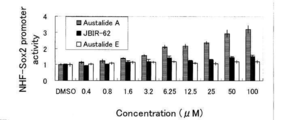
- FIG. 3 is a graph showing the influence of an australide analogue on Sox2 promoter activity, and the relative activity is calculated and plotted with the value of luciferase activity of DMSO-treated cells as 1.
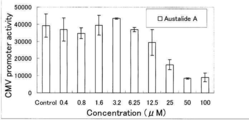
- FIG. 4 is a graph showing the effect of Austalide A on CMV promoter activity, and plots the relative activity calculated by setting the value of luciferase activity of DMSO-treated cells to 1.
- Austalide A is represented by the above formula (I).
- Austalide E is represented by the above formula (II).
- JBIR-62 is represented by the above formula (III) or has the physicochemical properties described in (4). JBIR-62 can be converted into a salt according to a conventional method. Examples of the salt of JBIR-62 include alkali metal salts such as lithium salt, sodium salt and potassium salt, alkaline earth metal salts such as calcium salt, barium salt and magnesium salt, aluminum salt, iron salt and zinc salt.
- Metal salts such as copper salts, nickel salts, cobalt salts; inorganic salts such as ammonium salts, t-octylamine salts, dibenzylamine salts, morpholine salts, glucosamine salts, phenylglycine alkyl ester salts, ethylenediamine salts, N -Methylglucamine salt, guanidine salt, diethylamine salt, triethylamine salt, dicyclohexylamine salt, N, N'-dibenzylethylenediamine salt, chloroprocaine salt, procaine salt, diethanolamine salt, N-benzylphenethylamine salt, piperazine salt, tetramethyl Ammonia salt, tris ( And organic amine salts such as hydroxymethyl) aminomethane salt; and amino acid salts such as glycine salt, lysine salt, arginine salt, ornithine salt and asparagine salt. Aus
- esters examples include methyl ester, ethyl ester, propyl ester, isopropyl ester, butyl ester, isobutyl ester, s-butyl ester, t-butyl ester, pentyl ester, isopentyl ester, neopentyl ester, etc. can do.
- austalide analogues have various isomers. In the present invention, these isomers and a mixture of these isomers are all represented by a single formula.
- the australide-related substance and its salt may become a solvate.
- solvates are also encompassed in the present invention.
- Australide analogs are present in cultures of microorganisms that produce australide analogs.
- the microorganism used in the method for producing an australide related substance of the present invention is not particularly limited as long as it is a microorganism that produces an australide related substance, but is preferably a fungus that produces an austalid related substance.
- a fungus belonging to the genus Aspergillus that produces an australide analogue examples include Aspergillus sp.
- SANK 11109 strain (hereinafter simply referred to as “SANK 11109 strain”).
- the SANK11109 strain was isolated from seawater along the coast of Kagoshima Prefecture.
- CYA medium ⁇ Czapek Yeast Extract
- Agar medium ⁇ K 2 HPO 4 1 g, * Zapec concentrate 10 ml, yeast extract 5 g, sucrose 30 g, agar 15 g, distilled water 1000 ml
- Zapec concentrate (NaNO 3 30 g, KCl 5 g, MgSO 4 .7H 2 O 5 g, FeSO 4 .7H 2 O 0.1 g, ZnSO 4 .7H 2 O 0.1 g, CuSO 4 .5H 2 O 0.05 g, 100ml distilled water)
- MEA medium ⁇ Malt Extract Agar medium ⁇ (Malt extract 20 g, Peptone 1 g, Glucose 20 g, Agar 20 g, Distilled water 1000 ml)
- CY20S medium ⁇ Czapek Yeast Extract Agar with 20% sucrose medium ⁇ (K 2 HPO 4 g, * Zapec concentrate 10 ml, yeast extract 5 g, sucrose 200 g, agar 15 g, distilled water 1000 ml)
- CZ medium ⁇ Czapek Yeast Extract Agar medium ⁇ (K 2 HPO 4 1 g, * Zapec concentrate 10 ml, sucrose 30 g, agar 17.5 g, distilled water 1000 ml)
- the mycological properties of SANK 11109 strain are as follows. Colonies on CYA medium have a diameter of 18 to 22 mm when cultured at 25 ° C. for 7 days. The mycelium is white. Conidia formation is vigorous and the conidia formation part exhibits dark green (25F6). The colony is velvety in the plane and fluffy in the center. The back side is orange yellow (4B8-4A8).
- the colonies on the MEA medium are 15 to 16 mm in diameter when cultured at 25 ° C. for 7 days. Conidia formation is vigorous and the conidia formation part is dark green (26F7). The colony is velvety in the plane and fluffy in the center. The back side is dark orange (5A8) or brownish yellow (5C8).
- the colonies on the CY20S medium have a diameter of 22 to 24 mm when cultured at 25 ° C. for 7 days. Conidia formation is vigorous, and the conidia formation part exhibits grayish green (26E7). The colony is velvety in the plane and fluffy in the center. The reverse side is deep orange (6A8-5A8).
- Colonies on CZ medium are 12-13 mm in diameter after 7 days of culture. Mycelium is sparse and sporulation is sparse. The colony is flat. The reverse side is brownish orange (5C3) or grayish brown (5C3). It does not grow at 37 ° C. No soluble pigment or leachate is observed.
- the conidia head is a radial or loose cylinder. The conidia pattern is 20 to 250 ⁇ m ⁇ 2.5 to 6 (or 9) ⁇ m, smooth and brown. The crest is 6 to 13 (to 15) ⁇ m wide and has a spherical or pear shape. Aspergillus is in two rows.
- the metre is 4 to 6 ⁇ m ⁇ 3 to 5 ⁇ m and is formed almost entirely from the upper two-thirds of the apex.
- the phialide is 4 to 9 ⁇ m ⁇ 3 to 4 ⁇ m.
- Conidia have a diameter of 4 to 5 ⁇ m, are spherical to subspherical, and have a rough surface. Often, degenerate conidia formation is observed, such as forming a conidia by forming a phialide directly from a vegetative mycelium without forming a crest. No fuel cell is observed.
- SANK 109 11109 shares are Aspergillus sp. SANK 11109 shares. As of August 31, 2010, National Institute of Advanced Industrial Science and Technology (AIST) Since April 1, it has been deposited internationally to the Patent Organism Depositary Center for Product Evaluation Technology (IPOD, NITE), an independent administrative agency, and has been given the accession number FERM BP-11268.
- fungi are susceptible to mutation in nature or by artificial manipulation (for example, ultraviolet irradiation, radiation irradiation, chemical treatment, etc.), and the same applies to the SANK11109 strain of the present invention.
- the SANK strain 11109 referred to in the present invention includes all mutants thereof.
- mutants also include those obtained by genetic methods such as recombination, transduction, transformation and the like. That is, the SANK11109 strain that produces austarid-related compounds, their mutants, and strains that are not clearly distinguished from them are all included in the SANK 11109 strain.
- these microorganisms are generally cultured using a medium similar to that used to produce other fermentation products.
- a medium contains a carbon source, a nitrogen source and an inorganic salt that can be assimilated by the microorganism.
- Examples of the carbon source include glucose, fructose, maltose, sucrose, mannitol, glycerin, dextrin, oats, rye, barley, brown rice, soluble starch, corn starch, potato, corn flour, soybean oil, cottonseed oil, molasses, citrus Examples include acid and tartaric acid. These carbon sources can be used alone or in combination.
- the amount of the carbon source added to the medium varies depending on other components in the medium, but is usually 1 to 10% by weight of the medium amount.
- nitrogen sources include soybean flour, bran, falling raw flour, cottonseed powder, casein hydrolyzate, pharmamine, corn steep liquor, peptone, gelatin, meat extract, yeast, yeast extract, malto extract, sodium nitrate, Examples thereof include ammonium nitrate, ammonium sulfate, sodium L-glutamate, and the like. These carbon sources can be used alone or in combination.
- the amount of nitrogen source added to the medium is usually 0.2 to 6% by weight, although it varies depending on other components in the medium.
- a carbon source and a nitrogen source are generally used in combination, but need not be in a pure form, and may be less pure containing trace amounts of growth factors, vitamins and inorganic nutrients.
- inorganic salts include salts that generate ions such as sodium, potassium, magnesium, ammonium, calcium, phosphoric acid, sulfuric acid, hydrochloric acid, and carbonic acid.
- vitamin B1 which can be assimilated by bacteria, vitamins such as biotin, bacterial cell growth promoting substances such as thiamine, and the like may be added as necessary. Further, manganese, molybdenum, and other metal salts may be added as necessary.
- An antifoaming agent such as silicone oil, polyalkylene glycol ether, vegetable oil, animal oil, or a surfactant may be added to the medium as necessary, such as when the nutrient medium is foamed.
- the pH of the medium varies depending on the components of the medium, the growth temperature, and the like, but may be any pH that is usually used for producing a fermentation product.
- the growth temperature of the fungus varies depending on the medium components, pH, etc., but is usually 10 ° C. to 32 ° C., and the range of 16 to 30 ° C. is good for growth.
- a temperature of 20 to 28 ° C. is suitable for production of an australide analogue.
- the culture method is not particularly limited, and any culture method generally used for microorganisms may be used.
- a culture method using a solid medium, a stirring culture method, a shaking culture method, an aeration culture method, an aeration stirring culture method, or the like is used.
- the culture is performed using a solid medium.
- solid culture is preferably performed at 20 to 26 ° C., more preferably at 23 ° C. for 10 days or longer.
- the culture is initiated in an Erlenmeyer flask by a one or two stage seed development process.
- the medium for the seed development stage can be used in combination with a carbon source, a nitrogen source, a trace amount of growth factors, inorganic salts and trace metals.
- the Erlenmeyer flask for seed culture is shaken in a rotary shaker at 20 to 26 ° C. (preferably 23 ° C.), 5 to 10 days (preferably 7 days), or shaken until it is fully grown. .
- the grown seed culture is used to inoculate the second seed culture medium or the production culture medium.
- the seed culture solution is grown essentially in the same manner as the first seed culture, and the seed culture solution is inoculated into a production culture medium in a solid medium culture vessel such as an Erlenmeyer flask.
- a solid medium culture vessel such as an Erlenmeyer flask.
- the inoculated solid medium culture vessel is allowed to stand at a constant temperature for production culture.
- the medium can be prepared in a jar fermenter or tank.
- the medium can be inoculated with, for example, a seed culture solution after sterilization at 121 ° C. for 20 minutes and cooling.
- the culture can be performed, for example, at 23 ° C. by aeration stirring.
- Monitoring of the australide-related substance in the culture medium can be performed using promoter activity promoting action as an index, but it can also be performed by a technique such as high performance liquid chromatography (hereinafter referred to as “HPLC”) analysis. it can.
- HPLC high performance liquid chromatography
- the production of australide analogues usually reaches its maximum after 240 to 360 hours from the start of culture. After completion of the culture, the australide-related substance can be extracted from the obtained culture, the cells contained therein, and / or the culture supernatant thereof.
- a centrifugal separation method or a filtration method using diatomaceous earth as a filter aid can be used.
- the physicochemical properties of the compound can be used for extraction of the australide-related substance.
- Austalide analogues present in the culture filtrate or culture supernatant are organic solvents that are not miscible with water under acidic or neutral conditions, such as ethyl acetate, chloroform, ethylene chloride, methylene chloride, butanol, two or more It can be extracted with a mixed solvent or the like.
- the australide-related substance present in the microbial cells is extracted from the microbial cells using 50 to 90% aqueous acetone or aqueous methanol, the organic solvent is distilled off, and then present in the culture filtrate or culture supernatant. It can be extracted in the same way.
- the austarid analogue present in the whole culture can be extracted by adding 20 to 80%, preferably 40 to 60%, more preferably 50% of acetone or methanol to the whole culture.
- the purification for isolating the australide analogue from the above-mentioned extract can be performed by a purification means such as adsorption chromatography, partition chromatography, reverse phase chromatography, HPLC and the like. Austalide analogues can be isolated by these purification means alone or in combination. If necessary, the same purification means can be used repeatedly.
- Austaride analogues or salts thereof have the effect of promoting the promoter activity of the gene.
- the present invention provides a promoter activity promoter comprising an australide analogue or a salt thereof.
- the gene to which such promoter activity promoter can be applied is not particularly limited as long as it is a gene encoding a protein.
- Such genes may be present in any of eukaryotic cell genomes, mitochondrial DNA, other endogenous genes (such as plasmids), and infectious organisms (such as viruses).
- Such a gene may be a foreign gene introduced. It may also be an endogenous or exogenous gene in prokaryotes.
- Austarid analogue or its salt is a promoter activity of a gene encoding a factor (also called reprogramming factor) that induces differentiated cells into undifferentiated cells (also called pluripotent stem cells) having the ability to differentiate into various cells.
- a factor also called reprogramming factor
- undifferentiated cells also called pluripotent stem cells
- an australide-related substance or a salt thereof has an action of promoting the promoter activity of a gene that induces iPS cells from somatic cells (iPS cell-forming factor gene), and induces (preparation) iPS cells from somatic cells.
- iPS cell-forming factor gene a gene that induces iPS cells from somatic cells
- the present invention provides a reprogramming factor gene promoter activity promoter and an iPS cell-forming factor gene promoter activity promoter comprising an australide analog or a salt thereof.
- the iPS cellizing factor gene is not particularly limited as long as it is a factor (a gene encoding) capable of inducing pluripotent stem cells such as iPS cells from somatic cells, alone or together with other factors (a gene encoding).
- a factor a gene encoding
- pluripotent stem cells such as iPS cells from somatic cells, alone or together with other factors (a gene encoding).
- a gene encoding capable of inducing pluripotent stem cells such as iPS cells from somatic cells, alone or together with other factors (a gene encoding).
- Sox2, Klf4, c-Myc, n-Myc, NANOG, LIN28, hTERT, SV40 Large T, Tbxl, L-Myc, UTF1 etc. are Oct3 / 4, Sox2 and Klf4.
- the present invention provides an Oct3 / 4 promoter activity promoter, a Sox2 promoter activity promoter, and a Klf4 promoter activity promoter comprising an australide analog or a salt thereof.
- Such promoter activity promoters may contain other genes (nucleotides), compounds, derivatives thereof and the like.
- the present invention also provides an iPS cell inducer containing an australide-related substance.
- an iPS cell inducer may contain other genes (nucleotides), compounds, derivatives thereof and the like.
- the present invention provides a method for inducing iPS cells, comprising the step of bringing an australide analogue and somatic cells into contact.
- Such an iPS cell inducing method may include a step of bringing another gene (nucleotide), compound, derivative thereof or the like into contact with a somatic cell.
- somatic cells to be subjected to such a method include cells derived from humans or non-human mammals, or somatic cells derived from other vertebrates.
- the present invention also provides a method for promoting promoter activity, comprising a step of bringing an austarid analog and a promoter of various genes such as an iPS cell factor gene into contact.
- a method may be either a cell system or a cell-free system.
- the amount (concentration) of the australide analog contained in the promoter activity promoter of the present invention and the iPS cell inducer, the iPS cell induction method of the present invention, and the australide analog used in the promoter activity promotion method of the present invention may vary depending on the promoter activity promoter, the iPS cell inducer, the cells used in the method, and the like. Although not particularly limited, for example, the concentration may be 0.01 ⁇ M to 100 ⁇ M.
- Example 1 Cultivation of SANK 11109 strain Mycelium pieces were scraped from the slant of the SANK 11109 strain and inoculated into a 100 ml Erlenmeyer flask containing 30 ml of a seed culture medium having the following composition that had been sterilized (121 ° C., 20 minutes) in advance. The same operation was performed to prepare a total of 10 seed culture flasks. The cells were cultured for 7 days in a rotary shaker at 210 rpm at 23 ° C.
- the seed culture solution thus obtained was sterilized (121 ° C., 40 minutes) and contained in a 500 ml solid medium culture vessel (Agriflex, manufactured by Fujimori Kogyo Co., Ltd.) 10
- a 500 ml solid medium culture vessel Agriflex, manufactured by Fujimori Kogyo Co., Ltd.
- Each of the books was inoculated with 20 ml, allowed to stand at 23 ° C., and cultured for 14 days.
- Example 2 Extraction of culture After completion of the culture described in Example 1, 1000 ml of 40% acetone water was added to the culture to disrupt the culture. After standing at 5 ° C. for 1 day and night, 160 ml of 3M glycine-hydrochloric acid buffer (pH 2.5) and 1000 ml of n-butanol were added and shaken for 5 minutes. This suspension was centrifuged at 3000 rpm for 5 minutes, and the separated upper layer was transferred to another container. To the resulting n-butanol layer was added 1000 ml of saturated saline, and the mixture was shaken for 5 minutes and then centrifuged at 3000 rpm for 5 minutes. The upper layer obtained was fractionated and concentrated to dryness to obtain 2.3 g of a residue.
- 3M glycine-hydrochloric acid buffer pH 2.5
- n-butanol 1000 ml of saturated saline
- Example 3 Purification and isolation of compounds Using the dried residue obtained in Example 2 as a starting material, austalide-related substances were purified and isolated using promoter activity promoting action as an index.
- Austalide A and Austalide E are the masses of each of the protonated molecules obtained by high resolution electrospray ionization mass spectrum [Austaride A (m / z 517.2437, C 28 From the theoretical value of H 37 O 9 : 517.2438, australide E (m / z 533.2375, the theoretical value of C 28 H 37 O 10 : 533.2387)], the respective molecular formulas are C 28 H 36 O 9 and C 28 H 36 O 10. Furthermore, the respective 1 H NMR spectra were consistent with the paper reports of Australide A and Australide E (J. Chem. Soc., Chem. Commun., 1981, 1265-1267).
- JBIR-62 is a colorless and amorphous solid ([ ⁇ ] 25 D -103 ° (c 0.1, in MeOH); UV ⁇ max ( ⁇ ) 221 (34,800), 266 (18,400), in MeOH; IR ⁇ max 3420, 1743, 1612 cm- 1 , in CHCl 3 ), exact mass of protonated molecule obtained by high resolution electrospray ionization mass spectrum (m / z 503.2276, C 27 H 35 O 9 theoretical value: 503.2281), the molecular formula was determined to be C 27 H 34 O 9 .
- the direct bond between each proton and carbon was determined from heteronuclear single quantum correlation (HSQC) spectra.
- HSQC heteronuclear single quantum correlation
- the NMR spectrum was measured using a Varian NMR System 500NB CL (Varian NMR System 500NB CL) in deuterated chloroform (chloroform-d) with the solvent peak as an internal standard ( ⁇ C 77.0, ⁇ H 7.26).
- the promoter sequence of the Klf4 gene is B1-SalI-P (hKLF4) -Fw having the nucleotide sequence described in SEQ ID NO: 1 in the sequence listing using human genomic DNA as a template and SEQ ID NO: 2 in the sequence listing.
- Amplification was performed by the PCR method using B5r-EcoRI-P (hKLF4) -Rv having the described base sequence as a primer.
- the resulting DNA fragment contains the human Klf4 promoter corresponding to nucleotide numbers 39420850 to 39415849 of Genebank NT_008470.
- the Oct4 gene promoter sequence uses human genomic DNA as a template, hO-For having the base sequence set forth in SEQ ID NO: 3 in the sequence listing and hO-Rev having the base sequence set forth in SEQ ID NO: 4 in the sequence listing as primers. Amplified by PCR method. The resulting DNA fragment is the human Oct3 / 4 promoter corresponding to nucleotide numbers 31081601 to 31078398 of Genebank NT_007592.
- the promoter sequence of the Sox2 gene has B1-SalI-P (hSOX2) -Fw having the nucleotide sequence set forth in SEQ ID NO: 5 in the sequence listing and the nucleotide sequence set forth in SEQ ID NO: 6 in the sequence listing using human genomic DNA as a template.
- Amplification was performed by PCR using B5r-EcoRI-P (hSOX2) -Rv as a primer.
- the resulting DNA fragment is a human Sox2 promoter corresponding to nucleotide numbers 87920274 to 87925274 of Genebank NT_005612.
- the amplified DNA fragment was cloned into a pLenti6 / V5 vector from which the CMV promoter had been removed in advance using the Gateway system (Invitrogen).
- the secreted Metridia luciferase gene in pMetLuc2-Reporter Vector was cloned and ligated downstream of the promoter sequence.
- the obtained recombinant vector was introduced into human normal diploid fetal fibroblasts immortalized with hTert gene (human telomerase gene) using a lentivirus to establish a stable strain.
- Lentiviral infection was performed using ViraPower TM Lentiviral Expression Systems (Invitrogen) according to the protocol.
- the cells were cultured in DMEM medium containing 10% fetal bovine serum, penicillin (100 units / ml) and streptomycin (100 ⁇ g / ml) in an incubator at 37 degrees and 5% CO 2 concentration. .
- Example 5 FIG. Evaluation of Promoter Activity Promoting Activity
- the stable strain obtained in Example 4 was adjusted to a concentration of 0.5 ⁇ 10 5 cells / ml and dispensed in 25 ⁇ l 384-well plates. After overnight culture, 0.2 ⁇ l of sample dissolved in DMSO was added per well and cultured for 48 hours. Luciferase activity was detected using Ready-To-Glow TM Secreted Luciferase Reporter Assay Kit (Clontech) and 2103 EnVision Multilabel Reader (Perkin Elmer). Australide analogues not only increased the activity of the Klf4 gene promoter, but also increased the promoter activity of the Oct4 and Sox2 genes (FIGS. 1 to 3).
- Austalide A increased the promoter activity of the Klf4 gene and the Oct4 gene by about 8 times and the promoter activity of the Sox2 gene by about 3 times when the cells were treated with 100 ⁇ M (FIGS. 1 to 3).
- safe stem cells can be efficiently provided by promoting the promoter activity of various genes.
- SEQ ID NO: 1 PCR primer B1-SalI-P (hKLF4) -Fw
- SEQ ID NO: 2 PCR primer B5r-EcoRI-P (hKLF4) -Rv
- 5 PCR primer B1-SalI-P (hSOX2) -Fw
- SEQ ID NO: 6 PCR primer B5r-EcoRI-P (hSOX2) -Rv
Landscapes
- Chemical & Material Sciences (AREA)
- Organic Chemistry (AREA)
- Life Sciences & Earth Sciences (AREA)
- Engineering & Computer Science (AREA)
- Wood Science & Technology (AREA)
- Health & Medical Sciences (AREA)
- Zoology (AREA)
- Bioinformatics & Cheminformatics (AREA)
- Biotechnology (AREA)
- Genetics & Genomics (AREA)
- Biochemistry (AREA)
- Microbiology (AREA)
- General Engineering & Computer Science (AREA)
- General Health & Medical Sciences (AREA)
- Virology (AREA)
- Biomedical Technology (AREA)
- Tropical Medicine & Parasitology (AREA)
- Botany (AREA)
- Medicinal Chemistry (AREA)
- Mycology (AREA)
- Chemical Kinetics & Catalysis (AREA)
- General Chemical & Material Sciences (AREA)
- Micro-Organisms Or Cultivation Processes Thereof (AREA)
Abstract
プロモーター活性促進剤を提供する。 下記式(I) で表わされる化合物を含有してなるプロモーター活性促進剤。
Description
本発明は、遺伝子のプロモーター活性を促進する作用を有する化合物又はその塩、該化合物の製造方法、該化合物を含有してなる遺伝子プロモーター活性促進剤、該化合物を含有してなる幹細胞誘導剤、該化合物を生産する微生物等に関する。
山中らは、Oct3/4、Sox2、Klf4、および、c-Mycの各遺伝子をヒト体細胞に導入することにより、ヒト人工多能性幹細胞(induced pluripotent stem cell:以下「iPS細胞」という。)を作製した(非特許文献1)。
山中らのiPS細胞誘導法はレトロウイルスを用いて外来遺伝子を細胞に導入する工程を含むため、該iPS細胞を特定の細胞に分化させた後も、該遺伝子は細胞内に残って何らかの作用を発揮し、細胞移植等の後における該遺伝子の作用が懸念される。
細胞内に取り込まれ易い低分子化合物で体細胞を刺激し、遺伝子導入せずにiPS細胞を作製する技術の確立が望まれていた。
K.タカハシ他、セル、131巻、861-872ページ、2007年刊行(Takahashi, K., et al., Cell, 131, pp861-872, 2007)
本発明者らは、Klf4等の遺伝子のプロモーター活性を促進する作用を有する化合物を見出すべく鋭意探索を行なった結果、微生物培養物中に該活性を有する化合物を見出し、本発明を完成した。
本発明は、特許請求の範囲
(1) 下記式(I)
(1) 下記式(I)
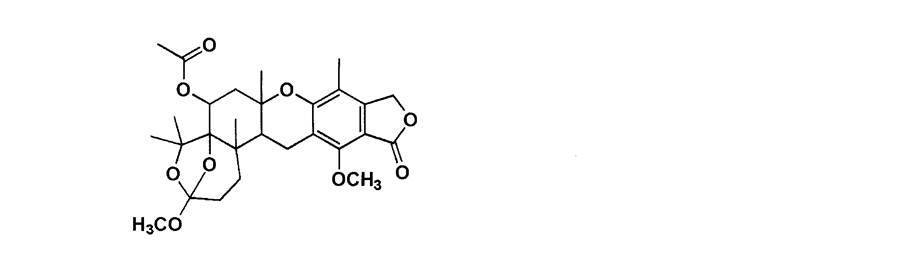
で表わされる化合物を含有してなるプロモーター活性促進剤、
(2) 下記式(II)
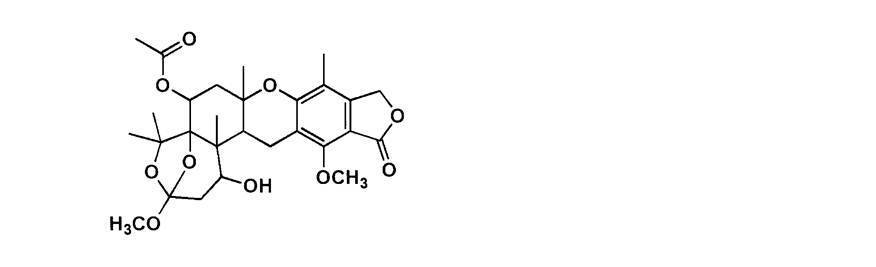
で表わされる化合物を含有してなるプロモーター活性促進剤、
(3)
下記式(III)
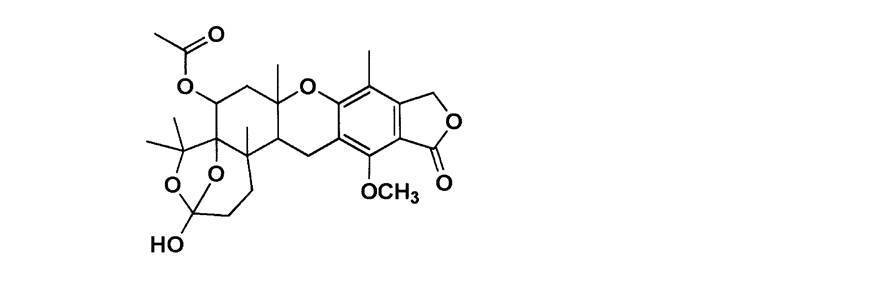
で表わされる化合物又はその塩を含有してなるプロモーター活性促進剤、
(4)下記の物理化学的性状を有する化合物又はその塩を含有してなるプロモーター活性促進剤:
1)物質の性状:無色不定形の固体
2)分子式:C27H34O9
3)高分解能エレクトロスプレーイオン化マススペクトル法により測定した精密質量、[M+H]+は次に示す通りである。
実測値:503.2276
計算値:503.2281
4)紫外部吸収スペクトル:メタノール中で測定した紫外部吸収スペクトルは、次のとおり極大吸収を示す:221 nm(ε 34800)、266(ε 18400)。
5)旋光度:メタノール中で測定した旋光度は、以下に示す値を示す:
[α]D 25:-103°(c 0.1)
6)赤外吸収スペクトル:クロロホルム中で測定した赤外吸収スペクトルは以下のとおり極大吸収を示す:
3420,1743,1612 cm-1
7)1H-核磁気共鳴スペクトル:重クロロホルム中でクロロホルムのシグナルを7.26ppmとして測定した、1H-核磁気共鳴スペクトルは、以下に示す通りである:
0.98(3H,s)、1.21(3H,s)、1.30(3H,s)、1.52(3H,s)、1.79(1H,m)、1.91(1H,m)、1.93(1H,m)、1.93(1H,m)、1.98(3H,s)、2.05(3H,s)、2.15(1H,dd,J=4.4,15.7Hz)、2.41(1H,d,J=8.1Hz)、2.55(1H,dd,J=1.5,16.1Hz)、2.85(1H,dd,H=8.1,18.5Hz)、2.96(1H,d,J=18.5Hz)、4.11(3H,s)、5.08(1H,br.S)、5.11(2H,s)ppm
8)13C-核磁気共鳴スペクトル:重クロロホルム中でクロロホルムのシグナルを77.0 ppmとして測定した、13C-核磁気共鳴スペクトルは、以下に示すとおりである:10.6(q)、18.0(t)、18.1(d)、21.2(q)、25.5(q)、27.5(q)、29.4(q)、29.7(t)、31.0(t)、35.4(d)、38.0(t)、40.2(s)、62.0(q)、68.2(t)、70.8(d)、75.6(s)、85.1(s)、86.2(s)、107.4(s)、113.9(s)、115.7(s)、117.8(s)、145.6(s)、155.4(s)、157.9(s)、169.4(s)、169.5(s)、
0.98(3H,s)、1.21(3H,s)、1.30(3H,s)、1.52(3H,s)、1.79(1H,m)、1.91(1H,m)、1.93(1H,m)、1.93(1H,m)、1.98(3H,s)、2.05(3H,s)、2.15(1H,dd,J=4.4,15.7Hz)、2.41(1H,d,J=8.1Hz)、2.55(1H,dd,J=1.5,16.1Hz)、2.85(1H,dd,H=8.1,18.5Hz)、2.96(1H,d,J=18.5Hz)、4.11(3H,s)、5.08(1H,br.S)、5.11(2H,s)ppm
8)13C-核磁気共鳴スペクトル:重クロロホルム中でクロロホルムのシグナルを77.0 ppmとして測定した、13C-核磁気共鳴スペクトルは、以下に示すとおりである:10.6(q)、18.0(t)、18.1(d)、21.2(q)、25.5(q)、27.5(q)、29.4(q)、29.7(t)、31.0(t)、35.4(d)、38.0(t)、40.2(s)、62.0(q)、68.2(t)、70.8(d)、75.6(s)、85.1(s)、86.2(s)、107.4(s)、113.9(s)、115.7(s)、117.8(s)、145.6(s)、155.4(s)、157.9(s)、169.4(s)、169.5(s)、
(5)プロモーター活性促進がiPS細胞化因子遺伝子のプロモーター活性促進である、(1)乃至(4)のいずれか一つに記載のプロモーター活性促進剤、
(6)iPS細胞化因子遺伝子が、Oct3/4、Sox2、Klf4、c-Myc、n-Myc、NANOG、LIN28、hTERT及びSV40 Large Tからなる群から選択される一つ又は二つ以上の遺伝子である、(5)に記載のプロモーター活性促進剤、
(6)iPS細胞化因子遺伝子が、Oct3/4、Sox2、Klf4、c-Myc、n-Myc、NANOG、LIN28、hTERT及びSV40 Large Tからなる群から選択される一つ又は二つ以上の遺伝子である、(5)に記載のプロモーター活性促進剤、
(7)iPS細胞化因子遺伝子が、Oct3/4、Sox2及びKlf4である、(5)又は(6)に記載のプロモーター活性促進剤、
(8)アスペルギルス(Aspergillus)属に属する、(1)乃至(4)のいずれか一つに記載の化合物の生産菌を培養する工程、並びに、その培養物より(1)乃至(4)のいずれか一つに記載の化合物を採取する工程を含んでなる、(1)乃至(4)のいずれか一つに記載の化合物の製造方法、
(9)アスペルギルス(Aspergillus)属に属する、(1)乃至(4)のいずれか一つに記載の化合物の生産菌がアスペルギルス・エスピー(Aspergillus sp.)SANK 11109株(FERM BP-11268)株である、(8)に記載の製造方法、
(10)アスペルギルス・エスピー(Aspergillus sp.)SANK 11109株(FERM BP-11268)株、
(11)(1)もしくは(2)記載の化合物、又は、(3)もしくは(4)又はその塩と、遺伝子プロモーターとを接触させる工程を含んでなる、プロモーター活性促進方法、
(12)遺伝子がiPS細胞化因子遺伝子である、(11)に記載の方法、
(8)アスペルギルス(Aspergillus)属に属する、(1)乃至(4)のいずれか一つに記載の化合物の生産菌を培養する工程、並びに、その培養物より(1)乃至(4)のいずれか一つに記載の化合物を採取する工程を含んでなる、(1)乃至(4)のいずれか一つに記載の化合物の製造方法、
(9)アスペルギルス(Aspergillus)属に属する、(1)乃至(4)のいずれか一つに記載の化合物の生産菌がアスペルギルス・エスピー(Aspergillus sp.)SANK 11109株(FERM BP-11268)株である、(8)に記載の製造方法、
(10)アスペルギルス・エスピー(Aspergillus sp.)SANK 11109株(FERM BP-11268)株、
(11)(1)もしくは(2)記載の化合物、又は、(3)もしくは(4)又はその塩と、遺伝子プロモーターとを接触させる工程を含んでなる、プロモーター活性促進方法、
(12)遺伝子がiPS細胞化因子遺伝子である、(11)に記載の方法、
(13)iPS細胞化因子遺伝子が、Oct3/4、Sox2、Klf4、c-Myc、n-Myc、NANOG、LIN28、hTERT及びSV40 Large T、Tbxl、L-Myc及びUTF1からなる群から選択される一つ又は二つ以上の遺伝子である、(12)に記載の方法、及び、
(14)iPS細胞化因子遺伝子が、Oct3/4、Sox2及びKlf4である、(12)又は(13)記載の方法、
等に関する。
(14)iPS細胞化因子遺伝子が、Oct3/4、Sox2及びKlf4である、(12)又は(13)記載の方法、
等に関する。
本発明によれば、各種遺伝子のプロモーター活性を促進することにより、安全な幹細胞を効率よく提供することが可能となる。
本発明においては、上記(1)乃至(4)にいずれか一つに記載の化合物等を、アウスタリド(Austalide)類縁物質と総称する。
アウスタリドA(Austalide A)は、上記式(I)で示される。
アウスタリドE(Austalide E)は、上記式(II)で示される。
JBIR-62は、上記式(III)で示されるか、または(4)記載の物理化学的性状を有する。
JBIR-62は、常法に従って塩にすることができる。
JBIR-62の塩としては、例えば、リチウム塩、ナトリウム塩、カリウム塩等のアルカリ金属の塩、カルシウム塩、バリウム塩、マグネシウム塩等のアルカリ土類金属の塩、アルミニウム塩、鉄塩、亜鉛塩、銅塩、ニッケル塩、コバルト塩等の金属の塩;アンモニウム塩のような無機塩、t-オクチルアミン塩、ジベンジルアミン塩、モルホリン塩、グルコサミン塩、フェニルグリシンアルキルエステル塩、エチレンジアミン塩、N-メチルグルカミン塩、グアニジン塩、ジエチルアミン塩、トリエチルアミン塩、ジシクロヘキシルアミン塩、N,N’-ジベンジルエチレンジアミン塩、クロロプロカイン塩、プロカイン塩、ジエタノールアミン塩、N-ベンジルフェネチルアミン塩、ピペラジン塩、テトラメチルアンモニア塩、トリス(ヒドロキシメチル)アミノメタン塩のような有機アミン塩;及びグリシン塩、リジン塩、アルギニン塩、オルニチン塩、アスパラギン塩のようなアミノ酸塩等を挙げることができる。
また、アウスタリドEおよびJBIR-62は、常法に従ってエステルとすることができる。
アウスタリド類縁物質のエステルとしては、例えば、炭素数1乃至6個からなるアルキル基で形成されるエステル等を挙げることができる。
アウスタリドA(Austalide A)は、上記式(I)で示される。
アウスタリドE(Austalide E)は、上記式(II)で示される。
JBIR-62は、上記式(III)で示されるか、または(4)記載の物理化学的性状を有する。
JBIR-62は、常法に従って塩にすることができる。
JBIR-62の塩としては、例えば、リチウム塩、ナトリウム塩、カリウム塩等のアルカリ金属の塩、カルシウム塩、バリウム塩、マグネシウム塩等のアルカリ土類金属の塩、アルミニウム塩、鉄塩、亜鉛塩、銅塩、ニッケル塩、コバルト塩等の金属の塩;アンモニウム塩のような無機塩、t-オクチルアミン塩、ジベンジルアミン塩、モルホリン塩、グルコサミン塩、フェニルグリシンアルキルエステル塩、エチレンジアミン塩、N-メチルグルカミン塩、グアニジン塩、ジエチルアミン塩、トリエチルアミン塩、ジシクロヘキシルアミン塩、N,N’-ジベンジルエチレンジアミン塩、クロロプロカイン塩、プロカイン塩、ジエタノールアミン塩、N-ベンジルフェネチルアミン塩、ピペラジン塩、テトラメチルアンモニア塩、トリス(ヒドロキシメチル)アミノメタン塩のような有機アミン塩;及びグリシン塩、リジン塩、アルギニン塩、オルニチン塩、アスパラギン塩のようなアミノ酸塩等を挙げることができる。
また、アウスタリドEおよびJBIR-62は、常法に従ってエステルとすることができる。
アウスタリド類縁物質のエステルとしては、例えば、炭素数1乃至6個からなるアルキル基で形成されるエステル等を挙げることができる。
そのようなエステルとしては、例えば、メチルエステル、エチルエステル、プロピルエステル、イソプロピルエステル、ブチルエステル、イソブチルエステル、s-ブチルエステル、t-ブチルエステル、ペンチルエステル、イソペンチルエステル、ネオペンチルエステル等を例示することができる。
さらに、アウスタリド類縁物質は、種々の異性体を有する。
本発明においては、これらの異性体及びこれらの異性体の混合物がすべて単一の式で示される。
さらに、アウスタリド類縁物質は、種々の異性体を有する。
本発明においては、これらの異性体及びこれらの異性体の混合物がすべて単一の式で示される。
本発明においては、これらの異性体及びこれらの異性体の混合物をもすべて包含される。
また、アウスタリド類縁物質及びその塩は、溶剤和物となることがある。
例えば、大気中での放置又は再結晶等により水分を吸収し、吸着水が付いたり、水和物となる場合があるが、そのような溶剤和物も本発明に包含される。
本発明においては、細胞内又は生体内において代謝されてアウスタリド類縁物質に変換される化合物、いわゆる前駆体もすべて含まれるものである。
アウスタリド類縁物質は、アウスタリド類縁物質を生産する微生物の培養物中に存在する。
また、アウスタリド類縁物質及びその塩は、溶剤和物となることがある。
例えば、大気中での放置又は再結晶等により水分を吸収し、吸着水が付いたり、水和物となる場合があるが、そのような溶剤和物も本発明に包含される。
本発明においては、細胞内又は生体内において代謝されてアウスタリド類縁物質に変換される化合物、いわゆる前駆体もすべて含まれるものである。
アウスタリド類縁物質は、アウスタリド類縁物質を生産する微生物の培養物中に存在する。
1.生産菌
本発明のアウスタリド類縁物質の製造方法において用いられる微生物は、アウスタリド類縁物質を生産する微生物であれば特に限定されるものではないが、好適にはアウスタリド類縁物質を生産する真菌であり、より好適にはアウスタリド類縁物質を生産するアスペルギルス属(Aspergillus)に属する真菌である。かかるアスペルギルス属(Aspergillus)に属する真菌としては、例えば、アスペルギルス・エスピー(Aspergillus sp.)SANK 11109株(以下、単に「SANK 11109株」と称する)をあげることができる。SANK11109株は、鹿児島県沿岸において、海水より分離された。
本発明のアウスタリド類縁物質の製造方法において用いられる微生物は、アウスタリド類縁物質を生産する微生物であれば特に限定されるものではないが、好適にはアウスタリド類縁物質を生産する真菌であり、より好適にはアウスタリド類縁物質を生産するアスペルギルス属(Aspergillus)に属する真菌である。かかるアスペルギルス属(Aspergillus)に属する真菌としては、例えば、アスペルギルス・エスピー(Aspergillus sp.)SANK 11109株(以下、単に「SANK 11109株」と称する)をあげることができる。SANK11109株は、鹿児島県沿岸において、海水より分離された。
SANK 11109株をクリックの文献(Klich M. A. 2002. Identification of common Aspergillus species. The Centraalbureau voor Schimmelcultures, Utrecht)に従い、4種類の培地(CYA培地、MEA培地、CY20S培地、CZ培地)に接種して、菌学的性状を観察した。4種類の培地(CYA培地、MEA培地、CY20S培地、CZ培地)の組成は以下の通りである。
CYA培地{Czapek Yeast Extract Agar 培地}(K2HPO4 1g、*ザペック濃縮液 10ml、イーストエキス 5g、シュークロース 30g、寒天 15g、蒸留水 1000ml)
*ザペック濃縮液(NaNO3 30g、KCl 5g、MgSO4・7H2O 5g、FeSO4・7H2O 0.1g、ZnSO4・7H2O 0.1g、CuSO4・5H2O 0.05g、蒸留水 100ml)
MEA培地{Malt Extract Agar 培地}(モルトエキス 20g、ペプトン 1g、グルコース 20g、寒天 20g、蒸留水 1000ml)
CY20S培地{Czapek Yeast Extract Agar with 20% Sucrose 培地}(K2HPO4 1g、*ザペック濃縮液 10ml、イーストエキス 5g、シュークロース 200g、寒天 15g、蒸留水 1000ml)
CZ培地{Czapek Yeast Extract Agar 培地}(K2HPO4 1g、*ザペック濃縮液 10ml、シュークロース 30g、寒天 17.5g、蒸留水 1000ml)
色調の表示は「メチューン・ハンドブック・オブ・カラー」 (Kornerup A. & Wanscher J. H. 1978. Methuen handbook of colour(3rd. edition). Erye Methuen, London)に従った。
SANK 11109株の菌学的性状は次の通りである。
CYA培地上でのコロニーは、25℃、7日の培養で直径18乃至22mmである。菌糸体は白色を呈する。分生子形成は旺盛で、分生子形成部はダークグリーン(25F6)を呈する。コロニーは平面でビロード状、中心部で綿毛状。裏面はオレンジイエロー(4B8-4A8)を呈する。
CYA培地上でのコロニーは、25℃、7日の培養で直径18乃至22mmである。菌糸体は白色を呈する。分生子形成は旺盛で、分生子形成部はダークグリーン(25F6)を呈する。コロニーは平面でビロード状、中心部で綿毛状。裏面はオレンジイエロー(4B8-4A8)を呈する。
MEA培地上でのコロニーは、25℃、7日の培養で直径15乃至16mmである。分生子形成は旺盛で、分生子形成部はダークグリーン(26F7)を呈する。コロニーは平面でビロード状、中心部で綿毛状。裏面はダークオレンジ(5A8)またはブラウニッシュイエロー(5C8)を呈する。
CY20S培地上でのコロニーは、25℃、7日の培養で直径22乃至24 mmである。分生子形成は旺盛で、分生子形成部はグレイイッシュグリーン(26E7)を呈する。コロニーは平面でビロード状、中心部で綿毛状。裏面はディープオレンジ(6A8-5A8)を呈する。
CZ培地上のコロニーは、7日の培養で直径12乃至13mmである。菌糸は疎であり、胞子形成はまばらである。コロニーは平面。裏面はブラウニッシュオレンジ(5C3)またはグレイイッシュブラウン(5C3)を呈する。
37℃では生育しない。可溶性色素や浸出液は観察されない。
分生子頭は、放射状またはゆるやかな円柱状である。分生子柄は20乃至250μm×2.5乃至6(乃至9)μm、平滑、褐色を呈する。頂のうは幅6乃至13(乃至15)μm、球形または洋梨形である。アスペルジラは二列である。メトレは、4乃至6μm×3乃至5μmで、頂のうの上部3分の2からほぼ全体に形成される。フィアライドは4乃至9μm×3乃至4μmである。分生子は直径4乃至5μm、球形から亜球形、表面は粗面である。しばしば、頂のうを形成せずに栄養菌糸より直接フィアライド形成して分生子を形成するなど、退化型の分生子形成が観察される。ヒュールセルは観察されない。
37℃では生育しない。可溶性色素や浸出液は観察されない。
分生子頭は、放射状またはゆるやかな円柱状である。分生子柄は20乃至250μm×2.5乃至6(乃至9)μm、平滑、褐色を呈する。頂のうは幅6乃至13(乃至15)μm、球形または洋梨形である。アスペルジラは二列である。メトレは、4乃至6μm×3乃至5μmで、頂のうの上部3分の2からほぼ全体に形成される。フィアライドは4乃至9μm×3乃至4μmである。分生子は直径4乃至5μm、球形から亜球形、表面は粗面である。しばしば、頂のうを形成せずに栄養菌糸より直接フィアライド形成して分生子を形成するなど、退化型の分生子形成が観察される。ヒュールセルは観察されない。
以上の菌学的性状より、本菌に該当する菌を検索したところ、クリックの文献(Klich M. A. 2002. Identification of common Aspergillus species. The Centraalbureau voor Schimmelcultures, Utrecht)に記載されているアスペルギルス属に一致した。よって、SANK11109株をアスペルギルス エスピー(Aspergillus sp.)と同定した。
なお、SANK 11109株はアスペルギルス エスピー SANK 11109株として、平成22年8月31日付けで日本国茨城県つくば市東1-1-1の独立行政法人産業技術総合研究所特許生物寄託センター(平成24年4月1日より独立行政法人 製品評価技術基盤機構特許生物寄託センター(IPOD、NITE)に業務承継された)に国際寄託され、受託番号FERM BP-11268を付与された。
周知の通り、真菌類は自然界において、又は人工的な操作(例えば、紫外線照射、放射線照射、化学薬品処理等)により、変異を起こしやすく、本発明のSANK11109株もその点は同様である。本発明にいうSANK 11109株はその全ての変異株を包含する。
また、これらの変異株の中には、遺伝的方法、たとえば組み換え、形質導入、形質転換等によりえられたものも包含される。即ち、アウスタリド類縁化合物を生産するSANK11109株、それらの変異株およびそれらと明確に区別されない菌株は全てSANK 11109株に包含される。
2.培養法及び精製法
本発明のアウスタリド類縁化合物を得るため、これらの微生物の培養は一般に他の発酵生成物を生産するために用いられる培地と同様の培地を用いて行なわれる。このような培地は、微生物が資化出来る炭素源、窒素源および無機塩を含有する。
本発明のアウスタリド類縁化合物を得るため、これらの微生物の培養は一般に他の発酵生成物を生産するために用いられる培地と同様の培地を用いて行なわれる。このような培地は、微生物が資化出来る炭素源、窒素源および無機塩を含有する。
炭素源としては、例えば、グルコース、フラクトース、マルトース、シュークロース、マンニトール、グリセリン、デキストリン、オート麦、ライ麦、大麦、玄米、可溶性デンプン、トウモロコシデンプン、ジャガイモ、トウモロコシ粉、大豆油、綿実油、糖蜜、クエン酸、酒石酸等をあげることができる。これらの炭素源は単独または組み合わせて用いることができる。
培地に加える炭素源の量は、培地中の他の成分により異なるが、通常、培地量の1乃至10重量%である。
窒素源としては、例えば、大豆粉、フスマ、落下生粉、綿実紛、カゼイン加水分解物、ファーマミン、コーンスチープリカー、ペプトン、ゼラチン、肉エキス、イースト、イーストエキス、マルトエキス、硝酸ナトリウム、硝酸アンモニウム、硫酸アンモニウム、L-グルタミン酸ナトリウム等をあげることができる。これらの炭素源は単独または組み合わせて用いることができる。
培地に加える窒素源の量は、培地中の他の成分により異なるが、通常、0.2乃至6重量%である。
炭素源および窒素源は、一般に組み合わせて用いるが、純粋な形態である必要はなく、微量の生育因子、ビタミンおよび無機栄養を含むより純度の低いものを用いてもよい。
無機塩としては、例えば、ナトリウム、カリウム、マグネシウム、アンモニウム、カルシウム、リン酸、硫酸、塩酸、炭酸等のイオンを生じる塩類をあげることができる。
無機塩としては、例えば、ナトリウム、カリウム、マグネシウム、アンモニウム、カルシウム、リン酸、硫酸、塩酸、炭酸等のイオンを生じる塩類をあげることができる。
また、菌の資化しうるビタミンB1、ビオチンのようなビタミン類、チアミンのような菌体増殖促進物質等も必要に応じて添加してもよい。
更に、マンガン、モリブデン、その他の金属塩を必要に応じて添加してもよい。
栄養培地が泡立つ場合など、必要に応じて、シリコンオイル、ポリアルキレングリコールエーテル、植物油、動物油、界面活性剤のような消泡剤を培地に添加してもよい。
更に、マンガン、モリブデン、その他の金属塩を必要に応じて添加してもよい。
栄養培地が泡立つ場合など、必要に応じて、シリコンオイル、ポリアルキレングリコールエーテル、植物油、動物油、界面活性剤のような消泡剤を培地に添加してもよい。
特に、液体培養に際しては、これらの消泡剤を添加することが好適である。
培地のpHは、培地の成分、生育温度等により異なるが、通常発酵生成物を生産するために用いられるpHであればよい。
培地のpHは、培地の成分、生育温度等により異なるが、通常発酵生成物を生産するために用いられるpHであればよい。
菌の生育温度は、培地の成分、pH等により異なるが、通常、10℃乃至32℃であり、16乃至30℃の範囲が生育に良好である。アウスタリド類縁化合物の生産には、20乃至28℃が好適である。
培養方法としては、特に制限はなく、微生物一般に用いられる培養法であればよく、固形培地を用いた培養法、攪拌培養法、振とう培養法、通気培養法、通気攪拌培養法等を使用することができ、好適には、固形培地を用いた培養である。
培養においては、好適には20乃至26℃、より好適には、23℃で10日以上固体培養を行なう。培養は三角フラスコ中で、1または2段階の種の発育工程により開始させる。種の発育段階の培地には、炭素源、窒素源、微量の生育因子、無機塩類および微量金属類を併用できる。種培養用三角フラスコはロータリー振とう培養機中で20乃至26℃(好適には23℃)、5乃至10日間(好適には7日間)振とうするか、又は充分に生育するまで振とうする。生育した種培養液は、第二の種培養培地又は生産培養培地に接種するために用いられる。中間の発育工程を用いる場合には、本質的に第一の種培養と同様の方法で生育させ、その種培養液を三角フラスコなどの固体培地培養容器中の生産培養培地に接種する。接種した固体培地培養容器を一定温度で静置して、生産培養を行なう。
本培養をより大きなスケールで行なう場合には、攪拌装置及び通気装置を備えたジャーファーメンター又はタンクを使用する。その場合、培地はジャーファーメンター又はタンク中で調製することができる。培地は、例えば、121℃にて20分間滅菌し、冷却した後、種培養液を接種することができる。培養は、例えば、23℃にて通気攪拌法により行なうことができる。
培養液中のアウスタリド類縁物質のモニタリングは、プロモーター活性促進作用を指標として行うことができるが、高速液体クロマトグラフィー(high performance liquid chromatography:以下、「HPLC」という。)分析等の手法により行うこともできる。
アウスタリド類縁物質の生産量は、通常、培養開始から240乃至360時間後に最高値に達する。
培養終了後、得られた培養物、その中に含まれる菌体及び/又はその培養上清から、アウスタリド類縁物質を抽出することができる。
培養終了後、得られた培養物、その中に含まれる菌体及び/又はその培養上清から、アウスタリド類縁物質を抽出することができる。
菌体及びその他の固形分と培養上清とを分離するためには、遠心分離法又は珪藻土をろ過助剤とするろ過法を使用することができる。
アウスタリド類縁物質の抽出には該化合物の物理化学的性状を利用することができる。
アウスタリド類縁物質の抽出には該化合物の物理化学的性状を利用することができる。
培養ろ液又は培養上清中に存在するアウスタリド類縁物質は、酸性又は中性条件下で水と混和しない有機溶剤、例えば、酢酸エチル、クロロホルム、塩化エチレン、塩化メチレン、ブタノール、それら2つ以上の混合溶媒等により抽出することができる。
菌体内に存在するアウスタリド類縁物質は、50乃至90%の含水アセトン又は含水メタノールを用いて菌体から抽出し、有機溶媒を留去した後、培養ろ液又は培養上清中に存在する場合と同様に抽出することができる。
全培養物中に存在するアウスタリド類縁物質は、全培養物にアセトン又はメタノールを20乃至80%、好適には40乃至60%、より好適には50%添加し、抽出することができる。
抽出終了後、珪藻土をろ過助剤としてろ過し、得られた可溶物から、培養ろ液又は培養上清中に存在する場合と同様に抽出することができる。
上述の抽出物からのアウスタリド類縁物質を単離するための精製は、吸着クロマトグラフィー、分配クロマトグラフィー、逆相クロマトグラフィー、HPLC等の精製手段により行なうことができる。 これらの精製手段を単独で、又は適宜組み合わせることにより、アウスタリド類縁物質を単離することができる。必要に応じて、同一の精製手段を反復して用いることができる。
上述の抽出物からのアウスタリド類縁物質を単離するための精製は、吸着クロマトグラフィー、分配クロマトグラフィー、逆相クロマトグラフィー、HPLC等の精製手段により行なうことができる。 これらの精製手段を単独で、又は適宜組み合わせることにより、アウスタリド類縁物質を単離することができる。必要に応じて、同一の精製手段を反復して用いることができる。
アウスタリド類縁物質又はその塩は遺伝子のプロモーター活性を促進する作用を有する。本発明は、アウスタリド類縁物質又はその塩を含有してなるプロモーター活性促進剤を提供する。かかるプロモーター活性促進剤が適用され得る遺伝子としては、タンパク質をコードする遺伝子であれば特に限定されるものではない。かかる遺伝子は真核生物の細胞のゲノム、ミトコンドリアDNA、その他の内在性遺伝子(プラスミド等)、感染性生物(ウイルス等)のいずれにあってもよい。かかる遺伝子は導入された外来遺伝子であってもよい。また、原核生物にある内在性又は外来性遺伝子であってもよい。
アウスタリド類縁物質又はその塩は、分化細胞を様々な細胞への分化能を有する未分化細胞(多能性幹細胞とも呼ばれる)へと誘導する因子(初期化因子とも呼ばれる)をコードする遺伝子のプロモーター活性を促進する作用を有する。
特に、アウスタリド類縁物質又はその塩は、体細胞からiPS細胞を誘導する遺伝子(iPS細胞化因子遺伝子)のプロモーター活性を促進する作用を有しており、体細胞からiPS細胞を誘導(調製)するのに有用である。本発明は、アウスタリド類縁物質又はその塩を含有してなる初期化因子遺伝子プロモーター活性促進剤、iPS細胞化因子遺伝子プロモーター活性促進剤を提供する。
iPS細胞化因子遺伝子としては、単独で又は他の因子(をコードする遺伝子)とともに、体細胞からiPS細胞等の多能性幹細胞を誘導し得る因子(をコードする遺伝子)であれば特に限定されるものではないが、例えば、Oct3/4、Sox2、Klf4、c-Myc、n-Myc、NANOG、LIN28、hTERT、SV40 Large T、Tbxl、L-Myc,UTF1等を挙げることができ、好適にはOct3/4、Sox2及びKlf4である。
本発明は、アウスタリド類縁物質又はその塩を含有してなるOct3/4プロモーター活性促進剤、Sox2プロモーター活性促進剤、および、Klf4プロモーター活性促進剤を提供する。かかるプロモーター活性促進剤は他の遺伝子(ヌクレオチド)、化合物、それらの誘導体等を含有していてもよい。
また、本発明は、アウスタリド類縁物質を含有するiPS細胞誘導剤を提供する。かかるiPS細胞誘導剤は他の遺伝子(ヌクレオチド)、化合物、それらの誘導体等を含有していてもよい。
さらに、本発明は、アウスタリド類縁物質と体細胞とを接触させる工程を含んでなるiPS細胞の誘導方法を提供する。かかるiPS細胞の誘導方法は、他の遺伝子(ヌクレオチド)、化合物、それらの誘導体等と体細胞とを接触させる工程を含んでいてもよい。かかる方法に供される体細胞としては、例えば、ヒト若しくは非ヒト哺乳動物由来の細胞、又はその他の脊椎動物由来の体細胞を挙げることができる。
また、本発明は、アウスタリド類縁物質と、iPS細胞化因子遺伝子等の各種遺伝子のプロモーターとを接触させる工程を含む、プロモーター活性促進方法を提供する。かかる方法は、細胞系及び無細胞系のいずれであってもよい。
本発明のプロモーター活性促進剤、iPS細胞誘導剤に含まれるアウスタリド類縁物質の量(濃度)、本発明のiPS細胞の誘導方法、および、本発明のプロモーター活性促進方法、に使用するアウスタリド類縁物質の量(濃度)、細胞との接触時間、接触頻度(回数)ならびにその他の接触条件は、該プロモーター活性促進剤、該iPS細胞誘導剤又は該方法に使用される細胞等に依存して変動し得るものであり、特に限定されないが、例えば、その濃度は0.01μM乃至100μMであってよい。
次に、実施例をあげて本発明を更に具体的に説明するが、本発明はこれらに限定されるものではない。
実施例1.SANK 11109株の培養
SANK 11109株のスラントより菌糸片をかきとり、あらかじめ滅菌(121℃、20分間)した後述の組成からなる種培養培地30mlを含む100ml容三角フラスコに接種した。同様の操作を行い、計10本の種培養フラスコを用意した。23℃で210rpmのロータリー振とう培養機中で7日間培養した。このようにして得られた種培養液を、滅菌(121℃、40分間)した後述の生産培養培地の培地組成を含む500ml容固体培地培養容器(アグリフレックス、藤森工業(株)社製)10本にそれぞれ20ml接種し、23℃で静置して14日間培養した。
SANK 11109株のスラントより菌糸片をかきとり、あらかじめ滅菌(121℃、20分間)した後述の組成からなる種培養培地30mlを含む100ml容三角フラスコに接種した。同様の操作を行い、計10本の種培養フラスコを用意した。23℃で210rpmのロータリー振とう培養機中で7日間培養した。このようにして得られた種培養液を、滅菌(121℃、40分間)した後述の生産培養培地の培地組成を含む500ml容固体培地培養容器(アグリフレックス、藤森工業(株)社製)10本にそれぞれ20ml接種し、23℃で静置して14日間培養した。
(表1)種培養培地の培地組成
―――――――――――――――――――――――――――――――――
可溶性デンプン 20g
グリセリン 30g
グルコース 30g
大豆粉 10g
ゼラチン 2.5g
イーストエキス 2.5g
NH4NO3 2.5g
寒天 3g
消泡剤* 0.05ml
蒸留水 1000ml
―――――――――――――――――――――――――――――――――
*ニッサン・ディスフォームCB-442(登録商標、日本油脂(株)社製)
―――――――――――――――――――――――――――――――――
可溶性デンプン 20g
グリセリン 30g
グルコース 30g
大豆粉 10g
ゼラチン 2.5g
イーストエキス 2.5g
NH4NO3 2.5g
寒天 3g
消泡剤* 0.05ml
蒸留水 1000ml
―――――――――――――――――――――――――――――――――
*ニッサン・ディスフォームCB-442(登録商標、日本油脂(株)社製)
(表2)生産培養培地の培地組成(500ml容固体培地培養容器1本あたり)
―――――――――――――――――――――――――――――――――
押麦 64g
マンニトール 1g
L-グルタミン酸ナトリウム一水和物 0.5g
イーストエキス(Difco) 0.5g
KH2PO4 0.1g
MgSO4・7H2O 0.1g
蒸留水 100ml
―――――――――――――――――――――――――――――――――
―――――――――――――――――――――――――――――――――
押麦 64g
マンニトール 1g
L-グルタミン酸ナトリウム一水和物 0.5g
イーストエキス(Difco) 0.5g
KH2PO4 0.1g
MgSO4・7H2O 0.1g
蒸留水 100ml
―――――――――――――――――――――――――――――――――
実施例2.培養物の抽出
実施例1に記載の培養終了後、培養物に40%アセトン水を1000ml加え、培養物を破砕した。1昼夜5℃で放置した後、3Mグリシン-塩酸緩衝液 (pH2.5)160mlとn-ブタノール1000mlを加え、5分間振とうした。この懸濁物を3000rpmで5分間遠心して、分離された上層を別容器に移した。得られたn-ブタノール層に飽和食塩水を1000ml加え、5分間振とうした後、3000rpmで5分間遠心して得られた上層を分画後、濃縮乾固し、残渣2.3gを得た。
実施例1に記載の培養終了後、培養物に40%アセトン水を1000ml加え、培養物を破砕した。1昼夜5℃で放置した後、3Mグリシン-塩酸緩衝液 (pH2.5)160mlとn-ブタノール1000mlを加え、5分間振とうした。この懸濁物を3000rpmで5分間遠心して、分離された上層を別容器に移した。得られたn-ブタノール層に飽和食塩水を1000ml加え、5分間振とうした後、3000rpmで5分間遠心して得られた上層を分画後、濃縮乾固し、残渣2.3gを得た。
実施例3.化合物の精製・単離
実施例2で得られた乾燥残渣を出発材料として、プロモーター活性促進作用を指標としてアウスタリド類縁物質を精製、単離した。
実施例2で得られた乾燥残渣を出発材料として、プロモーター活性促進作用を指標としてアウスタリド類縁物質を精製、単離した。
該乾燥残渣のうち0.4gを逆相中圧液体クロマトグラフィー(MPLC;Purif-Pack ODS-100, size:20, Moritex, Tokyo, Japan)に供し、メタノール-水のグラジエント(60-100%)で溶出した。60乃至80%及び80乃至100%のメタノール溶出液中に活性フラクションを得た。
上記MPLCにより得られた60乃至80%メタノール溶出画分の乾燥残渣42.1mgを、60%メタノール-水を展開したL-column2 column (20 i.d. × 150 mm;CERI, Tokyo, Japan) を用いた分取逆相HPLC(流速:10ml/分)により精製し、保持時間21.7分に溶出されるピーク画分からアウスタリドE 0.72mgを、保持時間15.2分に溶出されるピーク画分からJBIR-62化合物 5.2mgを、それぞれ得た。
同様に、上記MPLCにより得られた80乃至100%メタノール溶出画分の乾燥残渣12.8mgを、70%メタノール-水を展開したL-column2 column(前記)を用いた分取逆相HPLC(流速:10ml/分)により精製し、保持時間20.7分に溶出されるピーク画分からアウスタリドA 1.53mgを得た。
アウスタリド類縁物質のうちアウスタリドA(Austalide A)及びアウスタリドE(Austalide E)は、高分解能エレクトロスプレーイオン化マススペクトラムにより得られたそれぞれのプロトン付加分子の精密質量[アウスタリドA(m/z 517.2437, C28H37O9の理論値:517.2438、アウスタリドE(m/z 533.2375, C28H37O10の理論値:533.2387)]より、それぞれの分子式をC28H36O9およびC28H36O10と決定した。さらに、それぞれの1H NMRスペクトルは、アウスタリドA及びアウスタリドEの論文報告(J. Chem. Soc., Chem. Commun., 1981, 1265 - 1267)と一致した。
アウスタリド類縁物質のうちJBIR-62は無色不定形の固体として得られ([α]25
D-103°(c 0.1, in MeOH); UV λmax (ε) 221 (34,800), 266 (18,400), in MeOH; IR νmax3420, 1743, 1612 cm-1, in CHCl3)、高分解能エレクトロスプレーイオン化マススペクトラムにより得られたプロトン付加分子の精密質量(m/z 503.2276, C27H35O9の理論値:503.2281)より、その分子式はC27H34O9と決定された。各プロトンおよび炭素間の直接結合性を、異核単一量子相関(HSQC)スペクトルより決定した。
NMRスペクトルは、ヴァリアンNMRシステム500NB CL(Varian NMR System 500 NB CL)を用い、重クロロホルム(chloroform-d)中で、該溶媒ピークを内部標準(δC 77.0, δH 7.26)として測定された。
実施例4.リポーター遺伝子発現系の構築
Klf4遺伝子のプロモーター配列は、ヒトゲノムDNAをテンプレートとして、配列表の配列番号1に記載の塩基配列を有するB1-SalI-P(hKLF4)-Fw及び配列表の配列番号2に記載の塩基配列を有するB5r-EcoRI-P(hKLF4)-Rvをプライマーとして用いたPCR法により増幅した。得られたDNA断片は、GenebankのNT_008470の塩基番号39420850番から39415849番までに相当するヒトKlf4プロモーターを含む。
Klf4遺伝子のプロモーター配列は、ヒトゲノムDNAをテンプレートとして、配列表の配列番号1に記載の塩基配列を有するB1-SalI-P(hKLF4)-Fw及び配列表の配列番号2に記載の塩基配列を有するB5r-EcoRI-P(hKLF4)-Rvをプライマーとして用いたPCR法により増幅した。得られたDNA断片は、GenebankのNT_008470の塩基番号39420850番から39415849番までに相当するヒトKlf4プロモーターを含む。
Oct4遺伝子のプロモーター配列は、ヒトゲノムDNAをテンプレートとして、配列表の配列番号3に記載の塩基配列を有するhO-For及び配列表の配列番号4に記載の塩基配列を有するhO-Revをプライマーとして用いたPCR法により増幅した。得られたDNA断片は、GenebankのNT_007592の塩基番号31081601番から31078398番までに相当するヒトOct3/4プロモーターである。
Sox2遺伝子のプロモーター配列は、ヒトゲノムDNAをテンプレートとして、配列表の配列番号5に記載の塩基配列を有するB1-SalI-P(hSOX2)-Fw及び配列表の配列番号6に記載の塩基配列を有するB5r-EcoRI-P(hSOX2)-Rvをプライマーとして用いたPCR法により増幅した。得られたDNA断片は、GenebankのNT_005612の塩基番号87920274番から87925274番までに相当するヒトSox2プロモーターである。
増幅されたDNA断片を、Gatewayシステム(インビトロジェン社製)を用いて、予めCMVプロモーターを除去したpLenti6/V5ベクターにクローニングした。次いで、pMetLuc2-Reporter Vector(クローンテック社製)にある分泌型Metridiaルシフェラーゼ遺伝子をクローニングし、前記プロモーター配列の下流に連結した。
得られた組換えベクターを、hTert遺伝子(ヒトテロメラーゼ遺伝子)により不死化したヒト正常二倍体胎児線維芽細胞に、レンチウイルスを用いて導入し、安定株を樹立した。
レンチウイルス感染は、ViraPowerTM Lentiviral Expression Systems(インビトロジェン社製)を用い、そのプロトコールに従い行った。細胞の培養は、10%牛胎児血清とペニシリン(100 units/ml)とストレプトマイシン(100 μg/ml)を含むDMEM培地を使用し、37度、5%CO2濃度のインキュベーター内で培養を行った。
レンチウイルス感染は、ViraPowerTM Lentiviral Expression Systems(インビトロジェン社製)を用い、そのプロトコールに従い行った。細胞の培養は、10%牛胎児血清とペニシリン(100 units/ml)とストレプトマイシン(100 μg/ml)を含むDMEM培地を使用し、37度、5%CO2濃度のインキュベーター内で培養を行った。
実施例5.プロモーター活性促進活性の評価
実施例4で得られた安定株は、0.5×10⁵ cells/mlの濃度に調整し、384-well plateに25μlずつ分注した。一晩培養後、1ウエルあたり、0.2μlのサンプルDMSOに溶解させたものを添加し、48時間培養を行った。Ready-To-GlowTM Secreted Luciferase Reporter Assayキット(クローンテック社製)及び2103 EnVision Multilabel Reader(パーキンエルマー社製)を用いて、ルシフェラーゼ活性を検出した。
アウスタリド類縁物質は、Klf4遺伝子のプロモーターの活性を上昇させるだけでなく、Oct4遺伝子及びSox2遺伝子のプロモーター活性も上昇させた (図1乃至3)。
実施例4で得られた安定株は、0.5×10⁵ cells/mlの濃度に調整し、384-well plateに25μlずつ分注した。一晩培養後、1ウエルあたり、0.2μlのサンプルDMSOに溶解させたものを添加し、48時間培養を行った。Ready-To-GlowTM Secreted Luciferase Reporter Assayキット(クローンテック社製)及び2103 EnVision Multilabel Reader(パーキンエルマー社製)を用いて、ルシフェラーゼ活性を検出した。
アウスタリド類縁物質は、Klf4遺伝子のプロモーターの活性を上昇させるだけでなく、Oct4遺伝子及びSox2遺伝子のプロモーター活性も上昇させた (図1乃至3)。
特に、アウスタリドAは、100μMで細胞を処理した時に、Klf4遺伝子及びOct4遺伝子のプロモーター活性を8倍程度、Sox2遺伝子のプロモーター活性を3倍程度上昇させた(図1乃至3)。
アウスタリドAのプロモーター活性に対する選択性を評価するために、iPS細胞化因子以外の遺伝子のプロモーターとして、サイトメガロウイルス (CMV)のプロモーターに対する活性を調べたところ、アウスタリドAはCMVプロモーターの活性化を引き起こさずに、むしろ阻害活性を示した (図4)。
本発明によれば、各種遺伝子のプロモーター活性を促進することにより、安全な幹細胞を効率よく提供することができる。
FERM BP-11268
配列番号1 - PCRプライマー B1-SalI-P(hKLF4)-Fw
配列番号2 - PCRプライマー B5r-EcoRI-P(hKLF4)-Rv
配列番号3 - PCRプライマー hO-For
配列番号4 - PCRプライマー hO-Rev
配列番号5 - PCRプライマー B1-SalI-P(hSOX2)-Fw
配列番号6 - PCRプライマー B5r-EcoRI-P(hSOX2)-Rv
配列番号2 - PCRプライマー B5r-EcoRI-P(hKLF4)-Rv
配列番号3 - PCRプライマー hO-For
配列番号4 - PCRプライマー hO-Rev
配列番号5 - PCRプライマー B1-SalI-P(hSOX2)-Fw
配列番号6 - PCRプライマー B5r-EcoRI-P(hSOX2)-Rv
Claims (14)
- 下記式(I)
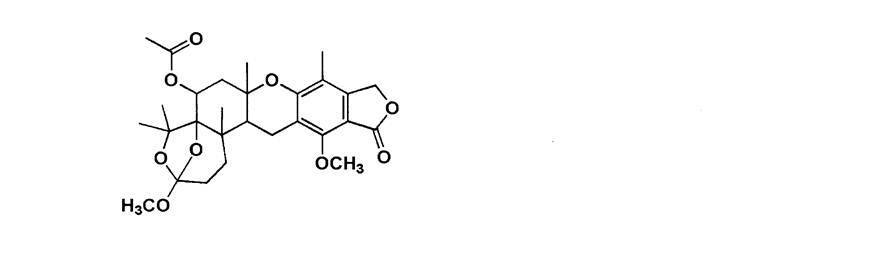
で表わされる化合物を含有してなるプロモーター活性促進剤。 - 下記式(II)
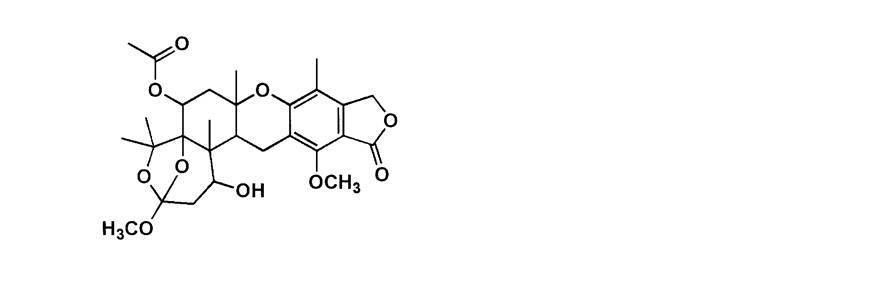
で表わされる化合物を含有してなるプロモーター活性促進剤。 - 下記式(III)
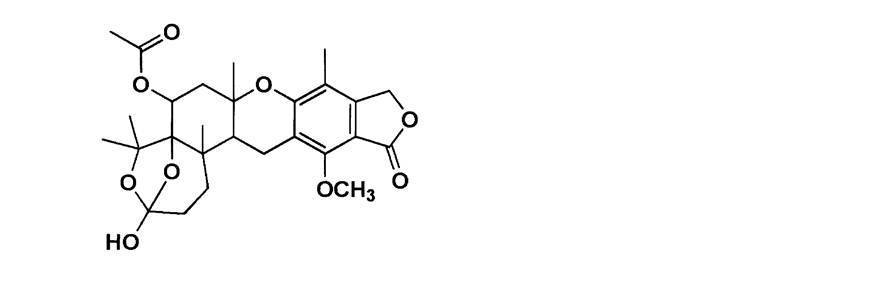
で表わされる化合物又はその塩を含有してなるプロモーター活性促進剤。 - 下記の物理化学的性状を有する化合物又はその塩を含有してなるプロモーター活性促進剤:
1)物質の性状:無色不定形の固体
2)分子式:C27H34O9
3)高分解能エレクトロスプレーイオン化マススペクトル法により測定した精密質量、[M+H]+は次に示す通りである。
実測値:503.2276
計算値:503.2281
4)紫外部吸収スペクトル:メタノール中で測定した紫外部吸収スペクトルは、次のとおり極大吸収を示す:221 nm(ε 34800)、266(ε 18400)。
5)旋光度:メタノール中で測定した旋光度は、以下に示す値を示す:
[α]D 25:-103°(c 0.1)
6)赤外吸収スペクトル:クロロホルム中で測定した赤外吸収スペクトルは以下のとおり極大吸収を示す:
3420,1743,1612 cm-1
7)1H-核磁気共鳴スペクトル:重クロロホルム中でクロロホルムのシグナルを7.26ppmとして測定した、1H-核磁気共鳴スペクトルは、以下に示す通りである:
0.98(3H,s)、1.21(3H,s)、1.30(3H,s)、1.52(3H,s)、1.79(1H,m)、1.91(1H,m)、1.93(1H,m)、1.93(1H,m)、1.98(3H,s)、2.05(3H,s)、2.15(1H,dd,J=4.4,15.7Hz)、2.41(1H,d,J=8.1Hz)、2.55(1H,dd,J=1.5,16.1Hz)、2.85(1H,dd,H=8.1,18.5Hz)、2.96(1H,d,J=18.5Hz)、4.11(3H,s)、5.08(1H,br.S)、5.11(2H,s)ppm
8)13C-核磁気共鳴スペクトル:重クロロホルム中でクロロホルムのシグナルを77.0 ppmとして測定した、13C-核磁気共鳴スペクトルは、以下に示すとおりである:10.6(q)、18.0(t)、18.1(d)、21.2(q)、25.5(q)、27.5(q)、29.4(q)、29.7(t)、31.0(t)、35.4(d)、38.0(t)、40.2(s)、62.0(q)、68.2(t)、70.8(d)、75.6(s)、85.1(s)、86.2(s)、107.4(s)、113.9(s)、115.7(s)、117.8(s)、145.6(s)、155.4(s)、157.9(s)、169.4(s)、169.5(s)。 - プロモーター活性促進がiPS細胞化因子遺伝子のプロモーター活性促進である、請求項1乃至4のいずれか一つに記載のプロモーター活性促進剤。
- iPS細胞化因子遺伝子が、Oct3/4、Sox2、Klf4、c-Myc、n-Myc、NANOG、LIN28、hTERT及びSV40 Large Tからなる群から選択される一つ又は二つ以上の遺伝子である、請求項5に記載のプロモーター活性促進剤。
- iPS細胞化因子遺伝子が、Oct3/4、Sox2及びKlf4である、請求項5又は6に記載のプロモーター活性促進剤。
- アスペルギルス(Aspergillus)属に属する、請求項1乃至4のいずれか一つに記載の化合物の生産菌を培養する工程、並びに、その培養物より請求項1乃至4のいずれか一つに記載の化合物を採取する工程を含んでなる、請求項1乃至4のいずれか一つに記載の化合物の製造方法。
- アスペルギルス(Aspergillus)属に属する、請求項1乃至4のいずれか一つに記載の化合物の生産菌がアスペルギルス・エスピー(Aspergillus sp.)SANK 11109株(FERM BP-11268)株である、請求項8に記載の製造方法。
- アスペルギルス・エスピー(Aspergillus sp.)SANK 11109株(FERM BP-11268)株。
- 請求項1もしくは2記載の化合物、又は、請求項3もしくは4又はその塩と、遺伝子プロモーターとを接触させる工程を含んでなる、プロモーター活性促進方法。
- 遺伝子がiPS細胞化因子遺伝子である、請求項11に記載の方法。
- iPS細胞化因子遺伝子が、Oct3/4、Sox2、Klf4、c-Myc、n-Myc、NANOG、LIN28、hTERT及びSV40 Large T、Tbxl、L-Myc及びUTF1からなる群から選択される一つ又は二つ以上の遺伝子である、請求項12に記載の方法。
- iPS細胞化因子遺伝子が、Oct3/4、Sox2及びKlf4である、請求項12又は13記載の方法。
Applications Claiming Priority (2)
| Application Number | Priority Date | Filing Date | Title |
|---|---|---|---|
| JP2011-100940 | 2011-04-28 | ||
| JP2011100940 | 2011-04-28 |
Publications (1)
| Publication Number | Publication Date |
|---|---|
| WO2012147905A1 true WO2012147905A1 (ja) | 2012-11-01 |
Family
ID=47072417
Family Applications (1)
| Application Number | Title | Priority Date | Filing Date |
|---|---|---|---|
| PCT/JP2012/061324 Ceased WO2012147905A1 (ja) | 2011-04-28 | 2012-04-27 | プロモーター活性促進剤 |
Country Status (1)
| Country | Link |
|---|---|
| WO (1) | WO2012147905A1 (ja) |
-
2012
- 2012-04-27 WO PCT/JP2012/061324 patent/WO2012147905A1/ja not_active Ceased
Non-Patent Citations (2)
| Title |
|---|
| HORAK, R.M. ET AL.: "Metabolites of Aspergillus ustus. Part2. Stereoelectronic Control in the Acid-catalysed Hydrolysis of the Ortho Ester Moiety in Austalides A-F.", J. CHEM. SOC. PERKIN TRANS., 1985, pages 357 - 61 * |
| HORAK, R.M. ET AL.: "Structures of the Austalides A-E, Five Novel Toxic Metabolites from Aspergillus ustus.", J. CHEM. SOC. CHEM. COMMUN., 1981, pages 1265 - 7 * |
Similar Documents
| Publication | Publication Date | Title |
|---|---|---|
| JPWO1987006265A1 (ja) | 新規化合物dc―88a及びdc―89a1 | |
| CN103865809B (zh) | 一种源于桔青霉的青霉烯醇b1的抗肿瘤用途 | |
| EP2543380B1 (en) | Neural stem cells proliferation promoting agent | |
| CN104402898B (zh) | 源于桔青霉的桔霉素类化合物penicitrinol M及其制备方法和应用 | |
| WO2004050890A1 (ja) | マクロライド系化合物の製造方法 | |
| JP2019149945A (ja) | プラテンシマイシンの製造方法 | |
| AU2016287537A1 (en) | Use of Microbacterium strains for the production of antibacterial agents | |
| CN107353274A (zh) | 源于草酸青霉的黑麦酮酸i及制备抗人食管癌药物的应用 | |
| JP6181972B2 (ja) | 芳香族化合物の製造方法 | |
| KR960016874B1 (ko) | 미생물에 의한 트랜스-4-히드록시-l-프롤린의 제조방법 | |
| CN104387396B (zh) | 源于米曲霉的吲哚萜speradine E及应用 | |
| CN104370917B (zh) | 源于米曲霉的吲哚萜speradine H及应用 | |
| JPH10130269A (ja) | カルボリン誘導体 | |
| CN101426900A (zh) | 新的微生物及使用该新的微生物制造十二氢-3a,6,6,9a-四甲基萘并[2,1-b]呋喃中间体的方法 | |
| US11332766B2 (en) | Strain of Serratia liquefaciens and a method of producing heliotropin with the same strain | |
| JP2012240974A (ja) | ダイデムニンbの製造方法 | |
| CN117487674A (zh) | 具有增强光动力活性的苝醌化合物cercosporin A及其应用 | |
| CN104370916B (zh) | 源于米曲霉的吲哚萜speradine B及应用 | |
| JP6181971B2 (ja) | 芳香族化合物の製造方法 | |
| KR101601089B1 (ko) | 신규한 답토마이신 생산 균주 및 이를 이용한 답토마이신의 제조방법 | |
| CN104370928B (zh) | 源于米曲霉的吲哚萜speradine F及应用 | |
| EP0284358B1 (en) | Novel anti-tumor compounds, method for the preparation thereof, and pharmaceutical preparations containing them | |
| JPH0246294A (ja) | ストレプトミセス属微生物からのアングサイクリノンおよびその製造方法 | |
| JPS6351395A (ja) | 抗生物質sf−2415物質およびその製造法 | |
| JPH04197191A (ja) | 化合物ms―347 |
Legal Events
| Date | Code | Title | Description |
|---|---|---|---|
| 121 | Ep: the epo has been informed by wipo that ep was designated in this application |
Ref document number: 12777728 Country of ref document: EP Kind code of ref document: A1 |
|
| NENP | Non-entry into the national phase |
Ref country code: DE |
|
| 122 | Ep: pct application non-entry in european phase |
Ref document number: 12777728 Country of ref document: EP Kind code of ref document: A1 |
|
| NENP | Non-entry into the national phase |
Ref country code: JP |