WO2012144495A1 - 冷間打抜用鋼及びこれを用いたスチールベルト用エレメント - Google Patents
冷間打抜用鋼及びこれを用いたスチールベルト用エレメント Download PDFInfo
- Publication number
- WO2012144495A1 WO2012144495A1 PCT/JP2012/060358 JP2012060358W WO2012144495A1 WO 2012144495 A1 WO2012144495 A1 WO 2012144495A1 JP 2012060358 W JP2012060358 W JP 2012060358W WO 2012144495 A1 WO2012144495 A1 WO 2012144495A1
- Authority
- WO
- WIPO (PCT)
- Prior art keywords
- steel
- hardness
- cold
- cold punching
- heat treatment
- Prior art date
- Legal status (The legal status is an assumption and is not a legal conclusion. Google has not performed a legal analysis and makes no representation as to the accuracy of the status listed.)
- Ceased
Links
Images







Classifications
-
- C—CHEMISTRY; METALLURGY
- C22—METALLURGY; FERROUS OR NON-FERROUS ALLOYS; TREATMENT OF ALLOYS OR NON-FERROUS METALS
- C22C—ALLOYS
- C22C38/00—Ferrous alloys, e.g. steel alloys
- C22C38/18—Ferrous alloys, e.g. steel alloys containing chromium
- C22C38/32—Ferrous alloys, e.g. steel alloys containing chromium with boron
-
- C—CHEMISTRY; METALLURGY
- C21—METALLURGY OF IRON
- C21D—MODIFYING THE PHYSICAL STRUCTURE OF FERROUS METALS; GENERAL DEVICES FOR HEAT TREATMENT OF FERROUS OR NON-FERROUS METALS OR ALLOYS; MAKING METAL MALLEABLE, e.g. BY DECARBURISATION OR TEMPERING
- C21D1/00—General methods or devices for heat treatment, e.g. annealing, hardening, quenching or tempering
- C21D1/18—Hardening; Quenching with or without subsequent tempering
- C21D1/25—Hardening, combined with annealing between 300 degrees Celsius and 600 degrees Celsius, i.e. heat refining ("Vergüten")
-
- C—CHEMISTRY; METALLURGY
- C21—METALLURGY OF IRON
- C21D—MODIFYING THE PHYSICAL STRUCTURE OF FERROUS METALS; GENERAL DEVICES FOR HEAT TREATMENT OF FERROUS OR NON-FERROUS METALS OR ALLOYS; MAKING METAL MALLEABLE, e.g. BY DECARBURISATION OR TEMPERING
- C21D9/00—Heat treatment, e.g. annealing, hardening, quenching or tempering, adapted for particular articles; Furnaces therefor
- C21D9/0068—Heat treatment, e.g. annealing, hardening, quenching or tempering, adapted for particular articles; Furnaces therefor for particular articles not mentioned below
-
- C—CHEMISTRY; METALLURGY
- C21—METALLURGY OF IRON
- C21D—MODIFYING THE PHYSICAL STRUCTURE OF FERROUS METALS; GENERAL DEVICES FOR HEAT TREATMENT OF FERROUS OR NON-FERROUS METALS OR ALLOYS; MAKING METAL MALLEABLE, e.g. BY DECARBURISATION OR TEMPERING
- C21D9/00—Heat treatment, e.g. annealing, hardening, quenching or tempering, adapted for particular articles; Furnaces therefor
- C21D9/46—Heat treatment, e.g. annealing, hardening, quenching or tempering, adapted for particular articles; Furnaces therefor for sheet metals
-
- C—CHEMISTRY; METALLURGY
- C22—METALLURGY; FERROUS OR NON-FERROUS ALLOYS; TREATMENT OF ALLOYS OR NON-FERROUS METALS
- C22C—ALLOYS
- C22C38/00—Ferrous alloys, e.g. steel alloys
- C22C38/02—Ferrous alloys, e.g. steel alloys containing silicon
-
- C—CHEMISTRY; METALLURGY
- C22—METALLURGY; FERROUS OR NON-FERROUS ALLOYS; TREATMENT OF ALLOYS OR NON-FERROUS METALS
- C22C—ALLOYS
- C22C38/00—Ferrous alloys, e.g. steel alloys
- C22C38/04—Ferrous alloys, e.g. steel alloys containing manganese
-
- C—CHEMISTRY; METALLURGY
- C22—METALLURGY; FERROUS OR NON-FERROUS ALLOYS; TREATMENT OF ALLOYS OR NON-FERROUS METALS
- C22C—ALLOYS
- C22C38/00—Ferrous alloys, e.g. steel alloys
- C22C38/18—Ferrous alloys, e.g. steel alloys containing chromium
- C22C38/22—Ferrous alloys, e.g. steel alloys containing chromium with molybdenum or tungsten
-
- C—CHEMISTRY; METALLURGY
- C22—METALLURGY; FERROUS OR NON-FERROUS ALLOYS; TREATMENT OF ALLOYS OR NON-FERROUS METALS
- C22C—ALLOYS
- C22C38/00—Ferrous alloys, e.g. steel alloys
- C22C38/18—Ferrous alloys, e.g. steel alloys containing chromium
- C22C38/24—Ferrous alloys, e.g. steel alloys containing chromium with vanadium
-
- C—CHEMISTRY; METALLURGY
- C22—METALLURGY; FERROUS OR NON-FERROUS ALLOYS; TREATMENT OF ALLOYS OR NON-FERROUS METALS
- C22C—ALLOYS
- C22C38/00—Ferrous alloys, e.g. steel alloys
- C22C38/18—Ferrous alloys, e.g. steel alloys containing chromium
- C22C38/28—Ferrous alloys, e.g. steel alloys containing chromium with titanium or zirconium
-
- F—MECHANICAL ENGINEERING; LIGHTING; HEATING; WEAPONS; BLASTING
- F16—ENGINEERING ELEMENTS AND UNITS; GENERAL MEASURES FOR PRODUCING AND MAINTAINING EFFECTIVE FUNCTIONING OF MACHINES OR INSTALLATIONS; THERMAL INSULATION IN GENERAL
- F16G—BELTS, CABLES, OR ROPES, PREDOMINANTLY USED FOR DRIVING PURPOSES; CHAINS; FITTINGS PREDOMINANTLY USED THEREFOR
- F16G5/00—V-belts, i.e. belts of tapered cross-section
- F16G5/16—V-belts, i.e. belts of tapered cross-section consisting of several parts
-
- C—CHEMISTRY; METALLURGY
- C21—METALLURGY OF IRON
- C21D—MODIFYING THE PHYSICAL STRUCTURE OF FERROUS METALS; GENERAL DEVICES FOR HEAT TREATMENT OF FERROUS OR NON-FERROUS METALS OR ALLOYS; MAKING METAL MALLEABLE, e.g. BY DECARBURISATION OR TEMPERING
- C21D2211/00—Microstructure comprising significant phases
- C21D2211/004—Dispersions; Precipitations
-
- C—CHEMISTRY; METALLURGY
- C21—METALLURGY OF IRON
- C21D—MODIFYING THE PHYSICAL STRUCTURE OF FERROUS METALS; GENERAL DEVICES FOR HEAT TREATMENT OF FERROUS OR NON-FERROUS METALS OR ALLOYS; MAKING METAL MALLEABLE, e.g. BY DECARBURISATION OR TEMPERING
- C21D2211/00—Microstructure comprising significant phases
- C21D2211/005—Ferrite
-
- C—CHEMISTRY; METALLURGY
- C21—METALLURGY OF IRON
- C21D—MODIFYING THE PHYSICAL STRUCTURE OF FERROUS METALS; GENERAL DEVICES FOR HEAT TREATMENT OF FERROUS OR NON-FERROUS METALS OR ALLOYS; MAKING METAL MALLEABLE, e.g. BY DECARBURISATION OR TEMPERING
- C21D2211/00—Microstructure comprising significant phases
- C21D2211/009—Pearlite
Definitions
- the present invention relates to a steel for cold punching and an element processed into a steel belt element used for a belt type CVT of an automobile or the like.
- a belt-type continuously variable transmission such as an automobile
- power is transmitted by putting a steel belt between a pair of pulleys on the input side and output side.
- a steel belt has a structure in which a plurality of chip-like elements (steel pieces) are assembled along an annular belt.
- the productivity is lowered with high hardness steel. Therefore, a manufacturing method in which a steel subjected to a softening heat treatment is subjected to cold punching, and then a hardening heat treatment is considered.
- the curing heat treatment should be performed at a relatively low temperature and in a short time.
- the present inventor focused on steel near the eutectoid composition having the lowest austenite single-phase stability region temperature on the equilibrium diagram, and performed a heat treatment at a temperature near the eutectoid point to obtain a high hardness. We are studying to obtain a steel that has both high wear resistance and high toughness that can withstand contact by relative movement with the pulley.
- Patent Document 1 discloses a high carbon steel member that is a steel near the eutectoid composition and has a high impact value of 25 J / cm 2 or more while maintaining a hardness of 600 to 900 Hv. Specifically, in mass%, C: 0.61 to 1.30%, Si: ⁇ 1.0%, Mn: 0.2 to 1.5%, P: ⁇ 0.02%, S: ⁇ 0 0.02%, Mo: ⁇ 0.5%, V: ⁇ 0.5%, and the composition after quenching and tempering is less than 8.5 ⁇ 15.3 ⁇ C% ⁇ It is disclosed that the coarse undissolved carbide having a particle size of 1.0 ⁇ m or more should be restricted to 2 or less per 100 ⁇ m 2 of observation area with V f ⁇ 10.0 volume ratio V f (volume%).
- Patent Document 2 discloses a carbon steel that is near eutectoid composition and has excellent toughness and fatigue resistance. Specifically, in mass%, C: 0.50 to 0.70%, Si: ⁇ 0.5%, Mn: 1.0 to 2.0%, P: ⁇ 0.02%, S: ⁇ 0 0.02%, Al: 0.001 to 0.10%, V: 0.05 to 0.50%, Ti: 0.02 to 0.20%, Nb: 0.01 to 0.50% , Mo: ⁇ 0.50% of component composition including one or more kinds, the spheroidization rate of undissolved carbide in the structure after annealing is 95% or more, and the particle size is 2.5 ⁇ m or more It is disclosed that no coarse undissolved carbide is produced.
- Mo is added, hardenability is improved, and when V is added, carbonitrides are formed and toughness is increased.
- a steel having excellent wear resistance and toughness can be obtained by adding rare metals such as Mo and V.
- rare metals such as Mo and V.
- the wear resistance and toughness of the same level or higher can be obtained while reducing the amount of these rare metals added.
- the present invention has been made in view of such a situation.
- the object of the present invention is to provide a belt-type CVT such as an automobile excellent in wear resistance and toughness while suppressing the addition of rare metals such as Mo and V. It is an object of the present invention to provide an element for a steel belt to be used and a steel for cold punching that provides the element.
- the steel for cold stamping according to the present invention is 10.8 [C] +5.6 [Si] +2.7 [Mn] +0.3 [Cr] +7.8 when the mass% of the element M is [M]. It is a steel for cold stamping made of steel having a component composition satisfying [Mo] +1.4 [V] ⁇ 13, in mass%, C as an essential additive element, 0.50 to 0.70%, Si 0.03 to 0.60%, Mn 0.50 to 1.00%, Cr 0.20 to 1.00%, Ti 0.01 to 0.10%, and B 0.0005% In the range of 0.0050% to 0.0050%, and as an optional additive element, P is 0.025% or less, and S is in a range of 0.015% or less, with the balance being Fe and inevitable impurities, and austenite After heating and holding in the single-phase temperature range, cool at a predetermined rate, mainly finely mixed with ferrite + pearlite structure. Characterized in that gave the following hardness 88HRB with carbide was dispersed tissue.
- a steel for cold punching cold punching into the shape of a belt type CVT steel belt element can be performed well. Further, it mainly has a structure in which fine carbides having B as a nucleus are dispersed in a ferrite + pearlite mixed structure. By a predetermined quenching and tempering heat treatment, coarse carbides can be suppressed and high toughness as an element can be provided while giving a high wear resistance as an element by a dispersed structure of fine carbides.
- coarse carbides having an equivalent circle diameter of 0.5 ⁇ m or more may be suppressed to 1.2 ⁇ 10 5 or less per 1 mm square.
- a predetermined quenching and tempering heat treatment can suppress coarse carbides and can provide high toughness as an element.
- the steel belt element of the belt type CVT according to the present invention is 640 Hv or more by applying a quenching and tempering heat treatment after cold punching the steel for cold punching according to any one of the above inventions into a predetermined shape. It is characterized by giving the hardness.
- coarse carbides having an equivalent circle diameter of 0.5 ⁇ m or more may be suppressed to 1.3 ⁇ 10 4 or less per 1 mm square. According to this invention, it has high toughness as an element by the structure
- softening heat treatment is performed so that a thin steel sheet having a predetermined component composition in the vicinity of a eutectoid composition containing a predetermined amount of B and Ti is easily punched as described later (S1).
- the thin steel sheet is heated to a relatively low temperature in the austenite single-phase stable temperature range, that is, about 20 to 30 ° C. higher than the A3 and Acm lines, held for a predetermined time, and then cooled at a predetermined rate.
- a steel for cold punching in which insoluble carbides are finely dispersed by B in the component composition can be obtained. This steel for cold punching has good cold punchability and can easily process the shape of the element.
- B is particularly dispersed in the cementite portion in the pearlite structure (see FIG. 2 (a)).
- this thin steel sheet is heated and held in the austenite single-phase stable temperature range, it changes into an austenite single-phase (see FIG. 2B).
- carbon that cannot be dissolved in ferrite first precipitates as carbide, but some carbide precipitates dispersed B. It precipitates as a nucleus (see also FIG. 2 (c) and FIG. 8).
- the temperature is continuously lowered, a structure is obtained in which carbides are finely dispersed in a mixed structure of coarse pearlite grains and ferrite grains (see FIG. 2D).
- the holding temperature is changed to the austenite single phase completely at a relatively low temperature near the A3 line and the Acm line.
- the temperature drop is started.
- Ti generates N and nitride in preference to B, suppresses the generation of B nitride, and maintains the dispersion of B.
- an element is obtained by punching from a cold punching steel into a predetermined element shape (S2).
- a curing heat treatment is performed so as to impart wear resistance and the like to the element obtained by punching (S3). That is, quenching and tempering are performed.
- this heat treatment it is preferable to perform this heat treatment at a relatively low temperature and in a short time. That is, as in the softening heat treatment (S1), the austenite single-phase stable temperature range is maintained at a relatively low temperature and quenched. In such a case, the fine carbide in which B is dispersed in the nucleus is maintained by the softening heat treatment.
- the present inventor has obtained the following empirical formula for the relationship between component elements and hardness in adjusting the component composition such as JIS SKS95 so as to obtain hardness suitable for cold punching processing so far.
- H 1 10.8 [C] +5.6 [Si] +2.7 [Mn] +0.3 [Cr] +7.8 [Mo] +1.4 [V] +75 (Formula 1) Therefore, when the target value of the component composition was first selected and steel was manufactured so as to obtain the predetermined hardness described later using Equation 1, the component compositions of Examples 1 to 10 and Comparative Examples 1 to 11 shown in FIG. Of steel was obtained.
- Mo was added in Comparative Example 3 and V was added according to the target value in Comparative Example 4, but in other Examples and Comparative Examples, , Mo and V are not intended to be added as target values, and both are detected as impurities.
- the rolled material was subjected to a heat treatment that was held at 760 ° C. for 1 hour, gradually cooled to 650 ° C. at 10 ° C./hr, and then air-cooled as the softening heat treatment (S1). As appropriate, polishing was performed to obtain a structure observation specimen, and the Rockwell hardness, the number of insoluble carbides, and the like were measured.
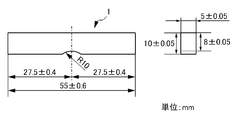
- Vickers hardness using a commercially available Vickers hardness meter, was measured five points at a depth of about 25 ⁇ m from the surface in the cross section of the wear test piece 13 was the average value and the measured value H 3.
- the impact test was conducted using a commercially available Charpy impact test apparatus.
- the impact ratio of FIG. 6 is a ratio with respect to the measured value in the test piece of Comparative Example 3. When this impact ratio is 1 or more, it is evaluated that the toughness is good ( ⁇ ), and less than 1, the toughness is poor (x).
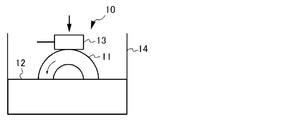
- the wear test was performed by a block-on-ring method using a wear test apparatus 10 as shown in FIG. Specifically, a wear test piece 13 is brought into contact with a rotating ring 11 immersed in a tank 14 storing 110 ° C. oil 12 at a load of 1200 N, and the wear amount at a relatively sliding distance of 3000 m is measured. did.
- the sliding speed of the wear test piece 13 with respect to the ring 11 is 0.05 m / sec.
- the ring 11 is an annular body having an outer diameter of 35 mm and a thickness of 8.74 mm, and is made of steel obtained by tempering a carburizing and tempering material of SCM420 to a hardness of about 750 Hv.
- the number of insoluble carbides was measured by image analysis of the cross-sectional structure.
- the number of undissolved carbides having an equivalent circle diameter of 0.50 ⁇ m or more present per 100 ⁇ m square was converted to the number present per 1 mm square.
- the hardness after the softening heat treatment (S1) (hereinafter referred to as “hardness after the softening heat treatment”) H 2 is smaller than 88HRB and has excellent punchability.
- the hardness after hardening heat treatment (S3) (hereinafter referred to as “hardness after hardening heat treatment”) H 3 is approximately the same as or lower than that of Comparative Example 3, but the impact ratio is 1 or more, the wear ratio. Is less than 1. That is, the toughness and the wear resistance are equal to or higher than those of conventional materials.
- Comparative Example 8 in which Mo is not added and the Mn content is reduced compared to the conventional material, the hardness H 2 after the softening heat treatment is low, and the cold punching steel is good as a steel for cold punching. is there.
- the wear ratio is much larger than 1, which is much inferior to conventional materials in wear resistance.
- Example 10 in which B and Ti were added instead of Mo as compared with the conventional material, the steel had good cold punchability as a steel for cold punching, the impact ratio was as large as 1.22, and wear The ratio is as small as 0.65. That is, it has good toughness and wear resistance.
- Example 1 Even in Example 1, where B and Ti are added instead of Mo and Mn is added while reducing the C content, the steel has good punchability as a steel for cold punching, The ratio is very large at 1.40 and has particularly excellent toughness.
- Example 2 Even in Example 2 in which B and Ti are added instead of Mo and the contents of Cr and P are increased compared to the conventional material, the steel has good punchability as a steel for cold punching. Moreover, both toughness and wear resistance are equal to or higher than those of conventional materials.
- Example 3 In Example 3 in which B and Ti were added instead of Mo and the Mn content was further reduced compared to the conventional material, the steel had good punchability as a steel for cold punching, and the impact ratio was 1.
- the wear ratio is as small as 0.68, and it has good toughness and wear resistance.
- Example 4 In Example 4 in which B and Ti were added instead of Mo to the conventional material and the Si content was increased, the steel had good punchability as a steel for cold punching, and the impact ratio was 1 .20, wear ratio is as small as 0.65, and has good toughness and wear resistance.
- Example 5 Even in Example 5 in which B and Ti were added instead of Mo, and the content of C was increased while reducing the Si content, the steel had good punchability as a cold punching steel. Have. Moreover, both toughness and wear resistance are equal to or higher than those of conventional materials.
- the steel has good punchability as a steel for cold punching. Further, the toughness of the steel belt element is equal to or higher than that of the conventional material, and the wear resistance is good.
- the steel has good punchability as a steel for cold punching. It has excellent toughness and wear resistance as a steel belt element.
- Comparative Example 6 in which B and Ti were not added has good punchability as a steel for cold punching.
- the impact ratio is smaller than 1
- the wear ratio is larger than 1
- both toughness and wear resistance are inferior to those of conventional materials.
- the toughness and wear resistance are greatly deteriorated with respect to Example 10.
- Comparative Example 11 in which Ti was not added has good punchability as a steel for cold punching.
- the impact ratio is less than 1
- the wear ratio is greater than 1
- both the toughness and wear resistance of the steel belt element are inferior to those of conventional materials.
- the toughness and wear resistance are greatly deteriorated with respect to Example 10.
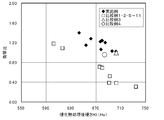
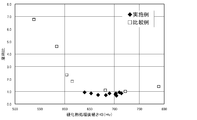
- Examples 1 to 10 to which B and Ti were added are Comparative Example 3 to which Mo was added and Comparative Example 4 to which V was added. It is in almost the same position. At least in the upper right position of Comparative Examples 1 and 2 and Comparative Examples 5 to 10 in which B and Ti were not added. That is, even if the hardness H 3 after the curing heat treatment is high, the impact resistance tends to be excellent. This is thought to be because B increases the grain boundary strength and suppresses the precipitation of coarse undissolved carbide that becomes the starting point of fracture.
- B becomes a precipitation nucleus of undissolved carbide during the softening heat treatment, and as a result, suppresses the precipitation of coarse undissolved carbide that becomes a starting point of fracture, but as shown in FIG.
- the concentration of B is high at the center of the insoluble carbide 15.
- Example 1 to 10 have a high impact ratio to after hardening heat treatment hardness H 3. In Examples 1 to 10, it is considered that Ti is bonded to N before B, thereby reducing N bonded to B and further enhancing the effect of B described above.
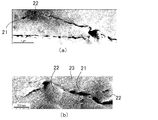
- wear proceeds by generation and growth of microcracks 21 from the surface and peeling of the surface.
- the microcracks 21 preferentially propagate through the interface between the undissolved carbide 22 and the parent phase 23. That is, it is considered that as the insoluble carbide 22 is larger, stress concentration is more likely to occur at the interface between the insoluble carbide 22 and the parent phase 23 and the microcracks 21 are easily propagated. Therefore, as shown in FIG. 10, when the relationship between the number of coarse undissolved carbides having an equivalent circle diameter of 0.5 ⁇ m or more and the wear ratio is summarized, the wear ratio decreases as the number decreases. That is, it can be seen that the wear resistance can be improved by reducing the number of coarse insoluble carbides 22.
- the number of coarse undissolved carbides depends on the C content, but if the C content is reduced, the hardness is reduced and the wear resistance is reduced. As shown in FIG. 11, when the hardness is 640 Hv or less after the curing heat treatment, the wear ratio increases rapidly, that is, the wear resistance greatly decreases. That is, there is a lower limit value of the C content necessary to give good wear resistance as a steel belt element. On the other hand, Comparative Example 1 and the like having a high C content have poor cold punchability as a steel for cold punching, and there is an upper limit for the C content.
- the range of the C content that provides both wear resistance as a steel belt element and cold punchability as a steel for cold punching is 0.50 to 0.70% in mass%.
- the number of coarse undissolved carbides having a hardness of 640 Hv or more and an equivalent circle diameter of 0.5 ⁇ m or more after curing heat treatment is 130 or less per 100 ⁇ m square, that is, about 1.3 ⁇ 10 4 or less per 1 mm square. It is said.
- Example 10 to which B was added was compared to Comparative Example 6 to which B was not added.
- the addition of B refines the insoluble carbide after the softening heat treatment.
- Example 10 to which B was added had more undissolved carbide having an equivalent circle diameter of 0.30 ⁇ m or less than Comparative Example 6 to which B was not added. There are fewer undissolved carbides larger than this. That is, the effect of making carbide fine by adding B is effective even after the heat treatment for curing.
- the predetermined component composition and the predetermined heat treatment to which B and Ti are added without adding Mo or V, the predetermined component composition and the predetermined heat treatment to which B and Ti are added, and the toughness is increased, while the insoluble carbide is finely precipitated and wear resistance is increased.
- composition range of the steel for cold stamping was determined by the following guidelines. First, the essential additive elements C, Si, Mn, Cr, B, and Ti will be described.
- C is the most important element for ensuring the wear resistance required as a steel belt element. If the amount of C added is too small, the hardness cannot be ensured after the curing heat treatment and the wear resistance is lowered. On the other hand, if the amount of addition of C is too large, coarse undissolved carbides remain after the heat treatment for curing, and the wear resistance is also lowered. Moreover, the carbide
- Si is an effective element as a deoxidizing element for steel. If the amount of Si added is too small, the steel cannot be sufficiently deoxidized. On the other hand, when there is too much addition amount of Si, the hardness after softening heat processing will raise and the cold punching property required as steel for cold punching will be deteriorated. Therefore, the Si content is in the range of 0.03 to 0.60% by mass%.
- Mn improves the hardenability of steel and is effective in ensuring the mechanical strength required for steel belt elements. If the amount of Mn added is too small, hardenability cannot be ensured, and the wear resistance required as a steel belt element is reduced. On the other hand, when there is too much addition amount of Mn, the cold punching property required as cold punching steel will be deteriorated. Therefore, in terms of mass%, Mn is in the range of 0.50 to 1.00%.
- Cr like Mn, improves the hardenability of steel and is effective in ensuring the mechanical strength required for steel belt elements.
- the amount of Cr added is too large, it easily dissolves in iron carbide, stabilizes insoluble carbides, and increases coarse insoluble carbides. That is, the wear resistance required as a steel belt element is reduced. Therefore, Cr is in the range of 0.20 to 1.00% by mass%.
- B suppresses the grain boundary segregation of impurities such as P, and increases the grain boundary strength, so it is effective in improving the toughness required as a steel belt element. Further, as described above, since it is dispersed in the old cementite portion in the pearlite phase, it becomes a precipitation nucleus of insoluble carbide precipitated during the softening heat treatment, and the insoluble carbide is finely dispersed and precipitated. Thereby, it has the effect which improves the abrasion resistance required as an element for steel belts. However, increasing the amount of B added increases the cost. Therefore, in mass%, B is in the range of 0.0005 to 0.0050%.
- Ti binds preferentially to N over B and becomes Ti nitride, thereby suppressing the formation of B nitride and contributing to the improvement of grain boundary strength and wear resistance by B. If the addition amount of Ti is too small, formation of B nitride cannot be sufficiently suppressed, and improvement in grain boundary strength and wear resistance due to B cannot be obtained. On the other hand, increasing the amount of Ti added increases the cost. Therefore, Ti is in the range of 0.01 to 0.10% by mass%.
- the optional additive elements will be described.
- the upper limit value was determined within a range not impairing the characteristics of the above-described essential additive element as a steel belt element.
- P decreases the strength of the crystal grain boundaries, but if the content is below a certain content, the decrease in the grain boundary strength is slight. In addition, the suppression of the addition amount can prolong the refining process and cause an increase in cost. Therefore, in mass%, P is in the range of 0.025% or less.
- S combines with Mn to produce MnS inclusions, if contained excessively, the amount of inclusions that become the starting point of stress concentration is increased, leading to a decrease in fatigue strength required as a steel belt element. However, if the content is below a certain level, the decrease in fatigue strength is very slight. Therefore, in mass%, S is within a range of 0.015% or less.
- Mo has the effect of suppressing the formation of film-like cementite at the grain boundaries, and the addition of Mo can be expected to further improve toughness. Mo also has the effect of significantly increasing the hardenability. However, the addition of Mo causes a significant deterioration in punchability and an increase in cost required as steel for cold punching. Further, according to the above-described embodiment, the addition of Mo is not necessarily required in order to obtain characteristics required as a steel belt element.
- V forms fine V carbide in the steel and makes the crystal grains fine, so that toughness and wear resistance can be improved.
- the addition of V increases costs.
- the addition of V is not always necessary in order to obtain the characteristics required as a steel belt element.
- the holding temperature of the softening heat treatment is preferably 700 ° C. to 780 ° C.
Landscapes
- Chemical & Material Sciences (AREA)
- Engineering & Computer Science (AREA)
- Mechanical Engineering (AREA)
- Materials Engineering (AREA)
- Metallurgy (AREA)
- Organic Chemistry (AREA)
- Physics & Mathematics (AREA)
- Thermal Sciences (AREA)
- Crystallography & Structural Chemistry (AREA)
- General Engineering & Computer Science (AREA)
- Heat Treatment Of Articles (AREA)
Abstract
Description
H1=10.8[C]+5.6[Si]+2.7[Mn]
+0.3[Cr]+7.8[Mo]+1.4[V]+75 (式1)
そこで、式1により後述する所定の硬さを得られるよう、まず成分組成の目標値を選択し、鋼を製造したところ、図3に示す実施例1乃至10及び比較例1乃至11の成分組成の鋼を得られた。ここで、図3の実施例1乃至10及び比較例1乃至11の成分組成において、比較例3ではMoを、比較例4ではVを目標値に従って添加したが、その他の実施例及び比較例において、Mo及びVは目標値としては添加を意図しておらず、いずれも不純物として検出されたものである。
低下を招く。しかし、一定の含有量以下であれば、疲労強度の低下は極めて軽微である。そこで、質量%で、Sは0.015%以下の範囲内である。
11 リング
13 摩耗試験片
21 微小亀裂
22 未固溶炭化物
23 母相
Claims (4)
- 元素Mの質量%を[M]とすると、
10.8[C]+5.6[Si]+2.7[Mn]
+0.3[Cr]+7.8[Mo]+1.4[V]≦13
を満たす成分組成の鋼からなる冷間打抜用鋼であって、
質量%で、必須添加元素として、
Cを0.50から0.70%、
Siを0.03から0.60%、
Mnを0.50から1.00%、
Crを0.20から1.00%、
Tiを0.01から0.10%、及び、
Bを0.0005から0.0050%の範囲内、
任意添加元素として、
Pを0.025%以下、及び、
Sを0.015%以下の範囲内、
残部Fe及び不可避的不純物とした成分組成を有し、
オーステナイト単相温度域に加熱保持後、所定速度で冷却して、主として、フェライト+パーライト混合組織に微細炭化物を分散させた組織で88HRB以下の硬さを与えたことを特徴とする冷間打抜用鋼。 - 断面組織において、円相当径で0.5μm以上の粗大炭化物を1mm四方当たり1.2×10⁵個以下に抑制したことを特徴とする請求項1記載の冷間打抜用鋼。
- 請求項1又は2に記載の冷間打抜用鋼を所定形状に冷間打ち抜きした後に焼き入れ焼き戻し熱処理を与えて640Hv以上の硬さを与えたことを特徴とするスチールベルト用エレメント。
- 断面組織において、円相当径で0.5μm以上の粗大炭化物を1mm四方当たり1.3×10⁴個以下に抑制したことを特徴とする請求項3記載のスチールベルト用エレメント。
Priority Applications (3)
| Application Number | Priority Date | Filing Date | Title |
|---|---|---|---|
| DE112012001745.5T DE112012001745T5 (de) | 2011-04-18 | 2012-04-17 | Stahl zum Kaltstanzen und Stahlelement für einen Stahlriemen unter Verwendung desselben |
| US14/003,508 US20140053955A1 (en) | 2011-04-18 | 2012-04-17 | Steel for cold punching and steel element for steel belt using the same |
| CN201280016737.1A CN103502495A (zh) | 2011-04-18 | 2012-04-17 | 冷冲用钢和使用该钢的钢带用构件 |
Applications Claiming Priority (2)
| Application Number | Priority Date | Filing Date | Title |
|---|---|---|---|
| JP2011092138A JP5619668B2 (ja) | 2011-04-18 | 2011-04-18 | 冷間打抜用鋼及びこれを用いたスチールベルト用エレメント |
| JP2011-092138 | 2011-04-18 |
Publications (1)
| Publication Number | Publication Date |
|---|---|
| WO2012144495A1 true WO2012144495A1 (ja) | 2012-10-26 |
Family
ID=47041601
Family Applications (1)
| Application Number | Title | Priority Date | Filing Date |
|---|---|---|---|
| PCT/JP2012/060358 Ceased WO2012144495A1 (ja) | 2011-04-18 | 2012-04-17 | 冷間打抜用鋼及びこれを用いたスチールベルト用エレメント |
Country Status (5)
| Country | Link |
|---|---|
| US (1) | US20140053955A1 (ja) |
| JP (1) | JP5619668B2 (ja) |
| CN (1) | CN103502495A (ja) |
| DE (1) | DE112012001745T5 (ja) |
| WO (1) | WO2012144495A1 (ja) |
Families Citing this family (2)
| Publication number | Priority date | Publication date | Assignee | Title |
|---|---|---|---|---|
| JP6527709B2 (ja) * | 2015-02-12 | 2019-06-05 | 本田技研工業株式会社 | 無段変速機の金属ベルト用エレメント |
| WO2016152406A1 (ja) * | 2015-03-26 | 2016-09-29 | 日立金属株式会社 | 冷間工具およびその製造方法 |
Citations (3)
| Publication number | Priority date | Publication date | Assignee | Title |
|---|---|---|---|---|
| JPH10287959A (ja) * | 1997-04-17 | 1998-10-27 | Daido Steel Co Ltd | 高強度高周波焼入用鋼 |
| JP2001220642A (ja) * | 2000-02-03 | 2001-08-14 | Sumitomo Metal Ind Ltd | 軟質で熱処理歪みの小さい高炭素鋼帯とその製造方法 |
| JP2005344196A (ja) * | 2004-06-07 | 2005-12-15 | Nippon Steel Corp | 伸びフランジ性の優れた高炭素冷延鋼板 |
Family Cites Families (5)
| Publication number | Priority date | Publication date | Assignee | Title |
|---|---|---|---|---|
| JPS6487748A (en) * | 1987-09-30 | 1989-03-31 | Aisin Seiki | Belt block for non-stage transmission |
| DE69905963T2 (de) * | 1998-04-21 | 2004-01-22 | Kabushiki Kaisha Kobe Seiko Sho Also Known As Kobe Steel Ltd. | Walzdraht oder Stabstahl mit guter Kaltverformbarkeit und daraus hergestellte Maschinenteile |
| JP3737952B2 (ja) * | 2001-02-16 | 2006-01-25 | 本田技研工業株式会社 | Cvtベルト用押しブロックおよびその製造方法 |
| JP2007107029A (ja) * | 2005-10-11 | 2007-04-26 | Honda Motor Co Ltd | 鋼材及びその製造方法 |
| JP5594521B2 (ja) * | 2010-06-21 | 2014-09-24 | 本田技研工業株式会社 | ベルト式cvtのエレメント用鋼及びこれを用いたエレメント |
-
2011
- 2011-04-18 JP JP2011092138A patent/JP5619668B2/ja not_active Expired - Fee Related
-
2012
- 2012-04-17 WO PCT/JP2012/060358 patent/WO2012144495A1/ja not_active Ceased
- 2012-04-17 DE DE112012001745.5T patent/DE112012001745T5/de not_active Withdrawn
- 2012-04-17 US US14/003,508 patent/US20140053955A1/en not_active Abandoned
- 2012-04-17 CN CN201280016737.1A patent/CN103502495A/zh active Pending
Patent Citations (3)
| Publication number | Priority date | Publication date | Assignee | Title |
|---|---|---|---|---|
| JPH10287959A (ja) * | 1997-04-17 | 1998-10-27 | Daido Steel Co Ltd | 高強度高周波焼入用鋼 |
| JP2001220642A (ja) * | 2000-02-03 | 2001-08-14 | Sumitomo Metal Ind Ltd | 軟質で熱処理歪みの小さい高炭素鋼帯とその製造方法 |
| JP2005344196A (ja) * | 2004-06-07 | 2005-12-15 | Nippon Steel Corp | 伸びフランジ性の優れた高炭素冷延鋼板 |
Also Published As
| Publication number | Publication date |
|---|---|
| US20140053955A1 (en) | 2014-02-27 |
| JP5619668B2 (ja) | 2014-11-05 |
| CN103502495A (zh) | 2014-01-08 |
| JP2012224896A (ja) | 2012-11-15 |
| DE112012001745T5 (de) | 2014-04-17 |
Similar Documents
| Publication | Publication Date | Title |
|---|---|---|
| JP5231101B2 (ja) | 疲労限度比と被削性に優れた機械構造用鋼 | |
| JP5030280B2 (ja) | 焼入れ性、疲労特性、靭性に優れた高炭素鋼板及びその製造方法 | |
| TWI591187B (zh) | High-carbon cold-rolled steel sheet and its manufacturing method | |
| JP5123335B2 (ja) | クランクシャフトおよびその製造方法 | |
| WO2013065718A1 (ja) | 鋼製部品の製造方法 | |
| JP4941252B2 (ja) | 動力伝達部品用肌焼鋼 | |
| CN108315637B (zh) | 高碳热轧钢板及其制造方法 | |
| JP2012214832A (ja) | 機械構造用鋼およびその製造方法 | |
| CN105102659A (zh) | 氮化处理用钢板及其制造方法 | |
| JP4581966B2 (ja) | 高周波焼入れ用鋼材 | |
| JP5541048B2 (ja) | 耐ピッチング性に優れた浸炭窒化鋼部品 | |
| JP4385019B2 (ja) | 鋼製軟窒化機械部品の製造方法 | |
| JP2004027334A (ja) | 高周波焼もどし用鋼およびその製造方法 | |
| JP6551225B2 (ja) | 高周波焼入れ歯車 | |
| JP2013028860A (ja) | ねじり疲労特性に優れた浸炭用鋼からなる鋼材 | |
| JP2007177317A (ja) | 強度、延性、靭性、耐磨耗性に優れた機械構造用鋼およびその製造方法およびこれを用いた金属ベルト | |
| JP4757831B2 (ja) | 高周波焼入れ部品およびその製造方法 | |
| JP6390685B2 (ja) | 非調質鋼およびその製造方法 | |
| JP5619668B2 (ja) | 冷間打抜用鋼及びこれを用いたスチールベルト用エレメント | |
| JP5583352B2 (ja) | 高周波焼入れ用鋼および静捩り破壊強度および捩り疲労強度に優れた高周波焼入れ部品 | |
| JP5594521B2 (ja) | ベルト式cvtのエレメント用鋼及びこれを用いたエレメント | |
| JP3996386B2 (ja) | ねじり疲労特性に優れた浸炭用鋼 | |
| JPH10259447A (ja) | 転造加工性に優れたドライブプレート用鋼板 | |
| JP2007332440A (ja) | 低サイクル疲労特性に優れた高周波焼入れ鋼材及び高周波焼入れ部品 | |
| JP5633426B2 (ja) | 熱処理用鋼材 |
Legal Events
| Date | Code | Title | Description |
|---|---|---|---|
| 121 | Ep: the epo has been informed by wipo that ep was designated in this application |
Ref document number: 12774674 Country of ref document: EP Kind code of ref document: A1 |
|
| WWE | Wipo information: entry into national phase |
Ref document number: 112012001745 Country of ref document: DE Ref document number: 1120120017455 Country of ref document: DE |
|
| WWE | Wipo information: entry into national phase |
Ref document number: 14003508 Country of ref document: US |
|
| 122 | Ep: pct application non-entry in european phase |
Ref document number: 12774674 Country of ref document: EP Kind code of ref document: A1 |