WO2012144481A1 - シロキサン化合物およびその硬化物 - Google Patents
シロキサン化合物およびその硬化物 Download PDFInfo
- Publication number
- WO2012144481A1 WO2012144481A1 PCT/JP2012/060314 JP2012060314W WO2012144481A1 WO 2012144481 A1 WO2012144481 A1 WO 2012144481A1 JP 2012060314 W JP2012060314 W JP 2012060314W WO 2012144481 A1 WO2012144481 A1 WO 2012144481A1
- Authority
- WO
- WIPO (PCT)
- Prior art keywords
- group
- siloxane compound
- represented
- siloxane
- cured product
- Prior art date
- Legal status (The legal status is an assumption and is not a legal conclusion. Google has not performed a legal analysis and makes no representation as to the accuracy of the status listed.)
- Ceased
Links
Classifications
-
- H—ELECTRICITY
- H10—SEMICONDUCTOR DEVICES; ELECTRIC SOLID-STATE DEVICES NOT OTHERWISE PROVIDED FOR
- H10W—GENERIC PACKAGES, INTERCONNECTIONS, CONNECTORS OR OTHER CONSTRUCTIONAL DETAILS OF DEVICES COVERED BY CLASS H10
- H10W74/00—Encapsulations, e.g. protective coatings
- H10W74/40—Encapsulations, e.g. protective coatings characterised by their materials
- H10W74/47—Encapsulations, e.g. protective coatings characterised by their materials comprising organic materials, e.g. plastics or resins
- H10W74/476—Organic materials comprising silicon
-
- C—CHEMISTRY; METALLURGY
- C07—ORGANIC CHEMISTRY
- C07F—ACYCLIC, CARBOCYCLIC OR HETEROCYCLIC COMPOUNDS CONTAINING ELEMENTS OTHER THAN CARBON, HYDROGEN, HALOGEN, OXYGEN, NITROGEN, SULFUR, SELENIUM OR TELLURIUM
- C07F7/00—Compounds containing elements of Groups 4 or 14 of the Periodic Table
- C07F7/02—Silicon compounds
- C07F7/21—Cyclic compounds having at least one ring containing silicon, but no carbon in the ring
-
- C—CHEMISTRY; METALLURGY
- C08—ORGANIC MACROMOLECULAR COMPOUNDS; THEIR PREPARATION OR CHEMICAL WORKING-UP; COMPOSITIONS BASED THEREON
- C08F—MACROMOLECULAR COMPOUNDS OBTAINED BY REACTIONS ONLY INVOLVING CARBON-TO-CARBON UNSATURATED BONDS
- C08F30/00—Homopolymers or copolymers of compounds having one or more unsaturated aliphatic radicals, each having only one carbon-to-carbon double bond, and containing phosphorus, selenium, tellurium or a metal
- C08F30/04—Homopolymers or copolymers of compounds having one or more unsaturated aliphatic radicals, each having only one carbon-to-carbon double bond, and containing phosphorus, selenium, tellurium or a metal containing a metal
- C08F30/08—Homopolymers or copolymers of compounds having one or more unsaturated aliphatic radicals, each having only one carbon-to-carbon double bond, and containing phosphorus, selenium, tellurium or a metal containing a metal containing silicon
-
- C—CHEMISTRY; METALLURGY
- C08—ORGANIC MACROMOLECULAR COMPOUNDS; THEIR PREPARATION OR CHEMICAL WORKING-UP; COMPOSITIONS BASED THEREON
- C08F—MACROMOLECULAR COMPOUNDS OBTAINED BY REACTIONS ONLY INVOLVING CARBON-TO-CARBON UNSATURATED BONDS
- C08F38/00—Homopolymers and copolymers of compounds having one or more carbon-to-carbon triple bonds
-
- C—CHEMISTRY; METALLURGY
- C08—ORGANIC MACROMOLECULAR COMPOUNDS; THEIR PREPARATION OR CHEMICAL WORKING-UP; COMPOSITIONS BASED THEREON
- C08G—MACROMOLECULAR COMPOUNDS OBTAINED OTHERWISE THAN BY REACTIONS ONLY INVOLVING UNSATURATED CARBON-TO-CARBON BONDS
- C08G77/00—Macromolecular compounds obtained by reactions forming a linkage containing silicon with or without sulfur, nitrogen, oxygen or carbon in the main chain of the macromolecule
- C08G77/04—Polysiloxanes
-
- C—CHEMISTRY; METALLURGY
- C09—DYES; PAINTS; POLISHES; NATURAL RESINS; ADHESIVES; COMPOSITIONS NOT OTHERWISE PROVIDED FOR; APPLICATIONS OF MATERIALS NOT OTHERWISE PROVIDED FOR
- C09J—ADHESIVES; NON-MECHANICAL ASPECTS OF ADHESIVE PROCESSES IN GENERAL; ADHESIVE PROCESSES NOT PROVIDED FOR ELSEWHERE; USE OF MATERIALS AS ADHESIVES
- C09J183/00—Adhesives based on macromolecular compounds obtained by reactions forming in the main chain of the macromolecule a linkage containing silicon, with or without sulfur, nitrogen, oxygen, or carbon only; Adhesives based on derivatives of such polymers
- C09J183/04—Polysiloxanes
-
- C—CHEMISTRY; METALLURGY
- C09—DYES; PAINTS; POLISHES; NATURAL RESINS; ADHESIVES; COMPOSITIONS NOT OTHERWISE PROVIDED FOR; APPLICATIONS OF MATERIALS NOT OTHERWISE PROVIDED FOR
- C09J—ADHESIVES; NON-MECHANICAL ASPECTS OF ADHESIVE PROCESSES IN GENERAL; ADHESIVE PROCESSES NOT PROVIDED FOR ELSEWHERE; USE OF MATERIALS AS ADHESIVES
- C09J183/00—Adhesives based on macromolecular compounds obtained by reactions forming in the main chain of the macromolecule a linkage containing silicon, with or without sulfur, nitrogen, oxygen, or carbon only; Adhesives based on derivatives of such polymers
- C09J183/04—Polysiloxanes
- C09J183/08—Polysiloxanes containing silicon bound to organic groups containing atoms other than carbon, hydrogen, and oxygen
-
- C—CHEMISTRY; METALLURGY
- C08—ORGANIC MACROMOLECULAR COMPOUNDS; THEIR PREPARATION OR CHEMICAL WORKING-UP; COMPOSITIONS BASED THEREON
- C08G—MACROMOLECULAR COMPOUNDS OBTAINED OTHERWISE THAN BY REACTIONS ONLY INVOLVING UNSATURATED CARBON-TO-CARBON BONDS
- C08G77/00—Macromolecular compounds obtained by reactions forming a linkage containing silicon with or without sulfur, nitrogen, oxygen or carbon in the main chain of the macromolecule
- C08G77/04—Polysiloxanes
- C08G77/20—Polysiloxanes containing silicon bound to unsaturated aliphatic groups
-
- C—CHEMISTRY; METALLURGY
- C08—ORGANIC MACROMOLECULAR COMPOUNDS; THEIR PREPARATION OR CHEMICAL WORKING-UP; COMPOSITIONS BASED THEREON
- C08G—MACROMOLECULAR COMPOUNDS OBTAINED OTHERWISE THAN BY REACTIONS ONLY INVOLVING UNSATURATED CARBON-TO-CARBON BONDS
- C08G77/00—Macromolecular compounds obtained by reactions forming a linkage containing silicon with or without sulfur, nitrogen, oxygen or carbon in the main chain of the macromolecule
- C08G77/04—Polysiloxanes
- C08G77/22—Polysiloxanes containing silicon bound to organic groups containing atoms other than carbon, hydrogen and oxygen
- C08G77/26—Polysiloxanes containing silicon bound to organic groups containing atoms other than carbon, hydrogen and oxygen nitrogen-containing groups
Definitions
- the present invention relates to a resin having heat resistance, particularly a siloxane compound and a cured product thereof.
- the cured product obtained by curing the siloxane compound of the present invention is a variety of sealing materials, adhesives, and the like that are required for heat resistance such as for semiconductors. It can also be used for thin films.
- ⁇ Semiconductor encapsulants such as light emitting diodes (LEDs) are required to have heat resistance to withstand the heat generated by the semiconductor during operation.
- epoxy resins or silicones which are heat resistant resins have been used as semiconductor sealing materials.
- SiC silicon carbide
- Si silicon carbide
- the power semiconductors generate a large amount of heat.
- the epoxy resin or silicone sealing material has insufficient heat resistance, and has a problem that it tends to undergo thermal decomposition during semiconductor operation.
- Patent Document 1 discloses a surface protective film for a semiconductor element formed by heating and curing a polyimide precursor composition film at 230 ° C. to 300 ° C.
- the polyimide precursor composition is solid in a low temperature region near room temperature (20 ° C.), there is a problem that the moldability is poor.
- silsesquioxane which is a network-like polysiloxane obtained by hydrolyzing an alkyltrialkoxysilane or the like and subjecting it to condensation polymerization is exemplified.
- Silsesquioxane can be used for various applications because of its high heat resistance of the inorganic siloxane skeleton and the characteristics of organic groups bonded to it.
- Some silsesquioxanes are liquid at room temperature, and after hanging on the surface of the base material, potting can be performed by condensation by heating or ultraviolet irradiation and curing.
- An object of the present invention is to obtain a siloxane compound that has fluidity and is easy to mold at a lower temperature than conventional silsesquioxanes.
- a siloxane compound obtained by bonding a specific crosslinking group to a specific siloxane skeleton is liquid at 60 ° C. or lower, and the cured product is heated by heating to 150 ° C. or higher and 350 ° C. or lower. As a result, it was found that good moldability was exhibited even at a low temperature, and the present invention was completed.
- the present invention is as follows.
- a siloxane compound represented by the general formula (1) is independently represented by X1 or X2, and at least one of X is X1, and in X1 and X2, R 1 to R 8 are each independently a hydrogen atom or carbon number. 1 to 8 alkyl group, alkenyl group or alkynyl group, phenyl group or pyridyl group, the carbon atom may be substituted with an oxygen atom, and the structure contains an ether bond, a carbonyl group or an ester bond M is an integer of 3 to 8, n is an integer of 0 to 9, p is 0 or 1, and Y is a bridging group.)
- the siloxane compound of the present invention is liquid at 60 ° C. or lower and can be molded, applied or potted.
- the siloxane compound of the present invention is heated alone or as a composition to which another composition is added, so that the cross-linking groups are cross-linked with each other to give a cured product having excellent heat resistance.
- siloxane compound of the present invention its synthesis method and its characteristics, and the application of the siloxane compound to the semiconductor sealing material will be described in order.
- siloxane compound of the present invention is a siloxane compound represented by the following general formula (1).
- the siloxane compound represented by the formula (1) may be referred to as “siloxane compound (1)”.
- each X is independently represented by X1 or X2, and at least one of X is X1.
- R 1 to R 8 are each independently a hydrogen atom or a carbon number of 1
- m is an integer of 3 to 8
- n is an integer of 0 to 9
- p is 0 or 1
- Y is a bridging group.
- the alkyl group having 1 to 8 carbon atoms include a methyl group, an ethyl group, a 1-propyl group, a 2-propyl group, an n-butyl group, and a sec-butyl group.
- the siloxane compound (1) containing a methyl group is particularly easy to synthesize, and the alkyl group is preferably a methyl group.
- alkenyl group having 1 to 8 carbon atoms examples include vinyl group, allyl group, methacryloyl group, acryloyl group, styryl group, and norbornenyl group.
- a siloxane compound (1) containing a vinyl group or a methacryloyl group is particularly easy to synthesize, and the alkenyl group is preferably a vinyl group or a methacryloyl group.
- alkynyl group having 1 to 8 carbon atoms examples include an ethynyl group and a phenylethynyl group.
- a siloxane compound (1) containing a phenylethynyl group is particularly easy to synthesize, and a phenylethynyl group is preferred as the alkynyl group.
- the phenyl group is preferably a phenyl group having 6 carbon atoms
- the pyridyl group is preferably a pyridyl group having 5 carbon atoms.
- the phenyl group and pyridyl group may have a substituent, but are preferably unsubstituted.
- the carbon atom may be substituted with an oxygen atom, and the structure may include an ether bond, a carbonyl group, or an ester bond. These are useful for adjusting the viscosity.
- the bridging group Y preferably includes a cyclic structure represented by an aromatic ring or a hetero ring for heat resistance, and the reactive site is a double bond or a triple bond. It is a certain group.
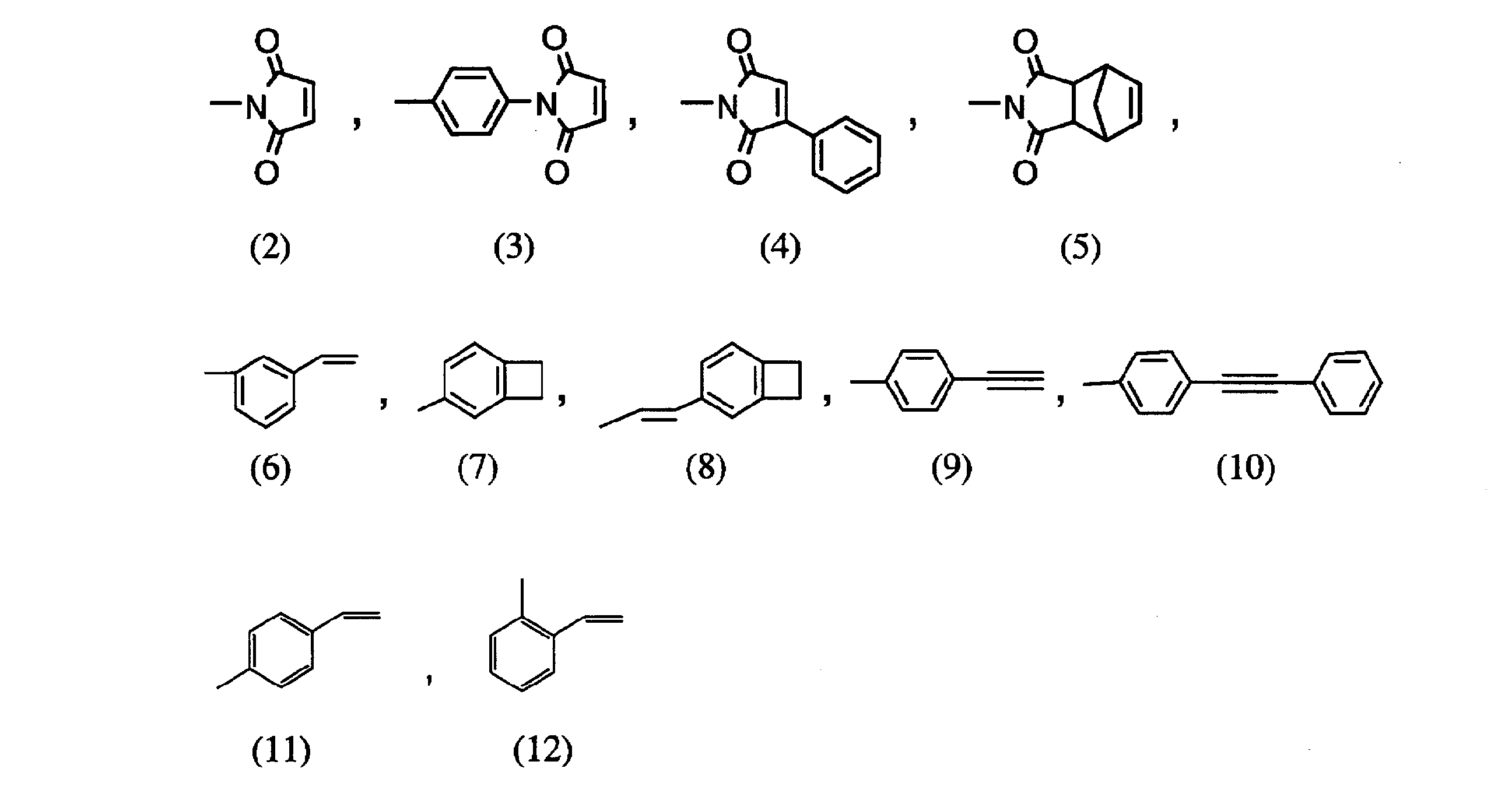
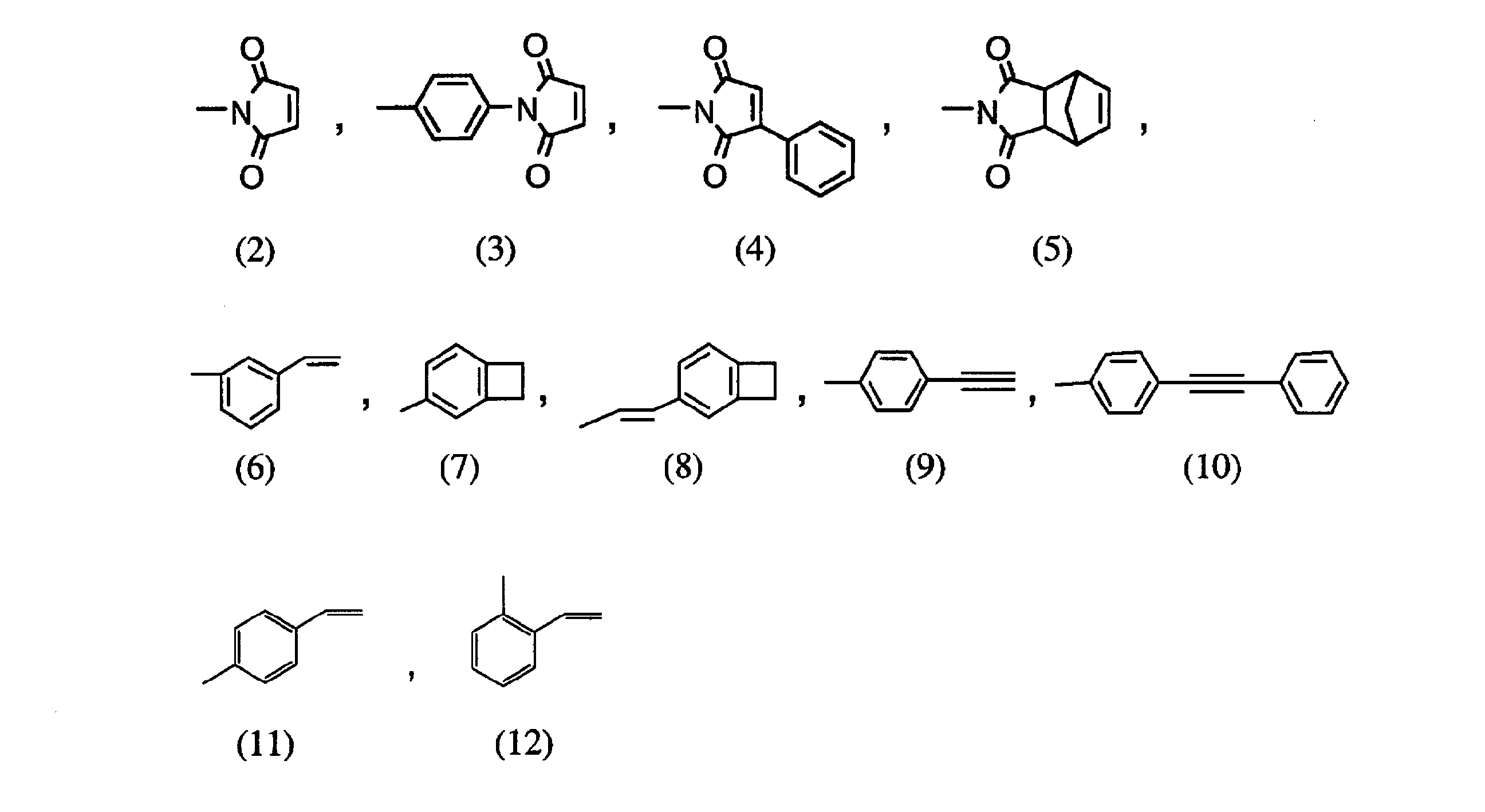
- the bridging group Y is preferably a bridging group selected from the group represented by structural formulas (2) to (12).
- These crosslinking groups represented by the structural formulas (2) to (12) have heat resistance due to the cyclic structure, and do not lower the heat resistance of the siloxane compound (1).
- the crosslinking group represented by the structural formulas (2) to (12) has a double bond or a triple bond, so that the bonding is easy, and a siloxane compound having at least two X1, preferably three or more X1 ( 1) The two are cross-linked by heating to become a cured product.
- the siloxane compound (1) is obtained by bonding the crosslinkable group Y represented by the structural formulas (2) to (12) to X2, and the siloxane (1) is heated to crosslink and cure the crosslinkable group Y. By doing so, a cured product with extremely high heat resistance can be obtained.
- siloxane compound (1) in which Y is the crosslinking group is It is easy to obtain as a single composition by organic synthesis.
- the siloxane compound (1) is liquid at room temperature (20 ° C.) or higher and 60 ° C. or lower, and is suitable for use as a semiconductor sealing material.
- siloxane compound (1) 2.1. Synthesis of Siloxane Compound Precursor (A) First, as shown in the following reaction scheme, the siloxane compound represented by the structural formula (13) is chlorinated.
- the chlorination is carried out by reacting with trichloroisocyanuric acid (see Non-patent Document 2), reacting with hexachlorocyclohexane in the presence of a rhodium catalyst (see Non-Patent Document 3), or reacting with chlorine gas.
- trichloroisocyanuric acid see Non-patent Document 2
- hexachlorocyclohexane in the presence of a rhodium catalyst
- chlorine gas rhodium catalyst
- reaction scheme it can be chlorinated by reacting tetramethyltetrahydrocyclotetrasiloxane with trichloroisocyanuric acid in an organic solvent.
- siloxane compound (1) is obtained by adding a crosslinking group represented by the structural formulas (2) to (12) to the siloxane compound precursor (A).
- the siloxane compound (1) is represented by the structural formula (7).
- a siloxane compound (1) containing a crosslinking group represented by the formula i.e., a benzocyclobutenyl group
- 4-bromobenzocyclobutene is reacted with an alkyl lithium salt, specifically n-butyl lithium, tert-butyl lithium, or methyl lithium, and is represented by the structural formula (7). It is set as the benzocyclobutenyl-lithium body as a precursor compound which gives the crosslinking group. (See Non-Patent Document 5)
- n-butyllithium is preferably used because of its availability. After lithiation, by reacting with trimethyltrivinylcyclotrisiloxane, a siloxylithium compound containing a benzocyclobutenyl group is obtained as a result via a ring cleavage reaction of trimethyltrivinylcyclotrisiloxane.
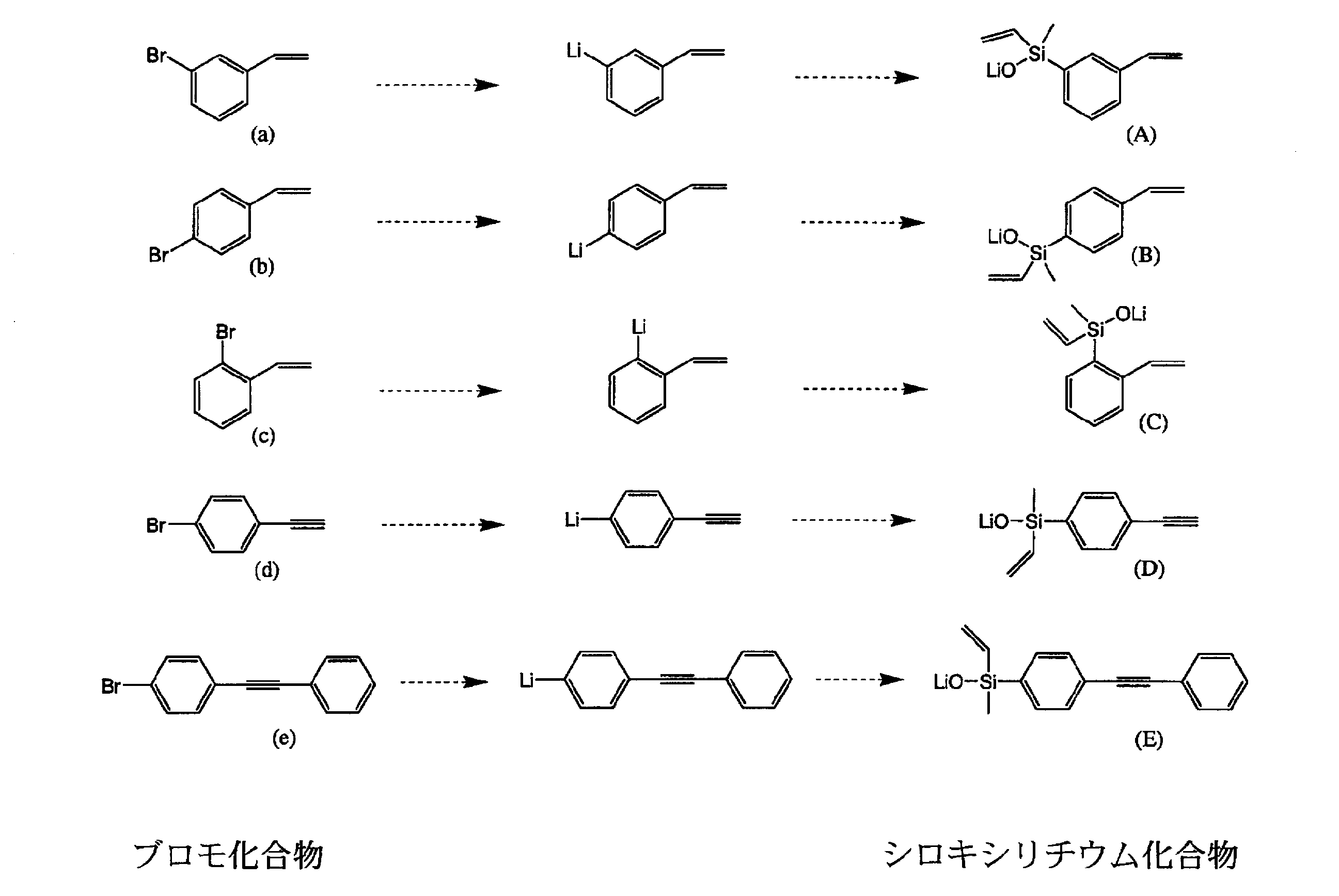
- the siloxylithium compounds (A) to (E) can be obtained from the bromo compounds (a) to (e) by carrying out the same operation as described above to advance the reaction.
- the corresponding siloxane compounds (AA) to (EE) are obtained from the siloxylithium compounds (A) to (E) by the same operation as described above.
- siloxane compound (1) to semiconductor encapsulant applications
- strong adhesion to metal wiring materials is required over a wide temperature range. It is necessary to adjust to a value as close as possible.
- the following measures can be cited as the solution.
- siloxane compound (1) is a mixture of a siloxane compound (1) and an inorganic filler.
- an inorganic filler such as silica and alumina
- the siloxane compound (1) is a liquid in a temperature range up to 60 ° C. and can be easily mixed with the inorganic filler.
- thermal addition polymerization is a curing system suitable for an encapsulant because it does not use ultraviolet light or a curing catalyst.
- the most preferred addition-polymerizable crosslinking group is a crosslinking group Y.
- These bridging groups Y are extremely durable when the curing reaction is completed at 350 ° C. or less, which is the heat resistant temperature range of the material used for the power semiconductor, and the mass reduction is 10% by mass or less in a long-term heat resistance test at 250 ° C. Is expensive.
- Example 1 Synthesis of siloxane compound
- a 300 mL three-necked flask equipped with a thermometer and a reflux condenser was charged with 50.0 g of tetrahydrofuran and 4.88 g (20.0 mmol) of tetramethyltetrahydrocyclotetrasiloxane, and cooled to ⁇ 78 ° C. while stirring. Subsequently, after the internal temperature reached ⁇ 78 ° C., 6.28 g (27.0 mmol) of trichloroisocyanuric acid was added. After completion of the addition, the mixture was stirred at ⁇ 78 ° C. for 30 minutes and then warmed to room temperature while stirring.
- the precipitated insoluble material was filtered off to obtain a tetrahydrofuran solution.
- the obtained tetrahydrofuran solution was added dropwise little by little over 10 minutes to the diethyl ether solution of the precursor compound A obtained in Synthesis Example 1 cooled to 3 ° C.
- the mixture was warmed to room temperature with stirring and stirred at room temperature for 2 hours.
- 50 g of diisopropyl ether and 50 g of water were added and stirred for 30 minutes, and then two layers were separated. Thereafter, the aqueous layer was removed, and the organic layer was washed 3 times with 50 g of distilled water.
- the obtained siloxane compound was poured into a silicone (SH 9555 made by Shin-Etsu Silicone) mold and heated at 250 ° C. for 1 hour under atmospheric pressure to obtain a cured product having a thickness of 2 mm free from bubbles and cracks.
- the 5% mass reduction temperature of this cured product was 430 ° C.
- the obtained siloxane compound was poured into a silicone (SH9555 made by Shin-Etsu Silicone) mold and heated at 330 ° C. for 1 hour under atmospheric pressure to obtain a cured product having a thickness of 2 mm free from bubbles and cracks.
- the 5% mass reduction temperature of this cured product was 450 ° C.
Landscapes
- Chemical & Material Sciences (AREA)
- Organic Chemistry (AREA)
- Chemical Kinetics & Catalysis (AREA)
- Health & Medical Sciences (AREA)
- Medicinal Chemistry (AREA)
- Polymers & Plastics (AREA)
- Silicon Polymers (AREA)
- Sealing Material Composition (AREA)
- Polyoxymethylene Polymers And Polymers With Carbon-To-Carbon Bonds (AREA)
- Addition Polymer Or Copolymer, Post-Treatments, Or Chemical Modifications (AREA)
Abstract
Description
一般式(1)で表されるシロキサン化合物。
Yがそれぞれ独立に構造式(2)~(12)で表される基からなる群から選ばれた架橋基である、発明1のシロキサン化合物。
R1~R8が全てメチル基であり、nおよびpが1である、発明1または発明2のシロキサン化合物。
発明1~3のシロキサン化合物の架橋基が反応して得られた硬化物。
発明4の硬化物を含む封止材。
本発明のシロキサン化合物は、下記一般式(1)で表されるシロキサン化合物である。尚、本発明において、式(1)で表わされるシロキサン化合物を「シロキサン化合物(1)」と称することがある。

2.1.シロキサン化合物前駆体(A)の合成
最初に、以下の反応スキームに示すように、構造式(13)で表されるシロキサン化合物のクロル化を行う。


シロキサン化合物前駆体(A)に、構造式(2)~(12)で表される架橋基を付加させることで、シロキサン化合物(1)が得られる。



半導体用途の封止材用途では、広い温度範囲において金属配線材料との強い密着性が求められ、封止材の線膨張係数を金属配線材料とできるだけ近い値に調整することが必要でなる。その解決策として、以下の方策を挙げることができる。
<粘度測定>
回転粘度計(ブルックフィールド・エンジニアリング・ラボラトリーズ・インク製、品名、DV-II+PRO」と温度制御ユニット(ブルックフィールド・エンジニアリング・ラボラトリーズ・インク、品名、THERMOSEL)を用い25℃における試料の粘度を測定した。
<5質量%減少温度の測定>
熱質量・示差熱分析計(株式会社リガク製、品名、TG8120)を用い、空気、50ml/minの気流下で、各々のシロキサン化合物の硬化物を、30℃から昇温速度5℃/minで昇温し、測定前の質量を基準として、5質量%減少した時点の温度を測定した。
シロキサン化合物前駆体(A)に構造式(7)で表される架橋基を含有させるための前駆体化合物Aの合成(合成例1)、構造式(10)で表される架橋基を含有させるための前駆体化合物Bの合成(合成例2)を行った。以下、詳細に示す。
温度計、還流冷却器を備えた1L三口フラスコに4-ブロモベンゾシクロブテン14.6g(80.0mmol)、ジエチルエーテル50gを入れ、攪拌しながら-78℃に冷却した。内温が-78℃に達した後に1.6mol/Lブチルリチウムヘキサン溶液56ml(90mmol)を30分間で滴下した。滴下終了後に30分間攪拌した後に、トリメチルトリビニルシクロトリシロキサン6.89g(26.7mmol)を加えた。攪拌しながら室温までの昇温し、室温で12時間攪拌し、以下の反応スキームにおいて、構造式(14)で表される化合物のジエチルエーテル溶液を得た。

温度計、還流冷却器を備えた1L三口フラスコに4-ブロモジフェニルアセチレン20.6g(80.0mmol)、ジエチルエーテル50gを入れ、攪拌しながら-78℃に冷却した。内温が-78℃に達した後に1.6mol/Lブチルリチウムヘキサン溶液56ml(90mmol)を30分間で滴下した。滴下終了後に30分間攪拌した後に、ヘキサメチルシクロトリシロキサン5.94g(26.7mmol)を加えた。攪拌しながら室温までの昇温し、室温で12時間攪拌し、以下の反応スキームにおいて、構造式(15)で表される前駆体化合物Bのジエチルエーテル溶液を得た。

次いで、前記前駆体化合物(A)(合成例1)および前駆体化合物(B)(合成例2)を各々用い、シロキサン化合物前駆体Aと反応させて、シロキサン化合物(1)を合成した。以下、実施例1および実施例2に詳細に示す。
温度計、還流冷却器を備えた300mLの三口フラスコに、テトラヒドロフランを50.0g、テトラメチルテトラヒドロシクロテトラシロキサンを4.88g(20.0mmol)を入れ、攪拌しがながら-78℃に冷却した。次いで、内温が-78℃に達した後にトリクロロイソシアヌル酸6.28g(27.0mmol)を加えた。添加終了後に-78℃で30分間攪拌した後に、攪拌しながら室温まで昇温した。析出した不溶物を濾別し、テトラヒドロフラン溶液を得た。
次いで得られたテトラヒドロフラン溶液を、3℃に冷却した合成例1で得られた前駆値化合物Aのジエチルエーテル溶液に10分間かけて、少量ずつ滴下した。滴下終了後に攪拌しながら室温まで昇温し、室温で2時間攪拌した。攪拌終了後にジイソプロピルエーテル50g、上水50gを加え30分間攪拌後、2層分離した。その後、水層を除去し、有機層を蒸留水50gで3回洗浄した。有機層を硫酸マグネシウム10gで乾燥し、硫酸マグネシウムを濾別した後に、150℃/0.1mmHgで減圧濃縮し、無色透明油状物として、以下の反応スキームに示すように、構造式(16)で表されるシロキサン組成物(R1=CH3、R4=CH3、R5=Vinyl,Y=構造式(7)で表わされる架橋基、m=4,n=0)16.5gを収率83%で得た。粘度測定を行ったところ、当該油状物の粘度は1700mPa・sであった。

合成例2で得られた前駆体化合物Bのジエチルエーテル溶液を用いて、実施例1と同様の手順にて、無色透明油状物として、以下の反応スキームに示すように、構造式(17)で表されるシロキサン組成物(R1、R4、R5=CH3,Y=構造式(10)で表わされる架橋基、m=4,n=0)19.9gを収率80%で得た。粘度測定を行ったところ、当該油状物の粘度は3600mPa・sであった。

温度計を備えた300mLの三口フラスコにテトラヒドロフラン、50.0g、テトラメチルテトラヒドロシクロテトラシロキサン、4.88g(20.0mmol)、4-ビニルベンゾシクロブテン、10.42g(80.0mmol)、白金-ジビニルテトラメチルジシロキサン混合物のキシレン溶液(2%白金含有)0.10gを加え、室温下で3時間攪拌した。150℃/0.1mmHgで減圧濃縮し、無色透明油状物として、以下の反応スキームに示すように、構造式(18)で表されるシロキサン組成物12.2gを収率80%で得た。粘度測定を行ったところ、当該油状物の粘度は2800mPa・sであった。


Claims (5)
- 一般式(1)で表されるシロキサン化合物。

- Yがそれぞれ独立に構造式(2)~(12)で表される基からなる群から選ばれた架橋基である、請求項1に記載のシロキサン化合物。

- R1~R8が全てメチル基であり、nおよびpが1である、請求項1または請求項2に記載のシロキサン化合物。
- 請求項1乃至請求項3のいずれか1項に記載のシロキサン化合物の架橋基が反応して得られた硬化物。
- 請求項4に記載の硬化物を含む封止材。
Priority Applications (4)
| Application Number | Priority Date | Filing Date | Title |
|---|---|---|---|
| DE112012001421T DE112012001421T5 (de) | 2011-04-20 | 2012-04-17 | Siloxanverbindung und ausgehärtetes Produkt derselben |
| KR1020137030819A KR20130140210A (ko) | 2011-04-20 | 2012-04-17 | 실록산 화합물 및 그 경화물 |
| US14/112,866 US20140046014A1 (en) | 2011-04-20 | 2012-04-17 | Siloxane compound and cured product thereof |
| CN201280018918.8A CN103492396A (zh) | 2011-04-20 | 2012-04-17 | 硅氧烷化合物及其固化物 |
Applications Claiming Priority (4)
| Application Number | Priority Date | Filing Date | Title |
|---|---|---|---|
| JP2011-094194 | 2011-04-20 | ||
| JP2011094194 | 2011-04-20 | ||
| JP2012090666A JP2012232975A (ja) | 2011-04-20 | 2012-04-12 | シロキサン化合物およびその硬化物 |
| JP2012-090666 | 2012-04-12 |
Publications (1)
| Publication Number | Publication Date |
|---|---|
| WO2012144481A1 true WO2012144481A1 (ja) | 2012-10-26 |
Family
ID=47041587
Family Applications (1)
| Application Number | Title | Priority Date | Filing Date |
|---|---|---|---|
| PCT/JP2012/060314 Ceased WO2012144481A1 (ja) | 2011-04-20 | 2012-04-17 | シロキサン化合物およびその硬化物 |
Country Status (6)
| Country | Link |
|---|---|
| US (1) | US20140046014A1 (ja) |
| JP (1) | JP2012232975A (ja) |
| KR (1) | KR20130140210A (ja) |
| CN (1) | CN103492396A (ja) |
| DE (1) | DE112012001421T5 (ja) |
| WO (1) | WO2012144481A1 (ja) |
Cited By (1)
| Publication number | Priority date | Publication date | Assignee | Title |
|---|---|---|---|---|
| JP2017145229A (ja) * | 2016-02-19 | 2017-08-24 | 国立大学法人群馬大学 | ルイス酸を用いた環状シロキサンの製造方法 |
Families Citing this family (3)
| Publication number | Priority date | Publication date | Assignee | Title |
|---|---|---|---|---|
| US20160244540A1 (en) * | 2013-09-27 | 2016-08-25 | Rimtec Corporation | Norbornene cross-linked polymer and method for producing same |
| CN107987278B (zh) * | 2017-11-14 | 2021-03-30 | 复旦大学 | 一种苯并环丁烯官能化有机硅树脂及其制备方法 |
| CN108299645B (zh) * | 2018-02-05 | 2021-12-14 | 中国科学院上海有机化学研究所 | 可直接热固化的有机硅氧烷的制备和应用 |
Citations (5)
| Publication number | Priority date | Publication date | Assignee | Title |
|---|---|---|---|---|
| JPH0853622A (ja) * | 1994-06-07 | 1996-02-27 | Shin Etsu Chem Co Ltd | シリコーンゲル組成物 |
| JP2003511465A (ja) * | 1999-10-12 | 2003-03-25 | ユニバーシティ オブ サザン カリフォルニア | 新規シクロトリシロキサン、新規シロキサンポリマーおよびそれらの製造 |
| JP2007023163A (ja) * | 2005-07-15 | 2007-02-01 | Fujifilm Corp | 膜形成用組成物、絶縁膜、およびその製造方法 |
| US20090171058A1 (en) * | 2007-12-31 | 2009-07-02 | John Kilgour | Low temperature platinum-vinylpolysiloxane hydrosilylation catalyst |
| JP2010195751A (ja) * | 2009-02-27 | 2010-09-09 | Shin-Etsu Chemical Co Ltd | 嵩高い置換基を有するシロキシ基含有シリル(メタ)アクリレート化合物及びその製造方法 |
Family Cites Families (11)
| Publication number | Priority date | Publication date | Assignee | Title |
|---|---|---|---|---|
| US4414375A (en) * | 1980-09-02 | 1983-11-08 | Neefe Russell A | Oxygen permeable contact lens material comprising copolymers of multifunctional siloxanyl alkylesters |
| JP2937622B2 (ja) * | 1992-05-25 | 1999-08-23 | 北辰工業株式会社 | 定着ロール |
| US5599894A (en) * | 1994-06-07 | 1997-02-04 | Shin-Etsu Chemical Co., Ltd. | Silicone gel compositions |
| JP3427713B2 (ja) | 1997-01-22 | 2003-07-22 | 株式会社日立製作所 | 樹脂封止型半導体装置およびその製造方法 |
| JP4256756B2 (ja) | 2002-09-30 | 2009-04-22 | 新日鐵化学株式会社 | 官能基を有するかご型シルセスキオキサン樹脂の製造方法 |
| JP4465233B2 (ja) * | 2003-06-30 | 2010-05-19 | 三星電子株式会社 | 多官能性環状シロキサン化合物、この化合物から製造されたシロキサン系重合体及びこの重合体を用いた絶縁膜の製造方法 |
| JP2007015991A (ja) | 2005-07-08 | 2007-01-25 | Tokyo Univ Of Science | かご状シルセスキオキサンの製造方法 |
| WO2007100329A1 (en) * | 2006-03-02 | 2007-09-07 | Designer Molecules, Inc. | Adhesive composition containing cyclic siloxanes |
| JP2009191024A (ja) | 2008-02-14 | 2009-08-27 | Tatsuya Okubo | かご型シロキサン化合物 |
| KR101445878B1 (ko) * | 2008-04-04 | 2014-09-29 | 삼성전자주식회사 | 보호 필름 및 이를 포함하는 봉지 재료 |
| JP2009269820A (ja) | 2008-04-30 | 2009-11-19 | Showa Denko Kk | かご型シロキサン化合物の製造方法 |
-
2012
- 2012-04-12 JP JP2012090666A patent/JP2012232975A/ja active Pending
- 2012-04-17 DE DE112012001421T patent/DE112012001421T5/de not_active Ceased
- 2012-04-17 CN CN201280018918.8A patent/CN103492396A/zh active Pending
- 2012-04-17 US US14/112,866 patent/US20140046014A1/en not_active Abandoned
- 2012-04-17 KR KR1020137030819A patent/KR20130140210A/ko not_active Ceased
- 2012-04-17 WO PCT/JP2012/060314 patent/WO2012144481A1/ja not_active Ceased
Patent Citations (5)
| Publication number | Priority date | Publication date | Assignee | Title |
|---|---|---|---|---|
| JPH0853622A (ja) * | 1994-06-07 | 1996-02-27 | Shin Etsu Chem Co Ltd | シリコーンゲル組成物 |
| JP2003511465A (ja) * | 1999-10-12 | 2003-03-25 | ユニバーシティ オブ サザン カリフォルニア | 新規シクロトリシロキサン、新規シロキサンポリマーおよびそれらの製造 |
| JP2007023163A (ja) * | 2005-07-15 | 2007-02-01 | Fujifilm Corp | 膜形成用組成物、絶縁膜、およびその製造方法 |
| US20090171058A1 (en) * | 2007-12-31 | 2009-07-02 | John Kilgour | Low temperature platinum-vinylpolysiloxane hydrosilylation catalyst |
| JP2010195751A (ja) * | 2009-02-27 | 2010-09-09 | Shin-Etsu Chemical Co Ltd | 嵩高い置換基を有するシロキシ基含有シリル(メタ)アクリレート化合物及びその製造方法 |
Non-Patent Citations (8)
Cited By (1)
| Publication number | Priority date | Publication date | Assignee | Title |
|---|---|---|---|---|
| JP2017145229A (ja) * | 2016-02-19 | 2017-08-24 | 国立大学法人群馬大学 | ルイス酸を用いた環状シロキサンの製造方法 |
Also Published As
| Publication number | Publication date |
|---|---|
| US20140046014A1 (en) | 2014-02-13 |
| CN103492396A (zh) | 2014-01-01 |
| JP2012232975A (ja) | 2012-11-29 |
| DE112012001421T5 (de) | 2013-12-24 |
| KR20130140210A (ko) | 2013-12-23 |
Similar Documents
| Publication | Publication Date | Title |
|---|---|---|
| JP5821761B2 (ja) | シロキサン化合物およびその硬化物 | |
| CN103890100B (zh) | 硅氧烷系组合物及其固化物以及其用途 | |
| JP5302586B2 (ja) | (チオ)フェノキシフェニルシラン組成物およびその製造方法 | |
| JP5153635B2 (ja) | 新規エポキシ化合物およびその製造方法 | |
| KR101215736B1 (ko) | 에폭시 화합물 및 그 제조 방법 | |
| JP6213123B2 (ja) | シリカ粒子を含む硬化性組成物およびその硬化物、並びにそれを用いた半導体封止材 | |
| WO2012144481A1 (ja) | シロキサン化合物およびその硬化物 | |
| US20080071017A1 (en) | Anhydride-Functional Silsesquioxane Resins | |
| JP2009173910A (ja) | 硬化性組成物 | |
| CN109415397B (zh) | 包含金属非质子有机硅烷氧化物化合物的制剂 | |
| KR101718175B1 (ko) | 광학 재료 형성용 실리콘 수지 조성물 및 광학 재료 | |
| JP2008274184A (ja) | ケイ素原子に結合した水素原子を有する多環式炭化水素基含有有機ケイ素化合物およびその製造方法 | |
| JP2023532443A (ja) | ポリシロキサンを製造するための前駆体、ポリシロキサン、ポリシロキサン樹脂、ポリシロキサンの製造方法、ポリシロキサン樹脂の製造方法およびオプトエレクトロニクス部品 | |
| JP2002155144A (ja) | ボラジン含有ケイ素系共重合ポリマー及びその薄膜の製造方法 | |
| JP2014098147A (ja) | シロキサン化合物およびそれを含む硬化性組成物と硬化体 | |
| TW201809081A (zh) | 金屬非質子性有機矽烷氧化物化合物 | |
| JP2022142064A (ja) | 熱硬化性樹脂組成物、有機ケイ素化合物、成形体、および光半導体装置 | |
| KR20130058642A (ko) | 오가노폴리실록산의 제조 방법 | |
| JP2014208742A (ja) | ヒダントイン環含有オルガノポリシロキサン |
Legal Events
| Date | Code | Title | Description |
|---|---|---|---|
| 121 | Ep: the epo has been informed by wipo that ep was designated in this application |
Ref document number: 12774861 Country of ref document: EP Kind code of ref document: A1 |
|
| WWE | Wipo information: entry into national phase |
Ref document number: 14112866 Country of ref document: US Ref document number: 112012001421 Country of ref document: DE Ref document number: 1120120014219 Country of ref document: DE |
|
| ENP | Entry into the national phase |
Ref document number: 20137030819 Country of ref document: KR Kind code of ref document: A |
|
| 122 | Ep: pct application non-entry in european phase |
Ref document number: 12774861 Country of ref document: EP Kind code of ref document: A1 |