WO2012144441A1 - 硫化カルボニルの製造方法 - Google Patents
硫化カルボニルの製造方法 Download PDFInfo
- Publication number
- WO2012144441A1 WO2012144441A1 PCT/JP2012/060163 JP2012060163W WO2012144441A1 WO 2012144441 A1 WO2012144441 A1 WO 2012144441A1 JP 2012060163 W JP2012060163 W JP 2012060163W WO 2012144441 A1 WO2012144441 A1 WO 2012144441A1
- Authority
- WO
- WIPO (PCT)
- Prior art keywords
- carbonyl sulfide
- carbon monoxide
- sulfur
- reactor
- base
- Prior art date
- Legal status (The legal status is an assumption and is not a legal conclusion. Google has not performed a legal analysis and makes no representation as to the accuracy of the status listed.)
- Ceased
Links
- UCBFBQXXPWLTSZ-WAYWQWQTSA-N C/C(/N(C)C)=N/C Chemical compound C/C(/N(C)C)=N/C UCBFBQXXPWLTSZ-WAYWQWQTSA-N 0.000 description 1
Images
Classifications
-
- C—CHEMISTRY; METALLURGY
- C01—INORGANIC CHEMISTRY
- C01B—NON-METALLIC ELEMENTS; COMPOUNDS THEREOF; METALLOIDS OR COMPOUNDS THEREOF NOT COVERED BY SUBCLASS C01C
- C01B32/00—Carbon; Compounds thereof
- C01B32/70—Compounds containing carbon and sulfur, e.g. thiophosgene
-
- B—PERFORMING OPERATIONS; TRANSPORTING
- B01—PHYSICAL OR CHEMICAL PROCESSES OR APPARATUS IN GENERAL
- B01J—CHEMICAL OR PHYSICAL PROCESSES, e.g. CATALYSIS OR COLLOID CHEMISTRY; THEIR RELEVANT APPARATUS
- B01J19/00—Chemical, physical or physico-chemical processes in general; Their relevant apparatus
- B01J19/18—Stationary reactors having moving elements inside
-
- B—PERFORMING OPERATIONS; TRANSPORTING
- B01—PHYSICAL OR CHEMICAL PROCESSES OR APPARATUS IN GENERAL
- B01J—CHEMICAL OR PHYSICAL PROCESSES, e.g. CATALYSIS OR COLLOID CHEMISTRY; THEIR RELEVANT APPARATUS
- B01J31/00—Catalysts comprising hydrides, coordination complexes or organic compounds
- B01J31/02—Catalysts comprising hydrides, coordination complexes or organic compounds containing organic compounds or metal hydrides
- B01J31/0234—Nitrogen-, phosphorus-, arsenic- or antimony-containing compounds
- B01J31/0235—Nitrogen containing compounds
- B01J31/0239—Quaternary ammonium compounds
-
- B—PERFORMING OPERATIONS; TRANSPORTING
- B01—PHYSICAL OR CHEMICAL PROCESSES OR APPARATUS IN GENERAL
- B01J—CHEMICAL OR PHYSICAL PROCESSES, e.g. CATALYSIS OR COLLOID CHEMISTRY; THEIR RELEVANT APPARATUS
- B01J31/00—Catalysts comprising hydrides, coordination complexes or organic compounds
- B01J31/02—Catalysts comprising hydrides, coordination complexes or organic compounds containing organic compounds or metal hydrides
- B01J31/0234—Nitrogen-, phosphorus-, arsenic- or antimony-containing compounds
- B01J31/0235—Nitrogen containing compounds
- B01J31/0245—Nitrogen containing compounds being derivatives of carboxylic or carbonic acids
- B01J31/0247—Imides, amides or imidates (R-C=NR(OR))
-
- B—PERFORMING OPERATIONS; TRANSPORTING
- B01—PHYSICAL OR CHEMICAL PROCESSES OR APPARATUS IN GENERAL
- B01J—CHEMICAL OR PHYSICAL PROCESSES, e.g. CATALYSIS OR COLLOID CHEMISTRY; THEIR RELEVANT APPARATUS
- B01J31/00—Catalysts comprising hydrides, coordination complexes or organic compounds
- B01J31/02—Catalysts comprising hydrides, coordination complexes or organic compounds containing organic compounds or metal hydrides
- B01J31/0234—Nitrogen-, phosphorus-, arsenic- or antimony-containing compounds
- B01J31/0235—Nitrogen containing compounds
- B01J31/0245—Nitrogen containing compounds being derivatives of carboxylic or carbonic acids
- B01J31/0251—Guanidides (R2N-C(=NR)-NR2)
-
- B—PERFORMING OPERATIONS; TRANSPORTING
- B01—PHYSICAL OR CHEMICAL PROCESSES OR APPARATUS IN GENERAL
- B01J—CHEMICAL OR PHYSICAL PROCESSES, e.g. CATALYSIS OR COLLOID CHEMISTRY; THEIR RELEVANT APPARATUS
- B01J31/00—Catalysts comprising hydrides, coordination complexes or organic compounds
- B01J31/02—Catalysts comprising hydrides, coordination complexes or organic compounds containing organic compounds or metal hydrides
- B01J31/0234—Nitrogen-, phosphorus-, arsenic- or antimony-containing compounds
- B01J31/0255—Phosphorus containing compounds
- B01J31/0264—Phosphorus acid amides
- B01J31/0265—Phosphazenes, oligomers thereof or the corresponding phosphazenium salts
Definitions
- the present invention relates to a method for producing carbonyl sulfide.
- the present invention relates to a method for producing carbonyl sulfide by reacting sulfur and carbon monoxide in a liquid phase.
- Carbonyl sulfide is an important compound that is attracting attention as an etching gas for high anisotropy and high selectivity etching by plasma of an organic antireflection film.
- a method for producing this carbonyl sulfide a method of reacting carbon dioxide with carbon disulfide and a method of reacting sulfur with carbon monoxide are known.
- Patent Document 1 A method of reacting carbon dioxide gas and carbon disulfide in the gas phase in the presence of a catalyst is disclosed in, for example, US Pat. No. 4,120,944 (Patent Document 1), US Pat. No. 3,409,399 (Patent Document 2), Although described in Japanese Patent Publication No. 47-40632 (Patent Document 3), reduction of catalyst activity is a problem.
- Patent Document 3 As a method for producing carbonyl sulfide in which sulfur and carbon monoxide are reacted, a reaction in a gas phase and a reaction in a liquid phase are known.
- Patent Document 4 Japanese Patent Publication No. 56-45847
- Patent Document 4 Japanese Patent Publication No.
- Patent Document 5 describes reactions in the gas phase in the presence or absence of a catalyst and sulfur and carbon monoxide. However, it is necessary to separate excess sulfur, and the carbonyl sulfide once formed may be decomposed due to high temperature. In the case of non-catalyst, a very high reaction temperature is required, and it is necessary to use an expensive corrosion-resistant material.
- Patent Document 6 An aliphatic tertiary amine and hydrogen sulfide are suspended in an aliphatic alcohol solvent, and sulfur and carbon monoxide are reacted to form carbonyl sulfide. A method of manufacturing is described.
- Patent Document 7 an aliphatic alcohol solvent is used, and an alkali or alkaline earth metal sulfide or bisulfide is used as a catalyst to react sulfur with carbon monoxide.
- Patent Document 8 describes a method for producing carbonyl sulfide by reacting sulfur and carbon monoxide in a tertiary aliphatic amine solution having a hydroxyl group.
- Patent Document 9 describes a catalyst, an alkali metal carboxylate, an alkali metal formate, an alkali metal acetate, an I, II or III group alkoxide, Using either tetramethylguanidine or potassium formate, sulfur and carbon monoxide are reacted by reacting sulfur and carbon monoxide at a temperature of 50 ° C.
- Patent Document 10 JP-A 61-197414 discloses a thiocarbamic acid amine salt obtained by reacting a secondary aliphatic amine with carbon monoxide and sulfur using selenium (Se) as a catalyst. The resulting thiocarbamic acid amine salt is heated to decompose into carbonyl sulfide and secondary amine, and the resulting secondary amine reaction solution is reacted again with carbon monoxide and sulfur. A method for producing carbonyl is described.
- Patent Document 11 describes a process for producing carbonyl sulfide in which sulfur dissolved in carbon disulfide is reacted with carbon monoxide.
- the production methods (1), (2), and (3) show that carbonyl sulfide is produced from sulfur and carbon monoxide even in a liquid phase even at a relatively low temperature. It is not done.
- the production of by-products is inevitable because aliphatic alcohols and glycols are used as the solvent.
- sulfur and carbon monoxide are reacted at a relatively low temperature, preferably at 80 ° C. to 150 ° C., in the presence of a catalytic amount of alkali.
- the pressure of carbon monoxide is 1.38 MPa.
- a pressure of (200 psig) or higher, desirably 3.44 MPa (500 psig) or higher is disclosed, and a relatively high pressure is required. Furthermore, the examples are mostly carried out using methanol as the solvent, and methanol seems to be optimal as the solvent. However, under alkaline conditions, the produced carbonyl sulfide may react under alkaline conditions. There is a risk of accompanying things.
- the production method (5) is a two-stage reaction in which a thiocarbamic acid amine salt is first made from carbon monoxide, sulfur and 2 equivalents of a secondary amine and then thermally decomposed. It is necessary to use high selenium, which is not an advantageous industrial production method.
- the production method (6) discloses a method for assembling the production process on the assumption that sulfur dissolved in carbon disulfide reacts with carbon monoxide to produce carbonyl sulfide. None is stated about the presence or absence.
- Patent Document 9 discloses that by using a suitable basic substance as a catalyst in an organic solvent, the pressure of carbon monoxide is between 1.378 MPa and 34.45 MPa, and between 50 ° C. and 150 ° C.
- a process for producing carbonyl sulfide from carbon and sulfur is disclosed. When sulfur and carbon monoxide are reacted under pressure of carbon monoxide in the presence of a catalyst in an organic solvent, the pressure indicated by the generated carbonyl sulfide is added as the reaction proceeds. If the pressure is kept high, the pressure of the entire reaction system becomes very high.
- the present invention is intended to solve the problems associated with the prior art as described above, and an object thereof is to provide a method for producing carbonyl sulfide (COS) efficiently and simply at low cost.
- COS carbonyl sulfide
- the present invention relates to the following items [1] to [4].
- Carbon monoxide is continuously introduced into a reactor containing a reaction solution in which sulfur is dissolved or suspended in an organic solvent in the presence of a base catalyst, under a pressure of 0.2 to 3.0 MPa, Sulfur and carbon monoxide are reacted at a temperature of 40 to 120 ° C. to produce carbonyl sulfide.
- the gas phase portion is extracted from the reactor, and the extracted gas phase portion is cooled using a cooler.
- the sulfidation is characterized in that carbonyl sulfide is continuously produced by condensing the carbonyl sulfide contained in the reactor, continuously extracting the condensed carbonyl sulfide, and returning the gas that has not been condensed in the cooler to the reactor again.
- a method for producing carbonyl [2] The method for producing carbonyl sulfide according to [1], further comprising continuously introducing sulfur into the reactor. [3] The method for producing carbonyl sulfide according to [1] or [2], wherein the base catalyst is a basic organic compound selected from the group consisting of an amidine base, a guanidine base, and a phosphazene base.
- the amidine base is selected from the group consisting of 1,8-diazabicyclo [5.4.0] undec-7-ene and 1,5-diazabicyclo [4.3.0] non-5-ene;
- the guanidine base is 1,5,7-triazabicyclo [4.4.0] dec-5-ene, 7-methyl-1,5,7-triazabicyclo [4.4.0] dec-5- Selected from the group consisting of ene and 1,1,3,3-tetramethylguanidine, and the phosphazene base is alkylimino-tris (dimethylamino) phosphorane (wherein alkyl is an alkyl group having 1 to 8 carbon atoms) And a sulfurized carbo described in [3], which is selected from the group consisting of alkylimino-tris (pyrrolidino) phosphorane (wherein alkyl is an alkyl group having 1 to 8 carbon atoms) A method for producing nil.
- COS carbonyl sulfide
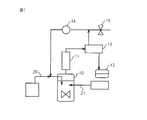
- FIG. 1 shows an example of a manufacturing process diagram that can be used to carry out the method of the present invention.
- carbon monoxide is continuously introduced into a reactor containing a reaction solution in which sulfur is dissolved or suspended in an organic solvent in the presence of a base catalyst, under a pressure of 0.2 to 3.0 MPa. , Reacting sulfur and carbon monoxide at a temperature of 40 to 120 ° C. to produce carbonyl sulfide, extracting the gas phase portion from the reactor, cooling the extracted gas phase portion using a cooler, It is characterized by continuously producing carbonyl sulfide by condensing the carbonyl sulfide contained therein, continuously extracting the condensed carbonyl sulfide, and returning the gas that has not been condensed by the cooler to the reactor again. .
- the reaction pressure is 0.2 to 3.0 MPa.
- the pressure of the reaction system in a continuous reaction, is 3 MPa or less in a continuous state. However, 1 MPa or less is sufficient, and the pressure of carbon monoxide is desirably maintained at around 30%. Therefore, a sufficiently large production rate can be obtained when the pressure of carbon monoxide is 0.3 MPa or less.
- the reaction temperature is 40 to 120 ° C.
- the reaction temperature can be 40 ° C. or higher, and can usually be carried out in the range of 60 ° C. to 100 ° C.
- Base catalysts that can be used in the method of the present invention include amidine bases, guanidine bases, phosphazene bases, quaternary ammonium hydroxides substituted with alkyl groups or aralkyl groups, aliphatic cyclic tertiary amines, aliphatic tertiary amines. And basic organic compounds such as an aliphatic cyclic secondary amine and an aliphatic secondary amine, and amidine base, guanidine base, and phosphazene base are preferable.
- Amidine bases are basic organic compounds having an amidine skeleton.
- the amidine skeleton means a structure represented by the formula (1).
- amidine base examples include 1,8-diazabicyclo [5.4.0] undec-7-ene (DBU), 1,5-diazabicyclo [4.3.0] non-5-ene (DBN) and the like. Is mentioned.
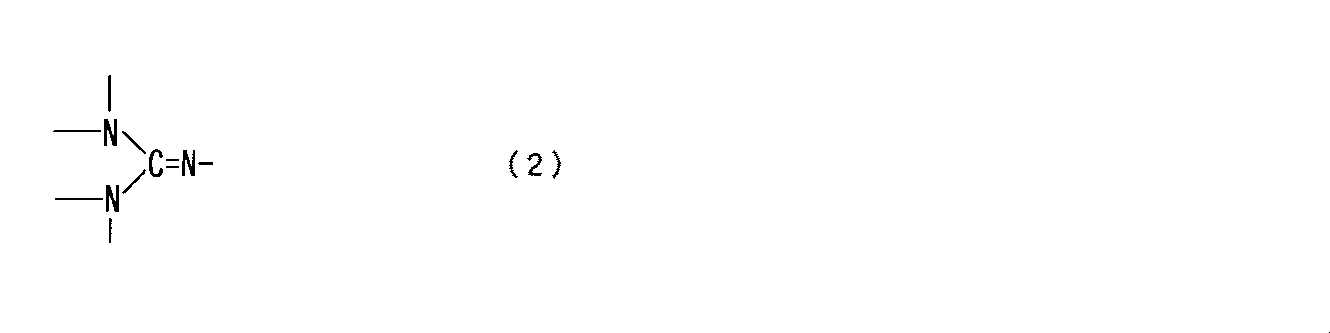
- Guanidine bases are basic organic compounds having a guanidine skeleton.
- the guanidine skeleton refers to a structure represented by the formula (2).
- Guanidine base is available from Ullmann's Encyclopedia of Industrial Chemistry, Sixth, Completely Revised Ed. , Vol. 16, p. 81. Specific examples of the guanidine base include 1,5,7-triazabicyclo [4.4.0] dec-5-ene (TBD), 7-methyl-1,5,7-triazabicyclo [4.4. 0.0] dec-5-ene (MTBD), 1,1,3,3-tetramethylguanidine (TMG) and the like.
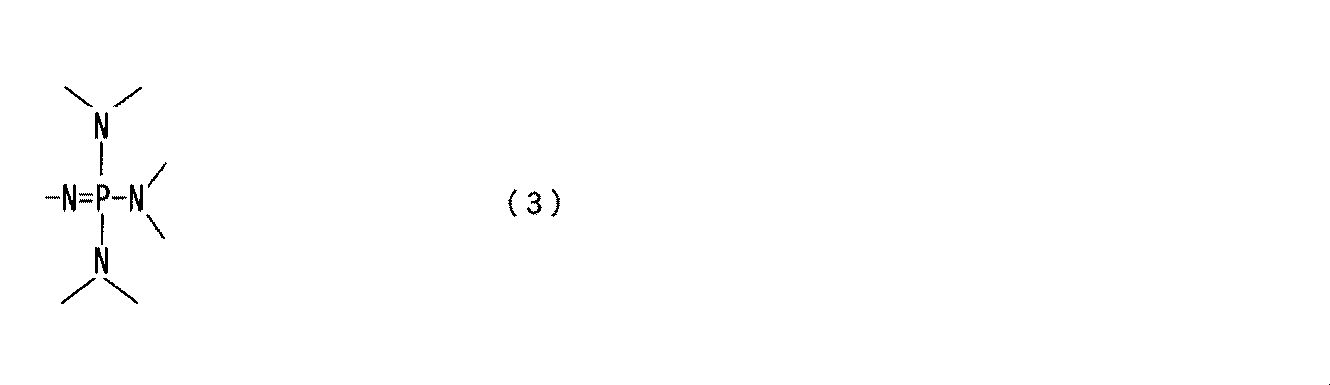
- the phosphazene base refers to a basic organic compound having a phosphazene skeleton.
- the phosphazene skeleton refers to a structure represented by the formula (3).
- Phosphazene bases are described, for example, in Journal of Organic Chemistry, 2002, Vol. 67, p. 1873-1881.
- Specific examples of the phosphazene base include alkylimino-tris (dimethylamino) phosphorane (wherein alkyl is an alkyl group having 1 to 8 carbon atoms), alkylimino-tris (pyrrolidino) phosphorane (wherein alkyl has 1 carbon atom). ⁇ 8 alkyl groups).
- the alkyl group in the quaternary ammonium hydroxide substituted with an alkyl group or an aralkyl group is preferably an alkyl group having 1 to 4 carbon atoms, and specific examples thereof include methyl, ethyl, normal propyl, and normal butyl. It is done.
- the aralkyl group in the quaternary ammonium hydroxide substituted with an alkyl group or an aralkyl group is preferably an aralkyl group having 7 to 10 carbon atoms, and specific examples thereof include benzyl and paramethylbenzyl.
- quaternary ammonium hydroxide substituted with an alkyl group or an aralkyl group include tetramethylammonium hydroxide, benzyltrimethylammonium hydroxide, and tetrabutylammonium hydroxide.
- Examples of the aliphatic cyclic tertiary amine include 1,4-diazabicyclo [2.2.2] octane.
- Examples of the aliphatic tertiary amine include triethylamine, tri-n-propylamine, tri-n-butylamine and the like.
- aliphatic cyclic secondary amine examples include pyrrolidine, piperazine, piperidine, morpholine and the like.
- Examples of the aliphatic secondary amine include di-n-propylamine, diethylamine, and di-n-butylamine.
- amidine base guanidine base
- phosphazene base are preferable.
- organic solvent examples include aromatic hydrocarbons such as toluene and xylene, aliphatic saturated hydrocarbons such as hexane and octane, aprotic molecules such as DMF, acetonitrile, and N-methylpyrrolidone.
- aromatic hydrocarbons such as toluene and xylene
- aliphatic saturated hydrocarbons such as hexane and octane
- aprotic molecules such as DMF, acetonitrile, and N-methylpyrrolidone.
- Suitable polar solvents, ethers such as diethyl ether, tetrahydrofuran and anisole, and esters such as ethyl acetate and butyl acetate are suitable.
- Alcohols such as methanol are also suitable as organic solvents.
- Ketones and aliphatic chlorinated solvents are undesirable because they may be decomposed or condensed by a base catalyst.
- the concentration of the base catalyst in the organic solvent is preferably 0.005 to 2.0 mol / L, more preferably 0.02 to 1 mol / L.
- FIG. 1 shows an example of a manufacturing process diagram that can be used to carry out the method of the present invention.
- the reactor 10 is, for example, a stirring reaction tank, and the reactor 10 contains a reaction solution in which sulfur is dissolved or suspended in an organic solvent.
- the reaction solution also contains a base catalyst. Carbon monoxide is also dissolved in the reaction solution.
- the reactor 10 is supplied with carbon monoxide from a carbon monoxide supply line 20 and sulfur from a sulfur supply line 21.
- the gas phase above the reaction liquid in the reactor 10 contains carbon monoxide as a raw material, carbonyl sulfide as a product, and vapor of an organic solvent.
- the vapor phase is sent to the reflux condenser 11 where the organic solvent is condensed and returned to the reactor.
- the gas phase that has passed through the reflux cooler 11 is sent to the cooler 12, where carbonyl sulfide is condensed in the cooler 12, and the condensed carbonyl sulfide is sent to the tank 13.
- the gas (mainly carbon monoxide and carbonyl sulfide) not condensed in the cooler 12 is returned to the reactor 10 by the blower 14.
- the pressure in the system is adjusted by a pressure control valve 15.
- an organic solvent, sulfur and a catalyst are put in an appropriate amount stirring reaction tank and stirred.
- carbon monoxide is introduced into the reaction solution or in the gas phase portion so as to maintain the set pressure.
- a cooler is installed in the gas phase, and the resulting carbonyl sulfide is cooled to a temperature at which it can be condensed so that the carbonyl sulfide can be condensed.
- a blower is installed in the gas phase portion above the cooler so that the gas phase components can be sent to the reactor. The reaction rate of carbonyl sulfide can be adjusted by adjusting the air flow rate.
- the organic solvent basically does not need to be replaced or added, but may be added as appropriate so as to maintain the liquid level of the reactor.
- the cooler temperature is set to a temperature higher than the boiling point of carbon monoxide and lower than the boiling point of carbonyl sulfide at the system pressure.
- the cooler temperature is preferably ⁇ 60 to ⁇ 10 ° C.
- the temperature of the reflux condenser is set to a temperature higher than the boiling point of carbonyl sulfide and lower than the boiling point of the organic solvent at the pressure of the system.
- the temperature of the reflux condenser is preferably 0 to 12 ° C.
- the form of sulfur used in the present invention is not particularly limited, but is introduced into the reactor appropriately or continuously in a powdered or molten state.
- the added sulfur is dissolved in an organic solvent in an amount corresponding to the temperature and reacts with carbon monoxide.
- the liquid carbonyl sulfide condensed in the cooler has a very high purity, but can be further purified by distillation to obtain a product.
- Continuous reaction is the most efficient production method, but using the basic catalyst, organic solvent and reaction conditions set in the present invention, sulfur is first charged into the reactor, and then only carbon monoxide is continuously added. You may employ
- Example 1 The reactor of the apparatus shown in FIG. 1 is charged with 1000 mL of dimethylformamide (DMF), 200 g of powdered sulfur, and 16 g of 1,8-diazabicyclo [5,4,0] -undec-7-ene (DBU) as a catalyst and stirred. And heated to 60 ° C. The reflux condenser was kept at 11 ° C., the condenser was kept at ⁇ 15 ° C., and the blower was stopped. Carbon monoxide was continuously introduced into the reaction liquid and the reaction pressure was kept at a gauge pressure of 0.8 MPa. . Eventually, carbon monoxide absorption stopped.
- DMF dimethylformamide
- DBU 1,8-diazabicyclo [5,4,0] -undec-7-ene
- Example 2 The reactor of the apparatus shown in FIG. 1 is charged with 1000 mL of toluene, 200 g of powdered sulfur, and 26 g of 1,5,7-triazabicyclo [4.4.0] dec-5-ene (TBD) as a catalyst and stirred. And heated to 80 ° C. The reflux condenser was kept at 11 ° C., the condenser was kept at ⁇ 15 ° C., and the blower was stopped. Carbon monoxide was continuously introduced into the reaction liquid and the reaction pressure was kept at a gauge pressure of 0.8 MPa. . Eventually, carbon monoxide absorption stopped.
- TBD 1,5,7-triazabicyclo [4.4.0] dec-5-ene
- Example 3 The reactor of the apparatus shown in FIG. 1 is charged with 1000 mL of dimethylformamide (DMF), 200 g of powdered sulfur, and 16 g of 1,8-diazabicyclo [5,4,0] -undec-7-ene (DBU) as a catalyst and stirred. And heated to 60 ° C. The reflux condenser was maintained at 11 ° C., the cooler was maintained at ⁇ 15 ° C., and the blower was stopped. Carbon monoxide was introduced into the reaction solution and the reaction pressure was maintained at a gauge pressure of 0.8 MPa. Eventually, carbon monoxide absorption stopped.
- DMF dimethylformamide
- DBU 1,8-diazabicyclo [5,4,0] -undec-7-ene
- the carbonyl sulfide produced by the method of the present invention can be suitably used as an etching gas for high anisotropy and high selectivity etching by plasma of an organic antireflection film.
Landscapes
- Chemical & Material Sciences (AREA)
- Organic Chemistry (AREA)
- Inorganic Chemistry (AREA)
- Chemical Kinetics & Catalysis (AREA)
- Organic Low-Molecular-Weight Compounds And Preparation Thereof (AREA)
- Low-Molecular Organic Synthesis Reactions Using Catalysts (AREA)
- Carbon And Carbon Compounds (AREA)
Abstract
Description
(1)米国特許第2992896号明細書(特許文献6)には、脂肪族アルコール溶媒中、脂肪族3級アミンと硫化水素を懸濁させ、硫黄と一酸化炭素とを反応させて硫化カルボニルを製造する方法が記載されている。
(2)米国特許第2992897号明細書(特許文献7)には、脂肪族アルコール溶媒を用い、アルカリあるいはアルカリ土類金属のサルファイド、バイサルファイドを触媒に用い、硫黄と一酸化炭素を反応させて硫化カルボニルを製造する方法が記載されている。
(3)米国特許第2992898号明細書(特許文献8)には、水酸基を有する3級脂肪族アミン溶液中で硫黄と一酸化炭素を反応させて硫化カルボニルを製造する方法が記載されている。
(4)米国特許第3235333号明細書(特許文献9)には、触媒として、アルカリ金属のカルボン酸塩、アルカリ金属の蟻酸塩、アルカリ金属の酢酸塩、I、IIあるいはIII族金属のアルコキシド、テトラメチルグアニジン、蟻酸カリウムのいずれかを用い、50℃から150℃の温度、一酸化炭素の圧力が200psig(1.38MPa)から5000psig(34.4MPa)で硫黄と一酸化炭素を反応させて硫化カルボニルを製造する方法が記載されている。
(5)特開昭61-197414号公報(特許文献10)には、2級脂肪族アミンを、セレン(Se)を触媒として、一酸化炭素と硫黄とを反応させることによりチオカルバミン酸アミン塩を製造し、生成したチオカルバミン酸アミン塩を加熱することにより、硫化カルボニルと2級アミンに分解し、得られた2級アミン反応液を再度一酸化炭素と硫黄と反応させる、連続的に硫化カルボニルを製造する方法が記載されている。
(6)国際公開第2004/089824号(特許文献11)には、二硫化炭素に溶解した硫黄と一酸化炭素とを反応させる硫化カルボニルの製造プロセスが記載されている。
(1)、(2)、(3)の製造方法は、液相で、比較的低温でも硫黄と一酸化炭素から硫化カルボニルが生成することを示しているが、選択性、品質についてはなんら述べられていない。(1)や(2)の方法は、溶媒に脂肪族アルコールやグリコール類を用いることから、副生成物の生成は避けられない。
(4)の製造方法は、触媒量のアルカリの存在で、比較的低温で、望ましくは80℃から150℃で、硫黄と一酸化炭素を反応させるが、一酸化炭素の圧力が、1.38MPa(200psig)以上、望ましくは3.44MPa(500psig)以上の圧力が開示されており、比較的高い圧力が必要である。さらに、実施例は、大部分メタノールを溶媒に用いて行われており、溶媒は、メタノールが最適と思えるが、アルカリ条件では、生成した硫化カルボニルがアルカリ条件下で反応するおそれがあり、副生成物を伴うおそれがある。
(5)の製造方法は、まず、一酸化炭素と、硫黄と2当量の2級アミンからチオカルバミン酸アミン塩を作り、これを熱分解する、という2段反応であり、しかも、有害性の高いセレンを用いる必要があり、有利な工業生産の方法とはいえない。
(6)の製造方法は、二硫化炭素に溶解した硫黄が一酸化炭素と反応して硫化カルボニルが生成することを前提に、製造プロセスの組み立て方法が開示されているが、反応条件、触媒の有無については何も記載されていない。
[1] 塩基触媒の存在下、有機溶媒に硫黄を溶解または懸濁させた反応液が入った反応器に、一酸化炭素を連続的に導入し、0.2~3.0MPaの圧力下、40~120℃の温度で硫黄と一酸化炭素を反応させて硫化カルボニルを生成させ、反応器から気相部分を抜き出し、抜き出した気相部分を冷却器を用いて冷却し、気相部分の中に含まれる硫化カルボニルを凝縮させ、凝縮した硫化カルボニルを連続的に抜き出し、冷却器で凝縮しなかったガスを再び反応器に戻すことにより、連続的に硫化カルボニルを製造することを特徴とする硫化カルボニルの製造方法。
[2] さらに硫黄を連続的に反応器に導入することを特徴とする[1]に記載の硫化カルボニルの製造方法。
[3] 前記塩基触媒が、アミジン塩基、グアニジン塩基、およびフォスファゼン塩基からなる群から選ばれる塩基性有機化合物であることを特徴とする[1]または[2]に記載の硫化カルボニルの製造方法。
[4] 前記アミジン塩基が、1,8-ジアザビシクロ[5.4.0]ウンデカ-7-エンおよび1,5-ジアザビシクロ[4.3.0]ノナ-5-エンからなる群から選ばれ、前記グアニジン塩基が1,5,7-トリアザビシクロ[4.4.0]デカ-5-エン、7-メチル-1,5,7-トリアザビシクロ[4.4.0]デカ-5-エンおよび1,1,3,3-テトラメチルグアニジンからなる群から選ばれ、前記フォスファゼン塩基がアルキルイミノ-トリス(ジメチルアミノ)ホスホラン(ただしアルキルは炭素数1~8個のアルキル基である。)およびアルキルイミノ-トリス(ピロリジノ)ホスホラン(ただしアルキルは炭素数1~8個のアルキル基である。)からなる群から選ばれることを特徴とする[3]に記載の硫化カルボニルの製造方法。

アルキル基またはアラルキル基で置換された4級アンモニウムハイドロオキサイドにおけるアラルキル基は、好ましくは炭素数7~10個のアラルキル基であり、その具体例としては、ベンジル、パラメチルベンジルが挙げられる。
アルキル基またはアラルキル基で置換された4級アンモニウムハイドロオキサイドの具体例としては、テトラメチルアンモニウムハイドロオキサイド、ベンジルトリメチルアンモニウムハイドロオキサイド、テトラブチルアンモニウムハイドロオキサイドが挙げられる。
図1に示した装置の反応器にジメチルホルムアミド(DMF)1000mL、粉末硫黄200g、触媒として1,8-ジアザビシクロ[5,4,0]-ウンデカ-7-エン(DBU)16gを入れ、撹拌し、60℃に加熱した。還流冷却器を11℃に保ち、冷却器を-15℃に保ち、送風機は停止した状態で、一酸化炭素を反応液に、反応圧力をゲージ圧0.8MPaに保つように連続的に導入した。やがて、一酸化炭素の吸収は停止した。次いで、送風機を稼動し、送風量を2.0NL/hにすると、一酸化炭素の吸収が始まり、硫化カルボニルがタンクに凝縮してきた。やがて、定常状態になり、一酸化炭素の吸収速度は、8.87NL/hで一定になった。更に2時間後送風量を10.4NL/hに上げると、一酸化炭素の吸収速度が高まり、やがて、定常状態になった。この時、一酸化炭素の吸収速度は17.7NL/hであった。更に、送風速度を33.6NL/hに上げると、定常状態で、一酸化炭素の吸収速度は、26.6NL/hに向上した。この時、硫化カルボニルの凝縮速度は、71g/hであり、ほぼ定常的に転化した。
図1に示した装置の反応器にトルエン1000mL、粉末硫黄200g、触媒として、1,5,7-トリアザビシクロ[4.4.0]デカ-5-エン(TBD)26gを入れ、撹拌し、80℃に加熱した。還流冷却器を11℃に保ち、冷却器を-15℃に保ち、送風機は停止した状態で、一酸化炭素を反応液に、反応圧力をゲージ圧0.8MPaに保つように連続的に導入した。やがて、一酸化炭素の吸収は停止した。次いで、送風機を稼動し、送風量を7.6NL/hにすると、一酸化炭素の吸収が始まり、硫化カルボニルがタンクに凝縮してきた。やがて、定常状態になり、一酸化炭素の吸収速度は、12.0NL/hで一定になった。更に2時間後送風量を24.1NL/hに上げると、一酸化炭素の吸収速度がたかまり、やがて、定常状態になった。この時、一酸化炭素の吸収速度は19.4NL/hであった。更に、送風速度を73.3NL/hに上げると、定常状態で、一酸化炭素の吸収速度は、25.3NL/hに向上した。この時、硫化カルボニルの凝縮速度は、67g/hであり、ほぼ定常的に転化した。
図1に示した装置の反応器にジメチルホルムアミド(DMF)1000mL、粉末硫黄200g、触媒として1,8-ジアザビシクロ[5,4,0]-ウンデカ-7-エン(DBU)16gを入れ、撹拌し、60℃に加熱した。還流冷却器を11℃に保ち、冷却器を-15℃に保ち、送風機は停止した状態で、一酸化炭素を反応液に、反応圧力をゲージ圧0.8MPaに保つように導入した。やがて、一酸化炭素の吸収は停止した。次いで、送風機を稼動し、送風量を33.6NL/hにすると、一酸化炭素の吸収が始まり、硫化カルボニルがタンクに凝縮してきた。やがて、定常状態になり、一酸化炭素の吸収速度は、26.6NL/hで一定になった。2時間後から、反応器に、130℃の溶融硫黄を38g/hの速度で連続的に加え、反応を続けることにより、硫化カルボニルの凝縮速度は71g/hに維持された。
11 還流冷却器
12 冷却器
13 タンク
14 送風機
15 圧力調節弁
20 一酸化炭素供給ライン
21 硫黄供給ライン
Claims (4)
- 塩基触媒の存在下、有機溶媒に硫黄を溶解または懸濁させた反応液が入った反応器に、一酸化炭素を連続的に導入し、0.2~3.0MPaの圧力下、40~120℃の温度で硫黄と一酸化炭素を反応させて硫化カルボニルを生成させ、反応器から気相部分を抜き出し、抜き出した気相部分を冷却器を用いて冷却し、気相部分の中に含まれる硫化カルボニルを凝縮させ、凝縮した硫化カルボニルを連続的に抜き出し、冷却器で凝縮しなかったガスを再び反応器に戻すことにより、連続的に硫化カルボニルを製造することを特徴とする硫化カルボニルの製造方法。
- さらに硫黄を連続的に反応器に導入することを特徴とする請求項1に記載の硫化カルボニルの製造方法。
- 前記塩基触媒が、アミジン塩基、グアニジン塩基、およびフォスファゼン塩基からなる群から選ばれる塩基性有機化合物であることを特徴とする請求項1または2に記載の硫化カルボニルの製造方法。
- 前記アミジン塩基が1,8-ジアザビシクロ[5.4.0]ウンデカ-7-エンおよび1,5-ジアザビシクロ[4.3.0]ノナ-5-エンからなる群から選ばれ、前記グアニジン塩基が1,5,7-トリアザビシクロ[4.4.0]デカ-5-エン、7-メチル-1,5,7-トリアザビシクロ[4.4.0]デカ-5-エンおよび1,1,3,3-テトラメチルグアニジンからなる群から選ばれ、前記フォスファゼン塩基がアルキルイミノ-トリス(ジメチルアミノ)ホスホラン(ただしアルキルは炭素数1~8個のアルキル基である。)およびアルキルイミノ-トリス(ピロリジノ)ホスホラン(ただしアルキルは炭素数1~8個のアルキル基である。)からなる群から選ばれることを特徴とする請求項3に記載の硫化カルボニルの製造方法。
Priority Applications (4)
| Application Number | Priority Date | Filing Date | Title |
|---|---|---|---|
| US14/112,477 US9115000B2 (en) | 2011-04-18 | 2012-04-13 | Process for producing carbonyl sulfide |
| CN201280006282.5A CN103328379B (zh) | 2011-04-18 | 2012-04-13 | 羰基硫的制造方法 |
| KR1020137018711A KR101542090B1 (ko) | 2011-04-18 | 2012-04-13 | 황화카르보닐의 제조 방법 |
| JP2013510980A JP5889286B2 (ja) | 2011-04-18 | 2012-04-13 | 硫化カルボニルの製造方法 |
Applications Claiming Priority (2)
| Application Number | Priority Date | Filing Date | Title |
|---|---|---|---|
| JP2011-092435 | 2011-04-18 | ||
| JP2011092435 | 2011-04-18 |
Publications (1)
| Publication Number | Publication Date |
|---|---|
| WO2012144441A1 true WO2012144441A1 (ja) | 2012-10-26 |
Family
ID=47041548
Family Applications (1)
| Application Number | Title | Priority Date | Filing Date |
|---|---|---|---|
| PCT/JP2012/060163 Ceased WO2012144441A1 (ja) | 2011-04-18 | 2012-04-13 | 硫化カルボニルの製造方法 |
Country Status (6)
| Country | Link |
|---|---|
| US (1) | US9115000B2 (ja) |
| JP (1) | JP5889286B2 (ja) |
| KR (1) | KR101542090B1 (ja) |
| CN (1) | CN103328379B (ja) |
| TW (1) | TWI481557B (ja) |
| WO (1) | WO2012144441A1 (ja) |
Cited By (2)
| Publication number | Priority date | Publication date | Assignee | Title |
|---|---|---|---|---|
| JPWO2020262319A1 (ja) * | 2019-06-27 | 2020-12-30 | ||
| WO2024070744A1 (ja) * | 2022-09-28 | 2024-04-04 | 日本ゼオン株式会社 | 硫化カルボニルの製造方法 |
Families Citing this family (5)
| Publication number | Priority date | Publication date | Assignee | Title |
|---|---|---|---|---|
| CN106892411B (zh) * | 2017-05-04 | 2018-09-21 | 辽宁大学 | 一种提纯硒的方法 |
| CN109231207A (zh) * | 2018-10-24 | 2019-01-18 | 欧中汇智电子材料研究院(重庆)有限公司 | 羰基硫的制备方法及制备装置 |
| CN111268680B (zh) * | 2020-04-07 | 2023-04-18 | 江西华特电子化学品有限公司 | 一种高纯羰基硫的纯化方法与纯化系统 |
| CN114669298B (zh) * | 2020-12-24 | 2024-08-13 | 南通泰禾化工股份有限公司 | 一种氧硫化碳合成催化剂的制备方法及氧硫化碳的制备方法 |
| KR20240068389A (ko) * | 2022-11-10 | 2024-05-17 | 주식회사 포스코 | 황화 카르보닐의 합성방법 및 합성장치 |
Citations (7)
| Publication number | Priority date | Publication date | Assignee | Title |
|---|---|---|---|---|
| US3235333A (en) * | 1961-03-07 | 1966-02-15 | Standard Oil Co | Process for producing carbonylsulfide |
| US3409399A (en) * | 1964-03-18 | 1968-11-05 | Thiokol Chemical Corp | Process for the preparation of carbonyl sulfide |
| JPS52131993A (en) * | 1976-04-28 | 1977-11-05 | Ihara Chem Ind Co Ltd | Production of carbonyl sulfide |
| US4120944A (en) * | 1976-08-31 | 1978-10-17 | Phillips Petroleum Company | Preparation of carbonyl sulfide and production of methyl mercaptan therefrom |
| JPS5659613A (en) * | 1979-08-20 | 1981-05-23 | Ihara Chem Ind Co Ltd | Manufacture of carbonyl sulfide |
| JPS5659614A (en) * | 1979-08-22 | 1981-05-23 | Ihara Chem Ind Co Ltd | Manufacture of carbonyl sulfide |
| WO2004089824A1 (en) * | 2003-04-10 | 2004-10-21 | Winston David Fink | The manufacture of carbonyl sulphide |
Family Cites Families (10)
| Publication number | Priority date | Publication date | Assignee | Title |
|---|---|---|---|---|
| US2992896A (en) | 1959-01-02 | 1961-07-18 | Monsanto Chemicals | Preparation of carbonyl sulfide |
| US2992898A (en) | 1959-01-02 | 1961-07-18 | Monsanto Chemicals | Preparation of carbonyl sulfide |
| US2992897A (en) | 1959-01-02 | 1961-07-18 | Monsanto Chemicals | Preparation of carbonyl sulfide |
| FR1409765A (fr) | 1964-05-27 | 1965-09-03 | Azote Office Nat Ind | Fabrication de l'oxysulfure de carbone |
| JPS61197414A (ja) * | 1985-02-26 | 1986-09-01 | Nippon Nohyaku Co Ltd | 連続的に硫化カルボニルを製造する方法 |
| JPH0727634B2 (ja) | 1986-11-13 | 1995-03-29 | 共同印刷株式会社 | 磁気記録媒体およびその真偽判定方法 |
| JPH0740632B2 (ja) | 1988-06-10 | 1995-05-01 | 三洋電機株式会社 | 混成集積回路の製造方法 |
| EA014709B1 (ru) * | 2006-05-16 | 2011-02-28 | Шелл Интернэшнл Рисерч Маатсхаппий Б.В. | Способ получения дисульфида углерода |
| CA2656776C (en) | 2006-07-07 | 2014-09-09 | Shell Internationale Research Maatschappij B.V. | Process for the manufacture of carbon disulphide and use of a liquid stream comprising carbon disulphide for enhanced oil recovery |
| CN101289186B (zh) | 2008-05-24 | 2011-06-15 | 孔庆然 | 一种生产二硫化碳的方法 |
-
2012
- 2012-04-13 KR KR1020137018711A patent/KR101542090B1/ko active Active
- 2012-04-13 JP JP2013510980A patent/JP5889286B2/ja active Active
- 2012-04-13 WO PCT/JP2012/060163 patent/WO2012144441A1/ja not_active Ceased
- 2012-04-13 US US14/112,477 patent/US9115000B2/en active Active
- 2012-04-13 CN CN201280006282.5A patent/CN103328379B/zh active Active
- 2012-04-18 TW TW101113695A patent/TWI481557B/zh active
Patent Citations (7)
| Publication number | Priority date | Publication date | Assignee | Title |
|---|---|---|---|---|
| US3235333A (en) * | 1961-03-07 | 1966-02-15 | Standard Oil Co | Process for producing carbonylsulfide |
| US3409399A (en) * | 1964-03-18 | 1968-11-05 | Thiokol Chemical Corp | Process for the preparation of carbonyl sulfide |
| JPS52131993A (en) * | 1976-04-28 | 1977-11-05 | Ihara Chem Ind Co Ltd | Production of carbonyl sulfide |
| US4120944A (en) * | 1976-08-31 | 1978-10-17 | Phillips Petroleum Company | Preparation of carbonyl sulfide and production of methyl mercaptan therefrom |
| JPS5659613A (en) * | 1979-08-20 | 1981-05-23 | Ihara Chem Ind Co Ltd | Manufacture of carbonyl sulfide |
| JPS5659614A (en) * | 1979-08-22 | 1981-05-23 | Ihara Chem Ind Co Ltd | Manufacture of carbonyl sulfide |
| WO2004089824A1 (en) * | 2003-04-10 | 2004-10-21 | Winston David Fink | The manufacture of carbonyl sulphide |
Cited By (3)
| Publication number | Priority date | Publication date | Assignee | Title |
|---|---|---|---|---|
| JPWO2020262319A1 (ja) * | 2019-06-27 | 2020-12-30 | ||
| WO2020262319A1 (ja) * | 2019-06-27 | 2020-12-30 | 日本ゼオン株式会社 | 硫化カルボニルの製造方法 |
| WO2024070744A1 (ja) * | 2022-09-28 | 2024-04-04 | 日本ゼオン株式会社 | 硫化カルボニルの製造方法 |
Also Published As
| Publication number | Publication date |
|---|---|
| CN103328379A (zh) | 2013-09-25 |
| KR101542090B1 (ko) | 2015-08-05 |
| TWI481557B (zh) | 2015-04-21 |
| JPWO2012144441A1 (ja) | 2014-07-28 |
| JP5889286B2 (ja) | 2016-03-22 |
| KR20130105712A (ko) | 2013-09-25 |
| CN103328379B (zh) | 2015-04-08 |
| US9115000B2 (en) | 2015-08-25 |
| TW201302609A (zh) | 2013-01-16 |
| US20140044638A1 (en) | 2014-02-13 |
Similar Documents
| Publication | Publication Date | Title |
|---|---|---|
| JP5889286B2 (ja) | 硫化カルボニルの製造方法 | |
| CN101084179B (zh) | 制备碳酸二烷基酯的方法 | |
| RU2010146077A (ru) | Способ получения изоцианатов с использованием диарилкарбоната | |
| JP4460780B2 (ja) | 有機ジスルフィドの製法 | |
| CN102482207A (zh) | 双磺酰亚胺基铵盐、双磺酰亚胺以及双磺酰亚胺基锂盐的制造方法 | |
| JP4134761B2 (ja) | 亜硝酸アルキルの製法 | |
| JP5721517B2 (ja) | 硫化カルボニルの製造方法 | |
| JP2004107336A (ja) | シュウ酸ジアルキルの製造法 | |
| CN111072499B (zh) | 一种盐酸氨溴索的合成工艺 | |
| CN1793114B (zh) | 环己酮肟的制备方法 | |
| US20100094022A1 (en) | Method for Producing Thiazole Compound | |
| BR112013002105B1 (pt) | Processo para preparar um composto, mistura de dmapn e dgn, e, uso de uma mistura | |
| JP5472991B2 (ja) | ジボランの製造方法 | |
| JP2011098862A (ja) | ジボランの製造方法 | |
| CN103998409A (zh) | 制备甲酸的方法 | |
| WO2018193749A1 (ja) | インダンカルボアルデヒドの製造方法 | |
| CN113354529A (zh) | 一种利用bdo装置副产2-羟甲基丙醛合成2,2-二羟甲基丙酸方法 | |
| JPWO2005095355A1 (ja) | N,n’−カルボニルジイミダゾールの製造方法 | |
| JP2004323470A (ja) | 炭酸ジアルキルの製造法 | |
| CN114702499B (zh) | 一种用于储氢的苯并对二吡咯分子的合成方法 | |
| US9061978B1 (en) | Process for the production of ethionic acid | |
| JP6807695B2 (ja) | 2−メトキシエチルビニルエーテルの製造方法 | |
| JP4023255B2 (ja) | ジカルボン酸の製造方法とそれに用いる触媒の製造方法 | |
| JP5790430B2 (ja) | ヒドロキシアダマンタンカルボン酸類の製造方法及び精製方法 | |
| EP2374793A1 (en) | Method for producing alkenyl mercaptan |
Legal Events
| Date | Code | Title | Description |
|---|---|---|---|
| 121 | Ep: the epo has been informed by wipo that ep was designated in this application |
Ref document number: 12774231 Country of ref document: EP Kind code of ref document: A1 |
|
| ENP | Entry into the national phase |
Ref document number: 2013510980 Country of ref document: JP Kind code of ref document: A |
|
| ENP | Entry into the national phase |
Ref document number: 20137018711 Country of ref document: KR Kind code of ref document: A |
|
| WWE | Wipo information: entry into national phase |
Ref document number: 14112477 Country of ref document: US |
|
| NENP | Non-entry into the national phase |
Ref country code: DE |
|
| 122 | Ep: pct application non-entry in european phase |
Ref document number: 12774231 Country of ref document: EP Kind code of ref document: A1 |