WO2012137828A1 - 光硬化性組成物並びに導電性複合フィルム及びその製造方法 - Google Patents
光硬化性組成物並びに導電性複合フィルム及びその製造方法 Download PDFInfo
- Publication number
- WO2012137828A1 WO2012137828A1 PCT/JP2012/059215 JP2012059215W WO2012137828A1 WO 2012137828 A1 WO2012137828 A1 WO 2012137828A1 JP 2012059215 W JP2012059215 W JP 2012059215W WO 2012137828 A1 WO2012137828 A1 WO 2012137828A1
- Authority
- WO
- WIPO (PCT)
- Prior art keywords
- meth
- conductive
- acrylate
- conductive layer
- photocurable composition
- Prior art date
- Legal status (The legal status is an assumption and is not a legal conclusion. Google has not performed a legal analysis and makes no representation as to the accuracy of the status listed.)
- Ceased
Links
Images

Classifications
-
- C—CHEMISTRY; METALLURGY
- C09—DYES; PAINTS; POLISHES; NATURAL RESINS; ADHESIVES; COMPOSITIONS NOT OTHERWISE PROVIDED FOR; APPLICATIONS OF MATERIALS NOT OTHERWISE PROVIDED FOR
- C09D—COATING COMPOSITIONS, e.g. PAINTS, VARNISHES OR LACQUERS; FILLING PASTES; CHEMICAL PAINT OR INK REMOVERS; INKS; CORRECTING FLUIDS; WOODSTAINS; PASTES OR SOLIDS FOR COLOURING OR PRINTING; USE OF MATERIALS THEREFOR
- C09D4/00—Coating compositions, e.g. paints, varnishes or lacquers, based on organic non-macromolecular compounds having at least one polymerisable carbon-to-carbon unsaturated bond ; Coating compositions, based on monomers of macromolecular compounds of groups C09D183/00 - C09D183/16
-
- C—CHEMISTRY; METALLURGY
- C09—DYES; PAINTS; POLISHES; NATURAL RESINS; ADHESIVES; COMPOSITIONS NOT OTHERWISE PROVIDED FOR; APPLICATIONS OF MATERIALS NOT OTHERWISE PROVIDED FOR
- C09D—COATING COMPOSITIONS, e.g. PAINTS, VARNISHES OR LACQUERS; FILLING PASTES; CHEMICAL PAINT OR INK REMOVERS; INKS; CORRECTING FLUIDS; WOODSTAINS; PASTES OR SOLIDS FOR COLOURING OR PRINTING; USE OF MATERIALS THEREFOR
- C09D5/00—Coating compositions, e.g. paints, varnishes or lacquers, characterised by their physical nature or the effects produced; Filling pastes
- C09D5/24—Electrically-conducting paints
Definitions
- the present invention includes a photocurable composition and a cured product thereof used for applications requiring conductivity, thermal conductivity, solvent resistance, and flexibility, and a conductive layer formed of the cured product, and
- the present invention relates to a conductive composite film used for an electric double layer capacitor, a lithium ion battery, an electronic component, a semiconductor element, and the like, and a method for producing the same.
- Patent Document 1 JP-A-60-60166 discloses a coating binder mainly composed of one or more (meth) acryl oligomers having two or more (meth) acryloyl groups in the molecule, and tin oxide.
- An electrically conductive coating composition containing an electrically conductive powder having a particle size of 0.2 ⁇ m or less, which is mainly composed of is disclosed.
- the hardness and scratch resistance of the coating film can be improved by having a (meth) acrylate oligomer having a urethane bond.
- the scratch resistance and hardness of the coating film can be improved by crosslinking the composition by photocuring or radiation curing.
- the composition containing an isocyanate compound and a photosensitizer is irradiated with ultraviolet rays.
- a cured product is formed.
- the conductive powder is blended in an amount of 50 to 400 parts by weight with respect to 100 parts by weight of the coating binder.
- this composition has solvent resistance, it is hard and brittle. On the other hand, even if it has flexibility, the solvent resistance is low.
- tin oxide since tin oxide is used, it is necessary to control the particle size in order to suppress light scattering, and in addition, a large amount of tin oxide having a large weight is blended. The mechanical properties are also low. Furthermore, a polymerization catalyst such as a photosensitizer and an initiator are required.
- Patent Document 2 JP-A-63-33470 discloses a conductive resin composition containing polyphenylene oxide and a crosslinkable polymer and / or a crosslinkable monomer, in which a conductive filler is dispersed.
- radiation crosslinking is also described, specifically, a composition containing an isocyanate compound and an initiator is heat-cured.
- this composition contains a thermoplastic resin, the solvent resistance is low.
- an initiator is required for curing.
- JP-A-2000-86728 discloses 3 to 12 An amine-modified (meth) acrylate compound (A) in which a primary or secondary amine is added to a (meth) acrylate compound having a (meth) acryloyl group and a molecular weight of less than 500, and hydrogen such as ethylene oxide are extracted.
- An electron beam curable composition containing a polymerizable unsaturated compound (B) having an easy skeleton is disclosed.
- an amine-modified (meth) acrylate compound is used to prevent oxygen inhibition in electron beam curing.
- the filler is only described as an example of an optional additive to be added for curing properties, viscosity adjustment, and cost reduction.
- a conductive film made of resin is used because of excellent moldability and flexibility.
- a thin film is also required for the conductive film used.
- a low electric resistance layer having a volume resistance value in the thickness direction of 0.1 to 1.0 ⁇ ⁇ cm is provided on at least one outermost layer of a conductive base material layer.
- the volume resistivity value in the thickness direction of the low electrical resistance layer is 1/5 or less of the volume resistance value in the thickness direction of the base material layer.
- a conductive resin laminated film is disclosed. In this laminated film, a low electrical resistance layer formed of a coating film of an elastomer composition containing fine carbon fibers is laminated on a substrate formed by extrusion molding an elastomer composition containing a conductive agent such as carbon black. Yes.
- Patent Document 5 Japanese Patent Laid-Open No. 2008-207404 (Patent Document 5) is obtained by mixing a conductive resin layer with a conductive resin layer obtained by mixing a conductive agent with a thermoplastic resin, and a thermoplastic resin having adhesiveness to a metal.
- a conductive film characterized by having at least a conductive adhesive resin layer is disclosed.
- a conductive resin layer formed by extrusion molding of an elastomer composition containing a conductive agent such as carbon black and a conductive film formed of a coating film of an acid-modified elastomer composition containing carbon fibers and carbon fibers.
- An adhesive resin layer is laminated.
- a soft elastomer or the like as a resin component.
- a soft resin such as an elastomer or an amorphous resin is resistant to solvents. Is low.
- a polar solvent having high solubility in a polymer such as ethylene carbonate or propylene carbonate as an electrolyte solution Therefore, high solvent resistance is required.
- Patent Document 7 has a structure including one or more layers having a resin and a conductive material, and a crystalline resin having a melting point of 120 ° C. or higher is used as the resin.
- a current collector for a bipolar secondary battery to be used is disclosed. This document describes that the volume resistivity in the thickness direction (film thickness direction) of the current collector is preferably 10 2 ⁇ or less, preferably in the range of 10 2 to 10 ⁇ 5 ⁇ .
- pellets were prepared by adding 10% by weight ketjen black to a crystalline resin such as polypropylene, and then the pellets were kneaded and rolled with a rolling mill to produce a current collecting sheet having a thickness of 50 ⁇ m. is doing.
- the current collector sheet has an electric resistance in the thickness direction of 10 to 100 ⁇ (2000 to 20000 ⁇ ⁇ cm in terms of volume resistivity per 1 cm thickness), and has good chemical resistance, oxygen barrier property, and heat press resistance. It is described that it is useful as a current collector for a secondary battery such as a lithium ion battery.
- JP-A-60-60166 (Claims, Examples) JP 63-33470 A (Claims, Examples) JP 2000-86728 A (claims, paragraphs [0020] [0021] [0041], Examples) Japanese Patent No. 4349793 (Claim 1, Example) JP 2008-207404 A (Claim 1, Example) JP 2006-32143 A (Claim 1, paragraphs [0042] to [0044]) JP 2010-170833 A (claims, paragraph [0088], examples)
- an object of the present invention is to provide a photocurable composition having high conductivity, solvent resistance and flexibility of a cured product, and a method for producing a cured product and a cured product using the composition.
- Another object of the present invention is to provide a photocurable composition capable of improving the solvent resistance, conductivity and flexibility of a cured product regardless of the type of the conductive agent, and a method for producing and curing a cured product using the composition. To provide things.
- Still another object of the present invention is to use a photocurable composition that can suppress swelling and maintain high conductivity even when the cured product is in contact with a polar organic solvent for a long period of time, and this composition. It is in providing the manufacturing method and hardened
- Still another object of the present invention is to provide a photocurable composition that is excellent in flexibility and handleability of a cured product, and that can easily produce a sheet using a roll-to-roll method, and a cured product using this composition. It is in providing the manufacturing method and hardened
- Another object of the present invention is to provide a conductive composite film that is stable against polar solvents (such as aprotic polar solvents) such as alkylene carbonate, has high solvent resistance, and low solvent permeability, and a method for producing the same. There is to do.
- polar solvents such as aprotic polar solvents
- alkylene carbonate a conductive composite film that is stable against polar solvents (such as aprotic polar solvents) such as alkylene carbonate, has high solvent resistance, and low solvent permeability, and a method for producing the same. There is to do.
- Still another object of the present invention is to provide a conductive composite film having high conductivity even when it is thin, and a method for producing the same.
- Another object of the present invention is to provide a conductive composite film excellent in light weight despite its high conductivity and a method for producing the same.
- Still another object of the present invention is to provide a conductive composite film having high thermal conductivity and excellent mechanical properties such as flexibility and a method for producing the same.
- the present inventors combined a trifunctional or higher polyfunctional vinyl compound, a bifunctional vinyl compound containing an aliphatic bifunctional (meth) acrylate, and a conductive agent. Since the viscoelasticity of the cured product is adjusted to a specific range, when photocured, the conductivity, solvent resistance and flexibility of the cured product can be improved, and further, a crystalline resin composition containing a conductive agent.
- Curing of the photocurable composition containing the formed first conductive layer, a trifunctional or higher polyfunctional vinyl compound, a bifunctional vinyl compound containing an aliphatic bifunctional (meth) acrylate, and a second conductive agent By laminating the second conductive layer formed of a product, a conductive composite film that is stable with respect to polar solvents such as alkylene carbonate, has high solvent resistance, and has low permeability of the polar solvent is obtained. Is It found that, and have completed the present invention.
- the photocurable composition of the present invention comprises a trifunctional or higher polyfunctional vinyl compound, a bifunctional vinyl compound containing an aliphatic bifunctional (meth) acrylate having a chain aliphatic skeleton, a conductive agent,
- a storage elastic modulus in a rubbery region of the cured product E ′ is 200 to 2000 MPa.
- the acrylic equivalent of the aliphatic bifunctional (meth) acrylate may be 200 or more.
- the chain aliphatic skeleton may contain an aliphatic polyester unit.
- the bifunctional vinyl compound may further contain a ring-containing bifunctional (meth) acrylate having an alicyclic and / or aromatic skeleton.
- the ring-containing bifunctional (meth) acrylate is a polycyclic alicyclic and / or bifunctional (meth) acrylate having a bisphenol skeleton (particularly a 2 to 4 ring bridged alicyclic having 8 to 12 carbon atoms). It may be a bifunctional (meth) acrylate having a skeleton).
- the ratio of the ring-containing bifunctional (meth) acrylate may be about 10 to 100 parts by weight with respect to 100 parts by weight of the aliphatic bifunctional (meth) acrylate.
- the bifunctional vinyl compound is a combination of an aliphatic bifunctional (meth) acrylate and a ring-containing bifunctional (meth) acrylate, and the ratio of the bifunctional vinyl compound is large.
- the amount may be about 100 to 200 parts by weight with respect to 100 parts by weight of the functional vinyl compound.
- the polyfunctional vinyl compound may be a tri- to hexa-functional (meth) acrylate.
- the polyfunctional vinyl compound may be a polyfunctional vinyl compound not modified with an amine (unmodified compound).
- the conductive agent may be conductive carbon black.
- the ratio of the conductive agent may be about 10 to 40 parts by weight with respect to 100 parts by weight of the total amount of the polyfunctional vinyl compound and the bifunctional vinyl compound.
- the photocurable composition of the present invention may be an ultraviolet or electron beam curable composition.
- the photocurable composition of the present invention may be an electron beam curable composition and a composition that substantially does not contain a polymerization initiator. Further, the photocurable composition of the present invention may be a composition that does not substantially contain a polyphenylene oxide resin.
- the photocurable composition of the present invention is suitable for an application for forming a cured product used in contact with a solvent.
- the present invention includes a method for producing a cured product by irradiating the photocurable composition with light. Furthermore, the hardened
- the cured product of the present invention may be a sheet-like molded body.
- the present invention includes a first conductive layer formed of a crystalline resin composition containing a crystalline resin and a first conductive agent, and a second conductive layer formed of a cured product of the photocurable composition. And a conductive composite film in which are laminated.
- the first and second conductive agents contained in the first and second conductive layers may be conductive carbon black.
- the thickness of the first conductive layer is 1 to 200 ⁇ m
- the thickness of the second conductive layer is 1 to 100 ⁇ m
- the first conductive layer and the second conductive layer are The thickness ratio of the first conductive layer / second conductive layer may be 1/1 to 20/1.
- the volume resistivity of the first conductive layer may be 0.1 to 1500 ⁇ ⁇ cm
- the volume resistivity of the second conductive layer may be 1 to 1000 ⁇ ⁇ cm.
- the weight change rate (weight increase rate) of the first conductive layer after being immersed in tetrahydrofuran at 25 ° C. for 24 hours may be 10% by weight or less.
- the obtained sheet is heated or stretched or rolled while being heated, and on the obtained first conductive layer.
- the manufacturing method of the said conductive composite film including the shaping
- the molding step of the first conductive layer after extruding the crystalline resin composition to form a sheet having a thickness of 120 to 500 ⁇ m, when the melting point of the crystalline resin is mp, (mp-40)
- the obtained sheet may be stretched or rolled while being heated at a temperature of from 0 ° C. to (mp-5) ° C.
- the photocurable composition may be irradiated with an electron beam to form a cured product.
- an acrylic equivalent means the number average molecular weight per (meth) acryloyl group contained in a molecule
- numerator
- a trifunctional or higher polyfunctional vinyl compound, a bifunctional vinyl compound containing an aliphatic bifunctional (meth) acrylate, and a conductive agent are combined to adjust the viscoelasticity of the cured product to a specific range. Therefore, the electrical conductivity and solvent resistance of the cured product can be improved by photocuring. In addition, the solvent resistance, conductivity and flexibility of the cured product can be improved regardless of the type of the conductive agent. Further, even when the cured product comes into contact with a polar organic solvent for a long period of time, swelling and the like are suppressed, and high conductivity can be maintained. Furthermore, since the cured product is excellent in flexibility and handleability, a sheet can be easily manufactured using a roll-to-roll method, and the productivity of the molded body is high.
- cured material of the said photocurable composition are laminated
- FIG. 1 is a graph showing the storage elastic modulus E ′ of ⁇ 50 ° C. to 250 ° C. in the cured product obtained in Comparative Example 2.
- the photocurable composition of the present invention includes a trifunctional or higher polyfunctional vinyl compound, a bifunctional vinyl compound containing an aliphatic bifunctional (meth) acrylate having a chain aliphatic skeleton, and a conductive agent.
- the storage elastic modulus E ′ in the rubber-like region of the cured product is 200 to 2000 MPa.
- the relationship between solvent resistance and flexibility, as well as the relationship between the improvement in conductivity and the improvement in the properties due to the blending of the conductive agent are all in a trade-off relationship, satisfying these properties in a well-balanced manner.
- the photocurable composition of the present invention can be prepared by adjusting the type and ratio of the resin component, the number of functional groups, the molecular weight (viscosity), the type and blending amount of the conductive agent, and the like. By controlling the elasticity within the above range, it has both characteristics.
- the polyfunctional vinyl compound only needs to have 3 or more (for example, about 3 to 8) polymerizable groups in the molecule. Specifically, the polyfunctional vinyl compound has 3 or more (meth) acryloyl groups. (Meth) acrylate is widely used.
- polyfunctional (meth) acrylate esterified product of polyhydric alcohol and (meth) acrylic acid
- examples include pentaerythritol tri (meth) acrylate; ditrimethylolpropane tetra (meth) acrylate, pentaerythritol tetra (meth) acrylate; dipentaerythritol penta (meth) acrylate; dipentaerythritol hexa (meth) acrylate, and the like.
- the polyhydric alcohol may be an adduct of alkylene oxide (for example, C 2-4 alkylene oxide such as ethylene oxide or propylene oxide).
- alkylene oxide for example, C 2-4 alkylene oxide such as ethylene oxide or propylene oxide.
- the average number of moles of alkylene oxide added can be selected, for example, from a range of about 0 to 30 moles (particularly 1 to 10 moles).
- These polyfunctional (meth) acrylates can be used alone or in combination of two or more.
- polyfunctional vinyl compounds tri- to 6-functional (meth) acrylates such as trimethylolpropane tri (meth) acrylate, pentaerythritol tri (meth) acrylate, and pentaerythritol tetra (meth) acrylate are preferable.
- Pentaerythritol tris A tri- to tetrafunctional (meth) acrylate such as (meth) acrylate is widely used.
- the polyfunctional vinyl compound is preferably an unmodified polyfunctional vinyl compound that has not been modified with an amine (a polyfunctional vinyl compound in which amines are not added by Michael addition or the like).
- the bifunctional vinyl compound is a vinyl compound having two polymerizable groups in the molecule.
- the bifunctional vinyl compound is excellent in reactivity and solvent resistance and can improve the flexibility of the cured product.
- an aliphatic bifunctional (meth) acrylate having a chain aliphatic skeleton is included as an essential component.
- Aliphatic bifunctional (meth) acrylate As the aliphatic bifunctional (meth) acrylate having a chain aliphatic skeleton, it is sufficient if it has a chain aliphatic skeleton containing an alkyl group.
- C 2-12 alkanediol di (meth) acrylate such as 4-butanediol di (meth) acrylate, neopentylglycol di (meth) acrylate, 1,6-hexanediol di (meth) acrylate; (Meth) acrylate; aliphatic polyester type di (meth) acrylate; aliphatic polyester type urethane di (meth) acrylate and the like.
- a chain aliphatic skeleton may be introduced into (meth) acrylate having an alicyclic and / or aromatic skeleton.
- the number of carbon atoms of the alkyl group constituting the aliphatic skeleton can be selected from a range of, for example, about 3 to 20, but from the viewpoint of the balance between flexibility and solvent resistance, for example, 4 to 12, preferably It is preferably 4 to 10, more preferably about 4 to 8 (especially 5 to 8).
- These aliphatic bifunctional (meth) acrylates can be used alone or in combination of two or more.
- the aliphatic bifunctional (meth) acrylate contains a lactone-derived unit and / or an aliphatic polyester unit.
- lactone examples include C 3 such as ⁇ -butyrolactone (GBL), ⁇ -valerolactone, ⁇ -valerolactone, ⁇ -methyl- ⁇ -valerolactone, ⁇ -caprolactone, and enanthlactone (7-hydroxyheptanoic acid lactone). And -10 lactone. These lactones can be used alone or in combination of two or more. Of these lactones, C 4-8 lactones (particularly C 5-8 lactones) such as valerolactone and caprolactone are preferred.
- aliphatic polyester examples include aliphatic dicarboxylic acids or anhydrides thereof (C 4-20 alkanedicarboxylic acids such as succinic acid, succinic anhydride, adipic acid, azelaic acid, and sebacic acid) and aliphatic diols (ethylene glycol). Reaction products with C 2-10 alkanediols such as propylene glycol and tetramethylene ether glycol), and reaction products obtained by ring-opening addition polymerization of the lactone to an initiator.
- the degree of polymerization of the polyester unit can be appropriately selected from the range of about 2 to 100, for example, and may be about 3 to 90, preferably 5 to 80, and more preferably about 10 to 70.
- Examples of the aliphatic bifunctional (meth) acrylate containing a lactone-derived unit and / or an aliphatic polyester unit include, for example, an aliphatic polyester type di (meta) having a polyester unit obtained by ring-opening polymerization of C 5-8 lactone such as caprolactone. ) Acrylate, urethane di (meth) acrylate having the polyester unit, epoxy di (meth) acrylate having the polyester unit, and the like can be used.
- a bifunctional (meth) acrylate (particularly urethane di (meth) acrylate or epoxy di (meth) acrylate) having an aliphatic polyester unit (particularly a polyester unit obtained by ring-opening polymerization of C 5-8 lactone) is preferable.
- the polyisocyanate unit of the polyester type urethane di (meth) acrylate may be any of aliphatic polyisocyanate, alicyclic polyisocyanate, and aromatic polyisocyanate, and aliphatic polyisocyanate such as hexamethylene diisocyanate is widely used.
- the epoxy di (meth) acrylate having a polyester unit may be a bisphenol-type epoxy (meth) acrylate such as bisphenol A.
- the acrylic equivalent (molecular weight per (meth) acryloyl group) of the aliphatic bifunctional (meth) acrylate may be 200 or more, for example, 200 to 3000, preferably 300 to 2000, more preferably 400 to 1000. It may be about (especially 450 to 800).
- the acrylic equivalent can be a value obtained by dividing the molecular weight (number average molecular weight) of (meth) acrylate by the number of (meth) acrylic groups contained in the molecule.
- the (meth) acrylate is an oligomer or a polymer
- the number average molecular weight may be measured in terms of polystyrene using gel permeation chromatography (GPC).
- a ring-containing bifunctional (meth) acrylate bifunctional vinyl compound is an alicyclic and / or aromatic skeleton in addition to the vinyl compound having an aliphatic skeleton in terms of improving solvent resistance.
- the ring-containing bifunctional (meth) acrylate may have an alicyclic and / or aromatic skeleton in the molecule.
- polycyclic alicyclic rings such as tricyclodecane dimethanol di (meth) acrylate and adamantane di (meth) acrylate are used because of the high solvent resistance and strength of the cured product.
- Di (meth) acrylates having a bisphenol skeleton such as di (meth) acrylate having a group skeleton, 2,2-bis (4- (meth) acryloxyethoxyphenyl) propane, bisphenol A type epoxy (meth) acrylate
- Particularly preferred are di (meth) acrylates having a bicyclic to tetracyclic bridged alicyclic skeleton having 8 to 12 carbon atoms, such as tricyclodecane dimethanol di (meth) acrylate.
- the ratio of the ring-containing bifunctional (meth) acrylate can be appropriately selected from the range of about 0 to 500 parts by weight with respect to 100 parts by weight of the aliphatic bifunctional (meth) acrylate depending on the target viscoelasticity.
- the amount is about 5 to 200 parts by weight, preferably about 10 to 100 parts by weight (for example, 20 to 80 parts by weight), and more preferably about 30 to 60 parts by weight (particularly 40 to 50 parts by weight).
- flexibility can be improved while maintaining solvent resistance.
- bifunctional vinyl compounds may further contain other bifunctional vinyl compounds.
- Other bifunctional vinyl compounds include, for example, allyl (meth) acrylate; ethylene glycol di (meth) acrylate, propylene glycol di (meth) acrylate, 1,3-propanediol di (meth) acrylate, 1,4- Alkanediol di (meth) acrylates such as butanediol di (meth) acrylate, neopentyl glycol di (meth) acrylate, 1,6-hexanediol di (meth) acrylate; alkane polyol di ( (Meth) acrylate; diethylene glycol di (meth) acrylate, triethylene glycol di (meth) acrylate, polyethylene glycol di (meth) acrylate, dipropylene glycol di (meth) acrylate, polypropylene group Polyalkylene glycol di (meth) acrylates such as cold di (
- epoxy di (meth) acrylate bisphenol A type epoxy di (meth) acrylate, novolac type epoxy di (meth) acrylate, etc.
- polyester di (meth) acrylate for example, aliphatic) Polyester type di (meth) acrylate, aromatic polyester type di (meth) acrylate, etc.
- poly) urethane di (meth) acrylate polyyester type urethane di (meth) acrylate, polyether type urethane di (meth) acrylate, etc.
- silicone examples also include oligomers such as (meth) acrylate and resins.
- the ratio of the bifunctional vinyl compound can be selected from the range of about 1 to 1000 parts by weight with respect to 100 parts by weight of the polyfunctional vinyl compound, for example, about 5 to 500 parts by weight, preferably about 10 to 300 parts by weight. is there.
- the ratio of the bifunctional vinyl compound can be selected from the above range depending on the type of the bifunctional vinyl compound.
- the bifunctional vinyl compound includes the aliphatic bifunctional (meth) acrylate and the ring-containing 2.
- the proportion of the bifunctional vinyl compound is, for example, 30 to 500 parts by weight, preferably 50 to 300 parts by weight, with respect to 100 parts by weight of the polyfunctional vinyl compound.
- the amount is preferably about 100 to 200 parts by weight (particularly 120 to 150 parts by weight).
- the ratio of the bifunctional vinyl compound is, for example, 1 to 100 parts by weight with respect to 100 parts by weight of the polyfunctional vinyl compound.
- the amount is preferably 5 to 50 parts by weight, more preferably 10 to 40 parts by weight (particularly 20 to 30 parts by weight).
- the conductive agent examples include carbon materials (for example, carbon-based conductive fillers such as artificial graphite, expanded graphite, natural graphite, coke, carbon nanotube, conductive carbon black, and carbon fiber), simple metals or alloys (for example, Iron, copper, magnesium, aluminum, gold, platinum, zinc, manganese, stainless steel, etc.), ceramics (eg, ferrite, tourmaline, diatomaceous earth, etc.), conductive polymers (eg, polyacetylene polymers such as polyacetylene, polythiophene, etc.) Polythiophene polymers, polyphenylene polymers such as polyparaphenylene, polypyrrole polymers, polyaniline polymers, polyester polymers modified with acrylic polymers, and the like. These conductive agents can be used alone or in combination of two or more.
- carbon materials for example, carbon-based conductive fillers such as artificial graphite, expanded graphite, natural graphite, coke, carbon nanotube, conductive carbon black, and carbon fiber
- the conductive agent is in the form of particles (powder), and examples of the shape include a substantially spherical shape, a polyhedron shape, a plate shape (or scale shape), a fiber shape, and an indefinite shape. Of these shapes, particle shapes such as a substantially spherical shape and a polyhedral shape are widely used.
- the average primary particle size (calculated average particle size obtained by observation with a transmission electron microscope) of the conductive agent (particularly, carbon-based conductive filler such as conductive carbon black) can be appropriately selected from a range of about 10 ⁇ m or less. 1 ⁇ m or less is preferable from the viewpoint of being dispersed in the layer, and further, for example, from 1 to 1000 nm, preferably from 5 to 100 nm, more preferably from the viewpoint of suppressing the smoothness of the first conductive layer and pinholes and tearing. It is about 10 to 60 nm (especially 10 to 50 nm).
- the carbon-based conductive filler is used as a particulate conductive agent having the above average particle diameter and excellent conductivity. Can be used particularly preferably.
- carbon-based conductive fillers especially conductive carbon black, which is excellent in conductivity and light weight
- they are lighter than metal fillers. There is no significant damage.
- Examples of conductive carbon black include furnace black, channel black, gas black, acetylene black, arc black, and ketjen black. These conductive carbon blacks can be selected depending on the application.For example, acetylene black with low oil content may be used to improve flame retardancy, and hollow shell structure ketjen black is used to improve lightness. May be. Of these conductive carbon blacks, furnace black, ketjen black, acetylene black and the like are preferable from the viewpoint of conductivity. Further, a conductive composite carbon black obtained by combining these conductive carbon blacks may be used.
- Ketjen Black (“EC600JD” manufactured by Ketjen Black International Co., Ltd.), Ketjen Black (“EC300J” manufactured by Ketjen Black International Co., Ltd.), Ketjen Black ( “MBP1853” manufactured by Ketjen Black International Co., Ltd.), acetylene black (“Denka Black HS-100” manufactured by Denki Kagaku Kogyo Co., Ltd.), furnace carbon black (“Toka Black # 5500” manufactured by Tokai Carbon Co., Ltd.)
- Examples include conductive carbon blacks having different characteristics such as particle diameter and cohesiveness, such as “Toka Black # 4300”) and “# 3030B” and “# 3400B” manufactured by Mitsubishi Chemical Corporation.
- Carbon-based conductive fillers eg, conductive carbon black
- DBP dibutyl phthalate
- oil absorption amount of (A method of JIS K6221) is, depending on the application, 10 ⁇ 1000cm 3 / 100g (e.g., 30 ⁇ 500cm 3 / 100g ) Select from a range of degrees.
- the nitrogen adsorption BET specific surface area can be selected from the range of about 5 to 1000 m 2 / g (for example, 10 to 300 m 2 / g), for example, 20 m 2 / g or more, preferably 25 m 2 / g or more (for example, 25 to 2000 m). 2 / g), more preferably 30 m 2 / g or more (for example, 30 to 1500 m 2 / g).
- the specific gravity of carbon-based conductive fillers is 2.5 or less, for example, 0.30 to 2.5, preferably Is about 0.45 to 2.0, more preferably about 1.0 to 2.0 (especially 1.4 to 1.9).
- the ratio of the conductive agent can be selected from the range of about 1 to 100 parts by weight with respect to 100 parts by weight of the total amount of the polyfunctional vinyl compound and the bifunctional vinyl compound (photocurable resin), for example, 3 to 80 parts by weight.
- the amount is preferably about 5 to 50 parts by weight, more preferably about 10 to 40 parts by weight (especially 15 to 35 parts by weight). About 40 parts by weight).
- the photocurable composition of the present invention may further contain a monofunctional vinyl compound in order to improve curability, coating properties, and the like.
- a monofunctional vinyl compound include (meth) acrylic acid; methyl (meth) acrylate, ethyl (meth) acrylate, propyl (meth) acrylate, butyl (meth) acrylate, isobutyl (meth) acrylate, sec-butyl ( (Meth) acrylate, t-butyl (meth) acrylate, hexyl (meth) acrylate, octyl (meth) acrylate, isooctyl (meth) acrylate, 2-ethylhexyl (meth) acrylate, decyl (meth) acrylate, lauryl (meth) acrylate, C 1-24 alkyl (meth) acrylates such as stearyl (meth) acrylate; cycloalkyl
- the proportion of the monofunctional vinyl compound may be, for example, 100 parts by weight or less with respect to 100 parts by weight of the polyfunctional vinyl compound, for example, 0.1 to 50 parts by weight, preferably 1 to 30 parts by weight. More preferably, it is about 5 to 20 parts by weight.
- the photocurable composition of the present invention may contain an organic solvent.
- the organic solvent include ketones (acetone, methyl ethyl ketone, methyl isobutyl ketone, cyclohexanone, etc.), ethers (dioxane, tetrahydrofuran, etc.), aliphatic hydrocarbons (hexane, etc.), alicyclic hydrocarbons (cyclohexane, etc.) ), Aromatic hydrocarbons (benzene, toluene, xylene, etc.), halogenated carbons (dichloromethane, dichloroethane, etc.), esters (methyl acetate, ethyl acetate, etc.), water, alcohols (ethanol, isopropanol, butanol, cyclo Hexanol, etc.), cellosolves (methyl cellosolve, ethyl cellosolve, etc.), cellosolve acetates, amide
- organic solvents can be used alone or in combination of two or more.
- ketones such as methyl ethyl ketone, aromatic hydrocarbons such as toluene, etc. are widely used.
- monofunctional vinyl compounds such as styrene and other vinyl compounds such as (meth) acrylic acid may be used as the reactive diluent.
- the proportion of the solvent can be selected from the range of about 10 to 1000 parts by weight with respect to 100 parts by weight of the photocurable resin (the total amount of the polyfunctional vinyl compound and the bifunctional vinyl compound).
- the amount is preferably about 80 to 300 parts by weight, more preferably about 100 to 200 parts by weight (particularly 120 to 180 parts by weight).
- the photocurable composition of the present invention further contains conventional additives such as stabilizers (antioxidants, ultraviolet absorbers, light stabilizers, heat stabilizers, etc.), colorants, lubricants, crystal nucleating agents. , Flame retardants, flame retardant aids, fillers, plasticizers, impact modifiers, reinforcing agents, dispersants, antistatic agents, foaming agents, antibacterial agents, and the like. These additives can be used alone or in combination of two or more.
- the ratio of the additive is, for example, 10 parts by weight or less, preferably 0.01 to 5 parts by weight, more preferably 0.05 to 3 parts by weight (based on 100 parts by weight of the total of the photocurable resin and the conductive agent ( In particular, it is about 0.1 to 2 parts by weight.
- the photocurable composition of the present invention does not substantially contain a polymerization initiator (for example, a photopolymerization initiator, a photosensitizer, a thermal polymerization initiator, etc.) when cured with an electron beam. Also good. Furthermore, it is preferable that the photocurable composition of the present invention does not substantially contain a thermoplastic resin (particularly, a polyphenylene oxide resin) as a resin component from the viewpoint of solvent resistance.
- a polymerization initiator for example, a photopolymerization initiator, a photosensitizer, a thermal polymerization initiator, etc.
- a thermoplastic resin particularly, a polyphenylene oxide resin
- the photocured product of the present invention is obtained by irradiating the photocurable composition with light.
- it manufactures through the application
- a coating method of the curable composition conventional methods such as roll coater, air knife coater, blade coater, rod coater, reverse coater, bar coater, comma coater, dip squeeze coater, die coater, gravure coater, microgravure coater Examples include coater, silk screen coater method, dip method, spray method, spinner method and the like. Of these methods, the bar coater method and the gravure coater method are widely used. If necessary, the coating solution may be applied a plurality of times.
- the curable composition may be dried as necessary after application.
- the drying may be performed at a temperature of about 30 to 150 ° C., preferably 40 to 100 ° C., more preferably about 50 to 70 ° C., for example.
- a method of irradiating light energy rays such as radiation (gamma rays, X-rays, etc.), ultraviolet rays, visible rays, electron beams (EB) can be used.
- radiation gamma rays, X-rays, etc.
- ultraviolet rays visible rays
- electron beams EB
- the method of irradiating with ultraviolet rays and electron beams is preferable.
- Irradiation light amount varies depending on the thickness of the coating film, for example, 50 ⁇ 10000mJ / cm 2, preferably 70 ⁇ 7000mJ / cm 2, more preferably may be 100 ⁇ 5000mJ / cm 2 approximately.
- a method of irradiating an electron beam As a method of irradiating an electron beam, a method of irradiating an electron beam with an exposure source such as an electron beam irradiation apparatus can be used.
- the irradiation amount (dose) varies depending on the thickness of the coating film, but is, for example, about 1 to 200 kGy (gray), preferably 10 to 180 kGy, and more preferably about 30 to 150 kGy (particularly 50 to 120 kGy).
- the acceleration voltage is, for example, about 10 to 1000 kV, preferably about 50 to 500 kV, and more preferably about 100 to 300 kV.
- inert gas for example, nitrogen gas, argon gas, helium gas etc.
- the method of irradiating with an electron beam is particularly preferable because polymerization can be performed without using a polymerization initiator and a cured product having high weather resistance can be produced.
- the photocured product of the present invention has a storage elastic modulus E ′ of 200 to 2000 MPa in a rubber-like region in a dynamic viscoelasticity test measured from ⁇ 50 ° C. to 250 ° C. under conditions of a heating rate of 5 ° C./min and a frequency of 10 Hz.
- it is about 300 to 1500 MPa, more preferably about 350 to 1200 MPa (particularly 400 to 1000 MPa).
- the rubber-like region is substantially flat in the vicinity of 10 6 to 10 7 Pa after passing through a transition region in which the storage elastic modulus-temperature curve greatly decreases as the temperature rises from a glassy region of about 10 10 Pa. Means an area to become.
- the photocured product of the present invention has such a storage elastic modulus E ′, it has an appropriate crosslinking density, is excellent in solvent resistance, and has a conductive agent and is also excellent in conductivity. Regardless, it has moderate flexibility. In particular, the relationship between solvent resistance and flexibility, as well as the relationship between the improvement in conductivity and the improvement in the properties due to the blending of the conductive agent are all in a trade-off relationship, satisfying these properties in a well-balanced manner.
- the photocured product of the present invention is difficult to adjust, the viscoelasticity of the photocured product is adjusted by adjusting the type and ratio of the resin component, the number of functional groups, the molecular weight (viscosity), the type and blending amount of the conductive filler. By controlling the value within the above range, both characteristics are obtained. Moreover, since the photocured product of the present invention can be made into a sheet and manufactured by a roll-to-roll method, the productivity is high and the industrial value is high.
- the photocured product of the present invention is excellent in conductivity and may have a volume resistivity of 10 5 ⁇ ⁇ cm or less, for example, 10 4 ⁇ ⁇ cm or less (for example, 0.01 to 10 4 ⁇ ⁇ cm). ), Preferably 10 3 ⁇ ⁇ cm or less (eg, 0.1 to 10 3 ⁇ ⁇ cm), more preferably 10 2 ⁇ ⁇ cm or less (particularly 10 ⁇ ⁇ cm or less).
- the shape of the photocured product of the present invention may be, for example, a sheet shape, a film shape, a fiber shape, or a three-dimensional molded body.
- a sheet shape or a film shape is widely used, and a three-dimensional shaped body may be formed by secondary forming a sheet formed of the cured product of the present invention.
- the thickness of the sheet-like or film-like molded product can be selected from the range of about 1 ⁇ m to 10 mm depending on the application, for example, 1 to 1000 ⁇ m, preferably 3 to 500 ⁇ m, more preferably 5 to 100 ⁇ m (for example, 10 to 100 ⁇ m). Degree. Since the sheet or film formed of the photocured product of the present invention is excellent in flexibility, even if it has such a thickness, it can be produced by a roll-to-roll method.
- the photocured product of the present invention may be a laminate with a base material sheet, for example, a laminate, a base in which a layer composed of the photocured product of the present invention is formed on one surface of the base material sheet.
- the laminated body etc. in which the layer comprised by the photocured material of this invention was formed on both surfaces of the material film may be sufficient.
- the base sheet may be made of glass, ceramic, metal, plastic, or the like, but plastic is preferable from the viewpoint of adhesion to a cured product.
- plastics examples include olefin resins (polyethylene, polypropylene, amorphous polyolefin, etc.), styrene resins (polystyrene, acrylonitrile-styrene copolymers, etc.), polyester resins (polyethylene terephthalate, polybutylene terephthalate, polyethylene naphthalate).
- olefin resins polyethylene, polypropylene, amorphous polyolefin, etc.
- styrene resins polystyrene, acrylonitrile-styrene copolymers, etc.
- polyester resins polyethylene terephthalate, polybutylene terephthalate, polyethylene naphthalate.
- polyalkylene arylate resin polyarylate resin, liquid crystalline polyester, etc.
- polyamide resin polyamide 6, polyamide 66, polyamide 12, etc.
- vinyl chloride resin polyvinyl chloride, etc.
- polycarbonate resin bisphenol A type polycarbonate
- polyvinyl alcohol resin cellulose ester resin
- polyimide resin polysulfone resin
- polyphenylene ether resin poly E double sulfide resins
- fluorine resins polypropylene resins such as polypropylene, polyamide resins, polyester resins and the like are preferable from the viewpoint of excellent heat resistance.
- the plastic may contain the conductive agent.
- the thickness of the layer (cured product layer) composed of the photocured product of the present invention can be selected depending on the application. For example, it is 1 to 100 ⁇ m, preferably 2 to 50 ⁇ m, more preferably 3 to 30 ⁇ m. Degree.
- the thickness of the base sheet is, for example, about 1 to 300 ⁇ m, preferably 10 to 200 ⁇ m, and more preferably about 20 to 150 ⁇ m.
- the conductive composite film of the present invention includes a first conductive layer formed of a crystalline resin composition containing a first conductive agent, and a second conductive layer formed of a cured product of the photocurable composition. And are stacked.
- the first conductive layer is formed of a crystalline resin composition containing a crystalline resin and a first conductive agent.
- Crystalline resins examples include olefin resins (polyethylene resins such as high density polyethylene, polypropylene resins, etc.), styrene resins (syndiotactic polystyrene, etc.), polyacetal resins (polyoxy). Methylene, etc.), polyester resins (polyethylene terephthalate, polybutylene terephthalate, polyalkylene arylates such as polyethylene naphthalate, liquid crystal polyesters, etc.), polyamide resins (aliphatic polyamides, etc.), polyphenylene sulfide resins, polyether ether ketone, fluorine Resin (polytetrafluoroethylene etc.) etc. are mentioned. These crystalline resins can be used alone or in combination of two or more.
- polypropylene resins polyamide resins, polyphenylene sulfide resins, polyether ether ketones, etc. are preferable because of their excellent heat resistance and mechanical properties. Chemical resistance, moldability, and light weight Polypropylene resins and polyamide resins are particularly preferred from the standpoint of superiority.
- the polypropylene resin may be a propylene copolymer (propylene copolymer) as well as a propylene homopolymer (propylene homopolymer).
- Copolymers include propylene and ⁇ -olefins [eg, ethylene, 1-butene, 2-butene, 1-pentene, 1-hexene, 3-methylpentene, 4-methylpentene, 4-methyl-1-butene, 1 - ⁇ -C 2-16 olefins other than propylene such as hexene, 1-octene, 1-nonene, 1-decene, 1-undecene, 1-dodecene, etc.
- propylene-ethylene random copolymer for example, propylene-ethylene random copolymer, propylene-butene random copolymer, propylene-ethylene-butene random terpolymer.
- it does not substantially contain a copolymerizable unit having a polar group such as maleic acid or (meth) acrylic acid and / or an aromatic vinyl unit such as styrene. Is preferred.
- the form of the copolymer include block copolymerization, random copolymerization, and graft copolymerization.
- the proportion of ⁇ -olefin is too small, crystallinity is lowered, and solvent resistance and heat resistance are lowered.
- a homopolymer is preferred.
- the polypropylene resin may be an atactic polymer, but a structure having stereoregularity such as isotactic and syndiotactic is preferable from the viewpoint of improving crystallinity, and an isotactic polymer is particularly preferable.
- the polypropylene resin may be a polymer using a Ziegler catalyst, but a metallocene resin using a metallocene catalyst from the viewpoint of obtaining a polymer having a low molecular weight tack component and a narrow molecular weight distribution. It is preferable to contain at least (particularly a metallocene copolymer).
- the specific gravity of the polypropylene resin is 1.00 or less (particularly 0.95 or less), for example, 0.80 to 0.95, preferably 0.85 to 0.95, and more preferably 0.87 to 0.93. (Especially about 0.89 to 0.91).
- the melting point of the polypropylene resin (melting peak temperature in the differential scanning calorimeter DSC) can be selected, for example, from the range of about 100 to 170 ° C., but from the viewpoint of heat resistance, for example, 110 to 170 ° C., preferably 120 to It is about 168 ° C., more preferably about 130 to 166 ° C. (especially 160 to 166 ° C.).
- the melting point of the polypropylene resin is measured in the form of pellets prepared by melt mixing with the conductive filler.
- polyamide resins include polyamides obtained by polycondensation of diamine and dicarboxylic acid, polyamides obtained by polycondensation of aminocarboxylic acid, and polyamides obtained by ring-opening polymerization of lactam. And polyamides obtained by polymerizing these monomers in combination.
- diamines examples include trimethylenediamine, tetramethylenediamine, pentamethylenediamine, hexamethylenediamine, 2,2,4-trimethylhexamethylenediamine, 2,4,4-trimethylhexamethylenediamine, octamethylenediamine, and nonamethylene.
- Aliphatic diamines such as diamines; and alicyclic diamines such as bis (4-aminocyclohexyl) methane and bis (4-amino-3-methylcyclohexyl) methane.
- aromatic diamines such as phenylenediamine and metaxylylenediamine may be used in combination. These diamines can be used alone or in combination of two or more.
- dicarboxylic acid examples include C 4-20 aliphatic dicarboxylic acids such as glutaric acid, adipic acid, pimelic acid, suberic acid, azelaic acid, sebacic acid, and octadecanedioic acid; dimerized fatty acid (dimer acid); cyclohexane Alicyclic dicarboxylic acids such as 1,4-dicarboxylic acid and cyclohexane-1,3-dicarboxylic acid; aromatic dicarboxylic acids such as phthalic acid, phthalic anhydride, isophthalic acid, terephthalic acid, and naphthalenecarboxylic acid . These dicarboxylic acids can be used alone or in combination of two or more.
- aminocarboxylic acids examples include C 4-20 aminocarboxylic acids such as aminoheptanoic acid, aminononanoic acid, and aminoundecanoic acid. Aminocarboxylic acids can be used alone or in combination of two or more. These aminocarboxylic acids can be used alone or in combination of two or more.
- lactam examples include C 4-20 lactams such as butyrolactam, bivalolactam, caprolactam, capryllactam, enantolactam, undecanolactam, and dodecalactam. These lactams can be used alone or in combination of two or more.
- Polyamide resins include aliphatic polyamides such as polyamide 46, polyamide 6, polyamide 66, polyamide 610, polyamide 612, polyamide 11 and polyamide 12, aromatic dicarboxylic acids (for example, terephthalic acid and / or isophthalic acid) and aliphatic. Obtained from polyamides obtained from diamines (eg hexamethylenediamine, nonamethylenediamine, etc.), aromatic and aliphatic dicarboxylic acids (eg terephthalic acid and adipic acid) and aliphatic diamines (eg hexamethylenediamine) Examples thereof include polyamide. These polyamide-based resins are not limited to homopolyamide but may be copolyamide. These polyamide resins can be used alone or in combination of two or more.
- aliphatic polyamides such as polyamide 46, polyamide 6, polyamide 66, polyamide 610, polyamide 612, polyamide 11, and polyamide 12 are preferable because of high crystallinity and excellent heat resistance.
- These aliphatic polyamides can be selected according to the use, and when improving crystallinity such as uses where heat resistance and gas barrier properties are important, an aliphatic polyamide having a C 2-12 alkylene chain (particularly polyamide 46).
- aliphatic polyamides having a C 3-8 alkylene chain such as polyamide 66).
- aliphatic polyamides having C 8-16 alkylene chains are preferred.
- the specific gravity of the polyamide-based resin is 1.05 or less, for example, about 0.80 to 1.04, more preferably about 0.85 to 1.02.
- the melting point of the polyamide-based resin (melting peak temperature in the differential scanning calorimeter DSC) can be selected from the range of, for example, about 100 to 250 ° C. From the viewpoint of heat resistance, for example, 140 to 220 ° C., preferably 150 to It is about 200 ° C., more preferably about 160 to 190 ° C. (especially 170 to 180 ° C.). In the present specification, the melting point of the polyamide-based resin is measured in the state of pellets prepared by melt mixing with the conductive filler.
- polypropylene resins are particularly preferred because they are excellent in chemical resistance, gas barrier properties, toughness, and economy in addition to the above-mentioned properties.
- a polypropylene resin is used, the effect of reducing the weight is remarkable.
- polypropylene resin is more preferably used in applications that require low moisture permeability or water absorption.
- (B) 1st electrically conductive agent As a 1st electrically conductive agent, the electrically conductive agent similar to the electrically conductive agent of a photocurable composition can be used.
- the first conductive agent is also preferably a first carbon filler such as conductive carbon black from the viewpoint of lightness.
- the specific gravity and shape of the first carbon-based filler are also the same as the carbon-based filler of the photocurable composition.
- the conductive carbon black As the conductive carbon black, the conductive carbon black exemplified in the section of the conductive agent of the photocurable composition can be used.
- the average primary particle size of the first conductive agent (particularly, the first carbon filler) is the same as the particle size of the photocurable composition, and the DBP oil absorption and specific surface area of the first carbon filler are also photocured. This is the same as the carbon-based conductive filler of the conductive composition.
- the first conductive agent particularly the first carbon-based conductive filler (for example, conductive carbon black) has the primary particle size described above, but the primary particles in the layer. Can be presumed to further form aggregates (aggregates). It can be presumed that this aggregate structure is maintained even in a thin layer, forms a network structure with many contact points between particles, and improves the conductivity of the film.
- first carbon-based conductive filler for example, conductive carbon black
- the first conductive agent is a first carbon-based conductive filler such as conductive carbon black
- a special filler such as Ketjen black
- Ketjen black having an internal void or cavity such as a hollow structure or a tube structure
- a structure having voids or cavities is destroyed by mechanical shearing force such as kneading, extrusion molding, stretching, rolling, etc., compared to a filler having substantially no internal voids or cavities, such as acetylene black. Tend. Therefore, when using the filler which has a space
- crystalline resin / first carbon-based conductive filler 90/10 to 70 / 30, preferably 90/10 to 80/20, more preferably about 90/10 to 85/15.
- the first conductive layer is made of other polymers (amorphous resin, amorphous elastomer, crystalline elastomer, rubber). Etc.) may be contained. These additives can be used alone or in combination of two or more. The ratio of these additives is, for example, 10 parts by weight or less, preferably 0.01 to 5 parts by weight, more preferably 0.05 to 100 parts by weight with respect to 100 parts by weight of the total of the crystalline resin and the first conductive agent. It is about 3 parts by weight (particularly 0.1 to 2 parts by weight).
- the first conductive layer may contain a soft component such as an elastomer or rubber as long as it is in the above ratio, but substantially contains a soft component such as an elastomer or rubber (especially an elastomer such as an amorphous elastomer). It does not need to contain.
- the first conductive layer having a thin wall and high conductivity can be prepared without containing a soft component, although the resin component is substantially formed of a crystalline resin.
- the first conductive layer is a thin layer having a thickness of 200 ⁇ m or less.
- the thickness of the first conductive layer can be selected from the range of about 5 to 150 ⁇ m (for example, 5 to 120 ⁇ m), preferably about 10 to 110 ⁇ m, more preferably about 15 to 100 ⁇ m (particularly about 20 to 100 ⁇ m). In applications where thin walls are required, the thickness may be, for example, about 25 to 50 ⁇ m (particularly 30 to 45 ⁇ m).
- the first conductive layer has high uniformity of thickness, and the thickness variation ratio (maximum thickness / minimum thickness) is, for example, 1.5 or less (for example, 1 to 1.5), preferably 1.01 to 1. 4, more preferably about 1.03 to 1.3 (particularly 1.05 to 1.25), for example, about 1.1 to 1.2. Since the first conductive layer has a uniform thickness, for example, even when a plurality of films are laminated, a large gap does not occur, and the adhesiveness is high, and the conductivity uniformity and stability are also high.
- the thickness variation ratio can be measured by the method described in Examples described later.
- the first conductive layer is thin and has high conductivity. That is, the volume resistivity of the first conductive layer is 0.1 to 1500 ⁇ ⁇ cm, preferably 1 to 1000 ⁇ ⁇ cm, more preferably 2 to 500 ⁇ ⁇ cm (particularly 3 to 100 ⁇ ⁇ cm). For example, it may be about 1 to 50 ⁇ ⁇ cm (particularly 2 to 10 ⁇ ⁇ cm). Further, the volume resistance value of the first conductive layer is, for example, about 0.001 to 5 ⁇ , preferably about 0.01 to 3 ⁇ , and more preferably about 0.1 to 1 ⁇ .
- the first conductive layer also has excellent solvent resistance, and has a weight change rate (weight increase rate) of 10% by weight or less after being immersed in tetrahydrofuran at 25 ° C. for 24 hours.
- % By weight, preferably 0.5 to 5.0% by weight, more preferably about 0.5 to 4.0% by weight.
- % By weight, preferably 0.5 to 5.0% by weight, more preferably about 0.5 to 4.0% by weight.
- % By weight, preferably 0.5 to 5.0% by weight, more preferably about 0.5 to 4.0% by weight.
- It may be about 0.0% by weight, preferably 0.5 to 2.0% by weight, more preferably about 0.5 to 1.5% by weight (particularly 0.5 to 1.0% by weight).
- the specific gravity of the first conductive layer is, for example, about 0.75 to 1.20, preferably 0.80 to 1.18, and more preferably 0.85 to 1.15 (particularly 0.90 to 1.15). It is.
- the crystalline resin is a polypropylene resin
- the specific gravity of the first conductive layer is, for example, 0.95 to 1.2, preferably 0.96 to 1.18, and more preferably 0.97 to 1.15. It may be about (especially 1.0 to 1.1).
- the second conductive layer includes the photocurable composition (that is, a trifunctional or higher polyfunctional vinyl compound, a bifunctional vinyl compound including the aliphatic bifunctional (meth) acrylate), and a second conductive agent. And a cured product of a composition containing
- the thickness of the second conductive layer can be selected from the range of about 1 to 100 ⁇ m depending on the application, and is, for example, about 1 to 80 ⁇ m, preferably 3 to 50 ⁇ m, more preferably 5 to 30 ⁇ m (particularly 8 to 20 ⁇ m). .
- the conductive composite film obtained by laminating the first conductive layer and the second conductive layer is excellent in solvent resistance and has high conductivity even though it is thin.
- the volume resistivity of the conductive composite film may be 10 5 ⁇ ⁇ cm or less, for example, 1 to 10000 ⁇ ⁇ cm (for example, 2 to 1000 ⁇ ⁇ cm), preferably 3 to 500 ⁇ ⁇ cm, more preferably It may be about 5 to 100 ⁇ ⁇ cm (particularly 10 to 50 ⁇ ⁇ cm).
- the conductive composite film has high solvent resistance and particularly low permeability to polar solvents.
- propylene carbonate was sealed between two conductive composite films laminated with the second conductive layers facing each other, for 14 days.
- the weight change rate (weight increase rate) after the lapse of time is, for example, 5% by weight or less, preferably 1% by weight or less (for example, 0.01 to 1% by weight), more preferably 0.5% by weight or less (for example, 0.1 to 0.5% by weight).
- the thickness of the conductive composite film can be selected from the range of about 1 to 300 ⁇ m depending on the application, for example, can be selected from the range of about 1 to 250 ⁇ m (for example, 5 to 200 ⁇ m), preferably 10 to 150 ⁇ m, more preferably It is about 15 to 120 ⁇ m (particularly 20 to 100 ⁇ m), and usually about 25 to 80 ⁇ m (for example, 30 to 50 ⁇ m).
- the thickness ratio between the first conductive layer and the second conductive layer can be selected from the range of about 1/10 to 100/1, where 1/5 to 50/1. / 1, preferably 1/3 to 30/1, more preferably 1/1 to 20/1 (particularly 2/1 to 15/1), and 2/1 to 10/1 (for example, 3/1). About 9/1).
- the conductive composite film of the present invention is not limited to a two-layer structure, for example, a three-layer structure in which a second layer is laminated on both sides of a first layer, and a three-layer structure in which a first layer is laminated on both sides of a second layer Alternatively, a multilayer structure of four or more layers in which the first layer and the second layer are alternately stacked may be used.
- the conductive composite film of the present invention may further include other layers such as a functional layer (a hard coat layer, another conductive layer, an antistatic layer, an optical layer, etc.).
- the current collector of the bipolar battery preferably has a two-layer structure from the viewpoint of thinness.
- the conductive composite film of the present invention is excellent in flexibility and can be made into a sheet and manufactured in a roll-to-roll system, so that the productivity is high and the industrial value is high.
- the method for producing a conductive composite film of the present invention includes a first conductive layer forming step in which a crystalline resin composition is extruded and then the obtained sheet is stretched or rolled while heating, and the obtained first step is performed. After the photocurable composition is applied onto one conductive layer, the method includes a step of forming a second conductive layer that is irradiated with light to form a cured product.
- the crystalline resin composition used in the first molding step may be a pellet prepared by previously melt-kneading the crystalline resin and the first conductive agent.
- a method of melt kneading a conventional method, for example, a method using a mixer such as a pressure kneader kneader, a Banbury mixer, a mixing roll, or the like can be used.
- operativity such as adjustment between each process of sheet
- each component may be dry-mixed with a Henschel mixer or a ribbon mixer, and melt kneading and pelletization may be simultaneously performed using a single screw or twin screw extruder.
- the obtained pellet or dry mixture is produced into a sheet using an extruder (for example, a single-screw or twin-screw extruder) or a calendar molding machine, and usually the pellet is melt-kneaded in the extruder, Molding is performed by extruding from the slit of the die (die) at the tip of the extruder.
- the die (die) may be a ring die used for inflation molding, but usually a T die such as a multi-manifold die or a flat die can be used.
- the extruded sheet is cooled by a cooling roll and can be wound on a sheet winder.
- the conditions for extrusion molding can be selected according to the type of the extruder and the crystalline resin, and the molding temperature is usually 100 to 280 ° C., preferably 150 to 260 ° C., more preferably about 180 to 250 ° C.
- the cooling temperature by the cooling roll is, for example, about 80 to 200 ° C., preferably about 100 to 180 ° C., more preferably about 120 to 160 ° C.
- the gap (clearance or gap) of the extrusion slit is 0.5 to 2.0 mm, preferably 0.6 to 1.5 mm, more preferably 0.7 to 1.0 mm.
- the take-up speed (winding speed) is, for example, about 0.1 to 70 m / min, preferably 0.5 to 40 m / min, more preferably 1.5 to 30 m / min (particularly 2 to 10 m / min). .
- the thickness of each resin composition is adjusted to 120 to 500 ⁇ m, preferably 130 to 400 ⁇ m, more preferably 130 to 300 ⁇ m (particularly 130 to 250 ⁇ m) by extrusion molding.
- the winding speed is adjusted.
- the sheet is once adjusted to such a thickness by extrusion molding.
- the first conductive agent particularly the carbon-based conductive filler
- the first conductive agent is appropriately aggregated (aggregated) in the sheet.
- High conductivity is probably due to the formation of a network structure.
- the obtained sheet has a volume resistivity of 1000 ⁇ ⁇ cm or less, preferably 0.1 to 500 ⁇ ⁇ cm, more preferably 0.2 to 200 ⁇ ⁇ cm (particularly 0.3 to 100 ⁇ ⁇ cm). .
- the rolled sheet obtained by extrusion molding is rewound and stretched or rolled.
- the stretching or rolling treatment is performed in a state where the sheet is heated.
- the heating temperature is controlled.
- the heating temperature in the stretching or rolling process is a temperature range of (mp ⁇ 40) ° C. to (mp ⁇ 5) ° C., preferably (mp ⁇ 35) ° C. to (mp ⁇ 5) ° C., more preferably (mp-30) ° C. to (mp-10) ° C. [particularly, (mp-30) ° C. to (mp-15) ° C.].
- the heating temperature is too high, the conductivity decreases because the molecular chains of the molten polymer enter the network structure of the conductive agent. In addition, the polymer is softened or melted, and tends to be in close contact with the rotating roll or difficult to tear and wind. On the other hand, if the heating temperature is too low, a high shearing force is applied to the resin composition and the network structure is destroyed. Moreover, since the fluidity
- the thickness of the thin film after treatment may be adjusted to about 1 / 1.2 to 1/10 times that of the sheet before treatment, for example, 1 / 1.5-1 to / 8 times, preferably 1/2 to 1/5 times, more preferably about 1 / 2.5 to 1 / 4.5 times.
- the stretching treatment may be uniaxial stretching or biaxial stretching.
- the biaxial stretching may be simultaneous biaxial stretching or sequential biaxial stretching.
- the draw ratio may be adjusted so that the thickness of the thin film falls within the above range, and can be selected from the range of about 1.1 to 10 times, preferably 1.5 to 5 times, more preferably 2 to 5 times. It is about twice.
- the load of the rolling process can be selected from about 100 kN or less, for example, 0.1 to 100 kN, preferably 0.5 to 50 kN, more preferably 1 to 30 kN (particularly 2 to 10 kN). If the rolling pressure increases, the shearing force applied to the thick sheet increases, or the volume-specific low efficiency of the thin film tends to increase. Therefore, the load applied to the sheet from the heating roll is preferably small.
- a drawing process may be added in the longitudinal direction of the sheet by increasing the winding speed of the winder from the supply speed of the original sheet.
- the ratio of the winding speed to the supply speed is, for example, about 1 to 10 times, preferably 1.5 to 8 times, more preferably 2 to 5 times (particularly 3 to 4.5 times). is there. This ratio can be selected from this range in accordance with the processing temperature and the applied load, and the thickness of the film may be adjusted by adjusting these conditions.
- the relationship between the load load and the speed ratio is preferably such that the load ratio is reduced and the speed ratio is increased from the viewpoint that the film thickness can be made uniform and the conductivity can be improved.
- a stretching process without applying a load may be used.
- a conductive agent having a cavity structure such as ketjen black can maintain high conductivity even after stretching or rolling because the destruction of the cavity structure can be suppressed.
- a lubricant or a release agent may be applied to the sheet surface, or a plurality of rolls may be combined.
- the obtained first conductive layer may be annealed by a conventional method in order to release residual strain in the thinned layer.
- the annealing temperature is, for example, (mp-60) ° C. to (mp-5) ° C., preferably (mp ⁇ 55) ° C. to (mp-10), where mp is the melting point of the crystalline resin. It is preferably about (mp-50) ° C to (mp-20) ° C.
- the second conductive layer can be formed on the first conductive layer by the same method as the method for producing the photocured product.
- solvent immersion test Put 10 ml of solvent in a petri dish, immerse the glass plate on which the cured coating film was laminated in methyl ethyl ketone (MEK) or N-methyl-2-pyrrolidone (NMP), and let stand at 25 ° C. for 24 hours. The weight change rate before and after immersion was determined. In this test, when the weight change (%) is 1.5% or less, the solvent resistance is excellent.
- MEK methyl ethyl ketone
- NMP N-methyl-2-pyrrolidone
- Weight change rate (%) ⁇ [(weight of coating film after immersion in solvent) ⁇ (weight of coating film before immersion in solvent)] / (weight of coating film before immersion in solvent) ⁇ ⁇ 100.
- Weight change rate (%) ⁇ [(weight of specimen immediately after enclosing solvent) ⁇ (weight of specimen after 14 days)] / (weight of encapsulated solvent) ⁇ ⁇ 100.
- a cured coating film having a thickness of 10 ⁇ m was produced on a PET film having a thickness of 100 ⁇ m.
- the surface resistivity was measured using a resistivity measuring device (“Loresta-GP” manufactured by Mitsubishi Chemical Corporation) to determine the volume resistivity.
- a cured coating film having a thickness of 10 ⁇ m was prepared on a polyethylene terephthalate (PET) film having a thickness of 100 ⁇ m.
- PET polyethylene terephthalate
- the obtained specimen was cut into a 2 cm ⁇ 15 cm strip and subjected to a flexibility test in accordance with JIS K5600 to determine the diameter of the mandrel where the coating film cracked.
- Trifunctional acrylate Pentaerythritol triacrylate, “PETIA” manufactured by Daicel Cytec Co., Ltd. Ring-containing bifunctional acrylate: Tricyclodecane diacrylate, manufactured by Daicel-Cytec Co., Ltd.)
- IRR214K Bifunctional urethane acrylate: High weather resistant urethane acrylate
- EBECRYL8402 manufactured by Daicel Cytec Co., Ltd., acrylic equivalent 500
- Bifunctional epoxy acrylate modified epoxy acrylate
- EBECRYL 3708 manufactured by Daicel Cytec Co., Ltd.
- Acrylic equivalent 750 Photopolymerization initiator hydroxycyclohexyl phenyl ketone, “Irgacure 184” manufactured by BASF Japan Ltd.
- Furnace carbon black conductive carbon black, average primary particle size 50 nm, surface area 33 m 2 / g, “# 4300” manufactured by Tokai Carbon Co., Ltd.
- the evaluation results of the obtained cured coating film are shown in Table 1.
- a graph of the storage elastic modulus E ′ of ⁇ 50 ° C. to 250 ° C. in the cured coating film obtained in Comparative Example 2 is shown in FIG.
- the rubbery region is a region of about 200-250 ° C.
- Furnace carbon black was added to this solution, and a dispersion composition was prepared using a self-revolving mixing and defoaming machine (“ARE-250” manufactured by Shinkey Co., Ltd.).
- the obtained composition was coated on a release paper with a bar coater to a thickness of about 50 ⁇ m, and dried at 60 ° C.
- the dried composition was irradiated with an electron beam having an acceleration voltage of 150 kV and a dose of 100 kGy in a nitrogen atmosphere to prepare a cured coating film.
- Table 2 shows the evaluation results of the cured coating film.
- MFR Melt flow rate (MFR) and melt tension] MFR (g / 10 minutes) of a resin composition (for example, pellets) prepared by melt kneading is based on JIS K7210, using a capillary rheometer (“Capillograph 1D” manufactured by Toyo Seiki Seisakusho) The measurement was performed under the conditions of 230 ° C. and 21.2 N load. Moreover, the melt tension of 200 degreeC and 240 degreeC of the said composition was also measured using the same apparatus. The melt tension was measured under the measurement conditions of extrusion speed: 0.05 m / min, pulling speed: 3 m / min, capillary diameter: 2 mm ⁇ , land length: 20 mm.
- a melting point (mp) and a glass transition temperature (Tg) of a resin composition (for example, pellets) prepared by melt kneading were measured. The measurement was performed by a normal thermal analysis method using a differential scanning calorimeter (DSC) (trade name “Q2000” manufactured by TA Instruments Inc.).
- DSC differential scanning calorimeter
- the film was measured at 10 points or more at 25 mm intervals in the film width direction (TD), and the film flow direction (MD) The measurement was performed at 10 points or more at intervals of 25 mm, and the arithmetic average value was obtained from the measured values of 20 points or more in total.
- the uniformity (or stability) of the thickness is 1 m in the flow direction (MD) at the center of the film, and the thickness is measured at intervals of 50 mm.
- volume resistivity ( ⁇ ⁇ cm) resistance ( ⁇ ) ⁇ area (cm 2 ) / thickness (cm).
- Weight change rate (%) [(BA) / A] ⁇ 100 (%) ⁇ : Less than ⁇ 1% ⁇ : ⁇ 1% or more and less than ⁇ 5% ⁇ : ⁇ 5% or more and less than ⁇ 10% ⁇ : ⁇ 10% or more.
- the test specimen (reference example is the first conductive layer) is cut into 2 cm ⁇ 15 cm strips, subjected to a flexibility test in accordance with JIS K5600, and whether or not a mandrel with a diameter of 10 mm is cracked is checked. It was evaluated with.
- the obtained pellets are supplied to a T-die extrusion molding machine, extruded into a sheet shape from an extrusion slit gap of 0.8 mm at an extrusion temperature of 230 ° C., wound at a winding speed of 2.5 m / min, and have a thickness of 140 ⁇ m. Sex sheet was obtained. The volume resistivity of this sheet was 8 ⁇ ⁇ cm.
- the film was passed at a feeding speed of 1 m / min and a winding speed of 2.8 m / min to perform a heat stretching process.
- the obtained first conductive layer has a thickness of 40 ⁇ m, a volume resistivity of 8 ⁇ ⁇ cm, a thickness variation ratio of 1.1, a weight change rate of THF of 0.8%, and is smooth and has a thickness variation. There was almost no solvent resistance.
- the obtained pellets were supplied to a T-die extrusion molding machine, extruded into a sheet shape from an extrusion slit gap of 0.8 mm to an extrusion temperature of 220 ° C., and wound up with a winder at a winding speed of 1.6 m / min.
- a conductive sheet having a thickness of 205 ⁇ m was obtained.
- the volume resistivity of this sheet was 80 ⁇ ⁇ cm.
- the obtained first conductive layer has a thickness of 90 ⁇ m, a volume resistivity of 67 ⁇ ⁇ cm, a thickness fluctuation ratio of 1.3, a weight change ratio of 9% by THF, and is smooth and has almost no thickness fluctuation. It was excellent in solvent resistance.
- Examples 9 to 10 (second conductive layer production examples 1 and 2)
- Furnace carbon black was added to this solution, and a dispersion composition was prepared using a self-revolving mixing and defoaming machine (“ARE-250” manufactured by Shinkey Co., Ltd.).
- the obtained dispersion composition was coated on a release paper to a thickness of about 50 ⁇ m with a bar coater and dried at 60 ° C.
- the dried composition was irradiated with an electron beam having an acceleration voltage of 150 kV and a dose of 100 kGy in a nitrogen atmosphere to prepare a cured coating film (second conductive layer).
- the storage elastic modulus of the second conductive layer obtained by peeling the release paper was evaluated.
- the dispersion composition was applied to the thickness of about 10 ⁇ m on the first conductive layer obtained in Production Example 1 or 2, and dried at 60 ° C.
- the dried composition was irradiated with an electron beam having an acceleration voltage of 150 kV and a dose of 100 kGy in a nitrogen atmosphere to prepare a cured coating film (second conductive layer).
- the obtained conductive composite film was evaluated for flexibility, solvent permeability, and conductivity.
- the conductive composite film of the example is flexible, has low solvent permeability, and high conductivity.
- the conductive film of the reference example has a solvent permeability of 95% by weight or more, and has a high solvent permeability.
- the photocurable composition and conductive composite film of the present invention are used in various fields that require electrical conductivity and solvent resistance, and are used in contact with a solvent, for example, storage of electronic components, semiconductor elements, and semiconductor wafers. It can be used as a material for containers, gasoline tanks, electronic and electrical equipment, floor materials and wall materials in semiconductor manufacturing factories, various battery members (for example, members such as electric double layer capacitors and lithium ion batteries). Furthermore, since it is excellent in electroconductivity and solvent resistance, it is excellent also in a softness
Landscapes
- Chemical & Material Sciences (AREA)
- Life Sciences & Earth Sciences (AREA)
- Engineering & Computer Science (AREA)
- Materials Engineering (AREA)
- Wood Science & Technology (AREA)
- Organic Chemistry (AREA)
- Laminated Bodies (AREA)
- Non-Insulated Conductors (AREA)
- Manufacturing Of Electric Cables (AREA)
Abstract
3官能以上の多官能ビニル系化合物と鎖状脂肪族骨格を有する脂肪族2官能(メタ)アクリレートを含む2官能ビニル系化合物と導電剤とを組み合わせて、昇温速度5℃/分及び周波数10Hzの条件で-50℃から250℃まで測定した動的粘弾性試験において、硬化物のゴム状領域における貯蔵弾性率E'が200~2000MPaである光硬化性組成物を調製する。前記脂肪族2官能(メタ)アクリレートのアクリル当量は200以上であってもよい。この組成物の硬化物は、導電性、耐溶剤性及び柔軟性に優れている。さらに、結晶性樹脂及び第1の導電剤を含む結晶性樹脂組成物で形成された第1の導電層と、前記光硬化性組成物の硬化物で形成された第2の導電層とを積層して導電性複合フィルムを調製する。この導電性複合フィルムは、アルキレンカーボネートなどの極性溶媒に対しても安定で耐溶剤性が高く、かつ前記極性溶媒の透過性も低い。
Description
本発明は、導電性、熱伝導性、耐溶剤性、柔軟性を要求される用途に利用される光硬化性組成物及びその硬化物、並びにこの硬化物で形成された導電層を含み、かつ電気二重層コンデンサー、リチウムイオン電池、電子部品、半導体素子などに利用される導電性複合フィルム及びその製造方法に関する。
半導体ウエハーの保存容器、ガソリンタンク、電子・電気機器や半導体製造工場における床材や壁材などの材料には、帯電防止などの点から要求される導電性や熱伝導性に加えて、使用時に有機溶媒と接触するため、耐溶剤性も要求される。従来から、これらの用途に利用される材料としては、導電剤とバインダー樹脂との組み合わせが広く利用されているが、耐溶剤性を向上させる点から、バインダー樹脂として硬化樹脂が使用されている。
特開昭60-60166号公報(特許文献1)には、分子内に2個以上の(メタ)アクリロイル基を有する(メタ)アクリルオリゴマーの1種以上を主成分とする塗料バインダー、及び酸化スズを主成分とする粒径0.2μm以下の導電性粉末を含有する導電性塗料組成物が開示されている。この文献には、(メタ)アクリレートオリゴマーがウレタン結合を有することにより塗膜の硬度及び耐擦過傷性を向上できると記載されている。また、前記組成物を光硬化もしくは放射線硬化により架橋することにより塗膜の耐擦過傷性及び硬度を向上できると記載され、具体的には、イソシアネート化合物及び光増感剤を含む組成物を紫外線照射して硬化物を形成している。さらに、導電性粉末は塗料バインダー100重量部に対して50~400重量部配合されている。
しかし、この組成物では、耐溶剤性があっても硬くて脆く、一方、柔軟性があっても耐溶剤性は低い。また、酸化スズを用いるため、光の散乱を抑制するために、粒径を制御する必要がある上に、重量の大きい酸化スズが多量に配合されており、シートにした際などにおける取り扱い性や機械的特性も低い。さらに、光増感剤などの重合触媒や開始剤が必要となる。
特開昭63-33470号公報(特許文献2)には、ポリフェニレンオキシド並びに架橋性ポリマー及び/又は架橋性モノマーを含み、導電性フィラーが分散されている導電性樹脂組成物が開示されている。この文献では、放射線架橋についても記載されているが、具体的には、イソシアネート化合物及び開始剤を含む組成物を加熱硬化している。
しかし、この組成物では、熱可塑性樹脂を含むため、耐溶剤性が低い。さらに、硬化において開始剤が必要である。
また、開始剤を用いることなく、硬化可能な組成物として、電子線硬化性組成物も提案されており、例えば、特開2000-86728号公報(特許文献3)には、3~12個の(メタ)アクリロイル基を有し、かつ分子量が500未満の(メタ)アクリレート化合物に、1級又は2級アミンを付加させたアミン変性(メタ)アクリレート化合物(A)と、エチレンオキシドなどの水素を引き抜き易い骨格を有する重合性不飽和化合物(B)を含む電子線硬化性組成物が開示されている。この文献では、アミン変性させた(メタ)アクリレート化合物を用いて、電子線硬化における酸素阻害を防止している。
しかし、この文献には、フィラーに関しては、硬化物性、粘度調節、コストダウンのために添加する任意の添加剤の一例として記載されているにすぎない。
一方、電子部品や半導体素子など、導電性が必要とされる各種分野において、成形性や可撓性に優れるため、樹脂で形成された導電性フィルムが使用されている。特に、近年、電子部品の小型化や薄肉化などに伴って、使用される導電性フィルムにも薄肉のフィルムが要求されている。
特許第4349793号公報(特許文献4)には、導電性を有する基材層の少なくとも片面の最外層に、厚み方向への体積抵抗値が0.1~1.0Ω・cmの低電気抵抗層を設けてなる導電性樹脂積層フィルムであって、前記低電気抵抗層の厚み方向への体積抵抗値が、前記基材層の厚み方向への体積抵抗値の1/5以下であることを特徴とする導電性樹脂積層フィルムが開示されている。この積層フィルムでは、カーボンブラックなどの導電剤を含むエラストマー組成物を押出成形で形成した基材に、微細な炭素繊維を含むエラストマー組成物のコーティング膜で形成された低電気抵抗層が積層されている。
特開2008-207404号公報(特許文献5)には、熱可塑性樹脂に導電剤を混合してなる導電性樹脂層と、金属との接着性を有する熱可塑性樹脂に導電剤を混合してなる導電性接着樹脂層とを少なくとも有することを特徴とする導電性フィルムが開示されている。この導電性フィルムでは、カーボンブラックなどの導電剤を含むエラストマー組成物を押出成形で形成した導電性樹脂層に、カーボンなのファイバーやカーボン繊維を含む酸変性エラストマー組成物のコーティング膜で形成された導電性接着樹脂層が積層されている。
しかし、これらの特許文献のように、導電性フィルムを薄肉化するためには、樹脂成分として軟質なエラストマーなどを使用する必要があるが、エラストマーなどの軟質樹脂や非晶性樹脂は耐溶剤性が低い。特に、リチウムイオン二次電池では、特開2006-32143号公報(特許文献6)に開示されているように、電解質液としてエチレンカーボネートやプロピレンカーボネートなどの高分子に対して溶解性の高い極性溶媒を用いるため、高い耐溶剤性が要求される。さらに、特許文献1及び2では、基材が押出成形で形成されているため、薄肉化するためには、導電性フィラーの含有量が少量に限定されるとともに、導電性を向上できない。すなわち、導電性フィラーを含む高分子で形成された集電体では、薄肉化するために導電性フィラーの割合を低下させる必要があり、導電性を維持しながら、薄肉化することは困難であった。
特開2010-170833号公報(特許文献7)には、樹脂と導電材とを有する層を1層以上備えてなる構造であって、前記樹脂として、120℃以上の融点を有する結晶性樹脂を用いる双極型二次電池用集電体が開示されている。この文献には、集電体の厚さ方向(膜厚方向)の体積抵抗率が102Ω以下、好ましくは102~10-5Ωの範囲が好ましいと記載されている。さらに、実施例では、ポリプロピレンなどの結晶性樹脂に10重量%濃度のケッチェンブラックを添加してペレットを調製した後、このペレットを圧延機で混練・圧延して厚み50μmの集電シートを製造している。得られた集電シートの厚み方向の電気抵抗は10~100Ω(1cm厚み当たりの体積固有抵抗率に換算すると、2000~20000Ω・cm)であり、耐薬品、酸素バリア性、耐熱プレス性が良好であり、リチウムイオン電池など二次電池の集電体として有用であることが記載されている。
しかし、このような集電体であっても、混練・圧延処理で薄肉フィルムを製造しているため、導電性フィラーの含有量が少量に限定されるとともに、導電性が低く、耐溶剤性も十分でない。
従って、本発明の目的は、硬化物の導電性、耐溶剤性及び柔軟性が高い光硬化性組成物並びにこの組成物を用いた硬化物の製造方法及び硬化物を提供することにある。
本発明の他の目的は、導電剤の種類に拘わらず、硬化物の耐溶剤性、導電性及び柔軟性を向上できる光硬化性組成物並びにこの組成物を用いた硬化物の製造方法及び硬化物を提供することにある。
本発明のさらに他の目的は、硬化物が極性の有機溶媒と長期間に亘り接触しても、膨潤などが抑制され、高い導電性を保持できる光硬化性組成物並びにこの組成物を用いた硬化物の製造方法及び硬化物を提供することにある。
本発明のさらに他の目的は、硬化物の柔軟性及び取り扱い性に優れ、ロール・ツー・ロール方式を利用してシートを容易に製造できる光硬化性組成物並びにこの組成物を用いた硬化物の製造方法及び硬化物を提供することにある。
本発明の別の目的は、アルキレンカーボネートなどの極性溶媒(非プロトン性極性溶媒など)に対しても安定で耐溶剤性が高く、かつ溶剤透過性も低い導電性複合フィルム及びその製造方法を提供することにある。
本発明のさらに別の目的は、薄肉であっても、導電性が高い導電性複合フィルム及びその製造方法を提供することにある。
本発明の他の目的は、高い導電性を有しているにも拘わらず、軽量性に優れた導電性複合フィルム及びその製造方法を提供することにある。
本発明のさらに他の目的は、熱伝導性が高く、柔軟性などの機械的特性にも優れた導電性複合フィルム及びその製造方法を提供することにある。
本発明者らは、前記課題を達成するため鋭意検討した結果、3官能以上の多官能ビニル系化合物と、脂肪族2官能(メタ)アクリレートを含む2官能ビニル系化合物と、導電剤とを組み合わせて、硬化物の粘弾性が特定の範囲に調整されているため、光硬化すると、硬化物の導電性、耐溶剤性及び柔軟性を向上できること、さらには導電剤を含む結晶性樹脂組成物で形成された第1の導電層と、3官能以上の多官能ビニル系化合物、脂肪族2官能(メタ)アクリレートを含む2官能ビニル系化合物並びに第2の導電剤を含む光硬化性組成物の硬化物で形成された第2の導電層とを積層することにより、アルキレンカーボネートなどの極性溶媒に対しても安定で耐溶剤性が高く、かつ前記極性溶媒の透過性も低い導電性複合フィルムが得られることを見出し、本発明を完成した。
すなわち、本発明の光硬化性組成物は、3官能以上の多官能ビニル系化合物と、鎖状脂肪族骨格を有する脂肪族2官能(メタ)アクリレートを含む2官能ビニル系化合物と、導電剤とを含む光硬化性組成物であって、昇温速度5℃/分及び周波数10Hzの条件で-50℃から250℃まで測定した動的粘弾性試験において、硬化物のゴム状領域における貯蔵弾性率E′が200~2000MPaである。
前記脂肪族2官能(メタ)アクリレートのアクリル当量は200以上であってもよい。前記鎖状脂肪族骨格は脂肪族ポリエステル単位を含んでいてもよい。前記2官能ビニル系化合物は、さらに脂環族及び/又は芳香族骨格を有する環含有2官能(メタ)アクリレートを含んでいてもよい。前記環含有2官能(メタ)アクリレートは、多環式脂環族及び/又はビスフェノール骨格を有する2官能(メタ)アクリレート(特に、炭素数8~12の2~4環橋架け環式脂環族骨格を有する2官能(メタ)アクリレート)であってもよい。前記環含有2官能(メタ)アクリレートの割合は、前記脂肪族2官能(メタ)アクリレート100重量部に対して10~100重量部程度であってもよい。
本発明の光硬化性組成物は、2官能ビニル系化合物が、脂肪族2官能(メタ)アクリレートと環含有2官能(メタ)アクリレートとの組み合わせであり、2官能ビニル系化合物の割合が、多官能ビニル系化合物100重量部に対して100~200重量部程度であってもよい。
前記多官能ビニル系化合物は、3~6官能(メタ)アクリレートであってもよい。前記多官能ビニル系化合物は、アミンで変性されていない多官能ビニル系化合物(未変性化合物)であってもよい。
前記導電剤は、導電性カーボンブラックであってもよい。前記導電剤の割合は、多官能ビニル系化合物と2官能ビニル系化合物との総量100重量部に対して10~40重量部程度であってもよい。
本発明の光硬化性組成物は、紫外線又は電子線硬化性組成物であってもよい。本発明の光硬化性組成物は、電子線硬化性組成物であり、かつ重合開始剤を実質的に含有しない組成物であってもよい。また、本発明の光硬化性組成物は、ポリフェニレンオキシド系樹脂を実質的に含有しない組成物であってもよい。本発明の光硬化性組成物は、溶媒と接触して使用される硬化物を形成するための用途に適している。
本発明には、前記光硬化性組成物を光照射して硬化物を製造する方法も含まれる。さらに、本発明には、この方法で得られた硬化物も含まれる。本発明の硬化物は、シート状成形体であってもよい。
本発明には、結晶性樹脂及び第1の導電剤を含む結晶性樹脂組成物で形成された第1の導電層と、前記光硬化性組成物の硬化物で形成された第2の導電層とが積層された導電性複合フィルムも含まれる。第1及び第2の導電層に含まれる第1及び第2の導電剤は、導電性カーボンブラックであってもよい。前記結晶性樹脂組成物において、結晶性樹脂と第1の導電剤との割合(重量比)は、前者/後者=90/10~55/45であってもよい。本発明の導電性複合フィルムにおいて、第1の導電層の厚みは1~200μmであり、第2の導電層の厚みは1~100μmであり、かつ第1の導電層と第2の導電層との厚み比が、第1の導電層/第2の導電層=1/1~20/1であってもよい。第1の導電層の体積固有抵抗率は0.1~1500Ω・cmであり、かつ第2の導電層の体積固有抵抗率は1~1000Ω・cmであってもよい。本発明の導電性複合フィルムにおいて、25℃でテトラヒドロフラン中に24時間浸漬後の第1の導電層の重量変化率(重量増加率)が10重量%以下であってもよい。
本発明には、結晶性樹脂組成物を押出成形した後、得られたシートを加熱しながら延伸又は圧延処理する第1の導電層の成形工程、及び得られた第1の導電層の上に光硬化性組成物を塗布した後、光照射して硬化物を形成する第2の導電層の成形工程を含む前記導電性複合フィルムの製造方法も含まれる。第1の導電層の成形工程において、結晶性樹脂組成物を押出成形して厚み120~500μmのシートを成形する押出成形した後、結晶性樹脂の融点をmpとしたとき、(mp-40)℃~(mp-5)℃の温度で、得られたシートを加熱しながら延伸又は圧延処理してもよい。第2の導電層の成形工程において、光硬化性組成物に電子線を照射して硬化物を形成してもよい。
なお、本明細書において、アクリル当量とは、分子内に含まれる(メタ)アクリロイル基1個当たりの数平均分子量を意味する。
本発明では、3官能以上の多官能ビニル系化合物と、脂肪族2官能(メタ)アクリレートを含む2官能ビニル系化合物と、導電剤とを組み合わせて、硬化物の粘弾性が特定の範囲に調整されているため、光硬化させることにより、硬化物の導電性及び耐溶剤性を向上できる。また、導電剤の種類に拘わらず、硬化物の耐溶剤性、導電性及び柔軟性を向上できる。また、硬化物が極性の有機溶媒と長期間に亘り接触しても、膨潤などが抑制され、高い導電性を保持できる。さらに、硬化物の柔軟性及び取り扱い性に優れるため、ロール・ツー・ロール方式を利用してシートを容易に製造できるため、成形体の生産性も高い。
さらに、第1の導電剤を含む結晶性樹脂組成物で形成された第1の導電層と、前記光硬化性組成物の硬化物で形成された第2の導電層とが積層されているため、アルキレンカーボネートなどの極性溶媒に対しても安定で耐溶剤性が高く、かつ前記極性溶媒の透過性も低い。また、カーボン系の導電性フィラーが高密度で充填されているため、薄肉であっても、導電性が高い上に、高い導電性を有しているにも拘わらず、軽量性に優れている。さらに、熱伝導性が高く、柔軟性などの機械的特性にも優れている。
[光硬化性組成物]
本発明の光硬化性組成物は、3官能以上の多官能ビニル系化合物と、鎖状脂肪族骨格を有する脂肪族2官能(メタ)アクリレートを含む2官能ビニル系化合物と、導電剤とを含み、かつ硬化物のゴム状領域における貯蔵弾性率E′が200~2000MPaである。特に、耐溶剤性と柔軟性との関係、さらに導電剤の配合による導電性の向上効果と前記特性の向上効果との関係はいずれもトレードオフの関係にあり、これらの特性をバランス良く充足するのは困難であるが、本発明の光硬化性組成物は、樹脂成分の種類や比率、官能基数、分子量(粘度)、導電剤の種類及び配合量などを調整して、光硬化物の粘弾性を前記範囲に制御することにより、両特性を併せ持つことを特徴とする。
本発明の光硬化性組成物は、3官能以上の多官能ビニル系化合物と、鎖状脂肪族骨格を有する脂肪族2官能(メタ)アクリレートを含む2官能ビニル系化合物と、導電剤とを含み、かつ硬化物のゴム状領域における貯蔵弾性率E′が200~2000MPaである。特に、耐溶剤性と柔軟性との関係、さらに導電剤の配合による導電性の向上効果と前記特性の向上効果との関係はいずれもトレードオフの関係にあり、これらの特性をバランス良く充足するのは困難であるが、本発明の光硬化性組成物は、樹脂成分の種類や比率、官能基数、分子量(粘度)、導電剤の種類及び配合量などを調整して、光硬化物の粘弾性を前記範囲に制御することにより、両特性を併せ持つことを特徴とする。
(多官能ビニル系化合物)
多官能ビニル系化合物としては、分子内に3以上(例えば、3~8程度)の重合性基を有していればよく、具体的には、3以上の(メタ)アクリロイル基を有する多官能(メタ)アクリレートが汎用される。
多官能ビニル系化合物としては、分子内に3以上(例えば、3~8程度)の重合性基を有していればよく、具体的には、3以上の(メタ)アクリロイル基を有する多官能(メタ)アクリレートが汎用される。
多官能(メタ)アクリレートとしては、多価アルコールと(メタ)アクリル酸とのエステル化物、例えば、グリセリントリ(メタ)アクリレート、トリメチロールプロパントリ(メタ)アクリレート、トリメチロールエタントリ(メタ)アクリレート、ペンタエリスリトールトリ(メタ)アクリレート;ジトリメチロールプロパンテトラ(メタ)アクリレート、ペンタエリスリトールテトラ(メタ)アクリレート;ジペンタエリスリトールペンタ(メタ)アクリレート;ジペンタエリスリトールヘキサ(メタ)アクリレートなどが挙げられる。さらに、これらの多官能(メタ)アクリレートにおいて、多価アルコールは、アルキレンオキシド(例えば、エチレンオキシドやプロピレンオキシドなどのC2-4アルキレンオキシド)の付加体であってもよい。アルキレンオキシドの平均付加モル数は、例えば、0~30モル(特に1~10モル)程度の範囲から選択できる。これらの多官能(メタ)アクリレートは、単独で又は二種以上組み合わせて使用できる。
これらの多官能ビニル系化合物のうち、トリメチロールプロパントリ(メタ)アクリレート、ペンタエリスリトールトリ(メタ)アクリレート、ペンタエリスリトールテトラ(メタ)アクリレートなどの3~6官能(メタ)アクリレートが好ましく、ペンタエリスリトールトリ(メタ)アクリレートなどの3~4官能(メタ)アクリレートが汎用される。さらに、多官能ビニル系化合物は、アミンで変性されていない未変性多官能ビニル化合物(マイケル付加などによりアミン類が付加していない多官能ビニル化合物)が好ましい。
(2官能ビニル系化合物)
2官能ビニル系化合物は、分子内に2つの重合性基を有するビニル系化合物であり、本発明では、反応性や耐溶剤性に優れ、かつ硬化物の柔軟性を向上できる点から、2官能ビニル系化合物として、鎖状脂肪族骨格を有する脂肪族2官能(メタ)アクリレートを必須成分として含む。
2官能ビニル系化合物は、分子内に2つの重合性基を有するビニル系化合物であり、本発明では、反応性や耐溶剤性に優れ、かつ硬化物の柔軟性を向上できる点から、2官能ビニル系化合物として、鎖状脂肪族骨格を有する脂肪族2官能(メタ)アクリレートを必須成分として含む。
(1)脂肪族2官能(メタ)アクリレート
鎖状脂肪族骨格を有する脂肪族2官能(メタ)アクリレートとしては、アルキル基を含む鎖状脂肪族骨格を有していればよく、例えば、1,4-ブタンジオールジ(メタ)アクリレート、ネオペンチルグリコールジ(メタ)アクリレート、1,6-ヘキサンジオールジ(メタ)アクリレートなどのC2-12アルカンジオールジ(メタ)アクリレート;脂肪酸変性アルカンポリオールのジ(メタ)アクリレート;脂肪族ポリエステル型ジ(メタ)アクリレート;脂肪族ポリエステル型ウレタンジ(メタ)アクリレートなどが挙げられる。また、脂環族及び/又は芳香族骨格を有する(メタ)アクリレートに鎖状脂肪族骨格が導入されていてもよい。さらに、前記脂肪族骨格を構成するアルキル基の炭素数は、例えば、3~20程度の範囲から選択できるが、柔軟性と耐溶剤性とのバランスの点から、例えば、4~12、好ましくは4~10、さらに好ましくは4~8(特に5~8)程度が好ましい。これらの脂肪族2官能(メタ)アクリレートは、単独で又は二種以上組み合わせて使用できる。
鎖状脂肪族骨格を有する脂肪族2官能(メタ)アクリレートとしては、アルキル基を含む鎖状脂肪族骨格を有していればよく、例えば、1,4-ブタンジオールジ(メタ)アクリレート、ネオペンチルグリコールジ(メタ)アクリレート、1,6-ヘキサンジオールジ(メタ)アクリレートなどのC2-12アルカンジオールジ(メタ)アクリレート;脂肪酸変性アルカンポリオールのジ(メタ)アクリレート;脂肪族ポリエステル型ジ(メタ)アクリレート;脂肪族ポリエステル型ウレタンジ(メタ)アクリレートなどが挙げられる。また、脂環族及び/又は芳香族骨格を有する(メタ)アクリレートに鎖状脂肪族骨格が導入されていてもよい。さらに、前記脂肪族骨格を構成するアルキル基の炭素数は、例えば、3~20程度の範囲から選択できるが、柔軟性と耐溶剤性とのバランスの点から、例えば、4~12、好ましくは4~10、さらに好ましくは4~8(特に5~8)程度が好ましい。これらの脂肪族2官能(メタ)アクリレートは、単独で又は二種以上組み合わせて使用できる。
さらに、前記脂肪族2官能(メタ)アクリレートは、ラクトン由来の単位及び/又は脂肪族ポリエステル単位を含むのが特に好ましい。
ラクトンとしては、例えば、γ-ブチロラクトン(GBL)、γ-バレロラクトン、δ-バレロラクトン、β-メチル-δ-バレロラクトン、γ-カプロラクトン、エナントラクトン(7-ヒドロキシヘプタン酸ラクトン)などのC3-10ラクトンなどが挙げられる。これらのラクトンは、単独で又は二種以上組み合わせて使用できる。これらのラクトンのうち、バレロラクトンやカプロラクトンなどのC4-8ラクトン(特にC5-8ラクトン)が好ましい。
脂肪族ポリエステルとしては、例えば、脂肪族ジカルボン酸又はその無水物(コハク酸、無水コハク酸、アジピン酸、アゼライン酸、セバシン酸などのC4-20アルカンジカルボン酸)と、脂肪族ジオール(エチレングリコール、プロピレングリコール、テトラメチレンエーテルグリコールなどのC2-10アルカンジオールなど)との反応生成物、開始剤に対して前記ラクトンを開環付加重合させた反応生成物などが挙げられる。ポリエステル単位の重合度は、例えば、2~100程度の範囲から適宜選択でき、例えば、3~90、好ましくは5~80、さらに好ましくは10~70程度であってもよい。
ラクトン由来の単位及び/又は脂肪族ポリエステル単位を含む脂肪族2官能(メタ)アクリレートとしては、例えば、カプロラクトンなどのC5-8ラクトンが開環重合したポリエステル単位を有する脂肪族ポリエステル型ジ(メタ)アクリレート、前記ポリエステル単位を有するウレタンジ(メタ)アクリレート、前記ポリエステル単位を有するエポキシジ(メタ)アクリレートなどが利用できる。これらのうち、脂肪族ポリエステル単位(特に、C5-8ラクトンが開環重合したポリエステル単位)を有する2官能(メタ)アクリレート(特に、ウレタンジ(メタ)アクリレート又はエポキシジ(メタ)アクリレート)が好ましい。
さらに、ポリエステル型ウレタンジ(メタ)アクリレートのポリイソシアネート単位としては、脂肪族ポリイソシアネート、脂環族ポリイソシアネート、芳香族ポリイソシアネートのいずれでもよく、ヘキサメチレンジイソシアネートなどの脂肪族ポリイソシアネートなどが汎用される。前記ポリエステル単位を有するエポキシジ(メタ)アクリレートは、ビスフェノールAなどのビスフェノール型エポキシ(メタ)アクリレートであってもよい。
脂肪族2官能(メタ)アクリレートのアクリル当量((メタ)アクリロイル基1個当たりの分子量)は200以上であってもよく、例えば、200~3000、好ましくは300~2000、さらに好ましくは400~1000(特に450~800)程度であってもよい。アクリル当量が小さすぎると柔軟性が低下し、大きすぎると、耐溶剤性が低下する。なお、本明細書では、アクリル当量は、(メタ)アクリレートの分子量(数平均分子量)を分子内に含まれる(メタ)アクリル基の数で除した値を使用できる。(メタ)アクリレートがオリゴマー又はポリマーである場合、数平均分子量は、ゲルパーミエーションクロマトグラフィー(GPC)を用いて、ポリスチレン換算で測定してもよい。
(2)環含有2官能(メタ)アクリレート
2官能ビニル系化合物は、耐溶剤性を向上させる点から、前記脂肪族骨格を有するビニル系化合物に加えて、さらに脂環族及び/又は芳香族骨格を有する環含有(メタ)アクリレートを含んでいてもよい。
2官能ビニル系化合物は、耐溶剤性を向上させる点から、前記脂肪族骨格を有するビニル系化合物に加えて、さらに脂環族及び/又は芳香族骨格を有する環含有(メタ)アクリレートを含んでいてもよい。
環含有2官能(メタ)アクリレートとしては、分子内に脂環族及び/又は芳香族骨格を有していればよく、例えば、トリシクロデカンジメタノールジ(メタ)アクリレート、アダマンタンジ(メタ)アクリレートなどの2~4環C6-20(特にC8-12)橋架け環式ジ(メタ)アクリレート;2,2-ビス(4-(メタ)アクリロキシエトキシフェニル)プロパン、2,2-ビス(4-(メタ)アクリロキシプロポキシフェニル)プロパン、2,2-ビス(4-(メタ)アクリロキシジエトキシフェニル)プロパン、2,2-ビス(4-(メタ)アクリロキシポリエトキシフェニル)プロパンなどのビスフェノール類(ビスフェノールA、Sなど)-C2-4アルキレンオキシド付加体[アルキレンオキシドの平均付加モル数0~30モル(特に1~10モル)程度]のジ(メタ)アクリレート;オリゴマー[ビスフェノールA型エポキシ(メタ)アクリレート、ノボラック型エポキシ(メタ)アクリレートなどの芳香族エポキシ(メタ)アクリレートなど]などが挙げられる。これらの2官能(メタ)アクリレートは、単独で又は二種以上組み合わせて使用できる。
これらの環含有2官能(メタ)アクリレートのうち、硬化物の耐溶剤性及び強度が高い点から、トリシクロデカンジメタノールジ(メタ)アクリレート、アダマンタンジ(メタ)アクリレートなどの多環式脂環族骨格を有するジ(メタ)アクリレート、2,2-ビス(4-(メタ)アクリロキシエトキシフェニル)プロパン、ビスフェノールA型エポキシ(メタ)アクリレートなどのビスフェノール骨格を有するジ(メタ)アクリレートが好ましく、トリシクロデカンジメタノールジ(メタ)アクリレートなどの炭素数8~12の2~4環橋架け環式脂環族骨格を有するジ(メタ)アクリレートが特に好ましい。
環含有2官能(メタ)アクリレートの割合は、目的の粘弾性に応じて、前記脂肪族2官能(メタ)アクリレート100重量部に対して0~500重量部程度の範囲から適宜選択でき、例えば、5~200重量部、好ましくは10~100重量部(例えば、20~80重量部)、さらに好ましくは30~60重量部(特に40~50重量部)程度である。本発明では、このような割合で前記脂肪族2官能(メタ)アクリレートと環含有2官能(メタ)アクリレートとを組み合わせることにより、耐溶剤性を維持しながら、柔軟性を向上できる。
(3)他の2官能ビニル系化合物
2官能ビニル系化合物は、さらに他の2官能ビニル系化合物を含んでいてもよい。他の2官能ビニル系化合物としては、例えば、アリル(メタ)アクリレート;エチレングリコールジ(メタ)アクリレート、プロピレングリコールジ(メタ)アクリレート、1,3-プロパンジオールジ(メタ)アクリレート、1,4-ブタンジオールジ(メタ)アクリレート、ネオペンチルグリコールジ(メタ)アクリレート、1,6-ヘキサンジオールジ(メタ)アクリレートなどのアルカンジオールジ(メタ)アクリレート;グリセリンジ(メタ)アクリレートなどのアルカンポリオールジ(メタ)アクリレート;ジエチレングリコールジ(メタ)アクリレート、トリエチレングリコールジ(メタ)アクリレート、ポリエチレングリコールジ(メタ)アクリレート、ジプロピレングリコールジ(メタ)アクリレート、ポリプロピレングリコールジ(メタ)アクリレートなどのポリアルキレングリコールジ(メタ)アクリレート;2,2-ビス(4-(メタ)アクリロキシエトキシフェニル)プロパン、2,2-ビス(4-(メタ)アクリロキシジエトキシフェニル)プロパン、2,2-ビス(4-(メタ)アクリロキシポリエトキシフェニル)プロパンなどのビスフェノール類(ビスフェノールA、ビスフェノールSなど)のC2-4アルキレンオキサイド付加体のジ(メタ)アクリレート;脂肪酸変性ペンタエリスリトールなどの酸変性アルカンポリオールのジ(メタ)アクリレート;トリシクロデカンジメタノールジ(メタ)アクリレート、アダマンタンジ(メタ)アクリレートなどの橋架け環式ジ(メタ)アクリレート;ジビニルベンゼンなどの芳香族ビニル化合物などが例示できる。
2官能ビニル系化合物は、さらに他の2官能ビニル系化合物を含んでいてもよい。他の2官能ビニル系化合物としては、例えば、アリル(メタ)アクリレート;エチレングリコールジ(メタ)アクリレート、プロピレングリコールジ(メタ)アクリレート、1,3-プロパンジオールジ(メタ)アクリレート、1,4-ブタンジオールジ(メタ)アクリレート、ネオペンチルグリコールジ(メタ)アクリレート、1,6-ヘキサンジオールジ(メタ)アクリレートなどのアルカンジオールジ(メタ)アクリレート;グリセリンジ(メタ)アクリレートなどのアルカンポリオールジ(メタ)アクリレート;ジエチレングリコールジ(メタ)アクリレート、トリエチレングリコールジ(メタ)アクリレート、ポリエチレングリコールジ(メタ)アクリレート、ジプロピレングリコールジ(メタ)アクリレート、ポリプロピレングリコールジ(メタ)アクリレートなどのポリアルキレングリコールジ(メタ)アクリレート;2,2-ビス(4-(メタ)アクリロキシエトキシフェニル)プロパン、2,2-ビス(4-(メタ)アクリロキシジエトキシフェニル)プロパン、2,2-ビス(4-(メタ)アクリロキシポリエトキシフェニル)プロパンなどのビスフェノール類(ビスフェノールA、ビスフェノールSなど)のC2-4アルキレンオキサイド付加体のジ(メタ)アクリレート;脂肪酸変性ペンタエリスリトールなどの酸変性アルカンポリオールのジ(メタ)アクリレート;トリシクロデカンジメタノールジ(メタ)アクリレート、アダマンタンジ(メタ)アクリレートなどの橋架け環式ジ(メタ)アクリレート;ジビニルベンゼンなどの芳香族ビニル化合物などが例示できる。
さらに、他の2官能ビニル系化合物としては、例えば、エポキシジ(メタ)アクリレート(ビスフェノールA型エポキシジ(メタ)アクリレート、ノボラック型エポキシジ(メタ)アクリレートなど)、ポリエステルジ(メタ)アクリレート(例えば、脂肪族ポリエステル型ジ(メタ)アクリレート、芳香族ポリエステル型ジ(メタ)アクリレートなど)、(ポリ)ウレタンジ(メタ)アクリレート(ポリエステル型ウレタンジ(メタ)アクリレート、ポリエーテル型ウレタンジ(メタ)アクリレートなど)、シリコーン(メタ)アクリレートなどのオリゴマー又は樹脂も例示できる。
2官能ビニル系化合物の割合は、前記多官能ビニル系化合物100重量部に対して1~1000重量部程度の範囲から選択でき、例えば、5~500重量部、好ましくは10~300重量部程度である。
本発明では2官能ビニル系化合物の割合は、2官能ビニル系化合物の種類に応じて、前記範囲から選択でき、例えば、2官能ビニル系化合物が前記脂肪族2官能(メタ)アクリレートと環含有2官能(メタ)アクリレートとの組み合わせである場合、2官能ビニル系化合物の割合は、多官能ビニル系化合物100重量部に対して、例えば、30~500重量部、好ましくは50~300重量部、さらに好ましくは100~200重量部(特に120~150重量部)程度である。
また、2官能ビニル系化合物が前記脂肪族2官能(メタ)アクリレート単独である場合、2官能ビニル系化合物の割合は、多官能ビニル系化合物100重量部に対して、例えば、1~100重量部、好ましくは5~50重量部、さらに好ましくは10~40重量部(特に20~30重量部)程度である。
(導電剤)
導電剤としては、例えば、炭素材(例えば、人造黒鉛、膨張黒鉛、天然黒鉛、コークス、カーボンナノチューブ、導電性カーボンブラック、炭素繊維などのカーボン系導電性フィラーなど)、金属単体又は合金(例えば、鉄、銅、マグネシウム、アルミニウム、金、白金、亜鉛、マンガン、ステンレスなど)、セラミックス類(例えば、フェライト、トルマリン、珪藻土など)、導電性ポリマー(例えば、ポリアセチレンなどのポリアセチレン系重合体、ポリチオフェンなどのポリチオフェン系重合体、ポリパラフェニレンなどのポリフェニレン系重合体、ポリピロール系重合体、ポリアニリン系重合体、アクリル系重合体で変性されたポリエステル系重合体など)などが挙げられる。これらの導電剤は、単独で又は二種以上組み合わせて使用できる。
導電剤としては、例えば、炭素材(例えば、人造黒鉛、膨張黒鉛、天然黒鉛、コークス、カーボンナノチューブ、導電性カーボンブラック、炭素繊維などのカーボン系導電性フィラーなど)、金属単体又は合金(例えば、鉄、銅、マグネシウム、アルミニウム、金、白金、亜鉛、マンガン、ステンレスなど)、セラミックス類(例えば、フェライト、トルマリン、珪藻土など)、導電性ポリマー(例えば、ポリアセチレンなどのポリアセチレン系重合体、ポリチオフェンなどのポリチオフェン系重合体、ポリパラフェニレンなどのポリフェニレン系重合体、ポリピロール系重合体、ポリアニリン系重合体、アクリル系重合体で変性されたポリエステル系重合体など)などが挙げられる。これらの導電剤は、単独で又は二種以上組み合わせて使用できる。
導電剤は粒子状(粉末状)であり、その形状は、例えば、略球状、多面体状、板状(又は鱗片状)、繊維状、不定形状などが挙げられる。これらの形状のうち、略球状や多面体状などの粒子状が汎用される。
導電剤(特に、導電性カーボンブラックなどのカーボン系導電性フィラー)の平均一次粒径(透過型電子顕微鏡観察で得られる算出平均粒径)は、10μm以下程度の範囲から適宜選択できるが、薄肉の層中で分散させる点から、1μm以下が好ましく、さらに第1の導電層の平滑性、ピンホールや裂けを抑制できる点などから、例えば、1~1000nm、好ましくは5~100nm、さらに好ましくは10~60nm(特に10~50nm)程度である。
本発明では、これらの導電剤のうち、軽量性の点から、炭素材や導電性ポリマーが好ましく、前記平均粒径を有し、かつ導電性に優れる粒子状導電剤として、カーボン系導電性フィラーを特に好ましく使用できる。カーボン系導電性フィラー(特に、導電性及び軽量性に優れる導電性カーボンブラック)を用いると、金属フィラーに比べて軽量性に優れるため、多量のフィラーを樹脂成分に配合しても、軽量性が大きく損なわれない。
導電性カーボンブラックとしては、例えば、ファーネスブラック、チャンネルブラック、ガスブラック、アセチレンブラック、アークブラック、ケッチェンブラックなどが例示できる。これらの導電性カーボンブラックは、用途に応じて選択でき、例えば、油分の少ないアセチレンブラックを用いて難燃性を向上してもよく、中空シェル構造のケッチェンブラックを用いて軽量性を向上してもよい。これらの導電性カーボンブラックのうち、導電性などの点から、ファーネスブラック、ケッチェンブラック、アセチレンブラックなどが好ましい。さらに、これらの導電性カーボンブラックを組合せた導電性複合カーボンブラックでもよい。
導電性カーボンブラックの市販品としては、ケッチェンブラック(ケッチェン・ブラック・インターナショナル(株)製「EC600JD」)、ケッチェンブラック(ケッチェン・ブラック・インターナショナル(株)製「EC300J」)、ケッチェンブラック(ケッチェン・ブラック・インターナショナル(株)製「MBP1853」)、アセチレンブラック(電気化学工業(株)製「デンカブラックHS-100」)、ファーネスカーボンブラック(東海カーボン(株)製「トーカブラック#5500」、「トーカブラック#4300」)や三菱化学(株)製「#3030B」、「#3400B」)など、粒子径や凝集性など各種特性が異なる導電性カーボンブラックが挙げられる。
カーボン系導電性フィラー(例えば、導電性カーボンブラック)のDBP(ジブチルフタレート)吸油量(JIS K6221のA法)は、用途に応じて、10~1000cm3/100g(例えば、30~500cm3/100g)程度の範囲から選択できる。窒素吸着BET比表面積は5~1000m2/g(例えば、10~300m2/g)程度の範囲から選択でき、例えば、20m2/g以上、好ましくは25m2/g以上(例えば、25~2000m2/g)、さらに好ましくは30m2/g以上(例えば、30~1500m2/g)であってもよい。
カーボン系導電性フィラー、とりわけナノレベルの粒子状フィラーの真比重を求めることは難しいものの、カーボン系導電性フィラーの比重としては2.5以下であり、例えば、0.30~2.5、好ましくは0.45~2.0、さらに好ましくは1.0~2.0(特に1.4~1.9)程度である。
導電剤の割合は、多官能ビニル系化合物及び2官能ビニル系化合物の総量(光硬化性樹脂)100重量部に対して1~100重量部程度の範囲から選択でき、例えば、3~80重量部、好ましくは5~50重量部、さらに好ましくは10~40重量部(特に15~35重量部)程度であり、特に、硬化物の柔軟性を確保する点から、45重量部以下(特に5~40重量部程度)であってもよい。
(他の添加剤)
本発明の光硬化性組成物は、硬化性や塗布性などを改良するために、さらに単官能ビニル系化合物を含んでいてもよい。単官能ビニル系化合物としては、例えば、(メタ)アクリル酸;メチル(メタ)アクリレート、エチル(メタ)アクリレート、プロピル(メタ)アクリレート、ブチル(メタ)アクリレート、イソブチル(メタ)アクリレート、sec-ブチル(メタ)アクリレート、t-ブチル(メタ)アクリレート、ヘキシル(メタ)アクリレート、オクチル(メタ)アクリレート、イソオクチル(メタ)アクリレート、2-エチルヘキシル(メタ)アクリレート、デシル(メタ)アクリレート、ラウリル(メタ)アクリレート、ステアリル(メタ)アクリレートなどのC1-24アルキル(メタ)アクリレート;シクロヘキシル(メタ)アクリレートなどのシクロアルキル(メタ)アクリレート;ジシクロペンタニル(メタ)アクリレート、ジシクロペンテニル(メタ)アクリレート、ジシクロペンテニルオキシエチル(メタ)アクリレート、ボルニル(メタ)アクリレート、イソボルニル(メタ)アクリレート、トリシクロデカニル(メタ)アクリレートなどの橋架け環式(メタ)アクリレート;フェニル(メタ)アクリレート、ノニルフェニル(メタ)アクリレートなどのアリール(メタ)アクリレート;ベンジル(メタ)アクリレートなどのアラルキル(メタ)アクリレート;ヒドロキシエチル(メタ)アクリレート、ヒドロキシプロピル(メタ)アクリレート、ヒドロキシブチル(メタ)アクリレートなどのヒドロキシC2-10アルキル(メタ)アクリレート又はC2-10アルカンジオールモノ(メタ)アクリレート;トリフルオロエチル(メタ)アクリレート、テトラフルオロプロピル(メタ)アクリレート、ヘキサフルオロイソプロピル(メタ)アクリレートなどのフルオロC1-10アルキル(メタ)アクリレート;メトキシエチル(メタ)アクリレートなどのアルコキシアルキル(メタ)アクリレート;フェノキシエチル(メタ)アクリレート、フェノキシプロピル(メタ)アクリレートなどのアリールオキシアルキル(メタ)アクリレート;フェニルカルビトール(メタ)アクリレート、ノニルフェニルカルビトール(メタ)アクリレート、ノニルフェノキシポリエチレングリコール(メタ)アクリレートなどのアリールオキシ(ポリ)アルコキシアルキル(メタ)アクリレート;ポリエチレングリコールモノ(メタ)アクリレートなどのポリアルキレングリコールモノ(メタ)アクリレート;グリセリンモノ(メタ)アクリレートなどのアルカンポリオールモノ(メタ)アクリレート;2-ジメチルアミノエチル(メタ)アクリレート、2-ジエチルアミノエチル(メタ)アクリレート、2-t-ブチルアミノエチル(メタ)アクリレートなどのアミノ基又は置換アミノ基を有する(メタ)アクリレート;グリシジル(メタ)アクリレート;スチレンなどの芳香族ビニル化合物などが例示できる。
本発明の光硬化性組成物は、硬化性や塗布性などを改良するために、さらに単官能ビニル系化合物を含んでいてもよい。単官能ビニル系化合物としては、例えば、(メタ)アクリル酸;メチル(メタ)アクリレート、エチル(メタ)アクリレート、プロピル(メタ)アクリレート、ブチル(メタ)アクリレート、イソブチル(メタ)アクリレート、sec-ブチル(メタ)アクリレート、t-ブチル(メタ)アクリレート、ヘキシル(メタ)アクリレート、オクチル(メタ)アクリレート、イソオクチル(メタ)アクリレート、2-エチルヘキシル(メタ)アクリレート、デシル(メタ)アクリレート、ラウリル(メタ)アクリレート、ステアリル(メタ)アクリレートなどのC1-24アルキル(メタ)アクリレート;シクロヘキシル(メタ)アクリレートなどのシクロアルキル(メタ)アクリレート;ジシクロペンタニル(メタ)アクリレート、ジシクロペンテニル(メタ)アクリレート、ジシクロペンテニルオキシエチル(メタ)アクリレート、ボルニル(メタ)アクリレート、イソボルニル(メタ)アクリレート、トリシクロデカニル(メタ)アクリレートなどの橋架け環式(メタ)アクリレート;フェニル(メタ)アクリレート、ノニルフェニル(メタ)アクリレートなどのアリール(メタ)アクリレート;ベンジル(メタ)アクリレートなどのアラルキル(メタ)アクリレート;ヒドロキシエチル(メタ)アクリレート、ヒドロキシプロピル(メタ)アクリレート、ヒドロキシブチル(メタ)アクリレートなどのヒドロキシC2-10アルキル(メタ)アクリレート又はC2-10アルカンジオールモノ(メタ)アクリレート;トリフルオロエチル(メタ)アクリレート、テトラフルオロプロピル(メタ)アクリレート、ヘキサフルオロイソプロピル(メタ)アクリレートなどのフルオロC1-10アルキル(メタ)アクリレート;メトキシエチル(メタ)アクリレートなどのアルコキシアルキル(メタ)アクリレート;フェノキシエチル(メタ)アクリレート、フェノキシプロピル(メタ)アクリレートなどのアリールオキシアルキル(メタ)アクリレート;フェニルカルビトール(メタ)アクリレート、ノニルフェニルカルビトール(メタ)アクリレート、ノニルフェノキシポリエチレングリコール(メタ)アクリレートなどのアリールオキシ(ポリ)アルコキシアルキル(メタ)アクリレート;ポリエチレングリコールモノ(メタ)アクリレートなどのポリアルキレングリコールモノ(メタ)アクリレート;グリセリンモノ(メタ)アクリレートなどのアルカンポリオールモノ(メタ)アクリレート;2-ジメチルアミノエチル(メタ)アクリレート、2-ジエチルアミノエチル(メタ)アクリレート、2-t-ブチルアミノエチル(メタ)アクリレートなどのアミノ基又は置換アミノ基を有する(メタ)アクリレート;グリシジル(メタ)アクリレート;スチレンなどの芳香族ビニル化合物などが例示できる。
単官能ビニル系化合物の割合は、多官能ビニル系化合物100重量部に対して、例えば、100重量部以下であってもよく、例えば、0.1~50重量部、好ましくは1~30重量部、さらに好ましくは5~20重量部程度である。
本発明の光硬化性組成物は有機溶媒を含んでいてもよい。有機溶媒としては、例えば、ケトン類(アセトン、メチルエチルケトン、メチルイソブチルケトン、シクロヘキサノンなど)、エーテル類(ジオキサン、テトラヒドロフランなど)、脂肪族炭化水素類(ヘキサンなど)、脂環式炭化水素類(シクロヘキサンなど)、芳香族炭化水素類(ベンゼン、トルエン、キシレンなど)、ハロゲン化炭素類(ジクロロメタン、ジクロロエタンなど)、エステル類(酢酸メチル、酢酸エチルなど)、水、アルコール類(エタノール、イソプロパノール、ブタノール、シクロヘキサノールなど)、セロソルブ類(メチルセロソルブ、エチルセロソルブなど)、セロソルブアセテート類、アミド類(ジメチルホルムアミド、ジメチルアセトアミドなど)などが挙げられる。これらの有機溶媒は、単独で又は二種以上組み合わせて使用できる。これらの有機溶媒のうち、メチルエチルケトンなどのケトン類、トルエンなどの芳香族炭化水素などが汎用される。なお、塗布性などの特性を改良する目的を兼ねて、スチレンなどの単官能ビニル系化合物や、(メタ)アクリル酸などの前記他のビニル系化合物を反応性希釈剤として使用してもよい。
溶媒の割合は、光硬化性樹脂(多官能ビニル系化合物及び2官能ビニル系化合物の総量)100重量部に対して10~1000重量部程度の範囲から選択でき、例えば、50~500重量部、好ましくは80~300重量部、さらに好ましくは100~200重量部(特に120~180重量部)程度である。
本発明の光硬化性組成物は、さらに慣用の添加剤、例えば、安定化剤(酸化防止剤、紫外線吸収剤、耐光安定剤、熱安定化剤など)、着色剤、潤滑剤、結晶核剤、難燃剤、難燃助剤、充填剤、可塑剤、耐衝撃改良剤、補強剤、分散剤、帯電防止剤、発泡剤、抗菌剤などを含んでいてもよい。これらの添加剤は、単独で又は二種以上組み合わせて使用できる。添加剤の割合は、光硬化性樹脂及び導電剤の合計100重量部に対して、例えば、10重量部以下、好ましくは0.01~5重量部、さらに好ましくは0.05~3重量部(特に0.1~2重量部)程度である。
但し、本発明の光硬化性組成物は、電子線で硬化する場合、重合開始剤(例えば、光重合開始剤、光増感剤、熱重合開始剤など)を実質的に含有していなくてもよい。さらに、本発明の光硬化性組成物は、耐溶剤性の点から、樹脂成分として、熱可塑性樹脂(特に、ポリフェニレンオキシド系樹脂)を実質的に含有しないのが好ましい。
[光硬化物及びその製造方法]
本発明の光硬化物は、前記光硬化性組成物を光照射して得られる。詳しくは、基材の上に液状の光硬化性組成物を塗布する塗布工程、塗布された前記硬化性組成物を光照射して硬化する硬化工程を経て製造される。
本発明の光硬化物は、前記光硬化性組成物を光照射して得られる。詳しくは、基材の上に液状の光硬化性組成物を塗布する塗布工程、塗布された前記硬化性組成物を光照射して硬化する硬化工程を経て製造される。
硬化性組成物の塗布方法としては、慣用の方法、例えば、ロールコーター、エアナイフコーター、ブレードコーター、ロッドコーター、リバースコーター、バーコーター、コンマコーター、ディップ・スクイズコーター、ダイコーター、グラビアコーター、マイクログラビアコーター、シルクスクリーンコーター法、ディップ法、スプレー法、スピナー法などが挙げられる。これらの方法のうち、バーコーター法やグラビアコーター法などが汎用される。なお、必要であれば、塗布液は複数回に亘り塗布してもよい。
硬化性組成物が有機溶媒を含有する場合など、塗布後は、必要に応じて乾燥を行ってもよい。乾燥は、例えば、30~150℃、好ましくは40~100℃、さらに好ましくは50~70℃程度の温度で行ってもよい。
硬化工程において、硬化性組成物を光照射する方法としては、放射線(ガンマー線、X線など)、紫外線、可視光線、電子線(EB)などの光エネルギー線を照射する方法を利用できる。これらの方法のうち、紫外線、電子線を照射する方法が好ましい。
紫外線を照射する方法において、光源としては、例えば、紫外線の場合は、Deep UV ランプ、低圧水銀ランプ、高圧水銀ランプ、超高圧水銀ランプ、ハロゲンランプ、レーザー光源(ヘリウム-カドミウムレーザー、エキシマレーザーなどの光源)などを用いることができる。照射光量(照射エネルギー)は、塗膜の厚みにより異なるが、例えば、50~10000mJ/cm2、好ましくは70~7000mJ/cm2、さらに好ましくは100~5000mJ/cm2程度であってもよい。
電子線を照射する方法としては、電子線照射装置などの露光源によって電子線を照射する方法などが利用できる。照射量(線量)は、塗膜の厚みにより異なるが、例えば、1~200kGy(グレイ)、好ましくは10~180kGy、さらに好ましくは30~150kGy(特に50~120kGy)程度である。加速電圧は、例えば、10~1000kV、好ましくは50~500kV、さらに好ましくは100~300kV程度である。
なお、電子線の照射は、必要であれば、不活性ガス(例えば、窒素ガス、アルゴンガス、ヘリウムガスなど)雰囲気中で行ってもよい。
本発明では、重合開始剤を使用せずに重合ができ、高い耐候性を有する硬化物を製造できる点から、電子線で照射する方法が特に好ましい。
本発明の光硬化物は、昇温速度5℃/分及び周波数10Hzの条件で-50℃から250℃まで測定した動的粘弾性試験において、ゴム状領域における貯蔵弾性率E′が200~2000MPaであり、好ましくは300~1500MPa、さらに好ましくは350~1200MPa(特に400~1000MPa)程度である。なお、ゴム状領域とは、貯蔵弾性率-温度曲線が、1010Pa程度のガラス状領域から、温度の上昇と共に大きく低下する転移領域を経た後で、106~107Pa付近でほぼ平坦になる領域を意味する。
本発明の光硬化物は、このような貯蔵弾性率E′を有するため、適度な架橋密度を有し、耐溶剤性に優れ、かつ導電剤を含有して導電性にも優れているにも拘わらず、適度な柔軟性を有している。特に、耐溶剤性と柔軟性との関係、さらに導電剤の配合による導電性の向上効果と前記特性の向上効果との関係はいずれもトレードオフの関係にあり、これらの特性をバランス良く充足するのは困難であるが、本発明の光硬化物は、樹脂成分の種類や比率、官能基数、分子量(粘度)、導電性フィラーの種類及び配合量などを調整して、光硬化物の粘弾性を前記範囲に制御することにより、両特性を併せ持つ。また、本発明の光硬化物は、シート化してロール・ツー・ロール方式での製造が可能であるため、生産性が高く、工業的な価値が高い。
本発明の光硬化物は、導電性に優れ、体積固有抵抗率が105Ω・cm以下であってもよく、例えば、104Ω・cm以下(例えば、0.01~104Ω・cm)、好ましくは103Ω・cm以下(例えば、0.1~103Ω・cm)、さらに好ましくは102Ω・cm以下(特に10Ω・cm以下)であってもよい。
本発明の光硬化物の形状は、例えば、シート状又はフィルム状、繊維状などであってもよく、三次元状成形体であってもよい。これらの形状のうち、シート状又はフィルム状が汎用され、三次元状成形体も本発明の硬化物で形成されたシートを二次成形することにより成形してもよい。シート状又はフィルム状成形体の厚みは、用途に応じて1μm~10mm程度の範囲から選択でき、例えば、1~1000μm、好ましくは3~500μm、さらに好ましくは5~100μm(例えば、10~100μm)程度である。本発明の光硬化物で形成されたシート又はフィルムは、柔軟性に優れるため、このような厚みを有していても、ロール・ツー・ロール方式での製造が可能である。
本発明の光硬化物は、基材シートとの積層体であってもよく、例えば、基材シートの一方の面に本発明の光硬化物で構成された層が形成された積層体、基材フィルムの両面に本発明の光硬化物で構成された層が形成された積層体などであってもよい。前記基材シートは、ガラス、セラミック、金属、プラスチックなどで構成されていてもよいが、硬化物との密着性などの点から、プラスチックが好ましい。プラスチックとしては、例えば、オレフィン系樹脂(ポリエチレン、ポリプロピレン、非晶質ポリオレフィンなど)、スチレン系樹脂(ポリスチレン、アクリロニトリル-スチレン共重合体など)、ポリエステル系樹脂(ポリエチレンテレフタレート、ポリブチレンテレフタレート、ポリエチレンナフタレートなどのポリアルキレンアリレート系樹脂、ポリアリレート系樹脂、液晶性ポリエステルなど)、ポリアミド系樹脂(ポリアミド6、ポリアミド66、ポリアミド12など)、塩化ビニル系樹脂(ポリ塩化ビニルなど)、ポリカーボネート系樹脂(ビスフェノールA型ポリカーボネートなど)、ポリビニルアルコール系樹脂、セルロースエステル系樹脂、ポリイミド系樹脂、ポリスルホン系樹脂、ポリフェニレンエーテル系樹脂、ポリフェニレンスルフイド系樹脂、フッ素樹脂などが挙げられる。これらのうち、耐熱性などに優れる点から、ポリプロピレンなどのポリプロピレン系樹脂、ポリアミド系樹脂、ポリエステル系樹脂などが好ましい。さらに、プラスチックは、前記導電剤を含有していてもよい。
積層体において、本発明の光硬化物で構成された層(硬化物層)の厚みは、用途に応じて選択できるが、例えば、1~100μm、好ましくは2~50μm、さらに好ましくは3~30μm程度である。基材シートの厚みは、例えば、1~300μm、好ましくは10~200μm、さらに好ましくは20~150μm程度である。両者の比率は、例えば、基材シート/硬化物層=10/1~1/1、好ましくは8/1~1/1、さらに好ましくは5/1~1/1程度である。
[導電性複合フィルム]
本発明の導電性複合フィルムは、第1の導電剤を含む結晶性樹脂組成物で形成された第1の導電層と、前記光硬化性組成物の硬化物で形成された第2の導電層とが積層されている。
本発明の導電性複合フィルムは、第1の導電剤を含む結晶性樹脂組成物で形成された第1の導電層と、前記光硬化性組成物の硬化物で形成された第2の導電層とが積層されている。
(第1の導電層)
第1の導電層は、結晶性樹脂と第1の導電剤とを含む結晶性樹脂組成物で形成されている。
第1の導電層は、結晶性樹脂と第1の導電剤とを含む結晶性樹脂組成物で形成されている。
(A)結晶性樹脂
結晶性樹脂としては、例えば、オレフィン系樹脂(高密度ポリエチレンなどのポリエチレン系樹脂、ポリプロピレン系樹脂など)、スチレン系樹脂(シンジオタクチックポリスチレンなど)、ポリアセタール系樹脂(ポリオキシメチレンなど)、ポリエステル系樹脂(ポリエチレンテレフタレート、ポリブチレンテレフタレート、ポリエチレンナフタレートなどのポリアルキレンアリレート、液晶ポリエステルなど)、ポリアミド系樹脂(脂肪族ポリアミドなど)、ポリフェニレンスルフィド系樹脂、ポリエーテルエーテルケトン、フッ素樹脂(ポリテトラフルオロエチレンなど)などが挙げられる。これらの結晶性樹脂は、単独で又は二種以上組み合わせて使用できる。
結晶性樹脂としては、例えば、オレフィン系樹脂(高密度ポリエチレンなどのポリエチレン系樹脂、ポリプロピレン系樹脂など)、スチレン系樹脂(シンジオタクチックポリスチレンなど)、ポリアセタール系樹脂(ポリオキシメチレンなど)、ポリエステル系樹脂(ポリエチレンテレフタレート、ポリブチレンテレフタレート、ポリエチレンナフタレートなどのポリアルキレンアリレート、液晶ポリエステルなど)、ポリアミド系樹脂(脂肪族ポリアミドなど)、ポリフェニレンスルフィド系樹脂、ポリエーテルエーテルケトン、フッ素樹脂(ポリテトラフルオロエチレンなど)などが挙げられる。これらの結晶性樹脂は、単独で又は二種以上組み合わせて使用できる。
これらの結晶性樹脂のうち、耐熱性や機械的特性などに優れる点から、ポリプロピレン系樹脂、ポリアミド系樹脂、ポリフェニレンスルフィド系樹脂、ポリエーテルエーテルケトンなどが好ましく、耐薬品性や成形性、軽量性などに優れる点から、ポリプロピレン系樹脂、ポリアミド系樹脂が特に好ましい。
(A1)ポリプロピレン系樹脂
ポリプロピレン系樹脂は、プロピレンホモポリマー(プロピレン単独重合体)の他、プロピレンコポリマー(プロピレン系共重合体)であってもよい。コポリマーとしては、プロピレンとα-オレフィン類[例えば、エチレン、1-ブテン、2-ブテン、1-ペンテン、1-ヘキセン、3-メチルペンテン、4-メチルペンテン、4-メチル-1-ブテン、1-ヘキセン、1-オクテン、1-ノネン、1-デセン、1-ウンデセン、1-ドデセンなどのプロピレン以外のα-C2-16オレフィン(特にエチレンやブテンなどのα-C2-6オレフィン)など]との共重合体、例えば、プロピレン-エチレンランダム共重合体、プロピレン-ブテンランダム共重合体、プロピレン-エチレン-ブテンランダム三元共重合体などが挙げられる。本発明では、耐溶剤性や耐熱性などの点から、マレイン酸や(メタ)アクリル酸などの極性基を有する共重合性単位及び/又はスチレンなどの芳香族ビニル単位を実質的に含有しないのが好ましい。共重合体の形態としては、ブロック共重合、ランダム共重合、グラフト共重合などが挙げられる。
ポリプロピレン系樹脂は、プロピレンホモポリマー(プロピレン単独重合体)の他、プロピレンコポリマー(プロピレン系共重合体)であってもよい。コポリマーとしては、プロピレンとα-オレフィン類[例えば、エチレン、1-ブテン、2-ブテン、1-ペンテン、1-ヘキセン、3-メチルペンテン、4-メチルペンテン、4-メチル-1-ブテン、1-ヘキセン、1-オクテン、1-ノネン、1-デセン、1-ウンデセン、1-ドデセンなどのプロピレン以外のα-C2-16オレフィン(特にエチレンやブテンなどのα-C2-6オレフィン)など]との共重合体、例えば、プロピレン-エチレンランダム共重合体、プロピレン-ブテンランダム共重合体、プロピレン-エチレン-ブテンランダム三元共重合体などが挙げられる。本発明では、耐溶剤性や耐熱性などの点から、マレイン酸や(メタ)アクリル酸などの極性基を有する共重合性単位及び/又はスチレンなどの芳香族ビニル単位を実質的に含有しないのが好ましい。共重合体の形態としては、ブロック共重合、ランダム共重合、グラフト共重合などが挙げられる。
共重合体において、プロピレンとα-オレフィン(特にエチレン)との割合(モル比)は、プロピレン/α-オレフィン=90/10~100/0、好ましくは95/5~100/0、さらに好ましくは99/1~100/0程度である。α-オレフィンの割合が少なすぎると、結晶性が低下し、耐溶剤性や耐熱性が低下する。本発明では、ホモポリマーが好ましい。
ポリプロピレン系樹脂は、アタクチック重合体であってもよいが、結晶性を向上できる点から、アイソタクチック、シンジオタクチックなどの立体規則性を有する構造が好ましく、アイソタクチック重合体が特に好ましい。
さらに、ポリプロピレン系樹脂は、チーグラー触媒などを用いた重合体であってもよいが、低分子量のタック成分が少なくかつ分子量分布の狭い重合体が得られる点から、メタロセン触媒を用いたメタロセン系樹脂(特にメタロセン系共重合体)を少なくとも含むのが好ましい。
ポリプロピレン系樹脂の比重は1.00以下(特に0.95以下)であり、例えば、0.80~0.95、好ましくは0.85~0.95、さらに好ましくは0.87~0.93(特に0.89~0.91)程度である。
ポリプロピレン系樹脂の融点(示差走査熱量計DSCでの融解ピーク温度)は、例えば、100~170℃程度の範囲から選択できるが、耐熱性の点から、例えば、110~170℃、好ましくは120~168℃、さらに好ましくは130~166℃(特に160~166℃)程度である。なお、本明細書では、ポリプロピレン系樹脂の融点は、導電性フィラーと溶融混合して調製されたペレットの状態で測定される。
(A2)ポリアミド系樹脂
ポリアミド系樹脂としては、例えば、ジアミンとジカルボン酸とを重縮合して得られるポリアミド、アミノカルボン酸を重縮合して得られるポリアミド、ラクタムを開環重合して得られるポリアミド、これらのモノマーを組み合わせて重合して得られるポリアミドなどが挙げられる。
ポリアミド系樹脂としては、例えば、ジアミンとジカルボン酸とを重縮合して得られるポリアミド、アミノカルボン酸を重縮合して得られるポリアミド、ラクタムを開環重合して得られるポリアミド、これらのモノマーを組み合わせて重合して得られるポリアミドなどが挙げられる。
ジアミンとしては、例えば、トリメチレンジアミン、テトラメチレンジアミン、ペンタメチレンジアミン、ヘキサメチレンジアミン、2,2,4-トリメチルヘキサメチレンジアミン、2,4,4-トリメチルヘキサメチレンジアミン、オクタメチレンジアミン、ノナメチレンジアミンなどの脂肪族ジアミン;ビス(4-アミノシクロヘキシル)メタン、ビス(4-アミノ-3-メチルシクロヘキシル)メタンなどの脂環族ジアミンが挙げられる。また、フェニレンジアミン、メタキシリレンジアミンなどの芳香族ジアミンを併用してもよい。これらのジアミンは、単独で又は二種以上組み合わせて使用できる。
ジカルボン酸としては、例えば、グルタル酸、アジピン酸、ピメリン酸、スベリン酸、アゼライン酸、セバシン酸、オクタデカン二酸などのC4-20脂肪族ジカルボン酸;二量体化脂肪酸(ダイマー酸);シクロヘキサン-1,4-ジカルボン酸やシクロヘキサン-1,3-ジカルボン酸などの脂環式ジカルボン酸;フタル酸、無水フタル酸、イソフタル酸やテレフタル酸、ナフタレンカルボン酸などの芳香族ジカルボン酸などが挙げられる。これらのジカルボン酸は、単独で又は二種以上組み合わせて使用できる。
アミノカルボン酸としては、例えば、アミノヘプタン酸、アミノノナン酸、アミノウンデカン酸などのC4-20アミノカルボン酸が例示される。アミノカルボン酸も一種で又は二種以上組み合わせて使用できる。これらのアミノカルボン酸は、単独で又は二種以上組み合わせて使用できる。
ラクタムとしては、例えば、ブチロラクタム、ビバロラクタム、カプロラクタム、カプリルラクタム、エナントラクタム、ウンデカノラクタム、ドデカラクタムなどのC4-20ラクタムが挙げられる。これらのラクタムは、単独で又は二種以上組み合わせて使用できる。
ポリアミド系樹脂としては、ポリアミド46、ポリアミド6、ポリアミド66、ポリアミド610、ポリアミド612、ポリアミド11、ポリアミド12などの脂肪族ポリアミド、芳香族ジカルボン酸(例えば、テレフタル酸および/又はイソフタル酸)と脂肪族ジアミン(例えば、ヘキサメチレンジアミン、ノナメチレンジアミンなど)とから得られるポリアミド、芳香族及び脂肪族ジカルボン酸(例えば、テレフタル酸とアジピン酸)と脂肪族ジアミン(例えば、ヘキサメチレンジアミン)とから得られるポリアミドなどが挙げられる。これらのポリアミド系樹脂は、ホモポリアミドに限らずコポリアミドであってもよい。これらのポリアミド系樹脂は、単独で又は二種以上組み合わせて使用できる。
これらのポリアミド系樹脂のうち、結晶性が高く、耐熱性に優れる点から、ポリアミド46、ポリアミド6、ポリアミド66、ポリアミド610、ポリアミド612、ポリアミド11、ポリアミド12などの脂肪族ポリアミドが好ましい。これらの脂肪族ポリアミドは、用途に応じて選択でき、耐熱性やガスバリア性が重要な用途など、結晶性を向上させる場合には、C2-12アルキレン鎖を有する脂肪族ポリアミド(特に、ポリアミド46やポリアミド66などのC3-8アルキレン鎖を有する脂肪族ポリアミド)が好ましい。また、成形性や耐溶剤性が重要な用途では、C8-16アルキレン鎖を有する脂肪族ポリアミド(特に、ポリアミド11やポリアミド12などのC10-14アルキレン鎖を有する脂肪族ポリアミド)が好ましい。
ポリアミド系樹脂の比重は1.05以下であり、例えば、0.80~1.04、さらに好ましくは0.85~1.02程度である。
ポリアミド系樹脂の融点(示差走査熱量計DSCでの融解ピーク温度)は、例えば、100~250℃程度の範囲から選択できるが、耐熱性の点から、例えば、140~220℃、好ましくは150~200℃、さらに好ましくは160~190℃(特に170~180℃)程度である。なお、本明細書では、ポリアミド系樹脂の融点は、導電性フィラーと溶融混合して調製されたペレットの状態で測定される。
これらの結晶性樹脂のうち、前記特性に加えて、耐薬品性、ガスバリア性、靱性、経済性にも優れる点から、ポリプロピレン系樹脂が特に好ましい。特に、ポリプロピレン系樹脂を用いると軽量化の効果が著しい。さらに、水分透過性もしくは吸水性が低いことが求められる用途においても、ポリプロピレン系樹脂がより好ましく用いられる。
(B)第1の導電剤
第1の導電剤としては、光硬化性組成物の導電剤と同様の導電剤を使用できる。第1の導電剤としても、軽量性の点から、導電性カーボンブラックなどの第1のカーボン系フィラーが好ましい。第1のカーボン系フィラーの比重及び形状も、光硬化性組成物のカーボン系フィラーと同様である。
第1の導電剤としては、光硬化性組成物の導電剤と同様の導電剤を使用できる。第1の導電剤としても、軽量性の点から、導電性カーボンブラックなどの第1のカーボン系フィラーが好ましい。第1のカーボン系フィラーの比重及び形状も、光硬化性組成物のカーボン系フィラーと同様である。
導電性カーボンブラックとしても、光硬化性組成物の導電剤の項で例示された導電性カーボンブラックを使用できる。第1の導電剤(特に、第1のカーボン系フィラー)の平均一次粒径は光硬化性組成物の粒径と同様であり、第1のカーボン系フィラーのDBP吸油量及び比表面積も光硬化性組成物のカーボン系導電性フィラーと同様である。
第1の導電層において、第1の導電剤、特に、第1のカーボン系導電性フィラー(例えば、導電性カーボンブラック)は、前述の一次粒径を有しているが、層中の一次粒子は、凝集体(アグリゲート)をさらに形成していると推定できる。このアグリゲート構造は、薄肉の層中においても維持され、粒子間の接触点が多いネットワーク構造を形成し、フィルムの導電性を向上させていると推定できる。
結晶性樹脂と第1の導電剤との割合(重量比)が、前者/後者=90/10~55/45であり、好ましくは85/15~55/45、さらに好ましくは85/15~60/40(特に80/20~60/40)程度である。導電剤の含有量が少なすぎると、薄肉の第1の導電層の体積固有抵抗値が高くなり、逆に多すぎると、シート成形性やシート物性が低下する傾向がある。
なお、第1の導電剤が導電性カーボンブラックなどの第1のカーボン系導電性フィラーである場合、中空構造やチューブ構造などの内部空隙又は空洞を有する特殊なフィラー(ケッチェンブラックなど)では、見掛け密度が小さいため、樹脂組成物に対する添加重量に対し、体積が大きくアグリゲート構造を形成し易い一方、混錬や溶融押出特性におけるフィラーの影響がより大きくなる。従って、少量の添加量でも組成物の真比重が低く、導電性が高いフィルムを得ることができるものの、組成物の加工性から添加重量の上限は、他の見かけ密度の大きなカーボン系フィラーに比べて低い傾向となる。また、内部空隙又は空洞を実質的に有さないフィラー、例えば、アセチレンブラックなどに比べ、混錬、押出成形、延伸、圧延などの機械的なせん断力により空隙又は空洞を有する構造が破壊される傾向がある。そのため、内部に空隙を有するフィラーを使用する場合は、各工程での条件に注意する必要がある。
結晶性樹脂と第1のカーボン系導電性フィラーとの割合は、カーボン系導電性フィラーの比重に応じて調整してもよく、ナノレベルの粒状カーボンブラックの真比重を求めることは難しいものの、例えば、比重が2.0~1.7(特に1.9~1.8)のフィラー(例えば、アセチレンブラック)の場合、結晶性樹脂/第1のカーボン系導電性フィラー=80/20~55/45、好ましくは75/25~55/45、さらに好ましくは70/30~60/40程度であってもよい。また、比重が0.3~1.6(特に0.4~1.5)のフィラー(例えば、アセチレンブラック)の場合、結晶性樹脂/第1のカーボン系導電性フィラー=90/10~70/30、好ましくは90/10~80/20、さらに好ましくは90/10~85/15程度であってもよい。
(C)他の添加剤
第1の導電層は、光硬化性組成物と同様の慣用の添加剤に加えて、他の高分子(非晶性樹脂、非晶性エラストマー、結晶性エラストマー、ゴムなど)などを含有していてもよい。これらの添加剤は、単独で又は二種以上組み合わせて使用できる。これらの添加剤の割合は、結晶性樹脂及び第1の導電剤の合計100重量部に対して、例えば、10重量部以下、好ましくは0.01~5重量部、さらに好ましくは0.05~3重量部(特に0.1~2重量部)程度である。
第1の導電層は、光硬化性組成物と同様の慣用の添加剤に加えて、他の高分子(非晶性樹脂、非晶性エラストマー、結晶性エラストマー、ゴムなど)などを含有していてもよい。これらの添加剤は、単独で又は二種以上組み合わせて使用できる。これらの添加剤の割合は、結晶性樹脂及び第1の導電剤の合計100重量部に対して、例えば、10重量部以下、好ましくは0.01~5重量部、さらに好ましくは0.05~3重量部(特に0.1~2重量部)程度である。
第1の導電層は、前記割合であれば、エラストマーやゴムなどの軟質成分を含有していてもよいが、エラストマーやゴムなどの軟質成分(特に非晶性エラストマーなどのエラストマー)を実質的に含有していなくてもよい。本発明では、軟質成分を含有することなく、樹脂成分として実質的に結晶性樹脂で形成されているにも拘わらず、薄肉で導電性の高い第1の導電層を調製できる。
(第1の導電層の特性)
第1の導電層は、厚み200μm以下の薄肉の層である。詳しくは、第1の導電層の厚みは、5~150μm(例えば、5~120μm)程度の範囲から選択でき、好ましくは10~110μm、さらに好ましくは15~100μm(特に20~100μm)程度であり、薄肉が要求される用途では、例えば、25~50μm(特に30~45μm)程度であってもよい。
第1の導電層は、厚み200μm以下の薄肉の層である。詳しくは、第1の導電層の厚みは、5~150μm(例えば、5~120μm)程度の範囲から選択でき、好ましくは10~110μm、さらに好ましくは15~100μm(特に20~100μm)程度であり、薄肉が要求される用途では、例えば、25~50μm(特に30~45μm)程度であってもよい。
第1の導電層は、厚みの均一性も高く、厚み変動比(最大厚み/最小厚み)が、例えば、1.5以下(例えば、1~1.5)、好ましくは1.01~1.4、さらに好ましくは1.03~1.3(特に1.05~1.25)程度であり、例えば、1.1~1.2程度であってもよい。第1の導電層は、均一な厚みを有するため、例えば、複数のフィルムを積層しても大きな空隙が生じることなく、密着性が高い上に、導電性の均一性及び安定性も高い。厚み変動比の測定方法は、後述する実施例に記載の方法で測定できる。
第1の導電層は、薄肉でありながら、高い導電性を有する。すなわち、第1の導電層の体積固有抵抗率は0.1~1500Ω・cmであり、好ましくは1~1000Ω・cm、さらに好ましくは2~500Ω・cm(特に3~100Ω・cm)程度であり、例えば、1~50Ω・cm(特に2~10Ω・cm)程度であってもよい。また、第1の導電層の体積抵抗値は、例えば、0.001~5Ω、好ましくは0.01~3Ω、さらに好ましくは0.1~1Ω程度である。
第1の導電層は、耐溶剤性にも優れており、25℃でテトラヒドロフラン中に24時間浸漬後の重量変化率(重量増加率)が10重量%以下であり、例えば、0.05~8重量%、好ましくは0.5~5.0重量%、さらに好ましくは0.5~4.0重量%程度であり、高い耐溶剤性を要求される用途などでは、例えば、0.5~3.0重量%、好ましくは0.5~2.0重量%、さらに好ましくは0.5~1.5重量%(特に0.5~1.0重量%)程度であってもよい。
第1の導電層の比重は、例えば、0.75~1.20、好ましくは0.80~1.18、さらに好ましくは0.85~1.15(特に0.90~1.15)程度である。結晶性樹脂がポリプロピレン系樹脂である場合、第1の導電層の比重は、例えば、0.95~1.2、好ましくは0.96~1.18、さらに好ましくは0.97~1.15(特に1.0~1.1)程度であってもよい。
(第2の導電層)
第2の導電層は、前記光硬化性組成物(すなわち、3官能以上の多官能ビニル系化合物と、前記脂肪族2官能(メタ)アクリレートを含む2官能ビニル系化合物と、第2の導電剤とを含む組成物)の硬化物で形成されている。第2の導電層の厚みは、用途に応じて1~100μm程度の範囲から選択でき、例えば、1~80μm、好ましくは3~50μm、さらに好ましくは5~30μm(特に8~20μm)程度である。
第2の導電層は、前記光硬化性組成物(すなわち、3官能以上の多官能ビニル系化合物と、前記脂肪族2官能(メタ)アクリレートを含む2官能ビニル系化合物と、第2の導電剤とを含む組成物)の硬化物で形成されている。第2の導電層の厚みは、用途に応じて1~100μm程度の範囲から選択でき、例えば、1~80μm、好ましくは3~50μm、さらに好ましくは5~30μm(特に8~20μm)程度である。
(導電性複合フィルムの特性)
第1の導電層と第2の導電層とを積層した導電性複合フィルムは、耐溶剤性に優れ、薄肉であるにも拘わらず、導電性も高い。導電性複合フィルムの体積固有抵抗率は105Ω・cm以下であってもよく、例えば、1~10000Ω・cm(例えば、2~1000Ω・cm)、好ましくは3~500Ω・cm、さらに好ましくは5~100Ω・cm(特に10~50Ω・cm)程度であってもよい。
第1の導電層と第2の導電層とを積層した導電性複合フィルムは、耐溶剤性に優れ、薄肉であるにも拘わらず、導電性も高い。導電性複合フィルムの体積固有抵抗率は105Ω・cm以下であってもよく、例えば、1~10000Ω・cm(例えば、2~1000Ω・cm)、好ましくは3~500Ω・cm、さらに好ましくは5~100Ω・cm(特に10~50Ω・cm)程度であってもよい。
導電性複合フィルムは、耐溶剤性が高く、特に極性溶媒に対する透過性が低い。具体的には、後述する実施例に記載の方法に準拠して、第2の導電層同士を対向させて積層した2枚の導電性複合フィルムの間にプロピレンカーボーネートを封入し、14日間経過後の重量変化率(重量増加率)は、例えば、5重量%以下、好ましくは1重量%以下(例えば、0.01~1重量%)、さらに好ましくは0.5重量%以下(例えば、0.1~0.5重量%)であってもよい。
導電性複合フィルムの厚みは、用途に応じて1~300μm程度の範囲から選択でき、例えば、1~250μm(例えば、5~200μm)程度の範囲から選択でき、好ましくは10~150μm、さらに好ましくは15~120μm(特に20~100μm)程度であり、通常、25~80μm(例えば、30~50μm)程度である。
第1の導電層と第2の導電層との厚み比は、第1の導電層/第2の導電層=1/10~100/1程度の範囲から選択えきるが、1/5~50/1、好ましくは1/3~30/1、さらに好ましくは1/1~20/1(特に2/1~15/1)程度であり、2/1~10/1(例えば、3/1~9/1)程度であってもよい。
本発明の導電性複合フィルムは、二層構造に限定されず、例えば、第1層の両面に第2層を積層した三層構造、第2層の両面に第1層を積層した三層構造、又は第1層と第2層とを交互に積層した四層以上の多層構造などであってもよい。本発明の導電性複合フィルムは、さらに他の層、例えば、機能層(ハードコート層、他の導電層、帯電防止層、光学層など)を積層してもよい。これらのうち、バイポーラ電池の集電体としては、薄肉性の点から、二層構造が好ましい。
本発明の導電性複合フィルムは、柔軟性にも優れ、シート化してロール・ツー・ロール方式での製造が可能であるため、生産性が高く、工業的な価値が高い。
[導電性複合フィルムの製造方法]
本発明の導電性複合フィルムの製造方法は、結晶性樹脂組成物を押出成形した後、得られたシートを加熱しながら延伸又は圧延処理する第1の導電層の成形工程、及び得られた第1の導電層の上に光硬化性組成物を塗布した後、光照射して硬化物を形成する第2の導電層の成形工程を含む。
本発明の導電性複合フィルムの製造方法は、結晶性樹脂組成物を押出成形した後、得られたシートを加熱しながら延伸又は圧延処理する第1の導電層の成形工程、及び得られた第1の導電層の上に光硬化性組成物を塗布した後、光照射して硬化物を形成する第2の導電層の成形工程を含む。
(第1の導電層の成形工程)
第1の成形工程に供される結晶性樹脂組成物は、結晶性樹脂と第1の導電剤とを予め溶融混練することにより調製したペレットであってもよい。溶融混練の方法としては、慣用の方法、例えば、加圧ニーダー混錬機、バンバリーミキサー、ミキシングロールなどの混合機を用いる方法を利用できる。さらに、溶融混錬後にフィーダールーダーなどを用いてペレット化してもよい。本発明では、ペレット化することにより、シート加工の各工程間の調整などの作業性を向上できる。なお、溶融混錬の方法としては、各成分をヘンシェルミキサーやリボンミキサーで乾式混合し、単軸又は二軸押出機などを用いて溶融混錬とペレット化を同時に行ってもよい。
第1の成形工程に供される結晶性樹脂組成物は、結晶性樹脂と第1の導電剤とを予め溶融混練することにより調製したペレットであってもよい。溶融混練の方法としては、慣用の方法、例えば、加圧ニーダー混錬機、バンバリーミキサー、ミキシングロールなどの混合機を用いる方法を利用できる。さらに、溶融混錬後にフィーダールーダーなどを用いてペレット化してもよい。本発明では、ペレット化することにより、シート加工の各工程間の調整などの作業性を向上できる。なお、溶融混錬の方法としては、各成分をヘンシェルミキサーやリボンミキサーで乾式混合し、単軸又は二軸押出機などを用いて溶融混錬とペレット化を同時に行ってもよい。
得られたペレット又は乾式混合物は、押出成形機(例えば、単軸又は二軸押出機など)やカレンダー成形機を使用してシート状に製造され、通常、ペレットを押出成形機内で溶融混練し、押出成形機の先端部の口金(ダイ)のスリットから押出すことにより成形される。前記口金(ダイ)は、インフレーション成形に利用されるリングダイであってもよいが、通常、マルチマニホールドダイなどのTダイまたはフラットダイなどが使用できる。さらに、押出成形されたシートは、冷却ロールにより冷却されて、シート巻き取り機に巻き取ることができる。
押出成形の条件は、押出成形機や結晶性樹脂の種類などに応じて選択でき、通常、成形温度は100~280℃、好ましくは150~260℃、さらに好ましくは180~250℃程度である。冷却ロールによる冷却温度は、例えば、80~200℃、好ましくは100~180℃、さらに好ましくは120~160℃程度である。また、押出しスリットのギャップ(クリアランス又は隙間)は、0.5~2.0mm、好ましくは0.6~1.5mm、さらに好ましくは0.7~1.0mmである。引き取り速度(巻き取り速度)は、例えば、0.1~70m/分、好ましくは0.5~40m/分、さらに好ましくは1.5~30m/分(特に2~10m/分)程度である。
本発明では、押出成形によって、各樹脂組成物ごとに、120~500μm、好ましくは130~400μm、さらに好ましくは130~300μm(特に130~250μm)程度の厚みになるように、装置の特性に合わせた巻き取り速度で調整される。
本発明では、押出成形により、一旦このような厚みにシートが調整されるが、この状態では、第1の導電剤(特にカーボン系導電性フィラー)は、シート中において適度に凝集(アグリゲート)してネットワーク構造を形成しているためか、高い導電性を示す。得られたシートの体積固有抵抗率は1000Ω・cm以下であり、好ましくは0.1~500Ω・cm、さらに好ましくは0.2~200Ω・cm(特に0.3~100Ω・cm)程度である。
押出成形により得られたロール状シートは、巻き戻されて延伸又は圧延処理される。延伸又は圧延処理はシートを加熱した状態で処理されるが、本発明の方法では、前記押出成形により形成された導電剤のネットワーク構造を延伸又は圧延処理で破壊しないために、延伸又は圧延処理における加熱温度を制御することを特徴とする。延伸又は圧延処理における加熱温度は、結晶性樹脂の融点をmpとしたとき、(mp-40)℃~(mp-5)℃の温度範囲であり、好ましくは(mp-35)℃~(mp-5)℃、さらに好ましくは(mp-30)℃~(mp-10)℃[特に、(mp-30)℃~(mp-15)℃]程度である。加熱温度が高すぎると、溶融したポリマーの分子鎖が導電剤のネットワーク構造に進入するためか、導電性が低下する。また、ポリマーが軟化又は溶融し、回転ロールに密着したり、裂けて巻き取ることが困難になる傾向がある。一方、加熱温度が低すぎると、樹脂組成物に高い剪断力が負荷され、前記ネットワーク構造が破壊されるためか、導電性が低下する。また、ポリマーの流動性が低いため、シートが十分に薄肉化せず、裂け易くなる。これに対して、本発明の方法では、延伸又は圧延における加熱温度が適度な範囲に制御されているため、例えば、パンタグラフが畳まれるように前記ネットワーク構造が厚み方向に縮小するためか、延伸又は圧延処理後も高い導電性を維持できる。
延伸又は圧延処理において、処理後の薄肉フィルムの厚みは、処理前のシートに対して、1/1.2~1/10倍程度に調整してもよく、例えば、1/1.5~1/8倍、好ましくは1/2~1/5倍、さらに好ましくは1/2.5~1/4.5倍程度に調整してもよい。
延伸処理は、一軸延伸であってもよく、二軸延伸であってもよい。また、二軸延伸は、同時二軸延伸であってもよく、逐次二軸延伸であってもよい。延伸倍率は、薄肉フィルムの厚みが前記範囲になるように調整すればよく、例えば、1.1~10倍程度の範囲から選択でき、好ましくは1.5~5倍、さらに好ましくは2~5倍程度である。
圧延処理の負荷荷重は100kN以下程度から選択でき、例えば、0.1~100kN、好ましくは0.5~50kN、さらに好ましくは1~30kN(特に2~10kN)程度である。圧延処理圧が高くなると、肉厚シートに掛かるせん断力が大きくなるためか、薄肉フィルムの体積固有低効率が高くなる傾向があるため、加熱ロールからシートに掛かる荷重は小さいことが好ましい。
また、圧延処理において、原反シートの供給速度より巻き取り機の巻き取り速度を早くすることにより、シートの縦方向に延伸処理を加えてもよい。供給速度に対する巻き速度の比率(巻き速度/供給速度)は、例えば、1~10倍、好ましくは1.5~8倍、さらに好ましくは2~5倍(特に3~4.5倍)程度である。この比率は、処理温度、負荷荷重に応じて、この範囲から選択でき、これらの条件を調整することにより、フィルムの厚みを調整してもよい。なお、圧延処理において、負荷荷重と前記速度比との関係は、フィルム厚みを均一にし、かつ導電性を向上できる点から、荷重を小さくして、前記速度比を大きくするのが好ましい。さらに、フィルム厚みを均一にし、かつ導電性を向上させる点から、荷重を負荷しない延伸処理であってもよい。特に、ケッチェンブラックなどの空洞構造を有する導電剤では、空洞構造の破壊を抑制できるためか、延伸又は圧延後も高い導電性を保持できる。
さらに、延伸又は圧延処理において、加工性を向上させるために、シート表面に滑剤や離型剤を塗布してもよく、複数のロールを組み合わせてもよい。
得られた第1の導電層は、薄肉化された層内の残留歪みを開放するために、慣用の方法によりアニール処理してもよい。アニール処理の温度としては、例えば、結晶性樹脂の融点をmpとしたとき、(mp-60)℃~(mp-5)℃であり、好ましくは(mp-55)℃~(mp-10)℃、さらに好ましくは(mp-50)℃~(mp-20)℃程度である。
(第2の成形工程)
第2の導電層の成形工程では、前記光硬化物の製造方法と同様の方法で第1の導電層の上に第2の導電層を形成できる。
第2の導電層の成形工程では、前記光硬化物の製造方法と同様の方法で第1の導電層の上に第2の導電層を形成できる。
以下に、実施例に基づいて本発明をより詳細に説明するが、本発明はこれらの実施例によって限定されるものではない。
(A)硬化物(単層)の実験
硬化物の実施例及び参考例で用いた配合成分、実施例及び参考例で得られた硬化物の耐溶剤性及び導電性の評価は、以下の方法で測定した。
硬化物の実施例及び参考例で用いた配合成分、実施例及び参考例で得られた硬化物の耐溶剤性及び導電性の評価は、以下の方法で測定した。
[耐溶剤性:溶媒浸漬試験]
シャーレに溶媒10mlを入れ、硬化塗膜が積層されたガラス板をメチルエチルケトン(MEK)又はN-メチル-2-ピロリドン(NMP)中に浸漬し、25℃で24時間静置後、下記式により溶媒浸漬前後の重量変化率を求めた。なお、この試験において、重量変化量(%)が1.5%以下であれば耐溶剤性に優れることを示す。
シャーレに溶媒10mlを入れ、硬化塗膜が積層されたガラス板をメチルエチルケトン(MEK)又はN-メチル-2-ピロリドン(NMP)中に浸漬し、25℃で24時間静置後、下記式により溶媒浸漬前後の重量変化率を求めた。なお、この試験において、重量変化量(%)が1.5%以下であれば耐溶剤性に優れることを示す。
重量変化率(%)={[(溶媒浸漬後の塗膜重量)-(溶媒浸漬前の塗膜重量)]/(溶媒浸漬前の塗膜重量)}×100。
[溶媒透過性]
厚さ90μmのポリアミド12フィルム上に、厚さ10μmの硬化塗膜を作製した。10cm×10cmのサイズに2枚切り出し、硬化塗膜を外側にして3方向をそれぞれ幅1cm分溶着した。未溶着部分から、プロピレンカーボネート2gを添加し、幅1cm分溶着して密閉した。さらに、溶着部分をアルミテープでシールし、試験体とした。試験体をデシケーター中に入れ、23℃、50Rh%で静置し、重量の経時変化を、下記式に基づいて算出し、評価した。なお、この試験において、14日経過後の重量変化量(%)が0.5%以下であれば溶媒透過性が低いことを示す。
厚さ90μmのポリアミド12フィルム上に、厚さ10μmの硬化塗膜を作製した。10cm×10cmのサイズに2枚切り出し、硬化塗膜を外側にして3方向をそれぞれ幅1cm分溶着した。未溶着部分から、プロピレンカーボネート2gを添加し、幅1cm分溶着して密閉した。さらに、溶着部分をアルミテープでシールし、試験体とした。試験体をデシケーター中に入れ、23℃、50Rh%で静置し、重量の経時変化を、下記式に基づいて算出し、評価した。なお、この試験において、14日経過後の重量変化量(%)が0.5%以下であれば溶媒透過性が低いことを示す。
重量変化率(%)={[(溶媒封入直後の試験体重量)-(14日経過後の試験体重量)]/(封入した溶媒重量)}×100。
[導電性]
厚さ100μのPETフィルム上に、厚さ10μmの硬化塗膜を作製した。JIS K7194に従い、抵抗率測定装置(三菱化学(株)製「Loresta-GP」)を用いて表面抵抗率を測定し、体積抵抗率を求めた。
厚さ100μのPETフィルム上に、厚さ10μmの硬化塗膜を作製した。JIS K7194に従い、抵抗率測定装置(三菱化学(株)製「Loresta-GP」)を用いて表面抵抗率を測定し、体積抵抗率を求めた。
[屈曲性]
厚さ100μmのポリエチレンテレフタレート(PET)フィルム上に、厚さ10μmの硬化塗膜を作製した。得られた試験体を2cm×15cmの短冊にカットし、JIS K5600に従って屈曲性試験を行い、塗膜の割れが起こったマンドレルの直径を求めた。
厚さ100μmのポリエチレンテレフタレート(PET)フィルム上に、厚さ10μmの硬化塗膜を作製した。得られた試験体を2cm×15cmの短冊にカットし、JIS K5600に従って屈曲性試験を行い、塗膜の割れが起こったマンドレルの直径を求めた。
[貯蔵弾性率E′]
得られた試験片について、動的粘弾性測定装置(ティー・エイ・インスツルメント・ジャパン(株)製、RSA-III)を用い、昇温速度5℃/分及び周波数10Hzの条件で、-50℃~250℃の貯蔵弾性率(E′)を求めた。
得られた試験片について、動的粘弾性測定装置(ティー・エイ・インスツルメント・ジャパン(株)製、RSA-III)を用い、昇温速度5℃/分及び周波数10Hzの条件で、-50℃~250℃の貯蔵弾性率(E′)を求めた。
[配合成分]
3官能アクリレート:ペンタエリスリトールトリアクリレート、ダイセル・サイテック(株)製「PETIA」
環含有2官能アクリレート:トリシクロデカンジアクリレート、ダイセル・サイテック(株)製)「IRR214K」
2官能ウレタンアクリレート:高耐候性ウレタンアクリレート、ダイセル・サイテック(株)製「EBECRYL8402」、アクリル当量500
2官能エポキシアクリレート:変性エポキシアクリレート、ダイセル・サイテック(株)製「EBECRYL3708」、アクリル当量750
光重合開始剤:ヒドロキシシクロヘキシルフェニルケトン、BASFジャパン(株)製「Irgacure184」
ファーネスカーボンブラック:導電性カーボンブラック、平均一次粒経50nm、表面積33m2/g、東海カーボン(株)製「#4300」。
3官能アクリレート:ペンタエリスリトールトリアクリレート、ダイセル・サイテック(株)製「PETIA」
環含有2官能アクリレート:トリシクロデカンジアクリレート、ダイセル・サイテック(株)製)「IRR214K」
2官能ウレタンアクリレート:高耐候性ウレタンアクリレート、ダイセル・サイテック(株)製「EBECRYL8402」、アクリル当量500
2官能エポキシアクリレート:変性エポキシアクリレート、ダイセル・サイテック(株)製「EBECRYL3708」、アクリル当量750
光重合開始剤:ヒドロキシシクロヘキシルフェニルケトン、BASFジャパン(株)製「Irgacure184」
ファーネスカーボンブラック:導電性カーボンブラック、平均一次粒経50nm、表面積33m2/g、東海カーボン(株)製「#4300」。
(比較例1~2及び実施例1~6)
本発明の光硬化性組成物について、紫外線照射による硬化物を作製し、評価した。すなわち、50mlの茶色スクリュー管に、表1の割合で、アクリレート、光重合開始剤を秤量し、メチルエチルケトン(MEK)に溶解した。得られた組成物を、離型紙上にバーコーターにより約50μmの厚みに塗工し、60℃で乾燥した。乾燥後の組成物に、メタルハライドランプからの紫外線を照射光量650mJ/cm2で15秒間照射し、硬化塗膜を作製した。得られた硬化塗膜の評価結果を表1に示す。比較例2で得られた硬化塗膜における-50℃~250℃の貯蔵弾性率E′のグラフを図1に示す。図1では、ゴム状領域は約200~250℃の領域である。
本発明の光硬化性組成物について、紫外線照射による硬化物を作製し、評価した。すなわち、50mlの茶色スクリュー管に、表1の割合で、アクリレート、光重合開始剤を秤量し、メチルエチルケトン(MEK)に溶解した。得られた組成物を、離型紙上にバーコーターにより約50μmの厚みに塗工し、60℃で乾燥した。乾燥後の組成物に、メタルハライドランプからの紫外線を照射光量650mJ/cm2で15秒間照射し、硬化塗膜を作製した。得られた硬化塗膜の評価結果を表1に示す。比較例2で得られた硬化塗膜における-50℃~250℃の貯蔵弾性率E′のグラフを図1に示す。図1では、ゴム状領域は約200~250℃の領域である。
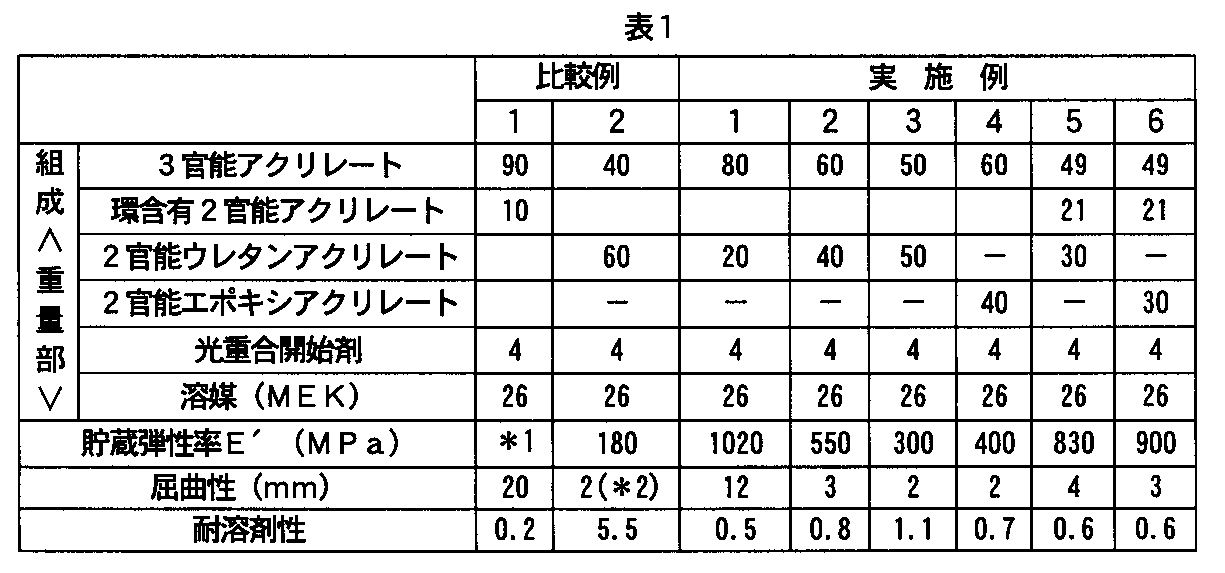
*1:割れやすく測定不可能
*2:2mmのマンドレルでも割れ生じず
表1の結果から、実施例の硬化物は曲げ性と耐溶剤性の両者を併せ持つ。
*2:2mmのマンドレルでも割れ生じず
表1の結果から、実施例の硬化物は曲げ性と耐溶剤性の両者を併せ持つ。
(実施例7~8)
150mlの蓋付容器に、表2の割合で、アクリレートを秤量し、メチルエチルケトン(MEK)及びトルエン(TOL)の混合溶媒[MEK/TOL=50/50(重量比)]に溶解した。この溶液にファーネスカーボンブラックを添加し、自公転式混合脱泡機((株)シンキー製「ARE-250」)で分散組成物を作製した。得られた組成物を、離型紙上にバーコーターにより約50μmの厚みに塗工し、60℃で乾燥した。乾燥後の組成物に、窒素雰囲気中で、加速電圧150kV、線量100kGyの電子線を照射し、硬化塗膜を作製した。硬化塗膜の評価結果を表2に示す。
150mlの蓋付容器に、表2の割合で、アクリレートを秤量し、メチルエチルケトン(MEK)及びトルエン(TOL)の混合溶媒[MEK/TOL=50/50(重量比)]に溶解した。この溶液にファーネスカーボンブラックを添加し、自公転式混合脱泡機((株)シンキー製「ARE-250」)で分散組成物を作製した。得られた組成物を、離型紙上にバーコーターにより約50μmの厚みに塗工し、60℃で乾燥した。乾燥後の組成物に、窒素雰囲気中で、加速電圧150kV、線量100kGyの電子線を照射し、硬化塗膜を作製した。硬化塗膜の評価結果を表2に示す。
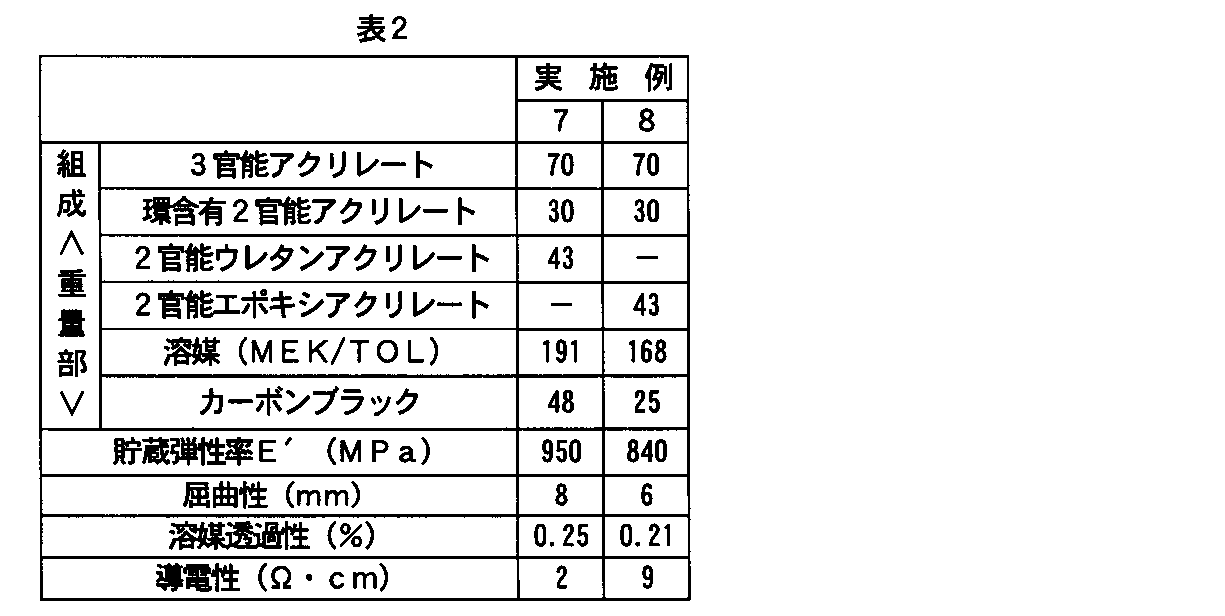
(B)導電性複合フィルムの実験
導電性複合フィルムの実施例及び比較例で用いた配合成分、実施例及び比較例で得られた導電性複合フィルムの特性の評価は、以下の方法で測定した。
導電性複合フィルムの実施例及び比較例で用いた配合成分、実施例及び比較例で得られた導電性複合フィルムの特性の評価は、以下の方法で測定した。
[比重]
JIS K7112に準拠して、電子比重計(アルファ・ミラージュ(株)製「エレクトロニックデンソメーターSD-200L」)を用いて測定したサンプル密度より比重を求めた。なお、嵩高いサンプルなどにおいて、測定に適正なサンプル形状が得られない場合は、予め熱プレスで成形した後、サンプルを切り出した。
JIS K7112に準拠して、電子比重計(アルファ・ミラージュ(株)製「エレクトロニックデンソメーターSD-200L」)を用いて測定したサンプル密度より比重を求めた。なお、嵩高いサンプルなどにおいて、測定に適正なサンプル形状が得られない場合は、予め熱プレスで成形した後、サンプルを切り出した。
[メルトフローレート(MFR)及びメルトテンション]
溶融混錬して調製した樹脂組成物(例えば、ペレット)のMFR(g/10分)は、JIS K7210に準拠し、キャピラリーレオメーター((株)東洋精機製作所製「キャピログラフ1D」)を用い、230℃、21.2N荷重の条件で測定を行った。また、同じ機器を用いて、上記組成物の200℃、240℃のメルトテンションの測定も行った。なお、測定条件は、押出し速度:0.05m/分、引っ張り速度:3m/分、キャピラリー径:2mmφ、ランド長:20mmでメルトテンションの測定を行った。
溶融混錬して調製した樹脂組成物(例えば、ペレット)のMFR(g/10分)は、JIS K7210に準拠し、キャピラリーレオメーター((株)東洋精機製作所製「キャピログラフ1D」)を用い、230℃、21.2N荷重の条件で測定を行った。また、同じ機器を用いて、上記組成物の200℃、240℃のメルトテンションの測定も行った。なお、測定条件は、押出し速度:0.05m/分、引っ張り速度:3m/分、キャピラリー径:2mmφ、ランド長:20mmでメルトテンションの測定を行った。
[融点・ガラス転移温度]
溶融混錬して調製した樹脂組成物(例えば、ペレット)の融点(mp)及びガラス転移温度(Tg)を測定した。測定は、示差走査熱量計(DSC)(ティー・エイ・インスツルメント社製、商品名「Q2000」)を用いて、通常の熱分析法により行った。
溶融混錬して調製した樹脂組成物(例えば、ペレット)の融点(mp)及びガラス転移温度(Tg)を測定した。測定は、示差走査熱量計(DSC)(ティー・エイ・インスツルメント社製、商品名「Q2000」)を用いて、通常の熱分析法により行った。
[第1の導電層の厚み及び均一性]
マイクロメータ((株)ミツトヨ製「デジマチックマイクロメータMDC25MJ」)を用いて、フィルムの幅方向(TD)に25mm間隔をおいて10点以上の箇所で測定し、またフィルムの流れ方向(MD)で25mm間隔をおいて10点以上の箇所で測定し、計20点以上の測定値から算術平均値を求めた。同様に、厚みの均一性(又は安定性)は、フィルム中央で流れ方向(MD)の長さ1mを、50mm間隔で厚みを測定し、得られた測定値の最大5点の平均値と最小5点の平均値を、厚み変動比=(最大平均値/最小平均値)として算出した。この比が小さいほどフィルムの厚みが安定しているとした。
マイクロメータ((株)ミツトヨ製「デジマチックマイクロメータMDC25MJ」)を用いて、フィルムの幅方向(TD)に25mm間隔をおいて10点以上の箇所で測定し、またフィルムの流れ方向(MD)で25mm間隔をおいて10点以上の箇所で測定し、計20点以上の測定値から算術平均値を求めた。同様に、厚みの均一性(又は安定性)は、フィルム中央で流れ方向(MD)の長さ1mを、50mm間隔で厚みを測定し、得られた測定値の最大5点の平均値と最小5点の平均値を、厚み変動比=(最大平均値/最小平均値)として算出した。この比が小さいほどフィルムの厚みが安定しているとした。
[導電性(体積固有抵抗率)]
サンプル両面にΦ3mmの穴を開けたシールを貼り、銀ペーストを塗布、テスターにて抵抗値(Ω)を測定、以下の式により体積抵抗率(Ω・cm)を算出した。
サンプル両面にΦ3mmの穴を開けたシールを貼り、銀ペーストを塗布、テスターにて抵抗値(Ω)を測定、以下の式により体積抵抗率(Ω・cm)を算出した。
体積抵抗率(Ω・cm)=抵抗(Ω)×面積(cm2)/厚み(cm)。
[第1の導電層の耐溶剤性]
フィルムを100mm×100mmにカットし、初期重量:A(mg)を測定した。次いで、25℃のテトラヒドロフラン(THF)中に、フィルムを完全に浸漬して24時間放置した後、取り出したフィルムの表面を拭き取り乾燥し、再び重量:B(mg)を測定した。下記式に基づいて、重量変化率(重量増加率)を算出した。
フィルムを100mm×100mmにカットし、初期重量:A(mg)を測定した。次いで、25℃のテトラヒドロフラン(THF)中に、フィルムを完全に浸漬して24時間放置した後、取り出したフィルムの表面を拭き取り乾燥し、再び重量:B(mg)を測定した。下記式に基づいて、重量変化率(重量増加率)を算出した。
重量変化率(%)=[(B-A)/A]×100(%)
◎:±1%未満
○:±1%以上±5%未満
△:±5%以上±10%未満
×:±10%以上。
◎:±1%未満
○:±1%以上±5%未満
△:±5%以上±10%未満
×:±10%以上。
[第2の導電層の貯蔵弾性率E′]
得られた試験片について、硬化物(A)の実験と同一の方法でE′を求めた。
得られた試験片について、硬化物(A)の実験と同一の方法でE′を求めた。
[第1の導電層又は導電性複合フィルムの屈曲性]
試験体(参考例は第1の導電層)を2cm×15cmの短冊にカットし、JIS K5600に従って屈曲性試験を行い、直径10mmのマンドレルで割れが発生するか否かを確認し、以下の基準で評価した。
試験体(参考例は第1の導電層)を2cm×15cmの短冊にカットし、JIS K5600に従って屈曲性試験を行い、直径10mmのマンドレルで割れが発生するか否かを確認し、以下の基準で評価した。
○:割れやひびは発生しない
×:割れやひびが発生した。
×:割れやひびが発生した。
[導電性複合フィルムの溶媒透過性]
導電性複合フィルムを10cm×10cmのサイズに2枚切り出し、硬化物(A)の実験と同一の方法で重量変化率を測定した。
[配合成分]
(第1の導電層)
ポリプロピレン:(株)プライムポリマー製「E-100GPL」、比重0.90
ポリアミド12:ダイセルエボニック(株)製「L1901」、比重1.01
カーボンブラック:電気化学工業(株)製「デンカブラックHS-100、平均粒経48nm、BET比表面積39m2/g、比重1.9
(第2の導電層)
硬化物(A)の実験と同一の配合成分を使用した。
導電性複合フィルムを10cm×10cmのサイズに2枚切り出し、硬化物(A)の実験と同一の方法で重量変化率を測定した。
[配合成分]
(第1の導電層)
ポリプロピレン:(株)プライムポリマー製「E-100GPL」、比重0.90
ポリアミド12:ダイセルエボニック(株)製「L1901」、比重1.01
カーボンブラック:電気化学工業(株)製「デンカブラックHS-100、平均粒経48nm、BET比表面積39m2/g、比重1.9
(第2の導電層)
硬化物(A)の実験と同一の配合成分を使用した。
[第1の導電層の製造例1]
樹脂成分としてホモポリプロピレン68重量部、導電性フィラーとしてカーボンブラック32重量部を加圧ニーダー混練り機に配合し、溶融混合し、さらにフィーダールーダーにてペレットとした。このペレットの特性を測定すると、比重1.08、融点(mp)166℃、ガラス転移温度(Tg)-22℃であった。
樹脂成分としてホモポリプロピレン68重量部、導電性フィラーとしてカーボンブラック32重量部を加圧ニーダー混練り機に配合し、溶融混合し、さらにフィーダールーダーにてペレットとした。このペレットの特性を測定すると、比重1.08、融点(mp)166℃、ガラス転移温度(Tg)-22℃であった。
得られたペレットをTダイ押出し成形機に供給し、押出スリットのギャップ:0.8mmから押出温度230℃でシート状に押出し、巻き取り速度2.5m/分で巻き取って、厚み140μmの導電性シートを得た。このシートの体積固有抵抗率は8Ω・cmであった。
次いで、ロール状のシートを巻き戻しながら、加熱ロールの表面温度140℃(熱延伸温度差=組成物融点-加熱ロール表面温度=-25℃)の二本の加熱ロールの間を、ロール荷重5kNにて、シートの両面から加熱しながら、送り速度1m/分、巻き取り速度2.8m/分で通過させることで熱延伸処理を行った。得られた第1の導電層は、厚み40μmで体積固有抵抗率が8Ω・cmであり、厚み変動比は1.1、THFによる重量変化率が0.8%であり、平滑で厚み変動がほとんど無く、耐溶剤性に優れていた。
[第1の導電層の製造例2]
樹脂成分としてポリアミド12を70重量部、導電性フィラーとしてカーボンブラックを30重量部加圧ニーダー混練り機に配合し、溶融混合し、さらにフィーダールーダーにてペレットとした。このペレットの特性を測定すると、比重1.17、融点(mp)178℃、ガラス転移温度(Tg)50℃であった。
樹脂成分としてポリアミド12を70重量部、導電性フィラーとしてカーボンブラックを30重量部加圧ニーダー混練り機に配合し、溶融混合し、さらにフィーダールーダーにてペレットとした。このペレットの特性を測定すると、比重1.17、融点(mp)178℃、ガラス転移温度(Tg)50℃であった。
得られたペレットをTダイ押出し成形機に供給し、押出スリットのギャップ:0.8mmから押出温度:220℃でシート状に押し出し、巻き取り速度1.6m/分で巻き取り機で巻き取って、厚み205μmの導電性シートを得た。このシートの体積固有抵抗率は80Ω・cmであった。
次いで、ロール状のシートを巻き戻しながら、加熱ロールの表面温度150℃(熱延伸温度差=組成物融点-加熱ロール表面温度=-28℃)に代えた以外は製造例1と同様にしてシートの両面から加熱しながら、熱延伸処理して、導電性フィルムを得た。得られた第1の導電層は、厚み90μmで体積固有抵抗率が67Ω・cmであり、厚み変動比は1.3、THFによる重量変化率が9%であり、平滑で厚み変動がほとんど無く、耐溶剤性に優れていた。
[実施例9~10(第2の導電層の製造例1~2)]
150mlの蓋付容器に、表2の割合で、アクリレートを秤量し、メチルエチルケトン(MEK)及びトルエン(TOL)の混合溶媒[MEK/TOL=50/50(重量比)]に溶解した。この溶液にファーネスカーボンブラックを添加し、自公転式混合脱泡機((株)シンキー製「ARE-250」)で分散組成物を作製した。
150mlの蓋付容器に、表2の割合で、アクリレートを秤量し、メチルエチルケトン(MEK)及びトルエン(TOL)の混合溶媒[MEK/TOL=50/50(重量比)]に溶解した。この溶液にファーネスカーボンブラックを添加し、自公転式混合脱泡機((株)シンキー製「ARE-250」)で分散組成物を作製した。
得られた分散組成物を、離型紙上にバーコーターにより約50μmの厚みに塗工し、60℃で乾燥した。乾燥後の組成物に、窒素雰囲気中で、加速電圧150kV、線量100kGyの電子線を照射し、硬化塗膜(第2の導電層)を作製した。離型紙を剥離して得られた第2の導電層について、貯蔵弾性率を評価した。
さらに、前記分散組成物を、前記製造例1又は2で得られた第1の導電層の上に、約10μmの厚みに塗工し、60℃で乾燥した。乾燥後の組成物に、窒素雰囲気中で、加速電圧150kV、線量100kGyの電子線を照射し、硬化塗膜(第2の導電層)を作製した。得られた導電性複合フィルムについて、屈曲性、溶媒透過性及び導電性を評価した。
これらの結果を表3に示す。なお、参考例1~2として、第1の導電層単独の特性を表3に示す。
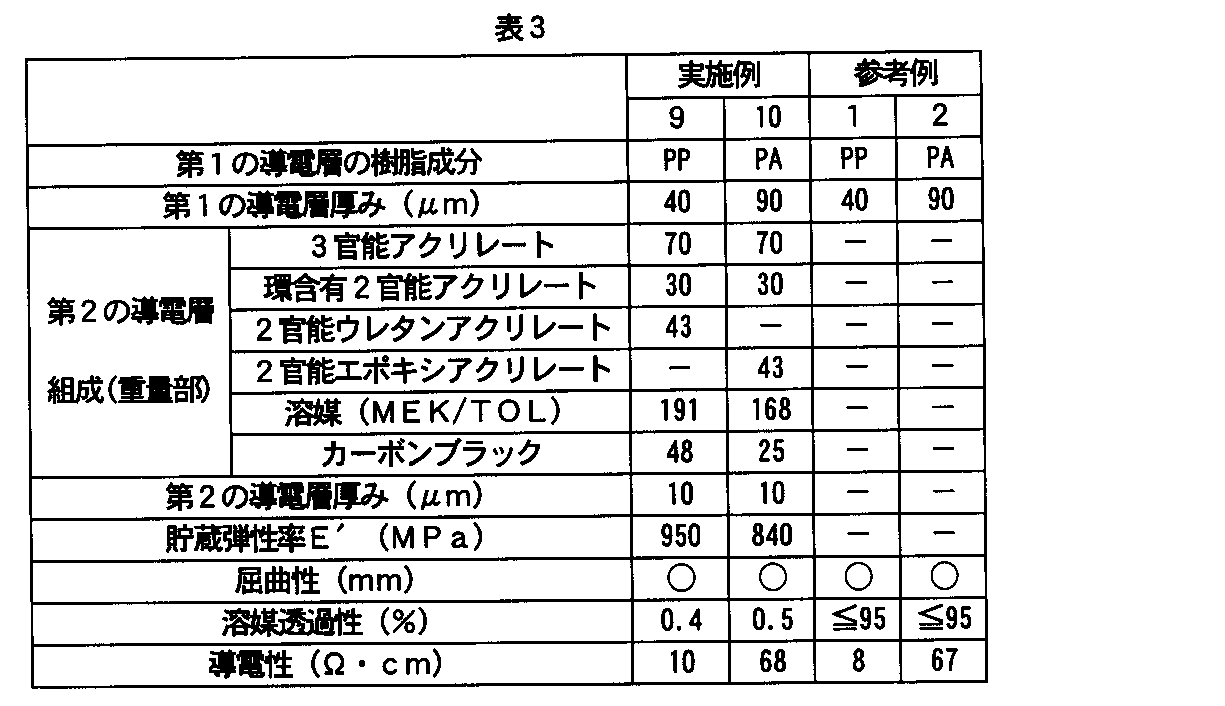
実施例の導電性複合フィルムは、柔軟で、溶媒透過性も低く、導電性も高い。これに対して、参考例の導電フィルムは、溶媒透過性を95重量%以上もあり、溶媒透過性が高い。
本発明の光硬化性組成物及び導電性複合フィルムは、導電性及び耐溶剤性を要求される各種の分野に利用され、溶媒と接触する用途、例えば、電子部品、半導体素子、半導体ウエハーの保存容器、ガソリンタンク、電子・電気機器や半導体製造工場における床材や壁材、各種の電池用部材(例えば、電気二重層コンデンサー、リチウムイオン電池など部材)などの材料として利用できる。さらに、導電性及び耐溶剤性に優れている上に、柔軟性にも優れるため、ロール・ツー・ロール方式を利用して容易に製造でき、取り扱い性にも優れるため、利用範囲も広い。
Claims (19)
- 3官能以上の多官能ビニル系化合物と、鎖状脂肪族骨格を有する脂肪族2官能(メタ)アクリレートを含む2官能ビニル系化合物と、導電剤とを含む光硬化性組成物であって、昇温速度5℃/分及び周波数10Hzの条件で-50℃から250℃まで測定した動的粘弾性試験において、硬化物のゴム状領域における貯蔵弾性率E′が200~2000MPaである光硬化性組成物。
- 脂肪族2官能(メタ)アクリレートのアクリル当量が200以上である請求項1記載の光硬化性組成物。
- 脂肪族骨格が脂肪族ポリエステル単位を含む請求項1又は2記載の光硬化性組成物。
- 2官能ビニル系化合物が、さらに多環式脂環族及び/又はビスフェノール骨格を有する環含有2官能(メタ)アクリレートを含む請求項1~3のいずれかに記載の光硬化性組成物。
- 環含有2官能(メタ)アクリレートの割合が、脂肪族2官能(メタ)アクリレート100重量部に対して10~100重量部である請求項4記載の光硬化性組成物。
- 導電剤が、導電性カーボンブラックである請求項1~5のいずれかに記載の光硬化性組成物。
- 導電剤の割合が、多官能ビニル系化合物と2官能ビニル系化合物との総量100重量部に対して10~40重量部である請求項1~6のいずれかに記載の光硬化性組成物。
- 紫外線又は電子線硬化性組成物である請求項1~7のいずれかに記載の光硬化性組成物。
- 請求項1~8のいずれかに記載の光硬化性組成物を光照射して硬化物を製造する方法。
- 請求項9記載の方法で得られた硬化物。
- シート状成形体である請求項10記載の硬化物。
- 結晶性樹脂及び第1の導電剤を含む結晶性樹脂組成物で形成された第1の導電層と、請求項1~8のいずれかに記載の光硬化性組成物の硬化物で形成された第2の導電層とが積層された導電性複合フィルム。
- 第1及び第2の導電層に含まれる第1及び第2の導電剤が、導電性カーボンブラックである請求項12記載の導電性複合フィルム。
- 結晶性樹脂と第1の導電剤との割合(重量比)が、前者/後者=90/10~55/45である請求項12又は13記載の導電性複合フィルム。
- 結晶性樹脂がポリプロピレン系樹脂及び/又はポリアミド系樹脂である請求項12~14のいずれかに記載の導電性複合フィルム。
- 第1の導電層の厚みが1~200μmであり、第2の導電層の厚みが1~100μmであり、第1の導電層と第2の導電層との厚み比が、第1の導電層/第2の導電層=1/1~20/1である請求項12~15のいずれかに記載の導電性複合フィルム。
- 結晶性樹脂組成物を押出成形した後、得られたシートを加熱しながら延伸又は圧延処理する第1の導電層の成形工程、及び得られた第1の導電層の上に光硬化性組成物を塗布した後、光照射して硬化物を形成する第2の導電層の成形工程を含む請求項12~16のいずれかに記載の導電性複合フィルムの製造方法。
- 第1の導電層の成形工程において、結晶性樹脂組成物を押出成形して厚み50~500μmのシートを成形する押出成形した後、結晶性樹脂の融点をmpとしたとき、(mp-40)℃~(mp-5)℃の温度で、得られたシートを加熱しながら延伸又は圧延処理する請求項17記載の製造方法。
- 第2の導電層の成形工程において、光硬化性組成物に電子線を照射して硬化物を形成する請求項17又は18記載の製造方法。
Applications Claiming Priority (2)
| Application Number | Priority Date | Filing Date | Title |
|---|---|---|---|
| JP2011-083077 | 2011-04-04 | ||
| JP2011083077A JP2012218185A (ja) | 2011-04-04 | 2011-04-04 | 導電性複合フィルム及びその製造方法 |
Publications (1)
| Publication Number | Publication Date |
|---|---|
| WO2012137828A1 true WO2012137828A1 (ja) | 2012-10-11 |
Family
ID=46969222
Family Applications (1)
| Application Number | Title | Priority Date | Filing Date |
|---|---|---|---|
| PCT/JP2012/059215 Ceased WO2012137828A1 (ja) | 2011-04-04 | 2012-04-04 | 光硬化性組成物並びに導電性複合フィルム及びその製造方法 |
Country Status (2)
| Country | Link |
|---|---|
| JP (1) | JP2012218185A (ja) |
| WO (1) | WO2012137828A1 (ja) |
Cited By (1)
| Publication number | Priority date | Publication date | Assignee | Title |
|---|---|---|---|---|
| WO2024034195A1 (ja) * | 2022-08-09 | 2024-02-15 | グンゼ株式会社 | 導電性フィルム、及び、導電性フィルムの製造方法 |
Families Citing this family (3)
| Publication number | Priority date | Publication date | Assignee | Title |
|---|---|---|---|---|
| MX2013013538A (es) * | 2011-05-23 | 2013-12-16 | Kaneka Corp | Pelicula conductora de multiples capas, recolector de corriente que utiliza la misma, bateria y bateria bipolar. |
| JP6874406B2 (ja) * | 2016-02-09 | 2021-05-19 | 大日本印刷株式会社 | 光学積層体、これを有する前面板及び画像表示装置 |
| TW201817597A (zh) * | 2016-05-26 | 2018-05-16 | 東洋炭素股份有限公司 | 複合體及複合體之製造方法 |
Citations (7)
| Publication number | Priority date | Publication date | Assignee | Title |
|---|---|---|---|---|
| JPH06162818A (ja) * | 1992-11-18 | 1994-06-10 | Ajinomoto Co Inc | 活性エネルギー線硬化型導電性組成物 |
| JPH09117716A (ja) * | 1995-10-24 | 1997-05-06 | Nippon Zeon Co Ltd | コート剤組成物および同組成物によりコートされたポリカーボネート製品 |
| JP2004264763A (ja) * | 2003-03-04 | 2004-09-24 | C I Kasei Co Ltd | 導電性ベルト |
| JP2007137908A (ja) * | 2005-10-18 | 2007-06-07 | Teikoku Printing Inks Mfg Co Ltd | 放射線硬化型組成物および帯電防止フィルム |
| WO2008056751A1 (en) * | 2006-11-09 | 2008-05-15 | Toagosei Co., Ltd. | Actinic radiation curable adhesive composition |
| JP2010218957A (ja) * | 2009-03-18 | 2010-09-30 | Hitachi Maxell Ltd | 透明導電膜及びその製造方法 |
| JP2011094132A (ja) * | 2009-09-30 | 2011-05-12 | Aica Kogyo Co Ltd | 化粧板用の活性エネルギー線硬化型樹脂組成物、転写シート、化粧板、及び化粧板の製造方法 |
-
2011
- 2011-04-04 JP JP2011083077A patent/JP2012218185A/ja not_active Withdrawn
-
2012
- 2012-04-04 WO PCT/JP2012/059215 patent/WO2012137828A1/ja not_active Ceased
Patent Citations (7)
| Publication number | Priority date | Publication date | Assignee | Title |
|---|---|---|---|---|
| JPH06162818A (ja) * | 1992-11-18 | 1994-06-10 | Ajinomoto Co Inc | 活性エネルギー線硬化型導電性組成物 |
| JPH09117716A (ja) * | 1995-10-24 | 1997-05-06 | Nippon Zeon Co Ltd | コート剤組成物および同組成物によりコートされたポリカーボネート製品 |
| JP2004264763A (ja) * | 2003-03-04 | 2004-09-24 | C I Kasei Co Ltd | 導電性ベルト |
| JP2007137908A (ja) * | 2005-10-18 | 2007-06-07 | Teikoku Printing Inks Mfg Co Ltd | 放射線硬化型組成物および帯電防止フィルム |
| WO2008056751A1 (en) * | 2006-11-09 | 2008-05-15 | Toagosei Co., Ltd. | Actinic radiation curable adhesive composition |
| JP2010218957A (ja) * | 2009-03-18 | 2010-09-30 | Hitachi Maxell Ltd | 透明導電膜及びその製造方法 |
| JP2011094132A (ja) * | 2009-09-30 | 2011-05-12 | Aica Kogyo Co Ltd | 化粧板用の活性エネルギー線硬化型樹脂組成物、転写シート、化粧板、及び化粧板の製造方法 |
Cited By (1)
| Publication number | Priority date | Publication date | Assignee | Title |
|---|---|---|---|---|
| WO2024034195A1 (ja) * | 2022-08-09 | 2024-02-15 | グンゼ株式会社 | 導電性フィルム、及び、導電性フィルムの製造方法 |
Also Published As
| Publication number | Publication date |
|---|---|
| JP2012218185A (ja) | 2012-11-12 |
Similar Documents
| Publication | Publication Date | Title |
|---|---|---|
| CN103347693B (zh) | 层合聚酯膜、成型用构件及成型体以及它们的制造方法 | |
| CN104220258B (zh) | 聚酯膜及其制造方法、太阳能电池用背板以及太阳能电池模块 | |
| CN103756347A (zh) | 树脂复合材料及树脂复合材料的制造方法 | |
| CN105658709A (zh) | 涂布膜 | |
| JP2012204292A (ja) | 導電性フィルム及びその製造方法 | |
| CN1309605A (zh) | 热塑性树脂拉伸薄膜 | |
| JP6699659B2 (ja) | フィルムおよびそれを用いた電気絶縁シート、粘着テープ、回転機 | |
| TWI820304B (zh) | 積層膜及其製造方法 | |
| JP6798343B2 (ja) | ホットメルト接着剤組成物 | |
| KR20210032305A (ko) | 가공된 그래핀의 응용 | |
| CN116901553A (zh) | 适用于复合集流体的bopp薄膜、bopp复合集流体及其制备方法 | |
| CN107151384A (zh) | 一种用于太阳能电池背板的改性聚丙烯组合物及其制备方法 | |
| JP2012218185A (ja) | 導電性複合フィルム及びその製造方法 | |
| JP2004269766A (ja) | 二軸配向ポリエステルフィルム | |
| JP5134945B2 (ja) | カーボンナノチューブ含有組成物および硬化物 | |
| JP2021143327A (ja) | 液状組成物及びその製造方法 | |
| KR101004426B1 (ko) | 디스플레이 패널 적층용 쿠션재 및 이의 제조방법 | |
| CN102481768B (zh) | 成型用膜 | |
| JP7702311B2 (ja) | 液晶ポリマーフィルム、積層体 | |
| JP4497822B2 (ja) | 電気絶縁材料 | |
| JP2013188924A (ja) | 複合封止体 | |
| TW201922869A (zh) | 單層薄膜及使用其之耐熱黏著帶 | |
| JP6854121B2 (ja) | フィルム又はラミネート用ポリブチレンテレフタレート系樹脂 | |
| CN100532088C (zh) | 层压薄膜和双轴取向聚酯薄膜 | |
| JP6969414B2 (ja) | 離型フィルム及び粘着体 |
Legal Events
| Date | Code | Title | Description |
|---|---|---|---|
| 121 | Ep: the epo has been informed by wipo that ep was designated in this application |
Ref document number: 12768512 Country of ref document: EP Kind code of ref document: A1 |
|
| NENP | Non-entry into the national phase |
Ref country code: DE |
|
| 122 | Ep: pct application non-entry in european phase |
Ref document number: 12768512 Country of ref document: EP Kind code of ref document: A1 |