WO2012133792A1 - タンパク質含有組成物及びその製造方法 - Google Patents
タンパク質含有組成物及びその製造方法 Download PDFInfo
- Publication number
- WO2012133792A1 WO2012133792A1 PCT/JP2012/058616 JP2012058616W WO2012133792A1 WO 2012133792 A1 WO2012133792 A1 WO 2012133792A1 JP 2012058616 W JP2012058616 W JP 2012058616W WO 2012133792 A1 WO2012133792 A1 WO 2012133792A1
- Authority
- WO
- WIPO (PCT)
- Prior art keywords
- protein
- containing composition
- cocoa beans
- producing
- derived
- Prior art date
- Legal status (The legal status is an assumption and is not a legal conclusion. Google has not performed a legal analysis and makes no representation as to the accuracy of the status listed.)
- Ceased
Links
Classifications
-
- A—HUMAN NECESSITIES
- A23—FOODS OR FOODSTUFFS; TREATMENT THEREOF, NOT COVERED BY OTHER CLASSES
- A23J—PROTEIN COMPOSITIONS FOR FOODSTUFFS; WORKING-UP PROTEINS FOR FOODSTUFFS; PHOSPHATIDE COMPOSITIONS FOR FOODSTUFFS
- A23J1/00—Obtaining protein compositions for foodstuffs; Bulk opening of eggs and separation of yolks from whites
- A23J1/14—Obtaining protein compositions for foodstuffs; Bulk opening of eggs and separation of yolks from whites from leguminous or other vegetable seeds; from press-cake or oil-bearing seeds
-
- A—HUMAN NECESSITIES
- A23—FOODS OR FOODSTUFFS; TREATMENT THEREOF, NOT COVERED BY OTHER CLASSES
- A23J—PROTEIN COMPOSITIONS FOR FOODSTUFFS; WORKING-UP PROTEINS FOR FOODSTUFFS; PHOSPHATIDE COMPOSITIONS FOR FOODSTUFFS
- A23J3/00—Working-up of proteins for foodstuffs
- A23J3/14—Vegetable proteins
-
- A—HUMAN NECESSITIES
- A23—FOODS OR FOODSTUFFS; TREATMENT THEREOF, NOT COVERED BY OTHER CLASSES
- A23L—FOODS, FOODSTUFFS OR NON-ALCOHOLIC BEVERAGES, NOT OTHERWISE PROVIDED FOR; PREPARATION OR TREATMENT THEREOF
- A23L33/00—Modifying nutritive qualities of foods; Dietetic products; Preparation or treatment thereof
- A23L33/10—Modifying nutritive qualities of foods; Dietetic products; Preparation or treatment thereof using additives
- A23L33/17—Amino acids, peptides or proteins
- A23L33/185—Vegetable proteins
-
- A—HUMAN NECESSITIES
- A61—MEDICAL OR VETERINARY SCIENCE; HYGIENE
- A61P—SPECIFIC THERAPEUTIC ACTIVITY OF CHEMICAL COMPOUNDS OR MEDICINAL PREPARATIONS
- A61P1/00—Drugs for disorders of the alimentary tract or the digestive system
- A61P1/10—Laxatives
-
- C—CHEMISTRY; METALLURGY
- C07—ORGANIC CHEMISTRY
- C07K—PEPTIDES
- C07K14/00—Peptides having more than 20 amino acids; Gastrins; Somatostatins; Melanotropins; Derivatives thereof
- C07K14/415—Peptides having more than 20 amino acids; Gastrins; Somatostatins; Melanotropins; Derivatives thereof from plants
-
- A—HUMAN NECESSITIES
- A23—FOODS OR FOODSTUFFS; TREATMENT THEREOF, NOT COVERED BY OTHER CLASSES
- A23V—INDEXING SCHEME RELATING TO FOODS, FOODSTUFFS OR NON-ALCOHOLIC BEVERAGES AND LACTIC OR PROPIONIC ACID BACTERIA USED IN FOODSTUFFS OR FOOD PREPARATION
- A23V2002/00—Food compositions, function of food ingredients or processes for food or foodstuffs
Definitions
- the present invention relates to a protein-containing composition containing a protein derived from cacao beans at a high content, and a method for producing the same.
- Cocoa have been studied not only as luxury products but also as food materials having an effective function on the living body.
- cocoa mass obtained by grinding after removing the shell from cocoa beans also contains functional ingredients such as antioxidants and dietary fiber, so it is not only a raw material for chocolate and cocoa, but also a nutritive functional food.
- Research has been made as a material (Patent Documents 1 and 2).
- cocoa extracts with increased concentrations of antioxidants and the like are expected to have various effects (Patent Documents 3 to 6).
- Cocoa beans contain not only antioxidants and dietary fiber, but also proteins. However, the protein content in cocoa beans is low compared to soybeans and the like. For this reason, the utilization of the protein in cacao beans has not been noted so far.
- Patent Documents 3 to 6 describe that an extract containing 25% by weight or more of polyphenol is obtained from unfermented or lightly fermented unroasted cocoa beans, and the content of protein in the extract is described. Increasing the rate is not described.
- cocoa beans The protein content in cocoa beans is low compared to soybeans. For this reason, in order to increase the content of protein such as food by using an extract from cocoa beans as a material containing protein derived from cocoa beans, a large amount of extract from cocoa beans is added. Had to do. However, in this case, the taste and flavor of food and the like change due to the bitterness and astringent taste (sustained astringency) derived from cocoa beans. Under such circumstances, the use of cocoa bean-derived protein-containing materials in various foods, medicines, chemical products, and the like has been limited. In addition, since cocoa beans contain physiologically active substances such as caffeine and theobromine, simple cocoa bean extracts are also added together, which may cause unexpected physiological effects. For this reason, it has not been possible to add a large amount of cocoa bean extract to foods and drinks, pharmaceuticals, chemical products and the like.
- cocoa beans and cocoa mass contain a high content of cocoa butter, and the fat content derived from cocoa beans is transferred to the extract from cocoa beans and cocoa mass.
- the above extract or the like is added to food or the like as a material containing protein derived from cocoa beans, there is also a problem that fat derived from cocoa beans is also added to food or the like together with protein. .
- effective utilization of the residue after extracting functional components such as antioxidant substances derived from cocoa beans has been desired.
- the object of the present invention is not only to increase the content of protein derived from cocoa beans, but also to hardly contain fat, caffeine, theobromine and polyphenols, and further has no bitter and astringent taste (sustained astringency). It is providing a protein containing composition and its manufacturing method.
- the present inventors have found that a protein-containing composition having an increased content of protein derived from cocoa beans can solve the above problems. Moreover, it discovered that the residue after extracting the cacao bean which passed through roasting and the functional component derived from a cacao bean also contains the protein derived from a cacao bean, and can be utilized as a material.
- the present invention provides a protein-containing composition containing 42 to 70% by weight of the protein derived from cacao beans in a solid content.
- This protein-containing composition has an increased content of protein derived from cocoa beans, contains almost no fat content derived from cocoa beans, and has little bitterness and astringent taste. It is useful as a material for products, pharmaceuticals, and chemical products.
- the present invention is a method for producing the above-mentioned protein-containing composition containing a protein derived from cocoa beans at a high content, and (a) from a raw material containing a protein derived from cocoa beans, Extracting the protein under alkaline conditions to obtain an extract containing the protein; (b) Precipitating the protein under acidic conditions from the extract obtained in step (a), and containing the protein
- a method for producing a protein-containing composition comprising a precipitation step for obtaining a composition.
- the method for producing a protein-containing composition of the present invention includes (c) a degreasing step for removing fat derived from cocoa beans before step (a) and / or after step (b). preferable. In this case, it is possible to provide a protein-containing composition containing almost no fat derived from cocoa beans.
- Preferred conditions for protein extraction in step (a) are as follows.
- the pH is preferably 8-13, more preferably 10-12.
- the temperature is preferably 20 to 100 ° C, more preferably 30 to 100 ° C, still more preferably 40 to 100 ° C, and particularly preferably 50 to 100 ° C.
- Preferred conditions for protein precipitation in step (b) are as follows.
- the pH is preferably 2 to 6, more preferably 2 to 5.
- the temperature is preferably 0 to 40 ° C, more preferably 0 to 20 ° C.
- the pH is preferably 2 to 7, more preferably 3 to 7, even more preferably 4 to 6, and the temperature is preferably 30 to 90 ° C., more preferably 40 to 70 ° C.
- the organic solvent include ethanol, an aqueous ethanol solution, diethyl ether, hexane and the like. These organic solvents are used singly or in combination of two or more.
- the lower limit of the weight ratio of the protein derived from cocoa beans in the protein-containing composition of the present invention is 42%, preferably 44%, more preferably 46%, and still more preferably 48% by weight ratio in the solid content. More preferably, it is 50%, more preferably 52%, still more preferably 54%, particularly preferably 56%.
- the upper limit of the weight ratio is 70%, more preferably 65%, and most preferably 60%, considering the ease of setting various conditions in the production method of the present invention.
- the protein-containing composition of the present invention (hereinafter sometimes abbreviated as the composition of the present invention) has a high content of protein derived from cocoa beans.
- the protein content such as can be increased.
- the composition of the present invention not only has a high protein content derived from cocoa beans, but also has almost no bitterness or astringent taste (sustained astringency) derived from cocoa beans, and is tasteless and odorless.
- the composition contains almost no fat derived from cocoa beans, it does not become oily due to temperature changes, and is very easy to handle. Therefore, the protein-containing composition of the present invention can be advantageously used as a protein-containing material that does not change the taste, flavor, amount of fat, etc. for constituting various foods, beverages, pharmaceuticals, and chemical products. it can.
- the content of protein derived from cocoa beans in the protein-containing composition is increased.
- a protein-containing composition that hardly contains fat, caffeine, theobromine, and polyphenols derived from cacao beans and has little bitterness and astringent taste.
- a composition containing a protein derived from cocoa beans that could not be added can be widely used.
- the residue after extraction of functional components, such as roasted cocoa beans and the antioxidant substance derived from cocoa beans can also be used effectively.
- the raw material used in step (a) of the production method of the present invention is not particularly limited as long as it contains a protein derived from cocoa beans.
- the raw material include cocoa beans (whether or not roasted), cocoa nibs obtained by removing the shell from cocoa beans (whether or not roasted), cocoa mass obtained by grinding cocoa nibs, and cocoa mass.
- cocoa beans whether or not roasted
- cocoa nibs obtained by removing the shell from cocoa beans (whether or not roasted)
- cocoa mass obtained by grinding cocoa nibs
- cocoa mass obtained by grinding cocoa nibs, and cocoa mass.
- degreasing means such as hot water, organic solvent, etc.
- residues after extraction of oxidizing substances and the like for example, residues after extraction by the method described in JP-A-7-213251.
- the raw material in order to extract protein from a raw material containing protein derived from cocoa beans under alkaline conditions, for example, the raw material is suspended in water and alkali (liquidity is made alkaline).
- alkali liquidity is made alkaline.
- an alkali agent for example, an alkali agent.
- the protein extraction conditions are not particularly limited as long as they are alkaline, but from the viewpoint of increasing the protein content in the composition of the present invention, it is preferably pH 8 to 13, more preferably pH 9 to 13, and still more preferably pH 10 to 12. Particularly preferably, the pH is 10.5-12.
- the alkali used here is not particularly limited as long as it can be adjusted to pH 8 to 13, and may be used in any form of a solid or an aqueous solution. Examples of the alkali include sodium hydroxide, potassium carbonate, trisodium phosphate and the like. These alkalis are used alone or in combination of two or more.
- the lower limit of the protein extraction temperature is not particularly limited, but from the viewpoint of increasing the protein content in the composition of the present invention, it is preferably 20 ° C, more preferably 30 ° C, still more preferably 40 ° C, and still more preferably. 50 ° C., more preferably 70 ° C., particularly preferably 80 ° C.
- the upper limit of the protein extraction temperature is not particularly limited, but is preferably 100 ° C., more preferably from the viewpoint of increasing the protein content in the composition of the present invention even when the temperature exceeds 80 ° C. Is 95 ° C., particularly preferably 90 ° C.
- the protein extraction time is preferably 30 minutes to 48 hours, more preferably 30 minutes to 24 hours. When the extraction time is 30 minutes or longer, the protein content in the composition of the present invention can be sufficiently increased. When the extraction time is 48 hours or less, extraction can be performed efficiently.
- a supernatant containing a protein derived from cocoa beans can be obtained.
- protein extraction under normal alkaline conditions in the prior art is weakly alkaline and less than 50 ° C. in order to avoid alkali denaturation and heat denaturation of proteins during the extraction process.
- a preferred embodiment of the production method of the present invention is to perform the protein extraction operation at a high alkalinity of pH 8 or higher and a high temperature of 50 ° C. or higher.
- step (b) in order to obtain a protein-containing composition under acidic conditions, acid is added to the supernatant containing the protein derived from cocoa beans obtained in step (a) to precipitate the protein.
- the conditions for precipitating the protein are not particularly limited as long as they are acidic, but from the viewpoint of increasing the protein content in the composition of the present invention, it is preferably pH 2 to 6, more preferably pH 2 to 5, and still more preferably pH 2 to 4, particularly preferably pH 2 to 3.5.
- the acid used here is not particularly limited as long as it can be adjusted to pH 2 to 6, and it may be used in the form of a solid or an aqueous solution.
- the acid examples include inorganic acids such as hydrochloric acid, sulfuric acid, and phosphoric acid, and organic acids such as citric acid, malic acid, and tartaric acid. These acids are used singly or in combination of two or more.
- the temperature at which the protein is precipitated is preferably 0 to 40 ° C., more preferably 0 to 20 ° C., and particularly preferably 0 to 10 ° C. from the viewpoint of promoting precipitation.
- the protein-containing composition of the present invention can be obtained, for example, by performing operations such as solid-liquid separation by filtration or the like, washing with water, and drying.
- ⁇ About step (c)> When the raw material containing the protein derived from cocoa beans used in step (a) contains a fat content (for example, cacao mass contains about 55% fat and cocoa powder contains about 20% fat content).
- the manufacturing method is (A) only at the point before step (a), (B) only at the point after step (b), or (C) both before step (a) and after step (b).
- step (c) (Degreasing step) is preferably included.
- the protein containing composition which hardly contains the fat content derived from cocoa beans can be obtained.
- step (c) When step (c) is before step (a), fat is removed from the raw material containing the protein derived from cocoa beans. When step (c) is after step (b), fat is removed from the protein-containing composition obtained in step (b). Whether step (c) is before step (a) or after step (b), the method for removing fat is the same except that the object of fat removal is different. . Therefore, hereinafter, the step (c) will be described by taking the case where the step (c) is before the step (a) as an example.
- the raw material is suspended in a fat removing solvent such as water or an organic solvent, and the fat is extracted, followed by filtration or the like.
- the solid content is removed by removing the supernatant containing the fat by solid-liquid separation.
- the degreasing conditions are not particularly limited.
- the pH is preferably 2 to 7, more preferably pH 3 to 6.
- the acid used here is not particularly limited as long as it can be adjusted to pH 2 to 7, and may be used in any form of a solid or an aqueous solution.
- the acid include inorganic acids such as hydrochloric acid, sulfuric acid, and phosphoric acid, and organic acids such as citric acid, malic acid, and tartaric acid. These acids are used singly or in combination of two or more.
- an organic solvent when removing a fat content using an organic solvent, ethanol, ethanol aqueous solution, diethyl ether, hexane etc. are mentioned as an example of an organic solvent. These organic solvents are used singly or in combination of two or more.
- ethanol and an aqueous ethanol solution are preferable from the viewpoint of safety.
- the preferred degreasing temperature is 30 to 90 ° C. when water is used, and 20 to 90 ° C. when an organic solvent is used.
- a more preferable temperature for degreasing is 40 to 70 ° C. in both cases of using water and an organic solvent.
- the degreasing time is preferably 10 minutes to 24 hours, more preferably 30 minutes to 2 hours.
- a raw material from which fat has been removed can be obtained, for example, by solid-liquid separation such as filtration.
- cacao extracts obtained by conventional techniques include cacao bean-derived caffeine, theobromine, polyphenols, and the like.
- the protein-containing composition of the present invention contains almost no caffeine, theobromine or polyphenols.
- the protein contents described in the following Examples and Comparative Examples were obtained by the macro modified Kjeldahl method (nitrogen / protein conversion factor: 6.25) which is an official method.
- the lipid content was obtained by an acid decomposition method which is an official method. Details of these methods are described in “Detailed Explanation of Official Test Methods / Standard Test Methods, Food Sanitation Inspection Guidelines, Physical and Chemical Edition 2005” (supervised by the Ministry of Health, Labor and Welfare, published by Japan Food Sanitation Association).
- a supernatant containing the protein was obtained by centrifugation. After filtering the obtained supernatant, the filtrate was ice-cooled, the liquid temperature was adjusted to 4 ° C., and then adjusted to pH 3.5 using hydrochloric acid. The supernatant was removed by centrifugation, and the resulting precipitate was washed with water and lyophilized to obtain a protein-containing composition containing a protein derived from cocoa beans.
- the numerical value in Table 1 is the protein content (g) in 100 g of the composition.
- Example 13 After adjusting pH 12 (Example 13), 8) 60 ° C. after adjusting pH 12 (Example 14), 9) 70 ° C. after adjusting pH 12 (Example 15), and after stirring for 1 hour, respectively
- the supernatant containing the protein was obtained by centrifugation. Furthermore, in the same manner as in Example 1, protein precipitation was performed under acidic conditions to obtain a protein-containing composition containing a protein derived from cocoa beans.
- Table 2 shows the protein content, solid content recovery rate, and molecular weight distribution of the composition obtained as described above.
- the molecular weight distribution was measured by the following method. First, 0.25 g was accurately weighed using the composition obtained in the example as a sample, and 30 mL of water was added and stirred well. Thereafter, 1N aqueous sodium hydroxide solution was added to adjust the pH to 10.5, and the mixture was stirred at 50 ° C. for 30 minutes. Further, 1N hydrochloric acid was added to adjust the pH to 7.0, and water was added to make a constant volume of 50 ml to prepare a solution containing 0.5% of the sample.
- 0.1 volume% trifluoroacetic acid water and 0.1 volume% trifluoroacetic acid-containing acetonitrile were added to the above solution containing 0.5% of the sample, and prepared to be 0.1% of the sample and 45 volume% of acetonitrile, followed by centrifugation (10,000 ⁇ g ) To obtain a supernatant.
- the obtained supernatant was filtered through a filter having a pore size of 0.45 ⁇ m to obtain a sample solution.
- the sample solution was analyzed by gel permeation chromatography (GPC).
- the fraction is divided into a high molecular fraction (6.5 kDa or more) or a low molecular fraction (307 Da or more and less than 6.5 kDa), and the ratio of the area of each fraction of the test solution to the total area ( %), The molecular weight distribution was calculated as shown in Table 2.
- Example 16 degreasing was performed under acidic conditions, and water was added again to the resulting precipitate to prepare a suspension.
- the mixture was stirred at 70 ° C. for 1) 4 hours (Example 16) or 2) 8 hours (Example 17), respectively, and then the protein was separated by centrifugation. A supernatant containing was obtained.
- protein precipitation was performed under acidic conditions to obtain a protein-containing composition containing a protein derived from cocoa beans.
- Table 3 shows the protein content, solid content recovery rate, and molecular weight distribution of the composition obtained as described above.
- the numerical value in Table 4 is the protein content (g) in 100 g of the composition.
- step (c) (1) Degreasing conditions First, for 1) No degreasing operation (Example 26), water (liquid temperature: 50 ° C.) was added to cacao powder to form a suspension (pH: 6). The next protein extraction operation was performed as it was. 2) For degreasing with an organic solvent (Example 27), add 95% ethanol aqueous solution to cacao powder to make a suspension, stir at 50 ° C. for 1 hour, and filter the supernatant containing fat by filtration. Left. A 95 vol% ethanol aqueous solution was again added to the obtained precipitate to prepare a suspension, and the above degreasing operation was further performed twice.
- Example 2 protein extraction under alkaline conditions and protein precipitation under acidic conditions were performed. Then, the supernatant was removed by centrifugation, and the resulting precipitate was washed with water and lyophilized to obtain a protein-containing composition containing a protein derived from cocoa beans.
- Example 29 (2) Degreasing sequence
- the protein was extracted under alkaline conditions without performing the degreasing operation, and the protein was precipitated under acidic conditions. Qing was removed.
- Example 28 a 95% by volume ethanol aqueous solution was added to the resulting precipitate to form a suspension, and the same degreasing operation as in Example 27 was performed.
- Example 29 the obtained precipitate was freeze-dried, and a 95% by volume ethanol aqueous solution was added to form a suspension, and the same degreasing operation as in Example 27 was performed.
- the obtained precipitation was dried and the protein containing composition containing the protein derived from a cocoa bean was obtained.
- the protein and lipid contents of the composition obtained as described above are shown in Table 5.
- the numerical values in Table 5 are the contents (g) of protein and lipid in 100 g of the composition.
- Example 30 The protein-containing composition containing the protein derived from cocoa beans was obtained (Example 30). Moreover, about the residue after extracting a functional component from cacao mass using unfermented cacao bean, like Example 2, degreasing operation under acidic conditions, extraction of protein under alkaline conditions, and The protein was precipitated under acidic conditions to obtain a protein-containing composition containing a protein derived from cocoa beans (Example 31). Table 6 shows the protein content of the composition obtained as described above.
- the numerical value in Table 6 is the protein content (g) in 100 g of the composition.
- the obtained precipitate that is, the defatted sample
- water was added to make about 100 mL, followed by heating in a 100 ° C. hot water bath for 25 minutes and immediately cooling.
- 10 mL of a 2 wt% aqueous zinc sulfate solution and 10 mL of 1.8 wt% barium hydroxide were added and mixed, and then allowed to stand, and water was added to make a constant volume of 200 mL.
- the sample was heated in a 100 ° C. hot water bath for 10 minutes, and the heated solution was filtered to obtain a sample solution.
- the sample solution was analyzed by high performance liquid chromatography.
- Table 7 The numerical values in Table 7 are the contents (mg) of caffeine and theobromine in 1 g of the composition.
- Example 2 About total polyphenol content The total polyphenol content was measured by the Prussian blue method. Martin With reference to the method described in L. Price and Larry G. Butler, J. Agric Food Chem., Vol. 25 No. 6, 1268-1273 (1977), with commercially available epicatechin as a standard, Example 2 and The solid content of the composition obtained in No. 26 was quantitatively analyzed. First, the obtained composition was degreased by treatment with n-hexane, and then extracted using a 50 wt% aqueous methanol solution to obtain a test solution.
- the numerical values in Table 8 are the total polyphenol content (% by weight) in the composition.
- mice Six-week-old BALB / c female mice (6 mice in each group) were fed with water and food ad libitum for 14 days.
- standard feed AIN93G compliant, cellulose-free, corn starch added 5% by weight
- protein-containing composition added group 5% by weight of the protein-containing composition obtained in Example 2 was added to the standard feed ( Each meal was replaced with cornstarch.
- mouth was measured on the first breeding day (0th day), the 7th day, and the 14th day.
- the amount of food intake (g / animal / day) was measured from day 6 to day 7 and day 13 to day 14.
- Table 9th to 11th day 3 days
- Example 2 and Example 26 were brownish brown fluid powder that was darker than the cocoa powder.
- Table 10 the scent of cacao felt with cacao powder was not felt, and no other scent was felt.
- the cacao bitterness and astringent taste (sustained astringency) felt with cacao powder were not felt, and other tastes (sweet, sour, salty, umami, etc.) were not felt.
- compositions having a high content of protein derived from cocoa beans As described above, it was possible to establish a composition having a high content of protein derived from cocoa beans and a method for producing the same, containing almost no fat, caffeine, theobromine and polyphenols derived from cocoa beans. . Moreover, according to this method for producing a protein-containing composition, it was also possible to effectively use the cocoa bean-derived residue after extracting functional components such as antioxidants. Moreover, the effect of the improvement of the bowel movement by the composition of this invention was also able to be confirmed.
Landscapes
- Life Sciences & Earth Sciences (AREA)
- Chemical & Material Sciences (AREA)
- Health & Medical Sciences (AREA)
- Engineering & Computer Science (AREA)
- Polymers & Plastics (AREA)
- Food Science & Technology (AREA)
- Organic Chemistry (AREA)
- Biochemistry (AREA)
- General Health & Medical Sciences (AREA)
- Proteomics, Peptides & Aminoacids (AREA)
- Nutrition Science (AREA)
- Medicinal Chemistry (AREA)
- Veterinary Medicine (AREA)
- Botany (AREA)
- Animal Behavior & Ethology (AREA)
- Pharmacology & Pharmacy (AREA)
- Nuclear Medicine, Radiotherapy & Molecular Imaging (AREA)
- General Chemical & Material Sciences (AREA)
- Chemical Kinetics & Catalysis (AREA)
- Bioinformatics & Cheminformatics (AREA)
- Mycology (AREA)
- Public Health (AREA)
- Gastroenterology & Hepatology (AREA)
- Biophysics (AREA)
- Genetics & Genomics (AREA)
- Molecular Biology (AREA)
- Coloring Foods And Improving Nutritive Qualities (AREA)
- Medicines Containing Plant Substances (AREA)
- Confectionery (AREA)
- Medicines That Contain Protein Lipid Enzymes And Other Medicines (AREA)
- Peptides Or Proteins (AREA)
Abstract
カカオ豆に由来するタンパク質を高含有率で含有し、脂肪分、カフェイン、テオブロミン及びポリフェノール類をほとんど含まず、さらに苦味及び収斂味(持続する渋み)を有しないタンパク質含有組成物の製造方法を提供する。 (a)カカオ豆に由来するタンパク質を含有する原料から、アルカリ性の条件下でタンパク質を抽出し、タンパク質を含有する抽出液を得る抽出工程と、(b)工程(a)で得た抽出液から、酸性の条件下でタンパク質を沈殿させ、カカオ豆に由来するタンパク質を固形分中の重量割合で42~70%含有するタンパク質含有組成物を得る沈殿工程と、を含むタンパク質含有組成物の製造方法。該製造方法は、工程(a)の前、及び/又は、工程(b)の後に、(c)カカオ豆に由来する脂肪分を除去する脱脂工程、を含むことができる。
Description
本発明は、カカオ豆に由来するタンパク質を高含有率で含有するタンパク質含有組成物、及びその製造方法に関する。
チョコレートやココアは嗜好品としてだけでなく、生体に及ぼす有効な機能を有する食品素材として研究がなされている。また、カカオ豆から外皮を取り除いた後に磨砕して得られるカカオマスも、抗酸化物質、食物繊維等の機能性成分を含んでいることから、チョコレートやココアの原料としてだけでなく、栄養機能食品素材として研究がなされている(特許文献1、2)。
特に、抗酸化物質等の濃度を高めたカカオ抽出物は、様々な効果が期待されている(特許文献3~6)。
特に、抗酸化物質等の濃度を高めたカカオ抽出物は、様々な効果が期待されている(特許文献3~6)。
カカオ豆には抗酸化物質や食物繊維だけでなく、タンパク質も含まれている。しかし、カカオ豆中のタンパク質の含有率は、大豆等に比べると低い。このため、カカオ豆中のタンパク質の利用は、これまで着目されることがなかった。例えば、上記特許文献3~6には、未発酵または発酵の浅い未焙炒カカオ豆から、ポリフェノールを25重量%以上含む抽出物を得ることが記載されており、この抽出物中のタンパク質の含有率を高めることは、記載されていない。
カカオ豆中のタンパク質の含有率は、大豆等に比べると低い。このため、カカオ豆からの抽出物等を、カカオ豆に由来するタンパク質を含有する素材として用いて、食品等のタンパク質の含有率を高めるためには、カカオ豆からの抽出物等を大量に添加しなければならなかった。しかし、この場合、カカオ豆に由来する苦味や収斂味(持続する渋み)によって、食品等の味や風味が変化してしまう。このような事情により、種々の飲食品、医薬品、化成品等へのカカオ豆由来タンパク質含有素材の使用は、限定されていた。また、カカオ豆にはカフェインやテオブロミン等の生理活性物質が含まれていることから、単なるカカオ豆抽出物ではこれらも一緒に添加されてしまい、想定外の生理作用が出てしまう可能性があるため、飲食品、医薬品、化成品等に単なるカカオ豆抽出物を大量に添加することはできなかった。
また、カカオ豆やカカオマスにはカカオバターが高含有率で含まれており、カカオ豆やカカオマスからの抽出物等に、カカオ豆に由来する脂肪分が移行するため、温度の変化によって、上記抽出物等がオイル状に変化する現象などが見られた。このため、タンパク質を含有する素材としての上記抽出物等の取り扱いが、煩雑であった。また、上記抽出物等を、カカオ豆に由来するタンパク質を含有する素材として食品等に添加すると、カカオ豆に由来する脂肪分も、タンパク質と一緒に食品等に添加されてしまうという問題もあった。
さらに、カカオ豆に由来する抗酸化物質等の機能性成分を抽出した後の残渣の有効利用が望まれていた。
さらに、カカオ豆に由来する抗酸化物質等の機能性成分を抽出した後の残渣の有効利用が望まれていた。
本発明の目的は、カカオ豆に由来するタンパク質の含有率を高めただけでなく、脂肪分、カフェイン、テオブロミン及びポリフェノール類をほとんど含まず、さらに苦味及び収斂味(持続する渋み)を有しないタンパク質含有組成物、及びその製造方法を提供することである。
本発明者らは上記課題を解決するために研究した結果、カカオ豆に由来するタンパク質の含有率を高めたタンパク質含有組成物が、上記課題を解決できることを見出した。また、焙炒を経たカカオ豆や、カカオ豆に由来する機能性成分を抽出した後の残渣も、カカオ豆に由来するタンパク質を含むため、材料として活用可能なことも見出した。
すなわち、本発明は、カカオ豆に由来するタンパク質を、固形分中の重量割合で42~70%含有する、タンパク質含有組成物を提供する。このタンパク質含有組成物は、カカオ豆に由来するタンパク質の含有率を高めたものであり、かつ、カカオ豆に由来する脂肪分をほとんど含まず、苦味及び収斂味をほとんど有しないため、種々の飲食品、医薬品、化成品等の素材として有用である。
また、本発明は、カカオ豆に由来するタンパク質を高含有率で含有する上述のタンパク質含有組成物を製造するための方法であって、(a)カカオ豆に由来するタンパク質を含有する原料から、アルカリ性の条件下でタンパク質を抽出し、タンパク質を含有する抽出液を得る抽出工程と、(b)工程(a)で得た上記抽出液から、酸性の条件下でタンパク質を沈殿させ、上記タンパク質含有組成物を得る沈殿工程、を含むタンパク質含有組成物の製造方法を提供する。
本発明のタンパク質含有組成物の製造方法において、工程(a)の前、及び/又は、工程(b)の後に、(c)カカオ豆に由来する脂肪分を除去する脱脂工程、を含むことが好ましい。この場合、カカオ豆に由来する脂肪分をほとんど含まないタンパク質含有組成物を提供することができる。
工程(a)におけるタンパク質の抽出の好ましい条件は、次のとおりである。pHは、好ましくは8~13、より好ましくは10~12である。温度は、好ましくは20~100℃、より好ましくは30~100℃、さらに好ましくは40~100℃、特に好ましくは50~100℃である。これらの条件下でタンパク質を抽出することによって、タンパク質含有組成物中のタンパク質の含有率を高めることができる。
工程(b)におけるタンパク質の沈殿の好ましい条件は、次のとおりである。pHは、好ましくは2~6、より好ましくは2~5である。温度は、好ましくは0~40℃、より好ましくは0~20℃である。これらの条件下でタンパク質を沈殿させることによって、タンパク質含有組成物中のタンパク質の含有率を高めることができる。
工程(c)における脂肪分の除去を、水を用いて行なう場合、pHは、好ましくは2~7、より好ましくは3~7、さらに好ましくは4~6であり、温度は、好ましくは30~90℃、より好ましくは40~70℃である。
工程(c)における脂肪分の除去を、有機溶媒を用いて行なう場合、有機溶媒の好ましい例として、エタノール、エタノール水溶液、ジエチルエーテル、ヘキサン等が挙げられる。これらの有機溶媒は、1種を単独でまたは2種以上を組み合わせて用いられる。
工程(c)における脂肪分の除去を、有機溶媒を用いて行なう場合、有機溶媒の好ましい例として、エタノール、エタノール水溶液、ジエチルエーテル、ヘキサン等が挙げられる。これらの有機溶媒は、1種を単独でまたは2種以上を組み合わせて用いられる。
本発明のタンパク質含有組成物中の、カカオ豆に由来するタンパク質の重量割合の下限値は、固形分中の重量割合で42%、好ましくは44%、より好ましくは46%、さらに好ましくは48%、さらに好ましくは50%、さらに好ましくは52%、さらに好ましくは54%、特に好ましくは56%である。該重量割合が大きいと、食品等に添加する場合に、少量の添加でも食品等のタンパク質の含有率を高めることができる。
該重量割合の上限値は、本発明の製造方法における各種の条件の設定の容易性を考慮すると、70%、より好ましくは65%、最も好ましくは60%である。
該重量割合の上限値は、本発明の製造方法における各種の条件の設定の容易性を考慮すると、70%、より好ましくは65%、最も好ましくは60%である。
本発明のタンパク質含有組成物(以下、本発明の組成物と略すことがある。)は、カカオ豆に由来するタンパク質の含有率が高いので、食品等に添加する場合に、少量の添加でも食品等のタンパク質の含有率を高めることができる。
また、本発明の組成物は、カカオ豆に由来するタンパク質の含有率が高いだけでなく、カカオ豆に由来する苦味や収斂味(持続する渋み)をほとんど有さず、無味無臭である。また、当該組成物は、カカオ豆に由来する脂肪分をほとんど含まないため、温度の変化によってオイル状になること等がなく、取り扱いが非常に簡便である。そのため、本発明のタンパク質含有組成物は、種々の飲食品、医薬品、化成品等を構成するための、味、風味、脂肪分の量等を変化させないタンパク質含有素材として、有利に使用することができる。
また、本発明の組成物は、カカオ豆に由来するタンパク質の含有率が高いだけでなく、カカオ豆に由来する苦味や収斂味(持続する渋み)をほとんど有さず、無味無臭である。また、当該組成物は、カカオ豆に由来する脂肪分をほとんど含まないため、温度の変化によってオイル状になること等がなく、取り扱いが非常に簡便である。そのため、本発明のタンパク質含有組成物は、種々の飲食品、医薬品、化成品等を構成するための、味、風味、脂肪分の量等を変化させないタンパク質含有素材として、有利に使用することができる。
また、本発明のタンパク質含有組成物の製造方法(以下、本発明の製造方法と略すことがある。)によれば、タンパク質含有組成物中の、カカオ豆に由来するタンパク質の含有率を高めただけでなく、カカオ豆に由来する脂肪分、カフェイン、テオブロミン及びポリフェノール類をほとんど含まず、苦味及び収斂味をほとんど有しないタンパク質含有組成物を得ることができる。これにより、カカオ豆に由来する脂肪分、苦味及び収斂味を有するためにこれまで食品素材として利用できなかった、あるいはカフェイン、テオブロミン等の生理活性物質の含有率が高いためにこれまで大量に添加できなかった、カカオ豆に由来するタンパク質を含む組成物を広く利用することができる。さらに、当該組成物を得るにあたり、焙炒を経たカカオ豆や、カカオ豆に由来する抗酸化物質等の機能性成分の抽出後の残渣を有効活用することもできる。
以下、本発明の実施形態について詳細に説明する。
<工程(a)について>
本発明の製造方法の工程(a)で用いられる原料は、カカオ豆に由来するタンパク質を含有するものであれば特に限定されない。該原料として、例えば、カカオ豆(焙炒の有無は問わない。)の他、カカオ豆から外皮を取り除いたカカオニブ(焙炒の有無は問わない。)や、カカオニブを磨砕したカカオマスや、カカオマスから圧搾によりカカオバターを除去したカカオパウダー(アルカリゼーションの有無は問わない。)や、カカオマスから温水、有機溶媒等の脱脂手段を用いてカカオバターを除去した脱脂カカオマスや、以上の例示物から抗酸化物質等を抽出した後の残渣等(例えば、特開平7-213251号公報に記載の方法で抽出した後の残渣等)が挙げられる。これらは、1種を単独でまたは2種以上を組み合わせて用いられる。
本発明の製造方法の工程(a)で用いられる原料は、カカオ豆に由来するタンパク質を含有するものであれば特に限定されない。該原料として、例えば、カカオ豆(焙炒の有無は問わない。)の他、カカオ豆から外皮を取り除いたカカオニブ(焙炒の有無は問わない。)や、カカオニブを磨砕したカカオマスや、カカオマスから圧搾によりカカオバターを除去したカカオパウダー(アルカリゼーションの有無は問わない。)や、カカオマスから温水、有機溶媒等の脱脂手段を用いてカカオバターを除去した脱脂カカオマスや、以上の例示物から抗酸化物質等を抽出した後の残渣等(例えば、特開平7-213251号公報に記載の方法で抽出した後の残渣等)が挙げられる。これらは、1種を単独でまたは2種以上を組み合わせて用いられる。
工程(a)において、カカオ豆に由来するタンパク質を含有する原料から、アルカリ性の条件下でタンパク質を抽出するためには、例えば、当該原料を水に懸濁させ、アルカリ(液性をアルカリ性にするための薬剤であり、アルカリ剤ともいう。)を添加すればよい。タンパク質の抽出条件は、アルカリ性であれば特に限定されないが、本発明の組成物中のタンパク質の含有率を高める観点から、好ましくはpH8~13、より好ましくはpH9~13、さらに好ましくはpH10~12、特に好ましくはpH10.5~12である。
ここで用いられるアルカリは、pH8~13に調整できるものであれば特に限定されず、固体と水溶液のいずれの形態で使用してもよい。アルカリの例としては、水酸化ナトリウム、炭酸カリウム、リン酸三ナトリウム等が挙げられる。これらのアルカリは、1種を単独でまたは2種以上を組み合わせて用いられる。
ここで用いられるアルカリは、pH8~13に調整できるものであれば特に限定されず、固体と水溶液のいずれの形態で使用してもよい。アルカリの例としては、水酸化ナトリウム、炭酸カリウム、リン酸三ナトリウム等が挙げられる。これらのアルカリは、1種を単独でまたは2種以上を組み合わせて用いられる。
タンパク質の抽出温度の下限値は、特に限定されないが、本発明の組成物中のタンパク質の含有率を高める観点から、好ましくは20℃、より好ましくは30℃、さらに好ましくは40℃、さらに好ましくは50℃、さらに好ましくは70℃、特に好ましくは80℃である。タンパク質の抽出温度の上限値は、特に限定されないが、温度が80℃を超えても、本発明の組成物中のタンパク質の含有率の増大が頭打ちになる観点から、好ましくは100℃、より好ましくは95℃、特に好ましくは90℃である。
タンパク質の抽出時間は、好ましくは30分~48時間、より好ましくは30分~24時間である。該抽出時間が30分以上であると、本発明の組成物中のタンパク質の含有率を十分に高めることができる。該抽出時間が48時間以下であると、抽出を効率的に行なうことができる。
タンパク質の抽出時間は、好ましくは30分~48時間、より好ましくは30分~24時間である。該抽出時間が30分以上であると、本発明の組成物中のタンパク質の含有率を十分に高めることができる。該抽出時間が48時間以下であると、抽出を効率的に行なうことができる。
タンパク質の抽出操作後に、例えば、ろ過等の固液分離を行なうことにより、カカオ豆に由来するタンパク質を含む上清を得ることができる。
なお、従来技術における通常のアルカリ性の条件下でのタンパク質の抽出は、抽出過程でのタンパク質のアルカリ変性及び熱変性を避けるため、弱アルカリ性で50℃未満で行われる。しかし、本発明の製造方法の好ましい態様は、pH8以上の強アルカリ性で、かつ50℃以上の高温で、タンパク質の抽出操作を行うものである。
なお、従来技術における通常のアルカリ性の条件下でのタンパク質の抽出は、抽出過程でのタンパク質のアルカリ変性及び熱変性を避けるため、弱アルカリ性で50℃未満で行われる。しかし、本発明の製造方法の好ましい態様は、pH8以上の強アルカリ性で、かつ50℃以上の高温で、タンパク質の抽出操作を行うものである。
<工程(b)について>
工程(b)において、酸性の条件下でタンパク質含有組成物を得るためには、工程(a)で得られたカカオ豆に由来するタンパク質を含む上清に酸を添加して、タンパク質を沈殿させればよい。タンパク質を沈殿させる条件は、酸性であれば特に限定されないが、本発明の組成物中のタンパク質の含有率を高める観点から、好ましくはpH2~6、より好ましくはpH2~5、さらに好ましくはpH2~4、特に好ましくはpH2~3.5である。
ここで用いられる酸は、pH2~6に調整できるものであれば特に限定されず、固体で使用と水溶液のいずれの形態で使用してもよい。酸の例としては、塩酸、硫酸、リン酸等の無機酸の他、クエン酸、リンゴ酸、酒石酸等の有機酸が挙げられる。これらの酸は、1種を単独でまたは2種以上を組み合わせて用いられる。
タンパク質を沈殿させるときの温度は、沈殿の促進の観点から、好ましくは0~40℃、より好ましくは0~20℃、特に好ましくは0~10℃である。
タンパク質を沈殿させた後に、例えば、ろ過等による固液分離、水洗、乾燥等の操作を行うことにより、本発明のタンパク質含有組成物を得ることができる。
工程(b)において、酸性の条件下でタンパク質含有組成物を得るためには、工程(a)で得られたカカオ豆に由来するタンパク質を含む上清に酸を添加して、タンパク質を沈殿させればよい。タンパク質を沈殿させる条件は、酸性であれば特に限定されないが、本発明の組成物中のタンパク質の含有率を高める観点から、好ましくはpH2~6、より好ましくはpH2~5、さらに好ましくはpH2~4、特に好ましくはpH2~3.5である。
ここで用いられる酸は、pH2~6に調整できるものであれば特に限定されず、固体で使用と水溶液のいずれの形態で使用してもよい。酸の例としては、塩酸、硫酸、リン酸等の無機酸の他、クエン酸、リンゴ酸、酒石酸等の有機酸が挙げられる。これらの酸は、1種を単独でまたは2種以上を組み合わせて用いられる。
タンパク質を沈殿させるときの温度は、沈殿の促進の観点から、好ましくは0~40℃、より好ましくは0~20℃、特に好ましくは0~10℃である。
タンパク質を沈殿させた後に、例えば、ろ過等による固液分離、水洗、乾燥等の操作を行うことにより、本発明のタンパク質含有組成物を得ることができる。
<工程(c)について>
工程(a)に用いられるカカオ豆に由来するタンパク質を含有する原料が、脂肪分を含む場合(例えば、カカオマスは約55%、カカオパウダーは約20%の脂肪分を含む。)、本発明の製造方法は、(A)工程(a)の前の時点のみ、(B)工程(b)の後の時点のみ、または、(C)工程(a)の前と工程(b)の後の両方の時点(本明細書中、上記(A)~(C)を総称して、「工程(a)の前、及び/又は、工程(b)の後」ともいう。)で、工程(c)(脱脂工程)を含むことが好ましい。これにより、カカオ豆に由来する脂肪分をほとんど含まないタンパク質含有組成物を得ることができる。
工程(c)が工程(a)の前である場合、カカオ豆に由来するタンパク質を含有する原料から脂肪分を除去する。工程(c)が工程(b)の後である場合、工程(b)で得たタンパク質含有組成物から脂肪分を除去する。
工程(c)が工程(a)の前と工程(b)の後のいずれであっても、脂肪分を除去する方法は、脂肪分の除去の対象物が異なることを除いて、同じである。そこで、以下、工程(c)が工程(a)の前である場合を例にとり、工程(c)を説明する。
工程(a)に用いられるカカオ豆に由来するタンパク質を含有する原料が、脂肪分を含む場合(例えば、カカオマスは約55%、カカオパウダーは約20%の脂肪分を含む。)、本発明の製造方法は、(A)工程(a)の前の時点のみ、(B)工程(b)の後の時点のみ、または、(C)工程(a)の前と工程(b)の後の両方の時点(本明細書中、上記(A)~(C)を総称して、「工程(a)の前、及び/又は、工程(b)の後」ともいう。)で、工程(c)(脱脂工程)を含むことが好ましい。これにより、カカオ豆に由来する脂肪分をほとんど含まないタンパク質含有組成物を得ることができる。
工程(c)が工程(a)の前である場合、カカオ豆に由来するタンパク質を含有する原料から脂肪分を除去する。工程(c)が工程(b)の後である場合、工程(b)で得たタンパク質含有組成物から脂肪分を除去する。
工程(c)が工程(a)の前と工程(b)の後のいずれであっても、脂肪分を除去する方法は、脂肪分の除去の対象物が異なることを除いて、同じである。そこで、以下、工程(c)が工程(a)の前である場合を例にとり、工程(c)を説明する。
カカオ豆に由来するタンパク質を含有する原料から脂肪分を除去するためには、例えば、当該原料を水、有機溶媒等の脂肪分除去用溶媒に懸濁させ、脂肪分を抽出した後に、ろ過等の固液分離によって、脂肪分を含む上清を除去し、脂肪分が除去された固形分を得ればよい。
脱脂の条件は、特に限定されないが、例えば、水を用いる場合、好ましくはpH2~7、より好ましくはpH3~6である。ここで用いられる酸は、pH2~7に調整できるものであれば特に限定されず、固体と水溶液のいずれの形態で使用してもよい。酸の例としては、塩酸、硫酸、リン酸等の無機酸の他、クエン酸、リンゴ酸、酒石酸等の有機酸が挙げられる。これらの酸は、1種を単独でまたは2種以上を組み合わせて用いられる。
脱脂の条件は、特に限定されないが、例えば、水を用いる場合、好ましくはpH2~7、より好ましくはpH3~6である。ここで用いられる酸は、pH2~7に調整できるものであれば特に限定されず、固体と水溶液のいずれの形態で使用してもよい。酸の例としては、塩酸、硫酸、リン酸等の無機酸の他、クエン酸、リンゴ酸、酒石酸等の有機酸が挙げられる。これらの酸は、1種を単独でまたは2種以上を組み合わせて用いられる。
また、有機溶媒を用いて脂肪分を除去する場合、有機溶媒の例として、エタノール、エタノール水溶液、ジエチルエーテル、ヘキサン等が挙げられる。これらの有機溶媒は、1種を単独でまたは2種以上を組み合わせて用いられる。本発明の組成物が食品素材等である場合、これらの有機溶媒の中でも、安全性の観点から、エタノール及びエタノール水溶液が好ましい。
水を用いた脱脂と、有機溶媒を用いた脱脂を組み合わせてもよい。また、水を用いた脱脂、及び/又は、有機溶媒を用いた脱脂、を繰り返してもよい。
脱脂の好ましい温度は、水を用いる場合は30~90℃、有機溶媒を用いる場合は20~90℃である。脱脂のより好ましい温度は、水を用いる場合と有機溶媒を用いる場合のいずれにおいても40~70℃である。脱脂時間は、好ましくは10分~24時間、より好ましくは30分~2時間である。
脱脂操作後に、例えば、ろ過等の固液分離によって、脂肪分を除去した原料を得ることができる。
水を用いた脱脂と、有機溶媒を用いた脱脂を組み合わせてもよい。また、水を用いた脱脂、及び/又は、有機溶媒を用いた脱脂、を繰り返してもよい。
脱脂の好ましい温度は、水を用いる場合は30~90℃、有機溶媒を用いる場合は20~90℃である。脱脂のより好ましい温度は、水を用いる場合と有機溶媒を用いる場合のいずれにおいても40~70℃である。脱脂時間は、好ましくは10分~24時間、より好ましくは30分~2時間である。
脱脂操作後に、例えば、ろ過等の固液分離によって、脂肪分を除去した原料を得ることができる。
従来技術で得られる通常のカカオ抽出物には、カカオ豆由来のカフェイン、テオブロミン、ポリフェノール類等が含まれる。しかし、本発明のタンパク質含有組成物はカフェイン、テオブロミン、ポリフェノール類をほとんど含まない。
以下、実施例を挙げて本発明を具体的に説明するが、本発明はこれら実施例に限定されるものではない。なお、以下の実施例及び比較例中、特に記載のない限り、「%」は「w/v%」(100ml中の重量(単位:g))を表し、「重量%」は「w/w%」を表し、「容量%」は「v/v%」を表す。
以下の実施例及び比較例に記載したタンパク質含有量は、公定法であるマクロ改良ケルダール法(窒素・タンパク質換算係数は6.25)によって得た。また、脂質含有量は、公定法である酸分解法によって得た。これらの方法の詳細は、「公定試験法・標準試験法詳解 食品衛生検査指針理化学編2005」(厚生労働省監修、出版:社団法人日本食品衛生協会)に記載されている。
1.工程(a)の検討について
(1)pH
カカオパウダーに水を加えて懸濁液とし、塩酸を用いてpH4に調整した後、50℃で30分間撹拌し、遠心分離により脂肪分を含む上清を除去した。得られた沈殿に再び水を加えて懸濁液を調製し、上記脱脂操作を再度行った。
次いで、得られた沈殿に再び水を加えて懸濁液を調製し、水酸化ナトリウム水溶液を用いて、1)pH8(比較例1)、2)pH9(比較例2)、3)pH10(実施例1)、4)pH10.5(実施例2)に調整し、50℃で1時間撹拌した後、遠心分離によりタンパク質を含む上清を得た。
得られた上清をろ過した後、ろ液を氷冷して、液温を4℃に調整し、次いで、塩酸を用いてpH3.5に調整した。遠心分離により上清を除去し、得られた沈殿を水洗後に凍結乾燥し、カカオ豆に由来するタンパク質を含有するタンパク質含有組成物を得た。
(1)pH
カカオパウダーに水を加えて懸濁液とし、塩酸を用いてpH4に調整した後、50℃で30分間撹拌し、遠心分離により脂肪分を含む上清を除去した。得られた沈殿に再び水を加えて懸濁液を調製し、上記脱脂操作を再度行った。
次いで、得られた沈殿に再び水を加えて懸濁液を調製し、水酸化ナトリウム水溶液を用いて、1)pH8(比較例1)、2)pH9(比較例2)、3)pH10(実施例1)、4)pH10.5(実施例2)に調整し、50℃で1時間撹拌した後、遠心分離によりタンパク質を含む上清を得た。
得られた上清をろ過した後、ろ液を氷冷して、液温を4℃に調整し、次いで、塩酸を用いてpH3.5に調整した。遠心分離により上清を除去し、得られた沈殿を水洗後に凍結乾燥し、カカオ豆に由来するタンパク質を含有するタンパク質含有組成物を得た。
(2)pH及び温度
実施例2と同様に、酸性条件下で脱脂し、得られた沈殿に再び水を加えて懸濁液を調製した。
次いで、水酸化ナトリウム水溶液を用いて、1)pH11調整後に80℃で(実施例3)、2)pH11調整後に100℃で(実施例4)、3)pH12調整後に80℃で(実施例5)、4)pH12調整後に100℃で(実施例6)、5)pH13調整後に80℃で(比較例3)、または、6)pH13調整後に100℃で(比較例4)、それぞれ1時間撹拌した後、遠心分離によりタンパク質を含む上清を得た。
さらに、実施例1と同様に、酸性条件下でタンパク質を沈殿させ、カカオ豆に由来するタンパク質を含有するタンパク質含有組成物を得た。
以上により得られた組成物中のタンパク質の含有量を表1に示した。
実施例2と同様に、酸性条件下で脱脂し、得られた沈殿に再び水を加えて懸濁液を調製した。
次いで、水酸化ナトリウム水溶液を用いて、1)pH11調整後に80℃で(実施例3)、2)pH11調整後に100℃で(実施例4)、3)pH12調整後に80℃で(実施例5)、4)pH12調整後に100℃で(実施例6)、5)pH13調整後に80℃で(比較例3)、または、6)pH13調整後に100℃で(比較例4)、それぞれ1時間撹拌した後、遠心分離によりタンパク質を含む上清を得た。
さらに、実施例1と同様に、酸性条件下でタンパク質を沈殿させ、カカオ豆に由来するタンパク質を含有するタンパク質含有組成物を得た。
以上により得られた組成物中のタンパク質の含有量を表1に示した。

(3)固形分の回収率
実施例2と同様に、酸性条件下で脱脂し、得られた沈殿に再び水を加えて懸濁液を調製した。
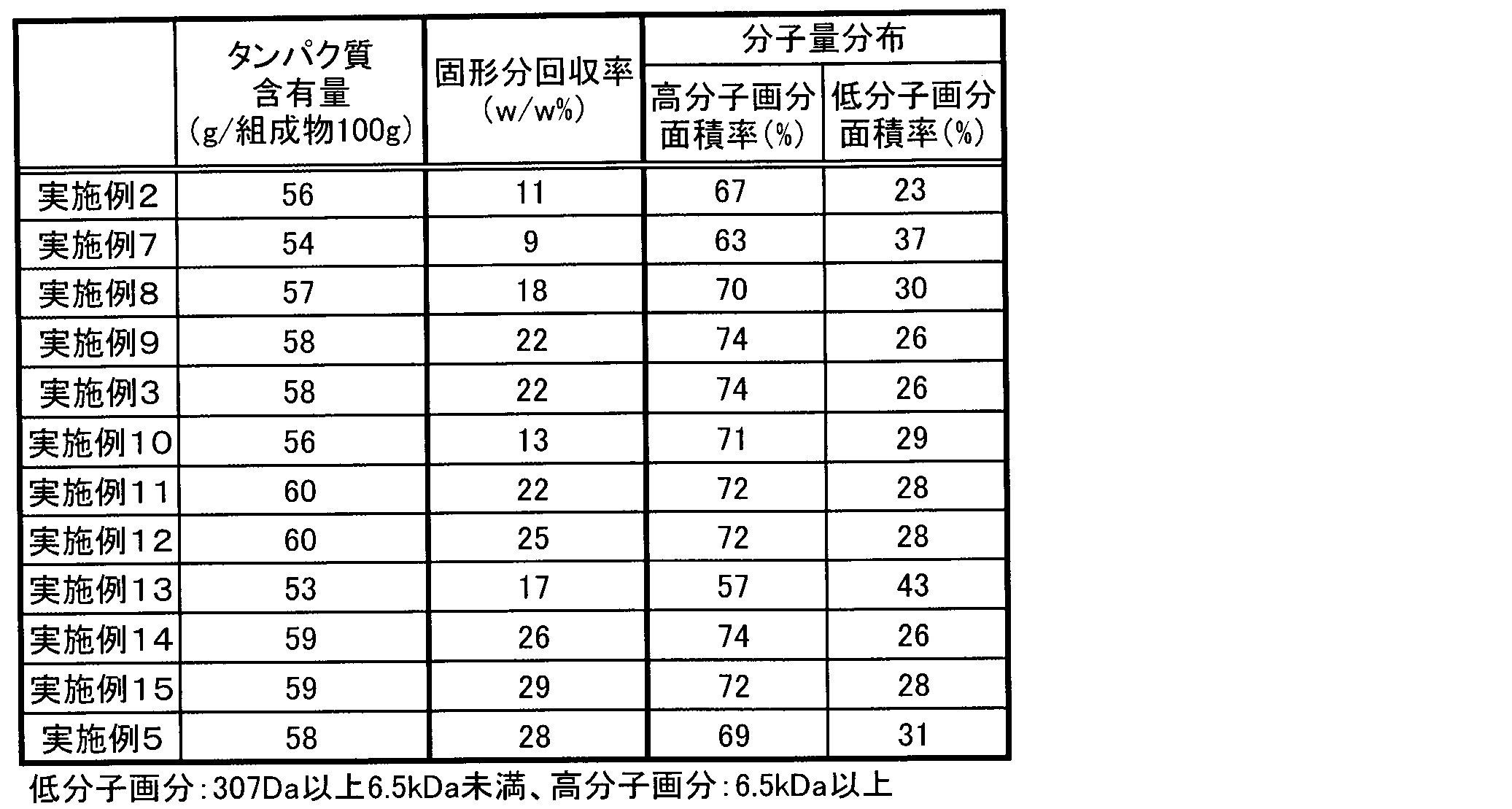
次いで、水酸化ナトリウム水溶液を用いて、1)pH11調整後に50℃で(実施例7)、2)pH11調整後に60℃で(実施例8)、3)pH11調整後に70℃で(実施例9)、または4)pH11.5調整後に50℃で(実施例10)、5)pH11.5調整後に60℃で(実施例11)、6)pH11.5調整後に70℃で(実施例12)、あるいは7)pH12調整後に50℃で(実施例13)、8)pH12調整後に60℃で(実施例14)、9)pH12調整後に70℃で(実施例15)、それぞれ1時間撹拌した後、遠心分離によりタンパク質を含む上清を得た。
さらに、実施例1と同様に、酸性条件下でのタンパク質沈殿化を行い、カカオ豆に由来するタンパク質を含有するタンパク質含有組成物を得た。
以上により得られた組成物のタンパク質含有量、固形分回収率および分子量分布について、表2に示した。
実施例2と同様に、酸性条件下で脱脂し、得られた沈殿に再び水を加えて懸濁液を調製した。
次いで、水酸化ナトリウム水溶液を用いて、1)pH11調整後に50℃で(実施例7)、2)pH11調整後に60℃で(実施例8)、3)pH11調整後に70℃で(実施例9)、または4)pH11.5調整後に50℃で(実施例10)、5)pH11.5調整後に60℃で(実施例11)、6)pH11.5調整後に70℃で(実施例12)、あるいは7)pH12調整後に50℃で(実施例13)、8)pH12調整後に60℃で(実施例14)、9)pH12調整後に70℃で(実施例15)、それぞれ1時間撹拌した後、遠心分離によりタンパク質を含む上清を得た。
さらに、実施例1と同様に、酸性条件下でのタンパク質沈殿化を行い、カカオ豆に由来するタンパク質を含有するタンパク質含有組成物を得た。
以上により得られた組成物のタンパク質含有量、固形分回収率および分子量分布について、表2に示した。
なお、固形分回収率は、以下の方法で算出した(表2)。
固形分回収率(重量%)=凍結乾燥後のタンパク質含有組成物の重量(g)÷原料の重量(g)×100
また、分子量分布は、以下の方法で測定した。
まず、実施例で得た組成物を試料として0.25gを正確に量り取り、水30mLを加えてよく撹拌した。その後、1N水酸化ナトリウム水溶液を加えてpH10.5とし、50℃で30分間撹拌した。さらに、1N塩酸を加えてpH7.0とした後、水を加えて50mlに定容し、試料を0.5%含む溶液を調製した。
試料を0.5%含む上記の溶液に0.1容量%トリフルオロ酢酸水および0.1容量%トリフルオロ酢酸含有アセトニトリルを加え、試料0.1%、アセトニトリル45容量%となるように調製した後、遠心分離(10,000×g)して上清を得た。得られた上清を孔径0.45μmのフィルターでろ過し、試料溶液とした。
上記試料溶液を用い、ゲル浸透クロマトグラフィー(GPC)で分析した。なお、市販の分子量マーカーを基準として、高分子画分(6.5kDa以上)または低分子画分(307Da以上6.5kDa未満)に分け、試験溶液の各画分の面積が全体の面積に占める割合(%)として、表2に示すように、分子量分布を算出した。
<測定条件>
・分析用カラム:東ソー, G4000PWXL,
7.8mm x 300mm(またはこれと同等のもの)
・カラム温度:40℃、検出:UV-Vis 190~600nm
・移動層: 水:アセトニトリル(体積比)=55:45(0.1容量%トリフロオロ酢酸含有)
・移動層流量:0.5mL/分、注入量:0.1%試料溶液10μL
<分子量マーカー(各0.1%終濃度)>
Aprotinin(分子量:6500)
Glutathione(分子量:307)
固形分回収率(重量%)=凍結乾燥後のタンパク質含有組成物の重量(g)÷原料の重量(g)×100
また、分子量分布は、以下の方法で測定した。
まず、実施例で得た組成物を試料として0.25gを正確に量り取り、水30mLを加えてよく撹拌した。その後、1N水酸化ナトリウム水溶液を加えてpH10.5とし、50℃で30分間撹拌した。さらに、1N塩酸を加えてpH7.0とした後、水を加えて50mlに定容し、試料を0.5%含む溶液を調製した。
試料を0.5%含む上記の溶液に0.1容量%トリフルオロ酢酸水および0.1容量%トリフルオロ酢酸含有アセトニトリルを加え、試料0.1%、アセトニトリル45容量%となるように調製した後、遠心分離(10,000×g)して上清を得た。得られた上清を孔径0.45μmのフィルターでろ過し、試料溶液とした。
上記試料溶液を用い、ゲル浸透クロマトグラフィー(GPC)で分析した。なお、市販の分子量マーカーを基準として、高分子画分(6.5kDa以上)または低分子画分(307Da以上6.5kDa未満)に分け、試験溶液の各画分の面積が全体の面積に占める割合(%)として、表2に示すように、分子量分布を算出した。
<測定条件>
・分析用カラム:東ソー, G4000PWXL,
7.8mm x 300mm(またはこれと同等のもの)
・カラム温度:40℃、検出:UV-Vis 190~600nm
・移動層: 水:アセトニトリル(体積比)=55:45(0.1容量%トリフロオロ酢酸含有)
・移動層流量:0.5mL/分、注入量:0.1%試料溶液10μL
<分子量マーカー(各0.1%終濃度)>
Aprotinin(分子量:6500)
Glutathione(分子量:307)
(4)抽出時間
実施例2と同様に、酸性条件下で脱脂し、得られた沈殿に再び水を加えて懸濁液を調製した。
次いで、水酸化ナトリウム水溶液を用いてpH12に調整した後に、70℃で、1)4時間(実施例16)、または2)8時間(実施例17)、それぞれ撹拌した後、遠心分離によりタンパク質を含む上清を得た。
さらに、実施例1と同様に、酸性条件下でのタンパク質の沈殿化を行い、カカオ豆に由来するタンパク質を含有するタンパク質含有組成物を得た。
以上により得られた組成物のタンパク質含有量、固形分回収率および分子量分布について、表3に示した。
実施例2と同様に、酸性条件下で脱脂し、得られた沈殿に再び水を加えて懸濁液を調製した。
次いで、水酸化ナトリウム水溶液を用いてpH12に調整した後に、70℃で、1)4時間(実施例16)、または2)8時間(実施例17)、それぞれ撹拌した後、遠心分離によりタンパク質を含む上清を得た。
さらに、実施例1と同様に、酸性条件下でのタンパク質の沈殿化を行い、カカオ豆に由来するタンパク質を含有するタンパク質含有組成物を得た。
以上により得られた組成物のタンパク質含有量、固形分回収率および分子量分布について、表3に示した。

2.工程(b)の検討について
(1)pH
実施例2と同様に、酸性条件下での脱脂操作、アルカリ性条件下でのタンパク質抽出操作を行った。
次いで、得られた上清をろ過した後、ろ液を氷冷して、液温を4℃に調整し、次いで、塩酸を用いて、1)pH4(実施例18)または2)pH5(実施例19)に調整、もしくは、硫酸を用いて、3)pH2(実施例20)に調整した。
そして、遠心分離により上清を除去し、得られた沈殿を水洗後に凍結乾燥し、カカオ豆に由来するタンパク質を含有するタンパク質含有組成物を得た。
(1)pH
実施例2と同様に、酸性条件下での脱脂操作、アルカリ性条件下でのタンパク質抽出操作を行った。
次いで、得られた上清をろ過した後、ろ液を氷冷して、液温を4℃に調整し、次いで、塩酸を用いて、1)pH4(実施例18)または2)pH5(実施例19)に調整、もしくは、硫酸を用いて、3)pH2(実施例20)に調整した。
そして、遠心分離により上清を除去し、得られた沈殿を水洗後に凍結乾燥し、カカオ豆に由来するタンパク質を含有するタンパク質含有組成物を得た。
(2)酸の種類
実施例2と同様に、酸性条件下での脱脂操作、およびアルカリ性条件下でのタンパク質抽出操作を行った。
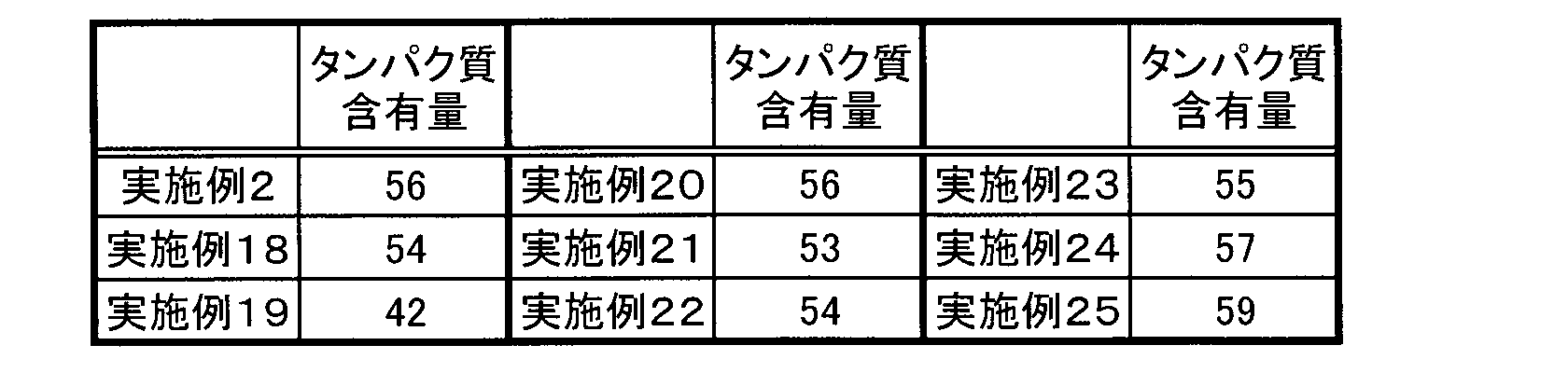
次いで、得られた上清をろ過した後、ろ液を氷冷して、液温を4℃に調整し、次いで、3)硫酸(実施例21)、4)リン酸(実施例22)、5)クエン酸(実施例23)、6)リンゴ酸(実施例24)、または7)酒石酸(実施例25)を用いて、それぞれpH3.5に調整した。そして、遠心分離により上清を除去し、得られた沈殿を水洗後に凍結乾燥し、カカオ豆に由来するタンパク質を含有するタンパク質含有組成物を得た。
以上により得られた組成物のタンパク質の含有量を、表4に示した。
実施例2と同様に、酸性条件下での脱脂操作、およびアルカリ性条件下でのタンパク質抽出操作を行った。
次いで、得られた上清をろ過した後、ろ液を氷冷して、液温を4℃に調整し、次いで、3)硫酸(実施例21)、4)リン酸(実施例22)、5)クエン酸(実施例23)、6)リンゴ酸(実施例24)、または7)酒石酸(実施例25)を用いて、それぞれpH3.5に調整した。そして、遠心分離により上清を除去し、得られた沈殿を水洗後に凍結乾燥し、カカオ豆に由来するタンパク質を含有するタンパク質含有組成物を得た。
以上により得られた組成物のタンパク質の含有量を、表4に示した。
3.工程(c)の検討について
(1)脱脂条件
まず、1)脱脂操作なし(実施例26)については、カカオパウダーに水(液温:50℃)を加えて懸濁液(pH:6)とし、そのまま次のタンパク質抽出操作を行った。また、2)有機溶媒による脱脂(実施例27)については、カカオパウダーに95容量%エタノール水溶液を加えて懸濁液とし、50℃で1時間撹拌し、ろ過により脂肪分を含む上清をろ去した。得られた沈殿に再び95容量%エタノール水溶液を加えて懸濁液を調製し、上記脱脂操作をさらに二度行った。
次いで、実施例2と同様に、アルカリ性条件下でのタンパク質抽出、および酸性条件下でのタンパク質沈殿化を行った。そして、遠心分離により上清を除去し、得られた沈殿を水洗後に凍結乾燥し、カカオ豆に由来するタンパク質を含有するタンパク質含有組成物を得た。
(1)脱脂条件
まず、1)脱脂操作なし(実施例26)については、カカオパウダーに水(液温:50℃)を加えて懸濁液(pH:6)とし、そのまま次のタンパク質抽出操作を行った。また、2)有機溶媒による脱脂(実施例27)については、カカオパウダーに95容量%エタノール水溶液を加えて懸濁液とし、50℃で1時間撹拌し、ろ過により脂肪分を含む上清をろ去した。得られた沈殿に再び95容量%エタノール水溶液を加えて懸濁液を調製し、上記脱脂操作をさらに二度行った。
次いで、実施例2と同様に、アルカリ性条件下でのタンパク質抽出、および酸性条件下でのタンパク質沈殿化を行った。そして、遠心分離により上清を除去し、得られた沈殿を水洗後に凍結乾燥し、カカオ豆に由来するタンパク質を含有するタンパク質含有組成物を得た。
(2)脱脂順序
実施例26と同様に、脱脂操作を行わずにアルカリ性の条件下でのタンパク質の抽出操作、及び、酸性の条件下でのタンパク質の沈殿化を行った後、遠心分離により上清を除去した。
次いで、実施例28では、得られた沈殿に95容量%エタノール水溶液を加えて懸濁液とし、実施例27と同様の脱脂操作を行った。それに対し、実施例29では、得られた沈殿を凍結乾燥した後、95容量%エタノール水溶液を加えて懸濁液とし、実施例27と同様の脱脂操作を行った。
そして、得られた沈殿を乾燥し、カカオ豆に由来するタンパク質を含有するタンパク質含有組成物を得た。
以上により得られた組成物のタンパク質及び脂質含有量を表5に示した。
実施例26と同様に、脱脂操作を行わずにアルカリ性の条件下でのタンパク質の抽出操作、及び、酸性の条件下でのタンパク質の沈殿化を行った後、遠心分離により上清を除去した。
次いで、実施例28では、得られた沈殿に95容量%エタノール水溶液を加えて懸濁液とし、実施例27と同様の脱脂操作を行った。それに対し、実施例29では、得られた沈殿を凍結乾燥した後、95容量%エタノール水溶液を加えて懸濁液とし、実施例27と同様の脱脂操作を行った。
そして、得られた沈殿を乾燥し、カカオ豆に由来するタンパク質を含有するタンパク質含有組成物を得た。
以上により得られた組成物のタンパク質及び脂質含有量を表5に示した。

4.原料の検討について
カカオパウダーから機能性成分を抽出した残渣について、実施例2と同様に、酸性条件下での脱脂操作、アルカリ性の条件下でのタンパク質の抽出、及び、酸性の条件下でのタンパク質の沈殿化を行い、カカオ豆に由来するタンパク質を含有するタンパク質含有組成物を得た(実施例30)。
また、未発酵カカオ豆を用いたカカオマスから機能性成分を抽出した後の残渣について、実施例2と同様に、酸性の条件下での脱脂操作、アルカリ性の条件下でのタンパク質の抽出、及び、酸性の条件下でのタンパク質の沈殿化を行い、カカオ豆に由来するタンパク質を含有するタンパク質含有組成物を得た(実施例31)。
以上により得られた組成物のタンパク質の含有量を表6に示した。
カカオパウダーから機能性成分を抽出した残渣について、実施例2と同様に、酸性条件下での脱脂操作、アルカリ性の条件下でのタンパク質の抽出、及び、酸性の条件下でのタンパク質の沈殿化を行い、カカオ豆に由来するタンパク質を含有するタンパク質含有組成物を得た(実施例30)。
また、未発酵カカオ豆を用いたカカオマスから機能性成分を抽出した後の残渣について、実施例2と同様に、酸性の条件下での脱脂操作、アルカリ性の条件下でのタンパク質の抽出、及び、酸性の条件下でのタンパク質の沈殿化を行い、カカオ豆に由来するタンパク質を含有するタンパク質含有組成物を得た(実施例31)。
以上により得られた組成物のタンパク質の含有量を表6に示した。
5.カフェイン含有量及びテオブロミン含有量について
カフェイン含有量およびテオブロミン含有量は、AOAC Official Methods
of Analysis(1990) 980.14「Theobromine and Caffeine in Cacao Products Liquid Chromatographic Method」に記載の方法を参照し、市販のカフェイン及びテオブロミンを標準品として、実施例で得た組成物の固形分について定量分析を行った。
まず、実施例2、26、27及び31で得た組成物を試料として、遠沈管に正確に量り取り、石油エーテル30mLを加えてよく撹拌した後、遠心分離して上清を捨てた。得られた沈殿、すなわち脱脂された試料を三角フラスコに移し入れ、水を加えて約100mLとした後、100℃の湯浴中で25分間加熱し、直ちに冷却した。そして、2重量%硫酸亜鉛水溶液10mLおよび1.8重量%水酸化バリウム10mLを加えて混合した後、静置し、水を加えて200mLに定容した。再度、100℃の湯浴中で10分間加熱し、加熱後の溶液をろ過し、試料溶液とした。
上記試料溶液を用い、高速液体クロマトグラフで分析した。また、市販のカフェイン及びテオブロミンを用い、同様の処理と分析を行って検量線を作成し、各試験溶液中のカフェイン含有量及びテオブロミン含有量を算出した。結果を表7に示す。
<測定条件>
・分析用カラム:Waters, μ-Bondapak C18, 10μm, 4mmID x 300mm(またはこれと同等のもの)
・移動層: 水:アセトニトリル(体積比)=85:15
・移動層の流量:1.0mL/分、検出:UV 273nm
カフェイン含有量およびテオブロミン含有量は、AOAC Official Methods
of Analysis(1990) 980.14「Theobromine and Caffeine in Cacao Products Liquid Chromatographic Method」に記載の方法を参照し、市販のカフェイン及びテオブロミンを標準品として、実施例で得た組成物の固形分について定量分析を行った。
まず、実施例2、26、27及び31で得た組成物を試料として、遠沈管に正確に量り取り、石油エーテル30mLを加えてよく撹拌した後、遠心分離して上清を捨てた。得られた沈殿、すなわち脱脂された試料を三角フラスコに移し入れ、水を加えて約100mLとした後、100℃の湯浴中で25分間加熱し、直ちに冷却した。そして、2重量%硫酸亜鉛水溶液10mLおよび1.8重量%水酸化バリウム10mLを加えて混合した後、静置し、水を加えて200mLに定容した。再度、100℃の湯浴中で10分間加熱し、加熱後の溶液をろ過し、試料溶液とした。
上記試料溶液を用い、高速液体クロマトグラフで分析した。また、市販のカフェイン及びテオブロミンを用い、同様の処理と分析を行って検量線を作成し、各試験溶液中のカフェイン含有量及びテオブロミン含有量を算出した。結果を表7に示す。
<測定条件>
・分析用カラム:Waters, μ-Bondapak C18, 10μm, 4mmID x 300mm(またはこれと同等のもの)
・移動層: 水:アセトニトリル(体積比)=85:15
・移動層の流量:1.0mL/分、検出:UV 273nm

6.総ポリフェノール含有量について
総ポリフェノール含有量は、プルシアンブルー法によって測定した。Martin
L. Price and Larry G. Butler, J. Agric Food Chem., Vol. 25 No.6, 1268-1273 (1977)に記載の方法を参照し、市販のエピカテキンを標準品として、実施例2及び26で得た組成物の固形分について定量分析を行った。
まず、得られた組成物をn-ヘキサンで処理して脱脂した後、50重量%メタノール水溶液を用いて抽出し、試験溶液とした。次いで、蒸留水50mLに各試験溶液100μLを添加し、撹拌しながら0.1M硫酸鉄(III)アンモニウム-0.1N塩酸溶液3mLを加え、その20分後に8mMヘキサシアノ鉄(III)カリウム水溶液3mLを加え、さらに20分後に720nmの吸光度を測定した。
また、蒸留水50mLに各サンプル液の溶媒(50重量%メタノール)100μLを加えたもの、及び、市販の(-)-エピカテキンのメタノール溶液を用い、同様の処理を行って検量線を作成し、各試験溶液中の総ポリフェノール含有量を算出した。結果を表8に示す。
総ポリフェノール含有量は、プルシアンブルー法によって測定した。Martin
L. Price and Larry G. Butler, J. Agric Food Chem., Vol. 25 No.6, 1268-1273 (1977)に記載の方法を参照し、市販のエピカテキンを標準品として、実施例2及び26で得た組成物の固形分について定量分析を行った。
まず、得られた組成物をn-ヘキサンで処理して脱脂した後、50重量%メタノール水溶液を用いて抽出し、試験溶液とした。次いで、蒸留水50mLに各試験溶液100μLを添加し、撹拌しながら0.1M硫酸鉄(III)アンモニウム-0.1N塩酸溶液3mLを加え、その20分後に8mMヘキサシアノ鉄(III)カリウム水溶液3mLを加え、さらに20分後に720nmの吸光度を測定した。
また、蒸留水50mLに各サンプル液の溶媒(50重量%メタノール)100μLを加えたもの、及び、市販の(-)-エピカテキンのメタノール溶液を用い、同様の処理を行って検量線を作成し、各試験溶液中の総ポリフェノール含有量を算出した。結果を表8に示す。

<試験例>
1.マウスでの評価(便通の改善効果の確認)
6週令のBALB/c系雌性マウス(各群6匹)に水及び食餌を自由摂取させて14日間飼育した。コントロール群には標準飼料(AIN93G準拠、セルロース不含有、コーンスターチ5重量%添加)を、タンパク質含有組成物添加群には、標準飼料に実施例2で得たタンパク質含有組成物を5重量%添加(コーンスターチ代替)した餌を、それぞれ摂取させた。
そして、飼育初日(0日目)、7日目、14日目にマウスの体重(g)を測定した。また、飼育6~7日、13~14日にかけての摂餌量(g/匹/day)を測定した。さらに、飼育9~11日目(3日間)の糞便を採取し、凍結乾燥して糞便量(g/匹/day)を測定した。
以上により得られた値について、表9に示した。
1.マウスでの評価(便通の改善効果の確認)
6週令のBALB/c系雌性マウス(各群6匹)に水及び食餌を自由摂取させて14日間飼育した。コントロール群には標準飼料(AIN93G準拠、セルロース不含有、コーンスターチ5重量%添加)を、タンパク質含有組成物添加群には、標準飼料に実施例2で得たタンパク質含有組成物を5重量%添加(コーンスターチ代替)した餌を、それぞれ摂取させた。
そして、飼育初日(0日目)、7日目、14日目にマウスの体重(g)を測定した。また、飼育6~7日、13~14日にかけての摂餌量(g/匹/day)を測定した。さらに、飼育9~11日目(3日間)の糞便を採取し、凍結乾燥して糞便量(g/匹/day)を測定した。
以上により得られた値について、表9に示した。

表9中、コントロール群と比較して、タンパク質含有組成物添加群では、平均体重及び摂餌量の増大または減少は見られなかったが、糞便量は約3倍に増加した。
2.得られたタンパク質含有組成物の評価
実施例2及び実施例26で得られたタンパク質含有組成物は、いずれもカカオパウダーに比べて、より黒味がかった茶褐色の流動性粉末であった。
これらを試食して評価したところ(表10)、カカオパウダーで感じられるカカオの香ばしさが感じられず、それ以外の香りも感じられなかった。また、カカオパウダーで感じられるカカオの苦味および収斂味(持続する渋み)も感じられず、それ以外の味(甘味・酸味・塩味・うま味等)も感じられなかった。
実施例2及び実施例26で得られたタンパク質含有組成物は、いずれもカカオパウダーに比べて、より黒味がかった茶褐色の流動性粉末であった。
これらを試食して評価したところ(表10)、カカオパウダーで感じられるカカオの香ばしさが感じられず、それ以外の香りも感じられなかった。また、カカオパウダーで感じられるカカオの苦味および収斂味(持続する渋み)も感じられず、それ以外の味(甘味・酸味・塩味・うま味等)も感じられなかった。

以上により、カカオ豆に由来する脂肪分、カフェイン、テオブロミン及びポリフェノール類をほとんど含まずに、カカオ豆に由来するタンパク質の含有率を高めた組成物、及びその製造方法を確立することができた。また、このタンパク質含有組成物の製造方法によれば、抗酸化物質等の機能性成分を抽出した後のカカオ豆由来残渣を有効利用することも可能であった。
また、本発明の組成物による便通の改善の効果も確認することができた。
また、本発明の組成物による便通の改善の効果も確認することができた。
Claims (11)
- カカオ豆に由来するタンパク質を、固形分中の重量割合で42~70%含有する、タンパク質含有組成物。
- 請求項1に記載のタンパク質含有組成物の製造方法であって、
(a)カカオ豆に由来するタンパク質を含有する原料から、アルカリ性の条件下でタンパク質を抽出し、タンパク質を含有する抽出液を得る抽出工程と、
(b)工程(a)で得た上記抽出液から、酸性の条件下でタンパク質を沈殿させ、上記タンパク質含有組成物を得る沈殿工程、
を含むタンパク質含有組成物の製造方法。 - 工程(a)が、pH8~13及び20~100℃の条件下で行なわれる請求項2に記載のタンパク質含有組成物の製造方法。
- 工程(a)が、pH10~12及び50~100℃の条件下で行なわれる請求項3に記載のタンパク質含有組成物の製造方法。
- 工程(b)が、pH2~6及び0~40℃の条件下で行なわれる請求項2~4のいずれか1項に記載のタンパク質含有組成物の製造方法。
- 工程(b)が、pH2~5及び0~20℃の条件下で行なわれる請求項5に記載のタンパク質含有組成物の製造方法。
- 工程(a)の前、及び/又は、工程(b)の後に、
(c)カカオ豆に由来する脂肪分を除去する脱脂工程、
を含む請求項2~6のいずれか1項に記載のタンパク質含有組成物の製造方法。 - 工程(c)が、pH2~7及び30~90℃の条件下で、水を用いて行なわれる請求項7に記載のタンパク質含有組成物の製造方法。
- 工程(c)が、エタノール、エタノール水溶液、ジエチルエーテル及びヘキサンからなる群より選ばれる1種以上の有機溶媒を用いて行なわれる請求項7又は8に記載のタンパク質含有組成物の製造方法。
- 請求項2~9のいずれか1項に記載のタンパク質含有組成物の製造方法によって得られるタンパク質含有組成物。
- 請求項1又は10に記載のタンパク質含有組成物を含む、便通の改善剤。
Priority Applications (2)
| Application Number | Priority Date | Filing Date | Title |
|---|---|---|---|
| JP2013507798A JP5626817B2 (ja) | 2011-03-31 | 2012-03-30 | 便通の改善剤及びその製造方法 |
| SG2013073077A SG194004A1 (en) | 2011-03-31 | 2012-03-30 | Protein-containing composition and method for producing same |
Applications Claiming Priority (2)
| Application Number | Priority Date | Filing Date | Title |
|---|---|---|---|
| JP2011080743 | 2011-03-31 | ||
| JP2011-080743 | 2011-03-31 |
Publications (1)
| Publication Number | Publication Date |
|---|---|
| WO2012133792A1 true WO2012133792A1 (ja) | 2012-10-04 |
Family
ID=46931487
Family Applications (1)
| Application Number | Title | Priority Date | Filing Date |
|---|---|---|---|
| PCT/JP2012/058616 Ceased WO2012133792A1 (ja) | 2011-03-31 | 2012-03-30 | タンパク質含有組成物及びその製造方法 |
Country Status (4)
| Country | Link |
|---|---|
| JP (1) | JP5626817B2 (ja) |
| MY (1) | MY161128A (ja) |
| SG (1) | SG194004A1 (ja) |
| WO (1) | WO2012133792A1 (ja) |
Cited By (2)
| Publication number | Priority date | Publication date | Assignee | Title |
|---|---|---|---|---|
| CN115590108A (zh) * | 2022-01-14 | 2023-01-13 | 河套学院(Cn) | 一种降血脂葵花籽蛋白的提取工艺及其应用 |
| JP2023054707A (ja) * | 2021-10-04 | 2023-04-14 | オカヤス株式会社 | モモ蛋白質含有組成物の製造方法 |
Families Citing this family (1)
| Publication number | Priority date | Publication date | Assignee | Title |
|---|---|---|---|---|
| JP7467804B2 (ja) * | 2016-09-21 | 2024-04-16 | 株式会社明治 | 腸内菌叢改善用組成物 |
Citations (1)
| Publication number | Priority date | Publication date | Assignee | Title |
|---|---|---|---|---|
| JP2000204044A (ja) * | 1998-11-12 | 2000-07-25 | Kuriniko:Kk | 便通、便の性状及び便臭改善剤、経腸栄養食品、便臭改善効果を有する飲食品及び飼料 |
-
2012
- 2012-03-30 JP JP2013507798A patent/JP5626817B2/ja active Active
- 2012-03-30 WO PCT/JP2012/058616 patent/WO2012133792A1/ja not_active Ceased
- 2012-03-30 SG SG2013073077A patent/SG194004A1/en unknown
- 2012-03-30 MY MYPI2013003542A patent/MY161128A/en unknown
Patent Citations (1)
| Publication number | Priority date | Publication date | Assignee | Title |
|---|---|---|---|---|
| JP2000204044A (ja) * | 1998-11-12 | 2000-07-25 | Kuriniko:Kk | 便通、便の性状及び便臭改善剤、経腸栄養食品、便臭改善効果を有する飲食品及び飼料 |
Non-Patent Citations (5)
| Title |
|---|
| ABECIA-SORIA L. ET AL.: "Soluble albumin and biological value of protein in cocoa (Theobroma cacao L.) beans as a function of roasting time.", J. FOOD SCI., vol. 70, no. 4, 2005, pages S294 - S298 * |
| TIMBIE D.J. ET AL.: "Comparison of several types of cocoa beans relative to fractionated protein components.", J. AGRIC. FOOD CHEM., vol. 28, no. 2, 1980, pages 472 - 474 * |
| TIMBIE D.J. ET AL.: "Extraction, fractionation, and amino acid composition of brazilian comun cacao proteins.", J. AGRIC. FOOD CHEM., vol. 25, no. 2, 1977, pages 424 - 426 * |
| VOIGT J. ET AL.: "The major seed proteins of Theobroma cacao", L. FOOD CHEM., vol. 47, no. 2, 1993, pages 145 - 151 * |
| ZAK D.L. ET AL.: "Extraction and fractionation of cocoa proteins as applied to several varieties of cocoa beans.", J. AGRIC. FOOD CHEM., vol. 24, no. 3, 1976, pages 479 - 483 * |
Cited By (3)
| Publication number | Priority date | Publication date | Assignee | Title |
|---|---|---|---|---|
| JP2023054707A (ja) * | 2021-10-04 | 2023-04-14 | オカヤス株式会社 | モモ蛋白質含有組成物の製造方法 |
| JP7828737B2 (ja) | 2021-10-04 | 2026-03-12 | オカヤス株式会社 | モモ蛋白質含有組成物の製造方法 |
| CN115590108A (zh) * | 2022-01-14 | 2023-01-13 | 河套学院(Cn) | 一种降血脂葵花籽蛋白的提取工艺及其应用 |
Also Published As
| Publication number | Publication date |
|---|---|
| MY161128A (en) | 2017-04-14 |
| SG194004A1 (en) | 2013-11-29 |
| JP5626817B2 (ja) | 2014-11-19 |
| JPWO2012133792A1 (ja) | 2014-07-28 |
Similar Documents
| Publication | Publication Date | Title |
|---|---|---|
| EP2578089B1 (en) | Fat-reduced soybean protein material and processes for production thereof | |
| JP5441232B2 (ja) | メイラード反応阻害剤 | |
| JP2010077123A (ja) | メイラード反応阻害剤 | |
| WO2015163062A1 (ja) | 糖尿病予防または改善剤 | |
| TWI278285B (en) | Water-soluble bean-based extracts | |
| JP5626817B2 (ja) | 便通の改善剤及びその製造方法 | |
| JP4224361B2 (ja) | 茶風味増強剤 | |
| JPH11308978A (ja) | 高コレステロール血症予防飲食品 | |
| JP6552097B2 (ja) | 飲食品の苦味改善剤、飲食品の苦味改善方法、及び飲食用組成物 | |
| WO2011105042A1 (ja) | 消臭組成物 | |
| US9408812B2 (en) | Coenzyme Q10-containing composition for oral ingestion | |
| CN105996023A (zh) | 水溶性油棕叶粉末和浓缩物的制造方法 | |
| KR100539419B1 (ko) | 카시아 미모소이데스 엘. 변종 노마메 마키노 유래의 향미가 개선된 추출물 및 그 제조방법 | |
| KR20180047091A (ko) | 그라비올라, 핑거루트, 후코이단, 히비스커스, 노니, 및 모링가 추출 혼합 분말 제조 방법 | |
| JP2001149038A (ja) | サラシア食品素材およびその製造方法、およびその食品素材を含有する食品。 | |
| JPH11137211A (ja) | 風味の改良されたギムネマシルベスタエキスおよびそ の製造法 | |
| JP5550168B2 (ja) | 経口摂取用組成物 | |
| JP2025107766A (ja) | 経口用組成物およびコラーゲン臭マスキング剤 | |
| JP2004283112A (ja) | ハトムギ若葉含有健康食品 | |
| AU2005220186B2 (en) | Water soluble bean-based extracts | |
| JP6829550B2 (ja) | 抗肥満食品及びカロブパウダーの使用方法 | |
| JP2023014930A (ja) | 呈味改善用組成物、呈味改善方法、フコースの使用、及びポリフェノール及びフコースを含有する組成物 | |
| JPWO2009005115A1 (ja) | 脂肪細胞の小型化促進用組成物 | |
| JP2013070646A (ja) | カカオ原料の処理方法 | |
| JP2007145802A (ja) | リパーゼ阻害剤及びそれを用いた飲食品 |
Legal Events
| Date | Code | Title | Description |
|---|---|---|---|
| 121 | Ep: the epo has been informed by wipo that ep was designated in this application |
Ref document number: 12765197 Country of ref document: EP Kind code of ref document: A1 |
|
| ENP | Entry into the national phase |
Ref document number: 2013507798 Country of ref document: JP Kind code of ref document: A |
|
| NENP | Non-entry into the national phase |
Ref country code: DE |
|
| 122 | Ep: pct application non-entry in european phase |
Ref document number: 12765197 Country of ref document: EP Kind code of ref document: A1 |