WO2012132518A1 - 吸収性物品の包装体 - Google Patents
吸収性物品の包装体 Download PDFInfo
- Publication number
- WO2012132518A1 WO2012132518A1 PCT/JP2012/051431 JP2012051431W WO2012132518A1 WO 2012132518 A1 WO2012132518 A1 WO 2012132518A1 JP 2012051431 W JP2012051431 W JP 2012051431W WO 2012132518 A1 WO2012132518 A1 WO 2012132518A1
- Authority
- WO
- WIPO (PCT)
- Prior art keywords
- absorbent article
- sheet
- packaging sheet
- cut line
- line portion
- Prior art date
- Legal status (The legal status is an assumption and is not a legal conclusion. Google has not performed a legal analysis and makes no representation as to the accuracy of the status listed.)
- Ceased
Links
Images




Classifications
-
- A—HUMAN NECESSITIES
- A61—MEDICAL OR VETERINARY SCIENCE; HYGIENE
- A61F—FILTERS IMPLANTABLE INTO BLOOD VESSELS; PROSTHESES; DEVICES PROVIDING PATENCY TO, OR PREVENTING COLLAPSING OF, TUBULAR STRUCTURES OF THE BODY, e.g. STENTS; ORTHOPAEDIC, NURSING OR CONTRACEPTIVE DEVICES; FOMENTATION; TREATMENT OR PROTECTION OF EYES OR EARS; BANDAGES, DRESSINGS OR ABSORBENT PADS; FIRST-AID KITS
- A61F13/00—Bandages or dressings; Absorbent pads
- A61F13/15—Absorbent pads, e.g. sanitary towels, swabs or tampons for external or internal application to the body; Supporting or fastening means therefor; Tampon applicators
- A61F13/551—Packaging before or after use
- A61F13/5513—Packaging before or after use packaging of feminine sanitary napkins
- A61F13/55135—Packaging before or after use packaging of feminine sanitary napkins before use
- A61F13/5514—Packaging before or after use packaging of feminine sanitary napkins before use each item packaged single
Definitions
- the present invention relates to an absorbent article package in which absorbent articles are individually packaged.
- Patent Document 1 discloses a sanitary napkin as an absorbent article having a liquid-permeable top sheet, a liquid-impermeable back sheet, and an absorbent body disposed between the top sheet and the back sheet.
- An absorbent article package in which sanitary napkins are individually packaged is described by folding both sides in the width direction inward in a state of being arranged on the packaging sheet, and then folding the both sides in the longitudinal direction and fastening them. Yes.
- the sanitary napkin is adhered to the packaging sheet via an adhesive provided on the clothing surface side of the back sheet. Cutouts are formed at the four corners of the packaging sheet.
- the longitudinal ends of the sanitary napkin are configured to be visible from the outside of the packaging sheet through the notches. Therefore, the sanitary napkin and the packaging sheet are removed by pulling the longitudinal end of the sanitary napkin away from the packaging sheet in a state where both sides of the sanitary napkin are folded inward. Once separated, the sanitary napkin can be withdrawn from the packaging sheet.
- the absorbent article package described above has the following problems. Both sides in the width direction of the sanitary napkin are folded inward from two folds along the longitudinal direction. When the sanitary napkin is pulled in the direction away from the packaging sheet via the longitudinal end, the region between the two folds of the sanitary napkin is pulled in the direction away from the packaging sheet. The region on the outer side in the width direction from the fold line is pulled toward the side of the packaging sheet folded inward. Therefore, in the region outside the two folds in the width direction, when the sanitary napkin is pulled out from the packaging sheet, the sanitary napkin may be bent without being properly separated from the packaging sheet. is there.
- the wing part is arranged on the outer side in the width direction of the sanitary napkin. Since the wing portion does not have an absorber, its rigidity is relatively low, and it is easy to bend when the sanitary napkin is pulled out from the packaging sheet. Moreover, the adhesive agent is attached
- this invention is made
- an absorbent article package as an exemplary aspect of the present invention includes a liquid-permeable surface sheet (surface sheet 10) and a liquid-impermeable sheet.
- Absorbent article (absorbent article 1) including a back sheet (back sheet 20) and an absorbent main body having an absorbent body (absorbent body 30) disposed between the top sheet and the back sheet, and the absorption A packaging sheet (packaging sheet 70) for individually packaging the absorbent article, and the absorbent sheet is disposed on the back surface of the packaging sheet, the packaging sheet and the absorbent article being the absorbent.
- An absorbent article package in which a first longitudinal fold and a second longitudinal fold along the longitudinal direction of the article are folded from the outside to the inside of the absorbent article and the absorbent article is packaged.
- the back of the product Is provided with an adhesive region (adhesive region 50) to which an adhesive is applied on the clothing surface side, and the packaging sheet has a tear line portion (first tear line) configured to be separable from the packaging sheet.
- Part 81, second cut line part 82) are formed along the longitudinal direction, and in the viewpoint from the back sheet side on a straight line perpendicular to the back sheet of the absorbent article, the cut line part
- the gist is that the adhesive regions are arranged on both sides in the width direction.
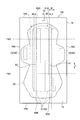
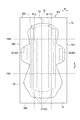
- FIG. 1 is a plan view of a package for absorbent articles
- FIG. 2 is a rear view of the package for absorbent articles.
- the package 100 of an absorbent article has the absorbent article 1 and the packaging sheet 70 which wraps this absorbent article 1 separately.
- the absorbent article 1 according to the present embodiment is, for example, a sanitary napkin.
- the package 100 of the absorbent article is such that the absorbent article 1 is individually wrapped by folding the packaging sheet 70 and the absorbent article 1 in a state where the absorbent article 1 is disposed on the packaging sheet 70. It is configured. 1 and 2 show a state in which the absorbent article 1 is opened after individually packaging the absorbent article 1 with the packaging sheet 70.
- the absorbent article 1 includes a top sheet 10 that comes into contact with the wearer's skin, a liquid-impermeable back sheet 20 that does not transmit liquid, and an absorber 30.
- the absorber 30 is disposed between the top sheet 10 and the back sheet 20. Therefore, the absorber 30 is shown with a broken line in FIG.
- the absorbent body 30 is disposed at the central portion in the longitudinal direction L and the width direction W of the absorbent article 1.
- the absorbent article 1 has an absorbent body 30 in a plan view shown in FIG. 1 and extends in the longitudinal direction L, and on the outside of the absorbent body in the width direction W perpendicular to the longitudinal direction L. Wings 43 and 44 are provided.
- the absorbent article 1 includes side sheets 41 and 42 provided outside the absorber 30 in the width direction W.
- the top sheet 10 is a liquid-permeable sheet that transmits liquid such as body fluid.
- the top sheet 10 covers at least the surface of the absorber 30.
- the top sheet 10 is not particularly limited as long as it is a sheet-like material having a structure that allows liquid to permeate, such as a nonwoven fabric, a woven fabric, a perforated plastic sheet, and a mesh sheet. Either natural fibers or chemical fibers can be used as the woven or non-woven material.
- thermoplastic hydrophobic chemical fibers examples include single fibers such as polyethylene (PE), polypropylene (PP), and polyethylene terephthalate (PET), fibers formed by graft polymerization of polyethylene and polypropylene, and composite fibers such as a core-sheath structure. Can be mentioned.
- the surface sheet 10 according to the present embodiment is made of a nonwoven fabric.
- the nonwoven fabric is formed by any one of a dry method (a card method, a spunbond method, a melt blown method, an airlaid method, etc.) and a wet method.
- the nonwoven fabric may be formed by combining a plurality of methods among a dry method and a wet method. Examples of the method include thermal bonding, needle punching, and chemical bonding.
- the method of manufacturing a nonwoven fabric is not limited to the above-mentioned method.
- the spunlace formed in the sheet form by the hydroentanglement method can also be used as the top sheet.
- corrugation in the upper layer side or the nonwoven fabric which provided the fabric weight unevenness by applying air at the time of web formation.
- corrugation in the upper layer side or the nonwoven fabric which provided the fabric weight unevenness by applying air at the time of web formation.
- the back sheet 20 has substantially the same length as the top sheet 10.
- the back sheet 20 may be a film mainly composed of polyethylene, polypropylene, or the like, a breathable resin film, a sheet obtained by bonding a breathable resin film to a nonwoven fabric such as spunbond or spunlace.
- the back sheet 20 is preferably made of a material having flexibility that does not cause a sense of incongruity when worn.
- the absorber 30 includes hydrophilic fibers and pulp.
- hydrophilic fibers include pulverized pulp, cellulose such as cotton, regenerated cellulose such as rayon and fibril rayon, semi-synthetic cellulose such as acetate and triacetate, particulate polymer, fibrous polymer, thermoplastic hydrophobic chemical fiber, or A thermoplastic hydrophobic chemical fiber or the like subjected to hydrophilic treatment can be used alone or in combination.
- the polymer absorber is a granular polymer such as a sodium acrylate copolymer having absorbency and hygroscopicity.
- the absorbent body may be an air laid sheet obtained by forming hydrophilic fibers or powder into a sheet by the air laid method.
- the side sheets 41 and 42 can be selected from the same material as the top sheet 10. However, in order to prevent menstrual blood from flowing over the side sheets 41 and 42 to the outside of the absorbent article 1, it is preferable to have hydrophobicity or water repellency. Specifically, a spunbond nonwoven fabric, an SMS nonwoven fabric, etc. are mentioned. The side sheet constitutes a contact surface with the skin. For this reason, it is preferable to use an air-through non-woven fabric in order to reduce rubbing irritation to the skin.
- the side sheets 41 and 42 are disposed on both sides of the top sheet 10.
- the side sheets 41 and 42 cover a part of the side edge of the absorber 30 and the wing parts 43 and 44.
- the periphery of the surface sheet 10, the side sheets 41 and 42, and the back sheet 20 is joined, and the absorber 30 is enclosed.
- any one or a combination of heat embossing, ultrasonic waves, or hot melt adhesive can be used.
- a plurality of adhesive regions 50 to which an adhesive is applied are provided on the surface in contact with the shorts (see FIG. 2).
- the adhesive region 50 is formed on the non-skin contact surface of the back sheet 20 after applying an adhesive on the non-skin contact surface of the back sheet 20 or after applying the adhesive to the packaging sheet 70 that has been peeled off from the entire surface. It is formed by transferring.
- the adhesion region 50 has a stripe shape extending in the longitudinal direction L. The intervals in the width direction of the plurality of bonding regions are substantially equal.
- region 50 is regularly scattered and arrange
- the adhesion region 50 has a main body adhesion region 51 that is substantially the same length as the absorber in the longitudinal direction, and a wing adhesion region 52 that is disposed on the back side of the wing portions 43 and 44.
- the adhesive region 50 is in contact with the packaging sheet 70, and the packaging sheet 70 prevents the adhesive from deteriorating before use.
- the packaging sheet 70 is peeled by the wearer at the time of use.
- the adhesive surface having tackiness is opened.
- a release sheet may be provided between the packaging sheet 70 and the absorbent article 1 to prevent the adhesive from being deteriorated by the release sheet before use.
- a styrene block polymer is used as a thermoplastic polymer, a natural resin or a synthetic resin is used as a tackifier resin, and a paraffin oil is used as a plastic material.
- the styrenic block polymer include styrene-ethylene-butadiene-styrene block copolymer (SEBS), styrene-butadiene-styrene block copolymer (SBS), styrene-isoprene-styrene block copolymer (SIS), and styrene.
- Synthetic resins include aliphatic (C5) petroleum resins, aromatic (C9) petroleum resins, copolymerized petroleum resins, hydrogenated petroleum resins, DCPD petroleum resins, pure monomer petroleum resins, and the like.
- natural resins include terpene resins that are copolymers of ⁇ -pinene, ⁇ -pinene, or dipentene, rosin resins that are gum rosin, tall oil rosin, or wood rosin, or hydrogenated products or esters thereof.
- the plastic material include a paraffin oil system that lowers viscosity, a naphthenic oil that increases tackiness, and an aroma oil that lowers cohesion and imparts color and odor.
- the application basis weight of the adhesive is 10 to 100 g / m 2 , preferably 20 to 50 g / m 2 .
- the application basis weight of the adhesive is 10 g / m 2 or less, the adhesive strength when the absorbent article is attached to the underwear is small, and the absorbent article may drop or the absorbent article may be displaced during use.
- the application basis weight of the adhesive is 100 g / m 2 or more, when the absorbent article is peeled from the underwear, the adhesive article may be too high and the absorbent article may be torn and the underwear may become dirty.
- the top sheet 10 is provided with a plurality of compressed grooves (not shown).
- the pressing groove is configured by pressing the surface sheet 10 to the absorber 30 in the thickness direction.
- the squeezing groove is squeezed by embossing.
- the pressing groove may not be formed.
- the packaging sheet 70 wraps the absorbent article 1 individually.
- the packaging sheet 70 is a back surface 71 which is a facing surface facing the absorbent article 1 on the back sheet 20 side of the absorbent article 1 and a non-facing surface facing the absorbent article 1, and contains the absorbent article 1. And a surface 72 located outside in the state.
- the packaging sheet 70 may be subjected to surface processing such as round dot embossing or satin embossing on the surface of the packaging sheet 70 for the purpose of improving the texture or the like.
- the surface processing is performed during normal sheet formation.
- the material of the packaging sheet 70 is not particularly limited.
- a plastic film such as polyethylene, polypropylene, or polyester, various films such as a nylon film, a breathable film stretched with a filler such as barium sulfate, or a nonwoven fabric.
- stacked are mentioned.
- the basis weight of the packaging sheet 70 is 10 to 50 g / m 2 , preferably 12 to 30 g / m 2 .
- the packaging sheet 70 may be printed partially or entirely.
- the back surface of the packaging sheet 70 is subjected to a treatment that makes it possible to peel without reducing the adhesive strength of the adhesive.
- a processing method that allows the adhesive to be peeled off a method of applying a release treatment agent to the entire surface of the packaging sheet 70 that is the processing surface, heating and drying, or the entire back surface of the packaging sheet 70 that is the processing surface by spraying
- the release treatment agent include silicone resins, fluorine resins, octadecyl isocyanate resins and the like.
- the packaging sheet 70 is formed with two first cut line portions 81 and second cut line portions 82 along the longitudinal direction.
- the first cut line portion 81 and the second cut line portion 82 are perforated.
- the packaging sheet 70 is configured to be separable into a plurality through the first cut line portion 81 and the second cut line portion 82.
- the 1st cut line part 81 and the 2nd cut line part 82 are arrange
- the main body adhesion region 51 is disposed between the first cut line part 81 and the second cut line part 82,
- the main body bonding region 51 and the wing bonding region 52 are arranged outside the first cut line portion 81 in the width direction, and the main body bonding region 51 and the wing bonding region 52 are arranged outside the second cut line portion 82 in the width direction. Is arranged.
- the front end 81 ⁇ / b> A of the first cut line portion 81 and the front end 82 ⁇ / b> A of the second cut line portion 82 that are located on the front side of the absorbent article 1 reach the end portion in the longitudinal direction L of the packaging sheet 70. Further, the rear end 81B of the first cut line portion 81 located on the rear side of the absorbent article 1 reaches the rear end 70B of the packaging sheet 70 located on the rear side of the absorbent article 1. On the other hand, the rear end 82B of the second cut line portion 82 located on the rear side of the absorbent article 1 does not reach the rear end 70B of the packaging sheet 70 and is longer in the longitudinal direction than the rear end 70B of the packaging sheet 70 ( Terminate at the center side).
- the packaging sheet 70 is not parted in the whole longitudinal direction via the 2nd cut line part 82.
- FIG. When the packaging sheet 70 is divided into a plurality of parts, handling when the packaging sheet 70 is discarded becomes complicated, or the used absorbent article 1 cannot be wrapped with the packaging sheet 70.
- the packaging sheet 70 can be prevented from being divided. It is possible to prevent the number of packaging sheets 70 from becoming three, to reduce the amount of dust, and to facilitate handling when discarded.
- the rear end of the second cut line portion is configured to terminate in the longitudinal direction inner side than the end portion in the longitudinal direction of the packaging sheet, but at least the first cut line portion and the first cut line portion
- the first cut line portion 81 and the second cut line portion only have to be terminated at the end in the longitudinal direction with respect to the end in the longitudinal direction of the packaging sheet. You may comprise so that both the edge parts of 82 may terminate in a longitudinal direction inner side rather than the edge part in the longitudinal direction of a packaging sheet.
- the absorbent article 1 and the packaging sheet 70 are folded at a predetermined folding position along the width direction W and the longitudinal direction L with the surface sheet 10 of the absorbent article 1 inside.
- the packaging sheet 70 is folded via two longitudinal folds FL1 and FL2 along the longitudinal direction L, and is folded via width folds FW1 and FW2 along the width direction W.
- the longitudinal fold and the width fold are indicated by a one-dot chain line in FIGS.
- one end portion in the longitudinal direction L of the packaging sheet 70 is adhered to the packaging sheet 70.
- the edge part of the packaging sheet 70 is stuck to a part of the packaging sheet 70 by the adhesive tape 75.
- the adhesive tape 75 is disposed between the first cut line portion 81 and the second cut line portion 82 in the width direction, and is disposed across the front end 70A of the packaging sheet 70 located on the front side of the absorbent article 1. ing. By grasping the adhesive tape 75 arranged in this way and pulling the adhesive tape 75 toward the rear side of the absorbent article 1, the front end 70 ⁇ / b> A of the packaging sheet 70 is pulled together with the adhesive tape 75.
- the packaging sheet 70 is separated via the first cut line portion 81 and the second cut line portion 82 formed on the outer side in the width direction.
- the adhesive tape 75 has a function of securely storing an unused napkin in a packaging sheet, and the adhesive tape 75 is bonded to the packaging sheet 70, so that the packaging body is in an unopened state. And a function of sealing the packaging sheet 70 so that the packaging sheet 70 does not open when the used absorbent article is wrapped by the packaging sheet 70 after the absorbent article is taken out.
- the material for forming the adhesive tape 75 is a single layer film such as a polypropylene film or a polyethylene film, or a multilayer film in which a plurality of types of resin films are laminated.
- a pressure sensitive adhesive layer is formed on one side of the adhesive tape 75.
- the pressure-sensitive adhesive layer is formed of the same material and the same application amount (the same thickness and the same basis weight) in the entire length of the pressure-sensitive adhesive tape 75.
- the pressure-sensitive adhesive layer is a rubber-based or polyester-based elastomer, a hot-melt adhesive mainly composed of a thermosetting resin, or the like.
- the thickness of the substrate is 10 to 100 ⁇ m, preferably 40 to 60 ⁇ m.
- FIG. 3 is a perspective view schematically showing a folding process of the package 100 of absorbent articles.
- the folding process of the absorbent article packaging body 100 includes an absorbent article placing process, a first folding process, a second folding process, a joining process, and a third folding process.
- the absorbent article 1 is placed on the packaging sheet 70.
- the packaging sheet 70 and the back sheet 20 of the absorbent article 1 face each other.
- interval is provided on the packaging sheet continuous along a conveyance direction.
- a folding method will be described using a package of absorbent articles for packaging one absorbent article.
- the packaging sheet 70 and the absorbent article 1 are elongated from the end region side including one end side of the absorbent article 1 in the width direction W.
- a first longitudinal fold line (see FIG. 1) FL1 along the direction L is folded inward from the base point.
- the packaging sheet 70 and the absorbent article 1 are elongated from the end region side including the other end side of the absorbent article 1 in the width direction W.
- the second fold line FL2 (see FIG. 1) along the direction L is folded inward from the base point.
- the absorbent article 1 folded back with the second longitudinal fold FL2 as a base point and the widthwise end of the packaging sheet 70 are disposed on the packaging sheet 70 via the sheet adhesion region 53 to which a hot melt adhesive is applied. Adhere to.
- the absorbent article 1 is individually packaged by the packaging sheet 70.
- the hot melt adhesive should just be arrange
- the length in the width direction of the sheet bonding region 53 can be set to, for example, 1 to 20 mm, and more preferably 2 to 5 mm.
- the widthwise ends of the packaging sheet 70 folded back from the first longitudinal fold FL1 and the second longitudinal fold FL2 are bonded via a hot melt adhesive.
- the ends in the width direction of 70 may not be bonded.
- the packaging sheet 70 and the absorbent article 1 have a first width along the width direction W from both ends in the longitudinal direction L of the absorbent article 1.
- the sheet is folded inward from the fold line FW1 and the second width fold line FW2 (see FIG. 1).
- the absorbent article packaging body 100 is folded and miniaturized.
- the packaging sheet 70 and the absorbent article 1 may be configured to be folded one by one from one end in the longitudinal direction L.
- both may be configured to be folded back from both ends in the longitudinal direction L.
- the absorbent article 1 can be individually packaged in a compact manner by the packaging sheet 70.
- the packaging sheet 70 By reducing the size of the absorbent article 1, when storing in a bag such as an accessory case or a pochette, the storage space of the bag is not greatly occupied, and simple carrying is possible.
- the absorbent article 1 individually in a compact manner, it can be placed in the hand even when it is not folded when being carried in a toilet or the like during use, and can be kept from being seen by others. .
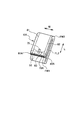
- FIG. 4 is a view schematically showing a state in which the absorbent article 1 individually packaged by the packaging sheet 70 is opened.
- the other adhesive tape 75 is held with one hand holding the longitudinal end of the packaging sheet 70 and the longitudinal end of the absorbent article 1 in place. Then, the adhesive tape 75 is pulled in a direction away from the packaging sheet 70 held by one hand.
- FIG. 4 shows a state in which the region of the packaging sheet 70 between the first cut line portion 81 and the second cut line portion 82 is separated from the regions of the packaging sheet 70 on both sides in the width direction along the longitudinal direction L. Yes.
- the region of the packaging sheet 70 between the first cut line portion 81 and the second cut line portion 82 is separated, so that a part of the main body bonding region of the back sheet 20 is opened.
- the packaging sheet 70 is in contact with the adhesive regions located on both sides in the width direction of the first cut line portion 81 and the second cut line portion 82.
- the packaging sheet can be divided along the longitudinal direction. Therefore, only a part of the plurality of adhesion regions can be opened.
- the packaging sheet since the cut line portion is formed along the direction in which the longitudinal fold extends, the packaging sheet can be separated via the cut line portion in a state where the cut line portion is folded from the outside to the inside along the plurality of longitudinal folds. it can.
- the wearer can first put the opened main body adhesion region 51 on the undergarment and put on the central portion in the width direction of the absorbent article 1.
- the packaging sheet 70 of the width direction outer side from the 1st cut line part 81 and the width direction outer side of the 2nd cut line part 82 is formed.
- a wing or the like can be attached to the undergarment by peeling off the absorbent article.
- the adhesives of the wing portions 43 and 44 are bonded to each other. It is possible to prevent the adhesive of the wing part from adhering to other adhesives of the absorbent article. Therefore, it is possible to easily and appropriately separate the absorbent article 1 from the packaging sheet 70 in a state where the adhesive effect of the adhesive is maintained, and to appropriately attach the absorbent article to the underwear.
- the package body of the absorbent article folded compactly is folded by a longitudinal fold and a width fold, it is easy to have a crease.
- the adhesive regions of the absorbent article may stick to each other due to folding.
- by separating the packaging sheet and partially opening the adhesive region it is possible to suppress the occurrence of a problem that the adhesive regions stick to each other due to folding.
- first cut line portion 81 and the second cut line portion 82 are disposed across the main body adhesion region 51 in the longitudinal direction L. Therefore, by separating the packaging sheet 70 by the first cut line portion 81 and the second cut line portion 82, the entire adhesive region 50 in the longitudinal direction can be opened.
- the first cut line portion is arranged inside the first longitudinal fold in the width direction
- the second cut line portion is arranged inside the second longitudinal fold in the width direction.
- the (second cut line portion) may overlap the first longitudinal fold line (second longitudinal crease line), or may be arranged shifted within a range of 5 mm or less on the inner side (or outer side) in the width direction.
- the packaging sheet according to the first embodiment is not formed with a cutout which will be described later, but the packaging sheet according to the first embodiment is formed with a cutout and is absorbed on the back surface of the packaging sheet.
- the end in the longitudinal direction of the absorbent article is on the surface side of the packaging sheet through the notch It may be configured to be visible from.
- FIG. 5 is the top view seen from the non-skin contact surface of the package 101 of the absorbent article which concerns on 2nd Embodiment.
- the packaging sheet 70 of the absorbent article packaging body 101 according to the second embodiment has both ends in the longitudinal direction adhered to each other in a state where both sides in the width direction of the absorbent article are folded back inward.
- a sheet adhesion region 53 to which a hot melt adhesive is applied is provided at the end of the packaging sheet 70 in the longitudinal direction.
- the absorbent articles 1 are individually packaged by the packaging sheet 70 by bonding the facing packaging sheets in a folded state with a hot melt adhesive.
- the packaging sheet 70 is formed with a third cut line portion connected to the first cut line portion 81 and the second cut line portion 82.
- the third cut line portion 83 is located closer to the center side in the longitudinal direction than the sheet bonding region 53. Further, the rear end (not shown) of the first cut line portion 81 and the rear end (not shown) of the second cut line portion 82 reach the rear end 70B of the packaging sheet.
- An adhesive tape 75 is attached between the first cut line portion 81 and the second cut line portion 82 in the width direction and closer to the center side in the longitudinal direction than the third cut line portion 83.
- the user pulls the adhesive tape 75 toward the rear side of the absorbent article 1, whereby the first cut line portion 81 and the second cut line portion. 82, the packaging sheet 70 is separated from the front side to the rear side of the region surrounded by the third cutoff line portion 83 and the rear end 70B of the packaging sheet via the first cutoff line portion 81 and the second cutoff line portion 82. Therefore, the area surrounded by the first cut line portion 81, the second cut line portion 82, the third cut line portion 83, and the rear end 70B of the packaging sheet 70 can be separated from the surrounding area. That is, even when both longitudinal ends of the packaging sheet 70 are bonded, the packaging sheet 70 can be separated along the longitudinal direction.
- first cut line portion 81, the second cut line portion 82, the third cut line portion 83, and the area surrounded by the rear end 70B of the packaging sheet are separated from the surrounding area, the first cut line The line portion 81, the second cut line portion 82, the third cut line portion 83, and the regions located on both sides in the width direction from the rear end 70 ⁇ / b> B of the packaging sheet are connected via the front end of the packaging sheet 70.
- the pair of wing bonding regions 52 are opened one by one without opening at a time. Can be attached to the underwear.
- FIG. 6 is the top view seen from the non-skin contact surface of the package 102 of the absorbent article which concerns on 3rd Embodiment.
- the package 102 of the absorbent article according to the third embodiment is configured such that the first cut line portion 81 and the second cut line portion 82 are bonded to the main body in a viewpoint from the back sheet side on a straight line orthogonal to the back sheet 20.
- the main body bonding region 51 is disposed between the first cut line portion 81 and the second cut line portion 82, and is disposed between the region 51 and the wing bonding region 52.
- the notch is formed in the corner
- FIG. The notches are recessed from the end portions 70 ⁇ / b> C and 70 ⁇ / b> D in the width direction of the packaging sheet 70 toward the inner side in the width direction at the front end 70 ⁇ / b> A in the longitudinal direction of the packaging sheet 70.
- the front end of the absorbent article 1 can be visually recognized from the outside of the packaging sheet 70 in a state where both ends in the width direction of the packaging sheet 70 and the absorbent article 1 are folded inward via the first longitudinal fold FL1 and the second longitudinal fold FL2. It is configured as follows.
- a notch is an absorbent article from the outer side of the packaging sheet 70 in the state which turned the both ends of the width direction of the packaging sheet 70 and the absorbent article 1 inside via the 1st longitudinal fold FL1 and the 2nd longitudinal fold FL2. It is only necessary to be formed so that the front end of 1 can be visually recognized, and is formed between the first longitudinal fold side end portion 70C in the width direction of the packaging sheet 70 and the first longitudinal fold FL1, and the first of the packaging sheet 70 What is necessary is just to be formed between edge part 70D and the 2nd longitudinal fold FL2 in the width direction by the side of 2 longitudinal folds.
- the space between the end portion 70C on the first longitudinal fold side in the width direction of the packaging sheet 70 and the first longitudinal fold FL1 includes the first longitudinal fold FL1, and the first longitudinal fold FL1 extends to the first of the packaging sheet 70 from the first longitudinal fold FL1. This is the region up to the end 70C on the longitudinal fold side.
- the space between the second longitudinal fold side end portion 70D and the second longitudinal fold line FL2 in the width direction of the packaging sheet 70 includes the second longitudinal fold line FL2, and the second longitudinal fold line FL2 through the second longitudinal fold line FL2 This is the area up to the end on the longitudinal fold side.
- the front ends 81A and 82A and the rear ends 81B and 82B of the first cut line portion 81 and the second cut line portion 82 are connected to the fourth cut line portion 84 extending in the width direction, respectively.
- the fourth cut line portion 84 is formed so as to extend from the first cut line portion 81 and the second cut line portion 82 to the outside in the width direction and reach the outside in the width direction of the packaging sheet 70.
- a region surrounded by the first cut line portion 81 and the fourth cut line portion 84 and a region surrounded by the second cut line portion 82 and the fourth cut line portion 84 face the wing bonding region 52.
- the absorbent article packaging body 102 is detachably in contact with the adhesive region between the packaging sheet 70 and the adhesive region 50 of the absorbent article 1 and is joined to the packaging sheet 70.
- a plurality of release sheets 90 are arranged.
- the release sheet 90 includes a first release sheet 91 disposed between the first cut line portion 81 and the second cut line portion 82 in the viewpoint from the back sheet side on a straight line orthogonal to the back sheet 20, It has the 2nd peeling sheet 92 arrange
- the first release sheet 91 is in contact with the main body adhesive region 51
- each release sheet 90 and the packaging sheet 70 are joined, when the packaging sheet 70 is pulled away from the absorbent article 1, the release sheet 90 is also pulled together with the packaging sheet 70. Therefore, the area surrounded by the first cut line part 81 and the fourth cut line part 84, the area surrounded by the second cut line part 82 and the fourth cut line part 84, and the area between them are separated from each other. As a result, the release sheet bonded to each region is separated from the absorbent article 1. Therefore, the main body adhesion region 51 disposed opposite to the first release sheet 91 is opened, the wing adhesion region 52 disposed opposite to the second release sheet 92 is opened, or the third release sheet is opposed. Thus, the wing bonding area 52 arranged in this manner can be opened.
- the front end of the absorbent article is gripped and separated from the packaging sheet in a state where both sides in the width direction of the packaging sheet and the absorbent article are folded inward.
- the first release sheet 91 in contact with the main body adhesion region 51 can be peeled from the absorbent article 1.
- region 52 can be peeled from the absorbent article 1, and the wing adhesion area
- the package 102 of the absorbent article which concerns on 3rd Embodiment is comprised so that a different peeling sheet may be joined for every area
- the present invention is not limited to this configuration, and the release sheet may be configured so that a release cut line portion that can be separated is provided on the release sheet, and the release sheet is separated along with the separation of the packaging sheet.
- the wing adhesion region The area other than the area where the second release sheet and the third release sheet covering 52 are arranged is more flexible than the area where the release sheet is provided. Therefore, the flexibility of the absorbent article 1 is maintained, and the wing portions 43 and 44 can be easily folded back to the back side and attached to the outer side of the underwear.
- FIG. 7 is the top view seen from the non-skin contact surface of the package 103 of the absorbent article which concerns on 4th Embodiment.
- a cut line portion 85 is formed along the longitudinal direction L.
- the adhesive region 50 formed on the back surface side of the absorbent body is disposed outside the cut line portion 85 in the width direction from the viewpoint from the back sheet side on a straight line orthogonal to the back sheet 20.
- the adhesive tape 75 is attached to the region of the packaging sheet 70 on one side across the cut line portion.
- the packaging sheet 70 When the adhesive tape 75 is gripped and pulled in the direction of separating the packaging sheet 70 from the absorbent article 1, the packaging sheet 70 is separated into two via the tear line portion 85, and is attached to the adhesive tape 75 on one side.
- the packaging sheet 70 is separated from the absorbent article. Accordingly, a part of the main body bonding area (a part on the first longitudinal direction side with respect to the cut line portion) arranged on the back side of the absorber and one wing bonding area of the pair of wing bonding areas are opened. At this time, the other part (the part on the first longitudinal direction side of the cut line part) of the main body adhesion region is not opened. Therefore, after attaching the half area
- the absorbent article of the present invention may be a panty liner (origami sheet), an incontinence pad, etc. in addition to a sanitary napkin.
- a panty liner origami sheet
- an incontinence pad etc. in addition to a sanitary napkin.
- the absorbent article according to the present invention may be provided with a leak-proof wall having an elastic contraction member that applies an elastic contraction force to the side sheet portion.
- the number and arrangement position of the elastic members are arbitrary.
- the elastic magnification by the elastic contraction member is preferably 1.2 times or more.
- the elastic contraction member is a rubber-based material such as polyurethane, polybutadiene, or polypropylene, an ethylene-vinyl acetate copolymer, a stretchable polyolefin-based polymer, or the like, and has a thread-like shape, a fiber-like shape or a belt-like shape. Can be used.
- the cut line portion of the packaging sheet according to the present invention is not limited to the perforation, and any configuration may be adopted as long as the packaging sheet can be separated through the cut line portion.
- a cutting line cut by a cutting device or the like may be used.
- the packaging sheet is separated into a plurality of parts by intermittently forming cutting lines on the packaging sheet on the same line along the longitudinal direction, and tearing or separating regions between the cutting lines. It can be constituted as follows.
- the packaging sheet can be separated through the cut line portions in a state of being folded from the outside to the inside along the plurality of longitudinal folds. .
- the adhesive regions are arranged on both sides in the width direction of the cut line portion, the adhesive region of the absorbent article is separated by separating the packaging sheet separated through the cut line portion from the absorbent article. Only a part can be opened. Therefore, after adhering only a part of the adhering area of the absorbent article to the undergarment, it is possible to adhere the other adhering area to the undergarment.
- the absorbent article can be appropriately attached to the undergarment. Therefore, it becomes possible to provide the package of the absorbent article which a wearer can isolate
Landscapes
- Health & Medical Sciences (AREA)
- Epidemiology (AREA)
- Engineering & Computer Science (AREA)
- Biomedical Technology (AREA)
- Heart & Thoracic Surgery (AREA)
- Vascular Medicine (AREA)
- Life Sciences & Earth Sciences (AREA)
- Animal Behavior & Ethology (AREA)
- General Health & Medical Sciences (AREA)
- Public Health (AREA)
- Veterinary Medicine (AREA)
- Absorbent Articles And Supports Therefor (AREA)
Abstract
吸収性物品の包装体100は、包装シート70の裏面上に吸収性物品1が配置された状態で、包装シート70と吸収性物品1とが吸収性物品1の長手方向に沿う第1長手折り目FL1及び第2長手折り目FL2を基点に吸収性物品1の外側から内側に折り畳まれ、吸収性物品1が包装される。吸収性物品の裏面シート20には、その着衣面側に接着剤が塗布された接着領域50が設けられており、包装シート70には、包装シート70を分離可能に構成する第1切り取り線部81及び第2切り取り線部82が長手方向Lに沿って形成されており、吸収性物品1の裏面シート20と直交する直線上の裏面シート側からの視点において、切り取り線部の幅方向両側には、接着領域50がそれぞれ配置されている。
Description
本発明は、吸収性物品が個別に包装された吸収性物品の包装体に関する。
特許文献1には、液透過性の表面シートと、液不透過性の裏面シートと、表面シートと裏面シートとの間に配置される吸収体とを有する吸収性物品としての生理用ナプキンを、包装シート上に配置した状態で幅方向両側を内側に折り畳んだ後、長手方向両側を内側に折り畳んで止着することによって、生理用ナプキンを個別に包装した吸収性物品の包装体が記載されている。
生理用ナプキンは、裏面シートの着衣面側に設けられた接着剤を介して包装シートに接着されている。包装シートの四隅には、切り欠きが形成されている。生理用ナプキンの幅方向両側を内側に向けて折り返した状態では、生理用ナプキンの長手方向端部が、切り欠きを介して包装シートの外側から視認可能に構成されている。よって、生理用ナプキンの幅方向両側を内側に向けて折り返した状態で、使用者が生理用ナプキンの長手方向端部を包装シートから離間させる方向に引っ張ることにより、生理用ナプキンと包装シートとを分離させて、生理用ナプキンを包装シートから引き出すことができる。
しかし、上述の吸収性物品の包装体は、以下の問題があった。生理用ナプキンの幅方向両側は、長手方向に沿った2本の折り目を基点にして内側に折り返されている。長手方向端部を介して包装シートから離間する方向に生理用ナプキンが引っ張られた際に、生理用ナプキンの2本の折り目間の領域は、包装シートから離間する方向に引っ張られるが、2本の折り目よりも幅方向外側の領域は、内側に折り返された包装シート側に引っ張られる。よって、2本の折り目よりも幅方向外側の領域においては、生理用ナプキンを包装シートから引き出す際に、生理用ナプキンが包装シートから適切に分離せずに、生理用ナプキンが折れ曲がってしまうことがある。
特に、ウイング部を有する生理用ナプキンにおいては、生理用ナプキンの幅方向外側にウイング部が配置されている。ウイング部は、吸収体を有しないため、その剛性が比較的低く、包装シートから生理用ナプキンが引き出される際に折れ曲がり易い。また、ウイング部の裏面シートには、接着剤が付されている。よって、ウイング部が折れ曲がることにより、ウイング部の接着剤同士が接着したり、ウイング部の接着剤が生理用ナプキンの他の接着剤と接着してしまったりすることがある。よって、接着剤の接着効果を維持した状態で、容易かつ適切に生理用ナプキンを包装シートから分離させることができなかった。
そこで、本発明は、上述の課題に鑑みてなされたものであり、着用者が容易かつ適切に吸収性物品を包装シートから分離させることができる吸収性物品の包装体を提供することを目的とする。
上述した課題を解決するため、本発明の例示的側面としての吸収性物品の包装体(吸収性物品の包装体100)は、液透過性の表面シート(表面シート10)、液不透過性の裏面シート(裏面シート20)、及び前記表面シートと前記裏面シートとの間に配置される吸収体(吸収体30)を有する吸収性本体を含む吸収性物品(吸収性物品1)と、前記吸収性物品を個別に包装する包装シート(包装シート70)と、を備え、前記包装シートの裏面上に前記吸収性物品が配置された状態で、前記包装シートと前記吸収性物品とが前記吸収性物品の長手方向に沿う第1長手折り目及び第2長手折り目を基点に前記吸収性物品の外側から内側に折り畳まれ、前記吸収性物品が包装される吸収性物品の包装体であって、前記吸収性物品の裏面シートには、その着衣面側に接着剤が塗布された接着領域(接着領域50)が設けられており、前記包装シートには、前記包装シートを分離可能に構成する切り取り線部(第1切り取り線部81、第2切り取り線部82)が前記長手方向に沿って形成されており、前記吸収性物品の前記裏面シートと直交する直線上の前記裏面シート側からの視点において、前記切り取り線部の幅方向両側には、前記接着領域がそれぞれ配置されていることを要旨とする。
(第1の実施形態)
図1及び図2を参照して、本発明の第1の実施形態に係る吸収性物品の包装体について説明する。図1は、吸収性物品の包装体の平面図であり、図2は、吸収性物品の包装体の背面図である。図1及び図2に示すように吸収性物品の包装体100は、吸収性物品1と、この吸収性物品1を個別に包装する包装シート70と、を有する。本実施形態に係る吸収性物品1は、例えば、生理用ナプキンである。
図1及び図2を参照して、本発明の第1の実施形態に係る吸収性物品の包装体について説明する。図1は、吸収性物品の包装体の平面図であり、図2は、吸収性物品の包装体の背面図である。図1及び図2に示すように吸収性物品の包装体100は、吸収性物品1と、この吸収性物品1を個別に包装する包装シート70と、を有する。本実施形態に係る吸収性物品1は、例えば、生理用ナプキンである。
吸収性物品の包装体100は、包装シート70上に吸収性物品1が配置された状態で包装シート70と吸収性物品1とが折り畳まれることにより、吸収性物品1が個別に包装されるように構成されている。図1及び図2は、包装シート70によって吸収性物品1を個別に包装した後、吸収性物品1を開いた状態を示している。
吸収性物品1は、着用者の肌に当接する表面シート10と、液体を透過しない液不透過性の裏面シート20と、吸収体30とを有する。吸収体30は、表面シート10と裏面シート20との間に配設される。従って、吸収体30は、図1において破線で示される。吸収体30は、吸収性物品1の長手方向L及び幅方向Wにおける中央部分に配設される。また、吸収性物品1は、図1に示す平面視にて、吸収体30を有し、長手方向Lに延びる吸収性本体と、長手方向Lに直交する幅方向Wにおいて吸収性本体の外側に設けられるウイング部43,44を備える。更に、吸収性物品1は、幅方向Wにおいて吸収体30の外側に設けられるサイドシート41,42を備える。
表面シート10は、体液等の液体を透過する液透過性のシートである。表面シート10は、少なくとも吸収体30の表面を覆う。表面シート10は、不織布、織布、有孔プラスチックシート、メッシュシート等、液体を透過する構造のシート状の材料であれば、特に限定されない。織布や不織布の素材としては、天然繊維、化学繊維のいずれも使用できる。
天然繊維の例としては、粉砕パルプ、コットン等のセルロースが挙げられる。化学繊維の例としては、レーヨン、フィブリルレーヨン等の再生セルロース、アセテート、トリアセテート等の半合成セルロース、熱可塑性疎水性化学繊維、又は親水化処理を施した熱可塑性疎水性化学繊維などが挙げられる。熱可塑性疎水性化学繊維の例としては、ポリエチレン(PE)、ポリプロピレン(PP)、ポリエチレンテレフタレート(PET)等の単繊維、ポリエチレンとポリプロピレンをグラフト重合してなる繊維、芯鞘構造等の複合繊維が挙げられる。
また、本実施の形態に係る表面シート10は、不織布によって構成される。不織布は、乾式(カード法、スパンボンド法、メルトブローン法、エアレイド法等)及び湿式のいずれか一つの方法によって形成される。不織布は、乾式法と湿式法のうち、複数の方法を組み合わせて形成されていてもよい。また、サーマルボンディング、ニードルパンチ、ケミカルボンディング等の方法を例示することができる。なお、不織布を製造する方法は、上述の方法に限定されない。また、水流交絡法によりシート状に形成したスパンレースを表面シートとして用いることもできる。また、上層側に凹凸を形成した不織布、又はウェブ形成時にエアーを当てることにより目付ムラを設けた不織布を表面シートとして用いてもよい。表面シートの表面に凹凸を形成することにより、表面シート10を体液が透過する前に、表面シート10の表面を伝わって体液が拡散することを軽減できる。
裏面シート20は、表面シート10の長さと略同一の長さを有する。裏面シート20は、ポリエチレン、ポリプロピレン等を主体としたフィルム、通気性の樹脂フィルム、スパンボンド、又はスパンレース等の不織布に通気性の樹脂フィルムが接合されたシートなどを用いることができる。裏面シート20は、着用時の違和感を生じさせない程度の柔軟性を有する材料とすることが好ましい。
吸収体30は、親水性繊維、パルプを含む。親水性繊維の例としては、粉砕パルプ、コットン等のセルロース、レーヨン、フィブリルレーヨン等の再生セルロース、アセテート、トリアセテート等の半合成セルロース、粒子状ポリマー、繊維状ポリマー、熱可塑性疎水性化学繊維、又は、親水化処理を施した熱可塑性疎水性化学繊維等を単独又は混合して用いることができる。これらの中でも、低コストと吸収体の成形し易さとを考慮すると、粉砕パルプを使用することが好ましい。親水性繊維に高分子吸収体を混合したものを吸収体として使用しても良い。本実施形態では、高分子吸収体は、吸収性、吸湿性のあるアクリル酸ナトリウム共重合体等の粒状ポリマーである。吸収体は、親水性繊維又は粉体をエアレイド法によってシート状に成形したエアレイドシートでもよい。
サイドシート41,42は、表面シート10と同様の材料から選ぶことができる。但し、サイドシート41,42を乗り越えて吸収性物品1外方へ経血が流れることを防止するためには、疎水性又は撥水性を有することが好ましい。具体的には、スパンボンド不織布やSMS不織布などが挙げられる。サイドシートは、肌との当接面を構成する。そのため、肌への擦れ刺激を低減するためには、エアスルー不織布を用いることが好ましい。
サイドシート41,42は、表面シート10の両側に配設される。サイドシート41,42は、吸収体30の側縁の一部及びウイング部43,44を覆う。吸収性物品1では、表面シート10、サイドシート41,42、及び裏面シート20の周縁が接合されて、吸収体30が内封される。表面シート10と裏面シート20との接合方法としては、ヒートエンボス加工、超音波、又はホットメルト型接着剤のいずれか一つ、又は複数を組み合わせることが可能である。
裏面シート20において、ショーツと接触する表面には、接着剤が塗布された接着領域50が複数設けられている(図2参照)。接着領域50は、裏面シート20の非肌当接面上に接着剤を塗布するか、全面を剥離処理した包装シート70に接着剤を塗布した後、裏面シート20の非肌当接面上に転写することによって形成される。接着領域50は、長手方向Lに延びるストライプ状である。複数の接合領域の幅方向における間隔は、略等間隔である。なお、接着領域50は、裏面シートの全域に規則的に点在して配置されていることが好ましい。
接着領域50は、長手方向において吸収体と略同じ長さである本体接着領域51と、ウイング部43、44の裏面側に配置されたウイング接着領域52とを有する。使用前の状態では、接着領域50は包装シート70に接しており、包装シート70によって使用前に接着剤が劣化するのを防止している。そして、使用時に着用者によって包装シート70が剥離される。包装シート70が剥離されることにより、粘着性を有する接着面が開放される。なお、包装シート70と吸収性物品1との間に剥離シートを設けて、剥離シートによって使用前に接着剤が劣化するのを防止するように構成してもよい。
接着領域を形成する接着剤としては、例えば、熱可塑性高分子としてスチレン系ブロックポリマー、粘着付与剤樹脂として天然樹脂や合成樹脂系、可塑性材料としてパラフィン系オイルが用いられる。上記スチレン系ブロックポリマーとしては、スチレンーエチレンーブタジエンースチレンブロック共重合体(SEBS)、スチレンーブタジエンースチレンブロック共重合体(SBS)、スチレンーイソプレンースチレンブロック共重合体(SIS)、スチレン-エチレン-プロピレン-スチレン共重合体(SEPS)等が挙げられる。また、合成樹脂は、脂肪族系(C5系)石油樹脂、芳香族系(C9系)石油樹脂、共重合系石油樹脂、水素添加石油樹脂、DCPD系石油樹脂、ピュアーモノマー系石油樹脂等が挙げられ、天然樹脂は、αピネン、βピネン又はジペンテンの共重合体であるテルペン系樹脂、ガムロジン、トール油ロジン又はウッドロジンであるロジン系樹脂、若しくはこれらの水添物やエステル等が挙がられる。可塑性材料は、粘度を下げるパラフィンオイル系、タック性を上げるナフテンオイル、凝集力を下げたり色や臭いを付与したりするアロマオイルが挙げられる。
接着剤の塗布坪量は10~100g/m2であり、好ましくは20~50g/m2である。接着剤の塗布坪量が10g/m2以下であると、吸収性物品を下着に貼り付ける際の粘着力が少なく、使用時に吸収性物品が落ちたり、吸収性物品がずれたりするおそれがある。一方、接着剤の塗布坪量が100g/m2以上であると、下着から吸収性物品を剥がす際に、粘着力が高すぎて吸収性物品が破れて下着が汚れてしまうおそれがある。
表面シート10には、複数の圧搾溝(図示せず)が設けられている。圧搾溝は、表面シート10から吸収体30までを厚さ方向に圧搾して構成されている。なお、本実施形態では、圧搾溝は、エンボス加工によって圧搾加工される。なお、圧搾溝は、形成されていなくてもよい。
包装シート70は、吸収性物品1を個別に包装する。包装シート70は、吸収性物品1の裏面シート20側において吸収性物品1と対向する対向面である裏面71と、吸収性物品1と対向する非対向面であり、吸収性物品1を収容した状態で外側に位置する表面72と、を有する。
なお、包装シート70は、質感向上等の目的のために包装シート70の表面に丸点エンボスや梨地エンボスのような表面加工が施されていてもよい。表面加工は、通常のシート形成時に行われる。包装シート70の材質は、特に限定されるものではなく、例えば、ポリエチレンやポリプロピレン、ポリエステル等のプラスチックフィルムやナイロンフィルムなどの各種フィルム、硫酸バリウムなどのフィラーを入れて延伸させた通気性フィルム、不織布をラミネートさせたフィルム等が挙げられる。包装シート70の目付は、10~50g/m2であり、好ましくは12~30g/m2である。また、包装シート70には、一部もしくは全域に渡って印刷が施されていてもよい。
更に、包装シート70の裏面には、接着剤の粘着力を低下させることなく剥離可能にする処理が施されている。接着剤を剥離可能にする加工方法としては、処理面である包装シート70の全面に剥離処理剤を塗布し、加熱・乾燥する方法、或いは、スプレーにより処理面である包装シート70の裏面の全面に剥離処理剤を吹きつけることにより薄膜を形成する方法などが挙げられる。剥離処理剤としては、シリコーン系樹脂、フッ素系樹脂、オクタルデシルイソシアネート系樹脂などを例示できる。また、処理面に微細な凹凸を形成する加工を施してもよい。処理面に凹凸を形成することにより、処理面と接着剤との接触面積が低減するため、包装シート70と接着領域50との剥離が容易になる。
包装シート70には、長手方向に沿った2本の第1切り取り線部81及び第2切り取り線部82が形成されている。第1切り取り線部81及び第2切り取り線部82は、ミシン目加工が施されている。第1切り取り線部81及び第2切り取り線部82を介して包装シート70が複数に分離可能に構成されている。第1切り取り線部81及び第2切り取り線部82は、長手方向に沿った後述する2本の長手折り目よりも幅方向内側に配置されている。また、吸収性物品の裏面シート20と直交する直線上の裏面シート側からの視点において、第1切り取り線部81と第2切り取り線部82との間には、本体接着領域51が配置され、第1切り取り線部81の幅方向外側には、本体接着領域51及びウイング接着領域52が配置され、かつ第2切り取り線部82の幅方向外側には、本体接着領域51及びウイング接着領域52が配置されている。
吸収性物品1の前側に位置する第1切り取り線部81の前端81A及び第2切り取り線部82の前端82Aは、包装シート70の長手方向Lにおける端部に到達している。また、吸収性物品1の後側に位置する第1切り取り線部81の後端81Bは、吸収性物品1の後側に位置する包装シート70の後端70Bに到達している。一方、吸収性物品1の後側に位置する第2切り取り線部82の後端82Bは、包装シート70の後端70Bに到達してなく、包装シート70の後端70Bよりも長手方向内側(中心側)において終端している。このように、第2切り取り線部82を形成することにより、包装シート70が第2切り取り線部82を介して長手方向全域で分断されない。包装シート70が複数に分断されると、包装シート70を廃棄するときの取り扱いが煩雑になったり、使用済の吸収性物品1を包装シート70によって包むことができなくなったりする。しかし、切り取り線部の前端及び後端のいずれか一方が包装シート70の長手方向Lにおける端部よりも内側において終端するように形成することにより、包装シート70の分断を防止することができる。包装シート70が3つになることを防ぎ、ゴミの量を削減したり、廃棄するときの取り扱いを容易にしたりすることができる。
なお、第1の実施形態では、第2切り取り線部の後端を包装シートの長手方向における端部よりも長手方向内側において終端するように構成しているが、少なくとも第1切り取り線部及び第2切り取り線部のうちいずれか一方の長手方向における端部が、包装シートの長手方向における端部よりも長手方向内側で終端していればよく、第1切り取り線部81と第2切り取り線部82の両方の端部が包装シートの長手方向における端部よりも長手方向内側で終端するように構成してもよい。
吸収性物品1及び包装シート70は、幅方向W及び長手方向Lに沿った所定の折り位置において、吸収性物品1の表面シート10を内側にして折り畳まれる。具体的には、包装シート70は、長手方向Lに沿った2本の長手折り目FL1及びFL2を介して折り畳まれ、かつ幅方向Wに沿った幅折り目FW1及びFW2を介して折り畳まれる。この長手折り目及び幅折り目は、図1及び図2において一点鎖線にて示す。吸収性物品1が折り畳まれた状態で、包装シート70の長手方向Lにおける一方の端部が包装シート70に貼着される。包装シート70の端部は、粘着テープ75によって包装シート70の一部と貼着される。
粘着テープ75は、幅方向において第1切り取り線部81と第2切り取り線部82との間に配置されており、吸収性物品1の前側に位置する包装シート70の前端70Aを跨って配置されている。このように配置された粘着テープ75を把持して、吸収性物品1の後側に向けて粘着テープ75を引っ張ることにより、粘着テープ75と共に包装シート70の前端70Aが引っ張られ、粘着テープ75の幅方向外側に形成された第1切り取り線部81及び第2切り取り線部82を介して包装シート70が分離する。
粘着テープ75は、未使用のナプキンを包装シートで確実に収納しておく機能と、粘着テープ75が包装シート70に接合していることにより、包装体が未開封の状態であることを使用者に認識させる機能と、吸収性物品を取り出した後の包装シート70によって使用済の吸収性物品を包む際に包装シート70が開かないように封止する機能とを有する。粘着テープ75を形成する材料としては、ポリプロピレンフィルム、ポリエチレンフィルムなどの単層フィルムで形成されており、または複数種の樹脂フィルムがラミネートされた多層フィルムで形成されている。
粘着テープ75の片面には感圧接着剤層が形成されている。感圧接着剤層は、粘着テープ75の全長において同じ材料で且つ同じ塗布量(同じ厚みおよび同じ坪量)で形成されている。感圧接着剤層は、ゴム系、ポリエステル系のエラストマー、熱硬化型樹脂を主体としたホットメルト型の接着剤などである。基材の厚みは10~100μmであり、好ましくは40~60μmである。
次いで、吸収性物品の包装体100の折り畳み方法を説明する。図3は、吸収性物品の包装体100の折り畳み工程を模式的に示した斜視図である。吸収性物品の包装体100の折り畳み工程は、吸収性物品載置工程と、第1折り工程と、第2折り工程と、接合工程と、第3折り工程と、を有する。
吸収性物品載置工程では、包装シート70上に吸収性物品1が配置される。包装シート70と吸収性物品1の裏面シート20とが対向する。なお、1個の吸収性物品1を個別に包装する寸法の包装シート70上に吸収性物品1を配置してもよいし、例えば、搬送方向に沿って連続する包装シート上に、所定間隔を空けて複数の吸収性物品を配置するように構成してもよい。本実施形態では、説明の便宜上、1個の吸収性物品を包装する吸収性物品の包装体を用いて折り畳み方法を説明する。
第1折り工程では、図3(a)に示すように、包装シート70と吸収性物品1とが、幅方向Wにおける吸収性物品1の一方の端部側を含む端部領域側から、長手方向Lに沿った第1長手折り目(図1参照)FL1を基点に内側に折り返される。第2折り工程では、図3(b)に示すように、包装シート70と吸収性物品1とが、幅方向Wにおける吸収性物品1の他方の端部側を含む端部領域側から、長手方向Lに沿った第2幅折り目FL2(図1参照)を基点に内側に折り返される。
次いで、接合工程は、第2長手折り目FL2を基点に折り返された吸収性物品1及び包装シート70の幅方向端部を、ホットメルト接着剤が付されたシート接着領域53を介して包装シート70に対して接着する。本工程により、吸収性物品1が包装シート70によって個別に包装される。ホットメルト接着剤は、包装シートの対向面71の幅方向端部を、包装シートの非対向面72に接着できるように配置されていればよい。シート接着領域53の幅方向の長さは、例えば、1~20mmとすることができ、より好ましくは2~5mmとすることができる。
なお、本実施形態では、第1長手折り目FL1及び第2長手折り目FL2を基点に折り返された包装シート70の幅方向の端部を、ホットメルト接着剤を介して接着しているが、包装シート70の幅方向の端部を接着しなくてもよい。また、包装シート70の幅方向端部の接着方法は、熱溶着、圧着又は超音波溶着によって接着してもよい。
第3折り工程では、図3(c)に示すように、包装シート70と吸収性物品1とが、吸収性物品1の長手方向Lにおける両端部側から、幅方向Wに沿った第1幅折り目FW1及び第2幅折り目FW2(図1参照)を基点に内側に折り返される。上述した工程が実行されることによって、吸収性物品の包装体100は、折り畳まれて小型化される。
なお、包装シート70と吸収性物品1とを、吸収性物品1の長手方向Lにおける両端部側から折り返す際は、長手方向Lにおける一方の端部側から片方ずつ折り返すように構成してもよいし、長手方向Lにおける両端部側から両方を一遍に折り返すように構成してもよい。
このように折り畳むことにより、吸収性物品1を包装シート70によってコンパクトに個別に包装することができる。吸収性物品1を小型化することにより、小物入れ、ポシェット等のバッグに収納する場合、バッグの収納スペースを大きく占有する事がなく、簡便な携帯を可能とする。また、吸収性物品1をコンパクトに個別に包装することにより、使用時にトイレ等に携帯する際に、折り返さない状態でも手の中に配置し、他人から見えないように保持する事が可能となる。
次いで、このように折り畳まれた吸収性物品の包装体100の開封態様について、図4に基づいて詳細に説明する。図4は、包装シート70によって個別に包装された吸収性物品1を開封する状態を模式的に示した図である。吸収体物品の包装体を開封する際は、例えば、一方の手で包装シート70の長手方向の端部と吸収性物品1の長手方向の端部を抑えた状態で他方の粘着テープ75を把持し、一方の手によって抑えた包装シート70から離間する方向に粘着テープ75を引っ張る。
粘着テープ75を引っ張ることにより、粘着テープ75が付されている包装シート70が粘着テープ75と共に引っ張られる。このとき、第1切り取り線部81及び第2切り取り線部82に沿って包装シート70が分離する。具体的には、第1切り取り線部81と第2切り取り線部82との間の包装シート70の領域が、幅方向両側の包装シート70の領域と分離する。図4は、第1切り取り線部81と第2切り取り線部82との間の包装シート70の領域が、長手方向Lに沿って幅方向両側の包装シート70の領域と分離した状態を示している。このように、第1切り取り線部81と第2切り取り線部82との間の包装シート70の領域が分離することにより、裏面シート20の本体接着領域の一部が開放される。このとき、第1切り取り線部81及び第2切り取り線部82の幅方向両側に位置する接着領域には、包装シート70が接している。更に、粘着テープ75を吸収性物品1から離間する方向に引っ張ることにより、長手方向に沿って包装シートを分断することができる。よって、複数の接着領域のうち、一部のみを開放することができる。また、長手折り目が延びる方向に沿って切り取り線部が形成されているため、複数の長手折り目に沿って外側から内側に折り畳まれた状態で、切り取り線部を介して包装シートを分離することができる。
着用者は、まず開放された本体接着領域51を下着に当てて、吸収性物品1の幅方向における中央部分を装着することができる。このように吸収性物品の幅方向中央部分を下着に装着した後、第1切り取り線部81よりも幅方向外側の包装シート70及び第2切り取り線部82よりも幅方向外側の包装シート70を吸収性物品から剥離させることにより、ウイング部等を下着に装着することができる。
このように、吸収性物品1の一部を下着に装着した後、ウイング接着領域等他の接着領域を下着に装着するように構成することにより、ウイング部43,44の接着剤同士が接着したり、ウイング部の接着剤が吸収性物品の他の接着剤と接着してしまったりすることを抑制することができる。よって、接着剤の接着効果を維持した状態で、容易かつ適切に吸収性物品1を包装シート70から分離させて、適切に吸収性物品を下着に装着することができる。
また、コンパクトに折り畳んだ吸収性物品の包装体は、長手折り目及び幅折り目によって折り畳まれるため、折り癖が付き易い。折り癖によって、吸収性物品の接着領域同士がくっついてしまうことがある。しかし、包装シートを分離して接着領域を部分的に開放するように構成することにより、折り癖によって接着領域同士がくっついたりする不具合の発生を抑制することができる。
また、第1切り取り線部81及び第2切り取り線部82は、長手方向Lにおいて本体接着領域51を跨って配置されている。よって、第1切り取り線部81及び第2切り取り線部82によって包装シート70を分離することにより、接着領域50の長手方向における全体を開放することができる。
本実施の形態では、第1長手折り目の幅方向内側に第1切り取り線部が配置され、第2長手折り目の幅方向内側に第2切り取り線部が配置されているが、第1切り取り線部(第2切り取り線部)は、第1長手折り目(第2長手折り目)に重なっていてもよいし、幅方向内側(又は外側)に5mm以内の範囲でずれて配置されていてもよい。また、第1切り取り線部(第2切り取り線部)は、第1長手折り目(第2長手折り目)に重なっていることが望ましい。長手折り目と切り取り線部とが近接して配置されていることにより、折り畳まれた状態で包装シート70を分離して、吸収性物品1を包装シート70から容易に取り出すことが可能となる。
また、第1の実施形態に係る包装シートは、後述する切り欠きが形成されていないが、第1の実施形態に係る包装シートに切り欠きが形成されていており、包装シートの裏面上に吸収性物品が配置された状態で長手折り目を基点として吸収性物品の外側から内側に向けて折り畳まれた状態において、吸収性物品の長手方向における端部が、切り欠きを介して包装シートの表面側から視認可能に構成されていてもよい。
(第2の実施形態)
次いで、第2の実施形態に係る吸収性物品の包装体101について、図5を参照して詳細に説明する。なお、第2の実施形態の説明においては、第1の実施形態と異なる構成について説明し、同様の構成については説明を省略する。図5は、第2の実施形態に係る吸収性物品の包装体101の非肌当接面からみた平面図である。
次いで、第2の実施形態に係る吸収性物品の包装体101について、図5を参照して詳細に説明する。なお、第2の実施形態の説明においては、第1の実施形態と異なる構成について説明し、同様の構成については説明を省略する。図5は、第2の実施形態に係る吸収性物品の包装体101の非肌当接面からみた平面図である。
第2の実施形態に係る吸収性物品の包装体101の包装シート70は、吸収性物品の幅方向両側を内側に向けて折り返した状態において、長手方向における両端部が互いに接着されている。包装シート70の長手方向における端部には、ホットメルト接着剤が付されたシート接着領域53が設けられている。折り畳まれた状態で対向する包装シート同士がホットメルト接着剤によって接着されることにより、吸収性物品1が包装シート70によって個別に包装される。
また、包装シート70には、第1切り取り線部81及び第2切り取り線部82に連なる第3切り取り線部が形成されている。第3切り取り線部83は、シート接着領域53よりも長手方向における中心側に位置する。また、第1切り取り線部81の後端(図示せず)及び第2切り取り線部82の後端(図示せず)は、包装シートの後端70Bまで到達している。幅方向における第1切り取り線部81と第2切り取り線部82との間であって、かつ第3切り取り線部83よりも長手方向における中心側には、粘着テープ75が付されている。
このように構成された吸収性物品の包装体101によれば、使用者が吸収性物品1の後側に向けて粘着テープ75を引っ張ることにより、第1切り取り線部81、第2切り取り線部82、第3切り取り線部83及び包装シートの後端70Bによって囲まれた領域の前側から後側まで、第1切り取り線部81及び第2切り取り線部82を介して包装シート70が分離する。よって、第1切り取り線部81、第2切り取り線部82、第3切り取り線部83及び包装シート70の後端70Bによって囲まれた領域を、その周囲の領域と分離することができる。すなわち、包装シート70の長手方向両端部が接着されている場合であっても、包装シート70を長手方向に沿って分離することができる。
また、第1切り取り線部81、第2切り取り線部82、第3切り取り線部83、及び包装シートの後端70Bによって囲まれた領域を、その周囲の領域と分離した状態において、第1切り取り線部81、第2切り取り線部82、第3切り取り線部83、及び包装シートの後端70Bよりも幅方向両側に位置する領域同士は、包装シート70の前端を介して連なっている。この状態において、幅方向両側に位置する領域を第1切り取り線部81又は第2切り取り線部82を介して分離することにより、一対のウイング接着領域52を一度に開放せずに、片方ずつ開放して下着に装着することができる。
(第3の実施形態)
次いで、第3の実施形態に係る吸収性物品の包装体102について、図6を参照して詳細に説明する。図6は、第3の実施形態に係る吸収性物品の包装体102の非肌当接面からみた平面図である。第3の実施形態に係る吸収性物品の包装体102は、裏面シート20と直交する直線上の裏面シート側からの視点において、第1切り取り線部81及び第2切り取り線部82は、本体接着領域51とウイング接着領域52の間に配置されており、第1切り取り線部81と第2切り取り線部82との間には、本体接着領域51が配置されている。また、吸収性物品1の前側に位置する包装シートの角部には、切り欠きが形成されている。切り欠きは、包装シート70の長手方向における前端70Aにおいて、包装シート70の幅方向における端部70C、70Dから幅方向内側に向かって凹んでいる。包装シート70と吸収性物品1の幅方向両端を、第1長手折り目FL1及び第2長手折り目FL2を介して内側に折り返した状態において、包装シート70の外側から吸収性物品1の前端を視認できるように構成されている。
次いで、第3の実施形態に係る吸収性物品の包装体102について、図6を参照して詳細に説明する。図6は、第3の実施形態に係る吸収性物品の包装体102の非肌当接面からみた平面図である。第3の実施形態に係る吸収性物品の包装体102は、裏面シート20と直交する直線上の裏面シート側からの視点において、第1切り取り線部81及び第2切り取り線部82は、本体接着領域51とウイング接着領域52の間に配置されており、第1切り取り線部81と第2切り取り線部82との間には、本体接着領域51が配置されている。また、吸収性物品1の前側に位置する包装シートの角部には、切り欠きが形成されている。切り欠きは、包装シート70の長手方向における前端70Aにおいて、包装シート70の幅方向における端部70C、70Dから幅方向内側に向かって凹んでいる。包装シート70と吸収性物品1の幅方向両端を、第1長手折り目FL1及び第2長手折り目FL2を介して内側に折り返した状態において、包装シート70の外側から吸収性物品1の前端を視認できるように構成されている。
なお、切り欠きは、包装シート70と吸収性物品1の幅方向両端を、第1長手折り目FL1及び第2長手折り目FL2を介して内側に折り返した状態において、包装シート70の外側から吸収性物品1の前端を視認できるように形成されていればよく、包装シート70の幅方向における第1長手折り目側の端部70Cと第1長手折り目FL1との間に形成され、かつ包装シート70の第2長手折り目側の幅方向における端部70Dと第2長手折り目FL2との間に形成されていればよい。なお、包装シート70の幅方向における第1長手折り目側の端部70Cと第1長手折り目FL1との間とは、第1長手折り目FL1を含み、第1長手折り目FL1から包装シート70の第1長手折り目側の端部70Cまでの領域である。また、包装シート70の幅方向における第2長手折り目側の端部70Dと第2長手折り目FL2との間とは、第2長手折り目FL2を含み、第2長手折り目FL2から包装シート70の第2長手折り目側の端部までの領域である。
第1切り取り線部81及び第2切り取り線部82の前端81A、82A及び後端81B、82Bは、幅方向に延びる第4切り取り線部84とそれぞれ連なっている。第4切り取り線部84は、第1切り取り線部81及び第2切り取り線部82から幅方向外側に延びて包装シート70の幅方向外側まで到達するように形成されている。第1切り取り線部81と第4切り取り線部84によって囲まれた領域、及び第2切り取り線部82と第4切り取り線部84によって囲まれた領域は、ウイング接着領域52と対向している。
また、第3の実施形態に係る吸収性物品の包装体102は、包装シート70と吸収性物品1の接着領域50との間に、接着領域と分離可能に接し、かつ包装シート70に接合された剥離シート90が複数配置されている。剥離シート90は、裏面シート20と直交する直線上の裏面シート側からの視点において、第1切り取り線部81及び第2切り取り線部82との間に配置された第1剥離シート91と、第1切り取り線部81の幅方向外側に配置された第2剥離シート92と、第2切り取り線部82の幅方向外側に配置された第3剥離シート93とを有する。第1剥離シート91には、本体接着領域51が接しており、第2剥離シート92及び第3剥離シート93には、ウイング接着領域52が接している。
各剥離シート90と包装シート70とは接合されているため、包装シート70が吸収性物品1から離間する方向に引っ張られることにより、包装シート70とともに剥離シート90も引っ張られる。よって、第1切り取り線部81及び第4切り取り線部84によって囲まれた領域、第2切り取り線部82及び第4切り取り線部84によって囲まれた領域、及びこれらの間の領域が、互いに分離することにより、各領域に接合された剥離シートが吸収性物品1と分離する。よって、第1剥離シート91に対向して配置された本体接着領域51を開放したり、第2剥離シート92に対向して配置されたウイング接着領域52を開放したり、第3剥離シートに対向して配置されたウイング接着領域52を開放したりすることができる。
このように構成された吸収性物品の包装体によれば、包装シート及び吸収性物品の幅方向両側を内側に折り返した状態で、吸収性物品の前端を把持し、包装シートから離間する方向に引っ張ることにより、本体接着領域51と接する第1剥離シート91を吸収性物品1から剥がすことができる。そして、本体接着領域51を下着に装着した後、ウイング接着領域52に接する第2剥離シート92及び第3剥離シート93を吸収性物品1から剥がして、ウイング接着領域52を下着に装着することができる。
また、第3の実施形態に係る吸収性物品の包装体102は、複数の剥離シートを備え、切り取り線部によって分離される包装シートの領域毎に異なる剥離シートが接合されるように構成されているが、この構成に限られず、剥離シートを分離可能に構成する剥離切り取り線部を剥離シートに設け、包装シートの分離に伴って剥離シートも分離するように構成されていてもよい。しかし、例えば、第3の実施の形態に係る吸収性物品の包装体のように複数の剥離シートを備えることにより、本体接着領域51に接する第1剥離シート91を剥がした状態において、ウイング接着領域52を覆う第2剥離シート及び第3剥離シートが配置された以外の領域は、剥離シートが設けられている領域よりも柔軟性が高い。よって、吸収性物品1の柔軟性が維持され、ウイング部43、44を容易に裏面側に折り返して、下着の外側面に装着することができる。
(第4の実施形態)
次いで、第4の実施形態に係る吸収性物品の包装体103について、図7を参照して詳細に説明する。図7は、第4の実施形態に係る吸収性物品の包装体103の非肌当接面からみた平面図である。長手方向Lに沿って1本の切り取り線部85が形成されている。裏面シート20と直交する直線上の裏面シート側からの視点において、切り取り線部85の幅方向外側には、吸収体の裏面側に形成された接着領域50が配置されている。粘着テープ75は、切り取り線部を挟んだ一方側の包装シート70の領域に付されている。
次いで、第4の実施形態に係る吸収性物品の包装体103について、図7を参照して詳細に説明する。図7は、第4の実施形態に係る吸収性物品の包装体103の非肌当接面からみた平面図である。長手方向Lに沿って1本の切り取り線部85が形成されている。裏面シート20と直交する直線上の裏面シート側からの視点において、切り取り線部85の幅方向外側には、吸収体の裏面側に形成された接着領域50が配置されている。粘着テープ75は、切り取り線部を挟んだ一方側の包装シート70の領域に付されている。
粘着テープ75を把持して包装シート70を吸収性物品1から離間させる方向に引っ張ると、切り取り線部85を介して包装シート70が2つに分離し、粘着テープ75と接合された一方側の包装シート70が吸収性物品と離間する。よって、吸収体の裏面側に配置された本体接着領域の一部分(切り取り線部よりも第1長手方向側の部分)及び、一対のウイング接着領域のうち一方のウイング接着領域が開放される。このとき、本体接着領域の他の部分(切り取り線部よりも第1長手方向側の部分)は、開放されない。よって、吸収性物品の幅方向における半分の領域を下着に装着した後、他方の部分の包装シートを剥がして下着に装着することができる。
このように、本発明は、ここでは記載していない様々な実施形態などを含むことは勿論である。したがって、本発明の技術的範囲は、上述の説明から妥当な特許請求の範囲に係る発明特定事項によってのみ定められるものである。
例えば、本発明の吸収性物品は、生理用ナプキン以外に、パンティライナー(おりものシート)、失禁パッド等であってもよい。
また、本発明に係る吸収性物品は、サイドシート部に弾性収縮力を与える弾性収縮部材を有する防漏壁を設けてもよい。弾性部材の数および配置位置は任意である。弾性収縮部材による弾性倍率は、1.2倍以上であることが好ましい。弾性収縮部材は、ポリウレタン、ポリブタジエン、磯プレンなどのゴム系材料、エチレン-酢酸ビニル共重合体、伸縮性を有するポリオレフィン系の重合体などであり、糸状、繊維状、帯状などの形態のものを使用することができる。
また、本発明に係る包装シートの切り取り線部は、ミシン目に限られず、切り取り線部を介して包装シートが分離可能に構成されていればよく、種々の構成を採用することができる。例えば、切断装置等によって切断された切断線であってもよい。具体的には、長手方向に沿った同一線上において包装シートに切断線を間欠的に形成し、切断線同士の間の領域を引き裂いたり、分離させたりすることにより、包装シートが複数に分離するように構成することができる。
なお、日本国特許出願第2011-073036号(2011年3月29日出願)の全内容が、参照により、本願明細書に組み込まれている。
長手折り目が延びる長手方向に沿って切り取り線部が形成されているため、複数の長手折り目に沿って外側から内側に折り畳まれた状態で、切り取り線部を介して包装シートを分離することができる。また、切り取り線部の幅方向両側には、接着領域がそれぞれ配置されているため、切り取り線部を介して分離された包装シートを吸収性物品から離間させることにより、吸収性物品の接着領域を一部分のみ開放することができる。よって、吸収性物品の接着領域のうち一部のみ下着に接着した後、他の接着領域を下着に接着することが可能となり、複数の接着領域の接着効果を維持した状態で、適切に吸収性物品を包装シートから分離させて、吸収性物品を適切に下着に装着することが可能となる。よって、着用者が容易かつ適切に吸収性物品を包装シートから分離させることができる吸収性物品の包装体を提供することが可能となる。
1…吸収性物品、 10…表面シート、 20…裏面シート、 30…吸収体、 41,42…サイドシード、 43,44…ウイング部、 45,46…エンドフラップ部、 50…接着領域、 51…本体接着領域、 52…ウイング接着領域、 70…包装シート、 71…対向面、 72…非対向面、 75…粘着テープ、 90…剥離シート、 100、101、102、103…吸収性物品の包装体
Claims (9)
- 液透過性の表面シート、液不透過性の裏面シート、及び前記表面シートと前記裏面シートとの間に配置される吸収体を有する吸収性本体を含む吸収性物品と、前記吸収性物品を個別に包装する包装シートと、を備え、前記包装シートの裏面上に前記吸収性物品が配置された状態で、前記包装シートと前記吸収性物品とが前記吸収性物品の長手方向に沿う第1長手折り目及び第2長手折り目を基点に前記吸収性物品の外側から内側に折り畳まれ、前記吸収性物品が包装される吸収性物品の包装体であって、
前記吸収性物品の裏面シートには、その着衣面側に接着剤が塗布された接着領域が設けられており、
前記包装シートには、前記包装シートを分離可能に構成する切り取り線部が前記長手方向に沿って形成されており、
前記吸収性物品の前記裏面シートと直交する直線上の前記裏面シート側からの視点において、前記切り取り線部の幅方向両側には、前記接着領域が配置されている、吸収性物品の包装体。 - 前記切り取り線部は、前記第1長手折り目に沿った第1切り取り線部と、前記第2長手折り目に沿った第2切り取り線部とを有し、
前記吸収性物品の前記裏面シートと直交する直線上の前記裏面シート側からの視点において、前記第1切り取り線部と前記第2切り取り線部との間には、前記接着領域が配置されている、請求項1に記載の吸収性物品の包装体。 - 前記吸収性物品の包装体は、前記包装シートの裏面上に前記吸収性物品が配置された状態で前記長手折り目を基点として前記吸収性物品の外側から内側に向けて折り畳まれた後、前記長手折り目と直交する幅折り目を基点として前記吸収性物品の外側から内側に向けて折り畳まれるように構成されており、
前記包装シートの前記長手方向の端部には、前記幅折り目を基点として折り返された状態で前記包装シートの表面に接合される粘着テープが設けられており、
前記粘着テープは、前記幅方向において前記第1切り取り線部と前記第2切り取り線部との間に配置されている、請求項2に記載の吸収性物品の包装体。 - 前記包装シートの前記長手方向における端部は、前記長手折り目を基点として折り畳まれた状態で互いに対向して配置された前記包装シートと接着されており、
前記包装シートには、前記長手方向における端部よりも長手方向内側において前記幅方向に沿って延びる第3切り取り線部が形成され、
前記第3切り取り線部は、その一端が前記第1切り取り線部と連なり、その他端が前記第2切り取り線部と連なっており、
前記粘着テープは、前記第3切り取り線部よりも前記長手方向における中心側に配置されている、請求項3に記載の吸収性物品の包装体。 - 前記接着領域は、前記吸収性本体の裏面側に配置された本体接着領域を備えており、
前記吸収性物品の前記裏面シートと直交する直線上の前記裏面シート側からの視点において、前記本体接着領域の前記幅方向外側には、前記第1切り取り線部と前記第2切り取り線部とが配置され、且つ前記第1切り取り線部及び前記第2切り取り線部は、前記長手方向において前記本体接着領域を跨って配置されている、請求項2から請求項4のいずれかに記載の吸収性物品の包装体。 - 前記切り取り線部の前記長手方向における長さは、前記包装シートの前記長手方向における長さよりも短く形成されており、
前記切り取り線部は、前記包装シートの長手方向両端部よりも長手方向内側において終端している、請求項1から請求項5のいずれかに記載の吸収性物品の包装体。 - 前記吸収性物品は、前記吸収性本体の幅方向両端部から幅方向外側に延出するウイング部を更に備えており、
前記接着領域は、前記ウイング部の裏面側に配置されたウイング接着領域を備えており、
前記吸収性物品の前記裏面シートと直交する直線上の前記裏面シート側からの視点において、前記切り取り線部は、前記ウイング接着領域よりも幅方向内側に配置されている、請求項1から請求項6のいずれかに記載の吸収性物品の包装体。 - 前記包装シートと、前記吸収性物品の前記接着領域との間には、前記接着領域と分離可能に接し、かつ前記包装シートに接合された剥離シートが複数配置されており、
前記吸収性物品の前記裏面シートと直交する直線上の前記裏面シート側からの視点において、前記切り取り線部は、前記剥離シート間に配置されている、請求項1から請求項6のいずれかに記載の吸収性物品の包装体。 - 前記包装シートの前記長手方向における端部には、前記幅方向における外側端部から幅方向内側に向かって凹んだ切り欠きが複数形成されており、
前記切り欠きは、前記包装シートの前記幅方向における前記第1長手折り目側の端部と前記第1長手折り目との間に形成され、かつ前記包装シートの前記幅方向における前記第2長手折り目側の端部と前記第2長手折り目との間に形成されており、
前記包装シートの裏面上に前記吸収性物品が配置された状態で前記長手折り目を基点として前記吸収性物品の外側から内側に向けて折り畳まれた状態において、前記吸収性物品の前記長手方向における端部は、前記切り欠きを介して前記包装シートの表面側から視認可能に構成されている、請求項1から請求項8のいずれかに記載の吸収性物品の包装体。
Applications Claiming Priority (2)
| Application Number | Priority Date | Filing Date | Title |
|---|---|---|---|
| JP2011073036A JP5755920B2 (ja) | 2011-03-29 | 2011-03-29 | 吸収性物品の包装体 |
| JP2011-073036 | 2011-03-29 |
Publications (1)
| Publication Number | Publication Date |
|---|---|
| WO2012132518A1 true WO2012132518A1 (ja) | 2012-10-04 |
Family
ID=46930286
Family Applications (1)
| Application Number | Title | Priority Date | Filing Date |
|---|---|---|---|
| PCT/JP2012/051431 Ceased WO2012132518A1 (ja) | 2011-03-29 | 2012-01-24 | 吸収性物品の包装体 |
Country Status (2)
| Country | Link |
|---|---|
| JP (1) | JP5755920B2 (ja) |
| WO (1) | WO2012132518A1 (ja) |
Cited By (2)
| Publication number | Priority date | Publication date | Assignee | Title |
|---|---|---|---|---|
| CN107072833A (zh) * | 2014-10-31 | 2017-08-18 | 尤妮佳股份有限公司 | 吸收性物品 |
| TWI709392B (zh) * | 2014-02-25 | 2020-11-11 | 日商優你 嬌美股份有限公司 | 失禁墊及失禁墊收納物 |
Families Citing this family (6)
| Publication number | Priority date | Publication date | Assignee | Title |
|---|---|---|---|---|
| JP2014097132A (ja) * | 2012-11-13 | 2014-05-29 | Uni Charm Corp | 吸収性物品 |
| JP6121245B2 (ja) * | 2013-05-29 | 2017-04-26 | 日本製紙クレシア株式会社 | 吸収性物品 |
| JP6126182B2 (ja) * | 2015-09-07 | 2017-05-10 | ユニ・チャーム株式会社 | 吸収性物品の個包装体 |
| JP7018409B2 (ja) * | 2019-02-21 | 2022-02-10 | ユニ・チャーム株式会社 | 吸収性物品の包装体 |
| JP2021045321A (ja) * | 2019-09-18 | 2021-03-25 | 大王製紙株式会社 | 個装吸収性物品 |
| JP7386748B2 (ja) * | 2020-03-27 | 2023-11-27 | 大王製紙株式会社 | 包装シート、及び包装吸収性物品 |
Citations (6)
| Publication number | Priority date | Publication date | Assignee | Title |
|---|---|---|---|---|
| JPS59196219U (ja) * | 1983-06-15 | 1984-12-27 | 花王株式会社 | 生理用ナプキンの個装袋 |
| JPH10127684A (ja) * | 1996-11-01 | 1998-05-19 | Uni Charm Corp | 個袋入り生理用ナプキン |
| JP2003312765A (ja) * | 2002-04-24 | 2003-11-06 | Pigeon Corp | 吸収性製品の包装体と製造方法及び製造装置 |
| JP2003341767A (ja) * | 2002-05-24 | 2003-12-03 | Pigeon Corp | 吸収性製品の包装体と製造方法及び製造装置 |
| JP2005176869A (ja) * | 2003-12-16 | 2005-07-07 | Daio Paper Corp | 個装吸収性物品及びその製造方法 |
| JP2006340974A (ja) * | 2005-06-10 | 2006-12-21 | Daio Paper Corp | 個装吸収性物品 |
-
2011
- 2011-03-29 JP JP2011073036A patent/JP5755920B2/ja active Active
-
2012
- 2012-01-24 WO PCT/JP2012/051431 patent/WO2012132518A1/ja not_active Ceased
Patent Citations (6)
| Publication number | Priority date | Publication date | Assignee | Title |
|---|---|---|---|---|
| JPS59196219U (ja) * | 1983-06-15 | 1984-12-27 | 花王株式会社 | 生理用ナプキンの個装袋 |
| JPH10127684A (ja) * | 1996-11-01 | 1998-05-19 | Uni Charm Corp | 個袋入り生理用ナプキン |
| JP2003312765A (ja) * | 2002-04-24 | 2003-11-06 | Pigeon Corp | 吸収性製品の包装体と製造方法及び製造装置 |
| JP2003341767A (ja) * | 2002-05-24 | 2003-12-03 | Pigeon Corp | 吸収性製品の包装体と製造方法及び製造装置 |
| JP2005176869A (ja) * | 2003-12-16 | 2005-07-07 | Daio Paper Corp | 個装吸収性物品及びその製造方法 |
| JP2006340974A (ja) * | 2005-06-10 | 2006-12-21 | Daio Paper Corp | 個装吸収性物品 |
Cited By (3)
| Publication number | Priority date | Publication date | Assignee | Title |
|---|---|---|---|---|
| TWI709392B (zh) * | 2014-02-25 | 2020-11-11 | 日商優你 嬌美股份有限公司 | 失禁墊及失禁墊收納物 |
| CN107072833A (zh) * | 2014-10-31 | 2017-08-18 | 尤妮佳股份有限公司 | 吸收性物品 |
| CN107072833B (zh) * | 2014-10-31 | 2020-04-03 | 尤妮佳股份有限公司 | 吸收性物品 |
Also Published As
| Publication number | Publication date |
|---|---|
| JP2012205709A (ja) | 2012-10-25 |
| JP5755920B2 (ja) | 2015-07-29 |
Similar Documents
| Publication | Publication Date | Title |
|---|---|---|
| JP5755920B2 (ja) | 吸収性物品の包装体 | |
| JP5697439B2 (ja) | 吸収性物品の包装体及び吸収性物品の包装体の折り畳み方法 | |
| TWI291346B (en) | Hygiene product | |
| WO2022158102A1 (ja) | 包装吸収性物品 | |
| CN102740819B (zh) | 吸收性物品 | |
| MX2012006005A (es) | Articulo absorbente y empaque para articulo absorbente. | |
| CN102421401B (zh) | 被包装吸收性物品 | |
| CN102470057A (zh) | 独立包装制品 | |
| JP5823699B2 (ja) | 吸収性物品の包装体及び吸収性物品の包装体の製造方法 | |
| TW202135748A (zh) | 包裝片及包裝吸收性物品 | |
| KR20160052654A (ko) | 흡수성 물품의 개별 포장체 | |
| JP2018149025A (ja) | 吸収性物品包装体 | |
| JP7381380B2 (ja) | 包装材、包装面状物品、包装吸収性物品、及び個装方法 | |
| JP2010220911A (ja) | 個装吸収性物品 | |
| JP2019126585A (ja) | 個装吸収性物品、及びロール状体 | |
| JP7386748B2 (ja) | 包装シート、及び包装吸収性物品 | |
| JP2023032954A (ja) | 個装吸収性物品 | |
| JP5475333B2 (ja) | 吸収性製品 | |
| JP7690714B2 (ja) | 個装吸収性物品 | |
| TWI865746B (zh) | 個別包裝吸收性物品 | |
| KR20250097848A (ko) | 개별 포장 흡수성 물품 및 포장 시트 | |
| JP2024140800A (ja) | 吸収性物品個包装体 | |
| JP2023030348A (ja) | 個装吸収性物品 | |
| JP3631783B2 (ja) | ウイング付吸収性物品 | |
| JP2006320397A (ja) | 吸収性物品の包装構造 |
Legal Events
| Date | Code | Title | Description |
|---|---|---|---|
| 121 | Ep: the epo has been informed by wipo that ep was designated in this application |
Ref document number: 12763783 Country of ref document: EP Kind code of ref document: A1 |
|
| NENP | Non-entry into the national phase |
Ref country code: DE |
|
| 122 | Ep: pct application non-entry in european phase |
Ref document number: 12763783 Country of ref document: EP Kind code of ref document: A1 |