WO2012127899A1 - 製紙方法及び製紙用添加剤 - Google Patents
製紙方法及び製紙用添加剤 Download PDFInfo
- Publication number
- WO2012127899A1 WO2012127899A1 PCT/JP2012/051667 JP2012051667W WO2012127899A1 WO 2012127899 A1 WO2012127899 A1 WO 2012127899A1 JP 2012051667 W JP2012051667 W JP 2012051667W WO 2012127899 A1 WO2012127899 A1 WO 2012127899A1
- Authority
- WO
- WIPO (PCT)
- Prior art keywords
- component
- trash
- less
- papermaking
- anion
- Prior art date
- Legal status (The legal status is an assumption and is not a legal conclusion. Google has not performed a legal analysis and makes no representation as to the accuracy of the status listed.)
- Ceased
Links
Images

Classifications
-
- D—TEXTILES; PAPER
- D21—PAPER-MAKING; PRODUCTION OF CELLULOSE
- D21H—PULP COMPOSITIONS; PREPARATION THEREOF NOT COVERED BY SUBCLASSES D21C OR D21D; IMPREGNATING OR COATING OF PAPER; TREATMENT OF FINISHED PAPER NOT COVERED BY CLASS B31 OR SUBCLASS D21G; PAPER NOT OTHERWISE PROVIDED FOR
- D21H17/00—Non-fibrous material added to the pulp, characterised by its constitution; Paper-impregnating material characterised by its constitution
- D21H17/20—Macromolecular organic compounds
- D21H17/33—Synthetic macromolecular compounds
- D21H17/34—Synthetic macromolecular compounds obtained by reactions only involving carbon-to-carbon unsaturated bonds
- D21H17/41—Synthetic macromolecular compounds obtained by reactions only involving carbon-to-carbon unsaturated bonds containing ionic groups
- D21H17/44—Synthetic macromolecular compounds obtained by reactions only involving carbon-to-carbon unsaturated bonds containing ionic groups cationic
-
- D—TEXTILES; PAPER
- D21—PAPER-MAKING; PRODUCTION OF CELLULOSE
- D21H—PULP COMPOSITIONS; PREPARATION THEREOF NOT COVERED BY SUBCLASSES D21C OR D21D; IMPREGNATING OR COATING OF PAPER; TREATMENT OF FINISHED PAPER NOT COVERED BY CLASS B31 OR SUBCLASS D21G; PAPER NOT OTHERWISE PROVIDED FOR
- D21H17/00—Non-fibrous material added to the pulp, characterised by its constitution; Paper-impregnating material characterised by its constitution
- D21H17/63—Inorganic compounds
-
- D—TEXTILES; PAPER
- D21—PAPER-MAKING; PRODUCTION OF CELLULOSE
- D21H—PULP COMPOSITIONS; PREPARATION THEREOF NOT COVERED BY SUBCLASSES D21C OR D21D; IMPREGNATING OR COATING OF PAPER; TREATMENT OF FINISHED PAPER NOT COVERED BY CLASS B31 OR SUBCLASS D21G; PAPER NOT OTHERWISE PROVIDED FOR
- D21H21/00—Non-fibrous material added to the pulp, characterised by its function, form or properties; Paper-impregnating or coating material, characterised by its function, form or properties
- D21H21/06—Paper forming aids
- D21H21/10—Retention agents or drainage improvers
Definitions
- the present invention relates to a papermaking technique, and more particularly to a technique for processing a papermaking raw material.
- anionic trash In the paper manufacturing process for manufacturing paper, various chemicals such as paper strength enhancers and sizing agents are used. Moreover, the utilization rate of waste paper and waste paper, and the compounding rate of calcium carbonate as a filler are improved. Furthermore, since the circulation rate of white water is increasing and the papermaking process is being closed, anionic impurities (so-called “anionic trash”) are increasing in the water circulating in the papermaking process system.
- anion trash inhibits the effects of various chemicals and accumulates in the papermaking circulating water to form aggregates, thereby causing product quality degradation and defects. Furthermore, a paper break occurs in the paper machine due to the defect, leading to a reduction in the operation rate. For this reason, anion trash treatment is indispensable for the production of high-quality and efficient paper. Conventionally, anion trash treatment is performed by adding a cationic polymer, an aluminum compound, or the like.
- the treatment agents have different particle size tendencies of removable anion trash.
- an aluminum compound generally exhibits high removability with respect to anion trash having a small particle diameter.
- the charge disappears after being added to the system, so it is necessary to add a large amount. The addition is limited because the salt concentration in the water increases.
- a cationic polymer has a lower ability to remove anionic trash having a small particle diameter than an aluminum compound or the like. For this reason, there is a problem that the range of anion trash that can be sufficiently removed is limited with a single treatment agent.
- an aluminum compound is first added to condense anion trash with a small particle size to form a primary aggregation floc with a relatively large particle size, and then a cationic polymer is added.
- SS insoluble suspension
- the present invention has been made in view of the above circumstances, and an object thereof is to provide a papermaking additive and a papermaking method capable of sufficiently removing anionic trash over a wide range of particle diameters.
- the present invention provides the following.
- the anion trash has excellent removability of anion trash with a particle size of 5 ⁇ m or less, and inferior to anion trash with a particle size of 5 ⁇ m or more and 20 ⁇ m or less.
- a papermaking method comprising a step of adding a second component exhibiting removability to a pulp suspension in a mixed state.
- a first component having an anion trash removability and an anion trash with a particle size of 5 ⁇ m or less and an anion trash with a particle size of 5 ⁇ m or more and 20 ⁇ m or less inferior to the first component.
- An additive for papermaking which is a mixture of two components.
- the first component and the second component exhibiting excellent removability of anion trash having a particle diameter of 5 ⁇ m or less and inferior removability of anion trash having a particle diameter of 20 ⁇ m or less as compared with the first component.
- the second component forms agglomeration flocs of a small particle size anion trash before the first component turns to the condensation and fixing of the large particle size anion trash.
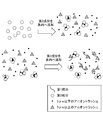
- FIG. 1 is a diagram showing an anion trash removal mechanism in a papermaking method according to an embodiment of the present invention.
- the papermaking method according to the present invention has a step of adding a first component and a second component having removability of anion trash to a pulp suspension in a state of being mixed with each other, and the second component is added to the first component.
- it exhibits excellent removability of anion trash having a particle diameter of 5 ⁇ m or less and inferior removability of anion trash having a particle diameter of 5 ⁇ m to 20 ⁇ m.
- the second component mainly neutralizes the charge of the anionic trash having a small particle diameter, and forms a primary condensation floc.
- the first component mainly neutralizes the charge of the anionic trash having a large particle size and fixes it to an insoluble suspension. As this fixing proceeds, the amount of the first component in the water decreases, and the remaining power for fixing the primary condensation flocs decreases.
- the first component since the first component is added in a state of being mixed with the second component, primary condensation flocs exist around the first component as in the case of the anionic trash having a large particle diameter. Thereby, as shown in FIG. 1, it is considered that not only the large particle size anion trash but also the primary condensed floc can be fixed to the insoluble suspension.
- the first component and the second component are added in a state where they are not mixed, the first component is separated from the second component compared to the present invention.
- the first component does not take in the primary condensation flocs, and the large particle size anion trash preferentially aggregates and settles. End up. For this reason, it is considered that anion trash having a small particle diameter is not sufficiently removed.
- the superiority or inferiority of the removability is determined by comparing the removability of the first component and the second component in the normal usage amount. Specifically, the water obtained by treating the pulp suspension with each of the first component and the second component in the normal usage amount is filtered through a filter paper having a pore size of 20 ⁇ m and 5 ⁇ m, and the turbidity of each filtrate is determined. It is measured with a portable turbidimeter “2100P” (manufactured by HACH) and determined based on the magnitude of the measured value.
- the amount of normal use is not particularly limited and is appropriately set based on common general technical knowledge. Generally, the amount of the first component is 0.1% by mass to 1000% by mass with respect to the amount of the second component. is there.
- the first component and the second component are not particularly limited as long as the above relationship is satisfied, but the first component preferably contains a cationic polymer and the second component preferably contains an aluminum compound.
- the cationic polymer is not particularly limited, and may be a compound having epichlorohydrin, polyethyleneimine, diallyldimethylammonium halide, dimethylaminoethyl acrylate / methyl halide as a monomer, a copolymer of these with acrylamide, or the like.
- the first component such as the cationic polymer preferably has an intrinsic viscosity of 0.1 dl / g or more and 5 dl / g or less in 1N saline at 25 ° C. in terms of obtaining an appropriate removal effect. Is 0.5 dl / g or more and 3.5 dl / g or less.
- the first component such as the cationic polymer preferably has a colloid equivalent of 2 meq / g or more and 15 meq / g or less, more preferably 2.5 meq / g or more and 10 in view of obtaining an appropriate removal effect. .5 meq / g or less.
- the aluminum compound is not particularly limited, and may be polyaluminum chloride, alumina sol, polyaluminum sulfate, polyaluminum silicate compounded aluminum, aluminum sulfate, aluminum nitrate, or the like.
- the first component is preferably added in an amount of 0.1% by mass to 1000% by mass with respect to the second component, more preferably 1% by mass to 400% by mass, and most preferably 5% by mass or more. It is 400 mass% or less.
- the location to be added may be any one or more locations in the papermaking system, for example, a raw material tank for storing raw materials such as broke pulp and deinked pulp, and a mixing chest.
- the timing which mixes a 1st component and a 2nd component may be the arbitrary time before adding to a pulp suspension, and adds what was mixed beforehand like the below-mentioned papermaking additive.
- the first component and the second component may be stored separately and mixed before addition (for example, merged in the middle of a pipe for addition).
- the first component and the second component are preferably mixed completely homogeneously, but are not limited thereto, and may be mixed incompletely homogeneously.
- the present invention has a first component having an anion trash removability and an anion trash removability with a particle size of 5 ⁇ m or less and an anion trash with a particle size of 5 ⁇ m or more and 20 ⁇ m or less compared to the first component.
- a paper additive containing a mixture of the second component is also included.
- the first component includes a cationic polymer
- the second component includes an aluminum compound.
- a 1st component is contained in the quantity of 0.1 to 1000 mass% with respect to a 2nd component.
- the additive was added to the coated paper coat broke raw material slurry (180 mL) under the conditions described below, and then stirred with a hand mixer at 800 rpm for 20 seconds. Then, it diluted with 450 mL water and stirred 20 times with the spatula.
- the liquid after stirring was subjected to suction filtration using filter paper having a pore size of 20 ⁇ m and 5 ⁇ m in order, and the turbidity and cation requirement of each filtrate were measured.
- the turbidity was measured using a portable turbidimeter “2100P” (manufactured by HACH), and the cation demand was measured using a particle charge detector (PCD) (manufactured by Spectris) according to a conventional method.
- PCD particle charge detector
- an aluminum compound and a cationic polymer mixed in advance were used.
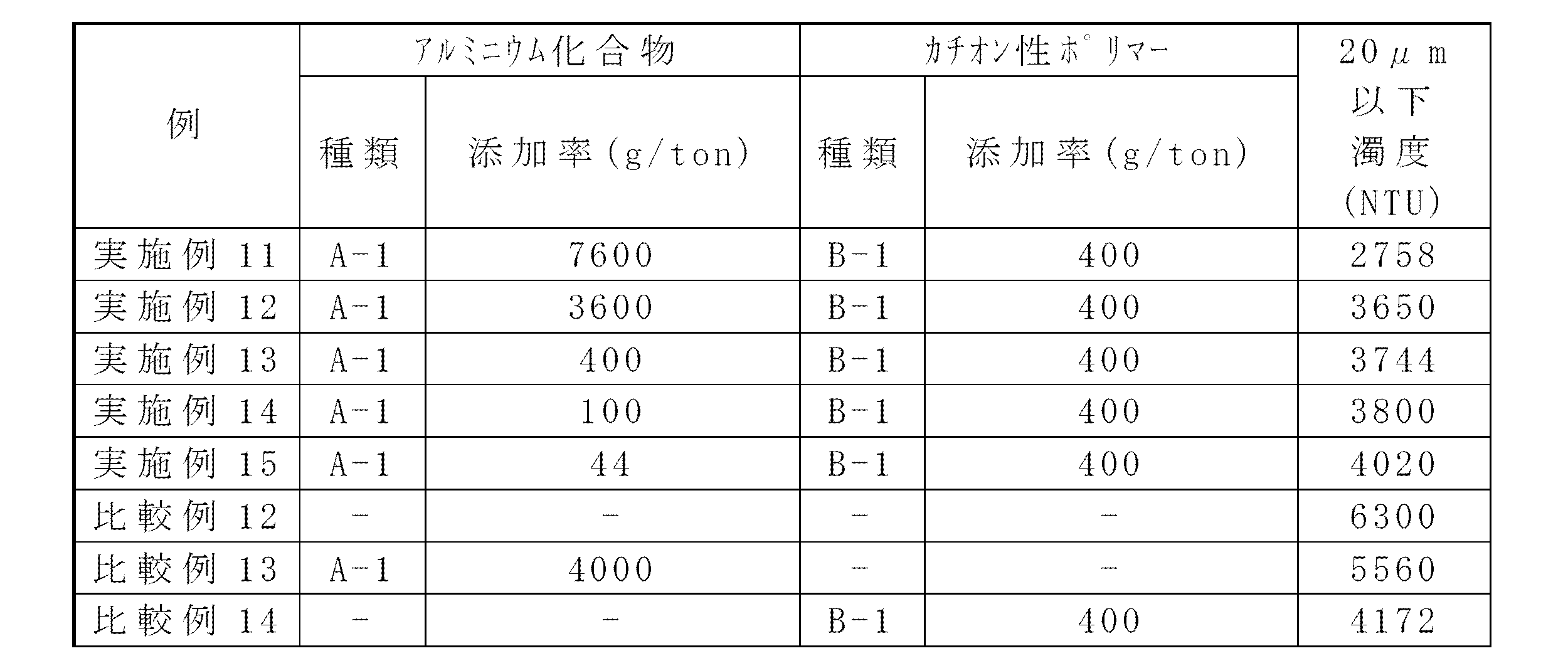
- Comparative Examples 2 to 14 only one or both of the aluminum compound and the cationic polymer were added separately and simultaneously.
- Tables 1 and 2 show the types and physical properties of the aluminum compounds and cationic polymers used.
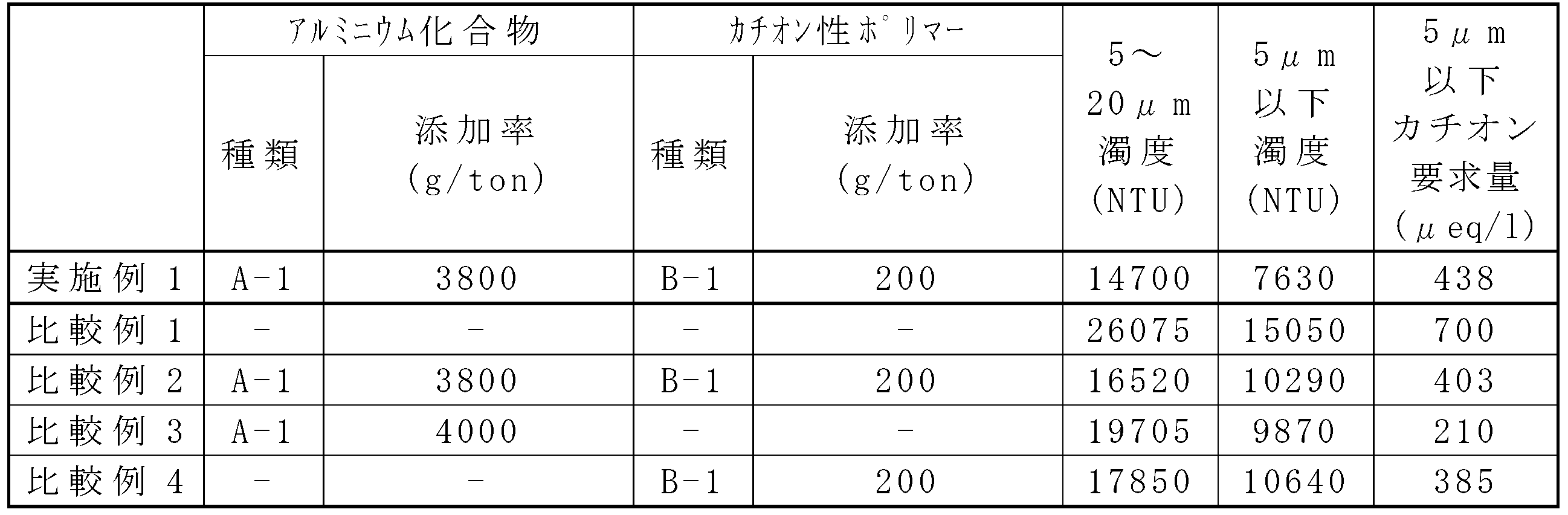
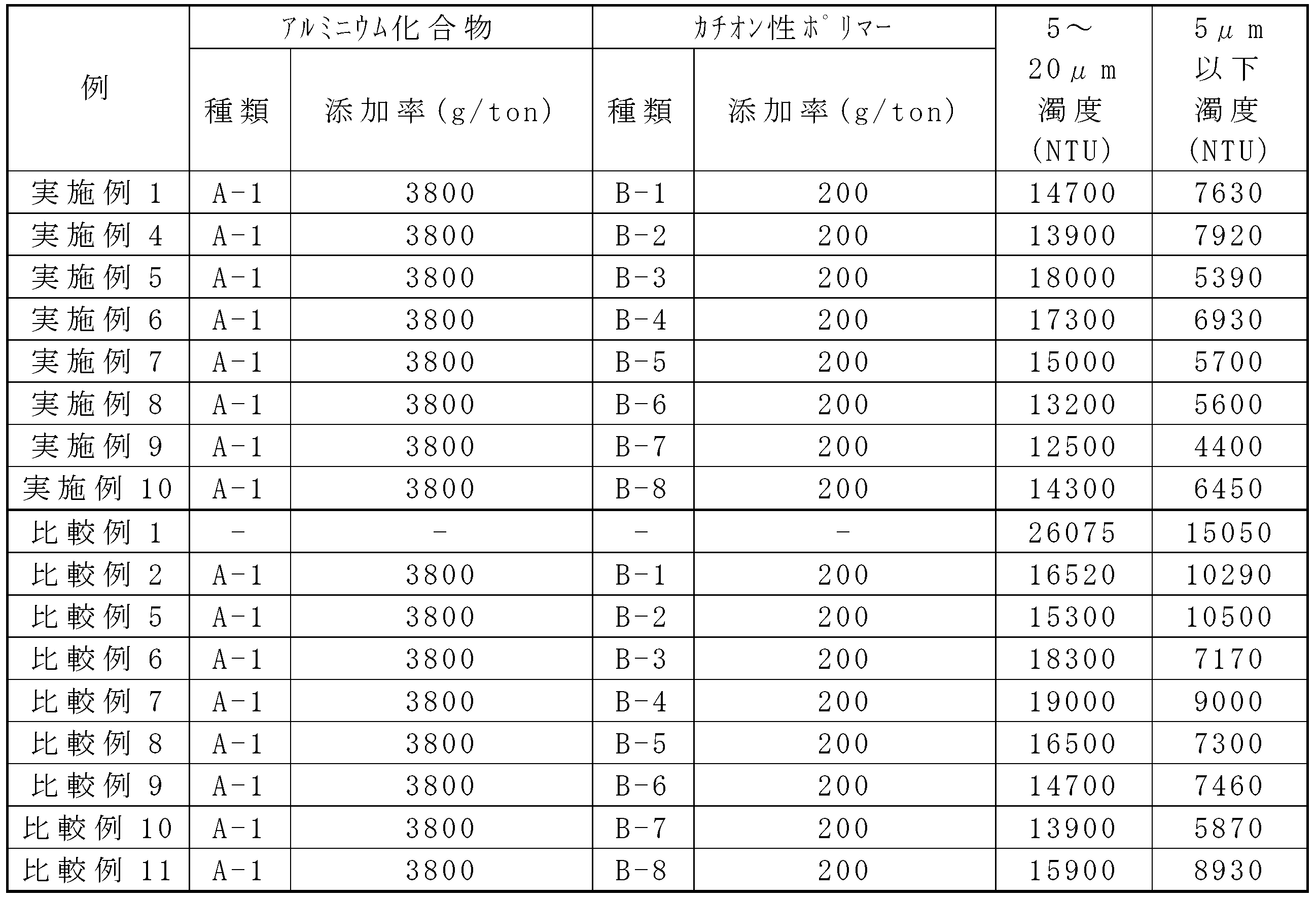
- Tables 3 to 5 show the addition amounts of the aluminum compound and the cationic polymer, the turbidity of each filtrate, and the required cation amount.
- the aluminum compound and the cationic polymer have anion trash removability, and the aluminum compound (second component) has a particle size of 5 ⁇ m or less compared to the cationic polymer (first component).
- the anion trash has excellent removability and an inferior removability of anion trash having a particle diameter of 5 ⁇ m to 20 ⁇ m.
- the removal rates of both anionic trash having a particle diameter of 5 ⁇ m to 20 ⁇ m and anionic trash having a particle diameter of 5 ⁇ m or less were higher than those of Comparative Examples 1 to 4. Thereby, it turned out that a desired effect is show
- the improvement in the removal rate of both anion trash having a particle diameter of 5 ⁇ m to 20 ⁇ m and anion trash having a particle diameter of 5 ⁇ m or less is related to the type of aluminum compound. It was found that
- the improvement in the removal rate of both the anion trash having a particle diameter of 5 ⁇ m or more and 20 ⁇ m or less and the anion trash having a particle diameter of 5 ⁇ m or less is improved regardless of the kind of the cationic polymer. It turns out that it is achieved.
Landscapes
- Chemical & Material Sciences (AREA)
- Inorganic Chemistry (AREA)
- Chemical Kinetics & Catalysis (AREA)
- Paper (AREA)
- Separation Of Suspended Particles By Flocculating Agents (AREA)
Abstract
Description

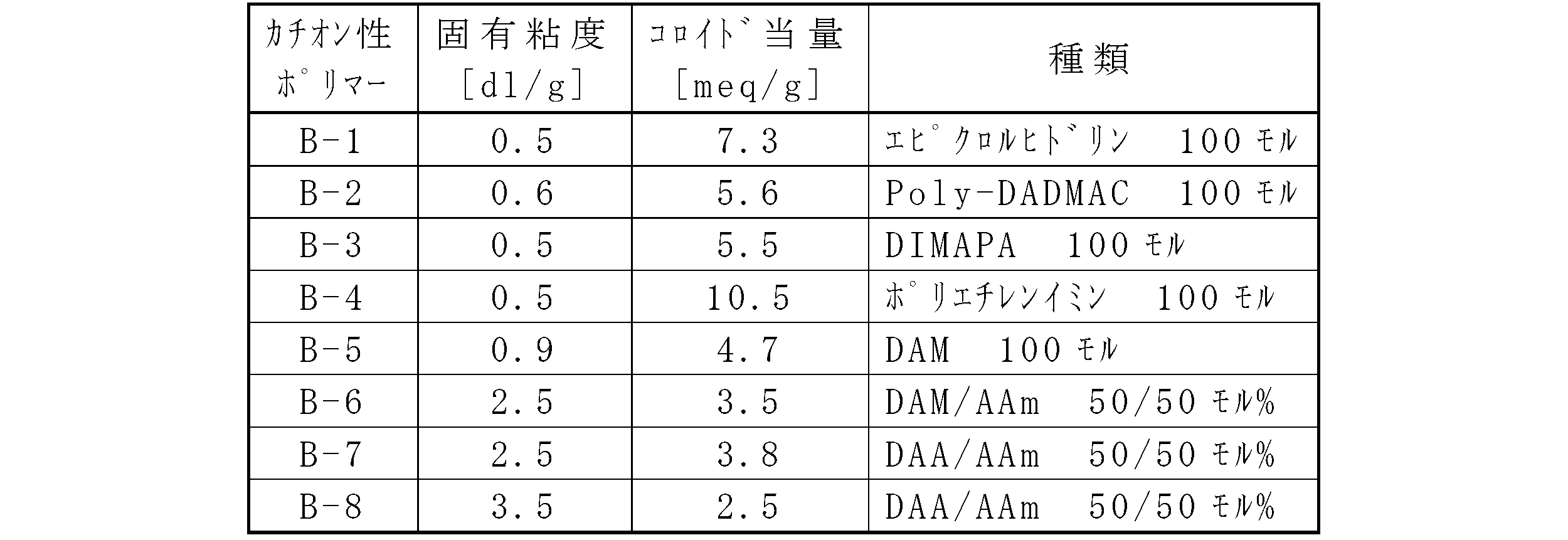
Poly-DADMAC : ポリジアリルジメチルアンモニウムクロライド
DIMAPA : ジメチルアミノプロピルアクリレート
DAM : ジメチルアミノエチルメタクリレート・メチルクロライド
DAM/AAm : ジメチルアミノエチルメタクリレート・メチルクロライドとアクリルアミドとの共重合物
DAA/AAm : ジメチルアミノエチルアクリレートとアクリルアミドとの共重合物

Claims (6)
- アニオントラッシュの除去性を有する第1成分と、前記第1成分に比べて、粒子径5μm以下のアニオントラッシュの優れた除去性を呈しかつ粒子径5μm以上20μm以下のアニオントラッシュの劣った除去性を呈する第2成分とを、互いに混合した状態で、パルプ懸濁液に添加する工程を有する製紙方法。
- 前記第1成分はカチオン性ポリマーを含み、前記第2成分はアルミニウム化合物を含む請求項1記載の製紙方法。
- 前記第1成分は、前記第2成分に対し0.1質量%以上1000質量%以下の量で添加する請求項1又は2記載の製紙方法。
- アニオントラッシュの除去性を有する第1成分と、前記第1成分に比べて粒子径5μm以下のアニオントラッシュの除去性に優れかつ粒子径5μm以上20μm以下のアニオントラッシュの除去性に劣る第2成分と、が混合して含まれる製紙用添加剤。
- 前記第1成分はカチオン性ポリマーを含み、前記第2成分はアルミニウム化合物を含む請求項4記載の製紙用添加剤。
- 前記第1成分は、前記第2成分に対し0.1質量%以上1000質量%以下の量で含まれる請求項4又は5記載の製紙用添加剤。
Priority Applications (3)
| Application Number | Priority Date | Filing Date | Title |
|---|---|---|---|
| KR1020137027576A KR101570151B1 (ko) | 2011-03-23 | 2012-01-26 | 제지 방법 및 제지용 첨가제 |
| CN2012800142340A CN103459715A (zh) | 2011-03-23 | 2012-01-26 | 造纸方法及造纸用添加剂 |
| JP2013505835A JP5858038B2 (ja) | 2011-03-23 | 2012-01-26 | 製紙方法及び製紙用添加剤 |
Applications Claiming Priority (2)
| Application Number | Priority Date | Filing Date | Title |
|---|---|---|---|
| JP2011064459 | 2011-03-23 | ||
| JP2011-064459 | 2011-03-23 |
Publications (1)
| Publication Number | Publication Date |
|---|---|
| WO2012127899A1 true WO2012127899A1 (ja) | 2012-09-27 |
Family
ID=46879068
Family Applications (1)
| Application Number | Title | Priority Date | Filing Date |
|---|---|---|---|
| PCT/JP2012/051667 Ceased WO2012127899A1 (ja) | 2011-03-23 | 2012-01-26 | 製紙方法及び製紙用添加剤 |
Country Status (4)
| Country | Link |
|---|---|
| JP (1) | JP5858038B2 (ja) |
| KR (1) | KR101570151B1 (ja) |
| CN (1) | CN103459715A (ja) |
| WO (1) | WO2012127899A1 (ja) |
Families Citing this family (2)
| Publication number | Priority date | Publication date | Assignee | Title |
|---|---|---|---|---|
| JP6929899B2 (ja) * | 2018-06-15 | 2021-09-01 | 栗田工業株式会社 | 紙及び紙板の製造方法 |
| CN112195681A (zh) * | 2020-07-24 | 2021-01-08 | 山鹰国际控股股份公司 | 一种纸机湿部pac添加工艺 |
Citations (2)
| Publication number | Priority date | Publication date | Assignee | Title |
|---|---|---|---|---|
| JPS55122099A (en) * | 1979-03-16 | 1980-09-19 | Seiko Kagaku Kogyo Co Ltd | Production of highly compressed strong paper |
| JPH08226092A (ja) * | 1995-02-17 | 1996-09-03 | Harima Chem Inc | 製紙方法 |
Family Cites Families (5)
| Publication number | Priority date | Publication date | Assignee | Title |
|---|---|---|---|---|
| CA2138314C (en) * | 1993-12-24 | 1999-09-21 | Hirotoshi Doki | Acrylamide polymers and use thereof |
| SE9502522D0 (sv) * | 1995-07-07 | 1995-07-07 | Eka Nobel Ab | A process for the production of paper |
| US5989392A (en) * | 1997-09-10 | 1999-11-23 | Nalco Chemical Company | Method of using polyammonium quaternary for controlling anionic trash and pitch deposition in pulp containing broke |
| CN101691719B (zh) * | 2009-10-15 | 2012-10-10 | 金东纸业(江苏)股份有限公司 | 纸机循环白水中溶解胶体物的控制剂及其使用方法 |
| CN101962425B (zh) * | 2010-09-10 | 2011-12-21 | 山东轻工业学院 | 一种树核星形阴离子垃圾捕捉剂及应用 |
-
2012
- 2012-01-26 WO PCT/JP2012/051667 patent/WO2012127899A1/ja not_active Ceased
- 2012-01-26 JP JP2013505835A patent/JP5858038B2/ja active Active
- 2012-01-26 CN CN2012800142340A patent/CN103459715A/zh active Pending
- 2012-01-26 KR KR1020137027576A patent/KR101570151B1/ko active Active
Patent Citations (2)
| Publication number | Priority date | Publication date | Assignee | Title |
|---|---|---|---|---|
| JPS55122099A (en) * | 1979-03-16 | 1980-09-19 | Seiko Kagaku Kogyo Co Ltd | Production of highly compressed strong paper |
| JPH08226092A (ja) * | 1995-02-17 | 1996-09-03 | Harima Chem Inc | 製紙方法 |
Also Published As
| Publication number | Publication date |
|---|---|
| KR20130143720A (ko) | 2013-12-31 |
| KR101570151B1 (ko) | 2015-11-19 |
| CN103459715A (zh) | 2013-12-18 |
| JPWO2012127899A1 (ja) | 2014-07-24 |
| JP5858038B2 (ja) | 2016-02-10 |
Similar Documents
| Publication | Publication Date | Title |
|---|---|---|
| KR100229973B1 (ko) | 제지방법 | |
| JP3696243B2 (ja) | 紙の製造 | |
| JP5961619B2 (ja) | イオン性架橋ポリマー微粒子を用いて紙を作製する方法及び該方法により作製された製品 | |
| BRPI0818243B1 (pt) | Processo para a preparação de uma dispersão de polímero água-em-óleo, dispersão de polímero água-em-óleo, uso da dispersão de polímero água-em-óleo, e, processo para a fabricação de papel, papelão ou cartolina. | |
| CN105178097A (zh) | 纸加工用组合物和方法 | |
| EP3286377A1 (en) | A composition for use as a paper strength agent | |
| JP5858038B2 (ja) | 製紙方法及び製紙用添加剤 | |
| JP4442337B2 (ja) | 中性新聞印刷用紙の製造方法 | |
| JP4268583B2 (ja) | 中性新聞印刷用紙の製造方法 | |
| JP4782432B2 (ja) | 中性新聞印刷用紙の製造方法 | |
| JP6308585B2 (ja) | 歩留向上剤及びそれを用いた製紙原料の歩留向上方法 | |
| RU2363799C1 (ru) | Способ изготовления бумаги | |
| CN1654744A (zh) | 纸和纸板的制备方法 | |
| JP2005054311A (ja) | 紙及び板紙の製造方法 | |
| JP7445859B2 (ja) | 両性水溶性高分子からなるピッチコントロール剤 | |
| TWI770387B (zh) | 紙及紙板的製造方法 | |
| CN102597369B (zh) | 制备纸或类似物的方法 | |
| JP6419612B2 (ja) | 紙粉低減剤、紙粉低減方法及び紙製造方法 | |
| KR20090064594A (ko) | 규산질 조성물 및 제지시 이의 용도 | |
| JP4809584B2 (ja) | 古紙パルプの製造方法 | |
| JP2016539902A (ja) | 安定な水性コロイダルシリカ生成物、ならびにその製造および使用方法 | |
| CN101649577A (zh) | 一种能提高纸页中碳酸钙留着率的改性碳酸钙制备方法 | |
| CN103608516A (zh) | 生产纸和纸板 | |
| JP2008063706A (ja) | 紙、板紙の製造方法 | |
| JP5757651B2 (ja) | 抄紙方法 |
Legal Events
| Date | Code | Title | Description |
|---|---|---|---|
| 121 | Ep: the epo has been informed by wipo that ep was designated in this application |
Ref document number: 12760732 Country of ref document: EP Kind code of ref document: A1 |
|
| ENP | Entry into the national phase |
Ref document number: 2013505835 Country of ref document: JP Kind code of ref document: A |
|
| NENP | Non-entry into the national phase |
Ref country code: DE |
|
| WWE | Wipo information: entry into national phase |
Ref document number: 1301005211 Country of ref document: TH |
|
| ENP | Entry into the national phase |
Ref document number: 20137027576 Country of ref document: KR Kind code of ref document: A |
|
| 122 | Ep: pct application non-entry in european phase |
Ref document number: 12760732 Country of ref document: EP Kind code of ref document: A1 |