WO2012124400A1 - 偏光フィルム、コーティング液、及び画像表示装置 - Google Patents
偏光フィルム、コーティング液、及び画像表示装置 Download PDFInfo
- Publication number
- WO2012124400A1 WO2012124400A1 PCT/JP2012/052362 JP2012052362W WO2012124400A1 WO 2012124400 A1 WO2012124400 A1 WO 2012124400A1 JP 2012052362 W JP2012052362 W JP 2012052362W WO 2012124400 A1 WO2012124400 A1 WO 2012124400A1
- Authority
- WO
- WIPO (PCT)
- Prior art keywords
- substituted
- group
- polarizing film
- general formula
- compound
- Prior art date
- Legal status (The legal status is an assumption and is not a legal conclusion. Google has not performed a legal analysis and makes no representation as to the accuracy of the status listed.)
- Ceased
Links
- 0 *c(cc(cc(c(N)c1)S(O)(=O)=O)c1c1O)c1N=N[C@@]1c2cc(S(O)(=O)=O)ccc2C(N=Nc(cc2)ccc2C#N)=CC1 Chemical compound *c(cc(cc(c(N)c1)S(O)(=O)=O)c1c1O)c1N=N[C@@]1c2cc(S(O)(=O)=O)ccc2C(N=Nc(cc2)ccc2C#N)=CC1 0.000 description 1
Images


Classifications
-
- C—CHEMISTRY; METALLURGY
- C09—DYES; PAINTS; POLISHES; NATURAL RESINS; ADHESIVES; COMPOSITIONS NOT OTHERWISE PROVIDED FOR; APPLICATIONS OF MATERIALS NOT OTHERWISE PROVIDED FOR
- C09B—ORGANIC DYES OR CLOSELY-RELATED COMPOUNDS FOR PRODUCING DYES, e.g. PIGMENTS; MORDANTS; LAKES
- C09B67/00—Influencing the physical, e.g. the dyeing or printing properties of dyestuffs without chemical reactions, e.g. by treating with solvents grinding or grinding assistants, coating of pigments or dyes; Process features in the making of dyestuff preparations; Dyestuff preparations of a special physical nature, e.g. tablets, films
- C09B67/0033—Blends of pigments; Mixtured crystals; Solid solutions
- C09B67/0041—Blends of pigments; Mixtured crystals; Solid solutions mixtures containing one azo dye
-
- G—PHYSICS
- G02—OPTICS
- G02B—OPTICAL ELEMENTS, SYSTEMS OR APPARATUS
- G02B5/00—Optical elements other than lenses
- G02B5/30—Polarising elements
- G02B5/3025—Polarisers, i.e. arrangements capable of producing a definite output polarisation state from an unpolarised input state
Definitions
- the present invention relates to a polarizing film having a high dichroic ratio, and a coating liquid for forming the polarizing film.
- the polarizing film is an optical member having a function of transmitting specific linearly polarized light from polarized light or natural light.
- a general-purpose polarizing film can be obtained, for example, by stretching a polyvinyl alcohol film dyed with iodine.
- a polarizing film containing a disazo compound having a naphthalene ring is also known (Patent Document 1). This polarizing film is obtained by a method (solution casting method) in which a coating liquid containing the disazo compound and a solvent is applied onto a substrate. In this coating solution, the disazo compound forms a supramolecular aggregate in the solution to exhibit a liquid crystal phase.
- a coating film in which the disazo compound is oriented is obtained.
- the oriented disazo compound is fixed by drying the coating film.
- the dried coating film has polarizing properties.
- a polarizing film having a high dichroic ratio cannot be obtained.
- Patent Document 2 discloses a polarizing film containing an azo compound having an anthraquinone ring and a disazo compound having a naphthalene ring. This polarizing film is also obtained by a method in which a coating liquid containing the two kinds of azo compounds and a solvent is applied onto a substrate.
- a coating liquid containing the two kinds of azo compounds and a solvent is applied onto a substrate.
- an azo compound having a large aromatic ring such as an anthraquinone ring
- a crystal may be generated.
- the orientation of the azo compound tends to be nonuniform. For this reason, in patent document 2, a polarizing film with a high dichroic ratio cannot be obtained.
- the first object of the present invention is to provide a polarizing film having a high dichroic ratio.
- the second object of the present invention is to provide a coating liquid for forming a polarizing film having a high dichroic ratio.
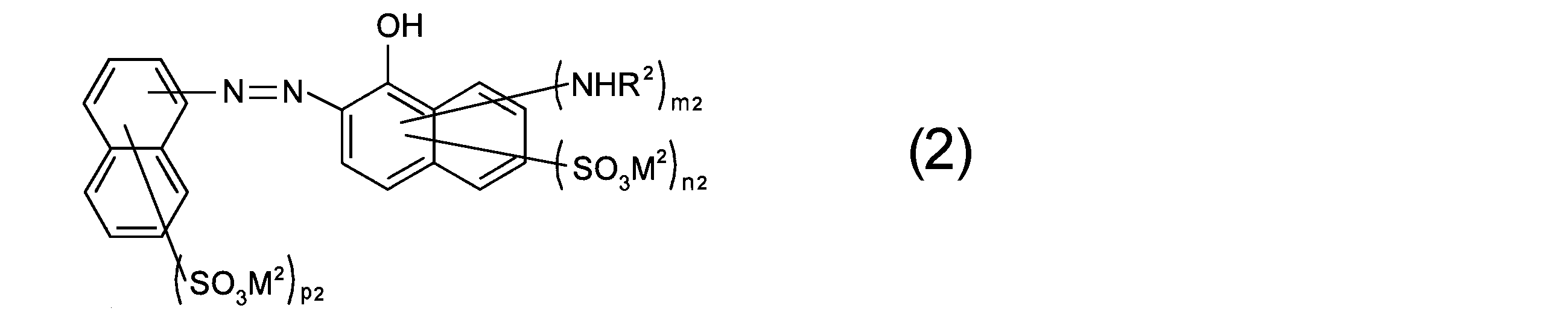
- the polarizing film of the present invention contains a disazo compound represented by the following general formula (1) and a monoazo compound represented by the following general formula (2).
- Q represents a substituted or unsubstituted aryl group
- R 1 represents a hydrogen atom, a substituted or unsubstituted alkyl group, a substituted or unsubstituted acetyl group, a substituted or unsubstituted benzoyl group.
- each M 1 independently represents a counter ion
- m1 represents an integer of 0 to 2
- n1 represents an integer of 0 to 6
- m1 And at least one of n1 is not 0, o1 represents an integer of 0 to 1, and p1 represents an integer of 1 to 4.
- R 2 represents a hydrogen atom, a substituted or unsubstituted alkyl group, a substituted or unsubstituted acetyl group, a substituted or unsubstituted benzoyl group, or a substituted or unsubstituted phenyl group
- M 2 each independently represents a counter ion
- m 2 represents an integer of 0 to 2
- n 2 represents an integer of 0 to 6
- p 2 Represents an integer of 1 to 4.
- the disazo compound is a disazo compound represented by the following general formula (3).
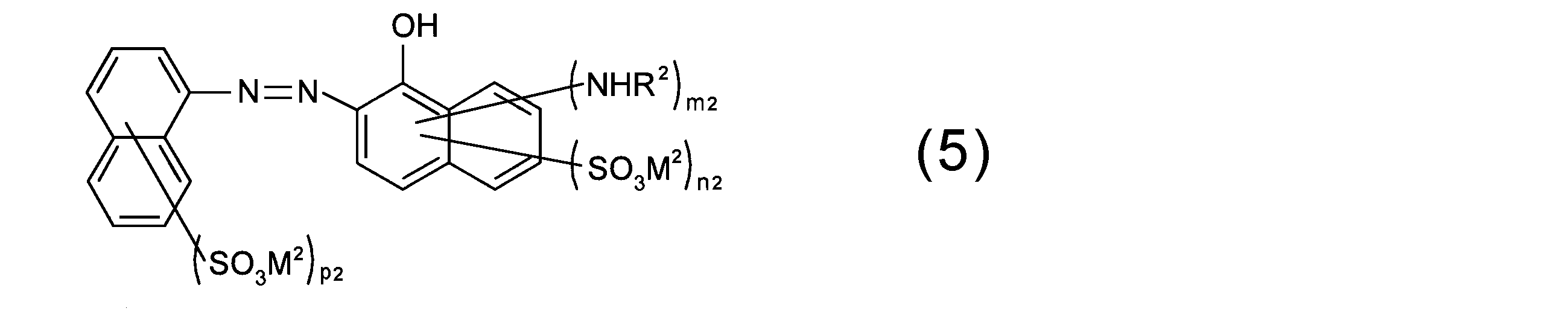
- the monoazo compound is a monoazo compound represented by the following general formula (5).
- R 2 , M 2 , m2, n2 and p2 in the general formula (5) are the same as those in the general formula (2).
- a coating liquid is provided.
- This coating liquid contains the disazo compound represented by the general formula (1), the monoazo compound represented by the general formula (2), and a solvent.
- an image display device is provided.
- This image display apparatus has any of the above polarizing films as its constituent members.
- the polarizing film of this invention contains the disazo compound represented by General formula (1) and the monoazo compound represented by General formula (2), it has a high dichroic ratio.
- the coating liquid of the present invention contains a disazo compound represented by the general formula (1) and a monoazo compound represented by the general formula (2). By coating this coating solution on a suitable development surface, a polarizing film having a relatively thin and high dichroic ratio can be easily obtained.
- the fragmentary sectional view which shows the polarizing film which concerns on one embodiment.
- the fragmentary sectional view showing the polarizing plate concerning one embodiment.
- the polarizing film of the present invention contains the following disazo compound and monoazo compound.
- the polarizing film of the present invention may contain one or more selected from the following disazo compounds and one or more selected from the following monoazo compounds.
- the description “substituted or unsubstituted” means “having a substituent or not having a substituent”.
- the description “Y to Z” means “Y or more and Z or less”.
- the disazo compound used in the present invention is represented by the following general formula (1).
- Q represents a substituted or unsubstituted aryl group
- R 1 represents a hydrogen atom, a substituted or unsubstituted alkyl group, a substituted or unsubstituted acetyl group, a substituted or unsubstituted benzoyl group.
- each M 1 independently represents a counter ion
- m1 represents an integer of 0 to 2
- n1 represents an integer of 0 to 6
- m1 And at least one of n1 is not 0, o1 represents an integer of 0 to 1, and
- p1 represents an integer of 1 to 4.
- 1 ⁇ (m1 + n1) 6
- each R 1 may be the same or different.
- n1 and p1 are 2 or more (that is, when the number of substitutions of SO 3 M 1 is 2 or more)
- each M 1 may be the same or different.
- each substituent of NHR 1 , SO 3 M 1 , OH and SO 3 M 1 may be substituted at any position of the naphthalene ring.
- Examples of the aryl group represented by Q in the general formula (1) include a phenyl group, a phenyl group to which a heterocyclic ring is bonded, and a condensed ring group in which two or more benzene rings are condensed (for example, a naphthyl group).
- the phenyl group includes a phenyl group in which non-adjacent carbon atoms are substituted with nitrogen atoms.
- the aryl group represented by Q may have a substituent or may not have a substituent. Regardless of whether the aryl group is substituted or unsubstituted, the disazo compound is excellent in solubility in an aqueous solvent and is also excellent in orientation.
- the aryl group has a substituent
- examples of the substituent include an alkyl group having 1 to 6 carbon atoms, an alkoxy group having 1 to 6 carbon atoms, a thioalkyl group having 1 to 6 carbon atoms, and a dihydroxypropyl group.
- the substituent is a polar group.
- the polar group means a functional group having polarity.
- Examples of the polar group include functional groups containing oxygen and / or nitrogen having a relatively high electronegativity such as a nitro group, a cyano group, an amino group, a hydroxyl group, a sulfonic acid group, and a carboxyl group.
- Q in the general formula (1) is preferably a phenyl group represented by the following formula (A).
- X represents a substituent
- x represents the number of substitutions of X and represents an integer of 0 to 5.
- Specific examples of the substituent X are the same as the substituents in the aryl group, so refer to it.
- X is preferably 1 or 2.
- Q in the general formula (1) is, for example, one selected from the following formula group.
- R 1 is preferably a hydrogen atom, a substituted or unsubstituted alkyl group, or a substituted or unsubstituted acetyl group, and more preferably a hydrogen atom or a substituted or unsubstituted acetyl group.
- the substituted or unsubstituted alkyl group include substituted or unsubstituted alkyl groups having 1 to 6 carbon atoms.
- M 1 (counter ion) of the general formula (1) is preferably a hydrogen ion; an alkali metal ion such as Li, Na, K, or Cs; an alkaline earth metal ion such as Ca, Sr, or Ba; Ions; ammonium ions optionally substituted with alkyl groups or hydroxyalkyl groups; salts of organic amines, and the like.
- the other metal ions include Ni + , Fe 3+ , Cu 2+ , Ag + , Zn 2+ , Al 3+ , Pd 2+ , Cd 2+ , Sn 2+ , Co 2+ , Mn 2+ , and Ce 3+ .
- Examples of the organic amine include alkylamines having 1 to 6 carbon atoms, alkylamines having 1 to 6 carbon atoms having a hydroxyl group, and alkylamines having 1 to 6 carbon atoms having a carboxyl group.
- each M 1 may be the same or different.
- M 1 of SO 3 M 1 is a divalent or higher cation, or the M 1 is stabilized by binding electrostatically with other anions, Alternatively, the M 1 is shared and stabilized with other azo compounds.
- m1 is preferably 1.
- n1 in the general formula (1) is preferably 1 or 2.
- Such a disazo compound of the general formula (1) has an SO 3 M 1 group and an NHR 1 group, and is particularly excellent in solubility in an aqueous solvent.
- Such an azo compound is preferable because it forms a stable supramolecular aggregate in a liquid and exhibits a liquid crystal phase.
- the naphthyl group of the general formula (1) (the naphthyl group represented on the right side of the formula (1)), the OH group is bonded to the ortho position with respect to the bonding portion of the azo group.
- the hydrogen atom of the highly reactive OH group and one nitrogen of the azo group are bonded in the coating solution.
- the planar structure of the naphthyl group is stabilized by changing the OH group and bonding the hydrogen atom to the azo group.
- the naphthyl group of the general formula (1) (the naphthyl group represented on the right side of the formula (1)) include the following formulas (a) to (h).
- R 1 and M 1 in the formulas (a) to (h) are the same as those in the general formula (1).
- the disazo compound of the general formula (1) having the formula (a), the formula (b), the formula (c), or the formula (e) can be synthesized from a raw material that is distributed in large quantities in the market. For this reason, such a disazo compound is preferable because it can be obtained relatively inexpensively.
- specific examples of the naphthylene group (naphthylene group between the two azo groups of the formula (1)) bonded to the two azo groups include, for example, the following formulas (B) to (D):
- the naphthylene group represented is mentioned.
- M 1 , o1 and p1 in the formulas (B) to (D) are the same as those in the general formula (1).
- the p1 is 1 or 2.
- naphthylene groups of the above formulas (B) to (D) naphthylene groups represented by the following formulas (E) to (H) are preferable.
- the disazo compound of the general formula (1) having a naphthylene group of the formula (B), the formula (E) or the formula (F) is more preferable. Since this disazo compound has a 1,4-naphthylene group represented by the formula (B), formula (E) or formula (F), it has a large dielectric anisotropy in the molecular minor axis direction. Having such a 1,4-naphthylene group acts preferentially in the formation of supramolecular aggregates of disazo compounds.
- the disazo compound preferably used in the present invention is represented by the following general formula (3) or general formula (4).
- Q, R 1 , M 1 , m1, n1, o1, and p1 in the general formula (3) are the same as those in the general formula (1).
- R 1 , M 1 , m1, n1 and p1 in the general formula (4) are the same as those in the general formula (1), and
- X and x in the general formula (4) are the same as those in the formula (A). It is.
- the disazo compounds represented by the above general formulas (1), (3) and (4) are, for example, “Toyo Hosoda,“ Theoretical Manufacturing, Dye Chemistry (5th Edition) ”(published on July 15, 1968, Gihodo, page 135). To page 152).
- a monoazo compound is obtained by diazonium chloride of a substituted or unsubstituted aniline compound and coupling reaction with an aminonaphthalenesulfonic acid compound.
- a disazo compound represented by the above general formulas (1), (3), and (4) can be obtained by coupling the monoazo compound with a hydroxynaphthalenesulfonic acid compound.
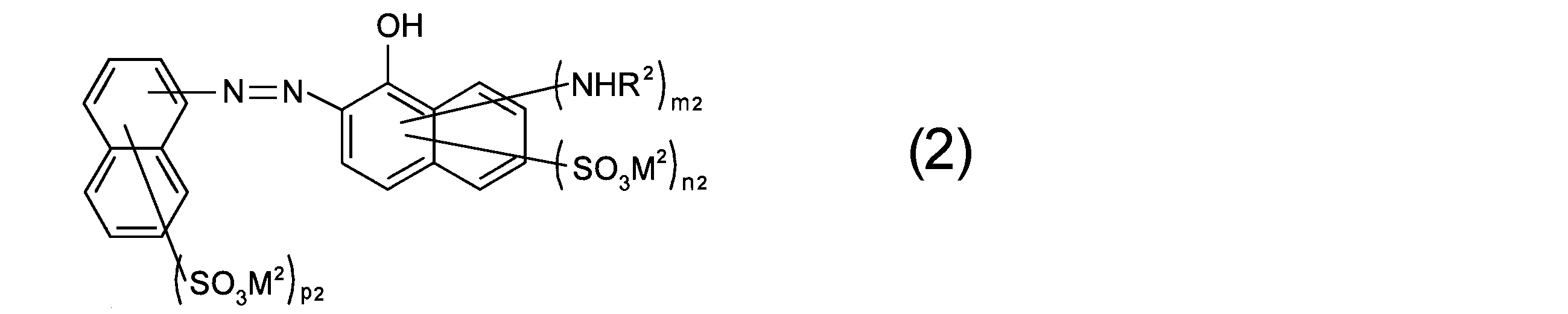
- the monoazo compound used in the present invention is represented by the following general formula (2).
- R 2 represents a hydrogen atom, a substituted or unsubstituted alkyl group, a substituted or unsubstituted acetyl group, a substituted or unsubstituted benzoyl group, or a substituted or unsubstituted phenyl group
- M 2 each independently represents a counter ion
- m 2 represents an integer of 0 to 2
- n 2 represents an integer of 0 to 6
- p 2 Represents an integer of 1 to 4.
- each R 2 may be the same or different.
- each M 2 may be the well or be the same or different.
- each substituent of NHR 2 , SO 3 M 2 and SO 3 M 2 may be substituted at any position of the naphthalene ring.
- R 2 is preferably a hydrogen atom, a substituted or unsubstituted alkyl group, or a substituted or unsubstituted acetyl group, and more preferably a hydrogen atom or a substituted or unsubstituted acetyl group.
- the substituted or unsubstituted alkyl group include substituted or unsubstituted alkyl groups having 1 to 6 carbon atoms.
- Examples of M 2 in the general formula (2) include the same counter ion as M 1 in the general formula (1). Therefore, regarding M 2 in the general formula (2), refer to the description regarding M 1 above.
- M2 in the general formula (2) is preferably 1. Further, n2 in the general formula (2) is preferably 1 or 2.
- Such a monoazo compound of the general formula (2) has an SO 3 M 2 group and an NHR 2 group, and thus has excellent solubility in an aqueous solvent.
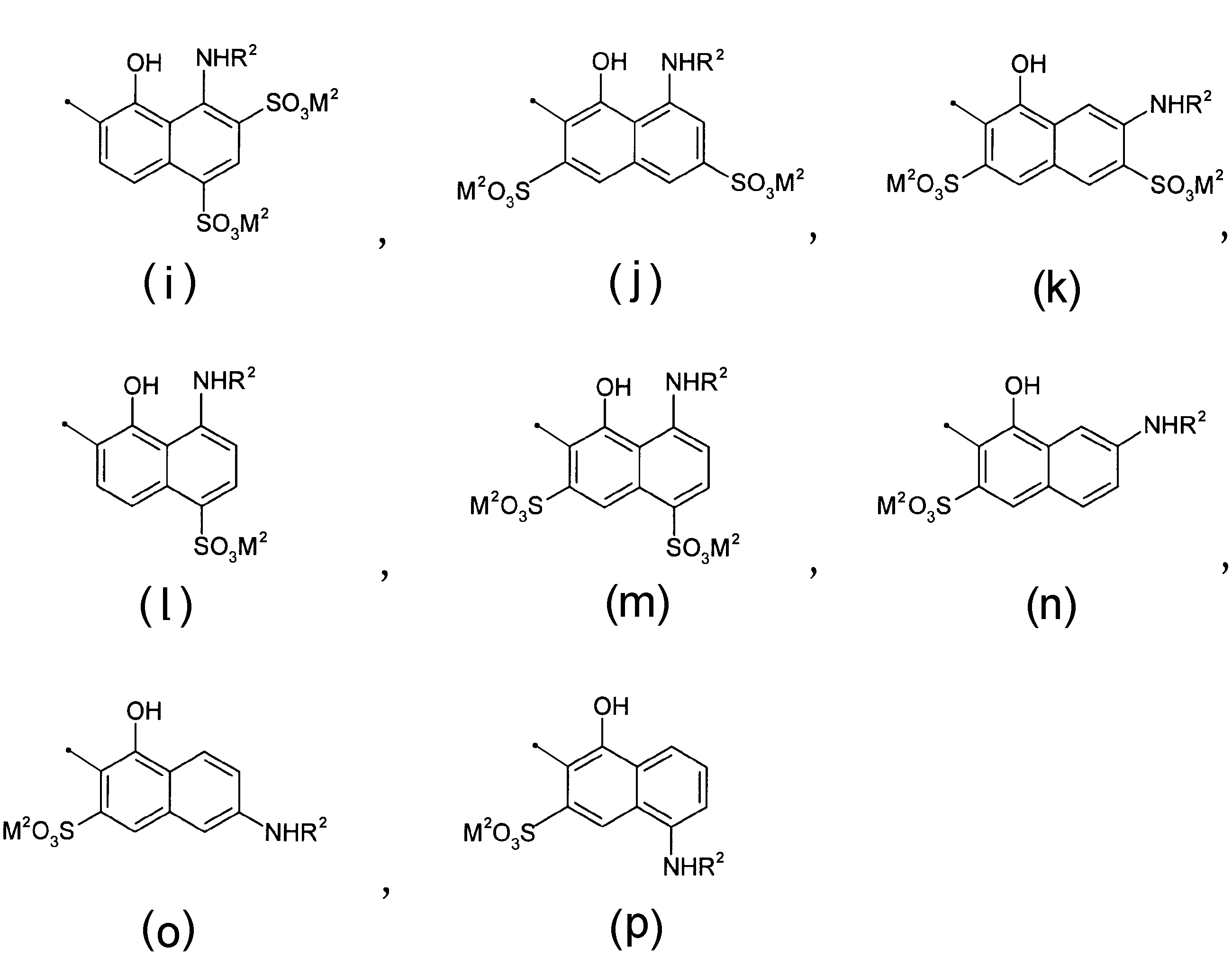
- the naphthyl group represented on the right side of the formula (2) include, for example, the following formulas (i) to (p ) And the like.
- R 2 and M 2 in the formulas (i) to (p) are the same as those in the general formula (2).
- the monoazo compound of the general formula (2) having the formula (i), the formula (j), the formula (k), the formula (m) or the formula (n) is derived from a raw material which is distributed in large quantities in the market Can be synthesized. For this reason, such a monoazo compound is preferable because it can be obtained relatively inexpensively.
- the monoazo compound of the general formula (2) having a 1-naphthyl group represented by the above formula (I), formula (J) or formula (K) has a large dielectric anisotropy in the molecular minor axis direction.
- a polarizing film having a high dichroic ratio can be obtained by mixing such a monoazo compound of the general formula (2) having a 1-naphthyl group with the disazo compound of the general formula (1).
- the monoazo compound preferably used in the present invention is represented by the following general formula (5).
- R 2 , M 2 , m2, n2 and p2 in the general formula (5) are the same as those in the general formula (2).
- the monoazo compounds represented by the above general formulas (2) and (5) are, for example, Yutaka Hosoda, “Theoretical Manufacturing, Dye Chemistry (5th Edition)” (published July 15, 1968, Gihodo, pages 135-152).
- an azo compound represented by the above general formulas (2) and (5) can be obtained by diazonium-chlorinating an aminonaphthalene sulfonic acid compound and coupling it with a hydroxy naphthalene sulfonic acid compound.
- the polarizing film of this invention should just contain the said disazo compound and monoazo compound, and those content is not specifically limited.
- the polarizing film of the present invention has absorption dichroism at least at a part of wavelengths between 380 nm and 780 nm.
- the dichroic ratio of the polarizing film is preferably 15 or more, more preferably 20 or more, and particularly preferably 31 or more. However, the dichroic ratio can be determined by the method described in the following examples. According to the present invention, a polarizing film having a dichroic ratio of 40 or more can also be provided.
- the polarization degree of the polarizing film of the present invention is preferably 97% or more, more preferably 98% or more, and particularly preferably 99% or more. The degree of polarization can be adjusted according to the thickness of the film, for example.
- the transmittance (measured at a wavelength of 550 nm and 23 ° C.) of the polarizing film is preferably 35% or more, more preferably 40% or more.
- the degree of polarization and transmittance can be measured using, for example, a spectrophotometer (product name “V-7100” manufactured by JASCO Corporation).
- the present inventors estimate the reason why the polarizing film containing the disazo compound represented by the general formula (1) and the monoazo compound represented by the general formula (2) has a high dichroic ratio as follows. ing.
- the disazo compound of the general formula (1) forms a stable planar structure by bonding a hydrogen atom of the OH group and one nitrogen of the azo group in the coating solution. For this reason, even when this disazo compound is used alone, the disazo compounds associate with each other in accordance with the hydrophobic interaction, so that they can form supramolecular aggregates in the coating solution. When the disazo compound forms a supramolecular aggregate, the coating liquid exhibits a liquid crystal phase.
- the said supramolecular aggregate will be stabilized when the said monoazo compound enters into the fine area
- the azo compound can be oriented substantially uniformly. Therefore, according to the present invention, a polarizing film having a high dichroic ratio can be obtained.
- the disazo compound represented by the general formula (3) and the monoazo compound represented by the general formula (5) have a large dielectric anisotropy in the molecular minor axis direction, polarized light containing the disazo compound and the monoazo compound is included.
- the film has a higher dichroic ratio.
- the polarizing film of the present invention contains other azo compounds, other dyes other than azo compounds, and / or additives. May be included. These compounding quantities are not specifically limited, For example, it exceeds 0 mass% and is 50 mass% or less.
- Examples of the other dyes include perylene compounds, quinophthalone compounds, naphthoquinone compounds, merocyanine compounds, and the like.
- Examples of the additives include compatibilizers, surfactants, heat stabilizers, light stabilizers, lubricants, antioxidants, flame retardants, antistatic agents, and polymers such as polyvinyl alcohol and polyacrylamide.
- a coating solution containing a disazo compound represented by the above general formula (1), a monoazo compound represented by the above general formula (2) and a solvent is applied in a thin film on an appropriate development surface. It is obtained by working and drying this coating film.
- the polarizing film of the present invention can be preferably manufactured through the following step A and step B, and the step C below may be performed after the step B as necessary.
- Step A A step of applying a coating liquid containing the disazo compound and monoazo compound and a solvent on the development surface to form a coating film.
- Process B The process of drying the said coating film.
- Step C A step of applying a water resistance treatment to the surface of the coating film dried in Step B. An alignment regulating force may be applied to the development surface.
- the coating liquid of the present invention includes a disazo compound represented by the general formula (1), a monoazo compound represented by the general formula (2), and a solvent for dissolving or dispersing the azo compound.
- the disazo compound to be used is not particularly limited as long as it is included in the general formula (1), and may be used alone or in combination of two or more.
- the monoazo compound to be used will not be specifically limited if it is contained in General formula (2), You may use 1 type individually or 2 types or more from it among them.
- the coating liquid is obtained by dissolving or dispersing the azo compound in a solvent such as an aqueous solvent. If necessary, in addition to the azo compound, other azo compounds, other dyes other than azo compounds, polymers, and / or additives may be added to the solvent.
- the solvent is not particularly limited, and a conventionally known solvent can be used, but an aqueous solvent is preferable.
- the aqueous solvent include water, a hydrophilic solvent, a mixed solvent of water and a hydrophilic solvent, and the like.
- the hydrophilic solvent is a solvent that dissolves substantially uniformly in water.
- examples of the hydrophilic solvent include alcohols such as methanol and isopropyl alcohol; glycols such as ethylene glycol; cellosolves such as methyl cellosolve and ethyl cellosolve; ketones such as acetone and methylethylketone; esters such as ethyl acetate; Is mentioned.
- water or a mixed solvent of water and a hydrophilic solvent is preferably used.
- the coating liquid exhibits a liquid crystal phase by changing the liquid temperature, the concentration of each azo compound, and the like. This liquid crystal phase is generated when the azo compound forms a supramolecular aggregate in the liquid.
- the liquid crystal phase is not particularly limited, and examples thereof include a nematic liquid crystal phase, a smectic liquid crystal phase, a cholesteric liquid crystal phase, and a hexagonal liquid crystal phase.
- the liquid crystal phase can be confirmed and identified by an optical pattern observed with a polarizing microscope.
- the concentration of the disazo compound and the monoazo compound in the coating liquid is preferably adjusted so that it exhibits a liquid crystal phase.
- the concentration of the disazo compound and the monoazo compound in the coating liquid is 0.05% by mass to 50% by mass, preferably 0.5% by mass to 40% by mass, more preferably 2% by mass to 30% by mass. It is. However, the concentration is a value based on the sum of the disazo compound and the monoazo compound.
- the coating solution is adjusted to an appropriate pH.
- the pH of the coating solution is preferably about pH 2 to 10, more preferably about pH 6 to 8.
- the temperature of the coating solution is preferably adjusted to 10 ° C. to 40 ° C., more preferably 15 ° C. to 30 ° C.
- the coating liquid is applied to an appropriate development surface to form a coating film.
- the development surface is for developing the coating liquid substantially uniformly.
- the type of the development surface is not particularly limited as long as it is suitable for this purpose.
- Examples of the development surface include a polymer film surface, a glass plate surface, and a metal drum surface.
- an oriented film may be used as the polymer film. Since the oriented film has orientation regulating force on its surface, the azo compound in the liquid can be surely oriented.
- the oriented film can be obtained, for example, by applying an orientation regulating force to the film.
- Examples of the method for imparting alignment regulating force include: rubbing the surface of the film; forming a film such as polyimide on the surface of the film, and rubbing the surface of the film; photoreactive compound on the surface of the film Forming an alignment film by irradiating the film with light.
- a polymer film is used as the development surface, and a polymer film excellent in transparency (for example, a haze value of 3% or less) is preferable.
- the material of the polymer film include polyesters such as polyethylene terephthalate; celluloses such as triacetyl cellulose; polycarbonates; acrylics such as polymethyl methacrylate; styrenes such as polystyrene; polypropylene, cyclic or norbornene structures. Olefins such as polyolefin; and the like. In order to satisfactorily orient the azo compound, it is preferable to use a norbornene film.
- the coating method of the coating liquid is not particularly limited, and for example, a coating method using a conventionally known coater can be employed.
- a coating method using a conventionally known coater can be employed.
- shear stress is applied to the supramolecular aggregate of the azo compound during the flow of the coating liquid. Therefore, a coating film in which the major axis direction of the supramolecular aggregate is parallel to the flow direction of the coating liquid and the supramolecular aggregate of the azo compound is oriented can be formed on the development surface.
- a coating film in which the azo compound is oriented substantially uniformly can be formed.
- a magnetic field or an electric field may be applied as necessary after forming the coating film.
- the coating film can be dried by natural drying or forced drying. Examples of forced drying include reduced pressure drying, heat drying, and reduced pressure heat drying.
- the coating film increases in concentration in the course of drying, and the oriented azo compound is fixed. By fixing the orientation of the azo compound in the coating film, absorption dichroism, which is a characteristic of a polarizing film, is produced.
- the obtained dried coating film can be used as a polarizing film.
- the polarizing film of the present invention can be formed by a solution casting method using a coating liquid. Therefore, according to the present invention, it is possible to produce a very thin polarizing film.
- the thickness of the polarizing film of the present invention is, for example, 0.1 ⁇ m to 10 ⁇ m, preferably 0.1 ⁇ m to 5 ⁇ m.
- the following treatment may be performed. Specifically, on the surface of the dried coating film, aluminum salt, barium salt, lead salt, chromium salt, strontium salt, cerium salt, lanthanum salt, samarium salt, yttrium salt, copper salt, iron salt, and intramolecular A solution containing at least one compound salt selected from the group consisting of compound salts having two or more amino groups is contacted.
- a layer containing the compound salt is formed on the surface of the dry coating film.
- the surface of the dried coating film can be insolubilized or hardly soluble in water. Therefore, water resistance can be imparted to the dried coating film (polarizing film).
- a polarizing film 1 obtained by applying the coating liquid onto a polymer film is laminated on a polymer film 2 as shown in FIG.
- the polarizing film 1 of the present invention is usually used in a state where it is laminated on a polymer film 2. But the said polarizing film 1 can also be peeled from the said polymer film 2, and can also be used. You may laminate
- a polarizing plate can be comprised by laminating
- the polarizing plate 5 by which the protective film 3 was laminated
- the polarizing plate 5 includes a polymer film 2, a polarizing film 1 laminated on the polymer film 2, and a protective film 3 laminated on the polarizing film 1.
- the polymer film 2 has a function of protecting the polarizing film 1.
- the protective film 3 is laminated
- the polarizing plate 5 may be laminated with another optical film such as a retardation film.
- any suitable adhesive layer is provided between them.
- the material for forming the adhesive layer include an adhesive, a pressure-sensitive adhesive, and an anchor coat agent.
- the application of the polarizing film of the present invention is not particularly limited.
- the polarizing film of this invention is used as a structural member of image display apparatuses, such as a liquid crystal display device and an organic electroluminescence display, for example.
- image display apparatuses such as a liquid crystal display device and an organic electroluminescence display, for example.
- preferred applications are a television, a portable device, a video camera, and the like.
- Example 1 The disazo compound of the above formula (1-1) and the monoazo compound of the formula (2-1) are mixed at a blending ratio (mass ratio) shown in Table 1, and dissolved in ion-exchanged water to obtain a concentration of 7 A mass% coating solution was prepared. However, the concentration is a value based on the total solid content of the disazo compound and the monoazo compound.
- the coating liquid is applied to a bar coater (manufactured by BUSHMAN, product name “Mayer rot”). HS4 ”) and dried naturally.
- the coating film after drying is a polarizing film.
- the thickness of the obtained polarizing film was about 0.2 ⁇ m.
- Table 1 shows the measurement results of the dichroic ratio of the polarizing film.
- the disazo compound of the formula (1-1) and the monoazo compound of the formula (2-1) are mixed at a blending ratio (mass ratio) shown in Table 1, and dissolved in ion-exchanged water. Then, a liquid having a concentration of 20% by mass was prepared, and the liquid was observed at 23 ° C. according to the liquid crystal phase observation method. As a result, a nematic liquid crystal phase was shown.
- Example 2 A polarizing film having a thickness of about 0.2 ⁇ m was produced in the same manner as in Example 1 except that the monoazo compound of the formula (2-2) was used instead of the monoazo compound of the formula (2-1).
- Table 1 shows the blending ratio (mass ratio) and the measurement results of the dichroic ratio of the polarizing film.
- Example 3 A polarizing film having a thickness of about 0.2 ⁇ m was prepared in the same manner as in Example 1 except that the monoazo compound of formula (2-3) was used instead of the monoazo compound of formula (2-1).
- Table 1 shows the blending ratio (mass ratio) and the measurement results of the dichroic ratio of the polarizing film.
- Example 4 A polarizing film having a thickness of about 0.2 ⁇ m was produced in the same manner as in Example 1 except that the monoazo compound of the formula (2-4) was used instead of the monoazo compound of the formula (2-1).
- Table 1 shows the blending ratio (mass ratio) and the measurement results of the dichroic ratio of the polarizing film.
- Example 5 A polarizing film having a thickness of about 0.2 ⁇ m was produced in the same manner as in Example 1 except that the monoazo compound of the formula (2-5) was used instead of the monoazo compound of the formula (2-1).
- Table 1 shows the blending ratio (mass ratio) and the measurement results of the dichroic ratio of the polarizing film.
- Example 6 The disazo compound of the formula (1-2) was used in place of the disazo compound of the formula (1-1), and the monoazo of the formula (2-2) was used instead of the monoazo compound of the formula (2-1).
- a polarizing film having a thickness of about 0.2 ⁇ m was produced in the same manner as in Example 1 except that the compound was used.
- Table 1 shows the blending ratio (mass ratio) and the measurement results of the dichroic ratio of the polarizing film.
- Example 7 The disazo compound of the formula (1-2) was used instead of the disazo compound of the formula (1-1), and the monoazo of the formula (2-3) instead of the monoazo compound of the formula (2-1)
- a polarizing film having a thickness of about 0.2 ⁇ m was produced in the same manner as in Example 1 except that the compound was used.
- Table 1 shows the blending ratio (mass ratio) and the measurement results of the dichroic ratio of the polarizing film.
- Example 8 The disazo compound of the formula (1-3) was used in place of the disazo compound of the formula (1-1), and the monoazo of the formula (2-3) was replaced with the monoazo compound of the formula (2-1)
- a polarizing film having a thickness of about 0.2 ⁇ m was produced in the same manner as in Example 1 except that the compound was used.
- Table 1 shows the blending ratio (mass ratio) and the measurement results of the dichroic ratio of the polarizing film.
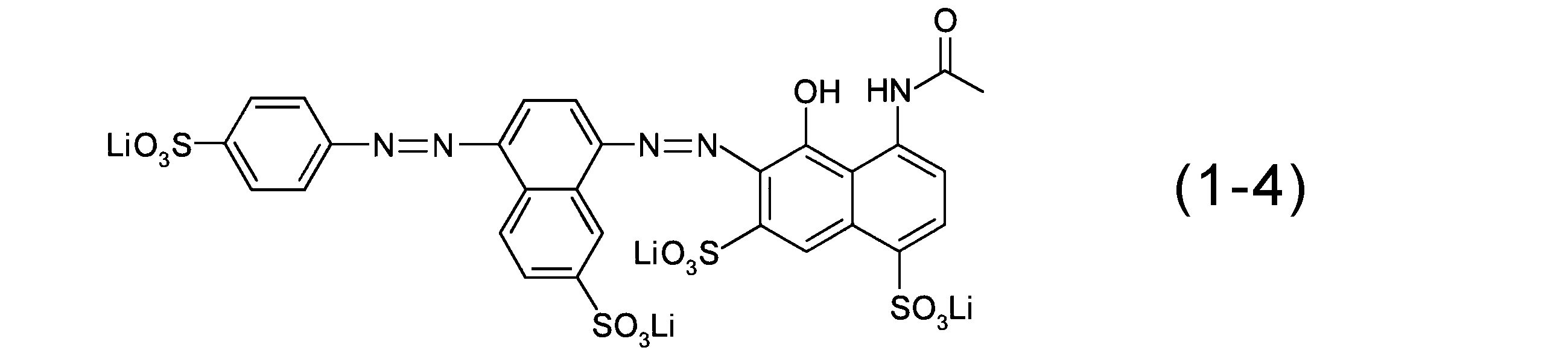
- Example 9 The disazo compound of the formula (1-4) was used in place of the disazo compound of the formula (1-1), and the monoazo of the formula (2-5) instead of the monoazo compound of the formula (2-1)
- a polarizing film having a thickness of about 0.2 ⁇ m was produced in the same manner as in Example 1 except that the compound was used.
- Table 1 shows the blending ratio (mass ratio) and the measurement results of the dichroic ratio of the polarizing film.
- Example 1 In the same manner as in Example 1 except that only the disazo compound of the formula (1-1) was used instead of the mixture of the disazo compound of the formula (1-1) and the monoazo compound of the formula (2-1). A polarizing film having a thickness of about 0.2 ⁇ m was prepared. Table 1 shows the measurement results of the dichroic ratio of the polarizing film.
- Example 2 In the same manner as in Example 1 except that only the disazo compound of the formula (1-2) was used instead of the mixture of the disazo compound of the formula (1-1) and the monoazo compound of the formula (2-1). A polarizing film having a thickness of about 0.2 ⁇ m was prepared. Table 1 shows the measurement results of the dichroic ratio of the polarizing film.
- Example 1 was repeated except that only the monoazo compound of the formula (2-1) was used instead of the mixture of the disazo compound of the formula (1-1) and the monoazo compound of the formula (2-1).
- a polarizing film having a thickness of about 0.2 ⁇ m was prepared. Table 1 shows the measurement results of the dichroic ratio of the polarizing film.
- Example 6 In the same manner as in Example 1 except that only the monoazo compound of the formula (2-2) was used instead of the mixture of the disazo compound of the formula (1-1) and the monoazo compound of the formula (2-1). A polarizing film having a thickness of about 0.2 ⁇ m was prepared. Table 1 shows the measurement results of the dichroic ratio of the polarizing film.
- Example 7 In the same manner as in Example 1 except that only the monoazo compound of the formula (2-3) was used instead of the mixture of the disazo compound of the formula (1-1) and the monoazo compound of the formula (2-1). A polarizing film having a thickness of about 0.2 ⁇ m was prepared. Table 1 shows the measurement results of the dichroic ratio of the polarizing film.
- Example 8 In the same manner as in Example 1 except that only the monoazo compound of the formula (2-4) was used instead of the mixture of the disazo compound of the formula (1-1) and the monoazo compound of the formula (2-1). A polarizing film having a thickness of about 0.2 ⁇ m was prepared. Table 1 shows the measurement results of the dichroic ratio of the polarizing film.
- Example 9 In the same manner as in Example 1 except that only the monoazo compound of the formula (2-5) was used instead of the mixture of the disazo compound of the formula (1-1) and the monoazo compound of the formula (2-1). A polarizing film having a thickness of about 0.2 ⁇ m was prepared. Table 1 shows the measurement results of the dichroic ratio of the polarizing film.
- the polarizing film of this invention can be utilized for the structural member of a liquid crystal display device, polarized sunglasses, etc., for example.
- the coating liquid of the present invention can be used as a material for forming a polarizing film.
- Polarizing film 1 ... Polarizing film, 2 ... Base material, 3 ... Protective film, 5 ... Polarizing plate
Landscapes
- Chemical & Material Sciences (AREA)
- Chemical Kinetics & Catalysis (AREA)
- Organic Chemistry (AREA)
- Polarising Elements (AREA)
- Liquid Crystal (AREA)
Abstract
【課題】 本発明は、高い二色比を有する偏光フィルムを提供する。 【解決手段】 本発明の偏光フィルムは、下記一般式(1)で表されるジスアゾ化合物と下記一般式(2)で表されるモノアゾ化合物を含んでいる。 一般式(1)及び(2)において、Qは、置換若しくは無置換のアリール基を表し、R1及びR2は、水素原子、置換若しくは無置換のアルキル基、置換若しくは無置換のアセチル基、置換若しくは無置換のベンゾイル基、又は、置換若しくは無置換のフェニル基を表し、M1及びM2は、対イオンを表し、m1及びm2は、0~2の整数を表し、n1及びn2は、0~6の整数を表し、o1は、0~1の整数を表し、p1及びp2は、1~4の整数を表す。
Description
本発明は、高い二色比を有する偏光フィルム、及びこの偏光フィルムを形成するためのコーティング液に関する。
偏光フィルムは、偏光又は自然光から特定の直線偏光を透過させる機能を有する光学部材である。
汎用的な偏光フィルムは、例えば、ヨウ素で染色したポリビニルアルコールフィルムを延伸することにより得られる。
また、ナフタレン環を有するジスアゾ化合物を含む偏光フィルムも知られている(特許文献1)。この偏光フィルムは、前記ジスアゾ化合物と溶媒とを含むコーティング液を基材上に塗工する方法(溶液流延法)によって得られる。このコーティング液においては、その液中で前記ジスアゾ化合物が超分子会合体を形成することによって液晶相を示す。液晶相状態のコーティング液を基材上に塗工することにより、ジスアゾ化合物が配向した塗膜が得られる。この塗膜を乾燥することによって前記配向したジスアゾ化合物が固定される。この乾燥後の塗膜は偏光特性を有する。
しかしながら、上記ジスアゾ化合物のみを用いた場合には、二色比の高い偏光フィルムが得られない。
汎用的な偏光フィルムは、例えば、ヨウ素で染色したポリビニルアルコールフィルムを延伸することにより得られる。
また、ナフタレン環を有するジスアゾ化合物を含む偏光フィルムも知られている(特許文献1)。この偏光フィルムは、前記ジスアゾ化合物と溶媒とを含むコーティング液を基材上に塗工する方法(溶液流延法)によって得られる。このコーティング液においては、その液中で前記ジスアゾ化合物が超分子会合体を形成することによって液晶相を示す。液晶相状態のコーティング液を基材上に塗工することにより、ジスアゾ化合物が配向した塗膜が得られる。この塗膜を乾燥することによって前記配向したジスアゾ化合物が固定される。この乾燥後の塗膜は偏光特性を有する。
しかしながら、上記ジスアゾ化合物のみを用いた場合には、二色比の高い偏光フィルムが得られない。
また、特許文献2には、アントラキノン環を有するアゾ化合物とナフタレン環を有するジスアゾ化合物と含む偏光フィルムが開示されている。この偏光フィルムも、前記2種類のアゾ化合物と溶媒とを含むコーティング液を基材上に塗工する方法によって得られる。
しかしながら、アントラキノン環のような大きな芳香環を有するアゾ化合物を用いると、結晶が生じるおそれがある。アゾ化合物の一部が結晶化すると、アゾ化合物の配向が不均一になり易い。このため、特許文献2では、二色比の高い偏光フィルムが得られない。
しかしながら、アントラキノン環のような大きな芳香環を有するアゾ化合物を用いると、結晶が生じるおそれがある。アゾ化合物の一部が結晶化すると、アゾ化合物の配向が不均一になり易い。このため、特許文献2では、二色比の高い偏光フィルムが得られない。
本発明の第1の目的は、高い二色比を有する偏光フィルムを提供することである。
本発明の第2の目的は、高い二色比を有する偏光フィルムを形成するためのコーティング液を提供することである。
本発明の第2の目的は、高い二色比を有する偏光フィルムを形成するためのコーティング液を提供することである。
本発明の偏光フィルムは、下記一般式(1)で表されるジスアゾ化合物と、下記一般式(2)で表されるモノアゾ化合物と、を含む。

一般式(1)において、Qは、置換若しくは無置換のアリール基を表し、R1は、水素原子、置換若しくは無置換のアルキル基、置換若しくは無置換のアセチル基、置換若しくは無置換のベンゾイル基、又は、置換若しくは無置換のフェニル基を表し、M1は、それぞれ独立して、対イオンを表し、m1は、0~2の整数を表し、n1は、0~6の整数を表し、m1及びn1の少なくとも何れか一方は0でなく、o1は、0~1の整数を表し、p1は、1~4の整数を表す。
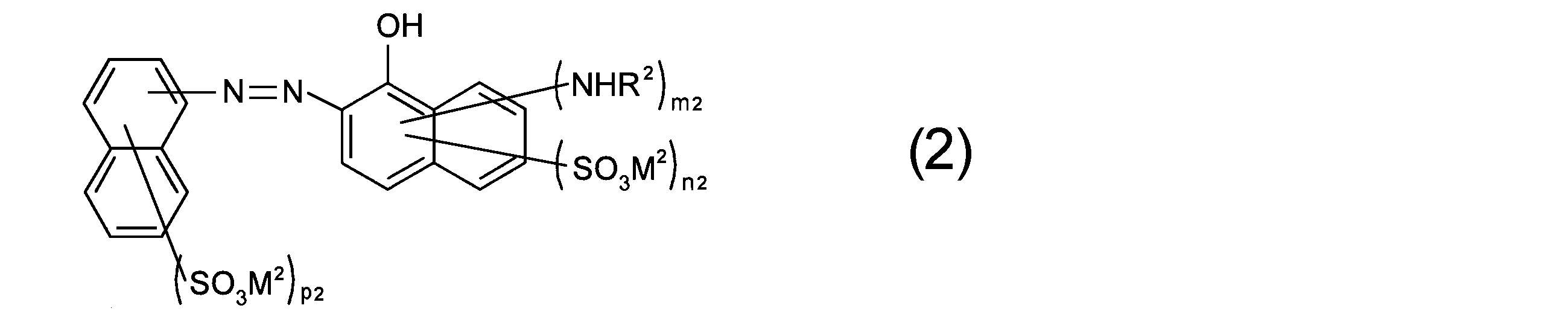
一般式(2)において、R2は、水素原子、置換若しくは無置換のアルキル基、置換若しくは無置換のアセチル基、置換若しくは無置換のベンゾイル基、又は、置換若しくは無置換のフェニル基を表し、M2は、それぞれ独立して、対イオンを表し、m2は、0~2の整数を表し、n2は、0~6の整数を表し、m2及びn2の少なくとも何れか一方は0でなく、p2は、1~4の整数を表す。
本発明の好ましい偏光フィルムは、前記ジスアゾ化合物が、下記一般式(3)で表されるジスアゾ化合物である。

一般式(3)のQ、R1、M1、m1、n1、o1及びp1は、前記一般式(1)のそれらと同様である。
本発明の他の好ましい偏光フィルムは、前記モノアゾ化合物が、下記一般式(5)で表されるモノアゾ化合物である。
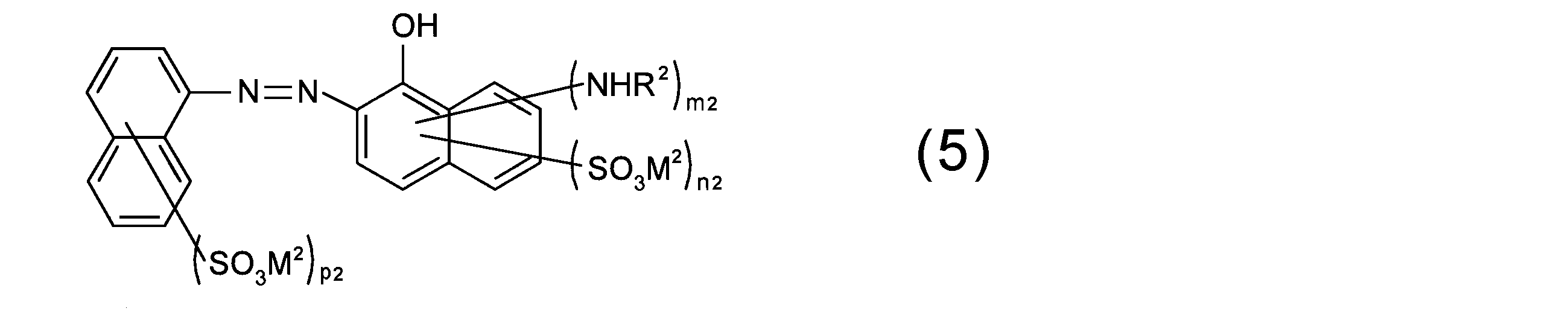
一般式(5)のR2、M2、m2、n2及びp2は、前記一般式(2)のそれらと同様である。
本発明の別の局面によれば、コーティング液が提供される。
このコーティング液は、上記一般式(1)で表されるジスアゾ化合物と、上記一般式(2)で表されるモノアゾ化合物と、溶媒と、を含む。
このコーティング液は、上記一般式(1)で表されるジスアゾ化合物と、上記一般式(2)で表されるモノアゾ化合物と、溶媒と、を含む。
本発明の別の局面によれば、画像表示装置が提供される。
この画像表示装置は、その構成部材として、上記いずれかの偏光フィルムを有する。
この画像表示装置は、その構成部材として、上記いずれかの偏光フィルムを有する。
本発明の偏光フィルムは、一般式(1)で表されるジスアゾ化合物及び一般式(2)で表されるモノアゾ化合物を含んでいるので、高い二色比を有する。
本発明のコーティング液は、一般式(1)で表されるジスアゾ化合物及び一般式(2)で表されるモノアゾ化合物を含んでいる。このコーティング液を適当な展開面上に塗工することにより、比較的薄く、且つ高い二色比を有する偏光フィルムを容易に得ることができる。
本発明のコーティング液は、一般式(1)で表されるジスアゾ化合物及び一般式(2)で表されるモノアゾ化合物を含んでいる。このコーティング液を適当な展開面上に塗工することにより、比較的薄く、且つ高い二色比を有する偏光フィルムを容易に得ることができる。
[ジスアゾ化合物及びモノアゾ化合物を含む偏光フィルム]
本発明の偏光フィルムは、下記ジスアゾ化合物及びモノアゾ化合物を含む。
本発明の偏光フィルムは、下記ジスアゾ化合物の中から選ばれる1種又は2種以上、及び、下記モノアゾ化合物の中から選ばれる1種又は2種以上を含んでいてもよい。
ここで、本明細書において、「置換若しくは無置換」という記載は、「置換基を有する、又は、置換基を有しない」ことを意味する。
また、本明細書において、「Y~Z」という記載は、「Y以上Z以下」を意味する。
本発明の偏光フィルムは、下記ジスアゾ化合物及びモノアゾ化合物を含む。
本発明の偏光フィルムは、下記ジスアゾ化合物の中から選ばれる1種又は2種以上、及び、下記モノアゾ化合物の中から選ばれる1種又は2種以上を含んでいてもよい。
ここで、本明細書において、「置換若しくは無置換」という記載は、「置換基を有する、又は、置換基を有しない」ことを意味する。
また、本明細書において、「Y~Z」という記載は、「Y以上Z以下」を意味する。
(ジスアゾ化合物)
本発明で用いられるジスアゾ化合物は、下記一般式(1)で表される。
本発明で用いられるジスアゾ化合物は、下記一般式(1)で表される。

一般式(1)において、Qは、置換若しくは無置換のアリール基を表し、R1は、水素原子、置換若しくは無置換のアルキル基、置換若しくは無置換のアセチル基、置換若しくは無置換のベンゾイル基、又は、置換若しくは無置換のフェニル基を表し、M1は、それぞれ独立して、対イオンを表し、m1は、0~2の整数を表し、n1は、0~6の整数を表し、m1及びn1の少なくとも何れか一方は0でなく、o1は、0~1の整数を表し、p1は、1~4の整数を表す。ただし、1≦(m1+n1)≦6である。前記m1が2の場合(即ち、NHR1の置換数が2である場合)、各R1は同一でもよく又は異なっていてもよい。前記n1及びp1が2以上の場合(即ち、SO3M1の置換数が2以上である場合)、各M1は同一でもよく又は異なっていてもよい。
一般式(1)において、NHR1、SO3M1、OH及びSO3M1の各置換基は、それぞれナフタレン環の何れの位置に置換していてもよい。
一般式(1)において、NHR1、SO3M1、OH及びSO3M1の各置換基は、それぞれナフタレン環の何れの位置に置換していてもよい。
上記一般式(1)のQで表されるアリール基は、フェニル基、複素環が結合したフェニル基、ベンゼン環が2以上縮合した縮合環基(例えばナフチル基など)などが挙げられる。前記フェニル基は、隣接しない炭素原子が窒素原子に置換されているフェニル基を含む。
Qで表されるアリール基は、置換基を有していてもよいし、又は、置換基を有していなくてもよい。前記アリール基が置換又は無置換のいずれの場合でも、上記ジスアゾ化合物は、水系溶媒に対する溶解性に優れ、さらに、配向性にも優れている。
前記アリール基が置換基を有する場合、その置換基としては、例えば、炭素数1~6のアルキル基、炭素数1~6のアルコキシ基、炭素数1~6のチオアルキル基、ジヒドロキシプロピル基等の炭素数1~6のヒドロキシアルキル基、炭素数1~6のアルキルアミノ基、炭素数6~20のフェニルアミノ基、炭素数1~6のアシルアミノ基、ハロゲノ基、ニトロ基、シアノ基、アミノ基、アセトアミド基、水酸基、SO3M基などのスルホン酸基、COOM基などのカルボキシル基などが挙げられる。前記Qが前記置換基を複数有する場合、各置換基は同一又は異なっていてもよい。ただし、前記Mは、上記M1と同様に対イオンを表す。
前記アリール基が置換基を有する場合、その置換基としては、例えば、炭素数1~6のアルキル基、炭素数1~6のアルコキシ基、炭素数1~6のチオアルキル基、ジヒドロキシプロピル基等の炭素数1~6のヒドロキシアルキル基、炭素数1~6のアルキルアミノ基、炭素数6~20のフェニルアミノ基、炭素数1~6のアシルアミノ基、ハロゲノ基、ニトロ基、シアノ基、アミノ基、アセトアミド基、水酸基、SO3M基などのスルホン酸基、COOM基などのカルボキシル基などが挙げられる。前記Qが前記置換基を複数有する場合、各置換基は同一又は異なっていてもよい。ただし、前記Mは、上記M1と同様に対イオンを表す。
好ましくは、前記置換基は、極性基である。極性基とは、極性を持つ官能基を意味する。極性基としては、ニトロ基、シアノ基、アミノ基、水酸基、スルホン酸基、カルボキシル基のような比較的電気陰性度の大きい酸素及び/又は窒素を含む官能基が挙げられる。
一般式(1)のQは、好ましくは下記式(A)で表されるフェニル基である。
式(A)において、Xは、置換基を表し、xは、前記Xの置換数であって0~5の整数を表す。前記置換基Xの具体例は、上記アリール基における置換基と同様であるので、それを参照されたい。また、xは、好ましくは1又は2である。
式(A)において、Xは、置換基を表し、xは、前記Xの置換数であって0~5の整数を表す。前記置換基Xの具体例は、上記アリール基における置換基と同様であるので、それを参照されたい。また、xは、好ましくは1又は2である。

より具体的には、一般式(1)のQは、例えば、下記式群の中から選ばれる1つである。
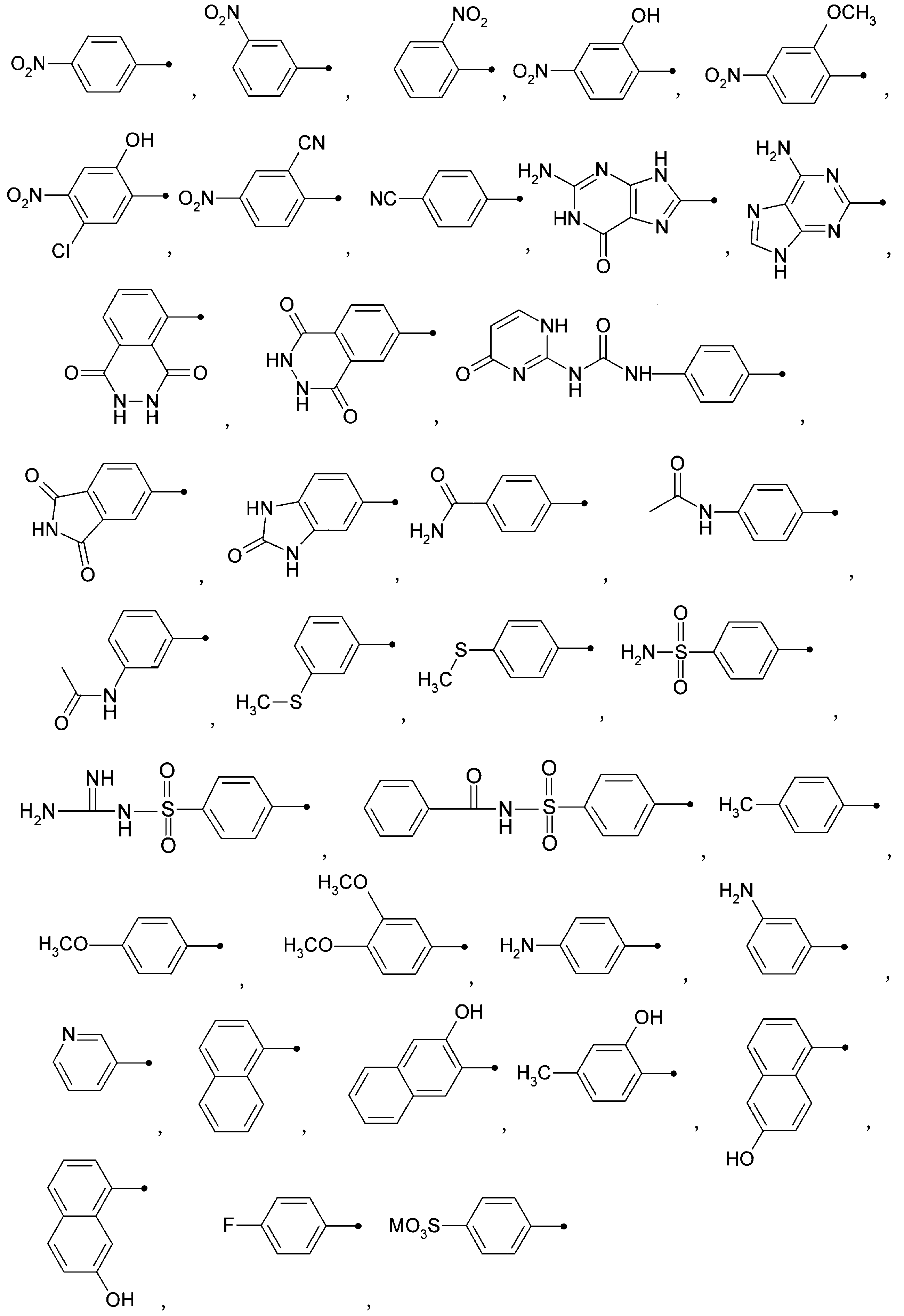
上記一般式(1)のR1のアルキル基、アセチル基、ベンゾイル基、又はフェニル基が置換基を有する場合、その置換基としては、上記アリール基における置換基と同様であるので、それを参照されたい。
前記R1は、好ましくは、水素原子、置換若しくは無置換のアルキル基、置換若しくは無置換のアセチル基であり、より好ましくは水素原子又は置換若しくは無置換のアセチル基である。
前記置換若しくは無置換のアルキル基としては、置換若しくは無置換の炭素数1~6のアルキル基が挙げられる。
前記R1は、好ましくは、水素原子、置換若しくは無置換のアルキル基、置換若しくは無置換のアセチル基であり、より好ましくは水素原子又は置換若しくは無置換のアセチル基である。
前記置換若しくは無置換のアルキル基としては、置換若しくは無置換の炭素数1~6のアルキル基が挙げられる。
前記一般式(1)のM1(対イオン)は、好ましくは、水素イオン;Li、Na、K、Csなどのアルカリ金属イオン;Ca、Sr、Baなどのアルカリ土類金属イオン;その他の金属イオン;アルキル基若しくはヒドロキシアルキル基で置換されていてもよいアンモニウムイオン;有機アミンの塩などが挙げられる。前記他の金属イオンとしては、例えば、Ni+、Fe3+、Cu2+、Ag+、Zn2+、Al3+、Pd2+、Cd2+、Sn2+、Co2+、Mn2+、Ce3+などが挙げられる。有機アミンとしては、炭素数1~6のアルキルアミン、ヒドロキシル基を有する炭素数1~6のアルキルアミン、カルボキシル基を有する炭素数1~6のアルキルアミンなどが挙げられる。上記一般式(1)において、SO3M1基が2つ以上結合している場合、各M1は、同一又は異なっていてもよい。また、前記一般式(1)において、SO3M1のM1が2価以上の陽イオンである場合、そのM1は、他の陰イオンと静電的に結合して安定化しているか、或いは、そのM1は他のアゾ化合物と共有されて安定化している。
前記一般式(1)のm1は、好ましくは1である。また、一般式(1)のn1は、好ましくは1又は2である。このような一般式(1)のジスアゾ化合物は、SO3M1基及びNHR1基を有するので、水系溶媒に対する溶解性に特に優れている。このようなアゾ化合物は、液中において安定な超分子会合体を形成して液晶相を示すので好ましい。
また、一般式(1)のナフチル基(式(1)の右側に表されているナフチル基)においては、OH基がアゾ基の結合部に対してオルト位に結合している。このようなナフチル基を有するジスアゾ化合物は、コーティング液中において、反応性の高いOH基の水素原子とアゾ基の一方の窒素とが結合する。このようにOH基が変化してその水素原子がアゾ基と結合することにより、ナフチル基の平面構造が安定する。
また、一般式(1)のナフチル基(式(1)の右側に表されているナフチル基)においては、OH基がアゾ基の結合部に対してオルト位に結合している。このようなナフチル基を有するジスアゾ化合物は、コーティング液中において、反応性の高いOH基の水素原子とアゾ基の一方の窒素とが結合する。このようにOH基が変化してその水素原子がアゾ基と結合することにより、ナフチル基の平面構造が安定する。
また、一般式(1)の前記ナフチル基(式(1)の右側に表されているナフチル基)の具体例としては、例えば、下記式(a)乃至式(h)などが挙げられる。式(a)乃至式(h)のR1及びM1は、一般式(1)のそれらと同様である。
これらの中でも、式(a)、式(b)、式(c)又は式(e)を有する一般式(1)のジスアゾ化合物は、市場において多量に流通している原料から合成できる。このため、かかるジスアゾ化合物は比較的安価に得ることができるので好ましい。
これらの中でも、式(a)、式(b)、式(c)又は式(e)を有する一般式(1)のジスアゾ化合物は、市場において多量に流通している原料から合成できる。このため、かかるジスアゾ化合物は比較的安価に得ることができるので好ましい。

一般式(1)において、2つのアゾ基と結合するナフチレン基(式(1)の2つのアゾ基の間のナフチレン基)の具体例としては、例えば、下記式(B)乃至(D)で表されるナフチレン基が挙げられる。式(B)乃至式(D)のM1、o1及びp1は、一般式(1)のそれらと同様である。好ましくは、前記p1は、1又は2である。
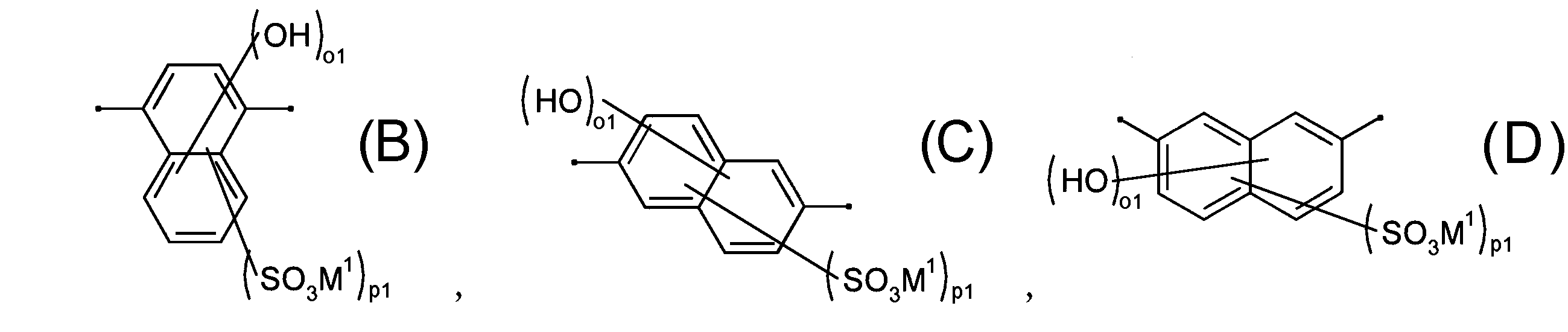
上記式(B)乃至(D)のナフチレン基の中で、下記式(E)乃至(H)で表されるナフチレン基が好ましい。

中でも、式(B)、式(E)又は式(F)のナフチレン基を有する一般式(1)のジスアゾ化合物がより好ましい。このジスアゾ化合物は、式(B)、式(E)又は式(F)で表される1,4-ナフチレン基を有するので、分子短軸方向における誘電率異方性が大きい。このような1,4-ナフチレン基を有することは、ジスアゾ化合物の超分子会合体の形成において優位に作用する。
以上のような点から、本発明において好ましく用いられるジスアゾ化合物は、下記一般式(3)又は一般式(4)で表される。一般式(3)のQ、R1、M1、m1、n1、o1及びp1は、一般式(1)のそれらと同様である。一般式(4)のR1、M1、m1、n1及びp1は、一般式(1)のそれらと同様であり、一般式(4)のX及びxは、式(A)のそれらと同様である。


上記一般式(1)、(3)及び(4)で表されるジスアゾ化合物は、例えば、細田豊著「理論製造 染料化学(5版)」(昭和43年7月15日技報堂発行、135頁~152頁)に従って合成できる。
例えば、置換若しくは無置換のアニリン化合物をジアゾニウム塩化し、これをアミノナフタレンスルホン酸化合物とカップリング反応させることにより、モノアゾ化合物を得る。このモノアゾ化合物を、ヒドロキシナフタレンスルホン酸化合物とカップリング反応させることにより、上記一般式(1)、(3)及び(4)で表されるジスアゾ化合物を得ることができる。
例えば、置換若しくは無置換のアニリン化合物をジアゾニウム塩化し、これをアミノナフタレンスルホン酸化合物とカップリング反応させることにより、モノアゾ化合物を得る。このモノアゾ化合物を、ヒドロキシナフタレンスルホン酸化合物とカップリング反応させることにより、上記一般式(1)、(3)及び(4)で表されるジスアゾ化合物を得ることができる。
(モノアゾ化合物)
本発明で用いられるモノアゾ化合物は、下記一般式(2)で表される。
本発明で用いられるモノアゾ化合物は、下記一般式(2)で表される。
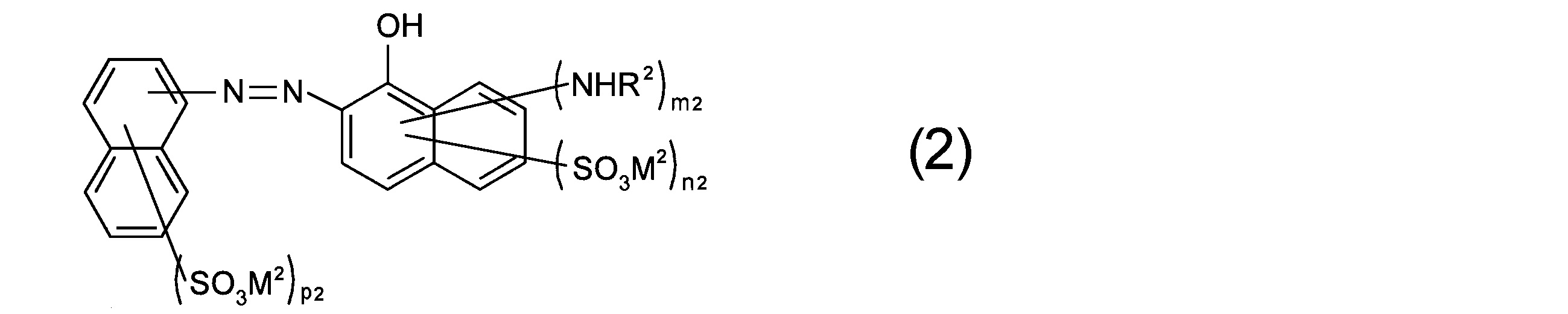
一般式(2)において、R2は、水素原子、置換若しくは無置換のアルキル基、置換若しくは無置換のアセチル基、置換若しくは無置換のベンゾイル基、又は、置換若しくは無置換のフェニル基を表し、M2は、それぞれ独立して、対イオンを表し、m2は、0~2の整数を表し、n2は、0~6の整数を表し、m2及びn2の少なくとも何れか一方は0でなく、p2は、1~4の整数を表す。ただし、1≦(m2+n2)≦6である。前記m2が2の場合、各R2は同一でもよく又は異なっていてもよい。前記n2及びp2が2以上の場合、各M2は同一でもよく又は異なっていてもよい。
一般式(2)において、NHR2、SO3M2及びSO3M2の各置換基は、それぞれナフタレン環の何れの位置に置換していてもよい。
一般式(2)において、NHR2、SO3M2及びSO3M2の各置換基は、それぞれナフタレン環の何れの位置に置換していてもよい。
上記一般式(2)のR2のアルキル基、アセチル基、ベンゾイル基、又はフェニル基が置換基を有する場合、その置換基としては、上記ジスアゾ化合物のアリール基における置換基と同様であるので、それを参照されたい。
前記R2は、好ましくは、水素原子、置換若しくは無置換のアルキル基、置換若しくは無置換のアセチル基であり、より好ましくは水素原子又は置換若しくは無置換のアセチル基である。前記置換若しくは無置換のアルキル基としては、置換若しくは無置換の炭素数1~6のアルキル基が挙げられる。
前記R2は、好ましくは、水素原子、置換若しくは無置換のアルキル基、置換若しくは無置換のアセチル基であり、より好ましくは水素原子又は置換若しくは無置換のアセチル基である。前記置換若しくは無置換のアルキル基としては、置換若しくは無置換の炭素数1~6のアルキル基が挙げられる。
前記一般式(2)のM2としては、上記一般式(1)のM1と同様の対イオンが挙げられる。従って、一般式(2)のM2については、上記M1に関する説明を参照されたい。
前記一般式(2)のm2は、好ましくは1である。また、一般式(2)のn2は、好ましくは1又は2である。このような一般式(2)のモノアゾ化合物は、SO3M2基及びNHR2基を有するので、水系溶媒に対する溶解性に優れている。
また、一般式(2)において、アゾ基と結合する一方のナフチル基(式(2)の右側に表されているナフチル基)の具体例としては、例えば、下記式(i)乃至式(p)などが挙げられる。式(i)乃至式(p)のR2及びM2は、一般式(2)のそれらと同様である。
これらの中でも、式(i)、式(j)、式(k)、式(m)又は式(n)を有する一般式(2)のモノアゾ化合物は、市場において多量に流通している原料から合成できる。このため、かかるモノアゾ化合物は比較的安価に得ることができるので好ましい。
これらの中でも、式(i)、式(j)、式(k)、式(m)又は式(n)を有する一般式(2)のモノアゾ化合物は、市場において多量に流通している原料から合成できる。このため、かかるモノアゾ化合物は比較的安価に得ることができるので好ましい。
一般式(2)において、アゾ基と結合する他方のナフチル基(式(2)の左側に表されているナフチル基)の具体例としては、例えば、下記式(I)乃至式(K)で表されるナフチル基が挙げられる。式(I)乃至式(K)のM2及びp2は、一般式(2)のそれらと同様である。好ましくは、前記p2は、1又は2である。

上記式(I)、式(J)又は式(K)で表される1-ナフチル基を有する一般式(2)のモノアゾ化合物は、分子短軸方向における誘電率異方性が大きい。このような1-ナフチル基を有する一般式(2)のモノアゾ化合物を、上記一般式(1)のジスアゾ化合物に混合することにより、二色比の高い偏光フィルムが得られる。
以上のような点から、本発明において好ましく用いられるモノアゾ化合物は、下記一般式(5)で表される。一般式(5)のR2、M2、m2、n2及びp2は、一般式(2)のそれらと同様である。

上記一般式(2)及び(5)で表されるモノアゾ化合物は、例えば、細田豊著「理論製造 染料化学(5版)」(昭和43年7月15日技報堂発行、135頁~152頁)に従って合成できる。
例えば、アミノナフタレンスルホン酸化合物をジアゾニウム塩化し、これをヒドロキシナフタレンスルホン酸化合物とカップリング反応させることにより、上記一般式(2)及び(5)で表されるアゾ化合物を得ることができる。
例えば、アミノナフタレンスルホン酸化合物をジアゾニウム塩化し、これをヒドロキシナフタレンスルホン酸化合物とカップリング反応させることにより、上記一般式(2)及び(5)で表されるアゾ化合物を得ることができる。
(偏光フィルム)
本発明の偏光フィルムは、上記ジスアゾ化合物及びモノアゾ化合物を含んでいればよく、それらの含有量は特に限定されない。例えば、偏光フィルム中における上記ジスアゾ化合物とモノアゾ化合物の含有比は、ジスアゾ化合物:モノアゾ化合物(質量比)=99:1~10:90であり、好ましくは95:5~30:70であり、より好ましくは90:10~50:50である。より高い二色比を有する偏光フィルムが得られることから、ジスアゾ化合物が、モノアゾ化合物と同量又はそれよりも多く含まれていることが好ましい。
本発明の偏光フィルムは、上記ジスアゾ化合物及びモノアゾ化合物を含んでいればよく、それらの含有量は特に限定されない。例えば、偏光フィルム中における上記ジスアゾ化合物とモノアゾ化合物の含有比は、ジスアゾ化合物:モノアゾ化合物(質量比)=99:1~10:90であり、好ましくは95:5~30:70であり、より好ましくは90:10~50:50である。より高い二色比を有する偏光フィルムが得られることから、ジスアゾ化合物が、モノアゾ化合物と同量又はそれよりも多く含まれていることが好ましい。
本発明の偏光フィルムは、波長380nm~780nmの間の少なくとも一部の波長において吸収二色性を有する。前記偏光フィルムの二色比は、好ましくは15以上であり、より好ましくは20以上であり、特に好ましくは31以上である。ただし、二色比は、下記実施例に記載の方法によって求めることができる。本発明によれば、40以上の二色比を有する偏光フィルムを提供することもできる。
本発明の偏光フィルムの偏光度は、好ましくは97%以上であり、より好ましくは98%以上であり、特に好ましくは99%以上である。前記偏光度は、例えば、フィルムの厚みに応じて調整することもできる。前記偏光フィルムの透過率(波長550nm、23℃で測定)は、好ましくは35%以上、より好ましくは40%以上である。ただし、前記偏光度及び透過率は、例えば、分光光度計(日本分光(株)製、製品名「V-7100」)を用いて測定できる。
本発明の偏光フィルムの偏光度は、好ましくは97%以上であり、より好ましくは98%以上であり、特に好ましくは99%以上である。前記偏光度は、例えば、フィルムの厚みに応じて調整することもできる。前記偏光フィルムの透過率(波長550nm、23℃で測定)は、好ましくは35%以上、より好ましくは40%以上である。ただし、前記偏光度及び透過率は、例えば、分光光度計(日本分光(株)製、製品名「V-7100」)を用いて測定できる。
前記一般式(1)で表されるジスアゾ化合物及び一般式(2)で表されるモノアゾ化合物を含む偏光フィルムが高い二色比を有する理由を、本発明者らは、次のように推定している。
一般式(1)のジスアゾ化合物は、上述のように、コーティング液中においてOH基の水素原子とアゾ基の一方の窒素とが結合することにより、安定な平面構造を成している。このため、このジスアゾ化合物を単独で用いた場合でも、疎水性相互作用に従ってジスアゾ化合物同士がπ-π分子会合することによって、コーティング液中においてそれらが超分子会合体を形成し得る。ジスアゾ化合物が超分子会合体を形成することにより、コーティング液は液晶相を示す。そして、上記モノアゾ化合物が、前記ジスアゾ化合物の超分子会合体の微細領域に入ることにより、前記超分子会合体が安定化すると推定される。このように超分子会合体が安定化されることにより、各アゾ化合物が結晶化することを抑制できる。また、超分子会合体が安定化されたコーティング液を用いれば、アゾ化合物を略均一に配向させることができる。従って、本発明によれば、高い二色比を有する偏光フィルムが得られる。特に、一般式(3)で表されるジスアゾ化合物及び一般式(5)で表されるモノアゾ化合物は、分子短軸方向における誘電率異方性が大きいので、このジスアゾ化合物及びモノアゾ化合物を含む偏光フィルムは、より高い二色比を有する。
一般式(1)のジスアゾ化合物は、上述のように、コーティング液中においてOH基の水素原子とアゾ基の一方の窒素とが結合することにより、安定な平面構造を成している。このため、このジスアゾ化合物を単独で用いた場合でも、疎水性相互作用に従ってジスアゾ化合物同士がπ-π分子会合することによって、コーティング液中においてそれらが超分子会合体を形成し得る。ジスアゾ化合物が超分子会合体を形成することにより、コーティング液は液晶相を示す。そして、上記モノアゾ化合物が、前記ジスアゾ化合物の超分子会合体の微細領域に入ることにより、前記超分子会合体が安定化すると推定される。このように超分子会合体が安定化されることにより、各アゾ化合物が結晶化することを抑制できる。また、超分子会合体が安定化されたコーティング液を用いれば、アゾ化合物を略均一に配向させることができる。従って、本発明によれば、高い二色比を有する偏光フィルムが得られる。特に、一般式(3)で表されるジスアゾ化合物及び一般式(5)で表されるモノアゾ化合物は、分子短軸方向における誘電率異方性が大きいので、このジスアゾ化合物及びモノアゾ化合物を含む偏光フィルムは、より高い二色比を有する。
また、本発明の偏光フィルムは、上記一般式(1)のジスアゾ化合物及び一般式(2)のモノアゾ化合物に加えて、他のアゾ化合物、アゾ化合物以外の他の色素、及び/又は添加剤を含んでいてもよい。これらの配合量は特に限定されず、例えば、0質量%を超え50質量%以下である。
上記他の色素としては、ペリレン系化合物、キノフタロン系化合物、ナフトキノン系化合物、メロシアニン系化合物などが挙げられる。
上記添加剤としては、相溶化剤、界面活性剤、熱安定剤、光安定剤、滑剤、抗酸化剤、難燃剤、帯電防止剤、ポリビニルアルコールやポリアクリルアミドなどのポリマーなどが挙げられる。
上記添加剤としては、相溶化剤、界面活性剤、熱安定剤、光安定剤、滑剤、抗酸化剤、難燃剤、帯電防止剤、ポリビニルアルコールやポリアクリルアミドなどのポリマーなどが挙げられる。
[本発明のコーティング液及びこれを用いた偏光フィルムの製造方法]
本発明の偏光フィルムは、上記一般式(1)で表されるジスアゾ化合物と上記一般式(2)で表されるモノアゾ化合物と溶媒とを含むコーティング液を適当な展開面上に薄膜状に塗工し、この塗膜を乾燥することによって得られる。
本発明の偏光フィルムは、上記一般式(1)で表されるジスアゾ化合物と上記一般式(2)で表されるモノアゾ化合物と溶媒とを含むコーティング液を適当な展開面上に薄膜状に塗工し、この塗膜を乾燥することによって得られる。
本発明の偏光フィルムは、好ましくは下記工程A及び工程Bを経て製造でき、必要に応じて、工程Bの後、下記工程Cを行ってもよい。
工程A:前記ジスアゾ化合物及びモノアゾ化合物と溶媒とを含むコーティング液を、展開面上に塗工し、塗膜を形成する工程。
工程B:前記塗膜を乾燥する工程。
工程C:工程Bで乾燥させた塗膜の表面に、耐水化処理を施す工程。
前記展開面には、配向規制力が付与されていてもよい。
工程A:前記ジスアゾ化合物及びモノアゾ化合物と溶媒とを含むコーティング液を、展開面上に塗工し、塗膜を形成する工程。
工程B:前記塗膜を乾燥する工程。
工程C:工程Bで乾燥させた塗膜の表面に、耐水化処理を施す工程。
前記展開面には、配向規制力が付与されていてもよい。
本発明のコーティング液は、前記一般式(1)で表されるジスアゾ化合物と、前記一般式(2)で表されるモノアゾ化合物と、それらのアゾ化合物を溶解又は分散させる溶媒と、を含む。使用するジスアゾ化合物は、一般式(1)に含まれるものであれば特に限定されず、その中から1種単独で又は2種以上を併用してもよい。使用するモノアゾ化合物は、一般式(2)に含まれるものであれば特に限定されず、その中から1種単独で又は2種以上を併用してもよい。
コーティング液は、水系溶媒などの溶媒に、前記アゾ化合物を溶解又は分散させることによって得られる。
なお、必要に応じて、前記アゾ化合物以外に、他のアゾ化合物、アゾ化合物以外の他の色素、ポリマー、及び/又は添加剤などを前記溶媒に添加してもよい。
コーティング液は、水系溶媒などの溶媒に、前記アゾ化合物を溶解又は分散させることによって得られる。
なお、必要に応じて、前記アゾ化合物以外に、他のアゾ化合物、アゾ化合物以外の他の色素、ポリマー、及び/又は添加剤などを前記溶媒に添加してもよい。
前記溶媒は、特に限定されず、従来公知の溶媒を用いることができるが、水系溶媒が好ましい。水系溶媒としては、水、親水性溶媒、水と親水性溶媒の混合溶媒などが挙げられる。前記親水性溶媒は、水に略均一に溶解する溶媒である。親水性溶媒としては、例えば、メタノール、イソプロピルアルコールなどのアルコール類;エチレングリコールなどのグリコール類;メチルセロソルブ、エチルセロソルブなどのセロソルブ類;アセトン、メチルエチルケトンなどのケトン類;酢酸エチルなどのエステル類;などが挙げられる。上記水系溶媒は、好ましくは、水、又は、水と親水性溶媒の混合溶媒が用いられる。
上記コーティング液は、液温や各アゾ化合物の濃度などを変化させることにより、液晶相を示す。
この液晶相は、アゾ化合物が液中で超分子会合体を形成することによって生じる。液晶相は、特に限定されず、ネマチック液晶相、スメクチック液晶相、コレステリック液晶相、又はヘキサゴナル液晶相等が挙げられる。液晶相は、偏光顕微鏡で観察される光学模様によって、確認、識別できる。
この液晶相は、アゾ化合物が液中で超分子会合体を形成することによって生じる。液晶相は、特に限定されず、ネマチック液晶相、スメクチック液晶相、コレステリック液晶相、又はヘキサゴナル液晶相等が挙げられる。液晶相は、偏光顕微鏡で観察される光学模様によって、確認、識別できる。
コーティング液中におけるジスアゾ化合物及びモノアゾ化合物の濃度は、それが液晶相を示すように調製することが好ましい。前記コーティング液中におけるジスアゾ化合物及びモノアゾ化合物の濃度は、0.05質量%~50質量%であり、好ましくは0.5質量%~40質量%であり、より好ましくは2質量%~30質量%である。ただし、前記濃度は、ジスアゾ化合物及びモノアゾ化合物の合計に基づく値である。
また、コーティング液は、適切なpHに調整される。コーティング液のpHは、好ましくはpH2~10程度、より好ましくはpH6~8程度である。
さらに、コーティング液の温度は、好ましくは10℃~40℃、より好ましくは15℃~30℃に調整される。
さらに、コーティング液の温度は、好ましくは10℃~40℃、より好ましくは15℃~30℃に調整される。
上記コーティング液を、適当な展開面に塗工し、塗膜を形成する。
展開面は、コーティング液を略均一に展開するためのものである。この目的に適していれば展開面の種類は特に限定されない。展開面としては、例えば、ポリマーフィルムの表面、ガラス板の表面、金属ドラムの表面などが挙げられる。また、前記ポリマーフィルムとして配向フィルムを用いてもよい。配向フィルムは、その表面において配向規制力を有するので、液中のアゾ化合物を確実に配向させることができる。配向フィルムは、例えば、フィルムに配向規制力を付与することにより得られ得る。配向規制力の付与方法としては、例えば、フィルムの表面をラビング処理すること;フィルムの表面にポリイミドなどの膜を形成し、その膜の表面をラビング処理すること;フィルムの表面に光反応性化合物からなる膜を形成し、その膜に光照射して配向膜を形成すること;などが挙げられる。
展開面は、コーティング液を略均一に展開するためのものである。この目的に適していれば展開面の種類は特に限定されない。展開面としては、例えば、ポリマーフィルムの表面、ガラス板の表面、金属ドラムの表面などが挙げられる。また、前記ポリマーフィルムとして配向フィルムを用いてもよい。配向フィルムは、その表面において配向規制力を有するので、液中のアゾ化合物を確実に配向させることができる。配向フィルムは、例えば、フィルムに配向規制力を付与することにより得られ得る。配向規制力の付与方法としては、例えば、フィルムの表面をラビング処理すること;フィルムの表面にポリイミドなどの膜を形成し、その膜の表面をラビング処理すること;フィルムの表面に光反応性化合物からなる膜を形成し、その膜に光照射して配向膜を形成すること;などが挙げられる。
好ましくは、展開面として、ポリマーフィルムが用いられ、透明性に優れているポリマーフィルム(例えば、ヘイズ値3%以下)が好ましい。
上記ポリマーフィルムの材質としては、例えば、ポリエチレンテレフタレート等のポリエステル系;トリアセチルセルロース等のセルロース系;ポリカーボネート系;ポリメチルメタクリレート等のアクリル系;ポリスチレン等のスチレン系;ポリプロピレン、環状又はノルボルネン構造を有するポリオレフィン等のオレフィン系;などが挙げられる。前記アゾ化合物を良好に配向させるために、ノルボルネン系フィルムを用いることが好ましい。
上記ポリマーフィルムの材質としては、例えば、ポリエチレンテレフタレート等のポリエステル系;トリアセチルセルロース等のセルロース系;ポリカーボネート系;ポリメチルメタクリレート等のアクリル系;ポリスチレン等のスチレン系;ポリプロピレン、環状又はノルボルネン構造を有するポリオレフィン等のオレフィン系;などが挙げられる。前記アゾ化合物を良好に配向させるために、ノルボルネン系フィルムを用いることが好ましい。
コーティング液の塗工方法は特に限定されず、例えば、従来公知のコータを用いた塗工方法を採用できる。
液晶相状態のコーティング液を展開面に塗工すると、コーティング液の流動過程でアゾ化合物の超分子会合体に剪断応力が加わる。よって、前記超分子会合体の長軸方向がコーティング液の流動方向と平行となって、前記アゾ化合物の超分子会合体が配向した塗膜を展開面上に形成できる。本発明のコーティング液中においては、アゾ化合物が安定な超分子会合体を形成しているので、アゾ化合物が略均一に配向した塗膜を形成できる。
なお、アゾ化合物の配向を高めるため、必要に応じて、前記塗膜を形成した後、磁場又は電場などを印加してもよい。
液晶相状態のコーティング液を展開面に塗工すると、コーティング液の流動過程でアゾ化合物の超分子会合体に剪断応力が加わる。よって、前記超分子会合体の長軸方向がコーティング液の流動方向と平行となって、前記アゾ化合物の超分子会合体が配向した塗膜を展開面上に形成できる。本発明のコーティング液中においては、アゾ化合物が安定な超分子会合体を形成しているので、アゾ化合物が略均一に配向した塗膜を形成できる。
なお、アゾ化合物の配向を高めるため、必要に応じて、前記塗膜を形成した後、磁場又は電場などを印加してもよい。
上記コーティング液を塗工して塗膜を形成した後、これを乾燥する。
塗膜の乾燥は、自然乾燥、又は強制的な乾燥などで実施できる。強制的な乾燥としては、減圧乾燥、加熱乾燥、減圧加熱乾燥などが挙げられる。
前記塗膜は、乾燥する過程で濃度が上昇し、配向したアゾ化合物が固定される。塗膜中のアゾ化合物の配向が固定されることによって、偏光フィルムの特性である、吸収二色性を生じる。得られた乾燥塗膜は、偏光フィルムとして使用できる。
以上のように本発明の偏光フィルムは、コーティング液を用いた溶液流延法によって形成できる。従って、本発明によれば、非常に薄い偏光フィルムを作製することも可能である。本発明の偏光フィルムの厚みは、例えば、0.1μm~10μmであり、好ましくは0.1μm~5μmである。
塗膜の乾燥は、自然乾燥、又は強制的な乾燥などで実施できる。強制的な乾燥としては、減圧乾燥、加熱乾燥、減圧加熱乾燥などが挙げられる。
前記塗膜は、乾燥する過程で濃度が上昇し、配向したアゾ化合物が固定される。塗膜中のアゾ化合物の配向が固定されることによって、偏光フィルムの特性である、吸収二色性を生じる。得られた乾燥塗膜は、偏光フィルムとして使用できる。
以上のように本発明の偏光フィルムは、コーティング液を用いた溶液流延法によって形成できる。従って、本発明によれば、非常に薄い偏光フィルムを作製することも可能である。本発明の偏光フィルムの厚みは、例えば、0.1μm~10μmであり、好ましくは0.1μm~5μmである。
なお、上記乾燥後の塗膜の表面に耐水性を付与するために、次の処理を行ってもよい。
具体的には、上記乾燥塗膜の表面に、アルミニウム塩、バリウム塩、鉛塩、クロム塩、ストロンチウム塩、セリウム塩、ランタン塩、サマリウム塩、イットリウム塩、銅塩、鉄塩、及び分子内に2個以上のアミノ基を有する化合物塩からなる群から選択される少なくとも1種の化合物塩を含む溶液を接触させる。
具体的には、上記乾燥塗膜の表面に、アルミニウム塩、バリウム塩、鉛塩、クロム塩、ストロンチウム塩、セリウム塩、ランタン塩、サマリウム塩、イットリウム塩、銅塩、鉄塩、及び分子内に2個以上のアミノ基を有する化合物塩からなる群から選択される少なくとも1種の化合物塩を含む溶液を接触させる。
この処理を行うことにより、前記化合物塩を含む層が前記乾燥塗膜の表面に形成される。かかる層を形成することにより、乾燥塗膜の表面を水に対して不溶化又は難溶化させることができる。よって、乾燥塗膜(偏光フィルム)に、耐水性を付与できる。
なお、必要に応じて、得られた偏光フィルムの表面を水又は洗浄液で洗浄してもよい。
なお、必要に応じて、得られた偏光フィルムの表面を水又は洗浄液で洗浄してもよい。
(本発明の偏光フィルムの用途等)
上記コーティング液をポリマーフィルム上に塗工することによって得られた偏光フィルム1は、図1に示すように、ポリマーフィルム2に積層されている。
本発明の偏光フィルム1は、通常、ポリマーフィルム2に積層された状態で使用される。もっとも、前記偏光フィルム1は、上記ポリマーフィルム2から剥離して使用することもできる。
本発明の偏光フィルム1には、さらに、他の光学フィルムを積層してもよい。他の光学フィルムとしては、保護フィルム、位相差フィルムなどが挙げられる。本発明の偏光フィルムに、保護フィルム及び/又は位相差フィルムを積層することにより、偏光板を構成できる。
上記コーティング液をポリマーフィルム上に塗工することによって得られた偏光フィルム1は、図1に示すように、ポリマーフィルム2に積層されている。
本発明の偏光フィルム1は、通常、ポリマーフィルム2に積層された状態で使用される。もっとも、前記偏光フィルム1は、上記ポリマーフィルム2から剥離して使用することもできる。
本発明の偏光フィルム1には、さらに、他の光学フィルムを積層してもよい。他の光学フィルムとしては、保護フィルム、位相差フィルムなどが挙げられる。本発明の偏光フィルムに、保護フィルム及び/又は位相差フィルムを積層することにより、偏光板を構成できる。
図2に、本発明の偏光フィルム1に保護フィルム3が積層された偏光板5を示す。この偏光板5は、ポリマーフィルム2と、前記ポリマーフィルム2に積層された偏光フィルム1と、前記偏光フィルム1に積層された保護フィルム3と、を有する。ポリマーフィルム2は、偏光フィルム1を保護する機能を有する。このため、前記偏光板5は、偏光フィルム1の一方の面にのみ保護フィルム3が積層されている。
また、特に図示しないが、この偏光板5には、位相差フィルムなどの他の光学フィルムが積層されていてもよい。
また、特に図示しないが、この偏光板5には、位相差フィルムなどの他の光学フィルムが積層されていてもよい。
偏光フィルムに他の光学フィルムを積層する場合、実用的には、これらの間には任意の適切な接着層が設けられる。接着層を形成する材料としては、例えば、接着剤、粘着剤、アンカーコート剤等が挙げられる。
本発明の偏光フィルムの用途は、特に限定されない。本発明の偏光フィルムは、例えば、液晶表示装置、有機EL表示装置などの画像表示装置の構成部材として使用される。
前記画像表示装置が液晶表示装置の場合、その好ましい用途は、テレビ、携帯機器、ビデオカメラなどである。
前記画像表示装置が液晶表示装置の場合、その好ましい用途は、テレビ、携帯機器、ビデオカメラなどである。
以下、実施例及び比較例を示して本発明をさらに説明する。ただし、本発明は、下記実施例のみに限定されるものではない。なお、実施例及び比較例で用いた各分析方法は、以下の通りである。
[偏光フィルムの二色比の測定方法]
グラムトムソン偏光子を備える分光光度計(日本分光(株)製、製品名「V-7100」)を用いて、測定対象の偏光フィルムに、直線偏光の測定光を入射して、視感度補正したY値のk1及びk2を求めた。そのk1及びk2を下記式に代入して、二色比を求めた。ただし、前記k1は、偏光フィルムの最大透過率方向における直線偏光の透過率を表し、前記k2は、前記最大透過率方向に直交する方向における直線偏光の透過率を表す。
式:二色比=log(1/k2)/log(1/k1)
グラムトムソン偏光子を備える分光光度計(日本分光(株)製、製品名「V-7100」)を用いて、測定対象の偏光フィルムに、直線偏光の測定光を入射して、視感度補正したY値のk1及びk2を求めた。そのk1及びk2を下記式に代入して、二色比を求めた。ただし、前記k1は、偏光フィルムの最大透過率方向における直線偏光の透過率を表し、前記k2は、前記最大透過率方向に直交する方向における直線偏光の透過率を表す。
式:二色比=log(1/k2)/log(1/k1)
[液晶相の観察方法]
2枚のスライドガラスの間にコーティング液を少量挟み込み、顕微鏡用大型試料加熱冷却ステージ(ジャパンハイテック(株)製、製品名「10013L」)を備える、偏光顕微鏡(オリンパス(株)製、製品名「OPTIPHOT-POL」)を用いて、液晶相を観察した。
2枚のスライドガラスの間にコーティング液を少量挟み込み、顕微鏡用大型試料加熱冷却ステージ(ジャパンハイテック(株)製、製品名「10013L」)を備える、偏光顕微鏡(オリンパス(株)製、製品名「OPTIPHOT-POL」)を用いて、液晶相を観察した。
[偏光フィルムの厚みの測定方法]
偏光フィルムの厚みは、ノルボルネン系ポリマーフィルム上に形成された偏光フィルムの一部を剥離し、3次元非接触表面形状計測システム((株)菱化システム製、製品名「Micromap MM5200」)を用い、前記ポリマーフィルムと偏光フィルムの段差を測定した。
偏光フィルムの厚みは、ノルボルネン系ポリマーフィルム上に形成された偏光フィルムの一部を剥離し、3次元非接触表面形状計測システム((株)菱化システム製、製品名「Micromap MM5200」)を用い、前記ポリマーフィルムと偏光フィルムの段差を測定した。
[ジスアゾ化合物(1-1)の合成例]
4-ニトロアニリン(1当量)を、下記文献に記載の方法に従って、亜硝酸ナトリウム(1当量)及び塩酸(5当量)を用いてジアゾニウム塩化し、弱酸性冷水溶液中にて、これを1-アミノ-7-ナフタレンスルホン酸(1当量)とカップリング反応させることによって、モノアゾ化合物を得た。このモノアゾ化合物(1当量)を、亜硝酸ナトリウム(1当量)及び塩酸(2.5当量)を用いてジアゾニウム塩化し、弱塩基性冷水溶液中にて、これを1-アミノ-8-ヒドロキシ-2,4-ナフタレンジスルホン酸(0.95当量)とカップリング反応させることによって、ジスアゾ化合物を得た。このジスアゾ化合物のスルホン酸塩をリチウム塩へ変換するため、ジスアゾ化合物を塩化リチウムで塩析することによって、下記式(1-1)で表されるジスアゾ化合物を得た。
文献:細田豊著「理論製造 染料化学(5版)」(昭和43年7月15日技報堂発行の135頁~152頁)
4-ニトロアニリン(1当量)を、下記文献に記載の方法に従って、亜硝酸ナトリウム(1当量)及び塩酸(5当量)を用いてジアゾニウム塩化し、弱酸性冷水溶液中にて、これを1-アミノ-7-ナフタレンスルホン酸(1当量)とカップリング反応させることによって、モノアゾ化合物を得た。このモノアゾ化合物(1当量)を、亜硝酸ナトリウム(1当量)及び塩酸(2.5当量)を用いてジアゾニウム塩化し、弱塩基性冷水溶液中にて、これを1-アミノ-8-ヒドロキシ-2,4-ナフタレンジスルホン酸(0.95当量)とカップリング反応させることによって、ジスアゾ化合物を得た。このジスアゾ化合物のスルホン酸塩をリチウム塩へ変換するため、ジスアゾ化合物を塩化リチウムで塩析することによって、下記式(1-1)で表されるジスアゾ化合物を得た。
文献:細田豊著「理論製造 染料化学(5版)」(昭和43年7月15日技報堂発行の135頁~152頁)

[ジスアゾ化合物(1-2)の合成例]
4-ニトロアニリンに代えて、4-シアノアニリンを用いたこと、及び、1-アミノ-8-ヒドロキシ-2,4-ナフタレンジスルホン酸に代えて、1-アミノ-8-ヒドロキシ-3,6-ナフタレンジスルホン酸を用いたこと以外は、上記ジスアゾ化合物(1-1)の合成例と同様にして、下記式(1-2)のジスアゾ化合物を得た。
4-ニトロアニリンに代えて、4-シアノアニリンを用いたこと、及び、1-アミノ-8-ヒドロキシ-2,4-ナフタレンジスルホン酸に代えて、1-アミノ-8-ヒドロキシ-3,6-ナフタレンジスルホン酸を用いたこと以外は、上記ジスアゾ化合物(1-1)の合成例と同様にして、下記式(1-2)のジスアゾ化合物を得た。

[ジスアゾ化合物(1-3)の合成例]
4-ニトロアニリンに代えて、4-シアノアニリンを用いたこと、及び、1-アミノ-8-ヒドロキシ-2,4-ナフタレンジスルホン酸に代えて、2-アミノ-8-ヒドロキシ-3,6-ナフタレンジスルホン酸を用いたこと以外は、上記ジスアゾ化合物(1-1)の合成例と同様にして、下記式(1-3)のジスアゾ化合物を得た。
4-ニトロアニリンに代えて、4-シアノアニリンを用いたこと、及び、1-アミノ-8-ヒドロキシ-2,4-ナフタレンジスルホン酸に代えて、2-アミノ-8-ヒドロキシ-3,6-ナフタレンジスルホン酸を用いたこと以外は、上記ジスアゾ化合物(1-1)の合成例と同様にして、下記式(1-3)のジスアゾ化合物を得た。

[ジスアゾ化合物(1-4)の合成例]
4-ニトロアニリンに代えて、4-スルホアニリンを用いたこと、及び、1-アミノ-8-ヒドロキシ-2,4-ナフタレンジスルホン酸に代えて、1-アセチルアミノ-8-ヒドロキシ-4,6-ナフタレンジスルホン酸を用いたこと以外は、上記ジスアゾ化合物(1-1)の合成例と同様にして、下記式(1-4)のジスアゾ化合物を得た。
4-ニトロアニリンに代えて、4-スルホアニリンを用いたこと、及び、1-アミノ-8-ヒドロキシ-2,4-ナフタレンジスルホン酸に代えて、1-アセチルアミノ-8-ヒドロキシ-4,6-ナフタレンジスルホン酸を用いたこと以外は、上記ジスアゾ化合物(1-1)の合成例と同様にして、下記式(1-4)のジスアゾ化合物を得た。
[モノアゾ化合物(2-1)の合成例]
1-アミノ-7-ナフタレンスルホン酸(1当量)を、下記文献に記載の方法に従って、亜硝酸ナトリウム(1当量)及び塩酸(5当量)を用いてジアゾニウム塩化し、これを1-アミノ-8-ヒドロキシ-2,4-ナフタレンジスルホン酸(1当量)とカップリング反応させることによって、モノアゾ化合物を得た。このモノアゾ化合物のスルホン酸塩をリチウム塩へ変換するため、モノアゾ化合物を塩化リチウムで塩析することによって、下記式(2-1)で表されるモノアゾ化合物を得た。
文献:細田豊著「理論製造 染料化学(5版)」(昭和43年7月15日技報堂発行の135頁~152頁)
1-アミノ-7-ナフタレンスルホン酸(1当量)を、下記文献に記載の方法に従って、亜硝酸ナトリウム(1当量)及び塩酸(5当量)を用いてジアゾニウム塩化し、これを1-アミノ-8-ヒドロキシ-2,4-ナフタレンジスルホン酸(1当量)とカップリング反応させることによって、モノアゾ化合物を得た。このモノアゾ化合物のスルホン酸塩をリチウム塩へ変換するため、モノアゾ化合物を塩化リチウムで塩析することによって、下記式(2-1)で表されるモノアゾ化合物を得た。
文献:細田豊著「理論製造 染料化学(5版)」(昭和43年7月15日技報堂発行の135頁~152頁)

[モノアゾ化合物(2-2)の合成例]
1-アミノ-7-ナフタレンスルホン酸に代えて、1-アミノ-6-ナフタレンスルホン酸を用いたこと以外は、上記モノアゾ化合物(2-1)の合成例と同様にして、下記式(2-2)のモノアゾ化合物を得た。
1-アミノ-7-ナフタレンスルホン酸に代えて、1-アミノ-6-ナフタレンスルホン酸を用いたこと以外は、上記モノアゾ化合物(2-1)の合成例と同様にして、下記式(2-2)のモノアゾ化合物を得た。

[モノアゾ化合物(2-3)の合成例]
1-アミノ-7-ナフタレンスルホン酸に代えて、1-アミノ-6-ナフタレンスルホン酸を用いたこと、及び、1-アミノ-8-ヒドロキシ-2,4-ナフタレンジスルホン酸に代えて、1-アセチルアミノ-8-ヒドロキシ-3,6-ナフタレンジスルホン酸を用いたこと以外は、上記モノアゾ化合物(2-1)の合成例と同様にして、下記式(2-3)のモノアゾ化合物を得た。
1-アミノ-7-ナフタレンスルホン酸に代えて、1-アミノ-6-ナフタレンスルホン酸を用いたこと、及び、1-アミノ-8-ヒドロキシ-2,4-ナフタレンジスルホン酸に代えて、1-アセチルアミノ-8-ヒドロキシ-3,6-ナフタレンジスルホン酸を用いたこと以外は、上記モノアゾ化合物(2-1)の合成例と同様にして、下記式(2-3)のモノアゾ化合物を得た。

[モノアゾ化合物(2-4)の合成例]
1-アミノ-7-ナフタレンスルホン酸に代えて、1-アミノ-6-ナフタレンスルホン酸を用いたこと、及び、1-アミノ-8-ヒドロキシ-2,4-ナフタレンジスルホン酸に代えて、3-アミノ-8-ヒドロキシ-6-ナフタレンスルホン酸を用いたこと以外は、上記モノアゾ化合物(2-1)の合成例と同様にして、下記式(2-4)のモノアゾ化合物を得た。
1-アミノ-7-ナフタレンスルホン酸に代えて、1-アミノ-6-ナフタレンスルホン酸を用いたこと、及び、1-アミノ-8-ヒドロキシ-2,4-ナフタレンジスルホン酸に代えて、3-アミノ-8-ヒドロキシ-6-ナフタレンスルホン酸を用いたこと以外は、上記モノアゾ化合物(2-1)の合成例と同様にして、下記式(2-4)のモノアゾ化合物を得た。

[モノアゾ化合物(2-5)の合成例]
1-アミノ-7-ナフタレンスルホン酸に代えて、1-アミノ-6-ナフタレンスルホン酸を用いたこと、及び、1-アミノ-8-ヒドロキシ-2,4-ナフタレンジスルホン酸に代えて、2-アミノ-8-ヒドロキシ-6-ナフタレンスルホン酸を用いたこと以外は、上記モノアゾ化合物(2-1)の合成例と同様にして、下記式(2-5)のモノアゾ化合物を得た。
1-アミノ-7-ナフタレンスルホン酸に代えて、1-アミノ-6-ナフタレンスルホン酸を用いたこと、及び、1-アミノ-8-ヒドロキシ-2,4-ナフタレンジスルホン酸に代えて、2-アミノ-8-ヒドロキシ-6-ナフタレンスルホン酸を用いたこと以外は、上記モノアゾ化合物(2-1)の合成例と同様にして、下記式(2-5)のモノアゾ化合物を得た。

[実施例1]
上記式(1-1)のジスアゾ化合物及び式(2-1)のモノアゾ化合物を、表1に示される配合比(質量比)で混合し、これをイオン交換水に溶解させることにより、濃度7質量%のコーティング液を調製した。ただし、前記濃度は、前記ジスアゾ化合物及びモノアゾ化合物の固形分合計に基づく値である。
前記コーティング液を、ラビング処理及びコロナ処理が施されたノルボルネン系ポリマーフィルム(日本ゼオン(株)製、商品名「ゼオノア」)の前記処理面上に、バーコータ(BUSHMAN社製、製品名「Mayer rot HS4」)を用いて塗工し、自然乾燥した。乾燥後の塗膜が、偏光フィルムである。
得られた偏光フィルムの厚みは、約0.2μmであった。その偏光フィルムの二色比の測定結果を表1に示す。
なお、別途、式(1-1)のジスアゾ化合物及び式(2-1)のモノアゾ化合物を、表1に示される配合比(質量比)で混合し、これをイオン交換水に溶解させることにより、濃度20質量%の液を調製し、その液を、上記液晶相の観察方法に従って、23℃で観察したところ、ネマチック液晶相を示していた。
上記式(1-1)のジスアゾ化合物及び式(2-1)のモノアゾ化合物を、表1に示される配合比(質量比)で混合し、これをイオン交換水に溶解させることにより、濃度7質量%のコーティング液を調製した。ただし、前記濃度は、前記ジスアゾ化合物及びモノアゾ化合物の固形分合計に基づく値である。
前記コーティング液を、ラビング処理及びコロナ処理が施されたノルボルネン系ポリマーフィルム(日本ゼオン(株)製、商品名「ゼオノア」)の前記処理面上に、バーコータ(BUSHMAN社製、製品名「Mayer rot HS4」)を用いて塗工し、自然乾燥した。乾燥後の塗膜が、偏光フィルムである。
得られた偏光フィルムの厚みは、約0.2μmであった。その偏光フィルムの二色比の測定結果を表1に示す。
なお、別途、式(1-1)のジスアゾ化合物及び式(2-1)のモノアゾ化合物を、表1に示される配合比(質量比)で混合し、これをイオン交換水に溶解させることにより、濃度20質量%の液を調製し、その液を、上記液晶相の観察方法に従って、23℃で観察したところ、ネマチック液晶相を示していた。
[実施例2]
式(2-1)のモノアゾ化合物に代えて、式(2-2)のモノアゾ化合物を用いたこと以外は、上記実施例1と同様にして、厚み約0.2μmの偏光フィルムを作製した。それらの配合比(質量比)及び偏光フィルムの二色比の測定結果を表1に示す。
式(2-1)のモノアゾ化合物に代えて、式(2-2)のモノアゾ化合物を用いたこと以外は、上記実施例1と同様にして、厚み約0.2μmの偏光フィルムを作製した。それらの配合比(質量比)及び偏光フィルムの二色比の測定結果を表1に示す。
[実施例3]
式(2-1)のモノアゾ化合物に代えて、式(2-3)のモノアゾ化合物を用いたこと以外は、上記実施例1と同様にして、厚み約0.2μmの偏光フィルムを作製した。それらの配合比(質量比)及び偏光フィルムの二色比の測定結果を表1に示す。
式(2-1)のモノアゾ化合物に代えて、式(2-3)のモノアゾ化合物を用いたこと以外は、上記実施例1と同様にして、厚み約0.2μmの偏光フィルムを作製した。それらの配合比(質量比)及び偏光フィルムの二色比の測定結果を表1に示す。
[実施例4]
式(2-1)のモノアゾ化合物に代えて、式(2-4)のモノアゾ化合物を用いたこと以外は、上記実施例1と同様にして、厚み約0.2μmの偏光フィルムを作製した。それらの配合比(質量比)及び偏光フィルムの二色比の測定結果を表1に示す。
式(2-1)のモノアゾ化合物に代えて、式(2-4)のモノアゾ化合物を用いたこと以外は、上記実施例1と同様にして、厚み約0.2μmの偏光フィルムを作製した。それらの配合比(質量比)及び偏光フィルムの二色比の測定結果を表1に示す。
[実施例5]
式(2-1)のモノアゾ化合物に代えて、式(2-5)のモノアゾ化合物を用いたこと以外は、上記実施例1と同様にして、厚み約0.2μmの偏光フィルムを作製した。それらの配合比(質量比)及び偏光フィルムの二色比の測定結果を表1に示す。
式(2-1)のモノアゾ化合物に代えて、式(2-5)のモノアゾ化合物を用いたこと以外は、上記実施例1と同様にして、厚み約0.2μmの偏光フィルムを作製した。それらの配合比(質量比)及び偏光フィルムの二色比の測定結果を表1に示す。
[実施例6]
式(1-1)のジスアゾ化合物に代えて、式(1-2)のジスアゾ化合物を用いたこと、及び、式(2-1)のモノアゾ化合物に代えて、式(2-2)のモノアゾ化合物を用いたこと以外は、上記実施例1と同様にして、厚み約0.2μmの偏光フィルムを作製した。それらの配合比(質量比)及び偏光フィルムの二色比の測定結果を表1に示す。
式(1-1)のジスアゾ化合物に代えて、式(1-2)のジスアゾ化合物を用いたこと、及び、式(2-1)のモノアゾ化合物に代えて、式(2-2)のモノアゾ化合物を用いたこと以外は、上記実施例1と同様にして、厚み約0.2μmの偏光フィルムを作製した。それらの配合比(質量比)及び偏光フィルムの二色比の測定結果を表1に示す。
[実施例7]
式(1-1)のジスアゾ化合物に代えて、式(1-2)のジスアゾ化合物を用いたこと、及び、式(2-1)のモノアゾ化合物に代えて、式(2-3)のモノアゾ化合物を用いたこと以外は、上記実施例1と同様にして、厚み約0.2μmの偏光フィルムを作製した。それらの配合比(質量比)及び偏光フィルムの二色比の測定結果を表1に示す。
式(1-1)のジスアゾ化合物に代えて、式(1-2)のジスアゾ化合物を用いたこと、及び、式(2-1)のモノアゾ化合物に代えて、式(2-3)のモノアゾ化合物を用いたこと以外は、上記実施例1と同様にして、厚み約0.2μmの偏光フィルムを作製した。それらの配合比(質量比)及び偏光フィルムの二色比の測定結果を表1に示す。
[実施例8]
式(1-1)のジスアゾ化合物に代えて、式(1-3)のジスアゾ化合物を用いたこと、及び、式(2-1)のモノアゾ化合物に代えて、式(2-3)のモノアゾ化合物を用いたこと以外は、上記実施例1と同様にして、厚み約0.2μmの偏光フィルムを作製した。それらの配合比(質量比)及び偏光フィルムの二色比の測定結果を表1に示す。
式(1-1)のジスアゾ化合物に代えて、式(1-3)のジスアゾ化合物を用いたこと、及び、式(2-1)のモノアゾ化合物に代えて、式(2-3)のモノアゾ化合物を用いたこと以外は、上記実施例1と同様にして、厚み約0.2μmの偏光フィルムを作製した。それらの配合比(質量比)及び偏光フィルムの二色比の測定結果を表1に示す。
[実施例9]
式(1-1)のジスアゾ化合物に代えて、式(1-4)のジスアゾ化合物を用いたこと、及び、式(2-1)のモノアゾ化合物に代えて、式(2-5)のモノアゾ化合物を用いたこと以外は、上記実施例1と同様にして、厚み約0.2μmの偏光フィルムを作製した。それらの配合比(質量比)及び偏光フィルムの二色比の測定結果を表1に示す。
式(1-1)のジスアゾ化合物に代えて、式(1-4)のジスアゾ化合物を用いたこと、及び、式(2-1)のモノアゾ化合物に代えて、式(2-5)のモノアゾ化合物を用いたこと以外は、上記実施例1と同様にして、厚み約0.2μmの偏光フィルムを作製した。それらの配合比(質量比)及び偏光フィルムの二色比の測定結果を表1に示す。
[比較例1]
式(1-1)のジスアゾ化合物及び式(2-1)のモノアゾ化合物の混合物に代えて、式(1-1)のジスアゾ化合物のみを用いたこと以外は、上記実施例1と同様にして、厚み約0.2μmの偏光フィルムを作製した。その偏光フィルムの二色比の測定結果を表1に示す。
式(1-1)のジスアゾ化合物及び式(2-1)のモノアゾ化合物の混合物に代えて、式(1-1)のジスアゾ化合物のみを用いたこと以外は、上記実施例1と同様にして、厚み約0.2μmの偏光フィルムを作製した。その偏光フィルムの二色比の測定結果を表1に示す。
[比較例2]
式(1-1)のジスアゾ化合物及び式(2-1)のモノアゾ化合物の混合物に代えて、式(1-2)のジスアゾ化合物のみを用いたこと以外は、上記実施例1と同様にして、厚み約0.2μmの偏光フィルムを作製した。その偏光フィルムの二色比の測定結果を表1に示す。
式(1-1)のジスアゾ化合物及び式(2-1)のモノアゾ化合物の混合物に代えて、式(1-2)のジスアゾ化合物のみを用いたこと以外は、上記実施例1と同様にして、厚み約0.2μmの偏光フィルムを作製した。その偏光フィルムの二色比の測定結果を表1に示す。
[比較例3]
式(1-1)のジスアゾ化合物及び式(2-1)のモノアゾ化合物の混合物に代えて、式(1-3)のジスアゾ化合物のみを用いたこと以外は、上記実施例1と同様にして、厚み約0.2μmの偏光フィルムを作製した。その偏光フィルムの二色比の測定結果を表1に示す。
式(1-1)のジスアゾ化合物及び式(2-1)のモノアゾ化合物の混合物に代えて、式(1-3)のジスアゾ化合物のみを用いたこと以外は、上記実施例1と同様にして、厚み約0.2μmの偏光フィルムを作製した。その偏光フィルムの二色比の測定結果を表1に示す。
[比較例4]
式(1-1)のジスアゾ化合物及び式(2-1)のモノアゾ化合物の混合物に代えて、式(1-4)のジスアゾ化合物のみを用いたこと以外は、上記実施例1と同様にして、厚み約0.2μmの偏光フィルムを作製した。その偏光フィルムの二色比の測定結果を表1に示す。
式(1-1)のジスアゾ化合物及び式(2-1)のモノアゾ化合物の混合物に代えて、式(1-4)のジスアゾ化合物のみを用いたこと以外は、上記実施例1と同様にして、厚み約0.2μmの偏光フィルムを作製した。その偏光フィルムの二色比の測定結果を表1に示す。
[比較例5]
式(1-1)のジスアゾ化合物及び式(2-1)のモノアゾ化合物の混合物に代えて、式(2-1)のモノアゾ化合物のみを用いたこと以外は、上記実施例1と同様にして、厚み約0.2μmの偏光フィルムを作製した。その偏光フィルムの二色比の測定結果を表1に示す。
式(1-1)のジスアゾ化合物及び式(2-1)のモノアゾ化合物の混合物に代えて、式(2-1)のモノアゾ化合物のみを用いたこと以外は、上記実施例1と同様にして、厚み約0.2μmの偏光フィルムを作製した。その偏光フィルムの二色比の測定結果を表1に示す。
[比較例6]
式(1-1)のジスアゾ化合物及び式(2-1)のモノアゾ化合物の混合物に代えて、式(2-2)のモノアゾ化合物のみを用いたこと以外は、上記実施例1と同様にして、厚み約0.2μmの偏光フィルムを作製した。その偏光フィルムの二色比の測定結果を表1に示す。
式(1-1)のジスアゾ化合物及び式(2-1)のモノアゾ化合物の混合物に代えて、式(2-2)のモノアゾ化合物のみを用いたこと以外は、上記実施例1と同様にして、厚み約0.2μmの偏光フィルムを作製した。その偏光フィルムの二色比の測定結果を表1に示す。
[比較例7]
式(1-1)のジスアゾ化合物及び式(2-1)のモノアゾ化合物の混合物に代えて、式(2-3)のモノアゾ化合物のみを用いたこと以外は、上記実施例1と同様にして、厚み約0.2μmの偏光フィルムを作製した。その偏光フィルムの二色比の測定結果を表1に示す。
式(1-1)のジスアゾ化合物及び式(2-1)のモノアゾ化合物の混合物に代えて、式(2-3)のモノアゾ化合物のみを用いたこと以外は、上記実施例1と同様にして、厚み約0.2μmの偏光フィルムを作製した。その偏光フィルムの二色比の測定結果を表1に示す。
[比較例8]
式(1-1)のジスアゾ化合物及び式(2-1)のモノアゾ化合物の混合物に代えて、式(2-4)のモノアゾ化合物のみを用いたこと以外は、上記実施例1と同様にして、厚み約0.2μmの偏光フィルムを作製した。その偏光フィルムの二色比の測定結果を表1に示す。
式(1-1)のジスアゾ化合物及び式(2-1)のモノアゾ化合物の混合物に代えて、式(2-4)のモノアゾ化合物のみを用いたこと以外は、上記実施例1と同様にして、厚み約0.2μmの偏光フィルムを作製した。その偏光フィルムの二色比の測定結果を表1に示す。
[比較例9]
式(1-1)のジスアゾ化合物及び式(2-1)のモノアゾ化合物の混合物に代えて、式(2-5)のモノアゾ化合物のみを用いたこと以外は、上記実施例1と同様にして、厚み約0.2μmの偏光フィルムを作製した。その偏光フィルムの二色比の測定結果を表1に示す。
式(1-1)のジスアゾ化合物及び式(2-1)のモノアゾ化合物の混合物に代えて、式(2-5)のモノアゾ化合物のみを用いたこと以外は、上記実施例1と同様にして、厚み約0.2μmの偏光フィルムを作製した。その偏光フィルムの二色比の測定結果を表1に示す。

[評価]
ジスアゾ化合物及びモノアゾ化合物を含む実施例1乃至実施例9の偏光フィルムは、ジスアゾ化合物のみ又はモノアゾ化合物のみを含む比較例1乃至9の偏光フィルムに比して、二色比が格段に高くなった。
ジスアゾ化合物及びモノアゾ化合物を含む実施例1乃至実施例9の偏光フィルムは、ジスアゾ化合物のみ又はモノアゾ化合物のみを含む比較例1乃至9の偏光フィルムに比して、二色比が格段に高くなった。
本発明の偏光フィルムは、例えば、液晶表示装置の構成部材、偏光サングラスなどに利用できる。
本発明のコーティング液は、偏光フィルムの形成材料として利用できる。
本発明のコーティング液は、偏光フィルムの形成材料として利用できる。
1…偏光フィルム、2…基材、3…保護フィルム、5…偏光板
Claims (5)
- 下記一般式(1)で表されるジスアゾ化合物と、下記一般式(2)で表されるモノアゾ化合物と、を含む偏光フィルム。

- 前記ジスアゾ化合物が、下記一般式(3)で表されるジスアゾ化合物である、請求項1に記載の偏光フィルム。

- 前記モノアゾ化合物が、下記一般式(5)で表されるモノアゾ化合物である、請求項1又は2に記載の偏光フィルム。
- 下記一般式(1)で表されるジスアゾ化合物と、下記一般式(2)で表されるモノアゾ化合物と、溶媒と、を含むコーティング液。

- 請求項1乃至3のいずれかに記載の偏光フィルムを有する画像表示装置。
Applications Claiming Priority (2)
| Application Number | Priority Date | Filing Date | Title |
|---|---|---|---|
| JP2011058097A JP2012194357A (ja) | 2011-03-16 | 2011-03-16 | 偏光フィルム、コーティング液、及び画像表示装置 |
| JP2011-058097 | 2011-03-16 |
Publications (1)
| Publication Number | Publication Date |
|---|---|
| WO2012124400A1 true WO2012124400A1 (ja) | 2012-09-20 |
Family
ID=46830479
Family Applications (1)
| Application Number | Title | Priority Date | Filing Date |
|---|---|---|---|
| PCT/JP2012/052362 Ceased WO2012124400A1 (ja) | 2011-03-16 | 2012-02-02 | 偏光フィルム、コーティング液、及び画像表示装置 |
Country Status (2)
| Country | Link |
|---|---|
| JP (1) | JP2012194357A (ja) |
| WO (1) | WO2012124400A1 (ja) |
Cited By (2)
| Publication number | Priority date | Publication date | Assignee | Title |
|---|---|---|---|---|
| JP2020056916A (ja) * | 2018-10-02 | 2020-04-09 | 日東電工株式会社 | ヘッドアップディスプレイ装置 |
| CN111226159A (zh) * | 2017-11-09 | 2020-06-02 | 日东电工株式会社 | 抬头显示器装置 |
Families Citing this family (8)
| Publication number | Priority date | Publication date | Assignee | Title |
|---|---|---|---|---|
| WO2015087978A1 (ja) | 2013-12-13 | 2015-06-18 | 三菱化学株式会社 | 異方性色素膜用組成物、異方性色素膜及び光学素子 |
| JP2019079042A (ja) * | 2017-10-19 | 2019-05-23 | 日東電工株式会社 | ヘッドアップディスプレイ装置 |
| WO2019078192A1 (ja) * | 2017-10-19 | 2019-04-25 | 日東電工株式会社 | ヘッドアップディスプレイ装置 |
| WO2019078190A1 (ja) * | 2017-10-19 | 2019-04-25 | 日東電工株式会社 | ヘッドアップディスプレイ装置 |
| WO2019078191A1 (ja) * | 2017-10-19 | 2019-04-25 | 日東電工株式会社 | ヘッドアップディスプレイ装置 |
| JP7309264B2 (ja) * | 2017-10-19 | 2023-07-18 | 日東電工株式会社 | ヘッドアップディスプレイ装置 |
| JP7253893B2 (ja) * | 2017-10-19 | 2023-04-07 | 日東電工株式会社 | ヘッドアップディスプレイ装置 |
| WO2019093079A1 (ja) * | 2017-11-09 | 2019-05-16 | 日東電工株式会社 | ヘッドアップディスプレイ装置 |
Citations (3)
| Publication number | Priority date | Publication date | Assignee | Title |
|---|---|---|---|---|
| JP2009294566A (ja) * | 2008-06-09 | 2009-12-17 | Nitto Denko Corp | 偏光膜 |
| WO2011004759A1 (ja) * | 2009-07-10 | 2011-01-13 | 日東電工株式会社 | 液晶性コーティング液および偏光膜 |
| JP2011008112A (ja) * | 2009-06-26 | 2011-01-13 | Nitto Denko Corp | 偏光子用組成物、偏光子、偏光子の製造方法、及び画像表示装置 |
-
2011
- 2011-03-16 JP JP2011058097A patent/JP2012194357A/ja active Pending
-
2012
- 2012-02-02 WO PCT/JP2012/052362 patent/WO2012124400A1/ja not_active Ceased
Patent Citations (3)
| Publication number | Priority date | Publication date | Assignee | Title |
|---|---|---|---|---|
| JP2009294566A (ja) * | 2008-06-09 | 2009-12-17 | Nitto Denko Corp | 偏光膜 |
| JP2011008112A (ja) * | 2009-06-26 | 2011-01-13 | Nitto Denko Corp | 偏光子用組成物、偏光子、偏光子の製造方法、及び画像表示装置 |
| WO2011004759A1 (ja) * | 2009-07-10 | 2011-01-13 | 日東電工株式会社 | 液晶性コーティング液および偏光膜 |
Cited By (7)
| Publication number | Priority date | Publication date | Assignee | Title |
|---|---|---|---|---|
| CN111226159A (zh) * | 2017-11-09 | 2020-06-02 | 日东电工株式会社 | 抬头显示器装置 |
| CN111226159B (zh) * | 2017-11-09 | 2022-12-13 | 日东电工株式会社 | 抬头显示器装置 |
| US11567315B2 (en) | 2017-11-09 | 2023-01-31 | Nitto Denko Corporation | Head-up display device |
| JP2020056916A (ja) * | 2018-10-02 | 2020-04-09 | 日東電工株式会社 | ヘッドアップディスプレイ装置 |
| WO2020071176A1 (ja) * | 2018-10-02 | 2020-04-09 | 日東電工株式会社 | ヘッドアップディスプレイ装置 |
| JP7148348B2 (ja) | 2018-10-02 | 2022-10-05 | 日東電工株式会社 | ヘッドアップディスプレイ装置 |
| US11933979B2 (en) | 2018-10-02 | 2024-03-19 | Nitto Denko Corporation | Head-up display device |
Also Published As
| Publication number | Publication date |
|---|---|
| JP2012194357A (ja) | 2012-10-11 |
Similar Documents
| Publication | Publication Date | Title |
|---|---|---|
| WO2012124400A1 (ja) | 偏光フィルム、コーティング液、及び画像表示装置 | |
| KR101032015B1 (ko) | 액정성 코팅액 및 편광막 | |
| JP5336751B2 (ja) | 液晶性コーティング液および偏光膜 | |
| JP5153445B2 (ja) | 液晶性コーティング液および偏光膜 | |
| JP5153436B2 (ja) | 耐水性偏光膜の製造方法 | |
| KR20120034737A (ko) | 액정성 코팅액 및 편광막 | |
| JP5942318B2 (ja) | 偏光フィルム、画像表示装置、及び偏光フィルムの製造方法 | |
| JP2015099362A (ja) | 光学積層体及び調光窓 | |
| JP2011016921A (ja) | モノアゾ化合物、偏光子、偏光子の製造方法、及び画像表示装置 | |
| JP5978529B2 (ja) | 偏光フィルム、画像表示装置、及び偏光フィルムの製造方法 | |
| JP5388689B2 (ja) | 偏光フィルム、コーティング液、及び画像表示装置 | |
| JP5388723B2 (ja) | 偏光子用組成物、偏光子、偏光子の製造方法、及び画像表示装置 | |
| JP5428091B2 (ja) | 偏光子、偏光子の製造方法、及び画像表示装置 | |
| KR101191689B1 (ko) | 액정성 코팅액 및 편광막 | |
| JP4784897B2 (ja) | コーティング液および偏光膜 | |
| JP5673254B2 (ja) | 偏光フィルム、コーティング液、及び画像表示装置 | |
| US20120180700A1 (en) | Coating fluid, process for producing same, and polarizing film | |
| JP2009115866A (ja) | コーティング液と偏光膜および偏光膜の製造方法 | |
| JP2011016920A (ja) | ジスアゾ化合物、偏光子、偏光子の製造方法、及び画像表示装置 |
Legal Events
| Date | Code | Title | Description |
|---|---|---|---|
| 121 | Ep: the epo has been informed by wipo that ep was designated in this application |
Ref document number: 12758384 Country of ref document: EP Kind code of ref document: A1 |
|
| NENP | Non-entry into the national phase |
Ref country code: DE |
|
| 122 | Ep: pct application non-entry in european phase |
Ref document number: 12758384 Country of ref document: EP Kind code of ref document: A1 |