WO2012121394A1 - 置換芳香族化合物、ヒドロゲル化剤、ヒドロゲル、及び水系試料のゲル化方法 - Google Patents
置換芳香族化合物、ヒドロゲル化剤、ヒドロゲル、及び水系試料のゲル化方法 Download PDFInfo
- Publication number
- WO2012121394A1 WO2012121394A1 PCT/JP2012/056185 JP2012056185W WO2012121394A1 WO 2012121394 A1 WO2012121394 A1 WO 2012121394A1 JP 2012056185 W JP2012056185 W JP 2012056185W WO 2012121394 A1 WO2012121394 A1 WO 2012121394A1
- Authority
- WO
- WIPO (PCT)
- Prior art keywords
- group
- compound
- substituted aromatic
- gel
- aromatic compound
- Prior art date
- Legal status (The legal status is an assumption and is not a legal conclusion. Google has not performed a legal analysis and makes no representation as to the accuracy of the status listed.)
- Ceased
Links
Images


Classifications
-
- C—CHEMISTRY; METALLURGY
- C07—ORGANIC CHEMISTRY
- C07H—SUGARS; DERIVATIVES THEREOF; NUCLEOSIDES; NUCLEOTIDES; NUCLEIC ACIDS
- C07H15/00—Compounds containing hydrocarbon or substituted hydrocarbon radicals directly attached to hetero atoms of saccharide radicals
- C07H15/20—Carbocyclic rings
- C07H15/203—Monocyclic carbocyclic rings other than cyclohexane rings; Bicyclic carbocyclic ring systems
-
- C—CHEMISTRY; METALLURGY
- C07—ORGANIC CHEMISTRY
- C07C—ACYCLIC OR CARBOCYCLIC COMPOUNDS
- C07C275/00—Derivatives of urea, i.e. compounds containing any of the groups, the nitrogen atoms not being part of nitro or nitroso groups
- C07C275/28—Derivatives of urea, i.e. compounds containing any of the groups, the nitrogen atoms not being part of nitro or nitroso groups having nitrogen atoms of urea groups bound to carbon atoms of six-membered aromatic rings of a carbon skeleton
- C07C275/32—Derivatives of urea, i.e. compounds containing any of the groups, the nitrogen atoms not being part of nitro or nitroso groups having nitrogen atoms of urea groups bound to carbon atoms of six-membered aromatic rings of a carbon skeleton being further substituted by singly-bound oxygen atoms
- C07C275/34—Derivatives of urea, i.e. compounds containing any of the groups, the nitrogen atoms not being part of nitro or nitroso groups having nitrogen atoms of urea groups bound to carbon atoms of six-membered aromatic rings of a carbon skeleton being further substituted by singly-bound oxygen atoms having nitrogen atoms of urea groups and singly-bound oxygen atoms bound to carbon atoms of the same non-condensed six-membered aromatic ring
-
- C—CHEMISTRY; METALLURGY
- C07—ORGANIC CHEMISTRY
- C07H—SUGARS; DERIVATIVES THEREOF; NUCLEOSIDES; NUCLEOTIDES; NUCLEIC ACIDS
- C07H15/00—Compounds containing hydrocarbon or substituted hydrocarbon radicals directly attached to hetero atoms of saccharide radicals
- C07H15/02—Acyclic radicals, not substituted by cyclic structures
- C07H15/04—Acyclic radicals, not substituted by cyclic structures attached to an oxygen atom of the saccharide radical
-
- C—CHEMISTRY; METALLURGY
- C07—ORGANIC CHEMISTRY
- C07H—SUGARS; DERIVATIVES THEREOF; NUCLEOSIDES; NUCLEOTIDES; NUCLEIC ACIDS
- C07H15/00—Compounds containing hydrocarbon or substituted hydrocarbon radicals directly attached to hetero atoms of saccharide radicals
- C07H15/18—Acyclic radicals, substituted by carbocyclic rings
-
- C—CHEMISTRY; METALLURGY
- C09—DYES; PAINTS; POLISHES; NATURAL RESINS; ADHESIVES; COMPOSITIONS NOT OTHERWISE PROVIDED FOR; APPLICATIONS OF MATERIALS NOT OTHERWISE PROVIDED FOR
- C09K—MATERIALS FOR MISCELLANEOUS APPLICATIONS, NOT PROVIDED FOR ELSEWHERE
- C09K3/00—Materials not provided for elsewhere
-
- G—PHYSICS
- G01—MEASURING; TESTING
- G01N—INVESTIGATING OR ANALYSING MATERIALS BY DETERMINING THEIR CHEMICAL OR PHYSICAL PROPERTIES
- G01N27/00—Investigating or analysing materials by the use of electric, electrochemical, or magnetic means
- G01N27/26—Investigating or analysing materials by the use of electric, electrochemical, or magnetic means by investigating electrochemical variables; by using electrolysis or electrophoresis
- G01N27/416—Systems
- G01N27/447—Systems using electrophoresis
- G01N27/44704—Details; Accessories
- G01N27/44747—Composition of gel or of carrier mixture
Definitions
- the present invention relates to a substituted aromatic compound, a hydrogelator, a hydrogel, and a method for gelling an aqueous sample.
- a gel is a structure in which a fluid such as water or an organic solvent is contained in a three-dimensional network structure formed of a chemical substance.
- An organogel is used when the fluid is an organic solvent, and a hydrogel when the fluid is water That's it.
- hydrogels and hydrogelators composed of specific glycoside amino acid derivatives (see, for example, JP-A Nos. 2003-327949 and 2005-13174), and specific 2′-deoxyuridine derivatives.
- Hydrogels produced from for example, see JP-A-2005-194257
- hydrogelators for example, see JP-A-2007-217551
- a substituted aromatic compound having a specific structure having a hydrophilic part located in the outer part of the molecule and a hydrophobic part located in the central part of the molecule is known.
- a substituted aromatic compound having a specific structure having a hydrophilic part located in the outer part of the molecule and a hydrophobic part located in the central part of the molecule is known.
- the hydrogelators described in JP-A-2003-327949, JP-A-2005-13174, and JP-A-2007-217551 are compounds having a long-chain alkyl group, and have a structure with low molecular symmetry It has become. Further, the 2′-deoxyuridine derivative described in JP-A-2005-194257 has a structure with low molecular symmetry although it does not have a long-chain alkyl group. It is not clear why the above conventional hydrogelators have long-chain alkyl groups or have a low symmetry structure, and the structures of these conventional hydrogelators have been found based on empirical rules for gelators. It is considered to be a structure.
- the conventional method for developing hydrogelators is a method that relies on an empirical rule of constructing a group (compound library) consisting of a large number of compounds and finding a compound that can be gelled.
- a clear molecular design guideline for hydrogelators has not yet been established.
- long-chain alkyl groups and structures with low symmetry have an enormous number of structures that can be selected, and it is difficult to construct a systematic compound library.
- the substituted aromatic compound described in the pamphlet of International Publication No. 2010/101147 is a compound having a highly symmetric structure and is a compound having gelling activity (gelation ability) with respect to an aqueous sample.
- gelation ability gelling activity
- an object of the present invention is to provide a substituted aromatic compound having an unprecedented chemical structure, high gelation ability for an aqueous sample, and capable of gelling an aqueous sample even with a small addition amount.
- the objective of this invention is providing the hydrogelator containing the said substituted aromatic compound.
- Another object of the present invention is to provide a hydrogel containing the substituted aromatic compound and having excellent thermal stability and stability over time.
- the objective of this invention is providing the gelation method of the aqueous sample which can gelatinize an aqueous sample easily using the said substituted aromatic compound.
- a 1 , A 2 , and A 3 each independently represents an aryl group substituted by a hydrophilic group.
- the hydrophilic group is an —OH group, —SO 3 H group, —SO 3 M group (M represents an alkali metal element), —COOH group, or —COOM group (M represents an alkali metal element).
- M represents an alkali metal element
- —NR 1 R 2 R 3 X group R 1 , R 2 , and R 3 each independently represents an alkyl group, X represents a halogen element), —NH 2 group, alkyleneoxy group, and sugar group
- the substituted aromatic compound as described in ⁇ 1> containing at least 1 sort (s) selected from these.
- the hydrophilic group is an —OH group, —SO 3 H group, —SO 3 M group (M represents an alkali metal element), —COOH group, —COOM group (M represents an alkali metal element) , —NR 1 R 2 R 3 X group (R 1 , R 2 , and R 3 each independently represents an alkyl group, X represents a halogen element), —NH 2 group, and alkyleneoxy group and sugar
- the substituted aromatic compound according to ⁇ 1> or ⁇ 2> which is at least one selected from groups containing a group.
- the hydrophilic group is an —OH group and a — [(OE) n S g ] group (E represents an ethylene group, n represents an integer of 1 to 4, and S g represents a sugar group.
- a hydrogelator comprising the substituted aromatic compound according to any one of ⁇ 1> to ⁇ 4>.
- a hydrogel comprising the substituted aromatic compound according to any one of ⁇ 1> to ⁇ 4>.
- ⁇ 7> A method for gelling an aqueous sample, comprising bringing the substituted aromatic compound according to any one of ⁇ 1> to ⁇ 4> into contact with the aqueous sample.
- the present invention it is possible to provide a substituted aromatic compound that has an unprecedented chemical structure, has high gelation ability with respect to an aqueous sample, and can gel an aqueous sample even with a small addition amount.
- the hydrogelator containing the said substituted aromatic compound can be provided.
- the hydrogel which contains the said substituted aromatic compound and was excellent in thermal stability and temporal stability can be provided.
- the gelation method of the aqueous sample which can gelatinize an aqueous sample easily can be provided using the said substituted aromatic compound.
- Example 2 it is a photograph when water is gelatinized. In this Example 2, it is a photograph when the gelation of the Tris-Glycine-SDS buffer is performed. 4 is a photograph when D-MEM is gelled in Example 2.
- FIG. 2 it is a photograph when water is gelatinized. In this Example 2, it is a photograph when the gelation of the Tris-Glycine-SDS buffer is performed. 4 is a photograph when D-MEM is gelled in Example 2.
- the substituted aromatic compound of the present invention is a substituted aromatic compound represented by the following general formula (I) (hereinafter also referred to as “compound represented by general formula (I)”).
- a 1 , A 2 , and A 3 each independently represents an aryl group substituted with a hydrophilic group.
- the compound represented by the general formula (I) includes a hydrophilic part located in the outer periphery of the compound (specifically, a hydrophilic group substituted with an aryl group) and a hydrophobic part located in the central part of the compound. (A portion other than the hydrophilic portion) and a planar molecule.
- the hydrophobic part has a highly symmetric structure having three urea structures.
- the compound represented by the general formula (I) can easily gel an aqueous sample using water as a solvent. That is, the compound represented by the general formula (I) is useful as a hydrogelator having an excellent gelling ability with respect to an aqueous sample.
- the gelation mechanism estimated about the gelation of the aqueous sample by the compound represented by general formula (I) is demonstrated, this invention is not limited to the following gelation mechanisms.
- the compound represented by the general formula (I) hereinafter also simply referred to as “molecule”
- the main driving force is the interaction between the hydrophobic parts and the hydrogen bond between the urea parts. Self-assemble, overlap each other, and accumulate in one dimension. As a result, a fibrous supramolecular assembly in which each molecule is one-dimensionally accumulated is formed.
- the ⁇ electrons present in the aryl group in A 1 , A 2 , and A 3 in one molecule are the ⁇ electrons present in the aryl group in A 1 , A 2 , and A 3 in the other molecule. It is thought that the bond (overlap) between molecules is strengthened by interacting with ( ⁇ stacking).
- the fibrous supramolecular assemblies formed as described above are assembled in an aqueous sample to form a three-dimensional network structure.
- the supramolecular assembly in which the three-dimensional network structure is formed has an affinity for water due to the hydrophilic portion of each molecule, and therefore does not precipitate in an aqueous sample. Therefore, it is considered that water exists in the gaps of the formed three-dimensional network structure, the fluidity of the aqueous sample is lowered, and gelation occurs.
- the compound represented by the general formula (I) has a highly symmetric structure, it is excellent in terms of synthesis and compound identification.
- the compound represented by the general formula (I) of the present invention has higher gelling ability than the substituted aromatic compound described in International Publication No. 2010/101147 pamphlet. Accordingly, the aqueous sample can be gelled with an addition amount smaller than that of the substituted aromatic compound described in the pamphlet. Furthermore, a wider variety of aqueous samples than the substituted aromatic compounds described in the pamphlet can be gelled.
- the compound represented by the general formula (I) of the present invention has a structure in which the benzene ring at the center of the molecule and three urea structures are connected by a methylene group (—CH 2 — group). It is speculated that this is because the size of the hydrophobic portion is reduced compared to the substituted aromatic compound described in the pamphlet, and the hydrophobicity of the molecule as a whole is decreased (that is, the hydrophilicity is increased).
- the compound represented by the general formula (I) of the present invention can have a molecular weight smaller than that of the substituted aromatic compound described in the pamphlet, and is advantageous in terms of ease of synthesis.
- the “aqueous sample” in the present invention is not particularly limited as long as it is a sample containing at least water as a solvent.
- the compound represented by the general formula (I) of the present invention can gel a wide variety of aqueous samples.
- the compound represented by the general formula (I) of the present invention can gel an aqueous sample having a wide range of pH (for example, pH 1 to 12).
- the aqueous sample include water, a buffer solution, a culture medium, an inorganic aqueous solution (an acidic aqueous solution, a basic aqueous solution, a neutral aqueous solution, etc.).
- buffer examples include sodium phosphate buffer, Tris-HCl buffer, 4- (2-hydroxyethyl) -1-piperazine ethanesulfonic acid-sodium hydroxide (HEPES- NaOH) buffer, sodium acetate (NaOAc) buffer, borate buffer (Borate), borate-sodium hydroxide (Borate NaOH) buffer, tris-glycine-sodium dodecyl sulfate (Tris-glycine-SDS) buffer , Tris-Borate-Ethylenediaminetetraacetic acid (Tris-Borate-EDTA) buffer, Phosphate buffered saline (PBS), Glycine-sodium hydroxide (Glycine-NaOH) buffer, Glycine-HCl (Glycine-HCl)
- buffer solution examples include various buffer solutions such as a buffer solution, a phosphate buffer solution, and a sodium dihydrogen phosphate-sodium hydroxide
- Examples of the medium include various mediums such as Dulbecco's modified Eagle medium (D-MEM), Roswell Park Memorial Institute 1640 medium (RPMI1640 medium), Ham's F12 medium (F12 medium).
- Examples of the inorganic aqueous solution include an aqueous solution of an acid such as hydrochloric acid, an aqueous solution of an alkali such as sodium hydroxide, and an aqueous solution of an inorganic salt such as a sodium salt or an ammonium salt (including seawater and saline).
- gelation is confirmed visually. Specifically, 0.1 to 5 mL of an aqueous sample is placed in a test tube having an inner diameter of 5 to 20 mm (hereinafter also referred to as a “microtube”), and the test tube is turned upside down (the bottom of the test tube is up, the test is performed). Allow the tube to rest for 60 seconds (with the mouth of the tube down). If the sample does not flow down after 60 seconds, it is determined that the sample has gelled.
- a test tube having an inner diameter of 5 to 20 mm
- the concentration of the compound represented by the general formula (I) in the aqueous sample and the minimum concentration at which the aqueous sample can be gelled is referred to as “minimum gelation concentration”.
- minimum gelation concentration the concentration of the compound represented by the general formula (I) in the aqueous sample and the minimum concentration at which the aqueous sample can be gelled. The lower the minimum gelation concentration, the better the gelation ability, which means that an aqueous sample can be gelled with a smaller addition amount.
- a 1 , A 2 , and A 3 each independently represents an aryl group substituted with a hydrophilic group.
- a 1 , A 2 , and A 3 may be the same group or different groups, but are the same group from the viewpoint of symmetry of the compound represented by the general formula (I). It is preferable.
- the number of hydrophilic groups relative to the aryl group can be appropriately adjusted according to the required degree of hydrophilicity, but from the viewpoint of ease of synthesis and the like, 1 to 3 Is preferable, and 1 or 2 is more preferable.
- the substitution position of the hydrophilic group with respect to the aryl group is the outermost contour of the compound represented by the general formula (I) from the viewpoint of gelation activity. It is preferable that the substitution position is located.
- the hydrophilic group is preferably substituted at the 4-position of the phenyl group.
- the hydrophilic group is preferably substituted at the 3-position and 5-position of the phenyl group.
- the hydrophilic group is preferably substituted at the 3-position, 4-position, and 5-position of the phenyl group.
- examples of the aryl group in A 1 , A 2 , and A 3 include a phenyl group, a naphthyl group, a biphenyl group, and the like. From the viewpoint of increasing the molecular weight, a phenyl group is preferable.
- hydrophilic group in A 1 , A 2 , and A 3 is not particularly limited, but —OH group, —SO 3 H group, —SO 3 M group (M represents an alkali metal element), — COOH group, —COOM group (M represents an alkali metal element), —NR 1 R 2 R 3 X group (R 1 , R 2 , and R 3 each independently represents an alkyl group, and X represents a halogen element. And a group containing at least one selected from the group consisting of —NH 2 group, alkyleneoxy group, and sugar group.
- the sugar group represents a monovalent group derived from sugar. Specifically, it refers to a residue obtained by removing a hydrogen atom from one of the hydroxyl groups of a sugar.
- the sugar group may be substituted with a substituent such as an alkyl group (such as a methyl group or an ethyl group) or a sulfo group.
- the type of sugar is not particularly limited, but from the viewpoint of gelation activity, monosaccharides or oligosaccharides are preferable, monosaccharides or disaccharides are more preferable, and monosaccharides are particularly preferable.
- pentose or hexose is preferable.
- pentose include ribose, deoxyribose, and fructose.
- hexose include glucose, mannose, galactose, methyl- ⁇ -glucose, methyl- ⁇ -mannose, and the like. Among the above, hexose is preferable, and glucose, mannose, galactose, methyl- ⁇ -glucose, and methyl- ⁇ -mannose are particularly preferable.
- disaccharide examples include maltose, isomaltose, lactose, trehalose, sucrose, and cerobiose. Among these, maltose is particularly preferable.
- the alkyleneoxy group is preferably an alkyleneoxy group having 1 to 10 carbon atoms, more preferably an alkyleneoxy group having 1 to 4 carbon atoms, and an ethyleneoxy group (that is, 2 carbon atoms) from the viewpoint of maintaining hydrophilicity.
- the alkyleneoxy group is preferably bonded to the aryl group on the oxygen atom side.
- only one alkyleneoxy group hereinafter also referred to as “-AO-group” may be contained alone, or a plurality of them may be linked in a chain form, It may be contained in a state of-(AO) n -structure (n is an integer of 1 to 10, for example).
- the alkyl group represented by R 1 , R 2 and R 3 is preferably an alkyl group having 1 to 10 carbon atoms and more preferably an alkyl group having 1 to 4 carbon atoms from the viewpoint of maintaining hydrophilicity.
- the alkali metal represented by M is preferably K or Na.
- the halogen element represented by X is preferably F, Cl, Br, or I.
- the hydrophilic groups in A 1 , A 2 , and A 3 include —OH group, —SO 3 H group, —SO 3 M group (M is an alkali metal element) -COOH group, -COOM group (M represents an alkali metal element), -NR 1 R 2 R 3 X group (R 1 , R 2 , and R 3 each independently represents an alkyl group, X represents a halogen element, —NH 2 group, a sugar group (preferably a sugar group derived from a monosaccharide) and an alkyleneoxy group (preferably an alkyleneoxy group having 1 to 4 carbon atoms, more preferably ethyleneoxy group).
- the hydrophilic groups in A 1 , A 2 , and A 3 include —OH group, —SO 3 H group, —SO 3 M group (M represents an alkali metal element), —COOH group, — A COOM group (M represents an alkali metal element), a —NR 1 R 2 R 3 X group (R 1 , R 2 , and R 3 each independently represents an alkyl group, and X represents a halogen element), — NH 2 group and — [(OE) n S g ] group (E represents an ethylene group, n represents an integer of 1 to 10 (preferably an integer of 1 to 4), and S g represents a sugar group.
- At least one selected from the group consisting of —OH group or — [(OE) n S g ] group (where E represents an ethylene group, and n represents an integer of 1 to 4) Preferably an integer of 1 to 3, and S g represents a sugar group (preferably a sugar group derived from a monosaccharide)).
- E represents an ethylene group
- n represents an integer of 1 to 4
- S g represents a sugar group (preferably a sugar group derived from a monosaccharide)).
- —OH group is preferable from the viewpoint of ease of synthesis
- — [(OE) n S g ] group is preferable from the viewpoint of gelation ability.
- the compound represented by the general formula (I) is preferably a low molecular weight compound from the viewpoint of easiness of synthesis, specifically a compound having a molecular weight of 3000 or less, and a compound having a molecular weight of 1500 or less. Is more preferable.
- the lower limit of the molecular weight of the compound represented by the general formula (I) is preferably 500 from the viewpoint of gelling activity. More specifically, the molecular weight of the compound represented by the general formula (I) is preferably 500 to 3000, more preferably 500 to 1500, from the viewpoints of gelling activity and ease of synthesis.
- the compound represented by the general formula (I) can be synthesized, for example, by the following method. First, 1,3,5-tris (aminomethyl) benzene (compound (7) to be described later) and a hydrophilic group protected by a protecting group (for example, —OH group or the aforementioned — [(OE) n S g ] group, etc.) and an aromatic compound having an isocyanate group (—NCO group).
- a protecting group for example, —OH group or the aforementioned — [(OE) n S g ] group, etc.
- an aromatic compound having an isocyanate group —NCO group
- the protecting group a general group (acetyl group, t-butyldimethylsilyl group, methoxymethyl group, benzyl group, etc.) as a protecting group for the hydrophilic group can be used.
- a precursor compound having a structure in which a hydrophilic group is protected by a protecting group for example, a compound (13) and a compound (16) described later
- the obtained precursor compound can be deprotected to obtain a compound represented by the general formula (I).
- a deprotection method a known method can be used. For example, treatment with an acid, treatment with a base, treatment with fluoride ions, treatment by catalytic hydrogenation, and the like can be used.
- the hydrophilic group can be appropriately selected from the above-described hydrophilic groups in consideration of the balance between the hydrophilicity and hydrophobicity of the whole molecule.
- the compound represented by the general formula (I) of the present invention is hydrophilic on the outside of the hydrophobic portion having high symmetry while considering the balance between hydrophilicity and hydrophobicity. It can be easily synthesized based on the theoretical molecular design of introducing a group.
- Preferred examples of the aryl group substituted with a hydrophilic group represented by A 1 , A 2 , and A 3 include groups represented by the following formulas (a-1) to (a-55): Is mentioned. However, A 1 , A 2 , and A 3 in the present invention are not limited to the following groups. In the following formulas (a-1) to (a-55), “*” represents a bonding position with the urea structure in the general formula (I).
- the hydrogelator of the present invention contains the compound represented by the aforementioned general formula (I). That is, as the form of the hydrogelator of the present invention, the compound represented by the above general formula (I) and other components may be used, even if the form is only the compound represented by the above general formula (I). (A form of a mixture or a form other than a mixture may be used). When a hydrogelator in a form other than the mixture is added to water, the compound represented by the general formula (I) and other components may be added simultaneously or separately. Examples of the other components include binder components and buffer solution solutes.
- the hydrogel of the present invention contains a compound represented by the aforementioned general formula (I). Since this hydrogel contains the compound represented by the aforementioned general formula (I), which has a high gelation ability with respect to an aqueous sample, it is excellent in thermal stability, and has excellent temporal stability (for example, in the air or in water). Excellent.
- thermal stability and stability over time may be a problem.
- thermal stability may be a problem.
- cosmetics, quasi-drugs, pharmaceuticals, inks, paints, and coating materials (for stationery, printing, and construction) that use hydrogels require thermal stability at 40 ° C to 50 ° C. is there.
- the hydrogel can be used in the vicinity of the equator and desert areas. Even in areas other than the equator and other desert areas (for example, Japan), the temperature may be 60 ° C. or higher, for example, in a summer car.
- the hydrogels of the present invention have a high thermal stability (for example, maintain the gel state even when heated to 90 ° C.), so that they can be used in any situation.
- the hydrogel of the present invention As a specific form of the hydrogel of the present invention, at least water (and, if necessary, other components) in the gap portion of the three-dimensional network structure formed by self-assembly of the compound represented by the general formula (I)
- the three-dimensional network structure is a structure formed by further assembling a fibrous supramolecular assembly formed by self-assembly of the compounds represented by the general formula (I).
- the content of the compound represented by the general formula (I) in the hydrogel of the present invention is not particularly limited as long as it is an amount equal to or more than the amount corresponding to the minimum gelation concentration.
- the hydrogel of the present invention is suitably produced by, for example, a water-based sample gelation method described later.
- the reaction in which the aqueous sample gels is also referred to as “phase transition reaction from sol to gel”.
- screening can be performed by selecting target compounds having specific properties (properties that strongly interact with specific compounds) from a group of unknown test compounds. .
- the hydrogel of the present invention is in a gel state at room temperature (15 ° C. to 25 ° C.) as in the case of general hydrogels, but external stimuli (stimulation by heating, physical stimulation such as stirring, addition of chemical substances) Etc.), the self-assembly of the compounds represented by the general formula (I) is eliminated and the sol is formed.
- solubilization of the hydrogel by the addition of a chemical substance there is a reaction in which an anion is added to eliminate the self-assembly of the compounds represented by the general formula (I) to form a sol.
- the anion can be added in the form of a metal salt such as a sodium salt.
- the anion added here is an anion that interacts with the urea moiety of the compound represented by the general formula (I) from the viewpoint of more effectively eliminating the self-assembly of the compounds represented by the general formula (I).
- Specific examples of such anions include halogen ions such as fluorine ion (F ⁇ ), chlorine ion (Cl ⁇ ), bromine ion (Br ⁇ ), iodine ion (I ⁇ ), and acetate ion (CH 3 COO). - ), Etc.
- solubilization of the hydrogel by adding a chemical substance by adding a lectin that strongly interacts with the hydrophilic group (sugar group) at the end of the compound represented by the general formula (I),
- a reaction in which self-assembly of the compounds represented by I) is eliminated to form a sol is also referred to as a “phase transition reaction from gel to sol”.
- the hydrogel of the present invention can be used as an electrophoresis gel by containing sodium dodecyl sulfate (SDS) as required. That is, the target substance (protein, nucleic acid, etc.) can be developed on the hydrogel of the present invention by electrophoresis. In this case, the target substance can be efficiently recovered by making the hydrogel in which the target substance is developed into a sol by a phase transition reaction from the gel to the sol.
- analysis such as MALDI / TOFMS (matrix-assisted laser desorption / ionization time-of-flight mass spectrometer) is performed from each spot after electrophoresis. A possible amount of protein sample can be recovered.
- the method for gelling an aqueous sample of the present invention includes bringing the compound represented by the above general formula (I) into contact with an aqueous sample.
- the contact can be performed by adding and mixing the compound represented by the general formula (I) to the aqueous sample. After mixing, the aqueous sample can be gelled as described above by allowing it to stand for 1 hour or longer as necessary.
- the aqueous sample after contact with the compound represented by the general formula (I) is subjected to heat treatment and ultrasonic treatment in order to further increase the gelation activity as necessary. You may give at least one of these.
- the heat treatment and the ultrasonic treatment may be used in combination. As a combination method, heat treatment and ultrasonic treatment may be sequentially performed (any treatment may be performed first), or heat treatment and ultrasonic treatment may be simultaneously performed.
- the heat treatment is performed, for example, under conditions of 70 ° C. or higher (preferably 80 ° C. or higher).
- the heating time is, for example, 30 minutes or more (preferably 60 minutes or more).
- the gelation can be further advanced by cooling to room temperature (15 ° C. to 25 ° C.).
- the ultrasonic treatment is performed, for example, using a commercially available ultrasonic treatment apparatus for 5 minutes or more (preferably 15 minutes or more).
- the gelation method of the substituted aromatic compound, hydrogelator, and aqueous sample of the present invention exhibits excellent gelation activity with respect to the aqueous sample, and the hydrogel of the present invention is excellent in high thermal stability and stability over time.
- the substituted aromatic compound, hydrogelator, hydrogel, and aqueous sample gelation method of the present invention can be used in the medical field, cosmetic field, food field, daily necessities field, industrial field, agricultural field, environmental field, biological field, analysis. Can be used in fields. Specific applications include, for example, SDS buffer gel for electrophoresis, hydrogel for cell culture, water quality investigation, and urinalysis.
- the gelation method of the substituted aromatic compound, hydrogelator, hydrogel, and aqueous sample of the present invention includes screening described in paragraphs 0075 to 0085 and 0167 to 0179 of WO 2010/101147, It can also be used for titration of the amount of anion in an aqueous sample described in paragraphs 0184 to 0188 of the pamphlet.
- Example 1 As Example 1, an exemplary compound of the substituted aromatic compound of the present invention was synthesized.
- the NMR measurement result of the compound (9) was as follows.
- the resulting organic layer was washed with saturated brine and dried over Na 2 SO 4 .
- the NMR measurement result of the compound (10) was as follows.
- the NMR measurement result of the compound (11) was as follows.
- the NMR measurement result of the compound (13) was as follows.
- Example 2 ⁇ Gelification of aqueous sample with Exemplified Compound (I-2) ⁇ Using the exemplified compound (I-2) synthesized above as a gelling agent, the following various aqueous samples were gelled.
- Tris-Glycine-SDS Buffer Dulbecco's modified Eagle medium
- Tris-HCl buffer Tris-HCl buffer
- Borate NaOH buffer Boric acid-sodium hydroxide buffer
- Tris-Borate-Ethylenediaminetetraacetic acid buffer hereinafter also referred to as “Tris-Borate-EDTA buffer”
- Hydrochloric acid aqueous solution sodium hydroxide aqueous solution, saline solution, 4- (2-hydroxyethyl) -1-piperazineethanesulfonic acid-sodium hydroxide buffer (hereinafter also referred to as “HEPES-NaOH buffer”) ⁇ P
- a gelling agent and an aqueous sample were added to a microtube (volume: 2.2 mL, inner diameter: 5 mm), heated (about 100 ° C.) to dissolve the gelling agent, and then allowed to cool at room temperature for 2 hours.
- -Evaluation of gelation> Each sample after being allowed to cool was evaluated for gelation according to the following evaluation criteria.
- -Evaluation criteria- G gel: When the microtube is turned upside down so that the bottom is at the top and the mouth is at the bottom, the aqueous sample does not flow down even after 60 seconds, and the gel does not flow even when the microtube is tilted PG (Partial gel)... When the gel is partially formed I (insoluble)... When the gelling agent is hardly soluble in the solvent V (viscous solution)... With the microtube, the bottom is at the top and the mouth is at the bottom When the water sample flows down in less than 60 seconds and the water sample is viscous S (solution)... When the micro tube is turned upside down so that the bottom is up and the mouth is down When the water sample flows down in less than 60 seconds and the water sample is not viscous
- FIG. 1 is a photograph when the microtube is turned upside down so that the bottom is on the top and the mouth is on the bottom after the gelation operation, and the reference numerals such as “A1” attached to the microtube are the sample numbers. (The same applies to the following figures).
- water could be gelled by the addition of the exemplified compound (I-2).
- the minimum gelation concentration was 0.50% by mass.
- the gels of the above sample numbers A1 to A3 maintained the gel state even when heated to at least 90 ° C., and were confirmed to have high thermal stability. Specifically, the temperatures at which the gels of the sample numbers A1 to A3 are solated (hereinafter referred to as “T gel ”) are 96.9 ° C. (sample number A1), 96.5 ° C. (sample number A2), 95, respectively. It was 9 ° C. (Sample No. A3).
- the central benzene ring and each of the three urea structures are divalent groups having the following structure (* represents the bonding position with the benzene ring, ** represents The structure is the same as that of the exemplified compound (I-2) except that it is bonded via a nitrogen atom of the urea structure).
- Tris-Glycine-SDS buffer As the Tris-Glycine-SDS buffer, Tris (25 mM) -Glycine (192 mM) -SDS (0.1%) buffer was used.
- the Tris-Glycine-SDS buffer could be gelled by adding the exemplified compound (I-2).
- the minimum gelation concentration was 1.5% by mass.
- D-MEM could be gelled by adding the exemplified compound (I-2).
- the minimum gelation concentration was 0.60% by mass.
- a gel of a D-MEM sample having a gelling agent concentration of 1.0% by mass was prepared, and T gel of this gel was measured. As a result, T gel was 103.7 ° C. It was confirmed.
- the Tris-HCl buffer solution was gelled by adding the exemplified compound (I-2).
- the minimum gelation concentration was 0.50% by mass or less.
- the Tris-Borate-EDTA buffer was gelled by adding the exemplified compound (I-2).
- the minimum gelation concentration was 0.50% by mass.
- ⁇ PH response 1> As aqueous samples, gelation of aqueous samples (hydrochloric acid aqueous solution (HCl aq.), Water (H 2 0), sodium hydroxide aqueous solution (NaOH aq.)) Of various pH was carried out, and the pH responsiveness of the gelation ability was improved. Examined. The concentration of the gelling agent was 1.0% by mass in any sample. The evaluation results are shown in Table 8 below.
- the aqueous sample having a pH in the range of 1.0 to 12.0 could be gelled by adding the exemplified compound (I-2). Further, T gel of the gel of the sample No. H1 ⁇ H12 are both at 95 ° C. or more, it was confirmed that these gels have a high thermal stability.
- Table 10 shows the evaluation results when saline solutions having various salt concentrations were used as the aqueous sample.
- the concentration of the gelling agent was 1.0% by mass in any sample.
- Table 11 shows the evaluation results when a HEPES-NaOH buffer solution (pH 7.5) was used as the aqueous sample.
- the concentration of the gelling agent was 1.0% by mass.
- gelation of the HEPES-NaOH buffer could be performed by adding the exemplified compound (I-2).
- ⁇ PH response of HEPES-NaOH buffer The pH of the HEPES-NaOH buffer (pH 7.5) was variously changed as shown in Table 12 below (the gelling agent concentration was 1.0% by mass in any sample), and the HEPES-NaOH was changed. The same evaluation as that of the buffer solution (pH 7.5) was performed. The evaluation results are shown in Table 12 below.
- Table 13 shows the evaluation results and the minimum gelation concentration when other buffer solutions than the above are used as the aqueous sample.
- the above buffer solution could be gelled by adding the exemplified compound (I-2). Further, T gel of PBS buffer gel was 97.1 ° C., and T gel of Glycine-NaOH buffer gel was 100.5 ° C. It was confirmed that these gels have high thermal stability.
- Table 14 below shows the results of evaluation when aqueous solutions of various inorganic salts including seawater were used as the water-based sample.
- the amount of inorganic salt (eq.) Indicates the equivalent to the amount of gelling agent, and saturated indicates the amount of saturation.
- Example 3 ⁇ Gelification of aqueous sample with Exemplified Compound (I-21) ⁇ Except that Exemplified Compound (I-2) was changed to Exemplified Compound (I-21), in the same manner as in Example 2, water, Tris-HCl buffer (50 mM, pH 7.0), HEPES-NaOH buffer ( Each aqueous sample (50 mM, pH 7.0) was gelled, and the minimum gelation concentration was measured. The measurement results of the minimum gelation concentration are shown in Table 15 below.
Landscapes
- Chemical & Material Sciences (AREA)
- Organic Chemistry (AREA)
- Life Sciences & Earth Sciences (AREA)
- Health & Medical Sciences (AREA)
- Molecular Biology (AREA)
- Engineering & Computer Science (AREA)
- Biochemistry (AREA)
- General Health & Medical Sciences (AREA)
- Biotechnology (AREA)
- Genetics & Genomics (AREA)
- Materials Engineering (AREA)
- Dispersion Chemistry (AREA)
- Electrochemistry (AREA)
- Physics & Mathematics (AREA)
- Analytical Chemistry (AREA)
- General Physics & Mathematics (AREA)
- Immunology (AREA)
- Pathology (AREA)
- Chemical Kinetics & Catalysis (AREA)
- Crystallography & Structural Chemistry (AREA)
- Saccharide Compounds (AREA)
- Organic Low-Molecular-Weight Compounds And Preparation Thereof (AREA)
Abstract
Description
ヒドロゲルやヒドロゲル化剤に関する技術としては、特定のグリコシドアミノ酸誘導体から成るヒドロゲル化剤(例えば、特開2003-327949号公報及び特開2005-13174号公報参照)や、特定の2’-デオキシウリジン誘導体から製造されたヒドロゲル(例えば、特開2005-194257号公報参照)、特定のベンズアミド誘導体を有効成分とするヒドロゲル化剤(例えば、特開2007-217551号公報参照)が知られている。
また、水系試料に対しゲル化活性を発現する化合物として、分子の外郭に位置する親水性部と分子の中央部分に位置する疎水性部とを有する特定構造の置換芳香族化合物が知られている(例えば、国際公開第2010/101147号パンフレット参照)。
即ち、従来のヒドロゲル化剤の開発の方法は、多数の化合物からなる群(化合物ライブラリー)を構築し、その中からゲル化が達成される化合物を見出す、という経験則に頼った方法であり、ヒドロゲル化剤の明確な分子設計指針は未だ確立されていない。また、長鎖アルキル基や対称性の低い構造は、選択し得る構造の数が膨大であり、系統的な化合物ライブラリーを構築すること自体困難である。
この点に関し、前記国際公開第2010/101147号パンフレットに記載の置換芳香族化合物は、対称性の高い構造を有する化合物であり、水系試料に対しゲル化活性(ゲル化能)を有する化合物ではあるものの、ゲル化能を更に向上させ、より少ない添加量で水系試料をゲル化させることが望まれている。
また、本発明の目的は、前記置換芳香族化合物を含むヒドロゲル化剤を提供することである。
また、本発明の目的は、前記置換芳香族化合物を含み、熱安定性及び経時安定性に優れたヒドロゲルを提供することである。
また、本発明の目的は、前記置換芳香族化合物を用い、水系試料を容易にゲル化できる水系試料のゲル化方法を提供することである。
<1> 下記一般式(I)で表される置換芳香族化合物。

また、本発明によれば、前記置換芳香族化合物を含むヒドロゲル化剤を提供することができる。
また、本発明によれば、前記置換芳香族化合物を含み、熱安定性及び経時安定性に優れたヒドロゲルを提供することができる。
また、本発明によれば、前記置換芳香族化合物を用い、水系試料を容易にゲル化できる水系試料のゲル化方法を提供することができる。
本発明の置換芳香族化合物は、下記一般式(I)で表される置換芳香族化合物(以下、「一般式(I)で表される化合物」ともいう)である。
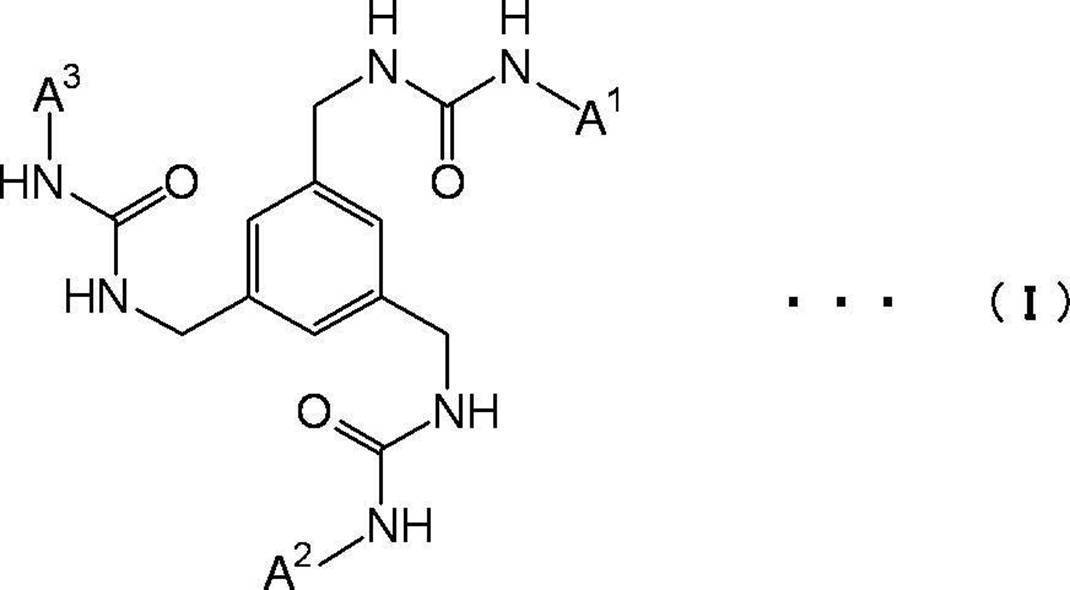
前記疎水性部は、3つのウレア構造を有する対称性の高い構造となっている。
一般式(I)で表される化合物(以下、単に「分子」ともいう)と水とが接触すると、疎水性部同士の相互作用及びウレア部分同士の水素結合を主たる駆動力として、各分子が自己集合して相互に重なり合い、一次元集積する。その結果、各分子が一次元集積した、繊維状の超分子集合体が形成される。この際に、一の分子中のA1、A2、及びA3におけるアリール基に存在するπ電子が、他の分子中のA1、A2、及びA3におけるアリール基に存在するπ電子と相互作用(πスタッキング)することで、分子同士の結合(重なり合い)をより強固にするものと考えられる。
以上のようにして形成された繊維状の超分子集合体は、水系試料中で集合し、三次元網目構造を形成する。三次元網目構造を形成した超分子集合体は、各分子の有する親水性部により水との親和性を有しているので、水系試料中で沈殿することはない。
従って、形成された三次元網目構造の隙間部分に水が存在することとなり、水系試料の流動性が低下し、ゲル化が起こるものと考えられる。
従って、当該パンフレットに記載された置換芳香族化合物よりも少ない添加量で水系試料をゲル化させることができる。更には、当該パンフレットに記載された置換芳香族化合物よりも広範な種類の水系試料をゲル化できる。
この原因については、本発明の一般式(I)で表される化合物では、分子中心部のベンゼン環と3つのウレア構造とをメチレン基(-CH2-基)で繋いだ構造としたことにより、当該パンフレットに記載された置換芳香族化合物と比較して疎水性部のサイズが小さくなり、分子全体としての疎水性が低下した(即ち、親水性が上昇した)ことが原因であると推測される。
前記水系試料の例として、水、緩衝液、培地、無機水溶液(酸性水溶液、塩基性水溶液、中性水溶液等)などが挙げられる。
前記緩衝液としては、3リン酸ナトリウム(sodium phosphate)緩衝液、トリス-塩酸(Tris-HCl)緩衝液、4-(2-ヒドロキシエチル)-1-ピペラジンエタンスルホン酸-水酸化ナトリウム(HEPES-NaOH)緩衝液、酢酸ナトリウム(NaOAc)緩衝液、ホウ酸緩衝液(Borate)、ホウ酸-水酸化ナトリウム(Borate NaOH)緩衝液、トリス-グリシン-ドデシル硫酸ナトリウム(Tris-glycine-SDS)緩衝液、トリス-ホウ酸-エチレンジアミン四酢酸(Tris-Borate-EDTA)緩衝液、リン酸緩衝生理食塩水(PBS)、グリシン-水酸化ナトリウム(Glycine-NaOH)緩衝液、グリシン-塩酸(Glycine-HCl)緩衝液、リン酸(Phosphate)緩衝液、リン酸二水素ナトリウム-水酸化ナトリウム(NaH2PO4-NaOH)緩衝液、などの各種の緩衝液が挙げられる。
前記培地としては、ダルベッコ改変イーグル培地(D-MEM)、ロズウェル・パーク・メモリアル・インスティテュート1640培地(RPMI1640培地)、ハムF12培地(F12培地)などの各種の培地が挙げられる。
前記無機水溶液としては、塩酸等の酸の水溶液、水酸化ナトリウム等のアルカリの水溶液、ナトリウム塩やアンモニウム塩等の無機塩の水溶液(海水、食塩水を含む)などが挙げられる。
具体的には、内径5~20mmの試験管(以下、「ミクロチューブ」ともいう)に0.1~5mLの水系試料を入れ、試験管を上下反転させて(試験管の底が上、試験管の口が下となるようにして)、60秒間静止させる。
60秒間経過しても試料が流れ落ちなかった場合を、ゲル化したものと判定する。
最小ゲル化濃度が低い程、ゲル化能に優れており、より少ない添加量で水系試料をゲル化できることを意味する。
A1、A2、及びA3は、同一の基であっても異なる基であってもよいが、一般式(I)で表される化合物の対称性の観点からは、同一の基であることが好ましい。
また、A1、A2、及びA3において、アリール基に対する親水性基の数は、要求される親水性の度合いに応じて適宜調整できるが、合成容易性等の観点からは、1~3であることが好ましく、1又は2であることがより好ましい。
具体的には、前記アリール基が、1つの親水性基により置換されたフェニル基である場合、前記親水性基は、前記フェニル基の4位に置換することが好ましい。また、前記アリール基が、2つの親水性基により置換されたフェニル基である場合、前記親水性基は、前記フェニル基の3位及び5位に置換することが好ましい。また、前記アリール基が、3つの親水性基により置換されたフェニル基である場合、前記親水性基は、前記フェニル基の3位、4位、及び5位に置換することが好ましい。
具体的には、糖の水酸基のうちの一つから水素原子を除いた残基を指す。
前記糖基は、アルキル基(メチル基やエチル基等)、スルホ基、等の置換基によって置換されていてもよい。
前記糖の種類には特に限定はないが、ゲル化活性の観点からは、単糖又はオリゴ糖が好ましく、単糖又は二糖であることがより好ましく、単糖であることが特に好ましい。
前記5炭糖としては、リボース、デオキシリボース、フルクトース、等が挙げられる。
前記6炭糖としては、グルコース、マンノース、ガラクトース、メチル-α-グルコース、メチル-α-マンノース、等が挙げられる。
上記の中でも、6炭糖が好ましく、グルコース、マンノース、ガラクトース、メチル-α-グルコース、メチル-α-マンノース、が特に好ましい。
上記の中でも、マルトースが特に好ましい。
また、前記アルキレンオキシ基は、酸素原子側で前記アリール基に結合することが好ましい。また、1個の親水性基中には、前記アルキレンオキシ基(以下、「-AO-基」ともいう)が1個のみ単独で含まれていてもよいし、複数が鎖状に連結し、-(AO)n-構造(nは、例えば1~10の整数)の状態で含まれていてもよい。
前記Mで表されるアルカリ金属としては、K又はNaが好ましい。
前記Xで表されるハロゲン元素としては、F、Cl、Br、又はIが好ましい。
更には、A1、A2、及びA3中の親水性基としては、-OH基、-SO3H基、-SO3M基(Mはアルカリ金属元素を表す)、-COOH基、-COOM基(Mはアルカリ金属元素を表す)、-NR1R2R3X基(R1、R2、及びR3は、それぞれ独立にアルキル基を表し、Xはハロゲン元素を表す)、-NH2基、及び-[(OE)nSg]基(Eはエチレン基を表し、nは1~10の整数(好ましくは1~4の整数)を表し、Sgは糖基を表す。)から選択される少なくとも1種であることがより好ましく、-OH基、又は、-[(OE)nSg]基(ここで、Eはエチレン基を表し、nは1~4の整数(好ましくは1~3の整数)を表し、Sgは糖基(好ましくは、単糖類由来の糖基)を表す。)が特に好ましい。
これらのうち、合成容易性の観点からは-OH基が好ましく、ゲル化能の観点からは-[(OE)nSg]基が好ましい。
より具体的には、一般式(I)で表される化合物の分子量は、ゲル化活性及び合成容易性の観点等から、500~3000が好ましく、500~1500がより好ましい。
まず、1,3,5-トリス(アミノメチル)ベンゼン(後述の化合物(7))と、保護基によって保護された親水性基(例えば、-OH基、又は、前記-[(OE)nSg]基、等)及びイソシアネート基(-NCO基)を有する芳香族化合物と、を反応させる。ここで、保護基としては、親水性基に対する保護基として一般的な基(アセチル基、t-ブチルジメチルシリル基、メトキシメチル基、ベンジル基、等)を用いることができる。
すると、1,3,5-トリス(アミノメチル)ベンゼンの末端のアミノ基と、前記芳香族化合物のイソシアネート基(-NCO基)と、の反応により、一般式(I)で表される化合物の親水性基が保護基によって保護された構造の前駆体化合物(例えば、後述の化合物(13)、化合物(16)等)が生成される。
次に、得られた前駆体化合物を脱保護させて一般式(I)で表される化合物を得ることができる。
脱保護の方法としては公知の方法を用いることができ、例えば、酸による処理、塩基による処理、フッ化物イオンによる処理、接触水素化による処理、等を用いることができる。
また、上記合成方法において親水性基としては、上述した親水性基の中から、分子全体の親水性、疎水性のバランスを考慮しながら適宜選択できる。
以上の合成方法の例で示したとおり、本発明の一般式(I)で表される化合物は、対称性が高い疎水性部の外側に、親水性、疎水性のバランスを考慮しながら親水性基を導入するという理論的な分子設計に基づいて容易に合成できる。
下記式(a-1)~(a-55)において、「*」は、一般式(I)中のウレア構造との結合位置を表す。
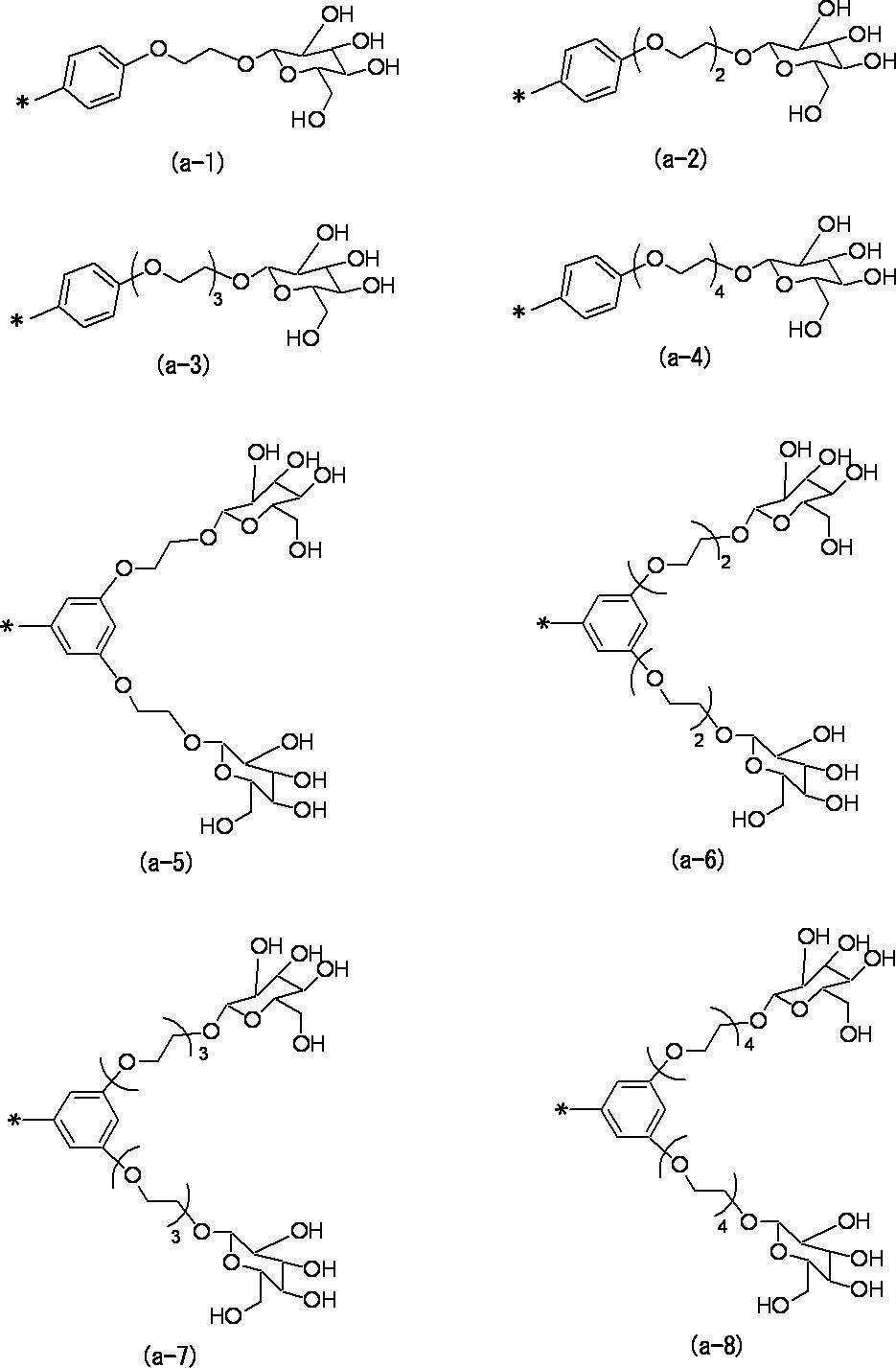
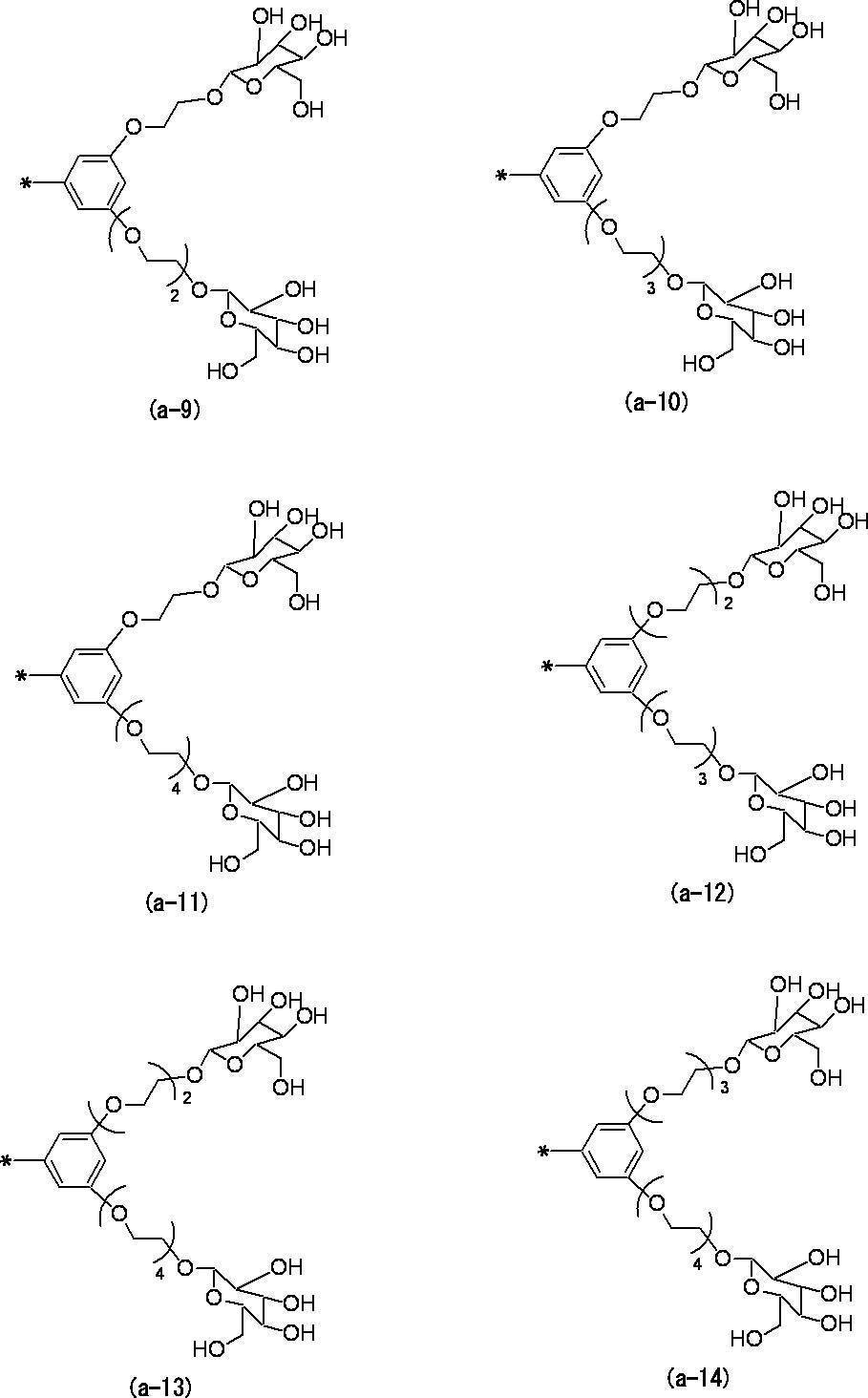


下記例示化合物における、(a-1)等の符号は、A1、A2、及びA3の好ましい例として前記で例示した基を示している。
但し、本発明は以下の例示化合物には限定されず、下記例示化合物以外にも、A1、A2、及びA3として、親水性基によって置換されたアリール基を適宜組み合わせた化合物が含まれることはいうまでもない。


本発明のヒドロゲル化剤は、前述の一般式(I)で表される化合物を含む。
即ち、本発明のヒドロゲル化剤の形態としては、前述の一般式(I)で表される化合物のみである形態であっても、前述の一般式(I)で表される化合物と他の成分との組み合わせの形態(混合物の形態、混合物でない形態のいずれであってもよい)であってもよい。
前記混合物でない形態のヒドロゲル化剤を水に添加する場合は、一般式(I)で表される化合物及び他の成分を同時に添加してもよいし、別々に添加してもよい。
前記他の成分としては、バインダー成分、緩衝液の溶質等が挙げられる。
本発明のヒドロゲルは、前述の一般式(I)で表される化合物を含む。
このヒドロゲルは、水系試料に対するゲル化能が高い前述の一般式(I)で表される化合物を含んでいるため、熱安定性に優れ、また、(例えば大気下や水中おける)経時安定性に優れる。
例えば、ヒドロゲルを用いた化粧品、医薬部外品、医薬品、インク・塗料・コーティング材(文具用、印刷用、建築用)等では、40℃~50℃での熱安定性が要求されることがある。また、ヒドロゲルの使用場面としては、赤道付近や砂漠地帯も想定される。赤道付近や砂漠地帯以外(例えば日本)であっても、例えば、夏の自動車内等は60℃以上となることがある。このような高温環境下において、従来のヒドロゲル化剤によって作製されたヒドロゲルは、ゲルの状態を維持することができないことが多い。
従来のヒドロゲルに対し、本発明のヒドロゲルは、高い熱安定性を有する(例えば90℃に加熱してもゲルの状態を保つ)ため、あらゆる場面で使用できる。
ここで、三次元網目構造は前述のとおり、一般式(I)で表される化合物同士の自己集合により形成された繊維状の超分子集合体が、更に集合することにより形成された構造である。
本発明のヒドロゲル中における、一般式(I)で表される化合物の含有量は、最小ゲル化濃度に相当する量以上の量であれば特に限定はない。
以下、水系試料がゲル化する反応を、「ゾルからゲルへの相転移反応」ともいう。
このゾルからゲルへの相転移反応を利用して、未知の被検化合物の群から特定の性質(特定化合物に対し強く相互作用する性質)を有する標的化合物を選別する、スクリーニングを行うことができる。
化学物質の添加によるヒドロゲルのゾル化の一例として、アニオンを添加することにより、一般式(I)で表される化合物同士の自己集合を解消させてゾル化させる反応が挙げられる。アニオンは、ナトリウム塩等の金属塩等の形態で添加することができる。
ここで添加するアニオンとしては、一般式(I)で表される化合物同士の自己集合をより効果的に解消させる観点より、一般式(I)で表される化合物のウレア部分と相互作用するアニオンが好ましい。このようなアニオンとして、具体的には、フッ素イオン(F-)、塩素イオン(Cl-)、臭素イオン(Br-)、ヨウ素イオン(I-)等のハロゲンイオンや、酢酸イオン(CH3COO-)、等が挙げられる。
化学物質の添加によるヒドロゲルのゾル化の別の一例として、一般式(I)で表される化合物の末端の親水性基(糖基)と強く相互作用するレクチンを添加することにより、一般式(I)で表される化合物同士の自己集合を解消させてゾル化させる反応が挙げられる。
以下、ヒドロゲルがゾル化する反応を、「ゲルからゾルへの相転移反応」ともいう。
即ち、本発明のヒドロゲルに、電気泳動により標的物質(タンパク質や核酸など)を展開させることができる。この場合、標的物質が展開されたヒドロゲルを、ゲルからゾルへの相転移反応によりゾル化させることにより、標的物質を効率よく回収できる。
例えば、本発明のヒドロゲルをタンパク質の電気泳動用ゲルとして用いた場合には、電気泳動後の各スポットから、MALDI/TOFMS(マトリックス支援レーザー脱離イオン化飛行時間型質量分析計)等の解析を行うことが可能な量のタンパク質サンプルを回収することができる。
本発明の水系試料のゲル化方法は、前述の一般式(I)で表される化合物と水系試料とを接触させることを含む。
前記接触は、一般式(I)で表される化合物を水系試料に添加して混合することにより行うことができる。
前記混合後、必要に応じ、1時間以上放置することにより、前述のとおり水系試料をゲル化させることができる。
ここで、加熱処理及び超音波処理は併用してもよい。
併用の方法としては、加熱処理及び超音波処理を順次行ってもよいし(いずれの処理が先であってもよい)、加熱処理及び超音波処理を同時に行ってもよい。
加熱時間は、例えば、30分間以上(好ましくは60分間以上)行う。
前記加熱処理後は、例えば室温(15℃~25℃)まで冷却することにより、ゲル化をより進行させることができる。
また、前記超音波処理は、例えば、市販されている超音波処理装置を用い、5分間以上(好ましくは15分間以上)を行う。
具体的な用途としては、例えば、電気泳動用のSDS緩衝液ゲル、細胞培養用ヒドロゲル、水質調査、尿検査が挙げられる。
更に、本発明の置換芳香族化合物、ヒドロゲル化剤、ヒドロゲル、及び水系試料のゲル化方法は、国際公開第2010/101147号パンフレットの段落0075~0085、0167~0179に記載されているスクリーニングや、当該パンフレットの段落0184~0188に記載されている水系試料中におけるアニオン量の滴定にも利用できる。
実施例1として、本発明の置換芳香族化合物の例示化合物の合成を行った。
下記合成経路に従い、例示化合物(I-2)を合成した。
下記合成経路において、Meはメチル基、Acはアセチル基、Tsはトシル基を示している。


アルゴン雰囲気下、化合物(5)(1,3,5-トリス(ブロモメチル)ベンゼン)(302mg,0.85mmol)、フタルイミドカリウム塩(potassium phthalimide)(562mg,3.03mmol)、18-クラウン-6-エーテル(18-crown-6-ether)(67mg,0.25mmol)を順次加えた後、トルエン(toluene)(7.1mL)を加えた。得られた溶液を27時間還流した。還流後の溶液に対しCH2Cl2を加えて固体を溶かし、H2Oで有機層を洗浄し、得られた有機層をさらに飽和食塩水で洗浄した。洗浄後の溶液にNa2SO4を加えて乾燥し、自然濾過し、更に濃縮を行い、シリカゲルカラムクロマトグラフィー(アセトン/CH2Cl2=1:60)により精製した。得られた固体にメタノール(MeOH)/酢酸エチル(AcOEt)再沈殿法を行い、目的物である化合物(6)を白色固体として得た(収率79%,収量369mg)。
化合物(6)のNMR測定結果は以下の通りであった。
1H NMR (400 MHz, CDCl3) δ4.78 (s, 6H), 7.35 (s, 3H), 7.69-7.83 (m, 12H).
アルゴン雰囲気下、化合物(6)(1.00g,1.80mmol)に、エタノール(EtOH)(24mL)とトルエン(toluene)(12mL)とを加えた。
得られた溶液に、氷冷下、H2NNH2・H2O(0.52mL,10.8mmol)を滴下し、72℃で17時間撹拌した。攪拌後の溶液から溶媒を減圧留去した後、40%水酸化カリウム水溶液(4.0mL)を加えて固体を溶かし、CHCl3で抽出した。有機層にNa2SO4を加えて該有機層を乾燥し、自然濾過し、更に濃縮を行い、未精製の目的物(化合物(7))を黄土色固体として得た(粗収率60%,粗収量178mg)。次の段階で不純物を除くことができるため、ここではこれ以上の精製は行っていない。
化合物(7)のNMR測定結果は以下の通りであった。
1H NMR (400 MHz, CD3OD) δ3.85 (s, 6H), 7.24 (s, 3H).
アルゴン雰囲気下、α,D-グルコピラノースペンタアセテート(α,D-glucopyranose pentaacetate)(1.00g,2.57mmol)に、酢酸(AcOH)(9.2mL)を加えた。得られた溶液に、遮光下で、臭化アセチル(AcBr)(0.57mL,7.69mmol)及びメタノール(MeOH)(0.15mL,3.70mmol)を加え、室温で1日撹拌した。攪拌後の反応溶液を濃縮することで、未精製の目的物(化合物(8))を褐色シロップ状液体として得た。次の段階で不純物を除くことができるため、ここではこれ以上の精製は行っていない。
化合物(8)のNMR測定結果は以下の通りであった。
1H NMR (400 MHz, CDCl3) δ2.03 (s, 3H), 2.05 (s, 3H), 2.10 (s, 3H), 2.10 (s, 3H), 4.13 (dd, J1 = 2.0 Hz, J2 = 14.4 Hz, 1H), 4.29 (ddd, J1 = 6.3 Hz, J2 = 5.4 Hz, J3 = 1.5 Hz, 1H), 4.33 (dd, J1 = 11.5 Hz, J2 = 3.9 Hz, 1H), 4.83 (dd, J1 = 10.0 Hz, J2 = 3.9 Hz, 1H), 5.18 (t, J = 9.8 Hz, 1H), 5.56 (t, J =9.8 Hz, 1H), 6.61 (d, J =3.9 Hz, 1H).
アルゴン雰囲気下、未精製の化合物(8)にCH2Cl2(107mL)を加えた。ここにNa2SO4(3.64g,25.6mmol)及びジエチレングリコール(diethylene glycol)(2.4mL,25.6mmol)を加え、室温で15分撹拌した後、Ag2CO3(1.47g,5.35mmol)を加え、さらに室温で19時間撹拌した。得られた溶液から、吸引濾過によりAg2CO3を除き、水で洗浄した。生じた有機層を飽和食塩水で洗浄した後、Na2SO4により乾燥した。得られた反応混合物はシリカゲルカラムクロマトグラフィー(酢酸エチル/ヘキサン=1:3→1:0)により精製し、目的物である化合物(9)を白色固体として得た(二段階収率48%,収量535mg)。
化合物(9)のNMR測定結果は以下の通りであった。
1H NMR (400 MHz, CDCl3) δ2.01 (s, 3H), 2.03 (s, 3H), 2.06 (s, 3H), 2.09 (s, 3H), 2.17-2.25 (m, 1H), 3.54-3.62 (m, 2H), 3.66 (t,J = 4.6 Hz), 3.69-3.77 (m, 4H), 3.96 (dt, Jd = 10.7 Hz, Jt = 4.2 Hz, 1H), 4.15 (dd, J1 = 12.7 Hz, J2 = 2.5 Hz, 1H), 4.26 (dd, J1 = 12.4 Hz, J2 = 4.9 Hz, 1H), 4.61 (d, J = 7.8 Hz, 1H), 5.00 (dd, J1 = 9.5 Hz, J2 = 7.8 Hz, 1H), 5.10 (t, J = 9.8 Hz, 1H), 5.21 (t, J = 9.5 Hz, 1H) .
アルゴン雰囲気下、塩化パラトルエンスルホニル(塩化トシル;Ts-Cl)(258mg,1.35mmol)、N,N-ジメチル-4-アミノピリジン(DMAP)(4.9mg,0.040mmol)に、1,2-ジクロロエタン(1,2-dichloroethane)(2.8mL)を加えた。ここに化合物(9)(536mg,1.23mmol)とトリエチルアミン(Et3N)(0.55mL,3.96mmol)とを加え、室温で20時間撹拌した。
攪拌後の溶液を飽和炭酸水素ナトリウム水溶液でクエンチした後、CH2Cl2で抽出した。生じた有機層を飽和食塩水で洗浄し、Na2SO4により乾燥した。得られた反応混合物はシリカゲルカラムクロマトグラフィー(酢酸エチル/ヘキサン=1:1→1:0)で精製し、目的物である化合物(10)を無色透明のシロップ状液体として得た(収率81%,収量587mg)。
化合物(10)のNMR測定結果は以下の通りであった。
1H NMR (400 MHz, CDCl3) δ2.00 (s, 3H), 2.02 (s, 3H), 2.03 (s, 3H), 2.08 (s, 3H), 2.46 (s, 3H), 3.58-3.60 (m, 2H), 3.65-3.72 (m, 4H), 3.89 (dt, J1 = 11.7 Hz, J2 = 4.1 Hz, 1H), 4.11-4.16 (m, 3H), 4.26 (dd, J1 = 12.4 Hz, J2 = 3.9 Hz, 1H), 4.58 (d, J = 8.3 Hz, 1H), 4.98 (t, J = 8.8 Hz, 1H), 5.08 (t, J = 9.5 Hz, 1H), 5.21 (t, J = 9.5 Hz, 1H).
アルゴン雰囲気下、p-ニトロフェノール(p-nitrophenol)(182mg,1.29mmol)及びK2CO3(413mg,2.98mmol)に、N,N-ジメチルホルムアミド(DMF)(10.0mL)を加えた。ここにDMF(9.5mL)に溶かした化合物(10)(587mg,0.99mmol)を加え、100℃で4時間撹拌した。得られた溶液から吸引濾過によりK2CO3を除いた後、水を加えてCH2Cl2で抽出した。有機層を飽和食塩水で洗浄し、Na2SO4により乾燥した。得られた反応混合物はシリカゲルカラムクロマトグラフィー(酢酸エチル/ヘキサン=1:1)で精製し、目的物である化合物(11)を黄色のシロップ状液体として得た(収率81%,収量446mg)。
化合物(11)のNMR測定結果は以下の通りであった。
1H NMR (400 MHz, CDCl3) δ2.01 (s, 3H), 2.02 (s, 3H), 2.08 (s, 3H), 3.66-3.78 (m, 4H), 3.87 (t, J = 4.6 Hz, 2H),3.96-4.00 (m, 1H), 4.14 (dd, J1 = 12.2 Hz, J2 = 2.4 Hz, 1H), 4.20 (t, J =4.9 Hz, 2H), 4.25 (dd, J1 = 12.7 Hz, J2 = 8.3 Hz, 1H), 4.59 (d, J = 7.8 Hz, 1H),5.00 ( t, J = 8.3 Hz, 1H), 5.08 ( t, J = 10.0 Hz, 1H), 5.19 ( t, J = 9.0 Hz, 1H), 6.99 (d, J = 8.3 Hz, 2H), 8.21 (d, J = 8.3 Hz, 2H).
アルゴン雰囲気下、化合物(11)(446mg,0.80mmol)に酢酸エチル(AcOEt)(8.4mL)を加え、さらにパラジウム炭素触媒(Pd/C)(46mg,10wt%)を加えて18時間水素置換した。得られた溶液から自然濾過によりPd/Cを除き、得られた反応混合物をシリカゲルカラムクロマトグラフィー(酢酸エチル/ヘキサン=1:1)により精製し、目的物である化合物(12)を黄色のシロップ状液体として得た(収率55%,収量232mg)。
化合物(12)のNMR測定結果は以下の通りであった。
1H NMR (400 MHz, CDCl3) δ2.00 (s, 3H), 2.02 (s, 3H), 2.03 (s, 3H), 2.08 (s, 3H), 3.43 (s, 2H), 3.66-3.72 (m, 4H), 3.75-3.79 (m, 4H), 3.96 (dt, Jd = 11.5 Hz, Jt =4.4 Hz, 1H), 4.03 (t, J = 3.4 Hz, 2H), 4.13 (dd, J1 = 12.2 Hz, J2 = 2.4 Hz, 1H), 4.25 (dd, J1 = 12.4 Hz, J2 = 4.4 Hz, 1H), 4.61 (d, J = 7.8 Hz, 1H), 4.99 (dd, J1 = 9.5 Hz, J2 = 8.3 Hz, 1H), 5.08 (t, J = 9.8 Hz, 1H), 5.20 (t, J = 9.8 Hz, 1H), 6.63 (d, J = 8.8 Hz, 2H), 6.77 (d, J = 8.8 Hz, 2H).
アルゴン雰囲気下、化合物(12)(375mg,0.71mmol)に1,2-ジクロロエタン(1,2-dichloroethane)(1.5mL)を加えた。ここへ1,2-ジクロロエタン(1,2-dichloroethane)(1.4mL)に溶かしたトリホスゲン(triphosgene)(218mg,0.74mmol)を加えた。得られた溶液に、氷冷下、トリエチルアミン(Et3N)(0.22mL,1.56mmol)を加え、室温で40分撹拌した。攪拌後の溶液から反応溶媒を留去した後、1,2-ジクロロエタン(1,2-dichloroethane)(2.9 mL)を加え、さらに未精製の化合物(7)(40mg,0.24mmol)を加えた。得られた溶液を90℃で2日間撹拌した後、飽和塩化アンモニウム水溶液でクエンチし、CH2Cl2で抽出した。有機層を飽和食塩水で洗浄し、Na2SO4により乾燥した。得られた反応混合物はシリカゲルカラムクロマトグラフィー(アセトン/CH2Cl2=1:3→1:0)で精製し、目的物である化合物(13)を黄土色固体として得た(収率78%,収量347mg)。
化合物(13)のNMR測定結果は以下の通りであった。
1H NMR (400 MHz, DMSO-d6) δ1.93 (s, 9H), 1.98 (d, J = 1.0 Hz, 18.0 Hz), 2.01 (s, 9H), 3.53-3.58 (m, 6H), 3.62-3.70 (m, 9H), 3.82 (dt, J = 11.2 Hz, 4.3 Hz, 3H), 3.95-4.00 (m, 12H), 4.17 (dd, J1 = 11.7 Hz, J2= 4.9 Hz, 3H), 4.25 (d, J = 5.9 Hz, 6H), 4.76 (t, J = 9.0 Hz, 3H), 4.84 (d, J = 7.8 Hz, 3H), 4.90 (t, J = 9.8 Hz, 3H), 5.26 (t, J = 9.5 Hz, 3H), 6.52 (t, J = 5.6 Hz, 3H), 6.79 (d, J = 8.8 Hz, 6H), 7.10 (s, 3H), 7.28 (d, J = 8.8 Hz, 6H), 8.35 (s, 3H).
アルゴン雰囲気下、化合物(13)(73mg,0.040mmol)にエタノール(EtOH)(1.5mL)を加えた。得られた溶液にナトリウムエトキシド(NaOEt)(8.5mg,0.13mmol)を加えて、室温で21時間撹拌した。攪拌後の反応溶液を、水中で半透膜を用いて透析し、濃縮することで目的物である例示化合物(I-2)を黄土色固体として得た(収率76%,収量40mg)。
例示化合物(I-2)の分子量は、1321である。
例示化合物(I-2)のNMR測定結果は以下の通りであった。
1H NMR (400 MHz, DMSO-d6) δ2.92-2.99 (m, 3H), 3.00-3.17 (m, 12H), 3.40-3.44 (m, 3H), 3.59-3.73 (m, 18H), 3.89 (t, J = 6.8 Hz, 3H), 3.99 (d, J = 4.4 Hz, 6H), 4.15 (d, J = 7.8 Hz, 3H), 4.25 (d, J = 4.9 Hz, 6H), 4.51 (t, J = 5.6 Hz, 3H), 4.93 (dd, J1 = 16.6 Hz, J2= 4.4 Hz, 6H), 5.01 (d, J = 4.4 Hz, 3H), 6.53 (s, 3H), 6.80 (d, J = 8.8 Hz, 6H), 7.10 (s, 3H), 7.28 (d, J = 8.8 Hz, 6H), 8.36 (s, 3H).
下記合成経路に従い、例示化合物(I-21)を合成した。
下記合成経路において、「TBS」はt-ブチルジメチルシリル基を表す。
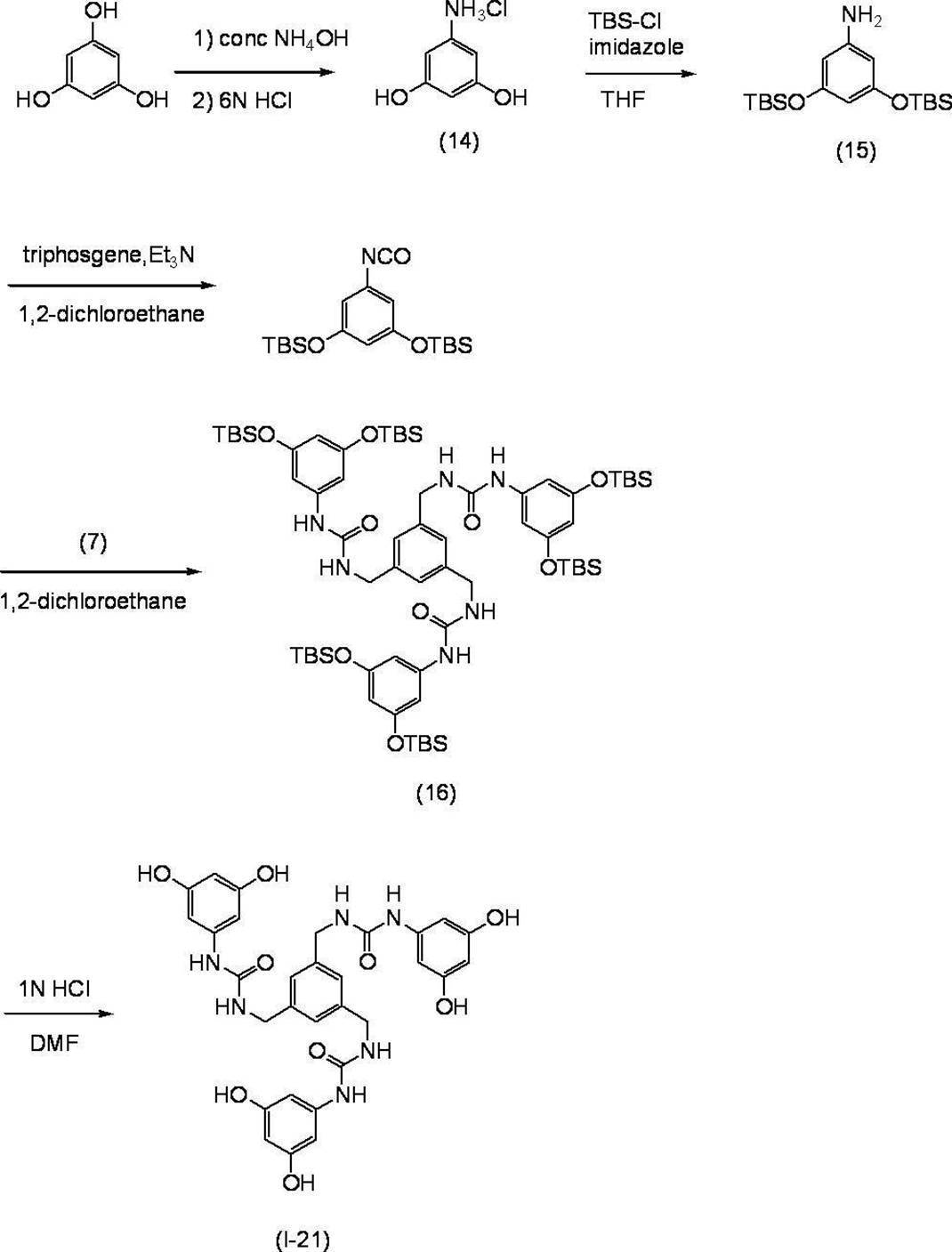
アルゴン雰囲気下、フロログルシノール(phloroglucinol)(10.0g,79.5mmol)に濃アンモニア水(conc.NH4OH)(78mL)を加えた。得られた溶液を室温で1日撹拌した後、溶媒を減圧留去した。得られた溶液に対し、氷冷下で6N HClを加えて塩酸塩とし、溶媒を減圧留去した後、MeOH/CH2Cl2再沈殿法により精製し、目的物である化合物(14)を黄色固体として得た(収率69%,収量8.89g)。
化合物(14)のNMR測定結果は以下の通りであった。
1H NMR (400 MHz, CD3OD) δ6.27 (s, 2H), 6.32 (s, 1H).
アルゴン雰囲気下、化合物(14)(542mg,3.34mmol)及びイミダゾール(imidazole)(1.01g,14.8mmol)にTHF(20.0mL)を加えた。得られた溶液に、氷冷下、THF(13.6mL)に溶かしたt-ブチルジメチルシリルクロリド(TBS-Cl)(2.02g,13.4mmol)をトランスファーにより加えた後、室温で37時間撹拌した。有機層をH2Oと飽和食塩水で順次洗浄し、Na2SO4を加えて乾燥し、自然ろ過し、更に濃縮を行った。得られた反応混合物をシリカゲルカラムクロマトグラフィー(酢酸エチル/ヘキサン=1:50)で精製し、目的物である化合物(15)を白色固体として得た(収率72%,収量937mg)。
化合物(15)のNMR測定結果は以下の通りであった。
1H NMR (600 MHz, CDCl3) δ0.18 (s, 12H), 0.96 (s, 18H), 3.54 (s, 2H), 5.78 (t, J = 2.0Hz, 1H), 5.84 (d, J = 2.0 Hz, 2H).
アルゴン雰囲気下、化合物(15)(599mg,1.53mmol)に1,2-ジクロロエタン(1,2-dichroloethane)(2.5mL)を加えた。得られた溶液に、1,2-ジクロロエタン(1,2-dichroloethane)(2.7mL)に溶かしたトリホスゲン(triphosgene)(456mg,1.54mmol)を加え、続いて氷冷下、トリエチルアミン(Et3N)(0.44mL,3.07mmol)を加え、室温で1時間撹拌した。攪拌後の溶液から溶媒を減圧留去して白色固体を得た後、1,2-ジクロロエタン(1,2-dichroloethane)(5.2mL)を加え、さらに未精製の化合物(7)(76mg,0.46mmol)を加えて50℃で2.5日間撹拌した。飽和塩化アンモニウム水溶液により反応をクエンチした後、CHCl3で抽出し、得られた有機層をH2Oと飽和食塩水で洗浄した。有機層にNa2SO4を加えて乾燥し、自然ろ過し、更に濃縮を行った。得られた反応混合物をシリカゲルカラムクロマトグラフィー(CHCl3/酢酸エチル=50:1)で精製し、目的物である化合物(16)を黄土色固体として得た(収率64%,収量385mg)。
化合物(16)のNMR測定結果は以下の通りであった。
1H NMR (600 MHz, DMSO-d6) δ0.15 (s, 36H), 0.92 (s, 54H), 4.26 (d, J = 5.5 Hz, 6H), 5.83 (s, 3H), 6.52 (t, J = 5.8 Hz, 3H), 6.62 (d, J = 2.1 Hz, 6H), 7.11 (s, 3H), 8.53 (s, 3H).
アルゴン雰囲気下、化合物(16)(107mg,0.082mmol)にDMF(7.0mL)を加えた。氷冷下、1N HCl(1.3mL)を滴下した後、室温で5日間撹拌した。飽和炭酸水素ナトリウム水溶液を加えて反応をクエンチし、溶媒を減圧留去した。得られた固体をMeOH/H2O再沈殿法により精製し、目的物である例示化合物(I-21)を黄土色固体として得た(収率37%,収量19mg)。
例示化合物(I-21)の分子量は、618である。
例示化合物(I-21)のNMR測定結果は以下の通りであった。
1H NMR (600 MHz, DMSO-d6) δ 4.24 (d, J = 5.5 Hz, 6H), 5.76 (t, J = 2.1 Hz, 3H), 6.35 (d, J = 2.1 Hz, 6H), 6.45 (t, J = 5.8 Hz, 3H), 7.09 (s, 3H), 8.29 (d, J = 26.8 Hz, 3H), 9.01 (s, 6H).
≪例示化合物(I-2)による水系試料のゲル化≫
上記で合成した例示化合物(I-2)をゲル化剤として用い、以下の各種の水系試料のゲル化を行った。
・水
・トリス-グリシン-ドデシル硫酸ナトリウム緩衝液(以下、「Tris-Glycine-SDS緩衝液」ともいう)
・ダルベッコ改変イーグル培地(以下、「D-MEM」ともいう)
・トリス-塩酸緩衝液(以下、「Tris-HCl緩衝液」ともいう)
・ホウ酸-水酸化ナトリウム緩衝液(以下、「Borate NaOH緩衝液」ともいう)
・トリス-ホウ酸-エチレンジアミン四酢酸緩衝液(以下、「Tris-Borate-EDTA緩衝液」ともいう)
・塩酸水溶液
・水酸化ナトリウム水溶液
・食塩水
・4-(2-ヒドロキシエチル)-1-ピペラジンエタンスルホン酸-水酸化ナトリウム緩衝液(以下、「HEPES-NaOH緩衝液」ともいう)
・リン酸緩衝生理食塩水(以下、「PBS buffer」ともいう)
・グリシン-水酸化ナトリウム緩衝液(以下、「Glycine-NaOH buffer」ともいう)
・グリシン-塩酸緩衝液(以下、「Glycine-HCl buffer」ともいう)
・リン酸緩衝液(以下、「Phosphate buffer」ともいう)
・リン酸二水素ナトリウム-水酸化ナトリウム緩衝液(以下、「NaH2PO4-NaOH buffer」ともいう)
・各種無機塩(NaF, NaCl, NaBr, NaOAc, Na2CO3, Na2SO3, Na2SO4, Na3PO4, NH4F, NH4Cl, NH4Br)の水溶液
・海水
ミクロチューブ(容積2.2mL、内径5mm)にゲル化剤及び水系試料(100μL)を加え、加熱(約100℃)してゲル化剤を溶解させた後、室温で2時間放冷した。
上記放冷後の各サンプルについて、下記評価基準に従い、ゲル化の評価を行った。
-評価基準-
G(gel) … ミクロチューブを、底が上、口が下となるように上下反転させて、60秒間経過させても水系試料が流れ落ちてこず、ミクロチューブを傾けてもゲルが流動しない場合
PG(partial gel) … 部分的にゲルを形成している場合
I(insoluble) … ゲル化剤が溶媒にほとんど溶けない場合
V(viscous solution) … ミクロチューブを、底が上、口が下となるように上下反転させると、60秒間未満で水系試料が流れ落ちる場合であって、水系試料に粘性がある場合
S(solution) … ミクロチューブを、底が上、口が下となるように上下反転させると、60秒間未満で水系試料が流れ落ちる場合であって、水系試料に粘性がない場合
上記放冷後の各試料について、下記基準に従い、ゲルの透明度を判定した。
ゲル化が進むにつれ、ゲルの透明度が下がる傾向がある。
-基準-
A: 無色透明である場合
B: ゲルをとおして文字が読める場合
C: ゲルをとおしてかろうじて文字がわかる場合
D: ゲルをとおして文字が読めない場合
水系試料として、水を用いたときの評価結果を下記表1及び図1に示す。
表1中の濃度欄は、各試料中におけるゲル化剤の濃度を表す(以降の表についても同様である)。
図1は、ゲル化の操作後、ミクロチューブを、底が上、口が下となるように上下反転させたときの写真であり、ミクロチューブに付した「A1」等の符号は、試料番号を示している(以降の図についても同様である)。

最小ゲル化濃度は0.50質量%であった。
上記試料番号A1~A3のゲルは、少なくとも90℃まで加熱してもゲルの状態を保っており、高い熱安定性を有することが確認された。
詳しくは、試料番号A1~A3のゲルがゾル化する温度(以下、「Tgel」とする)は、それぞれ、96.9℃(試料番号A1)、96.5℃(試料番号A2)、95.9℃(試料番号A3)であった。
また、上記試料番号A3のゲルを大気下(室温)で放置したところ、大気下において、少なくとも5ヶ月間ゲルの状態を保っていた。また、上記試料番号A3のゲルを水中(室温)で放置したところ、水中において、少なくとも3ヶ月間ゲルの状態を保っていた。
以上の結果より、得られたゲルが、高い経時安定性を有することが確認された。
次に、比較実験として、例示化合物(I-2)を、WO2010/101147号パンフレットに記載の例示化合物(3)に変えたこと以外は上記水の評価と同様の操作を行い、該例示化合物(3)の最小ゲル化濃度を求めた。
当該パンフレットに記載の例示化合物(3)を用いた場合、最小ゲル化濃度は1.5質量%であった。
これにより、中央のベンゼン環と3つのウレア構造のそれぞれとが、メチレン基(-CH2-基)で結合された本発明の一般式(I)で表される化合物は、顕著に高いゲル化能を有することがわかった。
なお、当該パンフレットに記載の例示化合物(3)は、中央のベンゼン環と3つのウレア構造のそれぞれとが、下記構造の2価の基(*はベンゼン環との結合位置を表し、**はウレア構造の窒素原子との結合位置を表す)を介して結合していること以外は上記例示化合物(I-2)の構造と同一である。

水系試料として、Tris-Glycine-SDS緩衝液を用いたときの評価結果を下記表2及び図2に示す。
Tris-Glycine-SDS緩衝液としては、Tris(25mM)-Glycine(192mM)-SDS(0.1%)緩衝液を用いた。

最小ゲル化濃度は1.5質量%であった。
水系試料として、D-MEMを用いたときの評価結果を下記表3及び図3に示す。

最小ゲル化濃度は0.60質量%であった。
別途、ゲル化剤濃度1.0質量%のD-MEM試料のゲルを作製し、このゲルのTgelを測定したところTgelは103.7℃であり、このゲルが高い熱安定性を有することが確認された。
水系試料として、Tris-HCl緩衝液を用いたときの評価結果を下記表4に示す。
なお、表4以降の評価結果については図面(ゲルの写真)は省略する。

最小ゲル化濃度は0.50質量%以下であった。
(Borate NaOH緩衝液(50mM、pH7.0))
水系試料として、Borate NaOH緩衝液(50mM、pH7.0)を用いたときの評価結果を下記表5に示す。

最小ゲル化濃度は0.50質量%であった。
また、試料番号E3のゲルのTgelは96.4℃であり、このゲルが高い熱安定性を有することが確認された。
Borate NaOH緩衝液(pH8.5)において、Borate NaOHの濃度を変化させたときの評価結果を下記表6に示す。表6中の「濃度(mM)」欄は、Borate NaOHの濃度である。ここで、ゲル化剤の濃度はすべて0.5質量%とした。

水系試料として、Tris-Borate-EDTA緩衝液を用いたときの評価結果を下記表7に示す。
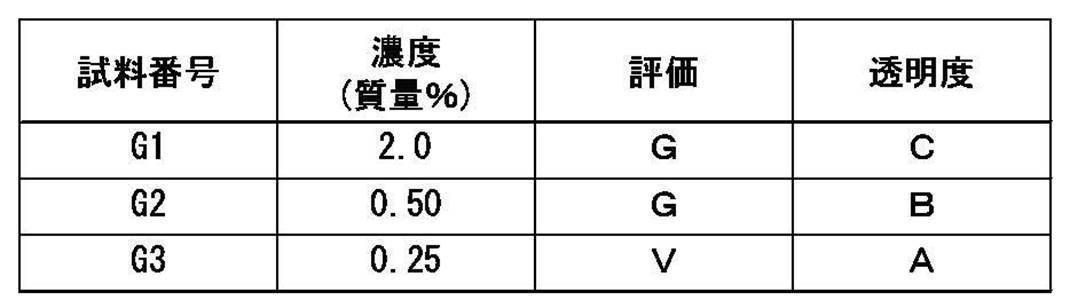
最小ゲル化濃度は0.50質量%であった。
水系試料として、種々のpHの水系試料(塩酸水溶液(HCl aq.)、水(H20)、水酸化ナトリウム水溶液(NaOH aq.))のゲル化を行い、ゲル化能のpH応答性を調べた。
ゲル化剤の濃度は、いずれの試料においても1.0質量%とした。
評価結果を下記表8に示す。

また、試料番号H1~H12のゲルのTgelは、いずれも95℃以上であり、これらのゲルが高い熱安定性を有することが確認された。
次に、比較実験として、例示化合物(I-2)を、WO2010/101147号パンフレットに記載の例示化合物(3)に変えたこと以外は上記pH応答性の評価と同様の評価を行った。
すると、該例示化合物(3)では、ゲル化を行えるpHが約6.0~9.0の範囲であった。
この結果から、中央のベンゼン環と3つのウレア構造のそれぞれとを、メチレン基(-CH2-基)で結合した構造の本発明の一般式(I)で表される化合物は、幅広い範囲のpHの水系試料のゲル化を行えることがわかった。
水系試料として、Borate NaOH緩衝液(50mM)のpHを種々変化させ、上記pH応答性1と同様の評価を行った。
ゲル化剤の濃度は、いずれの試料においても0.50質量%とした。
評価結果を下記表9に示す。
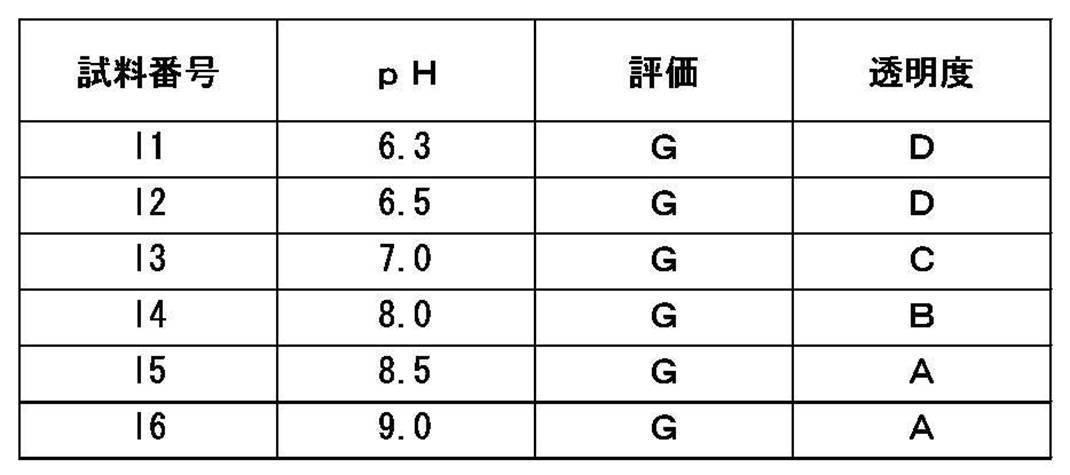
水系試料として、種々の塩濃度の食塩水を用いたときの評価結果を下記表10に示す。
ゲル化剤の濃度は、いずれの試料においても1.0質量%とした。

また、試料番号J2のゲルのTgelは99.6℃であり、このゲルが高い熱安定性を有することが確認された。
水系試料として、HEPES-NaOH緩衝液(pH7.5)を用いたときの評価結果を下記表11に示す。ゲル化剤の濃度は1.0質量%とした。

上記HEPES-NaOH緩衝液(pH7.5)のpHを下記表12に示すように種々変化させ(いずれの試料においても、ゲル化剤の濃度は1.0質量%とした)、上記HEPES-NaOH緩衝液(pH7.5)の評価と同様の評価を行った。評価結果を下記表12に示す。

また、試料番号K4のゲルのTgelは98.9℃であり、このゲルが高い熱安定性を有することが確認された。
水系試料として、上記以外のその他の緩衝液を用いたときの評価結果及び最小ゲル化濃度を下記表13に示す。

また、PBS bufferのゲルのTgelは97.1℃であり、Glycine-NaOH bufferのゲルのTgelは100.5℃であり、これらのゲルが高い熱安定性を有することが確認された。
水系試料として、海水を含め、各種無機塩の水溶液を用いたときの評価結果を下記表14に示す。下記表14において、無機塩の量(eq.)は、ゲル化剤の量に対する当量を示し、saturatedは飽和量を示す。

また、飽和NaCl水溶液のゲルのTgelは121.1℃であり、飽和NaF水溶液のゲルのTgelは110.0℃であり、これらのゲルが高い熱安定性を有することが確認された。
≪例示化合物(I-21)による水系試料のゲル化≫
例示化合物(I-2)を例示化合物(I-21)に変えたこと以外は実施例2と同様にして、水、Tris-HCl緩衝液(50mM、pH7.0)、HEPES-NaOH緩衝液(50mM、pH7.0)の各水系試料のゲル化を行い、最小ゲル化濃度を測定した。
最小ゲル化濃度の測定結果を下記表15に示す。
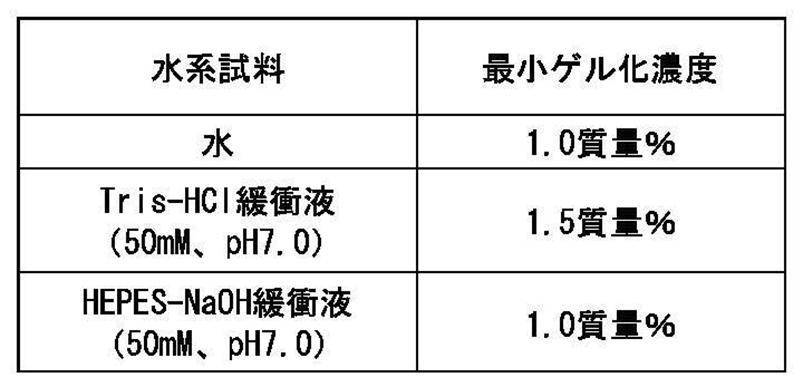
本明細書に記載された全ての文献、特許出願、および技術規格は、個々の文献、特許出願、および技術規格が参照により取り込まれることが具体的かつ個々に記された場合と同程度に、本明細書中に参照により取り込まれる。
Claims (7)
- 下記一般式(I)で表される置換芳香族化合物。

〔一般式(I)において、A1、A2、及びA3は、それぞれ独立に、親水性基によって置換されたアリール基を表す。〕 - 前記親水性基が、-OH基、-SO3H基、-SO3M基(Mはアルカリ金属元素を表す)、-COOH基、-COOM基(Mはアルカリ金属元素を表す)、-NR1R2R3X基(R1、R2、及びR3は、それぞれ独立にアルキル基を表し、Xはハロゲン元素を表す)、-NH2基、アルキレンオキシ基、及び糖基から選択される少なくとも1種を含む請求項1に記載の置換芳香族化合物。
- 前記親水性基が、-OH基、-SO3H基、-SO3M基(Mはアルカリ金属元素を表す)、-COOH基、-COOM基(Mはアルカリ金属元素を表す)、-NR1R2R3X基(R1、R2、及びR3は、それぞれ独立にアルキル基を表し、Xはハロゲン元素を表す)、-NH2基、並びに、アルキレンオキシ基及び糖基を含む基から選択される少なくとも1種である請求項1又は請求項2に記載の置換芳香族化合物。
- 前記親水性基が、-OH基、及び、-[(OE)nSg]基(Eはエチレン基を表し、nは1~4の整数を表し、Sgは糖基を表す。)から選択される少なくとも1種である請求項1~請求項3のいずれか1項に記載の置換芳香族化合物。
- 請求項1~請求項4のいずれか1項に記載の置換芳香族化合物を含むヒドロゲル化剤。
- 請求項1~請求項4のいずれか1項に記載の置換芳香族化合物を含むヒドロゲル。
- 請求項1~請求項4のいずれか1項に記載の置換芳香族化合物と水系試料とを接触させることを含む水系試料のゲル化方法。
Priority Applications (4)
| Application Number | Priority Date | Filing Date | Title |
|---|---|---|---|
| EP12755360.0A EP2684868B1 (en) | 2011-03-10 | 2012-03-09 | Substituted aromatic compound, hydrogelation agent, hydrogel, and method for gelating aqueous sample |
| JP2013503636A JP5991547B2 (ja) | 2011-03-10 | 2012-03-09 | 置換芳香族化合物、ヒドロゲル化剤、ヒドロゲル、及び水系試料のゲル化方法 |
| US14/003,907 US9115164B2 (en) | 2011-03-10 | 2012-03-09 | Substituted aromatic compound, hydrogelation agent, hydrogel, and method for gelating aqueous sample |
| KR1020137024089A KR20140004749A (ko) | 2011-03-10 | 2012-03-09 | 치환 방향족 화합물, 히드로겔화제, 히드로겔, 및 수계 시료의 겔화 방법 |
Applications Claiming Priority (2)
| Application Number | Priority Date | Filing Date | Title |
|---|---|---|---|
| JP2011-053564 | 2011-03-10 | ||
| JP2011053564 | 2011-03-10 |
Publications (1)
| Publication Number | Publication Date |
|---|---|
| WO2012121394A1 true WO2012121394A1 (ja) | 2012-09-13 |
Family
ID=46798345
Family Applications (1)
| Application Number | Title | Priority Date | Filing Date |
|---|---|---|---|
| PCT/JP2012/056185 Ceased WO2012121394A1 (ja) | 2011-03-10 | 2012-03-09 | 置換芳香族化合物、ヒドロゲル化剤、ヒドロゲル、及び水系試料のゲル化方法 |
Country Status (5)
| Country | Link |
|---|---|
| US (1) | US9115164B2 (ja) |
| EP (1) | EP2684868B1 (ja) |
| JP (1) | JP5991547B2 (ja) |
| KR (1) | KR20140004749A (ja) |
| WO (1) | WO2012121394A1 (ja) |
Cited By (3)
| Publication number | Priority date | Publication date | Assignee | Title |
|---|---|---|---|---|
| US20110198534A1 (en) * | 2008-09-24 | 2011-08-18 | National University Corporation Shizuoka University | Urea compound, self-assembly of urea compounds, organogel containing self-assembly, and method for producing organogel |
| WO2018070546A1 (ja) | 2016-10-14 | 2018-04-19 | 国立大学法人静岡大学 | 新規ヒドロゲル化剤 |
| US11465962B2 (en) * | 2018-01-26 | 2022-10-11 | Lg Chem, Ltd. | Composition for detecting acidic compound |
Families Citing this family (3)
| Publication number | Priority date | Publication date | Assignee | Title |
|---|---|---|---|---|
| US10425366B2 (en) * | 2014-01-08 | 2019-09-24 | Microsoft Technology Licensing, Llc | Reminder service for email selected for follow-up actions |
| US10326722B2 (en) * | 2015-03-16 | 2019-06-18 | International Business Machines Corporation | Auto clean-up of unused email rules |
| EP3109233A1 (en) | 2015-06-22 | 2016-12-28 | The Procter and Gamble Company | Urea gellants |
Citations (8)
| Publication number | Priority date | Publication date | Assignee | Title |
|---|---|---|---|---|
| JP2003327949A (ja) | 2002-05-13 | 2003-11-19 | Japan Science & Technology Corp | グリコシドアミノ酸誘導体から成るヒドロゲル化剤およびヒドロゲル |
| JP2005013174A (ja) | 2003-06-30 | 2005-01-20 | Japan Science & Technology Agency | 酵素反応検出などに用いられるゲルチップ |
| JP2005194257A (ja) | 2004-01-07 | 2005-07-21 | Pohang Eng College | ヒドロゲル化剤として用いられる2’−デオキシウリジン誘導体 |
| JP2007217551A (ja) | 2006-02-16 | 2007-08-30 | Noguchi Inst | 生体適合性ヒドロゲル |
| JP2008189559A (ja) * | 2007-02-01 | 2008-08-21 | National Univ Corp Shizuoka Univ | 尿素化合物およびチオ尿素化合物ならびにこれを用いたオルガノゲル |
| JP2009524819A (ja) * | 2006-01-27 | 2009-07-02 | ソヨン キム | 表面処理されていない基質にプローブを固定するためのゾル−ゲルバイオチップ用のゾル組成物及びそのスクリーニング方法 |
| WO2010101147A1 (ja) | 2009-03-03 | 2010-09-10 | 国立大学法人静岡大学 | ヒドロゲル化剤 |
| JP2011053564A (ja) | 2009-09-03 | 2011-03-17 | Nikon Corp | 表示装置および撮像装置 |
Family Cites Families (1)
| Publication number | Priority date | Publication date | Assignee | Title |
|---|---|---|---|---|
| JP5376290B2 (ja) * | 2008-09-24 | 2013-12-25 | 国立大学法人静岡大学 | 尿素化合物、尿素化合物の自己集合体及び自己集合体を含有するオルガノゲル並びにオルガノゲルの製造方法 |
-
2012
- 2012-03-09 JP JP2013503636A patent/JP5991547B2/ja not_active Expired - Fee Related
- 2012-03-09 KR KR1020137024089A patent/KR20140004749A/ko not_active Abandoned
- 2012-03-09 EP EP12755360.0A patent/EP2684868B1/en not_active Not-in-force
- 2012-03-09 WO PCT/JP2012/056185 patent/WO2012121394A1/ja not_active Ceased
- 2012-03-09 US US14/003,907 patent/US9115164B2/en not_active Expired - Fee Related
Patent Citations (8)
| Publication number | Priority date | Publication date | Assignee | Title |
|---|---|---|---|---|
| JP2003327949A (ja) | 2002-05-13 | 2003-11-19 | Japan Science & Technology Corp | グリコシドアミノ酸誘導体から成るヒドロゲル化剤およびヒドロゲル |
| JP2005013174A (ja) | 2003-06-30 | 2005-01-20 | Japan Science & Technology Agency | 酵素反応検出などに用いられるゲルチップ |
| JP2005194257A (ja) | 2004-01-07 | 2005-07-21 | Pohang Eng College | ヒドロゲル化剤として用いられる2’−デオキシウリジン誘導体 |
| JP2009524819A (ja) * | 2006-01-27 | 2009-07-02 | ソヨン キム | 表面処理されていない基質にプローブを固定するためのゾル−ゲルバイオチップ用のゾル組成物及びそのスクリーニング方法 |
| JP2007217551A (ja) | 2006-02-16 | 2007-08-30 | Noguchi Inst | 生体適合性ヒドロゲル |
| JP2008189559A (ja) * | 2007-02-01 | 2008-08-21 | National Univ Corp Shizuoka Univ | 尿素化合物およびチオ尿素化合物ならびにこれを用いたオルガノゲル |
| WO2010101147A1 (ja) | 2009-03-03 | 2010-09-10 | 国立大学法人静岡大学 | ヒドロゲル化剤 |
| JP2011053564A (ja) | 2009-09-03 | 2011-03-17 | Nikon Corp | 表示装置および撮像装置 |
Non-Patent Citations (4)
| Title |
|---|
| MASAMICHI YAMANAKA ET AL.: "Reversible sol-gel transition of a tris-urea gelator that responds to chemical stimuli", TETRAHEDRON LETTERS, vol. 48, no. 51, 17 December 2007 (2007-12-17), pages 8990 - 8993, XP022355455 * |
| MASAMICHI YAMANAKA ET AL.: "Synthesis and estimation of gelation ability of C3-symmetry tris-urea compounds", TETRAHEDRON, vol. 64, no. 51, 15 December 2008 (2008-12-15), pages 11558 - 11567, XP025654715 * |
| PIEPENBROCK,M.M. ET AL.: "Metal Ion and Anion- Based ''Tuning'' of a Supramolecular Metallogel", LANGMUIR, vol. 25, no. 15, 2009, pages 8451 - 8456, XP055122666 * |
| VACCA,A. ET AL.: "A New Tripodal Receptor for Molecular Recognition of Monosaccharides. A Paradigm for Assessing Glycoside Binding Affinities and Selectivities by 1H NMR Spectroscopy", JOURNAL OF THE AMERICAN CHEMICAL SOCIETY, vol. 126, no. 50, 2004, pages 16456 - 16465, XP055055398 * |
Cited By (8)
| Publication number | Priority date | Publication date | Assignee | Title |
|---|---|---|---|---|
| US20110198534A1 (en) * | 2008-09-24 | 2011-08-18 | National University Corporation Shizuoka University | Urea compound, self-assembly of urea compounds, organogel containing self-assembly, and method for producing organogel |
| US8697758B2 (en) * | 2008-09-24 | 2014-04-15 | National University Corporation Shizuoka University | Urea compound, self-assembly of urea compounds, organogel containing self-assembly, and method for producing organogel |
| WO2018070546A1 (ja) | 2016-10-14 | 2018-04-19 | 国立大学法人静岡大学 | 新規ヒドロゲル化剤 |
| CN109790439A (zh) * | 2016-10-14 | 2019-05-21 | 国立大学法人静冈大学 | 新的水凝胶化剂 |
| KR20190067167A (ko) | 2016-10-14 | 2019-06-14 | 고쿠리츠 다이가꾸 호우진 시즈오까 다이가꾸 | 신규 하이드로겔화제 |
| JPWO2018070546A1 (ja) * | 2016-10-14 | 2019-09-05 | 国立大学法人静岡大学 | 新規ヒドロゲル化剤 |
| JP7133174B2 (ja) | 2016-10-14 | 2022-09-08 | 国立大学法人静岡大学 | 新規ヒドロゲル化剤 |
| US11465962B2 (en) * | 2018-01-26 | 2022-10-11 | Lg Chem, Ltd. | Composition for detecting acidic compound |
Also Published As
| Publication number | Publication date |
|---|---|
| KR20140004749A (ko) | 2014-01-13 |
| JP5991547B2 (ja) | 2016-09-14 |
| US20140005279A1 (en) | 2014-01-02 |
| EP2684868A4 (en) | 2014-09-03 |
| US9115164B2 (en) | 2015-08-25 |
| EP2684868B1 (en) | 2016-12-21 |
| EP2684868A1 (en) | 2014-01-15 |
| JPWO2012121394A1 (ja) | 2014-07-17 |
Similar Documents
| Publication | Publication Date | Title |
|---|---|---|
| JP5991547B2 (ja) | 置換芳香族化合物、ヒドロゲル化剤、ヒドロゲル、及び水系試料のゲル化方法 | |
| Albuquerque et al. | Cholesterol-based compounds: recent advances in synthesis and applications | |
| Zullo et al. | Sugar-based ionic liquids: Multifaceted challenges and intriguing potential | |
| CN108699558A (zh) | 核酸复合物 | |
| CN118852286A (zh) | 化合物、缀合物及其用途 | |
| JP5775072B2 (ja) | 分離剤としてのシクロフルクタン用の組成物および方法 | |
| Bernardo et al. | Supported ionic liquids used as chromatographic matrices in bioseparation—An overview | |
| Behm et al. | Novel cationic surfactants derived from metal ion cage complexes: potential anthelmintic agents | |
| CN114805113A (zh) | 一种安全高效的可降解脂质纳米颗粒及其制备方法和应用 | |
| KR20110073491A (ko) | 요소 화합물, 요소 화합물의 자기 집합체 및 자기 집합체를 함유하는 오르가노겔 및 오르가노겔의 제조 방법 | |
| JP5649073B2 (ja) | ヒドロゲル化剤 | |
| Latxague et al. | Glycosyl-nucleolipids as new bioinspired amphiphiles | |
| JP3834607B2 (ja) | オリゴ糖鎖・フェニレンジアミン複合化合物の製造方法、オリゴ糖鎖集合化用リンカー化合物、リンカー化合物により集合化したオリゴ糖鎖・フェニレンジアミン複合化合物 | |
| TWI378939B (en) | Bifunctional compound with monomeric sugars and n2s2 ligands, method for preparing and the use thereof | |
| CN101829598B (zh) | 乙酰化糖基硫脲衍生物制备及其在异喹啉酸合成中的应用 | |
| US7202228B2 (en) | Hydrogelation agents | |
| JP3898897B2 (ja) | 糖誘導体から成る新規ゲル化剤 | |
| US20240374742A1 (en) | Compound, a conjugate and uses thereof | |
| JPS62242692A (ja) | モラノリン誘導体の製造法 | |
| CN104388499A (zh) | 一种透明质酸寡糖链修饰末端带葡萄糖醛酸的黄酮化合物的方法 | |
| US20250215040A1 (en) | Method and compound | |
| KR102007317B1 (ko) | 벤젠 고리에서 파생된 양친매성 화합물 및 이의 활용 | |
| JP2011064601A (ja) | 電気泳動用ヒドロゲル及び電気泳動方法 | |
| Qiu | Development Of New Stationary Phases And Their Applications In High Performance Liquid Chromatography | |
| JPH0477493A (ja) | 新規糖誘導体及びその製造方法 |
Legal Events
| Date | Code | Title | Description |
|---|---|---|---|
| 121 | Ep: the epo has been informed by wipo that ep was designated in this application |
Ref document number: 12755360 Country of ref document: EP Kind code of ref document: A1 |
|
| ENP | Entry into the national phase |
Ref document number: 2013503636 Country of ref document: JP Kind code of ref document: A |
|
| WWE | Wipo information: entry into national phase |
Ref document number: 14003907 Country of ref document: US |
|
| NENP | Non-entry into the national phase |
Ref country code: DE |
|
| REEP | Request for entry into the european phase |
Ref document number: 2012755360 Country of ref document: EP |
|
| WWE | Wipo information: entry into national phase |
Ref document number: 2012755360 Country of ref document: EP |
|
| ENP | Entry into the national phase |
Ref document number: 20137024089 Country of ref document: KR Kind code of ref document: A |