WO2012117848A1 - ゲーム機、並びに、それに用いる制御方法及びコンピュータプログラムを記憶した記憶媒体 - Google Patents
ゲーム機、並びに、それに用いる制御方法及びコンピュータプログラムを記憶した記憶媒体 Download PDFInfo
- Publication number
- WO2012117848A1 WO2012117848A1 PCT/JP2012/053390 JP2012053390W WO2012117848A1 WO 2012117848 A1 WO2012117848 A1 WO 2012117848A1 JP 2012053390 W JP2012053390 W JP 2012053390W WO 2012117848 A1 WO2012117848 A1 WO 2012117848A1
- Authority
- WO
- WIPO (PCT)
- Prior art keywords
- game
- time
- machine
- distance
- unit
- Prior art date
- Legal status (The legal status is an assumption and is not a legal conclusion. Google has not performed a legal analysis and makes no representation as to the accuracy of the status listed.)
- Ceased
Links
Images





Classifications
-
- A—HUMAN NECESSITIES
- A63—SPORTS; GAMES; AMUSEMENTS
- A63F—CARD, BOARD, OR ROULETTE GAMES; INDOOR GAMES USING SMALL MOVING PLAYING BODIES; VIDEO GAMES; GAMES NOT OTHERWISE PROVIDED FOR
- A63F13/00—Video games, i.e. games using an electronically generated display having two or more dimensions
- A63F13/30—Interconnection arrangements between game servers and game devices; Interconnection arrangements between game devices; Interconnection arrangements between game servers
- A63F13/35—Details of game servers
- A63F13/358—Adapting the game course according to the network or server load, e.g. for reducing latency due to different connection speeds between clients
-
- A—HUMAN NECESSITIES
- A63—SPORTS; GAMES; AMUSEMENTS
- A63F—CARD, BOARD, OR ROULETTE GAMES; INDOOR GAMES USING SMALL MOVING PLAYING BODIES; VIDEO GAMES; GAMES NOT OTHERWISE PROVIDED FOR
- A63F13/00—Video games, i.e. games using an electronically generated display having two or more dimensions
-
- A—HUMAN NECESSITIES
- A63—SPORTS; GAMES; AMUSEMENTS
- A63F—CARD, BOARD, OR ROULETTE GAMES; INDOOR GAMES USING SMALL MOVING PLAYING BODIES; VIDEO GAMES; GAMES NOT OTHERWISE PROVIDED FOR
- A63F13/00—Video games, i.e. games using an electronically generated display having two or more dimensions
- A63F13/40—Processing input control signals of video game devices, e.g. signals generated by the player or derived from the environment
- A63F13/44—Processing input control signals of video game devices, e.g. signals generated by the player or derived from the environment involving timing of operations, e.g. performing an action within a time slot
-
- A—HUMAN NECESSITIES
- A63—SPORTS; GAMES; AMUSEMENTS
- A63F—CARD, BOARD, OR ROULETTE GAMES; INDOOR GAMES USING SMALL MOVING PLAYING BODIES; VIDEO GAMES; GAMES NOT OTHERWISE PROVIDED FOR
- A63F13/00—Video games, i.e. games using an electronically generated display having two or more dimensions
- A63F13/50—Controlling the output signals based on the game progress
- A63F13/52—Controlling the output signals based on the game progress involving aspects of the displayed game scene
-
- A—HUMAN NECESSITIES
- A63—SPORTS; GAMES; AMUSEMENTS
- A63F—CARD, BOARD, OR ROULETTE GAMES; INDOOR GAMES USING SMALL MOVING PLAYING BODIES; VIDEO GAMES; GAMES NOT OTHERWISE PROVIDED FOR
- A63F13/00—Video games, i.e. games using an electronically generated display having two or more dimensions
- A63F13/50—Controlling the output signals based on the game progress
- A63F13/54—Controlling the output signals based on the game progress involving acoustic signals, e.g. for simulating revolutions per minute [RPM] dependent engine sounds in a driving game or reverberation against a virtual wall
-
- A—HUMAN NECESSITIES
- A63—SPORTS; GAMES; AMUSEMENTS
- A63F—CARD, BOARD, OR ROULETTE GAMES; INDOOR GAMES USING SMALL MOVING PLAYING BODIES; VIDEO GAMES; GAMES NOT OTHERWISE PROVIDED FOR
- A63F13/00—Video games, i.e. games using an electronically generated display having two or more dimensions
- A63F13/55—Controlling game characters or game objects based on the game progress
- A63F13/57—Simulating properties, behaviour or motion of objects in the game world, e.g. computing tyre load in a car race game
- A63F13/573—Simulating properties, behaviour or motion of objects in the game world, e.g. computing tyre load in a car race game using trajectories of game objects, e.g. of a golf ball according to the point of impact
-
- A—HUMAN NECESSITIES
- A63—SPORTS; GAMES; AMUSEMENTS
- A63F—CARD, BOARD, OR ROULETTE GAMES; INDOOR GAMES USING SMALL MOVING PLAYING BODIES; VIDEO GAMES; GAMES NOT OTHERWISE PROVIDED FOR
- A63F13/00—Video games, i.e. games using an electronically generated display having two or more dimensions
- A63F13/55—Controlling game characters or game objects based on the game progress
- A63F13/57—Simulating properties, behaviour or motion of objects in the game world, e.g. computing tyre load in a car race game
- A63F13/577—Simulating properties, behaviour or motion of objects in the game world, e.g. computing tyre load in a car race game using determination of contact between game characters or objects, e.g. to avoid collision between virtual racing cars
-
- A—HUMAN NECESSITIES
- A63—SPORTS; GAMES; AMUSEMENTS
- A63F—CARD, BOARD, OR ROULETTE GAMES; INDOOR GAMES USING SMALL MOVING PLAYING BODIES; VIDEO GAMES; GAMES NOT OTHERWISE PROVIDED FOR
- A63F13/00—Video games, i.e. games using an electronically generated display having two or more dimensions
- A63F13/20—Input arrangements for video game devices
- A63F13/21—Input arrangements for video game devices characterised by their sensors, purposes or types
- A63F13/214—Input arrangements for video game devices characterised by their sensors, purposes or types for locating contacts on a surface, e.g. floor mats or touch pads
- A63F13/2145—Input arrangements for video game devices characterised by their sensors, purposes or types for locating contacts on a surface, e.g. floor mats or touch pads the surface being also a display device, e.g. touch screens
-
- A—HUMAN NECESSITIES
- A63—SPORTS; GAMES; AMUSEMENTS
- A63F—CARD, BOARD, OR ROULETTE GAMES; INDOOR GAMES USING SMALL MOVING PLAYING BODIES; VIDEO GAMES; GAMES NOT OTHERWISE PROVIDED FOR
- A63F13/00—Video games, i.e. games using an electronically generated display having two or more dimensions
- A63F13/80—Special adaptations for executing a specific game genre or game mode
- A63F13/814—Musical performances, e.g. by evaluating the player's ability to follow a notation
-
- A—HUMAN NECESSITIES
- A63—SPORTS; GAMES; AMUSEMENTS
- A63F—CARD, BOARD, OR ROULETTE GAMES; INDOOR GAMES USING SMALL MOVING PLAYING BODIES; VIDEO GAMES; GAMES NOT OTHERWISE PROVIDED FOR
- A63F13/00—Video games, i.e. games using an electronically generated display having two or more dimensions
- A63F13/80—Special adaptations for executing a specific game genre or game mode
- A63F13/843—Special adaptations for executing a specific game genre or game mode involving concurrently two or more players on the same game device, e.g. requiring the use of a plurality of controllers or of a specific view of game data for each player
-
- A—HUMAN NECESSITIES
- A63—SPORTS; GAMES; AMUSEMENTS
- A63F—CARD, BOARD, OR ROULETTE GAMES; INDOOR GAMES USING SMALL MOVING PLAYING BODIES; VIDEO GAMES; GAMES NOT OTHERWISE PROVIDED FOR
- A63F2300/00—Features of games using an electronically generated display having two or more dimensions, e.g. on a television screen, showing representations related to the game
- A63F2300/40—Features of games using an electronically generated display having two or more dimensions, e.g. on a television screen, showing representations related to the game characterised by details of platform network
- A63F2300/407—Data transfer via internet
-
- A—HUMAN NECESSITIES
- A63—SPORTS; GAMES; AMUSEMENTS
- A63F—CARD, BOARD, OR ROULETTE GAMES; INDOOR GAMES USING SMALL MOVING PLAYING BODIES; VIDEO GAMES; GAMES NOT OTHERWISE PROVIDED FOR
- A63F2300/00—Features of games using an electronically generated display having two or more dimensions, e.g. on a television screen, showing representations related to the game
- A63F2300/50—Features of games using an electronically generated display having two or more dimensions, e.g. on a television screen, showing representations related to the game characterized by details of game servers
- A63F2300/53—Features of games using an electronically generated display having two or more dimensions, e.g. on a television screen, showing representations related to the game characterized by details of game servers details of basic data processing
- A63F2300/534—Features of games using an electronically generated display having two or more dimensions, e.g. on a television screen, showing representations related to the game characterized by details of game servers details of basic data processing for network load management, e.g. bandwidth optimization, latency reduction
-
- A—HUMAN NECESSITIES
- A63—SPORTS; GAMES; AMUSEMENTS
- A63F—CARD, BOARD, OR ROULETTE GAMES; INDOOR GAMES USING SMALL MOVING PLAYING BODIES; VIDEO GAMES; GAMES NOT OTHERWISE PROVIDED FOR
- A63F2300/00—Features of games using an electronically generated display having two or more dimensions, e.g. on a television screen, showing representations related to the game
- A63F2300/60—Methods for processing data by generating or executing the game program
- A63F2300/63—Methods for processing data by generating or executing the game program for controlling the execution of the game in time
- A63F2300/638—Methods for processing data by generating or executing the game program for controlling the execution of the game in time according to the timing of operation or a time limit
-
- A—HUMAN NECESSITIES
- A63—SPORTS; GAMES; AMUSEMENTS
- A63F—CARD, BOARD, OR ROULETTE GAMES; INDOOR GAMES USING SMALL MOVING PLAYING BODIES; VIDEO GAMES; GAMES NOT OTHERWISE PROVIDED FOR
- A63F2300/00—Features of games using an electronically generated display having two or more dimensions, e.g. on a television screen, showing representations related to the game
- A63F2300/60—Methods for processing data by generating or executing the game program
- A63F2300/64—Methods for processing data by generating or executing the game program for computing dynamical parameters of game objects, e.g. motion determination or computation of frictional forces for a virtual car
- A63F2300/646—Methods for processing data by generating or executing the game program for computing dynamical parameters of game objects, e.g. motion determination or computation of frictional forces for a virtual car for calculating the trajectory of an object
-
- A—HUMAN NECESSITIES
- A63—SPORTS; GAMES; AMUSEMENTS
- A63F—CARD, BOARD, OR ROULETTE GAMES; INDOOR GAMES USING SMALL MOVING PLAYING BODIES; VIDEO GAMES; GAMES NOT OTHERWISE PROVIDED FOR
- A63F2300/00—Features of games using an electronically generated display having two or more dimensions, e.g. on a television screen, showing representations related to the game
- A63F2300/80—Features of games using an electronically generated display having two or more dimensions, e.g. on a television screen, showing representations related to the game specially adapted for executing a specific type of game
- A63F2300/8011—Ball
Definitions
- the present invention relates to a game machine that instructs a player to operate an operation unit provided in an input device, and a control method used for the game machine and a storage medium that stores a computer program.
- each game machine When a plurality of players play a game of the type described above using a game machine connected to each other via a communication line, each game machine receives operation information from the game machine of the opponent player, and from the operation information, It is necessary to detect the operation time of the player and advance the game. In that case, if the detection of the operation time of the opponent player is delayed due to the congestion of the communication line, the operation instruction sign such as the object is moved even though the opponent player is operating at an appropriate time. There may be a delay even when the direction changes. While the next operation time to be instructed by the operation instruction sign is predetermined, when the change of the movement direction of the operation instruction sign is delayed, the distance that the operation instruction sign should move next increases and The remaining time until the operation time is also reduced. Therefore, it is necessary to move the operation instruction mark at a higher speed than the original, and there is a possibility that an unintended inconvenience may occur in the movement speed control result.
- an object of the present invention is to provide a game machine or the like in which the control of the movement speed of the operation instruction mark is improved when a delay occurs at the time when the operation time is detected.
- the game machine of the present invention is a game machine that is applied to a game system that progresses a game between a plurality of terminals connected via a communication line and can function as one of the plurality of terminals,
- An input device having at least one operation unit, a display device for displaying a game screen, an operation timing of the operation unit of the own device during the game, and an operation of the operation unit of another device functioning as another terminal of the game system
- Game area presenting means to be displayed on the game screen own machine operation detecting means for detecting operation information recording an actual operation timing for the operation unit of the own machine, and the own machine Based on the operation information transmitted from the operation information transmitting means of the other machine and the operation information transmitted from the operation information transmitting means of the other machine based on the operation information transmitted by the operation detecting means.
- An operation instruction indicator for instructing the operation timing and an operation instruction indicator for instructing the operation timing, the operation timing of the operation unit of the own device described in the sequence data is a reference corresponding to the operation unit of the own device
- the operation time of the operation unit of the other machine is reached so as to reach the reference part corresponding to the operation part of the other machine, and the operation time of the own machine operation detection means and the other machine operation detection means
- a sign display control means for moving the operation instruction sign in the game area so that the movement path of the operation instruction sign changes to a movement path toward the next reference unit.
- the display control means includes a delay determination means for determining whether or not a delay with respect to an actual operation timing recorded in the operation information has occurred with respect to the timing when the operation detection means detects the operation timing, and the delay If it is determined that the delay has not occurred, the distance from the operation instruction sign to the next reference unit when it is assumed that the delay has not occurred is estimated as the original distance, and the estimated original distance And the difference between the actual distance from the operation instruction mark to the next reference part is resolved earlier than the operation time on the sequence data corresponding to the next reference part. And a correcting means for correcting the display.
- a computer program of a game machine stored in a computer-readable storage medium according to the present invention is applied to a game system that progresses a game between a plurality of terminals connected via a communication line, and is one of the plurality of terminals.
- An input device having at least one operation unit, a display device for displaying a game screen, an operation timing of the operation unit of the own device during the game, and functioning as another terminal of the game system
- a game machine computer comprising: sequence data storage means for storing sequence data describing the operation timing of the operation unit of the other machine; a reference unit corresponding to the operation unit of the own machine; and the other machine
- the operation time of the operation unit of the own device described in the data is set to the reference unit corresponding to the operation unit of the own device, and the operation time of the operation unit of the other device is set to the reference unit corresponding to the operation unit of the other device.
- the movement path of the operation instruction mark is changed to a movement path toward the next reference unit.
- To change It functions as a sign display control means for moving the operation instruction sign within the game area, and the sign display control means is recorded in the operation information regarding the time when the operation detection means detects the operation time.
- Delay determining means for determining whether or not a delay with respect to the actual operation timing is occurring, and the operation when it is assumed that the delay has not occurred when it is determined that the delay has occurred
- the distance from the instruction sign to the next reference part is estimated as the original distance, and the difference between the estimated original distance and the actual distance from the operation instruction sign to the next reference part is the next distance.
- the display unit is configured to function as a correction unit that corrects the display of the operation instruction sign so as to be canceled earlier than the operation time on the sequence data corresponding to the reference portion. It has been.
- the game machine control method of the present invention is applied to a game system in which a game is progressed between a plurality of terminals connected via a communication line, and can function as one of the plurality of terminals.
- An input device having one operation unit, a display device for displaying a game screen, an operation time of the operation unit of the own device during the game, and an operation time of the operation unit of another device functioning as another terminal of the game system
- a sequence data storage means for storing sequence data respectively describing the reference data, and a reference unit corresponding to the operation unit of the own device and a reference unit corresponding to the other device are spaced apart
- a game area presenting step for displaying a game area arranged at an interval on the game screen, and operation information that records an actual operation time for the operation unit of the own device is detected.
- the operation information transmission step of transmitting the operation information detected in the own device operation detection step Based on the operation information transmitted in the operation information transmission step of transmitting the operation information detected in the own device operation detection step, the operation information transmission step of transmitting the operation information detected in the own device operation detection step to the other device
- the operation of the operation unit of the own device described in the sequence data includes an operation detection step of detecting the other device for detecting an actual operation time of the operation unit of the other device and an operation instruction indicator for indicating the operation time.
- the own unit operation detection is performed so that the reference unit corresponding to the operation unit of the own machine is reached at the timing, the reference unit corresponding to the operation unit of the other machine is reached at the operation time of the operation unit of the other machine, respectively.
- the movement path of the operation instruction mark changes in the game area so as to change to a movement path toward the next reference portion.
- Sign that moves the operation instruction sign In addition, a delay with respect to the actual operation timing recorded in the operation information is generated with respect to the timing at which the operation timing is detected in the operation detection step in the sign display control step.
- a delay determining step for determining whether or not there is a delay, and if it is determined that the delay has occurred, the distance from the operation instruction sign to the next reference portion when it is assumed that the delay has not occurred The difference between the estimated original distance and the actual distance from the operation instruction sign to the next reference part is an operation time on the sequence data corresponding to the next reference part.
- a correction step of correcting the display of the operation instruction mark so as to be resolved earlier.
- the present invention it is determined whether or not there is a delay with respect to the time when the operation time is detected. If a delay has occurred, the distance from the operation instruction sign to the next reference portion when it is assumed that the delay has not occurred is estimated as the original distance, and the original distance and the operation instruction The difference from the actual distance from the sign to the next reference part is resolved earlier than the operation time on the sequence data corresponding to the next reference part, that is, the operation instruction sign should reach the next reference part. Thus, the display of the operation instruction sign is corrected. Therefore, after the difference in distance is resolved, the operation instruction indicator is moved at the same speed as when there was no delay, so that the operation instruction indicator is moved to the next reference part at the correct operation time described in the sequence data. Can be reached. This improves the control of the movement speed of the operation instruction mark when a delay occurs at the time when the operation time is detected.
- correction for eliminating the difference in distance can be performed in an appropriate manner.
- the correction means includes: The position of the operation instruction mark at the time of next drawing may be changed with respect to the position of the operation instruction mark at the time of one drawing of the game screen so that the difference in distance is eliminated at a time.
- the operation instruction sign moves instantaneously so as to eliminate the difference in distance, and thereafter, the operation instruction sign can be moved toward the next reference portion at the same speed as in the case without delay. it can.
- the correction unit sets the new movement route from the position of the operation instruction mark at the detected time as a starting point, and on the new movement route Even if the distance difference is eliminated by starting the movement of the operation instruction mark toward the next reference portion from the position where the distance to the next reference portion coincides with the estimated original distance. Good.
- the difference in distance is immediately eliminated, and thereafter, the operation instruction sign is moved toward the next reference portion at the same speed as in the case without delay. Can do.
- the correction means includes the game
- the position of the operation instruction mark at the next drawing is compared with the position of the operation instruction mark at the time of one drawing of the game screen so that the difference in the distance gradually decreases while the screen is drawn a plurality of times.
- the position may be changed.
- the operation instruction sign starts moving along the new movement route
- the operation instruction sign moves so that the distance difference gradually decreases at a relatively early stage, and the distance difference is eliminated.
- the operation instruction mark can be moved toward the next reference portion at the same speed as when there is no delay.
- the correction unit sets the new movement route starting from the position of the operation instruction mark at the detected time, and the operation instruction mark is being moved.
- the original distance is repeatedly estimated, and the movement speed of the operation instruction sign is changed until the distance from the operation instruction sign on the new movement route to the next reference portion matches the original distance.
- the difference in the distance may be eliminated by increasing the original moving speed determined according to the original distance and the remaining time until the operation time on the sequence data corresponding to the next reference portion. .
- the operation instruction sign is accelerated until the distance difference is eliminated, and after the operation instruction sign, the operation instruction sign is not delayed. It is possible to move toward the next reference portion at a speed of.
- the sign display control means changes the movement path when the actual operation timing is within a predetermined range with respect to the operation timing described in the sequence data, and the actual display timing is changed.
- the shortest route to the next reference unit is set as the new route, and the correction unit is configured to start the movement of the operation instruction mark on the shortest route. Only in this stage, the display correction for eliminating the difference in distance may be performed, and the display may not be corrected after the movement on the shortest path is started.
- the operation instruction mark starts moving along the shortest path, the operation instruction mark moves at a relatively slow speed. Therefore, if the display correction that eliminates the difference in distance is executed only in the above-described stage, the function and effect of the present invention can be sufficiently exerted.
- the present invention can be applied to various types of game machines.
- the game area presenting means is an area formed in a quadrangle, wherein two reference portions extending in a straight line are set so as to face each other on one end of the square. May be displayed on the screen of the display device.
- the input device may include a touch panel arranged on the display device so as to cover the game area.
- the game machine of the present invention includes an audio output device that reproduces and outputs sound, music data storage means that stores music data for reproducing music, and the music from the audio output device based on the music data.
- Music reproduction means for reproducing, and the sequence data may describe an operation timing of the operation unit during reproduction of the music.
- the original distance from the operation instruction sign to the next reference part caused by the delay in the detection of the operation time, and the next reference part from the operation instruction sign The display of the operation instruction mark is corrected so that the difference from the actual distance until the time is eliminated earlier than the operation time on the sequence data corresponding to the next reference portion. Therefore, after the difference in distance is resolved, the operation instruction indicator is moved at the same speed as when there was no delay, so that the operation instruction indicator is moved to the next reference part at the correct operation time described in the sequence data. Can be reached. This improves the control of the movement speed of the operation instruction mark when a delay occurs at the time when the operation time is detected.
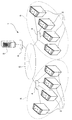
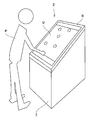
- the figure which shows the game system containing the game machine which concerns on one form of this invention The figure which shows the physical structure of the one game machine in a game system.
- the figure which showed the game screen typically.
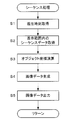
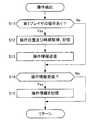
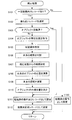
- the flowchart of a sequence processing routine The flowchart of an operation detection routine.
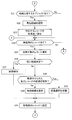
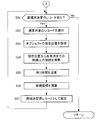
- the flowchart following FIG. The flowchart following FIG.
- amendment processing is applied.
- amendment processing is applied.
- amendment processing is applied.
- amendment processing is applied
- FIG. 1 shows a game system including a game machine according to one embodiment of the present invention.
- a plurality of game machines 2 and a center server 3 are respectively connected to a network 5 via a router 4.
- the center server 3 is not limited to an example configured by a single physical device, and a single logical center server 3 may be configured by a server group as a plurality of physical devices.
- Each game machine 2 functions as a terminal device (or client) of the game system 1 by being connected to the network 5.
- the Internet is used.
- the network 5 may be any network that uses a communication line, and is not limited to the Internet.
- Each game machine 2 is configured as a business game machine that permits play of a predetermined range of games in exchange for payment of a play fee.
- An appropriate number of game machines 2 are installed in a commercial facility such as a store 6.
- the router 4 is installed in association with each store 6 and the center server 3.
- Game machines 2 in the same store are connected to a network 5 through a common router 4.
- a local server may be installed between the game machine 2 and the router 4 of the store 6, and the game machine 2 may be communicably connected to the center server 3 via the local server.
- the center server 3 includes a microprocessor, a ROM in which a program such as an operating system to be executed by the microprocessor is recorded, and an internal storage device (not shown) such as a RAM that provides a work area for the microprocessor. There is provided a control unit (not shown) configured as a computer equipped with.
- the center server 3 is connected to an external storage device (not shown).
- the external storage device stores various server programs to be executed by the control unit and various data referred to by the programs.
- FIG. 2 shows a physical configuration of the game machine 2.
- the game machine 2 includes a housing 7 and a monitor 8 as a display device disposed on the upper surface of the housing 7 so as to be inclined toward the player P side.
- a transparent touch panel 9 is superimposed on the surface of the monitor 8.
- the touch panel 9 is a known input device that outputs a signal corresponding to the contact position when the player P touches with a finger or the like.
- the game machine 2 is provided with various input devices and output devices provided in a normal business game machine such as a button for selecting or determining, a power switch, a volume operation switch, and a power lamp. However, these are not shown in FIG.
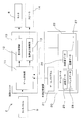
- FIG. 3 is a functional block diagram of the game machine 2.
- a control unit 10 as a computer is provided inside the housing 7.
- the control unit 10 includes a game control unit 11 as a control subject, a display control unit 12 that operates according to an output from the game control unit 11, and an audio output control unit 13.
- the game control unit 11 is configured as a unit in which a microprocessor and various peripheral devices such as an internal storage device (for example, ROM and RAM) necessary for the operation of the microprocessor are combined.
- the display control unit 12 draws an image corresponding to the image data supplied from the game control unit 11 in the frame buffer, and outputs a video signal corresponding to the drawn image to the monitor 8, whereby a predetermined signal is displayed on the monitor 8. Display an image.
- the audio output control unit 13 generates an audio reproduction signal corresponding to the audio reproduction data given from the game control unit 11 and outputs the audio reproduction signal to the speaker 14 as an audio output device connected to the control unit 10. To play a predetermined sound (including music).
- An external storage device 20 is connected to the game control unit 11.
- a storage medium that can hold the storage without power supply such as an optical storage medium such as a DVDROM or a CDROM, or a nonvolatile semiconductor memory device such as an EEPROM, is used.
- the external storage device 20 stores a game program 21 and game data 22.
- the game program 21 is a computer program necessary for executing a music game according to a predetermined procedure on the game machine 2.
- the game control unit 11 executes various operation settings stored in the internal storage device, thereby executing various initial settings necessary to operate as the game machine 2. Then, by reading the game program 21 from the external storage device 20 and executing it, an environment for executing the music game according to the game program 21 is set.
- the game control unit 11 is a logical device realized by a combination of computer hardware and a computer program.
- the game control unit 11 performs a music game process in which an operation is instructed to the player in accordance with the reproduction of music (music) selected by the player, or a sound effect is generated in accordance with the operation of the player. Further, the game control unit 11 evaluates the player's operation and executes a process such as controlling the game according to the evaluation result.
- the game data 22 includes various data to be referred to when the music game is executed according to the game program 21.
- the game data 22 includes music data 25, sound effect data 26, and image data 27.
- the music data 25 is data necessary for reproducing and outputting music to be played from the speaker 14. Although only one type of music data 25 is shown in FIG. 3, the player can actually select music to be played from a plurality of types of music.
- a plurality of types of music data 25 respectively corresponding to the plurality of types of music are recorded with information for identifying the music.
- the external storage device 20 functions as music data storage means.
- the sound effect data 26 is data in which a plurality of types of sound effects to be output from the speaker 14 in response to the operation of the player are recorded in association with unique codes for each sound effect. Sound effects include musical instruments and various other types of sounds. The sound effect data may be prepared for a predetermined number of octaves by changing the pitch for each type.
- the image data 27 is data for causing the monitor 8 to display a background image, various objects, icons, and the like in the game screen.
- the game data 22 further includes sequence data 28.
- the sequence data 28 is data for instructing the operation timing for the player, and details thereof will be described later.
- the external storage device 20 functions as sequence data storage means by storing the sequence data 28.
- the game machine 2 causes the player of the game machine and the player of another game machine 2 (other machine) connected via the network 5 to perform operations in accordance with the same music, and evaluates the operations of those players. Thus, it is possible to execute a battle-type music game for competing the results.
- a matching request for requesting an opponent is transmitted from the game machines 2 to the center server 3 via the network 5.
- the center server 3 matches two players who are opponents with each other.
- an opponent is determined based on the designation of the center server 3, a music game battle using communication between the game machines 2 is started between the players.
- FIG. 4 is a diagram schematically showing a game screen of a music game executed on the game machine 2.
- the game screen 50 includes a game area 52 for guiding the operation timing to the player, and an information area 53 for displaying game information including scores of the two matched players.
- the game area 52 is formed in a rectangular shape. In the vicinity of both ends 52U and 52B in the longitudinal direction (vertical direction in FIG. 4) of the game area 52, a first reference portion 55A and a second reference portion 55B as reference portions are arranged to face each other. Each of the reference portions 55A and 55B extends linearly in a direction orthogonal to the longitudinal direction of the game area 52.
- the game control unit 11 functions as a game area presenting means by displaying the game area 52 on the monitor 8.
- the reference portion 55A is used as a reference for the current time on the game by both players playing the two matched game machines 2 respectively.
- the reference unit 55B functions as a sign indicating the reference of the current time in the opponent player. That is, the first reference unit 55A functions as a reference for the current time of the player of the own device (hereinafter sometimes referred to as the first player), and the second reference unit 55B is a player of the other device (hereinafter referred to as the second player). Function as a marker indicating the position recognized as the reference of the current time.
- the game screen 50 of FIG. 4 is drawn with the front side down and the back side up when viewed from the first player.
- Different colors are used for the reference portions 55A and 55B in order to distinguish each player.
- a red straight line is used as the first reference portion 55A
- a blue straight line is used as the second reference portion 55B.
- the information area 53 is arranged around the game area 52, and one end side in the longitudinal direction of the game area 52 is used to display the score of one player, and the other end side displays the score of the other player. Used to do.
- the reference portions 55A and 55B respectively include a plurality of repulsion points R1 and R2 arranged at a predetermined interval. As indicated by broken lines in the figure, the plurality of repulsion points R1 included in the first reference portion 55A and the plurality of repulsion points R2 included in the second reference portion are connected to each other by a plurality of paths W, respectively. Yes. Specifically, a plurality of paths W from one repulsion point R1 of the first reference portion 55A to a plurality of repulsion points R2 included in the second reference portion 55B are also one of the second reference portions 55B. A plurality of routes W are provided from the repulsion point R2 to the plurality of repulsion points R1 included in the first reference portion 55A. In FIG. 4, only some repulsion points R1 and R2 are illustrated. Actually, a large number of repulsion points R1 and R2 exist at regular intervals along the reference portions 55A and 55B.
- the plurality of paths W extending from the repulsion point R1 of the first reference portion 55A extends to the upper end portion 52U on the second reference portion 55B side while passing through the repulsion point R2. Further, the plurality of paths W extending from the repulsion point R2 of the second reference portion 55B extends to the lower end portion 52B on the first reference portion 55A side while passing through the repulsion point R1. Focusing on one repulsion point R1 of the first reference portion 55A, the repulsion point R1 is directed toward the three repulsion points R2 included in the second reference portion 55B as a plurality of paths W with respect to the repulsion point R1. Three paths W1, W2, and W3 extending from are provided.
- an object 60 as an operation instruction indicator for instructing an operation is displayed according to the sequence data 28 on the path W connecting the repulsion point R1 and the repulsion point R2. Is done.
- each of the routes W1, W2, and W3 is indicated by a broken line, but none of the plurality of routes W is displayed on the actual game screen 50A.
- the object 60 appears at the repulsion point R1 or the repulsion point R2 at a predetermined time in the music, and moves toward the repulsion points R1 and R2 located on the opposite side from the repelling points R1 and R2 that appear as the music progresses. Then, it moves on the path W extending from each rebound point R1, R2 that has appeared.
- the object 60 disappears. In exchange for the disappearance of the object 60, the next object 60 appears at the repulsion points R1 and R2 of the reference portions 55A and 55B.
- the position (repulsion point) where the object 60 has reached functions as the appearance position of the next object 60.
- the object 60 moves along any one of a plurality of routes W set for one repulsion point R1 (or R2). A procedure for selecting one route W from the plurality of routes W will be described later.
- the object 60 that appears at the appearance position moves toward the repulsion points R1 and R2 located on the opposite side from the appearance position. For this reason, when an appropriate operation is performed, the object 60 repeatedly moves alternately between the reference portions 55A and 55B so as to repel each repulsion point R1 and R2. On the other hand, when an appropriate operation is not executed, the object 60 passes through the reference portions 55A and 55B along the paths W. The object 60 that has passed through each of the reference portions 55A and 55B moves to the upper end 52U or the lower end 52B. And the position where the object 60 of each end 52U, 52B arrives functions as the appearance position of the next object 60.
- the object 60 when the operation is not executed, the object 60 is repelled at the end portions 52U and 52B from the end portions 52U and 52B toward the reference portion located on the opposite side. Change the direction of movement.
- the movement path of the object 60 after rebounding at the end portions 52U and 52B is set to a path that does not pass through the side walls 52L and 52R and has the minimum distance to the rebound point to be reached next. Note that the inversion of the object 60 is a principle, and exceptional processing is performed in a fixed case. Details will be described later.
- each player is required to perform a touch operation of touching a position at which the object 60 of the reference unit 55A has reached in accordance with the arrival of the object 60 of the own device to the reference unit 55A.
- a time difference between the time when the object 60 matches the reference portion 55A and the time when each player performs the touch operation is detected. The smaller the deviation time, the higher the player's operation is evaluated.
- sound effects are reproduced from the speaker 14 in response to the touch operation.
- a well-known method may be applied as a method for reproducing sound effects.
- the object 60 is moving toward the repulsion point R2 of the second reference portion 55B on the route W1.
- the second player moves the object 60 of the first reference portion 55A displayed on the game screen 50 of the other device (the own device as viewed from the second player). What is necessary is just to touch the position to reach.
- the object 60 is displayed in a color corresponding to each reference portion 55A, 55B ahead. That is, in the example of FIG. 4, the object 60 is displayed in blue until it reaches the repulsion point R2 of the second reference portion 55B, and the next object 60 that appears at the reached rebound point R2 is displayed in red.
- the operation unit is formed by a combination of the reference portion 55A on the monitor 8 (more precisely, all the repulsion points R1 set on the reference portion 55A) and the touch panel 9 superimposed thereon.
- the reference unit 55A functions as a part of the operation unit in the input device of the present invention, and also functions as a reference unit corresponding to the operation unit of the own device.
- the reference portion 55A may be used as a term representing the operation portion.
- the reference unit 55B is a reference unit corresponding to the operation unit of the game machine 2 (other machine) of the opponent player.
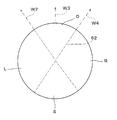
- FIG. 5 is a diagram for explaining the area of the object 60.
- the broken lines in FIG. 5 indicate the paths W1, W2, and W3, respectively, and the alternate long and short dash line 62 indicates the boundary between the regions.
- the object 60 has four contact areas, a contact area S in the vicinity of a contact point that first contacts the reference portion 55A, a right area R, a left area L, and other areas O that are bordered by the contact area S. Divided into areas.
- the path W on which the object 60 should travel next is selected according to which area the player has touched.
- the straight path W2 that goes to the repulsion point R1 with the shortest distance is near the left region L (the region Is touched in the vicinity of the right area R (including the area), the first right path W3 going to the repulsion point R1 via the right side wall 52R in the longitudinal direction of the game area 52 is touched.
- the first left-side path W1 toward the repulsion point R1 via the left side wall 52L in the longitudinal direction of the game area 52 is selected.
- the distances of the movement paths W1 to W3 are different from each other.
- FIG. 4 shows a state in which only a single object 60 is displayed in the game area 52.
- a plurality of objects 60 having different positions, speeds, or paths may be displayed.
- control related to the display and movement of the object 60 such as the appearance position, movement path, and disappearance position of each object 60 is performed for each object 60 according to the above-described example.
- the sequence data 28 includes a condition definition unit 28a and an operation sequence unit 28b.
- the condition definition unit 28a includes information for specifying different game execution conditions for each music piece, such as music tempo, beat, track, and information for specifying sound effects to be generated when the object 60 is touched. Described.
- the condition defining unit 28a is provided only at the beginning of the sequence data 28. However, the condition defining unit 28a may be added at an appropriate position in the middle of the operation sequence unit 28b. As a result, it is possible to realize processing such as changing the tempo in a song and changing the allocation of sound effects.
- the operation sequence unit 28b the time when the object 60 should be touched, the time when the display should be started, and the information indicating the player who should perform the touch operation (in other words, among the reference parts 55A and 55B, the object 60 Are described in association with each object 60.
- the operation sequence unit 28b starts to display the object 60 and the operation time unit 28c for instructing the time (operation time) when the touch operation should be performed in the music.
- a position instruction unit 28e and a sign information unit 28f for indicating the object 60 to be displayed are included.
- the operation sequence unit 28b includes, for each object 60 to be displayed, a plurality of descriptions in which an operation time when an operation should be performed in the music, a display start time of the object 60, and a player from which the object 60 starts to be displayed are associated with each other. It is configured as a set of records.
- the operation time and the display start time are described by separating a bar number in the music, the number of beats, and a value indicating the time of the beat with a comma.
- the operation time section 28c includes an operation time when the time interval between one operation time and the next operation time with respect to the one operation time is less than a predetermined value.
- the next operation time 28cr corresponding to the time is surrounded by a broken line.
- the display start time of the next operation time 28cr is set to a time that matches the display start time set to the previous operation time 28cf.
- Information indicating another object 60 is associated with the next operation time 28cr, the previous operation time 28cf, and the specific operation time 28cs.
- the instruction of the player to start displaying the object 60 is described as “P1” when instructing the first player and “P2” when instructing the second player.
- the record with “P1” indicating the first player is a record that means that the object 60 should reach the first reference part 55A at the operation time described in the operation time part 28c. on the other hand.
- the record with “P2” indicating the second player is a record that means that the object 60 should reach the second reference portion 55B at the operation time described in the operation time portion 28c.
- the player's instruction corresponds to an instruction of the color of the object 60 to be displayed, and the blue object 60 is displayed when “P1” and the red object 60 is displayed when “P2”.
- information indicating the object 60 to be displayed is described using alphabets such as “A”.
- the information is attached to distinguish the objects 60 when the plurality of objects 60 are displayed in the game area 52. That is, “A” is the alphabet corresponding to the first object 60 displayed in the game area 52, “B” is the alphabet corresponding to the second object 60, and “B” is the alphabet corresponding to the third object 60. C ′′ is used respectively.
- alphabets of a type corresponding to the number of objects 60 to be displayed in the game area 52 are used as information indicating the objects 60 to be displayed.
- Information indicating the object 60 also indicates the correspondence between the operation periods.
- the position where the object 60 corresponding to a certain operation time arrives is closest to the one operation time ( Alternatively, it has a function as an appearance position of the object 60 corresponding to another operation time for which the display start time is set. If there are a plurality of records that specify the same operation time, the record that specifies the same operation time, such as the earlier display start time or the earlier of the sequence described in the sequence data 28, By specifying any one of them according to a predetermined specifying condition or the like, the appearance position of the object 60 (the next appearing object 60) corresponding to another operation time may be specified.
- the blue object 60 is displayed on the first reference portion 55A corresponding to the first player at the start time (000) of the fourth beat of the first measure, and the route W from the first reference portion 55A.
- the operation time, and the object 60 such as moving to reach the second reference portion 55B at a time equivalent to “010” from the start time of the fourth beat of the first bar.
- the reference part for starting the display is indicated.
- the red object 60 is displayed with the rebound point R2 reached by the object 60 as an appearance position.
- the first reference portion 55A is reached at a time equivalent to “016” from the start time of the fourth beat of the first measure.
- the rebound point R2 that the object 60 has reached immediately before on the second reference portion 55B used as a reference by the second player, A red object 60 corresponding to the previous operation time 28cf and a second red object 60 corresponding to the next operation time 28cr appear, and the first object 60 is the start time of the second beat of the second measure.
- the second object 60 arrives at the first reference portion 55A at the time when “030” has elapsed from the start time of the second beat of the second bar at the time when “030” has elapsed. Move on route W.
- the first object 60 reaches the first reference portion 55 ⁇ / b> A at a time corresponding to “030” from the start time of the second beat of the second measure
- the second object 60 reaches the second reference position.
- a record instructing the object 60 to reach the second reference portion 55B at a time equivalent to “034” from the start time of the second beat of the bar corresponds to a record at a specific operation time 28cs.
- the object 60 that repeatedly moves between the reference portions 55A and 55B when the player performs an appropriate operation has been described.
- an object of a type that does not assume a reciprocation and only disappears in response to an operation of one player and does not reverse the moving direction may be added.
- various objects such as objects appearing in a chained state may be added to the game area 52 in addition to the reciprocating type object 60 described above.
- the game control unit 11 When the game between the matched players is started, the game control unit 11 reads the music data 25 corresponding to the music selected by the player and outputs the music data 25 to the audio output control unit 13, whereby the music of the music is output from the speaker 14. Start playback. Thereby, the control unit 10 functions as a music reproducing means. In addition, the game control unit 11 reads the sequence data 28 corresponding to the player's selection in synchronization with the reproduction of the music, and refers to the image data 27 to obtain image data necessary for drawing the game area 52 and the information area 53. And the game area 52 and the information area 53 are displayed on the monitor 8. Furthermore, during the execution of the music game, the game control unit 11 repeatedly executes the sequence processing routine shown in FIG. 7 at a predetermined cycle as a process necessary for displaying the game area 52 and the like. The cycle is equal to the cycle of drawing the game screen 50, that is, the frame rate.
- the game control unit 11 first acquires the current time on the music in step S1. For example, timing is started with the internal clock of the game control unit 11 with the music reproduction start time as a reference, and the current time is acquired from the value of the internal clock.
- the time on the music may be specified by the elapsed time from the playback start time, or may be specified by another value correlated with the elapsed time. For example, the time may be specified using the number of beats of the music from the playback start time of the music, the number of frames of the game screen 50, or the like.
- the game control unit 11 acquires from the sequence data 28 the data of the display start time and the operation time that exist in the time length corresponding to the display range of the game area 52 to be drawn in the next frame. Hold in internal storage.
- the display range is a time range corresponding to two measures of music from the current time (however, at the time of drawing the next frame) to the future, and a time corresponding to the ends 52U and 52B of the game area 52 from the current time. Set to range.
- the coordinates in the game area 52 of all the objects 60 to be drawn in the next frame are calculated. Details of the calculation will be described later.
- step S4 the game control unit 11 generates image data necessary for drawing the game area 52 based on the coordinates of the object 60 calculated in step S4. Specifically, the image data is generated so that each object 60 is arranged at the calculated coordinates. An image such as the object 60 may be acquired from the image data 27.
- step S ⁇ b> 5 the game control unit 11 outputs image data to the display control unit 12. Thereby, the display of the game area 52 on the monitor 8 is updated.
- step S5 the game control unit 11 ends the current sequence process routine.
- the object 60 appears on one of the reference portions 55A and 55B at a predetermined display start time, advances along the path W in accordance with the progress of the music, and is set at the reference time at a predetermined operation time.
- the display of the object 60 is controlled so as to reach the other of the portions 55A and 55B.
- the game control unit 11 repeatedly executes the operation detection routine of FIG. 8 at an appropriate cycle in parallel with the sequence processing routine described above. Note that the period in which the routine of FIG. 8 is executed is equal to or shorter than the execution period of the routine of FIG.
- the operation detection routine is a process executed to acquire the contents (operation position and operation timing) of the touch operation of the first player and the second player.
- the game control unit 11 refers to the output of the touch panel 9 in step S11 to determine whether or not the first player has performed a touch operation after the end of the previous routine.
- step S12 acquires the position touched by the first player and the time when the touch operation is performed, generates operation information that records them, and Operation information is stored in an internal storage device.
- step S13 the game control unit 11 transmits the operation information stored in step S12 to the game machine 2 of the opponent player.
- step S14 the game control unit 11 determines whether or not operation information has been received from the opponent game machine 2 after the end of the previous routine. If received, the game control unit 11 proceeds to step S15 and stores the received operation information in the internal storage device. When the process of step S15 is completed, the game control unit 11 ends the current process. If a negative determination is made in step S11, the game control unit 11 skips steps S12 and S13 and proceeds to step S14. If a negative determination is made in step S14, the game control unit 11 skips step S15 and ends the routine.
- the timing of each operation of the first player and the second player included in the operation information stored by the processing of FIG. 8 is treated as the actual operation timing of each player.
- the operation time is in the past of the time when this operation was performed.
- a communication delay occurs in the network 5 and a time difference occurs between the time when the operation information is transmitted from the other device and the time when the operation information is received at the own device
- the time when the operation information is detected is indicated in the operation information.
- One object of the present invention is to deal with such a delay.
- the game control unit 11 extracts a record on the sequence data 28 corresponding to each player's touch operation, and compares the operation time on the record with the actual operation time of the player. And the process which divides and evaluates each operation of a player in several steps according to the deviation
- the process may be the same as that of a known game machine, and detailed description thereof is omitted.
- step S3 of FIG. 9 when starting the object coordinate calculation routine, the game control unit 11 first determines whether or not there is an unprocessed operation in step S21.
- An unprocessed operation is each operation acquired in the operation detection routine of FIG. 8 between the previous object coordinate calculation and this time, and is set as processed in the current object coordinate calculation routine. There is no operation. If there is an unprocessed operation, the game control unit 11 proceeds to step S22, and selects one operation to be processed from the unprocessed operations. In subsequent step S23, the game control unit 11 acquires the position and timing of the operation to be processed.
- the game control unit 11 determines whether or not a predetermined delay has occurred at the time when the operation time is detected (detection time). That is, the operation time acquired in steps S11 and S12 in FIG. 8 is the time when the game machine 2 detects the actual operation on the touch panel 9 of the own device, and there is no delay, and even if it is negligible. Is a level. However, regarding the operation time included in the operation information sent from the other machine, the time when the operation was actually performed on the other machine and the game control unit 11 of the own machine provided the operation information in step S13 of FIG. There may be a time difference that cannot be ignored due to the congestion of the network 5 or the like between the time of receiving and detecting the operation.
- step S24 the current time on the game is compared with the operation time recorded in the operation information to be processed, and it is determined whether or not there is a delay that cannot be ignored.
- step S24 may be affirmed when a delay having a time length exceeding a predetermined allowable range occurs without considering the delay to a certain extent with respect to the current time.
- step S24 If it is determined in step S24 that no delay has occurred, the game control unit 11 proceeds to step S25, and records including the operation position and operation time acquired in step S23 within a certain range (hereinafter, records within the certain range). Is determined to exist in the sequence data 28 in the range acquired in step S2 of FIG.
- the fixed range here is a time range set as an allowable range that can be considered that an appropriate operation has been performed with respect to the operation time described in the sequence data 28, and the reference unit 55A ( Or a distance range set as an allowable range that can be considered to have touched the object 60 with respect to the arrival position of the object 60 with respect to 55B).
- step S25 If it is determined in step S25 that there is a record within a certain range, the game control unit 11 proceeds to step S26, and operates the operation timing and operation position acquired in step S23 from the record within the certain range. Select the record with the closest time for comparison.
- step S27 the game control unit 11 determines the positional relationship between the position of the touch operation and the object 60 displayed corresponding to the record selected in step S26. In this process, the position where the touch operation is performed belongs to any of the four regions O, R, S and L shown in FIG. 5, or the position where the touch operation is performed is closest to any region. It is a thing which discriminates.
- step S28 the game control unit 11 selects a route W on which the object 60 should move next based on the position determined in step S27. The selection is as described with reference to FIG.
- the game control unit 11 proceeds to step S29, sets the operation and record processed this time as processed, and then returns to the process of step S21.
- the record set as processed in step S29 includes not only the record selected as the comparison target in step S26 but also the record associated with the display start time. That is, in the sign information section 28f of the sequence data 28 shown in FIG. 5, the information indicating the comparison target record coincides with the information indicating the object 60, and the display start time is the same as the operation time of the comparison target record.
- the path W determined in step S28 is stored as the path W corresponding to the subsequent record, and the path W of the preceding record is discarded.
- step S24 If it is determined in step S24 that a delay has occurred, the game control unit 11 proceeds to step S30 and executes correction processing. Details of the correction processing will be described later with reference to FIGS. After completion of the correction process, the game control unit 11 returns to step S21.
- step S21 the process of changing the path W corresponding to the operations of the first and second players is completed.
- the game control unit 11 proceeds to step S31 in FIG. Step S31 and subsequent steps are processing for records that are held in the internal storage device in step S2 of FIG. 7 and that have not been set as processed in step S29.
- step S31 the game control unit 11 determines whether or not the object 60 corresponding to these records reaches the end portions 52U and 52B for the records whose operation time has passed the current time among unprocessed records. Is determined. In this process, whether the object 60 moves the distance to the end portions 52U and 52B at the display time of the next frame using the coordinates and the moving speed of each object 60 calculated in the previous routine of the object 60. It may be determined whether or not.
- step S31 When it is determined in step S31 that there is an object 60 that reaches the end portions 52U and 52B, the game control unit 11 proceeds to step S32 and sets the next position W and the next position of the object 60 as the next path W corresponding to the object 60.
- the shortest distance route (shortest route) connecting the repulsion point R1 (or R2) is selected.
- step S33 the game control unit 11 sets the record corresponding to the object 60 for which the shortest path has been set as processed. In this case, not only the record determined to reach the end portions 52U and 52B but also the subsequent record associated with the record and the display start time is set to processed. This is the same as step S29.
- the shortest path is stored in association with the subsequent record, and the path of the preceding record is discarded.
- step S34 the game control unit 11 determines whether or not there is an unprocessed record. If a negative determination is made in step S31, steps S32 and S33 are skipped and the process proceeds to step S34. If it is determined in step S34 that there is an unprocessed record, the game control unit 11 proceeds to step S35, and selects one record to be processed from the unprocessed record. In subsequent step S36, the game control unit 11 determines whether or not the route W has already been determined in the previous routine for the record to be processed. If determined, the game control unit 11 proceeds to step S37, and maintains the route W of the record to be processed as the previously determined route W. Note that an affirmative determination is made in step S36 for the record in which the path W has already been discarded, and the discarded state is maintained in step S37.
- step S38 the game control unit 11 determines whether or not the route W of the preceding record associated with the record to be processed should be maintained.
- the preceding record here is a record in which the same information as the information in the indicator information portion 28f in the record to be processed is specified, and the display start time of the record to be processed is specified as the operation time.
- the next path W corresponding to the succeeding record associated with the preceding record is selected by the processing of FIG.
- the subsequent record to be processed is set as processed in step S29.
- step S38 the game control unit 11 determines whether or not the route W is maintained for the preceding record associated with the processing target. If the determination in step S38 is affirmative, the game control unit 11 determines that the object 60 should not yet appear with respect to the processing target record, and proceeds to step S39 to select the path W regarding the processing target record. Hold.
- step S40 the game control unit 11 proceeds to step S40.
- the processing target record is a record in which the object 60 should newly appear in the game area 52 of the next frame. Accordingly, the game control unit 11 newly selects a route W for the record to be processed in step S40.
- the record to be processed specifies the operation of the first player, the repulsion point R2 on the reference portion 55B is determined, and one route W from the repulsion point R2 toward the reference portion 55A is selected.
- the record to be processed designates the operation of the second player, the repulsion point R1 on the reference portion 55A is determined, and one route W from the repulsion point R1 toward the reference portion 55B is selected. .
- step S37, S39, or S40 the game control unit 11 proceeds to step S41 and sets the processing target record as processed. Thereafter, the game control unit 11 returns to step S34.
- step S34 the game control unit 11 proceeds to step S51 of FIG. Step S51 and subsequent steps are processing for determining the position (coordinates) of the object 60 on the route W for the record for which the route W is determined. That is, regarding the record in which the route has already been discarded or the route has not yet been set, it is not necessary to display the object 60 and is excluded from the coordinate calculation target.
- step S51 the game control unit 11 determines whether or not there is a record whose coordinates have not been determined in the record in which the route W is selected. If there is an undetermined record, the game control unit 11 proceeds to step S52 and selects a record to be calculated.
- step S53 the game control unit 11 acquires the current position of the object 60 corresponding to the calculation target record. As the position, the position set at the time of execution of the previous routine may be used. What is necessary is just to judge that there is no present position regarding the object 60 which should newly appear.
- step S54 the game control unit 11 calculates the distance on the path W from the current position of the object 60 to the repulsion point.
- step S55 the game control unit 11 calculates the time difference between the current time and the time at which the object 60 should reach the rebound point (that is, the operation time described in the record) as the remaining time. Thereafter, the game control unit 11 proceeds to step S56, and calculates the new coordinates of the object 60 corresponding to the calculation target record, that is, the position of the object 60 in the game area 52 of the next frame.
- the new coordinates calculate the moving speed of the object 60 by dividing the distance by the remaining time, and calculate the distance (moving distance) that the object 60 should travel to the next frame from the moving speed and the time interval to the next frame. Then, a position that has traveled on the route W by the moving distance may be set as a new coordinate.
- the appearance position may be set as a new coordinate. Further, for the object 60 passing through the reference portions 55A and 55B and heading toward the end portions 52U and 52B, new coordinates may be obtained using the moving speed used in the previous calculations.
- step S56 the game control unit 11 proceeds to step S57, sets the calculation target record as a coordinate-determined record, and then returns to the process of step S51. If there are no coordinates yet to be determined, a negative determination is made in step S51. Thereby, the game control unit 11 finishes the current object coordinate calculation routine.
- FIG. 12 is a flowchart showing a detailed procedure of the correction process
- FIG. 13 shows an example of the game area 52 to which the correction process is applied.
- the fixed range here is a time range set as an allowable range in which it can be considered that an appropriate operation has been performed with respect to the operation timing described in the sequence data 28 as in step S25 of FIG.
- the process of step S101 refers to the operation position and operation time included in the delay information, and whether or not the operation is an appropriate operation for any of the records included in the sequence data 28.
- step S101 If it is determined in step S101 that there is no record within a certain range, the game control unit 11 sets the operation included in the delay information as a processed operation in step S120, and completes the current correction process. On the other hand, when it is determined in step S101 that there is a record within a certain range, the game control unit 11 proceeds to step S102, and is closest to the operation time acquired in step S23 in FIG. 9 from the record within the certain range. Select records for comparison. In subsequent step S103, the game control unit 11 determines whether or not the object 60 corresponding to the record to be compared has been inverted at the end 52U.
- the path W is set in the record to be compared, and if it is not set, it may be determined as reversed. As described in FIG. 10, if the object 60 is inverted at the end 52U, the shortest path is newly set for the associated record, and the path W of the object 60 before reaching the end 52U is discarded. This is because that.
- step S104 the game control unit 11 determines the positional relationship between the position of the touch operation included in the delay information and the object 60 corresponding to the comparison target record. This process is the same as step S27 in FIG. However, at the time when the process of step S105 is performed, the object 60 has advanced a distance corresponding to the delay time with respect to the position of the object 60 at the operation time.
- step S106 the game control unit 11 determines the original path of the object 60 based on the determination result of the positional relationship, and refers to the determination result, and in step S107, the path from the current position of the object 60.
- Set W An example of the route W setting method at this time will be described with reference to FIG.
- a route W is set from the repulsion point R1a on the reference portion 55A of the first player to the repulsion point R2 on the reference portion 55B of the second player, and at the operation time included in the delay information, Although the second player touches the object 60 when the object 60 moved along the path W reaches the rebound point R2, the object 60 is rebounded on the game machine 2 of the second player due to a delay in the operation information. It is assumed that the operation of the second player is detected when the point A is passed through R2 and the correction process is started. Further, if there is no delay in the operation information, the object 60 should change the moving direction at the rebound point R2, and the route from the rebound point R2 to the rebound point R1b via the turn point C should be originally set.
- step S104 the point A is acquired as the current position of the object 60 in step S104.
- step S105 the object 60 is compared with the operation position in the delay information, assuming that the object 60 exists at the repulsion point R2.
- step S106 it is determined that the original route should have been set so as to reach the repulsion point R1b from the repulsion point R2 via the turnaround point C.
- the game control unit 11 sets a path W so as to reach the repulsion point R1b from the current position A of the object 60 via the turning point C in step S107.
- step S108 the game control unit 11 proceeds to step S108, and based on the delay time calculated in step S104 and the original path determined in step S106, The original position of 60 is calculated. That is, the coordinates of the object 60 in the next frame when it is assumed that there is no delay in the operation information is calculated.
- the point D on the imaginary line from the repulsion point R ⁇ b> 2 to the turning point C is the original position of the object 60.
- step S109 the game control unit 11 calculates the distance on the original path from the original position D to the rebound point R1b via the turn-around point C.
- step S110 the game control unit 11 calculates the position (coordinates) of point B at which the distance to the repulsion point R1b is equal to the original distance calculated in step S109 on the route set in step S107.
- the position is determined as the appearance position of the object 60. That is, in FIG. 13, the position of the point B is obtained so that the distance of the point BCR1b is equal to the distance of the point DCR1b, and the point B is set as the appearance position of the object 60 in the next frame. .
- step S110 the game control unit 11 proceeds to step S111, and selects the operation included in the delay information and the record selected as the comparison target in step S102 in association with the operation. Both are set as processed. Note that if an affirmative determination is made in step S103, the game control unit 11 skips steps S104 to S110 and proceeds to step S111.
- the reason is that when the object 60 is inverted at the end 52U, the shortest path is set and the moving speed of the object 60 is relatively slow, and therefore the moving speed of the object 60 need not be reduced by the correction process.
- the record set as processed in step S111 includes not only the record selected as the comparison target in step S102 but also the subsequent record associated with the record as the preceding record. The relationship between the preceding record and the succeeding record is as described above. These processes are the same as step S29. Furthermore, in subsequent step S112, the game control unit 11 sets the subsequent record set as processed in step S111 as a coordinate determined record. As a result, for the record in which the appearance position of the object 60 is determined by the correction process corresponding to the delay information, the negative determination is made in step S51 in FIG. 11, and the coordinates of the object 60 are calculated by overlapping in this routine. There is no. When the process of step S112 is completed, the game control unit 11 finishes the correction process and returns to step S21 of FIG.
- step S51 of FIG. 11 When all the operations have been processed and the coordinates of all the objects 60 that should appear in the display range of the next frame have been calculated, a negative determination is made in step S51 of FIG. 11 and the object coordinate calculation routine ends. Then, the calculated coordinates are referred to in step S4 of FIG. 7 to generate image data.
- the game control unit 11 functions as a self-operation detection unit by executing steps S11 and S12 in FIG. 8, and functions as an operation information transmission unit by executing step S13 in FIG. By performing steps S14 and S15 in the figure, it functions as an other device operation detection means. Further, the game control unit 11 functions as a sign display control means by executing the sequence processing routine of FIG. 7 and the subroutines of FIGS. 11 to 12 included therein. Furthermore, the game control unit 11 functions as a delay determination unit by executing step S24, and functions as a correction unit by executing step S30 of FIG. 9 and the subroutine of FIG. 12 as its subroutine.
- the present invention is not limited to the above-described form, and appropriate modifications are possible.
- the increment of the movement distance of the operation instruction mark due to the detection time detection delay is eliminated by a single process, and then the operation instruction mark is moved to the original speed (no delay). At the same speed).
- the correction of the increment of the movement distance may be gradually reduced in a plurality of times. That is, in the example of FIG. 13, the movement direction of the object 60 is changed to a direction along a new route (a route connecting points A, C, and R1b) at the point A, and the movement distance of the object 60 to the repulsion point R1b.
- FIG. 14 shows a procedure of correction processing executed instead of FIG. 11, and FIG. 15 shows a procedure of object coordinate calculation to be executed instead of FIG.
- step S131 the game control unit 11 sets the current position of the object 60 (point A in FIG. 13) as the appearance position of the object 60 in the next frame.
- step S132 the game control unit 11 records the subsequent record for the record selected as the comparison target in step S102 as a delay record, and then proceeds to step S111. That is, in the process of FIG. 14, the appearance position of the object 60 of the next frame is set not at the point B in FIG.
- step S61 is added between steps S55 and S56, and steps S62 to S65 are added as a process when step S61 is affirmed. Is different.
- the processing of steps denoted by the same reference numerals as in FIG. 11 is the same as that in the example of FIG.
- step S61 the game control unit 11 determines whether or not the record selected as the calculation target is a delay record, and if not, the process proceeds to step S56. On the other hand, if it is determined in step S61 that the record is a delay record, the game control unit 11 proceeds to step S62, and calculates the position on the original path of the object 60 corresponding to the delay record.
- the display start of the distance of the original route (route connecting points R2, C, and R1b in FIG. 13) described in the delay record is started.
- the original moving speed of the object 60 is calculated by dividing by the time from the time to the operation time, and based on the elapsed time from the display start time to the current time and the moving speed, the position of the object 60 in the original path is Calculate what to do.
- step S63 the game control unit 11 calculates a distance on the original route from the original position calculated in step S62 to the rebound point R1b to be reached next. Further, in the next step S64, the game control unit 11 determines whether or not the distance on the original route calculated in step S63 matches the distance calculated in step S54. If they do not match, the game control unit 11 proceeds to step S65, increases the moving speed of the object 60 from the original moving speed (the moving speed calculated in step S62), and then sets the current speed of the object 60 in the next frame. The position (new coordinates) on the route (route connecting points A, C, and R1b in FIG. 13) is calculated.
- step S65 the new coordinates of the object 60 are calculated from the point A that is the appearance position as the object 60 is moved at a speed higher than the original moving speed. By repeating the calculation, the increment of the moving distance of the object 60 caused by the delay of the operation information is gradually reduced.
- step S65 the game control unit 11 proceeds to step S57.
- step S65 As the speed increases in step S65, the difference in distance compared in step S64 gradually decreases. If the distances match and the determination in step S64 is affirmative, the game control unit 11 proceeds to step S66, cancels the setting of the delay record for the record to be calculated, and then proceeds to step S56.
- the degree of acceleration in step S65 may be set to an appropriate rate. For example, it can be set to twice the original moving speed. As the difference in distance decreases, the moving speed of the object 60 may be gradually decreased toward the original moving speed. 14 and 15, the game control unit 11 functions as a correction unit by executing the correction process routine of FIG. 14 and the processes of steps S61 to S66 of FIG.
- the selection of the movement route is not limited to an example in which one route is selected from a plurality of routes prepared in advance according to the operation position.
- the player's operation may be analyzed in more detail, and the movement route may be selected as appropriate, or the repulsion point and the movement route may be set in a one-to-one correspondence.
- the present invention increases the movement distance of the next operation instruction mark if the operation instruction mark is moved in a different direction from the position at the time of detection. It can be used appropriately as a solution in the case where an increase in moving speed can occur.
- the configuration of the operation unit is an example, and it is not always necessary that the operation unit exists on the reference unit. As long as the correspondence between the reference unit on the screen of the display device and the operation unit is clear, the operation unit may be set at a position away from the reference unit.
- an example is shown in which an increase in the movement speed of the operation instruction mark that occurs due to a delay in the transmission of operation information from another machine, that is, the opponent game machine is suppressed.
- the present invention is also useful as a countermeasure when a failure occurs between the two and a delay occurs in the detection of the operation time in the own device.
- the present invention is not limited to a game machine that requires an operation in accordance with music.
- the operation timing is instructed to a plurality of players by the movement of the operation instruction sign and the reference unit, and the operation instruction is supported. Any game machine that detects the player's operation and moves the operation instruction mark reciprocally between the reference parts can be applied as appropriate.
Landscapes
- Engineering & Computer Science (AREA)
- Multimedia (AREA)
- Theoretical Computer Science (AREA)
- Human Computer Interaction (AREA)
- Physics & Mathematics (AREA)
- Acoustics & Sound (AREA)
- User Interface Of Digital Computer (AREA)
- Management, Administration, Business Operations System, And Electronic Commerce (AREA)
- Processing Or Creating Images (AREA)
Abstract
Description
Claims (11)
- 通信回線を介して接続された複数の端末間でゲームを進行させるゲームシステムに適用され、前記複数の端末の一つとして機能することが可能なゲーム機であって、
少なくとも一つの操作部を有する入力装置と、
ゲーム画面を表示する表示装置と、
ゲーム中における自機の操作部の操作時期と、前記ゲームシステムの他の端末として機能する他機の操作部の操作時期とをそれぞれ記述したシーケンスデータを記憶するシーケンスデータ記憶手段と、
前記自機の操作部に対応する基準部と、前記他機に対応する基準部とが間隔をあけて配されたゲーム領域を前記ゲーム画面上に表示させるゲーム領域提示手段と、
前記自機の操作部に対する実際の操作時期を記録した操作情報を検出する自機操作検出手段と、
前記自機操作検出手段が検出した操作情報を前記他機に送信する操作情報送信手段と、
前記他機の操作情報送信手段から送信される操作情報に基づいて、当該他機の操作部に対する実際の操作時期を検出する他機操作検出手段と、
前記操作時期を指示するための操作指示標識が、前記シーケンスデータに記述された自機の操作部の操作時期には当該自機の操作部に対応する基準部に、他機の操作部の操作時期には当該他機の操作部に対応する基準部にそれぞれ達するように、かつ、前記自機操作検出手段及び前記他機操作検出手段による前記操作時期の検出に応答して、前記操作指示標識の移動経路が、次の基準部に向かう移動経路へと変化するように、前記ゲーム領域内にて前記操作指示標識を移動させる標識表示制御手段と、を具備し、
前記標識表示制御手段は、
前記操作検出手段が前記操作時期を検出した時期に関して、前記操作情報に記録されている実際の操作時期に対する遅延が発生しているか否かを判別する遅延判別手段と、
前記遅延が発生していると判断された場合、当該遅延が発生しなかったと仮定したときの前記操作指示標識から前記次の基準部までの距離を本来の距離として推定し、該推定された本来の距離と、前記操作指示標識から前記次の基準部までの実際の距離との差が、前記次の基準部に対応する前記シーケンスデータ上の操作時期よりも早期に解消するように、前記操作指示標識の表示を補正する補正手段と、をさらに含んでいるゲーム機。 - 前記標識表示手段は、前記ゲーム画面が描画される周期に合わせて前記操作指示標識の位置を漸次変化させることにより前記操作指示標識を前記ゲーム領域内で移動させ、
前記補正手段は、前記距離の差が一度に解消するように、前記ゲーム画面の一回の描画時における前記操作指示標識の位置に対して、次回の描画時における前記操作指示標識の位置を変化させる請求項1に記載のゲーム機。 - 前記補正手段は、前記遅延が発生していると判断された場合、前記検出した時期における前記操作指示標識の位置を起点として前記新たな移動経路を設定し、前記新たな移動経路上で前記次の基準部までの距離が前記推定された本来の距離と一致する位置から、前記次の基準部に向かう前記操作指示標識の移動を開始させることにより、前記距離の差を解消させる請求項1に記載のゲーム機。
- 前記標識表示手段は、前記ゲーム画面が描画される周期に合わせて前記操作指示標識の位置を漸次変化させることにより前記操作指示標識を前記ゲーム領域内で移動させ、
前記補正手段は、前記ゲーム画面を複数回描画する間に前記距離の差が徐々に減少するように、前記ゲーム画面の一回の描画時における前記操作指示標識の位置に対して、次回の描画時における前記操作指示標識の位置を変化させる請求項1に記載のゲーム機。 - 前記補正手段は、前記遅延が発生していると判断された場合、前記検出した時期における前記操作指示標識の位置を起点として前記新たな移動経路を設定し、前記操作指示標識の移動中に前記本来の距離を繰り返し推定し、前記新たな移動経路上における前記操作指示標識から前記次の基準部までの距離が前記本来の距離と一致するまで、前記操作指示標識の移動速度を、前記本来の距離と前記次の基準部に対応する前記シーケンスデータ上の操作時期までの残り時間とに応じて定まる本来の移動速度に対して増加させることにより、前記距離の差を解消させる請求項1に記載のゲーム機。
- 前記標識表示制御手段は、前記シーケンスデータにて記述された操作時期に対して前記実際の操作時期が所定範囲内の場合に前記移動経路を変化させるとともに、前記実際の操作時期が検出されない状態で所定時間が経過すると前記次の基準部に向かう最短経路を前記新たな経路として設定し、
前記補正手段は、前記操作指示標識が前記最短経路上の移動を開始する前の段階に限って、前記距離の差を解消させるための前記表示を補正を実行し、前記最短経路上の移動が開始された後は前記表示を補正しない、請求項1~5のいずれか一項に記載のゲーム機。 - 前記ゲーム領域提示手段は、四角形に形成された領域であって、直線状に延びる2つの基準部が前記四角形の一の両端に互いに対向するように設定されている領域を前記ゲーム領域として前記表示装置の画面上に表示させる請求項1~6のいずれか一項に記載のゲーム機。
- 前記入力装置は、前記ゲーム領域を覆うように前記表示装置に配置されるタッチパネルを含んでいる請求項1~7のいずれか一項に記載のゲーム機。
- 音声を再生出力する音声出力装置と、
楽曲を再生させるための楽曲データを記憶する楽曲データ記憶手段と、
前記楽曲データに基づいて前記音声出力装置から前記楽曲を再生させる楽曲再生手段と、をさらに備え、
前記シーケンスデータには、前記楽曲の再生中における前記操作部の操作時期が記述されている請求項1~8のいずれか一項に記載のゲーム機。 - 通信回線を介して接続された複数の端末間でゲームを進行させるゲームシステムに適用され、前記複数の端末の一つとして機能することが可能であり、少なくとも一つの操作部を有する入力装置と、ゲーム画面を表示する表示装置と、ゲーム中における自機の操作部の操作時期と、前記ゲームシステムの他の端末として機能する他機の操作部の操作時期とをそれぞれ記述したシーケンスデータを記憶するシーケンスデータ記憶手段と、を備えたゲーム機のコンピュータを、
前記自機の操作部に対応する基準部と、前記他機に対応する基準部とが間隔をあけて配置されたゲーム領域を前記ゲーム画面上に表示させるゲーム領域提示手段、
前記自機の操作部に対する実際の操作時期を記録した操作情報を検出する自機操作検出手段、
前記自機操作検出手段が検出した操作情報を前記他機に送信する操作情報送信手段、
前記他機の操作情報送信手段から送信される操作情報に基づいて、当該他機の操作部に対する実際の操作時期を検出する他機操作検出手段、及び、
前記操作時期を指示するための操作指示標識が、前記シーケンスデータに記述された自機の操作部の操作時期には当該自機の操作部に対応する基準部に、他機の操作部の操作時期には当該他機の操作部に対応する基準部にそれぞれ達するように、かつ、前記自機操作検出手段及び前記他機操作検出手段による前記操作時期の検出に応答して、前記操作指示標識の移動経路が、次の基準部に向かう移動経路へと変化するように、前記ゲーム領域内にて前記操作指示標識を移動させる標識表示制御手段として機能させ、
さらに、前記標識表示制御手段を、
前記操作検出手段が前記操作時期を検出した時期に関して、前記操作情報に記録されている実際の操作時期に対する遅延が発生しているか否かを判別する遅延判別手段、及び、
前記遅延が発生していると判断された場合、当該遅延が発生しなかったと仮定したときの前記操作指示標識から前記次の基準部までの距離を本来の距離として推定し、該推定された本来の距離と、前記操作指示標識から前記次の基準部までの実際の距離との差が、前記次の基準部に対応する前記シーケンスデータ上の操作時期よりも早期に解消するように、前記操作指示標識の表示を補正する補正手段、としてそれぞれ機能させる、ように構成されたゲーム機のコンピュータプログラムが記憶されたコンピュータ読み取り可能な記憶媒体。 - 通信回線を介して接続された複数の端末間でゲームを進行させるゲームシステムに適用され、前記複数の端末の一つとして機能することが可能であり、少なくとも一つの操作部を有する入力装置と、ゲーム画面を表示する表示装置と、ゲーム中における自機の操作部の操作時期と、前記ゲームシステムの他の端末として機能する他機の操作部の操作時期とをそれぞれ記述したシーケンスデータを記憶するシーケンスデータ記憶手段と、を備えたゲーム機のコンピュータに、
前記自機の操作部に対応する基準部と、前記他機に対応する基準部とが間隔をあけて配置されたゲーム領域を前記ゲーム画面上に表示させるゲーム領域提示工程と、
前記自機の操作部に対する実際の操作時期を記録した操作情報を検出する自機操作検出工程と、
前記自機操作検出工程にて検出した操作情報を前記他機に送信する操作情報送信工程と、
前記他機の操作情報送信工程にて送信される操作情報に基づいて、当該他機の操作部に対する実際の操作時期を検出する他機操作検出工程と、
前記操作時期を指示するための操作指示標識が、前記シーケンスデータに記述された自機の操作部の操作時期には当該自機の操作部に対応する基準部に、他機の操作部の操作時期には当該他機の操作部に対応する基準部にそれぞれ達するように、かつ、前記自機操作検出工程及び前記他機操作検出工程による前記操作時期の検出に応答して、前記操作指示標識の移動経路が、次の基準部に向かう移動経路へと変化するように、前記ゲーム領域内にて前記操作指示標識を移動させる標識表示制御工程とを実行させ、
さらに、前記標識表示制御工程では、
前記操作検出工程にて前記操作時期を検出した時期に関して、前記操作情報に記録されている実際の操作時期に対する遅延が発生しているか否かを判別する遅延判別工程と、
前記遅延が発生していると判断された場合、当該遅延が発生しなかったと仮定したときの前記操作指示標識から前記次の基準部までの距離を本来の距離として推定し、該推定された本来の距離と、前記操作指示標識から前記次の基準部までの実際の距離との差が、前記次の基準部に対応する前記シーケンスデータ上の操作時期よりも早期に解消するように、前記操作指示標識の表示を補正する補正工程と、をそれぞれ実行させる、ゲーム機の制御方法。
Priority Applications (3)
| Application Number | Priority Date | Filing Date | Title |
|---|---|---|---|
| US14/001,385 US8876602B2 (en) | 2011-03-01 | 2012-02-14 | Game machine, and control method and storage medium storing computer program used therefor |
| CN201280010474.3A CN103402593B (zh) | 2011-03-01 | 2012-02-14 | 游戏机和用于该游戏机的控制方法 |
| KR1020137021922A KR101354306B1 (ko) | 2011-03-01 | 2012-02-14 | 게임기, 및, 그것에 사용하는 제어 방법 및 컴퓨터 프로그램을 기억한 기억 매체 |
Applications Claiming Priority (2)
| Application Number | Priority Date | Filing Date | Title |
|---|---|---|---|
| JP2011-044368 | 2011-03-01 | ||
| JP2011044368A JP5091335B2 (ja) | 2011-03-01 | 2011-03-01 | ゲーム機、並びに、それに用いる制御方法及びコンピュータプログラム |
Publications (1)
| Publication Number | Publication Date |
|---|---|
| WO2012117848A1 true WO2012117848A1 (ja) | 2012-09-07 |
Family
ID=46757787
Family Applications (1)
| Application Number | Title | Priority Date | Filing Date |
|---|---|---|---|
| PCT/JP2012/053390 Ceased WO2012117848A1 (ja) | 2011-03-01 | 2012-02-14 | ゲーム機、並びに、それに用いる制御方法及びコンピュータプログラムを記憶した記憶媒体 |
Country Status (6)
| Country | Link |
|---|---|
| US (1) | US8876602B2 (ja) |
| JP (1) | JP5091335B2 (ja) |
| KR (1) | KR101354306B1 (ja) |
| CN (1) | CN103402593B (ja) |
| TW (1) | TW201242646A (ja) |
| WO (1) | WO2012117848A1 (ja) |
Families Citing this family (7)
| Publication number | Priority date | Publication date | Assignee | Title |
|---|---|---|---|---|
| JP6292707B2 (ja) * | 2013-10-22 | 2018-03-14 | 任天堂株式会社 | 情報処理システム、情報処理装置、情報処理プログラム、および情報処理方法 |
| JP2016146882A (ja) * | 2015-02-10 | 2016-08-18 | 株式会社バンダイナムコエンターテインメント | 景品獲得ゲーム装置 |
| CN106267818B (zh) * | 2016-08-03 | 2019-10-18 | 北京蜜柚时尚科技有限公司 | 一种动态调整障碍物位置的方法及装置 |
| CN107562303B (zh) * | 2017-07-13 | 2020-06-26 | 北京永航科技有限公司 | 显示界面中元素运动控制方法及装置 |
| CN108704314B (zh) * | 2018-05-25 | 2021-10-26 | 网易(杭州)网络有限公司 | 一种音乐游戏中延迟校准的方法、装置和电子设备 |
| CN108888950B (zh) * | 2018-06-15 | 2020-01-10 | 腾讯科技(深圳)有限公司 | 终端中的对局界面显示方法、装置、设备及存储介质 |
| SG10202100950PA (en) * | 2021-01-28 | 2021-06-29 | Garena Online Private Ltd | A method for implementing multi-player games |
Citations (4)
| Publication number | Priority date | Publication date | Assignee | Title |
|---|---|---|---|---|
| JP2000155543A (ja) * | 1998-11-20 | 2000-06-06 | Sega Enterp Ltd | 遊戯装置および発光装置 |
| JP2003236243A (ja) * | 2002-02-20 | 2003-08-26 | Aruze Corp | ゲーム機 |
| WO2011136303A1 (ja) * | 2010-04-28 | 2011-11-03 | 株式会社コナミデジタルエンタテインメント | ゲームシステム、それに用いる制御方法及び、コンピュータプログラム |
| JP4827982B1 (ja) * | 2010-06-10 | 2011-11-30 | 株式会社コナミデジタルエンタテインメント | ゲームシステム、それに用いる制御方法及び、コンピュータプログラム |
Family Cites Families (5)
| Publication number | Priority date | Publication date | Assignee | Title |
|---|---|---|---|---|
| US20060009979A1 (en) * | 2004-05-14 | 2006-01-12 | Mchale Mike | Vocal training system and method with flexible performance evaluation criteria |
| US8079907B2 (en) * | 2006-11-15 | 2011-12-20 | Harmonix Music Systems, Inc. | Method and apparatus for facilitating group musical interaction over a network |
| JP5264335B2 (ja) | 2008-07-10 | 2013-08-14 | 株式会社コナミデジタルエンタテインメント | ゲームシステム、ゲーム装置の制御方法、及びプログラム |
| JP5207895B2 (ja) * | 2008-09-17 | 2013-06-12 | キヤノン株式会社 | 送信装置、受信装置、及び方法、プログラム |
| JP5161167B2 (ja) * | 2009-08-04 | 2013-03-13 | 株式会社コナミデジタルエンタテインメント | ゲームシステム及びゲームプログラム |
-
2011
- 2011-03-01 JP JP2011044368A patent/JP5091335B2/ja active Active
-
2012
- 2012-02-14 WO PCT/JP2012/053390 patent/WO2012117848A1/ja not_active Ceased
- 2012-02-14 US US14/001,385 patent/US8876602B2/en active Active
- 2012-02-14 KR KR1020137021922A patent/KR101354306B1/ko active Active
- 2012-02-14 CN CN201280010474.3A patent/CN103402593B/zh active Active
- 2012-02-29 TW TW101106536A patent/TW201242646A/zh unknown
Patent Citations (4)
| Publication number | Priority date | Publication date | Assignee | Title |
|---|---|---|---|---|
| JP2000155543A (ja) * | 1998-11-20 | 2000-06-06 | Sega Enterp Ltd | 遊戯装置および発光装置 |
| JP2003236243A (ja) * | 2002-02-20 | 2003-08-26 | Aruze Corp | ゲーム機 |
| WO2011136303A1 (ja) * | 2010-04-28 | 2011-11-03 | 株式会社コナミデジタルエンタテインメント | ゲームシステム、それに用いる制御方法及び、コンピュータプログラム |
| JP4827982B1 (ja) * | 2010-06-10 | 2011-11-30 | 株式会社コナミデジタルエンタテインメント | ゲームシステム、それに用いる制御方法及び、コンピュータプログラム |
Also Published As
| Publication number | Publication date |
|---|---|
| KR101354306B1 (ko) | 2014-03-17 |
| JP2012179253A (ja) | 2012-09-20 |
| US20130331186A1 (en) | 2013-12-12 |
| KR20130105744A (ko) | 2013-09-25 |
| CN103402593B (zh) | 2014-08-20 |
| TW201242646A (en) | 2012-11-01 |
| US8876602B2 (en) | 2014-11-04 |
| JP5091335B2 (ja) | 2012-12-05 |
| CN103402593A (zh) | 2013-11-20 |
Similar Documents
| Publication | Publication Date | Title |
|---|---|---|
| US8771068B2 (en) | Game system, control method of controlling computer, and a storage medium storing a computer program | |
| JP5091335B2 (ja) | ゲーム機、並びに、それに用いる制御方法及びコンピュータプログラム | |
| US9522329B2 (en) | Game system, control method, and a storage medium storing a computer program used thereof | |
| US8622827B2 (en) | Game system and control method of controlling computer used thereof | |
| US9463382B2 (en) | Game system, control method, and a storage medium storing a computer program used thereof | |
| KR101408605B1 (ko) | 게임 시스템 및 그것에 이용하는 제어 방법 | |
| US20130045802A1 (en) | Game system, data generation system, data generation method of controlling computer, and a storage medium storing a computer program | |
| JP5290385B2 (ja) | ゲーム機、それに用いる制御方法及び、コンピュータプログラム | |
| WO2013069648A1 (ja) | ゲーム機、それに用いる制御方法及び、コンピュータプログラム | |
| JP2012050893A (ja) | ゲームシステム、それに用いる制御方法及び、コンピュータプログラム | |
| JP5437356B2 (ja) | ゲームシステム及び、それに用いる制御方法 | |
| JP5536020B2 (ja) | ゲームシステム、それに用いる制御方法及び、コンピュータプログラム | |
| JP2014133150A (ja) | ゲームシステム、それに用いるデータ生成方法及び、コンピュータプログラム | |
| HK1180263A (en) | Game system and control method used for same |
Legal Events
| Date | Code | Title | Description |
|---|---|---|---|
| 121 | Ep: the epo has been informed by wipo that ep was designated in this application |
Ref document number: 12751821 Country of ref document: EP Kind code of ref document: A1 |
|
| ENP | Entry into the national phase |
Ref document number: 20137021922 Country of ref document: KR Kind code of ref document: A |
|
| WWE | Wipo information: entry into national phase |
Ref document number: 14001385 Country of ref document: US |
|
| NENP | Non-entry into the national phase |
Ref country code: DE |
|
| 122 | Ep: pct application non-entry in european phase |
Ref document number: 12751821 Country of ref document: EP Kind code of ref document: A1 |