WO2012114963A1 - ネガ型パターン形成方法及びフォトレジスト組成物 - Google Patents
ネガ型パターン形成方法及びフォトレジスト組成物 Download PDFInfo
- Publication number
- WO2012114963A1 WO2012114963A1 PCT/JP2012/053570 JP2012053570W WO2012114963A1 WO 2012114963 A1 WO2012114963 A1 WO 2012114963A1 JP 2012053570 W JP2012053570 W JP 2012053570W WO 2012114963 A1 WO2012114963 A1 WO 2012114963A1
- Authority
- WO
- WIPO (PCT)
- Prior art keywords
- group
- carbon atoms
- structural unit
- polymer
- photoresist composition
- Prior art date
- Legal status (The legal status is an assumption and is not a legal conclusion. Google has not performed a legal analysis and makes no representation as to the accuracy of the status listed.)
- Ceased
Links
Classifications
-
- G—PHYSICS
- G03—PHOTOGRAPHY; CINEMATOGRAPHY; ANALOGOUS TECHNIQUES USING WAVES OTHER THAN OPTICAL WAVES; ELECTROGRAPHY; HOLOGRAPHY
- G03F—PHOTOMECHANICAL PRODUCTION OF TEXTURED OR PATTERNED SURFACES, e.g. FOR PRINTING, FOR PROCESSING OF SEMICONDUCTOR DEVICES; MATERIALS THEREFOR; ORIGINALS THEREFOR; APPARATUS SPECIALLY ADAPTED THEREFOR
- G03F7/00—Photomechanical, e.g. photolithographic, production of textured or patterned surfaces, e.g. printing surfaces; Materials therefor, e.g. comprising photoresists; Apparatus specially adapted therefor
- G03F7/004—Photosensitive materials
-
- G—PHYSICS
- G03—PHOTOGRAPHY; CINEMATOGRAPHY; ANALOGOUS TECHNIQUES USING WAVES OTHER THAN OPTICAL WAVES; ELECTROGRAPHY; HOLOGRAPHY
- G03F—PHOTOMECHANICAL PRODUCTION OF TEXTURED OR PATTERNED SURFACES, e.g. FOR PRINTING, FOR PROCESSING OF SEMICONDUCTOR DEVICES; MATERIALS THEREFOR; ORIGINALS THEREFOR; APPARATUS SPECIALLY ADAPTED THEREFOR
- G03F7/00—Photomechanical, e.g. photolithographic, production of textured or patterned surfaces, e.g. printing surfaces; Materials therefor, e.g. comprising photoresists; Apparatus specially adapted therefor
- G03F7/004—Photosensitive materials
- G03F7/0045—Photosensitive materials with organic non-macromolecular light-sensitive compounds not otherwise provided for, e.g. dissolution inhibitors
-
- G—PHYSICS
- G03—PHOTOGRAPHY; CINEMATOGRAPHY; ANALOGOUS TECHNIQUES USING WAVES OTHER THAN OPTICAL WAVES; ELECTROGRAPHY; HOLOGRAPHY
- G03F—PHOTOMECHANICAL PRODUCTION OF TEXTURED OR PATTERNED SURFACES, e.g. FOR PRINTING, FOR PROCESSING OF SEMICONDUCTOR DEVICES; MATERIALS THEREFOR; ORIGINALS THEREFOR; APPARATUS SPECIALLY ADAPTED THEREFOR
- G03F7/00—Photomechanical, e.g. photolithographic, production of textured or patterned surfaces, e.g. printing surfaces; Materials therefor, e.g. comprising photoresists; Apparatus specially adapted therefor
- G03F7/004—Photosensitive materials
- G03F7/0046—Photosensitive materials with perfluoro compounds, e.g. for dry lithography
-
- G—PHYSICS
- G03—PHOTOGRAPHY; CINEMATOGRAPHY; ANALOGOUS TECHNIQUES USING WAVES OTHER THAN OPTICAL WAVES; ELECTROGRAPHY; HOLOGRAPHY
- G03F—PHOTOMECHANICAL PRODUCTION OF TEXTURED OR PATTERNED SURFACES, e.g. FOR PRINTING, FOR PROCESSING OF SEMICONDUCTOR DEVICES; MATERIALS THEREFOR; ORIGINALS THEREFOR; APPARATUS SPECIALLY ADAPTED THEREFOR
- G03F7/00—Photomechanical, e.g. photolithographic, production of textured or patterned surfaces, e.g. printing surfaces; Materials therefor, e.g. comprising photoresists; Apparatus specially adapted therefor
- G03F7/004—Photosensitive materials
- G03F7/0047—Photosensitive materials characterised by additives for obtaining a metallic or ceramic pattern, e.g. by firing
-
- G—PHYSICS
- G03—PHOTOGRAPHY; CINEMATOGRAPHY; ANALOGOUS TECHNIQUES USING WAVES OTHER THAN OPTICAL WAVES; ELECTROGRAPHY; HOLOGRAPHY
- G03F—PHOTOMECHANICAL PRODUCTION OF TEXTURED OR PATTERNED SURFACES, e.g. FOR PRINTING, FOR PROCESSING OF SEMICONDUCTOR DEVICES; MATERIALS THEREFOR; ORIGINALS THEREFOR; APPARATUS SPECIALLY ADAPTED THEREFOR
- G03F7/00—Photomechanical, e.g. photolithographic, production of textured or patterned surfaces, e.g. printing surfaces; Materials therefor, e.g. comprising photoresists; Apparatus specially adapted therefor
- G03F7/004—Photosensitive materials
- G03F7/038—Macromolecular compounds which are rendered insoluble or differentially wettable
-
- G—PHYSICS
- G03—PHOTOGRAPHY; CINEMATOGRAPHY; ANALOGOUS TECHNIQUES USING WAVES OTHER THAN OPTICAL WAVES; ELECTROGRAPHY; HOLOGRAPHY
- G03F—PHOTOMECHANICAL PRODUCTION OF TEXTURED OR PATTERNED SURFACES, e.g. FOR PRINTING, FOR PROCESSING OF SEMICONDUCTOR DEVICES; MATERIALS THEREFOR; ORIGINALS THEREFOR; APPARATUS SPECIALLY ADAPTED THEREFOR
- G03F7/00—Photomechanical, e.g. photolithographic, production of textured or patterned surfaces, e.g. printing surfaces; Materials therefor, e.g. comprising photoresists; Apparatus specially adapted therefor
- G03F7/004—Photosensitive materials
- G03F7/038—Macromolecular compounds which are rendered insoluble or differentially wettable
- G03F7/0382—Macromolecular compounds which are rendered insoluble or differentially wettable the macromolecular compound being present in a chemically amplified negative photoresist composition
-
- G—PHYSICS
- G03—PHOTOGRAPHY; CINEMATOGRAPHY; ANALOGOUS TECHNIQUES USING WAVES OTHER THAN OPTICAL WAVES; ELECTROGRAPHY; HOLOGRAPHY
- G03F—PHOTOMECHANICAL PRODUCTION OF TEXTURED OR PATTERNED SURFACES, e.g. FOR PRINTING, FOR PROCESSING OF SEMICONDUCTOR DEVICES; MATERIALS THEREFOR; ORIGINALS THEREFOR; APPARATUS SPECIALLY ADAPTED THEREFOR
- G03F7/00—Photomechanical, e.g. photolithographic, production of textured or patterned surfaces, e.g. printing surfaces; Materials therefor, e.g. comprising photoresists; Apparatus specially adapted therefor
- G03F7/004—Photosensitive materials
- G03F7/039—Macromolecular compounds which are photodegradable, e.g. positive electron resists
- G03F7/0392—Macromolecular compounds which are photodegradable, e.g. positive electron resists the macromolecular compound being present in a chemically amplified positive photoresist composition
- G03F7/0397—Macromolecular compounds which are photodegradable, e.g. positive electron resists the macromolecular compound being present in a chemically amplified positive photoresist composition the macromolecular compound having an alicyclic moiety in a side chain
-
- G—PHYSICS
- G03—PHOTOGRAPHY; CINEMATOGRAPHY; ANALOGOUS TECHNIQUES USING WAVES OTHER THAN OPTICAL WAVES; ELECTROGRAPHY; HOLOGRAPHY
- G03F—PHOTOMECHANICAL PRODUCTION OF TEXTURED OR PATTERNED SURFACES, e.g. FOR PRINTING, FOR PROCESSING OF SEMICONDUCTOR DEVICES; MATERIALS THEREFOR; ORIGINALS THEREFOR; APPARATUS SPECIALLY ADAPTED THEREFOR
- G03F7/00—Photomechanical, e.g. photolithographic, production of textured or patterned surfaces, e.g. printing surfaces; Materials therefor, e.g. comprising photoresists; Apparatus specially adapted therefor
- G03F7/20—Exposure; Apparatus therefor
- G03F7/2041—Exposure; Apparatus therefor in the presence of a fluid, e.g. immersion; using fluid cooling means
-
- G—PHYSICS
- G03—PHOTOGRAPHY; CINEMATOGRAPHY; ANALOGOUS TECHNIQUES USING WAVES OTHER THAN OPTICAL WAVES; ELECTROGRAPHY; HOLOGRAPHY
- G03F—PHOTOMECHANICAL PRODUCTION OF TEXTURED OR PATTERNED SURFACES, e.g. FOR PRINTING, FOR PROCESSING OF SEMICONDUCTOR DEVICES; MATERIALS THEREFOR; ORIGINALS THEREFOR; APPARATUS SPECIALLY ADAPTED THEREFOR
- G03F7/00—Photomechanical, e.g. photolithographic, production of textured or patterned surfaces, e.g. printing surfaces; Materials therefor, e.g. comprising photoresists; Apparatus specially adapted therefor
- G03F7/26—Processing photosensitive materials; Apparatus therefor
- G03F7/30—Imagewise removal using liquid means
- G03F7/32—Liquid compositions therefor, e.g. developers
- G03F7/325—Non-aqueous compositions
Definitions
- the present invention relates to a negative pattern forming method and a photoresist composition.
- a typical short wavelength light source is an ArF excimer laser, which can be used to form a fine resist pattern with a line width of about 90 nm.
- Various resist compositions that can handle such short-wavelength light sources have been studied, and among these resist compositions, an acid is generated by exposure, and the exposed and unexposed areas are developed by the catalytic action of this acid.
- a photoresist composition that causes a difference in dissolution rate with respect to a liquid and forms a resist pattern on a substrate.
- a pattern forming method using an organic solvent having a polarity lower than that of an alkaline aqueous solution as a developing solution is known as a technique for improving the resolving power without increasing the number of steps by using the characteristics of such a photoresist composition.
- Patent Documents 1 to 3 See Patent Documents 1 to 3).
- this pattern forming method since the optical contrast can be increased as compared with alkali development, a finer pattern can be formed.
- the present invention has been made based on the above circumstances, and an object of the present invention is a negative pattern forming method using an organic solvent as a developer, and suppresses the roughness of the exposed portion surface after development. And a negative pattern forming method capable of forming a desired fine pattern with high sensitivity, and a photoresist composition used therefor.
- the invention made to solve the above problems is (1) Using a photoresist composition containing [A] a polymer containing a structural unit (I) having an acid generating ability (hereinafter also referred to as “[A] polymer”) and [F] an organic solvent, Forming a resist film thereon, (2) A negative pattern forming method including a step of exposing the resist film, and (3) a step of developing the exposed resist film with a developer containing an organic solvent.
- the negative pattern forming method of the present invention uses the [A] polymer containing the structural unit (I) having an acid generating ability.
- the acid generating ability refers to a property capable of generating an acid by exposure, for example, an anion portion left in the structural unit (I) by cation dissociation from the structural unit (I) by exposure. Can function as an acid, an anion can be dissociated from the structural unit (I) by exposure, and the anion can function as an acid.
- the structural unit (I) of the polymer [A] has an acid generating ability, the acid generated by exposure can be uniformly distributed in the polymer chain and diffused from the exposed area to the unexposed area. Is easy to control.
- the photoresist composition containing the [A] polymer since the acid acts uniformly and sufficiently in the exposed area, the poor solubility in the developer containing the organic solvent is further improved, and the roughness of the resist surface is reduced. Can be reduced. In addition, the sensitivity is higher than that of a conventional chemically amplified resist. According to the negative pattern forming method using such a photoresist composition, roughness can be reduced and a good fine pattern can be formed.
- the structural unit (I) preferably has a structure derived from an onium salt, diazomethane or N-sulfonyloxyimide.
- the structural portion derived from the onium salt, diazomethane or N-sulfonyloxyimide in the structural unit (I) can generate an acid with sufficient strength upon exposure. Therefore, the above-described photoresist composition can further improve the above-described effects, and according to the negative pattern forming method using such a photoresist, the roughness is further reduced and a good fine pattern can be formed. Can do.
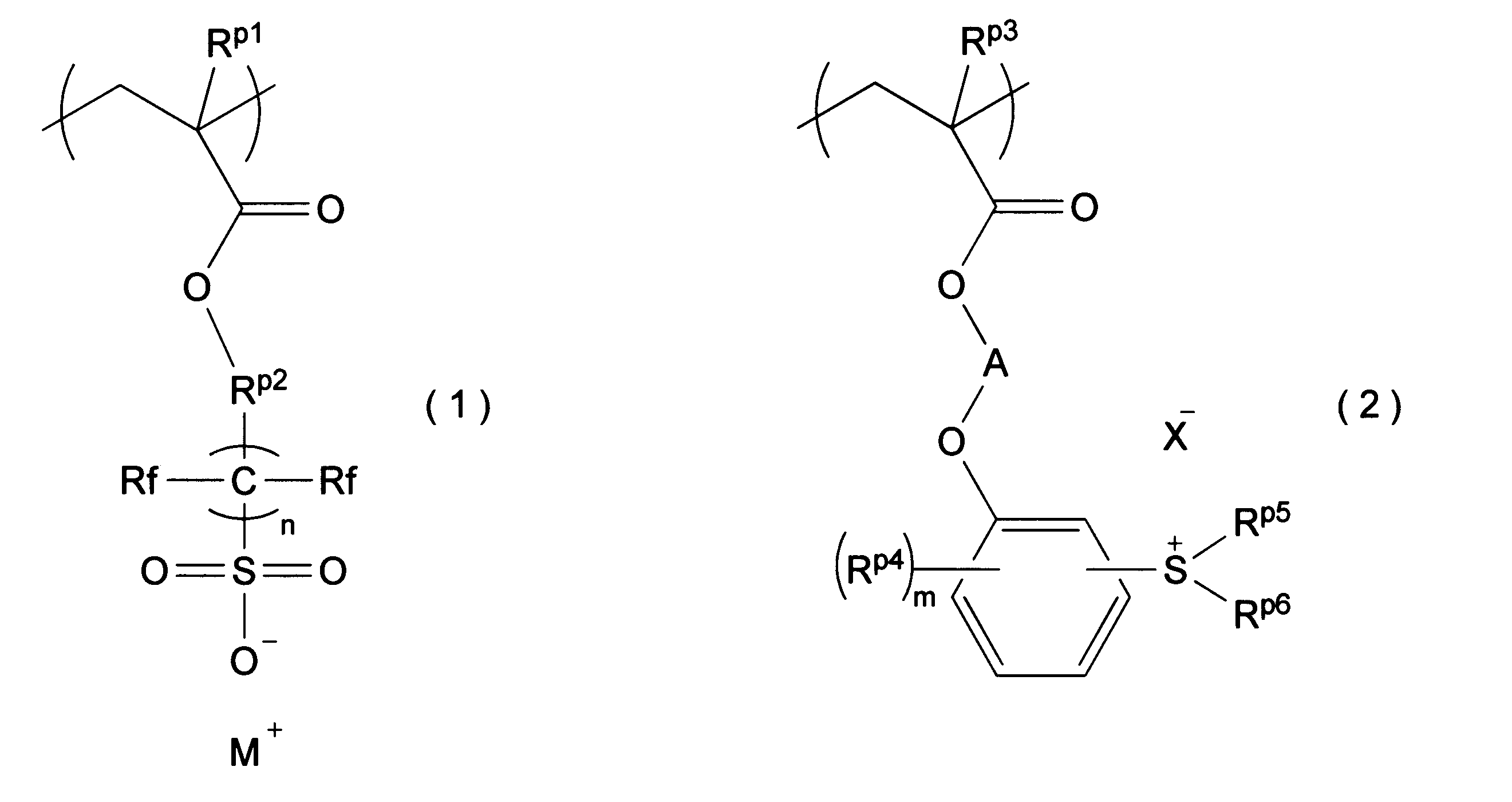
- the structural unit (I) is preferably represented by the following formula (1) or the following formula (2).
- R p1 is a hydrogen atom, a fluorine atom, a trifluoromethyl group, or an alkyl group having 1 to 3 carbon atoms.
- R p2 is a divalent organic group. Each independently represents a hydrogen atom, a fluorine atom, or a fluorinated alkyl group having 1 to 3 carbon atoms, n is an integer of 0 to 6.
- M + is an onium cation.
- R p3 is a hydrogen atom, a fluorine atom, a trifluoromethyl group or an alkyl group having 1 to 3 carbon atoms.
- R p4 , R p5 and R p6 are each independently an organic group having 1 to 10 carbon atoms.
- m is an integer of 0 to 3.
- the plurality of R p4 may be the same or different from each other.
- A is a methylene group, an alkylene group having 2 to 10 carbon atoms, or an arylene group having 6 to 10 carbon atoms.
- X ⁇ is a sulfonate anion, a carboxylate anion or an amide anion.
- the [A] polymer contained in the photoresist composition used in the negative pattern forming method of the present invention has a structural unit represented by the above formula (1) or the above formula (2) as the structural unit (I).
- the polymer itself has the above specific structure capable of generating an acid, so that the acid generated by exposure is uniformly distributed in the polymer chain, and the diffusion of the acid from the exposed area to the unexposed area is prevented. Easy to control.
- the said exposed part becomes hydrophilicity and the poor solubility with respect to the developing solution containing an organic solvent further improves, the roughness of the resist surface can be suppressed.
- a good fine pattern in which the contrast between the exposed portion and the unexposed portion is improved can be formed.
- R p7 to R p9 are each independently a hydrocarbon group having 1 to 30 carbon atoms, provided that R p7 and R p8 are bonded to each other, and A cyclic structure may be formed together with the sulfur atom, and a part or all of the hydrogen atoms of the hydrocarbon group may be substituted.
- the negative pattern forming method can reduce the occurrence of roughness, and can achieve finer fineness.
- a pattern can be formed.
- X ⁇ in the above formula (2) is preferably represented by the following formula (4).
- R p10 —SO 3 — (4) (In formula (4), R p10 is a monovalent organic group having a fluorine atom.)
- the negative pattern forming method can further reduce the occurrence of roughness, and is more favorable. A fine pattern can be formed.
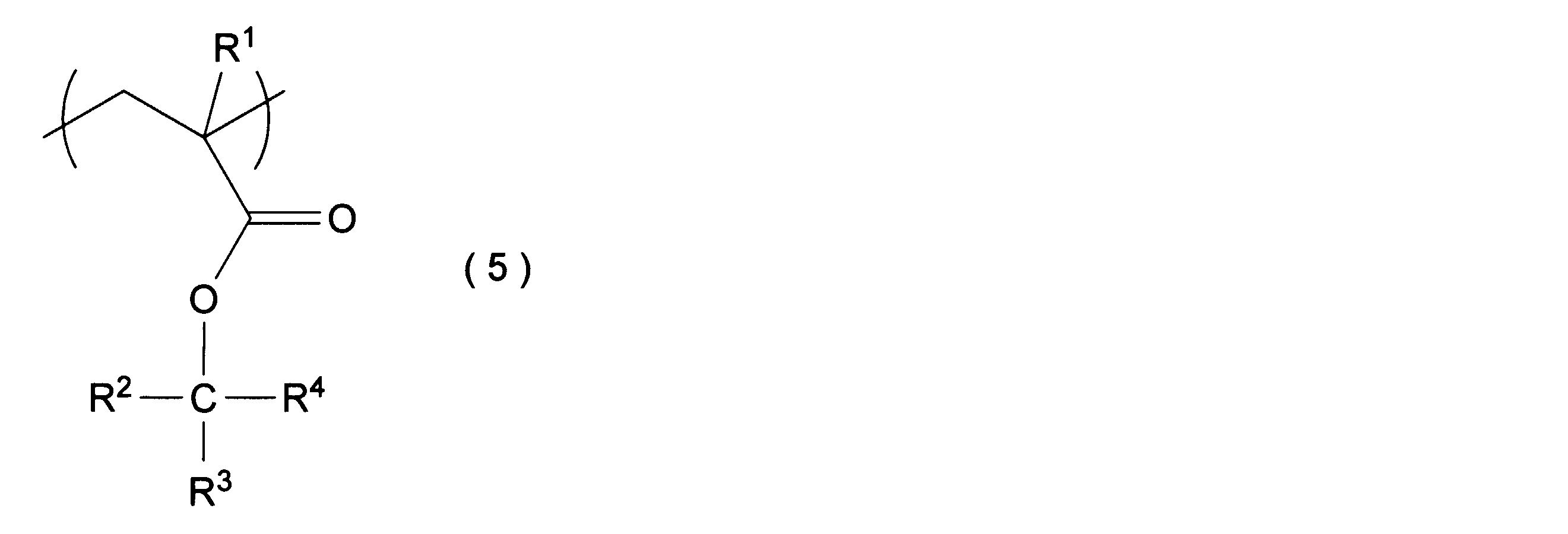
- the polymer further includes a structural unit (II) represented by the following formula (5).
- R 1 represents a hydrogen atom, a fluorine atom, a trifluoromethyl group, or an alkyl group having 1 to 3 carbon atoms.
- R 2 to R 4 each independently represent 1 to 4 carbon atoms. Or an alicyclic hydrocarbon group having 4 to 20 carbon atoms, provided that R 3 and R 4 are bonded to each other and are divalent having 4 to 20 carbon atoms together with the carbon atom to which they are bonded. Alicyclic hydrocarbon group may be formed.
- the structural unit (II) represented by the above formula (5) has an acid dissociable group that is easily dissociated by the action of an acid.
- the polymer further includes the structural unit (II) containing an acid-dissociable group, so that the acid generated by exposure is in the vicinity of the acid dissociation.
- the sex group can be efficiently dissociated. Therefore, in the negative pattern forming method, the sensitivity of the photoresist composition to be used is further improved, and a good fine pattern can be formed.
- the photoresist composition may further contain [B] a polymer not containing the structural unit (I) and containing the structural unit (II) (hereinafter also referred to as “[B] polymer”). preferable.
- the photoresist composition contains an acid-dissociable group [B] polymer together with the [A] polymer containing the structural unit (I) having an acid generating ability, so that the acid generated by exposure is [B]
- the acid dissociable group of the polymer can be dissociated.
- the photoresist composition may further contain a [C] acid generator.
- the photoresist composition further contains a [C] acid generator in addition to the [A] polymer containing the structural unit (I) having an acid generating ability. According to the negative pattern forming method, it is possible to form a good fine pattern with further reduced roughness.
- the present invention [A] a polymer containing the structural unit (I) having an acid generating ability, and [F] a photoresist composition for organic solvent development and negative pattern formation containing an organic solvent.
- the photoresist composition contains a [A] polymer containing the structural unit (I) having an acid generating ability.
- the structural unit (I) preferably has a structure derived from an onium salt, diazomethane or N-sulfonyloxyimide. Since the structural portion derived from the onium salt, diazomethane or N-sulfonyloxyimide in the structural unit (I) can generate a sufficiently strong acid upon exposure, the photoresist composition improves the sensitivity. And the roughness can be further reduced.
- the structural unit (I) is preferably represented by the following formula (1) or the following formula (2).
- R p1 is a hydrogen atom, a fluorine atom, a trifluoromethyl group, or an alkyl group having 1 to 3 carbon atoms.
- R p2 is a divalent organic group. Each independently represents a hydrogen atom, a fluorine atom, or a fluorinated alkyl group having 1 to 3 carbon atoms, n is an integer of 0 to 6.
- M + is an onium cation.
- R p3 is a hydrogen atom, a fluorine atom, a trifluoromethyl group or an alkyl group having 1 to 3 carbon atoms.
- R p4 , R p5 and R p6 are each independently an organic group having 1 to 10 carbon atoms.
- m is an integer of 0 to 3.
- the plurality of R p4 may be the same or different from each other.
- A is a methylene group, an alkylene group having 2 to 10 carbon atoms, or an arylene group having 6 to 10 carbon atoms.
- X ⁇ is a sulfonate anion, a carboxylate anion or an amide anion.
- the polymer itself has the above specific structure capable of generating an acid, so that the acid is uniformly distributed in the polymer chain and the acid from the exposed part to the unexposed part. Diffusion is controlled. Moreover, since the said exposed part becomes hydrophilicity and the poor solubility with respect to the developing solution containing an organic solvent further improves, the said photoresist composition can suppress the roughness of the resist surface.
- a photoresist composition containing a polymer having an acid generating ability is used.
- the resist film formed from the above photoresist composition has excellent sensitivity because the acid generated by exposure can be more uniformly distributed in the resist film, and the exposed portion is hardly soluble in a developer containing an organic solvent. Can be improved and the occurrence of roughness can be reduced. Therefore, according to the negative pattern forming method of the present invention, the occurrence of roughness is reduced, and a finer pattern can be formed with high accuracy.
- the negative pattern forming method of the present invention is (1) A step of forming a resist film on a substrate using a photoresist composition containing [A] a polymer containing the structural unit (I) having an acid generating ability and [F] an organic solvent; (2) A negative pattern forming method including a step of exposing the resist film, and (3) a step of developing the exposed resist film with a developer containing an organic solvent.
- a photoresist composition used for the negative pattern formation method of this invention is mentioned later.
- the photoresist composition is applied directly or via a lower layer film or the like on the substrate to form a resist film.
- a substrate for example, a conventionally known substrate such as a silicon wafer or a wafer coated with aluminum can be used.
- an organic or inorganic antireflection film disclosed in Japanese Patent Publication No. 6-12452 and Japanese Patent Application Laid-Open No. 59-93448 may be formed on the substrate.
- the underlayer film or the like is not particularly limited as long as it is a material that is insoluble in a developer used for development after exposure and can be etched by a conventional etching method.
- what is generally used as a base material in the manufacture of a semiconductor element or a liquid crystal display element can be used.
- Examples of the method for applying the photoresist composition include spin coating, spin coating, and roll coating.
- the thickness of the resist film to be formed is usually 0.01 ⁇ m to 1 ⁇ m, preferably 0.01 ⁇ m to 0.5 ⁇ m.
- the solvent in the coating film may be volatilized by pre-baking (PB) as necessary.
- PB pre-baking
- the heating conditions for PB are appropriately selected depending on the composition of the composition, but are usually about 30 to 200 ° C, preferably 50 to 150 ° C.
- a protective film disclosed in, for example, Japanese Patent Laid-Open No. 5-188598 can be provided on the resist film.
- an immersion protective film disclosed in, for example, Japanese Patent Application Laid-Open No. 2005-352384 can be provided on the resist film.
- Step (2) exposure is performed by reducing and projecting a desired region of the resist film formed in step (1) through a mask having a specific pattern such as a dot pattern or a line pattern.
- a mask having a specific pattern such as a dot pattern or a line pattern.
- an isospace pattern can be formed by performing reduced projection exposure on a desired region through an isoline pattern mask.
- a first reduced projection exposure is performed on a desired area via a line and space pattern mask, and then the second is so that the line intersects the exposed portion where the first exposure has been performed. Reduced projection exposure is performed.
- the first exposure part and the second exposure part are preferably orthogonal. By being orthogonal, it becomes easier to form a circular contact hole pattern in the unexposed area surrounded by the exposed area.
- an immersion exposure method using an immersion liquid may be used.
- the immersion liquid include water and a fluorine-based inert liquid.
- the immersion liquid is preferably a liquid that is transparent to the exposure wavelength and has a refractive index temperature coefficient that is as small as possible so as to minimize distortion of the optical image projected onto the film.
- excimer laser light wavelength 193 nm
- the exposure light used for the exposure is appropriately selected according to the type of the acid generator.
- a charged particle beam such as an electron beam (EB), ultraviolet rays, far ultraviolet rays, extreme ultraviolet rays (EUV), X-rays, etc. Is mentioned.
- far ultraviolet rays, extreme ultraviolet rays (EUV), X-rays and charged particle beams represented by ArF excimer lasers and KrF excimer lasers (wavelength 248 nm) are preferable, ArF excimer lasers, extreme ultraviolet rays (EUV), X-rays and An electron beam is more preferable.
- the exposure conditions such as the exposure amount are appropriately selected according to the composition of the composition, the type of additive, and the like.
- the exposure process may be performed a plurality of times, and the plurality of exposures may be performed using the same light source or different light sources, but the ArF excimer is used for the first exposure. It is preferable to use a laser beam or an electron beam.
- PEB post-exposure baking
- Step (3) is a step of forming a negative pattern such as a trench pattern and / or a hole pattern by performing development using a developer containing an organic solvent after the exposure in step (2).
- a negative pattern is a pattern in which a low-exposed portion and an unexposed portion are selectively dissolved and removed by a developer.
- the organic solvent contained in the developer is at least one selected from the group consisting of alcohol solvents, ether solvents, ketone organic solvents, amide solvents, ester organic solvents, and hydrocarbon solvents. preferable. Examples of these organic solvents include the same solvents as the solvent [F] described later as the solvent contained in the photoresist composition.
- butyl acetate isoamyl acetate, methyl-n-pentyl ketone, and anisole are preferable.
- These organic solvents may be used alone or in combination of two or more.
- the content of the organic solvent in the developer is usually 80% by mass or more, preferably 90% by mass or more, and more preferably 99% by mass or more.
- the developer contains 80% by mass or more of the organic solvent, good development characteristics can be obtained, and a pattern with more excellent lithography characteristics can be formed.
- components other than the organic solvent include water, silicone oil, and surfactant.
- a surfactant can be added to the developer as necessary.
- a surfactant for example, an ionic or nonionic fluorine-based and / or silicon-based surfactant can be used.
- a developing method for example, a method in which a substrate is immersed in a tank filled with a developer for a certain period of time (dip method), a method in which the developer is raised on the surface of the substrate by surface tension and is left stationary for a certain time (paddle method) ), A method of spraying the developer on the substrate surface (spray method), a method of continuously applying the developer while scanning the developer coating nozzle on the substrate rotating at a constant speed (dynamic dispensing method) Etc.
- a step of washing the resist film with a rinsing liquid may be performed after the development in the step (3).
- a rinsing liquid it is preferable to use a liquid containing an organic solvent in the same manner as the above developing liquid, and the scum generated by doing so can be washed efficiently.
- hydrocarbon solvents, ketone solvents, ester solvents, alcohol solvents, amide solvents and the like are preferable. Of these, alcohol solvents and ester solvents are preferable, and monovalent alcohol solvents having 6 to 8 carbon atoms are more preferable.
- Examples of monohydric alcohols having 6 to 8 carbon atoms include linear, branched or cyclic monohydric alcohols such as 1-hexanol, 1-heptanol, 1-octanol, and 4-methyl-2-pentanol.
- 1-hexanol, 2-hexanol, 2-heptanol, and 4-methyl-2-pentanol are preferable.
- Each component of the rinse liquid may be used alone or in combination of two or more.
- the water content of the rinse liquid is preferably 10% by mass or less, more preferably 5% by mass or less, and further preferably 3% by mass or less. By setting the water content of the rinse liquid to 10% by mass or less, good development characteristics can be obtained. In addition, you may add surfactant mentioned later to a rinse liquid.
- a cleaning method for example, a method of continuously applying a rinse liquid onto a substrate rotating at a constant speed (rotary coating method), a method of immersing the substrate in a tank filled with the rinse liquid for a predetermined time (dip method) ), A method (spray method) of spraying a rinse liquid on the substrate surface, and the like.
- the photoresist composition used in the negative pattern forming method of the present invention contains [A] a polymer containing the structural unit (I) having an acid generating ability and [F] an organic solvent. Moreover, a [B] polymer and / or a [C] acid generator are contained as a suitable component. In addition, as long as the effect of this invention is not impaired, you may contain another arbitrary component. Hereinafter, each component will be described in detail.
- the polymer contains the structural unit (I) having an acid generating ability. Moreover, it is preferable that the [A] polymer further contains structural unit (II). Furthermore, as long as the effects of the present invention are not impaired, the [A] polymer may contain other structural units. Below, each structural unit is explained in full detail.
- the structural unit (I) is a structural unit having an acid generating ability.
- the acid generated by exposure can be uniformly distributed in the polymer chain, and the acid from the exposed area to the unexposed area. Is easily controlled.
- the photoresist composition allows the acid to uniformly and sufficiently act in the exposed area, thereby improving the poor solubility in a developer containing an organic solvent and reducing the roughness of the resist surface. it can.
- the sensitivity is higher than that of a conventional chemically amplified resist.
- the structural unit (I) preferably has a structure derived from an onium salt, diazomethane or N-sulfonyloxyimide, and more preferably has a structure derived from an onium salt.
- Examples of the structure derived from the onium salt include structures represented by the following formula (i) and formula (ii).
- Rf, n and M + are as defined in the above formula (1).
- R p5 , R p6 and X ⁇ are as defined in the above formula (2).
- the polymer preferably contains the structural unit (I) represented by the above formula (1) or the above formula (2) as the structural unit (I) having a structure derived from an onium salt.
- R p1 is a hydrogen atom, a fluorine atom, a trifluoromethyl group or an alkyl group having 1 to 3 carbon atoms.
- R p2 is a divalent organic group.
- the plurality of Rf are each independently a hydrogen atom, a fluorine atom, or a fluorinated alkyl group having 1 to 3 carbon atoms.
- n is an integer of 0-6.
- M + is an onium cation.
- Examples of the alkyl group having 1 to 3 carbon atoms represented by R p1 include a methyl group, an ethyl group, and a propyl group. Of these, a methyl group is preferred.
- R p1 is preferably a hydrogen atom or a methyl group.
- Examples of the divalent organic group represented by R p2 include a hydrocarbon group having 1 to 20 carbon atoms and a group represented by —R p21 —R p22 —.
- R p21 is a hydrocarbon group having 1 to 20 carbon atoms
- R p22 is —O—, —CO—, —COO—, —OCO—, —NH—, —NHCO—, —CONH—, or — NHCOO-.
- hydrocarbon group having 1 to 20 carbon atoms examples include: Chain hydrocarbon groups such as methylene group, ethanediyl group, propanediyl group, butanediyl group, pentanediyl group, hexanediyl group, decandiyl group; An alicyclic hydrocarbon group in which two hydrogen atoms are removed from an alicyclic structure such as cyclopentane, cyclohexane, dicyclopentane, tricyclodecane, tetracyclododecane, adamantane; Examples thereof include aromatic hydrocarbon groups such as a phenylene group, a naphthylene group, and a biphenylene group.
- Chain hydrocarbon groups such as methylene group, ethanediyl group, propanediyl group, butanediyl group, pentanediyl group, hexanediyl group, decandiy
- hydrogen atoms of these hydrocarbon groups may be substituted with fluorine atoms or the like.
- a chain hydrocarbon group and an alicyclic hydrocarbon group are preferable, a chain hydrocarbon group is more preferable, a methylene group, an ethanediyl group, a propanediyl group, a butanediyl group, and a pentanediyl group are more preferable, and a methylene group is preferable.
- ethanediyl groups are particularly preferred.
- Examples of the hydrocarbon group having 1 to 20 carbon atoms represented by R p21 include the same groups as those exemplified as the hydrocarbon group having 1 to 20 carbon atoms represented by R p2 .
- Examples of the group represented by —R p21 —R p22 — include —CH 2 —O—, —CH 2 —CO—, —CH 2 —COO—, —CH 2 —OCO—, —CH 2 —.
- R p21 is preferably bonded to the ester group in the above formula (1).
- Examples of the fluorinated alkyl group having 1 to 3 carbon atoms represented by Rf include, for example, a monofluoromethyl group, a difluoromethyl group, a trifluoromethyl group, a 1-fluoroethyl group, a 1,2-difluoroethyl group, 1,2,2,2-tetrafluoroethyl group and the like.
- Rf is preferably a hydrogen atom or a fluorine atom, and more preferably a fluorine atom.
- N is preferably 0 to 4, more preferably 1 to 3, and still more preferably 1 and 2.
- Examples of the onium cation represented by M + include a sulfonium cation and an iodonium cation.
- the onium cation is a group consisting of a sulfonium cation represented by the above formula (3) and an iodonium cation represented by the following formula (6). More preferred are at least one onium cation selected.
- R p7 to R p9 are each independently a hydrocarbon group having 1 to 30 carbon atoms. However, R p7 and R p8 may be bonded to each other to form a cyclic structure together with the sulfur atom to which they are bonded. Part or all of the hydrogen atoms of the hydrocarbon group may be substituted.
- Examples of the hydrocarbon group having 1 to 30 carbon atoms represented by R p7 to R p9 include monovalent chains such as a methyl group, an ethyl group, an n-propyl group, an n-butyl group, and an n-pentyl group.
- a hydrocarbon group Monovalent alicyclic hydrocarbon groups such as a cyclobutyl group, a cyclopentyl group, a cyclohexyl group, a dicyclopentyl group, a tricyclodecyl group, a tetracyclododecyl group, an adamantyl group; A monovalent hydrocarbon group partially having the alicyclic structure; Monovalent aromatic hydrocarbon groups such as phenyl group, naphthyl group, anthryl group, biphenyl group; And monovalent hydrocarbon groups having an aromatic ring in part. Of these, a monovalent aromatic hydrocarbon group is preferable, and a phenyl group is more preferable.
- Examples of the substituent that the hydrocarbon group may have include, for example, a halogen atom, a hydroxyl group, a carboxyl group, a cyano group, a nitro group, a halogenated hydrocarbon group, an alkyl group, an alkoxyl group, an amino group, a thiol group, and an organic group.
- Examples include a sulfonyl group (RSO 2 —) and the like.
- R is an alkyl group, a cycloalkyl group or an aryl group.
- a hydroxyl group, an alkyl group, an alkoxyl group, and a cyclohexylsulfonyl group are preferable, and a cyclohexylsulfonyl group is more preferable.
- sulfonium cation represented by the above formula (3) include, for example, cations represented by the following formulas (i-1) to (i-23).
- R p11 is each independently a hydrocarbon group having 1 to 30 carbon atoms or a heterocyclic organic group having 4 to 30 nucleus atoms. However, two R p11 may be bonded to each other to form a cyclic structure together with the iodine atom. Moreover, one part or all part of the hydrogen atom which the said hydrocarbon group and heterocyclic organic group have may be substituted.
- the hydrocarbon group having 1 to 30 carbon atoms represented by R p11 is the same as the group exemplified as the hydrocarbon group having 1 to 30 carbon atoms represented by R p7 to R p9 in the above formula (3). Can be mentioned.
- R p11 is preferably a monovalent aromatic hydrocarbon group, more preferably a phenyl group.
- Examples of the substituent that the hydrocarbon group and the heterocyclic organic group may have include the substituents that the hydrocarbon group represented by R p7 to R p9 in the above formula (3) may have.
- the same group as a group can be mentioned.
- a halogen atom, a nitro group, a halogenated hydrocarbon group, an alkyl group, and an alkoxyl group are preferable.
- the sulfonium cation represented by the above formula (3) is preferable, and among them, the sulfonium cation represented by the above formulas (i-1) and (i-23). Is more preferable.
- the monovalent onium cation represented by M + in the above formula (1) is, for example, Advances in Polymer Science, Vol. 62, p. 1-48 (1984).
- Examples of the structural unit (I) represented by the above formula (1) include structural units represented by the following formulas (1-1) to (1-8).
- R p1 has the same meaning as the above formula (1).
- the cation represented by M + is dissociated from the polymer chain, and the anion portion remains in the polymer chain, which functions as an acid.
- Examples of the monomer compound that gives the structural unit represented by the above formula (1) include a compound represented by the following formula (1 ′).
- R p2 , Rf, n, and M + have the same meaning as in the above formula (1).
- the compound represented by the above formula (1 ') can be synthesized by a known method.
- Examples of the compound represented by the above formula (1 ′) include compounds represented by the following formulas (1′-1) to (1′-8).
- R p3 is a hydrogen atom, a fluorine atom, a trifluoromethyl group or an alkyl group having 1 to 3 carbon atoms.
- R p4 , R p5 and R p6 are each independently an organic group having 1 to 10 carbon atoms.
- m is an integer of 0 to 3. When m is 2 or 3, the plurality of R p4 may be the same or different from each other.
- A is a methylene group, an alkylene group having 2 to 10 carbon atoms, or an arylene group having 6 to 10 carbon atoms.
- X ⁇ is a sulfonate anion, a carboxylate anion or an amide anion.
- Examples of the alkyl group having 1 to 3 carbon atoms represented by R p3 include a methyl group, an ethyl group, and a propyl group. Of these, a methyl group is preferred.
- R p3 is preferably a hydrogen atom or a methyl group.
- alkylene group having 2 to 10 carbon atoms represented by A examples include ethylene group, 1,3-propylene group, 1,2-propylene group, tetramethylene group, pentamethylene group, hexamethylene group, heptamethylene. Group, octamethylene group, nonamethylene group, decamethylene group, 1-methyl-1,3-propylene group, 2-methyl-1,3-propylene group, 2-methyl-1,2-propylene group, 1-methyl-1 , 4-butylene group, 2-methyl-1,4-butylene group and the like.
- Examples of the arylene group having 6 to 10 carbon atoms represented by A include a phenylene group, a naphthylene group, an anthrylene group, a phenanthrylene group, and the like.
- an alkylene group such as an ethylene group or a propylene group is preferable from the viewpoint of excellent stability as a compound.
- Examples of the monovalent organic group having 1 to 10 carbon atoms represented by R p4 , R p5 and R p6 include an alkyl group having 1 to 10 carbon atoms, an alkoxy group, and an aryl group.
- alkyl group examples include methyl, ethyl, n-propyl, i-propyl, n-butyl, 2-methylpropyl, 1-methylpropyl, t-butyl, pentyl, and hexyl.
- alkoxy group examples include methoxy group, ethoxy group, n-propoxy group, i-propoxy group, n-butoxy group, 2-methylpropoxy group, 1-methylpropoxy group, t-butoxy group, and n-pentyloxy.
- aryl group examples include a phenyl group and a naphthyl group.
- R p4 is preferably an alkoxy group, and more preferably a methoxy group.
- R p5 and R p6 are preferably an aryl group, more preferably a phenyl group and a naphthyl group, and still more preferably a phenyl group.
- the above m is preferably 0 or 1, more preferably 0.
- X ⁇ is preferably a sulfonate anion and a carboxylate anion, more preferably a sulfonate anion, and still more preferably a sulfonate anion represented by the above formula (4).
- R p10 is a monovalent organic group having a fluorine atom.
- Examples of the monovalent organic group include a chain alkyl group having 1 to 10 carbon atoms and a hydrocarbon group having an alicyclic skeleton having 6 to 20 carbon atoms.
- —O—, —S—, —C (O) O—, or —C (O) N— is present between the carbon-carbon bonds of the hydrocarbon group having a chain alkyl group and an alicyclic skeleton. You may do it.
- Examples of the chain alkyl group having 1 to 10 carbon atoms having a fluorine atom represented by R p10 include trifluoromethyl group, trifluoroethyl group, pentafluoropropyl group, hexafluoroisopropyl group, hexafluoro (2 -Methyl) isopropyl group, heptafluorobutyl group, heptafluoroisopropyl group, octafluoroisobutyl group, nonafluorohexyl group, nonafluorobutyl group, perfluoroisopentyl group, perfluorooctyl group, perfluoro (trimethyl) hexyl group, etc. Is mentioned. Of these, a nonafluorobutyl group is preferred.
- Examples of the hydrocarbon group having an alicyclic skeleton having 6 to 20 carbon atoms and having a fluorine atom represented by R p10 include groups represented by the following formulae.
- Part or all of the hydrogen atoms of the sulfonate anion may be substituted.
- substituents include an alkyl group, an aryl group, an aralkyl group, a cycloalkyl group, a halogenated alkyl group, and a halogenated aryl group.
- the halogen atom in the halogenated alkyl group, halogenated aryl group, halogenated aralkyl group, and halogenated cycloalkyl group is preferably a fluorine atom.
- Examples of the sulfonate anion represented by the above formula (4) include sulfonate anions represented by the following formulas (4-1) to (4-17).
- Examples of the structural unit (I) represented by the above formula (2) include structural units represented by the following formulas (2-1) to (2-18).
- R p3 has the same meaning as in the above formula (2).
- the anion represented by X ⁇ is dissociated from the polymer chain by exposure and functions as an acid.
- Examples of the monomer compound that gives the structural unit represented by the above formula (2) include a compound represented by the following formula (2 ′).
- Examples of the compound represented by the above formula (2 ') include compounds represented by the following formulas (2'-1) to (2'-18).
- the content ratio of the structural unit (I) is preferably 1 mol% or more and 50 mol% or less, and preferably 1 mol% or more and 30 mol% with respect to all the structural units constituting the [A] polymer. % Or less is more preferable, and 1 mol% or more and 10 mol% or less is more preferable.
- the photoresist composition can effectively suppress the occurrence of roughness and can form a good fine pattern.
- the [A] polymer may have 1 type, or 2 or more types of structural units (I).
- the polymer preferably further contains the structural unit (II) represented by the above formula (5).
- the structural unit (II) represented by the above formula (5) is a structural unit having an acid dissociable group in which the carbon atom bonded to the ester group is a tertiary carbon and is easily dissociated by the action of an acid.
- R 1 is a hydrogen atom, a fluorine atom, a trifluoromethyl group or an alkyl group having 1 to 3 carbon atoms.
- R 2 to R 4 are each independently an alkyl group having 1 to 4 carbon atoms or an alicyclic hydrocarbon group having 4 to 20 carbon atoms. However, R 3 and R 4 may be bonded to each other to form a divalent alicyclic hydrocarbon group having 4 to 20 carbon atoms together with the carbon atom to which they are bonded.
- Examples of the alkyl group having 1 to 4 carbon atoms represented by R 2 to R 4 include a methyl group, an ethyl group, an n-propyl group, an i-propyl group, an n-butyl group, a 2-methylpropyl group, Examples thereof include a 1-methylpropyl group and a t-butyl group.
- the alicyclic hydrocarbon group having 4 to 20 carbon atoms represented by the above R 2 to R 4 or R 3 and R 4 may be bonded to each other and formed together with the carbon atom to which they are bonded.
- Examples of the alicyclic hydrocarbon group having 4 to 20 carbon atoms include polycyclic alicyclic groups having a bridged skeleton such as an adamantane skeleton and a norbornane skeleton; and monocyclic having a cycloalkane skeleton such as cyclopentane and cyclohexane.
- An alicyclic group is mentioned. These groups may be substituted with one or more of linear, branched or cyclic alkyl groups having 1 to 10 carbon atoms, for example.
- Examples of the structural unit (II) include a structural unit represented by the following formula.
- R ⁇ 1 > is synonymous with the said Formula (5).
- R 2 is an alkyl group having 1 to 4 carbon atoms.
- m is an integer of 1-6.
- R ⁇ 1 > is synonymous with the said Formula (5).
- the content ratio of the structural unit (II) is preferably 10 mol% or more and 80 mol% or less, and more preferably 20 mol% or more and 60 mol% with respect to all the structural units constituting the [A] polymer. % Or less is more preferable.
- the content ratio of the structural unit (II) is within the specific range, the photoresist composition is excellent in pattern formability.
- the [A] polymer may have 1 type, or 2 or more types of structural units (II).
- Examples of the monomer that gives the structural unit (II) include compounds represented by the following formulas.
- R ⁇ 1 > is synonymous with the said Formula (5).
- the polymer may have a structural unit (III) having a lactone skeleton or a cyclic carbonate skeleton as a structural unit other than the above. [A] When the polymer has the structural unit (III), the adhesion of the photoresist composition to the substrate or the like is improved.
- Examples of the structural unit (III) include a structural unit represented by the following formula.
- R 5 is a hydrogen atom, a fluorine atom, a trifluoromethyl group or an alkyl group having 1 to 3 carbon atoms.
- R 6 is a hydrogen atom or a methyl group.
- R 7 is a hydrogen atom or a methoxy group.
- Q is a single bond or a methylene group.
- B is a methylene group or an oxygen atom. a and b are 0 or 1;
- the structural unit (III) is preferably a structural unit represented by the following formula.
- R 5 is a hydrogen atom or a methyl group.
- the content ratio of the structural unit (III) is preferably 0 mol% or more and 70 mol% or less, and preferably 10 mol% or more and 60 mol% with respect to all the structural units constituting the [A] polymer. % Or less is more preferable. By setting it as such a content rate, the adhesiveness to the board
- Examples of preferable monomers that give structural unit (III) include monomers described in International Publication No. 2007/116664 pamphlet.
- the polymer may further have a structural unit (IV) containing a polar group represented by the following formula.
- a polar group represented by the following formula.
- Examples of the “polar group” herein include a hydroxyl group, a carboxyl group, a keto group, a sulfonamide group, an amino group, an amide group, and a cyano group.
- the structural unit (IV) does not include a structural unit having an aromatic ring.
- Examples of the structural unit (IV) include a structural unit represented by the following formula.
- R 6 is a hydrogen atom, a fluorine atom, a trifluoromethyl group or an alkyl group having 1 to 3 carbon atoms.
- Examples of the monomer that gives the structural unit (IV) include compounds represented by the following formulas.
- the content ratio of the structural unit (IV) is preferably 5 mol% or more and 80 mol or less, and preferably 10 mol% or more and 40 mol or less with respect to all the structural units constituting the [A] polymer. % Or less is more preferable.
- the polymer may have one or more structural units (IV).
- the polymer may contain another structural unit (V) derived from an aromatic compound as another structural unit.
- V another structural unit derived from an aromatic compound
- Examples of the structural unit (V) include a structural unit represented by the following formula.
- R 7 is a hydrogen atom, a fluorine atom, a trifluoromethyl group or an alkyl group having 1 to 3 carbon atoms.
- Preferred monomers that give the structural unit (V) derived from the aromatic compound include, for example, styrene, ⁇ -methylstyrene, 2-methylstyrene, 3-methylstyrene, 4-methylstyrene, 2-methoxystyrene, 3-methoxystyrene, 4-methoxystyrene, 5-hydroxy-1-naphthyl (meth) acrylate, 4-hydroxyphenyl (meth) acrylate, 4- (2-hydroxy-1,1,1,3,3,3- Hexafluoro) styrene, 4- (2-t-butoxycarbonylethyloxy) styrene 2-hydroxystyrene, 3-hydroxystyrene, 4-hydroxystyrene, 2-hydroxy- ⁇ -methylstyrene, 3-hydroxy- ⁇ -methylstyrene 4-hydroxy- ⁇ -methylstyrene, 2-methyl-3-hydroxystyrene 4-methyl-3-hydroxystyrene, 5-
- the content ratio of the structural unit (V) is preferably 5 mol% or more and 50 mol% or less, and preferably 10 mol% or more and 30 mol% with respect to all the structural units constituting the [A] polymer. % Or less is more preferable.
- the [A] polymer may have 1 type, or 2 or more types of structural units (V).
- the polymer can be produced, for example, by polymerizing a monomer corresponding to each predetermined structural unit in a suitable solvent using a radical polymerization initiator.
- a method of dropping a solution containing a monomer and a radical initiator into a reaction solvent or a solution containing the monomer to cause a polymerization reaction, a solution containing the monomer, and a solution containing the radical initiator Separately, a method of dropping a reaction solvent or a monomer-containing solution into a polymerization reaction, a plurality of types of solutions containing each monomer, and a solution containing a radical initiator, It is preferable to synthesize by a method such as a method of dropping it into a reaction solvent or a solution containing a monomer to cause a polymerization reaction.
- Examples of the solvent used for the polymerization include alkanes such as n-pentane, n-hexane, n-heptane, n-octane, n-nonane and n-decane; Cycloalkanes such as cyclohexane, cycloheptane, cyclooctane, decalin, norbornane; Aromatic hydrocarbons such as benzene, toluene, xylene, ethylbenzene, cumene; Halogenated hydrocarbons such as chlorobutanes, bromohexanes, dichloroethanes, hexamethylene dibromide, chlorobenzene; Saturated carboxylic acid esters such as ethyl acetate, n-butyl acetate, i-butyl acetate and methyl propionate; Ketones such as acetone, 2-butanone, 4-methyl-2-p
- the reaction temperature in the polymerization may be appropriately determined according to the type of radical initiator, but is usually 40 ° C to 150 ° C, preferably 50 ° C to 120 ° C.
- the reaction time is usually 1 hour to 48 hours, preferably 1 hour to 24 hours.
- radical initiator used in the polymerization examples include azobisisobutyronitrile (AIBN), 2,2′-azobis (4-methoxy-2,4-dimethylvaleronitrile), 2,2′-azobis (2 -Cyclopropylpropionitrile), 2,2'-azobis (2,4-dimethylvaleronitrile), 2,2'-azobis (2-methylpropionitrile) and the like. Two or more of these initiators may be mixed and used.
- the polymer obtained by the polymerization reaction is preferably recovered by a reprecipitation method. That is, after completion of the polymerization reaction, the target resin is recovered as a powder by introducing the polymerization solution into a reprecipitation solvent.
- a reprecipitation solvent alcohols or alkanes can be used alone or in admixture of two or more.
- the polymer can be recovered by removing low-molecular components such as monomers and oligomers by a liquid separation operation, a column operation, an ultrafiltration operation, or the like.
- the weight average molecular weight (Mw) in terms of polystyrene by gel permeation chromatography (GPC) of the polymer is not particularly limited, but is preferably 1,000 or more and 100,000 or less, more preferably 1,000 or more and 50,000 or less. Preferably, it is 1,000 or more and 30,000 or less.
- Mw of the [A] polymer is in the specific range, the photoresist composition sufficiently satisfies the heat resistance and developability when used as a resist, and can form a good pattern.
- the ratio (Mw / Mn) of Mw to the number average molecular weight (Mn) in terms of polystyrene by GPC of the polymer is usually from 1 to 5, preferably from 1 to 3, preferably from 1 to 2. More preferred. By setting Mw / Mn in such a range, the photoresist film has excellent resolution performance.
- Mw and Mn in this specification are GPC columns (Tosoh Corporation, G2000HXL, 2 G3000HXL, 1 G4000HXL), using a flow rate of 1.0 mL / min, elution solvent tetrahydrofuran, and column temperature of 40 ° C. under analysis conditions.
- the photoresist composition preferably further contains a [B] polymer.
- the polymer does not contain the structural unit (I) having an acid generating ability and contains the structural unit (II) having an acid dissociable group represented by the above formula (5).
- the acid dissociable group of the [B] polymer is dissociated and becomes insoluble in a developer containing an organic solvent. Thereby, the pattern which is excellent in the contrast of an exposed part and an unexposed part can be formed.
- the structural unit (II) contained in the polymer can be explained in the same manner as already described in detail as the structural unit (II) suitably contained in the [A] polymer. The description in is omitted.
- the content ratio of the structural unit (II) is preferably 5 mol% or more and 80 mol% or less, and preferably 10 mol% or more to 40 mol% with respect to all the structural units constituting the [B] polymer.
- the mol% or less is more preferable.
- the polymer may have one or more structural units (II).
- the polymer includes a structural unit (III) having a lactone skeleton or a cyclic carbonate skeleton, a structural unit (IV) containing a polar group, and an aromatic compound as other structural units.
- the derived structural unit (V) and the like may be included.
- the description of the structural units (III) to (V) contained in the [A] polymer can be applied.
- the content ratio of the structural unit (III) is preferably 5 mol% or more and 70 mol% or less, and preferably 10 mol% or more and 60 mol% with respect to all the structural units constituting the [B] polymer. % Or less is more preferable. By setting it as such a content rate, the adhesiveness to the board
- the content ratio of the structural unit (IV) is preferably 0 mol% or more and 80 mol or less, and preferably 10 mol% or more and 40 mol% based on all the structural units constituting the [B] polymer. The following is more preferable.
- the [B] polymer may have 1 type (s) or 2 or more types of structural units (IV).
- the content ratio of the structural unit (V) is preferably from 0 to 80 mol%, preferably from 10 to 40 mol%, based on all the structural units constituting the [B] polymer. The following is more preferable.
- the [B] polymer may have 1 type, or 2 or more types of structural units (V).
- the polymer can be produced, for example, by polymerizing a monomer corresponding to each predetermined structural unit in a suitable solvent using a radical polymerization initiator.
- radical polymerization initiator and the solvent used for the polymerization include the same solvents as those mentioned in the method for synthesizing [A] polymer.
- the Mw of the polymer by GPC method is preferably 1,000 to 100,000, more preferably 1,000 to 50,000, and particularly preferably 1,000 to 30,000. [B] By making Mw of a polymer into the said range, the said photoresist composition containing this is excellent in lithography performance.
- the ratio of Mw to Mn (Mw / Mn) of the polymer is usually 1 to 3, preferably 1 to 2.
- the photoresist composition may further contain a [C] acid generator.
- the [A] polymer contained in the photoresist composition contains the structural unit (I) having an acid generating ability, and additionally contains a [C] acid generator, whereby the sensitivity is improved and the same. In the exposure amount, more acid can be generated.
- the acid dissociates the acid dissociable group present in the [A] polymer and / or the [B] polymer with the acid, and as a result, the exposed portion becomes insoluble in a developer containing an organic solvent.
- the containing form of the [C] acid generator in the said photoresist composition is a form of a compound as mentioned later. Note that the [C] acid generator does not include the [A] polymer.
- Examples of the [C] acid generator include onium salt compounds such as sulfonium salts and iodonium salts, sulfone compounds such as organic halogen compounds, disulfones and diazomethane sulfones.
- Examples of the sulfonium salt include compounds described in paragraphs [0080] to [0113] of JP2009-134088A.
- Acid generators include diphenyliodonium trifluoromethanesulfonate, diphenyliodonium nonafluoro-n-butanesulfonate, diphenyliodonium perfluoro-n-octanesulfonate, bis (4-t-butylphenyl) iodonium trifluoromethanesulfonate, bis (4-t-butylphenyl) iodonium nonafluoro-n-butanesulfonate, bis (4-t-butylphenyl) iodonium perfluoro-n-octanesulfonate, triphenylsulfonium trifluoromethanesulfonate, triphenylsulfonium nonafluoro-n- Butanesulfonate, triphenylsulfonium perfluoro-n-octanesulfonate, cyclohexyl, 2-ox
- Trifluoromethanesulfonylbicyclo [2.2.1] hept-5-ene-2,3-dicarbodiimide, nonafluoro-n-butanesulfonylbicyclo [2.2.1] hept-5-ene-2,3-dicarbodiimide Perfluoro-n-octanesulfonylbicyclo [2.2.1] hept-5-ene-2,3-dicarbodiimide, N-hydroxysuccinimide trifluoromethanesulfonate, N-hydroxysuccinimide nonafluoro-n- Butane sulfonate, N-hydroxysuccinimide perfluoro-n-octane sulfonate, 1,8-naphthalenedicarboxylic imide trifluoromethane sulfonate are preferred.
- [C] acid generators may be used alone or in combination of two or more.
- the amount of the acid generator used is usually 0.1 parts by mass or more and 20 parts by mass or less with respect to 100 parts by mass of the polymer [A] from the viewpoint of ensuring sensitivity and developability as a resist. Preferably they are 0.5 mass part or more and 10 mass parts or less. In this case, when the amount of the [C] acid generator used is less than 0.1 parts by mass, the sensitivity and developability tend to decrease. It may be difficult to obtain a resist pattern.
- the photoresist composition is a fluorine atom-containing polymer other than the [A] polymer and the [B] polymer, and has a higher fluorine atom content than the [A] polymer and the [B] polymer [D ]
- a fluorine atom-containing polymer (hereinafter, also referred to as “[D] polymer”) may be contained.
- the photoresist composition contains a [D] polymer, when the resist film is formed, the distribution is unevenly distributed near the resist film surface due to the oil-repellent characteristics of the fluorine atom-containing polymer in the film.
- the acid generator, the acid diffusion control agent, and the like from eluting into the immersion medium during the immersion exposure.
- the advancing contact angle between the resist film and the immersion medium can be controlled within a desired range, and the occurrence of bubble defects can be suppressed.
- the receding contact angle between the resist film and the immersion medium is increased, and high-speed scanning exposure is possible without leaving water droplets.
- the polymer is formed by polymerizing one or more monomers containing fluorine atoms in the structure.
- Examples of the structural unit contained in the [D] polymer include a structural unit represented by the following formula.
- R 8 is a hydrogen atom, a fluorine atom, a trifluoromethyl group or an alkyl group having 1 to 3 carbon atoms.
- Y is a linking group.
- R 9 is a linear or branched alkyl group having 1 to 6 carbon atoms containing at least one fluorine atom, or a monovalent alicyclic hydrocarbon group having 4 to 20 carbon atoms or a derivative thereof. .
- Examples of the linking group represented by Y include a single bond, an oxygen atom, a sulfur atom, a carbonyloxy group, an oxycarbonyl group, an amide group, a sulfonylamide group, and a urethane group.
- the polymer [D] is a structural unit (II) having an acid-dissociable group, a lactone skeleton or a cyclic carbonate skeleton in order to control the dissolution rate in a developer, for example.
- Other structural units detailed in the [A] polymer such as a structural unit (IV) containing a polar group and a structural unit (V) derived from an aromatic compound in order to suppress light scattering due to reflection from the substrate
- One or more types can be included.
- the Mw of the [D] polymer is preferably 1,000 to 100,000, more preferably 1,000 to 50,000, and still more preferably 1,000 to 30,000.
- the ratio (Mw / Mn) between Mw and Mn of the fluorine atom-containing polymer is usually 1 to 3, preferably 1 to 2.
- the content ratio of the [D] polymer in the photoresist composition is preferably 0 to 50 parts by mass, more preferably 0 to 20 parts by mass, and more preferably 0.5 to 100 parts by mass with respect to 100 parts by mass of the [A] polymer. 10 parts by mass is more preferable, and 1 to 8 parts by mass is particularly preferable.
- the polymer can be synthesized, for example, by polymerizing a monomer corresponding to each predetermined structural unit in a suitable solvent using a radical polymerization initiator.
- a radical polymerization initiator examples include those similar to those mentioned in the method for synthesizing [A] polymer.
- the photoresist composition preferably further contains [E] a nitrogen-containing compound.
- the nitrogen-containing compound controls the diffusion phenomenon in the resist film of the acid generated from the structural unit (I) and [C] acid generator having acid generating ability contained in the [A] polymer by exposure, and serves as a resist.
- the storage stability of the resulting photoresist composition can be improved.
- the inclusion form of the nitrogen-containing compound in the photoresist composition may be a free compound form, a form incorporated as part of a polymer, or both forms.
- Examples of the nitrogen-containing compound include compounds represented by the following formulae.
- R e1 to R e5 are each independently a hydrogen atom, or a linear, branched, or cyclic C 1-20 alkyl group, aryl group, or aralkyl group. However, these groups may have a substituent.
- R e1 and R e2 are bonded together with a nitrogen atom to which each is bonded and / or R e3 and R e4 are bonded to each other with a carbon atom to which each is bonded to form a divalent saturated group having 4 to 20 carbon atoms.
- an unsaturated hydrocarbon group or a derivative thereof may be formed.
- Examples of the [E] nitrogen-containing compound represented by the above formula include Nt-butoxycarbonyldi-n-octylamine, Nt-amyloxycarbonyldi-n-octylamine, and Nt-butoxycarbonyldiethyl.
- Nt-N-nonylamine Nt-amyloxycarbonyldi-n-nonylamine, Nt-butoxycarbonyldi-n-decylamine, Nt-amyloxycarbonyldi-n-decylamine, Nt-butoxycarbonyldicyclohexyl Amine, Nt-amyloxycarbonyldicyclohexylamine, Nt-butoxycarbonyl-1-adamantylamine, Nt-amyloxycarbonyl-1-adamantylamine, Nt-butoxycarbonyl-2-adamantylamine, N -T-amyloxycarbonyl-2-adamantylamine, N t-butoxycarbonyl-N-methyl-1-adamantylamine, Nt-amyloxycarbonyl-N-methyl-1-adamantylamine, (S)-( ⁇ )-1- (t-butoxycarbonyl) -2- Pyrrolidinemethanol
- examples of the nitrogen-containing compounds include tertiary amine compounds, quaternary ammonium hydroxide compounds, photodegradable base compounds, and other nitrogen-containing heterocyclic compounds. It is done.
- tertiary amine compound examples include triethylamine, tri-n-propylamine, tri-n-butylamine, tri-n-pentylamine, tri-n-hexylamine, tri-n-heptylamine, tri-n-octylamine.
- Tri (cyclo) alkylamines such as cyclohexyldimethylamine, dicyclohexylmethylamine, and tricyclohexylamine; Fragrances such as aniline, N-methylaniline, N, N-dimethylaniline, 2-methylaniline, 3-methylaniline, 4-methylaniline, 4-nitroaniline, 2,6-dimethylaniline, 2,6-diisopropylaniline Group amines; Alkanolamines such as triethanolamine, N, N-di (hydroxyethyl) aniline; N, N, N ′, N′-tetramethylethylenediamine, N, N, N ′, N′-tetrakis (2-hydroxypropyl) ethylenediamine, 1,3-bis [1- (4-aminophenyl) -1- Methylethyl] benzenetetramethylenediamine, bis (2-dimethylaminoethyl) ether, bis (2-diethyla
- Examples of the quaternary ammonium hydroxide compound include tetra-n-propylammonium hydroxide and tetra-n-butylammonium hydroxide.
- Examples of the photodegradable base compound include a sulfonium salt compound represented by the following formula (8-1), an iodonium salt compound represented by the following formula (8-2), and the like.
- R 10 to R 14 in the above formulas (8-1) and (8-2) are each independently a hydrogen atom, an alkyl group, an alkoxyl group, a hydroxyl group, or a halogen atom.
- Anb ⁇ represents OH ⁇ , R 15 —COO ⁇ , R 15 —SO 3 — (wherein R 15 independently represents an alkyl group, an aryl group, or an alkanol group), or the following formula:
- the anion represented by (9) is represented.
- sulfonium salt compound and the iodonium salt compound include triphenylsulfonium hydroxide, triphenylsulfonium acetate, triphenylsulfonium salicylate, diphenyl-4-hydroxyphenylsulfonium hydroxide, diphenyl-4-hydroxyphenylsulfonium acetate.
- Diphenyl-4-hydroxyphenylsulfonium salicylate bis (4-tert-butylphenyl) iodonium hydroxide, bis (4-tert-butylphenyl) iodonium acetate, bis (4-tert-butylphenyl) iodonium hydroxide, Bis (4-t-butylphenyl) iodonium acetate, bis (4-t-butylphenyl) iodonium salicylate, 4-t- Tylphenyl-4-hydroxyphenyliodonium hydroxide, 4-t-butylphenyl-4-hydroxyphenyliodonium acetate, 4-t-butylphenyl-4-hydroxyphenyliodonium salicylate, bis (4-t-butylphenyl) iodonium Examples thereof include 10-camphor sulfonate, diphenyliodonium 10-camphor sulfonate, triphenylsulfonium 10-camphor
- [E] As a content rate of a nitrogen-containing compound, 10 mass parts or less are preferable with respect to 100 mass parts of [A] polymers, and 8 mass parts or less are more preferable. When the amount used exceeds 10 parts by mass, the sensitivity as a resist tends to decrease.
- the photoresist composition usually contains a [F] solvent.
- the [F] solvent include alcohol solvents, ketone solvents, amide solvents, ether solvents, ester solvents, and mixed solvents thereof.
- alcohol solvent examples include methanol, ethanol, n-propanol, iso-propanol, n-butanol, iso-butanol, sec-butanol, tert-butanol, n-pentanol, iso-pentanol, 2-methylbutanol, sec-pentanol, tert-pentanol, 3-methoxybutanol, n-hexanol, 2-methylpentanol, sec-hexanol, 2-ethylbutanol, sec-heptanol, 3-heptanol, n-octanol, 2-ethylhexanol , Sec-octanol, n-nonyl alcohol, 2,6-dimethyl-4-heptanol, n-decanol, sec-undecyl alcohol, trimethylnonyl alcohol, sec-tetradecyl alcohol, sec -und
- ketone solvent examples include acetone, methyl ethyl ketone, methyl-n-propyl ketone, methyl-n-butyl ketone, diethyl ketone, methyl-iso-butyl ketone, methyl-n-pentyl ketone, ethyl-n-butyl ketone, methyl-n- Ketones such as hexyl ketone, di-iso-butyl ketone, trimethylnonanone, cyclopentanone, cyclohexanone, cycloheptanone, cyclooctanone, methylcyclohexanone, 2,4-pentanedione, acetonyl acetone, diacetone alcohol, acetophenone A solvent is mentioned.
- amide solvents include N, N′-dimethylimidazolidinone, N-methylformamide, N, N-dimethylformamide, N, N-diethylformamide, acetamide, N-methylacetamide, N, N-dimethylacetamide, Examples thereof include N-methylpropionamide and N-methylpyrrolidone.
- ester solvents include diethyl carbonate, propylene carbonate, methyl acetate, ethyl acetate, ⁇ -butyrolactone, ⁇ -valerolactone, n-propyl acetate, iso-propyl acetate, n-butyl acetate, iso-butyl acetate, sec -Butyl, n-pentyl acetate, sec-pentyl acetate, iso-amyl acetate, 3-methoxybutyl acetate, methyl pentyl acetate, 2-ethylbutyl acetate, 2-ethylhexyl acetate, benzyl acetate, cyclohexyl acetate, methylcyclohexyl acetate, n-acetate -Nonyl, methyl acetoacetate, ethyl acetoacetate, ethylene glycol monomethyl ether acetate, ethylene glycol mono
- solvents examples include n-pentane, iso-pentane, n-hexane, iso-hexane, n-heptane, iso-heptane, 2,2,4-trimethylpentane, n-octane, iso-octane, cyclohexane, Aliphatic hydrocarbon solvents such as methylcyclohexane; Benzene, toluene, xylene, mesitylene, ethylbenzene, trimethylbenzene, methylethylbenzene, n-propylbenzene, iso-propylbenzene, diethylbenzene, iso-butylbenzene, triethylbenzene, di-iso-propylbenzene, n-amylnaphthalene, anisole, etc.
- Aromatic hydrocarbon solvents of And halogen-containing solvents such as dichloromethane,
- propylene glycol monomethyl ether acetate propylene glycol monomethyl ether
- propylene glycol monomethyl ether ethyl lactate
- ⁇ -butyrolactone ⁇ -butyrolactone
- cyclohexanone cyclohexanone
- the photoresist composition can contain an uneven distribution accelerator, an alicyclic skeleton compound, a surfactant, a sensitizer, and the like as long as the effects of the present invention are not impaired.
- these other optional components will be described in detail. These other optional components can be used alone or in admixture of two or more.
- the compounding quantity of another arbitrary component can be suitably determined according to the objective.
- the photoresist composition can be blended with an uneven distribution promoter, for example, when a resist pattern is formed using an immersion exposure method.
- an uneven distribution accelerator By blending an uneven distribution accelerator, the [D] polymer can be further unevenly distributed in the vicinity of the surface layer.
- the uneven distribution promoter include ⁇ -butyrolactone and propylene carbonate.
- An alicyclic skeleton compound is a component that exhibits an action of further improving dry etching resistance, pattern shape, adhesion to a substrate, and the like.
- Surfactants are components that have the effect of improving coatability, striation, developability, and the like.
- the sensitizer absorbs the energy of exposure light and transmits the energy to the [A] compound, thereby increasing the amount of acid generated.
- the “apparent sensitivity” of the photoresist composition is shown. ”Is improved.
- the photoresist composition is, for example, the above-mentioned [A] polymer, [B] polymer as a suitable component, [C] acid generator, and [D] It can be prepared by mixing the coalesced, [E] nitrogen-containing compound and other optional components at a predetermined ratio.
- the photoresist composition is usually dissolved in [F] solvent so that the total solid content concentration is 1% by mass to 50% by mass, preferably 2% by mass to 25% by mass, and then the pore size, for example, is used. It is prepared by filtering with a filter of about 0.2 ⁇ m.
- Mw and Mn of the polymer were measured under the following conditions using GPC columns (Tosoh Corporation, 2 G2000HXL, 1 G3000HXL, 1 G4000HXL). Column temperature: 40 ° C Elution solvent: Tetrahydrofuran (LiBr 0.3% (mass conversion), H 3 PO 4 0.1% (mass conversion) mixed solution) Flow rate: 1.0 mL / min Sample concentration: 0.2% by mass Sample injection volume: 100 ⁇ L Detector: Differential refractometer Standard material: Monodisperse polystyrene
- the polymerization solution was cooled with water and cooled to 30 ° C. or lower.
- the cooled polymerization solution was put into 600 g of methanol or heptane, and the precipitated white powder was separated by filtration.
- the filtered white powder was washed twice with 120 g of methanol or isopropanol as a slurry, then filtered and dried at 50 ° C. for 17 hours to give a white powdery polymer [A] as a polymer (A- 1) was obtained (25.4 g, yield 84.5%).
- Mw of the obtained polymer (A-1) was 6,900, and Mw / Mn was 1.4.
- the content ratio of the structural unit derived from the compound (M-1): the structural unit derived from the compound (M-3): the structural unit derived from the compound (M-2) was 41.0. : 3.5: 55.5 (mol%).
- a solution of copolymer (D-1) was obtained. (38.0 g in terms of solid content, yield 76%).
- This copolymer (D-1) had Mw of 7,000 and Mw / Mn of 1.40.
- the content ratio (mol%) of the structural unit derived from the compound (M-1) to the structural unit derived from the compound (M-8) was 70.2: 29.8 (mol%). there were.
- the content ratio (mol%) of the structural unit derived from the compound (M-1): the compound (M-18): the structural unit derived from the compound (M-19) was 40.2: 49. .6: 10.2 (mol%).
- Example 1 100 parts by mass of polymer (A-1), 3 parts by mass of fluorine atom-containing polymer (D-1), 1.1 parts by mass of nitrogen-containing compound (E-1), 2,220 parts by mass of solvent (F-1) , (F-2) 950 parts by mass and (F-3) 30 parts by mass were mixed, and the resulting mixed solution was filtered through a filter having a pore size of 0.2 ⁇ m to prepare a photoresist composition.
- Examples 2 to 22 and Comparative Examples 1 and 2 Except that the types and amounts of [A] polymer or [B] polymer, [C] acid generator and [D] polymer shown in Table 2 and Table 3 were used, the same operation as in Example 1 was carried out. A photoresist composition was prepared. In Tables 2 and 3, “-” indicates that the corresponding component was not used.
- PEB post exposure bake
- the exposure amount that results in a hole size of 0.055 ⁇ m in diameter on the wafer after the reduced projection is defined as the optimal exposure amount, and this optimal exposure amount is the sensitivity (mJ / cm 2 ).
- the film was subjected to PEB for 60 seconds, developed with butyl acetate at 23 ° C. for 30 seconds, rinsed with 4-methyl-2-pentanol for 10 seconds, and dried to form a resist film.
- the surface roughness on the resist film was measured with an atomic force microscope (Digital Instrument, Nano Scope IIIa) under a measurement area of 40 ⁇ 40 ⁇ m. The results are shown in Table 2. When the roughness was measured and the value calculated by RMS was less than 5.0 nm, it was judged as “good”, and when it was 5.0 nm or more, it was judged as “bad”.
- the photoresist composition of the present invention is superior in sensitivity as compared with the comparative example and can suppress the occurrence of roughness on the exposed portion surface after development. It was confirmed that the same effect was also obtained with a pattern formed using methyl-n-pentyl ketone, isoamyl acetate and anisole as the developer.
- the resist film was developed with butyl acetate at 23 ° C. for 30 seconds, rinsed with 4-methyl-2-pentanol for 10 seconds, and then dried to form a negative resist pattern. Further, methyl-n-pentyl ketone, isoamyl acetate and anisole were used as other developing solutions, and patterns were similarly formed.
- the photoresist compositions of Examples 16 to 22 were significantly more sensitive to electron beams than the photoresist composition of Comparative Example 2, and a fine pattern could be formed with high accuracy. .
- the photoresist composition used in the negative pattern forming method of the present invention contains a polymer containing the structural unit (I) having an acid generating ability, it is excellent in sensitivity and exposed to a developer containing an organic solvent. The poor solubility of the part is further improved, and the occurrence of roughness can be reduced. Therefore, according to the negative pattern forming method of the present invention, the occurrence of roughness is reduced, and a fine pattern can be formed with high accuracy. Therefore, the negative pattern forming method of the present invention is extremely useful in the manufacture of semiconductor devices that will require further miniaturization in the future.
Landscapes
- Physics & Mathematics (AREA)
- General Physics & Mathematics (AREA)
- Spectroscopy & Molecular Physics (AREA)
- Chemical & Material Sciences (AREA)
- Engineering & Computer Science (AREA)
- Ceramic Engineering (AREA)
- Materials For Photolithography (AREA)
Abstract
Description
(1)[A]酸発生能を有する構造単位(I)を含む重合体(以下、「[A]重合体」ともいう)及び[F]有機溶媒を含有するフォトレジスト組成物を用い、基板上にレジスト膜を形成する工程、
(2)上記レジスト膜に露光する工程、及び
(3)上記露光されたレジスト膜を、有機溶媒を含む現像液で現像する工程
を有するネガ型パターン形成方法である。
式(2)中、Rp3は、水素原子、フッ素原子、トリフルオロメチル基又は炭素数1~3のアルキル基である。Rp4、Rp5及びRp6は、それぞれ独立して、炭素数1~10の有機基である。mは、0~3の整数である。mが2又は3の場合、複数のRp4は、それぞれ同一でも異なっていてもよい。Aは、メチレン基、炭素数2~10のアルキレン基又は炭素数6~10のアリーレン基である。X-は、スルホネートアニオン、カルボキシレートアニオン又はアミドアニオンである。)

(式(3)中、Rp7~Rp9は、それぞれ独立して、炭素数1~30の炭化水素基である。但し、Rp7及びRp8は、互いに結合して、それらが結合している硫黄原子と共に環状構造を形成していてもよい。上記炭化水素基が有する水素原子の一部又は全部は置換されていてもよい。)
Rp10-SO3 - ・・・(4)
(式(4)中、Rp10は、フッ素原子を有する1価の有機基である。)
(式(5)中、R1は、水素原子、フッ素原子、トリフルオロメチル基又は炭素数1~3のアルキル基である。R2~R4は、それぞれ独立して、炭素数1~4のアルキル基又は炭素数4~20の脂環式炭化水素基である。但し、R3及びR4は、互いに結合して、それらが結合している炭素原子と共に炭素数4~20の2価の脂環式炭化水素基を形成してもよい。)
[A]酸発生能を有する構造単位(I)を含む重合体、及び
[F]有機溶媒
を含有する有機溶媒現像かつネガ型パターン形成用のフォトレジスト組成物も含む。

式(2)中、Rp3は、水素原子、フッ素原子、トリフルオロメチル基又は炭素数1~3のアルキル基である。Rp4、Rp5及びRp6は、それぞれ独立して、炭素数1~10の有機基である。mは、0~3の整数である。mが2又は3の場合、複数のRp4は、それぞれ同一でも異なっていてもよい。Aは、メチレン基、炭素数2~10のアルキレン基又は炭素数6~10のアリーレン基である。X-は、スルホネートアニオン、カルボキシレートアニオン又はアミドアニオンである。)
本発明のネガ型パターン形成方法は、
(1)[A]酸発生能を有する構造単位(I)を含む重合体及び[F]有機溶媒を含有するフォトレジスト組成物を用い、基板上にレジスト膜を形成する工程、
(2)上記レジスト膜に露光する工程、及び
(3)上記露光されたレジスト膜を、有機溶媒を含む現像液で現像する工程を有するネガ型パターン形成方法である。以下、各工程を詳述する。なお、本発明のネガ型パターン形成方法に用いられる上記フォトレジスト組成物の詳細については、後述する。
本工程では、上記フォトレジスト組成物を、基板上に直接又は下層膜等を介して塗布し、レジスト膜を形成する。基板としては、例えばシリコンウェハ、アルミニウムで被覆されたウェハ等の従来公知の基板を使用できる。また、例えば特公平6-12452号公報や特開昭59-93448号公報等に開示されている有機系又は無機系の反射防止膜を基板上に形成してもよい。上記下層膜等としては、特に限定されるものではなく、露光後の現像の際に用いられる現像液に対して不溶性であり、かつ従来のエッチング法でエッチング可能な材料であればよい。例えば半導体素子や液晶表示素子の製造において、下地材として一般的に使用されているものを用いることができる。
本工程では、工程(1)で形成したレジスト膜の所望の領域にドットパターンやラインパターンなどの特定パターンを有するマスクを介して縮小投影することにより露光を行う。例えば、所望の領域にアイソラインパターンマスクを介して縮小投影露光を行うことにより、アイソスペースパターンを形成できる。また、露光は所望のパターンとマスクパターンによって2回以上行ってもよい。2回以上露光を行う場合、露光は連続して行うことが好ましい。複数回露光する場合、例えば所望の領域にラインアンドスペースパターンマスクを介して第1の縮小投影露光を行い、続けて第1の露光を行った露光部に対してラインが交差するように第2の縮小投影露光を行う。第1の露光部と第2の露光部とは直交することが好ましい。直交することにより、露光部で囲まれた未露光部において円状のコンタクトホールパターンが形成しやすくなる。なお、露光方法としては、液浸液を用いる液浸露光法を用いても良く、上記液浸液としては水やフッ素系不活性液体等が挙げられる。液浸液は、露光波長に対して透明であり、かつ膜上に投影される光学像の歪みを最小限に留めるよう屈折率の温度係数ができる限り小さい液体が好ましいが、特に露光光源がArFエキシマレーザー光(波長193nm)である場合、上述の観点に加えて、入手の容易さ、取り扱いのし易さといった点から水を用いるのが好ましい。
本工程は、工程(2)の露光後に有機溶媒を含有する現像液を用いて現像を行い、トレンチパターン及び/又はホールパターンなどのネガ型パターンを形成する工程である。ネガ型パターンとは現像液により低露光部及び未露光部が選択的に溶解・除去されたパターンのことである。上記現像液が含有する有機溶媒は、アルコール系溶媒、エーテル系溶媒、ケトン系有機溶媒、アミド系溶媒、エステル系有機溶媒及び炭化水素系溶媒からなる群より選択される少なくとも1種であることが好ましい。これらの有機溶媒としては、上記フォトレジスト組成物が含有する溶媒として後述する[F]溶媒と同様のものを挙げることができる。
本発明のネガ型パターン形成方法において用いられるフォトレジスト組成物は、[A]酸発生能を有する構造単位(I)を含む重合体及び[F]有機溶媒を含有する。また、好適成分として[B]重合体及び/又は[C]酸発生剤を含有する。なお、本発明の効果を損なわない限り、さらにその他の任意成分を含有してもよい。以下、各成分について詳述する。
[A]重合体は、酸発生能を有する構造単位(I)を含む。また、[A]重合体は、構造単位(II)をさらに含むことが好ましい。さらに、本発明の効果を損なわない限り、[A]重合体は、これら以外の構造単位を含んでもよい。以下に、各構造単位について詳述する。
構造単位(I)は、酸発生能を有する構造単位である。[A]重合体が酸発生能を有する構造単位(I)を含むことで、露光により発生する酸は重合体鎖中に均一に分布することができると共に、露光部から未露光部への酸の拡散が制御され易い。それにより、当該フォトレジスト組成物は、露光部において酸が均一かつ十分に作用することができるため、有機溶媒を含有する現像液に対する難溶性がより向上し、レジスト表面のラフネスを低減することができる。また、従来の化学増幅型レジストに比べてより高い感度を有する。

式(ii)中、Rp5、Rp6、X-は、上記式(2)と同義である。)
上記式(1)中、Rp1は、水素原子、フッ素原子、トリフルオロメチル基又は炭素数1~3のアルキル基である。Rp2は、2価の有機基である。複数のRfは、それぞれ独立して、水素原子、フッ素原子又は炭素数1~3のフッ素化アルキル基である。nは0~6の整数である。M+は、オニウムカチオンである。
メチレン基、エタンジイル基、プロパンジイル基、ブタンジイル基、ペンタンジイル基、ヘキサンジイル基、デカンジイル基等の鎖状炭化水素基;
シクロペンタン、シクロヘキサン、ジシクロペンタン、トリシクロデカン、テトラシクロドデカン、アダマンタン等の脂環構造から2個の水素原子を除いた脂環式炭化水素基;
フェニレン基、ナフチレン基、ビフェニレン基等の芳香族炭化水素基等が挙げられる。但し、これらの炭化水素基が有する水素原子の一部又は全部は、フッ素原子等で置換されていてもよい。これらのうち、鎖状炭化水素基及び脂環式炭化水素基が好ましく、鎖状炭化水素基がより好ましく、メチレン基、エタンジイル基、プロパンジイル基、ブタンジイル基、及びペンタンジイル基がさらに好ましく、メチレン基及びエタンジイル基が特に好ましい。
上記式(3)中、Rp7~Rp9は、それぞれ独立して、炭素数1~30の炭化水素基である。但し、Rp7及びRp8は、互いに結合して、それらが結合している硫黄原子と共に環状構造を形成していてもよい。上記炭化水素基が有する水素原子の一部又は全部は置換されていてもよい。
シクロブチル基、シクロペンチル基、シクロヘキシル基、ジシクロペンチル基、トリシクロデシル基、テトラシクロドデシル基、アダマンチル基等の1価の脂環式炭化水素基;
上記脂環構造を一部に有する1価の炭化水素基;
フェニル基、ナフチル基、アントリル基、ビフェニル基等の1価の芳香族炭化水素基;
芳香環を一部に有する1価の炭化水素基等が挙げられる。これらのうち、1価の芳香族炭化水素基が好ましく、フェニル基がより好ましい。

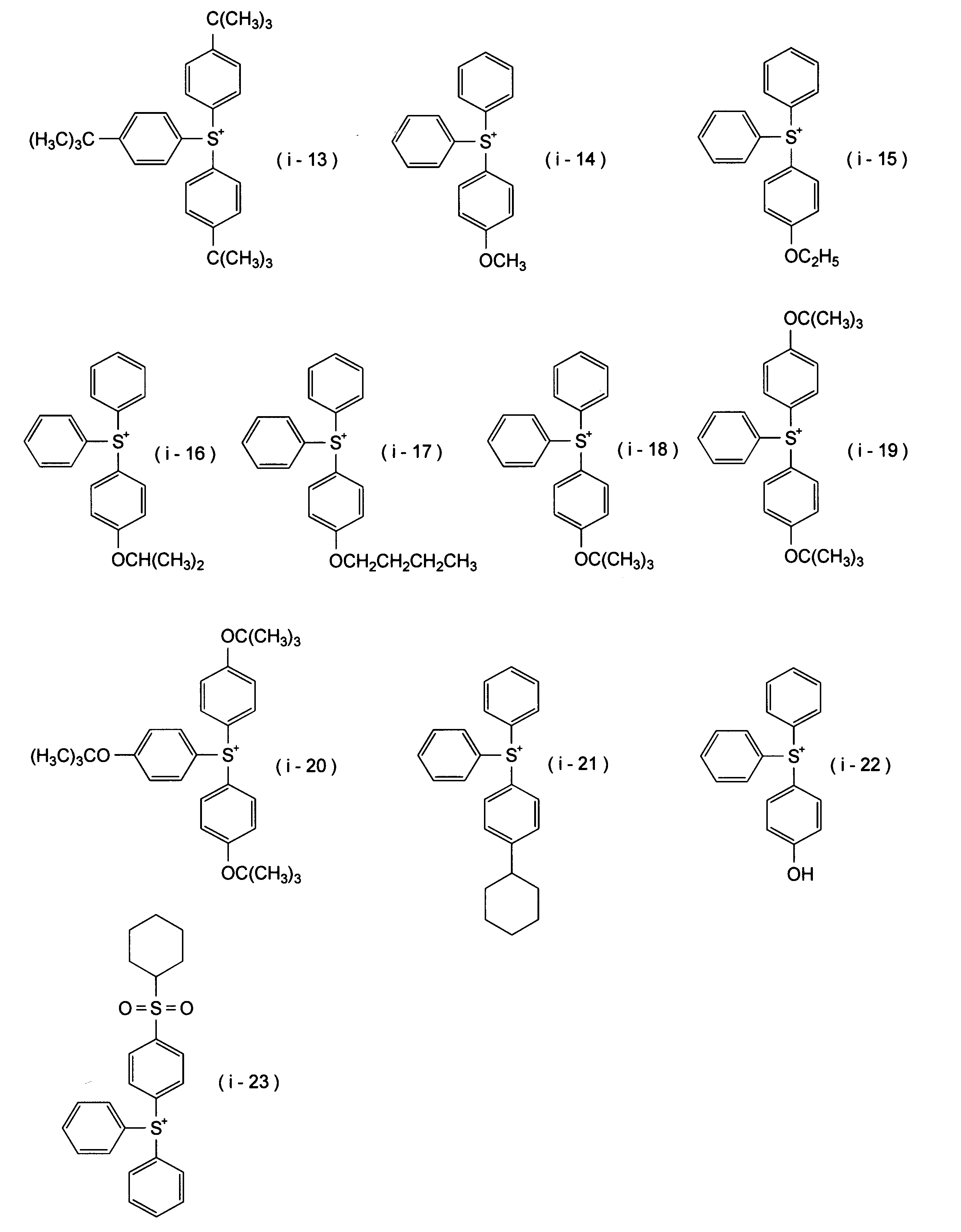


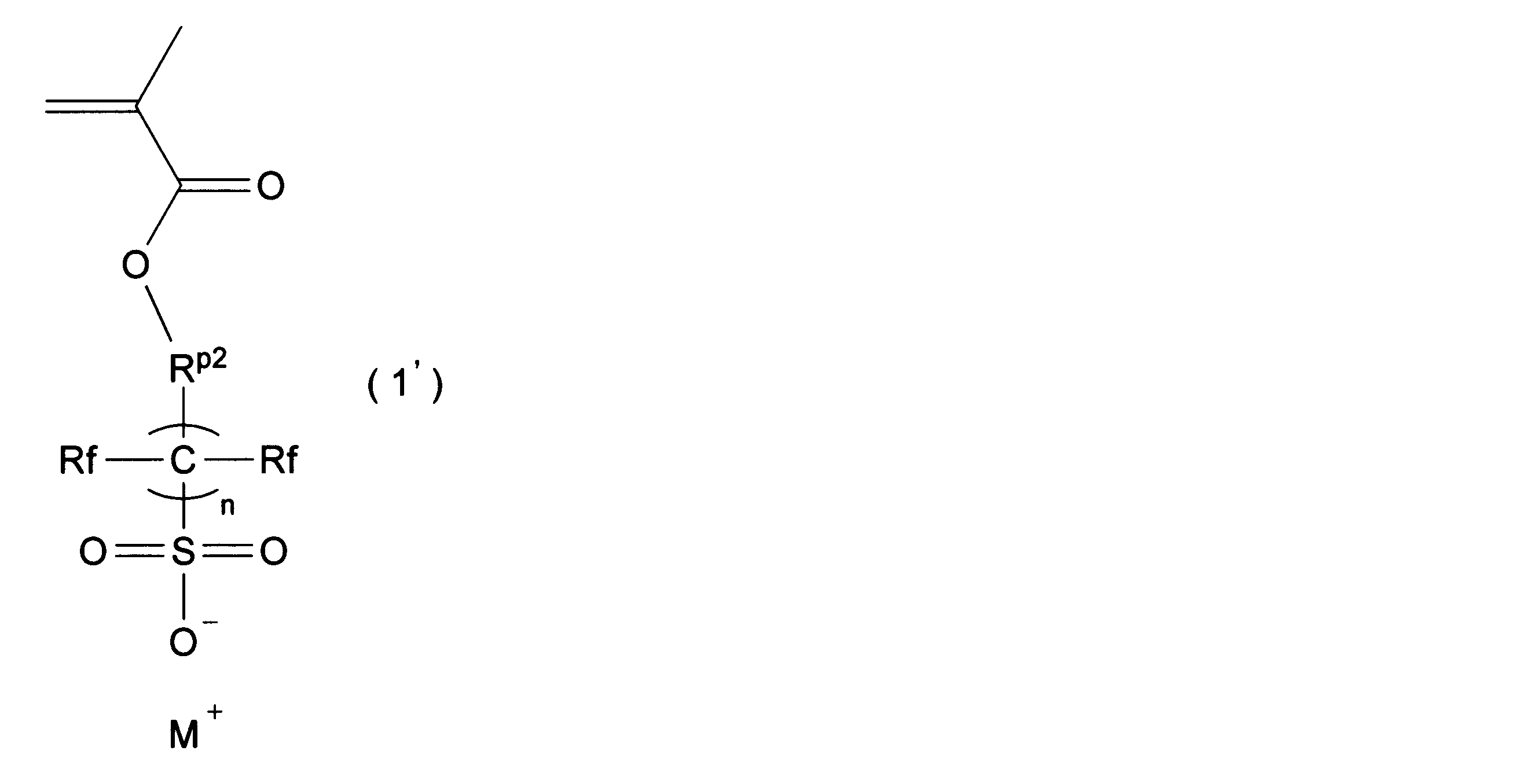
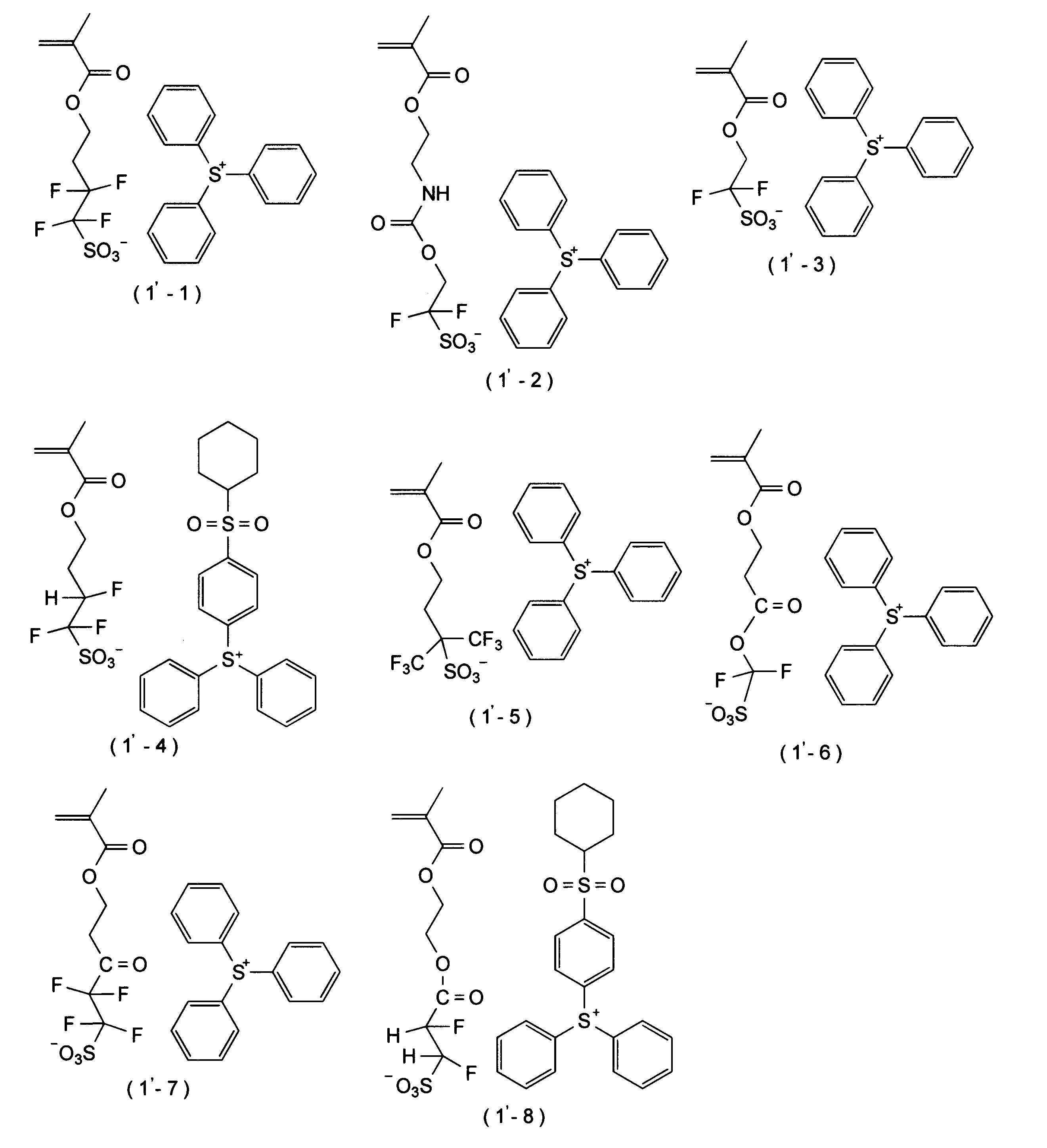
上記式(2)中、Rp3は、水素原子、フッ素原子、トリフルオロメチル基又は炭素数1~3のアルキル基である。Rp4、Rp5及びRp6は、それぞれ独立して、炭素数1~10の有機基である。mは、0~3の整数である。mが2又は3の場合、複数のRp4は、それぞれ同一でも異なっていてもよい。Aは、メチレン基、炭素数2~10のアルキレン基又は炭素数6~10のアリーレン基である。X-は、スルホネートアニオン、カルボキシレートアニオン又はアミドアニオンである。


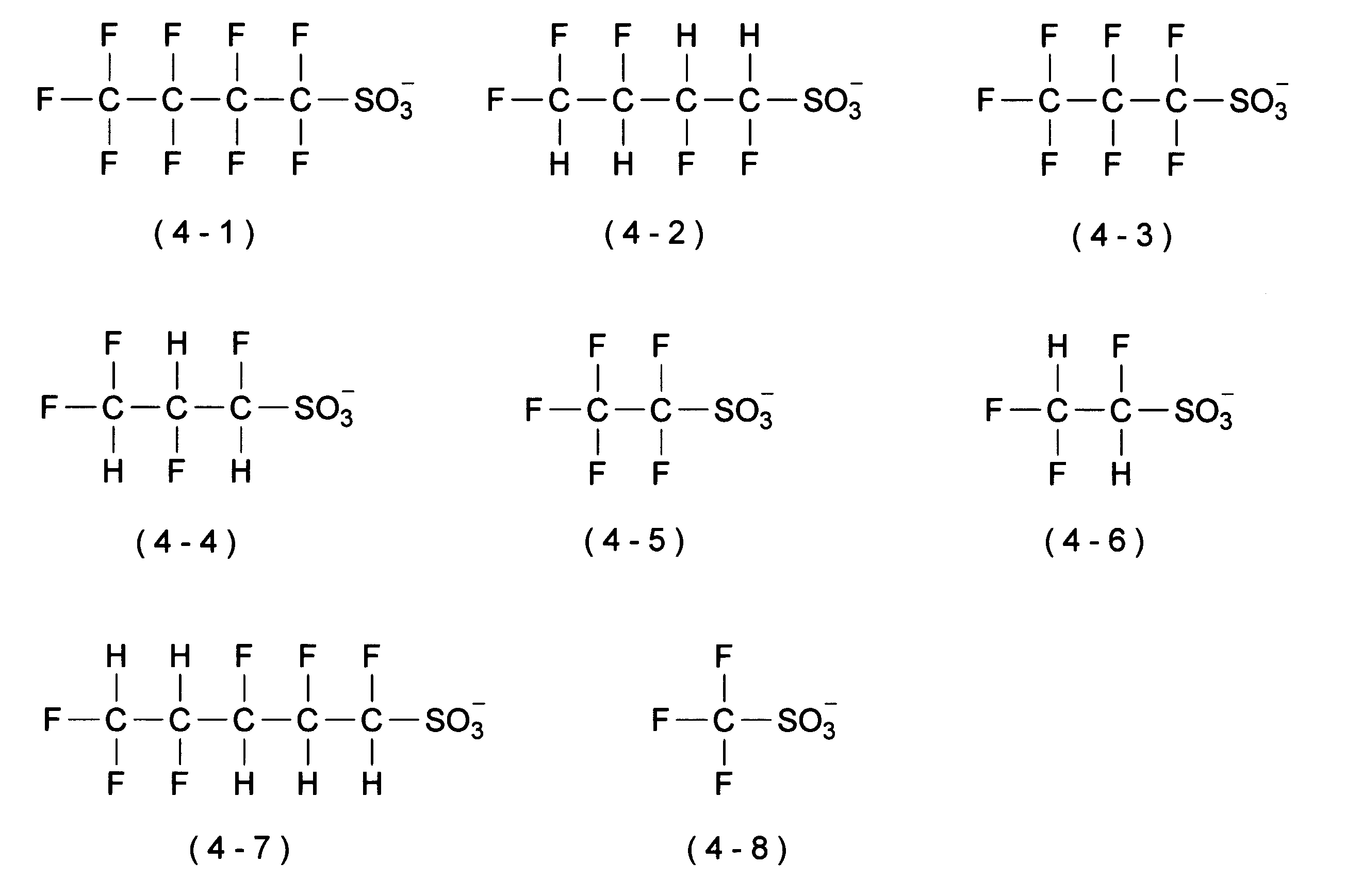
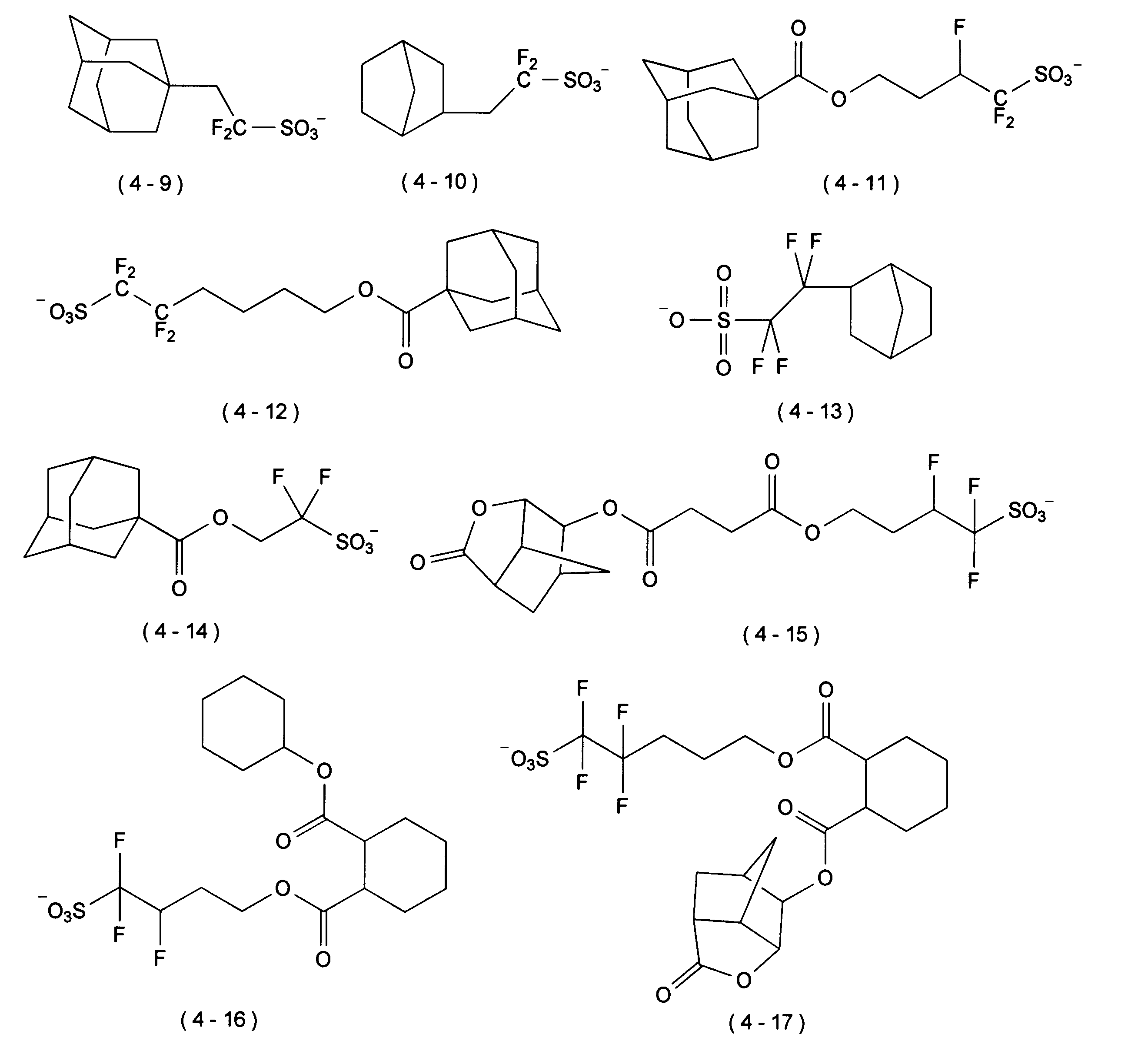
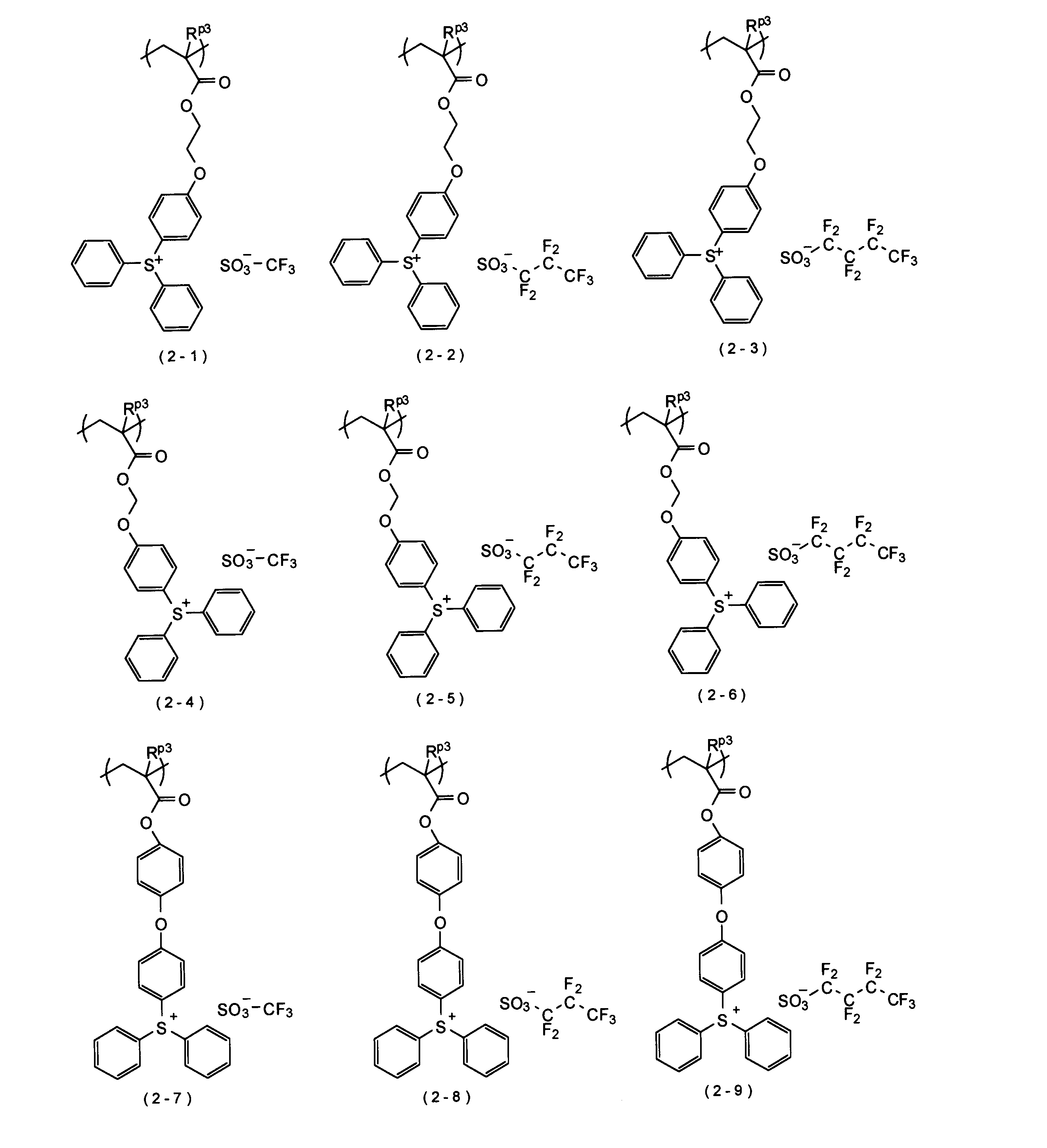


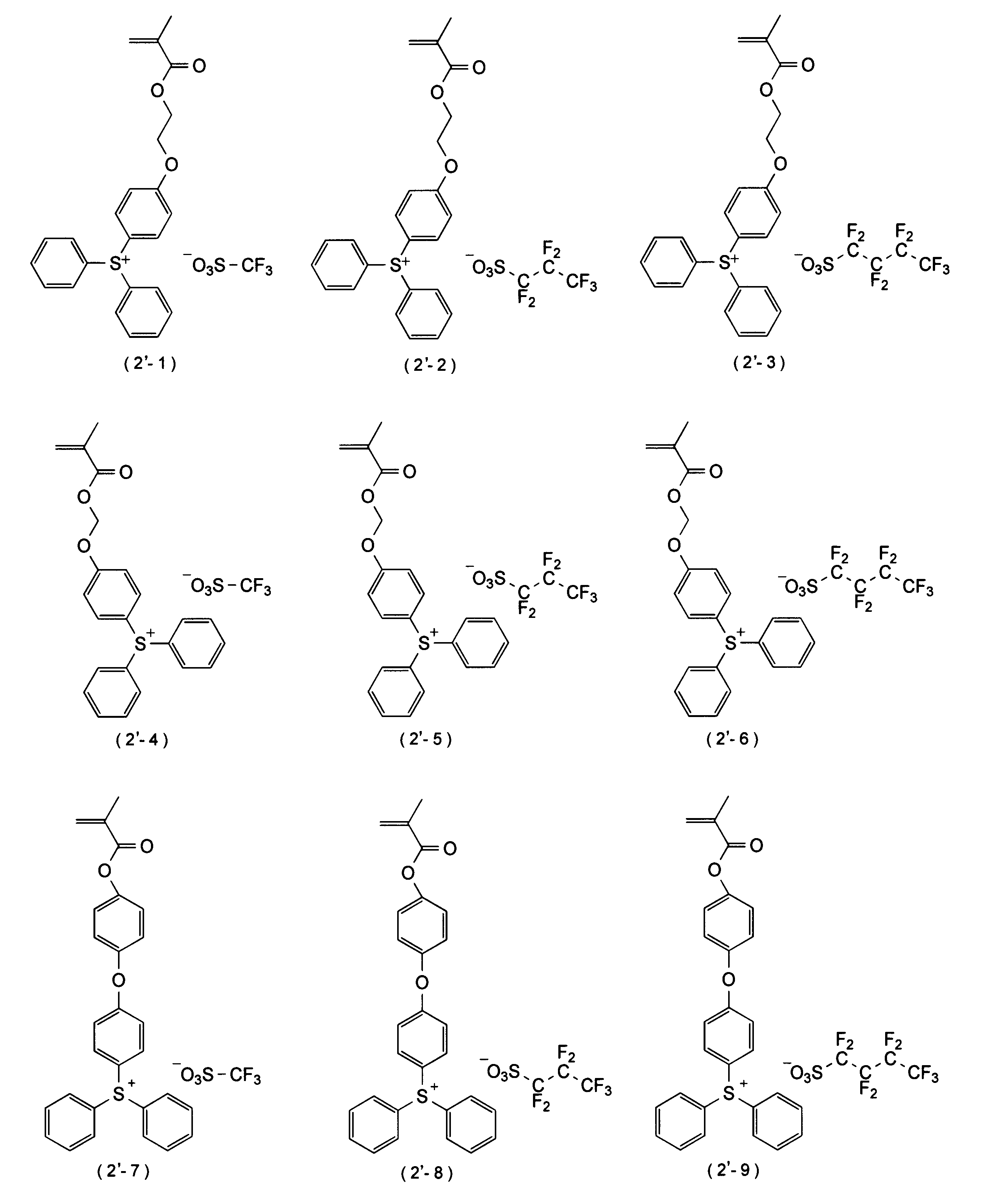

[A]重合体は、上記式(5)で表される構造単位(II)をさらに含むことが好ましい。上記式(5)で表される構造単位(II)は、エステル基に結合する炭素原子が3級炭素であり酸の作用により解離し易い酸解離性基を有する構造単位である。
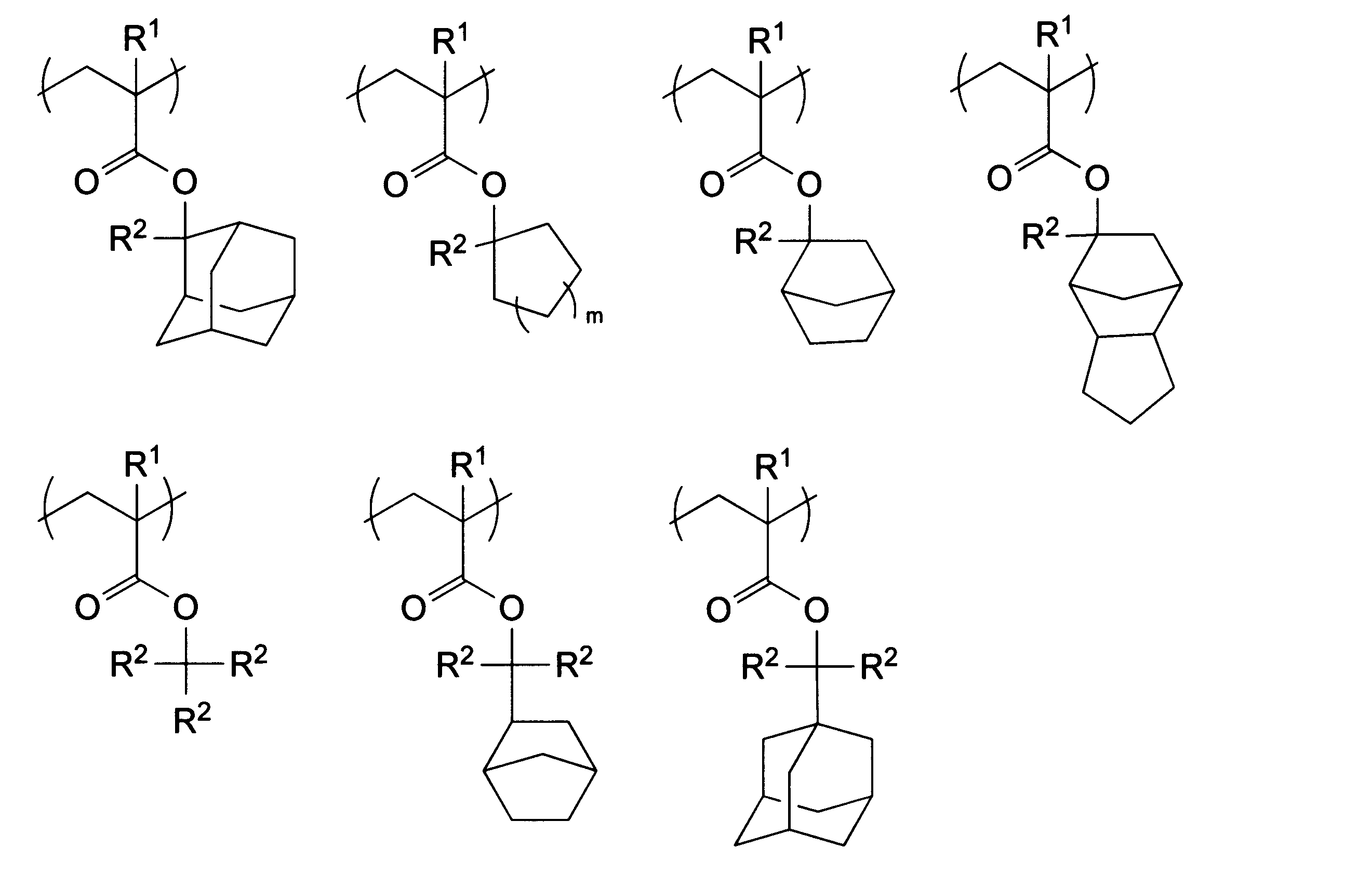

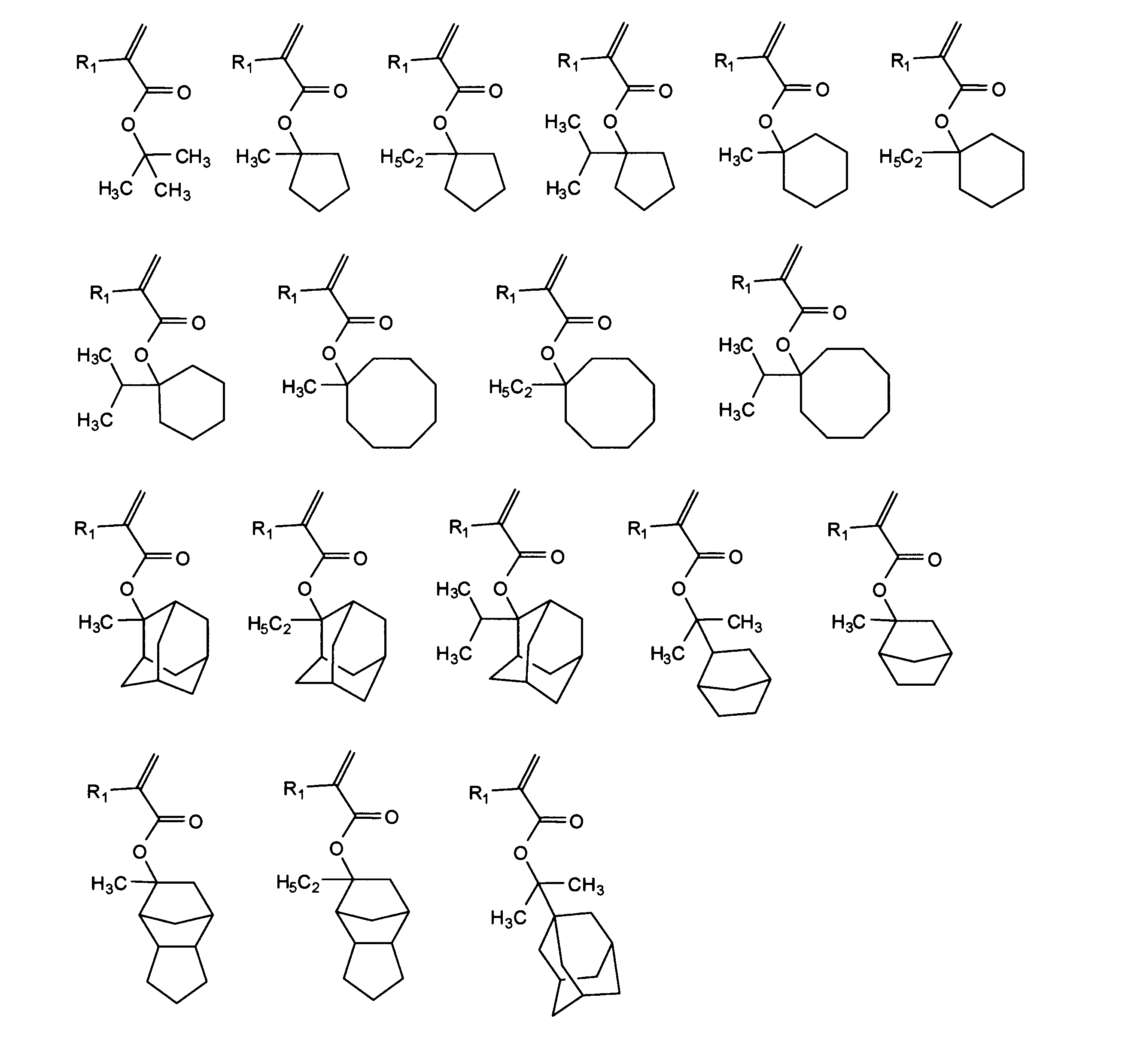
[A]重合体は、上記以外の他の構造単位として、ラクトン骨格又は環状カーボネート骨格を有する構造単位(III)を有することができる。[A]重合体が、構造単位(III)を有することで、当該フォトレジスト組成物の基板等に対する密着性が向上する。


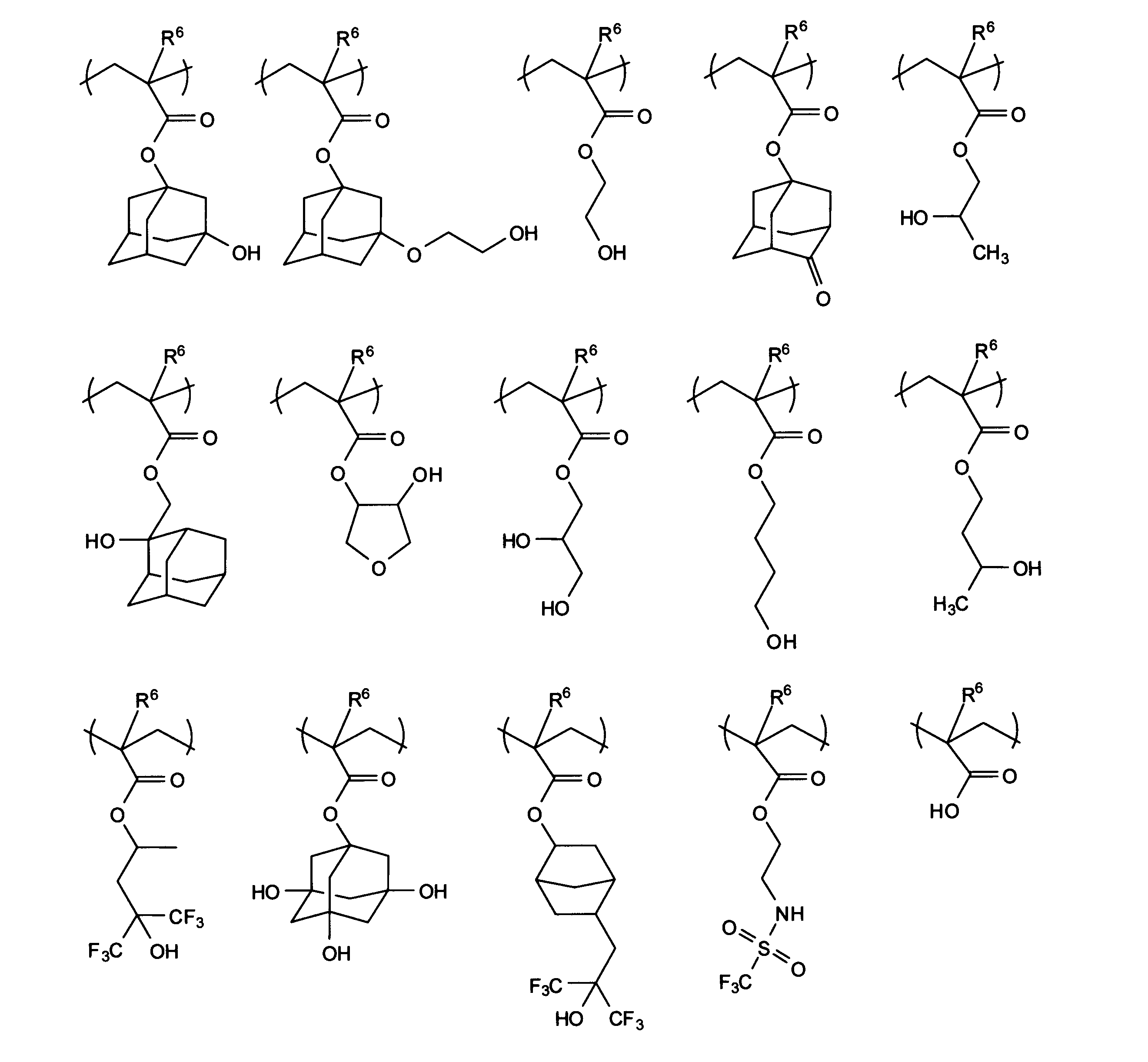
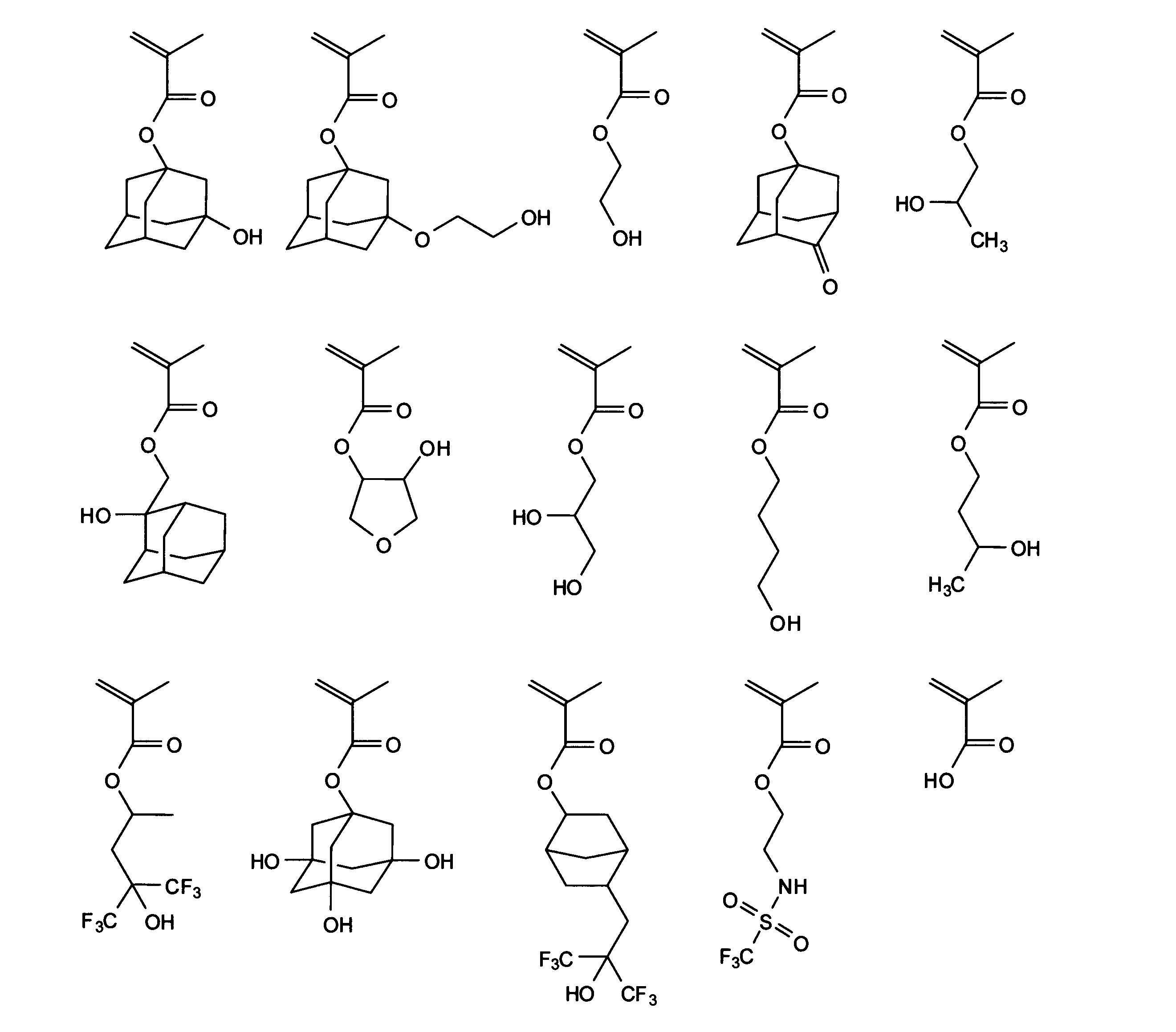
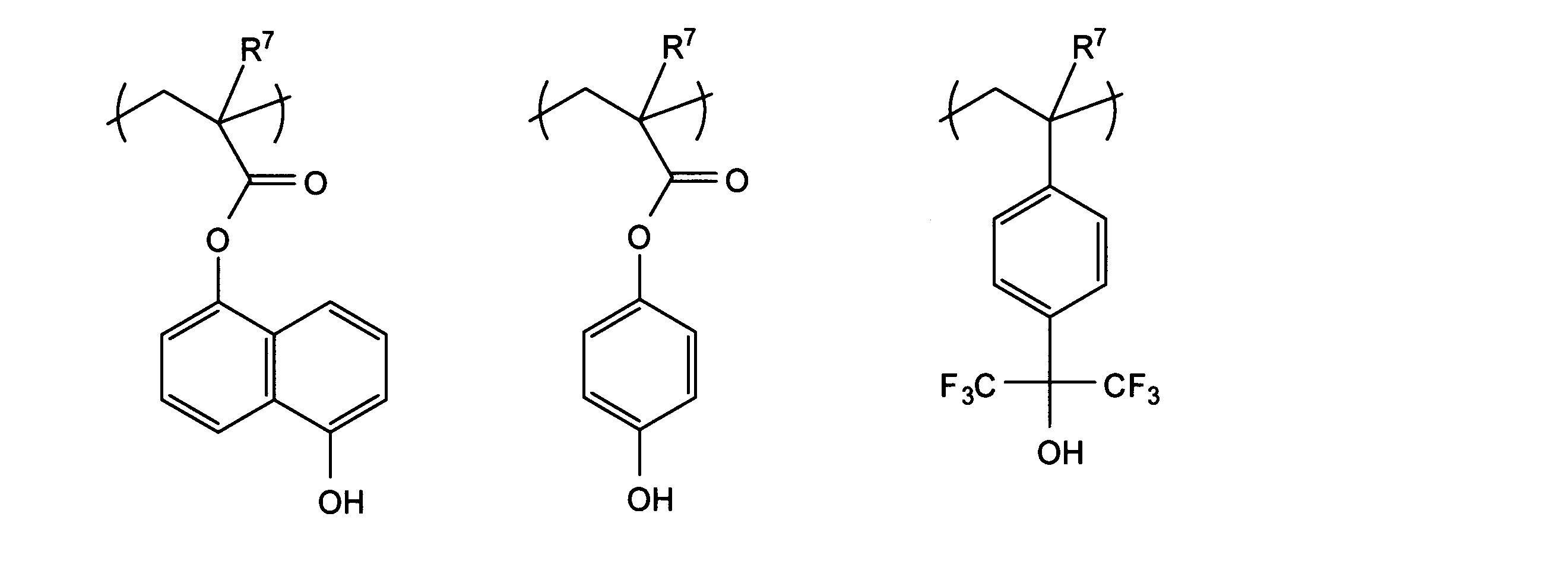
[A]重合体は、例えば所定の各構造単位に対応する単量体を、ラジカル重合開始剤を使用し、適当な溶媒中で重合することにより製造できる。例えば、単量体及びラジカル開始剤を含有する溶液を、反応溶媒又は単量体を含有する溶液に滴下して重合反応させる方法、単量体を含有する溶液と、ラジカル開始剤を含有する溶液とを各別に、反応溶媒又は単量体を含有する溶液に滴下して重合反応させる方法、各々の単量体を含有する複数種の溶液と、ラジカル開始剤を含有する溶液とを各別に、反応溶媒又は単量体を含有する溶液に滴下して重合反応させる方法等の方法で合成することが好ましい。
n-ペンタン、n-ヘキサン、n-ヘプタン、n-オクタン、n-ノナン、n-デカン等のアルカン類;
シクロヘキサン、シクロヘプタン、シクロオクタン、デカリン、ノルボルナン等のシクロアルカン類;
ベンゼン、トルエン、キシレン、エチルベンゼン、クメン等の芳香族炭化水素類;
クロロブタン類、ブロモヘキサン類、ジクロロエタン類、ヘキサメチレンジブロミド、クロロベンゼン等のハロゲン化炭化水素類;
酢酸エチル、酢酸n-ブチル、酢酸i-ブチル、プロピオン酸メチル等の飽和カルボン酸エステル類;
アセトン、2-ブタノン、4-メチル-2-ペンタノン、2-ヘプタノン等のケトン類;
テトラヒドロフラン、ジメトキシエタン類、ジエトキシエタン類等のエーテル類;
メタノール、エタノール、1-プロパノール、2-プロパノール、4-メチル-2-ペンタノール等のアルコール類等が挙げられる。これらの溶媒は、単独で使用してもよく2種以上を併用してもよい。
当該フォトレジスト組成物は、[B]重合体をさらに含有することが好ましい。[B]重合体は、酸発生能を有する構造単位(I)を含まず、かつ上記式(5)で表される酸解離性基を有する構造単位(II)を含む。露光により[A]重合体において発生した酸の作用で、[B]重合体が有する上記酸解離性基が解離し、有機溶媒を含有する現像液に不溶性となる。これにより、露光部と未露光部とのコントラストに優れるパターンを形成することができる。
[B]重合体が含む構造単位(II)については、[A]重合体が好適に含む構造単位(II)として、すでに詳述している内容と同様の説明をすることができるので、ここでの説明は省略する。
[B]重合体において、構造単位(IV)の含有割合としては、[B]重合体を構成する全構造単位に対して、0モル%以上80モル以下が好ましく、10モル以上~40モル%以下がより好ましい。なお、[B]重合体は構造単位(IV)を1種又は2種以上を有してもよい。
[B]重合体において、構造単位(V)の含有割合としては、[B]重合体を構成する全構造単位に対して、0モル%以上80モル以下が好ましく、10モル以上~40モル%以下がより好ましい。なお、[B]重合体は構造単位(V)を1種又は2種以上有してもよい。
[B]重合体は、例えば所定の各構造単位に対応する単量体を、ラジカル重合開始剤を使用し、適当な溶媒中で重合することにより製造できる。
当該フォトレジスト組成物は、[C]酸発生剤をさらに含有することができる。当該フォトレジスト組成物が含有する[A]重合体は、酸発生能を有する構造単位(I)を含み、それに加えてさらに[C]酸発生剤を含有することで、感度が向上し、同じ露光量においては、さらに多くの酸を発生することができる。その酸により[A]重合体及び/又は[B]重合体中に存在する酸解離性基を解離させ、その結果、露光部が有機溶媒を含有する現像液に不溶解性となる。なお、当該フォトレジスト組成物における[C]酸発生剤の含有形態は、後述するような化合物の形態である。なお、[C]酸発生剤には、[A]重合体は含まれないものとする。
当該フォトレジスト組成物は、[A]重合体及び[B]重合体以外のフッ素原子含有重合体であって、[A]重合体及び[B]重合体よりもフッ素原子含有率が高い[D]フッ素原子含有重合体(以下、「[D]重合体」ともいう)を含有していてもよい。当該フォトレジスト組成物が、[D]重合体を含有することで、レジスト膜を形成した際に、膜中のフッ素原子含有重合体の撥油性的特徴により、その分布がレジスト膜表面近傍で偏在化する傾向があるので、液浸露光時に酸発生剤や酸拡散制御剤等が液浸媒体に溶出することを抑制することができる。また、この[D]重合体の撥水性的特徴により、レジスト膜と液浸媒体との前進接触角が所望の範囲に制御でき、バブル欠陥の発生を抑制できる。さらに、レジスト膜と液浸媒体との後退接触角が高くなり、水滴が残らずに高速でのスキャン露光が可能となる。このように当該フォトレジスト組成物が[D]重合体を含有することにより、液浸露光法に好適なレジスト塗膜を形成することができる。
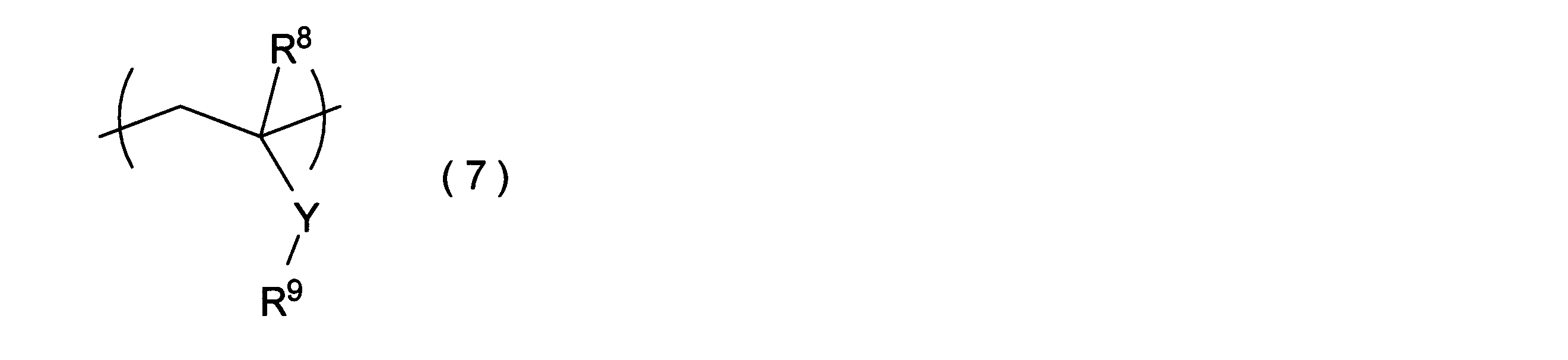
[D]重合体は、例えば所定の各構造単位に対応する単量体を、ラジカル重合開始剤を使用し、適当な溶媒中で重合することにより合成できる。
上記重合に使用されるラジカル重合開始剤及び溶媒としては、例えば[A]重合体の合成方法で挙げたものと同様のものが挙げられる。
当該フォトレジスト組成物は、[E]含窒素化合物をさらに含んでいることが好ましい。[E]含窒素化合物は、露光により[A]重合体が含む酸発生能を有する構造単位(I)及び[C]酸発生剤から生じる酸のレジスト膜中における拡散現象を制御し、レジストとしての解像度をより向上させるとともに、得られるフォトレジスト組成物の貯蔵安定性が向上させることができる。[E]含窒素化合物の当該フォトレジスト組成物における含有形態としては、遊離の化合物の形態でも、重合体の一部として組み込まれた形態でも、これらの両方の形態でもよい。

トリエチルアミン、トリ-n-プロピルアミン、トリ-n-ブチルアミン、トリ-n-ペンチルアミン、トリ-n-ヘキシルアミン、トリ-n-ヘプチルアミン、トリ-n-オクチルアミン、シクロヘキシルジメチルアミン、ジシクロヘキシルメチルアミン、トリシクロヘキシルアミン等のトリ(シクロ)アルキルアミン類;
アニリン、N-メチルアニリン、N,N-ジメチルアニリン、2-メチルアニリン、3-メチルアニリン、4-メチルアニリン、4-ニトロアニリン、2,6-ジメチルアニリン、2,6-ジイソプロピルアニリン等の芳香族アミン類;
トリエタノールアミン、N,N-ジ(ヒドロキシエチル)アニリン等のアルカノールアミン類;
N,N,N’,N’-テトラメチルエチレンジアミン、N,N,N’,N’-テトラキス(2-ヒドロキシプロピル)エチレンジアミン、1,3-ビス[1-(4-アミノフェニル)-1-メチルエチル]ベンゼンテトラメチレンジアミン、ビス(2-ジメチルアミノエチル)エーテル、ビス(2-ジエチルアミノエチル)エーテル等が挙げられる。
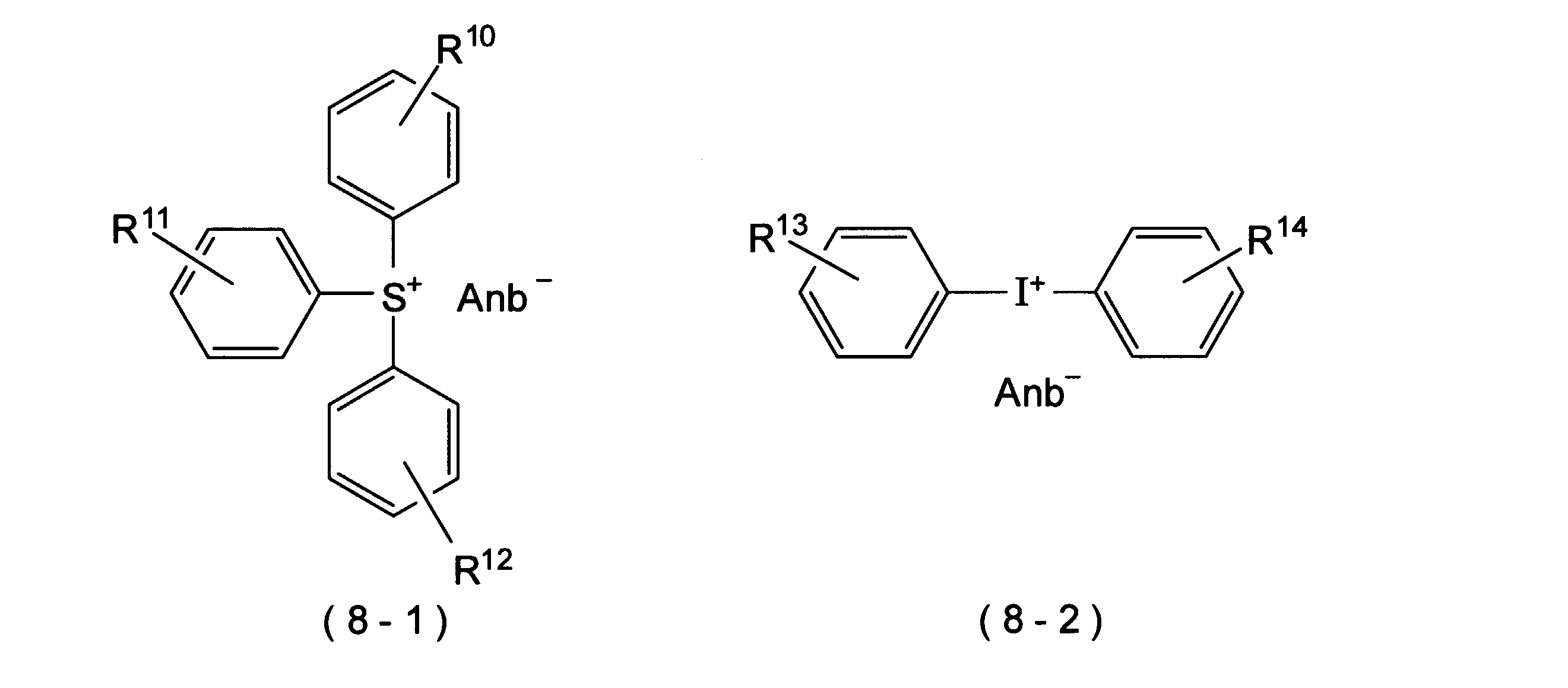
また、Anb-は、OH-、R15-COO-、R15-SO3 -(但し、R15は、それぞれ独立して、アルキル基、アリール基、又はアルカノール基である。)、又は下記式(9)で表されるアニオンを表す。

当該フォトレジスト組成物は、通常、[F]溶媒を含有する。[F]溶媒としては、例えばアルコール系溶媒、ケトン系溶媒、アミド系溶媒、エーテル系溶媒、エステル系溶媒及びその混合溶媒等が挙げられる。
メタノール、エタノール、n-プロパノール、iso-プロパノール、n-ブタノール、iso-ブタノール、sec-ブタノール、tert-ブタノール、n-ペンタノール、iso-ペンタノール、2-メチルブタノール、sec-ペンタノール、tert-ペンタノール、3-メトキシブタノール、n-ヘキサノール、2-メチルペンタノール、sec-ヘキサノール、2-エチルブタノール、sec-ヘプタノール、3-ヘプタノール、n-オクタノール、2-エチルヘキサノール、sec-オクタノール、n-ノニルアルコール、2,6-ジメチル-4-ヘプタノール、n-デカノール、sec-ウンデシルアルコール、トリメチルノニルアルコール、sec-テトラデシルアルコール、sec-ヘプタデシルアルコール、フルフリルアルコール、フェノール、シクロヘキサノール、メチルシクロヘキサノール、3,3,5-トリメチルシクロヘキサノール、ベンジルアルコール、ジアセトンアルコール等のモノアルコール系溶媒;
エチレングリコール、1,2-プロピレングリコール、1,3-ブチレングリコール、2,4-ペンタンジオール、2-メチル-2,4-ペンタンジオール、2,5-ヘキサンジオール、2,4-ヘプタンジオール、2-エチル-1,3-ヘキサンジオール、ジエチレングリコール、ジプロピレングリコール、トリエチレングリコール、トリプロピレングリコール等の多価アルコール系溶媒;
エチレングリコールモノメチルエーテル、エチレングリコールモノエチルエーテル、エチレングリコールモノプロピルエーテル、エチレングリコールモノブチルエーテル、エチレングリコールモノヘキシルエーテル、エチレングリコールモノフェニルエーテル、エチレングリコールモノ-2-エチルブチルエーテル、ジエチレングリコールモノメチルエーテル、ジエチレングリコールモノエチルエーテル、ジエチレングリコールモノプロピルエーテル、ジエチレングリコールモノブチルエーテル、ジエチレングリコールモノヘキシルエーテル、プロピレングリコールモノメチルエーテル、プロピレングリコールモノエチルエーテル、プロピレングリコールモノプロピルエーテル、プロピレングリコールモノブチルエーテル、ジプロピレングリコールモノメチルエーテル、ジプロピレングリコールモノエチルエーテル、ジプロピレングリコールモノプロピルエーテル等の多価アルコール部分エーテル系溶媒等が挙げられる。
n-ペンタン、iso-ペンタン、n-ヘキサン、iso-ヘキサン、n-ヘプタン、iso-ヘプタン、2,2,4-トリメチルペンタン、n-オクタン、iso-オクタン、シクロヘキサン、メチルシクロヘキサン等の脂肪族炭化水素系溶媒;
ベンゼン、トルエン、キシレン、メシチレン、エチルベンゼン、トリメチルベンゼン、メチルエチルベンゼン、n-プロピルベンゼン、iso-プロピルベンゼン、ジエチルベンゼン、iso-ブチルベンゼン、トリエチルベンゼン、ジ-iso-プロピルベンセン、n-アミルナフタレン、アニソール等の芳香族炭化水素系溶媒;
ジクロロメタン、クロロホルム、フロン、クロロベンゼン、ジクロロベンゼン等の含ハロゲン溶媒等が挙げられる。
当該フォトレジスト組成物は、本発明の効果を損なわない範囲で、偏在化促進剤、脂環式骨格化合物、界面活性剤、増感剤等を含有できる。以下、これらのその他の任意成分について詳述する。これらのその他の任意成分は、単独で又は2種以上を混合して使用することができる。また、その他の任意成分の配合量は、その目的に応じて適宜決定することができる。
当該フォトレジスト組成物は、液浸露光法を使用しレジストパターンを形成する場合等に、偏在化促進剤を配合することができる。偏在化促進剤を配合することで、[D]重合体をさらに表層近傍に偏在化させることができる。偏在化促進剤としては、例えばγ-ブチロラクトン、プロピレンカーボネート等が挙げられる。
脂環式骨格化合物は、ドライエッチング耐性、パターン形状、基板との接着性等をさらに改善する作用を示す成分である。
界面活性剤は塗布性、ストリエーション、現像性等を改良する作用を示す成分である。
増感剤は、露光光のエネルギーを吸収して、そのエネルギーを[A]化合物に伝達しそれにより酸の生成量を増加する作用を示すものであり、当該フォトレジスト組成物の「みかけの感度」を向上させる効果を有する。
当該フォトレジスト組成物は、例えば上記[F]溶媒中で、上記[A]重合体、好適成分である[B]重合体、[C]酸発生剤、必要に応じて加えられる[D]重合体、[E]含窒素化合物及びその他の任意成分を所定の割合で混合することにより調製できる。当該フォトレジスト組成物は、通常、その使用に際して、全固形分濃度が1質量%~50質量%、好ましくは2質量%~25質量%となるように[F]溶媒に溶解した後、例えば孔径0.2μm程度のフィルターでろ過することによって調製される。
カラム温度:40℃
溶出溶媒:テトラヒドロフラン
(LiBr 0.3%(質量換算)、H3PO4 0.1%(質量換算) 混合溶液)
流速:1.0mL/分
試料濃度:0.2質量%
試料注入量:100μL
検出器:示差屈折計
標準物質:単分散ポリスチレン
[A]重合体、[B]重合体及び後述する[D]重合体の合成に用いた単量体を下記に示す。
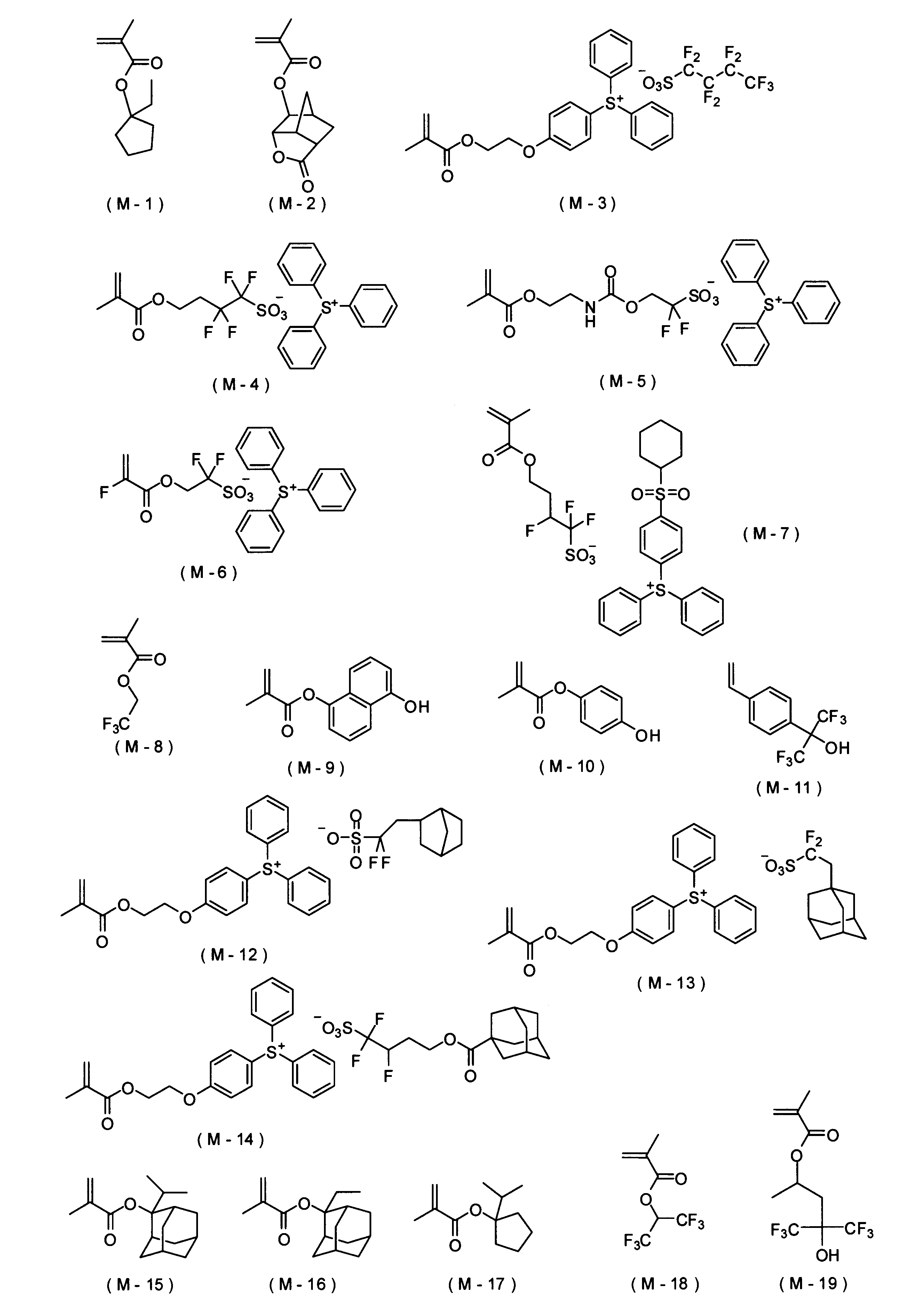
化合物(M-1)11.8g(46モル%)、化合物(M-3)2.3g(3モル%)、及び化合物(M-2)15.9g(51モル%)を60gのメチルエチルケトンに溶解し、AIBN 1.2gを添加して単量体溶液を調製した。30gのメチルエチルケトンを入れた500mLの三口フラスコを30分窒素パージした後、撹拌しながら80℃に加熱し、調製した単量体溶液を滴下漏斗にて3時間かけて滴下した。滴下開始を重合反応の開始時間とし、重合反応を6時間実施した。重合反応終了後、重合溶液を水冷して30℃以下に冷却した。600gのメタノール又はヘプタン中に冷却した重合溶液を投入し、析出した白色粉末をろ別した。ろ別した白色粉末を120gのメタノール又はイソプロパノールにてスラリー状で2回洗浄した後、ろ別し、50℃で17時間乾燥させて白色粉末状の[A]重合体としての重合体(A-1)を得た(25.4g、収率84.5%)。得られた重合体(A-1)のMwは6,900であり、Mw/Mnは1.4であった。また、13C-NMR分析の結果、化合物(M-1)由来の構造単位:化合物(M-3)由来の構造単位:化合物(M-2)由来の構造単位の含有比率は、41.0:3.5:55.5(モル%)であった。
表1に記載の単量体を所定量配合した以外は、合成例1と同様に操作して重合体[A]重合体としての(A-2)~(A-15)、並びに[B]重合体としての(B-1)及び(B-2)を得た。また、得られた各重合体のMw、Mw/Mn、収率(%)及び各重合体における各単量体に由来する構造単位の含有率を合わせて表1に示す。

[合成例18]
化合物(M-1)35.8g(70モル%)及び化合物(M-8)14.2g(30モル%)を50gの2-ブタノンに溶解し、ジメチル-2,2’-アゾビスイソブチレート3.2gを添加して単量体溶液を調製した。50gの2-ブタノンを入れた500mLの三口フラスコを30分窒素パージした後、撹拌しながら80℃に加熱し、調製した単量体溶液を滴下漏斗にて3時間かけて滴下した。滴下開始を重合反応の開始時間とし、重合反応を6時間実施した。重合反応終了後、重合溶液を水冷して30℃以下に冷却し、825gのメタノール/2-ブタノン/ヘキサン=2/1/8混合溶液で洗浄した後、酢酸プロピレングリコールモノメチルエーテルで溶媒置換し、共重合体(D-1)の溶液を得た。(固形分換算で38.0g、収率76%)。この共重合体(D-1)は、Mwが7,000であり、Mw/Mnが1.40であった。13C-NMR分析の結果、化合物(M-1)由来の構造単位:化合物(M-8)由来の構造単位の含有比率(モル%)は、70.2:29.8(モル%)であった。
化合物(M-1)16.5g(40モル%)、化合物(M-18)26.8g(50モル%)及び化合物(M-19)6.7g(10モル%)を50gの2-ブタノンに溶解し、ジメチル-2,2’-アゾビスイソブチレート3.2gを添加して単量体溶液を調製した。50gの2-ブタノンを入れた500mLの三口フラスコを30分窒素パージした後、撹拌しながら80℃に加熱し、調製した単量体溶液を滴下漏斗にて3時間かけて滴下した。滴下開始を重合反応の開始時間とし、重合反応を6時間実施した。重合反応終了後、重合溶液を水冷して30℃以下に冷却し、825gのメタノール/2-ブタノン/ヘキサン=2/1/8混合溶液で洗浄した後、酢酸プロピレングリコールモノメチルエーテルで溶媒置換し、共重合体(D-2)の溶液を得た。(固形分換算で36.5g、収率73%)。この共重合体(D-2)は、Mwが5,000であり、Mw/Mnが1.40であった。13C-NMR分析の結果、化合物(M-1)由来の構造単位:化合物(M-18):化合物(M-19)由来の構造単位の含有比率(モル%)は、40.2:49.6:10.2(モル%)であった。
フォトレジスト組成物の調製に用いた[C]酸発生剤、[E]含窒素化合物及び[F]溶媒について以下に示す。
C-1:下記式で表される化合物

E-1:下記式で表される化合物

F-1:酢酸プロピレングリコールモノメチルエーテル
F-2:シクロヘキサノン
F-3:γ-ブチロラクトン
重合体(A-1)100質量部、フッ素原子含有重合体(D-1)3質量部、含窒素化合物(E-1)1.1質量部、溶媒(F-1)2,220質量部、(F-2)950質量部及び(F-3)30質量部を混合し、得られた混合溶液を孔径0.2μmのフィルターでろ過して、フォトレジスト組成物を調製した。
表2及び表3に示す種類、量の[A]重合体又は[B]重合体、[C]酸発生剤及び[D]重合体を使用した以外は実施例1と同様に操作して、フォトレジスト組成物を調製した。なお、表2及び表3中の「-」は該当する成分を使用しなかったことを示す。

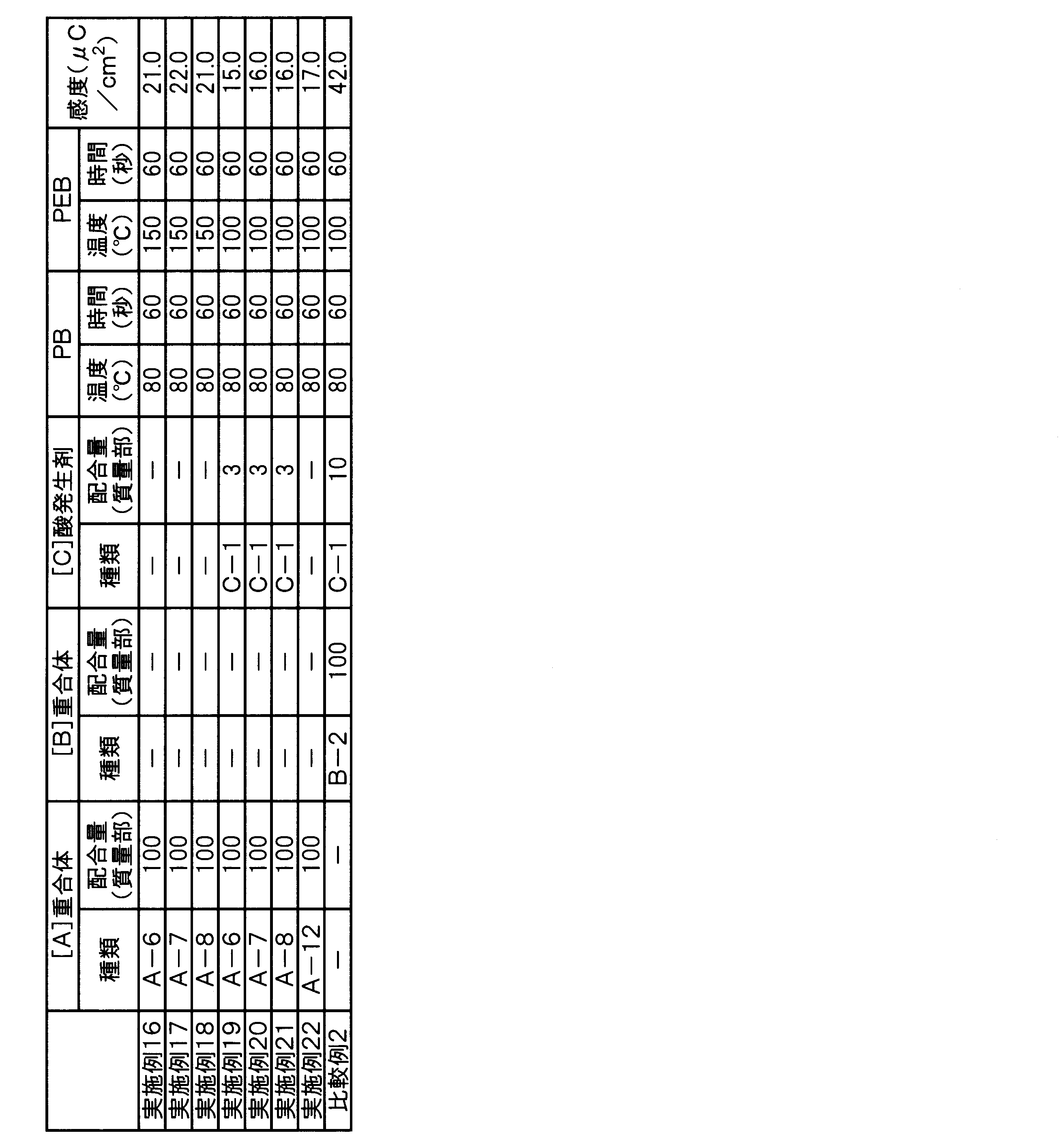
膜厚105nmのARC66(BREWER SCIENCE社)の下層反射防止膜を形成したシリコンウェハを用い、実施例1~15及び比較例1で調製した各フォトレジスト組成物を、それぞれ基板上にクリーントラックACT12(東京エレクトロン社)を用いてスピンコートにより塗布した。ホットプレート上にて80℃で60秒間プレベーク(PB)を行って膜厚0.100μmのレジスト膜を形成した。形成したレジスト膜に、ArF液浸露光装置(S610C、ニコン社、開口数1.30)を用いて、下記の各評価に記載のマスクパターン、液浸水を介して縮小投影露光を行った。次いで表2に示す温度で60秒間ポスト・エクスポージャー・ベーク(PEB)を行った後、酢酸ブチルにより23℃で30秒間現像し、4-メチル-2-ペンタノールで10秒間リンス処理を行った後、乾燥してネガ型のレジストパターンを形成した。また、他の現像液としてメチル-n-ペンチルケトン、酢酸イソアミル及びアニソールを使用し、同様にパターンを形成した。
上記縮小投影後にウエハー上で直径0.055μmのホールサイズになるような露光量を最適露光量とし、この最適露光量を感度(mJ/cm2)とし、表2に合わせて示す。
膜厚105nmのARC66(BREWER SCIENCE社)の下層反射防止膜を形成したシリコンウェハを用い、実施例1~15又は比較例1で調製したフォトレジスト組成物を、基板上にクリーントラックACT12(東京エレクトロン社)を用いてスピンコートにより塗布し、ホットプレート上にて80℃で60秒間PBを行って膜厚0.10μmのレジスト膜を形成した。形成したレジスト膜に、ArF液浸露光装置(S610C、ニコン社、開口数1.30)を用いて、表2記載の感度で表される露光量で全面露光し、表2に示されるベーク温度で60秒間PEBを行った後、酢酸ブチルにより23℃で30秒間現像し、4-メチル-2-ペンタノールで10秒間リンス処理を行い、乾燥してレジスト膜を形成した。本レジスト膜上の表面ラフネスを、原子間力顕微鏡(Digital Instrument社 Nano Scope IIIa)にて、測定領域40×40μmの条件下で測定した。結果を表2に示す。ラフネスを測定しRMSにより算出した値が5.0nm未満の場合を「良好」、5.0nm以上の場合を「不良」と判断した。
東京エレクトロン社製の「クリーントラックACT-8」内で、シリコンウエハー上に実施例16~22及び比較例2の各フォトレジスト組成物をスピンコートした後、表3に示す条件でPBを行い、膜厚50nmのレジスト被膜を形成した。その後、簡易型の電子線描画装置(日立製作所社製、型式「HL800D」、出力;50KeV、電流密度;5.0アンペア/cm2)を用いてレジスト膜に電子線を照射した。電子線の照射後、表3に示す条件でPEBを行った。その後、酢酸ブチルにより23℃で30秒間現像し、4-メチル-2-ペンタノールで10秒間リンス処理を行った後、乾燥してネガ型のレジストパターンを形成した。また、他の現像液としてメチル-n-ペンチルケトン、酢酸イソアミル及びアニソールを使用し、同様にパターンを形成した。
線幅130nmのライン部と、隣り合うライン部によって形成され間隔が130nmのスペース部とからなるパターン(ライン・アンド・スペースパターン(1L1S))を1対1の線幅に形成する露光量を最適露光量とし、この最適露光量により感度(μC/cm2)を評価した。結果は表3に合わせて示す。
Claims (11)
- (1)[A]酸発生能を有する構造単位(I)を含む重合体及び[F]有機溶媒を含有するフォトレジスト組成物を用い、基板上にレジスト膜を形成する工程、
(2)上記レジスト膜に露光する工程、及び
(3)上記露光されたレジスト膜を、有機溶媒を含む現像液で現像する工程
を有するネガ型パターン形成方法。 - 上記構造単位(I)が、オニウム塩、ジアゾメタン又はN-スルホニルオキシイミドに由来する構造を有する請求項1に記載のネガ型パターン形成方法。
- 上記構造単位(I)が、下記式(1)又は下記式(2)で表される請求項2に記載のネガ型パターン形成方法。

式(2)中、Rp3は、水素原子、フッ素原子、トリフルオロメチル基又は炭素数1~3のアルキル基である。Rp4、Rp5及びRp6は、それぞれ独立して、炭素数1~10の有機基である。mは、0~3の整数である。mが2又は3の場合、複数のRp4は、それぞれ同一でも異なっていてもよい。Aは、メチレン基、炭素数2~10のアルキレン基又は炭素数6~10のアリーレン基である。X-は、スルホネートアニオン、カルボキシレートアニオン又はアミドアニオンである。) - 上記式(1)のM+が下記式(3)で表される請求項3に記載のネガ型パターン形成方法。

(式(3)中、Rp7~Rp9は、それぞれ独立して、炭素数1~30の炭化水素基である。但し、Rp7及びRp8は、互いに結合して、それらが結合している硫黄原子と共に環状構造を形成していてもよい。上記炭化水素基が有する水素原子の一部又は全部は置換されていてもよい。) - 上記式(2)のX-が下記式(4)で表される請求項3に記載のネガ型パターン形成方法。
Rp10-SO3 - ・・・(4)
(式(4)中、Rp10は、フッ素原子を有する1価の有機基である。) - [A]重合体が、下記式(5)で表される構造単位(II)をさらに含む請求項1から請求項5のいずれか1項に記載のネガ型パターン形成方法。
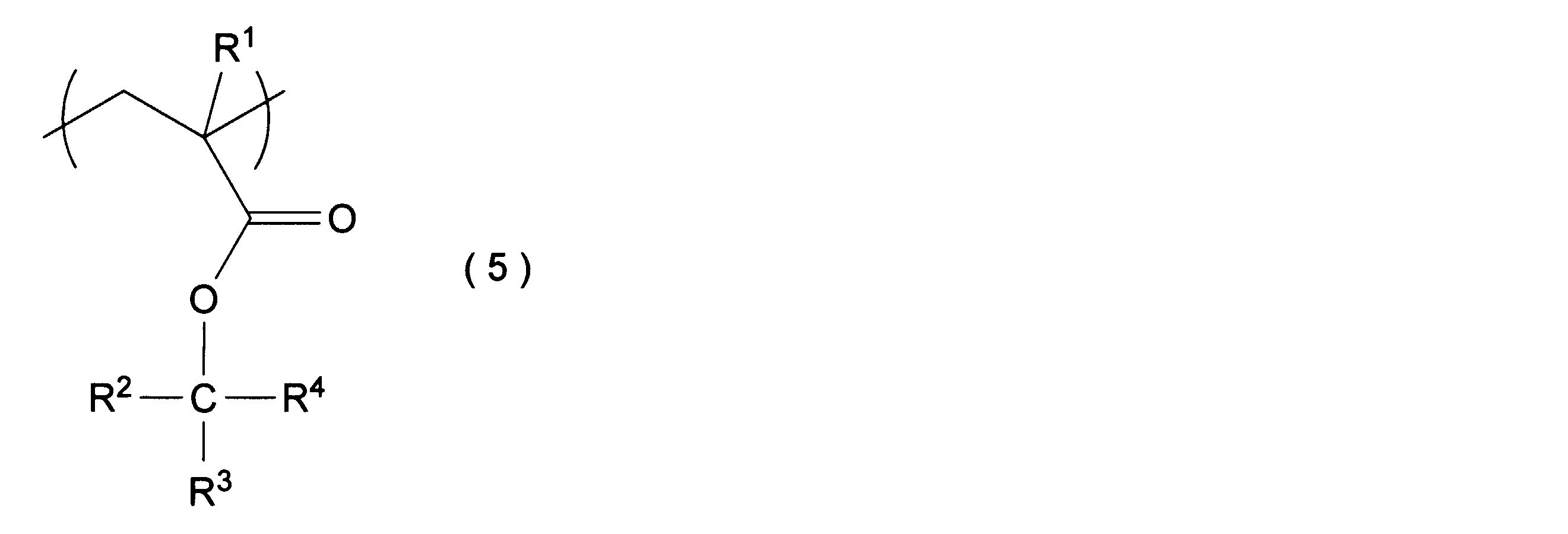
(式(5)中、R1は、水素原子、フッ素原子、トリフルオロメチル基又は炭素数1~3のアルキル基である。R2~R4は、それぞれ独立して、炭素数1~4のアルキル基又は炭素数4~20の脂環式炭化水素基である。但し、R3及びR4は、互いに結合して、それらが結合している炭素原子と共に炭素数4~20の2価の脂環式炭化水素基を形成してもよい。) - 上記フォトレジスト組成物が、
[B]上記構造単位(I)を含まず、かつ上記構造単位(II)を含む重合体
をさらに含有する請求項1から請求項6のいずれか1項に記載のネガ型パターン形成方法。 - 上記フォトレジスト組成物が、
[C]酸発生剤
をさらに含有する請求項1から請求項7のいずれか1項に記載のネガ型パターン形成方法。 - [A]酸発生能を有する構造単位(I)を含む重合体、及び
[F]有機溶媒
を含有する有機溶媒現像かつネガ型パターン形成用のフォトレジスト組成物。 - 上記構造単位(I)が、オニウム塩、ジアゾメタン又はN-スルホニルオキシイミドに由来する構造を有する請求項9に記載のフォトレジスト組成物。
- 上記構造単位(I)が、下記式(1)又は下記式(2)で表される請求項10に記載のフォトレジスト組成物。
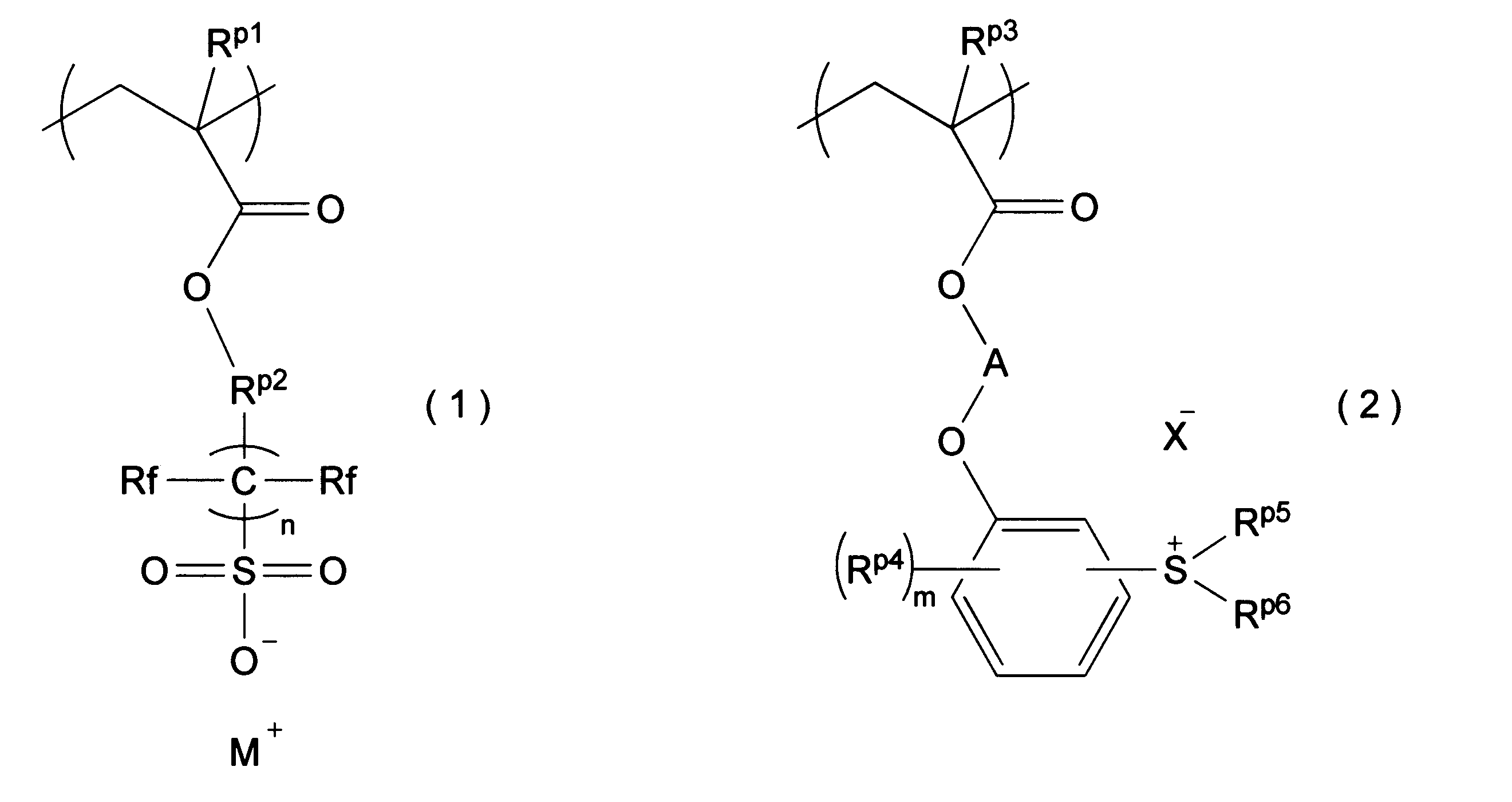
式(2)中、Rp3は、水素原子、フッ素原子、トリフルオロメチル基又は炭素数1~3のアルキル基である。Rp4、Rp5及びRp6は、それぞれ独立して、炭素数1~10の有機基である。mは、0~3の整数である。mが2又は3の場合、複数のRp4は、それぞれ同一でも異なっていてもよい。Aは、メチレン基、炭素数2~10のアルキレン基又は炭素数6~10のアリーレン基である。X-は、スルホネートアニオン、カルボキシレートアニオン又はアミドアニオンである。)
Priority Applications (3)
| Application Number | Priority Date | Filing Date | Title |
|---|---|---|---|
| KR1020137022130A KR20140007854A (ko) | 2011-02-23 | 2012-02-15 | 네가티브형 패턴 형성 방법 및 포토레지스트 조성물 |
| JP2013500981A JPWO2012114963A1 (ja) | 2011-02-23 | 2012-02-15 | ネガ型パターン形成方法及びフォトレジスト組成物 |
| US13/972,963 US20130337385A1 (en) | 2011-02-23 | 2013-08-22 | Negative pattern-forming method and photoresist composition |
Applications Claiming Priority (2)
| Application Number | Priority Date | Filing Date | Title |
|---|---|---|---|
| JP2011037640 | 2011-02-23 | ||
| JP2011-037640 | 2011-02-23 |
Related Child Applications (1)
| Application Number | Title | Priority Date | Filing Date |
|---|---|---|---|
| US13/972,963 Continuation US20130337385A1 (en) | 2011-02-23 | 2013-08-22 | Negative pattern-forming method and photoresist composition |
Publications (1)
| Publication Number | Publication Date |
|---|---|
| WO2012114963A1 true WO2012114963A1 (ja) | 2012-08-30 |
Family
ID=46720745
Family Applications (1)
| Application Number | Title | Priority Date | Filing Date |
|---|---|---|---|
| PCT/JP2012/053570 Ceased WO2012114963A1 (ja) | 2011-02-23 | 2012-02-15 | ネガ型パターン形成方法及びフォトレジスト組成物 |
Country Status (4)
| Country | Link |
|---|---|
| US (1) | US20130337385A1 (ja) |
| JP (1) | JPWO2012114963A1 (ja) |
| KR (1) | KR20140007854A (ja) |
| WO (1) | WO2012114963A1 (ja) |
Cited By (9)
| Publication number | Priority date | Publication date | Assignee | Title |
|---|---|---|---|---|
| WO2013047396A1 (en) * | 2011-09-30 | 2013-04-04 | Fujifilm Corporation | Pattern forming method, electron beam-sensitive or extreme ultraviolet-sensitive composition, resist film, method for manufacturing electronic device using the same, and electronic device |
| WO2013081168A1 (en) * | 2011-11-30 | 2013-06-06 | Fujifilm Corporation | Pattern forming method, actinic ray-sensitive or radiation-sensitive resin composition, resist film, method for manufacturing electronic device, and electronic device |
| WO2013176294A1 (en) * | 2012-05-23 | 2013-11-28 | Fujifilm Corporation | Pattern forming method, actinic ray-sensitive or radiation-sensitive resin composition, resist film, manufacturing method of electronic device, and electronic device |
| WO2014080849A1 (ja) * | 2012-11-26 | 2014-05-30 | 富士フイルム株式会社 | 感活性光線性又は感放射線性樹脂組成物、パターン形成方法、レジスト膜、電子デバイスの製造方法及び電子デバイス |
| KR20160027156A (ko) | 2013-08-01 | 2016-03-09 | 후지필름 가부시키가이샤 | 패턴 형성 방법, 감활성 광선성 또는 감방사선성 수지 조성물, 및 레지스트막, 그리고 이들을 이용한 전자 디바이스의 제조 방법, 및 전자 디바이스 |
| US9651863B2 (en) | 2013-05-02 | 2017-05-16 | Fujifilm Corporation | Pattern forming method, active light sensitive or radiation sensitive resin composition, resist film, method for manufacturing electronic device, and electronic device |
| US9766547B2 (en) | 2013-03-29 | 2017-09-19 | Fujifilm Corporation | Pattern forming method, actinic ray-sensitive or radiation-sensitive resin composition, resist film, method of manufacturing electronic device using the same, and electronic device |
| WO2020241099A1 (ja) * | 2019-05-29 | 2020-12-03 | 富士フイルム株式会社 | 感活性光線性又は感放射線性樹脂組成物、パターン形成方法、電子デバイスの製造方法 |
| JPWO2021153466A1 (ja) * | 2020-01-31 | 2021-08-05 |
Families Citing this family (3)
| Publication number | Priority date | Publication date | Assignee | Title |
|---|---|---|---|---|
| JP6267533B2 (ja) | 2014-02-14 | 2018-01-24 | 信越化学工業株式会社 | パターン形成方法 |
| JPWO2023286736A1 (ja) * | 2021-07-14 | 2023-01-19 | ||
| KR102898319B1 (ko) * | 2021-07-14 | 2025-12-11 | 후지필름 가부시키가이샤 | 감활성광선성 또는 감방사선성 수지 조성물, 레지스트막, 패턴 형성 방법, 전자 디바이스의 제조 방법 |
Citations (5)
| Publication number | Priority date | Publication date | Assignee | Title |
|---|---|---|---|---|
| JPS59181535A (ja) * | 1983-03-31 | 1984-10-16 | Oki Electric Ind Co Ltd | ネガレジストのパタ−ン形成方法 |
| JPS61241745A (ja) * | 1985-04-18 | 1986-10-28 | Oki Electric Ind Co Ltd | ネガ型フオトレジスト組成物及びレジストパタ−ン形成方法 |
| WO2009057484A1 (ja) * | 2007-10-29 | 2009-05-07 | Jsr Corporation | 感放射線性樹脂組成物及び重合体 |
| JP2011170316A (ja) * | 2010-01-20 | 2011-09-01 | Shin-Etsu Chemical Co Ltd | パターン形成方法 |
| JP2011248019A (ja) * | 2010-05-25 | 2011-12-08 | Fujifilm Corp | パターン形成方法及び感活性光線性又は感放射線性樹脂組成物 |
Family Cites Families (22)
| Publication number | Priority date | Publication date | Assignee | Title |
|---|---|---|---|---|
| US3779778A (en) * | 1972-02-09 | 1973-12-18 | Minnesota Mining & Mfg | Photosolubilizable compositions and elements |
| JPS5218848B2 (ja) * | 1972-12-28 | 1977-05-24 | ||
| US4743529A (en) * | 1986-11-21 | 1988-05-10 | Eastman Kodak Company | Negative working photoresists responsive to shorter visible wavelengths and novel coated articles |
| JP3078152B2 (ja) * | 1993-07-07 | 2000-08-21 | 富士写真フイルム株式会社 | 感光性組成物 |
| CA2187046A1 (fr) * | 1996-10-03 | 1998-04-03 | Alain Vallee | Sulfonylimidures et sulfonylmethylures, leur utilisation comme photoinitiateur |
| JP4794835B2 (ja) * | 2004-08-03 | 2011-10-19 | 東京応化工業株式会社 | 高分子化合物、酸発生剤、ポジ型レジスト組成物、およびレジストパターン形成方法 |
| JP5428159B2 (ja) * | 2005-05-11 | 2014-02-26 | Jsr株式会社 | 新規化合物および重合体、ならびに感放射線性樹脂組成物 |
| US7569326B2 (en) * | 2006-10-27 | 2009-08-04 | Shin-Etsu Chemical Co., Ltd. | Sulfonium salt having polymerizable anion, polymer, resist composition, and patterning process |
| JP5410093B2 (ja) * | 2006-11-10 | 2014-02-05 | Jsr株式会社 | 重合性スルホン酸オニウム塩の製造方法 |
| JP5186255B2 (ja) * | 2007-03-20 | 2013-04-17 | 富士フイルム株式会社 | レジスト表面疎水化用樹脂、その製造方法及び該樹脂を含有するポジ型レジスト組成物 |
| JP4590431B2 (ja) * | 2007-06-12 | 2010-12-01 | 富士フイルム株式会社 | パターン形成方法 |
| JP4966886B2 (ja) * | 2008-02-12 | 2012-07-04 | 富士フイルム株式会社 | 感光性組成物、該感光性組成物を用いたパターン形成方法及び該感光性組成物に用いられる化合物 |
| JP5201363B2 (ja) * | 2008-08-28 | 2013-06-05 | 信越化学工業株式会社 | 重合性アニオンを有するスルホニウム塩及び高分子化合物、レジスト材料及びパターン形成方法 |
| TWI400226B (zh) * | 2008-10-17 | 2013-07-01 | Shinetsu Chemical Co | 具有聚合性陰離子之鹽及高分子化合物、光阻劑材料及圖案形成方法 |
| JP5586294B2 (ja) * | 2009-03-31 | 2014-09-10 | 富士フイルム株式会社 | 感活性光線性または感放射線性樹脂組成物、及び該組成物を用いたパターン形成方法 |
| JP5481979B2 (ja) * | 2009-07-15 | 2014-04-23 | Jsr株式会社 | 感放射線性樹脂組成物及びそれに用いられる重合体 |
| JP5708082B2 (ja) * | 2010-03-24 | 2015-04-30 | 信越化学工業株式会社 | パターン形成方法及びネガ型レジスト組成物 |
| JP5387601B2 (ja) * | 2010-03-24 | 2014-01-15 | 信越化学工業株式会社 | アセタール化合物、高分子化合物、レジスト材料及びパターン形成方法 |
| JP5772216B2 (ja) * | 2010-06-28 | 2015-09-02 | 信越化学工業株式会社 | パターン形成方法 |
| JP5729171B2 (ja) * | 2010-07-06 | 2015-06-03 | 信越化学工業株式会社 | パターン形成方法 |
| JP5533797B2 (ja) * | 2010-07-08 | 2014-06-25 | 信越化学工業株式会社 | パターン形成方法 |
| TWI506370B (zh) * | 2011-01-14 | 2015-11-01 | Shinetsu Chemical Co | 圖案形成方法及使用於該方法之光阻組成物 |
-
2012
- 2012-02-15 JP JP2013500981A patent/JPWO2012114963A1/ja active Pending
- 2012-02-15 KR KR1020137022130A patent/KR20140007854A/ko not_active Withdrawn
- 2012-02-15 WO PCT/JP2012/053570 patent/WO2012114963A1/ja not_active Ceased
-
2013
- 2013-08-22 US US13/972,963 patent/US20130337385A1/en not_active Abandoned
Patent Citations (5)
| Publication number | Priority date | Publication date | Assignee | Title |
|---|---|---|---|---|
| JPS59181535A (ja) * | 1983-03-31 | 1984-10-16 | Oki Electric Ind Co Ltd | ネガレジストのパタ−ン形成方法 |
| JPS61241745A (ja) * | 1985-04-18 | 1986-10-28 | Oki Electric Ind Co Ltd | ネガ型フオトレジスト組成物及びレジストパタ−ン形成方法 |
| WO2009057484A1 (ja) * | 2007-10-29 | 2009-05-07 | Jsr Corporation | 感放射線性樹脂組成物及び重合体 |
| JP2011170316A (ja) * | 2010-01-20 | 2011-09-01 | Shin-Etsu Chemical Co Ltd | パターン形成方法 |
| JP2011248019A (ja) * | 2010-05-25 | 2011-12-08 | Fujifilm Corp | パターン形成方法及び感活性光線性又は感放射線性樹脂組成物 |
Cited By (22)
| Publication number | Priority date | Publication date | Assignee | Title |
|---|---|---|---|---|
| JP2013080002A (ja) * | 2011-09-30 | 2013-05-02 | Fujifilm Corp | パターン形成方法、感電子線性又は感極紫外線性樹脂組成物、及び、レジスト膜、並びに、これらを用いた電子デバイスの製造方法、及び、電子デバイス |
| WO2013047396A1 (en) * | 2011-09-30 | 2013-04-04 | Fujifilm Corporation | Pattern forming method, electron beam-sensitive or extreme ultraviolet-sensitive composition, resist film, method for manufacturing electronic device using the same, and electronic device |
| US9411230B2 (en) | 2011-09-30 | 2016-08-09 | Fujifilm Corporation | Pattern forming method, electron beam-sensitive or extreme ultraviolet-sensitive composition, resist film, method for manufacturing electronic device using the same, and electronic device |
| KR20140090615A (ko) * | 2011-11-30 | 2014-07-17 | 후지필름 가부시키가이샤 | 패턴 형성 방법, 감활성광선성 또는 감방사선성 수지 조성물, 레지스트막, 전자 디바이스의 제조 방법, 및 전자 디바이스 |
| WO2013081168A1 (en) * | 2011-11-30 | 2013-06-06 | Fujifilm Corporation | Pattern forming method, actinic ray-sensitive or radiation-sensitive resin composition, resist film, method for manufacturing electronic device, and electronic device |
| JP2013137524A (ja) * | 2011-11-30 | 2013-07-11 | Fujifilm Corp | パターン形成方法、感活性光線性又は感放射線性樹脂組成物、レジスト膜、電子デバイスの製造方法及び電子デバイス |
| KR101716289B1 (ko) | 2011-11-30 | 2017-03-14 | 후지필름 가부시키가이샤 | 패턴 형성 방법, 감활성광선성 또는 감방사선성 수지 조성물, 레지스트막, 전자 디바이스의 제조 방법, 및 전자 디바이스 |
| US9128376B2 (en) | 2011-11-30 | 2015-09-08 | Fujifilm Corporation | Pattern forming method, actinic ray-sensitive or radiation-sensitive resin composition, resist film, method for manufacturing electronic device, and electronic device |
| JP2014002358A (ja) * | 2012-05-23 | 2014-01-09 | Fujifilm Corp | パターン形成方法、感活性光線性又は感放射線性樹脂組成物、レジスト膜、電子デバイスの製造方法及び電子デバイス |
| US9235117B2 (en) | 2012-05-23 | 2016-01-12 | Fujifilm Corporation | Pattern forming method, actinic ray-sensitive or radiation-sensitive resin composition, resist film, manufacturing method of electronic device, and electronic device |
| WO2013176294A1 (en) * | 2012-05-23 | 2013-11-28 | Fujifilm Corporation | Pattern forming method, actinic ray-sensitive or radiation-sensitive resin composition, resist film, manufacturing method of electronic device, and electronic device |
| JP2014106299A (ja) * | 2012-11-26 | 2014-06-09 | Fujifilm Corp | 感活性光線性又は感放射線性樹脂組成物、パターン形成方法、レジスト膜、電子デバイスの製造方法及び電子デバイス |
| CN104823109A (zh) * | 2012-11-26 | 2015-08-05 | 富士胶片株式会社 | 感光化射线性或感放射线性树脂组合物、图案形成方法、抗蚀剂膜、电子元件的制造方法及电子元件 |
| WO2014080849A1 (ja) * | 2012-11-26 | 2014-05-30 | 富士フイルム株式会社 | 感活性光線性又は感放射線性樹脂組成物、パターン形成方法、レジスト膜、電子デバイスの製造方法及び電子デバイス |
| US9766547B2 (en) | 2013-03-29 | 2017-09-19 | Fujifilm Corporation | Pattern forming method, actinic ray-sensitive or radiation-sensitive resin composition, resist film, method of manufacturing electronic device using the same, and electronic device |
| US9651863B2 (en) | 2013-05-02 | 2017-05-16 | Fujifilm Corporation | Pattern forming method, active light sensitive or radiation sensitive resin composition, resist film, method for manufacturing electronic device, and electronic device |
| KR20160027156A (ko) | 2013-08-01 | 2016-03-09 | 후지필름 가부시키가이샤 | 패턴 형성 방법, 감활성 광선성 또는 감방사선성 수지 조성물, 및 레지스트막, 그리고 이들을 이용한 전자 디바이스의 제조 방법, 및 전자 디바이스 |
| US10444627B2 (en) | 2013-08-01 | 2019-10-15 | Fujifilm Corporation | Pattern formation method, active light-sensitive or radiation-sensitive resin composition, resist film, production method for electronic device using same, and electronic device |
| WO2020241099A1 (ja) * | 2019-05-29 | 2020-12-03 | 富士フイルム株式会社 | 感活性光線性又は感放射線性樹脂組成物、パターン形成方法、電子デバイスの製造方法 |
| JPWO2021153466A1 (ja) * | 2020-01-31 | 2021-08-05 | ||
| TWI884210B (zh) * | 2020-01-31 | 2025-05-21 | 日商富士軟片股份有限公司 | 正型抗蝕劑組成物、抗蝕劑膜、圖案形成方法、及電子器件的製造方法 |
| JP7901451B2 (ja) | 2020-01-31 | 2026-08-06 | 富士フイルム株式会社 | ポジ型レジスト組成物、レジスト膜、パターン形成方法、及び電子デバイスの製造方法 |
Also Published As
| Publication number | Publication date |
|---|---|
| JPWO2012114963A1 (ja) | 2014-07-07 |
| US20130337385A1 (en) | 2013-12-19 |
| KR20140007854A (ko) | 2014-01-20 |
Similar Documents
| Publication | Publication Date | Title |
|---|---|---|
| JP6292255B2 (ja) | パターン形成方法 | |
| JP5716751B2 (ja) | パターン形成方法及び感放射線性樹脂組成物 | |
| JP5928347B2 (ja) | パターン形成方法 | |
| JP5035466B1 (ja) | レジストパターン形成用感放射線性樹脂組成物 | |
| JPWO2012114963A1 (ja) | ネガ型パターン形成方法及びフォトレジスト組成物 | |
| WO2013024756A1 (ja) | フォトレジスト組成物 | |
| WO2012157433A1 (ja) | ダブルパターン形成方法 | |
| WO2023203827A1 (ja) | 感放射線性樹脂組成物及びパターン形成方法 | |
| WO2012053396A1 (ja) | レジストパターン形成方法及び感放射線性樹脂組成物 | |
| JP6060967B2 (ja) | フォトレジスト組成物及びレジストパターン形成方法 | |
| JP2013068675A (ja) | フォトレジスト組成物及びネガ型パターン形成方法 | |
| WO2012077433A1 (ja) | パターン形成方法及び感放射線性樹脂組成物 | |
| JP2013130735A (ja) | ネガ型のレジストパターン形成方法及びフォトレジスト組成物 | |
| JP5772432B2 (ja) | フォトレジスト組成物、レジストパターン形成方法及び重合体 | |
| JP2014102494A (ja) | フォトレジスト組成物及びネガ型レジストパターン形成方法 | |
| JP2016194676A (ja) | パターン形成方法及びレジストパターン微細化用組成物 | |
| JP2015099311A (ja) | ネガ型レジストパターン形成方法 | |
| JP2013075963A (ja) | 化合物、重合体及びフォトレジスト組成物 | |
| JP2013083973A (ja) | フォトレジスト組成物及びレジストパターン形成方法 | |
| JP5803805B2 (ja) | レジストパターン形成方法 | |
| JP2013075843A (ja) | 化合物、重合体及びフォトレジスト組成物 | |
| JP2016224123A (ja) | 感放射線性樹脂組成物及びレジストパターン形成方法 | |
| WO2012046581A1 (ja) | パターン形成方法及び感放射線性樹脂組成物 |
Legal Events
| Date | Code | Title | Description |
|---|---|---|---|
| 121 | Ep: the epo has been informed by wipo that ep was designated in this application |
Ref document number: 12750303 Country of ref document: EP Kind code of ref document: A1 |
|
| ENP | Entry into the national phase |
Ref document number: 2013500981 Country of ref document: JP Kind code of ref document: A |
|
| ENP | Entry into the national phase |
Ref document number: 20137022130 Country of ref document: KR Kind code of ref document: A |
|
| NENP | Non-entry into the national phase |
Ref country code: DE |
|
| 122 | Ep: pct application non-entry in european phase |
Ref document number: 12750303 Country of ref document: EP Kind code of ref document: A1 |