WO2012111810A1 - キチン分解酵素遺伝子および該遺伝子によりコードされるキチン分解酵素 - Google Patents
キチン分解酵素遺伝子および該遺伝子によりコードされるキチン分解酵素 Download PDFInfo
- Publication number
- WO2012111810A1 WO2012111810A1 PCT/JP2012/053833 JP2012053833W WO2012111810A1 WO 2012111810 A1 WO2012111810 A1 WO 2012111810A1 JP 2012053833 W JP2012053833 W JP 2012053833W WO 2012111810 A1 WO2012111810 A1 WO 2012111810A1
- Authority
- WO
- WIPO (PCT)
- Prior art keywords
- chitin
- dna
- enzyme
- amino acid
- acid sequence
- Prior art date
- Legal status (The legal status is an assumption and is not a legal conclusion. Google has not performed a legal analysis and makes no representation as to the accuracy of the status listed.)
- Ceased
Links
Images



Classifications
-
- C—CHEMISTRY; METALLURGY
- C12—BIOCHEMISTRY; BEER; SPIRITS; WINE; VINEGAR; MICROBIOLOGY; ENZYMOLOGY; MUTATION OR GENETIC ENGINEERING
- C12Y—ENZYMES
- C12Y302/00—Hydrolases acting on glycosyl compounds, i.e. glycosylases (3.2)
- C12Y302/01—Glycosidases, i.e. enzymes hydrolysing O- and S-glycosyl compounds (3.2.1)
- C12Y302/01014—Chitinase (3.2.1.14)
-
- C—CHEMISTRY; METALLURGY
- C12—BIOCHEMISTRY; BEER; SPIRITS; WINE; VINEGAR; MICROBIOLOGY; ENZYMOLOGY; MUTATION OR GENETIC ENGINEERING
- C12N—MICROORGANISMS OR ENZYMES; COMPOSITIONS THEREOF; PROPAGATING, PRESERVING, OR MAINTAINING MICROORGANISMS; MUTATION OR GENETIC ENGINEERING; CULTURE MEDIA
- C12N9/00—Enzymes; Proenzymes; Compositions thereof; Processes for preparing, activating, inhibiting, separating or purifying enzymes
- C12N9/14—Hydrolases (3)
- C12N9/24—Hydrolases (3) acting on glycosyl compounds (3.2)
- C12N9/2402—Hydrolases (3) acting on glycosyl compounds (3.2) hydrolysing O- and S- glycosyl compounds (3.2.1)
- C12N9/2405—Glucanases
- C12N9/2434—Glucanases acting on beta-1,4-glucosidic bonds
- C12N9/2442—Chitinase (3.2.1.14)
-
- C—CHEMISTRY; METALLURGY
- C12—BIOCHEMISTRY; BEER; SPIRITS; WINE; VINEGAR; MICROBIOLOGY; ENZYMOLOGY; MUTATION OR GENETIC ENGINEERING
- C12P—FERMENTATION OR ENZYME-USING PROCESSES TO SYNTHESISE A DESIRED CHEMICAL COMPOUND OR COMPOSITION OR TO SEPARATE OPTICAL ISOMERS FROM A RACEMIC MIXTURE
- C12P19/00—Preparation of compounds containing saccharide radicals
- C12P19/26—Preparation of nitrogen-containing carbohydrates
Definitions
- the present invention relates to a novel chitinolytic enzyme gene and a chitinolytic enzyme encoded by the gene. More specifically, it has the activity of randomly hydrolyzing chitin like endo-type chitinase, and in addition, the known endo-type chitinase has been stopped by dimer diacetyl-N-chitobiose.
- the present invention relates to a chitinolytic enzyme gene having an activity capable of degrading the reaction to monomeric N-acetylglucosamine and a chitinolytic enzyme encoded by the gene.
- the present invention also relates to a method for decomposing chitin using the chitinolytic enzyme and a method for producing N-acetylglucosamine.
- Chitin is a polysaccharide contained in crustacean shells such as crabs and shrimps, and is the most abundant biomass in the natural world after cellulose. This chitin is in a polysaccharide state and is used in various industries as a material for pharmaceuticals, agricultural chemicals, foods, cosmetics and the like. Furthermore, N-acetylglucosamine obtained by hydrolyzing chitin and its oligosaccharide also show various physiological activities such as immunostimulatory action and elicitor action, and are also used as active ingredients in pharmaceuticals, foods, cosmetics, etc. Yes.
- chitin is a method for solving this problem.
- a method using a degrading enzyme has been studied.
- Various chitin degrading enzyme-producing microorganisms have been found so far, and a chitin decomposing method using these microorganisms, a culture solution thereof, an isolated enzyme, or the like has been proposed. (Patent Documents 1 to 5)
- JP 2004-357620 A Japanese Patent No. 3026312 Japanese Patent No. 23118573 Japanese Patent No. 4110243 JP 2008-253252 A
- chitinolytic enzymes known so far are generally low in reactivity, and in order to degrade high molecular chitin into monosaccharide N-acetylglucosamine, at least two kinds of enzymes are used. It was necessary to decompose in stages. For this reason, it has been desired to develop an enzyme having a high decomposing property and capable of degrading from high molecular chitin into N-acetylglucosamine in one step.
- chitinolytic enzymes endo-type chitinase and exo-type N-acetylglucosaminidase.
- the former decomposes chitin randomly, and the final product is N-acetylglucosamine disaccharide (diacetyl-N-chitobiose).
- the latter catalyzes the reaction of sequentially cutting out N-acetylglucosamine from the non-reducing end, but the substrate is limited to low-molecular oligosaccharides and does not act on high-molecular chitin. Therefore, in order to produce N-acetylglucosamine from chitin, it is necessary to use at least these two kinds of enzymes, and there is a problem that the reaction is difficult to control because of a complicated enzyme reaction system.
- the present inventors diligently analyzed the chitinolytic enzyme gene of this strain. As a result, it was possible to find a gene having a low base sequence homology with the chitinolytic enzyme genes reported so far. Furthermore, it was confirmed that the protein encoded by the gene is a novel enzyme having characteristics different from those of previously reported chitinolytic enzymes. That is, the chitin degrading enzyme of the present invention, like the conventional endo-type chitinase, exhibits the activity of acting on high molecular chitin and degrading it at random, while the conventional endo-type chitinase could not be decomposed. The disaccharide (diacetyl-N-chitobiose) can also be decomposed.
- An object of the present invention is to provide a gene encoding a novel chitinolytic enzyme and a chitinolytic enzyme encoded by the gene. More specifically, a novel chitin degradation with excellent degradation characteristics that can be degraded from high molecular chitin to monosaccharide N-acetylglucosamine in one step, which could not be degraded by conventional chitinolytic enzymes. It is intended to provide a gene encoding an enzyme, a chitinolytic enzyme encoded by the gene, a method for decomposing chitin using the chitinolytic enzyme, and a method for producing N-acetylglucosamine.
- the inventors of the present invention have made extensive studies to solve the above-mentioned problems, and previously isolated and identified from Urijo Castle's moat water in Ueda City, Nagano Prefecture, a new kind of chitin-degrading bacterium, Chitininius sinanononensis SAY3 strain
- a new kind of chitin-degrading bacterium Chitininius sinanononensis SAY3 strain
- We conducted a genetic analysis isolated a new chitinase gene, and succeeded in identifying the base sequence of the DNA. Furthermore, as a result of confirming that the chitinolytic enzyme expressed by the gene exhibits extremely excellent chitin resolution, and further researching it, the present invention has been completed.
- the present invention provides: [1] Including the DNA sequence shown in the nucleotide sequence shown in SEQ ID NO: 1 in the nucleotide sequence shown in nucleotide numbers 1 to 1464 or a sequence in which one or more bases of the sequence are deleted, substituted or added DNA encoding a chitinolytic enzyme, and [2]
- the base sequence shown in SEQ ID NO: 3 includes the DNA sequence shown in the base sequence shown in base numbers 1 to 1527 or a sequence in which one or more bases of the sequence are deleted, substituted or added DNA encoding a chitinolytic enzyme, and [3]
- the DNA according to [1] or [2] which is DNA derived from Chitininiphilus shinanonensis SAY3 strain, About.
- the present invention also provides: [4] Chitin characterized in that it contains any one of the amino acid sequence shown in SEQ ID NO: 2 or 4 or an amino acid sequence in which one to several amino acids are substituted, deleted, inserted or added in the amino acid sequence Degrading enzymes, [5] The amino acid sequence encoded by the DNA according to [1] or [2], or any amino acid sequence in which one to several amino acids are substituted, deleted, inserted or added in the amino acid sequence A chitinolytic enzyme according to [4], and [6] The chitin according to [5], wherein the chitin is produced from a transformed microorganism into which the DNA according to [1] or [2] is introduced, or from Chitininiphilus shinanonensis SAY3 strain Degrading enzymes, About.
- the present invention also provides: [7] A chitin degrading agent comprising the chitinolytic enzyme according to any one of [4] to [6] as an active ingredient, [8] The chitin degrading agent according to [7], comprising a microorganism that produces the chitin degrading enzyme according to [6] or a culture solution thereof, and [9] The chitin degrading agent according to [8], comprising the Chitininiphilus shinanonensis SAY3 strain, the transformed microorganism into which the DNA according to [1] is introduced, or a culture solution thereof , About.
- the present invention also provides: [10] A method for decomposing chitin, comprising using the chitin degrading agent according to any one of [7] to [9], and [11] A method for producing N-acetylglucosamine, comprising using the chitin degrading agent according to any one of [7] to [9], About.
- the present invention provides [12] A plasmid for transformation comprising the DNA according to [1], and [13] The plasmid according to [12], which is a plasmid pCold I-cshchiG, About.
- the protein encoded by the gene of the present invention has the action of degrading high molecular chitin into endo form, and also dimer diacetyl-N-chitobiose which could not be degraded by conventional endo chitinase.
- the protein encoded by the gene of the present invention can be decomposed from the high molecular chitin to the monosaccharide N-acetylglucosamine in one step without the need for complicated steps and operations. It is extremely useful for the production method of N-acetylglucosamine.
- the chitinolytic enzyme of the present invention is extremely useful as an efficient method for producing glucosamine.
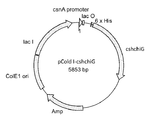
- FIG. 1 is a map diagram showing the structure of a CshchiG expression plasmid pCold I-cshchiG.
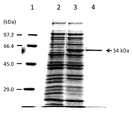
- FIG. 2 shows the result of analysis by SDS-polyacrylamide gel electrophoresis after purification of the enzyme CshchiG expressed in E. coli.
- lane 1 is a molecular weight marker
- lane 2 is E. coli BL21 (DE3) strain / pColdI-crude enzyme extract
- lane 3 is E. coli BL21 (DE3) strain / pColdI-cshchiG crude enzyme extract
- lane 4 is after purification.
- the results of the recombinant protein CshchiG are shown respectively.
- FIG. 1 is a molecular weight marker
- lane 2 is E. coli BL21 (DE3) strain / pColdI-crude enzyme extract
- lane 3 is E. coli BL21 (DE3) strain / pColdI-csh
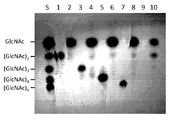
- S is a standard compound
- lane 1 is before (GlcNAc) 2 reaction
- lane 2 is after (GlcNAc) 2 reaction
- lane 3 is before (GlcNAc) 3 reaction
- lane 4 is after (GlcNAc) 3 reaction
- lane 5 Is (GlcNAc) 4 reaction
- lane 6 is after (GlcNAc) 4 reaction
- lane 7 is before (GlcNAc) 5 reaction
- lane 8 is after (GlcNAc) 5 reaction
- lane 9 is before colloidal chitin reaction
- lane 10 is colloidal The results after the chitin reaction are shown respectively.
- FIG. 4 shows the results of thin layer chromatography analysis of the time course of the product produced when the N-acetylglucosamine (GlcNAc) pentamer was decomposed using the purified enzyme CshchiG.
- S is a standard compound
- lane 1 is 1 minute after reaction
- lane 2 is 5 minutes after reaction
- lane 3 is 10 minutes after reaction
- lane 4 is 15 minutes after reaction
- lane 5 is 30 minutes after reaction
- lane 6 is lane 6 Shows the result after 60 minutes of reaction
- Lane 7 shows the result after 24 hours of reaction.
- FIG. 5 shows the NBRC biological genetic resource deposit certificate for the chitin-degrading bacterium Chitininiphilus shinanononensis SAY3 strain (NBRC104970, NCIMB14509, DSM23277).
- the present invention relates to a novel chitinolytic enzyme gene derived from a novel chitinolytic bacterium and a chitinolytic enzyme encoded by the gene.
- the chitinolytic enzyme may be simply referred to as chitinase.
- the present inventors previously encoded a protein having chitinolytic enzyme activity produced by a new species of chitin-degrading bacterium, Chitiniphilus shinanonensis SAY3 strain, which was isolated and identified from Uori Castle Uorimizu, Ueda City, Nagano Prefecture, Japan.
- chitin-degrading bacterium Chitiniphilus shinanonensis SAY3 strain
- a gene library of the Chitininiphilus shinanonensis SAY3 strain was constructed using the fosmid vector pCC1FOS.
- 10 clones were selected from 5,000 clones of the library using a selective medium to which a fluorescent substrate for chitinase was added.
- fosmid DNA was prepared from this selected clone, and the nucleic acid sequence was analyzed using the genome sequencer FLX system (Genome Sequnecer FLX system).
- the DNA having the lowest homology with the known chitinase gene was DNA consisting of the base sequence shown in SEQ ID NO: 1.
- This DNA was inserted into an expression vector and transformed into Escherichia coli, and the recombinant protein produced by the transformed Escherichia coli was purified and confirmed to exhibit chitinolytic activity.
- the gene encoding the amino acid sequence part essential for the chitinolytic enzyme active protein is a DNA comprising the nucleotide sequence represented by nucleotide numbers 1-146 in the nucleotide sequence represented by SEQ ID NO: 1. .
- This gene has a low base sequence homology compared to the endo-type chitinase genes reported so far, and is novel in its structure.
- the protein encoded by the gene has an action of degrading high molecular chitin into an endo form, and dimer diacetyl-N-chitobiose, which could not be degraded by a conventional endo chitinase, is also present. It exhibits very good enzymatic activity that decomposes to produce N-acetylglucosamine as the final product.
- N-acetylglucosamine can be produced from chitin in one step. Therefore, in the production of N-acetylglucosamine, Very useful.
- the enzyme of the present invention can be isolated and purified from the culture solution of Chitininiphilus shinanonensis SAY3 strain.
- the enzyme comprising the nucleotide sequence shown in SEQ ID NO: 1 or the sequence shown in SEQ ID NO: 1
- a chitinase-producing microorganism of the present invention By efficiently producing a DNA containing the nucleotide sequence represented by nucleotide numbers 1-146 in the nucleotide sequence by a transformed microorganism introduced into an appropriate microorganism (hereinafter referred to as a chitinase-producing microorganism of the present invention), Obtainable.
- the DNA containing the base sequence shown in SEQ ID NO: 1 can be a DNA containing the base sequence shown in SEQ ID NO: 3.
- the chitinolytic enzyme gene of the present invention is a nucleic acid (typically DNA) comprising the base sequence shown in SEQ ID NO: 1 or 3, and a sequence in which one or more bases of the sequence are deleted, substituted or added.
- Nucleic acids comprising a sequence encoding a protein shown and having chitinolytic enzyme activity.
- Such a base sequence is, for example, a base sequence obtained by deleting, substituting, or adding the base sequence represented by SEQ ID NO: 1 or 3 with 1 to 30, 1 to 50, 1 to 100, or 1 to 200 bases. It is.
- the nucleic acid which consists of a base sequence shown by sequence number 1 or 3 may be sufficient.
- the chitinolytic enzyme gene of the present invention has a nucleotide sequence represented by SEQ ID NO: 1 or 3 and 60% or more, 65% or more, 70% or more, 75% or more, 80% or more, 85% or more, 90% or more. , 95% or more, 98% or more, or 99% or more, and a nucleic acid (typically DNA) containing a sequence encoding a protein having chitinolytic enzyme activity. Also included are nucleic acid molecules that hybridize under stringent conditions with the nucleic acid molecule having the base sequence shown in SEQ ID NO: 1 or 3.
- stringent conditions as used herein is a parameter well known in the art, and stringent conditions in the present invention are, for example, 3.5 ⁇ SSC (0.15 M at 65 ° C.).
- Hybridization buffer consisting of sodium chloride / 0.15M sodium citrate, pH 7), Ficoll 0.02%, polyvinylpyrrolidone 0.02%, bovine serum albumin 0.02%, NaH2PO425 mM (pH 7), SDS 0.05%, EDTA 2 mM Refers to hybridization.
- the membrane to which the DNA has been transferred is washed with 2 ⁇ SSC at room temperature and then with 0.1 to 0.5 ⁇ SSC / 0.1 ⁇ SDS at a temperature up to 68 ° C.
- stringent hybridization may be performed using commercially available hybridization buffers under the hybridization and washing conditions described by the manufacturer.
- Such a gene-converting microorganism may be any microorganism that is used in the field of genetic engineering and has no pathogenicity, but non-pathogenic Escherichia coli that is widely used in the field of genetic engineering is preferred.
- DNA As the DNA used for transformation, in the base sequence shown in SEQ ID NO: 1, DNA consisting of the base sequence shown in base Nos. 1 to 1464, or 90% or more base sequence homology with the DNA It is possible to use DNA characterized in that it comprises a base sequence having an amino acid sequence and encodes a protein having chitinolytic enzyme activity.
- a nucleic acid typically DNA
- a nucleic acid containing the base sequence shown in SEQ ID NO: 3 may be used, preferably a nucleic acid containing the base sequence shown in SEQ ID NO: 3.
- a nucleic acid comprising the base sequence shown by SEQ ID NO: 1 or 3 or the base sequence shown by a sequence in which one or more bases of the sequence are deleted, substituted or added may be used.
- a nucleic acid typically DNA
- a nucleic acid molecule that hybridizes with a nucleic acid molecule having the base sequence represented by SEQ ID NO: 1 or 3 under stringent conditions may be used.
- the chitinolytic enzyme of the present invention has an endo-type chitinase activity, exhibits an action of decomposing high-molecular chitin into an endo-type, and has not been able to be decomposed by a conventional endo-type chitinase.
- N-chitobiose also exhibits an enzymatic activity capable of degrading, and exhibits extremely excellent activity characteristics to produce N-acetylglucosamine as a final product.
- the chitinolytic enzyme-active protein of the present invention is any of the amino acid sequence shown in SEQ ID NO: 2 or 4, or an amino acid sequence in which 1 to several amino acids are substituted, deleted, inserted or added in the amino acid sequence. It is a protein characterized by including these. Such an amino acid sequence is obtained by, for example, substituting, deleting, inserting or adding the amino acid sequence shown in SEQ ID NO: 2 or 4 with 1 to 3, 1 to 5, 1 to 10, or 1 to 20 amino acids. Amino acid sequence.
- the chitinolytic enzyme-active protein of the present invention can be obtained by culturing the chitinolytic enzyme-producing microorganism of the present invention in an appropriate culture solution, and separating and purifying it from the culture solution and the like by a usual method.
- the chitinolytic enzyme of the present invention has a protein comprising the amino acid sequence shown in SEQ ID NO: 2 or 4, and an amino acid sequence in which 1 to several amino acids are substituted, deleted, inserted or added in the amino acid sequence, And a protein having chitinolytic enzyme activity.
- the chitinolytic enzyme of the present invention comprises an amino sequence represented by SEQ ID NO: 2 or 4, 40% or more, 50% or more, 60% or more, 70% or more, 80% or more, 85% or more, 90% or more, It includes proteins having a homology of 95% or more, 98% or more, or 99% or more and having chitinolytic enzyme activity.
- the protein which consists of an amino acid sequence shown by sequence number 2 or 4 may be sufficient.
- the chitin degrading enzyme of the present invention has an action of degrading high molecular chitin into endo-type, and by using this enzyme, N-acetylglucosamine can be produced from chitin in one step. It is extremely useful in the production of acetylglucosamine.
- a purified enzyme When degrading chitin into oligosaccharides of an appropriate size using the chitin degrading enzyme of the present invention, or when producing N-acetylglucosamine, a purified enzyme may be used. It can also be used as a product. Examples of such a composition include a composition containing the above-described chitinolytic enzyme-producing microorganism of the present invention or a culture solution thereof, or a culture solution of the above-described chitinolytic enzyme-producing microorganism of the present invention or a roughly purified solution thereof. be able to.
- N-acetylglucosamine can be used as a sweetener and is also known to have a cartilage replenishing effect, and is used in supplements for the purpose of joint health of the elderly. Furthermore, since it is converted into hyaluronic acid in the body, it is also attracting attention as an effect of keeping the skin moist.
- the chitinolytic enzyme-active protein of the present invention can be used in one step without combining N-acetylglucosamine, which is useful as an active ingredient of functional health foods or pharmaceutical compositions, without combining multiple enzymes as in the past. It can be manufactured very simply.
- a fosmid library production kit (CopyControl (registered trademark) Fosmid Library Production Kit (EPICENTRE BIOTECHNOLOGY)) was used to prepare a genomic library using the fosmid vector pCC1FOS.
- the E. coli EPI300 clone constituting the genomic library of SAY3 strain was selected from the synthetic substrate 4-methylumbelliferyl (4-metylumbelliferyl (4MU))-GlcNAc (1 mM) or 4MU- (GlcNAc) 3 (1 mM) -containing M9 synthesis medium (containing 36 ⁇ g / ml chloramphenicol) was applied and cultured overnight at 37 degrees Celsius. Since clones exhibiting chitinase activity release 4 MU, clones exhibiting chitinase activity that emits blue fluorescence around colonies under UV irradiation were selected using this as an index.
- 4-methylumbelliferyl (4-metylumbelliferyl (4MU))-GlcNAc (1 mM) or 4MU- (GlcNAc) 3 (1 mM) -containing M9 synthesis medium containing 36 ⁇ g / ml chloramphenicol
- cshchiG chitinase gene
- chitinase chitinase (cshchiG) gene structure
- the protein coding region of the cshchiG gene is composed of 1,464 bases and consists of 487 amino acid residues. It was confirmed that it encodes a polypeptide having a molecular weight of 51.4 kDa.
- a chitin binding domain appeared twice from the N-terminal side, and a sequence similar to the active domain of family 18 chitinase appeared. The sequence similarity of the active domain was as low as 38% for the most similar Streptomyces sp. ACTE chitinase in the database.
- a gene fragment encoding a protein-corresponding portion was PCR-amplified using the genomic DNA of Chitininiphilus shinanonensis SAY3 strain as a template.
- the oligonucleotide sequences designed for use as PCR primers are as follows: A recognition sequence of restriction enzyme Bam HI was added to the sense primer (SEQ ID NO: 5), and a Hind III recognition sequence was added to the 5 ′ end side of the antisense primer (SEQ ID NO: 6) (underlined portion).
- each primer is the base sequence represented by base numbers 1 to 18 in the base sequence represented by SEQ ID NO: 1 in the sense primer, and the base sequence represented by base numbers 1447 to 1464 in the antisense primer. .
- Antisense primer 5 ' -GC AAGCTT TCAGAACTCGCCGAAGAT -3 ' According to a conventional method, the obtained PCR-amplified DNA fragment was double-digested with Bam HI and Hind III and ligated with the expression vector pCold I (Takara Bio) double-digested with the same enzymes, and the expression plasmid pCold I-cshchiG was created (Fig. 1). It was confirmed by nucleotide sequence sequencing that the cshchiG gene fragment was inserted into the expression vector as designed in the correct reading frame.
- IPTG isopropyl-1-thio-beta-D-galactopyranoside
- the recombinant protein contained in the soluble fraction was purified with an affinity column (His GlaviTrap (registered trademark) affinity columns (GE Healthcare)) using a 6xHis tag fused to the N-terminal side.
- the gel after SDS-polyacrylamide gel electrophoresis was stained with Coomassie Brilliant Blue (CBB) to confirm that the recombinant protein was purified (FIG. 2).
- CBB Coomassie Brilliant Blue
- the molecular weight estimated from the migration distance of the band in the gel was about 54 kDa, which was in good agreement with the expected molecular weight of the recombinant protein of 54.3 kDa. This protein was named CshchiG.
- Chitinolytic enzyme activity of the recombinant enzyme CshchiG By measuring the amount of reducing sugar newly produced by the degradation of the polymeric substrate chitin during the reaction by the Schales method. evaluated.
- the reaction solution (2 ml) is composed of 0.25% colloidal chitin, 50 mM sodium acetate buffer (pH 5.6) and an appropriate amount of enzyme, and incubated at 37 degrees Celsius for 30 minutes to proceed the reaction, 100 degrees Celsius, The enzyme reaction was stopped by heat treatment for 3 minutes.
- 2.7 ml of Schales reagent 0.5 g of potassium ferricyanide dissolved in 1 liter of 0.5 M sodium carbonate solution
- the absorbance (OD 420) of the supernatant portion from which the substrate precipitate was removed by centrifugation (4,000 rpm, 20 minutes) was measured, and the amount of reducing sugar was measured.
- Activity (1 U) was defined as the amount of enzyme that produces a reducing sugar amount corresponding to 1 ⁇ 10 ⁇ 6 mol of N-acetylglucosamine (GlcNAc) per minute.
- the recombinant enzyme CshchiG clearly showed colloidal chitinolytic activity, and the activity per protein amount was 0.21 U / mg-protein.
- N-acetylglucosamine (GlcNAc) dimer to pentamer or colloidal chitin was used as a substrate.
- the reaction solution 50 ⁇ 10 ⁇ 6 l
- the reaction solution consists of 25 mM acetate buffer (pH 5.6), 10 mM GlcNAc oligosaccharide (or 0.025% colloidal chitin) and an appropriate amount of enzyme, and is reacted overnight at 37 degrees Celsius. After that, the reaction was stopped by heat treatment at 100 degrees Celsius for 5 minutes.
- the above reaction solution using GlcNAc pentamer as a substrate was prepared, the reaction was stopped over time, and the product was analyzed by TLC (FIG. 4).
- the pentamer is first decomposed into a dimer and a trimer at the beginning of the reaction, then the trimer is decomposed into a dimer and a monomer, and the resulting dimer is further decomposed into a monomer. And finally all decomposed into monomers. Since the dimer and trimer were formed without the occurrence of GlcNAc monomer at the initial stage of the reaction, it was confirmed that the enzyme CshchiG clearly shows endo-type degradation activity.
- Point mutations were introduced using the CshchiG expression plasmid pCold I-cshchiG DNA as a template and QuikChange Lightning Site-Directed Mutagenesis Kit (Agilent Tachnologies). After production, the base sequence of the cshchiG gene region was decoded to confirm that the designed mutation was correctly introduced. The expression and purification of the mutant cshchiG enzyme were performed in the same manner as the wild type cshchiG.
- the degradation activity for soluble chitosan was determined by quantifying the amount of reducing sugar newly generated by the reaction and representing the amount of reducing sugar equivalent of N-acetylglucosamine.
- the degradation activity for the synthetic substrate p-nitrophenyl (pNP) -GlcNAc dimer and trimer was expressed as the amount of p-nitrophenol released.
- the relative activity when the activity of the wild-type enzyme for each substrate is taken as 100% is shown in parentheses.
- the chitin-degrading enzyme-active protein of the present invention exhibits endo-type chitinase activity that degrades high-molecular chitin into endo-type, and dimer-diacetyl-N-chitobiose that could not be degraded by conventional endo-type chitinase is also present. It has an enzymatic activity that can be decomposed, and exhibits extremely excellent activity characteristics that produce N-acetylglucosamine as a final product, and is extremely useful in a method for decomposing chitin or a method for producing N-acetylglucosamine.
Landscapes
- Chemical & Material Sciences (AREA)
- Organic Chemistry (AREA)
- Life Sciences & Earth Sciences (AREA)
- Health & Medical Sciences (AREA)
- Engineering & Computer Science (AREA)
- Zoology (AREA)
- Wood Science & Technology (AREA)
- Genetics & Genomics (AREA)
- Bioinformatics & Cheminformatics (AREA)
- General Health & Medical Sciences (AREA)
- Biochemistry (AREA)
- General Engineering & Computer Science (AREA)
- Microbiology (AREA)
- Biotechnology (AREA)
- Molecular Biology (AREA)
- General Chemical & Material Sciences (AREA)
- Chemical Kinetics & Catalysis (AREA)
- Medicinal Chemistry (AREA)
- Biomedical Technology (AREA)
- Enzymes And Modification Thereof (AREA)
- Preparation Of Compounds By Using Micro-Organisms (AREA)
Abstract
キチン分解酵素活性タンパク質発現遺伝子および該遺伝子によりコードされるキチン分解酵素活性タンパク質、並びに該キチン分解酵素活性タンパク質を用いるキチンの分解方法およびN-アセチルグルコサミンの製造方法を提供する。配列番号1に示された塩基配列において、塩基番号1~1464に示される塩基配列からなるDNAまたは該DNAと90%以上の塩基配列相同性を有する塩基配列からなり、キチン分解酵素活性を有するタンパク質をコードするものであることを特徴とするDNA、配列番号2に示されたアミノ酸配列または該アミノ酸配列において、1~数個のアミノ酸が置換、欠失、挿入もしくは付加したアミノ酸配列のいずれかを含み、キチン分解酵素活性を有することを特徴とするタンパク質および、該タンパク質を用いるキチンの分解方法およびN-アセチルグルコサミンの製造方法に関する。
Description
本発明は新規なキチン分解酵素遺伝子およびその遺伝子によりコードされるキチン分解酵素に関するものである。より詳細には、エンド型キチナーゼのようにキチンをランダムに加水分解する活性を有し、しかも、これまで知られているエンド型キチナーゼでは2量体のジアセチル-N-キトビオースで停止していた分解反応を、単量体のN-アセチルグルコサミンまで分解することができる活性を有するキチン分解酵素遺伝子およびその遺伝子によりコードされるキチン分解酵素に関するものである。
また本発明は、該キチン分解酵素を用いるキチンの分解方法およびN-アセチルグルコサミンの製造方法に関するものである。
キチンはカニ、エビなどの甲殻類の殻などに含まれる多糖であり、自然界においてセルロースに次ぐ豊富なバイオマスである。
このキチンは多糖の状態で、医薬品、農薬、食品、化粧品などの素材として、様々な産業で利用されている。さらに、キチンを加水分解して得られるN-アセチルグルコサミンおよびそのオリゴ糖も、免疫賦活作用、エリシター作用など種々の生理活性を示し、同様に、医薬品、食品、化粧品などの有効成分として利用されている。
このキチンは多糖の状態で、医薬品、農薬、食品、化粧品などの素材として、様々な産業で利用されている。さらに、キチンを加水分解して得られるN-アセチルグルコサミンおよびそのオリゴ糖も、免疫賦活作用、エリシター作用など種々の生理活性を示し、同様に、医薬品、食品、化粧品などの有効成分として利用されている。
キチンの加水分解は、一般的に、強酸を用いた化学分解法が用いられているが、この方法は、多量の廃液を生じ環境に対する負荷が大きいことから、この問題を解決する方法として、キチン分解酵素を用いる方法が検討されている。
これまでにも、種々のキチン分解酵素産生微生物が見出されており、それらの微生物あるいはその培養液や単離された酵素などを用いたキチン分解方法が提案されている。(特許文献1~5)
これまでにも、種々のキチン分解酵素産生微生物が見出されており、それらの微生物あるいはその培養液や単離された酵素などを用いたキチン分解方法が提案されている。(特許文献1~5)
Kazuaki Sato et al.; J. Gen. Appl. Microbiol., 55, 147~153 (2009)
Kazuaki Sato et al.; Biosci. Biotechnol. Biochem., 74(3), 90856-1~5 (2010)
International Journal of Systematic and Evolutionary Microbiology,59,2129-2130 (2009)
しかしながら、これまでに知られているキチン分解酵素は、概して反応性が低く、また、高分子のキチンを単糖のN-アセチルグルコサミンに分解するには、少なくとも2種類の酵素を用いて、2段階で分解する必要があった。
このため、分解能が強く、かつ、高分子のキチンから1段階でN-アセチルグルコサミンに分解できるような、分解特性に優れた酵素の開発が望まれていた。
このため、分解能が強く、かつ、高分子のキチンから1段階でN-アセチルグルコサミンに分解できるような、分解特性に優れた酵素の開発が望まれていた。
キチン分解酵素については、エンド型のキチナーゼとエキソ型のN-アセチルグルコサミニダーゼの2種類があることが知られている。前者はキチンをランダムに分解し、最終生産物はN-アセチルグルコサミンの2糖(ジアセチル-N-キトビオース)である。後者は、非還元末端より順次N-アセチルグルコサミンを切り出す反応を触媒するが、基質は低分子のオリゴ糖に限られ高分子キチンに対しては作用しない。
したがって、キチンからN-アセチルグルコサミンを製造するためには、少なくともこの2種類の酵素を用いる必要があり、しかも複雑な酵素反応系となるため反応の制御が難しいという問題点があった。
したがって、キチンからN-アセチルグルコサミンを製造するためには、少なくともこの2種類の酵素を用いる必要があり、しかも複雑な酵素反応系となるため反応の制御が難しいという問題点があった。
本発明者らは、先に、長野県上田市の上田城の堀水より、強力なキチン分解能を有する新属新種のキチン分解細菌キチニフィラス・シナノネンシス(Chitiniphilus shinanonensis)SAY3株(NBRC104970、NCIMB14509、DSM23277)を分離同定し、報告した。(非特許文献1~3)
本発明者らは、本菌株が有するキチン分解酵素遺伝子の解析を鋭意行った。その結果、これまでに報告されているキチン分解酵素遺伝子とは塩基配列の相同性が低い遺伝子を見出すことができた。
さらに、該遺伝子によりコードされるタンパク質は、従来報告されているキチン分解酵素と異なる特性を有する新規な酵素であることを確認した。
すなわち、本発明のキチン分解酵素は、従来のエンド型キチナーゼと同様に、高分子キチンに作用してランダムに分解する活性を示す一方、従来のエンド型キチナーゼでは分解できなかった、N-アセチルグルコサミンの2糖(ジアセチル-N-キトビオース)をも分解できるという優れた特性を有している。
さらに、該遺伝子によりコードされるタンパク質は、従来報告されているキチン分解酵素と異なる特性を有する新規な酵素であることを確認した。
すなわち、本発明のキチン分解酵素は、従来のエンド型キチナーゼと同様に、高分子キチンに作用してランダムに分解する活性を示す一方、従来のエンド型キチナーゼでは分解できなかった、N-アセチルグルコサミンの2糖(ジアセチル-N-キトビオース)をも分解できるという優れた特性を有している。
本発明の目的は、新規なキチン分解酵素をコードする遺伝子およびその遺伝子によりコードされるキチン分解酵素を提供することである。
より詳細には、従来のキチン分解酵素では分解できなかった、1段階で高分子のキチンから単糖体のN-アセチルグルコサミンまで分解することができる、優れた分解特性を有する、新規なキチン分解酵素をコードする遺伝子、その遺伝子によりコードされるキチン分解酵素、並びに、該キチン分解酵素を用いたキチン分解方法およびN-アセチルグルコサミンの製造方法を提供することである。
より詳細には、従来のキチン分解酵素では分解できなかった、1段階で高分子のキチンから単糖体のN-アセチルグルコサミンまで分解することができる、優れた分解特性を有する、新規なキチン分解酵素をコードする遺伝子、その遺伝子によりコードされるキチン分解酵素、並びに、該キチン分解酵素を用いたキチン分解方法およびN-アセチルグルコサミンの製造方法を提供することである。
本発明者らは、上記課題を解決すべく鋭意研究を重ねる中、先に長野県上田市の上田城の堀水より分離同定した、新種のキチン分解細菌キチニフィラス・シナノネンシス(Chitiniphilus shinanonensis)SAY3株の遺伝子解析を行い、新規なキチン分解酵素遺伝子を単離し、そのDNAの塩基配列を同定することに成功した。さらに、該遺伝子により発現されるキチン分解酵素が、極めて優れたキチン分解能を示すことを確認し、さらに研究を進めた結果、本発明を完成するに至った。
より詳細には、本発明は、
[1] 配列番号1に示された塩基配列において、塩基番号1~1464に示される塩基配列またはその配列の1もしくは複数の塩基が欠失、置換もしくは付加された配列で示されるDNA配列を含む、キチン分解酵素をコードするDNA、および
[2] 配列番号3に示された塩基配列において、塩基番号1~1527に示される塩基配列またはその配列の1もしくは複数の塩基が欠失、置換もしくは付加された配列で示されるDNA配列を含む、キチン分解酵素をコードするDNA、および
[3] キチニフィラス・シナノネンシス(Chitiniphilus shinanonensis)SAY3株由来のDNAであることを特徴とする、[1]または[2]に記載のDNA、
に関する。
[1] 配列番号1に示された塩基配列において、塩基番号1~1464に示される塩基配列またはその配列の1もしくは複数の塩基が欠失、置換もしくは付加された配列で示されるDNA配列を含む、キチン分解酵素をコードするDNA、および
[2] 配列番号3に示された塩基配列において、塩基番号1~1527に示される塩基配列またはその配列の1もしくは複数の塩基が欠失、置換もしくは付加された配列で示されるDNA配列を含む、キチン分解酵素をコードするDNA、および
[3] キチニフィラス・シナノネンシス(Chitiniphilus shinanonensis)SAY3株由来のDNAであることを特徴とする、[1]または[2]に記載のDNA、
に関する。
また、本発明は、
[4] 配列番号2または4に示されたアミノ酸配列または該アミノ酸配列において、1~数個のアミノ酸が置換、欠失、挿入もしくは付加したアミノ酸配列のいずれかを含むことを特徴とする、キチン分解酵素、
[5] [1]または[2]に記載の DNAによってコードされるアミノ酸配列または該アミノ酸配列において、1~数個のアミノ酸が置換、欠失、挿入もしくは付加したアミノ酸配列のいずれかを含むことを特徴とする、[4]に記載のキチン分解酵素、および、
[6] [1] または[2]に記載のDNAを導入した形質転換微生物またはキチニフィラス・シナノネンシス(Chitiniphilus shinanonensis)SAY3株から産生されるものであることを特徴とする、[5]に記載のキチン分解酵素、
に関する。
[4] 配列番号2または4に示されたアミノ酸配列または該アミノ酸配列において、1~数個のアミノ酸が置換、欠失、挿入もしくは付加したアミノ酸配列のいずれかを含むことを特徴とする、キチン分解酵素、
[5] [1]または[2]に記載の DNAによってコードされるアミノ酸配列または該アミノ酸配列において、1~数個のアミノ酸が置換、欠失、挿入もしくは付加したアミノ酸配列のいずれかを含むことを特徴とする、[4]に記載のキチン分解酵素、および、
[6] [1] または[2]に記載のDNAを導入した形質転換微生物またはキチニフィラス・シナノネンシス(Chitiniphilus shinanonensis)SAY3株から産生されるものであることを特徴とする、[5]に記載のキチン分解酵素、
に関する。
また、本発明は、
[7] [4]~[6]のいずれか一項に記載のキチン分解酵素を活性成分として含有することを特徴とする、キチン分解剤、
[8] [6]に記載のキチン分解酵素を産生する微生物またはその培養液を含むものであることを特徴とする、[7]に記載のキチンの分解剤、および、
[9] キチニフィラス・シナノネンシス(Chitiniphilus shinanonensis)SAY3株または、[1]に記載のDNAを導入した形質転換微生物またはその培養液を含むものであることを特徴とする、[8]に記載のキチンの分解剤、
に関する。
[7] [4]~[6]のいずれか一項に記載のキチン分解酵素を活性成分として含有することを特徴とする、キチン分解剤、
[8] [6]に記載のキチン分解酵素を産生する微生物またはその培養液を含むものであることを特徴とする、[7]に記載のキチンの分解剤、および、
[9] キチニフィラス・シナノネンシス(Chitiniphilus shinanonensis)SAY3株または、[1]に記載のDNAを導入した形質転換微生物またはその培養液を含むものであることを特徴とする、[8]に記載のキチンの分解剤、
に関する。
また、本発明は、
[10] [7]~[9]のいずれか一項に記載のキチン分解剤を用いることを特徴とする、キチンの分解方法、および、
[11] [7]~[9]のいずれか一項に記載のキチン分解剤を用いることを特徴とする、N-アセチルグルコサミンの製造方法、
に関する。
[10] [7]~[9]のいずれか一項に記載のキチン分解剤を用いることを特徴とする、キチンの分解方法、および、
[11] [7]~[9]のいずれか一項に記載のキチン分解剤を用いることを特徴とする、N-アセチルグルコサミンの製造方法、
に関する。
さらに、本発明は、
[12] [1]に記載のDNAを含む形質転換用プラスミド、および、
[13] プラスミドpCold I-cshchiGであることを特徴とする、[12]記載のプラスミド、
に関する。
[12] [1]に記載のDNAを含む形質転換用プラスミド、および、
[13] プラスミドpCold I-cshchiGであることを特徴とする、[12]記載のプラスミド、
に関する。
本発明の遺伝子によりコードされるタンパク質は、高分子キチンをエンド型に分解する作用を有しており、しかも、従来のエンド型キチナーゼでは分解できなかった2量体のジアセチル-N-キトビオースも分解し、最終産物としてN-アセチルグルコサミンを生じさせる。よって、本発明の遺伝子によりコードされるタンパク質は、高分子のキチンから、複雑な工程や操作を要する事なく、1段階で単糖体のN-アセチルグルコサミンまで分解することができ、効率的なN-アセチルグルコサミンの製造方法に極めて有用である。
また、N-アセチルグルコサミンは、加水分解することにより、容易にグルコサミンを製造することができることから、本発明のキチン分解酵素は、グルコサミンの効率的な製造方法としても極めて有用である。
また、N-アセチルグルコサミンは、加水分解することにより、容易にグルコサミンを製造することができることから、本発明のキチン分解酵素は、グルコサミンの効率的な製造方法としても極めて有用である。
本発明は、新規なキチン分解細菌由来の、新規なキチン分解酵素遺伝子およびその遺伝子によりコードされるキチン分解酵素に関する。
なお、本発明においては、該キチン分解酵素を単にキチナーゼと称することもある。
なお、本発明においては、該キチン分解酵素を単にキチナーゼと称することもある。
本発明者らは、先に、長野県上田市の上田城の堀水より分離同定した、新種のキチン分解細菌キチニフィラス・シナノネンシス(Chitiniphilus shinanonensis)SAY3株が産生するキチン分解酵素活性を有するタンパク質をコードする遺伝子の解析に鋭意努力し、該キチン分解酵素遺伝子を単離し、そのDNAの塩基配列を同定することができた。
すなわち、まず、フォスミドベクターpCC1FOSを用いて、該キチニフィラス・シナノネンシス(Chitiniphilus shinanonensis)SAY3株の遺伝子ライブラリーを構築した。
次いで、キチナーゼに対する蛍光基質を添加した選択培地を用いて、ライブラリーの5,000クローンの中から、10クローンを選択した。
さらに、この選択クローンからフォスミドDNAを調製し、ゲノム・シーケンサーFLXシステム(Genome Sequnecer FLX system)を用いて核酸配列を解析した。
次いで、キチナーゼに対する蛍光基質を添加した選択培地を用いて、ライブラリーの5,000クローンの中から、10クローンを選択した。
さらに、この選択クローンからフォスミドDNAを調製し、ゲノム・シーケンサーFLXシステム(Genome Sequnecer FLX system)を用いて核酸配列を解析した。
その解析において、既知のキチナーゼ酵素の遺伝子と相同性を示す15種の遺伝子を見出した。そのうち、ファミリー18のエンド型キチナーゼに相同性を示すものが12種、ファミリー19のエンド型キチナーゼが1種、ファミリー20のエキソ型キチナーゼが1種、キチン結合ドメインを含むものの酵素活性ドメインが欠失したものが1種であることを確認した。
そして、13種のエンド型キチナーゼの中で既知のキチナーゼ遺伝子との相同性が最も低いものが、配列番号1に示された塩基配列からなるDNAであった。このDNAを発現ベクターに挿入して大腸菌に形質転換し、この形質転換大腸菌が産生する組換えタンパク質を精製し、キチン分解活性を示すことを確認した。さらに、該キチン分解酵素活性タンパク質に必須なアミノ酸配列部分をコードする遺伝子が、配列番号1に示された塩基配列において、塩基番号1~1464に示される塩基配列からなるDNAであることを見出した。
本遺伝子は、これまでに報告されているエンド型キチナーゼ遺伝子と比較しても塩基配列の相同性が低く、その構造において新規なものである。
また、該遺伝子によりコードされるタンパク質は、高分子キチンをエンド型に分解する作用を有しており、しかも、従来のエンド型キチナーゼでは分解できなかった、2量体のジアセチル-N-キトビオースも分解し、最終産物としてN-アセチルグルコサミンを生じさせる、極めて優れた酵素活性を示す。
また、該遺伝子によりコードされるタンパク質は、高分子キチンをエンド型に分解する作用を有しており、しかも、従来のエンド型キチナーゼでは分解できなかった、2量体のジアセチル-N-キトビオースも分解し、最終産物としてN-アセチルグルコサミンを生じさせる、極めて優れた酵素活性を示す。
このような反応性を示す酵素はこれまで全く報告されておらず、本酵素を用いることにより、キチンから1段階でN-アセチルグルコサミンを製造することができることから、N-アセチルグルコサミンの製造において、極めて有用である。
本発明の酵素は、キチニフィラス・シナノネンシス(Chitiniphilus shinanonensis)SAY3株の培養液から単離精製することもできるが、配列番号1に示された塩基配列を含むDNA、または、配列番号1に示された塩基配列において、塩基番号1~1464に示される塩基配列を含むDNAを、適当な微生物に導入した形質転換微生物(以下、本発明のキチン分解酵素産生微生物という)に産生させることにより、効率的に得ることができる。また、配列番号1に示される塩基配列を含むDNAは、配列番号3に示される塩基配列を含むDNAとすることができる。
本発明のキチン分解酵素遺伝子は、配列番号1または3に示される塩基配列を含む核酸(典型的にはDNA)、および該配列の1もしくは複数の塩基が欠失、置換もしくは付加された配列で示され、かつキチン分解酵素活性を有するタンパク質をコードする配列を含む核酸を包含する。かかる塩基配列は、例えば、配列番号1または3に示される塩基配列を、1~30個、1~50個、1~100個または1~200個の塩基で欠失、置換もしくは付加した塩基配列である。
また、配列番号1または3に示される塩基配列からなる核酸であってもよい。
また、配列番号1または3に示される塩基配列からなる核酸であってもよい。
また、本発明のキチン分解酵素遺伝子は、配列番号1または3で示される塩基配列と、60%以上、65%以上、70%以上、75%以上、80%以上、85%以上、90%以上、95%以上、98%以上、または99%以上の相同性を有し、かつキチン分解酵素活性を有するタンパク質をコードする配列を含む核酸(典型的にはDNA)であってもよい。また、配列番号1または3で示される塩基配列を有する核酸分子とストリンジェントな条件でハイブリダイズする核酸分子も含まれる。
本明細書で用いる「ストリンジェントな条件」という用語は、当該技術分野において周知のパラメータであり、本発明におけるストリンジェントな条件は、例えば、65℃での、3.5×SSC(0.15M塩化ナトリウム/0.15Mクエン酸ナトリウム、pH7)、フィコール0.02%、ポリビニルピロリドン0.02%、ウシ血清アルブミン0.02%、NaH2PO425mM(pH7)、SDS0.05%、EDTA2mMからなるハイブリダイゼーションバッファーによるハイブリダイゼーションを指す。ハイブリダイゼーション後、DNAが移された膜は、2×SSCにて室温において、次いで0.1~0.5×SSC/0.1×SDSにて68℃までの温度において洗浄する。
あるいは、ストリンジェントなハイブリダイゼーションは、市販のハイブリダイゼーションバッファーを用いて、製造者によって記載されたハイブリダイゼーションおよび洗浄条件で行ってもよい。
あるいは、ストリンジェントなハイブリダイゼーションは、市販のハイブリダイゼーションバッファーを用いて、製造者によって記載されたハイブリダイゼーションおよび洗浄条件で行ってもよい。
このような遺伝子転換微生物としては、遺伝子工学分野で用いられる微生物で、病原性のない微生物であればどのようなものでもよいが、遺伝子工学分野で汎用されている病原性のない大腸菌が好ましい。
また、形質転換に用いるDNAとしては、上記、配列番号1に示された塩基配列において、塩基番号1~1464に示される塩基配列からなるDNAまたは、該DNAと90%以上の塩基配列相同性を有する塩基配列からなり、キチン分解酵素活性を有するタンパク質をコードするものであることを特徴とするDNAを用いることができる。
形質転換には、配列番号1に示される塩基配列を含む核酸(典型的にはDNA)を用いてもよく、好ましくは配列番号3に示される塩基配列を含む核酸である。また、配列番号1または3に示される塩基配列、または該配列の1もしくは複数の塩基が欠失、置換もしくは付加された配列で示される塩基配列を含む核酸を用いてもよい。
また、配列番号1または3で示される塩基配列と、60%以上、65%以上、70%以上、75%以上、80%以上、85%以上、90%以上、95%以上、98%以上、または99%以上の相同性を有し、かつキチン分解酵素活性を有するタンパク質をコードする配列を含む核酸(典型的にはDNA)を用いてもよい。また、配列番号1または3で示される塩基配列を有する核酸分子とストリンジェントな条件でハイブリダイズする核酸分子を用いてもよい。
本発明のキチン分解酵素は、エンド型キチナーゼ活性を有しており、高分子キチンをエンド型に分解する作用を示し、しかも、従来のエンド型キチナーゼでは分解できなかった、2量体のジアセチル-N-キトビオースも分解できる酵素活性を示し、最終産物としてN-アセチルグルコサミンを生じさせる、極めて優れた活性特性を示すものである。
また、本発明のキチン分解酵素活性タンパク質は、配列番号2または4に示されたアミノ酸配列、または該アミノ酸配列において、1~数個のアミノ酸が置換、欠失、挿入もしくは付加したアミノ酸配列のいずれかを含むことを特徴とするタンパク質である。かかるアミノ酸配列は、例えば、配列番号2または4に示されるアミノ酸配列を、1~3個、1~5個、1~10個または1~20個のアミノ酸で置換、欠失、挿入もしくは付加したアミノ酸配列である。
本発明のキチン分解酵素活性タンパク質は、本発明のキチン分解酵素産生微生物を、適当な培養液中で培養し、その培養液等から通常の方法により分離、精製することにより得ることができる。
本発明のキチン分解酵素活性タンパク質は、本発明のキチン分解酵素産生微生物を、適当な培養液中で培養し、その培養液等から通常の方法により分離、精製することにより得ることができる。
本発明のキチン分解酵素は、配列番号2または4に示されるアミノ酸配列を含むタンパク質、および該アミノ酸配列において、1~数個のアミノ酸が置換、欠失、挿入もしくは付加したアミノ酸配列を有し、かつキチン分解酵素活性を有するタンパク質を包含する。また、本発明のキチン分解酵素は、配列番号2または4で示されるアミノ配列と、40%以上、50%以上、60%以上、70%以上、80%以上、85%以上、90%以上、95%以上、98%以上、または99%以上の相同性を有し、かつキチン分解酵素活性を有するタンパク質を包含する。
また、配列番号2または4に示されるアミノ酸配列からなるタンパク質であってもよい。
また、配列番号2または4に示されるアミノ酸配列からなるタンパク質であってもよい。
本発明のキチン分解酵素は、高分子キチンをエンド型に分解する作用を有しており、本酵素を用いることにより、キチンから1段階でN-アセチルグルコサミンを製造することができることから、N-アセチルグルコサミンの製造において、極めて有用なものである。
本発明のキチン分解酵素を用いて、キチンを適当な大きさのオリゴ糖に分解する場合、あるいは、N-アセチルグルコサミンを製造する場合、精製した酵素を用いてもよいが、酵素を含有する組成物として用いることもできる。
そのような組成物としては、例えば、上記本発明のキチン分解酵素産生微生物もしくはその培養液を含む組成物、または、上記本発明のキチン分解酵素産生微生物の培養液もしくはその粗精製液などを挙げることができる。
そのような組成物としては、例えば、上記本発明のキチン分解酵素産生微生物もしくはその培養液を含む組成物、または、上記本発明のキチン分解酵素産生微生物の培養液もしくはその粗精製液などを挙げることができる。
N-アセチルグルコサミンは、甘味料としても利用可能であり、また、軟骨補充効果を示すことも知られており、老齢者の関節の健康を目的としたサプリメントなどに使用されている。さらに、体内でヒアルロン酸に変換されることから、肌のうるおいを保つ成分としての効果にも注目されている。
本発明のキチン分解酵素活性タンパク質は、このように機能性健康食品あるいは医薬品組成物の有効成分として有用なN-アセチルグルコサミンを、これまでのように、複数の酵素を組み合わせることなく、一段階で、極めて簡便に、製造することができる。
本発明のキチン分解酵素活性タンパク質は、このように機能性健康食品あるいは医薬品組成物の有効成分として有用なN-アセチルグルコサミンを、これまでのように、複数の酵素を組み合わせることなく、一段階で、極めて簡便に、製造することができる。
以下に、本発明の実施の態様について実施例および試験例を挙げて説明するが、本発明は以下の例に限定されるものではない。
キチナーゼ遺伝子(cshchiG)の単離
(1)キチニフィラス・シナノネンシス(Chitiniphilus shinanonensis)SAY3株ゲノムライブラリーの構築
キチニフィラス・シナノネンシス(Chitiniphilus shinanonensis)SAY3株菌体よりDNA分離キット(Nexttec(登録商標) Genomic DNA Isolation kit for Bacteria (Nexttec) )を用いてゲノムDNAを調製した。
ゲノムDNA溶液に対して、超音波破砕機 (Sonics & Materials社、Vibra cell(登録商標)) を用いてDNAの平均サイズを40kbp程度まで断片化した。
この断片化したDNAより、フォスミド(fosmid)ベクターpCC1FOS を用いてフォスミド・ライブラリー作成キット(CopyControl(登録商標)Fosmid Library Production Kit (EPICENTRE BIOTECHNOLOGY) )を用いてゲノムライブラリーを作成した。
(1)キチニフィラス・シナノネンシス(Chitiniphilus shinanonensis)SAY3株ゲノムライブラリーの構築
キチニフィラス・シナノネンシス(Chitiniphilus shinanonensis)SAY3株菌体よりDNA分離キット(Nexttec(登録商標) Genomic DNA Isolation kit for Bacteria (Nexttec) )を用いてゲノムDNAを調製した。
ゲノムDNA溶液に対して、超音波破砕機 (Sonics & Materials社、Vibra cell(登録商標)) を用いてDNAの平均サイズを40kbp程度まで断片化した。
この断片化したDNAより、フォスミド(fosmid)ベクターpCC1FOS を用いてフォスミド・ライブラリー作成キット(CopyControl(登録商標)Fosmid Library Production Kit (EPICENTRE BIOTECHNOLOGY) )を用いてゲノムライブラリーを作成した。
(2)キチン分解酵素活性を示すクローンの選抜
SAY3株のゲノムライブラリーを構成する大腸菌EPI300株クローンをキチン分解酵素活性検出用合成基質4-メチルウンベリフェリル(4-metylumbelliferyl (4MU))- GlcNAc (1 mM) または4MU-(GlcNAc)3(1mM)を含有したM9合成培地(36μg/mlクロラムフェニコール含有)に塗布し、摂氏37度で一晩培養した。
キチン分解酵素活性を示すクローンは4MUを遊離することからこれを指標として、UV照射下でコロニー周辺に青色の蛍光を発するキチン分解酵素活性を示すクローンを選抜した。
SAY3株のゲノムライブラリーを構成する大腸菌EPI300株クローンをキチン分解酵素活性検出用合成基質4-メチルウンベリフェリル(4-metylumbelliferyl (4MU))- GlcNAc (1 mM) または4MU-(GlcNAc)3(1mM)を含有したM9合成培地(36μg/mlクロラムフェニコール含有)に塗布し、摂氏37度で一晩培養した。
キチン分解酵素活性を示すクローンは4MUを遊離することからこれを指標として、UV照射下でコロニー周辺に青色の蛍光を発するキチン分解酵素活性を示すクローンを選抜した。
(3)選抜クローンの塩基配列解読
シーケンス用テンプレートのフォスミドDNA(fosmid DNA)の調製は、キアゲン・ラージコンストラクトキット(QIAGEN Large-Construct Kit (QIAGEN) )を用いて行った。
キチナーゼ活性を示した10個のクローンから調製した組換えフォスミドDNA(fosmid DNA)をそれぞれ4 ×10⁻⁶ gずつ混合し、タカラバイオ株式会社による受託サービス(BAC / Fosmidなどの多クローン配列解析) に供した。
用いたシーケンサーは、ゲノム・シーケンス FLX(Genome Sequence FLX (ロシュダイアグノスティクス) )である。
シーケンス用テンプレートのフォスミドDNA(fosmid DNA)の調製は、キアゲン・ラージコンストラクトキット(QIAGEN Large-Construct Kit (QIAGEN) )を用いて行った。
キチナーゼ活性を示した10個のクローンから調製した組換えフォスミドDNA(fosmid DNA)をそれぞれ4 ×10⁻⁶ gずつ混合し、タカラバイオ株式会社による受託サービス(BAC / Fosmidなどの多クローン配列解析) に供した。
用いたシーケンサーは、ゲノム・シーケンス FLX(Genome Sequence FLX (ロシュダイアグノスティクス) )である。
(4)塩基配列の解析
DNAデータバンクオフジャパン(DNA Data Bank of Japan (DDBJ) )のBLAST (http://www.ddbj.nig.ac.jp/sear ch/blast-j.html) 、ナショナルセンター フォー バイオテクノォジー インフォメーション(National Center for Biotechnology Information (NCBI)のORFファインダー(ORF finder (http://www.ncbi.nlm.nih.gov/projects/gorf/))、およびジェネティックス(GENETYX (株式会社ジェネティックス) )を用いて、上記(3)で解読した塩基配列の中からキチン分解酵素関連遺伝子を探索した。
キチン分解酵素と考えられるORFに関しては、シグナル配列推定プログラムシグナルP(SignalP (http://www.cbs.dtu.dk/services/SignalP/))を用いて、シグナル配列の有無を判定した。また、ピーファム(pfam (http://pfam.sanger.ac.uk/) )およびケイジー(cazy (http://www.ca zy.org/))を用いて、糖質加水分解酵素のファミリー(family)を推定した。
その結果、ファミリー18のエンド型キチナーゼが12種、ファミリー19のエンド型キチナーゼが1種、ファミリー20のエキソ型キチナーゼが1種と、キチン結合ドメインを含むものの酵素活性ドメインが欠失したポリペプチドが1種であると推定された。
DNAデータバンクオフジャパン(DNA Data Bank of Japan (DDBJ) )のBLAST (http://www.ddbj.nig.ac.jp/sear ch/blast-j.html) 、ナショナルセンター フォー バイオテクノォジー インフォメーション(National Center for Biotechnology Information (NCBI)のORFファインダー(ORF finder (http://www.ncbi.nlm.nih.gov/projects/gorf/))、およびジェネティックス(GENETYX (株式会社ジェネティックス) )を用いて、上記(3)で解読した塩基配列の中からキチン分解酵素関連遺伝子を探索した。
キチン分解酵素と考えられるORFに関しては、シグナル配列推定プログラムシグナルP(SignalP (http://www.cbs.dtu.dk/services/SignalP/))を用いて、シグナル配列の有無を判定した。また、ピーファム(pfam (http://pfam.sanger.ac.uk/) )およびケイジー(cazy (http://www.ca zy.org/))を用いて、糖質加水分解酵素のファミリー(family)を推定した。
その結果、ファミリー18のエンド型キチナーゼが12種、ファミリー19のエンド型キチナーゼが1種、ファミリー20のエキソ型キチナーゼが1種と、キチン結合ドメインを含むものの酵素活性ドメインが欠失したポリペプチドが1種であると推定された。
(5)キチナーゼ遺伝子(cshchiG)の選定
13種のエンド型キチナーゼ遺伝子について、既知のエンド型キチナーゼとの相同性を比較した結果、最も相同性の低い遺伝子をcshchiGと名付けた。
13種のエンド型キチナーゼ遺伝子について、既知のエンド型キチナーゼとの相同性を比較した結果、最も相同性の低い遺伝子をcshchiGと名付けた。
キチナーゼ(cshchiG)遺伝子構造の解析
実施例1、(4)と同様にして、塩基配列を解析した結果、cshchiG遺伝子のタンパク質コード領域は1,464塩基から構成され、487個のアミノ酸残基からなる分子量51.4kDaのポリペプチドをコードするものである事を確認した。
推定アミノ酸配列を解析したところ、N末端側からキチン結合ドメインが2回繰り返して出現し、さらにfamily18キチナーゼの活性ドメイン類似の配列が現れた。活性ドメインの配列類似性は、データベース上の最も類似性の高い、ストレプトミセス(Streptomyces sp.)のACTEキチナーゼに対しても38%と低いものであった。
実施例1、(4)と同様にして、塩基配列を解析した結果、cshchiG遺伝子のタンパク質コード領域は1,464塩基から構成され、487個のアミノ酸残基からなる分子量51.4kDaのポリペプチドをコードするものである事を確認した。
推定アミノ酸配列を解析したところ、N末端側からキチン結合ドメインが2回繰り返して出現し、さらにfamily18キチナーゼの活性ドメイン類似の配列が現れた。活性ドメインの配列類似性は、データベース上の最も類似性の高い、ストレプトミセス(Streptomyces sp.)のACTEキチナーゼに対しても38%と低いものであった。
大腸菌を宿主としたcshchiG遺伝子の発現
常法に従い、キチニフィラス・シナノネンシス(Chitiniphilus shinanonensis)SAY3株のゲノムDNAを鋳型に用いて、タンパク質相当部分をコードする遺伝子断片をPCR増幅した。
PCRプライマーに用いるために設計したオリゴヌクレオチド配列は以下の通りである。センスプライマー(配列番号5)には制限酵素Bam HIの認識配列、アンチセンスプライマー(配列番号6)にはHind III認識配列を5’末端側に付加した(下線部分)。
各プライマーの相同配列位置は、センスプライマーが配列番号1に示された塩基配列において塩基番号1~18に示される塩基配列であり、アンチセンスプライマーが塩基番号1447~1464に示される塩基配列である。
センスプライマー 5’- GCGGATCCATGGCCGCGCATGCCGCG -3’
アンチセンスプライマー 5’- GCAAGCTTTCAGAACTCGCCGAAGAT -3’
常法にしたがって、得られたPCR増幅DNA断片をBam HI、Hind IIIで二重消化し、同じ酵素で二重消化した大腸菌用発現ベクターpCold I(タカラバイオ)と連結して,発現用プラスミドpCold I-cshchiGを作成した(図1)。
cshchiG遺伝子断片が、読み取り枠を合わせて正しく設計通りに発現ベクターに挿入されていることを塩基配列シークエンスにより確認した。
常法に従い、キチニフィラス・シナノネンシス(Chitiniphilus shinanonensis)SAY3株のゲノムDNAを鋳型に用いて、タンパク質相当部分をコードする遺伝子断片をPCR増幅した。
PCRプライマーに用いるために設計したオリゴヌクレオチド配列は以下の通りである。センスプライマー(配列番号5)には制限酵素Bam HIの認識配列、アンチセンスプライマー(配列番号6)にはHind III認識配列を5’末端側に付加した(下線部分)。
各プライマーの相同配列位置は、センスプライマーが配列番号1に示された塩基配列において塩基番号1~18に示される塩基配列であり、アンチセンスプライマーが塩基番号1447~1464に示される塩基配列である。
センスプライマー 5’- GCGGATCCATGGCCGCGCATGCCGCG -3’
アンチセンスプライマー 5’- GCAAGCTTTCAGAACTCGCCGAAGAT -3’
常法にしたがって、得られたPCR増幅DNA断片をBam HI、Hind IIIで二重消化し、同じ酵素で二重消化した大腸菌用発現ベクターpCold I(タカラバイオ)と連結して,発現用プラスミドpCold I-cshchiGを作成した(図1)。
cshchiG遺伝子断片が、読み取り枠を合わせて正しく設計通りに発現ベクターに挿入されていることを塩基配列シークエンスにより確認した。
組換えCshchiGタンパク質の発現と精製
上記実施例3で構築した発現用プラスミドpCold I-cshchiGを保持する大腸菌BL21(DE3)株を5mlのLB培地(50×10-6g/ml ampicillin含有)を用いて、一晩摂氏37度で前培養した。
その前培養液1mlを50mlのLB培地(50×10-6g/ml ampicillin含有)に移植して摂氏37度、200rpmで振とう培養を行った。
濁度(O.D.600)が0.4~0.5に達した時点でその培養液を摂氏15度、30分間静置した。
その後、終濃度0.5mMとなるようにイソプロピル-1-チオ-ベータ-D-ガラクトピラノシド(isopropyl-1-thio-beta-D-galactopyranoside(IPTG))を添加し、摂氏15度、200rpmで24時間、コールドショック発現を行った。
遠心(8000rpm、15分間、摂氏4度)により、回収した菌体を1mlの20mM トリス塩酸緩衝液(Tris-HCl buffer)(pH8.0)に懸濁し、氷上で超音波破砕を計4分間(30秒間破砕、30秒間冷却を8サイクル)行った(Astrason Model 2020、 MISONIX)。
破砕液を遠心(8000rpm、30分間、摂氏4度)した後、上清を可溶性タンパク質画分として得た。
可溶性画分に含まれる組換えタンパク質をN末端側に融合された6xHisタグを利用して、アフィニティーカラム(His GlaviTrap(登録商標)affinity columns (GE Healthcare )) により精製した。
SDS-ポリアクリルアミドゲル電気泳動後のゲルをクーマシー・ブリリアント・ブルー(Coomassie Brilliant Blue (CBB))により染色し、組換えタンパク質が精製されていることを確認した(図2)。
ゲル中のバンドの泳動距離から推定した分子量は約54kDaであり、予想された組換えタンパク質の分子量54.3kDaによく一致した。このタンパク質をCshchiGと名付けた。
上記実施例3で構築した発現用プラスミドpCold I-cshchiGを保持する大腸菌BL21(DE3)株を5mlのLB培地(50×10-6g/ml ampicillin含有)を用いて、一晩摂氏37度で前培養した。
その前培養液1mlを50mlのLB培地(50×10-6g/ml ampicillin含有)に移植して摂氏37度、200rpmで振とう培養を行った。
濁度(O.D.600)が0.4~0.5に達した時点でその培養液を摂氏15度、30分間静置した。
その後、終濃度0.5mMとなるようにイソプロピル-1-チオ-ベータ-D-ガラクトピラノシド(isopropyl-1-thio-beta-D-galactopyranoside(IPTG))を添加し、摂氏15度、200rpmで24時間、コールドショック発現を行った。
遠心(8000rpm、15分間、摂氏4度)により、回収した菌体を1mlの20mM トリス塩酸緩衝液(Tris-HCl buffer)(pH8.0)に懸濁し、氷上で超音波破砕を計4分間(30秒間破砕、30秒間冷却を8サイクル)行った(Astrason Model 2020、 MISONIX)。
破砕液を遠心(8000rpm、30分間、摂氏4度)した後、上清を可溶性タンパク質画分として得た。
可溶性画分に含まれる組換えタンパク質をN末端側に融合された6xHisタグを利用して、アフィニティーカラム(His GlaviTrap(登録商標)affinity columns (GE Healthcare )) により精製した。
SDS-ポリアクリルアミドゲル電気泳動後のゲルをクーマシー・ブリリアント・ブルー(Coomassie Brilliant Blue (CBB))により染色し、組換えタンパク質が精製されていることを確認した(図2)。
ゲル中のバンドの泳動距離から推定した分子量は約54kDaであり、予想された組換えタンパク質の分子量54.3kDaによく一致した。このタンパク質をCshchiGと名付けた。
組換え酵素CshchiGのキチン分解酵素活性
精製した組換えCshchiG酵素のキチン分解酵素活性を、反応中に高分子基質キチンの分解により新たに生成した還元糖量をシェールズ(Schales)法により定量することにより評価した。
反応液(2ml)は、0.25%コロイダルキチン、50mM酢酸ナトリウム緩衝液(pH5.6)、適当量の酵素からなり、摂氏37度で30分間インキュベートして反応を進行させ、摂氏100度、3分間の熱処理により酵素反応を停止させた。
そこにシェールズ(Schales)試薬(フェリシアン化カリウム0.5gを0.5M炭酸ナトリウム溶液1リットルに溶解させたもの)を2.7ml加え、摂氏100度、15分間処理してFe3+の還元反応を終了させた。
遠心(4,000rpm、20分間)により基質沈殿を除去した上清部の吸光度(O.D.420)を測定し、還元糖量を測定した。
コントロールには、上記反応液から酵素を除去したものを用いた。活性(1U)は、1分間に1×10⁻⁶molの N-アセチルグルコサミン(GlcNAc)に相当する還元糖量を生成する酵素量と定義した。
組換え酵素CshchiGは明らかにコロイダルキチン分解活性を示し、タンパク質量当たりの活性は0.21U/mg-proteinであった。
精製した組換えCshchiG酵素のキチン分解酵素活性を、反応中に高分子基質キチンの分解により新たに生成した還元糖量をシェールズ(Schales)法により定量することにより評価した。
反応液(2ml)は、0.25%コロイダルキチン、50mM酢酸ナトリウム緩衝液(pH5.6)、適当量の酵素からなり、摂氏37度で30分間インキュベートして反応を進行させ、摂氏100度、3分間の熱処理により酵素反応を停止させた。
そこにシェールズ(Schales)試薬(フェリシアン化カリウム0.5gを0.5M炭酸ナトリウム溶液1リットルに溶解させたもの)を2.7ml加え、摂氏100度、15分間処理してFe3+の還元反応を終了させた。
遠心(4,000rpm、20分間)により基質沈殿を除去した上清部の吸光度(O.D.420)を測定し、還元糖量を測定した。
コントロールには、上記反応液から酵素を除去したものを用いた。活性(1U)は、1分間に1×10⁻⁶molの N-アセチルグルコサミン(GlcNAc)に相当する還元糖量を生成する酵素量と定義した。
組換え酵素CshchiGは明らかにコロイダルキチン分解活性を示し、タンパク質量当たりの活性は0.21U/mg-proteinであった。
反応生成物の分析
基質には、N-アセチルグルコサミン(GlcNAc)の2~5量体またはコロイダルキチンを用いた。反応液 (50×10-6l) は25mM酢酸緩衝液(pH5.6)、10mM GlcNAcオリゴ糖(または0.025%コロイダルキチン)、適当量の酵素から成り、摂氏37度で一晩反応させた後、摂氏100度、5分間の熱処理で反応を停止させた。
その後、15,000rpm、5分間の遠心で回収した上清10×10-6lをシリカゲル薄層プレート (TLC plastic sheets 20 x 20 cm silica gel 60 F254: MERCK) にスポットした。
展開溶媒にはN-プロパノール:滅菌水:酢酸エチル:30%アンモニア水=60:28:30:12(v/v)を用いた。
GlcNAcオリゴ糖の展開スポット検出には、アニリン-ジフェニルアミンアセトン溶液(10g/lアニリン:10g/lジフェニルアミン-アセトン溶液:85%リン酸=5:5:1(v/v))を用いた。
長時間反応の結果、GlcNAc2~5量体からはGlcNAcのみのスポットが検出され、酵素CshchiGは最終生成物としてGlcNAc単量体を与えることがわかった。
また、高分子のコロイダルキチンを基質とした場合にもGlcNAcを生じることがわかった(図3)。
続いて、GlcNAc5量体を基質に用いた上記反応液を作成し、経時的に反応を停止しTLCで生成物を分析した(図4)。
その結果、反応初期には5量体が、先ず2量体と3量体に分解され、その後3量体は2量体と単量体に、生じた2量体はさらに単量体に分解され、最終的に全て単量体にまで分解された。
反応初期にGlcNAc単量体が生じることなく、2量体と3量体を生じたことから、酵素CshchiGは明らかにエンド型の分解活性を示すことが確認された。
基質には、N-アセチルグルコサミン(GlcNAc)の2~5量体またはコロイダルキチンを用いた。反応液 (50×10-6l) は25mM酢酸緩衝液(pH5.6)、10mM GlcNAcオリゴ糖(または0.025%コロイダルキチン)、適当量の酵素から成り、摂氏37度で一晩反応させた後、摂氏100度、5分間の熱処理で反応を停止させた。
その後、15,000rpm、5分間の遠心で回収した上清10×10-6lをシリカゲル薄層プレート (TLC plastic sheets 20 x 20 cm silica gel 60 F254: MERCK) にスポットした。
展開溶媒にはN-プロパノール:滅菌水:酢酸エチル:30%アンモニア水=60:28:30:12(v/v)を用いた。
GlcNAcオリゴ糖の展開スポット検出には、アニリン-ジフェニルアミンアセトン溶液(10g/lアニリン:10g/lジフェニルアミン-アセトン溶液:85%リン酸=5:5:1(v/v))を用いた。
長時間反応の結果、GlcNAc2~5量体からはGlcNAcのみのスポットが検出され、酵素CshchiGは最終生成物としてGlcNAc単量体を与えることがわかった。
また、高分子のコロイダルキチンを基質とした場合にもGlcNAcを生じることがわかった(図3)。
続いて、GlcNAc5量体を基質に用いた上記反応液を作成し、経時的に反応を停止しTLCで生成物を分析した(図4)。
その結果、反応初期には5量体が、先ず2量体と3量体に分解され、その後3量体は2量体と単量体に、生じた2量体はさらに単量体に分解され、最終的に全て単量体にまで分解された。
反応初期にGlcNAc単量体が生じることなく、2量体と3量体を生じたことから、酵素CshchiGは明らかにエンド型の分解活性を示すことが確認された。
酵素CshchiGの活性中心アミノ酸残基の決定
酵素CshchiGの活性中心アミノ酸残基を探索するため、点突然変異を導入した変異型組換え酵素を作成し、キチン分解活性を測定した。
ファミリー18キチナーゼにおいて、活性中心を構成するAsp X Asp X Gluの配列が保存されていること、および、左端のAspと右端のGluが活性発現に必須なアミノ酸残基であることが報告されている。CshchiGタンパク質のアミノ酸配列を調べたところ、N末端から配列番号4の313番目よりAsp Leu Asp Pro Gluという類似のアミノ酸配列が保存されていた。そこで、点突然変異導入の手法により、Asp313とAsp315をそれぞれAsnに、Glu317をGlnに置換した3種類の変異型酵素を作成した。既報によれば、キチナーゼ活性の発現には、AspとGluが有する側鎖のカルボキシル基が重要な役割を果たしている。活性中心であるAsp、Gluが、カルボキシル基にアミノ基が結合したAsn、Glnに置換された場合、活性は消失するはずである。なお、配列番号4の313番目、315番目および317番目のアミノ酸は、それぞれ配列番号2の292番目、294番目および296番目のアミノ酸に対応する。
酵素CshchiGの活性中心アミノ酸残基を探索するため、点突然変異を導入した変異型組換え酵素を作成し、キチン分解活性を測定した。
ファミリー18キチナーゼにおいて、活性中心を構成するAsp X Asp X Gluの配列が保存されていること、および、左端のAspと右端のGluが活性発現に必須なアミノ酸残基であることが報告されている。CshchiGタンパク質のアミノ酸配列を調べたところ、N末端から配列番号4の313番目よりAsp Leu Asp Pro Gluという類似のアミノ酸配列が保存されていた。そこで、点突然変異導入の手法により、Asp313とAsp315をそれぞれAsnに、Glu317をGlnに置換した3種類の変異型酵素を作成した。既報によれば、キチナーゼ活性の発現には、AspとGluが有する側鎖のカルボキシル基が重要な役割を果たしている。活性中心であるAsp、Gluが、カルボキシル基にアミノ基が結合したAsn、Glnに置換された場合、活性は消失するはずである。なお、配列番号4の313番目、315番目および317番目のアミノ酸は、それぞれ配列番号2の292番目、294番目および296番目のアミノ酸に対応する。
点突然変異の導入は、CshchiG発現プラスミドpCold I-cshchiG DNAをテンプレートに用い、QuikChange Lightning Site-Directed Mutagenesis Kit (Agilent Tachnologies社)を用いて行った。作製後、cshchiG遺伝子領域の塩基配列を解読し、設計した変異が正しく導入されていることを確認した。変異型cshchiG酵素の発現と精製は、野生型cshchiGと同様に行った。
精製した野生型cshchiGと3種の変異型酵素D313N(Asp313をAsnに置換)、D315N(Asp315をAsnに置換)、E317Q(Glu317をGlnに置換)を用いて、各種キチン関連基質の分解活性を調査した。その結果、変異型酵素E317Qにおいてのみ、いずれの基質に対してもほとんど活性が消失した(表1)。
精製した野生型cshchiGと3種の変異型酵素D313N(Asp313をAsnに置換)、D315N(Asp315をAsnに置換)、E317Q(Glu317をGlnに置換)を用いて、各種キチン関連基質の分解活性を調査した。その結果、変異型酵素E317Qにおいてのみ、いずれの基質に対してもほとんど活性が消失した(表1)。

合成基質p-ニトロフェニル(pNP)-GlcNAc2量体および3量体に対する分解活性は、p-ニトロフェノール遊離量で示した。
各基質に対する野生型酵素の活性を100%とした場合の相対活性を括弧内に示した。
この結果は、酵素cshchiG中のGlu317(317番目のグルタミン酸)残基が、キチナーゼ活性発現に必須な活性中心であることを証明するものである。
なお、本実施例において使用したキチニフィラス・シナノネンシス(Chitiniphilus shinanonensis)SAY3株は、
NBRC104970として、NITE Biological Resource Center (NBRC)、〒292-0818日本国千葉県木更津市かずさ鎌足2-5-8に、平成20年8月15日付で(図5)、
NCIMB14509として、National Collections of Industrial, Food and Marine Bacteria、Ferguson Building, Craibstone Estate, Bucksburn, Aberdeen AB21 9YA, United Kingdomに、2008年8月11日付で(図6、http://www.ncimb.com/results.php?parent=culture)、および
DSM23277として、DSMZ - Deutsche Sammlung von Mikroorganismen und Zellkulturen GmbH、Inhoffenstr. 7B, D-38124 Braunschweig, Germanyに、2010年3月8日付で(図7、http://old.dsmz.de/microorganisms/html/strains/strain.dsm023277.html)、それぞれ寄託されている。
NBRC104970として、NITE Biological Resource Center (NBRC)、〒292-0818日本国千葉県木更津市かずさ鎌足2-5-8に、平成20年8月15日付で(図5)、
NCIMB14509として、National Collections of Industrial, Food and Marine Bacteria、Ferguson Building, Craibstone Estate, Bucksburn, Aberdeen AB21 9YA, United Kingdomに、2008年8月11日付で(図6、http://www.ncimb.com/results.php?parent=culture)、および
DSM23277として、DSMZ - Deutsche Sammlung von Mikroorganismen und Zellkulturen GmbH、Inhoffenstr. 7B, D-38124 Braunschweig, Germanyに、2010年3月8日付で(図7、http://old.dsmz.de/microorganisms/html/strains/strain.dsm023277.html)、それぞれ寄託されている。
本発明のキチン分解酵素活性タンパク質は、高分子キチンをエンド型に分解する、エンド型キチナーゼ活性を示し、しかも、従来のエンド型キチナーゼでは分解できなかった、2量体のジアセチル-N-キトビオースも分解できる酵素活性を有し、最終産物としてN-アセチルグルコサミンを生じさせる、極めて優れた活性特性を示すものであり、キチンの分解方法またはN-アセチルグルコサミンの製造方法において極めて有用である。
Claims (13)
- 配列番号1に示された塩基配列において、塩基番号1~1464に示される塩基配列またはその配列の1もしくは複数の塩基が欠失、置換もしくは付加された配列で示されるDNA配列を含む、キチン分解酵素をコードするDNA。
- 配列番号3に示された塩基配列において、塩基番号1~1527に示される塩基配列またはその配列の1もしくは複数の塩基が欠失、置換もしくは付加された配列で示されるDNA配列を含む、キチン分解酵素をコードするDNA。
- キチニフィラス・シナノネンシス(Chitiniphilus shinanonensis)SAY3株由来のDNAであることを特徴とする、請求項1または2に記載のDNA。
- 配列番号2または4に示されたアミノ酸配列または該アミノ酸配列において、1~数個のアミノ酸が置換、欠失、挿入もしくは付加したアミノ酸配列のいずれかを含むことを特徴とする、キチン分解酵素。
- 請求項1または2に記載の DNAによってコードされるアミノ酸配列または該アミノ酸配列において、1~数個のアミノ酸が置換、欠失、挿入もしくは付加したアミノ酸配列のいずれかを含むことを特徴とする、請求項4に記載のキチン分解酵素。
- 請求項1または2に記載のDNAを導入した形質転換微生物またはキチニフィラス・シナノネンシス(Chitiniphilus shinanonensis)SAY3株から産生されるものであることを特徴とする、請求項5に記載のキチン分解酵素。
- 請求項4~6のいずれか一項に記載のキチン分解酵素を活性成分として含有することを特徴とする、キチン分解剤。
- 請求6に記載のキチン分解酵素を産生する微生物またはその培養液を含むものであることを特徴とする、請求項7に記載のキチンの分解剤。
- キチニフィラス・シナノネンシス(Chitiniphilus shinanonensis)SAY3株または、請求項1に記載のDNAを導入した形質転換微生物またはその培養液を含むものであることを特徴とする、請求項8に記載のキチンの分解剤。
- 請求項7~9のいずれか一項に記載のキチン分解剤を用いることを特徴とするキチンの分解方法。
- 請求項7~9のいずれか一項に記載のキチン分解剤を用いることを特徴とする、N-アセチルグルコサミンの製造方法。
- 請求項1に記載のDNAを含む形質転換用プラスミド。
- プラスミドpCold I-cshchiGであることを特徴とする、請求項12記載のプラスミド。
Priority Applications (1)
| Application Number | Priority Date | Filing Date | Title |
|---|---|---|---|
| JP2012558037A JPWO2012111810A1 (ja) | 2011-02-18 | 2012-02-17 | キチン分解酵素遺伝子および該遺伝子によりコードされるキチン分解酵素 |
Applications Claiming Priority (2)
| Application Number | Priority Date | Filing Date | Title |
|---|---|---|---|
| JP2011032947 | 2011-02-18 | ||
| JP2011-032947 | 2011-02-18 |
Publications (1)
| Publication Number | Publication Date |
|---|---|
| WO2012111810A1 true WO2012111810A1 (ja) | 2012-08-23 |
Family
ID=46672721
Family Applications (1)
| Application Number | Title | Priority Date | Filing Date |
|---|---|---|---|
| PCT/JP2012/053833 Ceased WO2012111810A1 (ja) | 2011-02-18 | 2012-02-17 | キチン分解酵素遺伝子および該遺伝子によりコードされるキチン分解酵素 |
Country Status (2)
| Country | Link |
|---|---|
| JP (1) | JPWO2012111810A1 (ja) |
| WO (1) | WO2012111810A1 (ja) |
Cited By (5)
| Publication number | Priority date | Publication date | Assignee | Title |
|---|---|---|---|---|
| WO2019150919A1 (ja) * | 2018-01-30 | 2019-08-08 | トヨタ紡織株式会社 | Dna断片、組み換えベクター、形質転換体及び窒素固定酵素 |
| CN113073091A (zh) * | 2020-01-03 | 2021-07-06 | 高雄科技大学 | 重组几丁聚糖水解酵素及其用于制造几丁寡糖的方法 |
| US11124784B2 (en) * | 2019-07-09 | 2021-09-21 | Korea University Research And Business Foundation | Chitinolytic enzyme derived from Clostridium cellulovorans |
| WO2023074415A1 (ja) * | 2021-10-25 | 2023-05-04 | 学校法人東京薬科大学 | キチン結合ポリペプチドならびにキチンの検出方法および検出キット |
| CN116218819A (zh) * | 2022-11-11 | 2023-06-06 | 深圳润康生态环境股份有限公司 | 一种几丁质酶突变体ChiTgM及其应用 |
-
2012
- 2012-02-17 JP JP2012558037A patent/JPWO2012111810A1/ja active Pending
- 2012-02-17 WO PCT/JP2012/053833 patent/WO2012111810A1/ja not_active Ceased
Non-Patent Citations (7)
| Title |
|---|
| DATABASE DDBJ/EMBL/GENBANK [online] 29 July 2011 (2011-07-29), SHIMOSAKA, M. ET AL., retrieved from http://getentry.ddbj.nig.ac.jp/ search/get_entry?mode=view&type= flatfile&database=ddbj&format=&accnumber= AB649129 Database accession no. AB649129 * |
| HAO Z. ET AL.: "Chitinolyticbacter meiyuanensis SYBC-H1T, Gen. nov., sp. Nov., a chitin-degrading bacterium isolated from soil", CURRENT MICROBIOLOGY, vol. 62, no. 6, June 2011 (2011-06-01), pages 1732 - 1738 * |
| HUANG L. ET AL.: "Cloning and analysis of genes coding for chitinolytic enzymes from the novel chitinolytic bacterium Chitiniphilus shinanonensis", CHITIN AND CHITOSAN RESEARCH, vol. 16, no. 2, 1 July 2010 (2010-07-01), pages 199 * |
| HUANG L. ET AL.: "Isolation of genes coding for chitin-degrading enzymes in the novel chitinolytic bacterium, Chitiniphilus shinanonensis, and characterization of a gene coding for a family 19 chitinase", JOURNAL OF BIOSCIENCE AND BIOENGINEERING, 16 December 2011 (2011-12-16) * |
| SATO, K. ET AL.: "Chitiniphilus shinanonensis gen. nov., sp. nov., a novel chitin-degrading bacterium belonging to Betaproteobacteria", THE JOURNAL OF GENERAL AND APPLIED MICROBIOLOGY, vol. 55, no. 2, 2009, pages 147 - 153 * |
| SATO, K. ET AL.: "Construction and analysis of a bacterial community exhibiting strong chitinolytic activity", BIOSCIENCE, BIOTECHNOLOGY, AND BIOCHEMISTRY, vol. 74, no. 3, 2010, pages 636 - 640 * |
| TSUJI H. ET AL.: "Kinetic and crystallographic analyses of the catalytic domain of chitinase from Pyrococcus furiosus - the role of conserved residues in the active site", FEBS JOURNAL, vol. 277, no. ISSUE, 2010, pages 2683 - 2695 * |
Cited By (11)
| Publication number | Priority date | Publication date | Assignee | Title |
|---|---|---|---|---|
| WO2019150919A1 (ja) * | 2018-01-30 | 2019-08-08 | トヨタ紡織株式会社 | Dna断片、組み換えベクター、形質転換体及び窒素固定酵素 |
| JPWO2019150919A1 (ja) * | 2018-01-30 | 2021-02-12 | トヨタ紡織株式会社 | Dna断片、組み換えベクター、形質転換体及び窒素固定酵素 |
| US11566249B2 (en) | 2018-01-30 | 2023-01-31 | Toyota Boshoku Kabushiki Kaisha | DNA fragment, recombinant vector, transformant, and nitrogen fixation enzyme |
| JP2023099138A (ja) * | 2018-01-30 | 2023-07-11 | トヨタ紡織株式会社 | 組み換えベクター及び形質転換体 |
| JP7487821B2 (ja) | 2018-01-30 | 2024-05-21 | トヨタ紡織株式会社 | 組み換えベクター及び形質転換体 |
| JP7764119B2 (ja) | 2018-01-30 | 2025-11-05 | トヨタ紡織株式会社 | Dna断片、組み換えベクター、形質転換体及び窒素固定酵素 |
| US11124784B2 (en) * | 2019-07-09 | 2021-09-21 | Korea University Research And Business Foundation | Chitinolytic enzyme derived from Clostridium cellulovorans |
| CN113073091A (zh) * | 2020-01-03 | 2021-07-06 | 高雄科技大学 | 重组几丁聚糖水解酵素及其用于制造几丁寡糖的方法 |
| CN113073091B (zh) * | 2020-01-03 | 2023-07-04 | 高雄科技大学 | 重组几丁聚糖水解酵素及其用于制造几丁寡糖的方法 |
| WO2023074415A1 (ja) * | 2021-10-25 | 2023-05-04 | 学校法人東京薬科大学 | キチン結合ポリペプチドならびにキチンの検出方法および検出キット |
| CN116218819A (zh) * | 2022-11-11 | 2023-06-06 | 深圳润康生态环境股份有限公司 | 一种几丁质酶突变体ChiTgM及其应用 |
Also Published As
| Publication number | Publication date |
|---|---|
| JPWO2012111810A1 (ja) | 2014-07-07 |
Similar Documents
| Publication | Publication Date | Title |
|---|---|---|
| Fu et al. | Purification and characterization of a novel β-agarase, AgaA34, from Agarivorans albus YKW-34 | |
| Ohta et al. | A novel enzyme, λ-carrageenase, isolated from a deep-sea bacterium | |
| KR100601333B1 (ko) | 아가레이즈 및 그의 유전자 | |
| Long et al. | A novel β-agarase with high pH stability from marine Agarivorans sp. LQ48 | |
| US8795989B2 (en) | Enzymic production of neoagarobiose | |
| Lee et al. | Cloning, expression, and characterization of a glycoside hydrolase family 50 β-agarase from a marine Agarivorans isolate | |
| Lee et al. | Molecular cloning, overexpression, and enzymatic characterization of glycosyl hydrolase family 16 β-agarase from marine bacterium Saccharophagus sp. AG21 in Escherichia coli | |
| CN112430615A (zh) | 壳聚糖酶基因csnbaa、壳聚糖酶及其制备方法和应用 | |
| Rakitin et al. | Complete genome sequence of the cellulolytic planctomycete Telmatocola sphagniphila SP2T and characterization of the first cellulolytic enzyme from planctomycetes | |
| WO2012111810A1 (ja) | キチン分解酵素遺伝子および該遺伝子によりコードされるキチン分解酵素 | |
| JP5447761B2 (ja) | キチン・キトサンを分解する新種の微生物及びその利用方法 | |
| Huang et al. | Heterologous expression and functional characterization of a novel chitinase from the chitinolytic bacterium Chitiniphilus shinanonensis | |
| Li et al. | Identification and biochemical characterization of a novel exo-type β-agarase Aga3463 from an Antarctic Pseudoalteromonas sp. strain | |
| WO2012100345A1 (en) | Thermostable chitosanase | |
| JP5392942B2 (ja) | 新規なアルカリアルギン酸リアーゼとその利用 | |
| Haraguchi et al. | Inulin fructotransferase (DFA III-producing) from Leifsonia sp. T88-4 | |
| CN111996205A (zh) | 几丁质酶基因、几丁质酶及其制备方法和应用 | |
| Wang et al. | Characterization and overexpression of a glycosyl hydrolase family 16 β-agarase Aga0917 from Pseudoalteromonas fuliginea YTW1-15-1 | |
| Itoi et al. | Identification of a novel endochitinase from a marine bacterium Vibrio proteolyticus strain No. 442 | |
| Arai et al. | Occurrence of different fucoidanase genes in Flavobacterium sp. SW and enzyme characterization | |
| JP5932644B2 (ja) | ポルフィラナーゼ、及び多糖の加水分解のためのその使用 | |
| KR102070415B1 (ko) | 신규한 알파-아가레이즈 및 이를 이용한 한천 유래 홀수 개의 올리고당 생산 방법 | |
| KR101212106B1 (ko) | 신규한 베타-아가라제 및 그 용도 | |
| Chi et al. | Characterization of two thermostable β-agarases from a newly isolated marine agarolytic bacterium, Vibrio sp. S1 | |
| KR101250828B1 (ko) | 신규한 키티나아제 및 그 용도 |
Legal Events
| Date | Code | Title | Description |
|---|---|---|---|
| 121 | Ep: the epo has been informed by wipo that ep was designated in this application |
Ref document number: 12747472 Country of ref document: EP Kind code of ref document: A1 |
|
| DPE1 | Request for preliminary examination filed after expiration of 19th month from priority date (pct application filed from 20040101) | ||
| ENP | Entry into the national phase |
Ref document number: 2012558037 Country of ref document: JP Kind code of ref document: A |
|
| NENP | Non-entry into the national phase |
Ref country code: DE |
|
| 122 | Ep: pct application non-entry in european phase |
Ref document number: 12747472 Country of ref document: EP Kind code of ref document: A1 |