WO2012111707A1 - 電気化学素子用電極とその製造方法 - Google Patents
電気化学素子用電極とその製造方法 Download PDFInfo
- Publication number
- WO2012111707A1 WO2012111707A1 PCT/JP2012/053535 JP2012053535W WO2012111707A1 WO 2012111707 A1 WO2012111707 A1 WO 2012111707A1 JP 2012053535 W JP2012053535 W JP 2012053535W WO 2012111707 A1 WO2012111707 A1 WO 2012111707A1
- Authority
- WO
- WIPO (PCT)
- Prior art keywords
- electrode
- porous body
- slurry
- active material
- aluminum
- Prior art date
- Legal status (The legal status is an assumption and is not a legal conclusion. Google has not performed a legal analysis and makes no representation as to the accuracy of the status listed.)
- Ceased
Links
Images

Classifications
-
- H—ELECTRICITY
- H01—ELECTRIC ELEMENTS
- H01M—PROCESSES OR MEANS, e.g. BATTERIES, FOR THE DIRECT CONVERSION OF CHEMICAL ENERGY INTO ELECTRICAL ENERGY
- H01M4/00—Electrodes
- H01M4/02—Electrodes composed of, or comprising, active material
- H01M4/13—Electrodes for accumulators with non-aqueous electrolyte, e.g. for lithium-accumulators; Processes of manufacture thereof
- H01M4/139—Processes of manufacture
-
- H—ELECTRICITY
- H01—ELECTRIC ELEMENTS
- H01M—PROCESSES OR MEANS, e.g. BATTERIES, FOR THE DIRECT CONVERSION OF CHEMICAL ENERGY INTO ELECTRICAL ENERGY
- H01M4/00—Electrodes
- H01M4/02—Electrodes composed of, or comprising, active material
- H01M4/04—Processes of manufacture in general
- H01M4/0402—Methods of deposition of the material
- H01M4/0416—Methods of deposition of the material involving impregnation with a solution, dispersion, paste or dry powder
-
- H—ELECTRICITY
- H01—ELECTRIC ELEMENTS
- H01M—PROCESSES OR MEANS, e.g. BATTERIES, FOR THE DIRECT CONVERSION OF CHEMICAL ENERGY INTO ELECTRICAL ENERGY
- H01M4/00—Electrodes
- H01M4/02—Electrodes composed of, or comprising, active material
- H01M4/06—Electrodes for primary cells
- H01M4/08—Processes of manufacture
-
- H—ELECTRICITY
- H01—ELECTRIC ELEMENTS
- H01M—PROCESSES OR MEANS, e.g. BATTERIES, FOR THE DIRECT CONVERSION OF CHEMICAL ENERGY INTO ELECTRICAL ENERGY
- H01M4/00—Electrodes
- H01M4/02—Electrodes composed of, or comprising, active material
- H01M4/13—Electrodes for accumulators with non-aqueous electrolyte, e.g. for lithium-accumulators; Processes of manufacture thereof
-
- H—ELECTRICITY
- H01—ELECTRIC ELEMENTS
- H01M—PROCESSES OR MEANS, e.g. BATTERIES, FOR THE DIRECT CONVERSION OF CHEMICAL ENERGY INTO ELECTRICAL ENERGY
- H01M4/00—Electrodes
- H01M4/02—Electrodes composed of, or comprising, active material
- H01M4/64—Carriers or collectors
- H01M4/66—Selection of materials
-
- H—ELECTRICITY
- H01—ELECTRIC ELEMENTS
- H01M—PROCESSES OR MEANS, e.g. BATTERIES, FOR THE DIRECT CONVERSION OF CHEMICAL ENERGY INTO ELECTRICAL ENERGY
- H01M4/00—Electrodes
- H01M4/02—Electrodes composed of, or comprising, active material
- H01M4/64—Carriers or collectors
- H01M4/66—Selection of materials
- H01M4/661—Metal or alloys, e.g. alloy coatings
-
- H—ELECTRICITY
- H01—ELECTRIC ELEMENTS
- H01M—PROCESSES OR MEANS, e.g. BATTERIES, FOR THE DIRECT CONVERSION OF CHEMICAL ENERGY INTO ELECTRICAL ENERGY
- H01M4/00—Electrodes
- H01M4/02—Electrodes composed of, or comprising, active material
- H01M4/64—Carriers or collectors
- H01M4/70—Carriers or collectors characterised by shape or form
- H01M4/72—Grids
- H01M4/74—Meshes or woven material; Expanded metal
- H01M4/745—Expanded metal
-
- H—ELECTRICITY
- H01—ELECTRIC ELEMENTS
- H01M—PROCESSES OR MEANS, e.g. BATTERIES, FOR THE DIRECT CONVERSION OF CHEMICAL ENERGY INTO ELECTRICAL ENERGY
- H01M4/00—Electrodes
- H01M4/02—Electrodes composed of, or comprising, active material
- H01M4/64—Carriers or collectors
- H01M4/70—Carriers or collectors characterised by shape or form
- H01M4/80—Porous plates, e.g. sintered carriers
-
- H—ELECTRICITY
- H01—ELECTRIC ELEMENTS
- H01M—PROCESSES OR MEANS, e.g. BATTERIES, FOR THE DIRECT CONVERSION OF CHEMICAL ENERGY INTO ELECTRICAL ENERGY
- H01M4/00—Electrodes
- H01M4/02—Electrodes composed of, or comprising, active material
- H01M4/64—Carriers or collectors
- H01M4/70—Carriers or collectors characterised by shape or form
- H01M4/80—Porous plates, e.g. sintered carriers
- H01M4/806—Nonwoven fibrous fabric containing only fibres
-
- H—ELECTRICITY
- H01—ELECTRIC ELEMENTS
- H01M—PROCESSES OR MEANS, e.g. BATTERIES, FOR THE DIRECT CONVERSION OF CHEMICAL ENERGY INTO ELECTRICAL ENERGY
- H01M4/00—Electrodes
- H01M4/02—Electrodes composed of, or comprising, active material
- H01M4/64—Carriers or collectors
- H01M4/70—Carriers or collectors characterised by shape or form
- H01M4/80—Porous plates, e.g. sintered carriers
- H01M4/808—Foamed, spongy materials
-
- H—ELECTRICITY
- H01—ELECTRIC ELEMENTS
- H01M—PROCESSES OR MEANS, e.g. BATTERIES, FOR THE DIRECT CONVERSION OF CHEMICAL ENERGY INTO ELECTRICAL ENERGY
- H01M10/00—Secondary cells; Manufacture thereof
- H01M10/05—Accumulators with non-aqueous electrolyte
- H01M10/052—Li-accumulators
-
- H—ELECTRICITY
- H01—ELECTRIC ELEMENTS
- H01M—PROCESSES OR MEANS, e.g. BATTERIES, FOR THE DIRECT CONVERSION OF CHEMICAL ENERGY INTO ELECTRICAL ENERGY
- H01M10/00—Secondary cells; Manufacture thereof
- H01M10/36—Accumulators not provided for in groups H01M10/05-H01M10/34
- H01M10/39—Accumulators not provided for in groups H01M10/05-H01M10/34 working at high temperature
- H01M10/399—Cells with molten salts
-
- Y—GENERAL TAGGING OF NEW TECHNOLOGICAL DEVELOPMENTS; GENERAL TAGGING OF CROSS-SECTIONAL TECHNOLOGIES SPANNING OVER SEVERAL SECTIONS OF THE IPC; TECHNICAL SUBJECTS COVERED BY FORMER USPC CROSS-REFERENCE ART COLLECTIONS [XRACs] AND DIGESTS
- Y02—TECHNOLOGIES OR APPLICATIONS FOR MITIGATION OR ADAPTATION AGAINST CLIMATE CHANGE
- Y02E—REDUCTION OF GREENHOUSE GAS [GHG] EMISSIONS, RELATED TO ENERGY GENERATION, TRANSMISSION OR DISTRIBUTION
- Y02E60/00—Enabling technologies; Technologies with a potential or indirect contribution to GHG emissions mitigation
- Y02E60/10—Energy storage using batteries
-
- Y—GENERAL TAGGING OF NEW TECHNOLOGICAL DEVELOPMENTS; GENERAL TAGGING OF CROSS-SECTIONAL TECHNOLOGIES SPANNING OVER SEVERAL SECTIONS OF THE IPC; TECHNICAL SUBJECTS COVERED BY FORMER USPC CROSS-REFERENCE ART COLLECTIONS [XRACs] AND DIGESTS
- Y02—TECHNOLOGIES OR APPLICATIONS FOR MITIGATION OR ADAPTATION AGAINST CLIMATE CHANGE
- Y02P—CLIMATE CHANGE MITIGATION TECHNOLOGIES IN THE PRODUCTION OR PROCESSING OF GOODS
- Y02P70/00—Climate change mitigation technologies in the production process for final industrial or consumer products
- Y02P70/50—Manufacturing or production processes characterised by the final manufactured product
-
- Y—GENERAL TAGGING OF NEW TECHNOLOGICAL DEVELOPMENTS; GENERAL TAGGING OF CROSS-SECTIONAL TECHNOLOGIES SPANNING OVER SEVERAL SECTIONS OF THE IPC; TECHNICAL SUBJECTS COVERED BY FORMER USPC CROSS-REFERENCE ART COLLECTIONS [XRACs] AND DIGESTS
- Y10—TECHNICAL SUBJECTS COVERED BY FORMER USPC
- Y10T—TECHNICAL SUBJECTS COVERED BY FORMER US CLASSIFICATION
- Y10T29/00—Metal working
- Y10T29/49—Method of mechanical manufacture
- Y10T29/4998—Combined manufacture including applying or shaping of fluent material
- Y10T29/49993—Filling of opening
Definitions
- the present invention relates to electrodes for electrochemical elements such as high-power lithium batteries (including “lithium secondary batteries”), electric double layer capacitors, lithium ion capacitors, molten salt batteries, and methods for producing the same.
- high-power lithium batteries including “lithium secondary batteries”
- electric double layer capacitors including “lithium secondary batteries”
- lithium ion capacitors including “lithium secondary batteries”
- molten salt batteries and methods for producing the same.
- Electrochemical elements such as lithium batteries, electric double layer capacitors, lithium ion capacitors, and molten salt batteries are widely used as portable small electronic devices such as mobile phones and notebook personal computers, and power sources for EVs.
- Electrodes in which a mixture layer containing an active material is formed on a metal foil.
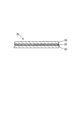
- a positive electrode active material such as lithium cobaltate (LiCoO 2 ) powder, polyvinylidene fluoride on both surfaces of a current collector 32 made of aluminum (Al) foil.
- a lithium secondary battery electrode 31 provided with a positive electrode mixture layer 33 containing a binder such as (PVDF) and a conductive auxiliary agent such as carbon powder is used.
- the positive electrode mixture made into a slurry by adding a solvent is applied onto the current collector 32 made of Al foil, and then the coated film is dried (for example, Patent Document 1).
- a large number of thinned electrodes are laminated, or a large area electrode is wound in a spiral shape.
- an object of the present invention is to provide an electrode for an electrochemical element that can obtain an electrochemical element having a sufficiently high output as compared with the prior art, and a method for manufacturing the electrode.
- the present inventor firstly used a lithium secondary battery electrode, which is superior in the current collecting function as compared with a method employed in a nickel metal hydride battery, that is, compared with a nickel (Ni) foil.
- a Ni porous body as a current collector and filling the Ni porous body with nickel hydroxide (Ni (OH) 2 ) powder, which is an active material, presses (compresses) it to increase the packing density, and individual active material powders Focusing on the method of reducing the electrical resistance of the electrode by reducing the distance between the electrode and the Ni porous body, the application of the Al porous body to the current collector of the electrode for the lithium secondary battery was studied.
- Al has a strength of about 1/3 that of Ni, its skeleton is easily deformed. For this reason, when a high-density press is performed at a high ratio, the skeleton is damaged, the current collecting function is impaired, and the electric resistance may be increased. In addition, the high-density press reduces the space inside the electrode and inhibits the penetration of the electrolyte into the electrode, so that only a low-power lithium secondary battery can be obtained.
- the present inventor tried to produce an electrode for a lithium secondary battery without performing pressing, that is, without causing deformation of the Al skeleton after filling and drying the slurry containing the active material.
- Such an electrode is used not only as a lithium secondary battery but also as another lithium battery such as a lithium primary battery, and as an electrode of an electrochemical element such as an electric double layer capacitor, a lithium ion capacitor, or a molten salt battery. It was also confirmed that the output of these electrochemical elements can be improved.
- the invention according to claim 1 is an invention based on the above findings, A slurry filling step of filling a slurry containing an active material into the continuous air holes of the aluminum porous body having continuous air holes; A slurry drying step of drying the filled slurry, In the method for producing an electrode for an electrochemical element, the electrode for an electrochemical element is produced after the slurry drying step without going through a compression step of compressing the aluminum porous body filled and dried with the slurry. is there.
- the compression step is not provided in order not to deform the Al skeleton, but the present inventors have further studied, even if the compression step is provided.
- the deformation of the Al skeleton caused by pressing is reasonably small, the effect of sufficiently approximating the case where no compression process is provided by reducing the electrical resistance by reducing the distance between the individual active material and the Al porous body skeleton. It was found that an electrode for an electrochemical device having the same can be produced, and as a result, a sufficiently high output electrochemical device can be obtained.
- d thickness of aluminum porous body before compression
- t thickness of aluminum porous body after compression
- the present inventor has developed a method for producing an Al porous body without heating Al in an oxygen-containing environment.
- an Al porous body with a small amount of oxygen on the surface that is, an Al porous body with a small oxide film on the surface can be obtained.
- the foamed resin having continuous air holes formed with an Al layer is immersed in a molten salt and heated to a temperature not higher than the melting point of Al while applying a negative potential to the Al layer.
- a molten salt By decomposing, an Al porous body whose surface oxygen content determined by EDX analysis at an acceleration voltage of 15 kV is 3.1% by mass or less can be obtained.
- the amount of active material supported can be increased, and the contact resistance between the active material and the Al porous body can be kept low, thereby improving the utilization efficiency of the active material. be able to.
- invention of Claim 3 is an invention based on said knowledge, 3.
- the electricity according to claim 1, wherein the aluminum porous body is an aluminum porous body having an oxygen content of 3.1% by mass or less determined by EDX analysis at an acceleration voltage of 15 kV. It is a manufacturing method of the electrode for chemical elements.
- the inventor paid attention to the change in the porosity of the porous body that changes depending on the degree of compression when the compression is performed, when the compression is not performed, and when the compression is performed. Specifically, attention was paid to the porosity (%) shown in the following formula.
- the volume of the electrode material in the following formula refers to the volume (true volume) obtained from each weight and specific gravity of the Al porous body and the mixture.
- the electrode has a porosity of 15 to 55%, preferably 30 to 45%, a sufficient space can be secured inside the electrode while ensuring the packing density of the active material, and the electrolyte can be used as an electrode. It has been found that the output of the electrochemical device can be improved by sufficiently penetrating the inside.
- Porosity (%) ⁇ 1 ⁇ (volume of electrode material / apparent volume of electrode) ⁇ ⁇ 100
- invention of Claim 5 is an invention based on said knowledge, 5.
- the electrode for an electrochemical element according to claim 4, wherein the aluminum porous body is an aluminum porous body having a surface oxygen content of 3.1 mass% or less determined by EDX analysis at an acceleration voltage of 15 kV. It is.
- an electrode for an electrochemical element that can obtain an electrochemical element having a sufficiently high output as compared with the prior art, and a method for manufacturing the electrode.
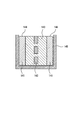
- 1 is a schematic cross-sectional view of a lithium ion capacitor in which an electrode for an electrochemical element according to an embodiment of the present invention is used.
- 1 is a schematic cross-sectional view of a molten salt battery in which an electrode for an electrochemical element according to an embodiment of the present invention is used.
- Electrode for Electrochemical Element First, a method for producing an electrode for an electrochemical element will be described first, and a method for producing an Al porous body will be described. Then, the production of an electrode for a lithium secondary battery will be described as an example. A method for producing an electrode for an electrochemical element using an Al porous body will be described.
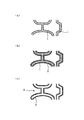
- FIG. 1 is a schematic diagram for explaining an example of a method for producing a porous aluminum body, and schematically shows how an aluminum structure (porous body) is formed using a resin molded body as a core material.
- FIG. 1A is an enlarged schematic view showing a part of a cross section of a foamed resin molded body having continuous air holes as an example of a resin molded body serving as a base, and pores are formed using the foamed resin molded body 1 as a skeleton. It shows how it is.
- the surface of the resin molded body is made conductive. By this step, a thin conductive layer is formed on the surface of the foamed resin molded body 1 using a conductive material. Subsequently, aluminum plating in a molten salt is performed to form an aluminum plating layer 2 on the surface of the resin molded body on which the conductive layer is formed (FIG. 1B).
- a porous resin molded body having a three-dimensional network structure and continuous air holes is prepared as a resin molded body to be a base.
- Arbitrary resin can be selected as a raw material of a porous resin molding.
- the material include foamed resin moldings such as polyurethane, melamine, polypropylene, and polyethylene.
- foamed resin moldings such as polyurethane, melamine, polypropylene, and polyethylene.
- a resin molded article having an arbitrary shape can be selected as long as it has continuous pores (continuous vent holes). For example, what has a shape like a nonwoven fabric entangled with a fibrous resin can be used instead of the foamed resin molded article.
- the foamed resin molded article preferably has a continuous ventilation hole having a porosity of 40 to 98% and a cell diameter of 50 to 1000 ⁇ m, more preferably a porosity of 80% to 98% and a cell diameter of 50 ⁇ m to 500 ⁇ m.
- Foamed urethane and foamed melamine have high porosity, and have excellent porosity and thermal decomposability, and therefore can be preferably used as a porous resin molded article.
- Urethane foam is preferable in terms of pore uniformity and availability, and foamed urethane is preferable in that a cell having a small cell diameter can be obtained.
- the porous resin molded body often has residues such as foaming agents and unreacted monomers in the foam production process, and it is preferable to perform a washing treatment for the subsequent steps.
- the urethane foam forms continuous pores as a whole by forming a three-dimensional network of resin molded bodies as a skeleton.
- the urethane skeleton has a substantially triangular shape in a cross section perpendicular to the extending direction.
- the surface of the foamed resin is subjected to a conductive treatment in advance.
- the treatment method is not particularly limited as long as it is a treatment that can provide a conductive layer on the surface of the foamed resin, electroless plating of a conductive metal such as nickel, vapor deposition and sputtering of aluminum, etc., carbon, etc.
- coating of the electroconductive coating material containing these electroconductive particles, can be selected.
- the conductive treatment As examples of the conductive treatment, a method for conducting the conductive treatment by sputtering of aluminum and a method for conducting the conductive treatment of the surface of the foamed resin using carbon as conductive particles will be described below.
- the sputtering treatment using aluminum is not limited as long as aluminum is used as a target, and may be performed according to a conventional method. For example, after attaching a foamed resin to the substrate holder, while applying an inert gas, a DC voltage is applied between the holder and the target (aluminum) to cause the ionized inert gas to collide with aluminum. The aluminum particles sputtered off are deposited on the foamed resin surface to form an aluminum sputtered film.
- the sputtering treatment is preferably performed at a temperature at which the foamed resin does not dissolve. Specifically, the sputtering treatment may be performed at about 100 to 200 ° C., preferably about 120 to 180 ° C.
- Carbon coating A carbon coating is prepared as a conductive coating.
- the suspension as the conductive paint preferably contains carbon particles, a binder, a dispersant and a dispersion medium. In order to uniformly apply the conductive particles, the suspension needs to maintain a uniform suspension state. For this reason, the suspension is preferably maintained at 20 ° C. to 40 ° C.
- the reason for this is that when the temperature of the suspension is below 20 ° C., the uniform suspension state collapses, and only the binder forms a layer on the surface of the skeleton that forms the network structure of the synthetic resin molding. Because it does. In this case, the applied carbon particle layer is easy to peel off, and it is difficult to form a metal plating that is firmly adhered.
- the temperature of the suspension exceeds 40 ° C., the amount of evaporation of the dispersant is large, and the suspension is concentrated as the coating treatment time elapses, and the amount of carbon applied tends to fluctuate.
- the particle size of the carbon particles is 0.01 to 5 ⁇ m, preferably 0.01 to 0.5 ⁇ m. If the particle size is large, the pores of the porous resin molded body may be clogged or smooth plating may be hindered. If it is too small, it is difficult to ensure sufficient conductivity.
- Application of the carbon particles to the resin molding can be performed by immersing the target resin molding in the suspension, and performing squeezing and drying.
- a long sheet-like strip-shaped resin having a three-dimensional network structure is continuously drawn out from a supply bobbin and immersed in a suspension in a tank.
- the strip-shaped resin immersed in the suspension is squeezed with a squeeze roll, and excess suspension is squeezed out.
- the belt-shaped resin is wound on a winding bobbin after the dispersion medium of the suspension is removed by hot air injection or the like from a hot air nozzle and sufficiently dried.
- the temperature of the hot air is preferably in the range of 40 ° C to 80 ° C.
- an organic molten salt that is a eutectic salt of an organic halide and an aluminum halide, or an inorganic molten salt that is a eutectic salt of an alkali metal halide and an aluminum halide can be used.
- an organic molten salt bath that melts at a relatively low temperature because plating can be performed without decomposing the resin molded body as a base material.
- the organic halide imidazolium salt, pyridinium salt and the like can be used. Specifically, 1-ethyl-3-methylimidazolium chloride (EMIC) and butylpyridinium chloride (BPC) are preferable. Since the molten salt deteriorates when moisture or oxygen is mixed in the molten salt, the plating is preferably performed in an atmosphere of an inert gas such as nitrogen or argon and in a sealed environment.
- an inert gas such as nitrogen or argon
- a molten salt bath containing nitrogen is preferable, and among them, an imidazolium salt bath is preferably used.
- an imidazolium salt bath is preferably used.
- the resin is dissolved or decomposed in the molten salt faster than the growth of the plating layer, and the plating layer cannot be formed on the surface of the resin molded body.
- the imidazolium salt bath can be used without affecting the resin even at a relatively low temperature.
- the imidazolium salt a salt containing an imidazolium cation having an alkyl group at the 1,3-position is preferably used.
- aluminum chloride + 1-ethyl-3-methylimidazolium chloride (AlCl 3 + EMIC) molten salt is stable. Is most preferably used because it is high and difficult to decompose.
- Plating onto foamed urethane resin or foamed melamine resin is possible, and the temperature of the molten salt bath is 10 ° C to 65 ° C, preferably 25 ° C to 60 ° C. The lower the temperature, the narrower the current density range that can be plated, and the more difficult it is to plate on the entire porous body surface. At a high temperature exceeding 65 ° C., a problem that the shape of the base resin is impaired tends to occur.
- an organic solvent to the molten salt bath, and 1,10-phenanthroline is particularly preferably used.
- the amount added to the plating bath is preferably 0.2 to 7 g / L. If it is 0.2 g / L or less, it is brittle with plating having poor smoothness, and it is difficult to obtain the effect of reducing the difference in thickness between the surface layer and the inside. On the other hand, if it is 7 g / L or more, the plating efficiency is lowered and it is difficult to obtain a predetermined plating thickness.
- an inorganic salt bath can be used as the molten salt as long as the resin is not dissolved.
- the inorganic salt bath is typically a binary or multicomponent salt of AlCl 3 —XCl (X: alkali metal).
- Such an inorganic salt bath generally has a higher melting temperature than an organic salt bath such as an imidazolium salt bath, but is less restricted by environmental conditions such as moisture and oxygen, and can be put into practical use at a low cost overall.
- the resin is a foamed melamine resin, it can be used at a higher temperature than the foamed urethane resin, and an inorganic salt bath at 60 ° C. to 150 ° C. is used.
- the aluminum layer is formed by molten salt plating.
- it can be performed by any method such as vapor deposition, sputtering, vapor phase method such as plasma CVD, and application of aluminum paste.
- the resin may be used as a composite of resin and metal as it is, but the resin is removed when used as a porous metal body without resin due to restrictions on the use environment.
- the resin is removed by decomposition in a molten salt described below so that oxidation of aluminum does not occur.
- the heating temperature can be appropriately selected according to the type of foamed resin molding.
- the resin molding is urethane, decomposition takes place at about 380 ° C., so the temperature of the molten salt bath needs to be 380 ° C. or higher.
- the melting point of the aluminum (660 ° C.) or lower is required. It is necessary to process at temperature.
- a preferable temperature range is 500 ° C. or more and 600 ° C. or less.
- the amount of negative potential to be applied is on the minus side of the reduction potential of aluminum and on the plus side of the reduction potential of cations in the molten salt.
- alkali metal or alkaline earth metal halide salts can be used so that the electrode potential of the aluminum layer is low.
- LiCl lithium chloride
- KCl potassium chloride
- NaCl sodium chloride
- a eutectic molten salt is more preferable.
- an aluminum porous body having a porosity of 40 to 98% and a cell diameter of 50 to 1000 ⁇ m is preferably used. More preferably, the porosity is 80 to 98%, and the cell diameter is 350 to 900 ⁇ m.
- An active material powder such as LiCoO 2
- a binder such as polyvinylidene fluoride (PVDF)
- a conductive additive such as acetylene black
- NMP -Methyl-2-pyrrolidone
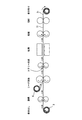
- FIG. 2 is a diagram for explaining a procedure for manufacturing an electrode for a lithium secondary battery in the present embodiment.
- the gap generated by the evaporation of NMP is reduced, and the packing density of the mixture is adjusted to prepare the precursor 11 having a predetermined porosity.
- the precursor 11 is cut (slit) to produce a long lithium secondary battery electrode 21 which is wound up.
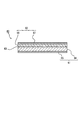
- FIGS. 3A and 3B are diagrams schematically illustrating a state in which the precursor of the electrode for the lithium secondary battery is cut in the present embodiment.
- FIGS. 3A and 3B are a plan view and a cross section before cutting. It is a figure, (c), (d) is the top view and sectional drawing after a cutting
- 12 and 22 are electrode main-body parts (mixture filling part). As shown in FIG. 3, the precursor is cut at the center of the width and the center of the lead 4 to produce the lithium secondary battery electrode 21.
- the obtained electrode for a lithium secondary battery is cut into a predetermined length and used for manufacturing a lithium secondary battery.
- the manufacturing method of the electrode for lithium secondary batteries was demonstrated, it manufactures similarly about other lithium batteries, such as a lithium primary battery, and also an electrode for electric double layer capacitors, a lithium ion capacitor, and a molten salt battery. Can do.
- Electrochemical element Next, the electrochemical element using the electrochemical element electrode produced as described above is divided into a lithium battery, an electric double layer capacitor, a lithium ion capacitor, and a sodium battery. explain.
- Lithium Battery First, the characteristics of the positive electrode for a lithium battery manufactured as described above using an Al porous body will be described, and then the configuration of the lithium secondary battery will be described.
- a positive electrode for a lithium battery produced using an Al porous body As a conventional positive electrode for a lithium secondary battery, an electrode in which an active material is applied to the surface of an Al foil (current collector) is used.
- Lithium secondary batteries have higher capacities than nickel metal hydride batteries and capacitors, but there is a need for higher capacities for automotive applications, and in order to improve battery capacity per unit area, The coating thickness is increased. Further, in order to effectively use the active material, the active material must be mixed with a conductive additive because the aluminum foil as a current collector and the active material must be in electrical contact. Yes.
- an electrode filled with an active material mixed with a conductive additive or a binder using an Al porous body as a current collector is used.
- This Al porous body has a high porosity and a large surface area per unit area.
- the lithium secondary battery using the Al porous body as the current collector can improve the capacity even with a small electrode area, the energy density of the battery is made higher than the lithium secondary battery using the conventional Al foil. be able to.
- the effect on the secondary battery has been mainly described.
- the effect of increasing the contact area when the Al porous body is filled with the active material is the same as in the case of the secondary battery. Can be improved.
- FIG. 5 is a longitudinal sectional view of an all-solid lithium secondary battery (using a solid electrolyte as an electrolyte) in which an electrode for an electrochemical element (lithium secondary battery) according to an embodiment of the present invention is used.
- the all solid lithium secondary battery 60 includes a positive electrode 61, a negative electrode 62, and a solid electrolyte layer (SE layer) 63 disposed between the two electrodes.
- the positive electrode 61 includes a positive electrode layer (positive electrode body) 64 and a positive electrode current collector 65
- the negative electrode 62 includes a negative electrode layer 66 and a negative electrode current collector 67.
- a non-aqueous electrolyte may be used as the electrolyte.
- a separator a porous polymer film, a nonwoven fabric, paper, or the like
- the non-aqueous electrolyte is used. Is impregnated in both electrodes and the separator.
- the positive electrode, the negative electrode, and the electrolyte constituting the lithium secondary battery will be described in this order.
- transition metal oxide such as conventional lithium iron phosphate and its compounds (LiFePO 4, LiFe 0.5 Mn 0.5 PO 4) a is olivine compound.
- the transition metal element contained in these materials may be partially substituted with another transition metal element.
- LiMS x is a transition metal element such as Mo, Ti, Cu, Ni, Fe, or Sb
- M is a transition metal element such as Mo, Ti, Cu, Ni, Fe, or Sb
- a metal oxide such as TiO 2 , Cr 3 O 8 , V 2 O 5 , or MnO 2
- the lithium titanate (Li 4 Ti 5 O 12 ) described above can also be used as a negative electrode active material.
- a solid electrolyte may be further added to fill the Al porous body.
- a positive electrode active material and a solid electrolyte By filling the Al porous body with a positive electrode active material and a solid electrolyte, an electrode more suitable as a positive electrode for a lithium secondary battery can be obtained.
- the proportion of the active material in the material filled in the Al porous body is preferably 50% by mass or more and more preferably 70% by mass or more from the viewpoint of securing the discharge capacity.
- a sulfide-based solid electrolyte having high lithium ion conductivity is preferably used.
- a sulfide-based solid electrolyte having high lithium ion conductivity examples include a sulfide-based solid electrolyte containing lithium, phosphorus, and sulfur. It is done.
- These sulfide-based solid electrolytes may further contain elements such as O, Al, B, Si, and Ge.
- Such a sulfide-based solid electrolyte can be obtained by a known method.
- lithium sulfide (Li 2 S) and diphosphorus pentasulfide (P 2 S 5 ) are prepared as starting materials, and the ratio of Li 2 S and P 2 S 5 is about 50:50 to 80:20 in molar ratio.
- Melting and quenching method melting and quenching method
- mechanically milled mechanical milling method
- the sulfide-based solid electrolyte obtained by the above method is amorphous. Although it can be used in this amorphous state, it may be heat-treated to obtain a crystalline sulfide solid electrolyte. Crystallization can be expected to improve lithium ion conductivity.
- carbon black such as acetylene black (AB) and ketjen black (KB)
- carbon fiber such as carbon nanotube (CNT)
- binder for example, polyvinylidene fluoride (PVDF), polytetrafluoroethylene (PTFE), polyvinyl alcohol (PVA), carboxymethylcellulose (CMC), xanthan gum, or the like can be used.
- PVDF polyvinylidene fluoride
- PTFE polytetrafluoroethylene
- PVA polyvinyl alcohol
- CMC carboxymethylcellulose
- xanthan gum or the like
- (D) Solvent As described above, an organic solvent or water can be used as the solvent used when preparing the positive electrode mixture slurry.
- the organic solvent can be appropriately selected as long as it does not adversely affect the material filled in the Al porous body (that is, the active material, the conductive additive, the binder, and, if necessary, the solid electrolyte). .
- organic solvents examples include n-hexane, cyclohexane, heptane, toluene, xylene, trimethylbenzene, dimethyl carbonate, diethyl carbonate, ethyl methyl carbonate, propylene carbonate, ethylene carbonate, butylene carbonate, vinylene carbonate, vinyl ethylene carbonate.
- Tetrahydrofuran, 1,4-dioxane, 1,3-dioxolane, ethylene glycol, N-methyl-2-pyrrolidone and the like can be used.
- a surfactant may be used in order to improve the filling property.
- a known method such as a dip filling method or a coating method can be used.
- the coating method include roll coating method, applicator coating method, electrostatic coating method, powder coating method, spray coating method, spray coater coating method, bar coater coating method, roll coater coating method, dip coater coating method, doctor Examples thereof include a blade coating method, a wire bar coating method, a knife coater coating method, a blade coating method, and a screen printing method.
- Negative electrode For the negative electrode, a copper or nickel foil, punching metal, porous body, or the like is used as a current collector, and graphite, lithium titanate (Li 4 Ti 5 O 12 ), an alloy system such as Sn or Si, Alternatively, a negative electrode active material such as lithium metal is used. A negative electrode active material is also used in combination with a conductive additive and a binder.
- non-aqueous electrolyte a solution obtained by dissolving a supporting salt in a polar aprotic organic solvent is used.
- polar aprotic organic solvents include ethylene carbonate, diethyl carbonate, dimethyl carbonate, propylene carbonate, ⁇ -butyrolactone, and sulfolane.
- the supporting salt lithium tetrafluoroborate, lithium hexafluorophosphate, and an imide salt are used.
- concentration of the supporting salt serving as an electrolyte is high, a concentration around 1 mol / L is generally used because there is a limit to dissolution.
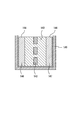
- FIG. 6 is a schematic cross-sectional view showing an example of an electric double layer capacitor in which an electrode for an electrochemical element (electric double layer capacitor) according to an embodiment of the present invention is used.
- an electrode material in which an electrode active material (activated carbon) is supported on an Al porous body is disposed as the polarizable electrode 141.
- the polarizable electrode 141 is connected to the lead wire 144, and the whole is housed in the case 145.
- the surface area of the current collector is increased and the contact area with the activated carbon as the active material is increased, so that an electric double layer capacitor capable of high output and high capacity can be obtained. Obtainable.
- activated carbon is filled in an Al porous body current collector as an active material.
- Activated carbon is used by adding a conductive additive, a binder, and, if necessary, a solid electrolyte.
- Active material Active material
- the amount of activated carbon as a main component is large, and the activated carbon is preferably 90% or more in terms of the composition ratio after drying (after solvent removal).
- conductive aids and binders are necessary, they are a cause of a decrease in capacity, and binders further increase internal resistance.
- the conductive assistant is preferably 10% by mass or less, and the binder is preferably 10% by mass or less.
- the activated carbon has a specific surface area of preferably 1000 m 2 / g or more because the larger the surface area, the larger the capacity of the electric double layer capacitor.
- Activated carbon can use plant-derived coconut shells, petroleum-based materials, and the like. In order to improve the surface area of the activated carbon, it is preferable to perform activation treatment using water vapor or alkali.
- conductive additive for example, carbon black such as acetylene black (AB) and ketjen black (KB) and carbon fiber such as carbon nanotube (CNT) can be used.
- AB acetylene black
- KB ketjen black
- CNT carbon nanotube
- binder for example, polyvinylidene fluoride (PVDF), polytetrafluoroethylene (PTFE), polyvinyl alcohol (PVA), carboxymethylcellulose (CMC), xanthan gum, or the like can be used.
- PVDF polyvinylidene fluoride
- PTFE polytetrafluoroethylene
- PVA polyvinyl alcohol
- CMC carboxymethylcellulose
- xanthan gum or the like
- a slurry of activated carbon paste is prepared by mixing an organic solvent or water as a solvent with a mixture composed of the above active material and other additives.
- the organic solvent can be appropriately selected as long as it does not adversely affect the material (active material, conductive additive, binder, and solid electrolyte as required) filled in the Al porous body.
- organic solvents examples include n-hexane, cyclohexane, heptane, toluene, xylene, trimethylbenzene, dimethyl carbonate, diethyl carbonate, ethyl methyl carbonate, propylene carbonate, ethylene carbonate, butylene carbonate, vinylene carbonate, vinyl ethylene carbonate.
- Tetrahydrofuran, 1,4-dioxane, 1,3-dioxolane, ethylene glycol, N-methyl-2-pyrrolidone and the like can be used.
- a surfactant may be used in order to improve the filling property.
- a known method such as an immersion filling method or a coating method can be used as a filling method of the activated carbon paste.
- the coating method include roll coating method, applicator coating method, electrostatic coating method, powder coating method, spray coating method, spray coater coating method, bar coater coating method, roll coater coating method, dip coater coating method, doctor Examples thereof include a blade coating method, a wire bar coating method, a knife coater coating method, a blade coating method, and a screen printing method.
- the electrodes obtained as described above are punched out to an appropriate size to prepare two sheets, and are opposed to each other with a separator interposed therebetween.
- the separator is preferably a porous film or non-woven fabric made of cellulose or polyolefin resin. And it accommodates in a cell case using a required spacer, and impregnates electrolyte solution. Finally, the electric double layer capacitor can be manufactured by sealing the case with an insulating gasket.
- the electric double layer capacitor may be manufactured in an environment with little moisture, and the sealing may be performed in a reduced pressure environment.
- the above-described method for producing an electric double layer capacitor is an embodiment, and as long as the current collector and electrode of the present invention are used, the method for producing an electric double layer capacitor is not limited. It may be produced by a method.
- both aqueous and non-aqueous electrolytes can be used, but non-aqueous electrolytes are preferred because the voltage can be set higher.
- potassium hydroxide can be used as the aqueous electrolyte.
- Non-aqueous electrolytes include ionic liquids, many in combination with cations and anions.
- cation lower aliphatic quaternary ammonium, lower aliphatic quaternary phosphonium, imidazolinium and the like are used, and as the anion, imide such as metal chloride ion, metal fluoride ion and bis (fluorosulfonyl) imide.
- imide such as metal chloride ion, metal fluoride ion and bis (fluorosulfonyl) imide. Compounds and the like are known.
- polar aprotic organic solvents and specifically, ethylene carbonate, diethyl carbonate, dimethyl carbonate, propylene carbonate, ⁇ -butyrolactone, sulfolane, and the like are used.
- the supporting salt in the non-aqueous electrolyte lithium tetrafluoroborate, lithium hexafluorophosphate, or the like is used.
- FIG. 7 is a schematic cross-sectional view showing an example of a lithium ion capacitor using an electrode for an electrochemical element (lithium ion capacitor) according to an embodiment of the present invention.
- an electrode material carrying a positive electrode active material on an Al porous body is arranged as a positive electrode 146
- an electrode material carrying a negative electrode active material on a current collector is arranged as a negative electrode 147.
- the positive electrode 146 and the negative electrode 147 are connected to the lead wire 144, and the whole is housed in the case 145.
- an Al porous body as a positive electrode current collector, a surface area of the current collector is increased, and a lithium ion capacitor capable of high output and high capacity even when activated carbon as an active material is thinly applied is obtained. Can do.
- an Al porous body current collector is filled with activated carbon as an active material.
- Activated carbon is used by adding a conductive additive, a binder, and, if necessary, a solid electrolyte.
- (I) Active material Active material (activated carbon)
- the activated carbon is preferably 90% or more in terms of the composition ratio after drying (after solvent removal).
- conductive aids and binders are necessary, they are a cause of a decrease in capacity, and binders further increase internal resistance.
- the conductive assistant is preferably 10% by mass or less, and the binder is preferably 10% by mass or less.
- the activated carbon has a specific surface area of preferably 1000 m 2 / g or more because the larger the surface area, the larger the capacity of the lithium ion capacitor.
- Activated carbon can use plant-derived coconut shells, petroleum-based materials, and the like. In order to improve the surface area of the activated carbon, it is preferable to perform activation treatment using water vapor or alkali.
- carbon black such as acetylene black (AB) and ketjen black (KB)
- carbon fiber such as carbon nanotube (CNT)
- a composite material thereof can be used.
- binder for example, polyvinylidene fluoride (PVDF), polytetrafluoroethylene (PTFE), polyvinyl alcohol (PVA), carboxymethylcellulose (CMC), xanthan gum, or the like can be used.
- PVDF polyvinylidene fluoride
- PTFE polytetrafluoroethylene
- PVA polyvinyl alcohol
- CMC carboxymethylcellulose
- xanthan gum or the like
- a slurry of activated carbon paste is prepared by mixing an organic solvent or water as a solvent with a mixture composed of the above active material and other additives.
- N-methyl-2-pyrrolidone is often used as the organic solvent. Further, when water is used as the solvent, a surfactant may be used in order to improve the filling property.
- organic solvents in addition to N-methyl-2-pyrrolidone, organic solvents that do not adversely affect the material (active material, conductive additive, binder, and solid electrolyte as required) filled in the Al porous body If it is, it can select suitably.
- organic solvents examples include n-hexane, cyclohexane, heptane, toluene, xylene, trimethylbenzene, dimethyl carbonate, diethyl carbonate, ethyl methyl carbonate, propylene carbonate, ethylene carbonate, butylene carbonate, vinylene carbonate, vinyl ethylene carbonate. , Tetrahydrofuran, 1,4-dioxane, 1,3-dioxolane, ethylene glycol and the like.
- a known method such as an immersion filling method or a coating method can be used as a filling method of the activated carbon paste.
- the coating method include roll coating method, applicator coating method, electrostatic coating method, powder coating method, spray coating method, spray coater coating method, bar coater coating method, roll coater coating method, dip coater coating method, doctor Examples thereof include a blade coating method, a wire bar coating method, a knife coater coating method, a blade coating method, and a screen printing method.
- the negative electrode is not particularly limited, and a conventional negative electrode for a lithium secondary battery can be used.
- a conventional negative electrode for a lithium secondary battery can be used.
- the conventional electrode using a copper foil as a current collector has a small capacity
- An electrode in which a porous material made of copper such as nickel or nickel is filled with an active material is preferable.
- the negative electrode is doped with lithium ions in advance.
- a known method can be used as the doping method. For example, a method of attaching a lithium metal foil on the negative electrode surface and immersing it in an electrolyte solution, or arranging an electrode with lithium metal attached in a lithium ion capacitor and assembling the cell, between the negative electrode and the lithium metal electrode And a method of electrically doping with an electric current, or a method of assembling an electrochemical cell with a negative electrode and lithium metal, and taking out and using the negative electrode electrically doped with lithium.
- any method it is better to increase the amount of lithium doping in order to sufficiently lower the potential of the negative electrode.
- the remaining capacity of the negative electrode is smaller than the positive electrode capacity, the capacity of the lithium ion capacitor is reduced, so the positive electrode capacity is not doped. It is preferable to leave it in
- Electrolytic solution The same electrolytic solution as the nonaqueous electrolytic solution used for the lithium secondary battery is used.
- a solution in which a supporting salt is dissolved in a polar aprotic organic solvent is used.
- polar aprotic organic solvents include ethylene carbonate, diethyl carbonate, dimethyl carbonate, propylene carbonate, ⁇ -butyrolactone, and sulfolane.
- the supporting salt lithium tetrafluoroborate, lithium hexafluorophosphate, and an imide salt are used.
- the electrode obtained as described above is punched out to an appropriate size and is opposed to the negative electrode with a separator interposed therebetween.
- the negative electrode may be previously doped with lithium ions, and when a method of doping after assembling the cell is taken, an electrode connected with lithium metal may be disposed in the cell.
- the separator is preferably a porous film or non-woven fabric made of cellulose or polyolefin resin. And it accommodates in a cell case using a required spacer, and impregnates electrolyte solution. Finally, the case is covered and sealed with an insulating gasket, so that a lithium ion capacitor can be produced.
- the lithium ion capacitor may be manufactured in an environment with little moisture, and the sealing may be performed in a reduced pressure environment.
- the above-described method for manufacturing a lithium ion capacitor is an embodiment, and as long as the current collector and electrode of the present invention are used, the method for manufacturing a lithium capacitor is not limited. May be.
- the Al porous body can also be used as an electrode material for a molten salt battery.
- a metal compound capable of intercalating a cation of a molten salt serving as an electrolyte such as sodium chromite (NaCrO 2 ) or titanium disulfide (TiS 2 ) as an active material Is used.
- the active material is used by adding a conductive additive and a binder.
- Acetylene black or the like can be used as a conductive aid.
- polytetrafluoroethylene (PTFE) etc. can be used as a binder.
- PTFE polytetrafluoroethylene
- the Al porous body can also be used as a negative electrode material for a molten salt battery.
- an Al porous body is used as a negative electrode material
- sodium alone, an alloy of sodium and another metal, carbon, or the like can be used as an active material.
- Sodium has a melting point of about 98 ° C., and the metal softens as the temperature rises. Therefore, it is preferable to alloy sodium with other metals (Si, Sn, In, etc.), and among these, sodium and Sn An alloy of these is particularly preferable because it is easy to handle.
- Sodium or sodium alloy can be supported on the surface of the Al porous body by a method such as electrolytic plating or hot dipping.
- a metal such as Si
- a metal that is alloyed with sodium is attached to the Al porous body by a method such as plating, and then charged in a molten salt battery to form a sodium alloy.
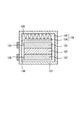
- FIG. 8 is a schematic cross-sectional view showing an example of a molten salt battery in which an electrode for an electrochemical element (molten salt battery) according to an embodiment of the present invention is used.
- the positive electrode 121 carrying the positive electrode active material on the surface of the Al skeleton part of the Al porous body, the negative electrode 122 carrying the negative electrode active material on the surface of the Al skeleton part of the Al porous body, and the molten salt as an electrolyte are impregnated.
- the separator 123 is housed in the case 127.
- a pressing member 126 including a pressing plate 124 and a spring 125 that presses the pressing plate 124 is disposed.
- the current collector (Al porous body) of the positive electrode 121 and the current collector (Al porous body) of the negative electrode 122 are connected to the positive electrode terminal 128 and the negative electrode terminal 129 by lead wires 130, respectively.
- molten salt As the electrolyte, various inorganic salts or organic salts that melt at the operating temperature can be used.
- alkali metals such as lithium (Li), sodium (Na), potassium (K), rubidium (Rb) and cesium (Cs), beryllium (Be), magnesium (Mg), calcium (Ca)
- strontium (Sr) and barium (Ba) can be used.
- the melting point of the molten salt it is preferable to use a mixture of two or more salts.
- potassium bis (fluorosulfonyl) amide [KN (SO 2 F) 2 ; KFSA] and sodium bis (fluorosulfonyl) amide [Na—N (SO 2 F) 2 ; NaFSA] are used in combination.
- the operating temperature of the battery can be 90 ° C. or lower.
- a separator is provided in order to prevent a positive electrode and a negative electrode from contacting, and a glass nonwoven fabric, a porous resin molding, etc. can be used.
- the above positive electrode, negative electrode, and separator impregnated with molten salt are stacked and housed in a case, and used as a molten salt battery.
- a conductive layer having carbon particles attached to the entire surface was formed.
- the components of the suspension include graphite + carbon black 25%, and include a resin binder, a penetrating agent, and an antifoaming agent.
- the particle size of carbon black was 0.5 ⁇ m.
- a urethane foam with a conductive layer formed on the surface is set as a work piece in a jig with a power supply function, and then placed in a glove box with an argon atmosphere and low moisture (dew point -30 ° C or less), and melted at a temperature of 40 ° C. It was immersed in a salt aluminum plating bath (33 mol% EMIC-67 mol% AlCl 3 ). The jig on which the workpiece was set was connected to the cathode side of the rectifier, and a counter electrode Al plate (purity 99.99%) was connected to the anode side.
- the sample of the skeleton part of the obtained Al porous body was sampled, cut and observed at a cross section perpendicular to the extending direction of the skeleton.
- the cross section has a substantially triangular shape, which reflects the structure of the urethane foam as the core material.
- the obtained aluminum porous body was dissolved in aqua regia and measured with an ICP (inductively coupled plasma) emission spectrometer.
- the Al purity was 98.5% by mass.
- the carbon content was measured by JIS-G1211 high frequency induction furnace combustion-infrared absorption method and found to be 1.4% by mass. Furthermore, as a result of EDX analysis of the surface with an acceleration voltage of 15 kV, almost no oxygen peak was observed, and it was confirmed that the oxygen content of the aluminum porous body was below the EDX detection limit (3.1 mass%).
- electrode for lithium secondary battery (Example 1) After the lead was attached to the Al porous body, the slurry was filled. After removing NMP through a drying furnace, compression was not performed, and an electrode for a lithium secondary battery having a thickness of 1 mm and a filling capacity of 8 mAh / cm 2 was produced. The porosity of the obtained electrode was 55%.
- Example 2 to 4 The electrodes of Examples 2 to 4 were produced in the same manner as in Example 1 except that the dried Al porous body was compressed to the thickness (mm) shown in Table 1. Table 1 shows the porosity of each obtained electrode.
- Comparative Examples 1 and 2 The electrodes of Comparative Examples 1 and 2 were prepared in the same manner as in Example 1 except that the dried Al porous body was compressed to the thickness (mm) shown in Table 1. Table 1 shows the porosity of each obtained electrode.
Landscapes
- Chemical & Material Sciences (AREA)
- Chemical Kinetics & Catalysis (AREA)
- Electrochemistry (AREA)
- General Chemical & Material Sciences (AREA)
- Engineering & Computer Science (AREA)
- Materials Engineering (AREA)
- Manufacturing & Machinery (AREA)
- Dispersion Chemistry (AREA)
- Cell Electrode Carriers And Collectors (AREA)
- Battery Electrode And Active Subsutance (AREA)
- Electric Double-Layer Capacitors Or The Like (AREA)
Abstract
Description
連通気孔を有するアルミニウム多孔体の連通気孔中に、活物質を含有するスラリーを充填するスラリー充填工程と、
充填された前記スラリーを乾燥するスラリー乾燥工程とを有し、
前記スラリー乾燥工程の後に、前記スラリーが充填、乾燥されたアルミニウム多孔体を圧縮する圧縮工程を経ずに、電気化学素子用電極を製造することを特徴とする電気化学素子用電極の製造方法である。
連通気孔を有するアルミニウム多孔体の連通気孔中に、活物質を含有するスラリーを充填するスラリー充填工程と、
充填された前記スラリーを乾燥するスラリー乾燥工程と、
前記スラリー乾燥工程の後に、前記スラリーが充填、乾燥されたアルミニウム多孔体を下式を満たすように圧縮する圧縮工程を有していることを特徴とする電気化学素子用電極の製造方法である。
0.5d≦t<1.0d
ただし、d:アルミニウム多孔体の圧縮前の厚さ
t:アルミニウム多孔体の圧縮後の厚さ
前記アルミニウム多孔体が、15kVの加速電圧でのEDX分析により定量した表面の酸素量が3.1質量%以下のアルミニウム多孔体であることを特徴とする請求項1または請求項2に記載の電気化学素子用電極の製造方法である。
多孔度(%)={1-(電極材料の体積/電極の見かけの体積)}×100
活物質を含有する合剤が、連通気孔を有するアルミニウム多孔体の前記連通気孔中に充填されており、
下式に示すアルミニウム多孔体の多孔度(%)が、15~55%であることを特徴とする電気化学素子用電極である。
多孔度(%)={1-(電極材料の体積/電極の見かけの体積)}×100
前記アルミニウム多孔体が、15kVの加速電圧でのEDX分析により定量した表面の酸素量が3.1質量%以下のアルミニウム多孔体であることを特徴とする請求項4に記載の電気化学素子用電極である。
最初に、電気化学素子用電極の製造方法について、まず、Al多孔体の製造方法について説明し、その後、リチウム二次電池用電極の作製を例に挙げて、このAl多孔体を用いた電気化学素子用電極の製造方法について説明する。
始めに、本発明の電気化学素子用電極に用いられるアルミニウム多孔体の製造方法について説明する。図1は、アルミニウム多孔体の製造方法の一例を説明する模式図であり、樹脂成形体を芯材としてアルミニウム構造体(多孔体)を形成する様子を模式的に示したものである。
まず、基体となる樹脂成形体として、三次元網目構造を有し連通気孔を有する多孔質樹脂成形体を準備する。多孔質樹脂成形体の素材は任意の樹脂を選択できる。ポリウレタン、メラミン、ポリプロピレン、ポリエチレン等の発泡樹脂成形体が素材として例示できる。発泡樹脂成形体と表記したが、連続した気孔(連通気孔)を有するものであれば任意の形状の樹脂成形体を選択できる。例えば繊維状の樹脂を絡めて不織布のような形状を有するものも発泡樹脂成形体に代えて使用可能である。
気孔率[%]=(1-(多孔質材の重量[g]/(多孔質材の体積[cm3]× 素材密度)))×100
電解めっきを行うために、発泡樹脂の表面をあらかじめ導電化処理する。処理方法としては、発泡樹脂の表面に導電性を有する層を設けることができる処理である限り特に制限はなく、ニッケル等の導電性金属の無電解めっき、アルミニウム等の蒸着及びスパッタ、又はカーボン等の導電性粒子を含有した導電性塗料の塗布等任意の方法を選択できる。
アルミニウムを用いたスパッタリング処理としては、アルミニウムをターゲットとする限り限定的でなく、常法に従って行えばよい。例えば、基板ホルダに発泡状樹脂を取り付けた後、不活性ガスを導入しながら、ホルダとターゲット(アルミニウム)との間に直流電圧を印加することにより、イオン化した不活性ガスをアルミニウムに衝突させて、はじき飛ばされたアルミニウム粒子を発泡状樹脂表面に堆積することによってアルミニウムのスパッタ膜を形成する。なお、スパッタリング処理は発泡状樹脂が溶解しない温度下で行うことが好ましく、具体的には、100~200℃程度、好ましくは120~180℃程度で行えばよい。
導電性塗料としてのカーボン塗料を準備する。導電性塗料としての懸濁液は、好ましくは、カーボン粒子、粘結剤、分散剤および分散媒を含む。導電性粒子の塗布を均一に行うには、懸濁液が均一な懸濁状態を維持している必要がある。このため、懸濁液は、20℃~40℃に維持されていることが好ましい。
次に溶融塩中で電解めっきを行い、樹脂成形体表面にアルミニウムめっき層を形成する。溶融塩浴中でアルミニウムのめっきを行うことにより特に三次元網目構造を有する樹脂成形体のように複雑な骨格構造の表面に均一に厚いアルミニウム層を形成することができる。表面が導電化された樹脂成形体を陰極、純度99.0%のアルミニウムを陽極として溶融塩中で直流電流を印加する。溶融塩としては、有機系ハロゲン化物とアルミニウムハロゲン化物の共晶塩である有機溶融塩、アルカリ金属のハロゲン化物とアルミニウムハロゲン化物の共晶塩である無機溶融塩を使用することができる。
溶融塩中での分解は以下の方法で行う。表面にアルミニウムめっき層を形成した樹脂成形体を溶融塩に浸漬し、アルミニウム層に負電位(アルミニウムの標準電極電位より卑な電位)を印加しながら加熱して発泡樹脂成形体を除去する。溶融塩に浸漬した状態で負電位を印加すると、アルミニウムを酸化させることなく発泡樹脂成形体を分解することができる。
次に、リチウム二次電池の正極の場合を例にとり、スラリーの作製方法について説明する。LiCoO2等の活物質粉末、ポリフッ化ビニリデン(PVDF)等のバインダ、さらに、アセチレンブラック等の導電助剤を所定の比率で混合し、得られた混合物(合剤)に溶媒として所定量のN-メチル-2-ピロリドン(NMP)を添加後、混練することによりスラリーが作製される。なお、これらの材料の配合比率は、電極の容量、導電性、スラリーの粘度、およびスラリーを充填して乾燥した後の電極の多孔度等を考慮して適宜決定される。
次に、電気化学素子用電極の作製について、リチウム二次電池用電極の作製を例に挙げて説明する。図2は、本実施の形態において、リチウム二次電池用電極の製造の手順を説明する図である。
まず、前記の製造方法に基づいて製造されたAl多孔体3を巻き出し、調厚用のロールを通してAl多孔体3の厚さを所定の厚さに調厚する。次に、リード4を巻き出し、調厚されたAl多孔体3にリード4を溶接して集電体を作製する。
次に、前記の作製方法に基づいて作製されたスラリーを、ロールを用いて集電体の連通気孔中に充填し、その後、乾燥炉を通すことにより、スラリー中に含まれるNMPを蒸発、除去する。
次に、上記のように作製された電気化学素子用電極が用いられた電気化学素子につき、リチウム電池、電気二重層キャパシタ、リチウムイオンキャパシタ、ナトリウム電池に分けて具体的に説明する。
初めに、Al多孔体を用いて上記のように作製されたリチウム電池用正極の特徴について説明し、その後、リチウム二次電池の構成について説明する。
従来のリチウム二次電池用正極としては、Al箔(集電体)の表面に活物質を塗布した電極が用いられている。リチウム二次電池は、ニッケル水素電池やキャパシタに比べれば高容量であるが、自動車用途などでは更なる高容量化が求められており、単位面積当たりの電池容量を向上させるために、活物質の塗布厚みを厚くしている。また、活物質を有効に利用するためには、集電体であるアルミニウム箔と活物質とが電気的に接触している必要があるため、活物質は導電助剤と混合して用いられている。
リチウム二次電池には、電解質として固体電解質を用いる場合と、非水電解液を用いる場合とがある。図5は、本発明の一実施の形態に係る電気化学素子(リチウム二次電池)用電極が用いられた全固体リチウム二次電池(電解質として固体電解質を使用)の縦断面図である。この全固体リチウム二次電池60は、正極61、負極62、および、両電極間に配置される固体電解質層(SE層)63を備えている。そして、正極61は、正極層(正極体)64と正極集電体65とからなり、負極62は、負極層66と負極集電体67とからなる。
Al多孔体をリチウム二次電池の正極集電体として使用する場合は、正極活物質として、リチウムを脱挿入できる材料を使用することができ、このような材料をAl多孔体に充填することにより、リチウム二次電池に適した電極を得ることができる。
このような正極活物質としては、例えば、コバルト酸リチウム(LiCoO2)、ニッケル酸リチウム(LiNiO2)、ニッケルコバルト酸リチウム(LiCo0.3Ni0.7O2)、マンガン酸リチウム(LiMn2O4)、チタン酸リチウム(Li4Ti5O12)、リチウムマンガン酸化合物(LiMyMn2-yO4;M=Cr、Co、Ni)、リチウム酸等が使用できる。これらの活物質は導電助剤及びバインダと組み合わせて使用する。
上記正極活物質の他に、必要に応じて、さらに、固体電解質を加えてAl多孔体に充填してもよい。Al多孔体に正極活物質と固体電解質とを充填することにより、リチウム二次電池用正極としてより適した電極を得ることができる。ただし、Al多孔体に充填する材料の内、活物質の割合は、放電容量を確保する観点から、50質量%以上であることが好ましく、70質量%以上であるとより好ましい。
上記活物質の合剤(活物質と固体電解質)をAl多孔体に充填するに際しては、必要に応じて導電助剤やバインダを加え、これに有機溶剤や水を混合して正極合剤スラリーを作製する。
正極合剤スラリーを作製する際に用いられる溶媒としては、上記したように、有機溶剤や水を用いることができる。
作製された正極合剤スラリーの充填方法としては、浸漬充填法や塗工法などの公知の方法を用いることができる。塗工法としては、例えば、ロール塗工法、アプリケータ塗工法、静電塗工法、粉体塗工法、スプレー塗工法、スプレーコータ塗工法、バーコータ塗工法、ロールコータ塗工法、ディップコータ塗工法、ドクターブレード塗工法、ワイヤーバー塗工法、ナイフコータ塗工法、ブレード塗工法、及びスクリーン印刷法などが挙げられる。
負極には、銅やニッケルの箔やパンチングメタル、多孔体などが集電体として用いられ、黒鉛、チタン酸リチウム(Li4Ti5O12)、SnやSi等の合金系、あるいはリチウム金属等の負極活物質が使用される。負極活物質も、導電助剤及びバインダと組み合わせて使用する。
前記したように、リチウム二次電池には、電解質として固体電解質を用いる場合と、非水電解液を用いる場合とがある。
図6は、本発明の一実施の形態に係る電気化学素子(電気二重層キャパシタ)用電極が用いられた電気二重層キャパシタの一例を示す断面模式図である。セパレータ142で仕切られた有機電解液143中に、Al多孔体に電極活物質(活性炭)を担持した電極材料が分極性電極141として配置されている。分極性電極141はリード線144に接続されており、これら全体がケース145中に収納されている。
電気二重層キャパシタ用電極を製造するには、Al多孔体の集電体に活物質として活性炭を充填する。活性炭は、導電助剤やバインダ、及び必要に応じて固体電解質を添加して使用する。
電気二重層キャパシタの容量を大きくするためには主成分である活性炭の量が多い方がよく、乾燥後(溶媒除去後)の組成比で活性炭が90%以上であることが好ましい。また、導電助剤やバインダは、必要ではあるが容量低下の要因であり、バインダは更に内部抵抗を増大させる要因となるため、できる限り少ない方がよい。導電助剤は10質量%以下、バインダは10質量%以下であることが好ましい。
導電助剤としては、例えば、アセチレンブラック(AB)やケッチェンブラック(KB)といったカーボンブラックや、カーボンナノチューブ(CNT)などの炭素繊維を用いることができる。
作製された活性炭ペースト(スラリー)を上記Al多孔体の集電体に充填して乾燥させ、必要に応じてローラプレス等により圧縮することにより密度を向上させ、電気二重層キャパシタ用電極が得られる。
上記のようにして得られた電極を適当な大きさに打ち抜いて2枚用意し、セパレータを挟んで対向させる。セパレータはセルロースやポリオレフィン樹脂などで構成された多孔膜や不織布を用いることが好ましい。そして、必要なスペーサを用いてセルケースに収納し、電解液を含浸させる。最後に絶縁ガスケットを介してケースに蓋をして封口することにより電気二重層キャパシタを作製することができる。
図7は、本発明の一実施の形態に係る電気化学素子(リチウムイオンキャパシタ)用電極が用いられたリチウムイオンキャパシタの一例を示す断面模式図である。セパレータ142で仕切られた有機電解液143中に、Al多孔体に正極活物質を担持した電極材料が正極146として配置され、集電体に負極活物質を担持した電極材料が負極147として配置されている。正極146および負極147はリード線144に接続されており、これら全体がケース145中に収納されている。
リチウムイオンキャパシタ用電極(正極)を製造するには、Al多孔体の集電体に活物質として活性炭を充填する。活性炭は、導電助剤やバインダ、及び必要に応じて固体電解質を添加して使用する。
リチウムイオンキャパシタの容量を大きくするためには主成分である活性炭の量が多い方がよく、乾燥後(溶媒除去後)の組成比で活性炭が90%以上であることが好ましい。また、導電助剤やバインダは、必要ではあるが容量低下の要因であり、バインダは更に内部抵抗を増大させる要因となるため、できる限り少ない方がよい。導電助剤は10質量%以下、バインダは10質量%以下であることが好ましい。
作製された活性炭ペースト(スラリー)を上記Al多孔体の集電体に充填して乾燥させ、必要に応じてローラプレス等により圧縮することにより密度を向上させ、リチウムイオンキャパシタ用電極が得られる。
負極は特に限定されず、従来のリチウム二次電池用負極を使用可能であるが、銅箔を集電体に用いた従来の電極では容量が小さいため、前述の発泡状ニッケルのような銅やニッケル製の多孔体に活物質を充填した電極が好ましい。
電解液は、リチウム二次電池に使用する非水電解液と同じものが用いられる。非水電解液としては、支持塩を極性非プロトン性有機溶媒の溶かしたものが用いられる。このような極性非プロトン性有機溶媒としては、例えば、エチレンカーボネート、ジエチルカーボネート、ジメチルカーボネート、プロピレンカーボネート、γ-ブチロラクトン及びスルホラン等が使用される。支持塩としては4フッ化ホウ酸リチウム、6フッ化リン酸リチウム、およびイミド塩等が使用されている。
上記にようにして得られた電極を適当な大きさに打ち抜きし、セパレータを挟んで負極と対向させる。負極は、予めリチウムイオンをドープしたものを用いても構わないし、セルを組み立て後にドープする方法をとる場合は、リチウム金属を接続した電極をセル内に配置すればよい。
Al多孔体は、溶融塩電池用の電極材料として使用することもできる。Al多孔体を正極材料として使用する場合は、活物質として亜クロム酸ナトリウム(NaCrO2)、二硫化チタン(TiS2)等、電解質となる溶融塩のカチオンをインターカレーションすることができる金属化合物を使用する。活物質は、導電助剤及びバインダを添加して使用する。
予め、以下に示す方法により、スラリーおよびAl多孔体を準備した。
活物質としてLiCoO2粉末、導電助剤としてアセチレンブラック、バインダとしてPVDFを、重量比で88:6:6の比率で混合し、溶媒としてNMPを添加して混合し、スラリーとした。
発泡樹脂成形体として、厚み1.0mm、気孔率95%、1インチ当たりの気孔数(セル数)約50個のウレタン発泡体を準備し、100mm×30mm角に切断し、実施の形態に記載した方法を用いてアルミニウム多孔体を作製した。具体的には、以下の通りである。
ウレタン発泡体をカーボン懸濁液に浸漬し乾燥することで、表面全体にカーボン粒子が付着した導電層を形成した。懸濁液の成分は、黒鉛+カーボンブラック25%を含み、樹脂バインダ、浸透剤、消泡剤を含む。カーボンブラックの粒径は0.5μmとした。
表面に導電層を形成したウレタン発泡体をワークとして、給電機能を有する治具にセットした後、アルゴン雰囲気かつ低水分(露点-30℃以下)としたグローブボックス内に入れ、温度40℃の溶融塩アルミめっき浴(33mol%EMIC-67mol%AlCl3)に浸漬した。ワークをセットした治具を整流器の陰極側に接続し、対極のAl板(純度99.99%)を陽極側に接続した。電流密度3.6A/dm2の直流電流を90分間印加してめっきすることにより、ウレタン発泡体表面に150g/m2の重量のAlめっき層が形成されたAl構造体を得た。攪拌はテフロン(登録商標)製の回転子を用いてスターラにて行った。ここで、電流密度はウレタン発泡体の見かけの面積で計算した値である。
前記アルミニウム構造体を温度500℃のLiCl-KCl共晶溶融塩に浸漬し、-1Vの負電位を30分間印加した。溶融塩中にポリウレタンの分解反応による気泡が発生した。その後大気中で室温まで冷却した後、水洗して溶融塩を除去し、樹脂が除去されたアルミニウム多孔体を得た。このAl多孔体は連通気孔を有し、気孔率が芯材としたウレタン発泡体と同様に高いものであった。
(実施例1)
前記Al多孔体にリードを取り付けた後、前記スラリーを充填した。乾燥炉を通してNMPを除去した後、圧縮を行わず、厚さ1mm、充填容量が8mAh/cm2のリチウム二次電池用電極を作製した。得られた電極の多孔度は55%であった。
乾燥後のAl多孔体を、表1に示す厚さ(mm)に圧縮したこと以外は実施例1と同じ方法で実施例2~4の電極を作製した。得られた各電極の多孔度を表1に併せて示す。
乾燥後のAl多孔体を、表1に示す厚さ(mm)に圧縮したこと以外は実施例1と同じ方法で比較例1、2の電極を作製した。得られた各電極の多孔度を表1に併せて示す。
(1)リチウム二次電池の作製
前記実施例および比較例で作製したリチウム二次電池用電極を正極とし、対極(負極)にリチウム(Li)金属箔、セパレータにガラス繊維フィルタ、電解液に濃度1mol/LのLiPF6のEC/DEC溶液を用いて、実施例および比較例のリチウム二次電池を作製した。
イ.評価方法
作製した各リチウム二次電池を充電後、0.2Cで放電し、放電容量を求めた。得られた放電容量から活物質重量単位(活物質1g当たり)の放電容量を求めた。また、2Cの効率放電を行い、その放電容量の大きさから出力を評価した。結果を表1に示す。

2 アルミニウム(Al)めっき層
3 アルミニウム(Al)多孔体
4 リード
11 前駆体
12、22 電極本体部分
21、31 リチウム二次電池用電極
32 集電体
33 正極合剤層
60 全固体リチウム二次電池
61 正極
62 負極
63 固体電解質層(SE層)
64 正極層
65 正極集電体
66 負極層
67 負極集電体
121、146 正極
122、147 負極
123、142 セパレータ
124 押え板
125 バネ
126 押圧部材
127、145 ケース
128 正極端子
129 負極端子
130、144 リード線
141 分極性電極
143 有機電解液
Claims (5)
- 連通気孔を有するアルミニウム多孔体の連通気孔中に、活物質を含有するスラリーを充填するスラリー充填工程と、
充填された前記スラリーを乾燥するスラリー乾燥工程とを有し、
前記スラリー乾燥工程の後に、前記スラリーが充填、乾燥されたアルミニウム多孔体を圧縮する圧縮工程を経ずに、電気化学素子用電極を製造することを特徴とする電気化学素子用電極の製造方法。 - 連通気孔を有するアルミニウム多孔体の連通気孔中に、活物質を含有するスラリーを充填するスラリー充填工程と、
充填された前記スラリーを乾燥するスラリー乾燥工程と、
前記スラリー乾燥工程の後に、前記スラリーが充填、乾燥されたアルミニウム多孔体を下式を満たすように圧縮する圧縮工程を有していることを特徴とする電気化学素子用電極の製造方法。
0.5d≦t<1.0d
ただし、d:アルミニウム多孔体の圧縮前の厚さ
t:アルミニウム多孔体の圧縮後の厚さ - 前記アルミニウム多孔体が、15kVの加速電圧でのエネルギー分散型X線分析(EDX分析)により定量した表面の酸素量が3.1質量%以下のアルミニウム多孔体であることを特徴とする請求項1または請求項2に記載の電気化学素子用電極の製造方法。
- 活物質を含有する合剤が、連通気孔を有するアルミニウム多孔体の前記連通気孔中に充填されており、
下式に示すアルミニウム多孔体の多孔度(%)が、15~55%であることを特徴とする電気化学素子用電極。
多孔度(%)={1-(電極材料の体積/電極の見かけの体積)}×100 - 前記アルミニウム多孔体が、15kVの加速電圧でのEDX分析により定量した表面の酸素量が3.1質量%以下のアルミニウム多孔体であることを特徴とする請求項4に記載の電気化学素子用電極。
Priority Applications (4)
| Application Number | Priority Date | Filing Date | Title |
|---|---|---|---|
| CN201280005821.3A CN103329328B (zh) | 2011-02-18 | 2012-02-15 | 电化学元件用电极及其制造方法 |
| KR1020137021058A KR20140051130A (ko) | 2011-02-18 | 2012-02-15 | 전기 화학 소자용 전극과 그의 제조 방법 |
| DE112012000896T DE112012000896T5 (de) | 2011-02-18 | 2012-02-15 | Elektrode für elektrochemisches Element und Verfahren zu ihrer Herstellung |
| US13/569,319 US9184435B2 (en) | 2011-02-18 | 2012-08-08 | Electrode for electrochemical element and method for producing the same |
Applications Claiming Priority (4)
| Application Number | Priority Date | Filing Date | Title |
|---|---|---|---|
| JP2011-033366 | 2011-02-18 | ||
| JP2011033366 | 2011-02-18 | ||
| JP2012005597A JP2012186143A (ja) | 2011-02-18 | 2012-01-13 | 電気化学素子用電極とその製造方法 |
| JP2012-005597 | 2012-01-13 |
Related Child Applications (1)
| Application Number | Title | Priority Date | Filing Date |
|---|---|---|---|
| US13/569,319 Continuation US9184435B2 (en) | 2011-02-18 | 2012-08-08 | Electrode for electrochemical element and method for producing the same |
Publications (1)
| Publication Number | Publication Date |
|---|---|
| WO2012111707A1 true WO2012111707A1 (ja) | 2012-08-23 |
Family
ID=46672620
Family Applications (1)
| Application Number | Title | Priority Date | Filing Date |
|---|---|---|---|
| PCT/JP2012/053535 Ceased WO2012111707A1 (ja) | 2011-02-18 | 2012-02-15 | 電気化学素子用電極とその製造方法 |
Country Status (6)
| Country | Link |
|---|---|
| US (1) | US9184435B2 (ja) |
| JP (1) | JP2012186143A (ja) |
| KR (1) | KR20140051130A (ja) |
| CN (1) | CN103329328B (ja) |
| DE (1) | DE112012000896T5 (ja) |
| WO (1) | WO2012111707A1 (ja) |
Families Citing this family (9)
| Publication number | Priority date | Publication date | Assignee | Title |
|---|---|---|---|---|
| JP6394986B2 (ja) * | 2015-07-02 | 2018-09-26 | トヨタ自動車株式会社 | 電池用電極の製造方法 |
| EP3151304B1 (de) * | 2015-10-02 | 2018-07-25 | VARTA Microbattery GmbH | Knopfzelle auf lithium-ionen-basis |
| KR20180101474A (ko) * | 2016-01-15 | 2018-09-12 | 나노텍 인스트러먼츠, 인코포레이티드 | 높은 체적 및 중량 에너지 밀도를 갖는 알칼리 금속-황 전지 |
| EP3522267B1 (en) * | 2017-05-22 | 2023-11-01 | LG Energy Solution, Ltd. | Flexible electrode, method for manufacturing the same and secondary battery including the same |
| CN107887568B (zh) * | 2017-10-23 | 2020-08-28 | 柔电(武汉)科技有限公司 | 一种导电集流体及其制备方法 |
| JP6962235B2 (ja) * | 2018-02-23 | 2021-11-05 | トヨタ自動車株式会社 | リチウムイオン二次電池用正極の製造方法 |
| US12506137B2 (en) | 2019-09-23 | 2025-12-23 | International Business Machines Corporation | High capacity compact lithium thin film battery |
| CN111063546A (zh) * | 2019-12-19 | 2020-04-24 | 泉州泉石电子科技有限公司 | 一种滚压式的电容电极片基材制作方法 |
| JP7365048B2 (ja) * | 2020-02-27 | 2023-10-19 | 学校法人早稲田大学 | 二次電池の正極の製造方法、および、二次電池 |
Citations (7)
| Publication number | Priority date | Publication date | Assignee | Title |
|---|---|---|---|---|
| JPH09213307A (ja) * | 1995-11-30 | 1997-08-15 | Elna Co Ltd | 非水電解液系二次電池 |
| JP2001155739A (ja) * | 1999-11-24 | 2001-06-08 | Nissha Printing Co Ltd | 二次電池用正極および二次電池 |
| JP2004071305A (ja) * | 2002-08-05 | 2004-03-04 | Hitachi Maxell Ltd | 非水電解質二次電池 |
| JP2007087758A (ja) * | 2005-09-21 | 2007-04-05 | Nissan Motor Co Ltd | 電池用電極 |
| JP2007095421A (ja) * | 2005-09-28 | 2007-04-12 | Sharp Corp | 大型リチウムイオン二次電池及び蓄電システム |
| JP2010040218A (ja) * | 2008-07-31 | 2010-02-18 | Idemitsu Kosan Co Ltd | リチウム電池用電極材料シート、固体リチウム電池、及び、固体リチウム電池を備えた装置 |
| JP2010232171A (ja) * | 2009-03-05 | 2010-10-14 | Hitachi Metals Ltd | アルミニウム多孔質材およびその製造方法、アルミニウム多孔質材を電極集電体として用いた蓄電デバイス |
Family Cites Families (12)
| Publication number | Priority date | Publication date | Assignee | Title |
|---|---|---|---|---|
| JP3568052B2 (ja) | 1994-12-15 | 2004-09-22 | 住友電気工業株式会社 | 金属多孔体、その製造方法及びそれを用いた電池用極板 |
| EP0771042A3 (en) | 1995-09-28 | 2000-05-24 | Shin-Etsu Chemical Co., Ltd. | Battery electrode and method for the preparation thereof |
| US5795680A (en) * | 1995-11-30 | 1998-08-18 | Asahi Glass Company Ltd. | Non-aqueous electrolyte type secondary battery |
| JPH10334948A (ja) | 1997-05-30 | 1998-12-18 | Tdk Corp | 電極、この電極を用いたリチウム2次電池および電気2重層キャパシタ |
| JP3016769B1 (ja) * | 1998-12-02 | 2000-03-06 | 片山特殊工業株式会社 | 電池用電極板の製造方法、該方法により製造された電極板および該電極板を備えた電池 |
| JP4623786B2 (ja) | 1999-11-10 | 2011-02-02 | 住友電気工業株式会社 | 非水二次電池 |
| US8895187B2 (en) * | 2005-08-16 | 2014-11-25 | Lg Chem, Ltd. | Cathode active material and lithium secondary battery containing the same |
| WO2007072815A1 (ja) * | 2005-12-20 | 2007-06-28 | Zeon Corporation | 電気二重層キャパシタ |
| BRPI0809342A2 (pt) * | 2007-03-26 | 2014-10-07 | Gillette Co | Eletrodos de bateria e baterias incluindo os referidos eletrodos |
| US20080241664A1 (en) * | 2007-03-26 | 2008-10-02 | Nanjundaswamy Kirakodu S | Battery Electrodes and Batteries Including Such Electrodes |
| JP4478706B2 (ja) | 2007-09-05 | 2010-06-09 | セイコーエプソン株式会社 | リチウムイオン伝導性固体電解質およびそれを用いた全固体リチウム二次電池 |
| KR100947072B1 (ko) * | 2008-03-27 | 2010-04-01 | 삼성에스디아이 주식회사 | 전극조립체 및 이를 구비하는 이차전지 |
-
2012
- 2012-01-13 JP JP2012005597A patent/JP2012186143A/ja active Pending
- 2012-02-15 CN CN201280005821.3A patent/CN103329328B/zh not_active Expired - Fee Related
- 2012-02-15 DE DE112012000896T patent/DE112012000896T5/de not_active Withdrawn
- 2012-02-15 WO PCT/JP2012/053535 patent/WO2012111707A1/ja not_active Ceased
- 2012-02-15 KR KR1020137021058A patent/KR20140051130A/ko not_active Withdrawn
- 2012-08-08 US US13/569,319 patent/US9184435B2/en active Active
Patent Citations (7)
| Publication number | Priority date | Publication date | Assignee | Title |
|---|---|---|---|---|
| JPH09213307A (ja) * | 1995-11-30 | 1997-08-15 | Elna Co Ltd | 非水電解液系二次電池 |
| JP2001155739A (ja) * | 1999-11-24 | 2001-06-08 | Nissha Printing Co Ltd | 二次電池用正極および二次電池 |
| JP2004071305A (ja) * | 2002-08-05 | 2004-03-04 | Hitachi Maxell Ltd | 非水電解質二次電池 |
| JP2007087758A (ja) * | 2005-09-21 | 2007-04-05 | Nissan Motor Co Ltd | 電池用電極 |
| JP2007095421A (ja) * | 2005-09-28 | 2007-04-12 | Sharp Corp | 大型リチウムイオン二次電池及び蓄電システム |
| JP2010040218A (ja) * | 2008-07-31 | 2010-02-18 | Idemitsu Kosan Co Ltd | リチウム電池用電極材料シート、固体リチウム電池、及び、固体リチウム電池を備えた装置 |
| JP2010232171A (ja) * | 2009-03-05 | 2010-10-14 | Hitachi Metals Ltd | アルミニウム多孔質材およびその製造方法、アルミニウム多孔質材を電極集電体として用いた蓄電デバイス |
Also Published As
| Publication number | Publication date |
|---|---|
| CN103329328B (zh) | 2016-04-06 |
| US9184435B2 (en) | 2015-11-10 |
| KR20140051130A (ko) | 2014-04-30 |
| JP2012186143A (ja) | 2012-09-27 |
| CN103329328A (zh) | 2013-09-25 |
| US20130040205A1 (en) | 2013-02-14 |
| DE112012000896T5 (de) | 2013-12-12 |
Similar Documents
| Publication | Publication Date | Title |
|---|---|---|
| CN103380518B (zh) | 电化学元件 | |
| US20120264022A1 (en) | Electrode for electrochemical device and method for producing the same | |
| US20120263993A1 (en) | Electrochemical device | |
| JP5976551B2 (ja) | 三次元網状アルミニウム多孔体及び該アルミニウム多孔体を用いた電極並びに該電極を用いた非水電解質電池、非水電解液を用いたキャパシタ及びリチウムイオンキャパシタ | |
| US9484570B2 (en) | Method for producing electrode for electrochemical element | |
| JPWO2012111601A1 (ja) | 三次元網状アルミニウム多孔体、該アルミニウム多孔体を用いた電極、該電極を用いた非水電解質電池、非水電解液を用いたキャパシタ及びリチウムイオンキャパシタ | |
| JP5883288B2 (ja) | 集電体用三次元網状アルミニウム多孔体、該アルミニウム多孔体を用いた集電体、電極、非水電解質電池、キャパシタ及びリチウムイオンキャパシタ | |
| US9184435B2 (en) | Electrode for electrochemical element and method for producing the same | |
| JPWO2012111659A1 (ja) | 集電体用三次元網状アルミニウム多孔体、該アルミニウム多孔体を用いた電極、非水電解質電池、キャパシタ及びリチウムイオンキャパシタ | |
| US20130040046A1 (en) | Method for producing electrode for electrochemical element | |
| JP5876839B2 (ja) | 集電体用三次元網状アルミニウム多孔体、該アルミニウム多孔体を用いた集電体、電極、非水電解質電池、キャパシタ及びリチウムイオンキャパシタ | |
| JP2012256583A (ja) | 電気化学素子用電極の製造方法 | |
| US20130004854A1 (en) | Electrode for electrochemical element |
Legal Events
| Date | Code | Title | Description |
|---|---|---|---|
| WWE | Wipo information: entry into national phase |
Ref document number: 201280005821.3 Country of ref document: CN |
|
| 121 | Ep: the epo has been informed by wipo that ep was designated in this application |
Ref document number: 12747611 Country of ref document: EP Kind code of ref document: A1 |
|
| ENP | Entry into the national phase |
Ref document number: 20137021058 Country of ref document: KR Kind code of ref document: A |
|
| WWE | Wipo information: entry into national phase |
Ref document number: 112012000896 Country of ref document: DE Ref document number: 1120120008960 Country of ref document: DE |
|
| 122 | Ep: pct application non-entry in european phase |
Ref document number: 12747611 Country of ref document: EP Kind code of ref document: A1 |