WO2012098926A1 - ゲーム装置 - Google Patents
ゲーム装置 Download PDFInfo
- Publication number
- WO2012098926A1 WO2012098926A1 PCT/JP2012/050030 JP2012050030W WO2012098926A1 WO 2012098926 A1 WO2012098926 A1 WO 2012098926A1 JP 2012050030 W JP2012050030 W JP 2012050030W WO 2012098926 A1 WO2012098926 A1 WO 2012098926A1
- Authority
- WO
- WIPO (PCT)
- Prior art keywords
- fish
- signal
- game
- game device
- display screen
- Prior art date
- Legal status (The legal status is an assumption and is not a legal conclusion. Google has not performed a legal analysis and makes no representation as to the accuracy of the status listed.)
- Ceased
Links
Images




Classifications
-
- A—HUMAN NECESSITIES
- A63—SPORTS; GAMES; AMUSEMENTS
- A63F—CARD, BOARD, OR ROULETTE GAMES; INDOOR GAMES USING SMALL MOVING PLAYING BODIES; VIDEO GAMES; GAMES NOT OTHERWISE PROVIDED FOR
- A63F13/00—Video games, i.e. games using an electronically generated display having two or more dimensions
- A63F13/80—Special adaptations for executing a specific game genre or game mode
- A63F13/825—Fostering virtual characters
-
- A—HUMAN NECESSITIES
- A63—SPORTS; GAMES; AMUSEMENTS
- A63F—CARD, BOARD, OR ROULETTE GAMES; INDOOR GAMES USING SMALL MOVING PLAYING BODIES; VIDEO GAMES; GAMES NOT OTHERWISE PROVIDED FOR
- A63F13/00—Video games, i.e. games using an electronically generated display having two or more dimensions
- A63F13/25—Output arrangements for video game devices
- A63F13/26—Output arrangements for video game devices having at least one additional display device, e.g. on the game controller or outside a game booth
-
- A—HUMAN NECESSITIES
- A63—SPORTS; GAMES; AMUSEMENTS
- A63F—CARD, BOARD, OR ROULETTE GAMES; INDOOR GAMES USING SMALL MOVING PLAYING BODIES; VIDEO GAMES; GAMES NOT OTHERWISE PROVIDED FOR
- A63F13/00—Video games, i.e. games using an electronically generated display having two or more dimensions
- A63F13/80—Special adaptations for executing a specific game genre or game mode
- A63F13/843—Special adaptations for executing a specific game genre or game mode involving concurrently two or more players on the same game device, e.g. requiring the use of a plurality of controllers or of a specific view of game data for each player
-
- A—HUMAN NECESSITIES
- A63—SPORTS; GAMES; AMUSEMENTS
- A63F—CARD, BOARD, OR ROULETTE GAMES; INDOOR GAMES USING SMALL MOVING PLAYING BODIES; VIDEO GAMES; GAMES NOT OTHERWISE PROVIDED FOR
- A63F13/00—Video games, i.e. games using an electronically generated display having two or more dimensions
- A63F13/50—Controlling the output signals based on the game progress
- A63F13/52—Controlling the output signals based on the game progress involving aspects of the displayed game scene
-
- A—HUMAN NECESSITIES
- A63—SPORTS; GAMES; AMUSEMENTS
- A63F—CARD, BOARD, OR ROULETTE GAMES; INDOOR GAMES USING SMALL MOVING PLAYING BODIES; VIDEO GAMES; GAMES NOT OTHERWISE PROVIDED FOR
- A63F2300/00—Features of games using an electronically generated display having two or more dimensions, e.g. on a television screen, showing representations related to the game
- A63F2300/60—Methods for processing data by generating or executing the game program
- A63F2300/66—Methods for processing data by generating or executing the game program for rendering three dimensional images
- A63F2300/6653—Methods for processing data by generating or executing the game program for rendering three dimensional images for altering the visibility of an object, e.g. preventing the occlusion of an object, partially hiding an object
-
- A—HUMAN NECESSITIES
- A63—SPORTS; GAMES; AMUSEMENTS
- A63F—CARD, BOARD, OR ROULETTE GAMES; INDOOR GAMES USING SMALL MOVING PLAYING BODIES; VIDEO GAMES; GAMES NOT OTHERWISE PROVIDED FOR
- A63F2300/00—Features of games using an electronically generated display having two or more dimensions, e.g. on a television screen, showing representations related to the game
- A63F2300/80—Features of games using an electronically generated display having two or more dimensions, e.g. on a television screen, showing representations related to the game specially adapted for executing a specific type of game
- A63F2300/8005—Athletics
-
- A—HUMAN NECESSITIES
- A63—SPORTS; GAMES; AMUSEMENTS
- A63F—CARD, BOARD, OR ROULETTE GAMES; INDOOR GAMES USING SMALL MOVING PLAYING BODIES; VIDEO GAMES; GAMES NOT OTHERWISE PROVIDED FOR
- A63F2300/00—Features of games using an electronically generated display having two or more dimensions, e.g. on a television screen, showing representations related to the game
- A63F2300/80—Features of games using an electronically generated display having two or more dimensions, e.g. on a television screen, showing representations related to the game specially adapted for executing a specific type of game
- A63F2300/8058—Virtual breeding, e.g. tamagotchi
-
- A—HUMAN NECESSITIES
- A63—SPORTS; GAMES; AMUSEMENTS
- A63F—CARD, BOARD, OR ROULETTE GAMES; INDOOR GAMES USING SMALL MOVING PLAYING BODIES; VIDEO GAMES; GAMES NOT OTHERWISE PROVIDED FOR
- A63F2300/00—Features of games using an electronically generated display having two or more dimensions, e.g. on a television screen, showing representations related to the game
- A63F2300/80—Features of games using an electronically generated display having two or more dimensions, e.g. on a television screen, showing representations related to the game specially adapted for executing a specific type of game
- A63F2300/8088—Features of games using an electronically generated display having two or more dimensions, e.g. on a television screen, showing representations related to the game specially adapted for executing a specific type of game involving concurrently several players in a non-networked game, e.g. on the same game console
Definitions
- the present invention relates to a game device, and more particularly to a commercial video game device installed in an amusement facility or the like.
- a display screen such as a video monitor is provided, and a player plays well while facing the display screen.
- a plurality of display devices are arranged to form a continuous display screen, and a video imitating one large aquarium or the sea floor is displayed on the continuous display screen.
- a video imitating one large aquarium or the sea floor is displayed on the continuous display screen.
- an image of fish swimming is displayed.
- the fish that ate the bait starts to swim toward the upper end of the display device, and performs an extinction process that disappears from the upper end of the display device.
- the disappearing fish is subjected to appearance processing such that it appears from the upper end of the display device and dives into the water (see paragraphs 0031 and 0082 of Patent Document 1).
- An object of the present invention is to provide a game device that can change a video expression by changing an object disappearance process and an appearance process.
- a game device includes a pedestal portion, a display portion provided on the pedestal portion and having a display screen, an input portion having an input device provided in association with the display screen, and the display
- the screen has a annihitable object that can be annihilated based on a signal from the input device, and a control unit that displays an irreversible object that cannot be annihilated based on a signal from the input device,
- the control unit changes the non-destructible object to the non-destructible object and generates a new non-destructible object when the destructible object has disappeared based on a signal from the input device. It is characterized by.
- the control unit displays a video having a plurality of layers on the display screen, causes the annihitable object to belong to a first layer, and causes the non-erasable object to belong to the first layer. You may make it belong to the 2nd layer of the heel side. Thereby, a sense of depth can be given to the display mode of the object.
- the non-destructible object includes a first non-destructible object and a second non-destructible object
- the control unit displays an image having a plurality of layers on the display screen. Display, and make the annihitable object belong to a first layer, make the first non-destructible object belong to a second layer on the heel side of the first layer, and make the second non-destructible object May belong to a third layer on the heel side of the second layer. Thereby, a sense of depth can be given to the display mode of the object.
- control unit may display a relatively long time among the non-destructible objects when the destructible object disappears based on an input signal from the input device. You may make it change the object which cannot be lost to the said object which can be destroyed.
- control unit changes the first non-destructible object to the non-destructible object when the destructible object has disappeared based on a signal from the input device.
- the second non-destructible object may be changed to the first non-destructible object, and a new second non-destructible object may be generated.
- the control unit displays a relatively displayed time of the first non-annihitable object when the extinct object is extinguished based on a signal from the input device.
- the first non-destructible object having a long length is changed to the non-destructible object, and the second non-destructible object of the second non-destructible object is displayed as the second non-destructible object having a relatively long time. You may make it change into 1 non-annihilation object.
- the display unit includes a plurality of display screens
- the input unit includes a plurality of input devices provided in association with the plurality of display screens
- the control unit includes: When the erasable object disappears based on a signal from the input device, the non-destructible object is changed to the erasable object on a display screen different from the display screen corresponding to the input device that has output the signal. You may make it make it.
- the control unit has a display screen that is different from a display screen corresponding to the input device that has output the signal when the extinct object disappears based on a signal from the input device.
- the non-destructible object may be changed to an erasable object on a display screen with a small number of erasable objects.
- the display unit includes a plurality of display screens
- the input unit includes a plurality of input devices provided in association with the plurality of display screens
- the control unit includes: When the extinct object disappears based on the signal from the input device, the new extinct object or the second extinction object is displayed on a display screen different from the display screen corresponding to the input device that has output the signal. Possible objects may be generated.
- the control unit has a display screen that is different from a display screen corresponding to the input device that has output the signal when the extinct object disappears based on a signal from the input device.
- a new non-destructible object or a second non-destructible object may be generated on a display screen having a small number of non-destructible objects or the second non-destructible object.
- the control unit when the extinct object is extinguished based on a signal from the input device, the control unit is configured to erase the extinct object or the first non-extinguishable object.
- the non-destructible object or the first non-destructible object having the coordinate value farthest from the coordinate value of the destructible object may be changed to the destructible object.
- the control unit when the erasable object disappears based on a signal from the input device, the control unit newly annihilates at a position farthest from the coordinate value of the extinct object that has disappeared. An impossible object or a second non-erasable object may be generated.
- the display unit includes a plurality of display screens
- the input unit includes a plurality of input devices provided in association with the plurality of display screens
- the control unit includes: When the extinct object disappears based on the signal from the input device, the non-extinguishable object or the first extinct object cannot be displayed on the display screen corresponding to the input device that has not output a signal for a predetermined time or more. You may make it change an object into the said extinct object.
- the display unit includes a plurality of display screens
- the input unit includes a plurality of input devices provided in association with the plurality of display screens
- the control unit includes: When the extinct object disappears based on a signal from the input device, a new non-extinguishable object or a second indelible object is displayed on the display screen corresponding to the input device that has not output a signal for a predetermined time or more. You may make it produce
- the display unit includes four display screens, and each display surface of the four display screens is perpendicular to the pedestal unit and is positioned at an angle of 90 degrees with respect to each other.
- the input unit has four input devices provided in association with the four display screens, and the control unit is configured to delete the extinguishable object based on a signal from the input device.
- the non-destructible object or the first non-destructible object may be changed to an erasable object.
- the display unit includes four display screens, and each display surface of the four display screens is perpendicular to the pedestal unit and is positioned at an angle of 90 degrees with respect to each other.
- the input unit has four input devices provided in association with the four display screens, and the control unit is configured to delete the extinguishable object based on a signal from the input device. May generate a new non-destructible object or a second non-destructible object on the display screen located behind the display screen corresponding to the input device that has output the signal.
- a pedestal unit As described above, according to the present invention, a pedestal unit, a display unit provided on the pedestal unit and having a display screen, an input unit having an input device provided in association with the display screen, and the display
- the screen has a annihitable object that can be annihilated based on a signal from the input device, and a control unit that displays an irreversible object that cannot be annihilated based on a signal from the input device,
- the control unit changes the non-deletable object to the extinct object and generates a new non-destructible object. Therefore, it is possible to change the video expression by changing the object disappearance process and the appearance process.
- FIG. 1 is a diagram showing an external appearance of the game apparatus of the present embodiment
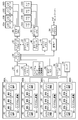
- FIG. 2 is a block diagram of the game apparatus of the present embodiment.
- the game device 10 of the present embodiment is installed as an arcade video game device in an amusement facility or the like.
- a player who visits an amusement facility or the like purchases a medal for play and uses the medal to play with the game apparatus 10.
- a quadrangular columnar pedestal 12 is provided at the bottom of the game apparatus 10.
- a medal payout opening 14 for paying out a medal to the player is provided on each of the four surfaces around the square columnar pedestal portion 12.
- a medal payout device (not shown) for paying out medals is provided.
- a rectangular console 16 is provided which is horizontal to the pedestal portion 12 and allows the player to perform various operations.
- a quadrangular prism-shaped display unit 18 is provided on the rectangular console 16.
- LCD monitors 20A, 20B, 20C, and 20D which are display screens for displaying game screens, and speakers 22A, 22B, and 22C for outputting sounds are displayed on the four surfaces around the quadrangular prism-shaped display unit 18, respectively. , 22D.
- LCD monitors 20A, 20B, 20C, and 20D are vertically long screens that are perpendicular to the pedestal 12 and have a height that is greater than the width. Thus, by making the height of the screen larger than the width of the screen, the overall width of the game device can be omitted.
- the four LCD monitors 20A, 20B, 20C, and 20D are located at an angle of 90 degrees with respect to each other.
- a lamp 24 for alerting the surroundings is provided on the top of the quadrangular prism-shaped display unit 18.
- the player 24 is alerted by blinking and rotating the lamp 24.
- the game apparatus 10 is used as a CPU 30 for executing a play program, controlling the entire system, calculating coordinates for image display, and the like, and a buffer memory for storing programs and data necessary for the CPU 30 to perform processing.
- a system memory (RAM) 32 is commonly connected by a bus line and is connected to a bus arbiter 34.
- the bus arbiter 34 controls the flow of programs and data with each block of the game apparatus 10 and devices connected to the outside.
- a program data storage device or storage medium (including an optical disk or an optical disk drive for driving a CD-ROM or the like as a recording medium) 36 in which a play program and data (including video data and music data) are stored, and a game apparatus 10
- a BOOTROM 38 in which a program and data for starting up are stored is connected to the bus arbiter 34.
- a rendering processor that reproduces video (MOVIE) data read from the program data storage device or the storage medium 36 via the bus arbiter 34 and generates an image for image display in accordance with the player's operation or game progress 40 and a graphic memory 42 for storing graphic data and the like necessary for image generation by the rendering processor 40 are connected.
- the image signal output from the rendering processor 40 is converted from a digital signal to an analog signal by the video DAC 44 and displayed on the four LCD monitors 20A, 20B, 20C, and 20D.
- a display method of the game screen by the four LCD monitors 20A, 20B, 20C, and 20D will be described later.
- a sound processor 46 that reproduces music data read from the program data storage device or storage medium 36 via the bus arbiter 34, and generates sound effects and sounds according to the player's operation and game progress, and its sound A processor 46 is connected to a sound memory 48 for storing sound data necessary for generating sound effects and sounds.
- the audio signal output from the sound processor 46 is converted from a digital signal to an analog signal by the audio DAC 50 and output from the speakers 22A, 22B, 22C, and 22D.
- a communication interface 52 is connected to the bus arbiter 34.
- the communication interface 52 is connected to an external network such as a telephone line via a LAN adapter 54.
- the game apparatus 10 is connected to the Internet via a telephone line or the like, and can communicate with other game apparatuses and network servers.
- the communication interface 52 and the LAN adapter 54 use a telephone line, but use a terminal adapter (TA) or router that uses a telephone line, a cable modem that uses a cable TV line, a mobile phone or a PHS.
- TA terminal adapter
- Other communication methods such as wireless communication means and optical fiber communication means using an optical fiber may be used.
- the bus arbiter 34 is connected to four input / output units 60A, 60B, 60C, and 60D via a peripheral I / F (interface) 56.
- Each input / output unit 60A, 60B, 60C, 60D is provided with three operation buttons 25, 26, 27, two medal input devices 62, 63, and one medal payout device 64, respectively.
- the lamp 24 is connected to the bus arbiter 34 via a peripheral I / F (interface) 56.
- the hardware configuration of the game apparatus 10 as described above is merely an example, and the present invention can be applied to an arbitrary computer system including a display device.
- the program of the present invention is not only supplied to the computer system through an external storage medium such as a memory card, but may be supplied to the computer system through a wired or wireless communication line. May be recorded in advance in the sexual storage device.
- the game device 10 is not limited to a game device installed in an amusement facility or a store such as a game cafe, and is not limited to a home game device, a personal computer, a portable electronic game machine, a mobile phone, a PDA, or the like.
- An electronic device or a game information processing device may be used.
- the game executed by the game apparatus 10 of the present embodiment is a medal game simulating an aquarium.
- Objects such as fish are moving around in the aquarium tank.
- a player inserts a medal
- food can be fed to an object such as a fish traveling around in the aquarium.
- an object such as a fish successfully feeds, the object changes to a medal and the medal is paid out to the player.
- the player can enjoy a feeding game while appreciating fish moving around in the aquarium at the aquarium displayed on the LCD monitor.
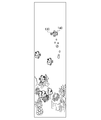
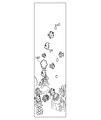
- the game screen in the game of the present embodiment is a game screen in which an object such as a fish moves around in the aquarium as shown in FIG.
- This game screen is a single aquarium screen.
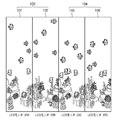
- the screen of the aquarium is divided into four and displayed on the four LCD monitors 20A, 20B, 20C, and 20D. That is, the water tank arranged in the virtual space is imaged by four virtual cameras, and the captured images are displayed on the four LCD monitors 20A, 20B, 20C, and 20D.
- the aquarium image is divided into two images 100 and 104 and processed as shown in FIG.
- the left half 101 of the divided image 100 is displayed on the LCD monitor 20A, and the right half 102 is displayed on the LCD monitor 20B.
- the left half 105 of the divided image 104 is displayed on the LCD monitor 20C, and the right half 106 is displayed on the LCD monitor 20D.
- the roulettes 108A, 108B, 108C, and 108D are displayed below the screens 101, 102, 105, and 106 displayed on the LCD monitors 20A, 20B, 20C, and 20D.
- the player can play various mini games according to the lottery results displayed on the roulettes 108A, 108B, 108C, and 108D.
- the LCD monitors 20A, 20B, 20C, and 20D are images of continuous aquariums, for example, a player participating in a game while looking at the LCD monitor 20A looks at the LCD monitor 20B on the right side and starts moving from the right side.
- a player participating in a game while looking at the LCD monitor 20A looks at the LCD monitor 20B on the right side and starts moving from the right side.
- By predicting fish and the like appearing on the LCD monitor 20A and looking into the LCD monitor 20D on the left side it is possible to predict the fish and the like appearing on the LCD monitor 20A by migrating from the left side.
- the right end image displayed on the LCD monitor 20A is the left end image of the LCD monitor 20B
- the right end image of the LCD monitor 20B is the left end image of the LCD monitor 20C
- the right end image of the LCD monitor 20C is the left end image of the LCD monitor 20D
- the right end image of the LCD monitor 20D and the left end image of the LCD monitor 20A are continuous.
- Game control method A game control method for a game executed by the game apparatus 10 of the present embodiment will be described with reference to FIGS.
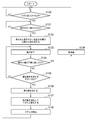
- step S100 it is detected by the medal input devices 62 and 63 whether or not a medal is inserted from the medal insertion ports 28 and 29 by the player (step S100).
- step S101 determines whether any of the operation buttons 25, 26, and 27 has been pressed. Judgment is made (step S101).
- the position where the food appears is determined by the pressed operation buttons 25, 26, and 27.
- the operation button 25 when the operation button 25 is pressed, bait appears from the upper left end of the aquarium, and when the operation button 26 is pressed, bait appears from the upper end at the center of the aquarium, and when the operation button 27 is pressed. The bait appears from the upper right side of the aquarium.
- the bait 130 appears from the upper end at the center of the aquarium as shown in FIG. 5 (step S102).
- step S103 an image of the appearing bait 130 gradually falling in the water tank is displayed. Subsequently, it is determined whether or not the bait 130 has reached the lower end of the water tank (step S104).
- step S104 if it is determined that the bait 130 has reached the lower end of the aquarium without being eaten by the fish, the bait 130 disappears (step S109), and the process returns to the first step S100.
- the bait 130 reaches the lower end of the aquarium, it is determined whether or not there is a fish that satisfies the “prey condition”, which is a condition for the fish 140 to eat the bait 130 (step S105).
- the prey condition is determined by parameters such as the traveling direction D of the fish 140, the traveling speed V of the fish 140, the distance L between the fish 140 and the bait 130, the hunger degree H of the fish 140, and the freshness F of the bait 130.
- the bait 130 is located within a predetermined angle ⁇ 1 with respect to the traveling direction D of the fish 140, the distance L between the fish 140 and the bait 130 is not more than a predetermined value L1, and the hunger degree H of the fish 140 is not less than the predetermined value H1.
- the freshness F of the bait 130 is equal to or greater than the predetermined value F1, it is determined that the prey condition is satisfied.
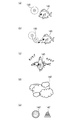
- step S105 If it is determined in step S105 that the prey condition is satisfied, as shown in FIG. 6, the fish 140 that satisfies the prey condition eats the prey 130 (step S106), and as shown in FIG. Is converted into a transformed image 140 ′ and then changed to a medal 140 ′′ (step S107), and a medal is paid out from the medal payout opening 14 by the medal payout device 64 (step S108).
- the fish 140 When the fish 140 satisfies the prey condition for the bait 130 as shown in FIG. 8 (a), the fish 140 eats the bait 130 as shown in FIG. 8 (b), and subsequently, as shown in FIG. 8 (c). As shown in FIG. 8D, after the fish 140 digests the bait 130, and after the fish 140 is transformed into 140 ′, as shown in FIG. When the medal is paid out from the medal payout opening 14 by the medal payout device 64, the medal 140 "disappears from the game screen.
- the fish 140 that has eaten the bait 130 may change to a stool 140 ′′ instead of the medal 140 ′′.
- medals are paid out from the medal payout opening 14 by the medal payout device 64, and the excrement 140 ′′ changed from the fish 140 is accumulated in the water tank of the game screen.
- the processing is performed as described above, it is easy for the player to feed the fish moving around the upper part of the aquarium, and to the fish moving around the lower part of the aquarium. . If the fish can be fed around the lower part of the aquarium using the characteristics of this game, a privilege may be given to the player. For example, the number of medals to be paid out may be increased.
- the medal is paid out when the fish 140 eats the bait 130, but the timing of paying out the medal from the medal payout opening 14 may be the timing immediately after the fish 140 eats the bait 130, or the fish 140 becomes the medal 140 ′′. It may be a timing that changes and disappears from the lower end of the water tank, or a timing between these timings.
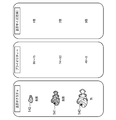
- the aquarium and fish are displayed in seven layers as shown in FIG.
- the first layer 121 in the forefront is a fish (food target) layer that displays a fish (food target) 140 that is a fish that moves around in the aquarium and eats food in the feeding game. Display fish clearly.
- the fish in the fish (prey target) layer is an erasable object that can be eaten and annihilated.
- the display texture of the fish (food target) 140 is the clearest, and the display size is three times that of the fish shadow 142, which is the largest.
- the second layer 122 at the foot of the first layer 121 is a foreground layer that displays a foreground that is an aquarium at a position where the fish (food target) 140 moves around. Display the scenery clearly.
- the third layer 123 at the base of the second layer 122 is a fish shadow 1 layer that displays a fish shadow 141 that is a fish migrating in the aquarium and that cannot feed in the feeding game.
- the fish is migrating from the fish (prey target) 140 and displayed darker than the fish (prey target) 140.
- the fish shadow 141 is a first non-annihitable object that cannot be annihilated because it cannot eat food.
- the display texture of the fish shadow 141 is darker and unclear than the fish 140, and the display size is twice that of the fish shadow 142, which is a medium size.
- the fourth layer 124 at the foot of the third layer 123 is a middle scene 1 layer that displays the middle scene 1 that is the scenery of the aquarium at the position where the fish shadow 141 moves around. It is displayed darker than the scenery of the second layer 122.
- the fifth layer 125 at the base of the fourth layer 124 is a fish shadow two layer that displays a fish shadow 142 that is a fish that moves around in the aquarium and that cannot feed in the feeding game. It is a fish that travels in a bowl rather than the fish shadow 141, and is darker than the fish shadow 141.
- the fish shadow 142 is a second non-annihitable object that cannot be annihilated because it cannot eat food.
- the display texture of the fish shadow 142 is darker and unclear than the fish shadow 141, the display size is one third of the fish 140, and one half of the fish shadow 142, Smallest.
- the sixth layer 126 at the base of the fifth layer 125 is a middle scene 2 layer that displays the middle scene 2 that is the scenery of the aquarium at the position where the fish shadow 142 moves around. It is displayed darker than the scenery of the fourth layer 124.
- the seventh layer 127 at the base of the sixth layer 126 is a distant view layer that displays a distant view that is a distant view at the base of the middle view 2. It is displayed darker than the scenery of the sixth layer 126.
- the aquarium is displayed realistically by displaying the aquarium and the fish with the seven layers described above.
- the fish (food target) 140 that can feed in the feeding game is displayed only on the first layer 121 as an extinct object.
- the fish shadow 141 that cannot be fed in the feeding game is displayed only on the third layer 123 as the first non-annihilation object.
- the fish shadow 142 that cannot be fed in the feeding game is displayed only on the fifth layer 125 as the second non-annihilation object.
- the fish (food target) 140 eats food, it disappears and disappears from the aquarium. If it is left as it is, the number of fish migrating in the aquarium will be reduced, and the fun of the game will be reduced, so a new fish will be generated.
- the fish (food target) 140 that is an extinct object disappears, it is generated as a fish shadow 142 that moves around in the water tank. This is called reincarnation.
- the fish shadow 142 is a second non-annihilation object that cannot be annihilated by eating food.
- the first non-annihilation object that is the fish shadow 141 that has already migrated is changed to the fish (food target) 140 that is an extinction object.
- This is called promotion 1.
- the second non-annihilation object that is the fish shadow 142 that has already migrated is changed to the fish shadow 141 that is the first non-annihilation object. This is called promotion 2.
- promotion 1 and promotion 2 even if the fish (food target) 140 disappears, the number of the fish (food target) 140, fish shadow 141, and fish shadow 142 migrating in the aquarium is kept constant. Can do.
- the process of reincarnation, promotion 1 and promotion 2 is executed at the same time as the disappearance of the fish.
- the processes are not necessarily performed simultaneously, and the timing of executing these processes may be shifted.
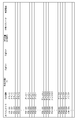
- FIG. 11 is a fish data table showing data of fish (object) used in the feeding game
- FIG. 12 is a fish priority table showing the priority of fish in the feeding game.
- the data shown in FIG. 11 is provided for fish (objects) used in the game.
- object the object ID for identifying the solid, the type of fish, the display texture of the fish (food target) 140, the display texture of the fish shadow 141, the display texture of the fish shadow 142, the current fish in the aquarium
- action parameters for determining the next action such as the hunger degree / raising of the fish, determination information as to whether or not to become a medal when eating food, and the like.
- the object ID “F01-001” stores data of the fish type “Clownfish”, and the object ID “F01-002” stores data of the fish type “Clownfish”.
- the object ID “F02001” stores data of the fish type “guppy”
- the object ID “F02-002” stores data of the fish type “guppy”
- the object ID “F03-001”. Stores the data of the fish type “Discus”
- the object ID “F03-002 stores the data of the fish type“ Discus ”
- the object ID“ F04-001 ” stores the data of the fish type“ Arowana ”. Is stored, and the object ID “F04-002” has data of the fish type “Arowana”. It is stored.
- 100 fishes are allowed to migrate in the aquarium.
- a fish object ID is assigned to each of the priority fields from “00” to “99”.
- a fish with object ID “F01-001” is assigned to priority “00”
- a fish with object ID “F02-001” is assigned to priority “01”
- an object ID is assigned to priority “98”.
- a fish of “F03-025” is assigned
- a fish of object ID “F04-025” is assigned to priority “99”.
- Priority indicates the priority of fish in the aquarium. As shown in FIG. 10, fish given priority “00” to “49” are displayed as fish (food target) 140 in the aquarium. Fishes with priorities “50” to “74” are displayed as fish shadows 141 in the aquarium. Fishes given priority “75” to “99” are displayed as fish shadow 2 in the aquarium.
- priority is given to the fishes in the fish data table of FIG. 11 in order so that the types of fish are distributed to 100 fishes, but this is not restrictive. For example, 100 fishes may be picked up randomly from the fish data table and given priority.
- a fish with priority “05” (object ID “F02-002”)
- a fish with priority “37” (object ID “F02-010”)
- a priority “38” Suppose that three fish with the fish (object ID “F03-010”) were successfully fed.
- a priority “06” fish (object ID “F03-002”) is assigned to the blank of the priority “05”, and the fish with the lower priority are sequentially assigned higher priority. Pack it.
- the three fish (object ID “F03-013”, object ID “F04-013”, object assigned to priority “50” “51” “52” IDs “F01-014”) are assigned priorities “47”, “48”, and “49”, and the fish shadow 141 is promoted to the fish (food target) 140 (promotion 1).
- the priority “72” is assigned to the three fishes (object ID “F04-019”, object ID “F01-020”, object ID “F02-020”) assigned to the priority “75” “76” “77”. "73” and “74” are given, and the fish shadow 142 is promoted to the fish shadow 141 (promotion 2).
- the priority assigned to the fish assigned to the fish priority table increases each time the player succeeds in feeding the fish.
- the fishes that have been assigned since the old days, that is, the fishes that have been displayed for a long time are promoted in order. That is, the fishes assigned from the old days, that is, the fishes that are displayed for a long time, are promoted (elevated 1) from the fish shadow 141 to the fish (food target) 140, and the fish shadow 142 is changed to the fish shadow. Promoted to 141.
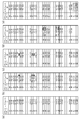
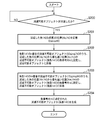
- FIG. 13 is a flowchart of a method for controlling the disappearance, reincarnation, and promotion of fish according to this specific example
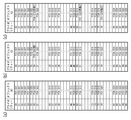
- FIG. 14 is a fish priority table showing the priority of the fish in the feeding game
- FIG. 15 is an explanatory diagram of the coordinate values of the aquarium image. It is.
- the appearance position of the reincarnation fish is determined or the fish to be promoted is determined.
- the fish that ate the food will disappear and a reincarnation process will be performed to generate a new fish.
- a player who has successfully fed the fish will witness the generation of the fish, and the player will feel uncomfortable.
- the fish is promoted immediately after the fish has disappeared, the player who has succeeded in feeding will witness the promotion of the fish, which will give the player a sense of incongruity.
- the reincarnation and promotion of the fish away from the position of the extinct fish prevents the player who has succeeded in feeding from witnessing the reincarnation and promotion of the fish, and does not give a sense of incongruity. Yes.
- step S200 it is determined whether or not the extinct object that is the fish (prey target) 140 has disappeared.
- a new fish object ID is picked up from the fish data table shown in FIG. 11, given priority “m”, and a second fish object 142 that is a new fish shadow 142 is generated (reincarnation) (step) S204). This completes the process of fish extinction, promotion, and reincarnation.
- step S200 it is assumed that the fish (food target) 140 with priority “06” has been successfully fed (see FIG. 14B).
- step S201 the coordinate values (X6, Y6) of the fish (food target) 140 with the priority “06” are stored.
- step S202 if the priority of the fish shadow 141 farthest from the coordinate values (X6, Y6) of the extinct fish (food target) 140 is “51”, the object ID assigned to the priority “51” “F04-013” is given the priority “06” of the extinct fish (prey target) 140 to be promoted (promotion 1) (see FIG. 14C).
- step S203 if the priority of the fish shadow 142 located farthest from the coordinate values (X6, Y6) of the extinct fish (food target) 140 is “76”, the object ID assigned to the priority “76”
- the priority (51) of the promoted (promoted 1) fish shadow 141 is given to “F01-020” to be promoted (promoted 2) (see FIG. 14C).
- step S204 if the object ID of the new fish shadow 142 to be generated (incarnated) is “F01-026”, the priority “of the fish shadow 142 that has been promoted (promoted 2) to the object ID“ F01-026 ”is“ 76 ”is given (reincarnation) (see FIG. 14C).
- FIG. 15 shows the coordinates of the game screen shown in FIG.
- the entire game screen has 3072 dots in the horizontal direction (X direction) and 1360 dots in the vertical direction (Y direction). This game screen is divided into four in the horizontal direction. Each divided screen has 768 dots in the horizontal direction (X direction) and 1360 dots in the vertical direction (Y direction).
- the four divided screens are displayed on the four LCD monitors 20A, 20B, 20C, and 20D, respectively.
- the four LCD monitors 20A, 20B, 20C, and 20D are arranged such that the LCD monitor 20C is located on the back side of the LCD monitor 20A and the LCD monitor 20D is located on the back side of the LCD monitor 20B.
- the first non-annihilarable object that is the fish shadow 141 and the second that is the fish shadow 142 are located farthest from the coordinate values (Xk, Yk) of the extinct fish (food target) 140.
- the distance calculation at this time is calculated in consideration of the arrangement of the four LCD monitors 20A, 20B, 20C, and 20D.
- the “farthest position” is a coordinate value in the LCD monitor 20C located on the back side of the LCD monitor 20A if it is a coordinate value in the LCD monitor 20A. This is because the LCD monitor 20A is disposed adjacent to the LCD monitors 20B and 20C.
- the coordinate values (Xk, Yk) of the extinct fish (food target) 140 are (300, 500)
- the coordinate values (Xk ′, Yk ′) farthest from the coordinate values (Xk, Yk) are .
- the fish shadow 141 and fish shadow 142 having the coordinate values closest to the farthest coordinate values (Xk ′, Yk ′) are determined as the fish shadow 141 and fish shadow 142 to be promoted.
- the farthest position is not limited to the X position of the coordinate value of the extinct fish (food target) 140 plus the coordinate value of two monitors (X direction).
- a value obtained by adding a predetermined coordinate value to the Y position of the coordinate value may be used.
- the coordinate values of the extinct fish (food target) 140 are compared with the coordinate values of the fish shadow 141 and fish shadow 142, respectively, and the calculated fish shadow 141 and fish shadow 142 at the farthest position are promoted.
- the fish shadow 142 may be determined.
- step S204 a second non-annihilation object that is a fish shadow 142 that is farthest from the coordinate values (Xk, Yk) of the extinct fish (prey object) 140 is obtained. This is the same as the distance calculation in steps S203 and S204.
- the determination method of the fish shadow 141 and the fish shadow 142 to be promoted and the determination method of the position to be reborn as the fish shadow 142 are not limited to the coordinate calculation method described above.
- a player who has successfully fed a fish may be promoted and reintroduced on a screen other than the divided screen including the coordinate values (Xk, Yk) of the extinct fish (food target) 140. Good.
- the extinct fish (food target) 140 is displayed on the LCD monitor 20A, the fish shadow 141 and the fish shadow 142 to be promoted are determined on the divided screens displayed on the other LCD monitors 20B, 20C, and 20D, and the fish The shadow 142 may be reincarnated.
- the LCD monitor 20C on the back side of the LCD monitor 20A is more desirable.
- the number of fish shadows 141 and fish shadows 142 in each divided screen is detected at any time, and the screen is not a divided screen including the coordinate values (Xk, Yk) of the extinct fish (food target) 140. ) 140, fish shadow 141, and fish shadow 142 may be preferentially determined and reincarnated as fish shadow 142 on the split screen with a small number of fish shadows 142.
- the fish shadow 141 and fish shadow 142 to be promoted may be preferentially determined on the estimated divided screen displayed on the LCD monitor, and may be reincarnation as the fish shadow 142.
- the LCD monitors 20A, 20B, 20C, and 20D are provided on the four surfaces around the quadrangular prism-shaped display unit 18, but the present invention is not limited to this configuration.
- three monitors may be provided on the three surfaces around the triangular prism-shaped display unit, or four or more monitors may be provided on each surface of the display unit on four or more polygons.
- a cylindrical monitor may be provided on the display surface of the columnar display unit.
- you may provide many monitors on the wall of the space where a player is. A player plays a game by looking at a monitor provided on the wall from the inside.
- a touch panel may be provided on the LCD monitors 20A, 20B, 20C, and 20D in the above embodiment.
- the game performance can be further enhanced using this touch panel. For example, food is made to appear at a position where the player touches the touch panel, and the food is made to eat. When the fish eats food, medals are paid out. The bait disappears after a predetermined time.
- the three operation buttons 25, 26, and 27 and the two medal insertion ports 28 and 29 are provided as input devices.
- the present invention is not limited to this configuration.
- the number and arrangement of operation buttons and medal slot are not limited to this.
- only the medal slot may be provided and the operation button may not be provided.
- the medal payout device 64 is provided as the output device and the medal is paid out.
- the present invention is not limited to this.
- a ticket may be output.
- any game value medium may be output, such as giving points to a player-owned card.
- the position of the bait which appears in an aquarium was determined by the three operation buttons 25, 26, and 27, it is not restricted to it.
- the manner of feeding may be changed depending on whether a plurality of operation buttons are pressed simultaneously or a long press of the operation buttons.
- each player independently played a game on the four LCD monitors 20A, 20B, 20C, and 20D, but the present invention is not limited to this.
- four players may cooperate to play a game.
- a special stage may be provided in the game, or a jackpot may be set.
- the feeding game is such that the fish moving around in the aquarium is fed from above the aquarium.
- the present invention is not limited to this.
- you may comprise as a game which hits a torpedo on an underwater submarine.
- you may comprise as a game which drops a bomb on the ship on the water instead of underwater.
- it may be configured as a game in which a bird flying in the air is shot from below.
- the present invention is useful for providing a game device capable of changing a video expression by giving a change to an object disappearance process and an appearance process.
Landscapes
- Engineering & Computer Science (AREA)
- Multimedia (AREA)
- Controls And Circuits For Display Device (AREA)
Applications Claiming Priority (2)
| Application Number | Priority Date | Filing Date | Title |
|---|---|---|---|
| JP2011-009112 | 2011-01-19 | ||
| JP2011009112A JP5765552B2 (ja) | 2011-01-19 | 2011-01-19 | ゲーム装置 |
Publications (1)
| Publication Number | Publication Date |
|---|---|
| WO2012098926A1 true WO2012098926A1 (ja) | 2012-07-26 |
Family
ID=46515558
Family Applications (1)
| Application Number | Title | Priority Date | Filing Date |
|---|---|---|---|
| PCT/JP2012/050030 Ceased WO2012098926A1 (ja) | 2011-01-19 | 2012-01-04 | ゲーム装置 |
Country Status (2)
| Country | Link |
|---|---|
| JP (1) | JP5765552B2 (enExample) |
| WO (1) | WO2012098926A1 (enExample) |
Cited By (1)
| Publication number | Priority date | Publication date | Assignee | Title |
|---|---|---|---|---|
| JP2018149149A (ja) * | 2017-03-14 | 2018-09-27 | 株式会社ドワンゴ | アプリケーションプログラム、端末装置の制御方法、端末装置、およびサーバのプログラム |
Citations (4)
| Publication number | Priority date | Publication date | Assignee | Title |
|---|---|---|---|---|
| JPH10165647A (ja) * | 1996-12-06 | 1998-06-23 | Sega Enterp Ltd | ゲーム装置及び画像処理装置 |
| JPH11259687A (ja) * | 1998-03-06 | 1999-09-24 | Namco Ltd | 画像生成装置及び情報記憶媒体 |
| JP2004130119A (ja) * | 2002-09-20 | 2004-04-30 | Dyna Co Ltd | ゲームシステム、管理装置、ゲーム端末、ジャックポットの払い出し方法、及びプログラム |
| JP2008113762A (ja) * | 2006-11-01 | 2008-05-22 | Nintendo Co Ltd | ゲームプログラムおよびゲーム装置 |
-
2011
- 2011-01-19 JP JP2011009112A patent/JP5765552B2/ja active Active
-
2012
- 2012-01-04 WO PCT/JP2012/050030 patent/WO2012098926A1/ja not_active Ceased
Patent Citations (4)
| Publication number | Priority date | Publication date | Assignee | Title |
|---|---|---|---|---|
| JPH10165647A (ja) * | 1996-12-06 | 1998-06-23 | Sega Enterp Ltd | ゲーム装置及び画像処理装置 |
| JPH11259687A (ja) * | 1998-03-06 | 1999-09-24 | Namco Ltd | 画像生成装置及び情報記憶媒体 |
| JP2004130119A (ja) * | 2002-09-20 | 2004-04-30 | Dyna Co Ltd | ゲームシステム、管理装置、ゲーム端末、ジャックポットの払い出し方法、及びプログラム |
| JP2008113762A (ja) * | 2006-11-01 | 2008-05-22 | Nintendo Co Ltd | ゲームプログラムおよびゲーム装置 |
Cited By (1)
| Publication number | Priority date | Publication date | Assignee | Title |
|---|---|---|---|---|
| JP2018149149A (ja) * | 2017-03-14 | 2018-09-27 | 株式会社ドワンゴ | アプリケーションプログラム、端末装置の制御方法、端末装置、およびサーバのプログラム |
Also Published As
| Publication number | Publication date |
|---|---|
| JP5765552B2 (ja) | 2015-08-19 |
| JP2012147960A (ja) | 2012-08-09 |
Similar Documents
| Publication | Publication Date | Title |
|---|---|---|
| US8568229B2 (en) | Apparatus and method for displaying player character showing special movement state in network game | |
| US10478724B2 (en) | Game device, processing method, and information storage medium | |
| JP6577209B2 (ja) | プログラム及びサーバシステム | |
| JP3779298B2 (ja) | ゲーム装置およびゲームプログラム | |
| WO2018012066A1 (ja) | ゲームシステム、端末装置及びプログラム | |
| AU2017276164A1 (en) | Video Slot Machine, Server System, And Computer System | |
| JP2015126784A (ja) | プログラム及びサーバシステム | |
| JP2016501043A (ja) | コンピュータゲームを実装する方法 | |
| JP3786669B2 (ja) | ゲームシステム、プログラム及び情報記憶媒体 | |
| JP2011255031A (ja) | ゲームプログラム、ゲーム装置およびゲーム制御方法 | |
| JP2022009108A (ja) | 情報処理システム、情報処理方法、及びプログラム | |
| JP2008183053A (ja) | ゲームシステム及びゲームプログラム | |
| CN202237225U (zh) | 游戏装置 | |
| JP5765552B2 (ja) | ゲーム装置 | |
| JP2020110452A (ja) | ゲームプログラム、方法、および情報処理装置 | |
| JP7678185B2 (ja) | プログラム、端末、及びゲームシステム | |
| WO2024103954A1 (zh) | 虚拟对局的界面显示方法、装置、设备、介质及程序产品 | |
| JP2025536405A (ja) | 仮想オブジェクトに基づくインタラクション方法および装置、電子機器並びにコンピュータプログラム | |
| CN100538746C (zh) | 图像生成装置及自动配置方法 | |
| JP2024081184A (ja) | ゲーム装置、ゲーム実行制御方法およびプログラム | |
| JP6964899B2 (ja) | 情報処理システム、情報処理方法、及びプログラム | |
| JP2010057841A (ja) | ゲーム装置及びゲーム装置の制御方法 | |
| JP7535551B2 (ja) | 情報処理プログラム、情報処理装置、情報処理システム、および情報処理方法 | |
| JP7463322B2 (ja) | プログラム、情報処理システム | |
| JP6993012B2 (ja) | 情報処理システム、情報処理方法、及びプログラム |
Legal Events
| Date | Code | Title | Description |
|---|---|---|---|
| 121 | Ep: the epo has been informed by wipo that ep was designated in this application |
Ref document number: 12736232 Country of ref document: EP Kind code of ref document: A1 |
|
| NENP | Non-entry into the national phase |
Ref country code: DE |
|
| 122 | Ep: pct application non-entry in european phase |
Ref document number: 12736232 Country of ref document: EP Kind code of ref document: A1 |