WO2012096017A1 - 触媒及びその製造法 - Google Patents
触媒及びその製造法 Download PDFInfo
- Publication number
- WO2012096017A1 WO2012096017A1 PCT/JP2011/065971 JP2011065971W WO2012096017A1 WO 2012096017 A1 WO2012096017 A1 WO 2012096017A1 JP 2011065971 W JP2011065971 W JP 2011065971W WO 2012096017 A1 WO2012096017 A1 WO 2012096017A1
- Authority
- WO
- WIPO (PCT)
- Prior art keywords
- mol
- catalyst
- composite oxide
- oxygen
- catalyst according
- Prior art date
- Legal status (The legal status is an assumption and is not a legal conclusion. Google has not performed a legal analysis and makes no representation as to the accuracy of the status listed.)
- Ceased
Links
Images

Classifications
-
- B—PERFORMING OPERATIONS; TRANSPORTING
- B01—PHYSICAL OR CHEMICAL PROCESSES OR APPARATUS IN GENERAL
- B01J—CHEMICAL OR PHYSICAL PROCESSES, e.g. CATALYSIS OR COLLOID CHEMISTRY; THEIR RELEVANT APPARATUS
- B01J23/00—Catalysts comprising metals or metal oxides or hydroxides, not provided for in group B01J21/00
- B01J23/70—Catalysts comprising metals or metal oxides or hydroxides, not provided for in group B01J21/00 of the iron group metals or copper
- B01J23/89—Catalysts comprising metals or metal oxides or hydroxides, not provided for in group B01J21/00 of the iron group metals or copper combined with noble metals
- B01J23/8933—Catalysts comprising metals or metal oxides or hydroxides, not provided for in group B01J21/00 of the iron group metals or copper combined with noble metals also combined with metals, or metal oxides or hydroxides provided for in groups B01J23/02 - B01J23/36
- B01J23/894—Catalysts comprising metals or metal oxides or hydroxides, not provided for in group B01J21/00 of the iron group metals or copper combined with noble metals also combined with metals, or metal oxides or hydroxides provided for in groups B01J23/02 - B01J23/36 with rare earths or actinides
-
- B—PERFORMING OPERATIONS; TRANSPORTING
- B01—PHYSICAL OR CHEMICAL PROCESSES OR APPARATUS IN GENERAL
- B01J—CHEMICAL OR PHYSICAL PROCESSES, e.g. CATALYSIS OR COLLOID CHEMISTRY; THEIR RELEVANT APPARATUS
- B01J23/00—Catalysts comprising metals or metal oxides or hydroxides, not provided for in group B01J21/00
- B01J23/70—Catalysts comprising metals or metal oxides or hydroxides, not provided for in group B01J21/00 of the iron group metals or copper
- B01J23/76—Catalysts comprising metals or metal oxides or hydroxides, not provided for in group B01J21/00 of the iron group metals or copper combined with metals, oxides or hydroxides provided for in groups B01J23/02 - B01J23/36
- B01J23/83—Catalysts comprising metals or metal oxides or hydroxides, not provided for in group B01J21/00 of the iron group metals or copper combined with metals, oxides or hydroxides provided for in groups B01J23/02 - B01J23/36 with rare earths or actinides
-
- B—PERFORMING OPERATIONS; TRANSPORTING
- B01—PHYSICAL OR CHEMICAL PROCESSES OR APPARATUS IN GENERAL
- B01J—CHEMICAL OR PHYSICAL PROCESSES, e.g. CATALYSIS OR COLLOID CHEMISTRY; THEIR RELEVANT APPARATUS
- B01J35/00—Catalysts, in general, characterised by their form or physical properties
- B01J35/19—Catalysts containing parts with different compositions
-
- B—PERFORMING OPERATIONS; TRANSPORTING
- B01—PHYSICAL OR CHEMICAL PROCESSES OR APPARATUS IN GENERAL
- B01J—CHEMICAL OR PHYSICAL PROCESSES, e.g. CATALYSIS OR COLLOID CHEMISTRY; THEIR RELEVANT APPARATUS
- B01J35/00—Catalysts, in general, characterised by their form or physical properties
- B01J35/40—Catalysts, in general, characterised by their form or physical properties characterised by dimensions, e.g. grain size
-
- B—PERFORMING OPERATIONS; TRANSPORTING
- B01—PHYSICAL OR CHEMICAL PROCESSES OR APPARATUS IN GENERAL
- B01J—CHEMICAL OR PHYSICAL PROCESSES, e.g. CATALYSIS OR COLLOID CHEMISTRY; THEIR RELEVANT APPARATUS
- B01J35/00—Catalysts, in general, characterised by their form or physical properties
- B01J35/60—Catalysts, in general, characterised by their form or physical properties characterised by their surface properties or porosity
- B01J35/61—Surface area
- B01J35/613—10-100 m2/g
-
- B—PERFORMING OPERATIONS; TRANSPORTING
- B01—PHYSICAL OR CHEMICAL PROCESSES OR APPARATUS IN GENERAL
- B01J—CHEMICAL OR PHYSICAL PROCESSES, e.g. CATALYSIS OR COLLOID CHEMISTRY; THEIR RELEVANT APPARATUS
- B01J37/00—Processes, in general, for preparing catalysts; Processes, in general, for activation of catalysts
- B01J37/0009—Use of binding agents; Moulding; Pressing; Powdering; Granulating; Addition of materials ameliorating the mechanical properties of the product catalyst
- B01J37/0018—Addition of a binding agent or of material, later completely removed among others as result of heat treatment, leaching or washing,(e.g. forming of pores; protective layer, desintegrating by heat)
-
- B—PERFORMING OPERATIONS; TRANSPORTING
- B01—PHYSICAL OR CHEMICAL PROCESSES OR APPARATUS IN GENERAL
- B01J—CHEMICAL OR PHYSICAL PROCESSES, e.g. CATALYSIS OR COLLOID CHEMISTRY; THEIR RELEVANT APPARATUS
- B01J37/00—Processes, in general, for preparing catalysts; Processes, in general, for activation of catalysts
- B01J37/02—Impregnation, coating or precipitation
- B01J37/0201—Impregnation
-
- B—PERFORMING OPERATIONS; TRANSPORTING
- B01—PHYSICAL OR CHEMICAL PROCESSES OR APPARATUS IN GENERAL
- B01J—CHEMICAL OR PHYSICAL PROCESSES, e.g. CATALYSIS OR COLLOID CHEMISTRY; THEIR RELEVANT APPARATUS
- B01J37/00—Processes, in general, for preparing catalysts; Processes, in general, for activation of catalysts
- B01J37/04—Mixing
-
- B—PERFORMING OPERATIONS; TRANSPORTING
- B01—PHYSICAL OR CHEMICAL PROCESSES OR APPARATUS IN GENERAL
- B01J—CHEMICAL OR PHYSICAL PROCESSES, e.g. CATALYSIS OR COLLOID CHEMISTRY; THEIR RELEVANT APPARATUS
- B01J37/00—Processes, in general, for preparing catalysts; Processes, in general, for activation of catalysts
- B01J37/08—Heat treatment
-
- C—CHEMISTRY; METALLURGY
- C01—INORGANIC CHEMISTRY
- C01B—NON-METALLIC ELEMENTS; COMPOUNDS THEREOF; METALLOIDS OR COMPOUNDS THEREOF NOT COVERED BY SUBCLASS C01C
- C01B3/00—Hydrogen; Gaseous mixtures containing hydrogen; Separation of hydrogen from mixtures containing it; Purification of hydrogen; Reversible storage of hydrogen
- C01B3/02—Production of hydrogen; Production of gaseous mixtures containing hydrogen
- C01B3/32—Production of hydrogen; Production of gaseous mixtures containing hydrogen by reaction of gaseous or liquid organic compounds with gasifying agents, e.g. water, carbon dioxide or air
- C01B3/34—Production of hydrogen; Production of gaseous mixtures containing hydrogen by reaction of gaseous or liquid organic compounds with gasifying agents, e.g. water, carbon dioxide or air by reaction of hydrocarbons with gasifying agents
- C01B3/38—Production of hydrogen; Production of gaseous mixtures containing hydrogen by reaction of gaseous or liquid organic compounds with gasifying agents, e.g. water, carbon dioxide or air by reaction of hydrocarbons with gasifying agents using catalysts
- C01B3/40—Production of hydrogen; Production of gaseous mixtures containing hydrogen by reaction of gaseous or liquid organic compounds with gasifying agents, e.g. water, carbon dioxide or air by reaction of hydrocarbons with gasifying agents using catalysts characterised by the catalyst
-
- H—ELECTRICITY
- H01—ELECTRIC ELEMENTS
- H01M—PROCESSES OR MEANS, e.g. BATTERIES, FOR THE DIRECT CONVERSION OF CHEMICAL ENERGY INTO ELECTRICAL ENERGY
- H01M4/00—Electrodes
- H01M4/86—Inert electrodes with catalytic activity, e.g. for fuel cells
- H01M4/90—Selection of catalytic material
- H01M4/9041—Metals or alloys
-
- H—ELECTRICITY
- H01—ELECTRIC ELEMENTS
- H01M—PROCESSES OR MEANS, e.g. BATTERIES, FOR THE DIRECT CONVERSION OF CHEMICAL ENERGY INTO ELECTRICAL ENERGY
- H01M4/00—Electrodes
- H01M4/86—Inert electrodes with catalytic activity, e.g. for fuel cells
- H01M4/90—Selection of catalytic material
- H01M4/9041—Metals or alloys
- H01M4/905—Metals or alloys specially used in fuel cell operating at high temperature, e.g. SOFC
- H01M4/9066—Metals or alloys specially used in fuel cell operating at high temperature, e.g. SOFC of metal-ceramic composites or mixtures, e.g. cermets
-
- B—PERFORMING OPERATIONS; TRANSPORTING
- B01—PHYSICAL OR CHEMICAL PROCESSES OR APPARATUS IN GENERAL
- B01J—CHEMICAL OR PHYSICAL PROCESSES, e.g. CATALYSIS OR COLLOID CHEMISTRY; THEIR RELEVANT APPARATUS
- B01J21/00—Catalysts comprising the elements, oxides, or hydroxides of magnesium, boron, aluminium, carbon, silicon, titanium, zirconium, or hafnium
- B01J21/06—Silicon, titanium, zirconium or hafnium; Oxides or hydroxides thereof
- B01J21/066—Zirconium or hafnium; Oxides or hydroxides thereof
-
- B—PERFORMING OPERATIONS; TRANSPORTING
- B01—PHYSICAL OR CHEMICAL PROCESSES OR APPARATUS IN GENERAL
- B01J—CHEMICAL OR PHYSICAL PROCESSES, e.g. CATALYSIS OR COLLOID CHEMISTRY; THEIR RELEVANT APPARATUS
- B01J2235/00—Indexing scheme associated with group B01J35/00, related to the analysis techniques used to determine the catalysts form or properties
-
- B—PERFORMING OPERATIONS; TRANSPORTING
- B01—PHYSICAL OR CHEMICAL PROCESSES OR APPARATUS IN GENERAL
- B01J—CHEMICAL OR PHYSICAL PROCESSES, e.g. CATALYSIS OR COLLOID CHEMISTRY; THEIR RELEVANT APPARATUS
- B01J35/00—Catalysts, in general, characterised by their form or physical properties
- B01J35/70—Catalysts, in general, characterised by their form or physical properties characterised by their crystalline properties, e.g. semi-crystalline
-
- C—CHEMISTRY; METALLURGY
- C01—INORGANIC CHEMISTRY
- C01B—NON-METALLIC ELEMENTS; COMPOUNDS THEREOF; METALLOIDS OR COMPOUNDS THEREOF NOT COVERED BY SUBCLASS C01C
- C01B2203/00—Integrated processes for the production of hydrogen or synthesis gas
- C01B2203/02—Processes for making hydrogen or synthesis gas
- C01B2203/0205—Processes for making hydrogen or synthesis gas containing a reforming step
- C01B2203/0227—Processes for making hydrogen or synthesis gas containing a reforming step containing a catalytic reforming step
- C01B2203/0233—Processes for making hydrogen or synthesis gas containing a reforming step containing a catalytic reforming step the reforming step being a steam reforming step
-
- C—CHEMISTRY; METALLURGY
- C01—INORGANIC CHEMISTRY
- C01B—NON-METALLIC ELEMENTS; COMPOUNDS THEREOF; METALLOIDS OR COMPOUNDS THEREOF NOT COVERED BY SUBCLASS C01C
- C01B2203/00—Integrated processes for the production of hydrogen or synthesis gas
- C01B2203/10—Catalysts for performing the hydrogen forming reactions
- C01B2203/1041—Composition of the catalyst
- C01B2203/1047—Group VIII metal catalysts
- C01B2203/1052—Nickel or cobalt catalysts
- C01B2203/1058—Nickel catalysts
-
- C—CHEMISTRY; METALLURGY
- C01—INORGANIC CHEMISTRY
- C01B—NON-METALLIC ELEMENTS; COMPOUNDS THEREOF; METALLOIDS OR COMPOUNDS THEREOF NOT COVERED BY SUBCLASS C01C
- C01B2203/00—Integrated processes for the production of hydrogen or synthesis gas
- C01B2203/10—Catalysts for performing the hydrogen forming reactions
- C01B2203/1041—Composition of the catalyst
- C01B2203/1082—Composition of support materials
-
- H—ELECTRICITY
- H01—ELECTRIC ELEMENTS
- H01M—PROCESSES OR MEANS, e.g. BATTERIES, FOR THE DIRECT CONVERSION OF CHEMICAL ENERGY INTO ELECTRICAL ENERGY
- H01M8/00—Fuel cells; Manufacture thereof
- H01M8/10—Fuel cells with solid electrolytes
- H01M2008/1095—Fuel cells with polymeric electrolytes
-
- Y—GENERAL TAGGING OF NEW TECHNOLOGICAL DEVELOPMENTS; GENERAL TAGGING OF CROSS-SECTIONAL TECHNOLOGIES SPANNING OVER SEVERAL SECTIONS OF THE IPC; TECHNICAL SUBJECTS COVERED BY FORMER USPC CROSS-REFERENCE ART COLLECTIONS [XRACs] AND DIGESTS
- Y02—TECHNOLOGIES OR APPLICATIONS FOR MITIGATION OR ADAPTATION AGAINST CLIMATE CHANGE
- Y02E—REDUCTION OF GREENHOUSE GAS [GHG] EMISSIONS, RELATED TO ENERGY GENERATION, TRANSMISSION OR DISTRIBUTION
- Y02E60/00—Enabling technologies; Technologies with a potential or indirect contribution to GHG emissions mitigation
- Y02E60/30—Hydrogen technology
- Y02E60/50—Fuel cells
-
- Y—GENERAL TAGGING OF NEW TECHNOLOGICAL DEVELOPMENTS; GENERAL TAGGING OF CROSS-SECTIONAL TECHNOLOGIES SPANNING OVER SEVERAL SECTIONS OF THE IPC; TECHNICAL SUBJECTS COVERED BY FORMER USPC CROSS-REFERENCE ART COLLECTIONS [XRACs] AND DIGESTS
- Y02—TECHNOLOGIES OR APPLICATIONS FOR MITIGATION OR ADAPTATION AGAINST CLIMATE CHANGE
- Y02P—CLIMATE CHANGE MITIGATION TECHNOLOGIES IN THE PRODUCTION OR PROCESSING OF GOODS
- Y02P20/00—Technologies relating to chemical industry
- Y02P20/50—Improvements relating to the production of bulk chemicals
- Y02P20/52—Improvements relating to the production of bulk chemicals using catalysts, e.g. selective catalysts
Definitions
- the present invention relates to a catalyst and a method for producing the same, and more particularly to a hydrocarbon steam reforming catalyst for producing hydrogen.
- PEFC polymer electrolyte fuel cells
- a catalyst is necessary to perform the steam reforming reaction efficiently.
- a catalyst in which Ru is supported on alumina Non-patent Document 1
- an oxide solid solution of Zr, Ce, Fe, or Y is added to Pt, Ru, Rh.
- Catalysts supporting Pd, etc. Patent Document 1
- catalysts supporting Pt, Rh, Ni, Co, etc. on oxides containing Ce, Pr, etc. have been proposed (Patent Document 2).
- exhaust gas purification catalysts for automobiles and the like use so-called three-way catalysts that oxidize carbon monoxide and hydrocarbons in exhaust gas to carbon dioxide gas and water and reduce nitrogen oxides to nitrogen and water.
- the three-way catalyst is configured, for example, by supporting a catalyst metal such as alumina or cordierite with a catalytic metal such as Pt, Rh, or Pd and a co-catalyst containing Ce or the like for enhancing their catalytic action. ing.
- a catalyst metal such as alumina or cordierite with a catalytic metal such as Pt, Rh, or Pd and a co-catalyst containing Ce or the like for enhancing their catalytic action.
- the noble metal used as such a catalyst metal has problems in terms of cost and supply.
- the object of the present invention is to reduce the cost and supply problems associated with the above catalyst, and the reforming rate of hydrocarbons to hydrogen is high. In particular, the reforming rate of hydrocarbons to hydrogen after oxidation is increased.
- Another object of the present invention is to provide a catalyst, a hydrocarbon steam reforming catalyst, and a method for producing the same that can be made higher and that can be easily handled.
- the inventors of the present invention have prepared a catalyst in which at least Ni is supported on a composite oxide containing at least Ce and Zr and having specific crystallinity and specific surface area. We have found that a high reforming ratio from hydrocarbon to hydrogen is maintained with a small amount of use, even if no precious metal is used, and a high reforming ratio is maintained even after oxidation. did.
- R represents Ce or a mixture of Ce and Pr
- Zr represents and oxygen
- the total amount of elements other than oxygen is 100 mol%, R 10 mol% or more and 90 mol% or less, Zr 10 mol% or more and 90 mol% or less
- M is an element other than oxygen, R, or Zr
- a catalyst and a hydrocarbon steam reforming catalyst characterized in that a catalytic metal containing is supported.
- the step (a) of preparing a mixed solution containing a cerium solution in which 80 mol% or more of cerium ions are tetravalent and zirconium hydroxide is neutralized, and the obtained mixed solution is neutralized.
- a step (b) for obtaining a precursor of a composite oxide, a step (c) for adding and mixing a surfactant to the obtained precursor, and a precursor obtained by mixing the obtained surfactant are fired.
- a process for producing the above catalyst comprising the step (d) of obtaining a composite oxide and the step (e) of supporting a catalyst metal containing at least Ni on the obtained composite oxide.
- the catalyst of the present invention is low in cost, has no fear of supply, has a high reforming rate from hydrocarbon to hydrogen, and can maintain a high reforming rate even after being oxidized. It is useful as a hydrogen steam reforming catalyst.
- the catalyst of the present invention can be produced efficiently.
- the catalyst of the present invention has a specific surface area of the composite oxide to be used of 20 to 40 m 2 / g and a half-value width of the strongest peak measured by Raman spectroscopy in the wavelength range of 200 to 800 cm ⁇ 1 to 30 to 45 cm ⁇ .
- the catalyst according to the present invention supporting at least Ni as the catalyst metal is oxidized to NiO in an oxidizing atmosphere, and usually has no catalytic properties.
- the catalyst of the present invention employing such a configuration can continue to function as a hydrocarbon steam reforming catalyst without reduction treatment even after the hydrocarbon steam reforming reaction.
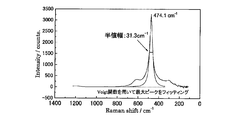
- FIG. 2 is a graph obtained by subtracting the background evaluated in FIG. 1 and then fitting a maximum peak using a Voigt function to obtain a half width.
- the catalyst of the present invention is obtained by supporting a catalytic metal containing at least Ni on a composite oxide having a specific composition containing Ce and Zr, or Ce, Pr and Zr.
- R is Ce or a mixture of Ce and Pr
- Zr is 10 mol% or more and 90 mol% or less
- M M is an element other than oxygen, R, or Zr
- R contains 50 mol% or more and 80 mol% or less
- Zr contains 20 mol% or more and 50 mol% or less
- M element contains 0 mol% or more and 20 mol% or less.
- R contains Pr
- the content of Pr is preferably 10 mol% or less in R, more preferably 5 mol% or less.
- Zr salts may contain several mole% of Hf, and Hf is included in Zr in the present invention.
- examples of M include alkaline earth metals such as Mg, Ca, Sr, and Ba, and other than Ce and Pr, such as Sc, Y, La, Nd, and Tb.
- alkaline earth metals such as Mg, Ca, Sr, and Ba
- Ce and Pr such as Sc, Y, La, Nd, and Tb.
- rare earth elements such as rare earth elements, Ti, V, Nb, Ta, Cr, Mo, W, Mn, Fe, Co, Ni, Pd, Pt, Cu, Ag, Zn, Al, Ga, In, Ge, Sn, Bi Transition metal elements, halogen elements such as F and Cl, and one or more of Si.
- Composite oxide used in the present invention is a specific surface area of 11 ⁇ 90m 2 / g, and a half-value width 20 ⁇ 72cm -1 of the strongest peak measured in the wavelength range of 200 ⁇ 800 cm -1 in Raman spectroscopy is there.
- a specific surface area of 12 ⁇ 40m 2 / g, and a half-value width 30 ⁇ 60cm -1 of the strongest peak measured in the wavelength range of 200 ⁇ 800 cm -1 in Raman spectroscopy particularly preferably the ratio surface area of 20 ⁇ 40m 2 / g, and the half-value width of the strongest peak measured in the wavelength range of 200 ⁇ 800 cm -1 in Raman spectroscopy is 30 ⁇ 60cm -1.
- the specific surface area is 20 to 40 m 2 / g, since the oxidation catalyst ability can always be maintained in the oxidizing atmosphere. and most preferably in the range of 30 ⁇ 45cm -1 and half-width of the strongest peak measured in the wavelength range of 200 ⁇ 800 cm -1 in Raman spectroscopy.
- the specific surface area a value measured by a BET method by nitrogen gas adsorption was used.
- the half-value width of the strongest peak measured in the wavelength range of 200 to 800 cm ⁇ 1 by the Raman spectroscopy described above is measured using Raman scattering obtained by using NRS-3100 (manufactured by JASCO Corporation). After subtracting the background evaluated using the Gauss function for the spectrum and then fitting the maximum peak using the Voigt function, the half width was determined. Specifically, taking the composite oxide produced in Example 2 described later as an example, a graph obtained by subtracting the background evaluated using the Gauss function for the Raman scattering spectrum obtained by measurement is shown in FIG. 1, and then the Voigt function. FIG. 2 shows a graph in which the full width at half maximum was obtained after fitting the maximum peak using.
- the composite oxide used in the present invention tends to increase the half width when a catalytic metal is supported and a hydrocarbon steam reforming reaction is performed.
- the composite oxide before supporting the catalytic metal The full width at half maximum was determined.
- the peak originates from the CaF 2 phase or a similar phase, and in the present invention, the half width is used for evaluating the crystallinity of the composite oxide.
- the catalyst support has a large specific surface area.
- the inventors have found that the catalyst performance is effectively exhibited when the complex oxide supporting the catalyst metal has high crystallinity. Therefore, the present inventors adopted a high crystallinity while maintaining the specific surface area of the composite oxide as high as possible.
- Such a composite oxide is microscopically composed of two or more types of CaF 2 phases or similar phases thereof, and oxygen is firmly taken in and smoothly moves at the interface between the plurality of such very similar phases.
- the catalyst metal is reduced to exhibit good catalyst performance.
- Two or more similar CaF 2 phases or similar phases are preferably expressed when the composite oxide has the above-described composition, specific surface area, and crystallinity, and are expected to exhibit good catalytic performance. .
- the catalyst of the present invention carries at least Ni as a catalyst metal.
- a catalyst metal one or more elements selected from Cu, Fe, Ru, Pt, Pd, or Rh can be contained together with Ni.
- the amount of the catalyst metal supported is preferably 0.1 to 10 mol% with respect to 100 mol% of the total of R, Zr and M in the composite oxide. From the viewpoint of cost and supply, the catalyst metal is preferably only Ni or Ni and Fe. When elements other than Ni and Fe are contained, the content of Ni and Fe is preferably not more than the content.
- the catalyst of the present invention is preferably heated from room temperature to 600 ° C. over 1.5 hours under an oxygen flow and kept at 600 ° C. for 1 hour.
- the modification rate is 40% or more, particularly preferably 80% or more.
- methane steam reforming measurement can be performed under the following conditions.
- the methane steam reforming measurement method first, 50.0 mg of the catalyst is weighed, and fixed in a quartz glass fixed bed type reaction tube (inner diameter 11 mm) by sandwiching the upper and lower sides with quartz glass wool. Hydrogen gas is allowed to flow through the reaction tube at 100 ml / min, and the temperature is raised from room temperature to 600 ° C. over 1.5 hours. After reaching 600 ° C., the catalyst is reduced by holding for 1 hour. After the reduction, hydrogen gas is stopped, and nitrogen gas is flowed to discharge the hydrogen gas in the reaction tube.
- nitrogen gas is used as a carrier gas, nitrogen gas is 90 ml / min, methane gas is 2.5 ml / min, and water vapor is 7.5 ml / min so that the ratio of methane: water is 1: 3.
- nitrogen gas is 90 ml / min
- methane gas is 2.5 ml / min
- water vapor is 7.5 ml / min so that the ratio of methane: water is 1: 3.
- the measurement is performed every 13 minutes for a total of 4 points, the outlet gas is sampled and analyzed by gas chromatography, and the average value is obtained. This is measured (1).
- the temperature is lowered to room temperature while flowing 90 ml / min of nitrogen gas. Then, oxygen gas 100ml / min is flowed, and it heats up from room temperature to 600 degreeC over 1.5 hours. After reaching 600 ° C., hold for 1 hour to oxidize the catalyst. After the oxidation, the oxygen gas is stopped, and nitrogen gas is supplied to discharge the oxygen gas in the reaction tube. After exhausting the oxygen gas sufficiently, the reforming rate from methane to hydrogen is measured as in measurement (1). This is measured (4).
- the catalyst of the present invention can be used as an alternative to Pt catalysts such as PEFC and exhaust gas purification catalyst, but is preferably used as a hydrocarbon steam reforming catalyst.
- the production method of the catalyst of the present invention is not particularly limited, and can be performed by a method of supporting a catalyst metal by an impregnation method after a precursor prepared in a wet process is heat-treated to obtain a composite oxide, for example, It can be obtained by the production method of the present invention.
- the production method of the present invention includes a step (a) of preparing a mixed solution containing a cerium solution in which 80 mol% or more of cerium ions are tetravalent and zirconium hydroxide.
- a cerium solution in which 80 mol% or more of cerium ions are tetravalent and zirconium hydroxide.
- the tetravalent cerium solution include ceric nitrate solution and ceric ammonium nitrate solution, and the use of ceric nitrate solution is particularly preferable.
- the initial concentration of the cerium solution can be adjusted to usually 5 to 100 g / l, preferably 10 to 80 g / l in terms of CeO 2 . If the concentration is too low, productivity is low, which is not industrially advantageous.
- the average particle size of the zirconium hydroxide is usually 0.5 to 50 ⁇ m, preferably 10 to 40 ⁇ m.
- the zirconium hydroxide is (A) zirconium hydroxide Zr (OH) 4 ⁇ nH 2 O, (B) zirconium oxyhydroxide ZrO (OH) 2 ⁇ nH 2 O, (C) hydrated zirconia ZrO 2 ⁇ nH.
- a general term for 2 O which can be used alone or as a mixture.
- the zirconium hydroxide is usually available in the form of powder from a commercial product.
- an aqueous solution of zirconium salt such as zirconium nitrate, zirconium chloride, zirconyl nitrate, aqueous ammonia, ammonia gas, sodium hydroxide, potassium hydroxide, etc. It can be obtained by a known method of adding a base.
- the production method of the present invention includes a step (b) in which the mixed solution obtained in the step (a) is neutralized to obtain a composite oxide precursor.
- the mixed solution obtained in the step (a) Prior to performing the step (b), can be heated and held at 60 ° C. or higher. By this heating and holding, cerium oxide hydrate is produced from the cerium solution, and a solution containing zirconium hydroxide and a colloidal complex salt can be formed.
- the reactor to be used may be either a closed type container or an open type container.
- an autoclave reactor can be used.
- the heating and holding temperature is 60 ° C. or higher, preferably 60 to 200 ° C., particularly preferably 80 to 180 ° C., and most preferably 90 to 130 ° C.
- the heating and holding time is usually 10 minutes to 48 hours, preferably 30 minutes to 36 hours, more preferably 1 hour to 24 hours. If the conditions for heating and holding are not sufficient, the crystallinity of the precursor described later does not increase, and the specific surface area and crystallinity of the finally obtained composite oxide may not be within the desired ranges.
- an element other than Ce and Zr it can be mixed so as to have a desired composition as an aqueous solution of the element before and after the heating and holding step. Moreover, it can also carry out by the method of impregnating a precursor with the aqueous solution of this element before the baking process (d) mentioned later, or the method of mixing the salt and oxide of this element with a precursor.
- Neutralization in the step (b) can be performed, for example, by mixing sodium hydroxide, potassium hydroxide, ammonia water, ammonia gas, or a mixture thereof and the mixed solution obtained in the step (a).
- it can be performed by adding a colloidal complex salt-containing solution obtained after heating and holding to aqueous ammonia. Neutralization may be performed after cooling the colloidal complex salt-containing solution obtained by heating and holding.
- the precursor can be separated by, for example, Nutsche method, centrifugal separation method, or filter press method.
- the precipitate can be washed with water as much as necessary.
- the production method of the present invention includes a step (c) of adding and mixing a surfactant to the obtained precursor.
- the surfactant include anionic surfactants such as ethoxycarboxylate, nonionic surfactants such as alcohol ethoxylate, polyethylene glycol, and carboxylic acids and mixtures thereof. Is preferred.
- Preferred examples of the carboxylic acid include saturated carboxylic acids such as decanoic acid, lauric acid, myristic acid, and palmitic acid, and lauric acid is particularly preferable.
- the addition amount of the surfactant is usually 1 to 50 parts by mass, preferably 5 to 30 parts by mass per 100 parts by mass of the obtained composite oxide.
- the surfactant can be used in the form of a solution diluted or dissolved with a solvent such as alcohol or pure water as it is. Mixing can be performed using a known mixer.
- the production method of the present invention includes a step (d) of firing the precursor mixed with the obtained surfactant to obtain a composite oxide.
- the precursor mixed with the surfactant can be calcined to obtain a composite oxide.
- the calcination temperature can usually be 250 to 700 ° C, preferably 300 to 500 ° C. Calcination can be performed in air or oxygen.
- the calcining time can be appropriately set in consideration of the calcining temperature, and can usually be determined in the range of 1 to 10 hours. If necessary, the composite oxide after calcination is pulverized and then fired in the step (d).
- the calcination temperature in step (d) is usually 600 to 1200 ° C., preferably 800 to 1100 ° C., most preferably 800 to 1050 ° C. Firing can be performed in air or oxygen, but is preferably performed in oxygen.
- the firing time can be appropriately set in consideration of the firing temperature, and can usually be determined in the range of 1 to 10 hours.
- the obtained composite oxide can be pulverized to a desired particle size if necessary.
- the average particle size is preferably 1 to 50 ⁇ m.
- the production method of the present invention includes a step (e) of supporting a catalytic metal containing at least Ni on the obtained composite oxide.
- the catalyst metal can be supported by a known method.
- the composite oxide can be impregnated with an aqueous solution of a catalytic metal and then baked.
- the firing temperature is usually 250 to 800 ° C., preferably 300 to 600 ° C. Firing can be performed in air or oxygen, but is preferably performed in oxygen.
- the firing time can be appropriately set in consideration of the firing temperature, and can usually be determined in the range of 1 to 10 hours.
- Example 1 90% or more of cerium ions are mixed with a tetravalent cerium nitrate aqueous solution and zirconium hydroxide with an average particle size of 30 ⁇ m so as to have a ratio of Ce 75 mol% and Zr 25 mol%, resulting in a concentration of 30 g / l in terms of oxide.
- 1 liter of the mixed solution was prepared as described above and placed in a 1 liter separable flask. A stirrer and a Dimroth condenser were set in the separable flask, and heated at 98 ° C. for 20 hours.
- the obtained composite oxide was measured by ICP, it was Ce 75 mol% and Zr 25 mol%.
- the composite oxide half-width of the strongest peak measured in the wavelength range of 200 ⁇ 800 cm -1 in the foregoing Raman spectroscopy 47.5cm -1, a specific surface area of 72.8m 2 / g.
- the composite oxide is impregnated with an aqueous nickel nitrate solution so that the amount of Ni is 6.25 mol%, and calcined in oxygen at 500 ° C. for 3 hours.
- a catalyst was obtained.
- Ni was 6.25 mol% with respect to 100 mol% in total of Ce and Zr.
- the obtained catalyst was subjected to the methane steam reforming measurement described above. Table 1 shows the reforming rate.
- Example 2 A composite oxide and a catalyst were obtained in the same manner as in Example 1 except that the firing temperature of the composite oxide was changed from 800 ° C. to 1000 ° C.
- the complex oxide thus obtained was measured for its half-value width, specific surface area, and reforming rate of the obtained catalyst measured by Raman spectroscopy. The results are shown in Table 1.
- Example 3 The composition of the composite oxide was Ce 73.2 mol%, Pr 2.4 mol%, and Zr 24.4 mol%.
- the catalyst composition was 100 mol% in total of Ce, Pr, and Zr, and Ni was 6.25 mol%.
- a composite oxide and a catalyst were obtained in the same manner as in Example 2 except that. Pr used an aqueous praseodymium nitrate solution and was added to a mixed solution of an aqueous cerium nitrate solution and zirconium hydroxide.
- the complex oxide thus obtained was measured for its half-value width, specific surface area, and reforming rate of the obtained catalyst measured by Raman spectroscopy. The results are shown in Table 1.
- Example 4 A composite oxide and a catalyst were obtained in the same manner as in Example 3 except that the firing temperature of the composite oxide was changed from 1000 ° C. to 1100 ° C. The complex oxide thus obtained was measured for its half-value width, specific surface area, and reforming rate of the obtained catalyst measured by Raman spectroscopy. The results are shown in Table 1.
- Example 5 A composite oxide and a catalyst were obtained in the same manner as in Example 1 except that the composition of the composite oxide was changed to Ce 50 mol% and Zr 50 mol%. The complex oxide thus obtained was measured for its half-value width, specific surface area, and reforming rate of the obtained catalyst measured by Raman spectroscopy. The results are shown in Table 1.
- Example 6 A composite oxide and a catalyst were obtained in the same manner as in Example 5 except that the firing temperature of the composite oxide was changed from 800 ° C to 1000 ° C. The complex oxide thus obtained was measured for its half-value width, specific surface area, and reforming rate of the obtained catalyst measured by Raman spectroscopy. The results are shown in Table 1.
- Example 7 A composite oxide and a catalyst were obtained in the same manner as in Example 3 except that the composition of the composite oxide was Ce 47.6 mol%, Pr 4.8 mol%, and Zr 47.6 mol%.
- the complex oxide thus obtained was measured for its half-value width, specific surface area, and reforming rate of the obtained catalyst measured by Raman spectroscopy. The results are shown in Table 1.
- Example 8 A mixed oxide and a catalyst were obtained in the same manner as in Example 3, except that the precursor was obtained by adding the mixed solution to an aqueous ammonia solution without heating, and the firing temperature of the composite oxide was changed from 1000 ° C to 800 ° C. It was. The complex oxide thus obtained was measured for its half-value width, specific surface area, and reforming rate of the obtained catalyst measured by Raman spectroscopy. The results are shown in Table 1.
- Example 9 When the total amount of Ce, Pr, and Zr is 100 mol%, a nickel nitrate aqueous solution and a palladium nitrate aqueous solution are added to the composite oxide so that the Ni amount is 5.94 mol% and the Pd amount is 0.31 mol%.
- a composite oxide and a catalyst were obtained in the same manner as in Example 7 except for impregnation. The complex oxide thus obtained was measured for its half-value width, specific surface area, and reforming rate of the obtained catalyst measured by Raman spectroscopy. The results are shown in Table 1.
- Comparative Example 1 A composite oxide and a catalyst were obtained in the same manner as in Example 8 except that the firing temperature of the composite oxide was changed from 800 ° C to 1000 ° C. The complex oxide thus obtained was measured for its half-value width, specific surface area, and reforming rate of the obtained catalyst measured by Raman spectroscopy. The results are shown in Table 1.
- Comparative Example 2 A composite oxide and a catalyst were obtained in the same manner as in Example 5 except that the firing temperature of the composite oxide was changed from 800 ° C to 600 ° C. The complex oxide thus obtained was measured for its half-value width, specific surface area, and reforming rate of the obtained catalyst measured by Raman spectroscopy. However, measurement (5) was omitted. The results are shown in Table 1.
- Comparative Example 3 A composite oxide and a catalyst were obtained in the same manner as in Example 7 except that the firing temperature of the composite oxide was changed from 1000 ° C to 600 ° C. The complex oxide thus obtained was measured for its half-value width, specific surface area, and reforming rate of the obtained catalyst measured by Raman spectroscopy. The results are shown in Table 1.
- Comparative Example 4 A composite oxide and a catalyst were obtained in the same manner as in Example 7 except that the firing temperature of the composite oxide was changed from 1000 ° C to 1050 ° C. The complex oxide thus obtained was measured for its half-value width, specific surface area, and reforming rate of the obtained catalyst measured by Raman spectroscopy. The results are shown in Table 1.
- Comparative Example 5 A composite oxide and a catalyst were obtained in the same manner as in Example 3 except that the firing temperature of the composite oxide was changed from 1000 ° C. to 1200 ° C. The complex oxide thus obtained was measured for its half-value width, specific surface area, and reforming rate of the obtained catalyst measured by Raman spectroscopy. The results are shown in Table 1.
- Comparative Example 6 The reforming rate of a Ru / Al 2 O 3 catalyst containing 2% by mass of commercially available Ru was measured.
- the reforming rate was measured by flowing oxygen gas through the reaction tube at 100 ml / min, raising the temperature from room temperature to 600 ° C. over 1.5 hours, and holding for 1 hour to oxidize the catalyst. Then, oxygen gas was stopped and nitrogen gas was flowed to discharge oxygen gas in the reaction tube. After exhausting oxygen gas sufficiently, the reforming rate was measured. Since it is considered that measurement (2) was performed by omitting the above-described measurement (1), the results are shown in measurement (2) in Table 1 for convenience. Subsequently, the same measurement (3) and (4) was performed. For convenience, these results are shown in the measurements (3) and (4) in Table 1, respectively.
Landscapes
- Chemical & Material Sciences (AREA)
- Chemical Kinetics & Catalysis (AREA)
- Engineering & Computer Science (AREA)
- Materials Engineering (AREA)
- Organic Chemistry (AREA)
- General Chemical & Material Sciences (AREA)
- Electrochemistry (AREA)
- Composite Materials (AREA)
- Ceramic Engineering (AREA)
- Health & Medical Sciences (AREA)
- General Health & Medical Sciences (AREA)
- Combustion & Propulsion (AREA)
- Inorganic Chemistry (AREA)
- Thermal Sciences (AREA)
- Physics & Mathematics (AREA)
- Catalysts (AREA)
- Hydrogen, Water And Hydrids (AREA)
Abstract
Description
また、PEFCは、アノード、カソード両極で使用するPt触媒が高コストであることが普及拡大の妨げになっている。特に、カソードでの1/2O2+2H++2e-→H2Oの酸素還元反応には大量のPt触媒が用いられている。そこで、Pt触媒を代替、またはその使用量を低減する触媒材料の開発が活発に行われている。
さらに自動車等の排ガス浄化用触媒は、排ガス中の一酸化炭素、炭化水素を炭酸ガスと水に酸化し、窒素酸化物を窒素と水に還元する、いわゆる三元触媒が使用されている。三元触媒は、例えば、アルミナ、コージェライト等の触媒担持体に、触媒金属であるPt、Rh又はPdとこれらの触媒作用を高めるためのCe等を含有する助触媒とが担持されて構成されている。このような触媒金属として用いられる貴金属は、上述の通りコスト面と供給面の問題がある。
また本発明によれば、セリウムイオンの80モル%以上が4価であるセリウム溶液と、水酸化ジルコニウムとを含む混合溶液を調製する工程(a)と、得られた混合溶液を中和して複合酸化物の前駆体を得る工程(b)と、得られた前駆体に界面活性剤を添加して混合する工程(c)と、得られた界面活性剤が混合された前駆体を焼成して複合酸化物を得る工程(d)と、得られた複合酸化物に少なくともNiを含む触媒金属を担持する工程(e)と、を含む上記触媒の製造法が提供される。
本発明の触媒は、特に、用いる複合酸化物の比表面積を20~40m2/g、かつラマン分光法で波長200~800cm-1の範囲に測定される最強ピークの半値幅を30~45cm-1の範囲とすることにより、触媒金属として貴金属を用いないか、もしくはその量を抑制した場合であっても、酸化雰囲気において常に酸化触媒能力を維持することができる。触媒金属として少なくともNiを担持した本発明における触媒は、酸化雰囲気下において、該Niが酸化されNiOとなり、通常は触媒特性が発揮されない。しかし、上記複合酸化物が、上記特定の比表面積と半値幅を有することにより、従来では達成し得なかった触媒特性が発揮される。従って、このような構成を採用する本発明の触媒は、炭化水素水蒸気改質反応後も還元処理することなく炭化水素水蒸気改質用触媒としての機能を持続できる。
本発明の触媒は、CeおよびZr、もしくはCe、PrおよびZrを含有する特定の組成の複合酸化物に、少なくともNiを含む触媒金属を担持したものである。
RがPrを含む場合の該Prの含有量はR中の10モル%以下が好ましく、さらに好ましくは5モル%以下である。また、工業的にはZr塩には数モル%のHfを含有している場合があり、本発明においてHfはZrに含めて取り扱う。
本発明において上記比表面積は、窒素ガス吸着によるBET法で測定した値を用いた。
具体的には後述する実施例2で製造した複合酸化物を例として、測定して得られたラマン散乱スペクトルについてGauss関数を用いて評価したバックグラウンドを減算したグラフを図1に、次いでVoigt関数を用いて最大ピークをフィッティングした後、半値幅を求めたグラフを図2に示す。
本発明に用いる複合酸化物は、触媒金属を担持し、炭化水素水蒸気改質反応を行うと、該半値幅が大きくなる傾向にあり、本発明においては触媒金属を担持する前の複合酸化物の該半値幅を求めた。該ピークはCaF2相もしくはその類似相に起因するもので、本発明においてはその半値幅を複合酸化物の結晶性の評価に用いている。
測定(2)の後、水素ガス100ml/minを流し、1時間保持して触媒を還元する。還元後、水素ガスを止め、窒素ガスを流して該反応管内の水素ガスを排出する。十分に水素ガスを排出した後、測定(1)と同様にメタンから水素への改質率の測定を行う。これを測定(3)とする。
測定(3)の後、窒素ガス90ml/minを流しながら室温まで降温する。その後、酸素ガス100ml/minを流し、室温から600℃まで1.5時間かけて昇温する。600℃に到達後、1時間保持し、触媒を酸化する。酸化後、酸素ガスを止め、窒素ガスを流して該反応管内の酸素ガスを排出する。十分に酸素ガスを排出した後、測定(1)と同様にメタンから水素への改質率の測定を行う。これを測定(4)とする。
改質率は、ガスクロマトグラフィ分析のメタン(CH4)、二酸化炭素(CO2)、一酸化炭素(CO)の測定値を用いて下記の通り算出した。
改質率(%)=(1-CH4/(CH4+CO2+CO))×100
4価であるセリウム溶液としては、例えば、硝酸第二セリウム溶液、硝酸第二セリウムアンモニウム溶液を挙げることができ、特に、硝酸第二セリウム溶液の使用が好ましい。
セリウム溶液の初期濃度は、セリウムをCeO2換算で通常5~100g/l、好ましくは10~80g/lに調整することができる。濃度が低すぎると生産性が低いため工業的に有利でない。
前記水酸化ジルコニウムの平均粒径は、通常0.5~50μm、好ましくは10~40μmである。該水酸化ジルコニウムとは、(A)水酸化ジルコニウムZr(OH)4・nH2O、(B)オキシ水酸化ジルコニウムZrO(OH)2・nH2O、(C)水和ジルコニアZrO2・nH2Oの総称であって、単独若しくは混合物として用いることができる。前記水酸化ジルコニウムは、通常粉体の状態で市販品から入手できるが、例えば、硝酸ジルコニウム、塩化ジルコニウム、硝酸ジルコニル等のジルコニウム塩水溶液にアンモニア水、アンモニアガス、水酸化ナトリウム、水酸化カリウム等の塩基を加える公知の方法で得ることができる。
該工程(b)を行う前に、工程(a)で得られた混合溶液を、60℃以上に加熱保持することもできる。この加熱保持により、セリウム溶液から酸化セリウム水和物が生成し、水酸化ジルコニウムとコロイド状の複合塩含有溶液を形成することができる。使用する反応器としては、密閉タイプの容器、開放タイプの容器のどちらでも良い。好ましくはオートクレーブ反応器を用いることができる。加熱保持温度は、60℃以上、好ましくは60~200℃、特に好ましくは80~180℃、最も好ましくは90~130℃である。加熱保持時間は、通常10分~48時間、好ましくは30分~36時間、より好ましくは1時間~24時間である。加熱保持の条件が十分でないと、後述する前駆体の結晶性が上がらず、最終的に得られる複合酸化物の比表面積と結晶性を所望の範囲にできない恐れがある。
Ce、Zr以外の元素を含有させる場合、この加熱保持する工程の前後で該元素の水溶液として所望の組成となるように混合することができる。また、後述する焼成工程(d)の前に前駆体に該元素の水溶液を含浸させる方法、もしくは該元素の塩、酸化物を前駆体と混合する方法で行うこともできる。
中和は、上記加熱保持して得られたコロイド状の複合塩含有溶液を冷却した後に行っても良い。
該前駆体は、例えば、ヌッチェ法、遠心分離法、フィルタープレス法で分離できる。また、必要程度に沈澱物の水洗を付加することもできる。更に、得られた前駆体を適度に乾燥する工程を付加しても良い。乾燥は、60~200℃程度で実施することができる。
前記界面活性剤としては、例えば、エトキシカルボキシレート等の陰イオン界面活性剤、アルコールエトキシレート等の非イオン界面活性剤、ポリエチレングリコール、並びにカルボン酸及びそれらの混合物が挙げられ、特にカルボン酸の使用が好ましい。
前記カルボン酸としては、例えば、デカン酸、ラウリン酸、ミリスチン酸、パルミチン酸等の飽和カルボン酸が好ましく挙げられ、特にラウリン酸が好ましい。
界面活性剤の添加量は、得られる複合酸化物100質量部あたり、通常1~50質量部、好ましくは5~30質量部である。該添加量が、上記範囲より少ないと、最終的に得られる複合酸化物の比表面積と結晶性を所望の範囲にできない恐れがある。
界面活性剤は、固形のまま、アルコール、純水等の溶媒で希釈または溶解した溶液として使用することができる。混合は公知の混合機を用いて行うことができる。
工程(d)を行う前に、界面活性剤が混合された前駆体を仮焼して複合酸化物とすることもできる。仮焼温度は、通常250~700℃、好ましくは300~500℃で行うことができる。仮焼は空気中もしくは酸素中で行うことができる。仮焼時間は、仮焼温度との兼ね合いで適宜設定でき、通常1~10時間の範囲で決定することができる。
仮焼後の複合酸化物は、必要な場合は、粉砕した後、工程(d)の焼成を行う。工程(d)の焼成温度は、通常600~1200℃、好ましくは800~1100℃、最も好ましくは800~1050℃で行うことができる。焼成は空気中もしくは酸素中で行うことができるが、酸素中で行うことが好ましい。焼成時間は、焼成温度との兼ね合いで適宜設定でき、通常1~10時間の範囲で決定することができる。
工程(e)において触媒金属の担持方法は、公知の方法で行うことができる。例えば、該複合酸化物に触媒金属の水溶液を含浸させた後、焼成して行うことができる。焼成温度は、通常250~800℃、好ましくは300~600℃で行うことができる。焼成は空気中もしくは酸素中で行うことができるが、酸素中で行うことが好ましい。焼成時間は、焼成温度との兼ね合いで適宜設定でき、通常1~10時間の範囲で決定することができる。
本発明の触媒は、前記焼成後、そのまま触媒性能を発揮するものもあるが、必要により、還元および/または酸化を行う活性化処理を行ってもよい。
実施例1
セリウムイオンの90%以上が4価の硝酸セリウム水溶液と平均粒径が30μmの水酸化ジルコニウムをCe75モル%、Zr25モル%の割合となるよう配合し、酸化物換算で30g/lの濃度になるように1リットルの混合溶液を調製し、1リットルのセパラブルフラスコに入れた。セパラブルフラスコに攪拌機、及びジムロート冷却管をセットし、98℃で20時間加熱保持した。加熱保持終了後、室温まで冷却し、セリウム・ジルコニウムのコロイド状の複合塩含有溶液を得た。この複合塩含有溶液を、撹拌している415mlの12.5%アンモニア水の中に50ml/minの速度で添加し、得られたゲル状の複合酸化物の前駆体を得た。これをろ過、洗浄し、ろ過ケーキを得た。得られたろ過ケーキにラウリン酸アンモニウム3gを純水に溶解した溶液を加え、混合した。次いで400℃、5時間仮焼して複合酸化物を得た。得られた複合酸化物を酸素中、800℃で3時間焼成した。得られた複合酸化物をICPにて測定したところ、Ce75モル%、Zr25モル%であった。
この複合酸化物は前述のラマン分光法で波長200~800cm-1の範囲に測定される最強ピークの半値幅が47.5cm-1、比表面積は72.8m2/gであった。その後Ce、Zrの合計を100モル%とした場合にNi量が6.25モル%の組成になるように複合酸化物に硝酸ニッケル水溶液を含浸させ、酸素中、500℃で3時間焼成し、触媒を得た。得られた複合酸化物をICPにて測定したところ、Ce、Zrの合計100モル%に対し、Niが6.25モル%であった。
得られた触媒は、前述のメタン水蒸気改質測定を行った。改質率を表1に示す。
複合酸化物の焼成温度を800℃から1000℃とした以外は、実施例1と同様にして複合酸化物および触媒を得た。得られた複合酸化物のラマン分光法で測定した半値幅、比表面積、得られた触媒の改質率を測定した。結果を表1に示す。
複合酸化物の組成をCe73.2モル%、Pr2.4モル%、Zr24.4モル%とし、触媒の組成をCe、Pr、Zrの合計100モル%に対し、Niが6.25モル%とした以外は、実施例2と同様にして複合酸化物および触媒を得た。Prは硝酸プラセオジム水溶液を使用し、硝酸セリウム水溶液と水酸化ジルコニウムの混合溶液に添加した。得られた複合酸化物のラマン分光法で測定した半値幅、比表面積、得られた触媒の改質率を測定した。結果を表1に示す。
複合酸化物の焼成温度を1000℃から1100℃とした以外は、実施例3と同様にして複合酸化物および触媒を得た。得られた複合酸化物のラマン分光法で測定した半値幅、比表面積、得られた触媒の改質率を測定した。結果を表1に示す。
複合酸化物の組成をCe50モル%、Zr50モル%とした以外は、実施例1と同様にして複合酸化物および触媒を得た。得られた複合酸化物のラマン分光法で測定した半値幅、比表面積、得られた触媒の改質率を測定した。結果を表1に示す。
複合酸化物の焼成温度を800℃から1000℃とした以外は、実施例5と同様にして複合酸化物および触媒を得た。得られた複合酸化物のラマン分光法で測定した半値幅、比表面積、得られた触媒の改質率を測定した。結果を表1に示す。
複合酸化物の組成をCe47.6モル%、Pr4.8モル%、Zr47.6モル%とした以外は、実施例3と同様にして複合酸化物および触媒を得た。得られた複合酸化物のラマン分光法で測定した半値幅、比表面積、得られた触媒の改質率を測定した。結果を表1に示す。
混合溶液を加熱せずに、アンモニア水溶液に添加して前駆体を得、複合酸化物の焼成温度を1000℃から800℃とした以外は、実施例3と同様にして複合酸化物および触媒を得た。得られた複合酸化物のラマン分光法で測定した半値幅、比表面積、得られた触媒の改質率を測定した。結果を表1に示す。
Ce、Pr、Zrの合計を100モル%とした場合にNi量が5.94モル%、Pd量が0.31モル%の組成になるように複合酸化物に硝酸ニッケル水溶液と硝酸パラジウム水溶液を含浸させた以外は、実施例7と同様にして複合酸化物および触媒を得た。得られた複合酸化物のラマン分光法で測定した半値幅、比表面積、得られた触媒の改質率を測定した。結果を表1に示す。
複合酸化物の焼成温度を800℃から1000℃とした以外は、実施例8と同様にして複合酸化物および触媒を得た。得られた複合酸化物のラマン分光法で測定した半値幅、比表面積、得られた触媒の改質率を測定した。結果を表1に示す。
複合酸化物の焼成温度を800℃から600℃とした以外は、実施例5と同様にして複合酸化物および触媒を得た。得られた複合酸化物のラマン分光法で測定した半値幅、比表面積、得られた触媒の改質率を測定した。但し、測定(5)は省略した。結果を表1に示す。
複合酸化物の焼成温度を1000℃から600℃とした以外は、実施例7と同様にして複合酸化物および触媒を得た。得られた複合酸化物のラマン分光法で測定した半値幅、比表面積、得られた触媒の改質率を測定した。その結果を表1に示す。
複合酸化物の焼成温度を1000℃から1050℃とした以外は、実施例7と同様にして複合酸化物および触媒を得た。得られた複合酸化物のラマン分光法で測定した半値幅、比表面積、得られた触媒の改質率を測定した。結果を表1に示す。
複合酸化物の焼成温度を1000℃から1200℃とした以外は、実施例3と同様にして複合酸化物および触媒を得た。得られた複合酸化物のラマン分光法で測定した半値幅、比表面積、得られた触媒の改質率を測定した。結果を表1に示す。
市販のRuを2質量%含有するRu/Al2O3触媒の改質率を測定した。改質率の測定は、該反応管に酸素ガスを100ml/minで流し、室温から600℃まで1.5時間かけて昇温した後、1時間保持して触媒を酸化した。その後、酸素ガスを止め、窒素ガスを流して該反応管内の酸素ガスを排出した。十分に酸素ガスを排出した後、改質率の測定を行った。これは、前述の測定(1)を省略して測定(2)を行ったものと考えられるため、便宜上、結果を表1中の測定(2)に示す。次いで、前述の測定(3)、(4)と同様に行った。これらも便宜上、結果を表1中のそれぞれ測定(3)、(4)に示す。

Claims (12)
- R(Rは、Ce、又はCeとPrの混合物を示す)と、Zrと、酸素とを含み、酸素以外の元素の合計量を100モル%としたとき、Rを10モル%以上90モル%以下、Zrを10モル%以上90モル%以下、M(Mは、酸素、R、Zr以外の元素)を0モル%以上20モル%以下となる組成を有し、比表面積が11~90m2/gであり、かつラマン分光法で波長200~800cm-1の範囲に測定される最強ピークの半値幅が20~72cm-1である複合酸化物に、少なくともNiを含む触媒金属を担持したことを特徴とする触媒。
- 酸素以外の元素の合計量を100モル%としたときの複合酸化物の組成が、Rを50モル%以上80モル%以下、Zrを20モル%以上50モル%以下、Mを0モル%以上20モル%以下である請求項1記載の触媒。
- 複合酸化物の比表面積が20~40m2/gであり、かつラマン分光法で波長200~800cm-1の範囲に測定される最強ピークの半値幅が30~60cm-1である請求項1又は2記載の触媒。
- 複合酸化物の比表面積が20~40m2/gであり、かつラマン分光法で波長200~800cm-1の範囲に測定される最強ピークの半値幅が30~45cm-1である請求項3記載の触媒。
- 複合酸化物中のR、Zr、Mの合計100モル%に対し、触媒金属を0.1~10モル%含有することを特徴とする請求項1~4のいずれかに記載の触媒。
- 触媒金属として、Niと共に、Cu、Fe、Pt、Pd又はRhから選択される1種以上の元素を含む請求項1~5のいずれかに記載の触媒。
- 請求項1~6のいずれかに記載の触媒を含む、炭化水素水蒸気改質用触媒。
- セリウムイオンの80モル%以上が4価であるセリウム溶液と、水酸化ジルコニウムとを含む混合溶液を調製する工程(a)と、
得られた混合溶液を中和して複合酸化物の前駆体を得る工程(b)と、
得られた前駆体に界面活性剤を添加して混合する工程(c)と、
得られた界面活性剤が混合された前駆体を焼成して複合酸化物を得る工程(d)と、
得られた複合酸化物に少なくともNiを含む触媒金属を担持する工程(e)と、
を含む請求項1記載の触媒の製造法。 - 工程(a)において、混合溶液が、M元素の水溶液を含む請求項8記載の触媒の製造法。
- 工程(c)の後、工程(d)の前に、界面活性剤を添加した前駆体に、M元素の水溶液を含浸、もしくはM元素の塩または酸化物を混合する工程を含む請求項8又は9記載の触媒の製造法。
- 工程(d)において、焼成を800~1100℃で行う請求項8~10のいずれかに記載の触媒の製造法。
- 工程(b)の前に工程(a)で得られた混合溶液を加熱保持する工程を含む請求項8~11のいずれかに記載の触媒の製造法。
Priority Applications (3)
| Application Number | Priority Date | Filing Date | Title |
|---|---|---|---|
| JP2012552620A JP5831946B2 (ja) | 2011-01-14 | 2011-07-13 | 触媒の製造法 |
| US13/979,555 US20130288891A1 (en) | 2011-01-14 | 2011-07-13 | Catalysts and process for producing same |
| US14/791,935 US9962685B2 (en) | 2011-01-14 | 2015-07-06 | Catalyst and process for producing same |
Applications Claiming Priority (2)
| Application Number | Priority Date | Filing Date | Title |
|---|---|---|---|
| JP2011-005936 | 2011-01-14 | ||
| JP2011005936 | 2011-01-14 |
Related Child Applications (2)
| Application Number | Title | Priority Date | Filing Date |
|---|---|---|---|
| US13/979,555 A-371-Of-International US20130288891A1 (en) | 2011-01-14 | 2011-07-13 | Catalysts and process for producing same |
| US14/791,935 Continuation US9962685B2 (en) | 2011-01-14 | 2015-07-06 | Catalyst and process for producing same |
Publications (1)
| Publication Number | Publication Date |
|---|---|
| WO2012096017A1 true WO2012096017A1 (ja) | 2012-07-19 |
Family
ID=46506936
Family Applications (1)
| Application Number | Title | Priority Date | Filing Date |
|---|---|---|---|
| PCT/JP2011/065971 Ceased WO2012096017A1 (ja) | 2011-01-14 | 2011-07-13 | 触媒及びその製造法 |
Country Status (3)
| Country | Link |
|---|---|
| US (2) | US20130288891A1 (ja) |
| JP (1) | JP5831946B2 (ja) |
| WO (1) | WO2012096017A1 (ja) |
Cited By (3)
| Publication number | Priority date | Publication date | Assignee | Title |
|---|---|---|---|---|
| WO2017094688A1 (ja) * | 2015-11-30 | 2017-06-08 | 株式会社三徳 | 炭化水素の水蒸気改質触媒 |
| JP2022522718A (ja) * | 2019-03-03 | 2022-04-20 | ローディア オペレーションズ | 高い細孔容積を有する混合酸化物 |
| WO2023026775A1 (ja) * | 2021-08-24 | 2023-03-02 | エヌ・イーケムキャット株式会社 | 触媒構造体、燃料改質方法および燃料改質システム |
Families Citing this family (1)
| Publication number | Priority date | Publication date | Assignee | Title |
|---|---|---|---|---|
| JP2714886B2 (ja) | 1991-03-27 | 1998-02-16 | 三菱電機株式会社 | ミシン |
Citations (3)
| Publication number | Priority date | Publication date | Assignee | Title |
|---|---|---|---|---|
| JP2001524918A (ja) * | 1997-04-21 | 2001-12-04 | ローディア レアー アースズ インコーポレイティド | 改良された熱安定性と酸素貯蔵能力を有する酸化セリウム、酸化ジルコニウム、Ce/Zr複合酸化物及びCe/Zr固溶体 |
| JP2008150237A (ja) * | 2006-12-15 | 2008-07-03 | Toyota Motor Corp | 金属酸化物の製造方法 |
| JP2010530343A (ja) * | 2007-06-20 | 2010-09-09 | 阿南化成株式会社 | 高比表面積のセリウムおよび別の希土類混合酸化物、調製方法、ならびに触媒反応における使用 |
Family Cites Families (5)
| Publication number | Priority date | Publication date | Assignee | Title |
|---|---|---|---|---|
| KR100890773B1 (ko) * | 2001-09-07 | 2009-03-31 | 아난 가세이 가부시키가이샤 | 산화 제2세륨 및 그 제조법 및 배기가스 정화용 촉매 |
| CN101031512B (zh) * | 2004-08-17 | 2010-12-01 | 日产化学工业株式会社 | 金属氧化物溶胶的制造方法 |
| JP4296430B2 (ja) | 2004-12-27 | 2009-07-15 | 戸田工業株式会社 | 水性ガスシフト反応用の触媒及びその製造方法 |
| US7824656B2 (en) * | 2005-03-24 | 2010-11-02 | University Of Regina | Catalysts for hydrogen production |
| JP5428103B2 (ja) | 2007-02-21 | 2014-02-26 | 国立大学法人 大分大学 | 低温水素製造用触媒及びその製造方法と水素製造方法 |
-
2011
- 2011-07-13 WO PCT/JP2011/065971 patent/WO2012096017A1/ja not_active Ceased
- 2011-07-13 US US13/979,555 patent/US20130288891A1/en not_active Abandoned
- 2011-07-13 JP JP2012552620A patent/JP5831946B2/ja not_active Expired - Fee Related
-
2015
- 2015-07-06 US US14/791,935 patent/US9962685B2/en not_active Expired - Fee Related
Patent Citations (3)
| Publication number | Priority date | Publication date | Assignee | Title |
|---|---|---|---|---|
| JP2001524918A (ja) * | 1997-04-21 | 2001-12-04 | ローディア レアー アースズ インコーポレイティド | 改良された熱安定性と酸素貯蔵能力を有する酸化セリウム、酸化ジルコニウム、Ce/Zr複合酸化物及びCe/Zr固溶体 |
| JP2008150237A (ja) * | 2006-12-15 | 2008-07-03 | Toyota Motor Corp | 金属酸化物の製造方法 |
| JP2010530343A (ja) * | 2007-06-20 | 2010-09-09 | 阿南化成株式会社 | 高比表面積のセリウムおよび別の希土類混合酸化物、調製方法、ならびに触媒反応における使用 |
Non-Patent Citations (3)
| Title |
|---|
| JIXIANG CHEN ET AL.: "Effect of preparation methods on structure and performance of Ni/ Ceo,75Zro,z50z catalysts for CH4-CO2 reforming", FUEL, vol. 87, no. ISSUES, October 2008 (2008-10-01), pages 2901 - 2907, XP022778765, DOI: doi:10.1016/j.fuel.2008.04.015 * |
| LEI CAO ET AL.: "Autothermal reforming of methane over Rh/Ceo.5Zro.502 catalyst: Effects of the crystal structure of the supports", FUEL PROCESSING TECHNOLOGY, vol. 91, March 2010 (2010-03-01), pages 306 - 312, XP026870423 * |
| LEI CAO ET AL.: "Correlation between catalytic selectivity and oxygen storage capacity inautothermal reforming of methane overRh/ Ceo.45Zro.45REO., catalysts (RE = La, Pr, Nd, Sm, Eu, Gd, Tb)", CATALYSIS COMMUNICATIONS, vol. 10, no. ISSUE, 30 March 2009 (2009-03-30), pages 1192 - 1195 * |
Cited By (6)
| Publication number | Priority date | Publication date | Assignee | Title |
|---|---|---|---|---|
| WO2017094688A1 (ja) * | 2015-11-30 | 2017-06-08 | 株式会社三徳 | 炭化水素の水蒸気改質触媒 |
| JP2022522718A (ja) * | 2019-03-03 | 2022-04-20 | ローディア オペレーションズ | 高い細孔容積を有する混合酸化物 |
| JP7532392B2 (ja) | 2019-03-03 | 2024-08-13 | ローディア オペレーションズ | 高い細孔容積を有する混合酸化物 |
| WO2023026775A1 (ja) * | 2021-08-24 | 2023-03-02 | エヌ・イーケムキャット株式会社 | 触媒構造体、燃料改質方法および燃料改質システム |
| JP2023031006A (ja) * | 2021-08-24 | 2023-03-08 | 株式会社デンソー | 触媒構造体、燃料改質方法および燃料改質システム |
| US12319578B2 (en) | 2021-08-24 | 2025-06-03 | N.E. Chemcat Corporation | Catalyst structure, fuel reforming method, and fuel reforming system |
Also Published As
| Publication number | Publication date |
|---|---|
| JP5831946B2 (ja) | 2015-12-09 |
| US9962685B2 (en) | 2018-05-08 |
| JPWO2012096017A1 (ja) | 2014-06-09 |
| US20130288891A1 (en) | 2013-10-31 |
| US20150306577A1 (en) | 2015-10-29 |
Similar Documents
| Publication | Publication Date | Title |
|---|---|---|
| Gurbani et al. | CuO–CeO2 catalysts synthesized by various methods: Comparative study of redox properties | |
| Shu-Ping et al. | Comparison of CuO/Ce0. 8Zr0. 2O2 and CuO/CeO2 catalysts for low-temperature CO oxidation | |
| AU2020103244A4 (en) | Preparation of CuO-LaCoO3 mesoporous supported catalyst | |
| KR102830381B1 (ko) | 양이온-음이온 이중 가수분해를 이용한 암모니아 분해용 촉매 제조방법 | |
| JP2011056488A (ja) | アンモニア改質触媒とこれを用いた水素の製造方法 | |
| JP6272609B2 (ja) | 複合酸化物の製造方法及び複合酸化物触媒 | |
| KR101985366B1 (ko) | 복합 산화물 | |
| CN113019394A (zh) | 氨分解制氢Ni-Pt/CeO2催化剂及其制备方法和应用 | |
| JP5831946B2 (ja) | 触媒の製造法 | |
| Zhang et al. | Ultrafine PdO x nanoparticles on spinel oxides by galvanic displacement for catalytic combustion of methane | |
| CN105642131A (zh) | 一种纳米粒子稳定钙钛矿结构透氧膜的方法 | |
| CN104511288A (zh) | 一种纳米结构介孔CuO/Ce1-xMnxO2催化剂的制备方法 | |
| EP3384985A1 (en) | Steam reforming catalyst for hydrocarbons | |
| JP4657645B2 (ja) | 水性ガスシフト反応触媒および該触媒の製造方法。 | |
| CN107224971B (zh) | 氧吸藏材料及其制造方法 | |
| JP2007069105A (ja) | 触媒及び触媒の製造方法 | |
| JP5105709B2 (ja) | 水性ガスシフト反応触媒 | |
| JP4882048B2 (ja) | メタンの酸化的除去用触媒及びメタンの酸化的除去方法 | |
| JP5054693B2 (ja) | 貴金属含有金属酸化物の製造方法、酸素貯蔵用物質、および触媒システム | |
| JP7545362B2 (ja) | 水素生成触媒 | |
| WO2025238955A1 (ja) | アンモニア電解合成用電極触媒、アンモニア電解合成用電極触媒の製造方法、希土類酸化物、及びアンモニア電解合成用セル | |
| JP2012245429A (ja) | 貴金属担持触媒 |
Legal Events
| Date | Code | Title | Description |
|---|---|---|---|
| 121 | Ep: the epo has been informed by wipo that ep was designated in this application |
Ref document number: 11855461 Country of ref document: EP Kind code of ref document: A1 |
|
| ENP | Entry into the national phase |
Ref document number: 2012552620 Country of ref document: JP Kind code of ref document: A |
|
| WWE | Wipo information: entry into national phase |
Ref document number: 13979555 Country of ref document: US |
|
| NENP | Non-entry into the national phase |
Ref country code: DE |
|
| 122 | Ep: pct application non-entry in european phase |
Ref document number: 11855461 Country of ref document: EP Kind code of ref document: A1 |