WO2012081518A2 - 非水電解質二次電池 - Google Patents
非水電解質二次電池 Download PDFInfo
- Publication number
- WO2012081518A2 WO2012081518A2 PCT/JP2011/078556 JP2011078556W WO2012081518A2 WO 2012081518 A2 WO2012081518 A2 WO 2012081518A2 JP 2011078556 W JP2011078556 W JP 2011078556W WO 2012081518 A2 WO2012081518 A2 WO 2012081518A2
- Authority
- WO
- WIPO (PCT)
- Prior art keywords
- positive electrode
- active material
- electrode active
- electrolyte secondary
- cobalt
- Prior art date
- Legal status (The legal status is an assumption and is not a legal conclusion. Google has not performed a legal analysis and makes no representation as to the accuracy of the status listed.)
- Ceased
Links
Classifications
-
- H—ELECTRICITY
- H01—ELECTRIC ELEMENTS
- H01M—PROCESSES OR MEANS, e.g. BATTERIES, FOR THE DIRECT CONVERSION OF CHEMICAL ENERGY INTO ELECTRICAL ENERGY
- H01M4/00—Electrodes
- H01M4/02—Electrodes composed of, or comprising, active material
- H01M4/36—Selection of substances as active materials, active masses, active liquids
- H01M4/362—Composites
- H01M4/364—Composites as mixtures
-
- H—ELECTRICITY
- H01—ELECTRIC ELEMENTS
- H01M—PROCESSES OR MEANS, e.g. BATTERIES, FOR THE DIRECT CONVERSION OF CHEMICAL ENERGY INTO ELECTRICAL ENERGY
- H01M10/00—Secondary cells; Manufacture thereof
- H01M10/05—Accumulators with non-aqueous electrolyte
- H01M10/052—Li-accumulators
- H01M10/0525—Rocking-chair batteries, i.e. batteries with lithium insertion or intercalation in both electrodes; Lithium-ion batteries
-
- H—ELECTRICITY
- H01—ELECTRIC ELEMENTS
- H01M—PROCESSES OR MEANS, e.g. BATTERIES, FOR THE DIRECT CONVERSION OF CHEMICAL ENERGY INTO ELECTRICAL ENERGY
- H01M10/00—Secondary cells; Manufacture thereof
- H01M10/05—Accumulators with non-aqueous electrolyte
- H01M10/056—Accumulators with non-aqueous electrolyte characterised by the materials used as electrolytes, e.g. mixed inorganic/organic electrolytes
- H01M10/0564—Accumulators with non-aqueous electrolyte characterised by the materials used as electrolytes, e.g. mixed inorganic/organic electrolytes the electrolyte being constituted of organic materials only
- H01M10/0566—Liquid materials
- H01M10/0569—Liquid materials characterised by the solvents
-
- H—ELECTRICITY
- H01—ELECTRIC ELEMENTS
- H01M—PROCESSES OR MEANS, e.g. BATTERIES, FOR THE DIRECT CONVERSION OF CHEMICAL ENERGY INTO ELECTRICAL ENERGY
- H01M4/00—Electrodes
- H01M4/02—Electrodes composed of, or comprising, active material
- H01M4/13—Electrodes for accumulators with non-aqueous electrolyte, e.g. for lithium-accumulators; Processes of manufacture thereof
- H01M4/131—Electrodes based on mixed oxides or hydroxides, or on mixtures of oxides or hydroxides, e.g. LiCoOx
-
- H—ELECTRICITY
- H01—ELECTRIC ELEMENTS
- H01M—PROCESSES OR MEANS, e.g. BATTERIES, FOR THE DIRECT CONVERSION OF CHEMICAL ENERGY INTO ELECTRICAL ENERGY
- H01M4/00—Electrodes
- H01M4/02—Electrodes composed of, or comprising, active material
- H01M4/36—Selection of substances as active materials, active masses, active liquids
- H01M4/48—Selection of substances as active materials, active masses, active liquids of inorganic oxides or hydroxides
- H01M4/485—Selection of substances as active materials, active masses, active liquids of inorganic oxides or hydroxides of mixed oxides or hydroxides for inserting or intercalating light metals, e.g. LiTi2O4 or LiTi2OxFy
-
- H—ELECTRICITY
- H01—ELECTRIC ELEMENTS
- H01M—PROCESSES OR MEANS, e.g. BATTERIES, FOR THE DIRECT CONVERSION OF CHEMICAL ENERGY INTO ELECTRICAL ENERGY
- H01M4/00—Electrodes
- H01M4/02—Electrodes composed of, or comprising, active material
- H01M4/36—Selection of substances as active materials, active masses, active liquids
- H01M4/48—Selection of substances as active materials, active masses, active liquids of inorganic oxides or hydroxides
- H01M4/50—Selection of substances as active materials, active masses, active liquids of inorganic oxides or hydroxides of manganese
- H01M4/505—Selection of substances as active materials, active masses, active liquids of inorganic oxides or hydroxides of manganese of mixed oxides or hydroxides containing manganese for inserting or intercalating light metals, e.g. LiMn2O4 or LiMn2OxFy
-
- H—ELECTRICITY
- H01—ELECTRIC ELEMENTS
- H01M—PROCESSES OR MEANS, e.g. BATTERIES, FOR THE DIRECT CONVERSION OF CHEMICAL ENERGY INTO ELECTRICAL ENERGY
- H01M4/00—Electrodes
- H01M4/02—Electrodes composed of, or comprising, active material
- H01M4/36—Selection of substances as active materials, active masses, active liquids
- H01M4/48—Selection of substances as active materials, active masses, active liquids of inorganic oxides or hydroxides
- H01M4/52—Selection of substances as active materials, active masses, active liquids of inorganic oxides or hydroxides of nickel, cobalt or iron
- H01M4/525—Selection of substances as active materials, active masses, active liquids of inorganic oxides or hydroxides of nickel, cobalt or iron of mixed oxides or hydroxides containing iron, cobalt or nickel for inserting or intercalating light metals, e.g. LiNiO2, LiCoO2 or LiCoOxFy
-
- Y—GENERAL TAGGING OF NEW TECHNOLOGICAL DEVELOPMENTS; GENERAL TAGGING OF CROSS-SECTIONAL TECHNOLOGIES SPANNING OVER SEVERAL SECTIONS OF THE IPC; TECHNICAL SUBJECTS COVERED BY FORMER USPC CROSS-REFERENCE ART COLLECTIONS [XRACs] AND DIGESTS
- Y02—TECHNOLOGIES OR APPLICATIONS FOR MITIGATION OR ADAPTATION AGAINST CLIMATE CHANGE
- Y02E—REDUCTION OF GREENHOUSE GAS [GHG] EMISSIONS, RELATED TO ENERGY GENERATION, TRANSMISSION OR DISTRIBUTION
- Y02E60/00—Enabling technologies; Technologies with a potential or indirect contribution to GHG emissions mitigation
- Y02E60/10—Energy storage using batteries
-
- Y—GENERAL TAGGING OF NEW TECHNOLOGICAL DEVELOPMENTS; GENERAL TAGGING OF CROSS-SECTIONAL TECHNOLOGIES SPANNING OVER SEVERAL SECTIONS OF THE IPC; TECHNICAL SUBJECTS COVERED BY FORMER USPC CROSS-REFERENCE ART COLLECTIONS [XRACs] AND DIGESTS
- Y02—TECHNOLOGIES OR APPLICATIONS FOR MITIGATION OR ADAPTATION AGAINST CLIMATE CHANGE
- Y02T—CLIMATE CHANGE MITIGATION TECHNOLOGIES RELATED TO TRANSPORTATION
- Y02T10/00—Road transport of goods or passengers
- Y02T10/60—Other road transportation technologies with climate change mitigation effect
- Y02T10/70—Energy storage systems for electromobility, e.g. batteries
Definitions
- the present invention relates to a non-aqueous electrolyte secondary battery, and more particularly, to a high-capacity non-aqueous electrolyte secondary battery having good safety and excellent high-load (high-rate) charge / discharge cycle performance.
- High energy as a driving power source for portable electronic devices such as today's mobile phones, portable personal computers, portable music players, and also for power tools, hybrid electric vehicles (HEV) and electric vehicles (EV)
- HEV hybrid electric vehicles
- EV electric vehicles
- Non-aqueous electrolyte secondary batteries represented by lithium ion secondary batteries having high density and high capacity are widely used from low loads to high load applications.
- the positive electrode active material of these nonaqueous electrolyte secondary batteries is represented by LiMO 2 (where M is at least one of Co, Ni, and Mn) capable of reversibly occluding and releasing lithium ions.
- the lithium-containing nickel oxide-based active material has a large theoretical capacity and a high charge / discharge potential, and the lithium-containing manganese oxide-based active material is inexpensive and has excellent thermal stability. Each is expected as a promising material.
- the lithium-containing nickel oxide active material has a problem of low thermal stability, and the lithium-containing manganese oxide active material has a small theoretical capacity and a short cycle life at high temperatures. Has a problem.
- Patent Document 1 discloses LiNi 1-x as a positive electrode material for the above-mentioned problems that each of these lithium-containing nickel oxide-based active materials and lithium-containing manganese oxide-based active materials has.
- -Y Co x Mn y O 2 (wherein x and y satisfy the conditions of 0.5 ⁇ x + y ⁇ 1.0 and 0.1 ⁇ y ⁇ 0.6) Fluorine added to cobalt-manganese composite oxide and Li (1 + a) Mn 2- ab- MbO 4 (wherein M is selected from the group consisting of Al, Co, Ni, Mg, Fe)
- a lithium-manganese composite oxide having a spinel structure represented by at least one element and satisfying the conditions of 0 ⁇ a ⁇ 0.2 and 0 ⁇ b ⁇ 0.1.
- a specific cyclic carbonate is contained in the non-aqueous electrolyte so that a film is formed on the surface of the carbon material as the negative electrode active material to improve the charge / discharge cycle characteristics.
- the composition formula Li x Mn 2-y1 M1 y2 O 4 + z having a spinel structure as the positive electrode active material (wherein M1 is selected from the group consisting of Al, Co, Ni, Mg, Fe) At least one element that satisfies the following conditions: 0 ⁇ x ⁇ 1.5, 0 ⁇ y1 ⁇ 1.0, 0 ⁇ y2 ⁇ 0.5, and ⁇ 0.2 ⁇ z ⁇ 0.2.
- non-aqueous electrolyte secondary battery obtained by mixing a lithium / nickel / cobalt / manganese composite oxide and a lithium / manganese composite oxide having a spinel structure as disclosed in Patent Documents 1 and 2 above.
- non-aqueous electrolyte secondary batteries used as positive electrode active materials there are not enough studies to achieve both high capacity and safety. The required various conditions are not fully satisfied.
- the present inventors have made extensive studies, and a positive electrode active material obtained by mixing nickel, cobalt, lithium manganate modified with tungsten and zirconium, and spinel type lithium manganate at a specific ratio.
- a non-aqueous electrolyte secondary battery excellent in high rate charge / discharge cycle performance and safety can be obtained by using a non-aqueous electrolyte having a specific ratio of dimethyl carbonate and cyclic carbonate content.
- the present invention has been completed.
- the present invention provides a non-aqueous electrolyte that has excellent safety performance and high-rate charge / discharge cycle performance even when nickel, cobalt, lithium manganate and spinel type lithium manganate are used as the positive electrode active material.
- An object is to provide a secondary battery.
- the composition formula Li (1 + ⁇ ) Mn x Ni y Co (1-xyz) M z O 2 (M is Ti, Zr, Nb, Mo, W, Al, Si, , Ga, Ge and Sn, at least one element selected from the group consisting of ⁇ 0.15 ⁇ ⁇ 0.15, 0.1 ⁇ x ⁇ 0.5, 0.6 ⁇ x + y + z ⁇ 1.0 , 0 ⁇ z ⁇ 0.1), and a composition formula Li (1 + ⁇ ) Mn (2-W) M ′ W O 4 (M ′ , Mg, Ca, Sr, Al, Ga, Zn, and Cu, and at least one element selected from the group consisting of 0 ⁇ ⁇ 0.2 and 0 ⁇ w ⁇ 0.1)
- An invention of a non-aqueous electrolyte secondary battery having a positive electrode having a mass% and a positive electrode mixture layer density of 3.0 to 3.6 g / cm 3 is disclosed.
- (1 + ⁇ ) Mn x Ni y Co (1-xyz) Mz The specific case where tungsten or zirconium is used as the element M contained in M 2 O 2 has not been studied.
- the nonaqueous electrolyte secondary battery of the present invention comprises a positive electrode plate having a positive electrode active material capable of occluding and releasing lithium ions, and a negative electrode active material capable of occluding and releasing lithium ions.
- non-aqueous electrolyte secondary battery According to the non-aqueous electrolyte secondary battery according to the present invention, safety is ensured despite containing nickel, cobalt, and lithium manganate, and despite containing lithium manganate.
- a nonaqueous electrolyte secondary battery in which the deterioration of the high rate charge / discharge cycle performance is sufficiently suppressed can be obtained.
- the positive electrode active material a Ti, Nb, Mo, Zn, Al, Sn, as the different element M2 with respect to the nickel / cobalt / lithium manganate. At least one element selected from Mg, Ca, and Sr may be dissolved. In that case, it is preferable that the content rate of M2 is 0.1 mol% or more and 5 mol% or less.
- Example 1 Initially, the specific manufacturing method of the nonaqueous electrolyte secondary battery of Example 1 is demonstrated.
- positive electrode active material a As the positive electrode active material a, the abundance ratio of nickel: cobalt: manganese is 0.3: 0.4: 0.3 (molar ratio), the tungsten content is 5 mol%, and the zirconium content is 5 mol%.
- lithium carbonate Li 2 CO 3
- nickel cobalt manganese composite oxide obtained by thermally decomposing nickel cobalt manganese composite carbonate produced by coprecipitation by adding sodium hydrogen carbonate was used.
- this mixture was fired at 850 ° C. for 20 hours in an air atmosphere, and the content ratio of Li: Ni: Co: Mn: W: Zr was 1.0: 0.27: 0.36: 0.27: 0.
- a tungsten-zirconium-containing nickel cobalt lithium manganate having a ratio of 0.05: 0.05 (molar ratio) was obtained.
- the abundance ratio of nickel, cobalt, and manganese was confirmed by ICP (Inductively Coupled Plasma) emission analysis.
- positive electrode active material b lithium carbonate (Li 2 CO 3 ) and manganese oxide obtained by thermally decomposing manganese carbonate were mixed at a molar ratio of 1: 2, and then at 750 ° C. in an air atmosphere. Spinel lithium manganate (LiMn 2 O 4 ) obtained by firing for 20 hours was used.
- the positive electrode active material obtained as described above was mixed such that 94 parts by weight, carbon powder as a conductive agent was 3 parts by weight, and polyvinylidene fluoride (PVdF) powder as a binder was 3 parts by weight.
- PVdF polyvinylidene fluoride
- NMP N-methylpyrrolidone
- the potential of graphite is about 0.1 V on the basis of Li.
- the active material application amount of the positive electrode plate and the negative electrode plate is such that the charge capacity ratio (negative electrode charge capacity / positive electrode charge capacity) between the positive electrode plate and the negative electrode plate is 1. It adjusted so that it might be set to 1.
- a nonaqueous electrolyte is obtained by dissolving lithium hexafluorophosphate (LiPF 6 ) as a solute in a mixed solvent of ethylene carbonate (EC), dimethyl carbonate (DMC), methyl ethyl carbonate (MEC) and vinylene carbonate (VC).
- EC ethylene carbonate
- DMC dimethyl carbonate
- MEC methyl ethyl carbonate
- VC vinylene carbonate
- VC is a general graphite negative electrode protection system performance improvement additive, and there is no substantial influence on the effect of this invention by the presence or absence of addition.
- the positive electrode plate and the negative electrode plate obtained as described above are wound through a separator made of a polypropylene microporous film to produce a wound electrode body, and the wound electrode body is placed in a cylindrical battery outer can. And a non-aqueous electrolyte secondary battery according to Example 1 was fabricated.
- the obtained cylindrical non-aqueous electrolyte secondary battery has a height of 65 mm, a diameter of 18 mm, and a design capacity of 1500 mAh.
- Example 2 and 3 and Comparative Examples 1 to 4 batteries were made in the same manner as in Example 1 except that the composition ratio of the positive electrode active material a was changed without changing the abundance ratio of nickel: cobalt: manganese. Was made.
- the abundance ratio of nickel: cobalt: manganese is 0.3: 0 as in Example 1. .4: 0.3 (molar ratio), but the content ratio of tungsten and zirconium is different from that in Example 1. That is, the content ratio (mol%) of tungsten and zirconium was 0.1 mol% and 5 mol% (Example 2), 5 mol% and 0.1 mol% (Example 3), and 0.0 mol%, respectively.
- compositions of the positive electrode active materials a of Examples 2 and 3 and Comparative Examples 1 to 4 are as follows.
- Example 2 Li (Ni 0.3 Co 0.4 Mn 0.3) 0.949 W 0.001 Zr 0.05 O 2
- Example 3 Li (Ni 0.3 Co 0.4 Mn 0.3) 0.949 W 0.05 Zr 0.001 O 2 Comparative Example 1: Li (Ni 0.3 Co 0.4 Mn 0.3 ) 0.95 Zr 0.05 O 2 Comparative Example 2: Li (Ni 0.3 Co 0.4 Mn 0.3 ) 0.85 W 0.1 Zr 0.05 O 2 Comparative Example 3: Li (Ni 0.3 Co 0.4 Mn 0.3 ) 0.95 W 0.05 O 2 Comparative Example 4: Li (Ni 0.3 Co 0.4 Mn 0.3 ) 0.85 W 0.05 Zr 0.1 O 2
- Examples 4 to 12 and Comparative Examples 5 to 10 batteries were fabricated in the same manner as in Example 1 except that the composition ratio of the positive electrode active material a was changed without changing the content ratios of tungsten and zirconium.
- the content ratios of tungsten and zirconium are 5 mol% as in Example 1.
- the abundance ratio of nickel: cobalt: manganese is different from that in Example 1.
- the abundance ratio (molar ratio) of nickel: cobalt: manganese was 0.6: 0.4: 0.0 (Example 4), 0.6: 0.3: 0.1 (Example 5), 0.6: 0.1: 0.3 (Example 6), 0.5: 0.3: 0.2 (Example 7), 0.5: 0.2: 0.3 (Example 8) 0.4: 0.3: 0.3 (Example 9), 0.4: 0.2: 0.4 (Example 10), 0.3: 0.7: 0.0 (Example 11) ), 0.3: 0.5: 0.2 (Example 12), 0.8: 0.0: 0.2 (Comparative Example 5), 0.6: 0.0: 0.4 (Comparative Example) 6), 0.4: 0.1: 0.5 (Comparative Example 7), 0.3: 0.2: 0.5 (Comparative Example 8), 0.2: 0.8: 0.0 (Comparison) Example 9), 0.2: 0.7: 0.1 (Comparative Example 10).
- Example 13 and 14 and Comparative Examples 11 to 15 batteries were fabricated in the same manner as in Example 1 except that only the mixing ratio of the positive electrode active material a and the positive electrode active material b was changed.
- the cylindrical non-aqueous electrolyte secondary batteries according to Examples 13 and 14 and Comparative Examples 11 and 15 are similar to Example 1 in that Li (Ni 0.3 Co 0.4 Mn 0.3 ) 0.9 W 0.05 Zr 0.05 O 2 was used as the positive electrode active material a and LiMn 2 O 4 was used as the positive electrode active material b.
- the positive electrode active material a of the cylindrical non-aqueous electrolyte secondary batteries according to Comparative Examples 12 to 14 was prepared in the same manner as Comparative Example 15 and Examples 13 to 14, respectively, except that tungsten and zirconium were not included. .
- Example 15 to 17 and Comparative Examples 16 to 21 The cylindrical non-aqueous electrolyte secondary batteries according to Examples 15 to 17 were used except that 5 mol% of different elements were further added to the tungsten / zirconium-containing nickel cobalt lithium manganate of Example 1 as the positive electrode active material a.
- the positive electrode active material a of the cylindrical non-aqueous electrolyte secondary battery according to Examples 15 to 17 is similar to tungsten or zirconium in titanium (Example 15), aluminum (Example 16), or magnesium (Example 17). In a proportion of 5 mol%.
- the abundance ratio of nickel: cobalt: manganese is 0.3: 0.4: 0.3 (molar ratio) as in Example 1, but nickel per mole of lithium contained in the positive electrode active material a.
- the total molar amount of titanium, aluminum or magnesium is 1 mol.
- Cylindrical nonaqueous electrolyte secondary batteries contain titanium as the positive electrode active material a as in Example 15 (Comparative Examples 16 to 18), or aluminum as in Example 16 above. (Comparative Examples 19 to 21), except that either one or both of tungsten and zirconium were not used. Except for this point, the non-cylindrical shapes according to Comparative Examples 16 to 21 were the same as in Example 1. A water electrolyte secondary battery was produced.
- Example 18 to 20 In Examples 18 to 20, contrary to Examples 15 to 17, different elements were added to the positive electrode active material b. That is, with respect to the spinel type lithium manganate in Example 1, manganese is partially substituted with boron (Example 18), aluminum (Example 19) or magnesium (Example 20) as a different element, and the positive electrode active material A battery was fabricated in the same manner as in Example 1 except that b was used. The content ratio of the different elements in the positive electrode active material b according to Examples 18 to 20 is 5 mol%.
- Examples 21 to 26 and Comparative Examples 22 to 24 batteries were produced by changing only the composition of the nonaqueous electrolyte with respect to the nonaqueous electrolyte secondary battery of Example 1. Among them, in Examples 21 and 22 and Comparative Example 22, the content ratio of EC (20% by mass), VC (2% by mass), LiPF 6 (18% by mass) is fixed to the same value as in Example 1, The ratio of DMC and MEC in the chain carbonate was changed.
- the total amount of the chain carbonate in the total amount of the non-aqueous electrolyte was 60% by mass as in Example 1, and the ratio of DMC and MEC in the chain carbonate was 48:12 (mass ratio) in Example 1. That is, when expressed as a proportion in the chain carbonate, 25% by mass and 75% by mass (Example 21), 100% by mass and 0% by mass (Example 22), 10% by mass with respect to 80% by mass of DMC and 20% by mass of MEC % And 90% by mass (Comparative Example 22) were used.
- Example 23 to 26 and Comparative Examples 23 and 24 the content ratio of VC and LiPF 6 and the ratio of DMC and MEC in the chain carbonate were the same as those in Examples 21 and 22 and Comparative Example 22. The mixing ratio of EC and chain carbonate was changed.
- Examples 23 and 24 and Comparative Example 23 the ratio of EC to the total amount of the nonaqueous electrolyte was 40% by mass (therefore, the chain carbonate was 40% by mass), and Examples 25 and 26 and Comparative Example 24 were The ratio of EC to the total amount of nonaqueous electrolyte was 10% by mass (therefore, the linear carbonate was 70% by mass), and the proportions of DMC and MEC in the linear carbonate were compared with Examples 21 and 22, respectively. Similar to Example 23, 25 and 75% (Examples 23 and 25), 100 and 0% (Examples 24 and 26), 10 and 90% (Comparative Examples 23 and 24) It was.
- the non-aqueous electrolyte secondary batteries of the examples and comparative examples produced as described above were subjected to a charge / discharge cycle characteristic test. Among them, Examples 1, 13 to 20 and Comparative Examples 11 to 21 were performed. Further, a short circuit test was performed. The conditions for each test are shown below.
- Capacity maintenance rate (%) (Discharge capacity at 200th cycle / Discharge capacity at 1st cycle) x 100
- Tables 1 to 6 The results of each test are shown in Tables 1 to 6 together with the composition of the positive electrode active material and the composition of the nonaqueous electrolyte.
- Table 1 shows the results of charge / discharge cycle characteristics tests of Examples 2 and 3 and Comparative Examples 1 to 4 together with Example 1.
- Table 2 shows charge and discharge of Examples 4 to 12 and Comparative Examples 5 to 10.
- the results of the cycle characteristic test are shown together with Example 1
- Table 3 shows the results of the charge / discharge cycle characteristic tests and short-circuit tests of Examples 13 and 14 and Comparative Examples 11 to 15 together with Example 1
- Table 4 shows The results of the charge / discharge cycle characteristic test and the short circuit test of Examples 15 to 17 and Comparative Examples 16 to 21 are shown together with Example 1.
- Table 5 shows the results of the charge / discharge cycle characteristic test and the short circuit test of Examples 18 to 20.
- Table 6 shows the results of the charge / discharge cycle characteristic tests of Examples 21 to 26 and Comparative Examples 22 to 24 together with Example 1.
- Example 13 and Comparative Example 13 and the comparison between Example 14 and Comparative Example 14 by adding tungsten and zirconium to nickel / cobalt / lithium manganate as the positive electrode active material a, cycle characteristics and safety were improved.
- the non-aqueous electrolyte has improved cycle characteristics and safety by using a mixed material of tungsten and zirconium-containing nickel, cobalt, lithium manganate and spinel type lithium manganate as the positive electrode active material. It turns out that a secondary battery is obtained.
- tungsten and zirconium contained in the tungsten and zirconium-containing nickel / cobalt / lithium manganate contained 0.1% of tungsten. It can be seen that it is preferable that the mol% is 5 mol% or less and the zirconium content is 0.1 mol% or more and 5 mol% or less.
- the lithium in the positive electrode active material a is preferably in a molar ratio of 0.9 to 1.2 with respect to tungsten and zirconium-containing nickel / cobalt / lithium manganate. It is preferable that the Li content is within this range because the battery capacity is large and gas generation can be suppressed.
- tungsten and zirconium-containing nickel / cobalt / lithium manganate as the positive electrode active material a further contain titanium, aluminum or magnesium as a different element. Even if it does, it turns out that the said effect is show
- nickel, cobalt, and lithium manganate do not contain both tungsten and zirconium, that is, when only tungsten and zirconium contain different elements, or It can be seen that the above effect is not achieved when only different elements other than tungsten and zirconium are contained.
- the lithium in the positive electrode active material b is preferably in a molar ratio of 0.9 to 1.2 with respect to the spinel type lithium manganate. When the Li content is within this range, it is preferable because the battery capacity and the cycle characteristics can be balanced.
- graphite was used as the negative electrode active material, but carbonaceous materials such as natural graphite, artificial graphite and coke capable of reversibly occluding and releasing lithium ions, silicon, tin, etc.
- An alloy, an oxide, a mixture thereof, or the like can be used.
- a lithium salt generally used as a solute in the nonaqueous electrolyte secondary battery can be used.
- a lithium salt in addition to LiPF 6 used in the examples, LiBF 4 , LiCF 3 SO 3 , LiN (CF 3 SO 2 ) 2 , LiN (C 2 F 5 SO 2 ) 2 , LiN (CF 3 SO 2) (C 4 F 9 SO 2), LiC (CF 3 SO 2) 3, LiC (C 2 F 5 SO 2) 3, LiAsF 6, LiClO 4, Li 2 B 10 Cl 10, Li 2 B 12 Examples include Cl 12 and mixtures thereof.
- the amount of solute dissolved in the non-aqueous solvent is preferably 0.5 to 2.0 mol / L.
Landscapes
- Chemical & Material Sciences (AREA)
- Chemical Kinetics & Catalysis (AREA)
- Electrochemistry (AREA)
- General Chemical & Material Sciences (AREA)
- Engineering & Computer Science (AREA)
- Inorganic Chemistry (AREA)
- Materials Engineering (AREA)
- Manufacturing & Machinery (AREA)
- Composite Materials (AREA)
- Physics & Mathematics (AREA)
- Condensed Matter Physics & Semiconductors (AREA)
- General Physics & Mathematics (AREA)
- Battery Electrode And Active Subsutance (AREA)
- Secondary Cells (AREA)
Abstract
【課題】正極活物質としてニッケル・コバルト・マンガン酸リチウム及びスピネル型マンガン酸リチウムを用いた場合であっても、安全性能に優れかつ、ハイレート放電行程を有する充放電サイクル性能に優れた非水電解質二次電池を提供すること。 【解決手段】タングステン及びジルコニウムにより修飾されたニッケル・コバルト・マンガン酸リチウムと、スピネル型マンガン酸リチウムとを特定の割合で混合させたものを正極活物質として用い、更に、ジメチルカーボネート及び環状カーボネートの含有量を特定の割合とした非水電解質を用いる。
Description
本発明は、非水電解質二次電池に関し、特に安全性が良好で、高負荷(ハイレート)充放電サイクル性能に優れた高容量の非水電解質二次電池に関する。
今日の携帯電話機、携帯型パーソナルコンピューター、携帯型音楽プレイヤー等の携帯型電子機器の駆動電源として、更には、電動工具、ハイブリッド電気自動車(HEV)や電気自動車(EV)用の電源として、高エネルギー密度を有し、高容量であるリチウムイオン二次電池に代表される非水電解質二次電池が、低い負荷から高い負荷がかかる用途まで広く利用されている。
これらの非水電解質二次電池の正極活物質としては、リチウムイオンを可逆的に吸蔵・放出することが可能なLiMO2(但し、MはCo、Ni、Mnの少なくとも1種である)で表されるリチウム遷移金属複合酸化物、すなわち、LiCoO2、LiNiO2、LiNiyCo1-yO2(y=0.01~0.99)、LiMnO2、LiCoxMnyNizO2(x+y+z=1)や、LiMn2O4又はLiFePO4などが一種単独もしくは複数種を混合して用いられており、中でも各種電池特性が他のものに対して優れていることから、リチウムコバルト複合酸化物や異種金属元素添加リチウムコバルト複合酸化物が多く使用されている。
しかしながら、コバルトは高価であると共に資源としての存在量が少ないため、コバルトに換えて他の遷移元素を使用することでコバルトを使用した場合と同等、ないしはそれ以上の各種電池特性を達成すべく現在に至るまで多くの試みがなされている。中でも、リチウム含有ニッケル酸化物系活物質は理論容量が大きく高い充放電電位を有する点で、また、リチウム含有マンガン酸化物系活物質は、安価で、かつ熱安定性にも優れている点で、それぞれ有望な材料として期待されている。しかしながら、リチウム含有ニッケル酸化物系活物質は熱安定性が低いという課題を有しており、また、リチウム含有マンガン酸化物系活物質は理論容量が小さく、また高温でのサイクル寿命が短い、という課題を有している。
また、ニッケル酸化物系活物質にスピネル型マンガン酸リチウムを混合することで安全性能については良化傾向となるが、マンガン酸リチウムの多量添加は容量低下となると共に、高温保存・ハイレート充放電サイクル性能の低下を引き起こす。以上のように、従来の方法では、安全性能と良好な(高負荷)サイクル性能の向上と、高容量化を両立することは困難であった。
これらのリチウム含有ニッケル酸化物系活物質及びリチウム含有マンガン酸化物系活物質がそれぞれが抱えている上記のような課題に対して、例えば下記特許文献1には、正極材料として、LiNi1-x-yCoxMnyO2(式中、x,yは、0.5<x+y<1.0,0.1<y<0.6の条件を満たす。)で表されるリチウム・ニッケル・コバルト・マンガン複合酸化物にフッ素を添加したものと、Li(1+a)Mn2-a-bMbO4(式中、MはAl,Co,Ni,Mg,Feからなる群から選択される少なくとも1種以上の元素であり、0≦a≦0.2,0≦b≦0.1の条件を満たす。)で表されるスピネル構造を有するリチウム・マンガン複合酸化物と、を混合させることで、熱安定性及び放電容量の向上を両立させる技術が開示されている。
また、下記特許文献2には、非水電解液中に特定の環状炭酸エステルを含有させることで、負極活物質としての炭素材料の表面に被膜を形成させて、充放電サイクル特性の向上を図った非水電解質二次電池において、正極活物質として、スピネル構造を有する組成式LixMn2-y1M1y2O4+z(式中、M1はAl,Co,Ni,Mg,Feからなる群から選択される少なくとも1種の元素であり、0≦x≦1.5,0≦y1≦1.0,0≦y2≦0.5,-0.2≦z≦0.2の条件を満たす。)で表されるリチウム・マンガン系複合酸化物と、組成式LiaNibCocMndO2(但し、0≦a≦1.2,b+c+d=1の条件を満たす。)で表されるリチウム・ニッケル・コバルト・マンガン複合酸化物とを組み合わせることで、出力特性と充放電サイクル寿命が向上された非水電解質二次電池が得られることが開示されている。
しかしながら、上記特許文献1及び2に開示されているような、リチウム・ニッケル・コバルト・マンガン複合酸化物と、スピネル構造を有するリチウム・マンガン複合酸化物とを混合して、非水電解質二次電池の正極活物質として用いた非水電解質二次電池に対しては、特に高容量化と安全性を両立させるための検討が不足しており、最近の携帯型電子機器の駆動電源用用途などで要求される各種条件を充分に満足させることができていない。
本発明者等は上記知見を基に鋭意研究を重ね、タングステン及びジルコニウムにより修飾されたニッケル・コバルト・マンガン酸リチウムと、スピネル型マンガン酸リチウムとを特定の割合で混合させたものを正極活物質として用い、更に、ジメチルカーボネート及び環状カーボネートの含有量を特定の割合とした非水電解質を用いることで、ハイレート充放電サイクル性能及び安全性について優れた非水電解質二次電池が得られることを見出して、本発明を完成させるに至った。
すなわち、本発明は、正極活物質としてニッケル・コバルト・マンガン酸リチウム及びスピネル型マンガン酸リチウムを用いた場合であっても、安全性能に優れかつ、ハイレート充放電サイクル性能に優れた非水電解質二次電池を提供することを目的とする。
なお、上記特許文献3には、組成式Li(1+δ)MnxNiyCo(1-x-y-z)MzO2(Mは、Ti、Zr、Nb、Mo、W、Al、Si、Ga、GeおよびSnよりなる群から選ばれる少なくとも1種の元素であり、-0.15<δ<0.15、0.1<x≦0.5、0.6<x+y+z≦1.0、0≦z≦0.1である)で表される層状型リチウム・マンガン・ニッケル・コバルト複合酸化物と、組成式Li(1+η)Mn(2-W)M'WO4(M'は、Mg、Ca、Sr、Al、Ga、Zn、およびCuよりなる群から選ばれる少なくとも1種の元素であり、0≦η≦0.2、0≦w≦0.1である)で表されるスピネル型リチウム・マンガン複合酸化物と、を活物質として含有する正極合剤層を有しており、上記正極合剤層では、上記層状型リチウム・マンガン・ニッケル・コバルト複合酸化物と、上記スピネル型リチウム・マンガン複合酸化物の合計に対し、上記スピネル型リチウム・マンガン複合酸化物の比率が20~60質量%であり、上記正極合剤層の密度が、3.0~3.6g/cm3である正極を有することを特徴とする非水電解質二次電池の発明が開示されているが、Li(1+δ)MnxNiyCo(1-x-y-z)MzO2に含まれる元素Mとして、具体的にタングステンやジルコニウムを用いた場合についての検討はなされていない。
上記目的を達成するため、本発明の非水電解質二次電池は、リチウムイオンの吸蔵・放出が可能な正極活物質を有する正極極板と、リチウムイオンの吸蔵・放出が可能な負極活物質を有する負極極板と、非水溶媒と溶質からなる非水電解質とを備えた非水電解質二次電池において、前記正極活物質は、Lia(NibCocMnd)(1-x-y)WxZryO2(但し、0.9≦a≦1.2、0.3≦b≦0.6、0.1≦c≦0.7、0≦d≦0.4、b+c+d=1、0.001≦x≦0.05、0.001≦y≦0.05である)で表されるニッケル・コバルト・マンガン酸リチウムと、LieMn2-fM1fO4(但し、M1はB、Mg、Ca、Sr、Ba、Ti、Ni、Al、Nb、Mo、W、Y、Rhから選択される、少なくとも一種の元素であり、0.9≦x≦1.2、0≦f≦0.1である)で表されるスピネル型マンガン酸リチウムと、を90:10~60:40(質量比)の割合で含有しており、前記非水電解質は、非水溶媒として環状カーボネート及び鎖状カーボネートを含み、前記環状カーボネートの含有割合が前記非水電解質の10質量%以上かつ40質量%以下であり、かつ、前記鎖状カーボネート中に含まれるジメチルカーボネートの含有割合が25質量%以上であること、を特徴とする。
本発明に係る非水電解質二次電池によれば、ニッケル・コバルト・マンガン酸リチウムを含有しているにもかかわらず安全性が確保されると共に、マンガン酸リチウムを含有しているにもかかわらずハイレート充放電サイクル性能の低下が充分に抑制された非水電解質二次電池が得られる。
このことは、タングステン及びジルコニウムにより修飾されたニッケル・コバルト・マンガン酸リチウム(正極活物質a)と、スピネル型マンガン酸リチウム(正極活物質b)とを所定の割合で混合させたものを正極活物質として用い、更に、非水電解質中のジメチルカーボネート及び環状カーボネートの含有量を所定の割合とした非水電解質を用いることで、
(1)マンガン溶出等に起因する正極の劣化反応が抑制されるために、ハイレート充放電サイクル特性の向上に寄与し、
(2)また、マンガン酸リチウム自体の熱安定性に加えて、ニッケル・コバルト・マンガン酸リチウムに固溶するタングステン及びジルコニウムの存在により急激な構造崩壊が抑制されることが、安全性の向上に寄与している、
ものと推測される。
(1)マンガン溶出等に起因する正極の劣化反応が抑制されるために、ハイレート充放電サイクル特性の向上に寄与し、
(2)また、マンガン酸リチウム自体の熱安定性に加えて、ニッケル・コバルト・マンガン酸リチウムに固溶するタングステン及びジルコニウムの存在により急激な構造崩壊が抑制されることが、安全性の向上に寄与している、
ものと推測される。
なお、本発明に係る非水電解質二次電池においては、正極活物質aとして、前記ニッケル・コバルト・マンガン酸リチウムに対して、更に異種元素M2として、Ti、Nb、Mo、Zn、Al、Sn、Mg、Ca、Srから選ばれる少なくとも1種の元素を固溶させてもよい。その場合、M2の含有割合は0.1モル%以上5モル%以下であることが好ましい。このM2の添加により、非水電解質二次電池の短絡試験時に発煙の発生を抑制することができ、より安全性を向上させることができるようになる。
以下、本願発明を実施するための形態を実施例及び比較例を用いて詳細に説明する。但し、以下に示す実施例は、本発明の技術思想を具体化するための非水電解質二次電池の一例を示すものであって、本発明をこの実施例に限定することを意図するものではなく、本発明は特許請求の範囲に示した技術思想を逸脱することなく種々の変更を行ったものにも均しく適用し得るものである。
[実施例1]
最初に、実施例1の非水電解質二次電池の具体的製造方法について説明する。
[正極活物質aの作製]
正極活物質aとしては、ニッケル:コバルト:マンガンの存在比が0.3:0.4:0.3(モル比)、タングステン含有割合が5モル%、ジルコニウム含有割合が5モル%であり、かつ、リチウム1モルに対する、ニッケル、コバルト、マンガン、タングステン及びジルコニウムの各含有モル量の合計が1モルであるタングステン・ジルコニウム含有ニッケルコバルトマンガン酸リチウム、すなわちLi(Ni0.3Co0.4Mn0.3)0.9W0.05Zr0.05O2(=LiNi0.27Co0.36Mn0.27W0.05Zr0.05O2)を用いた。
正極活物質aとしてのLiNi0.27Co0.36Mn0.27W0.05Zr0.05O2は以下のように作製した。すなわち、出発原料としてのリチウム源には炭酸リチウム(Li2CO3)を用い、ニッケル・コバルト・マンガン源には、ニッケル・コバルト・マンガン硫酸溶液(ニッケル:コバルト:マンガン=0.3:0.4:0.3(モル比))に、炭酸水素ナトリウムを加えることで共沈により生じるニッケルコバルトマンガン複合炭酸塩を、熱分解反応させることで得られる、ニッケルコバルトマンガン複合酸化物を用いた。
次いで、リチウム1モルに対して、タングステン及びジルコニウムがそれぞれ0.05モル、かつ、ニッケル、コバルト、マンガン、タングステン及びジルコニウムが合計で1モルとなるように、炭酸リチウム、ニッケルコバルトマンガン複合酸化物、酸化タングステン(WO3)及び酸化ジルコニウム(ZrO2)を混合した。すなわち、炭酸リチウム1モルに対して、上記ニッケルコバルトマンガン複合酸化物を0.9モル、酸化タングステンを0.05モル、酸化ジルコニウムを0.05モルの割合で加えて乳鉢で混合した。
次いで、この混合物を空気雰囲気下において850℃で20時間焼成して、Li:Ni:Co:Mn:W:Zrの含有割合が1.0:0.27:0.36:0.27:0.05:0.05(モル比)であるタングステン・ジルコニウム含有ニッケルコバルトマンガン酸リチウムを得た。なお、ニッケル、コバルト、マンガンの存在比はICP(Inductively Coupled Plasma:誘導結合プラズマ)発光分析により確認した。
[正極活物質bの作製]
正極活物質bとしては、炭酸リチウム(Li2CO3)及びマンガン炭酸塩を熱分解させることで得られるマンガン酸化物を、モル比で1:2で混合した後、空気雰囲気下において750℃で20時間焼成することで得られる、スピネル型マンガン酸リチウム(LiMn2O4)を用いた。
正極活物質bとしては、炭酸リチウム(Li2CO3)及びマンガン炭酸塩を熱分解させることで得られるマンガン酸化物を、モル比で1:2で混合した後、空気雰囲気下において750℃で20時間焼成することで得られる、スピネル型マンガン酸リチウム(LiMn2O4)を用いた。
[正極活物質の作製]
上記のようにして得られた正極活物質a及びbをそれぞれ平均粒径が15μmになるまで粉砕した後、混合割合が正極活物質a:正極活物質b=80:20(質量比)となるように混合し、実施例1で用いる正極活物質とした。
上記のようにして得られた正極活物質a及びbをそれぞれ平均粒径が15μmになるまで粉砕した後、混合割合が正極活物質a:正極活物質b=80:20(質量比)となるように混合し、実施例1で用いる正極活物質とした。
[正極極板の作製]
上記のようにして得られた正極活物質が94重量部、導電剤としての炭素粉末が3重量部、結着剤としてのポリフッ化ビニリデン(PVdF)粉末が3重量部となるよう混合し、これをN-メチルピロリドン(NMP)溶液と混合して正極合剤スラリーを調製した。このスラリーを厚さ20μmのアルミニウム製の正極芯体の両面にドクターブレード法により塗布し、その後圧縮ローラーを用いて圧縮することで、実施例1で用いる正極極板を作製した。
上記のようにして得られた正極活物質が94重量部、導電剤としての炭素粉末が3重量部、結着剤としてのポリフッ化ビニリデン(PVdF)粉末が3重量部となるよう混合し、これをN-メチルピロリドン(NMP)溶液と混合して正極合剤スラリーを調製した。このスラリーを厚さ20μmのアルミニウム製の正極芯体の両面にドクターブレード法により塗布し、その後圧縮ローラーを用いて圧縮することで、実施例1で用いる正極極板を作製した。
[負極極板の作製]
負極活物質としての黒鉛97.5質量部と、増粘剤としてのカルボキシメチルセルロース(CMC)1.0質量部と、結着剤としてのスチレンブタジエンゴム(SBR)1.5質量部と、適量の水とを混合して負極合剤スラリーを調製した。このスラリーを厚さ12μmの銅製の負極芯体の両面にドクターブレード法により塗布し、その後、乾燥機中を通過させて乾燥することにより、負極芯体の両面に負極活物質層を形成した。次いで圧縮ローラーを用いて圧縮することで、各実施例及び比較例で用いる負極極板とした。
負極活物質としての黒鉛97.5質量部と、増粘剤としてのカルボキシメチルセルロース(CMC)1.0質量部と、結着剤としてのスチレンブタジエンゴム(SBR)1.5質量部と、適量の水とを混合して負極合剤スラリーを調製した。このスラリーを厚さ12μmの銅製の負極芯体の両面にドクターブレード法により塗布し、その後、乾燥機中を通過させて乾燥することにより、負極芯体の両面に負極活物質層を形成した。次いで圧縮ローラーを用いて圧縮することで、各実施例及び比較例で用いる負極極板とした。
なお、黒鉛の電位はLi基準で約0.1Vである。また、正極極板及び負極極板の活物質塗布量は、設計基準となる正極活物質の電位において、正極極板と負極極板の充電容量比(負極充電容量/正極充電容量)が1.1となるように調整した。
[非水電解質の調製]
エチレンカーボネート(EC)、ジメチルカーボネート(DMC)、メチルエチルカーボネート(MEC)及びビニレンカーボネート(VC)の混合溶媒に、溶質としてのヘキサフルオロリン酸リチウム(LiPF6)を溶解させることで、非水電解質を調製した。実施例1においては、溶媒及び溶質の混合割合を、EC:DMC:MEC:VC:LiPF6=20:48:12:2:18(質量比)とした。なお、VCは一般的な黒鉛負極保護系性能改善添加剤であり、添加の有無により本発明の効果への実質的影響はない。
エチレンカーボネート(EC)、ジメチルカーボネート(DMC)、メチルエチルカーボネート(MEC)及びビニレンカーボネート(VC)の混合溶媒に、溶質としてのヘキサフルオロリン酸リチウム(LiPF6)を溶解させることで、非水電解質を調製した。実施例1においては、溶媒及び溶質の混合割合を、EC:DMC:MEC:VC:LiPF6=20:48:12:2:18(質量比)とした。なお、VCは一般的な黒鉛負極保護系性能改善添加剤であり、添加の有無により本発明の効果への実質的影響はない。
[電池の作製]
上記のようにして得られた正極極板及び負極極板をポリプロピレン製微多孔膜からなるセパレータを介して巻回して巻回電極体を作製し、円筒形の電池外装缶内に巻回電極体と上記の非水電解質を封入して、実施例1にかかる円筒形非水電解質二次電池を作製した。なお、得られた円筒形非水電解質二次電池のサイズは、高さ65mm、直径18mmであり、設計容量は1500mAhである。
上記のようにして得られた正極極板及び負極極板をポリプロピレン製微多孔膜からなるセパレータを介して巻回して巻回電極体を作製し、円筒形の電池外装缶内に巻回電極体と上記の非水電解質を封入して、実施例1にかかる円筒形非水電解質二次電池を作製した。なお、得られた円筒形非水電解質二次電池のサイズは、高さ65mm、直径18mmであり、設計容量は1500mAhである。
[実施例2、3及び比較例1~4]
実施例2、3及び比較例1~4においては、ニッケル:コバルト:マンガンの存在比は変更せずに、正極活物質aの組成を変更した以外は、実施例1の場合と同様にして電池を作製した。
実施例2、3及び比較例1~4においては、ニッケル:コバルト:マンガンの存在比は変更せずに、正極活物質aの組成を変更した以外は、実施例1の場合と同様にして電池を作製した。
すなわち、実施例2、3及び比較例1~4に係る円筒形非水電解質二次電池の正極活物質aは、ニッケル:コバルト:マンガンの存在比は実施例1と同様に0.3:0.4:0.3(モル比)であるが、タングステン及びジルコニウムの含有割合が実施例1と異なるものである。すなわち、タングステン及びジルコニウムの含有割合(モル%)をそれぞれ、0.1モル%及び5モル%(実施例2)、5モル%及び0.1モル%(実施例3)、0.0モル%及び5モル%(比較例1)、10モル%及び5モル%(比較例2)、5モル%及び0モル%(比較例3)、5モル%及び10モル%(比較例4)としたものである。
なお、正極活物質aに含まれるリチウム1モルに対して、ニッケル、コバルト、マンガン、タングステン及びジルコニウムの各含有モル量を合計すると1モルであることは実施例1の場合と同様であるため、実施例2、3及び比較例1~4の正極活物質aの組成は以下のとおりとなる。
実施例2:Li(Ni0.3Co0.4Mn0.3)0.949W0.001Zr0.05O2
実施例3:Li(Ni0.3Co0.4Mn0.3)0.949W0.05Zr0.001O2
比較例1:Li(Ni0.3Co0.4Mn0.3)0.95Zr0.05O2
比較例2:Li(Ni0.3Co0.4Mn0.3)0.85W0.1Zr0.05O2
比較例3:Li(Ni0.3Co0.4Mn0.3)0.95W0.05O2
比較例4:Li(Ni0.3Co0.4Mn0.3)0.85W0.05Zr0.1O2
実施例2:Li(Ni0.3Co0.4Mn0.3)0.949W0.001Zr0.05O2
実施例3:Li(Ni0.3Co0.4Mn0.3)0.949W0.05Zr0.001O2
比較例1:Li(Ni0.3Co0.4Mn0.3)0.95Zr0.05O2
比較例2:Li(Ni0.3Co0.4Mn0.3)0.85W0.1Zr0.05O2
比較例3:Li(Ni0.3Co0.4Mn0.3)0.95W0.05O2
比較例4:Li(Ni0.3Co0.4Mn0.3)0.85W0.05Zr0.1O2
[実施例4~12及び比較例5~10]
実施例4~12及び比較例5~10においては、タングステン及びジルコニウムの含有割合は変更せずに、正極活物質aの組成を変更した以外は、実施例1と同様にして電池を作製した。
実施例4~12及び比較例5~10においては、タングステン及びジルコニウムの含有割合は変更せずに、正極活物質aの組成を変更した以外は、実施例1と同様にして電池を作製した。
すなわち、実施例4~12及び比較例5~10に係る円筒形非水電解質二次電池の正極活物質aは、タングステン及びジルコニウムの含有割合は、実施例1と同様にそれぞれ5モル%であるが、ニッケル:コバルト:マンガンの存在比が実施例1と異なるものである。すなわち、ニッケル:コバルト:マンガンの存在比(モル比)は、0.6:0.4:0.0(実施例4)、0.6:0.3:0.1(実施例5)、0.6:0.1:0.3(実施例6)、0.5:0.3:0.2(実施例7)、0.5:0.2:0.3(実施例8)、0.4:0.3:0.3(実施例9)、0.4:0.2:0.4(実施例10)、0.3:0.7:0.0(実施例11)、0.3:0.5:0.2(実施例12)、0.8:0.0:0.2(比較例5)、0.6:0.0:0.4(比較例6)、0.4:0.1:0.5(比較例7)、0.3:0.2:0.5(比較例8)、0.2:0.8:0.0(比較例9)、0.2:0.7:0.1(比較例10)である。
[実施例13、14及び比較例11~15]
実施例13、14及び比較例11、15においては、正極活物質aと正極活物質bとの混合割合のみを変更した以外は、実施例1と同様にして電池を作製した。
実施例13、14及び比較例11、15においては、正極活物質aと正極活物質bとの混合割合のみを変更した以外は、実施例1と同様にして電池を作製した。
すなわち、実施例13、14及び比較例11、15に係る円筒形非水電解質二次電池は、実施例1と同様にLi(Ni0.3Co0.4Mn0.3)0.9W0.05Zr0.05O2を正極活物質aとし、LiMn2O4を正極活物質bとして用いたが、実施例1においてはその混合比が質量比で正極活物質a:正極活物質b=80:20であるのに対して、90:10(実施例13)、60:40(実施例14)、50:50(比較例11)、100:0(比較例15)に変更したものである。
また、比較例12~14に係る円筒形非水電解質二次電池の正極活物質aは、タングステン及びジルコニウムを含有させない点以外は、それぞれ比較例15、実施例13ないし14と同様にして作製した。
[実施例15~17及び比較例16~21]
実施例15~17に係る円筒形非水電解質二次電池は、実施例1のタングステン・ジルコニウム含有ニッケルコバルトマンガン酸リチウムに、更に異種元素を5モル%含有させて正極活物質aとして用いた以外は、実施例1と同様にして電池を作製した。すなわち、実施例15~17に係る円筒形非水電解質二次電池の正極活物質aは、チタン(実施例15)、アルミニウム(実施例16)ないしマグネシウム(実施例17)をタングステンやジルコニウムと同様に5モル%の割合で含有している。
実施例15~17に係る円筒形非水電解質二次電池は、実施例1のタングステン・ジルコニウム含有ニッケルコバルトマンガン酸リチウムに、更に異種元素を5モル%含有させて正極活物質aとして用いた以外は、実施例1と同様にして電池を作製した。すなわち、実施例15~17に係る円筒形非水電解質二次電池の正極活物質aは、チタン(実施例15)、アルミニウム(実施例16)ないしマグネシウム(実施例17)をタングステンやジルコニウムと同様に5モル%の割合で含有している。
また、ニッケル:コバルト:マンガンの存在比は実施例1と同様0.3:0.4:0.3(モル比)であるが、正極活物質aに含まれるリチウム1モルに対して、ニッケル、コバルト、マンガン、タングステン及びジルコニウムの含有モル量に加えて、チタン、アルミニウムないしマグネシウムの含有モル量の合計が1モルとなる。
また、比較例16~21円筒形非水電解質二次電池は、正極活物質aとして上記実施例15と同様にチタンを含有(比較例16~18)、もしくは、上記実施例16と同様にアルミニウムを含有(比較例19~21)させたが、タングステン及びジルコニウムのどちらかもしくはその両方を含有しないものを用い、その点以外は実施例1と同様にして比較例16~21に係る円筒形非水電解質二次電池を作製した。
[実施例18~20]
実施例18~20においては、実施例15~17とは逆に正極活物質bに異種元素を加えた。すなわち、実施例1におけるスピネル型マンガン酸リチウムに対して、マンガンを異種元素としてのホウ素(実施例18)、アルミニウム(実施例19)またはマグネシウム(実施例20)で一部置換して正極活物質bとした以外は、実施例1と同様にして電池を作製した。なお、実施例18~20に係る正極活物質b中の異種元素の含有割合は、5モル%である。
実施例18~20においては、実施例15~17とは逆に正極活物質bに異種元素を加えた。すなわち、実施例1におけるスピネル型マンガン酸リチウムに対して、マンガンを異種元素としてのホウ素(実施例18)、アルミニウム(実施例19)またはマグネシウム(実施例20)で一部置換して正極活物質bとした以外は、実施例1と同様にして電池を作製した。なお、実施例18~20に係る正極活物質b中の異種元素の含有割合は、5モル%である。
[実施例21~26及び比較例22~24]
実施例21~26及び比較例22~24においては、実施例1の非水電解質二次電池に対して非水電解質の組成のみを変更して電池を作製した。その内、実施例21、22及び比較例22においては、EC(20質量%)、VC(2質量%)、LiPF6(18質量%)の含有割合は実施例1と同値に固定して、鎖状カーボネートに占めるDMCとMECの割合を変更した。
実施例21~26及び比較例22~24においては、実施例1の非水電解質二次電池に対して非水電解質の組成のみを変更して電池を作製した。その内、実施例21、22及び比較例22においては、EC(20質量%)、VC(2質量%)、LiPF6(18質量%)の含有割合は実施例1と同値に固定して、鎖状カーボネートに占めるDMCとMECの割合を変更した。
すなわち、非水電解質全量に占める鎖状カーボネートの合計については、実施例1と同様に60質量%とし、鎖状カーボネートに占めるDMC及びMECの割合を、実施例1における48:12(質量比)、すなわち鎖状カーボネートに占める割合で表現するとDMC80質量%及びMEC20質量%に対して、25質量%及び75質量%(実施例21)、100質量%及び質量0%(実施例22)、10質量%及び90質量%(比較例22)とした非水電解質を用いた。
また、実施例23~26及び比較例23、24においては、VC及びLiPF6の含有割合及び、鎖状カーボネートに占めるDMC及びMECの割合については、実施例21、22及び比較例22と同様にし、EC及び鎖状カーボネートの混合割合を変更した。
すなわち、実施例23、24及び比較例23については、非水電解質全量に対するECの割合を40質量%(従って、鎖状カーボネートは40質量%)とし、実施例25、26及び比較例24については、非水電解質全量に対するECの割合を10質量%(よって、鎖状カーボネートは70質量%)とした上で、DMC及びMECの鎖状カーボネートに占める割合を、それぞれ上記実施例21、22及び比較例23と同様に、25質量%及び75質量%(実施例23及び25)、100質量%及び0質量%(実施例24及び26)、10質量%及び90質量%(比較例23及び24)とした。
上述のようにして作製した各実施例及び比較例の非水電解質二次電池について、充放電サイクル特性試験を実施し、その内、実施例1、13~20及び、比較例11~21についてはさらに短絡試験を実施した。以下に、各試験の条件を示す。
[充放電サイクル特性試験]
充放電サイクル特性試験における充放電条件は以下のとおりである。
・充電:1.0It(1500mA)の電流で電池電圧が4.20Vとなるまで定電流充電を行い、その後4.2Vの定電圧で電流が0.2It(30mA)になるまで充電した。
・放電:10It(15A)のハイレート電流で電池電圧が2.7Vとなるまで定電流放電を行った。
・環境温度:充放電は25℃で行った。
上記の充放電条件で、充放電サイクルを200回繰り返した。1サイクル目の放電容量及び200サイクル目の放電容量を測定して、下記の計算式から200サイクル後の容量維持率を算出して、充放電サイクル特性として求めた。
容量維持率(%)
= (200サイクル目の放電容量/1サイクル目の放電容量)×100
[短絡試験]
実施例1、13~20及び、比較例11~21に係る電池をそれぞれ5個を用意し、1.0It(1500mA)の電流で電池電圧が4.40Vとなるまで定電流充電を行った後、4.4Vの定電圧で電流が0.2It(30mA)になるまで充電した。次いで、3mmφの鉄製の釘を電池の中心付近に貫通させ、発煙した電池の数を数えた。
実施例1、13~20及び、比較例11~21に係る電池をそれぞれ5個を用意し、1.0It(1500mA)の電流で電池電圧が4.40Vとなるまで定電流充電を行った後、4.4Vの定電圧で電流が0.2It(30mA)になるまで充電した。次いで、3mmφの鉄製の釘を電池の中心付近に貫通させ、発煙した電池の数を数えた。
各試験の結果を、正極活物質の組成や非水電解質の組成と共に表1~6に示す。なお、表1には実施例2、3及び比較例1~4の充放電サイクル特性試験の結果について実施例1と共に示し、表2には実施例4~12及び比較例5~10の充放電サイクル特性試験の結果について実施例1と共に示し、表3には実施例13、14及び比較例11~15の充放電サイクル特性試験及び短絡試験の結果について実施例1と共に示し、表4には、実施例15~17及び比較例16~21の充放電サイクル特性試験及び短絡試験の結果について実施例1と共に示し、表5には、実施例18~20の充放電サイクル特性試験及び短絡試験の結果について実施例1と共に示し、表6には、実施例21~26及び比較例22~24の充放電サイクル特性試験の結果について実施例1と共に示した。

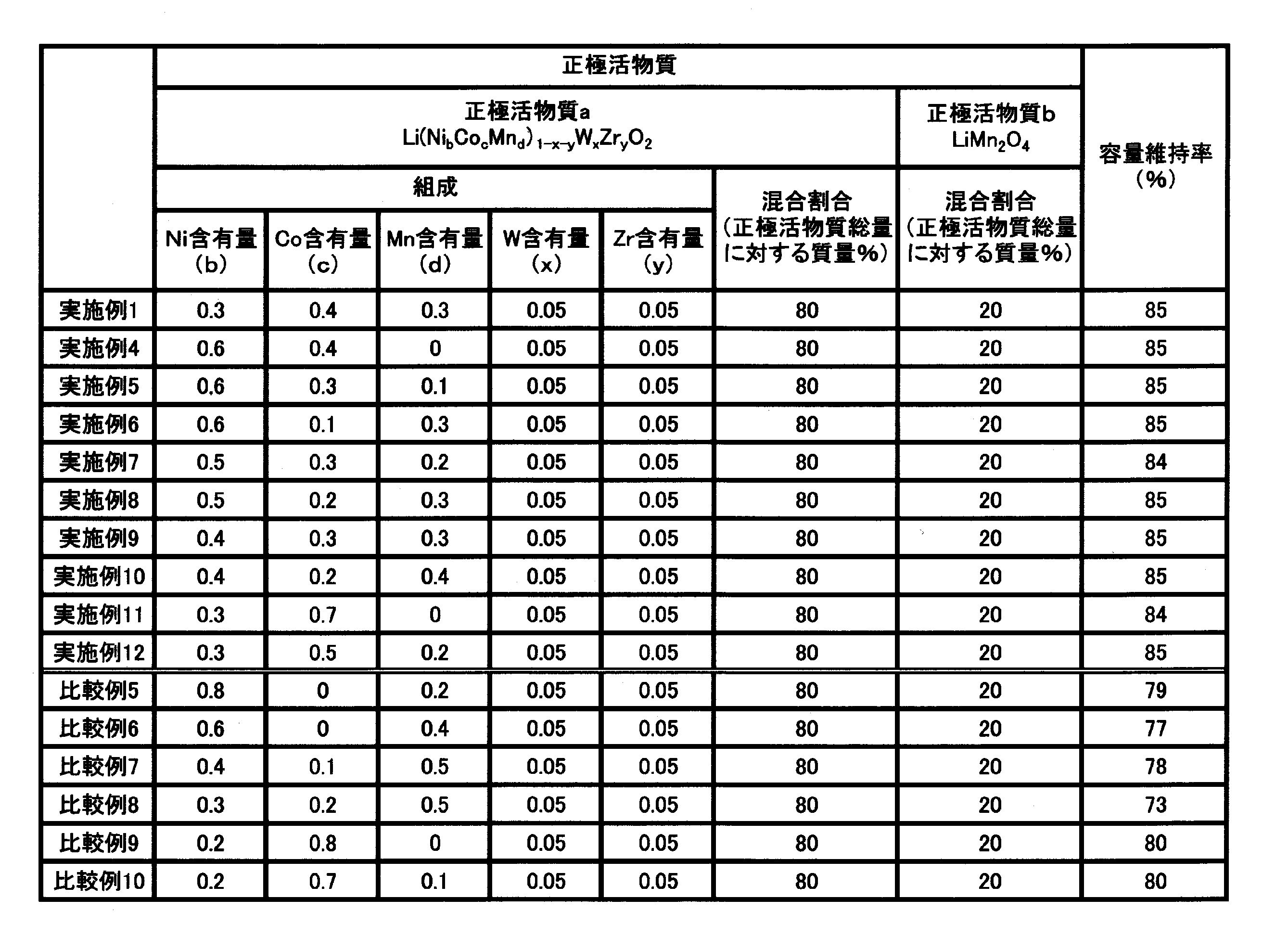
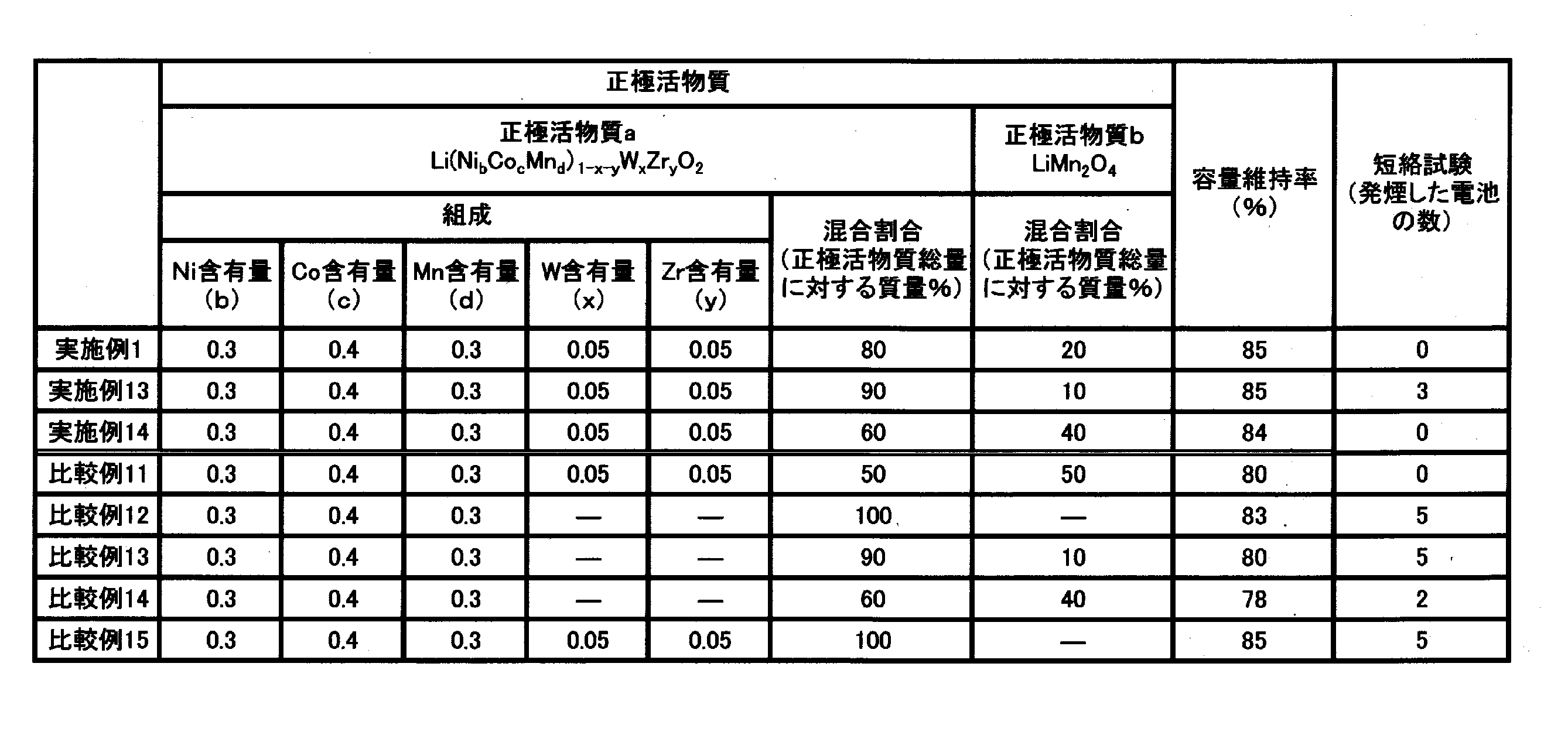
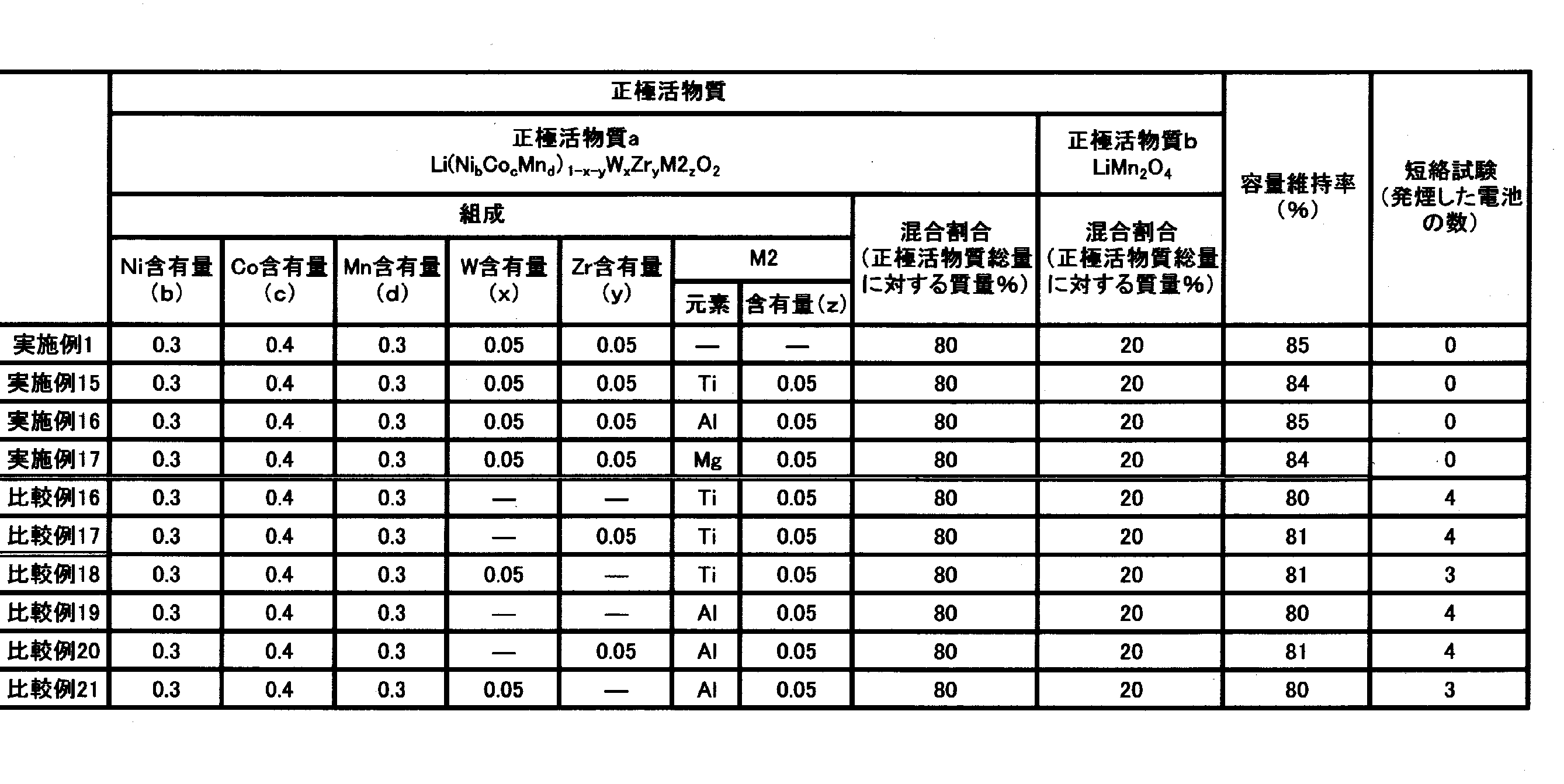
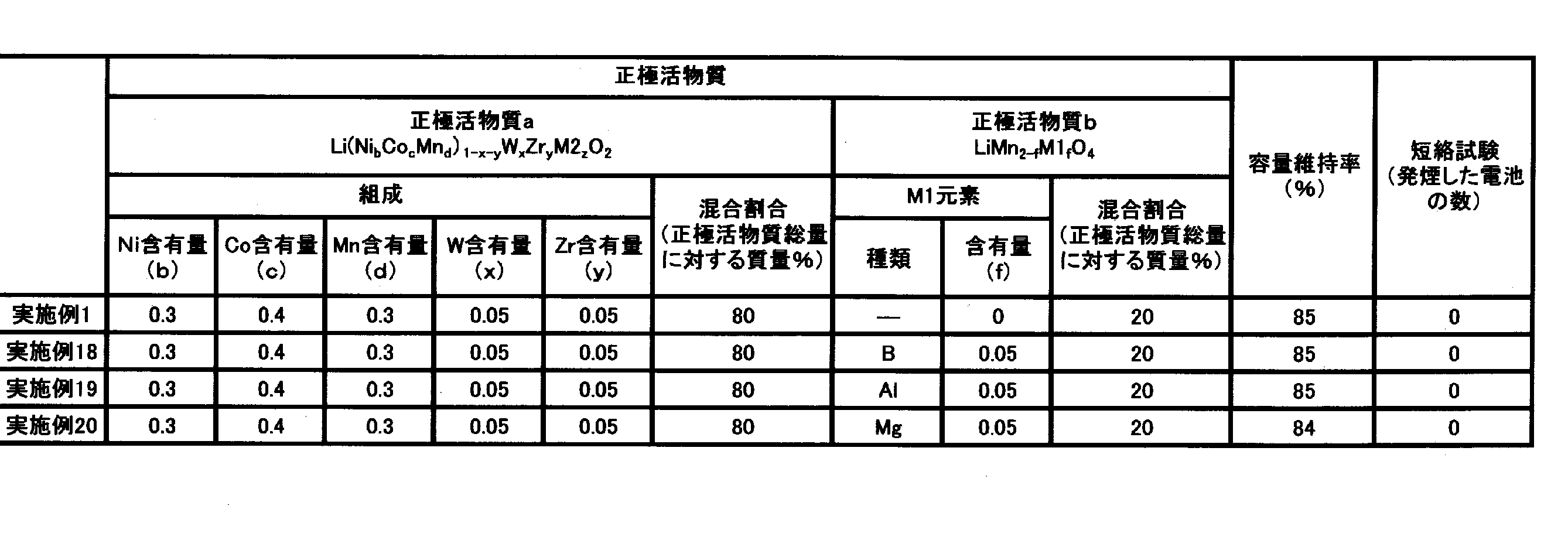
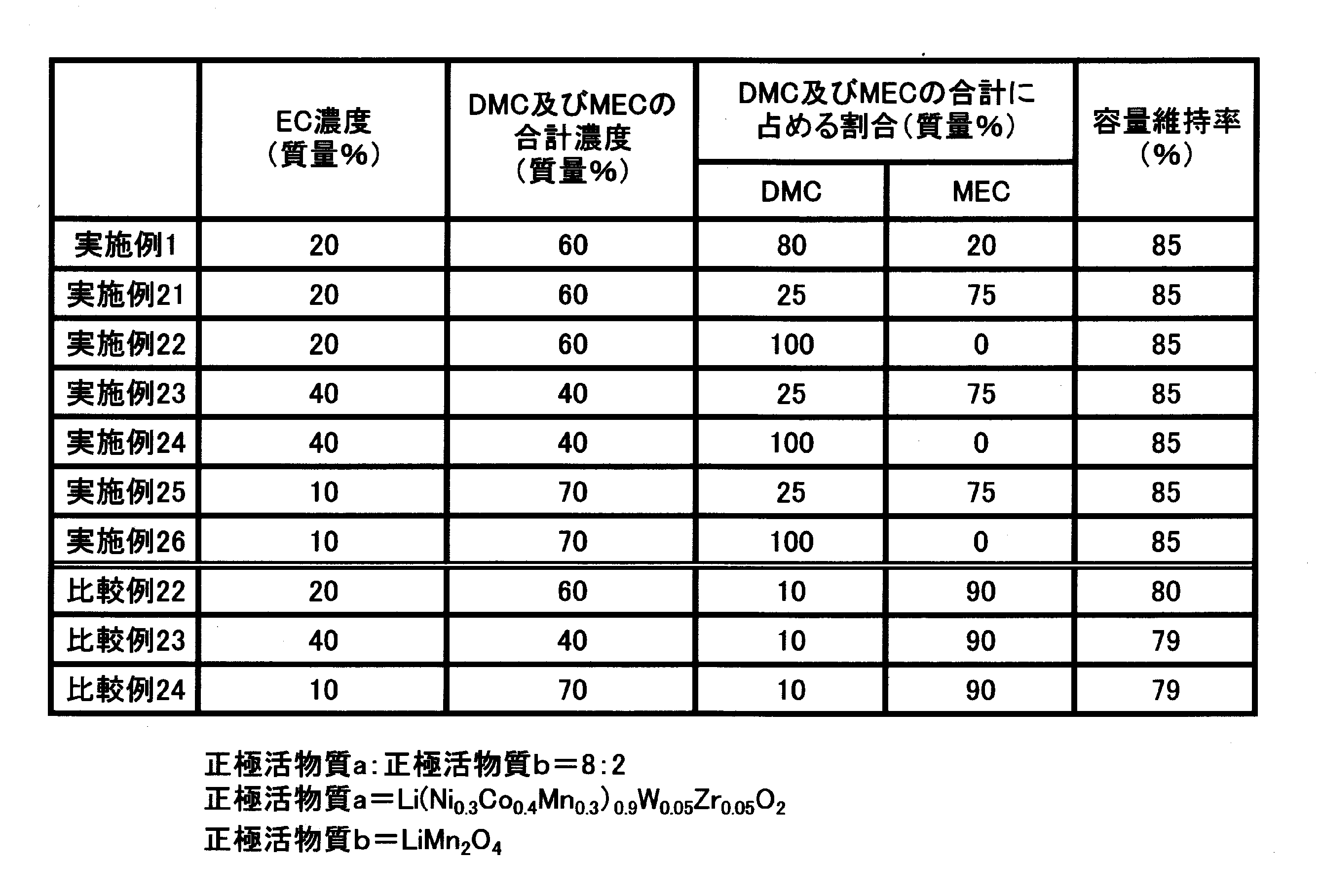
表1~6に示される充放電サイクル試験及び短絡試験の結果より、以下のことがわかる。
まず、比較例12~14の結果から、正極活物質bとしてのスピネル型マンガン酸リチウムの混合比を増大させるに従ってサイクル特性の悪化がみられ、また、安全性の向上効果が確認できる程度に正極活物質bの混合比を増大させる(比較例14)と、サイクル特性が極端に低下してしまうことが示されている。そのため、タングステン及びジルコニウムを含有していないニッケル・コバルト・マンガン酸リチウムと、スピネル型マンガン酸リチウムとを混合した材料を正極活物質として用いた非水電解質二次電池においては、サイクル特性と安全性の両立が困難であることがわかる。
まず、比較例12~14の結果から、正極活物質bとしてのスピネル型マンガン酸リチウムの混合比を増大させるに従ってサイクル特性の悪化がみられ、また、安全性の向上効果が確認できる程度に正極活物質bの混合比を増大させる(比較例14)と、サイクル特性が極端に低下してしまうことが示されている。そのため、タングステン及びジルコニウムを含有していないニッケル・コバルト・マンガン酸リチウムと、スピネル型マンガン酸リチウムとを混合した材料を正極活物質として用いた非水電解質二次電池においては、サイクル特性と安全性の両立が困難であることがわかる。
一方、実施例13及び比較例13の比較、実施例14及び比較例14の比較により、正極活物質aとしてのニッケル・コバルト・マンガン酸リチウムにタングステン及びジルコニウムを含有させることにより、サイクル特性及び安全性がそれぞれ向上しており、タングステン及びジルコニウム含有ニッケル・コバルト・マンガン酸リチウムとスピネル型マンガン酸リチウムとを混合した材料を正極活物質として用いることで、サイクル特性及び安全性の向上した非水電解質二次電池が得られることがわかる。
また、比較例11においては、正極活物質aとしてのニッケル・コバルト・マンガン酸リチウムにタングステン及びジルコニウムを含有させているにも関わらず、サイクル特性は比較例13、14と同等で向上していない。したがって、サイクル特性の向上及び安全性の向上の両立という効果は、少なくとも、正極活物質aとしてのタングステン及びジルコニウム含有ニッケル・コバルト・マンガン酸リチウムと、正極活物質bとしてのスピネル型マンガン酸リチウムとの混合割合が、正極活物質a:正極活物質b(質量比)=60:40~90:10の場合に奏されており、特に60:40~80:20の場合に顕著に奏されることがわかる。
また、表1に示される実施例1~3及び比較例1~4の結果より、タングステン及びジルコニウム含有ニッケル・コバルト・マンガン酸リチウムに含まれるタングステン及びジルコニウムの含有量については、タングステンが0.1モル%以上5モル%以下、かつ、ジルコニウムが0.1モル%以上5モル%以下であることが好ましいことがわかる。
また、表2に示される実施例1、4~12及び比較例5~10の結果より、タングステン及びジルコニウム含有ニッケル・コバルト・マンガン酸リチウムに含まれるNi、Co、Mnの含有比を順にb:c:d(但し、b+c+d=1)とした場合、0.6≧b≧0.3かつ0.7≧c≧0.1かつd≦0.4を満たすタングステン及びジルコニウム含有ニッケル・コバルト・マンガン酸リチウムを用いることが好ましいことがわかる。なお、正極活物質aにおけるリチウムは、タングステン及びジルコニウム含有ニッケル・コバルト・マンガン酸リチウムに対して、0.9~1.2のモル比であることが好ましい。Liの含有割合をこの範囲内とすると、電池容量が大きく、かつガス発生を抑制することができるので好ましい。
また、表4に示される、実施例1、15~17の結果より、正極活物質aとしてのタングステン及びジルコニウム含有ニッケル・コバルト・マンガン酸リチウムには、更に異種元素としてチタン、アルミニウムまたはマグネシウムを含有していても、上記効果が奏されることがわかる。しかし、比較例16~21の結果から、ニッケル・コバルト・マンガン酸リチウムにタングステン及びジルコニウムの両方が含まれていない場合、つまりタングステン及びジルコニウムのどちらかのみと異種元素を含有している場合、あるいはタングステン及びジルコニウム以外の異種元素のみを含有している場合には上記効果を奏しないことがわかる。
また、表5に示される、実施例1及び18~20の結果より、正極活物質bとしてのスピネル型マンガン酸リチウムには、異種元素としてホウ素、アルミニウム、マグネシウムを含有していても、上記効果が奏されることがわかる。なお、正極活物質bにおけるリチウムは、スピネル型マンガン酸リチウムに対して、0.9~1.2のモル比であることが好ましい。Liの含有割合をこの範囲内とすると、電池容量とサイクル特性のバランスを取ることができるので好ましい。
また、表6に示される、実施例1、21~26及び比較例22~24の結果より、非水電解質中に占めるエチレンカーボネートの濃度を10質量%以上40質量%以下とした場合、ジメチルカーボネート及びメチルエチルカーボネートの合計に占めるジメチルカーボネートの割合は、25質量%以上が好ましいことがわかる。
なお、上記実施例においては、負極活物質として黒鉛を用いたが、リチウムイオンを可逆的に吸蔵・放出することが可能な天然黒鉛、人造黒鉛、コークスなどの炭素質物質、ケイ素、スズなどを含む合金や酸化物、これらの混合物などを用いることができる。
また、本発明の非水電解質二次電池で使用する非水電解質の溶質としては、非水電解質二次電池において一般に溶質として用いられるリチウム塩を用いることができる。このようなリチウム塩としては、実施例で用いたLiPF6の他に、LiBF4、LiCF3SO3、LiN(CF3SO2)2、LiN(C2F5SO2)2、LiN(CF3SO2)(C4F9SO2)、LiC(CF3SO2)3、LiC(C2F5SO2)3、LiAsF6、LiClO4、Li2B10Cl10、Li2B12Cl12など及びそれらの混合物が例示される。前記非水溶媒に対する溶質の溶解量は、0.5~2.0mol/Lとするのが好ましい。
Claims (3)
- リチウムイオンの吸蔵・放出が可能な正極活物質を有する正極極板と、リチウムイオンの吸蔵・放出が可能な負極活物質を有する負極極板と、非水溶媒と溶質からなる非水電解質とを備えた非水電解質二次電池において、
前記正極活物質は、
Lia(NibCocMnd)(1-x-y)WxZryO2(但し、0.9≦a≦1.2、0.3≦b≦0.6、0.1≦c≦0.7、0≦d≦0.4、b+c+d=1、0.001≦x≦0.05、0.001≦y≦0.05である)で表されるニッケル・コバルト・マンガン酸リチウムと、
LieMn2-fM1fO4(但し、M1はB、Mg、Ca、Sr、Ba、Ti、Ni、Al、Nb、Mo、W、Y、Rhから選択される、少なくとも一種の元素であり、0.9≦x≦1.2、0≦f≦0.1である)で表されるスピネル型マンガン酸リチウムと、
を60:40~90:10(質量比)の割合で含有しており、
前記非水電解質は、非水溶媒として環状カーボネート及び鎖状カーボネートを含み、
前記環状カーボネートの含有割合が前記非水電解質の10質量%以上かつ40質量%以下であり、かつ、
前記鎖状カーボネート中に含まれるジメチルカーボネートの含有割合が25質量%以上であること、
を特徴とする非水電解質二次電池。 - 前記ニッケル・コバルト・マンガン酸リチウムは、
Lia(NibCocMnd)(1-x-y-z)WxZryM2zO2(但し、M2はTi、Nb、Mo、Zn、Al、Sn、Mg、Ca、Srからなる群から選択される少なくとも1種の元素であり、0.9≦a≦1.2、0.3≦b≦0.6、0.1≦c≦0.7、0≦d≦0.4、b+c+d=1、0.001≦x≦0.05、0.001≦y≦0.05及び0.001≦z≦0.05である)で表されるニッケル・コバルト・マンガン酸リチウムであることを特徴とする、請求項1に記載の非水電解質二次電池。 - 前記正極活物質は、前記ニッケル・コバルト・マンガン酸リチウムと、前記スピネル型マンガン酸リチウムとを、60:40~80:20(質量比)の割合で含有していることを特徴とする、請求項1または2に記載の非水電解質二次電池。
Priority Applications (2)
| Application Number | Priority Date | Filing Date | Title |
|---|---|---|---|
| JP2012548768A JPWO2012081518A1 (ja) | 2010-12-15 | 2011-12-09 | 非水電解質二次電池 |
| US13/992,521 US9337479B2 (en) | 2010-12-15 | 2011-12-09 | Nonaqueous electrolyte secondary battery |
Applications Claiming Priority (2)
| Application Number | Priority Date | Filing Date | Title |
|---|---|---|---|
| JP2010-279840 | 2010-12-15 | ||
| JP2010279840 | 2010-12-15 |
Publications (2)
| Publication Number | Publication Date |
|---|---|
| WO2012081518A2 true WO2012081518A2 (ja) | 2012-06-21 |
| WO2012081518A3 WO2012081518A3 (ja) | 2012-09-20 |
Family
ID=46245173
Family Applications (1)
| Application Number | Title | Priority Date | Filing Date |
|---|---|---|---|
| PCT/JP2011/078556 Ceased WO2012081518A2 (ja) | 2010-12-15 | 2011-12-09 | 非水電解質二次電池 |
Country Status (3)
| Country | Link |
|---|---|
| US (1) | US9337479B2 (ja) |
| JP (1) | JPWO2012081518A1 (ja) |
| WO (1) | WO2012081518A2 (ja) |
Cited By (6)
| Publication number | Priority date | Publication date | Assignee | Title |
|---|---|---|---|---|
| WO2013008475A1 (ja) * | 2011-07-13 | 2013-01-17 | 株式会社Gsユアサ | 非水電解質二次電池 |
| JP2017041426A (ja) * | 2015-08-21 | 2017-02-23 | 株式会社日本触媒 | リチウムイオン二次電池 |
| JP2017041425A (ja) * | 2015-08-21 | 2017-02-23 | 株式会社日本触媒 | リチウムイオン二次電池 |
| JP2020501329A (ja) * | 2016-12-12 | 2020-01-16 | ポスコPosco | リチウム二次電池用正極活物質、その製造方法、およびそれを含むリチウム二次電池 |
| JPWO2019176389A1 (ja) * | 2018-03-13 | 2021-02-25 | 三洋電機株式会社 | 非水電解質二次電池 |
| JP2024501271A (ja) * | 2020-12-21 | 2024-01-11 | ユミコア | 充電式リチウムイオン電池用の正極活物質としてのリチウムニッケル系複合酸化物 |
Families Citing this family (3)
| Publication number | Priority date | Publication date | Assignee | Title |
|---|---|---|---|---|
| JP6128398B2 (ja) * | 2014-12-26 | 2017-05-17 | トヨタ自動車株式会社 | 非水電解質二次電池 |
| KR102195187B1 (ko) * | 2019-02-18 | 2020-12-28 | 주식회사 에스엠랩 | 양극활물질, 이의 제조방법 및 이를 포함하는 양극을 포함한 리튬이차전지 |
| WO2021029650A1 (ko) * | 2019-08-12 | 2021-02-18 | 주식회사 엘지화학 | 리튬 이차전지용 양극 및 이를 포함하는 리튬 이차전지 |
Family Cites Families (8)
| Publication number | Priority date | Publication date | Assignee | Title |
|---|---|---|---|---|
| JP3631166B2 (ja) | 2001-05-31 | 2005-03-23 | 三洋電機株式会社 | 非水電解質二次電池 |
| JP3631197B2 (ja) * | 2001-11-30 | 2005-03-23 | 三洋電機株式会社 | 非水電解質二次電池 |
| JP4731106B2 (ja) | 2002-09-30 | 2011-07-20 | 三洋電機株式会社 | 非水電解質二次電池 |
| JP4726423B2 (ja) | 2004-03-17 | 2011-07-20 | 三洋電機株式会社 | 非水電解質二次電池用正極材料及び非水電解質二次電池 |
| JP4565874B2 (ja) * | 2004-03-31 | 2010-10-20 | 三洋電機株式会社 | 非水電解質二次電池 |
| JP4841116B2 (ja) | 2004-05-28 | 2011-12-21 | 三洋電機株式会社 | 非水電解質二次電池 |
| JP5105393B2 (ja) * | 2005-03-02 | 2012-12-26 | 日立マクセルエナジー株式会社 | 非水電解質二次電池 |
| JP5135912B2 (ja) * | 2007-06-25 | 2013-02-06 | 三菱化学株式会社 | リチウム二次電池用正極活物質材料、及びそれを用いたリチウム二次電池用正極並びにリチウム二次電池 |
-
2011
- 2011-12-09 WO PCT/JP2011/078556 patent/WO2012081518A2/ja not_active Ceased
- 2011-12-09 US US13/992,521 patent/US9337479B2/en active Active
- 2011-12-09 JP JP2012548768A patent/JPWO2012081518A1/ja active Pending
Cited By (9)
| Publication number | Priority date | Publication date | Assignee | Title |
|---|---|---|---|---|
| WO2013008475A1 (ja) * | 2011-07-13 | 2013-01-17 | 株式会社Gsユアサ | 非水電解質二次電池 |
| JPWO2013008475A1 (ja) * | 2011-07-13 | 2015-02-23 | 株式会社Gsユアサ | 非水電解質二次電池 |
| JP2017041426A (ja) * | 2015-08-21 | 2017-02-23 | 株式会社日本触媒 | リチウムイオン二次電池 |
| JP2017041425A (ja) * | 2015-08-21 | 2017-02-23 | 株式会社日本触媒 | リチウムイオン二次電池 |
| JP2020501329A (ja) * | 2016-12-12 | 2020-01-16 | ポスコPosco | リチウム二次電池用正極活物質、その製造方法、およびそれを含むリチウム二次電池 |
| US11670766B2 (en) | 2016-12-12 | 2023-06-06 | Posco Holdings Inc. | Positive electrode active material for lithium secondary battery, method for preparing same, and lithium secondary battery comprising same |
| JPWO2019176389A1 (ja) * | 2018-03-13 | 2021-02-25 | 三洋電機株式会社 | 非水電解質二次電池 |
| JP7232814B2 (ja) | 2018-03-13 | 2023-03-03 | 三洋電機株式会社 | 非水電解質二次電池 |
| JP2024501271A (ja) * | 2020-12-21 | 2024-01-11 | ユミコア | 充電式リチウムイオン電池用の正極活物質としてのリチウムニッケル系複合酸化物 |
Also Published As
| Publication number | Publication date |
|---|---|
| WO2012081518A3 (ja) | 2012-09-20 |
| US20130260262A1 (en) | 2013-10-03 |
| US9337479B2 (en) | 2016-05-10 |
| JPWO2012081518A1 (ja) | 2014-05-22 |
Similar Documents
| Publication | Publication Date | Title |
|---|---|---|
| JP3631197B2 (ja) | 非水電解質二次電池 | |
| JP3024636B2 (ja) | 非水電解液二次電池 | |
| US9337479B2 (en) | Nonaqueous electrolyte secondary battery | |
| US20110200880A1 (en) | Positive electrode active material for lithium secondary battery, method of manufacturing the same, and lithium secondary battery using the same | |
| US20100173201A1 (en) | Lithium secondary battery | |
| JP2010064944A (ja) | リチウムニッケル複合酸化物及びリチウムニッケル複合酸化物を正極活物質に用いた非水系電解質二次電池 | |
| JP2009140919A (ja) | 非水電解質二次電池 | |
| JP5052161B2 (ja) | 非水電解質二次電池 | |
| JP2002289261A (ja) | 非水電解質二次電池 | |
| JP2012033400A (ja) | 二次電池用正極活物質及びそれを使用した二次電池 | |
| JP4696557B2 (ja) | リチウム二次電池用活物質材料、その製造方法及びこれに用いる原材料並びにリチウム二次電池 | |
| JP2009217981A (ja) | 非水電解質二次電池 | |
| JP4853608B2 (ja) | リチウム二次電池 | |
| JP2004006094A (ja) | 非水電解液二次電池 | |
| JPWO2012020647A1 (ja) | 電極活物質およびそれを備えた非水電解質二次電池 | |
| JP2007200862A (ja) | 非水電解質二次電池 | |
| WO2013008581A1 (ja) | 二次電池用活物質 | |
| JP3120789B2 (ja) | 非水電解液二次電池 | |
| JP2011249293A (ja) | リチウム遷移金属化合物及びその製造方法、並びにリチウムイオン電池 | |
| JP2005085720A (ja) | リチウムイオン二次電池用正極およびリチウムイオン二次電池 | |
| JP2009266791A (ja) | 非水電解質二次電池 | |
| JP4268442B2 (ja) | 非水系電解質二次電池用正極活物質および非水系電解質二次電池 | |
| JP6072689B2 (ja) | 非水電解質二次電池 | |
| JP2012009270A (ja) | 非水電解質二次電池 | |
| JP5046602B2 (ja) | 二次電池用正極、およびそれを用いた二次電池 |
Legal Events
| Date | Code | Title | Description |
|---|---|---|---|
| WWE | Wipo information: entry into national phase |
Ref document number: 13992521 Country of ref document: US |
|
| ENP | Entry into the national phase |
Ref document number: 2012548768 Country of ref document: JP Kind code of ref document: A |
|
| NENP | Non-entry into the national phase |
Ref country code: DE |
|
| 122 | Ep: pct application non-entry in european phase |
Ref document number: 11848737 Country of ref document: EP Kind code of ref document: A2 |