WO2012053546A1 - 粉末分散液を含む化粧料 - Google Patents
粉末分散液を含む化粧料 Download PDFInfo
- Publication number
- WO2012053546A1 WO2012053546A1 PCT/JP2011/074042 JP2011074042W WO2012053546A1 WO 2012053546 A1 WO2012053546 A1 WO 2012053546A1 JP 2011074042 W JP2011074042 W JP 2011074042W WO 2012053546 A1 WO2012053546 A1 WO 2012053546A1
- Authority
- WO
- WIPO (PCT)
- Prior art keywords
- dispersion
- oil
- mass
- powder
- cosmetic
- Prior art date
- Legal status (The legal status is an assumption and is not a legal conclusion. Google has not performed a legal analysis and makes no representation as to the accuracy of the status listed.)
- Ceased
Links
Classifications
-
- A—HUMAN NECESSITIES
- A61—MEDICAL OR VETERINARY SCIENCE; HYGIENE
- A61Q—SPECIFIC USE OF COSMETICS OR SIMILAR TOILETRY PREPARATIONS
- A61Q1/00—Make-up preparations; Body powders; Preparations for removing make-up
- A61Q1/02—Preparations containing skin colorants, e.g. pigments
-
- A—HUMAN NECESSITIES
- A61—MEDICAL OR VETERINARY SCIENCE; HYGIENE
- A61K—PREPARATIONS FOR MEDICAL, DENTAL OR TOILETRY PURPOSES
- A61K8/00—Cosmetics or similar toiletry preparations
- A61K8/02—Cosmetics or similar toiletry preparations characterised by special physical form
- A61K8/04—Dispersions; Emulsions
- A61K8/06—Emulsions
- A61K8/064—Water-in-oil emulsions, e.g. Water-in-silicone emulsions
Definitions
- the present invention relates to a cosmetic containing a powder dispersion, and particularly to a cosmetic having a good feeling of use including a dispersion in which powder is uniformly dispersed.
- a hydrophobic inorganic powder is added to an oil containing a surfactant, a continuous mill (OB mill, dyno mill, etc.), a batch mill.
- OB mill continuous mill
- dyno mill dyno mill
- a method of high dispersion using a ring mill or the like is also performed.
- such a method takes a lot of labor, and due to the characteristics of using media, the processing amount is low and may not be suitable for mass production.
- pulverization with a bead mill leaves a large amount of slurry between the beads, which is not preferable from the viewpoint of environmental load.
- the present invention has been made in view of the above prior art, and the problem to be solved is a cosmetic containing a dispersion in which powder is uniformly dispersed in an oil while having excellent handling properties and good usability. Is to provide a fee.
- the inventors of the present invention include a dispersion in which an oil, a powder, and a dispersion aid containing a specific amount of volatile oil are dispersed with an ultrasonic pulverizer.
- the present inventors have found that a cosmetic material having excellent handling feeling and excellent usability can be obtained, and has completed the present invention.
- the cosmetic according to the present invention is characterized by including a dispersion obtained by dispersing the following (a) to (c) with an ultrasonic grinder.
- the ultrasonic grinder has a frequency of 10 to 100 kHz and an output of 500 to 16000 W.
- a color material is included as (b).
- the water-in-oil emulsified cosmetic according to the present invention is characterized in that the cosmetic includes a hydrophilic powder as (b).
- (c) contains 0.01 to 1% by mass of a cationic surfactant and 0.02 to 2% by mass of palmitic acid.
- the blending amount of the cationic surfactant / the blending amount of palmitic acid 0.3 to 1.
- the method for producing a cosmetic according to the present invention comprises (a) an oil containing 5 to 100% by mass of a volatile oil with respect to the amount of oil, 0.1 to 40% by mass of (b) powder in the dispersion, It is characterized by mixing a cosmetic base material with a dispersion obtained by dispersing 0.1 to 10% by mass of (c) a dispersion aid in the dispersion with an ultrasonic grinder.
- the cosmetic according to the present invention comprises (a) an oil containing 5 to 100% by mass of a volatile oil, (b) a powder of 0.1 to 40% by mass, and (c) a dispersion aid of 0.1%. It is a cosmetic containing a dispersion in which ⁇ 10% by mass is dispersed with an ultrasonic pulverizer. By including a uniformly dispersed dispersion, a cosmetic with excellent usability can be provided.
- the cosmetic according to the present invention comprises (a) an oil containing 5 to 100% by mass of a volatile oil, (b) a powder of 0.1 to 40% by mass, and (c) a dispersion aid of 0.1%. It contains a dispersion obtained by dispersing ⁇ 10% by mass with an ultrasonic pulverizer.
- a volatile oil component is an oil component that exhibits volatility at room temperature (25 ° C.), and may be used alone or in combination of two or more.
- volatile oil examples include volatile silicones such as chain polysiloxanes such as decamethyltetrasiloxane, hexamethyldisiloxane, and dodecamethylpentasiloxane, and cyclic polysiloxanes such as octamethylcyclotetrasiloxane and decamethylcyclopentasiloxane. Examples thereof include oil and light liquid isoparaffin. Of these, preferred volatile oils include decamethyltetrasiloxane.
- the blending amount of the volatile oil must be 5 to 100% by mass in the total oil content of the dispersion. Further, it is preferably 50 to 100% by mass. When the blending amount of the volatile oil is less than 5% by mass in the total amount of the oil, a sufficient dispersion force may not be obtained.
- oils (nonvolatile oils) other than volatile oils include hydrocarbon oils such as liquid paraffin, isoparaffin, squalane and polybutene; waxes such as lanolin; castor oil, olive oil, palm oil, palm Oils and fats such as macadamia nut oil and jojoba oil; higher alcohols such as isostearyl alcohol; higher fatty acids such as lauric acid, myristic acid and palmitic acid; glyceryl diisostearate, trimethylolpropane tri-2-ethylisostearate, isopropyl milliliter State, cetyl 2-ethylhexanoate, glyceryl triisostearate, 2-heptyl undecyl palmitate, ester oils such as glyceryl triisostearate, diisostearyl malate; dimethylpolysiloxane, methylphenylpolysiloxane, Ultraviolet absorbers such as benzophenone derivatives, wax
- a powder will not be specifically limited if it is a powder generally used for cosmetics. A powder may be used independently or may use 2 or more types together.
- the powder examples include talc, kaolin, sericite (sericite), muscovite, phlogopite, synthetic mica, saucite, biotite, calcined talc, calcined sericite, calcined muscovite, calcined phlogopite, permiculite, carbonate Magnesium, calcium carbonate, aluminum silicate, barium silicate, calcium silicate, magnesium silicate, strontium silicate, metal tungstate, magnesium, silica, zeolite, barium sulfate, calcined calcium sulfate (calcined gypsum), calcium phosphate, fluorine Apatite, hydroxyapatite, ceramic powder, metal soap (eg, zinc myristate, calcium palmitate, aluminum stearate, etc.), boron nitride, photochromic titanium oxide (titanium dioxide sintered with iron oxide), reduced zinc white; Organic powder For example, silicone elast
- pearl pigment surface Coated with aluminum hydroxide particles Japanese Patent Laid-Open No. 2002-146238
- pearl pigment surface with acid Coated with zinc halide particles Japanese Patent Laid-Open No. 2003-261421
- barium sulfate particles coated with barium sulfate particles on the surface of a pearl pigment
- metal powder pigment for example, aluminum powder, copper powder, etc.
- Organic pigments such as zirconium, barium or aluminum lakes (for example, red 201, red 202, red 204, red 205, red 220, red 226, red 228, red 405, orange 203, orange Organic pigments such as No. 204, Yellow No.
- Yellow No. 401, and Blue No. 404 Red No. 3, Red No. 104, Red No. 106, Red No. 227, Red No. 230, Red No. 401, Red No. 505, Orange 205 No. 4, Yellow No. 4, Yellow No. 5, Yellow No. 202, Yellow No. 203, Green No. 3 and Blue No. 1); natural pigments (for example, Chlorophyll, beta-carotene, etc.) and the like.
- natural pigments for example, Chlorophyll, beta-carotene, etc.
- organic ultraviolet absorber examples include 2,2′-hydroxy-5-methylphenylbenzotriazole, 2- (2′-hydroxy-5′-t-octylphenyl) benzotriazole, 2- (2 Benzotriazole ultraviolet absorbers such as' -hydroxy-5'-methylphenylbenzotriazole; dibenzalazine, dianisoylmethane, 4-tert-butyl-4'-methoxydibenzoylmethane, 1- (4'-isopropylphenyl)- Benzoylmethane ultraviolet absorbers such as 3-phenylpropane-1,3-dione and 5- (3,3′-dimethyl-2-norbornylidene) -3-pentan-2-one; paraaminobenzoic acid (PABA), PABA Monoglycerin ester, N, N-dipropoxy PABA ethyl ester, N, N-die Benzoic acid UV absorbers such as xy-PABA e
- Anthranilic acid ultraviolet absorbers amyl salicylates, menthyl salicylates, homomenthyl salicylates, octyl salicylates, phenyl salicylates, benzyl salicylates, p-isopropanol phenyl salicylates, etc .; salicylic acid ultraviolet absorbers; octylmethoxycinnamate, di-paramethoxysilicate Acid-mono-2-ethylhexanoate glyceryl, octylcinnamate, ethyl-4-isopropylcinnamate, methyl-2,5-diisopropylcinnamate, ethyl-2,4 -Diisopropylcinnamate, methyl-2,4-diisopropylcinnamate, propyl-p-methoxycinnamate, isopropyl-p-methoxycinnamate
- untreated surface may be used, but the surface treated with silicone, fluorine compound, silane coupling agent, Teflon (registered trademark), fatty acid, fatty acid soap, lauroyl lysine or the like may be used. Good.
- the effect of this invention appears notably by mix
- blending a coloring material as (b) powder in a dispersion liquid it is effective.
- the cosmetic obtained using the ultrasonic pulverizer of the present invention is more efficient than the case of using a conventional disperser, and the time required from the start of dispersion to the plateau state is short. For this reason, the present invention also has an advantage of easy toning.
- the blending amount of the powder (b) needs to be 0.1 to 40% by mass in the total amount of the dispersion. Further, it is preferably 1 to 20% by mass. When the amount of the powder is less than 0.1% by mass, the effect as a dispersion is poor. Moreover, when it exceeds 40 mass%, the viscosity of a dispersion liquid rises and sufficient dispersion force may not be obtained.
- the dispersion aid is not particularly limited as long as it is soluble in oil. Moreover, a dispersion
- distribution adjuvant may be used independently or may use 2 or more types together.
- dispersion aid examples include polyoxyethylene alkyl ether, sorbitan fatty acid ester, polyoxyethylene alkyl phosphate ester, fatty acid alkanolamide, polyether-modified silicone oil, silicone resin, and both-end silicone-modified polyglycerin.
- preferred dispersing aids include sorbitan fatty acid esters and both-ends siliconeized polyglycerin.
- the amount of the dispersion aid should be 0.1 to 10% by mass in the total amount of the dispersion. Further, it is preferably 1 to 8% by mass. If the blending amount of the dispersion aid is less than 0.1% by mass, the effect of blending cannot be exhibited. Moreover, even if it exceeds 10 mass%, the remarkable increase in an effect is not recognized.
- the dispersion liquid of the present invention can be obtained by adding (b) powder and (c) a dispersion aid to (a) the oil and dispersing the mixture using an ultrasonic grinder.
- preliminary stirring may be performed using a disper, a homomixer, or the like before the dispersion treatment.
- the ability of the ultrasonic disperser is not particularly limited, but it is preferable to use an ultrasonic grinder having a frequency of 10 to 100 kHz and an output of 500 to 16000 W. In particular, it is preferable to use an ultrasonic pulverizer having a power of 500 to 5000 W. If the ability is too small, color fading may occur over time or the brightness may decrease. In addition, if the ability is too large, a significant improvement in the effect is not seen, which is not preferable.
- the viscosity of the dispersion liquid contained in the cosmetic of the present invention is preferably 2000 cps or less. When the viscosity exceeds 2000 cps, sufficient dispersion force may not be obtained.
- the cosmetic of the present invention includes, in addition to the dispersion, which is the essential component, other components usually used in cosmetics, for example, powder components, liquid fats and oils, solid fats and oils, waxes, hydrocarbons, higher fatty acids, higher alcohols. , Ester, silicone, anionic surfactant, cationic surfactant, amphoteric surfactant, nonionic surfactant, moisturizer, water-soluble polymer, thickener, film agent, UV absorber, sequestering agent, Lower alcohol, polyhydric alcohol, sugar, amino acid, organic amine, polymer emulsion, pH adjuster, skin nutrient, vitamin, antioxidant, antioxidant aid, fragrance, etc. Can be manufactured.
- the dosage form of the cosmetic of the present invention is arbitrary, and can be provided in any form such as an emulsion system, a water-oil two-layer system, a gel, an aerosol, a mist, and a capsule.
- the dispersion can be used as it is or diluted with an oil component to form an oily cosmetic.
- These can also be emulsified by an aqueous phase component and a known method to obtain an emulsified cosmetic.
- the cosmetic of the present invention is preferably a water-in-oil emulsified cosmetic containing a hydrophilic powder in a dispersion.
- a disperser having a weak dispersion ability such as a homomixer
- a stable and uniform oil phase may not be obtained.
- Even when a bead mill or the like is used it may be difficult to obtain a uniform oil phase (dispersion) because it is difficult to disperse particularly in a system having a low powder concentration or a system containing a large amount of volatile oil.
- a stable and uniform oil phase (dispersion) can be obtained, so that a water-in-oil emulsified cosmetic with no color dullness and excellent usability such as lightness of spreading is obtained. Can do.
- a cationic surfactant as a dispersion aid is further added to the dispersion in an amount of 0.01 to It is preferable to contain 1% by mass and 0.02 to 2% by mass of palmitic acid in the total amount of the dispersion.
- a cationic surfactant and palmitic acid By adding a cationic surfactant and palmitic acid, a more uniform dispersion can be obtained.
- the ratio of the cationic surfactant to the blending amount of palmitic acid that is, the blending amount of the cationic surfactant / palmitic acid is particularly preferably 0.3 to 1.
- Cationic surfactants include stearyltrimethylammonium chloride, hexadecyltrimethylammonium chloride, tetradecyltrimethylammonium chloride, lauryltrimethylammonium chloride, C12 monohydroxyalkyl ether cation, dihydroxyalkyl ether cation, dihydroxyalkyl ether cation, coconut oil diamide Propyl cation, palm oil dicarboxyethyl cation, C16 dicarboxyethyl cation, C18 dicarboxyethyl cation, POP (15) diethylmethyl cation, POP (25) diethylmethyl cation, POP (40) diethylmethyl cation, C12 diamidopropylmethyl Amine, C14 diamidopropyl methylamine, C16 diamidopropyl methylamine, C18 diamidopropyl methylamine, iso C18 diamidopropyl methyl
- the cosmetic of the present invention can be widely applied to cosmetics that have been conventionally applied to the outer skin.
- cosmetic liquid for example, cosmetic liquid, milky lotion, cream, pack, foundation, lipstick, eye shadow, eyeliner, mascara, face wash, sunscreen cream, spray, mousse, hair rinse, shampoo and the like can be mentioned.
- the present invention will be described in more detail with reference to the following examples, but the present invention is not limited thereto.
- the blending amount is expressed in mass% with respect to the system in which the component is blended. Prior to the description of the examples, the evaluation method of the test used in the present invention will be described.
- a * There is no visible powder aggregate.
- Evaluation (2) Handling property The handling property of the disperser (labor during use) was evaluated. A: Handling property is good. B: I can't say either. C: The handling property is poor.
- Evaluation (3) Feeling of use
- Ten professional panelists evaluated the feeling of use (lightness and smoothness) of the samples. Here, evaluation was performed using a homomixer product as a reference sample.
- a * Nine or more responded that the feeling of use was improved over the reference sample.
- the inventors changed the type of disperser to be used, and manufactured a sample having the composition shown in Table 1 below by the following manufacturing method.
- the ratio of the volatile oil to the oil in the dispersion was 51% by mass.
- the disperser was a homomixer (Primics, 9000 rpm, 2 minutes), a bead mill (VMA-GETZMANN, 5000 rpm ⁇ 0.5, output 1500 W, 30 minutes), an ultrasonic mill UIP1000 (Dr. Hielscher). , Output 1000 W, 2 minutes). The results are shown in Table 2.
- the present inventors manufactured a sample (water-in-oil type emulsified foundation) having the composition shown in Table 3 below by the above manufacturing method (dispersing machine and dispersion conditions were the same as those in Table 2). .
- the ratio of the volatile oil to the oil in the dispersion was 69.3% by mass.
- Each sample was evaluated according to the above scoring criteria for evaluation items (1) to (3) and (5). The results are shown in Table 4.
- samples A to C having the composition shown in Table 5 below by the following sample manufacturing method.
- particle diameter of each sample was measured with the particle size distribution measuring apparatus MICROTRACK HRA (made by Nikkiso Co., Ltd.). The results are shown in Table 6.
- the disperser used was a disper (manufactured by Primics, 1500 rpm), a bead mill (manufactured by VMA-GETZMANN, 5000 rpm ⁇ 0.5, output 1500 W), and an ultrasonic grinder UIP1000 (manufactured by Dr. Hielscher, output 1000 W).
- the unit of the blending amount in Table 5 is g
- the unit of the particle size in Table 6 is ⁇ m.
- Sample preparation method (a) Oil, (b) powder, (c) Dispersion aid was pre-stirred for 5 minutes using a disper (shown as disper in Table 6). A dispersion was prepared from the predispersed sample using a bead mill or an ultrasonic grinder. The amount of pre-dispersed sample processed by the bead mill or ultrasonic grinder was adjusted to equal power consumption.
- the ultrasonic pulverizer can make particles finer than the bead mill. That is, the power consumption required to reduce the particle size of the dispersion is less in the ultrasonic grinder than in the bead mill. For this reason, it became clear that energy saving can be expected. Further, it can be seen that the dispersions B and C containing the volatile oil can make the particles finer in a shorter time than the dispersion A. For this reason, the dispersion liquid contained in the cosmetic according to the present invention needs to contain at least a volatile oil.
Landscapes
- Life Sciences & Earth Sciences (AREA)
- Health & Medical Sciences (AREA)
- Chemical & Material Sciences (AREA)
- Animal Behavior & Ethology (AREA)
- General Health & Medical Sciences (AREA)
- Public Health (AREA)
- Veterinary Medicine (AREA)
- Oil, Petroleum & Natural Gas (AREA)
- Dispersion Chemistry (AREA)
- Birds (AREA)
- Epidemiology (AREA)
- Cosmetics (AREA)
Abstract
本発明は、ハンドリング性に優れていながら、使用感も良好な、油分中に粉末が均一に分散した分散液を含有する化粧料を提供する。本発明にかかる化粧料は、(a)油分量に対して5~100質量%の揮発性油分を含む油分と、(b)粉末 0.1~40質量%と、(c)分散助剤 0.1~10質量%と、を超音波粉砕機にて分散させた分散液を含むことを特徴とする。
Description
本出願は、2010年10月19日付け出願の日本国特許出願2010-234740号の優先権を主張しており、ここに折り込まれるものである。
本発明は粉末分散液を含む化粧料に関し、特に、均一に粉末が分散した分散液を含む使用感が良好な化粧料に関するものである。
従来、化粧料に粉末を配合することにより、紫外線からの肌の保護、シミやソバカスなどの隠蔽、皮脂吸収等の機能を付与することが行われてきた。
例えば、紫外線防御化粧料、メークアップ化粧料などの分野で、無機粉末を油分中に分散した分散液が用いられている。このような分散液を調製する方法として、界面活性剤を含む油分に予めディスパーやペイントシェーカーを用いて、表面を疎水化処理した金属酸化物を主成分とする無機粉末を分散させる方法が行われている。
しかし、この方法では、疎水性である無機粉末を油分中に十分に均一に分散させることができず、使用感に改良の余地があった。
例えば、紫外線防御化粧料、メークアップ化粧料などの分野で、無機粉末を油分中に分散した分散液が用いられている。このような分散液を調製する方法として、界面活性剤を含む油分に予めディスパーやペイントシェーカーを用いて、表面を疎水化処理した金属酸化物を主成分とする無機粉末を分散させる方法が行われている。
しかし、この方法では、疎水性である無機粉末を油分中に十分に均一に分散させることができず、使用感に改良の余地があった。
さらに、疎水性の無機粉末を均一に油相分散した分散物を調製する方法として、界面活性剤を含む油分に疎水性無機粉末を加え、連続式ミル(OBミル、ダイノーミル等)、バッチ式ミル(リングミル等)で高分散化させる方法も行われている。
しかし、このような方法では、多くの手間がかかり、また、メディアを使用する特性上、処理量が低く大量生産に向かない場合があった。
また、ビーズミルでの粉砕はビーズ間に多量のスラリーが残ってしまい、環境負荷の観点からも好ましいとはいえない。
しかし、このような方法では、多くの手間がかかり、また、メディアを使用する特性上、処理量が低く大量生産に向かない場合があった。
また、ビーズミルでの粉砕はビーズ間に多量のスラリーが残ってしまい、環境負荷の観点からも好ましいとはいえない。
本発明は前記従来技術に鑑み行われたものであり、その解決すべき課題は、ハンドリング性に優れていながら、使用感も良好な、油分中に粉末が均一に分散した分散液を含有する化粧料を提供することにある。
本発明者らが前述の課題を解決すべく鋭意研究を行った結果、特定量の揮発性油分を含む油分、粉末、分散助剤を超音波粉砕機にて分散させた分散液を含むことで、ハンドリング性に優れていながら、使用感に優れた化粧料が得られることを見出し、本発明を完成するに至った。
すなわち、本発明にかかる化粧料は、次の(a)~(c)を超音波粉砕機にて分散させた分散液を含むことを特徴とする。
(a)油分量に対して5~100質量%の揮発性油分を含む油分
(b)粉末 0.1~40質量%
(c)分散助剤 0.1~10質量%
前記化粧料において、超音波粉砕機が周波数10~100kHz、出力500~16000Wの能力を有することが好適である。
前記化粧料において、(b)として色材を含むことが好適である。
本発明にかかる油中水型乳化化粧料は、前記化粧料において(b)として親水性粉末を含むことを特徴とする。
前記油中水型乳化化粧料において、(c)としてカチオン性界面活性剤0.01~1質量%、パルミチン酸0.02~2質量%を含むことが好適である。
前記油中水型乳化化粧料において、カチオン性界面活性剤の配合量/パルミチン酸の配合量=0.3~1であることが好適である。
本発明にかかる化粧料の製造方法は、(a)油分量に対して5~100質量%の揮発性油分を含む油分と、分散液中0.1~40質量%の(b)粉末と、分散液中0.1~10質量%の(c)分散助剤と、を超音波粉砕機にて分散させて得られた分散液と、化粧料基材を混合することを特徴とする。
(a)油分量に対して5~100質量%の揮発性油分を含む油分
(b)粉末 0.1~40質量%
(c)分散助剤 0.1~10質量%
前記化粧料において、超音波粉砕機が周波数10~100kHz、出力500~16000Wの能力を有することが好適である。
前記化粧料において、(b)として色材を含むことが好適である。
本発明にかかる油中水型乳化化粧料は、前記化粧料において(b)として親水性粉末を含むことを特徴とする。
前記油中水型乳化化粧料において、(c)としてカチオン性界面活性剤0.01~1質量%、パルミチン酸0.02~2質量%を含むことが好適である。
前記油中水型乳化化粧料において、カチオン性界面活性剤の配合量/パルミチン酸の配合量=0.3~1であることが好適である。
本発明にかかる化粧料の製造方法は、(a)油分量に対して5~100質量%の揮発性油分を含む油分と、分散液中0.1~40質量%の(b)粉末と、分散液中0.1~10質量%の(c)分散助剤と、を超音波粉砕機にて分散させて得られた分散液と、化粧料基材を混合することを特徴とする。
本発明にかかる化粧料は、(a)油分量に対して5~100質量%の揮発性油分を含む油分、(b)粉末0.1~40質量%、(c)分散助剤0.1~10質量%を超音波粉砕機にて分散させた分散液を含む化粧料であり、均一に分散した分散液を含むことにより、使用感に優れた化粧料を提供することができる。
本発明にかかる化粧料は、(a)油分量に対して5~100質量%の揮発性油分を含む油分、(b)粉末0.1~40質量%、(c)分散助剤0.1~10質量%を超音波粉砕機にて分散させた分散液を含むものである。
以下、各成分について詳述する。
以下、各成分について詳述する。
((a)揮発性油分を含む油分)
(a)油分は、揮発性油分を含むことが必要である。揮発性油分は、室温(25℃)で揮発性を示す油分であって、単独で用いても、2種以上を併用しても良い。
(a)油分は、揮発性油分を含むことが必要である。揮発性油分は、室温(25℃)で揮発性を示す油分であって、単独で用いても、2種以上を併用しても良い。
揮発性油分としては、例えば、デカメチルテトラシロキサン、ヘキサメチルジシロキサン、ドデカメチルペンタシロキサン等の鎖状ポリシロキサン、オクタメチルシクロテトラシロキサン、デカメチルシクロペンタシロキサン等の環状ポリシロキサン等の揮発性シリコーン油、軽質流動イソパラフィン等が挙げられる。
これらのうち、好ましい揮発性油分としては、デカメチルテトラシロキサンが挙げられる。
これらのうち、好ましい揮発性油分としては、デカメチルテトラシロキサンが挙げられる。
揮発性油分の配合量は、分散液の油分全量中5~100質量%であることが必要である。また50~100質量%であることが好ましい。揮発性油分の配合量が油分全量中5質量%未満では、十分な分散力が得られない場合がある。
また、揮発性油分以外の油分(不揮発性油分)としては、具体的には、流動パラフィン、イソパラフィン、スクワラン、ポリブテン等の炭化水素油;ラノリン等のロウ類;ヒマシ油、オリーブ油、パーム油、ヤシ油、マカデミアナッツ油、ホホバ油等の油脂;イソステアリルアルコール等の高級アルコール;ラウリン酸、ミリスチン酸、パルミチン酸等の高級脂肪酸;グリセリルジイソステアレート、トリメチロールプロパントリ2エチルイソステアレート、イソプロピルミリステート、セチル2エチルヘキサノエート、グリセリルトリイソステアレート、2ヘプチルウンデシルパルミテート、トリイソステアリン酸グリセリン、ジイソステアリルマレート等のエステル油類;ジメチルポリシロキサン、メチルフェニルポリシロキサン、メチルハイドロジェンポリシロキサン等の鎖状ポリシロキサン;トリメチルシロキシケイ酸;ベンゾフェノン誘導体等の紫外線吸収剤;セレシンワックス、カルナバワックス、ポリエチレンワックス、パラフィンワックス等のワックス類等が挙げられる。
((b)粉末)
(b)粉末は、一般に化粧料に用いられる粉末であれば特に限定されるものでない。粉末は、単独で用いても、2種以上を併用しても良い。
(b)粉末は、一般に化粧料に用いられる粉末であれば特に限定されるものでない。粉末は、単独で用いても、2種以上を併用しても良い。
粉末としては、例えば、タルク、カオリン、絹雲母(セリサイト)、白雲母、金雲母、合成雲母、紅雲母、黒雲母、焼成タルク、焼成セリサイト、焼成白雲母、焼成金雲母、パーミキュライト、炭酸マグネシウム、炭酸カルシウム、ケイ酸アルミニウム、ケイ酸バリウム、ケイ酸カルシウム、ケイ酸マグネシウム、ケイ酸ストロンチウム、タングステン酸金属塩、マグネシウム、シリカ、ゼオライト、硫酸バリウム、焼成硫酸カルシウム(焼セッコウ)、リン酸カルシウム、弗素アパタイト、ヒドロキシアパタイト、セラミックパウダー、金属石鹸(例えば、ミリスチン酸亜鉛、パルミチン酸カルシウム、ステアリン酸アルミニウムなど)、窒化ホウ素、フォトクロミック性酸化チタン(酸化鉄を焼結した二酸化チタン、)、還元亜鉛華;有機粉末(例えば、シリコーンエラストマー粉末、シリコーン粉末、シリコーンレジン被覆シリコーンエラストマー粉末、ポリアミド樹脂粉末(ナイロン粉末)、ポリエチレン粉末、ポリメタクリル酸メチル粉末、ポリスチレン粉末、スチレンとアクリル酸の共重合体樹脂粉末、ベンゾグアナミン樹脂粉末、ポリ四フッ化エチレン粉末、セルロース粉末等);無機白色顔料(例えば、二酸化チタン、酸化亜鉛等);無機赤色系顔料(例えば、酸化鉄(ベンガラ)、チタン酸鉄等);無機褐色系顔料(例えば、γ-酸化鉄等);無機黄色系顔料(例えば、黄酸化鉄、黄土等);無機黒色系顔料(例えば、黒酸化鉄、低次酸化チタン等);無機紫色系顔料(例えば、マンゴバイオレット、コバルトバイオレット等);無機緑色系顔料(例えば、酸化クロム、水酸化クロム、チタン酸コバルト等);無機青色系顔料(例えば、群青、紺青等);パール顔料(例えば、オキシ塩化ビスマス、魚鱗箔、雲母チタン、酸化鉄被覆雲母チタン、低次酸化チタン被覆雲母チタン、フォトクロミック性を有する雲母チタン、基板として雲母の代わりタルク、ガラス、合成フッ素金雲母、シリカ、オキシ塩化ビスマスなどを使用したもの、被覆物として酸化チタン以外に、低次性酸化チタン、着色酸化チタン、酸化鉄、アルミナ、シリカ、ジルコニア、酸化亜鉛、酸化コバルト、アルミなどを被覆したもの、機能性パール顔料として、パール顔料表面に樹脂粒子を被覆したもの(特開平11-92688)、パール顔料表面に水酸化アルミニウム粒子を被覆したもの(特開2002-146238)、パール顔料表面に酸化亜鉛粒子を被覆したもの(特開2003-261421)、パール顔料表面に硫酸バリウム粒子を被覆したもの(特開2003-61229)等);金属粉末顔料(例えば、アルミニウムパウダー、カッパーパウダー等);ジルコニウム、バリウム又はアルミニウムレーキ等の有機顔料(例えば、赤色201号、赤色202号、赤色204号、赤色205号、赤色220号、赤色226号、赤色228号、赤色405号、橙色203号、橙色204号、黄色205号、黄色401号、及び青色404号などの有機顔料、赤色3号、赤色104号、赤色106号、赤色227号、赤色230号、赤色401号、赤色505号、橙色205号、黄色4号、黄色5号、黄色202号、黄色203号、緑色3号及び青色1号等);天然色素(例えば、クロロフィル、β-カロチン等)等が挙げられる。
有機系紫外線吸収剤としては、具体的には、2,2’-ヒドロキシ-5-メチルフェニルベンゾトリアゾール、2-(2’-ヒドロキシ-5’-t-オクチルフェニル)ベンゾトリアゾール、2-(2’-ヒドロキシ-5’-メチルフェニルベンゾトリアゾール等のベンゾトリアゾール系紫外線吸収剤;ジベンザラジン、ジアニソイルメタン、4-tert-ブチル-4’-メトキシジベンゾイルメタン、1-(4’-イソプロピルフェニル)-3-フェニルプロパン-1,3-ジオン、5-(3,3’-ジメチル-2-ノルボルニリデン)-3-ペンタン-2-オン等のベンゾイルメタン系紫外線吸収剤;パラアミノ安息香酸(PABA)、PABAモノグリセリンエステル、N,N-ジプロポキシPABAエチルエステル、N,N-ジエトキシPABAエチルエステル、N,N-ジメチルPABAエチルエステル、N,N-ジメチルPABAブチルエステル、N,N-ジメチルPABAメチルエステル等の安息香酸系紫外線吸収剤;ホモメンチル-N-アセチルアントラニレート等のアントラニル酸系紫外線吸収剤;アミルサリシレート、メンチルサリシレート、ホモメンチルサリシレート、オクチルサリシレート、フェニルサリシレート、ベンジルサリシレート、p-イソプロパノールフェニルサリシレート等のサリチル酸系紫外線吸収剤;オクチルメトキシシンナメート、ジ-パラメトキシケイ皮酸-モノ-2-エチルヘキサン酸グリセリル、オクチルシンナメート、エチル-4-イソプロピルシンナメート、メチル-2,5-ジイソプロピルシンナメート、エチル-2,4-ジイソプロピルシンナメート、メチル-2,4-ジイソプロピルシンナメート、プロピル-p-メトキシシンナメート、イソプロピル-p-メトキシシンナメート、イソアミル-p-メトキシシンナメート、オクチル-p-メトキシシンナメート(2-エチルヘキシル-p-メトキシシンナメート)、2-エトキシエチル-p-メトキシシンナメート、シクロヘキシル-p-メトキシシンナメート、エチル-α-シアノ-β-フェニルシンナメート、2-エチルヘキシル-α-シアノ-β-フェニルシンナメート、グリセリルモノ-2-エチルヘキサノイル-ジパラメトキシシンナメート等のケイ皮酸系紫外線吸収剤;[3-ビス(トリメチルシロキシ)メチルシリル-1-メチルプロピル]-3,4,5-トリメトキシシンナメート、[3-ビス(トリメチルシロキシ)メチルシリル-3-メチルプロピル]-3,4,5-トリメトキシシンナメート、[3-ビス(トリメチルシロキシ)メチルシリルプロピル]-3,4,5-トリメトキシシンナメート、[3-ビス(トリメチルシロキシ)メチルシリルブチル]-3,4,5-トリメトキシシンナメート、[3-トリス(トリメチルシロキシ)シリルブチル]-3,4,5-トリメトキシシンナメート、[3-トリス(トリメチルシロキシ)シリル-1-メチルプロピル]-3,4-ジメトキシシンナメート等のシリコーン系ケイ皮酸紫外線吸収剤;その他、3-(4’-メチルベンジリデン)-d,l-カンファー、3-ベンジリデン-d,l-カンファー、ウロカニン酸、ウロカニン酸エチルエステル、2-フェニル-5-メチルベンゾキサゾール、5-(3,3’-ジメチル-2-ノルボルニリデン)-3-ペンタン-2-オン、シリコーン変性紫外線吸収剤;フッ素変性紫外線吸収剤等が挙げられる。
粉末としては表面未処理のものを用いてもよいが、シリコーンやフッ素化合物、シランカップリング剤、テフロン(登録商標)、脂肪酸、脂肪酸セッケン、ラウロイルリジン等により表面処理を施したものを用いてもよい。
また、分散液中の(b)粉末として、色材を配合することで、本発明の効果が顕著に現れるため、有効である。
これまで、色材を含む化粧料を調色する場合、所定の色を製造する際の分散時間や分散回数を機械により制御することは難しかった。しかし、本発明の超音波粉砕機を用いて得られる化粧料は、従来の分散機を用いて得る場合より、効率が良く、分散開始からプラトー状態になるまでに必要な時間が短い。このため、本発明では、調色が容易であるという利点も有している。
これまで、色材を含む化粧料を調色する場合、所定の色を製造する際の分散時間や分散回数を機械により制御することは難しかった。しかし、本発明の超音波粉砕機を用いて得られる化粧料は、従来の分散機を用いて得る場合より、効率が良く、分散開始からプラトー状態になるまでに必要な時間が短い。このため、本発明では、調色が容易であるという利点も有している。
また、従来の分散機では、粉末を配合する場合、原料の予備撹拌・予備粉砕を行わないと、凝集が改善されず、直接原料から分散液を得ることが難しい場合があった。このため、色材を配合した場合に経時で色ぐすみが起こってしまったり、明度が低下する場合があった。しかし、本発明では、予備撹拌・予備粉砕なしでも均一な分散液を得ることもでき、また、色材を配合しても、経時で色ぐすみのない化粧料を得ることができる。
なお、(b)粉末の配合量は、分散液全量中0.1~40質量%であることが必要である。また、1~20質量%であることが好ましい。粉末の配合量が0.1質量%未満では、分散液としての効果が乏しい。また、40質量%を超えると、分散液の粘度が上昇し十分な分散力が得られない場合がある。
((c)分散助剤)
(c)分散助剤は、油分に可溶なものであれば特に限定されない。また、分散助剤は、単独で用いても、2種以上を併用しても良い。
(c)分散助剤は、油分に可溶なものであれば特に限定されない。また、分散助剤は、単独で用いても、2種以上を併用しても良い。
分散助剤としては、例えばポリオキシエチレンアルキルエーテル、ソルビタン脂肪酸エステル、ポリオキシエチレンアルキルリン酸エステル、脂肪酸アルカノールアミド、ポリエーテル変性シリコーン油、シリコーン樹脂、両末端シリコーン化ポリグリセリン等が挙げられる。
これらのうち、好ましい分散助剤としては、ソルビタン脂肪酸エステル、両末端シリコーン化ポリグリセリンが挙げられる。
これらのうち、好ましい分散助剤としては、ソルビタン脂肪酸エステル、両末端シリコーン化ポリグリセリンが挙げられる。
(c)分散助剤の配合量は、分散液全量中0.1~10質量%であることが必要である。また、1~8質量%であることが好ましい。分散助剤の配合量が0.1質量%未満では配合による効果が発揮できない。また、10質量%を超えても、顕著な効果の増大が認められない。
本発明の分散液は、(a)油分に(b)粉末と(c)分散助剤を加え、超音波粉砕機を用いて分散処理することにより得られる。
また、分散処理前に、ディスパーやホモミキサー等を用いて、予備撹拌を行ってもよい。
また、分散処理前に、ディスパーやホモミキサー等を用いて、予備撹拌を行ってもよい。
超音波分散機の能力は特に限定されないが、周波数10~100kHz、出力500~16000Wの能力を有する超音波粉砕機を用いることが好ましい。特に、出力500~5000Wの能力を有する超音波粉砕機を用いることが好ましい。能力が小さすぎると、経時で色ぐすみが起こってしまったり、明度が低下してしまう場合がある。また、能力が大きすぎても、顕著な効果の向上が見られないため、好ましくない。
また、本発明の化粧料に含まれる分散液の粘度は、2000cps以下であることが好ましい。粘度が2000cpsを超えると、十分な分散力が得られない場合がある。
本発明の化粧料には、上記必須成分である分散液の他に、通常化粧料に用いられる他の成分、例えば、粉末成分、液体油脂、固体油脂、ロウ、炭化水素、高級脂肪酸、高級アルコール、エステル、シリコーン、アニオン界面活性剤、カチオン界面活性剤、両性界面活性剤、非イオン界面活性剤、保湿剤、水溶性高分子、増粘剤、皮膜剤、紫外線吸収剤、金属イオン封鎖剤、低級アルコール、多価アルコール、糖、アミノ酸、有機アミン、高分子エマルジョン、pH調整剤、皮膚栄養剤、ビタミン、酸化防止剤、酸化防止助剤、香料等を必要に応じて適宜配合し、常法により製造することが出来る。
本発明の化粧料の剤型は任意であり、乳化系、水-油二層系、ゲル、エアゾール、ミスト、及びカプセル等、任意の形態で提供することができる。
例えば、分散液を、そのまままたは油性成分で希釈して油性化粧料とすることができる。また、これらを水相成分と公知の方法により乳化処理して、乳化化粧料とすることもできる。
例えば、分散液を、そのまままたは油性成分で希釈して油性化粧料とすることができる。また、これらを水相成分と公知の方法により乳化処理して、乳化化粧料とすることもできる。
本発明の化粧料は、分散液中に親水性粉末を含む油中水型乳化化粧料であることが好適である。
従来、油相中に親水性粉末を安定に配合することは難しかった。すなわち、ホモミキサー等の分散能力の弱い分散機では、安定で均一な油相(分散液)が得られない場合があった。また、ビーズミル等を用いた場合にも、特に粉末の濃度が低い系や揮発性油分の多い系において分散しづらく、均一な油相(分散液)を得ることができない場合があった。
しかし、本発明によれば、安定で均一な油相(分散液)が得られるため、色ぐすみがなく、のびの軽さ等の使用感に優れた油中水型乳化化粧料を得ることができる。
従来、油相中に親水性粉末を安定に配合することは難しかった。すなわち、ホモミキサー等の分散能力の弱い分散機では、安定で均一な油相(分散液)が得られない場合があった。また、ビーズミル等を用いた場合にも、特に粉末の濃度が低い系や揮発性油分の多い系において分散しづらく、均一な油相(分散液)を得ることができない場合があった。
しかし、本発明によれば、安定で均一な油相(分散液)が得られるため、色ぐすみがなく、のびの軽さ等の使用感に優れた油中水型乳化化粧料を得ることができる。
親水性粉末を含む分散液を配合した油中水型乳化組成物を調製する場合、分散液中に、さらに、(c)分散助剤としてカチオン性界面活性剤を分散液全量中0.01~1質量%、および、パルミチン酸を分散液全量中0.02~2質量%含むことが好適である。カチオン性界面活性剤およびパルミチン酸を配合することにより、さらに均一な分散液を得ることができる。
また、パルミチン酸の配合量に対するカチオン性界面活性剤の割合、すなわちカチオン性界面活性剤の配合量/パルミチン酸の配合量が0.3~1であることが特に好適である。
また、パルミチン酸の配合量に対するカチオン性界面活性剤の割合、すなわちカチオン性界面活性剤の配合量/パルミチン酸の配合量が0.3~1であることが特に好適である。
カチオン性界面活性剤としては、塩化ステアリルトリメチルアンモニウム、塩化ヘキサデシルトリメチルアンモニウム、塩化テトラデシルトリメチルアンモニウム、塩化ラウリルトリメチルアンモニウム、C12モノヒドロキシアルキルエーテルカチオン、ジヒドロキシアルキルエーテルカチオン、ジヒドロキシアルキルエーテルカチオン、ヤシ油ジアミドプロピルカチオン、ヤシ油ジカルボキシエチルカチオン、C16ジカルボキシエチルカチオン、C18ジカルボキシエチルカチオン、POP(15)ジエチルメチルカチオン、POP(25)ジエチルメチルカチオン、POP(40)ジエチルメチルカチオン、C12ジアミドプロピルメチルアミン、C14ジアミドプロピルメチルアミン、C16ジアミドプロピルメチルアミン、C18ジアミドプロピルメチルアミン、イソC18ジアミドプロピルメチルアミン、ジC18プロピルジメチルカチオン、ヒドロキシプロピル-ビス-ラウリルカチオン、ヒドロキシプロピル-ビス-ステアリルカチオン、ヒドロキシプロピル-ビス-ラウリルアミドカチオン、ヒドロキシプロピル-ビス-ステアリルアミドカチオン、C18モノヒドロキシアルキルエーテルカチオン、ビス-C18ヒドロキシアルキルエーテルカチオン、C22トリメチルアンモニウムブロマイド、C22プロピルジメチルアミン、クオタニウム-91、C22トリメチルアンモニウムメトサルフェート、ジココイルアミドエチルエチルヒドロキシカチオン、ジC18アミドエチルエチルヒドロキシカチオン、ジC16アミドエチルエチルヒドロキシカチオン、ジC18ジメチルアンモニウム塩、C18ジメチルベンジルアンモニウム塩、パーフルオロトリメチルアンモニウム塩、ジアシルアミドエチルエチルヒドロキシカチオン等が挙げられる。
これらのうち、塩化ステアリルトリメチルアンモニウムが好ましい。
これらのうち、塩化ステアリルトリメチルアンモニウムが好ましい。
また、本発明の化粧料は、従来外皮に適用されている化粧料に広く適用することが可能である。例えば、美容液、乳液、クリーム、パック、ファンデーション、口紅、アイシャドー、アイライナー、マスカラ、洗顔料、サンスクリーンクリーム、スプレー、ムース、ヘアーリンス、シャンプー等が挙げられる。
本発明について、以下に実施例を挙げてさらに詳述するが、本発明はこれにより限定されるものではない。配合量は特記しない限り、その成分が配合される系に対する質量%で示す。
実施例の説明に先立ち本発明で用いた試験の評価方法について説明する。
実施例の説明に先立ち本発明で用いた試験の評価方法について説明する。
評価(1):分散性
分散液(スラリー)をドクターブレードにて膜厚0.137mmに調整し15分乾燥した後、分散液の状態を確認した。
A*:目視できる粉体凝集物が全くない。
A:目視できる粉体凝集物がほとんどない。
B:目視できる粉体凝集物がややある。
C:目視できる粉体凝集物がかなりある。
分散液(スラリー)をドクターブレードにて膜厚0.137mmに調整し15分乾燥した後、分散液の状態を確認した。
A*:目視できる粉体凝集物が全くない。
A:目視できる粉体凝集物がほとんどない。
B:目視できる粉体凝集物がややある。
C:目視できる粉体凝集物がかなりある。
評価(2):ハンドリング性
分散機のハンドリング性(使用時の手間)について評価した。
A:ハンドリング性が良好である。
B:どちらとも言えない。
C:ハンドリング性が悪い。
分散機のハンドリング性(使用時の手間)について評価した。
A:ハンドリング性が良好である。
B:どちらとも言えない。
C:ハンドリング性が悪い。
評価(3):使用感
専門パネラー10名により、試料の使用感(のびの軽さおよびなめらかさ)を評価した。なお、ここでは、ホモミキサー品を基準試料として評価を行った。
A*:9名以上が基準試料より使用感が向上していると回答した。
A:5名以上、9名未満が基準試料より使用感が向上していると回答した。
B:5名未満が基準試料より使用感が向上していると回答した。
専門パネラー10名により、試料の使用感(のびの軽さおよびなめらかさ)を評価した。なお、ここでは、ホモミキサー品を基準試料として評価を行った。
A*:9名以上が基準試料より使用感が向上していると回答した。
A:5名以上、9名未満が基準試料より使用感が向上していると回答した。
B:5名未満が基準試料より使用感が向上していると回答した。
評価(4):分散液(スラリー)ロス率
配合した原料のうち、分散機内でどれほど損失が起きるかを計測した。なお、計測は5回行われた。
配合した原料のうち、分散機内でどれほど損失が起きるかを計測した。なお、計測は5回行われた。
評価(5):色差
試料の吐出直後の色と、塗布した状態の色の色差を、分光測色機CM-2600d(コニカミノルタ社製)により測定した。
吐出直後の色は、30mmカバーグラスにはさんで測定した。塗布色は、ファントムスキンに2mg/cm2塗布し、15分間自然乾燥したものを測定した。
試料の吐出直後の色と、塗布した状態の色の色差を、分光測色機CM-2600d(コニカミノルタ社製)により測定した。
吐出直後の色は、30mmカバーグラスにはさんで測定した。塗布色は、ファントムスキンに2mg/cm2塗布し、15分間自然乾燥したものを測定した。
まず、本発明者らは、用いる分散機の種類を変化させ、下記表1に示す配合組成よりなる試料を、下記製造方法により製造した。なお、本化粧料において、分散液中の油分に対する揮発性油分の割合は、51質量%であった。
そして、各試料を評価項目(1)~(4)について上記採点基準にて評価した。なお、分散機は、ホモミキサー(プライミクス社製、9000rpm、2分間)、ビーズミル(VMA-GETZMANN社製、5000rpm φ0.5、出力1500W、30分間)、超音波粉砕機UIP1000(Dr.Hielscher社製、出力1000W、2分間)を使用した。
結果を表2に示す。
結果を表2に示す。
化粧料(油中水型乳化ファンデーション)製造方法
(a)油分、(b)粉末、(c)分散助剤を、各種分散機を用いて、分散液を調製した。その後、得られた分散液を油相成分とした油中水型乳化ファンデーションを、常法により製造した。
(a)油分、(b)粉末、(c)分散助剤を、各種分散機を用いて、分散液を調製した。その後、得られた分散液を油相成分とした油中水型乳化ファンデーションを、常法により製造した。

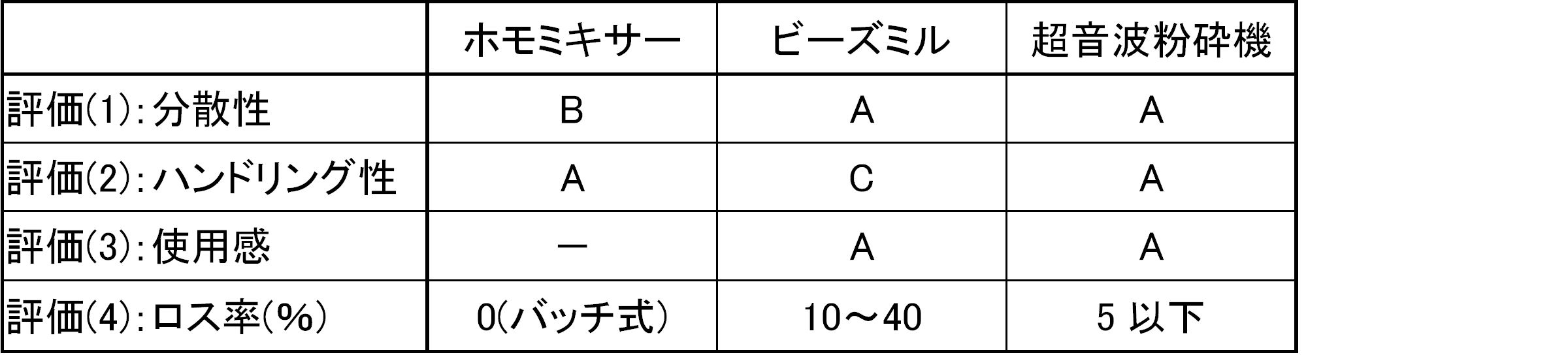
表2によると、従来のホモミキサーを用いた場合、ハンドリング性は良好であるが、分散液に凝集が見られ、色ブツも見られた。またそのような分散液を含む化粧料は、使用感に満足できるものではなかった。
ビーズミルを用いた場合、分散液の凝集はなく、得られた化粧料の使用感も良好であった。しかし、ビーズを用いているため、ハンドリング性が悪かった。
一方、超音波粉砕機を用いた場合、ハンドリング性が良好であるにもかかわらず、分散液の分散性が良好で、得られた化粧料の使用感にも優れており、透明感も有していた。
ビーズミルを用いた場合、分散液の凝集はなく、得られた化粧料の使用感も良好であった。しかし、ビーズを用いているため、ハンドリング性が悪かった。
一方、超音波粉砕機を用いた場合、ハンドリング性が良好であるにもかかわらず、分散液の分散性が良好で、得られた化粧料の使用感にも優れており、透明感も有していた。
次に、本発明者らは、下記表3に示す配合組成よりなる試料(油中水型乳化ファンデーション)を、上記製造方法により製造した(分散機および分散条件は表2と同じであった)。なお、本化粧料において、分散液中の油分に対する揮発性油分の割合は、69.3質量%であった。
そして、各試料を評価項目(1)~(3)、(5)について上記採点基準にて評価した。結果を表4に示す。
そして、各試料を評価項目(1)~(3)、(5)について上記採点基準にて評価した。結果を表4に示す。

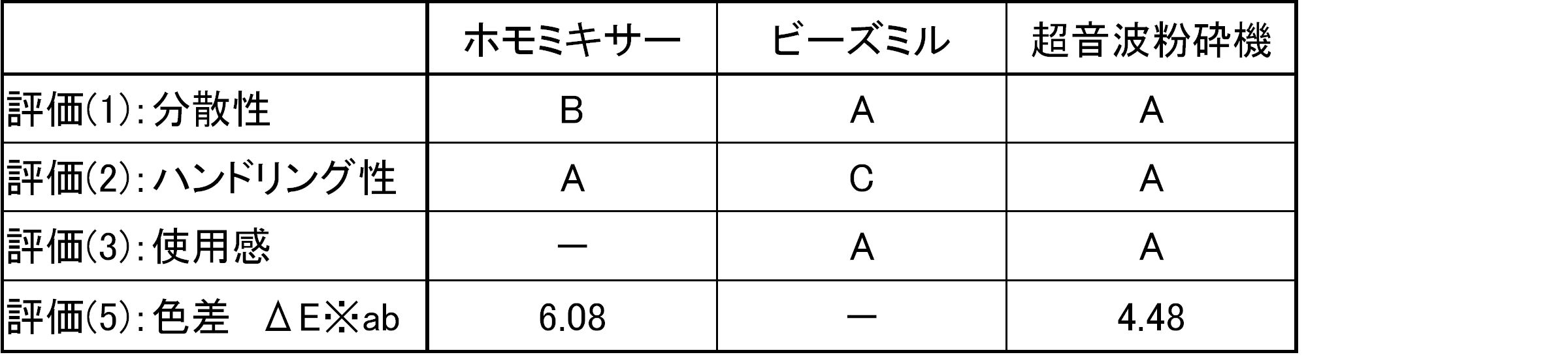
表4によると、従来のホモミキサーを用いた場合、ハンドリング性は良好であるが、分散液に凝集が見られ、色ブツも見られた。
ビーズミルを用いた場合、分散液の凝集はなく、得られた化粧料の使用感も良好であった。しかし、ビーズを用いているため、ハンドリング性が悪かった。
一方、超音波粉砕機を用いた場合、ハンドリング性が良好であるにもかかわらず、分散液の分散性が良好で、得られた化粧料の使用感にも優れており、透明感も有していた。
また、ホモミキサー処理と比較し、超音波粉砕処理を行った場合に、外観色と塗布色が近づく傾向が見られ、消費者により好まれる化粧料を得られることがわかった。
ビーズミルを用いた場合、分散液の凝集はなく、得られた化粧料の使用感も良好であった。しかし、ビーズを用いているため、ハンドリング性が悪かった。
一方、超音波粉砕機を用いた場合、ハンドリング性が良好であるにもかかわらず、分散液の分散性が良好で、得られた化粧料の使用感にも優れており、透明感も有していた。
また、ホモミキサー処理と比較し、超音波粉砕処理を行った場合に、外観色と塗布色が近づく傾向が見られ、消費者により好まれる化粧料を得られることがわかった。
次に、本発明者らは、下記表5に示す配合組成よりなる試料(試料A~C)を、下記試料製造方法により製造した。そして、各試料の粒子径を、粒度分布測定装置MICROTRACK HRA(日機装社製)で測定した。結果を表6に示す。
なお、分散機は、ディスパー(プライミクス社製、1500rpm)、ビーズミル(VMA-GETZMANN社製、5000rpm φ0.5、出力1500W)、超音波粉砕機UIP1000(Dr.Hielscher社製、出力1000W)を使用した。
表5の配合量の単位はgであり、表6の粒子径の単位はμmである。
表5の配合量の単位はgであり、表6の粒子径の単位はμmである。
試料製造方法
(a)油分、(b)粉末、(c)分散助剤を、ディスパーを用いて5分間、予備撹拌を行った(表6中、ディスパーで示す)。
予備分散された試料を、ビーズミルまたは超音波粉砕機を用いて、分散液を調製した。ビーズミルまたは超音波粉砕機が処理する予備分散された試料の量は、等量の電力消費量になるように調整した。
(a)油分、(b)粉末、(c)分散助剤を、ディスパーを用いて5分間、予備撹拌を行った(表6中、ディスパーで示す)。
予備分散された試料を、ビーズミルまたは超音波粉砕機を用いて、分散液を調製した。ビーズミルまたは超音波粉砕機が処理する予備分散された試料の量は、等量の電力消費量になるように調整した。
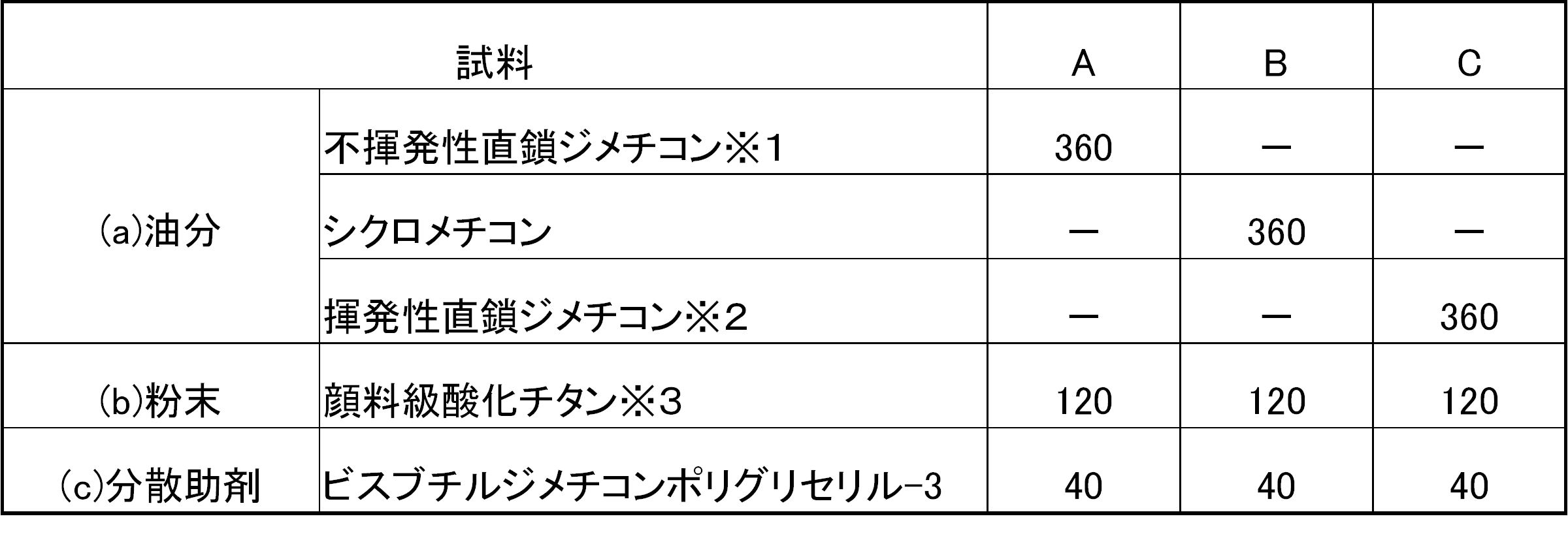
※2:Wacker-Belsil(R) DM1 PLUS(旭化成ワッカーシリコーン社製)
※3:SACHTLEBEN RC402(SACHTLEBEN PIGMENTS OY社製)

表6によると、分散機の消費電力を同じにした場合、ビーズミルより超音波粉砕機の方が粒子を細かくできることが明らかになった。すなわち、分散液の粒子径を小さくするために必要な消費電力は、ビーズミルより超音波粉砕機の方がより少ない。このため、省エネルギー化が期待できることが明らかになった。
また、揮発性油分を含む分散液BおよびCは、分散液Aより短時間で粒子を細かくできることがわかる。このため、本発明にかかる化粧料に含まれる分散液は、少なくとも揮発性油分を含むことが必要である。
また、揮発性油分を含む分散液BおよびCは、分散液Aより短時間で粒子を細かくできることがわかる。このため、本発明にかかる化粧料に含まれる分散液は、少なくとも揮発性油分を含むことが必要である。
Claims (7)
- 次の(a)~(c)を超音波粉砕機にて分散させた分散液を含むことを特徴とする化粧料。
(a)油分量に対して5~100質量%の揮発性油分を含む油分
(b)粉末 0.1~40質量%
(c)分散助剤 0.1~10質量% - 請求項1に記載の化粧料において、超音波粉砕機が周波数20kHz、出力500~16000Wの能力を有することを特徴とする化粧料。
- 請求項1または2に記載の化粧料において、(b)として色材を含むことを特徴とする化粧料。
- 請求項1~3のいずれかに記載の化粧料において、(b)として親水性粉末を含むことを特徴とする油中水型乳化化粧料。
- 請求項4に記載の化粧料において、(c)としてカチオン性界面活性剤0.01~1質量%、パルミチン酸0.02~2質量%を含むことを特徴とする油中水型乳化化粧料。
- 請求項5に記載の化粧料において、カチオン性界面活性剤の配合量/パルミチン酸の配合量=0.3~1であることを特徴とする油中水型乳化化粧料。
- (a)油分量に対して5~100質量%の揮発性油分を含む油分と、分散液中0.1~40質量%の(b)粉末と、分散液中0.1~10質量%の(c)分散助剤と、を超音波粉砕機にて分散させて得られた分散液と、化粧料基材を混合することを特徴とする化粧料の製造方法。
Priority Applications (1)
| Application Number | Priority Date | Filing Date | Title |
|---|---|---|---|
| JP2012504946A JP5054247B2 (ja) | 2010-10-19 | 2011-10-19 | 粉末分散液を含む化粧料 |
Applications Claiming Priority (2)
| Application Number | Priority Date | Filing Date | Title |
|---|---|---|---|
| JP2010234740 | 2010-10-19 | ||
| JP2010-234740 | 2010-10-19 |
Publications (1)
| Publication Number | Publication Date |
|---|---|
| WO2012053546A1 true WO2012053546A1 (ja) | 2012-04-26 |
Family
ID=45975257
Family Applications (1)
| Application Number | Title | Priority Date | Filing Date |
|---|---|---|---|
| PCT/JP2011/074042 Ceased WO2012053546A1 (ja) | 2010-10-19 | 2011-10-19 | 粉末分散液を含む化粧料 |
Country Status (3)
| Country | Link |
|---|---|
| JP (1) | JP5054247B2 (ja) |
| TW (1) | TW201221146A (ja) |
| WO (1) | WO2012053546A1 (ja) |
Citations (3)
| Publication number | Priority date | Publication date | Assignee | Title |
|---|---|---|---|---|
| JPH11322562A (ja) * | 1998-05-15 | 1999-11-24 | Shiseido Co Ltd | 日焼け止め化粧料 |
| JP2001058935A (ja) * | 1999-08-19 | 2001-03-06 | Dainippon Kasei Kk | 化粧料用分散組成物の製造方法 |
| JP2002080771A (ja) * | 2000-09-07 | 2002-03-19 | Noevir Co Ltd | 顔料分散体および化粧料 |
Family Cites Families (2)
| Publication number | Priority date | Publication date | Assignee | Title |
|---|---|---|---|---|
| JP4991161B2 (ja) * | 2006-02-17 | 2012-08-01 | 株式会社 資生堂 | 化粧料組成物 |
| JP2010030954A (ja) * | 2008-07-29 | 2010-02-12 | Fuji Kasei Kk | 処理粉体および乳化組成物 |
-
2011
- 2011-10-19 TW TW100138181A patent/TW201221146A/zh unknown
- 2011-10-19 JP JP2012504946A patent/JP5054247B2/ja active Active
- 2011-10-19 WO PCT/JP2011/074042 patent/WO2012053546A1/ja not_active Ceased
Patent Citations (3)
| Publication number | Priority date | Publication date | Assignee | Title |
|---|---|---|---|---|
| JPH11322562A (ja) * | 1998-05-15 | 1999-11-24 | Shiseido Co Ltd | 日焼け止め化粧料 |
| JP2001058935A (ja) * | 1999-08-19 | 2001-03-06 | Dainippon Kasei Kk | 化粧料用分散組成物の製造方法 |
| JP2002080771A (ja) * | 2000-09-07 | 2002-03-19 | Noevir Co Ltd | 顔料分散体および化粧料 |
Also Published As
| Publication number | Publication date |
|---|---|
| JPWO2012053546A1 (ja) | 2014-02-24 |
| JP5054247B2 (ja) | 2012-10-24 |
| TW201221146A (en) | 2012-06-01 |
Similar Documents
| Publication | Publication Date | Title |
|---|---|---|
| US20090263660A1 (en) | Surface-treated powder and cosmetics containing same | |
| JP5649051B2 (ja) | 微粒子金属酸化物分散組成物 | |
| JP2016216423A (ja) | 表面処理した化粧料用粉体及び顔料級酸化チタンを配合した、白浮きのないメーキャップ化粧料 | |
| JP2007230995A (ja) | サブミクロン窒化ホウ素粒子を含む化粧品組成物 | |
| JP2016216424A (ja) | 表面処理した化粧用粉体及び該表面処理粉体を配合したメーキャップ化粧料 | |
| JPH03115211A (ja) | 化粧料 | |
| JP6012983B2 (ja) | 被覆粉体及びその製造方法 | |
| JPH10182397A (ja) | 紫外線防御化粧料 | |
| JP7671952B2 (ja) | 水中油型乳化化粧料 | |
| JP5260060B2 (ja) | 微粒子酸化チタン分散物及びそれを含む化粧料 | |
| WO2013190114A1 (en) | Cosmetic composition comprising non-interference scattering particles and aerogel particles, and cosmetic lightening method | |
| JP6462583B2 (ja) | テアニンを用いた表面処理粉体及びそれを含有する化粧料 | |
| JP2009046643A (ja) | セルロース被覆顔料およびその製造方法並びにそれを含有する化粧料 | |
| JPH09221411A (ja) | 二酸化チタン及びこれを含有する組成物 | |
| JPH02247109A (ja) | 化粧料 | |
| JP5548352B2 (ja) | メークアップ化粧料 | |
| JP2007056086A (ja) | 顔料内包セルロースパウダー並びにそれを含有する化粧料、樹脂および塗料 | |
| JP2021155383A (ja) | 化粧料用粉体、色持ち向上剤、及び色持ち向上方法 | |
| JPH0826931A (ja) | 化粧料 | |
| JP7808947B2 (ja) | 油性化粧料 | |
| JP2008214267A (ja) | 粉末化粧料の製造方法 | |
| JP5054247B2 (ja) | 粉末分散液を含む化粧料 | |
| JP2020164458A (ja) | 水中油型乳化化粧料 | |
| JP2002146237A (ja) | 新規な有色虹彩箔光沢顔料及びこれらを含有してなる化粧料 | |
| JP3492966B2 (ja) | 化粧料 |
Legal Events
| Date | Code | Title | Description |
|---|---|---|---|
| WWE | Wipo information: entry into national phase |
Ref document number: 2012504946 Country of ref document: JP |
|
| 121 | Ep: the epo has been informed by wipo that ep was designated in this application |
Ref document number: 11834385 Country of ref document: EP Kind code of ref document: A1 |
|
| NENP | Non-entry into the national phase |
Ref country code: DE |
|
| 122 | Ep: pct application non-entry in european phase |
Ref document number: 11834385 Country of ref document: EP Kind code of ref document: A1 |