WO2012033016A1 - 腫瘍治療用薬剤、抗腫瘍剤、腫瘍治療方法および腫瘍治療用キット - Google Patents
腫瘍治療用薬剤、抗腫瘍剤、腫瘍治療方法および腫瘍治療用キット Download PDFInfo
- Publication number
- WO2012033016A1 WO2012033016A1 PCT/JP2011/070022 JP2011070022W WO2012033016A1 WO 2012033016 A1 WO2012033016 A1 WO 2012033016A1 JP 2011070022 W JP2011070022 W JP 2011070022W WO 2012033016 A1 WO2012033016 A1 WO 2012033016A1
- Authority
- WO
- WIPO (PCT)
- Prior art keywords
- tumor
- compound
- cancer
- immunosuppressive
- gemcitabine
- Prior art date
- Legal status (The legal status is an assumption and is not a legal conclusion. Google has not performed a legal analysis and makes no representation as to the accuracy of the status listed.)
- Ceased
Links
Images


Classifications
-
- A—HUMAN NECESSITIES
- A61—MEDICAL OR VETERINARY SCIENCE; HYGIENE
- A61K—PREPARATIONS FOR MEDICAL, DENTAL OR TOILETRY PURPOSES
- A61K45/00—Medicinal preparations containing active ingredients not provided for in groups A61K31/00 - A61K41/00
- A61K45/06—Mixtures of active ingredients without chemical characterisation, e.g. antiphlogistics and cardiaca
-
- A—HUMAN NECESSITIES
- A61—MEDICAL OR VETERINARY SCIENCE; HYGIENE
- A61K—PREPARATIONS FOR MEDICAL, DENTAL OR TOILETRY PURPOSES
- A61K31/00—Medicinal preparations containing organic active ingredients
- A61K31/185—Acids; Anhydrides, halides or salts thereof, e.g. sulfur acids, imidic, hydrazonic or hydroximic acids
- A61K31/19—Carboxylic acids, e.g. valproic acid
- A61K31/20—Carboxylic acids, e.g. valproic acid having a carboxyl group bound to a chain of seven or more carbon atoms, e.g. stearic, palmitic, arachidic acids
- A61K31/203—Retinoic acids ; Salts thereof
-
- A—HUMAN NECESSITIES
- A61—MEDICAL OR VETERINARY SCIENCE; HYGIENE
- A61K—PREPARATIONS FOR MEDICAL, DENTAL OR TOILETRY PURPOSES
- A61K31/00—Medicinal preparations containing organic active ingredients
- A61K31/33—Heterocyclic compounds
- A61K31/395—Heterocyclic compounds having nitrogen as a ring hetero atom, e.g. guanethidine or rifamycins
- A61K31/40—Heterocyclic compounds having nitrogen as a ring hetero atom, e.g. guanethidine or rifamycins having five-membered rings with one nitrogen as the only ring hetero atom, e.g. sulpiride, succinimide, tolmetin, buflomedil
- A61K31/403—Heterocyclic compounds having nitrogen as a ring hetero atom, e.g. guanethidine or rifamycins having five-membered rings with one nitrogen as the only ring hetero atom, e.g. sulpiride, succinimide, tolmetin, buflomedil condensed with carbocyclic rings, e.g. carbazole
- A61K31/404—Indoles, e.g. pindolol
-
- A—HUMAN NECESSITIES
- A61—MEDICAL OR VETERINARY SCIENCE; HYGIENE
- A61K—PREPARATIONS FOR MEDICAL, DENTAL OR TOILETRY PURPOSES
- A61K31/00—Medicinal preparations containing organic active ingredients
- A61K31/66—Phosphorus compounds
- A61K31/661—Phosphorus acids or esters thereof not having P—C bonds, e.g. fosfosal, dichlorvos, malathion or mevinphos
-
- A—HUMAN NECESSITIES
- A61—MEDICAL OR VETERINARY SCIENCE; HYGIENE
- A61K—PREPARATIONS FOR MEDICAL, DENTAL OR TOILETRY PURPOSES
- A61K31/00—Medicinal preparations containing organic active ingredients
- A61K31/70—Carbohydrates; Sugars; Derivatives thereof
- A61K31/7042—Compounds having saccharide radicals and heterocyclic rings
- A61K31/7052—Compounds having saccharide radicals and heterocyclic rings having nitrogen as a ring hetero atom, e.g. nucleosides, nucleotides
- A61K31/706—Compounds having saccharide radicals and heterocyclic rings having nitrogen as a ring hetero atom, e.g. nucleosides, nucleotides containing six-membered rings with nitrogen as a ring hetero atom
- A61K31/7064—Compounds having saccharide radicals and heterocyclic rings having nitrogen as a ring hetero atom, e.g. nucleosides, nucleotides containing six-membered rings with nitrogen as a ring hetero atom containing condensed or non-condensed pyrimidines
- A61K31/7068—Compounds having saccharide radicals and heterocyclic rings having nitrogen as a ring hetero atom, e.g. nucleosides, nucleotides containing six-membered rings with nitrogen as a ring hetero atom containing condensed or non-condensed pyrimidines having oxo groups directly attached to the pyrimidine ring, e.g. cytidine, cytidylic acid
-
- A—HUMAN NECESSITIES
- A61—MEDICAL OR VETERINARY SCIENCE; HYGIENE
- A61P—SPECIFIC THERAPEUTIC ACTIVITY OF CHEMICAL COMPOUNDS OR MEDICINAL PREPARATIONS
- A61P35/00—Antineoplastic agents
-
- A—HUMAN NECESSITIES
- A61—MEDICAL OR VETERINARY SCIENCE; HYGIENE
- A61P—SPECIFIC THERAPEUTIC ACTIVITY OF CHEMICAL COMPOUNDS OR MEDICINAL PREPARATIONS
- A61P43/00—Drugs for specific purposes, not provided for in groups A61P1/00-A61P41/00
Definitions
- the present invention relates to a tumor therapeutic agent using an antitumor agent containing a protein polysaccharide derived from Kawaratake as an active ingredient.
- Protein polysaccharide extracted from Kawaratake shows antitumor activity and the like.
- JP-A-60-45533 Patent Document 1 describes an antitumor agent containing a protein polysaccharide derived from Kawaratake as an active ingredient.
- PSK registered trademark
- Keratin registered trademark
- PSK is a protein polysaccharide containing about 18 to 38% protein, and has a molecular weight of 5000 or more (gel filtration method), for example, 5000 to 300,000 (gel filtration method).
- the sugar part of the main fraction is ⁇ -D-glucan, and the structure of this glucan part is a branched structure containing 1 ⁇ 3, 1 ⁇ 4 and 1 ⁇ 6 bonds.
- Antitumor agents eg, PSK
- PSK Kawaratake-derived protein polysaccharide
- the effect of prolonging the response period by combination with chemotherapy for small cell lung cancer has been confirmed, and application to gastric cancer patients, colorectal cancer patients, and small cell lung cancer patients has been approved.
- an object of the present invention is to provide a tumor therapeutic agent or an antitumor agent that exhibits a therapeutic effect even for these non-responders.
- a further object of the present invention is to provide a tumor therapeutic agent or an antitumor agent using a protein polysaccharide derived from Kawaratake with few side effects for cancer patients to which PSK has not been applied.
- the present inventors have found that the compound having inhibitory activity against immunosuppressive cells is a protein polysaccharide derived from Kawaratake. It has been found that by administering in combination with the body, the inhibitory effect on the proliferation of cancer cells of the protein polysaccharide derived from Kawaratake can be enhanced and can be an excellent drug for treating tumors against many cancers.
- the present invention is based on such findings and includes the following inventions.
- the present invention relates to a tumor therapeutic agent comprising a combination of an antitumor agent comprising a protein polysaccharide derived from Kawaratake as an active ingredient and an immunosuppressive cell inhibitor comprising a compound having an inhibitory activity on immunosuppressive cells.
- an antitumor agent comprising a protein polysaccharide derived from Kawaratake as an active ingredient
- an immunosuppressive cell inhibitor comprising a compound having an inhibitory activity on immunosuppressive cells.
- the therapeutic agent for tumor according to the present invention has a high therapeutic effect even for a non-responder having low reactivity with an antitumor agent containing a protein polysaccharide derived from Kawaratake as an active ingredient.
- the compound further has antitumor activity.
- a compound having an inhibitory activity on immunosuppressive cells has an antitumor activity, whereby a synergistic effect is obtained in the treatment of tumors.
- the immunosuppressive cell is preferably a myeloid-derived suppressor cell (MDSC). Since the compound has an inhibitory activity on MDSC, it is possible to eliminate the inhibition of the action of an antitumor agent containing a protein polysaccharide derived from Kawaratake by MDSC as an active ingredient, and to improve the therapeutic effect of the drug for tumor treatment. is there.
- MDSC myeloid-derived suppressor cell
- the immunosuppressive cell is preferably a regulatory T cell (Treg). Since the compound has Treg inhibitory activity, it is possible to eliminate the suppression of the action of an antitumor agent containing a protein polysaccharide derived from Kawaratake by Treg as an active ingredient, and to improve the therapeutic effect of a drug for tumor treatment. is there.
- Treg regulatory T cell
- the compound is gemcitabine, phosphodiesterase-5 (PDE-5) inhibitory compound, all-trans-retinoic acid (ATRA), arginase inhibitory compound, sunitinib, cyclophosphami
- the compound is selected from the group consisting of: Denileukindiftitox, CTLA-4 inhibitory compound, CD25 inhibitory compound, and IL-2R inhibitory compound.
- the present invention also relates to an antitumor agent comprising a protein polysaccharide derived from Kawaratake as an active ingredient, characterized in that it is used in combination with an immunosuppressive cell inhibitor comprising a compound having an inhibitory activity on immunosuppressive cells. It relates to an antitumor agent.
- the antitumor agent according to the present invention has a high therapeutic effect even for a non-responder having a low reactivity with an antitumor agent containing a protein polysaccharide derived from Kawaratake as an active ingredient.
- the present invention also relates to a tumor treatment comprising a combination of an antitumor agent comprising a protein polysaccharide derived from Kawaratake as an active ingredient and an immunosuppressive cell inhibitor comprising a compound having immunosuppressive cell inhibitory activity. Regarding the method.
- the present invention also relates to a tumor treatment kit comprising a combination of a plurality of active ingredients, wherein the active ingredient comprises a protein polysaccharide derived from Kawaratake and a compound having an inhibitory activity on immunosuppressive cells. .
- an antitumor agent comprising a protein polysaccharide derived from Kawaratake as an active ingredient and an immunosuppressive cell inhibitor comprising a compound having an inhibitory activity on immunosuppressive cells are used in combination.
- an antitumor agent comprising a protein polysaccharide derived from Kawaratake as an active ingredient and an immunosuppressive cell inhibitor comprising a compound having an inhibitory activity on immunosuppressive cells are used in combination.
- the proliferation of cancer cells can be suppressed and a high therapeutic effect can be obtained. That is, the tumor therapeutic agent of the present invention has a high therapeutic effect even for a non-responder having low reactivity (sensitivity) to an antitumor agent containing a protein polysaccharide derived from Kawaratake as an active ingredient.
- the tumor therapeutic agent of the present invention suppresses the growth of cancer cells even for tumors for which application of an antitumor agent containing a protein polysaccharide derived from Kawaratake, such as PSK, as an active ingredient has not been approved. There is also an effect that can be made.
- an antitumor agent containing protein polysaccharide derived from Kawaratake such as PSK as an active ingredient is not approved for breast cancer, but the tumor therapeutic agent of the present invention suppresses the growth of cancer cells, It can also be retracted.
- the immunosuppressive cell inhibitor used in the present invention has immunosuppressive cell inhibitory activity and (direct) cytotoxic (disorder) activity
- the tumor therapeutic agent of the present invention is The effect which synergized the effect which this compound originally has is shown.
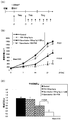
- Example 1 The data regarding Example 1 are shown, (A) is the figure which showed the administration schedule of an antitumor agent and an immunosuppressive cell inhibitor, (B) is a graph which shows the suppression effect of a tumor volume, ( C) is a graph showing the effect of suppressing tumor weight.
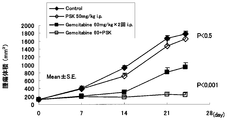
- Example 2 The data regarding Example 2 are shown, (A) is the figure which showed the administration schedule of an antitumor agent and an immunosuppressive cell inhibitor, (B) is a graph which shows the suppression effect of a tumor volume, ( C) is a graph showing the effect of suppressing tumor weight.
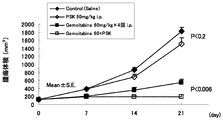
- 4 is a graph showing the effect of suppressing the tumor volume of a tumor therapeutic agent in Example 3.
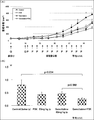
- FIG. 6 is a graph showing the effect of suppressing the tumor volume of a tumor therapeutic agent in Example 4.
- Example 5 The data regarding Example 5 are shown, (A) is a graph which shows the inhibitory effect of a tumor volume, (B) is a graph which shows the inhibitory effect of a tumor weight. 10 is a graph showing the tumor volume inhibitory effect of a tumor therapeutic agent in Example 6.
- FIG. 5 is a graph which shows the inhibitory effect of a tumor volume
- FIG. 10 is a graph showing the tumor volume inhibitory effect of a tumor therapeutic agent in Example 6.
- the drug for tumor treatment of the present invention comprises an antitumor agent comprising a protein polysaccharide derived from Kawaratake as an active ingredient, and an immunosuppressive cell inhibitor comprising a compound having an inhibitory activity on immunosuppressive cells, Are used together. Details of the antitumor agent and immunosuppressive cell inhibitor in the tumor therapeutic agent according to the present invention are described below.
- “combination” means administration of a drug for tumor treatment containing a protein polysaccharide derived from Kawaratake and a compound having an inhibitory activity on immunosuppressive cells as a single agent.
- an antitumor agent comprising a protein polysaccharide derived from Kawaratake, which is in the form of a single preparation, as an active ingredient and an immunosuppressive cell inhibitor comprising a compound having an inhibitory activity on immunosuppressive cells, either simultaneously or with a time difference. It also means that two drugs are administered. In the latter case, the number of administrations of the antitumor agent and the immunosuppressive cell inhibitor may be the same or different.
- PSK As an antitumor agent containing Kawaratake-derived protein polysaccharide as an active ingredient, for example, PSK can be mentioned.
- PSK is sold under the trade name “Krestin”, and mycelium of Kawaratake fungus CM101 strain [FERM-P2412 (ATCC20547)] is used in an aqueous solvent such as hot water or an alkaline solution (for example, alkali metal hydroxide).
- aqueous solvent such as hot water or an alkaline solution (for example, alkali metal hydroxide).
- Product in particular, an aqueous solution of sodium hydroxide), purified and dried.
- the sugar portion of the main fraction is ⁇ -D-glucan, and the structure of this glucan portion is a branched structure containing ⁇ 1 ⁇ 3, ⁇ 1 ⁇ 4 and ⁇ 1 ⁇ 6 bonds.
- the main constituent monosaccharides are glucose and mannose and contain about 18-38% protein.
- the constituent amino acids of proteins are mostly acidic amino acids such as aspartic acid and glutamic acid, and neutral amino acids such as valine and leucine, and few basic amino acids such as lysine and arginine.
- Kawaratake is not limited to the CM101 strain, and may contain any protein polysaccharide having antitumor activity.
- the antitumor agent containing protein polysaccharide derived from Kawaratake as an active ingredient is not limited as long as it has antitumor activity.
- PSK and PSK generic drugs such as Ascle (Nichi-Iko), Cretile powder (Sawai Pharmaceutical), Thiorestin powder (Chaseido), Thiorestin powder (Tanabe Seiyaku Sales), Carbocline powder (Taiyo Pharmaceutical Co., Ltd.), and Carbocline powder (Nippon Chemifa) may be used.
- Antitumor agents containing Kawaratake-derived protein polysaccharide as an active ingredient are prolongation of survival by combined use with chemotherapy in patients with gastric cancer (surgery) and colorectal cancer (curative resection), and small cell lung cancer Has been confirmed to be effective in prolonging the response period by combination with chemotherapy, etc., and is approved for gastric cancer patients, colorectal cancer patients, and small cell lung cancer patients.
- immunosuppressive cell inhibitor comprising a compound having inhibitory activity on immunosuppressive cells
- the immunosuppressive cell inhibitor used in the tumor therapeutic agent of the present invention contains a compound having an inhibitory activity on immunosuppressive cells.
- the immunosuppressive cell is not particularly limited as long as it has a function of suppressing the immune response of the living body. Examples of immunosuppressive cells include myeloid-derived suppressor cells (hereinafter sometimes referred to as MDSC) and regulatory T cells (hereinafter sometimes referred to as Treg). The myeloid-derived suppressor cells and regulatory T cells will be described below.
- MDSC myeloid-derived suppressor cells
- Treg regulatory T cells
- MDSC Myeloid-derived suppressor cells
- MDSCs are heterogeneous cell groups that interact with T cells, macrophages, and NK cells. It has also been reported that it increases in peripheral blood and tumor tissue of cancer patients. Although it does not specifically limit as a surface marker of mouse
- human MDSC surface markers are CD11b + , Gr1 + , CD14 +/ ⁇ , and HLA-DR low , but no specific markers have been identified. Therefore, human MDSCs are not limited to cells having the aforementioned markers as long as they have any one of the immunosuppressive functions described below.
- the immunosuppressive function of MDSC is 2 of inducible nitric oxide synthase (inducible nitric-oxide synthase 2: hereinafter referred to as NOS2) and arginase-1 (hereinafter referred to as ARG1) expressed in MDSC.
- NOS2 suppresses T cell IL-2 receptor signaling through the production of NO and induces apoptosis.
- ARG1 is an arginine metabolizing enzyme that suppresses the function of T cells by consuming arginine from the surrounding environment.
- immunosuppressive function of MDSC immunosuppression by TGF- ⁇ and IL-10 secreted by MDSC and cysteine deficiency due to the presence of MDSC have been reported.
- Tregs are T cells that suppressively act on immunocompetent cells such as T cells or dendritic cells, and an increase in Tregs is observed in human tumor tissue or peripheral blood.
- the surface marker of human Treg is not limited, it is assumed to be CD4 + , CD25 + (IL-2 receptor ⁇ chain), and accounts for 5 to 10% of CD4 + cells in the peripheral blood of healthy people Yes.
- Treg constantly expresses glucocorticoid-induced TNF receptor (GITR), cytotoxic T lymphocyte antigen 4 (CTLA-4), and FOXP3. ing.
- nTreg In CD4 + Treg, IL-10-producing Tr1, TGF- ⁇ -producing Th3, spontaneous Treg (nTreg) and inducible Treg (iTreg) have been reported. Physiologically, nTreg prevents the development of autoimmune diseases by suppressing peripherally self-reactive T cells that have escaped central immune tolerance in the thoracic line.
- Compound having inhibitory activity of immunosuppressive cells examples include a compound that inhibits the function of MDSC, a compound that inhibits the function of Treg, and a compound that inhibits the function of MDSC and Treg.
- inhibiting MDSC function means reducing MDSC cells, inhibiting immunosuppressive substances secreted from MDSC, inhibiting MDSC immunosuppressive substance secretion, Or inhibition of antigen presentation ability and effector ability by MDSC.
- inhibiting the function of Treg in this specification and the like may be obtained by replacing MDSC in the above description of MDSC with Treg.
- decrease here means suppression and elimination of induction of MDSC or Treg.
- Compounds that inhibit the function of MDSC include gemcitabine, phosphodiesterase-5 (PDE-5) inhibitory compounds (eg, sildenafil, tadalafil, and vardenafil), all-trans-retinoic acid (hereinafter referred to as ATRA).
- PDE-5 phosphodiesterase-5
- ATRA all-trans-retinoic acid
- arginase-inhibiting compounds for example, boronic-acid derivative 2 (S) -amino-6-boronohexanoinic acid (ABH), S- (2boronoethyl) -L-cystein (BEC)), COX-2 inhibitor (SC58236) KIT-specific antibody, Nitroaspirin, VitaminD3, avastin, VEGF-trap, Doxorubicin, 5-FU and cyclophosphamide.
- ATRA induces differentiation of MDSC and inhibits the immunosuppressive activity of MDSC.
- boronic-acid derivative 2 (S) -amino-6-boronohexanoinic acid (ABH) and S- (2boronoethyl) -L-cystein (BEC) are analogs of arginine.
- Treg function Compounds that inhibit Treg function include cyclophosphamide, Denileukindiftitox, CTLA-4 inhibitory compound (eg, anti-CTLA-4 antibody), CD25 inhibitory compound (eg, anti-CD25 antibody) And IL-2R inhibitory compounds (eg, anti-IL-2R antibodies).
- CTLA-4 inhibitory compound eg, anti-CTLA-4 antibody
- CD25 inhibitory compound eg, anti-CD25 antibody
- IL-2R inhibitory compounds eg, anti-IL-2R antibodies.
- Denileukin diftitox is a fusion protein of IL-2 and diphtheria and damages CD25 positive cells.
- Sunitinib (Sunitinib) can be mentioned as a compound which inhibits the function of MDSC and Treg.
- the compound having immunosuppressive cell inhibitory activity preferably has antitumor activity (direct cytotoxic activity) in addition to immunosuppressive cell inhibitory activity.
- a compound having an inhibitory activity on immunosuppressive cells enhances the antitumor effect of an antitumor agent containing a protein polysaccharide derived from Kawaratake as an active ingredient by inhibiting immunosuppressive cells, Tumor cells can be suppressed.
- a tumor therapeutic agent using an immunosuppressive cell inhibitor containing a compound having antitumor activity can provide a synergistic effect on the suppression of tumor cell proliferation.
- Examples of compounds having immunosuppressive cell inhibitory activity and antitumor activity include gemcitabine, cyclophosphamide, and sunitinib.
- a compound having immunosuppressive cell inhibitory activity and antitumor activity if the effective amount showing immunosuppressive cell inhibitory activity differs from the effective amount showing antitumor activity, at least immunosuppression An amount of the compound exhibiting sex cell inhibitory activity is administered.
- Gemcitabine is a compound represented by the following formula (1), and a pharmaceutical composition containing gemcitabine hydrochloride is applied to non-small cell cancer, pancreatic cancer, biliary tract cancer, urothelial cancer, and inoperable or recurrent breast cancer. It is approved and marketed as an antitumor agent (trade name: Gemzar). Gemcitabine has also been reported to be effective for breast cancer, bladder cancer, ovarian cancer and the like. The action of gemcitabine is DNA synthesis inhibition, apoptosis induction, and MDSC reduction.
- gemcitabine is administered by intravenously injecting 1000 mg / m 2 of gemcitabine over 30 minutes. Administration once a week for 3 consecutive weeks, withdrawn during the 4th week. This is repeated as one course. The dose may be reduced according to the patient's condition. In the case of inoperable or recurrent breast cancer, 1250 mg / m 2 of gemcitabine is infused intravenously over 30 minutes as gemcitabine. In this case, administration once a week is continued for 2 weeks, and the drug is withdrawn during the 3rd week. This is repeated as one course.
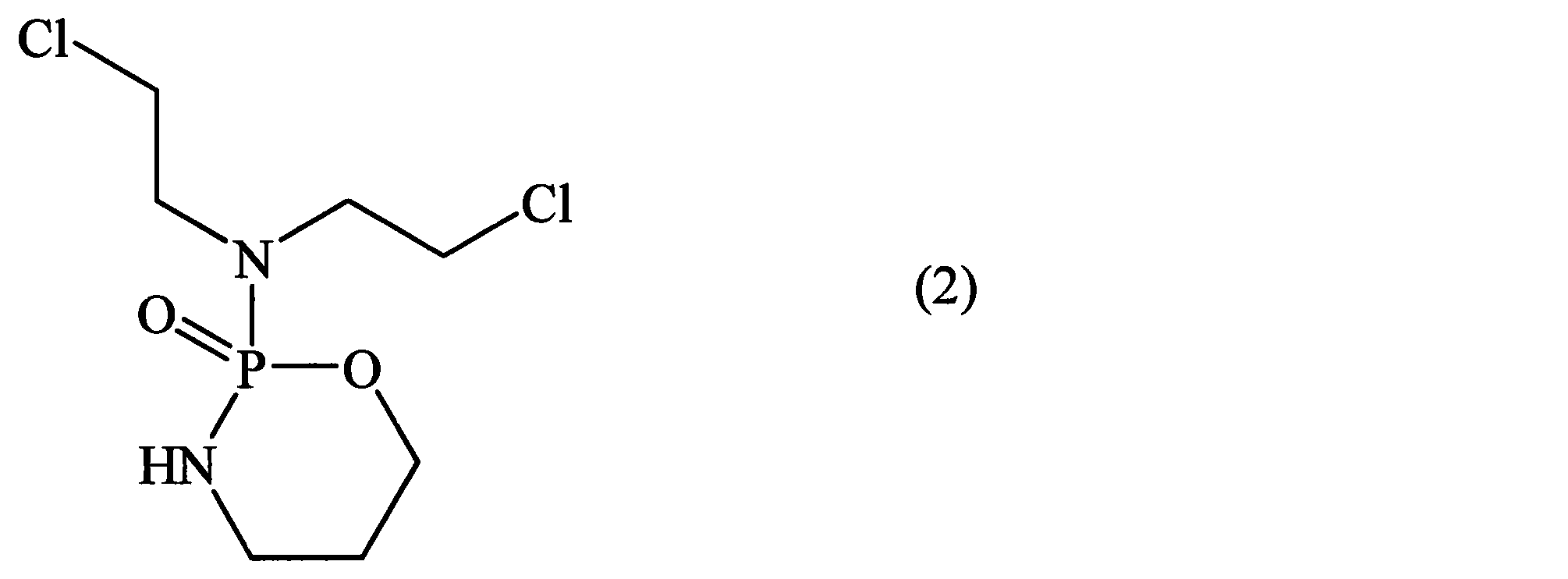
- Cyclophosphamide is a compound represented by the following formula (2): multiple myeloma, malignant lymphoma (Hodgkin's disease, lymphosarcoma, reticulosarcoma), lung cancer, breast cancer, acute leukemia, polycythemia vera, child Approved for application to cervical cancer, endometrial cancer, ovarian cancer, neuronal tumors (neuroblastoma, retinoblastoma), and bone tumors.
- malignant lymphoma Hodgkin's disease, lymphosarcoma, reticulosarcoma
- lung cancer breast cancer
- acute leukemia polycythemia vera
- neuronal tumors neuronal tumors (neuroblastoma, retinoblastoma), and bone tumors.
- chronic lymphocytic leukemia chronic myeloid leukemia, pharyngeal cancer, stomach cancer, pancreatic cancer, liver cancer, colon cancer, testicular tumor, choriocarcinoma (chorionic cancer, destructive hydatidiform mole, hydatidiform mole), rhabdomyosarcoma, and It is approved for use in combination with other antineoplastic agents for melanoma.
- breast cancer preoperative or postoperative chemotherapy in operable cases
- Cyclophosphamide is a compound that inhibits the function of Treg when administered in small doses.
- cyclophosphamide as an antitumor agent is carried out by injecting 100 mg of cyclophosphamide (anhydrous equivalent) into a vein once a day when administered alone. If the patient can tolerate, the daily dose is increased to 200 mg. Cyclophosphamide is administered in a total amount of 3000-8000 mg, but lasts as long as possible when the effect is observed.
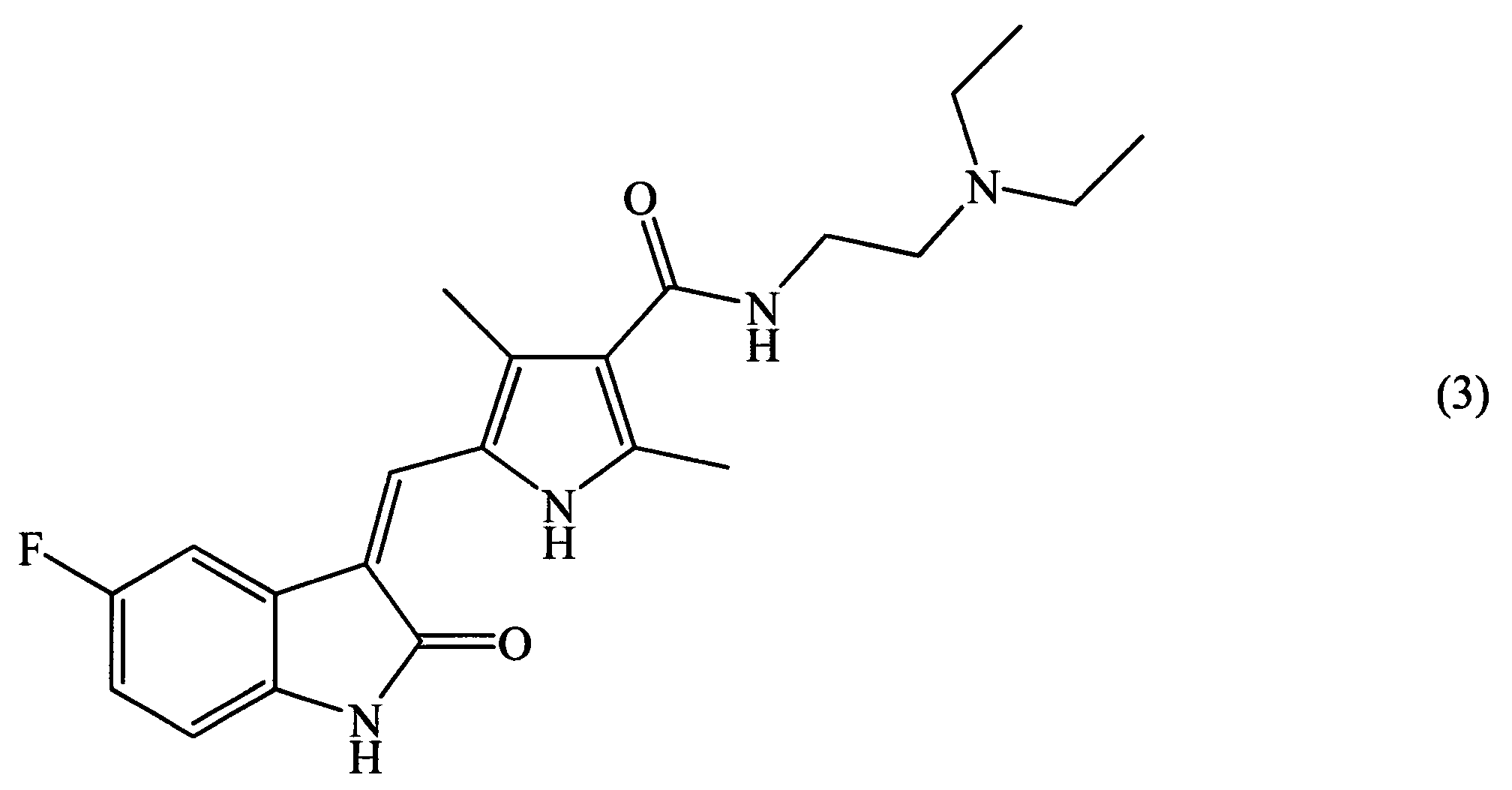
- Sunitinib is a compound represented by the following formula (3), and has been approved for imatinib-resistant gastrointestinal stromal tumor (GIST) and unresectable or metastatic renal cell carcinoma. It is sold under the brand name Sutent. Sunitinib is a compound that inhibits the functions of Treg and MDSC. The main functions are VEGF (vascular endothelial growth factor) receptor involved in angiogenesis and PDGF (platelet derived growth factor) receptor involved in tumor growth. It targets multiple receptors such as the body.
- GIST gastrointestinal stromal tumor
- Sutent a compound that inhibits the functions of Treg and MDSC.
- VEGF vascular endothelial growth factor
- PDGF platelet derived growth factor
- sunitinib as an antitumor agent is performed by daily oral administration of 50 mg of sunitinib to adults once a day for 4 weeks.
- the drug will be withdrawn for 2 weeks. This is repeated as one course.
- the dose may be reduced according to the patient's condition.
- An anti-tumor agent containing a protein polysaccharide derived from Kawaratake as an active ingredient is considered to exhibit an anti-tumor effect by restoring and enhancing the biological defense function of cancer patients, specifically the immune function. Therefore, by administering an immunosuppressive cell inhibitor containing a compound having an inhibitory activity on immunosuppressive cells to a cancer patient, immunosuppressive cells (for example, MDSC or Treg) of the cancer patient are inhibited. As described above, the suppression of the immune function is released by the inhibition of the immunosuppressive cells, whereby the immunostimulatory action of the antitumor agent containing the protein polysaccharide derived from Kawaratake as an active ingredient is further enhanced.
- an antitumor agent containing an agaric protein-derived polysaccharide as an active ingredient and an immunosuppressive cell inhibitor containing a compound having an inhibitory activity on immunosuppressive cells, a protein polysaccharide derived from agaricus so far
- immunosuppressive cells for example, non-responsible for the treatment of antitumor agents using protein polysaccharides from Kawaratake
- an immunosuppressive cell inhibitor containing a compound having an immunosuppressive cell inhibitory activity has antitumor activity, it has a synergistic effect with the antitumor activity of the antitumor agent using a protein polysaccharide derived from Kawaratake. You can expect.
- an antitumor agent containing a protein polysaccharide derived from Kawaratake as an active ingredient is not currently approved for use in cancer patients other than gastric cancer patients, colorectal cancer patients, and small cell lung cancer patients. Therefore, in the present invention, a drug using a protein polysaccharide derived from Kawaratake, which has low side effects on cancer patients, including gastric cancer patients, colorectal cancer patients, and cancer patients other than small cell lung cancer patients, Another object of the present invention is to provide a tumor therapeutic agent that can provide a therapeutic effect.
- the antitumor activity possessed by the immunosuppressive cell inhibitor is activity against tumors other than gastric cancer, colorectal cancer, and small cell lung cancer, it is effective against tumors other than gastric cancer, colorectal cancer, and small cell lung cancer.
- the therapeutic effect of an antitumor agent using a protein polysaccharide derived from Kawaratake is obtained. That is, when the immunosuppressive cell inhibitor has antitumor activity (direct cytotoxic activity) against tumors other than gastric cancer, colorectal cancer, and small cell lung cancer, the tumor therapeutic agent according to the present invention is used.
- an antitumor agent using a protein polysaccharide derived from Kawaratake with small side effects can be provided for treatment of cancer patients other than gastric cancer, colorectal cancer, and small cell lung cancer.
- the tumor therapeutic agent of the present invention is effective for tumors where the application of antitumor agents containing Kawaratake protein polysaccharide as an active ingredient has not been approved, and for tumors where immunosuppressive cell inhibitors with antitumor activity have not been applied as antitumor agents.
- the tumor therapeutic agent of the present invention is effective for tumors where the application of antitumor agents containing Kawaratake protein polysaccharide as an active ingredient has not been approved, and for tumors where immunosuppressive cell inhibitors with antitumor activity have not been applied as antitumor agents.
- the dosage form of the therapeutic agent for tumor of the present invention may be two agents in which the antitumor agent and the immunosuppressive cell inhibitor are separated as a single preparation, respectively, and the antitumor agent (protein isolate from Kawaratake) and the immunity One agent mixed with a suppressor cell inhibitor (a compound having an inhibitory activity of immunosuppressive cells) may be used.
- the combination ratio of the protein polysaccharide derived from Kawaratake and the compound having an inhibitory activity on immunosuppressive cells is not particularly limited as long as it is an amount effective for cancer treatment. It is not something.
- the compounding ratio of the protein polysaccharide derived from Kawaratake and the compound having an inhibitory activity on immunosuppressive cells is not particularly limited as long as it is effective for treating tumor.
- the dosage form of the tumor treatment drug is not particularly limited.
- it may be orally administered in the form of a conventional pharmaceutical preparation such as a capsule, a microcapsule, a tablet, a granule, a fine granule, or a powder. Can do.
- parenterally for example, intravenous injection, intramuscular injection, subcutaneous administration, intraperitoneal administration, rectal administration, transdermal administration
- parenterally for example, intravenous injection, intramuscular injection, subcutaneous administration, intraperitoneal administration, rectal administration, transdermal administration
- injections such as intravenous injection and intramuscular injection.
- отно ⁇ preparations are commonly used excipients, extenders, binders, wetting agents, disintegrants, surfactants, lubricants, dispersants, buffers, preservatives, solubilizers, preservatives, It can be produced by a conventional method using a flavoring agent, a soothing agent, a stabilizer and the like.
- non-toxic additive examples include lactose, fructose, glucose, starch, gelatin, magnesium carbonate, synthetic magnesium silicate, talc, magnesium stearate, methylcellulose, carboxymethylcellulose or a salt thereof, gum arabic, and polyethylene.
- examples include glycol, syrup, petrolatum, glycerin, ethanol, propylene glycol, citric acid, sodium chloride, sodium sulfite, and sodium phosphate.
- the administration method, dose, administration period, and administration interval of the drug for treating tumor can be appropriately set depending on, for example, the patient's weight, age, symptom level, and the like.
- the drug for tumor treatment is one agent, it is provided as a pharmaceutical composition comprising a protein polysaccharide derived from Kawaratake and a compound having an inhibitory activity on immunosuppressive cells as active ingredients, and further comprising a pharmaceutically acceptable carrier. May be.
- This pharmaceutical composition is a novel pharmaceutical composition.
- the usage ratio of the antitumor agent and the immunosuppressive cell inhibitor should be effective for the treatment of malignant tumors. It is not particularly limited.
- the dosage forms of the antitumor agent and the immunosuppressive cell inhibitor are not particularly limited, and the same dosage form as that of the one drug for treating a tumor can be used.
- the administration method, the dose, the administration period, and the administration interval can be appropriately set depending on, for example, the patient's weight, age, degree of symptoms, and the like.
- gemcitabine when PSK is used as an anti-tumor agent and gemcitabine is used as an immunosuppressive cell inhibitor, gemcitabine is administered as a single course of intravenous administration of 1000 mg / mm 2 once a week for 2 consecutive weeks. , PSK may be orally administered daily for 3 g daily from the 2nd week to 3 weeks. Alternatively, as a course dose, gemcitabine is orally administered once a week at 1000 mg / mm 2 once a week for 3 consecutive weeks, and PSK is orally administered daily for 3 weeks from the 2nd week to 3 weeks. You may do it.
- the above administration method is an example, and other administration methods may be used.
- the administration method, dose, administration period, and administration interval of the antitumor agent and immunosuppressive cell inhibitor to humans are determined by a controlled clinical trial.
- the antitumor agent may be provided as a pharmaceutical composition containing a protein polysaccharide derived from Kawaratake as an active ingredient and further containing a pharmaceutically acceptable carrier.
- the immunosuppressive cell inhibitor may also be provided as a pharmaceutical composition containing a compound having immunosuppressive cell inhibitory activity as an active ingredient and further containing a pharmaceutically acceptable carrier.
- two drugs for tumor treatment are used so that the other drug can be administered even while one drug is being withdrawn. You can continue. For example, if the side effect of one drug is large and the side effect of the other drug is small, even if it is not necessary to administer a drug with a large side effect, it is necessary to administer a drug with a large side effect. May increase. By using two drugs for tumor treatment, it becomes possible to administer the other drug with the smaller side effect even while the drug with the larger side effect is suspended.
- the administration period, and the administration interval are controlled. Preferably determined by clinical trials.
- the administration method, dose, administration period, and administration interval for the combined use of the antitumor agent and the immunosuppressive cell inhibitor may be described in the package insert or pamphlet of the tumor therapeutic agent of the present invention.
- the tumor to be treated by the tumor therapeutic agent of the present invention is not particularly limited, and the following can be mentioned.
- Mention may be made of cancer (eg neuroblastoma), retinal cancer, skin cancer, leukemia, urothelial cancer, brain tumor, osteosarcoma or transitional cell carcinoma.
- cancers to which PSK, gemcitabine, cyclophosphamide, or sunitinib is applied and other cancers.
- Cancer with PSK application gastric cancer, colorectal cancer, and small cell lung cancer
- Cancer to which gemcitabine is applied non-small cell cancer, pancreatic cancer, biliary tract cancer, urothelial cancer, and inoperable or recurrent breast cancer
- Cancer to which cyclophosphamide is applied multiple myeloma, malignant lymphoma (Hodgkin's disease, lymphosarcoma, reticulosarcoma), lung cancer, breast cancer, acute leukemia, polycythemia vera, cervical cancer, uterine body Cancer, ovarian cancer, neuronal tumor (neuroblastoma, retinoblastoma), bone tumor, chronic lymphocytic leukemia, chronic myelogenous leukemia, pharyngeal cancer, stomach cancer
- the antitumor agent comprising the Kawaratake-derived protein polysaccharide as an active ingredient is an immunosuppressive agent comprising a compound having an inhibitory activity on immunosuppressive cells. Used in combination with cell inhibitors.
- the antitumor agent containing the protein polysaccharide derived from Kawaratake as an active ingredient is the same as the antitumor agent in the above-mentioned tumor therapeutic agent, detailed description thereof is omitted.
- an immunosuppressive cell inhibitor to be administered in combination with an antitumor agent containing a protein polysaccharide derived from Kawaratake as an active ingredient the same immunosuppressive cell inhibitors as those in the above-mentioned tumor therapeutic agents can be used.
- the appropriate use ratio, dose, administration period, and administration interval of the antitumor agent in combination with the immunosuppressive cell inhibitor are determined by controlled clinical trials. What is necessary is just to describe an administration method, dosage amount, administration period, administration interval, etc. for using an antitumor agent together with an immunosuppressive cell inhibitor in the package insert or pamphlet of the antitumor agent.
- the tumor to be treated with the antitumor agent is not particularly limited, and examples thereof include tumors to be treated with the above-mentioned drug for tumor treatment, and preferably non-small cell lung cancer, pancreatic cancer, biliary tract cancer Urothelial cancer, stomach cancer, colorectal cancer, small cell lung cancer.
- the compound having an inhibitory activity on immunosuppressive cells further has an antitumor activity.
- a compound having an inhibitory activity on immunosuppressive cells has an antitumor activity, so that a synergistic effect is obtained in the treatment of tumors, and further, a therapeutic effect on tumors for which the antitumor agent of the present invention is not approved. Is obtained.
- the immunosuppressive cells are preferably myeloid-derived suppressor cells (MDSC). Since the compound having the inhibitory activity of immunosuppressive cells has the inhibitory activity of MDSC, the suppression of the action of the antitumor agent containing protein polysaccharide derived from Kawaratake by MDSC as an active ingredient is eliminated, and the antitumor of the present invention It is possible to improve the therapeutic effect of the agent.
- MDSC myeloid-derived suppressor cells
- the immunosuppressive cell is preferably a regulatory T cell (Treg). Since the compound having the inhibitory activity of immunosuppressive cells has the inhibitory activity of Treg, the suppression of the action of the antitumor agent containing the protein polysaccharide derived from Kawaratake by Treg as an active ingredient is eliminated, and the antitumor of the present invention It is possible to improve the therapeutic effect of the agent.
- Treg regulatory T cell
- the compound having an inhibitory activity on immunosuppressive cells is gemcitabine, a phosphodiesterase-5 (PDE-5) inhibitory compound, all-trans-retinoic acid (ATRA), It is preferably a compound selected from the group consisting of arginine inhibitory compounds, sunitinib, cyclophosphamide, Denileukindiftitox, CTLA-4 inhibitory compounds, CD25 inhibitory compounds, and IL-2R inhibitory compounds. .
- An immunosuppressive cell inhibitor comprising a compound having an inhibitory activity on immunosuppressive cells
- An immunosuppressive cell inhibitor comprising a compound having an inhibitory activity on immunosuppressive cells described in this specification and the like is a protein derived from Kawaratake It is used in combination with an antitumor agent containing a polysaccharide as an active ingredient.
- An immunosuppressive cell inhibitor comprising a compound having an inhibitory activity on immunosuppressive cells is an immunosuppressive cell inhibitor in the tumor therapeutic agent.
- An anti-tumor agent administered in combination with an immunosuppressive cell inhibitor containing a compound having an inhibitory activity on immunosuppressive cells uses an anti-tumor agent containing a protein polysaccharide derived from Kawaratake as an active ingredient in the tumor therapeutic agent. be able to.
- the package insert or pamphlet of the immunosuppressive cell inhibitor of the present invention describes the administration method, dose, administration period, and administration interval for the combined use of the immunosuppressive cell inhibitor and the antitumor agent.
- Tumor treatment method The present specification describes an antitumor agent comprising a protein polysaccharide derived from Kawaratake as an active ingredient and an immunosuppressive cell inhibitor comprising a compound having an inhibitory activity on immunosuppressive cells.
- an antitumor agent comprising a protein polysaccharide derived from Kawaratake as an active ingredient and an immunosuppressive cell inhibitor comprising a compound having an inhibitory activity on immunosuppressive cells.
- a method for treating tumors comprising administering to a subject in need thereof in an effective amount.
- the immunosuppressive cell inhibitor used in the present treatment method preferably further has antitumor activity.
- the immunosuppressive cell in which the immunosuppressive cell inhibitor used in this treatment method has inhibitory activity is, for example, a myeloid-derived suppressor cell (MDSC) and a regulatory T cell (Treg).
- MDSC myeloid-derived suppressor cell
- Treg regulatory T cell
- the immunosuppressive cell inhibitor may have inhibitory activity on both MDSC and Treg, or may have inhibitory activity on only one of them.
- Compounds having inhibitory activity on immunosuppressive cells include gemcitabine, phosphodiesterase-5 (PDE-5) inhibitory compound, all-trans-retinoic acid (ATRA), arginase inhibitory compound, sunitinib, cyclophosphami And Denileukin diftitox, CTLA-4 inhibitory compound, CD25 inhibitory compound, and IL-2R inhibitory compound.
- PDE-5 phosphodiesterase-5
- ATRA all-trans-retinoic acid
- arginase inhibitory compound sunitinib
- cyclophosphami And Denileukin diftitox CTLA-4 inhibitory compound
- CD25 inhibitory compound CD25 inhibitory compound
- IL-2R inhibitory compound IL-2R inhibitory compound
- the compound having an inhibitory activity on immunosuppressive cells further has an antitumor activity.
- the immunosuppressive cells are preferably myeloid-derived suppressor cells (MDSC).
- MDSC myeloid-derived suppressor cells
- the immunosuppressive cell is preferably a regulatory T cell (Treg).
- the compound having immunosuppressive cell inhibitory activity is gemcitabine, a phosphodiesterase-5 (PDE-5) inhibitory compound, all-trans-retinoic acid (ATRA),
- the compound is selected from the group consisting of an arginase inhibitor compound, sunitinib, cyclophosphamide, Denileukin diftitox, CTLA-4 inhibitor compound, CD25 inhibitor compound, and IL-2R inhibitor compound .
- the tumor treatment kit of the present invention is a tumor treatment kit comprising a combination of a plurality of active ingredients, and as an active ingredient, the protein polysaccharide derived from Kawaratake and the inhibitory activity of immunosuppressive cells
- a compound having As the compound having the inhibitory activity of Kawaratake-derived protein polysaccharide and immunosuppressive cells, the compound having the inhibitory activity of Kawaratake-derived protein polysaccharide and immunosuppressive cells in the above-mentioned tumor therapeutic agent can be used.
- the tumor treatment kit of the present invention is a tumor treatment kit comprising a combination of a plurality of active ingredients, comprising as an active ingredient a protein polysaccharide derived from Kawaratake and a compound having an inhibitory activity on immunosuppressive cells, Instructions may be included for administering the medication to the patient simultaneously, sequentially or individually.
- a protein polysaccharide derived from Kawaratake and an inhibitory activity on immunosuppressive cells may be included as one agent, and an inhibitory activity on the protein polysaccharide derived from Kawaratake and immunosuppressive cells.
- You may include the compound which has as 2 agents.
- the administration method, dose, administration period, administration interval, etc. are not particularly limited.
- the compound having an inhibitory activity on immunosuppressive cells further has an antitumor activity.
- the immunosuppressive cell is preferably a myeloid-derived suppressor cell (MDSC).
- MDSC myeloid-derived suppressor cell
- the immunosuppressive cells are preferably regulatory T cells (Treg).
- the compound having an inhibitory activity on immunosuppressive cells is gemcitabine, a phosphodiesterase-5 (PDE-5) inhibitory compound, all-trans-retinoic acid (ATRA), It is preferably a compound selected from the group consisting of arginine inhibitory compounds, sunitinib, cyclophosphamide, Denileukindiftitox, CTLA-4 inhibitory compounds, CD25 inhibitory compounds, and IL-2R inhibitory compounds. .
- Kawaratake-derived protein polysaccharide which is an active ingredient of an antitumor agent, is used in combination with a compound having an inhibitory activity on immunosuppressive cells when used in a method for treating tumors. is there.
- the compound having immunosuppressive cell inhibitory activity further has antitumor activity.
- the immunosuppressive cells are preferably myeloid-derived suppressor cells (MDSC).
- MDSC myeloid-derived suppressor cells
- the immunosuppressive cells are preferably regulatory T cells (Tregs).
- compounds having epithelial suppressive cell inhibitory activity include gemcitabine, phosphodiesterase-5 (PDE-5) inhibitory compounds, all-trans-retinoic acid: ATRA), an arginine inhibitor compound, sunitinib, cyclophosphamide, Denileukindiftitox, a CTLA-4 inhibitor compound, a CD25 inhibitor compound, and an IL-2R inhibitor compound. It is preferable.
- Example 1 in order to examine the effect of the tumor therapeutic agent of the present invention in mice transplanted with breast cancer cells, the effect of combined administration of PSK and gemcitabine (Gemzar injection) was examined.
- Female BALB / c mice were transplanted subcutaneously with 1 ⁇ 10 5 mouse breast cancer cell line 4T1 per mouse.
- breast cancer cells grew to 200 mm 3, they were divided into 4 groups of 8 (PSK and gemcitabine administration group, PSK single administration group, gemcitabine single administration group, and non-administration group).
- Gemcitabine was administered intraperitoneally at a dose of 120 mg / kg immediately after grouping and after 7 days.
- PSK was administered intraperitoneally at a dose of 50 mg / kg three times a week from the next day.
- physiological saline was administered intraperitoneally as a control for gemcitabine or PSK.
- tumor volumes were measured on the 7th, 14th, and 21st days. The day after the last administration of PSK, necropsy was performed and the tumor weight was measured.
- FIG. 1 is a graph showing the effect of suppressing tumor volume (FIG. 1B) and tumor weight (FIG. 1C) in a breast cancer transplanted mouse of a tumor therapeutic agent, and the administration schedule of an antitumor agent and an immunosuppressive cell inhibitor (FIG. 1A). ).
- the administration schedule shown in FIG. 1 is an administration schedule of each drug in the PSK and gemcitabine administration groups.
- “G” indicates gemcitabine
- “P” indicates PSK. That is, in the gemcitabine single administration group, PSK was not administered in the administration schedule, and physiological saline was administered instead of PSK.
- the PSK single administration group is a schedule in which gemcitabine is not administered in the administration schedule, and is a schedule in which physiological saline is administered instead of gemcitabine.
- the combined use effect was recognized significantly with respect to the tumor volume and the tumor weight by using gemcitabine and PSK together.
- the tumor growth was promoted by gemcitabine withdrawal, as the tumor volume increased after 14 days.
- the growth promotion was suppressed by administering only PSK. More specifically, the tumor volume increased by about 600 mm 3 in the gemcitabine alone administration group, whereas the increase was only about 100 mm 3 in the PSK and gemcitabine administration group. That is, by administering PSK while gemcitabine was withdrawn, tumor volume growth could be suppressed to about 1/6.
- the decrease in the tumor weight relative to the non-administration group of the PSK and gemcitabine administration group is The combined effect in the PSK and gemcitabine administration group is considered to have a synergistic effect, more than the addition of the decrease in the single administration group and the gemcitabine administration group.
- the white triangle ( ⁇ ) is the PSK and gemcitabine administration group
- the black triangle ( ⁇ ) is the gemcitabine single administration group
- the white rhombus ( ⁇ ) is the PSK single administration group
- the black rhombus ( ⁇ ) is the non-administration group Indicates.
- Example 2 In this example, the administration frequency of gemcitabine in Example 1 was increased, and the effect of combined administration of PSK and gemcitabine was examined. The procedure of Example 1 was repeated except that the administration of gemcitabine was changed immediately after grouping, after 7 days, after 14 days, and after 21 days.
- FIG. 2 is a graph showing the effect of suppressing tumor volume (FIG. 2B) and tumor weight (FIG. 2C) in a breast cancer transplanted mouse of a tumor therapeutic agent, and the administration schedule of an antitumor agent and an immunosuppressive cell inhibitor (FIG. 2A). ).
- the administration schedule shown in FIG. 2 is an administration schedule of each drug in the PSK and gemcitabine administration groups.
- “G” indicates gemcitabine
- “P” indicates PSK. That is, in the gemcitabine single administration group, it becomes a schedule which does not administer PSK in an administration schedule.
- the PSK single administration group is a schedule in which gemcitabine is not administered in the administration schedule, and is a schedule in which physiological saline is administered instead of gemcitabine.
- the combined use effect on tumor volume and tumor weight was significantly recognized by the combined use of gemcitabine and PSK.
- the increase in tumor volume was not limited to 7 days to On day 21, the tumor volume could be reduced. More specifically, in the gemcitabine alone administration group, the tumor volume increased by about 200 mm 3 between day 7 and day 21, whereas in the PSK and gemcitabine administration group, the tumor volume was reduced to near zero. I was able to.
- the white triangle ( ⁇ ) is the PSK and gemcitabine administration group
- the black triangle ( ⁇ ) is the gemcitabine single administration group
- the white rhombus ( ⁇ ) is the PSK single administration group
- the black rhombus ( ⁇ ) is the non-administration group Indicates.
- Example 3 the effect of combined administration of PSK and gemcitabine (Gemzar injection) when the dose of gemcitabine was decreased was examined.
- the procedure of Example 1 was repeated except that the dose of gemcitabine was replaced with a dose of 60 mg / kg instead of a dose of 120 mg / kg.
- FIG. 3 is a graph showing the suppressive effect of tumor volume in a breast cancer transplanted mouse of a tumor therapeutic agent.
- the PSK single administration group showed an anti-tumor tendency, but no significant difference was observed, whereas gemcitabine showed an anti-tumor effect alone.
- the combined use effect on the tumor volume was recognized significantly by using gemcitabine and PSK in combination.
- tumor growth was promoted by gemcitabine withdrawal as the tumor volume increased after 14 days, but during the gemcitabine withdrawal in the PSK and gemcitabine administration group
- the growth promotion (recovery) was suppressed by administering only PSK. More specifically, the tumor volume increased by about 500 mm 3 in the gemcitabine alone administration group, whereas it hardly increased in the PSK and gemcitabine administration group.
- the decrease in tumor volume relative to the non-administration group of the PSK and gemcitabine administration group is The combined effect in the PSK and gemcitabine administration group is considered to have a synergistic effect, more than the addition of the decrease in the single administration group and the gemcitabine administration group. In addition, a sufficient antitumor effect was obtained even at a dose of gemcitabine of 60 mg / kg.
- white squares ( ⁇ ) are PSK and gemcitabine (60 mg / kg) administration group
- black squares ( ⁇ ) are gemcitabine (60 mg / kg) single administration group
- white diamonds ( ⁇ ) are PSK single administration group
- black diamonds ( ⁇ ) indicate non-administration groups.
- Example 4 the effect of combined administration of PSK and gemcitabine (Gemzar injection) when the dose of gemcitabine was decreased was examined.
- the procedure of Example 2 was repeated except that the dose of gemcitabine was replaced with a dose of 60 mg / kg instead of the dose of 120 mg / kg.
- FIG. 4 is a graph showing the effect of suppressing tumor volume in a breast cancer transplanted mouse of a tumor therapeutic agent.
- gemcitabine alone showed an antitumor effect, although no significant difference was observed in 4T1 cells, although PSK alone showed an antitumor tendency.
- the combined use effect on the tumor volume was significantly recognized by the combined use of gemcitabine and PSK.
- the tumor volume increased from day 7 to day 21 in the gemcitabine alone administration group, the tumor volume was almost from day 7 to day 21 in the PSK and gemcitabine administration group in this example. It did not increase. More specifically, in the gemcitabine alone administration group, the tumor volume increased by about 200 mm 3 between day 7 and day 21, whereas in the PSK and gemcitabine administration group, no increase in tumor volume was observed. It was. Even when the dose of gemcitabine was reduced from 120 mg / kg to 60 mg / kg, a sufficient antitumor effect was obtained.
- the white square ( ⁇ ) is the PSK and gemcitabine (60 mg / kg) administration group
- the black square ( ⁇ ) is the gemcitabine (60 mg / kg) single administration group
- the white rhombus ( ⁇ ) Indicates a PSK single administration group
- a black diamond ( ⁇ ) indicates a non-administration group.
- Example 5 in order to examine the effect of the therapeutic agent for tumor of the present invention in mice transplanted with pancreatic cancer cells, the effect of combined administration of PSK and gemcitabine (Gemzar injection) was examined.
- Female BALB / c mice were implanted subcutaneously with 1 ⁇ 10 6 mouse pancreatic cancer cell line PAN-02.
- PAN-02. mouse pancreatic cancer cell line
- PSK was administered intraperitoneally at a dose of 50 mg / kg three times a week from the next day.
- physiological saline was administered intraperitoneally as a control for gemcitabine or PSK.
- Tumor volume measured after grouping (9 days after transplantation), 13 days, 17 days, 20 days, 24 days, 27 days, 31 days, 34 days, 38 days, 41 days, 45 days, and 48 days after transplantation did.
- necropsy was performed and the tumor weight was measured.
- FIG. 5 is a graph showing the inhibitory effect on tumor volume (FIG. 5A) and tumor weight (FIG. 5B) in mice transplanted with pancreatic cancer as a therapeutic drug for tumors.
- the administration schedule of the antitumor agent (PSK) and immunosuppressive cell inhibitor (gemcitabine) is shown in FIG. 5A.
- “G” indicates gemcitabine
- “P” indicates PSK.
- PSK was not administered in the administration schedule, and physiological saline was administered instead of PSK.
- the PSK single administration group is a schedule in which gemcitabine is not administered in the administration schedule, and is a schedule in which physiological saline is administered instead of gemcitabine.
- the PSK single administration group and the gemcitabine single administration group showed an antitumor tendency, but no significant difference was observed.
- the white triangle ( ⁇ ) indicates the PSK and gemcitabine administration group
- the black triangle ( ⁇ ) indicates the gemcitabine single administration group
- the white circle ( ⁇ ) indicates the PSK single administration group
- the black circle ( ⁇ ) indicates the non-administration group.
- Example 6 it was examined that the effect of combined administration of PSK and gemcitabine can be obtained even when the administration start time of the tumor therapeutic agent of the present invention in Example 5 is delayed.
- the procedure of Example 5 was repeated except that the start of gemcitabine administration was changed 34 days after transplantation. Tumor volumes were measured after grouping (34 days after transplantation), 36 days, 40 days, 43 days, 47 days, 50 days, and 54 days after transplantation. 54 days after tumor implantation, one mouse in each of the non-administration group and the PSK single administration group died.
- FIG. 6 shows a graph showing the effect of suppressing tumor volume in mice transplanted with pancreatic cancer, which is a drug for treating tumors.
- tumor growth was promoted by gemcitabine withdrawal as the tumor volume increased after 43 days, but during the gemcitabine withdrawal in the PSK and gemcitabine administration group The growth promotion (recovery) was suppressed by administering only PSK.
- the tumor volume was increased by about 350 mm 3
- the increase was only about 200 mm 3 .
- tumor volume growth could be suppressed by administering PSK while gemcitabine was withdrawn. This combined effect in the PSK and gemcitabine administration group is considered to be a synergistic effect.
- the white triangle ( ⁇ ) represents the PSK and gemcitabine administration group
- the black triangle ( ⁇ ) represents the gemcitabine single administration group
- the white circle ( ⁇ ) represents the PSK single administration group
- the black circle ( ⁇ ) represents the non-administration group.
- the tumor therapeutic drug of the present invention can be suitably used as a drug that enhances the therapeutic effect on a non-responder having low reactivity (sensitivity) to an antitumor agent containing PSK as an active ingredient, and at the present time PSK. It can be used as a drug having a high therapeutic effect even for cancer patients for which application of an antitumor agent containing as an active ingredient has not been approved.
- sensitivity sensitivity to an antitumor agent containing PSK as an active ingredient
Landscapes
- Health & Medical Sciences (AREA)
- Life Sciences & Earth Sciences (AREA)
- Chemical & Material Sciences (AREA)
- Medicinal Chemistry (AREA)
- Pharmacology & Pharmacy (AREA)
- Animal Behavior & Ethology (AREA)
- General Health & Medical Sciences (AREA)
- Public Health (AREA)
- Veterinary Medicine (AREA)
- Epidemiology (AREA)
- Chemical Kinetics & Catalysis (AREA)
- General Chemical & Material Sciences (AREA)
- Nuclear Medicine, Radiotherapy & Molecular Imaging (AREA)
- Organic Chemistry (AREA)
- Engineering & Computer Science (AREA)
- Bioinformatics & Cheminformatics (AREA)
- Molecular Biology (AREA)
- Pharmaceuticals Containing Other Organic And Inorganic Compounds (AREA)
- Medicines That Contain Protein Lipid Enzymes And Other Medicines (AREA)
- Medicines Containing Plant Substances (AREA)
Abstract
本発明の目的は、胃癌患者、結腸・直腸癌患者、及び小細胞肺癌患者のうち、カワラタケ由来の蛋白多糖体を有効成分として含む抗腫瘍剤に対して反応性(感受性)が低いノンレスポンダーに対して治療効果を示す腫瘍治療用薬剤を提供することである。 前記課題は、カワラタケ由来の蛋白多糖体を有効成分として含む抗腫瘍剤と、免疫抑制性細胞の阻害活性を有する化合物を含む免疫抑制細胞阻害剤とを併用することを特徴とする腫瘍治療用薬剤によって解決することができる。
Description
本発明は、カワラタケ由来の蛋白多糖体を有効成分として含む抗腫瘍剤を用いた腫瘍治療用薬剤などに関する。
カワラタケから抽出される蛋白多糖体は、抗腫瘍活性などを示す。例えば、特開昭60-45533号公報(特許文献1)には、カワラタケ由来の蛋白多糖体を有効成分とする抗腫瘍剤などが記載されている。このような蛋白多糖体のなかで、カワラタケ由来の蛋白多糖体の一種であるPSK(登録商標)(商品名「クレスチン」(登録商標))は、皮内投与や静脈内投与だけでなく、経口投与によっても抗腫瘍活性を示すことが特長であり、臨床的にも経口投与製剤として用いられている。
PSKは、約18~38%の蛋白質を含む蛋白多糖体であり、5000以上(ゲル濾過法)の分子量、例えば5000~300000(ゲル濾過法)の分子量を有するものである。主要画分の糖部分はβ-D-グルカンで、このグルカン部分の構造は、1→3、1→4及び1→6結合を含む分枝構造である。
カワラタケ由来の蛋白多糖体を有効成分として含む抗腫瘍剤(例えば、PSK)は、胃癌(手術例)患者、及び結腸・直腸癌(治癒切除例)患者における化学療法との併用による生存期間の延長、並びに小細胞肺癌に対する化学療法等との併用による奏功期間の延長の効果が確認されており、胃癌患者、結腸・直腸癌患者、及び小細胞肺癌患者への適用が認可されている。
しかしながら、胃癌患者、結腸・直腸癌患者、及び小細胞肺癌患者において、PSKの投与の効果が低いノンレスポンダーが存在する。すなわち、胃癌患者、結腸・直腸癌患者、及び小細胞肺癌患者には、カワラタケ由来の蛋白多糖体を有効成分として含む抗腫瘍剤に対して反応性(感受性)が低いノンレスポンダーが存在している。したがって、本発明の目的は、これらのノンレスポンダーに対しても治療効果を示す腫瘍治療用薬剤、又は抗腫瘍剤を提供することである。
また、胃癌患者、結腸・直腸癌患者、及び小細胞肺癌患者以外の癌患者へのPSKの適用は、現在のところ認められていない。本発明のさらなる目的は、PSKの適用が認められていない癌患者に対して、副作用の少ないカワラタケ由来の蛋白多糖体を用いた腫瘍治療用薬剤、又は抗腫瘍剤を提供することである。
本発明者らは、カワラタケ由来の蛋白多糖体の、悪性腫瘍に対する治療効果を増強することのできる化合物について、鋭意研究した結果、免疫抑制性細胞に対する阻害活性を有する化合物を、カワラタケ由来の蛋白多糖体と組み合わせて併用投与することにより、カワラタケ由来の蛋白多糖体の癌細胞の増殖に対する抑制効果が増強し、多くの癌に対する優れた腫瘍治療用薬剤となり得ることを見出した。本発明は、こうした知見に基づくものであり、以下の発明を包含する。
本発明は、カワラタケ由来の蛋白多糖体を有効成分として含む抗腫瘍剤と、免疫抑制性細胞の阻害活性を有する化合物を含む免疫抑制細胞阻害剤とを併用することを特徴とする腫瘍治療用薬剤に関する。本発明に係る腫瘍治療用薬剤では、カワラタケ由来の蛋白多糖体を有効成分として含む抗腫瘍剤に対して反応性が低いノンレスポンダーに対しても、高い治療効果を奏する。
本発明の腫瘍治療用薬剤では、前記化合物が、更に抗腫瘍活性を有していることが好ましい。免疫抑制性細胞の阻害活性を有する化合物が、抗腫瘍活性を有することにより、腫瘍の治療において相乗効果が得られる。
また、本発明の腫瘍治療用薬剤では、前記免疫抑制性細胞が、ミエロイド由来サプレッサー細胞(MDSC)であることが好ましい。前記化合物が、MDSCの阻害活性を有することによって、MDSCによるカワラタケ由来の蛋白多糖体を有効成分として含む抗腫瘍剤の作用の抑制を解消し、腫瘍治療用薬剤治療効果を向上させることが可能である。
また、本発明の腫瘍治療用薬剤では、前記免疫抑制性細胞が、制御性T細胞(Treg)であることが好ましい。前記化合物が、Tregの阻害活性を有することによって、Tregによるカワラタケ由来の蛋白多糖体を有効成分として含む抗腫瘍剤の作用の抑制を解消し、腫瘍治療用薬剤治療効果を向上させることが可能である。
本発明の腫瘍治療用薬剤では、前記化合物が、ゲムシタビン、ホスホジエステラーゼ-5(PDE-5)阻害化合物、オールトランスレチノイン酸(all-trans-retinoic acid:ATRA)、アルギナーゼ阻害化合物、スニチニブ、シクロホスファミド、デニロイキンジフチトックス(Denileukin diftitox)、CTLA-4阻害化合物、CD25阻害化合物、及びIL-2R阻害化合物からなる群から選択される化合物であることが好ましい。
また、本発明は、カワラタケ由来の蛋白多糖体を有効成分として含む抗腫瘍剤であって、免疫抑制性細胞の阻害活性を有する化合物を含む免疫抑制細胞阻害剤と併用されることを特徴とする抗腫瘍剤に関する。本発明に係る抗腫瘍剤では、特にカワラタケ由来の蛋白多糖体を有効成分として含む抗腫瘍剤に対して反応性が低いノンレスポンダーに対しても、高い治療効果を奏する。
また、本発明は、カワラタケ由来の蛋白多糖体を有効成分として含む抗腫瘍剤と、免疫抑制性細胞の阻害活性を有する化合物を含む免疫抑制細胞阻害剤とを併用することを特徴とする腫瘍治療方法に関する。
また、本発明は、複数の活性成分を組み合わせて含む腫瘍治療用キットであって、前記活性成分として、カワラタケ由来の蛋白質多糖体および免疫抑制細胞の阻害活性を有する化合物を含む腫瘍治療用キットに関する。
本発明の腫瘍治療用薬剤によれば、カワラタケ由来の蛋白多糖体を有効成分として含む抗腫瘍剤と、免疫抑制性細胞の阻害活性を有する化合物を含む免疫抑制細胞阻害剤とを併用して投与することにより、癌細胞の増殖を抑制し、高い治療効果を得ることができる。すなわち、本発明の腫瘍治療用薬剤は、カワラタケ由来の蛋白多糖体を有効成分として含む抗腫瘍剤に対して反応性(感受性)が低いノンレスポンダーに対しても、高い治療効果を奏する。
また、本発明の腫瘍治療用薬剤は、PSKなどのカワラタケ由来の蛋白多糖体を有効成分として含む抗腫瘍剤の適用が認可されていない腫瘍に対しても癌細胞の増殖を抑え、更には退縮させることができる効果も併せて奏する。
例えば、現在、乳癌はPSKなどのカワラタケ由来の蛋白多糖体を有効成分として含む抗腫瘍剤の適用が認可されていないが、本発明の腫瘍治療用薬剤では、癌細胞の増殖を抑え、更には退縮させることもできる。さらに、本発明に用いる免疫抑制細胞阻害剤が、免疫抑制性細胞の阻害活性及び(直接的)細胞傷害(障害)活性を有している場合には、本発明の腫瘍治療用薬剤は、互いの化合物が本来有する効果を相乗した効果を示す。
[1]腫瘍治療用薬剤
本発明の腫瘍治療用薬剤は、カワラタケ由来の蛋白多糖体を有効成分として含む抗腫瘍剤と、免疫抑制性細胞の阻害活性を有する化合物を含む免疫抑制細胞阻害剤とを併用するものである。本発明に係る腫瘍治療用薬剤における抗腫瘍剤および免疫抑制細胞阻害剤の詳細について、以下に記載する。
本発明の腫瘍治療用薬剤は、カワラタケ由来の蛋白多糖体を有効成分として含む抗腫瘍剤と、免疫抑制性細胞の阻害活性を有する化合物を含む免疫抑制細胞阻害剤とを併用するものである。本発明に係る腫瘍治療用薬剤における抗腫瘍剤および免疫抑制細胞阻害剤の詳細について、以下に記載する。
なお、本明細書等における「併用」とは、カワラタケ由来の蛋白多糖体と、免疫抑制性細胞の阻害活性を有する化合物とを含む腫瘍治療用薬剤を1剤として投与することを意味する。更に、それぞれ単独製剤の形態であるカワラタケ由来の蛋白多糖体を有効成分として含む抗腫瘍剤と、免疫抑制性細胞の阻害活性を有する化合物を含む免疫抑制細胞阻害剤とを、同時に又は時間差をおいて、2剤で投与することも併せて意味する。後者の場合、抗腫瘍剤と免疫抑制細胞阻害剤との投与回数は同じであってもよいし、異なっていてもよい。
(カワラタケ由来の蛋白多糖体を有効成分として含む抗腫瘍剤)
カワラタケ由来の蛋白多糖体を有効成分として含む抗腫瘍剤としては、例えばPSKを挙げることができる。PSKは、商品名「クレスチン」の名称で販売されており、カワラタケ菌CM101株〔FERM-P2412(ATCC20547)〕の菌糸体を水系溶媒、例えば、熱水又はアルカリ溶液(例えば、アルカリ金属の水酸化物、特には水酸化ナトリウムの水溶液)で抽出し、精製した後に乾燥して得ることができる。主要画分の糖部分はβ-D-グルカンで、このグルカン部分の構造はβ1→3、β1→4及びβ1→6結合を含む分枝構造である。主な構成単糖はグルコースやマンノースであり、約18~38%のタンパク質を含む。タンパク質の構成アミノ酸は、アスパラギン酸やグルタミン酸等の酸性アミノ酸と、バリンやロイシン等の中性アミノ酸が多く、リジンやアルギニン等の塩基性アミノ酸は少ない。
カワラタケ由来の蛋白多糖体を有効成分として含む抗腫瘍剤としては、例えばPSKを挙げることができる。PSKは、商品名「クレスチン」の名称で販売されており、カワラタケ菌CM101株〔FERM-P2412(ATCC20547)〕の菌糸体を水系溶媒、例えば、熱水又はアルカリ溶液(例えば、アルカリ金属の水酸化物、特には水酸化ナトリウムの水溶液)で抽出し、精製した後に乾燥して得ることができる。主要画分の糖部分はβ-D-グルカンで、このグルカン部分の構造はβ1→3、β1→4及びβ1→6結合を含む分枝構造である。主な構成単糖はグルコースやマンノースであり、約18~38%のタンパク質を含む。タンパク質の構成アミノ酸は、アスパラギン酸やグルタミン酸等の酸性アミノ酸と、バリンやロイシン等の中性アミノ酸が多く、リジンやアルギニン等の塩基性アミノ酸は少ない。
本明細書等において、カワラタケはCM101株に限定されるものではなく、抗腫瘍活性を有する蛋白多糖体を含むものであればよい。また、カワラタケ由来の蛋白多糖体を有効成分として含む抗腫瘍剤は、抗腫瘍活性を有するものであれば、限定されるものではない。例えば、PSK、並びにPSKのジェネリック医薬品であるアスクレ(日医工)、クレチール末(沢井製薬)、チオレスチン散(長生堂)、チオレスチン散(田辺製薬販売)、カルボクリン末(大洋薬品工業)、及びカルボクリン末(日本ケミファ)であってもよい。
カワラタケ由来の蛋白多糖体を有効成分として含む抗腫瘍剤は、胃癌(手術例)患者、及び結腸・直腸癌(治癒切除例)患者における化学療法との併用による生存期間の延長、並びに小細胞肺癌に対する化学療法等との併用による奏功期間の延長の効果が確認されており、胃癌患者、結腸・直腸癌患者、及び小細胞肺癌患者への適用が認可されている。
(免疫抑制性細胞の阻害活性を有する化合物を含む免疫抑制細胞阻害剤)
本発明の腫瘍治療用薬剤に用いられる免疫抑制細胞阻害剤は、免疫抑制性細胞の阻害活性を有する化合物を含む。免疫抑制性細胞は、生体の免疫反応を抑制する機能を有する細胞であれば、特に限定されるものではない。免疫抑制性細胞としては、例えば、ミエロイド由来サプレッサー細胞(以下、MDSCと称することがある)、及び制御性T細胞(以下、Tregと称することがある)を挙げることができる。ミエロイド由来サプレッサー細胞及び制御性T細胞について以下に説明する。
本発明の腫瘍治療用薬剤に用いられる免疫抑制細胞阻害剤は、免疫抑制性細胞の阻害活性を有する化合物を含む。免疫抑制性細胞は、生体の免疫反応を抑制する機能を有する細胞であれば、特に限定されるものではない。免疫抑制性細胞としては、例えば、ミエロイド由来サプレッサー細胞(以下、MDSCと称することがある)、及び制御性T細胞(以下、Tregと称することがある)を挙げることができる。ミエロイド由来サプレッサー細胞及び制御性T細胞について以下に説明する。
(ミエロイド由来サプレッサー細胞)
MDSCは、免疫抑制能を有する骨髄系細胞の総称である。MDSCは、不均一な細胞群であり、T細胞、マクロファージ、及びNK細胞と相互作用する。また、癌患者の末梢血及び腫瘍組織において増加していることが報告されている。マウスのMDSCの表面マーカーとしては、特に限定されるものではないが、CD11b+、Gr1+を挙げることができる。また、CD31+及びIL-4αをマーカーとしてもよい。また、ヒトのMDSCの表面マーカーはCD11b+、Gr1+、CD14+/-、及びHLA-DRlowとされているが、特異的なマーカーは同定されていない。したがって、ヒトのMDSCは、後述の免疫抑制機能のいずれか1つを有するものであれば、前記のマーカーを有する細胞に限定されるものではない。
MDSCは、免疫抑制能を有する骨髄系細胞の総称である。MDSCは、不均一な細胞群であり、T細胞、マクロファージ、及びNK細胞と相互作用する。また、癌患者の末梢血及び腫瘍組織において増加していることが報告されている。マウスのMDSCの表面マーカーとしては、特に限定されるものではないが、CD11b+、Gr1+を挙げることができる。また、CD31+及びIL-4αをマーカーとしてもよい。また、ヒトのMDSCの表面マーカーはCD11b+、Gr1+、CD14+/-、及びHLA-DRlowとされているが、特異的なマーカーは同定されていない。したがって、ヒトのMDSCは、後述の免疫抑制機能のいずれか1つを有するものであれば、前記のマーカーを有する細胞に限定されるものではない。
MDSCの免疫抑制機能は、MDSCに発現している誘導性一酸化窒素シンターゼ(inducible nitric-oxide synthase 2:以下、NOS2と称する)、及びアルギナーゼ1(arginase-1:以下、ARG1と称する)の2つの酵素に関連している。NOS2は、NOの産生を介してT細胞のIL-2レセプターシグナル伝達を抑制しアポトーシスを誘導する。一方、ARG1は、アルギニンの代謝酵素で、アルギニンを周囲の環境から消費することにより、T細胞の機能を抑制する。更に、MDSCの免疫抑制機能としては、MDSCが分泌しているTGF-β及びIL-10による免疫抑制、及びMDSC存在によるシステイン欠乏も報告されている。
(制御性T細胞)
Tregは、T細胞又は樹状細胞などの免疫担当細胞に抑制的に働くT細胞であり、ヒト腫瘍組織又は末梢血中でTregの増加が認められている。ヒトのTregの表面マーカーは限定されるものではないが、CD4+、CD25+(IL-2レセプターα鎖)とされており、健常人の末梢血のCD4+細胞の5~10%を占めている。また、Tregは、グルココルチコイド誘導性TNF受容体(glucocorticoid-induced TNF receptor:GITR)、細胞傷害性Tリンパ球抗原4(Cytotoxic T lymphocyte antigen 4:CTLA-4)、及びFOXP3を恒常的に発現している。CD4+Tregには、IL-10産生性Tr1、TGF-β産生性Th3、自然発生Treg(nTreg)及び誘導性Treg(iTreg)が報告されている。nTregは、生理的には、胸線において中枢性免疫寛容を逃れた自己反応性T細胞を末梢で抑制することにより、自己免疫疾患の発症を予防している。
Tregは、T細胞又は樹状細胞などの免疫担当細胞に抑制的に働くT細胞であり、ヒト腫瘍組織又は末梢血中でTregの増加が認められている。ヒトのTregの表面マーカーは限定されるものではないが、CD4+、CD25+(IL-2レセプターα鎖)とされており、健常人の末梢血のCD4+細胞の5~10%を占めている。また、Tregは、グルココルチコイド誘導性TNF受容体(glucocorticoid-induced TNF receptor:GITR)、細胞傷害性Tリンパ球抗原4(Cytotoxic T lymphocyte antigen 4:CTLA-4)、及びFOXP3を恒常的に発現している。CD4+Tregには、IL-10産生性Tr1、TGF-β産生性Th3、自然発生Treg(nTreg)及び誘導性Treg(iTreg)が報告されている。nTregは、生理的には、胸線において中枢性免疫寛容を逃れた自己反応性T細胞を末梢で抑制することにより、自己免疫疾患の発症を予防している。
(免疫抑制性細胞の阻害活性を有する化合物)
免疫抑制性細胞の阻害活性を有する化合物としては、例えばMDSCの機能を阻害する化合物、Tregの機能を阻害する化合物、並びにMDSC及びTregの機能を阻害する化合物を挙げることができる。
免疫抑制性細胞の阻害活性を有する化合物としては、例えばMDSCの機能を阻害する化合物、Tregの機能を阻害する化合物、並びにMDSC及びTregの機能を阻害する化合物を挙げることができる。
本明細書等において、「MDSCの機能を阻害する」とは、MDSCの細胞を減少させること、MDSCから分泌された免疫抑制物質を阻害すること、MDSCの免疫抑制物質の分泌を阻害すること、又はMDSCによる抗原提示能およびエフェクター能の阻害を抑制することなどを含む。なお、本明細書等における「Tregの機能を阻害する」とは、上述したMDSCに関する記載におけるMDSCをTregに読み換えればよい。また、ここでの「減少」とは、MDSC又はTregの誘導抑制及び排除を意味する。
MDSCの機能を阻害する化合物としては、ゲムシタビン、ホスホジエステラーゼ-5(PDE-5)阻害化合物(例えば、sildenafil、tadalafil、及びvardenafil)、オールトランスレチノイン酸(all-trans-retinoic acid:以下、ATRAと称する)、又はアルギナーゼ阻害化合物(例えば、boronic-acid derivative 2(S)-amino-6-boronohexanoinic acid(ABH), S-(2boronoethyl)-L-cystein(BEC))、COX-2阻害剤(SC58236)、KIT-specific antibody、Nitroaspirin、VitaminD3、avastin、VEGF-trap、Doxorubicin、5-FU、cyclophosphamideを挙げることができる。例えば、ATRAは、MDSCを分化誘導し、MDSCの免疫抑制活性を阻害する。また、boronic-acid derivative 2(S)-amino-6-boronohexanoinic acid(ABH)、及びS-(2boronoethyl)-L-cystein(BEC)は、アルギニンのアナログである。
Tregの機能を阻害する化合物としては、シクロホスファミド、デニロイキンジフチトックス(Denileukin diftitox)、CTLA-4阻害化合物(例えば、抗CTLA-4抗体)、CD25阻害化合物(例えば、抗CD25抗体)、及びIL-2R阻害化合物(例えば、抗IL-2R抗体)を挙げることができる。デニロイキンジフチトックスは、IL-2とジフテリアとの融合タンパクであり、CD25陽性細胞を傷害する。
MDSC及びTregの機能を阻害する化合物としては、スニチニブ(Sunitinib)を挙げることができる。
免疫抑制性細胞の阻害活性を有する化合物は、免疫抑制性細胞の阻害活性に加えて、抗腫瘍活性(直接的細胞傷害活性)を有することが好ましい。これによって、免疫抑制性細胞の阻害活性を有する化合物は、免疫抑制性細胞を阻害することにより、カワラタケ由来の蛋白多糖体を有効成分として含む抗腫瘍剤の抗腫瘍効果を増強すると共に、自身が腫瘍細胞を抑制することができる。
したがって、免疫抑制性細胞の阻害活性に加えて、抗腫瘍活性を有する化合物を含む免疫抑制細胞阻害剤を用いた腫瘍治療用薬剤では、腫瘍細胞の増殖抑制に対して相乗効果が得られることになる。
免疫抑制性細胞の阻害活性を有し、かつ、抗腫瘍活性(直接的細胞傷害活性)を有する化合物としては、ゲムシタビン、シクロホスファミド、及びスニチニブを挙げることができる。免疫抑制性細胞の阻害活性を有し、かつ、抗腫瘍活性を有する化合物において、免疫抑制性細胞の阻害活性を示す有効量と、抗腫瘍活性を示す有効量とが異なる場合は、少なくとも免疫抑制性細胞の阻害活性を示す量の当該化合物を投与する。
(ゲムシタビン)
ゲムシタビンは、下記式(1)で表わされる化合物であり、ゲムシタビン塩酸塩を含む医薬組成物が、非小細胞癌、膵癌、胆道癌、尿路上皮癌、及び手術不能又は再発乳癌に適用される抗腫瘍剤(商品名:ジェムザール)として認可され、販売されている。また、ゲムシタビンは、乳癌、膀胱癌、及び卵巣癌などにも有効であると報告されている。なお、ゲムシタビンの作用は、DNA合成阻害、アポトーシスの誘導、及びMDSCの減少である。
ゲムシタビンは、下記式(1)で表わされる化合物であり、ゲムシタビン塩酸塩を含む医薬組成物が、非小細胞癌、膵癌、胆道癌、尿路上皮癌、及び手術不能又は再発乳癌に適用される抗腫瘍剤(商品名:ジェムザール)として認可され、販売されている。また、ゲムシタビンは、乳癌、膀胱癌、及び卵巣癌などにも有効であると報告されている。なお、ゲムシタビンの作用は、DNA合成阻害、アポトーシスの誘導、及びMDSCの減少である。

ゲムシタビンの抗腫瘍剤としての投与は、非小細胞肺癌、膵癌、胆道癌、尿路上皮癌の場合、1回あたり1000mg/m2のゲムシタビンを30分かけて点滴静注することで行う。週1回投与を3週連続し、4週目は休薬する。これを1コースとして投与を繰り返す。なお、患者の状態により適宜減量する。また、手術不能又は再発乳癌の場合、ゲムシタビンとして1回あたり1250mg/m2のゲムシタビンを30分かけて点滴静注する。この場合は、週1回投与を2週連続し、3週目は休薬する。これを1コースとして投与を繰り返す。
(シクロホスファミド)
シクロホスファミドは、下記式(2)で表わされる化合物であり、多発性骨髄腫、悪性リンパ腫(ホジキン病、リンパ肉腫、細網肉腫)、肺癌、乳癌、急性白血病、真性多血症、子宮頸癌、子宮体癌、卵巣癌、神経腫瘍(神経芽腫、網膜芽腫)、及び骨腫瘍への適用が認可されている。また、慢性リンパ性白血病、慢性骨髄性白血病、咽頭癌、胃癌、膵癌、肝癌、結腸癌、睾丸腫瘍、絨毛性疾患(絨毛癌、破壊胞状奇胎、胞状奇胎)、横紋筋肉腫、及び悪性黒色腫には、他の抗悪性腫瘍剤と併用で認可されている。更に、乳癌(手術可能例における術前、あるいは術後化学療法)では、他の抗悪性腫瘍剤との併用療法で、認可されている。シクロホスファミドは、少量投与により、Tregの機能を阻害する化合物である。
シクロホスファミドは、下記式(2)で表わされる化合物であり、多発性骨髄腫、悪性リンパ腫(ホジキン病、リンパ肉腫、細網肉腫)、肺癌、乳癌、急性白血病、真性多血症、子宮頸癌、子宮体癌、卵巣癌、神経腫瘍(神経芽腫、網膜芽腫)、及び骨腫瘍への適用が認可されている。また、慢性リンパ性白血病、慢性骨髄性白血病、咽頭癌、胃癌、膵癌、肝癌、結腸癌、睾丸腫瘍、絨毛性疾患(絨毛癌、破壊胞状奇胎、胞状奇胎)、横紋筋肉腫、及び悪性黒色腫には、他の抗悪性腫瘍剤と併用で認可されている。更に、乳癌(手術可能例における術前、あるいは術後化学療法)では、他の抗悪性腫瘍剤との併用療法で、認可されている。シクロホスファミドは、少量投与により、Tregの機能を阻害する化合物である。
シクロホスファミドの抗腫瘍剤としての投与は、単独で投与する場合、成人には1日1回100mgのシクロホスファミド(無水物換算)を静脈内に注射することで行う。患者が耐えられる場合には、1日あたりの投与量を200mgに増量する。シクロホスファミドは、総量3000~8000mgを投与するが、効果が認められたときは、できる限り長期間持続する。
(スニチニブ)
スニチニブは、下記式(3)で表される化合物であり、イマチニブ抵抗性の消化管間質腫瘍(GIST)、及び根治切除不能又は転移性の腎細胞がんへの適用が認可されており、商品名スーテントとして販売されている。スニチニブは、Treg及びMDSCの機能を阻害する化合物であり、主な機能は、血管新生に関与するVEGF(血管内皮細胞増殖因子)受容体と、腫瘍増殖に関与するPDGF(血小板由来増殖因子)受容体など複数の受容体を標的としている。
スニチニブは、下記式(3)で表される化合物であり、イマチニブ抵抗性の消化管間質腫瘍(GIST)、及び根治切除不能又は転移性の腎細胞がんへの適用が認可されており、商品名スーテントとして販売されている。スニチニブは、Treg及びMDSCの機能を阻害する化合物であり、主な機能は、血管新生に関与するVEGF(血管内皮細胞増殖因子)受容体と、腫瘍増殖に関与するPDGF(血小板由来増殖因子)受容体など複数の受容体を標的としている。
スニチニブの抗腫瘍剤としての投与は、成人には1日1回50mgのスニチニブを4週間連日経口投与することで行う。その後2週間は休薬する。これを1コースとして投与を繰り返す。なお、患者の状態により適宜減量する。
(腫瘍治療用薬剤の利点)
カワラタケ由来の蛋白多糖体を有効成分として含む抗腫瘍剤は、癌患者の生体防御機能、具体的には免疫機能を回復及び増強させることにより、抗腫瘍効果を発揮すると考えられている。従って、免疫抑制性細胞の阻害活性を有する化合物を含む免疫抑制細胞阻害剤を、癌患者に投与することによって、癌患者の免疫抑制細胞(例えば、MDSC又はTreg)が阻害される。このように、免疫抑制細胞の阻害により免疫機能の抑制が解除されることによって、カワラタケ由来の蛋白多糖体を有効成分として含む抗腫瘍剤の免疫賦活作用が、更に増強されることになる。
カワラタケ由来の蛋白多糖体を有効成分として含む抗腫瘍剤は、癌患者の生体防御機能、具体的には免疫機能を回復及び増強させることにより、抗腫瘍効果を発揮すると考えられている。従って、免疫抑制性細胞の阻害活性を有する化合物を含む免疫抑制細胞阻害剤を、癌患者に投与することによって、癌患者の免疫抑制細胞(例えば、MDSC又はTreg)が阻害される。このように、免疫抑制細胞の阻害により免疫機能の抑制が解除されることによって、カワラタケ由来の蛋白多糖体を有効成分として含む抗腫瘍剤の免疫賦活作用が、更に増強されることになる。
したがって、ワラタケ由来の蛋白多糖体を有効成分として含む抗腫瘍剤と、免疫抑制性細胞の阻害活性を有する化合物を含む免疫抑制細胞阻害剤とを併用することにより、これまでカワラタケ由来の蛋白多糖体を有効成分として含む抗腫瘍剤の免疫賦活作用が免疫抑制性細胞により阻害されていた対象(例えば、カワラタケ由来の蛋白多糖体を用いた抗腫瘍剤の治療に対して、反応性の低いノンレスポンダー、及びカワラタケ由来の蛋白多糖体を用いた抗腫瘍剤の適用が認可されていない癌の患者)に対して治療効果を高めることができる。
また、免疫抑制性細胞の阻害活性を有する化合物を含む免疫抑制細胞阻害剤が抗腫瘍活性を有する場合には、カワラタケ由来の蛋白多糖体を用いた抗腫瘍剤の抗腫瘍活性との相乗効果を期待することができる。
なお、カワラタケ由来の蛋白多糖体を有効成分として含む抗腫瘍剤は、現在、胃癌患者、結腸・直腸癌患者、及び小細胞肺癌患者以外の癌患者への適用は現在認められていない。したがって、本発明では、胃癌患者、結腸・直腸癌患者、及び小細胞肺癌患者以外の癌患者にも、癌患者に対して副作用の少ないカワラタケ由来の蛋白多糖体を用いた薬剤であって、高い治療効果が得られる腫瘍治療用薬剤を提供することも目的としている。
ここで、免疫抑制細胞阻害剤の有する抗腫瘍活性が胃癌、結腸・直腸癌、及び小細胞肺癌以外の腫瘍に対する活性の場合には、胃癌、結腸・直腸癌、及び小細胞肺癌以外の腫瘍に対してもカワラタケ由来の蛋白多糖体を用いた抗腫瘍剤の治療効果が得られることになる。すなわち、免疫抑制細胞阻害剤が胃癌、結腸・直腸癌、及び小細胞肺癌以外の腫瘍に対しても抗腫瘍活性(直接的細胞傷害活性)を有する場合に、本発明に係る腫瘍治療用薬剤を用いることによって、胃癌、結腸・直腸癌、及び小細胞肺癌以外の癌患者に対する治療に、副作用の小さいカワラタケ由来の蛋白多糖体を用いた抗腫瘍剤を提供することができる。
更に、カワラタケ由来の蛋白多糖体を有効成分として含む抗腫瘍剤の適用が認められていない腫瘍、及び抗腫瘍活性を有する免疫抑制細胞阻害剤が抗腫瘍剤として適用が認められていない腫瘍に対しても、本発明の腫瘍治療用薬剤は有効である。
(腫瘍治療用薬剤の剤形について)
本発明の腫瘍治療用薬剤の剤形は、抗腫瘍剤と免疫抑制細胞阻害剤とが、それぞれ単独製剤として分離している2剤でもよく、抗腫瘍剤(カワラタケ由来の蛋白多糖体)と免疫抑制細胞阻害剤(免疫抑制性細胞の阻害活性を有する化合物)とが混合している1剤でもよい。
本発明の腫瘍治療用薬剤の剤形は、抗腫瘍剤と免疫抑制細胞阻害剤とが、それぞれ単独製剤として分離している2剤でもよく、抗腫瘍剤(カワラタケ由来の蛋白多糖体)と免疫抑制細胞阻害剤(免疫抑制性細胞の阻害活性を有する化合物)とが混合している1剤でもよい。
カワラタケ由来の蛋白多糖体と、免疫抑制性細胞の阻害活性を有する化合物の組み合わせ比率(1剤における配合比率、又は2剤における使用比率)は、癌治療に有効な量であれば、特に限定されるものではない。
(腫瘍治療用薬剤が1剤の場合)
腫瘍治療用薬剤が1剤の場合、カワラタケ由来の蛋白多糖体及び免疫抑制性細胞の阻害活性を有する化合物の配合比率は、腫瘍の治療に有効であれば特に限定されるものではない。また、腫瘍治療用薬剤の剤形も、特に限定されるものではなく、例えばカプセル剤、マイクロカプセル剤、錠剤、顆粒剤、細粒剤、粉末等、慣用の医薬製剤の形で経口投与することができる。また、静注、筋注等の注射剤等、慣用の医薬製剤の形で非経口(例えば、静注、筋注、皮下投与、腹腔内投与、直腸投与、経皮投与)投与することもできる。
腫瘍治療用薬剤が1剤の場合、カワラタケ由来の蛋白多糖体及び免疫抑制性細胞の阻害活性を有する化合物の配合比率は、腫瘍の治療に有効であれば特に限定されるものではない。また、腫瘍治療用薬剤の剤形も、特に限定されるものではなく、例えばカプセル剤、マイクロカプセル剤、錠剤、顆粒剤、細粒剤、粉末等、慣用の医薬製剤の形で経口投与することができる。また、静注、筋注等の注射剤等、慣用の医薬製剤の形で非経口(例えば、静注、筋注、皮下投与、腹腔内投与、直腸投与、経皮投与)投与することもできる。
各種製剤は、通常用いられている賦形剤、増量剤、結合剤、湿潤化剤、崩壊剤、表面活性剤、滑沢剤、分散剤、緩衝剤、保存剤、溶解補助剤、防腐剤、矯味矯臭剤、無痛化剤、安定化剤などを用いて常法により製造することができる。使用可能な無毒性の上記添加剤としては、例えば、乳糖、果糖、ブドウ糖、でん粉、ゼラチン、炭酸マグネシウム、合成ケイ酸マグネシウム、タルク、ステアリン酸マグネシウム、メチルセルロース、カルボキシメチルセルロース又はその塩、アラビアゴム、ポリエチレングリコール、シロップ、ワセリン、グレセリン、エタノール、プロピレングリコール、クエン酸、塩化ナトリウム、亜硫酸ソーダ、リン酸ナトリウムなどが挙げられる。
また、腫瘍治療用薬剤の投与方法、投与量、投与期間、投与間隔は、例えば患者の体重、年齢、症状の程度などによって適宜設定することができる。
なお、腫瘍治療用薬剤が1剤の場合、カワラタケ由来の蛋白多糖体及び免疫抑制性細胞の阻害活性を有する化合物を有効成分として含み、更に薬学的に許容可能な担体を含む医薬組成物として提供されてもよい。この医薬組成物は新規の医薬組成物である。
(腫瘍治療用薬剤が1剤の場合の利点)
腫瘍治療用薬剤を1剤とすることにより、患者に対して複数の薬剤を投与することを避けることができる。すなわち、これまでと同様に1剤を投与することで癌細胞の増殖が抑制され、高い治療効果が得られるため、薬剤投与に対する患者の負担の増加を避けることができる。
腫瘍治療用薬剤を1剤とすることにより、患者に対して複数の薬剤を投与することを避けることができる。すなわち、これまでと同様に1剤を投与することで癌細胞の増殖が抑制され、高い治療効果が得られるため、薬剤投与に対する患者の負担の増加を避けることができる。
(腫瘍治療用薬剤が2剤の場合)
腫瘍治療用薬剤が、抗腫瘍剤と免疫抑制細胞阻害剤とに分離している2剤の場合、抗腫瘍剤と免疫抑制細胞阻害剤との使用比率は、悪性腫瘍の治療に有効であれば特に限定されるものではない。また、抗腫瘍剤及び免疫抑制細胞阻害剤の剤形も特に限定されるものではなく、前記の1剤の腫瘍治療用薬剤の剤形と同様の剤形を用いることができる。また、投与方法、投与量、及び投与期間、投与間隔も、例えば患者の体重、年齢、症状の程度などによって適宜設定することができる。
腫瘍治療用薬剤が、抗腫瘍剤と免疫抑制細胞阻害剤とに分離している2剤の場合、抗腫瘍剤と免疫抑制細胞阻害剤との使用比率は、悪性腫瘍の治療に有効であれば特に限定されるものではない。また、抗腫瘍剤及び免疫抑制細胞阻害剤の剤形も特に限定されるものではなく、前記の1剤の腫瘍治療用薬剤の剤形と同様の剤形を用いることができる。また、投与方法、投与量、及び投与期間、投与間隔も、例えば患者の体重、年齢、症状の程度などによって適宜設定することができる。
例えば、抗腫瘍剤としてPSKを用い、免疫抑制細胞阻害剤としてゲムシタビンを用いる場合、1コースの投与量として、ゲムシタビンは1回あたり1000mg/mm2の週1回の静脈内投与を2週連続し、PSKは1日3gを2週目から3週間にかけて、連日経口投与するようにすればよい。あるいは、1コースの投与量として、ゲムシタビンは1回あたり1000mg/mm2の週1回の静脈内投与を3週連続し、PSKは1日3gを2週目から3週間にかけて、連日経口投与するようにしてもよい。
もちろん、上記の投与法は一例であり、他の投与法であってもよい。ヒトへの抗腫瘍剤と免疫抑制細胞阻害剤の投与方法、投与量、投与期間、及び投与間隔等は、管理された臨床治験によって決定されることが望ましい。
なお、抗腫瘍剤は、カワラタケ由来の蛋白多糖体を有効成分として含み、更に薬学的に許容可能な担体を含む医薬組成物として提供されてもよい。また、免疫抑制細胞阻害剤も、免疫抑制性細胞の阻害活性を有する化合物を有効成分として含み、更に薬学的に許容可能な担体を含む医薬組成物として提供されてもよい。
(腫瘍治療用薬剤が2剤の場合の利点)
抗腫瘍活性を有している免疫抑制細胞阻害剤を用いる場合、腫瘍治療用薬剤を2剤とすることにより、一方の薬剤を休薬している間であってももう一方の薬剤を投与し続けることができる。例えば、一方の薬剤の副作用が大きく、もう一方の薬剤の副作用が小さい場合、副作用の大きい薬剤を投与する必要がない場合であっても副作用の大きい薬剤を投与しなければならないため、患者にとって負担が大きくなる虞がある。腫瘍治療用薬剤を2剤とすることで、副作用の大きい薬剤を休薬させている間であっても、副作用の小さいもう一方の薬剤を投与することができるようになる。
抗腫瘍活性を有している免疫抑制細胞阻害剤を用いる場合、腫瘍治療用薬剤を2剤とすることにより、一方の薬剤を休薬している間であってももう一方の薬剤を投与し続けることができる。例えば、一方の薬剤の副作用が大きく、もう一方の薬剤の副作用が小さい場合、副作用の大きい薬剤を投与する必要がない場合であっても副作用の大きい薬剤を投与しなければならないため、患者にとって負担が大きくなる虞がある。腫瘍治療用薬剤を2剤とすることで、副作用の大きい薬剤を休薬させている間であっても、副作用の小さいもう一方の薬剤を投与することができるようになる。
このように、腫瘍治療用薬剤を2剤とすることにより、癌細胞の増殖が抑制することで高い治療効果が得つつ、副作用に対する患者の負担の増加を避けることができる。
本発明の腫瘍治療用薬剤における、抗腫瘍剤及び免疫抑制細胞阻害剤のそれぞれの適切な組み合わせ比率(配合比率、又は使用比率)投与量、及び投与期間、投与間隔を設定するに当たっては、制御された臨床試験により決定されることが好ましい。抗腫瘍剤及び免疫抑制細胞阻害剤の併用のための、投与方法、投与量、投与期間、及び投与間隔については、本発明の腫瘍治療用薬剤の添付文書又はパンフレットに記載すればよい。
(腫瘍治療用薬剤の治療対象となる腫瘍)
本発明の腫瘍治療用薬剤の治療対象となる腫瘍は、特に限定されるものではなく、以下のものを挙げることができる。具体的には、乳癌、扁平上皮癌、肺癌(例えば小細胞または非小細胞肺癌)、膵臓癌、膠芽腫、卵巣癌、外陰癌、肝臓癌、肝細胞癌、結腸直腸癌、子宮癌(例えば、子宮内膜細胞腫、子宮頸癌、子宮内膜癌)唾液腺癌、腎臓癌、甲状腺癌、膀胱癌、腎臓癌、頭頸部癌、胃癌、食道癌、前立腺癌、胆道癌、神経系の癌(例えば神経芽細胞種)、網膜癌、皮膚癌、白血病、尿路上皮癌、脳腫瘍、骨肉種又は移行上皮癌を挙げることができる。より具体的には、PSK、ゲムシタビン、シクロホスファミド、又はスニチニブの適用のある癌、及びその他の癌として以下のものを挙げることができる。
(1)PSKの適用がある癌(胃癌、結腸・直腸癌、及び小細胞肺癌)
(2)ゲムシタビンの適用がある癌(非小細胞癌、膵癌、胆道癌、尿路上皮癌、及び手術不能又は再発乳癌)
(3)シクロホスファミドの適用がある癌(多発性骨髄腫、悪性リンパ腫(ホジキン病、リンパ肉腫、細網肉腫)、肺癌、乳癌、急性白血病、真性多血症、子宮頸癌、子宮体癌、卵巣癌、神経腫瘍(神経芽腫、網膜芽腫)、骨腫瘍、慢性リンパ性白血病、慢性骨髄性白血病、咽頭癌、胃癌、膵癌、肝癌、結腸癌、睾丸腫瘍、絨毛性疾患(絨毛癌、破壊胞状奇胎、胞状奇胎)、横紋筋肉腫、悪性黒色腫、乳癌(手術可能例における術前、あるいは術後化学療法))
(4)スニチニブの適用がある癌(イマチニブ抵抗性の消化管間質腫瘍(GIST)、及び根治切除不能又は転移性の腎細胞がん)
(5)その他の癌(扁平上皮癌、膠芽腫、外陰癌、肝臓癌、肝細胞癌、結腸直腸癌、子宮癌(例えば、子宮内膜細胞腫、子宮頸癌、又は子宮内膜癌)、唾液腺癌、腎臓癌、甲状腺癌、膀胱癌、頭頸部癌、食道癌、前立腺癌、神経系の癌(例えば神経芽細胞種)、網膜癌、皮膚癌、白血病、脳腫瘍、骨肉種、移行上皮癌)
腫瘍治療用薬剤の治療対象となる腫瘍は、これらの中でも、非小細胞肺癌、膵癌、胆道癌、尿路上皮癌、胃癌、結腸・直腸癌、小細胞肺癌であることが好ましい。
本発明の腫瘍治療用薬剤の治療対象となる腫瘍は、特に限定されるものではなく、以下のものを挙げることができる。具体的には、乳癌、扁平上皮癌、肺癌(例えば小細胞または非小細胞肺癌)、膵臓癌、膠芽腫、卵巣癌、外陰癌、肝臓癌、肝細胞癌、結腸直腸癌、子宮癌(例えば、子宮内膜細胞腫、子宮頸癌、子宮内膜癌)唾液腺癌、腎臓癌、甲状腺癌、膀胱癌、腎臓癌、頭頸部癌、胃癌、食道癌、前立腺癌、胆道癌、神経系の癌(例えば神経芽細胞種)、網膜癌、皮膚癌、白血病、尿路上皮癌、脳腫瘍、骨肉種又は移行上皮癌を挙げることができる。より具体的には、PSK、ゲムシタビン、シクロホスファミド、又はスニチニブの適用のある癌、及びその他の癌として以下のものを挙げることができる。
(1)PSKの適用がある癌(胃癌、結腸・直腸癌、及び小細胞肺癌)
(2)ゲムシタビンの適用がある癌(非小細胞癌、膵癌、胆道癌、尿路上皮癌、及び手術不能又は再発乳癌)
(3)シクロホスファミドの適用がある癌(多発性骨髄腫、悪性リンパ腫(ホジキン病、リンパ肉腫、細網肉腫)、肺癌、乳癌、急性白血病、真性多血症、子宮頸癌、子宮体癌、卵巣癌、神経腫瘍(神経芽腫、網膜芽腫)、骨腫瘍、慢性リンパ性白血病、慢性骨髄性白血病、咽頭癌、胃癌、膵癌、肝癌、結腸癌、睾丸腫瘍、絨毛性疾患(絨毛癌、破壊胞状奇胎、胞状奇胎)、横紋筋肉腫、悪性黒色腫、乳癌(手術可能例における術前、あるいは術後化学療法))
(4)スニチニブの適用がある癌(イマチニブ抵抗性の消化管間質腫瘍(GIST)、及び根治切除不能又は転移性の腎細胞がん)
(5)その他の癌(扁平上皮癌、膠芽腫、外陰癌、肝臓癌、肝細胞癌、結腸直腸癌、子宮癌(例えば、子宮内膜細胞腫、子宮頸癌、又は子宮内膜癌)、唾液腺癌、腎臓癌、甲状腺癌、膀胱癌、頭頸部癌、食道癌、前立腺癌、神経系の癌(例えば神経芽細胞種)、網膜癌、皮膚癌、白血病、脳腫瘍、骨肉種、移行上皮癌)
腫瘍治療用薬剤の治療対象となる腫瘍は、これらの中でも、非小細胞肺癌、膵癌、胆道癌、尿路上皮癌、胃癌、結腸・直腸癌、小細胞肺癌であることが好ましい。
[2]カワラタケ由来の蛋白多糖体を有効成分として含む抗腫瘍剤
本発明のカワラタケ由来の蛋白多糖体を有効成分として含む抗腫瘍剤は、免疫抑制性細胞の阻害活性を有する化合物を含む免疫抑制細胞阻害剤と併用される。
本発明のカワラタケ由来の蛋白多糖体を有効成分として含む抗腫瘍剤は、免疫抑制性細胞の阻害活性を有する化合物を含む免疫抑制細胞阻害剤と併用される。
カワラタケ由来の蛋白多糖体を有効成分として含む抗腫瘍剤は、上述した腫瘍治療用薬剤における抗腫瘍剤と同様のものであるため、詳細な説明については省略する。また、カワラタケ由来の蛋白多糖体を有効成分として含む抗腫瘍剤と併用投与する免疫抑制細胞阻害剤としては、上述した腫瘍治療用薬剤における免疫抑制細胞阻害剤と同様のものを用いることができる。
抗腫瘍剤を免疫抑制細胞阻害剤と併用するにあたってのそれぞれの適切な使用比率、投与量、及び投与期間、投与間隔は、制御された臨床試験により決定されることが好ましい。抗腫瘍剤を免疫抑制細胞阻害剤と併用するための、投与方法、投与量、投与期間、及び投与間隔等については、抗腫瘍剤の添付文書又はパンフレットに記載すればよい。
抗腫瘍剤の治療対象となる腫瘍は、特に限定されるものではないが、前記の腫瘍治療用薬剤の治療対象となる腫瘍を挙げることができ、好ましくは、非小細胞肺癌、膵癌、胆道癌、尿路上皮癌、胃癌、結腸・直腸癌、小細胞肺癌である。
本発明の抗腫瘍剤では、免疫抑制性細胞の阻害活性を有する化合物が、更に抗腫瘍活性を有していることが好ましい。免疫抑制性細胞の阻害活性を有する化合物が、抗腫瘍活性を有することにより、腫瘍の治療において相乗効果が得られ、更に本発明の抗腫瘍剤が認可されていない腫瘍に対しても、治療効果が得られる。
また、本発明の抗腫瘍剤では、免疫抑制性細胞が、ミエロイド由来サプレッサー細胞(MDSC)であることが好ましい。免疫抑制性細胞の阻害活性を有する化合物が、MDSCの阻害活性を有することによって、MDSCによるカワラタケ由来の蛋白多糖体を有効成分として含む抗腫瘍剤の作用の抑制を解消し、本発明の抗腫瘍剤の治療効果を向上させることが可能である。
また、本発明の抗腫瘍剤では、免疫抑制性細胞が、制御性T細胞(Treg)であることが好ましい。免疫抑制性細胞の阻害活性を有する化合物が、Tregの阻害活性を有することによって、Tregによるカワラタケ由来の蛋白多糖体を有効成分として含む抗腫瘍剤の作用の抑制を解消し、本発明の抗腫瘍剤の治療効果を向上させることが可能である。
また、本発明の抗腫瘍剤では、免疫抑制性細胞の阻害活性を有する化合物が、ゲムシタビン、ホスホジエステラーゼ-5(PDE-5)阻害化合物、オールトランスレチノイン酸(all-trans-retinoic acid:ATRA)、アルギニン阻害化合物、スニチニブ、シクロホスファミド、デニロイキンジフチトックス(Denileukin diftitox)、CTLA-4阻害化合物、CD25阻害化合物、及びIL-2R阻害化合物からなる群から選択される化合物であることが好ましい。
[3]免疫抑制性細胞の阻害活性を有する化合物を含む免疫抑制細胞阻害剤
本明細書等に記載の免疫抑制性細胞の阻害活性を有する化合物を含む免疫抑制細胞阻害剤は、カワラタケ由来の蛋白多糖体を有効成分として含む抗腫瘍剤と併用される。
本明細書等に記載の免疫抑制性細胞の阻害活性を有する化合物を含む免疫抑制細胞阻害剤は、カワラタケ由来の蛋白多糖体を有効成分として含む抗腫瘍剤と併用される。
免疫抑制性細胞の阻害活性を有する化合物を含む免疫抑制細胞阻害剤は、前記腫瘍治療用薬剤における免疫抑制細胞阻害剤である。また、免疫抑制性細胞の阻害活性を有する化合物を含む免疫抑制細胞阻害剤と併用投与する抗腫瘍剤は、前記腫瘍治療用薬剤におけるカワラタケ由来の蛋白多糖体を有効成分として含む抗腫瘍剤を用いることができる。
本明細書の免疫抑制細胞阻害剤における、免疫抑制細胞阻害剤と抗腫瘍剤とのそれぞれの適切な使用比率、投与量、及び投与期間、投与間隔を設定するに当たっては、制御された臨床試験により決定される。本発明の免疫抑制細胞阻害剤の添付文書又はパンフレットには、免疫抑制細胞阻害剤と抗腫瘍剤とを併用するための、投与方法、投与量、投与期間、及び投与間隔等が記載される。
[4]腫瘍治療方法
本明細書は、カワラタケ由来の蛋白多糖体を有効成分として含む抗腫瘍剤と、免疫抑制性細胞の阻害活性を有する化合物を含む免疫抑制細胞阻害剤とを、腫瘍の治療が必要な対象に、有効量で投与することを含む、腫瘍治療方法を開示する。
本明細書は、カワラタケ由来の蛋白多糖体を有効成分として含む抗腫瘍剤と、免疫抑制性細胞の阻害活性を有する化合物を含む免疫抑制細胞阻害剤とを、腫瘍の治療が必要な対象に、有効量で投与することを含む、腫瘍治療方法を開示する。
本治療方法において用いられる免疫抑制細胞阻害剤は、更に抗腫瘍活性を有することが好ましい。また、本治療方法において用いられる免疫抑制細胞阻害剤が阻害活性を有する免疫抑制性細胞は、例えばミエロイド由来サプレッサー細胞(MDSC)及び制御性T細胞(Treg)である。免疫抑制細胞阻害剤は、MDSCおよびTregの双方に阻害活性を有していてもよいし、いずれか一方に対してのみ阻害活性を有していてもよい。
免疫抑制性細胞の阻害活性を有する化合物としては、ゲムシタビン、ホスホジエステラーゼ-5(PDE-5)阻害化合物、オールトランスレチノイン酸(all-trans-retinoic acid:ATRA)、アルギナーゼ阻害化合物、スニチニブ、シクロホスファミド、デニロイキンジフチトックス(Denileukin diftitox)、CTLA-4阻害化合物、CD25阻害化合物、及びIL-2R阻害化合物を挙げることができる。
本発明の腫瘍治療方法では、免疫抑制性細胞の阻害活性を有する化合物が、更に抗腫瘍活性を有していることが好ましい。
また、本発明の腫瘍治療方法では、免疫抑制性細胞が、ミエロイド由来サプレッサー細胞(MDSC)であることが好ましい。
また、本発明の腫瘍治療方法では、免疫抑制性細胞が、制御性T細胞(Treg)であることが好ましい。
また、本発明の腫瘍治療方法では、免疫抑制性細胞の阻害活性を有する化合物が、ゲムシタビン、ホスホジエステラーゼ-5(PDE-5)阻害化合物、オールトランスレチノイン酸(all-trans-retinoic acid:ATRA)、アルギナーゼ阻害化合物、スニチニブ、シクロホスファミド、デニロイキンジフチトックス(Denileukin diftitox)、CTLA-4阻害化合物、CD25阻害化合物、及びIL-2R阻害化合物からなる群から選択される化合物であることが好ましい。
[5]腫瘍治療用キット
本発明の腫瘍治療用キットは、複数の活性成分を組み合わせて含む腫瘍治療用キットであって、前記活性成分として、カワラタケ由来の蛋白質多糖体および免疫抑制細胞の阻害活性を有する化合物含む。カワラタケ由来の蛋白多糖体及び免疫抑制性細胞の阻害活性を有する化合物は、前記腫瘍治療用薬剤におけるカワラタケ由来の蛋白多糖体及び免疫抑制性細胞の阻害活性を有する化合物を用いることができる。
本発明の腫瘍治療用キットは、複数の活性成分を組み合わせて含む腫瘍治療用キットであって、前記活性成分として、カワラタケ由来の蛋白質多糖体および免疫抑制細胞の阻害活性を有する化合物含む。カワラタケ由来の蛋白多糖体及び免疫抑制性細胞の阻害活性を有する化合物は、前記腫瘍治療用薬剤におけるカワラタケ由来の蛋白多糖体及び免疫抑制性細胞の阻害活性を有する化合物を用いることができる。
本発明の腫瘍治療用キットは、複数の活性成分を組み合わせて含む腫瘍治療用キットであって、前記活性成分として、カワラタケ由来の蛋白質多糖体および免疫抑制細胞の阻害活性を有する化合物を含み、更に患者へ薬剤を同時に、連続的にまたは個別に投与するための説明書を含んでもよい。また、腫瘍治療用薬剤と同じように、カワラタケ由来の蛋白多糖体及び免疫抑制性細胞の阻害活性を有する化合物を1剤として含んでもよく、カワラタケ由来の蛋白多糖体及び免疫抑制性細胞の阻害活性を有する化合物を2剤として含んでもよい。更に投与方法、投与量、投与期間、及び投与間隔等も特に限定されるものではない。
本発明の腫瘍治療用キットでは、免疫抑制性細胞の阻害活性を有する化合物が、更に抗腫瘍活性を有していることが好ましい。
また本発明の腫瘍治療用キットでは、免疫抑制性細胞が、ミエロイド由来サプレッサー細胞(MDSC)であることが好ましい。
また本発明の腫瘍治療用キットでは、免疫抑制性細胞が、制御性T細胞(Treg)であることが好ましい。
また本発明の腫瘍治療用キットでは、免疫抑制性細胞の阻害活性を有する化合物が、ゲムシタビン、ホスホジエステラーゼ-5(PDE-5)阻害化合物、オールトランスレチノイン酸(all-trans-retinoic acid:ATRA)、アルギニン阻害化合物、スニチニブ、シクロホスファミド、デニロイキンジフチトックス(Denileukin diftitox)、CTLA-4阻害化合物、CD25阻害化合物、及びIL-2R阻害化合物からなる群から選択される化合物であることが好ましい。
[6]カワラタケ由来の蛋白多糖体
抗腫瘍剤の有効成分であるカワラタケ由来の蛋白多糖体は、腫瘍の治療方法での使用において、免疫抑制性細胞の阻害活性を有する化合物と併用されるものである。
抗腫瘍剤の有効成分であるカワラタケ由来の蛋白多糖体は、腫瘍の治療方法での使用において、免疫抑制性細胞の阻害活性を有する化合物と併用されるものである。
腫瘍の治療方法での蛋白多糖体の使用において、免疫抑制性細胞の阻害活性を有する化合物は、更に抗腫瘍活性を有していることが好ましい。
腫瘍の治療方法での蛋白多糖体の使用において、免疫抑制性細胞は、ミエロイド由来サプレッサー細胞(MDSC)であることが好ましい。
腫瘍の治療方法での蛋白多糖体の使用において、免疫抑制性細胞は、制御性T細胞(Treg)であることが好ましい。
腫瘍の治療方法での蛋白多糖体の使用において、疫抑制性細胞の阻害活性を有する化合物は、ゲムシタビン、ホスホジエステラーゼ-5(PDE-5)阻害化合物、オールトランスレチノイン酸(all-trans-retinoic acid:ATRA)、アルギニン阻害化合物、スニチニブ、シクロホスファミド、デニロイキンジフチトックス(Denileukin diftitox)、CTLA-4阻害化合物、CD25阻害化合物、及びIL-2R阻害化合物からなる群から選択される化合物であることが好ましい。
本発明は上述した実施形態に限定されるものではなく、請求項に示した範囲で種々の変更が可能であり、実施形態に開示された技術的手段を適宜組み合わせて得られる形態についても本発明の技術的範囲に含まれる。また、本明細書中に記載された文献の全てが参考として援用される。
以下、実施例によって本発明を具体的に説明するが、これらは本発明の範囲を限定するものではない。
《実施例1》
本実施例では、乳癌細胞を移植したマウスにおける本発明の腫瘍治療用薬剤の効果を検討するために、PSK及びゲムシタビン(ジェムザール注射液)の併用投与の効果を検討した。雌のBALB/cマウスに、マウス乳癌細胞株4T1を、1匹あたり1x105個皮下に移植した。乳癌細胞が200mm3に増殖した時点で、8匹ずつ4群(PSK及びゲムシタビン投与群、PSK単独投与群、ゲムシタビン単独投与群、及び非投与群)に分けた。ゲムシタビンは、群分け直後及び7日後に、120mg/kgの用量で、腹腔内に投与した。ゲムシタビンを2回投与後、翌日よりPSKを週に3回、50mg/kgの用量で、腹腔内に投与した。非投与群においては、ゲムシタビン又はPSKのコントロールとして、生理食塩水を腹腔内に投与した。群分け後、7日、14日、21日の腫瘍体積を測定した。PSK最終投与の翌日、剖検し腫瘍重量を測定した。
本実施例では、乳癌細胞を移植したマウスにおける本発明の腫瘍治療用薬剤の効果を検討するために、PSK及びゲムシタビン(ジェムザール注射液)の併用投与の効果を検討した。雌のBALB/cマウスに、マウス乳癌細胞株4T1を、1匹あたり1x105個皮下に移植した。乳癌細胞が200mm3に増殖した時点で、8匹ずつ4群(PSK及びゲムシタビン投与群、PSK単独投与群、ゲムシタビン単独投与群、及び非投与群)に分けた。ゲムシタビンは、群分け直後及び7日後に、120mg/kgの用量で、腹腔内に投与した。ゲムシタビンを2回投与後、翌日よりPSKを週に3回、50mg/kgの用量で、腹腔内に投与した。非投与群においては、ゲムシタビン又はPSKのコントロールとして、生理食塩水を腹腔内に投与した。群分け後、7日、14日、21日の腫瘍体積を測定した。PSK最終投与の翌日、剖検し腫瘍重量を測定した。
投与スケジュール及び結果を図1に示す。図1は、腫瘍治療用薬剤の乳癌移植マウスにおける腫瘍体積(図1B)および腫瘍重量(図1C)の抑制効果を示したグラフ、並びに抗腫瘍剤及び免疫抑制細胞阻害剤の投与スケジュール(図1A)を示した図である。
図1に示す投与スケジュールは、PSK及びゲムシタビン投与群における各薬剤の投与スケジュールである。なお、投与スケジュールの「G」はゲムシタビンを、「P」はPSKを示す。すなわち、ゲムシタビン単独投与群では、投与スケジュールにおいてPSKの投与を行わないスケジュールであり、PSKの代わりに生理食塩水を投与した。一方、PSK単独投与群は、投与スケジュールにおいてゲムシタビンの投与を行わないスケジュールであり、ゲムシタビンの代わりに、生理食塩水を投与したスケジュールとなる。
図1に示すように、PSK単独投与群では抗腫瘍傾向を示すものの有意差は認められなかったが、一方で、ゲムシタビンは単独で抗腫瘍効果を示した。
さらに、ゲムシタビンとPSKとを併用することにより有意に腫瘍体積、及び腫瘍重量に対し併用効果が認められた。また、図1におけるゲムシタビン単独投与群では14日以降に腫瘍体積が増加しているように、ゲムシタビンの休薬により腫瘍の増殖は促進されるが、PSK及びゲムシタビン投与群においてゲムシタビンの休薬中にPSKのみを投与することにより、その増殖促進(回復)を抑制した。より具体的には、ゲムシタビン単独投与群では、腫瘍体積が約600mm3増加しているのに対し、PSK及びゲムシタビン投与群では、わずかに約100mm3程度の増加に抑制していた。すなわち、ゲムシタビンを休薬している際にPSKを投与することにより、腫瘍体積の増殖を約1/6に抑制することができた。
また、PSK及びゲムシタビン投与群、PSK単独投与群、ゲムシタビン単独投与群、及び非投与群の剖検時の腫瘍重量を比較すると、PSK及びゲムシタビン投与群の非投与群に対する腫瘍重量の減少量は、PSK単独投与群、及びゲムシタビン単独投与群の減少量を加えたものより多く、PSK及びゲムシタビン投与群における併用効果は、相乗効果があると考えられる。
なお、図1中の白三角(△)はPSK及びゲムシタビン投与群、黒三角(▲)はゲムシタビン単独投与群、白菱形(◇)はPSK単独投与群、及び黒菱形(◆)は非投与群を示す。
《実施例2》
本実施例では、実施例1におけるゲムシタビンの投与回数を増加させ、PSK及びゲムシタビンの併用投与の効果を検討した。ゲムシタビンの投与を、群分け直後、7日後、14日後、及び21日後に変更したことを除いては、実施例1の操作を繰り返した。
本実施例では、実施例1におけるゲムシタビンの投与回数を増加させ、PSK及びゲムシタビンの併用投与の効果を検討した。ゲムシタビンの投与を、群分け直後、7日後、14日後、及び21日後に変更したことを除いては、実施例1の操作を繰り返した。
投与スケジュール及び結果を図2に示す。図2は、腫瘍治療用薬剤の乳癌移植マウスにおける腫瘍体積(図2B)および腫瘍重量(図2C)の抑制効果を示したグラフ、並びに抗腫瘍剤及び免疫抑制細胞阻害剤の投与スケジュール(図2A)を示した図である。
図2に示す投与スケジュールは、PSK及びゲムシタビン投与群における各薬剤の投与スケジュールである。なお、投与スケジュールの「G」はゲムシタビンを、「P」はPSKを示す。すなわち、ゲムシタビン単独投与群では、投与スケジュールにおいてPSKの投与を行わないスケジュールとなる。一方、PSK単独投与群は、投与スケジュールにおいてゲムシタビンの投与を行わないスケジュールであり、ゲムシタビンの代わりに、生理食塩水を投与したスケジュールとなる。
本投与スケジュールにおいても、4T1細胞に対し、PSK単独投与では抗腫瘍傾向を示すものの有意差は認められないが、ゲムシタビンは単独で抗腫瘍効果を示した。
さらに、ゲムシタビンとPSKとの併用することにより有意に腫瘍体積、及び腫瘍重量に対し併用効果が認められた。図2に示すように、ゲムシタビン単独投与群において7日~21日目で腫瘍体積が増加しているものの、本実施例におけるPSK及びゲムシタビン投与群では、腫瘍体積の増加抑制に留まらず7日~21日目で腫瘍体積を減少させることができた。より具体的には、ゲムシタビン単独投与群では、7日~21日目の間に腫瘍体積が約200mm3増加しているのに対し、PSK及びゲムシタビン投与群では、腫瘍体積を0近くまで減少させることができた。
また、7日目以降、PSKの投与開始と共に腫瘍体積の減少が始まっていることから腫瘍体積の減少にPSKが大きく影響を与えていることが示された。
なお、図2中の白三角(△)はPSK及びゲムシタビン投与群、黒三角(▲)はゲムシタビン単独投与群、白菱形(◇)はPSK単独投与群、及び黒菱形(◆)は非投与群を示す。
《実施例3》
本実施例では、ゲムシタビンの投与量を減少させた場合の、PSK及びゲムシタビン(ジェムザール注射液)の併用投与の効果を検討した。ゲムシタビンの投与量を、120mg/kgの用量に代えて、60mg/kgの用量を用いたことを除いては、実施例1の操作を繰り返した。
本実施例では、ゲムシタビンの投与量を減少させた場合の、PSK及びゲムシタビン(ジェムザール注射液)の併用投与の効果を検討した。ゲムシタビンの投与量を、120mg/kgの用量に代えて、60mg/kgの用量を用いたことを除いては、実施例1の操作を繰り返した。
結果を、図3に示す。図3は、腫瘍治療用薬剤の乳癌移植マウスにおける腫瘍体積の抑制効果を示したグラフである。図3に示すように、PSK単独投与群では抗腫瘍傾向を示すものの有意差は認められなかったが、一方で、ゲムシタビンは単独で抗腫瘍効果を示した。
さらに、ゲムシタビンとPSKとを併用することにより有意に腫瘍体積に対し併用効果が認められた。また、図3におけるゲムシタビン単独投与群では14日以降に腫瘍体積が増加しているように、ゲムシタビンの休薬により腫瘍の増殖は促進されるが、PSK及びゲムシタビン投与群においてゲムシタビンの休薬中にPSKのみを投与することにより、その増殖促進(回復)を抑制した。より具体的には、ゲムシタビン単独投与群では、腫瘍体積が約500mm3増加しているのに対し、PSK及びゲムシタビン投与群では、ほとんど増加しなかった。
PSK及びゲムシタビン投与群、PSK単独投与群、ゲムシタビン単独投与群、及び非投与群の剖検日の前日の腫瘍体積を比較すると、PSK及びゲムシタビン投与群の非投与群に対する腫瘍体積の減少量は、PSK単独投与群、及びゲムシタビン単独投与群の減少量を加えたものより多く、PSK及びゲムシタビン投与群における併用効果は、相乗効果があると考えられる。また、ゲムシタビンの60mg/kgの用量であっても、十分な抗腫瘍効果が得られた。
なお、図3中の白四角(□)はPSK及びゲムシタビン(60mg/kg)投与群、黒四角(■)はゲムシタビン(60mg/kg)単独投与群、白菱形(◇)はPSK単独投与群、及び黒菱形(◆)は非投与群を示す。
《実施例4》
本実施例では、ゲムシタビンの投与量を減少させた場合の、PSK及びゲムシタビン(ジェムザール注射液)の併用投与の効果を検討した。ゲムシタビンの投与量を、120mg/kgの用量に代えて、60mg/kgの用量を用いたことを除いては、実施例2の操作を繰り返した。
本実施例では、ゲムシタビンの投与量を減少させた場合の、PSK及びゲムシタビン(ジェムザール注射液)の併用投与の効果を検討した。ゲムシタビンの投与量を、120mg/kgの用量に代えて、60mg/kgの用量を用いたことを除いては、実施例2の操作を繰り返した。
結果を、図4に示す。図4は、腫瘍治療用薬剤の乳癌移植マウスにおける腫瘍体積の抑制効果を示したグラフである。図4に示すように、4T1細胞に対し、PSK単独投与では抗腫瘍傾向を示すものの有意差は認められないが、ゲムシタビンは単独で抗腫瘍効果を示した。
さらに、ゲムシタビンとPSKとの併用することにより有意に腫瘍体積に対し併用効果が認められた。図4に示すように、ゲムシタビン単独投与群において7日~21日目で腫瘍体積が増加しているものの、本実施例におけるPSK及びゲムシタビン投与群では、7日~21日目で腫瘍体積はほとんど増加しなかった。より具体的には、ゲムシタビン単独投与群では、7日~21日目の間に腫瘍体積が約200mm3増加しているのに対し、PSK及びゲムシタビン投与群では、腫瘍体積の増加は見られなかった。ゲムシタビンの投与量を120mg/kgから60mg/kgに減少させても、十分な抗腫瘍効果が得られた。
なお、図4中の腫瘍体積のグラフにおいて、白四角(□)はPSK及びゲムシタビン(60mg/kg)投与群、黒四角(■)はゲムシタビン(60mg/kg)単独投与群、白菱形(◇)はPSK単独投与群、及び黒菱形(◆)は非投与群を示す。
《実施例5》
本実施例では、膵臓癌細胞を移植したマウスにおける本発明の腫瘍治療用薬剤の効果を検討するために、PSK及びゲムシタビン(ジェムザール注射液)の併用投与の効果を検討した。雌のBALB/cマウスに、マウス膵臓癌細胞株PAN-02を、1匹あたり1x106個皮下に移植した。移植9日後に、7匹ずつ4群(PSK及びゲムシタビン投与群、PSK単独投与群、ゲムシタビン単独投与群、及び非投与群)に分けた。ゲムシタビンは、群分け直後及び7日後に、60mg/kgの用量で、腹腔内に投与した。ゲムシタビンを2回投与後、翌日よりPSKを週に3回、50mg/kgの用量で、腹腔内に投与した。非投与群においては、ゲムシタビン又はPSKのコントロールとして、生理食塩水を腹腔内に投与した。群分け後(移植後9日)、移植後13日、17日、20日、24日、27日、31日、34日、38日、41日、45日、及び48日の腫瘍体積を測定した。腫瘍移植後48日後に、剖検し腫瘍重量を測定した。
本実施例では、膵臓癌細胞を移植したマウスにおける本発明の腫瘍治療用薬剤の効果を検討するために、PSK及びゲムシタビン(ジェムザール注射液)の併用投与の効果を検討した。雌のBALB/cマウスに、マウス膵臓癌細胞株PAN-02を、1匹あたり1x106個皮下に移植した。移植9日後に、7匹ずつ4群(PSK及びゲムシタビン投与群、PSK単独投与群、ゲムシタビン単独投与群、及び非投与群)に分けた。ゲムシタビンは、群分け直後及び7日後に、60mg/kgの用量で、腹腔内に投与した。ゲムシタビンを2回投与後、翌日よりPSKを週に3回、50mg/kgの用量で、腹腔内に投与した。非投与群においては、ゲムシタビン又はPSKのコントロールとして、生理食塩水を腹腔内に投与した。群分け後(移植後9日)、移植後13日、17日、20日、24日、27日、31日、34日、38日、41日、45日、及び48日の腫瘍体積を測定した。腫瘍移植後48日後に、剖検し腫瘍重量を測定した。
投与スケジュール及び結果を図5に示す。図5は、腫瘍治療用薬剤の膵臓癌移植マウスにおける腫瘍体積(図5A)および腫瘍重量(図5B)の抑制効果を示したグラフである。
抗腫瘍剤(PSK)及び免疫抑制細胞阻害剤(ゲムシタビン)の投与スケジュールは、図5Aに示す。なお、投与スケジュールの「G」はゲムシタビンを、「P」はPSKを示す。ゲムシタビン単独投与群は、投与スケジュールにおいてPSKの投与を行わないスケジュールであり、PSKの代わりに生理食塩水を投与した。一方、PSK単独投与群は、投与スケジュールにおいてゲムシタビンの投与を行わないスケジュールであり、ゲムシタビンの代わりに、生理食塩水を投与したスケジュールとなる。
図5に示すように、腫瘍体積はコントロールに対して、PSK単独投与群はp=0.288、及びゲムシタビン単独投与群はp=0.292を示し、抗腫瘍傾向を示すものの有意差は認められなかった。また、腫瘍重量についてもPSK単独投与群及びゲムシタビン単独投与群は、抗腫瘍傾向を示したが有意差は認められなかった。
一方、ゲムシタビンとPSKとを併用することにより有意に腫瘍体積、及び腫瘍重量に対し併用効果があり、具体的には、腫瘍重量でp=0.034、及び腫瘍体積でp=0.075であり、ゲムシタビンとPSKとの併用の効果が認められた。
なお、図5A中の白三角(△)はPSK及びゲムシタビン投与群、黒三角(▲)はゲムシタビン単独投与群、白丸(○)はPSK単独投与群、及び黒丸(●)は非投与群を示す。
《実施例6》
本実施例では、実施例5における本発明の腫瘍治療用薬剤の投与開始時期を遅らせても、PSK及びゲムシタビンの併用投与の効果が得られることを検討した。ゲムシタビンの投与開始を、移植34日後に変更したことを除いては、実施例5の操作を繰り返した。群分け後(移植以後34日)、移植後36日、40日、43日、47日、50日、及び54日の腫瘍体積を測定した。腫瘍移植54日後に、非投与群及びPSK単独投与群のマウスそれぞれ1匹が死亡した。
本実施例では、実施例5における本発明の腫瘍治療用薬剤の投与開始時期を遅らせても、PSK及びゲムシタビンの併用投与の効果が得られることを検討した。ゲムシタビンの投与開始を、移植34日後に変更したことを除いては、実施例5の操作を繰り返した。群分け後(移植以後34日)、移植後36日、40日、43日、47日、50日、及び54日の腫瘍体積を測定した。腫瘍移植54日後に、非投与群及びPSK単独投与群のマウスそれぞれ1匹が死亡した。
腫瘍治療用薬剤の膵臓癌移植マウスにおける腫瘍体積の抑制効果を示したグラフを図6に示す。
図6に示すように、PSK及びゲムシタビン単独投与群では抗腫瘍傾向を示すものの有意差は認められなかった。
さらに、ゲムシタビンとPSKとを併用することにより有意に腫瘍体積に対し併用効果が認められた。すなわち、移植後54日後のゲムシタビンとPSKとを併用されたマウスの腫瘍体積は、コントロールと比較してp=0.055であり、有意な傾向が見られ、移植後50日後のムシタビンとPSKとを併用されたマウスの腫瘍体積は、コントロールと比較してp=0.023であり、有意差が確認された。また、図6におけるゲムシタビン単独投与群では43日以降に腫瘍体積が増加しているように、ゲムシタビンの休薬により腫瘍の増殖は促進されるが、PSK及びゲムシタビン投与群においてゲムシタビンの休薬中にPSKのみを投与することにより、その増殖促進(回復)を抑制した。より具体的には、ゲムシタビン単独投与群では、腫瘍体積が約350mm3増加しているのに対し、PSK及びゲムシタビン投与群では、わずかに約200mm3程度の増加に抑制された。すなわち、ゲムシタビンを休薬している際にPSKを投与することにより、腫瘍体積の増殖を抑制することができた。このPSK及びゲムシタビン投与群における併用効果は、相乗効果であると考えられる。
なお、図2中の白三角(△)はPSK及びゲムシタビン投与群、黒三角(▲)はゲムシタビン単独投与群、白丸(○)はPSK単独投与群、及び黒丸(●)は非投与群を示す。
本発明の腫瘍治療用薬剤は、PSKを有効成分として含む抗腫瘍剤に対して反応性(感受性)の低いノンレスポンダーに対する治療効果を高める薬剤として好適に利用することができると共に、現時点でPSKを有効成分として含む抗腫瘍剤の適用が認められていない癌患者に対しても高い治療効果を有する薬剤として利用することができる。
以上、本発明を特定の態様に沿って説明したが、当業者に自明の変形や改良は本発明の範囲に含まれる。
以上、本発明を特定の態様に沿って説明したが、当業者に自明の変形や改良は本発明の範囲に含まれる。
Claims (8)
- カワラタケ由来の蛋白多糖体を有効成分として含む抗腫瘍剤と、免疫抑制性細胞の阻害活性を有する化合物を含む免疫抑制細胞阻害剤とを併用することを特徴とする腫瘍治療用薬剤。
- 前記化合物が、更に抗腫瘍活性を有している、請求項1に記載の腫瘍治療用薬剤。
- 前記免疫抑制性細胞が、ミエロイド由来サプレッサー細胞(MDSC)である、請求項1又は2に記載の腫瘍治療用薬剤。
- 前記免疫抑制性細胞が、制御性T細胞(Treg)である、請求項1又は2に記載の腫瘍治療用薬剤。
- 前記化合物が、ゲムシタビン、ホスホジエステラーゼ-5(PDE-5)阻害化合物、オールトランスレチノイン酸(all-trans-retinoic acid:ATRA)、アルギナーゼ阻害化合物、スニチニブ、シクロホスファミド、デニロイキンジフチトックス(Denileukin diftitox)、CTLA-4阻害化合物、CD25阻害化合物、及びIL-2R阻害化合物からなる群から選択される化合物である、請求項1に記載の腫瘍治療用薬剤。
- カワラタケ由来の蛋白多糖体を有効成分として含む抗腫瘍剤であって、免疫抑制性細胞の阻害活性を有する化合物を含む免疫抑制細胞阻害剤と併用されることを特徴とする抗腫瘍剤。
- カワラタケ由来の蛋白多糖体を有効成分として含む抗腫瘍剤と、免疫抑制性細胞の阻害活性を有する化合物を含む免疫抑制細胞阻害剤とを併用することを特徴とする腫瘍治療方法。
- 複数の活性成分を組み合わせて含む腫瘍治療用キットであって、
前記活性成分として、カワラタケ由来の蛋白質多糖体および免疫抑制細胞の阻害活性を有する化合物を含む腫瘍治療用キット。
Applications Claiming Priority (2)
| Application Number | Priority Date | Filing Date | Title |
|---|---|---|---|
| JP2010-203058 | 2010-09-10 | ||
| JP2010203058A JP2014001141A (ja) | 2010-09-10 | 2010-09-10 | 腫瘍治療用薬剤および抗腫瘍剤 |
Publications (1)
| Publication Number | Publication Date |
|---|---|
| WO2012033016A1 true WO2012033016A1 (ja) | 2012-03-15 |
Family
ID=45810617
Family Applications (1)
| Application Number | Title | Priority Date | Filing Date |
|---|---|---|---|
| PCT/JP2011/070022 Ceased WO2012033016A1 (ja) | 2010-09-10 | 2011-09-02 | 腫瘍治療用薬剤、抗腫瘍剤、腫瘍治療方法および腫瘍治療用キット |
Country Status (3)
| Country | Link |
|---|---|
| JP (1) | JP2014001141A (ja) |
| TW (1) | TW201215396A (ja) |
| WO (1) | WO2012033016A1 (ja) |
Families Citing this family (1)
| Publication number | Priority date | Publication date | Assignee | Title |
|---|---|---|---|---|
| CN104971069B (zh) * | 2013-05-14 | 2017-12-19 | 三峡大学 | 一种大白栓菌中提取的3‑氢化松苓酸b在制药中的应用 |
Citations (1)
| Publication number | Priority date | Publication date | Assignee | Title |
|---|---|---|---|---|
| JPH1171297A (ja) * | 1997-08-29 | 1999-03-16 | Kureha Chem Ind Co Ltd | 癌細胞アポトーシス誘導能増強剤及び癌細胞アポトーシス誘導性組成物 |
-
2010
- 2010-09-10 JP JP2010203058A patent/JP2014001141A/ja active Pending
-
2011
- 2011-09-02 WO PCT/JP2011/070022 patent/WO2012033016A1/ja not_active Ceased
- 2011-09-02 TW TW100131805A patent/TW201215396A/zh unknown
Patent Citations (1)
| Publication number | Priority date | Publication date | Assignee | Title |
|---|---|---|---|---|
| JPH1171297A (ja) * | 1997-08-29 | 1999-03-16 | Kureha Chem Ind Co Ltd | 癌細胞アポトーシス誘導能増強剤及び癌細胞アポトーシス誘導性組成物 |
Non-Patent Citations (6)
Also Published As
| Publication number | Publication date |
|---|---|
| TW201215396A (en) | 2012-04-16 |
| JP2014001141A (ja) | 2014-01-09 |
Similar Documents
| Publication | Publication Date | Title |
|---|---|---|
| EP3311841B1 (en) | Anticancer agent | |
| TWI764943B (zh) | 一種抗pd-1抗體和vegfr抑制劑聯合在製備治療癌症的藥物中的用途 | |
| EP4108242B1 (en) | Pharmaceutical composition for preventing or treating cancer, containing mtor-signaling inhibitor as active ingredient | |
| KR101628448B1 (ko) | 암 치료에 사용하기 위한 베무라페닙 및 인터페론을 포함하는 병용 요법 | |
| CN104918630A (zh) | 抗药性癌细胞的抑制 | |
| WO2024183645A1 (zh) | 包含阿兹夫定和化疗试剂的抗肿瘤药物组合物 | |
| US20190241660A1 (en) | Immune-stimulating peptides and checkpoint inhibitors, and uses thereof for treating cancer | |
| CN101102776A (zh) | 抗肿瘤药 | |
| TW201630597A (zh) | 巴豆酯組成物及用於治療或減少血球細胞減少期間之用途 | |
| JP2016033123A (ja) | 受容体の細胞内輸送制御による白血病治療のための新規医薬組成物 | |
| KR20180104744A (ko) | 중증 신장 기능 장애를 갖는 암 환자에 대한 치료 방법 | |
| JP6359198B1 (ja) | がん細胞の代謝の特異性に基づく新規抗悪性腫瘍剤 | |
| WO2012033016A1 (ja) | 腫瘍治療用薬剤、抗腫瘍剤、腫瘍治療方法および腫瘍治療用キット | |
| WO2020228656A1 (zh) | 用于联合治疗软组织肉瘤的喹啉衍生物 | |
| KR20140144213A (ko) | 3제를 조합한 신규 항종양제 | |
| TWI671072B (zh) | 曲氟尿苷(trifluridine)/替匹拉希(tipiracil)鹽酸鹽、抗腫瘤鉑錯合物及免疫檢查點調節子之間的新穎組合 | |
| TWI727858B (zh) | 維奈托克(venetoclax)之水溶性高分子衍生物 | |
| JP7317343B2 (ja) | 乳がんの予防又は治療剤及び乳がん細胞の増殖抑制剤 | |
| JP4512322B2 (ja) | 癌転移抑制剤 | |
| JP2024522135A (ja) | 膵臓癌の治療のためのオートタキシン(atx)阻害剤 | |
| CN118986967A (zh) | 一种肿瘤免疫治疗药物组合物及其应用 | |
| JP2022099744A (ja) | 破骨細胞増殖性疾患の予防又は治療剤 | |
| JPWO2020049786A1 (ja) | 組み合わせ医薬、ピリミジン代謝拮抗剤の耐性化の予防または抑制薬、および疾患の処置方法 |
Legal Events
| Date | Code | Title | Description |
|---|---|---|---|
| 121 | Ep: the epo has been informed by wipo that ep was designated in this application |
Ref document number: 11823491 Country of ref document: EP Kind code of ref document: A1 |
|
| NENP | Non-entry into the national phase |
Ref country code: DE |
|
| 122 | Ep: pct application non-entry in european phase |
Ref document number: 11823491 Country of ref document: EP Kind code of ref document: A1 |
|
| NENP | Non-entry into the national phase |
Ref country code: JP |