WO2012032969A1 - コンテンツ配信システム、コンテンツ配信方法、サーバ、コンテンツ再生装置、プログラム、および記録媒体 - Google Patents
コンテンツ配信システム、コンテンツ配信方法、サーバ、コンテンツ再生装置、プログラム、および記録媒体 Download PDFInfo
- Publication number
- WO2012032969A1 WO2012032969A1 PCT/JP2011/069582 JP2011069582W WO2012032969A1 WO 2012032969 A1 WO2012032969 A1 WO 2012032969A1 JP 2011069582 W JP2011069582 W JP 2011069582W WO 2012032969 A1 WO2012032969 A1 WO 2012032969A1
- Authority
- WO
- WIPO (PCT)
- Prior art keywords
- content
- update information
- time
- server
- content reproduction
- Prior art date
- Legal status (The legal status is an assumption and is not a legal conclusion. Google has not performed a legal analysis and makes no representation as to the accuracy of the status listed.)
- Ceased
Links
Images


Classifications
-
- G—PHYSICS
- G06—COMPUTING OR CALCULATING; COUNTING
- G06F—ELECTRIC DIGITAL DATA PROCESSING
- G06F16/00—Information retrieval; Database structures therefor; File system structures therefor
- G06F16/20—Information retrieval; Database structures therefor; File system structures therefor of structured data, e.g. relational data
- G06F16/25—Integrating or interfacing systems involving database management systems
Definitions
- the present invention relates to a content distribution system and a content distribution method for distributing content from a server to a content reproduction apparatus.
- the present invention also relates to a server and a content reproduction apparatus provided in this system.
- the present invention relates to a program and a recording medium for realizing this system.
- push delivery and pull delivery are often used as mechanisms for delivering content from a server to client terminals.
- the former is mainly used for delivery of e-mail from the server to the mobile phone. Specifically, an e-mail that reaches the server is automatically transmitted as needed without waiting for a request from the mobile phone.
- the mobile phone automatically receives an e-mail whenever necessary while it is in operation and in a communicable state.
- An example of such a technique is disclosed in Patent Document 1.
- pull-type distribution technology is mainly used for downloading various contents.
- downloading a web page is typical.
- a web page acquisition request is transmitted from the terminal to the server, and the server receives the request.
- the server analyzes the received acquisition request, identifies the requested web page, and transmits it to the terminal.
- the terminal receives a desired web page.
- Content distribution technology that uses content update information is also known as a device that devised pull-type distribution technology.
- the server transmits update information regarding the content prepared by the server to the terminal.
- the terminal refers to the received update information and acquires information on the content included therein.
- the content is acquired from the server.
- the user of the terminal can know which content has been updated on the server before downloading each content. Therefore, new content can be acquired efficiently.
- Patent Document 2 An example of a technique for distributing such update information from a server to a terminal by push distribution is disclosed in Patent Document 2.
- the content distribution control server determines a time interval for distributing content update information according to the terminal state information, and updates content data that matches the user setting information according to the time interval. Determine the presence or absence. Further, the content distribution control server generates content update information based on the updated content data, and distributes the content update information to the terminal. With these devices, the terminal can optimally receive the content update information according to the type or network environment.
- Japanese Patent Publication Japanese Patent Laid-Open No. 2008-46441 (published on February 28, 2008)” Japanese Patent Publication “JP 2009-181386 A (published on August 13, 2009)”
- the server periodically transmits content update information to the terminal. Therefore, in order for the terminal to receive the content update information in a timely manner, it is necessary to always wait for the content update information. That is, there is a problem that content update information cannot be distributed in a timely manner unless the terminal is always in an operating state.
- the present invention has been made to solve the above-described problems, and an object of the present invention is to provide a content distribution system and content capable of distributing update information in a timely manner even if the content reproduction device (terminal) is not always in an operating state.
- a distribution method, a server, a content reproduction device, a program, and a recording medium are provided.
- the content distribution system provides: In a content distribution system comprising a server that distributes content and a content reproduction device that receives and reproduces the content distributed from the server,
- the server Determining means for determining a next acquisition time which is a time at which update information including information specifying the updated content is to be acquired next; Generating means for generating new update information including the determined next acquisition time; Transmission means for transmitting the generated update information to the content reproduction device in response to a request from the content reproduction device;
- the content playback device Acquisition means for acquiring the update information from the server; Based on the next acquisition time included in the acquired update information, the acquisition means includes setting means for setting a time at which the update information should be acquired next.
- the content reproduction apparatus acquires update information from the server.
- This update information includes information for specifying the content updated in the server. Therefore, the content reproduction apparatus can acquire updated content from the server using the information.
- the update information includes the next acquisition time which is the time when the update information should be acquired next. Based on this next acquisition time, the content reproduction apparatus sets a time at which update information is acquired from the server. Then, when the set time comes, new update information is acquired from the server.
- the server transmits the update information to the content reproduction apparatus after receiving the request from the content reproduction apparatus. That is, the update information is not regularly distributed to the content reproduction apparatus. However, since the update information generated by the server includes the next acquisition time, which is the time when the update information should be acquired next, an update information acquisition request from the content reproduction device to the server based on the next acquisition time Can be performed in a timely manner.
- the update information is timely distributed from the server to the content reproduction device even though the content reproduction device actively acquires the content update information from the server. Make it possible to do. Therefore, there is an effect that update information can be distributed in a timely manner even if the content reproduction apparatus is not always in an operating state.
- the server provides: In a server that distributes the content to a content reproduction device that receives and reproduces the content distributed from the server, Determining means for determining a next acquisition time which is a time at which update information including information specifying the updated content is to be acquired next; Generating means for generating new update information including the determined next acquisition time; Transmission means for transmitting the generated update information to the content reproduction apparatus in response to a request from the content reproduction apparatus.
- the content reproduction apparatus provides: In a content playback apparatus that receives and plays back content distributed from a server, Acquisition means for acquiring update information including the next acquisition time, which is a time at which update information including information specifying the updated content transmitted from the server is to be acquired next, from the server; Based on the next acquisition time included in the acquired update information, the acquisition means includes setting means for setting a time at which the update information should be acquired next.
- the content distribution method provides: In a content distribution method executed by a content distribution system including a server that distributes content and a content reproduction device that receives and reproduces the content distributed from the server, The server A determination step for determining a next acquisition time which is a time at which update information including information for specifying the updated content is to be acquired next; A generation step of generating new update information including the determined next acquisition time; In response to a request from the content reproduction device, a transmission step of transmitting the generated update information to the content reproduction device; The content playback device An acquisition step of acquiring the update information from the server; Based on the next acquisition time included in the acquired update information, a setting step of setting a time at which the update information should be acquired next is executed in the acquisition step.
- the content distribution system may be realized by a computer.
- a program for realizing the content reproduction apparatus in the computer by causing the computer to operate as each of the above means and a computer-readable recording medium recording the program also fall within the scope of the present invention.
- the content distribution system according to the present invention has an effect that the update information can be distributed in a timely manner even if the content reproduction device (terminal) is not always in an operating state.
- a content distribution system 1 according to an embodiment of the present invention will be described below with reference to FIGS.
- FIG. 1 is a block diagram showing a configuration of a content distribution system 1 according to the present invention.
- the content distribution system 1 includes an electronic book terminal 10 (content reproduction device) and a server 20.
- the electronic book terminal 10 is a terminal device for browsing digital books such as magazines, newspapers, and books. The user reproduces and reads a desired electronic book using the electronic book terminal 10.
- the electronic book terminal 10 has a communication function, and a desired electronic book can be acquired (downloaded) from the server 20.
- the server 20 operates a service for selling various electronic books, and the user of the electronic book terminal 10 becomes a member thereof and purchases the electronic book.
- the purchased electronic book is automatically downloaded from the server 20 to the electronic book terminal 10 and stored in the memory in the electronic book terminal 10.
- the electronic book terminal 10 includes a communication unit 11, an update information acquisition unit 12 (reception unit), a next acquisition time setting unit 13 (setting unit), a content acquisition unit 14 (acquisition unit), a display unit 15, and a display 16. Yes.
- the communication unit 11 communicates with the server 20 through a wireless communication line.
- the update information acquisition unit 12 acquires update information from the server 20.
- the next acquisition time setting unit 13 sets a time when the electronic book terminal 10 next acquires update information based on the next acquisition time included in the acquired update information.
- the content acquisition unit 14 acquires an electronic book from the electronic book terminal 10 based on the content information included in the update information.
- the display unit 15 reproduces the acquired electronic book and displays it on the display 16.
- the display 16 is various display devices such as a liquid crystal display.
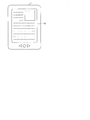
- FIG. 2 is a diagram illustrating a state in which the electronic book terminal 10 reproduces the electronic book and displays it on the display 16.
- the server 20 includes a communication unit 21, an update information generation unit 22 (generation unit, transmission unit), a next acquisition time determination unit 23 (determination unit), a terminal DB 24, and a content DB 25.
- the communication unit 21 communicates with the electronic book terminal 10 through a wireless communication line.
- the update information generation unit 22 generates update information.
- the next acquisition time determination unit 23 determines the next acquisition time, which is the time when update information should be acquired next.
- the terminal DB 24 is a database for managing each electronic book terminal 10 constituting the content distribution system 1.
- the content DB 25 is a database for storing and managing content that can be distributed to the electronic book terminal 10 by the server 20.
- content can be distributed by using content update information.
- the server 20 provides the electronic book terminal 10 with update information including information related to the content updated in the server 20.
- the electronic book terminal 10 refers to the provided update information, identifies the updated content, and acquires it from the server 20. Thereby, the user of the electronic book terminal 10 can know which content is updated in the server 20 before downloading each content. Therefore, new content can be acquired efficiently.
- the content distribution system 1 of the present embodiment is characterized by the content of update information and the distribution timing control. Therefore, hereinafter, the flow of content acquisition processing and the content of update information will be described.
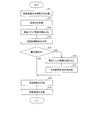
- FIG. 3 is a flowchart showing a flow of processing when the electronic book terminal 10 acquires update information from the server 20.
- the update information acquisition unit 12 determines whether or not the current time matches the set next acquisition time (step S1).
- the result of determination in step S1 is “false” (No)
- the processing in FIG. 1 ends. That is, the electronic book terminal 10 does nothing.
- the update information acquisition unit 12 transmits an update information acquisition request to the server 20 through the communication unit 11 (step S2). At this time, the update information acquisition unit 12 transmits a terminal ID for identifying the electronic book terminal 10 included in the acquisition request.
- the server 20 Upon receiving the acquisition request, the server 20 generates update information and transmits it to the electronic book terminal 10.
- the update information acquisition unit 12 receives new update information from the server 20 through the communication unit 11 (step S3).
- the update information acquisition unit 12 outputs the acquired update information to the next acquisition time setting unit 13 and the content acquisition unit 14.
- the content acquisition unit 14 acquires content such as an electronic book from the electronic book terminal 10 based on the content information included in the acquired update information.
- the next acquisition time setting unit 13 reads the next acquisition time included in the update information from the acquired update information (step S4). Then, based on the next acquisition time read out, the time when the electronic book terminal 10 should acquire the update information next is set (step S5).
- the time set at this time may be, for example, the read next acquisition time itself. Further, as will be described later, it may be another time determined from the next acquisition time. Further, a predetermined timer may be operated at the time of setting.
- the process illustrated in FIG. 3 is a process that is executed when the time for acquiring the update information is already set in the electronic book terminal 10.
- the update information acquisition unit 12 may determine an appropriate timing at random and acquire update information at that timing.
- the update information may be acquired after receiving an instruction from the user.
- FIG. 4 is a flowchart showing a process flow when the server 20 generates update information and transmits it to the electronic book terminal 1.
- a control unit acquires an update information acquisition request from the electronic book terminal 10 through the communication unit 21 (step S11).
- the control unit interprets the acquired acquisition request and controls the update information generation unit 22 as necessary to generate update information.
- an acquisition request is output to the update information generation unit 22.
- the update information generation unit 22 acquires the terminal ID of the electronic book terminal 10 included in the acquired acquisition request (step S12). In that case, the electronic book terminal 10 which transmitted the acquisition request is specified by searching terminal DB24 using terminal ID.
- the update information generation unit 22 reads, from the content DB 25, update content information related to content distributed in common to all electronic book terminals 10 (step S13).
- the content that is distributed in common here is content that should be provided uniformly to all members who use the service based on the content distribution system 1, such as recommended information from the service and maintenance notice of the server 20. .
- the update information generation unit 22 outputs the read update content information to the next acquisition time determination unit 23.
- the next acquisition time determination unit 23 determines the next acquisition time, which is the time when the electronic book terminal 10 should acquire the update information next (step S14).
- the next acquisition time can be determined based on the updated content information. For example, the time after the time when the content represented by the updated content information can be distributed is determined as the next acquisition time. There are various other methods for determining the next acquisition time, and the method is not limited to this.
- the update information generation unit 22 determines whether or not the electronic book terminal 10 is a priority terminal (step S15).
- the priority terminal is one of them.
- the user can receive the same service using a plurality of electronic book terminals 10, but specific content (such as subscription contents) can be downloaded only by one of the electronic book terminals 10.
- the terminal is a priority terminal.
- step S15 the update information generation unit 22 searches for the priority terminal information from the terminal DB 24 using the terminal ID, and determines whether or not the electronic book terminal 10 is the priority terminal based on the content.
- step S15 When the determination result in step S15 is “true” (Yes), the update information generation unit 22 reads the update content information related to the subscription content from the content DB 25 (step S16).
- subscription content refers to information representing an electronic book that the user of the electronic book terminal 10 subscribes regularly. Examples of such electronic books include newspapers and magazines. In this embodiment, the user of the electronic book terminal 10 subscribes to a magazine.
- the update information generation unit 22 outputs the read update content information to the next acquisition time determination unit 23.
- the next acquisition time determination unit 23 re-determines the next acquisition time (step S17). That is, the optimum next acquisition time is determined in accordance with the information of the content that is subscribed. For example, it is assumed that the next acquisition time determined in step 14 is 10 days after the current time. On the other hand, assume that the next issue of a subscribed newspaper is available for download in 5 hours. In this case, the next acquisition time once determined as 10 days later is determined again as 5 hours after the current time in accordance with the scheduled download time of the magazine. Thus, an appropriate next acquisition time can be determined according to the type of content information included in the update information.
- the next acquisition time determination unit 23 notifies the update information generation unit 22 of the determined next acquisition time.
- the update information generation unit 22 generates update information (step S18). Specifically, update information including each piece of content information read from the content DB 25 (update content information related to commonly distributed content, update content information related to subscription content) and including the next acquisition time is generated. Then, the update information generation unit 22 transmits the generated update information to the electronic book terminal 10 through the communication unit 21 (step S19). Thus, the electronic book terminal 10 acquires the update information requested from the server 20 from the server 20.
- step S15 When the determination result in step S15 is “false” (No), the update information generation unit 22 generates update information including update content information related to commonly distributed content and the next acquisition time ( Step S18).
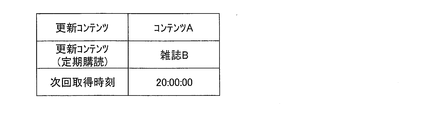
- FIG. 5 is a diagram illustrating a specific example of update information.
- the update information includes information (content information) for specifying two updated contents. That is, it includes the name of content A, which is update content distributed in common, and the name of magazine B, which is update content that is regularly subscribed. Each content also includes information (URL, ID, etc.) necessary for downloading the content (not shown).
- the data format of the update information may be arbitrary. For example, it may be data in XML (eXtensible Markup Language) format.
- the electronic book terminal 10 can automatically acquire the content specified by the content information included in the acquired update information from the server 20 without waiting for the user's selection operation.
- the electronic book terminal 10 transmits the contents information included in the update information to the server 20 to specify the contents to be acquired to the server 20.
- the server 20 transmits the indicated content to the electronic book terminal 10.
- the electronic book terminal 10 acquires the content updated in the content from the server 20 with reference to the update information.
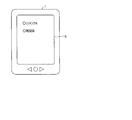
- FIG. 6 is a diagram illustrating a state in which the electronic book terminal 10 displays content information that can be acquired from the server 20 on the display 16 based on the update information.
- the content reproduction apparatus displays the content information included in the update information shown in FIG. That is, the information (name) of the content A and the information (name) of the magazine B are respectively displayed. The user who confirms this display recognizes that these contents are newly updated. And the electronic book terminal 10 is operated and the content to acquire is selected. Thereby, the content of the electronic book terminal 10 acquires the selected content from the server 20.
- the electronic book terminal 10 acquires update information from the server 20.
- This update information includes information for specifying the content updated in the server. Therefore, the electronic book terminal 10 can acquire updated content from the server 20 using the information.
- the update information includes the next acquisition time which is the time when the update information should be acquired next.
- the electronic book terminal 10 sets the time when the update information is acquired from the server based on the next acquisition time. Then, when the set time comes, new update information is acquired from the server.
- the server 20 transmits update information to the electronic book terminal 10. That is, the update information is not regularly distributed to the electronic book terminal 10. However, since the update information generated by the server 20 includes the next acquisition time which is the time when the update information should be acquired next, the update information from the electronic book terminal 10 to the server 20 based on the next acquisition time. Acquisition requests can be made in a timely manner.
- the update information is updated from the server 20 to the electronic book terminal 10 even though the electronic book terminal 10 actively acquires the update information of the content from the server. Can be delivered in a timely manner. Therefore, even if the content reproduction apparatus 10 is not always in an operating state, update information can be distributed in a timely manner.
- the content distribution system 1 is premised on receiving access from a large number of electronic book terminals 10.
- the next acquisition time determination unit 23 determines a different next acquisition time for each electronic book terminal 10. Thereby, it can prevent trying to acquire update information all at once at the same time of the plurality of electronic book terminals 10. Accordingly, communication congestion can be reduced.
- the next acquisition time determination unit 23 may determine a time at regular intervals as the next acquisition time. For example, the current time + 24 hours is determined as the next acquisition time. In this case, the electronic book terminal 10 can acquire update information at regular intervals.
- the next acquisition time determination unit 23 may determine the time after the time when the content can be acquired from the server 20 as the next acquisition time. In this case, the electronic book terminal 10 can acquire content from the server 20 at an appropriate timing.
- the next acquisition time determination unit 23 may determine a time obtained by adding a certain time to the scheduled time when the content is submitted to the server 20 as the next acquisition time.
- the case where the content to be distributed is a newspaper will be described in detail as an example.
- the time when the newspaper company submits the morning edition to the server 20 is specified (for example, 4 am).
- the update information generation unit 22 randomly determines an arbitrary time between 4 am and 5 am as the next acquisition time for the update information distributed to the electronic book terminal 10 owned by the user who subscribes to the newspaper. To do.
- next acquisition time to be determined may be changed between the premium user and other general users. Specifically, for a premium user, an arbitrary time between 4 am and 4:30 am is set as the next acquisition time. On the other hand, for general users, the subsequent time is set as the next acquisition time.
- next acquisition time determination unit 23 may change the next acquisition time between a user who subscribes to a newspaper and a user who does not subscribe to the newspaper. As described above, there is an access concentration accompanying the acquisition of newspaper data in the early morning hours (4 am to 5 am). Therefore, for the user who does not subscribe to the newspaper, the update information generation unit 22 sets a time zone avoiding this time zone as the next acquisition time.
- the data size of the update information itself is very small compared to the content downloaded thereafter. Therefore, the server 20 can level the server load by changing the timing of including the content entry in the update information.
- the server 20 distributes it for several days. Specifically, all users are divided into several groups from the youngest of the first characters of the user account character string. On the first day, entries for recommended content are included in the update information only for the users in the first group. The next day, the same processing is performed for the next group.
- the update information distributed to the premium user during the time when access is concentrated includes the entry of the regular distribution (subscription) content, but the update information distributed to the general user during the same time period is included in the update information distributed to the premium user. May not include the entry of the regularly distributed content. In this way, the premium user can acquire the regularly distributed content in the time zone when the access is concentrated, but the general user cannot acquire it.
- the server 20 may remove the entry of the regularly distributed content from the update information for premium users when access is considerably concentrated due to unexpected circumstances.
- the update information generation unit 22 may vary the timing of generating update information for each electronic book terminal 10. In this case, update information regarding the same content is distributed at different timings for each electronic book terminal 10. Thereby, it can prevent that each electronic book terminal 10 tries to acquire the same content at the same time all at once. That is, concentration of access to the server 20 can be avoided.
- the update information acquisition unit 12 attempted to acquire update information at the time (initially set by the server 20) that was initially set, but could not be acquired due to a network connection error or the like.
- the next acquisition time setting unit 13 sets again a time after a certain time from the currently set next acquisition time as the time for acquiring update information.
- the electronic book terminal 10 is not AC-charged when it is time to acquire update information.
- the update information acquisition unit 12 does not acquire update information at that time.
- the next acquisition time setting unit 13 sets again a time after a certain time from the currently set time as a time for acquiring the update information.
- the electronic book terminal 10 may operate in a mode in which the power consumption of the electronic book terminal 10 is reduced after the update information is acquired until the set time. In this case, the power consumption of the electronic book terminal 10 can be reduced and the update information can be received in a timely manner.
- the electronic book terminal 10 may turn off the power source of the electronic book terminal 10 until the set time after acquiring the update information.
- update information can be received in a timely manner even if the electronic book terminal 10 is not always operating. Therefore, the update information can be received in a timely manner while reducing the power consumption of the electronic book terminal 10 to the maximum.
- the content distribution system 1 includes a CPU that executes instructions of a program that realizes each function, a ROM (Read Only Memory) that stores the program, a RAM (Random Access Memory) that expands the program into an executable format, Also, a storage device (recording medium) such as a memory for storing the program and various data is provided. With this configuration, the object of the present invention can be achieved by a predetermined recording medium.
- This recording medium only needs to record the program code (execution format program, intermediate code program, source program) of the program of the content distribution system 1 which is software for realizing the above-described functions so as to be readable by a computer.
- This recording medium is supplied to the content distribution system 1.
- the content distribution system 1 or CPU or MPU as a computer may read and execute the program code recorded on the supplied recording medium.
- the recording medium that supplies the program code to the content distribution system 1 is not limited to a specific structure or type. That is, the recording medium includes, for example, a tape system such as a magnetic tape and a cassette tape, a magnetic disk such as a floppy (registered trademark) disk / hard disk, and an optical disk such as a CD-ROM / MO / MD / DVD / CD-R. System, a card system such as an IC card (including a memory card) / optical card, or a semiconductor memory system such as a mask ROM / EPROM / EEPROM / flash ROM.
- a tape system such as a magnetic tape and a cassette tape
- a magnetic disk such as a floppy (registered trademark) disk / hard disk
- an optical disk such as a CD-ROM / MO / MD / DVD / CD-R.
- a card system such as an IC card (including a memory card) / optical card, or a semiconductor memory system such as
- the object of the present invention can be achieved.
- the program code is supplied to the content distribution system 1 via the communication network.
- the communication network is not limited to a specific type or form as long as it can supply the program code to the content distribution system 1.
- the Internet intranet, extranet, LAN, ISDN, VAN, CATV communication network, virtual private network, telephone line network, mobile communication network, satellite communication network, etc. may be used.
- the transmission medium constituting the communication network may be any medium that can transmit the program code, and is not limited to a specific configuration or type.
- a specific configuration or type for example, even wired such as IEEE 1394, USB (Universal Serial Bus), power line carrier, cable TV line, telephone line, ADSL (Asymmetric Digital Subscriber Line) line, infrared such as IrDA or remote control, Bluetooth (registered trademark), 802.11
- radio such as radio, HDR, mobile phone network, satellite line, terrestrial digital network.
- the present invention can also be realized in the form of a computer data signal embedded in a carrier wave in which the program code is embodied by electronic transmission.
- the content distribution system includes a plurality of the content reproduction devices, Preferably, the determining means determines the next acquisition time that is different for each content reproduction apparatus.
- the determination means determines a time obtained by adding a certain time to the current time as the next acquisition time.
- the content reproduction apparatus can acquire update information at regular intervals.
- the determination means determines a time after the time when the content can be acquired from the server as the next acquisition time.
- the content reproduction apparatus can acquire content from the server at an appropriate timing.
- the content distribution system includes a plurality of the content reproduction devices, It is preferable that the generation unit changes the timing of generating the update information for each content reproduction apparatus.
- update information related to the same content is distributed at different timings for each content reproduction device. Therefore, it can prevent that each content reproduction apparatus tries to acquire the same content at the same time at the same time. That is, it is possible to avoid concentration of access to the server.
- the content reproduction apparatus operates in a mode in which the power consumption of the content reproduction apparatus is reduced from the acquisition of the update information until the set time.
- the content playback apparatus turns off the power of the content playback apparatus from the time when the update information is acquired until the set time.
- the update information can be received in a timely manner even when the content reproduction apparatus is not always operating. Therefore, the update information can be received in a timely manner while maximizing the power consumption of the content reproduction apparatus.
- the present invention can be widely used as a content distribution system for distributing various contents such as electronic books.
Landscapes
- Engineering & Computer Science (AREA)
- Databases & Information Systems (AREA)
- Theoretical Computer Science (AREA)
- Data Mining & Analysis (AREA)
- Physics & Mathematics (AREA)
- General Engineering & Computer Science (AREA)
- General Physics & Mathematics (AREA)
- Information Transfer Between Computers (AREA)
- Computer Networks & Wireless Communication (AREA)
- Signal Processing (AREA)
- Management, Administration, Business Operations System, And Electronic Commerce (AREA)
Abstract
Description
コンテンツを配信するサーバと、当該サーバから配信されたコンテンツを受信して再生するコンテンツ再生装置とを備えたコンテンツ配信システムにおいて、
上記サーバは、
更新された上記コンテンツを特定する情報を含んだ更新情報を次に取得すべき時刻である次回取得時刻を決定する決定手段と、
決定された上記次回取得時刻を含んだ新たな上記更新情報を生成する生成手段と、
上記コンテンツ再生装置からの要求に応じて、生成された上記更新情報を上記コンテンツ再生装置に送信する送信手段とを備えており、
上記コンテンツ再生装置は、
上記更新情報をサーバから取得する取得手段と、
取得された上記更新情報に含まれている上記次回取得時刻に基づいて、上記取得手段が次に上記更新情報を取得すべき時刻を設定する設定手段とを備えていることを特徴としている。
サーバから配信されたコンテンツを受信して再生するコンテンツ再生装置に当該コンテンツを配信するサーバにおいて、
更新された上記コンテンツを特定する情報を含んだ更新情報を次に取得すべき時刻である次回取得時刻を決定する決定手段と、
決定された上記次回取得時刻を含んだ新たな上記更新情報を生成する生成手段と、
上記コンテンツ再生装置からの要求に応じて、生成された上記更新情報を上記コンテンツ再生装置に送信する送信手段とを備えている。
サーバから配信されたコンテンツを受信して再生するコンテンツ再生装置において、
上記サーバから送信された、更新された上記コンテンツを特定する情報を含んだ更新情報を次に取得すべき時刻である次回取得時刻を含んだ更新情報を上記サーバから取得する取得手段と、
取得された上記更新情報に含まれている上記次回取得時刻に基づいて、上記取得手段が次に上記更新情報を取得すべき時刻を設定する設定手段とを備えていることを特徴としている。
コンテンツを配信するサーバと、当該サーバから配信されたコンテンツを受信して再生するコンテンツ再生装置とを備えたコンテンツ配信システムが実行するコンテンツ配信方法において、
上記サーバは、
更新された上記コンテンツを特定する情報を含んだ更新情報を次に取得すべき時刻である次回取得時刻を決定する決定工程と、
決定された上記次回取得時刻を含んだ新たな上記更新情報を生成する生成工程と、
上記コンテンツ再生装置からの要求に応じて、生成された上記更新情報を上記コンテンツ再生装置に送信する送信工程とを実行し、
上記コンテンツ再生装置は、
上記更新情報をサーバから取得する取得工程と、
取得された上記更新情報に含まれている上記次回取得時刻に基づいて、上記取得工程において次に上記更新情報を取得すべき時刻を設定する設定工程とを実行することを特徴としている。
図1は、本発明に係るコンテンツ配信システム1の構成を示すブロック図である。この図に示すように、コンテンツ配信システム1は、電子書籍端末10(コンテンツ再生装置)およびサーバ20によって構成されている。
電子書籍端末10は、通信部11、更新情報取得部12(受信手段)、次回取得時刻設定部13(設定手段)、コンテンツ取得部14(取得手段)、表示部15、およびディスプレイ16を備えている。通信部11は、無線通信回線を通じてサーバ20と通信する。更新情報取得部12は、更新情報をサーバ20から取得する。次回取得時刻設定部13は、取得された更新情報に含まれている次回取得時刻に基づき、電子書籍端末10が次に更新情報を取得する時刻を設定する。コンテンツ取得部14は、更新情報に含まれるコンテンツ情報に基づき、電子書籍を電子書籍端末10から取得する。表示部15は、取得された電子書籍を再生してディスプレイ16に表示する。ディスプレイ16は、液晶ディスプレイなどの各種の表示装置である。図2は、電子書籍端末10が電子書籍を再生してディスプレイ16に表示している様子を示す図である。
サーバ20は、通信部21、更新情報生成部22(生成手段、送信手段)、次回取得時刻決定部23(決定手段)、端末DB24、およびコンテンツDB25を備えている。通信部21は、無線通信回線を通じて、電子書籍端末10と通信する。更新情報生成部22は、更新情報を生成する。次回取得時刻決定部23は、更新情報を次に取得すべき時刻である次回取得時刻を決定する。端末DB24は、コンテンツ配信システム1を構成する各電子書籍端末10を管理するためのデータベースである。コンテンツDB25は、サーバ20が電子書籍端末10に配信できるコンテンツを格納しかつ管理するためのデータベースである。
コンテンツ配信システム1では、コンテンツの更新情報を利用して、コンテンツを配信することができる。具体的には、サーバ20は、サーバ20において更新したコンテンツに関する情報を含んだ更新情報を、電子書籍端末10に提供する。電子書籍端末10は、提供された更新情報を参照して、更新されたコンテンツを特定し、サーバ20から取得する。これにより、電子書籍端末10のユーザはサーバ20において更新されたコンテンツがどれであるのかを、各コンテンツをダウンロードする前に知ることができる。したがって、新たなコンテンツを効率よく取得できる。
図3は、電子書籍端末10がサーバ20から更新情報を取得する際の処理の流れを示すフローチャート図である。
図4は、サーバ20が更新情報を生成して電子書籍端末1に送信する際の処理の流れを示すフローチャート図である。
図5は、更新情報の具体例を示す図である。この図の例では、更新情報は、更新された2つのコンテンツを特定する情報(コンテンツ情報)を含んでいる。すなわち、共通に配信される更新コンテンツであるコンテンツAの名称と、定期的に購読される更新コンテンツである雑誌Bの名称とを、それぞれ含んでいる。また、コンテンツごとに、当該コンテンツをダウンロードするために必要な情報(URLおよびID等)も含んでいる(不図示)。更新情報のデータ形式は任意でよい。たとえばXML(eXtensible Markup Language)形式のデータであればよい。
電子書籍端末10は、コンテンツを自動的に取得するだけではなく、ユーザによる選択操作を受けてから、すなわちユーザによるコンテンツの指定を受けてから、当該コンテンツをサーバ20から取得することもできる。図6は、電子書籍端末10が、更新情報に基づきサーバ20から取得可能なコンテンツの情報をディスプレイ16に表示している様子を示す図である。この図の例では、コンテンツ再生装置は、図5に示す更新情報に含まれているコンテンツ情報をディスプレイ16に表示している。すなわち、コンテンツAの情報(名称)、および雑誌Bの情報(名称)をそれぞれ表示している。この表示を確認したユーザは、これらのコンテンツが新たに更新されたものだと認識する。そして、電子書籍端末10を操作して、取得したいコンテンツを選択する。これにより、電子書籍端末10のコンテンツが、選択されたコンテンツをサーバ20から取得する。
以上に説明したように、電子書籍端末10は、サーバ20から更新情報を取得する。この更新情報には、サーバにおいて更新されたコンテンツを特定する情報が含まれている。したがって電子書籍端末10は、当該情報を使って、更新されたコンテンツをサーバ20から取得できる。
コンテンツ配信システム1は、本来、多数の電子書籍端末10からのアクセスを受けることを前提としている。この場合、次回取得時刻決定部23は、電子書籍端末10ごとに異なる次回取得時刻を決定することが好ましい。これにより、複数の電子書籍端末10同時刻に一斉に更新情報を取得しようとすることを防止できる。したがって、通信の混雑を緩和できる。
更新情報自体のデータサイズは、その後にダウンロードされるコンテンツに比べれば非常に小さい。そこでサーバ20は、更新情報にコンテンツのエントリを含めるタイミングを前後させることによって、サーバ負荷を平準化させることができる。
更新情報取得部12が、当初設定されていた(サーバ20側の設定による)時刻に、更新情報の取得を試みたが、ネットワーク接続エラー等により取得できなかったとする。この場合、次回取得時刻設定部13は、現在設定されている次回取得時刻よりも一定時間後の時刻を、再度、更新情報を取得する時刻として設定する。
電子書籍端末10は、更新情報を取得してから、設定された時刻までの間、電子書籍端末10の消費電力を低下させるモードで動作してもよい。この場合、電子書籍端末10の消費電力を低減させることと、更新情報をタイムリーに受信することとを両立させることができる。
` すなわちコンテンツ配信システム1は、各機能を実現するプログラムの命令を実行するCPU、このプログラムを格納したROM(Read Only Memory)、上記プログラムを実行可能な形式に展開するRAM(Random Access Memory)、および、上記プログラムおよび各種データを格納するメモリ等の記憶装置(記録媒体)を備えている。この構成により、本発明の目的は、所定の記録媒体によっても、達成できる。
以上のように、上記コンテンツ配信システムは、上記コンテンツ再生装置を複数備えており、
上記決定手段は、上記コンテンツ再生装置ごとに異なる上記次回取得時刻を決定することが好ましい。
上記生成手段は、上記コンテンツ再生装置ごとに、上記更新情報を生成するタイミングを異ならせることが好ましい。
10 電子書籍端末(コンテンツ再生装置)
11 通信部
12 更新情報取得部(受信手段)
13 次回取得時刻設定部(設定手段)
14 コンテンツ取得部(取得手段)
15 表示部
16 ディスプレイ
20 サーバ
21 通信部
22 更新情報生成部(生成手段、送信手段)
23 次回取得時刻決定部(決定手段)
24 端末DB
25 コンテンツDB
Claims (12)
- コンテンツを配信するサーバと、当該サーバから配信されたコンテンツを受信して再生するコンテンツ再生装置とを備えたコンテンツ配信システムにおいて、
上記サーバは、
更新された上記コンテンツを特定する情報を含んだ更新情報を次に取得すべき時刻である次回取得時刻を決定する決定手段と、
決定された上記次回取得時刻を含んだ新たな上記更新情報を生成する生成手段と、
上記コンテンツ再生装置からの要求に応じて、生成された上記更新情報を上記コンテンツ再生装置に送信する送信手段とを備えており、
上記コンテンツ再生装置は、
上記更新情報をサーバから取得する取得手段と、
取得された上記更新情報に含まれている上記次回取得時刻に基づいて、上記取得手段が次に上記更新情報を取得すべき時刻を設定する設定手段とを備えていることを特徴とするコンテンツ配信システム。 - 上記コンテンツ配信システムは、上記コンテンツ再生装置を複数備えており、
上記決定手段は、上記コンテンツ再生装置ごとに異なる上記次回取得時刻を決定することを特徴とする請求項1に記載のコンテンツ配信システム。 - 上記決定手段は、現在の時刻に一定の時間を加えた時刻を、上記次回取得時刻として決定することを特徴とする請求項1または2に記載のコンテンツ配信システム。
- 上記決定手段は、上記コンテンツが上記サーバから取得可能になる時刻以降の時刻を、上記次回取得時刻として決定することを特徴とする請求項1または2に記載のコンテンツ配信システム。
- 上記コンテンツ配信システムは、上記コンテンツ再生装置を複数備えており、
上記生成手段は、上記コンテンツ再生装置ごとに、上記更新情報を生成するタイミングを異ならせることを特徴とする請求項1~4のいずれか1項に記載のコンテンツ配信システム。 - 上記コンテンツ再生装置は、上記更新情報を取得してから、設定された上記時刻までの間、コンテンツ再生装置の消費電力を低下させるモードで動作することを特徴とする請求項1~5のいずれか1項に記載のコンテンツ配信システム。
- 上記コンテンツ再生装置は、上記更新情報を取得してから、設定された上記時刻までの間、コンテンツ再生装置の電源をオフすることを特徴とする請求項6のいずれか1項に記載のコンテンツ配信システム。
- サーバから配信されたコンテンツを受信して再生するコンテンツ再生装置に当該コンテンツを配信するサーバにおいて、
更新された上記コンテンツを特定する情報を含んだ更新情報を次に取得すべき時刻である次回取得時刻を決定する決定手段と、
決定された上記次回取得時刻を含んだ新たな上記更新情報を生成する生成手段と、
上記コンテンツ再生装置からの要求に応じて、生成された上記更新情報を上記コンテンツ再生装置に送信する送信手段とを備えていることを特徴とするサーバ。 - サーバから配信されたコンテンツを受信して再生するコンテンツ再生装置において、
上記サーバから送信された、更新された上記コンテンツを特定する情報を含んだ更新情報を次に取得すべき時刻である次回取得時刻を含んだ更新情報を、上記サーバから取得する取得手段と、
受信された上記更新情報に含まれている上記次回取得時刻に基づいて、上記取得手段が次に上記更新情報を取得すべき時刻を設定する設定手段とを備えていることを特徴とするコンテンツ再生装置。 - コンテンツを配信するサーバと、当該サーバから配信されたコンテンツを受信して再生するコンテンツ再生装置とを備えたコンテンツ配信システムが実行するコンテンツ配信方法において
上記サーバは、
更新された上記コンテンツを特定する情報を含んだ更新情報を次に取得すべき時刻である次回取得時刻を決定する決定工程と、
決定された上記次回取得時刻を含んだ新たな上記更新情報を生成する生成工程と、
上記コンテンツ再生装置からの要求に応じて、生成された上記更新情報を上記コンテンツ再生装置に送信する送信工程とを実行し、
上記コンテンツ再生装置は、
上記更新情報をサーバから取得する取得工程と、
取得された上記更新情報に含まれている上記次回取得時刻に基づいて、上記取得工程において次に上記更新情報を取得すべき時刻を設定する設定工程と、
設定された上記時刻に、
を実行することを特徴とするコンテンツ配信方法。 - 請求項1から7のいずれか1項に記載のコンテンツ配信システムを動作させるプログラムであって、コンピュータを上記の各手段として機能させるためのプログラム。
- 請求項11に記載のプログラムを記録しているコンピュータ読み取り可能な記録媒体。
Priority Applications (2)
| Application Number | Priority Date | Filing Date | Title |
|---|---|---|---|
| CN2011800434452A CN103098037A (zh) | 2010-09-09 | 2011-08-30 | 内容传送系统、内容传送方法、服务器、内容重放装置、程序、及记录介质 |
| US13/821,445 US20130166700A1 (en) | 2010-09-09 | 2011-08-30 | Content delivery system, method of delivering content, server, content reproduction device, program, and recording medium |
Applications Claiming Priority (2)
| Application Number | Priority Date | Filing Date | Title |
|---|---|---|---|
| JP2010-202212 | 2010-09-09 | ||
| JP2010202212A JP2012059056A (ja) | 2010-09-09 | 2010-09-09 | コンテンツ配信システム、コンテンツ配信方法、サーバ、コンテンツ再生装置、プログラム、および記録媒体 |
Publications (1)
| Publication Number | Publication Date |
|---|---|
| WO2012032969A1 true WO2012032969A1 (ja) | 2012-03-15 |
Family
ID=45810571
Family Applications (1)
| Application Number | Title | Priority Date | Filing Date |
|---|---|---|---|
| PCT/JP2011/069582 Ceased WO2012032969A1 (ja) | 2010-09-09 | 2011-08-30 | コンテンツ配信システム、コンテンツ配信方法、サーバ、コンテンツ再生装置、プログラム、および記録媒体 |
Country Status (4)
| Country | Link |
|---|---|
| US (1) | US20130166700A1 (ja) |
| JP (1) | JP2012059056A (ja) |
| CN (1) | CN103098037A (ja) |
| WO (1) | WO2012032969A1 (ja) |
Cited By (1)
| Publication number | Priority date | Publication date | Assignee | Title |
|---|---|---|---|---|
| CN113704628A (zh) * | 2021-09-08 | 2021-11-26 | 北京得间科技有限公司 | 书籍更新消息的推送方法、计算设备及计算机存储介质 |
Families Citing this family (3)
| Publication number | Priority date | Publication date | Assignee | Title |
|---|---|---|---|---|
| US9405526B2 (en) * | 2012-08-07 | 2016-08-02 | Microsoft Technology Licensing, Llc | Initiating update operations |
| JP6065114B2 (ja) * | 2013-06-28 | 2017-01-25 | 日本電気株式会社 | プッシュ型情報送信装置、プッシュ型情報送信方法及びプログラム |
| JP2016004392A (ja) * | 2014-06-16 | 2016-01-12 | 株式会社ピーシーデポコーポレーション | 電子書籍配信システム、及びプログラム |
Citations (2)
| Publication number | Priority date | Publication date | Assignee | Title |
|---|---|---|---|---|
| JP2009169783A (ja) * | 2008-01-18 | 2009-07-30 | Hitachi Ltd | コンテンツ受信方法及びコンテンツ受信装置 |
| JP2009181386A (ja) * | 2008-01-31 | 2009-08-13 | Kddi Corp | コンテンツ更新情報配信方法、コンテンツ配信制御サーバ、端末及びプログラム |
Family Cites Families (14)
| Publication number | Priority date | Publication date | Assignee | Title |
|---|---|---|---|---|
| JPH1039959A (ja) * | 1996-07-18 | 1998-02-13 | Nec Corp | オンラインシステムおよびその端末電源制御方法 |
| JP4634547B2 (ja) * | 1998-06-30 | 2011-02-16 | 株式会社東芝 | リアルタイム情報配信方法 |
| US20030195974A1 (en) * | 1998-12-04 | 2003-10-16 | Ronning Joel A. | Apparatus and method for scheduling of search for updates or downloads of a file |
| JP3906994B2 (ja) * | 2003-05-07 | 2007-04-18 | ソニー株式会社 | 情報処理装置および方法、記録媒体、並びにプログラム |
| JP2006018506A (ja) * | 2004-06-30 | 2006-01-19 | Sony Corp | コンテンツ配信システム,コンテンツ配信サーバ,利用者端末,およびコンピュータプログラム。 |
| JP4403048B2 (ja) * | 2004-10-12 | 2010-01-20 | 日本放送協会 | コンテンツ提供サーバ、ユーザ端末、コンテンツ提供プログラム、及びコンテンツ取得プログラム |
| CN1859329A (zh) * | 2006-03-29 | 2006-11-08 | 华为技术有限公司 | 一种呈现信息更新通知方法与系统 |
| KR101086425B1 (ko) * | 2007-01-22 | 2011-11-25 | 삼성전자주식회사 | 휴대 단말 장치의 전원 제어를 이용한 업데이트 정보 제공방법 및 그 장치 |
| JP4946592B2 (ja) * | 2007-04-20 | 2012-06-06 | 株式会社日立製作所 | ダウンロード装置および方法、コンテンツ送受信システムおよび方法 |
| JP2009027390A (ja) * | 2007-07-18 | 2009-02-05 | Sony Corp | コンテンツ配信システム、配信サーバ、受信端末及びコンピュータプログラム |
| CN101166313B (zh) * | 2007-09-24 | 2010-11-03 | Ut斯达康通讯有限公司 | 一种滚动新闻数据获取和更新的方法和系统 |
| JP2010020610A (ja) * | 2008-07-11 | 2010-01-28 | Sony Corp | 録画装置、ソフトウェアのアップデート・データ取得方法、プログラム、およびデータ配信システム |
| EP2632213B1 (en) * | 2010-10-21 | 2016-12-21 | LG Electronics Inc. | Method and apparatus for performing network entry/reentry in wireless communication system |
| US8526604B2 (en) * | 2011-09-23 | 2013-09-03 | Gainspan Corporation | Enabling wireless clients for low-power operation when clients require control messages from external sources for communication |
-
2010
- 2010-09-09 JP JP2010202212A patent/JP2012059056A/ja active Pending
-
2011
- 2011-08-30 WO PCT/JP2011/069582 patent/WO2012032969A1/ja not_active Ceased
- 2011-08-30 CN CN2011800434452A patent/CN103098037A/zh active Pending
- 2011-08-30 US US13/821,445 patent/US20130166700A1/en not_active Abandoned
Patent Citations (2)
| Publication number | Priority date | Publication date | Assignee | Title |
|---|---|---|---|---|
| JP2009169783A (ja) * | 2008-01-18 | 2009-07-30 | Hitachi Ltd | コンテンツ受信方法及びコンテンツ受信装置 |
| JP2009181386A (ja) * | 2008-01-31 | 2009-08-13 | Kddi Corp | コンテンツ更新情報配信方法、コンテンツ配信制御サーバ、端末及びプログラム |
Cited By (2)
| Publication number | Priority date | Publication date | Assignee | Title |
|---|---|---|---|---|
| CN113704628A (zh) * | 2021-09-08 | 2021-11-26 | 北京得间科技有限公司 | 书籍更新消息的推送方法、计算设备及计算机存储介质 |
| CN113704628B (zh) * | 2021-09-08 | 2024-05-31 | 北京得间科技有限公司 | 书籍更新消息的推送方法、计算设备及计算机存储介质 |
Also Published As
| Publication number | Publication date |
|---|---|
| JP2012059056A (ja) | 2012-03-22 |
| US20130166700A1 (en) | 2013-06-27 |
| CN103098037A (zh) | 2013-05-08 |
Similar Documents
| Publication | Publication Date | Title |
|---|---|---|
| US8296375B1 (en) | Parallel management of load servers, cache servers, and feed servers | |
| US20080113656A1 (en) | System and method for updating contents | |
| US10831681B2 (en) | Display apparatus, display control method, and computer readable recording medium | |
| JP4946592B2 (ja) | ダウンロード装置および方法、コンテンツ送受信システムおよび方法 | |
| CN105594177A (zh) | 用于呈现媒体内容的系统、方法以及介质 | |
| CN103324499A (zh) | 针对无线设备的位于应用服务器上的应用程序目录 | |
| CN101330509A (zh) | 服务器、客户端装置、程序和下载方法 | |
| US9942287B2 (en) | Information processing system, terminal device, and method | |
| JP5163648B2 (ja) | 情報処理装置,更新情報取得方法及び更新情報取得プログラム | |
| WO2012032969A1 (ja) | コンテンツ配信システム、コンテンツ配信方法、サーバ、コンテンツ再生装置、プログラム、および記録媒体 | |
| CN111144954A (zh) | 展示资源投放方法及其设备 | |
| US20080244058A1 (en) | Program | |
| US20240143146A1 (en) | Methods, systems, and media for specifying different content management techniques across various publishing platforms | |
| KR20120134598A (ko) | 컨텐츠 이어보기 제공 시스템 및 방법 | |
| JP5165628B2 (ja) | コンテンツ表示端末、コンテンツ表示方法およびプログラムならびに配信サーバ | |
| TW463126B (en) | Dedicated Internet access device and method for use | |
| JP5206719B2 (ja) | カラオケネットワークシステム及び集中管理装置 | |
| US20070136359A1 (en) | Contents list providing apparatus and contents list providing method | |
| JP5832246B2 (ja) | 通信システム、通信装置、通信方法及びコンピュータプログラム | |
| EP4664378A1 (en) | System, program, and method | |
| JP5163781B2 (ja) | ダウンロード制御装置 | |
| US20090172072A1 (en) | Remote viewing of documents via the web in real-time | |
| JP2005208924A (ja) | コンテンツ配信システム、サーバ、クライアント、カタログ管理方法及びプログラム | |
| CN115002216A (zh) | 一种下载方法、装置、终端设备以及可读存储介质 | |
| JP2011237960A (ja) | サービス勧誘システム、クライアント装置、サービス勧誘方法。 |
Legal Events
| Date | Code | Title | Description |
|---|---|---|---|
| WWE | Wipo information: entry into national phase |
Ref document number: 201180043445.2 Country of ref document: CN |
|
| 121 | Ep: the epo has been informed by wipo that ep was designated in this application |
Ref document number: 11823445 Country of ref document: EP Kind code of ref document: A1 |
|
| WWE | Wipo information: entry into national phase |
Ref document number: 13821445 Country of ref document: US |
|
| NENP | Non-entry into the national phase |
Ref country code: DE |
|
| 122 | Ep: pct application non-entry in european phase |
Ref document number: 11823445 Country of ref document: EP Kind code of ref document: A1 |