WO2012014492A1 - 免疫誘導剤 - Google Patents
免疫誘導剤 Download PDFInfo
- Publication number
- WO2012014492A1 WO2012014492A1 PCT/JP2011/004305 JP2011004305W WO2012014492A1 WO 2012014492 A1 WO2012014492 A1 WO 2012014492A1 JP 2011004305 W JP2011004305 W JP 2011004305W WO 2012014492 A1 WO2012014492 A1 WO 2012014492A1
- Authority
- WO
- WIPO (PCT)
- Prior art keywords
- tcp
- porosity
- less
- immunity
- cells
- Prior art date
- Legal status (The legal status is an assumption and is not a legal conclusion. Google has not performed a legal analysis and makes no representation as to the accuracy of the status listed.)
- Ceased
Links
Images











Classifications
-
- A—HUMAN NECESSITIES
- A61—MEDICAL OR VETERINARY SCIENCE; HYGIENE
- A61K—PREPARATIONS FOR MEDICAL, DENTAL OR TOILETRY PURPOSES
- A61K33/00—Medicinal preparations containing inorganic active ingredients
- A61K33/42—Phosphorus; Compounds thereof
-
- A—HUMAN NECESSITIES
- A61—MEDICAL OR VETERINARY SCIENCE; HYGIENE
- A61K—PREPARATIONS FOR MEDICAL, DENTAL OR TOILETRY PURPOSES
- A61K9/00—Medicinal preparations characterised by special physical form
- A61K9/0012—Galenical forms characterised by the site of application
- A61K9/0019—Injectable compositions; Intramuscular, intravenous, arterial, subcutaneous administration; Compositions to be administered through the skin in an invasive manner
- A61K9/0024—Solid, semi-solid or solidifying implants, which are implanted or injected in body tissue
-
- A—HUMAN NECESSITIES
- A61—MEDICAL OR VETERINARY SCIENCE; HYGIENE
- A61K—PREPARATIONS FOR MEDICAL, DENTAL OR TOILETRY PURPOSES
- A61K9/00—Medicinal preparations characterised by special physical form
- A61K9/20—Pills, tablets, discs, rods
- A61K9/2095—Tabletting processes
-
- A—HUMAN NECESSITIES
- A61—MEDICAL OR VETERINARY SCIENCE; HYGIENE
- A61P—SPECIFIC THERAPEUTIC ACTIVITY OF CHEMICAL COMPOUNDS OR MEDICINAL PREPARATIONS
- A61P35/00—Antineoplastic agents
-
- A—HUMAN NECESSITIES
- A61—MEDICAL OR VETERINARY SCIENCE; HYGIENE
- A61P—SPECIFIC THERAPEUTIC ACTIVITY OF CHEMICAL COMPOUNDS OR MEDICINAL PREPARATIONS
- A61P37/00—Drugs for immunological or allergic disorders
- A61P37/02—Immunomodulators
- A61P37/04—Immunostimulants
-
- A—HUMAN NECESSITIES
- A61—MEDICAL OR VETERINARY SCIENCE; HYGIENE
- A61P—SPECIFIC THERAPEUTIC ACTIVITY OF CHEMICAL COMPOUNDS OR MEDICINAL PREPARATIONS
- A61P43/00—Drugs for specific purposes, not provided for in groups A61P1/00-A61P41/00
Definitions
- the present invention relates to an immunity-inducing agent containing ⁇ -tricalcium phosphate (hereinafter also referred to as “ ⁇ -TCP”) having a porosity of 50% or less, more specifically, by being implanted or injected into a living body. And an immunity-inducing agent that induces lymphocytes and dendritic cells (hereinafter also referred to as “DC cells”) in the vicinity thereof.
- ⁇ -TCP ⁇ -tricalcium phosphate
- DC cells dendritic cells
- ⁇ -TCP calcium phosphate compounds
- ⁇ -TCP has a high-purity ⁇ -TCP crystal layer consisting of continuous macropores and micropores with a porosity of about 75% and 100 to 400 ⁇ m, and a compressive strength of 2 to 3 MPa that is easy to process at the surgical site.
- Quality artificial bone filling agents and the like are commercially available (for example, see Non-Patent Document 1), and such a ⁇ -TCP porous body has ideal properties as an artificial bone filling material in that it is replaced by its own bone.
- Patent Document 1 it has been explained that such properties are due to absorption by two mechanisms of in vivo chemical dissolution and cell phagocytosis (see, for example, Patent Document 1).
- the present inventors have used a cancer cell suppression sheet obtained by coating a surface of a flexible sheet member with a ⁇ -TCP porous powder having a particle size of 25 to 75 ⁇ m and having a porosity of 75% or more. It has been confirmed that malignant tumors can be suppressed by bringing ⁇ -TCP into direct contact with activating macrophage activity (see, for example, Patent Document 2).
- ⁇ -TCP porous powder having a particle size of 25 to 75 ⁇ m and having a porosity of 75% or more. It has been confirmed that malignant tumors can be suppressed by bringing ⁇ -TCP into direct contact with activating macrophage activity (see, for example, Patent Document 2).
- the accumulation action of lymphocytes and dendritic cells by ⁇ -TCP porous body powder has not been confirmed, and an invasive treatment such as introduction of a sheet is necessary. Such a delicate treatment was difficult.
- An object of the present invention is to provide an immunity-inducing agent that can be transplanted or injected into a living body by a simple operation and can activate immune action without side effects in the living body.
- the present inventors examined the immunity-inducing action by changing the porosity of ⁇ -TCP.
- ⁇ -TCP having a porosity of 50% or less was transplanted / injected into a living body, the vicinity of ⁇ -TCP
- lymphocytes and dendritic cells such as B cells, T cells and natural killer cells (hereinafter also referred to as “NK cells”) involved in immunity are accumulated and induced in these areas.
- NK cells natural killer cells
- the present invention is (1) an immunity-inducing agent containing ⁇ -tricalcium phosphate ( ⁇ -TCP) having a porosity of 50% or less, or (2) for implantation or injection into a living body.
- a method for inducing an immune reaction in which ⁇ -TCP having a porosity of 50% or less is transplanted or injected into a living body, or ⁇ -TCP having a porosity of 50% or less is used.
- a method of activating immune action to be transplanted or injected into the living body a method of forming lymph node-like tissue in which ⁇ -TCP having a porosity of 50% or less is transplanted or injected into the living body, and a porosity of 50% or less ⁇ -TCP is used as an immune inducer for transplantation or injection into a living body, and ⁇ -TCP having a porosity of 50% or less is used as a lymph for transplantation or injection into a living body.
- ⁇ -TCP having a porosity of 50% or less for the preparation of an immunoinducing agent for transplantation or injection for implantation in vivo or transplantation in vivo
- ⁇ -TCP for the preparation of lymph node-like tissue forming agents for injection or injection
- beta-TCP is 50% or less.
- an immunoinducing agent containing ⁇ -TCP having a porosity of 50% or less can be transplanted or injected into a living body, particularly in the vicinity of a lesion such as cancer (non-lesion).
- a lesion such as cancer
- ⁇ -TCP which is biocompatible, is transplanted or injected, and lymphocytes and dendritic cells originally present in the patient's body are induced, so reactions other than immune activation occur in the body. Can prevent you from getting up.
- ⁇ -TCP particles or granules having a particle size of 0.05 ⁇ m or more and less than 25 ⁇ m and having a porosity of 50% or less are injected or transplanted
- ⁇ -TCP particles or granules having a porosity of 25 ⁇ m or more and 50% or less are used. More lymphocytes and dendritic cells can be induced than when injected or transplanted.
- a ⁇ -TCP tablet having a porosity of 50% or less is transplanted or injected, a long-term immune induction effect can be expected.
- ⁇ -TCP particles (granule) or ⁇ -TCP columnar bodies having a porosity of 50% or less they can be easily administered multiple times or locally with a syringe or the like.
- FIG. 1 is an overall configuration diagram of a ⁇ -TCP tablet that is an embodiment of an immunity-inducing agent of the present invention.
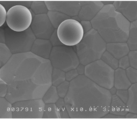
- 2 is an SEM photograph of a fractured section of a ⁇ -TCP tablet having a porosity of 18%.
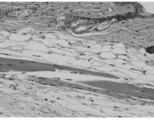
- 3 is a HE-stained photograph of skin tissue transplanted with a ⁇ -TCP tablet having a porosity of 18%.
- FIG. 4 is an enlarged photograph of a region a in FIG. 3.
- Fig. 4 is an enlarged photograph of a region b in Fig. 3. It is a HE staining photograph of untreated normal skin tissue.
- 3 is a HE-stained photograph of skin tissue transplanted with a ⁇ -TCP porous body having a porosity of 60%.
- 3 is a HE-stained photograph of a skin tissue transplanted with a ⁇ -TCP porous body having a porosity of 75%. It is the HE dyeing
- FIG. 6 is a particle size distribution diagram of a fraction of ⁇ -TCP powder having a particle size of 0.05 to 25 ⁇ m.
- the immunity-inducing agent of the present invention is not particularly limited as long as it is an immunity-inducing agent containing ⁇ -tricalcium phosphate ( ⁇ -TCP) having a porosity of 50% or less. Inducing a reaction, that is, inducing an action of the immune system against a foreign substance (antigen).
- ⁇ -TCP is a single crystal form of a composition represented by Ca 3 (PO 4 ) 2 and is a compound that is stable at room temperature and has biocompatibility.
- the ⁇ -TCP is preferably a sintered body.
- ⁇ -TCP stone having a porosity of 0% ( ⁇ -TCP sintered body having the same composition as that of the sintered body to be measured and having no crystalline pores)
- a method can be mentioned.
- the immunity-inducing agent of the present invention includes ⁇ -TCP particles having a porosity of 50% or less, ⁇ -TCP granules (a conjugate of a plurality of particles) having a porosity of 50% or less, and a porosity of 50%.
- ⁇ -TCP tablets, ⁇ -TCP columnar bodies having a porosity of 50% or less, and the like can be exemplified. Even if these are composed only of ⁇ -TCP, ⁇ -TCP is an active ingredient. , Other components may be included.
- the porosity of ⁇ -TCP of 50% or less is preferably 40% or less, more preferably 30% or less, and particularly preferably 20% or less.
- the ⁇ -TCP particles and ⁇ -TCP granules are in the form of powder, suspension (sol) or viscous material (gel) in the vicinity of a lesion such as cancer in a living body (non-cancerous part, etc.). Be administered.
- the porosity P of such ⁇ -TCP particles and ⁇ -TCP granules can be measured using, for example, AccuPick 1330 series (manufactured by Shimadzu Corporation).
- the molar ratio of calcium hydrogen phosphate and calcium carbonate powder is 1: 1 to 3, preferably 1: 1.5 to 2.5.
- the mechanochemical method is prepared by adding pure water to the calcium hydrogen phosphate-calcium carbonate mixture to prepare a slurry, and subjecting the prepared slurry to a wet milling process for about 24 hours by a ball mill.
- the slurry obtained by the above-mentioned reaction was dried at 70 to 90 ° C., preferably 75 to 85 ° C., and the solid obtained by pulverizing the solid material was added to 700-TCP powder.
- ⁇ -TCP calcined powder By pre-calcining at ⁇ 800 ° C for several hours, ⁇ -TCP calcined powder can be prepared, and the obtained ⁇ -TCP calcined powder can be sieved to obtain a fraction of each particle size. , Porosity for each fraction By measuring, a fraction having a porosity of 50% or less can be obtained. Specifically, first, the sieve passes through a 105 ⁇ m sieve, and the sieve passes through the 75 ⁇ m sieve to leave the remaining ⁇ -TCP as a fraction (A), and then the sieve passes through a 75 ⁇ m sieve.
- fraction (B) ⁇ -TCP remaining through a sieve having a sieve size of 25 ⁇ m
- fraction (C) ⁇ -TCP that has passed through a 25 ⁇ m sieve
- Suitable examples of the particle diameter of the ⁇ -TCP particles and ⁇ -TCP granules are 0.05 or more and less than 500 ⁇ m, preferably less than 100 ⁇ m, more preferably less than 50 ⁇ m, still more preferably less than 25 ⁇ m, and more preferably less than 15 ⁇ m. can do. These particle sizes can be evaluated by the size of ⁇ -TCP particles and granules confirmed by fractionation using the above-mentioned sieve or by comparison with markers by SEM photographs.
- the dose of ⁇ -TCP particles or ⁇ -TCP granules to be transplanted or injected is not limited as long as the immunity-inducing effect is exhibited, but should be appropriately selected according to the disease type, lesion size, patient weight, etc.
- 0.01 mg to 100 g, more preferably 0.1 mg to 10 g, and still more preferably 1 mg to 1 g can be exemplified.
- the frequency of transplantation and / or infusion can be exemplified once every 1 to 6 weeks.
- Examples of the shape of the ⁇ -TCP tablet and ⁇ -TCP columnar body include a columnar body such as a disk, a cylindrical body, a substantially cylindrical body, an elliptical columnar body, and a triangular to heptagonal columnar body.
- the ⁇ -TCP The size of the tablet or columnar body can be appropriately determined in consideration of the type of lesion, the administration site, the size of the lesion, the weight of the patient, and the like.
- the diameter of the ⁇ -TCP tablet can be 1.0 to 10.0 mm, preferably 3.0 to 7.0 mm, more preferably 4.0 to 6.0 mm, and the height is 0 0.5 to 4.0 mm, preferably 1.0 to 3.0 mm, and more preferably 1.5 to 2.5 mm.
- the diameter of the ⁇ -TCP columnar body can be 0.1 to 2.0 mm, preferably 0.3 to 1.0 mm, more preferably 0.4 to 0.6 mm. 1.0 to 6.0 mm, preferably 2.0 to 5.0 mm, more preferably 3.0 to 4.0 mm.
- the ⁇ -TCP calcined powder is prepared as described above, and the obtained ⁇ -TCP calcined powder is molded into tablets or columns by compression molding (tabletting).
- the sintered ⁇ -TCP calcined tablet or columnar body is sintered at 450 to 650 ° C., preferably 600 ° C. for 2.5 to 3.5 hours, preferably 3 hours, and then 850 to 950 ° C., preferably 900 ° C.
- the ⁇ -TCP calcined powder is sintered to obtain a powder as a sintered body of ⁇ -TCP, which is then compression-molded (tablet). TCP tablets and columns may be produced.
- the ⁇ -TCP columnar body may be produced by punching a ⁇ -TCP tablet into a columnar shape.
- the living body in the present invention is not particularly limited as long as it is a site other than bones and teeth, and examples include subcutaneous, intradermal, intramuscular, intraperitoneal, intrathoracic, and intracerebral, preferably subcutaneous. Can do.
- lymphocytes and dendritic cells such as T cells, B cells, and NK cells are accumulated in the vicinity of the transplanted and / or injected immunity-inducing agent.
- Lymph node-like tissue can be constructed.
- the lymph node-like tissue means a cell cluster in which lymphocytes and dendritic cells are accumulated.
- the immunity-inducing agent that induces lymphocytes and dendritic cells is located in the vicinity of the lesion site but is a non-lesion site, a remote site away from the lesion site, or after excision of the lesion site. Specifically, it is 1 mm or more and 100 cm or less, preferably 50 cm or less, more preferably 5 cm or less, further preferably 3 cm or less, for example 1.5 cm to 2.0 cm from the lesion site or the excision site of the lesion. An area at a distance can be mentioned. Lymphocytes and dendritic cells induced in the vicinity of immunity inducers are lymphocytes and dendritic cells originally present in the patient's body, preventing reactions other than immune activation from occurring in the body. .
- the lesion in the present invention is not particularly limited as long as it is a lesion other than a bone or a tooth, and examples thereof include cancer, allergic immunity, and infectious diseases.
- cancer can be preferably mentioned.
- Tissue, lung, skin, mammary gland, soft tissue, bladder, stomach, liver, gallbladder, pancreas, head, neck, kidney, adrenal gland, prostate, large intestine, small intestine, esophagus, female organ (eg ovary, uterus) or thyroid gland Can be particularly preferably exemplified.
- Examples of the method of transplanting the immunity-inducing agent of the present invention include a method of placing the tablet at an incision site by surgical treatment, and a method of distributing the particles and granules at the incision site by surgical treatment.
- a method for injecting an immunity-inducing agent a method of directly injecting into the living body through a minimal opening using a syringe filled with the above-mentioned particles or granule suspension, or the above-mentioned columnar article was attached to an injection needle The method of extruding and injecting directly into the living body through a minimal opening using a syringe can be mentioned.
- the immunity-inducing agent of the present invention includes, as long as it does not diminish or inhibit the effects of the present invention, pharmaceutically acceptable ordinary carriers, binders, stabilizers, excipients, diluents other than ⁇ -TCP, Various formulation ingredients such as pH buffering agents, disintegrants, solubilizers, solubilizers, isotonic agents, etc. can also be included, these components can be mixed with the above particles or granules and injected, It can also be prepared by mixing in advance and compression molding (tablet).
- ⁇ -TCP tablets Calcium hydrogen phosphate and calcium carbonate powder are weighed and mixed at a molar ratio of 1: 2, and a slurry is prepared by adding pure water to the calcium hydrogen phosphate-calcium carbonate mixture at an appropriate ratio. The prepared slurry is subjected to wet milling for about 1 day with a ball mill, the milled slurry is dried at 80 ° C. for several hours, and the resulting solid is pulverized to obtain ⁇ -TCP A powder was obtained. The obtained ⁇ -TCP powder was calcined at 750 ° C. for several hours to prepare a ⁇ -TCP calcined powder.
- FIG. 1 is an overall configuration diagram of a ⁇ -TCP tablet.
- FIG. 2 is a photograph of a ⁇ -TCP tablet having a porosity of 18%, which was observed with a scanning electron microscope (SEM) in its fractured section.
- SEM scanning electron microscope
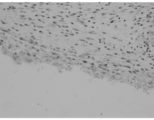
- ⁇ -TCP tablets with a porosity of 18% were used to transplant the immune cell-inducing effect of the immunity-inducing agent of the present application subcutaneously into two 7-week-old mice. It was evaluated by doing. Specifically, the mouse is anesthetized, the back skin is incised about 10 mm, a ⁇ -TCP tablet with a porosity of 18% is implanted subcutaneously, the mouse is bred for 2 weeks, and the skin tissue including the tablet implantation site is collected. did. The collected skin tissue was fixed with formalin and then embedded in paraffin to prepare a thin section for a pathological specimen, stained with HE (hematoxin / eosin), and observed with an optical microscope.
- HE hematoxin / eosin
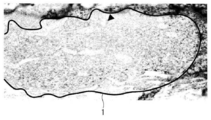
- FIG. 3 to 5 show photographs when a ⁇ -TCP tablet having a porosity of 18% is transplanted.
- 4 and 5 are enlarged photographs of the edge portion a or the central portion b of the transplant site in FIG.
- FIG. 6 shows an HE-stained image of a thin section prepared from skin tissue not transplanted with ⁇ -TCP tablets as a negative control.
- FIG. 7 shows the result of implanting a ⁇ -TCP tablet with a porosity of 60%
- FIG. 8 shows the ⁇ -TCP tablet with a porosity of 75%
- FIG. 9 shows the result of implanting a plastic piece.
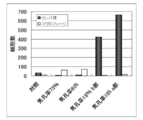
- the number of lymphocytes and macrophages induced in the graft was compared in an HE-stained image obtained by photographing the skin tissue transplanted with each graft. The result is shown in FIG.
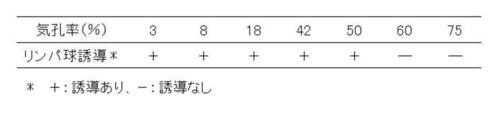
- FIG. 11 shows the results of the same analysis performed on ⁇ -TCP tablets with porosity 3, 8, 18, 42, 50, 60, and 75% prepared in Example 1 above.
- induction of lymphocytes was observed at a porosity of 50% or less, but in the ⁇ -TCP tablets having a porosity of 60% and 75%, almost no induction of lymphocytes was confirmed.
- ⁇ -TCP tablets with a porosity of 50% or less effectively induce lymphocytes and have an immune induction effect that activates immune functions by the induced lymphocytes.
- Example 1 The types and distribution of lymphocytes induced by the ⁇ -TCP tablets prepared in Example 1 were examined by immunostaining.
- a ⁇ -TCP tablet with a porosity of 18% was transplanted subcutaneously into a mouse in the same procedure as in Example 2 above, and the mouse was bred for 2 weeks after transplantation, the transplant site was collected, a thin section was prepared, and a thin section was prepared.
- immunostaining of each cell was performed on a thin section of a lymph node collected from a mouse transplanted with an immunity-inducing agent.
- FIGS. 12 to 19 show the results of observation of the vicinity of the transplantation site where ⁇ -TCP having a porosity of 18% was transplanted and the lymph tissue of the spleen of the mouse not transplanted with an optical microscope.
- T cells 12 and 13 show T cells stained in the vicinity of the transplant site and splenic lymph tissue, respectively. In both cases, it can be seen that the density of T cells is higher in the central part than in the edge part.
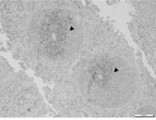
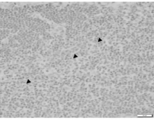
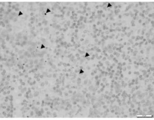
- FIGS. 14 and 15 show B cells stained in the vicinity of the transplant site and splenic lymph tissue, respectively. Similarly, in both cases, it can be seen that B cells are densely packed at the edge (see arrows in FIGS. 14 and 15).
- NK cells 16 and 17 are NK cells stained in the vicinity of the transplant site and spleen lymph tissue, respectively. Cells indicated by arrows are NK cells. Similarly, in both cases, a small number of NK cells were dispersed and confirmed.
- FIGS. 18 and 19 are obtained by staining dendritic cells in the vicinity of the transplant site and splenic lymph tissue, respectively.
- the cell indicated by the arrow is a DC cell.
- a small number of DC cells were dispersed and confirmed in both cases.
- the ⁇ -TCP tablet produced in Example 1 above induces various types of lymphocytes such as T cells, B cells, NK cells, and also induces dendritic cells. It was confirmed that it had the same distribution and density as normal lymph nodes after transplantation in the body and constructed a cell cluster structure similar to normal lymph nodes.
- the tablet containing ⁇ -TCP of the present invention is an excellent immunity-inducing agent capable of inducing immune functions by inducing lymph node-like tissues similar to natural lymph nodes. To do.
- ⁇ -TCP particles or granules The ⁇ -TCP calcined powder obtained in Example 1 is sieved, the sieve passes through a sieve of 105 ⁇ m, and the sieve passes through a sieve of 75 ⁇ m. The remaining ⁇ -TCP has a particle size of 75 ⁇ m or more and less than 105 ⁇ m.
- A ⁇ -TCP passed through a sieve of 75 ⁇ m, and the particle size of ⁇ -TCP remaining on the sieve passed through a sieve of 25 ⁇ m was set to 25 ⁇ m or more and less than 75 ⁇ m (B), and ⁇ -TCP passed through a 25 ⁇ m sieve.
- 3 fractions (A) to (C) were obtained with a particle size of 0.05 ⁇ m or more and less than 25 ⁇ m (C).
- A represents a ⁇ -TCP powder having a porosity of 60 to 70%, B a porosity of 40 to 50%, and C a porosity of 0 to 30%. It was confirmed that macrophages were distributed around A. On the other hand, the distribution of lymphocytes was confirmed around B, and it was confirmed that lymphocytes were localized at a high density around C. Thus, it became clear that lymphocytes were more effectively induced particularly in C.
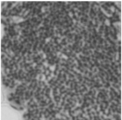
- the SEM image was shown about the particle
- FIG. 23 shows the particle size distribution of the powder of (C) fraction.
- Anti-tumor effect by ⁇ -TCP tablet Antitumor effects in mice were examined using disk-shaped ⁇ -TCP tablets (diameter 5 mm, height 2 mm) with a porosity of 0.1 to 12%. As a control, a plastic carrier material of the same size and free of heterologous proteins that could be immunogenic was used.
- Tumor volume (major axis ⁇ minor axis 2 ) / 2 (mm 3 )
- a ⁇ -TCP tablet and a plastic carrier material as a control were each implanted subcutaneously at a site 15 to 20 mm away from the forming tumor. About one month later, the tumor size was measured, and the effect of ⁇ -TCP on tumor growth was observed. As a result, the tumor volume of the control was 1400 mm 3 , whereas in the ⁇ -TCP tablet administration group, the tumor volume was reduced to 1200 mm 3 .
Landscapes
- Health & Medical Sciences (AREA)
- Public Health (AREA)
- Life Sciences & Earth Sciences (AREA)
- General Health & Medical Sciences (AREA)
- Animal Behavior & Ethology (AREA)
- Chemical & Material Sciences (AREA)
- Medicinal Chemistry (AREA)
- Pharmacology & Pharmacy (AREA)
- Veterinary Medicine (AREA)
- Epidemiology (AREA)
- Engineering & Computer Science (AREA)
- Organic Chemistry (AREA)
- Nuclear Medicine, Radiotherapy & Molecular Imaging (AREA)
- General Chemical & Material Sciences (AREA)
- Chemical Kinetics & Catalysis (AREA)
- Immunology (AREA)
- Inorganic Chemistry (AREA)
- Neurosurgery (AREA)
- Biomedical Technology (AREA)
- Dermatology (AREA)
- Bioinformatics & Cheminformatics (AREA)
- Medicinal Preparation (AREA)
- Medicines Containing Material From Animals Or Micro-Organisms (AREA)
- Pharmaceuticals Containing Other Organic And Inorganic Compounds (AREA)
Abstract
Description
リン酸水素カルシウム、炭酸カルシウムの粉末をモル比で1:2になるように秤量して混合し、かかるリン酸水素カルシウム-炭酸カルシウム混合物に純水を適切な割合で添加してスラリーを調製し、調製されたスラリーをボールミルにより約1日湿式磨砕処理を行い、磨砕処理されたスラリーを、80℃にて数時間乾燥し、乾燥して得られた固形物を粉砕してβ-TCP粉末を得た。得られたβ-TCP粉末を750℃にて数時間仮焼してβ-TCP仮焼粉末を作製した。上記β-TCP仮焼粉末を内径5mm、高さ2mmの容器内に収容し、回転数100rpmで打錠することにより、錠剤に賦形した。かかる錠剤は、600℃で3時間、900℃で1時間、さらに1000~1300℃で1時間焼結した。得られたβ-TCP錠剤は、一部が結晶構造を有するために半透明であり、吸湿性が高いという特徴を有していた。図1は、β-TCP錠剤の全体構成図である。
上記β-TCP錠剤の気孔率を調べた。気孔率が0%のβ-TCP石(測定対象の焼結体と同じ組成、結晶形の気孔を持たない焼結体)の真密度ρを測定しておき、測定対象の焼結体の体積と重さから算出した見かけ密度ρ’とから気孔率P(%)=(1-ρ’/ρ)×100として算出した。その結果、気孔率3,8,18,42,50,60,及び75%のβ-TCP錠剤を得た。図2は、気孔率18%のβ-TCP錠剤について、その割断面を走査型電子顕微鏡(SEM)で観察した写真である。写真内のビーズは、寸法の指標として用いたものであり、直径2μmである。
上記実施例1で作製したβ-TCP錠剤のうち、気孔率18%のβ-TCP錠剤を用いて、本願の免疫誘導剤の免疫細胞誘導効果を2匹の7週齢のマウスの皮下に移植することで評価した。具体的には、マウスを麻酔し、背部皮膚を約10mm切開し、気孔率18%のβ-TCP錠剤を皮下に移植後、マウスを2週間飼育し、錠剤の移植部位を含む皮膚組織を採取した。採取した皮膚組織を、ホルマリンにより固定した後、パラフィン包埋し、病理標本用の薄切片を作製し、HE(ヘマトキシン・エオシン)染色を施し、光学顕微鏡により観察した。
図3~図5から、気孔率18%のβ-TCP錠剤を移植した場合、錠剤の周囲全体にリンパ球が多く分布し、特に錠剤の縁部分にリンパ球が高密度で局在するリンパ節様組織が形成されていることが確認された。具体的には、図10からわかるように、気孔率18%β-TCP錠剤の移植部位には、比較実験で用いた他の移植片の約120~650倍の数のリンパ球が存在する一方、マクロファージはほとんど存在しなかった。気孔率60%及び75%のβ-TCP多孔体を移植した場合では、移植部位の縁部分を中心に骨芽細胞が確認されたが、リンパ球はほとんど確認されず、プラスチックを移植した場合、リンパ球が分散して確認されたが、その数は極めて少なかった。
上記実施例1で調製されたβ-TCP錠剤によって誘導されたリンパ球の種類及び分布を、免疫染色により調べた。気孔率18%のβ-TCP錠剤を、上記実施例2と同様の手順でマウスの皮下に移植し、移植後2週間マウスを飼育し、移植部位を採取し、薄切片を作製し、薄切片にT細胞、B細胞、NK細胞及びDC細胞にそれぞれ特異的な抗体を用いた免疫染色を施した。また、免疫誘導剤を移植したマウスから採取したリンパ節の薄切片にも、各細胞の免疫染色を施した。気孔率18%のβ-TCPを移植した移植部位近傍と移植を行っていない上記マウスの脾臓のリンパ組織とを光学顕微鏡により観察した結果を図12~図19に示す。
前記実施例1にて得られたβ-TCP仮焼粉末をふるいにかけ、ふるい目が105μmのふるいを通過し、更にふるい目が75μmのふるいにかけ残ったβ-TCPの粒径を75μm以上105μm未満(A)とし、ふるい目が75μmのふるいを通過し、さらにふるい目が25μmのふるいにかけ残ったβ-TCPの粒径を25μm以上75μm未満(B)とし、25μmのふるいを通過したβ-TCPの粒径を0.05μm以上25μm未満(C)として、3つの分画(A)~(C)を得た。
上記(A)~(C)の3種類の分画について、気孔率を乾式自動密度計(アキュピック1330、株式会社島津製作所製)で計測したところ(A)分画は、気孔率:60~70%、(B)分画は、気孔率:40~50%、(C)分画は、気孔率:0~30%であることが確認された。
上記で選別した(A)~(C)分画を各々等量で混合し、さらに、200g/mlの割合でPBSに懸濁させた。その後、皮内に注射して移植し、HE染色を行い、光学顕微鏡により薄切片を観察した。その観察結果の写真を図20に示す。また、図21にβ-TCP粉体の粒径と細胞誘導との関係を示す。
気孔率が0.1~12%の円板状のβ-TCP錠剤(直径5mm、高さ2mm)を用いてマウスにおける抗腫瘍効果について調べた。対照として、同サイズの、免疫原性をもつ可能性のある異種タンパク質を含まないプラスチックキャリアマテリアルを用いた。
6週齢の雄性ヌードマウス(BALB/c-nu/nu)皮内に2.5×106個のヒト大腸癌細胞COLO 205(ATCC社より購入)を移植し、5~7日後、マウスに形成された腫瘍サイズを計測して腫瘍体積を算出した。腫瘍体積の算出は以下の数式によった。
腫瘍体積=(長径×短径2)/2(mm3)
β-TCP錠剤と対照としてのプラスチックキャリアマテリアルを、形成腫瘍から15~20mm離れた部位の皮下にそれぞれ移植した。約1ヶ月後に腫瘍サイズを計測し、腫瘍の増殖に対するβ-TCPの作用を観察した。その結果、対照の腫瘍体積は1400mm3であったのに対し、β-TCP錠剤投与群では腫瘍体積は1200mm3に減少していた。
2 β-TCP
Claims (7)
- 気孔率が50%以下であるβ-リン酸三カルシウム(β-TCP)を含む免疫誘導剤。
- 生体内への移植用又は注入用であることを特徴とする請求項1記載の免疫誘導剤。
- 近傍にリンパ球及び樹状細胞を誘導することを特徴とする請求項1又は2記載の免疫誘導剤。
- リンパ球が、T細胞、B細胞、及びNK細胞から選ばれる1又は2以上であることを特徴とする請求項1~3いずれか記載の免疫誘導剤。
- 剤型が、粒径0.05以上25μm未満の粒子又は顆粒であることを特徴とする請求項1~4いずれか記載の免疫誘導剤。
- 剤型が、錠剤又は柱状体であることを特徴とする請求項1~4いずれか記載の免疫誘導剤。
- 請求項1~6いずれか記載の免疫誘導剤により形成されたリンパ節様組織。
Priority Applications (2)
| Application Number | Priority Date | Filing Date | Title |
|---|---|---|---|
| CN2011800359983A CN103153317A (zh) | 2010-07-28 | 2011-07-28 | 免疫诱导剂 |
| US13/812,000 US20130183356A1 (en) | 2010-07-28 | 2011-07-28 | Immunity inducer |
Applications Claiming Priority (2)
| Application Number | Priority Date | Filing Date | Title |
|---|---|---|---|
| JP2010-169055 | 2010-07-28 | ||
| JP2010169055 | 2010-07-28 |
Publications (1)
| Publication Number | Publication Date |
|---|---|
| WO2012014492A1 true WO2012014492A1 (ja) | 2012-02-02 |
Family
ID=45529718
Family Applications (1)
| Application Number | Title | Priority Date | Filing Date |
|---|---|---|---|
| PCT/JP2011/004305 Ceased WO2012014492A1 (ja) | 2010-07-28 | 2011-07-28 | 免疫誘導剤 |
Country Status (4)
| Country | Link |
|---|---|
| US (1) | US20130183356A1 (ja) |
| JP (1) | JP5828470B2 (ja) |
| CN (1) | CN103153317A (ja) |
| WO (1) | WO2012014492A1 (ja) |
Families Citing this family (1)
| Publication number | Priority date | Publication date | Assignee | Title |
|---|---|---|---|---|
| EP2796141A1 (en) * | 2011-12-22 | 2014-10-29 | Olympus Corporation | Cancer cell-inhibiting ceramics and method for producing cancer cell-inhibiting ceramics, method for treating bone neoplasm, and use of b tricalcium phosphate porous granules having grain size of 1 to 10 mm |
Citations (3)
| Publication number | Priority date | Publication date | Assignee | Title |
|---|---|---|---|---|
| JPH041122A (ja) * | 1990-04-16 | 1992-01-06 | Olympus Optical Co Ltd | 薬物徐放材 |
| JPH05237178A (ja) * | 1991-04-08 | 1993-09-17 | Olympus Optical Co Ltd | 骨補填材及びその製造方法 |
| JP2010126434A (ja) * | 2008-11-25 | 2010-06-10 | Olympus Corp | 癌細胞抑制剤および癌細胞抑制シート |
Family Cites Families (3)
| Publication number | Priority date | Publication date | Assignee | Title |
|---|---|---|---|---|
| DE19940717A1 (de) * | 1999-08-26 | 2001-03-01 | Gerontocare Gmbh | Resorblerbares Knochenersatz- und Knochenaufbaumaterial |
| JP4801316B2 (ja) * | 2003-03-24 | 2011-10-26 | 太平化学産業株式会社 | リン酸カルシウム多孔体の製法 |
| US7901650B2 (en) * | 2005-06-22 | 2011-03-08 | Skeletal Kinectics, LLC | Porous beta-tricalcium phosphate and methods for producing the same |
-
2011
- 2011-07-28 US US13/812,000 patent/US20130183356A1/en not_active Abandoned
- 2011-07-28 WO PCT/JP2011/004305 patent/WO2012014492A1/ja not_active Ceased
- 2011-07-28 CN CN2011800359983A patent/CN103153317A/zh active Pending
- 2011-07-28 JP JP2011166051A patent/JP5828470B2/ja active Active
Patent Citations (3)
| Publication number | Priority date | Publication date | Assignee | Title |
|---|---|---|---|---|
| JPH041122A (ja) * | 1990-04-16 | 1992-01-06 | Olympus Optical Co Ltd | 薬物徐放材 |
| JPH05237178A (ja) * | 1991-04-08 | 1993-09-17 | Olympus Optical Co Ltd | 骨補填材及びその製造方法 |
| JP2010126434A (ja) * | 2008-11-25 | 2010-06-10 | Olympus Corp | 癌細胞抑制剤および癌細胞抑制シート |
Also Published As
| Publication number | Publication date |
|---|---|
| CN103153317A (zh) | 2013-06-12 |
| JP5828470B2 (ja) | 2015-12-09 |
| US20130183356A1 (en) | 2013-07-18 |
| JP2012046510A (ja) | 2012-03-08 |
Similar Documents
| Publication | Publication Date | Title |
|---|---|---|
| TW393322B (en) | Close vascularization implant material | |
| Ma et al. | Multifunctional 3D-printed scaffolds eradiate orthotopic osteosarcoma and promote osteogenesis via microwave thermo-chemotherapy combined with immunotherapy | |
| JP2020022467A (ja) | ナチュラルキラー細胞の大量生産方法及びその方法により得られたナチュラルキラー細胞の抗癌剤としての用途 | |
| Wang et al. | Macrophage-derived implantable vaccine prevents postsurgical tumor recurrence | |
| CN110393699A (zh) | 一种有效防治肿瘤术后复发和转移的抗癌组合物 | |
| JP2010507584A (ja) | 細胞外マトリックス癌ワクチンアジュバント | |
| Kinard et al. | Synthetic biodegradable hydrogel delivery of demineralized bone matrix for bone augmentation in a rat model | |
| ES2206696T3 (es) | Perlas de agarosa-colageno implantables que contienen celulas que producen un producto biologico difundible, y sus usos. | |
| US11590076B2 (en) | Cryogel scaffold capable of controlling degree of degradation and soft bio-integrated device in which drug modulating immunosuppressive action in solid microenvironment is loaded in same scaffold | |
| Zhang et al. | 3D-printed CoSi/PCL composite scaffold with NIR-II photothermal ability and enhanced adipogenic activity for breast reconstruction after mastectomy | |
| JP5999639B2 (ja) | 免疫刺激因子担持微粒子 | |
| JP5828470B2 (ja) | 免疫誘導剤 | |
| TWI687222B (zh) | 多孔質複合體、及含有磷酸八鈣及副甲狀腺素的多孔質複合體的製造方法 | |
| Moreau et al. | A liquid immunogenic fiducial eluter for image-guided radiotherapy | |
| JP4802317B2 (ja) | リン酸カルシウム系セラミックスビーズ集積体及びその構築方法 | |
| JP6082901B2 (ja) | ワクチン・アジュバント | |
| JP5990752B2 (ja) | 抗体療法の効果増強剤 | |
| Eweida et al. | Irradiation delays tissue growth but enhances osteogenic differentiation in vascularized constructs | |
| JP5966129B2 (ja) | 免疫賦活剤 | |
| KR20140126829A (ko) | 조직 재생용 생분해성 고분자 제제 및 그 제조방법 | |
| Xie et al. | Dentin tubules as a long-term sustained release carrier to accelerate bone repair by loading FTY720 | |
| CN104127893A (zh) | 一种类零级缓释放化疗联合应用粒子及制备方法和应用 | |
| KR102741280B1 (ko) | 골재생 유도 멤브레인 및 이의 제조방법 | |
| Wang et al. | Hybrid Cell Membrane-Conjugated Photosensitive Hydrogel as a Tumor Vaccine for Promoting Cancer Immunotherapy | |
| US20140294971A1 (en) | Cancer cell-inhibiting ceramic, process for producing cancer cell-inhibiting ceramic, method for treating bone tumor, and use of beta-tricalcium phosphate porous granules with particle size of 1 to 10 micrometer |
Legal Events
| Date | Code | Title | Description |
|---|---|---|---|
| WWE | Wipo information: entry into national phase |
Ref document number: 201180035998.3 Country of ref document: CN |
|
| 121 | Ep: the epo has been informed by wipo that ep was designated in this application |
Ref document number: 11812089 Country of ref document: EP Kind code of ref document: A1 |
|
| NENP | Non-entry into the national phase |
Ref country code: DE |
|
| WWE | Wipo information: entry into national phase |
Ref document number: 13812000 Country of ref document: US |
|
| 122 | Ep: pct application non-entry in european phase |
Ref document number: 11812089 Country of ref document: EP Kind code of ref document: A1 |