WO2011132718A1 - 還元型補酵素q10含有組成物とその製造方法及び安定化方法 - Google Patents
還元型補酵素q10含有組成物とその製造方法及び安定化方法 Download PDFInfo
- Publication number
- WO2011132718A1 WO2011132718A1 PCT/JP2011/059762 JP2011059762W WO2011132718A1 WO 2011132718 A1 WO2011132718 A1 WO 2011132718A1 JP 2011059762 W JP2011059762 W JP 2011059762W WO 2011132718 A1 WO2011132718 A1 WO 2011132718A1
- Authority
- WO
- WIPO (PCT)
- Prior art keywords
- oil
- acid ester
- fatty acid
- reduced coenzyme
- coenzyme
- Prior art date
- Legal status (The legal status is an assumption and is not a legal conclusion. Google has not performed a legal analysis and makes no representation as to the accuracy of the status listed.)
- Ceased
Links
Classifications
-
- A—HUMAN NECESSITIES
- A61—MEDICAL OR VETERINARY SCIENCE; HYGIENE
- A61K—PREPARATIONS FOR MEDICAL, DENTAL OR TOILETRY PURPOSES
- A61K31/00—Medicinal preparations containing organic active ingredients
- A61K31/12—Ketones
- A61K31/122—Ketones having the oxygen directly attached to a ring, e.g. quinones, vitamin K1, anthralin
-
- A—HUMAN NECESSITIES
- A23—FOODS OR FOODSTUFFS; TREATMENT THEREOF, NOT COVERED BY OTHER CLASSES
- A23K—FODDER
- A23K20/00—Accessory food factors for animal feeding-stuffs
- A23K20/10—Organic substances
- A23K20/111—Aromatic compounds
-
- A—HUMAN NECESSITIES
- A23—FOODS OR FOODSTUFFS; TREATMENT THEREOF, NOT COVERED BY OTHER CLASSES
- A23L—FOODS, FOODSTUFFS OR NON-ALCOHOLIC BEVERAGES, NOT OTHERWISE PROVIDED FOR; PREPARATION OR TREATMENT THEREOF
- A23L33/00—Modifying nutritive qualities of foods; Dietetic products; Preparation or treatment thereof
-
- A—HUMAN NECESSITIES
- A23—FOODS OR FOODSTUFFS; TREATMENT THEREOF, NOT COVERED BY OTHER CLASSES
- A23L—FOODS, FOODSTUFFS OR NON-ALCOHOLIC BEVERAGES, NOT OTHERWISE PROVIDED FOR; PREPARATION OR TREATMENT THEREOF
- A23L33/00—Modifying nutritive qualities of foods; Dietetic products; Preparation or treatment thereof
- A23L33/10—Modifying nutritive qualities of foods; Dietetic products; Preparation or treatment thereof using additives
-
- A—HUMAN NECESSITIES
- A23—FOODS OR FOODSTUFFS; TREATMENT THEREOF, NOT COVERED BY OTHER CLASSES
- A23P—SHAPING OR WORKING OF FOODSTUFFS, NOT FULLY COVERED BY A SINGLE OTHER SUBCLASS
- A23P10/00—Shaping or working of foodstuffs characterised by the products
- A23P10/30—Encapsulation of particles, e.g. foodstuff additives
-
- A—HUMAN NECESSITIES
- A61—MEDICAL OR VETERINARY SCIENCE; HYGIENE
- A61K—PREPARATIONS FOR MEDICAL, DENTAL OR TOILETRY PURPOSES
- A61K47/00—Medicinal preparations characterised by the non-active ingredients used, e.g. carriers or inert additives; Targeting or modifying agents chemically bound to the active ingredient
- A61K47/06—Organic compounds, e.g. natural or synthetic hydrocarbons, polyolefins, mineral oil, petrolatum or ozokerite
- A61K47/08—Organic compounds, e.g. natural or synthetic hydrocarbons, polyolefins, mineral oil, petrolatum or ozokerite containing oxygen, e.g. ethers, acetals, ketones, quinones, aldehydes, peroxides
- A61K47/10—Alcohols; Phenols; Salts thereof, e.g. glycerol; Polyethylene glycols [PEG]; Poloxamers; PEG/POE alkyl ethers
-
- A—HUMAN NECESSITIES
- A61—MEDICAL OR VETERINARY SCIENCE; HYGIENE
- A61K—PREPARATIONS FOR MEDICAL, DENTAL OR TOILETRY PURPOSES
- A61K8/00—Cosmetics or similar toiletry preparations
- A61K8/18—Cosmetics or similar toiletry preparations characterised by the composition
- A61K8/30—Cosmetics or similar toiletry preparations characterised by the composition containing organic compounds
- A61K8/33—Cosmetics or similar toiletry preparations characterised by the composition containing organic compounds containing oxygen
- A61K8/34—Alcohols
- A61K8/347—Phenols
-
- A—HUMAN NECESSITIES
- A61—MEDICAL OR VETERINARY SCIENCE; HYGIENE
- A61K—PREPARATIONS FOR MEDICAL, DENTAL OR TOILETRY PURPOSES
- A61K8/00—Cosmetics or similar toiletry preparations
- A61K8/18—Cosmetics or similar toiletry preparations characterised by the composition
- A61K8/30—Cosmetics or similar toiletry preparations characterised by the composition containing organic compounds
- A61K8/33—Cosmetics or similar toiletry preparations characterised by the composition containing organic compounds containing oxygen
- A61K8/35—Ketones, e.g. benzophenone
- A61K8/355—Quinones
-
- A—HUMAN NECESSITIES
- A61—MEDICAL OR VETERINARY SCIENCE; HYGIENE
- A61K—PREPARATIONS FOR MEDICAL, DENTAL OR TOILETRY PURPOSES
- A61K9/00—Medicinal preparations characterised by special physical form
- A61K9/48—Preparations in capsules, e.g. of gelatin, of chocolate
- A61K9/4841—Filling excipients; Inactive ingredients
- A61K9/4858—Organic compounds
-
- A—HUMAN NECESSITIES
- A61—MEDICAL OR VETERINARY SCIENCE; HYGIENE
- A61Q—SPECIFIC USE OF COSMETICS OR SIMILAR TOILETRY PREPARATIONS
- A61Q19/00—Preparations for care of the skin
-
- A—HUMAN NECESSITIES
- A61—MEDICAL OR VETERINARY SCIENCE; HYGIENE
- A61K—PREPARATIONS FOR MEDICAL, DENTAL OR TOILETRY PURPOSES
- A61K2800/00—Properties of cosmetic compositions or active ingredients thereof or formulation aids used therein and process related aspects
- A61K2800/80—Process related aspects concerning the preparation of the cosmetic composition or the storage or application thereof
- A61K2800/92—Oral administration
Definitions
- the present invention relates to a composition containing reduced coenzyme Q10, a method for producing the same, and a method for stabilizing the same.
- Reduced coenzyme Q10 exhibits higher oral absorbability than oxidized coenzyme Q10, and is excellent food, health food, functional nutrition food, food for specified health use, supplement, nutritional supplement, nutritional supplement, beverage, feed It is a compound useful as an animal drug, cosmetics, pharmaceutical, therapeutic drug, prophylactic drug, and the like.
- Patent Document 1 discloses a method of dissolving coenzyme Q10 in limonene and delivering it to the body and a composition thereof in order to ingest coenzyme Q10 more efficiently.
- Patent Document 2 discloses ⁇ -lipoic acid as a stabilizer for stably maintaining reduced coenzyme Q10, and fatty acids and limonene as coexisting components.
- the maximum concentration of reduced coenzyme Q10 described in Patent Document 2 in the composition is 23.5% by weight.
- reduced coenzyme Q10 can be obtained by reducing oxidized coenzyme Q10.
- common reducing agents such as sodium borohydride and sodium dithionite (sodium hyposulfite) are used.
- sodium borohydride and sodium dithionite sodium hyposulfite
- the present inventors have studied various methods for reducing oxidized coenzyme Q10 in limonene as a method for producing a composition containing reduced coenzyme Q10 at a high concentration. Even if the reduction reaction is carried out under general reaction conditions using a known reducing agent for oxidized coenzyme Q10, the reduction reaction of oxidized coenzyme Q10 does not proceed easily in limonene, and in this method, oxidized coenzyme Q10 It was found that it is difficult to obtain a high-quality reduced coenzyme Q10 composition using as a raw material.
- Limonene is a kind of terpenes, but as a result of the same examination among other terpenes, the reduction reaction of oxidized coenzyme Q10 is also difficult to proceed, and a high-quality reduced coenzyme Q10 composition. I also found it difficult to get things.
- the inventors have added a specific additive when reducing oxidized coenzyme Q10 in terpenes capable of dissolving reduced coenzyme Q10 at a high concentration.
- the inventors have found that the reduction reaction of oxidized coenzyme Q10 proceeds favorably, and that reduced coenzyme Q10 can be stably present in the obtained composition, thereby completing the present invention.
- the present invention reduces oxidized coenzyme Q10 using a reducing agent in terpenes in the presence of at least one additive selected from the group consisting of alcohols, water, surfactants and diacylglycerols.
- the present invention relates to a method for producing reduced coenzyme Q10.
- the present invention also provides a composition comprising at least one selected from the group consisting of alcohols, water, surfactants and diacylglycerols, terpenes, reducing agents and reduced coenzyme Q10, and alcohols.
- the present invention also relates to a method for stabilizing reduced coenzyme Q10, wherein at least one selected from the group consisting of water, a surfactant, and diacylglycerol is allowed to coexist with a terpene and a reducing agent.
- the present invention is as follows. [1] reducing oxidized coenzyme Q10 using a reducing agent in a terpene in the presence of at least one additive selected from the group consisting of alcohols, water, surfactants and diacylglycerols A method for producing reduced coenzyme Q10. [2] The production method according to [1], wherein the alcohol is a monohydric alcohol having 1 to 4 carbon atoms or a dihydric alcohol having 2 to 4 carbon atoms. [3] The production method according to [1] or [2], wherein the alcohol is ethanol.
- the surfactant comprises glycerin fatty acid ester, sucrose fatty acid ester, organic acid monoglyceride, sorbitan fatty acid ester, polyoxyethylene sorbitan fatty acid ester, propylene glycol fatty acid ester, polyglycerin condensed ricinoleic acid ester, saponin and phospholipid.
- [5] The production method according to [1], wherein the terpenes are at least one selected from the group consisting of hemiterpenes, monoterpenes, sesquiterpenes, diterpenes, sesterterpenes, and triterpenes.
- the reducing agent is L-ascorbic acid, D-arabo-ascorbic acid, L-ascorbyl palmitate, L-ascorbyl stearate, sodium borohydride, sodium hyposulfite, retinal, acerola extract, pine bark extract.
- the method according to [1], wherein the method is at least one selected from the group consisting of an extract of twilight leaves, gardenia pigment, and perfume vinegar.
- Oils and fats are palm oil, palm oil, palm kernel oil, linseed oil, camellia oil, brown rice germ oil, olive oil, rapeseed oil, rice oil, peanut oil, corn oil, wheat germ oil, soybean oil, sesame oil, cottonseed oil , Sunflower seed oil, kapok oil, evening primrose oil, shea fat, monkey fat, cacao fat, sesame oil, safflower oil, avocado oil, poppy oil, burdock oil, pork fat, milk fat, fish oil, beef tallow, these are separated, hydrogen [7] The production method according to [7], which is at least one selected from the group consisting of fats and oils processed by addition, transesterification, and the like, medium chain fatty acid triglycerides, and fatty acid partial glycerides.
- a composition comprising at least one selected from the group consisting of alcohols, water, surfactants, and diacylglycerols, and terpenes, reducing agents, and reduced coenzyme Q10.
- the alcohol is a monohydric alcohol having 1 to 4 carbon atoms or a dihydric alcohol having 2 to 4 carbon atoms.
- the surfactant comprises glycerin fatty acid ester, sucrose fatty acid ester, organic acid monoglyceride, sorbitan fatty acid ester, polyoxyethylene sorbitan fatty acid ester, propylene glycol fatty acid ester, polyglycerin condensed ricinoleic acid ester, saponin and phospholipid.
- the composition according to [14] which is at least one selected from the group.
- the terpenes are at least one selected from the group consisting of hemiterpenes, monoterpenes, sesquiterpenes, diterpenes, sesterterpenes, and triterpenes.
- the reducing agent is L-ascorbic acid, D-arabo-ascorbic acid, L-ascorbyl palmitate, L-ascorbyl stearate, sodium borohydride, sodium hyposulfite, retinal, acerola extract, pine bark extract
- the composition according to [14] which is at least one selected from the group consisting of an extract of twilight leaves, a gardenia pigment, and perfume vinegar.
- the composition according to any one of [14] to [18] further containing an oil and fat.
- the composition according to any one of [14] to [19], wherein the content of reduced coenzyme Q10 in the composition is 0.001% by weight or more.
- the surfactant comprises glycerin fatty acid ester, sucrose fatty acid ester, organic acid monoglyceride, sorbitan fatty acid ester, polyoxyethylene sorbitan fatty acid ester, propylene glycol fatty acid ester, polyglycerin condensed ricinoleic acid ester, saponin and phospholipid.
- the stabilization method according to [23], wherein the terpenes are at least one selected from the group consisting of hemiterpenes, monoterpenes, sesquiterpenes, diterpenes, sesterterpenes, and triterpenes.
- the reducing agent is L-ascorbic acid, D-arabo-ascorbic acid, L-ascorbyl palmitate, L-ascorbyl stearate, sodium borohydride, sodium hyposulfite, retinal, acerola extract, pine bark extract
- the stabilization method according to [23], wherein the method is at least one selected from the group consisting of an extract of twilight leaves, a gardenia pigment, and perfume vinegar.
- the stabilization method according to any one of [23] to [28], wherein reduced coenzyme Q10 added externally is used.
- the stabilization method according to any one of [23] to [29], wherein the coexistence is performed in a deoxygenated atmosphere.
- oxidized coenzyme Q10 and reduced coenzyme Q10 can be obtained by using terpenes in combination with at least one additive selected from the group consisting of alcohols, water, surfactants and diacylglycerols.
- terpenes in combination with at least one additive selected from the group consisting of alcohols, water, surfactants and diacylglycerols.
- oxidized coenzyme Q10 is produced using a reducing agent in terpenes.
- This is a method for producing reduced coenzyme Q10, characterized in that it is reduced.
- the oxidized coenzyme Q10 used as a raw material may be oxidized coenzyme Q10 alone or a mixture with reduced coenzyme Q10.
- the oxidized coenzyme Q10 occupies the total amount of coenzyme Q10 (that is, the total amount of reduced coenzyme Q10 and oxidized coenzyme Q10).
- the ratio is not particularly limited, but is, for example, 1% by weight or more, usually 5% by weight or more, preferably 10% by weight or more, more preferably 20% by weight or more, and particularly preferably 50% by weight or more.
- the upper limit is not particularly limited, but when a mixture of oxidized coenzyme Q10 and reduced coenzyme Q10 is used as a raw material, it is usually 99.9% by weight or less.
- oxidized coenzyme Q10 may be used alone.
- the oxidized coenzyme Q10 used here can be obtained by a conventionally known method such as synthesis, fermentation, extraction from a natural product, or the like. Preferably, it is obtained by fermentation or extraction from a natural product.
- terpenes capable of highly dissolving oxidized coenzyme Q10 and reduced coenzyme Q10 are reacted. Used as a solvent.
- the terpenes used as the reaction solvent for the reduction reaction in the production method of the present invention are not particularly limited, and any of hemiterpenes, monoterpenes, sesquiterpenes, diterpenes, sesterterpenes, and triterpenes can be suitably used. Among these, hemiterpenes, monoterpenes, and sesquiterpenes are more preferable, monoterpenes and sesquiterpenes are particularly preferable, and monoterpenes are most preferable from the viewpoint of solubility in oxidized coenzyme Q10 and reduced coenzyme Q10.
- essential oils containing the above terpenes can be used as the terpenes in the present invention.
- the essential oil that can be used in this case is not particularly limited as long as it contains terpenes, but orange oil, capsicum oil, mustard oil, garlic oil, caraway oil, clove oil, cinnamon oil, cocoa extract, Coffee bean extract, ginger oil, spearmint oil, celery seed oil, thyme oil, onion oil, nutmeg oil, parsley seed oil, bran oil, vanilla extract, funnel oil, peni royal oil, peppermint oil, eucalyptus oil, lemon oil , Rose oil, Rosemary oil, Almond oil, Ajowan oil, Anise oil, Amiris oil, Angelica root oil, Amblet seed oil, Estragon oil, Origanum oil, Oris root oil, Olivenum oil, Cassia oil, Cascarilla oil, Cananga oil , Chamomile oil, columnus oil, cardamom oil, carrot seed oil, cubebu oil Cumin oil, grapefruit oil,
- additives of the present invention for promoting the reduction reaction of oxidized coenzyme Q10 in terpenes.
- Either glycerol or a mixture thereof is used.
- the alcohol that can be used as the additive of the present invention is not particularly limited, regardless of whether it is cyclic or non-cyclic, and saturated or unsaturated.
- those having 1 to 20 carbon atoms are mentioned, preferably those having 1 to 12 carbon atoms, more preferably those having 1 to 5 carbon atoms, and particularly preferably those having 1 to 4 carbon atoms, and among these, monohydric alcohols are preferred.
- a monohydric alcohol having 2 carbon atoms Most preferred is a monohydric alcohol having 2 carbon atoms.
- a dihydric alcohol having 2 to 5, preferably 2 to 4, more preferably 3 carbon atoms, and a trihydric alcohol having 3 carbon atoms are also preferably used.
- Examples of monohydric alcohols include methanol, ethanol, 1-propanol, 2-propanol, 1-butanol, 2-butanol, isobutyl alcohol, tert-butyl alcohol, 1-pentanol, 2-pentanol, and 3-pen.
- divalent alcohol examples include 1,2-ethanediol, 1,2-propanediol (propylene glycol), 1,3-propanediol, 1,2-butanediol, 1,3-butanediol, 1,4- Examples include butanediol, 2,3-butanediol, and 1,5-pentanediol. 1,2-ethanediol, 1,2-propanediol, 1,3-butanediol and 1,3-propanediol are preferred, and 1,2-propanediol is most preferred.
- Glycerin or the like can be suitably used as the trivalent alcohol.
- optical isomers When the optical isomers are present in the alcohols, either of them or a mixture thereof can be used.
- any of L-form, D-form, and a racemate which is a mixture thereof can be used.
- the surfactant that can be used as the additive of the present invention is not particularly limited.
- glycerin fatty acid ester sucrose fatty acid ester, organic acid monoglyceride, sorbitan fatty acid ester, polyoxyethylene sorbitan fatty acid ester, propylene glycol fatty acid ester
- examples thereof include polyglycerin condensed ricinoleic acid ester (condensed ricinoleic acid glyceride), saponin, phospholipid and the like.
- the glycerin fatty acid ester is not particularly limited, and examples thereof include those having a glycerin polymerization degree of 1 to 10. Further, glycerin fatty acid esters each having 6 to 18 carbon atoms in the fatty acid can be exemplified.
- the fatty acid residue constituting the glycerin fatty acid ester is not particularly limited, but fatty acids having 6 to 18 carbon atoms can be preferably used.
- caprylic acid, capric acid, lauric acid, myristic acid, palmitic acid can be used. Examples thereof include acids, stearic acid, isostearic acid, oleic acid, linoleic acid, and linolenic acid.
- the sucrose fatty acid ester is not particularly limited, and examples thereof include those in which a fatty acid having 6 to 22 carbon atoms is bonded to one or more hydroxyl groups of sucrose, such as sucrose laurate, sucrose myristine. Examples include acid esters, sucrose palmitate, sucrose stearate, sucrose oleate, sucrose behenate, and sucrose erucate.
- Succinic acid monoglycerides such as monoglycerin caprylic acid succinic acid ester and monoglycerin stearic acid succinic acid ester
- Citric acid such as monoglycerin oleic acid citrate ester, monoglycerin stearic acid citrate ester
- Monoglycerides Acetic monoglycerides such as monoglycerin stearic acid acetate; monoglycerin stearic acid lactic acid ester, monoglycerin stearic acid diacetyltartaric acid ester and the like.
- the sorbitan fatty acid ester is not particularly limited, and examples thereof include those in which a fatty acid having 6 to 18 carbon atoms is ester-bonded to one or more hydroxyl groups of sorbitan, such as sorbitan monolaurate, sorbitan monopalmitate, Examples include sorbitan monostearate and sorbitan monooleate.
- the polyoxyethylene sorbitan fatty acid ester is not particularly limited.
- examples thereof include esters, polyoxyethylene sorbitan tristearate, and polyoxyethylene sorbitan trioleate.
- any monoester or diester can be used as the propylene glycol fatty acid ester.
- the fatty acid residue constituting the propylene glycol fatty acid ester is not particularly limited, but those having 6 to 18 carbon atoms can be preferably used.
- caprylic acid, capric acid, lauric acid, myristic acid, palmitic acid can be used.
- examples thereof include acids, stearic acid, isostearic acid, oleic acid, linoleic acid, and linolenic acid.
- the polyglycerin condensed ricinoleic acid ester is not particularly limited.
- the polyglycerin average polymerization degree is 2 to 10
- the polyricinoleic acid average condensation degree (average number of condensation of ricinoleic acid) is 2 to 4.
- examples thereof include tetraglycerin condensed ricinoleic acid ester, pentaglycerin condensed ricinoleic acid ester, hexaglycerin condensed ricinoleic acid ester and the like.
- the saponin is not particularly limited, and examples include enjusaponin, kiraya saponin, purified soybean saponin, and yucca saponin.
- the phospholipid is not particularly limited.
- lecithin such as egg yolk lecithin, purified soybean lecithin, phosphatidylcholine, phosphatidylethanolamine, phosphatidylserine, sphingomyelin, dicetylphosphate, stearylamine, phosphatidylglycerol, phosphatidic acid, phosphatidylinositolamine, Examples thereof include cardiolipin, ceramide phosphorylethanolamine, ceramide phosphorylglycerol, and mixtures thereof.
- phospholipids (hydrogenated lecithin and lysolecithin) subjected to processing such as hydrogenation and enzymatic degradation can also be used. From the viewpoint of improving the absorbability of reduced coenzyme Q10, it is also preferable to use enzymatically decomposed phospholipid (lysolecithin).
- glycerin fatty acid ester sucrose fatty acid ester, organic acid monoglyceride, sorbitan fatty acid ester, propylene glycol fatty acid ester, and phospholipid are preferable, and phospholipid is particularly preferable.
- polyglycerin fatty acid esters such as decaglycerin pentaoleate, tetraglycerin monolaurate, decaglycerin monomyristate, decaglycerin monooleate, diglycerin monooleate; glycerin monostearate Monoglycerol fatty acid esters such as glycerol monooleate; acetic acid monoglycerides such as sucrose oleate and monoglycerol laurate acetate, citric acid monoglycerides such as monoglycerol oleate citrate, sorbitan monooleate, mono Particularly preferred are propylene glycol oleate, propylene glycol monostearate, lecithin and the like.
- the diacylglycerol that can be used as the additive of the present invention may be any one of 1,2-diacylglycerol and 1,3-diacylglycerol, as long as it is a fatty acid ester of glycerol to which two fatty acid groups are bonded. It may be present or a mixture thereof.
- the fatty acid group is not particularly limited, and for example, any fatty acid having 8 to 22 carbon atoms can be selected.
- the fatty acid composition may be single or a mixture.
- commercially available diacylglycerol obtained by hydrolyzing one fatty acid of vegetable oil can also be used suitably.
- a solvent other than the above-mentioned terpenes and the additive of the present invention can be used in combination as long as the progress of the reduction reaction of oxidized coenzyme Q10 is not significantly adversely affected.
- Other solvents used in the production method of the present invention are not particularly limited, but include hydrocarbons, fatty acid esters, ethers, ketones, nitrogen compounds (including nitriles and amides), sulfur compounds, and the like. Organic solvents, fatty acids, and oils.
- the hydrocarbons are not particularly limited, and examples thereof include aliphatic hydrocarbons, aromatic hydrocarbons, and halogenated hydrocarbons.
- an aliphatic hydrocarbon and an aromatic hydrocarbon are preferable, and an aliphatic hydrocarbon is particularly preferable.
- the aliphatic hydrocarbon is not particularly limited regardless of whether it is cyclic or non-cyclic, or saturated or unsaturated, but a non-cyclic aliphatic hydrocarbon is particularly preferably used. Usually, those having 3 to 20 carbon atoms, preferably 5 to 12 carbon atoms are used.
- Specific examples include, for example, propane, butane, isobutane, pentane, 2-methylbutane, cyclopentane, 2-pentene, hexane, 2-methylpentane, 2,2-dimethylbutane, 2,3-dimethylbutane, methylcyclopentane.
- saturated aliphatic hydrocarbons having 5 to 8 carbon atoms are preferable, and pentane, 2-methylbutane, cyclopentane, hexane, 2-methylpentane, 2,2-dimethylbutane, 2,3-dimethylbutane, methylcyclopentane, Especially cyclohexane, heptane, 2-methylhexane, 3-methylhexane, 2,3-dimethylpentane, 2,4-dimethylpentane, methylcyclohexane, octane, 2,2,3-trimethylpentane, isooctane, ethylcyclohexane, etc. preferable.
- the aromatic hydrocarbon is not particularly limited, but usually, an aromatic hydrocarbon having 6 to 20 carbon atoms, particularly 6 to 12 carbon atoms, especially 7 to 10 carbon atoms is preferably used.
- Specific examples include, for example, benzene, toluene, xylene, o-xylene, m-xylene, p-xylene, ethylbenzene, cumene, mesitylene, tetralin, butylbenzene, p-cymene, cyclohexylbenzene, diethylbenzene, pentylbenzene, dipentylbenzene. , Dodecylbenzene, styrene and the like.
- the halogenated hydrocarbon is not particularly limited regardless of whether it is cyclic or non-cyclic, or saturated or unsaturated, but generally non-cyclic hydrocarbons are preferably used. Usually, chlorinated hydrocarbons and fluorinated hydrocarbons are preferable, and chlorinated hydrocarbons are particularly preferable. Those having 1 to 6 carbon atoms, particularly 1 to 4 carbon atoms, especially 1 to 2 carbon atoms are preferably used.
- Specific examples include, for example, dichloromethane, chloroform, carbon tetrachloride, 1,1-dichloroethane, 1,2-dichloroethane, 1,1,1-trichloroethane, 1,1,2-trichloroethane, 1,1,1,2, and the like.
- dichloromethane chloroform, carbon tetrachloride, 1,1-dichloroethane, 1,2-dichloroethane, 1,1,1-trichloroethane, 1,1,2-trichloroethane, 1,1-dichloroethylene, 1,2-dichloroethylene , Trichloroethylene, chlorobenzene, 1,1,1,2-tetrafluoroethane, more preferably dichloromethane, chloroform, 1,2-dichloroethylene, trichloroethylene, chlorobenzene, 1,1,1,2-tetrafluoroethane .
- the fatty acid esters are not particularly limited, and examples thereof include formic acid esters, acetic acid esters, propionic acid esters, butyric acid esters, isovaleric acid esters, heptanoic acid esters, and hexanoic acid esters.
- acetate ester and formate ester are preferable, and acetate ester is particularly preferable.
- formate examples include methyl formate, ethyl formate, propyl formate, isopropyl formate, butyl formate, isobutyl formate, sec-butyl formate, pentyl formate, isoamyl formate, geranyl formate, and citronellyl formate.
- Preferred are methyl formate, ethyl formate, propyl formate, isoamyl formate, geranyl formate, citronellyl formate, and most preferred is ethyl formate.
- acetate esters examples include methyl acetate, ethyl acetate, propyl acetate, isopropyl acetate, butyl acetate, isobutyl acetate, sec-butyl acetate, pentyl acetate, isopentyl acetate, isoamyl acetate, sec-hexyl acetate, cyclohexyl acetate, benzyl acetate, Examples thereof include amyl acetate, geranyl acetate, citronellyl acetate, cinnamyl acetate, terpinyl acetate, l-menthyl acetate, and linalyl acetate.
- propionic acid esters examples include methyl propionate, ethyl propionate, butyl propionate, isopentyl propionate, and isoamyl propionate.
- Examples of the butyric acid ester include methyl butyrate, ethyl butyrate, butyl butyrate, isopentyl butyrate, isoamyl propionate, and cyclohexyl butyrate.
- Examples of the isovaleric acid ester include methyl isovalerate, ethyl isovalerate, butyl isovalerate, isopentyl isovalerate, isoamyl isovalerate, and allyl isovalerate.
- heptanoic acid ester examples include methyl heptanoate, ethyl heptanoate, butyl heptanoate, isopentyl heptanoate, allyl heptanoate and the like.
- hexanoic acid esters examples include methyl hexanoate, ethyl hexanoate, butyl hexanoate, isopentyl hexanoate, and allyl hexanoate.
- the ethers are not particularly limited regardless of whether they are cyclic or non-cyclic, or saturated or unsaturated, but saturated ones are generally preferably used.
- Specific examples include, for example, diethyl ether, methyl tert-butyl ether, dipropyl ether, diisopropyl ether, dibutyl ether, dihexyl ether, ethyl vinyl ether, butyl vinyl ether, anisole, phenetole, butyl phenyl ether, methoxy toluene, dioxane, furan, 2 -Methylfuran, tetrahydrofuran, tetrahydropyran, ethylene glycol dimethyl ether, ethylene glycol diethyl ether, ethylene glycol dibutyl ether, ethylene glycol monomethyl ether, ethylene glycol monoethyl ether, ethylene glycol dibutyl ether, dibenzyl ether, benzyl butyl ether, etc. it can.
- ketones are not particularly limited regardless of whether they are cyclic or non-cyclic, and saturated or unsaturated. Specific examples include acetone, methyl ethyl ketone, methyl butyl ketone, methyl isobutyl ketone, acetophenone, 4-methoxyphenyl acetone, paramethyl acetophenone, methyl ⁇ -naphthyl ketone, and preferably acetone, acetophenone, 4-Methoxyphenylacetone, paramethylacetophenone, and methyl ethyl ketone, and most preferably methyl ethyl ketone.
- the nitriles are not particularly limited regardless of whether they are cyclic or non-cyclic, or saturated or unsaturated, but saturated ones are generally preferably used. Usually, those having 2 to 20 carbon atoms, particularly 2 to 12 carbon atoms, especially 2 to 8 carbon atoms are preferably used. Specific examples include, for example, acetonitrile, propionitrile, malononitrile, butyronitrile, isobutyronitrile, succinonitrile, valeronitrile, glutaronitrile, hexanenitrile, heptyl cyanide, octyl cyanide, undecane nitrile, dodecane nitrile, tridecane.
- nitrogen compounds include nitromethane, triethylamine, pyridine, formamide, N-methylformamide, N, N-dimethylformamide, N, N-dimethylacetamide, N-methylpyrrolidone and the like in addition to the nitriles described above. Can do.
- sulfur compounds include dimethyl sulfoxide and sulfolane.
- any Fatty acids can be used.
- it is a monovalent fatty carboxylic acid, specifically, formic acid, acetic acid, propionic acid, butyric acid, valeric acid, caproic acid, enanthic acid, glycolic acid, lactic acid, glyceric acid, hydroxybutyric acid, leucine acid, Mevalonic acid, pantoic acid, ricinoleic acid, ricinaleic acid, cerebronic acid, quinic acid, shikimic acid, gluconic acid, sorbic acid, pantothenic acid, caprylic acid, capric acid, lauric acid, myristic acid, palmitic acid, stearic acid, isostearic acid Oleic acid, linoleic acid, linolenic acid
- fats and oils may further coexist during the reduction.
- the fats and oils may be natural fats and oils from animals and plants, or synthetic fats and processed fats and oils.
- vegetable oils include palm oil, palm oil, palm kernel oil, linseed oil, camellia oil, brown rice germ oil, rapeseed oil, rice oil, peanut oil, corn oil, wheat germ oil, soybean oil, sesame oil, cottonseed oil, Sunflower seed oil, kapok oil, evening primrose oil, shea fat, monkey fat, cocoa butter, sesame oil, safflower oil, olive oil, avocado oil, poppy oil, burdock oil, etc. Pork fat, milk fat, fish oil, beef tallow, etc.
- fats and oils processed by fractionation, hydrogenation, transesterification, etc. can also be mentioned.
- fats and oils processed by fractionation, hydrogenation, transesterification, etc. for example, hardened oil
- MCT medium-chain fatty acid triglycerides
- fatty acid partial glycerides and the like can also be used. Moreover, you may use these mixtures.
- the medium chain fatty acid triglyceride is not particularly limited, and examples thereof include triglycerides in which the fatty acid has 6 to 12 carbon atoms, preferably 8 to 12 carbon atoms.
- oils and fats vegetable oils, synthetic oils, and processed oils and fats are preferable from the viewpoint of ease of handling, odor, and the like.
- palm oil, palm oil, palm kernel oil, rapeseed oil, rice oil, soybean oil, cottonseed oil, safflower oil, olive oil, medium chain fatty acid triglyceride (MCT), fatty acid partial triglycerides, and the like are preferable.
- Rice oil, soybean oil, rapeseed oil, safflower oil, medium chain fatty acid triglycerides, fatty acid partial triglycerides and the like are particularly preferred.
- the above-mentioned other solvents can be suitably used in the present invention.
- a solvent acceptable for foods, pharmaceuticals, cosmetics and the like is preferable, and a solvent acceptable for foods is more preferable.
- Fats and oils are preferable from the viewpoint that the reaction product can be directly ingested without being processed.
- the reducing agent used in the production method of the present invention is not particularly limited as long as it can convert oxidized coenzyme Q10 to reduced coenzyme Q10.
- a reducing agent for example, even if it is not common as a reducing agent, as long as it has the ability to convert oxidized coenzyme Q10 to reduced coenzyme Q10, naturally derived extracts such as extracts from animals and plants, pigments, animal and plant products, etc. Whether it is a component or a compound, it can be used as a reducing agent in the production method of the present invention.
- Examples of extracts from animals and plants that can be used as a reducing agent in the production method of the present invention include, for example, an acerola extract, a pine bark extract, a yellow leaf extract, a tea extract (green tea extract, sweet tea extract, oolong tea extract, etc. ), Dokudami extract, Enzyme-treated rutin, Red bean extract, Cranberry extract, Rosemary extract, Grape extract, Maca extract, Indian date extract, etc.
- acerola extract, pine bark extract Products, japonica leaf extract, dokudami extract, and enzyme-treated rutin are preferable, and an acerola extract, pine bark extract, and jaundice leaf extract are particularly preferable.
- pigments derived from animals and plants that can be used as a reducing agent in the production method of the present invention include cacao pigments, gardenia pigments, grape skin pigments, and red grape pigments, among which gardenia pigments are preferred.
- Examples of the compound that can be used as a reducing agent in the production method of the present invention include L-ascorbic acid, D-arabo-ascorbic acid, L-ascorbyl palmitate, L-ascorbyl stearate, sodium borohydride, sodium hyposulfite,
- Examples include retinal, ⁇ -carotene, tocotrienol, NADH, cyanocobalamin, octyl gallate, dodecyl gallate, sesamol, thiamine hydrochloride, among which L-ascorbic acid, D-arabo-ascorbic acid, L-ascorbyl palmitate, L-ascorbyl stearate, sodium borohydride, sodium hyposulfite, retinal, ⁇ -carotene and tocotrienol are preferred, and L-ascorbic acid, D-arabo-ascorbic acid, L-ascorbyl palmitate, L-ascorbyl are particularly preferred. Tea
- the reduction reaction may be carried out by coexisting the raw material oxidized coenzyme Q10 and the reducing agent in the presence of the terpenes and the additive of the present invention, if necessary. It is not limited. In this case, coexistence means that the oxidized coenzyme Q10 as a raw material and the reducing agent are in contact with each other in the reaction system, and the system may be uniform or heterogeneous. Not limited. Of course, a system with high contact efficiency between oxidized coenzyme Q10 and a reducing agent is effective in reducing oxidized coenzyme Q10. From this viewpoint, oxidized coenzyme Q10 and reducing agent are in the same liquid phase. Is most preferably present.
- the concentration of the additive with respect to the reaction system (total weight of the reaction solution) at the start of the reduction reaction is not particularly limited, but is usually about 0.1% by weight or more, preferably about 1% by weight or more, More preferably, it is about 5% by weight or more, particularly preferably about 10% by weight or more, further preferably about 20% by weight or more, still more preferably about 30% by weight or more, especially about 50% by weight or more.
- the upper limit of the concentration of the additive with respect to the reaction system at the start of the reduction reaction (total weight of the reaction solution) is not particularly limited, but the content of the reduced coenzyme Q10 itself is ensured, and the solubility in oxidized coenzyme Q10 is ensured. From the viewpoint, it is usually about 99% by weight or less, preferably about 90% by weight or less, more preferably about 80% by weight or less, and particularly preferably about 60% by weight or less.
- the method for adding the additive to the reaction system is not particularly limited, and the additive may be added alone to the reaction system, or terpenes containing these additives and / or others. These solvents may be used as the reaction solvent. Furthermore, it is also possible to use oxidized coenzyme Q10 or a reducing agent containing these additives. Further, the state of the additive at the time of addition is not particularly limited, and the additive may be added in any state of solid, liquid, and gas. Needless to say, in order for the additive to work effectively in the reaction system, it is desirable that the additive is uniformly mixed with the terpene as a reaction solvent. It is preferable to add as a solution dissolved in another solvent.
- the concentration of terpenes with respect to the reaction system (total weight of the reaction solution) at the start of the reduction reaction is not particularly limited, but is usually about 1% by weight or more, preferably about 5% by weight or more, more preferably Is at least about 10% by weight, particularly preferably at least about 20% by weight, more preferably at least about 30% by weight, even more preferably at least about 40% by weight.
- the upper limit of the concentration of terpenes in the reaction system at the start of the reduction reaction is not particularly limited, but it is usually about 99% from the viewpoint of securing the content of reduced coenzyme Q10 itself and solubility in oxidized coenzyme Q10. % Or less, preferably about 90% by weight or less, more preferably about 80% by weight or less, and particularly preferably about 70% by weight or less.
- the weight ratio of the oxidized coenzyme Q10 and the reducing agent at the start of the reaction is not particularly limited.
- the weight ratio of the reducing agent to the oxidized coenzyme Q10 (reducing agent / oxidized coenzyme Q10). ) Is usually about 1/1000 or more, preferably about 1/100 or more, more preferably about 1/10 or more, and particularly preferably about 1/1 or more.
- the upper limit of the weight ratio of the reducing agent to oxidized coenzyme Q10 is not particularly limited, but is about 10,000 / 1 or less, preferably about 1000/1 or less, from the viewpoint of economy and effectiveness as a nutrient of the resulting composition. More preferably, it is about 100/1 or less, and particularly preferably about 10/1 or less.
- the concentration of oxidized coenzyme Q10 with respect to the reaction system (total weight of all reaction solutions) at the start of the reduction reaction is not particularly limited, but is usually about 0.001% by weight, preferably about 0.00. 01% by weight or more, more preferably about 0.1% by weight or more, more preferably about 0.2% by weight or more, particularly preferably about 1% by weight or more, still more preferably about 2% by weight or more, especially about 3% by weight. % Or more.
- the upper limit is not particularly limited, but is usually 99% by weight or less, preferably 98% by weight or less, and more preferably 96% by weight or less.
- the reaction temperature during the reduction reaction in the production method of the present invention is not particularly limited, but is usually 20 ° C. or higher, preferably 30 ° C. or higher, more preferably 40 ° C. or higher, more preferably 50 ° C. or higher, particularly preferably 60 ° C. That's it.
- the upper limit of the reaction temperature is not particularly limited, but is usually 200 ° C. or lower, preferably 150 ° C. or lower, more preferably 120 ° C. or lower.
- the reduction reaction is preferably carried out in a deoxygenated atmosphere.
- the deoxygenated atmosphere can be achieved by substitution with an inert gas, reduced pressure, boiling, or a combination thereof. It is preferable to use at least substitution with an inert gas, that is, an inert gas atmosphere.
- the inert gas include nitrogen gas, helium gas, argon gas, hydrogen gas, carbon dioxide gas, and the like, preferably nitrogen gas.
- the reduction reaction can also be performed in the preparation. That is, after preparing a composition containing oxidized coenzyme Q10, a reducing agent, terpenes and the additive of the present invention, and processing the mixture into a preparation form, oxidized coenzyme Q10 in the preparation of the form It is also within the scope of the present invention to produce reduced coenzyme Q10 by reducing the reduced coenzyme to reduced coenzyme Q10. The reduction in this case is performed by storage or heating for a certain period or longer.
- the preparation refers to oral administration forms such as capsules (hard capsules, soft capsules, microcapsules), tablets, syrups and beverages, or forms such as creams, suppositories, and toothpastes.
- oral administration forms such as capsules (hard capsules, soft capsules, microcapsules), tablets, syrups and beverages, or forms such as creams, suppositories, and toothpastes.
- the above-mentioned oral dosage form is preferable, more preferably a capsule, and particularly preferably a soft capsule.
- Reduced coenzyme Q10 can be easily produced by the production method of the present invention as described above.
- the proportion of reduced coenzyme Q10 in the total amount of coenzyme Q10 (ie, the total amount of reduced coenzyme Q10 and oxidized coenzyme Q10) at this time (at the end of the reaction) is usually about 65% by weight or more, preferably Is about 70% by weight or more, more preferably 85% by weight or more, particularly preferably 90% by weight or more, especially 95% by weight or more, especially 98% by weight or more.
- the composition of the present invention is a composition of reduced coenzyme Q10 containing at least one selected from the group consisting of alcohols, water, surfactants and diacylglycerols, and terpenes, reducing agents and reduced coenzyme Q10. It is a thing.
- the stabilization method of the present invention is a method for stabilizing reduced coenzyme Q10 in which at least one selected from the group consisting of alcohols, water, surfactants and diacylglycerols, and a terpene and a reducing agent coexist. is there. That is, reduced coenzyme Q10 can be stabilized by using the composition of the present invention.
- the reduced coenzyme Q10 contained in the composition and to be stabilized is, for example, synthesized, fermented, extracted from natural products, or reduced oxidized coenzyme Q10. It can be obtained by a conventionally known method such as.
- an oxidized coenzyme Q10 such as an existing high-purity coenzyme Q10, or a mixture of oxidized coenzyme Q10 and reduced coenzyme Q10 is used as a general reducing agent, for example, hydrosulfite sodium (sodium hyposulfite).
- oxidized coenzyme Q10 obtained by reduction using sodium borohydride, ascorbic acid, etc., and more preferably oxidized coenzyme Q10 such as existing high purity coenzyme Q10, or oxidized coenzyme Q10 and reduced form It is obtained by reducing a mixture of coenzyme Q10 using ascorbic acids. Needless to say, reduced coenzyme Q10 obtained by the above-described production method of the present invention can also be suitably used.
- the reduced coenzyme Q10 used in the composition and stabilization method of the present invention may be reduced coenzyme Q10 alone or a mixture with oxidized coenzyme Q10.
- the reduced coenzyme Q10 occupies the total amount of coenzyme Q10 (that is, the total amount of reduced coenzyme Q10 and oxidized coenzyme Q10).
- the ratio is not particularly limited, but is usually about 65% by weight or more, preferably about 70% by weight or more, more preferably 85% by weight or more, particularly preferably 90% by weight or more, especially 95% by weight or more, especially 98% by weight or more. It is. Although an upper limit is not specifically limited, Usually, it is 99.9 weight% or less.
- L-ascorbic acid, D-arabo-ascorbic acid, L-ascorbyl palmitate, L-ascorbyl stearate, sodium borohydride, sodium hyposulfite, retinal, acerola extract, pine bark extract, japonica leaf extract, gardenia pigment, vinegar and the like can be used as more preferred examples.
- the weight ratio of the reduced coenzyme Q10 and the reducing agent contained in the composition or used for stabilization is not particularly limited, but is usually reduced with respect to the reduced coenzyme Q10.
- the weight ratio of the agent (reducing agent / reduced coenzyme) is usually about 1/1000 or more, preferably about 1/100 or more, more preferably about 1/10 or more, and particularly preferably about 1/1 or more.
- the upper limit of the weight ratio of the reducing agent to reduced coenzyme Q10 is not particularly limited, but is about 10000/1 or less, preferably about 1000/1 or less, more preferably about 100/1 or less, particularly preferably about 10/1 or less. It is.
- composition and stabilization method of the present invention terpenes that highly dissolve reduced coenzyme Q10 are used as a solvent, and in order to maintain reduced coenzyme Q10 stably, alcohols, water, surface activity At least one selected from the group consisting of an agent and diacylglycerol, that is, the additive of the present invention is used in combination.
- terpenes used in the composition and stabilization method of the present invention hemiterpenes, monoterpenes, sesquiterpenes, diterpenes, sesterterpenes, triterpenes, and the like can be used, as described in the production method of the present invention. From this viewpoint, hemiterpenes, monoterpenes, and sesquiterpenes are more preferable, and monoterpenes and sesquiterpenes are particularly preferable, and monoterpenes are most preferable. Other details and preferred examples of terpenes that can be used in the composition and stabilization method of the present invention are the same as those described in the production method of the present invention.
- the additives of the present invention such as alcohols, water, surfactants, diacylglycerols and the like are used. Specific examples of the additives of the present invention in that case And preferred examples are the same as those described in the production method of the present invention.
- the concentration of the additive contained in the composition is not particularly limited, but is usually about 0.1% by weight or more, preferably about 0, based on the total weight of the composition. .5% by weight or more, more preferably about 1% by weight or more, particularly preferably about 5% by weight or more, further preferably about 10% by weight or more, especially about 20% by weight or more.
- the upper limit of the additive concentration relative to the total weight of the composition is not particularly limited, but is usually about 99% by weight or less, preferably about 90% by weight or less, more preferably about 80% from the viewpoint of solubility of reduced coenzyme Q10. % By weight or less, particularly preferably about 60% by weight or less.
- the concentration of terpenes contained in the composition is not particularly limited, but is usually about 1% by weight or more, preferably about 5% by weight, based on the total weight of the composition. More preferably, it is about 10% by weight or more, particularly preferably about 20% by weight or more, further preferably about 30% by weight or more, and still more preferably 40% by weight or more.
- the upper limit of the concentration of terpenes with respect to the total weight of the composition is not particularly limited, but the content of reduced coenzyme Q10 itself is ensured, the solubility in reduced coenzyme Q10, the properties of the resulting composition, etc. From the viewpoint, it is usually about 99% by weight or less, preferably about 90% by weight or less, more preferably about 80% by weight or less, and particularly preferably about 70% by weight or less.
- solvents used in the composition and stabilization method of the present invention are not particularly limited, but hydrocarbons, fatty acid esters, ethers, ketones, nitrogen compounds (including nitriles and amides), Examples thereof include organic solvents such as sulfur compounds, fatty acids, and fats. Specific examples and detailed explanations of these other solvents that can be used in the composition and stabilization method of the present invention are the same as those described in the production method of the present invention, and fats and oils are preferred.
- the reduced coenzyme Q10 and the reducing agent coexist in the composition in the presence of the terpenes and the additive of the present invention.
- the contact form is not particularly limited, and the composition system may be uniform or heterogeneous, but a system with high contact efficiency between reduced coenzyme Q10 and the reducing agent is reduced. It is effective for stabilizing the coenzyme Q10, and it is most preferable that the reduced coenzyme Q10 and the reducing agent exist in the same liquid phase.
- reduced coenzyme Q10 and reducing agent, terpenes, and substances other than the additives of the present invention and the above-mentioned other solvents include, for example, excipients, disintegrants, lubricants.
- Agents, binders, dyes, aggregation inhibitors, absorption promoters, solubilizers, stabilizers, active ingredients other than reduced coenzyme Q10, and the like can be included, and are not particularly limited.
- the excipient is not particularly limited, and examples thereof include sucrose, lactose, glucose, starch, mannitol, crystalline cellulose, calcium phosphate, and calcium sulfate.
- the disintegrant is not particularly limited, and examples thereof include starch, agar, calcium citrate, calcium carbonate, crystalline cellulose, carboxymethylcellulose, tragacanth, and alginic acid.
- the lubricant is not particularly limited, and examples thereof include talc, magnesium stearate, polyethylene glycol, silica, and hardened oil.
- the binder is not particularly limited, and examples thereof include ethyl cellulose, methyl cellulose, hydroxypropyl methyl cellulose, hydroxypropyl cellulose, tragacanth, shellac, gelatin, pullulan, gum arabic, polyvinyl pyrrolidone, polyvinyl alcohol, polyacrylic acid, polymethacrylic acid, And sorbitol.
- the dye is not particularly limited, and examples thereof include titanium oxide, synthetic dyes, bengara dyes, tar dyes, and the like.
- the aggregation preventing agent is not particularly limited, and examples thereof include stearic acid, talc, light anhydrous silicic acid, hydrous silicic acid dioxide and the like.
- the absorption promoter is not particularly limited, and examples thereof include higher alcohols and higher fatty acids.
- the solubilizing agent is not particularly limited, and examples thereof include organic acids such as fumaric acid and succinic acid.
- the stabilizer is not particularly limited, and examples thereof include benzoic acid, beeswax, hydroxypropylmethylcellulose, and methylcellulose.
- the active ingredient other than the reduced coenzyme Q10 is not particularly limited.
- amino acids amino acids, vitamins such as vitamin C and vitamin E and derivatives thereof, carotenoids such as ⁇ -carotene and astaxanthin, minerals, polyphenols, Organic acids, saccharides, peptides, proteins and the like can be mentioned.
- starch may serve as an excipient and a disintegrant.
- the content of the reducing agent with respect to the total weight of the composition is not particularly limited, but it is usually about 0. 0 from the viewpoint of sufficiently exhibiting the stabilizing effect of reduced coenzyme Q10. It is at least 01% by weight, preferably at least about 0.1% by weight, more preferably at least about 1% by weight, particularly preferably at least about 10% by weight.
- the content of reduced coenzyme Q10 with respect to the total weight of the composition is not particularly limited, but is usually about 0.001% by weight, preferably about 0.01% by weight or more, More preferably, it is about 0.1% by weight or more, more preferably about 0.2% by weight or more, particularly preferably about 1% by weight or more, still more preferably about 2% by weight or more, especially about 3% by weight or more. Further, from the viewpoint of preparing a high concentration solution composition, for example, about 10% by weight or more, preferably about 20% by weight or more, more preferably about 23% by weight or more, further preferably 25% by weight or more, particularly preferably. It may be 30% by weight or more. Although an upper limit is not specifically limited, For example, it is 90 weight% or less, Preferably it is 80 weight% or less.
- the method for preparing the reduced coenzyme Q10, terpenes, the composition containing the additive of the present invention and the reducing agent is not particularly limited.
- the reduced coenzyme Q10, the reducing agent, the terpenes, and the additive of the present invention may be simply mixed.
- Other solvents and other components may be further mixed.
- the reduced coenzyme Q10 obtained by the production method of the present invention is used as it is, that is, the reduced coenzyme Q10 and the reducing agent after the reduction reaction coexist in the terpenes and the additive of the present invention.
- the mixture thus obtained can be used as it is as the composition in the present invention, and this embodiment is one of the most preferred embodiments.
- the stabilization method of the present invention is preferably carried out in a deoxygenated atmosphere, that is, the above-mentioned coexistence is preferably performed, and the composition of the present invention is removed from the deoxygenated atmosphere. It is preferably prepared and / or stored below. Moreover, it is preferable to perform the process to the formulation mentioned later and the preservation
- the deoxygenated atmosphere can be achieved by substitution with an inert gas, reduced pressure, boiling, or a combination thereof. It is preferable to use at least substitution with an inert gas, that is, an inert gas atmosphere.
- the inert gas include nitrogen gas, helium gas, argon gas, hydrogen gas, carbon dioxide gas, and the like, preferably nitrogen gas.
- composition of the present invention can be used as it is, it is a preparation as described in the production method of the present invention, that is, oral administration forms such as capsules (hard capsules, soft capsules, microcapsules), tablets, syrups, beverages and the like. It can also be used by processing into forms for creams, suppositories, toothpastes and the like. Among them, it is preferable to process into the above oral dosage form, particularly preferably in the form of a capsule, and particularly preferably in the form of a soft capsule.
- the capsule base is not particularly limited, but includes gelatin derived from cow bone, cow skin, pig skin, fish skin, and other base materials (for example, carrageenan that can be used as a food additive, Materials for production containing thickening stabilizers and celluloses such as seaweed-derived products such as alginic acid and plant seed-derived products such as locust bean gum and guar gum can also be used.
- base materials for example, carrageenan that can be used as a food additive
- Materials for production containing thickening stabilizers and celluloses such as seaweed-derived products such as alginic acid and plant seed-derived products such as locust bean gum and guar gum can also be used.
- the composition of the present invention is a formulation containing not only the reduced coenzyme Q10, which is an active ingredient, but also being stably protected from oxidation and containing reduced coenzyme Q10 at a high concentration by using terpenes.
- other ingredients that are effective as nutrients are also included, so a synergistic effect with reduced coenzyme Q10 can also be expected, and foods and supplements such as nutritional functional foods, foods for specified health use, drinks, pharmaceuticals, It can also be a composition useful as a veterinary medicine, cosmetics, pet food or the like.
- the weight ratio of reduced coenzyme Q10 and oxidized coenzyme Q10 in the examples was determined by the following HPLC analysis.
- the weight ratio of reduced coenzyme Q10 and oxidized coenzyme Q10 thus obtained was The upper limit in the present invention is not specified.
- the weight ratio of reduced coenzyme Q10 and oxidized coenzyme Q10 is simply expressed, so that it accounts for the total amount of coenzyme Q10 (total amount of oxidized coenzyme Q10 and reduced coenzyme Q10).
- the ratio of reduced coenzyme Q10 is expressed as a percentage as “weight ratio of reduced coenzyme Q10”. For example, when “weight ratio of reduced coenzyme Q10 is 20%”, it means that the weight ratio of reduced coenzyme Q10 and oxidized coenzyme Q10 is 20/80.
- Example 1 Limonene (d-limonene) and ethanol in the amounts shown in Table 1 were added to a 25 ml test tube, to which 200 mg (0.23 mmol) of oxidized coenzyme Q10 and 576 mg of L-ascorbyl palmitate as a reducing agent (6 Double equivalent) was added, and the inside of the container was purged with nitrogen, and then the mixture was stirred and held at 80 ° C. for 16 hours to carry out a reduction reaction.
- Table 1 shows the weight ratio of reduced coenzyme Q10 in the reaction solution after the reaction.
- Table 1 also shows the results of not adding ethanol as a comparison target.
- Example 2 Limonene (d-limonene) and ethanol in the amounts shown in Table 2 were added to a 25 ml test tube, where 200 mg (0.23 mmol) of oxidized coenzyme Q10 and 245 mg (6-fold) of L-ascorbic acid as a reducing agent were added. Equivalent) was added, and the inside of the container was purged with nitrogen, followed by stirring and holding at 80 ° C. for 16 hours to carry out a reduction reaction. Table 2 shows the weight ratio of reduced coenzyme Q10 in the reaction solution after the reaction. In addition, Table 2 also shows the results of not adding ethanol as a comparison target.
- Example 3 Limonene (d-limonene) and water in the amounts shown in Table 3 were added to a 25 ml test tube, where 200 mg (0.23 mmol) of oxidized coenzyme Q10 and 576 mg (6-fold) of L-ascorbyl palmitate as a reducing agent were added. Equivalent) was added, and the inside of the container was purged with nitrogen, followed by stirring and holding at 80 ° C. for 16 hours to carry out a reduction reaction. Table 3 shows the weight ratio of reduced coenzyme Q10 in the reaction solution after the reaction. In addition, Table 3 also shows the results of not adding water as a comparison target.
- Example 4 2.85 g of limonene (d-limonene) and 0.15 g of each additive such as alcohols listed in Table 4 were added to a 25 ml test tube, and 200 mg (0.23 mmol) of oxidized coenzyme Q10 was added thereto. Then, 576 mg (6-fold equivalent) of L-ascorbyl palmitate was added as a reducing agent, and the inside of the container was purged with nitrogen. Then, the mixture was stirred and held at 80 ° C. for 16 hours to carry out a reduction reaction. Table 4 shows the weight ratio of reduced coenzyme Q10 in the reaction solution after the reaction. Table 4 also shows the results of using 3.00 g of limonene as a comparison target and not adding an additive.
- Example 5 1.50 g of limonene (d-limonene) and 1.50 g of each additive such as surfactant or diacylglycerol listed in Table 5 were added to a 25 ml test tube, and 200 mg (0.23 mmol) of oxidized coenzyme Q10 was added thereto. ) And 576 mg (6-fold equivalent) of L-ascorbyl palmitate as a reducing agent were added, the inside of the container was purged with nitrogen, and then the mixture was stirred and held at 80 ° C. for 16 hours to carry out a reduction reaction. Table 5 shows the weight ratio of reduced coenzyme Q10 in the reaction solution after the reaction. Table 5 also shows the results of using 3.00 g of limonene as a comparison target and not adding the additive.
- each additive such as surfactant or diacylglycerol listed in Table 5
- Example 6 1.50 g of limonene (d-limonene) and 1.50 g of each of the alcohols and surfactants listed in Table 6 were added to a 25 ml test tube, and 200 mg (0.23 mmol) of oxidized coenzyme Q10 was added thereto.
- 2.00 g (10-fold weight) pine bark extract (main component, pycnogenol) as a reducing agent and the inside of the container was purged with nitrogen, followed by stirring and holding at 80 ° C. for 16 hours to carry out the reduction reaction It was.
- Table 6 shows the weight ratio of reduced coenzyme Q10 in the reaction solution after the reaction. Table 6 also shows the results of using 3.00 g of limonene as a comparison target and not adding an additive.
- Example 7 Add 1.50 g of tarpinene and 1.50 g of each of the surfactants listed in Table 7 to a 25 ml test tube, and add 200 mg (0.23 mmol) of oxidized coenzyme Q10 and L- 245 mg (6 times equivalent) of ascorbic acid was added and the inside of the container was replaced with nitrogen, and then the mixture was stirred and held at 80 ° C. for 16 hours to carry out a reduction reaction.
- Table 7 shows the weight ratio of reduced coenzyme Q10 in the reaction solution after the reaction.
- Table 7 also shows the results of using 3.00 g of terpinene as a comparative object and adding no additive.
- Example 8 1.50 g of bisabolen and 1.50 g of each of the alcohols, water or surfactants described in Table 8 were added to a 25 ml test tube, and 200 mg (0.23 mmol) of oxidized coenzyme Q10 was added thereto. 576 mg (6 equivalents) of L-ascorbyl palmitate was added as a reducing agent, and the inside of the container was purged with nitrogen. Then, the mixture was stirred and held at 80 ° C. for 16 hours to carry out a reduction reaction. Table 8 shows the weight ratio of reduced coenzyme Q10 in the obtained reaction solution. Table 8 also shows the results of using 3.00 g of bisabolen and adding no additive as a comparison target.
- Example 9 1.50 g of bisabolen and 1.50 g of each of the alcohols and surfactants listed in Table 9 were added to a 25 ml test tube, and 200 mg (0.23 mmol) of oxidized coenzyme Q10 was added to the reducing agent. After adding 245 mg (6-fold equivalent) of L-ascorbic acid to purge the inside of the container with nitrogen, the reaction was carried out with stirring at 80 ° C. for 16 hours. Table 9 shows the weight ratio of reduced coenzyme Q10 in the reaction solution after the reaction. Table 9 also shows the results of using 3.00 g of bisabolen and no additive as a comparison target.
- Example 10 26.5 kg of limonene (d-limonene) and 0.27 kg of ethanol were added to the reaction vessel, and 20 kg (23.2 mol) of oxidized coenzyme Q10 crystals and 1.8 equivalents of L-ascorbyl palmitate as a reducing agent ( 17.3 kg, 41.8 mol) was added, and the inside of the reaction vessel was purged with nitrogen, followed by stirring and holding at 80 ° C. for 24 hours to carry out a reduction reaction to obtain a composition containing reduced coenzyme Q10.
- a gelatin soft capsule preparation using the composition obtained after the reaction as it was as it was was prepared by a conventional method.
- Example 11 The composition containing reduced coenzyme Q10 after reaction and the reducing agent obtained in Examples 1 to 9 and the gelatin soft capsule prepared in Example 10 were each stored in air at 25 ° C. for 1 week. The weight ratio of reduced coenzyme Q10 after storage was not lower than the value at the start of storage.
Landscapes
- Health & Medical Sciences (AREA)
- Life Sciences & Earth Sciences (AREA)
- Chemical & Material Sciences (AREA)
- Veterinary Medicine (AREA)
- Public Health (AREA)
- General Health & Medical Sciences (AREA)
- Animal Behavior & Ethology (AREA)
- Engineering & Computer Science (AREA)
- Polymers & Plastics (AREA)
- Epidemiology (AREA)
- Food Science & Technology (AREA)
- Pharmacology & Pharmacy (AREA)
- Medicinal Chemistry (AREA)
- Mycology (AREA)
- Nutrition Science (AREA)
- Birds (AREA)
- Emergency Medicine (AREA)
- Chemical Kinetics & Catalysis (AREA)
- General Chemical & Material Sciences (AREA)
- Oil, Petroleum & Natural Gas (AREA)
- Dermatology (AREA)
- Animal Husbandry (AREA)
- Zoology (AREA)
- Organic Low-Molecular-Weight Compounds And Preparation Thereof (AREA)
- Medicinal Preparation (AREA)
- Coloring Foods And Improving Nutritive Qualities (AREA)
- Acyclic And Carbocyclic Compounds In Medicinal Compositions (AREA)
Abstract
Description
[1]アルコール類、水、界面活性剤及びジアシルグリセロールからなる群より選ばれる少なくとも1種の添加剤の共存下、テルペン類中で、還元剤を用いて酸化型補酵素Q10を還元することを特徴とする、還元型補酵素Q10の製造方法。
[2]アルコール類が炭素数1~4の1価アルコール又は炭素数2~4の2価アルコールである[1]に記載の製造方法。
[3]アルコール類がエタノールである[1]又は[2]に記載の製造方法。
[4]界面活性剤が、グリセリン脂肪酸エステル、ショ糖脂肪酸エステル、有機酸モノグリセリド、ソルビタン脂肪酸エステル、ポリオキシエチレンソルビタン脂肪酸エステル、プロピレングリコール脂肪酸エステル、ポリグリセリン縮合リシノレイン酸エステル、サポニン及びリン脂質からなる群より選ばれる少なくとも1つである[1]に記載の製造方法。
[5]テルペン類が、ヘミテルペン、モノテルペン、セスキテルペン、ジテルペン、セスタテルペン及びトリテルペンからなる群より選ばれる少なくとも1つである[1]に記載の製造方法。
[6]還元剤が、L-アスコルビン酸、D-arabo-アスコルビン酸、L-アスコルビルパルミテート、L-アスコルビルステアレート、水素化ホウ素ナトリウム、次亜硫酸ナトリウム、レチナール、アセロラ抽出物、松皮抽出物、黄杞葉抽出物、クチナシ色素及び香酢からなる群より選ばれる少なくとも1つである[1]に記載の製造方法。
[7]還元反応時に、さらに、油脂を共存させる[1]~[6]のいずれか1項に記載の製造方法。
[8]油脂が、ヤシ油、パーム油、パーム核油、アマニ油、つばき油、玄米胚芽油、オリーブ油、菜種油、米油、落花生油、コーン油、小麦胚芽油、大豆油、エゴマ油、綿実油、ヒマワリ種子油、カポック油、月見草油、シア脂、サル脂、カカオ脂、ゴマ油、サフラワー油、アボカド油、けし油、ごぼう子油、豚脂、乳脂、魚油、牛脂、これらを分別、水素添加、エステル交換等により加工した油脂、中鎖脂肪酸トリグリセリド及び脂肪酸の部分グリセリドからなる群より選ばれる少なくとも1種である[7]に記載の製造方法。
[9]還元反応開始時の反応液の全量に対する酸化型補酵素Q10濃度が0.001重量%以上である[1]~[8]のいずれか1項に記載の製造方法。
[10]製剤中で還元反応を行う[1]~[9]のいずれか1項に記載の製造方法。
[11]製剤がカプセル剤である[10]に記載の製造方法。
[12]カプセル剤がソフトカプセルである[11]に記載の製造方法。
[13]還元反応を脱酸素雰囲気下に行う[1]~[12]のいずれか1項に記載の製造方法。
[14]アルコール類、水、界面活性剤及びジアシルグリセロールからなる群より選ばれる少なくとも1種と、テルペン類、還元剤及び還元型補酵素Q10を含有する組成物。
[15]アルコール類が炭素数1~4の1価アルコール又は炭素数2~4の2価アルコールである[14]に記載の組成物。
[16]界面活性剤が、グリセリン脂肪酸エステル、ショ糖脂肪酸エステル、有機酸モノグリセリド、ソルビタン脂肪酸エステル、ポリオキシエチレンソルビタン脂肪酸エステル、プロピレングリコール脂肪酸エステル、ポリグリセリン縮合リシノレイン酸エステル、サポニン及びリン脂質からなる群より選ばれる少なくとも1つである[14]に記載の組成物。
[17]テルペン類が、ヘミテルペン、モノテルペン、セスキテルペン、ジテルペン、セスタテルペン及びトリテルペンからなる群より選ばれる少なくとも1つである[14]に記載の組成物。
[18]還元剤が、L-アスコルビン酸、D-arabo-アスコルビン酸、L-アスコルビルパルミテート、L-アスコルビルステアレート、水素化ホウ素ナトリウム、次亜硫酸ナトリウム、レチナール、アセロラ抽出物、松皮抽出物、黄杞葉抽出物、クチナシ色素及び香酢からなる群より選ばれる少なくとも1つである[14]に記載の組成物。
[19]さらに、油脂を含有する[14]~[18]のいずれか1項に記載の組成物。
[20]組成物中の還元型補酵素Q10含有量が、0.001重量%以上である[14]~[19]のいずれか1項に記載の組成物。
[21]還元型補酵素Q10が、外部添加されたものである[14]~[20]のいずれか1項に記載の組成物。
[22]還元型補酵素Q10が、組成物中で還元されたものである[14]~[20]のいずれか1項に記載の組成物。
[23]アルコール類、水、界面活性剤及びジアシルグリセロールからなる群より選ばれる少なくとも1種と、テルペン類及び還元剤を共存させることを特徴とする還元型補酵素Q10の安定化方法。
[24]アルコール類が炭素数1~4の1価アルコール又は炭素数2~4の2価アルコールである[23]に記載の安定化方法。
[25]界面活性剤が、グリセリン脂肪酸エステル、ショ糖脂肪酸エステル、有機酸モノグリセリド、ソルビタン脂肪酸エステル、ポリオキシエチレンソルビタン脂肪酸エステル、プロピレングリコール脂肪酸エステル、ポリグリセリン縮合リシノレイン酸エステル、サポニン及びリン脂質からなる群より選ばれる少なくとも1つである[23]に記載の安定化方法。
[26]テルペン類が、ヘミテルペン、モノテルペン、セスキテルペン、ジテルペン、セスタテルペン及びトリテルペンからなる群より選ばれる少なくとも1つである[23]に記載の安定化方法。
[27]還元剤が、L-アスコルビン酸、D-arabo-アスコルビン酸、L-アスコルビルパルミテート、L-アスコルビルステアレート、水素化ホウ素ナトリウム、次亜硫酸ナトリウム、レチナール、アセロラ抽出物、松皮抽出物、黄杞葉抽出物、クチナシ色素及び香酢からなる群より選ばれる少なくとも1つである[23]に記載の安定化方法。
[28]さらに、油脂を共存させる[23]~[27]のいずれか1項に記載の安定化方法。
[29]外部添加された還元型補酵素Q10を使用する、[23]~[28]のいずれか1項に記載の安定化方法。
[30]脱酸素雰囲気下に共存させることを特徴とする[23]~[29]のいずれか1項に記載の安定化方法。
まず、本発明の還元型補酵素Q10の製造方法について述べる。本発明の製造方法は、アルコール類、水、界面活性剤及びジアシルグリセロールからなる群より選ばれる少なくとも1種の添加剤の共存下、テルペン類中で、還元剤を用いて酸化型補酵素Q10を還元することを特徴とする還元型補酵素Q10の製造方法である。
本発明の組成物は、アルコール類、水、界面活性剤及びジアシルグリセロールからなる群より選ばれる少なくとも1種と、テルペン類、還元剤及び還元型補酵素Q10を含有する還元型補酵素Q10の組成物である。また本発明の安定化方法は、アルコール類、水、界面活性剤及びジアシルグリセロールからなる群より選ばれる少なくとも1種と、テルペン類及び還元剤を共存させる、還元型補酵素Q10の安定化方法である。すなわち、本発明の組成物とすることで、還元型補酵素Q10を安定化することができる。
カラム:SYMMETRY C18(Waters製)250mm(長さ)4.6mm(内径)、移動相;C2H5OH:CH3OH=4:3(v:v)、検出波長;210nm、流速;1ml/min、還元型補酵素Q10の保持時間;9.1min、酸化型補酵素Q10の保持時間;13.3min。
表1に記載した量のリモネン(d-リモネン)とエタノールを、25ml試験管に添加し、ここに酸化型補酵素Q10を200mg(0.23mmol)、還元剤としてL-アスコルビルパルミテート576mg(6倍当量)を添加して、容器内を窒素置換した後、80℃、16時間撹拌保持して還元反応を行った。反応後の反応液中の還元型補酵素Q10の重量比を表1に示す。また、比較対象としてエタノールを添加しなかった結果も合わせて表1に示す。

表2に記載した量のリモネン(d-リモネン)とエタノールを、25ml試験管に添加し、ここに酸化型補酵素Q10を200mg(0.23mmol)、還元剤としてL-アスコルビン酸245mg(6倍当量)を添加して、容器内を窒素置換した後、80℃、16時間撹拌保持して還元反応を行った。反応後の反応液中の還元型補酵素Q10の重量比を表2に示す。また、比較対象としてエタノールを添加しなかった結果も合わせて表2に示す。

表3に記載した量のリモネン(d-リモネン)と水を25ml試験管に添加し、ここに酸化型補酵素Q10を200mg(0.23mmol)、還元剤としてL-アスコルビルパルミテート576mg(6倍当量)を添加して、容器内を窒素置換した後、80℃、16時間撹拌保持して還元反応を行った。反応後の反応液中の還元型補酵素Q10の重量比を表3に示す。また、比較対象として水を添加しなかった結果も合わせて表3に示す。
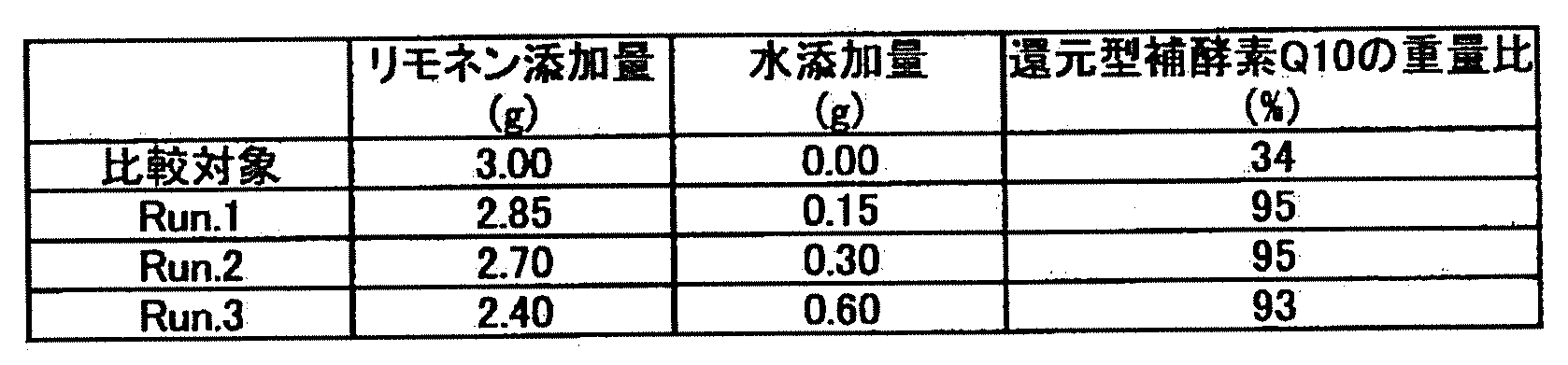
リモネン(d-リモネン)2.85gと、表4に記載したアルコール類等の添加剤各0.15gを、25ml試験管に添加し、ここに酸化型補酵素Q10を200mg(0.23mmol)と、還元剤としてL-アスコルビルパルミテート576mg(6倍当量)を添加して、容器内を窒素置換した後、80℃、16時間撹拌保持して還元反応を行った。反応後の反応液中の還元型補酵素Q10の重量比を表4に示す。また、比較対象としてリモネンを3.00g使用し添加剤を添加しなかった結果も合わせて表4に示す。
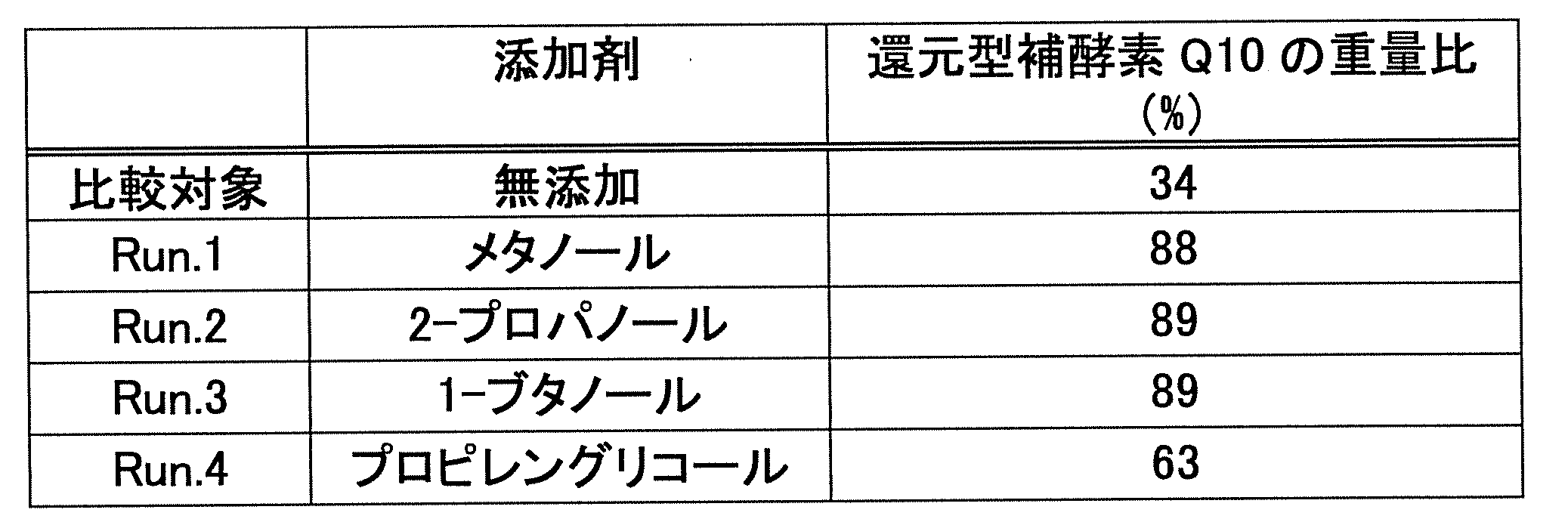
リモネン(d-リモネン)1.50gと表5に記載した界面活性剤又はジアシルグリセロール等の添加剤各1.50gを25ml試験管に添加し、ここに酸化型補酵素Q10を200mg(0.23mmol)と、還元剤としてL-アスコルビルパルミテート576mg(6倍当量)を添加して、容器内を窒素置換した後、80℃、16時間撹拌保持して還元反応を行った。反応後の反応液中の還元型補酵素Q10の重量比を表5に示す。また、比較対象としてリモネンを3.00g使用し添加剤を添加しなかった結果も合わせて表5に示す。
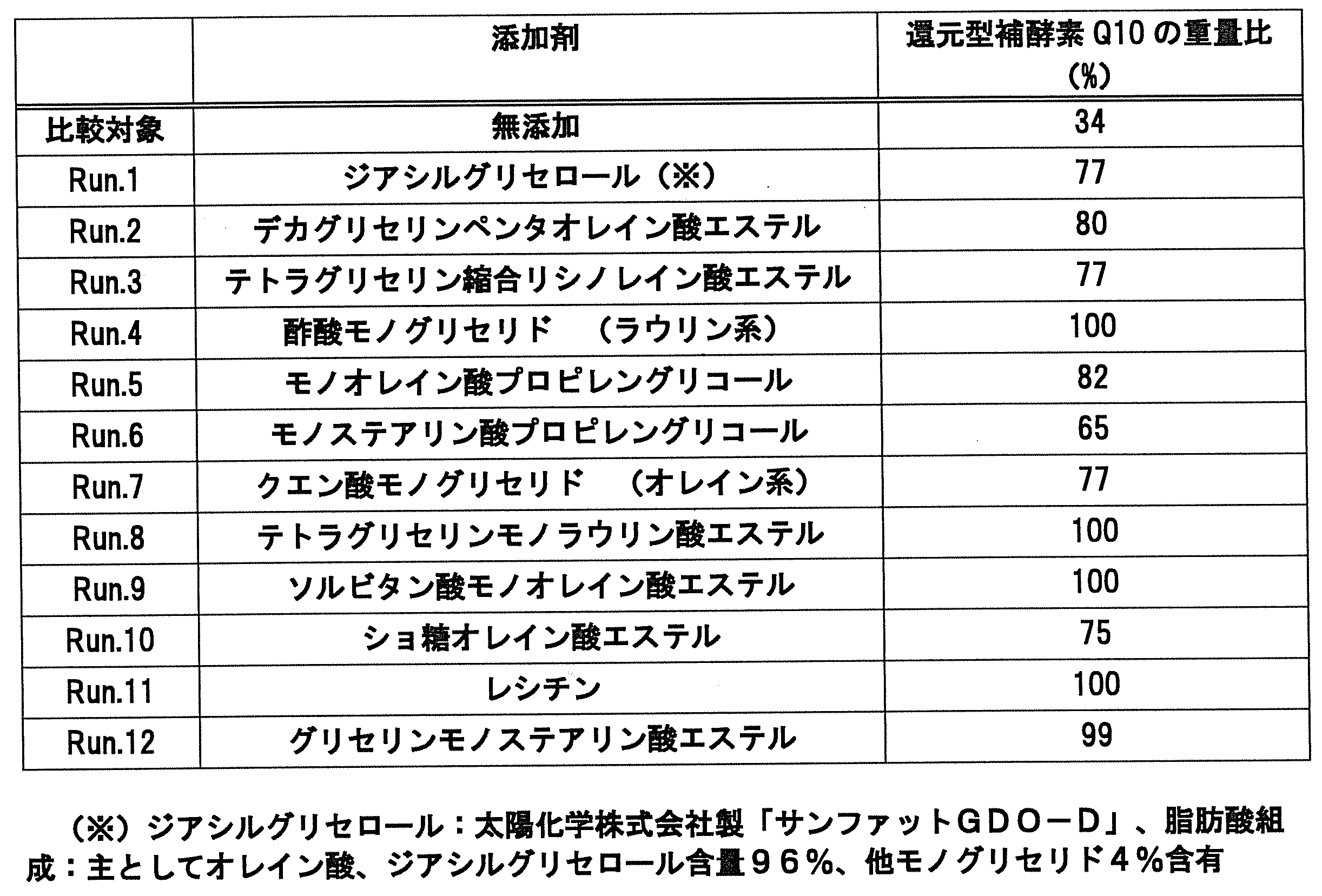
リモネン(d-リモネン)1.50gと表6に記載したアルコール類又は界面活性剤等の添加剤各1.50gを25ml試験管に添加し、ここに酸化型補酵素Q10を200mg(0.23mmol)と、還元剤として松皮抽出物(主成分、ピクノジェノール)2.00g(10倍重量)を添加して、容器内を窒素置換した後、80℃、16時間撹拌保持して還元反応を行った。反応後の反応液中の還元型補酵素Q10の重量比を表6に示す。また、比較対象としてリモネンを3.00g使用し添加剤を添加しなかった結果も合わせて表6に示す。
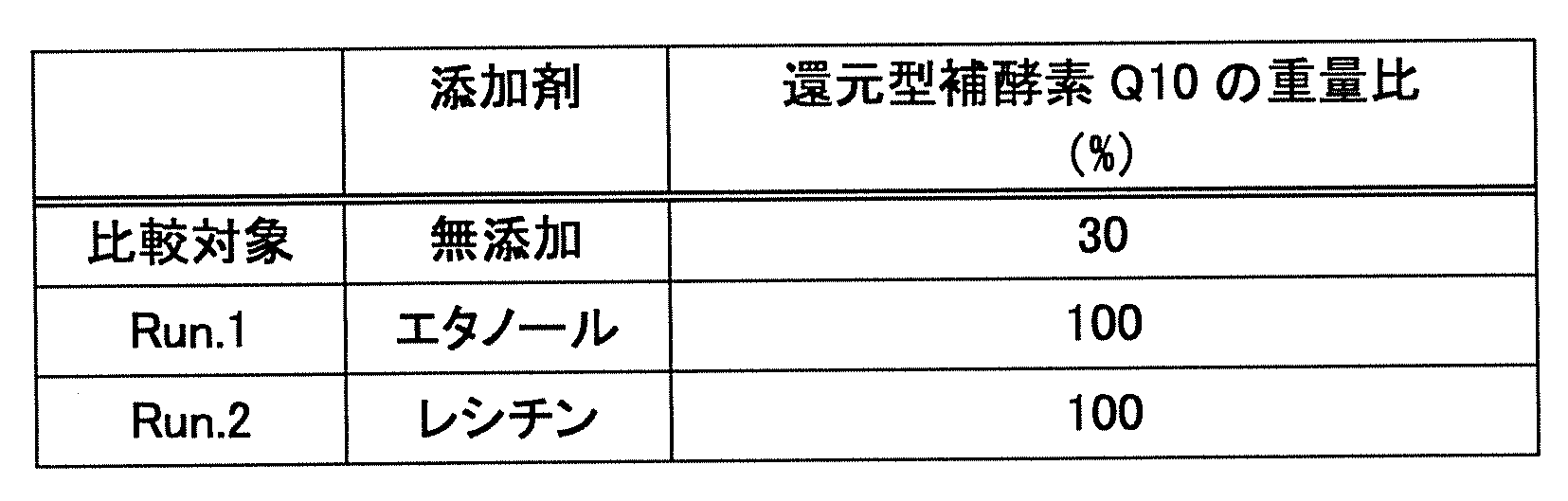
ターピネン1.50gと表7に記載した界面活性剤等の添加剤各1.50gを25ml試験管に添加し、ここに酸化型補酵素Q10を200mg(0.23mmol)と、還元剤としてL-アスコルビン酸245mg(6倍当量)を添加して、容器内を窒素置換した後、80℃、16時間撹拌保持して還元反応を行った。反応後の反応液中の還元型補酵素Q10の重量比を表7に示す。また、比較対象としてターピネンを3.00g使用し添加剤を添加しなかった結果も合わせて表7に示す。
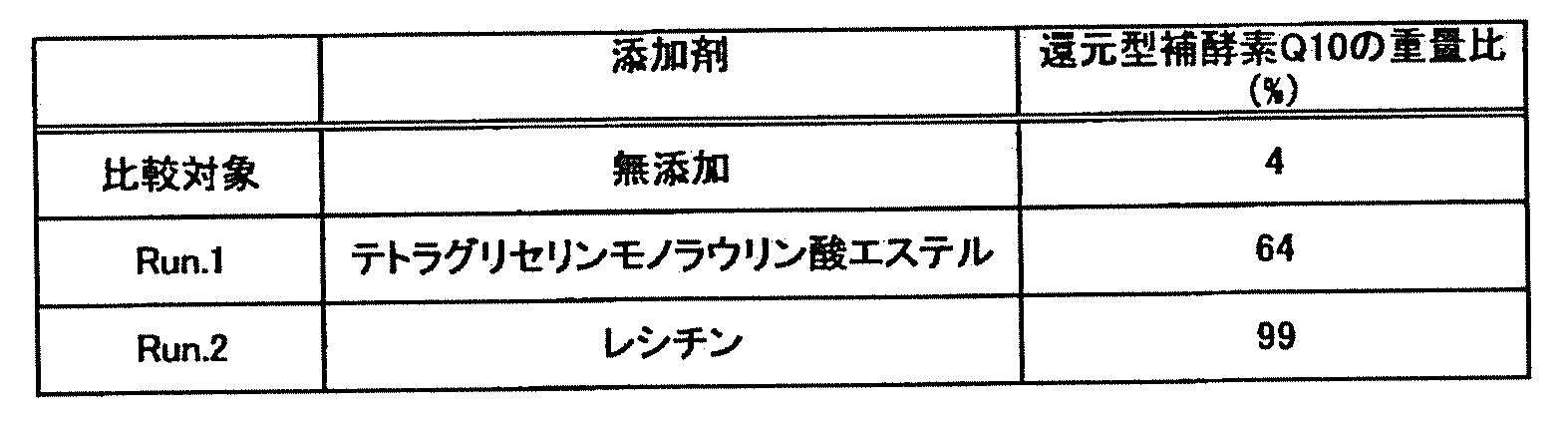
ビサボレン1.50gと表8に記載したアルコール類、水又は界面活性剤等の添加剤各1.50gを25ml試験管に添加し、ここに酸化型補酵素Q10を200mg(0.23mmol)と、還元剤としてL-アスコルビルパルミテート576mg(6倍当量)を添加して、容器内を窒素置換した後、80℃、16時間撹拌保持して還元反応を行った。得られた反応液中の還元型補酵素Q10の重量比を表8に示す。また、比較対象として、ビサボレンを3.00g使用し添加剤を添加しなかった結果も合わせて表8に示す。

ビサボレン1.50gと表9に記載したアルコール類又は界面活性剤等の添加剤各1.50gを25ml試験管に添加し、ここに酸化型補酵素Q10を200mg(0.23mmol)と、還元剤としてL-アスコルビン酸245mg(6倍当量)を添加して、容器内を窒素置換した後、80℃、16時間撹拌保持して還元反応を行った。反応後の反応液中の還元型補酵素Q10の重量比を表9に示す。また、比較対象として、ビサボレンを3.00g使用し添加剤を添加しなかった結果も合わせて表9に示す。
リモネン(d-リモネン)26.5kgとエタノール0.27kgを反応容器に添加し、ここに酸化型補酵素Q10結晶20kg(23.2mol)と、還元剤としてL-アスコルビルパルミテート1.8当量(17.3kg、41.8mol)を添加して、反応容器内を窒素置換した後、80℃、24時間撹拌保持して還元反応を行い、還元型補酵素Q10を含有する組成物を得た。反応後に得られた組成物をそのまま内容物とするゼラチンソフトカプセル製剤を、常法により作製した。
実施例1~9で得た、反応後の還元型補酵素Q10と還元剤を含む組成物と、実施例10で作成したゼラチンソフトカプセルを、それぞれ、空気中、25℃で1週間保存した。保存後の還元型補酵素Q10の重量比は、保存開始時の値より低下していなかった。
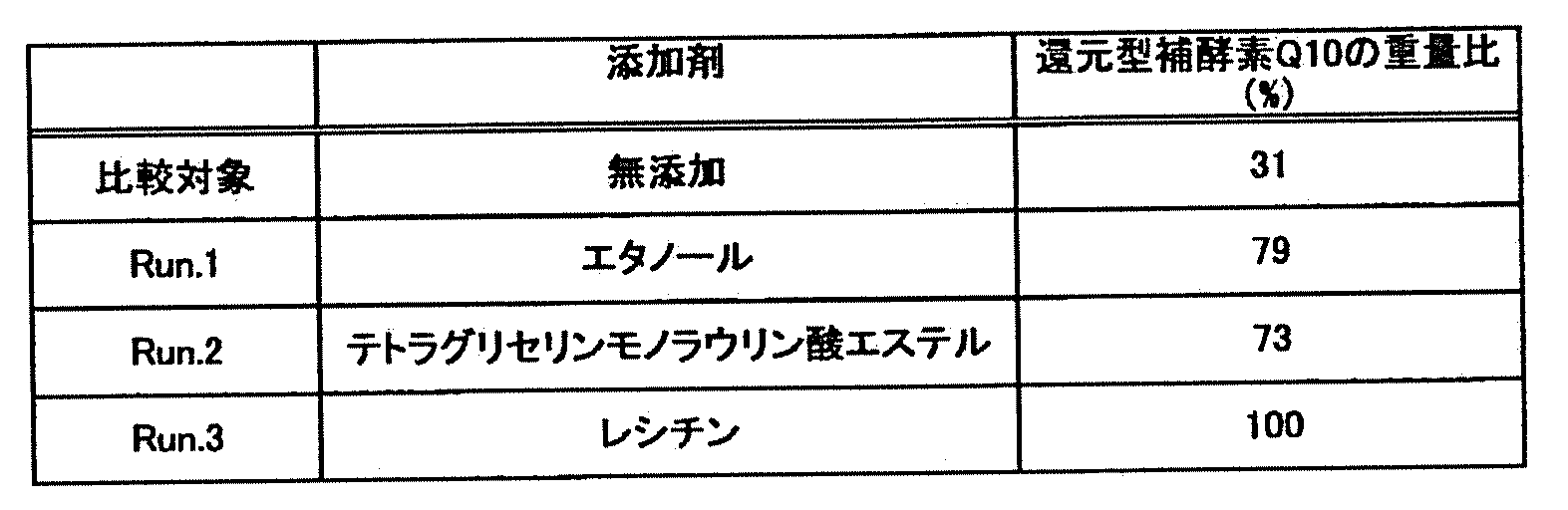
リモネン(d-リモネン)1.5gと表10に記載した各添加剤1.50gを、25ml試験管に添加し、実施例2と同じ方法で、酸化型補酵素Q10を200mg(0.23mmol)、還元剤としてL-アスコルビン酸245mg(6倍当量)を添加して、容器内を窒素置換した後、80℃、16時間撹拌保持して還元反応を行った。反応後の反応液中の還元型補酵素Q10の重量比を表10に示す。また、比較対象としてリモネンを3.00g使用し添加剤を添加しなかった結果も合わせて表10に示す。

Claims (30)
- アルコール類、水、界面活性剤及びジアシルグリセロールからなる群より選ばれる少なくとも1種の添加剤の共存下、テルペン類中で、還元剤を用いて酸化型補酵素Q10を還元することを特徴とする、還元型補酵素Q10の製造方法。
- アルコール類が炭素数1~4の1価アルコール又は炭素数2~4の2価アルコールである請求項1に記載の製造方法。
- アルコール類がエタノールである請求項1に記載の製造方法。
- 界面活性剤が、グリセリン脂肪酸エステル、ショ糖脂肪酸エステル、有機酸モノグリセリド、ソルビタン脂肪酸エステル、ポリオキシエチレンソルビタン脂肪酸エステル、プロピレングリコール脂肪酸エステル、ポリグリセリン縮合リシノレイン酸エステル、サポニン及びリン脂質からなる群より選ばれる少なくとも1つである請求項1に記載の製造方法。
- テルペン類が、ヘミテルペン、モノテルペン、セスキテルペン、ジテルペン、セスタテルペン及びトリテルペンからなる群より選ばれる少なくとも1つである請求項1に記載の製造方法。
- 還元剤が、L-アスコルビン酸、D-arabo-アスコルビン酸、L-アスコルビルパルミテート、L-アスコルビルステアレート、水素化ホウ素ナトリウム、次亜硫酸ナトリウム、レチナール、アセロラ抽出物、松皮抽出物、黄杞葉抽出物、クチナシ色素及び香酢からなる群より選ばれる少なくとも1つである請求項1に記載の製造方法。
- 還元反応時に、さらに、油脂を共存させる請求項1~6のいずれか1項に記載の製造方法。
- 油脂が、ヤシ油、パーム油、パーム核油、アマニ油、つばき油、玄米胚芽油、オリーブ油、菜種油、米油、落花生油、コーン油、小麦胚芽油、大豆油、エゴマ油、綿実油、ヒマワリ種子油、カポック油、月見草油、シア脂、サル脂、カカオ脂、ゴマ油、サフラワー油、アボカド油、けし油、ごぼう子油、豚脂、乳脂、魚油、牛脂、これらを分別、水素添加、エステル交換等により加工した油脂、中鎖脂肪酸トリグリセリド及び脂肪酸の部分グリセリドからなる群より選ばれる少なくとも1種である請求項7に記載の製造方法。
- 還元反応開始時の反応液の全量に対する酸化型補酵素Q10濃度が0.001重量%以上である請求項1~8のいずれか1項に記載の製造方法。
- 製剤中で還元反応を行う請求項1~9のいずれか1項に記載の製造方法。
- 製剤がカプセル剤である請求項10に記載の製造方法。
- カプセル剤がソフトカプセルである請求項11に記載の製造方法。
- 還元反応を脱酸素雰囲気下に行う請求項1~12のいずれか1項に記載の製造方法。
- アルコール類、水、界面活性剤及びジアシルグリセロールからなる群より選ばれる少なくとも1種と、テルペン類、還元剤及び還元型補酵素Q10を含有する組成物。
- アルコール類が炭素数1~4の1価アルコール又は炭素数2~4の2価アルコールである請求項14に記載の組成物。
- 界面活性剤が、グリセリン脂肪酸エステル、ショ糖脂肪酸エステル、有機酸モノグリセリド、ソルビタン脂肪酸エステル、ポリオキシエチレンソルビタン脂肪酸エステル、プロピレングリコール脂肪酸エステル、ポリグリセリン縮合リシノレイン酸エステル、サポニン及びリン脂質からなる群より選ばれる少なくとも1つである請求項14に記載の組成物。
- テルペン類が、ヘミテルペン、モノテルペン、セスキテルペン、ジテルペン、セスタテルペン及びトリテルペンからなる群より選ばれる少なくとも1つである請求項14に記載の組成物。
- 還元剤が、L-アスコルビン酸、D-arabo-アスコルビン酸、L-アスコルビルパルミテート、L-アスコルビルステアレート、水素化ホウ素ナトリウム、次亜硫酸ナトリウム、レチナール、アセロラ抽出物、松皮抽出物、黄杞葉抽出物、クチナシ色素及び香酢からなる群より選ばれる少なくとも1つである請求項14に記載の組成物。
- さらに、油脂を含有する請求項14~18のいずれか1項に記載の組成物。
- 組成物中の還元型補酵素Q10含有量が0.001重量%以上である請求項14~19のいずれか1項に記載の組成物。
- 還元型補酵素Q10が、外部添加されたものである請求項14~20のいずれか1項に記載の組成物。
- 還元型補酵素Q10が、組成物中で還元されたものである請求項14~20のいずれか1項に記載の組成物。
- アルコール類、水、界面活性剤及びジアシルグリセロールからなる群より選ばれる少なくとも1種と、テルペン類及び還元剤を共存させることを特徴とする還元型補酵素Q10の安定化方法。
- アルコール類が炭素数1~4の1価アルコール又は炭素数2~4の2価アルコールである請求項23に記載の安定化方法。
- 界面活性剤が、グリセリン脂肪酸エステル、ショ糖脂肪酸エステル、有機酸モノグリセリド、ソルビタン脂肪酸エステル、ポリオキシエチレンソルビタン脂肪酸エステル、プロピレングリコール脂肪酸エステル、ポリグリセリン縮合リシノレイン酸エステル、サポニン及びリン脂質からなる群より選ばれる少なくとも1つである請求項23に記載の安定化方法。
- テルペン類が、ヘミテルペン、モノテルペン、セスキテルペン、ジテルペン、セスタテルペン及びトリテルペンからなる群より選ばれる少なくとも1つである請求項23に記載の安定化方法。
- 還元剤が、L-アスコルビン酸、D-arabo-アスコルビン酸、L-アスコルビルパルミテート、L-アスコルビルステアレート、水素化ホウ素ナトリウム、次亜硫酸ナトリウム、レチナール、アセロラ抽出物、松皮抽出物、黄杞葉抽出物、クチナシ色素及び香酢からなる群より選ばれる少なくとも1つである請求項23に記載の安定化方法。
- さらに、油脂を共存させる請求項23~27のいずれか1項に記載の安定化方法。
- 外部添加された還元型補酵素Q10を使用する、請求項23~28のいずれか1項に記載の安定化方法。
- 脱酸素雰囲気下に共存させることを特徴とする請求項23~29のいずれか1項に記載の安定化方法。
Priority Applications (2)
| Application Number | Priority Date | Filing Date | Title |
|---|---|---|---|
| JP2012511691A JP5810079B2 (ja) | 2010-04-20 | 2011-04-20 | 還元型補酵素q10含有組成物とその製造方法及び安定化方法 |
| US13/642,375 US20130142767A1 (en) | 2010-04-20 | 2011-04-20 | Composition containing reduced coenzyme q10, and manufacturing and stabilising methods therefor |
Applications Claiming Priority (2)
| Application Number | Priority Date | Filing Date | Title |
|---|---|---|---|
| JP2010-097263 | 2010-04-20 | ||
| JP2010097263 | 2010-04-20 |
Publications (1)
| Publication Number | Publication Date |
|---|---|
| WO2011132718A1 true WO2011132718A1 (ja) | 2011-10-27 |
Family
ID=44834235
Family Applications (1)
| Application Number | Title | Priority Date | Filing Date |
|---|---|---|---|
| PCT/JP2011/059762 Ceased WO2011132718A1 (ja) | 2010-04-20 | 2011-04-20 | 還元型補酵素q10含有組成物とその製造方法及び安定化方法 |
Country Status (3)
| Country | Link |
|---|---|
| US (1) | US20130142767A1 (ja) |
| JP (1) | JP5810079B2 (ja) |
| WO (1) | WO2011132718A1 (ja) |
Cited By (5)
| Publication number | Priority date | Publication date | Assignee | Title |
|---|---|---|---|---|
| CN102516213A (zh) * | 2011-11-30 | 2012-06-27 | 浙江大学 | 一种倍半萜化合物及其制备方法和应用 |
| WO2016208658A1 (ja) * | 2015-06-23 | 2016-12-29 | 株式会社カネカ | 還元型補酵素q10の製造方法 |
| JP2018057329A (ja) * | 2016-10-05 | 2018-04-12 | 株式会社ディーエイチシー | 油脂組成物及びカプセル剤 |
| JP2019026600A (ja) * | 2017-07-31 | 2019-02-21 | 富士カプセル株式会社 | ソフトカプセル充填用組成物およびソフトカプセル剤 |
| EP4454643A4 (en) * | 2021-12-24 | 2025-11-05 | Kaneka Corp | REDUCED Q10 COENZYME PRESERVATION PROCESS |
Families Citing this family (3)
| Publication number | Priority date | Publication date | Assignee | Title |
|---|---|---|---|---|
| US20180132514A1 (en) * | 2016-11-16 | 2018-05-17 | Sensorygen, Inc. | Natural sweetener compositions |
| CA3128882A1 (en) | 2019-03-18 | 2020-09-24 | Sunstar Americas, Inc. | Oral care composition |
| US11471426B2 (en) | 2019-10-16 | 2022-10-18 | American River Nutrition, Llc | Compositions comprising quinone and/or quinol and methods of preparations and use thereof |
Citations (9)
| Publication number | Priority date | Publication date | Assignee | Title |
|---|---|---|---|---|
| JP2006070016A (ja) * | 2004-08-02 | 2006-03-16 | Kaneka Corp | 還元型補酵素qを含有する美白用組成物 |
| JP2006328024A (ja) * | 2005-05-30 | 2006-12-07 | Seiren Co Ltd | 皮膚用外用剤 |
| JP2007507427A (ja) * | 2003-09-29 | 2007-03-29 | ソフト ジェル テクノロジーズ, インコーポレイテッド | 可溶化されたCoQ−10 |
| JP2007526303A (ja) * | 2004-03-03 | 2007-09-13 | ソフト ジェル テクノロジーズ, インコーポレイテッド | 可溶化coq−10およびカルニチン |
| WO2008113066A2 (en) * | 2007-03-15 | 2008-09-18 | Soft Gel Technologies, Inc. | Ubiquinol and alpha lipoic compositions |
| WO2009025277A1 (ja) * | 2007-08-22 | 2009-02-26 | Kaneka Corporation | 還元型補酵素q10の製造方法、ならびに、その安定化方法 |
| WO2009136587A1 (ja) * | 2008-05-08 | 2009-11-12 | 株式会社カネカ | 抗疲労組成物 |
| WO2011046199A1 (ja) * | 2009-10-16 | 2011-04-21 | 株式会社カネカ | 還元型補酵素q10の製造方法、安定化方法及びそれを含有する組成物 |
| WO2011045934A1 (ja) * | 2009-10-16 | 2011-04-21 | 株式会社カネカ | 還元型補酵素q10の製造方法、安定化方法及びそれを含有する組成物 |
Family Cites Families (6)
| Publication number | Priority date | Publication date | Assignee | Title |
|---|---|---|---|---|
| CA2650686C (en) * | 2006-04-28 | 2014-12-16 | Kaneka Corporation | Method for stabilization of reduced coenzyme q10 |
| US8642030B2 (en) * | 2006-08-25 | 2014-02-04 | Epc Europe Gmbh | Compositions containing coenzyme Q-10 and dihydrolipoic acid |
| TW200916090A (en) * | 2007-06-22 | 2009-04-16 | Kaneka Corp | Composition comprising coenzyme Q10 |
| JPWO2009025372A1 (ja) * | 2007-08-23 | 2010-11-25 | 株式会社カネカ | 還元型補酵素q10含有組成物及びその安定化方法 |
| JP4598873B2 (ja) * | 2007-10-30 | 2010-12-15 | 株式会社カネカ | 含水有機溶媒を用いる還元型補酵素q10の製造方法 |
| JP5546935B2 (ja) * | 2010-04-20 | 2014-07-09 | 株式会社カネカ | 還元型補酵素q10含有組成物及びその製法方法 |
-
2011
- 2011-04-20 WO PCT/JP2011/059762 patent/WO2011132718A1/ja not_active Ceased
- 2011-04-20 JP JP2012511691A patent/JP5810079B2/ja active Active
- 2011-04-20 US US13/642,375 patent/US20130142767A1/en not_active Abandoned
Patent Citations (9)
| Publication number | Priority date | Publication date | Assignee | Title |
|---|---|---|---|---|
| JP2007507427A (ja) * | 2003-09-29 | 2007-03-29 | ソフト ジェル テクノロジーズ, インコーポレイテッド | 可溶化されたCoQ−10 |
| JP2007526303A (ja) * | 2004-03-03 | 2007-09-13 | ソフト ジェル テクノロジーズ, インコーポレイテッド | 可溶化coq−10およびカルニチン |
| JP2006070016A (ja) * | 2004-08-02 | 2006-03-16 | Kaneka Corp | 還元型補酵素qを含有する美白用組成物 |
| JP2006328024A (ja) * | 2005-05-30 | 2006-12-07 | Seiren Co Ltd | 皮膚用外用剤 |
| WO2008113066A2 (en) * | 2007-03-15 | 2008-09-18 | Soft Gel Technologies, Inc. | Ubiquinol and alpha lipoic compositions |
| WO2009025277A1 (ja) * | 2007-08-22 | 2009-02-26 | Kaneka Corporation | 還元型補酵素q10の製造方法、ならびに、その安定化方法 |
| WO2009136587A1 (ja) * | 2008-05-08 | 2009-11-12 | 株式会社カネカ | 抗疲労組成物 |
| WO2011046199A1 (ja) * | 2009-10-16 | 2011-04-21 | 株式会社カネカ | 還元型補酵素q10の製造方法、安定化方法及びそれを含有する組成物 |
| WO2011045934A1 (ja) * | 2009-10-16 | 2011-04-21 | 株式会社カネカ | 還元型補酵素q10の製造方法、安定化方法及びそれを含有する組成物 |
Cited By (8)
| Publication number | Priority date | Publication date | Assignee | Title |
|---|---|---|---|---|
| CN102516213A (zh) * | 2011-11-30 | 2012-06-27 | 浙江大学 | 一种倍半萜化合物及其制备方法和应用 |
| WO2016208658A1 (ja) * | 2015-06-23 | 2016-12-29 | 株式会社カネカ | 還元型補酵素q10の製造方法 |
| JPWO2016208658A1 (ja) * | 2015-06-23 | 2018-04-12 | 株式会社カネカ | 還元型補酵素q10の製造方法 |
| US10239811B2 (en) | 2015-06-23 | 2019-03-26 | Kaneka Corporation | Process for producing reduced coenzyme Q10 |
| JP2018057329A (ja) * | 2016-10-05 | 2018-04-12 | 株式会社ディーエイチシー | 油脂組成物及びカプセル剤 |
| JP2019026600A (ja) * | 2017-07-31 | 2019-02-21 | 富士カプセル株式会社 | ソフトカプセル充填用組成物およびソフトカプセル剤 |
| JP7022973B2 (ja) | 2017-07-31 | 2022-02-21 | 富士カプセル株式会社 | ソフトカプセル充填用組成物およびソフトカプセル剤 |
| EP4454643A4 (en) * | 2021-12-24 | 2025-11-05 | Kaneka Corp | REDUCED Q10 COENZYME PRESERVATION PROCESS |
Also Published As
| Publication number | Publication date |
|---|---|
| JP5810079B2 (ja) | 2015-11-11 |
| US20130142767A1 (en) | 2013-06-06 |
| JPWO2011132718A1 (ja) | 2013-07-18 |
Similar Documents
| Publication | Publication Date | Title |
|---|---|---|
| JP5810079B2 (ja) | 還元型補酵素q10含有組成物とその製造方法及び安定化方法 | |
| DK2017251T3 (en) | Method for Stabilizing Reduced Coenzyme Q10 | |
| JP5364580B2 (ja) | 還元型補酵素q10の製造方法、ならびに、その安定化方法 | |
| US20070258967A1 (en) | Purification method of reduced coenzyme q10 | |
| JP5546935B2 (ja) | 還元型補酵素q10含有組成物及びその製法方法 | |
| JP4855551B2 (ja) | 還元型補酵素q10の製造方法、安定化方法及びそれを含有する組成物 | |
| WO2008029909A1 (fr) | Composition comprenant une coenzyme q10 réduite et de la lysolécithine | |
| JP4786000B2 (ja) | 還元型補酵素q10の製造方法、安定化方法及びそれを含有する組成物 | |
| WO2023120555A1 (ja) | 還元型補酵素q10の保存方法 |
Legal Events
| Date | Code | Title | Description |
|---|---|---|---|
| 121 | Ep: the epo has been informed by wipo that ep was designated in this application |
Ref document number: 11772051 Country of ref document: EP Kind code of ref document: A1 |
|
| WWE | Wipo information: entry into national phase |
Ref document number: 2012511691 Country of ref document: JP |
|
| NENP | Non-entry into the national phase |
Ref country code: DE |
|
| WWE | Wipo information: entry into national phase |
Ref document number: 13642375 Country of ref document: US |
|
| 122 | Ep: pct application non-entry in european phase |
Ref document number: 11772051 Country of ref document: EP Kind code of ref document: A1 |