WO2011125818A1 - インクジェット記録用紙 - Google Patents
インクジェット記録用紙 Download PDFInfo
- Publication number
- WO2011125818A1 WO2011125818A1 PCT/JP2011/058176 JP2011058176W WO2011125818A1 WO 2011125818 A1 WO2011125818 A1 WO 2011125818A1 JP 2011058176 W JP2011058176 W JP 2011058176W WO 2011125818 A1 WO2011125818 A1 WO 2011125818A1
- Authority
- WO
- WIPO (PCT)
- Prior art keywords
- ink
- recording paper
- jet recording
- receiving layer
- ink jet
- Prior art date
- Legal status (The legal status is an assumption and is not a legal conclusion. Google has not performed a legal analysis and makes no representation as to the accuracy of the status listed.)
- Ceased
Links
Classifications
-
- B—PERFORMING OPERATIONS; TRANSPORTING
- B41—PRINTING; LINING MACHINES; TYPEWRITERS; STAMPS
- B41M—PRINTING, DUPLICATING, MARKING, OR COPYING PROCESSES; COLOUR PRINTING
- B41M5/00—Duplicating or marking methods; Sheet materials for use therein
- B41M5/50—Recording sheets characterised by the coating used to improve ink, dye or pigment receptivity, e.g. for ink-jet or thermal dye transfer recording
- B41M5/502—Recording sheets characterised by the coating used to improve ink, dye or pigment receptivity, e.g. for ink-jet or thermal dye transfer recording characterised by structural details, e.g. multilayer materials
- B41M5/504—Backcoats
-
- D—TEXTILES; PAPER
- D21—PAPER-MAKING; PRODUCTION OF CELLULOSE
- D21H—PULP COMPOSITIONS; PREPARATION THEREOF NOT COVERED BY SUBCLASSES D21C OR D21D; IMPREGNATING OR COATING OF PAPER; TREATMENT OF FINISHED PAPER NOT COVERED BY CLASS B31 OR SUBCLASS D21G; PAPER NOT OTHERWISE PROVIDED FOR
- D21H19/00—Coated paper; Coating material
- D21H19/36—Coatings with pigments
- D21H19/38—Coatings with pigments characterised by the pigments
-
- B—PERFORMING OPERATIONS; TRANSPORTING
- B41—PRINTING; LINING MACHINES; TYPEWRITERS; STAMPS
- B41M—PRINTING, DUPLICATING, MARKING, OR COPYING PROCESSES; COLOUR PRINTING
- B41M2205/00—Printing methods or features related to printing methods; Location or type of the layers
- B41M2205/34—Both sides of a layer or material are treated, e.g. coated
-
- B—PERFORMING OPERATIONS; TRANSPORTING
- B41—PRINTING; LINING MACHINES; TYPEWRITERS; STAMPS
- B41M—PRINTING, DUPLICATING, MARKING, OR COPYING PROCESSES; COLOUR PRINTING
- B41M2205/00—Printing methods or features related to printing methods; Location or type of the layers
- B41M2205/36—Backcoats; Back layers
-
- B—PERFORMING OPERATIONS; TRANSPORTING
- B41—PRINTING; LINING MACHINES; TYPEWRITERS; STAMPS
- B41M—PRINTING, DUPLICATING, MARKING, OR COPYING PROCESSES; COLOUR PRINTING
- B41M5/00—Duplicating or marking methods; Sheet materials for use therein
- B41M5/50—Recording sheets characterised by the coating used to improve ink, dye or pigment receptivity, e.g. for ink-jet or thermal dye transfer recording
- B41M5/52—Macromolecular coatings
- B41M5/5218—Macromolecular coatings characterised by inorganic additives, e.g. pigments, clays
-
- D—TEXTILES; PAPER
- D21—PAPER-MAKING; PRODUCTION OF CELLULOSE
- D21H—PULP COMPOSITIONS; PREPARATION THEREOF NOT COVERED BY SUBCLASSES D21C OR D21D; IMPREGNATING OR COATING OF PAPER; TREATMENT OF FINISHED PAPER NOT COVERED BY CLASS B31 OR SUBCLASS D21G; PAPER NOT OTHERWISE PROVIDED FOR
- D21H19/00—Coated paper; Coating material
- D21H19/80—Paper comprising more than one coating
- D21H19/84—Paper comprising more than one coating on both sides of the substrate
Definitions
- the present invention relates to an ink jet recording paper, has high color developability, is capable of double-sided recording, and is particularly excellent in printer transportability when used in a high-speed sheet-fed ink jet printer having a line head. About.
- the ink jet recording method has been rapidly spread in recent years because it is easy to make full color and has less printing noise.
- fine droplets of ink are ejected at high speed from a nozzle toward a recording medium, and images and characters are recorded.
- the inkjet recording paper If the inkjet recording paper is not transportable, it will not be fed to the printer, or multiple feeds will be caused by overlapping multiple sheets, causing problems. This is also a problem in home inkjet printers, but is particularly fatal in commercial high-speed sheet-fed printers characterized by high-speed printing. For such troubles, a method for improving transportability by providing a backcoat layer on the opposite surface of the inkjet recording surface (see, for example, Patent Document 2) has been disclosed. Double-sided recording is not possible because the surface does not have inkjet suitability.
- Patent Document 3 a method (see Patent Document 3) is disclosed in which organic spherical particles are contained in the ink receiving layer so that the coefficient of static friction between the front surface and the back surface of the ink jet recording paper is 0.7 or less. It is intended for inkjet printers and is not preferred for commercial high-speed sheet-fed printers.
- the present invention has an object to obtain an ink jet recording paper having high color developability, capable of double-sided recording, and particularly excellent in printer transportability when used in a high-speed sheet-fed ink jet printer having a line head. To do.
- the present invention is an ink jet recording paper in which an ink receiving layer containing an inorganic pigment is provided on both sides of a support, the ink receiving layer on at least one side contains organic spherical particles, and JIS P 8147: 1994
- the coefficient of static friction between the front surface and the back surface of the ink jet recording paper measured according to “Method for testing friction coefficient of paper and paperboard” (horizontal method) is 0.65 or more and 0.85 or less. Inkjet recording paper.
- the coefficient of static friction between the front surface and the back surface of the ink jet recording paper is controlled to a desired range. It is effective and preferable.
- the inorganic pigment is a synthetic amorphous silica, and the coating amount of the ink-receiving layer is in the range of per side 1g / m 2 ⁇ 4g / m 2, high coloring property can be obtained, preferably .
- the compounding quantity of the said organic spherical particle is 0.5 to 3 mass parts with respect to 100 mass parts of inorganic pigments.
- an ink jet recording paper having high color developability capable of double-sided recording, and particularly excellent in printer transportability when used in a high-speed sheet-fed ink jet printer having a line head.
- the ink jet recording paper in the present invention preferably comprises a support having a sheet shape and an ink receiving layer formed on both sides thereof.
- the support of the inkjet recording paper of the present invention is not particularly limited, and is a sheet-like substance such as paper mainly made of wood fiber (pulp), plastics such as polyethylene, or non-woven fabric mainly made of wood fiber or synthetic fiber. Can be used. Moreover, what bonded together the different kind of sheet-like substance mentioned above can also be used as a support body. In the present invention, it is desirable to use paper as a support, particularly in terms of excellent ink absorbability.
- wood pulp constituting the paper support chemical pulps such as LBKP and NBKP, mechanical pulps such as GP, PGW, RMP, TMP, CTMP, CMP and CGP, and pulps such as waste paper pulp such as DIP are used alone or in combination. It is possible to use.
- the paper support is mixed with various additives such as fillers, binders, sizing agents, fixing agents, yield improvers, paper strength enhancers, etc., which are conventionally known, in the above wood pulp. It can be obtained by drying after forming a web with various paper machines such as a paper machine and a twin wire paper machine.
- the presence or absence of an internal sizing agent, the presence or absence of an internal filler, and the presence or absence of a size press are not limited.
- a conventionally known white pigment can be used as the inorganic pigment used in the ink receiving layer of the present invention.
- a conventionally known white pigment can be used.
- synthetic amorphous silica or alumina having an oil absorption amount of 150 ml / 100 g to 350 ml / 100 g according to a measurement method in accordance with JIS K 5101 to obtain an ink jet recording paper having good print quality. be able to.
- organic spherical particles used in the ink receiving layer of the present invention include polyamide resin, polyester resin, polycarbonate resin, polyether resin, polyolefin resin, polysulfone resin, polystyrene resin, polyurethane resin, polyacrylic resin, polychlorinated resin.
- Common organic spherical particles such as vinyl resins, polyvinylidene chloride resins, ethylene-vinyl acetate copolymer resins, and styrene copolymer resins can be listed.
- the ink receiving layer of the present invention contains a hydrophilic binder in order to maintain the properties as a coating film.
- the hydrophilic binder include polyvinyl alcohol and modified products thereof, oxidized starch, etherified starch, casein, gelatin, soy protein, carboxymethyl cellulose, SB latex, NB latex, acrylic latex, vinyl acetate polymer latex, ethylene acetate Vinyl latex, polyurethane, unsaturated polyester resin, etc. can be used.
- at least one of these hydrophilic binders can be used, and the blending amount is preferably 20 to 80 parts by weight with respect to 100 parts by weight of the inorganic pigment.
- the ink receiving layer preferably contains a cationic water-soluble resin.
- the cationic water-soluble resin used in the present invention include secondary amines, tertiary amines, and quaternary ammonium salts such as polyethyleneimine salts, dimethylamine epihalohydrin condensates, polyvinylamine salts, polyallylamine salts, and polydimethylaminoethyl. Examples thereof include methacrylate quaternary salts, polydiallyldimethylammonium salts, diallylamine acrylamide copolymer salts, and quaternary ammonium salts of polystyrene. Two or more of these cationic resins can be used in combination.
- a sizing agent pigment dispersant, thickener, fluidity improver, surfactant, antifoaming agent, antifoaming agent, release agent, foaming agent, penetrating agent, coloring dye on the support or ink receiving layer , Fluorescent whitening agents, ultraviolet absorbers, antioxidants, antiseptics, antibacterial agents, water resistance agents, wet paper strength enhancers, dry paper strength enhancers, water retention agents, and the like can be appropriately contained as necessary. .
- the total number and configuration of the coating layer and the ink receiving layer provided on the support are not particularly limited.
- the application amount of the ink receiving layer (dry coating amount) is preferably a single-sided per 1g / m 2 ⁇ 4g / m 2, more preferably from 1.5g / m 2 ⁇ 4g / m 2.
- the coating amount of the ink receiving layer is less than 1 g / m 2 , the color developability is lowered or the ink absorbability is lowered, so that the ink jet printing performance is adversely affected. Further, if the coating amount of the ink receiving layer exceeds 4 g / m 2 , the ink absorbability is good, but on the other hand, the color developability is lowered, which is not preferable.
- Various apparatuses such as a gravure coater, a flexographic gravure coater, and a size press can be used on-machine or off-machine.
- a calendar device such as a machine calendar, a super calendar, or a soft calendar after coating the ink receiving layer.
- the reason why it is possible to obtain an inkjet recording paper having high color developability, capable of double-sided recording, and particularly excellent in printer transportability when used in a high-speed sheet-fed inkjet printer having a line head It is explained as follows.
- One possible cause of printer transport problems is that the coefficient of friction between the stacked inkjet recording sheets is not in the proper range. If the friction coefficient is too high, slippage between the ink jet recording papers becomes worse, and a trouble that the ink jet recording paper is not conveyed into the printer occurs.
- the average particle size of the organic spherical fine particles is preferably 2 to 8 times the average particle size of the inorganic pigment. If the average particle size of the organic spherical fine particles is less than twice the average particle size of the inorganic pigment, the effect of reducing the static friction coefficient is low, and it is difficult to make it 0.65 or more and 0.85 or less. Ink absorbability decreases.
- the average particle size of the organic spherical fine particles is preferably 5 to 20 ⁇ m, more preferably 5 to 10 ⁇ m.
- the average particle diameter of the organic spherical fine particles is measured by a laser diffraction / scattering method. As a measuring device of the laser diffraction / scattering method, for example, there is Master Sizer S type manufactured by Malvern.
- the organic sucking fine particles are mixed in the ink receiving layer in the range of 0.5 to 3 parts by mass with respect to 100 parts by mass of the inorganic pigment.
- the blending amount of the organic sucking fine particles is less than 0.5 parts by mass, the static friction reducing effect is low, and it is difficult to make the range of the static friction coefficient measured according to JIS P 8147 from 0.65 to 0.85, It becomes difficult to be transported into the printer.
- the blending amount of the organic sucking fine particles exceeds 3 parts by mass, the coefficient of static friction becomes too low, and a plurality of papers are conveyed at a time or the ink absorbability is lowered.
- Example 1 (Support) Neutral rosin sizing agent 0.3 parts for 70 parts of pulp slurry with hardwood bleached kraft pulp beaten to adjust Canada standard freeness to 350 ml, and 30 parts of waste paper pulp slurry (Canadian standard freeness 350 ml) Then, 0.3 parts of sulfuric acid band, 0.7 parts of cationized starch, 13 parts of calcium carbonate as filler, 6.5 parts of kaolin, 0.015 part of yield improver were added, and paper was made with a twin wire type paper machine. .
- (Ink receiving layer) Synthetic amorphous silica as an inorganic pigment (product name: Nipgel AZ-200: average particle size 2.4 ⁇ m, oil absorption 330 ml / 100 g, manufactured by Tosoh Silica Corporation), organic spherical particles (product name: Art Pearl G) -800, transparent acrylic resin, average particle size 6 ⁇ m, 0.5 parts by Negami Kogyo Co., Ltd., polyvinyl alcohol (product name: PVA-117, Kuraray Co., Ltd.) 60 parts, cationic resin (product name: Sumirez) Resin 1001, manufactured by Taoka Chemical Co., Ltd.) 20 parts, antifoaming agent (product name: SN deformer 480, manufactured by San Nopco Co., Ltd.) 0.5 part, dilution water, etc.
- organic spherical particles product name: Art Pearl G
- transparent acrylic resin average particle size 6 ⁇ m
- Negami Kogyo Co., Ltd. polyvin
- a liquid was prepared. This coating solution was applied to both sides of the support using an air knife coater so that the dry coating amount was 3.5 g / m 2 per side to obtain an ink jet recording paper.
- the average particle diameter of the organic spherical fine particles was measured by a laser diffraction / scattering method (Mastersizer S type manufactured by Malvern).
- Example 2 An ink jet recording paper was obtained in exactly the same manner as in Example 1 except that the blending part of the organic spherical particles in the ink receiving layer was changed to 1 part.
- Example 3 An ink jet recording sheet was obtained in exactly the same manner as in Example 1 except that the blending number of organic spherical particles in the ink receiving layer was changed to 2 parts.
- Example 4 An ink jet recording paper was obtained in exactly the same manner as in Example 1 except that the blending number of organic spherical particles in the ink receiving layer was changed to 5 parts.
- Example 5 Inkjet recording was carried out in the same manner as in Example 1, except that the organic spherical particles in the ink receiving layer were changed to 0.5 part of Art Pearl GR-600 (transparent acrylic resin, average particle size 10 ⁇ m, manufactured by Negami Kogyo Co., Ltd.). Got the paper.
- Art Pearl GR-600 transparent acrylic resin, average particle size 10 ⁇ m, manufactured by Negami Kogyo Co., Ltd.
- Example 6 An ink jet recording paper was prepared in the same manner as in Example 1 except that the organic spherical particles of the ink receiving layer were changed to 1 part of Art Pearl GR-600 (transparent acrylic resin, average particle size 10 ⁇ m, manufactured by Negami Kogyo Co., Ltd.). Obtained.
- Art Pearl GR-600 transparent acrylic resin, average particle size 10 ⁇ m, manufactured by Negami Kogyo Co., Ltd.
- Example 7 An ink jet recording paper was prepared in the same manner as in Example 1 except that the organic spherical particles of the ink receiving layer were changed to 2 parts of Art Pearl GR-600 (transparent acrylic resin, average particle size 10 ⁇ m, manufactured by Negami Kogyo Co., Ltd.). Obtained.
- Art Pearl GR-600 transparent acrylic resin, average particle size 10 ⁇ m, manufactured by Negami Kogyo Co., Ltd.
- Example 8 Inkjet recording was carried out in the same manner as in Example 1 except that the organic spherical particles of the ink receiving layer were changed to 0.1 part of Art Pearl G-400 (transparent acrylic resin, average particle size 15 ⁇ m, manufactured by Negami Kogyo Co., Ltd.). Got the paper.
- Art Pearl G-400 transparent acrylic resin, average particle size 15 ⁇ m, manufactured by Negami Kogyo Co., Ltd.
- Example 9 Inkjet recording was carried out in the same manner as in Example 1, except that the organic spherical particles in the ink receiving layer were changed to 0.5 part of Art Pearl G-400 (transparent acrylic resin, average particle size 15 ⁇ m, manufactured by Negami Kogyo Co., Ltd.). Got the paper.
- Art Pearl G-400 transparent acrylic resin, average particle size 15 ⁇ m, manufactured by Negami Kogyo Co., Ltd.
- Example 10 Inkjet recording paper, exactly the same as in Example 1, except that the organic spherical particles of the ink receiving layer were changed to 10 parts of Art Pearl J-5P (acrylic resin, average particle size 3.3 ⁇ m, manufactured by Negami Kogyo Co., Ltd.) Got.
- Art Pearl J-5P acrylic resin, average particle size 3.3 ⁇ m, manufactured by Negami Kogyo Co., Ltd.
- Example 11 An ink jet recording paper was prepared in exactly the same manner as in Example 1 except that the organic spherical particles of the ink receiving layer were changed to 0.1 part of Art Pearl GR-300 (transparent acrylic resin, average particle size 22 ⁇ m, manufactured by Negami Kogyo). Obtained.
- Example 12 An ink jet recording paper was obtained in exactly the same manner as in Example 6 except that the dry coating amount of the ink receiving layer was changed to 0.5 g / m 2 per side.
- Example 13 An ink jet recording paper was obtained in exactly the same manner as in Example 6 except that the dry coating amount of the ink receiving layer was changed to 2 g / m 2 per side.
- Example 14 An ink jet recording sheet was obtained in exactly the same manner as in Example 6 except that the dry coating amount of the ink receiving layer was changed to 5 g / m 2 per side.
- Example 15 An ink jet recording paper was obtained in exactly the same manner as in Example 1 except that the blending number of organic spherical particles in the ink receiving layer was changed to 3 parts.
- Example 1 An ink jet recording paper was obtained in the same manner as in Example 1 except that the organic spherical particles were not blended in the ink receiving layer.
- Example 2 An ink jet recording paper was obtained in exactly the same manner as in Example 1, except that the organic spherical particles were not blended in the ink receiving layer and the dry coating amount of the ink receiving layer was changed to 2 g / m 2 per side.
- Example 3 Inkjet recording paper is obtained in exactly the same manner as in Example 1 except that the organic spherical particles are not blended in the ink receiving layer and the dry coating amount of the ink receiving layer is changed to 0.5 g / m 2 per side. It was.
- Example 4 An ink jet recording sheet was obtained in the same manner as in Example 1 except that the organic spherical particles were not blended in the ink receiving layer and the dry coating of the ink receiving layer was changed to 5 g / m 2 per side.
- Example 5 An ink jet recording sheet was obtained in exactly the same manner as in Example 1 except that the blending number of the organic spherical particles in the ink receiving layer was changed to 0.1 part.
- Example 6 An ink jet recording paper was obtained in exactly the same manner as in Example 1 except that the number of blended organic spherical particles in the ink receiving layer was changed to 10 parts.
- Example 8 An inkjet recording paper was prepared in the same manner as in Example 1 except that the organic spherical particles of the ink receiving layer were changed to 5 parts of Art Pearl GR-600 (transparent acrylic resin, average particle size 10 ⁇ m, manufactured by Negami Kogyo Co., Ltd.). Obtained.
- Art Pearl GR-600 transparent acrylic resin, average particle size 10 ⁇ m, manufactured by Negami Kogyo Co., Ltd.
- the total print density of four colors is 3.6 or more and less than 4.2.
- X ... The total print density of four colors is less than 3.6.
- Ink Absorbance Cyan, magenta, and yellow solid printing was performed, and the bleeding that occurred at the boundary between the printed portion and the unprinted portion was visually evaluated. ⁇ ... Bleeding at the boundary is not recognized. ⁇ : Slight bleeding at the boundary is observed. ⁇ : Bleeding at the boundary is observed. X: Bleeding at the boundary is noticeable.
- Example 8 in which the blending amount of the organic spherical particles is less than 0.5 parts by mass with respect to 100 parts by mass of the inorganic pigment
- Examples 4 and 10 in which the blending amount of the organic spherical particles exceeds 3 parts by mass.
- the printer transportability is slightly inferior to the other examples, there is no practical problem.
- the amount of organic spherical particles was less than 0.5 parts by mass with respect to 100 parts by mass of the inorganic pigment.
- Example 9 Although the printer transportability was the same as that of Example 9, the transportability of the printer was slightly inferior to that of Example 9 in Example 9 in which the amount of organic spherical particles was slightly increased from Example 8. From this, when the average particle diameter of the organic spherical fine particles exceeds 10 ⁇ m, the effect of reducing the static friction coefficient becomes sharp, and the static friction coefficient greatly fluctuates due to a slight change in the blending amount of the organic spherical fine particles. there is a possibility.
- the ink jet recording papers of Comparative Examples 1 to 9 are inferior in printer transportability because the static friction coefficient between the front surface and the back surface is out of the range of 0.65 to 0.85. If the static friction coefficient is greater than 0.85, the slip between the ink jet recording papers is poor and difficult to be conveyed into the printer. If the static friction coefficient is less than 0.65, the slip between the ink jet recording papers is reversed. Was too good, and a conveyance trouble occurred because a large number of inkjet recording papers were displaced at a time.
Landscapes
- Ink Jet Recording Methods And Recording Media Thereof (AREA)
- Paper (AREA)
- Ink Jet (AREA)
Abstract
【課題】高い発色性を有し、両面記録可能であり、かつ高速枚葉インクジェットプリンターで使用する際にプリンター搬送性に優れるインクジェット記録用紙を提供する。 【解決手段】支持体の両面に無機顔料を含有するインク受理層を設けてなるインクジェット記録用紙において、少なくとも一方のインク受理層には有機球状粒子を含有し、かつJIS P 8147:1994「紙及び板紙の摩擦係数試験方法」(水平方法)に従って測定した該インクジェット記録用紙の表面と裏面との間の静摩擦係数が0.65以上0.85以下である。
Description
本発明は、インクジェット記録用紙に関するものであり、高い発色性を有し、両面記録可能であり、かつ、特にラインヘッドを有する高速枚葉インクジェットプリンターで使用する際にプリンター搬送性に優れるインクジェット記録用紙に関する。
インクジェット記録方式は、フルカラー化が容易なことや印字騒音が少ないことなどから近年急速に普及してきた。この方式はノズルから記録媒体に向けてインクの微小液滴を高速で飛翔、付着させて画像や文字などの記録を行うものである。このため、多色、高精細化が容易であり、特に近年の高解像度フルカラープリンターでは、カラー印刷や銀塩写真と比べてもほとんど遜色のない画像も印字可能になった。そこで、現在一般家庭にも数多くのインクジェットプリンターが導入され、主にデジタルカメラからの画像をインクジェット記録により印字して、ダイレクトメール用カードや年賀葉書等を作成するといった用途で使用されている。
しかし、家庭用インクジェットプリンターの印刷速度では、印刷機による印刷と比べて処理時間が長すぎて、インクジェット記録を商業的に実現するのは難しい。そこで、主に商業用途に印刷時間を大幅に短縮した、すなわち高速印刷が可能なラインヘッド搭載型プリンターが登場した(例えば、特許文献1参照)。ラインヘッド搭載型プリンターは、インクヘッドが移動して印刷を行う従来のインクジェットプリンターとは異なり、ライン状のインクヘッドが装備されており、その下をインクジェット記録用紙がベルトに乗って高速で搬送される。そのため、1枚当たりの印字時間は数秒又は1秒以下であり、家庭用インクジェットプリンターと比べて圧倒的な高速印字が可能となる。また、プリンター機内で記録用紙を反転させる機構を有しており、両面印字も可能となっている。しかしながら、高速・両面印字が可能となった一方で、記録用紙に対する要求特性も高度になってきている。
インクジェット記録用紙の搬送性が良くないと、プリンターに給紙されなかったり、または複数枚が重なって給紙される重送を起こしたりして、トラブルとなる。これは、家庭用インクジェットプリンターにおいても問題であるが、特に高速印字を特徴とした商業用途の高速枚葉プリンターにおいては致命的問題となる。
このようなトラブルに対して、インクジェット記録面の反対面にバックコート層を設けて搬送性を向上させる方法(例えば、特許文献2参照)が開示されているが、この方法ではバックコート層側の面がインクジェット適性を持たないため、両面記録ができない。
また、インク受理層に有機球状粒子を含有して、インクジェット記録用紙の表面と裏面との間の静摩擦係数を0.7以下にする方法(特許文献3参照)が開示されているが、家庭用インクジェットプリンターを対象としたものであり、商業用途の高速枚葉プリンターに対しては好ましいものではなかった。
このようなトラブルに対して、インクジェット記録面の反対面にバックコート層を設けて搬送性を向上させる方法(例えば、特許文献2参照)が開示されているが、この方法ではバックコート層側の面がインクジェット適性を持たないため、両面記録ができない。
また、インク受理層に有機球状粒子を含有して、インクジェット記録用紙の表面と裏面との間の静摩擦係数を0.7以下にする方法(特許文献3参照)が開示されているが、家庭用インクジェットプリンターを対象としたものであり、商業用途の高速枚葉プリンターに対しては好ましいものではなかった。
そこで、本発明は、高い発色性を有し、両面記録可能であり、かつ、特にラインヘッドを有する高速枚葉インクジェットプリンターで使用する際にプリンター搬送性に優れるインクジェット記録用紙を得ることを目的とする。
本発明の発明者らは、上記課題を解決するために鋭意検討した結果、以下の構成を用いることにより、本発明の目的を達成することを可能にした。
すなわち、本発明は支持体の両面に無機顔料を含有するインク受理層を設けてなるインクジェット記録用紙であって、少なくとも一方の面のインク受理層には有機球状粒子を含有して、かつJIS P 8147:1994「紙及び板紙の摩擦係数試験方法」(水平方法)に従って測定した該インクジェット記録用紙の表面と裏面との間の静摩擦係数が0.65以上0.85以下であることを特徴とするインクジェット記録用紙である。
さらに、該有機球状粒子の平均粒径が、該無機顔料の平均粒径の2倍~8倍の範囲であると、該インクジェット記録用紙の表面と裏面の静摩擦係数を所望の範囲に制御するのに効果的であり、好ましい。
さらに、該無機顔料が合成非晶質シリカであり、かつ該インク受理層の塗工量が片面あたり1g/m2~4g/m2の範囲であると、高い発色性が得られるため、好ましい。
さらに、前記有機球状粒子の配合量が無機顔料100質量部に対して0.5質量部以上3質量部以下であることが好ましい。
すなわち、本発明は支持体の両面に無機顔料を含有するインク受理層を設けてなるインクジェット記録用紙であって、少なくとも一方の面のインク受理層には有機球状粒子を含有して、かつJIS P 8147:1994「紙及び板紙の摩擦係数試験方法」(水平方法)に従って測定した該インクジェット記録用紙の表面と裏面との間の静摩擦係数が0.65以上0.85以下であることを特徴とするインクジェット記録用紙である。
さらに、該有機球状粒子の平均粒径が、該無機顔料の平均粒径の2倍~8倍の範囲であると、該インクジェット記録用紙の表面と裏面の静摩擦係数を所望の範囲に制御するのに効果的であり、好ましい。
さらに、該無機顔料が合成非晶質シリカであり、かつ該インク受理層の塗工量が片面あたり1g/m2~4g/m2の範囲であると、高い発色性が得られるため、好ましい。
さらに、前記有機球状粒子の配合量が無機顔料100質量部に対して0.5質量部以上3質量部以下であることが好ましい。
本発明によれば、高い発色性を有し、両面記録可能であり、かつ、特にラインヘッドを有する高速枚葉インクジェットプリンターで使用する際にプリンター搬送性に優れるインクジェット記録用紙を得ることができる。
本発明におけるインクジェット記録用紙は、好ましくはシート状を有する支持体とその両面上に形成されたインク受理層からなる。本発明のインクジェット記録用紙の支持体は特に制限されるものではなく、木材繊維(パルプ)主体の紙、またはポリエチレンなどのプラスチック類、もしくは木材繊維や合成繊維を主体とした不織布のごときシート状物質使用することができる。また前述した異なる種類のシート状物質を貼り合わせたものを支持体として用いることもできる。本発明においては、特にインク吸収性に優れるという点で、紙を支持体として使用することが望ましい。
紙支持体を構成する木材パルプとしてはLBKP、NBKP等の化学パルプ、GP、PGW、RMP、TMP、CTMP、CMP、CGP等の機械パルプ、DIP等の古紙パルプ等のパルプを単独又は併用して用いることが可能である。紙支持体は上記木材パルプには必要に応じて従来公知の填料やバインダー及びサイズ剤や定着剤、歩留まり向上剤、紙力増強剤等の各種添加剤を混合し、長網抄紙機、円網抄紙機、ツインワイヤー抄紙機等の各種抄紙機にて紙匹を形成した後に、乾燥させて得ることができる。なお、紙支持体においては内添サイズ剤の添加の有無、内添填料の有無、サイズプレスの有無等は何等制限しない。
本発明のインク受理層に用いられる無機顔料としては、従来公知の白色顔料を使用することが出来る。例えば、軽質炭酸カルシウム、重質炭酸カルシウム、カオリン、タルク、硫酸カルシウム、硫酸バリウム、二酸化チタン、酸化亜鉛、硫化亜鉛、炭酸亜鉛、サチンホワイト、珪酸アルミニウム、ケイソウ土、珪酸カルシウム、珪酸マグネシウム、合成非晶質シリカ、コロイダルシリカ、コロイダルアルミナ、ベーマイト、擬ベーマイト、水酸化アルミニウム、アルミナ、リトポン、ゼオライト、加水ハロイサイト、炭酸マグネシウム、水酸化マグネシウムなどである。この中でも、JIS K 5101に順じた測定法による吸油量が150ml/100g~350ml/100gである合成非晶質シリカ、又はアルミナを使用することが好ましく、印字品質が良好なインクジェット記録用紙を得ることができる。
本発明のインク受理層に用いられる有機球状粒子としては、ポリアミド樹脂、ポリエステル樹脂、ポリカーボネイト樹脂、ポリエーテル樹脂、ポリオレフィン樹脂、ポリスルホン系樹脂、ポリスチレン系樹脂、ポリウレタン系樹脂、ポリアクリル系樹脂、ポリ塩化ビニル系樹脂、ポリ塩化ビニリデン系樹脂、エチレン-酢酸ビニル共重合樹脂、スチレン共重合樹脂など一般的な有機物の球状粒子を挙げることができる。
本発明のインク受理層には、塗膜としての特性を維持するために親水性結着剤を含有する。親水性結着剤とは、例えばポリビニルアルコール及びその変性物、酸化デンプン、エーテル化デンプン、カゼイン、ゼラチン、大豆蛋白、カルボキシメチルセルロース、SBラテックス、NBラテックス、アクリルラテックス、酢酸ビニル重合体ラテックス、エチレン酢酸ビニル系ラテックス、ポリウレタン、不飽和ポリエステル樹脂等が使用できる。
本発明においては、これらの親水性結着剤の少なくとも1種を使用することができるが、その配合部数は、前記した無機顔料100重量部に対し、20~80重量部であることが好ましい。結着剤の配合部数が少ないと表面強度が不十分となり、多すぎるとインク吸収性が不十分となる。
本発明においては、これらの親水性結着剤の少なくとも1種を使用することができるが、その配合部数は、前記した無機顔料100重量部に対し、20~80重量部であることが好ましい。結着剤の配合部数が少ないと表面強度が不十分となり、多すぎるとインク吸収性が不十分となる。
本発明ではインク受理層にカチオン性水溶性樹脂を含有することも好ましい。本発明で使用されるカチオン性水溶性樹脂としては、二級アミン、三級アミン、及び四級アンモニウム塩としてポリエチレンイミン塩、ジメチルアミンエピハロヒドリン縮合体、ポリビニルアミン塩、ポリアリルアミン塩、ポリジメチルアミノエチルメタクリレート四級塩、ポリジアリルジメチルアンモニウム塩、ジアリルアミンアクリルアミド共重合体塩、ポリスチレンの四級アンモニウム塩等が挙げられる。またこれらカチオン性樹脂の2種類以上を配合使用することも可能である。
また、支持体又はインク受理層に、サイズ剤、顔料分散剤、増粘剤、流動性改良剤、界面活性剤、消泡剤、抑泡剤、離型剤、発泡剤、浸透剤、着色染料、蛍光増白剤、紫外線吸収剤、酸化防止剤、防腐剤、防バイ剤、耐水化剤、湿潤紙力増強剤、乾燥紙力増強剤、保水剤などを必要に応じ適宜含有させることもできる。
本発明において、支持体上に設けられる塗工層及びインク受理層の総数及び構成については特に限定されるものではない。インク受理層の塗工量(乾燥塗工量)は片面当たり1g/m2~4g/m2となることが好ましく、さらに好ましくは1.5g/m2~4g/m2である。インク受理層の塗工量が1g/m2未満であると、発色性が低下したり、インク吸収性が低下したりするため、インクジェット印字性能に悪影響が生じる。またインク受理層の塗工量が4g/m2を超えるとインク吸収性は良いが、一方で発色性が低下してくるため好ましくない。
インク受理層を支持体表面に設けるために、本発明においては、一般的な塗工装置である各種ブレードコーター、ロールコーター、エアーナイフコーター、バーコーター、ゲートロールコーター、カーテンコーター、ショートドゥエルコーター、グラビアコーター、フレキソグラビアコーター、サイズプレス等の各種装置をオンマシン又はオフマシンで使用することができる。また、インク受理層を塗工した後にインク受理層をマシンカレンダー、スーパーカレンダー、ソフトカレンダー等のカレンダー装置で表面処理することも可能である。
本発明において、高い発色性を有し、両面記録可能であり、かつ、特にラインヘッドを有する高速枚葉インクジェットプリンターで使用する際にプリンター搬送性に優れるインクジェット記録用紙を得ることができる理由については、以下のように説明される。
プリンターでの搬送トラブルを起こす原因として、積み重ねたインクジェット記録用紙の間の摩擦係数が適正範囲でないことが考えられる。摩擦係数が高すぎると、インクジェット記録用紙間の滑りが悪くなり、インクジェット記録用紙がプリンター内に搬送されないトラブルが生じる。逆に摩擦係数が低すぎると、積み重ねたインクジェット記録用紙が滑りすぎるため、一番上のインクジェット記録用紙が搬送される際に、同時に多枚数のインクジェット記録用紙がずれてしまい、その後の搬送でトラブルとなる。そこで、インクジェット記録用紙の表面と裏面との間の静摩擦係数を適正範囲に調整する必要があるが、家庭用インクジェットプリンターと比べて圧倒的な高速印字が可能であり、1分間に数十枚もの搬送を行う高速枚葉インクジェットプリンターにおいて良好な搬送性を得るために許容されるJIS P 8147:1994「紙及び板紙の摩擦係数試験方法」(水平方法)に従って測定した静摩擦係数の範囲は小さく、0.65以上0.85以下である。
プリンターでの搬送トラブルを起こす原因として、積み重ねたインクジェット記録用紙の間の摩擦係数が適正範囲でないことが考えられる。摩擦係数が高すぎると、インクジェット記録用紙間の滑りが悪くなり、インクジェット記録用紙がプリンター内に搬送されないトラブルが生じる。逆に摩擦係数が低すぎると、積み重ねたインクジェット記録用紙が滑りすぎるため、一番上のインクジェット記録用紙が搬送される際に、同時に多枚数のインクジェット記録用紙がずれてしまい、その後の搬送でトラブルとなる。そこで、インクジェット記録用紙の表面と裏面との間の静摩擦係数を適正範囲に調整する必要があるが、家庭用インクジェットプリンターと比べて圧倒的な高速印字が可能であり、1分間に数十枚もの搬送を行う高速枚葉インクジェットプリンターにおいて良好な搬送性を得るために許容されるJIS P 8147:1994「紙及び板紙の摩擦係数試験方法」(水平方法)に従って測定した静摩擦係数の範囲は小さく、0.65以上0.85以下である。
特に、支持体の両面にインク受理層を設けてなるインクジェット記録用紙では、高い発色性を有して両面記録が可能となる代わりに、静摩擦係数をコントロールするためのバックコート層を設けることができないため、静摩擦係数が高くなりすぎてしまう問題がある。
そこで、インク受理層中に有機球状微粒子を含有させる必要があるが、静摩擦係数をコントロールするためには有機球状微粒子の球面がインク受理層の表面に存在する必要があるので、有機球状微粒子の粒径は、インク受理層に用いられる無機顔料の粒径よりも大きい必要がある。しかしながら、有機球状微粒子は無機顔料とは異なり、インクを吸収しないため、粒径が大きすぎるとインクジェット印字性能に悪影響が及ぶ。
そこで、インク受理層中に有機球状微粒子を含有させる必要があるが、静摩擦係数をコントロールするためには有機球状微粒子の球面がインク受理層の表面に存在する必要があるので、有機球状微粒子の粒径は、インク受理層に用いられる無機顔料の粒径よりも大きい必要がある。しかしながら、有機球状微粒子は無機顔料とは異なり、インクを吸収しないため、粒径が大きすぎるとインクジェット印字性能に悪影響が及ぶ。
そのため、有機球状微粒子の平均粒径は無機顔料の平均粒径の2倍~8倍であることが好ましい。有機球状微粒子の平均粒径が無機顔料の平均粒径の2倍未満では、静摩擦係数を低減させる効果が低くなり0.65以上0.85以下にすることが困難であり、8倍を超えるとインク吸収性が低下する。
また、有機球状微粒子の平均粒径は5~20μmが好ましく、5~10μmがより好ましい。平均粒径が5μm未満では静摩擦係数の低減効果が低く、20μmを超えると静摩擦係数の低減効果が大き過ぎるので、静摩擦係数を本発明の範囲に調整することが困難となる。
又、有機球状微粒子の平均粒径が10μmを超えると、静摩擦係数の低減効果が鋭敏となり、有機球状微粒子の配合量の僅かな変化で静摩擦係数が大きく変動するため実用上問題となる場合がある。
有機球状微粒子の平均粒径は、レーザー回折/散乱法にて測定する。レーザー回折/散乱法の測定器としては、例えば、マルバーン社製のマスターサイザーS型などがある。
また、有機球状微粒子の平均粒径は5~20μmが好ましく、5~10μmがより好ましい。平均粒径が5μm未満では静摩擦係数の低減効果が低く、20μmを超えると静摩擦係数の低減効果が大き過ぎるので、静摩擦係数を本発明の範囲に調整することが困難となる。
又、有機球状微粒子の平均粒径が10μmを超えると、静摩擦係数の低減効果が鋭敏となり、有機球状微粒子の配合量の僅かな変化で静摩擦係数が大きく変動するため実用上問題となる場合がある。
有機球状微粒子の平均粒径は、レーザー回折/散乱法にて測定する。レーザー回折/散乱法の測定器としては、例えば、マルバーン社製のマスターサイザーS型などがある。
また、有機吸状微粒子はインク受理層中に無機顔料100質量部に対して0.5質量部以上3質量部以下の範囲で配合させることが望ましい。有機吸状微粒子の配合量が0.5質量部未満の場合、静摩擦低減効果が低く、JIS P 8147に従って測定した静摩擦係数の範囲を0.65以上0.85以下とすることが困難であり、プリンター内に搬送され難くなる。一方、有機吸状微粒子の配合量が3質量部を超えると静摩擦係数が低くなりすぎ、一度に複数の紙が搬送されたり、インク吸収性が低下する。
以下に実施例を挙げて本発明をより具体的に説明するが、本発明はこれらによって限定されるものではない。また、「部」及び「%」は、特に明示しない限り質量部及び質量%を示す。
<実施例1>
(支持体)
広葉樹漂白クラフトパルプを叩解してカナダ標準濾水度を350mlに調整したパルプスラリー70部、及び古紙パルプスラリー30部(カナダ標準濾水度350ml)に対して、中性ロジンサイズ剤0.3部、硫酸バンド0.3部、カチオン化澱粉0.7部、填料として炭酸カルシウム13部、カオリン6.5部、歩留まり向上剤0.015部を添加して、ツインワイヤー型の抄紙機で抄紙した。その後、この原紙の両面に、ポリビニルアルコール(製品名:PVA-117、株式会社クラレ製)1.5%の液をサイズプレスにより乾燥重量が両面で2g/m2となるように塗布し、乾燥後マシンカレンダー処理して坪量70g/m2の支持体を製造した。
(支持体)
広葉樹漂白クラフトパルプを叩解してカナダ標準濾水度を350mlに調整したパルプスラリー70部、及び古紙パルプスラリー30部(カナダ標準濾水度350ml)に対して、中性ロジンサイズ剤0.3部、硫酸バンド0.3部、カチオン化澱粉0.7部、填料として炭酸カルシウム13部、カオリン6.5部、歩留まり向上剤0.015部を添加して、ツインワイヤー型の抄紙機で抄紙した。その後、この原紙の両面に、ポリビニルアルコール(製品名:PVA-117、株式会社クラレ製)1.5%の液をサイズプレスにより乾燥重量が両面で2g/m2となるように塗布し、乾燥後マシンカレンダー処理して坪量70g/m2の支持体を製造した。
(インク受理層)
無機顔料として合成非晶質シリカ(製品名:ニップジェルAZ-200:平均粒径2.4μm、吸油量330ml/100g、東ソー・シリカ株式会社製)100部、有機球状粒子(製品名:アートパールG-800、透明アクリル樹脂、平均粒径6μm、根上工業株式会社製)0.5部、ポリビニルアルコール(製品名:PVA-117、株式会社クラレ製)60部、カチオン性樹脂(製品名:スミレッツレジン1001、田岡化学工業株式会社製)20部、消泡剤(製品名:SNデフォーマー480、サンノプコ株式会社製)0.5部及び希釈水等を適宜添加し、固形分が10%の塗工液を調製した。この塗工液を、エアーナイフコーターを用いてその乾燥塗工量が片面当たり3.5g/m2となるように支持体の両面に塗工してインクジェット記録用紙を得た。
有機球状微粒子の平均粒径は、レーザー回折/散乱法(マルバーン社製のマスターサイザーS型)で測定した。
無機顔料として合成非晶質シリカ(製品名:ニップジェルAZ-200:平均粒径2.4μm、吸油量330ml/100g、東ソー・シリカ株式会社製)100部、有機球状粒子(製品名:アートパールG-800、透明アクリル樹脂、平均粒径6μm、根上工業株式会社製)0.5部、ポリビニルアルコール(製品名:PVA-117、株式会社クラレ製)60部、カチオン性樹脂(製品名:スミレッツレジン1001、田岡化学工業株式会社製)20部、消泡剤(製品名:SNデフォーマー480、サンノプコ株式会社製)0.5部及び希釈水等を適宜添加し、固形分が10%の塗工液を調製した。この塗工液を、エアーナイフコーターを用いてその乾燥塗工量が片面当たり3.5g/m2となるように支持体の両面に塗工してインクジェット記録用紙を得た。
有機球状微粒子の平均粒径は、レーザー回折/散乱法(マルバーン社製のマスターサイザーS型)で測定した。
<実施例2>
インク受理層の有機球状粒子の配合部数を1部に変更したこと以外は、実施例1と全く同様にしてインクジェット記録用紙を得た。
インク受理層の有機球状粒子の配合部数を1部に変更したこと以外は、実施例1と全く同様にしてインクジェット記録用紙を得た。
<実施例3>
インク受理層の有機球状粒子の配合部数を2部に変更したこと以外は、実施例1と全く同様にしてインクジェット記録用紙を得た。
インク受理層の有機球状粒子の配合部数を2部に変更したこと以外は、実施例1と全く同様にしてインクジェット記録用紙を得た。
<実施例4>
インク受理層の有機球状粒子の配合部数を5部に変更したこと以外は、実施例1と全く同様にしてインクジェット記録用紙を得た。
インク受理層の有機球状粒子の配合部数を5部に変更したこと以外は、実施例1と全く同様にしてインクジェット記録用紙を得た。
<実施例5>
インク受理層の有機球状粒子をアートパールGR-600(透明アクリル樹脂、平均粒径10μm、根上工業株式会社製)0.5部に変更したこと以外は、実施例1と全く同様にしてインクジェット記録用紙を得た。
インク受理層の有機球状粒子をアートパールGR-600(透明アクリル樹脂、平均粒径10μm、根上工業株式会社製)0.5部に変更したこと以外は、実施例1と全く同様にしてインクジェット記録用紙を得た。
<実施例6>
インク受理層の有機球状粒子をアートパールGR-600(透明アクリル樹脂、平均粒径10μm、根上工業株式会社製)1部に変更したこと以外は、実施例1と全く同様にしてインクジェット記録用紙を得た。
インク受理層の有機球状粒子をアートパールGR-600(透明アクリル樹脂、平均粒径10μm、根上工業株式会社製)1部に変更したこと以外は、実施例1と全く同様にしてインクジェット記録用紙を得た。
<実施例7>
インク受理層の有機球状粒子をアートパールGR-600(透明アクリル樹脂、平均粒径10μm、根上工業株式会社製)2部に変更したこと以外は、実施例1と全く同様にしてインクジェット記録用紙を得た。
インク受理層の有機球状粒子をアートパールGR-600(透明アクリル樹脂、平均粒径10μm、根上工業株式会社製)2部に変更したこと以外は、実施例1と全く同様にしてインクジェット記録用紙を得た。
<実施例8>
インク受理層の有機球状粒子をアートパールG-400(透明アクリル樹脂、平均粒径15μm、根上工業株式会社製)0.1部に変更したこと以外は、実施例1と全く同様にしてインクジェット記録用紙を得た。
インク受理層の有機球状粒子をアートパールG-400(透明アクリル樹脂、平均粒径15μm、根上工業株式会社製)0.1部に変更したこと以外は、実施例1と全く同様にしてインクジェット記録用紙を得た。
<実施例9>
インク受理層の有機球状粒子をアートパールG-400(透明アクリル樹脂、平均粒径15μm、根上工業株式会社製)0.5部に変更したこと以外は、実施例1と全く同様にしてインクジェット記録用紙を得た。
インク受理層の有機球状粒子をアートパールG-400(透明アクリル樹脂、平均粒径15μm、根上工業株式会社製)0.5部に変更したこと以外は、実施例1と全く同様にしてインクジェット記録用紙を得た。
<実施例10>
インク受理層の有機球状粒子をアートパールJ-5P(アクリル樹脂、平均粒径3.3μm、根上工業株式会社製)10部に変更したこと以外は、実施例1と全く同様にしてインクジェット記録用紙を得た。
インク受理層の有機球状粒子をアートパールJ-5P(アクリル樹脂、平均粒径3.3μm、根上工業株式会社製)10部に変更したこと以外は、実施例1と全く同様にしてインクジェット記録用紙を得た。
<実施例11>
インク受理層の有機球状粒子をアートパールGR-300(透明アクリル樹脂、平均粒径22μm、根上工業製)0.1部に変更したこと以外は、実施例1と全く同様にしてインクジェット記録用紙を得た。
インク受理層の有機球状粒子をアートパールGR-300(透明アクリル樹脂、平均粒径22μm、根上工業製)0.1部に変更したこと以外は、実施例1と全く同様にしてインクジェット記録用紙を得た。
<実施例12>
インク受理層の乾燥塗工量を片面当たり0.5g/m2に変更したこと以外は、実施例6と全く同様にしてインクジェット記録用紙を得た。
インク受理層の乾燥塗工量を片面当たり0.5g/m2に変更したこと以外は、実施例6と全く同様にしてインクジェット記録用紙を得た。
<実施例13>
インク受理層の乾燥塗工量を片面当たり2g/m2に変更したこと以外は、実施例6と全く同様にしてインクジェット記録用紙を得た。
インク受理層の乾燥塗工量を片面当たり2g/m2に変更したこと以外は、実施例6と全く同様にしてインクジェット記録用紙を得た。
<実施例14>
インク受理層の乾燥塗工量を片面当たり5g/m2に変更したこと以外は、実施例6と全く同様にしてインクジェット記録用紙を得た。
インク受理層の乾燥塗工量を片面当たり5g/m2に変更したこと以外は、実施例6と全く同様にしてインクジェット記録用紙を得た。
<実施例15>
インク受理層の有機球状粒子の配合部数を3部に変更したこと以外は、実施例1と全く同様にしてインクジェット記録用紙を得た。
インク受理層の有機球状粒子の配合部数を3部に変更したこと以外は、実施例1と全く同様にしてインクジェット記録用紙を得た。
<比較例1>
インク受理層中に有機球状粒子を配合しなかったこと以外は、実施例1と全く同様にしてインクジェット記録用紙を得た。
インク受理層中に有機球状粒子を配合しなかったこと以外は、実施例1と全く同様にしてインクジェット記録用紙を得た。
<比較例2>
インク受理層中に有機球状粒子を配合せず、さらにインク受理層の乾燥塗工量を片面当たり2g/m2に変更した以外は、実施例1と全く同様にしてインクジェット記録用紙を得た。
インク受理層中に有機球状粒子を配合せず、さらにインク受理層の乾燥塗工量を片面当たり2g/m2に変更した以外は、実施例1と全く同様にしてインクジェット記録用紙を得た。
<比較例3>
インク受理層中に有機球状粒子を配合せず、さらにインク受理層の乾燥塗工量を片面当たり0.5g/m2に変更した以外は、実施例1と全く同様にしてインクジェット記録用紙を得た。
インク受理層中に有機球状粒子を配合せず、さらにインク受理層の乾燥塗工量を片面当たり0.5g/m2に変更した以外は、実施例1と全く同様にしてインクジェット記録用紙を得た。
<比較例4>
インク受理層中に有機球状粒子を配合せず、さらにインク受理層の乾燥塗工を片面当たり5g/m2に変更した以外は、実施例1と全く同様にしてインクジェット記録用紙を得た。
インク受理層中に有機球状粒子を配合せず、さらにインク受理層の乾燥塗工を片面当たり5g/m2に変更した以外は、実施例1と全く同様にしてインクジェット記録用紙を得た。
<比較例5>
インク受理層の有機球状粒子の配合部数を0.1部に変更したこと以外は、実施例1と全く同様にしてインクジェット記録用紙を得た。
インク受理層の有機球状粒子の配合部数を0.1部に変更したこと以外は、実施例1と全く同様にしてインクジェット記録用紙を得た。
<比較例6>
インク受理層の有機球状粒子の配合部数を10部に変更したこと以外は、実施例1と全く同様にしてインクジェット記録用紙を得た。
インク受理層の有機球状粒子の配合部数を10部に変更したこと以外は、実施例1と全く同様にしてインクジェット記録用紙を得た。
<比較例7>
有機球状粒子をアートパールGR-600(透明アクリル樹脂、平均粒径10μm、根上工業株式会社製)0.1部に変更したこと以外は、実施例1と全く同様にしてインクジェット記録用紙を得た。
有機球状粒子をアートパールGR-600(透明アクリル樹脂、平均粒径10μm、根上工業株式会社製)0.1部に変更したこと以外は、実施例1と全く同様にしてインクジェット記録用紙を得た。
<比較例8>
インク受理層の有機球状粒子をアートパールGR-600(透明アクリル樹脂、平均粒径10μm、根上工業株式会社製)5部に変更したこと以外は、実施例1と全く同様にしてインクジェット記録用紙を得た。
インク受理層の有機球状粒子をアートパールGR-600(透明アクリル樹脂、平均粒径10μm、根上工業株式会社製)5部に変更したこと以外は、実施例1と全く同様にしてインクジェット記録用紙を得た。
<比較例9>
インク受理層の有機球状粒子をアートパールG-400(透明アクリル樹脂、平均粒径15μm、根上工業株式会社製)1部に変更したこと以外は、実施例1と全く同様にしてインクジェット記録用紙を得た。
インク受理層の有機球状粒子をアートパールG-400(透明アクリル樹脂、平均粒径15μm、根上工業株式会社製)1部に変更したこと以外は、実施例1と全く同様にしてインクジェット記録用紙を得た。
実施例1~15、比較例1~9で得られたインクジェット記録用紙について、以下の評価を行い、得られた結果を表1に示す。
<評価方法>
実施例及び比較例における各々のインクジェット記録用紙の評価を、以下に示す方法により行った。印字及びプリンター搬送性は全て高速枚葉インクジェットプリンターORPHIS HC 5000(理想科学工業株式会社製)にて行った。各項目において、×の評価は実用上問題となるレベルである。
実施例及び比較例における各々のインクジェット記録用紙の評価を、以下に示す方法により行った。印字及びプリンター搬送性は全て高速枚葉インクジェットプリンターORPHIS HC 5000(理想科学工業株式会社製)にて行った。各項目において、×の評価は実用上問題となるレベルである。
(評価項目)
1.静摩擦係数
JIS P 8147:1994「紙及び板紙の摩擦係数試験方法」(水平方法)に従い、インクジェット記録用紙の表面と裏面との間の静摩擦係数を測定した。
2.プリンター搬送性
A3サイズのインクジェット記録用紙を500枚連続給紙して、印字を行った。
○…搬送トラブルの発生率が0%である。
△…搬送トラブルの発生率が1%未満である。
×…搬送トラブルの発生率が1%以上である。
3.発色性
シアン、マゼンタ、イエロー、ブラックについて各ベタ画像を印字し、23℃、50%RH環境下で24時間放置した後に、各画像部の印字濃度を反射濃度計(MACBEATH RD194I)で測定した。
○…4色の印字濃度合計値が4.2以上
△…4色の印字濃度合計値が3.6以上4.2未満
×…4色の印字濃度合計値が3.6未満
4.インク吸収性
シアン、マゼンタ、イエローの重色のベタ印字を行い、印字部と未印字部との境界に生じる滲みを目視評価した。
◎…境界部分の滲みは認められない。
○…境界部分の滲みが僅かに認められる。
△…境界部分の滲みが認められる。
×…境界部分の滲みが顕著に認められる。
1.静摩擦係数
JIS P 8147:1994「紙及び板紙の摩擦係数試験方法」(水平方法)に従い、インクジェット記録用紙の表面と裏面との間の静摩擦係数を測定した。
2.プリンター搬送性
A3サイズのインクジェット記録用紙を500枚連続給紙して、印字を行った。
○…搬送トラブルの発生率が0%である。
△…搬送トラブルの発生率が1%未満である。
×…搬送トラブルの発生率が1%以上である。
3.発色性
シアン、マゼンタ、イエロー、ブラックについて各ベタ画像を印字し、23℃、50%RH環境下で24時間放置した後に、各画像部の印字濃度を反射濃度計(MACBEATH RD194I)で測定した。
○…4色の印字濃度合計値が4.2以上
△…4色の印字濃度合計値が3.6以上4.2未満
×…4色の印字濃度合計値が3.6未満
4.インク吸収性
シアン、マゼンタ、イエローの重色のベタ印字を行い、印字部と未印字部との境界に生じる滲みを目視評価した。
◎…境界部分の滲みは認められない。
○…境界部分の滲みが僅かに認められる。
△…境界部分の滲みが認められる。
×…境界部分の滲みが顕著に認められる。
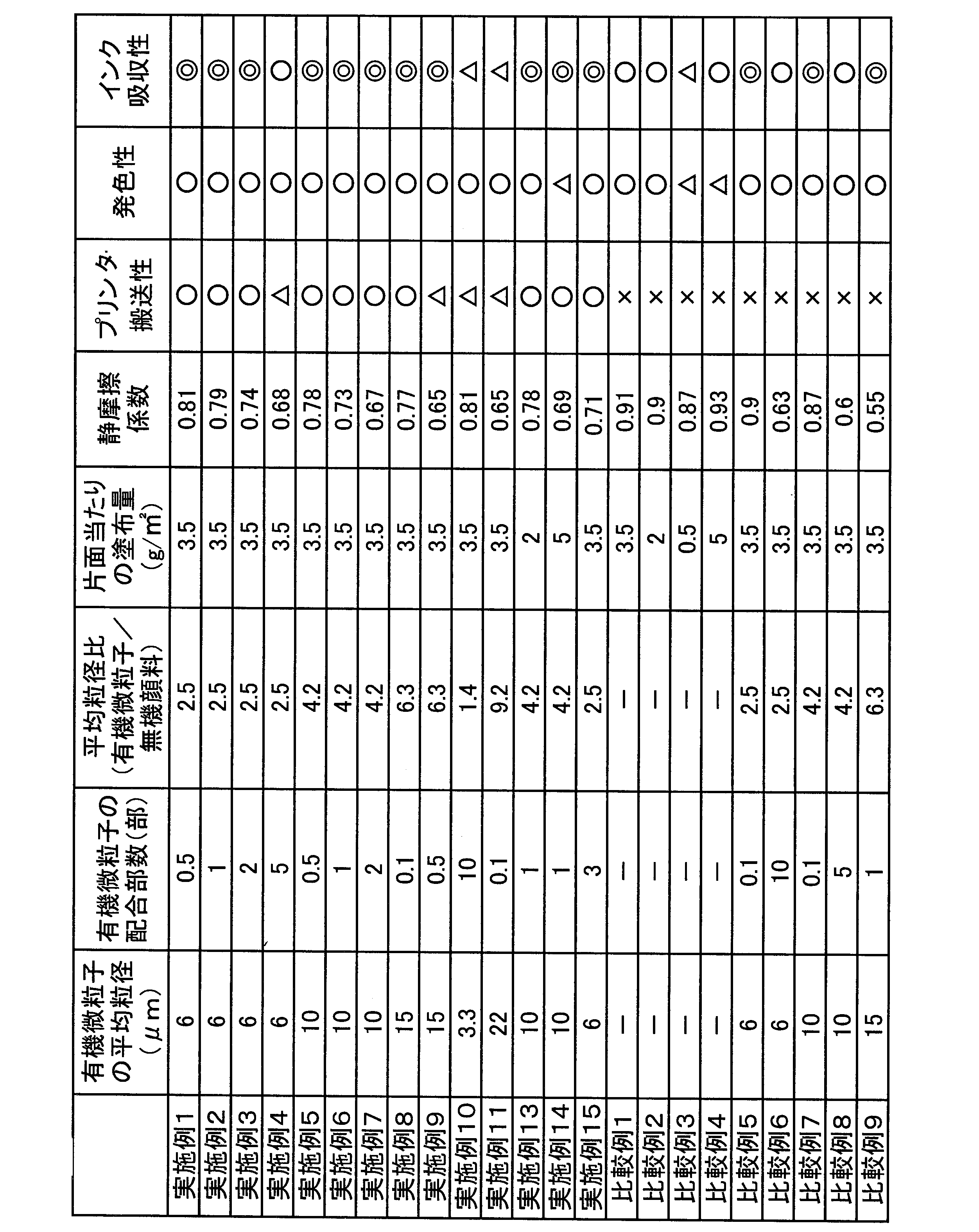
表1から、実施例1~14の場合、発色性、インク吸収性に優れ、かつ、特にラインヘッドを有する高速枚葉インクジェットプリンターで使用する際にプリンター搬送性に優れる両面インクジェット記録用紙となった。
なお、有機球状粒子の平均粒径が、無機顔料の平均粒径の2倍~8倍の範囲を外れた実施例10,11の場合、他の実施例に比べてインク吸収性がやや劣ったが実用上問題はない。
なお、有機球状粒子の平均粒径が、無機顔料の平均粒径の2倍~8倍の範囲を外れた実施例10,11の場合、他の実施例に比べてインク吸収性がやや劣ったが実用上問題はない。
また、無機顔料100質量部に対して有機球状粒子の配合量が0.5質量部未満である実施例8、及び有機球状粒子の配合量が3質量部を超えた実施例4、10の場合、他の実施例に比べてプリンター搬送性がやや劣ったが実用上問題はない。
なお、平均粒径が10μmを超える有機球状粒子を使用した実施例8の場合、無機顔料100質量部に対して有機球状粒子の配合量が0.5質量部未満であるにも関わらず、他の実施例とプリンター搬送性が同等であったが、実施例8からわずかに有機球状粒子の配合量を増やした実施例9の場合は他の実施例に比べてプリンター搬送性がやや劣った。このことより、有機球状微粒子の平均粒径が10μmを超えると、静摩擦係数の低減効果が鋭敏となり、有機球状微粒子の配合量の僅かな変化で静摩擦係数が大きく変動するため、実用上問題となる可能性がある。
なお、平均粒径が10μmを超える有機球状粒子を使用した実施例8の場合、無機顔料100質量部に対して有機球状粒子の配合量が0.5質量部未満であるにも関わらず、他の実施例とプリンター搬送性が同等であったが、実施例8からわずかに有機球状粒子の配合量を増やした実施例9の場合は他の実施例に比べてプリンター搬送性がやや劣った。このことより、有機球状微粒子の平均粒径が10μmを超えると、静摩擦係数の低減効果が鋭敏となり、有機球状微粒子の配合量の僅かな変化で静摩擦係数が大きく変動するため、実用上問題となる可能性がある。
これに対し、比較例1~9のインクジェット記録用紙は、表面と裏面との間の静摩擦係数が0.65~0.85の範囲から外れたため、プリンター搬送性が劣っている。なお、静摩擦係数が0.85より大きい場合は、インクジェット記録用紙間の滑りが悪く、プリンター内に搬送され難くなり、また静摩擦係数が0.65より小さい場合は、逆にインクジェット記録用紙間の滑りが良すぎるため、一度に多枚数のインクジェット記録用紙がずれてしまうことによる搬送トラブルが発生した。
Claims (4)
- 支持体の両面に無機顔料を含有するインク受理層を設けてなるインクジェット記録用紙において、少なくとも一方の面のインク受理層には有機球状粒子を含有し、かつJIS P 8147:1994「紙及び板紙の摩擦係数試験方法」(水平方法)に従って測定した該インクジェット記録用紙の表面と裏面との間の静摩擦係数が0.65以上0.85以下であることを特徴とするインクジェット記録用紙。
- 前記有機球状粒子の平均粒径が、前記無機顔料の平均粒径の2倍~8倍の範囲である請求項1記載のインクジェット記録用紙。
- 前記該無機顔料が合成非晶質シリカであり、かつ前記インク受理層の塗工量が片面あたり1g/m2~4g/m2の範囲であることを特徴とする請求項1または2記載のインクジェット記録用紙。
- 前記有機球状粒子の配合量が無機顔料100質量部に対して0.5質量部以上3質量部以下であることを特徴とする請求項1~3のいずれかに記載のインクジェット記録用紙。
Priority Applications (1)
| Application Number | Priority Date | Filing Date | Title |
|---|---|---|---|
| JP2012509560A JP5595487B2 (ja) | 2010-03-31 | 2011-03-31 | インクジェット記録用紙 |
Applications Claiming Priority (2)
| Application Number | Priority Date | Filing Date | Title |
|---|---|---|---|
| JP2010-084440 | 2010-03-31 | ||
| JP2010084440 | 2010-03-31 |
Publications (1)
| Publication Number | Publication Date |
|---|---|
| WO2011125818A1 true WO2011125818A1 (ja) | 2011-10-13 |
Family
ID=44762756
Family Applications (1)
| Application Number | Title | Priority Date | Filing Date |
|---|---|---|---|
| PCT/JP2011/058176 Ceased WO2011125818A1 (ja) | 2010-03-31 | 2011-03-31 | インクジェット記録用紙 |
Country Status (2)
| Country | Link |
|---|---|
| JP (1) | JP5595487B2 (ja) |
| WO (1) | WO2011125818A1 (ja) |
Families Citing this family (1)
| Publication number | Priority date | Publication date | Assignee | Title |
|---|---|---|---|---|
| EP4313613A1 (en) * | 2021-03-23 | 2024-02-07 | Sappi Ehingen GmbH | Versatile printable topliner |
Citations (2)
| Publication number | Priority date | Publication date | Assignee | Title |
|---|---|---|---|---|
| JP2002292997A (ja) * | 2001-03-28 | 2002-10-09 | Mitsubishi Paper Mills Ltd | インクジェット記録シート |
| JP2006274450A (ja) * | 2005-03-25 | 2006-10-12 | Fuji Xerox Co Ltd | 記録用紙及びこれを用いる画像形成方法 |
Family Cites Families (1)
| Publication number | Priority date | Publication date | Assignee | Title |
|---|---|---|---|---|
| JP3222253B2 (ja) * | 1993-03-25 | 2001-10-22 | 三菱製紙株式会社 | インクジェット記録シート |
-
2011
- 2011-03-31 WO PCT/JP2011/058176 patent/WO2011125818A1/ja not_active Ceased
- 2011-03-31 JP JP2012509560A patent/JP5595487B2/ja not_active Expired - Fee Related
Patent Citations (2)
| Publication number | Priority date | Publication date | Assignee | Title |
|---|---|---|---|---|
| JP2002292997A (ja) * | 2001-03-28 | 2002-10-09 | Mitsubishi Paper Mills Ltd | インクジェット記録シート |
| JP2006274450A (ja) * | 2005-03-25 | 2006-10-12 | Fuji Xerox Co Ltd | 記録用紙及びこれを用いる画像形成方法 |
Also Published As
| Publication number | Publication date |
|---|---|
| JP5595487B2 (ja) | 2014-09-24 |
| JPWO2011125818A1 (ja) | 2013-07-11 |
Similar Documents
| Publication | Publication Date | Title |
|---|---|---|
| US9174479B2 (en) | Coated printing paper and method for forming printed images | |
| KR101885543B1 (ko) | 잉크젯 인쇄를 위한 기록 매체 | |
| US8821998B2 (en) | Recording medium for inkjet printing | |
| KR20060043306A (ko) | 잉크젯 기록 용지 | |
| JP6535429B1 (ja) | インクジェット記録媒体 | |
| JP2018188760A (ja) | 印刷用塗工紙 | |
| JP5595487B2 (ja) | インクジェット記録用紙 | |
| JP6248870B2 (ja) | インクジェット印刷用塗工紙 | |
| JP4098267B2 (ja) | インクジェット用記録シート | |
| JP2019196566A (ja) | 印刷用塗工紙 | |
| JP4312533B2 (ja) | インクジェット記録用紙 | |
| JP2006062228A (ja) | インクジェット記録媒体 | |
| JP2005212263A (ja) | インクジェット記録媒体 | |
| JPH09263041A (ja) | インクジェット記録シート及びその加工方法 | |
| JP2012213930A (ja) | インクジェット記録用紙 | |
| JP2007083681A (ja) | インクジェット記録用紙 | |
| JP2003285543A (ja) | インクジェット記録用キャストコート紙用支持体及びそれを用いたインクジェット記録用キャストコート紙 | |
| JP2018188758A (ja) | 印刷用紙 | |
| JP2005028671A (ja) | インクジェット記録用葉書及びその製造方法 | |
| JP2006281606A (ja) | インクジェット記録媒体 | |
| JP2006137081A (ja) | マット調インクジェット記録媒体 | |
| JP2006248154A (ja) | インクジェット記録用紙 | |
| JP2006327065A (ja) | インクジェット記録シート | |
| JP2006062230A (ja) | インクジェット記録用紙 | |
| JP2002283552A (ja) | インクジェット記録シート及びその加工方法 |
Legal Events
| Date | Code | Title | Description |
|---|---|---|---|
| 121 | Ep: the epo has been informed by wipo that ep was designated in this application |
Ref document number: 11765718 Country of ref document: EP Kind code of ref document: A1 |
|
| WWE | Wipo information: entry into national phase |
Ref document number: 2012509560 Country of ref document: JP |
|
| NENP | Non-entry into the national phase |
Ref country code: DE |
|
| 122 | Ep: pct application non-entry in european phase |
Ref document number: 11765718 Country of ref document: EP Kind code of ref document: A1 |