WO2011125728A1 - 籐の木片を揮散部材として揮散される揮散液 - Google Patents
籐の木片を揮散部材として揮散される揮散液 Download PDFInfo
- Publication number
- WO2011125728A1 WO2011125728A1 PCT/JP2011/057996 JP2011057996W WO2011125728A1 WO 2011125728 A1 WO2011125728 A1 WO 2011125728A1 JP 2011057996 W JP2011057996 W JP 2011057996W WO 2011125728 A1 WO2011125728 A1 WO 2011125728A1
- Authority
- WO
- WIPO (PCT)
- Prior art keywords
- volatilization
- liquid
- rattan
- piece
- volatilization liquid
- Prior art date
- Legal status (The legal status is an assumption and is not a legal conclusion. Google has not performed a legal analysis and makes no representation as to the accuracy of the status listed.)
- Ceased
Links
Images

Classifications
-
- A—HUMAN NECESSITIES
- A61—MEDICAL OR VETERINARY SCIENCE; HYGIENE
- A61L—METHODS OR APPARATUS FOR STERILISING MATERIALS OR OBJECTS IN GENERAL; DISINFECTION, STERILISATION OR DEODORISATION OF AIR; CHEMICAL ASPECTS OF BANDAGES, DRESSINGS, ABSORBENT PADS OR SURGICAL ARTICLES; MATERIALS FOR BANDAGES, DRESSINGS, ABSORBENT PADS OR SURGICAL ARTICLES
- A61L9/00—Disinfection, sterilisation or deodorisation of air
- A61L9/015—Disinfection, sterilisation or deodorisation of air using gaseous or vaporous substances, e.g. ozone
- A61L9/04—Disinfection, sterilisation or deodorisation of air using gaseous or vaporous substances, e.g. ozone using substances evaporated in the air without heating
- A61L9/042—Disinfection, sterilisation or deodorisation of air using gaseous or vaporous substances, e.g. ozone using substances evaporated in the air without heating with the help of a macromolecular compound as a carrier or diluent
-
- A—HUMAN NECESSITIES
- A61—MEDICAL OR VETERINARY SCIENCE; HYGIENE
- A61L—METHODS OR APPARATUS FOR STERILISING MATERIALS OR OBJECTS IN GENERAL; DISINFECTION, STERILISATION OR DEODORISATION OF AIR; CHEMICAL ASPECTS OF BANDAGES, DRESSINGS, ABSORBENT PADS OR SURGICAL ARTICLES; MATERIALS FOR BANDAGES, DRESSINGS, ABSORBENT PADS OR SURGICAL ARTICLES
- A61L9/00—Disinfection, sterilisation or deodorisation of air
- A61L9/01—Deodorant compositions
- A61L9/012—Deodorant compositions characterised by being in a special form, e.g. gels, emulsions
Definitions
- the present invention relates to a volatilization liquid volatilized by a volatilizing member made of rattan wood pieces. More specifically, the present invention relates to a volatilizing liquid that is volatilized using a rattan wood piece as a volatilizing member, and allows a grain-like pattern to be exposed on the surface of the rattan wood piece. Furthermore, this invention relates to the volatilizer using the said volatilization liquid and the volatilization member containing a wooden piece of rattan.
- volatilizers are used to volatilize volatilization liquids such as fragrances, deodorants, and insect repellents into the space.
- volatilization liquids such as fragrances, deodorants, and insect repellents into the space.
- the volatilization member such as a nonwoven fabric is impregnated with the volatilization liquid and is volatilized.
- what gave various shapes to the volatilization member and the container has been developed. For example, a technique for providing a natural texture to a volatilizer by using a piece of wood as a volatilizing member has been proposed.
- the piece of wood used as the volatilization member cannot be derived from any tree, and in addition to being able to impregnate the volatilization liquid, it is required to have a function of volatilizing the volatilization liquid into the space.
- a wooden piece of rattan has a plurality of conduits for impregnating and volatilizing a volatilizing liquid and can be used as a volatilizing member (see Patent Document 1).
- volatilizers are required not only to have an excellent volatilization effect, but also to improve design and provide an excellent design effect.
- a rattan trunk has a vine shape with a diameter of about 2 to 5 cm, and the wood piece itself is not clearly formed with the wood grain formed by annual rings, etc., and the rattan wood piece is used as a volatilizing member. Therefore, in order to improve the design and give a more excellent design effect, it is required to further express the texture of wood.
- a method of coloring the rattan wood piece itself with a pigment is known. However, it was not clarified, and it was not possible to express the grain of the natural texture.
- the design effect of the volatilizer can be further enhanced and further added value can be given to the volatilizer. Be expected.
- the present invention has an object of providing a volatilization liquid capable of expressing a grain-like pattern on the surface of a rattan wood piece when the rattan wood piece is used as a volatilization member. Furthermore, this invention aims at providing the volatilizer using the said volatilization liquid and the volatilization member containing a rattan wood piece.
- the present inventor made an intensive study to solve the above problems, and surprisingly, using a volatilizing liquid containing a compound represented by the general formula (1), the rattan wood piece as a volatilizing member. It has been found that by removing the volatilization liquid, it is possible to newly express a woodgrain pattern on the surface of a rattan wood piece. The present invention has been completed by further studies based on this finding.
- this invention provides the invention of the aspect hung up below.
- Item 1 A volatilizing liquid that is volatilized by a volatilizing member made of rattan wood, and containing a compound represented by the general formula (1).
- R 1 represents an alkyl group having 1 to 5 carbon atoms or a hydrogen atom.
- R 2 and R 3 are the same or different and each represents an alkyl group having 1 to 5 carbon atoms, an alkoxyl group having 1 to 5 carbon atoms, a hydrogen atom, or a hydroxyl group.
- R 4 represents a hydroxyalkyl group having 1 to 5 carbon atoms or a hydroxyl group.
- Item 2 represents an alkyl group having 1 to 3 carbon atoms or a hydrogen atom
- R 2 and R 3 may be the same or different and represent an alkyl group having 1 to 3 carbon atoms, 1 carbon atom Item 3.
- the volatilization liquid according to Item 1 wherein R 4 represents a hydroxyalkyl group having 1 to 3 carbon atoms or a hydroxyl group; Item 3.
- item 1 or 2 whose volatilization liquid is an aromatic liquid containing a fragrance
- the compound represented by the general formula (1) is at least one compound selected from the group consisting of 3-methoxy-3-methyl-1-butanol, 1-butanol, and 3-methoxy-1-butanol.
- Item 6. The volatilization liquid according to any one of Items 1 to 5, wherein the density of the rattan wood pieces is 0.28 to 0.72 g / cm 3 .
- a volatile liquid container having an opening; A volatilization liquid contained in the volatilization liquid container; A volatilizing member including a piece of rattan wood, At least a part of the volatilization member is immersed in the volatilization liquid, and at least a part of the volatilization member is installed so as to be exposed to the air from the opening,
- the volatilization liquid contains a compound represented by the following general formula (1),
- Volatilizer characterized by that.
- Item 8. The volatilizer according to Item 7, wherein the volatilization liquid is an aromatic liquid containing a fragrance.
- Item 9. 7. A method for expressing a grain-like pattern on a rattan piece of wood, wherein the rattan piece of wood is impregnated with the volatilization liquid according to any one of Items 1 to 6 and volatilized.
- Item 10. Item 10. A piece of rattan wood obtained by the method according to item 9, wherein a woodgrain pattern is exposed.
- the volatilization liquid of the present invention can form a natural textured wood grain pattern on the surface of the rattan wood piece by volatilizing it using the rattan wood piece as a volatilization member. It is possible to provide a new design effect and a high-class feeling that cannot be obtained with wood chips.
- volatilization liquid of the present invention can maintain volatilization of the volatilization liquid continuously and homogeneously by using rattan wood pieces as the volatilization member, a desired effect required for the volatilization liquid (for example, aroma Effects, etc.) can also be exhibited without loss.
- the photograph on the left shows a state in which no woodgrain pattern is formed on the surface of the rattan wood piece
- the photograph on the right shows a state in which a woodgrain pattern is formed on the surface of the rattan wood piece.
- the volatilization liquid of the present invention is a volatilization liquid that is volatilized using a wooden piece of rattan as a volatilization member, and is represented by the compound represented by the general formula (1) (hereinafter simply referred to as compound (1)) In some cases).
- compound (1) the compound represented by the general formula (1)
- compound (1) the compound represented by the general formula (1)
- the “wood grain pattern” is a pattern that is newly formed irrespective of the conduit pattern formed from the conduit that feeds moisture and nutrients absorbed from the roots in the plant tissue to the upper part. This means that the white part and the brown part are mixed with each other, and specifically, the pattern shown in the left figure of FIG.
- Compound (1) contained in the volatilization liquid of the present invention has the following structure.
- R 1 represents an alkyl group having 1 to 5 carbon atoms or a hydrogen atom.
- R 1 is preferably an alkyl group having 1 to 3 carbon atoms, or a hydrogen atom, more preferably a methyl group, an ethyl group, or a hydrogen atom, more preferably a methyl group or an ethyl group, and particularly preferably a methyl group. It is.
- R 2 and R 3 are the same or different and each represents an alkyl group having 1 to 5 carbon atoms, an alkoxyl group having 1 to 5 carbon atoms, a hydrogen atom, or a hydroxyl group, preferably the same or different, An alkyl group having 1 to 3 carbon atoms, an alkoxyl group having 1 to 3 carbon atoms, or a hydrogen atom;
- R 2 is an alkyl group having 1 to 5 carbon atoms or a hydrogen atom
- R 3 is an alkoxyl group having 1 to 5 carbon atoms or a hydrogen atom; More preferably, R 2 is a methyl group, an ethyl group, or a hydrogen atom, and R 3 is a methoxyl group, an ethoxyl group, a hydrogen atom, or a hydroxyl group; particularly preferably, R 2 is a methyl group, and R 3 Is a methoxyl group.
- R 4 represents a hydroxyalkyl group having 1 to 5 carbon atoms or a hydroxyl group.
- R 4 is preferably a hydroxyalkyl group having 1 to 3 carbon atoms or a hydroxyl group, more preferably a hydroxymethyl group, a hydroxyethyl group, or a hydroxyl group, more preferably a hydroxymethyl group or a hydroxyethyl group, Particularly preferred is a hydroxymethyl group.
- alkyl group and alkoxyl group having 1 to 5 carbon atoms may be linear or have a side chain.
- 3-methoxy-3-methyl-1-butanol (wherein R 1 is a methyl group, R 2 is A compound in which a methyl group, R 3 is a methoxyl group, and R 4 is a hydroxymethyl group), 1-butanol (wherein R 1 is a methyl group, R 2 is a hydrogen atom, R 3 is a hydrogen atom, and R 4 is hydroxymethyl) And 3-methoxy-1-butanol (wherein R 1 is a methyl group, R 2 is a hydrogen atom, R 3 is a methoxyl group, and R 4 is a hydroxymethyl group), More preferred is 3-methoxy-3-methyl-1-butanol.
- the compound (1) may be used alone or in combination of two or more.
- the volatilization liquid of the present invention may be composed of only the compound (1), but may be a composition to which other components are added.
- the volatilization liquid of the present invention may be composed of only the compound (1), but may be a composition to which other components are added.
- Specific examples of the compounding ratio of the compound (1) in the volatilization liquid of the present invention include a range of 50 to 100% by weight.
- the blending ratio of the compound (1) in the volatilization liquid of the present invention is, for example, 50 to 99.99% by weight, preferably 70 to 99. .99% by weight, more preferably 90 to 99.99% by weight. In the case of satisfying such a blending ratio, it is possible to make the effect of making the grain pattern appear on the rattan wood piece more remarkably.
- the volatilization liquid of the present invention has a function to be provided in the volatilization liquid, that is, a fragrance, an extinction, depending on a desired function to be exhibited when the volatilization liquid is described in the space.
- Functional volatile components such as odorant components, insect repellent components and antibacterial components are blended.
- Such a functional component may be either oily or aqueous as long as it can be volatilized in the air in the environment in which it is used.
- the volatilization liquid of the present invention is an insecticide when it contains a fragrance, as a deodorant liquid when it contains a deodorant component, and as an aroma deodorant liquid when it contains a fragrance and a deodorant component.
- an ingredient When an ingredient is included, it is used as an insect repellent, and when it contains an antibacterial agent, it is used as an antibacterial liquid.
- an aromatic liquid containing a fragrance As the volatilization liquid of the present invention, an aromatic liquid containing a fragrance, and an aromatic deodorant liquid containing a fragrance and a deodorant component are preferable.
- flavor may be used, and the well-known fragrance
- fragrances include aldehydes having 6 to 12 carbon atoms, anisaldehyde, acetal R, acetophenone, acetyl cedrene, adoxal, allyl amyl glycolate, allyl cyclohexane propionate, alpha damascon, ambrett lid, ambro Xanthine, amylcinnamic aldehyde, amylcinnamic aldehyde dimethyl acetal, amyl valericate, amyl salicylate, isoamyl acetate, acetyl eugenol, isoamyl salicylate, indole, ⁇ ionone, ⁇ ionone, ⁇ methyl ionone, ⁇ methyl ionone, ⁇ methyl ionone, indene, Ethyl alliline, uranium thiol, oak moss No.
- Examples of the deodorant component include extracts of plants such as rice, pine, hinoki and cocoon; desalted betaine compounds; modified organic acid compounds; triethanolamine; stabilized chlorine dioxide; It is done. These deodorant components may be used alone or in any combination of two or more.
- insect repellent component examples include hinokitiol, hiba oil, allyl isothiocyanate, ethanol, propanol, 1.8. Examples include cineole. These insect repellent components may be used alone or in any combination of two or more.
- antibacterial agent component examples include octyltrimethylammonium chloride, didecyldimethylammonium gluconic acid, chlorhexidine, chlorhexidine gluconate, allyl isothiocyanate, propylene glycol monomethyl ether, propylene glycol monopropyl ether and the like. These antibacterial components may be used alone or in any combination of two or more.
- the blending ratio of the functional volatilization component in the volatilization liquid of the present invention is appropriately set according to the type of the component, but is, for example, 0.01 to 50% by weight, preferably 0.01 to 30% by weight, Preferably, it is 0.01 to 10% by weight.
- the volatilization liquid of the present invention is water, ethanol, propylene glycol, dipropylene glycol, propylene glycol monopropyl ether, dipropylene glycol monomethyl ether, isoparaffin hydrocarbon, in addition to the above components, as long as the effects of the present invention are not hindered.
- Solubilizers for functional volatile components such as nonionic surfactants (polyoxyethylene alkyl ether, polyoxyethylene hydrogenated castor oil), anionic surfactants, amphoteric surfactants, etc .; 1,2- Preservatives such as benzisothiazolin-3-one and 2n-octyl-isothiazolin-3-one; antioxidants; ultraviolet absorbers; pigments such as pigments and dyes; and additives such as silicone may be contained in appropriate amounts.
- nonionic surfactants polyoxyethylene alkyl ether, polyoxyethylene hydrogenated castor oil
- anionic surfactants amphoteric surfactants, etc .
- 1,2- Preservatives such as benzisothiazolin-3-one and 2n-octyl-isothiazolin-3-one
- antioxidants such as benzisothiazolin-3-one and 2n-octyl-isothiazolin-3-one
- ultraviolet absorbers pigments such as pigments and
- the volatilization liquid of the present invention is used by impregnating a volatilizing member made of rattan wood pieces and volatilizing from the volatilizing member.
- Rattan is a plant that is also called rattan and is classified as a coconut family.
- a piece of wood from which rattan bark has been peeled is used, but the bark may remain on a part of the surface of the piece of wood.
- the rattan wood piece used as the volatilization member may be used as it is after being processed into a predetermined shape from the rattan, but it is desirable to subject it to a predetermined shape before or after the processing. .
- the density of the rattan wood used for the volatilization member is not particularly limited, for example, from the viewpoint of enhancing the volatility of the fragrance liquid and making the grain of the rattan wood surface more clearly expressed, for example, 0. .28 ⁇ 0.72g / cm 3, preferably 0.28 ⁇ 0.59g / cm 3, more preferably 0.28 ⁇ 0.5g / cm 3, particularly preferably 0.28 ⁇ 0.46g / cm 3 Is exemplified.
- the volatilization liquid of the present invention is used in a volatilizer that is volatilized in a volatilization target space through a volatilizing member including a piece of rattan wood.
- a volatilizing member including a piece of rattan wood.
- volatilization liquid of the present invention is impregnated into a volatilizing member made of rattan wood pieces and volatilized from the volatilizing member, its specific use mode is not particularly limited.
- the volatilization liquid containing the rattan wood pieces is immersed in the volatilization liquid of the invention, and a part of the volatilization member is exposed to the volatilization target space.
- the volatilizer of such an embodiment includes a volatilization liquid container having an opening, the volatilization liquid of the present invention housed in the volatilization liquid container, and a volatilization member including a rattan wood piece.
- the shape of the rattan wood piece used as the volatilizing member is not particularly limited, but a rod-like shape having a cross-sectional area of about 0.75 to 15 mm 2 and a length of about 5 to 30 cm. It is preferable that a single volatilizer may use a plurality of pieces of rattan wood having the same or different shapes. About the number of volatilization members (wicker wooden piece) installed in this volatilizer, it sets suitably according to the magnitude
- volatilizer containing the volatilizing liquid of the present invention
- a volatilizer volatilized liquid-impregnated wooden piece obtained by impregnating rattan wood pieces with the volatilizing liquid of the present invention in advance.
- the rattan wood pieces used as the volatilization member may be in the form of blocks, rods, spheres, etc., and may be used by combining a plurality of rattan wood pieces of the same or different shapes. Good.
- a method of exposing a woodgrain pattern on a rattan wood piece is a method of exposing a woodgrain pattern on a rattan wood piece, wherein the volatilized liquid containing the compound (1) is added to the rattan wood piece.
- a method characterized by impregnation and volatilization is provided.
- the present invention also provides a rattan wood piece that is obtained (formed) with a woodgrain pattern obtained by the method.
- rattan wood pieces used in the method a method of impregnating and volatilizing the volatilization liquid, and the like are also as described in the above “1. Volatilization liquid and volatilizer”.
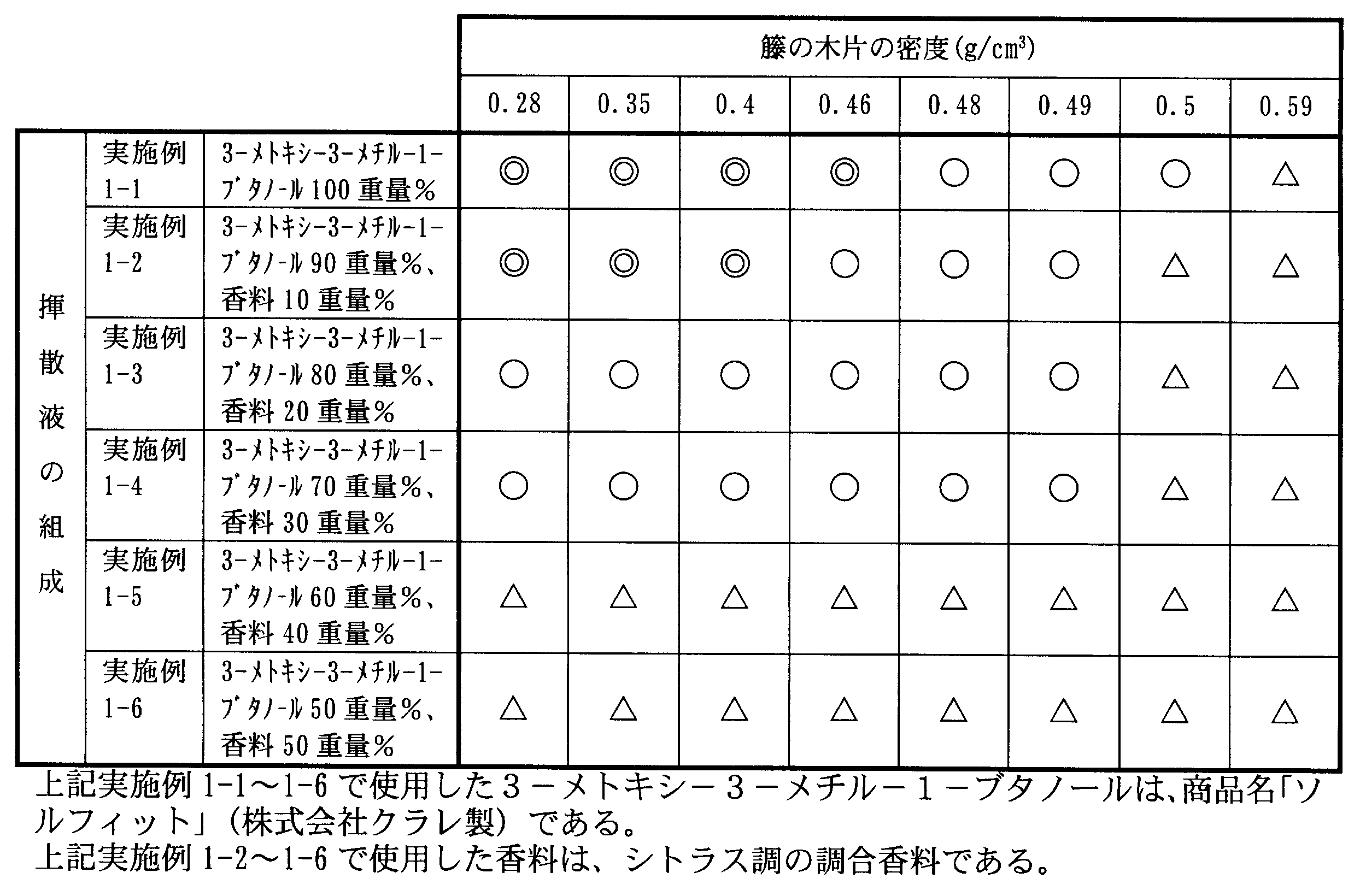
- Example 1 A volatilization liquid (aromatic liquid) having the composition shown in Table 1 was prepared, and 50 ml of the volatilization liquid was accommodated in a cylindrical container (inner diameter 5 cm, height 9.5 cm), and a hole having a diameter of 1.6 cm was formed in the center. A lid was used to close the opening of the container.
- a representative example of a rattan wood piece with a woodgrain pattern is shown on the left of FIG. 1, and a representative example of a rattan wood piece without a woodgrain pattern is shown. It is shown in the right figure of 1.
- this wood grain pattern is shown when the concentration of 3-methoxy-3-methyl-1-butanol in the volatilization liquid is 70% by weight or more, or the density of rattan wood pieces is 0.49 g / cm 3. Remarkably observed in the case of 3 or less. In particular, when the concentration of 3-methoxy-3-methyl-1-butanol in the volatilization liquid is 90% by weight or more and the density of rattan wood pieces is 0.4 g / cm 3 or less, the grain pattern was even clearer and more pronounced. In any of Examples 1-2 to 1-6, it was also confirmed that the volatile liquid was volatilized from the rattan wood piece into the indoor space, and that the fragrance effect based on the fragrance was sufficiently exhibited.
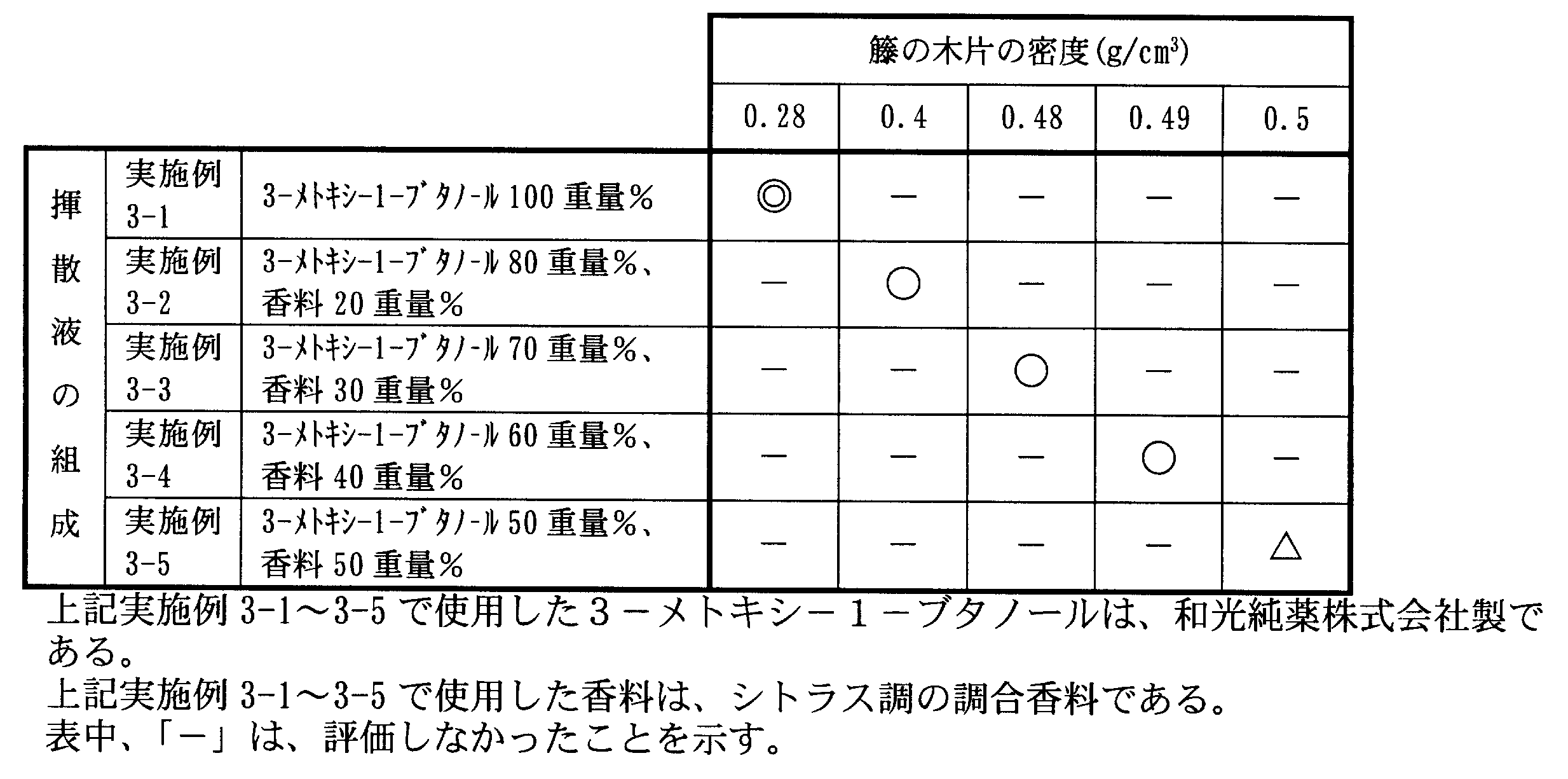
- Example 2 Volatile liquids (aromatic liquids) having the compositions shown in Tables 2 to 3 were prepared and tested under the same conditions as in Example 1 to confirm the presence or absence of the formation of a woodgrain pattern on the surface of the rattan wood piece.
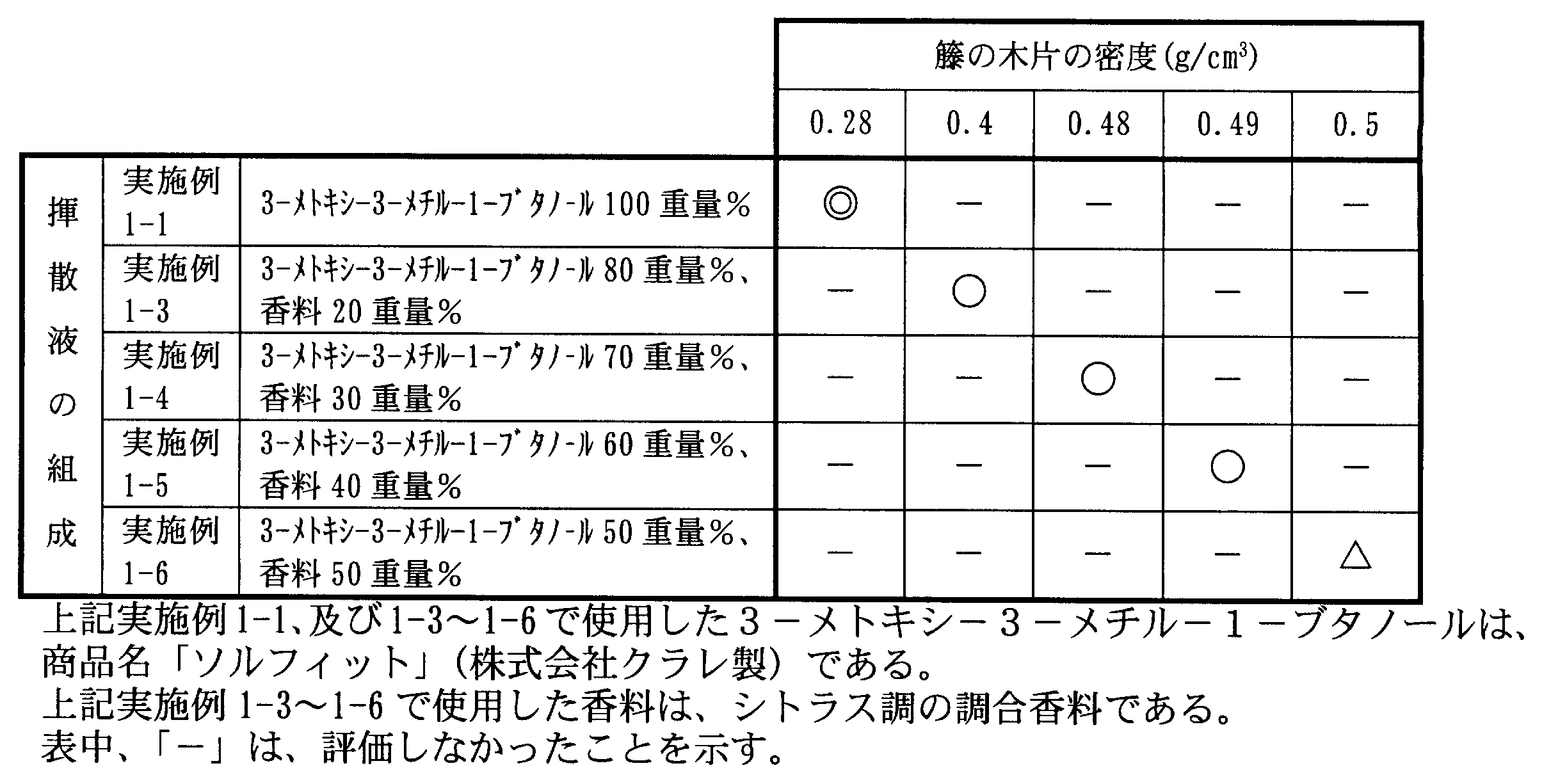
- Example 4 Using the volatilization liquids (fragrance liquids) of Examples 1-1 and 1-3 to 1-6, and as volatilization members, rattan wood pieces (cross-sectional area 3 to 13 mm 2 , length 17. A test was performed under the same conditions as in Example 1 except that 10 rods of 0 to 22.0 cm (made in Indonesia) were used, and the presence or absence of the formation of a woodgrain pattern on the surface of the rattan wood piece was confirmed.
- Table 4 shows the obtained results. From this result, even when an Indonesian rattan wood piece is used as the volatilization member, a grain-like pattern is formed on the surface of the rattan wood piece as in the case of using a Malaysian rattan wood piece (Example 1). was recognized. From this result, the rattan wood piece used as the volatilization member, regardless of the production area, the volatilization liquid containing the compound represented by the general formula (1), the shape of the grain-like pattern on the surface of the rattan wood piece was confirmed to be possible.
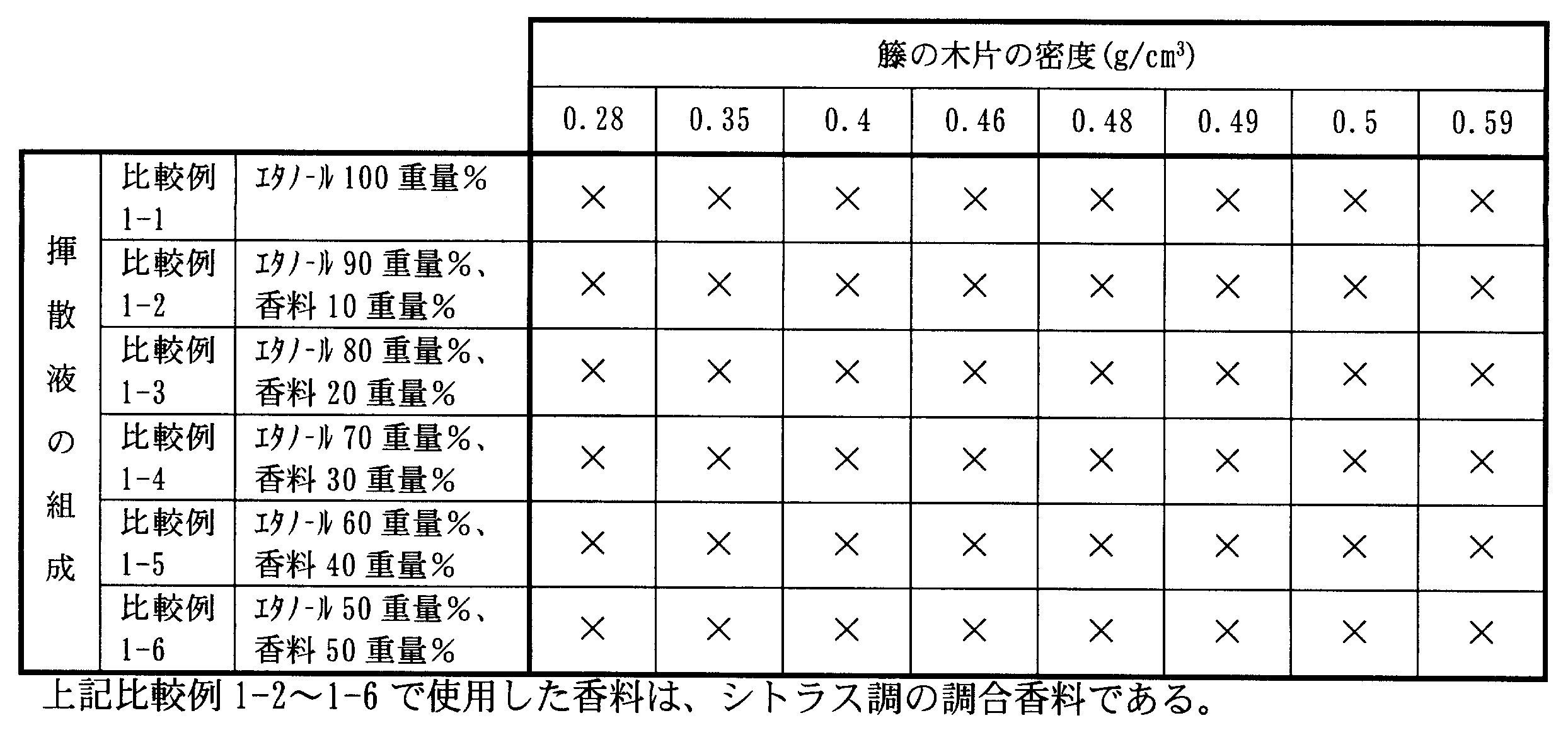
- Comparative Example 1-5 Volatile liquids (aromatic liquids) having the compositions shown in Tables 5 to 9 were prepared and tested under the same conditions as in Example 1 to confirm the presence or absence of the formation of a woodgrain pattern on the surface of the rattan wood piece.
- Comparative Example 6 Using the volatilized liquid shown in Table 1, bamboo, cypress, teak, or lamin instead of rattan wood pieces (all shapes are rod-shaped with a cross-sectional area of 3 to 13 mm 2 and a length of 17.0 to 22.0 cm) ) was used under the same conditions to confirm the presence or absence of the formation of a woodgrain pattern on the surface of each piece of wood.
- Table 10 shows the obtained results. From this result, the wood grain pattern was not formed on the surface of any piece of bamboo, cypress, teak or lamin. From the above results, the formation of the grain-like pattern on the surface of the rattan wood piece in Example 1 is the case where the compound represented by the general formula (1) is blended in the volatilization liquid and the rattan wood piece is selected as the volatilization member. It was confirmed that this was a unique effect. In any of Examples 1-2 to 1-6, the volatile liquid was volatilized from each piece of wood into the indoor space, and the fragrance effect based on the fragrance was exhibited by any of the volatile members.
Landscapes
- Health & Medical Sciences (AREA)
- Epidemiology (AREA)
- Life Sciences & Earth Sciences (AREA)
- Animal Behavior & Ethology (AREA)
- General Health & Medical Sciences (AREA)
- Public Health (AREA)
- Veterinary Medicine (AREA)
- Chemical & Material Sciences (AREA)
- Dispersion Chemistry (AREA)
- Disinfection, Sterilisation Or Deodorisation Of Air (AREA)
- Catching Or Destruction (AREA)
Abstract
【課題】本発明の目的は、籐の木片を揮散部材として使用する際に、籐の木片表面に木目調の模様を表出させることができる揮散液を提供することである。 【解決手段】籐の木片からなる揮散部材によって揮散される揮散液に、3-メトキシ-3-メチル-1-ブタノール等の一般式(1)で表される化合物を配合する。
Description
本発明は、籐の木片からなる揮散部材によって揮散される揮散液に関する。より詳細には、本発明は、籐の木片を揮散部材として使用して揮散され、籐の木片表面に木目調の模様を表出させることができる揮散液に関する。更に、本発明は、当該揮散液と、籐の木片を含む揮散部材を利用した揮散器に関する。
従来、芳香剤、消臭剤、防虫剤等の揮散液を空間に揮散させるために、揮散器が使用されている。従来の揮散器では、揮散液の揮散性を高めるために、不織布等の揮散部材に揮散液を含浸させて揮発するように設計されている。また、従来の揮散器では、意匠効果を備えさせるため、揮散部材や容器に様々な形状を施したものが開発されている。例えば、揮散部材として木片を利用することにより、天然の風合いを揮散器に備えさせる技術が提案されている。揮散部材として使用される木片は、あらゆる樹木由来のものを使用できるわけではなく、揮散液を含浸できることに加え、揮散液を空間に揮散させる機能を備えていることが必要とされている。近年、籐の木片は、揮散液を含浸させて揮散させるための導管を複数有しており、揮散部材として利用可能であることが報告されている(特許文献1参照)。
今日、様々なタイプの揮散器が商品化されている中で、揮散器には、単に優れた揮散効果を奏することだけでなく、デザイン性を高め、優れた意匠効果を与えることも求められている。
一方、籐の幹は、直径2~5cm程度のつる状であり、その木片自体は、年輪等によって形成された木目調が明瞭に形成されておらず、籐の木片を揮散部材として使用する場合には、デザイン性を高め、一層優れた意匠効果を与えるために、木質の風合いをより一層表出させることが求められている。しかしながら、従来の技術では、籐の木片のデザイン性を付与するには、籐の木片自体を色素で着色化する手法しか知られておらず、このような手法では、単に籐の木片の繊維質が明瞭化されるに止まり、自然な風合いの木目調を表出できるものではなかった。
一方、籐の幹は、直径2~5cm程度のつる状であり、その木片自体は、年輪等によって形成された木目調が明瞭に形成されておらず、籐の木片を揮散部材として使用する場合には、デザイン性を高め、一層優れた意匠効果を与えるために、木質の風合いをより一層表出させることが求められている。しかしながら、従来の技術では、籐の木片のデザイン性を付与するには、籐の木片自体を色素で着色化する手法しか知られておらず、このような手法では、単に籐の木片の繊維質が明瞭化されるに止まり、自然な風合いの木目調を表出できるものではなかった。
籐の木片を揮散部材として使用する際に、籐の木片表面に木目調の模様を表出させる技術を確立できれば、揮散器の意匠効果を一層高め、揮散器に更なる付加価値を与えることが期待される。
本発明は、籐の木片を揮散部材として使用する際に、籐の木片表面に木目調の模様を表出させることができる揮散液を提供することを目的とする。更に、本発明は、当該揮散液と、籐の木片を含む揮散部材を利用した揮散器を提供することを目的とする。
本発明者は、上記課題を解決すべく鋭意検討を行ったところ、驚くべきことに、一般式(1)で表される化合物を配合した揮散液を使用し、籐の木片を揮散部材として当該揮散液を揮散させることによって、籐の木片表面に木目調の模様を新たに表出させることが可能になることを見出した。本発明は、かかる知見に基づいて、更に検討を重ねることにより完成したものである。
即ち、本発明は、下記に掲げる態様の発明を提供する。
項1. 籐の木片からなる揮散部材によって揮散される揮散液であって、一般式(1)で表される化合物を含有することを特徴とする、揮散液。
項1. 籐の木片からなる揮散部材によって揮散される揮散液であって、一般式(1)で表される化合物を含有することを特徴とする、揮散液。

[式中、R1は、炭素数1~5のアルキル基、又は水素原子を示す。R2及びR3は、同一又は異なって、炭素数1~5のアルキル基、炭素数1~5のアルコキシル基、水素原子、又は水酸基を示す。R4は、炭素数1~5のヒドロキシアルキル基、又は水酸基を示す。]
項2. 一般式(1)において、R1は、炭素数1~3のアルキル基、又は水素原子を示し;R2及びR3は、同一又は異なって、炭素数1~3のアルキル基、炭素数1~3のアルコキシル基、又は水素原子を示し;R4は、炭素数1~3のヒドロキシアルキル基、又は水酸基を示す、項1に記載の揮散液。
項3. 揮散液が香料を含有する芳香液である、項1又は2に記載の揮散液。
項4. 一般式(1)で表される化合物が、3-メトキシ-3-メチル-1-ブタノール、1-ブタノール、及び3-メトキシ-1-ブタノールよりなる群から選択される少なくとも1種の化合物である、項1乃至3のいずれかに記載の揮散液。
項5. 揮散液に含まれる一般式(1)で表される化合物の配合割合が50~100重量%である、項1乃至4のいずれかに記載の揮散液。
項6. 籐の木片の密度が0.28~0.72g/cm3である、項1乃至5のいずれかに記載の揮散液。
項7.開口部を有する揮散液容器と、
前記揮散液容器に収容された揮散液と、
籐の木片を含む揮散部材とを含んで構成され、
前記揮散部材の少なくとも一部が前記揮散液に浸漬され、且つ前記揮散部材の少なくとも一部が前記開口部から空気中に露出可能に設置されており、
前記揮散液が、下記一般式(1)で表される化合物を含有する、
項2. 一般式(1)において、R1は、炭素数1~3のアルキル基、又は水素原子を示し;R2及びR3は、同一又は異なって、炭素数1~3のアルキル基、炭素数1~3のアルコキシル基、又は水素原子を示し;R4は、炭素数1~3のヒドロキシアルキル基、又は水酸基を示す、項1に記載の揮散液。
項3. 揮散液が香料を含有する芳香液である、項1又は2に記載の揮散液。
項4. 一般式(1)で表される化合物が、3-メトキシ-3-メチル-1-ブタノール、1-ブタノール、及び3-メトキシ-1-ブタノールよりなる群から選択される少なくとも1種の化合物である、項1乃至3のいずれかに記載の揮散液。
項5. 揮散液に含まれる一般式(1)で表される化合物の配合割合が50~100重量%である、項1乃至4のいずれかに記載の揮散液。
項6. 籐の木片の密度が0.28~0.72g/cm3である、項1乃至5のいずれかに記載の揮散液。
項7.開口部を有する揮散液容器と、
前記揮散液容器に収容された揮散液と、
籐の木片を含む揮散部材とを含んで構成され、
前記揮散部材の少なくとも一部が前記揮散液に浸漬され、且つ前記揮散部材の少なくとも一部が前記開口部から空気中に露出可能に設置されており、
前記揮散液が、下記一般式(1)で表される化合物を含有する、

[式中、R1~R4は、前記と同じ]
ことを特徴とする、揮散器。
項8. 前記揮散液が香料を含有する芳香液である、項7に記載の揮散器。
項9. 籐の木片に木目調の模様を表出させる方法であって、籐の木片に、項1乃至6のいずれかに記載の揮散液を含浸させて揮散させることを特徴とする方法。
項10. 項9に記載の方法によって得られる、木目調の模様が表出された籐の木片。
ことを特徴とする、揮散器。
項8. 前記揮散液が香料を含有する芳香液である、項7に記載の揮散器。
項9. 籐の木片に木目調の模様を表出させる方法であって、籐の木片に、項1乃至6のいずれかに記載の揮散液を含浸させて揮散させることを特徴とする方法。
項10. 項9に記載の方法によって得られる、木目調の模様が表出された籐の木片。
本発明の揮散液は、籐の木片を揮散部材として使用して揮散させることによって、籐の木片の表面に自然な風合いの木目調の模様を新たに形成させることができ、通常の状態の籐の木片では得られない新たな意匠効果や高級感を備えさせることが可能になる。
また、本発明の揮散液は、籐の木片を揮散部材として使用することによって、揮散液の揮散を持続的且つ均質に保持することができるので、当該揮散液に求められる所望の効果(例えば芳香効果等)も損なうことなく発揮させることができる。
1.揮散液及び揮散器
本発明の揮散液は、籐の木片を揮散部材として揮散される揮散液であって、一般式(1)で表される化合物(以下、単に化合物(1)と表記することもある)を含有することを特徴とする。このように化合物(1)を揮散液に配合し、且つ揮散部材として籐の木片を利用することによって、籐の木片の表面に、木目調の模様を新たに創出させることが可能になる。ここで、本明細書において、「木目調の模様」とは、植物組織において根から吸収した水分や養分を上部に送る導管から形成される導管模様とは関係なく新たに形成される模様であって、白色部分と茶色部分が混ざり合って形成された木目のような模様であることを意味し、具体的には、図1の左図に示すような模様を指す。
本発明の揮散液は、籐の木片を揮散部材として揮散される揮散液であって、一般式(1)で表される化合物(以下、単に化合物(1)と表記することもある)を含有することを特徴とする。このように化合物(1)を揮散液に配合し、且つ揮散部材として籐の木片を利用することによって、籐の木片の表面に、木目調の模様を新たに創出させることが可能になる。ここで、本明細書において、「木目調の模様」とは、植物組織において根から吸収した水分や養分を上部に送る導管から形成される導管模様とは関係なく新たに形成される模様であって、白色部分と茶色部分が混ざり合って形成された木目のような模様であることを意味し、具体的には、図1の左図に示すような模様を指す。
本発明の揮散液に含まれる化合物(1)は下記構造を示す。

式中、R1は、炭素数1~5のアルキル基、又は水素原子を示す。R1として、好ましくは炭素数1~3のアルキル基、又は水素原子、更に好ましくはメチル基、エチル基、又は水素原子であり、より好ましくはメチル基又はエチル基であり、特に好ましくはメチル基である。
式中、R2及びR3は、同一又は異なって、炭素数1~5のアルキル基、炭素数1~5のアルコキシル基、水素原子、又は水酸基を示し、好ましくは、同一又は異なって、炭素数1~3のアルキル基、炭素数1~3のアルコキシル基、又は水素原子を示す。また、R2及びR3の好適な一態様として、R2が炭素数1~5のアルキル基又は水素原子であり、且つR3が炭素数1~5のアルコキシル基、又は水素原子であり;更に好ましくはR2がメチル基、エチル基、又は水素原子であり、且つR3がメトキシル基、エトキシル基、水素原子、又は水酸基であり;特に好ましくはR2がメチル基であり、且つR3がメトキシル基である。
式中、R4は、炭素数1~5のヒドロキシアルキル基、又は水酸基を示す。R4として、好ましくは炭素数1~3のヒドロキシアルキル基、又は水酸基であり、更に好ましくはヒドロキシメチル基、ヒドロキシエチル基、又は水酸基であり、より好ましくはヒドロキシメチル基又はヒドロキシエチル基であり、特に好ましくはヒドロキシメチル基である。
なお、上記炭素数1~5のアルキル基及びアルコキシル基については、直鎖状であってもよく、また側鎖を有するものであってもよい。
籐の木片に木目調の模様を一層顕著に表出させるために、好適な化合物(1)として、3-メトキシ-3-メチル-1-ブタノール(式中、R1がメチル基、R2がメチル基、R3がメトキシル基、R4がヒドロキシメチル基である化合物)、1-ブタノール(式中、R1がメチル基、R2が水素原子、R3が水素原子、R4がヒドロキシメチル基である化合物)、及び3-メトキシ-1-ブタノール(式中、R1がメチル基、R2が水素原子、R3がメトキシル基、R4がヒドロキシメチル基である化合物)が挙げられ、更に好ましくは3-メトキシ-3-メチル-1-ブタノールが挙げられる。
本発明において、上記化合物(1)は、1種単独で使用してもよく、また2種以上を組み合わせて使用してもよい。
本発明の揮散液は、上記化合物(1)のみから構成されてもよいが、他の成分が添加された組成物であってもよい。
本発明の揮散液は、上記化合物(1)のみから構成されてもよいが、他の成分が添加された組成物であってもよい。本発明の揮散液における上記化合物(1)の配合割合として、具体的には、50~100重量%の範囲が挙げられる。特に、上記化合物(1)以外に他の成分を配合する場合には、本発明の揮散液における上記化合物(1)の配合割合としては、例えば50~99.99重量%、好ましくは70~99.99重量%、更に好ましくは90~99.99重量%が挙げられる。このような配合割合を充足する場合には、籐の木片に木目調の模様を表出させる効果を一層顕著に奏させることが可能になる。
本発明の揮散液には、上記化合物(1)以外に、当該揮散液に備えさせる機能、即ち、当該揮散液が空間に記載された際に発揮される所望の機能に応じて、香料、消臭剤成分、防虫剤成分、抗菌剤成分等の機能性揮散成分が配合される。このような機能性成分については、使用される環境で空気中に揮散可能である限り、油性又は水性のいずれであってもよい。本発明の揮散液は、香料を含む場合には芳香液として、消臭剤成分を含む場合には消臭液として、香料及び消臭剤成分を含む場合には芳香消臭液として、防虫剤成分を含む場合には防虫液として、抗菌剤成を含む場合には抗菌液として、各々使用される。本発明の揮散液として、好ましくは、香料を含む芳香液、香料及び消臭剤成分を含む芳香消臭液が挙げられる。
本発明の揮散液に配合される香料については、天然香料、天然香料から分離された単離香料、合成香料のいずれであってもよく、従来の芳香剤に使用されている公知の香料を使用することができる。香料として、具体的には、炭素数6~12のアルデヒド、アニスアルデヒド、アセタールR、アセトフェノン、アセチルセドレン、アドキサール、アリルアミルグリコレート、アリルシクロヘキサンプロピオネート、アルファダマスコン、アンブレットリッド、アンブロキサン、アミルシンナミックアルデヒド、アミルシンナミックアルデヒドジメチルアセタール、アミルバレリアネート、アミルサリシレート、イソアミルアセテート、アセチルユゲノール、イソアミルサリシレート、インドール、αイオノン、βイオノン、αメチルイオノン、βメチルイオノン、γメチルイオノン、インデン、エチルワニリン、オウランチオール、オークモスNo.1、オリボン、オキシフェニロン、カリオフィレン、カシュメラン、カルボン、ガラキソリッド、キャロン、クマリン、パラクレジールメチルエーテル、ゲラニオール、ゲラニルアセテート、ゲラニルフォーメート、ゲラニルニトリル、テトラヒドロゲラニオール、テトラヒドロゲラニールアセテート、コアボン、サンダロア、サンデラ、サンタレックス、サンタリノール、メチルサリシレート、シンナミックアルコール、シンナミックアルデヒド、シスジャスモン、シトラール、シトラールジメチルアセタール、シトラサール、シトロネラール、シトロネロール、シトロネリルアセテート、シトロネリルフォーメート、シトロネリルニトリル、シクラセット、シクラメンアルデヒド、シクラプロップ、シンナミルアセテート、ジヒドロジャスモン、ジメトール、イソシクロシトラール、ジャスマール、ジャスモラクトン、ジャスモフィラン、スチラリールアセテート、スチラリールプロピオネート、セドロアンバー、セドリルアセテート、セドロール、セレストリッド、βダマスコン、αターピネオール、γターピネオール、ターピニルアセテート、チモール、デルタダマスコン、デルタC6~C13ラクトン、トナリッド、トラセオライド、トリプラール、イソノニルアセテート、ネロール、ネリールアセテート、ネオベルガメート、ノピールアセテート、ノピールアルコール、バクダノール、ヒヤシンスジメチルアセタール、ヒドロトロピックアルコール、ヒドロキシシトロネラール、αピネン、ブチルブチレート、パラターシャリーブチルシクロヘキサノール、パラターシャリーブチルシクロヘキシルアセテート、オルトターシャリーブチルシクロヘキサノール、ジフェニルオキサイド、フルイテート、フェンチールアルコール、フェニルエチルフェニルアセテート、イソブチルキノリン、フェニルエチルアルコール、フェニルエチルアセテート、フェニルアセトアルデハイドジメチルアセタール、ベンジルアセテート、ベンジルアルコール、ベンジルサリシレート、ベルガミールアセテート、ベンズアルデヒド、ベンジルフォーメート、ジメチルベンジルカービノール、ヘディオン、ヘリオナール、ヘリオトロピン、シス-3-ヘキセノール、シス-3-ヘキセニールアセテート、シス-3-ヘキセニールサリシレート、ヘキシルシンナミックアルデヒド、ヘキシルサリシレート、ペンタリッド、ベルドックス、オルトボルニルアセテート、イソボルニルアセテート、イソボルネオール、エンド-ボルネオール、マンザネート、マイヨール、ミューゲアルデヒド、ミラックアルデヒド、ジヒドロミルセノール、ジミルセトール、ムゴール、ムスクTM-II、ムスク781、ムスクC14、ムスクT、ムスクケトン、ムスクチベチン、ムスクモスケン、メンサニールアセテート、メンソネート、メチルアンスラニレート、メチルユゲノール、メントール、メチルフェニルアセテート、ユゲノール、イソユゲノール、メチルイソユゲノール、γC6~13ラクトン、ライムオキサイド、メチルラベンダーケトン、ジヒドロリナロール、リグストラール、リリアール、リモネン、リナロール、リナロールオキサイド、テトラヒドロリナロール、テトラヒドロリナリールアセテート、リナリルアセテート、リラール、ルバフラン、ローズフェノン、ローズオキサイド、ワニリン、ベンゾイン、ペルーバルサム、トルーバルサム、チュベローズ油、ムスクチンキ、カストリウムチンキ、シベットチンキ、アンバーグリスチンキ、ペパーミント油、ペリラ油、プチグレン油、パイン油、ローズ油、ローズマリー油、しょう脳油、芳油、クラリーセージ油、サンダルウッド油、スペアミント油、スパイクラベンダー油、スターアニス油、ラバンジン油、ラベンダー油、レモン油、レモングラス油、ライム油、ネロリ油、オークモス油、オコチア油、パチュリ油、タイム油、トンカ豆チンキ、テレピン油、ワニラ豆チンキ、バジル油、ナツメグ油、シトロネラ油、クローブ油、ボアドローズ油、カナンガ油、カルダモン油、カシア油、シダーウッド油、オレンジ油、マンダリン油、タンジェリン油、アニス油、ベイ油、コリアンダー油、エレミ油、ユーカリ油、フェンネル油、ガルバナム油、ゼラニウム油、ヒバ油、桧油、ジャスミン油、ベチバー油、ベルガモット油、イランイラン油、グレープフルーツ油、ゆず油等を挙げることができる。これらの香料は、1種単独で使用してもよく、また2種以上を任意に組み合わせて調香して使用することもできる。
また、消臭剤成分としては、例えば、イネ、松、ヒノキ、笹等の植物の抽出物;脱塩型ベタイン化合物;変性有機酸化合物;トリエタノールアミン;安定化二酸化塩素;アルデヒド化合物等が挙げられる。これらの消臭剤成分は、1種単独で使用してもよく、また2種以上を任意に組み合わせて使用してもよい。
防虫剤成分としては、例えば、ヒノキチオール、ヒバ油、アリルイソチオシアネート、エタノール、プロパノール、1.8.シネオール等が挙げられる。これらの防虫剤成分は、1種単独で使用してもよく、また2種以上を任意に組み合わせて使用してもよい。
抗菌剤成分としては、例えば、オクチルトリメチルアンモニウムクロライド、ジデシルジメチルアンモニウムグルコン酸、クロルヘキシジン、グルコン酸クロルヘキシジン、アリルイソチオシアネート、プロピレングリコールモノメチルエーテル、プロピレングリコールモノプロピルエーテル等が挙げられる。これらの抗菌剤成分は、1種単独で使用してもよく、また2種以上を任意に組み合わせて使用してもよい。
これらの機能性揮散成分は、1種単独で使用してもよく、また2種以上を組み合わせて使用してもよい。
本発明の揮散液における上記機能性揮散成分の配合割合については、当該成分の種類に応じて適宜設定されるが、例えば0.01~50重量%、好ましくは0.01~30重量%、更に好ましくは0.01~10重量%が挙げられる。
本発明の揮散液は、本発明の効果を妨げない範囲で、上記成分の他に、水、エタノール、プロピレングリコール、ジプロピレングリコール、プロピレングリコールモノプロピルエーテル、ジプロピレングリコールモノメチルエーテル、イソパラフィン系炭化水素等の機能性揮散成分の溶解剤;非イオン性界面活性剤(ポリオキシエチレンアルキルエーテル、ポリオキシエチレン硬化ひまし油)、アニオン性界面活性剤、両性界面活性剤等の界面活性剤;1,2-ベンズイソチアゾリン-3-オン、2n-オクチル-イソチアゾリン-3-オン等の防腐剤;酸化防止剤;紫外線吸収剤;顔料、染料等の色素;シリコーン等の添加剤を適当量含有してもよい。
本発明の揮散液は、籐の木片からなる揮散部材に含浸されて、当該揮散部材から揮散されることによって使用される。
籐とは、ラタンとも称され、ヤシ科トウ連に分類される植物である。本発明では、籐の樹皮を剥離した木片が使用されるが、当該木片の表面の一部に樹皮が残存していてもよい。揮散部材として使用される籐の木片は、籐から所定の形状に加工処理されたものをそのまま使用してもよいが、所定の形状に加工処理の前又は後に乾燥処理に供しておくことが望ましい。
揮散部材に使用される籐の木片は、その密度については特に制限されないが、芳香液の揮散性を高めると共に、籐の木片表面に木目調をより一層明瞭に表出させるという観点から、例えば0.28~0.72g/cm3、好ましくは0.28~0.59g/cm3、更に好ましくは0.28~0.5g/cm3、特に好ましくは0.28~0.46g/cm3が例示される。
本発明の揮散液は、籐の木片を含む揮散部材を介して揮散対象空間に揮散される揮散器に使用される。このように、本発明の揮散液を籐の木片から揮散させることにより、本発明の揮散液を揮散させている木片部位において、揮散開始から48時間程度以内、好ましくは24時間程度以内で、木目調の模様が表出され、当該木片部位に新たな意匠的効果が付与される。
本発明の揮散液は、籐の木片からなる揮散部材に含浸されて、当該揮散部材から揮散される限り、その具体的使用態様については特に制限されない。
本発明の揮散液を含む揮散器の好適な一実施態様として、発明の揮散液に、籐の木片を含む揮散部材を浸漬させ、当該揮散部材の一部を揮散対象空間に露出させることにより、当該記載部材によって揮散液の吸い上げと揮散を行う揮散器が挙げられる。このような態様の揮散器としては、具体的には、開口部を有する揮散液容器と、当該揮散液容器に収容された本発明の揮散液と、籐の木片を含む揮散部材とを含んで構成され、当該揮散部材の少なくとも一部が当該揮散液に浸漬され、且つ当該揮散部材の少なくとも一部が当該開口部から空気中(揮散対象空間中)に露出可能に設置されているものが例示される。このような態様の揮散器において、揮散部材として使用される籐の木片の形状については、特に制限されないが、断面積が0.75~15mm2程度で長さが5~30cm程度の棒状の形状が好ましく、1つの揮散器において、同一又は異なる形状の籐の木片を複数使用してもよい。本揮散器に設置される揮散部材(籐の木片)の数については、揮散部材の大きさや揮散対象空間の広さ等に応じて適宜設定される。
また、本発明の揮散液を含む揮散器の他の実施態様として、本発明の揮散液を予め籐の木片に含浸させた揮散器(揮散液含浸木片)が挙げられる。このような態様の揮散器において、揮散部材として使用される籐の木片は、ブロック状、棒状、球状等の形状であればよく、同一又は異なる形状の籐の木片を複数組み合わせて使用してもよい。
2.籐の木片に木目調の模様を表出させる方法
また、本発明は、籐の木片に木目調の模様を表出させる方法であって、籐の木片に、化合物(1)を含む揮散液を含浸させて揮散させることを特徴とする方法を提供する。更に、本発明は、当該方法によって得られる、木目調の模様が表出(形成)された籐の木片をも提供する。
また、本発明は、籐の木片に木目調の模様を表出させる方法であって、籐の木片に、化合物(1)を含む揮散液を含浸させて揮散させることを特徴とする方法を提供する。更に、本発明は、当該方法によって得られる、木目調の模様が表出(形成)された籐の木片をも提供する。
当該方法に使用される化合物(1)の種類や配合割合、揮散液に配合可能な他の成分等については、上記「1.揮散液及び揮散器」の記載の通りである。
また、当該方法に使用される籐の木片、揮散液を含浸させて揮散させる方法等についても、上記「1.揮散液及び揮散器」の記載の通りである。
以下、実施例を挙げて本発明を説明するが、本発明はこれらに限定されるものではない。
実施例1
表1に示す組成の揮散液(芳香液)を調製し、当該揮散液50mlを円筒状の容器(内径5cm、高さ9.5cm)に収容し、中心部に直径1.6cmの穴が空いた蓋を用いて、当該容器の開口部を塞いだ。次いで、揮散部材として表1に示す各密度の籐の木片(断面積3~13mm2、長さ17.0~22.0cmの棒状、マレーシア産)10本を上記蓋の穴から挿入して、当該木片の一部を揮散液に浸漬させ、当該木片の一部を容器外に露出させた状態にした。この状態で25℃で48時間静置した後、籐の木片の外観を観察し、木目調の模様の有無を目視にて確認し、下記の基準に従って評価した。本試験では、籐の木片として、表1に示す密度のものを各々使用して評価した。
<評価基準>
◎:籐の木片10本の全てにおいて木目調の模様が確認された。
○:木目調の模様が確認されたのは、籐の木片10本中の3本以上9本以下である。
△:木目調の模様が確認されたのは、籐の木片10本中の1又は2本である。
×:籐の木片10本の全てにおいて木目調の模様が確認されなかった。
実施例1
表1に示す組成の揮散液(芳香液)を調製し、当該揮散液50mlを円筒状の容器(内径5cm、高さ9.5cm)に収容し、中心部に直径1.6cmの穴が空いた蓋を用いて、当該容器の開口部を塞いだ。次いで、揮散部材として表1に示す各密度の籐の木片(断面積3~13mm2、長さ17.0~22.0cmの棒状、マレーシア産)10本を上記蓋の穴から挿入して、当該木片の一部を揮散液に浸漬させ、当該木片の一部を容器外に露出させた状態にした。この状態で25℃で48時間静置した後、籐の木片の外観を観察し、木目調の模様の有無を目視にて確認し、下記の基準に従って評価した。本試験では、籐の木片として、表1に示す密度のものを各々使用して評価した。
<評価基準>
◎:籐の木片10本の全てにおいて木目調の模様が確認された。
○:木目調の模様が確認されたのは、籐の木片10本中の3本以上9本以下である。
△:木目調の模様が確認されたのは、籐の木片10本中の1又は2本である。
×:籐の木片10本の全てにおいて木目調の模様が確認されなかった。
なお、参考のために、木目調の模様が表出されている籐の木片の代表例を図1の左図に、また木目調の模様が表出されていない籐の木片の代表例を図1の右図に示す。
得られた結果を表1に纏めて示す。この結果から、3-メトキシ-3-メチル-1-ブタノール(R1がメチル基、R2がメチル基、R3がメトキシル基、R4がヒドロキシメチル基である化合物(1))を含む揮散液を籐の木片によって揮散させることにより、籐の木片の表面(揮散液を揮散させている部分の表面)に、籐の繊維の方向とは関係なく、白色部分と茶色部分が混ざり合って形成された木目調の模様が表出されていた。特に、この木目調の模様の表出は、揮散液中の3-メトキシ-3-メチル-1-ブタノールの濃度が70重量%以上含まれる場合、又は籐の木片の密度が0.49g/cm3以下の場合において顕著に認められた。とりわけ、揮散液中の3-メトキシ-3-メチル-1-ブタノールの濃度が90重量%以上であり、且つ籐の木片の密度が0.4g/cm3以下の場合には、木目調の模様が一層鮮明で顕著に表出されていた。なお、実施例1-2~1-6のいずれでも、揮散液が籐の木片から室内空間に揮散し、香料に基づく芳香効果が十分に奏されていることも確認された。
また、シトラス調の調合香料の代わりに、フローラル調の調合香料、グリーン調の調合香料、フルーツ調の調合香料、又はソープ調の調合香料を使用すること以外は、上記と同条件で試験を行ったところ、これらの香料でも、実施例1-1~1-6と同じ結果が得られた。この結果から、使用する香料の組成の相違に拘わらず、籐の木片の表面に木目調の模様が表出される効果が奏されていることが確認された。
実施例2
表2~3に示す組成の揮散液(芳香液)を調製し、上記実施例1と同条件で試験を行い、籐の木片表面の木目調の模様の形成の有無を確認した。
表2~3に示す組成の揮散液(芳香液)を調製し、上記実施例1と同条件で試験を行い、籐の木片表面の木目調の模様の形成の有無を確認した。
得られた結果を表2~3に示す。この結果から、揮散液において、ブタノール又は3-メトキシ-1-ブタノールを使用した場合でも、3-メトキシ-3-メチル-1-ブタノールを使用した場合と同様に、籐の木片表面の木目調の模様の形成が確認された。以上の結果から、籐の木片を揮散部材として使用する場合には、一般式(1)で表される化合物を揮散液に配合することによって、籐の木片表面に木目調の模様を表出させることが可能になることが明らかとなった。

実施例4
実施例1-1及び1-3~1-6の揮散液(芳香液)を使用し、揮散部材として、表4に示す各密度の籐の木片(断面積3~13mm2、長さ17.0~22.0cmの棒状、インドネシア産)10本を使用すること以外は、上記実施例1と同条件で試験を行い、籐の木片表面の木目調の模様の形成の有無を確認した。
実施例1-1及び1-3~1-6の揮散液(芳香液)を使用し、揮散部材として、表4に示す各密度の籐の木片(断面積3~13mm2、長さ17.0~22.0cmの棒状、インドネシア産)10本を使用すること以外は、上記実施例1と同条件で試験を行い、籐の木片表面の木目調の模様の形成の有無を確認した。
得られた結果を表4に示す。この結果から、揮散部材として、インドネシア産の籐の木片を使用した場合でも、マレーシア産の籐の木片を使用した場合(実施例1)と同様に、籐の木片表面の木目調の模様の形成が認められた。この結果から、揮散部材として使用する籐の木片は、その産地の別を問わず、一般式(1)で表される化合物を含む揮散液によって、籐の木片表面に木目調の模様の形性が可能になることが確認された。
比較例1-5
表5~9に示す組成の揮散液(芳香液)を調製し、上記実施例1と同条件で試験を行い、籐の木片表面の木目調の模様の形成の有無を確認した。
表5~9に示す組成の揮散液(芳香液)を調製し、上記実施例1と同条件で試験を行い、籐の木片表面の木目調の模様の形成の有無を確認した。
得られた結果を表5~9に示す。この結果から、揮散液において、エタノール、プロピレングリコール、プロピレングリコールモノプロピルエーテル、ジプロピレングリコールモノメチルエーテル、又はイソパラフィン炭化水素を配合した場合には、3-メトキシ-3-メチル-1-ブタノールを使用した場合に認められたような木目調の模様は全く形成されなかった。以上の結果から、籐の木片表面の木目調の模様の形成は、揮散液に一般式(1)で表される化合物を配合した場合に認められる特有の効果であることが確認された。
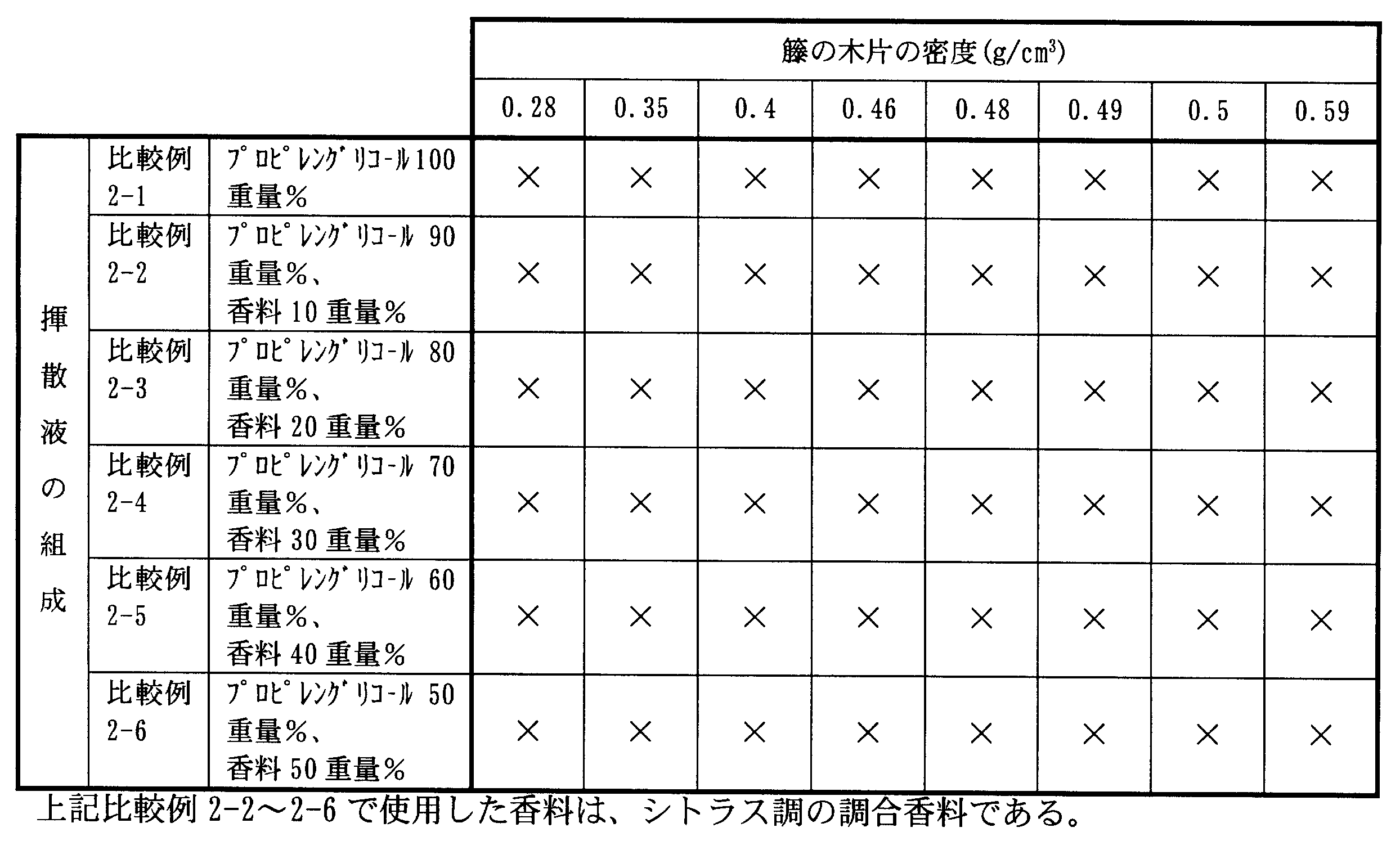


比較例6
表1に記載の揮散液を使用し、籐の木片の代わりに、竹、ヒノキ、チーク、又はラミン(いずれも形状は、断面積3~13mm2、長さ17.0~22.0cmの棒状)を用いて、同条件で試験を行い、各木片表面の木目調の模様の形成の有無を確認した。
表1に記載の揮散液を使用し、籐の木片の代わりに、竹、ヒノキ、チーク、又はラミン(いずれも形状は、断面積3~13mm2、長さ17.0~22.0cmの棒状)を用いて、同条件で試験を行い、各木片表面の木目調の模様の形成の有無を確認した。
得られた結果を表10に示す。この結果から、竹、ヒノキ、チーク、及びラミンのいずれの木片でも、表面に木目調の模様は形成されなかった。以上の結果から、実施例1において籐の木片表面の木目調の模様の形成は、揮散液に一般式(1)で表される化合物を配合し、且つ揮散部材として籐の木片を選択した場合に認められる特有の効果であることが確認された。なお、実施例1-2~1-6のいずれでも、揮散液が各々の木片から室内空間に揮散しており、香料に基づく芳香効果については、いずれの揮散部材でも奏されていた。

Claims (8)
- 籐の木片からなる揮散部材によって揮散される揮散液であって、一般式(1)で表される化合物を含有することを特徴とする、揮散液。

- 一般式(1)において、R1は、炭素数1~3のアルキル基、又は水素原子を示し;R2及びR3は、同一又は異なって、炭素数1~3のアルキル基、炭素数1~3のアルコキシル基、又は水素原子を示し;R4は、炭素数1~3のヒドロキシアルキル基、又は水酸基を示す、請求項1に記載の揮散液。
- 揮散液が香料を含有する芳香液である、請求項1又は2に記載の揮散液。
- 一般式(1)で表される化合物が、3-メトキシ-3-メチル-1-ブタノール、1-ブタノール、及び3-メトキシ-1-ブタノールよりなる群から選択される少なくとも1種の化合物である、請求項1乃至3のいずれかに記載の揮散液。
- 揮散液に含まれる一般式(1)で表される化合物の配合割合が50~100重量%である、請求項1乃至4のいずれかに記載の揮散液。
- 籐の木片の密度が0.28~0.72g/cm3である、請求項1乃至5のいずれかに記載の揮散液。
- 開口部を有する揮散液容器と、
前記揮散液容器に収容された揮散液と、
籐の木片を含む揮散部材とを含んで構成され、
前記揮散部材の少なくとも一部が前記揮散液に浸漬され、且つ前記揮散部材の少なくとも一部が前記開口部から空気中に露出可能に設置されており、
前記揮散液が、下記一般式(1)で表される化合物を含有する、

ことを特徴とする、揮散器。 - 前記揮散液が香料を含有する芳香液である、請求項7に記載の揮散器。
Applications Claiming Priority (2)
| Application Number | Priority Date | Filing Date | Title |
|---|---|---|---|
| JP2010-83912 | 2010-03-31 | ||
| JP2010083912A JP5769383B2 (ja) | 2010-03-31 | 2010-03-31 | 籐の木片を揮散部材として揮散される揮散液 |
Publications (1)
| Publication Number | Publication Date |
|---|---|
| WO2011125728A1 true WO2011125728A1 (ja) | 2011-10-13 |
Family
ID=44762670
Family Applications (1)
| Application Number | Title | Priority Date | Filing Date |
|---|---|---|---|
| PCT/JP2011/057996 Ceased WO2011125728A1 (ja) | 2010-03-31 | 2011-03-30 | 籐の木片を揮散部材として揮散される揮散液 |
Country Status (2)
| Country | Link |
|---|---|
| JP (1) | JP5769383B2 (ja) |
| WO (1) | WO2011125728A1 (ja) |
Cited By (1)
| Publication number | Priority date | Publication date | Assignee | Title |
|---|---|---|---|---|
| EP4079157B1 (en) * | 2020-01-06 | 2025-12-31 | Fumakilla Limited | INDOOR SPACE STERILIZATION AGENT AND INDOOR SPACE STERILIZATION DEVICE |
Families Citing this family (2)
| Publication number | Priority date | Publication date | Assignee | Title |
|---|---|---|---|---|
| JP6170759B2 (ja) * | 2013-06-27 | 2017-07-26 | 小林製薬株式会社 | 薬剤揮散器 |
| JP6319982B2 (ja) * | 2013-09-30 | 2018-05-09 | 小林製薬株式会社 | 薬剤揮散器 |
Citations (6)
| Publication number | Priority date | Publication date | Assignee | Title |
|---|---|---|---|---|
| JPH03183504A (ja) * | 1989-09-22 | 1991-08-09 | Shiseido Co Ltd | 表面処理木材 |
| JPH1024096A (ja) * | 1996-07-12 | 1998-01-27 | Hattori Norimasa | 芳香材 |
| JPH10108903A (ja) * | 1996-10-09 | 1998-04-28 | Fumakilla Ltd | 揮散性物質の含浸体 |
| JP2003245904A (ja) * | 2001-12-19 | 2003-09-02 | Hayao Ito | 木材用浸透助剤 |
| JP2004129844A (ja) * | 2002-10-10 | 2004-04-30 | S T Chem Co Ltd | 揮散性化合物含浸体 |
| JP2005040593A (ja) * | 2003-07-07 | 2005-02-17 | Kobayashi Pharmaceut Co Ltd | 芳香脱臭器用の芳香液組成物 |
Family Cites Families (3)
| Publication number | Priority date | Publication date | Assignee | Title |
|---|---|---|---|---|
| JP2007130439A (ja) * | 2005-06-27 | 2007-05-31 | Earth Chem Corp Ltd | 揮散器 |
| JP4782076B2 (ja) * | 2007-06-12 | 2011-09-28 | アース製薬株式会社 | 揮散体及び揮散性物質収納容器 |
| JP5594979B2 (ja) * | 2008-03-31 | 2014-09-24 | 小林製薬株式会社 | 界面活性剤の配合量が低減された透明な芳香液 |
-
2010
- 2010-03-31 JP JP2010083912A patent/JP5769383B2/ja active Active
-
2011
- 2011-03-30 WO PCT/JP2011/057996 patent/WO2011125728A1/ja not_active Ceased
Patent Citations (6)
| Publication number | Priority date | Publication date | Assignee | Title |
|---|---|---|---|---|
| JPH03183504A (ja) * | 1989-09-22 | 1991-08-09 | Shiseido Co Ltd | 表面処理木材 |
| JPH1024096A (ja) * | 1996-07-12 | 1998-01-27 | Hattori Norimasa | 芳香材 |
| JPH10108903A (ja) * | 1996-10-09 | 1998-04-28 | Fumakilla Ltd | 揮散性物質の含浸体 |
| JP2003245904A (ja) * | 2001-12-19 | 2003-09-02 | Hayao Ito | 木材用浸透助剤 |
| JP2004129844A (ja) * | 2002-10-10 | 2004-04-30 | S T Chem Co Ltd | 揮散性化合物含浸体 |
| JP2005040593A (ja) * | 2003-07-07 | 2005-02-17 | Kobayashi Pharmaceut Co Ltd | 芳香脱臭器用の芳香液組成物 |
Cited By (1)
| Publication number | Priority date | Publication date | Assignee | Title |
|---|---|---|---|---|
| EP4079157B1 (en) * | 2020-01-06 | 2025-12-31 | Fumakilla Limited | INDOOR SPACE STERILIZATION AGENT AND INDOOR SPACE STERILIZATION DEVICE |
Also Published As
| Publication number | Publication date |
|---|---|
| JP5769383B2 (ja) | 2015-08-26 |
| JP2011212271A (ja) | 2011-10-27 |
Similar Documents
| Publication | Publication Date | Title |
|---|---|---|
| JP5752103B2 (ja) | 界面活性剤の配合量が低減された透明な芳香液 | |
| DE69016141T2 (de) | Luftverbesserungspräparat. | |
| JP5769383B2 (ja) | 籐の木片を揮散部材として揮散される揮散液 | |
| DE2807584B2 (de) | Fixateur für Parfümkompositionen | |
| KR20200062776A (ko) | 항균성 방향 조성물 및 이를 포함하는 항균성 방향제 | |
| ATE445590T1 (de) | Verwendung von dynamischen mischungen zur kontrollierten freisetzung von duftstoffen | |
| JP5241905B2 (ja) | 有機系消臭成分の効力増強剤を配合した消臭剤 | |
| KR101936426B1 (ko) | 향료를 이용한 천연탈취제 | |
| WO2021122756A1 (en) | Perfumed compositions, process of preparing thereof and uses | |
| US20240225971A1 (en) | 1,3-butylene glycol compositions and methods of use thereof | |
| JP2008214285A (ja) | 紙様お香 | |
| BR112019023208B1 (pt) | Processo para preparação de uma composição aromatizante | |
| JP2023547328A (ja) | 無水のアルコールフリーの滑らかな芳香剤配合物 | |
| JP2015065941A (ja) | 薬剤揮散器 | |
| JP2018079318A (ja) | 設置型揮散装置用の液体組成物及び該液体組成物中の有効成分の溶解性を向上させる方法 | |
| JP4896538B2 (ja) | 有機系消臭成分の効力増強剤。 | |
| Brechbill | Classifying aroma chemicals | |
| WO2014034478A1 (ja) | 芳香剤組成物 | |
| JPWO2012046434A1 (ja) | エビネ様香料組成物 | |
| JP7492638B1 (ja) | 香料組成物、及び化粧品 | |
| JP5438231B1 (ja) | ソラの茎部を加工した揮散部材を用いて揮散させる液体芳香剤組成物 | |
| JP2009137865A (ja) | 木質成分の熱分解液の消臭方法及び液体と、これらを用いた物品 | |
| Meehan et al. | Anhydrous alcohol-free silky fragrance formulation | |
| KR101822929B1 (ko) | 의류 및 섬유용 탈취제 및 이의 제조방법 | |
| Stoilova et al. | CONTEMPORARY TRENDS IN THE PRODUCTION OF BIOPERFUMES |
Legal Events
| Date | Code | Title | Description |
|---|---|---|---|
| 121 | Ep: the epo has been informed by wipo that ep was designated in this application |
Ref document number: 11765628 Country of ref document: EP Kind code of ref document: A1 |
|
| NENP | Non-entry into the national phase |
Ref country code: DE |
|
| 122 | Ep: pct application non-entry in european phase |
Ref document number: 11765628 Country of ref document: EP Kind code of ref document: A1 |