WO2011125402A1 - 金属チタン製造装置および金属チタンの製造方法 - Google Patents
金属チタン製造装置および金属チタンの製造方法 Download PDFInfo
- Publication number
- WO2011125402A1 WO2011125402A1 PCT/JP2011/055184 JP2011055184W WO2011125402A1 WO 2011125402 A1 WO2011125402 A1 WO 2011125402A1 JP 2011055184 W JP2011055184 W JP 2011055184W WO 2011125402 A1 WO2011125402 A1 WO 2011125402A1
- Authority
- WO
- WIPO (PCT)
- Prior art keywords
- titanium
- metal
- magnesium
- kpa
- deposition
- Prior art date
- Legal status (The legal status is an assumption and is not a legal conclusion. Google has not performed a legal analysis and makes no representation as to the accuracy of the status listed.)
- Ceased
Links
Images


Classifications
-
- C—CHEMISTRY; METALLURGY
- C23—COATING METALLIC MATERIAL; COATING MATERIAL WITH METALLIC MATERIAL; CHEMICAL SURFACE TREATMENT; DIFFUSION TREATMENT OF METALLIC MATERIAL; COATING BY VACUUM EVAPORATION, BY SPUTTERING, BY ION IMPLANTATION OR BY CHEMICAL VAPOUR DEPOSITION, IN GENERAL; INHIBITING CORROSION OF METALLIC MATERIAL OR INCRUSTATION IN GENERAL
- C23C—COATING METALLIC MATERIAL; COATING MATERIAL WITH METALLIC MATERIAL; SURFACE TREATMENT OF METALLIC MATERIAL BY DIFFUSION INTO THE SURFACE, BY CHEMICAL CONVERSION OR SUBSTITUTION; COATING BY VACUUM EVAPORATION, BY SPUTTERING, BY ION IMPLANTATION OR BY CHEMICAL VAPOUR DEPOSITION, IN GENERAL
- C23C16/00—Chemical coating by decomposition of gaseous compounds, without leaving reaction products of surface material in the coating, i.e. chemical vapour deposition [CVD] processes
- C23C16/06—Chemical coating by decomposition of gaseous compounds, without leaving reaction products of surface material in the coating, i.e. chemical vapour deposition [CVD] processes characterised by the deposition of metallic material
-
- C—CHEMISTRY; METALLURGY
- C22—METALLURGY; FERROUS OR NON-FERROUS ALLOYS; TREATMENT OF ALLOYS OR NON-FERROUS METALS
- C22B—PRODUCTION AND REFINING OF METALS; PRETREATMENT OF RAW MATERIALS
- C22B34/00—Obtaining refractory metals
- C22B34/10—Obtaining titanium, zirconium or hafnium
- C22B34/12—Obtaining titanium or titanium compounds from ores or scrap by metallurgical processing; preparation of titanium compounds from other titanium compounds see C01G23/00 - C01G23/08
- C22B34/1263—Obtaining titanium or titanium compounds from ores or scrap by metallurgical processing; preparation of titanium compounds from other titanium compounds see C01G23/00 - C01G23/08 obtaining metallic titanium from titanium compounds, e.g. by reduction
- C22B34/1268—Obtaining titanium or titanium compounds from ores or scrap by metallurgical processing; preparation of titanium compounds from other titanium compounds see C01G23/00 - C01G23/08 obtaining metallic titanium from titanium compounds, e.g. by reduction using alkali or alkaline-earth metals or amalgams
- C22B34/1272—Obtaining titanium or titanium compounds from ores or scrap by metallurgical processing; preparation of titanium compounds from other titanium compounds see C01G23/00 - C01G23/08 obtaining metallic titanium from titanium compounds, e.g. by reduction using alkali or alkaline-earth metals or amalgams reduction of titanium halides, e.g. Kroll process
-
- F—MECHANICAL ENGINEERING; LIGHTING; HEATING; WEAPONS; BLASTING
- F27—FURNACES; KILNS; OVENS; RETORTS
- F27B—FURNACES, KILNS, OVENS OR RETORTS IN GENERAL; OPEN SINTERING OR LIKE APPARATUS
- F27B17/00—Furnaces of a kind not covered by any of groups F27B1/00 - F27B15/00
-
- F—MECHANICAL ENGINEERING; LIGHTING; HEATING; WEAPONS; BLASTING
- F27—FURNACES; KILNS; OVENS; RETORTS
- F27D—DETAILS OR ACCESSORIES OF FURNACES, KILNS, OVENS OR RETORTS, IN SO FAR AS THEY ARE OF KINDS OCCURRING IN MORE THAN ONE KIND OF FURNACE
- F27D99/00—Subject matter not provided for in other groups of this subclass
- F27D99/0001—Heating elements or systems
- F27D99/0006—Electric heating elements or system
- F27D2099/0015—Induction heating
-
- Y—GENERAL TAGGING OF NEW TECHNOLOGICAL DEVELOPMENTS; GENERAL TAGGING OF CROSS-SECTIONAL TECHNOLOGIES SPANNING OVER SEVERAL SECTIONS OF THE IPC; TECHNICAL SUBJECTS COVERED BY FORMER USPC CROSS-REFERENCE ART COLLECTIONS [XRACs] AND DIGESTS
- Y02—TECHNOLOGIES OR APPLICATIONS FOR MITIGATION OR ADAPTATION AGAINST CLIMATE CHANGE
- Y02P—CLIMATE CHANGE MITIGATION TECHNOLOGIES IN THE PRODUCTION OR PROCESSING OF GOODS
- Y02P10/00—Technologies related to metal processing
- Y02P10/25—Process efficiency
Definitions
- the present invention relates to a method and apparatus for producing metallic titanium. Specifically, the present invention relates to a method and apparatus for producing metallic titanium in which metallic titanium is deposited and grown from a mixed gas of titanium tetrachloride and magnesium.
- Titanium is lightweight, has high specific strength, and is excellent in corrosion resistance. It is widely used in various fields such as aircraft, medical care, and automobiles, and its usage is increasing. Titanium crust reserves are the fourth most abundant in practical metal elements after aluminum, iron and magnesium, and are abundant as resources. Although titanium resources are abundant in this way, titanium is more than an order of magnitude more expensive than steel materials, and faces the current situation of short supply.
- titanium tetrachloride (TiCl 4 ) is produced by adding chlorine gas and coke (C) to titanium ore (main component TiO 2 ), which is a raw material, and further producing high-purity titanium tetrachloride through distillation separation.
- TiCl 4 titanium tetrachloride
- main component TiO 2 main component TiO 2
- Titanium metal is produced by a thermal reduction reaction between purified titanium tetrachloride and magnesium (Mg).
- Mg magnesium
- molten magnesium at 800 ° C. or higher is preliminarily filled in a stainless steel reduction reaction vessel, titanium tetrachloride solution is dropped from the upper portion of the vessel, and titanium is generated by reacting with magnesium in the vessel. .
- the produced titanium sinks into the magnesium solution to form sponge-like titanium.
- magnesium chloride and residual magnesium which are by-products of the reaction, become a mixture with sponge-like titanium as a liquid phase.
- a porous sponge cake is obtained through a high-temperature vacuum separation process at 1000 ° C. or higher, and this sponge cake is cut and pulverized to produce sponge titanium.
- Patent Document 1 Japanese Patent Publication No. 33-3004
- titanium tetrachloride gas and magnesium vapor are supplied to a reaction vessel, and the reaction vessel is in a temperature range of 800 to 1100 ° C. and 10 ⁇ 4.
- a gas phase reaction is caused in a vacuum state of mmHg (1.3 ⁇ 10 ⁇ 2 Pa), and titanium is deposited on a net-like recovery material installed in the reaction vessel and recovered.
- Patent Document 2 In the method disclosed in Patent Document 2 (US Pat. No. 2,997,385), a halide vapor of a metal element and an alkali metal or alkaline earth metal vapor as a reducing agent are introduced into a reaction vessel, In this method, a metal is produced by a gas phase reaction in a vacuum range of 1200 ° C. and 0.01 to 300 mmHg (1.3 Pa to 40 kPa).
- Document 2 shows a method for generating titanium in Example II by using TiCl 4 gas + Mg gas. Specifically, the reaction temperature is about 850 ° C., the pressure is 10 to 200 microns (1.3 to 26.7 Pa). ) Is applied.
- Non-Patent Document 1 (Hansen and Geldeman, JOM, 1998, No. 11, page 56) discloses a method for producing a titanium ultrafine powder through a gas phase reaction.
- titanium tetrachloride gas and magnesium gas are introduced into a reactor, reacted at a temperature of 850 ° C. or more, and titanium fine powder and by-product MgCl 2 powder as products are separated by a cyclone provided at the bottom. To do. Thereafter, vacuum distillation or filtration is applied to separate magnesium and MgCl 2 from the obtained fine titanium powder.
- Patent Document 1 can recover a small amount of titanium, but in order to maintain the reaction vessel at a vacuum of 10 ⁇ 4 mmHg, it is necessary to limit the supply rate of the reactants. There is. There is a possibility that the processing capacity may be increased by increasing the size of the vacuum exhaust pump and increasing the exhaust capacity, but industrial mass processing is difficult.
- Powder produced by the non-patent document 1 methods are fineness of submicron, can not achieve an efficient separation of magnesium and MgCl 2, many impurities mixed amount. Therefore, another separation means such as vacuum distillation is necessary.
- the prior art document proposed for solving the problem of the crawl method is a method for producing titanium through a gas phase reaction between titanium tetrachloride gas and magnesium gas.
- each method has a problem that it is difficult to process in large quantities because basically it is necessary to separate a by-product MgCl 2 or unreacted magnesium by applying a high-level vacuum state. .
- the present inventors supplied titanium tetrachloride and magnesium in the RF thermal plasma flame, and titanium tetrachloride and magnesium were evaporated in the RF thermal plasma flame, and titanium tetrachloride was reduced by magnesium to be reduced.
- a method and apparatus for depositing metallic titanium has been proposed (Japanese Patent Laid-Open No. 2009-242946). In this method, it is necessary to mix uniformly in order to increase the efficiency of the reaction between titanium tetrachloride gas and magnesium gas.
- the objective of this invention is providing the manufacturing method and apparatus of metallic titanium which can manufacture metallic titanium efficiently from titanium tetrachloride and magnesium as a starting material.
- An apparatus for producing titanium metal includes (a) a magnesium evaporating part for evaporating solid magnesium, an evaporating part, a first flow path for supplying gaseous magnesium connected to the magnesium evaporating part, and (b) gaseous A second flow path for supplying titanium tetrachloride, and (c) a gas mixing section communicating with the first flow path and the second flow path, wherein gaseous magnesium and titanium tetrachloride are mixed in the gas mixing section.
- a gas mixing section in which the gas mixing section has an absolute pressure of 50 kPa to 500 kPa in absolute pressure and a temperature controlled to 1600 ° C. or higher, and (d) a metal titanium precipitation section communicating with the gas mixing section.
- a base material for precipitation at least partially in the temperature range of 715 to 1500 ° C. is disposed, and communicates with a titanium metal precipitation portion of 50 kPa to 500 kPa in absolute pressure and (e) a metal titanium precipitation portion It is intended to include a discharge portion of the mixed gas that.
- the solid magnesium evaporation section has a DC plasma torch as an evaporation heat source.
- the absolute pressure of the metal titanium precipitation part is preferably 90 kPa to 200 kPa.
- At least one of the first flow path, the second flow path, the gas mixing part, and the metal titanium precipitation part has a graphite wall. More preferably, part or all of the graphite wall can be heated by induction heating.
- the deposition base material has a roll shape having irregularities with different diameters in a direction perpendicular to the rotation axis, and rotates around the central axis. Furthermore, it is preferable to have a scraper for scraping off the metal titanium deposited on the surface of the deposition substrate.
- At least a part of the deposition base material is in a temperature range of 900 to 1200 ° C.
- the deposition base is preferably made of titanium or a titanium alloy.
- the method for producing titanium metal according to the present invention includes (a) a step of evaporating solid magnesium, (b) gaseous magnesium evaporated in step (a), and gaseous titanium tetrachloride. A step of supplying a mixed gas having a pressure of 50 kPa to 500 kPa and a temperature of 1600 ° C. or higher to form a mixed gas; and (c) a step of introducing the mixed gas into the precipitation space, where the precipitation space has an absolute value of 50 kPa to 500 kPa.
- titanium can be produced directly by a gas phase reaction between titanium tetrachloride and magnesium, and high-purity titanium can be produced with high productivity. Further, since titanium is deposited on the deposition substrate, it is not necessary to separate titanium tetrachloride and residual magnesium, which are byproducts of the reaction, in separate steps. Furthermore, continuous production is also possible by pulling out the deposition base material in accordance with the deposition growth of titanium metal.
- the present invention discloses a new apparatus and method for producing metallic titanium.
- gaseous magnesium obtained by evaporating solid magnesium at room temperature and gaseous titanium tetrachloride are supplied to a mixed space having an absolute pressure of 50 kPa to 500 kPa and a temperature of 1600 ° C. or higher.
- a homogeneous reaction can be continuously realized in the reactor by previously mixing gaseous titanium tetrachloride and magnesium vaporized to form a mixed gas. Since the driving force of the reaction between titanium tetrachloride and magnesium decreases with increasing temperature, the reaction between titanium tetrachloride and magnesium can be substantially suppressed at 1600 ° C. or higher, and only mixing of reactant gases can be realized.
- the formation of a uniform mixed gas of titanium tetrachloride and magnesium is an important feature.
- the mixed gas is introduced into the metal titanium deposition space.
- the metal titanium deposition space has an absolute pressure of 50 kPa to 500 kPa, a deposition base material is disposed in the metal titanium deposition space, and at least a part of the deposition base material is controlled to a temperature range of 715 to 1500 ° C. As the temperature of the mixed gas decreases, the driving force for the titanium production reaction increases.
- the surface of the deposition base placed in the metal titanium deposition space promotes the heterogeneous nucleation of titanium and promotes the generation and deposition of titanium.
- the absolute pressure of the metal titanium deposition space is 50 kPa to 500 kPa.
- the lower the pressure in the metal titanium precipitation space the more advantageous for evaporative separation of magnesium and MgCl 2 .
- a mixture of titanium, magnesium and MgCl 2 in a liquid phase is formed at a temperature of 1000 ° C., and then titanium is produced by vacuum separation of 0.1 to 1 Pa.
- the absolute pressure of 50 kPa to 500 kPa as defined in the present invention is almost atmospheric pressure, and is an environment that cannot be separated from titanium that has produced magnesium or MgCl 2 by referring to the literature introduced as the prior art.
- the present inventor confirmed that titanium crystallizes and grows on the deposition base material even under such a pressure that cannot be considered in the past, and surprisingly, its purity is extremely high. It was confirmed that.
- the unit reactor volume throughput increases in proportion to the increase in vessel pressure.
- the processing speed also increases by an order of magnitude.
- the processing speed can be remarkably increased by applying such a pressure that cannot be considered in the prior art.
- titanium can be recovered even if it is less than 50 kPa, but at the same time as the pressure decreases, the production rate decreases and the possibility of air leakage into the apparatus increases. Since titanium is a metal having a high reaction activity with oxygen and nitrogen, it is also necessary to protect the production process from air. The higher the degree of vacuum, the higher the cost for countermeasures against vacuum leakage on the process and on the apparatus. At 50 kPa or more, the problem of air leakage can be easily solved at the industrial production level, which is a practically preferable range.
- the absolute pressure is more preferably in the range of 90 kPa to 200 kPa.
- the temperature range in which titanium can be precipitated as particles on the deposition substrate surface under a pressure of 50 kPa to 500 kPa is 715 to 1500 ° C.
- the reaction driving force increases, but the evaporation effect of magnesium and MgCl 2 decreases.
- the temperature rises it is advantageous for evaporating MgCl 2 or the like, but the reaction driving force is reduced.
- the temperature is 1500 ° C. or higher, the reduction reaction of titanium is difficult to proceed, and when the temperature is 715 ° C. or lower, the reaction gas is uniformly nucleated and hardly precipitated on the surface of the deposition base. Therefore, it is effective that at least a part of the deposition base material has a temperature range of 715 to 1500 ° C.
- reaction products such as MgCl 2 may be mixed at a lower temperature, 900 ° C. to 1300 ° C. is preferable and 900 to 1200 ° C. is more preferable in order to achieve industrial production stability. preferable.
- a deposition base material for securing a contact area with the mixed gas is disposed in the metal titanium deposition space.
- the base material for precipitation is arranged in the metal titanium precipitation space, it becomes a precipitation site of the introduced mixed gas, and the metal titanium can be deposited and grown on the base material.
- the surface of the deposition substrate provides a place for heterogeneous nucleation of the titanium produced by the reaction and promotes precipitation. It is desirable that the deposition base material has a shape that allows the mixed gas to escape and evenly pass through and contact the deposition base material. Therefore, it is desirable that the deposition base material has a large surface area while forming a space where the mixed gas sufficiently flows. In order to ensure the specific surface area of the deposition substrate, a porous structure is preferred. Moreover, it is preferable that the deposition base material has a shape extending in the flowing direction of the mixed gas and forms a flow path for the mixed gas.
- the amount of precipitation at the tip of the deposition base material is particularly large, and by scraping it off, the titanium deposited on the tip surface is continuously maintained. Can grow into.
- a separate scraper function for scraping titanium deposited on the surface of the deposition base material is added, or a plurality of deposition base materials are arranged, and the deposited portions are slid relative to each other to precipitate titanium. You may make it scrape off.
- the base material for precipitation can also be cooled in order to remove reaction heat and control the temperature of the reaction region.
- the material for the deposition substrate used in the present invention is not particularly limited. For example, ceramics or metal may be used. Since the base material for precipitation is controlled in a temperature range of 700 to 1500 ° C., it is desirable to use a high melting point metal that does not melt and change in this temperature range. For efficient precipitation, it is preferable that the crystal structure is close to that of titanium, and pure titanium or a titanium alloy is particularly preferable. In particular, pure titanium is desirable as the deposition base material in order to maintain the purity of the recovered titanium and prevent impurities from being mixed.
- FIG. 1 is a schematic side sectional view showing an example of the titanium metal production apparatus of the present invention.
- This apparatus includes a magnesium evaporation section 1 having a mechanism for evaporating solid magnesium, a first flow path 5 for supplying gaseous magnesium communicating with the evaporation section, a second flow path 7 for supplying gaseous titanium tetrachloride, a first flow.
- a gas mixing part 8 in which gaseous magnesium and titanium tetrachloride are mixed, the metal titanium precipitation part 9 in communication with the gas mixing part, and a mixed gas in communication with the metal titanium precipitation part.
- the exhaust part 16 is comprised.
- the evaporation unit 1 is composed of a crucible 2 for inserting solid magnesium and a heat source for evaporating the solid magnesium.
- FIG. 1 shows a configuration in which a heater 3 is provided around at least a part of the side wall of the crucible 2, and the heater heats the temperature in the crucible to a temperature at which magnesium can evaporate. Evaporate.
- the evaporation heat source it is possible to heat the graphite wall of the crucible by induction heating using a heater having a coil provided outside the crucible.
- the evaporation heat source as shown in the schematic side sectional view of the evaporation section in FIG.
- a first flow path 5 for supplying gaseous magnesium to the gas mixing section 8 is connected to the magnesium evaporation section 1.
- the heater 6 can be provided around at least a part of the side wall of the first flow path 5, and the heater heats the temperature in the flow path to a temperature at which magnesium can be evaporated. Accumulation in the flow path can be suppressed.
- the titanium production apparatus of the present invention has a second flow path 7 for supplying gaseous titanium tetrachloride to the gas mixing section 8.
- the heater 10 can be provided around at least a part of the side wall of the second flow path 7 for supplying gaseous titanium tetrachloride. Can be heated to temperature.
- the 2nd flow path 7 can be formed with the material which has the corrosion resistance to a chloride vapor
- graphite can be used.
- the second flow path 7 can be heated using a heater having a coil. Heating can be performed by induction heating the graphite wall of the second flow path 7.
- the gas mixing section 8 in which the first flow path 5 for supplying gaseous magnesium and the second flow path 7 for supplying gaseous titanium tetrachloride are connected has an absolute pressure of 50 KPa to 500 KPa and a temperature of 1600 ° C. or higher. Be controlled. This is because titanium tetrachloride and magnesium do not cause a reduction reaction if the absolute pressure and temperature are maintained.
- the heater 11 around at least a part of the side wall of the gas mixing unit, the gas mixing unit is controlled to the above temperature range.
- the inner wall of the gas mixing part is preferably formed of a material having corrosion resistance to chloride vapor, and an example of the material is graphite.
- the temperature can be controlled by induction heating using a heater having a coil outside the side wall of the gas mixing section.
- the metal titanium precipitation part 9 connected to the gas mixing part 8 is maintained at an absolute pressure of 50 kPa to 500 kPa, and at least a part of the precipitation base material 13 in the temperature range of 715 to 1500 ° C. is disposed.
- at least a part of the deposition substrate is controlled in a temperature range of 900 to 1200 ° C.
- the mixed gas of titanium tetrachloride and magnesium causes a reduction reaction of titanium tetrachloride with magnesium in the above temperature range. And the produced
- the heater 12 around at least a part of the side wall of the precipitation portion, the inside of the metal titanium precipitation portion is heated to a predetermined temperature, and the precipitation base material disposed inside is controlled to the above temperature range.
- temperature control can be performed by induction heating using a heater having a coil outside the side wall of the titanium metal deposition portion.
- the deposition base material As the deposition base material, a shape that allows the mixed gas to uniformly pass through and contact the deposition base material while ensuring a sufficient flow path of the mixed gas, and a shape having a large surface area that can be deposited is preferable.
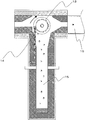
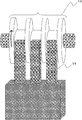
- a schematic side sectional view of the metal titanium deposition portion in FIG. 3 and the structure of the deposition base material and scraper in FIG. 4 are shown.
- the deposition substrate 13 may be a roll-shaped substrate having irregularities with different diameters in the direction perpendicular to the rotation axis, and a configuration in which the central axis is rotated by a motor.
- An example of this configuration includes (but is not limited to) a plurality of disk-shaped metal plates connected by the same central axis.
- a scraper 14 is installed under the roll-shaped deposition base material 13 so as to scrape off the titanium metal deposited on the surface of the deposition base material. The titanium scraped off can be continuously recovered by recovering it with the recovery device 15 connected to the lower part of the metal titanium deposit.
- the mixed gas of gaseous magnesium other than titanium and gaseous titanium tetrachloride which precipitates and grows in the metal titanium precipitation part 9 is discharged to the discharge part connected to the precipitation part, including by-product magnesium chloride. It is collected by a filter or the like.
- Experimental example 1 Experimental examples showing the effectiveness of the method for producing titanium metal according to the present invention will be described below.
- the apparatus used for the experiment has the basic structure shown in FIG. 1, the magnesium evaporation part has the structure shown in FIG. 2, and the metal titanium deposition part has the structure shown in FIG.
- the magnesium evaporating section is provided with a graphite crucible 2 into which solid magnesium is inserted, and has a structure in which the solid magnesium inserted into the graphite crucible is melted and evaporated with a DC plasma torch 4 having a maximum output of 50 kW as an evaporation heat source.
- a DC plasma torch 4 having a maximum output of 50 kW as an evaporation heat source.
- the metal titanium precipitation part scrapes off the titanium roll-shaped precipitation base material 13 and titanium deposited and grown on the surface of the precipitation base material as shown in FIG.
- a molybdenum scraper was arranged for the purpose.
- the roll-shaped deposition base material 13 rotated by a motor was arranged in an uneven shape so that the surface area was increased and the mixed gas was in contact with the surface portion of the base material.
- An exhaust part is connected to the metal titanium precipitation part.
- An induction heating coil 6 was installed on the outer periphery of the first flow path
- an induction heating coil 10 was installed on the outer periphery of the second flow path
- an induction heating coil 11 was installed on the outer periphery of the mixed gas part, and the respective temperatures were controlled by induction heating.
- a plasma flame was generated at an output of 20 kW and Ar: He of 60 slpm (standard liter per minute): 10 slpm as a plasma operating gas, and solid magnesium inserted in the graphite crucible was evaporated. Titanium tetrachloride solution 20 ml / min (milliliter per minute), magnesium 9.7 g / min were supplied from each channel to the gas mixing section, and the mixed gas was supplied to the metal titanium precipitation section for 12 minutes. The material was formed with titanium metal grown into dendrites.
- the electric power of the induction heating coil 11 was set to 14.7 kW, and the outer peripheral temperature of the gas mixing unit was controlled to 1700 ° C.
- the inside of the gas mixing section is estimated to be 1600 ° C. or higher.
- the pressure in a gas mixing part was 105 kPa.
- the temperature of the deposition base material for the titanium metal deposition part was controlled to 950 to 1050 ° C. and the pressure to 105 kPa.
- titanium is suitable as a melting raw material or a powder metallurgy raw material. It can be used in applications where the manufacture of molten materials for electronic materials, aircraft parts, and power / chemical plants is essential.
Landscapes
- Engineering & Computer Science (AREA)
- Chemical & Material Sciences (AREA)
- Mechanical Engineering (AREA)
- Life Sciences & Earth Sciences (AREA)
- General Life Sciences & Earth Sciences (AREA)
- Geology (AREA)
- Environmental & Geological Engineering (AREA)
- Metallurgy (AREA)
- Materials Engineering (AREA)
- Organic Chemistry (AREA)
- Manufacturing & Machinery (AREA)
- General Engineering & Computer Science (AREA)
- General Chemical & Material Sciences (AREA)
- Chemical Kinetics & Catalysis (AREA)
- Manufacture And Refinement Of Metals (AREA)
- Furnace Housings, Linings, Walls, And Ceilings (AREA)
- Furnace Details (AREA)
Abstract
Description
クロール法は実用レベルのチタン素材を製造できるが、熱還元反応と真空分離は別工程で行なわれるために製造に長時間を要する。また、製造はバッチ式であるため、製造能率が低い。クロール法のこれらの課題を克服するために、様々な技術が提案されている。
文献2には、Example IIにチタンをTiCl4ガス+Mgガスにより生成する方法が示されており、具体的には、反応温度として約850℃、圧力として10~200microns(1.3~26.7Pa)が適用されている。
この方法では、四塩化チタンガスとマグネシウムガスとの反応の効率を上げるためには均一に混合させる必要がある。
本発明の目的は、四塩化チタンおよびマグネシウムを出発原料として、金属チタンを効率よく製造できる金属チタンの製造方法および装置を提供することである。
これに対して、本発明で規定する絶対圧50kPa~500kPaというのは、ほぼ大気圧であり、従来技術として紹介した文献を参照すると、マグネシウムやMgCl2を生成したチタンから分離できない環境である。本発明者は、このような従来では考えられない圧力下であっても、析出用基材上にチタンが結晶化して成長することを確認し、さらに驚くべきことに、その純度も極めて高いものであることを確認したのである。
なお、50kPa未満でも原理的にはチタンを回収できるが、圧力低下に伴って製造速度が低くなると同時に、装置内への空気漏れの可能性が大きくなる。チタンは酸素、窒素との反応活性が高い金属であるから、製造プロセスを空気から保護することも必要である。真空度が高いほど、プロセス上および装置上の真空漏れ対策のコストが高くなる。50kPa以上では空気漏れという課題は工業製造レベルで容易に解決でき、実用上好ましい範囲となる。
処理能力、分離効率、工業設備の経済合理性を考慮すると、絶対圧90kPa~200kPaの範囲がより好ましい。
なお、析出用基材の表面上に析出させたチタンを掻き落とすスクレーパ機能を別途付加したり、析出用基材を複数配置して、析出部分を相互に摺動運動させることで、析出したチタンを掻き落とすようにしてもよい。あるいは析出用基材に振動を加えることにより、析出基材表面に形成したチタン粒子を連続的に回収することも可能である。
また、反応熱を奪い、反応領域の温度を制御する目的で、析出用基材を冷却することもできる。
特に、回収されるチタンの純度を維持し、不純物の混入を防止するため、析出用基材は純チタンが望ましい。
本発明の一例によれば、気体状の四塩化チタンを供給する第二流路7の側壁の少なくとも一部の周りに加熱ヒータ10を設けることができ、このヒータにより第二流路内を所定温度まで加熱することができる。なお、第二流路7は、塩化物蒸気への耐食性を有する材料により形成することができる。塩化物蒸気への耐食性を有する材料の一例としては、黒鉛を使用できる。他の例としては、第二流路7は、コイルを有するヒータを使って加熱できる。加熱は第二流路7の黒鉛壁を誘導加熱することにより行うことができる。
析出用基材に析出した金属チタンを連続的に回収する場合の機構の一具体例として、図3の金属チタン析出部の側面略断面図や図4の析出用基材およびスクレーパの構造を示す模式図に示すように、析出用基材13は回転軸線に対して垂直方向に径の異なる凹凸を有するロール形状のものを、モータで中心軸を回転させる構成が挙げられる。この構成の一例として、(これに限定されないが)複数のディスク状の金属板が同一中心軸によって連結されて形成されたものが挙げられる。このロール形状の析出用基材13の下部には、析出用基材の表面に析出した金属チタンを掻き落とすようにスクレーパ14が設置されている。掻き落としたチタンは、金属チタン析出部の下部に連結された回収器15で回収することで、連続的に回収できる。
本発明に係る金属チタンの製造方法の有効性を示す実験例を以下説明する。実験に使用した装置は図1に示した基本構造を有し、マグネシウム蒸発部は図2に示す構造、金属チタン析出部は図3に示す構造のものである。マグネシウム蒸発部は、固体マグネシウムを挿入する黒鉛坩堝2を設置され、蒸発熱源として最大出力50kWのDCプラズマトーチ4で黒鉛坩堝に挿入した固体マグネシウムを溶融蒸発させる構造とした。
金属チタン析出部には、連続的にチタンを回収するための構成として、図4に示すようにチタン製のロール形状の析出用基材13と析出用基材表面に析出成長したチタンを掻き落とすためのモリブデン製のスクレーパを配置した。なお、モータで回転させるロール形状の析出用基材13は凹凸形状とすることで表面積を大きくし、基材の表面部に混合ガスが接触するよう配置した。金属チタン析出部には排気部を接続する構造とした。第一流路の外周に誘導加熱コイル6、第二流路の外周に誘導加熱コイル10、混合ガス部の外周に誘導加熱コイル11を設置し、誘導加熱により、それぞれの温度制御を行った。
2 坩堝
3 加熱ヒータ
4 DCプラズマトーチ
5 第一流路
6 加熱ヒータ
7 第二流路
8 ガス混合部
9 金属チタン析出部
10、11、12 加熱ヒータ
13 析出用基材
14 スクレーパ
15 回収器
16 排出部
Claims (9)
- 金属チタン製造装置において、該装置が、
(a)固体マグネシウムを蒸発させるマグネシウム蒸発部及び該マグネシウム蒸発部に連結された気体状のマグネシウムを供給する第一流路と、
(b)気体状の四塩化チタンを供給する第二流路と、
(c)前記第一流路および前記第二流路に連通するガス混合部であって、該ガス混合部内で気体状のマグネシウムと四塩化チタンとが混合されるようになっており、前記ガス混合部内が絶対圧で50kPa~500kPa、温度が1600℃以上に制御された、ガス混合部と、
(d)前記ガス混合部に連通する金属チタン析出部であって、少なくとも一部が715~1500℃の温度範囲にある析出用基材が配置され、絶対圧で50kPa~500kPaの金属チタン析出部と、
(e)前記金属チタン析出部に連通する混合ガスの排出部と
を含むことを特徴とする金属チタン製造装置。 - 前記マグネシウム蒸発部が、固体マグネシウムを蒸発させるための蒸発熱源としてDCプラズマトーチを有することを特徴とする請求項1に記載の金属チタン製造装置。
- 前記金属チタン析出部の絶対圧が90kPa~200kPaである請求項1又は請求項2に記載の金属チタン製造装置。
- 前記第一流路、前記第二流路、前記ガス混合部、および前記金属チタン析出部のうちの少なくとも1つが黒鉛壁を有することを特徴とする請求項1から請求項3までのいずれか1項に記載の金属チタン製造装置。
- 誘導加熱によって前記黒鉛壁の一部または全てを加熱できるようになっていることを特徴とする請求項4に記載の金属チタン製造装置。
- 前記析出用基材が、回転軸線に対して垂直方向に径の異なる凹凸を有するロール形状を有し、前記中心軸線を中心に回転するようになっており、
前記析出用基材が、前記析出用基材の表面に析出した金属チタンを掻き落とすためのスクレーパを更に有することを特徴とする請求項1から請求項5までのいずれか1項に記載の金属チタン製造装置。 - 前記析出用基材の少なくとも一部が900~1200℃の温度範囲にあることを特徴とする請求項1から請求項6までのいずれか1項に記載の金属チタン製造装置。
- 前記析出用基材がチタンまたはチタン合金でできていることを特徴とする請求項1から請求項7までのいずれか1項に記載の金属チタン製造装置。
- 金属チタンの製造方法において、該方法が、
(a)固体マグネシウムを蒸発させる工程と、
(b)前記工程(a)で蒸発させた気体状のマグネシウムと、気体状の四塩化チタンとを絶対圧で50kPa~500kPa、温度が1600℃以上の混合空間に供給して混合ガスを形成する工程と、
(c)前記混合ガスを金属チタン析出空間に導入する工程であって、前記金属チタン析出空間は50kPa~500kPaの絶対圧を有し、前記金属チタン析出空間には析出用基材が配置され、該析出用基材の少なくとも一部が715~1500℃の温度範囲にある、前記混合ガスを析出空間に導入する工程と、
(d)前記析出用基材上に金属チタンを析出成長させる工程と、
(e)前記工程(d)を経た前記混合ガスを排出する工程と
を含むことを特徴とする金属チタンの製造方法。
Priority Applications (5)
| Application Number | Priority Date | Filing Date | Title |
|---|---|---|---|
| AU2011236279A AU2011236279B2 (en) | 2010-04-07 | 2011-03-07 | Metal titanium production device and metal titanium production method |
| CN2011800147388A CN102803527B (zh) | 2010-04-07 | 2011-03-07 | 金属钛制造装置以及金属钛的制造方法 |
| CA2795184A CA2795184C (en) | 2010-04-07 | 2011-03-07 | Metal titanium production device and metal titanium production method |
| US13/639,358 US20130095243A1 (en) | 2010-04-07 | 2011-03-07 | Metal titanium production device and metal titanium production method |
| JP2012509358A JP5698221B2 (ja) | 2010-04-07 | 2011-03-07 | 金属チタン製造装置および金属チタンの製造方法 |
Applications Claiming Priority (2)
| Application Number | Priority Date | Filing Date | Title |
|---|---|---|---|
| JP2010-088568 | 2010-04-07 | ||
| JP2010088568 | 2010-04-07 |
Publications (1)
| Publication Number | Publication Date |
|---|---|
| WO2011125402A1 true WO2011125402A1 (ja) | 2011-10-13 |
Family
ID=44762363
Family Applications (1)
| Application Number | Title | Priority Date | Filing Date |
|---|---|---|---|
| PCT/JP2011/055184 Ceased WO2011125402A1 (ja) | 2010-04-07 | 2011-03-07 | 金属チタン製造装置および金属チタンの製造方法 |
Country Status (6)
| Country | Link |
|---|---|
| US (1) | US20130095243A1 (ja) |
| JP (1) | JP5698221B2 (ja) |
| CN (1) | CN102803527B (ja) |
| AU (1) | AU2011236279B2 (ja) |
| CA (1) | CA2795184C (ja) |
| WO (1) | WO2011125402A1 (ja) |
Cited By (3)
| Publication number | Priority date | Publication date | Assignee | Title |
|---|---|---|---|---|
| WO2012070461A1 (ja) * | 2010-11-22 | 2012-05-31 | 日立金属株式会社 | 金属チタン製造装置および金属チタンの製造方法 |
| WO2012070452A1 (ja) * | 2010-11-22 | 2012-05-31 | 日立金属株式会社 | 金属チタン製造装置および金属チタンの製造方法 |
| JP2020117752A (ja) * | 2019-01-22 | 2020-08-06 | 株式会社Ihi | 金属チタン製造装置及び方法 |
Families Citing this family (1)
| Publication number | Priority date | Publication date | Assignee | Title |
|---|---|---|---|---|
| CN105177506B (zh) * | 2015-09-07 | 2017-05-17 | 京东方科技集团股份有限公司 | 一种坩埚、真空蒸镀装置及系统 |
Citations (3)
| Publication number | Priority date | Publication date | Assignee | Title |
|---|---|---|---|---|
| JPH03150327A (ja) * | 1989-11-06 | 1991-06-26 | Osaka Titanium Co Ltd | 金属Tiの製造方法 |
| JPH03150326A (ja) * | 1989-11-06 | 1991-06-26 | Osaka Titanium Co Ltd | 還元による金属の製造方法 |
| WO2010137688A1 (ja) * | 2009-05-29 | 2010-12-02 | 日立金属株式会社 | 金属チタンの製造方法 |
Family Cites Families (5)
| Publication number | Priority date | Publication date | Assignee | Title |
|---|---|---|---|---|
| US2997385A (en) * | 1958-10-29 | 1961-08-22 | Du Pont | Method of producing refractory metal |
| CN100519784C (zh) * | 2006-05-31 | 2009-07-29 | 刘晓岚 | 一种直冷式联合法制取海绵钛的装置 |
| US7914600B2 (en) * | 2007-01-22 | 2011-03-29 | Materials & Electrochemical Research Corp. | Continuous production of titanium by the metallothermic reduction of TiCl4 |
| CN101270418B (zh) * | 2008-03-18 | 2010-06-23 | 杜德忠 | 海绵钛制备工艺 |
| JP5427452B2 (ja) * | 2008-03-31 | 2014-02-26 | 日立金属株式会社 | 金属チタンの製造方法 |
-
2011
- 2011-03-07 US US13/639,358 patent/US20130095243A1/en not_active Abandoned
- 2011-03-07 AU AU2011236279A patent/AU2011236279B2/en not_active Ceased
- 2011-03-07 JP JP2012509358A patent/JP5698221B2/ja not_active Expired - Fee Related
- 2011-03-07 CN CN2011800147388A patent/CN102803527B/zh not_active Expired - Fee Related
- 2011-03-07 CA CA2795184A patent/CA2795184C/en not_active Expired - Fee Related
- 2011-03-07 WO PCT/JP2011/055184 patent/WO2011125402A1/ja not_active Ceased
Patent Citations (3)
| Publication number | Priority date | Publication date | Assignee | Title |
|---|---|---|---|---|
| JPH03150327A (ja) * | 1989-11-06 | 1991-06-26 | Osaka Titanium Co Ltd | 金属Tiの製造方法 |
| JPH03150326A (ja) * | 1989-11-06 | 1991-06-26 | Osaka Titanium Co Ltd | 還元による金属の製造方法 |
| WO2010137688A1 (ja) * | 2009-05-29 | 2010-12-02 | 日立金属株式会社 | 金属チタンの製造方法 |
Cited By (7)
| Publication number | Priority date | Publication date | Assignee | Title |
|---|---|---|---|---|
| WO2012070461A1 (ja) * | 2010-11-22 | 2012-05-31 | 日立金属株式会社 | 金属チタン製造装置および金属チタンの製造方法 |
| WO2012070452A1 (ja) * | 2010-11-22 | 2012-05-31 | 日立金属株式会社 | 金属チタン製造装置および金属チタンの製造方法 |
| JP2012111986A (ja) * | 2010-11-22 | 2012-06-14 | Hitachi Metals Ltd | 金属チタン製造装置および金属チタンの製造方法 |
| US9163299B2 (en) | 2010-11-22 | 2015-10-20 | Hitachi Metals, Ltd. | Device for producing titanium metal, and method for producing titanium metal |
| US9435007B2 (en) | 2010-11-22 | 2016-09-06 | Hitachi Metals, Ltd. | Titanium metal production apparatus and production method for titanium metal |
| JP2020117752A (ja) * | 2019-01-22 | 2020-08-06 | 株式会社Ihi | 金属チタン製造装置及び方法 |
| JP7230526B2 (ja) | 2019-01-22 | 2023-03-01 | 株式会社Ihi | 金属チタン製造装置及び方法 |
Also Published As
| Publication number | Publication date |
|---|---|
| US20130095243A1 (en) | 2013-04-18 |
| JP5698221B2 (ja) | 2015-04-08 |
| AU2011236279A1 (en) | 2012-10-25 |
| CA2795184A1 (en) | 2011-10-13 |
| CN102803527B (zh) | 2013-11-13 |
| AU2011236279B2 (en) | 2013-12-12 |
| CA2795184C (en) | 2015-07-14 |
| JPWO2011125402A1 (ja) | 2013-07-08 |
| CN102803527A (zh) | 2012-11-28 |
Similar Documents
| Publication | Publication Date | Title |
|---|---|---|
| JP5425196B2 (ja) | 金属チタンの製造方法 | |
| JP5571537B2 (ja) | 金属チタン製造装置および金属チタンの製造方法 | |
| JP5427452B2 (ja) | 金属チタンの製造方法 | |
| JP3865033B2 (ja) | 酸化珪素粉末の連続製造方法及び連続製造装置 | |
| CN103221558B (zh) | 金属钛制造装置和金属钛的制造方法 | |
| JP5698221B2 (ja) | 金属チタン製造装置および金属チタンの製造方法 | |
| JP2007505992A (ja) | 金属ハロゲン化物の還元によって金属組成物を製造するための方法および装置 | |
| US20060270199A1 (en) | Process for producing high-purity silicon and apparatus | |
| JP4295823B2 (ja) | マグネトロン容量結合型プラズマによる気化性金属化合物からの高純度金属の還元精製方法及びそのための装置 | |
| JP5475708B2 (ja) | チタンの製造方法及び製造装置 | |
| JP4692324B2 (ja) | 高純度多結晶シリコンの製造装置 | |
| TWI482736B (zh) | Manufacture of high purity silicon micropowder | |
| WO2011071032A1 (ja) | 多結晶シリコンの製造方法及び多結晶シリコン製造用の反応炉 | |
| JP2013071881A (ja) | 多結晶シリコンの製造方法 |
Legal Events
| Date | Code | Title | Description |
|---|---|---|---|
| WWE | Wipo information: entry into national phase |
Ref document number: 201180014738.8 Country of ref document: CN |
|
| 121 | Ep: the epo has been informed by wipo that ep was designated in this application |
Ref document number: 11765304 Country of ref document: EP Kind code of ref document: A1 |
|
| WWE | Wipo information: entry into national phase |
Ref document number: 2012509358 Country of ref document: JP |
|
| ENP | Entry into the national phase |
Ref document number: 2795184 Country of ref document: CA |
|
| NENP | Non-entry into the national phase |
Ref country code: DE |
|
| ENP | Entry into the national phase |
Ref document number: 2011236279 Country of ref document: AU Date of ref document: 20110307 Kind code of ref document: A |
|
| WWE | Wipo information: entry into national phase |
Ref document number: 13639358 Country of ref document: US |
|
| 122 | Ep: pct application non-entry in european phase |
Ref document number: 11765304 Country of ref document: EP Kind code of ref document: A1 |