WO2011121681A1 - ジョブスケジュールシステム、ジョブスケジュール管理方法及び記録媒体 - Google Patents
ジョブスケジュールシステム、ジョブスケジュール管理方法及び記録媒体 Download PDFInfo
- Publication number
- WO2011121681A1 WO2011121681A1 PCT/JP2010/005673 JP2010005673W WO2011121681A1 WO 2011121681 A1 WO2011121681 A1 WO 2011121681A1 JP 2010005673 W JP2010005673 W JP 2010005673W WO 2011121681 A1 WO2011121681 A1 WO 2011121681A1
- Authority
- WO
- WIPO (PCT)
- Prior art keywords
- job
- failure
- computer
- degree
- server
- Prior art date
- Legal status (The legal status is an assumption and is not a legal conclusion. Google has not performed a legal analysis and makes no representation as to the accuracy of the status listed.)
- Ceased
Links
Images




Classifications
-
- G—PHYSICS
- G06—COMPUTING OR CALCULATING; COUNTING
- G06F—ELECTRIC DIGITAL DATA PROCESSING
- G06F11/00—Error detection; Error correction; Monitoring
- G06F11/008—Reliability or availability analysis
Definitions
- the present invention relates to a job schedule system, a job schedule management method, and a recording medium, and in particular, evaluates the failure impact level of a job and the failure risk level of an execution server, and puts a job with a high failure impact level into a state with a low failure risk level.
- the present invention relates to a job schedule system, a job schedule management method, and a recording medium that are executed by a held execution server.
- Document 1 discloses a method for selecting an execution server that is a computer that executes a job that is a control unit of batch processing for batch processing of data.
- an execution server with a low load is selected so as to average the load of each execution server.
- a rank in which the user evaluates the reliability of the hardware of the execution server is disclosed.
- Patent Document 2 discloses a method for changing the multiplicity, which is the maximum value of the number of jobs that can be executed simultaneously, according to the size of the job load and the number of jobs in the queue queue of the job class.
- the degree of failure impact which is the magnitude of the impact on work when a job ends abnormally (probability of impact or amount of loss when impacted) varies depending on the job. Jobs that cannot start the next job if they are not completed within a certain period of time, jobs that cannot be re-executed, or jobs that cannot be re-executed and need to be re-executed after confirmation and recovery, and subsequent jobs For jobs that do not affect the job, jobs that can be re-executed several times, or jobs that can be automatically re-executed, the probability that the job will be affected when the job ends abnormally and the amount of damage that will be affected Is different.
- the failure probability of the execution server is also different. It is necessary to consider not only hardware failure but also software failure such as operating system, middleware or user application. Immediately after the introduction or update of software, the failure occurrence probability tends to be high, and there are many system failure reports at high load.
- An object of the present invention is to improve the normal termination probability of a job that has a large impact on business when it is abnormally terminated, and to reduce the impact on business when a failure occurs.
- one aspect of the present invention is a computer system including a plurality of computers, and means for calculating a failure influence degree that is a magnitude of influence on a job when a job ends abnormally. And a means for calculating a risk degree indicating a magnitude of the failure occurrence probability of the computer, and an allowable maximum failure influence which is a maximum value of the failure influence degree of a job that can be executed by the computer having the risk degree.
- Means for determining the degree of failure means for selecting the computer whose failure impact degree of the job is less than or equal to the allowable maximum failure impact level, means for requesting execution of the job to the computer that has selected execution of the job, and the computer And means for executing the job.
- means for calculating a failure influence degree that is a magnitude of influence on a job when a job ends abnormally characterized in that it comprises means for determining a maximum failure impact level which is the maximum value of the fault impact level of at least one job to be executed, and means for calculating a multiplicity corresponding to the maximum fault impact level.
- the failure impact level of a job and the failure risk level of an execution server are evaluated each time a job is submitted, and a job with a high failure impact level is executed on an execution server kept at a low failure risk level.
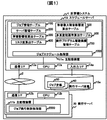
- FIG. 1 is a diagram showing a hardware configuration of a computer system 1 which is an embodiment to which the present invention is applied.
- the computer system 1 includes a schedule server 10 that is a computer on which the program code of the job schedule processing unit 1000 operates, and a computer on which the program code of the job execution control processing unit 2000 that executes a job in response to a request from the schedule server 10 operates. And at least one of the plurality of execution servers 20.
- the schedule server 10 includes a main storage device 11a that stores an instruction code of a program of the job schedule processing unit 1000, a CPU (Central Processing Unit) 12a that loads, interprets and executes the program instruction code of the processing unit 1000, and a communication path 2.
- a communication interface 13a and an input / output interface 14a that transmit / receive an execution request and an execution result to / from one or more servers 20 are included.
- the execution server 20 includes a main storage device 11b that stores the instruction code of the program of the job execution control processing unit 2000, a CPU 12b that loads, interprets and executes the instruction code of the program of the processing unit 2000, and a schedule server via the communication path 2. 10, a communication interface 13b for transmitting and receiving an execution request and an execution result.
- a job management table 100 In the main storage device 11a, a job management table 100, a server management table 200, a failure influence degree calculation table 300, a risk degree calculation table 400, a maximum allowable failure, which are management tables assigned and referred to or updated by the job schedule processing unit 1000.
- An influence degree calculation table 500, a multiplicity limit rate calculation table 600, and an execution program operation result management table 700 are included.
- the bag storage device 15a is a storage device that can be accessed from the schedule server 10 via the interface 14a.
- the storage device 15a stores at least one definition file 30 in which job attributes and execution details are described, and an execution server definition file 40 in which the names and attributes of the servers 20 are described.
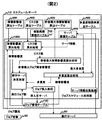
- FIG. 2 is a block diagram showing an outline of the processing of the computer system 1.
- the probability that the job cannot be completed by the target end time, or the effect that affects the business if it cannot be completed when a job is abnormally terminated or cannot be continued due to a failure of the execution server 20, the probability that the job cannot be completed by the target end time, or the effect that affects the business if it cannot be completed.
- the evaluation rank of the magnitude of (loss) is evaluated as an obstacle influence degree.
- the evaluation rank of the server failure occurrence probability at which the server 20 becomes faulty and job execution cannot be continued is evaluated each time the job is executed because the risk degree dynamically varies depending on the load or the like. A job having a high degree of fault influence is executed on the server 20 with a low risk level, so that the fault tolerance of the entire computer system 1 is improved.
- the fault impact level of a job is calculated by applying the job attribute value extracted from the job definition file for the job to the conditional expression in the fault impact level calculation table 300.
- the risk level of the server 20 is a risk level calculation table based on the magnitude of the dynamically changing failure factor indicated by the server information collected from the server 20 and the presence / absence of job program operation results on the server 20 indicated by the operation result management table 700. It is calculated by applying to each condition in 400.
- the execution server determination process for determining the server 20 that executes the job there is a margin in the multiplicity that is the maximum value of the number of jobs that can be executed simultaneously in the server 20, and the job failure influence degree is the allowable maximum failure influence degree of the server 20.
- the smaller server 20 is a server 20 that executes jobs.
- the allowable maximum failure influence degree is the maximum value of the failure influence degree of a job that can be executed by the server 20, and a value corresponding to the risk degree of the server 20 is obtained from the allowable maximum failure influence degree calculation table 500.
- a job with a high failure impact level can be executed even if the job schedule time has not been reached.
- the server 20 that executes the job is determined in advance (reservation of the execution server).
- the multiplicity of the server 20 is limited according to the magnitude of the failure impact of the job being executed on the server 20 with the maximum multiplicity specified in the server definition file 40 as the upper limit.
- the ratio of the multiplicity to be limited is obtained from the multiplicity limit rate calculation table 600.
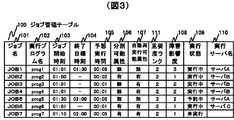
- FIG. 3 shows the structure of the job management table 100.
- the entries of the table 100 provided for each job include a job name 101, an execution program name 102, a job start time 103, an end target time 104, an expected execution time 105, a separable attribute 106, and automatic re-execution.
- a possible attribute 107, a job importance rank 111, a failure influence degree 108, an execution state 109, and an execution server name 110 are included.
- the job name 101 is a name that uniquely identifies the job in the computer system 1.
- the execution program name 102 is the name of a program or command that is started as a job in the server 20.
- the job start time 103 is a time when the server 20 is requested to execute.
- the target end time 104 is a deadline time when it is desired to end the job by that time.
- the expected execution time 105 is an estimated value of the job execution time.
- the splittable attribute 106 is set to “present” when a plurality of jobs are generated from the same job and a part of the data processed by the same job is processed by each generated job. Otherwise, set it to “None”.
- the automatic re-executable attribute 107 is set to “present” when there is no problem even if the job is re-executed when the job ends abnormally.
- the job is set to “None” when it is necessary to intervene with some user action such as state inspection or recovery processing.
- the job importance rank 111 is a numerical value obtained by evaluating the amount of loss when a job is abnormally terminated and a loss is caused to work.
- the execution state 109 is “not executed” when the job has not yet been executed and the server 20 that executes the job has not been determined. The job has not yet been executed, but the server 20 that has executed the job has been determined. "Reserving" when the job is in progress, "Sending” when the job is submitted to the server 20 and the completion notification is not received, or the completion notification is received from the server 20 Any value of “completed” is registered in.
- the execution server name 110 is the name of the server 20 that is selected during execution of the job or as the execution destination of the job.
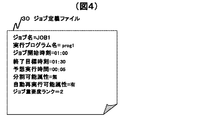
- FIG. 4 shows a description example of the job definition file 30. Describe values such as job name, execution program name, job start time, end target time, expected execution time, splittable attribute, and automatic re-executable attribute. Values described in the job definition file 30 are registered in the elements 101 to 107 and 111 of the job management table.
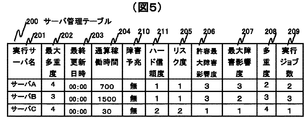
- FIG. 5 shows the structure of the server management table 200.
- the entries of the table 200 provided for each server 20 include the execution server name 201, the maximum multiplicity 202, the last update date and time 203, the total operation time 204, the risk degree 205, the allowable maximum failure influence degree 206, The maximum failure influence degree 207, the multiplicity 208, the number of execution jobs 209, the failure predictor 210, and the hardware reliability 211 are included.
- the execution server name 201 is a name that uniquely identifies the server 20 within the computer system 1.
- the maximum multiplicity 202 is the maximum value of the number of jobs that can be simultaneously executed by the server 20.
- the last update date and time 203 is a value closer to the current time among the date and time when the server 20 is first started and the date and time when the system software such as the operating system of the server 20 was last updated or changed.
- the maximum failure influence degree 207 is the maximum value of the failure influence degree of a job being executed by the server 20 or reserved to be executed by the server 20.
- the multiplicity 208 is a current value of the maximum value of the number of jobs that can be simultaneously executed by the server 20.
- the number of execution jobs 209 is the number of jobs being executed on the server 20.
- the failure sign 210 is “present” when the server 20 determines from the failure message, statistical information, or the like that there is a possibility of a system failure or a failure of the components constituting the server 20, and “no” when there is no failure. The value of is registered.
- Hardware reliability 211 is a value evaluated by the user for the reliability of hardware such as the components of the server 20. A higher value is set as the physical failure probability of the server 20 is higher.
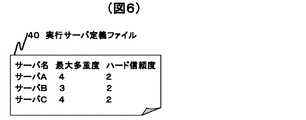
- FIG. 6 shows a description example of the execution server definition file 40.
- the server name which is the name of the server 20, the maximum multiplicity which is the maximum value of the multiplicity of the server 20, and the hardware reliability of the server 20 are described. Values described in the execution server definition file 40 are registered in the server management tables 201, 202, and 211.
- FIG. 7 shows the structure of the execution program operation result management table 700.
- the execution program operation result management table 700 is used as one of indexes for calculating the value of the risk degree 205 (see FIG. 5) of the server 20.
- Each entry of the execution program operation result management table 700 holds a list of the name 701 of each execution server and the execution program name 702 of the job executed on the server 20 (the same value as the program name 102). The list is acquired by inquiring of the server 20. Since the server 20 that has once executed a program to be operated by a job has a lower probability that the job will end abnormally than the server 20 that has never executed the program, one of the conditions for determining the risk level of the server 20 I will.
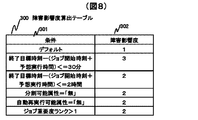
- FIG. 8 shows the structure of the failure impact degree calculation table 300.
- the table 300 is used as an index for calculating the value of the job failure impact level 108.
- Each entry in the table 300 includes a condition 301 that is a conditional expression for calculating the failure impact degree of a job, and a condition 301 when the values of the elements 101 to 106 of the table 100 are applied to the conditional expression.
- Job failure impact degree 302 is included. Of all the values of the failure influence degree 302 that satisfies the condition 301, the largest value is the failure influence degree 108 of the job (see FIG. 3).
- FIG. 8 shows an example in which the failure impact degree is “3” and “end target time ⁇ (job start time + expected execution time) ⁇ 2 hours” is the largest value.
- FIG. 9 shows the structure of the risk degree calculation table 400.
- the table risk degree calculation table 400 is used as an index for calculating the value of the risk degree 205 of the server 20.
- Each entry of the risk degree calculation table 400 is assigned the condition 401, which is a conditional expression for calculating the risk degree of the server 20, and the values of the elements 203, 204, 210, 211 of the server management table 200 to the conditional expression.
- the risk degree 402 of the server 20 when the condition 401 is sometimes satisfied is included.
- the largest value among all the values of the risk degree 402 that satisfies the condition 401 is the risk degree 205 of the server 20 (see FIG. 5).
- FIG. 10 shows the structure of the allowable maximum failure influence degree calculation table 500.
- the allowable maximum failure influence degree calculation table 500 is used as an index for calculating the value of the allowable maximum failure influence degree 206 (see FIG. 5) of the server 20.
- the entry of the allowable maximum failure influence degree calculation table 500 includes the risk degree 501 of the server 20 and the allowable maximum failure influence degree 502 of the server 20 at the risk degree.
- the value of the influence degree 502 of the entry of the risk degree 501 having the same value as the risk degree 205 becomes the value of the allowable maximum failure influence degree 206 of the server 20.
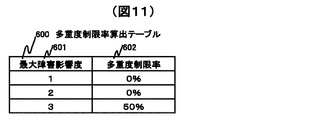
- FIG. 11 shows the structure of the multiplicity limiting rate calculation table 600.
- the multiplicity limit rate calculation table 600 is used as an index for calculating the value of the multiplicity 208 of the server 20.
- the entry of the severe restriction rate calculation table 600 includes the maximum failure influence degree 601 and the multiplicity restriction rate 602 of the job.
- a value obtained by multiplying the value of the multiplicity limit rate 602 of the entry of the maximum fault influence degree 601 having the same value as the maximum fault influence degree 207 (see FIG. 5) of the server 20 by the maximum multiplicity is the multiplicity 208 of the server 20. Value (see FIG. 5).
- FIG. 12 is a flowchart showing the flow of processing of the job schedule processing unit 1000.
- the job schedule processing unit 1000 first executes a table generation process 1100 to allocate and initialize the areas of the tables 100 to 600 to the main storage device 11a (details of the table generation process 1100 will be described later).
- the job schedule management processing unit 1000 executes the selection process 1200 of the server 20 that executes the requested job (Step 1002) (details of the execution server selection process 1200 will be described later). If the selection is successful (that is, the execution server name 110 is not blank) and the job execution state 109 is not “reserved” (executable) (step 1003: Yes), the job execution control processing unit 2000 of the selected server 20 is selected. The job name 101 and the execution program name 102 are transmitted to request execution of the job (step 1004), and the execution state 109 is changed to “being executed” (step 1005).
- the job schedule processing unit 1000 determines whether or not a job completion notification has been received from the job control processing unit 2000 of the selected server 20 after performing the determination in step 1001 (step 1001: No) (step 1006).
- step 1006: Yes the name of the job that has been processed is received from the job execution control processing unit 2000, and the name of the job management table 100 whose job name 101 matches that name is received.
- the execution state 109 is set to “completed” (step 1007).
- step 1006 the job management table 100 stores the job start time. It is determined whether or not there is an entry 103 with the current time and the execution state 109 being “unexecuted” (step 1008). If it is determined that there is an entry whose job start time 103 is after the current time and the execution state 109 is “unexecuted” (step 1008: Yes), execution server selection processing 1200 and steps 1003 to 1005 are performed for the job of that entry. And execute an unexecuted job that has reached the scheduled time.
- step 1008 determines in step 1008 that there is no entry whose job start time 103 is after the current time and the execution state 109 is “unexecuted” (step 1008: No)
- step 1009 determines whether or not there is an entry in the table 100 whose job start time 103 is after the current time and the execution state 109 is “reserved” (step 1009). If there is an entry whose job start time 103 is after the current time and the execution state 109 is “reserved” (step 1009: Yes), steps 1004 to 1005 are executed for the job of that entry, and the schedule time is reached. Run the reserved job. On the other hand, if it is determined that it does not exist, the process returns to step 1001.
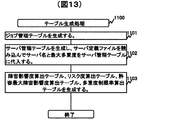
- FIG. 13 is a flowchart showing the flow of table generation processing.
- the job schedule processing unit 1000 first generates the job management table 100 (step 1101).
- the job schedule processing unit 1000 generates the server management table 200, reads the execution server definition 40, assigns an entry to the table 200, reads the server name, the maximum multiplicity, and the hardware reliability rank value. Are assigned to the server name 201, the maximum multiplicity 202, and the hardware reliability rank of the assigned entry, respectively (step 1102).
- the job schedule processing unit 1000 generates a failure influence degree calculation table 300, a risk degree calculation table 400, an allowable maximum failure influence degree calculation table 500, and a multiplicity limit rate calculation table 600 (step 1103).
- the values of the entries in these generated tables may be set by reading conditions and values specified in a file or the like instead of the values in FIGS.
- FIG. 14 is a flowchart showing the flow of the execution server selection process.
- the job schedule processing unit 1000 first calculates the failure impact level of the job requested to be executed and substitutes it in the failure impact level 108 (step 1201). Specifically, referring to the failure impact degree calculation table 300, the values of the items 103 to 107 of the job management table 100 are applied to the expressions indicated by the conditions 301 in the table 300 to determine whether or not the conditions are satisfied. To check. When the condition is satisfied, the failure influence degree 108 is set to the largest value among the failure influence degrees 302 corresponding to the condition. For example, JOB1 in FIG. 3 satisfies all the conditions 301 shown in FIG. 8, and therefore, “3” having the largest value is registered as the failure influence degree 108 among the failure influence degrees 302 corresponding to these conditions.
- “default” in the condition 301 in FIG. 8 is a condition that all jobs satisfy.
- target end time ⁇ (job start time + expected execution time) ⁇ 2 hours” similarly satisfies “ ⁇ 2 hours”.
- both the “dividable attribute” and the “automatic re-executable attribute” are “none”, which satisfies the condition.
- “job importance rank 1>” in the condition 301 of FIG. therefore, as shown in FIG. 8, among the failure impact levels 302 corresponding to these conditions, “3” having the largest value is registered in the job management table 100 as the failure impact level 108 of JOB1.
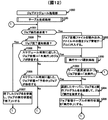
- the job schedule processing unit 1000 determines whether the job start time 103 is before the current time or the failure influence degree 108 is the maximum value (step 1202). If the job start time 103 is after the current time or the failure influence level 108 is not the maximum value (step 1202: No), the job schedule processing unit 1000 cannot immediately execute the job and determines the server 20 for reservation. Since there is no need, the server selection processing after step 1203 is not performed and the processing is terminated.
- the job schedule processing unit 1000 collects server information (step 1203). Specifically, the job schedule processing unit 1000 transmits a server information collection request to all the servers 20 indicated by the server name 201 in the server management table 200. The job schedule processing unit 1000 waits for a response from the server 20, extracts server information from the response, and the last update date / time 203, the total operation time 204, and the failure of the entry in which the server 20 having the response is equal to the server name 201 A value is substituted for each of the signs 210. Also, from the response, a list of programs having an operation record in the server 20 is taken out, an entry is assigned to the table 700, and the name 701 and the program name 702 of the server 20 are recorded.
- the job schedule processing unit 1000 calculates the risk level of each server 20 and substitutes it for the risk level 205 (step 1204). Specifically, referring to the risk degree calculation table 400 shown in FIG. 9, the formulas indicated by the conditions 401 in the risk degree calculation table 400 are collected in step 1203 for all the servers 20 in the server management table 200. It is checked whether or not the condition is satisfied by applying the values of the server information 203 to 204. When the condition is satisfied, the largest value among the risk degrees 402 corresponding to the condition is set as the risk degree 205.
- server A only the default (all jobs) is satisfied and the other conditions are not satisfied, so “1” that is the default risk degree is substituted for the risk degree 205.
- the job schedule processing unit 1000 obtains the number of jobs being executed by each server 20 (step 1205). That is, for all entries in the table 200, the number that the execution server name 201 and the execution server name 110 match and the execution state 109 is “executing” is obtained and substituted for the execution job number 209.
- the job schedule processing unit 1000 obtains the maximum failure influence degree of each server 20 (step 1206). That is, for all entries in the server management table 200, the failure of an entry in the table 100 in which the execution server name 201 and the execution server name 110 match and the execution state 109 is “executed” or “not executed”. Of the influence levels 108, the largest value is obtained and substituted for the maximum failure influence level 207.
- the job schedule processing unit 1000 calculates the allowable maximum failure influence degree corresponding to the risk degree 205 of each server 20 with reference to the allowable maximum failure influence degree calculation table 500 (step 1207). That is, for all entries in the table 200, the table 500 is searched for an entry in which the value of the risk degree 205 and the value of the risk degree 500 match, and the value of the allowable maximum failure influence degree 502 of the matched entry is calculated. Substituted in the maximum allowable fault influence degree 206.
- the job schedule processing unit 1000 calculates the multiplicity limit rate corresponding to the maximum failure impact degree 207 of each server 20 with reference to the multiplicity limit rate calculation table 600 shown in FIG. 11, and multiplies the maximum multiplicity.
- the multiplicity is obtained (step 1208). That is, for all the entries in the server management table 200, the table 600 is searched for an entry in which the value of the maximum failure influence degree 207 and the value of the maximum failure influence degree 601 match, and the multiplicity limit rate 602 of the matching entries is determined. A value obtained by multiplying the value by the value of maximum multiplicity 202 is substituted for multiplicity 208.
- a server 20 that has a margin for multiplicity and whose job failure impact level 108 does not exceed the allowable maximum fault impact level 206 of the server 20 is selected as the server 20 that executes the job.
- the server 20 indicated by the execution server name 201 of the entry is the server 20 that executes the job.
- the job schedule processing unit 1000 determines whether there is a selectable execution server (step 1210), and if it exists (step 1210: Yes), the name 201 of the selected server 20 is set as the execution server name 110. Substitute (step 1211). On the other hand, if it is determined that it does not exist (step 1210: No), the server selection is failed and the process is terminated.
- the job schedule processing unit 1000 determines whether the job start time is before the current time (step 1212). If the job start time is before the current time (step 1212: Yes), the value of the execution state 109 is set to “reserving” (step 1213). Conversely, if the job start time is later than the current time, the server selection is successful and the process is terminated.
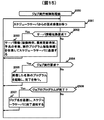
- FIG. 15 is a flowchart showing the processing flow of the job execution control processing unit 2000.
- the job execution control unit 2000 receives a request from the schedule server 10 and waits for completion of a job program being executed (step 2001).
- the job execution processing unit 2000 determines whether the request received from the schedule server 10 is a server information collection request (step 2002). If the request is a server information collection request (step 2002: Yes), the server information Are collected and transmitted to the schedule server 10 (step 2003). As the last update date and time, for example, the date and time recorded in the file when the update operation is performed in the server 20 is read and transmitted. The presence / absence of a sign is recorded by monitoring a hardware failure message, for example. As the execution program operation result, for example, the program name recorded in step 2005 is transmitted.
- step 2002 determines whether the request is a job execution request (step 2004). If it is a job execution request (step 2004: Yes), the program with the received name is started and the completion of the program processing is awaited (step 2005).
- step 2006 determines whether the job program has been completed.
- step 2006: Yes the job name of the completed program is transmitted to notify the schedule server 10 of completion (step 2007).
- the probability of normally ending a job having a large impact on a job when the job is terminated abnormally is improved, and the job when a failure occurs.
- the influence on can be reduced.
Landscapes
- Engineering & Computer Science (AREA)
- Quality & Reliability (AREA)
- Theoretical Computer Science (AREA)
- Physics & Mathematics (AREA)
- General Engineering & Computer Science (AREA)
- General Physics & Mathematics (AREA)
- Debugging And Monitoring (AREA)
Applications Claiming Priority (2)
| Application Number | Priority Date | Filing Date | Title |
|---|---|---|---|
| JP2010-080107 | 2010-03-31 | ||
| JP2010080107A JP5325827B2 (ja) | 2010-03-31 | 2010-03-31 | ジョブスケジュールシステム、ジョブスケジュール管理方法及びプログラム。 |
Publications (1)
| Publication Number | Publication Date |
|---|---|
| WO2011121681A1 true WO2011121681A1 (ja) | 2011-10-06 |
Family
ID=44711478
Family Applications (1)
| Application Number | Title | Priority Date | Filing Date |
|---|---|---|---|
| PCT/JP2010/005673 Ceased WO2011121681A1 (ja) | 2010-03-31 | 2010-09-17 | ジョブスケジュールシステム、ジョブスケジュール管理方法及び記録媒体 |
Country Status (2)
| Country | Link |
|---|---|
| JP (1) | JP5325827B2 (cg-RX-API-DMAC7.html) |
| WO (1) | WO2011121681A1 (cg-RX-API-DMAC7.html) |
Families Citing this family (3)
| Publication number | Priority date | Publication date | Assignee | Title |
|---|---|---|---|---|
| JP3386952B2 (ja) | 1996-04-10 | 2003-03-17 | 新日本製鐵株式会社 | 圧延機における圧延材のガイド調整機構 |
| JP6885193B2 (ja) | 2017-05-12 | 2021-06-09 | 富士通株式会社 | 並列処理装置、ジョブ管理方法、およびジョブ管理プログラム |
| DE112021002042T5 (de) * | 2020-03-31 | 2023-04-13 | Sumitomo Heavy Industries, Ltd. | Spritzgiessmaschine, spritzgiessmaschinensystem und verwaltungsvorrichtung |
Citations (9)
| Publication number | Priority date | Publication date | Assignee | Title |
|---|---|---|---|---|
| JPH05257908A (ja) * | 1992-03-16 | 1993-10-08 | Hitachi Ltd | 高信頼型分散処理システム |
| JPH09114790A (ja) * | 1995-10-17 | 1997-05-02 | Sumitomo Metal Ind Ltd | 生産管理方法及び生産管理システム |
| JPH1185707A (ja) * | 1997-09-04 | 1999-03-30 | Hitachi Ltd | 並列計算機におけるジョブ投入計算機の選択方法及び装置 |
| JP2000047956A (ja) * | 1998-07-27 | 2000-02-18 | Canon Inc | データ通信システム、データダウンロード方法及び記憶媒体 |
| JP2001175484A (ja) * | 1999-12-17 | 2001-06-29 | Nec Corp | ジョブスケジュール方法及びその装置並びにプログラムを記録した機械読み取り可能な記録媒体 |
| JP2002251929A (ja) * | 2001-02-23 | 2002-09-06 | National Institute Of Advanced Industrial & Technology | 結晶配向性の高いタリウム系超伝導銀系シース線材及びその製造方法 |
| JP2004258964A (ja) * | 2003-02-26 | 2004-09-16 | Hitachi Ltd | 計算機システムの自動運転方法及び計算機システム |
| JP2005234917A (ja) * | 2004-02-20 | 2005-09-02 | Hitachi Ltd | 障害時のサーバ決定方法 |
| JP2006243781A (ja) * | 2005-02-28 | 2006-09-14 | Ibm Japan Ltd | サーバの多重度の上限値を制御するための方法、管理サーバ、サーバ、およびプログラム |
Family Cites Families (1)
| Publication number | Priority date | Publication date | Assignee | Title |
|---|---|---|---|---|
| JP2002251292A (ja) * | 2001-02-22 | 2002-09-06 | Nec Software Chubu Ltd | クライアントサーバシステムにおけるジョブ管理方式及びクライアントサーバシステムにおけるジョブ管理方法 |
-
2010
- 2010-03-31 JP JP2010080107A patent/JP5325827B2/ja not_active Expired - Fee Related
- 2010-09-17 WO PCT/JP2010/005673 patent/WO2011121681A1/ja not_active Ceased
Patent Citations (9)
| Publication number | Priority date | Publication date | Assignee | Title |
|---|---|---|---|---|
| JPH05257908A (ja) * | 1992-03-16 | 1993-10-08 | Hitachi Ltd | 高信頼型分散処理システム |
| JPH09114790A (ja) * | 1995-10-17 | 1997-05-02 | Sumitomo Metal Ind Ltd | 生産管理方法及び生産管理システム |
| JPH1185707A (ja) * | 1997-09-04 | 1999-03-30 | Hitachi Ltd | 並列計算機におけるジョブ投入計算機の選択方法及び装置 |
| JP2000047956A (ja) * | 1998-07-27 | 2000-02-18 | Canon Inc | データ通信システム、データダウンロード方法及び記憶媒体 |
| JP2001175484A (ja) * | 1999-12-17 | 2001-06-29 | Nec Corp | ジョブスケジュール方法及びその装置並びにプログラムを記録した機械読み取り可能な記録媒体 |
| JP2002251929A (ja) * | 2001-02-23 | 2002-09-06 | National Institute Of Advanced Industrial & Technology | 結晶配向性の高いタリウム系超伝導銀系シース線材及びその製造方法 |
| JP2004258964A (ja) * | 2003-02-26 | 2004-09-16 | Hitachi Ltd | 計算機システムの自動運転方法及び計算機システム |
| JP2005234917A (ja) * | 2004-02-20 | 2005-09-02 | Hitachi Ltd | 障害時のサーバ決定方法 |
| JP2006243781A (ja) * | 2005-02-28 | 2006-09-14 | Ibm Japan Ltd | サーバの多重度の上限値を制御するための方法、管理サーバ、サーバ、およびプログラム |
Also Published As
| Publication number | Publication date |
|---|---|
| JP2011215661A (ja) | 2011-10-27 |
| JP5325827B2 (ja) | 2013-10-23 |
Similar Documents
| Publication | Publication Date | Title |
|---|---|---|
| US8713578B2 (en) | Managing job execution | |
| JP4859558B2 (ja) | コンピュータシステムの制御方法及びコンピュータシステム | |
| JP5422342B2 (ja) | インシデント管理方法および運用管理サーバ | |
| US8793693B2 (en) | Apparatus and method for predicting a processing time of a computer | |
| US8516499B2 (en) | Assistance in performing action responsive to detected event | |
| US9477460B2 (en) | Non-transitory computer-readable storage medium for selective application of update programs dependent upon a load of a virtual machine and related apparatus and method | |
| US8538793B2 (en) | System and method for managing real-time batch workflows | |
| JP2008158628A (ja) | 運用実績評価装置、運用実績評価方法、およびプログラム | |
| US20090158287A1 (en) | Dynamic critical path update facility | |
| JP2007193471A (ja) | 予約管理プログラム、予約管理装置、および予約管理方法 | |
| JP5942509B2 (ja) | バッチ処理システム | |
| US10733554B2 (en) | Information processing apparatus and method for managing connections | |
| JP5323554B2 (ja) | ジョブ処理方法、ジョブ処理プログラムを格納したコンピュータ読み取り可能な記録媒体、および、ジョブ処理システム | |
| EP3798931A1 (en) | Machine learning training resource management | |
| US8677375B2 (en) | Selecting executing requests to preempt | |
| JP5325827B2 (ja) | ジョブスケジュールシステム、ジョブスケジュール管理方法及びプログラム。 | |
| JP5155699B2 (ja) | 情報処理装置、情報処理方法及びプログラム | |
| CN113010278A (zh) | 一种用于财险核心系统的批处理方法及系统 | |
| JP2008059599A (ja) | 仮想化されたリソースの割当て方法及びその実施システム | |
| US9336063B1 (en) | Distributed task management | |
| JP2018041296A (ja) | 計算機システムおよびジョブ実行計画変更方法 | |
| JP2012256307A (ja) | 作業スケジューリングプログラム,方法,およびシステム | |
| WO2008040563A1 (en) | Method, system and computer program for distributing execution of independent jobs | |
| JP3596744B2 (ja) | 資源利用状況監視制御方法およびそのプログラムを記録した記録媒体 | |
| JP2006344061A (ja) | シナリオ適用支援方法、管理サーバおよび管理プログラム |
Legal Events
| Date | Code | Title | Description |
|---|---|---|---|
| 121 | Ep: the epo has been informed by wipo that ep was designated in this application |
Ref document number: 10848863 Country of ref document: EP Kind code of ref document: A1 |
|
| NENP | Non-entry into the national phase |
Ref country code: DE |
|
| 122 | Ep: pct application non-entry in european phase |
Ref document number: 10848863 Country of ref document: EP Kind code of ref document: A1 |