WO2011111497A1 - 発光性有機白金錯体、これを含む発光性材料および機能素子 - Google Patents
発光性有機白金錯体、これを含む発光性材料および機能素子 Download PDFInfo
- Publication number
- WO2011111497A1 WO2011111497A1 PCT/JP2011/053475 JP2011053475W WO2011111497A1 WO 2011111497 A1 WO2011111497 A1 WO 2011111497A1 JP 2011053475 W JP2011053475 W JP 2011053475W WO 2011111497 A1 WO2011111497 A1 WO 2011111497A1
- Authority
- WO
- WIPO (PCT)
- Prior art keywords
- group
- carbon atoms
- complex
- light
- platinum complex
- Prior art date
- Legal status (The legal status is an assumption and is not a legal conclusion. Google has not performed a legal analysis and makes no representation as to the accuracy of the status listed.)
- Ceased
Links
Images

Classifications
-
- C—CHEMISTRY; METALLURGY
- C07—ORGANIC CHEMISTRY
- C07F—ACYCLIC, CARBOCYCLIC OR HETEROCYCLIC COMPOUNDS CONTAINING ELEMENTS OTHER THAN CARBON, HYDROGEN, HALOGEN, OXYGEN, NITROGEN, SULFUR, SELENIUM OR TELLURIUM
- C07F15/00—Compounds containing elements of Groups 8, 9, 10 or 18 of the Periodic Table
- C07F15/0006—Compounds containing elements of Groups 8, 9, 10 or 18 of the Periodic Table compounds of the platinum group
- C07F15/0086—Platinum compounds
- C07F15/0093—Platinum compounds without a metal-carbon linkage
-
- C—CHEMISTRY; METALLURGY
- C07—ORGANIC CHEMISTRY
- C07F—ACYCLIC, CARBOCYCLIC OR HETEROCYCLIC COMPOUNDS CONTAINING ELEMENTS OTHER THAN CARBON, HYDROGEN, HALOGEN, OXYGEN, NITROGEN, SULFUR, SELENIUM OR TELLURIUM
- C07F15/00—Compounds containing elements of Groups 8, 9, 10 or 18 of the Periodic Table
-
- C—CHEMISTRY; METALLURGY
- C07—ORGANIC CHEMISTRY
- C07C—ACYCLIC OR CARBOCYCLIC COMPOUNDS
- C07C251/00—Compounds containing nitrogen atoms doubly-bound to a carbon skeleton
- C07C251/02—Compounds containing nitrogen atoms doubly-bound to a carbon skeleton containing imino groups
- C07C251/24—Compounds containing nitrogen atoms doubly-bound to a carbon skeleton containing imino groups having carbon atoms of imino groups bound to carbon atoms of six-membered aromatic rings
-
- C—CHEMISTRY; METALLURGY
- C09—DYES; PAINTS; POLISHES; NATURAL RESINS; ADHESIVES; COMPOSITIONS NOT OTHERWISE PROVIDED FOR; APPLICATIONS OF MATERIALS NOT OTHERWISE PROVIDED FOR
- C09K—MATERIALS FOR MISCELLANEOUS APPLICATIONS, NOT PROVIDED FOR ELSEWHERE
- C09K11/00—Luminescent materials, e.g. electroluminescent or chemiluminescent
- C09K11/06—Luminescent materials, e.g. electroluminescent or chemiluminescent containing organic luminescent materials
-
- H—ELECTRICITY
- H05—ELECTRIC TECHNIQUES NOT OTHERWISE PROVIDED FOR
- H05B—ELECTRIC HEATING; ELECTRIC LIGHT SOURCES NOT OTHERWISE PROVIDED FOR; CIRCUIT ARRANGEMENTS FOR ELECTRIC LIGHT SOURCES, IN GENERAL
- H05B33/00—Electroluminescent light sources
- H05B33/12—Light sources with substantially two-dimensional [2D] radiating surfaces
- H05B33/14—Light sources with substantially two-dimensional [2D] radiating surfaces characterised by the chemical or physical composition or the arrangement of the electroluminescent material, or by the simultaneous addition of the electroluminescent material in or onto the light source
-
- H—ELECTRICITY
- H10—SEMICONDUCTOR DEVICES; ELECTRIC SOLID-STATE DEVICES NOT OTHERWISE PROVIDED FOR
- H10K—ORGANIC ELECTRIC SOLID-STATE DEVICES
- H10K85/00—Organic materials used in the body or electrodes of devices covered by this subclass
- H10K85/30—Coordination compounds
- H10K85/341—Transition metal complexes, e.g. Ru(II)polypyridine complexes
- H10K85/346—Transition metal complexes, e.g. Ru(II)polypyridine complexes comprising platinum
-
- C—CHEMISTRY; METALLURGY
- C09—DYES; PAINTS; POLISHES; NATURAL RESINS; ADHESIVES; COMPOSITIONS NOT OTHERWISE PROVIDED FOR; APPLICATIONS OF MATERIALS NOT OTHERWISE PROVIDED FOR
- C09K—MATERIALS FOR MISCELLANEOUS APPLICATIONS, NOT PROVIDED FOR ELSEWHERE
- C09K2211/00—Chemical nature of organic luminescent or tenebrescent compounds
- C09K2211/10—Non-macromolecular compounds
- C09K2211/1003—Carbocyclic compounds
- C09K2211/1007—Non-condensed systems
-
- C—CHEMISTRY; METALLURGY
- C09—DYES; PAINTS; POLISHES; NATURAL RESINS; ADHESIVES; COMPOSITIONS NOT OTHERWISE PROVIDED FOR; APPLICATIONS OF MATERIALS NOT OTHERWISE PROVIDED FOR
- C09K—MATERIALS FOR MISCELLANEOUS APPLICATIONS, NOT PROVIDED FOR ELSEWHERE
- C09K2211/00—Chemical nature of organic luminescent or tenebrescent compounds
- C09K2211/10—Non-macromolecular compounds
- C09K2211/1003—Carbocyclic compounds
- C09K2211/1011—Condensed systems
-
- C—CHEMISTRY; METALLURGY
- C09—DYES; PAINTS; POLISHES; NATURAL RESINS; ADHESIVES; COMPOSITIONS NOT OTHERWISE PROVIDED FOR; APPLICATIONS OF MATERIALS NOT OTHERWISE PROVIDED FOR
- C09K—MATERIALS FOR MISCELLANEOUS APPLICATIONS, NOT PROVIDED FOR ELSEWHERE
- C09K2211/00—Chemical nature of organic luminescent or tenebrescent compounds
- C09K2211/18—Metal complexes
- C09K2211/185—Metal complexes of the platinum group, i.e. Os, Ir, Pt, Ru, Rh or Pd
-
- H—ELECTRICITY
- H10—SEMICONDUCTOR DEVICES; ELECTRIC SOLID-STATE DEVICES NOT OTHERWISE PROVIDED FOR
- H10K—ORGANIC ELECTRIC SOLID-STATE DEVICES
- H10K2101/00—Properties of the organic materials covered by group H10K85/00
- H10K2101/10—Triplet emission
-
- H—ELECTRICITY
- H10—SEMICONDUCTOR DEVICES; ELECTRIC SOLID-STATE DEVICES NOT OTHERWISE PROVIDED FOR
- H10K—ORGANIC ELECTRIC SOLID-STATE DEVICES
- H10K50/00—Organic light-emitting devices
- H10K50/10—OLEDs or polymer light-emitting diodes [PLED]
- H10K50/11—OLEDs or polymer light-emitting diodes [PLED] characterised by the electroluminescent [EL] layers
Definitions
- the present invention relates to a light-emitting organic platinum complex useful as a material for a functional element such as an organic light-emitting element, a light-emitting material including the same, and a functional element.
- the phosphorescent light emission by the organometallic complex can achieve a theoretically higher quantum efficiency than the fluorescent light emission in organic EL (electroluminescence).
- the said organometallic complex is anticipated as a material of functional elements, such as an organic light emitting element which is a next generation technique, specifically, a material of an organic EL display, etc.
- improvements are desired from the viewpoints of lifetime, heat resistance, efficiency when current increases, and the like.
- Patent Document 1 describes a metal porphyrin complex having a crosslinked structure using a metal such as platinum.
- Patent Document 2 describes an organometallic complex using a metal such as iridium or platinum and having a heterocyclic compound as a ligand.
- JP-A-2004-155711 released on June 3, 2004
- JP 2009-224763 released on October 1, 2009
- the metalloporphyrin complex described in Patent Document 1 has a crosslinked structure, the porphyrin as a ligand maintains a planar structure. For this reason, the metal porphyrin complex has a large ratio of non-radiation deactivation, and the emission quantum yield ⁇ is about several percent, and the emission efficiency is low. Therefore, the light emission intensity sufficient for practical use cannot be obtained. Moreover, in order to synthesize a metal porphyrin complex, it is necessary to carry out a multistage reaction (about 9 stages), and the production method is complicated. Furthermore, the emission color tone is limited to red with a wavelength of around 650 nm, and the three primary colors of light cannot be aligned.
- the organometallic complex described in Patent Document 2 also has a high ratio of non-radiation deactivation due to molecular motion of the organometallic complex. Therefore, since the light emission quantum yield ⁇ is 15% or less and the light emission efficiency is low, the light emission intensity sufficient for practical use cannot be obtained.
- the conventional organometallic complex has a problem in that the light emission efficiency is low, so that the light emission intensity sufficient for practical use cannot be obtained, and the three primary colors of light cannot be aligned.
- the inventor of the present application introduces a cross-linked structure with a cross-linked chain such as a methylene chain into the ligand of the luminescent organic platinum complex, and thereby emits light of the luminescent organic platinum complex. It was found that the intensity was increased and that the emission intensity was practical enough even at room temperature (23 ° C.), and that the emission color tone could be controlled by adjusting the length of the cross-linked chain. It came to be completed.
- An object of the present invention is to provide a light-emitting organic platinum complex useful as a material for a functional element such as an organic light-emitting element, a light-emitting material containing the same, and a functional element.
- the luminescent organic platinum complex according to the present invention is represented by any one of the following structural formulas.
- Z represents — (CH 2 ) n —, or —CH 2 (CH 2 OCH 2 ) m CH 2 —, wherein n represents an integer of 7 to 14, and m represents 3 or 4 A represents an aromatic hydrocarbon ring or an aromatic heterocyclic ring which may be a condensed ring, R is a substituent of the above A and is hydrogen (provided that hydrogen is a hydrogen atom of Z in the structural formula (1)).
- alkyl group having 1 to 6 carbon atoms An alkenyl group having 1 to 6 carbon atoms, an alkynyl group having 1 to 6 carbon atoms, an alkoxy group having 1 to 6 carbon atoms, a halogenated alkoxy group represented by -OC p H q X r, hydroxyl group, hydroxyethyl group , An alkylamino group represented by —NR 1 R 2 , a nitro group Sulfonyl group, sulfinyl group, carboxyl group, acetoxy group, ureido group, phenyl group, alkylphenyl group having 7 to 13 carbon atoms, alkylphenyloxy group having 7 to 13 carbon atoms, alkynylphenyl group having 8 to 13 carbon atoms, Represents an alkenylphenyl group having 8 to 13 carbon atoms or a phenoxy group, X
- R 1 and R 2 each independently represent hydrogen or an alkyl group having 1 to 6 carbon atoms, and a plurality of R exist in A. Rs present in A may be different from each other.
- the luminescent organic platinum complex according to the present invention is more preferably, (A) represented by the structural formula (1), wherein Z is — (CH 2 ) n —, n is an integer of 8 to 14, A is a benzene ring, R is halogen, methyl Group, ethyl group, methoxy group, ethoxy group, trifluoromethoxy group, difluoromethoxy group, hydroxyl group, hydroxyethyl group, dimethylamino group, diethylamino group, nitro group, acetoxy group, phenyl group, alkyl having 7 to 13 carbon atoms A phenyloxy group, an alkynylphenyl group having 8 to 13 carbon atoms, an alkenylphenyl group having 8 to 13 carbon atoms, or hydrogen (wherein n is 14), or (B) represented by structural formula (2a) or (2b), wherein Z is — (CH 2 ) n —, n
- R is hydrogen, halogen, methyl group, ethyl group, methoxy group, ethoxy group, trifluoromethoxy group, difluoromethoxy group, hydroxyl group, hydroxyethyl group, dimethylamino group, diethylamino group, nitro group, acetoxy group, A phenyl group, an alkylphenyloxy group having 7 to 13 carbon atoms, an alkynylphenyl group having 8 to 13 carbon atoms, or an alkenylphenyl group having 8 to 13 carbon atoms.
- the luminescent organic platinum complex according to the present invention is represented by any one of the following structural formulas.
- the luminescent material according to the present invention is characterized by containing a luminescent organic platinum complex represented by any one of the above structural formulas in order to solve the above problems.
- a functional element according to the present invention is a functional element in which an organic layer including a light-emitting layer is sandwiched between a pair of electrodes, and the light-emitting layer has any one of the above structures. It is characterized by containing a light-emitting organic platinum complex represented by the formula:
- the light-emitting organic platinum complex adopts a three-dimensional structure (stereostructure) in which two ligands are bent around a platinum atom, and the ligand cannot maintain a planar structure. . Accordingly, the emission intensity of the light-emitting organic platinum complex is increased, and the emission intensity sufficient for practical use can be exhibited even at room temperature (23 ° C.).
- the specific reason why the emission intensity of the luminescent organoplatinum complex is increased is that, besides the change (deformation) of the coordination plane of the complex due to the formation of the crosslinked chain, the luminescent organic platinum complex molecule by the crosslinked chain And control of the accumulation between them. Moreover, since the three-dimensional structure (three-dimensional structure) of two ligands can be controlled by adjusting the length of the crosslinked chain, the emission color tone can be controlled.
- the light-emitting material having the above structure contains a light-emitting organic platinum complex represented by any one of the above structural formulas.
- the functional element having the above structure includes an organic layer including a light-emitting layer containing a light-emitting organic platinum complex represented by any one of the above structural formulas between a pair of electrodes,
- the light emission efficiency is excellent, the light emission intensity sufficient for practical use can be obtained, and the three primary colors of light can be made uniform.
- a light-emitting organic platinum complex useful as a material for a functional element and a functional element using the same can be provided.
- the luminescent organic platinum complex According to the luminescent organic platinum complex according to the present invention, the luminescent material and the functional element including the same, it is possible to obtain a light emission intensity that is superior to the conventional organometallic complex and has a practical light emission intensity.
- the three primary colors can be aligned, and for example, a light-emitting organic platinum complex useful as a material for a functional element such as an organic light-emitting element, a light-emitting material including the same, and a functional element can be provided.
- the luminescent organic platinum complex according to the present invention is easier to industrialize than the conventional organometallic complex using iridium. is there.
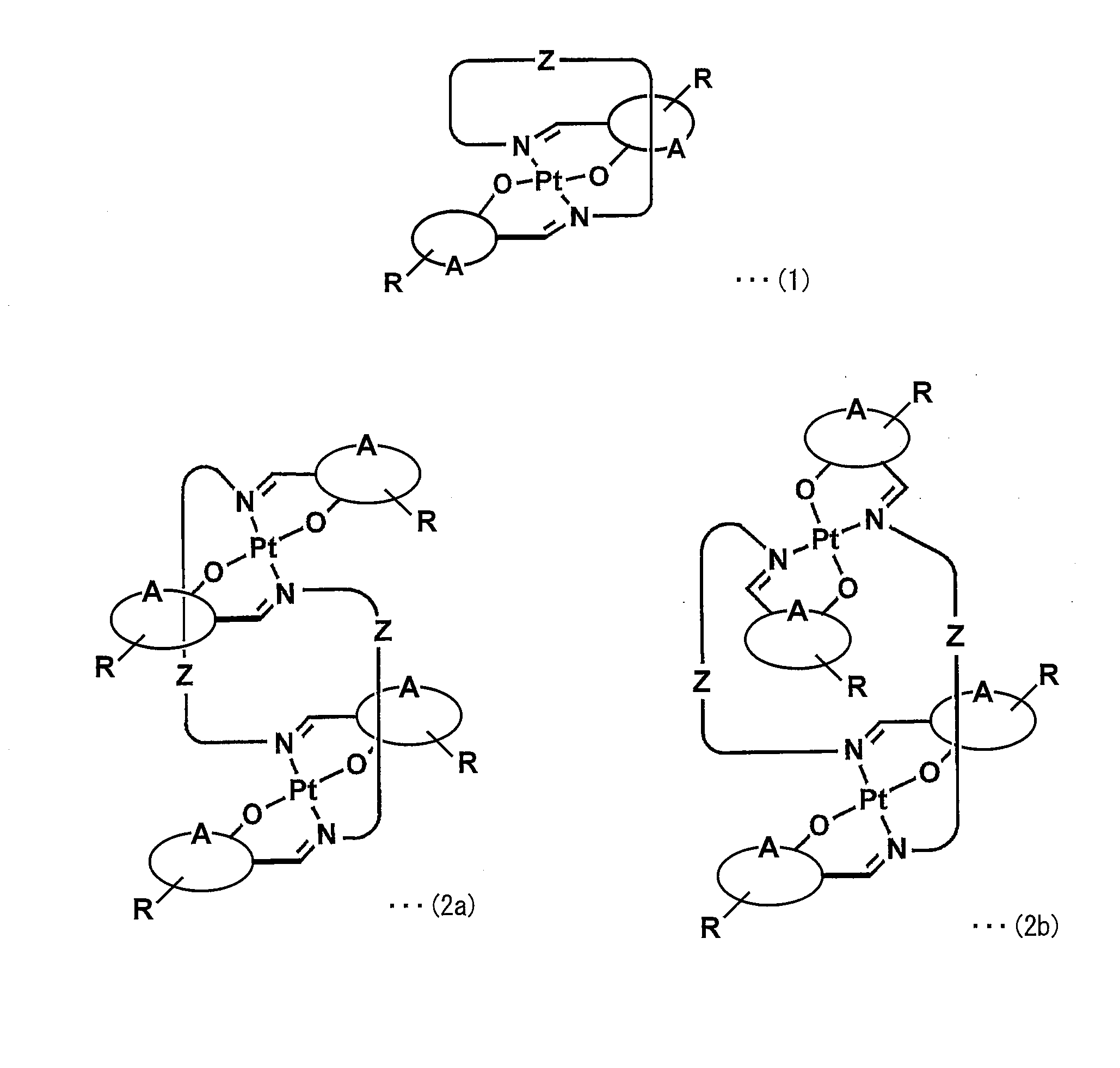
- the luminescent organic platinum complex according to the present invention is represented by any one of the following structural formulas (1), (2a), and (2b).
- Z represents — (CH 2 ) n —, or —CH 2 (CH 2 OCH 2 ) m CH 2 —, wherein n represents an integer of 7 to 14, and m represents 3 or 4 A represents an aromatic hydrocarbon ring or an aromatic heterocyclic ring which may be a condensed ring, R is a substituent of the above A and is hydrogen (provided that hydrogen is a hydrogen atom of Z in the structural formula (1)).
- halogen an alkyl group having 1 to 6 carbon atoms, an alkenyl group having 1 to 6 carbon atoms, an alkynyl group having 1 to 6 carbon atoms, an alkoxy group having 1 to 6 carbon atoms, -OC p H q X r halogenated alkoxy group represented by a hydroxyl group, a hydroxyethyl group, an alkylamino group represented by -NR 1 R 2 Nitro group, sulfonyl group, sulfinyl group, carboxyl group, acetoxy group, ureido group, phenyl group, alkylphenyl group having 7 to 13 carbon atoms, alkylphenyloxy group having 7 to 13 carbon atoms, alkynyl having 8 to 13 carbon atoms Represents a phenyl group, an alkenylphenyl group having 8 to 13 carbon atoms, or a phenoxy group,
- the light-emitting organic platinum complex may be a light-emitting organic platinum complex represented by the above structural formula (1) and containing one platinum atom, and two platinum atoms represented by the above structural formula (2a) may be substituted.
- the luminescent organic platinum complex may be an organic platinum trinuclear complex containing three platinum atoms.
- the functional element which concerns on this invention is the said luminescent organic platinum complex, (A) represented by the structural formula (1), wherein Z is — (CH 2 ) n —, n is an integer of 8 to 14, A is a benzene ring, R is halogen, methyl Group, ethyl group, methoxy group, ethoxy group, trifluoromethoxy group, difluoromethoxy group, hydroxyl group, hydroxyethyl group, dimethylamino group, diethylamino group, nitro group, acetoxy group, phenyl group, alkyl having 7 to 13 carbon atoms A phenyloxy group, an alkynylphenyl group having 8 to 13 carbon atoms, an alkenylphenyl group having 8 to 13 carbon atoms, or hydrogen (wherein n is 14), or (B) represented by structural formula (2a) or (2b), wherein Z is — (CH 2 ) n —, n is an integer
- R is hydrogen, halogen, methyl group, ethyl group, methoxy group, ethoxy group, trifluoromethoxy group, difluoromethoxy group, hydroxyl group, hydroxyethyl group, dimethylamino group, diethylamino group, nitro group, acetoxy group,
- a phenyl group, an alkylphenyloxy group having 7 to 13 carbon atoms, an alkynylphenyl group having 8 to 13 carbon atoms, or an alkenylphenyl group having 8 to 13 carbon atoms is more preferable.
- the light-emitting organic platinum complex has a cross-linked structure introduced by condensation between a ligand as a raw material and a raw material compound of a cross-linked chain that introduces a cross-linked structure into two molecules of the ligand (hereinafter referred to as a cross-linked compound).
- a cross-linked compound Is synthesized by a two-step synthesis method of synthesizing the ligand (hereinafter referred to as a bridging ligand) and an insertion step of inserting a platinum atom into the bridging ligand using a platinum compound. be able to. Therefore, the luminescent organoplatinum complex according to the present invention is easier to synthesize than a conventional organometallic complex such as a metal porphyrin complex. Since the ligand is a bidentate ligand, the bridging ligand functions as a tetradentate ligand for the platinum atom.
- the luminescent organic platinum complex is a trans-type bis (salicylaldiminato) platinum complex.
- reaction formula (A) N, N′-bis (salicylidene) —a bridging ligand obtained by condensation of two molecules of salicylaldehyde as a ligand and one molecule of diaminoalkane as a bridging compound.
- a platinum atom is inserted into N, N′-bis (salicylidene) -alkanediamine, which becomes trans-type bissalicylaldimine, using a synthesis process of alkanediamine and a platinum compound such as PtCl 2 (CH 3 CN) 2. It can be synthesized by a two-step synthesis method of an insertion step.
- combination process and insertion process can also be performed substantially simultaneously by 1 pot.
- the yield of the synthesis step in which two molecules of the bidentate ligand are linked (crosslinked) with one molecule of the crosslinking compound is 100% (or substantially 100%). Therefore, the above synthesis method is useful as an industrial production method.
- the syn-type organic platinum binuclear complex represented by the structural formula (2a) and the anti-type organic platinum binuclear complex represented by the structural formula (2b) are represented by the structural formula (1). Obtained as a by-product of a light-emitting organic platinum complex (mononuclear complex). That is, the organic platinum binuclear complex is by-produced as a by-product during the production of the light-emitting organic platinum complex (mononuclear complex).
- These organoplatinum binuclear complexes can be separated from the light-emitting organoplatinum complex (mononuclear complex) by performing a separation and purification operation such as column chromatography.
- an organic platinum trinuclear complex containing three platinum atoms is also obtained as a by-product of the light-emitting organic platinum complex (mononuclear complex) represented by the above structural formula (1).
- the light-emitting organic platinum complex can be separated.
- the light-emitting organic platinum complex according to the present invention depends on the position of the cross-linked chain relative to the coordination plane of the complex, that is, depending on whether the cross-linked chain crosses the coordination plane above or below. There are optical isomers. In the above synthesis method, the luminescent organic platinum complex is obtained as a racemate.
- ligand constituting the light-emitting organic platinum complex include salicylaldehyde, 3-fluorosalicylaldehyde, 4-fluorosalicylaldehyde, 5-fluorosalicylaldehyde, 6-fluorosalicylaldehyde, 3 -Chlorosalicylaldehyde, 4-chlorosalicylaldehyde, 5-chlorosalicylaldehyde, 6-chlorosalicylaldehyde, 3-bromosalicylaldehyde, 4-bromosalicylaldehyde, 5-bromosalicylaldehyde, 6-bromosalicylaldehyde, 3-methyl Salicylaldehyde, 4-methylsalicylaldehyde, 5-methylsalicylaldehyde, 6-methylsalicylaldehyde, 3-methoxysalicylaldehyde, 4-methoxysalicyl
- aromatic hydrocarbon ring or aromatic heterocyclic ring which may be a condensed ring represented by “A” in the structural formulas (1), (2a) and (2b), a benzene ring or a naphthalene ring (condensed) Ring) and a pyridine ring are more preferable, and a benzene ring is particularly preferable.
- a benzene ring is particularly preferable.
- crosslinking compound examples include 1,7-diaminoheptane, 1,8-diaminooctane, 1,9-diaminononane, 1,10-diaminodecane, 1,11-diaminoundecane, and 1,12-diamino.
- the cross-linking compound constituting the light-emitting organic platinum complex according to the present invention may be any compound as long as the light-emitting organic platinum complex can construct a three-dimensional structure (stereostructure).
- the above exemplified crosslinking compounds are only specific examples.
- platinum compound examples include PtCl 2 (CH 3 CN) 2, but are not particularly limited, and are known platinum compounds used when synthesizing conventional organometallic complexes. Can be suitably used.
- combining the conventional Schiff base can be used suitably.
- the solvent include, but are not limited to, ethyl alcohol.
- combining the conventional organometallic complex can be used suitably.
- the solvent include, but are not particularly limited to, a mixed solvent of toluene and dimethyl sulfoxide. The usage-amount of each said solvent with respect to the ligand per unit amount is not specifically limited.
- an inorganic compound such as potassium carbonate may be used in combination in order to promote the reaction.
- reaction conditions such as the reaction temperature and reaction time in the synthesis step and the insertion step
- known reaction conditions employed when synthesizing conventional organometallic complexes can be suitably employed.
- combination process a crosslinking ligand can be taken out from the said reaction liquid by cooling a reaction liquid.
- the reaction solution is concentrated, and an extraction operation and a separation / purification operation such as column chromatography can be performed (isolated) as a crystal, for example.
- a known isolation method employed when isolating a conventional organometallic complex can be suitably employed.
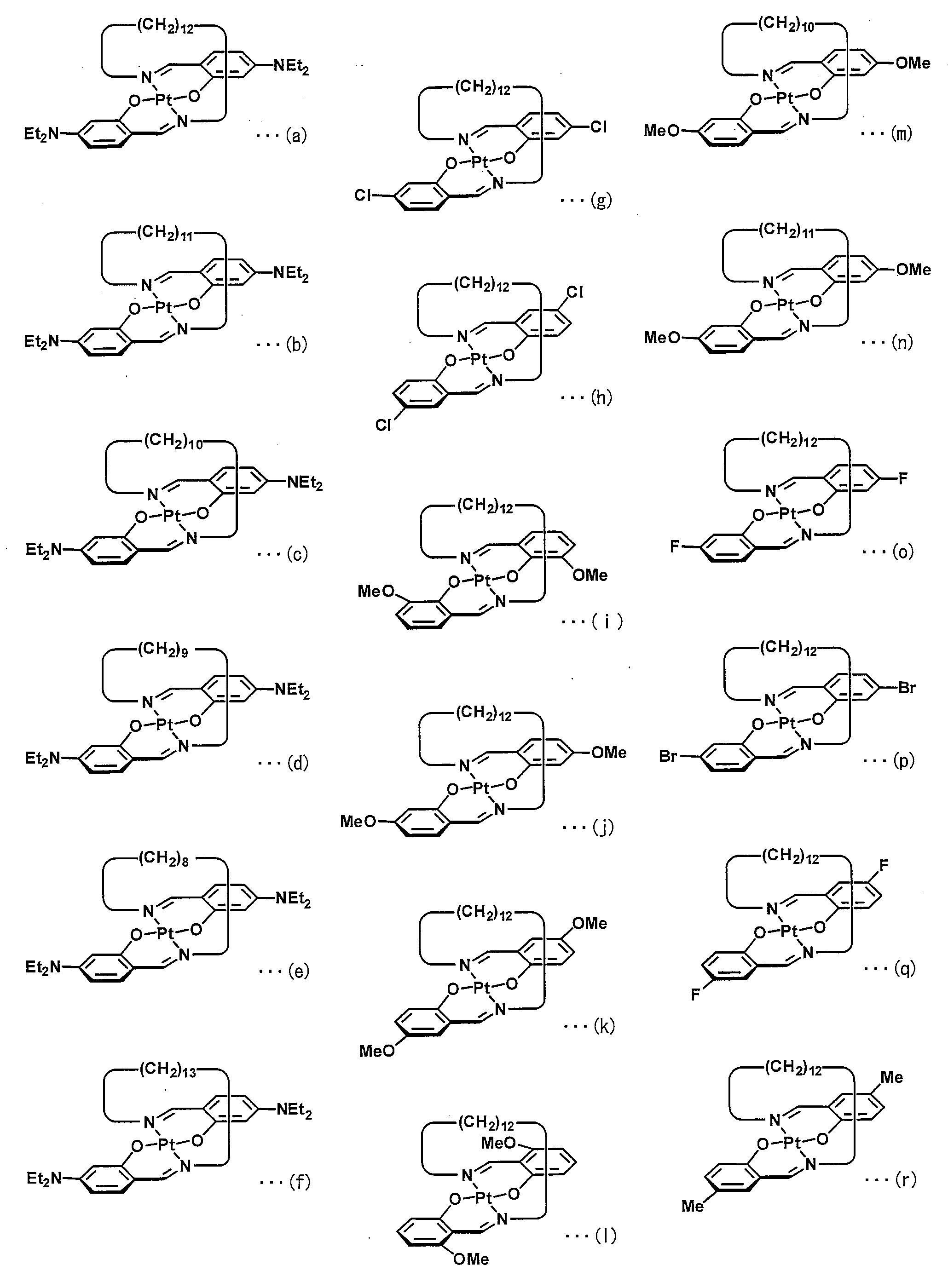
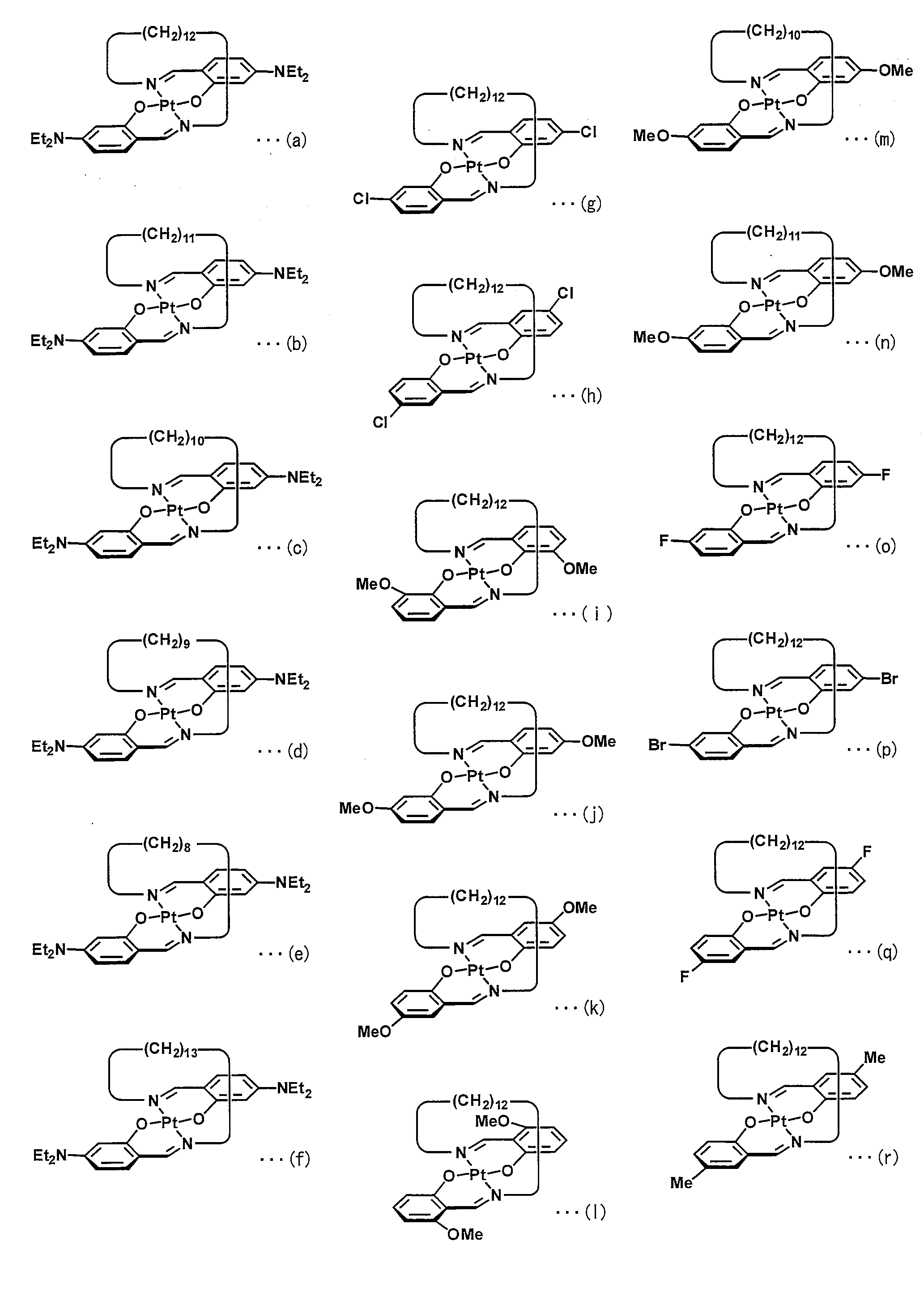
- the luminescent organic platinum complex according to the present invention obtained by the above synthesis method is specifically represented by, for example, any one of the following structural formulas. Therefore, as described above, the organic platinum binuclear complex containing two platinum atoms represented by the following structural formula is also included in the category of the luminescent organic platinum complex according to the present invention.
- Each of the light-emitting organic platinum complexes represented by these structural formulas is a novel substance that has been successfully synthesized for the first time by the present inventors.
- the luminescent organic platinum complex represented by any of the following structural formulas is merely a specific example of a more preferable luminescent organic platinum complex.
- an organic platinum trinuclear complex containing three platinum atoms is also included in the category of the luminescent organic platinum complex according to the present invention.
- Z in the structural formulas (1), (2a), and (2b) is — (CH 2 ) n —.
- N is an integer of 8 to 14 in the structural formula (1), 7 to 14 in the structural formulas (2a) and (2b), the A is a benzene ring, and the R is More preferred is —H, —F, —Cl, —Br, —CH 3 , —OCH 3 , —OCH 2 C 6 H 5 , —N (C 2 H 5 ) 2 or —NO 2 .
- -H represents the case where the above n of Z in the structural formula (1) is 7 to 13).
- the Z in the structural formulas (1), (2a), and (2b) is —CH 2 (CH 2 OCH 2 ) m CH 2 —, and the m Is more preferably 3 or 4, A is a benzene ring, and R is —H. Furthermore, as is clear from the structural formula (aj), in the luminescent organic platinum complex according to the present invention, Rs present in A may be different from each other.
- the luminescent organic platinum complex exhibits phosphorescent light emission when transitioning from the triplet transition state (excited triplet) to the ground state due to the heavy atom effect of the platinum atom.
- the light-emitting organic platinum complex according to the present invention since a cross-linked structure by a cross-linked chain such as a methylene chain is introduced into the ligand of the light-emitting organic platinum complex, the nitrogen atom bonded to the cross-linked chain is a cross-linked chain. Pulled in the direction of For this reason, the light-emitting organic platinum complex adopts a three-dimensional structure (stereostructure) in which two ligands are bent around a platinum atom, and the ligand cannot maintain a planar structure. .
- two ligands have a cross-linked structure in a trans position by a cross-linked chain (that is, a structure in which a ring is transferred in the vicinity of the platinum atom at the center of the complex) ),
- the two ligands have a three-dimensional structure (three-dimensional structure) that is bent around the platinum atom. That is, in the light-emitting organic platinum complex according to the present invention, two ligands are trans-coordinated, and a cross-linked structure is formed from nitrogen atoms of individual ligands, that is, nitrogen atoms directly coordinated to platinum atoms. Since it is formed, the ratio of non-radiation deactivation due to molecular motion of the luminescent organic platinum complex is reduced (the non-radiation deactivation is suppressed).
- the emission intensity of the luminescent organic platinum complex is increased and the phosphorescence efficiency is increased, the emission intensity sufficient for practical use can be exhibited even at room temperature (23 ° C.).
- the specific reason why the emission intensity of the luminescent organoplatinum complex is increased is that, besides the change (deformation) of the coordination plane of the complex due to the formation of the crosslinked chain, the luminescent organic platinum complex molecule by the crosslinked chain And control of the accumulation between them.
- each light-emitting organic platinum complex molecule has a non-integrated shape. For this reason, the interaction between molecules in a solid state (crystalline state or amorphous state) is reduced. Therefore, the luminescent organic platinum complex exhibits high luminous efficiency (solid emission quantum yield ⁇ at the maximum of 70% at 77 K) in the solid state (crystalline state or amorphous state).
- the conventional organometallic complex in which the ligand has a planar structure has vacancy above and below the coordination plane of the complex molecule, and it has an integrated shape, so it is hardly soluble and hardly volatile. It is difficult to handle in the solid state.
- the molecules of the luminescent organic platinum complex according to the present invention have a non-integrated shape, for example, a technique such as vapor deposition can be employed when manufacturing a functional element, It is advantageous to the manufacturing method.
- the luminescent organic platinum complex which concerns on this invention changes the coordination plane of a complex by adjusting the length (carbon number) of a bridge
- the bending angle of the 4-diethylaminosalicylaldimine ligand (the angle of the other 4-diethylaminosalicylaldimine ligand with respect to one 4-diethylaminosalicylaldimine ligand, which is 180 ° in the case of a planar structure) changes.
- the emission intensity becomes relatively small again due to the intermolecular accumulation.
- the planarity of the two 4-diethylaminosalicylaldimine ligands is strongly maintained in a bent state or a planar state depending on the length of the methylene chain.
- the trans-type bis (4-diethylaminosalicylaldiminato) platinum complex can firmly fix the three-dimensional structure (steric structure) in an arbitrary bent state by changing the length of the methylene chain. It is possible to control the color tone and the emission intensity.
- the three-dimensional structure (three-dimensional structure) of the luminescent organic platinum complex can be clarified by single crystal X-ray structural analysis.
- the angle can also be obtained by performing molecular orbital calculation using a density functional method.
- the light-emitting organoplatinum complex according to the present invention can be changed in the type of ligand and the substituent (substituent represented by “R” in structural formulas (1), (2a), and (2b)), Alternatively, the emission color tone can be changed between wavelengths (emission maximum wavelength) of 514 to 663 nm by changing the length and type of the crosslinking chain. That is, according to the luminescent organic platinum complex according to the present invention, a wide luminescent color tone can be obtained from green to yellow-green, yellow, yellow-orange, orange (orange), and the like to red. Therefore, by combining these light-emitting organic platinum complexes having various emission colors, a white LED (light-emitting diode) as a functional element, for example, a next-generation illumination can be developed.
- a white LED light-emitting diode
- ⁇ phosphorescent light emission
- ⁇ blue light having a wavelength of 420 nm as excitation light.
- the luminescent material according to the present invention includes a luminescent organic platinum complex represented by any one of the structural formulas (1), (2a), and (2b).
- the functional element according to the present invention is a functional element in which an organic layer including a light emitting layer is sandwiched between a pair of electrodes, and the light emitting layer has any one of the structural formulas (1), (2a). ), (2b) and a luminescent organic platinum complex. That is, the light emitting material according to the present invention is suitably used as a material for forming the light emitting layer of the functional element according to the present invention, for example.
- the organic EL element when the functional element is an organic EL element, for example, the organic EL element includes, for example, an anode, a hole injection layer and a hole transport layer, and a luminescent organic platinum complex on a substrate.
- the light emitting layer, the electron injection layer, the electron transport layer, and the cathode that are included are stacked in this order.
- a cathode, an electron injection layer and an electron transport layer, a light emitting layer containing a light emitting organic platinum complex, a hole injection layer and a hole transport layer, and an anode are laminated in this order on a substrate. It is constituted by.
- the hole injection layer, hole transport layer, light emitting layer, electron injection layer, and electron transport layer correspond to the organic layer.
- the organic layer may further include a protective layer, a dielectric layer, and the like of a known organic EL element, if necessary, in addition to the above-described layers. That is, in the organic EL element according to the present embodiment, a configuration of a known organic EL element is preferably adopted for each configuration other than the light emitting layer containing the light emitting organic platinum complex represented by any one of the structural formulas. be able to.
- the case where the organic layer is only the light emitting layer and the other layers are inorganic layers composed of an inorganic compound is also included in the scope of the present invention. That is, the functional element according to the present invention only needs to include at least a light emitting layer as an organic layer.
- the substrate may be any material that transmits light emitted from the light-emitting organic platinum complex without being scattered or attenuated.
- a known substrate made of an inorganic material such as a glass substrate; an organic material such as polyester, polystyrene, or polycarbonate polyimide is preferably used as the substrate.
- a moisture permeation preventing layer and a gas barrier layer may be formed on the substrate surface as necessary.
- the anode only needs to have a function of supplying holes to the hole injection layer.
- known materials such as various metals including alloys, metal oxides, or conductive compounds are preferably used as the anode.
- a metal oxide is more preferable, and a thin film made of iridium tin oxide (ITO) is particularly preferable.
- the formation method of an anode can employ
- the cathode only needs to have a function of supplying electrons to the electron injection layer.
- known materials such as various metals including alloys, metal oxides, or conductive compounds are suitably used as the cathode.
- an alloy of aluminum, alkali metal or alkaline earth metal and aluminum is particularly preferable.
- the formation method of a cathode can employ
- At least one of the anode and the cathode is desirably transparent.
- the hole injection layer and the hole transport layer may have a function of receiving holes from the anode and transporting the holes toward the light emitting layer.
- Known materials are preferably used for the hole injection layer and the hole transport layer.
- a well-known formation method can be employ
- the electron injection layer and the electron transport layer may have a function of receiving electrons from the cathode and transporting the electrons toward the light emitting layer.
- the electron injection layer and the electron transport layer known materials are preferably used.
- a well-known formation method can be employ
- the light emitting layer is formed of, for example, a light emitting material according to the present invention, and when a voltage is applied, holes transported from the anode via the hole injection layer and the hole transport layer, and the electron injection layer and the electron transport What is necessary is just to have the function to light-emit a luminescent organic platinum complex by couple
- the light emitting layer may contain a host material in addition to the light emitting organic platinum complex. That is, the light emitting material may further contain a host material.
- the host material is a function that disperses the light-emitting organic platinum complex and holds it in the light-emitting layer (that is, the light-emitting material), a function that receives holes and electrons, a function that transports holes and electrons, and a combination of holes and electrons.
- a material having at least one function of supplying (transmitting) the energy of excitons generated by bonding to the light-emitting organic platinum complex, and a known material is preferably used. .
- a mixture of a material having a hole transport function and a material having an electron transport function is more preferable.
- the formation method of a light emitting layer can employ
- the voltage applied to the organic EL element having the above configuration may be about 6 V, for example, but is not particularly limited. Since the organic EL element having the above-described configuration contains the light-emitting organic platinum complex represented by any one of the structural formulas, it can exhibit a wide range of light emission colors from green to red. That is, the functional element using the light-emitting organic platinum complex according to the present invention emits light with a wide emission color tone from green to red by applying a voltage.
- the functional element having the above structure sandwiches an organic layer including a light emitting layer containing a light emitting organic platinum complex represented by any one of the structural formulas (1), (2a), and (2b) between a pair of electrodes. Therefore, it is possible to obtain a light emission intensity which is superior to the conventional organometallic complex and has a light emission intensity sufficient for practical use, and it is possible to align the three primary colors of light.
- a luminescent organic platinum complex useful as a material for a functional element, a luminescent material containing the complex, and a functional element can be provided.
- reaction solution was concentrated under reduced pressure, and the resulting yellow solid was collected by filtration.
- the yellow solid was dried under reduced pressure to obtain 2.01 g of a slightly yellow solid of N- (4-methoxysalicylidene) -1,12-dodecanediamine.
- Example 1 0.14 g of N, N′-bis (4-diethylaminosalicylidene) -1,12-dodecanediamine synthesized in Synthesis Example 1, 0.23 g of potassium carbonate and 0.09 g of PtCl 2 (CH 3 CN) 2 The mixture was added to a mixed solvent of 90 ml of toluene and 22.5 ml of dimethyl sulfoxide and heated to reflux overnight (12 hours). The reaction mixture was concentrated under reduced pressure, and ethyl acetate and water were added to the residue to extract the desired product.
- the luminescence quantum yield in the crystalline state (powder) of each luminescent organic platinum complex was determined by an absolute method.
- the measurement method is as follows. (Measuring method) For the measurement, a fluorometer FP-6500N, a low-temperature medium integrating sphere system INK-533 for phosphorescence measurement, and a liquid sample cell LPH-120 (all manufactured by JASCO Corporation) were used. In order to eliminate the influence of oxygen, all samples (light-emitting organic platinum complexes) were measured in an argon atmosphere with the crystals enclosed in a quartz cell as they were. Furthermore, the measurement at low temperature (77K) was performed while cooling the quartz cell with liquid nitrogen using a quartz dewar.
- the luminescent organic platinum complex According to the luminescent organic platinum complex according to the present invention, the luminescent material and the functional element including the same, it is possible to obtain a light emission intensity that is superior to the conventional organometallic complex and has a practical light emission intensity.
- the three primary colors can be aligned, and for example, a light-emitting organic platinum complex useful as a material for a functional element such as an organic light-emitting element, a light-emitting material including the same, and a functional element can be provided.
- the light-emitting organic platinum complex according to the present invention is, for example, materials for functional elements such as organic light-emitting elements that are next-generation technologies, specifically organic EL (electroluminescence).
- materials for functional elements such as organic light-emitting elements that are next-generation technologies, specifically organic EL (electroluminescence).
- organic EL electroluminescence
Landscapes
- Chemical & Material Sciences (AREA)
- Organic Chemistry (AREA)
- Engineering & Computer Science (AREA)
- Materials Engineering (AREA)
- Crystallography & Structural Chemistry (AREA)
- Inorganic Chemistry (AREA)
- Electroluminescent Light Sources (AREA)
- Organic Low-Molecular-Weight Compounds And Preparation Thereof (AREA)
Abstract
Description
また、本発明に係る発光性有機白金錯体は、より好ましくは、
(a) 構造式(1)で示され、上記Zが-(CH2 )n -であり、上記nが8~14の整数であり、上記Aがベンゼン環であり、上記Rがハロゲン、メチル基、エチル基、メトキシ基、エトキシ基、トリフルオロメトキシ基、ジフルオロメトキシ基、ヒドロキシル基、ヒドロキシエチル基、ジメチルアミノ基、ジエチルアミノ基、ニトロ基、アセトキシ基、フェニル基、炭素数7~13のアルキルフェニルオキシ基、炭素数8~13のアルキニルフェニル基、炭素数8~13のアルケニルフェニル基、または水素(但し、水素はnが14のとき)であり、若しくは、
(b) 構造式(2a)または(2b)で示され、上記Zが-(CH2 )n -であり、上記nが7~14の整数であり、上記Aがベンゼン環であり、上記Rが水素、ハロゲン、メチル基、エチル基、メトキシ基、エトキシ基、トリフルオロメトキシ基、ジフルオロメトキシ基、ヒドロキシル基、ヒドロキシエチル基、ジメチルアミノ基、ジエチルアミノ基、ニトロ基、アセトキシ基、フェニル基、炭素数7~13のアルキルフェニルオキシ基、炭素数8~13のアルキニルフェニル基、または炭素数8~13のアルケニルフェニル基であり、若しくは、
(c) 構造式(1)で示され、上記Zが-CH2 (CH2 OCH2 )m CH2 -であり、上記mは3または4を表し、上記Aがベンゼン環であり、上記Rが水素、ハロゲン、メチル基、エチル基、メトキシ基、エトキシ基、トリフルオロメトキシ基、ジフルオロメトキシ基、ヒドロキシル基、ヒドロキシエチル基、ジメチルアミノ基、ジエチルアミノ基、ニトロ基、アセトキシ基、フェニル基、炭素数7~13のアルキルフェニルオキシ基、炭素数8~13のアルキニルフェニル基、または炭素数8~13のアルケニルフェニル基であり、若しくは、
(d) 構造式(2a)または(2b)で示され、上記Zが-CH2 (CH2 OCH2 )m CH2 -であり、上記mは3または4を表し、上記Aがベンゼン環であり、上記Rが水素、ハロゲン、メチル基、エチル基、メトキシ基、エトキシ基、トリフルオロメトキシ基、ジフルオロメトキシ基、ヒドロキシル基、ヒドロキシエチル基、ジメチルアミノ基、ジエチルアミノ基、ニトロ基、アセトキシ基、フェニル基、炭素数7~13のアルキルフェニルオキシ基、炭素数8~13のアルキニルフェニル基、または炭素数8~13のアルケニルフェニル基である。


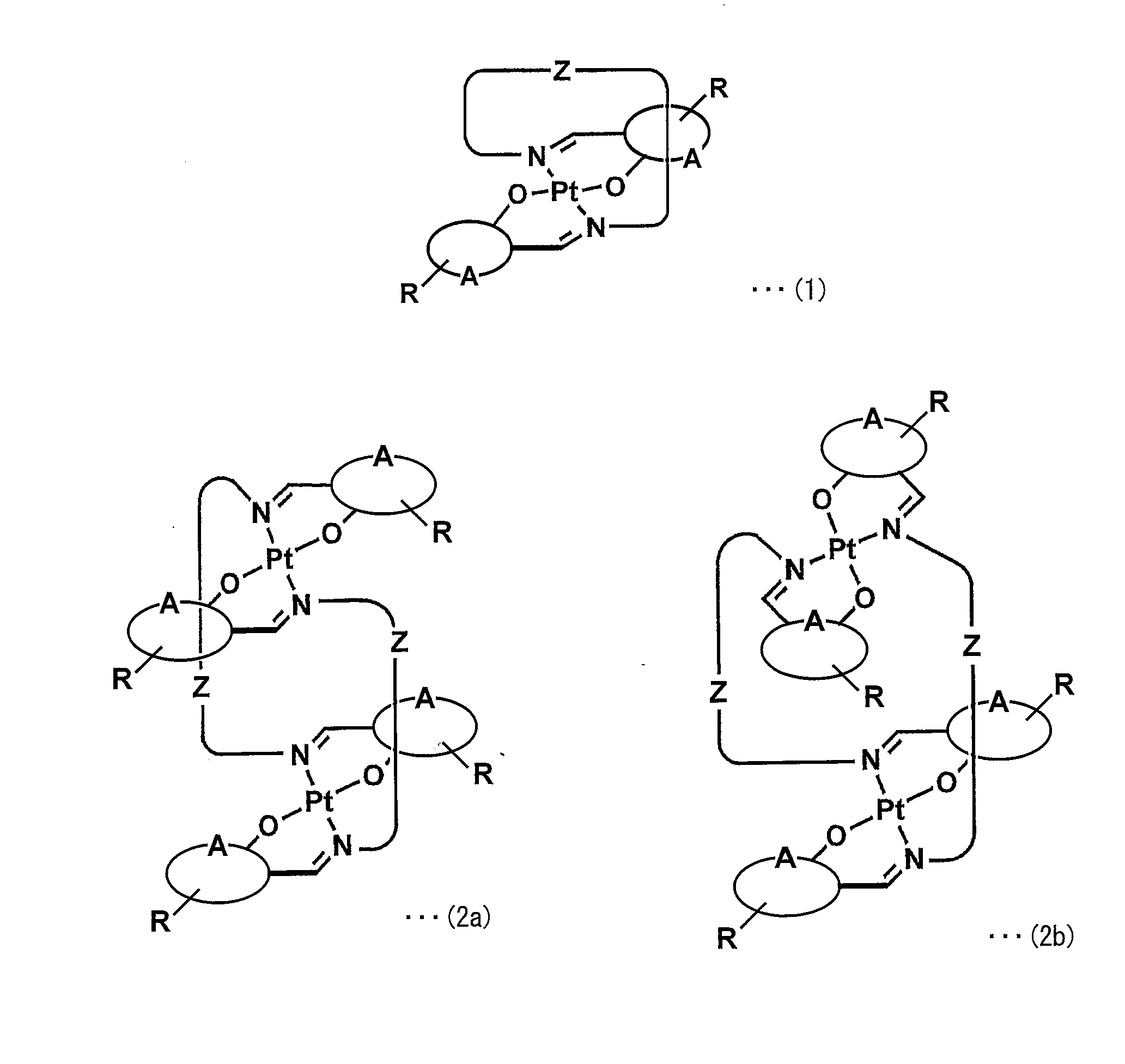
つまり、発光性有機白金錯体は、上記構造式(1)で示される、白金原子を一つ含む発光性有機白金錯体であってもよく、上記構造式(2a)で示される、白金原子を二つ含むsyn型の有機白金二核錯体であってもよく、上記構造式(2b)で示される、白金原子を二つ含むanti型の有機白金二核錯体であってもよい。尚、発光性有機白金錯体は、白金原子を三つ含む有機白金三核錯体とすることもできる。
(a) 構造式(1)で示され、上記Zが-(CH2 )n -であり、上記nが8~14の整数であり、上記Aがベンゼン環であり、上記Rがハロゲン、メチル基、エチル基、メトキシ基、エトキシ基、トリフルオロメトキシ基、ジフルオロメトキシ基、ヒドロキシル基、ヒドロキシエチル基、ジメチルアミノ基、ジエチルアミノ基、ニトロ基、アセトキシ基、フェニル基、炭素数7~13のアルキルフェニルオキシ基、炭素数8~13のアルキニルフェニル基、炭素数8~13のアルケニルフェニル基、または水素(但し、水素はnが14のとき)であり、若しくは、
(b) 構造式(2a)または(2b)で示され、上記Zが-(CH2 )n -であり、上記nが7~14の整数であり、上記Aがベンゼン環であり、上記Rが水素、ハロゲン、メチル基、エチル基、メトキシ基、エトキシ基、トリフルオロメトキシ基、ジフルオロメトキシ基、ヒドロキシル基、ヒドロキシエチル基、ジメチルアミノ基、ジエチルアミノ基、ニトロ基、アセトキシ基、フェニル基、炭素数7~13のアルキルフェニルオキシ基、炭素数8~13のアルキニルフェニル基、または炭素数8~13のアルケニルフェニル基であり、若しくは、
(c) 構造式(1)で示され、上記Zが-CH2 (CH2 OCH2 )m CH2 -であり、上記mは3または4を表し、上記Aがベンゼン環であり、上記Rが水素、ハロゲン、メチル基、エチル基、メトキシ基、エトキシ基、トリフルオロメトキシ基、ジフルオロメトキシ基、ヒドロキシル基、ヒドロキシエチル基、ジメチルアミノ基、ジエチルアミノ基、ニトロ基、アセトキシ基、フェニル基、炭素数7~13のアルキルフェニルオキシ基、炭素数8~13のアルキニルフェニル基、または炭素数8~13のアルケニルフェニル基であり、若しくは、
(d) 構造式(2a)または(2b)で示され、上記Zが-CH2 (CH2 OCH2 )m CH2 -であり、上記mは3または4を表し、上記Aがベンゼン環であり、上記Rが水素、ハロゲン、メチル基、エチル基、メトキシ基、エトキシ基、トリフルオロメトキシ基、ジフルオロメトキシ基、ヒドロキシル基、ヒドロキシエチル基、ジメチルアミノ基、ジエチルアミノ基、ニトロ基、アセトキシ基、フェニル基、炭素数7~13のアルキルフェニルオキシ基、炭素数8~13のアルキニルフェニル基、または炭素数8~13のアルケニルフェニル基であることがより好ましい。

また、上記合成工程および挿入工程を1ポットで実質的に同時に行うこともできる。2座配位子である上記配位子2分子を架橋化合物1分子で結び付ける(架橋する)上記合成工程の収率は、100%(若しくは実質的に100%)である。従って、上記合成方法は、工業的な製造方法として有用である。


配位子としての4-(ジエチルアミノ)サリチルアルデヒド0.58gと、架橋化合物としての1,12-ジアミノドデカン0.3gとをエチルアルコール5mlに加え、4時間加熱還流した。反応液を室温まで冷却した後、反応液を氷冷撹拌して析出晶を濾取した。減圧乾燥後、架橋配位子としてのN,N’-ビス(4-ジエチルアミノサリチリデン)-1,12-ドデカンジアミンの微黄色粉末0.72gを得た。
1H-NMR (270MHz, CDCl3) δ: 7.89 (2H, s) 6.94 (2H, d, J = 8.6Hz) 6.11 (2H, dd, J = 8.9Hz, 2.4Hz) 6.05 (2H, d, J = 2.4Hz) 3.45 (4H, t, J = 6.8Hz) 3.36 (8H, q, J = 6.8Hz) 1.58-1.67 (4H, m) 1.25-1.40 (16H, m) 1.18 (12H, t, J = 6.8Hz)
〔合成例2〕
4-(ジエチルアミノ)サリチルアルデヒド0.58gと1,11-ジアミノウンデカン0.28gとを用い、合成例1と同様の手法でN,N’-ビス(4-ジエチルアミノサリチリデン)-1,11-ウンデカンジアミンの微黄色粉末0.68gを得た。
1H-NMR (270MHz, CDCl3) δ: 13.9 (2H, br-s) 7.90 (2H, s) 6.95 (2H, d, J = 8.9Hz) 6.12 (2H, dd, J = 8.9Hz, 2.7Hz) 6.06 (2H, d, J = 2.7Hz) 3.45 (4H, t, J = 6.5Hz) 3.36 (8H, q, J = 6.8Hz) 1.58-1.67 (4H, m) 1.26-1.40 (14H, m) 1.18 (12H, t, J = 6.8Hz)
〔合成例3〕
4-(ジエチルアミノ)サリチルアルデヒド0.58gと1,10-ジアミノデカン0.26gとを用い、合成例1と同様の手法でN,N’-ビス(4-ジエチルアミノサリチリデン)-1,10-デカンジアミンの微黄色粉末0.71gを得た。
1H-NMR (270MHz, CDCl3) δ: 13.9 (2H, br-s) 7.90 (2H, s) 6.95 (2H, d, J = 8.9Hz) 6.12 (2H, dd, J = 8.9Hz, 2.7Hz) 6.06 (2H, d, J = 2.7Hz) 3.45 (4H, t, J = 6.5Hz) 3.36 (8H, q, J = 6.8Hz) 1.58-1.67 (4H, m) 1.26-1.40 (12H, m) 1.18 (12H, t, J = 6.8Hz)
〔合成例4〕
4-(ジエチルアミノ)サリチルアルデヒド0.58gと1,9-ジアミノノナン0.24gとを用い、合成例1と同様の手法でN,N’-ビス(4-ジエチルアミノサリチリデン)-1,9-ノナンジアミンの微黄色粉末0.43gを得た。
1H-NMR (270MHz, CDCl3) δ: 7.89 (2H, s) 6.95 (2H, d, J = 8.6Hz) 6.11 (2H, dd, J = 8.6Hz, 2.7Hz) 6.05 (2H, d, J = 2.7Hz) 3.44 (4H, t, J = 7.0Hz) 3.36 (8H, q, J = 7.0Hz) 1.49-2.18 (4H, m) 1.31-1.48 (10H, m) 1.18 (12H, t, J = 7.0Hz)
〔合成例5〕
4-(ジエチルアミノ)サリチルアルデヒド0.58gと1,8-ジアミノオクタン0.22gとを用い、合成例1と同様の手法でN,N’-ビス(4-ジエチルアミノサリチリデン)-1,8-オクタンジアミンの微黄色粉末0.55gを得た。
1H-NMR (270MHz, CDCl3) δ: 7.89 (2H, s) 6.95 (2H, d, J = 8.9Hz) 6.11 (2H, dd, J = 8.9Hz, 2.7Hz) 6.05 (2H, d, J = 2.7Hz) 3.44 (4H, t, J = 6.5Hz) 3.36 (8H, q, J = 7.3Hz) 1.58-1.67 (4H, m) 1.32-1.41 (8H, m) 1.18 (12H, t, J = 6.5Hz)
〔合成例6〕
4-(ジエチルアミノ)サリチルアルデヒド0.58gと1,13-ジアミノトリデカン0.32gとを用い、合成例1と同様の手法でN,N’-ビス(4-ジエチルアミノサリチリデン)-1,13-トリデカンジアミンの微黄色粉末0.66gを得た。
1H-NMR (270MHz, CDCl3) δ: 7.89 (2H, s) 6.95 (2H, d, J = 8.9Hz) 6.11 (2H, d, J = 8.9Hz, 2.7Hz) 6.05 (2H, d, J = 2.7Hz) 3.45 (4H, t, J = 6.8Hz) 3.36 (8H, q, J = 7.3Hz) 1.25-1.67 (8H, m) 1.18 (12H, t, J = 7.3Hz) 1.18-1.25 (14H, m)
〔合成例7〕
4-クロロサリチルアルデヒド0.16gと1,12-ジアミノドデカン0.10gとを用い、合成例1と同様の手法でN,N’-ビス(4-クロロサリチリデン)-1,12-ドデカンジアミンの微黄色粉末0.23gを得た。
1H-NMR (270MHz, CDCl3) δ: 14.1 (2H, br-s) 8.26 (2H, s) 7.13 (2H, d, J = 8.1Hz) 6.94 (2H, d, J = 1.6Hz) 6.80 (2H, dd, J = 8.1Hz, 1.6Hz) 3.57 (4H, t, J = 6.8Hz) 1.60-1.71 (4H, m) 1.25-1.35 (16H, m)
〔合成例8〕
5-クロロサリチルアルデヒド0.47gと1,12-ジアミノドデカン0.30gとを用い、合成例1と同様の手法でN,N’-ビス(5-クロロサリチリデン)-1,12-ドデカンジアミンの微黄色粉末0.70gを得た。
1H-NMR (270MHz, CDCl3) δ: 13.7 (2H, br-s) 8.25 (2H, s) 7.19-7.27 (4H, m) 6.99 (2H, d, J = 8.4Hz) 3.59 (4H, td, J = 7.0Hz, 1.1Hz) 1.63-1.74 (4H, m) 1.25-1.48 (16H, m)
〔合成例9〕
3-メトキシサリチルアルデヒド0.45gと1,12-ジアミノドデカン0.30gとを用い、合成例1と同様の手法でN,N’-ビス(3-メトキシサリチリデン)-1,12-ドデカンジアミンの微黄色粉末0.60gを得た。
1H-NMR (270MHz, CDCl3) δ: 14.2 (2H, br-s) 8.29 (2H, s) 6.83-6.92 (4H, m) 6.77 (2H, t, J = 7.6Hz) 3.90 (6H, s) 3.59 (4H, t, J = 6.8Hz) 1.62-1.74 (4H, m) 1.25-1.48 (16H, m)
〔合成例10〕
4-メトキシサリチルアルデヒド0.45gと1,12-ジアミノドデカン0.30gとを用い、合成例1と同様の手法でN,N’-ビス(4-メトキシサリチリデン)-1,12-ドデカンジアミンの微黄色粉末0.56gを得た。
1H-NMR (270MHz, CDCl3) δ: 14.2 (2H, br-s) 8.09 (2H, s) 7.06 (2H, d, J = 8.6Hz) 6.37 (2H, d, J = 2.7Hz) 6.32 (2H, dd, J = 8.6Hz, 2.4Hz) 3.80 (6H, s) 3.51 (4H, t, J = 6.8Hz) 1.61-1.80 (4H, m) 1.25-1.48 (16H, m)
〔合成例11〕
5-メトキシサリチルアルデヒド0.45gと1,12-ジアミノドデカン0.30gとを用い、合成例1と同様の手法でN,N’-ビス(5-メトキシサリチリデン)-1,12-ドデカンジアミンの微黄色粉末0.69gを得た。
1H-NMR (270MHz, CDCl3) δ: 13.2 (2H, br-s) 8.29 (2H, s) 6.89-6.91 (4H, m) 6.76 (2H, m) 3.78 (6H, s) 3.58 (4H, td, J = 7.0Hz, 1.1Hz) 1.58-1.74 (4H, m) 1.25-1.48 (16H, m)
〔合成例12〕
6-メトキシサリチルアルデヒド0.45gと1,12-ジアミノドデカン0.30gとを用い、合成例1と同様の手法でN,N’-ビス(6-メトキシサリチリデン)-1,12-ドデカンジアミンの微黄色粉末0.69gを得た。
1H-NMR (270MHz, CDCl3) δ: 8.73 (2H, s) 7.20 (2H, t, J = 8.1Hz) 6.51 (2H, d, J = 8.1Hz) 6.22 (2H, d, J = 8.1Hz) 3.81 (6H, s) 3.55 (4H, t, J = 7.0Hz) 1.60-1.73 (4H, m) 1.20-1.45 (16H, m)
〔合成例13〕
4-メトキシサリチルアルデヒド0.45gと1,10-ジアミノデカン0.26gとを用い、合成例1と同様の手法でN,N’-ビス(4-メトキシサリチリデン)-1,10-デカンジアミンの微黄色粉末0.55gを得た。
1H-NMR (270MHz, CDCl3) δ: 14.2 (2H, br-s) 8.53 (2H, s) 7.06 (2H, d, J = 8.6Hz) 6.38 (2H, d, J = 2.7Hz) 6.33 (2H, dd, J = 8.6Hz, 2.7Hz) 3.80 (6H, s) 3.51 (4H, t, J = 6.9Hz) 1.51-1.75 (4H, m) 1.20-1.48 (12H, m)
〔合成例14〕
4-メトキシサリチルアルデヒド0.46gと1,11-ジアミノウンデカン0.28gとを用い、合成例1と同様の手法でN,N’-ビス(4-メトキシサリチリデン)-1,11-ウンデカンジアミンの微黄色粉末0.57gを得た。
1H-NMR (270MHz, CDCl3) δ: 14.2 (2H, br-s) 8.09 (2H, s) 7.06 (2H, d, J = 8.6Hz) 6.38 (2H, d, J = 2.4Hz) 6.33 (2H, dd, J = 8.6Hz, 2.4Hz) 3.80 (6H, s) 3.51 (4H, t, J = 6.6Hz) 1.55-1.70 (4H, m) 1.25-1.48 (14H, m)
〔合成例15〕
4-フルオロサリチルアルデヒド0.31gと1,12-ジアミノドデカン0.22gとを用い、合成例1と同様の手法でN,N’-ビス(4-フルオロサリチリデン)-1,12-ドデカンジアミンの微黄色粉末0.41gを得た。
1H-NMR (270MHz, CDCl3) δ: 14.3 (2H, br-s) 8.23 (2H, s) 7.17 (2H, dd, J = 8.4Hz, 6.5Hz) 6.61 (2H, dd, J = 10.8Hz, 2.7Hz) 6.52 (2H, ddd, J = 8.4Hz, 8.4Hz, 2.7Hz) 3.55 (4H, t, J = 7.0Hz) 1.56-1.74 (4H, m) 1.21-1.49 (16H, m)
〔合成例16〕
4-ブロモサリチルアルデヒド0.44gと1,12-ジアミノドデカン0.22gとを用い、合成例1と同様の手法でN,N’-ビス(4-ブロモサリチリデン)-1,12-ドデカンジアミンの微黄色粉末0.56gを得た。
1H-NMR (270MHz, CDCl3) δ: 14.1 (2H, br-s) 8.25 (2H, s) 7.12 (2H, d, J = 1.6Hz) 7.06 (2H, d, J = 7.8Hz) 6.96 (2H, dd, J = 7.8Hz, 1.9Hz) 3.56 (4H, t, J = 6.8Hz) 1.60-1.74 (4H, m) 1.20-1.39 (16H, m)
〔合成例17〕
5-フルオロサリチルアルデヒド0.42gと1,12-ジアミノドデカン0.30gとを用い、合成例1と同様の手法でN,N’-ビス(5-フルオロサリチリデン)-1,12-ドデカンジアミンの微黄色粉末0.64gを得た。
1H-NMR (270MHz, CDCl3) δ: 13.4 (2H, br-s) 8.27 (2H, s) 6.86-7.05 (6H, m) 3.59 (4H, td, J = 6.8Hz, 1.1Hz) 1.55-1.74 (4H, m) 1.21-1.45 (16H, m)
〔合成例18〕
5-メチルサリチルアルデヒド0.41gと1,12-ジアミノドデカン0.30gとを用い、合成例1と同様の手法でN,N’-ビス(5-メチルサリチリデン)-1,12-ドデカンジアミンの微黄色粉末0.67gを得た。
1H-NMR (270MHz, CDCl3) δ: 13.4 (2H, br-s) 8.27 (2H, s) 7.09 (2H, dd, J = 8.5Hz, 1.9Hz) 7.02 (2H, d, J = 1.9Hz) 6.85 (2H, d, J = 8.5Hz) 3.56 (4H, t, J = 7.0Hz) 2.28 (6H, s) 1.61-1.80 (4H, m) 1.25-1.48 (16H, m)
〔合成例19〕
1-ヒドロキシ-2-ナフトアルデヒド0.52gと1,12-ジアミノドデカン0.30gとを用い、合成例1と同様の手法でN,N’-ビス(1-ヒドロキシ-2-ナフチリデン)-1,12-ドデカンジアミンの微黄色粉末0.49gを得た。
1H-NMR (270MHz, CDCl3) δ: 13.4 (2H, br-s) 8.46 (1H, s) 8.43 (1H, s) 7.74 (2H, d, J = 10.5Hz) 7.37-7.56 (6H, m) 6.92 (2H, d, J = 8.9Hz) 6.76 (2H, d, J = 8.9Hz) 3.51 (4H, m) 1.66-1.77 (4H, m) 1.21-1.40 (16H, m)
〔合成例20〕
4,6-ジメトキシサリチルアルデヒド0.55gと1,12-ジアミノドデカン0.30gとを用い、合成例1と同様の手法でN,N’-ビス(4,6-ジメトキシサリチリデン)-1,12-ドデカンジアミンの微黄色粉末0.43gを得た。
1H-NMR (270MHz, CDCl3) δ: 14.2 (2H, br-s) 8.26 (2H, d, J = 7.8Hz) 5.85 (2H, d, J = 2.2Hz) 5.55 (2H, d, J = 2.2Hz) 3.77 (12H, s) 3.46 (4H, t, J = 6.5Hz) 1.60-1.72 (4H, m) 1.21-1.36 (16H, m)
〔合成例21〕
5-ニトロサリチルアルデヒド0.50gと1,12-ジアミノドデカン0.30gとを用い、合成例1と同様の手法でN,N’-ビス(5-ニトロサリチリデン)-1,12-ドデカンジアミンの微黄色粉末0.71gを得た。
1H-NMR (270MHz, CDCl3) δ: 15.0 (2H, br-s) 8.31 (2H, s) 8.23 (2H, d, J = 2.7Hz) 8.18 (2H, dd, J = 9.2Hz, 2.7Hz) 6.91 (2H, t, J = 9.2Hz) 3.66 (4H, t, J = 6.8Hz) 1.69-1.80 (4H, m) 1.25-1.48 (16H, m)
〔合成例22〕
3-ヒドロキシピリジン-4-カルボキスアルデヒド0.25gと1,12-ジアミノドデカン0.20gとを用い、合成例1と同様の手法でN,N’-ビス[(3-ヒドロキシピリジン-4-イル)メチリデン]-1,12-ドデカンジアミンの褐色粉末0.39gを得た。
1H-NMR (270MHz, CDCl3) δ: 13.1 (2H, br-s) 8.43 (2H, s) 8.36 (2H, s) 8.19 (2H, d, J = 4.9Hz) 7.13 (2H, d, J = 4.9Hz) 3.65 (4H, t, J = 7.0Hz) 1.66-1.77 (4H, m) 1.20-1.48 (16H, m)
〔合成例23〕
サリチルアルデヒド0.38gと1,14-ジアミノテトラデカン0.38gとを用い、合成例1と同様の手法でN,N’-ビス(サリチリデン)-1,14-テトラデカンジアミンの黄色固体0.33gを得た。
1H-NMR (500MHz, CDCl3) δ: 13.72 (2H, s) 8.33 (2H, s) 7.27-7.31 (2H, m) 7.24 (2H, dd, J = 7.6Hz, 1.6Hz) 6.95 (2H, d, J = 8.0Hz) 6.86 (2H, td, J = 7.5Hz, 0.5Hz) 3.58 (4H, t, J = 6.9Hz) 1.66-1.71 (4H, m) 1.20-1.40 (20H, m)
〔合成例24〕
サリチルアルデヒド125mgと1,11-ジアミノ-3,6,9-トリオキサウンデカン105mgとを用い、合成例1と同様の手法でN,N’-ビス(サリチリデン)-3,6,9-トリオキサ-1,11-ウンデカンジアミンの黄色油状物210mgを得た。
1H-NMR (500MHz, CDCl3) δ: 13.43 (2H, s) 8.35 (2H, s) 7.28-7.31 (2H, m) 7.24 (2H, dd, J = 7.7Hz, 1.7Hz) 6.95 (2H, d, J = 8.2Hz) 6.85-6.88 (2H, m) 3.72-3.75 (8H, m) 3.57-3.59 (8H, m)
〔合成例25〕
サリチルアルデヒド0.36gと1,14-ジアミノ-3,6,9,12-テトラオキサテトラデカン0.54gとを用い、合成例1と同様の手法でN,N’-ビス(サリチリデン)-3,6,9,12-テトラオキサ-1,14-テトラデカンジアミンの黄色油状物0.21gを得た。
1H-NMR (500MHz, CDCl3) δ: 13.43 (6H, s) 8.36 (2H, s) 7.29 (2H, ddd, J = 8.5Hz, 7.0Hz, 1.3Hz) 7.25 (2H, dd, J = 7.6Hz, 1.7Hz) 6.94 (2H, d, J = 8.2Hz) 6.86 (2H, td, J = 7.5Hz, 1.0Hz) 3.56-3.76 (20H, m)
〔合成例26〕
5-トリフルオロメトキシサリチルアルデヒド0.21gと1,12-ジアミノドデカン0.10gとを用い、合成例1と同様の手法でN,N’-ビス(5-トリフルオロメトキシサリチリデン)-1,12-ドデカンジアミンの微黄色粉末0.21gを得た。
1H-NMR (270MHz, CDCl3) δ: 13.4 (2H, br-s) 8.27 (2H, s) 7.11-7.18 (4H, m) 6.94 (2H, d, J = 8.9Hz) 3.59 (4H, t, J = 6.8Hz) 1.55-1.74 (4H, m) 1.21-1.45 (16H, m)
〔合成例27〕
4-メトキシサリチルアルデヒド0.40gと1,13-ジアミノトリデカン0.10gとを用い、合成例1と同様の手法でN,N’-ビス(4-メトキシサリチリデン)-1,13-トリデカンジアミンの微黄色粉末0.45gを得た。
1H-NMR (270MHz, CDCl3) δ: 14.2 (2H, br-s) 8.09 (2H, s) 7.06 (2H, d, J = 8.6Hz) 6.37 (2H, d, J = 2.4Hz) 6.33 (2H, dd, J = 8.6Hz, 2.4Hz) 3.75 (6H, s) 3.51 (4H, t, J = 6.5Hz) 1.55-1.73 (4H, m) 1.21-1.50 (18H, m)
〔合成例28〕
4-メトキシサリチルアルデヒド0.9gと、1,12-ジアミノドデカン1.2gとをエチルアルコール300mlに加え、30分間加熱還流した。反応液を減圧濃縮した後、得られた黄色固体を濾取した。当該黄色固体を減圧乾燥して、N-(4-メトキシサリチリデン)-1,12-ドデカンジアミンの微黄色固体2.01gを得た。
1H-NMR (300MHz, CDCl3) δ: 8.10 (1H, s) 7.06 (1H, d, J = 8.7Hz) 6.38 (1H, d, J = 2.7Hz) 6.33 (1H, dd, J = 8.7, 2.7Hz) 3.80 (3H, s) 3.51 (2H, t, J = 6.6Hz) 2.68 (2H, t, J = 6.6Hz) 1.55-1.76 (2H, m) 1.20-1.50 (18H, m)
次に、上記N-(4-メトキシサリチリデン)-1,12-ドデカンジアミン0.17gと、4-クロロサリチルアルデヒド0.8gとをトルエン7mlに溶解し、終夜(12時間)加熱還流した。反応液を減圧濃縮した後、得られた黄色固体を濾取した。当該黄色固体を減圧乾燥して、N-(4-メトキシサリチリデン)-N’-(4-クロロサリチリデン)-1,12-ドデカンジアミンの微黄色粉末0.23gを得た。
1H-NMR (300MHz, CDCl3) δ: 14.1 (2H, br-s) 8.27 (1H, s) 8.10 (1H, s) 7.14 (1H, d, J = 8.1Hz) 7.14 (1H, d, J = 8.7Hz) 6.95 (1H, d, J = 1.8Hz) 6.80 (1H, dd, J = 8.1, 1.8Hz) 6.38 (1H, d, J = 2.7Hz) 6.33 (1H, dd, J = 8.7, 2.7Hz) 3.80 (3H, s) 3.57 (2H, t, J = 6.9Hz) 3.51 (2H, t, J = 6.6Hz) 1.45-1.75 (6H, m) 1.20-1.55 (14H, m)
〔合成例29〕
4-ベンジルオキシサリチルアルデヒド0.4gと1,11-ジアミノウンデカン0.16gとを用い、合成例1と同様の手法でN,N’-ビス(4-ベンジルオキシサリチリデン)-1,11-ジアミノウンデカンの微黄色粉末0.48gを得た。
1H-NMR (300MHz, CDCl3) δ: 14.2 (2H, br-s) 7.25-7.44 (10H, m) 7.07 (2H, d, J = 8.7Hz) 6.47 (2H, d, J = 2.4Hz) 6.41 (2H, dd, J = 8.7, 2.4Hz) 5.06 (4H, s) 3.51 (4H, t, J = 6.6Hz) 1.60-1.67 (4H, m) 1.25-1.45 (14H, m)
次に、上記各配位子を用いた発光性有機白金錯体の合成例を、実施例として以下に示す。
合成例1で合成したN,N’-ビス(4-ジエチルアミノサリチリデン)-1,12-ドデカンジアミン0.14gと炭酸カリウム0.23gとPtCl2 (CH3 CN)2 0.09gとを、トルエン90mlとジメチルスルホキシド22.5mlとの混合溶媒に加えて終夜(12時間)加熱還流した。反応液を減圧濃縮し、残渣に酢酸エチルと水とを加えて目的物を抽出した。有機層を濃縮後、得られた粗成物をシリカゲルカラムクロマトグラフィ(溶出液;n-ヘキサン:酢酸エチル=10:1)にて精製し、前記構造式(a)で表されるトランス-ビス(4-ジエチルアミノサリチルアルジミナト)白金(II)錯体の黄色粉末53mgを得た。
1H-NMR (500MHz, CD3CN) δ: 7.67 (2H, s) 7.05 (2H, d, J = 8.9Hz) 6.09 (2H, dd, J = 8.9Hz, 2.5Hz) 5.99 (2H, d, J = 2.5Hz) 4.72-4.80 (2H, m) 3.33 (8H, q, J = 7.1Hz) 2.81-2.89 (2H, m) 2.04-2.10 (2H, m) 1.25-1.50 (18H, m) 1.13 (12H, t, J = 7.1Hz)
〔実施例2〕
合成例2で合成したN,N’-ビス(4-ジエチルアミノサリチリデン)-1,11-ウンデカンジアミン0.14gを用い、実施例1と同様の手法で、前記構造式(b)で表されるトランス-ビス(4-ジエチルアミノサリチルアルジミナト)白金(II)錯体の黄色粉末40mgを得た。
1H-NMR (500MHz, CD3CN) δ: 7.60 (2H, s) 7.01 (2H, d, J = 8.9Hz) 6.04 (2H, dd, J = 8.9Hz, 2.5Hz) 5.93 (2H, d, J = 2.5Hz) 4.71-4.76 (2H, m) 3.30 (8H, q, J = 7.1Hz) 2.75-2.82 (2H, m) 2.10-2.19 (2H, m) 1.57-1.66 (2H, m) 1.33-1.57 (10H, m) 1.21-1.34 (2H, m) 1.09 (12H, t, J = 7.1Hz)
〔実施例3〕
合成例3で合成したN,N’-ビス(4-ジエチルアミノサリチリデン)-1,10-デカンジアミン0.14gを用い、実施例1と同様の手法で、前記構造式(c)で表されるトランス-ビス(4-ジエチルアミノサリチルアルジミナト)白金(II)錯体の黄色粉末41mgを得た。
1H-NMR (500MHz, CD3CN) δ: 7.61 (2H, s) 7.01 (2H, d, J = 8.9Hz) 6.04 (2H, dd, J = 8.9Hz, 2.5Hz) 5.95 (2H, d, J = 2.5Hz) 4.66-4.72 (2H, m) 3.30 (8H, q, J = 7.1Hz) 2.82-2.89 (2H, m) 2.22-2.34 (2H, m) 1.68-1.75 (2H, m) 1.58-1.68 (2H, m) 1.47-1.57 (2H, m) 1.32-1.45 (4H, m) 1.25-1.32 (2H, m) 1.10 (12H, t, J = 7.1Hz)
〔実施例4〕
合成例4で合成したN,N’-ビス(4-ジエチルアミノサリチリデン)-1,9-ノナンジアミン0.14gを用い、実施例1と同様の手法で、前記構造式(d)で表されるトランス-ビス(4-ジエチルアミノサリチルアルジミナト)白金(II)錯体の黄色粉末41mgを得た。
1H-NMR (500MHz, CD3CN) δ: 7.61 (2H, s) 7.03 (2H, d, J = 9.0Hz) 6.07 (2H, dd, J = 9.0Hz, 2.5Hz) 5.99 (2H, d, J = 2.5Hz) 4.64-4.72 (2H, m) 3.33 (8H, q, J = 7.1Hz) 3.03-3.09 (2H, m) 2.00-2.25 (2H, m) 1.75-1.90 (6H, m) 1.58-1.68 (2H, m) 1.38-1.47 (4H, m) 1.12 (12H, t, J = 7.1Hz)
MS(FAB): m/z 701.6 [M]+
〔実施例5〕
合成例5で合成したN,N’-ビス(4-ジエチルアミノサリチリデン)-1,8-オクタンジアミン0.14gを用い、実施例1と同様の手法で、前記構造式(e)で表されるトランス-ビス(4-ジエチルアミノサリチルアルジミナト)白金(II)錯体の黄色粉末37mgを得た。
1H-NMR (500MHz, CD3CN) δ: 7.57 (2H, s) 7.01 (2H, d, J = 9.0Hz) 6.06 (2H, dd, J = 9.0Hz, 2.5Hz) 5.97 (2H, d, J = 2.5Hz) 4.59-4.63 (2H, m) 3.32 (8H, q, J = 6.9Hz) 3.02-3.08 (2H, m) 2.25-2.35 (2H, m) 1.97-2.05 (2H, m) 1.70-1.80 (2H, m) 1.25-1.40 (4H, m) 1.12 (12H, t, J = 6.9Hz)
MS(FAB): m/z 687.2 [M]+
〔実施例6〕
合成例6で合成したN,N’-ビス(4-ジエチルアミノサリチリデン)-1,13-トリデカンジアミン0.42gを用い、実施例1と同様の手法で、前記構造式(f)で表されるトランス-ビス(4-ジエチルアミノサリチルアルジミナト)白金(II)錯体の黄色粉末66mgを得た。
1H-NMR (270MHz, CDCl3) δ: 7.54 (2H, s) 7.01 (2H, d, J = 8.9Hz) 6.04 (2H, s) 6.02 (2H, dd, J = 8.9Hz, 2.7Hz) 4.79-4.88 (2H, m) 3.33 (8H, q, J = 7.3Hz) 2.68-2.80 (2H, m) 2.00-2.15 (2H, m) 1.25-1.65 (20H, m) 1.19 (12H, t, J = 7.3Hz)
MS(FAB): m/z 757.2 [M]+
〔実施例7〕
合成例7で合成したN,N’-ビス(4-クロロサリチリデン)-1,12-ドデカンジアミン0.11gを用い、実施例1と同様の手法で、前記構造式(g)で表されるトランス-ビス(4-クロロサリチルアルジミナト)白金(II)錯体の黄色粉末36mgを得た。
1H-NMR (500MHz, CD3CN) δ: 7.99 (2H, s) 7.29 (2H, d, J = 8.5Hz) 6.90 (2H, d, J = 1.9Hz) 6.59 (2H, dd, J = 8.5Hz, 1.9Hz) 4.71-4.77 (2H, m) 3.00 (2H, td, J = 11.0Hz , 3.4Hz) 1.48-1.56 (2H, m) 1.30-1.45 (14H, m) 1.21-1.30 (2H, m) 1.06-1.12 (2H, m)
MS(FAB): m/z 670.2 [M]+
〔実施例8〕
合成例8で合成したN,N’-ビス(5-クロロサリチリデン)-1,12-ドデカンジアミン0.42gを用い、実施例1と同様の手法で、前記構造式(h)で表されるトランス-ビス(5-クロロサリチルアルジミナト)白金(II)錯体の橙色粉末150mgを得た。
1H-NMR (270MHz, CDCl3) δ: 7.75 (2H, s) 7.19-7.26 (4H, m) 6.82 (2H, d, J = 8.9Hz) 4.84-4.92 (2H, m) 2.93 (2H, br-t, J = 10.5Hz) 2.10-2.25 (2H, m) 1.10-1.60 (18H, m)
MS(FAB): m/z 670.4 [M]+
〔実施例9〕
合成例9で合成したN,N’-ビス(3-メトキシサリチリデン)-1,12-ドデカンジアミン0.42gを用い、実施例1と同様の手法で、前記構造式(i)で表されるトランス-ビス(3-メトキシサリチルアルジミナト)白金(II)錯体の橙色粉末52mgを得た。
1H-NMR (270MHz, CDCl3) δ: 7.82 (2H, s) 6.82-6.90 (4H, m) 6.50 (2H, t, J = 8.1Hz) 5.15-5.24 (2H, m) 3.81 (6H, m) 2.96 (2H, br-t, J = 9.7Hz) 2.21-2.25 (2H, m) 1.10-1.60 (18H, m)
MS(FAB): m/z 661.7 [M]+
〔実施例10〕
合成例10で合成したN,N’-ビス(4-メトキシサリチリデン)-1,12-ドデカンジアミン0.14gを用い、実施例1と同様の手法で、前記構造式(j)で表されるトランス-ビス(4-メトキシサリチルアルジミナト)白金(II)錯体の橙色粉末44mgを得た。
1H-NMR (500MHz, CD3CN) δ: 7.87 (2H, s) 7.20 (2H, d, J = 8.7Hz) 6.36 (2H, d, J = 2.3Hz) 6.22 (2H, dd, J = 8.7Hz, 2.3Hz) 4.76-4.82 (2H, m) 3.75 (6H, s) 2.95 (2H, td, J = 11.2Hz, 3.0Hz) 1.20-1.62 (18H, m) 1.05-1.20 (2H, m)
MS(FAB): m/z 661.2 [M]+
〔実施例11〕
合成例11で合成したN,N’-ビス(5-メトキシサリチリデン)-1,12-ドデカンジアミン0.14gを用い、実施例1と同様の手法で、前記構造式(k)で表されるトランス-ビス(5-メトキシサリチルアルジミナト)白金(II)錯体の赤色粉末35mgを得た。
1H-NMR (500MHz, CD3CN) δ: 7.95 (2H, s) 6.97 (2H, dd, J = 9.2Hz, 3.2Hz) 6.81 (2H, d, J = 3.2Hz) 6.75 (2H, d, J = 9.2Hz) 4.78-4.84 (2H, m) 3.68 (6H, s) 2.97 (2H, td, J = 10.8Hz, 3.2Hz) 1.45-1.54 (2H, m) 1.29-1.45 (14H, m) 1.21-1.29 (2H, m) 1.05-1.12 (2H, m)
MS(FAB): m/z 661.3 [M]+
〔実施例12〕
合成例12で合成したN,N’-ビス(6-メトキシサリチリデン)-1,12-ドデカンジアミン0.42gを用い、実施例1と同様の手法で、前記構造式(l)で表されるトランス-ビス(6-メトキシサリチルアルジミナト)白金(II)錯体の黄色粉末50mgを得た。
1H-NMR (270MHz, CDCl3) δ: 8.34 (2H, s) 7.13 (2H, t, J = 8.1Hz) 6.50 (2H, d, J = 8.1Hz) 6.00 (2H, d, J = 8.1Hz) 4.81-4.92 (2H, m) 3.81 (6H, m) 2.98 (2H, br-t, J = 10.3Hz) 2.10-2.25 (2H, m) 1.10-1.60 (18H, m)
MS(FAB): m/z 661.7 [M]+
〔実施例13〕
合成例13で合成したN,N’-ビス(4-メトキシサリチリデン)-1,10-デカンジアミン0.33gを用い、実施例1と同様の手法で、前記構造式(m)で表されるトランス-ビス(4-メトキシサリチルアルジミナト)白金(II)錯体の黄色粉末190mgを得た。
1H-NMR (270MHz, CDCl3) δ: 7.65 (2H, s) 7.08 (2H, d, J = 8.9Hz) 6.34 (2H, d, J = 2.2Hz) 6.20 (2H, dd, J = 8.9Hz, 2.2Hz) 4.80-4.89 (2H, m) 3.78 (6H, s) 2.92 (2H, br-t, J = 11.3Hz) 2.04-2.48 (2H, m) 1.20-1.82 (14H, m)
MS(FAB): m/z 633.3 [M]+
〔実施例14〕
合成例14で合成したN,N’-ビス(4-メトキシサリチリデン)-1,11-ウンデカンジアミン0.40gを用い、実施例1と同様の手法で、前記構造式(n)で表されるトランス-ビス(4-メトキシサリチルアルジミナト)白金(II)錯体の黄色粉末80mgを得た。
1H-NMR (270MHz, CDCl3) δ: 7.65 (2H, s) 7.08 (2H, d, J = 8.9Hz) 6.34 (2H, d, J = 2.2Hz) 6.20 (2H, dd, J = 8.9Hz, 2.2Hz) 4.80-4.89 (2H, m) 3.78 (6H, s) 2.92 (2H, br-t, J = 11.3Hz) 2.04-2.48 (2H, m) 1.20-1.82 (14H, m)
MS(FAB): m/z 647.4 [M]+
〔実施例15〕
合成例15で合成したN,N’-ビス(4-フルオロサリチリデン)-1,12-ドデカンジアミン0.35gを用い、実施例1と同様の手法で、前記構造式(o)で表されるトランス-ビス(4-フルオロサリチルアルジミナト)白金(II)錯体の黄色粉末170mgを得た。
1H-NMR (270MHz, CDCl3) δ: 7.75 (2H, s) 7.20 (2H, td, J = 8.6Hz, 1.6Hz) 6.55 (2H, dd, J = 11.3Hz, 2.7Hz) 6.35 (2H, td, J = 8.6Hz, 2.7Hz) 4.80-4.91 (2H, m) 2.92 (2H, br-t, J = 10.5Hz) 2.11-2.19 (2H, m) 1.10-1.60 (18H, m)
MS(FAB): m/z 637.5 [M]+
〔実施例16〕
合成例16で合成したN,N’-ビス(4-ブロモサリチリデン)-1,12-ドデカンジアミン0.42gを用い、実施例1と同様の手法で、前記構造式(p)で表されるトランス-ビス(4-ブロモサリチルアルジミナト)白金(II)錯体の黄色粉末150mgを得た。
1H-NMR (270MHz, CDCl3) δ: 7.77 (2H, s) 7.09 (2H, d, J = 1.9Hz) 7.07 (2H, d, J = 8.6Hz) 6.71 (2H, dd, J = 8.6Hz, 1.9Hz) 4.82-4.88 (2H, m) 2.92 (2H, br-t, J = 9.7Hz) 2.10-2.22 (2H, m) 1.10-1.60 (18H, m)
MS(FAB): m/z 760.4 [M]+
〔実施例17〕
合成例17で合成したN,N’-ビス(5-フルオロサリチリデン)-1,12-ドデカンジアミン0.44gを用い、実施例1と同様の手法で、前記構造式(q)で表されるトランス-ビス(5-フルオロサリチルアルジミナト)白金(II)錯体の赤橙色粉末102mgを得た。
1H-NMR (270MHz, CDCl3) δ: 7.74 (2H, s) 7.08 (2H, td, J = 8.6Hz, 3.0Hz) 6.91 (2H, dd, J = 8.6Hz, 3.0Hz) 6.81 (2H, dd, J = 8.6Hz, 4.9Hz) 4.87-4.94 (2H, m) 2.93 (2H, br-t, J = 10.0Hz) 2.11-2.20 (2H, m) 1.10-1.70 (18H, m)
〔実施例18〕
合成例18で合成したN,N’-ビス(5-メチルサリチリデン)-1,12-ドデカンジアミン0.42gを用い、実施例1と同様の手法で、前記構造式(r)で表されるトランス-ビス(5-メチルサリチルアルジミナト)白金(II)錯体の赤橙色粉末130mgを得た。
1H-NMR (270MHz, CDCl3) δ: 7.78 (2H, s) 7.13 (2H, dd, J = 8.6Hz, 2.7Hz) 7.01 (2H, d, J = 2.7Hz) 6.81 (2H, dd, J = 8.6Hz) 4.91-4.97 (2H, m) 2.91 (2H, br-t, J = 11.9Hz) 2.24 (6H, s) 2.12-2.25 (2H, m) 1.10-1.60 (18H, m)
〔実施例19〕
合成例19で合成したN,N’-ビス(1-ヒドロキシ-2-ナフチリデン)-1,12-ドデカンジアミン0.10gを用い、実施例1と同様の手法で、前記構造式(s)で表されるトランス-ビス(1-ヒドロキシ-2-ナフチルアルジミナト)白金(II)錯体の橙色粉末33mgを得た。
1H-NMR (270MHz, CDCl3) δ: 8.34 (2H, d, J = 8.6Hz) 7.92 (2H, s) 7.62-7.68 (2H, m) 7.57 (2H, td, J = 6.6Hz, 1.0Hz) 7.42 (2H, td, J = 8.3Hz, 1.3Hz) 7.23 (2H, d, J = 8.6Hz) 7.00 (2H, d, J = 8.6Hz) 5.12-5.24 (2H, m) 3.12 (2H, br-t, J = 10.2Hz) 2.34-2.50 (2H, m) 1.25-1.75 (16H, m) 0.98-1.20 (2H, m)
MS(FAB): m/z 701.8 [M]+
〔実施例20〕
合成例20で合成したN,N’-ビス(4,6-ジメトキシサリチリデン)-1,12-ドデカンジアミン0.14gを用い、実施例1と同様の手法で、前記構造式(t)で表されるトランス-ビス(4,6-ジメトキシサリチルアルジミナト)白金(II)錯体の黄色粉末35mgを得た。
1H-NMR (270MHz, CDCl3) δ: 8.17 (2H, s) 5.98 (2H, d, J = 1.9Hz) 5.66 (2H, d, J = 2.2Hz) 4.80 (2H, br-d, J = 11.1Hz) 3.78 (12H, s) 3.77 (6H, s) 2.93 (2H, br-t, J = 12.1Hz) 2.10-2.25 (2H, m) 1.05-1.60 (18H, m)
〔実施例21〕
合成例21で合成したN,N’-ビス(5-ニトロサリチリデン)-1,12-ドデカンジアミン0.20gを用い、実施例1と同様の手法で、前記構造式(u)で表されるトランス-ビス(5-ニトロサリチルアルジミナト)白金(II)錯体の黄色粉末14mgを得た。
1H-NMR (270MHz, DMSO-d6) δ: 8.59 (2H, d, J = 3.0Hz) 8.58 (2H, s) 8.20 (2H, dd, J = 9.2Hz, 3.0Hz) 6.99 (2H, d, J = 9.2Hz) 4.60-4.75 (2H, m) 3.18 (2H, br-t, J = 8.1Hz) 1.85-2.15 (2H, m) 1.50-1.68 (2H, m) 1.10-1.48 (16H, m)
MS(FAB): m/z 691.1 [M]+
〔実施例22〕
合成例22で合成したN,N’-ビス[(3-ヒドロキシピリジン-4-イル)メチリデン]-1,12-ドデカンジアミン0.20gを用い、実施例1と同様の手法で、前記構造式(v)で表されるトランス-ビス(4-アザアルジミナト)白金(II)錯体の赤色粉末12mgを得た。
1H-NMR (270MHz, CDCl3) δ: 8.37 (2H, s) 7.89 (2H, s) 7.81 (2H, d, J = 5.3Hz) 7.09 (2H, d, J = 5.3Hz) 4.94-5.01 (2H, m) 3.01 (2H, br-t, J = 10.6Hz) 2.05-2.30 (2H, m) 1.10-1.73 (18H, m)
MS(FAB): m/z 603.3 [M]+
〔実施例23〕
合成例23で合成したN,N’-ビス(サリチリデン)-1,14-テトラデカンジアミン0.44gを用い、実施例1と同様の手法で、前記構造式(w)で表されるトランス-ビス(サリチルアルジミナト)白金(II)錯体の黄色粉末88mgを得た。
1H-NMR (500MHz, CDCl3) δ: 7.86 (2H, s) 7.31 (2H, td, J = 7.6Hz, 1.7Hz) 7.24 (2H, dd, J = 7.9Hz, 1.7Hz) 6.89 (2H, d, J= 8.5Hz) 6.57 (2H, td, J = 7.4Hz, 0.93 Hz) 4.88-4.93 (2H, m) 2.88-2.96 (2H, m) 1.93-2.04 (2H, m) 1.71-1.82 (2H, m) 1.04-1.50 (20H, m)
〔実施例24〕
合成例24で合成したN,N’-ビス(サリチリデン)-3,6,9-トリオキサ-1,11-ウンデカンジアミン0.47gを用い、実施例1と同様の手法で、前記構造式(x)で表されるトランス-ビス(サリチルアルジミナト)白金(II)錯体の黄色粉末178mgを得た。
1H-NMR (500MHz, CDCl3) δ: 7.89 (2H, s) 7.31 (2H, ddd, J = 8.0Hz, 6.5Hz, 1.5Hz) 7.24-7.80 (2H, m) 6.86 (2H, d, J = 8.5Hz) 6.57 (2H, ddd, J = 8.0Hz, 6.5Hz, 0.5Hz) 5.04-5.10 (2H, m) 4.27 (2H, ddd, J = 11.0Hz, 8.5Hz, 3.0Hz) 3.88-3.94 (2H, m) 3.78-3.84 (2H, m) 3.65-3.74 (6H, m) 3.09-3.14 (2H, m)
〔実施例25〕
合成例25で合成したN,N’-ビス(サリチリデン)-3,6,9,12-テトラオキサ-1,14-テトラデカンジアミン0.23gを用い、実施例1と同様の手法で、前記構造式(y)で表されるトランス-ビス(サリチルアルジミナト)白金(II)錯体の黄色粉末46mgを得た。
1H-NMR (500MHz, CDCl3) δ: 7.92 (2H, s) 7.33 (2H, td, J = 7.8Hz, 1.6Hz) 7.26-7.29 (2H, m) 6.87 (2H, d, J = 8.5Hz) 6.59 (2H, td, J = 7.4Hz, 0.9Hz) 4.88 (2H, d, J = 8.5Hz) 3.99-4.07 (4H, m) 3.74-3.78 (2H, m) 3.53-3.67 (8H, m) 3.07-3.16 (4H, m)
〔実施例26〕
合成例26で合成したN,N’-ビス(5-トリフルオロメトキシサリチリデン)-1,12-ドデカンジアミン0.14gを用い、実施例1と同様の手法で、前記構造式(z)で表されるトランス-ビス(5-トリフルオロメトキシサリチルアルジミナト)白金(II)錯体の橙色粉末10mgを得た。
1H-NMR (270MHz, CDCl3) δ: 13.4 (2H, br-s) 8.27 (2H, s) 6.86-7.05 (6H, m) 3.59 (4H, td, J = 6.8Hz, 1.1Hz) 1.55-1.74 (4H, m) 1.21-1.45 (16H, m)
〔実施例27〕
合成例27で合成したN,N’-ビス(4-メトキシサリチリデン)-1,13-トリデカンジアミン0.36gを用い、実施例1と同様の手法で、前記構造式(aa)で表されるトランス-ビス(4-メトキシサリチルアルジミナト)白金(II)錯体の黄色粉末60mgを得た。
1H-NMR (270MHz, CDCl3) δ: 7.68 (2H, s) 7.11 (2H, d, J = 8.6Hz) 6.34 (2H, d, J = 2.4Hz) 6.21 (2H, dd, J = 8.6Hz, 2.4Hz) 4.82-4.91 (2H, m) 3.79 (6H, s) 2.82 (2H, td, J = 10.8Hz, 4.1Hz) 1.98-2.16 (2H, m) 1.60-1.70 (2H, m) 1.15-1.49 (18H, m)
〔実施例28〕
実施例24でトランス-ビス(サリチルアルジミナト)白金(II)錯体を合成したときに副生した副生成物を、シリカゲルカラムクロマトグラフィ(溶出液;n-ヘキサン:酢酸エチル=10:1)にて精製して単離し、前記構造式(ab)で表されるトランス-ビス(サリチルアルジミナト)白金(II)二核錯体の黄色粉末14mgを得た。
1H-NMR (500MHz, CDCl3) δ: 7.93 (s, 4H, N=CH) 7.29-7.22 (m, 4H, H4, H6), 6.84 (d, J = 8.6Hz, 4H, H3) 6.51 (t, J = 7.3 Hz, 4H, H5) 4.09-3.37 (m, 32H)
MS(FAB): m/z 1168.3 [M+H]+
〔実施例29〕
N,N’-ビス(サリチリデン)-1,7-ヘプタンジアミン194mgを用い、実施例1と同様の手法で、トランス-ビス(サリチルアルジミナト)白金(II)錯体を合成した。そして、そのときに副生した副生成物を、シリカゲルカラムクロマトグラフィ(溶出液;n-ヘキサン:酢酸エチル=10:1)にて精製して単離し、前記構造式(af)で表されるsyn型のトランス-ビス(サリチルアルジミナト)白金(II)二核錯体の橙色粉末9mgを得た。
1H-NMR (270MHz, CDCl3) δ: 7.77 (4H, s) 7.14 (8H, d, J = 7.0Hz) 6.80 (4H, d, J = 8.4Hz) 6.47 (4H, ddd, J = 7.0Hz, 4.3Hz, 1.1Hz) 4.64 (4H, ddd, J = 10.8Hz, 5.4Hz, 5.4Hz) 3.00 (4H, ddd, J = 11.0Hz, 11.0Hz, 8.1Hz) 1.56-1.90 (8H, m) 1.36-1.48 (12H, m)
〔実施例30〕
実施例29と同様にして、前記構造式(ag)で表されるanti型のトランス-ビス(サリチルアルジミナト)白金(II)二核錯体の赤色粉末29mgを得た。
1H-NMR (270MHz, CDCl3) δ: 7.61 (4H, s) 7.32 (4H, ddd, J = 8.4Hz, 6.8Hz, 1.9Hz) 7.13 (4H, dd, J = 7.6Hz, 1.6Hz) 6.86 (4H, d, J = 7.6Hz) 6.57 (4H, ddd, J = 8.1Hz, 7.0Hz, 1.1Hz) 4.65 (4H, ddd, J = 11.0Hz, 11.0Hz, 7.0Hz) 2.80-2.89 (4H, m) 1.81-1.93 (8H, m) 1.42-1.74 (12H, m)
〔実施例31〕
合成例28で合成したN-(4-メトキシサリチリデン)-N’-(4-クロロサリチリデン)-1,12-ドデカンジアミン0.18gと炭酸カリウム0.52gとPtCl2 (CH3 CN)2 0.13gとを、トルエン180mlとジメチルスルホキシド45mlとの混合溶媒に加えて終夜(12時間)加熱還流した。反応液を減圧濃縮し、残渣に酢酸エチルと水とを加えて目的物を抽出した。有機層を濃縮後、得られた粗成物をシリカゲルカラムクロマトグラフィ(溶出液;n-ヘキサン:酢酸エチル=10:1)にて精製し、前記構造式(aj)で表されるトランス-(4-メトキシ-4’-クロロサリチルアルジミナト)白金(II)錯体の黄色粉末60mgを得た。
1H-NMR (300MHz, CDCl3) δ: 7.80 (1H, s) 7.67 (1H, s) 7.15 (1H, d, J = 8.4Hz) 7.12 (1H, d, J = 8.7Hz) 6.90 (1H, d, J = 1.8Hz) 6.55 (1H, dd, J = 8.4, 1.8Hz) 6.35 (1H, d, J = 2.4Hz) 6.23 (1H, dd, J = 8.7, 2.4Hz) 6.33 (1H, dd, J = 8.7, 2.7Hz) 4.91-4.99 (1H, m) 4.76-4.86 (1H, m) 3.80 (3H, s) 2.84-2.90 (2H, m) 2.05-2.25 (2H, m) 1.25-1.60 (16H, m) 1.10-1.24 (2H, m)
〔実施例32〕
合成例29で合成したN,N’-ビス(4-ベンジルオキシサリチリデン)-1,11-ジアミノウンデカン0.4gを用い、実施例1と同様の手法で、前記構造式(ak)で表されるトランス-ビス(4-ベンジルオキシサリチルアルジミナト)白金(II)錯体の黄色粉末120mgを得た。
1H-NMR (300MHz, CDCl3) δ: 7.65 (2H, s) 7.25-7.45 (10H, m) 7.11 (2H, d, J = 8.7Hz) 6.46 (2H, d, J = 2.4Hz) 6.28 (2H, dd, J = 8.7, 2.4Hz) 5.03 (4H, s) 4.88-4.94 (2H, m) 1.58-1.67 (4H, m) 2.86 (2H, t, J = 9.6Hz) 2.23-2.30 (2H, m) 1.19-1.64 (16H, m)
〔固体発光量子収率の測定〕
上記実施例1~32で得られた各発光性有機白金錯体について、296Kおよび77Kにおける固体発光量子収率φ(%)を測定した。具体的には、各発光性有機白金錯体の結晶状態(粉末)における発光量子収率を、絶対法により求めた。測定方法は以下の通り。
(測定方法)
測定には、蛍光光度計FP-6500N、燐光測定対応低温中積分球システムINK-533、および、液体試料用セルLPH-120(全て日本分光株式会社製)を用いた。酸素の影響を除くため、全てのサンプル(発光性有機白金錯体)は、石英セル中に結晶をそのまま封入して、アルゴン雰囲気下で測定した。さらに、低温(77K)での測定は、石英製デュワーを用いて上記石英セルを液体窒素で冷やしながら測定した。全ての発光スペクトルは、標準光源を利用することにより補正を行った。励起光として420nmまたは450nmの波長の光を用いた。内部量子収率の算出には、固体量子効率計算プログラム(日本分光株式会社製)を用いた。また、各発光性有機白金錯体が発する光の発光極大波長も、併せて測定した。

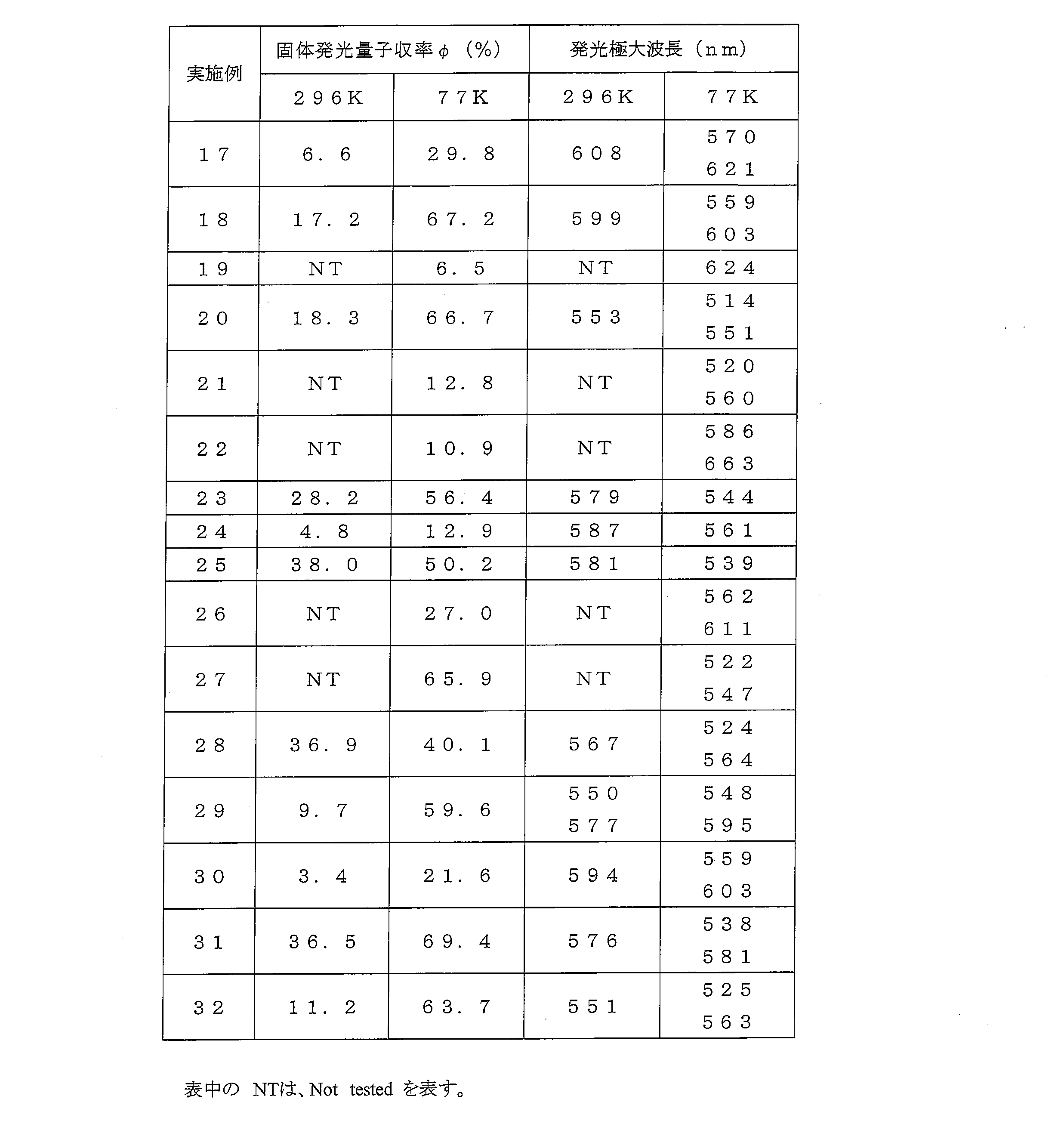
Claims (12)
- 下記何れかの構造式で示される発光性有機白金錯体。

- 構造式(1)で示され、上記Zが-(CH2 )n -であり、上記nが8~14の整数であり、上記Aがベンゼン環であり、上記Rがハロゲン、メチル基、エチル基、メトキシ基、エトキシ基、トリフルオロメトキシ基、ジフルオロメトキシ基、ヒドロキシル基、ヒドロキシエチル基、ジメチルアミノ基、ジエチルアミノ基、ニトロ基、アセトキシ基、フェニル基、炭素数7~13のアルキルフェニルオキシ基、炭素数8~13のアルキニルフェニル基、炭素数8~13のアルケニルフェニル基、または水素(但し、水素はnが14のとき)である請求項1に記載の発光性有機白金錯体。
- 構造式(2a)または(2b)で示され、上記Zが-(CH2 )n -であり、上記nが7~14の整数であり、上記Aがベンゼン環であり、上記Rが水素、ハロゲン、メチル基、エチル基、メトキシ基、エトキシ基、トリフルオロメトキシ基、ジフルオロメトキシ基、ヒドロキシル基、ヒドロキシエチル基、ジメチルアミノ基、ジエチルアミノ基、ニトロ基、アセトキシ基、フェニル基、炭素数7~13のアルキルフェニルオキシ基、炭素数8~13のアルキニルフェニル基、または炭素数8~13のアルケニルフェニル基である請求項1に記載の発光性有機白金錯体。
- 構造式(1)で示され、上記Zが-CH2 (CH2 OCH2 )m CH2 -であり、上記mは3または4を表し、上記Aがベンゼン環であり、上記Rが水素、ハロゲン、メチル基、エチル基、メトキシ基、エトキシ基、トリフルオロメトキシ基、ジフルオロメトキシ基、ヒドロキシル基、ヒドロキシエチル基、ジメチルアミノ基、ジエチルアミノ基、ニトロ基、アセトキシ基、フェニル基、炭素数7~13のアルキルフェニルオキシ基、炭素数8~13のアルキニルフェニル基、または炭素数8~13のアルケニルフェニル基である請求項1に記載の発光性有機白金錯体。
- 構造式(2a)または(2b)で示され、上記Zが-CH2 (CH2 OCH2 )m CH2 -であり、上記mは3または4を表し、上記Aがベンゼン環であり、上記Rが水素、ハロゲン、メチル基、エチル基、メトキシ基、エトキシ基、トリフルオロメトキシ基、ジフルオロメトキシ基、ヒドロキシル基、ヒドロキシエチル基、ジメチルアミノ基、ジエチルアミノ基、ニトロ基、アセトキシ基、フェニル基、炭素数7~13のアルキルフェニルオキシ基、炭素数8~13のアルキニルフェニル基、または炭素数8~13のアルケニルフェニル基である請求項1に記載の発光性有機白金錯体。
- 下記何れかの構造式で示される発光性有機白金錯体。
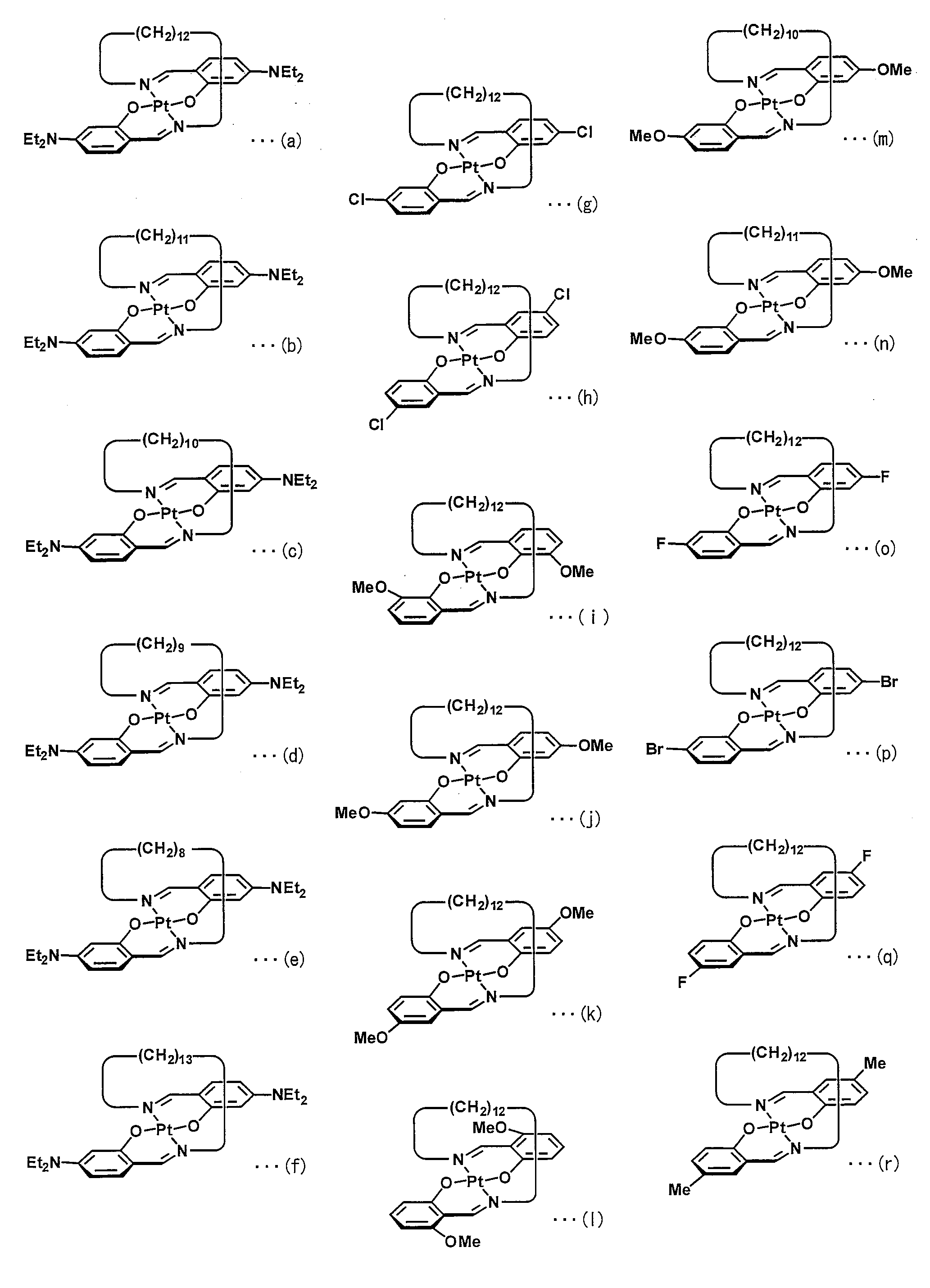
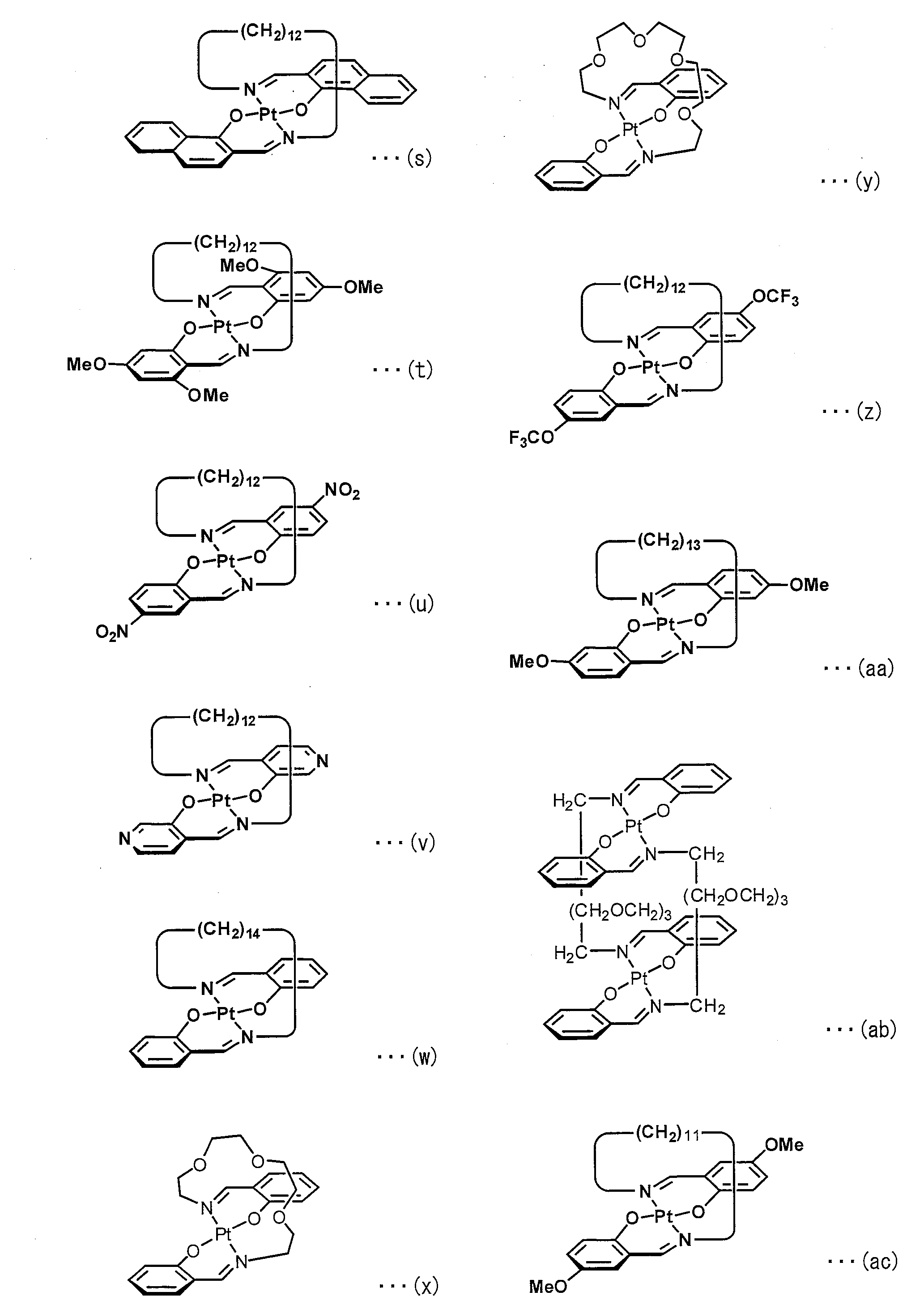
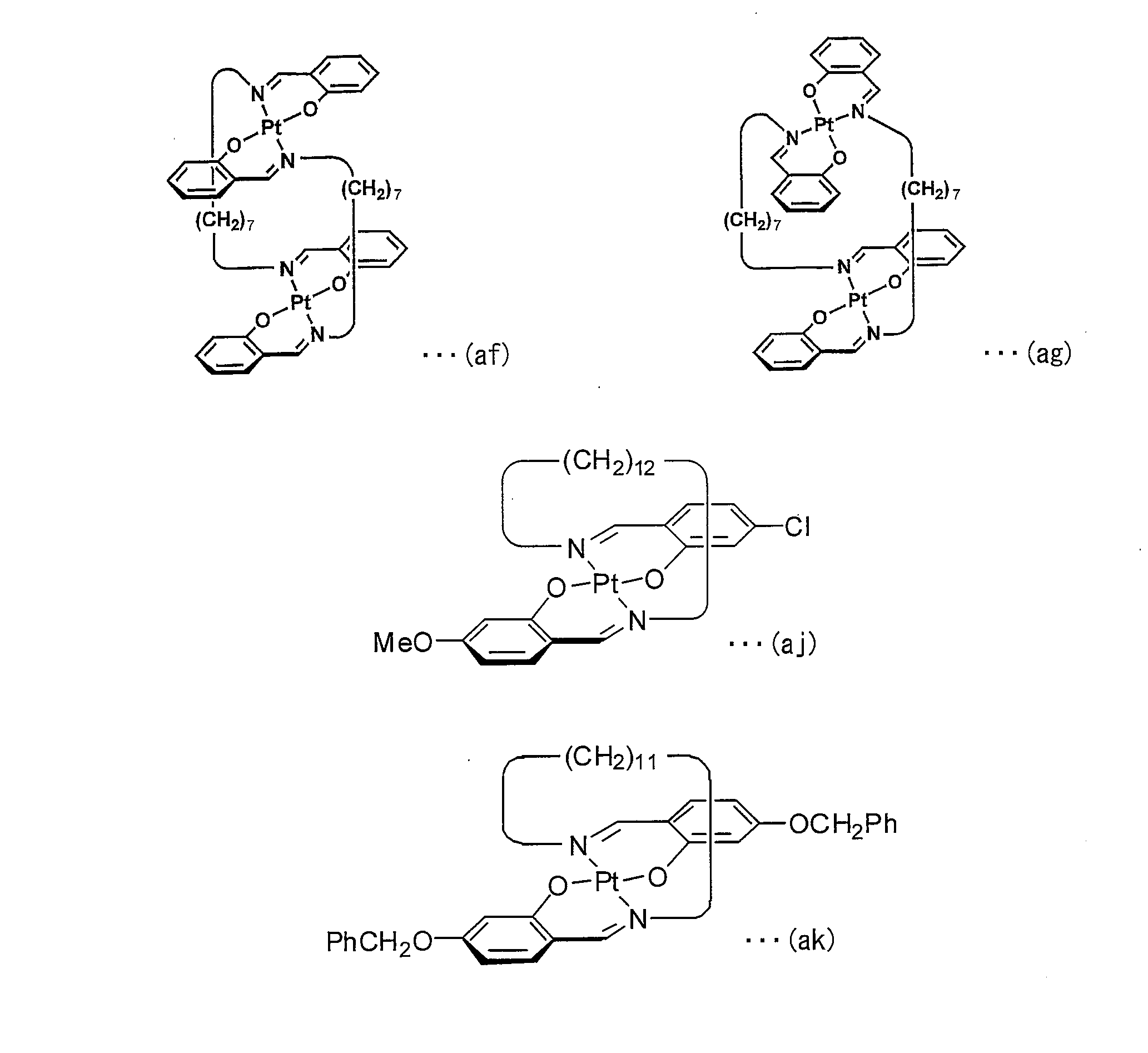
- 構造式(a)~(w),(z),(aa),(ac),(aj),(ak)の何れか一つで示される請求項6に記載の発光性有機白金錯体。
- 構造式(x)または(y)で示される請求項6に記載の発光性有機白金錯体。
- 構造式(ab)で示される請求項6に記載の発光性有機白金錯体。
- 構造式(af)または(ag)で示される請求項6に記載の発光性有機白金錯体。
- 請求項1ないし10の何れか一項に記載の発光性有機白金錯体を含むことを特徴とする発光性材料。
- 一対の電極間に、発光層を含む有機層を挟持してなる機能素子であって、
上記発光層が、請求項1ないし10の何れか一項に記載の発光性有機白金錯体を含むことを特徴とする機能素子。
Priority Applications (3)
| Application Number | Priority Date | Filing Date | Title |
|---|---|---|---|
| US13/583,153 US9187510B2 (en) | 2010-03-11 | 2011-02-18 | Light-emitting organic platinum complex, light-emitting material containing this complex and functional device |
| KR1020127023972A KR101418996B1 (ko) | 2010-03-11 | 2011-02-18 | 발광성 유기백금 착물, 이를 포함하는 발광성 재료 및 기능 소자 |
| JP2012504388A JP5499420B2 (ja) | 2010-03-11 | 2011-02-18 | 発光性有機白金錯体、これを含む発光性材料および機能素子 |
Applications Claiming Priority (2)
| Application Number | Priority Date | Filing Date | Title |
|---|---|---|---|
| JP2010-054699 | 2010-03-11 | ||
| JP2010054699 | 2010-03-11 |
Publications (1)
| Publication Number | Publication Date |
|---|---|
| WO2011111497A1 true WO2011111497A1 (ja) | 2011-09-15 |
Family
ID=44563320
Family Applications (1)
| Application Number | Title | Priority Date | Filing Date |
|---|---|---|---|
| PCT/JP2011/053475 Ceased WO2011111497A1 (ja) | 2010-03-11 | 2011-02-18 | 発光性有機白金錯体、これを含む発光性材料および機能素子 |
Country Status (4)
| Country | Link |
|---|---|
| US (1) | US9187510B2 (ja) |
| JP (1) | JP5499420B2 (ja) |
| KR (1) | KR101418996B1 (ja) |
| WO (1) | WO2011111497A1 (ja) |
Cited By (4)
| Publication number | Priority date | Publication date | Assignee | Title |
|---|---|---|---|---|
| WO2013035359A1 (ja) * | 2011-09-08 | 2013-03-14 | 国立大学法人大阪大学 | 白金錯体 |
| WO2015053291A1 (ja) * | 2013-10-11 | 2015-04-16 | 国立大学法人大阪大学 | 白金錯体を含む発光材料 |
| JP2015172007A (ja) * | 2014-03-11 | 2015-10-01 | 国立大学法人大阪大学 | 白金錯体およびそれを含む発光材料 |
| JP2019059694A (ja) * | 2017-09-27 | 2019-04-18 | 国立大学法人大阪大学 | 白金錯体およびそれを含む発光材料 |
Families Citing this family (1)
| Publication number | Priority date | Publication date | Assignee | Title |
|---|---|---|---|---|
| CN119859162B (zh) * | 2023-10-20 | 2026-03-27 | 中国石油化工股份有限公司 | 一种异核双金属催化剂及其制备方法和应用 |
Citations (3)
| Publication number | Priority date | Publication date | Assignee | Title |
|---|---|---|---|---|
| JP2004155711A (ja) * | 2002-11-06 | 2004-06-03 | Toyota Central Res & Dev Lab Inc | 機能素子及び有機金属錯体化合物 |
| JP2009224763A (ja) * | 2008-02-18 | 2009-10-01 | Fujifilm Corp | 有機電界発光素子 |
| JP2010135689A (ja) * | 2008-12-08 | 2010-06-17 | Fujifilm Corp | 白色有機電界発光素子 |
Family Cites Families (3)
| Publication number | Priority date | Publication date | Assignee | Title |
|---|---|---|---|---|
| JP2009215277A (ja) | 2007-09-07 | 2009-09-24 | Nagasaki Univ | 金属錯体、発光素子、表示装置 |
| JP5243972B2 (ja) * | 2008-02-28 | 2013-07-24 | ユー・ディー・シー アイルランド リミテッド | 有機電界発光素子 |
| JP4739362B2 (ja) * | 2008-03-13 | 2011-08-03 | 東芝テック株式会社 | 通信用アンテナ装置 |
-
2011
- 2011-02-18 KR KR1020127023972A patent/KR101418996B1/ko not_active Expired - Fee Related
- 2011-02-18 JP JP2012504388A patent/JP5499420B2/ja not_active Expired - Fee Related
- 2011-02-18 US US13/583,153 patent/US9187510B2/en not_active Expired - Fee Related
- 2011-02-18 WO PCT/JP2011/053475 patent/WO2011111497A1/ja not_active Ceased
Patent Citations (3)
| Publication number | Priority date | Publication date | Assignee | Title |
|---|---|---|---|---|
| JP2004155711A (ja) * | 2002-11-06 | 2004-06-03 | Toyota Central Res & Dev Lab Inc | 機能素子及び有機金属錯体化合物 |
| JP2009224763A (ja) * | 2008-02-18 | 2009-10-01 | Fujifilm Corp | 有機電界発光素子 |
| JP2010135689A (ja) * | 2008-12-08 | 2010-06-17 | Fujifilm Corp | 白色有機電界発光素子 |
Non-Patent Citations (5)
Cited By (4)
| Publication number | Priority date | Publication date | Assignee | Title |
|---|---|---|---|---|
| WO2013035359A1 (ja) * | 2011-09-08 | 2013-03-14 | 国立大学法人大阪大学 | 白金錯体 |
| WO2015053291A1 (ja) * | 2013-10-11 | 2015-04-16 | 国立大学法人大阪大学 | 白金錯体を含む発光材料 |
| JP2015172007A (ja) * | 2014-03-11 | 2015-10-01 | 国立大学法人大阪大学 | 白金錯体およびそれを含む発光材料 |
| JP2019059694A (ja) * | 2017-09-27 | 2019-04-18 | 国立大学法人大阪大学 | 白金錯体およびそれを含む発光材料 |
Also Published As
| Publication number | Publication date |
|---|---|
| JPWO2011111497A1 (ja) | 2013-06-27 |
| JP5499420B2 (ja) | 2014-05-21 |
| US9187510B2 (en) | 2015-11-17 |
| KR101418996B1 (ko) | 2014-07-15 |
| KR20120120425A (ko) | 2012-11-01 |
| US20130001535A1 (en) | 2013-01-03 |
Similar Documents
| Publication | Publication Date | Title |
|---|---|---|
| JP6425703B2 (ja) | 発光素子、発光装置、照明装置および電子機器 | |
| JP4351702B2 (ja) | 有機発光ダイオード用の発光体としてカルベンリガンドを有する遷移金属錯体 | |
| KR102210980B1 (ko) | Oled 디바이스용 고 효율 황색광 이미터 | |
| US8247086B2 (en) | Organometallic complex and light-emitting element, light-emitting device and electronic device using the same | |
| JP7179252B2 (ja) | 有機金属化合物及びその使用 | |
| JP2011528024A (ja) | 多核錯体を含む発光材料 | |
| KR101338343B1 (ko) | 유기 전계발광 소자 재료 및 유기 전계발광 소자 | |
| JP4564588B1 (ja) | 有機電界発光素子用材料、及び有機電界発光素子 | |
| JP5499420B2 (ja) | 発光性有機白金錯体、これを含む発光性材料および機能素子 | |
| US7198730B2 (en) | Phosphorescent material | |
| JP2005129499A (ja) | 有機発光素子 | |
| CN114957298A (zh) | 有机电致发光材料和装置 | |
| JP4488243B2 (ja) | トリス−オルト−メタル化有機金属錯体の製法およびoledにおける該錯体の使用 | |
| CN116891498A (zh) | 有机电致发光材料和装置 | |
| CN114621260A (zh) | 串联的碳烯磷光体 | |
| TW200424209A (en) | Organic electroluminescent device | |
| JP2007182429A (ja) | 有機金属錯体および前記錯体を用いた発光素子、発光装置、並びに電子機器 | |
| JPWO2008108407A1 (ja) | 金属錯体、発光素子、表示装置 | |
| CN114591372B (zh) | 一种金属配合物及其应用 | |
| JP2010505915A (ja) | 発光物質 | |
| CN115974931A (zh) | 有机电致发光材料和装置 | |
| KR20220165665A (ko) | 동종리간드 이리듐 인광체의 분자 정렬 | |
| CN113831371B (zh) | [3+2+1]配位构型铱金属红光配合物及其制备方法和有机电致发光器件 | |
| CN114989223B (zh) | 一种金属配合物及其应用 | |
| CN111793087B (zh) | 一种发光材料、延迟荧光体及有机发光元件 |
Legal Events
| Date | Code | Title | Description |
|---|---|---|---|
| 121 | Ep: the epo has been informed by wipo that ep was designated in this application |
Ref document number: 11753159 Country of ref document: EP Kind code of ref document: A1 |
|
| WWE | Wipo information: entry into national phase |
Ref document number: 13583153 Country of ref document: US |
|
| WWE | Wipo information: entry into national phase |
Ref document number: 2012504388 Country of ref document: JP |
|
| NENP | Non-entry into the national phase |
Ref country code: DE |
|
| ENP | Entry into the national phase |
Ref document number: 20127023972 Country of ref document: KR Kind code of ref document: A |
|
| 122 | Ep: pct application non-entry in european phase |
Ref document number: 11753159 Country of ref document: EP Kind code of ref document: A1 |