WO2011102276A1 - 高純度スルホン酸銅水溶液及びその製造方法 - Google Patents
高純度スルホン酸銅水溶液及びその製造方法 Download PDFInfo
- Publication number
- WO2011102276A1 WO2011102276A1 PCT/JP2011/052749 JP2011052749W WO2011102276A1 WO 2011102276 A1 WO2011102276 A1 WO 2011102276A1 JP 2011052749 W JP2011052749 W JP 2011052749W WO 2011102276 A1 WO2011102276 A1 WO 2011102276A1
- Authority
- WO
- WIPO (PCT)
- Prior art keywords
- copper
- solution
- aqueous
- sulfonic acid
- aqueous solution
- Prior art date
- Legal status (The legal status is an assumption and is not a legal conclusion. Google has not performed a legal analysis and makes no representation as to the accuracy of the status listed.)
- Ceased
Links
Classifications
-
- C—CHEMISTRY; METALLURGY
- C01—INORGANIC CHEMISTRY
- C01G—COMPOUNDS CONTAINING METALS NOT COVERED BY SUBCLASSES C01D OR C01F
- C01G3/00—Compounds of copper
-
- C—CHEMISTRY; METALLURGY
- C01—INORGANIC CHEMISTRY
- C01G—COMPOUNDS CONTAINING METALS NOT COVERED BY SUBCLASSES C01D OR C01F
- C01G3/00—Compounds of copper
- C01G3/12—Sulfides
-
- C—CHEMISTRY; METALLURGY
- C25—ELECTROLYTIC OR ELECTROPHORETIC PROCESSES; APPARATUS THEREFOR
- C25D—PROCESSES FOR THE ELECTROLYTIC OR ELECTROPHORETIC PRODUCTION OF COATINGS; ELECTROFORMING; APPARATUS THEREFOR
- C25D3/00—Electroplating: Baths therefor
- C25D3/02—Electroplating: Baths therefor from solutions
- C25D3/38—Electroplating: Baths therefor from solutions of copper
-
- C—CHEMISTRY; METALLURGY
- C01—INORGANIC CHEMISTRY
- C01P—INDEXING SCHEME RELATING TO STRUCTURAL AND PHYSICAL ASPECTS OF SOLID INORGANIC COMPOUNDS
- C01P2006/00—Physical properties of inorganic compounds
- C01P2006/80—Compositional purity
Definitions
- the present invention relates to a high-purity copper sulfonate aqueous solution and a method for producing the same.
- copper sulfate is used as a copper raw material for an electrolytic copper plating solution, and an electrolytic copper plating solution based on copper sulfate and sulfuric acid is used.
- the solubility limit of copper sulfate in water is about 80 g / L in terms of copper concentration, and when sulfuric acid is added thereto, the solubility further decreases.
- copper alkyl sulfonates such as copper methanesulfonate, are also used as a copper raw material for the electrolytic copper plating solution. Copper methanesulfonate can be dissolved in water up to about 120 g / L in terms of copper concentration.
- the copper material of the copper electroplating solution from copper sulfate to copper methanesulfonate, it is possible to produce a plating solution with a high copper concentration, enabling high-speed plating film formation at a high current density, and electrodeposition. It is effective as a raw material salt when performing a large amount of copper plating.
- the copper carbonate when copper carbonate is dissolved in methanesulfonic acid, the copper carbonate contains several hundred ppm of sodium, and the resulting copper methanesulfonate aqueous solution contains sodium, which is difficult to purify and remove. Met.
- anion exchange membranes generally have chloride ions as counter ions. Since the metal itself has high purity, it is difficult to avoid contamination with chloride ions because an anion exchange membrane is used even if metal impurities can be avoided.
- Chlorine ion is used as an additive for electrolytic copper plating solution, and is usually controlled at a concentration of several tens of mg / L in the electrolytic copper plating solution. Therefore, it is contained in the stock solution used as the plating solution at a concentration of 10 mg / L or more. If it is, it will become difficult to control its concentration when adjusting the plating solution.
- the pH of the copper alkyl sulfonate aqueous solution is preferably higher in consideration of the influence on the substrate to be plated when used as a plating solution, and preferably 2 or more if possible.
- the pH is usually as low as less than 2.
- the pH can be adjusted to pH 2 or more by using a pH adjuster. In that case, sodium ions, potassium ions, ammonium ions, etc. are contained in the solution by the pH adjuster, and impurities into the plating solution. It is not preferable because it is unavoidable.
- An object of the present invention is to provide a high-purity copper sulfonate aqueous solution and a method for producing it by a simple method.
- the present inventors obtain a high purity copper sulfonate aqueous solution by oxidizing and dissolving metallic copper in the sulfonic acid solution.
- the present inventors have found that it is possible to achieve the present invention.
- the present invention is as follows. (1) A copper sulfonate aqueous solution having a copper concentration of 90 g / L or more, a metal impurity content of less than 10 mg / L in terms of metal, and a chlorine content of less than 10 mg / L, A copper sulfonate aqueous solution, wherein the sulfonic acid is a sulfonic acid represented by the following general formula.
- R- (SO 3 H) n (In the formula, R represents a lower alkyl group, a lower alkylidene group, a lower alkylene group, or a hydroxyalkyl group, and n represents 1 or 2.)
- the metal impurities are iron, nickel, silver, lead, magnesium, aluminum, chromium, cobalt, zinc, sodium, potassium, arsenic, antimony, cadmium, gold, indium, manganese, thallium, tin, and titanium.
- the copper sulfonate aqueous solution according to (1) above wherein (3) The content of the iron, nickel, silver, lead, magnesium, aluminum, chromium, cobalt, zinc, cadmium, gold, manganese, tin, and titanium are all less than 1 mg / L.
- the copper sulfonate aqueous solution according to any one of (1) to (4) above which is prepared by oxidizing and dissolving metallic copper in a sulfonic acid solution.
- the aqueous copper sulfonate solution of the present invention has a high copper concentration, the metal impurity content is less than 10 mg / L in terms of metal, and the chlorine concentration is less than 10 mg / L, so that there are few impurities. Therefore, the aqueous copper sulfonate solution of the present invention is capable of plating at a high current density in semiconductor applications such as through silicon via embedded plating, and is effectively used as an electrolytic copper plating solution when performing copper plating with a large amount of electrodeposition. be able to.
- the aqueous copper sulfonate solution of the present invention can increase the pH to 2 or more, even when a copper plating solution is used, it can be a high-purity plating solution having a pH of 2 or more, and can be used for dissolution of a copper seed layer. The influence on the plating substrate can be reduced, and a high-purity plating film can be obtained.
- metal copper, copper oxide, copper hydroxide, or copper carbonate may be dissolved in a sulfonic acid solution.
- a high-purity product having a copper concentration of 90 g / L or more is prepared. It is preferable to use metallic copper and oxidatively dissolve in a high purity sulfonic acid solution. Since metal copper is produced by electrolytic deposition and there are few impurities, other things such as copper oxide are produced from metal copper or a copper salt through some kind of reaction, so the metal impurity content is generally high. It is not preferable as a copper raw material.
- Copper concentration cannot be increased to 90 g / L or more, which is also not preferable.
- Copper concentration can be 90 g / L or more by oxidizing and dissolving metallic copper in a sulfonic acid solution.
- the copper concentration can be increased to a saturation concentration relative to the sulfonic acid solution.
- the said copper concentration shows the density
- the sulfonic acid in the sulfonic acid solution is represented by the following general formula and does not contain a halogen.
- R- (SO 3 H) n (In the formula, R represents a lower alkyl group, a lower alkylidene group, a lower alkylene group, or a hydroxyalkyl group, and n represents 1 or 2.)
- the lower alkyl group, lower alkylidene group, lower alkylene group and hydroxyalkyl group are preferably those having 1 to 5 carbon atoms, and examples of the sulfonic acid in which R is a lower alkyl group include methanesulfonic acid, ethanesulfonic acid and propane.
- Examples include sulfonic acid, butanesulfonic acid, and pentanesulfonic acid.
- examples of the sulfonic acid in which R is a lower alkylidene group include methanedisulfonic acid, 1,1-ethanedisulfonic acid, and 1,1-propanedisulfonic acid.
- Examples of the sulfonic acid in which R is a lower alkylene group include 1, Examples include 2-ethylene disulfonic acid and 1,3-propylene disulfonic acid.
- Examples of the sulfonic acid in which R is a hydroxyalkyl group include hydroxymethanesulfonic acid, 2-hydroxyethanesulfonic acid, 3-hydroxypropanesulfonic acid, 4-hydroxy-2-butanesulfonic acid, and 4-hydroxy-1-butane. Examples thereof include sulfonic acid.
- sulfonic acid sulfonic acid in which R is a lower alkyl group is preferable, methanesulfonic acid and ethanesulfonic acid are more preferable, and methanesulfonic acid is particularly preferable.
- the sulfonic acid solution in which copper is dissolved preferably has a high purity, and it is preferable that both the metal component as an impurity and the chlorine concentration are less than 10 mg / L.
- the sulfonic acid solution is an aqueous solution of the sulfonic acid, and the sulfonic acid concentration in the sulfonic acid solution is preferably 150 to 360 g / L.
- the aqueous copper sulfonate solution of the present invention can be prepared by oxidizing and dissolving metallic copper in a sulfonic acid solution.
- Methods for oxidizing metallic copper include increasing the dissolved oxygen concentration by blowing an appropriate amount of air or oxygen gas into the heated aqueous sulfonic acid solution, and adding an oxidizing agent such as hydrogen peroxide. Since metallic copper is more easily oxidized and dissolved as the surface area is larger, it is preferable to use copper powder, copper wire or the like as a raw material. For example, copper powder, copper wire, etc.
- the copper sulfonate aqueous solution of the present invention can be obtained by oxidizing and dissolving while blowing at a flow rate of / min.
- copper powder, copper wire, etc. are put into a sulfonic acid aqueous solution and heated to 60 ° C. or higher and lower than 100 ° C., preferably 80 ° C. or higher and 90 ° C. or lower, and an oxidizing agent such as hydrogen peroxide is gradually added to oxidize.
- -It can be dissolved to obtain the copper sulfonate aqueous solution of the present invention.
- the copper sulfonate aqueous solution of the present invention has a metal impurity concentration of 10 mg / L or less in terms of metal, and a chlorine concentration of 10 mg / L or less. If the concentration of metal impurities in the copper sulfonate aqueous solution exceeds 10 mg / L in terms of metal, it will co-deposit in the copper film deposited at the time of electrolytic copper plating, and will eventually be used for semiconductor wiring applications. It causes an error when it is made into a device. Moreover, when the chlorine concentration exceeds 10 mg / L, it becomes difficult to manage the chlorine concentration of several tens mg / L added at the time of electrolytic copper plating.
- Metal impurities of copper sulfonate aqueous solution include iron, nickel, silver, lead, magnesium, aluminum, chromium, cobalt, zinc, sodium, potassium, arsenic, antimony, cadmium, gold, indium, manganese, thallium, tin
- the content of iron, nickel, silver, lead, magnesium, aluminum, chromium, cobalt, zinc, cadmium, gold, manganese, tin, and titanium are all less than 1 mg / L. It is more preferable.
- the metal equivalent content of metal impurities can be measured by flame atomic absorption analysis for sodium and potassium, and ICP-AES analysis for other metals. Further, the chlorine content can be measured by ion chromatography analysis.
- pH of the aqueous copper sulfonate solution of the present invention can be adjusted to 2 or more.
- pH of the resulting plating solution can be increased to 2 or more when used as a stock solution for adjusting the plating solution, and the effects on the substrate to be plated such as dissolution of the copper seed layer can be reduced. Can be relaxed.
- hydrochloric acid is added as a chlorine ion source. However, the addition amount is extremely small, and there is almost no influence of the pH of the plating solution.
- the preferable pH range of the aqueous copper sulfonate solution of the present invention is 2.2 to 3.0, and the pH of the plating solution obtained using the aqueous copper sulfonate solution is also 2.2 to 3.0. preferable. If the pH exceeds 3, copper ions in the plating solution may become oxides or hydroxides, and precipitation may occur.
- the copper sulfonate aqueous solution of the present invention has a high purity with low content of metal impurities and chlorine, a high purity copper plating film can be obtained by performing an electrolytic copper plating using an electrolytic copper plating solution prepared using the copper sulfonate aqueous solution. can get.
- the aqueous copper sulfonate solution of the present invention can have a pH of 2 or more, the pH of the copper electroplating solution produced using this can be increased, and the influence on the substrate to be plated can be reduced. Can do.
- the copper plating solution preferably has a copper concentration of 50 to 120 g / L and a sulfonic acid concentration of 150 to 360 g / L.
- the electrolytic copper plating solution using the aqueous copper sulfonate solution of the present invention is adjusted to an appropriate concentration (copper concentration is 50 to 120 g / L, sulfonic acid concentration is 150 to 360 g / L). Further, it can be prepared by adding 30 to 100 mg / L of chlorine (hydrochloric acid) and several hundred mg / L or less of other trace additives (polyethylene glycol, polypropylene glycol, etc.).
- the electrolytic copper plating can be performed at room temperature (20 to 25 ° C.) under the condition of a cathode current density of 0.1 to 20 A / dm 2 .
- the copper concentration can be increased, so that plating is possible even at a high current density.
- Example 1 Add 100 g of copper powder to an aqueous solution containing 300 g of methanesulfonic acid, add ion-exchanged water to 1 L, and then heat the air at 90 ° C. using a glass ball filter and an air pump at a flow rate of 3 L / min. Then, an aqueous copper methanesulfonate solution was prepared. After several tens of hours, all of the copper powder was dissolved, and an aqueous copper methanesulfonate solution having a copper concentration of 100 g / L was formed. The pH of the obtained aqueous copper methanesulfonate solution was 2.6.
- the impurity concentration in the solution was analyzed by flame atomic absorption spectrometry for sodium and potassium, ICP-AES analysis for other metals, and ion chromatographic analysis of the chlorine content. All the measured components were less than the lower limit of quantification.
- “All components ⁇ 1 mg / L” in the column of “Fe, Ni, Ag, Pb, Mg, Al, Cr, Co, Zn, Cd, Au, Mn, Ti, Sn” is Fe, It shows that the concentrations of Ni, Ag, Pb, Mg, Al, Cr, Co, Zn, Cd, Au, Mn, Ti, and Sn are all less than 1 mg / L.
- Additives (chlorine (hydrochloric acid) 50 mg / L, bis (3-sulfopropyl) disodium 10 mg / L, polyethylene glycol 200 mg / L, Janus Green 1 mg / L) were added to the prepared aqueous copper methanesulfonate solution. Then, an electrolytic copper plating solution was prepared, and via embedded plating of a silicon wafer with a sputtered copper seed layer having a via hole with a hole diameter of 20 ⁇ m and a depth of 100 ⁇ m was performed. The plating conditions were a bath temperature of 25 ° C., a cathode current density of 5 A / dm 2 , and a plating time of 10 min.
- Impurity analysis (GDMS) in the plated film after plating and via embedding evaluation were performed.
- the impurities in the plating film the same metals as the metal impurities in the copper methanesulfonate aqueous solution were analyzed.
- the via embedding property was determined by the presence or absence of a void by cleaving cross-sectional SEM observation of the obtained copper plating film. A cross section of 100 vias was observed, and no void was observed when no void was observed on the side wall of the via, and void was observed when generation of a void was observed on a part of the via side wall. The results are shown in Table 2.
- Example 2 100 g of copper wire waste material is put into an aqueous solution containing 300 g of methanesulfonic acid, added with ion exchange water to 1 L, and heated to 80 ° C. using a glass ball filter and an oxygen gas cylinder to supply oxygen at 1 L / min.
- An aqueous copper methanesulfonate solution was prepared while blowing at a flow rate of. After several tens of hours, the entire copper wire was dissolved, and a copper methanesulfonate aqueous solution having a copper concentration of 100 g / L was produced.
- the pH of the obtained aqueous copper methanesulfonate solution was 2.7.
- the impurity concentration in the solution was analyzed by flame atomic absorption spectrometry for sodium and potassium, ICP-AES analysis for other metals, and ion chromatographic analysis of the chlorine content. All the measured components were less than the lower limit of quantification. Further, in the same manner as in Example 1, an additive was added to the prepared aqueous copper methanesulfonate solution to prepare an electrolytic copper plating solution, and via-embedded plating of a silicon wafer with a sputtered copper seed layer was performed for evaluation. The results are shown in Table 2.
- Example 3 100 g of copper wire waste material was put into an aqueous solution containing 300 g of methanesulfonic acid, and ion-exchanged water was added to make about 0.7 L. Then, 10 ml of 30% hydrogen peroxide solution was added in a state of heating at 80 ° C. It was added intermittently while watching the situation. When a certain amount or more was added, hydrogen peroxide began to decompose and oxygen gas was generated, whereby copper was oxidized and gradually dissolved in methanesulfonic acid. When the reaction was stopped, hydrogen peroxide solution was further added.
- the entire copper wire was finally dissolved, and a copper methanesulfonate aqueous solution having a copper concentration of 100 g / L was formed.
- the pH of the obtained aqueous copper methanesulfonate solution was 2.5.
- the impurity concentration in the solution was analyzed by flame atomic absorption spectrometry for sodium and potassium, ICP-AES analysis for other metals, and ion chromatographic analysis of the chlorine content. All the measured components were less than the lower limit of quantification.
- Example 2 an additive was added to the prepared aqueous copper methanesulfonate solution to prepare an electrolytic copper plating solution, and via-embedded plating of a silicon wafer with a sputtered copper seed layer was performed for evaluation.
- the results are shown in Table 2.
- Example 4 Add 100 g of copper powder to an aqueous solution containing 200 g of 2-hydroxyethanesulfonic acid, add ion-exchanged water to 1 L, then heat to 90 ° C. using a glass ball filter and an air pump to reduce the air to 3 L / An aqueous copper 2-hydroxyethanesulfonate was prepared while blowing at a flow rate of min. After several tens of hours, the entire amount of the copper powder was dissolved, and an aqueous solution of copper 2-hydroxyethanesulfonate having a copper concentration of 100 g / L was formed. The pH of the obtained aqueous 2-hydroxyethanesulfonate copper solution was 2.7.
- the impurity concentration in the solution was analyzed by flame atomic absorption spectrometry for sodium and potassium, ICP-AES analysis for other metals, and ion chromatographic analysis of the chlorine content. All the measured components were less than the lower limit of quantification.
- an additive was added to the prepared 2-hydroxyethanesulfonic acid copper aqueous solution to prepare an electrolytic copper plating solution, and via wafer embedded plating of a sputtered copper seed layer silicon wafer was performed for evaluation. did. The results are shown in Table 2.
- Example 5 Add 100 g of copper powder to an aqueous solution containing 300 g of methanedisulfonic acid, add ion-exchanged water to 1 L, and then heat the air at 90 ° C. using a glass ball filter and an air pump at a flow rate of 3 L / min. Then, an aqueous copper methanedisulfonate solution was prepared. After several tens of hours, the entire amount of copper powder was dissolved, and an aqueous copper methanedisulfonate solution having a copper concentration of 100 g / L was formed. The pH of the obtained copper methane disulfonate aqueous solution was 2.6.
- the impurity concentration in the solution was analyzed by flame atomic absorption spectrometry for sodium and potassium, ICP-AES analysis for other metals, and ion chromatographic analysis of the chlorine content. All the measured components were less than the lower limit of quantification. Further, in the same manner as in Example 1, an additive was added to the prepared aqueous copper methanedisulfonate solution to prepare an electrolytic copper plating solution, and via-embedding plating of a silicon wafer with a sputtered copper seed layer was performed for evaluation. The results are shown in Table 2.
- Comparative Example 1 When 190 g of copper carbonate is added to about 0.7 L of ion-exchanged water, the liquid is stirred to form a slurry, and then methanesulfonic acid is added little by little, the copper carbonate dissolves while generating carbon dioxide gas, and finally The total amount was dissolved in a copper methanesulfonate aqueous solution having a copper concentration of 100 g / L. The pH of the obtained aqueous copper methanesulfonate solution was 2.9. As shown in Table 1, the impurity concentration in the solution was analyzed by flame atomic absorption spectrometry for sodium and potassium, ICP-AES analysis for other metals, and ion chromatographic analysis of the chlorine content.
- Example 2 Na was detected at 230 mg / L, and Fe and Mg were detected at 3 mg / L. The other components were less than the lower limit of quantification. Further, in the same manner as in Example 1, an additive was added to the prepared aqueous copper methanesulfonate solution to prepare an electrolytic copper plating solution, and via-embedded plating of a silicon wafer with a sputtered copper seed layer was performed for evaluation. The results are shown in Table 2.
- Comparative Example 2 Using copper as an anode and a cathode of an insoluble electrode, electrolysis was performed and copper was dissolved in a methanesulfonic acid solution to obtain an aqueous copper methanesulfonate solution having a copper concentration of 100 g / L. During electrolysis, the anode chamber and the cathode chamber were separated by an anion exchange membrane (Selemion AMV, manufactured by Asahi Glass Co., Ltd.). The pH of the obtained aqueous copper methanesulfonate solution was 1.7.
- silver was less than the lower limit of quantification in the aqueous copper sulfonate solution, but silver was detected as a metal impurity in the plating film. This is because silver has a higher standard electrode potential than copper, and when present in the plating solution, it is preferentially deposited over copper during plating. Therefore, even if the abundance in the plating solution is small, the plating film This is because they are more likely to be contained as impurities than other metals. Since silver has a lower resistance than copper, unlike other metal impurities, there is no concern about an increase in resistance, but migration tends to occur as the silver concentration increases. There is no problem if the concentration in the plating film is 10 ppm or less.
- Comparative Example 1 since copper carbonate was used, 230 mg / L of sodium was contained in the aqueous copper sulfonate solution. As a result, 3 ppm of sodium was contained in the plating film. If an alkali metal such as sodium or potassium is contained in the plating film, it is most likely to cause an error when it is made into a device. For example, if it is contained at several ppm in the plating film, an error occurs when the device is made. Is very likely to occur.
- the pH of the obtained aqueous copper methanesulfonate solution is 2 or less, and the pH of the electrolytic copper plating solution prepared using the aqueous copper methanesulfonate solution is as low as 2 or less. Therefore, at the start of electro copper plating, the thin copper seed layer portion was dissolved due to insufficient coverage, resulting in the generation of voids.
Landscapes
- Chemical & Material Sciences (AREA)
- Organic Chemistry (AREA)
- Inorganic Chemistry (AREA)
- Engineering & Computer Science (AREA)
- Chemical Kinetics & Catalysis (AREA)
- Electrochemistry (AREA)
- Materials Engineering (AREA)
- Metallurgy (AREA)
- Electroplating And Plating Baths Therefor (AREA)
- Electrodes Of Semiconductors (AREA)
Abstract
Description
また、電気銅めっき液の銅原料として、メタンスルホン酸銅等のアルキルスルホン酸銅も使用されている。メタンスルホン酸銅は銅濃度換算で約120g/Lまで水への溶解が可能である。従って、電気銅めっき液の銅原料を硫酸銅からメタンスルホン酸銅へ変更することにより、高銅濃度のめっき液の作製が可能となり、高電流密度での高速めっき成膜が可能で、電析量の多い銅めっきを行う際の原料塩として有効である。
(1)スルホン酸銅水溶液であって、銅濃度が90g/L以上で、金属不純物の含有量が金属換算でいずれも10mg/L未満であり、塩素の含有量が10mg/L未満であり、スルホン酸が下記一般式で表されるスルホン酸であることを特徴とするスルホン酸銅水溶液。
R-(SO3H)n
(式中、Rは低級アルキル基、低級アルキリデン基、低級アルキレン基、又はヒドロキシアルキル基を表し、nは1又は2を表す。)
(2)前記金属不純物の金属が、鉄、ニッケル、銀、鉛、マグネシウム、アルミニウム、クロム、コバルト、亜鉛、ナトリウム、カリウム、ヒ素、アンチモン、カドミウム、金、インジウム、マンガン、タリウム、スズ、及びチタンであることを特徴とする前記(1)記載のスルホン酸銅水溶液。
(3)前記鉄、ニッケル、銀、鉛、マグネシウム、アルミニウム、クロム、コバルト、亜鉛、カドミウム、金、マンガン、スズ、及びチタンの含有量がいずれも1mg/L未満であることを特徴とする前記(1)又は(2)記載のスルホン酸銅水溶液。
(4)pHが2以上であることを特徴とする前記(1)~(3)のいずれかに記載のスルホン酸銅水溶液。
(5)金属銅をスルホン酸溶液中で酸化・溶解させることにより作製したことを特徴とする前記(1)~(4)のいずれかに記載のスルホン酸銅水溶液。
(6)金属銅をスルホン酸溶液中で酸化・溶解させることを特徴とする前記(1)~(4)のいずれかに記載のスルホン酸銅水溶液の製造方法。
また本発明のスルホン酸銅水溶液は、pHを2以上と高くすることができるので、銅めっき液とした場合もpH2以上の高純度のめっき液とすることができ、銅シード層溶解等の被めっき基板への影響を緩和することができ、高純度のめっき膜が得られる。
また、硫酸銅、塩化銅、硝酸銅等の銅塩についても、硫酸イオン、塩素イオン、硝酸イオン等の陰イオンが溶解時大量に液中に残り、さらにこれらの陰イオンの影響で液中銅濃度も90g/L以上に高くすることができず、やはり好ましくない。
金属銅をスルホン酸溶液に酸化溶解させることにより銅濃度を90g/L以上とすることができる。銅濃度は、スルホン酸溶液に対する飽和濃度まで高くすることができる。
尚、前記銅濃度は常温での濃度を示す。
R-(SO3H)n
(式中、Rは低級アルキル基、低級アルキリデン基、低級アルキレン基、又はヒドロキシアルキル基を表し、nは1又は2を表す。)
前記低級アルキル基、低級アルキリデン基、低級アルキレン基、ヒドロキシアルキル基としては、炭素数1~5のものが好ましく、Rが低級アルキル基であるスルホン酸としては、メタンスルホン酸、エタンスルホン酸、プロパンスルホン酸、ブタンスルホン酸、ペンタンスルホン酸が挙げられる。またRが低級アルキリデン基であるスルホン酸としては、メタンジスルホン酸、1,1-エタンジスルホン酸、1,1-プロパンジスルホン酸が挙げられ、Rが低級アルキレン基であるスルホン酸としては、1,2-エチレンジスルホン酸、1,3-プロピレンジスルホン酸などが挙げられる。また、Rがヒドロキシアルキル基であるスルホン酸としては、ヒドロキシメタンスルホン酸、2-ヒドロキシエタンスルホン酸、3-ヒドロキシプロパンスルホン酸、4-ヒドロキシ-2-ブタンスルホン酸、4-ヒドロキシ-1-ブタンスルホン酸などが挙げられる。上記スルホン酸としてはRが低級アルキル基であるスルホン酸が好ましく、メタンスルホン酸、エタンスルホン酸がより好ましく、メタンスルホン酸が特に好ましい。
また、スルホン酸溶液は、上記スルホン酸の水溶液であり、スルホン酸溶液におけるスルホン酸濃度は150~360g/Lが好ましい。
金属銅は表面積が大きいほど酸化・溶解しやすいので、銅粉・銅線等を原料として使用するのが好ましい。
例えば銅粉、銅線等をスルホン酸水溶液に投入し、60℃以上100℃未満、好ましくは80℃以上90℃以下に加熱し、空気又は酸素ガスを液量1Lに対して0.01~5L/minの流速で吹き込みながら酸化・溶解させることで本発明のスルホン酸銅水溶液を得ることができる。また、銅粉、銅線等をスルホン酸水溶液に投入し、60℃以上100℃未満、好ましくは80℃以上90℃以下に加熱し、過酸化水素水等の酸化剤を徐々に添加して酸化・溶解させて本発明のスルホン酸銅水溶液を得ることができる。
スルホン酸銅水溶液中の金属不純物の濃度が金属換算でいずれも10mg/Lを超えると、電気銅めっき時に析出した銅膜中に共析し、半導体の配線用途で使用された場合、最終的にデバイス化された際のエラーの原因となる。また、塩素濃度が10mg/Lを超えると、電気銅めっき時に添加する数十mg/Lの塩素濃度の管理が困難となる。
スルホン酸銅水溶液中の金属不純物の金属としては、鉄、ニッケル、銀、鉛、マグネシウム、アルミニウム、クロム、コバルト、亜鉛、ナトリウム、カリウム、ヒ素、アンチモン、カドミウム、金、インジウム、マンガン、タリウム、スズ、及びチタン等が挙げられ、特に、鉄、ニッケル、銀、鉛、マグネシウム、アルミニウム、クロム、コバルト、亜鉛、カドミウム、金、マンガン、スズ、及びチタンの含有量がいずれも1mg/L未満であることがより好ましい。
なお、めっき液調製の際には塩素イオン源として塩酸を添加するが、添加量は極微量であり、めっき液のpHの影響はほとんどない。
本発明のスルホン酸銅水溶液のより好ましいpHの範囲は2.2~3.0であり、該スルホン酸銅水溶液を用いて得られるめっき液のpHも2.2~3.0であることが好ましい。
pHが3を超えると、めっき液中の銅イオンが酸化物あるいは水酸化物となって、沈殿が発生する恐れがある。
銅めっき液としては、銅濃度が50~120g/Lであり、スルホン酸濃度が150~360g/Lであることが好ましい。
従って本発明のスルホン酸銅水溶液を用いた電気銅めっき液は、本発明のスルホン酸銅水溶液を適当な濃度(銅濃度が50~120g/L、スルホン酸濃度が150~360g/L)に調整し、さらに塩素(塩酸)を30~100mg/L、その他の微量添加剤(ポリエチレングリコール、ポリプロピレングリコール等)を数百mg/L以下添加することにより作製することができる。
実施例1
銅粉100gをメタンスルホン酸300g入りの水溶液へ投入し、イオン交換水を加えて1Lとした後、90℃に加熱した状態でガラスボールフィルターとエアーポンプを使用して空気を3L/minの流速で吹き込みながら、メタンスルホン酸銅水溶液を作製した。数十時間後、銅粉は全量溶解し、銅濃度100g/Lのメタンスルホン酸銅水溶液ができた。得られたメタンスルホン酸銅水溶液のpHは2.6であった。
その液中不純物濃度について、ナトリウム、カリウムについてはフレーム原子吸光分析、それ以外の金属についてはICP-AES分析によって、また、塩素の含有量を、イオンクロマト分析によって分析した結果、表1に示すとおり、測定成分全てが定量下限値未満であった。例えば、表1において、「Fe、Ni、Ag、Pb、Mg、Al、Cr、Co、Zn、Cd、Au、Mn、Ti、Sn」の欄の「全成分<1mg/L」は、Fe、Ni、Ag、Pb、Mg、Al、Cr、Co、Zn、Cd、Au、Mn、Ti、Snのそれぞれの濃度がすべて1mg/L未満であることを示す。
また、作製したメタンスルホン酸銅水溶液に添加剤(塩素(塩酸)50mg/L、二硫化ビス(3-スルホプロピル)二ナトリウム10mg/L、ポリエチレングリコール200mg/L、ヤヌスグリーン1mg/L)を加えて電気銅めっき液を調整し、穴径20μm、深さ100μmのビアを有するスパッタ銅シード層つきシリコンウェハのビア埋め込みめっきを行った。めっき条件は浴温25℃、カソード電流密度5A/dm2、めっき時間10minとした。
めっき後めっき膜中の不純物分析(GDMS)、及びビア埋め込み性評価を実施した。めっき膜中の不純物としては、メタンスルホン酸銅水溶液の金属不純物と同様の金属について分析した。
また、ビア埋め込み性は、得られた銅めっき膜の劈開断面SEM観察により、ボイドの有無を判定した。100個のビアの断面を観察し、ビアの側壁部にボイドが全く観察されない場合をボイドなしとし、一部のビア側壁部にボイドの発生が観察された場合をボイド有りとした。
結果を表2に示す。
銅電線の廃材100gをメタンスルホン酸300g入りの水溶液へ投入し、イオン交換水を加えて1Lとした後、80℃に加熱した状態でガラスボールフィルターと酸素ガスボンベを使用して酸素を1L/minの流速で吹き込みながら、メタンスルホン酸銅水溶液を作製した。数十時間後、銅電線は全量溶解し、銅濃度100g/Lのメタンスルホン酸銅水溶液ができた。得られたメタンスルホン酸銅水溶液のpHは2.7であった。
その液中不純物濃度について、ナトリウム、カリウムについてはフレーム原子吸光分析、それ以外の金属についてはICP-AES分析によって、また、塩素の含有量を、イオンクロマト分析によって分析した結果、表1に示すとおり、測定成分全てが定量下限値未満であった。
また、実施例1と同様に、作製したメタンスルホン酸銅水溶液に添加剤を加えて電気銅めっき液を調整し、スパッタ銅シード層つきシリコンウェハのビア埋め込みめっきを行い、評価を実施した。結果を表2に示す。
銅電線の廃材100gをメタンスルホン酸300g入りの水溶液へ投入し、イオン交換水を加えて約0.7Lとした後、80℃に加熱した状態で30%過酸化水素水を10mlずつ、反応の様子を見ながら断続的に添加した。ある一定量以上加えると過酸化水素が分解し始めて酸素ガスが発生し、それによって銅が酸化されてメタンスルホン酸に徐々に溶解した。反応が収まった時点で過酸化水素水をさらに添加していき、数時間後、最終的に銅電線は全量溶解し、銅濃度100g/Lのメタンスルホン酸銅水溶液ができた。得られたメタンスルホン酸銅水溶液のpHは2.5であった。
その液中不純物濃度について、ナトリウム、カリウムについてはフレーム原子吸光分析、それ以外の金属についてはICP-AES分析によって、また、塩素の含有量を、イオンクロマト分析によって分析した結果、表1に示すとおり、測定成分全てが定量下限値未満であった。
また、実施例1と同様に、作製したメタンスルホン酸銅水溶液に添加剤を加えて電気銅めっき液を調整し、スパッタ銅シード層つきシリコンウェハのビア埋め込みめっきを行い、評価を実施した。結果を表2に示す。
銅粉100gを2-ヒドロキシエタンスルホン酸200g入りの水溶液へ投入し、イオン交換水を加えて1Lとした後、90℃に加熱した状態でガラスボールフィルターとエアーポンプを使用して空気を3L/minの流速で吹き込みながら、2-ヒドロキシエタンスルホン酸銅水溶液を作製した。数十時間後、銅粉は全量溶解し、銅濃度100g/Lの2-ヒドロキシエタンスルホン酸銅水溶液ができた。得られた2-ヒドロキシエタンスルホン酸銅水溶液のpHは2.7であった。
その液中不純物濃度について、ナトリウム、カリウムについてはフレーム原子吸光分析、それ以外の金属についてはICP-AES分析によって、また、塩素の含有量を、イオンクロマト分析によって分析した結果、表1に示すとおり、測定成分全てが定量下限値未満であった。
また、実施例1と同様に、作製した2-ヒドロキシエタンスルホン酸銅水溶液に添加剤を加えて電気銅めっき液を調整し、スパッタ銅シード層つきシリコンウェハのビア埋め込みめっきを行い、評価を実施した。結果を表2に示す。
銅粉100gをメタンジスルホン酸300g入りの水溶液へ投入し、イオン交換水を加えて1Lとした後、90℃に加熱した状態でガラスボールフィルターとエアーポンプを使用して空気を3L/minの流速で吹き込みながら、メタンジスルホン酸銅水溶液を作製した。数十時間後、銅粉は全量溶解し、銅濃度100g/Lのメタンジスルホン酸銅水溶液ができた。得られたメタンジスルホン酸銅水溶液のpHは2.6であった。
その液中不純物濃度について、ナトリウム、カリウムについてはフレーム原子吸光分析、それ以外の金属についてはICP-AES分析によって、また、塩素の含有量を、イオンクロマト分析によって分析した結果、表1に示すとおり、測定成分全てが定量下限値未満であった。
また、実施例1と同様に、作製したメタンジスルホン酸銅水溶液に添加剤を加えて電気銅めっき液を調整し、スパッタ銅シード層つきシリコンウェハのビア埋め込みめっきを行い、評価を実施した。結果を表2に示す。
炭酸銅190gをイオン交換水約0.7Lへ投入し、液を攪拌してスラリー状にしてから少量ずつメタンスルホン酸を加えていくと、炭酸銅が炭酸ガスを発生しながら溶解し、最終的に全量溶解して銅濃度100g/Lのメタンスルホン酸銅水溶液ができた。得られたメタンスルホン酸銅水溶液のpHは2.9であった。
その液中不純物濃度について、ナトリウム、カリウムについてはフレーム原子吸光分析、それ以外の金属についてはICP-AES分析によって、また、塩素の含有量を、イオンクロマト分析によって分析した結果、表1に示すとおり、Naが230mg/L、FeとMgが3mg/L検出された。その他の成分は定量下限値未満であった。
また、実施例1と同様に、作製したメタンスルホン酸銅水溶液に添加剤を加えて電気銅めっき液を調整し、スパッタ銅シード層つきシリコンウェハのビア埋め込みめっきを行い、評価を実施した。結果を表2に示す。
金属銅をアノードとし、不溶性電極のカソードを使用して、電解して銅をメタンスルホン酸溶液中に溶解して銅濃度100g/Lのメタンスルホン酸銅水溶液とした。電解の際には、アノード室とカソード室とを陰イオン交換膜(セレミオン AMV、旭硝子(株)製)で仕切った。得られたメタンスルホン酸銅水溶液のpHは1.7であった。
その液中の不純物濃度について、ナトリウム、カリウムについてはフレーム原子吸光分析、それ以外の金属についてはICP-AES分析によって、また、塩素の含有量を、イオンクロマト分析によって分析した結果、表1に示すとおり、塩素が24mg/L検出された。その他の成分は定量下限値未満であった。
また、作製したメタンスルホン酸銅水溶液に添加剤(塩素(塩酸)26mg/L、二硫化ビス(3-スルホプロピル)二ナトリウム10mg/L、ポリエチレングリコール200mg/L、ヤヌスグリーン1mg/L)を加えて電気銅めっき液を調整し、実施例1と同様に穴径20μm、深さ100μmのビアを有するスパッタ銅シード層つきシリコンウェハのビア埋め込みめっきを行い、評価を実施した。結果を表2に示す。

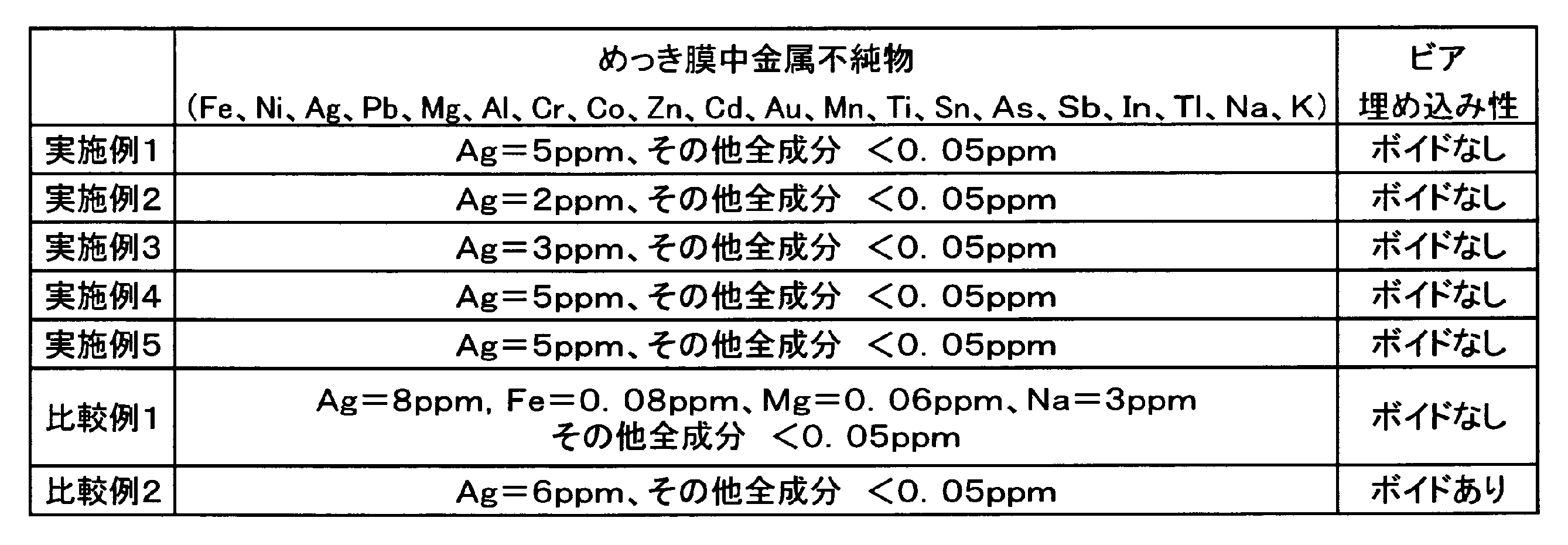
比較例2においては、得られたメタンスルホン酸銅水溶液のpHが2以下であり、そのメタンスルホン酸銅水溶液を用いて調整した電気銅めっき液のpHも2以下と低くなる。そのため、電気銅めっき開始時にカバレッジ不足で薄い銅シード層部分が溶解し、その結果ボイドが発生した。
Claims (6)
- スルホン酸銅水溶液であって、銅濃度が90g/L以上で、金属不純物の含有量が金属換算でいずれも10mg/L未満であり、塩素の含有量が10mg/L未満であり、スルホン酸が下記一般式で表されるスルホン酸であることを特徴とするスルホン酸銅水溶液。
R-(SO3H)n
(式中、Rは低級アルキル基、低級アルキリデン基、低級アルキレン基、又はヒドロキシアルキル基を表し、nは1又は2を表す。) - 前記金属不純物の金属が、鉄、ニッケル、銀、鉛、マグネシウム、アルミニウム、クロム、コバルト、亜鉛、ナトリウム、カリウム、ヒ素、アンチモン、カドミウム、金、インジウム、マンガン、タリウム、スズ、及びチタンであることを特徴とする請求項1記載のスルホン酸銅水溶液。
- 前記鉄、ニッケル、銀、鉛、マグネシウム、アルミニウム、クロム、コバルト、亜鉛、カドミウム、金、マンガン、スズ、及びチタンの含有量がいずれも1mg/L未満であることを特徴とする請求項1又は2記載のスルホン酸銅水溶液。
- pHが2以上であることを特徴とする請求項1~3のいずれかに記載のスルホン酸銅水溶液。
- 金属銅をスルホン酸溶液中で酸化・溶解させることにより作製したことを特徴とする請求項1~4のいずれかに記載のスルホン酸銅水溶液。
- 金属銅をスルホン酸溶液中で酸化・溶解させることを特徴とする請求項1~4のいずれかに記載のスルホン酸銅水溶液の製造方法。
Priority Applications (3)
| Application Number | Priority Date | Filing Date | Title |
|---|---|---|---|
| KR1020127012235A KR101329459B1 (ko) | 2010-02-22 | 2011-02-09 | 고순도 술폰산구리 수용액 및 그 제조방법 |
| US13/497,551 US8333834B2 (en) | 2010-02-22 | 2011-02-09 | High-purity aqueous copper sulfonate solution and method of producing same |
| JP2012500565A JP5384719B2 (ja) | 2010-02-22 | 2011-02-09 | 高純度スルホン酸銅水溶液及びその製造方法 |
Applications Claiming Priority (2)
| Application Number | Priority Date | Filing Date | Title |
|---|---|---|---|
| JP2010035972 | 2010-02-22 | ||
| JP2010-035972 | 2010-02-22 |
Publications (1)
| Publication Number | Publication Date |
|---|---|
| WO2011102276A1 true WO2011102276A1 (ja) | 2011-08-25 |
Family
ID=44482863
Family Applications (1)
| Application Number | Title | Priority Date | Filing Date |
|---|---|---|---|
| PCT/JP2011/052749 Ceased WO2011102276A1 (ja) | 2010-02-22 | 2011-02-09 | 高純度スルホン酸銅水溶液及びその製造方法 |
Country Status (5)
| Country | Link |
|---|---|
| US (1) | US8333834B2 (ja) |
| JP (1) | JP5384719B2 (ja) |
| KR (1) | KR101329459B1 (ja) |
| TW (1) | TWI444327B (ja) |
| WO (1) | WO2011102276A1 (ja) |
Cited By (1)
| Publication number | Priority date | Publication date | Assignee | Title |
|---|---|---|---|---|
| JP2011184343A (ja) * | 2010-03-08 | 2011-09-22 | Adeka Corp | 有機スルホン酸銅(ii)の製造方法 |
Families Citing this family (12)
| Publication number | Priority date | Publication date | Assignee | Title |
|---|---|---|---|---|
| TWI609100B (zh) * | 2012-03-30 | 2017-12-21 | 諾發系統有限公司 | 使用反向電流除鍍以清洗電鍍基板夾持具 |
| US10416092B2 (en) | 2013-02-15 | 2019-09-17 | Lam Research Corporation | Remote detection of plating on wafer holding apparatus |
| TWI510680B (zh) * | 2013-03-15 | 2015-12-01 | Omg Electronic Chemicals Llc | 銅電鍍溶液及其製備與使用方法 |
| KR101421503B1 (ko) * | 2013-07-23 | 2014-07-22 | 주식회사 에이엔씨코리아 | 고순도 메탄설폰산 동염 및 이를 함유하고 있는 회로 배선 도금용 동 도금액의 제조 방법 |
| JP6619718B2 (ja) * | 2016-10-14 | 2019-12-11 | 株式会社荏原製作所 | 基板のめっきに使用される酸化銅粉体、該酸化銅粉体を用いて基板をめっきする方法、該酸化銅粉体を用いてめっき液を管理する方法 |
| CN108689426A (zh) * | 2017-03-31 | 2018-10-23 | Jx金属株式会社 | 硫酸铜、其制造方法及其溶液、镀敷液、半导体电路基板的制造方法及电子机器的制造方法 |
| US10519558B2 (en) | 2017-04-28 | 2019-12-31 | Jx Nippon Mining & Metals Corporation | Copper sulfate, copper sulfate solution, plating solution, method for producing copper sulfate, method for producing semiconductor circuit board, and method for producing electronic apparatus |
| US11572533B2 (en) * | 2018-05-23 | 2023-02-07 | Tokuyama Corporation | Quaternary alkylammonium hypochlorite solution, method for manufacturing same, and method for cleaning semiconductor wafer |
| US10590560B1 (en) * | 2018-08-22 | 2020-03-17 | Eci Technology, Inc. | Control of additive turnover in an electrodeposition solution |
| KR102078819B1 (ko) | 2019-07-29 | 2020-02-18 | 하미나 | 단어학습용 전자펜, 이를 포함한 단어학습시스템 및 이의 동작방법 |
| CA3221703C (en) * | 2022-12-06 | 2026-03-10 | Sk Nexilis Co., Ltd. | Copper foil, electrode comprising the same, secondary battery comprising the same, and method for manufacturing the same |
| CA3222870C (en) * | 2022-12-28 | 2026-03-10 | Sk Nexilis Co., Ltd. | Copper foil, electrode comprising the same, secondary battery comprising the same, and method for manufacturing the same |
Citations (3)
| Publication number | Priority date | Publication date | Assignee | Title |
|---|---|---|---|---|
| JP2001115294A (ja) * | 1999-10-14 | 2001-04-24 | Atofina Chemicals Inc | アルカンスルホン酸塩電解質から銅の電気めっき |
| WO2009018581A1 (en) * | 2007-08-02 | 2009-02-05 | Enthone Inc. | Copper metallization of through silicon via |
| JP2009533555A (ja) * | 2006-04-13 | 2009-09-17 | マクダーミッド インコーポレーテッド | 印刷シリンダーの銅電気めっき |
Family Cites Families (9)
| Publication number | Priority date | Publication date | Assignee | Title |
|---|---|---|---|---|
| US4813970A (en) * | 1988-02-10 | 1989-03-21 | Crompton & Knowles Corporation | Method for improving the lightfasteness of nylon dyeings using copper sulfonates |
| JP2001115925A (ja) * | 1999-10-14 | 2001-04-27 | Yanmar Diesel Engine Co Ltd | ユニットインジェクタ |
| US20040045832A1 (en) * | 1999-10-14 | 2004-03-11 | Nicholas Martyak | Electrolytic copper plating solutions |
| US6808614B2 (en) * | 2002-01-17 | 2004-10-26 | Lucent Technologies Inc. | Electroplating solution for high speed plating of tin-copper solder |
| US20030159941A1 (en) * | 2002-02-11 | 2003-08-28 | Applied Materials, Inc. | Additives for electroplating solution |
| US20060272950A1 (en) | 2003-05-12 | 2006-12-07 | Martyak Nicholas M | High purity electrolytic sulfonic acid solutions |
| JP4894990B2 (ja) | 2005-03-09 | 2012-03-14 | 奥野製薬工業株式会社 | 酸性電気銅めっき液 |
| US8366901B2 (en) | 2006-09-07 | 2013-02-05 | Enthone Inc. | Deposition of conductive polymer and metallization of non-conductive substrates |
| JP2011184343A (ja) * | 2010-03-08 | 2011-09-22 | Adeka Corp | 有機スルホン酸銅(ii)の製造方法 |
-
2011
- 2011-02-09 WO PCT/JP2011/052749 patent/WO2011102276A1/ja not_active Ceased
- 2011-02-09 KR KR1020127012235A patent/KR101329459B1/ko active Active
- 2011-02-09 US US13/497,551 patent/US8333834B2/en active Active
- 2011-02-09 JP JP2012500565A patent/JP5384719B2/ja active Active
- 2011-02-16 TW TW100105028A patent/TWI444327B/zh active
Patent Citations (3)
| Publication number | Priority date | Publication date | Assignee | Title |
|---|---|---|---|---|
| JP2001115294A (ja) * | 1999-10-14 | 2001-04-24 | Atofina Chemicals Inc | アルカンスルホン酸塩電解質から銅の電気めっき |
| JP2009533555A (ja) * | 2006-04-13 | 2009-09-17 | マクダーミッド インコーポレーテッド | 印刷シリンダーの銅電気めっき |
| WO2009018581A1 (en) * | 2007-08-02 | 2009-02-05 | Enthone Inc. | Copper metallization of through silicon via |
Cited By (1)
| Publication number | Priority date | Publication date | Assignee | Title |
|---|---|---|---|---|
| JP2011184343A (ja) * | 2010-03-08 | 2011-09-22 | Adeka Corp | 有機スルホン酸銅(ii)の製造方法 |
Also Published As
| Publication number | Publication date |
|---|---|
| JPWO2011102276A1 (ja) | 2013-06-17 |
| US20120174827A1 (en) | 2012-07-12 |
| US8333834B2 (en) | 2012-12-18 |
| KR20120109482A (ko) | 2012-10-08 |
| TWI444327B (zh) | 2014-07-11 |
| KR101329459B1 (ko) | 2013-11-15 |
| JP5384719B2 (ja) | 2014-01-08 |
| TW201134753A (en) | 2011-10-16 |
Similar Documents
| Publication | Publication Date | Title |
|---|---|---|
| JP5384719B2 (ja) | 高純度スルホン酸銅水溶液及びその製造方法 | |
| KR102861234B1 (ko) | 백금 전해 도금욕 및 백금 도금 제품 | |
| CN104911676B (zh) | 具有滤过膜的碱性电镀浴 | |
| CN105189831A (zh) | 用于在工件上电解沉积金属层的装置和方法 | |
| JP2017504715A (ja) | 調節されたpHを有するメタンスルホン酸第一スズ溶液 | |
| JP2004510053A (ja) | 錫−銅合金層を析出させるための電解質及び方法 | |
| JP5887381B2 (ja) | 有毒金属または半金属を使用することなく電気めっき法により黄色金合金析出物を得る方法 | |
| CN100412236C (zh) | 镀金液及镀金方法 | |
| JP2001200387A (ja) | 錫−インジウム合金電気めっき浴 | |
| Ding et al. | Effects of four N-based additives on imitation gold plating | |
| JP6773241B2 (ja) | 高濃度スルホン酸錫水溶液及びその製造方法 | |
| TWI837305B (zh) | 電解金電鍍液、其製造方法及金電鍍方法、金錯合物 | |
| CN115605635A (zh) | 银/锡电镀浴及其使用方法 | |
| CN102041527B (zh) | 通过电铸在不使用有毒金属的情况下获得黄色金合金沉积物的方法 | |
| JP5079871B2 (ja) | カソード構造を改良する方法 | |
| WO2024105359A1 (en) | High efficiency platinum electroplating solutions | |
| JP5627629B2 (ja) | 18カラット3n金合金およびこれの析出方法 | |
| JP6326857B2 (ja) | 無電解めっき液 | |
| JP2023168652A (ja) | 電解金めっき液及びその製造方法並びに該めっき液を用いためっき方法 | |
| RU2459017C1 (ru) | Электролит для осаждения сплава серебро-рений | |
| JP2015190053A (ja) | 不純物の混入なく酸化を抑制する錫めっき方法 | |
| Murase et al. | Potentiostatic Cu-Zn alloying for polymer metallization using medium-low temperature ionic liquid baths | |
| KR20260057695A (ko) | 은/주석 전기 도금조 및 이를 사용하는 방법 | |
| JP2019173104A (ja) | Coアノード及びCoアノードを用いた電気Coめっき方法 | |
| CN111663127A (zh) | 一种低温化学镀低钖青铜镀液 |
Legal Events
| Date | Code | Title | Description |
|---|---|---|---|
| 121 | Ep: the epo has been informed by wipo that ep was designated in this application |
Ref document number: 11744563 Country of ref document: EP Kind code of ref document: A1 |
|
| WWE | Wipo information: entry into national phase |
Ref document number: 2012500565 Country of ref document: JP |
|
| WWE | Wipo information: entry into national phase |
Ref document number: 13497551 Country of ref document: US |
|
| ENP | Entry into the national phase |
Ref document number: 20127012235 Country of ref document: KR Kind code of ref document: A |
|
| NENP | Non-entry into the national phase |
Ref country code: DE |
|
| 122 | Ep: pct application non-entry in european phase |
Ref document number: 11744563 Country of ref document: EP Kind code of ref document: A1 |