WO2011102259A1 - 溶接変形が小さく耐食性に優れた鋼板 - Google Patents
溶接変形が小さく耐食性に優れた鋼板 Download PDFInfo
- Publication number
- WO2011102259A1 WO2011102259A1 PCT/JP2011/052573 JP2011052573W WO2011102259A1 WO 2011102259 A1 WO2011102259 A1 WO 2011102259A1 JP 2011052573 W JP2011052573 W JP 2011052573W WO 2011102259 A1 WO2011102259 A1 WO 2011102259A1
- Authority
- WO
- WIPO (PCT)
- Prior art keywords
- less
- steel
- deformation
- welding
- content
- Prior art date
- Legal status (The legal status is an assumption and is not a legal conclusion. Google has not performed a legal analysis and makes no representation as to the accuracy of the status listed.)
- Ceased
Links
Images


Classifications
-
- C—CHEMISTRY; METALLURGY
- C22—METALLURGY; FERROUS OR NON-FERROUS ALLOYS; TREATMENT OF ALLOYS OR NON-FERROUS METALS
- C22C—ALLOYS
- C22C38/00—Ferrous alloys, e.g. steel alloys
- C22C38/004—Very low carbon steels, i.e. having a carbon content of less than 0,01%
-
- C—CHEMISTRY; METALLURGY
- C21—METALLURGY OF IRON
- C21D—MODIFYING THE PHYSICAL STRUCTURE OF FERROUS METALS; GENERAL DEVICES FOR HEAT TREATMENT OF FERROUS OR NON-FERROUS METALS OR ALLOYS; MAKING METAL MALLEABLE, e.g. BY DECARBURISATION OR TEMPERING
- C21D8/00—Modifying the physical properties of ferrous metals or ferrous alloys by deformation combined with, or followed by, heat treatment
- C21D8/02—Modifying the physical properties of ferrous metals or ferrous alloys by deformation combined with, or followed by, heat treatment during manufacturing of plates or strips
-
- C—CHEMISTRY; METALLURGY
- C22—METALLURGY; FERROUS OR NON-FERROUS ALLOYS; TREATMENT OF ALLOYS OR NON-FERROUS METALS
- C22C—ALLOYS
- C22C38/00—Ferrous alloys, e.g. steel alloys
- C22C38/002—Ferrous alloys, e.g. steel alloys containing In, Mg, or other elements not provided for in one single group C22C38/001 - C22C38/60
-
- C—CHEMISTRY; METALLURGY
- C22—METALLURGY; FERROUS OR NON-FERROUS ALLOYS; TREATMENT OF ALLOYS OR NON-FERROUS METALS
- C22C—ALLOYS
- C22C38/00—Ferrous alloys, e.g. steel alloys
- C22C38/008—Ferrous alloys, e.g. steel alloys containing tin
-
- C—CHEMISTRY; METALLURGY
- C22—METALLURGY; FERROUS OR NON-FERROUS ALLOYS; TREATMENT OF ALLOYS OR NON-FERROUS METALS
- C22C—ALLOYS
- C22C38/00—Ferrous alloys, e.g. steel alloys
- C22C38/02—Ferrous alloys, e.g. steel alloys containing silicon
-
- C—CHEMISTRY; METALLURGY
- C22—METALLURGY; FERROUS OR NON-FERROUS ALLOYS; TREATMENT OF ALLOYS OR NON-FERROUS METALS
- C22C—ALLOYS
- C22C38/00—Ferrous alloys, e.g. steel alloys
- C22C38/04—Ferrous alloys, e.g. steel alloys containing manganese
-
- C—CHEMISTRY; METALLURGY
- C22—METALLURGY; FERROUS OR NON-FERROUS ALLOYS; TREATMENT OF ALLOYS OR NON-FERROUS METALS
- C22C—ALLOYS
- C22C38/00—Ferrous alloys, e.g. steel alloys
- C22C38/12—Ferrous alloys, e.g. steel alloys containing tungsten, tantalum, molybdenum, vanadium, or niobium
-
- C—CHEMISTRY; METALLURGY
- C22—METALLURGY; FERROUS OR NON-FERROUS ALLOYS; TREATMENT OF ALLOYS OR NON-FERROUS METALS
- C22C—ALLOYS
- C22C38/00—Ferrous alloys, e.g. steel alloys
- C22C38/14—Ferrous alloys, e.g. steel alloys containing titanium or zirconium
-
- C—CHEMISTRY; METALLURGY
- C22—METALLURGY; FERROUS OR NON-FERROUS ALLOYS; TREATMENT OF ALLOYS OR NON-FERROUS METALS
- C22C—ALLOYS
- C22C38/00—Ferrous alloys, e.g. steel alloys
- C22C38/16—Ferrous alloys, e.g. steel alloys containing copper
-
- C—CHEMISTRY; METALLURGY
- C22—METALLURGY; FERROUS OR NON-FERROUS ALLOYS; TREATMENT OF ALLOYS OR NON-FERROUS METALS
- C22C—ALLOYS
- C22C38/00—Ferrous alloys, e.g. steel alloys
- C22C38/18—Ferrous alloys, e.g. steel alloys containing chromium
- C22C38/40—Ferrous alloys, e.g. steel alloys containing chromium with nickel
- C22C38/42—Ferrous alloys, e.g. steel alloys containing chromium with nickel with copper
-
- C—CHEMISTRY; METALLURGY
- C22—METALLURGY; FERROUS OR NON-FERROUS ALLOYS; TREATMENT OF ALLOYS OR NON-FERROUS METALS
- C22C—ALLOYS
- C22C38/00—Ferrous alloys, e.g. steel alloys
- C22C38/18—Ferrous alloys, e.g. steel alloys containing chromium
- C22C38/40—Ferrous alloys, e.g. steel alloys containing chromium with nickel
- C22C38/44—Ferrous alloys, e.g. steel alloys containing chromium with nickel with molybdenum or tungsten
-
- C—CHEMISTRY; METALLURGY
- C22—METALLURGY; FERROUS OR NON-FERROUS ALLOYS; TREATMENT OF ALLOYS OR NON-FERROUS METALS
- C22C—ALLOYS
- C22C38/00—Ferrous alloys, e.g. steel alloys
- C22C38/18—Ferrous alloys, e.g. steel alloys containing chromium
- C22C38/40—Ferrous alloys, e.g. steel alloys containing chromium with nickel
- C22C38/46—Ferrous alloys, e.g. steel alloys containing chromium with nickel with vanadium
-
- C—CHEMISTRY; METALLURGY
- C22—METALLURGY; FERROUS OR NON-FERROUS ALLOYS; TREATMENT OF ALLOYS OR NON-FERROUS METALS
- C22C—ALLOYS
- C22C38/00—Ferrous alloys, e.g. steel alloys
- C22C38/18—Ferrous alloys, e.g. steel alloys containing chromium
- C22C38/40—Ferrous alloys, e.g. steel alloys containing chromium with nickel
- C22C38/48—Ferrous alloys, e.g. steel alloys containing chromium with nickel with niobium or tantalum
-
- C—CHEMISTRY; METALLURGY
- C22—METALLURGY; FERROUS OR NON-FERROUS ALLOYS; TREATMENT OF ALLOYS OR NON-FERROUS METALS
- C22C—ALLOYS
- C22C38/00—Ferrous alloys, e.g. steel alloys
- C22C38/18—Ferrous alloys, e.g. steel alloys containing chromium
- C22C38/40—Ferrous alloys, e.g. steel alloys containing chromium with nickel
- C22C38/58—Ferrous alloys, e.g. steel alloys containing chromium with nickel with more than 1.5% by weight of manganese
-
- C—CHEMISTRY; METALLURGY
- C21—METALLURGY OF IRON
- C21D—MODIFYING THE PHYSICAL STRUCTURE OF FERROUS METALS; GENERAL DEVICES FOR HEAT TREATMENT OF FERROUS OR NON-FERROUS METALS OR ALLOYS; MAKING METAL MALLEABLE, e.g. BY DECARBURISATION OR TEMPERING
- C21D2211/00—Microstructure comprising significant phases
- C21D2211/002—Bainite
Definitions
- the present invention relates to a steel plate having a small weld deformation and excellent corrosion resistance, which is used in the fields of shipbuilding, offshore structures, building structures, bridges, civil engineering and the like.
- the present invention relates to a thick steel plate with small welding deformation that occurs during fillet welding.
- Patent Document 1 proposes reducing welding deformation by devising welding materials.
- the increase in the cost of the welding material hinders the economic efficiency and the effect is insufficient, and the application is not progressing in reality.
- Patent Document 2 discloses a method of increasing yield stress by promoting precipitation in welding heat history by adding Nb and Mo in combination. However, since addition of Mo brings about a significant cost increase, it is poor in versatility.
- Patent Documents 3 and 4 by controlling the fraction of bainite and / or martensite of the steel material as the base material to 20% or more and further defining the dispersion state of carbonitride, the yield stress is increased, and There is a description of suppressing welding deformation. However, it has not yet reached a practically sufficient weld deformation reduction effect.
- Patent Document 5 describes that welding deformation is suppressed by setting the bainite ratio of a steel material as a base material to 70% or more and further ensuring a solid solution Nb amount of 0.0040% or more.
- the bainite ratio is 70% or more, not only does the strength of the base material deviate from the general-purpose range, but there is a concern that inhibition of weld cracking by Nb may become a problem.
- welded steel structures are often used in environments where there is a large amount of incoming salt, such as in beach areas or areas where snow melting salt is scattered. In the shipbuilding field, it is often used in a seawater splash environment.
- weathering steel is used for structures such as bridges as a minimum maintenance steel that can be used as it is without being painted.
- a protective rust layer is formed on the surface of weathering steel not only in the beach area but also in inland areas where there is a large amount of incoming salt, such as areas where snowmelt salt and antifreeze are sprayed. Since it is hard to be done, the effect which suppresses corrosion is hard to be exhibited. Therefore, in these regions, it is not possible to use bare weatherproof steel, and ordinary steel is used by painting on ordinary steel. However, in the case of using such ordinary steel for coating, it is necessary to repaint every 10 years because of coating deterioration due to corrosion, and therefore the cost required for maintenance becomes enormous.
- Ni-based high weathering steel to which about 1 to 3% of Ni is added has been developed.
- the salt in an environment where snow melting salt or anti-freezing agent is sprayed on the road, the salt is wound up on the running car and adheres to the bridge that supports the road, resulting in a severe corrosive environment. Furthermore, the eaves under the eaves a little away from the coast are also exposed to severe salt damage environments, and in such areas, the amount of incoming salt becomes a severe corrosive environment with 1 mdd or more.
- Patent Document 6 proposes a weather-resistant steel material having an increased chromium (Cr) content
- Patent Document 7 proposes a weather-resistant steel material having an increased nickel (Ni) content.
- the weathering steel material with the increased chromium (Cr) content proposed in Patent Document 6 can improve the weathering resistance in a region where the amount of incoming salt is below a certain level, it is severer than that. In a salt environment, the weather resistance is deteriorated.
- the weather resistance is improved to some extent, but the cost of the steel material itself is increased, and it is used for applications such as bridges. As an expensive material, it becomes expensive. In order to avoid this, if the Ni content is reduced, the weather resistance will not be improved so much, and if the amount of incoming salt is high, layered peeling rust will form on the surface of the steel material, corrosion will be remarkable, and it will be used for a long time. The problem of being unbearable arises.
- Japanese Unexamined Patent Publication No. 7-9191 Japanese Laid-Open Patent Publication No.7-138715 JP 2003-268484 A JP 2006-2211 A Japanese Unexamined Patent Publication No. 2006-2198 Japanese Patent Laid-Open No. 9-1779090 Japanese Patent Laid-Open No. 5-118011
- the conventional methods each have difficulty from the viewpoints of economy and practical reproducibility, and there is much room for improvement in practical use.
- paint peel resistance is a major problem in welded steel structures used in environments with a large amount of incoming salt. That is, as shown above, in a coastal environment where a large amount of chloride comes in or an environment where a snow melting agent or an antifreezing agent is sprayed, the coating peels off early and corrosion progresses. Therefore, it is necessary to repaint the paint every few to a few dozen years. In addition, when repainting is performed, it is necessary to assemble a scaffold on a once-corroded bridge and perform a reblasting process as a previous process, which is very expensive.
- the paint peel resistance is largely due to the characteristics including the corrosion resistance of the steel material as the base.
- an object of the present invention is to establish a technique for reliably suppressing welding deformation at low cost, and to provide a steel plate having small welding deformation.
- an object is to provide a steel plate with small welding deformation. Note that the target value of the amount of welding deformation is 1 ⁇ 2 that of conventional steel.
- the present invention provides corrosion resistance in a high chloride environment (including that the coating does not peel off and that corrosion at the coating defect is suppressed and corrosion resistance is maintained (including coating peeling resistance) and weather resistance when no coating is applied). It aims to provide an excellent steel material.
- FIG. 1 shows the independent influence of the physical property values of each material obtained by the thermal coupled FEM analysis conducted in conjunction with the experiment. Moreover, the calculation conditions of FEM analysis are shown in FIG.
- the horizontal axis represents thermal conductivity (white circle plot), transformation point Ac 1 (black circle plot), strength TS (square plot), and the vertical axis represents the amount of angular deformation.
- the welding deformation particularly depends largely on the strength and transformation point, and the target value of the welding deformation amount (angular deformation amount) is 1 ⁇ 2 that of conventional steel (angular deformation amount is about 0.8 mm), that is, 0.4 mm.
- the strength becomes extremely high and deviates from the general-purpose strength class. Deviations from the general strength class are not desirable because they are not only subject to general commercial transactions, but may also cause structural design problems and weldability problems.
- the present inventors aimed to develop a steel type in which the high-temperature strength was increased while maintaining the normal temperature strength suitable for the general-purpose strength class.
- the high temperature strength can be increased. If Nb is not contained, securing of high temperature strength is insufficient. However, the Nb content may be small, and if it is 0.02% or more, welding deformation can be suppressed through securing high temperature strength.
- the manufacturing method of the steel sheet may be under general conditions, but steels containing Nb and B in combination tend to have higher hardenability than ordinary steels, so they conform to general-purpose strength levels. It is preferable to devise for this purpose.
- the low carbon bainite structure has a lower hardness than the high carbon bainite structure, and the deformation resistance tends to be slightly inferior. For this reason, it is necessary to reduce as much as possible the ferrite structure that causes the hardness to decrease.
- the hardness of the bainite structure which is the main component of the steel structure, also affects the strength and deformation resistance. For this reason, it is necessary to adjust the hardness of the bainite structure.
- the present inventors examined corrosion in an environment with a large amount of incoming salt. As a result, in such an environment, repeated drying and wetting of the FeCl 3 solution became an essential condition of corrosion, and due to hydrolysis of Fe 3+ It has been found that corrosion is accelerated by lowering the pH and by Fe 3+ acting as an oxidizing agent.
- the corrosion reaction at this time is as shown below.
- Fe 2+ generated by the reaction of the above formula (1) is oxidized to Fe 3+ by air oxidation, and the generated Fe 3+ acts again as an oxidant to accelerate corrosion.
- the reaction rate of air oxidation of Fe 2+ is generally slow in a low pH environment, but is accelerated in a concentrated chloride solution, and Fe 3+ is easily generated. It has been found that due to such a cyclic reaction, in an environment where the amount of incoming salt is very large, Fe 3+ is always supplied, corrosion of steel is accelerated, and corrosion resistance is significantly deteriorated.
- the present inventors examined the influence of various alloy elements on the weather resistance based on the mechanism of corrosion in such a salt environment, and as a result, obtained the findings shown in the following (e) to (g).
- Sn is dissolved as Sn 2+ , and the concentration of Fe 3+ is reduced by a reaction of 2Fe 3+ + Sn 2+ ⁇ 2Fe 2+ + Sn 4+ to suppress the reaction of formula (1).
- Sn also has an effect of suppressing anodic dissolution.
- (F) Cu is an element that has traditionally been the basis of an effect of improving corrosion resistance in an environment with a large amount of incoming salt, and an effect of improving corrosion resistance is seen in an environment with a relatively long wetting time.
- a relatively dry environment in which salt is deposited and wet and dry are repeated due to changes in humidity and ⁇ -FeOOH is generated. Then, it was found that Cu rather promotes corrosion.
- the steel material which contains Sn actively and suppresses the Cu content can be expected to have high corrosion resistance.
- the corrosion resistance is high, even if the steel material is painted, there is little peeling of the paint due to the corrosion of the steel material, and the corrosion of the coating defect part is suppressed, but the anticorrosive effect by the coating film can also be expected.
- a further effect of corrosion resistance can be expected. Therefore, in addition to the corrosion resistance, the service life of the coating can be extended and the repair coating interval can be greatly extended. In particular, it is effective in improving paint peeling resistance in the marine and bridge fields.
- the present invention has been completed on the basis of the above knowledge, and the gist thereof lies in the steel sheet having the small weld deformation and excellent corrosion resistance shown in the following (1) to (4).
- a steel plate having small corrosion deformation and excellent corrosion resistance characterized by containing seeds or two or more kinds.
- the welding deformation in the steel plate is substantially a welding deformation in the weld heat affected zone (HAZ). If welding is performed after satisfying the requirements, it is considered that the ability to suppress welding deformation is improved.
- HAZ weld heat affected zone
- the present invention “In mass%, C: 0.0005% or more and less than 0.02%, Si: 0.01 to 0.7%, Mn: 0.1 to 5.0%, P: 0.05% or less, Cu : Less than 0.2%, S: 0.008% or less, Nb: 0.02 to 0.3%, Al: 0.003 to 0.1%, N: 0.01% or less, B: 0.0005
- a welding method characterized in that the metal structure contains 80% or more of a bainite structure, and the bainite hardness is 150 to 250 in terms of Vickers hardness. It can also be grasped.
- the steel sheet is in% by mass, Ti: 0.1% or less, Ni: 3.5% or less, Cr: 2% or less, Mo: 0.5% or less, V: 0.1% or less, Zr : 0.02% or less, Ca: 0.004% or less, Mg: 0.002% or less, and REM: 0.002% or less may be contained.
- the steel plate as a base material may be welded after being manufactured so as to satisfy the above requirements, or the part to be welded (welding heat effect in the steel plate as a base material). It is also possible to weld only after satisfying the above requirements for the part by processing only the part to be a part.
- this welding method can also be applied to fillet welding with large welding deformation.
- Fillet welding is performed on lap joints, T joints, cruciform joints, etc., but this welding method involves fillet welding on T joints and cruciform joints, which cause particularly large welding deformations due to the relative positional relationship of the joint base material. Is particularly effective.
- the reason for limiting the chemical composition and metal structure of the steel sheet is as follows.
- C 0.0005% or more and less than 0.02% C is an element most effective for improving the strength and is an inexpensive element. However, if it is less than 0.0005%, it is necessary to guarantee strength by using other elements in combination, resulting in an increase in cost. Moreover, when it contains 0.02% or more, intensity
- Si 0.01 to 0.7% Si is an element contributing to strength improvement. However, if it is less than 0.01%, the required strength cannot be ensured. Moreover, when it contains exceeding 0.7%, base material toughness and weldability toughness will deteriorate remarkably. Therefore, the Si content is set to 0.01 to 0.7%.
- Mn 0.1 to 5.0%
- Mn is an element necessary for ensuring strength. However, if it is less than 0.1%, the required strength cannot be ensured. Moreover, when it contains exceeding 5.0%, weldability will deteriorate. Therefore, the Mn content is set to 0.1 to 5.0%. Since addition of excessive Mn may deteriorate the corrosion resistance, it is preferably 4.0% or less, more preferably 2.0% or less.
- P 0.05% or less P is an element present in steel as an impurity. If the P content exceeds 0.05%, it not only segregates at the grain boundaries and lowers the toughness, but also causes hot cracking during welding, so the P content is 0.05% or less.
- S 0.008% or less S is an element present in steel as an impurity. If the S content exceeds 0.008%, center segregation is promoted or a large amount of stretched MnS is generated, so that the mechanical properties of the base material and the weld heat affected zone deteriorate. Therefore, the upper limit of the S content is 0.008%.
- Cu Less than 0.2% Cu is generally regarded as a basic element for improving weather resistance, and is added to all beach weather resistant steels and corrosion resistant steels, but in a relatively dry environment under high flying salt. Rather, it reduces the corrosion resistance. Further, if it coexists with Sn, cracking occurs during rolling. Therefore, it is necessary to reduce the Cu content. Even if contained as an impurity, the Cu content needs to be less than 0.2%. Preferably it is less than 0.1%.
- Nb 0.02 to 0.3%
- Nb expresses the precipitation behavior at high temperature and brings about an increase in high temperature strength. However, if the content is less than 0.02%, the effect cannot be obtained. On the other hand, if it exceeds 0.3%, the toughness of the weld heat affected zone is significantly impaired. Therefore, the Nb content is 0.02 to 0.3%. A preferable content is 0.02 to 0.18%.
- Al 0.003 to 0.1%
- Al is an essential element for deoxidation. In order to stably perform deoxidation, a content of 0.003% or more is necessary. However, if it exceeds 0.1%, the toughness tends to deteriorate particularly in the weld heat affected zone. This is presumably because coarse cluster-like alumina inclusion particles are easily formed. Therefore, the Al content is set to 0.003 to 0.1%.
- N 0.01% or less N is an element present in steel as an impurity.
- the N content exceeds 0.01%, the base material toughness and the weld heat affected zone toughness are deteriorated. Therefore, the upper limit of the N content is 0.01%.
- B 0.0005 to 0.004%
- B has the effect of improving the hardenability and increasing the strength.
- the B content needs to be 0.0005% or more.
- the B content is set to 0.0005 to 0.004%.
- a preferable content is 0.0005 to 0.0025%.
- Sn 0.03-0.50% Sn dissolves as Sn 2+ and has an action of inhibiting corrosion by an inhibitor action in an acidic chloride solution. Further, rapidly to reduce the Fe 3+, by having an effect of reducing Fe 3+ concentration as oxidizing agent, since inhibit corrosion promoting effect of Fe 3+, thereby improving the weather resistance in high airborne salt environments. Moreover, Sn has the effect
- Cu / Sn ratio 1 or less
- the corrosion resistance is significantly reduced by the inclusion of Cu.
- the steel sheet according to the present invention has the chemical composition described above, with the balance being Fe and impurities.
- the impurity is a component that is mixed due to various factors in the manufacturing process including raw materials such as ore and scrap when industrially manufacturing a steel sheet, and does not adversely affect the present invention. It means what is allowed.
- the steel sheet according to the present invention can contain one or more components selected from at least one of the following first group to third group, if necessary, in addition to the above components.
- first group to third group if necessary, in addition to the above components.
- Group 1 ingredients Ti Ti: 0.1% or less Since Ti mainly acts as a deoxidizing element, it can be contained if necessary. However, since deoxidation can be performed with Al, it is not always necessary to contain it. However, since Ti oxide or Ti—Al oxide is formed when the Ti content is large, the ability to refine the structure in the weld heat affected zone particularly in small heat input welding is lost. For this reason, Ti content in the case of making it contain shall be 0.1% or less. In addition, in order to acquire the deoxidation effect by containing Ti stably, it is preferable that the content shall be 0.01% or more.
- Ni is an element that improves the toughness of the base material and contributes to the improvement of the strength by improving the hardenability, and can be contained as necessary.
- Ni is an expensive element, if Ni is excessively contained, it causes a large cost increase.
- the upper limit of content of Ni in the case of making it contain shall be 3.5% or less.
- the content shall be 0.02% or more.
- Cr 2.0% or less Cr is an element effective for increasing the strength through improvement of hardenability, and can be contained as necessary. However, if it exceeds 2.0%, the toughness deteriorates. Therefore, the Cr content when contained is 2.0% or less. Cr is an element that degrades corrosion resistance in a salt environment, but when it coexists with Sn, its adverse effect is remarkably suppressed. In addition, in order to stably obtain the strength improvement effect by including Cr, the content is preferably set to 0.02% or more.
- Mo 0.5% or less Since Mo is an element effective for increasing the strength, it can be contained as required. However, if Mo is contained in excess of 0.5%, the cost is significantly increased, and the improvement in strength is saturated. Therefore, the Mo content in the case of inclusion is 0.5% or less. In addition, in order to acquire the strength improvement effect by containing Mo stably, it is preferable that the content shall be 0.06% or more.
- V 0.1% or less
- V is an element effective for improving the strength, and can be contained as necessary. However, if the V content exceeds 0.1%, the toughness is greatly deteriorated. Therefore, the V content in the case where V is included is 0.1% or less. In addition, in order to obtain the strength improvement effect by containing V stably, it is preferable to make the content 0.005% or more.
- Zr 0.02% or less Zr has the effect of finely dispersing and precipitating nitrides in steel and improving the strength, and can be contained as required. However, if the content exceeds 0.02%, coarse precipitates are formed and toughness is deteriorated, so the content of Zr in the case of inclusion is 0.02% or less. In order to stably obtain the strength improvement effect by containing Zr, the Zr content is preferably 0.0003% or more.
- Group 3 components Ca, Mg, REM Ca: 0.004% or less
- Ca reacts with S in steel to form oxysulfide (oxysulfide) in molten steel.
- oxysulfide oxysulfide
- this oxysulfide does not extend in the rolling direction during rolling and is spherical after rolling. Therefore, welding with the tip of the elongated shaped inclusions as the starting point of cracking Since there exists an effect
- Mg 0.002% or less Mg forms an Mg-containing oxide, serves as a generation nucleus of TiN, and has an effect of finely dispersing TiN. Therefore, Mg can be contained as necessary. However, when the content exceeds 0.002%, the amount of oxide becomes excessive and ductility is reduced. Therefore, the upper limit of the Mg content in the case of inclusion is set to 0.002%. In order to stably obtain the effect of finely dispersing TiN, the Mg content is preferably 0.0003% or more.
- REM 0.002% or less REM contributes to the refinement of the structure of the weld heat affected zone and the fixation of S, and can be contained as necessary. However, if the content exceeds 0.002%, REM becomes an inclusion that adversely affects the toughness of the base material, so the content of REM in the case of inclusion is 0.002% or less. In addition, in order to obtain the refinement
- the bainite fraction of a metal structure shall be 80% or more. Bainite is excellent in deformation resistance, but steel with a low carbon content lacks carbon in bainite, resulting in a low carbon bainite structure, which is slightly inferior in deformation resistance compared to a high carbon bainite structure. Therefore, in order to ensure deformation resistance in low carbon steel, it is necessary to secure a certain amount of bainite structure and not to have excessive ferrite. If the bainite ratio is 80% or more after the inclusion of Nb and B is essential, sufficient weld deformation resistance can be obtained, so the ratio of the bainite structure is defined as 80% or more. The balance is thought to be mainly composed of ferrite, but is not particularly specified.
- the lower limit is set to 150.
- the upper limit is set to 250.
- the steel ingot Prior to hot rolling, the steel ingot is first heated, but if the heating temperature at this time is set to Ac 3 or higher, it can be completely austenitic phase and homogenized without any untransformed part. It is preferable that the temperature be Ac 3 point or higher. Specifically, heating to 900 to 1200 ° C. is preferable. When the rolling finish temperature at the thin end is set to 900 ° C. or lower during hot rolling, the crystal grains become an appropriate size and the fracture toughness of the material becomes sufficient.
- the lower limit of the rolling finishing temperature is not particularly defined, and any conditions may be used as long as the strength can be adapted to the general-purpose strength range. When the rolling finish temperature is 700 ° C.
- accelerated cooling may be performed.
- the cooling stop temperature is preferably controlled using 150 to 500 ° C. as a guide.
- the heat treatment it is preferable to perform a normalizing process or a tempering process, and it is preferable to select temperature ranges of 800 to 1100 ° C. and 300 to 700 ° C. respectively.
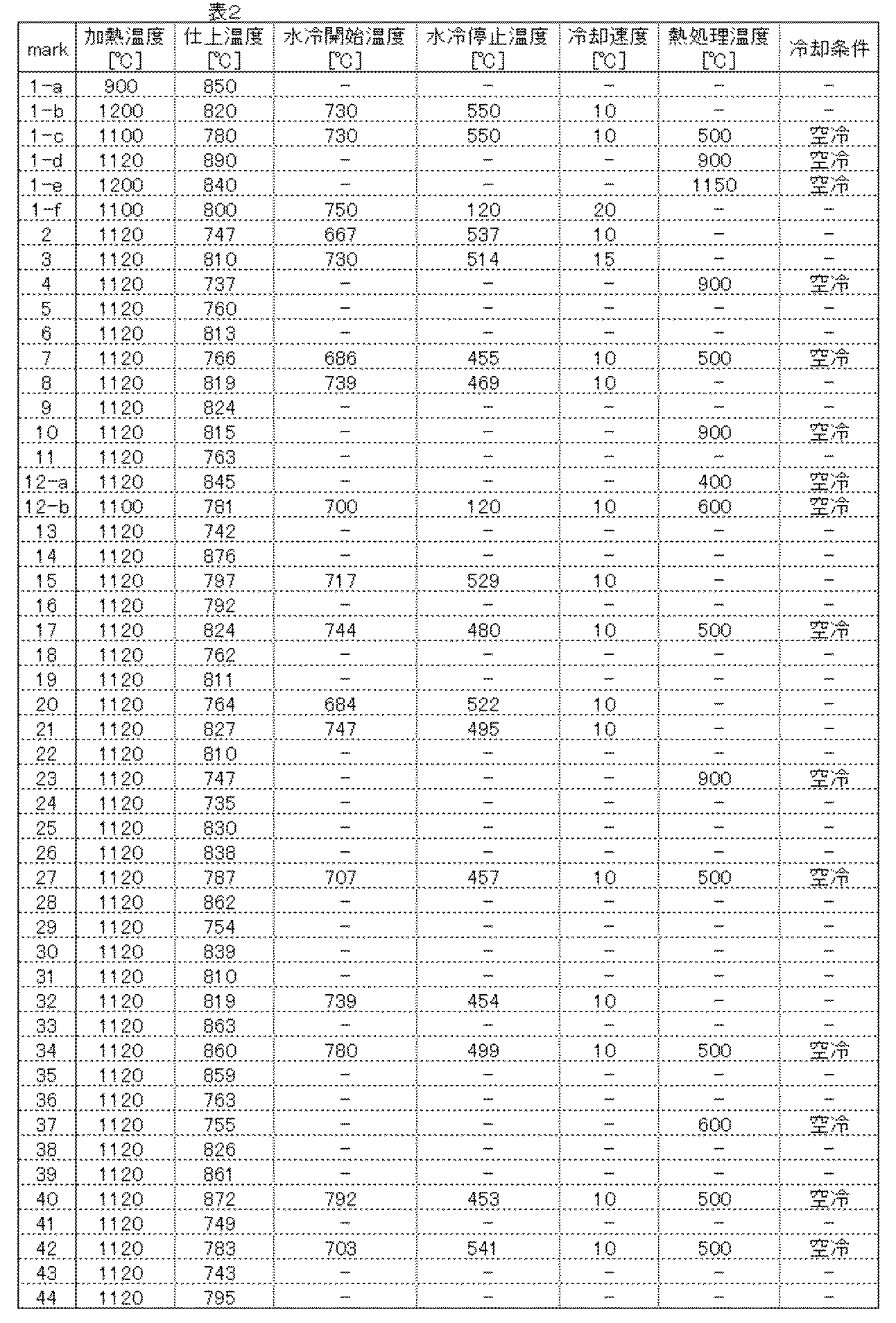
- Steel ingots having the composition components shown in Table 1 were produced under the heating temperature, finishing temperature, accelerated cooling, and heat treatment conditions shown in Table 2.
- the plate thickness of the steel plate was 16 mm.
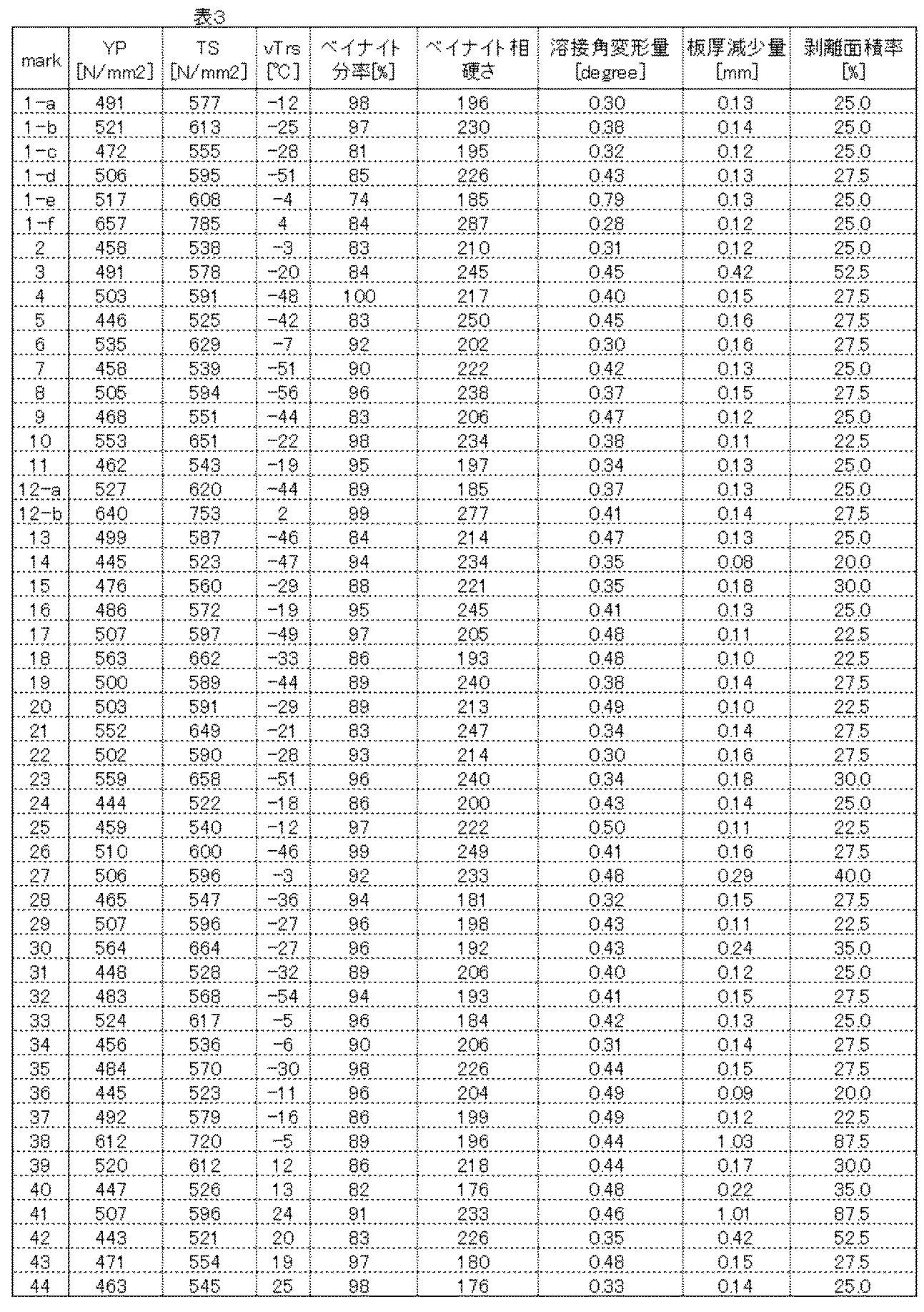
- Table 3 shows the yield point YP, tensile strength TS, transition temperature vTrs, bainite fraction, bainite hardness of the bainite phase, welding angle deformation, sheet thickness reduction, and peel area ratio. Respectively.
- specimens were collected according to the test method described in JIS-Z-2201. The sampling position was set to around 1 ⁇ 4 of the plate thickness direction and the L direction (parallel to the rolling direction). The yield point was determined as a test speed of 10 N / mm ⁇ s, and the yield point was 0.2% proof stress when no clear yield point appeared.
- a specimen was collected according to the test method described in JIS-Z2202. The sampling position was around 1/4 in the plate thickness direction and the L direction (parallel to the rolling direction), and a 2 mmV notch Charpy test piece was measured. The brittle fracture surface ratio at various temperatures was measured to determine the transition temperature. The target value of the Charpy characteristic is that the transition temperature is 0 ° C. or lower.
- Tissue observation was performed with an optical microscope. The image obtained by observation was subjected to image analysis. The bainite fraction of the metal structure was obtained by calculating the area ratio of bainite to the area of 100 visual field observations obtained by the above observation method.
- a T-shaped weld specimen was prepared for the steel plate, one side was restrained with a triangular steel plate having high rigidity, and the other side was subjected to 1-pass fillet welding.
- the welding material used was a general 50 kilo steel flux cored wire, and welding conditions were 10.4 kJ / cm (200 A-26 V-30 cm / min).
- a sufficient time has elapsed after welding, place the test piece on the surface plate, and measure the angular deformation ⁇ defined in Fig. 4 with three clearance gauges at the welding start position, center position and end position. The average value thereof was taken as the welding angle deformation.
- the welding angle deformation amount of ordinary general-purpose 50 kg steel measured by this method is about 1 °
- the target welding angle deformation level of the present invention is 0.5 °.
- test piece obtained from the obtained steel materials was evaluated by SAE (Society of Automotive Engineers) J2334 test.
- SAE J2334 test is wet: 50 ° C., 100% RH, 6 hours, salt adhesion: 0.5% NaCl, 0.1% CaCl 2 , 0.075% NaHCO 3 aqueous solution, 0.25 hour, dry: 60
- This test is a test that simulates a severe corrosive environment in which the amount of incoming salt exceeds 1 mdd.
- the “plate thickness reduction amount” is an average plate thickness reduction amount of the test piece, and is calculated using the weight reduction before and after the test and the surface area of the test piece.
- a test piece with a size of 150 x 70 mm was coated with a modified epoxy paint (Banno 200: made in China) by air spray to a dry film thickness of 150 ⁇ m, and the steel substrate After making a crosscut at a depth reaching, the SAE J2334 test was also evaluated.
- a modified epoxy paint Banno 200: made in China
- the quenching stop temperature was 120 ° C., which was quenched to a relatively low temperature, so that the hardness of the bainite phase became harder, the tensile strength increased, and the toughness deteriorated. For this reason, it is an inappropriate steel material as a structural steel plate.
- the water cooling stop temperature was set to 120 ° C. and the steel was quenched to a relatively low temperature, so that the hardness of the bainite phase became hard, the tensile strength increased, and the toughness deteriorated. For this reason, this steel material is also unsuitable as a structural steel plate.
- the steel composition specified in the present invention was not satisfied, and the toughness of the steel sheet itself was lowered. For this reason, it is inappropriate as a structural steel material.
- the steel plate of Mark 39 (comparative example) since the Cu / Sn ratio exceeded 1, rolling cracks also occurred.
- Sn did not satisfy the composition defined in the present invention, the corrosion resistance was lowered, and the coating peeled off.
- the tensile properties are all such that the yield point YP is 350 N / mm 2 or more and the tensile strength TS is 490 to 720 N / mm 2 class.
- It is a general-purpose steel that is suitable as a structural steel plate because its transition temperature vTrs, bainite fraction, bainite phase Vickers hardness are within the appropriate range, and the welding angle deformation is within the target 0.5 °. I understand that.
Landscapes
- Chemical & Material Sciences (AREA)
- Engineering & Computer Science (AREA)
- Materials Engineering (AREA)
- Mechanical Engineering (AREA)
- Metallurgy (AREA)
- Organic Chemistry (AREA)
- Physics & Mathematics (AREA)
- Thermal Sciences (AREA)
- Crystallography & Structural Chemistry (AREA)
- Heat Treatment Of Steel (AREA)
Abstract
Description
溶接変形が残留する原因は、溶接金属や母材の溶接止端部近傍が塑性変形を受けるためである。塑性変形を受けた部位は、その外側の部分を弾性的に変形させようとするが、剛性が高い場合、すなわち断面積が大きい場合には、その変形量は小さくなる。したがって、断面積を大きくするように設計変更することが一つの防止策となり得る。しかしながら、断面積を大きくするという設計変更は、使用鋼材のコストアップ、重量アップおよび工期長期化の面でロスが多い。
溶接時に、何らかの工夫をしておくことで溶接変形を防止することが可能である。幾つかの方法があるが、まずは溶接前に予め逆方向に曲げておくことである。溶接後には角変形が発生するが、予め逆方向に曲げておくことにより所望の形状に仕上がる可能性がある。また、溶接時に端部を拘束しておき変形を許容しない方法もある。さらに、後行トーチを設置し、溶接後に適切な位置を再加熱することにより逆に曲げ戻す方法も採られる場合がある。しかしながら、何れも大幅な工数増加を伴うので、コストアップ要因となる。
溶接後に矯正する方法として、機械的矯正と線状加熱矯正がある。しかしながら、これらの方法も大幅な工数増加が必要であるとともに熟練した高度な技能も要求される。
Fe3++e-→Fe2+ (Fe3+の還元反応)
2H2O+O2+2e-→4OH-、
2H++2e-→H2
アノード反応:Fe→Fe2++2e- (Feの溶解反応)
2Fe3++Fe→3Fe2+・・・・・・(1)式
「質量%で、C:0.0005%以上かつ0.02%未満、Si:0.01~0.7%、Mn:0.1~5.0%、P:0.05%以下、Cu:0.2%未満、S:0.008%以下、Nb:0.02~0.3%、Al:0.003~0.1%、N:0.01%以下、B:0.0005~0.004%およびSn:0.03~0.50%を含み、残部Feおよび不純物からなる化学組成を有する鋼板の溶接方法であって、溶接前の鋼板における溶接熱影響部となる部位の金属組織がベイナイト組織を80%以上含み、かつ、ベイナイト硬度がビッカース硬さで150~250であることを特徴とする溶接方法。」
と把握することもできる。
鋼板の各成分の作用効果および各成分の好ましい含有量は下記のとおりである。なお、含有量に関する「%」は「質量%」を意味する。
Cは強度向上にもっとも有効な元素であり、かつ安価な元素である。ただし、0.0005%未満では他の元素の併用による強度保証が必要となり、結果的にコストアップ要因となる。また、0.02%以上含有させると強度が上昇しすぎて汎用性を失う。したがって、Cの含有量は0.0005%以上かつ0.02%未満とする。好ましくは、0.0005~0.02%である。なお、強度汎用性の面で好ましいCの含有量の上限は0.002%である。
Siは強度向上に寄与する元素である。ただし、0.01%未満では必要とする強度を確保することができない。また、0.7%を超えて含有させると母材靱性と溶接性靱性を著しく劣化させることになる。したがって、Siの含有量は0.01~0.7%とする。
Mnは強度確保のために必要な元素である。ただし、0.1%未満では必要とする強度を確保することができない。また、5.0%を超えて含有させると溶接性が劣化する。したがって、Mnの含有量は0.1~5.0%とする。過剰のMnの添加は耐食性を劣化させる場合があるので、好ましくは4.0%以下、より好ましくは2.0%以下とする。
Pは、不純物として鋼中に存在する元素である。Pの含有量が0.05%を超えると、粒界に偏析して靭性を低下させるのみならず、溶接時に高温割れを招くため、Pの含有量を0.05%以下とする。
Sは、不純物として鋼中に存在する元素である。Sの含有量が0.008%を超えると、中心偏析を助長したり、延伸形状のMnSが多量に生成したりするため、母材および溶接熱影響部の機械的性質が劣化する。したがって、Sの含有量の上限を0.008%とする。
Cuは、一般的に耐候性を向上させる基本元素とされ、全ての海浜耐候性鋼や耐食鋼に添加されているが、高飛来塩分下の比較的ドライな環境においては、むしろ耐食性を低下させる。またSnと共存すると圧延時に割れが生じる。したがって、Cuの含有は少なくする必要がある。不純物として含有されるとしても、Cu含有量は0.2%未満とする必要がある。好ましくは0.1%未満である。
Nbは、高温中で析出挙動を発現し、高温強度の上昇をもたらす。ただし、その含有量が0.02%未満ではその効果が得られない。また、0.3%を超えると溶接熱影響部の靱性を著しく損なう。したがって、Nbの含有量は0.02~0.3%とする。なお、好ましい含有量は0.02~0.18%である。
Alは脱酸のために必須の元素である。脱酸を安定的に行うためには、0.003%以上の含有量が必要である。ただし、0.1%を超えると、特に溶接熱影響部において靱性が劣化しやすくなる。これは、粗大なクラスター状のアルミナ系介在物粒子が形成されやすくなるためと考えられる。したがって、Alの含有量は0.003~0.1%とする。
Nは、不純物として鋼中に存在する元素である。Nの含有量が0.01%を超えると、母材靱性と溶接熱影響部靭性の悪化原因となる。したがって、Nの含有量の上限を0.01%とする。
Bは焼入れ性を向上させて強度を高める作用がある。この効果を安定的に得るためにBの含有量は0.0005%以上とする必要がある。ただし、その含有量が0.004%を超えると、強度を高める効果が飽和し、また、母材、溶接熱影響部ともに靱性劣化の傾向が著しくなる。したがって、Bの含有量は0.0005~0.004%とする。なお、好ましい含有量は0.0005~0.0025%である。
Snは、Sn2+となって溶解し、酸性塩化物溶液中でのインヒビター作用により腐食を抑制する作用を有する。また、Fe3+を速やかに還元させ、酸化剤としてのFe3+濃度を低減する作用を有することにより、Fe3+の腐食促進作用を抑制するので、高飛来塩分環境における耐候性を向上させる。また、Snには鋼のアノード溶解反応を抑制し耐食性を向上させる作用がある。これらの作用は、Snを0.03%以上含有させることにより得られ、0.50%を超えると飽和する。したがって、Snの含有量は0.03~0.50%とする。Snの好ましい含有量は0.03~0.20%である。
Snを含有する鋼の場合には、Cuの含有による耐食性の低下が著しい。また、鋼材を製造する際、Cuの含有による圧延割れの原因ともなる。このため、Cu/Sn比、すなわち、Sn含有量に対するCu含有量の比を1.0以下とする必要がある。
Ti:0.1%以下
Tiは、主に脱酸元素として作用するので、必要に応じて含有させることができる。ただし、脱酸はAlによっても可能であるため、必ずしも含有させる必要はない。ただし、Ti含有量が多い場合にはTi酸化物またはTi-Al酸化物が形成されるため、特に小入熱溶接の溶接熱影響部における組織を微細化する能力が失われる。このため、含有させる場合のTi含有量は0.1%以下とする。なお、Tiを含有させることによる脱酸効果を安定的に得るためには、その含有量を0.01%以上とするのが好ましい。
Ni:3.5%以下
Niは母材靱性を向上させ、かつ焼入性向上により強度向上にも寄与する元素であるので、必要に応じて含有させることができる。ただし、Niは高価な元素であるからNiを過大に含有させると大きなコストアップ要因となる。また、Snと共存すると、塩化物存在下での耐食性を劣化させる。このため、含有させる場合のNiの含有量の上限を3.5%以下とする。好ましくは1.0%以下、より好ましくは0.5%以下である。なお、Niを含有させることによる上記効果を安定的に得るためには、その含有量を0.02%以上とするのが好ましい。
Crは焼入れ性の向上を通じて強度を高めるのに有効な元素であるので、必要に応じて含有させることができる。ただし、2.0%を超えると靱性が劣化する。したがって、含有させる場合のCrの含有量は2.0%以下とする。Crは塩分環境では耐食性を劣化させる元素であるが、Snと共存させると、その悪影響は著しく抑制される。なお、Crを含有させることによる強度向上効果を安定的に得るためには、その含有量を0.02%以上とするのが好ましい。
Moは強度を高めるのに有効な元素であるから、必要に応じて含有させることができる。ただし、Moを0.5%を超えて含有させるとコストの著しい増加をもたらし、また強度の向上も飽和する。したがって、含有させる場合のMoの含有量は0.5%以下とする。なお、Moを含有させることによる強度向上効果を安定的に得るためには、その含有量を0.06%以上とするのが好ましい。
Vは強度向上に有効な元素であるので、必要に応じて含有させることができる。ただし、Vの含有量が0.1%を超えると靱性が大きく劣化するので、含有させる場合のV含有量は0.1%以下とする。なお、Vを含有させることによる強度向上効果を安定的に得るためには、その含有量を0.005%以上とするのが好ましい。
Zrは鋼中で窒化物を微細分散析出し、強度を向上させる効果があるので、必要に応じて含有させることができる。ただし、0.02%を超えて含有させると粗大析出物を形成し、靭性を劣化させるので、含有させる場合のZrの含有量は0.02%以下とする。なお、Zrを含有させることによる強度向上効果を安定的に得るためには、Zrの含有量は0.0003%以上とすることが好ましい。
Ca:0.004%以下
Caは鋼中のSと反応して溶鋼中で酸硫化物(オキシサルファイド)を形成する。この酸硫化物はMnSなどの延伸形状の介在物とは異なり、圧延加工で圧延方向に伸びることがなく圧延後も球状であるため、延伸形状の介在物の先端などを割れの起点とする溶接割れや水素誘起割れを抑制する作用があるので、必要に応じて含有させることができる。ただし、その含有量が0.004%を超えると靱性の劣化を招くことがある。したがって、含有させる場合のCaの含有量は0.004%以下とする。なお、溶接割れや水素誘起割れを抑制する効果を安定的に得るためには、Caの含有量は0.0003%以上とすることが好ましい。
MgはMg含有酸化物を生成し、TiNの発生核となり、TiNを微細分散させる効果を持つので、必要に応じて含有させることができる。ただし、その含有量が0.002%を超えると、酸化物が多くなりすぎて延性低下をもたらす。したがって、含有させる場合のMgの含有量の上限を0.002%とする。なお、TiNを微細分散させる効果を安定的に得るためには、Mgの含有量は0.0003%以上とすることが好ましい。
REMは、溶接熱影響部の組織の微細化や、Sの固定に寄与するので、必要に応じて含有させることができる。ただし、その含有量が0.002%を超えると、REMは母材の靱性に悪影響を与える介在物となるので、含有させる場合のREMの含有量を0.002%以下とする。なお、組織の微細化やSの固定効果を安定的に得るためには、REMの含有量は0.0003%以上とすることが好ましい。なお、REMとは、ランタニドの15元素にYおよびScを合わせた17元素の総称であり、これらの元素のうちの1種又は2種以上を含有させることができる。また、REMの含有量はこれらの元素の合計含有量を意味する。
金属組織のベイナイト分率は80%以上とする。ベイナイトは耐変形能に優れるが、炭素含有量が低い鋼ではベイナイトにおける炭素が不足し低炭素ベイナイト組織となり、高炭素ベイナイト組織に比べやや耐変形能が劣る。よって、低炭素鋼において耐変形能を確保するために、一定量のベイナイト組織を確保し、フェライト過多にしない必要がある。NbとBの含有を必須にしたうえでベイナイト比率が80%以上であれば十分な耐溶接変形性能が得られるため、ベイナイト組織の比率を80%以上と規定する。残部はフェライトが主体となると考えられるが、特に規定するものではない。

Claims (4)
- 質量%で、C:0.0005%以上かつ0.02%未満、Si:0.01~0.7%、Mn:0.1~5.0%、P:0.05%以下、S:0.008%以下、Cu:0.2%未満、Nb:0.02~0.3%、Al:0.003~0.1%、N:0.01%以下、B:0.0005~0.004%およびSn:0.03~0.50%を含み、残部Feおよび不純物からなり、かつ、Cu/Sn比が1以下である化学組成を有し、金属組織がベイナイト組織を80%以上含み、かつ、ベイナイト硬度がビッカース硬さで150~250であることを特徴とする溶接変形が小さく耐食性に優れた鋼板。
- 質量%で、さらに、Ti:0.1%以下を含有することを特徴とする請求項1に記載の溶接変形が小さく耐食性に優れた鋼板。
- 質量%で、さらに、Ni:3.5%以下、Cr:2.0%以下、Mo:0.5%以下、V:0.1%以下およびZr:0.02%以下のうちの1種又は2種以上を含有することを特徴とする請求項1または2に記載の溶接変形が小さく耐食性に優れた鋼板。
- 質量%で、さらに、Ca:0.004%以下、Mg:0.002%以下およびREM:0.002%以下のうちの1種又は2種以上を含有することを特徴とする請求項1から3までのいずれかに記載の溶接変形が小さく耐食性に優れた鋼板。
Priority Applications (3)
| Application Number | Priority Date | Filing Date | Title |
|---|---|---|---|
| CN201180009786.8A CN102762756B (zh) | 2010-02-18 | 2011-02-08 | 焊接变形小且耐腐蚀性优异的钢板 |
| JP2012500560A JP5392397B2 (ja) | 2010-02-18 | 2011-02-08 | 溶接変形が小さく耐食性に優れた鋼板 |
| KR1020127020258A KR101442366B1 (ko) | 2010-02-18 | 2011-02-08 | 용접 변형이 작고 내식성이 우수한 강판 |
Applications Claiming Priority (2)
| Application Number | Priority Date | Filing Date | Title |
|---|---|---|---|
| JP2010-033837 | 2010-02-18 | ||
| JP2010033837 | 2010-02-18 |
Publications (1)
| Publication Number | Publication Date |
|---|---|
| WO2011102259A1 true WO2011102259A1 (ja) | 2011-08-25 |
Family
ID=44482846
Family Applications (1)
| Application Number | Title | Priority Date | Filing Date |
|---|---|---|---|
| PCT/JP2011/052573 Ceased WO2011102259A1 (ja) | 2010-02-18 | 2011-02-08 | 溶接変形が小さく耐食性に優れた鋼板 |
Country Status (4)
| Country | Link |
|---|---|
| JP (1) | JP5392397B2 (ja) |
| KR (1) | KR101442366B1 (ja) |
| CN (1) | CN102762756B (ja) |
| WO (1) | WO2011102259A1 (ja) |
Families Citing this family (1)
| Publication number | Priority date | Publication date | Assignee | Title |
|---|---|---|---|---|
| CN114574766B (zh) * | 2022-03-04 | 2023-04-11 | 武安市裕华钢铁有限公司 | 一种Ni-RE系耐腐蚀低碳热轧钢带及生产工艺 |
Citations (6)
| Publication number | Priority date | Publication date | Assignee | Title |
|---|---|---|---|---|
| JPH11269602A (ja) * | 1998-03-23 | 1999-10-05 | Kawasaki Steel Corp | 材質ばらつきが少なくかつ溶接部低温靱性に優れた高強度高靱性鋼材およびその製造方法 |
| JP2000239792A (ja) * | 1999-02-25 | 2000-09-05 | Nippon Steel Corp | 低降伏比型耐火用熱延鋼板及び鋼管並びにそれらの製造方法 |
| JP2005264294A (ja) * | 2004-03-22 | 2005-09-29 | Jfe Steel Kk | 材質のばらつきが少なく溶接部熱影響部の靱性に優れた鋼材 |
| JP2005290554A (ja) * | 2004-03-11 | 2005-10-20 | Nippon Steel Corp | 被削性と靭性および溶接性に優れた鋼板およびその製造方法 |
| JP2006002198A (ja) * | 2004-06-16 | 2006-01-05 | Nippon Steel Corp | 溶接歪の少ない鋼板 |
| JP2010047816A (ja) * | 2008-08-25 | 2010-03-04 | Sumitomo Metal Ind Ltd | 溶接変形が小さい鋼板 |
Family Cites Families (1)
| Publication number | Priority date | Publication date | Assignee | Title |
|---|---|---|---|---|
| JP4013505B2 (ja) * | 2000-11-27 | 2007-11-28 | 住友金属工業株式会社 | 極低炭素薄鋼板とその製造方法 |
-
2011
- 2011-02-08 KR KR1020127020258A patent/KR101442366B1/ko not_active Expired - Fee Related
- 2011-02-08 WO PCT/JP2011/052573 patent/WO2011102259A1/ja not_active Ceased
- 2011-02-08 CN CN201180009786.8A patent/CN102762756B/zh not_active Expired - Fee Related
- 2011-02-08 JP JP2012500560A patent/JP5392397B2/ja active Active
Patent Citations (6)
| Publication number | Priority date | Publication date | Assignee | Title |
|---|---|---|---|---|
| JPH11269602A (ja) * | 1998-03-23 | 1999-10-05 | Kawasaki Steel Corp | 材質ばらつきが少なくかつ溶接部低温靱性に優れた高強度高靱性鋼材およびその製造方法 |
| JP2000239792A (ja) * | 1999-02-25 | 2000-09-05 | Nippon Steel Corp | 低降伏比型耐火用熱延鋼板及び鋼管並びにそれらの製造方法 |
| JP2005290554A (ja) * | 2004-03-11 | 2005-10-20 | Nippon Steel Corp | 被削性と靭性および溶接性に優れた鋼板およびその製造方法 |
| JP2005264294A (ja) * | 2004-03-22 | 2005-09-29 | Jfe Steel Kk | 材質のばらつきが少なく溶接部熱影響部の靱性に優れた鋼材 |
| JP2006002198A (ja) * | 2004-06-16 | 2006-01-05 | Nippon Steel Corp | 溶接歪の少ない鋼板 |
| JP2010047816A (ja) * | 2008-08-25 | 2010-03-04 | Sumitomo Metal Ind Ltd | 溶接変形が小さい鋼板 |
Also Published As
| Publication number | Publication date |
|---|---|
| KR101442366B1 (ko) | 2014-09-17 |
| KR20120099516A (ko) | 2012-09-10 |
| JPWO2011102259A1 (ja) | 2013-06-17 |
| CN102762756A (zh) | 2012-10-31 |
| CN102762756B (zh) | 2014-04-02 |
| JP5392397B2 (ja) | 2014-01-22 |
Similar Documents
| Publication | Publication Date | Title |
|---|---|---|
| JP4924775B2 (ja) | 溶接変形が小さく耐食性に優れた鋼板 | |
| JP5531937B2 (ja) | 耐水素誘起割れ性、脆性亀裂伝播停止特性および耐食性に優れた厚鋼板 | |
| JP5163310B2 (ja) | 耐食性およびz方向の靭性に優れた鋼材の製造方法 | |
| JP5879758B2 (ja) | 耐食性に優れた鋼材 | |
| JP5644522B2 (ja) | 海洋構造物用厚鋼板およびその製造方法 | |
| JP4924774B2 (ja) | 耐疲労亀裂進展特性および耐食性に優れた鋼材並びにその製造方法 | |
| JP2008274367A (ja) | ボルト用鋼およびそれを用いた橋梁 | |
| KR20120040733A (ko) | 내후성이 우수한 구조용 강재 및 강 구조물 | |
| JP4495668B2 (ja) | 高耐食性鋼材 | |
| JP5556632B2 (ja) | 耐食性に優れた低降伏比鋼材およびその製造方法 | |
| JP2006169626A5 (ja) | ||
| JP5488395B2 (ja) | アレスト特性および耐食性に優れた高強度厚肉鋼板 | |
| KR101723459B1 (ko) | 용접 구조용 강재 | |
| JP5392397B2 (ja) | 溶接変形が小さく耐食性に優れた鋼板 | |
| JP7723891B2 (ja) | 鋼材 | |
| JP3265867B2 (ja) | 耐候性に優れた溶接構造用鋼 | |
| JP4041781B2 (ja) | 耐食性に優れた鋼材 | |
| JP7795086B2 (ja) | 鋼材 | |
| JP7261364B1 (ja) | 鋼板 | |
| JP7327444B2 (ja) | 厚鋼板、厚鋼板の製造方法、および構造物 | |
| JP7548148B2 (ja) | 鋼板およびその製造方法 | |
| JP2002309340A (ja) | 耐候性に優れた構造用鋼 | |
| JP2023132089A (ja) | 鋼材 | |
| KR20250164339A (ko) | H 형강 |
Legal Events
| Date | Code | Title | Description |
|---|---|---|---|
| WWE | Wipo information: entry into national phase |
Ref document number: 201180009786.8 Country of ref document: CN |
|
| 121 | Ep: the epo has been informed by wipo that ep was designated in this application |
Ref document number: 11744546 Country of ref document: EP Kind code of ref document: A1 |
|
| WWE | Wipo information: entry into national phase |
Ref document number: 2012500560 Country of ref document: JP |
|
| ENP | Entry into the national phase |
Ref document number: 20127020258 Country of ref document: KR Kind code of ref document: A |
|
| NENP | Non-entry into the national phase |
Ref country code: DE |
|
| 122 | Ep: pct application non-entry in european phase |
Ref document number: 11744546 Country of ref document: EP Kind code of ref document: A1 |