WO2011050684A1 - 治疗肿瘤疾病的药物组合物 - Google Patents
治疗肿瘤疾病的药物组合物 Download PDFInfo
- Publication number
- WO2011050684A1 WO2011050684A1 PCT/CN2010/077906 CN2010077906W WO2011050684A1 WO 2011050684 A1 WO2011050684 A1 WO 2011050684A1 CN 2010077906 W CN2010077906 W CN 2010077906W WO 2011050684 A1 WO2011050684 A1 WO 2011050684A1
- Authority
- WO
- WIPO (PCT)
- Prior art keywords
- compound
- pharmaceutical composition
- cancer
- pharmaceutically acceptable
- acceptable salt
- Prior art date
- Legal status (The legal status is an assumption and is not a legal conclusion. Google has not performed a legal analysis and makes no representation as to the accuracy of the status listed.)
- Ceased
Links
Classifications
-
- A—HUMAN NECESSITIES
- A61—MEDICAL OR VETERINARY SCIENCE; HYGIENE
- A61K—PREPARATIONS FOR MEDICAL, DENTAL OR TOILETRY PURPOSES
- A61K9/00—Medicinal preparations characterised by special physical form
- A61K9/20—Pills, tablets, discs, rods
- A61K9/2004—Excipients; Inactive ingredients
- A61K9/2022—Organic macromolecular compounds
- A61K9/205—Polysaccharides, e.g. alginate, gums; Cyclodextrin
- A61K9/2054—Cellulose; Cellulose derivatives, e.g. hydroxypropyl methylcellulose
-
- A—HUMAN NECESSITIES
- A61—MEDICAL OR VETERINARY SCIENCE; HYGIENE
- A61K—PREPARATIONS FOR MEDICAL, DENTAL OR TOILETRY PURPOSES
- A61K31/00—Medicinal preparations containing organic active ingredients
- A61K31/33—Heterocyclic compounds
- A61K31/395—Heterocyclic compounds having nitrogen as a ring hetero atom, e.g. guanethidine or rifamycins
- A61K31/435—Heterocyclic compounds having nitrogen as a ring hetero atom, e.g. guanethidine or rifamycins having six-membered rings with one nitrogen as the only ring hetero atom
- A61K31/44—Non condensed pyridines; Hydrogenated derivatives thereof
- A61K31/4427—Non condensed pyridines; Hydrogenated derivatives thereof containing further heterocyclic ring systems
- A61K31/444—Non condensed pyridines; Hydrogenated derivatives thereof containing further heterocyclic ring systems containing a six-membered ring with nitrogen as a ring heteroatom, e.g. amrinone
-
- A—HUMAN NECESSITIES
- A61—MEDICAL OR VETERINARY SCIENCE; HYGIENE
- A61K—PREPARATIONS FOR MEDICAL, DENTAL OR TOILETRY PURPOSES
- A61K31/00—Medicinal preparations containing organic active ingredients
- A61K31/33—Heterocyclic compounds
- A61K31/395—Heterocyclic compounds having nitrogen as a ring hetero atom, e.g. guanethidine or rifamycins
- A61K31/495—Heterocyclic compounds having nitrogen as a ring hetero atom, e.g. guanethidine or rifamycins having six-membered rings with two or more nitrogen atoms as the only ring heteroatoms, e.g. piperazine or tetrazines
- A61K31/505—Pyrimidines; Hydrogenated pyrimidines, e.g. trimethoprim
- A61K31/517—Pyrimidines; Hydrogenated pyrimidines, e.g. trimethoprim ortho- or peri-condensed with carbocyclic ring systems, e.g. quinazoline, perimidine
-
- A—HUMAN NECESSITIES
- A61—MEDICAL OR VETERINARY SCIENCE; HYGIENE
- A61K—PREPARATIONS FOR MEDICAL, DENTAL OR TOILETRY PURPOSES
- A61K31/00—Medicinal preparations containing organic active ingredients
- A61K31/33—Heterocyclic compounds
- A61K31/395—Heterocyclic compounds having nitrogen as a ring hetero atom, e.g. guanethidine or rifamycins
- A61K31/535—Heterocyclic compounds having nitrogen as a ring hetero atom, e.g. guanethidine or rifamycins having six-membered rings with at least one nitrogen and one oxygen as the ring hetero atoms, e.g. 1,2-oxazines
- A61K31/5375—1,4-Oxazines, e.g. morpholine
- A61K31/5377—1,4-Oxazines, e.g. morpholine not condensed and containing further heterocyclic rings, e.g. timolol
-
- A—HUMAN NECESSITIES
- A61—MEDICAL OR VETERINARY SCIENCE; HYGIENE
- A61P—SPECIFIC THERAPEUTIC ACTIVITY OF CHEMICAL COMPOUNDS OR MEDICINAL PREPARATIONS
- A61P35/00—Antineoplastic agents
Definitions
- composition for treating tumor diseases comprising
- the present invention relates to a pharmaceutical composition for treating a neoplastic disease, in particular comprising N-[4-(1-cyanocyclopentyl:)phenyl]-2-(4-pyridylmethyl)amino-3-pyridinecarboxamide or a pharmaceutically acceptable salt thereof and erlotinib or a pharmaceutically acceptable salt thereof or N-[4-(1-cyanocyclopentyl:)phenyl]-2-(4-pyridylmethyl)
- Pharmaceutical composition of a fixed dose combination of amino-3-pyridinecarboxamide or a pharmaceutically acceptable salt thereof and gefitinib or a pharmaceutically acceptable salt thereof, a method of preparing the pharmaceutical composition, and the pharmaceutical composition Use of the substance in the preparation of a medicament for treating a tumor disease. Background technique
- Cancer is a common and frequently-occurring disease that seriously endangers human health.
- the cancer chemotherapy drugs commonly used in clinical practice have mainly been cytotoxic drugs, and such anticancer drugs have the disadvantages of poor selectivity, strong toxic side effects, and easy drug resistance.
- cytotoxic drugs drugs commonly used in clinical practice
- anticancer drugs have the disadvantages of poor selectivity, strong toxic side effects, and easy drug resistance.
- tyrosine kinase has become an important target for the development of a new generation of anti-tumor drugs.
- Tyrosine kinases are key proteins in the cell signaling pathway, and protein tyrosine kinases can be divided into receptor and non-receptor types.
- the receptor tyrosine kinases are composed of an extracellular binding domain containing a ligand binding site, a single transmembrane hydrophobic alpha helix region, and an intracellular domain containing tyrosine protein kinase activity.
- the growth factor signal is introduced into the cell from outside the cell, a process that controls many physiological functions of the cell such as cell growth, angiogenesis, and apoptosis inhibition. In malignant tumors, this signaling pathway is closely related to tumor growth and metastasis.
- the vascular endothelial growth factor receptor (VEGFR) tyrosine kinase is one of the receptor tyrosine kinases, which express high levels in neovascularization of human tumors, especially gliomas and carcinomas. It plays an extremely important role in the production and is an important target in blocking tumor angiogenesis.
- Vascular endothelial growth factor (VEGF) is the most important factor in promoting angiogenesis in the body. Binding of VEGF to endothelial cell-derived vascular endothelial growth factor receptor (VEGFR) leads to a variety of angiogenic responses, such as cell proliferation, migration, and blood. The permeability of the tube is increased and the endothelial cell precursor is removed from the bone marrow.
- VEGF and more specific VEGF-A are present in humans in the form of three isoforms (by altering the contig:), and their nomenclature is determined by the number of amino acid groups: VEGF 121, VEGF 165 and VEGF 189. These three isomers have different functionalities depending on their binding and diffusivity to heparin. Placental growth factor (PIGF) binds only to VEGF-R 1 /Fl t-1.
- PIGF Placental growth factor
- VEGF expression is caused by hypoxia (Shweiki et al, Nature 1992, 359, 843) and cytokine, growth factor diversity, such as interleukin-1, interleukin-6, epidermal growth factors and allergic growth factors , abnormal growth factor ⁇ .
- the VEGF receptor membrane boundary is present on the surface of active endothelial cells and controls the intracellular tyrosine kinase domain, which is essential for the transmission of intracellular signals. It is theorized that VEGF dimers are formed by the polymerization of two receptor molecules, which cause partial phosphorylation of the receptor cells and consequent attachment of SH2 inhibitory proteins. Subsequent phosphorylation of phospholipase C, phosphatidylinositol-3 kinase and guanosine triphosphatase active protein (GAP) has been demonstrated.
- GAP guanosine triphosphatase active protein
- the epidermal growth factor receptor is a 170 kilodalton (kDa) membrane-bound protein expressed on the surface of epithelial cells.
- EGFR belongs to the family of growth factor receptors of protein tyrosine kinases.
- EGFR a member of the ERBB family of growth-promoting oncogenes erbBErbB or erbBl, which is a family of proto-oncogenes, is believed to play a key role in the development and progression of many human cancers.
- enhanced expression of EGFR was observed in breast cancer, bladder cancer, lung cancer, and glioblastoma.
- ERBB oncogenes encodes four structurally related transmembrane receptors, g ⁇ EGFR, HER-2/neu (erbB2), HER-3 (erbB3), and HER-4 (erbB4).
- ERBB oncogene amplification and/or receptor overexpression in tumors has been reported to be associated with disease recurrence and poor patient prognosis, as well as with response to therapy (L. Harris et al., 1999, Int. J. Biol). Markers, 14: 8-15 and J. Mendelsohn and J. Baselga, 2000, Oncogene, 19: 6550-6565).
- EGF or TGF-[alpha] Binding of EGF or TGF-[alpha] to EGFR activates the signal transduction pathway and leads to cell proliferation. Dimerization, conformational changes, and internalization of EGFR molecules act to signal intracellular signals, causing cell growth regulation. Genetic alterations that affect the regulation of growth factor receptor function or result in overexpression of receptors and/or ligands, causing cell proliferation.
- EGFR has been identified in cell differentiation, cell motility enhancement, protein secretion, neovascularization, and cancer cell chemistry Therapeutic agents and radiation invade, metastasize and drug resistance play a role (M.-J. Oh et al., 2000, Clin. Cancer Res., 6: 4760-4763).
- VEGFR inhibitors have been developed, among which small molecule inhibitors of VEGFR include the most eye-catching Novartis (Votalanib (PTK787), a VEGFR inhibitor for colorectal cancer developed by Novartisy Schering in recent years. Pfizer's multi-target inhibitor Sunitinib Malate (SU11248) for the treatment of gastrointestinal stromal tumors and advanced renal cell carcinoma, which was launched in 2006.
- the EGFR tyrosine kinase inhibitors are jointly developed by OSI Pharmaceuticals, Genentech and Roche.
- Anti-tumor targeted drugs erlotinib (Erlotinib, TarcevaTM, Tarceva, erlotinib) and gefitinib (IressaTM, Iressa) developed and marketed by AstraZeneca. Erlot By inhibiting the tyrosine kinase activity of EGFR-1, it blocks the receptor-mediated intracellular signaling pathway, thereby preventing tumor cell growth and ultimately exhibiting anti-tumor effects.
- Gefitinib competes for epidermal growth on the cell surface Factor receptor tyrosine kinase (EGFR-TK) catalyzes the region of Mg-ATP binding site, blocks EGFR signaling to intracellular inhibition of EGFR and Phosphorylation of the receptor after binding inhibits the formation of various homologous or heterodimers with other receptor molecules, resulting in down-regulation of activation of a series of downstream signaling pathways such as the P13K/AKT and RAS/RAF/MAPK kinase pathways. Thereby blocking tumor growth, metastasis and angiogenesis, and inducing apoptosis of tumor cells.
- EGFR-TK cell surface Factor receptor tyrosine kinase
- N-[4-(1-cyanocyclopentyl:)phenyl]-2-(4-pyridylmethyl)amino-3-pyridinecarboxamide having the following structural formula is Compound A, which is a VEGFR inhibitor Information on the compound and its various salts is disclosed in Chinese Patent Application No. 02138671.4 and 200810146951.1.
- EGFR tyrosine kinase inhibitors has strong synergistic antitumor activity and enhances antitumor activity.
- Compound A or a pharmaceutically acceptable salt thereof and erlotinib or a pharmaceutically acceptable salt thereof or Compound A or a pharmaceutically acceptable salt thereof and gefitinib or a pharmaceutically acceptable salt thereof works better when used. Accordingly, it is a technical object of the present invention to provide a pharmaceutical composition which is more resistant to tumors.
- a first aspect of the present invention provides a pharmaceutical composition for treating a neoplastic disease, the pharmaceutical composition comprising a therapeutically effective amount of erlotinib or a pharmaceutically acceptable salt thereof and Compound A or a pharmaceutically acceptable compound thereof
- the salt to be received, or the pharmaceutical composition comprises a therapeutically effective amount of gefitinib or a pharmaceutically acceptable salt thereof and Compound A or a pharmaceutically acceptable salt thereof, wherein erlotinib or a pharmaceutically acceptable salt thereof
- the weight ratio of the salt to the compound A or a pharmaceutically acceptable salt thereof is 1: 1-1:20, and the weight of the gefitinib or a pharmaceutically acceptable salt thereof and the compound A or a pharmaceutically acceptable salt thereof The ratio is 1:1-1:20, wherein the compound A is N-[4-(l-cyanocyclopentyl:)phenyl]-2-(4-pyridylmethyl)amino-3-pyridinecarboxamide, , the structure is as follows:
- the daily dose of the compound A or a pharmaceutically acceptable salt thereof is 100-1000 mg
- the daily dose of the erlotinib or a pharmaceutically acceptable salt thereof is 37.5-450 mg
- the daily dose of gefitinib or a pharmaceutically acceptable salt thereof is 62.5-750 mg
- the pharmaceutical composition is a tablet, a hard capsule, a soft capsule, an oral solution, a sustained release agent, and a pill.
- the pharmaceutical composition being a pharmaceutical composition for administration once a day, twice a day or three times a day, the pharmaceutically acceptable salt being selected from the group consisting of phosphate , hydrochloride, sulphate, nitrate, hydrobromide, methanesulfonate, maleate, tartrate, benzoate, lactate or malate.
- a second aspect of the invention relates to a process for producing a pharmaceutical composition as described above, wherein the method is a wet granulation method and a dry granulation method.
- a third aspect of the invention relates to the use of a pharmaceutical composition as described above for the manufacture of a medicament for the treatment of a human tumor disease.
- the tumor is lung cancer, bladder cancer, pancreatic cancer, prostate cancer, liver cancer, breast cancer, kidney cancer, gastric cancer, esophageal cancer, thyroid cancer, ovarian cancer, gallbladder cancer, skin cancer, epidermoid cancer or colon cancer.
- the present invention relates to the pharmaceutical administration of Compound A or a pharmaceutically acceptable salt thereof and erlotinib or a pharmaceutically acceptable salt thereof or Compound A or a pharmaceutically acceptable salt thereof and gefitinib or A composition of a pharmaceutically acceptable salt thereof and a fixed dosage combination thereof.
- the dosage form is a form suitable for oral administration, and may be, for example, a powder or a solid form, and includes tablets, capsules, sachets and the like.
- a specific solid dosage form relates to containing Compound A or a pharmaceutically acceptable salt thereof and erlotinib or a pharmaceutically acceptable salt thereof or Compound A or a pharmaceutically acceptable salt thereof and gefitinib or pharmaceutically thereof Tablets of a fixed dose combination of acceptable salts.
- the present invention also provides a fixed dose combination of Compound A or a salt thereof and erlotinib or a salt thereof or Compound A or a salt thereof and Gefitinib or a salt thereof by dry granulation or wet granulation A method of a pharmaceutical composition.
- Another aspect of the invention provides the use of a pharmaceutical composition of the invention in the manufacture of a medicament for the treatment of a neoplastic disease, the use comprising administering to a subject in need of such treatment a therapeutically effective amount of a pharmaceutical composition of the invention.
- the tumor includes, without limitation, the following tumors: lung cancer (including small cell and non-small cell lung cancer and lung adenocarcinoma), bladder cancer (including rapid and metastatic bladder cancer), pancreatic cancer (including exocrine pancreatic cancer).
- the pharmaceutical composition comprises: (1) Compound A or a pharmaceutically acceptable salt thereof, which is the first active pharmaceutical ingredient; (2) erlotinib or gefitinib or The salt thereof is a second active pharmaceutical ingredient; and (3) a lubricant or a glidant.
- the pharmaceutical composition may also contain one or more excipients selected from one or more binders (binding agents), one or more a diluent, one or more surfactants or wetting agents, one or more disintegrants or one or more antioxidants.
- binders binding agents
- a diluent one or more a diluent
- surfactants or wetting agents one or more surfactants or wetting agents
- disintegrants or one or more antioxidants selected from one or more binders (binding agents), one or more a diluent, one or more surfactants or wetting agents, one or more disintegrants or one or more antioxidants.
- Pharmaceutically acceptable salts of Compound A, erlotinib or gefitinib include, but are not limited to, phosphates, hydrochlorides, sulfates, nitrates, hydrobromides, methanesulfonates, maleic acid Salt, tartrate, benzoate, lactate or malate.
- the daily dose range of the compound A or a salt thereof incorporated in the pharmaceutical composition of the present invention is from 100 mg to 1000 mg.
- Discrete human daily doses are 100, 250, 500, 750 or 1000 mg of Compound A or a salt thereof.
- the daily dose of erlotinib or its salt incorporated into the fixed dose combination of the present invention is 37.5 mg to 450 mg, and the daily dose for discrete humans is 37.5, 75, 150, 300 and 450 mg, gefitinib.
- the daily dose for humans or their salts is 62.5 mg to 750 mg, and the daily dose for discrete persons is 62.5, 125, 250, 500 and 750 mg.
- These daily doses of erlotinib or gefitinib or a salt thereof represent daily doses approved for commercial treatment of tumors in China and/or the United States.
- the specific embodiment of the daily dose of Compound A or a salt thereof and erlotinib or a salt thereof or Compound A or a salt thereof and gefitinib or a salt thereof is as follows:
- Compound A or its salt (mg) 100, 250, 500, 750, 1000
- Erlotinib or its salt (mg) 37.5, 75, 150, 300, 450
- the pharmaceutical composition of the present invention may be any therapeutically effective amount of Compound A or a salt thereof and any therapeutically effective amount of a composition of erlotinib or a salt thereof or Compound A or a salt thereof and gefitinib or a salt thereof, for example : 100+37.5 , 100+150, 100+450, 250+37.5, 250+150, 250+450, 500+150, 500+300, 750+150 or 250+62.5, 250+250, 250+500, 500 +125, 500+250, 750+250 and more.
- the pharmaceutical composition of the present invention is prepared by a wet granulation method or a dry granulation method.
- the pharmaceutical composition is prepared by a wet granulation process.
- high shear granulation or fluidized bed granulation can be applied.
- the use of fluidized bed granulation has the advantage of making the tablet have a higher radial strength.
- the pharmaceutical composition obtained by dry granulation or wet granulation can be compressed into tablets, packaged or metered into sachets.
- the pharmaceutical composition contains one or more lubricants or glidants.
- the lubricant include magnesium stearate, calcium stearate, stearic acid, sodium stearyl fumarate, hydrogenated castor oil or a mixture thereof.
- a preferred lubricant is magnesium stearate or sodium stearyl fumarate or a mixture thereof.
- the glidant include colloidal silica, calcium phosphate, magnesium silicate, and talc.
- the pharmaceutical compositions of the invention optionally contain one or more binders.
- the binder include hydroxypropylcellulose (HPC), hydroxypropylmethylcellulose (HMPC), hydroxyethylcellulose, starch 1500, polyvinylpyrrolidone (polypyrrolidone), and copolymerized olefins. Pyrone.
- a preferred binder is polyvinylpyrrolidone.
- compositions of the invention may also optionally contain one or more diluents.
- the diluent include mannitol, sorbitol, calcium dihydrogen phosphate dihydrate, microcrystalline cellulose, and powdered cellulose.
- a preferred diluent is microcrystalline cellulose.
- Microcrystalline cellulose can be obtained from several suppliers including Avicel PH 101, Avicel PH 102, Avicel PH 103, Avicel PH 105 and Avicel PH 200 manufactured by FMC Corporation.
- the pharmaceutical composition of the present invention may also optionally contain a disintegrant.
- the disintegrant may be one of several modified starches, modified cellulose polymers or polycarboxylic acids, such as crosslinked hydroxymethylcellulose sodium, sodium starch glycolate, polakolin potassium and hydroxymethylcellulose. CMC Calcium o
- the disintegrant is cross-linked hydroxymethylcellulose sodium.
- Crosslinked hydroxymethylcellulose sodium NF type A is commercially available under the trade name "Ac-di-sol".
- the pharmaceutical compositions of the present invention may also optionally contain one or more surfactants or wetting agents.
- the surfactant can be an anionic, cationic or neutral surfactant.
- Anionic surfactants include sodium lauryl sulfate, sodium dodecyl sulfonate, sodium oleyl sulfate, and sodium laurate mixed with stearic acid and talc.
- Cationic surfactants include benzalkonium chloride and decyltrimethylammonium bromide.
- Neutral surfactants include glycerol monooleate, polyoxyethylene sorbitan fatty acid esters, polyvinyl alcohol and sorbitan esters.
- Embodiments of the wetting agent include poloxamers, polyoxyethylene methyl ethers, polyoxyethylene castor oil derivatives, and polyoxyethylene stearates.
- An antioxidant may optionally be added to the formulation to give it chemical stability.
- the antioxidant is selected from the group consisting of ⁇ -tocopherol, ⁇ -tocopherol, ⁇ -tocopherol, tocopherol enriched natural extract, L-ascorbic acid and its sodium or calcium salt, ascorbyl palmitate, citric acid Propyl ester, octyl phthalate, dodecyl phthalate, butylated hydroxytoluene (oxime) and butylated hydroxyanisole (oxime).
- the antioxidant is hydrazine or hydrazine.
- a preferred dosage form of the pharmaceutical composition of the invention is a tablet prepared by a compression process.
- the tablet may be coated with a mixture of, for example, hydroxypropylcellulose and hydroxypropylmethylcellulose, which contains titanium dioxide and/or other colorants such as iron oxide, dyes and lakes; polyvinyl alcohol A mixture of (PVA) and polyethylene glycol (PEG) containing titanium dioxide and/or other colorants such as iron oxide, dyes and lakes; or any other suitable immediate release coating.
- the coating provides taste masking and additional stability to the final tablet.
- Commercially available coatings are supplied by Colorcon to Opadry® for the formulation of powder blends.
- sweeteners and/or flavoring agents can be added if desired.
- the pharmaceutical tablet composition of the present invention may further contain one or more additional formulation ingredients selected from excipients known in the art of various pharmaceutical preparations. Depending on the desired properties of the pharmaceutical combination, any of the ingredients may be selected individually or in combination based on their known use in preparing the tablet composition.
- additional formulation ingredients include, but are not limited to, diluents, compression aids, glidants, disintegrants, lubricants, perfumes, flavoring agents, sweeteners, and/or preservatives.
- tablette refers to a compressed pharmaceutical dosage formulation comprising all shapes and sizes, whether coated or not.
- Materials which can be used for coating include hydroxypropylcellulose, hydroxypropylmethylcellulose, titanium dioxide, talc, sweeteners, colorants and flavoring agents.
- the invention further provides a method of treating a tumor by orally administering to a subject in need of such treatment a therapeutically effective amount of a fixed dose combination pharmaceutical composition of the invention.
- the subject in need of such treatment is a human.
- the pharmaceutical composition is in the form of a tablet, which may also be in the form of a capsule.
- the pharmaceutical composition containing the fixed dose combination can be administered once daily (QD), twice daily (BID) or three times daily (TID).
- Each tablet contains:
- Preparation method Compound A maleate, erlotinib hydrochloride, microcrystalline cellulose was mixed and granulated by a 2% starch slurry. Dry, add magnesium stearate, and mix and compress.
- Example 3 Compound A mesylate salt and erlotinib hydrochloride compound tablet
- Each tablet contains:
- Preparation method Compound A mesylate, erlotinib hydrochloride, microcrystalline cellulose were mixed and granulated by a 2% starch slurry. Dry, add magnesium stearate, and mix and compress.
- Example 4 Comparison of different ratios of erlotinib and compound A pharmaceutical composition on human non-small cell lung cancer A549 nude mice xenografts nude mice were subcutaneously inoculated with human non-small cell lung cancer A549 cells, and the tumors were grown to 100- After 300 mm 3 , nude mice were randomly divided into 10 groups of 6 rats each.
- Dosing schedule erlotinib hydrochloride, erlotinib hydrochloride, dO-4, d7-ll, dl4-18 days:
- Compound A mesylate salt is 1: 1, 1: 2.5, 1: 5, respectively 1: 7.5, 1: 10, 1: 15, 1: 20, Compound A mesylate, administered at a dose of 40 mg/kg/day, orally.
- the tumor volume was measured 2-3 times a week, the rats were weighed, and the data were recorded.
- Example 5 Effect of different ratios of erlotinib and compound A pharmaceutical composition on human colon cancer HT-29 nude mice xenografts nude mice were subcutaneously inoculated with human colon cancer HT-29 cells, and the tumors were grown to 100- After 300 mm 3 , nude mice were randomly divided into 10 groups of 6 rats each.
- Dosage regimen erlotinib HCl, erlotinib HCl at d0-4, d7-ll, dl4-18 days:
- Compound A mesylate is 1: 1, 1: 2.5, 1: 5, respectively 1: 7.5, 1: 10, 1: 15, 1: 20, compound A methyl sulfonate
- the acid salt was administered at a dose of 40 mg/kg/day and administered orally.
- the tumor volume was measured 2-3 times a week, the rats were weighed, and the data were recorded.
- V l/2XaXb 2 (where a and b represent length and width, respectively), and the results are shown in Table 2:
- Example 6 Different ratios of erlotinib and compound A pharmaceutical composition for human lung cancer NCI-H460 nude mice xenografts nude mice were subcutaneously inoculated with human lung cancer NCI-H460 cells, and the tumors were grown to 100-300 mm 3 After that, nude mice were randomly divided into 10 groups of 6 each.
- Dosage regimen erlotinib HCl, erlotinib HCl at d0-4, d7-ll, dl4-18 days:
- Compound A mesylate is 1: 1, 1: 2.5, 1: 5, respectively 1: 7.5, 1: 10, 1: 15, 1: 20, Compound A mesylate, administered at a dose of 30 mg/kg/day, orally.
- the tumor volume was measured 2-3 times a week, the rats were weighed, and the data were recorded.
- Table 3 The results are shown in Table 3:
- Dosage regimen erlotinib hydrochloride, erlotinib hydrochloride, d0-4, d7-ll, dl4-18 days:
- Compound A hydrochloride is 1: 1, 1: 2.5, 1: 5, 1 : 7.5, 1: 10, 1: 15, 1: 20, Compound A hydrochloride, administered at a dose of 40 mg/kg/day, orally.
- the tumor volume was measured 2-3 times a week, the rats were weighed, and the data were recorded.
- V l/2XaXb 2 (where a and b represent length and width, respectively), and the results are shown in Table 4:
- Example 8 Effect of different ratios of erlotinib and compound A pharmaceutical composition on human malignant melanin A375 nude mice xenografts nude mice were subcutaneously inoculated with human malignant melanin A375 cells, and after tumor growth to 100-300 mm 3 , Nude mice were randomly divided into 10 groups of 6 each.
- Dosing regimen erlotinib hydrochloride, erlotinib hydrochloride, dO-4, d7-ll, dl4-18 days:
- Compound A hydrochloride is 1: 1, 1: 2.5, 1: 5, 1 : 7.5, 1: 10, 1: 15, 1: 20,
- the tumor volume was measured 2-3 times a week, the rats were weighed, and the data were recorded.
- V l/2Xa Xb 2 (where a and b represent length and width, respectively), and the results are shown in Table 5:
- Example 9 Different ratios of erlotinib and compound A pharmaceutical composition for human liver cancer
- mice Inoculate human liver cancer Bel-7402 cells, and grow the tumor to 100-300mm : After that, nude mice were randomly divided into 10 groups of 6 each.
- Dosing regimen erlotinib hydrochloride, erlotinib hydrochloride, d0-4, d7-ll, dl4-18 days:
- Compound A maleate is 1: 1, 1: 2.5, 1: 5, 1: 7.5, 1: 10, 1: 15, 1: 20, Compound A maleate, administered at a dose of 40 mg/kg/day, orally.
- the tumor volume was measured 2-3 times a week, the rats were weighed, and the data were recorded.
- V l/2XaXb 2 (where a and b represent length and width, respectively), and the results are shown in Table 6:
- Example 10 Different ratios of erlotinib and compound A pharmaceutical composition for human kidney cancer Caki-1 nude mice xenografts nude mice were subcutaneously inoculated with human kidney cancer Caki-1 cells, and the tumors were grown to 100- After 300 mm 3 , nude mice were randomly divided into 10 groups of 6 rats each.
- Dosing regimen erlotinib hydrochloride, erlotinib hydrochloride, d0-4, d7-ll, dl4-18 days: Compound A maleate is 1: 1, 1: 2.5, 1: 5, 1: 7.5, 1: 10, 1: 15, 1: 20, Compound A maleate, administered at a dose of 20 mg/kg/day, orally.
- the tumor volume was measured 2-3 times a week, the rats were weighed, and the data were recorded.
- Each tablet contains:
- Preparation method Compound A maleate, gefitinib, microcrystalline cellulose were mixed and granulated by a 2% starch slurry. Dry, add magnesium stearate, and mix and compress.
- Example 12 Compound A mesylate and gefitinib compound tablet
- Each tablet contains:
- Preparation method Mixing compound A mesylate, gefitinib, microcrystalline cellulose, Wet granulation with 2% starch paddle. Dry, add magnesium stearate, and mix and compress.
- a compound containing two active ingredients in different ratios such as erlotinib or a salt thereof and Compound A or a salt thereof, can be prepared by adjusting the amount of Compound A or a salt thereof, erlotinib or a salt thereof in the compound.
- the ratio is 1: 1 to 1: 20, such as 1:1, 1:2.5, 1:5, 1:7.5, 1:10, 1:15, 1:20, and so on.
- a compound containing two active ingredients in different ratios such as gefitinib or a salt thereof and Compound A or a salt thereof, may be prepared by adjusting the amount of Compound A or a salt thereof, gefitinib or a salt thereof in the compound.
- the ratio is 1: 1 ⁇ 1: 20, such as 1:1, 1:3, 1:6, 1:9, 1:12, 1:15, 1:20, and so on.
- Example 13 Comparison of different proportions of gefitinib and compound A pharmaceutical composition on human non-small cell lung cancer A549 nude mice xenografts nude mice were subcutaneously inoculated with human non-small cell lung cancer A549 cells, and the tumors were grown to 100- After 300 mm 3 , nude mice were randomly divided into 10 groups of 6 rats each.
- the tumor volume was measured 2-3 times a week, the rats were weighed, and the data were recorded.
- Example 14 Comparison of different proportions of gefitinib and compound A pharmaceutical composition on human colon cancer HT-29 nude mice xenografts nude mice were subcutaneously inoculated with human colon cancer HT-29 cells, and the tumors were grown to 100- After 300 mm 3 , nude mice were randomly divided into 10 groups of 6 rats each.
- Dosing regimen gefitinib, gefitinib at d0-4, d7-ll, dl4-18 days: Compound A mesylate is 1: 1, 1: 3, 1: 6, 1: 9, 1: 12, 1: 15, 1: 20, Compound A mesylate, administered at a dose of 40 mg/kg/day, orally.
- the tumor volume was measured 2-3 times a week, the rats were weighed, and the data were recorded.
- Example 15 Different ratios of gefitinib and compound A pharmaceutical composition for human lung cancer
- NCI-H460 nude mice xenografts The effect of NCI-H460 nude mice xenografts was compared with nude mice.
- Human lung cancer NCI-H460 cells were subcutaneously inoculated. After the tumors were grown to 100-300 mm 3 , the nude mice were randomly divided into 10 groups of 6 rats each.
- the dose was 20 mg/kg/day and administered orally.
- the tumor volume was measured 2-3 times a week, the rats were weighed, and the data were recorded.
- V l/2XaXb 2 (where a and b represent length and width, respectively), and the results are shown in Table 10:
- Table 10 Oral (po) different ratios of gefitinib and compound A drug combinations Human lung cancer
- Example 16 Comparison of different proportions of gefitinib and compound A pharmaceutical composition on human epidermoid A431 nude mice xenografts nude mice were subcutaneously inoculated with human epidermoid carcinoma A431 cells, and the tumors were grown to 100-300 mm 3 . Nude mice were randomly divided into 10 groups of 6 rats each.
- Dosing regimen gefitinib, gefitinib at d0-4, d7-ll, dl4-18 days: Compound A hydrochloride is 1: 1, 1: 3, 1: 6, 1: 9 1, 12, 1: 15, 1: 20, Compound A hydrochloride, administered at a dose of 40 mg/kg/day, orally.
- the tumor volume was measured 2-3 times a week, the rats were weighed, and the data were recorded.
- Example 17 Comparison of different proportions of gefitinib and compound A pharmaceutical composition on human malignant melanin A375 nude mice xenografts nude mice were subcutaneously inoculated with human malignant melanin A375 cells, after tumor growth to 100-300 mm 3 , Nude mice were randomly divided into 10 groups of 6 each.
- Dosing regimen gefitinib, gefitinib at d0-4, d7-ll, dl4-18 days:
- Compound A hydrochloride is 1: 1, 1: 3, 1: 6, 1: 9 1, 12, 1: 15, 1: 20, Compound A hydrochloride, administered at a dose of 20 mg/kg/day, orally.
- the tumor volume was measured 2-3 times a week, the rats were weighed, and the data were recorded.
- Example 18 Different ratios of gefitinib and compound A pharmaceutical composition for human liver cancer Bel-7402 nude mice xenografts nude mice were subcutaneously inoculated with human liver cancer Bel-7402 cells, and the tumors were grown to 100-300 mm 3 After that, nude mice were randomly divided into 10 groups of 6 each.
- Dosing regimen gefitinib, gefitinib at d0-4, d7-ll, dl4-18 days: Compound A maleate is 1: 1, 1: 3, 1: 6, 1: 9, 1: 12, 1: 15, 1: 20, Compound A maleate, administered at a dose of 30 mg/kg/day, orally.
- the tumor volume was measured 2-3 times a week, the rats were weighed, and the data were recorded.
- Example 19 Different ratios of gefitinib and compound A pharmaceutical composition for human kidney cancer Caki-1 nude mice xenografts nude mice were subcutaneously inoculated with human kidney cancer Caki-1 cells, and the tumors were grown to 100- After 300 mm 3 , nude mice were randomly divided into 10 groups of 6 rats each.
- Dosing regimen gefitinib, gefitinib at d0-4, d7-ll, dl4-18 days: Compound A maleate is 1: 1, 1: 3, 1: 6, 1: 9, 1: 12, 1: 15, 1: 20, Compound A maleate, administered at a dose of 40 mg/kg/day, orally.
- the tumor volume was measured 2-3 times a week, the rats were weighed, and the data were recorded.
- D0 first administration time
- dn 21 days after the first administration
- TV tumor volume
- RTV relative tumor volume
Landscapes
- Health & Medical Sciences (AREA)
- Animal Behavior & Ethology (AREA)
- Public Health (AREA)
- Pharmacology & Pharmacy (AREA)
- Veterinary Medicine (AREA)
- Life Sciences & Earth Sciences (AREA)
- Chemical & Material Sciences (AREA)
- General Health & Medical Sciences (AREA)
- Medicinal Chemistry (AREA)
- Epidemiology (AREA)
- Chemical Kinetics & Catalysis (AREA)
- General Chemical & Material Sciences (AREA)
- Nuclear Medicine, Radiotherapy & Molecular Imaging (AREA)
- Organic Chemistry (AREA)
- Pharmaceuticals Containing Other Organic And Inorganic Compounds (AREA)
Description
治疗肿瘤疾病的药物组合物 技术领域
本发明涉及治疗肿瘤疾病的药物组合物,特别是含有 N-[4-(l -氰基 环戊基:)苯基] -2- (4-吡啶甲基)氨基 -3-吡啶甲酰胺或其药学上可接受的 盐和厄洛替尼或其药学上可接受的盐或含有 N-[4-(l -氰基环戊基:)苯 基] -2- (4-吡啶甲基)氨基 -3-吡啶甲酰胺或其药学上可接受的盐和吉非 替尼或其药学上可接受的盐的固定剂量组合的药物组合物, 制备所述 药物组合物的方法和所述药物组合物在制备治疗肿瘤疾病的药物中的 用途。 背景技术
癌症是严重危害人类健康的常见病、 多发病。 一直以来, 临床上 常用的癌症化疗药物主要是细胞毒性药物, 这类抗癌药具有选择性差、 毒副作用强、 易产生耐药性等缺点。 近年来, 随着对肿瘤生物学特性 的进一步认识, 发现了几种新的抗肿瘤靶点, 其中酪氨酸激酶已经成 为目前开发新一代抗肿瘤药物的重要靶点。 酪氨酸激酶是细胞信号传 导通路的关键蛋白质, 蛋白酪氨酸激酶可分为受体型和非受体型。 受 体酪氨酸激酶都是由含有配体结合位点的细胞外结合域、 单次跨膜的 疏水 α 螺旋区、含有酪氨酸蛋白激酶活性的细胞内结构域这三部分组 成。 当配体与细胞外结合域结合后, 将生长因子信号从细胞外传入细 胞内, 这一过程控制着细胞的许多生理功能如细胞生长、 血管生成以 及凋亡抑制等。 在恶性肿瘤中, 该信号通路与肿瘤的生长及转移关系 密切。
血管内皮生长因子受体 (VEGFR)酪氨酸激酶就是受体酪氨酸激酶 中的一种, 其在人肿瘤, 尤其是神经胶质瘤和癌中, 表达出高水平, 在肿瘤的新生血管生成中具有极其重要的作用, 是阻断肿瘤新生血管 生成中的重要靶点。 血管内皮生长因子(VEGF)是体内最主要的促进 血管生成的因子。 VEGF 与位于内皮细胞的血管内皮生长因子受体 (VEGFR) 结合后导致多种血管生成的反应, 如细胞增殖、 迁移、 血
管通透性增加、 内皮细胞前体从骨髓移出。
VEGF和更多特殊的 VEGF-A在人类中以三种异构体 (通过改变并 接:)的形式存在,它们的命名根据氨基酸基团的数字来决定: VEGF 121, VEGF 165和 VEGF189。 这三种异构体根据与肝素的结合和扩散性有 不同的官能性。 胎盘生长因素 (PIGF)仅与 VEGF-R 1 /Fl t-1结合。
VEGF的表达是由缺氧 (Shweiki等, Nature 1992, 359, 843)和细 胞素、 生长因素多样性引起的, 例如白细胞介素 -1, 白细胞介素 -6, 表 皮生长因素和变态生长因素 α、 变态生长因素 β。
VEGF受体膜边界存在于活跃的内皮细胞表面,并控制了细胞内酪 氨酸激酶辖区,这对于细胞内信号的传导是很必要的。有理论说 VEGF 二聚体是由两个受体分子聚合而成, 它引起了受体细胞内部分自身磷 酸化以及随之的 SH2抑制性蛋白质的连接。 磷脂酶 C、 磷脂酰肌醇 -3 激酶和鸟苷三磷酸酶活性蛋白质 (GAP)的后续磷酸化已被证明。
表皮生长因子受体 (EGFR)为上皮细胞表面表达的 170 千道尔顿 (kDa)膜结合蛋白质。 EGFR属于蛋白质酪氨酸激酶的生长因子受体家 族。 EGFR为生长促进致癌基因 erbBErbB或 erbBl的蛋白质产物, 其 为家族原癌基因protooncogenes)的 ERBB家族的一个成员, 据信在人 类许多癌症的发生和发展中起关键作用。 尤其是在乳腺癌、 膀胱癌、 肺癌及成胶质细胞瘤中观察到了 EGFR增强的表达。致癌基因的 ERBB 家族编码四种结构上相关的跨膜受体, g卩 EGFR、 HER-2/neu (erbB2 )、 HER-3 (erbB3 )和 HER-4 (erbB4)。 临床上, 已有报告肿瘤中的 ERBB 致癌基因扩增和 /或受体过度表达与疾病的复发和患者预后差相关, 以 及与疗法的响应相关 (L. Harris等, 1999, Int. J. Biol. Markers, 14: 8-15和 J. Mendelsohn和 J. Baselga, 2000, Oncogene, 19: 6550-6565 )。
EGF或 TGF-α与 EGFR的结合激活信号转导通路并且导致细胞增 殖。 EGFR分子的二聚、构象变化和内化起传导细胞内信号的作用, 引 起细胞生长调节。 影响生长因子受体功能调节或导致受体和 /或配体过 度表达的遗传学改变, 引起细胞增殖。 另外, 已经确定 EGFR在细胞 分化、 细胞运动性的增强、 蛋白质分泌、 新血管形成、 癌细胞对化学
治疗剂和放射线的入侵、转移和耐药性方面起作用(M. -J.Oh等, 2000, Clin.Cancer Res.,6: 4760-4763 )。
目前已陆续研发出了一些酪氨酸激酶抑制剂, 其中 VEGFR的小 分子抑制剂包括近年来最令人瞩目的诺华 (Novartisy先灵公司研发的 治疗结直肠癌的 VEGFR抑制剂 Vatalanib (PTK787) 及 2006年上市 的辉瑞公司的治疗胃肠间质肿瘤和晚期肾细胞癌的多靶点抑制剂 Sunitinib Malate (SU11248)。其中 EGFR酪氨酸激酶抑制剂包括由 OSI 制药、 Genentech 和罗氏三公司共同开发的抗肿瘤靶向药物厄洛替尼 (Erlotinib, Tarceva™, 特罗凯, 埃罗替尼) 和由 AstraZeneca开发并 上市的吉非替尼 (Gefitinib, Iressa™, 易瑞沙)。 厄洛替尼通过抑制 EGFR-1的酪氨酸激酶活性而阻止该受体介导的细胞内信号传导途径, 由此阻止肿瘤细胞生长并最终呈现抗肿瘤作用。 吉非替尼通过竞争细 胞表面的表皮生长因子受体酪氨酸激酶(EGFR-TK)催化区域 Mg-ATP 结合位点, 阻断 EGFR生成信号传导至细胞内抑制 EGFR与配体结合 后受体发生磷酸化, 抑制与其他受体分子形成各种同源或异源二聚体, 从而引起下游一系列信号通路如 P13K/AKT和 RAS/RAF/MAPK激酶 通路等活化的下调, 从而阻碍肿瘤的生长、 转移和血管生成, 并可诱 导肿瘤细胞的凋亡。
具有以下结构式的 N-[4-(l-氰基环戊基:)苯基] -2- (4-吡啶甲基)氨 基 -3-吡啶甲酰胺是化合物 A, 它是一种 VEGFR抑制剂, 该化合物及 其各种盐的有关信息公开于中国专利申请号 02138671.4 及 200810146951.1中。

化合物 发明内容
发明人经过大量实验发现, 化合物 A 或其药学上可接受的盐和
EGFR酪氨酸激酶抑制剂类化合物的联用具有很强的协同抗肿瘤活性, 实现了抗肿瘤活性的增强。 特别是化合物 A或其药学上可接受的盐和 厄洛替尼或其药学上可接受的盐或化合物 A或其药学上可接受的盐和 吉非替尼或其药学上可接受的盐联用时效果更好。 因此, 本发明的技 术目的是提供一种抗肿瘤效果更好的药物组合物。
因此, 本发明的第一方面提供了一种治疗肿瘤疾病的药物组合物, 所述药物组合物含有治疗有效量的厄洛替尼或其药学上可接受的盐和 化合物 A或其药学上可接受的盐, 或所述药物组合物含有治疗有效量 的吉非替尼或其药学上可接受的盐和化合物 A 或其药学上可接受的 盐, 其中厄洛替尼或其药学上可接受的盐与化合物 A或其药学上可接 受的盐的重量比为 1: 1-1 :20,吉非替尼或其药学上可接受的盐与化合物 A或其药学上可接受的盐的重量比为 1: 1-1 :20,其中化合物 A是 N-[4-(l- 氰基环戊基:)苯基] -2- (4-吡啶甲基)氨基 -3-吡啶甲酰胺,, 结构式如下:

本发明的第二方面涉及如上所述的药物组合物的制备方法, 其中 所述方法为湿法粒化法和干法粒化法。
本发明的第三方面涉及如上所述的药物组合物在制备治疗人肿瘤 疾病的药物中的用途。 特别地, 所述的肿瘤为肺癌、 膀胱癌、 胰腺癌、 前列腺癌、 肝癌、 乳腺癌、 肾癌、 胃癌、 食道癌、 甲状腺癌、 卵巢癌、 胆囊癌、 皮肤癌、 表皮样癌或结肠癌。 换言之, 本发明涉及用于医学 给药化合物 A或者其药学上可接受的盐和厄洛替尼或其药学上可接受 的盐或化合物 A或者其药学上可接受的盐和吉非替尼或其药学上可接 受的盐的组合物及其固定剂量组合的剂型。 所述剂型为适于口服的剂 型, 例如可以为粉剂或者固体形式, 并且包括片剂、 胶囊、 小袋等等。 具体的固体剂型涉及含有化合物 A或者其药学上可接受的盐和厄洛替 尼或者其药学上可接受的盐或含有化合物 A或者其药学上可接受的盐 和吉非替尼或者其药学上可接受的盐的固定剂量组合的片剂。
本发明还提供了通过干法粒化法或者湿法粒化法制备化合物 A或 其盐和厄洛替尼或其盐或化合物 A或其盐和吉非替尼或其盐的固定剂 量组合的药物组合物的方法。
本发明的另一方面提供了本发明药物组合物在制备治疗肿瘤疾病 的药物中的用途, 该用途包括给予需要所述治疗的主体治疗有效量的 本发明的药物组合物。 所述的肿瘤非限制性地包括如下的肿瘤: 肺癌 (包括小细胞和非小细胞肺癌和肺腺癌)、 膀胱癌 (包括快速和转移性 膀胱癌)、 胰腺癌 (包括外分泌的胰腺癌)、 前列腺癌、 肝癌、 乳腺癌、 肾癌、 胃癌、 食道癌、 甲状腺癌、 卵巢癌、 胆囊癌、 表皮样癌、 皮肤 癌 (包括鳞状细胞癌, 恶性黑色素瘤) 或结肠癌 (包括结肠直肠癌)。
在本发明的一个具体实施方案中, 药物组合物包含: (1 )化合物 A 或者其药学上可接受的盐, 为第一种活性药物成分; (2 ) 厄洛替尼或 吉非替尼或其盐, 为第二种活性药物成分; 和(3 )润滑剂或者助流剂。 在本发明该方面的具体实施方案中, 药物组合物还可以含有一种或者 多种赋形剂, 所述赋形剂选自一种或者多种粘合剂 (结合剂)、 一种或 者多种稀释剂、 一种或者多种表面活性剂或者润湿剂、 一种或者多种 崩解剂或一种或者多种抗氧化剂。
药学上可接受的化合物 A、 厄洛替尼或吉非替尼的盐包括但不限 于, 磷酸盐、 盐酸盐、 硫酸盐、 硝酸盐、 氢溴酸盐、 甲磺酸盐、 马来 酸盐、 酒石酸盐、 苯甲酸盐、 乳酸盐或苹果酸盐。
合并入本发明药物组合物中的化合物 A或者其盐的人日用剂量范 围为 100毫克〜 1000毫克。 离散的人日用剂量为 100、 250、 500、 750 或 1000毫克化合物 A或者其盐。
合并入本发明固定剂量组合中的厄洛替尼或其盐的人日用剂量为 37.5毫克〜 450毫克, 离散的人日用剂量为 37.5、 75、 150、 300和 450 毫克, 吉非替尼或其盐的人日用剂量为 62.5毫克〜 750毫克, 离散的 人日用剂量为 62.5、 125、 250、 500和 750毫克。 厄洛替尼或吉非替尼 或其盐的这些日用剂量表示在中国和 /或美国批准用于市售治疗肿瘤的 日用剂量。
在本发明的固定剂量组合中, 化合物 A或者其盐和厄洛替尼或其 盐或化合物 A或者其盐和吉非替尼或其的盐人日用剂量的具体实施方 案如下:
化合物 A或其盐 (mg) 100, 250, 500, 750, 1000
厄洛替尼或其盐 (mg) 37.5, 75, 150, 300, 450
吉非替尼或其盐 (mg) 62.5, 125, 250, 500, 750。
本发明的药物组合物可以是任何治疗有效量的化合物 A或其盐和 任何治疗有效量的厄洛替尼或其盐或化合物 A或其盐和吉非替尼或其 盐的组合物,例如: 100+37.5 , 100+150, 100+450, 250+37.5 , 250+150, 250+450, 500+150, 500+300, 750+150或 250+62.5, 250+250, 250+500, 500+125 , 500+250, 750+250等等。
本发明的药物组合物通过湿法粒化法或干法粒化法进行制备。 在
一个实施方案中, 药物组合物通过湿法粒化法进行制备。 在进行湿法 粒化中, 可以应用高剪切粒化或者流化床粒化。 在一种实施方案中, 使用流化床粒化具有使得片剂具有更高径向强度的优点。
可以将通过干法粒化法或者湿法粒化法获得的药物组合物压缩成 片剂、 封装或者计量入小袋中。
药物组合物含有一种或者多种润滑剂或者助流剂。 润滑剂的实例 包括硬脂酸镁、 硬脂酸钙、 硬脂酸、 硬脂富马酸钠、 氢化蓖麻油或其 混合物。 优选的润滑剂是硬脂酸镁或者硬脂富马酸钠或者其混合物。 助流剂的实例包括胶体二氧化硅、 磷酸钙、 硅酸镁和滑石。
本发明的药物组合物任选含有一种或者多种粘合剂。 粘合剂的实 施方案包括羟丙基纤维素(HPC)、 羟丙基甲基纤维素(HMPC)、 羟乙 基纤维素、 淀粉 1500、 聚乙烯吡咯垸酮 (聚烯吡酮) 和共聚烯吡酮。 优选的粘合剂是聚乙烯吡咯垸酮。
本发明的药物组合物还可以任选含有一种或者多种稀释剂。 稀释 剂的实例包括甘露醇、 山梨醇、 磷酸二氢钙二水合物、 微晶纤维素和 粉化纤维素。 优选的稀释剂是微晶纤维素。 微晶纤维素可以得自于数 个供应商,包括 FMC Corporation制造的 Avicel PH 101、 Avicel PH 102、 Avicel PH 103、 Avicel PH 105和 Avicel PH 200。
本发明的药物组合物还可以任选含有崩解剂。 崩解剂可以是数种 改性淀粉、 改性纤维素聚合物或者聚羧酸中的一种, 比如交联羟甲基 纤维素钠、 淀粉乙醇酸钠、 波拉克林钾和羟甲基纤维素钙 (CMC Calcium ) o 在一种实施方案中, 崩解剂是交联羟甲纤维素钠。 交联羟 甲纤维素钠 NF类型 A在市场上以商品名" Ac-di-sol"获得。
本发明的药物组合物还可以任选含有一种或者多种表面活性剂或 者润湿剂。 表面活性剂可以为阴离子、 阳离子或者中性表面活性剂。 阴离子表面活性剂包括月桂基硫酸钠、 十二垸基磺酸钠、 油烯基硫酸 钠和与硬脂酸脂和滑石混合的月桂酸钠。 阳离子表面活性剂包括苯扎 氯铵和垸基三甲基溴化铵。 中性表面活性剂包括甘油单油酸脂、 聚氧 乙烯脱水山梨糖醇脂肪酸脂、 聚乙烯醇和脱水山梨醇脂。 润湿剂的实 施方案包括泊洛沙姆、 聚氧乙烯垸基醚、 聚氧乙烯蓖麻油衍生物和聚 氧乙烯硬脂酸脂。
可以任选将抗氧化剂加入到制剂中, 从而给予其化学稳定性。 抗 氧化剂选自 α—生育酚、 γ—生育酚、 δ—生育酚、 生育酚富集天然来源 的提取物, L一抗坏血酸和它的钠或者钙盐、 抗坏血酰棕榈酸酯、 掊酸 丙酯、 掊酸辛酯、 掊酸十二垸基酯、 丁基化羟基甲苯 (ΒΗΤ) 和丁基 化羟基苯甲醚 (ΒΗΑ)。在一种实施方案中,抗氧化剂为 ΒΗΤ或者 ΒΗΑ。
本发明药组合物的优选剂型是通过压缩方法制备的片剂。 所述片 剂可以用比如羟丙基纤维素和羟丙基甲基纤维素的混合物进行涂膜, 该混合物中含有二氧化钛和 /或其它着色剂, 比如氧化铁、染料和色淀; 聚乙烯醇 (PVA) 和聚乙二醇 (PEG) 的混合物, 含有二氧化钛和 /或 其它着色剂, 比如氧化铁、 染料和色淀; 或者任何其它适宜的即时释 放涂覆剂。 包衣对最终的片剂提供味道掩蔽和另外的稳定性。 市售的 涂膜为 Colorcon提供的为配制粉末混合物的 Opadry®。
最后, 如果需要, 可以加入甜味剂和 /或增香剂。
本发明的药物片剂组合物还可以含有一种或者多种另外的选自多 种药物制剂领域已知的赋形剂中的制剂成分。 根据对药物组合的期望 的性能, 基于它们在制备片剂组合物中的已知用途, 可以单独或者联 合选择任意种成分。 所述成分包括但不限于稀释剂、 压缩助剂、 助流 剂、 崩解剂、 润滑剂、 香料、 增香剂、 甜味剂和 /或防腐剂。
在此使用的术语 "片剂 "指包括所有形状和大小的压缩药物剂量制 剂, 无论涂覆与否。 可以用于涂覆的物质包括羟丙纤维素、 羟丙基甲 基纤维素、 二氧化钛、 滑石、 甜味剂、 着色剂和增香剂。
本发明还提供了通过口服给药需要所述治疗的主体治疗有效量的 一种本发明固定剂量组合药物组合物治疗肿瘤的方法。 在一种实施方 案中, 需要所述治疗的主体是人类。 在另一实施方案中, 药物组合物 为片剂的形式, 也可以是胶囊剂形式。
含有固定剂量组合的药物组合物可以每日一次 (QD)、 每日两次 (BID) 或者每日三次 (TID) 给药。 具体实施方式
以下实施例进一步描述和说明了在本发明范围内的实施方案。 实 施例仅仅是为了例证说明的目的而给出, 并不意图将其视为对本发明
的限制, 其可能存在多种不背离本发明精神和范围的变体。 实施例 1、 化合物 A甲磺酸盐的制备
在 5L反应瓶中, 投入化合物 A 170g(0.428mol), 甲垸磺酸 42.5g (0.442mol), 95%异丙醇水溶液 2.55L, 在氮气保护并避光条件下搅拌 加热至全溶, 得淡黄色透明溶液, 趁热过滤, 冷却析晶至室温后过滤, 异丙醇洗, 真空干燥, 得白色针状晶体 180.2g(0.365mol), 收率 85.4%。
在 5L反应瓶中,投入化合物 A 180.2g, 95%异丙醇水溶液 2.52L, ί气保护并避光条件下搅拌加热至全溶, 趁热过滤, 滤液冷却析
 [温,过滤,异丙醇洗,真空干燥,得白色针状晶体 161.5g,收率 89.6%。 ί程: 193.5〜195°C。 实施例 2、 化合物 A马来酸盐与盐酸厄洛替尼复方片剂
处方 每片含:
化合物 A马来酸盐 750mg (以化合物 A计) 盐酸厄洛替尼 150mg
微晶纤维素 120mg
2%淀粉桨
硬脂酸^ ■έ.
'大 mg
制备方法: 将化合物 A马来酸盐, 盐酸厄洛替尼, 微晶纤维素混 匀, 用 2%淀粉桨湿法粒化。 干燥, 加入硬脂酸镁, 混匀压片。 实施例 3、 化合物 A甲磺酸盐与盐酸厄洛替尼复方片剂
处方 每片含:
化合物 A甲磺酸盐 400mg (以化合物 A计) 盐酸厄洛替尼 150mg
微晶纤维素 120mg
2%淀粉桨 适量
硬脂酸镁 5 mg
制备方法: 将化合物 A甲磺酸盐, 盐酸厄洛替尼, 微晶纤维素混 匀, 用 2%淀粉桨湿法粒化。 干燥, 加入硬脂酸镁, 混匀压片。
实施例 4: 不同比例厄洛替尼和化合物 A药物组合物对人非小细 胞肺癌 A549裸小鼠移植瘤的疗效比较 裸小鼠皮下接种人非小细胞肺癌 A549 细胞, 待肿瘤生长至 100-300mm3后, 将裸小鼠随机分为 10个组, 每组 6只。给药方案: 在 dO-4, d7-ll, dl4-18天按盐酸厄洛替尼, 盐酸厄洛替尼: 化合物 A甲 磺酸盐分别为 1: 1, 1: 2.5, 1: 5, 1: 7.5, 1: 10, 1: 15, 1: 20, 化合物 A甲磺酸盐, 给药剂量为 40mg/kg/天, 口服给药。 每周测 2-3 次瘤体积, 称鼠重, 记录数据。 肿瘤体积(V)计算公式为: V=l/2Xa Xb2 (其中 a、 b分别表示长、 宽), 结果见表 1: 表 1: 口服 (p.o) 不同比例厄洛替尼和化合物 A药物组合物对人非小 细胞肺癌 A549裸小鼠移植瘤的疗效
TV (X士 SD, mm3) RTV
组别 T/C(%) d0 dn (X士 SD)
对照 163 ±42 714±210 4·50±1·41
盐酸厄
147±33 392 ±63 2.67±0.96 59.2* 洛替尼
1: 1 131±20 311±82 2·37±0·72 52.7*
1: 2.5 128±18 150±30 1·17±0·17 26.0*
1: 5 136±26 118±30 0·9±0·32 20.0*
1: 7.5 123±15 213±101 1·73±0·76 38.4*
1: 10 124±12 239±150 1.93±1.20 42.9*
1: 15 132±13 452±112 3.42±0.98 76.0
1: 20 135±19 503 ±143 3·82±1·36 84.9 化合物 A
126±29 528±165 4·19±1·47 93.2 甲磺酸盐
d0: 第一次给药时间; dn: 第一次给药后 21天; TV: 肿瘤体积; RTV: 相对肿瘤体积; *P<0.01VS对照。 实施例 5: 不同比例厄洛替尼和化合物 A药物组合物对人结肠癌 HT-29裸小鼠移植瘤的疗效比较 裸小鼠皮下接种人结肠癌 HT-29细胞, 待肿瘤生长至 100-300mm3 后,将裸小鼠随机分为 10个组,每组 6只。给药方案:在 d0-4, d7-ll, dl4-18天按盐酸厄洛替尼, 盐酸厄洛替尼: 化合物 A甲磺酸盐分别为 1: 1, 1: 2.5, 1: 5, 1: 7.5, 1: 10, 1: 15, 1: 20, 化合物 A甲磺
酸盐, 给药剂量为 40mg/kg/天, 口服给药。 每周测 2-3次瘤体积, 称 鼠重, 记录数据。 肿瘤体积 (V)计算公式为: V=l/2XaXb2 (其中 a、 b分别表示长、 宽), 结果见表 2: 表 2: 口服 (p.o) 不同比例厄洛替尼和化合物 A药物组合物对人结肠 癌 HT-29裸小鼠移植瘤的疗效
TV (X士 SD, mm3) RTV
组别 T/C(%) d0 dn (X士 SD) 对照 128±14 538±177 4.23 ±1.66
盐酸厄
131±27 223 + 49 1.69±0.93 40.2* 洛替尼
1: 1 115±15 170±15 1·48±0·80 34.9*
1: 2.5 108±8 101±52 0.94±0.68 22.2*
1: 5 123 ±14 92±18 0·72±0·51 17.0*
1: 7.5 114±20 138·9±36 1·22±0·61 28.8*
1: 10 122±37 214±143 1·77±1·25 41.8*
1: 15 115±20 276±136 2.35±0.91 55.6*
1: 20 117±10 413±73 3·44±0·74 81.3 化合物 A
134±29 506 ±82 3·78±1·13 89.3 甲磺酸盐
d0: 第一次给药时间; dn: 第一次给药后 21天; TV: 瘤体积; RTV: 相对肿瘤体积; *P<0.01VS对照。 实施例 6: 不同比例厄洛替尼和化合物 A 药物组合物对人肺癌 NCI-H460裸小鼠移植瘤的疗效比较 裸小鼠皮下接种人肺癌 NCI-H460细胞,待肿瘤生长至 100-300mm3 后,将裸小鼠随机分为 10个组,每组 6只。给药方案:在 d0-4, d7-ll, dl4-18天按盐酸厄洛替尼, 盐酸厄洛替尼: 化合物 A甲磺酸盐分别为 1: 1, 1: 2.5, 1: 5, 1: 7.5, 1: 10, 1: 15, 1: 20, 化合物 A甲磺 酸盐, 给药剂量为 30mg/kg/天, 口服给药。 每周测 2-3次瘤体积, 称 鼠重, 记录数据。 肿瘤体积 (V)计算公式为: V=l/2XaXb2 (其中 a、 b分别表示长、 宽), 结果见表 3:
NCI-H460裸小鼠移植瘤的疗效 翻 TV dQ(X±S" m (XRsD) 釋 ) 对照 151 ±27 1393 ±407 9.31 ±3.20
盐酸厄
159±32 1186±308 7·45±2·88 80.1 洛替尼
1: 1 136±20 935±315 6.88±2.90 73.8
1: 2.5 129±16 571 ±243 4·42±2·06 47.5*
1: 5 141±28 337±79 2.43 ±0.54 26.1*
1: 7.5 139±26 688±185 5·28±1·72 56.7*
1: 10 139±27 952±296 7·13±2·13 76.6
1: 15 135±17 1020±178 7·56±1·80 81.2
1: 20 138±21 1117±289 8·23±2·36 88.4 化合物 A
144±51 1291 ±277 8.96±1.87 96.3 甲磺酸盐
d0: 第一次给药时间; dn: 第一次给药后 21天; TV: 肿瘤体积; RTV: 相对肿瘤体积; *P< 0.01VS对照。 实施例 Ί 不同比例厄洛替尼和化合物 A药物组合物对人表皮样 癌 A431裸小鼠移植瘤的疗效比较 裸小鼠皮下接种人表皮样癌 A431细胞,待肿瘤生长至 100-300mm3 后,将裸小鼠随机分为 10个组,每组 6只。给药方案:在 d0-4, d7-ll, dl4-18天按盐酸厄洛替尼, 盐酸厄洛替尼: 化合物 A盐酸盐分别为 1: 1, 1: 2.5, 1: 5, 1: 7.5, 1: 10, 1: 15, 1: 20, 化合物 A盐酸盐, 给药剂量为 40mg/kg/天, 口服给药。 每周测 2-3次瘤体积, 称鼠重, 记录数据。 肿瘤体积 (V) 计算公式为: V=l/2XaXb2 (其中 a、 b分 别表示长、 宽), 结果见表 4: 表 4: 口服 (p.o) 不同比例厄洛替尼和化合物 A药物组合物对人表皮 样癌 A431裸小鼠移植瘤的疗效
TV (X士 SD, mm3) RTV
组别 T/C(%) d0 dn (X士 SD)
对照 197±25 1947±370 9.94±5.90
盐酸厄
203 ±63 922±158 4·54±2·88 45.7* 洛替尼
1: 1 178±33 659±223 3·81±1·50 38.3*
1: 2.5 179±15 560±206 3·29±3·57 33.1*
1: 5 192±33 418±249 2.06±1.03 20.7*
1: 7.5 186±22 642 ±243 3·60±1·66 36.2*
1: 10 188±27 850±231 4.53±1.68 45.5*
1: 15 177±32 920±1·87 5·20±2·30 52.4*
1: 20 184±30 1438±305 7·82±3·04 78.6
仆 A物
±h"J^h 192±47 1668±203 8.69±2.17 87.4 jm酸 jm
d0: 第一次给药时间; dn: 第一次给药后 21天; TV: 肿瘤体积; RTV: 相对肿瘤体积; *P<0.01VS对照。 实施例 8: 不同比例厄洛替尼和化合物 A药物组合物对人恶性黑 色素 A375裸小鼠移植瘤的疗效比较 裸小鼠皮下接种人恶性黑色素 A375 细胞, 待肿瘤生长至 100-300mm3后, 将裸小鼠随机分为 10个组, 每组 6只。给药方案: 在 dO-4, d7-ll, dl4-18天按盐酸厄洛替尼, 盐酸厄洛替尼: 化合物 A盐 酸盐分别为 1: 1, 1: 2.5, 1: 5, 1: 7.5, 1: 10, 1: 15, 1: 20, 化 合物 A甲盐酸盐, 给药剂量为 30mg/kg/天, 口服给药。 每周测 2-3次 瘤体积, 称鼠重, 记录数据。 肿瘤体积 (V) 计算公式为: V=l/2Xa Xb2 (其中 a、 b分别表示长、 宽), 结果见表 5: 表 5: 口服 (p.o) 不同比例厄洛替尼和化合物 A药物组合物对人恶性 黑色素 A375裸小鼠移植瘤的疗效
TV (X士 SD, mm3) RTV
组别 T/C(%) dO dn (X士 SD)
对照 194±25 3113±327 16.12±3.68
盐酸厄
223 ±46 1984±243 8.90±2.95 55.2* 洛替尼
1: 1 205 ±19 1536±203 7·49±2·73 46.3*
1: 2.5 218±23 1527±266 7·09±2·82 44.0*
1: 5 213±27 1305±329 6·39±3·43 39.6*
1: 7.5 200±14 1460±287 7·36±2·65 45.7*
1: 10 192±27 1920±301 10.01 ±3.26 62.1*
1: 15 217±35 2647 ±279 12.21 ±2.42 75.7
1: 20 209 ±23 2823 ±347 13·51±3·37 83.6 化合物 A
246 ±39 3732±285 15·17±3·15 94.1
J ±U卜L西 HXJ±H卜L
dO: 第一次给药时间; dn: 第一次给药后 21天; TV: 肿瘤体积; RTV: 相对肿瘤体积; *P<0.01VS对照。 (表中的数字 890怀疑应该是 8.90) 实施例 9: 不同比例厄洛替尼和化合物 A 药物组合物对人肝癌
Bel-7402裸小鼠移植瘤的疗效比较
:下接种人肝癌 Bel-7402细胞,待肿瘤生长至 100-300mm:
后,将裸小鼠随机分为 10个组,每组 6只。给药方案:在 d0-4, d7-ll, dl4-18天按盐酸厄洛替尼, 盐酸厄洛替尼: 化合物 A马来酸盐分别为 1: 1, 1: 2.5, 1: 5, 1: 7.5, 1: 10, 1: 15, 1: 20, 化合物 A马来 酸盐, 给药剂量为 40mg/kg/天, 口服给药。 每周测 2-3次瘤体积, 称 鼠重, 记录数据。 肿瘤体积 (V)计算公式为: V=l/2XaXb2 (其中 a、 b分别表示长、 宽), 结果见表 6: 表 6: 口服 (p.o) 不同比例厄洛替尼和化合物 A药物组合物对人肝癌
Bel-7402裸小鼠移植瘤的疗效
TV (X士 SD, mm3) RTV
组别 T/C(%) d0 dn (X士 SD)
对照 227 ±43 2390 ±895 10·59±3·32
盐酸厄
277±51 1886±151 6.81 ±2.95 64.3* 洛替尼
1: 1 233±31 1401 ±413 6·19±2·18 58.5*
1: 2.5 251±33 643 ±306 2·68±1·55 25.3*
1: 5 243 ±35 335±161 1.41 ±0.66 13.3*
1: 7.5 256±31 661 ±82 2.61 ±0.43 24.6*
1: 10 257±18 1302 + 343 5·11±1·43 48.3*
1: 15 230±26 1291 ±287 5.61 ±0.93 52.6*
1: 20 229 + 32 1577±307 6·89±1·48 65.1 化合物 A
258±41 2272 + 294 8.81 ±1.47 83.2 马来酸盐
d0: 第一次给药时间; dn: 第一次给药后 21天; TV: 月 瘤体积; RTV: 相对肿瘤体积; *P<0.01VS对照。 实施例 10: 不同比例厄洛替尼和化合物 A 药物组合物对人肾癌 Caki-1裸小鼠移植瘤的疗效比较 裸小鼠皮下接种人肾癌 Caki-1 细胞, 待肿瘤生长至 100-300mm3 后,将裸小鼠随机分为 10个组,每组 6只。给药方案:在 d0-4, d7-ll, dl4-18天按盐酸厄洛替尼, 盐酸厄洛替尼: 化合物 A马来酸盐分别为 1: 1, 1: 2.5, 1: 5, 1: 7.5, 1: 10, 1: 15, 1: 20, 化合物 A马来 酸盐, 给药剂量为 20mg/kg/天, 口服给药。 每周测 2-3次瘤体积, 称 鼠重, 记录数据。 肿瘤体积 (V)计算公式为: V=l/2XaXb2 (其中 a、 b分别表示长、 宽), 结果见表 7: 表 7: 口服 (p.o) 不同比例厄洛替尼和化合物 A药物组合物对人肾癌
Caki-1裸小鼠移植瘤的疗效
TV (X士 SD, mm3) RTV
组别 T/C(%) d0 dn (X士 SD)
对照 258±36 890 ±242 3·45±1·20
盐酸厄
277±21 721 ±154 2.61 ±0.85 75.4 洛替尼
1: 1 253±25 509 ±240 2.01 ±0.93 63.2*
1: 2.5 242 ±33 441 ±205 1·82±0·73 52.6*
1: 5 243 ±30 374±127 1·60±0·74 46.4*
1: 7.5 271±31 482±213 1.78±0.92 51.7*
1: 10 239±36 499 ±185 2·10±1·03 60.9*
1: 15 248 ±33 681 ±167 2·74±1·15 79.3
1: 20 277 + 29 812±178 2.93 ±0.63 85.1 化合物 A
256±37 816±197 3·19±1·26 92.4 马来酸盐
d0: 第一次给药时间; dn: 第一次给药后 21天; TV: 肿瘤体积; RTV: 相对肿瘤体积; *P<0.01VS对照。 实施例 11、 化合物 A马来酸盐与吉非替尼复方片剂
处方 每片含:
化合物 A马来酸盐 750mg (以化合物 A计) 吉非替尼 250mg
微晶纤维素 120mg
2%淀粉桨 适量
硬脂酸镁 5 mg
制备方法: 将化合物 A马来酸盐, 吉非替尼, 微晶纤维素混匀, 用 2%淀粉桨湿法粒化。 干燥, 加入硬脂酸镁, 混匀压片。 实施例 12、 化合物 A甲磺酸盐与吉非替尼复方片剂
处方 每片含:
化合物 A甲磺酸盐 400mg (以化合物 A计) 吉非替尼 125mg
微晶纤维素 120mg
2%淀粉桨 适量
硬脂酸镁 5 mg
制备方法: 将化合物 A甲磺酸盐, 吉非替尼, 微晶纤维素混匀,
用 2%淀粉桨湿法粒化。 干燥, 加入硬脂酸镁, 混匀压片。
类似的, 通过调节复方中化合物 A或其盐, 厄洛替尼或其盐的用 量, 来制备含有不同比例的两种活性成分的复方, 例如厄洛替尼或其 盐与化合物 A或其盐的比例为 1: 1〜1: 20,例如 1:1、 1:2.5、 1:5、 1:7.5、 1:10、 1:15、 1:20等等。
或者, 通过调节复方中化合物 A或其盐, 吉非替尼或其盐的用量, 来制备含有不同比例的两种活性成分的复方, 例如吉非替尼或其盐与 化合物 A或其盐的比例为 1: 1〜1: 20, 例如 1:1、 1:3、 1:6、 1:9、 1:12、 1:15、 1:20等等。 实施例 13: 不同比例吉非替尼和化合物 A药物组合物对人非小细 胞肺癌 A549裸小鼠移植瘤的疗效比较 裸小鼠皮下接种人非小细胞肺癌 A549 细胞, 待肿瘤生长至 100-300mm3后, 将裸小鼠随机分为 10个组, 每组 6只。给药方案: 在 d0-4, d7-ll, dl4-18天按吉非替尼, 吉非替尼: 化合物 A甲磺酸盐分 别为 1: 1, 1: 3, 1: 6, 1: 9, 1: 12, 1: 15, 1: 20, 化合物 A甲 磺酸盐, 给药剂量为 40mg/kg/天, 口服给药。 每周测 2-3次瘤体积, 称鼠重, 记录数据。 肿瘤体积 (V) 计算公式为: V=l/2XaXb2 (其中 a、 b分别表示长、 宽), 结果见表 8: 表 8: 口服 (p.o) 不同比例吉非替尼和化合物 A药物组合物对人非小 细胞肺癌 A549裸小鼠移植瘤的疗效
TV (X士 SD, mm3) RTV
组别 T/C(%) d0 dn (X士 SD) 对照 183±14 482 ±123 2·66±0·78
吉非替尼 169±33 155±49 0.92±0.53 34.6*
1: 1 177±13 137±26 0·77±0·11 28.9*
1: 3 176±23 118±17 0·67±0·13 25.1*
1: 6 180±12 152±12 0·84±0·18 31.7*
1: 9 180±13 189±56 1·07±0·37 40.2*
1: 12 165±52 199 ±63 1.25 ±0.42 47.0*
1: 15 196±50 327 ±93 1·76±0·62 66.2
1: 20 166±48 320 ±74 1·93±0·38 72.5 化合物 A
182±47 443 ±81 2·43±0·71 91.5 甲磺酸盐
d0: 第一次给药时间; dn: 第一次给药后 21天; TV: 肿瘤体积; RTV: 相对肿瘤体积; *P<0.01VS对照。 实施例 14: 不同比例吉非替尼和化合物 A药物组合物对人结肠癌 HT-29裸小鼠移植瘤的疗效比较 裸小鼠皮下接种人结肠癌 HT-29细胞, 待肿瘤生长至 100-300mm3 后,将裸小鼠随机分为 10个组,每组 6只。给药方案:在 d0-4, d7-ll, dl4-18天按吉非替尼, 吉非替尼: 化合物 A甲磺酸盐分别为 1: 1, 1: 3, 1: 6, 1: 9, 1: 12, 1: 15, 1: 20, 化合物 A甲磺酸盐, 给药剂 量为 40mg/kg/天, 口服给药。 每周测 2-3次瘤体积, 称鼠重, 记录数 据。 肿瘤体积 (V) 计算公式为: V=l/2XaXb2 (其中 a、 b分别表示 长、 宽), 结果见表 9: 表 9: 口服 (p.o) 物组合物对人结肠

TV (X士 SD, mm3) RTV
组别 T/C(%) d0 dn (X士 SD) 对照 291±66 729±298 2·54±1·01
吉非替尼 274 ±45 296±95 1·08±0·71 42.7*
1: 1 242 ±57 196±85 0.81 ±0.54 31.9*
1: 3 264 ±46 213±54 0·80±0·42 31.5*
1: 6 214±31 177±28 0·83±0·10 32.7*
1: 9 199±56 187±31 0.94±0.21 37.0*
1: 12 228 + 32 351±113 1·54±0·23 60.5*
1: 15 197±30 313±72 1·59±0·31 62.6*
1: 20 214±26 453 ±166 2·12±0·54 83.4 化合物 A
181±72 425 + 144 2·35±0·83 92.5 甲磺酸盐
d0: 第一次给药时间; dn: 第一次给药后 21天; TV: 瘤体积; RTV: 相对肿瘤体积; *P<0.01VS对照。 实施例 15: 不同比例吉非替尼和化合物 A 药物组合物对人肺癌
NCI-H460裸小鼠移植瘤的疗效比较 裸小鼠皮下接种人肺癌 NCI-H460细胞,待肿瘤生长至 100-300mm3 后,将裸小鼠随机分为 10个组,每组 6只。给药方案:在 d0-4, d7-ll, dl4-18天按吉非替尼, 吉非替尼: 化合物 A甲磺酸盐分别为 1: 1, 1: 3, 1: 6, 1: 9, 1: 12, 1: 15, 1: 20, 化合物 A甲磺酸盐, 给药剂
量为 20mg/kg/天, 口服给药。 每周测 2-3次瘤体积, 称鼠重, 记录数 据。 肿瘤体积 (V) 计算公式为: V=l/2XaXb2 (其中 a、 b分别表示 长、 宽), 结果见表 10: 表 10: 口服(p.o)不同比例吉非替尼和化合物 A药物组合物对人肺癌
NCI-H460裸小鼠移植瘤的疗效
TV (X士 SD, mm3) RTV
组别 T/C(%) d0 dn (X士 SD)
对照 269±28 1380±51 5.13±2.06
吉非替尼 256 ±52 658±101 2·57±1·38 50.1*
1: 1 254±36 481 ±123 1·93±0·54 37.6*
1: 3 247 ±24 417±214 1·65±0·74 32.2*
1: 6 241±58 559±211 2·32±0·82 45.3*
1: 9 218±17 512±137 2·35±0·71 45.8*
1: 12 221 ±72 608 ±172 2.75±1.08 53.7*
1: 15 267±28 867±205 3.25±0.98 63.4*
1: 20 246 ±62 1117±238 4·54±2·80 88.6 化合物 A
218±84 1066±197 4·89±1·44 95.3 甲磺酸盐
d0: 第一次给药时间; dn: 第一次给药后 21天; TV: 肿瘤体积; RTV: 相对肿瘤体积; *P<0.01VS对照。 实施例 16: 不同比例吉非替尼和化合 A药物组合物对人表皮样 A431裸小鼠移植瘤的疗效比较 裸小鼠皮下接种人表皮样癌 A431细胞,待肿瘤生长至 100-300mm3 后,将裸小鼠随机分为 10个组,每组 6只。给药方案:在 d0-4, d7-ll, dl4-18天按吉非替尼, 吉非替尼: 化合物 A盐酸盐分别为 1: 1, 1: 3, 1: 6, 1: 9, 1: 12, 1: 15, 1: 20, 化合物 A盐酸盐, 给药剂量为 40mg/kg/天, 口服给药。 每周测 2-3次瘤体积, 称鼠重, 记录数据。 肿 瘤体积(V)计算公式为 V=l/2XaXb2 (其中 a、 b分别表示长、 宽), 结果见表 11: 表 11: 口服(p.o)不同比例吉非替尼和化合物 A药物组合物对人表 j

对照 252 ±43 1027 ±279 3·92±1·55
吉非替尼 221 ±56 305 ±80 1.38±0.72 35.2^
1 261 ±26 277 ±97 1·08±0·38 27.6*
270 ±45 265 ±106 1.02 ±0.49 26.0*
6 251±34 347 ±57 1·37±0·67 35.2*
9 248 ±43 402 + 228 1.70 ±1.07 43.4* 12 233 ±42 424 ±176 1.82 + 0.84 46.4* 15 254 ±24 644 ±257 2·53±1·08 64.2* 20 256±36 806 ±246 3·15±1·67 80.3
240 ±55 875±211 3·65±0·87 93.4 d0: 第一次给药时间; dn: 第一次给药后 21天; TV: 肿瘤体积; RTV: 相对肿瘤体积; *P<0.01VS对照。 实施例 17: 不同比例吉非替尼和化合物 A药物组合物对人恶性黑 色素 A375裸小鼠移植瘤的疗效比较 裸小鼠皮下接种人恶性黑色素 A375 细胞, 待肿瘤生长至 100-300mm3后, 将裸小鼠随机分为 10个组, 每组 6只。给药方案: 在 d0-4, d7-ll, dl4-18天按吉非替尼, 吉非替尼: 化合物 A盐酸盐分别 为 1: 1, 1: 3, 1: 6, 1: 9, 1: 12, 1: 15, 1: 20, 化合物 A盐酸 盐, 给药剂量为 20mg/kg/天, 口服给药。 每周测 2-3次瘤体积, 称鼠 重, 记录数据。 肿瘤体积 (V)计算公式为: V=l/2XaXb2 (其中 a、 b 分别表示长、 宽), 结果见表 12:
表 12: 口服(p.o)不同比例吉非替尼和化合物 A药物组合物对人恶性 黑色素 A375裸小鼠移植瘤的疗效
TV (X士 SD, mm3) RTV
组别 T/C(%) dO dn (X士 SD) 对照 255±40 830±266 3·37±1·33
吉非替尼 219±33 564±210 2·57±1·27 76.4
1: 1 248 ±43 574±241 2·39±1·11 70.9
1: 3 228 ±24 345 + 122 1·53±0·55 45.4*
1: 6 252 ±52 400±196 1·61±0·82 47.8*
1: 9 216±30 456±183 2.11 ±0.94 62.7*
1: 12 237 ±43 594±165 2·54±0·72 75.4
1: 15 239±35 613±187 2.88±0.90 85.5
1: 20 229 + 41 688±191 3.01 ±1.03 89.2 化合物 A
261±53 838 ±205 3·21±1·34 95.3
J ±U卜L西 HXJ±H卜L
dO: 第一次给药时间; dn: 第一次给药后 21天; TV: 肿瘤体积; RTV: 相对肿瘤体积; *P<0.01VS对照。
实施例 18: 不同比例吉非替尼和化合物 A 药物组合物对人肝癌 Bel-7402裸小鼠移植瘤的疗效比较 裸小鼠皮下接种人肝癌 Bel-7402细胞,待肿瘤生长至 100-300mm3 后,将裸小鼠随机分为 10个组,每组 6只。给药方案:在 d0-4, d7-ll, dl4-18天按吉非替尼, 吉非替尼: 化合物 A马来酸盐分别为 1: 1, 1: 3, 1: 6, 1: 9, 1: 12, 1: 15, 1: 20, 化合物 A马来酸盐, 给药剂 量为 30mg/kg/天, 口服给药。 每周测 2-3次瘤体积, 称鼠重, 记录数 据。 肿瘤体积 (V) 计算公式为: V=l/2XaXb2 (其中 a、 b分别表示 长、 宽), 结果见表 13: 表 13: 口服(p.o)不同比例吉非替尼和化合物 A药物组合物对人肝癌
Bel-7402裸小鼠移植瘤的疗效
TV (X士 SD, mm3) RTV
组别 T/C(%) d0 dn (X士 SD)
对照 240 ±45 878±203 3·66±0·76
吉非替尼 214±55 434±198 2.03±0.85 55.2*
1: 1 257±30 423 ±188 1·64±0·59 44.9*
1: 3 260±21 341±71 1·31±0·33 35.9*
1: 6 253 ±40 448±171 1·77±0·69 48.3*
1: 9 277 ±20 607 ±172 2·19±0·68 59.9*
1: 12 261 ±40 705±156 2·70±0·83 73.5
1: 15 265 ±33 780 ±164 3·04±0·79 83.1
1: 20 233 ±59 732 ±163 3·14±0·73 85.7 化合物 A
237 + 49 813±227 3.43 ±0.99 93.7 马来酸盐
d0: 第一次给药时间; dn: 第一次给药后 21天; TV: 瘤体积; RTV: 相对肿瘤体积; *P<0.01VS对照。 实施例 19: 不同比例吉非替尼和化合物 A 药物组合物对人肾癌 Caki-1裸小鼠移植瘤的疗效比较 裸小鼠皮下接种人肾癌 Caki-1 细胞, 待肿瘤生长至 100-300mm3 后,将裸小鼠随机分为 10个组,每组 6只。给药方案:在 d0-4, d7-ll, dl4-18天按吉非替尼, 吉非替尼: 化合物 A马来酸盐分别为 1: 1, 1: 3, 1: 6, 1: 9, 1: 12, 1: 15, 1: 20, 化合物 A马来酸盐, 给药剂 量为 40mg/kg/天, 口服给药。 每周测 2-3次瘤体积, 称鼠重, 记录数 据。 肿瘤体积 (V) 计算公式为: V=l/2XaXb2 (其中 a、 b分别表示
长、 宽), 结果见表 14: 表 14: 口服(p.o)不同比例吉非替尼和化合物 A药物组合物对人肾癌
Caki-1裸小鼠移植瘤的疗效
TV (X士 SD, mm3) RTV
组别 T/C(%) d0 dn (X士 SD)
对照 211±29 1703 ±364 8·20±2·82
吉非替尼 203 ±46 644±132 3·17±1·93 38.7*
1: 1 217±36 480±55 2·18±0·51 26.6*
1: 3 199±21 303±115 1·52±0·55 18.5*
1: 6 210±23 611±162 2.73±2.01 33.3*
1: 9 203 ±26 712±230 3·51±1·13 42.6*
1: 12 192±31 860 ±277 4.48±0.97 54.8*
1: 15 186±13 1027 + 304 5.52 + 1.32 67.1
1: 20 224 ±27 1328 + 348 7·17±2·13 87.4 化合物 A
239±46 1867±213 7·81±1·66 95.3 马来酸盐
d0: 第一次给药时间; dn: 第一次给药后 21天; TV: 肿瘤体积; RTV: 相对肿瘤体积; *P<0.01VS对照。
Claims
1、一种治疗肿瘤疾病的药物组合物, 其特征在于所述药物组合物 含有治疗有效量的厄洛替尼或其药学上可接受的盐和化合物 A或其药 学上可接受的盐, 或所述药物组合物含有治疗有效量的吉非替尼或其 药学上可接受的盐和化合物 A或其药学上可接受的盐, 其中厄洛替尼 或其药学上可接受的盐与化合物 A或其药学上可接受的盐的重量比为 1:1-1:20,吉非替尼或其药学上可接受的盐与化合物 A或其药学上可接 受的盐的重量比为 1:1-1:20, 其中化合物 A为 N-[4-(l-氰基环戊基)苯 基] -2- (4-吡啶甲基) 氨基 -3-吡啶甲酰胺, 结构式如下:
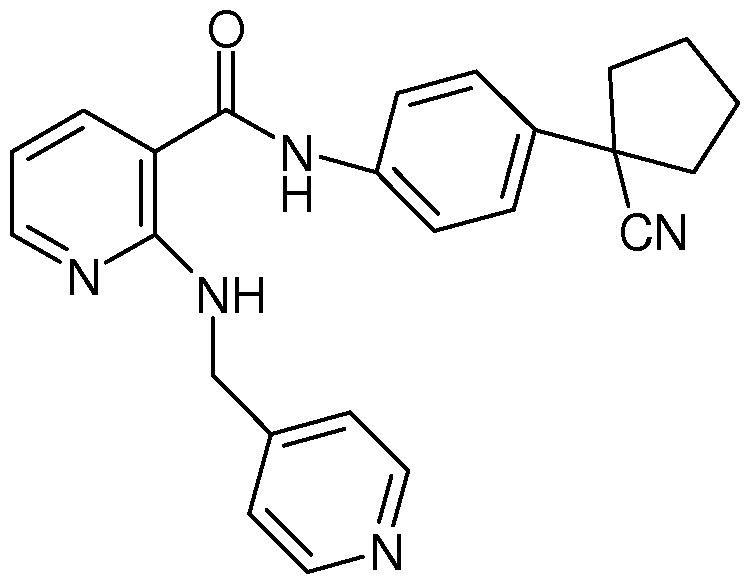
化合物 A
2、 根据权利要求 1所述的药物组合物, 其特征在于所述化合物 A 或其药学上可接受的盐的人日用量为 100-1000 mg。
3、 根据权利要求 1所述的药物组合物, 其特征在于所述厄洛替尼 或其药学上可接受的盐的人日用量为 37.5-450 mg, 所述吉非替尼或其 药学上可接受的盐的人日用量为 62.5-750 mg。
4、 根据权利要求 1-3任一项所述的药物组合物, 其特征在于所述 药物组合物的剂型为片剂、 硬胶囊剂、 软胶囊剂、 口服溶液剂、 缓释 剂、 滴丸剂、 冲剂、 颗粒剂或缓释微丸。
5、 根据权利要求 1-4任一项所述的药物组合物, 其特征在于所述 药物组合物是以一日一次、 一日两次或一日三次给药的药用组合物。
6、 根据权利要求 1-5任一项所述的药物组合物, 其特征在于所述 药学上可接受的盐选自磷酸盐、 盐酸盐、 硫酸盐、 硝酸盐、 氢溴酸盐、 甲磺酸盐、 马来酸盐、 酒石酸盐、 苯甲酸盐、 乳酸盐或苹果酸盐。
7、 如权利要求 1-4任一项所述的药物组合物的制备方法, 其中所 述方法为湿法粒化法和干法粒化法。
8、 根据权利要求 1-6任一项所述的药物组合物在制备治疗人肿瘤 疾病的药物中的用途。
9、根据权利要求 8所述的用途,其中所述的肿瘤为肺癌、膀胱癌、 胰腺癌、 前列腺癌、 肝癌、 乳腺癌、 肾癌、 胃癌、 食道癌、 甲状腺癌、 卵巢癌、 胆囊癌、 皮肤癌、 表皮样癌或结肠癌。
Applications Claiming Priority (2)
| Application Number | Priority Date | Filing Date | Title |
|---|---|---|---|
| CN200910209164A CN102048737B (zh) | 2009-10-28 | 2009-10-28 | 治疗肿瘤疾病的药物组合物 |
| CN200910209164.4 | 2009-10-28 |
Publications (1)
| Publication Number | Publication Date |
|---|---|
| WO2011050684A1 true WO2011050684A1 (zh) | 2011-05-05 |
Family
ID=43921318
Family Applications (1)
| Application Number | Title | Priority Date | Filing Date |
|---|---|---|---|
| PCT/CN2010/077906 Ceased WO2011050684A1 (zh) | 2009-10-28 | 2010-10-20 | 治疗肿瘤疾病的药物组合物 |
Country Status (2)
| Country | Link |
|---|---|
| CN (1) | CN102048737B (zh) |
| WO (1) | WO2011050684A1 (zh) |
Families Citing this family (9)
| Publication number | Priority date | Publication date | Assignee | Title |
|---|---|---|---|---|
| CN103172576B (zh) * | 2011-12-21 | 2015-08-05 | 沈阳药科大学 | 吉非替尼的苹果酸加成盐及其制备和应用 |
| CN103110597B (zh) * | 2013-02-02 | 2018-04-13 | 浙江华海药业股份有限公司 | 盐酸厄洛替尼片及其制备方法 |
| CN104086484B (zh) * | 2014-07-08 | 2016-05-25 | 上海宣创生物科技有限公司 | 烟酰胺类衍生物的甲磺酸盐溶剂化物晶体及其制备方法和应用 |
| CN104288114B (zh) * | 2014-10-27 | 2018-02-16 | 成都新恒创药业有限公司 | 一种不含表面活性剂的盐酸厄洛替尼药物组合物 |
| CN105622498A (zh) * | 2014-10-28 | 2016-06-01 | 华东理工常熟研究院有限公司 | 硫酸阿帕替尼的新晶型 |
| CN105541708A (zh) * | 2014-10-28 | 2016-05-04 | 华东理工常熟研究院有限公司 | 硫酸阿帕替尼的新晶型 |
| CN105622499A (zh) * | 2014-10-28 | 2016-06-01 | 华东理工常熟研究院有限公司 | 硫酸阿帕替尼的新晶型 |
| CN109381436A (zh) * | 2017-08-14 | 2019-02-26 | 江苏恒瑞医药股份有限公司 | 阿帕替尼药物组合物及其制备方法 |
| CN113301895B (zh) * | 2019-03-04 | 2023-04-04 | 江苏恒瑞医药股份有限公司 | 多靶点酪氨酸激酶抑制剂与egfr抑制剂联合在制备治疗肿瘤的药物中的用途 |
Citations (2)
| Publication number | Priority date | Publication date | Assignee | Title |
|---|---|---|---|---|
| CN1502608A (zh) * | 2002-11-27 | 2004-06-09 | 南京凯衡科贸有限公司 | 具有抑制血管生成活性的六员氨基酰胺类衍生物 |
| CN1826139A (zh) * | 2002-03-04 | 2006-08-30 | 伊姆克罗尼系统公司 | 用血管内皮生长因子受体拮抗剂抑制肿瘤生长的联合疗法 |
Family Cites Families (1)
| Publication number | Priority date | Publication date | Assignee | Title |
|---|---|---|---|---|
| CN1861047A (zh) * | 2006-03-06 | 2006-11-15 | 济南帅华医药科技有限公司 | 同载血管抑制剂及其增效剂的抗癌药物缓释注射剂 |
-
2009
- 2009-10-28 CN CN200910209164A patent/CN102048737B/zh not_active Expired - Fee Related
-
2010
- 2010-10-20 WO PCT/CN2010/077906 patent/WO2011050684A1/zh not_active Ceased
Patent Citations (2)
| Publication number | Priority date | Publication date | Assignee | Title |
|---|---|---|---|---|
| CN1826139A (zh) * | 2002-03-04 | 2006-08-30 | 伊姆克罗尼系统公司 | 用血管内皮生长因子受体拮抗剂抑制肿瘤生长的联合疗法 |
| CN1502608A (zh) * | 2002-11-27 | 2004-06-09 | 南京凯衡科贸有限公司 | 具有抑制血管生成活性的六员氨基酰胺类衍生物 |
Also Published As
| Publication number | Publication date |
|---|---|
| CN102048737B (zh) | 2012-10-03 |
| CN102048737A (zh) | 2011-05-11 |
Similar Documents
| Publication | Publication Date | Title |
|---|---|---|
| WO2011050684A1 (zh) | 治疗肿瘤疾病的药物组合物 | |
| JP5852105B2 (ja) | アミド誘導体またはその医薬的に許容される塩を含む医薬組成物 | |
| CN102579454B (zh) | 治疗肿瘤疾病的药物组合物 | |
| CN102786469B (zh) | 邻吡啶酰肼衍生物及其制法和药物组合物与用途 | |
| JP5858989B2 (ja) | 組合せ | |
| WO2013107225A1 (zh) | N-((4-氯-3-三氟甲基)苯基)-n'-(2-氟-4-((2-羟甲基氨基甲酰基)-4-吡啶基氧)苯基)脲及其作为抗癌药物的应用 | |
| TWI515186B (zh) | 治療腫瘤疾病的醫藥組成物 | |
| JP7370126B2 (ja) | エルロチニブを有効成分とする医薬錠剤 | |
| JP7370125B2 (ja) | エルロチニブを有効成分とする医薬錠剤 | |
| HK1157189A1 (zh) | 治疗肿瘤疾病的药物组合物 | |
| HK1157189B (zh) | 治疗肿瘤疾病的药物组合物 | |
| CN103784453B (zh) | 治疗肿瘤疾病的药物组合物及其制备方法 | |
| CN107530331B (zh) | 一种含有吡咯并六元杂环化合物或其可药用盐的药物组合物 | |
| CN103570616B (zh) | N′‑直链烷酰基邻吡啶酰肼衍生物及其制法和药物组合物与用途 | |
| KR102812658B1 (ko) | 암세포의 성장을 억제하는 아마이드 유도체를 포함하는 약제학적 제제 및 이를 포함하는 약제학적 제품 | |
| CN103784459B (zh) | 治疗肿瘤疾病的药物组合物及其制备方法和用途 | |
| CN104109120B (zh) | N′-芳丙烯酰基邻吡啶酰肼衍生物及其制法和药物组合物与用途 | |
| CN104109118A (zh) | 邻吡啶酰肼衍生物及其制法和药物组合物与用途 | |
| JP7370124B2 (ja) | エルロチニブを有効成分とする医薬錠剤 | |
| JP6945377B2 (ja) | エルロチニブを有効成分とする医薬錠剤及びその製造方法 | |
| JP2019059685A (ja) | エルロチニブを有効成分とする医薬錠剤 | |
| JP2022553744A (ja) | がん細胞の成長を阻害するアミド誘導体を含む医薬調製物およびそれを含有する医薬品 |
Legal Events
| Date | Code | Title | Description |
|---|---|---|---|
| 121 | Ep: the epo has been informed by wipo that ep was designated in this application |
Ref document number: 10826047 Country of ref document: EP Kind code of ref document: A1 |
|
| NENP | Non-entry into the national phase |
Ref country code: DE |
|
| 122 | Ep: pct application non-entry in european phase |
Ref document number: 10826047 Country of ref document: EP Kind code of ref document: A1 |