WO2010143323A1 - 新規なd-乳酸生産菌及びd-乳酸を生産する方法 - Google Patents
新規なd-乳酸生産菌及びd-乳酸を生産する方法 Download PDFInfo
- Publication number
- WO2010143323A1 WO2010143323A1 PCT/JP2009/070410 JP2009070410W WO2010143323A1 WO 2010143323 A1 WO2010143323 A1 WO 2010143323A1 JP 2009070410 W JP2009070410 W JP 2009070410W WO 2010143323 A1 WO2010143323 A1 WO 2010143323A1
- Authority
- WO
- WIPO (PCT)
- Prior art keywords
- lactic acid
- strain
- glucose
- lactobacillus
- nucleotide sequence
- Prior art date
- Legal status (The legal status is an assumption and is not a legal conclusion. Google has not performed a legal analysis and makes no representation as to the accuracy of the status listed.)
- Ceased
Links
Images






Classifications
-
- C—CHEMISTRY; METALLURGY
- C12—BIOCHEMISTRY; BEER; SPIRITS; WINE; VINEGAR; MICROBIOLOGY; ENZYMOLOGY; MUTATION OR GENETIC ENGINEERING
- C12P—FERMENTATION OR ENZYME-USING PROCESSES TO SYNTHESISE A DESIRED CHEMICAL COMPOUND OR COMPOSITION OR TO SEPARATE OPTICAL ISOMERS FROM A RACEMIC MIXTURE
- C12P7/00—Preparation of oxygen-containing organic compounds
- C12P7/40—Preparation of oxygen-containing organic compounds containing a carboxyl group including Peroxycarboxylic acids
- C12P7/56—Lactic acid
-
- C—CHEMISTRY; METALLURGY
- C12—BIOCHEMISTRY; BEER; SPIRITS; WINE; VINEGAR; MICROBIOLOGY; ENZYMOLOGY; MUTATION OR GENETIC ENGINEERING
- C12N—MICROORGANISMS OR ENZYMES; COMPOSITIONS THEREOF; PROPAGATING, PRESERVING, OR MAINTAINING MICROORGANISMS; MUTATION OR GENETIC ENGINEERING; CULTURE MEDIA
- C12N1/00—Microorganisms; Compositions thereof; Processes of propagating, maintaining or preserving microorganisms or compositions thereof; Processes of preparing or isolating a composition containing a microorganism; Culture media therefor
- C12N1/20—Bacteria; Culture media therefor
- C12N1/205—Bacterial isolates
-
- C—CHEMISTRY; METALLURGY
- C12—BIOCHEMISTRY; BEER; SPIRITS; WINE; VINEGAR; MICROBIOLOGY; ENZYMOLOGY; MUTATION OR GENETIC ENGINEERING
- C12R—INDEXING SCHEME ASSOCIATED WITH SUBCLASSES C12C - C12Q, RELATING TO MICROORGANISMS
- C12R2001/00—Microorganisms ; Processes using microorganisms
- C12R2001/01—Bacteria or Actinomycetales ; using bacteria or Actinomycetales
- C12R2001/225—Lactobacillus
Definitions
- the present invention relates to a novel D-lactic acid-producing bacterium, and in particular, to a Lactobacillus delbrueckii QU41 strain. Furthermore, the present invention relates to a method for producing D-lactic acid using the D-lactic acid-producing bacterium.
- poly L-lactic acid a biodegradable plastic made from plant biomass
- Poly-L-lactic acid has the same advantage as plastics, which have a tensile strength and the like, and has the advantages of being transparent while being crystalline, and thus can be used as an alternative to polypropylene and polystyrene.
- poly-L-lactic acid its properties such as strength and heat resistance depend greatly on the optical purity of the L-lactic acid monomer, which is a raw material. It becomes.
- poly L-lactic acid has the advantages of high strength and biodegradability, but its low heat resistance of 170 ° C. hinders its widespread use.
- a stereocomplex polylactic acid that can blend poly L-lactic acid and poly D-lactic acid and improve heat resistance up to 220 ° C. has attracted attention.
- Lactic acid bacteria are gram-positive cocci or bacilli and are defined as bacteria that are catalase negative, assimilate saccharides, produce lactic acid in a yield of 50% or more, and do not form spores.
- JP-A-62-44188 reports that D-lactic acid is produced using Sport Lactobacillus inulinus ATCC 15538 strain.
- the Sport Lactobacillus inulinus ATCC 15538 strain was cultured at 37 ° C. for 40 hours in the presence of 100 g / L glucose, resulting in an optical purity of about 99.5%. Yields 101 g / L of D-lactic acid.
- JP-A-2-76592 reports that L-lactic acid is produced using Lactobacillus lactis ATCC 12314 strain. Lactobacillus lactis ATCC 12314 strain produces 123.3 g / L D-lactic acid by culturing at 40 ° C. for 45 hours in a medium neutralized with calcium carbonate using a amylase degradation product of wheat starch as a carbon source. To do.
- JP 2007-215427 A it is reported that D-lactic acid is produced using Lactobacillus delbricki IFO 3202 strain. Lactobacillus delbricki IFO 3202 strain in a medium at pH 7 produces 106.9 g / L D-lactic acid by culturing at 37 ° C. for 96 hours in the presence of 100 g / L glucose.
- Ammonia is added to control pH after 24 hours from the start of culture. Therefore, in the method of Japanese Patent Application Laid-Open No. 2007-215427, two-stage culture is performed, which includes a first stage in which pH adjustment is not performed and a second stage in which pH adjustment is performed.
- An object of the present invention is to provide a novel D-lactic acid-producing bacterium and a method for efficiently producing high optical purity D-lactic acid using the D-lactic acid-producing bacterium in order to obtain D-lactic acid. To do.
- the present inventors have isolated and obtained a novel D-lactic acid-producing bacterium, in particular, Lactobacillus delbricki QUI41 strain, and completed the present invention. Highly pure D-lactic acid can be efficiently produced using the D-lactic acid-producing bacterium of the present invention.
- the present invention provides the following: 1) (1) D-lactic acid can be produced with an optical purity of 99% or more using glucose as a substrate, And (2) when the glucose concentration starts at 20 g / L and pH 6.0 and is cultured at a temperature of 43 ° C. for 12 hours, it is 12.0 g / L or more, preferably 16.0 g / L or more, more preferably Can produce 20.0 g / L or more of D-lactic acid, Lactic acid bacteria belonging to Lactobacillus del Bricky. 2) Furthermore, (3) The lactic acid bacterium according to 1), which can produce D-lactic acid at a temperature of 49 ° C. 3) Lactic acid bacteria according to 1) or 2) having the following mycological properties: 1.
- D-lactic acid is produced by homolactic fermentation using glucose as a substrate, and Glucose, fructose, mannose, N-acetylglucosamine, maltose, lactose, sucrose and trehalose can be assimilated, and xylose and arabinose cannot be assimilated.
- the lactic acid bacterium according to any one of 1) to 4 which is a Lactobacillus delbricki QUA41 strain deposited under the NITE BP-679 accession number.
- a method for producing lactic acid comprising the step of culturing the lactic acid bacterium according to any one of 1) to 5).
- the production method according to 6 wherein the lactic acid contains D-lactic acid with an optical purity of 99% or more.
- Lactobacillus delbricky QU41 strain, QU42 strain, and QU43 strain which are novel D-lactic acid producing bacteria, are provided.
- the microbial strain of the present invention enables efficient production of D-lactic acid.
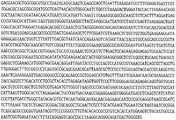
- FIG. 1 is a view showing the nucleotide sequence of 16S rRNA gene of QUI41 strain.
- FIG. 2 is a view showing the nucleotide sequence of the 16S rRNA gene of the QU42 strain.
- FIG. 3 is a diagram showing the nucleotide sequence of the 16S rRNA gene of QUI41 strain.
- FIG. 4 is a graph showing the results of test tube culture of Lactobacillus delbricky QU41 strain, QU42 strain, and QU43 strain.
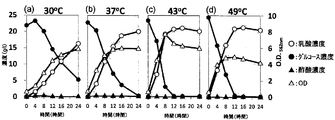
- FIG. 5 is a graph showing the influence of the culture temperature on the D-lactic acid producing ability of the QUI41 strain.
- FIG. 6 is a graph showing the effect of culture pH on the D-lactic acid producing ability of the QUI41 strain.
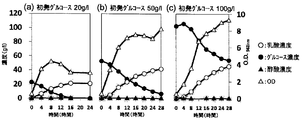
- FIG. 7 is a graph showing the effect of the initial glucose concentration on the D-lactic acid producing ability of the QUI41 strain.
- FIG. 8 is a graph comparing the D-lactic acid producing ability in the QUI41 strain, the JCM1166 strain, and the JCM1246 strain.
- FIG. 9 is a graph comparing the influence of the neutralizing agent of the medium between when NaOH is used and when NH 4 OH is used.
- the lactic acid bacteria of the present invention have an initial glucose concentration of 20 g / L, pH 6.0, and glucose as a substrate at an optimal temperature (specifically, 43 ° C.) for 8 to 12 hours. When cultured, 12.0 g / L or more of D-lactic acid can be produced with an optical purity of 99% or more. Lactic acid bacteria having the above-mentioned properties and genetically belonging to Lactobacillus delbrick are within the scope of the present invention.
- the lactic acid bacterium of the present invention can produce D-lactic acid of preferably 16.0 g / L or more, more preferably 20.0 g / L or more under the above conditions.
- Such lactic acid bacteria are suitable for the purpose of efficiently producing high optical purity D-lactic acid.
- the lactic acid bacterium of the present invention can produce D-lactic acid with an optical purity of 99% or higher, preferably 99.5% or higher, more preferably 99.9% or higher.
- Lactic acid bacteria of the present invention are 10 g of peptone, 8 g of beef extract, 4 g of yeast extract, 20 g of glucose, 1 g of Tween 80, 2 g of K 2 HPO 4 and 5 g of sodium acetate trihydrate in 1 L of distilled water.
- citric acid diammonium hydrogen 2g, the MgSO 4 ⁇ H 2 O 0.2g, MnSO 4 ⁇ nH to 2 O in MRS- glucose medium containing 0.05 g stand at a temperature ranging from at least 30 ° C. of 49 ° C. By culturing, it can be cultured well.
- the medium used for culturing the lactic acid bacterium of the present invention is not limited to the MRS-glucose medium, and the MRS-glucose medium can be modified as appropriate, and the bacterium can grow well and produce D-lactic acid.
- a medium having any composition may be used as long as it is produced.
- Lactobacillus delbrikkii QU41 strain isolated from the drainage channel on the campus of Kyushu University.
- Lactobacillus delbricky QUI41 strain is a novel strain, and it was established as NITE BP-679 in January 2009 at the National Institute of Technology and Evaluation of Microorganisms (2-5-8, Kazusa Kamashichi, Kisarazu City, Chiba Prefecture). Deposited on the 19th.
- Lactobacillus delbricki QP41 The mycological properties of Lactobacillus delbricki QP41 are as follows. 1. Form: Neisseria gonorrhoeae. 2. Biochemical properties: Catalase negative. 3. Motility: None Oxygen demand: It is facultative anaerobic. 5). D-lactic acid is produced by homolactic fermentation using glucose as a substrate. 6). Glucose, fructose, mannose, N-acetylglucosamine, maltose, lactose, sucrose and trehalose can be assimilated, and xylose and arabinose cannot be assimilated.
- the lactic acid bacteria of the present invention also include lactic acid bacteria belonging to Lactobacillus delbricky and having the same bacteriological properties as the QU41 strain.
- suitable strains of the present invention there can be mentioned Lactobacillus delbriquie QU42 strain and Lactobacillus delbrixi QU43 strain.
- Lactobacillus delbricki QU42 strain and QU43 strain are also novel strains and can produce D-lactic acid with high efficiency.
- the strain of the present invention is not limited to Lactobacillus delbrickey QU41 strain, QU42 strain, and QU43 strain, and is capable of producing D-lactic acid with an optical purity of 99% or more using glucose as a substrate, and the glucose concentration. Is within the scope of the present invention as long as it can produce 1-2.0 g / L or more of D-lactic acid when cultured at 43 ° C. for 12 hours under the conditions of 20 g / L and pH 6.0. .
- the nucleotide sequences of the 16S rRNA genes of Lactobacillus delbrikkii QU41 strain, QU42 strain and QU43 strain are shown in SEQ ID NO: 1, SEQ ID NO: 2 and SEQ ID NO: 3, respectively.
- Lactobacillus delbrikkii QU41 strain, QU42 strain, and QU43 strain showed high identity.
- the present invention provides a Lactobacillus delbrickey having a 16S rRNA gene comprising a sequence having 99.5% or more identity with the sequence shown in SEQ ID NO: 1 in the table consisting of any of the following sequences: (A) a nucleotide sequence represented by SEQ ID NO: 1 in the sequence listing, or a nucleotide sequence having 99.7% or more identity thereto; (B) a nucleotide sequence represented by SEQ ID NO: 2 in the sequence listing, or a nucleotide sequence having 99.75% or more identity thereto; or (c) a nucleotide sequence represented by SEQ ID NO: 3 in the sequence listing; or A nucleotide sequence having an identity of 99.8% or more.
- the identity of a nucleic acid sequence can be determined using, for example, a widely used program such as BLAST, but is not limited thereto, and the identity of a nucleic acid sequence is determined using another program. You can also
- Lactobacillus delbrikkii strains QU41, QU42 and QU43 are very similar in their genetic and biochemical properties, so these three strains are different strains. However, many properties including the ability to produce D-lactic acid are expected to be similar or identical.
- the lactic acid bacteria of the present invention can grow and produce D-lactic acid at a temperature in the range of at least 30 ° C. to 49 ° C.
- a preferable temperature for growth of the strain and production of D-lactic acid is 37 ° C to 43 ° C, and a particularly preferable temperature is 43 ° C.
- the lactic acid bacterium of the present invention can produce D-lactic acid even at 49 ° C. 49 ° C. is a considerably high temperature for lactic acid bacteria. Lactic acid fermentation at 49 ° C. can reduce contamination by various bacteria, and can reduce the need for cooling by fermentation heat.
- lactic acid can be produced it means that D-lactic acid can be produced at an industrially effective level. It was started under the conditions of a glucose concentration of 20 g / L and pH 6.0, and cultured for 12 hours. Sometimes, if it can produce 1-2.0 g / L or more of D-lactic acid, it can be said that “production is possible”.
- the lactic acid bacterium of the present invention can produce about 100 g / L of D-lactic acid from 100 g / L of glucose even in high-temperature culture at 49 ° C.
- the Lactobacillus delbricky QUI41 strain of the present invention can grow and produce D-lactic acid in a pH range of at least 5.5 to 6.5.
- a particularly preferred pH for the growth of the strain and the production of D-lactic acid is 6.0.
- Lactobacillus delbricky QUI41 of the present invention increases as the initial glucose concentration in the medium increases, and the productivity of D-lactic acid increases.
- a decrease in the maximum cell growth rate accompanying an increase in the initial glucose concentration and a decrease in the lactic acid production rate in the long-term culture occur. For this reason, batch culture is not suitable when D-lactic acid is efficiently produced using the strain.
- a method for producing D-lactic acid and a method for producing lactic acid by culturing the Lactobacillus delbrikkii strain of the present invention are also within the scope of the present invention.
- a medium in which the Lactobacillus delbrickey strain of the present invention can grow and produce lactic acid such as MRS-glucose medium
- the strain is grown under conditions suitable for its growth and lactic acid production (temperature and pH). Lactic acid can be produced by culturing in the above.
- D-lactic acid can be produced with high optical purity.
- D-lactic acid can be produced with an optical purity of 99% or more, preferably 99.5% or more, and more preferably 99.9% or more. it can.
- the concentration of lactic acid obtained by the present invention can be measured by a technique generally known in this technical field.
- the culture solution of the Lactobacillus delbricki strain of the present invention is centrifuged to obtain a supernatant, and the supernatant is filtered through a filter and then subjected to column chromatography (for example, a shodex Sugar S series etc.
- the amount of lactic acid can be measured with an exchange column, and the concentration of produced lactic acid can be measured by detecting lactic acid with a suggestive refractometer.
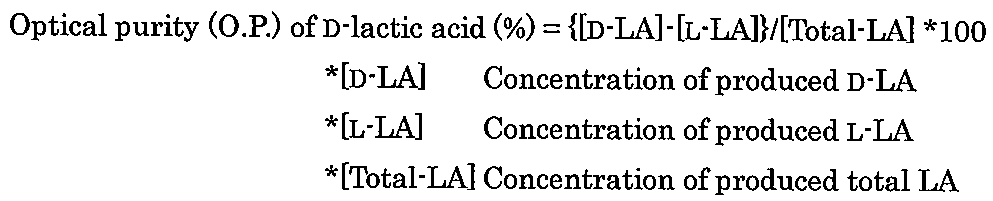
- the concentration of L-lactic acid can be measured by a biosensor (for example, enzyme electrode type biosensor BF-5), and the optical value of D-lactic acid is determined from the measured L-lactic acid concentration and total lactic acid concentration value. Purity can be calculated.
- the optical purity of D-lactic acid means a value calculated by the following formula, unless otherwise specified.
- the method for producing lactic acid of the present invention is preferably performed by subjecting the Lactobacillus delbrikkii strain of the present invention to pH 5.5 to pH 6.5 at a temperature of 37 ° C. to 43 ° C. for 12 hours in a medium containing glucose. For 72 hours to prepare a culture solution, and a step of centrifuging the culture solution and collecting a supernatant.
- a suitable medium for culturing the Lactobacillus delbrikkii strain of the present invention is not limited thereto, but is preferably the MRS-glucose medium described above. However, the medium used in the method of the present invention is not limited thereto, and can be appropriately modified.
- the conditions such as the pH of the medium, the culture temperature, and the culture time can also be appropriately modified as long as the Lactobacillus delbriqui strain of the present invention can grow and produce D-lactic acid.
- the most preferred strain used in the method of the present invention is Lactobacillus delbrikkii QU41 strain.
- the method of the present invention can also be carried out using Lactobacillus delbricky QU42 strain and QU43 strain.
- D-lactic acid produced by using the method of the present invention can be used as a raw material for producing a stereocomplex of poly-L-lactic acid and poly-D-lactic acid, for example.
- the stereocomplex of poly L-lactic acid and poly D-lactic acid can be a biodegradable plastic having high heat resistance.
- the use of D-lactic acid is not limited to a stereocomplex with poly L-lactic acid.
- D-lactic acid is known to be used as an agricultural intermediate.
- Example 1 Isolation and Identification of New D-Lactic Acid-Producing Bacteria
- MRS-glucose medium and MRS-glucose agar medium from 137 sources such as plants, animals, soil, and insects
- D-lactic acid-producing bacteria were isolated.
- enrichment culture was performed before plating.
- prokaryote preferentially sodium azide and cycloheximide that inhibit the growth of eukaryotes were added to the accumulation medium.
- This enrichment culture medium was prepared by adding MRS-glucose medium having the composition described above, 100 ppm sodium azide, 100 ppm cycloheximide, dissolving in distilled water, adjusting the pH to 5.5 and 6.5, and causing brown reaction. In order to prevent this, autoclaving was performed at 115 ° C. for 15 minutes.
- the MRS-glucose agar medium is 1.5% agar and 0.5% CaCO 2 added to the enrichment culture medium, dissolved in distilled water, adjusted to pH 6.5, and autoclaved at 115 ° C for 15 minutes. After performing, it poured into a sterilization petri dish and produced.
- the culture conditions for isolation are temperatures of 30 ° C., 37 ° C., and 43 ° C., and initial pH values of 5.5 and 6.5. Under these conditions, the bacteria were anaerobically cultured and isolated, and again cultured in the MRS medium. Then, the supernatant was analyzed, and the bacteria producing high optical purity D-lactic acid were isolated by homofermentation.
- the nucleotide sequence of the 16S rRNA gene of the QUI41 strain is shown in SEQ ID NO: 1 in the sequence listing and FIG.
- the nucleotide sequence of the 16S rRNA gene of the QU42 strain is shown in SEQ ID NO: 2 in the sequence listing and FIG.
- the nucleotide sequence of the 16S rRNA gene of the QU43 strain is shown in SEQ ID NO: 3 in the sequence listing and FIG.
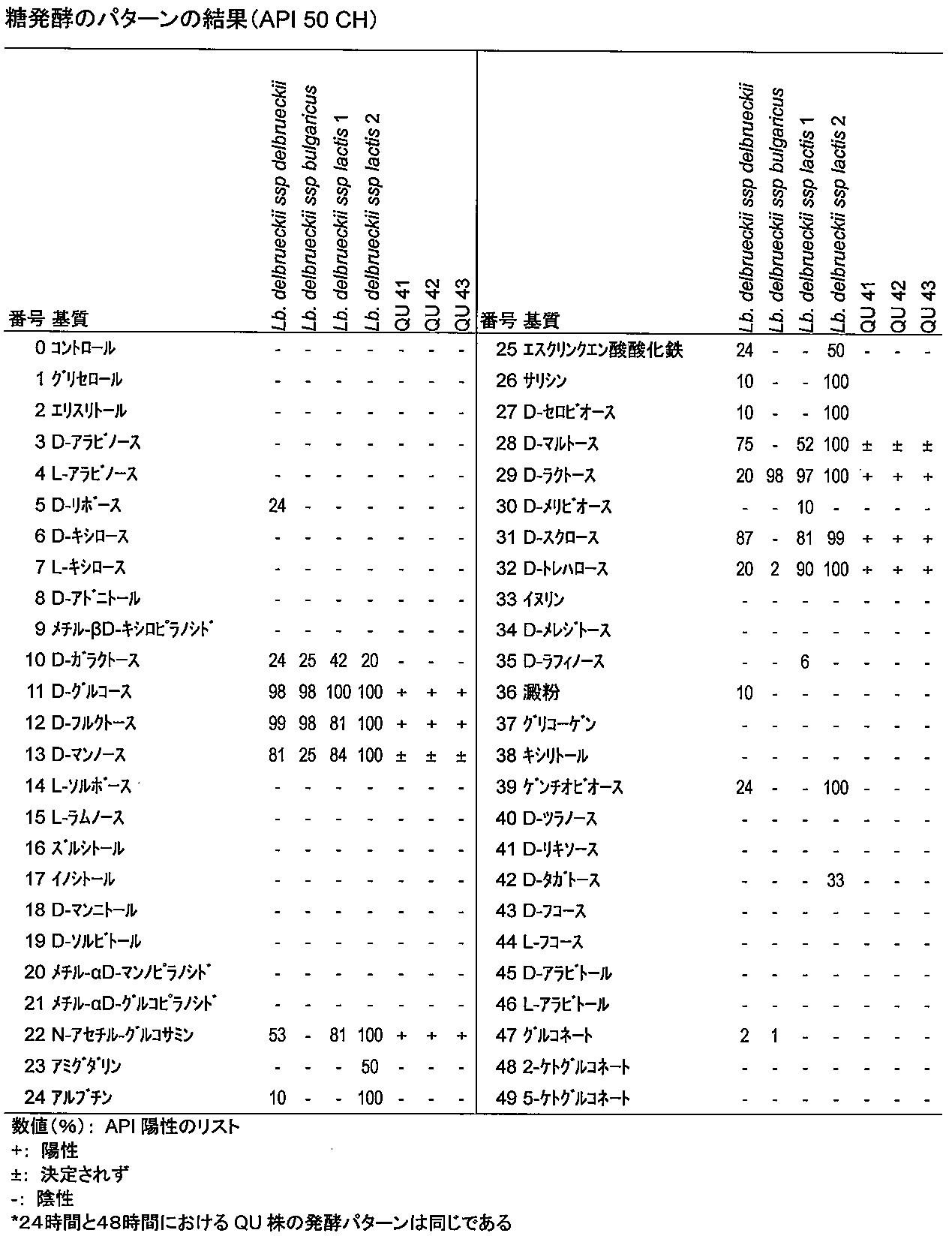
- Table 1 shows the results of the saccharide utilization test using the API50CH kit. For comparison, Lactobacillus delbrueckii subsp. Described in the API50CH kit. delbrueckii, Lactobacillus delbrueckii subsp. bulgaricus, Lactobacillus delbrueckii subsp. The saccharide utilization pattern of lactis is also shown in Table 1.
- each number indicates the proportion of strains having the ability to assimilate among strains held by BioMerieux. Even for the same species, Lactobacillus delbrueckii subsp. Some have grouped saccharide utilization properties, such as lactis 1 and 2.
- the QU41 strain, the QU42 strain, and the QU43 strain showed the same sugar fermentability pattern. That is, these strains assimilated glucose, fructose, mannose, N-acetylglucosamine, maltose, lactose, sucrose, and trehalose, but not pentoses such as xylose and arabinose. Lactobacillus delbrueckii ssp lactis was most consistent with the sugar fermentability pattern.
- FIG. 4 (a) shows the results of the study with the QUI41 strain
- FIG. 4 (b) shows the results of the study with the QUI41 strain
- FIG. 4 (c) shows the results of the study with the QUI41 strain.
- the left vertical axis indicates the concentrations of glucose, lactic acid, and acetic acid
- the right axis indicates OD
- the horizontal axis indicates time.
- the black circle is the glucose concentration
- the white circle is the lactic acid concentration
- the white triangle is the OD.
- the three strains of the QU41 strain, the QU42 strain, and the QU43 strain showed similar fermentation behaviors when cultured in the MRS medium.
- the QUI41 strain showed the highest value of D-lactic acid production at 16.8 g / L at 72 hours.
- Lactobacillus delbricky QUI41 strain, QUI42 strain, and QUI43 strain showed very similar fermentation characteristics in terms of yield, production rate, etc.
- the optimum conditions for D-lactic acid production described below were examined.
- Example 2 Examination of Optimal Conditions (1) Examination of Optimal Temperature With regard to QUI41 strain, the ability to produce D-lactic acid at 30 ° C., 37 ° C., 43 ° C., and 49 ° C. was examined using 20 g / L glucose MRS medium. . The pH was adjusted to 5.5 with 10 N NaOH and the experiment was conducted in an anaerobic state by nitrogen gas replacement. The culture was performed for 6 hours on a 40 ml scale and 12 hours on a 400 ml scale for main culture.
- FIG. 5 (a) shows the result of the examination at 30 ° C.
- FIG. 5 (b) shows the result of the examination at 37 ° C.
- FIG. 5 (c) shows the result of the examination at 43 ° C.
- FIG. 5 (d) shows the result of examination at 49 ° C.
- the left vertical axis indicates glucose, lactic acid, and acetic acid concentrations
- the right vertical axis indicates OD
- the horizontal axis indicates time.
- the black circle is the glucose concentration
- the white circle is the lactic acid concentration
- the black triangle is the acetic acid concentration
- the white triangle is the OD.
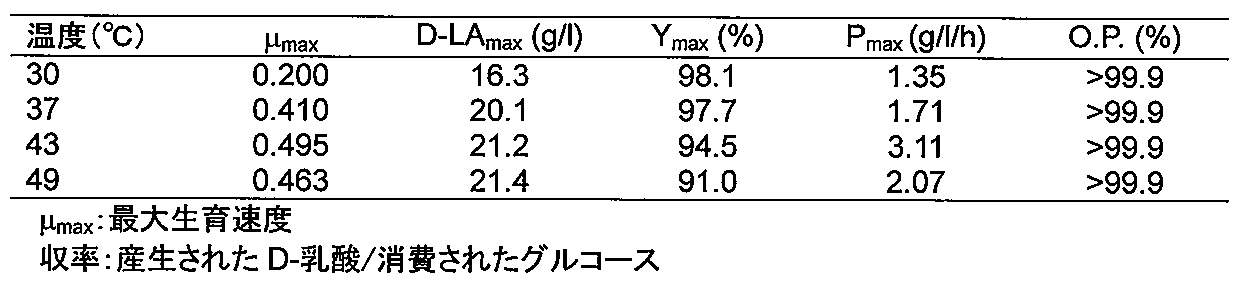
- Table 3 The values of the culture parameters obtained from this result are shown in Table 3 below.
- Table 3 from the left, values of maximum cell growth rate, D-lactic acid production, maximum yield, maximum production, and D-lactic acid optical purity are shown.
- the highest maximum growth rate and the maximum production rate were exhibited at 43 ° C., and the optimum temperature for growth and D-lactic acid production of the QUI41 strain was 43 ° C.
- the QUI41 strain was able to grow and produce D-lactic acid even at 55 ° C.
- FIG. 6 (a) shows the results of investigation at pH 5.0
- FIG. 6 (b) shows the results of examination at pH 5.5
- FIG. 6 (c) shows the results at pH 6.0
- FIG. 6 (d) shows the results of investigation at pH 6.5.
- the left vertical axis indicates glucose, lactic acid, and acetic acid concentrations
- the right vertical axis indicates OD
- the horizontal axis indicates time.
- the black circle is the glucose concentration
- the white circle is the lactic acid concentration
- the black triangle is the acetic acid concentration
- the white triangle is the OD.
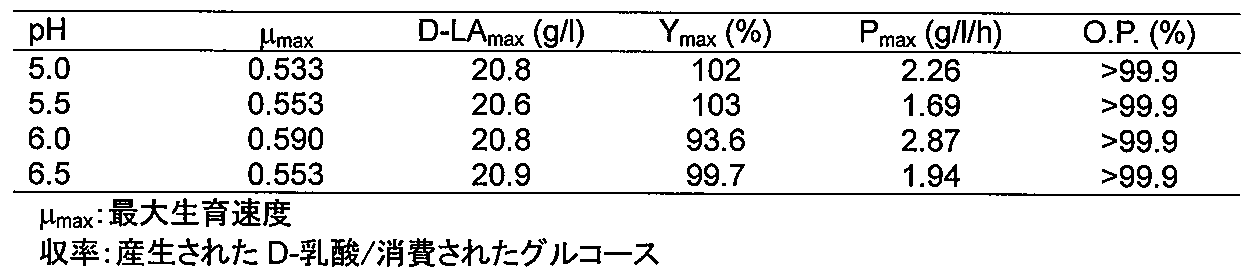
- Table 4 The values of the culture parameters obtained from this result are shown in Table 4 below.
- Table 4 From the left, the maximum cell growth rate, D-lactic acid production amount, maximum yield, maximum production amount, and D-lactic acid optical purity values are shown. Since the cultivation was completed in 12 hours at pH 6.0 and the maximum cell growth rate and lactic acid production were shown, the optimum pH was 6.0.
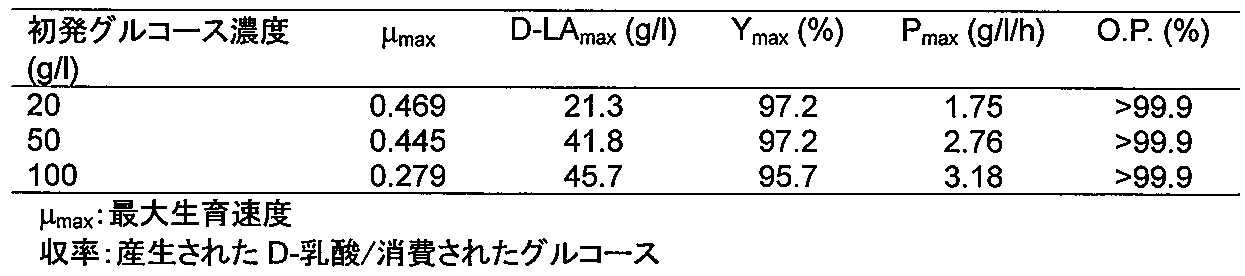
- Example 3 Examination of Influence of Initial Glucose Concentration Under the conditions of a temperature of 43 ° C. and pH 6.0, the influence of the glucose concentration on the D-lactic acid production ability of QUI41 strain was examined. The experiment was performed under the same conditions as those for the optimum temperature and optimum pH except that the pH was changed.
- FIG. 7 shows the results of investigations with the concentration of glucose added at the start of culture, that is, the initial glucose concentration set to 20, 50, and 100 g / L.
- FIG. 7A shows data with an initial glucose concentration of 20 g / L
- FIG. 7B shows data with an initial glucose concentration of 50 g / L (b)
- FIG. 7C shows the initial glucose concentration.
- the data is 100 g / L.
- the left vertical axis indicates glucose, lactic acid, and acetic acid concentrations
- the right vertical axis indicates OD
- the horizontal axis indicates time.
- the black circle is the glucose concentration
- the white circle is the lactic acid concentration
- the black triangle is the acetic acid concentration
- the white triangle is the OD.
- the values of the culture parameters obtained from this result are shown in Table 5 below.
- Table 5 the maximum cell growth rate, D-lactic acid production amount, maximum yield, maximum production amount, and D-lactic acid optical purity values are shown from the left.
- the maximum cell growth rate decreased and the lactic acid production rate also decreased with the lapse of culture time. From these results, it was found that QUI41 is inhibited by high concentrations of glucose and lactic acid, so that D-lactic acid cannot be efficiently produced by batch culture affected by changes in the medium environment accompanying bacterial growth.
- Example 4 Comparison of Lactobacillus delbrikkii QUA41 strain and existing D-lactic acid producing bacteria Comparison of D-lactic acid production between Lactobacillus delbrikkii QUI41 strain and existing D-lactic acid producing bacteria JCM1166 and JCM1248 It was. The results are shown in FIG. 8A shows data measured at 37 ° C., FIG. 8B shows data measured at 43 ° C., and FIG. 8C shows data measured at 50 ° C. In FIG. 8, the left vertical axis indicates the concentration of lactic acid, the right vertical axis indicates OD, and the horizontal axis indicates time.
- Lactobacillus del Bricky QU41 strain was also measured at 55 ° C. as shown in FIG.
- the right column shows the amount of D-lactic acid produced 24 hours after culturing, and the left column shows the amount of D-lactic acid produced 48 hours after culturing.
- Table 6 shows the values of D-lactic acid production of the three strains obtained from the results.
- Example 5 Examination of Neutralizing Agent for Medium As a neutralizing agent for the medium used for culturing QUA41 strain, a comparison was made between the case of using NaOH and the case of using NH 4 OH. The results are shown in FIG. FIG. 9A shows data when NaOH is used as a neutralizing agent, and FIG. 9B shows data when NH 4 OH is used as a neutralizing agent.
- the left vertical axis indicates the concentration of lactic acid
- the right vertical axis indicates OD
- the horizontal axis indicates time.
- the black circle is the glucose concentration
- the white circle is the lactic acid concentration
- the black triangle is the acetic acid concentration
- the white triangle is the OD.
- Table 7 The values of the culture parameters obtained from this result are shown in Table 7 below.
- Table 7 the maximum cell growth rate, D-lactic acid production amount, maximum yield, maximum production amount, and D-lactic acid optical purity values are shown from the left.
- the results were similar when NH 4 OH was used and when NaOH was used.
- the amount of D-lactic acid produced and the maximum D-lactic acid production rate were higher when NH 4 OH was used than when NaOH was used at 8 hours after culturing.
Landscapes
- Chemical & Material Sciences (AREA)
- Life Sciences & Earth Sciences (AREA)
- Engineering & Computer Science (AREA)
- Organic Chemistry (AREA)
- Health & Medical Sciences (AREA)
- Zoology (AREA)
- Wood Science & Technology (AREA)
- Genetics & Genomics (AREA)
- Biotechnology (AREA)
- Bioinformatics & Cheminformatics (AREA)
- General Engineering & Computer Science (AREA)
- Microbiology (AREA)
- Biochemistry (AREA)
- General Health & Medical Sciences (AREA)
- Biomedical Technology (AREA)
- Virology (AREA)
- Tropical Medicine & Parasitology (AREA)
- Medicinal Chemistry (AREA)
- Chemical Kinetics & Catalysis (AREA)
- General Chemical & Material Sciences (AREA)
- Preparation Of Compounds By Using Micro-Organisms (AREA)
- Micro-Organisms Or Cultivation Processes Thereof (AREA)
Abstract
本発明は、新規なD-乳酸生産菌、及び当該D-乳酸生産菌を用いてD-乳酸を生産する方法を提供することを目的とする。 本発明により、新規なD-乳酸生産菌であるラクトバシラス・デルブリッキーQU41株QU42株、及びQU43株が提供された。本発明の微生物株は高い光学純度のD-乳酸を効率良く生産することを可能とする。
Description
本発明は新規なD-乳酸生産菌に関し、特にラクトバシラス・デルブリッキー(Lactobacillus delbrueckii)QU41株に関する。さらに本発明は、当該D-乳酸生産菌を用いてD-乳酸を生産する方法に関する。
現在地球温暖化などの環境問題が深刻化することにより、植物バイオマスを原料とした生分解性プラスチックであるポリL-乳酸が注目されている。ポリL-乳酸は引っ張り強度などが汎用されているプラスチックと同程度であり、結晶性でありながら透明であるという長所を有するために、ポリプロピレンやポリスチレンなどの代替物としての利用が可能である。ポリL-乳酸を作製する際に、その強度、耐熱性などの性質は原料であるL-乳酸のモノマーの光学純度に大きく依存するために、一般的に光学純度99%以上の乳酸モノマーが必要となる。
一方、ポリL-乳酸は強度が高く、生分解性を有するという利点を有するが、耐熱性が170℃と低いことが普及の妨げとなっている。この問題の解決策として、ポリL-乳酸とポリD-乳酸とをブレンドし、220℃まで耐熱性を向上させることが可能なステレオコンプレックスポリ乳酸が注目されている。
ポリD-乳酸生産のためのD-乳酸モノマーは、乳酸菌を用いて生産する技術の研究が行われてきた。乳酸菌はグラム陽性の球菌又は桿菌であり、カタラーゼ陰性で、糖類を資化して50%以上の収率で乳酸を生産し、胞子を形成しない細菌であると定義されている。
これまでL-乳酸は需要が高かったことから、L-乳酸の発酵生産に関する研究は盛んに行われてきた。一方D-乳酸に関しては、これまで需要が低かったことから、その発酵生産に関する報告は少なかった。以下にD-乳酸の発酵生産に関する知見の例を示す。
特開昭62-44188号公報では、スポルトラクトバシルス・イヌリヌス ATCC 15538株を用いてD-乳酸を生産することが報告されている。炭酸カルシウムでpHを中和した培地中で、スポルトラクトバシルス・イヌリヌス ATCC 15538株は、100g/Lのグルコースの存在下、37℃で40時間培養することにより、約99.5%の光学純度で101g/LのD-乳酸を産生する。
特開平2-76592号公報では、Lactobacillus lactis ATCC 12314株を用いてD-乳酸を生産することが報告されている。Lactobacillus lactis ATCC 12314株は、コムギ澱粉のアミラーゼ分解物を炭素源とし炭酸カルシウムでpHを中和した培地中で、40℃で45時間培養することにより、123.3g/LのD-乳酸を産生する。
特開2007-215427号公報では、ラクトバシラス・デルブリッキー IFO 3202株を用いてD-乳酸を生産することが報告されている。pH7の培地中で、ラクトバシラス・デルブリッキー IFO 3202株は100g/Lのグルコースの存在下、37℃で96時間培養することにより、106.9g/LのD-乳酸を産生する。なお特開2007-215427号においては培養を開始して24時間以降は、アンモニアを添加してpHを制御している。よって特開2007-215427号の方法では、pHの調節を行なわない第1段階とpHの調節を行なう第2段階からなる、2段階の培養を行っている。
Leeは、ラクトバシラス・デルブリッキーの標準株(ATCC 12315)を用いてMRS培地中で培地する際にバッチ培養を繰り返し、その間に当該菌株を次第に酸性条件に適応させることにより、D-乳酸が生産性を向上することを報告している。ラクトバシラス・デルブリッキーの標準株を、100g/Lのグルコースの存在下42℃で48時間培養してD-乳酸の生産性の改善を検討したところ、最初のバッチでのD-乳酸の産生量は71.7g/Lであるが、8回目のバッチでのD-乳酸の産生量は90g/LのD-乳酸である。
Calabiaらは、ラクトバシラス・デルブリッキー JCM 1148株を用いてD-乳酸を生産することを報告している。ラクトバシラス・デルブリッキー JCM 1148株は40℃で72時間培養することにより、コウモロコシのジュース(当初の糖類133g/L)から118g/LのD-乳酸と2g/LのL-乳酸を産生する(D-乳酸の光学純度:98.3%)。
さらにXuらは、低エネルギーのイオンビーム・インプランテーションにより突然変異したスポロラクトバチルス・sp.DX12株が、D-乳酸を高産生することを報告している。この変異株は炭酸カルシウムで中和した培地中で7日間培養することにより、150g/Lのグルコースのから143.6g/LのL-乳酸を、99.08%の光学純度で産生する。
さらにOkinoらは、コリネバクテリウム・グルタミカムにラクトバシラス・デルブリッキー由来のD-ラクテート・デヒドロゲナーゼの遺伝子を導入する遺伝子改変を行い、変異体株を得たことを報告している。当該変異体株は、間歇的なグルコース添加の条件下、30時間の培養で120g/LのD-乳酸を、99.9%の光学純度で産生する。
しかしこれらにおいて報告されたD-乳酸の発酵生産の効率や光学純度は必ずしも高くなく、L-乳酸と比較するとD-乳酸の発酵生産量は少ない。よってより効率的に光学純度が高いD-乳酸を生産するために、D-乳酸を高生産する菌株、及び当該菌株を用いてD-乳酸を生産する技術が求められている。
Lee World J Microbiol.Biotechnol.(2007) 23:1317-1320
Calabia et al Biotechnol.Lett.(2007)29:1329-1332
Xu et al Appl.Biochem.Biotechnol.(2008)DOI 10.1007/s12010-008-8274-4
Okino et al Appl.Microbiol.Biotechnol.(2008)78:449-454
本発明はD-乳酸を得るために、新規なD-乳酸生産菌、及び当該D-乳酸生産菌を用いて高い光学純度のD-乳酸を効率的に生産する方法を提供することを目的とする。
本発明者らは、上記課題を解決するために鋭意研究に努めた結果、新規なD-乳酸生産菌、特にラクトバシラス・デルブリッキーQU41株を分離して得て、本発明を完成するに至った。本発明のD-乳酸生産菌を用いて高い光学純度のD-乳酸を効率良く生産することができる。
本発明は以下を提供する:
1)(1)グルコースを基質として99%以上の光学純度でD-乳酸を生産可能であり、
かつ
(2)グルコース濃度が20g/L、pH6.0の条件で開始し、43℃の温度で12時間培養したときに、12.0g/L以上、好ましくは16.0g/L以上、さらに好ましくは20.0g/L以上のD-乳酸を生産可能である、
ラクトバシラス・デルブリッキーに属する乳酸菌。
2)さらに、
(3)49℃の温度でD-乳酸を生産可能である、1)に記載の乳酸菌。
3)下記の菌学的性質を有する、1)又は2)記載の乳酸菌:
1.形態:桿菌、
2.生化学的性質:カタラーゼ陰性、
3.運動性:なし、
4.酸素要求性:通性嫌気性、
5.グルコースを基質としてホモ乳酸発酵によりD-乳酸を産生する、及び
6.グルコース、フルクトース、マンノース、N-アセチルグルコサミン、マルトース、ラクトース、スクロース、トレハロースを資化することができ、キシロース、アラビノースは資化することができない。
4)下記のいずれかの配列からなる16SrRNA遺伝子を有する、1)~3)記載の乳酸菌:
(a)配列表の配列番号:1で示されるヌクレオチド配列、又はそれと99.7%以上の同一性を有するヌクレオチド配列;
(b)配列表の配列番号:2で示されるヌクレオチド配列、又はそれと99.75%以上の同一性を有するヌクレオチド配列;又は
(c)配列表の配列番号:3で示されるヌクレオチド配列、又はそれと99.8%以上の同一性を有するヌクレオチド配列。
5)NITE BP-679の受託番号で寄託されたラクトバシラス・デルブリッキーQU41株である、1)~4)のいずれか1に記載の乳酸菌。
6)1)~5)のいずれか1に記載の乳酸菌を培養する工程を含む、乳酸を製造する方法。
7)乳酸が、D-乳酸を99%以上の光学純度で含む、6)に記載の製造方法。
1)(1)グルコースを基質として99%以上の光学純度でD-乳酸を生産可能であり、
かつ
(2)グルコース濃度が20g/L、pH6.0の条件で開始し、43℃の温度で12時間培養したときに、12.0g/L以上、好ましくは16.0g/L以上、さらに好ましくは20.0g/L以上のD-乳酸を生産可能である、
ラクトバシラス・デルブリッキーに属する乳酸菌。
2)さらに、
(3)49℃の温度でD-乳酸を生産可能である、1)に記載の乳酸菌。
3)下記の菌学的性質を有する、1)又は2)記載の乳酸菌:
1.形態:桿菌、
2.生化学的性質:カタラーゼ陰性、
3.運動性:なし、
4.酸素要求性:通性嫌気性、
5.グルコースを基質としてホモ乳酸発酵によりD-乳酸を産生する、及び
6.グルコース、フルクトース、マンノース、N-アセチルグルコサミン、マルトース、ラクトース、スクロース、トレハロースを資化することができ、キシロース、アラビノースは資化することができない。
4)下記のいずれかの配列からなる16SrRNA遺伝子を有する、1)~3)記載の乳酸菌:
(a)配列表の配列番号:1で示されるヌクレオチド配列、又はそれと99.7%以上の同一性を有するヌクレオチド配列;
(b)配列表の配列番号:2で示されるヌクレオチド配列、又はそれと99.75%以上の同一性を有するヌクレオチド配列;又は
(c)配列表の配列番号:3で示されるヌクレオチド配列、又はそれと99.8%以上の同一性を有するヌクレオチド配列。
5)NITE BP-679の受託番号で寄託されたラクトバシラス・デルブリッキーQU41株である、1)~4)のいずれか1に記載の乳酸菌。
6)1)~5)のいずれか1に記載の乳酸菌を培養する工程を含む、乳酸を製造する方法。
7)乳酸が、D-乳酸を99%以上の光学純度で含む、6)に記載の製造方法。
本発明により、新規なD-乳酸生産菌であるラクトバシラス・デルブリッキーQU41株、QU42株、及びQU43株が提供された。本発明の微生物株はD-乳酸の効率良い生産を可能とする。
以下、本発明の詳細、並びにその他の特徴及び利点について、形態に基づいて詳しく説明する。
1.新規乳酸菌
本発明の乳酸菌は、初発グルコース濃度が20g/L、pH6.0の条件下で、グルコースを基質として、至適な温度(具体的には、43℃)の温度で、8~12時間培養したときに、12.0g/L以上のD-乳酸を99%以上の光学純度で生産することができる。上記の性質を有し、遺伝学的にラクトバシラス・デルブリッキーに属する乳酸菌は本発明の範囲内である。なお本発明の乳酸菌は、上記の条件下で、好ましくは16.0g/L以上、さらに好ましくは20.0g/L以上のD-乳酸を生産することができる。このような乳酸菌は、高い光学純度のD-乳酸を効率的に生産する目的に適している。また本発明の乳酸菌はD-乳酸を、99%以上の光学純度、好ましくは99.5%以上の光学純度、さらに好ましくは99.9%以上の光学純度で生産することができる。
本発明の乳酸菌は、初発グルコース濃度が20g/L、pH6.0の条件下で、グルコースを基質として、至適な温度(具体的には、43℃)の温度で、8~12時間培養したときに、12.0g/L以上のD-乳酸を99%以上の光学純度で生産することができる。上記の性質を有し、遺伝学的にラクトバシラス・デルブリッキーに属する乳酸菌は本発明の範囲内である。なお本発明の乳酸菌は、上記の条件下で、好ましくは16.0g/L以上、さらに好ましくは20.0g/L以上のD-乳酸を生産することができる。このような乳酸菌は、高い光学純度のD-乳酸を効率的に生産する目的に適している。また本発明の乳酸菌はD-乳酸を、99%以上の光学純度、好ましくは99.5%以上の光学純度、さらに好ましくは99.9%以上の光学純度で生産することができる。
本発明の乳酸菌は、蒸留水1L中に、ペプトンを10g、牛肉エキスを8g、酵母エキスを4g、グルコースを20g、Tween80を1g、K2HPO4を2g、酢酸ナトリウム三水和物を5g、クエン酸水素二アンモニウムを2g、MgSO4・H2Oを0.2g、MnSO4・nH2Oを0.05g含むMRS-グルコース培地中で、少なくとも30℃から49℃の範囲の温度で静置培養することにより、良好に培養することができる。しかし本発明の乳酸菌の培養に使用する培地はMRS-グルコース培地に限定されるものではなく、MRS-グルコース培地を適宜改変することも可能であり、当該菌が良好に増殖してD-乳酸を産生する限り如何なる組成の培地であっても良い。
本発明における最も好適な乳酸菌の一つは、九州大学構内の排水溝から分離されたラクトバシラス・デルブリッキーQU41株である。なおラクトバシラス・デルブリッキーQU41株は新規な菌株であり、独立行政法人製品評価技術基盤機構特許微生物寄託センター(千葉県木更津市かずさ鎌足2-5-8)に、NITE BP-679として2009年1月19日に寄託されている。
ラクトバシラス・デルブリッキーQU41株の菌学的性質は以下の通りである。
1.形態:桿菌である。
2.生化学的性質:カタラーゼ陰性である。
3.運動性:なし
4.酸素要求性:通性嫌気性である。
5.グルコースを基質としてホモ乳酸発酵によりD-乳酸を産生する。
6.グルコース、フルクトース、マンノース、N-アセチルグルコサミン、マルトース、ラクトース、スクロース、トレハロースを資化することができ、キシロース、アラビノースは資化することができない。
1.形態:桿菌である。
2.生化学的性質:カタラーゼ陰性である。
3.運動性:なし
4.酸素要求性:通性嫌気性である。
5.グルコースを基質としてホモ乳酸発酵によりD-乳酸を産生する。
6.グルコース、フルクトース、マンノース、N-アセチルグルコサミン、マルトース、ラクトース、スクロース、トレハロースを資化することができ、キシロース、アラビノースは資化することができない。
本発明の乳酸菌には、ラクトバシラス・デルブリッキーに属し、QU41株と同じ菌学的性質を有する乳酸菌も含まれる。本発明の他の好適な菌株として、ラクトバシラス・デルブリッキーQU42株及びラクトバシラス・デルブリッキーQU43株を挙げることができる。ラクトバシラス・デルブリッキーQU42株、QU43株もまた新規な菌株であり、高い効率でD-乳酸を産生能することができる。なお本発明の菌株は、ラクトバシラス・デルブリッキーQU41株、QU42株、及びQU43株に限定されるものではなく、グルコースを基質として99%以上の光学純度でD-乳酸を生産可能であり、かつグルコース濃度が20g/L、pH6.0の条件で開始し、43℃の温度で12時間培養したときに、12.0g/L以上のD-乳酸を生産可能であるかぎり、本発明の範囲内である。
ラクトバシラス・デルブリッキーQU41株、QU42株及びQU43株の16SrRNA遺伝子のヌクレオチド配列をそれぞれ、配列表の配列番号:1、配列番号:2及び配列番号:3に示す。16SrRNA遺伝子解析において、ラクトバシラス・デルブリッキーQU41株、QU42株、QU43株は高い同一性を示した。すなわち本発明は、下記の何れかの配列からなる表の配列番号1で示される配列と99.5%以上の同一性を有する配列を含んでなる16SrRNA遺伝子を有する、ラクトバシラス・デルブリッキーを提供する:
(a)配列表の配列番号:1で示されるヌクレオチド配列、又はそれと99.7%以上の同一性を有するヌクレオチド配列;
(b)配列表の配列番号:2で示されるヌクレオチド配列、又はそれと99.75%以上の同一性を有するヌクレオチド配列;又は
(c)配列表の配列番号:3で示されるヌクレオチド配列、又はそれと99.8%以上の同一性を有するヌクレオチド配列。
本明細書において核酸配列の同一性は、例えば汎用されているBLASTなどのプログラム用いて決定することができるが、それに限定されるものではなく、他のプログラムを用いて核酸配列の同一性を決定することもできる。
(a)配列表の配列番号:1で示されるヌクレオチド配列、又はそれと99.7%以上の同一性を有するヌクレオチド配列;
(b)配列表の配列番号:2で示されるヌクレオチド配列、又はそれと99.75%以上の同一性を有するヌクレオチド配列;又は
(c)配列表の配列番号:3で示されるヌクレオチド配列、又はそれと99.8%以上の同一性を有するヌクレオチド配列。
本明細書において核酸配列の同一性は、例えば汎用されているBLASTなどのプログラム用いて決定することができるが、それに限定されるものではなく、他のプログラムを用いて核酸配列の同一性を決定することもできる。
またAPI50CHL糖類資化試験において、それらの3株は同一の糖発酵性パターンを示した。そのように、ラクトバシラス・デルブリッキーQU41株、QU42株、及びQU43株は、遺伝学的にも生化学的性質も相互に非常に類似しているために、これら3つの菌株は異なった菌株であっても、D-乳酸の産生能を含む多くの性質が類似又は同一であることが予想される。
本発明の乳酸菌は少なくとも30℃から49℃の範囲の温度で、増殖及びD-乳酸の産生が可能である。当該菌株の増殖及びD-乳酸の産生において好ましい温度は37℃から43℃であり、特に好ましい温度は43℃である。
本発明の乳酸菌は、49℃においてもD-乳酸を生産可能である。49℃は乳酸菌にとってかなり高い温度である。49℃での乳酸発酵により、雑菌汚染を低減することができ、また発酵熱による冷却の必要性を低減することができる。なお、本発明で乳酸を「生産可能」というときは、産業上有効なレベルでD-乳酸が生産できることをいい、グルコース濃度が20g/L、pH6.0の条件で開始し、12時間培養したときに、12.0g/L以上のD-乳酸を生産することができれば、「生産可能」といえる。本発明の乳酸菌は、49℃の高温培養でも、グルコース100g/LからD-乳酸を約100g/L産生することができる。
本発明のラクトバシラス・デルブリッキーQU41株は少なくとも5.5から6.5のpHの範囲で、増殖及びD-乳酸の産生が可能である。当該菌株の増殖及びD-乳酸の産生において特に好ましいpHは6.0である。
本発明のラクトバシラス・デルブリッキーQU41株は、培地中の初発グルコース濃度が増加すると増殖及びD-乳酸の産生性が高くなる。その一方、初発グルコース濃度の増加に伴う最大菌体増殖速度の低下と、長時間の培養における乳酸生産速度の低下が起こる。このために、当該菌株を用いてD-乳酸を効率的に産生する場合には、回分培養は適さない。
2.D-乳酸を産生する方法
また本発明のラクトバシラス・デルブリッキー株を培養することにより乳酸を製造する方法も、本発明の範囲内である。MRS-グルコース培地など、本発明のラクトバシラス・デルブリッキー株が増殖して乳酸を産生することができる培地を用いて、当該菌株を、それの増殖及び乳酸の産生に適した条件下(温度やpH)で培養することにより、乳酸を製造することができる。
また本発明のラクトバシラス・デルブリッキー株を培養することにより乳酸を製造する方法も、本発明の範囲内である。MRS-グルコース培地など、本発明のラクトバシラス・デルブリッキー株が増殖して乳酸を産生することができる培地を用いて、当該菌株を、それの増殖及び乳酸の産生に適した条件下(温度やpH)で培養することにより、乳酸を製造することができる。
本発明の方法によれば、高い光学純度でD-乳酸を産生することができる。具体的には本発明の方法によれば、D-乳酸を99%以上の光学純度、好ましくは99.5%以上の光学純度、さらに好ましくは99.9%以上の光学純度で製造することができる。
本発明により得られる乳酸の濃度は、本技術分野で一般的に知られた技術により測定することができる。例えば、本発明のラクトバシラス・デルブリッキー株の培養液を遠心分離して上清を得、その上清をフィルターで濾過した後に、カラムクロマトグラフィー(例えば、Shodex Sugar Sシリーズなどの糖分析用配意子交換カラム)により乳酸量を測定することができ、また示唆屈折計により乳酸を検出することにより、生産された乳酸の濃度を測定することができる。
また、D-乳酸の光学純度は、本技術分野で知られた種々の手段を用いることができる。例えば、バイオセンサー(例えば酵素電極式バイオセンサーBF-5)によりL-乳酸の濃度を測定することができ、そして測定したL-乳酸の濃度と全乳酸の濃度の値から、D-乳酸の光学純度を算出することができる。本発明でD-乳酸の光学純度をいうときは、特に示した場合を除き、下記の式により算出した値をいう。
本発明の乳酸を製造する方法は、好ましくは、グルコースを含有する培地中で本発明のラクトバシラス・デルブリッキー株を、pH5.5からpH6.5、温度37℃から43℃の条件下で、12時間から72時間培養して培養液を調製する工程、及び、上記培養液を遠心分離して上清を採取する工程からなる。本発明のラクトバシラス・デルブリッキー株を培養するのに適した培地は、それに限定されるものではないが、好ましくは上記で述べたMRS-グルコース培地である。しかし本発明の方法で使用される培地はそれに限定されるものではなく、適宜改変することができる。また培地のpH、培養温度、培養時間などの条件もまた、本発明のラクトバシラス・デルブリッキー株が増殖し、D-乳酸を産生することができる限り、適宜改変することができる。
また遠心分離して得た上清から純粋なD-乳酸を得るために、例えばフィルターによる濾過やクロマトグラフィーによる精製にかけることも、本発明の好適な態様である。
本発明の方法において用いられる最も好適な菌株はラクトバシラス・デルブリッキーQU41株である。その他に、ラクトバシラス・デルブリッキーQU42株、QU43株を用いても、本発明の方法を実施することができる。
3.用途
本発明の方法を用いて産生したD-乳酸を、例えば、ポリL-乳酸とポリD-乳酸とのステレオコンプレックスを製造するための原料として使用することができる。上記で述べたようにポリL-乳酸とポリD-乳酸とのステレオコンプレックスは、耐熱性が高い生分解性プラスチックとなり得る。しかしD-乳酸の用途はポリL-乳酸とのステレオコンプレックスに限定されるものではない。なおD-乳酸には、農業中間体としての用途もあることが知られている。
本発明の方法を用いて産生したD-乳酸を、例えば、ポリL-乳酸とポリD-乳酸とのステレオコンプレックスを製造するための原料として使用することができる。上記で述べたようにポリL-乳酸とポリD-乳酸とのステレオコンプレックスは、耐熱性が高い生分解性プラスチックとなり得る。しかしD-乳酸の用途はポリL-乳酸とのステレオコンプレックスに限定されるものではない。なおD-乳酸には、農業中間体としての用途もあることが知られている。
以下、実施例に基づいて本発明を詳細に説明するが、本発明はこれらの実施例に限定されるものではない。
実施例1 新規D-乳酸生産菌の分離及び同定
(1)新規D-乳酸生産菌の分離
植物、動物、土壌、昆虫など137の分離源から、MRS-グルコース培地及びMRS-グルコース寒天培地を用いてD-乳酸生産菌を単離した。分離条件として、酸生成菌を優先的に取得するため、プレーティングを行う前に集積培養を行った。また、原核生物を優先的に取得するため、真核生物の生育を阻害するアジ化ナトリウム、シクロヘキシミドを集積培地に添加した。この集積培養用培地は、上記で述べた組成のMRS-グルコース培地、100ppmアジ化ナトリウム、100ppmシクロヘキシミドを加え、蒸留水に溶解し、pHを5.5と6.5に調整し、褐色反応を防ぐために115℃、15分間オートクレーブ滅菌を行ったものである。またMRS-グルコース寒天培地は、集積培養用培地に1.5%寒天と0.5%CaCO2を加え蒸留水に溶解し、pHを6.5に調整し、115℃、15分間オートクレーブ滅菌を行った後、滅菌シャーレに注いで作製したものである。
(1)新規D-乳酸生産菌の分離
植物、動物、土壌、昆虫など137の分離源から、MRS-グルコース培地及びMRS-グルコース寒天培地を用いてD-乳酸生産菌を単離した。分離条件として、酸生成菌を優先的に取得するため、プレーティングを行う前に集積培養を行った。また、原核生物を優先的に取得するため、真核生物の生育を阻害するアジ化ナトリウム、シクロヘキシミドを集積培地に添加した。この集積培養用培地は、上記で述べた組成のMRS-グルコース培地、100ppmアジ化ナトリウム、100ppmシクロヘキシミドを加え、蒸留水に溶解し、pHを5.5と6.5に調整し、褐色反応を防ぐために115℃、15分間オートクレーブ滅菌を行ったものである。またMRS-グルコース寒天培地は、集積培養用培地に1.5%寒天と0.5%CaCO2を加え蒸留水に溶解し、pHを6.5に調整し、115℃、15分間オートクレーブ滅菌を行った後、滅菌シャーレに注いで作製したものである。
単離の際の培養条件は、温度が30℃、37℃、43℃であり、当初pHが5.5と6.5である。この条件下で嫌気的に菌を培養・単離し、再度MRS培地で培養した後、上清を分析し、ホモ発酵により光学純度の高いD-乳酸を生産する菌を分離した。
その結果、約350株の乳酸生産菌を分離した。得られたD-乳酸生産菌のうち殆どはヘテロ発酵型の菌であったが、40の菌株が99%以上の光学純度でD-乳酸を生産した。とりわけ九州大学構内の排水溝から分離されたQU41株、QU42株、及びQU43株が、収率約100%、光学純度99.9%以上でD-乳酸を生産したので、以下でさらに検討を行った。
(2)得られたD-乳酸生産菌の同定
QU41株、QU42株、及びQU43株につき、分離した株の16SrRNA遺伝子のポジション28-1491について解析した。ゲノム抽出キット(MagExtractor Genome)を用いて分離株のDNAを抽出し、それを鋳型としてプライマーとTaq DNA polymerase(Promega,USA)を用いてPCRを行った。PCR産物は、精製キット(High pure product purification kit,Roche,Switerland)を用いて精製した。定法に従って、それをベクター(pGEM-T,Promega)にライゲーションし、大腸菌DH5αにクローニングした後、シークエンス解析を行った。データベース(BLAST program of the National Center for Biotechnology Information)で、得られた配列について相同性検索を行った。
QU41株、QU42株、及びQU43株につき、分離した株の16SrRNA遺伝子のポジション28-1491について解析した。ゲノム抽出キット(MagExtractor Genome)を用いて分離株のDNAを抽出し、それを鋳型としてプライマーとTaq DNA polymerase(Promega,USA)を用いてPCRを行った。PCR産物は、精製キット(High pure product purification kit,Roche,Switerland)を用いて精製した。定法に従って、それをベクター(pGEM-T,Promega)にライゲーションし、大腸菌DH5αにクローニングした後、シークエンス解析を行った。データベース(BLAST program of the National Center for Biotechnology Information)で、得られた配列について相同性検索を行った。
16SrRNA遺伝子配列解析の結果、それらの菌株はLactobacillus delbrueckii ssp.lactis(基準株)と最も高い同一性を示した。QU41株、QU42株、QU43株と、基準株の間の同一性はそれぞれ、99.596%(全長1486bpにおいて、6塩基異なる)、99.664%(5塩基異なる)、99.80%(3塩基異なる)であった。また、QU41株とQU42株の間の同一性は99.664%(5塩基異なる)、QU41株とQU43株の間の同一性は99.596%(6塩基異なる)、QU42株とQU43株の間の同一性は99.664%(5塩基異なる)であった。さらにQU42株とQU43株の16SrRNA遺伝子配列間の同一性は、99.664%(5塩基異なる)であった。
なおQU41株の16SrRNA遺伝子のヌクレオチド配列を、配列表の配列番号:1と図1に示す。QU42株の16SrRNA遺伝子のヌクレオチド配列を、配列表の配列番号:2と図2に示す。QU43株の16SrRNA遺伝子のヌクレオチド配列を、配列表の配列番号:3と図3に示す。
さらにAPI50CHキット(BioMerieux、フランス)を用いて、糖類資化性試験を行なった。詳細は本キットのマニュアルに従った。24時間と48時間培養後の糖類資化性パターンをアピウェブサイトにて解析した(https://apiweb.biomerieux.com)。
API50CHキットを用いた糖類資化性試験の結果を、表1に示す。比較対象として、API50CHキットに記載のあるLactobacillus delbrueckii subsp.delbrueckii、Lactobacillus delbrueckii subsp.bulgaricus、Lactobacillus delbrueckii subsp.lactisの糖類資化性のパターンも併せて、表1に示す。
表1において各数字は、BioMerieux社が保有する菌株のうち、資化能を有する菌株の割合を示す。同一種でも、Lactobacillus delbrueckii subsp.lactis1,2のように、糖類資化性をグループ化しているものもある。
この試験においてQU41株、QU42株、及びQU43株は同一の糖発酵性パターンを示した。すなわちこれらの菌株は、グルコース、フルクトース、マンノース、N-アセチルグルコサミン、マルトース、ラクトース、スクロース、トレハロースを資化したが、五単糖であるキシロース、アラビノースは資化できなかった。その糖発酵性パターンと最も一致するのは、Lactobacillus delbrueckii ssp lactisであった。
よってこれらの結果から、QU41株、QU42株、及びQU43株の3株ともラクトバシラス・デルブリッキーであると同定された。
(3)試験管培養
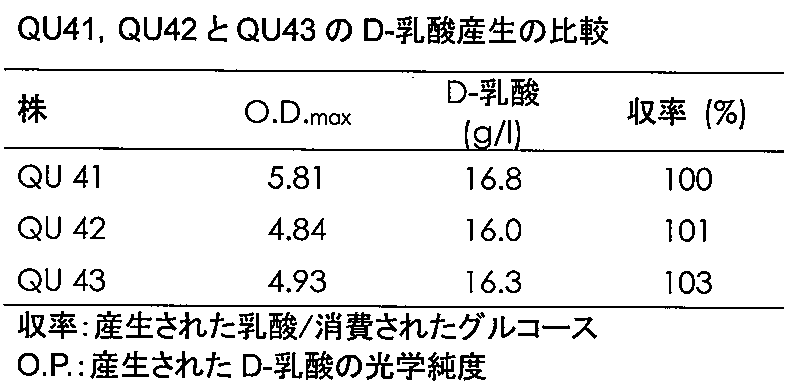
ラクトバシラス・デルブリッキーQU41株、QU42株、及びQU43株の3つの菌株を、10mlのMRS-グルコース培地中で、嫌気条件下、37℃で培養を行った。図4(a)はQU41株で検討を行なった結果であり、図4(b)はQU41株で検討を行なった結果であり、図4(c)はQU41株で検討を行なった結果である。図4において左の縦軸はグルコース、乳酸、酢酸の濃度を示し、右軸がODを示し、横軸が時間を示す。図4のプロットにおいて、黒丸がグルコース濃度、白丸が乳酸濃度であり、白三角がODである。さらに3つの株における試験官培養の結果を比較した数値データを、下の表2に示す。
ラクトバシラス・デルブリッキーQU41株、QU42株、及びQU43株の3つの菌株を、10mlのMRS-グルコース培地中で、嫌気条件下、37℃で培養を行った。図4(a)はQU41株で検討を行なった結果であり、図4(b)はQU41株で検討を行なった結果であり、図4(c)はQU41株で検討を行なった結果である。図4において左の縦軸はグルコース、乳酸、酢酸の濃度を示し、右軸がODを示し、横軸が時間を示す。図4のプロットにおいて、黒丸がグルコース濃度、白丸が乳酸濃度であり、白三角がODである。さらに3つの株における試験官培養の結果を比較した数値データを、下の表2に示す。
図4と表2に示されるように、QU41株、QU42株、及びQU43株の3つの菌株は、MRS培地での培養において、類似した発酵挙動を示した。QU41株は72時間目においてD-乳酸生産量が16.8g/Lであり、最も高い値を示した。
試験管培養において、ラクトバシラス・デルブリッキーQU41株、QU42株、及びQU43株の3株が収率や生産速度などの点で極めて類似した発酵特性を示したことから、QU41株を代表株として用いて、以下に述べるD-乳酸生産における最適条件の検討を行なった。
実施例2 最適条件の検討
(1)最適温度の検討
QU41株について、グルコース20g/LのMRS培地を用いて、30℃、37℃、43℃、及び49℃におけるD-乳酸生産能を検討した。なお10規定のNaOHによりpHを5.5に調整し、窒素ガス置換により嫌気的状態で実験を行った。培養は前培養を40mlスケールで6時間、主培養を400mlスケールで12時間行った。
(1)最適温度の検討
QU41株について、グルコース20g/LのMRS培地を用いて、30℃、37℃、43℃、及び49℃におけるD-乳酸生産能を検討した。なお10規定のNaOHによりpHを5.5に調整し、窒素ガス置換により嫌気的状態で実験を行った。培養は前培養を40mlスケールで6時間、主培養を400mlスケールで12時間行った。
その結果を図5に示す。図5(a)は30℃で検討を行なった結果であり、図5(b)は37℃で検討を行なった結果であり、図5(c)は43℃で検討を行なった結果であり、図5(d)は49℃で検討を行なった結果である。図5において左の縦軸はグルコース、乳酸、酢酸の濃度を示し、右の縦軸がODを示し、横軸が時間を示す。また図5のプロットにおいて、黒丸がグルコース濃度、白丸が乳酸濃度、黒三角が酢酸の濃度であり、白三角がODである。
この結果から得た培養のパラメーターの値を、下の表3に示す。表3において左から、最大菌体増殖速度、D-乳酸生産量、最大収率、最大生産量、D-乳酸光学純度の値をそれぞれ示す。表3に示すように、43℃の時に最も高い最大増殖速度と最大生産速度を示し、QU41株の増殖とD-乳酸生産の最適温度は43℃であった。なおこのデータには示さないが、QU41株は55℃でも増殖及びD-乳酸の産生が可能であった。
(2)最適pHの検討
最適温度を43℃として、QU41株のD-乳酸生産へpHが及ぼす影響を4つのpH(pH5.0、5.5、6.0、6.5)で検討した。pHを変えた以外は、上記の最適温度の検討と同じ条件で実験を行った。
最適温度を43℃として、QU41株のD-乳酸生産へpHが及ぼす影響を4つのpH(pH5.0、5.5、6.0、6.5)で検討した。pHを変えた以外は、上記の最適温度の検討と同じ条件で実験を行った。
その結果を図6に示す。なお図6(a)はpH5.0で検討を行なった結果であり、図6(b)はpH5.5で検討を行なった結果であり、図6(c)はpH6.0で検討を行なった結果であり、図6(d)はpH6.5で検討を行なった結果である。図6において左の縦軸はグルコース、乳酸、酢酸の濃度を示し、右の縦軸がODを示し、横軸が時間を示す。また図6のプロットにおいて、黒丸がグルコース濃度、白丸が乳酸濃度、黒三角が酢酸の濃度であり、白三角がODである。
この結果から得た培養のパラメーターの値を、下の表4に示す。表4において左から、最大菌体増殖速度、D-乳酸生産量、最大収率、最大生産量、D-乳酸光学純度の値をそれぞれ示す。pH6.0の時に12時間で培養が終了し、且つ最大の菌体増殖速度と乳酸生産量を示したので、最適pHは6.0であった。
実施例3 初発グルコース濃度が及ぼす影響の検討
温度が43℃、pH6.0の条件下で、QU41株のD-乳酸生産能にグルコース濃度が及ぼす影響を検討した。pHを変えた以外は、最適温度及び最適pHの検討と同じ条件で実験を行った。
温度が43℃、pH6.0の条件下で、QU41株のD-乳酸生産能にグルコース濃度が及ぼす影響を検討した。pHを変えた以外は、最適温度及び最適pHの検討と同じ条件で実験を行った。
培養開始時に添加したグルコースの濃度、即ち初発グルコース濃度を20、50、100g/Lとして検討を行なった結果を図7に示す。なお図7(a)は初発グルコース濃度が20g/Lのデータであり、図7(b)は初発グルコース濃度が50g/Lのデータ(b)であり、図7(c)は初発グルコース濃度が100g/Lのデータである。図7において左の縦軸はグルコース、乳酸、酢酸の濃度を示し、右の縦軸がODを示し、横軸が時間を示す。また図7のプロットにおいて、黒丸がグルコース濃度、白丸が乳酸濃度、黒三角が酢酸の濃度であり、白三角がODである。
この結果から得た培養のパラメーターの値を、下の表5に示す。表5において左から、最大菌体増殖速度、D-乳酸生産量、最大収率、最大生産量、D-乳酸光学純度の値をそれぞれ示す。初発グルコース濃度の増加に伴い、最大ODや乳酸生産性は高まったが、一方、最大菌体増殖速度は低下し、培養時間経過に伴って乳酸生産速度も低下した。この結果から、QU41は高濃度のグルコースや、乳酸により阻害を受けるので、細菌の増殖に伴う培地環境の変化に影響される回分培養では、効率的にD-乳酸を生産できないことが判った。
実施例4 ラクトバシラス・デルブリッキーQU41株と既存のD-乳酸生産菌の比較
ラクトバシラス・デルブリッキーQU41株と、既存のD-乳酸生産菌であるJCM1166及びJCM1248の間で、D-乳酸生産量の比較を行った。図8に結果を示す。図8(a)は37℃で測定したデータであり、図8(b)は43℃で測定したデータであり、図8(c)は50℃で測定したデータである。図8において左の縦軸は乳酸の濃度を示し、右の縦軸はODを示し、横軸は時間を示す。
ラクトバシラス・デルブリッキーQU41株と、既存のD-乳酸生産菌であるJCM1166及びJCM1248の間で、D-乳酸生産量の比較を行った。図8に結果を示す。図8(a)は37℃で測定したデータであり、図8(b)は43℃で測定したデータであり、図8(c)は50℃で測定したデータである。図8において左の縦軸は乳酸の濃度を示し、右の縦軸はODを示し、横軸は時間を示す。
ラクトバシラス・デルブリッキーQU41株のみ、図8(d)に示すように、55℃においても測定を行なった。なお右カラムは培養後24時間におけるD-乳酸生産量であり、左カラムは培養後48時間におけるD-乳酸生産量である。さらに、この結果から得た3つの菌株のD-乳酸生産量の値を表6に示す。
図8と表6から判るように、各温度でラクトバシラス・デルブリッキーQU41株は、既存のD-乳酸生産菌よりも高いD-乳酸生産能を示した。

実施例5 培地の中和剤の検討
QU41株の培養に用いる培地の中和剤として、NaOHを用いた場合とNH4OHを用いた場合の比較を行なった。結果を図9に示す。なお図9(a)は中和剤としてNaOHを用いた場合のデータであり、図9(b)は中和剤としてNH4OHを用いた場合のデータである。図9において左の縦軸は乳酸の濃度を示し、右の縦軸がODを示し、横軸が時間を示す。また図9のプロットにおいて、黒丸がグルコース濃度、白丸が乳酸濃度、黒三角が酢酸の濃度であり、白三角がODである。
QU41株の培養に用いる培地の中和剤として、NaOHを用いた場合とNH4OHを用いた場合の比較を行なった。結果を図9に示す。なお図9(a)は中和剤としてNaOHを用いた場合のデータであり、図9(b)は中和剤としてNH4OHを用いた場合のデータである。図9において左の縦軸は乳酸の濃度を示し、右の縦軸がODを示し、横軸が時間を示す。また図9のプロットにおいて、黒丸がグルコース濃度、白丸が乳酸濃度、黒三角が酢酸の濃度であり、白三角がODである。
この結果から得た培養のパラメーターの値を、下の表7に示す。表7において左から、最大菌体増殖速度、D-乳酸生産量、最大収率、最大生産量、D-乳酸光学純度の値をそれぞれ示す。
ODと菌体増殖速度に関しては、NH4OHを用いた場合とNaOHを用いた場合において、同程度の結果であった。一方D-乳酸生産量と最大D-乳酸生産速度については培養後8時間において、NH4OHを用いた場合には、NaOHを用いた場合と比較して高い値を示した。
これまでLactobacillus delbrueckii subsp.delbrueckiiを用いたD-乳酸生産において、中和剤にNH4OH、NaOHを用いた場合と比較して炭酸カルシウムを用いた方が、D-乳酸産生量が高いことが報告されている。しかし中和剤にNH4OHを用いるNH3回収-ブチルエステル化プロセス(BUL)精製法は、炭酸カルシウムによる中和と比較して、廃棄物の発生が少なく、中和剤の回収も可能であるといった長所を有している。この結果から判るようにQU41株はアンモニアによる乳酸発酵への悪影響が見られなかったので、BUL精製法と組み合わせることにより環境に対する負荷が低い乳酸発酵が可能となる。

Claims (7)
- (1)グルコースを基質として99%以上の光学純度でD-乳酸を生産可能であり、かつ
(2)グルコース濃度が20g/L、pH6.0の条件で開始し、43℃の温度で12時間培養したときに、12.0g/L以上、好ましくは16.0g/L以上、さらに好ましくは20.0g/L以上のD-乳酸を生産可能である、
ラクトバシラス・デルブリッキーに属する乳酸菌。 - さらに、
(3)49℃の温度でD-乳酸を生産可能である、
請求項1に記載の乳酸菌。 - 下記の菌学的性質を有する、請求項1記載の乳酸菌:
1.形態:桿菌、
2.生化学的性質:カタラーゼ陰性、
3.運動性:なし、
4.酸素要求性:通性嫌気性、
5.グルコースを基質としてホモ乳酸発酵によりD-乳酸を産生する、及び
6.グルコース、フルクトース、マンノース、N-アセチルグルコサミン、マルトース、ラクトース、スクロース、トレハロースを資化することができ、キシロース、アラビノースは資化することができない。 - 下記のいずれかの配列からなる16SrRNA遺伝子を有する、請求項1記載の乳酸菌:
(a)配列表の配列番号:1で示されるヌクレオチド配列、又はそれと99.7%以上の同一性を有するヌクレオチド配列;
(b)配列表の配列番号:2で示されるヌクレオチド配列、又はそれと99.75%以上の同一性を有するヌクレオチド配列;又は
(c)配列表の配列番号:3で示されるヌクレオチド配列、又はそれと99.8%以上の同一性を有するヌクレオチド配列。 - NITE BP-679の受託番号で寄託されたラクトバシラス・デルブリッキーQU41株である、請求項1~4のいずれか1項に記載の乳酸菌。
- 請求項1~5のいずれか1項に記載の乳酸菌を培養する工程を含む、乳酸を製造する方法。
- 乳酸が、D-乳酸を99%以上の光学純度で含む、請求項6に記載の製造方法。
Applications Claiming Priority (2)
| Application Number | Priority Date | Filing Date | Title |
|---|---|---|---|
| JP2009137375A JP2010279332A (ja) | 2009-06-08 | 2009-06-08 | 新規なd−乳酸生産菌及びd−乳酸を生産する方法 |
| JP2009-137375 | 2009-06-08 |
Publications (1)
| Publication Number | Publication Date |
|---|---|
| WO2010143323A1 true WO2010143323A1 (ja) | 2010-12-16 |
Family
ID=43308587
Family Applications (1)
| Application Number | Title | Priority Date | Filing Date |
|---|---|---|---|
| PCT/JP2009/070410 Ceased WO2010143323A1 (ja) | 2009-06-08 | 2009-12-04 | 新規なd-乳酸生産菌及びd-乳酸を生産する方法 |
Country Status (2)
| Country | Link |
|---|---|
| JP (1) | JP2010279332A (ja) |
| WO (1) | WO2010143323A1 (ja) |
Cited By (5)
| Publication number | Priority date | Publication date | Assignee | Title |
|---|---|---|---|---|
| CN103589668A (zh) * | 2013-10-24 | 2014-02-19 | 天津大学 | 一株发酵甘蔗糖蜜生产d-乳酸菌株及其发酵方法 |
| CN103787561A (zh) * | 2014-01-23 | 2014-05-14 | 杭州师范大学 | 海藻糖在厌氧氨氧化颗粒污泥保存中的应用 |
| WO2021032896A1 (en) * | 2019-08-22 | 2021-02-25 | Brainboost Solutions | Food, food precursors or beverages comprising d-lactic acid and/or a salt thereof and a method of producing the same |
| CN114381393A (zh) * | 2021-12-21 | 2022-04-22 | 西藏安琪生物科技有限公司 | 德氏乳杆菌乳亚种菌株及其应用 |
| CN118599735A (zh) * | 2024-07-12 | 2024-09-06 | 南京工业大学 | 一种耐低pH生产D-乳酸的乳酸菌及其应用 |
Families Citing this family (3)
| Publication number | Priority date | Publication date | Assignee | Title |
|---|---|---|---|---|
| KR101764095B1 (ko) * | 2011-04-11 | 2017-08-14 | 동국대학교 산학협력단 | 유산균 분말의 제조방법 |
| JP2015080430A (ja) * | 2013-10-22 | 2015-04-27 | 王子ホールディングス株式会社 | D−乳酸の製造方法 |
| JP6331327B2 (ja) * | 2013-10-22 | 2018-05-30 | 王子ホールディングス株式会社 | D−乳酸の製造方法 |
Citations (3)
| Publication number | Priority date | Publication date | Assignee | Title |
|---|---|---|---|---|
| JPS61181389A (ja) * | 1985-02-08 | 1986-08-14 | Daicel Chem Ind Ltd | D−乳酸の製造方法 |
| JP2007215427A (ja) * | 2006-02-14 | 2007-08-30 | Musashino Chemical Laboratory Ltd | 乳酸の製造方法 |
| JP2007215428A (ja) * | 2006-02-14 | 2007-08-30 | Musashino Chemical Laboratory Ltd | 乳酸の製造方法 |
-
2009
- 2009-06-08 JP JP2009137375A patent/JP2010279332A/ja not_active Withdrawn
- 2009-12-04 WO PCT/JP2009/070410 patent/WO2010143323A1/ja not_active Ceased
Patent Citations (3)
| Publication number | Priority date | Publication date | Assignee | Title |
|---|---|---|---|---|
| JPS61181389A (ja) * | 1985-02-08 | 1986-08-14 | Daicel Chem Ind Ltd | D−乳酸の製造方法 |
| JP2007215427A (ja) * | 2006-02-14 | 2007-08-30 | Musashino Chemical Laboratory Ltd | 乳酸の製造方法 |
| JP2007215428A (ja) * | 2006-02-14 | 2007-08-30 | Musashino Chemical Laboratory Ltd | 乳酸の製造方法 |
Non-Patent Citations (2)
| Title |
|---|
| CALABIA, B.P. ET AL.: "Production of D-lactic acid from sugarcane molasses, sugarcane juice and sugar beet juice by Lactobacillus delbrueckii", BIOTECHNOL LETT, vol. 29, no. 9, 2007, pages 1329 - 1332, XP019523948, DOI: doi:10.1007/s10529-007-9408-4 * |
| WATARU KANEKO ET AL.: "Shinki D-nyusan Seisankin no Bunri to Hakko Tokusei", NIPPON NOGEI KAGAKUKAI TAIKAI KOEN YOSHISHU, vol. 2009, 2009, pages 109 * |
Cited By (7)
| Publication number | Priority date | Publication date | Assignee | Title |
|---|---|---|---|---|
| CN103589668A (zh) * | 2013-10-24 | 2014-02-19 | 天津大学 | 一株发酵甘蔗糖蜜生产d-乳酸菌株及其发酵方法 |
| CN103787561A (zh) * | 2014-01-23 | 2014-05-14 | 杭州师范大学 | 海藻糖在厌氧氨氧化颗粒污泥保存中的应用 |
| CN103787561B (zh) * | 2014-01-23 | 2016-04-20 | 杭州师范大学 | 海藻糖在厌氧氨氧化颗粒污泥保存中的应用 |
| WO2021032896A1 (en) * | 2019-08-22 | 2021-02-25 | Brainboost Solutions | Food, food precursors or beverages comprising d-lactic acid and/or a salt thereof and a method of producing the same |
| CN114381393A (zh) * | 2021-12-21 | 2022-04-22 | 西藏安琪生物科技有限公司 | 德氏乳杆菌乳亚种菌株及其应用 |
| CN114381393B (zh) * | 2021-12-21 | 2024-03-29 | 西藏安琪生物科技有限公司 | 德氏乳杆菌乳亚种菌株及其应用 |
| CN118599735A (zh) * | 2024-07-12 | 2024-09-06 | 南京工业大学 | 一种耐低pH生产D-乳酸的乳酸菌及其应用 |
Also Published As
| Publication number | Publication date |
|---|---|
| JP2010279332A (ja) | 2010-12-16 |
Similar Documents
| Publication | Publication Date | Title |
|---|---|---|
| Nguyen et al. | Production of L-lactic acid from a green microalga, Hydrodictyon reticulum, by Lactobacillus paracasei LA104 isolated from the traditional Korean food, makgeolli | |
| Moon et al. | A novel lactic acid bacterium for the production of high purity L-lactic acid, Lactobacillus paracasei subsp. paracasei CHB2121 | |
| JP2010279332A (ja) | 新規なd−乳酸生産菌及びd−乳酸を生産する方法 | |
| JP6521243B2 (ja) | 3−ヒドロキシ酪酸又はその塩の好気的生産方法 | |
| CN109504630B (zh) | 一种重组d-乳酸生产植物乳杆菌菌株及利用该菌株生产d-乳酸的方法 | |
| KR101778436B1 (ko) | 우수한 초산 생성능을 가지는 신규한 아세토박터속 slv-7 균주 및 이의 용도 | |
| KR101686899B1 (ko) | 신규한 클루이베로마이세스 막시아누스 mj1 및 이의 용도 | |
| CN106536717A (zh) | 用于依赖蔗糖改善精细化学品产生的基因修饰微生物 | |
| Mondragón-Parada et al. | Lactic acid bacteria production from whey | |
| JP4067970B2 (ja) | 発酵性の糖およびその混合物からl(+)−ラクテートを生産するための好熱性微生物バチルス・コアグランスsim−tdsm14043株 | |
| WO2008043368A2 (en) | Method for obtaining endospores of sporogenous fermentable thermophilic strains of microorganism and use of the obtained endospores to inoculate fermentation | |
| CN106164249A (zh) | 用于基于蔗糖的改善精细化学品产生的修饰微生物 | |
| CN106164252A (zh) | 用于琥珀酸产生的改进微生物 | |
| KR101689004B1 (ko) | 젖산 분해 경로가 봉쇄된 클루이베로마이세스 막시아누스 및 이의 용도 | |
| EP3625337B1 (en) | Process for producing an organic compound | |
| EP3535384A1 (en) | Fermentation process for producing d-lactic acid or its salts | |
| JP5721162B2 (ja) | 高純度乳酸の製造方法 | |
| JP2014064477A (ja) | 酢酸生産能が向上した酢酸菌の育種方法 | |
| JP6558767B2 (ja) | ハロモナス菌を用いたピルビン酸の製造方法 | |
| KR101686337B1 (ko) | 글리세롤을 탄소원으로 젖산을 생산하는 미생물 및 이를 이용한 젖산 생산 방법 | |
| KR20100008715A (ko) | 잔탄검 생합성 관련 돌연변이 유전자와 이를 포함하는잔탄검 생합성 균주 및 돌연변이 균주를 이용한 잔탄검의제조방법 | |
| Abdel-Rahman et al. | Effective production of lactic acid by a newly isolated alkaliphilic Psychrobacter maritimus BoMAir 5 strain | |
| CN109072259B (zh) | 用于由各种碳源产生l-乳酸或及其盐的嗜氧乳酸芽孢杆菌 | |
| US20230002796A1 (en) | Method for inducing microbial mutagenesis to produce lactic acid | |
| KR100481942B1 (ko) | 대사공학적으로 개량한 대장균 및 신규의포스포에놀피루베이트에이 유전자를 이용한 사과산의 생산방법 |
Legal Events
| Date | Code | Title | Description |
|---|---|---|---|
| 121 | Ep: the epo has been informed by wipo that ep was designated in this application |
Ref document number: 09845845 Country of ref document: EP Kind code of ref document: A1 |
|
| NENP | Non-entry into the national phase |
Ref country code: DE |
|
| 122 | Ep: pct application non-entry in european phase |
Ref document number: 09845845 Country of ref document: EP Kind code of ref document: A1 |