WO2010140499A1 - ルチル型酸化チタン結晶及びこれを用いる中間赤外線フィルター - Google Patents
ルチル型酸化チタン結晶及びこれを用いる中間赤外線フィルター Download PDFInfo
- Publication number
- WO2010140499A1 WO2010140499A1 PCT/JP2010/058709 JP2010058709W WO2010140499A1 WO 2010140499 A1 WO2010140499 A1 WO 2010140499A1 JP 2010058709 W JP2010058709 W JP 2010058709W WO 2010140499 A1 WO2010140499 A1 WO 2010140499A1
- Authority
- WO
- WIPO (PCT)
- Prior art keywords
- titanium oxide
- rutile
- transition metal
- metal ion
- oxide crystal
- Prior art date
- Legal status (The legal status is an assumption and is not a legal conclusion. Google has not performed a legal analysis and makes no representation as to the accuracy of the status listed.)
- Ceased
Links
Images



Classifications
-
- C—CHEMISTRY; METALLURGY
- C01—INORGANIC CHEMISTRY
- C01G—COMPOUNDS CONTAINING METALS NOT COVERED BY SUBCLASSES C01D OR C01F
- C01G23/00—Compounds of titanium
- C01G23/04—Oxides; Hydroxides
- C01G23/047—Titanium dioxide
-
- C—CHEMISTRY; METALLURGY
- C01—INORGANIC CHEMISTRY
- C01G—COMPOUNDS CONTAINING METALS NOT COVERED BY SUBCLASSES C01D OR C01F
- C01G23/00—Compounds of titanium
- C01G23/04—Oxides; Hydroxides
- C01G23/047—Titanium dioxide
- C01G23/053—Producing by wet processes, e.g. hydrolysing titanium salts
-
- C—CHEMISTRY; METALLURGY
- C01—INORGANIC CHEMISTRY
- C01G—COMPOUNDS CONTAINING METALS NOT COVERED BY SUBCLASSES C01D OR C01F
- C01G41/00—Compounds of tungsten
-
- C—CHEMISTRY; METALLURGY
- C01—INORGANIC CHEMISTRY
- C01G—COMPOUNDS CONTAINING METALS NOT COVERED BY SUBCLASSES C01D OR C01F
- C01G45/00—Compounds of manganese
-
- C—CHEMISTRY; METALLURGY
- C09—DYES; PAINTS; POLISHES; NATURAL RESINS; ADHESIVES; COMPOSITIONS NOT OTHERWISE PROVIDED FOR; APPLICATIONS OF MATERIALS NOT OTHERWISE PROVIDED FOR
- C09C—TREATMENT OF INORGANIC MATERIALS, OTHER THAN FIBROUS FILLERS, TO ENHANCE THEIR PIGMENTING OR FILLING PROPERTIES ; PREPARATION OF CARBON BLACK ; PREPARATION OF INORGANIC MATERIALS WHICH ARE NO SINGLE CHEMICAL COMPOUNDS AND WHICH ARE MAINLY USED AS PIGMENTS OR FILLERS
- C09C1/00—Treatment of specific inorganic materials other than fibrous fillers; Preparation of carbon black
- C09C1/36—Compounds of titanium
- C09C1/3607—Titanium dioxide
- C09C1/3653—Treatment with inorganic compounds
-
- G—PHYSICS
- G02—OPTICS
- G02B—OPTICAL ELEMENTS, SYSTEMS OR APPARATUS
- G02B1/00—Optical elements characterised by the material of which they are made; Optical coatings for optical elements
- G02B1/02—Optical elements characterised by the material of which they are made; Optical coatings for optical elements made of crystals, e.g. rock-salt, semi-conductors
-
- G—PHYSICS
- G02—OPTICS
- G02B—OPTICAL ELEMENTS, SYSTEMS OR APPARATUS
- G02B5/00—Optical elements other than lenses
- G02B5/20—Filters
- G02B5/208—Filters for use with infrared or ultraviolet radiation, e.g. for separating visible light from infrared and/or ultraviolet radiation
-
- G—PHYSICS
- G02—OPTICS
- G02B—OPTICAL ELEMENTS, SYSTEMS OR APPARATUS
- G02B5/00—Optical elements other than lenses
- G02B5/20—Filters
- G02B5/22—Absorbing filters
-
- C—CHEMISTRY; METALLURGY
- C01—INORGANIC CHEMISTRY
- C01P—INDEXING SCHEME RELATING TO STRUCTURAL AND PHYSICAL ASPECTS OF SOLID INORGANIC COMPOUNDS
- C01P2002/00—Crystal-structural characteristics
- C01P2002/50—Solid solutions
- C01P2002/52—Solid solutions containing elements as dopants
- C01P2002/54—Solid solutions containing elements as dopants one element only
-
- C—CHEMISTRY; METALLURGY
- C01—INORGANIC CHEMISTRY
- C01P—INDEXING SCHEME RELATING TO STRUCTURAL AND PHYSICAL ASPECTS OF SOLID INORGANIC COMPOUNDS
- C01P2002/00—Crystal-structural characteristics
- C01P2002/70—Crystal-structural characteristics defined by measured X-ray, neutron or electron diffraction data
- C01P2002/72—Crystal-structural characteristics defined by measured X-ray, neutron or electron diffraction data by d-values or two theta-values, e.g. as X-ray diagram
-
- C—CHEMISTRY; METALLURGY
- C01—INORGANIC CHEMISTRY
- C01P—INDEXING SCHEME RELATING TO STRUCTURAL AND PHYSICAL ASPECTS OF SOLID INORGANIC COMPOUNDS
- C01P2002/00—Crystal-structural characteristics
- C01P2002/80—Crystal-structural characteristics defined by measured data other than those specified in group C01P2002/70
- C01P2002/82—Crystal-structural characteristics defined by measured data other than those specified in group C01P2002/70 by IR- or Raman-data
Definitions
- the present invention relates to a rutile-type titanium oxide crystal capable of efficiently transmitting mid-infrared rays, a production method thereof, a molding material for mid-infrared filters using the same, and a mid-infrared filter formed by molding the same.
- An infrared filter is a material that is widely used in industry, centering on optical devices (cameras, microscopes, displays). There are many types of infrared filters, but most of them are for near infrared rays, and there are few cases where they are used as materials and filters that transmit intermediate infrared rays. That is, the material that can be used for the transmission of the intermediate infrared ray is a material in which a multilayer film is formed on an infrared optical substrate such as quartz, sapphire, silicon, etc. by metal vapor deposition. Although it is to be controlled, its manufacturing cost is high and its versatility is poor.
- titanium oxide Compared with precious metal oxides, titanium oxide has a large reserve in the natural world. From white pigments, general-purpose materials such as photocatalysts and paints, to special application fields such as dye-sensitized solar cells and photoresponsive materials. It is an inexpensive material widely used in industry. Titanium oxide itself can also absorb certain infrared rays in the near infrared and far infrared regions. However, since infrared absorption is not selective, it passes through a wide range of wavelengths from the near infrared region to the mid infrared region, and wavelength selectivity in absorption or transmission is not shown. Therefore, titanium oxide as it is cannot be used as an infrared filter, and if there is a method that can precisely control the infrared absorption range inherent to titanium oxide, it is considered that the versatility of the intermediate infrared filter is particularly enhanced. .
- the problem to be solved by the present invention is to provide a material for an intermediate infrared filter that is excellent in versatility by precisely controlling the absorption intensity of titanium oxide in the infrared region.
- the present inventor doped a small amount of transition metal ions into titanium oxide, and grown the doped titanium oxide into a rutile type crystal. As a result, it was found that the absorption in the near / far infrared rays was strengthened and the intermediate infrared transmission wavelength region could be greatly narrowed, and that it could be suitably used as a material for an intermediate infrared filter.
- the present invention is a method for producing a rutile-type titanium oxide crystal doped with transition metal ions, (I) a step of dispersing or dissolving a complex (y) of a basic polymer (x) having an amino group and a transition metal ion in an aqueous medium, (II) The aqueous dispersion or aqueous solution obtained in (I) and the water-soluble titanium compound (z) are mixed in an aqueous medium under a temperature condition of 50 ° C. or less to carry out a hydrolysis reaction, whereby an amino acid is obtained.
- a polymer / titania layered structure composite having a distance interval of 1 to 3 nm in which a complex (y) of a basic polymer (x) having a group and a transition metal ion is sandwiched between titanias; (III)
- the layered structure composite is heated and fired at a temperature of 650 ° C. or higher in an air atmosphere so that the transition metal ions confined in the layered structure are doped on the surface of the titanium oxide crystal and at the same time become a rutile type crystal phase.
- a rutile type having a transmittance in the range of 5 to 12 ⁇ m in the infrared spectrum and having a half-value width of the transmission peak top of 2.5 ⁇ m or less.
- a titanium oxide crystal is provided.
- the present invention provides a powder for a mid-infrared filter containing the rutile-type titanium oxide crystal.
- the present invention is a method for producing a molding material for mid-infrared filters, (I) a step of dispersing or dissolving a complex (y) of a basic polymer (x) having an amino group and a transition metal ion in an aqueous medium, (II) The aqueous dispersion or aqueous solution obtained in (I) and the water-soluble titanium compound (z) are mixed in an aqueous medium under a temperature condition of 50 ° C. or less to carry out a hydrolysis reaction, whereby an amino acid is obtained.
- a polymer / titania layered structure composite having a distance of 1 to 3 nm in which a complex (y) of a basic polymer (x) having a group and a transition metal ion is sandwiched between titanias; (III) The layered structure composite is heated and fired at a temperature of 650 ° C. or higher in an air atmosphere so that the transition metal ions confined in the layered structure are doped on the surface of the titanium oxide crystal and at the same time become a rutile-type crystal phase.
- a method for producing a molding material for mid-infrared filter comprising the step of dispersing the rutile-type titanium oxide crystal obtained in (III) in a polyolefin, a molding material for mid-infrared filter, and a mid-infrared filter Is to provide.
- the rutile-type titanium oxide crystal of the present invention can be easily dispersed and mixed as a powder in a substance that does not absorb infrared rays, and can also be easily dispersed in a liquid substance. Since the rutile type titanium oxide crystal of the present invention efficiently transmits infrared rays in a wavelength range of 5 to 12 ⁇ m, a dispersion in which infrared rays are dispersed can be suitably used as a material for an intermediate infrared filter.
- the production method of the present invention includes a step of interposing a compound containing a transition metal ion to be doped in advance between titania nanocrystals at a nanospace distance (a step of obtaining a composite having a layered structure).
- a step of obtaining a composite having a layered structure By completely thermally firing below, transition metal ions confined in the nanospace can be effectively uniformly doped in the titanium oxide.
- doping by this method is advantageous for fine structure control, and the infrared transmission wavelength can be controlled in a very narrow range, so that it becomes a material for an intermediate infrared filter as described above.
- FIG. 2 is an XRD pattern of a precursor sample before firing obtained in Example 1.
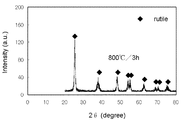
- FIG. It is the XRD pattern of the sample obtained after baking the precursor in Example 1 at 800 degreeC.
- 2 is a transmission spectrum of FT-IR measured using a KBr plate containing 5% of titanium oxide obtained in Example 1.
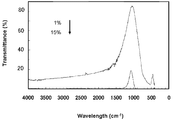
- FIG. 2 is a transmission spectrum of FT-IR measured using a KBr plate containing 1% and 15% of titanium oxide obtained in Example 1.
- FIG. 4 is an FT-IR transmission spectrum of titanium oxide of Example 2.
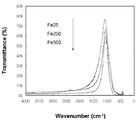
- 4 is an FT-IR transmission spectrum of iron-doped titanium oxide of Example 3.
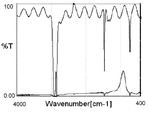
- FIG. 6 is an FT-IR transmission spectrum of a polyethylene / titanium oxide blend film in Example 5.
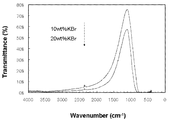
- FIG. 3 is an FT-IR transmission spectrum of titanium oxide obtained in Comparative Example 1.
- a basic polymer (x) having an amino group, a transition metal ion complex (y), and a titania nanocrystal are layered while having an interlayer distance of 1-3 nm.
- the composite is used as a precursor, and is converted into a rutile type titanium oxide crystal doped with a transition metal ion by thermal firing.
- Nanostructures such as nanocrystals and nanospaces are considered to have many possibilities for the synthesis of new functional materials as new nanoreaction fields in addition to the function of the structure itself.
- the chemistry between the semiconductor crystal plane and the substance existing between the layers is achieved by various processing methods. Can cause a reaction. That is, the layered nanospace can be a very advantageous nanoreaction field.
- the present invention pays attention to such a point of view and devised an optimum process comprising a two-stage method of synthesizing a precursor material for performing doping in a nano-reaction field and thermal firing of the material.
- the complex (y) of the basic polymer (x) having an amino group and a transition metal ion functions as a catalyst for the hydrolytic condensation reaction of the water-soluble titanium compound (z), and at the same time, titania sol and ions generated from the reaction. Inducing the deposit of the titania sol while forming a complex results in a polymer metal complex / titania layered structure composite in which the polymer and the titania are alternately stacked.
- the transition metal ions therein cause a doping reaction on the titania crystal surface, which is converted into a rutile type titanium oxide crystal, thereby being converted into doped titanium oxide that shows transmission in the mid-infrared wavelength range.
- the crystal is a rutile type titanium oxide crystal.
- the firing temperature it is essential to set the firing temperature to 650 ° C. or higher. It is desirable to set the temperature to 650 to 1200 ° C. from the viewpoint of cost. A firing temperature of 750 to 950 ° C. is preferable from the viewpoint of efficiently forming a rutile crystal phase.
- the firing time can be appropriately set in the range of 2 to 14 hours, but it is generally preferable to adjust the temperature range and time appropriately by combining a temperature increase program from the viewpoint of energy cost and productivity.
- the content of transition metal ions in the obtained rutile-type titanium oxide crystal is preferably in the range of 0.05 to 5% by mass, and the content is determined in the production stage of the composite as a precursor. It can be adjusted by the content of the transition metal ion in the complex (y) of the basic polymer (x) having an amino group and the transition metal ion. That is, the transition metal ions to be doped increase if the content is increased, and can be decreased if the content is decreased. Furthermore, by using a polymer complex having different transition metal ions in combination, it is possible to dope a plurality of types of transition metal ions into the resulting titanium oxide.
- the rutile-type titanium oxide crystals obtained above are usually in the form of powder, and can be used as a molding material for mid-infrared filters by mixing with various compounds as it is or after being pulverized in advance.
- the basic polymer (x) having an amino group used in the present invention is not particularly limited, and usual water-soluble polyamines and the like can be used.
- polymer (x) examples include, for example, synthetic amines such as polyvinylamine, polyallylamine, polyethyleneimine (branched and linear), polypropyleneimine, poly (4-vinylpyridine), poly (aminoethyl methacrylate). ) And poly [4- (N, N-dimethylaminomethylstyrene)] and the like, and synthetic polyamines containing amino groups in the side chain or main chain.
- synthetic amines such as polyvinylamine, polyallylamine, polyethyleneimine (branched and linear), polypropyleneimine, poly (4-vinylpyridine), poly (aminoethyl methacrylate).
- poly [4- (N, N-dimethylaminomethylstyrene)] and the like and synthetic polyamines containing amino groups in the side chain or main chain.
- polyethyleneimine is particularly preferable because it is easily available and can easily form a layered structure with the titanium oxide sol.
- biological polyamines for example, chitin, chitosan, spermidine, bis (3-aminopropyl) amine, homospermidine, spermine and the like, or as biopolymers having many basic amino acid residues, for example, polylysine, polyhistidine, poly Biological polyamines including synthetic polypeptides such as arginine can be mentioned.
- the polymer (x) may be a modified polyamine in which a part of the amino group in the polyamine is bonded to a non-amine polymer skeleton, or a copolymer of a polyamine skeleton and a non-amine polymer skeleton. .
- the amino group of the basic polymer (x) having an amino group is reacted with a compound having a functional group that can easily react with an amine such as an epoxy group, a halogen, a tosyl group, or an ester group. Can be easily obtained.
- the non-amine polymer skeleton may be either hydrophilic or hydrophobic.
- hydrophilic polymer skeleton include skeletons composed of polyethylene glycol, polymethyloxazoline, polyethyloxazoline, polyacrylamide, and the like.
- hydrophobic polymer skeleton include a skeleton made of an epoxy resin, a urethane resin, a polymethacrylate resin, or the like.
- the non-amine polymer skeleton is preferably 50% by mass or less, and 20% by mass or less, relative to the total structural unit of the polymer (x). More preferably, it is more preferably 10% by mass or less.
- the molecular weight of the polymer (x) is not particularly limited, and the weight average molecular weight as a polystyrene conversion value determined by gel permeation chromatography (GPC) is usually in the range of 300 to 100,000. Yes, preferably in the range of 500 to 80,000, and more preferably in the range of 1,000 to 50,000.
- the transition metal ion used here is the same as the transition metal ion in the obtained rutile-type titanium oxide crystal, and all transition metal ions capable of coordinating with an amino group can be used.
- the transition metal ion valence may be a monovalent to tetravalent metal salt, and they can be preferably used even in a complex ion state.
- the rutile-type titanium oxide crystal obtained has high intermediate infrared transmittance and is easy to obtain raw materials, so that it is an ion of iron, zinc, manganese, copper, cobalt, vanadium, tongue stem, nickel. preferable.
- the amount of the transition metal ion used is preferably 1/10 to 1/500 equivalent as an ion with respect to the number of moles of the amino group in the basic polymer (x) having an amino group.
- the titanium compound used in the present invention is preferably a non-halogenated titanium compound that is water-soluble and does not hydrolyze when dissolved in water, that is, is stable in pure water.
- aqueous solution of titanium bis (ammonium lactate) dihydroxide an aqueous solution of titanium bis (lactate), a propanol / water mixture of titanium bis (lactate), titanium (ethyl acetoacetate) diisopropoxide, etc. It is done.
- the polymer / titania layered structure composite can be obtained by mixing a water-soluble titanium compound (z) in an aqueous solution of a complex (y) of a basic polymer (x) having an amino group and a metal ion.
- the amount of the water-soluble titanium compound (z) as the titanium source is excessive with respect to the amine unit in the complex (y) of the basic polymer (x) having an amino group and the metal ion, the compound is suitably combined.
- the water-soluble titanium compound (z) is preferably in the range of 2 to 1000 times equivalent, particularly 4 to 700 times equivalent to the amine unit.
- the concentration of the aqueous solution of the complex (y) of the basic polymer (x) having an amino group and the transition metal ion is 0.1 to 30 on the basis of the amount of polyamine contained in the polymer (x). It is preferable to make it into the mass%.
- the time for the hydrolytic condensation reaction of the water-soluble titanium compound (z) varies from 1 minute to several hours, but it is more preferable to set the reaction time to 30 minutes to 5 hours in order to increase the reaction efficiency.
- the pH value of the aqueous solution in the hydrolytic condensation reaction is preferably set between 5 and 11, and particularly preferably 7 to 10.
- a complex obtained in the presence of a complex (y) of a basic polymer (x) having an amino group and a transition metal ion obtained by a hydrolytic condensation reaction becomes a colored precipitate reflecting the color of the transition metal ion.
- the content of titania in the composite (precursor) obtained by the hydrolytic condensation reaction can be adjusted depending on the reaction conditions and the like, and a product in the range of 20 to 90% by mass of the whole composite can be obtained.
- the rutile-type titanium oxide crystal of the present invention can be obtained by thermally firing the composite obtained here by the method described above.
- the rutile-type titanium oxide crystal of the present invention is a rutile-type titanium oxide crystal that exhibits transparency in the mid-infrared wavelength range of 5 to 12 ⁇ m and is doped with transition metal ions. Its shape is powder, and it is a polycrystalline body consisting of crystals of 20 to 100 nm.
- the amount of transition metal ions doped into titanium oxide is usually in the range of 0.05 to 10% by mass, and in order to further narrow the half-value width of the infrared transmission peak, the doping amount is set to 0.1 to 2% by mass. It is desirable to do.
- the transition metal ion to be doped may be one type or two or more types.
- the half width of the transmission peak and the peak top can be appropriately adjusted depending on the mixed doping state.
- a rutile crystal in order to exhibit transparency in the wavelength range of 5 to 12 ⁇ m in the mid-infrared region, a rutile crystal is essential.
- the crystal phase is a rutile-type crystal phase, it can be used as an intermediate infrared filter even in a state where a certain amount of anatase crystal phase is mixed.
- the ratio of the anatase crystal phase is desirably 30% by mass or less.
- the rutile-type titanium oxide crystal powder of the present invention can be lightly colored depending on the amount of transition metal ions doped and the type of transition metal ions.
- the particle size of the powder is usually several ⁇ m, but it can be easily prepared to a particle size of 100 nm or less by a grinding / dispersing method such as meal, desper, or mortar.
- a grinding / dispersing method such as meal, desper, or mortar.
- the rutile-type titanium oxide crystal of the present invention has the property of transmitting mid-infrared light between 5 and 12 ⁇ m wavelength.
- the wave number of the transmitted infrared peak can be finely adjusted such as 1037, 1055, 1057, 1068, 1096, 1130 cm ⁇ 1 .
- the half-value width of each transmitted wave number peak is 2.5 ⁇ m or less.
- rutile-type titanium oxide crystal of the present invention When such a rutile-type titanium oxide crystal of the present invention is used as a mid-infrared filter, it is preferably blended with a polyolefin that does not absorb in the mid-infrared region to adjust the molding material and then molded into a desired filter shape.
- polystyrene resin examples include industrially commercially available ones such as polyethylene, polypropylene, poly (ethylene / propylene), modified polyethylene, polymers of modified polypropylene, random copolymers and block copolymers thereof. Or can be used as a mixture.
- a method for producing a molding material containing polyolefin and rutile-type titanium oxide crystals is not particularly limited, and a commonly used melt-kneader, for example, a kneader such as a biaxial kneader or a Banbury mixer may be used. it can.
- the melt-kneading temperature is not particularly limited as long as it is within a range that suppresses thermal decomposition of polyolefin. Usually, 10 to 400 ° C. is preferable, and 80 to 400 ° C. is particularly preferable.
- the mixing ratio of the polyolefin and the rutile titanium oxide crystal is not particularly limited, but the content of the rutile titanium oxide crystal is usually 30% by mass or less with respect to the whole molding material, and the transparency is increased. From the viewpoint of improving the transmittance, the titanium oxide content is preferably 5% by mass or less. Even with such a content rate, the molded product can be suitably used as an intermediate infrared filter.
- the intermediate infrared filter can be formed into pellets, films, plates, tubes, etc. by processing methods. It can also be attached to other substrates.
- the precursor is a composite having a laminated structure formed from titanium oxide and a polymer metal complex.
- the 1-Ti-Mn500 powder obtained above was mixed with KBr powder in the proportions of 1, 5 and 15%, and after mixing with a mortar, a KBr plate was prepared and used for FT-IR measurement. It was. 3 and 4 show their FT-IR transmission spectra. From the plate containing 5wt% 1-Ti-Mn500 powder in KBr, the near-infrared side and far-infrared side are cut, and the IR transmission is only in the constant wave number range of the mid-infrared (wavelength 6.8-13 ⁇ m) Characteristics were seen.
- the infrared transmittance at the center wavelength (9.71 ⁇ m) of the transmission peak was 64%, and the half width (peak width at half height from the peak top) of the peak was 1.97 ⁇ m.
- the proportion of 1-Ti-Mn500 in the plate is large (15%), the transmittance of the infrared transmission peak is very low, and when the proportion is small (1%), the bottom portion of the infrared transmission peak spreads to the near infrared region. (Fig. 4). This strongly suggests that a plate containing an appropriate amount of 1-Ti-Mn500 functions as an infrared filter that efficiently transmits mid-infrared rays.
- Example 2 Synthesis of Titanium Oxide 2-Ti-Mn500 Doped with Manganese Ions 2-Ti—Mn500 was produced in the same manner as in Example 1 except that the firing temperature was 1100 ° C.
- FIG. 5 shows the FT-IR spectrum of a plate prepared by mixing the sample (5%) and KBr. By increasing the firing temperature, there was a tendency for the infrared transmission peak top to slightly shift to the short wavelength side. The center wavelength was 9.46 ⁇ m, the full width at half maximum was 1.89, and the transmittance was 50%.
- Example 3 Synthesis of Titanium Oxide Doped with Iron Ion
- Table 1 shows three types of titanium oxides having different iron doping amounts (converted values when the iron ion content is Fe 2 O 3 ).
- Example 5 Infrared filter film comprising polyethylene and 1-Ti-Mn500 blend
- this mixture was put into a twin-screw kneader (manufactured by Technobel, KZW15TW-45MG-NH-700) and melted at 250 ° C. for 15 minutes. Kneaded.
- the blend sample was taken out from the kneading chamber, cooled and solidified by sandwiching it between two iron plates, and formed into a film having a thickness of about 2 mm.
- the FT-IR transmission spectrum of the film is shown in FIG.
- a film made of polyethylene alone has absorption around 2800 cm ⁇ 1 , 1500 cm ⁇ 1 , and 670 cm ⁇ 1 , but there is no infrared absorption in other wave number ranges, and infrared rays are transmitted.
- these absorptions were cut and a transmission peak appeared centering on a wave number of 905 cm ⁇ 1 . That is, the blend polymer film containing manganese-doped rutile type titanium oxide functions as an infrared transmission filter.
- Comparative Example 1 1 ml of 0.1 M manganese nitrate was added to 10 ml of an absolute ethanol solution of 20 vol% titanium (IV) tetrabutoxide [Ti (OBu) 4 ] and reacted at room temperature for 1 hour with stirring. The precipitate was washed with water and dried at room temperature. The dry powder was fired at 800 ° C. for 3 hours in an air atmosphere. From the XRD measurement, it was confirmed that the titanium oxide after firing was a rutile crystal. From fluorescent X-ray analysis, 0.76% of MnO was detected in the titanium oxide.
- a KBr plate containing 10% of the sample was prepared, and the FT-IR transmission spectrum was measured. Infrared rays on the wavenumber side higher than 1500 cm ⁇ 1 could not be cut, transmission in a wide wavelength range occurred, and wavelength selective transparency could not be satisfied. Even with KBr contained in 20% of the sample, the infrared transmission filter was not suitable.
Landscapes
- Chemical & Material Sciences (AREA)
- Organic Chemistry (AREA)
- Physics & Mathematics (AREA)
- Inorganic Chemistry (AREA)
- Life Sciences & Earth Sciences (AREA)
- Optics & Photonics (AREA)
- General Physics & Mathematics (AREA)
- Environmental & Geological Engineering (AREA)
- General Life Sciences & Earth Sciences (AREA)
- Geology (AREA)
- Crystallography & Structural Chemistry (AREA)
- Health & Medical Sciences (AREA)
- Toxicology (AREA)
- Inorganic Compounds Of Heavy Metals (AREA)
Abstract
Description
(I)アミノ基を有する塩基性ポリマー(x)と遷移金属イオンとの錯体(y)を水性媒体中に分散又は溶解させる工程、
(II)(I)で得られた水性分散体又は水性溶液と、水溶性チタン化合物(z)とを水性媒体中、50℃以下の温度条件下で混合し加水分解反応を行うことによって、アミノ基を有する塩基性ポリマー(x)と遷移金属イオンとの錯体(y)がチタニアに挟まれた、1~3nmの距離間隔を有するポリマー/チタニアの層状構造複合体を得る工程、
(III)前記層状構造複合体を空気雰囲気下で650℃以上の温度で加熱焼成することにより、層状構造に閉じ込まれた遷移金属イオンが酸化チタン結晶表面にドーピングさせると同時にルチル型結晶相に成長させる工程、
とを有することを特徴とするルチル型酸化チタン結晶の製造方法、並びに赤外線スペクトルにて5~12μmの範囲で透過性を示し、且つその透過ピークトップの半値幅が2.5μm以下であるルチル型酸化チタン結晶を提供するものである。
(I)アミノ基を有する塩基性ポリマー(x)と遷移金属イオンとの錯体(y)を水性媒体中に分散又は溶解させる工程、
(II)(I)で得られた水性分散体又は水性溶液と、水溶性チタン化合物(z)とを水性媒体中、50℃以下の温度条件下で混合し加水分解反応を行うことによって、アミノ基を有する塩基性ポリマー(x)と遷移金属イオンとの錯体(y)がチタニアに挟まれた、1~3nmの距離間隔を有するポリマー/チタニアの層状構造複合体を得る工程、
(III)前記層状構造複合体を空気雰囲気下で650℃以上の温度で加熱焼成することにより、層状構造に閉じ込まれた遷移金属イオンが酸化チタン結晶表面にドーピングさせると同時にルチル型結晶相に成長させる工程、
(IV)(III)で得られたルチル型酸化チタン結晶をポリオレフィン類に分散する工程
とを有することを特徴とする中間赤外線フィルター用成形材料の製造方法、中間赤外線フィルター用成形材料及び中間赤外線フィルターを提供するものである。
〔ポリマー(x)〕
本発明において使用するアミノ基を有する塩基性ポリマー(x)は特に限定されるものではなく、通常の水溶性のポリアミン類等を用いることができる。
本発明の製造方法で用いる、アミノ基を有する塩基性ポリマー(x)と遷移金属イオンとの錯体(y)は、前述のアミノ基を有する塩基性ポリマー(x)に、遷移金属イオンを加えることで得られ、遷移金属イオンと前記ポリマー(x)中のアミノ基との配位結合によって錯体(y)を形成するものである。
本発明で用いるチタン化合物は水溶性であり、水中溶解された状態では加水分解しない、即ち、純水中で安定な非ハロゲン類チタン化合物であることが好ましい。具体的には、例えば、チタニウムビス(アンモニウムラクテート)ジヒドロキシド水溶液、チタニウムビス(ラクテート)の水溶液、チタニウムビス(ラクテート)のプロパノール/水混合液、チタニウム(エチルアセトアセテート)ジイソプロポオキシドなどが挙げられる。
ポリマー/チタニアの層状構造複合体は、アミノ基を有する塩基性ポリマー(x)と金属イオンとの錯体(y)の水溶液中、水溶性チタン化合物(z)を混合することで得ることができる。
酸化チタンを測定試料用ホルダーにのせ、それを株式会社リガク製広角X線回折装置「Rint-ultma」にセットし、Cu/Kα線、40kV/30mA、スキャンスピード1.0°/分、走査範囲20~40°の条件で行った。特に、被覆膜の内部構造詳細の分析では、その測定条件を以下のように設定した。X線:Cu/Kα線、50kV/300mA、走査スピード:0.12°/min;走査軸:2θ(入射角0.2~0.5°、1.0°)。
赤外線透過の測定は、パーキンエルマー社製のフーリェ変換赤外分光計Spectrum One Image System FT-IR Spectrometerを用いた。
蛍光X線測定は株式会社リガク製のZSXを用いて、真空条件下で行った。
100mlの2wt%ポリエチルイミン(SP200、分子量10000、日本触媒株式会社製)に0.93mlの0.1MのMn(NO3)2を加えてポリエチルイミン/マンガンイオンの錯体溶液(A液、イミン/Mnのモル比500)を調製した。一方、乳酸チタン(松本製薬株式会社製、TC310、20vol%)溶液中に、28%アンモニア水を滴下し、pH=9の水溶液(B液)を調製した。B液100mlを取り出し、室温(25℃)下攪拌しながら、10mLのA液をゆっくり滴下した。1時間程度で、該混合液から多くの沈殿物が生成した。その沈殿物を濾過、水で洗浄後、室温で乾燥し、8.2gの淡黄色粉末(前駆体)を得た。この前駆体粉末のXRDパターンから、低角度(2θ約3.8°)側に層状構造を示唆する強いX線回折ピークが現れた(図1)。即ち、該前駆体は、酸化チタンとポリマー金属錯体から形成された積層構造を有する複合体である。
焼成温度1100℃にした以外、実施例1と同様な方法で、2-Ti-Mn500を作製した。該サンプル(5%)とKBrをすり混ぜて作製したプレートのFT-IRスペクトルを図5に示した。焼成温度を高くすることで、赤外線透ピークトップが短波長側にややシフトする傾向が現れた。中心波長が9.46μm、半値幅が1.89、透過率が50%であった。
上記実施例1のMn(NO3)2の代わりに、Fe(NO3)3を用い(ポリマー金属錯体中、エチレンイミン/鉄のモル比=1/25,1/200、1/500)、同様な条件下で前駆体合成と空気下焼成(800℃)を行ない、鉄イオンがドープされたルチル型酸化チタンを得た。表1に、3種類の鉄ドープ量が異なる酸化チタンを示した(鉄イオン含有率はFe2O3とした場合の換算値)。

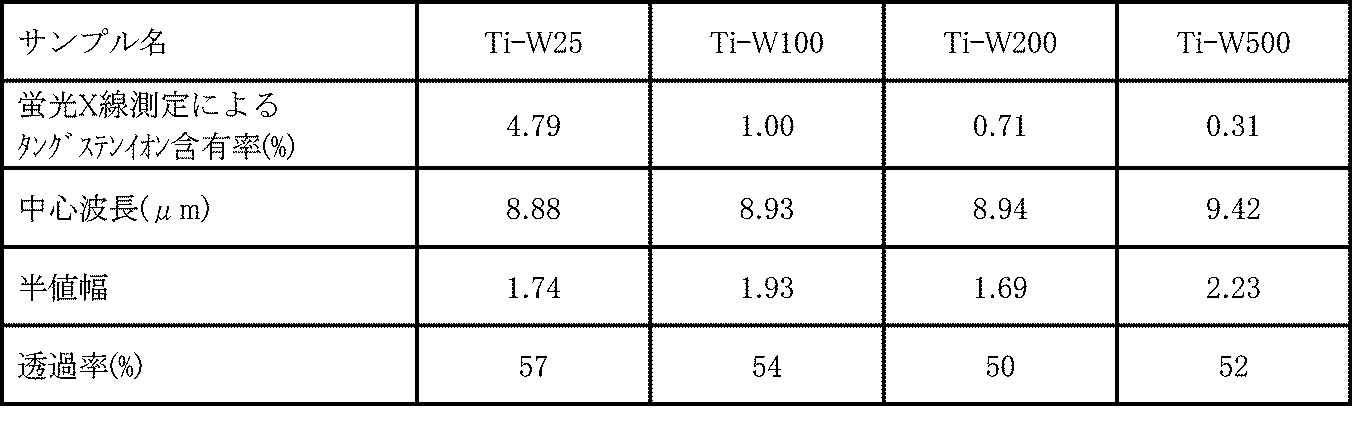
上記実施例1の硝酸マンガンの代わりに、タングステン酸アンモニウム(ポリマー金属錯体中、エチレンイミン/タングステンのモル比=1/25、1/100、1/200、1/500)用いた以外、同様な条件下で前駆体合成と空気下焼成(800℃)を行ない、タングステンイオンがドープされたルチル型酸化チタンを得た。表2に、4種類のタングステンドープ量が異なる酸化チタンを示した(タングステンイオン含有率はW2O5とした場合の換算値)。
90部のポリエチレンと10部の1-Ti-Mn500を混ぜ合わせた後、この混合物を二軸混練機(テクノベル製、KZW15TW-45MG-NH-700)に投入し、250℃加熱条件下15分間溶融混練した。混練終了後、ブレンド試料を混練チャンバーから取りだし,二枚の鉄板に挟んで冷却固化し、厚さ約2mm程度のフィルムに成形した。
10mlの20vol%チタン(IV)テトラブトキシド[Ti(OBu)4]の無水エタノール溶液中に1mlの0.1M硝酸マンガンを加え、室温下で攪拌しながら一時間反応させた。沈殿物を水で洗浄し、室温で乾燥した。空気雰囲気下、乾燥粉末を800℃にて3時間焼成した。XRD測定から、焼成後の酸化チタンがルチル結晶であることが確認された。蛍光X線分析から、該酸化チタン中には0.76%のMnOが検出された。
Claims (9)
- 遷移金属イオンがドーピングされたルチル型酸化チタン結晶を製造する方法であって、
(I)アミノ基を有する塩基性ポリマー(x)と遷移金属イオンとの錯体(y)を水性媒体中に分散又は溶解させる工程、
(II)(I)で得られた水性分散体又は水性溶液と、水溶性チタン化合物(z)とを水性媒体中、50℃以下の温度条件下で混合し加水分解反応を行うことによって、アミノ基を有する塩基性ポリマー(x)と遷移金属イオンとの錯体(y)がチタニアに挟まれた、1~3nmの距離間隔を有するポリマー/チタニアの層状構造複合体を得る工程、
(III)前記層状構造複合体を空気雰囲気下で650℃以上の温度で加熱焼成することにより、層状構造に閉じ込まれた遷移金属イオンが酸化チタン結晶表面にドーピングさせると同時にルチル型結晶相に成長させる工程、
とを有することを特徴とするルチル型酸化チタン結晶の製造方法。 - 前記遷移金属イオンが、鉄、亜鉛、マンガン、銅、コバルト、バナジウム、タングステン及びニッケルからなる群から選ばれる一種以上の遷移金属のイオンである請求項1記載のルチル型酸化チタン結晶の製造方法。
- 遷移金属イオンがドーピングされてなるルチル型酸化チタン結晶であって、
該結晶が、赤外線スペクトルにて5~12μmの範囲で透過性を示し、且つその透過ピークトップの半値幅が2.5μm以下であることを特徴とするルチル型酸化チタン結晶。 - 前記遷移金属イオンが鉄、亜鉛、マンガン、銅、コバルト、バナジウム、タングステン及びニッケルからなる群から選ばれる一種以上の遷移金属のイオンである請求項3記載のルチル型酸化チタン結晶。
- 前記遷移金属イオンの含有率が0.01~10質量%である請求項3又は4記載のルチル型酸化チタン結晶。
- 請求項3~5の何れか1項記載のルチル型酸化チタン結晶を含有することを特徴とする中間赤外線フィルター用粉末。
- 請求項3~5の何れか1項記載のルチル型酸化チタン結晶とポリオレフィン類とを含有することを特徴とする中間赤外線フィルター用成形材料。
- 中間赤外線フィルター用成形材料を製造する方法であって、
(I)アミノ基を有する塩基性ポリマー(x)と遷移金属イオンとの錯体(y)を水性媒体中に分散又は溶解させる工程、
(II)(I)で得られた水性分散体又は水性溶液と、水溶性チタン化合物(z)とを水性媒体中、50℃以下の温度条件下で混合し加水分解反応を行うことによって、アミノ基を有する塩基性ポリマー(x)と遷移金属イオンとの錯体(y)がチタニアに挟まれた、1~3nmの距離間隔を有するポリマー/チタニアの層状構造複合体を得る工程、
(III)前記層状構造複合体を空気雰囲気下で650℃以上の温度で加熱焼成することにより、層状構造に閉じ込まれた遷移金属イオンが酸化チタン結晶表面にドーピングさせると同時にルチル型結晶相に成長させる工程、
(IV)(III)で得られたルチル型酸化チタン結晶をポリオレフィン類に分散する工程
とを有することを特徴とする中間赤外線フィルター用成形材料の製造方法。 - 請求項7記載の中間赤外線フィルター用成形材料を成形してなることを特徴とする中間赤外線フィルター。
Priority Applications (5)
| Application Number | Priority Date | Filing Date | Title |
|---|---|---|---|
| US13/322,346 US20120161090A1 (en) | 2009-06-01 | 2010-05-24 | Rutile-type titanium oxide crystal and mid-infrared filter using the same |
| DE112010002196T DE112010002196T5 (de) | 2009-06-01 | 2010-05-24 | Titanoxidkristall vom rutil-typ und filter im mittlereninfparotbereich zur verwendung desselben |
| KR1020117025196A KR101279492B1 (ko) | 2009-06-01 | 2010-05-24 | 루틸형 산화티탄 결정 및 이것을 사용하는 중간적외선 필터 |
| JP2010535160A JP4704515B2 (ja) | 2009-06-01 | 2010-05-24 | ルチル型酸化チタン結晶及びこれを用いる中間赤外線フィルター |
| CN2010800241347A CN102448887A (zh) | 2009-06-01 | 2010-05-24 | 金红石型氧化钛晶体及使用其的中红外线滤波器 |
Applications Claiming Priority (2)
| Application Number | Priority Date | Filing Date | Title |
|---|---|---|---|
| JP2009-132024 | 2009-06-01 | ||
| JP2009132024 | 2009-06-01 |
Publications (1)
| Publication Number | Publication Date |
|---|---|
| WO2010140499A1 true WO2010140499A1 (ja) | 2010-12-09 |
Family
ID=43297635
Family Applications (1)
| Application Number | Title | Priority Date | Filing Date |
|---|---|---|---|
| PCT/JP2010/058709 Ceased WO2010140499A1 (ja) | 2009-06-01 | 2010-05-24 | ルチル型酸化チタン結晶及びこれを用いる中間赤外線フィルター |
Country Status (6)
| Country | Link |
|---|---|
| US (1) | US20120161090A1 (ja) |
| JP (1) | JP4704515B2 (ja) |
| KR (1) | KR101279492B1 (ja) |
| CN (1) | CN102448887A (ja) |
| DE (1) | DE112010002196T5 (ja) |
| WO (1) | WO2010140499A1 (ja) |
Cited By (3)
| Publication number | Priority date | Publication date | Assignee | Title |
|---|---|---|---|---|
| JP2013166659A (ja) * | 2012-02-14 | 2013-08-29 | Kawamura Institute Of Chemical Research | 金属酸化物ナノシートの製造方法及び金属酸化物ナノシート |
| WO2018079376A1 (ja) | 2016-10-28 | 2018-05-03 | 信越化学工業株式会社 | 耐熱性ミラブル型シリコーンゴム組成物 |
| WO2022176939A1 (ja) | 2021-02-18 | 2022-08-25 | 信越化学工業株式会社 | 耐熱性ミラブル型フロロシリコーンゴム組成物 |
Families Citing this family (10)
| Publication number | Priority date | Publication date | Assignee | Title |
|---|---|---|---|---|
| US8545995B2 (en) * | 2009-12-14 | 2013-10-01 | Lawrence Livermore National Security, Llc. | Systems having optical absorption layer for mid and long wave infrared and methods for making the same |
| JP6442416B2 (ja) * | 2013-01-07 | 2018-12-19 | 日東電工株式会社 | 酸化物被覆基材の形成方法 |
| JP6225786B2 (ja) * | 2013-05-29 | 2017-11-08 | Toto株式会社 | 金属酸化物粒子の製造方法 |
| WO2018163766A1 (ja) * | 2017-03-09 | 2018-09-13 | 富士フイルム株式会社 | 構造体、キットおよび光センサ |
| KR102806130B1 (ko) | 2019-05-31 | 2025-05-09 | 삼성전자주식회사 | 복합 구조체, 광학 필터, 이미지 센서, 카메라 모듈 및 전자 장치 |
| KR102810487B1 (ko) | 2019-09-03 | 2025-05-19 | 삼성전자주식회사 | 복합 구조체, 광학 필터, 이미지 센서, 카메라 모듈 및 전자 장치 |
| KR102910468B1 (ko) | 2019-09-10 | 2026-01-08 | 삼성전자주식회사 | 복합 구조체, 광학 필터, 이미지 센서, 카메라 모듈 및 전자 장치 |
| JP7704145B2 (ja) * | 2020-08-03 | 2025-07-08 | サンケン電気株式会社 | 減光剤及び減光剤を含む発光装置 |
| TW202300959A (zh) * | 2021-03-11 | 2023-01-01 | 美商應用材料股份有限公司 | 藉由物理氣相沉積所沉積的氧化鈦光學裝置薄膜 |
| CN116332632B (zh) * | 2022-12-12 | 2024-11-05 | 南京工业大学 | 一种多光谱抑制陶瓷材料的制备方法 |
Citations (3)
| Publication number | Priority date | Publication date | Assignee | Title |
|---|---|---|---|---|
| WO2004052786A1 (ja) * | 2002-12-09 | 2004-06-24 | Tayca Corporation | 有益な性質を有する酸化チタン粒子およびその製造方法 |
| JP2007238424A (ja) * | 2006-02-13 | 2007-09-20 | Hideki Koyanaka | R型二酸化マンガンナノニードル多孔体とそれを構成するr型二酸化マンガンナノニードル、水素化した酸化マンガン、赤外線吸収材料、赤外線フィルター、およびそれらの製造方法 |
| WO2008072595A1 (ja) * | 2006-12-13 | 2008-06-19 | Kawamura Institute Of Chemical Research | ドーピング酸化チタンの製造方法、ドーピング酸化チタン及びこれを用いる可視光応答型光触媒 |
Family Cites Families (4)
| Publication number | Priority date | Publication date | Assignee | Title |
|---|---|---|---|---|
| CN1154947A (zh) * | 1995-10-05 | 1997-07-23 | 泰奥塞集团服务有限公司 | 二氧化钛的煅烧方法 |
| EP1400491A3 (en) * | 2002-09-18 | 2005-01-19 | Toshiba Ceramics Co., Ltd. | Titanium dioxide fine particles and method for producing the same, and method for producing visible light activatable photocatalyst |
| CN100536047C (zh) * | 2003-03-12 | 2009-09-02 | 厦门量子星科技有限公司 | 一种可用于消除高电压线路中高频电磁干扰的电容器 |
| WO2008023597A1 (fr) * | 2006-08-25 | 2008-02-28 | Toda Kogyo Corp. | Corps poreux de nano-aiguille de dioxyde de manganèse de type r, nano-aiguille de dioxyde de manganèse de type r constituant celui-ci, oxyde de manganèse hydrogénée, matériau absorbant le rayonnement infra-rouge, filtre infrarouge et leurs procédés de production |
-
2010
- 2010-05-24 KR KR1020117025196A patent/KR101279492B1/ko not_active Expired - Fee Related
- 2010-05-24 JP JP2010535160A patent/JP4704515B2/ja not_active Expired - Fee Related
- 2010-05-24 CN CN2010800241347A patent/CN102448887A/zh active Pending
- 2010-05-24 WO PCT/JP2010/058709 patent/WO2010140499A1/ja not_active Ceased
- 2010-05-24 US US13/322,346 patent/US20120161090A1/en not_active Abandoned
- 2010-05-24 DE DE112010002196T patent/DE112010002196T5/de not_active Withdrawn
Patent Citations (3)
| Publication number | Priority date | Publication date | Assignee | Title |
|---|---|---|---|---|
| WO2004052786A1 (ja) * | 2002-12-09 | 2004-06-24 | Tayca Corporation | 有益な性質を有する酸化チタン粒子およびその製造方法 |
| JP2007238424A (ja) * | 2006-02-13 | 2007-09-20 | Hideki Koyanaka | R型二酸化マンガンナノニードル多孔体とそれを構成するr型二酸化マンガンナノニードル、水素化した酸化マンガン、赤外線吸収材料、赤外線フィルター、およびそれらの製造方法 |
| WO2008072595A1 (ja) * | 2006-12-13 | 2008-06-19 | Kawamura Institute Of Chemical Research | ドーピング酸化チタンの製造方法、ドーピング酸化チタン及びこれを用いる可視光応答型光触媒 |
Cited By (5)
| Publication number | Priority date | Publication date | Assignee | Title |
|---|---|---|---|---|
| JP2013166659A (ja) * | 2012-02-14 | 2013-08-29 | Kawamura Institute Of Chemical Research | 金属酸化物ナノシートの製造方法及び金属酸化物ナノシート |
| WO2018079376A1 (ja) | 2016-10-28 | 2018-05-03 | 信越化学工業株式会社 | 耐熱性ミラブル型シリコーンゴム組成物 |
| US10954385B2 (en) | 2016-10-28 | 2021-03-23 | Shin-Etsu Chemical Co., Ltd. | Heat-resistant millable silicone rubber composition |
| WO2022176939A1 (ja) | 2021-02-18 | 2022-08-25 | 信越化学工業株式会社 | 耐熱性ミラブル型フロロシリコーンゴム組成物 |
| KR20230146019A (ko) | 2021-02-18 | 2023-10-18 | 신에쓰 가가꾸 고교 가부시끼가이샤 | 내열성 미러블형 플루오로실리콘 고무 조성물 |
Also Published As
| Publication number | Publication date |
|---|---|
| CN102448887A (zh) | 2012-05-09 |
| KR101279492B1 (ko) | 2013-06-27 |
| US20120161090A1 (en) | 2012-06-28 |
| JP4704515B2 (ja) | 2011-06-15 |
| DE112010002196T5 (de) | 2012-06-28 |
| JPWO2010140499A1 (ja) | 2012-11-15 |
| KR20120022815A (ko) | 2012-03-12 |
Similar Documents
| Publication | Publication Date | Title |
|---|---|---|
| JP4704515B2 (ja) | ルチル型酸化チタン結晶及びこれを用いる中間赤外線フィルター | |
| JP4812912B1 (ja) | ルチル型酸化チタン結晶を含有する赤外線吸収薄膜及びその製造方法 | |
| US8017542B2 (en) | Method for production of doped titanium oxide, doped titanium oxide, and visible light-responsive photocatalyst comprising the doped titanium oxide | |
| Naghibi et al. | Application of the statistical Taguchi method to optimize TiO2 nanoparticles synthesis by the hydrothermal assisted sol–gel technique | |
| Ma et al. | Mesocrystals—Applications and potential | |
| KR20150058379A (ko) | 가시광 응답형 광촉매 미립자 분산액, 그의 제조 방법, 및 광촉매 박막을 표면에 갖는 부재 | |
| Balamurugan et al. | Synthesis of anatase and rutile mixed phase titanium dioxide nanoparticles using simple solution combustion method | |
| JP2008518873A (ja) | 二酸化チタンナノ粒子の合成 | |
| Zhang et al. | Synthesis and characterization of environmentally friendly BiVO4 yellow pigment by non-hydrolytic sol-gel route | |
| Godse et al. | Synthesis characterization and antimicrobial activity of copper oxide nanoparticles using sol-gel method | |
| Mulmi et al. | Spectroscopic studies of boron doped titanium dioxide nanoparticles | |
| US20130315787A1 (en) | Nanocrystals and methods and uses thereof | |
| Anyamaa et al. | Metal-organic frameworks as precursor for metal oxide nanostructures Part I: MOF-derived copper oxide embedded in carbon matrix | |
| Rahmatolahzadeh et al. | Synthesis, characterization, and morphological control of Cn3B2O6 nanostructures by sol–gel process for azo dye degradation | |
| KR101763357B1 (ko) | 루타일 이산화티탄 분말의 제조방법 | |
| JP4446776B2 (ja) | アナターゼ型酸化チタン結晶の製造方法 | |
| Kharkwal et al. | Synthesis and optical properties of pure CdTiO3 and Ni2+ and Zn2+ ion substituted CdTiO3 obtained by a novel precursor route | |
| Kobayashi et al. | Dispersion of oleate-modified CeO2 nanocrystals in non-polar solvent and aqueous solution | |
| Cui et al. | Formation of nanoparticles in solid-state matrices: a strategy for bulk transparent TiO 2–polymer nanocomposites | |
| Jayaselvan et al. | Structural, optical and phase formation modifications by varying precursor temperature on Mn2O3 nanoparticles prepared by microwave assisted precipitation | |
| KR20170090023A (ko) | 프러시안 블루 유사체를 포함하는 흡착제 및 이를 이용한 수처리 정화 방법 | |
| Zomaya | Synthesis of Chemically Stable VO2 Particles Using Green Solvents and their Application as Smart Coatings | |
| Priya et al. | Structural role of polyethylene glycol in the formation of anatase nanocrystalline titania at low temperature | |
| Gupta et al. | Titanium Dioxide Nanoparticles | |
| JP2010209288A (ja) | 酸化チタンを含有する水溶性複合材料及びその製造方法 |
Legal Events
| Date | Code | Title | Description |
|---|---|---|---|
| WWE | Wipo information: entry into national phase |
Ref document number: 201080024134.7 Country of ref document: CN |
|
| ENP | Entry into the national phase |
Ref document number: 2010535160 Country of ref document: JP Kind code of ref document: A |
|
| 121 | Ep: the epo has been informed by wipo that ep was designated in this application |
Ref document number: 10783283 Country of ref document: EP Kind code of ref document: A1 |
|
| ENP | Entry into the national phase |
Ref document number: 20117025196 Country of ref document: KR Kind code of ref document: A |
|
| WWE | Wipo information: entry into national phase |
Ref document number: 112010002196 Country of ref document: DE Ref document number: 1120100021961 Country of ref document: DE |
|
| WWE | Wipo information: entry into national phase |
Ref document number: 13322346 Country of ref document: US |
|
| 122 | Ep: pct application non-entry in european phase |
Ref document number: 10783283 Country of ref document: EP Kind code of ref document: A1 |