WO2010119989A1 - 低温靭性の優れた高生産型780MPa級高張力鋼板とその製造方法 - Google Patents
低温靭性の優れた高生産型780MPa級高張力鋼板とその製造方法 Download PDFInfo
- Publication number
- WO2010119989A1 WO2010119989A1 PCT/JP2010/057193 JP2010057193W WO2010119989A1 WO 2010119989 A1 WO2010119989 A1 WO 2010119989A1 JP 2010057193 W JP2010057193 W JP 2010057193W WO 2010119989 A1 WO2010119989 A1 WO 2010119989A1
- Authority
- WO
- WIPO (PCT)
- Prior art keywords
- less
- temperature
- steel
- toughness
- steel sheet
- Prior art date
- Legal status (The legal status is an assumption and is not a legal conclusion. Google has not performed a legal analysis and makes no representation as to the accuracy of the status listed.)
- Ceased
Links
Classifications
-
- C—CHEMISTRY; METALLURGY
- C21—METALLURGY OF IRON
- C21D—MODIFYING THE PHYSICAL STRUCTURE OF FERROUS METALS; GENERAL DEVICES FOR HEAT TREATMENT OF FERROUS OR NON-FERROUS METALS OR ALLOYS; MAKING METAL MALLEABLE, e.g. BY DECARBURISATION OR TEMPERING
- C21D8/00—Modifying the physical properties of ferrous metals or ferrous alloys by deformation combined with, or followed by, heat treatment
- C21D8/02—Modifying the physical properties of ferrous metals or ferrous alloys by deformation combined with, or followed by, heat treatment during manufacturing of plates or strips
- C21D8/0221—Modifying the physical properties of ferrous metals or ferrous alloys by deformation combined with, or followed by, heat treatment during manufacturing of plates or strips characterised by the working steps
- C21D8/0226—Hot rolling
-
- C—CHEMISTRY; METALLURGY
- C21—METALLURGY OF IRON
- C21D—MODIFYING THE PHYSICAL STRUCTURE OF FERROUS METALS; GENERAL DEVICES FOR HEAT TREATMENT OF FERROUS OR NON-FERROUS METALS OR ALLOYS; MAKING METAL MALLEABLE, e.g. BY DECARBURISATION OR TEMPERING
- C21D8/00—Modifying the physical properties of ferrous metals or ferrous alloys by deformation combined with, or followed by, heat treatment
- C21D8/02—Modifying the physical properties of ferrous metals or ferrous alloys by deformation combined with, or followed by, heat treatment during manufacturing of plates or strips
- C21D8/0247—Modifying the physical properties of ferrous metals or ferrous alloys by deformation combined with, or followed by, heat treatment during manufacturing of plates or strips characterised by the heat treatment
- C21D8/0263—Modifying the physical properties of ferrous metals or ferrous alloys by deformation combined with, or followed by, heat treatment during manufacturing of plates or strips characterised by the heat treatment following hot rolling
-
- C—CHEMISTRY; METALLURGY
- C22—METALLURGY; FERROUS OR NON-FERROUS ALLOYS; TREATMENT OF ALLOYS OR NON-FERROUS METALS
- C22C—ALLOYS
- C22C38/00—Ferrous alloys, e.g. steel alloys
- C22C38/001—Ferrous alloys, e.g. steel alloys containing N
-
- C—CHEMISTRY; METALLURGY
- C22—METALLURGY; FERROUS OR NON-FERROUS ALLOYS; TREATMENT OF ALLOYS OR NON-FERROUS METALS
- C22C—ALLOYS
- C22C38/00—Ferrous alloys, e.g. steel alloys
- C22C38/02—Ferrous alloys, e.g. steel alloys containing silicon
-
- C—CHEMISTRY; METALLURGY
- C22—METALLURGY; FERROUS OR NON-FERROUS ALLOYS; TREATMENT OF ALLOYS OR NON-FERROUS METALS
- C22C—ALLOYS
- C22C38/00—Ferrous alloys, e.g. steel alloys
- C22C38/04—Ferrous alloys, e.g. steel alloys containing manganese
-
- C—CHEMISTRY; METALLURGY
- C22—METALLURGY; FERROUS OR NON-FERROUS ALLOYS; TREATMENT OF ALLOYS OR NON-FERROUS METALS
- C22C—ALLOYS
- C22C38/00—Ferrous alloys, e.g. steel alloys
- C22C38/06—Ferrous alloys, e.g. steel alloys containing aluminium
-
- C—CHEMISTRY; METALLURGY
- C22—METALLURGY; FERROUS OR NON-FERROUS ALLOYS; TREATMENT OF ALLOYS OR NON-FERROUS METALS
- C22C—ALLOYS
- C22C38/00—Ferrous alloys, e.g. steel alloys
- C22C38/18—Ferrous alloys, e.g. steel alloys containing chromium
- C22C38/40—Ferrous alloys, e.g. steel alloys containing chromium with nickel
- C22C38/42—Ferrous alloys, e.g. steel alloys containing chromium with nickel with copper
-
- C—CHEMISTRY; METALLURGY
- C22—METALLURGY; FERROUS OR NON-FERROUS ALLOYS; TREATMENT OF ALLOYS OR NON-FERROUS METALS
- C22C—ALLOYS
- C22C38/00—Ferrous alloys, e.g. steel alloys
- C22C38/18—Ferrous alloys, e.g. steel alloys containing chromium
- C22C38/40—Ferrous alloys, e.g. steel alloys containing chromium with nickel
- C22C38/44—Ferrous alloys, e.g. steel alloys containing chromium with nickel with molybdenum or tungsten
-
- C—CHEMISTRY; METALLURGY
- C22—METALLURGY; FERROUS OR NON-FERROUS ALLOYS; TREATMENT OF ALLOYS OR NON-FERROUS METALS
- C22C—ALLOYS
- C22C38/00—Ferrous alloys, e.g. steel alloys
- C22C38/18—Ferrous alloys, e.g. steel alloys containing chromium
- C22C38/40—Ferrous alloys, e.g. steel alloys containing chromium with nickel
- C22C38/46—Ferrous alloys, e.g. steel alloys containing chromium with nickel with vanadium
-
- C—CHEMISTRY; METALLURGY
- C22—METALLURGY; FERROUS OR NON-FERROUS ALLOYS; TREATMENT OF ALLOYS OR NON-FERROUS METALS
- C22C—ALLOYS
- C22C38/00—Ferrous alloys, e.g. steel alloys
- C22C38/18—Ferrous alloys, e.g. steel alloys containing chromium
- C22C38/40—Ferrous alloys, e.g. steel alloys containing chromium with nickel
- C22C38/50—Ferrous alloys, e.g. steel alloys containing chromium with nickel with titanium or zirconium
-
- C—CHEMISTRY; METALLURGY
- C22—METALLURGY; FERROUS OR NON-FERROUS ALLOYS; TREATMENT OF ALLOYS OR NON-FERROUS METALS
- C22C—ALLOYS
- C22C38/00—Ferrous alloys, e.g. steel alloys
- C22C38/18—Ferrous alloys, e.g. steel alloys containing chromium
- C22C38/40—Ferrous alloys, e.g. steel alloys containing chromium with nickel
- C22C38/54—Ferrous alloys, e.g. steel alloys containing chromium with nickel with boron
Definitions
- the present invention relates to a 780 MPa class high-tensile steel plate for offshore structure steel having excellent low temperature toughness and excellent productivity, and a method for producing the same.
- the present invention can also be applied to architectural steel and bridge steel.
- Nb added for refining the structure has an extremely high effect of hardening the welded portion, and as a result, the weld heat affected zone (HAZ) toughness is deteriorated.
- HAZ weld heat affected zone
- a high-strength steel such as a 780 MPa class steel is problematic because the HAZ toughness deterioration due to this effect is extremely large.
- N has been fixed by Al or Ti (formation of AlN or TiN), which has been solved.
- the effect of fixing N of Al disappears due to dissolution of AlN during slab heating before rolling and direct quenching, and the solid solution B due to BN formation disappears.
- the hardenability is significantly reduced due to the decrease, and Ti and C added to fix N are combined, and the base material and weld toughness are deteriorated due to the formation of hard particles TiC.
- the gist of the present invention is as follows. (1) By mass%, C: 0.06 to 0.15%, Si: 0.05 to 0.35%, Mn: 0.6 to 2.00%, P: 0.015% or less, S: 0.015% or less, Cu: 0.1 to 0.5%, Ni: 0.1 to 1.5%, Cr: 0.05 to 0.8%, Mo: 0.1 to 0.6%, Nb: 0.004% or less, V: 0.005-0.060%, Ti: 0.002-0.005%, Al: 0.03-0.10%, B: 0.0005-0.003 %, N: 0.002 to 0.004%, and the balance is made of iron and inevitable impurities.
- a high-production type 780 MPa class high-tensile steel sheet having excellent low-temperature toughness characterized in that it is cooled to 200 ° C. or lower at a cooling rate of 20 ° C. and then tempered for 20 minutes to 60 minutes at a temperature of 450 ° C. to 650 ° C. Manufacturing method.
- (Equation 1) (% Al) and (% Ti) are the concentrations (mass%) of Al and Ti in the slab, respectively, and T is the slab heating temperature (K).
- K the slab heating temperature
- a high-production type 780 MPa class high-tensile steel sheet having excellent low-temperature toughness characterized in that it is cooled to 200 ° C. or lower at a cooling rate of 20 ° C. and then tempered for 20 minutes to 60 minutes at a temperature of 450 ° C. to 650 ° C. Manufacturing method.
- (% Al) and (% Ti) are the concentrations (mass%) of Al and Ti in the slab, respectively, and T is the slab heating temperature (K).
- a high level steel material having high strength, excellent base metal low temperature toughness and HAZ low temperature toughness can be obtained, which is extremely useful industrially.
- the present invention combines the combination of Al addition + trace Ti addition to securely fix N in steel that may be generated by heating, and contributes to improving hardenability.
- This is a technology that can secure high strength and high-temperature toughness while ensuring B and maintaining high productivity.
- the steel material that is the subject of the present invention is required to have a high strength of 780 MPa class and toughness at ⁇ 40 ° C. in the base material and the weld.
- B is known as an element that segregates at the austenite grain boundary and stabilizes the grain boundary, thereby suppressing transformation from the grain boundary and improving hardenability.
- austenite grains become fine by using a lot of controlled rolling, and when the austenite grain interfacial area increases, the amount of B grain boundary segregation becomes insufficient, or many dislocations are introduced into austenite. Therefore, when the pipe diffusion is promoted and B is not easily segregated at the grain boundary, there is a problem that the predetermined hardenability cannot be obtained and the material varies.
- B is an element that exhibits an effect in a very small amount, there is also a problem that it reacts sensitively with a slight difference in conditions and the material is likely to change. Therefore, in order to use B stably, it is important not to make the austenite grains too fine and to introduce more dislocations.
- the present inventors combined (0.0) Al addition of 0.03% or more and 0.002 to 0.005% trace Ti addition, even when manufacturing by DQ, (a) Trace Ti is preferential with N As a result, it is possible to suppress the increase in free N, (b) the dissolution of AlN is less likely to occur compared to the addition of Al alone, and (c) the toughness deterioration due to Ti does not occur due to the addition of a small amount. As a result, it was found that free B in the steel can be easily secured, and a hardened structure that fully utilizes the effect of improving hardenability can be sufficiently obtained. As a result, both high strength and high toughness can be achieved.
- the carbon equivalent (Ceq) represented by the following formula (2) needs to be 0.41 or more and 0.61 or less.
- Ceq may be limited to 0.43 or more, 0.45 or more, or 0.47 or more.
- it may be limited to 0.59 or less, 0.57 or less, 0.55 or less, or 0.53 or less.
- Ceq % C +% Mn / 6 + (% Cu +% Ni) / 15 + (% Cr +% Mo +% V) / 5 (2)
- % C,% Mn,% Cu,% Ni,% Cr,% Mo,% V in the formula (2) is the content (% by mass) of each element.
- C 0.06 to 0.15% C is an element necessary for ensuring strength, and addition of 0.06% or more is necessary. However, addition of a large amount may cause low temperature toughness, particularly HAZ toughness reduction, so its upper limit value. Is 0.15%. In order to stably secure the strength, the amount may be limited to 0.08% or more, 0.09% or more, or 0.10% or more. Moreover, you may restrict
- Si 0.05 to 0.35%
- Si is an element effective as a deoxidizer and to increase the strength of steel by solid solution strengthening. However, if its content is less than 0.05%, these effects are small, exceeding 0.35%. When contained, the HAZ toughness is deteriorated. For this reason, Si was limited to 0.05 to 0.35%. In order to perform deoxidation reliably, you may restrict
- Mn 0.6 to 2.00% Since Mn increases the strength of steel, it is an effective element for increasing the strength, and a content exceeding 0.60% is required from the viewpoint of ensuring hardenability. However, when Mn exceeding 2.00% is added, toughness deteriorates. For this reason, Mn was limited to 0.60 to 2.00%. In order to improve hardenability, the content may be limited to 0.70% or more, 0.75% or more, 0.80% or more, or 0.90% or more. In order to prevent toughness deterioration, you may restrict
- P 0.015% or less P is segregated at the grain boundary and deteriorates the toughness of the steel, so it is desirable to reduce it as much as possible, but since it is acceptable up to 0.015%, it is limited to 0.015% or less. In order to improve toughness, the content may be limited to 0.012% or less, 0.009% or less, or 0.007% or less.
- S 0.015% or less
- S is mainly present in steel by forming MnS, and has the effect of refining the structure after rolling and cooling, but the content exceeding 0.015% is in the thickness direction.
- Reduce toughness and ductility since S is essential to be 0.015% or less, S is limited to 0.015% or less. In order to improve toughness and toughness, it may be limited to 0.010% or less, 0.007% or less, 0.005% or less, or 0.003% or less.
- Cu 0.1 to 0.5%
- Cu is an effective element for securing the strength of the steel sheet by solid solution strengthening and precipitation strengthening, and a content of 0.1% or more is necessary, but addition exceeding 0.5% is hot working There is a risk of reducing the performance. For this reason, Cu was limited to 0.1 to 0.5%.
- the content In order to stably secure the strength, the content may be limited to 0.15% or more or 0.20% or more. In order to prevent a decrease in hot workability, the content may be limited to 0.40% or less, 0.35% or less, or 0.30% or less.
- Ni 0.1 to 1.5%
- Ni is effective in securing the strength and low temperature toughness of the steel sheet, and a content of 0.1% or more is necessary.
- addition over 1.5% significantly increases the cost.
- Ni was limited to 0.1 to 1.5%.
- Cr 0.05 to 0.8% Cr is an effective element for ensuring the strength of the steel sheet mainly by solid solution strengthening, and a content of 0.05% or more is necessary. Weldability is impaired and costs are increased. For this reason, Cr was limited to 0.05 to 0.8%.
- the content may be limited to 0.20% or more, 0.30% or more, or 0.40% or more.
- the content may be limited to 0.70% or less, 0.60% or less, or 0.50% or less.
- Mo 0.05-0.6%
- Mo is an effective element for securing the strength of the steel sheet by precipitation strengthening and solid solution strengthening, and a content of 0.05% or more is necessary, but addition exceeding 0.6% is a workability of the steel sheet. Cost and cost increase. For this reason, Mo was limited to 0.05 to 0.6%.
- the content may be limited to 0.20% or more, 0.25% or more, or 0.30% or more.
- it may be limited to 0.55% or less, 0.50% or less, or 0.45% or less.
- Nb 0.004% or less Nb expands the non-recrystallized region of austenite and promotes austenite refinement, thus causing a decrease in hardenability and further causing HAZ embrittlement due to Nb carbides. Therefore, Nb is limited to 0.004% or less because it is desirable that it is not contained as much as possible. You may restrict
- V 0.005 to 0.060%
- V is an effective element for securing the strength of the steel sheet by precipitation strengthening, and a content of 0.005% or more is necessary. However, addition over 0.060% impairs the weldability and toughness of the steel sheet. Therefore, V is limited to 0.005 to 0.060%. In order to improve the strength, the content may be limited to 0.015%, 0.025%, or 0.035% or more. You may restrict
- Ti 0.002 to 0.005%
- Ti combines with N in the steel to form TiN, and in addition to obtaining the effect of suppressing the coarsening of the crystal grain size, Ti is also an effective element in terms of N fixation. Addition of 002% or more is necessary. However, when 0.005% or more is added, the base material toughness may be deteriorated by combining with C to form TiC. For this reason, Ti was limited to 0.002 to 0.005%.
- Al 0.03-0.10%
- Al needs to be added in an amount of 0.03% or more in order to obtain an effect of suppressing the coarsening of the austenite grain size during reheating by bonding with N to form AlN and an effect of fixing N in the steel. is there.
- addition exceeding 0.10% may form coarse inclusions and deteriorate toughness.
- Al was limited to 0.03 to 0.10%. You may restrict
- the content may be limited to 0.09% or less, 0.08% or less, or 0.07% or less.
- B 0.0005 to 0.003%
- B is an element necessary for ensuring hardenability and needs to be added in an amount of 0.0005% or more, but addition exceeding 0.003% is low due to an excessive increase in hardenability due to excessive B.
- B is limited to 0.00005 to 0.003%.
- N 0.002 to 0.004%
- the effect of suppressing the coarsening of the austenite grain size at the time of reheating can be obtained by combining with Al or Ti to form AlN or TiN. If added over 0.004%, bonding with B is promoted, so the amount of free B in the steel is reduced, and the hardenability may be lowered. Therefore, N is limited to 0.002 to 0.004%.
- Mg 0.0050% or less
- Ca 0.0035% or less
- REM 0.0040% or less It is also effective to add.
- Mg has the effect of suppressing the grain growth of austenite in the HAZ and making it finer.
- HAZ toughness is improved, so that it can be selectively added particularly when the HAZ toughness is severe.
- the addition of Ca controls the form of MnS and further improves the low temperature toughness. Therefore, when severe HAZ characteristics are required, it can be selectively added.
- REM can form fine oxides and fine sulfides in molten steel and can exist stably thereafter, so it works effectively as pinning particles in the weld zone, especially improving high heat input weld toughness. Therefore, when particularly excellent toughness is required, it can be selected and added.
- the heating temperature of the slab needs to be 1050 ° C. or higher and 1150 ° C. or lower.
- the temperature is 1050 ° C. or more and 1150 ° C. or less after satisfying the condition that ATP defined by the following formula (1) is 0.0015 or less. It becomes.
- the reason for limiting the heating temperature is that when the temperature is lower than 1050 ° C., coarse inclusions that adversely affect the toughness generated during solidification may remain undissolved.
- the austenite grain size is excessively coarsened, which not only causes deterioration of toughness, but also may cause dissolution of precipitates formed by controlling the cooling rate during casting. Because there is. Based on the above, 1150 ° C. or lower is sufficient as the heating temperature in the sense of completing the phase transformation. As mentioned above, heating temperature was limited to 1050 degreeC or more and 1150 degrees C or less.
- ATP is defined by the following equation (1).
- This ATP is a parameter determined from the balance of Al, Ti, and N at each heating temperature for the amount of B necessary for ensuring hardenability. If the ATP exceeds 0.0015 when the plate thickness is 40 mm or more, the solute B is insufficient. Therefore, sufficient hardenability cannot be obtained. Therefore, ATP in the production of a steel material having a plate thickness of 40 mm or more is limited to 0.0015 or less. It should be noted that when the plate thickness is less than 40 mm, it is possible to ensure hardenability regardless of ATP. However, when the plate thickness is 12 mm or less, it is difficult to ensure the product shape, and further, the viewpoint of increasing the strength by ensuring the hardenability. Therefore, it is not desirable to apply the present invention to a plate thickness of 12 mm or less.
- the hot rolling on the heated slab needs to be completed at 870 ° C. or higher.
- the reason is that when rolling is performed at less than 870 ° C., the austenite recrystallization zone temperature and the non-recrystallization zone temperature become rolling, and the material becomes unstable due to variation in the austenite grain size, or This is because it becomes completely non-recrystallized zone rolling, and by making it finer, the hardenability is lowered and the required strength may not be obtained. For this reason, it limited to completion of hot rolling at 870 degreeC or more.
- the austenite particle diameter is 200 ⁇ m or less and 20 ⁇ m or more in terms of the equivalent circle diameter by heating and rolling so far.
- the austenite grain size is preferably 120 ⁇ m or less or 90 ⁇ m or less.
- the austenite grain size when reheated and quenched is less than 30 ⁇ m, but it is preferable that the austenite grain size be 30 ⁇ m or more or 40 ⁇ m or more in order to obtain high hardenability by taking advantage of the characteristics of DQ.
- the reason for starting the cooling after 10 seconds to 90 seconds have elapsed since the end of rolling is that when the period until the cooling start is less than 10 seconds, B cannot sufficiently diffuse into the austenite grain boundary and exceeds 90 seconds. This is because B is bonded to N in the steel, so that the hardenability is lowered and the required strength cannot be obtained.
- the reason for cooling from 840 ° C. or higher is that starting from less than 840 ° C.
- the cooling rate is 8 ° C./s or higher.
- the reason is that if the cooling rate is less than 8 ° C./s, the lower bainite structure or martensite structure necessary for obtaining the required strength cannot be obtained uniformly.
- the reason for cooling to 200 ° C or below is to ensure strength and toughness by lowering the cooling of the lower bainite structure or martensite structure (packets, blocks, etc.) when cooling is stopped at a temperature not reaching 200 ° C. This is because it becomes difficult.
- the hot rolling of the slab was completed, and after 10 seconds or more and 90 seconds or less had elapsed, it was limited to cooling from a temperature of 840 ° C. to 200 ° C. at a cooling rate of 8 ° C./s or more.
- the cooled steel sheet After the hot rolling is completed, the cooled steel sheet needs to be tempered for 20 minutes to 60 minutes at a temperature of 450 ° C. or higher and 650 ° C. or lower.
- the strength decreases as the temperature of the tempering process increases, and when the temperature exceeds 650 ° C., the strength becomes significant, and the required strength cannot be obtained.
- the tempering treatment at less than 450 ° C. the effect of improving toughness cannot be sufficiently obtained.
- the tempering time is less than 20 minutes, the effect of improving toughness cannot be sufficiently obtained, and if the tempering process exceeds 60 minutes, there is no significant material change, resulting in an increase in cost and a decrease in productivity due to the expansion of the heat treatment time.
- the steel sheet after completion of hot rolling and cooling is limited to being subjected to tempering treatment at a temperature of 450 ° C. or higher and 650 ° C. or lower for 20 minutes or longer and 60 minutes or shorter.
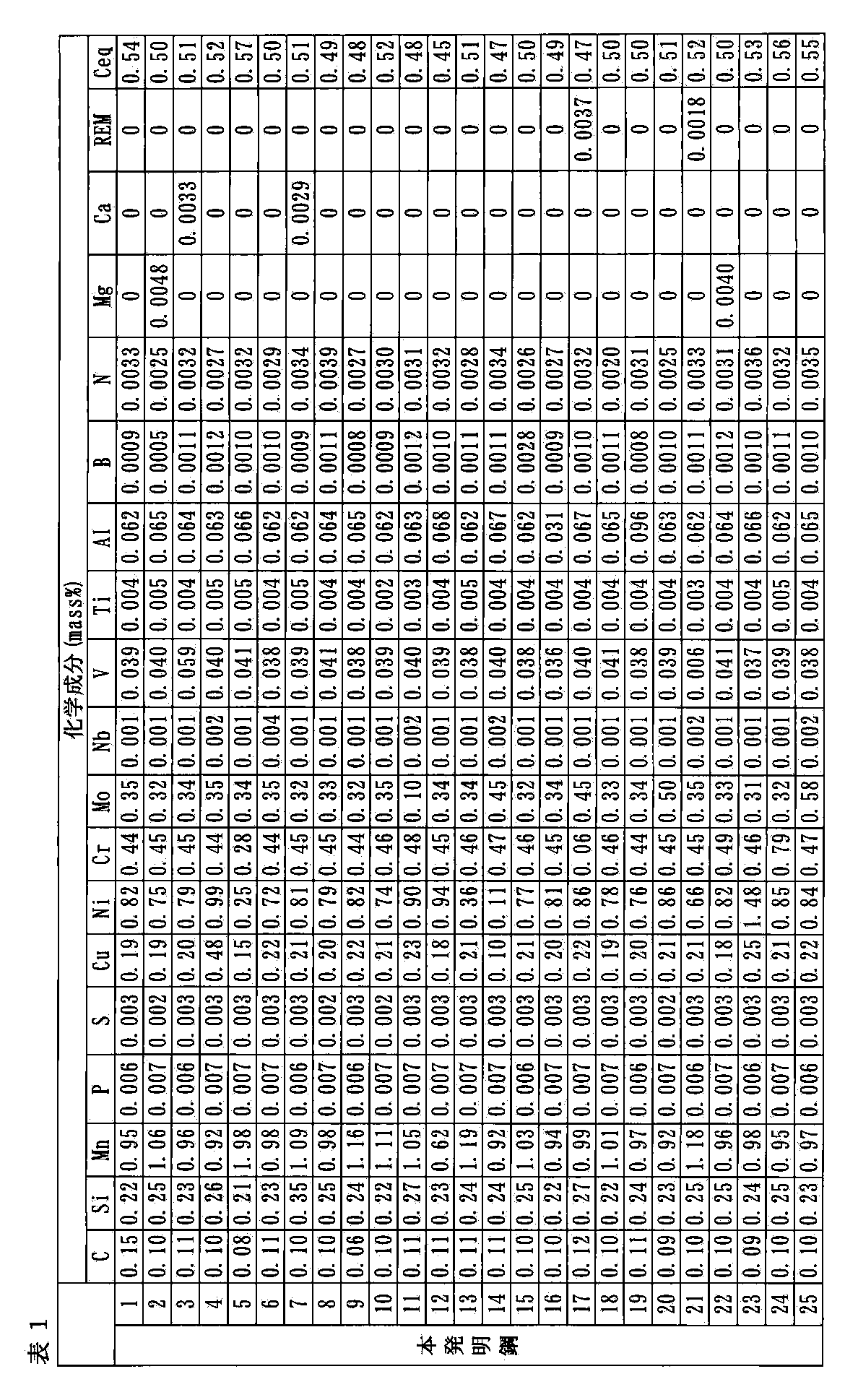
- a slab having the chemical composition shown in Tables 1 and 2 was subjected to hot rolling, direct quenching and tempering treatment under the conditions shown in Tables 3 and 4 to obtain a steel plate, and then a test was conducted to evaluate mechanical properties. .
- the prior austenite particle size was measured.
- JIS No. 4 test pieces were sampled from 1/4 of the thickness of each steel plate, and YS (0.2% proof stress), TS, and El were evaluated.
- the base material toughness was evaluated based on the impact absorption energy value obtained by collecting JIS 2 mmV notch test pieces from a 1/4 thickness portion of each steel plate, performing a Charpy impact test at -40 ° C.
- the HAZ toughness was evaluated by an impact absorption energy value obtained by a Charpy impact test at ⁇ 40 ° C. for a steel plate subjected to a reproducible thermal cycle test corresponding to a welding heat input of 5 kJ / mm.
- the base material has a yield strength of 690 MPa or more, a tensile strength of 780 MPa or more and 930 MPa or less, a base material impact test energy value of 100 J or more on average, and a HAZ impact test energy value of 50 J or more on average.
- Tables 5 and 6 summarize the mechanical properties of each steel obtained as a result of the test.
- those with symbols a and c and those without symbols are shown for the steel sheet of the present invention.
- these steel sheets satisfy the requirements of chemical components and production conditions, and as shown in Tables 5 and 6, have excellent base material properties and HAZ toughness. I understand. Moreover, if it is in a regulation range, even if it adds Mg, Ca, and REM, it turns out that a favorable mechanical characteristic is acquired.
- steels 26 to 47 show comparative examples that deviate from the present invention in terms of chemical components. These steels are respectively C amount (steel 35), Si amount (steel 36), Mn amount (steel 26), Cu amount (steel 34), Cr (steel 41), Mo amount (steel 27, steel 42), Nb amount (steel 31), V amount (steel 29), Ti amount (steel 33, steel 39, steel 46, steel 47), Al amount (steel 28, steel 44), B amount (steel 32, steel 43), Since the conditions of N amount (steel 37, steel 45), Mg (steel 38), Ca amount (steel 30), and REM amount (steel 40) are different from those of the invention, mechanical properties, particularly the base material and The toughness at low temperature in HAZ is inferior.
- each of these steels has a reheating temperature (steel 1b, steel 15b), ATP (steel 14b, steel 19b), rolling end temperature (steel 18b), and elapsed time from the end of rolling to the start of cooling (steel 4b, steel 12b).
- Cooling start temperature (steel 5b, steel 11b), cooling rate (steel 6b), cooling stop temperature (steel 21b), tempering temperature (steel 2b, steel 8b), tempering time (steel 9b, copper 17b) were invented. Therefore, the strength or low temperature toughness is inferior.
- a high level steel material having high strength, excellent base material low temperature toughness and HAZ low temperature toughness can be obtained, and therefore, it is extremely useful in industry.
Landscapes
- Chemical & Material Sciences (AREA)
- Engineering & Computer Science (AREA)
- Materials Engineering (AREA)
- Mechanical Engineering (AREA)
- Metallurgy (AREA)
- Organic Chemistry (AREA)
- Physics & Mathematics (AREA)
- Thermal Sciences (AREA)
- Crystallography & Structural Chemistry (AREA)
- Heat Treatment Of Steel (AREA)
Abstract
Description
焼入れ組織を微細とするためには、鋼材を冷却する前に焼入れ組織となる前のオーステナイト粒径を微細化しておく必要がある。特に直接焼入れ法(DQ)にて製造する場合は、制御圧延によってオーステナイト粒径のコントロールが可能であり、オーステナイト再結晶域で圧延をすることで焼入れ組織となる前のオーステナイト粒径の微細化が可能である。
しかしながら、圧延時における鋼材のオーステナイト再結晶域および未再結晶域を正確に把握することは困難であり、オーステナイト粒径がばらつくことによる材質の不安定性を招くおそれがある。
例えば、特許文献1には、Nb添加した鋼材について、オーステナイトの未再結晶域である780℃以下で仕上圧延を実施することで、組織微細化を達成し優れた低温靭性を確保している。
しかしながら、この製造方法では、焼入れ性が大きく低下し、フェライト組織が主体となるため、780MPa級の高強度を確保することが難しい。さらには、低温で圧延するために温度低下の待ち時間が必要となることから、生産性についても問題がある。
また、Bによる焼入れ性向上効果を得るためには、焼入れ直前に鋼中にBが固溶している必要があるが、鋼中に存在するNと結合し、BNなどの窒化物を形成することによりBの焼入れ性向上効果が失われる懸念がある。
しかしながら、高生産性を確保するためDQにて製造する場合、圧延・直接焼入れ前のスラブ加熱の際にAlNが溶解することによって、AlのN固定効果が消失し、BN形成による固溶Bの減少に起因した焼入れ性の著しい低下や、Nを固定するために添加したTiとCが結合し、硬質粒子TiC形成による母材および溶接部靭性の劣化が問題となっていた。
(1)質量%で、C:0.06~0.15%、Si:0.05~0.35%、Mn:0.6~2.00%、P:0.015%以下、S:0.015%以下、Cu:0.1~0.5%、Ni:0.1~1.5%、Cr:0.05~0.8%、Mo:0.1~0.6%、Nb:0.004%以下、V:0.005~0.060%、Ti:0.002~0.005%、Al:0.03~0.10%、B:0.0005~0.003%、N:0.002~0.004%を含有し、残部が鉄および不可避的不純物からなる板厚40mm未満の低温靭性の優れた高生産型780MPa級高張力鋼板。
(2)質量%で、Mg:0.0050%以下、Ca:0.0035%以下、REM:0.0040%以下の一種または二種以上を更に加えた、上記(1)に記載の板厚40mm未満の低温靭性の高生産型優れた780MPa級高張力鋼板。
(4)質量%で、C:0.06~0.15%、Si:0.05~0.35%、Mn:0.6~2.00%、P:0.015%以下、S:0.015%以下、Cu:0.1~0.5%、Ni:0.1~1.5%、Cr:0.05~0.8%、Mo:0.1~0.6%、Nb:0.004%以下、V:0.005~0.060%、Ti:0.002~0.005%、Al:0.03~0.10%、B:0.0005~0.003%、N:0.002~0.004%を含有したスラブを、1050℃以上1150℃以下かつ、次の(式1)

なお、(式1)中の(%Al)、(%Ti)はそれぞれスラブ中のAlおよびTiの濃度(質量%)、Tはスラブ加熱温度(K)である。
(5)質量%で、C:0.06~0.15%、Si:0.05~0.35%、Mn:0.6~2.00%、P:0.015%以下、S:0.015%以下、Cu:0.1~0.5%、Ni:0.1~1.5%、Cr:0.05~0.8%、Mo:0.1~0.6%、Nb:0.004%以下、V:0.005~0.060%、Ti:0.002~0.005%、Al:0.03~0.10%、B:0.0005~0.003%、N:0.002~0.004%を含有し、さらに質量%で、Mg:0.0050%以下、Ca:0.0035%以下、REM:0.0040%以下の一種または二種以上を加えたスラブを、1050℃以上1150℃以下かつ、次の(式1)

なお、(式1)中の(%Al)、(%Ti)はそれぞれスラブ中のAlおよびTiの濃度(質量%)、Tはスラブ加熱温度(K)である。
本発明の対象となる鋼材では、780MPa級という高い強度と母材および溶接部における−40℃での靭性が要求される。高強度を確保するためには、鋼成分を高くし、水冷することで下部ベイナイト組織やマルテンサイト組織と言った焼入れ組織を得る必要があるが、鋼成分が高い場合は、靭性確保が難しく、特に溶接部での低温靭性確保が大きな課題となる。
しかし、制御圧延を多用することでオーステナイト粒が微細となり、オーステナイト粒界面積が増加することでBの粒界偏析量が不足する状況となった場合や、オーステナイト中に多くの転位が導入されることでパイプ拡散が促進し、Bが粒界に偏析しにくい状況となった場合には、所定の焼入れ性が得られず材質がばらつくという問題があった。それに加えて、Bは極微量で効果を発揮する元素であるため、わずかな条件の違いで敏感に反応し、材質が変化しやすいという問題もある。
したがって、Bを安定的に使うためには、オーステナイト粒をあまり細粒化させず、さらに多量の転位を導入させないことが重要となる。
なお、780MPa級強度を確保するために、Bによる焼入れ性確保に加えて、下記の式(2)で示される炭素当量(Ceq)で、0.41以上0.61以下とする必要がある。安定して強度を確保するために、Ceqを0.43以上、0.45以上または0.47以上に制限してもよい。溶接性などの劣化を防止するため、0.59以下、0.57以下、0.55以下または0.53以下に制限してもよい。
Ceq=%C+%Mn/6+(%Cu+%Ni)/15+(%Cr+%Mo+%V)/5 ・・・(2)
なお、式(2)中の%C、%Mn、%Cu、%Ni、%Cr、%Mo、%Vは、各元素の含有量(質量%)である。
C:0.06~0.15%
Cは強度を確保するために必要な元素であり、0.06%以上の添加が必要であるが、多量の添加は低温靭性、特にHAZの靱性低下を招くおそれがあるために、その上限値を0.15%とする。強度を安定的に確保するために、0.08%以上、0.09%以上または0.10%以上に制限してもよい。また、低温靭性の向上のために、0.14%以下、0.13%以下または0.12%以下に制限してもよい。
Siは、脱酸剤として、また固溶強化により鋼の強度を増加させるのに有効な元素であるが、0.05%未満の含有量ではそれらの効果が少なく、0.35%を超えて含有すると、HAZ靱性を劣化させる。このため、Siは0.05~0.35%に限定した。脱酸を確実に行うため、0.10%以上、0.15%以上または0.20%以上に制限してもよい。HAZ靭性向上のため、0.30%以下または0.27%以下に制限してもよい。
Mnは鋼の強度を増加するため、高強度化には有効な元素であり、焼入れ性確保の観点から、0.60%を超える含有量が必要である。ただし、2.00%を超えるMnを添加すると靱性が劣化する。このため、Mnは0.60~2.00%に限定した。焼入性向上のため、0.70%以上、0.75%以上、0.80%以上または0.90%以上に制限してもよい。靭性劣化を防止するために、1.60%以下、1.40%以下、1.30%または1.20%以下に制限してもよい。
Pは、粒界に偏析して鋼の靱性を劣化させるので、できるだけ低減することが望ましいが、0.015%まで許容できるため、0.015%以下に限定した。靭性向上のため、0.012%以下、0.009%以下または0.007%以下に制限してもよい。
Sは、主にMnSを形成して鋼中に存在し、圧延冷却後の組織を微細にする作用を有するが、0.015%を超える含有は、板厚方向の靱性・延性を低下させる。これを回避するためには、Sは0.015%以下であることが必須であるため、Sは0.015%以下に限定した。靭性および靭性を改善させるため、0.010%以下、0.007%以下、0.005%以下または0.003%以下に制限してもよい。
Cuは、固溶強化および析出強化にて鋼板の強度を確保するために有効な元素であり、0.1%以上の含有量が必要であるが、0.5%を超える添加は熱間加工性を低下させるおそれがある。このため、Cuは0.1~0.5%に限定した。強度を安定して確保するために、0.15%以上または0.20%以上に制限してもよい。熱間加工性の低下を防ぐため、0.40%以下、0.35%以下または0.30%以下に制限してもよい。
Niは、鋼板の強度および低温靭性確保に有効であり0.1%以上の含有量が必要であるが、非常に高価な元素であるため、1.5%を超える添加は大幅なコストアップを招くことになり、さらに表面疵の発生が顕著となる。このため、Niは0.1~1.5%に限定した。強度および低温靭性の向上のため、0.35%以上、0.50%以上、0.65%以上または0.80%以上に制限してもよい。コストアップを避けるため、1.35%以下、1.20%以下または1.10%以下に制限してもよい。
Crは、主に固溶強化で鋼板の強度を確保するために有効な元素であり、0.05%以上の含有量が必要であるが、0.8%を超える添加は鋼板の加工性および溶接性を損ない、かつコストアップを招く。このためCrは0.05~0.8%に限定した。強度の向上のため、0.20%以上、0.30%以上または0.40%以上に制限してもよい。加工性および溶接性などの改善のため、0.70%以下、0.60%以下または0.50%以下に制限してもよい。
Moは、析出強化や固溶強化で鋼板の強度を確保するために有効な元素であり、0.05%以上の含有量が必要であるが、0.6%を超える添加は鋼板の加工性を損ないかつ大幅なコストアップとなる。このためMoは0.05~0.6%に限定した。強度の向上のため、0.20%以上、0.25%以上または0.30%以上に制限してもよい。加工性の改善のため、0.55%以下、0.50%以下または0.45%以下に制限してもよい。
Nbは、オーステナイトの未再結晶域を拡大して、オーステナイトの細粒化を促進するため、焼入れ性の低下を招き、さらにNb炭化物によってHAZ脆化が生じやすくなることから、できる限り含有しないことが望ましいので、Nbは0.004%以下に限定した。必要に応じて、0.003%以下または0.002%以下に制限してもよい。
Vは、析出強化で鋼板の強度を確保するために有効な元素であり、0.005%以上の含有量が必要であるが、0.060%を超える添加は鋼板の溶接性および靭性を損なうことから、Vは0.005~0.060%に限定した。強度の向上のため、0.015%、0.025%または0.035%以上に制限してもよい。溶接性および靭性の改善のため、0.050%以下、0.045%以下または0.040%以下に制限してもよい。
Tiは、鋼中でNと結合してTiNを形成し、結晶粒径粗大化抑制効果が得られることに加えて、N固定の意味でも有効な元素であり、その効果を得るために0.002%以上の添加が必要である。しかしながら、0.005%以上添加すると、Cと結合しTiCを形成することで母材靱性を劣化させるおそれがある。このため、Tiは0.002~0.005%に限定した。
Alは、Nと結合しAlNを形成させることで再加熱時のオーステナイト粒径の粗大化を抑制する効果、および鋼中Nを固定する効果を得るために0.03%以上の添加が必要である。しかしながら、0.10%を超える添加は粗大な介在物を形成し、靭性を劣化させるおそれがある。このため、Alは0.03~0.10%に限定した。必要に応じて、0.03%、0.04%、0.05%または0.06%に制限してもよい。靭性の改善のため、0.09%以下、0.08%以下または0.07%以下に制限してもよい。
Bは、焼入れ性を確保するために必要な元素であり0.0005%以上の添加が必要であるが、0.003%を超える添加は、過剰なBによる過度な焼入れ性の上昇により、低靭性となることおよび過剰となったBが粗大な窒化物を形成し、靱性を劣化するおそれがある。そのため、Bは0.00005~0.003%に限定した。
Nは、鋼中に0.002%以上含有している場合、AlやTiと結合しAlNあるいはTiNを形成することで、再加熱時のオーステナイト粒径の粗大化を抑制する効果が得られるが、0.004%を超える添加では、Bとの結合が促進するため鋼中フリーB量を減少し、焼入れ性の低下を招くおそれがある。そのため、Nは0.002~0.004%に限定した。
一方、Mgは0.0050%を超える添加では、オーステナイト細粒化効果代が小さくコスト上得策ではないため、0.0050%を上限とした。また、0.0035%を超えるCaの添加では、鋼の清浄度を損ない、靭性の劣化や水素誘起割れ感受性を高めてしまうので、0.0035%を上限とした。REMは0.0040%を超える添加では、晶出物が過剰となり鋳造時の鍋絞りを引き起こすおそれがあるため、0.0040%を上限とした。
以上で説明した化学組成を満たすスラブを熱間圧延する際、スラブの加熱温度については、1050℃以上1150℃以下の温度であることが必要である。板厚が40mm以上の鋼材を製造する場合では、下記の(1)式で規定するATPが0.0015以下となる条件を満たした上で、1050℃以上1150℃以下の温度であることが必要となる。
加熱温度を制限する理由は、1050℃未満の加熱では、凝固中に生成した靱性に悪影響を及ぼす粗大な介在物が溶けずに残る可能性があるためである。また、高温加熱すると、オーステナイト粒径を過剰に粗大化させてしまい、靭性の劣化要因になるだけでなく、鋳造時に冷却速度を制御して造り込んだ析出物を再溶解させてしまう可能性があるからである。上述を踏まえると、相変態を完了させる意味での加熱温度としては1150℃以下で十分である。以上より、加熱温度を1050℃以上1150℃以下に限定した。

なお、板厚が40mm未満の場合は、ATPに関わらず焼入れ性を確保することが可能であるが、板厚12mm以下については、製品形状確保が困難となり、さらに焼入れ性確保による強度上昇の観点で形状矯正も困難となるため、本発明を板厚12mm以下に適用することは望ましくない。
なお、これまでの加熱・圧延により、オーステナイト粒径は円相当径で200μm以下20μm以上にしておくことが好ましい。靭性の低下を防止するために、オーステナイト粒径を120μm以下または90μm以下とすることが好ましい。また、再加熱して焼入れする時のオーステナイト粒径は30μm未満であるが、DQの特徴を生かし、高い焼入れ性を得るため、オーステナイト粒径を30μm以上または40μm以上とすることが好ましい。
圧延終了して10秒以上90秒以下経過した後に冷却を開始する理由は、冷却開始までの期間が、10秒未満ではBが十分にオーステナイト粒界へ拡散できず、90秒を超えた場合には、Bが鋼中Nと結合するため焼入れ性が低下し、所要の強度が得られなくなるからである。
840℃以上から冷却する理由は、840℃未満より冷却を開始すると焼入れ性の観点から不利となり、所要の強度が得られない可能性があるためであり、冷却速度が8℃/s以上である理由は、冷却速度が8℃/s未満では、所要の強度得るために必要な下部ベイナイト組織あるいはマルテンサイト組織を均一に得ることできないからである。また、200℃以下まで冷却する理由は、200℃に達しない温度での冷却停止では、下部ベイナイト組織あるいはマルテンサイト組織における下部組織(パケット、ブロック等)が粗大化することで、強度・靭性確保が困難になるためである。
上記の理由により、スラブの熱間圧延を完了させて10秒以上90秒以下経過後、840℃以上の温度から8℃/s以上の冷却速度で200℃以下まで冷却することに限定した。
上記の理由により、熱間圧延を完了し冷却した後の鋼板に、450℃以上650℃以下の温度で20分以上60分以下の焼戻し処理を施すことに限定した。
表1、2に示す化学成分を有するスラブを、表3、4に示す条件にて熱間圧延、直接焼入れおよび焼戻し処理を行い鋼板とした後、機械的性質を評価するために試験を行った。また、旧オーステナイト粒径を測定した。
引張試験片は各鋼板の板厚の1/4部位からJIS4号試験片を採取し、YS(0.2%耐力)、TS、Elを評価した。母材靱性は各鋼板の板厚1/4部位よりJIS2mmVノッチ試験片を採取し、−40℃でシャルピー衝撃試験を行い、得られた衝撃吸収エネルギー値にて評価した。また、HAZ靱性は、溶接入熱5kJ/mm相当の再現熱サイクル試験を実施した鋼板を、−40℃でのシャルピー衝撃試験により得られる衝撃吸収エネルギー値によって評価した。
なお、母材の降伏強度は690MPa以上、引っ張り強さは780MPa以上930MPa以下、母材衝撃試験エネルギー値は平均値で100J以上、HAZ衝撃試験エネルギー値は平均値で50J以上が望まれる特性である。
鋼1~25を用いた例の内、符号a、cがついたもの及び符号がつかないものは、本発明の鋼板について示したものである。表1、3、4から明らかなように、これらの鋼板は化学成分と製造条件の各要件を満足しており、表5、6に示すように、母材特性およびHAZ靭性が優れていることがわかる。また、規定範囲内であれば、Mg、CaおよびREMを添加しても良好な機械的特性が得られることがわかる。


Claims (5)
- 質量%で、
C :0.06~0.15%、
Si:0.05~0.35%、
Mn:0.6~2.00%、
P :0.015%以下、
S :0.015%以下、
Cu:0.1~0.5%、
Ni:0.1~1.5%、
Cr:0.05~0.8%、
Mo:0.1~0.6%、
Nb:0.004%以下、
V :0.005~0.060%、
Ti:0.002~0.005%、
Al:0.03~0.10%、
B :0.0005~0.003%、
N :0.002~0.004%
を含有し、残部が鉄および不可避的不純物からなる板厚40mm未満の低温靭性の優れた高生産型780MPa級高張力鋼板。 - 質量%で、Mg:0.0050%以下、Ca:0.0035%以下、REM:0.0040%以下、の一種または二種以上を更に加えた、請求項1に記載の板厚40mm未満の低温靭性の高生産型優れた780MPa級高張力鋼板。
- 請求項1あるいは請求項2に記載の化学成分のスラブを1050℃以上1150℃以下に加熱し、870℃以上で熱間圧延を完了させ、10秒以上90秒以下経過後、840℃以上の温度から8℃/s以上の冷却速度で200℃以下まで冷却し、その後450℃以上650℃以下の温度で20分以上60分以下の焼戻し処理を施すことを特徴とする請求項1ないし請求項2に記載の板厚40mm未満の低温靭性の優れた高生産型780MPa級高張力鋼板の製造方法。
- 質量%で、
C :0.06~0.15%、
Si:0.05~0.35%、
Mn:0.6~2.00%、
P :0.015%以下、
S :0.015%以下、
Cu:0.1~0.5%、
Ni:0.1~1.5%、
Cr:0.05~0.8%、
Mo:0.1~0.6%、
Nb:0.004%以下、
V :0.005~0.060%、
Ti:0.002~0.005%、
Al:0.03~0.10%、
B :0.0005~0.003%、
N :0.002~0.004%
を含有したスラブを1050℃以上1150℃以下かつ、次の式(1)
で規定されるATPが0.0015以下となるような温度に加熱し、870℃以上で熱間圧延を完了させ、10秒以上90秒以下経過後、840℃以上の温度から8℃/s以上の冷却速度で200℃以下まで冷却し、その後450℃以上650℃以下の温度で20分以上60分以下の焼戻し処理を施すことを特徴とする低温靭性の優れた高生産型780MPa級高張力鋼板の製造方法。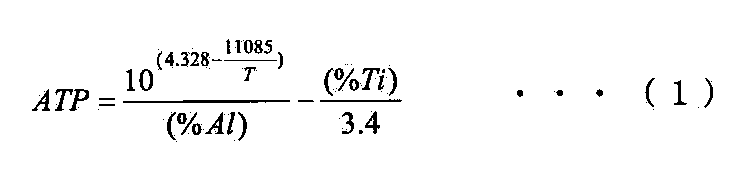
なお、式(1)中の(%Al)、(%Ti)はそれぞれスラブ中のAlおよびTiの濃度(質量%)、Tはスラブ加熱温度(K)である。 - 質量%で、
C :0.06~0.15%、
Si:0.05~0.35%、
Mn:0.6~2.00%、
P :0.015%以下、
S :0.015%以下、
Cu:0.1~0.5%、
Ni:0.1~1.5%、
Cr:0.05~0.8%、
Mo:0.1~0.6%、
Nb:0.004%以下、
V :0.005~0.060%、
Ti:0.002~0.005%、
Al:0.03~0.10%、
B :0.0005~0.003%、
N :0.002~0.004%
を含有し、さらに質量%で、Mg:0.0050%以下、Ca:0.0035%以下、REM:0.0040%以下、の一種または二種以上を更に加えたスラブを1050℃以上1150℃以下かつ、次の式(1)
で規定されるATPが0.0015以下となるような温度に加熱し、870℃以上で熱間圧延を完了させ、10秒以上90秒以下経過後、840℃以上の温度から8℃/s以上の冷却速度で200℃以下まで冷却し、その後450℃以上650℃以下の温度で20分以上60分以下の焼戻し処理を施すことを特徴とする低温靭性の優れた高生産型780MPa級高張力鋼板の製造方法。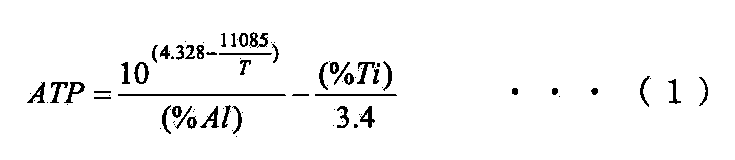
なお、式(1)中の(%Al)、(%Ti)はそれぞれスラブ中のAlおよびTiの濃度(質量%)、Tはスラブ加熱温度(K)である。
Priority Applications (2)
| Application Number | Priority Date | Filing Date | Title |
|---|---|---|---|
| JP2010532363A JP4842402B2 (ja) | 2009-04-17 | 2010-04-16 | 低温靭性の優れた高生産型780MPa級高張力鋼板の製造方法 |
| BRPI1011391A BRPI1011391A2 (pt) | 2009-04-17 | 2010-04-16 | chapa de aço de alta resistência do grau de 780 mpa do tipo de alta produtividade com excelente tenacidade a baixa temperatura e método de produção da mesma |
Applications Claiming Priority (2)
| Application Number | Priority Date | Filing Date | Title |
|---|---|---|---|
| JP2009101014 | 2009-04-17 | ||
| JP2009-101014 | 2009-04-17 |
Publications (1)
| Publication Number | Publication Date |
|---|---|
| WO2010119989A1 true WO2010119989A1 (ja) | 2010-10-21 |
Family
ID=42982642
Family Applications (1)
| Application Number | Title | Priority Date | Filing Date |
|---|---|---|---|
| PCT/JP2010/057193 Ceased WO2010119989A1 (ja) | 2009-04-17 | 2010-04-16 | 低温靭性の優れた高生産型780MPa級高張力鋼板とその製造方法 |
Country Status (3)
| Country | Link |
|---|---|
| JP (1) | JP4842402B2 (ja) |
| BR (1) | BRPI1011391A2 (ja) |
| WO (1) | WO2010119989A1 (ja) |
Cited By (4)
| Publication number | Priority date | Publication date | Assignee | Title |
|---|---|---|---|---|
| JP2014177687A (ja) * | 2013-03-15 | 2014-09-25 | Jfe Steel Corp | 落重特性に優れた高張力鋼板およびその製造方法 |
| CN111471933A (zh) * | 2020-06-11 | 2020-07-31 | 攀钢集团西昌钢钒有限公司 | 一种高强耐候彩涂板及其制备方法 |
| CN111763875A (zh) * | 2019-04-02 | 2020-10-13 | 上海梅山钢铁股份有限公司 | 一种瓶盖用高硬度冷轧电镀锡基板及其生产方法 |
| CN113930657A (zh) * | 2021-09-23 | 2022-01-14 | 江苏裕隆锻造有限公司 | 一种提高410锻件力学性能的工艺方法 |
Families Citing this family (1)
| Publication number | Priority date | Publication date | Assignee | Title |
|---|---|---|---|---|
| JP6551224B2 (ja) * | 2015-12-25 | 2019-07-31 | 日本製鉄株式会社 | 鋼管の製造方法 |
Citations (3)
| Publication number | Priority date | Publication date | Assignee | Title |
|---|---|---|---|---|
| JPS63190117A (ja) * | 1987-02-02 | 1988-08-05 | Kawasaki Steel Corp | 直接焼入れ法による引張強さ70Kgf/mm2以上,降伏比90%以下の高靭性低降伏比極厚高張力鋼板の製造方法 |
| JPH01319630A (ja) * | 1988-06-21 | 1989-12-25 | Kobe Steel Ltd | 直接焼入れによる調質高張力鋼板の製造方法 |
| JPH08143954A (ja) * | 1994-11-17 | 1996-06-04 | Kobe Steel Ltd | 耐溶接割れ性の優れた引張強さ780N/mm2級鋼板の製造方法 |
Family Cites Families (2)
| Publication number | Priority date | Publication date | Assignee | Title |
|---|---|---|---|---|
| JPH0663026B2 (ja) * | 1985-12-12 | 1994-08-17 | 川崎製鉄株式会社 | 直接焼入れ工程による高強度高じん性ボロン添加厚鋼板の製造法 |
| JP4434029B2 (ja) * | 2005-02-04 | 2010-03-17 | 住友金属工業株式会社 | 溶接性と継手靱性に優れた高張力鋼材 |
-
2010
- 2010-04-16 BR BRPI1011391A patent/BRPI1011391A2/pt not_active Application Discontinuation
- 2010-04-16 WO PCT/JP2010/057193 patent/WO2010119989A1/ja not_active Ceased
- 2010-04-16 JP JP2010532363A patent/JP4842402B2/ja active Active
Patent Citations (3)
| Publication number | Priority date | Publication date | Assignee | Title |
|---|---|---|---|---|
| JPS63190117A (ja) * | 1987-02-02 | 1988-08-05 | Kawasaki Steel Corp | 直接焼入れ法による引張強さ70Kgf/mm2以上,降伏比90%以下の高靭性低降伏比極厚高張力鋼板の製造方法 |
| JPH01319630A (ja) * | 1988-06-21 | 1989-12-25 | Kobe Steel Ltd | 直接焼入れによる調質高張力鋼板の製造方法 |
| JPH08143954A (ja) * | 1994-11-17 | 1996-06-04 | Kobe Steel Ltd | 耐溶接割れ性の優れた引張強さ780N/mm2級鋼板の製造方法 |
Cited By (5)
| Publication number | Priority date | Publication date | Assignee | Title |
|---|---|---|---|---|
| JP2014177687A (ja) * | 2013-03-15 | 2014-09-25 | Jfe Steel Corp | 落重特性に優れた高張力鋼板およびその製造方法 |
| CN111763875A (zh) * | 2019-04-02 | 2020-10-13 | 上海梅山钢铁股份有限公司 | 一种瓶盖用高硬度冷轧电镀锡基板及其生产方法 |
| CN111471933A (zh) * | 2020-06-11 | 2020-07-31 | 攀钢集团西昌钢钒有限公司 | 一种高强耐候彩涂板及其制备方法 |
| CN113930657A (zh) * | 2021-09-23 | 2022-01-14 | 江苏裕隆锻造有限公司 | 一种提高410锻件力学性能的工艺方法 |
| CN113930657B (zh) * | 2021-09-23 | 2023-03-17 | 江苏裕隆锻造有限公司 | 一种提高410锻件力学性能的工艺方法 |
Also Published As
| Publication number | Publication date |
|---|---|
| JP4842402B2 (ja) | 2011-12-21 |
| JPWO2010119989A1 (ja) | 2012-10-22 |
| BRPI1011391A2 (pt) | 2016-03-15 |
Similar Documents
| Publication | Publication Date | Title |
|---|---|---|
| JP4410836B2 (ja) | 低温靭性の優れた780MPa級高張力鋼板の製造方法 | |
| CN103014554B (zh) | 一种低屈强比高韧性钢板及其制造方法 | |
| JP5476763B2 (ja) | 延性に優れた高張力鋼板及びその製造方法 | |
| JP5659758B2 (ja) | 優れた生産性と溶接性を兼ね備えた、PWHT後の落重特性に優れたTMCP−Temper型高強度厚鋼板の製造方法 | |
| JP2010138421A (ja) | 低降伏比高強度厚鋼板およびその製造方法 | |
| JP5630322B2 (ja) | 靭性に優れる高張力鋼板とその製造方法 | |
| JP5194572B2 (ja) | 耐溶接割れ性が優れた高張力鋼材の製造方法 | |
| JP4842402B2 (ja) | 低温靭性の優れた高生産型780MPa級高張力鋼板の製造方法 | |
| JP4507669B2 (ja) | 溶接部靭性に優れた低温用低降伏比鋼材の製造方法 | |
| JP2015168864A (ja) | 板厚15mm以上の電縫鋼管用熱延鋼板 | |
| JP2010248621A (ja) | 高強度高靭性鋼の製造方法 | |
| JP5200600B2 (ja) | 高強度低降伏比鋼材の製造方法 | |
| JP5157387B2 (ja) | 高変形能を備えた厚肉高強度高靭性鋼管素材の製造方法 | |
| JP4310591B2 (ja) | 溶接性に優れた高強度鋼板の製造方法 | |
| JP2005187853A (ja) | 超大入熱溶接熱影響部靭性に優れた高強度厚鋼板の製造方法 | |
| CN103014553B (zh) | 一种屈服强度630MPa级高强度高韧性钢板及其制造方法 | |
| JP5028785B2 (ja) | 高靭性高張力鋼板およびその製造方法 | |
| CN100497706C (zh) | 焊接热影响区的低温韧性优良的焊接结构用钢及其制造方法 | |
| JP4673785B2 (ja) | 優れた母材および溶接熱影響部靭性を有する高生産性高強度鋼板及びその製造方法 | |
| JP2008280602A (ja) | 高生産性型高強度・高靭性鋼板とその製造方法 | |
| JP4770415B2 (ja) | 溶接性に優れた高張力厚鋼板およびその製造方法 | |
| JP6299676B2 (ja) | 高張力鋼板およびその製造方法 | |
| JP2006283187A (ja) | 高強度・高靭性鋼の製造方法 | |
| JP4951938B2 (ja) | 高靭性高張力鋼板の製造方法 | |
| JP4742597B2 (ja) | 非調質高張力鋼の製造方法 |
Legal Events
| Date | Code | Title | Description |
|---|---|---|---|
| WWE | Wipo information: entry into national phase |
Ref document number: 2010532363 Country of ref document: JP |
|
| 121 | Ep: the epo has been informed by wipo that ep was designated in this application |
Ref document number: 10764569 Country of ref document: EP Kind code of ref document: A1 |
|
| NENP | Non-entry into the national phase |
Ref country code: DE |
|
| 122 | Ep: pct application non-entry in european phase |
Ref document number: 10764569 Country of ref document: EP Kind code of ref document: A1 |
|
| REG | Reference to national code |
Ref country code: BR Ref legal event code: B01A Ref document number: PI1011391 Country of ref document: BR |
|
| ENP | Entry into the national phase |
Ref document number: PI1011391 Country of ref document: BR Kind code of ref document: A2 Effective date: 20111017 |