WO2010110437A1 - モザイク荷電膜及びその製造方法 - Google Patents
モザイク荷電膜及びその製造方法 Download PDFInfo
- Publication number
- WO2010110437A1 WO2010110437A1 PCT/JP2010/055410 JP2010055410W WO2010110437A1 WO 2010110437 A1 WO2010110437 A1 WO 2010110437A1 JP 2010055410 W JP2010055410 W JP 2010055410W WO 2010110437 A1 WO2010110437 A1 WO 2010110437A1
- Authority
- WO
- WIPO (PCT)
- Prior art keywords
- polymer
- group
- anionic
- polyvinyl alcohol
- cationic
- Prior art date
- Legal status (The legal status is an assumption and is not a legal conclusion. Google has not performed a legal analysis and makes no representation as to the accuracy of the status listed.)
- Ceased
Links
Images


Classifications
-
- B—PERFORMING OPERATIONS; TRANSPORTING
- B01—PHYSICAL OR CHEMICAL PROCESSES OR APPARATUS IN GENERAL
- B01D—SEPARATION
- B01D71/00—Semi-permeable membranes for separation processes or apparatus characterised by the material; Manufacturing processes specially adapted therefor
- B01D71/06—Organic material
- B01D71/38—Polyalkenylalcohols; Polyalkenylesters; Polyalkenylethers; Polyalkenylaldehydes; Polyalkenylketones; Polyalkenylacetals; Polyalkenylketals
- B01D71/381—Polyvinylalcohol
-
- B—PERFORMING OPERATIONS; TRANSPORTING
- B01—PHYSICAL OR CHEMICAL PROCESSES OR APPARATUS IN GENERAL
- B01D—SEPARATION
- B01D61/00—Processes of separation using semi-permeable membranes, e.g. dialysis, osmosis or ultrafiltration; Apparatus, accessories or auxiliary operations specially adapted therefor
- B01D61/24—Dialysis ; Membrane extraction
- B01D61/243—Dialysis
-
- B—PERFORMING OPERATIONS; TRANSPORTING
- B01—PHYSICAL OR CHEMICAL PROCESSES OR APPARATUS IN GENERAL
- B01D—SEPARATION
- B01D69/00—Semi-permeable membranes for separation processes or apparatus characterised by their form, structure or properties; Manufacturing processes specially adapted therefor
- B01D69/02—Semi-permeable membranes for separation processes or apparatus characterised by their form, structure or properties; Manufacturing processes specially adapted therefor characterised by their properties
-
- B—PERFORMING OPERATIONS; TRANSPORTING
- B01—PHYSICAL OR CHEMICAL PROCESSES OR APPARATUS IN GENERAL
- B01D—SEPARATION
- B01D69/00—Semi-permeable membranes for separation processes or apparatus characterised by their form, structure or properties; Manufacturing processes specially adapted therefor
- B01D69/14—Dynamic membranes
- B01D69/141—Heterogeneous membranes, e.g. containing dispersed material; Mixed matrix membranes
-
- B—PERFORMING OPERATIONS; TRANSPORTING
- B01—PHYSICAL OR CHEMICAL PROCESSES OR APPARATUS IN GENERAL
- B01D—SEPARATION
- B01D2323/00—Details relating to membrane preparation
- B01D2323/30—Cross-linking
-
- B—PERFORMING OPERATIONS; TRANSPORTING
- B01—PHYSICAL OR CHEMICAL PROCESSES OR APPARATUS IN GENERAL
- B01D—SEPARATION
- B01D2325/00—Details relating to properties of membranes
- B01D2325/18—Membrane materials having mixed charged functional groups
-
- B—PERFORMING OPERATIONS; TRANSPORTING
- B01—PHYSICAL OR CHEMICAL PROCESSES OR APPARATUS IN GENERAL
- B01D—SEPARATION
- B01D2325/00—Details relating to properties of membranes
- B01D2325/24—Mechanical properties, e.g. strength
-
- C—CHEMISTRY; METALLURGY
- C08—ORGANIC MACROMOLECULAR COMPOUNDS; THEIR PREPARATION OR CHEMICAL WORKING-UP; COMPOSITIONS BASED THEREON
- C08L—COMPOSITIONS OF MACROMOLECULAR COMPOUNDS
- C08L29/00—Compositions of homopolymers or copolymers of compounds having one or more unsaturated aliphatic radicals, each having only one carbon-to-carbon double bond, and at least one being terminated by an alcohol, ether, aldehydo, ketonic, acetal or ketal radical; Compositions of hydrolysed polymers of esters of unsaturated alcohols with saturated carboxylic acids; Compositions of derivatives of such polymers
- C08L29/02—Homopolymers or copolymers of unsaturated alcohols
- C08L29/04—Polyvinyl alcohol; Partially hydrolysed homopolymers or copolymers of esters of unsaturated alcohols with saturated carboxylic acids
Definitions
- the present invention relates to a mosaic charged membrane and a method for manufacturing the same.
- the mosaic charged membrane is a membrane in which cation exchange domains and anion exchange domains are arranged alternately and in parallel, and each domain penetrates to both sides of the membrane.
- This unique charged structure can facilitate the permeation of low molecular weight ions in the target solution without the need for an external current.
- the positively charged regions and the negatively charged regions are arranged in a mosaic pattern, the electric potential directions of the respective regions are opposite to each other, so that an electric circuit is formed in which the salt solution portions on both sides of the membrane become resistors.
- cations and anions are transported through the negatively charged region and the positively charged region, respectively, thereby generating a circulating current and promoting the transport of the salt.
- the mosaic charged membrane has a mechanism that causes ion transport in the membrane itself, unlike an ion exchange membrane having a single type of fixed charge that requires an external current.
- Patent Document 1 Japanese Patent Laid-Open No. 59-203613 describes a method for desalting organic compounds using a mosaic charged membrane produced by utilizing the microphase separation phenomenon of a block copolymer.
- the method for producing a mosaic charged membrane using the microphase separation phenomenon of a block copolymer requires very complicated operations and advanced techniques such as modification of a specific site of the block copolymer. Due to the high cost, there is a problem that it is difficult to easily increase the area of the mosaic charged film and to manufacture it at a low cost.
- Patent Document 2 Japanese Patent Laid-Open No. 2006-297338
- a film-forming polymer, a solvent capable of dissolving the film-forming polymer, a cation exchange resin and an anion exchange resin are mixed, and the cation exchange resin and the anion are mixed in the polymer solution.
- a method for manufacturing a mosaic charged film is described, which is characterized by performing the following steps.
- the mosaic charged membrane obtained by this method increased the salt permeation amount as the pressure increased in the pressure dialysis experiment.
- the membrane matrix and the ion exchange resin are not chemically bonded, leakage of water and neutral solute occurs at the interface, making it difficult to achieve high salt selective permeability. .
- Patent Document 3 Japanese Patent Application Laid-Open No. 8-155281
- the average of the continuous phase-forming polymer and the polymer that is at least counterionic in the method for producing a mosaic charged membrane comprising a cationic polymer domain and an anionic polymer domain dispersed as crosslinked particles having a particle size of 0.01 to 10 ⁇ m, any one of the ionic polymers forming the continuous phase of the membrane Forming a film using a dispersion in which spherical fine particles of a polymer having an ionicity opposite to that of the continuous phase-forming polymer are dispersed in the solution, cross-linking at least the continuous phase in the film, and then immersing in water or an aqueous solution.
- a method for manufacturing a mosaic charged film is described.
- the film produced by this method can be easily adjusted in domain size and film thickness, and the greatest advantage is that a film having a large area can be produced relatively easily.
- polymer fine particles having a small average particle size must be prepared, and there is a problem that a high level of technology and a long time are required.
- the resulting mosaic charged membrane is composed of a highly hydrous microgel, the pressure resistance is very low, and in particular, the adhesiveness between the membrane matrix and the positive and negative microgel interfaces is not perfect because of its structure. It is difficult to produce a mosaic charged membrane having electrolyte permeability, and the mechanical strength is not sufficient. Therefore, although it can be used as a membrane for diffusion dialysis, it has a drawback that it cannot be used as a membrane for pressure dialysis or is extremely inferior in durability.
- Non-Patent Document 1 J. Membr. Sci., Vol. 310, p. 466 (2008) describes a mosaic charged film produced by a lamination method.
- a lamination method a cation exchange membrane is produced from polyvinyl alcohol and a polyanion, an anion exchange membrane is produced from polyvinyl alcohol and a polycation, and a laminated charge block is produced by alternately laminating these with polyvinyl alcohol as an adhesive.
- the resulting block is cut with a lab cutter perpendicular to the laminated surface, and then subjected to a crosslinking treatment to produce a laminated mosaic charged film having a thickness of about 150 ⁇ m.
- the laminated mosaic charged membrane thus obtained has a salt flux J KCl of 3.0 ⁇ 10 ⁇ 9 mol ⁇ cm ⁇ 2 ⁇ s ⁇ 1 and an electrolyte selective permeability ⁇ of 2300, which is very high. It is described to show permeability. Although the tensile strength was 5.7 MPa in the direction parallel to the charged layer, it was 2.7 MPa in the vertical direction and can be used for diffusion dialysis. Need to increase.
- Non-Patent Document 2 (Textile Society Proceedings Vol. 56, No. 1, p. 33 (2001)) describes a mosaic charged membrane prepared by a polymer blend method using polyvinyl alcohol as a membrane matrix.
- an aqueous solution of a modified PVA polyanion containing 2 mol% of a vinyl compound containing polyvinyl alcohol and an itaconic acid group as a copolymer composition is used to suppress dissociation of hydrogen ions from the carboxyl group of the itaconic acid group.
- a polymer blend aqueous solution was prepared by mixing a solution acidified with hydrochloric acid and a polyvinyl alcohol and a polyallylamine hydrochloride aqueous solution.
- This solution is cast on a glass plate or the like to obtain a membrane, and then chemically crosslinked to obtain a mosaic charged membrane.
- the thus obtained mosaic charged membrane has a KCl salt flux J KCl of 1.7 ⁇ 10 ⁇ 8 mol ⁇ cm ⁇ 2 ⁇ s ⁇ 1 , an electrolyte permselectivity ⁇ of 48, Although described to exhibit high values, higher electrolyte permselectivity ⁇ is desired. Further, the acidic solution has a problem that the salt selective permeability is lowered.
- JP 59-203613 A JP 2006-297338 A JP-A-8-155281
- the present invention has been made to solve the above-described problems, and an object of the present invention is to provide a mosaic charged membrane excellent in electrolyte permselectivity and mechanical strength. It is another object of the present invention to provide a method for manufacturing a mosaic charged film that can easily manufacture a large area mosaic charged film at low cost.
- the above problem is a mosaic charged film in which particles of a cationic polymer or an anionic polymer are dispersed in a matrix of a polymer having a reverse charge, wherein the particles are made of a crystalline polymer. This is solved by providing a mosaic charged membrane.
- the cationic polymer is a polyvinyl alcohol containing a cationic group, or a mixture of a polymer containing a cationic group and a polyvinyl alcohol not containing a cationic group; and the anionic polymer contains an anionic group It is preferably a polyvinyl alcohol or a mixture of a polymer containing an anionic group and a polyvinyl alcohol not containing an anionic group.
- the average particle diameter of the particles is also preferably 30 to 200 ⁇ m.
- the above-mentioned problem is characterized in that a crystalline polymer particle composed of a cationic polymer or an anionic polymer is dispersed, and a solvent is removed from a solution in which a polymer having a reverse charge is dissolved to form a film.
- the cationic polymer is a polyvinyl alcohol containing a cationic group, or a mixture of a polymer containing a cationic group and a polyvinyl alcohol not containing a cationic group; and the anionic polymer contains an anionic group It is preferably a polyvinyl alcohol or a mixture of a polymer containing an anionic group and a polyvinyl alcohol not containing an anionic group. It is also preferable to introduce a powder composed of particles having an average particle diameter of 30 to 500 ⁇ m into the liquid and disperse. Moreover, it is also preferable to perform a heat treatment and / or a crosslinking treatment after forming the film.
- the mosaic charged membrane of the present invention is excellent in electrolyte selective permeability. Thereby, separation of electrolyte and non-electrolyte, removal of electrolyte (desalting), etc. can be performed efficiently.
- the mosaic charged membrane of the present invention is excellent in mechanical strength and can be used not only for diffusion dialysis but also for pressure dialysis. Furthermore, according to the method for manufacturing a mosaic charged film of the present invention, a large-area mosaic charged film can be manufactured easily and at low cost.
- FIG. 1 It is a schematic diagram of a diffuse transmission test apparatus.
- the KCl electrolyte permeation rate ⁇ with respect to sucrose is plotted against the KCl permeability coefficient P KCl .
- the maximum breaking stress is plotted against the ratio C pa of the number of anionic groups to the total number of all monomer units in the mosaic charged membrane.
- the mosaic charged membrane of the present invention is obtained by dispersing cationic polymer or anionic polymer particles in a polymer matrix having a reverse charge.
- the dispersion of particles in a matrix means a state in which another polymer exists as a dispersed phase (particles) in a continuous phase (matrix) of one polymer.
- a membrane that functions as a mosaic charged membrane and has high electrolyte selective permeability can be obtained.
- the cationic polymer particles may be dispersed in an anionic polymer matrix and the anionic polymer particles may be dispersed in a cationic polymer matrix.
- the cationic polymer used in the present invention is a polymer containing a cationic group in the molecular chain.
- the cationic group may be contained in any of the main chain, side chain, and terminal.
- Examples of the cationic group include an ammonium group and an iminium group.
- a polymer containing a functional group that can be converted into an ammonium group or an iminium group in water, such as an amino group or an imino group is also included in the cationic polymer of the present invention.
- an ammonium group is preferable from the viewpoint of industrial availability.
- ammonium group any of primary ammonium group (ammonium group), secondary ammonium group (alkyl ammonium group, etc.), tertiary ammonium group (dialkyl ammonium group, etc.), quaternary ammonium group (trialkyl ammonium group, etc.) can be used. It can also be used.
- the cationic polymer may contain only one type of cationic group or may contain a plurality of types of cationic groups. Further, the counter anion of the cationic group is not particularly limited. The cationic polymer may contain only one type of counter anion or may contain multiple types of counter anions.
- the cationic polymer used in the present invention may be a polymer composed only of a structural unit containing a cationic group, or a polymer composed of both a structural unit containing a cationic group and a structural unit not containing a cationic group. It may be a coalescence.
- the cationic polymer may be composed of only one type of polymer, or may include a plurality of types of polymers. Further, it may be a mixture of a polymer containing a cationic group and a polymer not containing a cationic group.
- Examples of the cationic polymer include homopolymers or copolymers of allyl ammonium salts such as allylamine hydrochloride, homopolymers or copolymers of vinylbenzyltrialkylammonium salts, homopolymers of aziridinium salts such as ethyleneimine hydrochloride, or Examples include copolymers.
- a copolymer component in the case of a copolymer a vinyl alcohol component is mentioned as a suitable thing.
- a polymer having no affinity for a polymer containing a cationic group is preferably used as the polymer containing no cationic group.
- Polyvinyl alcohol is preferred.
- the content of the cationic group in the cationic polymer is not particularly limited, but the content of the cationic group in the cationic polymer, that is, the ratio of the number of cationic groups to the total number of monomer units in the cationic polymer. Is preferably from 0.1 to 50 mol%. When the content of the cationic group is less than 0.1 mol%, the effective charge density in the mosaic charged membrane is lowered, and the electrolyte selective permeability may be lowered. The content is more preferably 0.5 mol% or more, and further preferably 1 mol% or more. When the content of the cationic group exceeds 50 mol%, the water content of the membrane is increased, which may cause a decrease in electrolyte selective permeability.
- the content is more preferably 30 mol% or less, and further preferably 10 mol% or less.
- the cationic polymer is a mixture of a polymer containing a cationic group and a polymer not containing a cationic group
- the content of the cationic group is the ratio of the number of cationic groups to the total number of monomer units in the mixture.
- the anionic polymer used in the present invention is a polymer containing an anionic group in the molecular chain.
- the anionic group may be contained in any of the main chain, side chain, and terminal.
- Examples of the anion group include a sulfonate group, a carboxylate group, and a phosphonate group.
- a polymer containing a functional group that can be converted into a sulfonate group, a carboxylate group, or a phosphonate group in water, such as a sulfonic acid group, a carboxyl group, and a phosphonic acid group, is also an anionic property of the present invention. Included in the polymer.
- the anionic polymer may contain only one type of anionic group or may contain a plurality of types of anionic groups. Further, the counter cation of the anionic group is not particularly limited. The anionic polymer may contain only one type of counter cation or may contain a plurality of types of counter cation.
- the anionic polymer used in the present invention may be a polymer composed only of a structural unit containing an anionic group, or a polymer composed of both a structural unit containing an anionic group and a structural unit not containing an anionic group. It may be a coalescence.
- the anionic polymer may be composed of only one type of polymer, or may include a plurality of types of polymers. Further, it may be a mixture of a polymer containing these anionic groups and a polymer containing no anionic groups.
- anionic polymer examples include 2-acrylamido-2-methylpropane sulfonate homopolymer or copolymer, styrene sulfonate homopolymer or copolymer, (meth) acrylic acid homopolymer or Examples include copolymers.
- a copolymer component in the case of a copolymer a vinyl alcohol component is mentioned as a suitable thing.
- a polymer having no affinity to the polymer containing an anionic group is preferably used as the polymer containing no anionic group, Polyvinyl alcohol is preferred.
- the anionic group content in the anionic polymer is not particularly limited, but the anionic group content, ie, the ratio of the number of anionic groups to the total number of monomer units in the anionic polymer is 0.1 to It is preferably 50 mol%.
- the content of the anionic group is less than 0.1 mol%, the effective charge density in the mosaic charged membrane is lowered, and the electrolyte selective permeability may be lowered.
- the content is more preferably 0.5 mol% or more, and further preferably 1 mol% or more.
- the content of the anionic group exceeds 50 mol%, the water content of the membrane is increased, and the electrolyte selective permeability may be lowered.
- membrane may become difficult.
- the content is more preferably 30 mol% or less, and further preferably 10 mol% or less.
- the anionic polymer is a mixture of a polymer containing an anionic group and a polymer containing no anionic group
- the content of the anionic group is the ratio of the number of anionic groups to the total number of monomer units in the mixture.
- the particles contained in the membrane are made of a crystalline polymer, which improves the electrolyte permselectivity.
- the particles are made of a crystalline polymer, formation of a polymer complex between a cationic polymer and an anionic polymer is suppressed, and it is considered that a decrease in effective charge density in the mosaic charged film can be suppressed. .
- the breaking stress of the mosaic charged film is improved. This is presumably because the presence of microcrystals in the particles makes the film more flexible and reduces stress concentration.
- the particles may be composed of one kind of crystalline polymer or may be composed of a mixture of plural kinds of crystalline polymers. Moreover, it may consist of a mixture of a crystalline polymer and an amorphous polymer.
- the portion where the above-mentioned particles are crystallized in the mosaic charged film of the present invention contributes to improving the durability of the mosaic charged film.
- the degree of crystallinity of the particles is not particularly limited, but is preferably in the range of 20 to 70%, more preferably in the range of 25 to 65%, and still more preferably in the range of 30 to 60%. If the crystallinity is less than 20%, the particles may be dissolved when the particles are introduced into a solvent and dispersed in the mosaic charged film manufacturing process. On the other hand, if the degree of crystallinity exceeds 70%, the material permeation region becomes small, and thus the electrolyte flux of the mosaic charged membrane may be small.
- grains in a mosaic charged film is the value measured using the X-ray-diffraction apparatus according to the method as described in an Example.
- the crystallinity of the particles can be adjusted to the above range by appropriately selecting the heat treatment conditions and the like.
- Examples of the crystalline cationic polymer include polyvinyl alcohol containing a cationic group, cellulose containing a cationic group, a mixture of a polymer containing a cationic group and polyvinyl alcohol not containing a cationic group, and a heavy polymer containing a cationic group. Examples thereof include a mixture of a coalescence and cellulose not containing a cationic group. Among these, a polyvinyl alcohol containing a cationic group or a mixture of a polymer containing a cationic group and polyvinyl alcohol not containing a cationic group is preferable.
- a polymer having a polyvinyl alcohol unit is preferable from the viewpoints of good film forming properties and high mechanical strength.
- a mixture of an allyl ammonium salt homopolymer and polyvinyl alcohol is particularly preferable because it is easily available.
- the ratio of the number of vinyl alcohol units to the total number of monomer units in the cationic polymer it is preferable that it is 50 mol% or more, and it is more preferable that it is 70 mol%.
- Examples of the crystalline anionic polymer include polyvinyl alcohol containing an anion group, cellulose containing an anion group, a mixture of a polymer containing an anion group and polyvinyl alcohol not containing an anion group, and a polymer containing an anion group. Examples thereof include a mixture of a coalescence and cellulose not containing an anionic group. Among these, a polyvinyl alcohol containing an anionic group or a mixture of a polymer containing an anionic group and a polyvinyl alcohol not containing an anionic group is preferable. The use of a polymer having a polyvinyl alcohol unit is preferable from the viewpoints of good film forming properties and high mechanical strength.
- poly (vinyl alcohol-2-acrylamido-2-methylpropanesulfonate sodium) is particularly preferable because it is easily available.
- the ratio of the number of polyvinyl alcohol units to the total number of monomer units in the anionic polymer it is preferable that it is 50 mol% or more, and it is more preferable that it is 70 mol% or more.
- the mass ratio of the polymers contained in the membrane is preferably 0.2 to 50.
- the mass ratio is more preferably 0.6 or more, and further preferably 0.8 or more.
- the mass ratio is more preferably 20 or less, and further preferably 8 or less.
- the mass ratio of those polymers contained in the film Is preferably 0.2 to 50.
- the mass ratio is more preferably 0.6 or more, and further preferably 0.8 or more. On the other hand, the mass ratio is more preferably 20 or less, and further preferably 8 or less.
- Electrolyte permselectivity tends to be improved by relatively increasing the content of the polymer constituting the particles. However, if the content of the polymer constituting the particles is too high, the electrolyte permselectivity tends to decrease and the membrane breaking stress tends to decrease.
- the mosaic charged membrane of the present invention is a membrane in which cationic polymer particles are dispersed in an anionic polymer matrix
- the molar ratio of ionic groups contained in the membrane is preferably from 0.1 to 5.
- the molar ratio is more preferably 0.2 or more, and further preferably 0.45 or more.
- the molar ratio is more preferably 3 or less, and further preferably 1.5 or less.
- the anionic polymer particles are in a form of a film dispersed in a cationic polymer matrix
- the molar ratio of the ionic groups contained in the film (anionic group / cationic group) is 0.1 to 5 is preferable.
- the molar ratio is more preferably 0.2 or more, and further preferably 0.45 or more. On the other hand, the molar ratio is more preferably 3 or less, and further preferably 1.5 or less.
- the structural unit of the portion other than the ionic group can be independently selected.
- the cationic polymer and the anionic polymer have the same structural unit. It is preferable. Thereby, since affinity between particle
- the same structural unit is a polyvinyl alcohol unit. Since the cationic polymer and the anionic polymer have vinyl alcohol units, the cross-linking agent such as glutaraldehyde can chemically cross-link between the particles and the matrix and between the particles, so that the mosaic charge The mechanical strength of the membrane can be further increased.
- particles comprising a mixture of polyvinyl alcohol containing a cationic group or a polymer containing a cationic group and polyvinyl alcohol containing no cationic group are anionic groups.
- a polymer containing an anionic group and a mixture of a polyvinyl alcohol containing no anionic group and a polyvinyl alcohol containing an anionic group or a heavy polymer containing an anionic group are anionic groups.
- Particles composed of a mixture of a polymer and a polyvinyl alcohol containing no anionic group are dispersed in a matrix comprising a polymer containing a cationic group or a polymer containing a cationic group and a polyvinyl alcohol containing no cationic group. If you want to.
- the size of the particles in the mosaic charged film of the present invention is not particularly limited, but the average particle size of the particles is preferably 30 to 200 ⁇ m. If the average particle size is less than 30 ⁇ m, a method for producing a film containing particles having such an average particle size becomes very complicated.
- the average particle diameter is more preferably 40 ⁇ m or more, and further preferably 50 ⁇ m or more. When the average particle diameter exceeds 200 ⁇ m, the distance between the positively charged region and the negatively charged region in the mosaic charged membrane increases, and the electrolyte selective permeability decreases.
- the average particle size is more preferably 150 ⁇ m or less, and further preferably 120 ⁇ m or less.
- an average particle diameter is the value measured using the optical microscope according to the method of an Example description.
- the polyvinyl alcohol containing a cationic group or an anionic group is not particularly limited as long as it is a polyvinyl alcohol containing a cationic group or an anionic group in the molecular chain. Usually, those obtained by saponifying a copolymer of a vinyl compound containing a cationic group or an anionic group and a vinyl ester are used.
- the degree of saponification of the polyvinyl alcohol containing a cationic group or an anionic group is not particularly limited, but it is preferably 40 to 99.9 mol%. If the degree of saponification is less than 40 mol%, the crystallinity may be lowered.
- the saponification degree is more preferably 60 mol% or more, and further preferably 80 mol% or more. Usually, the saponification degree is 99.9 mol% or less.
- the saponification degree when the polyvinyl alcohol is a mixture of plural kinds of polyvinyl alcohols refers to the average saponification degree of the whole mixture.
- the saponification degree of polyvinyl alcohol is a value measured according to JIS K6726.
- the saponification degree of polyvinyl alcohol containing no cationic group or anionic group used in the present invention is also preferably within the above range.
- the viscosity average degree of polymerization of the polyvinyl alcohol containing a cationic group or an anionic group (hereinafter sometimes simply referred to as the degree of polymerization) is not particularly limited, but is preferably 50 to 10,000. When the degree of polymerization is less than 50, there is a possibility that a practically sufficient strength cannot be maintained. More preferably, the degree of polymerization is 100 or more. When the degree of polymerization exceeds 10,000, the solution viscosity when dissolved as a resin constituting the matrix is increased, which may make handling difficult.
- the degree of polymerization is more preferably 8000 or less.
- the polymerization degree in the case where the polyvinyl alcohol is a mixture of plural kinds of polyvinyl alcohols means an average polymerization degree as the whole mixture.
- the viscosity average polymerization degree of polyvinyl alcohol is a value measured according to JIS K6726.
- the polymerization degree of polyvinyl alcohol containing no cationic group or anionic group used in the present invention is also preferably in the above range.
- the mosaic charged film of the present invention may contain various additives such as an inorganic filler as long as the object of the present invention is not impaired.
- the mosaic charged membrane of the present invention is preferably formed by dispersing a particle made of a cationic polymer or an anionic polymer and removing a solvent from a solution in which a polymer having a reverse charge is dissolved to form a film. Manufactured. According to such a manufacturing method, a large-area mosaic charged film can be easily manufactured at low cost.
- the particles, which are dispersed in a solution in which the polymer constituting the matrix is dissolved are made of a crystalline polymer.
- the particles are made of a crystalline polymer, formation of a polymer complex between a cationic polymer and an anionic polymer is suppressed, and a decrease in effective charge density in the mosaic charged membrane is suppressed, thereby selecting an electrolyte. It is considered that the permeability is improved.
- the breaking stress of the mosaic charged film is improved.
- the crystalline polymer examples include polyvinyl alcohol units such as polyvinyl alcohol containing a cation group or an anion group, or a mixture of a polymer containing a cation group or an anion group and a polyvinyl alcohol not containing a cation group or an anion group.
- a polymer having is preferably used. Utilizing the property of the polymer having a polyvinyl alcohol unit that it is easy to dissolve in high-temperature water but difficult to dissolve in low-temperature water, the polymer constituting the matrix is dissolved in high-temperature water in advance.
- the mosaic charged film of the present invention can be easily produced by cooling it, mixing it with particles, and forming a film using the resulting dispersion.
- the solvent is not particularly limited as long as the polymer constituting the matrix can be dissolved.
- Water, isopropyl alcohol, dimethyl sulfoxide and a mixed solvent thereof are exemplified, but water is preferable from the viewpoint of safety.
- the content of the dissolved polymer with respect to the entire liquid is not particularly limited, but is preferably from 0.1 to 30% by mass, and preferably from 0.5 to 20% by mass because the solution viscosity is in a range that is easy to handle. More preferred.
- the temperature of the solution for dissolving the polymer is not particularly limited, but in the case of polyvinyl alcohol, it is preferably 50 to 110 ° C, more preferably 70 to 105 ° C.
- the method for preparing a liquid in which particles of a crystalline polymer composed of a cationic polymer or an anionic polymer are dispersed and a polymer having a reverse charge is dissolved is not particularly limited.
- the particles may be charged into a solution in which a polymer having a reverse charge is dissolved, or the particles having a reverse charge may be added and dissolved after the particles are charged and dispersed in a solvent. You may mix what disperse
- the size of the particles contained in the crystalline polymer powder used in the method for producing a mosaic charged film of the present invention is not particularly limited, but the average particle size of the particles is preferably 30 to 500 ⁇ m. If the average particle size is less than 30 ⁇ m, the method for producing the particles becomes very complicated.
- the average particle diameter is more preferably 60 ⁇ m or more, and further preferably 80 ⁇ m or more. When the average particle diameter exceeds 500 ⁇ m, the distance between the positively charged region and the negatively charged region in the mosaic charged membrane to be manufactured increases, and the electrolyte selective permeability may be decreased.
- the average particle size is more preferably 400 ⁇ m or less, and further preferably 300 ⁇ m or less.
- the average particle diameter is a value measured by a laser diffraction method according to the method described in the examples.
- the particle diameter of the powder of the crystalline polymer used in the present invention can be adjusted by combining a sieve having a desired aperture and classifying with a vibration sieve.
- the temperature of the liquid Is preferably 0 to 50 ° C., more preferably 10 to 35 ° C.
- the content ratio of the particles to be dispersed with respect to the entire dispersion is preferably 0.1 to 20% by mass, and more preferably 0.5 to 10% by mass.
- the mass ratio of the polymer dispersed in the liquid to form particles (particle / matrix) with respect to the mass of the polymer dissolved in the liquid to form the matrix is 0. 2 to 50 is preferable.
- the mass ratio is more preferably 0.6 or more, and further preferably 0.8 or more.
- the mass ratio is more preferably 20 or less, and further preferably 8 or less.
- the method for forming the film by removing the solvent from the solution in which the polymer in which particles are dispersed and the reverse charge is dissolved is not particularly limited. Examples thereof include a casting method, a wet film forming method, a dry film forming method, and a melt extrusion method.
- the method for producing a mosaic charged film of the present invention it is preferable to perform a heat treatment after the film is formed.
- the method of heat treatment is not particularly limited, and a method using a heating wire (infrared ray) heater is generally used.
- the temperature of the heat treatment is not particularly limited, but in the case of polyvinyl alcohol, it is preferably 120 to 200 ° C. If the temperature of the heat treatment is less than 120 ° C., the resulting mosaic charged film may have insufficient mechanical strength.
- the temperature is more preferably 140 ° C. or higher, and further preferably 160 ° C. or higher.
- the crystalline polymer may be melted.
- the temperature is more preferably 190 ° C. or lower, and further preferably 180 ° C. or lower.
- the heat treatment time is usually about 1 minute to 10 hours.
- the heat treatment is desirably performed in an inert gas (eg, nitrogen gas, argon gas, etc.) atmosphere.
- the method for producing a mosaic charged film of the present invention it is preferable to perform a crosslinking treatment after forming a film.
- the method for the crosslinking treatment is not particularly limited as long as it is a method capable of bonding the molecular chains of the polymer by chemical bonding.
- a method of immersing in a solution containing a crosslinking agent is used.
- the crosslinking agent include glutaraldehyde, glyoxal, and sulfur-containing dialdehyde.
- the concentration of the crosslinking agent the volume concentration of the crosslinking agent relative to the solution is usually 0.01 to 0.5 vol%.
- both heat treatment and crosslinking treatment may be performed, or only one of them may be performed.
- the crosslinking treatment may be performed after the heat treatment, the heat treatment may be performed after the crosslinking treatment, or both may be performed simultaneously. It is preferable to perform a crosslinking treatment after the heat treatment from the viewpoint of the mechanical strength of the resulting mosaic charged film.
- the thickness of the mosaic charged film of the present invention is preferably 20 to 300 ⁇ m. If the film thickness is less than 20 ⁇ m, the mechanical strength may decrease. The film thickness is more preferably 50 ⁇ m or more, and further preferably 70 ⁇ m or more. If the film thickness exceeds 300 ⁇ m, the electrolyte flux may decrease. The film thickness is more preferably 200 ⁇ m or less, and further preferably 160 ⁇ m or less.
- the mosaic charged film of the present invention can be used for various applications. Since the mosaic charged membrane of the present invention is excellent in electrolyte permselectivity, it is suitable for purification of water, desalting of food and pharmaceutical raw materials, desalting of brine and seawater, and desalination.
- the mosaic charged membrane of the present invention is particularly suitable for pressure dialysis because of its excellent mechanical strength. According to the method for manufacturing a mosaic charged film of the present invention, a large-area film can be manufactured easily and at low cost.
- Average particle size of powder The particle size was measured using a laser diffraction particle size distribution analyzer “SALD-2200” manufactured by Shimadzu Corporation. About the obtained particle size distribution, the average value on a common logarithmic scale was calculated
- the diffusion transmission test was performed with the apparatus shown in FIG.
- KCl which is an electrolyte
- a membrane sandwiched between folders is sandwiched between two cells, and 100 mL of ion-exchanged water is added to cell I into which conductivity electrode “3552-10D” manufactured by HORIBA, Ltd. is inserted.
- II was charged with 400 mL of 0.1 M KCl aqueous solution, and measurement was performed at a constant temperature of 25 ° C. while stirring both cells with a stirrer.
- sucrose which is a non-electrolyte
- a membrane sandwiched between folders is sandwiched between two cells, 100 mL of ion exchange water is placed in cell I, and 400 mL of a 0.1 M sucrose aqueous solution is placed in cell II. Measurement was performed at a constant temperature of 25 ° C. while the cell was stirred with a stirrer.
- the concentration of KCl in the cell I was measured using a conductivity meter “ES-12” manufactured by Horiba, Ltd.
- the sucrose concentration in cell I was analyzed using a high performance liquid chromatograph by collecting a 0.5 mL sample from cell I with a pipetter at a predetermined time. For the KCl and sucrose concentrations in the cell I measured in this way, a time change curve was obtained, and the time change rate ⁇ C I i / ⁇ t of each concentration was calculated from the slope value when this was linearly approximated. did.
- i represents KCl or SUC (sucrose).
- the high performance liquid chromatography measurement was performed using the following apparatus under the following measurement conditions.
- Appatus ⁇ Pump: “PU-980 Intelligent HPLC PUMP” manufactured by JASCO Corporation ⁇ Detector: “RI-2031 Plus Intelligent RI Detector” manufactured by JASCO Corporation Autosampler: “AS-2055 Plus Intelligent Sampler” manufactured by JASCO Corporation Column oven: “860-CO Column Oven” manufactured by JASCO Corporation ⁇ Column: “WAKO-Sil II 3C18AR” manufactured by Wako Pure Chemical Industries, Ltd.
- Measurement condition -Eluent: Ultrapure water-Liquid flow rate: 0.4 mL / min -Column temperature: 40 ° C
- J KCl and sucrose fluxes J KCl and J SUC were calculated by the following equations.
- J i V I ⁇ ⁇ C I i / (S ⁇ ⁇ t) ⁇ 10 ⁇ 7
- P KCl and P SUC of KCl and sucrose were calculated by the following equations.
- Average particle diameter of polymer particles in mosaic charged film A mosaic charged film immersed in distilled water was cut into a 1 cm square to prepare a measurement sample. This measurement sample was observed using an optical microscope “OPTIPHOT-2” manufactured by Nikon Corporation, and an enlarged image of a particle group in the measurement sample was obtained. The obtained image was subjected to image processing using image processing software “WINROOF” manufactured by Mitani Corporation, and the maximum particle size of each particle was determined. Particles having a maximum particle size of less than 5 ⁇ m were not taken into consideration and the maximum particle size was determined for about 400 particles. The particle diameter at which the cumulative frequency of the maximum particle diameter is 50% was determined and used as the average particle diameter of the particles in the mosaic charged film.
- Crystallinity degree of polymer particles in mosaic charged film The crystallinity degree was measured using the measuring apparatus and measuring method described below.
- Measuring device Bruker AXS, Inc. “D8 Discover with GADDS”
- Detector HiSTAR (two-dimensional PSPC)
- Sample setting method The particle portion of the mosaic charged film was targeted, the collimator diameter was set to 0.03 mm, and the goniometer ⁇ angle was set to 11 ° so that the incident angle of X-rays was 11 °.
- Detector position: 2 ⁇ 22 °
- Camera distance 15cm Exposure time: 300 sec
- ⁇ Measuring method> The two-dimensional image obtained by the above apparatus and conditions was converted into an X-ray diffraction intensity curve using the following method.
- the obtained X-ray diffraction intensity curve was subjected to peak separation by the following curve fitting method to determine the crystallinity.
- the software used for the analysis was manufactured by MDI: JADE Ver. 6.0.
- the profile fitting model used was Pseudo-Voigt, and the fitting function was Gauss + Lorentz function.
- fitting (Iv) Fitting was performed by varying the height, half-value width, shape constant, and asymmetry of the amorphous peak.
- V For each peak, 2 ⁇ was fitted as a variable.
- the fitting was repeated by repeating (iii) to (v).
- Example 1 (Synthesis of anionic polymer AP-2) In a 6 L separable flask equipped with a stirrer, a temperature sensor, a dropping funnel and a reflux condenser, 25.7 g of a methanol solution containing 2340 g of vinyl acetate, 640 g of methanol, and 25% by mass of sodium 2-acrylamido-2-methylpropanesulfonate. Was added, and the inside of the system was replaced with nitrogen under stirring, and then the internal temperature was raised to 60 ° C. To this system, 20 g of methanol containing 1.2 g of 2,2′-azobisisobutyronitrile was added to initiate the polymerization reaction.
- AP-2 which is a polyvinyl alcohol containing 2 mol% of sodium 2-acrylamido-2-methylpropanesulfonate.
- AP-2 is represented by the following structural formula.
- the viscosity of the 4% aqueous solution was 33.1 mPa ⁇ s (20 ° C.), the polymerization degree was 1900, and the saponification degree was 99.2 mol%.
- Posaic charged membrane production In a 200 mL Erlenmeyer flask, 90 mL of deionized water is added, 3.3 g of polyvinyl alcohol (PVA) and 0.37 g of polyallylamine hydrochloride (PAAm) are added, and then heated and stirred in a 100 ° C. water bath. These polymers were dissolved.
- PVA polyvinyl alcohol
- PAAm polyallylamine hydrochloride
- PAAm polyallylamine hydrochloride
- the dispersion prepared in this manner was poured into an acrylic cast plate having a length of 270 mm and a width of 210 mm, and after removing excess liquid and bubbles, the film was dried on a hot plate at 50 ° C. for 24 hours. Produced. The film thus obtained was heat treated at 170 ° C. for 30 minutes to cause physical crosslinking. Subsequently, the film was immersed in an electrolyte solution of 3M sodium chloride for 24 hours. Hydrochloric acid was added to the aqueous solution so that the pH was 1, and the film was immersed in a 0.05 vol% glutaraldehyde aqueous solution, followed by stirring with a stirrer at 25 ° C. for 24 hours for crosslinking.
- glutaraldehyde aqueous solution a product obtained by diluting “glutaraldehyde” (25 vol%) manufactured by Ishizu Pharmaceutical Co., Ltd. with water was used. After the crosslinking treatment, the film was immersed in deionized water, and the film was immersed until the film reached the swelling equilibrium while exchanging the deionized water several times in the middle to obtain a mosaic charged film.
- the mosaic charged film thus produced was cut into a square having a side of 5 cm to produce a measurement sample.
- a diffusion dialysis test was performed according to the above-described method, and KCl flux J KCl , sucrose flux J SUC , KCl permeability coefficient P KCl , sucrose permeability coefficient P SUC , and sucrose
- the electrolyte selective permeation coefficient ⁇ of KCl was calculated.
- membrane moisture content, and the film thickness were measured about the obtained mosaic charge film
- the crystallinity of the polymer particles in the mosaic charged film was measured. The obtained results are shown in Table 1.
- the average particle diameter of the particles in the mosaic charged film measured according to the above method was 85 ⁇ m.
- Example 2-7 In Example 1, except that the amounts of the anionic polymer AP-2 powder and PVA were changed as shown in Table 1, a mosaic charged membrane was prepared and a diffusion dialysis test was performed in the same manner as in Example 1. In addition, the maximum breaking stress, the film thickness, the average particle diameter of the polymer particles in the mosaic charged film, and the crystallinity of the particles were measured. For Examples 2 to 6, the membrane water content was also measured. The obtained results are summarized in Table 1.
- Example 6 mosaic charging was performed in the same manner as in Example 6 except that the average particle diameter of the powder of the anionic polymer AP-2, the heat treatment temperature after film formation, and the film thickness were changed as shown in Table 1.
- a membrane was prepared and subjected to a diffusion dialysis test, and the maximum breaking stress, membrane moisture content, film thickness, average particle diameter of polymer particles in the mosaic charged membrane, and crystallinity of the particles were measured. The obtained results are summarized in Table 1.
- Example 1 instead of the dispersion in which the powder of the anionic polymer AP-2 is dispersed in the aqueous solution in which PVA and PAAm are dissolved, an aqueous solution in which all of AP-2, PVA, and PAAm are dissolved is used.
- an aqueous solution in which all of AP-2, PVA, and PAAm are dissolved is used.
- Example 1 an aqueous solution in which all of AP-2, PVA, and PAAm are dissolved is used.
- Example 1 instead of the dispersion in which the powder of the anionic polymer AP-2 is dispersed in the aqueous solution in which PVA and PAAm are dissolved.
- Example 1 instead of the dispersion in which the powder of the anionic polymer AP-2 is dispersed in the aqueous solution in which PVA and PAAm are dissolved, an aqueous solution in which all of AP-2, PVA, and PAAm are dissolved is used.
- Comparative Examples 2-5 In Comparative Example 1, except that the amounts of the anionic polymer AP-2 powder and PVA were changed as shown in Table 1, a mosaic charged membrane was prepared in the same manner as in Comparative Example 1, and a diffusion dialysis test was performed. At the same time, the maximum breaking stress, the film moisture content, the film thickness, and the crystallinity of the particles in the mosaic charged film were measured. The obtained results are summarized in Table 1.
- Comparative Example 6 In Comparative Example 1, except that PAAm and AP-2 were not blended and the blending amount of PVA was changed to 7.4 g, a mosaic charged membrane was prepared in the same manner as in Comparative Example 1, and a diffusion dialysis test was performed. The water content of the membrane, the thickness, and the crystallinity of the particles in the mosaic charged membrane were measured. The obtained results are shown in Table 1.
- FIG. 2 is a graph plotting the electrolyte selective permeability ⁇ of KCl against sucrose against the KCl permeability coefficient P KCl of the mosaic charged membranes obtained in Examples 1 to 7 and Comparative Examples 2 to 6.
- the mosaic charged films obtained in Comparative Examples 2 to 5 are located on the same trade-off line as the polyvinyl alcohol film obtained in Comparative Example 6. This is presumably because the cationic polymer and the anionic polymer formed a polymer complex when the films of Comparative Examples 2 to 6 were formed, and the amount of the effective cationic group and the amount of the anionic group were reduced.
- the mosaic charged film containing particles made of the crystalline polymer obtained in Examples 1 to 7 is located on the upper right side of the trade-off line in these films.
- the electrolyte permselectivity ⁇ was 1130 at the maximum. This is because, as a result of finely pulverizing polyvinyl alcohol having an anionic group and blending with a cationic polymer while leaving microcrystals, the formation of a polymer complex is suppressed to a very low level. This is probably because the amount of the group is higher than that of the mosaic charged film obtained in the comparative example.
- FIG. 3 shows that the maximum breaking stress shows almost the same value when compared with “AM-1” manufactured by Astom Co., Ltd., which is an anion exchange membrane having a commercially available support.
- AM-1 is an anion exchange membrane having a commercially available support.
- the mosaic charged membrane of the present invention is a self-supporting membrane that does not contain a support. From this, it can be said that the mosaic charged film of the present invention has a high maximum breaking stress. Furthermore, it can be said that the mosaic charged film of the present invention has a higher maximum breaking stress than the mosaic charged film produced by the polymer blend method.
Landscapes
- Chemical & Material Sciences (AREA)
- Chemical Kinetics & Catalysis (AREA)
- Dispersion Chemistry (AREA)
- Health & Medical Sciences (AREA)
- Urology & Nephrology (AREA)
- Engineering & Computer Science (AREA)
- Water Supply & Treatment (AREA)
- Separation Using Semi-Permeable Membranes (AREA)
- Addition Polymer Or Copolymer, Post-Treatments, Or Chemical Modifications (AREA)
- Manufacture Of Macromolecular Shaped Articles (AREA)
Abstract
カチオン性重合体又はアニオン性重合体の粒子が、逆電荷を有する重合体のマトリックス中に分散したモザイク荷電膜であって、前記粒子が結晶性重合体からなることを特徴とするモザイク荷電膜とする。カチオン性重合体が、カチオン基を含有するポリビニルアルコール、又はカチオン基を含有する重合体とカチオン基を含有しないポリビニルアルコールとの混合物であり;かつアニオン性重合体が、アニオン基を含有するポリビニルアルコール、又はアニオン基を含有する重合体とアニオン基を含有しないポリビニルアルコールとの混合物であることが好ましい。このようなモザイク荷電膜は、電解質選択透過性及び機械的強度に優れている。
Description
本発明は、モザイク荷電膜及びその製造方法に関する。
モザイク荷電膜は、カチオン交換ドメインとアニオン交換ドメインが交互にかつ並列に配列し、各ドメインが膜の両面まで貫通した膜である。この独特な荷電構造は、外部からの電流を必要とすることなく対象溶液中の低分子量イオンの透過を促進することができる。正荷電領域と負荷電領域がモザイク状に並べられると、それぞれの領域の電位の方向が互いに逆であるため、膜の両側の塩溶液部分が抵抗となる電気回路ができる。その回路に流れる電流のようにカチオンとアニオンがそれぞれ負荷電領域、正荷電領域を通って輸送されることで循環電流が生じ、塩の輸送が促進される。このことはモザイク荷電膜が、外部からの電流が必要な、一種類の固定電荷を有するイオン交換膜と異なり、イオン輸送を引き起こす機構を膜自体に内在させていることを意味する。
モザイク荷電膜として種々の手法により作製したものが報告されている。特許文献1(特開昭59-203613)には、ブロック共重合体のミクロ相分離現象を利用して作製したモザイク荷電膜を用いる有機化合物の脱塩方法が記載されている。しかしながら、ブロック共重合体のミクロ相分離現象を利用してモザイク荷電膜を作製する方法は、ブロック共重合体の特定部位を変性させるなど非常に煩雑な操作かつ高度な技術が必要であり、しかも高コストになることから、モザイク荷電膜を容易に大面積化し、かつ安価に製造することは困難であるという問題がある。
特許文献2(特開2006-297338)には、膜形成ポリマー、該膜形成ポリマーを溶解し得る溶媒、陽イオン交換樹脂及び陰イオン交換樹脂を混合し、ポリマー溶液に陽イオン交換樹脂及び陰イオン交換樹脂を分散させて均一なポリマー分散液を調製する工程;及び前記ポリマー分散液を基材上に塗布及び延伸し、乾燥して凝固させた後、得られた膜から溶媒を除去し、洗浄する工程を行うことを特徴とする、モザイク荷電膜の製造方法が記載されている。この方法により得られたモザイク荷電膜は、圧透析実験において圧力上昇とともに塩透過量も増加した。しかし、このモザイク荷電膜では膜マトリックスとイオン交換樹脂が化学的に結合されていないため、その界面において水や中性溶質の漏れが生じるため、高い塩選択透過性を達成することは困難である。
特許文献3(特開平8-155281)には、カチオン性ポリマー及びアニオン性ポリマーのいずれか一方のイオン性ポリマーが形成する架橋連続相中に、連続相形成ポリマーと少なくとも反対イオン性のポリマーが平均粒子径0.01~10μmの架橋粒子として分散してなるカチオン性ポリマードメインとアニオン性ポリマードメインからなるモザイク荷電膜を製造する方法において、前記膜の連続相を形成するいずれか一方のイオン性ポリマーの溶液に少なくとも連続相形成ポリマーと反対イオン性のポリマーの球状微粒子を分散させた分散液を用いて膜を形成し、該膜中の少なくとも連続相を架橋させ、次いで水又は水溶液浸漬処理することを特徴とするモザイク荷電膜の製造方法が記載されている。この方法で製造される膜は、ドメインサイズや膜厚の調整が容易であり、また最大の利点は比較的容易に大面積の膜の作製が可能である点である。しかし、この製造方法では、平均粒子径が小さい重合体微粒子を調製しなければならず、高度な技術及び長時間を要するといった問題がある。しかも得られるモザイク荷電膜は、含水性の高いミクロゲルで構成されているため、耐圧性が非常に低く、特に構造上、膜マトリックスと陽、陰ミクロゲル界面との接着性が完全ではないため、高い電解質透過性を有するモザイク荷電膜の作製が困難であり、また機械的強度も十分とは言えない。そのため、拡散透析用の膜としては使用可能であるものの、圧透析用の膜としては使用に耐えないか、もしくは耐久性に極めて劣るといった欠点を有する。
非特許文献1(J.Membr.Sci.,Vol.310,p.466(2008))には、積層法によって作製されたモザイク荷電膜が記載されている。当該積層法では、ポリビニルアルコールとポリアニオンから陽イオン交換膜を、ポリビニルアルコールとポリカチオンから陰イオン交換膜を作製し、これらをポリビニルアルコールを接着剤として交互に貼り合わせることにより積層荷電ブロックを作製し、得られたブロックを積層面と垂直にラボカッターで切断した後、架橋処理を行うことによって、約150μmの膜厚を有する積層モザイク荷電膜を作製している。このようにして得られた積層モザイク荷電膜のKClの塩流束JKClは3.0×10⁻⁹mol・cm-2・s-1、電解質選択透過性αは2300と非常に高い塩選択透過性を示すことが記載されている。引張強度は荷電層と平行な方向で5.7MPaであったが、垂直方向で2.7MPaであり、拡散透析用には使用可能であるが、圧透析用に使用するには、より強度を高める必要がある。
非特許文献2(繊維学会予稿集 Vol.56,No.1,p.33(2001))には、ポリビニルアルコールを膜マトリックスとするポリマーブレンド法によって作製されたモザイク荷電膜が記載されている。当該ポリマーブレンド法では、ポリビニルアルコールとイタコン酸基を含有するビニル化合物を2mol%共重合組成として含有する変性PVAポリアニオンの水溶液に、イタコン酸基のカルボキシル基からの水素イオンの解離を抑制するために塩酸を加えて酸性にした溶液と、ポリビニルアルコールとポリアリルアミン塩酸塩水溶液とを混合することでポリマーブレンド水溶液を調製した。この溶液をガラス板などにキャストして膜を得た後、化学的架橋を行うことによってモザイク荷電膜を得ている。このようにして得られたモザイク荷電膜のKClの塩流束JKClは1.7×10⁻⁸mol・cm-2・s-1であり、電解質選択透過性αは48であり、比較的高い値を示すことが記載されているけれども、より高い電解質選択透過性αが望まれている。また、酸性溶液では塩選択透過性が低下するという問題も有している。
J.Membr.Sci.,Vol.310,p.466(2008)
繊維学会予稿集 Vol.56,No.1,p.33(2001)
本発明は、上記課題を解決するためになされたものであり、電解質選択透過性及び機械的強度に優れたモザイク荷電膜を提供することを目的とするものである。また、大面積のモザイク荷電膜を、容易にかつ低コストで製造できるモザイク荷電膜の製造方法を提供することを目的とするものである。
上記課題は、カチオン性重合体又はアニオン性重合体の粒子が、逆電荷を有する重合体のマトリックス中に分散したモザイク荷電膜であって、前記粒子が結晶性重合体からなることを特徴とするモザイク荷電膜を提供することによって解決される。
このとき、カチオン性重合体が、カチオン基を含有するポリビニルアルコール、又はカチオン基を含有する重合体とカチオン基を含有しないポリビニルアルコールとの混合物であり;かつアニオン性重合体が、アニオン基を含有するポリビニルアルコール、又はアニオン基を含有する重合体とアニオン基を含有しないポリビニルアルコールとの混合物であることが好ましい。また、前記粒子の平均粒子径が30~200μmであることも好ましい。
また、上記課題は、カチオン性重合体又はアニオン性重合体からなる結晶性重合体の粒子が分散し、逆電荷を有する重合体が溶解した液から溶媒を除去して皮膜を形成することを特徴とするモザイク荷電膜の製造方法を提供することによっても解決される。
このとき、カチオン性重合体が、カチオン基を含有するポリビニルアルコール、又はカチオン基を含有する重合体とカチオン基を含有しないポリビニルアルコールとの混合物であり;かつアニオン性重合体が、アニオン基を含有するポリビニルアルコール、又はアニオン基を含有する重合体とアニオン基を含有しないポリビニルアルコールとの混合物であることが好ましい。平均粒子径が30~500μmの粒子からなる粉末を液に投入して分散させることも好ましい。また、前記皮膜を形成した後に、熱処理及び/又は架橋処理を施すことも好ましい。
本発明のモザイク荷電膜は、電解質選択透過性に優れている。これにより、電解質と非電解質の分離や、電解質の除去(脱塩)などを効率よく行うことができる。また、本発明のモザイク荷電膜は機械的強度に優れており、拡散透析だけでなく、圧透析にも用いることができる。さらに、本発明のモザイク荷電膜の製造方法によれば、大面積のモザイク荷電膜を、容易にかつ低コストで製造することができる。
本発明のモザイク荷電膜は、カチオン性重合体又はアニオン性重合体の粒子が、逆電荷を有する重合体のマトリックス中に分散したものである。ここで、粒子がマトリックス中に分散するとは、一の重合体の連続相(マトリックス)の中に、他の重合体が分散相(粒子)として存在する状態のことをいう。このような分散形態で正荷電領域及び負荷電領域が配列されることによって、モザイク荷電膜として機能し、高い電解質選択透過性を有する膜が得られる。具体的には、カチオン性重合体の粒子がアニオン性重合体のマトリックス中に分散する場合と、アニオン性重合体の粒子がカチオン性重合体のマトリックス中に分散する場合とがある。
本発明で用いられるカチオン性重合体は、分子鎖中にカチオン基を含有する重合体である。当該カチオン基は主鎖、側鎖、末端のいずれに含まれていても構わない。カチオン基としては、アンモニウム基、イミニウム基などが例示される。また、アミノ基やイミノ基のように、水中においてその一部が、アンモニウム基やイミニウム基に変換し得る官能基を含有する重合体も、本発明のカチオン性重合体に含まれる。この中で、工業的に入手し易い観点から、アンモニウム基が好ましい。アンモニウム基としては、1級アンモニウム基(アンモニウム基)、2級アンモニウム基(アルキルアンモニウム基等)、3級アンモニウム基(ジアルキルアンモニウム基等)、4級アンモニウム基(トリアルキルアンモニウム基等)のいずれを用いることもできる。カチオン性重合体は、1種類のみのカチオン基を含有していてもよいし、複数種のカチオン基を含有していてもよい。また、カチオン基の対アニオンは特に限定されない。カチオン性重合体は、1種類のみの対アニオンを含有していてもよいし、複数種の対アニオンを含有していてもよい。
本発明で用いられるカチオン性重合体は、カチオン基を含有する構造単位のみからなる重合体であってもよいし、カチオン基を含有する構造単位とカチオン基を含有しない構造単位の両方からなる重合体であってもよい。カチオン性重合体は、1種類のみの重合体からなるものであってもよいし、複数種の重合体を含むものであってもよい。また、これらカチオン基を含有する重合体とカチオン基を含有しない重合体との混合物であっても構わない。
カチオン性重合体としては、アリルアミン塩酸塩などアリルアンモニウム塩の単独重合体又は共重合体、ビニルベンジルトリアルキルアンモニウム塩の単独重合体又は共重合体、エチレンイミン塩酸塩などアジリジニウム塩の単独重合体又は共重合体などが例示される。共重合体の場合の共重合成分としては、ビニルアルコール成分が好適なものとして挙げられる。カチオン基を含有する重合体とカチオン基を含有しない重合体との混合物を用いる場合、カチオン基を含有しない重合体としてはカチオン基を含有する重合体と親和性の高いものが好適に用いられ、ポリビニルアルコールが好適である。
カチオン性重合体中のカチオン基の含有率は特に限定されないが、カチオン性重合体中のカチオン基の含有率、すなわち、カチオン性重合体中の単量体単位の総数に対するカチオン基の数の割合が、0.1~50モル%であることが好ましい。カチオン基の含有率が、0.1モル%未満だと、モザイク荷電膜中の有効荷電密度が低下し、電解質選択透過性が低くなるおそれがある。含有率が0.5モル%以上であることがより好ましく、1モル%以上であることがさらに好ましい。カチオン基の含有率が、50モル%を超えると、膜含水率が高くなり、電解質選択透過性の低下を引き起こすおそれがある。また、皮膜の作製が困難になるおそれがある。含有率が30モル%以下であることがより好ましく、10モル%以下であることがさらに好ましい。カチオン性重合体がカチオン基を含有する重合体とカチオン基を含有しない重合体との混合物である場合のカチオン基の含有率は、混合物中の単量体単位の総数に対するカチオン基の数の割合をいう。
本発明で用いられるアニオン性重合体は、分子鎖中にアニオン基を含有する重合体である。当該アニオン基は主鎖、側鎖、末端のいずれに含まれていても構わない。アニオン基としては、スルホネート基、カルボキシレート基、ホスホネート基などが例示される。また、スルホン酸基、カルボキシル基、ホスホン酸基のように、水中においてその一部が、スルホネート基、カルボキシレート基、ホスホネート基に変換し得る官能基を含有する重合体も、本発明のアニオン性重合体に含まれる。この中で、強酸性基である点から、スルホネート基が好ましい。アニオン性重合体は、1種類のみのアニオン基を含有していてもよいし、複数種のアニオン基を含有していてもよい。また、アニオン基の対カチオンは特に限定されない。アニオン性重合体は、1種類のみの対カチオンを含有していてもよいし、複数種の対カチオンを含有していてもよい。
本発明で用いられるアニオン性重合体は、アニオン基を含有する構造単位のみからなる重合体であってもよいし、アニオン基を含有する構造単位とアニオン基を含有しない構造単位の両方からなる重合体であってもよい。アニオン性重合体は、1種類のみの重合体からなるものであってもよいし、複数種の重合体を含むものであってもよい。また、これらアニオン基を含有する重合体とアニオン基を含有しない重合体との混合物であっても構わない。
アニオン性重合体としては、2-アクリルアミド-2-メチルプロパンスルホン酸塩の単独重合体又は共重合体、スチレンスルホン酸塩の単独重合体又は共重合体、(メタ)アクリル酸の単独重合体又は共重合体などが例示される。共重合体の場合の共重合成分としては、ビニルアルコール成分が好適なものとして挙げられる。アニオン基を含有する重合体とアニオン基を含有しない重合体との混合物を用いる場合、アニオン基を含有しない重合体としてはアニオン基を含有する重合体と親和性の高いものが好適に用いられ、ポリビニルアルコールが好適である。
アニオン性重合体中のアニオン基の含有率は特に限定されないが、アニオン基の含有率、すなわち、アニオン性重合体中の単量体単位の総数に対するアニオン基の数の割合が、0.1~50モル%であることが好ましい。アニオン基の含有率が、0.1モル%未満だと、モザイク荷電膜中の有効荷電密度が低下し、電解質選択透過性が低くなるおそれがある。含有率が0.5モル%以上であることがより好ましく、1モル%以上であることがさらに好ましい。アニオン基の含有率が、50モル%を超えると、膜含水率が高くなり、電解質選択透過性の低下を引き起こすおそれがある。また、皮膜の作製が困難になるおそれがある。含有率が30モル%以下であることがより好ましく、10モル%以下であることがさらに好ましい。アニオン性重合体がアニオン基を含有する重合体とアニオン基を含有しない重合体との混合物である場合のアニオン基の含有率は、混合物中の単量体単位の総数に対するアニオン基の数の割合をいう。
本発明のモザイク荷電膜においては、前記膜中に含まれる粒子が結晶性重合体からなることが重要であり、これによって、電解質選択透過性が向上する。前記粒子が結晶性重合体からなることにより、カチオン性重合体とアニオン性重合体とのポリマーコンプレックスの形成が抑制され、モザイク荷電膜中における有効荷電密度の低下を抑制することができると考えられる。また、前記粒子が結晶性重合体からなることにより、モザイク荷電膜の破断応力が向上する。これは、前記粒子中に微結晶が存在することによって、膜がより柔軟になるとともに、応力集中が少なくなるためと考えられる。
前記粒子は、1種類の結晶性重合体からなるものであってもよいし、複数種の結晶性重合体の混合物からなるものであってもよい。また、結晶性重合体と非結晶性重合体の混合物からなるものであってもよい。
本発明のモザイク荷電膜中の上記粒子の結晶化している部分はモザイク荷電膜の耐久性向上に寄与している。上記粒子の結晶化度は特に限定されないが、20~70%の範囲であることが好ましく、25~65%の範囲であることがより好ましく、30~60%の範囲であることが更に好ましい。結晶化度が20%未満であると、モザイク荷電膜の製造工程において、粒子を溶媒に投入して分散させる際に、該粒子が溶解してしまうおそれがある。一方、結晶化度が70%を超えると物質透過領域が小さくなるため、モザイク荷電膜の電解質流束が小さくなるおそれがある。なお、モザイク荷電膜中の粒子の結晶化度は、実施例に記載の方法に従い、X線回折装置を用いて測定した値である。また、粒子の結晶化度は、熱処理条件等を適宜選択することによって、上記範囲に調整することができる。
結晶性のカチオン性重合体としては、カチオン基を含有するポリビニルアルコール、カチオン基を含有するセルロース、カチオン基を含有する重合体とカチオン基を含有しないポリビニルアルコールとの混合物、カチオン基を含有する重合体とカチオン基を含有しないセルロースとの混合物などが例示される。この中で、カチオン基を含有するポリビニルアルコール、又はカチオン基を含有する重合体とカチオン基を含有しないポリビニルアルコールとの混合物であることが好ましい。ポリビニルアルコール単位を有する重合体を用いることが、製膜性が良好になり、かつ機械的強度が高くなる点から好ましい。その中でも、入手容易である点から、アリルアンモニウム塩の単独重合体とポリビニルアルコールとの混合物が特に好ましい。カチオン基を含有するポリビニルアルコール、又はカチオン基を含有する重合体とカチオン基を含有しないポリビニルアルコールとの混合物においては、カチオン性重合体中の単量体単位の総数に対するビニルアルコール単位の数の割合が、50モル%以上であることが好ましく、70モル%であることがより好ましい。
結晶性のアニオン性重合体としては、アニオン基を含有するポリビニルアルコール、アニオン基を含有するセルロース、アニオン基を含有する重合体とアニオン基を含有しないポリビニルアルコールとの混合物、アニオン基を含有する重合体とアニオン基を含有しないセルロースとの混合物などが例示される。この中で、アニオン基を含有するポリビニルアルコール、又はアニオン基を含有する重合体とアニオン基を含有しないポリビニルアルコールとの混合物であることが好ましい。ポリビニルアルコール単位を有する重合体を用いることが、製膜性が良好になり、かつ機械的強度が高くなる点から好ましい。その中でも、入手容易である点から、ポリ(ビニルアルコール-2-アクリルアミド-2-メチルプロパンスルホン酸ナトリウム)が特に好ましい。アニオン基を含有するポリビニルアルコール、又はアニオン基を含有する重合体とアニオン基を含有しないポリビニルアルコールとの混合物においては、アニオン性重合体中の単量体単位の総数に対するポリビニルアルコール単位の数の割合が、50モル%以上であることが好ましく、70モル%以上であることがより好ましい。
本発明のモザイク荷電膜が、カチオン性重合体の粒子がアニオン性重合体のマトリックス中に分散した形態の膜である場合、膜中に含まれるそれらの重合体の質量比(カチオン性重合体/アニオン性重合体)は0.2~50であることが好ましい。当該質量比は0.6以上であることがより好ましく、0.8以上であることがさらに好ましい。一方、当該質量比は20以下であることがより好ましく、8以下であることがさらに好ましい。逆に、アニオン性重合体の粒子がカチオン性重合体のマトリックス中に分散した形態の膜である場合、膜中に含まれるそれらの重合体の質量比(アニオン性重合体/カチオン性重合体)は0.2~50であることが好ましい。当該質量比は0.6以上であることがより好ましく、0.8以上であることがさらに好ましい。一方、当該質量比は20以下であることがより好ましく、8以下であることがさらに好ましい。上記のような質量比で各重合体を含有することによって、電解質選択透過性に優れたモザイク荷電膜が得られる。粒子を構成する重合体の含有率を相対的に高くすることによって、電解質選択透過性が向上する傾向がある。ただし、粒子を構成する重合体の含有率が高くなりすぎると、電解質選択透過性が低下するとともに膜の破断応力も低下する傾向がある。
また、本発明のモザイク荷電膜が、カチオン性重合体の粒子がアニオン性重合体のマトリックス中に分散した形態の膜である場合、膜中に含まれるイオン性基のモル比(カチオン基/アニオン基)は0.1~5であることが好ましい。当該モル比は0.2以上であることがより好ましく、0.45以上であることがさらに好ましい。一方、当該モル比は3以下であることがより好ましく、1.5以下であることがさらに好ましい。逆に、アニオン性重合体の粒子がカチオン性重合体のマトリックス中に分散した形態の膜である場合、膜中に含まれるイオン性基のモル比(アニオン基/カチオン基)は0.1~5であることが好ましい。当該モル比は0.2以上であることがより好ましく、0.45以上であることがさらに好ましい。一方、当該モル比は3以下であることがより好ましく、1.5以下であることがさらに好ましい。上記のようなモル比で各イオン性基を含有することによって、電解質選択透過性に優れたモザイク荷電膜が得られる。マトリックスに含まれるイオン性基の含有率を相対的に高くすることによって、電解質選択透過性が向上する傾向がある。
カチオン性重合体又はアニオン性重合体における、イオン性基以外の部分の構造単位は、それぞれ独立に選択することができるが、カチオン性重合体とアニオン性重合体とが、同一の構造単位を有することが好ましい。これにより、粒子とマトリックスとの間及び粒子同士の間の親和性が高くなるため、粒子の分散性が良くなり、電解質選択透過性が高くなる。また、マトリックスと粒子との界面における接着強度が高くなり、機械的強度が高くなる。同一の構造単位を、カチオン性重合体及びアニオン性重合体の両方が、50モル%以上有していることが好ましく、80モル%以上有していることがより好ましい。
また、水溶性であることから、同一の構造単位がポリビニルアルコール単位であることが特に好ましい。カチオン性重合体及びアニオン性重合体がビニルアルコール単位を有することにより、グルタルアルデヒドなどの架橋処理剤により粒子とマトリックスとの間及び粒子同士の間を化学的に架橋することができるので、モザイク荷電膜の機械的強度をさらに高くすることもできる。
同一の構造単位がビニルアルコール単位である場合の具体例として、カチオン基を含有するポリビニルアルコール、又はカチオン基を含有する重合体とカチオン基を含有しないポリビニルアルコールとの混合物からなる粒子が、アニオン基を含有する重合体、又はアニオン基を含有する重合体とアニオン基を含有しないポリビニルアルコールとの混合物からなるマトリックス中に分散する場合と、アニオン基を含有するポリビニルアルコール、又はアニオン基を含有する重合体とアニオン基を含有しないポリビニルアルコールとの混合物からなる粒子が、カチオン基を含有する重合体、又はカチオン基を含有する重合体とカチオン基を含有しないポリビニルアルコールとの混合物からなるマトリックス中に分散する場合が挙げられる。
本発明のモザイク荷電膜中の前記粒子の寸法は、特に限定されないが、粒子の平均粒子径が30~200μmであることが好ましい。平均粒子径が30μm未満だと、そのような平均粒子径の粒子を含む膜を製造する方法が非常に煩雑になる。平均粒子径が40μm以上であることがより好ましく、50μm以上であることがさらに好ましい。平均粒子径が200μmを超えると、モザイク荷電膜中における正荷電領域と負荷電領域間の距離が大きくなり、電解質選択透過性が小さくなる。平均粒子径が150μm以下であることがより好ましく、120μm以下であることがさらに好ましい。ここで、平均粒子径は、実施例記載の方法にしたがって、光学顕微鏡を用いて測定した値である。
カチオン基又はアニオン基を含有するポリビニルアルコールは、分子鎖中にカチオン基又はアニオン基を含有するポリビニルアルコールであればよく、特に限定されない。通常、カチオン基又はアニオン基を含有するビニル化合物とビニルエステルとの共重合体をけん化して得られるものが使用される。
カチオン基又はアニオン基を含有するポリビニルアルコールのけん化度は特に限定されないが、40~99.9モル%であることが好ましい。けん化度が40モル%未満だと、結晶性が低下するおそれがある。けん化度が60モル%以上であることがより好ましく、80モル%以上であることがさらに好ましい。通常、けん化度は99.9モル%以下である。このとき、前記ポリビニルアルコールが複数種のポリビニルアルコールの混合物である場合のけん化度は、混合物全体としての平均のけん化度をいう。なお、ポリビニルアルコールのけん化度は、JIS K6726に準じて測定した値である。本発明で用いられるカチオン基又はアニオン基を含有しないポリビニルアルコールのけん化度も、上記範囲であることが好ましい。
カチオン基又はアニオン基を含有するポリビニルアルコールの粘度平均重合度(以下単に重合度と言うことがある)は特に限定されないが、50~10000であることが好ましい。重合度が50未満だと、実用上十分な強度を保持できないおそれがある。重合度が100以上であることがより好ましい。重合度が10000を超えると、マトリックスを構成する樹脂として溶解した際の溶液粘度が高くなり、取扱いが困難になるおそれがある。重合度が8000以下であることがより好ましい。このとき、前記ポリビニルアルコールが複数種のポリビニルアルコールの混合物である場合の重合度は、混合物全体としての平均の重合度をいう。なお、ポリビニルアルコールの粘度平均重合度は、JIS K6726に準じて測定した値である。本発明で用いられるカチオン基又はアニオン基を含有しないポリビニルアルコールの重合度も、上記範囲であることが好ましい。
本発明のモザイク荷電膜は、本発明の目的を損なわない範囲で、無機フィラーなど種々の添加剤を含んでいてもよい。
本発明のモザイク荷電膜は、好適には、カチオン性重合体又はアニオン性重合体からなる粒子が分散し、逆電荷を有する重合体が溶解した液から溶媒を除去して皮膜を形成させることにより製造される。このような製造方法によれば、大面積のモザイク荷電膜を、容易にかつ低コストで製造することができる。
本発明のモザイク荷電膜の製造方法においては、マトリックスを構成する重合体が溶解した液に分散される、前記粒子が結晶性重合体からなることが重要である。前記粒子が結晶性重合体からなることにより、カチオン性重合体とアニオン性重合体とのポリマーコンプレックスの形成が抑制されるとともに、モザイク荷電膜中における有効荷電密度の低下が抑制されて、電解質選択透過性が向上すると考えられる。また、前記粒子が結晶性重合体からなることにより、モザイク荷電膜の破断応力が向上する。
前記結晶性重合体としては、カチオン基又はアニオン基を含有するポリビニルアルコール、又はカチオン基又はアニオン基を含有する重合体とカチオン基又はアニオン基を含有しないポリビニルアルコールとの混合物などの、ポリビニルアルコール単位を有する重合体が好適に用いられる。ポリビニルアルコール単位を有する重合体の、高温の水には溶解し易いが低温の水には溶解しにくいという性質を利用して、高温の水にあらかじめマトリックスを構成する重合体を溶解させておき、それを冷却してから粒子と混合し、得られた分散液を用いて製膜することによって、本発明のモザイク荷電膜を簡便に製造することができる。
マトリックスを構成する重合体が溶解した液には、粒子を構成する重合体が有する電荷と逆の電荷を有する重合体が溶解している。溶媒は、マトリックスを構成する重合体が溶解するものであればよく、特に限定されない。水、イソプロピルアルコール、ジメチルスルホキシド及びこれらの混合溶媒などが例示されるが、安全性の点から水が好ましい。液全体に対する溶解した重合体の含有率は特に限定されないが、溶液粘度が取扱い易い範囲になることから0.1~30質量%であることが好ましく、0.5~20質量%であることがより好ましい。該重合体を溶解させる際の液の温度は、特に限定されないが、ポリビニルアルコールの場合、50~110℃であることが好ましく、70~105℃であることがより好ましい。
カチオン性重合体又はアニオン性重合体からなる結晶性重合体の粒子が分散し、逆電荷を有する重合体が溶解した液を調製する方法は、特に限定されない。逆電荷を有する重合体が溶解した液に前記粒子を投入してもよいし、前記粒子を溶媒に投入して分散させた後に逆電荷を有する重合体を加えて溶解させてもよいし、前記粒子を液に分散させたものと逆電荷を有する重合体が溶解した液とを混合してもよい。
本発明のモザイク荷電膜の製造方法において用いられる結晶性重合体の粉末に含まれる粒子の寸法は、特に限定されないが、粒子の平均粒子径が30~500μmであることが好ましい。平均粒子径が30μm未満だと、該粒子を製造する方法が非常に煩雑になる。平均粒子径が60μm以上であることがより好ましく、80μm以上であることがさらに好ましい。平均粒子径が500μmを超えると、製造されるモザイク荷電膜中における正荷電領域と負荷電領域間の距離が大きくなるため、電解質選択透過性が小さくなるおそれがある。平均粒子径が400μm以下であることがより好ましく、300μm以下であることがさらに好ましい。ここで、平均粒子径は、実施例記載の方法にしたがって、レーザ回折法によって測定した値である。
なお、本発明において用いられる結晶性重合体の粉末の粒子径は、所望の目開きの篩を組み合わせ、振動ふるい機にて分級することにより調整することができる。
本発明においては、結晶性重合体の粒子を液に分散させる際に、粒子の結晶性の低下を抑制し、粒子が溶媒に溶解するのを防止する観点から、ポリビニルアルコールの場合、液の温度が、0~50℃であることが好ましく、10~35℃であることがより好ましい。分散液全体に対する分散させる粒子の含有率が0.1~20質量%であることが好ましく、0.5~10質量%であることがより好ましい。
本発明のモザイク荷電膜の製造方法において、マトリックスを構成するために液に溶解させる重合体の質量に対する、粒子を構成するために液に分散させる重合体の質量比(粒子/マトリックス)が、0.2~50であることが好ましい。当該質量比は0.6以上であることがより好ましく、0.8以上であることがさらに好ましい。一方、当該質量比は20以下であることがより好ましく、8以下であることがさらに好ましい。上記のような質量比で各重合体を配合することによって、電解質選択透過性に優れたモザイク荷電膜が得られる。粒子を構成するために液に分散させる重合体の含有率を相対的に高くすることによって、電解質選択透過性が向上する傾向がある。ただし、粒子を構成するために液に分散させる重合体の含有率が高くなりすぎると、電解質選択透過性が低下するとともに膜の破断応力も低下する傾向がある。
粒子が分散し逆電荷を有する重合体が溶解した液から溶媒を除去して皮膜を形成する方法は、特に限定されない。キャスト法、湿式製膜法、乾式製膜法、溶融押出法などが例示される。
本発明のモザイク荷電膜の製造方法においては、皮膜を形成した後に、熱処理を施すことが好ましい。熱処理を施すことによって、物理的な架橋が生じ、得られるモザイク荷電膜の機械的強度が増大する。熱処理の方法は特に限定されず、電熱線(赤外線)ヒーターによる方法などが一般に用いられる。熱処理の温度は、特に限定されないが、ポリビニルアルコールの場合、120~200℃であることが好ましい。熱処理の温度が120℃未満だと、得られるモザイク荷電膜の機械的強度が不足するおそれがある。該温度が140℃以上であることがより好ましく、160℃以上であることがさらに好ましい。熱処理の温度が200℃を超えると、結晶性重合体が融解するおそれがある。該温度が190℃以下であることがより好ましく、180℃以下であることがさらに好ましい。熱処理の時間は、通常、1分~10時間程度である。熱処理は不活性ガス(例えば窒素ガス、アルゴンガスなど)雰囲気下で行うことが望ましい。
本発明のモザイク荷電膜の製造方法においては、皮膜を形成した後に、架橋処理を施すことが好ましい。架橋処理を施すことによって、得られるモザイク荷電膜の機械的強度が増大する。架橋処理の方法は、重合体の分子鎖同士を化学結合によって結合できる方法であればよく、特に限定されない。通常、架橋処理剤を含む溶液に浸漬する方法などが用いられる。該架橋処理剤としては、グルタルアルデヒド、グリオキザール、イオウを含んだジアルデヒドなどが例示される。該架橋処理剤の濃度は、通常、溶液に対する架橋処理剤の体積濃度が0.01~0.5vol%である。
前記製造方法においては、熱処理と架橋処理の両方を行ってもよいし、そのいずれかのみを行ってもよい。熱処理と架橋処理を両方行う場合、熱処理の後に架橋処理を行ってもよいし、架橋処理の後に熱処理を行ってもよいし、両者を同時に行ってもよい。熱処理の後に架橋処理を行うことが、得られるモザイク荷電膜の機械的強度の面から好ましい。
本発明のモザイク荷電膜の膜厚は、20~300μmであることが好ましい。膜厚が20μm未満だと、機械的強度が低下するおそれがある。膜厚が50μm以上であることがより好ましく、70μm以上であることがさらに好ましい。膜厚が300μmを超えると、電解質流束が低下するおそれがある。膜厚が200μm以下であることがより好ましく、160μm以下であることがさらに好ましい。
本発明のモザイク荷電膜は、種々の用途に用いることができる。本発明のモザイク荷電膜は、電解質選択透過性に優れているので、水の精製、食品や医薬原材料の脱塩、かん水や海水の脱塩、淡水化をするのに適している。また、本発明のモザイク荷電膜は、機械的強度に優れているので、圧透析を行うのに、特に適している。本発明のモザイク荷電膜の製造方法によれば、大面積の膜を容易にかつ低コストで製造することができる。
以下、実施例を用いて本発明を詳細に説明する。以下の実施例における分析及び評価は下記の方法にしたがって行った。
(1)粉末の平均粒子径
株式会社島津製作所製レーザ回折式粒度分布測定装置「SALD-2200」を用いて測定した。得られた粒度分布について、常用対数スケール上での平均値を求め、平均粒子径とした。
株式会社島津製作所製レーザ回折式粒度分布測定装置「SALD-2200」を用いて測定した。得られた粒度分布について、常用対数スケール上での平均値を求め、平均粒子径とした。
(2)拡散透析試験
拡散透析試験の前処理として、測定試料を0.1Nの塩酸に一晩浸漬し、その後、1×10⁻⁴MのKCl水溶液中に保存した。モザイク荷電膜中のカチオン基として1級アンモニウム基を用いているため、酸性条件下に置くことにより、1級アンモニウム基がアミノ基と水素イオンに解離するのを防止し、カチオン性重合体の正電荷を維持するためである。
拡散透析試験の前処理として、測定試料を0.1Nの塩酸に一晩浸漬し、その後、1×10⁻⁴MのKCl水溶液中に保存した。モザイク荷電膜中のカチオン基として1級アンモニウム基を用いているため、酸性条件下に置くことにより、1級アンモニウム基がアミノ基と水素イオンに解離するのを防止し、カチオン性重合体の正電荷を維持するためである。
拡散透過試験は図1に示す装置で行った。電解質であるKClの拡散透析については、フォルダに挟んだ膜を2つのセルの間に挟み、株式会社堀場製作所製導電率電極「3552-10D」を挿入したセルIにイオン交換水100mLを、セルIIに0.1MのKCl水溶液400mLを入れ、両セルをスターラーで撹拌させながら、25℃の一定温度下で測定を行った。
また、非電解質であるスクロースの拡散透析については、フォルダに挟んだ膜を2つのセルの間に挟み、セルIにイオン交換水100mLを、セルIIに0.1Mのスクロース水溶液400mLを入れ、両セルをスターラーで撹拌させながら、25℃の一定温度下で測定を行った。
セルI中におけるKClの濃度は、株式会社堀場製作所製導電率計「ES-12」を用いて測定した。セルI中におけるスクロースの濃度は、所定時間にセルIからピペッターで0.5mLのサンプルを採取し、高速液体クロマトグラフを用いて分析した。このようにして測定したセルI中のKCl及びスクロースの濃度について、時間変化の曲線を求め、これを直線近似した際の傾きの値から、それぞれの濃度の時間変化率ΔCI
i/Δtを算出した。以下、iはKCl又はSUC(スクロース)を示す。
高速液体クロマトグラフィー測定は以下の装置を用い、以下の測定条件で行った。
(装置)
・ポンプ:日本分光株式会社製「PU-980 Intelligent HPLC PUMP」
・検出器:日本分光株式会社製「RI-2031 Plus Intelligent RI Detector」
・オートサンプラー:日本分光株式会社製「AS-2055 Plus Intelligent Sampler」
・カラムオーブン:日本分光株式会社製「860-CO Column Oven」
・カラム:和光純薬工業株式会社製「WAKO-Sil II 3C18AR」
(測定条件)
・溶離液:超純水
・液流速:0.4mL/min
・カラム温度:40℃
(装置)
・ポンプ:日本分光株式会社製「PU-980 Intelligent HPLC PUMP」
・検出器:日本分光株式会社製「RI-2031 Plus Intelligent RI Detector」
・オートサンプラー:日本分光株式会社製「AS-2055 Plus Intelligent Sampler」
・カラムオーブン:日本分光株式会社製「860-CO Column Oven」
・カラム:和光純薬工業株式会社製「WAKO-Sil II 3C18AR」
(測定条件)
・溶離液:超純水
・液流速:0.4mL/min
・カラム温度:40℃
KCl及びスクロースの流束JKCl及びJSUCは、次式により算出した。
Ji=VI×ΔCI i/(S×Δt)×10―7
KCl及びスクロースの透過係数PKCl及びPSUCは、次式により算出した。
Pi=Ji×d/(CII i-CI i)×10―1
・Ji:成分iの流束[mol・cm-2・s-1]
・Pi:成分iの透過係数[cm2・s-1]
・VI:セルI内のイオン交換水量[mL]
・S:モザイク荷電膜の膜有効面積[m2]
・d:モザイク荷電膜の膜厚[μm]
・ΔCI i:セルI内の成分iの濃度[mol/L]
・CI i:セルI内の成分iの初期濃度[mol/L]
・CII i:セルII内の成分iの初期濃度[mol/L]
・Δt:透過時間[s]
Ji=VI×ΔCI i/(S×Δt)×10―7
KCl及びスクロースの透過係数PKCl及びPSUCは、次式により算出した。
Pi=Ji×d/(CII i-CI i)×10―1
・Ji:成分iの流束[mol・cm-2・s-1]
・Pi:成分iの透過係数[cm2・s-1]
・VI:セルI内のイオン交換水量[mL]
・S:モザイク荷電膜の膜有効面積[m2]
・d:モザイク荷電膜の膜厚[μm]
・ΔCI i:セルI内の成分iの濃度[mol/L]
・CI i:セルI内の成分iの初期濃度[mol/L]
・CII i:セルII内の成分iの初期濃度[mol/L]
・Δt:透過時間[s]
求めたKClの透過係数PKClとスクロースの透過係数PSUCを用いて、下式からモザイク荷電膜のスクロースに対するKClの電解質選択透過性αを算出した。
α=PKCl/PSUC
α=PKCl/PSUC
(3)最大破断応力
JIS規格のポンチを用いて、モザイク荷電膜を幅2mm、長さ3cmのダンベル状に切り抜いて測定試料を作製した。株式会社島津製作所製小型卓上試験機「EZ-Test500N」を用いて測定した。評点間距離を2cmとし、25℃の温度下で測定を行った。最大破断応力は下式により算出した。
最大破断応力[MPa]
=破断点の応力[MPa]×初期断面積[m2]/破断断面積[m2]
JIS規格のポンチを用いて、モザイク荷電膜を幅2mm、長さ3cmのダンベル状に切り抜いて測定試料を作製した。株式会社島津製作所製小型卓上試験機「EZ-Test500N」を用いて測定した。評点間距離を2cmとし、25℃の温度下で測定を行った。最大破断応力は下式により算出した。
最大破断応力[MPa]
=破断点の応力[MPa]×初期断面積[m2]/破断断面積[m2]
(4)膜含水率(H)
熱処理後のモザイク荷電膜について測定試料を作製し、乾燥質量を測定した。該測定試料にグルタルアルデヒドによる架橋処理を行った後、脱イオン水に浸漬して膨潤平衡に達してから、該測定試料の湿潤質量を測定した。膜含水率(H)は下式により算出した。
H=[(Ww-Dw)/1.0]/[(Ww-Dw)/1.0+(Dw/1.3)]
ここで1.0と1.3はそれぞれ水とポリマーの比重を示している。
・H:膜含水率[-]
・Dw:膜の乾燥質量[g]
・Ww:膜の湿潤質量[g]
熱処理後のモザイク荷電膜について測定試料を作製し、乾燥質量を測定した。該測定試料にグルタルアルデヒドによる架橋処理を行った後、脱イオン水に浸漬して膨潤平衡に達してから、該測定試料の湿潤質量を測定した。膜含水率(H)は下式により算出した。
H=[(Ww-Dw)/1.0]/[(Ww-Dw)/1.0+(Dw/1.3)]
ここで1.0と1.3はそれぞれ水とポリマーの比重を示している。
・H:膜含水率[-]
・Dw:膜の乾燥質量[g]
・Ww:膜の湿潤質量[g]
(5)膜厚(d)
株式会社TECLOCK製ダイヤルシックネスゲージ「SM-114」を用いて測定した。
株式会社TECLOCK製ダイヤルシックネスゲージ「SM-114」を用いて測定した。
(6)モザイク荷電膜中の重合体粒子の平均粒子径
蒸留水に浸漬したモザイク荷電膜を一辺1cmの正方形に切り出して測定試料を作製した。この測定試料を、株式会社ニコン製光学顕微鏡「OPTIPHOT-2」を用いて観察し、測定試料中の粒子群についての拡大画像を得た。得られた画像について、三谷商事株式会社製画像処理ソフト「WINROOF」を用いて画像処理を行い、各々の粒子の最大粒子径を求めた。最大粒子径が5μm未満の粒子は考慮に入れず、約400個の粒子について最大粒子径を求めた。最大粒子径の累積頻度が50%である粒子径を求め、モザイク荷電膜中の粒子の平均粒子径とした。
蒸留水に浸漬したモザイク荷電膜を一辺1cmの正方形に切り出して測定試料を作製した。この測定試料を、株式会社ニコン製光学顕微鏡「OPTIPHOT-2」を用いて観察し、測定試料中の粒子群についての拡大画像を得た。得られた画像について、三谷商事株式会社製画像処理ソフト「WINROOF」を用いて画像処理を行い、各々の粒子の最大粒子径を求めた。最大粒子径が5μm未満の粒子は考慮に入れず、約400個の粒子について最大粒子径を求めた。最大粒子径の累積頻度が50%である粒子径を求め、モザイク荷電膜中の粒子の平均粒子径とした。
(7)モザイク荷電膜中の重合体粒子の結晶化度
結晶化度の測定は、以下に記載の測定装置及び測定方法を用いて行った。
〈測定装置及び測定条件〉
測定装置:ブルカーエイエックスエス社・「D8 Discover with GADDS」
X線源:CuKα線 λ=0.15418nm
検出器:HiSTAR (二次元PSPC)
サンプルセット方法:モザイク荷電膜の粒子部分をターゲットとし、コリメーター径を0.03mmに設定し、X線の入射角が11°になるようゴニオメーターω角を11°にセットした。
検出器位置:2θ=22°
管電圧:45kV
電流:110mA
カメラ距離:15cm
露光時間:300sec
結晶化度の測定は、以下に記載の測定装置及び測定方法を用いて行った。
〈測定装置及び測定条件〉
測定装置:ブルカーエイエックスエス社・「D8 Discover with GADDS」
X線源:CuKα線 λ=0.15418nm
検出器:HiSTAR (二次元PSPC)
サンプルセット方法:モザイク荷電膜の粒子部分をターゲットとし、コリメーター径を0.03mmに設定し、X線の入射角が11°になるようゴニオメーターω角を11°にセットした。
検出器位置:2θ=22°
管電圧:45kV
電流:110mA
カメラ距離:15cm
露光時間:300sec
〈測定方法〉
上記装置及び条件によって得られた2次元像を、以下の方法を用いてX線回折強度曲線に変換した。
データ変換ソフトウェア:ブルカーエイエックスエス社製「Bruker Analytical X-ray Systems GADDS for WNT 4.1.23」
2θ範囲:5~35°
χ範囲:-150~-30°
ステップ幅:0.02°
強度規格化法:「Bin normalized」
上記装置及び条件によって得られた2次元像を、以下の方法を用いてX線回折強度曲線に変換した。
データ変換ソフトウェア:ブルカーエイエックスエス社製「Bruker Analytical X-ray Systems GADDS for WNT 4.1.23」
2θ範囲:5~35°
χ範囲:-150~-30°
ステップ幅:0.02°
強度規格化法:「Bin normalized」
得られたX線回折強度曲線について、以下のカーブフィッティング法によりピーク分離を行い、結晶化度を求めた。解析に使用したソフトウェアは、MDI製:JADE Ver.6.0である。プロファイルフィッティングのモデルはPseudo-Voigt、フィッティング関数はガウス+ローレンツ関数を使用した。
(i)2θ=5°の回折強度と2θ=35°の回折強度を直線で結び、ベースラインとした。
(ii)非晶ピークとして、2θ=18°を中心に、非対称のピークを設定した。形定数=0.35、非対称=-0.6、半価幅=9と入力し、2θ=15~17°と30~35°付近で実測カーブに接するように高さ調節を行った。
(iii)結晶ピークとして、2θ=11.5°、16°、20°、23°、28°、32°の位置に左右対称なピークを設定し、高さ・半価幅・形定数を可変としてフィッティングした。
(iv)非晶ピークの高さ・半価幅・形定数・非対称を可変としてフィッティングした。
(v)各ピークについて、2θを可変としてフィッティングした。
(vi)(iii)~(v)を繰り返してフィッティングした。
(vii)得られた非晶ピークの面積(Aa)と結晶ピークの面積(Ac)より結晶化度(Ac/(Aa+Ac))を算出した。
(i)2θ=5°の回折強度と2θ=35°の回折強度を直線で結び、ベースラインとした。
(ii)非晶ピークとして、2θ=18°を中心に、非対称のピークを設定した。形定数=0.35、非対称=-0.6、半価幅=9と入力し、2θ=15~17°と30~35°付近で実測カーブに接するように高さ調節を行った。
(iii)結晶ピークとして、2θ=11.5°、16°、20°、23°、28°、32°の位置に左右対称なピークを設定し、高さ・半価幅・形定数を可変としてフィッティングした。
(iv)非晶ピークの高さ・半価幅・形定数・非対称を可変としてフィッティングした。
(v)各ピークについて、2θを可変としてフィッティングした。
(vi)(iii)~(v)を繰り返してフィッティングした。
(vii)得られた非晶ピークの面積(Aa)と結晶ピークの面積(Ac)より結晶化度(Ac/(Aa+Ac))を算出した。
実施例1
(アニオン性重合体AP-2の合成)
攪拌機、温度センサー、滴下漏斗及び還流冷却管を備え付けた6Lセパラブルフラスコに、酢酸ビニル2340g、メタノール640g、及び2-アクリルアミド-2-メチルプロパンスルホン酸ナトリウムを25質量%含有するメタノール溶液25.7gを仕込み、攪拌下に系内を窒素置換した後、内温を60℃まで上げた。この系に2,2’-アゾビスイソブチロニトリルを1.2g含有するメタノール20gを添加し、重合反応を開始した。重合開始時点より2-アクリルアミド-2-メチルプロパンスルホン酸ナトリウムを25質量%含有するメタノール溶液193.2gを系内に添加しながら、2.5時間重合反応を行った後、重合反応を停止した。重合反応を停止した時点における系内の固形分濃度、すなわち、重合反応スラリー全体に対する固形分の含有率は31.0質量%であった。ついで、系内にメタノール蒸気を導入することにより、未反応の酢酸ビニル単量体を追い出し、ビニルエステル共重合体を35質量%含有するメタノール溶液を得た。
(アニオン性重合体AP-2の合成)
攪拌機、温度センサー、滴下漏斗及び還流冷却管を備え付けた6Lセパラブルフラスコに、酢酸ビニル2340g、メタノール640g、及び2-アクリルアミド-2-メチルプロパンスルホン酸ナトリウムを25質量%含有するメタノール溶液25.7gを仕込み、攪拌下に系内を窒素置換した後、内温を60℃まで上げた。この系に2,2’-アゾビスイソブチロニトリルを1.2g含有するメタノール20gを添加し、重合反応を開始した。重合開始時点より2-アクリルアミド-2-メチルプロパンスルホン酸ナトリウムを25質量%含有するメタノール溶液193.2gを系内に添加しながら、2.5時間重合反応を行った後、重合反応を停止した。重合反応を停止した時点における系内の固形分濃度、すなわち、重合反応スラリー全体に対する固形分の含有率は31.0質量%であった。ついで、系内にメタノール蒸気を導入することにより、未反応の酢酸ビニル単量体を追い出し、ビニルエステル共重合体を35質量%含有するメタノール溶液を得た。
このビニルエステル共重合体を35質量%含有するメタノール溶液に、該共重合体中の酢酸ビニル単位に対する水酸化ナトリウムのモル比が0.025、ビニルエステル共重合体の固形分濃度が20質量%となるように、メタノール、及び水酸化ナトリウムを10質量%含有するメタノール溶液をこの順序で撹拌下に加え、40℃でけん化反応を開始した。
けん化反応の進行に伴ってゲル化物が生成した直後に、これを反応系から取り出して粉砕し、ついで、ゲル化物が生成してから1時間が経過した時点で、この粉砕物に酢酸メチルを添加することにより中和を行い、膨潤状態のポリ(ビニルアルコール-2-アクリルアミド-2-メチルプロパンスルホン酸ナトリウム)のアニオン性重合体を得た。この膨潤したアニオン性重合体に対して質量基準で6倍量(浴比6倍)のメタノールを加え、還流下に1時間洗浄し、該重合体をろ取した。該重合体を65℃で16時間乾燥し、2-アクリルアミド-2-メチルプロパンスルホン酸ナトリウム単位を2モル%含有するポリビニルアルコールであるAP-2を得た。AP-2は以下の構造式で表わされる。4%水溶液の粘度は33.1mPa・s(20℃)であり、重合度は1900、けん化度は99.2モル%であった。

(アニオン性重合体AP-2の粉末の調製)
このようにして得られたAP-2を16メッシュサイズのふるいを通過するまで粉砕した後、NIPPON PNEUMATIC MFG製ラボジェットミル「NPK EXCENT FEEDER(TYPE AF S-14-01)」を用いて、圧力5.5kgf/cm2、供給量100~200g/hの条件で微粉化し、結晶性のアニオン性重合体AP-2の粉末を得た。上記方法により、得られたAP-2の粉末の平均粒子径を測定したところ、150μmであった。
このようにして得られたAP-2を16メッシュサイズのふるいを通過するまで粉砕した後、NIPPON PNEUMATIC MFG製ラボジェットミル「NPK EXCENT FEEDER(TYPE AF S-14-01)」を用いて、圧力5.5kgf/cm2、供給量100~200g/hの条件で微粉化し、結晶性のアニオン性重合体AP-2の粉末を得た。上記方法により、得られたAP-2の粉末の平均粒子径を測定したところ、150μmであった。
(モザイク荷電膜の作製)
200mL三角フラスコに、90mLの脱イオン水を入れ、ポリビニルアルコール(PVA)3.3gと、ポリアリルアミン塩酸塩(PAAm)0.37gを加えてから、100℃のウォーターバスの中で加熱撹拌し、これらの重合体を溶解させた。ここで、PVAとしては、株式会社クラレ製「PVA:145H」を用いた。当該「PVA:145H」の重合度は4500、ビニルアルコール単位のけん化度は99.2モル%である。また、PAAmとしては、日東紡績株式会社製「PAAm:PAA-HCL-10S」を用いた。当該「PAAm」の重量平均分子量は約8万である。
200mL三角フラスコに、90mLの脱イオン水を入れ、ポリビニルアルコール(PVA)3.3gと、ポリアリルアミン塩酸塩(PAAm)0.37gを加えてから、100℃のウォーターバスの中で加熱撹拌し、これらの重合体を溶解させた。ここで、PVAとしては、株式会社クラレ製「PVA:145H」を用いた。当該「PVA:145H」の重合度は4500、ビニルアルコール単位のけん化度は99.2モル%である。また、PAAmとしては、日東紡績株式会社製「PAAm:PAA-HCL-10S」を用いた。当該「PAAm」の重量平均分子量は約8万である。
別の三角フラスコに、90mLの脱イオン水を入れ、上記の方法で調製したアニオン性重合体AP-2の粉末を3.7g投入してから、25℃の一定温度で撹拌することにより、水にAP-2を分散させた分散液を調製した。該分散液を、室温まで放冷させたPVAとPAAmが溶解した水溶液に加えて、さらに1時間程度撹拌することにより、PVAとPAAmが溶解した水溶液にAP-2の粒子が分散した分散液を調製した。
このようにして調製した分散液を、縦270mm×横210mmのアクリル製のキャスト板に流し込み、余分な液、気泡を除去した後、50℃のホットプレート上で24時間乾燥させることにより、皮膜を作製した。こうして得られた皮膜を、170℃で30分間熱処理し、物理的な架橋を生じさせた。ついで、皮膜を3Mの塩化ナトリウムの電解質水溶液に24時間浸漬させた。該水溶液にそのpHが1になるように塩酸を加えた後、0.05vol%グルタルアルデヒド水溶液に皮膜を浸漬し、25℃で24時間スターラーを用いて撹拌し、架橋処理を行った。ここで、グルタルアルデヒド水溶液としては、石津製薬株式会社製「グルタルアルデヒド」(25vol%)を水で希釈したものを用いた。架橋処理の後、皮膜を脱イオン水に浸漬し、途中数回脱イオン水を交換しながら、皮膜が膨潤平衡に達するまで浸漬させ、モザイク荷電膜を得た。
(モザイク荷電膜の評価)
このようにして作製したモザイク荷電膜を、一辺が5cmの正方形に裁断し、測定試料を作製した。得られた測定試料を用い、上記方法にしたがって、拡散透析試験を行い、KClの流束JKCl、スクロースの流束JSUC、KClの透過係数PKCl、スクロースの透過係数PSUC、及びスクロースに対するKClの電解質選択透過係数αを算出した。また、得られたモザイク荷電膜について、上記方法にしたがって、最大破断応力、膜含水率、及び膜厚を測定した。また、上記方法に従って、モザイク荷電膜中の重合体粒子の結晶化度を測定した。得られた結果を表1に示す。上記方法にしたがって測定したモザイク荷電膜中の粒子の平均粒子径は85μmであった。
このようにして作製したモザイク荷電膜を、一辺が5cmの正方形に裁断し、測定試料を作製した。得られた測定試料を用い、上記方法にしたがって、拡散透析試験を行い、KClの流束JKCl、スクロースの流束JSUC、KClの透過係数PKCl、スクロースの透過係数PSUC、及びスクロースに対するKClの電解質選択透過係数αを算出した。また、得られたモザイク荷電膜について、上記方法にしたがって、最大破断応力、膜含水率、及び膜厚を測定した。また、上記方法に従って、モザイク荷電膜中の重合体粒子の結晶化度を測定した。得られた結果を表1に示す。上記方法にしたがって測定したモザイク荷電膜中の粒子の平均粒子径は85μmであった。
実施例2~7
実施例1において、アニオン性重合体AP-2の粉末及びPVAの配合量を表1に示すように変更した以外は、実施例1と同様にしてモザイク荷電膜を作製し、拡散透析試験を行うとともに、最大破断応力、膜厚、モザイク荷電膜中の重合体粒子の平均粒子径、及び該粒子の結晶化度を測定した。実施例2~6については、膜含水率も測定した。得られた結果を表1にまとめて示す。
実施例1において、アニオン性重合体AP-2の粉末及びPVAの配合量を表1に示すように変更した以外は、実施例1と同様にしてモザイク荷電膜を作製し、拡散透析試験を行うとともに、最大破断応力、膜厚、モザイク荷電膜中の重合体粒子の平均粒子径、及び該粒子の結晶化度を測定した。実施例2~6については、膜含水率も測定した。得られた結果を表1にまとめて示す。
実施例8~11
実施例6において、アニオン性重合体AP-2の粉末の平均粒子径、皮膜作製後の熱処理温度、及び膜厚を表1に示すように変更した以外は、実施例6と同様にしてモザイク荷電膜を作製し、拡散透析試験を行うとともに、最大破断応力、膜含水率、膜厚、モザイク荷電膜中の重合体粒子の平均粒子径、及び該粒子の結晶化度を測定した。得られた結果を表1にまとめて示す。
実施例6において、アニオン性重合体AP-2の粉末の平均粒子径、皮膜作製後の熱処理温度、及び膜厚を表1に示すように変更した以外は、実施例6と同様にしてモザイク荷電膜を作製し、拡散透析試験を行うとともに、最大破断応力、膜含水率、膜厚、モザイク荷電膜中の重合体粒子の平均粒子径、及び該粒子の結晶化度を測定した。得られた結果を表1にまとめて示す。
比較例1
実施例1において、PVAとPAAmが溶解した水溶液にアニオン性重合体AP-2の粉末が分散した分散液の代わりに、AP-2、PVA及びPAAmが全て溶解した水溶液を用いて、モザイク荷電膜を作製した。すなわち、三角フラスコに、90mLの脱イオン水を入れ、AP-2を3.7g投入し、100℃のウォーターバスの中で加熱撹拌し、AP-2を脱イオン水に溶解させた以外は、実施例1と同様にしてモザイク荷電膜を作製し、膜含水率を測定した。得られた結果を表1に示す。該モザイク荷電膜中には、凝集物による粒子が観察された。また、上記方法にしたがって測定したモザイク荷電膜中の当該粒子の平均粒子径は2μmであった。
実施例1において、PVAとPAAmが溶解した水溶液にアニオン性重合体AP-2の粉末が分散した分散液の代わりに、AP-2、PVA及びPAAmが全て溶解した水溶液を用いて、モザイク荷電膜を作製した。すなわち、三角フラスコに、90mLの脱イオン水を入れ、AP-2を3.7g投入し、100℃のウォーターバスの中で加熱撹拌し、AP-2を脱イオン水に溶解させた以外は、実施例1と同様にしてモザイク荷電膜を作製し、膜含水率を測定した。得られた結果を表1に示す。該モザイク荷電膜中には、凝集物による粒子が観察された。また、上記方法にしたがって測定したモザイク荷電膜中の当該粒子の平均粒子径は2μmであった。
比較例2~5
比較例1において、アニオン重合体AP-2の粉末及びPVAの配合量を表1に示すように変えたこと以外は、比較例1と同様にしてモザイク荷電膜を作製し、拡散透析試験を行うとともに、最大破断応力、膜含水率、膜厚、及びモザイク荷電膜中の粒子の結晶化度を測定した。得られた結果を表1にまとめて示す。
比較例1において、アニオン重合体AP-2の粉末及びPVAの配合量を表1に示すように変えたこと以外は、比較例1と同様にしてモザイク荷電膜を作製し、拡散透析試験を行うとともに、最大破断応力、膜含水率、膜厚、及びモザイク荷電膜中の粒子の結晶化度を測定した。得られた結果を表1にまとめて示す。
比較例6
比較例1において、PAAm及びAP-2を配合せず、PVAの配合量を7.4gに変えた以外は、比較例1と同様にしてモザイク荷電膜を作製し、拡散透析試験を行うとともに、膜含水率、膜厚、及びモザイク荷電膜中の粒子の結晶化度を測定した。得られた結果を表1に示す。
比較例1において、PAAm及びAP-2を配合せず、PVAの配合量を7.4gに変えた以外は、比較例1と同様にしてモザイク荷電膜を作製し、拡散透析試験を行うとともに、膜含水率、膜厚、及びモザイク荷電膜中の粒子の結晶化度を測定した。得られた結果を表1に示す。
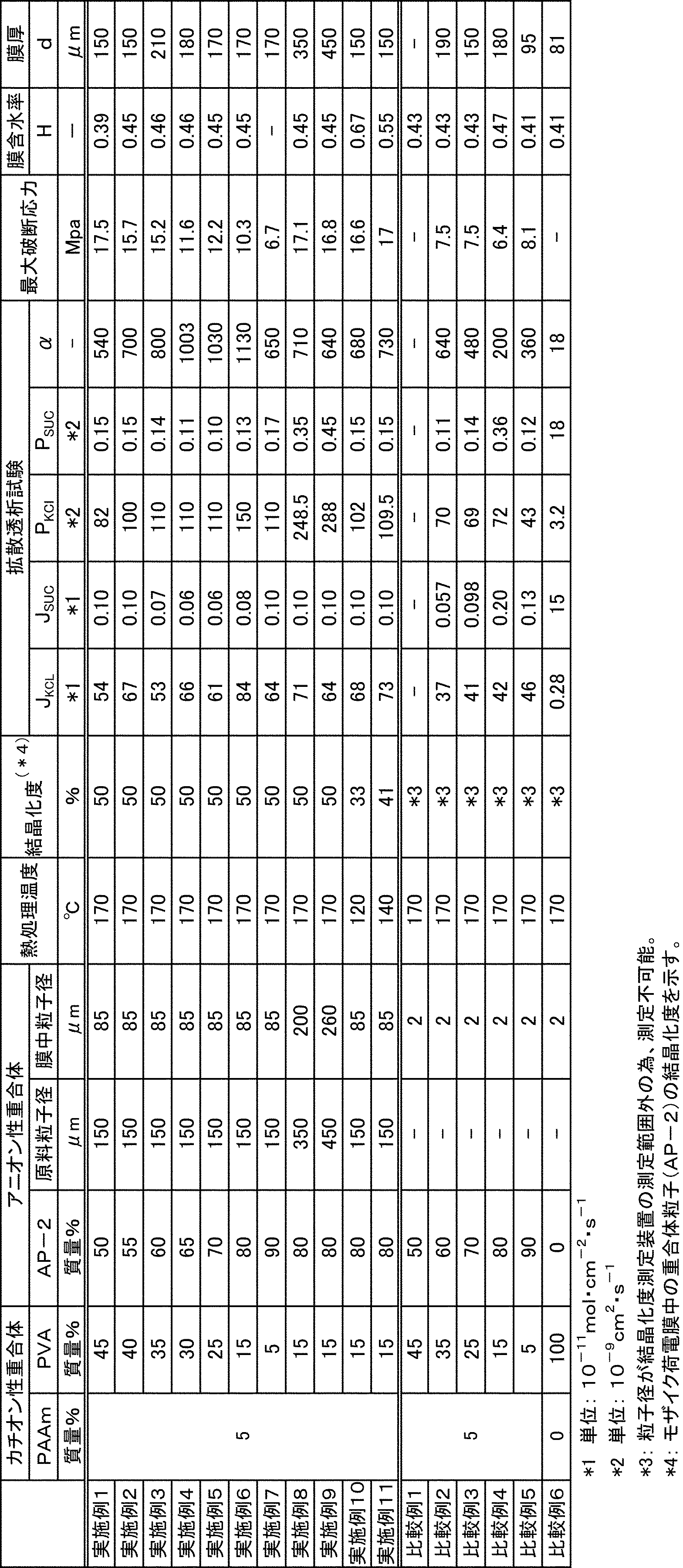
実施例1~7及び比較例2~6において得られたモザイク荷電膜の、KClの透過係数PKClに対して、スクロースに対するKClの電解質選択透過性αをプロットしたグラフを図2に示す。
モザイク荷電膜について、KClの透過係数PKClに対して、スクロースに対するKClの電解質選択透過性αをプロットしたグラフにおいては、点が右上に位置するほど、高い電解質透過性と高い電解質流束を有し、高性能のモザイク荷電膜であることを意味する。図2より、比較例2~5において得られたモザイク荷電膜は、比較例6で得られたポリビニルアルコール膜とほぼ同じトレードオフライン上に位置している。これは、比較例2~6の膜作製時においてカチオン性重合体とアニオン性重合体がポリマーコンプレックスを形成して、実効のカチオン基の量及びアニオン基の量が低下したためと考えられる。
一方、実施例1~7で得られた結晶性重合体からなる粒子を含有するモザイク荷電膜は、これらの膜におけるトレードオフラインよりも右上に位置する。そして電解質選択透過性αは最大で1130を示した。これは、アニオン基を有するポリビニルアルコールを微粉化し、微結晶を残した状態でカチオン性重合体とブレンドした結果、ポリマーコンプレックスの形成が非常に低く抑制され、そのため、実効のカチオン基の量及びアニオン基の量が、比較例で得られたモザイク荷電膜より高くなったためであると考えられる。
実施例1~7及び比較例2~5において得られた最大破断応力の値を、モザイク荷電膜中の全単量体単位の総数に対するアニオン基の数の割合Cpa:モル%に対してプロットしたグラフを図3に示す。
図3より、市販の支持体を有するアニオン交換膜である株式会社アストム製「AM-1」と比較すると、最大破断応力はほぼ同等の値を示すことがわかる。しかし、AM-1は支持体を含むが、本発明のモザイク荷電膜は支持体を含まない自立膜である。このことから、本発明のモザイク荷電膜は高い最大破断応力を有しているといえる。さらに、本発明のモザイク荷電膜は、ポリマーブレンド法によって作製したモザイク荷電膜よりも、最大破断応力が高いといえる。
また、実施例8~11において、アニオン性重合体粒子の平均粒子径、熱処理温度、及び膜厚を表1に示すように変更した場合においても、高い電解質選択透過性α及び最大破断応力が得られることがわかった。
このように、高い電解質選択透過性を有し、かつ圧透析にも十分使用できる機械的強度が高いモザイク荷電膜を作製することができた。
Claims (7)
- カチオン性重合体又はアニオン性重合体の粒子が、逆電荷を有する重合体のマトリックス中に分散したモザイク荷電膜であって、前記粒子が結晶性重合体からなることを特徴とするモザイク荷電膜。
- カチオン性重合体が、カチオン基を含有するポリビニルアルコール、又はカチオン基を含有する重合体とカチオン基を含有しないポリビニルアルコールとの混合物であり;かつ
アニオン性重合体が、アニオン基を含有するポリビニルアルコール、又はアニオン基を含有する重合体とアニオン基を含有しないポリビニルアルコールとの混合物である請求項1記載のモザイク荷電膜。 - 前記粒子の平均粒子径が30~200μmである請求項1又は2記載のモザイク荷電膜。
- カチオン性重合体又はアニオン性重合体からなる結晶性重合体の粒子が分散し、逆電荷を有する重合体が溶解した液から溶媒を除去して皮膜を形成することを特徴とするモザイク荷電膜の製造方法。
- カチオン性重合体が、カチオン基を含有するポリビニルアルコール、又はカチオン基を含有する重合体とカチオン基を含有しないポリビニルアルコールとの混合物であり;かつ
アニオン性重合体が、アニオン基を含有するポリビニルアルコール、又はアニオン基を含有する重合体とアニオン基を含有しないポリビニルアルコールとの混合物である請求項4記載のモザイク荷電膜の製造方法。 - 平均粒子径が30~500μmの粒子からなる粉末を液に投入して分散させる請求項4又は5記載のモザイク荷電膜の製造方法。
- 前記皮膜を形成した後に、熱処理及び/又は架橋処理を施す請求項4~6のいずれか記載のモザイク荷電膜の製造方法。
Priority Applications (1)
| Application Number | Priority Date | Filing Date | Title |
|---|---|---|---|
| JP2011506151A JP5476539B2 (ja) | 2009-03-27 | 2010-03-26 | モザイク荷電膜及びその製造方法 |
Applications Claiming Priority (2)
| Application Number | Priority Date | Filing Date | Title |
|---|---|---|---|
| JP2009078095 | 2009-03-27 | ||
| JP2009-078095 | 2009-03-27 |
Publications (1)
| Publication Number | Publication Date |
|---|---|
| WO2010110437A1 true WO2010110437A1 (ja) | 2010-09-30 |
Family
ID=42781127
Family Applications (1)
| Application Number | Title | Priority Date | Filing Date |
|---|---|---|---|
| PCT/JP2010/055410 Ceased WO2010110437A1 (ja) | 2009-03-27 | 2010-03-26 | モザイク荷電膜及びその製造方法 |
Country Status (2)
| Country | Link |
|---|---|
| JP (1) | JP5476539B2 (ja) |
| WO (1) | WO2010110437A1 (ja) |
Cited By (1)
| Publication number | Priority date | Publication date | Assignee | Title |
|---|---|---|---|---|
| CN106139926A (zh) * | 2016-07-13 | 2016-11-23 | 合肥工业大学 | 聚电解质复合膜、其制备方法与扩散渗析脱盐的方法 |
Citations (5)
| Publication number | Priority date | Publication date | Assignee | Title |
|---|---|---|---|---|
| JPH08155281A (ja) * | 1994-11-30 | 1996-06-18 | Dainichiseika Color & Chem Mfg Co Ltd | モザイク荷電膜の製造方法及びモザイク荷電膜 |
| JP2000070687A (ja) * | 1998-02-25 | 2000-03-07 | Dainichiseika Color & Chem Mfg Co Ltd | 荷電モザイク膜、荷電モザイク膜の製造方法、荷電モザイク膜の使用方法及び荷電モザイク膜を備えた装置 |
| JP2001212439A (ja) * | 2000-02-01 | 2001-08-07 | Dainichiseika Color & Chem Mfg Co Ltd | イオン性膜及びその製造方法並びにイオン性膜の使用方法及びイオン性膜を備えた装置 |
| JP2006297338A (ja) * | 2005-04-25 | 2006-11-02 | Takuma Co Ltd | モザイク荷電膜及びその製造方法 |
| JP2008188518A (ja) * | 2007-02-02 | 2008-08-21 | Yamaguchi Univ | イオンバリヤー膜および該イオンバリヤー膜を使用した分離装置 |
-
2010
- 2010-03-26 WO PCT/JP2010/055410 patent/WO2010110437A1/ja not_active Ceased
- 2010-03-26 JP JP2011506151A patent/JP5476539B2/ja not_active Expired - Fee Related
Patent Citations (5)
| Publication number | Priority date | Publication date | Assignee | Title |
|---|---|---|---|---|
| JPH08155281A (ja) * | 1994-11-30 | 1996-06-18 | Dainichiseika Color & Chem Mfg Co Ltd | モザイク荷電膜の製造方法及びモザイク荷電膜 |
| JP2000070687A (ja) * | 1998-02-25 | 2000-03-07 | Dainichiseika Color & Chem Mfg Co Ltd | 荷電モザイク膜、荷電モザイク膜の製造方法、荷電モザイク膜の使用方法及び荷電モザイク膜を備えた装置 |
| JP2001212439A (ja) * | 2000-02-01 | 2001-08-07 | Dainichiseika Color & Chem Mfg Co Ltd | イオン性膜及びその製造方法並びにイオン性膜の使用方法及びイオン性膜を備えた装置 |
| JP2006297338A (ja) * | 2005-04-25 | 2006-11-02 | Takuma Co Ltd | モザイク荷電膜及びその製造方法 |
| JP2008188518A (ja) * | 2007-02-02 | 2008-08-21 | Yamaguchi Univ | イオンバリヤー膜および該イオンバリヤー膜を使用した分離装置 |
Non-Patent Citations (2)
| Title |
|---|
| MITSURU HIGA ET AL.: "Charge Mosaic Membranes Prepared from Laminated Structure of Charged Gel Layers: Effect of Membrane Structure on the Salt Permselectivity.", TRANSACTIONS OF THE MATERIALS RESEARCH SOCIETY OF JAPAN, vol. 27, no. 2, 2002, pages 407 - 410 * |
| MITSURU HIGA ET AL.: "Charge mosaic membranes prepared from laminated structures of PVA- based charged layers: 1. Preparation and transport properties of charged mosaic membranes", JOURNAL OF MEMBRANE SCIENCE, vol. 310, no. ISSUES, 2008, pages 466 - 473 * |
Cited By (1)
| Publication number | Priority date | Publication date | Assignee | Title |
|---|---|---|---|---|
| CN106139926A (zh) * | 2016-07-13 | 2016-11-23 | 合肥工业大学 | 聚电解质复合膜、其制备方法与扩散渗析脱盐的方法 |
Also Published As
| Publication number | Publication date |
|---|---|
| JPWO2010110437A1 (ja) | 2012-10-04 |
| JP5476539B2 (ja) | 2014-04-23 |
Similar Documents
| Publication | Publication Date | Title |
|---|---|---|
| JP5531267B2 (ja) | イオン交換膜およびその製造方法 | |
| EP2627447B1 (en) | Anion exchange membranes and process for making | |
| Rahimi et al. | Hydrophilic goethite nanoparticle as a novel antifouling agent in fabrication of nanocomposite polyethersulfone membrane | |
| Li et al. | Effects of the porous structure on conductivity of nanocomposite polymer electrolyte for lithium ion batteries | |
| US10300478B2 (en) | Bipolar ion exchange sheet and manufacturing method therefor | |
| Alshahrani et al. | Synthesis and characterisation of MWNT/chitosan and MWNT/chitosan-crosslinked buckypaper membranes for desalination | |
| Bagheripour et al. | Preparation of mixed matrix PES-based nanofiltration membrane filled with PANI-co-MWCNT composite nanoparticles | |
| CA2772306C (en) | Ion exchange membranes featuring polymer-filled microporous supports | |
| JP4774520B2 (ja) | イオンバリヤー膜および該イオンバリヤー膜を使用した分離装置 | |
| Moochani et al. | Fabrication of novel polyethersulfone based nanofiltration membrane by embedding polyaniline-co-graphene oxide nanoplates | |
| Hosseini et al. | Electrochemical characterization of mixed matrix heterogeneous cation exchange membrane modified by aluminum oxide nanoparticles: mono/bivalent ionic transportation | |
| Ali et al. | Developing montmorillonite/PVDF/PEO microporous membranes for removal of malachite green: adsorption, isotherms, and kinetics | |
| CA2814701A1 (en) | Process for making a monomer solution for making cation exchange membranes | |
| Zhao et al. | Interfacial polymerization layer with CNT providing fast water channels under electric field for efficient desalination of nanofiltration membranes | |
| Li et al. | Revolutionary MOF-enhanced anion exchange membrane for precise monovalent anion separation through structural optimization and doping | |
| KR20150090757A (ko) | 전기 흡착 탈이온 장치용 전극 조성물, 및 이를 포함하는 전기 흡착 탈이온 장치용 전극 | |
| Amiri et al. | Fabrication and characterization of PES based nanofiltration membrane modified by zeolite nanoparticles for water desalination | |
| KR20180109586A (ko) | 비대칭 구조의 바이폴라 이온교환막 및 그 제조방법 | |
| JP2016173979A (ja) | 電界誘起および優先配向されたテクスチャーを有するイオン交換薄膜の製造方法 | |
| JP6300374B2 (ja) | 陽イオン交換膜及びその製造方法 | |
| JP5476539B2 (ja) | モザイク荷電膜及びその製造方法 | |
| Nagarale et al. | Polyaniline derivatized anion exchange membrane for acid recovery | |
| Nemati et al. | Thin film heterogeneous ion exchange membranes prepared by interfacial polymerization of paa-co-iron-nickel oxide nanoparticles on polyvinylchloride based substrate | |
| EP3222349B1 (en) | Bipolar ion exchange sheet and manufacturing method therefor | |
| Saadat et al. | Self-Assembled Nanofiltration Membranes with Thermo-and pH-Responsive Behavior |
Legal Events
| Date | Code | Title | Description |
|---|---|---|---|
| 121 | Ep: the epo has been informed by wipo that ep was designated in this application |
Ref document number: 10756233 Country of ref document: EP Kind code of ref document: A1 |
|
| WWE | Wipo information: entry into national phase |
Ref document number: 2011506151 Country of ref document: JP |
|
| NENP | Non-entry into the national phase |
Ref country code: DE |
|
| 122 | Ep: pct application non-entry in european phase |
Ref document number: 10756233 Country of ref document: EP Kind code of ref document: A1 |