WO2010104178A1 - フルオロアルカンスルホン酸アンモニウム塩類およびその製造方法 - Google Patents
フルオロアルカンスルホン酸アンモニウム塩類およびその製造方法 Download PDFInfo
- Publication number
- WO2010104178A1 WO2010104178A1 PCT/JP2010/054246 JP2010054246W WO2010104178A1 WO 2010104178 A1 WO2010104178 A1 WO 2010104178A1 JP 2010054246 W JP2010054246 W JP 2010054246W WO 2010104178 A1 WO2010104178 A1 WO 2010104178A1
- Authority
- WO
- WIPO (PCT)
- Prior art keywords
- group
- general formula
- carbon atoms
- represented
- acid
- Prior art date
- Legal status (The legal status is an assumption and is not a legal conclusion. Google has not performed a legal analysis and makes no representation as to the accuracy of the status listed.)
- Ceased
Links
- 0 C*1*=C(C)C*C1 Chemical compound C*1*=C(C)C*C1 0.000 description 3
- XHMOTVHYEXUHIW-UHFFFAOYSA-N CC(C(C(F)(F)F)=C)=O Chemical compound CC(C(C(F)(F)F)=C)=O XHMOTVHYEXUHIW-UHFFFAOYSA-N 0.000 description 1
- VHYFNPMBLIVWCW-UHFFFAOYSA-N CN(C)c1ccncc1 Chemical compound CN(C)c1ccncc1 VHYFNPMBLIVWCW-UHFFFAOYSA-N 0.000 description 1
- FKNQCJSGGFJEIZ-UHFFFAOYSA-N Cc1ccncc1 Chemical compound Cc1ccncc1 FKNQCJSGGFJEIZ-UHFFFAOYSA-N 0.000 description 1
- YCMLQLFZWQGLGU-UHFFFAOYSA-N OCC(F)(F)S(=O)=O Chemical compound OCC(F)(F)S(=O)=O YCMLQLFZWQGLGU-UHFFFAOYSA-N 0.000 description 1
Classifications
-
- C—CHEMISTRY; METALLURGY
- C07—ORGANIC CHEMISTRY
- C07C—ACYCLIC OR CARBOCYCLIC COMPOUNDS
- C07C303/00—Preparation of esters or amides of sulfuric acids; Preparation of sulfonic acids or of their esters, halides, anhydrides or amides
- C07C303/32—Preparation of esters or amides of sulfuric acids; Preparation of sulfonic acids or of their esters, halides, anhydrides or amides of salts of sulfonic acids
-
- C—CHEMISTRY; METALLURGY
- C07—ORGANIC CHEMISTRY
- C07C—ACYCLIC OR CARBOCYCLIC COMPOUNDS
- C07C309/00—Sulfonic acids; Halides, esters, or anhydrides thereof
- C07C309/01—Sulfonic acids
- C07C309/02—Sulfonic acids having sulfo groups bound to acyclic carbon atoms
- C07C309/03—Sulfonic acids having sulfo groups bound to acyclic carbon atoms of an acyclic saturated carbon skeleton
- C07C309/07—Sulfonic acids having sulfo groups bound to acyclic carbon atoms of an acyclic saturated carbon skeleton containing oxygen atoms bound to the carbon skeleton
- C07C309/08—Sulfonic acids having sulfo groups bound to acyclic carbon atoms of an acyclic saturated carbon skeleton containing oxygen atoms bound to the carbon skeleton containing hydroxy groups bound to the carbon skeleton
-
- C—CHEMISTRY; METALLURGY
- C07—ORGANIC CHEMISTRY
- C07C—ACYCLIC OR CARBOCYCLIC COMPOUNDS
- C07C309/00—Sulfonic acids; Halides, esters, or anhydrides thereof
- C07C309/01—Sulfonic acids
- C07C309/02—Sulfonic acids having sulfo groups bound to acyclic carbon atoms
- C07C309/03—Sulfonic acids having sulfo groups bound to acyclic carbon atoms of an acyclic saturated carbon skeleton
- C07C309/07—Sulfonic acids having sulfo groups bound to acyclic carbon atoms of an acyclic saturated carbon skeleton containing oxygen atoms bound to the carbon skeleton
- C07C309/12—Sulfonic acids having sulfo groups bound to acyclic carbon atoms of an acyclic saturated carbon skeleton containing oxygen atoms bound to the carbon skeleton containing esterified hydroxy groups bound to the carbon skeleton
-
- C—CHEMISTRY; METALLURGY
- C07—ORGANIC CHEMISTRY
- C07C—ACYCLIC OR CARBOCYCLIC COMPOUNDS
- C07C313/00—Sulfinic acids; Sulfenic acids; Halides, esters or anhydrides thereof; Amides of sulfinic or sulfenic acids, i.e. compounds having singly-bound oxygen atoms of sulfinic or sulfenic groups replaced by nitrogen atoms, not being part of nitro or nitroso groups
- C07C313/02—Sulfinic acids; Derivatives thereof
- C07C313/04—Sulfinic acids; Esters thereof
-
- C—CHEMISTRY; METALLURGY
- C07—ORGANIC CHEMISTRY
- C07C—ACYCLIC OR CARBOCYCLIC COMPOUNDS
- C07C381/00—Compounds containing carbon and sulfur and having functional groups not covered by groups C07C301/00 - C07C337/00
- C07C381/12—Sulfonium compounds
-
- G—PHYSICS
- G03—PHOTOGRAPHY; CINEMATOGRAPHY; ANALOGOUS TECHNIQUES USING WAVES OTHER THAN OPTICAL WAVES; ELECTROGRAPHY; HOLOGRAPHY
- G03F—PHOTOMECHANICAL PRODUCTION OF TEXTURED OR PATTERNED SURFACES, e.g. FOR PRINTING, FOR PROCESSING OF SEMICONDUCTOR DEVICES; MATERIALS THEREFOR; ORIGINALS THEREFOR; APPARATUS SPECIALLY ADAPTED THEREFOR
- G03F7/00—Photomechanical, e.g. photolithographic, production of textured or patterned surfaces, e.g. printing surfaces; Materials therefor, e.g. comprising photoresists; Apparatus specially adapted therefor
- G03F7/004—Photosensitive materials
- G03F7/0045—Photosensitive materials with organic non-macromolecular light-sensitive compounds not otherwise provided for, e.g. dissolution inhibitors
-
- G—PHYSICS
- G03—PHOTOGRAPHY; CINEMATOGRAPHY; ANALOGOUS TECHNIQUES USING WAVES OTHER THAN OPTICAL WAVES; ELECTROGRAPHY; HOLOGRAPHY
- G03F—PHOTOMECHANICAL PRODUCTION OF TEXTURED OR PATTERNED SURFACES, e.g. FOR PRINTING, FOR PROCESSING OF SEMICONDUCTOR DEVICES; MATERIALS THEREFOR; ORIGINALS THEREFOR; APPARATUS SPECIALLY ADAPTED THEREFOR
- G03F7/00—Photomechanical, e.g. photolithographic, production of textured or patterned surfaces, e.g. printing surfaces; Materials therefor, e.g. comprising photoresists; Apparatus specially adapted therefor
- G03F7/004—Photosensitive materials
- G03F7/0047—Photosensitive materials characterised by additives for obtaining a metallic or ceramic pattern, e.g. by firing
-
- G—PHYSICS
- G03—PHOTOGRAPHY; CINEMATOGRAPHY; ANALOGOUS TECHNIQUES USING WAVES OTHER THAN OPTICAL WAVES; ELECTROGRAPHY; HOLOGRAPHY
- G03F—PHOTOMECHANICAL PRODUCTION OF TEXTURED OR PATTERNED SURFACES, e.g. FOR PRINTING, FOR PROCESSING OF SEMICONDUCTOR DEVICES; MATERIALS THEREFOR; ORIGINALS THEREFOR; APPARATUS SPECIALLY ADAPTED THEREFOR
- G03F7/00—Photomechanical, e.g. photolithographic, production of textured or patterned surfaces, e.g. printing surfaces; Materials therefor, e.g. comprising photoresists; Apparatus specially adapted therefor
- G03F7/004—Photosensitive materials
- G03F7/0046—Photosensitive materials with perfluoro compounds, e.g. for dry lithography
-
- G—PHYSICS
- G03—PHOTOGRAPHY; CINEMATOGRAPHY; ANALOGOUS TECHNIQUES USING WAVES OTHER THAN OPTICAL WAVES; ELECTROGRAPHY; HOLOGRAPHY
- G03F—PHOTOMECHANICAL PRODUCTION OF TEXTURED OR PATTERNED SURFACES, e.g. FOR PRINTING, FOR PROCESSING OF SEMICONDUCTOR DEVICES; MATERIALS THEREFOR; ORIGINALS THEREFOR; APPARATUS SPECIALLY ADAPTED THEREFOR
- G03F7/00—Photomechanical, e.g. photolithographic, production of textured or patterned surfaces, e.g. printing surfaces; Materials therefor, e.g. comprising photoresists; Apparatus specially adapted therefor
- G03F7/004—Photosensitive materials
- G03F7/039—Macromolecular compounds which are photodegradable, e.g. positive electron resists
- G03F7/0392—Macromolecular compounds which are photodegradable, e.g. positive electron resists the macromolecular compound being present in a chemically amplified positive photoresist composition
Definitions
- the present invention relates to fluorine-containing sulfonates useful as an intermediate for producing a photoacid generator useful as a chemical amplification resist material suitable for microfabrication technology, particularly photolithography, in a manufacturing process of semiconductor elements and the like, and a method for producing the same About. Furthermore, the present invention relates to a method for producing fluorine-containing sulfonic acid onium salts that function as a photoacid generator.
- “Chemically amplified resist materials” are attracting attention as resists suitable for such exposure wavelengths.
- This contains a radiation-sensitive acid generator (hereinafter referred to as “photoacid generator”) that forms an acid upon irradiation with radiation (hereinafter referred to as “exposure”), and the acid generated by exposure is used as a catalyst.
- photoacid generator a radiation-sensitive acid generator
- Exposure an acid upon irradiation with radiation
- exposure the acid generated by exposure is used as a catalyst.
- It is a pattern forming material that forms a pattern by changing the solubility of the exposed portion and the non-exposed portion in the developer by a reaction.
- Patent Document 1 triphenylsulfonium methoxycarbonyldifluoromethanesulfonate
- Patent Document 2 (4-methylphenyl) diphenylsulfonyl t-butoxycarbonyldifluoromethanesulfonate
- Patent Document 3 triphenylsulfonium (adamantan-1-ylmethyl) oxy
- Alkoxycarbonylfluoromethanesulfonic acid onium salts such as carbonyldifluoromethanesulfonate
- triphenylsulfonium 1, 1, 3, 3, 3-penta which is a kind of alkylcarbonyloxyalkanesulfonic acid onium salt, in which the ester bond is reversed from the above-described alkoxycarbonyldifluoromethanesulfonic acid onium salt Fluoro-2- benzoyloxypropane-1-sulfonate has also been developed (Patent Document 4).
- Patent Document 5 an onium salt of 2-alkylcarbonyloxy-1,1-difluoroethanesulfonate, which is considered to have three fewer fluorine atoms than the acid generator of Patent Document 4, that is, less harmful to the environment.
- This substance functions as an acid generator having a strong acidity with a minimum number of fluorine atoms, has excellent compatibility with solvents and resins, and is useful as an acid generator for resists. (Patent Document 5).
- Patent Document 6 An onium salt of tetrafluoroalkanesulfonic acid was found (Patent Document 6).
- reaction formula [2] The reaction pathway as shown in is disclosed. That is, a first step of sulfinating 4-bromo-3,3,4,4-tetrafluorobutan-1-ol using a sulfinating agent to obtain a sulfinate metal salt, the obtained sulfinate metal A second step of oxidizing the salt using an oxidizing agent to obtain a sulfonic acid metal salt; and a third step of reacting the obtained sulfonic acid metal salt with a monovalent onium salt to obtain a sulfonic acid onium salt. And a fourth step of reacting the obtained sulfonic acid onium salt with an alkyl acrylate halide or an alkyl acrylate anhydride to obtain a target polymerizable sulfonic acid onium salt.
- Patent Document 7 The same tetrafluoroalkanesulfonic acid onium salt is also disclosed in other documents (Patent Document 7).
- 1, 4-dibromo- 1, 1, 2, 2-tetrafluorobutane is used as a starting material, and from a selective substitution reaction using a carboxylate such as sodium carboxylate or ammonium carboxylate, Aliphatic or aromatic carboxylic acid 4-bromo- 3, 3, 4, 4-tetrafluorobutyl ester is converted to tetrafluorobutyl ester, and then the ester is dissolved in the presence of a base such as sodium bicarbonate in the same manner as in Patent Document 6.
- a base such as sodium bicarbonate
- the purity of sodium sulfonate obtained is low.
- Patent Document 5 does not describe an example of an acyl group having a polymerizable double bond.
- the purity of the target product obtained is low (80% and 78%) in the first sulfination step and the second oxidation step. Further, the yields are calculated as 77% and 88%, respectively, from the weight of the target product obtained without considering the purity, but they are 62% and 69%, respectively, considering the purity, and are not necessarily high. Furthermore, most of the impurities are sodium salts that are inappropriate to remain in the final photoacid generator.
- the main cause of such problems is that the target sulfinic acid metal salt and sulfonic acid metal salt are easily soluble in water and hardly soluble in organic solvents.
- acetonitrile is used as an extraction solvent in the sulfination step. This is because it is difficult to dissolve or extract the target metal sulfinate sufficiently with other water-insoluble organic solvents.
- the recovery rate of the extract is not so high because the target metal salt of sulfinic acid is water-soluble. As a result, the yield of the target product is lowered.
- water is dissolved in the acetonitrile layer, and water-soluble inorganic impurities are mixed. Further, in the oxidation step, water is used as a reaction solvent and the water is distilled off. In this case, among the generated impurities, non-volatile substances are particularly problematic, and metal salts such as sodium salts cannot be removed.
- an object of the present invention is to provide a method for easily and inexpensively producing fluoroalkanesulfonates useful as a photoacid generator used in a chemically amplified resist material.
- the inventors of the present invention made extensive studies to solve the above problems. As a result, the inventors have found a novel reaction route that is useful for the production of the above-described fluoroalkanesulfonic acid onium salt and is much more advantageous for synthesis on a large scale than the conventional method.
- the present invention includes [Aspect 1] to [Aspect 3] as described below.
- bromine eliminated from the starting carboxylic acid bromofluoroalkyl ester is probably converted into sodium bromide by sodium dithionite and is present in the system, but it is concentrated without removing it.
- the next oxidation step without being separated from the target sodium sulfinate, there were many problems such as the formation of by-products.
- the ammonium salt has the following general formula [2] (In the general formula [2], A + represents an ammonium ion. X represents a hydrogen atom or a fluorine atom independently of each other. N represents an integer of 0 to 8.) It is represented by This ammonium sulfinate has high lipophilicity and low hydrophilicity.
- high-purity ammonium sulfinate can be obtained by removing water-soluble impurities including inorganic salt by a method such as dissolving the unpurified product containing inorganic salt in an appropriate organic solvent and filtering out insoluble matter.
- a method such as dissolving the unpurified product containing inorganic salt in an appropriate organic solvent and filtering out insoluble matter.
- purify to a salt was discovered.
- a by-product produced in the subsequent “oxidation step” (carboxyl bromofluoroalkyl ester represented by the general formula [1], which is a substrate for the sulfination reaction: disappears in the sulfination step, but is generated again in the oxidation step) Obtained) (see Comparative Example 3).
- the present inventors have also found that the presence of the amine greatly accelerates the sulfination reaction and completes it in a short time.
- the present inventors are suitable for large-scale production of hydroxyfluoroalkanesulfinates useful as a photoacid generator production intermediate for resists or as a solid polymer electrolyte production intermediate for fuel cells.
- a production method and a purification method were found.
- This ammonium sulfonate has high lipophilicity and low hydrophilicity, like the ammonium sulfinate. Therefore, high-purity ammonium sulfonate is obtained by removing water-soluble impurities including inorganic salt by a method such as dissolving the unpurified product containing inorganic salt in an appropriate organic solvent and filtering out insoluble matter. The knowledge that it can refine
- the present inventors are suitable for large-scale production of hydroxyfluoroalkanesulfonate useful as a photoacid generator production intermediate for resists or as a solid polymer electrolyte production intermediate for fuel cells.
- a production method and a purification method were found.
- the alkyl group, the alkenyl group, the alicyclic organic group, or an organic group composed of an alicyclic organic group and a linear alkylene group may be substituted on the same carbon.
- a hydrogen atom may be substituted with one oxygen atom to form a keto group, and one of the hydrogen atoms on the alkyl group may be substituted with a 2-acryloyloxy group or a 2-methacryloyloxy group. .))
- R has the same meaning as R in the general formula [6].
- Is reacted with a carboxylic acid derivative represented by the general formula [4] (In the general formula [4], A + represents an ammonium ion.
- X represents a hydrogen atom or a fluorine atom independently of each other.
- N represents an integer of 0 to 8.
- a monovalent onium salt represented by the general formula [8] (In the general formula [8], X ⁇ represents a monovalent anion.
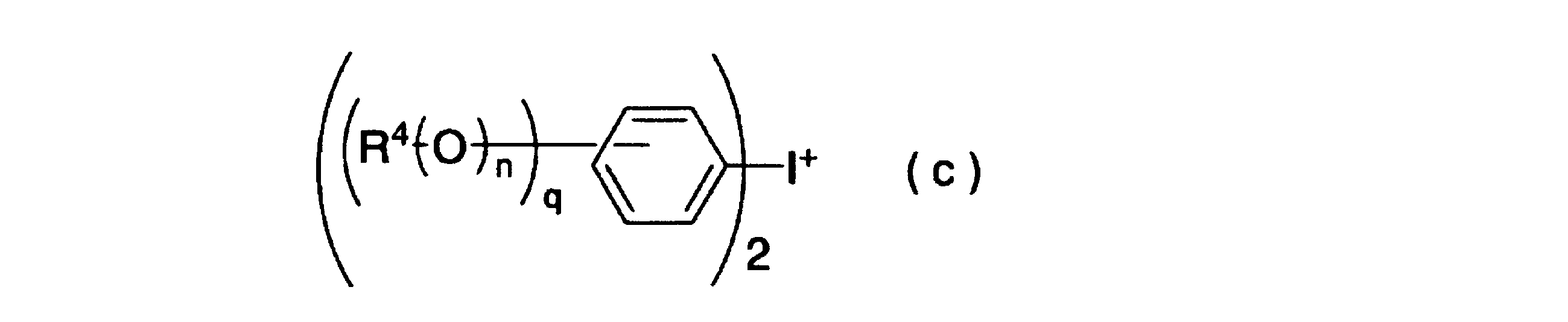
- Q + represents a sulfonium cation represented by the following general formula (a) or the following general formula (b), or represented by the following general formula (c). Iodonium cation.
- R 1 , R 2 and R 3 are each independently a substituted or unsubstituted linear or branched alkyl group having 1 to 10 carbon atoms, an alkenyl group or an oxoalkyl group, or Represents a substituted or unsubstituted aryl group, aralkyl group or aryloxoalkyl group having 6 to 18 carbon atoms, or any two or more of R 1 , R 2 and R 3 are bonded to each other; A ring may be formed together with the sulfur atom.
- R 4 represents a substituted or unsubstituted linear, branched or cyclic alkyl or alkenyl group having 1 to 20 carbon atoms, or a substituted or unsubstituted aryl having 6 to 14 carbon atoms. Indicates a group.
- m represents an integer of 1 to 5, and n represents 0 (zero) or 1.
- R 4 is a substituted or unsubstituted linear, branched or cyclic alkyl or alkenyl group having 1 to 20 carbon atoms, or a substituted or unsubstituted aryl having 6 to 14 carbon atoms. Indicates a group.
- substituent R of the fluoroalkanesulfonic acid onium salt represented by the formula [5] “the one having a nonconjugated unsaturated site (double bond or triple bond) in the structure” is also included. is important.
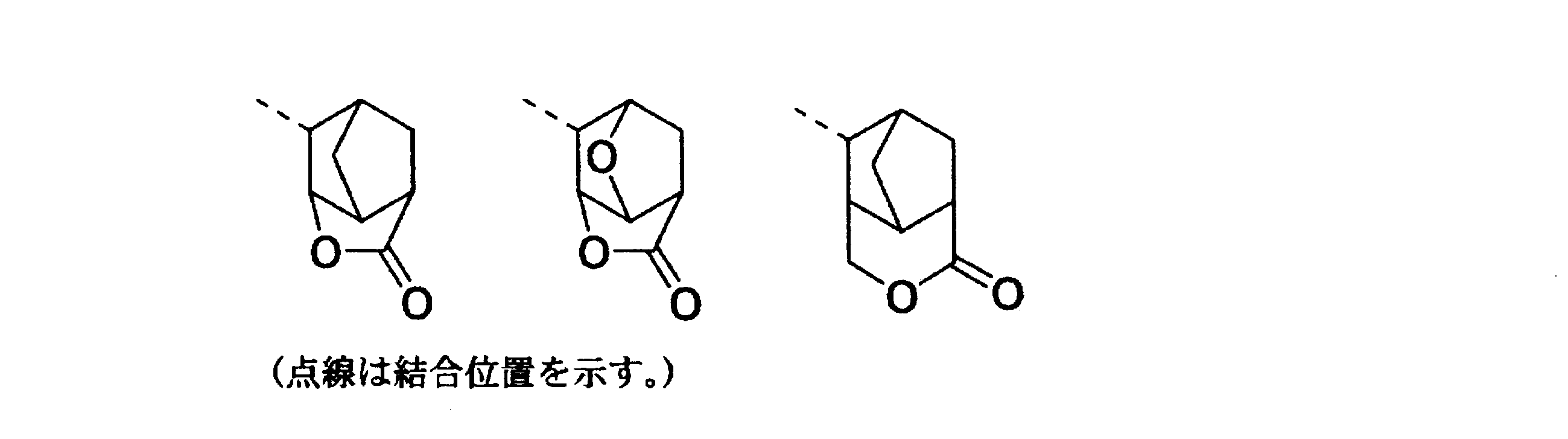
- substituent R a polymerizable double bond-containing group represented by the following formula: Can be illustrated.
- Patent Document 5 Japanese Patent Application Laid-Open No. 2009-7327
- Patent Document 5 Japanese Patent Application Laid-Open No. 2009-7327
- this [Aspect 3] is a fluoroalkanesulfonic acid onium salt useful as a photoacid generator used in a chemically amplified resist material.
- a substituent R a non-conjugated unsaturated site is present in the structure. It is particularly useful for those that have it.
- those having a non-conjugated unsaturated site at the end of the substituent that is, ( ⁇ -alkenylcarbonyloxy) fluoroalkanesulfonic acid onium salt, are disclosed in other documents such as those disclosed in International Publication No. 2006/121096.
- a resist resin By being copolymerized with the above monomer, it can be fixed in a resist resin, and can be used as a “resist resin-supported photoacid generator”.
- Such a “resist resin-supported photoacid generator” is a new type of photoacid generator that has attracted attention in recent years because of its high performance such as high resolution. In this sense, an ( ⁇ -alkenylcarbonyloxy) fluoroalkanesulfonic acid onium salt having a non-conjugated unsaturated site at the end of the substituent is extremely useful.
- another feature of the aspect 3 is the order in which esterification is performed first and onium salt exchange is performed later.
- Patent Document 6 International Publication No. 2008/056795 pamphlet
- the onium salt exchange is performed first, followed by the esterification.
- the fewer equipment installed under special conditions of light shielding conditions the better. The longer the process, the more equipment must be installed under light shielding conditions.
- esterification cannot be performed first and onium salt exchange cannot be performed later.
- the present invention includes [Invention 1] to [Invention 10].
- [Invention 2] General formula [3] by including the following two steps The manufacturing method of hydroxyfluoroalkanesulfonic-acid ammonium salt represented by these.
- a + represents an ammonium ion.
- X independently represents a hydrogen atom or a fluorine atom
- X represents a hydrogen atom or a fluorine atom independently of each other.
- N represents an integer of 0 to 8.
- X ′ represents a hydroxyl group or a halogen
- R represents a carbon number of 1 to 10 linear or branched alkyl groups, 1 to 10 linear or branched alkenyl groups having a polymerizable double bond at least at the terminal portion, and 3 to 20 alicyclic organic groups Represents an organic group composed of an alicyclic organic group having 3 to 20 carbon atoms and a linear alkylene group, a monocyclic or polycyclic lactone having 3 to 30 carbon atoms, or an aryl group having 6 to 20 carbon atoms.
- alkyl group, alkenyl An alicyclic organic group, an organic group composed of an alicyclic organic group and a linear alkylene group, a monocyclic or polycyclic lactone and a part or all of hydrogen atoms on the aryl group are fluorine, hydroxyl group, It may be substituted with a hydroxycarbonyl group, a linear, branched or cyclic alkoxy group having 1 to 6 carbon atoms, and the alkyl group, alkenyl group, alicyclic organic group or alicyclic organic group; Two hydrogen atoms on the same carbon constituting an organic group composed of a linear alkylene group may be substituted with one oxygen atom to form a keto group, and one of the hydrogen atoms on the alkyl group is , 2-acryloyloxy group, 2-methacryloyloxy group or 2-trifluoromethacryloyloxy group may be substituted.
- R 1 , R 2 and R 3 are each independently a substituted or unsubstituted linear or branched alkyl group having 1 to 10 carbon atoms, an alkenyl group or an oxoalkyl group, or Represents a substituted or unsubstituted aryl group, aralkyl group or aryloxoalkyl group having 6 to 18 carbon atoms, or any two or more of R 1 , R 2 and R 3 are bonded to each other; A ring may be formed together with the sulfur atom.
- R 4 represents a substituted or unsubstituted linear, branched or cyclic alkyl or alkenyl group having 1 to 20 carbon atoms, or a substituted or unsubstituted aryl having 6 to 14 carbon atoms. Indicates a group. m represents an integer of 1 to 5, and n represents 0 (zero) or 1. In the general formula (c), R 4 is a substituted or unsubstituted linear, branched or cyclic alkyl or alkenyl group having 1 to 20 carbon atoms, or a substituted or unsubstituted aryl having 6 to 14 carbon atoms. Indicates a group. q represents an integer of 0 (zero) to 5, and n represents 0 (zero) or 1. )
- the amine used in the sulfination step is an amine represented by the following general formula [I]
- G 1 , G 2 and G 3 are each independently a hydrogen atom, an alkyl group having 1 to 6 carbon atoms, an alkoxyalkyl group having 1 to 6 carbon atoms, or an alkyl group having 3 to 12 carbon atoms.
- an intermediate for producing a photoacid generator that is useful as a chemically amplified resist material suitable for microfabrication technology, particularly photolithography, in a production process of a semiconductor element or the like.
- Fluoroalkane sulfonates useful as a solid body or as an intermediate for producing a solid electrolyte used in a fuel cell or the like can be produced in a simple, good yield and on an industrial scale.
- fluoroalkanesulfonic acid onium salts that function as a photoacid generator can be produced easily and in a high yield on an industrial scale.
- a + represents an ammonium ion.
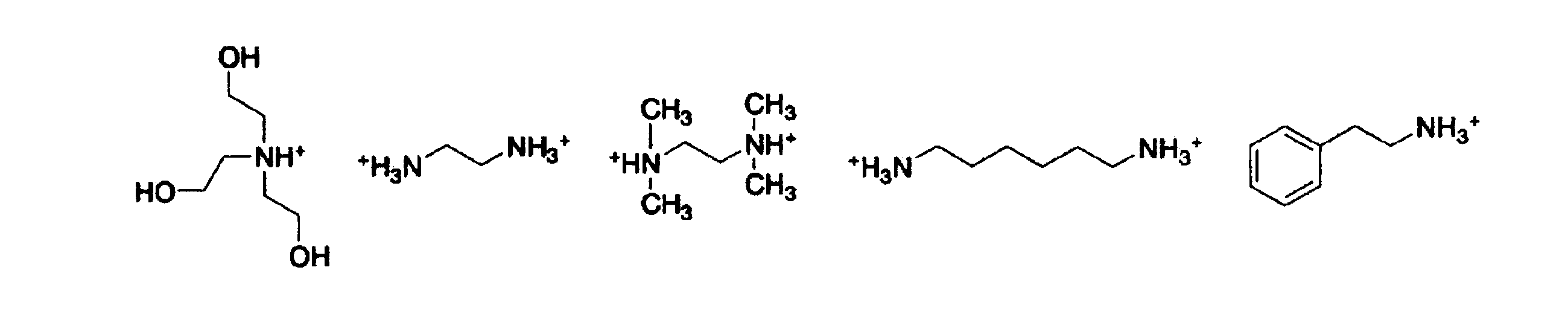
- ammonium ions represented by A + include ammonium ion (NH 4 + ), methyl ammonium ion (MeNH 3 + ), dimethyl ammonium ion (Me 2 NH 2 + ), trimethyl ammonium ion (Me 3 NH + ), Ethylammonium ion (EtNH 3 + ), diethylammonium ion (Et 2 NH 2 + ), triethylammonium ion (Et 3 NH + ), n-propylammonium ion (n-PrNH 3 + ), di-n-propylammonium ion (N-Pr 2 NH 2 + ), tri-n-propylammonium ion (n-Pr 3 NH + ), i-propylammonium ion (i-PrNH 3 + ), di-i-propylammonium ion (i-P
- a + is preferably an ammonium ion represented by the following general formula [ ⁇ ].
- G 1 , G 2 and G 3 are each independently a hydrogen atom, an alkyl group having 1 to 6 carbon atoms, an alkoxyalkyl group having 1 to 6 carbon atoms, or a cyclohexane having 3 to 12 carbon atoms.
- trimethylammonium ion (Me 3 NH + ), triethylammonium ion (Et 3 NH + ), and diisopropylethylammonium (n-Pr 2 EtNH + ) are particularly preferable.
- X represents a hydrogen atom or a fluorine atom independently of each other.
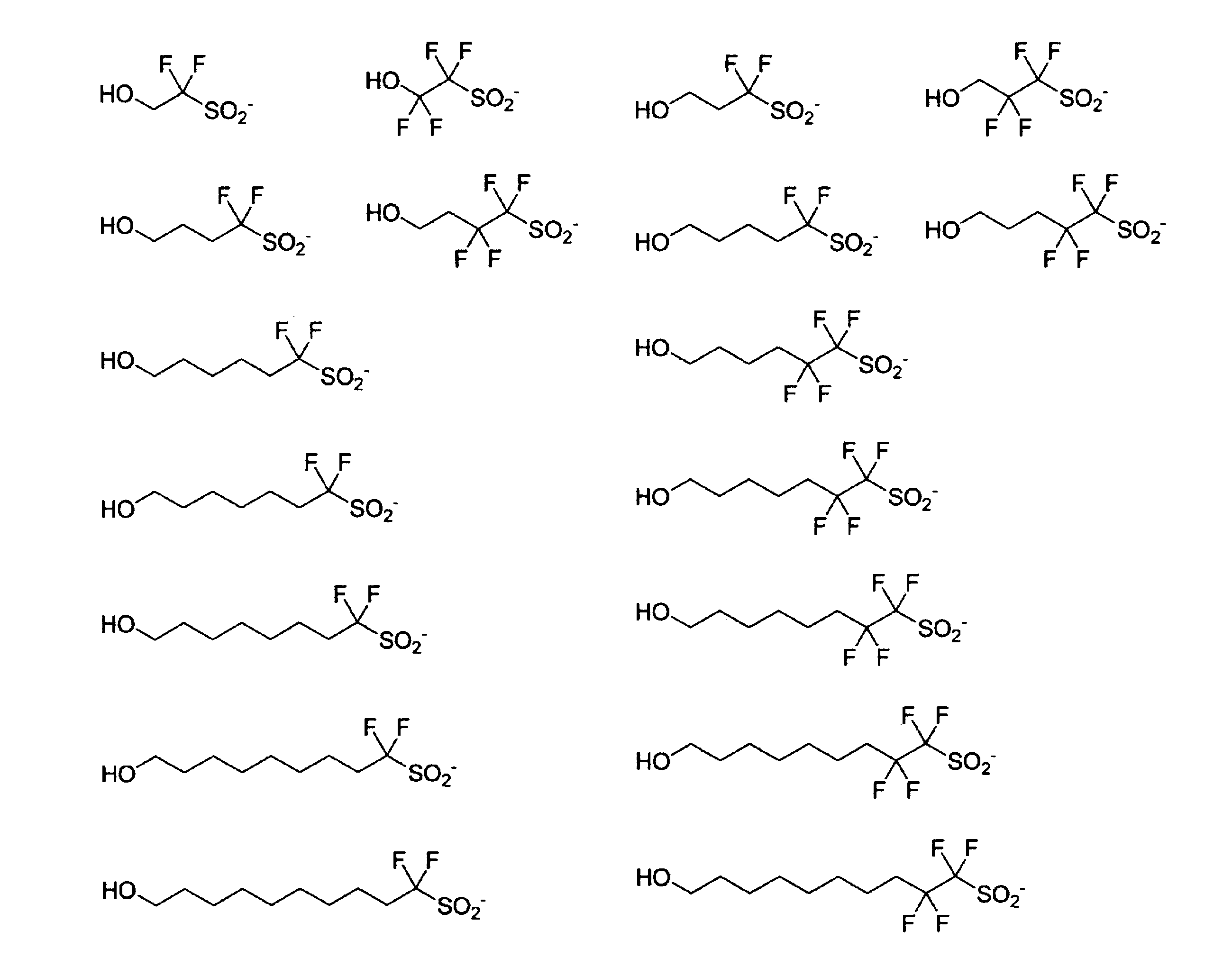
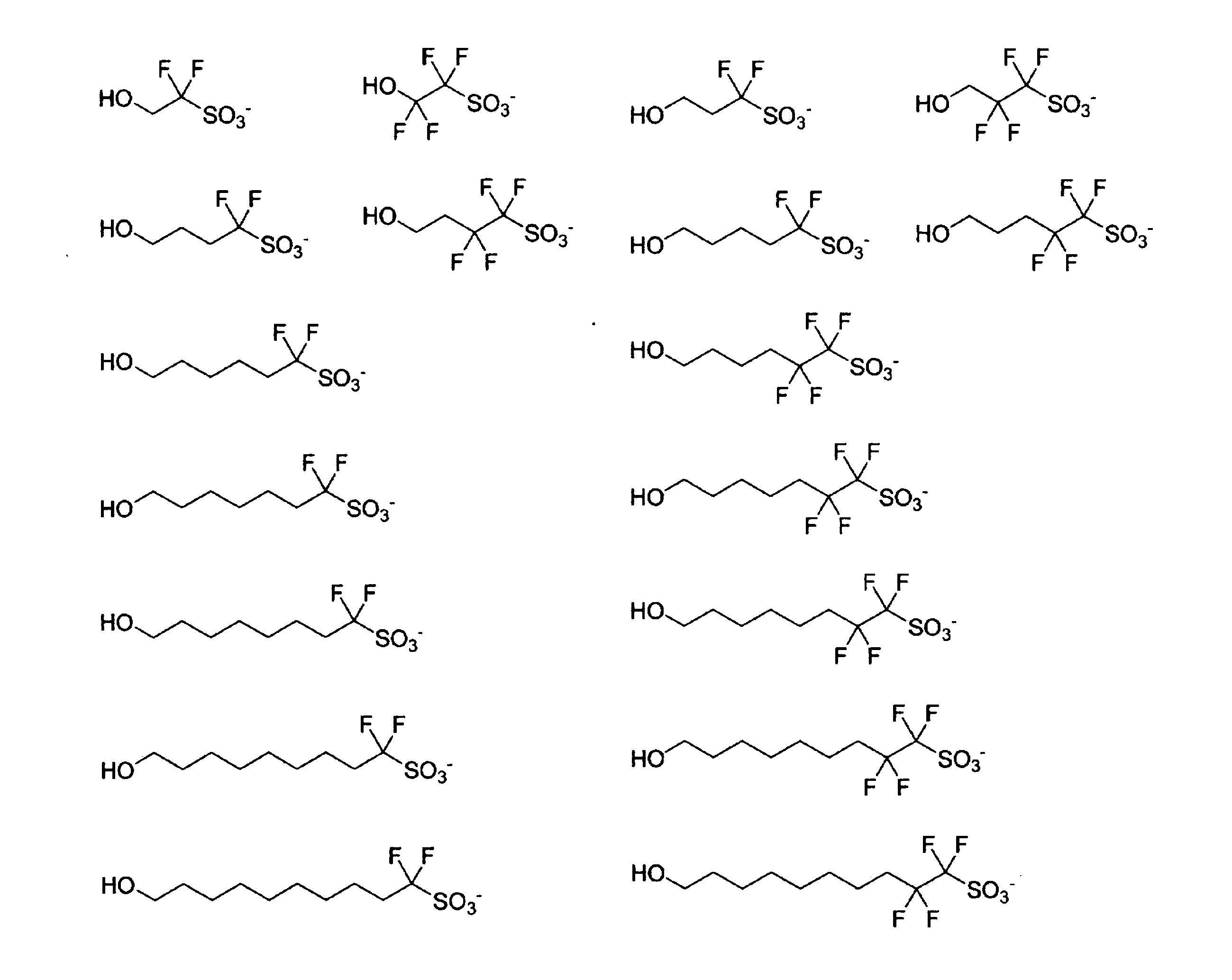
- n represents an integer of 0 to 8. Examples of the structure of the anion moiety in the general formula [2] include the following structures.
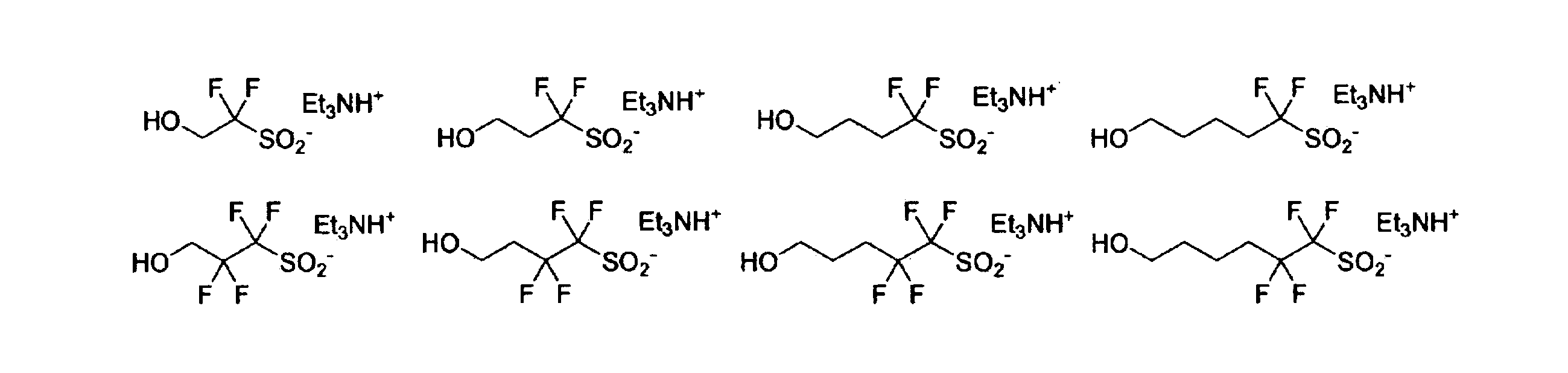
- hydroxyfluoroalkanesulfonic acid ammonium salt The hydroxyfluoroalkanesulfonic acid ammonium salt of the present invention is represented by the following general formula [3].
- a + represents an ammonium ion.
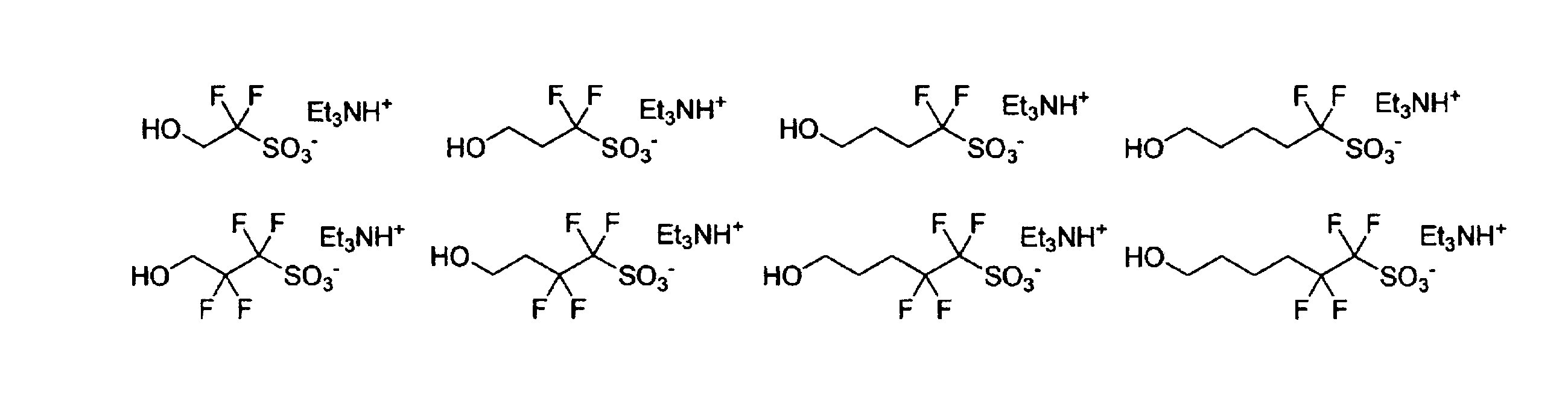
- specific examples of A + can be exemplified again by those exemplified in the section of ammonium hydroxyfluoroalkanesulfinic acid salt represented by the general formula [2].
- X represents a hydrogen atom or a fluorine atom independently of each other.
- n represents an integer of 0 to 8. Examples of the structure of the anion moiety in the general formula [2] include the following structures.
- the present invention is represented by the following reaction formula [3] As shown in the formula (1), the bromofluoroalcohol represented by the general formula [1] is reacted in the presence of an amine with a sulfinating agent to produce a hydroxyfluoroalkanesulfinic acid ammonium salt represented by the general formula [2] (an embodiment of the present invention).
- first step sulfination step
- the obtained hydroxyfluoroalkanesulfinic acid ammonium salt represented by the general formula [2] is reacted with an oxidizing agent, and the general formula [3]
- a step of obtaining a hydroxyfluoroalkanesulfonic acid ammonium salt (the target product of embodiment 2 of the present invention) represented (second step: oxidation step), and the resulting hydroxyfluoroalkanesulfonic acid ammonium salt represented by the general formula [3]
- the salt is esterified by reacting with a carboxylic acid derivative represented by the general formula [6] or the general formula [7], and represented by the general formula [4].
- the step of obtaining a fluoroalkanesulfonic acid ammonium salt ([third step]: esterification step), and the resulting fluoroalkanesulfonic acid ammonium salt represented by the general formula [4] is represented by the general formula [8].
- fluoroalkanesulfonic acid onium salt having a non-conjugated unsaturated site (double bond or triple bond) as R in general formula [5] is also converted to bromofluorofluoromethane represented by general formula [1]. It can be obtained from alcohol via four steps.
- the first step is a step (sulfination step) in which a bromofluoroalcohol represented by the general formula [1] is reacted in the presence of a sulfinating agent in the presence of an organic base to obtain a hydroxyfluoroalkanesulfinic acid ammonium salt.
- the sulfinating agent used in this step is represented by the general formula [10].
- S 1 represents S 2 O 4 , HOCH 2 SO 2 , SO 4 or HSO 4
- m and n represent an integer
- p represents 0 (zero) or an integer.
- M 1 represents Li, Na, K or NH 4 ), and specifically, lithium dithionite, sodium dithionite, potassium dithionite, ammonium dithionite, hydroxymethane Lithium sulfinate, sodium hydroxymethanesulfinate, potassium hydroxymethanesulfinate, ammonium hydroxymethanesulfinate, lithium sulfite, sodium sulfite, potassium sulfite, ammonium sulfite, lithium hydrogen sulfite, sodium hydrogen sulfite, potassium hydrogen sulfite, ammonium hydrogen sulfite, etc.
- sodium dithionite and potassium dithionite are preferred, and sodium dithionite is particularly preferred.
- the molar ratio of the sulfinating agent to bromofluoroalcohol [1] is usually 0.5 to 10, preferably 0.9 to 5.0, and particularly preferably 1.0 to 2.0.
- This reaction can be carried out in air, but the sulfinating agent may be decomposed by moisture in the air. Therefore, it is preferable to carry out in a nitrogen or argon atmosphere.
- the sulfination reaction using a sulfinating agent may proceed without the addition of a base, but the reaction can be promoted by the addition, so it is usually added.
- a base inorganic bases such as sodium carbonate, potassium carbonate, sodium hydrogen carbonate, potassium hydrogen carbonate and the like are generally used.
- an amine is a major feature. .
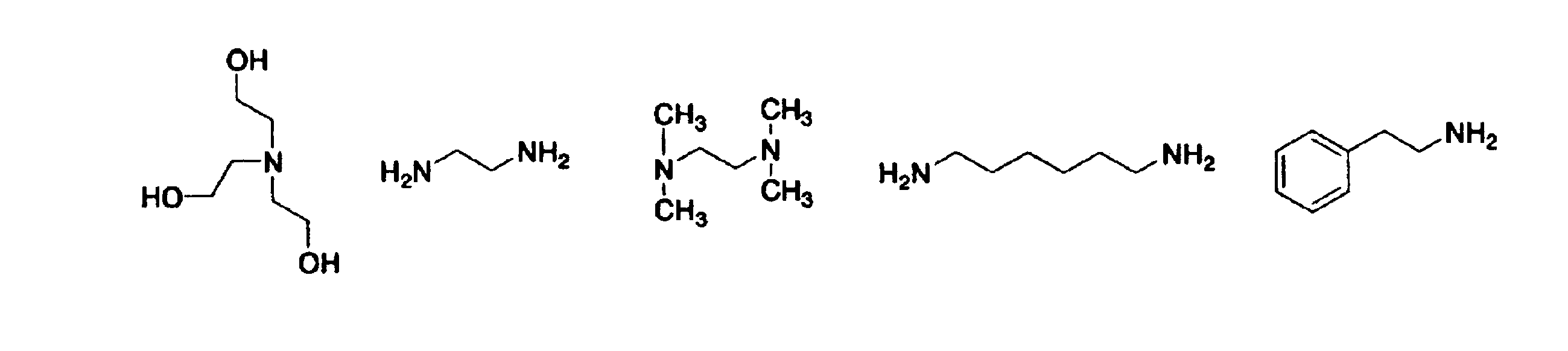
- the organic base used (coexisted) in this step is a free amine obtained by removing protons (H + ) from various ammonium ions exemplified as A + in the above formula [2].
- ammonia methylamine, dimethylamine, trimethylamine, ethylamine, diethylamine, triethylamine, n-propylamine, di-n-propylamine, tri-n-propylamine, i-propylamine, di-i-propylamine, tri -I-propylamine, n-butylamine, di-n-butylamine, tri-n-butylamine, sec-butylamine, di-sec-butylamine, tri-sec-butylamine, tert-butylamine, di-tert-butylamine, tri- Examples thereof include tert-butylamine, diisopropylethylamine, phenylamine, diphenylamine, triphenyl
- G 1 , G 2 and G 3 are each independently a hydrogen atom, an alkyl group having 1 to 6 carbon atoms, an alkoxyalkyl group having 1 to 6 carbon atoms, or an alkyl group having 3 to 12 carbon atoms.
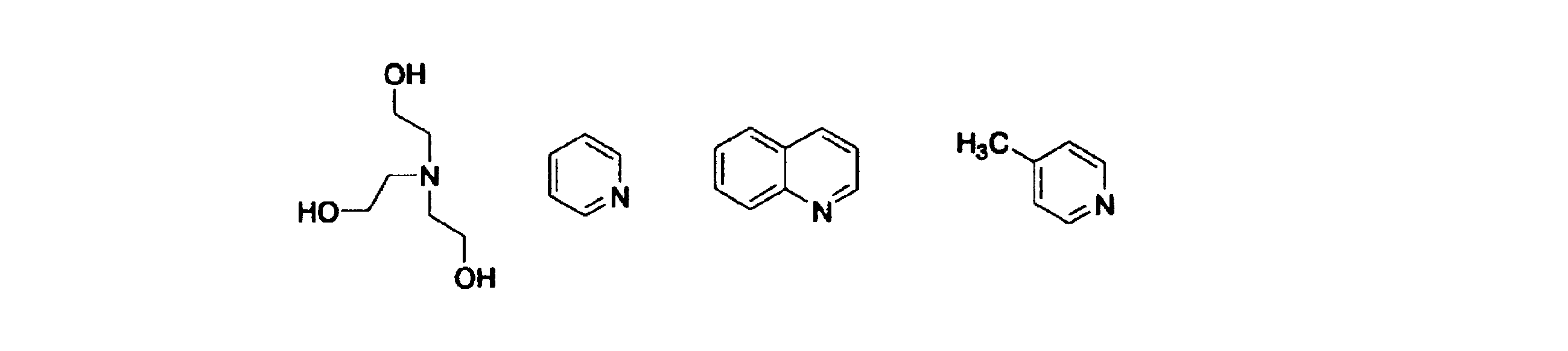
- a teroaromatic group, or a ring which may contain a hetero atom in at least two of G 1 , G 2 and G 3 Specifically, trimethylamine, triethylamine, tri-n-propylamine, tri-i-propylamine, tri-n-butylamine, tri-sec-butylamine, tri-tert-butylamine, diisopropylethylamine, triphenylamine, or Organic base having the structure Can be exemplified as a preferred organic base.
- trimethylamine, triethylamine, and diisopropylethylamine are not only easily available, but also significantly improve the reactivity of the sulfination reaction, and the lipid solubility of the resulting hydroxyfluoroalkanesulfinic acid ammonium salt is sufficiently improved. Therefore, it is preferable.
- the molar ratio of the organic base to bromofluoroalcohol [1] is usually 1.0 to 10.0, preferably 1.1 to 2.0.
- a hydroxyfluoroalkanesulfinate metal salt is by-produced by a cation derived from a sulfinating agent (metal cation such as sodium ion, potassium ion or lithium ion).
- metal cation such as sodium ion, potassium ion or lithium ion.
- This reaction is preferably performed in a mixed solvent of an organic solvent and water.
- the organic solvent is preferably a solvent having good compatibility with water, such as lower alcohols, tetrahydrofuran, N, N-dimethylformamide, N, N-dimethylacetamide, acetonitrile, dimethylsulfoxide, and more preferably Methanol, N, N-dimethylacetamide, acetonitrile, dimethyl sulfoxide and the like are preferable, and acetonitrile is particularly preferable.
- the proportion of the organic solvent used is usually 5 parts by weight or more, preferably 10 parts by weight or more, and more preferably 20 to 90 parts by weight with respect to 100 parts by weight of the total of the organic solvent and water.
- the reaction temperature is usually 0 to 200 ° C., preferably 30 to 100 ° C.
- the reaction time is usually 0.1 to 12 hours, preferably 0.5 to 6 hours.
- the end point of the reaction is preferably the time when a certain bromofluoroalcohol [1] is consumed.
- a pressure vessel such as an autoclave is used.
- reaction time when the reaction time is compared using bromofluoroalcohol [1] having the same structure as a substrate, when an inorganic base such as sodium carbonate, potassium carbonate, sodium hydrogen carbonate, potassium hydrogen carbonate is used, the organic base is converted.
- the reaction time is several to several tens of times as compared with the case of using. Specifically, it takes 12 hours or more. In some cases, the reaction is not completed.
- the desired sulfinized product cannot be obtained in high yield.
- an amine when used as the base, the reaction is remarkably accelerated, and in some cases, the reaction can be completed in several tens of minutes.
- one of the effects of using an amine as a base in the present invention is that the reaction time can be remarkably shortened.
- the post-reaction process will be described.
- the lipophilicity of the resulting hydroxyfluoroalkanesulfinic acid ammonium salt is improved.
- fat-soluble ammonium hydroxyfluoroalkanesulfinate can be dissolved in an organic solvent by treating an unpurified crude product containing a large amount of inorganic impurities obtained after the reaction with an organic solvent. At this time, it is possible to deposit inorganic impurities that are not fat-soluble and then filter them out.
- solvents examples include halogen solvents such as chloroform and dichloromethane, ether solvents such as diethyl ether, diisopropyl ether and tert-butyl methyl ether, or acetate solvents such as ethyl acetate and butyl acetate, acetone, 2- Examples thereof include ketone solvents such as butanone.
- the metal salt of hydroxyfluoroalkanesulfinic acid obtained by using an inorganic base has a lower fat solubility than the ammonium salt, and rather has a higher water solubility. Therefore, the difference in fat solubility with the inorganic impurities to be removed is small, and it is extremely difficult to selectively dissolve only the metal salt of hydroxyfluoroalkanesulfinate using an organic solvent as described above. Therefore, it is not possible to obtain a hydroxyfluoroalkanesulfinic acid metal salt with high purity.
- the bromine mark contained in the inorganic material is removed, the subsequent steps are hindered.
- the organic layer is washed with water and an aqueous solution of sodium thiosulfate (or an aqueous solution of sodium sulfite), and the solvent is distilled off from the organic layer to obtain the target ammonium sulfinate salt.
- the solvent is distilled off from the organic layer to obtain the target ammonium sulfinate salt.
- it may be purified by recrystallization or the like.
- oxidizing agent used in this step in addition to hydrogen peroxide, metachloroperbenzoic acid, t-butyl hydroperoxide, potassium peroxysulfate, potassium permanganate, sodium perborate, sodium metaiodate, chromic acid, Examples include sodium dichromate, halogen, iodobenzene dichloride, iodobenzene diacetate, osmium oxide (VIII), ruthenium oxide (VIII), sodium hypochlorite, sodium chlorite, oxygen gas, ozone gas, etc. Preferred are hydrogen peroxide, metachloroperbenzoic acid, t-butyl hydroperoxide, and the like.
- the molar ratio of oxidizing agent to hydroxyfluoroalkanesulfinic acid ammonium salt [2] is usually 0.9 to 10.0, preferably 1.0 to 2.0.
- an oxidizing agent may be added to the molar amount of the bromofluoroalcohol represented by the general formula [1] before sulfination. .
- a transition metal catalyst can be used in combination with the oxidizing agent.
- the transition metal catalyst include disodium tungstate, iron (III) chloride, ruthenium (III) chloride, selenium oxide (IV), and the like, preferably disodium tungstate.
- the molar ratio of the transition metal catalyst to the hydroxyfluoroalkanesulfinic acid ammonium salt [2] is usually 0.0001 to 1.0, preferably 0.001 to 0.5, more preferably 0.001 to 0.1. is there.
- a buffer may be used for the purpose of adjusting the pH of the reaction solution.
- the buffer include disodium hydrogen phosphate, sodium dihydrogen phosphate, dipotassium hydrogen phosphate, and potassium dihydrogen phosphate.
- the molar ratio of the buffer to ammonium hydroxyfluoroalkanesulfinate [2] is usually 0.01 to 2.0, preferably 0.03 to 1.0, more preferably 0.05 to 0.5. .
- reaction solvent is preferably water or an organic solvent such as lower alcohols, tetrahydrofuran, N, N-dimethylformamide, N, N-dimethylacetamide, acetonitrile, dimethyl sulfoxide, acetic acid, trifluoroacetic acid, and more preferably.
- an organic solvent and water can be used in combination, and the use ratio of the organic solvent in that case is usually 5 parts by weight or more, preferably 100 parts by weight in total of the organic solvent and water. Is 10 parts by weight or more, more preferably 20 to 90 parts by weight.
- the amount of the reaction solvent used per 1 part by weight of the hydroxyfluoroalkanesulfinic acid ammonium salt [2] is usually 1 to 100 parts by weight, preferably 2 to 100 parts by weight, and more preferably 5 to 50 parts by weight.
- the reaction temperature is usually 0 to 100 ° C., preferably 5 to 60 ° C., more preferably 5 to 40 ° C., and the reaction time is usually 0.1 to 72 hours, preferably 0.5 to 24 hours. Yes, and more preferably 0.5 to 12 hours, but using an analytical instrument such as thin layer chromatography (TLC) or nuclear magnetic resonance apparatus (NMR), the raw material ammonium hydroxyfluoroalkanesulfinate [2 It is preferable that the end point of the reaction is the point at which the] is consumed.
- TLC thin layer chromatography
- NMR nuclear magnetic resonance apparatus
- the post-reaction process will be described.
- the lipophilicity of the resulting hydroxyfluoroalkanesulfonic acid ammonium salt is improved.
- fat-soluble hydroxyfluoroalkanesulfonic acid ammonium salt is dissolved in an organic solvent by treating the crude product containing a large amount of inorganic impurities obtained after the reaction and post-treatment with an organic solvent. Can do. At this time, it is possible to deposit inorganic impurities that are not fat-soluble and then filter them out.
- solvents examples include halogen solvents such as chloroform and dichloromethane, ether solvents such as diethyl ether, diisopropyl ether and tert-butyl methyl ether, or acetate solvents such as ethyl acetate and butyl acetate, acetone, 2- Examples thereof include ketone solvents such as butanone.
- the obtained hydroxyfluoroalkanesulfonic acid ammonium salt [3] can be purified by recrystallization or the like in some cases.
- X ′ represents a hydroxyl group or a halogen.
- the halogen include fluorine, chlorine, bromine and iodine. Among these, chlorine is particularly preferable.
- R is a linear or branched alkyl group having 1 to 10 carbon atoms, and is polymerizable at least at the terminal portion of the linear or branched carbon group having 1 to 10 carbon atoms.
- An alkenyl group having a double bond, an alicyclic organic group having 3 to 20 carbon atoms, an organic group composed of an alicyclic organic group having 3 to 20 carbon atoms and a linear alkylene group, or a single group having 3 to 30 carbon atoms Represents a cyclic or polycyclic lactone or an aryl group having 6 to 20 carbon atoms (here, consisting of the alkyl group, alkenyl group, alicyclic organic group, alicyclic organic group and linear alkylene group).
- Some or all of the hydrogen atoms on the organic group, monocyclic or polycyclic lactone and aryl group are fluorine, hydroxyl group, hydroxycarbonyl group, linear, branched or cyclic alkoxy group having 1 to 6 carbon atoms. Is replaced by
- two hydrogen atoms on the same carbon constituting the alkyl group, alkenyl group, alicyclic organic group, or organic group composed of an alicyclic organic group and a linear alkylene group are one oxygen atom.
- a hydrogen atom on the alkyl group may be substituted with a 2-acryloyloxy group, 2-methacryloyloxy group-trifluoromethylmethacryloyloxy group.
- Examples of the linear or branched alkyl group having 1 to 10 carbon atoms include a methyl group, an ethyl group, an n-propyl group, an i-propyl group, an n-butyl group, a t-butyl group, and an n-pentyl group. N-hexyl group, n-heptyl group, n-octyl group, n-nonyl group, n-decyl group and the like.
- Examples of the straight-chain or branched alkenyl group having 1 to 10 carbon atoms and having a polymerizable double bond at the terminal portion include, for example, vinyl group, 1-methylethenyl group, allyl group, 3-butenyl group, 1-methylallyl group. Group, 2-methylallyl group, 4-pentenyl group, 5-hexenyl group and the like.
- Examples of the alicyclic organic group having 3 to 20 carbon atoms include cyclopentyl group, cyclohexyl group, adamantyl group, norbornyl group, camphoroyl group, cyclopentylmethyl group, cyclopentylethyl group, cyclohexylmethyl group, cyclohexylethyl group, and adamantylmethyl.
- An organic group composed of an alicyclic organic group having 3 to 20 carbon atoms and a linear alkylene group is “an organic group in which one valence of an alicyclic organic group and a linear alkylene group is bonded”. Specifically, for example, a cyclopropylmethyl group, a cyclobutylmethyl group, a cyclopentylmethyl group, a cyclohexylmethyl group, a bornylmethyl group, a norbornylmethyl group, an adamantylmethyl group and the like can be mentioned.
- the number of carbon atoms of the linear alkylene group is not particularly limited, but is 1 to 6, for example.
- Monocyclic or polycyclic lactones having 3 to 30 carbon atoms include ⁇ -butyrolaclone, ⁇ -valerolactone, angelica lactone, ⁇ -hexalactone, ⁇ -heptalactone, ⁇ -octalactone, ⁇ -nonalactone, 3-methyl -4-octanolide (whiskey lactone), ⁇ -decalactone, ⁇ -undecalactone, ⁇ -dodecalactone, ⁇ -jasmolactone (7-decenolactone), ⁇ -hexalactone, 4, 6, 6 (4, 4, 6) -Trimethyltetrahydropyran-2-one, ⁇ -octalactone, ⁇ -nonalactone, ⁇ -decalactone, ⁇ -2-decenolactone, ⁇ -undecalactone, ⁇ -dodecalactone, ⁇ -tridecalactone, ⁇ -tetra Decalactone, lactoscatone,
- aryl group having 6 to 20 carbon atoms examples include phenyl group, o-tolyl group, m-tolyl group, p-tolyl group, p-hydroxyphenyl group, 1-naphthyl group, 1-anthracenyl group, benzyl group and the like. Can be mentioned.
- two hydrogen atoms on the same carbon constituting the alkyl group, alkenyl group, alicyclic organic group, or organic group composed of an alicyclic organic group and a linear alkylene group are substituted with one oxygen atom. It may be a keto group.
- one of the hydrogen atoms on the alkyl group may be substituted with a 2-acryloyloxy group or a 2-methacryloyloxy group.
- the main feature is that a non-conjugated unsaturated site (double bond or triple bond), that is, a polymerizable acyl group can be used.
- the use of the carboxylic acid represented by the general formula [6] is allowed to act on the hydroxyfluoroalkanesulfonic acid ammonium salt [3].
- the amount is not particularly limited, but is usually 0.1 to 5 mol, preferably 0.2 to 3 mol, based on 1 mol of hydroxyfluoroalkanesulfonic acid ammonium salt [3]. More preferably, it is 0.5 to 2 mol.
- the amount of carboxylic acid used is particularly preferably 0.8 to 1.5 mol.
- an aprotic solvent such as dichloroethane, toluene, ethylbenzene, monochlorobenzene, acetonitrile, N, N-dimethylformamide or the like is usually used. These solvents may be used alone or in combination of two or more.
- the reaction temperature is not particularly limited, and is usually in the range of 0 to 200 ° C., preferably 20 to 180 ° C., more preferably 50 to 150 ° C.
- the reaction is preferably carried out with stirring.
- reaction time depends on the reaction temperature, it is usually several minutes to 100 hours, preferably 30 minutes to 50 hours, and more preferably 1 to 20 hours. It is preferable to use the analytical instrument such as), and to set the end point of the reaction to the time when the raw material ammonium hydroxyfluoroalkanesulfonate [3] is consumed.
- an organic acid such as p-toluenesulfonic acid and / or an inorganic acid such as sulfuric acid is usually added as an acid catalyst.
- 1,1′-carbonyldiimidazole, N, N′-dicyclohexylcarbodiimide or the like may be added as a dehydrating agent.
- the amount of the acid catalyst to be used is not particularly limited, but is 0.0001 to 10 mol, preferably 0.001 to 5 mol with respect to 1 mol of hydroxyfluoroalkanesulfonic acid ammonium salt [3]. More preferably, it is 0.01 to 1.5 mol.
- the esterification reaction using an acid catalyst is preferably carried out while dehydrating using a Dean Stark apparatus or the like because the reaction time tends to be shortened.
- the fluoroalkanesulfonic acid ammonium salt represented by the general formula [4] can be obtained by ordinary means such as extraction, distillation, recrystallization and the like. Moreover, it can also refine
- the amount of the carboxylic acid halide represented by the general formula [6] or the carboxylic acid anhydride represented by the general formula [7] to act on the acid ammonium salt [3] is not particularly limited. Usually, it is 0.1 to 5 moles, preferably 0.2 to 3 moles, more preferably 0.5 to 5 moles per mole of hydroxyfluoroalkanesulfonic acid ammonium salt [3]. There are 2 moles.
- the amount of carboxylic acid halides or carboxylic acid anhydrides used is particularly preferably 0.8 to 1.5 mol.
- the reaction may be performed without a solvent or in a solvent inert to the reaction.
- the solvent is not particularly limited as long as it is a reaction-inert solvent.
- Hydroxyfluoroalkanesulfonic acid ammonium salt [3] is a hydrocarbon-based nonpolar solvent such as n-hexane, benzene, or toluene. Is not preferable as a solvent used in this step.
- ketone solvents such as acetone, methyl ethyl ketone or methyl isobutyl ketone, ester solvents such as ethyl acetate or butyl acetate, ether solvents such as diethyl ether, diethylene glycol dimethyl ether, tetrahydrofuran or dioxane, dichloromethane, chloroform, carbon tetrachloride, Halogen solvents such as 1,2-dichloroethane, tetrachloroethylene, chlorobenzene, orthochlorobenzene, polar solvents such as acetonitrile, N, N-dimethylformamide, N, N-dimethylimidazolidinone, dimethyl sulfoxide, sulfolane may be used. preferable. These solvents may be used alone or in combination of two or more. *
- the reaction temperature is not particularly limited and is usually in the range of ⁇ 78 to 150 ° C., preferably ⁇ 20 to 120 ° C., and more preferably 0 to 100 ° C.
- reaction time depends on the reaction temperature, it is usually several minutes to 100 hours, preferably 30 minutes to 50 hours, and more preferably 1 to 20 hours. It is preferable to use the analytical instrument such as), and to set the end point of the reaction to the time when the raw material ammonium hydroxyfluoroalkanesulfonate [3] is consumed.
- the reaction may be carried out in the absence of a catalyst while removing by-product hydrogen halide (for example, hydrogen chloride) from the reaction system.
- a dehydrohalogenating agent for example, hydrogen chloride
- a by-product acid is captured. You may carry out using an acid acceptor.
- Examples of the acid acceptor include triethylamine, pyridine, picoline, dimethylaniline, diethylaniline, 1,4-diazabicyclo [2.2.2] octane (DABCO), 1,8-diazabicyclo [5.4.0].
- Examples include organic bases such as undec-7-ene (DBU) or inorganic bases such as sodium bicarbonate, sodium carbonate, potassium carbonate, lithium carbonate, sodium hydroxide, potassium hydroxide, calcium hydroxide, magnesium oxide, etc.
- the amount of the acid acceptor used is not particularly limited, but is 0.05 to 10 mol, preferably 0.1 to 5 mol, relative to 1 mol of hydroxyfluoroalkanesulfonic acid ammonium salt [3]. More preferably, it is 0.5 to 3 mol.
- the fluoroalkanesulfonic acid ammonium salt represented by the general formula [4] can be obtained by ordinary means such as extraction and recrystallization. Moreover, it can also refine
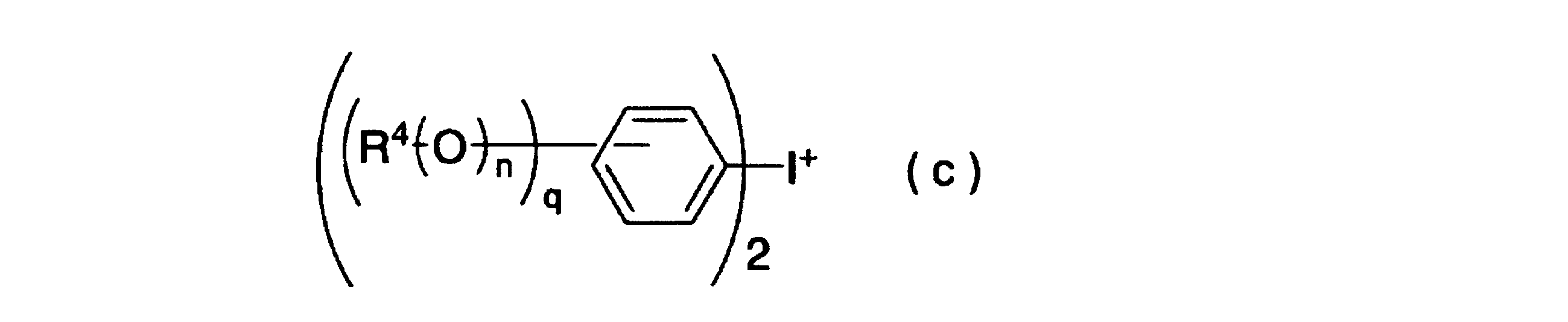
- the onium cation Q + contained in the general formula [8] represents a sulfonium cation represented by the following general formula (a) or the following general formula (b), or an iodonium cation represented by the following general formula (c).
- R 1 , R 2 and R 3 are each independently a substituted or unsubstituted linear or branched alkyl group having 1 to 10 carbon atoms, an alkenyl group or an oxoalkyl group, or Represents a substituted or unsubstituted aryl group, aralkyl group or aryloxoalkyl group having 6 to 18 carbon atoms, or any two or more of R 1 , R 2 and R 3 are bonded to each other; A ring may be formed together with the sulfur atom.
- R 4 represents a substituted or unsubstituted linear, branched or cyclic alkyl or alkenyl group having 1 to 20 carbon atoms, or a substituted or unsubstituted aryl having 6 to 14 carbon atoms. Indicates a group.
- m represents an integer of 1 to 5, and n represents 0 (zero) or 1.
- R 4 is a substituted or unsubstituted linear, branched or cyclic alkyl or alkenyl group having 1 to 20 carbon atoms, or a substituted or unsubstituted aryl having 6 to 14 carbon atoms. Indicates a group.
- q represents an integer of 0 (zero) to 5, and n represents 0 (zero) or 1.
- R 1 , R 2 and R 3 in the sulfonium cation general formula (a) represented by the general formula (a) include the following.
- alkyl group methyl group, ethyl group, n-propyl group, isopropyl group, cyclopropyl group, n-butyl group, sec-butyl group, isobutyl group, tert-butyl group, n-pentyl group, cyclopentyl group, n- Hexyl group, n-heptyl group, 2-ethylhexyl group, cyclohexyl group, cycloheptyl group, 4-methylcyclohexyl group, cyclohexylmethyl group, n-octyl group, n-decyl group, 1-adamantyl group, 2-adamantyl group, Bicyclo [2.2.1] hepten-2-yl group, 1-adamantanemethyl
- alkenyl group examples include a vinyl group, an allyl group, a propenyl group, a butenyl group, a hexenyl group, and a cyclohexenyl group.
- alkenyl group examples include a vinyl group, an allyl group, a propenyl group, a butenyl group, a hexenyl group, and a cyclohexenyl group.
- oxoalkyl group examples include 2-oxocyclopentyl group, 2-oxocyclohexyl group, 2-oxopropyl group, 2-oxoethyl group, 2-cyclopentyl-2-oxoethyl group, 2-cyclohexyl-2-oxoethyl group, 2- ( And 4-methylcyclohexyl) -2-oxoethyl group.
- Aryl groups include phenyl, naphthyl, thienyl, etc., p-methoxyphenyl, m-methoxyphenyl, o-methoxyphenyl, p-ethoxyphenyl, p-tert-butoxyphenyl, m-tert.
- An alkoxyphenyl group such as a butoxyphenyl group, an alkylphenyl group such as a 2-methylphenyl group, a 3-methylphenyl group, a 4-methylphenyl group and an ethylphenyl group, an alkylnaphthyl group such as a methylnaphthyl group and an ethylnaphthyl group, Examples thereof include a dialkylnaphthyl group such as a diethylnaphthyl group, a dialkoxynaphthyl group such as a dimethoxynaphthyl group and a diethoxynaphthyl group.
- Examples of the aralkyl group include benzyl group, 1-phenylethyl group, 2-phenylethyl group and the like.
- Examples of the aryloxoalkyl group 2-aryl-2-oxoethyl group such as 2-phenyl-2-oxoethyl group, 2- (1-naphthyl) -2-oxoethyl group, 2- (2-naphthyl) -2-oxoethyl group, etc. Groups and the like.
- R 1 , R 2 and R 3 are bonded to each other to form a cyclic structure via a sulfur atom, 1,4-butylene, 3-oxa-1, 5-pentylene and the like can be mentioned.
- substituents include aryl groups having a polymerizable substituent such as acryloyloxy group and methacryloyloxy group.
- 4- (acryloyloxy) phenyl group, 4- (methacryloyloxy) phenyl group, 4 -Vinyloxyphenyl group, 4-vinylphenyl group and the like can be mentioned.
- the sulfonium cation represented by the general formula (a) is represented by triphenylsulfonium, (4-tert-butylphenyl) diphenylsulfonium, bis (4-tert-butylphenyl) phenylsulfonium, tris (4-tert -Butylphenyl) sulfonium, (3-tert-butylphenyl) diphenylsulfonium, bis (3-tert-butylphenyl) phenylsulfonium, tris (3-tert-butylphenyl) sulfonium, (3,4-ditert-butylphenyl) ) Diphenylsulfonium, bis (3,4-ditert-butylphenyl) phenylsulfonium, tris (3,4-ditert-butylphenyl) sulfonium, (4-tert-butoxyphenyl)
- triphenylsulfonium (4-tert-butylphenyl) diphenylsulfonium, (4-tert-butoxyphenyl) diphenylsulfonium, tris (4-tert-butylphenyl) sulfonium, (4-tert-butoxycarbonylmethyloxyphenyl) ) Diphenylsulfonium and the like.
- the substituent position of the R 4 — (O) n — group in the sulfonium cation general formula (b) represented by the general formula (b) is not particularly limited, but the 4-position or 3-position of the phenyl group is preferred. More preferably, it is the 4th position.
- n is 0 (zero) or 1.
- sulfonium cation examples include (4-methylphenyl) diphenylsulfonium, (4-ethylphenyl) diphenylsulfonium, (4-cyclohexylphenyl) diphenylsulfonium, (4-n-hexylphenyl) diphenylsulfonium, (4-n -Octyl) phenyldiphenylsulfonium, (4-methoxyphenyl) diphenylsulfonium, (4-ethoxyphenyl) diphenylsulfonium, (4-tert-butoxyphenyl) diphenylsulfonium, (4-cyclohexyloxyphenyl) diphenylsulfonium, (4-tri Fluoromethylphenyl) diphenylsulfonium, (4-trifluoromethyloxyphenyl) diphenylsulfonium, (4-tert-butoxycarbonyl
- the position of the substituent of the R 4 — (O) n — group in the iodonium cation general formula (c) represented by the general formula (c) is not particularly limited, but the 4-position or 3-position of the phenyl group is preferred. More preferably, it is the 4th position.
- n is 0 (zero) or 1.
- Specific examples of R 4 can be mentioned again the same as R 4 in formula (b).
- Specific iodonium cations include diphenyliodonium, bis (4-methylphenyl) iodonium, bis (4-ethylphenyl) iodonium, bis (4-tert-butylphenyl) iodonium, bis (4- (1,1-dimethyl).
- bis (4-tert-butylphenyl) iodonium is preferably used.
- X ⁇ in the general formula [8] for example, F ⁇ , Cl ⁇ , Br ⁇ , I ⁇ , ClO 4 ⁇ , HSO 4 ⁇ , H 2 PO 4 ⁇ , BF 4 ⁇ , PF 6 ⁇ , SbF 6 ⁇ , aliphatic sulfonate anion, aromatic sulfonate anion, trifluoromethanesulfonate anion, fluorosulfonate anion, aliphatic carboxylate anion, aromatic carboxylate anion, fluorocarboxylate anion, trifluoro Examples thereof include acetate anions, preferably Cl ⁇ , Br ⁇ , HSO 4 ⁇ , BF 4 ⁇ , aliphatic sulfonate ions, etc., more preferably Cl ⁇ , Br ⁇ , HSO 4 ⁇ . .
- the molar ratio of the monovalent onium salt represented by the general formula [8] to the fluoroalkanesulfonic acid ammonium salt [4] is usually 0.5 to 10.0, preferably 0.8 to 2.0. More preferably, it is 0.9 to 1.2.
- reaction solvent is preferably water or an organic solvent such as lower alcohols, tetrahydrofuran, N, N-dimethylformamide, N, N-dimethylacetamide, acetonitrile, dimethyl sulfoxide, and more preferably water, methanol, N, N-dimethylacetamide, acetonitrile, dimethyl sulfoxide and the like are preferable, and water is particularly preferable.
- water and an organic solvent can be used in combination.
- the use ratio of the organic solvent in this case is usually 5 parts by weight or more, preferably 100 parts by weight of water and the organic solvent in total. Is 10 parts by weight or more, more preferably 20 to 90 parts by weight.
- the amount of the reaction solvent used is usually 1 to 100, preferably 2 to 100 parts by weight, and more preferably 5 to 50 parts by weight with respect to 1 part by weight of the counter-ion exchange precursor.
- the reaction temperature is usually from 0 to 80 ° C., preferably from 5 to 30 ° C.
- the reaction time is usually from 10 minutes to 16 hours, preferably from 30 minutes to 6 hours, but thin layer chromatography (TLC)
- TLC thin layer chromatography
- an analytical instrument such as NMR or a nuclear magnetic resonance apparatus (NMR)
- NMR nuclear magnetic resonance apparatus
- the fluoroalkanesulfonic acid onium salt represented by the general formula [5] thus obtained can be washed with an organic solvent or extracted and purified as necessary.
- the organic solvent is preferably an organic solvent that is not miscible with water, such as esters such as ethyl acetate and n-butyl acetate; ethers such as diethyl ether; alkyl halides such as methylene chloride and chloroform.
- the fluoroalkanesulfonic acid onium salt having no nonconjugated unsaturated site (double bond or triple bond) in the structure as a substituent of the acyl group is also a fluoro having an unconjugated unsaturated site.
- Alkanesulfonic acid onium salts can also be produced together. This compound can be used as a photoacid generator used in a chemically amplified resist material.
- the hydroxyfluoroalkanesulfonic acid ammonium salt represented by the general formula [3] is subjected to onium salt exchange to obtain a hydroxyfluoroalkanesulfonic acid onium salt represented by the general formula [11] (Step 3 ′: Onium Salt exchange step), and this is further reacted with a carboxylic acid derivative represented by general formula [6] or general formula [7] for esterification (step 4 ′: esterification step). It is the process of manufacturing the fluoroalkanesulfonic acid onium salt represented.
- the hydroxyfluoroalkanesulfonic acid onium salt is formed before the esterification step.
- onium sulfonic acid salt is photosensitive and must be handled under light-shielding conditions. Therefore, this method requires two steps under light-shielding conditions. Therefore, the load on the manufacturing equipment is large.
- reaction solution was cooled, 30 mL of 1N hydrochloric acid aqueous solution was added and stirred. Subsequently, the solvent of the reaction solution was distilled off to obtain 23.0 g of the desired triethylammonium 1,1-difluoro-2-hydroxy-ethane-1-sulfinate. The purity at this time was 26%, and the yield was 83%.
- triethylammonium 1,1-difluoro-2- (2-methyl-acryloyloxy) -ethane-1-sulfonate obtained in the third step was added to an aqueous solution of triphenylsulfonium bromide 3.18 g (8.9). Mmol) and 20 g of chloroform were added and stirred at room temperature for 3 hours. Thereafter, the organic layer was separated, and the obtained organic layer was washed four times with 20 g of chickenpox.
- triphenylammonium 1,1,2,2-tetrafluoro-4- (2-methyl-acryloyloxy) -butane-1-sulfonate aqueous solution obtained in the third step was added to triphenylsulfonium bromide 20.
- a solution of 2 g (0.056 mol) and chloroform 100 g was added and stirred at room temperature for 3 hours. Thereafter, the organic layer was separated, and the obtained organic layer was washed 4 times with 100 g of chickenpox. Then, when it wash
- reaction solution was cooled, and 7.5 g of sodium sulfite was added to the reaction solution and stirred. Subsequently, the solvent obtained by evaporating the reaction solution was washed with 50 g of hexane, and then extracted with 100 g of chloroform. The mixture was heated under reduced pressure to evaporate volatile components and dried to obtain 43 g of the desired triethylammonium 1,1,2,2-tetrafluoro-4-hydroxy-butane-1-sulfonate. The purity at this time was 50%, and the yield was 40%.
Landscapes
- Chemical & Material Sciences (AREA)
- Organic Chemistry (AREA)
- Physics & Mathematics (AREA)
- General Physics & Mathematics (AREA)
- Spectroscopy & Molecular Physics (AREA)
- Organic Low-Molecular-Weight Compounds And Preparation Thereof (AREA)
- Engineering & Computer Science (AREA)
- Ceramic Engineering (AREA)
Abstract
Description


まず、本願発明全体に共通する原料化合物となるヒドロキシフルオロアルカンスルフィン酸アンモニウム塩の合成方法につき、検討を行った。

で表されるブロモフルオロアルコールの場合にも、DMFやアセトニトリル、メタノール等の極性溶媒と水との混合溶媒中、亜ジチオン酸ナトリウムを使用することによって、対応する、下記一般式[13]

で表されるスルフィン酸ナトリウム塩が得られるはずである。

で表される。このスルフィン酸アンモニウム塩は親油性が高く親水性が低い。従って無機塩を含む反応後の未精製品を、適切な有機溶剤に溶解し、不溶分を濾別するなどの方法によって、無機塩を含む水溶性の不純物を除去し、高純度のスルフィン酸アンモニウム塩へと精製することができるという知見を見出した。そして、後の「酸化工程」で生じる副生成物(スルフィン化反応の基質である、一般式[1]で示されるカルボン酸ブロモフルオロアルキルエステル:スルフィン化工程で消失するが、酸化工程で再度生成する)の生成を格段に抑制できるという知見を得た(比較例3参照)。
上記[態様1]の方法(これを「第1工程」とも言う)で得た一般式[2]で表されるヒドロキシフルオロアルカンスルフィン酸アンモニウム塩を、第2工程である酸化工程に付することで、一般式[3]

上記[態様2]で得られた一般式[3]で表されるヒドロキシフルオロアルカンスルホン酸アンモニウム塩を、一般式[6]

もしくは一般式[7]

で表されるカルボン酸誘導体と反応させて、一般式[4]

で表されるフルオロアルカンスルホン酸アンモニウム塩を得、さらに一般式[8]で表される一価のオニウム塩



を用いてオニウム塩交換することで、レジスト用光酸発生剤等として有用な、一般式[5]


下記一般式[1]


(前記一般式[1]および一般式[2]において、A+はアンモニウムイオンを表す。Xは、互いに独立に水素原子もしくはフッ素原子を表す。nは、0~8の整数を表す。)
下記の2工程を含むことによる一般式[3]

第1工程(スルフィン化工程):下記一般式[1]


第2工程(酸化工程):第1工程(スルフィン化工程)で得られた、一般式[2]で表されるヒドロキシフルオロアルカンスルフィン酸アンモニウム塩を酸化剤と反応させ、一般式[3]で表されるヒドロキシフルオロアルカンスルホン酸アンモニウム塩を得る工程。
(前記一般式[1]から一般式[3]において、A+はアンモニウムイオンを表す。Xは、互いに独立に水素原子もしくはフッ素原子を表す。nは、0~8の整数を表す。)
発明2の方法で得られた一般式[3]






(前記一般式[3]および一般式[4]において、A+はアンモニウムイオンを表す。前記一般式[3]~一般式[5]において、Xは、互いに独立に水素原子もしくはフッ素原子を表す。nは、0~8の整数を表す。前記一般式[6]において、X’はヒドロキシル基もしくはハロゲンを表す。前記一般式[4]~一般式[7]において、Rは炭素数1~10の直鎖状もしくは分岐状のアルキル基、炭素数1~10の直鎖状もしくは分岐状の少なくとも末端部に重合性二重結合を有するアルケニル基、炭素数3~20の脂環式有機基、炭素数3~20の脂環式有機基と直鎖状のアルキレン基からなる有機基、炭素数3~30の単環式もしくは多環式ラクトン、あるいは炭素数6~20のアリール基を表す(ここで、該アルキル基、アルケニル基、脂環式有機基、脂環式有機基と直鎖状のアルキレン基からなる有機基、単環式もしくは多環式ラクトン及びアリール基上の水素原子の一部または全てはフッ素、ヒドロキシル基、ヒドロキシカルボニル基、炭素数1~6の直鎖状、分岐状もしくは環状のアルコキシ基で置換されていても良い。また、該アルキル基、アルケニル基、脂環式有機基もしくは脂環式有機基と直鎖状のアルキレン基からなる有機基を構成する同一炭素上の2つの水素原子は1つの酸素原子で置換されケト基となっていても良い。さらに該アルキル基上の水素原子の1つは、2-アクリロイルオキシ基、2-メタクリロイルオキシ基もしくは2-トリフルオロメタクリロイルオキシ基で置換されていても良い。)。前記一般式[5]および一般式[8]において、Q+は下記一般式(a)もしくは下記一般式(b)で示されるスルホニウムカチオン、または下記一般式(c)で示されるヨードニウムカチオンを示す。


一般式[1]~一般式[5]におけるnが2、2つのXがともにフッ素原子であることを特徴とする、発明1乃至発明3の何れか1つに記載の方法。
一般式[1]~一般式[5]におけるnが4、2つのXがともにフッ素原子であることを特徴とする、発明1乃至発明3の何れか1つに記載の方法。
一般式[1]~一般式[5]におけるnが0、2つのXがともに水素原子であることを特徴とする、発明1乃至発明3の何れか1つに記載の方法。
スルフィン化工程に使用されるアミンが、下記一般式[I]で示されるアミン

であることを特徴とする、発明1乃至発明6の何れか1つに記載の方法。
一般式[4]~一般式[7]におけるRが、下記式で表される重合性二重結合含有基の何れか1つを表すことを特徴とする、発明3乃至発明7の何れか1つに記載の方法。

下記一般式[2]

(前記一般式[2]において、A+はアンモニウムイオンを表す。Xは、互いに独立に水素原子もしくはフッ素原子を表す。nは、0~8の整数を表す。)
下記一般式[3]

(前記一般式[3]において、A+はアンモニウムイオンを表す。Xは、互いに独立に水素原子もしくはフッ素原子を表す。nは、0~8の整数を表す。)
本発明のヒドロキシフルオロアルカンスルフィン酸アンモニウム塩は、下記一般式[2]で表される。



本発明のヒドロキシフルオロアルカンスルホン酸アンモニウム塩は、下記一般式[3]で表される。

次いで、製造方法に関する発明について説明する。本発明は下記反応式[3]

まず、本発明の第1工程について説明する。第1工程は、一般式[1]で表されるブロモフルオロアルコールをスルフィン化剤と有機塩基の存在下で反応させ、ヒドロキシフルオロアルカンスルフィン酸アンモニウム塩を得る工程(スルフィン化工程)である。






具体的には、トリメチルアミン、トリエチルアミン、トリ-n-プロピルアミン、トリ-i-プロピルアミン、トリ-n-ブチルアミン、トリ-sec-ブチルアミン、トリ-tert-ブチルアミン、ジイソプロピルエチルアミン、トリフェニルアミン、もしくは下記の構造を有する有機塩基

次に、本発明の第2工程について説明する。第2工程は、第1工程で得られたヒドロキシフルオロアルカンスルフィン酸アンモニウム塩[2]を酸化剤と反応させ、一般式[3]で表されるヒドロキシフルオロアルカンスルホン酸アンモニウム塩を得る工程(酸化工程)である。
次に、本発明の第3工程について説明する。第3工程は、第2工程で得られた一般式[3]で表されるヒドロキシフルオロアルカンスルホン酸アンモニウム塩を、一般式[6]


等を挙げることができる。
次いで、本発明の第4工程について説明する。第4工程は、第3工程で得られた一般式[4]で表されるフルオロアルカンスルホン酸アンモニウム塩を、一般式[8]



一般式(a)におけるR1、R2及びR3としては具体的に以下のものが挙げられる。アルキル基として、メチル基、エチル基、n-プロピル基、イソプロピル基、シクロプロピル基、n-ブチル基、sec-ブチル基、イソブチル基、tert-ブチル基、n-ペンチル基、シクロペンチル基、n-ヘキシル基、n-ヘプチル基、2-エチルヘキシル基、シクロヘキシル基、シクロヘプチル基、4-メチルシクロヘキシル基、シクロヘキシルメチル基、n-オクチル基、n-デシル基、1-アダマンチル基、2-アダマンチル基、ビシクロ[2.2.1]ヘプテン-2-イル基、1-アダマンタンメチル基、2-アダマンタンメチル基等が挙げられる。アルケニル基としては、ビニル基、アリル基、プロペニル基、ブテニル基、ヘキセニル基、シクロヘキセニル基等が挙げられる。オキソアルキル基としては、2-オキソシクロペンチル基、2-オキソシクロヘキシル基、2-オキソプロピル基、2-オキソエチル基、2-シクロペンチル-2-オキソエチル基、2-シクロヘキシル-2-オキソエチル基、2-(4-メチルシクロヘキシル)-2-オキソエチル基等を挙げることができる。アリール基としては、フェニル基、ナフチル基、チエニル基等やp-メトキシフェニル基、m-メトキシフェニル基、o-メトキシフェニル基、p-エトキシフェニル基、p-tert-ブトキシフェニル基、m-tert-ブトキシフェニル基等のアルコキシフェニル基、2-メチルフェニル基、3-メチルフェニル基、4-メチルフェニル基、エチルフェニル基等のアルキルフェニル基、メチルナフチル基、エチルナフチル基等のアルキルナフチル基、ジエチルナフチル基等のジアルキルナフチル基、ジメトキシナフチル基、ジエトキシナフチル基等のジアルコキシナフチル基等が挙げられる。アラルキル基としては、ベンジル基、1-フェニルエチル基、2-フェニルエチル基等が挙げられる。アリールオキソアルキル基としては、2-フェニル-2-オキソエチル基、2-(1-ナフチル)-2-オキソエチル基、2-(2-ナフチル)-2-オキソエチル基等の2-アリール-2-オキソエチル基等が挙げられる。また、R1、R2及びR3のうちのいずれか2つ以上が相互に結合して硫黄原子を介して環状構造を形成する場合には、1,4-ブチレン、3-オキサ-1,5-ペンチレン等が挙げられる。更には置換基としてアクリロイルオキシ基、メタクリロイルオキシ基等の重合可能な置換基を有するアリール基が挙げられ、具体的には4-(アクリロイルオキシ)フェニル基、4-(メタクリロイルオキシ)フェニル基、4-ビニルオキシフェニル基、4-ビニルフェニル基等が挙げられる。
一般式(b)におけるR4-(O)n-基の置換基位置は特に限定されるものではないが、フェニル基の4位あるいは3位が好ましい。より好ましくは4位である。ここでnは0(零)又は1である。R4としては、具体的に、メチル基、エチル基、n-プロピル基、sec-プロピル基、シクロプロピル基、n-ブチル基、sec-ブチル基、iso-ブチル基、tert-ブチル基、n-ペンチル基、シクロペンチル基、n-ヘキシル基、シクロヘキシル基、n-オクチル基、n-デシル基、n-ドデシル基、1-アダマンチル基、2-アダマンチル基、ビシクロ[2.2.1]ヘプテン-2-イル基、フェニル基、4-メトキシフェニル基、4-tert-ブチルフェニル基、4-ビフェニル基、1-ナフチル基、2-ナフチル基、10-アントラニル基、2-フラニル基、更にn=1の場合に、アクリロイル基、メタクリロイル基、ビニル基、アリル基が挙げられる。
一般式(c)におけるR4-(O)n-基の置換基位置は特に限定されるものではないが、フェニル基の4位あるいは3位が好ましい。より好ましくは4位である。ここでnは0(零)又は1である。R4の具体例は上述した一般式(b)におけるR4と同じものを再び挙げることができる。

[トリエチルアンモニウム 1,1-ジフルオロ-2-ヒドロキシ-エタン-1-スルフィナートの製造](第1工程:スルフィン化工程)

1H NMR(測定溶媒:重ジメチルスルホキシド,基準物質:テトラメチルシラン);δ=3.80(t,2H),3.01(q,6H),1.17(t,9H)
19F NMR(測定溶媒:重ジメチルスルホキシド,基準物質:トリクロロフルオロメタン);δ=-121.0(s,2F)
[トリエチルアンモニウム 1,1-ジフルオロ-2-ヒドロキシ-エタン-1-スルホナートの製造](第2工程:酸化工程)

1H NMR(測定溶媒:重ジメチルスルホキシド,基準物質:テトラメチルシラン);δ=3.84(t,2H),3.04(q,6H),1.18(t,9H)
19F NMR(測定溶媒:重ジメチルスルホキシド,基準物質:トリクロロフルオロメタン);δ=-115.6(s,2F)
[トリエチルアンモニウム 1,1-ジフルオロ-2-(2-メチル-アクリロイルオキシ)-エタン-1-スルホナートの製造](第3工程:エステル化工程)

[トリフェニルスルホニウム 1,1-ジフルオロ-2-(2-メチル-アクリロイルオキシ)-エタン-1-スルホナートの製造](第4工程:オニウム塩交換工程)

1H NMR(測定溶媒:重ジメチルスルホキシド,基準物質:テトラメチルシラン);δ=7.92-7.65(m,15H,Ph3S+),6.19(s,1H),5.57(s,1H),4.81(t,J=16.0Hz,2H;CH2),1.92(s,3H).
19F NMR(測定溶媒:重ジメチルスルホキシド,基準物質:トリクロロフルオロメタン);δ=-114.49(t,J=16.0Hz,2F;CF2).
[トリエチルアンモニウム 1,1,2,2-テトラフルオロ-4-ヒドロキシ-ブタン-1-スルフィナートの製造](第1工程:スルフィン化工程)

1H NMR(測定溶媒:重ジメチルスルホキシド,基準物質:テトラメチルシラン);δ=3.58(t,2H),3.04(q,6H),2.30(m,2H),1.16(t,9H)
19F NMR(測定溶媒:重ジメチルスルホキシド,基準物質:トリクロロフルオロメタン);δ=-110.4(t,2F)、-131.0(s,2F)
[トリエチルアンモニウム 1,1,2,2-テトラフルオロ-4-ヒドロキシ-ブタン-1-スルホナートの製造](第2工程:酸化工程)

1H NMR(測定溶媒:重ジメチルスルホキシド,基準物質:テトラメチルシラン);δ=3.61(t,3H),3.07(q,6H),2.40(m,2H),1.17(t,9H)
19F NMR(測定溶媒:重ジメチルスルホキシド,基準物質:トリクロロフルオロメタン);δ=-110.9(s,2F)、-117.9(s,2F)
[トリエチルアンモニウム 1,1,2,2-テトラフルオロ-4-(2-メチル-アクリロイルオキシ)-ブタン-1-スルホナートの製造](第3工程:エステル化工程)

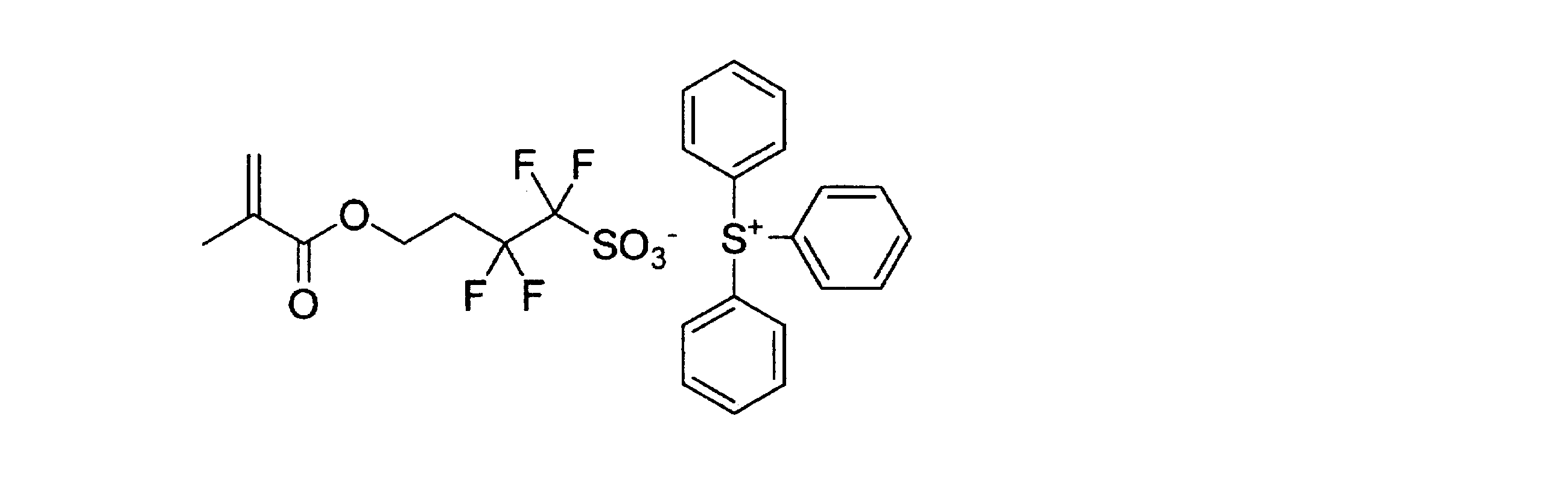
[トリフェニルスルホニウム 1,1,2,2-テトラフルオロ-4-(2-メチル-アクリロイルオキシ)-ブタン-1-スルホナートの製造](第4工程:オニウム塩交換工程)


[トリエチルアンモニウム 1,1,2,2-テトラフルオロ-4-ヒドロキシ-ブタン-1-スルホナートの製造](第2工程:酸化工程)
500mLの反応器に、実施例2-2で精製する前(未精製)の、トリエチルアンモニウム 1,1,2,2-テトラフルオロ-4-ヒドロキシ-ブタン-1-スルフィナート112g(純度46%、0.17モル)、水 200g、30%過酸化水素水 41g(0.36モル)を室温で加え、40℃で6時間攪拌した。反応の終了を確認した後、反応液を冷却し亜硫酸ナトリウム 7.5gを反応液に加えて攪拌した。続いて、反応液を溶媒留去して得られた液体をヘキサン50gで洗浄し、続いてクロロホルム100gで抽出した。減圧下加温して揮発成分を留去して乾固させ、目的とするトリエチルアンモニウム 1,1,2,2-テトラフルオロ-4-ヒドロキシ-ブタン-1-スルホナートを43g得た。このときの純度は50%、収率は40%であった。分析の結果、第1工程(スルフィン化工程)で消失を確認した4-ブロモ-3,3,4,4-テトラフルオロブタン-1-オールが、本第2工程(酸化工程)で9%副生していた。
Claims (10)
- 下記一般式[1]


(前記一般式[1]および一般式[2]において、A+はアンモニウムイオンを表す。Xは、互いに独立に水素原子もしくはフッ素原子を表す。nは、0~8の整数を表す。) - 下記の2工程を含むことによる一般式[3]

第1工程(スルフィン化工程):下記一般式[1]


第2工程(酸化工程):第1工程(スルフィン化工程)で得られた、一般式[2]で表されるヒドロキシフルオロアルカンスルフィン酸アンモニウム塩を酸化剤と反応させ、一般式[3]で表されるヒドロキシフルオロアルカンスルホン酸アンモニウム塩を得る工程。(前記一般式[1]から一般式[3]において、A+はアンモニウムイオンを表す。Xは、互いに独立に水素原子もしくはフッ素原子を表す。nは、0~8の整数を表す。) - 請求項2の方法で得られた一般式[3]






(前記一般式[3]および一般式[4]において、A+はアンモニウムイオンを表す。前記一般式[3]~一般式[5]において、Xは、互いに独立に水素原子もしくはフッ素原子を表す。nは、0~8の整数を表す。前記一般式[6]において、X’はヒドロキシル基もしくはハロゲンを表す。前記一般式[4]~一般式[7]において、Rは炭素数1~10の直鎖状もしくは分岐状のアルキル基、炭素数1~10の直鎖状もしくは分岐状の少なくとも末端部に重合性二重結合を有するアルケニル基、炭素数3~20の脂環式有機基、炭素数3~20の脂環式有機基と直鎖状のアルキレン基からなる有機基、炭素数3~30の単環式もしくは多環式ラクトン、あるいは炭素数6~20のアリール基を表す(ここで、該アルキル基、アルケニル基、脂環式有機基、脂環式有機基と直鎖状のアルキレン基からなる有機基、単環式もしくは多環式ラクトン及びアリール基上の水素原子の一部または全てはフッ素、ヒドロキシル基、ヒドロキシカルボニル基、炭素数1~6の直鎖状、分岐状もしくは環状のアルコキシ基で置換されていても良い。また、該アルキル基、アルケニル基、脂環式有機基もしくは脂環式有機基と直鎖状のアルキレン基からなる有機基を構成する同一炭素上の2つの水素原子は1つの酸素原子で置換されケト基となっていても良い。さらに該アルキル基上の水素原子の1つは、2-アクリロイルオキシ基、2-メタクリロイルオキシ基もしくは2-トリフルオロメタクリロイルオキシ基で置換されていても良い。)。前記一般式[5]および一般式[8]において、Q+は下記一般式(a)もしくは下記一般式(b)で示されるスルホニウムカチオン、または下記一般式(c)で示されるヨードニウムカチオンを示す。


- 一般式[1]~一般式[5]におけるnが2、2つのXがともにフッ素原子であることを特徴とする、請求項1乃至請求項3の何れか1項に記載の方法。
- 一般式[1]~一般式[5]におけるnが4、2つのXがともにフッ素原子であることを特徴とする、請求項1乃至請求項3の何れか1項に記載の方法。
- 一般式[1]~一般式[5]におけるnが0、2つのXがともに水素原子であることを特徴とする、請求項1乃至請求項3の何れか1項に記載の方法。
- スルフィン化工程に使用されるアミンが、下記一般式[I]で示されるアミン

であることを特徴とする、請求項1乃至請求項6の何れか1項に記載の方法。 - 一般式[4]~一般式[7]におけるRが、下記式で表される重合性二重結合含有基の何れか1つを表すことを特徴とする、請求項3乃至請求項7の何れか1項に記載の方法。

- 下記一般式[2]

(前記一般式[2]において、A+はアンモニウムイオンを表す。Xは、互いに独立に水素原子もしくはフッ素原子を表す。nは、0~8の整数を表す。) - 下記一般式[3]

(前記一般式[3]において、A+はアンモニウムイオンを表す。Xは、互いに独立に水素原子もしくはフッ素原子を表す。nは、0~8の整数を表す。)
Priority Applications (1)
| Application Number | Priority Date | Filing Date | Title |
|---|---|---|---|
| US13/256,101 US9024058B2 (en) | 2009-03-13 | 2010-03-12 | Ammonium fluoroalkanesulfonates and a synthesis method therefor |
Applications Claiming Priority (4)
| Application Number | Priority Date | Filing Date | Title |
|---|---|---|---|
| JP2009061240 | 2009-03-13 | ||
| JP2009-061240 | 2009-03-13 | ||
| JP2010054089A JP5549289B2 (ja) | 2009-03-13 | 2010-03-11 | フルオロアルカンスルホン酸アンモニウム塩類およびその製造方法 |
| JP2010-054089 | 2010-03-11 |
Publications (1)
| Publication Number | Publication Date |
|---|---|
| WO2010104178A1 true WO2010104178A1 (ja) | 2010-09-16 |
Family
ID=42728463
Family Applications (1)
| Application Number | Title | Priority Date | Filing Date |
|---|---|---|---|
| PCT/JP2010/054246 Ceased WO2010104178A1 (ja) | 2009-03-13 | 2010-03-12 | フルオロアルカンスルホン酸アンモニウム塩類およびその製造方法 |
Country Status (4)
| Country | Link |
|---|---|
| US (1) | US9024058B2 (ja) |
| JP (1) | JP5549289B2 (ja) |
| KR (1) | KR20110126752A (ja) |
| WO (1) | WO2010104178A1 (ja) |
Families Citing this family (6)
| Publication number | Priority date | Publication date | Assignee | Title |
|---|---|---|---|---|
| JP3480508B2 (ja) | 1994-02-03 | 2003-12-22 | 株式会社岡部ロック | 箱製函装置 |
| TWI525066B (zh) * | 2011-04-13 | 2016-03-11 | 住友化學股份有限公司 | 鹽、光阻組成物及製備光阻圖案之方法 |
| JP6019849B2 (ja) * | 2011-09-08 | 2016-11-02 | セントラル硝子株式会社 | 含フッ素スルホン酸塩類、含フッ素スルホン酸塩樹脂、レジスト組成物及びそれを用いたパターン形成方法 |
| JP5615860B2 (ja) * | 2012-03-07 | 2014-10-29 | 信越化学工業株式会社 | 酸発生剤、化学増幅型レジスト材料、及びパターン形成方法 |
| JP6037689B2 (ja) * | 2012-07-10 | 2016-12-07 | 東京応化工業株式会社 | アンモニウム塩化合物の製造方法、及び酸発生剤の製造方法 |
| KR101723012B1 (ko) | 2016-04-29 | 2017-04-04 | 인하대학교 산학협력단 | 셀룰로오스 나노섬유를 포함하는 미세조류 응집제 및 이를 이용한 미세조류 회수 및 지질 함량 증대 방법 |
Citations (2)
| Publication number | Priority date | Publication date | Assignee | Title |
|---|---|---|---|---|
| WO2006121096A1 (ja) * | 2005-05-11 | 2006-11-16 | Jsr Corporation | 新規化合物および重合体、ならびに感放射線性樹脂組成物 |
| WO2008056795A1 (en) * | 2006-11-10 | 2008-05-15 | Jsr Corporation | Polymerizable sulfonic acid onium salt and resin |
Family Cites Families (13)
| Publication number | Priority date | Publication date | Assignee | Title |
|---|---|---|---|---|
| US6749987B2 (en) | 2000-10-20 | 2004-06-15 | Fuji Photo Film Co., Ltd. | Positive photosensitive composition |
| JP4150509B2 (ja) | 2000-11-20 | 2008-09-17 | 富士フイルム株式会社 | ポジ型感光性組成物 |
| JP2004004561A (ja) | 2002-02-19 | 2004-01-08 | Sumitomo Chem Co Ltd | ポジ型レジスト組成物 |
| TWI314250B (en) | 2002-02-19 | 2009-09-01 | Sumitomo Chemical Co | Positive resist composition |
| JP4103523B2 (ja) | 2002-09-27 | 2008-06-18 | Jsr株式会社 | レジスト組成物 |
| JP4794835B2 (ja) * | 2004-08-03 | 2011-10-19 | 東京応化工業株式会社 | 高分子化合物、酸発生剤、ポジ型レジスト組成物、およびレジストパターン形成方法 |
| JP4816921B2 (ja) | 2005-04-06 | 2011-11-16 | 信越化学工業株式会社 | 新規スルホン酸塩及びその誘導体、光酸発生剤並びにこれを用いたレジスト材料及びパターン形成方法 |
| TWI332122B (en) | 2005-04-06 | 2010-10-21 | Shinetsu Chemical Co | Novel sulfonate salts and derivatives, photoacid generators, resist compositions and patterning process |
| JP5124805B2 (ja) * | 2006-06-27 | 2013-01-23 | 信越化学工業株式会社 | 光酸発生剤並びにこれを用いたレジスト材料及びパターン形成方法 |
| JP5124806B2 (ja) | 2006-06-27 | 2013-01-23 | 信越化学工業株式会社 | 光酸発生剤並びにこれを用いたレジスト材料及びパターン形成方法 |
| KR101442860B1 (ko) * | 2006-09-08 | 2014-09-22 | 제이에스알 가부시끼가이샤 | 감방사선성 조성물 및 이것에 사용되는 저분자량 화합물의 제조 방법 |
| WO2008099869A1 (ja) | 2007-02-15 | 2008-08-21 | Central Glass Company, Limited | 光酸発生剤用化合物及びそれを用いたレジスト組成物、パターン形成方法 |
| TWI438182B (zh) | 2007-07-25 | 2014-05-21 | Sumitomo Chemical Co | 適用於酸產生劑之鹽以及含有該鹽之化學放大正型抗蝕劑組成物 |
-
2010
- 2010-03-11 JP JP2010054089A patent/JP5549289B2/ja active Active
- 2010-03-12 US US13/256,101 patent/US9024058B2/en active Active
- 2010-03-12 WO PCT/JP2010/054246 patent/WO2010104178A1/ja not_active Ceased
- 2010-03-12 KR KR1020117023807A patent/KR20110126752A/ko not_active Ceased
Patent Citations (2)
| Publication number | Priority date | Publication date | Assignee | Title |
|---|---|---|---|---|
| WO2006121096A1 (ja) * | 2005-05-11 | 2006-11-16 | Jsr Corporation | 新規化合物および重合体、ならびに感放射線性樹脂組成物 |
| WO2008056795A1 (en) * | 2006-11-10 | 2008-05-15 | Jsr Corporation | Polymerizable sulfonic acid onium salt and resin |
Also Published As
| Publication number | Publication date |
|---|---|
| US20120004447A1 (en) | 2012-01-05 |
| JP5549289B2 (ja) | 2014-07-16 |
| JP2010235601A (ja) | 2010-10-21 |
| US9024058B2 (en) | 2015-05-05 |
| KR20110126752A (ko) | 2011-11-23 |
Similar Documents
| Publication | Publication Date | Title |
|---|---|---|
| JP5347371B2 (ja) | 2−(アルキルカルボニルオキシ)−1,1−ジフルオロエタンスルホン酸塩類およびその製造方法 | |
| JP5145776B2 (ja) | 新規スルホン酸塩、スルホン酸オニウム塩及びスルホン酸誘導体とその製造方法 | |
| JP5549289B2 (ja) | フルオロアルカンスルホン酸アンモニウム塩類およびその製造方法 | |
| US20100330497A1 (en) | Chemically amplified photoresist composition and method for forming resist pattern | |
| KR20130136396A (ko) | 고분자 화합물, 레지스트 재료 및 패턴 형성 방법 | |
| JP5151389B2 (ja) | アルコキシカルボニルフルオロアルカンスルホン酸塩類の製造方法 | |
| JP5549288B2 (ja) | フルオロアルカンスルホン酸アンモニウム塩類およびその製造方法 | |
| JP5446679B2 (ja) | アルコキシカルボニルフルオロアルカンスルホン酸塩類の製造方法 | |
| US7414148B2 (en) | Process for producing alkoxycarbonylfluoroalkanesulfonates |
Legal Events
| Date | Code | Title | Description |
|---|---|---|---|
| 121 | Ep: the epo has been informed by wipo that ep was designated in this application |
Ref document number: 10750929 Country of ref document: EP Kind code of ref document: A1 |
|
| WWE | Wipo information: entry into national phase |
Ref document number: 13256101 Country of ref document: US |
|
| NENP | Non-entry into the national phase |
Ref country code: DE |
|
| ENP | Entry into the national phase |
Ref document number: 20117023807 Country of ref document: KR Kind code of ref document: A |
|
| 122 | Ep: pct application non-entry in european phase |
Ref document number: 10750929 Country of ref document: EP Kind code of ref document: A1 |