WO2010104023A1 - ビタミンb1を安定に配合した糖液を含む末梢静脈投与用輸液 - Google Patents
ビタミンb1を安定に配合した糖液を含む末梢静脈投与用輸液 Download PDFInfo
- Publication number
- WO2010104023A1 WO2010104023A1 PCT/JP2010/053758 JP2010053758W WO2010104023A1 WO 2010104023 A1 WO2010104023 A1 WO 2010104023A1 JP 2010053758 W JP2010053758 W JP 2010053758W WO 2010104023 A1 WO2010104023 A1 WO 2010104023A1
- Authority
- WO
- WIPO (PCT)
- Prior art keywords
- solution
- infusion
- vitamin
- sugar solution
- amino acid
- Prior art date
- Legal status (The legal status is an assumption and is not a legal conclusion. Google has not performed a legal analysis and makes no representation as to the accuracy of the status listed.)
- Ceased
Links
Classifications
-
- A—HUMAN NECESSITIES
- A61—MEDICAL OR VETERINARY SCIENCE; HYGIENE
- A61K—PREPARATIONS FOR MEDICAL, DENTAL OR TOILETRY PURPOSES
- A61K9/00—Medicinal preparations characterised by special physical form
- A61K9/0012—Galenical forms characterised by the site of application
- A61K9/0019—Injectable compositions; Intramuscular, intravenous, arterial, subcutaneous administration; Compositions to be administered through the skin in an invasive manner
-
- A—HUMAN NECESSITIES
- A23—FOODS OR FOODSTUFFS; TREATMENT THEREOF, NOT COVERED BY OTHER CLASSES
- A23L—FOODS, FOODSTUFFS OR NON-ALCOHOLIC BEVERAGES, NOT OTHERWISE PROVIDED FOR; PREPARATION OR TREATMENT THEREOF
- A23L33/00—Modifying nutritive qualities of foods; Dietetic products; Preparation or treatment thereof
- A23L33/10—Modifying nutritive qualities of foods; Dietetic products; Preparation or treatment thereof using additives
-
- A—HUMAN NECESSITIES
- A23—FOODS OR FOODSTUFFS; TREATMENT THEREOF, NOT COVERED BY OTHER CLASSES
- A23L—FOODS, FOODSTUFFS OR NON-ALCOHOLIC BEVERAGES, NOT OTHERWISE PROVIDED FOR; PREPARATION OR TREATMENT THEREOF
- A23L33/00—Modifying nutritive qualities of foods; Dietetic products; Preparation or treatment thereof
- A23L33/10—Modifying nutritive qualities of foods; Dietetic products; Preparation or treatment thereof using additives
- A23L33/15—Vitamins
-
- A—HUMAN NECESSITIES
- A23—FOODS OR FOODSTUFFS; TREATMENT THEREOF, NOT COVERED BY OTHER CLASSES
- A23L—FOODS, FOODSTUFFS OR NON-ALCOHOLIC BEVERAGES, NOT OTHERWISE PROVIDED FOR; PREPARATION OR TREATMENT THEREOF
- A23L33/00—Modifying nutritive qualities of foods; Dietetic products; Preparation or treatment thereof
- A23L33/10—Modifying nutritive qualities of foods; Dietetic products; Preparation or treatment thereof using additives
- A23L33/17—Amino acids, peptides or proteins
- A23L33/175—Amino acids
-
- A—HUMAN NECESSITIES
- A61—MEDICAL OR VETERINARY SCIENCE; HYGIENE
- A61K—PREPARATIONS FOR MEDICAL, DENTAL OR TOILETRY PURPOSES
- A61K47/00—Medicinal preparations characterised by the non-active ingredients used, e.g. carriers or inert additives; Targeting or modifying agents chemically bound to the active ingredient
- A61K47/06—Organic compounds, e.g. natural or synthetic hydrocarbons, polyolefins, mineral oil, petrolatum or ozokerite
- A61K47/08—Organic compounds, e.g. natural or synthetic hydrocarbons, polyolefins, mineral oil, petrolatum or ozokerite containing oxygen, e.g. ethers, acetals, ketones, quinones, aldehydes, peroxides
- A61K47/12—Carboxylic acids; Salts or anhydrides thereof
-
- A—HUMAN NECESSITIES
- A61—MEDICAL OR VETERINARY SCIENCE; HYGIENE
- A61K—PREPARATIONS FOR MEDICAL, DENTAL OR TOILETRY PURPOSES
- A61K47/00—Medicinal preparations characterised by the non-active ingredients used, e.g. carriers or inert additives; Targeting or modifying agents chemically bound to the active ingredient
- A61K47/06—Organic compounds, e.g. natural or synthetic hydrocarbons, polyolefins, mineral oil, petrolatum or ozokerite
- A61K47/20—Organic compounds, e.g. natural or synthetic hydrocarbons, polyolefins, mineral oil, petrolatum or ozokerite containing sulfur, e.g. dimethyl sulfoxide [DMSO], docusate, sodium lauryl sulfate or aminosulfonic acids
-
- A—HUMAN NECESSITIES
- A61—MEDICAL OR VETERINARY SCIENCE; HYGIENE
- A61K—PREPARATIONS FOR MEDICAL, DENTAL OR TOILETRY PURPOSES
- A61K47/00—Medicinal preparations characterised by the non-active ingredients used, e.g. carriers or inert additives; Targeting or modifying agents chemically bound to the active ingredient
- A61K47/06—Organic compounds, e.g. natural or synthetic hydrocarbons, polyolefins, mineral oil, petrolatum or ozokerite
- A61K47/26—Carbohydrates, e.g. sugar alcohols, amino sugars, nucleic acids, mono-, di- or oligo-saccharides; Derivatives thereof, e.g. polysorbates, sorbitan fatty acid esters or glycyrrhizin
-
- A—HUMAN NECESSITIES
- A61—MEDICAL OR VETERINARY SCIENCE; HYGIENE
- A61P—SPECIFIC THERAPEUTIC ACTIVITY OF CHEMICAL COMPOUNDS OR MEDICINAL PREPARATIONS
- A61P3/00—Drugs for disorders of the metabolism
- A61P3/02—Nutrients, e.g. vitamins, minerals
Definitions
- the present invention relates to a peripheral intravenous administration infusion solution in which a sugar solution and an amino acid solution are separately stored in a multi-chamber container, and relates to a technique for stably blending vitamin B1 into the sugar solution.
- the stability of vitamin B1 can be improved by setting the titrated acidity of the electrolyte contained in the sugar solution containing vitamin B1 to 1 or less. There is a report that it is increased (Patent Document 1). There is also a report that antioxidants such as ascorbic acid and L-cysteine enhance the stability of vitamin B1 (Patent Document 2).
- Patent Document 1 since the method of Patent Document 1 needs to reduce the buffering capacity of the sugar solution to the utmost limit, the electrolyte that can be blended is limited, pH adjustment is difficult, and the pH fluctuates with a slight decomposition of the blend. There is a problem in stability.
- An object of the present invention is to stably add vitamin B1 to a sugar solution in an infusion for peripheral intravenous administration in which a sugar solution and an amino acid solution are separately stored in a multi-chamber container.
- preferred embodiments of the present invention are as follows. (1) An infusion for peripheral vein administration, wherein the sugar solution contains vitamin B1 and N-acetylcysteine in an infusion for peripheral vein administration in which a sugar solution and an amino acid solution are separately stored in a multi-chamber container. (2) The infusion for peripheral vein administration according to (1), wherein the sugar solution contains 0.3 to 3.0 g / L of N-acetylcysteine.
- Vitamin B1 can be stabilized by adding N-acetylcysteine to the sugar solution, and N-acetylcysteine added as a stabilizer can be used as an L-cysteine source.
- N-acetylcysteine added as a stabilizer can be used as an L-cysteine source.
- L-cysteine added as an antioxidant decreases during storage of the infusion solution. It became clear that the content could not be guaranteed.
- N-acetylcysteine is used as a stabilizer for vitamin B1
- the decrease in the content of N-acetylcysteine is small, so that a stabilizing effect is achieved and at the same time the content of N-acetylcysteine can be guaranteed.
- N-acetylcysteine works in the same way as carboxylic acid and makes the pH acidic, so that the amount of pH regulator added to the sugar solution can be reduced.
- the main point of the present invention is to stabilize vitamin B1 regardless of the titrated acidity of the sugar solution by containing N-acetylcysteine together with vitamin B1 in the sugar solution containing vitamin B1 and not containing sulfite ion.
- conventionally known matters relating to peripheral infusion for peripheral intravenous administration can be applied.
- the sugar solution contains sugar, an electrolyte and vitamin B1 as basic components and does not contain sulfite which inhibits the stabilization of vitamin B1.
- the sugar that can be used is not particularly limited as long as it is a sugar that is usually used for infusion.
- the reducing sugar include glucose, fructose, and maltose.
- the non-reducing sugar include trehalose, xylitol, sorbitol, and glycerin.
- glucose is preferably added from the viewpoint of nutritional effect.
- glucose When glucose is used, glucose is used at a concentration of 35 to 150 g / L, preferably 70 to 130 g / L, in the infusion solution after mixing with the amino acid solution.
- the pH of the sugar solution is preferably 4.0 to 4.5 in order to stably mix vitamin B1.
- the pH adjuster is not limited as long as it can be used as a pharmaceutical additive.
- sulfuric acid not containing chloro or organic acids such as acetic acid, lactic acid, citric acid, succinic acid and malic acid, and one or more of these pH regulators are added. be able to.
- any known vitamin B1 can be used as the vitamin B1 contained in the sugar solution, and examples thereof include thiamine hydrochloride, thiamine nitrate, and fursultiamine.
- the amount of vitamin B1 is preferably blended at 0.7 to 3.5 mg / L in an infusion solution in which a sugar solution and an amino acid solution are mixed.
- N-acetylcysteine for stabilizing vitamin B1 is preferably added at a rate of 0.3 to 3.0 g / L. In this range, the blended N-acetylcysteine can be easily quantified by absorptiometry.
- the same compounds as those used for general electrolyte infusion can be used, and examples thereof include sodium, potassium, magnesium, calcium, chloro, phosphorus, and the like, which are electrolytes essential for living bodies.
- potassium glycerophosphate serves as a phosphate source and does not cause a precipitation reaction with calcium salt and magnesium salt, it can be blended in the same solution as calcium salt and magnesium salt.
- a preferable potassium concentration in the infusion solution obtained by mixing the sugar solution and the amino acid solution is 10 to 30 mEq / L.
- a preferable concentration of phosphoric acid in the infusion solution obtained by mixing the sugar solution and the amino acid solution is 5 to 20 mmol / L.
- Calcium chloride is suitable for calcium
- magnesium sulfate is suitable for magnesium.
- the preferable calcium and magnesium concentrations in the infusion solution in which the sugar solution and the amino acid solution are mixed are each 2 to 8 mEq / L.
- Zinc is blended in the sugar liquid as zinc sulfate and zinc chloride.
- a preferable zinc concentration in the infusion solution obtained by mixing the sugar solution and the amino acid solution is 2.5 to 7.5 ⁇ mol / L.
- the amino acid solution is a solution in which an amino acid containing at least essential amino acids is dissolved.
- the amino acid is contained in a concentration of 10 to 70 g / L, preferably 15 to 45 g / L in terms of free amino acid.
- the amino acid may be not only a free amino acid but also various salts, for example, metal salts such as sodium and potassium, salts with organic acids such as acetic acid, and salts with inorganic acids such as hydrochloric acid. Further, some of them may be acyl forms or peptides.
- N-acetylcysteine is added to the sugar solution, L-cysteine can be omitted from the amino acid solution.
- a phosphorus compound other than glycerophosphate is blended, it is preferably separated from the calcium salt and the magnesium salt and blended in different liquids. Specifically, when calcium salt and magnesium salt are blended in a sugar solution, the phosphorus compound is blended in an amino acid solution.
- Other electrolytes are not particularly limited, and may be blended in either a sugar solution or an amino acid solution.
- the sugar solution and the amino acid solution are mixed by breaking the partition that can be communicated by external pressure during use.
- the infusion in the present invention is for peripheral intravenous administration, and it is preferable that the pH is in the range of 6 to 7.5 and the titratable acidity is in the range of 5 to 10 so as not to cause phlebitis or vascular pain at the time of administration.
- the mixing ratio of the sugar solution and the amino acid solution is preferably 2 to 3: 1.
- ⁇ About infusion containers Any known multi-chamber container configured to be able to communicate can be used. Of these, an infusion bag in which the partition wall is composed of an easily peelable seal is particularly preferable because the communication work is simple. Suitable materials for the infusion bag are, for example, polyolefins such as polyethylene, polypropylene and polybutene, ethylene / propylene copolymers, crosslinked ethylene / vinyl acetate copolymers, and laminates thereof.
- polyolefins such as polyethylene, polypropylene and polybutene
- ethylene / propylene copolymers ethylene / propylene copolymers
- crosslinked ethylene / vinyl acetate copolymers and laminates thereof.
- An infusion bag filled with a sugar solution and an amino acid solution under nitrogen substitution is packaged with a gas-impermeable outer packaging material having a light-shielding property together with an oxygen scavenger by a conventional method.
- the gas non-permeable outer packaging material having light shielding properties include aluminum foil and aluminum vapor deposition film which are generally used.
- transparent, gas-impermeable outer packaging materials such as polyethylene terephthalate, polyethylene naphthalate, ethylene / vinyl alcohol copolymer, polyvinylidene chloride, polyacrylonitrile, polyamide, alumina, silica, etc. It can be used by adding an ultraviolet cut layer.
- oxygen scavenger those containing iron compounds such as iron hydroxide, iron oxide and iron carbide as main components are used.
- Commercially available products include AGELESS (Mitsubishi Gas Chemical Co., Ltd.), Modulan (Nippon Kayaku Co., Ltd.), Secur (Nippon Soda Co., Ltd.) and the like.
- the space between the infusion bag and the outer packaging container is preferably filled with an inert gas such as nitrogen.
- Example 1 The sugar, electrolyte and vitamin B1 of the above formulation were dissolved in water for injection and adjusted to pH 4.3 using sulfuric acid as a pH regulator. After 350 mL of this liquid was filled in each chamber of a plastic container and sealed, high-pressure steam sterilization was performed in a nitrogen atmosphere. After sterilization, it was packaged under nitrogen gas in a gas-impermeable outer packaging material (Dai Nippon Printing Co., Ltd.) with an aluminum foil as a barrier layer together with an iron-based oxygen scavenger (trade name “AGELESS ZA-200”) .
- a gas-impermeable outer packaging material Dai Nippon Printing Co., Ltd.
- an aluminum foil as a barrier layer
- an iron-based oxygen scavenger trade name “AGELESS ZA-200”.
- Example 2 A chemical solution was obtained in the same manner as in Example 1 except that N-acetylcysteine was changed to 0.29 g / L in the formulation.
- Examples 1 and 2 and Comparative Examples 1 and 2 were stored at 25 ° C./60% RH and 40 ° C./75% RH.
- Vitamin B1 was measured by HPLC after 2 weeks, 4 weeks and 8 weeks.
- N-acetylcysteine and L-cysteine were quantified by a colorimetric method.
- the light absorbency was measured with the light absorption wavelength of 430 nm.
- NAC represents N-acetylcysteine
- the sugar solution was prepared by dissolving the above sugar, electrolyte, and vitamin B1 in water for injection and adjusting the pH to 4.5 using sulfuric acid as a pH regulator.
- the amino acid solution was adjusted to pH 6.8 by dissolving the above-described amino acid in water for injection and using sulfuric acid as a pH adjuster. Both solutions were aseptically filtered, filled with 350 mL of a sugar solution and 150 mL of an amino acid solution into each chamber of a plastic container partitioned by an easy-release seal, and sealed and then autoclaved under a nitrogen atmosphere.
- Example 4 A chemical solution was obtained in the same manner as in Example 3 except that N-acetylcysteine was changed to 1.17 g / L in the sugar solution formulation.
- the titratable acidity of the sugar solution was 21.
- Example 5 A chemical solution was obtained in the same manner as in Example 3 except that the sugar solution formulation was changed to 2.93 g / L of N-acetylcysteine. The titratable acidity of the sugar solution was 21.
- Examples 3, 4, 5 and Comparative Example 3 were stored at room temperature. Two weeks later, two months later and four months later, vitamin B1 was quantified by HPLC. In addition, N-acetylcysteine was quantified by a colorimetric method after 2 months and 4 months after storage.
- the measurement result regarding the residual amount of vitamin B1 is shown below.
- the stability of vitamin B1 was improved in the infusion solution formulated with N-acetylcysteine compared to the non-added solution.
- the N-acetylcysteine content was stable at 95% or more during the storage period compared to the prescribed amount.
Landscapes
- Health & Medical Sciences (AREA)
- Chemical & Material Sciences (AREA)
- Life Sciences & Earth Sciences (AREA)
- Engineering & Computer Science (AREA)
- Medicinal Chemistry (AREA)
- Veterinary Medicine (AREA)
- Public Health (AREA)
- General Health & Medical Sciences (AREA)
- Animal Behavior & Ethology (AREA)
- Pharmacology & Pharmacy (AREA)
- Epidemiology (AREA)
- General Chemical & Material Sciences (AREA)
- Chemical Kinetics & Catalysis (AREA)
- Oil, Petroleum & Natural Gas (AREA)
- Nutrition Science (AREA)
- Polymers & Plastics (AREA)
- Food Science & Technology (AREA)
- Mycology (AREA)
- Molecular Biology (AREA)
- Biochemistry (AREA)
- Dermatology (AREA)
- Bioinformatics & Cheminformatics (AREA)
- Hematology (AREA)
- Proteomics, Peptides & Aminoacids (AREA)
- Diabetes (AREA)
- Obesity (AREA)
- Nuclear Medicine, Radiotherapy & Molecular Imaging (AREA)
- Organic Chemistry (AREA)
- Acyclic And Carbocyclic Compounds In Medicinal Compositions (AREA)
- Pharmaceuticals Containing Other Organic And Inorganic Compounds (AREA)
- Medicinal Preparation (AREA)
Abstract
糖液とアミノ酸液が複室容器内に別々に収納された末梢静脈投与用輸液において、ビタミンB1を含む糖液にN-アセチルシステインを添加することによりビタミンB1が安定化された末梢静脈投与用輸液を提供する。
Description
本発明は糖液とアミノ酸液が複室容器内に別々に収納された末梢静脈投与用輸液であって、糖液にビタミンB1を安定に配合する技術に関するものである。
近年、経静脈栄養療法は著しい進歩を遂げ、糖・電解質・アミノ酸を含有する輸液剤が汎用されている。しかし、経口栄養補給ができないで経静脈栄養輸液のみに頼る場合には、糖・電解質・アミノ酸の投与のみではビタミンや微量元素の欠乏症が生じる。また、ビタミンB1を投与せずに大量の糖負荷がかかると、糖代謝に大きな異常をきたし、重篤な副作用である乳酸アシドーシスを引き起こすことがある。そこでビタミンB1をあらかじめ糖液に配合することが広く行われている。
またビタミンB1は、中性~アルカリ性で不安定であり、亜硫酸イオンの存在により分解するので、酸性に調節され、亜硫酸イオンを含有しない糖液側に配合される。
糖液中に含まれる緩衝性を有する塩がビタミンB1の安定化を妨げるため、ビタミンB1を配合する糖液中に含まれる電解質の滴定酸度を1以下とすることにより、ビタミンB1の安定性を高めるという報告がある(特許文献1)。また、アスコルビン酸やL-システインといった抗酸化剤がビタミンB1の安定性を高めるという報告もある(特許文献2)。
なお、特許文献1の方法は、糖液の緩衝能を極限にまで下げる必要があるため、配合できる電解質が限定され、pHの調整が難しいことに加え、配合物の少しの分解でpHが変動してしまうなど、安定性に課題がある。
またビタミンB1は、中性~アルカリ性で不安定であり、亜硫酸イオンの存在により分解するので、酸性に調節され、亜硫酸イオンを含有しない糖液側に配合される。
糖液中に含まれる緩衝性を有する塩がビタミンB1の安定化を妨げるため、ビタミンB1を配合する糖液中に含まれる電解質の滴定酸度を1以下とすることにより、ビタミンB1の安定性を高めるという報告がある(特許文献1)。また、アスコルビン酸やL-システインといった抗酸化剤がビタミンB1の安定性を高めるという報告もある(特許文献2)。
なお、特許文献1の方法は、糖液の緩衝能を極限にまで下げる必要があるため、配合できる電解質が限定され、pHの調整が難しいことに加え、配合物の少しの分解でpHが変動してしまうなど、安定性に課題がある。
本発明の課題は、糖液とアミノ酸液を複室容器内に別々に収納した末梢静脈投与用輸液において、糖液にビタミンB1を安定に配合する点にある。
糖液にN-アセチルシステインを添加することによって、緩衝性のある塩を含有し、一定の滴定酸度を有する糖液においても、糖液に処方されるビタミンB1の安定性を高めることができることを発見して本発明を完成させた。
したがって、本発明の好ましい態様は以下のとおりである。
(1)糖液とアミノ酸液が複室容器内に別々に収納された末梢静脈投与用輸液において、糖液がビタミンB1およびN-アセチルシステインを含有することを特徴とする末梢静脈投与用輸液。
(2)糖液がN-アセチルシステインを0.3~3.0g/L含有する(1)に記載の末梢静脈投与用輸液。
(3)糖液が乳酸ナトリウム、酢酸ナトリウム、グリセロリン酸カリウム、リン酸二カリウムから選ばれる緩衝性のある塩を一種類以上含有する(1)または(2)記載の末梢静脈投与用輸液。
(4)糖液およびアミノ酸液が亜硫酸イオンを含有しない(1)~(3)のいずれかに記載の末梢静脈投与用輸液。
したがって、本発明の好ましい態様は以下のとおりである。
(1)糖液とアミノ酸液が複室容器内に別々に収納された末梢静脈投与用輸液において、糖液がビタミンB1およびN-アセチルシステインを含有することを特徴とする末梢静脈投与用輸液。
(2)糖液がN-アセチルシステインを0.3~3.0g/L含有する(1)に記載の末梢静脈投与用輸液。
(3)糖液が乳酸ナトリウム、酢酸ナトリウム、グリセロリン酸カリウム、リン酸二カリウムから選ばれる緩衝性のある塩を一種類以上含有する(1)または(2)記載の末梢静脈投与用輸液。
(4)糖液およびアミノ酸液が亜硫酸イオンを含有しない(1)~(3)のいずれかに記載の末梢静脈投与用輸液。
N-アセチルシステインを糖液に添加することにより、ビタミンB1の安定化を図ることができ、安定化剤として添加したN-アセチルシステインはL-システイン源とすることができる。L-システインによるビタミンB1の安定化効果は知られている(前述特許文献2)が、抗酸化剤として添加したL-システインは輸液の保存中に減少するため、アミノ酸成分でもあるL-システインを含量保証することができないことが明らかとなった。これに引き換えN-アセチルシステインをビタミンB1の安定化剤として用いた時には、N-アセチルシステインの含量減少が小さいので、安定化効果が奏されると同時にN-アセチルシステインの含量を保証できる。また、N-アセチルシステインはカルボン酸と同様の働きで、pHを酸性にするため、糖液に添加するpH調節剤の量を減らすことができる。
以下、本発明の末梢静脈投与用輸液に関して説明する。本発明の要点は、ビタミンB1を含み亜硫酸イオンを含まない糖液において、ビタミンB1とともにN-アセチルシステインを含有させることによって、糖液の滴定酸度と関係なく、ビタミンB1の安定化を図ることであり、その他の点に関しては、従来から知られている末梢静脈投与用輸液に関する事項が応用できる。
<糖液について>
本発明の静脈投与用輸液における、糖液は、糖、電解質およびビタミンB1を基本構成とし、ビタミンB1の安定化を阻害する亜硫酸塩を含有しない。使用できる糖としては通常輸液に用いられる糖であれば特に制限はないが、例えば還元糖として、ブドウ糖、フルクトース、マルトースが、非還元糖としてはトレハロース、キシリトール、ソルビトール、グリセリンが挙げられる。前記の各種糖のうち、栄養効果の点からはブドウ糖を配合することが好ましい。ブドウ糖を用いる場合、ブドウ糖はアミノ酸液との混合後の輸液において35~150g/L、好ましくは70~130g/Lの濃度で使用される。
糖液のpHは、ビタミンB1を安定に配合するため、pH4.0~4.5とするのが望ましい。
pH調節剤としては、医薬品添加物として使用できるものであれば、制限を受けない。なお、クロル性アシドーシス防止のために、クロルを含まない硫酸あるいは酢酸、乳酸、クエン酸、コハク酸及びリンゴ酸などの有機酸を用いるのが好ましく、これらのpH調節剤から1種類以上を配合することができる。
糖液に含有させるビタミンB1は、公知の如何なるビタミンB1も用いることができるが、例えば、塩酸チアミン、硝酸チアミン、フルスルチアミンなどがあげられる。ビタミンB1の量は糖液とアミノ酸液を混合した輸液中において0.7~3.5mg/Lで配合するのが望ましい。
ビタミンB1を安定化させるN-アセチルシステインは、0.3~3.0g/Lの割合で配合することが好ましい。この範囲では、配合されたN-アセチルシステインは、吸光光度法によって、簡易的に定量できる。
電解質としては、一般の電解質輸液などに用いられる化合物と同様のものを使用でき、生体に必須の電解質であるナトリウム、カリウム、マグネシウム、カルシウム、クロル、リンなどが挙げられる。具体的には、リン酸二水素ナトリウム、リン酸水素二ナトリウム、酢酸ナトリウム、乳酸ナトリウム、クエン酸ナトリウム、塩化ナトリウム、硫酸ナトリウム、塩化カリウム、ヨウ化カリウム、リン酸二水素カリウム、リン酸水素二カリウム、乳酸カリウム、クエン酸カリウム、酢酸カリウム、乳酸カルシウム、グリセロリン酸ナトリウム、グリセロリン酸カリウム、グリセロリン酸カルシウム、グルコン酸カルシウム、塩化カルシウム、塩化マグネシウム、酢酸マグネシウム、塩化亜鉛、硫酸亜鉛などが使用でき、これらは水和物であっても良い。
ナトリウムは、乳酸ナトリウムとして添加することが好ましい。糖液とアミノ酸液を混合した輸液中におけるナトリウムの濃度は、20~50mEq/Lであることが好ましい。
カリウムは、グリセロリン酸カリウム、塩化カリウムとして添加することが好ましい。グリセロリン酸カリウムはリン酸源となり、カルシウム塩及びマグネシウム塩と沈殿反応を起こさないため、カルシウム塩及びマグネシウム塩と同じ液に配合することができる。糖液とアミノ酸液を混合した輸液中における好ましいカリウムの濃度は、10~30mEq/Lである。糖液とアミノ酸液を混合した輸液中における好ましいリン酸の濃度は、5~20mmol/Lである。
カルシウムは塩化カルシウムが、またマグネシウムは硫酸マグネシウムが適当である。糖液とアミノ酸液を混合した輸液中における好ましいカルシウムおよびマグネシウムの濃度は、いずれも2~8mEq/Lである。
亜鉛は、硫酸亜鉛、塩化亜鉛として糖液に配合される。糖液とアミノ酸液を混合した輸液中における好ましい亜鉛の濃度は、2.5~7.5μmol/Lである。
本発明の静脈投与用輸液における、糖液は、糖、電解質およびビタミンB1を基本構成とし、ビタミンB1の安定化を阻害する亜硫酸塩を含有しない。使用できる糖としては通常輸液に用いられる糖であれば特に制限はないが、例えば還元糖として、ブドウ糖、フルクトース、マルトースが、非還元糖としてはトレハロース、キシリトール、ソルビトール、グリセリンが挙げられる。前記の各種糖のうち、栄養効果の点からはブドウ糖を配合することが好ましい。ブドウ糖を用いる場合、ブドウ糖はアミノ酸液との混合後の輸液において35~150g/L、好ましくは70~130g/Lの濃度で使用される。
糖液のpHは、ビタミンB1を安定に配合するため、pH4.0~4.5とするのが望ましい。
pH調節剤としては、医薬品添加物として使用できるものであれば、制限を受けない。なお、クロル性アシドーシス防止のために、クロルを含まない硫酸あるいは酢酸、乳酸、クエン酸、コハク酸及びリンゴ酸などの有機酸を用いるのが好ましく、これらのpH調節剤から1種類以上を配合することができる。
糖液に含有させるビタミンB1は、公知の如何なるビタミンB1も用いることができるが、例えば、塩酸チアミン、硝酸チアミン、フルスルチアミンなどがあげられる。ビタミンB1の量は糖液とアミノ酸液を混合した輸液中において0.7~3.5mg/Lで配合するのが望ましい。
ビタミンB1を安定化させるN-アセチルシステインは、0.3~3.0g/Lの割合で配合することが好ましい。この範囲では、配合されたN-アセチルシステインは、吸光光度法によって、簡易的に定量できる。
電解質としては、一般の電解質輸液などに用いられる化合物と同様のものを使用でき、生体に必須の電解質であるナトリウム、カリウム、マグネシウム、カルシウム、クロル、リンなどが挙げられる。具体的には、リン酸二水素ナトリウム、リン酸水素二ナトリウム、酢酸ナトリウム、乳酸ナトリウム、クエン酸ナトリウム、塩化ナトリウム、硫酸ナトリウム、塩化カリウム、ヨウ化カリウム、リン酸二水素カリウム、リン酸水素二カリウム、乳酸カリウム、クエン酸カリウム、酢酸カリウム、乳酸カルシウム、グリセロリン酸ナトリウム、グリセロリン酸カリウム、グリセロリン酸カルシウム、グルコン酸カルシウム、塩化カルシウム、塩化マグネシウム、酢酸マグネシウム、塩化亜鉛、硫酸亜鉛などが使用でき、これらは水和物であっても良い。
ナトリウムは、乳酸ナトリウムとして添加することが好ましい。糖液とアミノ酸液を混合した輸液中におけるナトリウムの濃度は、20~50mEq/Lであることが好ましい。
カリウムは、グリセロリン酸カリウム、塩化カリウムとして添加することが好ましい。グリセロリン酸カリウムはリン酸源となり、カルシウム塩及びマグネシウム塩と沈殿反応を起こさないため、カルシウム塩及びマグネシウム塩と同じ液に配合することができる。糖液とアミノ酸液を混合した輸液中における好ましいカリウムの濃度は、10~30mEq/Lである。糖液とアミノ酸液を混合した輸液中における好ましいリン酸の濃度は、5~20mmol/Lである。
カルシウムは塩化カルシウムが、またマグネシウムは硫酸マグネシウムが適当である。糖液とアミノ酸液を混合した輸液中における好ましいカルシウムおよびマグネシウムの濃度は、いずれも2~8mEq/Lである。
亜鉛は、硫酸亜鉛、塩化亜鉛として糖液に配合される。糖液とアミノ酸液を混合した輸液中における好ましい亜鉛の濃度は、2.5~7.5μmol/Lである。
<アミノ酸液について>
アミノ酸液は、少なくとも必須アミノ酸を含むアミノ酸を溶解したものであり、糖液と混合後の輸液において、アミノ酸は遊離アミノ酸換算で10~70g/L、好ましくは15~45g/Lの濃度で含有される。アミノ酸は遊離のアミノ酸のみならず、種々の塩、例えばナトリウム、カリウムのような金属塩、酢酸などの有機酸との塩、塩酸などの無機酸との塩であってもよい。さらにその一部はアシル体やペプチドであってもよい。本発明においては、N-アセチルシステインを糖液に加えるのでアミノ酸液からL-システインを省くこともできる。
グリセロリン酸塩以外のリン化合物を配合する場合には、カルシウム塩及びマグネシウム塩と分離して、異なる液に配合しておくのが好ましい。具体的には、カルシウム塩及びマグネシウム塩を糖液に配合した場合、リン化合物はアミノ酸液に配合される。その他の電解質は、特に制限されず、糖液及びアミノ酸液のいずれに配合しても良い。
アミノ酸液は、少なくとも必須アミノ酸を含むアミノ酸を溶解したものであり、糖液と混合後の輸液において、アミノ酸は遊離アミノ酸換算で10~70g/L、好ましくは15~45g/Lの濃度で含有される。アミノ酸は遊離のアミノ酸のみならず、種々の塩、例えばナトリウム、カリウムのような金属塩、酢酸などの有機酸との塩、塩酸などの無機酸との塩であってもよい。さらにその一部はアシル体やペプチドであってもよい。本発明においては、N-アセチルシステインを糖液に加えるのでアミノ酸液からL-システインを省くこともできる。
グリセロリン酸塩以外のリン化合物を配合する場合には、カルシウム塩及びマグネシウム塩と分離して、異なる液に配合しておくのが好ましい。具体的には、カルシウム塩及びマグネシウム塩を糖液に配合した場合、リン化合物はアミノ酸液に配合される。その他の電解質は、特に制限されず、糖液及びアミノ酸液のいずれに配合しても良い。
<その他の成分について>
アミノ酸の安定剤として亜硫酸塩特に亜硫酸水素ナトリウムをアミノ酸液に添加することが良く知られている。しかし、糖液にN-アセチルシステインを配合することにより、L-システイン及びN-アセチルシステインをアミノ酸として使用する必要がない場合には亜硫酸水素ナトリウムの使用を省くこともできる。そのほか、必要に応じて、糖液及びアミノ酸液に各種ビタミン類、微量元素等を任意に配合することができる。
アミノ酸の安定剤として亜硫酸塩特に亜硫酸水素ナトリウムをアミノ酸液に添加することが良く知られている。しかし、糖液にN-アセチルシステインを配合することにより、L-システイン及びN-アセチルシステインをアミノ酸として使用する必要がない場合には亜硫酸水素ナトリウムの使用を省くこともできる。そのほか、必要に応じて、糖液及びアミノ酸液に各種ビタミン類、微量元素等を任意に配合することができる。
<糖液とアミノ酸液を混合した輸液について>
糖液とアミノ酸液は、使用時に外部からの押圧で、連通可能な仕切りを破壊して混合され輸液とする。本発明における輸液は末梢静脈投与用であり、投与時に静脈炎や血管痛を起こさないよう、pHが6~7.5、滴定酸度が5~10の範囲となるようにするのが好ましい。糖液とアミノ酸液の混合割合は、2~3:1とするのが好ましい。
糖液とアミノ酸液は、使用時に外部からの押圧で、連通可能な仕切りを破壊して混合され輸液とする。本発明における輸液は末梢静脈投与用であり、投与時に静脈炎や血管痛を起こさないよう、pHが6~7.5、滴定酸度が5~10の範囲となるようにするのが好ましい。糖液とアミノ酸液の混合割合は、2~3:1とするのが好ましい。
<輸液容器について>
連通可能に構成された多室容器としては、公知の如何なるものも使用できる。このうち隔壁が、易剥離シールで構成されている輸液バッグが、連通作業が簡単なために特に好ましい。輸液バッグの素材は、例えばポリエチレン、ポリプロピレン、ポリブテンのようなポリオレフィン、エチレン・プロピレン共重合体、架橋エチレン・酢酸ビニル共重合体、これらの積層体等が適当である。
連通可能に構成された多室容器としては、公知の如何なるものも使用できる。このうち隔壁が、易剥離シールで構成されている輸液バッグが、連通作業が簡単なために特に好ましい。輸液バッグの素材は、例えばポリエチレン、ポリプロピレン、ポリブテンのようなポリオレフィン、エチレン・プロピレン共重合体、架橋エチレン・酢酸ビニル共重合体、これらの積層体等が適当である。
<外包装と鉄系脱酸素剤について>
糖液、アミノ酸液を窒素置換下で充填した輸液バッグは、常法により脱酸素剤とともに遮光性を有するガス非透過性の外包装材で包装する。遮光性を有するガス非透過性の外包装材としては、一般に汎用されている、アルミ箔、アルミ蒸着フィルム等があげられる。また、透明性を有するガス非透過性の外包装材である、ポリエチレンテレフタレート、ポリエチレンナフタレート、エチレン・ビニルアルコール共重合体、ポリ塩化ビニリデン、ポリアクリロニトリル、ポリアミド、アルミナ、シリカ等を選択する場合は紫外線カット層を加えることで使用することができる。
脱酸素剤としては、水酸化鉄、酸化鉄、炭化鉄等の鉄化合物を主成分とするものが用いられる。市販品としては、エージレス(三菱ガス化学社製)、モジュラン(日本化薬社製)、セキュール(日本曹達社製)等があげられる。
輸液バッグと外包装容器の間の空間は窒素等の不活性ガスで充填されていることが好ましい。
糖液、アミノ酸液を窒素置換下で充填した輸液バッグは、常法により脱酸素剤とともに遮光性を有するガス非透過性の外包装材で包装する。遮光性を有するガス非透過性の外包装材としては、一般に汎用されている、アルミ箔、アルミ蒸着フィルム等があげられる。また、透明性を有するガス非透過性の外包装材である、ポリエチレンテレフタレート、ポリエチレンナフタレート、エチレン・ビニルアルコール共重合体、ポリ塩化ビニリデン、ポリアクリロニトリル、ポリアミド、アルミナ、シリカ等を選択する場合は紫外線カット層を加えることで使用することができる。
脱酸素剤としては、水酸化鉄、酸化鉄、炭化鉄等の鉄化合物を主成分とするものが用いられる。市販品としては、エージレス(三菱ガス化学社製)、モジュラン(日本化薬社製)、セキュール(日本曹達社製)等があげられる。
輸液バッグと外包装容器の間の空間は窒素等の不活性ガスで充填されていることが好ましい。
以下に本発明を説明するために実施例をあげるがこれは本発明を制限するものではない。
<実施例1>

上記処方の糖、電解質、ビタミンB1を注射用水に溶解し、pH調節剤として硫酸を用いてpH4.3とした。この液350mLをプラスチック製容器の各室に充填し、密封した後、窒素雰囲気下において高圧蒸気滅菌を行った。滅菌後、鉄系脱酸素剤(商品名「エージレスZA-200」)と共にアルミ箔をバリア層とするガス非透過性の外包装材(大日本印刷(株)製)に窒素ガス下で包装した。
<実施例1>
<実施例2>
処方において、N-アセチルシステインを0.29g/Lとした以外は、実施例1と同様に薬液を得た。
処方において、N-アセチルシステインを0.29g/Lとした以外は、実施例1と同様に薬液を得た。
<比較例1>
処方において、N-アセチルシステインを除外し、L-システイン0.43g/Lを加えた以外は、実施例1と同様に薬液を得た。
処方において、N-アセチルシステインを除外し、L-システイン0.43g/Lを加えた以外は、実施例1と同様に薬液を得た。
<比較例2>
処方において、N-アセチルシステインを除外した以外は実施例1と同様に薬液を得た。
処方において、N-アセチルシステインを除外した以外は実施例1と同様に薬液を得た。
実施例1及び2、比較例1及び2を25℃/60%RH及び40℃/75%RHに保存した。二週間後、四週間後及び八週間後にビタミンB1をHPLC法にて測定した。N-アセチルシステイン及びL-システインは比色法にて定量を行った。また、着色傾向を見るために吸光波長430nmにて吸光度を測定した。
ビタミンB1の残存量に関する測定結果を以下に示す。表中NACはN-アセチルシステインを示す。

以上の結果から明らかなようにN-アセチルシステインを用いた場合(実施例1および2)およびL-システインを用いた場合にはビタミンB1が十分に残存することが示された。
次に、N-アセチルシステインおよびL-システインに関する残存量の測定結果を以下に示す。
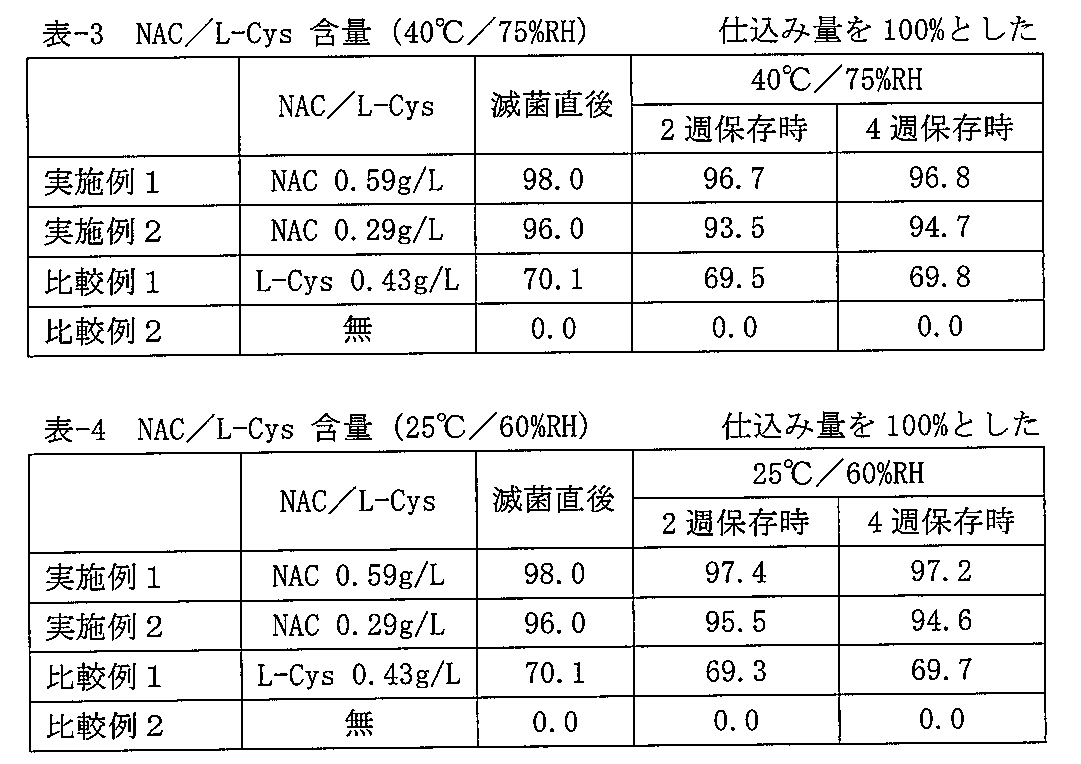
以上の結果から明らかなように、N-アセチルシステイン及びL-システインの含量を比較した場合、L-システインの含量が処方量に比較して約30%低下した一方でN-アセチルシステインは約3~5%の低下であった。
次に、吸光度の測定結果を以下に示す。
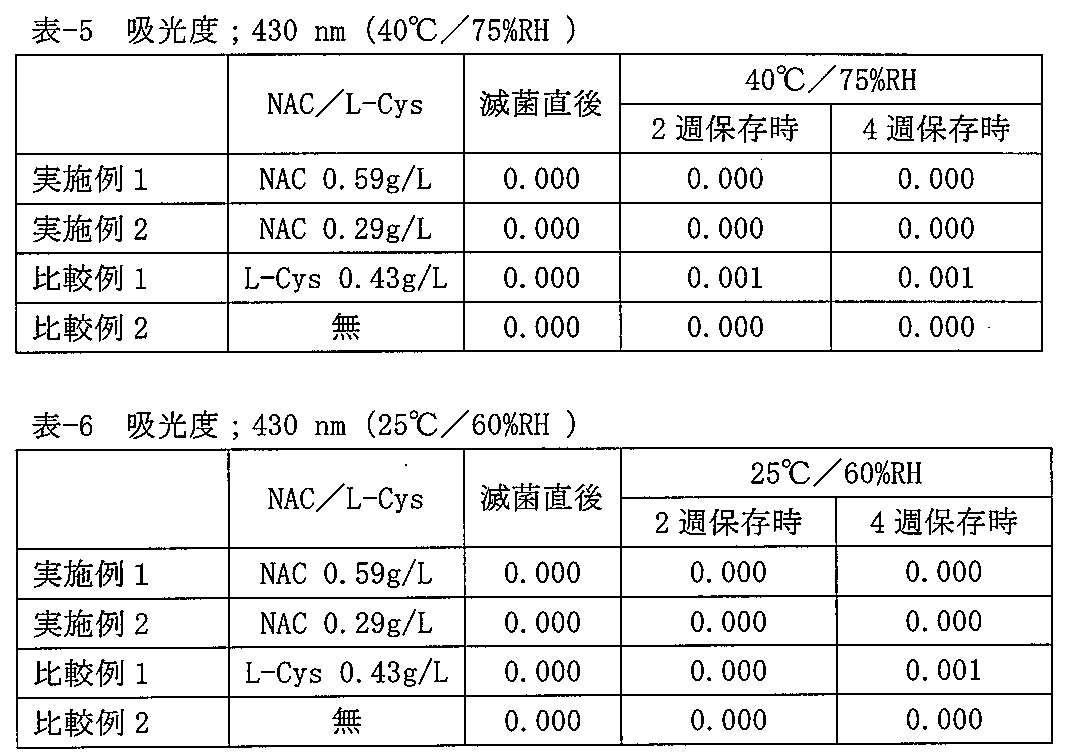
着色については、全ての液で認められなかった.
同様の処方を用いて同様の試験を行った。
<実施例3>
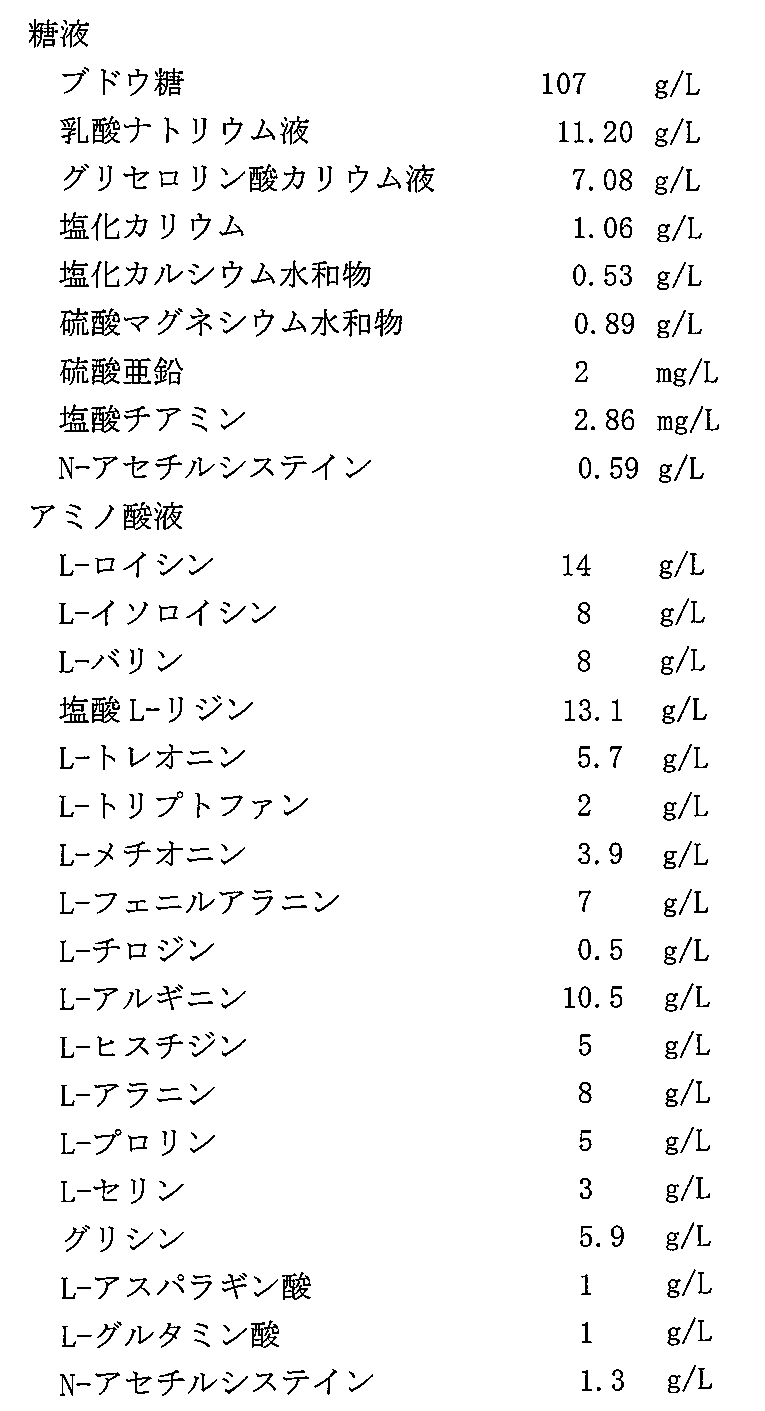
<実施例3>
糖液は上記の糖、電解質、ビタミンB1を注射用水に溶解し、pH調節剤として硫酸を用いてpH4.5とした。また、アミノ酸液は上記したアミノ酸を注射用水に溶解し、pH調節剤として硫酸を用いて、pH6.8とした。両液を無菌ろ過し、糖液350mLおよびアミノ酸液150mLをそれぞれ易剥離シールで仕切られたプラスチック製容器の各室に充填し、密封した後、窒素雰囲気下において高圧蒸気滅菌を行った。冷却乾燥後、鉄系脱酸素剤(商品名「エージレスZA-200」)と共にアルミ箔をバリア層とするガス非透過性の外包装材(大日本印刷(株)製)に窒素ガス下で包装した。なお、糖液の滴定酸度は、20であった。
<実施例4>
糖液処方において、N-アセチルシステインを1.17g/Lとした以外は、実施例3と同様に薬液を得た。なお、糖液の滴定酸度は21であった。
糖液処方において、N-アセチルシステインを1.17g/Lとした以外は、実施例3と同様に薬液を得た。なお、糖液の滴定酸度は21であった。
<実施例5>
糖液処方において、N-アセチルシステインを2.93g/Lとした以外は、実施例3と同様に薬液を得た。なお、糖液の滴定酸度は21であった。
糖液処方において、N-アセチルシステインを2.93g/Lとした以外は、実施例3と同様に薬液を得た。なお、糖液の滴定酸度は21であった。
<比較例3>
糖液処方において、N-アセチルシステインを除外した以外は、実施例3と同様に薬液を得た。なお、糖液の滴定酸度は20であった。
糖液処方において、N-アセチルシステインを除外した以外は、実施例3と同様に薬液を得た。なお、糖液の滴定酸度は20であった。
実施例3、4、5及び比較例3を室温下に保存した。二週間後、二箇月後及び四箇月後にビタミンB1をHPLC法にて定量した。また、保存二箇月後及び四箇月後にN-アセチルシステインを比色法にて定量した。
ビタミンB1の残存量に関する測定結果を以下に示す。

以上のように、N-アセチルシステインを処方した輸液は、未添加のものと比較して、ビタミンB1の安定性が向上した。
N-アセチルシステインの残存量に関する測定結果を以下に示す。

N-アセチルシステイン含量は処方量に比較して、保存期間中95%以上であり、安定であった。
Claims (4)
- 糖液とアミノ酸液が複室容器内に別々に収納された末梢静脈投与用輸液において、糖液がビタミンB1およびN-アセチルシステインを含有することを特徴とする末梢静脈投与用輸液。
- 糖液がN-アセチルシステインを0.3~3.0g/L含有する請求項1に記載の末梢静脈投与用輸液。
- 糖液が乳酸ナトリウム、酢酸ナトリウム、グリセロリン酸カリウム、リン酸二カリウムから選ばれる緩衝性のある塩を一種類以上含有する請求項1または2記載の末梢静脈投与用輸液。
- 糖液およびアミノ酸液が亜硫酸イオンを含有しない請求項1~3のいずれかに記載の末梢静脈投与用輸液。
Priority Applications (1)
| Application Number | Priority Date | Filing Date | Title |
|---|---|---|---|
| JP2011503800A JPWO2010104023A1 (ja) | 2009-03-11 | 2010-03-08 | ビタミンb1を安定に配合した糖液を含む末梢静脈投与用輸液 |
Applications Claiming Priority (2)
| Application Number | Priority Date | Filing Date | Title |
|---|---|---|---|
| JP2009057227 | 2009-03-11 | ||
| JP2009-057227 | 2009-03-11 |
Publications (1)
| Publication Number | Publication Date |
|---|---|
| WO2010104023A1 true WO2010104023A1 (ja) | 2010-09-16 |
Family
ID=42728312
Family Applications (1)
| Application Number | Title | Priority Date | Filing Date |
|---|---|---|---|
| PCT/JP2010/053758 Ceased WO2010104023A1 (ja) | 2009-03-11 | 2010-03-08 | ビタミンb1を安定に配合した糖液を含む末梢静脈投与用輸液 |
Country Status (2)
| Country | Link |
|---|---|
| JP (1) | JPWO2010104023A1 (ja) |
| WO (1) | WO2010104023A1 (ja) |
Cited By (1)
| Publication number | Priority date | Publication date | Assignee | Title |
|---|---|---|---|---|
| CN110898005A (zh) * | 2019-12-30 | 2020-03-24 | 滨州医学院附属医院 | 一种减毒增效的长春瑞滨注射液及其抗肺癌应用 |
Citations (4)
| Publication number | Priority date | Publication date | Assignee | Title |
|---|---|---|---|---|
| JPH04210629A (ja) * | 1990-11-30 | 1992-07-31 | Tanabe Seiyaku Co Ltd | 亜硫酸イオンフリーの二重包装型アミノ酸輸液製剤 |
| JPH07502025A (ja) * | 1991-10-21 | 1995-03-02 | ファルマチア・ゲゼルシャフト・ミット・ベシュレンクテル・ハフツング | ヒト非経口栄養補給に用いる、安定性に優れた熱量栄養剤溶液、および複数隔壁容器または複式受容器 |
| WO2004103375A1 (ja) * | 2003-05-22 | 2004-12-02 | Otsuka Pharmaceutical Factory, Inc. | 末梢静脈投与用輸液製剤およびビタミンb1の安定化方法 |
| JP2005179200A (ja) * | 2003-12-16 | 2005-07-07 | Terumo Corp | ビタミンb1類配合輸液剤 |
-
2010
- 2010-03-08 WO PCT/JP2010/053758 patent/WO2010104023A1/ja not_active Ceased
- 2010-03-08 JP JP2011503800A patent/JPWO2010104023A1/ja active Pending
Patent Citations (4)
| Publication number | Priority date | Publication date | Assignee | Title |
|---|---|---|---|---|
| JPH04210629A (ja) * | 1990-11-30 | 1992-07-31 | Tanabe Seiyaku Co Ltd | 亜硫酸イオンフリーの二重包装型アミノ酸輸液製剤 |
| JPH07502025A (ja) * | 1991-10-21 | 1995-03-02 | ファルマチア・ゲゼルシャフト・ミット・ベシュレンクテル・ハフツング | ヒト非経口栄養補給に用いる、安定性に優れた熱量栄養剤溶液、および複数隔壁容器または複式受容器 |
| WO2004103375A1 (ja) * | 2003-05-22 | 2004-12-02 | Otsuka Pharmaceutical Factory, Inc. | 末梢静脈投与用輸液製剤およびビタミンb1の安定化方法 |
| JP2005179200A (ja) * | 2003-12-16 | 2005-07-07 | Terumo Corp | ビタミンb1類配合輸液剤 |
Cited By (1)
| Publication number | Priority date | Publication date | Assignee | Title |
|---|---|---|---|---|
| CN110898005A (zh) * | 2019-12-30 | 2020-03-24 | 滨州医学院附属医院 | 一种减毒增效的长春瑞滨注射液及其抗肺癌应用 |
Also Published As
| Publication number | Publication date |
|---|---|
| JPWO2010104023A1 (ja) | 2012-09-13 |
Similar Documents
| Publication | Publication Date | Title |
|---|---|---|
| JP6766112B2 (ja) | 高圧蒸気滅菌済み末梢静脈投与用栄養輸液におけるビタミンcの安定化方法 | |
| JP5828019B2 (ja) | 総合栄養輸液剤 | |
| US20100143498A1 (en) | Infusion solution for peripheral intravenous administration | |
| JPH0753368A (ja) | 白金(ii)抗腫瘍剤の安定化溶液 | |
| WO2015050230A1 (ja) | 注射液製剤及びその製造方法 | |
| KR101039224B1 (ko) | 말초정맥 투여용 수액제제 및 비타민 비1의 안정화 방법 | |
| JP4929352B2 (ja) | 注入可能なパラセタモール液剤 | |
| JPWO2010104023A1 (ja) | ビタミンb1を安定に配合した糖液を含む末梢静脈投与用輸液 | |
| JP2003055195A (ja) | ビタミンb1配合末梢静脈投与用総合輸液剤 | |
| JP2005179200A (ja) | ビタミンb1類配合輸液剤 | |
| JPWO2008146731A1 (ja) | 末梢静脈投与用輸液の製造方法 | |
| JP4956935B2 (ja) | 輸液製剤 | |
| JP2004189677A (ja) | 輸液製剤 | |
| JP2010090039A (ja) | 還元糖とアミノ酸を含む一液化末梢静脈投与用輸液製剤 | |
| JP2006020657A (ja) | 微量元素配合輸液製剤 | |
| JP3824716B2 (ja) | 中心静脈投与用輸液 | |
| WO2025164749A1 (ja) | 輸液製剤及びその製造方法 | |
| WO2024022966A1 (en) | Ready-to-administer product comprising a norepinephrine formulation | |
| JP2005053872A (ja) | 糖電解質維持輸液 |
Legal Events
| Date | Code | Title | Description |
|---|---|---|---|
| 121 | Ep: the epo has been informed by wipo that ep was designated in this application |
Ref document number: 10750776 Country of ref document: EP Kind code of ref document: A1 |
|
| WWE | Wipo information: entry into national phase |
Ref document number: 2011503800 Country of ref document: JP |
|
| NENP | Non-entry into the national phase |
Ref country code: DE |
|
| 122 | Ep: pct application non-entry in european phase |
Ref document number: 10750776 Country of ref document: EP Kind code of ref document: A1 |