WO2010101131A1 - 印刷用塗工紙およびその製造方法 - Google Patents
印刷用塗工紙およびその製造方法 Download PDFInfo
- Publication number
- WO2010101131A1 WO2010101131A1 PCT/JP2010/053285 JP2010053285W WO2010101131A1 WO 2010101131 A1 WO2010101131 A1 WO 2010101131A1 JP 2010053285 W JP2010053285 W JP 2010053285W WO 2010101131 A1 WO2010101131 A1 WO 2010101131A1
- Authority
- WO
- WIPO (PCT)
- Prior art keywords
- paper
- coated paper
- printing
- coated
- basis weight
- Prior art date
- Legal status (The legal status is an assumption and is not a legal conclusion. Google has not performed a legal analysis and makes no representation as to the accuracy of the status listed.)
- Ceased
Links
Classifications
-
- D—TEXTILES; PAPER
- D21—PAPER-MAKING; PRODUCTION OF CELLULOSE
- D21F—PAPER-MAKING MACHINES; METHODS OF PRODUCING PAPER THEREON
- D21F3/00—Press section of machines for making continuous webs of paper
- D21F3/02—Wet presses
- D21F3/0209—Wet presses with extended press nip
- D21F3/0218—Shoe presses
-
- D—TEXTILES; PAPER
- D21—PAPER-MAKING; PRODUCTION OF CELLULOSE
- D21F—PAPER-MAKING MACHINES; METHODS OF PRODUCING PAPER THEREON
- D21F9/00—Complete machines for making continuous webs of paper
- D21F9/003—Complete machines for making continuous webs of paper of the twin-wire type
Definitions
- the present invention relates to a low basis weight coated paper for glossy printing and a method for producing the same.
- the present invention relates to a low basis weight glossy coated coated paper having excellent opacity and good printability, particularly blister suitability.
- the ash content of the coated paper is increased by adding inorganic substances such as clay, talc, calcium carbonate or the like as a filler to the base paper or increasing the pigment coating layer (Patent Documents 1 and 2). ).
- Patent Document 3 Japanese Patent Laid-Open No. 54-125712
- one of the means to reduce costs from the viewpoint of manufacturing prescription is to reduce the coating amount, but if the coating amount is reduced, the surface properties such as white paper glossiness and smoothness and printability are inevitably lowered. In addition, opacity, which is a particularly important point for coated paper for printing, is also deteriorated.
- an object of the present invention is to provide a low basis weight glossy printing coated paper having high opacity and excellent printability, and to apply the low basis weight glossy printing coating. It is to provide a method for producing a working paper at an operation speed of 1300 m / min or more.
- the present inventors have found that the moisture content of the base paper before the pigment coating layer is 3 using a paper machine having a gap former in the forming part and one or more tandem shoe presses in the press part.
- a paper machine having a gap former in the forming part and one or more tandem shoe presses in the press part.
- coating and surface treatment from paper making can be done efficiently at a high speed of 1300m / or more without any adverse effects such as paper breakage, increasing the density in the process where surface treatment is performed.
- the inventors have found that blistering during printing can be reduced and the present invention has been completed.
- the present invention is a coated coated paper for printing and a method for producing the same.
- the present invention relates to a coated paper for printing in which the basis weight of the coated paper is 30 g / m 2 to 70 g / m 2 , the ash content is 35% to 50%, and the white paper glossiness is 40% to 60%. It is a manufacturing method.
- the coated paper of the present invention has a specific scattering coefficient / density, which is a ratio of the specific scattering coefficient (cm 2 / g) to the density (g / cm 3 ), of 400 or more, the opacity is low. Is preferable because it is difficult to cause print-through.
- the method for producing a coated paper for printing of the present invention uses a paper machine having a gap former as a forming part and one or more tandem shoe presses as a press part, and has a water content of 3% before providing a pigment coating layer.
- an adhesive such as starch is not applied by size press before the pigment coating layer is provided in the process of making the base paper.
- an adhesive such as starch is not applied by size press before the pigment coating layer is provided in the process of making the base paper.
- the present invention by coating the 8g / m 2 ⁇ 20g / m 2 coating per side containing an adhesive and a pigment in the coating process, by increasing the ratio of high pigment component having a specific scattering coefficient, surface treatment The load in the process was reduced, and good opacity and, in turn, excellent through-through characteristics during printing were realized.
- the surface treatment is performed using a thermal soft calender having at least 6 nips composed of a metal roll and an elastic roll.
- the present invention includes the following inventions.
- (1) A method for producing coated paper for printing, in which the basis weight of the coated paper is 30 g / m 2 to 70 g / m 2 , the ash content is 35% to 50%, and the white paper glossiness is 40% to 60%. Papermaking, pigment coating, and surface treatment are continuously performed on-machine, the operation speed is 1300 m / min or more, and the papermaking process has one or more tandem shoe presses in the press part.
- the basis weight of the coated paper is 30 g / m 2 to 70 g / m 2 , the ash content is 35% to 50%, the white paper glossiness is 40% to 60%, and any of (1) to (4) Coated paper for printing obtained by this method.
- papermaking, coating and surface treatment can be continuously performed to produce low basis weight glossy coated paper having high opacity and good printability at an operation speed of 1300 m / min or more. It is.
- the present invention relates to a coated paper for low basis weight gloss tone printing and a method for producing the same.
- the glossy coated coated paper of the present invention has a coated paper having a basis weight of 30 g / m 2 to 70 g / m 2 , an ash content of 35% to 50%, and a blank paper glossiness of 40% to 60%. That is, according to the present invention, it is possible to efficiently produce a low basis weight glossy coated paper having high opacity.
- the glossy coated coated paper means a coated coated paper having a glossy (glossy) coated paper surface, and specifically, a blank paper glossiness of 40% to 60%.
- % Means coated paper for printing.
- the blank paper glossiness is 45% or more, and in a more preferred embodiment, the blank paper glossiness is 48 to 55%.
- the coated paper for printing of the present invention having such white paper glossiness is excellent in printing finish and can reproduce a stretched image.
- the present invention relates to a low basis weight coated paper for printing and a method for producing the same.
- the low basis weight printing coated paper of the present invention specifically has a basis weight of 30 g / m 2 to 70 g / m 2 .
- the basis weight of the printing coated paper of the present invention is 40 g / m 2 to 65 g / m 2 , in a more preferred embodiment 45 g / m 2 to 65 g / m 2 , and in a more preferred embodiment 50 g / m 2. ⁇ 65 g / m 2 .
- the ash content of the coated paper is 35% by weight to 50% by weight, preferably 35% by weight to 45% by weight, and more preferably 35% by weight to 40% by weight.
- the ash content of the coated paper is a value obtained by adding the ash content of the base paper and the ash content of the coating layer.
- a blister is a drying part after inking in a rotary offset printing press, and when the coated paper is heated suddenly together with the ink and the water in the coated paper evaporates, the vapor forms a coating layer. This phenomenon is caused by blistering caused by the ink layer.
- the interlaminar strength, air resistance, and moisture content of the coated paper are major factors. By adjusting to ⁇ 6%, the quality of coated paper including blister suitability is adjusted.
- the coating liquid stays on the surface of the base paper and covers the base paper during coating, the coating liquid is intensively dried in the drying part after coating. Therefore, it is difficult to suppress the generation of blisters simply by adjusting the moisture content of the coated paper.
- the paper is made without causing paper break even if the ash content of the base paper is increased. Can be made paper.
- the factor that determines the opacity of the paper is light scattering and absorption in the paper layer.
- As a method for increasing the opacity there is an increase in the absorption coefficient and an increase in the scattering coefficient.
- increasing the absorption coefficient decreases the whiteness of the paper, leading to a decrease in the quality of the coated paper. Therefore, in order to increase the opacity of the coated paper, it is important to make the paper opaque by increasing the paper scattering coefficient.
- the coated paper for printing of the present invention has a low basis weight and high opacity, it is particularly difficult to cause print-through.
- the ratio scattering coefficient (cm 2 / g) and specific ratios scatter factor / density which is the density (g / cm 3) is preferably 400 or more, 420 or more More preferred is 450 or more.
- the coated paper for printing according to the present invention having such a ratio of specific scattering coefficient and density is suitable because it has low opacity and high opacity, and is particularly difficult to cause print-through.
- the parameter of specific scattering coefficient / density is an index of opacity of the coated paper for printing, and the larger the value, the higher the opacity of the coated paper.
- the parameter is a large value of specific scattering coefficient / density.
- the specific scattering coefficient (cm 2 / g) is preferably 400 or more, more preferably 450 or more, and further preferably 500 or more. If the specific scattering coefficient (cm 2 / g) is smaller than 400, the print quality such as back-through tends to be lowered.
- the specific scattering coefficient can be increased, for example, by increasing the amount of ash, but can also be increased if light is well scattered in the coated paper, such as by reducing the density.
- the density (g / cm 3 ) is preferably 1.4 or less.
- the lower limit is preferably about 0.8.
- the printing coated paper of the present invention can correspond to various printing methods and can be suitably used for offset printing coated paper, relief printing coated paper, gravure printing coated paper, and the like. . Especially, since the coated paper for printing of this invention is excellent in the blister property, it can be used especially suitably for offset printing use.
- the paper making process, the coating process, and the surface treatment process are continuously performed using an on-machine coater, and the operation speed is 1300 m / min or more. Therefore, the present invention has a high production efficiency and is extremely advantageous. In high-speed operation with an on-machine coater, the operability is significantly reduced due to a paper-cutting trouble. However, since the present invention uses a paper machine having a gap former, a paper-cutting trouble hardly occurs. This is particularly advantageous during high-speed operation. Since the superiority of the present invention is particularly high in high-speed operation, it is preferable to operate under conditions of 1500 m / min or more, and it is more preferable to operate under conditions of 1600 m / min or more.
- Papermaking The method for producing a coated paper for printing of the present invention has a papermaking process, and uses a papermaking machine having one or more tandem shoe presses and a gap former as a papermaking machine, before providing a pigment coating layer.
- a base paper having a water content of less than 3% is made.
- paper making is performed using a paper machine having a gap former.
- this gap former the paper material jetted from the head box runs between two wires and travels on both sides of the wet paper. Dehydrated almost evenly.
- the initial dewatering is performed in the lap area of the forming roll having the vacuum, and immediately after that, the blade dewatering is performed by the pressure blade module.
- This mechanism enables slower dehydration than conventional formers, so that paper with a uniform paper layer structure and texture can be obtained, and the blister resistance of coated paper can be improved even under relatively high ash conditions. Can be maintained. If the diameter of the forming roll used at this time is small, a sufficient holding angle cannot be obtained, and adjustment of dehydration becomes insufficient, so that it is preferably 1500 mm or more.
- dryness can be adjusted by appropriately using a dewatering device such as a suction unit or a high vacuum suction box in the subsequent stage.
- the paper machine used in the present invention has at least one tandem type shoe press in the press part in consideration of moisture after pressing. More preferably, the interlayer strength and the blister resistance are improved by performing the treatment in two or more stages using a tandem type shoe press.
- the shoe press has a nip width in the range of about 150 to 250 mm, and the processing conditions are preferably 100 kN / m to 1100 kN / m, more preferably 500 kN / m to 1100 kN / m. Further, when two or more shoe presses are used, it is preferable to pass the paper so that the transfer belt comes into contact with the shoe press on the dryer part side, because paper breakage or the like hardly occurs and high-speed operability is excellent.
- the dryer of the paper machine a public device can be used, and the drying conditions are not particularly limited, and can be appropriately set within a normal operating range.
- blister suitability during offset printing can be greatly improved by setting the moisture content of the base paper before providing the pigment coating layer to less than 3%, more preferably less than 2.5%.
- Blisters are thought to be caused by the interlaminar strength, low air permeability, and moisture content of coated paper.
- the moisture content of the coated paper has been adjusted to 4-6%.
- the coating liquid is mainly dried. Therefore, even if the moisture content of the coated paper is adjusted by the drying part, it is difficult to suppress the generation of blisters.
- blister suitability is improved by adjusting the moisture content of the base paper before providing a pigment coating layer.
- the water content of the base paper portion is small, so that the water vapor generated by the heat during printing decreases, and the base paper has It is conceivable that the effect of the paper strength agent added internally is maximized.
- a paper machine having a gap former is used, and the ash content of the coated paper is increased, so that the operability is good and the high opacity and low basis weight printing coating is performed. Paper can be obtained.
- raw material pulp of raw paper chemical pulp (conifer bleached kraft pulp (NBKP) or unbleached kraft pulp (NUKP), hardwood bleached kraft pulp (LBKP) or unbleached kraft pulp (LUKP), etc.)
- Mechanical pulp groundwood pulp (GP), refiner mechanical pulp (RGP), thermomechanical pulp (TMP), chemithermomechanical pulp (CTMP), etc.
- deinked pulp DIP
- the deinked pulp may be any deinked pulp made from high-quality paper, medium-quality paper, low-grade paper, newspaper, flyers, magazines, etc., or unselected waste paper mixed with these. Absent. In the present invention, even when the deinked pulp is 30% by weight or more with respect to the pulp, effects such as no difference in front and back and good interlayer strength can be exhibited.
- known fillers can be arbitrarily used, such as white carbon, talc, heavy calcium carbonate, light calcium carbonate, clay, silica, light calcium carbonate-silica composite, kaolin, calcined kaolin, deramikaolin, Inorganic such as amorphous silica produced by neutralization by mineral production of magnesium carbonate, barium carbonate, barium sulfate, aluminum hydroxide, calcium hydroxide, magnesium hydroxide, zinc hydroxide, zinc oxide, titanium oxide, sodium silicate Fillers and organic fillers such as urea-formalin resins, melamine resins, polystyrene resins and phenol resins can be used alone or in combination.
- calcium carbonate and light calcium carbonate-silica composite which are typical fillers for neutral papermaking and alkaline papermaking, are preferably used.
- the filler content in the paper is not particularly limited, but is preferably 10 to 40% by solid weight. Since the opacity of the coated paper increases as the ash content increases, the effect of the present invention is greater when the present invention is applied to the production of a low-basis weight printing base paper, which is difficult to achieve opacity. From this viewpoint, the filler content in the paper is preferably 10 to 40% by solid weight, and more preferably 12 to 35% by solid weight.
- a known paper additive can be used.
- sulfuric acid bands and various anionic, cationic, nonionic or amphoteric yield improvers, drainage improvers, paper strength enhancers and internal additive sizing agents, etc. Can be used.
- good printability, particularly blister properties can be obtained by adding a cationic paper strength enhancer to the base paper and adding 50 kg to 150 kg / t of pulp.
- dyes, fluorescent brighteners, pH adjusters, antifoaming agents, pitch control agents, slime control agents and the like can be added as necessary.
- a clear coating layer is provided by applying a coating liquid mainly composed of an adhesive such as starch to a coated base paper.
- a coating liquid mainly composed of an adhesive such as starch is coated on the base paper.
- the interlayer strength due to the penetration of the adhesive is improved.
- Applying such a clear coating solution to the base paper before pigment coating in advance is generally called a size press, but the coating equipment used at this time is a rod metalling size press coater, blade metalling.
- a roll coater such as a size press coater, a gate roll size press coater, or a two roll size press is often used.
- such a clear coating is not performed, and it is preferable to provide a pigment coating layer on the base paper as it is. That is, when producing at a high speed of 1300 m / min or more with an on-machine coater as in the present invention, it is preferable not to perform clear coating with a size press because clear coating may be a significant adverse effect on operability. . That is, by not performing the clear coating, it is possible to avoid the wetting of the base paper due to the size press, the paper break due to the nip, and the increase in defects due to the mist.
- the base paper surface becomes hard, so that minute irregularities are not easily crushed in the surface treatment process. , Glossiness deteriorates. Furthermore, the size press deteriorates the air permeability of the base paper, which in turn affects the blister suitability during printing.
- the base paper in advance using an on-line soft calendar or an on-line chilled calendar in order to make the coating layer after coating uniform.
- the method for producing a coated paper for printing of the present invention includes a step of coating a coating liquid containing a pigment and an adhesive on the coating base paper obtained as described above with an on-machine coater. It becomes. Therefore, the printing coated paper of the present invention has a pigment coating layer on the base paper.
- the pigment used in the present invention is not particularly limited, and a pigment conventionally used for coated paper can be used.
- a pigment conventionally used for coated paper can be used.
- Organic pigments such as plastic pigments, organic / inorganic composite pigments, and the like can be used. These pigments can be used alone or in combination of two or more as required.
- calcium carbonate obtained by wet milling light calcium carbonate of spindle-shaped calcite crystal which is an average particle measured by an X-ray transmission type particle size distribution analyzer
- the diameter (d50: 50% by weight particle diameter) is 0.1 to 0.5 ⁇ m
- the BET specific surface area is in the range of 10 to 30 m 2 / g, and is measured with an X-ray transmission type particle size distribution analyzer.
- Sharpness (d30 / d70) ⁇ 100 [Wherein d30 is a particle size of 30% by weight and d70 is a particle size of 70% by weight] It is preferable to use calcium carbonate having a sharpness of the particle size distribution represented by It is preferable to apply such calcium carbonate with a pigment because a coated paper for printing excellent in see-through can be obtained.
- a calcite crystal in which spindle-shaped primary particles aggregate to form rosette-shaped secondary particles as light calcium carbonate before pulverization.
- the average particle diameter (d50) measured with the previous light calcium carbonate X-ray transmission particle size distribution analyzer is 1.4 to 3.0 ⁇ m, and the BET specific surface area is 4 to 12 m 2 / g. preferable.
- the blended amount of the ground calcium carbonate is preferably 40 to 100 parts by weight, more preferably 60 to 90 parts by weight per 100 parts by weight of the pigment.
- the adhesive used in the present invention is not particularly limited, and an adhesive (binder) conventionally used for coated paper can be used.
- an adhesive (binder) conventionally used for coated paper can be used.
- various copolymers such as styrene / butadiene, styrene / acrylic, ethylene / vinyl acetate, butadiene / methyl methacrylate, vinyl acetate / butyl acrylate, polyvinyl alcohol, maleic anhydride copolymer, acrylic acid / methyl
- Synthetic adhesives such as methacrylate copolymers; proteins such as casein, soy protein, synthetic proteins; etherified starches such as oxidized starch, positive starch, urea phosphate esterified starch, hydroxyethyl etherified starch, dextrin, etc.
- One or more kinds of ordinary adhesives for coated paper such as cellulose derivatives such as carboxymethylcellulose, hydroxyethylcellulose, and hydroxymethylcellulose can be appropriately selected and used.
- these adhesives are used in the range of about 5 to 50 parts by weight, more preferably about 8 to 30 parts by weight per 100 parts by weight of the pigment.
- blended with the pigment for normal coated papers such as a dispersing agent, a thickener, a water retention agent, an antifoamer, a water-resistant agent, and a coloring agent, are used suitably as needed.
- a blade coater when coating a paint mainly composed of a pigment and an adhesive, a blade coater, a bar coater, a roll coater, an air knife coater, a reverse roll coater, a curtain coater, a size press coater, and a gate roll coater are used.
- One layer or two or more layers can be coated on one side or both sides of the base paper by a coating machine or the like in which a paint such as OptiSpray is applied or directly sprayed onto the base paper by a spray nozzle.
- a blade system using a flooded nip type blade coater, a jet fountain type blade coater, a short dwell time application type blade coater or the like is preferable.
- an appropriate coating amount is required to obtain excellent penetration properties, and therefore it is preferable to employ a jet fountain blade coater with a wide adjustment range of the coating amount.
- the coating coverage of the paint to be applied by the method preferably has per side 8 ⁇ 20g / m 2, more preferably 9 ⁇ 15g / m 2.
- the pigment coating layer may be one or plural.
- the method for preparing the pigment coating liquid is not particularly limited, but in a preferred embodiment, the solid content concentration of the coating liquid is about 30 to 68% by weight.
- the method for drying the wet coating layer is not limited, and various methods such as a steam superheated cylinder, a heated hot air air dryer, a gas heater dryer, an electric heater dryer, and an infrared heater dryer may be used alone or in combination. it can.
- the method for producing a coated paper for printing of the present invention comprises a step of surface-treating the coating layer.
- the surface treatment in the present invention it is preferable to perform the surface treatment with an online thermal soft calender composed of a metal roll and an elastic roll.
- the surface treatment is preferably performed under conditions of 6 nips or more.
- increasing the calendar load to improve smoothness leads to a decrease in opacity, and paper breakage or the like is likely to occur.
- the calendar load can be dispersed, and the density increase that affects the opacity can be suppressed while obtaining the target smoothness.
- a coated paper for printing can be applied to a papermaking process, a coating with a low basis weight, without losing quality under high-speed operating conditions. It has become possible to continuously manufacture the process and surface treatment process online.
- the surface temperature of the metal roll is preferably 100 ° C. or higher and 300 ° C. or lower. If the moisture content of the coated paper is appropriate, the coating layer can be smoothed with a low nip pressure or a short nip residence time by using a metal roll heated to 100 ° C. or higher. Low density, high opacity, coated paper with good smoothness, and faster processing than conventional super calenders, eliminating the need for rewinding frames, etc., enabling efficient production Excellent operability.
- the Shore D hardness of the elastic roll is preferably 80 to 100, and more preferably 85 to 97.
- the sheet passing speed is preferably about 1000 to 3000 m / min, and the linear pressure is preferably about 30 to 500 kg / cm.
- the pre-calendar coating moisture is preferably 3 to 12%, but more preferably 4 to 8% in order to achieve both smoothness and operability.
- the material of the elastic roll used in pair with the metal roll of the soft calender is not particularly limited, but generally at high temperature and high pressure such as modified urethane resin, epoxy resin, polyamide resin, phenol resin, polyether resin, polyacrylate resin, etc.
- a resin roll exhibiting durability is preferably used.
- the type of the soft calendar used in the present invention is preferably 6 stacks or more with two tandem type rolls in consideration of easy paper passing and space saving.
- the tandem type is a soft calendar of a type in which two rolls obtained by overlapping a pair of metal rolls and elastic rolls are arranged in parallel.
- the present invention provides a gap former in which the process of making a base paper is one or more tandem shoe presses in a low basis weight printing coated paper manufactured by an on-machine coater having an operation speed of 1300 m / min or more.
- the moisture content of the base paper before the pigment coating layer is less than 3%
- the basis weight of the coated paper is 30 g / m 2 to 70 g / m 2
- the ash content is 35% to 50%
- the white paper glossiness is By setting the amount to 40% to 60%, it is possible to have both excellent printability and particularly good blister suitability at the time of printing while having a low basis weight.
- the coated paper of the present invention has a specific scattering coefficient / density, which is a ratio of the specific scattering coefficient (cm 2 / g) to the density (g / cm 3 ), of 400 or more, the opacity is low. Therefore, it is possible to efficiently suppress print-through.
- Example 1 A pulp slurry containing 30 parts of waste paper pulp (DIP) and 70 parts of hardwood kraft pulp (LBKP) as raw material is prepared, 12 parts of light calcium carbonate as a filler, and cationic paper as an internal paper strength agent A paper stock was prepared by adding 0.5% of a strength enhancer to the pulp.
- DIP waste paper pulp
- LKP hardwood kraft pulp
- the surface of the pigment coating layer is continuously treated using a 2-roll / 6-stack thermal soft calender at a surface temperature of the metal roll of 200 ° C. and a linear pressure of 250 kN / m.
- a coated paper for printing was obtained.
- the basis weight of the resulting coated paper for printing was 64.0 g / m 2
- the blank paper glossiness was 50.0%
- the ratio of specific scattering coefficient to density was 455.
- Example 2 The machine speed 1300 m / min, 2.5% the base paper moisture after drying, 46.6 g / m 2 base paper basis weight, except that the coating amount of the pigment coating layer per one surface 8.5 g / m 2 is A coated paper was produced in exactly the same manner as in Example 1 above.
- Example 3 The machine speed 1300 m / min, 2.2% the base paper moisture after drying, 35.2 g / m 2 base paper basis weight, except that the coating amount of the pigment coating layer per one surface 8.0 g / m 2 is A coated paper was produced in exactly the same manner as in Example 1 above.
- Example 4 Except for the papermaking speed of 1300 m / min, the moisture of the base paper after drying was 2.2%, the base weight of the base paper was 36.2 g / m 2 , and the coating amount of the pigment coating layer was 7.5 g / m 2 per side. A coated paper was produced in exactly the same manner as in Example 1 above.
- Example 5 The machine speed 1300 m / min, 2.5% of base paper moisture after drying, 46.6 g / m 2 base paper basis weight, the coating amount of the pigment coating layer per one surface 8.5 g / m 2, the pigment coating A coated paper was produced in exactly the same manner as in Example 1 except that instead of the heavy calcium carbonate in the working layer, the following pulverized light calcium carbonate was used.
- the pulverized calcium carbonate had an average particle size of 0.38 ⁇ m, a BET specific surface area of 22.5 m 2 / g, and a sharpness of 62, as measured with a particle size distribution analyzer of the X-ray transmission method.
- a calcite crystal in which spindle-shaped primary particles agglomerate to form rosette-shaped secondary particles is used.
- the measured average particle size (d50) was 2.2 ⁇ m, and the BET specific surface area was 5.9 m 2 / g.
- Example 6 The machine speed 1300 m / min, 2.5% of base paper moisture after drying, 46.6 g / m 2 base paper basis weight, the coating amount of the pigment coating layer per one surface 8.5 g / m 2, the pigment coating A coated paper was produced in exactly the same manner as in Example 1 above, except that a clear coating was applied to the base paper with a size press using a coating solution having a starch concentration of 6% before the work.
- Example 7 Base paper basis weight of 35 g / m 2, except that the coating amount of the pigment coating layer was per side 9.5 g / m 2 was prepared a coated paper in the same manner as in Example 1.
- Comparative Example 4 A coated paper was produced in the same manner as in Comparative Example 1 except that the base paper basis weight was 29 g / m 2 and the coating amount of the pigment coating layer was 10.5 g / m 2 per side. However, a paper break occurred during the operation, and the coated paper could not be produced stably.
- ⁇ Quality evaluation method> Coated paper ash content Measured according to JIS P-8251.
- Glossiness of white paper Measured at an angle of 75 degrees according to JIS P-8142.
- Table 1 shows the results. As is apparent from Table 1, according to the present invention, a coated paper having excellent blister resistance and reverse penetration properties during offset printing could be obtained without impairing high-speed operability.
- ⁇ ⁇ ⁇ Blister resistance is improved when the water content of the base paper is low, and there is a tendency for the see-through to improve when the ash content of the coated paper is high or when pulverized light calcium carbonate is used.
- the high-speed operability was particularly suitable when a gap former was used and the ash content was about 35 to 50%. Furthermore, when the ash content was increased, paper breakage occurred in paper machines other than the gap former, and the operability deteriorated remarkably.
- the uneven printing thickness tends to improve when the coating amount is 8 g / m 2 or more.
Landscapes
- Paper (AREA)
Abstract
本発明の課題は、不透明性が高く、印刷適性に優れる低坪量のグロス調印刷用塗工紙を提供すること、ならびに、当該低坪量グロス調印刷用塗工紙を1300m/分以上の操業速度で製造する方法を提供することである。 フォーミングパートにギャップフォーマ、プレスパートにタンデムシュープレスを1基以上有する抄紙機を用いて、顔料塗工層を設ける前の原紙水分率が3%未満の原紙を用いることによって、耐ブリスター性に優れ、不透明度の高い低坪量グロス調印刷用塗工紙を効率的に製造することができる。
Description
本発明は、低坪量のグロス調印刷用塗工紙およびその製造方法に関する。特に本発明は、不透明性に優れていながら、印刷適性、特にブリスター適性が良好な低坪量グロス調印刷用塗工紙に関する。
近年、印刷用塗工紙は、チラシ、カタログ、パンフレット、ダイレクトメール等の広告・宣伝を目的とした商業印刷分野での需要が伸びている。これら商業印刷物は、それ自体の商品価値は高くないが、宣伝媒体としての目的が達成されることが重要であるので、こういった商業印刷物に用いる印刷用紙は、低コストで印刷仕上がりの良いものが求められる。
また、近年の低成長時代に入ってからは、印刷用紙にかかるコストを削減するため、印刷用塗工紙においては低坪量化によるグレードダウンが急速に進行している。これは、原材料価格の高騰による企業収益の悪化や輸送コストの圧縮などの経済的要因、さらに、省資源・環境問題などの社会的要求に基づく社会的要因が挙げられる。特にここ数年、市場が拡大している通信販売業界において、カタログ・ダイレクトメールなどの郵便コスト抑制、倉庫保管料の削減、増ページ対策などのため、低坪量化への要求が高まっている。
このような低坪量化が求められる状況においても、印刷用塗工紙に対する品質的な要求は併せて求められている。塗工紙の品質の中でも、不透明性(特に印刷時にインキが裏面に抜けないこと)への要求は特に高く、さらに、白色度や白紙光沢度、印刷後の品質、耐刷性に優れることが重要である。
しかしながら、低坪量化と不透明性とは相反する事柄であり、これらの品質を両立することは難しい。つまり、低坪量化を実施すると、印刷用塗工紙において重要なポイントとなる不透明度が下がってしまう。
低坪量の塗工紙の不透明性を向上させる手段として、比散乱係数の高い無機物を塗工紙に多く配合して、塗工紙の灰分を高くする方法がある。具体的には、クレー、タルク、炭酸カルシウムなどの無機物を填料として原紙に配合したり、顔料塗工層を増やすことによって、塗工紙の灰分を高くすることが行われる(特許文献1、2)。
しかし、原紙の灰分アップと、顔料塗工層の増加に伴う原紙坪量の減少は、いずれも原紙の強度低下を招き、ひいては塗工紙の強度が低下することとなる。そのため、塗工紙製造過程における断紙の発生など、マシン操業性の悪化につながり、特に抄紙から塗工、表面処理がオンマシンで連続して行われる場合、断紙による製造効率の低下が著しい。さらに、断紙が発生すると、操業用具の破損など、製造過程にかかる弊害が著しく大きくなる危険性がある。このような紙の強度不足による弊害は、高速操業においてより一層大きい。
上述したように、低坪量化と不透明性は相反する事項であり、低坪量化に伴い紙層内の空隙が少なくなるにつれて、光が拡散する頻度、吸収される量がいずれも減少するため、不透明性が低下する。そのため、塗工紙の不透明性を向上させる他の手段として、紙層内の空隙の容積を上げるために紙を低密度化する方法がある。
さらに、高い白紙光沢度が求められるグロス調塗工紙については、高い線圧で表面処理を行う必要があることから、従来、グロス調塗工紙は、各種塗工装置(以下コータと称す)で顔料塗工した塗工紙をいったん巻取った後、スーパーカレンダーを使用して低温(約50~70℃)かつ多段ニップ(通常10~14段)の条件で処理して光沢(グロス)を付与して製品化されていた。特に、このようなスーパーカレンダーを用いて白紙光沢度が40%以上のグロス調塗工紙を得るには、高ニップ圧でカレンダー処理を行う必要があるが、高ニップ圧によって密度が上昇し、不透明性の低下や印刷後の裏抜け性悪化などが避けられない。
また、低ニップ圧のスーパーカレンダー処理でも高い光沢が発現するよう、光沢度が出やすい高価な顔料を配合して顔料塗工を行いグロス調塗工紙を製造することも提案されているが、コストアップが避けられない(特許文献3:特開昭54-125712号公報)。
その一方で、紙の生産性向上も重要な技術課題である。上述したように、商業印刷物に用いられる印刷用紙は、低コストで印刷仕上がりの良いものが求められるため、紙メーカーでは高品質を維持したまま、生産性を上げ、コストダウンを図ることが重要である。
一般に、製造処方の観点からコストダウンを図る手段の一つに低塗工量化があるが、塗工量を減らすと、白紙光沢度や平滑度等の表面性および印刷適性の低下が避けられない上に、印刷用塗工紙にとって特に重要なポイントである不透明性も悪化してしまう。
このように、高い不透明性と良好な印刷適性を兼ね備えた低坪量グロス調塗工紙を、効率よく製造することは極めて困難であった。以上のような状況に鑑み、本発明の課題は、不透明性が高く、印刷適性に優れる低坪量のグロス調印刷用塗工紙を提供すること、ならびに、当該低坪量グロス調印刷用塗工紙を1300m/分以上の操業速度で製造する方法を提供することである。
本発明者等は、上記課題について鋭意検討した結果、フォーミングパートにギャップフォーマ、プレスパートにタンデムシュープレスを1基以上有する抄紙機を用いて、顔料塗工層を設ける前の原紙水分率が3%未満の原紙を抄造することによって、抄紙から塗工、表面処理を連続して1300m/以上の高速で断紙などの弊害なしに効率よく抄造でき、表面処理が行われる工程での密度上昇を防ぐと共に、印刷時のブリスター発生を軽減できることを見出し、本発明を完成させるに至った。
1つの様態において、本発明は印刷用塗工紙およびその製造方法である。本発明は、塗工紙の坪量が30g/m2~70g/m2、灰分率が35%~50%、白紙光沢度が40%~60%である印刷用塗工紙、および、その製造方法である。特に本発明の塗工紙は、比散乱係数(cm2/g)と密度(g/cm3)の比である比散乱係数/密度が400以上であると、低坪量でありながら不透明度が高く、印刷の裏抜けが生じにくいため好適である。
本発明の印刷用塗工紙の製造方法は、フォーミングパートにギャップフォーマ、プレスパートにタンデムシュープレスを1基以上有する抄紙機を用いて、顔料塗工層を設ける前の原紙水分率が3%未満である原紙を抄造する工程と、顔料と接着剤を含有する塗工液を塗工して顔料塗工層を設ける工程と、塗工層を表面処理する工程と、を含んでなり、これらの工程が1300m/分以上の操業速度でオンマシンで連続して行われる。
本発明の好ましい様態において、原紙を抄造する工程で、顔料塗工層を設ける前に澱粉などの接着剤をサイズプレス塗布しない。クリア塗工をしないことによって、塗工紙の透気抵抗度を低下させることができ、オフセット印刷時のブリスター発生を防ぐと共に、表面処理による光沢発現性が高まるため、良好な印刷適性を持つグロス調印刷用塗工紙を得ることができ、好適である。
また本発明は、塗工工程において顔料と接着剤を含有する塗料を片面あたり8g/m2~20g/m2塗工することによって、比散乱係数の高い顔料成分の比率を高めて、表面処理工程での負荷を軽減させ、良好な不透明性、引いては印刷時の優れた裏抜け性を実現させた。
さらに本発明は、好ましい様態において、金属ロールと弾性ロールで構成される少なくとも6ニップ以上の熱ソフトカレンダーを用いて表面処理が行われる。これにより、カレンダー圧を複数に分散させ、密度上昇を抑えて不透明性を維持しながら、高い平滑性を得ることができる。
以下に限定されるわけではないが、本発明は以下の発明を包含する。
(1) 塗工紙の坪量が30g/m2~70g/m2、灰分率が35%~50%、白紙光沢度が40%~60%である印刷用塗工紙の製造方法であって、抄紙、顔料塗工、表面処理が連続してオンマシンで行われ、操業速度が1300m/分以上であり、抄紙工程が、プレスパートにタンデムシュープレスを1基以上有し、フォーミングパートにギャップフォーマを有する抄紙機を用いて行われ、顔料塗工層を設ける前の紙の水分率が3%未満である、上記方法。
(2) 前記顔料塗工工程において、片面当たり8~20g/m2の顔料塗工層が設けられる、(1)に記載の方法。
(3) 前記表面処理工程において、金属ロールと弾性ロールで構成されるソフトカレンダーを用いて6ニップ以上の条件で顔料塗工層が表面処理される、(1)または(2)に記載の方法。
(4) 前記塗工紙の比散乱係数(cm2/g)と密度(g/cm3)の比である比散乱係数/密度が400以上である、(1)~(3)のいずれかに記載の方法。
(5) 塗工紙の坪量が30g/m2~70g/m2、灰分率が35%~50%、白紙光沢度が40%~60%であり、(1)~(4)のいずれかの方法で得られる印刷用塗工紙。
(6) 前記塗工紙の比散乱係数(cm2/g)と密度(g/cm3)の比である比散乱係数/密度が400以上である、(5)に記載の塗工紙。
(1) 塗工紙の坪量が30g/m2~70g/m2、灰分率が35%~50%、白紙光沢度が40%~60%である印刷用塗工紙の製造方法であって、抄紙、顔料塗工、表面処理が連続してオンマシンで行われ、操業速度が1300m/分以上であり、抄紙工程が、プレスパートにタンデムシュープレスを1基以上有し、フォーミングパートにギャップフォーマを有する抄紙機を用いて行われ、顔料塗工層を設ける前の紙の水分率が3%未満である、上記方法。
(2) 前記顔料塗工工程において、片面当たり8~20g/m2の顔料塗工層が設けられる、(1)に記載の方法。
(3) 前記表面処理工程において、金属ロールと弾性ロールで構成されるソフトカレンダーを用いて6ニップ以上の条件で顔料塗工層が表面処理される、(1)または(2)に記載の方法。
(4) 前記塗工紙の比散乱係数(cm2/g)と密度(g/cm3)の比である比散乱係数/密度が400以上である、(1)~(3)のいずれかに記載の方法。
(5) 塗工紙の坪量が30g/m2~70g/m2、灰分率が35%~50%、白紙光沢度が40%~60%であり、(1)~(4)のいずれかの方法で得られる印刷用塗工紙。
(6) 前記塗工紙の比散乱係数(cm2/g)と密度(g/cm3)の比である比散乱係数/密度が400以上である、(5)に記載の塗工紙。
本発明により、抄紙、塗工、表面処理を連続して行い、高い不透明性と良好な印刷適性を兼ね備えた低坪量グロス調塗工紙を1300m/分以上の操業速度で製造することが可能である。
本発明は、低坪量グロス調印刷用塗工紙およびその製造方法に関する。本発明のグロス調印刷用塗工紙は、塗工紙の坪量が30g/m2~70g/m2、灰分率が35%~50%、白紙光沢度が40%~60%である。すなわち、本発明によれば、不透明度が高い低坪量グロス調塗工紙を効率よく製造することができる。
本発明において、グロス調印刷用塗工紙とは、塗工紙表面がグロス調である(光沢がある)印刷用塗工紙を意味し、具体的には、白紙光沢度が40%~60%である印刷用塗工紙を意味する。本発明の好ましい態様において白紙光沢度は45%以上であり、より好ましい態様において白紙光沢度は48~55%である。このような白紙光沢度を有する本発明の印刷用塗工紙は、印刷仕上りに優れ、張りのある画像を再現することができる。
本発明は低坪量の印刷用塗工紙およびその製造方法に関する。本発明の低坪量印刷用塗工紙は、具体的には30g/m2~70g/m2の坪量を有し、である。本発明によれば、塗工紙の坪量が50g/m2前後のグロス調印刷用塗工紙を効率よく製造することも可能である。好ましい態様において本発明の印刷用塗工紙の坪量は、40g/m2~65g/m2であり、より好ましい態様において45g/m2~65g/m2、さらに好ましい態様において50g/m2~65g/m2である。
本発明のグロス調印刷用紙は、塗工紙の灰分率が35重量%~50重量%であり、好ましくは35重量%~45重量%、より好ましくは35重量%~40重量%である。塗工紙の灰分を35重量%~50重量%とすることで、紙の強度や耐ブリスター性を維持しつつ、優れた裏抜け性、不透明度が得られる。本発明において、塗工紙の灰分とは、原紙の灰分含有量と塗工層の灰分量とを足した値である。
塗工紙の灰分アップには、原紙の灰分アップと顔料塗工層の灰分アップ(顔料塗工層の増加)とがあるが、原紙の灰分アップでは層間強度が低下し、顔料塗工層の増加では透気抵抗度が上昇するため、印刷時のブリスター適性が著しく悪化する。ここで、ブリスターとはオフセット輪転印刷機において、インキング後の乾燥パートで、インキとともに塗工紙が急激に加熱されて、塗工紙中の水分が蒸発する際に、蒸気が塗工層とインキ層に妨げられて火膨れとなる現象のことであり、塗工紙の層間強度、透気抵抗度、及び水分率が大きな要因となっており、一般的には塗工紙の水分を4~6%に調整することでブリスター適性を含めた塗工紙の品質を調節している。しかしながら、塗工する際に塗工液は原紙表面に留まり原紙を被覆した状態になるため、塗工後の乾燥パートにおいては、塗工液が重点的に乾燥される状況となる。そのため、単に塗工紙の水分率を調整してもブリスターの発生を抑制することは難しい。
また、本発明のようにオンマシンコータの高速塗工の場合は、原紙の灰分が高いと、紙の層間強度が弱くなり、断紙を起こし、操業性が著しく低下する。また、塗工量を多くすることで灰分を上げようとすると、高速マシンでは高速のため乾燥負荷が大きくなり、操業性が著しく低下する。このように、不透明度を向上させるため、塗工紙の灰分配合量を増加することはオンマシンの高速塗工においては非常に難しかった。
本発明においては、抄紙機として、タンデムシュープレスを1基以上有し、ギャップフォーマを有する抄紙機を用いて原紙を抄紙することにより、原紙の灰分量を増加させても断紙を起こすことなく、抄紙することができる。
紙の不透明性を左右する要因は、紙層内での光の散乱と吸収であり、不透明度を上げる方法としては、吸収係数を上げることと散乱係数を上げることがある。しかし、吸収係数を上げることは紙の白色度を下げることとなり、塗工紙の品質低下につながる。そこで、塗工紙の不透明度を上げるためには、紙の散乱係数を上げて、紙を不透明化することが重要となる。
本発明の印刷用塗工紙は、低坪量でありながら不透明性が高く、特に印刷の裏抜けなどが生じにくい。具体的には、本発明の印刷用塗工紙は、比散乱係数(cm2/g)と密度(g/cm3)の比である比散乱係数/密度が400以上が好ましく、420以上がより好ましく、450以上がさらに好ましい。このような比散乱係数と密度の比を有する本発明の印刷用塗工紙は、低坪量でありながら不透明性が高く、特に印刷の裏抜けなどが生じにくく好適である。ここで、比散乱係数/密度というパラメータは、印刷用塗工紙の不透明度の指標であり、値が大きいほど塗工紙の不透明度が高いことを示す。すなわち、比散乱係数が高い場合(つまり、塗工紙中で光がよく散乱する場合)や密度が低い場合(つまり、塗工紙内部に空隙が多く、光が散乱しやすい場合)、上記の比散乱係数/密度というパラメータ大きな値となる。
本発明において比散乱係数(cm2/g)は、400以上が好ましく、450以上がより好ましく、500以上がさらに好ましい。比散乱係数(cm2/g)が400より小さいと、裏抜けなどの印刷品質が低下する傾向がある。比散乱係数は、例えば、灰分量を多くすることにより高くすることができるが、それ以外にも低密度化など塗工紙中で光が良く散乱する状態とすれば、高くすることができる。
本発明において密度(g/cm3)は、1.4以下であることが好ましい。白紙光沢度を40%~60%とするためには、下限は0.8くらいとすることが好ましい。
本発明の印刷用塗工紙は、種々の印刷方式に対応することができ、オフセット印刷用塗工紙、凸版印刷用塗工紙、グラビア印刷用塗工紙などに好適に使用することができる。中でも、本発明の印刷用塗工紙は、ブリスター特性に優れているためオフセット印刷用途に特に好適に使用することができる。
本発明の製造方法においては、抄紙工程、塗工工程、表面処理工程がオンマシンコータを用いて連続して行われ、その操業速度は1300m/分以上である。したがって、本発明は、生産効率が高く、極めて有利である。また、オンマシンコータでの高速操業においては、断紙トラブルにより操業性が著しく低下してしまうところ、本発明はギャップフォーマを有する抄紙機を用いるため断紙トラブルが生じにくく、オンマシンコータでの高速操業時に特に有利である。本発明の優位性は高速操業において特に高いため、1500m/分以上の条件で操業することが好ましく、1600m/分以上の条件で操業することがより好ましい。
抄紙
本発明の印刷用塗工紙の製造方法は抄紙工程を有し、抄紙機として、タンデムシュープレスを1基以上有し、ギャップフォーマを有する抄紙機を用いて、顔料塗工層を設ける前の原紙水分率が3%未満である原紙を抄造する。
本発明の印刷用塗工紙の製造方法は抄紙工程を有し、抄紙機として、タンデムシュープレスを1基以上有し、ギャップフォーマを有する抄紙機を用いて、顔料塗工層を設ける前の原紙水分率が3%未満である原紙を抄造する。
本発明において抄紙は、ギャップフォーマを有する抄紙機を用いて行われるが、このギャップフォーマによれば、ヘッドボックスから噴射された紙料が2枚のワイヤーに挟まれて走行し、湿紙の両側からほぼ均等に脱水される。特に本発明においては、フォーミングロールによる初期脱水の直後に脱水ブレードによる脱水機構を有したロールアンドブレード形式のギャップフォーマをフォーミングパートに有する抄紙機を用いることが好ましい。このようなギャップフォーマ型抄紙機を用いることにより、良好な操業性を維持しつつ、高灰分で表裏差のない原紙を1300m/分以上の高速の抄紙速度において安定して抄紙することができる。ロールアンドブレード形式のフォーマを用いる場合、最初の脱水はバキュームを有したフォーミングロールのラップエリアで行われ、その直後に加圧ブレードモジュールによるブレード脱水が行われる。この機構より従来のフォーマよりも緩慢な脱水が可能となるため、均一な紙層構造や地合を有した紙を得ることができ、比較的灰分が高い条件でも塗工紙の耐ブリスター性を維持することができる。この時に使用されるフォーミングロールはその径が小さいと十分な抱き角度を得ることができず脱水の調整が不十分となるため1500mm以上が望ましい。フォーミングロールやブレードによる脱水機構に加えて、その後段にサクションユニットやハイバキュームサクションボックスなどの脱水装置を適宜用いることでドライネスの調整を行うことができる。
本発明で用いる抄紙機は、プレスパートに、プレス後水分を鑑みてタンデムタイプのシュープレスを1基以上有する。より好ましくは、タンデムタイプのシュープレスを用いて2段以上で処理することにより、層間強度、耐ブリスター性が向上する。好ましい態様においてシュープレスは、ニップ幅が概ね150~250mmの範囲にあり、処理条件は100kN/m~1100kN/mが好ましく、より好ましくは500kN/m~1100kN/mである。また、前記シュープレスを2基以上使用する場合、ドライヤーパート側のシュープレスにトランスファーベルトが接触するように通紙することが、断紙等が起こりにくく、高速操業性に優れるため、好ましい。
抄紙機のドライヤーは公用の装置を用いることができ、乾燥条件も特に限定はなく、通常の操業範囲で適宜設定できる。
本発明においては、顔料塗工層を設ける前の原紙水分率を3%未満、より好ましくは2.5%未満とすることで、オフセット印刷時のブリスター適性を大きく向上させることができる。ブリスターは、塗工紙の層間強度、透気低硬度、水分率が大きな要因と考えられ、従来は、塗工紙全体の水分を4~6%に調整することが行われていたが、塗工紙の塗工後の乾燥パートでは塗工液が重点的に乾燥されるため、乾燥パートによって塗工紙の水分率を調整してもブリスターの発生を抑制することは難しかった。それに対して本発明では、顔料塗工層を設ける前の原紙水分率を調整することにより、ブリスター適性を向上させる。原紙水分率を3%未満とすることによって耐ブリスター性が向上する理由の詳細は定かではないが、原紙部分の水分が少ないため印刷時の熱で発生する水蒸気が少なくなること、および、原紙に内添される紙力剤の効果が最大限に引き出されることなどが考えられる。
本発明においては、オンマシンの高速コータにおいて、ギャップフォーマを有する抄紙機を用い、塗工紙の灰分量が高くすることで、操業性が良く、高不透明度の低坪量の印刷用塗工紙を得ることができる。
本発明においては、原紙の原料パルプとして、化学パルプ(針葉樹の晒クラフトパルプ(NBKP)または未晒クラフトパルプ(NUKP)、広葉樹の晒クラフトパルプ(LBKP)または未晒クラフトパルプ(LUKP)等)、機械パルプ(グラウンドウッドパルプ(GP)、リファイナーメカニカルパルプ(RGP)、サーモメカニカルパルプ(TMP)、ケミサーモメカニカルパルプ(CTMP)等)、脱墨パルプ(DIP)などを単独または任意の割合で混合して使用する。脱墨パルプとしては、上質紙、中質紙、下級紙、新聞紙、チラシ、雑誌などの選別古紙やこれらが混合している無選別古紙を原料とする脱墨パルプであれば良く、特に限定はない。本発明においては、脱墨パルプが対パルプ30重量%以上においても、表裏差がなく、層間強度が良好であるなどの効果を発揮することができる。
本発明においては、公知の填料を任意に使用でき、例えば、ホワイトカーボン、タルク、重質炭酸カルシム、軽質炭酸カルシウム、クレー、シリカ、軽質炭酸カルシウム-シリカ複合物、カオリン、焼成カオリン、デラミカオリン、炭酸マグネシウム、炭酸バリウム、硫酸バリウム、水酸化アルミニウム、水酸化カルシウム、水酸化マグネシウム、水酸化亜鉛、酸化亜鉛、酸化チタン、ケイ酸ナトリウムの鉱産による中和で製造される非晶質シリカ等の無機填料や、尿素―ホルマリン樹脂、メラミン系樹脂、ポリスチレン樹脂、フェノール樹脂などの有機填料を単用又は併用できる。この中でも、中性抄紙やアルカリ抄紙における代表的な填料である炭酸カルシウムや軽質炭酸カルシウムーシリカ複合物が好ましく使用される。紙中填料率は特に制限されないが、10~40固形分重量%が好ましい。塗工紙の不透明性は灰分率が高いほど向上するため、不透明性を実現することが困難な低坪量の印刷用塗工原紙の製造に本発明を適用したほうが本発明の効果が大きい。この観点から、紙中填料率は10~40固形分重量%が好ましく、12~35固形分重量%が更に好ましい。
本発明においては、公知の製紙用添加剤を使用することができる。例えば、硫酸バンドや各種のアニオン性、カチオン性、ノニオン性あるいは、両性の歩留まり向上剤、濾水性向上剤、紙力増強剤や内添サイズ剤等の抄紙用内添助剤を必要に応じて使用することができる。更に、原紙へカチオン性の紙力増強剤を対パルプ50kg~150kg/t添加して抄造することで、良好な印刷適性、特にブリスター特性を得ることができる。また、染料、蛍光増白剤、pH調整剤、消泡剤、ピッチコントロール剤、スライムコントロール剤等も必要に応じて添加することができる。
一般に、表面強度を向上させることなどを目的として、塗工原紙に対して、澱粉などの接着剤を主成分とする塗工液を塗工して、クリア塗工層を設けることが行われる。特に、塗工紙の灰分を高くした場合には原紙の強度が低下するため、原紙の強度不足を補う方法として、澱粉などの接着剤を主体とするクリアー塗工液を原紙にクリア塗工することで、原紙の表面性改善に加えて、接着剤の浸透による層間強度を向上させることが行われる。このようなクリアー塗工液を予め顔料塗工の前に原紙に塗工することを、一般にサイズプレスと称するが、この時に使用する塗工装置としては、ロッドメタリングサイズプレスコータ、ブレードメタリングサイズプレスコータ、ゲートロールサイズプレスコータ、2ロールサイズプレスなどのロールコータが使用される場合が多い。
しかし、本発明においては、このようなクリア塗工は行わず、原紙上にそのまま顔料塗工層を設けることが好ましい。すなわち、本発明のようにオンマシンコータで1300m/分以上の高速で製造する場合、クリア塗工が操業性の大きな弊害となることがあるため、サイズプレスによるクリア塗工を行わないことが好ましい。つまり、クリア塗工を行わないことにより、サイズプレスによる原紙の濡れやニップによる断紙、ミストによる欠点増などを回避することができる。また、澱粉などの水溶性高分子を主成分とする表面処理剤を塗工原紙へ塗工(サイズプレス)することによって、原紙表面が硬くなるため、表面処理工程で微小な凹凸が潰れにくくなり、光沢度の発現性が悪化する。更に、サイズプレスすることにより原紙の透気性が悪化し、引いては印刷時のブリスター適性に影響を及ぼす。
本発明において、原紙をオンラインソフトキャレンダ、オンラインチルドカレンダを使用して予め平滑化しておくことは、塗工後の塗被層を均一化する上で特に好ましい。
顔料塗工
本発明の印刷用塗工紙の製造方法は、以上のように得られた塗工原紙上に、顔料と接着剤を含有する塗工液をオンマシンコータで塗工する工程を含んでなる。したがって、本発明の印刷用塗工紙は、原紙上に顔料塗工層を有する。
本発明の印刷用塗工紙の製造方法は、以上のように得られた塗工原紙上に、顔料と接着剤を含有する塗工液をオンマシンコータで塗工する工程を含んでなる。したがって、本発明の印刷用塗工紙は、原紙上に顔料塗工層を有する。
本発明で用いる顔料に特に制限はなく、塗工紙用に従来から用いられている顔料を使用することができる。例えば、カオリン、クレー、デラミネーテッドクレー、重質炭酸カルシウム、軽質炭酸カルシウム、タルク、二酸化チタン、硫酸バリウム、硫酸カルシウム、酸化亜鉛、ケイ酸、ケイ酸塩、コロイダルシリカ、サチンホワイトなどの無機顔料、プラスチックピグメントなどの有機顔料、有機・無機複合顔料などを使用することができ、これらの顔料は必要に応じて単独または二種以上混合で使用することができる。
また、本発明の顔料塗工用の顔料として、紡錘状カルサイト結晶の軽質炭酸カルシウムを湿式粉砕することにより得られる炭酸カルシウムであって、X線透過式粒度分布測定器で測定される平均粒子径(d50:積算50重量%の粒子径)が0.1~0.5μmであり、BET比表面積が10~30m2/gの範囲であり、X線透過式粒度分布測定器で測定される下式:
シャープ度=(d30/d70)×100
[式中、d30は積算30重量%の粒子径であり、d70は積算70重量%の粒子径である]
で表される粒度分布のシャープ度が50以上である炭酸カルシウムを使用することが好ましい。このような炭酸カルシウムを顔料塗工すると、裏抜けに優れた印刷用塗工紙が得られるため好ましい。
シャープ度=(d30/d70)×100
[式中、d30は積算30重量%の粒子径であり、d70は積算70重量%の粒子径である]
で表される粒度分布のシャープ度が50以上である炭酸カルシウムを使用することが好ましい。このような炭酸カルシウムを顔料塗工すると、裏抜けに優れた印刷用塗工紙が得られるため好ましい。
また、本発明において上記の炭酸カルシウムを使用する場合、粉砕前の軽質炭酸カルシウムとして、紡錘状の一次粒子が凝集してロゼッタ形状の二次粒子を形成したカルサイト結晶を用いることが好ましく、粉砕前の軽質炭酸カルシウムのX線透過式粒度分布測定器で測定される平均粒子径(d50)が1.4~3.0μmであり、BET比表面積が4~12m2/gであることがより好ましい。さらに、本発明において上記の炭酸カルシウムを使用する場合、マルチパス型粉砕機を使用して湿式粉砕を行うことが好ましい。この粉砕した炭酸カルシウムの配合量は、顔料100重量部当たり40~100重量部が好ましく、60~90重量部がより好ましい。
本発明で用いられる接着剤は、特に制限は無く、塗工紙用に従来から用いられている接着剤(バインダー)を使用することができる。例えば、スチレン・ブタジエン系、スチレン・アクリル系、エチレン・酢酸ビニル系、ブタジエン・メチルメタクリレート系、酢酸ビニル・ブチルアクリレート系等の各種共重合およびポリビニルアルコール、無水マレイン酸共重合体、アクリル酸・メチルメタクリレート系共重合体等の合成系接着剤;カゼイン、大豆蛋白、合成蛋白等の蛋白質類;酸化澱粉、陽性澱粉、尿素燐酸エステル化澱粉、ヒドロキシエチルエーテル化澱粉などのエーテル化澱粉、デキストリン等の澱粉類;カルボキシメチルセルロース、ヒドロキシエチルセルロース、ヒドロキシメチルセルロース等のセルロース誘導体等の通常の塗工紙用接着剤1種類以上を適宜選択して使用することができる。好ましい態様において、これらの接着剤は顔料100重量部当たり5~50重量部、より好ましくは8~30重量部程度の範囲で使用される。また、必要に応じて、分散剤、増粘剤、保水剤、消泡剤、耐水化剤、着色剤等、通常の塗工紙用顔料に配合される各種助剤が適宜使用される。
本発明において顔料と接着剤を主成分とした塗料を塗工する場合、ブレードコータ、バーコータ、ロールコータ、エアナイフコータ、リバースロールコータ、カーテンコータ、サイズプレスコータ、ゲートロールコータを用いて塗工原紙に塗工する方式、或いはオプティスプレーのような塗料をスプレーノズルにより塗工原紙に直接吹き付ける方式の塗工機等によって一層もしくは二層以上を原紙上に片面或いは両面に塗工することができる。その中でも、印刷後の画像再現性を考慮した場合、フラデッドニップ式ブレードコータ、ジェットファウンテン式ブレードコータ、ショートドウェルタイムアプリケート式ブレードコータ等によるブレード方式が好ましい。また、本発明においては、優れた裏抜け性を得るために適正な塗工量が必要であるため、塗工量の調整範囲の広いジェットファウンテン式ブレードコーターを採用することが好ましい。
上記塗工方法による塗工される塗料の塗工量は、片面当たり8~20g/m2が好ましく、9~15g/m2がより好ましい。これにより、塗工層が十分に原紙を被覆することができるため、良好な光沢発現性が得られる。なお、顔料塗工層は1つであっても複数であってもよい。
顔料塗工液の調製方法は特に限定されないが、好ましい態様において、塗工液の固形分濃度は30~68重量%程度である。
本発明において、湿潤塗工層を乾燥させる方法に制限はなく、例えば蒸気過熱シリンダ、加熱熱風エアドライヤ、ガスヒータードライヤ、電気ヒータードライヤ、赤外線ヒータードライヤ等各種の方法が単独もしくは併用して用いることができる。
表面処理
本発明の印刷用塗工紙の製造方法は、塗工層を表面処理する工程を含んでなる。特に本発明における表面処理としては、金属ロールと弾性ロールで構成されるオンライン熱ソフトカレンダーにより表面処理することが好ましい。
本発明の印刷用塗工紙の製造方法は、塗工層を表面処理する工程を含んでなる。特に本発明における表面処理としては、金属ロールと弾性ロールで構成されるオンライン熱ソフトカレンダーにより表面処理することが好ましい。
一般に、塗工層を設けた後、金属ロールと弾性ロールで構成されるオンライン熱ソフトカレンダーを用いて表面処理を行う場合、金属ロールの表面温度とカレンダーのニップ圧は、密度に与える影響が大きく、密度は光沢度と不透明性に大きく寄与するため、重要な要素である。
本発明の表面処理においては、6ニップ以上の条件で表面処理することが好ましい。一般に、低坪量の塗工紙においては、平滑性の改善のためにカレンダー負荷を強くすることは、不透明性の低下を招き、また、断紙などが発生しやすくなる。6ニップ以上の条件で表面処理することによりカレンダー負荷を分散させることができ、目標の平滑性を得ながら不透明性に影響を及ぼす密度上昇を抑えることができる。特に、少なくとも6ニップ以上の熱ソフトカレンダーで表面処理することによって、低坪量の塗工紙でありながら、高速の操業条件で、品質を損なうことなく印刷用塗工紙を、抄紙工程、塗工工程、表面処理工程をオンラインで連続して製造することが可能となった。
金属ロールの表面温度は、好ましくは100℃以上300℃以下である。塗工紙の含有水分が適当であれば、100℃以上に加熱された金属ロールを用いることにより、低いニップ圧あるいは短いニップ滞留時間で塗工層を平滑化することができ、塗工紙の密度は低くなり、不透明度が高く、良好な平滑性を合わせ持つ塗工紙となり、その上従来のスーパーカレンダーよりも処理速度が速く、巻取りの枠替えなどが省略できるため、効率よく生産でき操業性に優れる。
また、高温ソフトニップカレンダーを用いる場合の好ましい条件としては、例えば、弾性ロールのショアーD硬度が、80~100であることが好ましく、85~97であることがより好ましい。また、通紙速度は1000~3000m/分程度が好ましく、線圧は30~500kg/cm程度であることが好ましい。また、カレンダー前塗工水分は、3~12%であることが好ましいが、平滑性と操業性を両立させるため、4~8%がより好ましい。
ソフトカレンダーの金属ロールと対をなして使用される弾性ロールの材質については特に限定されないが、一般に変性ウレタン樹脂、エポキシ樹脂、ポリアミド樹脂、フェノール樹脂、ポリエーテル樹脂、ポリアクリレート樹脂等の高温高圧で耐久性を示す樹脂ロールが好ましく利用される。
本発明で使用するソフトカレンダーの型式は、通紙の容易さ、省スペースを考慮してタンデムタイプの2ロールで6スタック以上が好ましい。タンデムタイプとは、一対の金属ロールと弾性ロールを重ねた2ロールを並列に並べたタイプのソフトカレンダーである。
以上のように本発明は、操業速度が1300m/分以上のオンマシンコータで製造される低坪量の印刷用塗工紙において、原紙を抄造する工程がタンデムシュープレスを1基以上有するギャップフォーマ型で、顔料塗工層を設ける前の原紙水分率が3%未満とし、塗工紙の坪量が30g/m2~70g/m2、灰分率が35%~50%、白紙光沢度が40%~60%とすることにより、低坪量でありながら、印刷時には優れた裏抜け性を持ち、印刷適性、特に良好なブリスター適性を合わせ持たせることができる。特に本発明の塗工紙は、比散乱係数(cm2/g)と密度(g/cm3)の比である比散乱係数/密度が400以上であると、低坪量でありながら不透明度が高く、効率的に印刷の裏抜けを抑制することができる。
以下、本発明の実施例を挙げて本発明をさらに詳細に説明するが、本発明はこれらによりなんら限定されるものではない。なお、特に断らない限り、本明細書において、部および%はそれぞれ重量部および重量%を示し、数値範囲はその端点を含むものとして記載される。
<印刷用塗工紙の製造>
[実施例1]
原紙の原料として、古紙パルプ(DIP)30部、広葉樹クラフトパルプ(LBKP)70部を含有するパルプスラリーを調成し、填料として軽質炭酸カルシウムを12部、内添紙力剤としてカチオン性の紙力増強剤を対パルプ0.5%添加して紙料を調成した。
[実施例1]
原紙の原料として、古紙パルプ(DIP)30部、広葉樹クラフトパルプ(LBKP)70部を含有するパルプスラリーを調成し、填料として軽質炭酸カルシウムを12部、内添紙力剤としてカチオン性の紙力増強剤を対パルプ0.5%添加して紙料を調成した。
この紙料を用いて、ロールアンドブレードフォーマ形式のギャップフォーマを有し、プレスパートに2基のタンデムシュープレスを有する抄紙機を用いて、水分率2.8%、坪量45.6g/m2の原紙を得た。抄紙速度は1500m/分であり、原紙にサイズプレスなどによるクリア塗工は行わなかった。
次に、重質炭酸カルシウム73部及びカオリン27部を含有する顔料100部に対して、接着剤として酸化デンプンとカルボキシ変性スチレン・ブタジエン共重合ラテックスを併せて11.5部配合して固形分濃度64%の塗工液を調製した。この塗工液を用いて、ジェットファウンテンアプリケート式ブレードコータで、塗工量が片面当たり9.0g/m2となるように両面に顔料塗工層を設けた。
引き続き、表面処理の工程にて、2ロール・6スタックの熱ソフトカレンダーを用いて、金属ロールの表面温度は200℃、線圧250kN/mの条件にて、顔料塗工層を表面連続処理して印刷用塗工紙を得た。得られた印刷用塗工紙の坪量は64.0g/m2、白紙光沢度は50.0%、比散乱係数と密度の比は455だった。
本実施例においては、抄紙工程、塗工工程、表面処理工程をオンラインで連続して行ったため、抄紙速度だけでなく、塗工速度、カレンダー速度も1500m/分だった。
[実施例2]
抄紙速度を1300m/分、乾燥後の原紙水分を2.5%、原紙坪量を46.6g/m2、顔料塗工層の塗工量を片面あたり8.5g/m2とした以外は、上記実施例1と全く同様に塗工紙を製造した。
抄紙速度を1300m/分、乾燥後の原紙水分を2.5%、原紙坪量を46.6g/m2、顔料塗工層の塗工量を片面あたり8.5g/m2とした以外は、上記実施例1と全く同様に塗工紙を製造した。
[実施例3]
抄紙速度を1300m/分、乾燥後の原紙水分を2.2%、原紙坪量を35.2g/m2、顔料塗工層の塗工量を片面あたり8.0g/m2とした以外は、上記実施例1と全く同様に塗工紙を製造した。
抄紙速度を1300m/分、乾燥後の原紙水分を2.2%、原紙坪量を35.2g/m2、顔料塗工層の塗工量を片面あたり8.0g/m2とした以外は、上記実施例1と全く同様に塗工紙を製造した。
[実施例4]
抄紙速度を1300m/分、乾燥後の原紙水分を2.2%、原紙坪量を36.2g/m2、顔料塗工層の塗工量を片面あたり7.5g/m2とした以外は、上記実施例1と全く同様に塗工紙を製造した。
抄紙速度を1300m/分、乾燥後の原紙水分を2.2%、原紙坪量を36.2g/m2、顔料塗工層の塗工量を片面あたり7.5g/m2とした以外は、上記実施例1と全く同様に塗工紙を製造した。
[実施例5]
抄紙速度を1300m/分、乾燥後の原紙水分を2.5%、原紙坪量を46.6g/m2、顔料塗工層の塗工量を片面あたり8.5g/m2とし、顔料塗工層の重質炭酸カルシウムに代えて、以下の粉砕した軽質炭酸カルシウムを使用した以外は、上記実施例1と全く同様に塗工紙を製造した。
抄紙速度を1300m/分、乾燥後の原紙水分を2.5%、原紙坪量を46.6g/m2、顔料塗工層の塗工量を片面あたり8.5g/m2とし、顔料塗工層の重質炭酸カルシウムに代えて、以下の粉砕した軽質炭酸カルシウムを使用した以外は、上記実施例1と全く同様に塗工紙を製造した。
(粉砕軽質炭酸カルシウム)
本実施例においては、炭酸カルシウムとして、紡錘状の一次粒子が凝集してロゼッタ形状の二次粒子を形成したカルサイト結晶の炭酸カルシウム(奥多摩工業社製:TP221BM)を固形分濃度20%にし、ポリアクリル酸塩系分散剤を1.5重量部加えて、スラリーとした後、マルチパス型粉砕機であるSCミルロング(三井鉱山社製:SCミル100型)を使用して湿式粉砕を行うことにより得られる炭酸カルシウムを顔料として使用した。粉砕した炭酸カルシウムは、X線透過法の粒度分布測定器で測定した平均粒子径が0.38μm、BET比表面積が22.5m2/gであり、シャープ度が62だった。
本実施例においては、炭酸カルシウムとして、紡錘状の一次粒子が凝集してロゼッタ形状の二次粒子を形成したカルサイト結晶の炭酸カルシウム(奥多摩工業社製:TP221BM)を固形分濃度20%にし、ポリアクリル酸塩系分散剤を1.5重量部加えて、スラリーとした後、マルチパス型粉砕機であるSCミルロング(三井鉱山社製:SCミル100型)を使用して湿式粉砕を行うことにより得られる炭酸カルシウムを顔料として使用した。粉砕した炭酸カルシウムは、X線透過法の粒度分布測定器で測定した平均粒子径が0.38μm、BET比表面積が22.5m2/gであり、シャープ度が62だった。
湿式粉砕後の軽質炭酸カルシウムは、X線透過式粒度分布測定器で測定される平均粒子径(d50:積算50重量%の粒子径)が0.38μmであり、BET比表面積が22.5m2/gであり、X線透過式粒度分布測定器(セディグラフ5100、マイクロメリティクス社製)で測定される下式:
シャープ度=(d30/d70)×100
[式中、d30は積算30重量%の粒子径であり、d70は積算70重量%の粒子径である]
で表される粒度分布のシャープ度が62であった。
シャープ度=(d30/d70)×100
[式中、d30は積算30重量%の粒子径であり、d70は積算70重量%の粒子径である]
で表される粒度分布のシャープ度が62であった。
また、粉砕前の軽質炭酸カルシウムとして、紡錘状の一次粒子が凝集してロゼッタ形状の二次粒子を形成したカルサイト結晶を用い、粉砕前の軽質炭酸カルシウムのX線透過式粒度分布測定器で測定される平均粒子径(d50)は2.2μmであり、BET比表面積は5.9m2/gであった。
[実施例6]
抄紙速度を1300m/分、乾燥後の原紙水分を2.5%、原紙坪量を46.6g/m2、顔料塗工層の塗工量を片面あたり8.5g/m2とし、顔料塗工の前に澱粉濃度が6%の塗工液を用いてサイズプレスで原紙にクリア塗工を行った以外は、上記実施例1と全く同様に塗工紙を製造した。
抄紙速度を1300m/分、乾燥後の原紙水分を2.5%、原紙坪量を46.6g/m2、顔料塗工層の塗工量を片面あたり8.5g/m2とし、顔料塗工の前に澱粉濃度が6%の塗工液を用いてサイズプレスで原紙にクリア塗工を行った以外は、上記実施例1と全く同様に塗工紙を製造した。
[実施例7]
原紙坪量を35g/m2、顔料塗工層の塗工量を片面あたり9.5g/m2とした以外は、実施例1と同様に塗工紙を製造した。
原紙坪量を35g/m2、顔料塗工層の塗工量を片面あたり9.5g/m2とした以外は、実施例1と同様に塗工紙を製造した。
[比較例1]
抄紙速度が1300m/分にて、ハイブリッドフォーマを有し、プレスパートに2基のタンデムシュープレスを有する抄紙機を用いて、水分率4.0%、坪量36.2g/m2の原紙を得た。次に、顔料塗工層の塗工量が片面あたり7.5g/m2となるように両面に顔料塗工層を設けた。引き続き、2ロール・4スタックの熱ソフトカレンダーを用いて顔料塗工層を表面処理した。これ以外は、上記実施例1と全く同様に塗工紙を製造した。
抄紙速度が1300m/分にて、ハイブリッドフォーマを有し、プレスパートに2基のタンデムシュープレスを有する抄紙機を用いて、水分率4.0%、坪量36.2g/m2の原紙を得た。次に、顔料塗工層の塗工量が片面あたり7.5g/m2となるように両面に顔料塗工層を設けた。引き続き、2ロール・4スタックの熱ソフトカレンダーを用いて顔料塗工層を表面処理した。これ以外は、上記実施例1と全く同様に塗工紙を製造した。
[比較例2]
抄紙速度を1300m/分、乾燥後の原紙水分を2.5%、原紙坪量を35.2g/m2、顔料塗工層の塗工量を片面あたり8.0g/m2とした以外は、上記実施例1と全く同様に塗工紙を製造した。
抄紙速度を1300m/分、乾燥後の原紙水分を2.5%、原紙坪量を35.2g/m2、顔料塗工層の塗工量を片面あたり8.0g/m2とした以外は、上記実施例1と全く同様に塗工紙を製造した。
[比較例3]
抄紙速度を1300m/分、乾燥後の原紙水分を4.0%、原紙坪量を46.6g/m2、顔料塗工層の塗工量を片面あたり8.5g/m2とした以外は、上記実施例1と全く同様に塗工紙を製造した。
抄紙速度を1300m/分、乾燥後の原紙水分を4.0%、原紙坪量を46.6g/m2、顔料塗工層の塗工量を片面あたり8.5g/m2とした以外は、上記実施例1と全く同様に塗工紙を製造した。
[比較例4]
原紙坪量を29g/m2、顔料塗工層の塗工量を片面あたり10.5g/m2とした以外は、比較例1と同様に塗工紙を製造した。しかし、操業中に断紙が発生し、安定して塗工紙を製造することができなかった。
原紙坪量を29g/m2、顔料塗工層の塗工量を片面あたり10.5g/m2とした以外は、比較例1と同様に塗工紙を製造した。しかし、操業中に断紙が発生し、安定して塗工紙を製造することができなかった。
<品質評価方法>
(1)塗工紙灰分
JIS P-8251に従い測定した。
(2)白紙光沢度
JIS P-8142に従い角度75度で測定した。
(3)比散乱係数/密度(不透明性)
比散乱係数は、ISO-9416に従い算出し、密度はP-8118に従い測定した。
(4)印刷適性(ブリスター適性)
RI-I型印刷機(明製作所)を用い、東洋インキ製(TKマークV617)を使用し、インキ量0.8cc一定で両面印刷して一昼夜調湿度した後、この試験片を温度140℃に設定した恒温オイルバスに浸し、ブリスターの発生状況を以下の基準により目視判定した:◎=全く発生しない、○=ほとんど発生しない、△=発生する、×=発生が著しい
(5)印刷品質(着肉ムラ)
オフセット輪転印刷機(4色)にて、オフ輪印刷用インキ(東洋インキ製レオエックスM)を用いて墨→藍→紅→黄の順に印刷速度500rpmで2万部印刷した後、ハーフトーンでの着肉ムラ具合を以下の基準により目視評価した:◎=非常に良好、○=良好、△=やや劣る、×=劣る
(6)印刷品質(裏抜け)
オフセット輪転印刷機(4色)にて、オフ輪印刷用インキ(東洋インキ製レオエックスM)を用いて墨→藍→紅→黄の順に印刷速度500rpmで2万部印刷した後、裏抜け具合を以下の基準により目視評価した:◎=非常に良好、○=良好、△=やや劣る、×=劣る
(7)高速操業性
プレスパート部での断紙が起こりにくさ、塗工時にミストなどの発生がないこと、カレンダー時の収縮シワの発生がないこと、弾性ロールの耐久性などの観点から、以下の基準により高速操業性の適性を評価した:◎=非常に良好、○=良好、△=やや不良、×=不良
(1)塗工紙灰分
JIS P-8251に従い測定した。
(2)白紙光沢度
JIS P-8142に従い角度75度で測定した。
(3)比散乱係数/密度(不透明性)
比散乱係数は、ISO-9416に従い算出し、密度はP-8118に従い測定した。
(4)印刷適性(ブリスター適性)
RI-I型印刷機(明製作所)を用い、東洋インキ製(TKマークV617)を使用し、インキ量0.8cc一定で両面印刷して一昼夜調湿度した後、この試験片を温度140℃に設定した恒温オイルバスに浸し、ブリスターの発生状況を以下の基準により目視判定した:◎=全く発生しない、○=ほとんど発生しない、△=発生する、×=発生が著しい
(5)印刷品質(着肉ムラ)
オフセット輪転印刷機(4色)にて、オフ輪印刷用インキ(東洋インキ製レオエックスM)を用いて墨→藍→紅→黄の順に印刷速度500rpmで2万部印刷した後、ハーフトーンでの着肉ムラ具合を以下の基準により目視評価した:◎=非常に良好、○=良好、△=やや劣る、×=劣る
(6)印刷品質(裏抜け)
オフセット輪転印刷機(4色)にて、オフ輪印刷用インキ(東洋インキ製レオエックスM)を用いて墨→藍→紅→黄の順に印刷速度500rpmで2万部印刷した後、裏抜け具合を以下の基準により目視評価した:◎=非常に良好、○=良好、△=やや劣る、×=劣る
(7)高速操業性
プレスパート部での断紙が起こりにくさ、塗工時にミストなどの発生がないこと、カレンダー時の収縮シワの発生がないこと、弾性ロールの耐久性などの観点から、以下の基準により高速操業性の適性を評価した:◎=非常に良好、○=良好、△=やや不良、×=不良
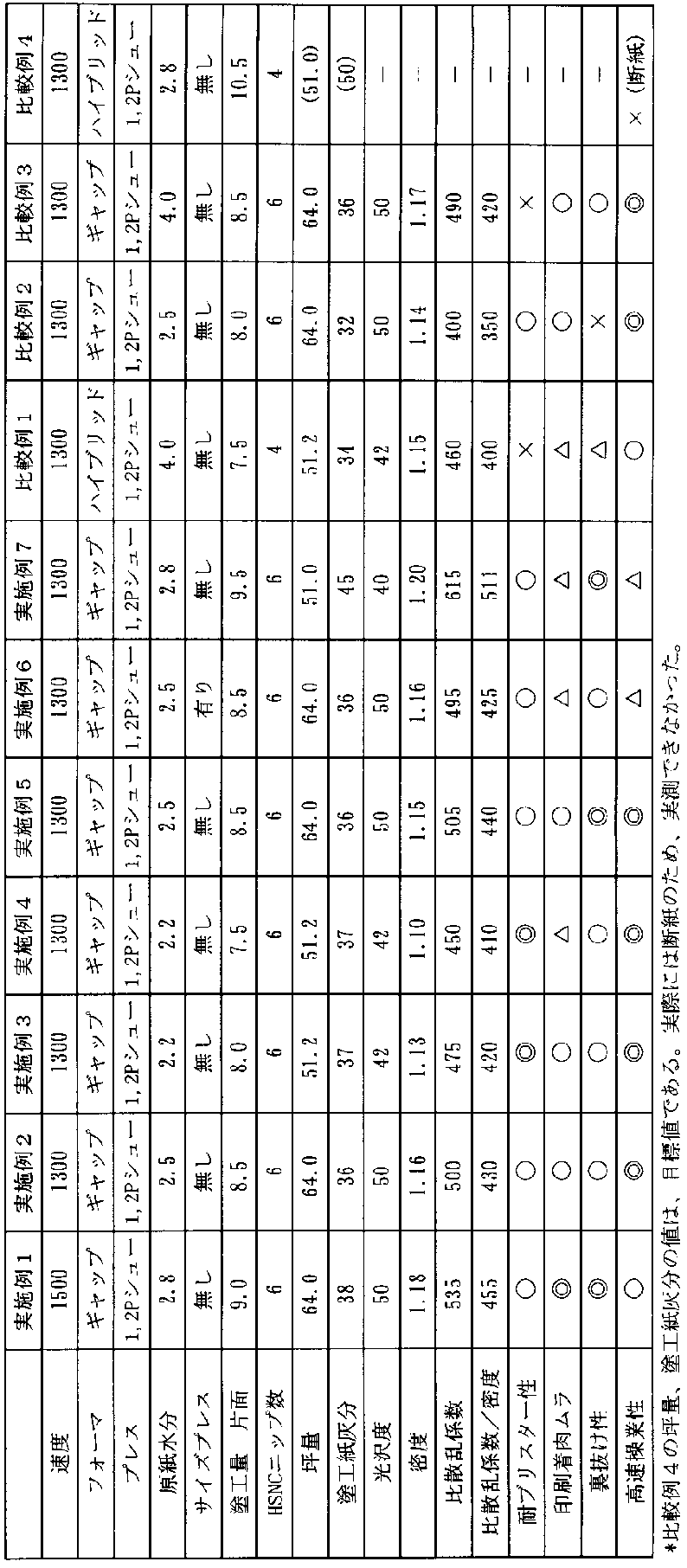
原紙水分が少ないと耐ブリスター性が向上し、塗工紙の灰分率が多いか粉砕軽質炭酸カルシウムを使用すると裏抜けが向上する傾向があった。また、高速操業性は、ギャップフォーマを用い、灰分が35~50%程度の場合に特に好適だった。さらに、灰分を多くした場合、ギャップフォーマ以外の抄紙機では、断紙が起こり、操業性が著しく悪化した。
また、印刷着肉ムラは、塗工量が8g/m2以上だと、良化する傾向にあった。
Claims (6)
- 塗工紙の坪量が30g/m2~70g/m2、灰分率が35%~50%、白紙光沢度が40%~60%である印刷用塗工紙の製造方法であって、
抄紙、顔料塗工、表面処理がオンマシンコータを用いて連続して行われ、操業速度が1300m/分以上であり、
抄紙工程が、プレスパートにタンデムシュープレスを1基以上有し、フォーミングパートにギャップフォーマを有する抄紙機を用いて行われ、
顔料塗工層を設ける前の紙の水分率が3%未満である、上記方法。 - 前記顔料塗工工程において、片面当たり8~20g/m2の顔料塗工層が設けられる、請求項1に記載の方法。
- 前記表面処理工程において、金属ロールと弾性ロールで構成されるソフトカレンダーを用いて6ニップ以上の条件で顔料塗工層が表面処理される、請求項1または2に記載の方法。
- 前記塗工紙の比散乱係数(cm2/g)と密度(g/cm3)の比である比散乱係数/密度が400以上である、請求項1~3のいずれかに記載の方法。
- 塗工紙の坪量が30g/m2~70g/m2、灰分率が35%~50%、白紙光沢度が40%~60%であり、請求項1~4のいずれかの方法で得られる印刷用塗工紙。
- 前記塗工紙の比散乱係数(cm2/g)と密度(g/cm3)の比である比散乱係数/密度が400以上である、請求項5に記載の塗工紙。
Priority Applications (1)
| Application Number | Priority Date | Filing Date | Title |
|---|---|---|---|
| JP2010529584A JP4668359B2 (ja) | 2009-03-03 | 2010-03-02 | 印刷用塗工紙およびその製造方法 |
Applications Claiming Priority (2)
| Application Number | Priority Date | Filing Date | Title |
|---|---|---|---|
| JP2009048965 | 2009-03-03 | ||
| JP2009-048965 | 2009-03-03 |
Publications (1)
| Publication Number | Publication Date |
|---|---|
| WO2010101131A1 true WO2010101131A1 (ja) | 2010-09-10 |
Family
ID=42709688
Family Applications (1)
| Application Number | Title | Priority Date | Filing Date |
|---|---|---|---|
| PCT/JP2010/053285 Ceased WO2010101131A1 (ja) | 2009-03-03 | 2010-03-02 | 印刷用塗工紙およびその製造方法 |
Country Status (2)
| Country | Link |
|---|---|
| JP (1) | JP4668359B2 (ja) |
| WO (1) | WO2010101131A1 (ja) |
Cited By (1)
| Publication number | Priority date | Publication date | Assignee | Title |
|---|---|---|---|---|
| JP2022131435A (ja) * | 2021-02-26 | 2022-09-07 | 三菱製紙株式会社 | 転写用紙 |
Citations (4)
| Publication number | Priority date | Publication date | Assignee | Title |
|---|---|---|---|---|
| JPH0625996A (ja) * | 1992-07-03 | 1994-02-01 | New Oji Paper Co Ltd | オフセット印刷用塗工紙のための原紙 |
| JP2008255503A (ja) * | 2007-03-31 | 2008-10-23 | Nippon Paper Industries Co Ltd | 塗工紙の製造方法 |
| JP2008274524A (ja) * | 2007-03-31 | 2008-11-13 | Nippon Paper Industries Co Ltd | 塗工紙の製造方法 |
| JP2009035831A (ja) * | 2007-07-31 | 2009-02-19 | Nippon Paper Industries Co Ltd | 塗工紙の製造方法 |
-
2010
- 2010-03-02 WO PCT/JP2010/053285 patent/WO2010101131A1/ja not_active Ceased
- 2010-03-02 JP JP2010529584A patent/JP4668359B2/ja not_active Expired - Fee Related
Patent Citations (4)
| Publication number | Priority date | Publication date | Assignee | Title |
|---|---|---|---|---|
| JPH0625996A (ja) * | 1992-07-03 | 1994-02-01 | New Oji Paper Co Ltd | オフセット印刷用塗工紙のための原紙 |
| JP2008255503A (ja) * | 2007-03-31 | 2008-10-23 | Nippon Paper Industries Co Ltd | 塗工紙の製造方法 |
| JP2008274524A (ja) * | 2007-03-31 | 2008-11-13 | Nippon Paper Industries Co Ltd | 塗工紙の製造方法 |
| JP2009035831A (ja) * | 2007-07-31 | 2009-02-19 | Nippon Paper Industries Co Ltd | 塗工紙の製造方法 |
Cited By (2)
| Publication number | Priority date | Publication date | Assignee | Title |
|---|---|---|---|---|
| JP2022131435A (ja) * | 2021-02-26 | 2022-09-07 | 三菱製紙株式会社 | 転写用紙 |
| JP7507708B2 (ja) | 2021-02-26 | 2024-06-28 | 三菱製紙株式会社 | 転写用紙 |
Also Published As
| Publication number | Publication date |
|---|---|
| JP4668359B2 (ja) | 2011-04-13 |
| JPWO2010101131A1 (ja) | 2012-09-10 |
Similar Documents
| Publication | Publication Date | Title |
|---|---|---|
| JP5484335B2 (ja) | 広葉樹機械パルプを用いる印刷用塗工紙の製造方法 | |
| WO2015146964A1 (ja) | ロゼッタ型軽質炭酸カルシウムを内填した紙 | |
| JP2009263855A (ja) | オフセット印刷用塗工紙 | |
| JP5905051B2 (ja) | 塗工紙の製造方法 | |
| JP3371422B2 (ja) | 艶消し塗工紙 | |
| JP2024026131A (ja) | 印刷用塗工紙 | |
| JP4918745B2 (ja) | オフセット印刷用塗工紙及びその製造方法 | |
| JPWO2003060232A1 (ja) | 印刷用塗工紙の製造方法及び塗工紙 | |
| JP2025066848A (ja) | 印刷用塗工紙 | |
| JP5462571B2 (ja) | 印刷用塗工紙およびその製造方法 | |
| JP4668359B2 (ja) | 印刷用塗工紙およびその製造方法 | |
| JP5462572B2 (ja) | 印刷用塗工紙およびその製造方法 | |
| JP5917220B2 (ja) | 印刷用塗工紙及びその製造方法 | |
| JP4918746B2 (ja) | オフセット印刷用塗工紙の製造方法及び塗工紙 | |
| CN100560866C (zh) | 照相凹版印刷用涂布纸 | |
| JP5047667B2 (ja) | オフセット印刷用紙 | |
| JP5300563B2 (ja) | 印刷用塗工紙 | |
| JP5374194B2 (ja) | グラビア印刷用塗工紙およびその製造方法 | |
| JP4377425B2 (ja) | 微塗工紙の製造方法 | |
| JP5033038B2 (ja) | 塗工紙の製造方法 | |
| JP2008255503A (ja) | 塗工紙の製造方法 | |
| JP2005089869A (ja) | グラビア印刷用塗工紙及びその製造方法 | |
| JP5374181B2 (ja) | 印刷用塗工紙およびその製造方法 | |
| JP2004060138A (ja) | オフセット輪転印刷用塗被紙 | |
| JP2006291393A (ja) | オフセット輪転印刷用塗被紙 |
Legal Events
| Date | Code | Title | Description |
|---|---|---|---|
| WWE | Wipo information: entry into national phase |
Ref document number: 2010529584 Country of ref document: JP |
|
| 121 | Ep: the epo has been informed by wipo that ep was designated in this application |
Ref document number: 10748726 Country of ref document: EP Kind code of ref document: A1 |
|
| NENP | Non-entry into the national phase |
Ref country code: DE |
|
| 122 | Ep: pct application non-entry in european phase |
Ref document number: 10748726 Country of ref document: EP Kind code of ref document: A1 |