WO2010092851A1 - 芳香族炭化水素製造方法 - Google Patents
芳香族炭化水素製造方法 Download PDFInfo
- Publication number
- WO2010092851A1 WO2010092851A1 PCT/JP2010/050379 JP2010050379W WO2010092851A1 WO 2010092851 A1 WO2010092851 A1 WO 2010092851A1 JP 2010050379 W JP2010050379 W JP 2010050379W WO 2010092851 A1 WO2010092851 A1 WO 2010092851A1
- Authority
- WO
- WIPO (PCT)
- Prior art keywords
- reaction
- catalyst
- aromatic hydrocarbon
- yield
- temperature
- Prior art date
- Legal status (The legal status is an assumption and is not a legal conclusion. Google has not performed a legal analysis and makes no representation as to the accuracy of the status listed.)
- Ceased
Links
Images


Classifications
-
- B—PERFORMING OPERATIONS; TRANSPORTING
- B01—PHYSICAL OR CHEMICAL PROCESSES OR APPARATUS IN GENERAL
- B01J—CHEMICAL OR PHYSICAL PROCESSES, e.g. CATALYSIS OR COLLOID CHEMISTRY; THEIR RELEVANT APPARATUS
- B01J38/00—Regeneration or reactivation of catalysts, in general
- B01J38/04—Gas or vapour treating; Treating by using liquids vaporisable upon contacting spent catalyst
- B01J38/10—Gas or vapour treating; Treating by using liquids vaporisable upon contacting spent catalyst using elemental hydrogen
-
- B—PERFORMING OPERATIONS; TRANSPORTING
- B01—PHYSICAL OR CHEMICAL PROCESSES OR APPARATUS IN GENERAL
- B01J—CHEMICAL OR PHYSICAL PROCESSES, e.g. CATALYSIS OR COLLOID CHEMISTRY; THEIR RELEVANT APPARATUS
- B01J29/00—Catalysts comprising molecular sieves
- B01J29/04—Catalysts comprising molecular sieves having base-exchange properties, e.g. crystalline zeolites
- B01J29/06—Crystalline aluminosilicate zeolites; Isomorphous compounds thereof
- B01J29/40—Crystalline aluminosilicate zeolites; Isomorphous compounds thereof of the pentasil type, e.g. types ZSM-5, ZSM-8 or ZSM-11, as exemplified by patent documents US3702886, GB1334243 and US3709979, respectively
- B01J29/48—Crystalline aluminosilicate zeolites; Isomorphous compounds thereof of the pentasil type, e.g. types ZSM-5, ZSM-8 or ZSM-11, as exemplified by patent documents US3702886, GB1334243 and US3709979, respectively containing arsenic, antimony, bismuth, vanadium, niobium tantalum, polonium, chromium, molybdenum, tungsten, manganese, technetium or rhenium
-
- B—PERFORMING OPERATIONS; TRANSPORTING
- B01—PHYSICAL OR CHEMICAL PROCESSES OR APPARATUS IN GENERAL
- B01J—CHEMICAL OR PHYSICAL PROCESSES, e.g. CATALYSIS OR COLLOID CHEMISTRY; THEIR RELEVANT APPARATUS
- B01J29/00—Catalysts comprising molecular sieves
- B01J29/90—Regeneration or reactivation
-
- B—PERFORMING OPERATIONS; TRANSPORTING
- B01—PHYSICAL OR CHEMICAL PROCESSES OR APPARATUS IN GENERAL
- B01J—CHEMICAL OR PHYSICAL PROCESSES, e.g. CATALYSIS OR COLLOID CHEMISTRY; THEIR RELEVANT APPARATUS
- B01J37/00—Processes, in general, for preparing catalysts; Processes, in general, for activation of catalysts
- B01J37/02—Impregnation, coating or precipitation
- B01J37/0201—Impregnation
-
- C—CHEMISTRY; METALLURGY
- C07—ORGANIC CHEMISTRY
- C07C—ACYCLIC OR CARBOCYCLIC COMPOUNDS
- C07C2/00—Preparation of hydrocarbons from hydrocarbons containing a smaller number of carbon atoms
- C07C2/76—Preparation of hydrocarbons from hydrocarbons containing a smaller number of carbon atoms by condensation of hydrocarbons with partial elimination of hydrogen
-
- C—CHEMISTRY; METALLURGY
- C10—PETROLEUM, GAS OR COKE INDUSTRIES; TECHNICAL GASES CONTAINING CARBON MONOXIDE; FUELS; LUBRICANTS; PEAT
- C10G—CRACKING HYDROCARBON OILS; PRODUCTION OF LIQUID HYDROCARBON MIXTURES, e.g. BY DESTRUCTIVE HYDROGENATION, OLIGOMERISATION, POLYMERISATION; RECOVERY OF HYDROCARBON OILS FROM OIL-SHALE, OIL-SAND, OR GASES; REFINING MIXTURES MAINLY CONSISTING OF HYDROCARBONS; REFORMING OF NAPHTHA; MINERAL WAXES
- C10G45/00—Refining of hydrocarbon oils using hydrogen or hydrogen-generating compounds
- C10G45/58—Refining of hydrocarbon oils using hydrogen or hydrogen-generating compounds to change the structural skeleton of some of the hydrocarbon content without cracking the other hydrocarbons present, e.g. lowering pour point; Selective hydrocracking of normal paraffins
- C10G45/68—Aromatisation of hydrocarbon oil fractions
-
- B—PERFORMING OPERATIONS; TRANSPORTING
- B01—PHYSICAL OR CHEMICAL PROCESSES OR APPARATUS IN GENERAL
- B01J—CHEMICAL OR PHYSICAL PROCESSES, e.g. CATALYSIS OR COLLOID CHEMISTRY; THEIR RELEVANT APPARATUS
- B01J2229/00—Aspects of molecular sieve catalysts not covered by B01J29/00
- B01J2229/30—After treatment, characterised by the means used
- B01J2229/42—Addition of matrix or binder particles
-
- C—CHEMISTRY; METALLURGY
- C07—ORGANIC CHEMISTRY
- C07C—ACYCLIC OR CARBOCYCLIC COMPOUNDS
- C07C2529/00—Catalysts comprising molecular sieves
- C07C2529/04—Catalysts comprising molecular sieves having base-exchange properties, e.g. crystalline zeolites, pillared clays
- C07C2529/06—Crystalline aluminosilicate zeolites; Isomorphous compounds thereof
- C07C2529/40—Crystalline aluminosilicate zeolites; Isomorphous compounds thereof of the pentasil type, e.g. types ZSM-5, ZSM-8 or ZSM-11
-
- C—CHEMISTRY; METALLURGY
- C07—ORGANIC CHEMISTRY
- C07C—ACYCLIC OR CARBOCYCLIC COMPOUNDS
- C07C2529/00—Catalysts comprising molecular sieves
- C07C2529/04—Catalysts comprising molecular sieves having base-exchange properties, e.g. crystalline zeolites, pillared clays
- C07C2529/06—Crystalline aluminosilicate zeolites; Isomorphous compounds thereof
- C07C2529/40—Crystalline aluminosilicate zeolites; Isomorphous compounds thereof of the pentasil type, e.g. types ZSM-5, ZSM-8 or ZSM-11
- C07C2529/48—Crystalline aluminosilicate zeolites; Isomorphous compounds thereof of the pentasil type, e.g. types ZSM-5, ZSM-8 or ZSM-11 containing arsenic, antimony, bismuth, vanadium, niobium, tantalum, polonium, chromium, molybdenum, tungsten, manganese, technetium or rhenium
-
- C—CHEMISTRY; METALLURGY
- C10—PETROLEUM, GAS OR COKE INDUSTRIES; TECHNICAL GASES CONTAINING CARBON MONOXIDE; FUELS; LUBRICANTS; PEAT
- C10G—CRACKING HYDROCARBON OILS; PRODUCTION OF LIQUID HYDROCARBON MIXTURES, e.g. BY DESTRUCTIVE HYDROGENATION, OLIGOMERISATION, POLYMERISATION; RECOVERY OF HYDROCARBON OILS FROM OIL-SHALE, OIL-SAND, OR GASES; REFINING MIXTURES MAINLY CONSISTING OF HYDROCARBONS; REFORMING OF NAPHTHA; MINERAL WAXES
- C10G2400/00—Products obtained by processes covered by groups C10G9/00 - C10G69/14
- C10G2400/30—Aromatics
-
- Y—GENERAL TAGGING OF NEW TECHNOLOGICAL DEVELOPMENTS; GENERAL TAGGING OF CROSS-SECTIONAL TECHNOLOGIES SPANNING OVER SEVERAL SECTIONS OF THE IPC; TECHNICAL SUBJECTS COVERED BY FORMER USPC CROSS-REFERENCE ART COLLECTIONS [XRACs] AND DIGESTS
- Y02—TECHNOLOGIES OR APPLICATIONS FOR MITIGATION OR ADAPTATION AGAINST CLIMATE CHANGE
- Y02P—CLIMATE CHANGE MITIGATION TECHNOLOGIES IN THE PRODUCTION OR PROCESSING OF GOODS
- Y02P20/00—Technologies relating to chemical industry
- Y02P20/50—Improvements relating to the production of bulk chemicals
- Y02P20/52—Improvements relating to the production of bulk chemicals using catalysts, e.g. selective catalysts
-
- Y—GENERAL TAGGING OF NEW TECHNOLOGICAL DEVELOPMENTS; GENERAL TAGGING OF CROSS-SECTIONAL TECHNOLOGIES SPANNING OVER SEVERAL SECTIONS OF THE IPC; TECHNICAL SUBJECTS COVERED BY FORMER USPC CROSS-REFERENCE ART COLLECTIONS [XRACs] AND DIGESTS
- Y02—TECHNOLOGIES OR APPLICATIONS FOR MITIGATION OR ADAPTATION AGAINST CLIMATE CHANGE
- Y02P—CLIMATE CHANGE MITIGATION TECHNOLOGIES IN THE PRODUCTION OR PROCESSING OF GOODS
- Y02P20/00—Technologies relating to chemical industry
- Y02P20/50—Improvements relating to the production of bulk chemicals
- Y02P20/584—Recycling of catalysts
Definitions
- the present invention relates to advanced utilization of natural gas, biogas, and methane hydrate mainly composed of methane.
- the present invention relates to catalytic chemical conversion technology for efficiently producing aromatic compounds mainly composed of benzene and naphthalene, which are raw materials for chemical products such as plastics, and high-purity hydrogen gas from methane.
- Natural gas, biogas, and methane hydrate are considered to be the most effective energy resources as a countermeasure against global warming, and interest in their utilization technologies is increasing. Taking advantage of its cleanliness, methane resources are attracting attention as new next-generation organic resources and hydrogen resources for fuel cells.
- Non-Patent Document 1 As a method of producing an aromatic compound such as benzene and hydrogen from methane, a method of reacting methane in the presence of a catalyst as in Non-Patent Document 1, for example, is known.
- a catalyst in this case, molybdenum supported on ZSM-5 is effective.
- Patent Document 1 a mixed gas obtained by adding CO 2 or CO to methane is used for the catalytic reaction under the conditions of a catalytic reaction temperature of 300 ° C. to 800 ° C.
- a mixed gas obtained by adding CO 2 or CO is used for the catalytic reaction under the conditions of a catalytic reaction temperature of 300 ° C. to 800 ° C.
- Patent Documents 2 and 3 the aromatic production reaction and the reaction for regenerating the catalyst used in the production reaction are alternately switched to suppress the deterioration of the catalyst with time and to maintain the catalytic reaction. That is, the lower hydrocarbon which is the reaction raw material and the hydrogen-containing gas (or hydrogen gas) for maintaining or regenerating the catalyst are periodically switched and brought into contact with the catalyst.
- Non-Patent Document 1 deterioration due to carbon deposition of the catalyst exemplified in Non-Patent Document 1 is particularly necessary for producing aromatic hydrocarbons and the like stably for a long time in a reaction system of a fixed bed system.
- the solution is extremely important.
- Patent Document 1 the catalyst life is greatly improved by adding CO 2 or CO, but the initial yield from the start of the reaction until the maximum benzene yield is obtained is significantly reduced. Therefore, it has been difficult to apply to a process in which a high yield is desired within a short time of 2 to 3 hours.
- Patent Documents 2 and 3 since the methods described in Patent Documents 2 and 3 are regenerated before the catalyst is completely deteriorated, the catalyst can be used over a long period of several days. In the methods described in Patent Documents 2 and 3, the catalyst is remarkably deteriorated, and the catalytic reaction and the regeneration reaction are repeated in a relatively short period.
- Patent Document 2 the catalytic reaction and the regeneration reaction are switched every 1 to 20 minutes. Further, in Patent Document 3, if the reaction time is 5 minutes or longer, difficult-to-removable coke is precipitated, and when the difficult-to-removable coke is accumulated, the catalyst activity cannot be recovered sufficiently even if regeneration is performed. It is described that the reaction time is within.
- precipitated carbon when the conversion reaction of methane is continuously performed, precipitated carbon accumulates during the reaction and may not be removed.
- the formation mechanism of precipitated carbon is not yet completely clear, but it is thought to be generated by a plurality of reaction mechanisms. Since it is difficult to remove the deposited carbon after a long-time reaction, it is necessary to switch between the catalytic reaction and the regeneration reaction in a short cycle.
- the aromatization reaction of methane is an endothermic reaction
- the temperature of the catalyst decreases due to the endothermic reaction at the initial stage of the reaction. Therefore, in the case of a short-time reaction, it is necessary to perform heating to raise the reaction temperature in the regeneration step.
- the aromatization reaction is activated as the reaction temperature increases, the initial temperature decrease is rapid, and the reaction temperature is likely to be affected by the endothermic reaction.
- the object of the present invention is to maintain a high yield of aromatic hydrocarbons and to make the catalytic reaction time as long as possible in a method for producing aromatic hydrocarbons by contacting lower hydrocarbons with a catalyst.
- the method for producing aromatic hydrocarbons of the present invention comprises a reaction step of contacting lower hydrocarbons with a catalyst to obtain aromatic hydrocarbons, and a regeneration step of regenerating the catalyst used in the reaction steps.
- a reaction step of contacting lower hydrocarbons with a catalyst to obtain aromatic hydrocarbons
- a regeneration step of regenerating the catalyst used in the reaction steps.
- carbon dioxide or carbon monoxide is added to the lower hydrocarbon, and the reaction temperature is set higher than 800 ° C.
- the catalyst examples include a metallosilicate supporting molybdenum, a metallosilicate supporting molybdenum and zinc, and a metallosilicate supporting molybdenum and magnesium.
- the reaction step may be switched to the regeneration step based on a change in the catalyst temperature.
- the regeneration step may be switched to the regeneration step based on the yield of benzene produced in the reaction step.
- the amount of carbon dioxide or carbon monoxide added may be 0.01% to 30% per volume of the lower hydrocarbon.
- the aromatic hydrocarbon when an aromatic hydrocarbon is produced by contacting a lower hydrocarbon with a catalyst, the aromatic hydrocarbon is produced stably for a long time while maintaining a high aromatic hydrocarbon yield. be able to.
- the present invention relates to a method for producing aromatic hydrocarbons by reacting lower hydrocarbons in the presence of a catalyst.
- the reaction temperature is higher than 800 ° C.
- the catalyst is changed over to a regeneration gas at regular intervals. It is characterized by replaying.
- the maximum yield is drastically improved by raising the reaction temperature above 800 ° C.
- the reactor used in the method for producing an aromatic hydrocarbon of the present invention is exemplified by a fixed bed reactor or a fluidized bed reactor.
- the metallosilicate on which the catalytic metal is supported for example, in the case of aluminosilicate, the molecular sieve 5A which is made of silica and alumina and which is a porous body, faujasite (NaY and NaX), ZSM-5, MCM-22 Is mentioned. Further, it is a porous body mainly composed of phosphoric acid, and is composed of a zeolite carrier characterized by 6 to 13 angstrom micropores and channels such as ALPO-5 and VPI-5, and partly composed mainly of silica.
- the molecular sieve 5A which is made of silica and alumina and which is a porous body, faujasite (NaY and NaX), ZSM-5, MCM-22 Is mentioned. Further, it is a porous body mainly composed of phosphoric acid, and is composed of a zeolite carrier characterized by 6 to 13 angstrom micropores and channels such as ALPO-5 and VPI-5, and partly composed
- Examples include mesoporous porous carriers such as FSM-16 and MCM-41 characterized by cylindrical pores (channels) having mesopores (10 to 1000 angstroms) containing alumina as a component. Furthermore, in addition to the alumina silicate, a metallosilicate composed of silica and titania can also be used as a catalyst.
- the weight ratio of the catalyst metal to the support is 0.001 to 50%, preferably 0.01 to 40%.
- an inert gas or oxygen gas is used after impregnation or ion exchange on a metallosilicate support from an aqueous solution of a catalyst metal precursor or an organic solvent such as alcohol. There is a method of heat treatment in an atmosphere. This method will be described more specifically.
- an aqueous solution of ammonium molybdate is impregnated and supported on a metallosilicate support, the support is dried and the solvent is removed, and then in a nitrogen-containing oxygen stream or pure oxygen stream
- a metallosilicate catalyst carrying molybdenum as a catalyst metal can be produced by heat treatment at a temperature of 250 to 800 ° C. (preferably 350 to 600 ° C.).
- molybdenum as the catalyst metal of the present invention, but rhenium, tungsten, iron, and cobalt may be used.
- precursors containing molybdenum among catalytic metals include ammonium paramolybdate, ammonium phosphomolybdate, 12-based molybdic acid, halides such as chloride and bromide, nitrates, sulfates, phosphates, etc.
- carboxylates such as mineral salts, carbonates, acetates, and oxalates.
- the metallosilicate is usually a proton exchange type (H type). Some protons are alkali metals such as Na, K and Li, alkaline earth elements such as Mg, Ca and Sr, transition metals such as Fe, Co, Ni, Zn, Ru, Pd, Pt, Zr and Ti It may be exchanged with at least one cation selected from elements.
- the metallosilicate may contain an appropriate amount of Ti, Zr, Hf, Cr, Mo, W, Th, Cu, Ag, and the like.
- metallosilicate catalyst supporting the catalyst metal there is no particular limitation on the form of the metallosilicate catalyst supporting the catalyst metal, and any shape such as powder or granules may be used. Further, alumina, titania, silica, clayey compound, or the like may be used as the carrier or binder.
- the metallosilicate catalyst carrying the catalyst metal may be used by adding a binder such as silica, alumina, clay, etc., and molding it into a pellet or extruded product.
- a binder such as silica, alumina, clay, etc.
- the lower hydrocarbon means methane and saturated and unsaturated hydrocarbons having 2 to 6 carbon atoms.
- saturated and unsaturated hydrocarbons having 2 to 6 carbon atoms include ethane, ethylene, propane, propylene, n-butane, isobutane, n-butene and isobutene.
- HZSM5 400 g of HZSM5 was added to an aqueous solution in which predetermined amounts of ammonium molybdate and zinc nitrate were dissolved in 2000 ml of ion-exchanged water, and the mixture was stirred at room temperature for 3 hours, and impregnated with zinc and molybdenum on HZSM5.
- the obtained zinc / molybdenum-supported HZSM5 (Zn / Mo—HZSM5) was dried and then calcined at 550 ° C. for 8 hours to obtain a catalyst powder.
- an inorganic binder was added to the catalyst powder, extruded into pellets, and fired to obtain a catalyst.
- the catalyst produced by the above method is filled in a reaction tube (inner diameter: 18 mm) made of Inconel 800H gas contact part calorizing treatment of a fixed bed flow reactor, the temperature in the reaction tube is made higher than 800 ° C., and the pressure is increased.
- the catalytic activity of the lower hydrocarbon aromatization reaction using methane as a raw material was examined by setting the reaction gas containing methane at a flow rate of 3000 ml / g-MFI / h at a space velocity while setting to 0.3 MPa. .
- the catalyst was evaluated based on the yield of benzene relative to the lower hydrocarbons circulated.
- the pretreatment of the catalyst before supplying the reaction gas is performed by heating the catalyst to 550 ° C. under an air stream and maintaining it for 2 hours, and then switching to a pretreatment gas of 20% methane: 80% hydrogen to 700 ° C. The temperature was raised and maintained for 3 hours. Thereafter, the reaction gas was switched to a predetermined temperature (780 ° C., 800 ° C., or 820 ° C.), and the catalyst was evaluated.
- the reaction temperature in the reaction tube was set to be the same as in the reaction, the pressure was set to 0.3 MPa, and hydrogen gas was supplied at a space velocity of 3000 ml / g-MFI / h.
- Hydrogen, argon, and methane were analyzed by TCD-GC, and aromatic hydrocarbons such as benzene, toluene, xylene, and naphthalene were analyzed by FID-GC.
- FIG. 1 shows the catalytic reaction in the presence of a Zn / Mo—HZSM5 catalyst without adding CO 2 and at each temperature condition of 780 ° C. (Comparative Example 1), 800 ° C. (Comparative Example 4), and 820 ° C. (Comparative Example 3). It is a figure which shows the time change of the benzene yield at the time of performing continuously.
- FIG. 2 shows that in the presence of Zn / Mo—HZSM5 catalyst, 3% CO 2 was added, and each temperature condition was 780 ° C. (Comparative Example 2), 800 ° C. (Comparative Example 5), and 820 ° C. (Example 1). It is a figure which shows the time change of the benzene yield at the time of performing a catalytic reaction continuously in (1).
- Comparative Example 1 a reaction was performed at a reaction temperature of 780 ° C. without adding carbon dioxide to 100 (volume) of methane as the reaction gas during the reaction, and the time elapsed of the analysis result was observed.
- Comparative Example 2 3 (volume) of carbon dioxide was added to 100 (volume) of methane as the reaction gas at the time of reaction, the reaction was performed at a reaction temperature of 780 ° C., and the time elapsed of the analysis result was observed.
- Comparative Example 3 a reaction was performed at a reaction temperature of 820 ° C. without adding carbon dioxide to methane 100 (volume) as the reaction gas during the reaction, and the time elapsed of the analysis result was observed.
- Comparative Example 4 a reaction was performed at a reaction temperature of 800 ° C. without adding carbon dioxide to methane 100 (volume) as the reaction gas at the time of reaction, and the time elapsed of the analysis result was observed.
- Comparative Example 5 3 (volume) of carbon dioxide was added to 100 (volume) of methane as the reaction gas during the reaction, the reaction was performed at a reaction temperature of 800 ° C., and the time-lapse observation of the analysis result was performed.
- Example 1 3 (volume) of carbon dioxide was added to 100 (volume) of methane as the reaction gas at the time of reaction, the reaction was performed at a reaction temperature of 820 ° C., and the time elapsed of the analysis result was observed.
- Comparing Comparative Example 1 and Comparative Example 2 when the reaction was carried out without adding carbon dioxide (FIG. 1, Comparative Example 1), the catalytic activity was lost after 7 hours of reaction, whereas carbon dioxide was lost. When carbon is added (FIG. 2, Comparative Example 2), the initial maximum benzene yield is maintained even when the reaction time is 15 hours.
- Example 1 shown in FIG. 2 when the reaction temperature is 820 ° C. and the catalytic reaction is performed with CO 2 added, the yield of the benzene exceeds the maximum when the catalytic reaction is performed under the conditions of Comparative Example 1. The maximum benzene yield was shown. That is, the catalyst stability was improved while maintaining high activity.
- Example 1 Although the catalyst stability is reduced as compared with other Comparative Examples 2 and 5, the benzene yield is dramatically improved. Therefore, it is suggested that if the reaction is carried out at a temperature higher than 800 ° C., an effect of dramatically improving the benzene yield can be obtained.
- reaction process a result of repeating a cycle of performing a catalytic reaction (reaction process) for 2 hours under the reaction conditions of the reaction gas and catalyst of Comparative Example 1 and Example 1 and then performing a regeneration reaction (regeneration process) for 2 hours with hydrogen gas.
- reaction process a catalytic reaction
- regeneration process a regeneration reaction
- the benzene yield is 10% or more after 80 hours (catalyst operation time 40 hours) or more, and the yield is extremely stable at a high yield. It can be seen that an aromatic compound can be produced.
- the catalyst temperature may be measured in the catalyst reaction step, and the catalyst reaction step and the regeneration step may be switched based on the temperature change.
- the temperature of the catalyst decreases during the reaction.
- the aromatization reaction activity of a lower hydrocarbon also falls with catalyst deterioration, the deterioration degree of a catalyst is detectable by measuring the temperature change of a catalyst. Therefore, by switching from the reaction step to the regeneration step after the temperature of the catalyst starts to rise, it is possible to produce aromatic hydrocarbons more efficiently and to prevent deterioration of the catalyst.
- the catalytic reaction step and the regeneration step may be switched based on the benzene yield.
- accumulation of difficult-to-removable coke can be prevented by switching from the catalytic reaction step to the regeneration step before the time when the benzene yield turns from increasing to decreasing.
- the production method of the Mo—HZSM5 catalyst was such that 400 g of HZSM5 was added to an aqueous solution in which a predetermined amount of ammonium molybdate was dissolved in 2000 ml of ion-exchanged water, and the mixture was stirred at room temperature for 3 hours. Was used.
- the method for producing the Mg / Mo—HZSM5 catalyst is that HZSM5 is added to an aqueous solution containing molybdenum ions and magnesium ions, and HZSM5 is impregnated with Mg and molybdenum. The method used was used.
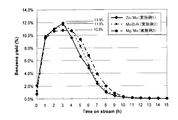
- Fig. 4 shows the change in benzene yield over time for each catalyst.
- Zn / Mo—HZSM5 Example 1
- Mo—HZSM5 Example 2
- Mg / Mo—HZSM5 Example 3
- the maximum benzene yield when Mo—HZSM5 (Example 2) is used as a catalyst is 11.6%, which is lower than that when Zn / Mo—HZSM5 is used as a catalyst, but the reaction stability is excellent. .
- aromatic hydrocarbons such as benzene can be produced in high yield. That is, by increasing the reaction temperature above 800 ° C. and adding CO 2 or CO, the decrease in the maximum yield of benzene, etc. is suppressed, a practically sufficient yield is obtained, and the catalytic activity is maintained over a long period of time. Can do.
- the catalyst reaction temperature higher than 800 ° C.
- the yield of benzene can be drastically improved, and by adding CO 2 , accumulation of difficult-to-removable coke can be suppressed.
- CO 2 has an effect of suppressing the aromatization reaction, reducing the amount of CO 2 added can improve the benzene yield (catalytic activity). It becomes difficult to repeat the catalyst regeneration reaction.
- the initial reaction yield is important. Therefore, according to the aromatic hydrocarbon production method of the present invention, a high benzene yield is obtained and regeneration removal is difficult. The generation of precipitated carbon can be suppressed, and high catalytic activity can be maintained over a long period of time even if the catalytic reaction and regeneration reaction are repeated.
- this invention is not limited to an Example, You may add carbon monoxide instead of a carbon dioxide.
- the reaction conditions such as the flow rate of the reaction gas and the catalyst to be used (the type and amount of the supported metal) can be selected as appropriate.
Landscapes
- Chemical & Material Sciences (AREA)
- Organic Chemistry (AREA)
- Engineering & Computer Science (AREA)
- Chemical Kinetics & Catalysis (AREA)
- Materials Engineering (AREA)
- Crystallography & Structural Chemistry (AREA)
- Oil, Petroleum & Natural Gas (AREA)
- General Chemical & Material Sciences (AREA)
- Organic Low-Molecular-Weight Compounds And Preparation Thereof (AREA)
- Low-Molecular Organic Synthesis Reactions Using Catalysts (AREA)
- Catalysts (AREA)
Abstract
【課題】低級炭化水素を触媒と接触反応させて芳香族炭化水素を製造する際、高い芳香族炭化水素収率を維持しつつ、長時間安定して芳香族炭化水素を製造する。 【解決手段】低級炭化水素を触媒と接触反応させて芳香族炭化水素を得る反応工程と、前記反応工程で使用された触媒を再生する再生工程を備え、前記反応工程と前記再生工程を繰り返すことにより芳香族炭化水素を製造する。前記反応工程において、前記低級炭化水素に二酸化炭素又は一酸化炭素を添加し、反応温度を800℃より高くする。
Description
本発明は、メタンを主成分とする天然ガス、バイオガス、メタンハイドレートの高度利用に関するものである。特に、メタンからプラスチック類などの化学製品原料であるベンゼン及びナフタレン類を主成分とする芳香族化合物と高純度の水素ガスを効率的に製造するための触媒化学変換技術に関するものである。
天然ガス、バイオガス、メタンハイドレートは、地球温暖化対策として最も効果的なエネルギー資源と考えられ、その利用技術に関心が高まっている。メタン資源は、そのクリーン性を活かして、次世代の新しい有機資源、燃料電池用の水素資源として注目されている。
メタンからベンゼン等の芳香族化合物と水素を製造する方法としては、例えば非特許文献1のように、触媒の存在下でメタンを反応させる方法が知られている。この際の触媒としては、ZSM-5に担持されたモリブデンが有効とされている。
しかしながら、これらの触媒を使用した場合でも、炭素析出が多いことやメタンの転化率が低いという問題がある。特に、炭素析出は触媒の劣化現象に直結する問題である。
これらの問題を解決するために、特許文献1では、触媒反応温度300℃~800℃の条件で、メタンにCO2又はCOを添加した混合ガスを触媒反応に供している。CO2又はCOを添加することにより炭素の析出が抑制され、触媒劣化を防ぎ、安定して芳香族を生成することを可能としている。
また、特許文献2、3では、芳香族製造反応とその製造反応に用いた触媒を再生する反応を交互に切り替えて、触媒の経時劣化を抑え、触媒反応を持続させている。つまり、反応原料である低級炭化水素と触媒の維持又は再生のための水素含有ガス(又は水素ガス)を周期的に切り替えて触媒と接触させている。
JOURNAL OF CATALYSIS、1997、Volume165、p.150-161
上記従来技術で述べた課題のうち、非特許文献1に例示される触媒の炭素析出による劣化は、特に固定床方式の反応系で長時間安定的に芳香族炭化水素等を製造するために、その解決が極めて重要である。
特許文献1では、CO2又はCOを添加することにより、触媒寿命が大きく向上するが、反応開始から最大のベンゼン収率を得るまでの初期収率が著しく低下してしまう。したがって、2~3時間の短時間内に高い収率を上げたいプロセスに適用することが困難であった。
また、特許文献2、3に記載の方法は、触媒が完全に劣化する前に再生を行うので、数日単位の長期にわたり触媒を使用することができる。特許文献2、3に記載の方法では、触媒の劣化が著しく、比較的短時間の周期で触媒反応と再生反応を繰り返している。
特許文献2では、触媒反応と再生反応を1~20分おきに切り替えている。また、特許文献3では、反応時間が5分以上であると難除去性コークが析出すること、難除去性コークが蓄積した場合に再生を行っても十分に触媒活性が回復できないため、4分以内の反応時間とすることが記載されている。
つまり、メタンの転換反応を連続して行うと、反応中に析出炭素が蓄積され除去不可能となる場合がある。析出炭素の生成機構は未だ完全には明らかでないが、複数の反応機構で生成すると考えられている。そして、長時間反応後に、この析出した炭素を除去することは困難であるため、短時間の周期で触媒反応と再生反応を切り替える必要がある。
しかし、短時間周期で触媒反応と再生反応を切り替えることは、エネルギー効率低下の要因となる。
短時間周期で触媒反応と再生反応を繰り返した場合、ガスを切り替える際の時間的・熱的ロスが生じる。特に大規模な反応管を有する反応系であれば、その影響が大きい。
また、メタンの芳香族化反応は吸熱反応であるため、反応初期は吸熱反応により触媒の温度が低下する。したがって、短時間反応の場合、再生工程において反応温度まで上昇させるための加熱を行う必要がある。特に反応温度が高いほど芳香族化反応が活性化されるため、初期の温度下降は急激であり、この吸熱反応による触媒温度低下の影響を受けやすい。
上記理由により、特許文献1に記載の芳香族炭化水素の製造方法では、初期反応において最大収率が著しく低下するため、特許文献2に記載の芳香族炭化水素の製造方法に適用したとしても実用には適さない。したがって、低級炭化水素芳香族化触媒を用いて、メタンよりベンゼン等の芳香族化合物を工業的に製造する場合、高い収率を維持するとともに、反応時間をできるだけ長くすることが強く求められている。
そこで、本発明は低級炭化水素を触媒と接触反応させて芳香族炭化水素を製造する方法において、芳香族炭化水素の収率を高く維持し、触媒反応時間をできるだけ長くすることを目的としている。
上記目的を達成する本発明の芳香族炭化水素製造方法は、低級炭化水素を触媒と接触反応させて芳香族炭化水素を得る反応工程と、前記反応工程で使用された触媒を再生する再生工程を繰り返すことにより芳香族炭化水素を製造する方法において、前記反応工程において、前記低級炭化水素に二酸化炭素又は一酸化炭素を添加し、反応温度を800℃より高くする、ことを特徴とする。
前記触媒としては、モリブデンを担持したメタロシリケート、モリブデンと亜鉛を担持したメタロシリケート、モリブデンとマグネシウムを担持したメタロシリケートが挙げられる。
前記反応工程において、前記触媒温度の変化に基づいて、前記反応工程から前記再生工程に切り替えてもよい。また、前記反応工程において、前記反応工程で生成されるベンゼンの収率に基づいて、前記反応工程から前記再生工程に切り替えてもよい。
そして、前記二酸化炭素又は一酸化炭素の添加量は、前記低級炭化水素の体積あたり0.01%~30%であればよい。
以上の発明によれば、低級炭化水素を触媒と接触反応させて芳香族炭化水素を製造する際、高い芳香族炭化水素収率を維持しつつ、長時間安定して芳香族炭化水素を製造することができる。
本発明は、低級炭化水素を触媒の存在下で反応させて芳香族炭化水素を製造する方法に係る発明であり、反応温度を800℃より高くし、一定時間ごとに再生ガスに切り替えて触媒を再生させることを特徴としている。特に、反応温度を800℃より高くすることにより、最大収率が飛躍的に向上したことを特徴とする。
そして、反応時に過剰とならない量の炭酸ガス(0.01~30%、好ましくは0.1~6%)添加することにより著しい炭素(コーク)析出の発生を抑えつつ、一定時間ごとに再生ガスに切り替えて触媒反応を行わせることで、難除去性コークが蓄積することなく、高収率を維持したまま長時間反応を行わせるものである。
本発明の芳香族炭化水素を製造する方法で使用する反応器は、固定床反応器あるいは流動床反応器などが例示される。
本発明において触媒金属が担持されるメタロシリケートとしては、例えばアルミノシリケートの場合、シリカ及びアルミナから成り多孔質体であるモレキュラーシーブ5A、フォジャサイト(NaY及びNaX)、ZSM-5、MCM-22が挙げられる。また、リン酸を主成分とする多孔質体でALPO-5、VPI-5等の6~13オングストロームのミクロ細孔やチャンネルからなることを特徴とするゼオライト担体や、シリカを主成分とし一部アルミナを成分として含むメゾ細孔(10~1000オングストローム)の筒状細孔(チャンネル)で特徴付けられるFSM-16やMCM-41等のメゾ細孔多孔質担体などが例示できる。さらに、前記アルミナシリケートの他に、シリカ及びチタニアからなるメタロシリケート等も触媒として用いることができる。
また、本発明で使用するメタロシリケートは、表面積が200~1000m2/gであり、そのミクロ及びメゾ細孔は5~100オングストロームの範囲内のものが望ましい。また、メタロシリケートが例えばアルミノシリケートである場合、そのシリカとアルミナの含有比(シリカ/アルミナ)が通常入手し得る多孔質体と同様にシリカ/アルミナ=1~8000のものを用いることができるが、本発明の低級炭化水素の芳香族化反応を、実用的な低級炭化水素の転化率及び芳香族化合物への選択率で実施するためには、シリカ/アルミナ=10~100の範囲内とすることがより好ましい。
さらに、本発明の触媒金属(を含む前駆体)をメタロシリケートに担持させる場合、触媒金属と担体との重量比は0.001~50%、好ましくは0.01~40%の範囲で行う。また、メタロシリケートへ担持させる方法としては、触媒金属の前駆体の水溶液、あるいはアルコール等の有機溶媒の溶液からメタロシリケート担体に含浸担持あるいはイオン交換方法により担持させた後、不活性ガスあるいは酸素ガス雰囲気下で加熱処理する方法がある。この方法をより具体的に説明すると、まず、例えばメタロシリケート担体にモリブデン酸アンモニウム塩の水溶液を含浸担持させ、その担持体を乾燥して溶媒を除いた後、窒素含有酸素気流中又は純酸素気流中にて温度250~800℃(好ましくは350~600℃)で加熱処理して、触媒金属としてモリブデンを担持したメタロシリケート触媒を製造することができる。
そして、本発明の触媒金属としてはモリブデンを用いることが好ましいが、レニウム、タングステン、鉄、コバルトを用いても良い。触媒金属のうちモリブデンを含む前駆体の例としては、パラモリブデン酸アンモニウム、リンモリブデン酸アンモニウム、12系モリブデン酸の他に、塩化物、臭化物等のハロゲン化物、硝酸塩、硫酸塩、リン酸塩等の鉱酸塩、炭酸塩、酢酸塩、蓚酸塩等のカルボン酸塩等を挙げることができる。
メタロシリケートは、通常プロトン交換型(H型)のものが用いられる。また、プロトンの一部がNa、K、Li等のアルカリ金属、Mg、Ca、Sr等のアルカリ土類元素、Fe、Co、Ni、Zn、Ru、Pd、Pt、Zr、Ti等の遷移金属元素から選ばれた少なくとも一種のカチオンで交換されていてもよい。また、メタロシリケートが、Ti、Zr、Hf、Cr、Mo、W、Th、Cu、Ag等を適量含有していてもよい。
触媒金属を担持したメタロシリケート触媒の形態に格別の制約はなく、粉末状、顆粒状等任意の形状のものを用いればよい。また、担体あるいはバインダーとして、アルミナ、チタニア、シリカ、粘土質化合物等を使用してもよい。
触媒金属を担持したメタロシリケート触媒は、シリカ、アルミナ、粘土等のバインダーを添加して、ペレット状若しくは押出品に成型して使用してもよい。
なお、本発明において、低級炭化水素とはメタンや炭素数が2~6の飽和及び不飽和炭化水素を意味する。これら炭素数が2~6の飽和及び不飽和炭化水素としては、エタン、エチレン、プロパン、プロピレン、n-ブタン、イソブタン、n-ブテン及びイソブテン等が例示できる。
以下、実施例により、さらに詳細に説明する。
メタロシリケート担体としてH型ZSM-5ゼオライト(SiO2/Al2O3=40)を用い、以下の調製方法により低級炭化水素芳香族化触媒(以下、触媒という)を作成した。
イオン交換水2000mlに所定量のモリブデン酸アンモニウム及び硝酸亜鉛を溶解させた水溶液に、HZSM5を400g加え、室温にて3時間攪拌し、HZSM5に亜鉛及びモリブデンを含浸担持した。得られた亜鉛/モリブデン担持HZSM5(Zn/Mo-HZSM5)を乾燥後、550℃で8時間焼成し、触媒粉末を得た。さらに、この触媒粉末に無機結合剤を加えてペレット状に押し出し成型、焼成を行い触媒とした。
上記の方法で作製した触媒を、固定床流通式反応装置のインコネル800H接ガス部カロライジング処理製反応管(内径18mm)内に充填し、その反応管内の温度を800℃より高くし、圧力を0.3MPaに設定するとともに、メタンを含有した反応ガスを空間速度3000ml/g-MFI/hの流量で供給することにより、メタンを原料とした低級炭化水素芳香族化反応の触媒活性を調べた。触媒の評価は、流通させた低級炭化水素に対するベンゼンの収率で評価した。ベンゼンの収率を以下のように定義する。
ベンゼン収率(%)={(生成したベンゼン量(mol))/(メタン改質反応に供されたメタン量(mol))}×100
前記反応ガスを供給する前の触媒の前処理は、触媒を空気気流下550℃まで昇温し、2時間維持した後、メタン20%:水素80%の前処理ガスに切り替えて、700℃まで昇温し、3時間維持した。その後、反応ガスに切り替えて所定の温度(780℃、800℃、又は820℃)まで昇温し触媒の評価を行った。
ベンゼン収率(%)={(生成したベンゼン量(mol))/(メタン改質反応に供されたメタン量(mol))}×100
前記反応ガスを供給する前の触媒の前処理は、触媒を空気気流下550℃まで昇温し、2時間維持した後、メタン20%:水素80%の前処理ガスに切り替えて、700℃まで昇温し、3時間維持した。その後、反応ガスに切り替えて所定の温度(780℃、800℃、又は820℃)まで昇温し触媒の評価を行った。
触媒の再生工程では、同反応管の反応温度を反応時と同じに設定し、圧力を0.3MPaに設定し、水素ガスを空間速度3000ml/g-MFI/hの流量で供給した。
水素、アルゴン、メタンの分析はTCD-GCで分析し、ベンゼン、トルエン、キシレン、ナフタレン等の芳香族炭化水素の分析はFID-GCで分析した。
図1は、Zn/Mo-HZSM5触媒存在下で、CO2を添加せず、各温度条件780℃(比較例1)、800℃(比較例4)、820℃(比較例3)で触媒反応を連続して行った場合のベンゼン収率の時間変化を示す図である。また、図2は、Zn/Mo-HZSM5触媒存在下で、CO2を3%添加して、各温度条件780℃(比較例2)、800℃(比較例5)、820℃(実施例1)で触媒反応を連続して行った場合のベンゼン収率の時間変化を示す図である。
以下に、比較例1~4及び実施例1、2の反応ガス及び反応条件を示す。
比較例1では、反応時に前記反応ガスとして、メタン100(体積)に対して二酸化炭素の添加せずに反応温度780℃にて反応を行い、前記分析結果の経時時間観察をした。
比較例2では、反応時に前記反応ガスとして、メタン100(体積)に対して二酸化炭素を3(体積)添加し、反応温度780℃にて反応を行い、前記分析結果の経時時間観察をした。
比較例3では、反応時に前記反応ガスとして、メタン100(体積)に対して二酸化炭素を添加せずに反応温度820℃にて反応を行い、前記分析結果の経時時間観察をした。
比較例4では、反応時に前記反応ガスとして、メタン100(体積)に対して二酸化炭素を添加せずに反応温度800℃にて反応を行い、前記分析結果の経時時間観察をした。
比較例5では、反応時に前記反応ガスとして、メタン100(体積)に対して二酸化炭素を3(体積)添加し、反応温度800℃にて反応を行い、前記分析結果の経時時間観察をした。
実施例1では、反応時に前記反応ガスとして、メタン100(体積)に対して二酸化炭素を3(体積)添加し、反応温度820℃にて反応を行い、前記分析結果の経時時間観察をした。
比較例1と比較例2を比べると、二酸化炭素を加えずに反応させた場合(図1、比較例1)は、反応時間が7時間たつと触媒活性を失っているのに対して、二酸化炭素を加えると(図2、比較例2)反応時間が15時間経過しても初期の最大ベンゼン収率を維持している。
しかし、二酸化炭素を添加しない場合(図1、比較例1)の最大ベンゼン収率が11%であるのに対して、二酸化炭素を添加した場合(図2、比較例2)は、8%と、最大ベンゼン収率が著しく減少する。
つまり、反応温度が同じ場合、二酸化炭素を加えることにより、触媒が活性を維持する時間は長くなるが、ベンゼン生成率が減少してしまう。
一方、比較例1と比較例3を比べると、反応温度が780℃(図1、比較例1)ではベンゼンの最大収率が11%であるのに対して、800℃では(図1、比較例4)ベンゼンの最大収率12%に向上する。さらに、反応温度を820℃(図1、比較例3)とするとベンゼンの最大収率は14%以上となり飛躍的に向上する。しかし、触媒活性を維持する時間が短くなり比較例3では、3時間後にはほぼ触媒活性を失ってしまう。
つまり、反応温度を高くすると、最大ベンゼン収率が向上するが、触媒の劣化する速度も速くなってしまう。
そこで、図2に示す実施例1のように、反応温度が820℃とし、CO2を添加して触媒反応を行うと、比較例1の条件で触媒反応を行った際の最大ベンゼン収率以上の最大ベンゼン収率を示した。すなわち、高い活性を維持しながら触媒安定性も向上した。
図2において、比較例2と比較例5を比べると、比較例5では、反応温度を800℃とすると、ベンゼン収率の向上がみられるものの、比較例2と比べてベンゼン収率の安定性の低下が著しい。
実施例1では、他の比較例2、5と比べて触媒安定性は低下するものの、ベンゼン収率が飛躍的に向上している。したがって、触媒反応温度は、800℃より高い温度で反応させれば、ベンゼン収率が飛躍的に向上する効果を得ることができることが示唆される。
次に、比較例1と実施例1の反応ガスと触媒の反応条件で、2時間触媒反応(反応工程)を行い、その後水素ガスで2時間再生反応(再生工程)を行うサイクルを繰り返した結果を図3に示す。なお、再生工程における反応はそれぞれの触媒反応工程の温度で行った。
図3に示すように、実施例1の条件による芳香族炭化水素製造方法では、80時間後(触媒稼動時間40時間)以上でベンゼン収率が10%以上であり、高収率で極めて安定して芳香族化合物を生成できることがわかる。
一方、比較例1の条件で芳香族炭化水素を製造する反応工程と前記反応で使用した触媒を再生する再生工程を繰り返した場合、およそ20時間で劣化の傾向がみられ、70時間後には最大時の60%程度までベンゼン収率が低下する。
図1の比較例1と図2の実施例1のベンゼン最大収率を比較すると、どちらも12%程度である。しかし、触媒反応工程と再生工程を繰り返すと、実施例1の反応条件は比較例1と比べて、高いベンゼン収率(触媒活性)を維持しつつ、触媒安定性が向上していることがわかる。
なお、触媒反応工程において触媒の温度を測定し、温度変化に基づいて触媒反応工程と再生工程を切り替えてもよい。
触媒反応工程では、低級炭化水素の芳香族化反応が吸熱反応であるため、反応時に触媒の温度が低下する。そして、触媒の劣化とともに低級炭化水素の芳香族化反応活性も低下するため、触媒の温度変化を測定することにより触媒の劣化度合いを検出することができる。そこで、触媒の温度が上昇し始めた後に反応工程から再生工程に切り替えることで、より効率的に芳香族炭化水素を製造できるとともに触媒の劣化を防止することもできる。
さらに、触媒の温度が上昇してから再生工程に切り替えることで、再生工程で触媒温度を反応に必要な設定温度まで上昇させるためのエネルギーを節約することもできる。
また、触媒反応工程において、ベンゼン収率に基づいて、触媒反応工程と再生工程を切り替えてもよい。図2のベンゼン収率の変化において、ベンゼン収率が増加から減少に転じる時間より前に、触媒反応工程から再生工程に切り替えれば、難除去性コークの蓄積を防止できる。
さらに、HZSM5に担持する触媒金属の違いによる触媒活性の違いについて検討した。触媒として、Mo-HZSM5(実施例2)、Mg/Mo-HZSM5(実施例3)を用いて、反応温度820℃、圧力0.3MPa、メタン反応ガス空間速度3000ml/g-MFI/h、CO2を3%添加した反応条件で触媒反応を行った。
Mo-HZSM5触媒の製造方法は、実施例1と同様に、イオン交換水2000mlに所定量のモリブデン酸アンモニウムを溶解させた水溶液に、HZSM5を400g加え、室温にて3時間攪拌し、HZSM5にモリブデンを含浸担持する方法を用いた。
また、Mg/Mo-HZSM5触媒の製造方法も、実施例1に用いた触媒の製造方法と同様に、モリブデンイオンとマグネシウムイオンを含有する水溶液に、HZSM5を加え、HZSM5にMg及びモリブデンを含浸担持する方法を用いた。
各触媒でのベンゼン収率の時間変化を図4に示す。図4に示すように、Zn/Mo-HZSM5(実施例1)、Mo-HZSM5(実施例2)、Mg/Mo-HZSM5(実施例3)どの触媒を用いても、10%を超える高いベンゼン収率を得ることができた。
Mo-HZSM5(実施例2)を触媒として用いた場合の最大ベンゼン収率は11.6%であり、Zn/Mo-HZSM5を触媒として用いた場合よりも低いが、反応安定性が優れている。
一方、Mg/Mo-HZSM5(実施例3)を触媒として用いた場合の最大ベンゼン収率は10.8%であり、他の実施例と比較して最も低いが、反応安定性では最も優れている。反応安定性が向上すると、長期にわたって高ベンゼン収率の反応を行うことができるので好ましい。
なお、Mo-HZSM5、Mg/Mo-HZSM5のいずれを用いた場合においても、触媒反応工程と触媒再生工程を繰り返すことにより、Zn/Mo-HZSM5(図3、実施例1)と同様に長期にわたってベンゼン収率が高い状態で触媒反応を継続することができた。
しかしながら、Mg/Mo-HZSM5を触媒として用いた場合、反応工程と再生行程を繰り返して反応する時間が80時間を超えると、他の触媒(実施例1、2)と比較して、ベンゼン収率の低下がみられることが実験で確認されている。すなわち、再生工程において、Mg/Mo-HZSM5では、十分な難除去性コークの析出が防止できないものと考えられる。したがって、図4に示すように、初期において同じ程度の触媒活性を有していても、難除去性コークの析出を防止できるという点では、Mo-HZSM5とZn/Mo-HZSM5がより好ましい触媒といえる。
以上のように、本発明に係る低級炭化水素芳香族化触媒を用いた芳香族炭化水素及び水素製造方法によれば、高収率でベンゼン等の芳香族炭化水素を生成することができる。すなわち、反応温度を800℃より高くし、CO2又はCOを添加することにより、ベンゼン等の最大収率の低下を抑え、実用上十分な収率を得るとともに、触媒活性を長期にわたって維持することができる。
すなわち、触媒反応温度を800℃より高くすることにより、ベンゼン収率を飛躍的に向上させ、CO2を添加することにより、難除去性コークの蓄積を抑えることができる。CO2は、芳香族化反応の抑制効果があるので、CO2添加量を減少させると、ベンゼン収率(触媒活性)を向上させることができるが、本発明のように長期間にわたり触媒反応と触媒再生反応を繰り返すことが難しくなる。
特に、触媒反応工程と触媒再生工程を繰り返すプロセスでは、初期の反応収率が重要となるので、本発明の芳香族炭化水素製造方法によれば、高いベンゼン収率を得るとともに、再生除去が難しい析出炭素の生成を抑え、触媒反応と再生反応を繰り返しても長期にわたり高い触媒活性を維持することができる。
なお、本発明は、実施例に限定されるものではなく、二酸化炭素の代わりに一酸化炭素を添加してもよい。その他、反応ガスの流速等の反応条件及び使用する触媒(担持する金属の種類や担持量)等は適宜選択可能である。
Claims (7)
- 低級炭化水素を触媒と接触反応させて芳香族炭化水素を得る反応工程と、前記反応工程で使用された触媒を再生する再生工程を繰り返すことにより芳香族炭化水素を製造する方法において、
前記反応工程において、
前記低級炭化水素に二酸化炭素又は一酸化炭素を添加し、
反応温度を800℃より高くする
ことを特徴とする芳香族炭化水素製造方法。 - 前記触媒は、モリブデンを担持したメタロシリケートである
ことを特徴とする請求項1に記載の芳香族炭化水素製造方法。 - 前記触媒は、亜鉛を担持したメタロシリケートである
ことを特徴とする請求項2に記載の芳香族炭化水素製造方法。 - 前記触媒は、マグネシウムを担持したメタロシリケートである
ことを特徴とする請求項2に記載の芳香族炭化水素製造方法。 - 前記反応工程において、前記触媒温度の変化に基づいて、前記反応工程から前記再生工程に切り替える
ことを特徴とする請求項1から請求項4のうちいずれか1項に記載の芳香族炭化水素製造方法。 - 前記反応工程において、前記反応工程で生成されるベンゼンの収率に基づいて、前記反応工程から前記再生工程に切り替える
ことを特徴とする請求項1から請求項4のうちいずれか1項に記載の芳香族炭化水素製造方法。 - 前記二酸化炭素又は一酸化炭素の添加量は、前記低級炭化水素の体積あたり0.01%~30%である
ことを特徴とする請求項1から請求項6のうちいずれか1項に記載の芳香族炭化水素製造方法。
Priority Applications (2)
| Application Number | Priority Date | Filing Date | Title |
|---|---|---|---|
| CN2010800074927A CN102317241A (zh) | 2009-02-12 | 2010-01-15 | 芳香族烃的制备方法 |
| US13/144,803 US20110275873A1 (en) | 2009-02-12 | 2010-01-15 | Method for producing aromatic hydrocarbon |
Applications Claiming Priority (4)
| Application Number | Priority Date | Filing Date | Title |
|---|---|---|---|
| JP2009029704 | 2009-02-12 | ||
| JP2009-029704 | 2009-02-12 | ||
| JP2009-174984 | 2009-07-28 | ||
| JP2009174984A JP5481996B2 (ja) | 2009-02-12 | 2009-07-28 | 芳香族炭化水素製造方法 |
Publications (1)
| Publication Number | Publication Date |
|---|---|
| WO2010092851A1 true WO2010092851A1 (ja) | 2010-08-19 |
Family
ID=42561698
Family Applications (1)
| Application Number | Title | Priority Date | Filing Date |
|---|---|---|---|
| PCT/JP2010/050379 Ceased WO2010092851A1 (ja) | 2009-02-12 | 2010-01-15 | 芳香族炭化水素製造方法 |
Country Status (4)
| Country | Link |
|---|---|
| US (1) | US20110275873A1 (ja) |
| JP (1) | JP5481996B2 (ja) |
| CN (1) | CN102317241A (ja) |
| WO (1) | WO2010092851A1 (ja) |
Cited By (4)
| Publication number | Priority date | Publication date | Assignee | Title |
|---|---|---|---|---|
| CN102093155A (zh) * | 2010-12-27 | 2011-06-15 | 山东东方宏业化工有限公司 | 一种低碳烃芳构化制备芳烃的工艺方法及装置 |
| WO2012103095A3 (en) * | 2011-01-26 | 2012-11-22 | Shell Oil Company | A zinc-containing methane aromatization catalyst, method of making and method of using the catalyst |
| WO2014022486A1 (en) * | 2012-07-31 | 2014-02-06 | Blackberry Limited | Handling in-device coexistence interference |
| JP2017171589A (ja) * | 2016-03-22 | 2017-09-28 | 三菱ケミカル株式会社 | α−オレフィン低重合体の製造方法 |
Families Citing this family (5)
| Publication number | Priority date | Publication date | Assignee | Title |
|---|---|---|---|---|
| US20110124935A1 (en) * | 2008-07-29 | 2011-05-26 | Meidensha Corporation | Process for producing aromatic compound |
| JP5423028B2 (ja) * | 2009-02-12 | 2014-02-19 | 株式会社明電舎 | 芳香族炭化水素製造方法 |
| JP2015063560A (ja) * | 2014-12-25 | 2015-04-09 | 株式会社明電舎 | 芳香族化合物製造方法 |
| US20180346394A1 (en) * | 2015-12-04 | 2018-12-06 | Sabic Global Technologies B.V. | Alkane aromatization by oxidative dehydrogenation with co2 |
| PL231852B1 (pl) * | 2017-05-03 | 2019-04-30 | Handerek Adam Tech Recyklingu | Sposób wytwarzania paliw węglowodorowych z odpadowych tworzyw poliolefinowych |
Citations (2)
| Publication number | Priority date | Publication date | Assignee | Title |
|---|---|---|---|---|
| JP2003026613A (ja) * | 2001-07-12 | 2003-01-29 | National Institute Of Advanced Industrial & Technology | 低級炭化水素から芳香族炭化水素と水素を製造する方法 |
| JP2008266244A (ja) * | 2007-04-24 | 2008-11-06 | Mitsubishi Chemicals Corp | 芳香族炭化水素の製造方法 |
Family Cites Families (1)
| Publication number | Priority date | Publication date | Assignee | Title |
|---|---|---|---|---|
| RU2459789C2 (ru) * | 2006-04-21 | 2012-08-27 | Эксонмобил Кемикэл Пейтентс Инк. | Получение ароматических соединений из метана |
-
2009
- 2009-07-28 JP JP2009174984A patent/JP5481996B2/ja not_active Expired - Fee Related
-
2010
- 2010-01-15 US US13/144,803 patent/US20110275873A1/en not_active Abandoned
- 2010-01-15 WO PCT/JP2010/050379 patent/WO2010092851A1/ja not_active Ceased
- 2010-01-15 CN CN2010800074927A patent/CN102317241A/zh active Pending
Patent Citations (2)
| Publication number | Priority date | Publication date | Assignee | Title |
|---|---|---|---|---|
| JP2003026613A (ja) * | 2001-07-12 | 2003-01-29 | National Institute Of Advanced Industrial & Technology | 低級炭化水素から芳香族炭化水素と水素を製造する方法 |
| JP2008266244A (ja) * | 2007-04-24 | 2008-11-06 | Mitsubishi Chemicals Corp | 芳香族炭化水素の製造方法 |
Cited By (6)
| Publication number | Priority date | Publication date | Assignee | Title |
|---|---|---|---|---|
| CN102093155A (zh) * | 2010-12-27 | 2011-06-15 | 山东东方宏业化工有限公司 | 一种低碳烃芳构化制备芳烃的工艺方法及装置 |
| WO2012103095A3 (en) * | 2011-01-26 | 2012-11-22 | Shell Oil Company | A zinc-containing methane aromatization catalyst, method of making and method of using the catalyst |
| US9339802B2 (en) | 2011-01-26 | 2016-05-17 | Shell Oil Company | Zinc containing methane aromatization catalyst, method of making a method of using the catalyst |
| WO2014022486A1 (en) * | 2012-07-31 | 2014-02-06 | Blackberry Limited | Handling in-device coexistence interference |
| US8849293B2 (en) | 2012-07-31 | 2014-09-30 | Blackberry Limited | Handling in-device coexistence interference |
| JP2017171589A (ja) * | 2016-03-22 | 2017-09-28 | 三菱ケミカル株式会社 | α−オレフィン低重合体の製造方法 |
Also Published As
| Publication number | Publication date |
|---|---|
| JP5481996B2 (ja) | 2014-04-23 |
| US20110275873A1 (en) | 2011-11-10 |
| CN102317241A (zh) | 2012-01-11 |
| JP2010209057A (ja) | 2010-09-24 |
Similar Documents
| Publication | Publication Date | Title |
|---|---|---|
| JP5481996B2 (ja) | 芳香族炭化水素製造方法 | |
| US8742189B2 (en) | Catalyst for the dehydroaromatisation of methane and mixtures containing methane | |
| JP5499669B2 (ja) | 低級炭化水素及び芳香族化合物の製造方法及び製造触媒 | |
| US8530713B2 (en) | Method for the dehydroaromatisation of mixtures containing methane by regenerating the corresponding catalysts that are devoid of precious metal | |
| CN1989088B (zh) | 芳烃和氢的制造方法 | |
| JP2008266244A (ja) | 芳香族炭化水素の製造方法 | |
| WO2012002269A1 (ja) | 芳香族炭化水素製造方法 | |
| JP2001334151A (ja) | 低級炭化水素の芳香族化合物化触媒ならびに低級炭化水素を原料とする芳香族化合物及び水素の製造方法 | |
| JP5434115B2 (ja) | 芳香族炭化水素製造方法及び芳香族炭化水素製造装置 | |
| JPH1147606A (ja) | 低級炭化水素の芳香族化触媒及び該触媒を用いた芳香族化合物の製造法 | |
| JP5564769B2 (ja) | 低級炭化水素芳香族化触媒及び芳香族化合物の製造方法 | |
| JP4677194B2 (ja) | 触媒を用いた低級炭化水素の転化方法 | |
| WO2011118279A1 (ja) | 芳香族化合物製造方法 | |
| JP5949069B2 (ja) | 低級炭化水素芳香族化触媒の製造方法 | |
| JP5423028B2 (ja) | 芳香族炭化水素製造方法 | |
| JP4302954B2 (ja) | 低級炭化水素の芳香族化合物化触媒の製造方法 | |
| JP5283666B2 (ja) | 低級炭化水素の芳香族化合物化触媒ならびに低級炭化水素を原料とする芳香族化合物及び水素の製造方法 | |
| JP5283665B2 (ja) | 低級炭化水素の芳香族化合物化触媒ならびに低級炭化水素を原料とする芳香族化合物及び水素の製造方法 | |
| JP2015063560A (ja) | 芳香族化合物製造方法 | |
| JP5151951B2 (ja) | 低級炭化水素芳香族化触媒及びその触媒の製造方法 | |
| JP2010064960A (ja) | 芳香族炭化水素の製造方法 | |
| JP2008266246A (ja) | 芳香族炭化水素の製造方法 |
Legal Events
| Date | Code | Title | Description |
|---|---|---|---|
| WWE | Wipo information: entry into national phase |
Ref document number: 201080007492.7 Country of ref document: CN |
|
| 121 | Ep: the epo has been informed by wipo that ep was designated in this application |
Ref document number: 10741131 Country of ref document: EP Kind code of ref document: A1 |
|
| NENP | Non-entry into the national phase |
Ref country code: DE |
|
| 122 | Ep: pct application non-entry in european phase |
Ref document number: 10741131 Country of ref document: EP Kind code of ref document: A1 |