WO2010090218A1 - 液晶パネルからのガラス、透明電極材料の分離・回収方法 - Google Patents
液晶パネルからのガラス、透明電極材料の分離・回収方法 Download PDFInfo
- Publication number
- WO2010090218A1 WO2010090218A1 PCT/JP2010/051510 JP2010051510W WO2010090218A1 WO 2010090218 A1 WO2010090218 A1 WO 2010090218A1 JP 2010051510 W JP2010051510 W JP 2010051510W WO 2010090218 A1 WO2010090218 A1 WO 2010090218A1
- Authority
- WO
- WIPO (PCT)
- Prior art keywords
- liquid crystal
- crystal panel
- glass
- subcritical water
- water
- Prior art date
- Legal status (The legal status is an assumption and is not a legal conclusion. Google has not performed a legal analysis and makes no representation as to the accuracy of the status listed.)
- Ceased
Links
Images



Classifications
-
- B—PERFORMING OPERATIONS; TRANSPORTING
- B09—DISPOSAL OF SOLID WASTE; RECLAMATION OF CONTAMINATED SOIL
- B09B—DISPOSAL OF SOLID WASTE NOT OTHERWISE PROVIDED FOR
- B09B3/00—Destroying solid waste or transforming solid waste into something useful or harmless
- B09B3/70—Chemical treatment, e.g. pH adjustment or oxidation
-
- B—PERFORMING OPERATIONS; TRANSPORTING
- B09—DISPOSAL OF SOLID WASTE; RECLAMATION OF CONTAMINATED SOIL
- B09B—DISPOSAL OF SOLID WASTE NOT OTHERWISE PROVIDED FOR
- B09B3/00—Destroying solid waste or transforming solid waste into something useful or harmless
- B09B3/30—Destroying solid waste or transforming solid waste into something useful or harmless involving mechanical treatment
- B09B3/35—Shredding, crushing or cutting
-
- G—PHYSICS
- G02—OPTICS
- G02F—OPTICAL DEVICES OR ARRANGEMENTS FOR THE CONTROL OF LIGHT BY MODIFICATION OF THE OPTICAL PROPERTIES OF THE MEDIA OF THE ELEMENTS INVOLVED THEREIN; NON-LINEAR OPTICS; FREQUENCY-CHANGING OF LIGHT; OPTICAL LOGIC ELEMENTS; OPTICAL ANALOGUE/DIGITAL CONVERTERS
- G02F1/00—Devices or arrangements for the control of the intensity, colour, phase, polarisation or direction of light arriving from an independent light source, e.g. switching, gating or modulating; Non-linear optics
- G02F1/01—Devices or arrangements for the control of the intensity, colour, phase, polarisation or direction of light arriving from an independent light source, e.g. switching, gating or modulating; Non-linear optics for the control of the intensity, phase, polarisation or colour
- G02F1/13—Devices or arrangements for the control of the intensity, colour, phase, polarisation or direction of light arriving from an independent light source, e.g. switching, gating or modulating; Non-linear optics for the control of the intensity, phase, polarisation or colour based on liquid crystals, e.g. single liquid crystal display cells
- G02F1/133—Constructional arrangements; Operation of liquid crystal cells; Circuit arrangements
- G02F1/1333—Constructional arrangements; Manufacturing methods
-
- G—PHYSICS
- G02—OPTICS
- G02F—OPTICAL DEVICES OR ARRANGEMENTS FOR THE CONTROL OF LIGHT BY MODIFICATION OF THE OPTICAL PROPERTIES OF THE MEDIA OF THE ELEMENTS INVOLVED THEREIN; NON-LINEAR OPTICS; FREQUENCY-CHANGING OF LIGHT; OPTICAL LOGIC ELEMENTS; OPTICAL ANALOGUE/DIGITAL CONVERTERS
- G02F2203/00—Function characteristic
- G02F2203/68—Green display, e.g. recycling, reduction of harmful substances
Definitions
- the present invention is applied to a method of recycling a product waste using LCD panels such as a liquid crystal television and a personal computer, a defective product generated during a new manufacturing process, and a piece cut.
- the Home Appliance Recycling Law was enforced in April 2001. According to the Home Appliance Recycling Law, as of August 2008, recycling of four home appliances such as air conditioners, televisions, refrigerators, and washing machines is obligatory. Legal reference values of 55% or more, refrigerator 50% or more, and washing machine 50% or more are set.
- flat panel TVs are relatively new products and the amount of waste is small, and the products are crushed at the waste treatment facility and then incinerated. ing.
- the base material of the liquid crystal panel a glass substrate is mainly used. Since glass occupies most of the product weight, it is desirable to recycle from the viewpoint of improving the recycling rate, and it is more desirable to perform high-quality recycling, such as recycling it as a glass raw material of the same product again.
- Some base materials are processed with an indium compound such as indium tin oxide (ITO) as a transparent electrode. Indium is a rare metal and has risend due to the recent expansion of the thin panel market, and its recovery and recycling are being sought.
- ITO indium tin oxide
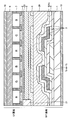
- FIG. 7 is a diagram schematically showing the structure of a general TFT (Thin Film Transistor) liquid crystal panel.
- a pixel ITO film (Indium Tin Oxide) 2 that is a transparent electrode is formed on a TFT glass substrate 1 in a matrix, and an active element 3 is formed for each pixel ITO film 2.
- the pixel ITO film 2 is composed of an oxide of In and Sn.
- the active element 3 is connected to a scanning signal line 4 and a data signal line formed of a metal conductor film such as Al, and is formed in a lattice shape between the pixel ITO films 2 of the TFT glass substrate 1.
- an organic film 20 formed of a resin such as acrylic.
- a color filter glass substrate 6 is disposed facing the TFT glass substrate 1, and a color filter 7 and an ITO film 8 are formed on the facing surface. Further, the periphery of the TFT glass substrate 1 and the color filter glass substrate 6 is filled with a sealing agent 21 such as a UV curable resin, and the liquid crystal 9 is sealed between these glass substrates.
- a polarizing plate 10 is provided on the outer surfaces of the color filter glass substrate 6 and the TFT glass substrate 1. In order to obtain a predetermined molecular orientation, an orientation film 23 that is an organic polymer film such as polyimide is formed.
- Patent Document 1 As a method for recovering glass and indium from liquid crystal display devices and liquid crystal panels contained in wastes such as defective waste liquid crystal panels and household appliances, personal computers and mobile phones discharged from liquid crystal panel manufacturing plants, for example, No. 170603 (Patent Document 1) devises a treatment method using supercritical water (partly including subcritical water).
- FIG. 8 is a graph showing the ITO peeling performance from the TFT glass when the temperature is changed, the vertical axis is the ratio of indium (%), and the horizontal axis is the temperature (K) of subcritical water. is there.
- FIG. 8 shows the ratio of indium remaining on the glass after the subcritical water (partially supercritical water) treatment for 5 minutes.
- FIG. 8 shows that 90% or more of ITO remains on the glass even in the treatment using supercritical water including subcritical water.
- FIG. 9 is a graph showing the ITO peeling performance from the color filter glass when the temperature is changed.
- the vertical axis represents the indium ratio (%), and the horizontal axis represents the subcritical water temperature (K). .
- FIG. 9 shows the ratio of indium remaining on the glass after the subcritical water (partially supercritical water) treatment for 5 minutes.
- FIG. 9 shows that 50% or more of ITO remains on the glass even in supercritical water including subcritical water.
- Patent Document 2 a treatment method using a critical water (partly including subcritical water) oxidation treatment method has been devised in Japanese Patent Application Laid-Open No. 2003-094007 (Patent Document 2).
- the critical hydroxylation treatment method is a technique in which oxygen is supplied to subcritical water, a supercritical state is created in a state where there is a large amount of oxygen, and the treated product is oxidized, and is generally called a wet oxidation treatment.
- this wet oxidation treatment when this wet oxidation treatment is used, there is a problem that the container is oxidized due to a strong oxidizing action.
- a method for solving this problem a method of coating the container with anticorrosion has been adopted.
- the cost of the container is high, the life of the container is short, both the equipment cost and the running cost are high, and it has not been put into practical use.
- an object of the present invention is to provide a method for separating and collecting at least one of glass and transparent electrode material from a liquid crystal panel at low apparatus cost, low running cost, and low energy consumption.
- the present invention is a method for recycling a liquid crystal panel using subcritical water, separating and recovering at least one selected from glass and transparent electrode (metal oxide) material from the liquid crystal panel, from the liquid crystal panel Including a step of obtaining a subcritical water state by applying heat and pressure to a mixture of a liquid crystal panel and water, the agent that improves at least one selected from the peelability of organic matter, the decomposability of organic matter, and the solubility of organic matter. Is the method.
- the transparent electrode material in the method of the present invention is preferably ITO (indium tin oxide).
- the agent is preferably an alkali or an alcohol, more preferably a strong base, and particularly preferably sodium hydroxide.
- the concentration is preferably 0.01 to 1N.
- the treatment time in the subcritical water state is preferably 0.5 to 60 minutes.
- the method of the present invention preferably further includes a step of crushing the liquid crystal panel.
- a step of mixing the drug, the crushed panel product, and water it is preferable to include a step of mixing the drug, the crushed panel product, and water.
- the method of this invention includes the process of conveying the mixture of the said chemical
- the liquid crystal panel recycling method of the present invention preferably further includes a step of removing the polarizing plate of the liquid crystal panel. In this case, it is more preferable to remove the polarizing plate by wind sorting.
- a liquid crystal panel recycling method capable of separating and recovering at least one selected from glass and transparent electrode material from a liquid crystal panel at low apparatus cost, low running cost, and low energy consumption. Can do.
- FIG. 1 is a flowchart showing a preferred example of a method for recycling a liquid crystal panel including a method for separating and collecting at least one selected from glass and a transparent electrode (metal oxide) material from the liquid crystal panel of the present invention.
- the present invention is a method for recycling a liquid crystal panel using subcritical water, separating and recovering at least one selected from glass and transparent electrode material from the liquid crystal panel, and peeling off organic substances from the liquid crystal panel
- the method includes a step of obtaining a subcritical water state by applying heat and pressure to a mixture of an agent that improves at least one selected from the degradability of organic matter and the solubility of organic matter, a liquid crystal panel, and water.
- a process for obtaining a subcritical water state by applying heat and pressure to a mixture of a liquid crystal panel and water includes a process for recovering glass (glass recovery process), and a process for recovering a transparent electrode material (transparent
- a process for recovering a transparent electrode material transparent
- the present invention is not limited to this.
- the present invention will be described in detail with reference to the example shown in FIG.
- Drug concentration adjustment step In this step, first, a drug that improves at least one selected from the peelability of organic substances from a liquid crystal panel, the decomposability of organic substances, and the solubility of organic substances is mixed with water, and the drug concentration is adjusted. adjust. In addition, you may make it use the aqueous solution collect
- a chemical when an acidic chemical is used, alkali or alcohol is preferably used because it is highly corrosive to metals and the like.
- alkali examples include sodium hydroxide, calcium hydroxide, sodium bicarbonate, ammonia, an amine chemical, and examples of the alcohol include ethanol and methanol. Of these, strong bases having high organic peelability and / or decomposability are preferable, and low-cost sodium hydroxide is particularly preferable.
- the concentration is not particularly limited, but the effect of improving at least one selected from the peelability of organic substances from the liquid crystal panel, the decomposability of organic substances, and the solubility of organic substances. Is particularly noticeable, it is preferably in the range of 0.01 to 1N, more preferably in the range of 0.05 to 0.5N.
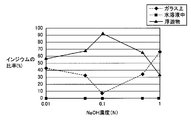
- FIG. 2 is a graph showing the peeling performance of ITO from the TFT glass when the sodium hydroxide concentration is changed, the vertical axis is the indium ratio (%), and the horizontal axis is the NaOH concentration (N). .
- the peeled ITO can be recovered by using a filter in the ITO recovery step (described later). Further, in the color filter of the liquid crystal panel, 100% ITO can be peeled from the glass side under the condition that the subcritical water temperature is 553K (pressure 6.42 MPa), the treatment time is 5 minutes, and the concentration of the sodium hydroxide aqueous solution is 0.1N.
- a pH (ion concentration) sensor is installed in the tank. If the pH is less than a certain value, sodium hydroxide is adjusted. This is done by supplying from the chemical tank.
- the drug may be stored directly in the drug tank without being dissolved in water, or a high-concentration aqueous solution of the drug may be prepared in advance and stored in the drug tank. If the pH is above a certain value, water is supplied to keep the ion concentration of the aqueous solution constant.
- liquid crystal panel crushing step The liquid crystal panel used for the treatment in the present invention is preferably crushed. That is, in the present invention, it is preferable to further include a step of crushing the liquid crystal panel (in the example shown in FIG. 1, a crushing step of the liquid crystal panel), and the organic matter peelability from the liquid crystal panel, the organic matter decomposability, and the organic matter dissolution. It is more preferable to mix a chemical that improves at least one selected from the properties, a crushed liquid crystal panel product (panel crushed product), and water.
- the liquid crystal panel is crushed using, for example, a uniaxial hammer type crusher or a biaxial crusher.
- the size of the crushing is not particularly limited as long as the mixture of the drug, the panel crushed product, and water can be smoothly transferred by a pressurizing means such as a pump in the subcritical water treatment process described later. However, if it is less than 0.5 mm, it takes time for crushing, so 0.5 mm or more is preferable. Further, from the viewpoint that the mixture of the drug and water can be smoothly transferred to the subcritical water treatment step, the size of the crushing is preferably 5 mm or less.
- the liquid crystal panel recycling method of the present invention preferably further includes a step of removing the polarizing plate of the liquid crystal panel. That is, it is preferable to remove the polarizing plate from the crushed panel after the liquid crystal panel is crushed as described above. In this case, it is desirable to remove the polarizing plate using a wind power sorter.
- removing the polarizing plate using a wind power sorter has an advantage that it can be processed continuously as compared with the case of removing the polarizing plate by another method. It is also effective to install a device for sending air in the crusher and remove the polarizing plate while crushing. It is also effective to peel the polarizing plate from the liquid crystal panel with a jig before crushing.
- the panel crushed product is introduced into the above-mentioned aqueous solution containing the medicine by a screw-type feeder or the like so that the panel crushed product and the aqueous solution are mixed at a certain ratio.
- Subcritical water treatment process The panel crushed product is mixed with the above-described aqueous solution containing the medicine, conveyed by a transporting means such as a pump, and supplied to the subcritical water treatment process.
- the mixture of the panel crushed product and the aqueous solution is first pressurized by a pressurizing means such as a pump.
- the pressurized mixture is sent to a heating means and heated to be in a subcritical water state.
- water is maintained in a liquid state up to 374 ° C. (647 K) when a pressure of 22.1 MPa is applied, and water at a temperature and pressure higher than this is called “supercritical water”.
- supercritical water Refers to water in a state intermediate between normal water and supercritical water.
- a mixture of the crushed panel and the aqueous solution in a subcritical water state is introduced into the reaction vessel from the inlet.
- the organic substance is peeled and / or decomposed from the glass of the liquid crystal panel (panel crushed product) by subcritical water treatment, and separated into glass and transparent electrode material (organic substance, ITO, etc.).
- the separated processed product is taken out from an outlet provided in the reaction vessel together with the aqueous solution.
- the processed product and the aqueous solution taken out are collected in the reaction product collection tank via the back pressure valve.
- the reaction pressure may be controlled by adjusting the opening of the back pressure valve.
- a cooling pipe may be provided immediately before the back pressure valve. When the cooling pipe is provided, the processed product can be safely recovered in a processed product recovery tank or the like.
- the heating means can be a known heating means without particular limitation.
- an electric heater, an induction heating device, a heat transfer oil, heating with water vapor, and the like can be given.
- the mixture may be preheated before being sent to the pressurizing means.
- the shape of the reaction vessel is not particularly limited, but a cylindrical shape is preferable. At least one of an upper end portion, an intermediate portion, and a lower end portion of the reaction vessel is provided with an input port.
- the mixture of the panel crushed product and the aqueous solution is introduced into the processing container through the inlet.
- the inner diameter of the inlet is preferably smaller than the inner diameter of the cylindrical reaction vessel. This is to reduce the falling speed of the mixture and increase the processing time at a short distance.
- the discharge port is provided at a position different from the position where the introduction port is provided.
- the discharge port can take a plurality of positions downstream of the position where the input port is provided.
- a plurality of the discharge ports are formed on the side wall of the reaction vessel along the flow direction.
- supercritical water may be used as necessary.
- the subcritical water treatment step it is preferable to perform heating and pressurization under conditions of a temperature of 493 to 647 K and a pressure of 2.3 to 22.1 MPa.
- the treatment time in the subcritical water state is preferably 0.5 to 60 minutes.
- the temperature, pressure, and time conditions of subcritical water when peeling and / or decomposing organic substances from the glass of the liquid crystal panel will be described with reference to an example in which sodium hydroxide is used as the agent. To do.
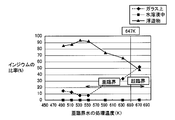
- FIG. 3 is a graph showing the peeling performance of ITO from the TFT glass of the liquid crystal panel when the temperature conditions of the subcritical water are changed, the vertical axis is the indium ratio (%), and the horizontal axis is the treatment of the subcritical water. Temperature (K).
- K Temperature
- a 0.1N sodium hydroxide aqueous solution was used, and after the subcritical water treatment was performed for 5 minutes, the ratio of indium remaining on the glass, the ratio of indium dissolved in the aqueous solution, and floating in the aqueous solution.
- the ratio of indium recovered from 0.5 ⁇ m or more of SS is shown. As shown in FIG.
- ITO is peeled from the glass at a temperature of subcritical water of 493 K (pressure 2.32 MPa saturated water) to 673 K (pressure 22 MPa), and from 533 K (pressure 4.69 MPa saturated water) to 553 K (pressure 6. In the case of 42 MPa saturated water), 90% or more of the ITO is peeled off, and the ratio of the ITO peeling from the glass is the maximum. This is considered to be because when the temperature exceeds 553 K, a part of the organic material peeled and decomposed from the glass becomes paste-like when ITO returns to the glass surface when it returns to normal temperature and pressure. From the viewpoint of prevention of reattachment and peeling performance, it is understood that the temperature condition is preferably 493 to 647 K, and particularly preferably 533 to 553 K, which has the maximum peeling performance.
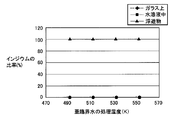
- FIG. 4 is a graph showing the ITO peeling performance from the color filter (CF) glass of the liquid crystal panel when the temperature condition of the subcritical water is changed, the vertical axis is the indium ratio (%), and the horizontal axis is It is the processing temperature (K) of subcritical water.
- K processing temperature
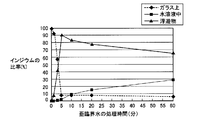
- FIG. 5 is a graph showing the removal performance of ITO from the liquid crystal panel TFT glass when the treatment time in subcritical water is changed.
- the vertical axis represents the indium ratio (%), and the horizontal axis represents the subcritical water.
- Processing time in minutes the ratio of indium remaining on the glass and the ratio of indium dissolved in the aqueous solution after performing subcritical water treatment under the conditions of 0.1N sodium hydroxide aqueous solution and temperature of 533 K (pressure 4.69 MPa saturated water)
- the ratio of indium recovered from 0.5 ⁇ m or more of SS suspended in an aqueous solution is shown. Peeling starts at 0.5 minutes and saturates at 5 minutes, and ITO peels from the TFT glass even at 60 minutes.
- the processing time exceeds 10 minutes ITO is dissolved in the solution, and it is difficult to recover by a filter or the like in an indium recovery process described later. Therefore, the optimal processing time is 5 to 10 minutes.
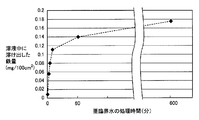
- FIG. 6 shows an experimental result in which the amount of iron dissolved in the aqueous solution from the reaction vessel (SUS) inner surface area of 100 cm 2 was confirmed by performing subcritical water treatment at a 0.1N sodium hydroxide aqueous solution at a temperature of 533 K. It is a graph, the vertical axis is the amount of iron dissolved in the solution (mg / 100 cm 2 ), and the horizontal axis is the treatment time (min) in subcritical water. As can be seen from FIG.
- the glass is first separated and recovered from the suspended solution containing glass and transparent electrode material (ITO, organic matter, etc.) and the aqueous solution of the drug from the outlet of the reaction vessel.
- a coarse filter such as a trommel, a vibrating sieve, or a centrifugal separator is used to separate the glass from other members and collect the glass.
- the mesh size at this time is preferably about 1/3 to 1/10 of the glass crushing mesh.
- the glass may be separated and recovered using an air lift type specific gravity separator.
- Glass separated and recovered in this process is stored in a container containing water, neutralized with sulfuric acid, etc., and then washed away with salt and reused as a raw material for liquid crystal panels, or foamed glass without being washed with water.
- Transparent Electrode Material Recovery Step As shown in FIGS. 2 to 5, in the subcritical water treatment step, ITO hardly dissolves in the aqueous solution and floats as SS in the aqueous solution. Therefore, most ITO can be recovered by optimizing the subcritical water treatment conditions and recovering suspended matters.
- a method for collecting the suspended matter a method using a centrifuge or the like is preferable.
- the mesh size of the filter is preferably 0.1 ⁇ m to 30 ⁇ m, and is preferably about 0.5 ⁇ m considering the size of the suspended matter.
- the transparent electrode material (ITO, organic matter) separated and recovered in the process is separated into indium at the smelting factory and reused. Further, the aqueous solution remaining after separating and recovering the transparent electrode material is recovered, returned to the above-described drug concentration adjustment step, and reused.
- Aqueous solution recovery process After the transparent electrode material is separated and recovered as described above, the sodium hydroxide aqueous solution remaining after solid-liquid separation is returned to the chemical concentration adjustment process, adjusted to an optimal concentration, and circulated. Will be reused.
- the aqueous solution after multiple uses, it is possible to use the aqueous solution alone for the subcritical water treatment process without introducing the liquid crystal panel, and recycle the organic substances after decomposition. .
Landscapes
- Engineering & Computer Science (AREA)
- Environmental & Geological Engineering (AREA)
- Physics & Mathematics (AREA)
- Chemical & Material Sciences (AREA)
- General Health & Medical Sciences (AREA)
- General Chemical & Material Sciences (AREA)
- Chemical Kinetics & Catalysis (AREA)
- Toxicology (AREA)
- Health & Medical Sciences (AREA)
- Nonlinear Science (AREA)
- Mathematical Physics (AREA)
- Crystallography & Structural Chemistry (AREA)
- General Physics & Mathematics (AREA)
- Optics & Photonics (AREA)
- Processing Of Solid Wastes (AREA)
Abstract
亜臨界水を用いて液晶パネルをリサイクル処理し、ガラスおよび透明電極材料から選ばれる少なくともいずれかを液晶パネルから分離し、回収する方法であって、液晶パネルからの有機物の剥離性、有機物の分解性および有機物の溶解性から選ばれる少なくともいずれかを向上する薬剤と、液晶パネルと、水との混合物に熱と圧力を加え亜臨界水状態を得る工程を含む方法によって、低装置コスト、低ランニングコスト、低消費エネルギーで、ガラスおよび透明電極材料の少なくともいずれかを液晶パネルから分離し、回収する方法を提供する。
Description
本発明は、液晶テレビ、パソコンなどの液晶パネルを使用した製品の廃棄物や新品製造過程で発生する不良品や端切れをリサイクル処理する方法に適用される。
近年、社会における生産・消費活動全般について一般廃棄物や産業廃棄物が増加し、不法投棄や埋立地逼迫などの地球環境問題が注目を集め、これまでの大量生産、大量消費、大量廃棄型の経済システムから資源循環型経済システムへの転換が社会的に重要な課題となってきている。
前記のような状況を受け、たとえば、2001年4月より家電リサイクル法が施行された。家電リサイクル法においては、2008年8月現在において、エアコン、テレビ、冷蔵庫、洗濯機の家電4品目のリサイクルが義務付けられ、また、それぞれの製品の再商品化率については、エアコン60%以上、テレビ55%以上、冷蔵庫50%以上、洗濯機50%以上の法定基準値が定められている。
これら家電4品目においては、関係者の鋭意努力のもと、法律施行当初に比べリサイクルが格段に進んでいる。テレビにおいては、CRT(Cathode Ray Tube)のガラスを切断して電子銃や蛍光体を除去した後、ガラスカレットとして元のCRT用ガラスに再生使用するリサイクル技術が既に実用化されている。
ところで、近年、表示部品として液晶パネル、プラズマディスプレイパネル(PDP)、有機ELパネル、電解放出型ディスプレイパネルなどの薄型パネルを搭載した薄型テレビの需要が、省電力、省スペース、軽量かつデジタル放送の受像に適するといった特性から、近年の地球環境問題への関心の高まり、ならびにテレビ放送のデジタル化と相俟って、急激に増加している。特に、大型の薄型パネルを搭載した大画面薄型テレビの需要が劇的に拡大している。これに伴い、製造工程で排出される不良パネルの増加や、使用済みの薄型テレビの廃棄量の今後の急激な増加が予想され、リサイクル活動などの環境活動において、リサイクル性向上などの要求が高くなってきている。
現在、薄型テレビのパネル(薄型パネル)は、比較的新しい製品であること、また、廃棄物の量としては少ないこともあり、廃棄物の処理施設にて製品ごと破砕された後、焼却処理されている。
特に液晶パネルのリサイクルにおいて考慮すべき点は、ガラス、インジウムなどの材料の再生である。液晶パネルの基材は、主にガラス基板が用いられている。ガラスは製品重量の大半を占めるため、リサイクル率向上の観点からも再資源化が望ましく、再度同一製品のガラス原料として再生するなど高品位なリサイクルを行うことがより望ましい。また、基材には透明電極としてインジウムスズ酸化物(ITO:Indium Tin Oxide)などのインジウム化合物が加工されているものがある。インジウムは希少金属であり、昨今の薄型パネル市場拡大も影響し高騰してきており、回収、リサイクルが模索されている。
上述の観点から、液晶パネル中のガラス、インジウムの回収、リサイクルは、必要不可欠であるが課題も多い。
図7は、一般的なTFT(Thin Film Transistor)液晶パネルの構造を模式的に示す図である。一般的なTFT液晶パネルの構造は、TFTガラス基板1上にマトリックス状に透明電極である画素ITO膜(Indium Tin Oxide)2が形成され、この画素ITO膜2ごとにアクティブ素子3が形成される。画素ITO膜2はInとSnの酸化物により構成される。アクティブ素子3は、Alなどの金属導電体膜で形成した走査信号線4およびデータ信号線に接続されており、TFTガラス基板1の画素ITO膜2の間に格子状に形成されている。TFTガラス基板1と画素ITO膜2との間には、アクリルなどの樹脂で形成される有機膜20が、存在する。
また、TFTガラス基板1に対向してカラーフィルタガラス基板6が配置され、この対向面には、カラーフィルタ7およびITO膜8が形成されている。また、TFTガラス基板1およびカラーフィルタガラス基板6の周囲はUV硬化樹脂などのシール剤21が充填され、これらガラス基板間に液晶9を封入している。また、カラーフィルタガラス基板6、TFTガラス基板1の外面には、偏光板10が設けられている。また、所定の分子配向を得るために、ポリイミドなどの有機高分子膜である配向膜23が形成されている。
液晶パネルの製造工場から排出される不良の廃液晶パネルや家電製品、パソコンおよび携帯電話などの廃棄物に含まれる液晶表示装置や液晶パネルからガラスとインジウムの回収方法として、たとえば、特開2001-170603号公報(特許文献1)には、超臨界水(一部亜臨界水を含む)を利用した処理方法が考案されている。
特許文献1に示される超臨界水(一部亜臨界水含む)条件では、温度や圧力が高いため、装置が高額となる。また多くのエネルギーを消費し、温暖化ガスの発生量が多く、ランニングコストも高額となる。そこで本発明者らは、少しでも温度と圧力を下げるべく、温度533K(圧力4.69MPa)から20℃ごとに飽和蒸気圧曲線に沿って亜臨界水(一部超臨界水)を使って、液晶パネルのTFT、カラーフィルタガラスからのITOの剥離性能を確認した。
ここで、図8は、温度を変化させたときのTFTガラスからのITOの剥離性能を示すグラフであり、縦軸はインジウムの比率(%)、横軸は亜臨界水の温度(K)である。図8には、亜臨界水(一部超臨界水)処理を5分間行った後のガラス上に残ったインジウムの比率が示されている。図8から、亜臨界水を含め超臨界水を用いた処理でも90%以上のITOがガラス上に残ることがわかる。
また図9は、温度を変化させたときのカラーフィルタガラスからのITOの剥離性能を示すグラフであり、縦軸はインジウムの比率(%)、横軸は亜臨界水の温度(K)である。図9には、亜臨界水(一部超臨界水)処理を5分間行った後のガラス上に残ったインジウムの比率が示されている。図9から、亜臨界水を含め超臨界水でも50%以上のITOがガラス上に残ることがわかる。
また、特開2003-094007号公報(特許文献2)に臨界水(一部亜臨界水含む)酸化処理方法を利用した処理方法が考案されている。臨界水酸化処理方法とは、亜臨界水に酸素を供給し、酸素の多い状態で超臨界状態を作り出し、処理物を酸化させる技術であり、一般に湿式酸化処理とよばれる方法である。一方この湿式酸化処理を利用する場合、強い酸化作用のため容器が酸化される問題がある。解決する方法として容器を耐食コーティングする方法がとられているが、容器のコストが高いことと、容器の寿命が短く、設備コスト、ランニングコストともに高く実用化されていなかった。
そこで本発明の目的は、低装置コスト、低ランニングコスト、低消費エネルギーで、ガラスおよび透明電極材料の少なくともいずれかを液晶パネルから分離し、回収する方法を提供することである。
本発明は、亜臨界水を用いて液晶パネルをリサイクル処理し、ガラスおよび透明電極(金属酸化物)材料から選ばれる少なくともいずれかを液晶パネルから分離し、回収する方法であって、液晶パネルからの有機物の剥離性、有機物の分解性および有機物の溶解性から選ばれる少なくともいずれかを向上する薬剤と、液晶パネルと、水との混合物に熱と圧力を加え亜臨界水状態を得る工程を含む方法である。
本発明の方法における透明電極材料はITO(インジウムスズ酸化物)であることが好ましい。
また本発明の方法において、前記薬剤はアルカリもしくはアルコールであることが好ましく、強塩基を使用することがより好ましく、水酸化ナトリウムを使用することが特に好ましい。前記薬剤が水酸化ナトリウムである場合、その濃度は0.01~1Nであることが好ましい。
本発明の方法において、温度493~647K、圧力2.3~22.1MPaの条件で加熱および加圧を行うことが、好ましい。
また本発明の方法において、亜臨界水状態での処理時間が0.5~60分間であることが好ましい。
本発明の方法においては、水酸化ナトリウム水溶液を繰り返し使用することが、好ましい。
本発明の方法は、液晶パネルを破砕する工程をさらに含むことが好ましい。この場合、前記薬剤とパネル破砕品と水とを混合する工程を含むことが好ましい。また、本発明の方法は、前記薬剤とパネル破砕品と水との混合物を亜臨界状態を得る容器に搬送する工程を含むことが好ましい。
本発明の液晶パネルのリサイクル処理方法は、液晶パネルの偏光板を除去する工程をさらに含むことが好ましい。この場合、風力選別によって偏光板を除去することが、より好ましい。
本発明によれば、低装置コスト、低ランニングコスト、低消費エネルギーで、液晶パネルからガラスおよび透明電極材料から選ばれる少なくともいずれかを分離し、回収できる、液晶パネルのリサイクル処理方法を提供することができる。
図1は、本発明の液晶パネルからのガラスおよび透明電極(金属酸化物)材料から選ばれる少なくともいずれかを分離し、回収する方法を含む液晶パネルのリサイクル処理方法の好ましい一例を示すフローチャートである。本発明は、亜臨界水を用いて液晶パネルをリサイクル処理し、ガラスおよび透明電極材料から選ばれる少なくともいずれかを液晶パネルから分離し、回収する方法であって、液晶パネルからの有機物の剥離性、有機物の分解性および有機物の溶解性から選ばれる少なくともいずれかを向上する薬剤と、液晶パネルと、水との混合物に、熱と圧力を加え亜臨界水状態を得る工程を含む方法である。図1には、液晶パネルからの有機物の剥離性、有機物の分解性および有機物の溶解性から選ばれる少なくともいずれかを向上する薬剤の濃度を調整する工程(薬剤濃度調整工程)と、当該薬剤と液晶パネルおよび水との混合物に熱と圧力を加え亜臨界水状態を得る工程(亜臨界水処理工程)と、ガラスを回収する工程(ガラス回収工程)と、透明電極材料を回収する工程(透明電極材料回収工程)と、処理後の水溶液を回収する工程(水溶液回収工程)とを含む例が示されているが、これに限定されるものではない。以下、図1に示す例を参照しながら、本発明について詳細に説明する。
〔1〕薬剤濃度調整工程
当該工程ではまず、液晶パネルからの有機物の剥離性、有機物の分解性および有機物の溶解性から選ばれる少なくともいずれかを向上する薬剤と水を混合し、薬剤の濃度を調整する。なお、後述する水溶液回収工程で回収された水溶液を当該工程における薬剤の濃度調整に用いるようにしてもよい。このような薬剤としては、酸性の薬剤を用いた場合には金属などに対する腐食性が高いため、アルカリまたはアルコールが好適に用いられる。アルカリとしては、水酸化ナトリウム、水酸化カルシウム、重曹、アンモニア、アミン系薬剤などが挙げられ、また、アルコールとしては、エタノール、メタノールなどが挙げられる。中でも、有機物の剥離性および/または分解性の高い強塩基が好ましく、さらに低コストな水酸化ナトリウムが特に好ましい。
当該工程ではまず、液晶パネルからの有機物の剥離性、有機物の分解性および有機物の溶解性から選ばれる少なくともいずれかを向上する薬剤と水を混合し、薬剤の濃度を調整する。なお、後述する水溶液回収工程で回収された水溶液を当該工程における薬剤の濃度調整に用いるようにしてもよい。このような薬剤としては、酸性の薬剤を用いた場合には金属などに対する腐食性が高いため、アルカリまたはアルコールが好適に用いられる。アルカリとしては、水酸化ナトリウム、水酸化カルシウム、重曹、アンモニア、アミン系薬剤などが挙げられ、また、アルコールとしては、エタノール、メタノールなどが挙げられる。中でも、有機物の剥離性および/または分解性の高い強塩基が好ましく、さらに低コストな水酸化ナトリウムが特に好ましい。
薬剤が水酸化ナトリウムである場合、その濃度については特に制限されるものではないが、液晶パネルからの有機物の剥離性、有機物の分解性および有機物の溶解性から選ばれる少なくともいずれかを向上する効果が特に顕著となることから、0.01~1Nの範囲内であることが好ましく、0.05~0.5Nの範囲内であることがより好ましい。ここで、図2は、水酸化ナトリウム濃度を変化させたときのTFTガラスからITOの剥離性能を示すグラフであり、縦軸はインジウムの比率(%)、横軸はNaOH濃度(N)である。ここでは、亜臨界水の温度553K(圧力6.42MPa飽和水)で亜臨界水処理を5分間行った後、ガラス上に残ったインジウムの比率と、水溶液に溶けたインジウムの比率、水溶液中に浮遊している0.5μm以上のSS(Suspended Solids)中から回収されるインジウムの比率が示されている。図2から、亜臨界水処理後の水酸化ナトリウム水溶液の濃度が0.01~1NまでがTFTガラスからITOを剥離する効果があり、中でも0.1Nの時点が、ガラス上に残ったITOが最小となり、ITOの剥離に対して最適であることがわかる。また、図2には、水溶液中に溶けているインジウムはほとんど無く、ITO回収工程(後述)でフィルタを使用することで、剥離したITOを回収することができることも示されている。また、液晶パネルのカラーフィルタでは、亜臨界水の温度553K(圧力6.42MPa)処理時間5分、水酸化ナトリウム水溶液の濃度が0.1Nの条件で100%のITOをガラス側から剥離できる。
当該工程における薬剤の濃度調整は、たとえば、上述した薬剤として水酸化ナトリウムを用いる場合、pH(イオン濃度)センサをタンク内に装着し、pHが一定値に満たない場合には、水酸化ナトリウムを薬剤タンクより供給するようにして行う。薬剤は、水に溶解しない状態で薬剤タンクに直接保管するようにしてもよいし、薬剤の高濃度の水溶液を予め調製し、これを薬剤タンクに保管するようにしてもよい。またpHが一定値以上の場合は、水を供給し水溶液のイオン濃度を一定にする。
〔2〕液晶パネル破砕工程
本発明において処理に供する液晶パネルは、破砕されたものであることが好ましい。すなわち、本発明においては、液晶パネルを破砕する工程(図1に示す例では、液晶パネル破砕工程)をさらに含むことが好ましく、液晶パネルからの有機物の剥離性、有機物の分解性および有機物の溶解性から選ばれる少なくともいずれかを向上する薬剤と液晶パネルの破砕品(パネル破砕品)と水を混合するようにすることが、より好ましい。
本発明において処理に供する液晶パネルは、破砕されたものであることが好ましい。すなわち、本発明においては、液晶パネルを破砕する工程(図1に示す例では、液晶パネル破砕工程)をさらに含むことが好ましく、液晶パネルからの有機物の剥離性、有機物の分解性および有機物の溶解性から選ばれる少なくともいずれかを向上する薬剤と液晶パネルの破砕品(パネル破砕品)と水を混合するようにすることが、より好ましい。
当該工程では、たとえば、一軸のハンマー型の破砕機や二軸の破砕機を用いて、液晶パネルを破砕する。破砕のサイズは、後述する亜臨界水処理工程に、薬剤とパネル破砕品と、水との混合物とが、ポンプなどの加圧手段によって円滑に移行できる大きさであれば特に制限されるものではないが、0.5mm未満であると、破砕に時間を要するため0.5mm以上が好ましい。また、前記薬剤と水との混合物の亜臨界水処理工程への移行を円滑に行い得る観点からは、破砕のサイズは5mm以下であることが好ましい。
また、液晶パネルに偏光板が付いていると、亜臨界水処理工程において偏光板が分解し糊状物質となり、ガラスと、透明電極材料(ITO、有機物など)との再付着が起こる。この現象を防ぐため、本発明の液晶パネルのリサイクル処理方法は、液晶パネルの偏光板を除去する工程をさらに含むことが好ましい。すなわち、上述したようにして液晶パネルを破砕した後、パネル破砕品から偏光板を除去するようにすることが好ましい。この場合、偏光板の除去は、風力選別機を用いて行うことが望ましい。風力選別機を用いて偏光板を除去するようにすることで、他の方法で偏光板を除去する場合と比較して、連続して処理できるというような利点があるためである。なお、破砕機内に風を送る装置を設置し、破砕をしながら偏光板を除去することも有効である。また、破砕前に液晶パネルから偏光板をジグなどにより剥がすことも有効である。
パネル破砕品は、スクリュー式のフィーダーなどによって、一定量が、上述した薬剤入りの水溶液に投入され、パネル破砕品と水溶液とが一定の割合で混ざるようにする。
〔3〕亜臨界水処理工程
パネル破砕品は、上述した薬剤入りの水溶液と混合され、ポンプなどの輸送手段によって搬送し、亜臨界水処理工程に供される。パネル破砕品と水溶液との混合物は、まず、ポンプなどの加圧手段によって加圧される。次に、加圧された混合物は、加熱手段に送られて加熱され、亜臨界水状態とされる。ここで、水は、22.1MPaの圧力をかけると374℃(647K)まで液体の状態を保ち、これ以上の温度、圧力の水は「超臨界水」と呼ばれるが、「亜臨界水」とは、通常の状態の水とこの超臨界水の状態の水との中間の状態の水を指す。亜臨界水状態とされたパネル破砕品と水溶液との混合物は、投入口から反応容器に導入される。
パネル破砕品は、上述した薬剤入りの水溶液と混合され、ポンプなどの輸送手段によって搬送し、亜臨界水処理工程に供される。パネル破砕品と水溶液との混合物は、まず、ポンプなどの加圧手段によって加圧される。次に、加圧された混合物は、加熱手段に送られて加熱され、亜臨界水状態とされる。ここで、水は、22.1MPaの圧力をかけると374℃(647K)まで液体の状態を保ち、これ以上の温度、圧力の水は「超臨界水」と呼ばれるが、「亜臨界水」とは、通常の状態の水とこの超臨界水の状態の水との中間の状態の水を指す。亜臨界水状態とされたパネル破砕品と水溶液との混合物は、投入口から反応容器に導入される。
反応容器内で、亜臨界水処理によって、液晶パネル(パネル破砕品)のガラスから有機物が剥離および/または分解し、ガラスと透明電極材料(有機物、ITOなど)に分離される。分離された処理物(分離されたガラス、透明電極材料)は、水溶液と共に反応容器に設けられた排出口より取り出される。取り出された処理物と水溶液は、背圧弁を介して、反応終了物回収タンクに回収される。
反応圧力の制御は、背圧弁の開度を調整することで行ってもよい。また、背圧弁の直前に、冷却管を備えていてもよい。冷却管を備えると処理物を安全に処理物回収タンクなどに回収することができる。
また、亜臨界水は超臨界水に比べ金属などに対する腐食性が低い。したがって、反応容器の素材としては、ハステロイ、インコネルなどに比べてはるかに安価なSUS316などを好適に用いることができる。
加熱手段は、特に制限なく公知の加熱手段を用いることができる。たとえば、電気ヒータ、誘導加熱装置、熱媒油、水蒸気による加熱などが挙げられる。また、混合物は、加圧手段に送る前に予備加熱しておいてもよい。
ここで、反応容器の形状は、特に制限されないが、円筒状であれば好ましい。この反応容器の上端部、中間部または下端部の少なくとも一方には、投入口が、設けられている。前記パネル破砕品と水溶液との混合物は、この投入口を介して、処理容器内に導入される。投入口の内径は、前記円筒状反応容器の内径より小さい方が望ましい。これは、混合物の落下速度を小さくし、短い距離で処理時間を長くとるためである。
排出口は、前記導入口が設けられた位置とは異なる位置に設けられる。排出口は、投入口が設けられた位置の下流側で複数の位置を取ることができる。一例では、前記排出口が、前記流れ方向に沿って、前記反応容器側壁に複数箇所形成されている。このように複数の排出口を設けることで、処理物を反応容器から取り出すことができる。具体的には、亜臨界水中でのパネル破砕品の処理時間、すなわち被処理物成分の亜臨界水分解時間に対応させて、反応容器内の亜臨界水の流れ方向に沿って、排出口の位置を設定すればよい。また複数箇所形成されている排出口のいずれかを選択して、処理物を取り出すことができる。このように、いずれかの排出口から処理物を取り出すことで、亜臨界水分解反応時間を調整することができる。
なお、本発明においては、必要に応じ、超臨界水を使用してもよい。
本発明では、亜臨界水処理工程において、温度493~647K、圧力2.3~22.1MPaの条件で加熱および加圧を行うことが好ましい。また、亜臨界水状態での処理時間は0.5~60分間であることが好ましい。ここで、液晶パネルのガラスから、有機物を剥離および/または分解する際の亜臨界水の温度、圧力、時間の条件について、前記薬剤として水酸化ナトリウムを使用した場合を例に挙げてについて、説明する。
本発明では、亜臨界水処理工程において、温度493~647K、圧力2.3~22.1MPaの条件で加熱および加圧を行うことが好ましい。また、亜臨界水状態での処理時間は0.5~60分間であることが好ましい。ここで、液晶パネルのガラスから、有機物を剥離および/または分解する際の亜臨界水の温度、圧力、時間の条件について、前記薬剤として水酸化ナトリウムを使用した場合を例に挙げてについて、説明する。
図3は、亜臨界水の温度条件を変えたときの液晶パネルのTFTガラスからのITOの剥離性能を示すグラフであり、縦軸はインジウムの比率(%)、横軸は亜臨界水の処理温度(K)である。ここでは、0.1N水酸化ナトリウム水溶液を用い、処理時間5分で亜臨界水処理を行った後、ガラス上に残ったインジウムの比率と、水溶液に溶けたインジウムの比率、水溶液中に浮遊している0.5μm以上のSS中から回収されるインジウムの比率が示されている。図3より亜臨界水の温度493K(圧力2.32MPa飽和水)から673K(圧力22MPa)でガラス上からITOが剥離しており、また533K(圧力4.69MPa飽和水)から553K(圧力6.42MPa飽和水)では90%以上のITOが剥離し、ガラスからITOが剥離する比率が最大となっている。これは、温度が553Kを超えるとガラスから剥がれ分解した有機物の一部が、常温常圧に戻った時、糊状になりガラス表面上にITOが再付着するためと考える。再付着の防止および剥離性能の観点からは、温度条件として、493~647Kが望ましく、剥離性能が最大である533~553Kが特に望ましいことが分かる。
また図4は、亜臨界水の温度条件を変えたときの液晶パネルのカラーフィルタ(CF)ガラスからのITOの剥離性能を示すグラフであり、縦軸はインジウムの比率(%)、横軸は亜臨界水の処理温度(K)である。ここでは、0.1N水酸化ナトリウム水溶液、処理時間5分で亜臨界水処理を行った後、ガラス上に残ったインジウムの比率と、水溶液に溶けたインジウムの比率、水溶液中に浮遊している0.5μm以上のSS中から回収されるインジウムの比率が示されている。この条件493K(圧力2.32MPa飽和水)から553K(圧力6.42MPa飽和水)ではカラーフィルタガラスからITOが100%剥離する。
また、図5は、亜臨界水中での処理時間を変えた時の液晶パネルTFTガラスからのITOの剥離性能を示すグラフであり、縦軸はインジウムの比率(%)、横軸は亜臨界水での処理時間(分)である。ここでは、0.1N水酸化ナトリウム水溶液、温度533K(圧力4.69MPa飽和水)の条件で亜臨界水処理を行った後、ガラス上に残ったインジウムの比率と、水溶液に溶けたインジウムの比率、水溶液中に浮遊している0.5μm以上のSS中から回収されるインジウムの比率を示す。0.5分から剥離が始まり5分で飽和し、60分でもTFTガラス上からITOが剥離する。一方、処理時間が10分を過ぎると溶液にITOが溶解し、後述するインジウム回収工程でフィルタなどによる回収がしにくくなる。よって処理時間は5分から10分が、最適である。
次に、亜臨界水処理による反応容器内の侵食を確認するため、亜臨界水中で処理時間を変えたときの反応容器内表面の水溶液への溶け出し量を確認した。図6は、0.1N水酸化ナトリウム水溶液、温度533Kで亜臨界水処理を行い、そのときの反応容器(SUS)内表面積100cm2から水溶液に溶け出した鉄の量を確認した実験結果を示すグラフであり、縦軸は溶液中に溶け出した鉄量(mg/100cm2)であり、横軸は亜臨界水での処理時間(分)である。図6から分かるように、時間と共に鉄の溶け出し量が減少していることが分かる。これは、反応容器表面に酸化皮膜ができ侵食が止まっていくものと考える。また660分の時点で鉄の溶け出し量が0.18mg/100cm2と微量であり、反応容器の侵食は問題ない。また、鉄の還元によるOH基の減少が660分で10-3molオーダーであり、水酸化ナトリウムの再利用に問題がないことがわかる。
〔4〕ガラス回収工程
次に、反応容器の排出口から、ガラスおよび透明電極材料(ITO、有機物など)を含む浮遊物および薬剤の水溶液から、まずはガラスを分離し、回収する。ガラスの分離には、トロンメルや振動篩や遠心分離機などの目の粗いフィルタを利用して、ガラスと他の部材を分離し、ガラスを回収する。このときのメッシュサイズは、ガラスの破砕メッシュの1/3~1/10程度がよい。またエアーリフト方式の比重分離装置を利用して、ガラスを分離回収してもよい。
次に、反応容器の排出口から、ガラスおよび透明電極材料(ITO、有機物など)を含む浮遊物および薬剤の水溶液から、まずはガラスを分離し、回収する。ガラスの分離には、トロンメルや振動篩や遠心分離機などの目の粗いフィルタを利用して、ガラスと他の部材を分離し、ガラスを回収する。このときのメッシュサイズは、ガラスの破砕メッシュの1/3~1/10程度がよい。またエアーリフト方式の比重分離装置を利用して、ガラスを分離回収してもよい。
当該工程で分離・回収されたガラスは、水の入った容器に収容され、水を硫酸などで中和させ、その後、塩分を洗い流し液晶パネルの原料として再利用したり、水洗いせずに発泡ガラスなどに加工され、建材などに好適に利用することができる。
〔5〕透明電極材料回収工程
図2~図5に示したように、亜臨界水処理工程において、ITOは水溶液中にほとんど溶解せず、SSとして水溶液中に浮遊している。そのため、亜臨界水処理の条件を最適にし、浮遊物を回収することでほとんどのITOを回収できる。浮遊物の回収方法としては、遠心分離機などを利用するものがよい。このときのフィルタのメッシュサイズは、0.1μmから30μmがよく、浮遊物の大きさを考慮すると0.5μm程度がよい。
図2~図5に示したように、亜臨界水処理工程において、ITOは水溶液中にほとんど溶解せず、SSとして水溶液中に浮遊している。そのため、亜臨界水処理の条件を最適にし、浮遊物を回収することでほとんどのITOを回収できる。浮遊物の回収方法としては、遠心分離機などを利用するものがよい。このときのフィルタのメッシュサイズは、0.1μmから30μmがよく、浮遊物の大きさを考慮すると0.5μm程度がよい。
当該工程で分離・回収された透明電極材料(ITO、有機物)は、精錬工場でインジウムに分離され再利用される。また、透明電極材料を分離・回収して残った水溶液は回収され、上述した薬剤濃度調整工程に戻され、再利用される。
〔6〕水溶液回収工程
上述したように透明電極材料を分離・回収した後、固液分離されて残った水酸化ナトリウム水溶液は、薬剤濃度調整工程に戻され、最適な濃度に調製され、循環され、再利用される。また複数回の使用で水溶液中に有機物が多く含まれるようになった場合、液晶パネルを投入せず水溶液のみで亜臨界水処理工程に供し、有機物を分解後、再利用することも可能である。
上述したように透明電極材料を分離・回収した後、固液分離されて残った水酸化ナトリウム水溶液は、薬剤濃度調整工程に戻され、最適な濃度に調製され、循環され、再利用される。また複数回の使用で水溶液中に有機物が多く含まれるようになった場合、液晶パネルを投入せず水溶液のみで亜臨界水処理工程に供し、有機物を分解後、再利用することも可能である。
今回開示された実施の形態、実施例および比較例は全ての点で例示であって制限的なものではないと考えられるべきである。本発明の範囲は上記した説明ではなくて請求の範囲によって示され、請求の範囲と均等の意味および範囲内での全ての変更が含まれることが意図される。
1 TFTガラス基板、2 画素ITO膜、3 アクティブ素子、4 走査信号線、6 カラーフィルタガラス基板、7 カラーフィルタ、8 ITO膜、9 液晶、10 偏光板、20 有機膜、21 シール剤、23 配向膜。
Claims (14)
- 亜臨界水を用いて液晶パネルをリサイクル処理し、ガラスおよび透明電極材料から選ばれる少なくともいずれかを液晶パネルから分離し、回収する方法であって、
液晶パネルからの有機物の剥離性、有機物の分解性および有機物の溶解性から選ばれる少なくともいずれかを向上する薬剤と、液晶パネルと、水との混合物に熱と圧力を加え亜臨界水状態を得る工程を含む、方法。 - 透明電極材料がITOである、請求の範囲第1項に記載の方法。
- 前記薬剤がアルカリもしくはアルコールである、請求の範囲第1項に記載の方法。
- 前記薬剤が強塩基である、請求の範囲第3項に記載の方法。
- 前記薬剤が水酸化ナトリウムである、請求の範囲第4項に記載の方法。
- 水酸化ナトリウム濃度が0.01~1Nである、請求の範囲第5項に記載の方法。
- 処理条件が温度493~647K、圧力2.3~22.1MPaである、請求の範囲第1項に記載の方法。
- 亜臨界水中の処理時間が0.5~60分である、請求の範囲第7項に記載の方法。
- 水酸化ナトリウム水溶液を繰り返し使用する、請求の範囲第5項に記載の方法。
- 液晶パネルを破砕する工程をさらに含む、請求の範囲第1項に記載の方法。
- 前記薬剤とパネル破砕品と水とを混合する工程をさらに含む、請求の範囲第10項に記載の方法。
- 前記薬剤とパネル破砕品と水との混合物を亜臨界水状態を得る容器に搬送する工程を含む、請求の範囲第10項に記載の方法。
- 液晶パネルの偏光板を除去する工程をさらに含む、請求の範囲第1項に記載の方法。
- 液晶パネルの偏光板を除去する工程を風力選別によって行う、請求の範囲第13項に記載の方法。
Priority Applications (1)
| Application Number | Priority Date | Filing Date | Title |
|---|---|---|---|
| JP2010549491A JP5385924B2 (ja) | 2009-02-04 | 2010-02-03 | 液晶パネルからのガラス、透明電極材料の分離・回収方法 |
Applications Claiming Priority (2)
| Application Number | Priority Date | Filing Date | Title |
|---|---|---|---|
| JP2009-023804 | 2009-02-04 | ||
| JP2009023804 | 2009-02-04 |
Publications (1)
| Publication Number | Publication Date |
|---|---|
| WO2010090218A1 true WO2010090218A1 (ja) | 2010-08-12 |
Family
ID=42542111
Family Applications (1)
| Application Number | Title | Priority Date | Filing Date |
|---|---|---|---|
| PCT/JP2010/051510 Ceased WO2010090218A1 (ja) | 2009-02-04 | 2010-02-03 | 液晶パネルからのガラス、透明電極材料の分離・回収方法 |
Country Status (2)
| Country | Link |
|---|---|
| JP (1) | JP5385924B2 (ja) |
| WO (1) | WO2010090218A1 (ja) |
Cited By (4)
| Publication number | Priority date | Publication date | Assignee | Title |
|---|---|---|---|---|
| JP2012125693A (ja) * | 2010-12-15 | 2012-07-05 | Sharp Corp | 液晶パネルの分離回収装置および再資源化方法 |
| JP2013176741A (ja) * | 2012-02-29 | 2013-09-09 | Sharp Corp | 表示パネルのリサイクル方法 |
| CN104722563A (zh) * | 2015-03-18 | 2015-06-24 | 合肥鑫晟光电科技有限公司 | 用于回收面板上的铟的方法 |
| DE102020123051B3 (de) | 2020-09-03 | 2021-07-29 | DER STEG gGmbH, Gesellschaft zur Förderung von Menschen mit psychischen Beeinträchtigungen | Verfahren und Vorrichtung zur Rückgewinnung von Glassubstraten aus Anzeigeelementen entsorgter LCD-Flachbildschirme |
Citations (4)
| Publication number | Priority date | Publication date | Assignee | Title |
|---|---|---|---|---|
| JP2001235718A (ja) * | 2000-02-23 | 2001-08-31 | Mitsuo Kamiwano | 液晶パネルのリサイクル処理方法およびリサイクル処理システム |
| JP2002023126A (ja) * | 2000-07-04 | 2002-01-23 | Mitsubishi Materials Corp | 廃液晶パネルの処理方法及びその処理装置 |
| JP2002159937A (ja) * | 2000-11-28 | 2002-06-04 | Kagawaken Sangyo Gijutsu Shinko Zaidan | 液晶パネルガラスの回収方法及び回収装置 |
| JP2003094007A (ja) * | 2001-09-26 | 2003-04-02 | Seiko Epson Corp | 臨界水酸化処理装置および臨界水酸化処理方法 |
Family Cites Families (3)
| Publication number | Priority date | Publication date | Assignee | Title |
|---|---|---|---|---|
| JP3589937B2 (ja) * | 2000-04-21 | 2004-11-17 | シャープ株式会社 | 廃液晶パネルの処理方法 |
| JP3589947B2 (ja) * | 2000-05-24 | 2004-11-17 | シャープ株式会社 | 廃液晶パネルの処理方法 |
| JP4374772B2 (ja) * | 2000-11-30 | 2009-12-02 | ソニー株式会社 | 液晶回収方法 |
-
2010
- 2010-02-03 WO PCT/JP2010/051510 patent/WO2010090218A1/ja not_active Ceased
- 2010-02-03 JP JP2010549491A patent/JP5385924B2/ja not_active Expired - Fee Related
Patent Citations (4)
| Publication number | Priority date | Publication date | Assignee | Title |
|---|---|---|---|---|
| JP2001235718A (ja) * | 2000-02-23 | 2001-08-31 | Mitsuo Kamiwano | 液晶パネルのリサイクル処理方法およびリサイクル処理システム |
| JP2002023126A (ja) * | 2000-07-04 | 2002-01-23 | Mitsubishi Materials Corp | 廃液晶パネルの処理方法及びその処理装置 |
| JP2002159937A (ja) * | 2000-11-28 | 2002-06-04 | Kagawaken Sangyo Gijutsu Shinko Zaidan | 液晶パネルガラスの回収方法及び回収装置 |
| JP2003094007A (ja) * | 2001-09-26 | 2003-04-02 | Seiko Epson Corp | 臨界水酸化処理装置および臨界水酸化処理方法 |
Cited By (4)
| Publication number | Priority date | Publication date | Assignee | Title |
|---|---|---|---|---|
| JP2012125693A (ja) * | 2010-12-15 | 2012-07-05 | Sharp Corp | 液晶パネルの分離回収装置および再資源化方法 |
| JP2013176741A (ja) * | 2012-02-29 | 2013-09-09 | Sharp Corp | 表示パネルのリサイクル方法 |
| CN104722563A (zh) * | 2015-03-18 | 2015-06-24 | 合肥鑫晟光电科技有限公司 | 用于回收面板上的铟的方法 |
| DE102020123051B3 (de) | 2020-09-03 | 2021-07-29 | DER STEG gGmbH, Gesellschaft zur Förderung von Menschen mit psychischen Beeinträchtigungen | Verfahren und Vorrichtung zur Rückgewinnung von Glassubstraten aus Anzeigeelementen entsorgter LCD-Flachbildschirme |
Also Published As
| Publication number | Publication date |
|---|---|
| JP5385924B2 (ja) | 2014-01-08 |
| JPWO2010090218A1 (ja) | 2012-08-09 |
Similar Documents
| Publication | Publication Date | Title |
|---|---|---|
| KR102524721B1 (ko) | 적어도 하나의 유기 성분을 포함하는 다층 시스템들을 해체하기 위한 방법 및 장치 | |
| JP5385924B2 (ja) | 液晶パネルからのガラス、透明電極材料の分離・回収方法 | |
| CN103602815B (zh) | 从废液晶显示器中回收铟的方法 | |
| KR101561528B1 (ko) | Pet 폐기물의 화학적 재활용 방법 | |
| CN103280390B (zh) | 一种废弃阴极射线管含铅玻璃的无害化处理方法 | |
| JP2012125693A (ja) | 液晶パネルの分離回収装置および再資源化方法 | |
| JP2011245379A (ja) | 液晶パネルの再資源化方法 | |
| CN103157646A (zh) | 一种废旧液晶显示器的综合处理方法 | |
| CN203854114U (zh) | 一种用于剥离塑料附着层的塑料清洗设备 | |
| JP2008216566A (ja) | 廃液晶パネルのガラス基板を回収する方法および装置 | |
| CN104624598A (zh) | 液晶显示器的无害化拆解处理方法 | |
| KR101552868B1 (ko) | Pet 폐기물의 화학적 재활용 방법 | |
| JP2013176741A (ja) | 表示パネルのリサイクル方法 | |
| JP5178036B2 (ja) | 廃材の再資源化装置およびそれを用いた再資源化方法、ならびに当該方法にて得られた金属、金属化合物、基材 | |
| KR101528598B1 (ko) | 인듐, 갈륨 및 아연 함유 혼합물로부터 인듐 및 갈륨의 선별 회수 방법 | |
| JP4374772B2 (ja) | 液晶回収方法 | |
| CN108913904A (zh) | 一种碲化镉薄膜太阳能电池的机械破碎回收处理方法 | |
| JP2001235718A (ja) | 液晶パネルのリサイクル処理方法およびリサイクル処理システム | |
| KR101327958B1 (ko) | 액정 표시 소자로부터 인듐 주석 산화물 및 유가 자원을 회수하는 방법 및 이에 따라 회수된 인듐 주석 산화물 | |
| JP2013119053A (ja) | 液晶パネルのリサイクル方法 | |
| CN109004305B (zh) | 一种正极混合料中分离磷酸亚铁锂和游离碳的方法 | |
| JP2008073619A (ja) | 液晶パネルの処理方法 | |
| JP2011167661A (ja) | 薄型パネルの再資源化方法 | |
| CN104646395B (zh) | 亚/超临界水法从废弃液晶面板中回收乙酸的装置及方法 | |
| CN106801143A (zh) | 一种回收废旧太阳能电池板银的方法 |
Legal Events
| Date | Code | Title | Description |
|---|---|---|---|
| 121 | Ep: the epo has been informed by wipo that ep was designated in this application |
Ref document number: 10738549 Country of ref document: EP Kind code of ref document: A1 |
|
| WWE | Wipo information: entry into national phase |
Ref document number: 2010549491 Country of ref document: JP |
|
| NENP | Non-entry into the national phase |
Ref country code: DE |
|
| 122 | Ep: pct application non-entry in european phase |
Ref document number: 10738549 Country of ref document: EP Kind code of ref document: A1 |