WO2010087048A1 - 遺伝子組換え植物の栽培方法 - Google Patents
遺伝子組換え植物の栽培方法 Download PDFInfo
- Publication number
- WO2010087048A1 WO2010087048A1 PCT/JP2009/064876 JP2009064876W WO2010087048A1 WO 2010087048 A1 WO2010087048 A1 WO 2010087048A1 JP 2009064876 W JP2009064876 W JP 2009064876W WO 2010087048 A1 WO2010087048 A1 WO 2010087048A1
- Authority
- WO
- WIPO (PCT)
- Prior art keywords
- plant
- genetically modified
- nitrogen
- cultivating
- protein
- Prior art date
- Legal status (The legal status is an assumption and is not a legal conclusion. Google has not performed a legal analysis and makes no representation as to the accuracy of the status listed.)
- Ceased
Links
Images

Classifications
-
- C—CHEMISTRY; METALLURGY
- C12—BIOCHEMISTRY; BEER; SPIRITS; WINE; VINEGAR; MICROBIOLOGY; ENZYMOLOGY; MUTATION OR GENETIC ENGINEERING
- C12N—MICROORGANISMS OR ENZYMES; COMPOSITIONS THEREOF; PROPAGATING, PRESERVING, OR MAINTAINING MICROORGANISMS; MUTATION OR GENETIC ENGINEERING; CULTURE MEDIA
- C12N15/00—Mutation or genetic engineering; DNA or RNA concerning genetic engineering, vectors, e.g. plasmids, or their isolation, preparation or purification; Use of hosts therefor
- C12N15/09—Recombinant DNA-technology
- C12N15/63—Introduction of foreign genetic material using vectors; Vectors; Use of hosts therefor; Regulation of expression
- C12N15/79—Vectors or expression systems specially adapted for eukaryotic hosts
- C12N15/82—Vectors or expression systems specially adapted for eukaryotic hosts for plant cells, e.g. plant artificial chromosomes (PACs)
- C12N15/8241—Phenotypically and genetically modified plants via recombinant DNA technology
- C12N15/8261—Phenotypically and genetically modified plants via recombinant DNA technology with agronomic (input) traits, e.g. crop yield
-
- C—CHEMISTRY; METALLURGY
- C12—BIOCHEMISTRY; BEER; SPIRITS; WINE; VINEGAR; MICROBIOLOGY; ENZYMOLOGY; MUTATION OR GENETIC ENGINEERING
- C12N—MICROORGANISMS OR ENZYMES; COMPOSITIONS THEREOF; PROPAGATING, PRESERVING, OR MAINTAINING MICROORGANISMS; MUTATION OR GENETIC ENGINEERING; CULTURE MEDIA
- C12N15/00—Mutation or genetic engineering; DNA or RNA concerning genetic engineering, vectors, e.g. plasmids, or their isolation, preparation or purification; Use of hosts therefor
- C12N15/09—Recombinant DNA-technology
- C12N15/63—Introduction of foreign genetic material using vectors; Vectors; Use of hosts therefor; Regulation of expression
- C12N15/79—Vectors or expression systems specially adapted for eukaryotic hosts
- C12N15/82—Vectors or expression systems specially adapted for eukaryotic hosts for plant cells, e.g. plant artificial chromosomes (PACs)
- C12N15/8216—Methods for controlling, regulating or enhancing expression of transgenes in plant cells
- C12N15/8222—Developmentally regulated expression systems, tissue, organ specific, temporal or spatial regulation
- C12N15/823—Reproductive tissue-specific promoters
- C12N15/8234—Seed-specific, e.g. embryo, endosperm
-
- C—CHEMISTRY; METALLURGY
- C12—BIOCHEMISTRY; BEER; SPIRITS; WINE; VINEGAR; MICROBIOLOGY; ENZYMOLOGY; MUTATION OR GENETIC ENGINEERING
- C12N—MICROORGANISMS OR ENZYMES; COMPOSITIONS THEREOF; PROPAGATING, PRESERVING, OR MAINTAINING MICROORGANISMS; MUTATION OR GENETIC ENGINEERING; CULTURE MEDIA
- C12N15/00—Mutation or genetic engineering; DNA or RNA concerning genetic engineering, vectors, e.g. plasmids, or their isolation, preparation or purification; Use of hosts therefor
- C12N15/09—Recombinant DNA-technology
- C12N15/63—Introduction of foreign genetic material using vectors; Vectors; Use of hosts therefor; Regulation of expression
- C12N15/79—Vectors or expression systems specially adapted for eukaryotic hosts
- C12N15/82—Vectors or expression systems specially adapted for eukaryotic hosts for plant cells, e.g. plant artificial chromosomes (PACs)
- C12N15/8216—Methods for controlling, regulating or enhancing expression of transgenes in plant cells
- C12N15/8237—Externally regulated expression systems
- C12N15/8238—Externally regulated expression systems chemically inducible, e.g. tetracycline
-
- C—CHEMISTRY; METALLURGY
- C12—BIOCHEMISTRY; BEER; SPIRITS; WINE; VINEGAR; MICROBIOLOGY; ENZYMOLOGY; MUTATION OR GENETIC ENGINEERING
- C12N—MICROORGANISMS OR ENZYMES; COMPOSITIONS THEREOF; PROPAGATING, PRESERVING, OR MAINTAINING MICROORGANISMS; MUTATION OR GENETIC ENGINEERING; CULTURE MEDIA
- C12N15/00—Mutation or genetic engineering; DNA or RNA concerning genetic engineering, vectors, e.g. plasmids, or their isolation, preparation or purification; Use of hosts therefor
- C12N15/09—Recombinant DNA-technology
- C12N15/63—Introduction of foreign genetic material using vectors; Vectors; Use of hosts therefor; Regulation of expression
- C12N15/79—Vectors or expression systems specially adapted for eukaryotic hosts
- C12N15/82—Vectors or expression systems specially adapted for eukaryotic hosts for plant cells, e.g. plant artificial chromosomes (PACs)
- C12N15/8241—Phenotypically and genetically modified plants via recombinant DNA technology
- C12N15/8242—Phenotypically and genetically modified plants via recombinant DNA technology with non-agronomic quality (output) traits, e.g. for industrial processing; Value added, non-agronomic traits
- C12N15/8243—Phenotypically and genetically modified plants via recombinant DNA technology with non-agronomic quality (output) traits, e.g. for industrial processing; Value added, non-agronomic traits involving biosynthetic or metabolic pathways, i.e. metabolic engineering, e.g. nicotine, caffeine
- C12N15/8251—Amino acid content, e.g. synthetic storage proteins, altering amino acid biosynthesis
-
- C—CHEMISTRY; METALLURGY
- C12—BIOCHEMISTRY; BEER; SPIRITS; WINE; VINEGAR; MICROBIOLOGY; ENZYMOLOGY; MUTATION OR GENETIC ENGINEERING
- C12N—MICROORGANISMS OR ENZYMES; COMPOSITIONS THEREOF; PROPAGATING, PRESERVING, OR MAINTAINING MICROORGANISMS; MUTATION OR GENETIC ENGINEERING; CULTURE MEDIA
- C12N15/00—Mutation or genetic engineering; DNA or RNA concerning genetic engineering, vectors, e.g. plasmids, or their isolation, preparation or purification; Use of hosts therefor
- C12N15/09—Recombinant DNA-technology
- C12N15/63—Introduction of foreign genetic material using vectors; Vectors; Use of hosts therefor; Regulation of expression
- C12N15/79—Vectors or expression systems specially adapted for eukaryotic hosts
- C12N15/82—Vectors or expression systems specially adapted for eukaryotic hosts for plant cells, e.g. plant artificial chromosomes (PACs)
- C12N15/8241—Phenotypically and genetically modified plants via recombinant DNA technology
- C12N15/8242—Phenotypically and genetically modified plants via recombinant DNA technology with non-agronomic quality (output) traits, e.g. for industrial processing; Value added, non-agronomic traits
- C12N15/8257—Phenotypically and genetically modified plants via recombinant DNA technology with non-agronomic quality (output) traits, e.g. for industrial processing; Value added, non-agronomic traits for the production of primary gene products, e.g. pharmaceutical products, interferon
-
- Y—GENERAL TAGGING OF NEW TECHNOLOGICAL DEVELOPMENTS; GENERAL TAGGING OF CROSS-SECTIONAL TECHNOLOGIES SPANNING OVER SEVERAL SECTIONS OF THE IPC; TECHNICAL SUBJECTS COVERED BY FORMER USPC CROSS-REFERENCE ART COLLECTIONS [XRACs] AND DIGESTS
- Y02—TECHNOLOGIES OR APPLICATIONS FOR MITIGATION OR ADAPTATION AGAINST CLIMATE CHANGE
- Y02A—TECHNOLOGIES FOR ADAPTATION TO CLIMATE CHANGE
- Y02A40/00—Adaptation technologies in agriculture, forestry, livestock or agroalimentary production
- Y02A40/10—Adaptation technologies in agriculture, forestry, livestock or agroalimentary production in agriculture
- Y02A40/146—Genetically Modified [GMO] plants, e.g. transgenic plants
Definitions
- the present invention relates to a method for cultivating a genetically modified plant, and in particular, relates to a method for cultivating a genetically modified plant transformed so as to highly express a desired target protein and a method for producing seeds containing the desired target protein. .
- Genetic modification technology has been applied as a plant breeding method, and genetically modified crops such as soybean, corn, rapeseed, cotton, potato, etc. that have already been added with functions such as herbicide resistance and pest resistance have been developed and put to practical use. Has been. Furthermore, in recent years, research and development for creating a genetically modified plant by introducing a useful foreign gene onto a plant chromosome as a means for producing a functional protein or peptide such as a drug or a test drug has been promoted. Functional components produced using genetically modified plants include not only proteins and peptides that are the products of the introduced gene, but also, for example, products resulting from the reaction of the introduced enzyme protein. Functional component production in plants has many advantages, especially cost reduction compared to animal transgenic lines, easy adjustment of production scale according to market scale, viruses and prions, etc. May not be contaminated with animal-derived pathogens.
- Patent Document 1 when developing a technique for highly accumulating functional components in a plant body, in Patent Document 1 described above, the technology that uses a promoter that highly expresses a functional component for gene recombination remains, and the productivity of the functional component is high. From this point of view, there is still room for improvement.
- the present invention provides a method capable of producing a desired functional component with higher yield by using a genetically modified plant transformed so as to express the desired functional component.
- the purpose is to do.
- any protein or peptide desired to be highly expressed in a genetically modified plant may be referred to as “target protein”.
- the present inventors have succeeded in detecting RNA and seed storage proteins whose expression levels are increased under predetermined high nitrogen cultivation conditions. Furthermore, the present inventors isolated a promoter that regulates the expression of RNA and seed storage protein obtained by this detection method, and introduced the promoter and a polynucleotide encoding a desired target protein downstream thereof. While succeeding in the production of the replacement plant, it succeeded in producing the target protein with high yield by cultivating such a genetically modified plant under predetermined high nitrogen cultivation conditions.
- the present invention provides the following genetically modified plant cultivation method and seed production method. In the present specification, the term “plant cultivation” may be replaced with “plant production”.
- L is the amount of RNA contained in seeds of a given plant grown in a medium adjusted to L to 750 mg / L
- W is between 30 days before the expected flowering date and the flowering date (This is the amount of RNA contained in the seeds of the plant when the plant is cultivated in a medium adjusted to have a nitrogen concentration of 0 mg / L to 50 mg / L for a certain period.)
- a genetically modified plant transformed by introducing an expression vector comprising a promoter that regulates the expression of RNA expressed in seeds satisfying the above and a polynucleotide encoding a target protein located downstream of the promoter, Adjusted so that nitrate nitrogen is 70 mg / L to 750 mg / L and / or ammonium nitrogen is 70 mg / L to 750 mg / L for a certain period from 30 days before the scheduled flowering date of the recombinant plant.
- a method for cultivating a genetically modified plant comprising cultivating in a cultured medium.
- L is the content of seed storage protein contained in seeds of a given plant grown in a medium adjusted to L to 750 mg / L
- Y is the flowering date from 30 days before the scheduled flowering date This is the content of the seed storage protein contained in the seed of the plant when the plant is cultivated in a medium adjusted to have a nitrogen concentration of 0 mg / L to 50 mg / L for a certain period of time.
- a genetically modified plant transformed by introducing an expression vector containing a promoter that regulates the expression of a seed storage protein that satisfies the above and a polynucleotide encoding a target protein located downstream of the promoter, Medium adjusted so that nitrate nitrogen is 70 mg / L to 750 mg / L and / or ammonium nitrogen is 70 mg / L to 750 mg / L for a certain period from 30 days before the flowering date of the plant to the flowering date
- a method for cultivating a genetically modified plant comprising cultivating at [3] The method for cultivating a genetically modified plant according to [1] and [2] above, wherein the predetermined plant and the genetically modified plant are the same plant species.
- [4] The method for cultivating a genetically modified plant according to the above [3], wherein the predetermined plant is a grass family plant and the genetically modified plant is a grass family plant.
- [5] The method for cultivating a genetically modified plant according to the above [4], wherein the promoter is a promoter that regulates expression of a seed storage protein selected from the group consisting of glutelin, globulin, and prolamin.
- a seed production method comprising cultivating the genetically modified plant according to any one of [1] to [6] above and collecting the seed.
- the seed production method according to [7] wherein the plant is rice and the seed is rice.
- a desired target protein can be produced with higher yield.
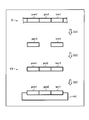
- FIG. 1 is a diagram showing an outline of a schedule for cultivation management and the like.
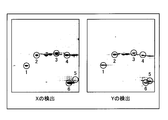
- FIG. 2 is a diagram showing an image analysis result of two-dimensional gel electrophoresis of proteins.
- FIG. 3 is a diagram schematically showing the process of constructing an expression vector.
- the method for cultivating a genetically modified plant of the present invention is a method for cultivating a genetically modified plant having predetermined characteristics under predetermined conditions. Therefore, in the following, embodiments of the present invention will be described in detail in the following order. 1. 1. Method for producing a genetically modified plant Method for cultivating genetically modified plant and method for producing seed
- Step A is a step of detecting RNA and seed storage proteins that are highly expressed under high nitrogen cultivation conditions in a predetermined plant.
- step B a promoter that regulates the expression of RNA and seed storage protein that are highly expressed under high nitrogen cultivation conditions is isolated, an expression vector containing a polynucleotide encoding the target protein is prepared, and the expression vector is used as a host plant cell. This is a process for producing a genetically modified plant by introducing into.
- RNA detection method of step A RNA satisfying the following formula (1) is detected.
- L is the amount of RNA contained in seeds of a given plant grown in a medium adjusted to L to 750 mg / L
- W is between 30 days before the expected flowering date and the flowering date (This is the amount of RNA contained in the seeds of the plant when the plant is cultivated in a medium adjusted to have a nitrogen concentration of 0 mg / L to 50 mg / L for a certain period.)
- RNA satisfying the above formula (1) is RNA highly expressed under high nitrogen cultivation conditions. Expression control regions such as promoters that promote RNA expression under high nitrogen cultivation conditions can be collected from the RNA information thus detected.
- Detection of seed storage protein> the plant is cultivated under at least two different nitrogen conditions, and a high expression level is obtained in a certain plant species under a predetermined high nitrogen cultivation condition using the difference in the amount of seed storage protein accumulation as an index. The seed storage protein is detected.
- a seed storage protein that satisfies the following formula (2) is detected.
- L is the seed storage protein content of the plant when the plant is cultivated in a medium adjusted to be L to 750 mg / L
- Y is nitrogen for a certain period from 30 days before the flowering date to the flowering date (The seed storage protein content of the plant when the plant is grown in a medium adjusted to 0 mg / L to 50 mg / L.)
- the seed storage protein that satisfies the above formula (2) is a seed storage protein that is highly expressed under high nitrogen cultivation conditions.
- Expression control regions such as a promoter that promotes expression of the seed storage protein under high nitrogen cultivation conditions can be collected from the information of the seed storage protein thus detected.
- the “predetermined plant” in step A means a plant to be tested.
- the plant to be tested in step A is a plant to be searched for a promoter that promotes the expression of RNA and seed storage protein, and appropriately considering conditions such as the type of genetically modified plant to be produced later You may choose.
- the plant to be detected for RNA and seed storage protein is not particularly limited as long as seeds are formed.
- typical examples of dicotyledonous plants include tobacco, rapeseed, and soybean
- examples of monocotyledonous plants include cereals such as rice, corn, barley, and wheat, asparagus, and the like.
- rice is a suitable plant because it has a high ability to accumulate proteins in seeds and has good seed preservation.
- the plant to be examined is cultivated under at least two different nitrogen conditions.
- cultivation is performed under the first cultivation condition and the second cultivation condition.
- the first cultivation condition is a condition where the supplied nitrogen concentration is high.
- the second cultivation condition is a condition in which the nitrogen concentration is relatively lower than the first cultivation condition.
- nitrate nitrogen is 50 mg / L to 750 mg / L and / or ammonium nitrogen is 50 mg / L to 750 mg / L in a certain period between 30 days before the flowering date and the flowering date. Cultivate in a medium adjusted to
- Second cultivation condition Cultivation is performed in a medium adjusted to be 0 mg / L to 50 mg / L of nitrogen for a certain period from 30 days before the flowering date to the flowering date.
- Nitrogen conditions in the medium start from 30 days before the scheduled flowering date.
- the expected date of flowering varies from plant to plant, but research has been done for each plant at which point in the cultivated crops. For example, in the case of rice, 30 days before the scheduled flowering date corresponds to the young panicle differentiation stage.
- the nitrogen condition in the medium is adjusted for a certain period from 30 days before the scheduled flowering date to the flowering date. It is important to expose the plant to high nitrogen conditions at least once during this period to provide a certain physiological stimulus. That is, the “certain period” herein may be a period sufficient to give a certain physiological stimulus to the plant.
- the period of the high nitrogen condition may be appropriately adjusted depending on conditions such as the growth state of the plant and the type of plant. Although it varies depending on conditions such as the growth state of the plant and the type of plant, it is preferably cultivated under high nitrogen cultivation conditions, preferably for about 1 week, more preferably for about 2 weeks.
- the plant it is preferable to place the plant under high nitrogen cultivation conditions immediately after 30 days before the scheduled flowering date and / or for a certain period immediately before flowering.
- it may be placed under high nitrogen cultivation conditions over the entire period from 30 days before the flowering date to the flowering date.
- the nitrogen concentration in the medium easily fluctuates due to the absorption of nutrients by the plant and the ability to retain the fertilizer in the medium.
- fertilization management may be performed so as to be within the above concentration range.
- the timing and frequency of fertilization, the concentration of fertilizer, and the like may be appropriately adjusted.
- the measurement of nitrogen concentration in the medium is based on general soil analysis methods and fertilizers such as nitrate ion meters, ammonia nitrogen meters, and fertilizer analysis methods established by the Ministry of Agriculture, Forestry and Fisheries. This can be done based on analytical methods.
- Nitrate nitrogen is a nitrogen component that exists in the form of nitric oxide, such as nitrate ions. Usually, it exists in the form of nitrate in which a metal is bound to nitrate ions in the form of NO 3 ⁇ . Moreover, ammonium nitrogen is a nitrogen component which exists in the form of ammonium salt among nitrogen components.
- Adjustment of the nitrogen source in the medium is performed so that nitrate nitrogen in the medium is 70 mg / L to 750 mg / L and / or ammonium nitrogen in the medium is 70 mg / L to 750 mg / L. That is, both nitrate nitrogen and ammonium nitrogen may be used as the nitrogen source, and the concentrations thereof may be adjusted, respectively, or only one of them may be used as the nitrogen source to adjust the concentration. Preferably, both are used as nitrogen sources.
- the ratio of the content of nitrate nitrogen and ammonium nitrogen is, for example, 750: 0 to 0: 750, preferably 100: 1 to 1: 100, more preferably 30: 1 to 1:30, more The ratio is preferably 10: 1 to 1:10, more preferably about 3: 1 to 1: 3.
- the content of nitrate nitrogen in the first cultivation condition is 70 mg / L to 750 mg / L, preferably 100 mg / L to 700 mg / L, more preferably 150 mg / L to 700 mg / L.
- the content of nitrate nitrogen is adjusted to 70 mg / L or less, the content of the seed storage protein is decreased, and it is difficult to obtain an appropriate index for comparison with the second cultivation condition.
- the content of nitrate nitrogen is adjusted to 750 mg / L or more, root rot is likely to occur, resulting in poor growth.
- the content of ammonium nitrogen in the first cultivation condition is 70 mg / L to 750 mg / L, preferably 100 mg / L to 700 mg / L, more preferably 150 mg / L to 700 mg / L.
- the content of ammonium nitrogen is adjusted to 70 mg / L or less, the stored protein content of the seed is reduced, and it is difficult to obtain an appropriate index compared with the case of the second cultivation condition.
- the content of ammonium nitrogen is adjusted to 750 mg / L or more, root rot is likely to occur, resulting in poor growth.
- fertilization management suitable for the plant may be appropriately performed according to the type of plant to be cultivated.
- examples of other components contained in the medium include phosphorus, potassium, manganese, boron, iron, calcium, copper, zinc, and magnesium.
- Plant cultivation includes hydroponics or soil cultivation.
- soil cultivation since the fertilizer component is adsorbed in the soil, there is an advantage that rapid fluctuation of the fertilizer component can be suppressed, but on the other hand, the fertilizer component that can be used by the plant is reduced.
- hydroponics all fertilizer components in the medium are in a state where the plant can be used.
- RNA contained in seeds obtained from the plants grown under the first and second cultivation conditions is measured.
- the amount of RNA contained in the seeds of the plant cultivated under the first cultivation condition is V
- the amount of RNA contained in the seeds of the plant cultivated under the second cultivation condition is W.
- RNA contents V and W can use various known RNA detection methods.
- the amount of RNA can be measured using a microarray as follows. First, RNA is extracted from seeds, and a fluorescently labeled cDNA is synthesized and then hybridized with a DNA fragment on a microarray. After capturing a microarray image using a scanner, the fluorescence intensity of each spot is calculated using analysis software. The amount of RNA can be determined from the calculated spot intensity.
- the seed from which RNA is extracted is preferably a seed from 15 days after flowering to 25 days after flowering where RNA is actively synthesized.
- RNA to be measured may be RNA contained in seeds.
- RNA for obtaining the V / W value for example, in the case of rice, for example, AK101497, AK120826, AJ002893, Os05g0329200, AK107271 (glutelin A-3), AK102194, AK120697, AK067141, AK063609, AF017205, AK0771 , AK059164, AK107238, AB016505, AK099086, AY166458, AY987390 (Gluterin B-2), AK107314, X15833, AY196923 (Gluterin B-5), AK061894, AK107343K (Gluterin B-1), AK06A1350J, J AK10763 , U43530, AK064310, AK064485, AK101309, AK107983, AK099918, AK100306, X83434, AK070414, AK
- RNAs satisfying the requirements are selected. Satisfying the formula (1) has a high probability of being RNA whose expression level increases under predetermined high nitrogen cultivation conditions.
- a DNA promoter encoding such RNA has a high probability of further promoting protein expression under high nitrogen cultivation conditions.
- the value of V / W is preferably 1.25 or more, more preferably 1.5 or more, and further preferably 2.0 or more.
- the value of V / W is 1 or less, even if the amount of nitrogen in the medium is increased, the effect of high production of the desired target protein cannot be expected.
- Proteins stored in seeds obtained from plants grown under the first and second cultivation conditions are measured. Let X be the seed storage protein content of the plant cultivated under the first cultivation condition, and Y be the seed storage protein content of the plant cultivated under the second cultivation condition.
- the seed storage protein content X and Y can use various known protein detection methods.
- the protein content can be measured using electrophoresis as follows. First, various child storage proteins are separated into single spots on the gel by two-dimensional gel electrophoresis. Next, after the gel information is converted into an image file by a scanner, the fluorescence intensity of each spot is calculated using image analysis software. The protein content can be determined from the calculated spot intensity.
- the seed from which protein is extracted is desirably a seed after 30 days after flowering, in which seed storage protein is sufficiently accumulated, preferably 45 days after flowering.
- the protein to be measured may be a seed storage protein.
- the seed storage protein for determining the X / Y value include, for example, in the case of rice, glutelin, globulin, prolamin protein and the like, and more specifically, glutelin B-1, glutelin B- 2, glutelin B-5, glutelin A-3, globulin, 13 KDa prolamin and the like.
- Select a seed storage protein that satisfies Satisfying the formula (2) is highly likely to be a seed storage protein whose expression level increases under predetermined high nitrogen cultivation conditions.
- such a seed storage protein promoter has a high probability of further promoting protein expression under high nitrogen cultivation conditions.
- the value of X / Y is preferably 1.5 or more, more preferably 2.0 or more.
- the value of X / Y is 1 or less, even if the amount of nitrogen in the medium is increased, the effect of producing a desired target protein at a high level cannot be expected.
- RNA and seed storage proteins whose expression levels increase under predetermined high nitrogen cultivation conditions can be selected.
- the selected RNA and seed storage protein promoters promote protein expression under high nitrogen cultivation conditions.
- Step B Production of transformant>
- a promoter that regulates the expression of RNA and seed storage protein that are highly expressed under high nitrogen cultivation conditions is isolated.
- Such a promoter can be isolated from, for example, a plant to be tested in the above-described step A and from which RNA and seed storage proteins that are highly expressed under high nitrogen cultivation conditions are detected.
- a promoter can be isolated from expression control regions located upstream of nucleic acids encoding RNA and seed storage proteins.
- RNAs and seed storage proteins and nucleic acid sequences encoding them are known from known databases and the like.
- the location and sequence of promoters that regulate the expression of RNA and seed storage proteins may also be known.
- a promoter may be specified using a known sequence, or a nucleic acid sequence encoding the RNA and seed storage protein selected in step A is searched, and the upstream nucleic acid sequence is used as a promoter. May be.
- the promoter may be identified by, for example, a commonly observed sequence such as a TATA box, CCAAT box, or GC rich sequence located upstream of the transcription region, or a known protein may be encoded.
- the nucleic acid sequence to be presumed to be a promoter and a nucleic acid sequence may be linked, and the expression level of a known protein may be measured and specified.
- An expression vector for expressing the target protein is constructed.
- the expression vector includes at least a promoter identified as described above and a nucleic acid encoding a target protein.
- a terminator, a known expression promoting sequence, a marker sequence, and the like may be inserted into the expression vector.
- the promoter identified as described above is prepared so that it can be incorporated into a vector. Promoters may be isolated from selected plant cells or may be sequenced and synthesized. A vector suitable for introduction into a plant cell is preferred. Moreover, a vector can use well-known or a commercially available thing.
- the target protein may be any protein or peptide that is expected to be highly expressed in seeds.
- a preferred embodiment includes so-called functional proteins.
- Functional protein means proteins useful for human beings such as antibacterial components and enzymes.
- the nucleic acid encoding the target protein can be obtained by a technique such as cloning of cDNA or genomic DNA. Moreover, if the DNA sequence is clarified beforehand, these may be obtained by chemical synthesis. Furthermore, even if the DNA sequence is not clear, if the amino acid sequence is clear, the DNA sequence deduced from the amino acid sequence can be chemically synthesized.
- An nucleic acid encoding the target protein can be placed downstream of the promoter and inserted into the vector to produce an expression vector.
- a method for cleaving and binding a nucleic acid fragment at a predetermined position is possible by using a known restriction enzyme or the like.
- step (S1) the promoter (pmr1) contained in the chromosome G contained in the plant cell selected in step A is isolated.
- the promoter (pmr1) and the terminator (tmr1) constitute a region that regulates the expression of the protein (ptn1).
- a promoter (pmr1) and a terminator (tmr1) are amplified by a technique such as PCR.
- PCR primers can be appropriately designed based on sequences before and after the promoter (pmr1) and terminator (tmr1) in chromosome G, respectively.
- step (S2) a nucleic acid fragment (F2) sandwiching a nucleic acid (ptn2) encoding a target protein between the promoter (pmr1) and terminator (tmr1) obtained by amplification is constructed.
- step (S3) the nucleic acid fragment (F2) obtained in step (S2) is incorporated into a plasmid vector (vct). In this way, an expression vector can be constructed.
- a plant cell producing the target protein as a genetically modified plant is used as a host into which the vector prepared as described above is introduced.
- the type of plant used as a host is not limited as long as the above promoter is recognized and the target protein can be expressed.
- the plant to be used as a host is suitable for the production of the target protein in consideration of the ease of cultivation management, the environment of the cultivation area, the growth period, the ease of harvesting, and the conditions such as the nature, size and yield of the seed. You may select a thing suitably.
- a preferred embodiment includes a form in which the same plant species as the promoter is selected as the host.
- Plants to be used as hosts that is, plants to be cultivated as genetically modified plants include, for example, dicotyledonous plants such as tobacco, rapeseed, and soybeans, cereals such as rice, corn, barley, and wheat, asparagus, etc. And monocotyledonous plants.
- dicotyledonous plants such as tobacco, rapeseed, and soybeans
- cereals such as rice, corn, barley, and wheat, asparagus, etc.
- monocotyledonous plants are examples of rice.
- rice is a suitable plant because it has a high ability to accumulate proteins in seeds and has good seed preservation.
- the plant cell to be transformed is preferably a plant that can be regenerated as it is and cultivated in large quantities as a genetically modified plant.
- Examples of methods for introducing the constructed expression vector into plant cells include physical or chemical methods such as microinjection, electroporation, polyethylene glycol, fusion, and high-speed ballistic penetration. It can be used as a method for direct introduction into animal cells (I. Potrykus, Annu. Rev. Plant Physiol. Plant Mol. Biol., 42: 205, 1991). In addition, for plant cells, an indirect introduction method performed through viruses or bacteria that infect plants can also be used (I. Potrykus, Annu. Rev. PlantP Physiol. Plant Mol. Biol., 42: 205, 1991). In this case, cauliflower mosaic virus, gemini virus, tobacco mosaic virus, brom mosaic virus, etc. can be used as the virus, and Agrobacterium tumefaciens, Agrobacterium lysogenes, etc. can be used as the bacteria.
- a recombinant tissue or a recombinant individual is cultured from the plant cell introduced with the foreign gene by the above method.
- Cells that have undergone gene transfer treatment are appropriately grown and re-differentiated by selection using the target gene or selection marker gene as a marker while selecting specific traits for expression or loss of specific traits due to gene deletion, etc.
- a recombinant tissue or a recombinant individual can be cultured.
- a seed can be collected from a plant obtained by redifferentiation, and the gene recombinant can be propagated using the obtained seed.
- the productivity of the desired target protein is improved by the present invention is presumed as follows. It is presumed that a gene involved in amino acid synthesis can be activated by giving an excessive amount of nitrogen as a raw material for amino acid production during the reproductive growth period before the flowering period. It is presumed that when the seed ripening stage after the flowering period begins, the protein synthesis gene of the seed is activated by the influence of the amino acid accumulated in the plant body and the gene involved in the synthesis of the activated amino acid. Furthermore, it is considered that the target protein can be produced more efficiently by using the promoter region of the protein synthesis gene that is more activated than other protein synthesis genes.
- the method for cultivating a genetically modified plant and the method for producing seeds comprises the steps of preparing a genetically modified plant that can be prepared as described above in “1. Method for producing a genetically modified plant”. It is cultivated under conditions. Specific embodiments will be described later, but once transformed so as to highly express the target protein under high nitrogen cultivation conditions as described in “1. Method for producing a genetically modified plant” above. After obtaining the genetically modified plant, it is not always necessary to repeat Step A: detection of RNA and seed storage protein and Step B: preparation of transformation as described above. That is, once a genetically modified plant transformed so as to express the target protein at high levels under high nitrogen cultivation conditions is obtained, the genetically modified plant is maintained as a line according to the normal breeding method of the plant species. The plant may be repeatedly cultivated.
- Method for producing a genetically modified plant is a nitrate nitrogen of 70 mg / L to 750 mg for a certain period between 30 days before the expected flowering date and the flowering date. / L and / or cultivated in a medium adjusted so that ammonium nitrogen is 70 mg / L to 750 mg / L.
- Process C is a process of cultivating the genetically modified plant under predetermined high nitrogen cultivation conditions.
- the embodiment of the cultivation condition in the step C is applied in the same manner except for the part relating only to the “second cultivation condition” (that is, in the case of the low nitrogen condition) in the “1. obtain.
- Method for producing a genetically modified plant is similarly applied with respect to the cultivation nitrogen condition, Other conditions related to cultivation: the start time of a predetermined nitrogen condition and its form for a certain period, the form for controlling the nitrogen concentration in the medium, the form for measuring the nitrogen concentration in the medium, the nitrogen source in the medium
- the form of adjustment, the form of fertilization management, the form of hydroponics or soil cultivation, etc. are applied in the same manner as the embodiment described in ⁇ Cultivation conditions> in “1. Production method of genetically modified plant” above. obtain.
- specific cultivation conditions other than the nitrogen condition may be appropriately adjusted according to the type of plant for the genetically modified plant.
- the genetically modified plant cultivated in the present invention can be used as it is or after it is taken in the form of the introduced target protein separated and purified.
- the cultivation method of the genetically modified plant of the present invention is also a seed production method. Since seed protein has high storability, the seeds include grasses, more preferably rice.
- the target protein is highly expressed in the seeds produced by the seed plant production method of the present invention.
- the target protein may be purified from the seed, or the seed itself may be used as it is.
- the target protein is a functional protein that can be ingested by humans, the seed can be easily ingested as it is or after cooking.
- RNA and seed storage proteins were detected and based on it. It is not necessary to repeat the production of genetically modified plants every time. For example, once a promoter that regulates the expression of RNA and seed storage protein that can be highly expressed under high nitrogen cultivation conditions for a certain plant species is identified, it is necessary to detect RNA and seed storage protein in Step A each time. However, a genetically modified plant can be produced based on the findings.
- a promoter is isolated from rice, preferably AK101497, AK120826, AJ002893, Os05g0329200, AK107271 (glutelin A-3), AK102194, AK120697, AK067141, AK065009, AF017360, AK07205, AK059164, AK107238, AB016505, AK099086, AY166458, AY987390 (Gluterin B-2), AK107314, X15833, AY196923 (Gluterin B-5), AK061894, AK1073435 (Gluterin B-1), AK061395A , AK107633, U43530, AK064310, AK064485, AK101309, AK107983, AK099918, AK100306, X83434, AK070414, AK103220, AK121856, AK062758, AK103306, AK061207,
- Examples include promoters of glutelin B-1 and glutelin B-5. These promoters can promote the expression of structural genes downstream thereof under high nitrogen cultivation conditions. When these promoters are used, rice is preferred as a plant to be transformed. That is, as another embodiment of the method for cultivating a genetically modified plant of the present invention, a promoter that regulates the expression of DNA encoding RNA contained in seeds satisfying V / W> 1.0, glutelin, and globulin And a gene set transformed by introducing an expression vector containing a promoter that regulates the expression of a seed storage protein selected from prolamin and the like, and a polynucleotide encoding a target protein that is to be highly expressed
- the replacement plant is treated with nitrate nitrogen at 70 mg / L to 750 mg / L and / or ammonium nitrogen at 70 mg / L to 750 mg / L for a certain period between 30 days before the flowering date and the flowering date.
- the genetically modified plant line may be maintained according to the normal breeding method of the plant species, and this may be cultivated according to the above step C.
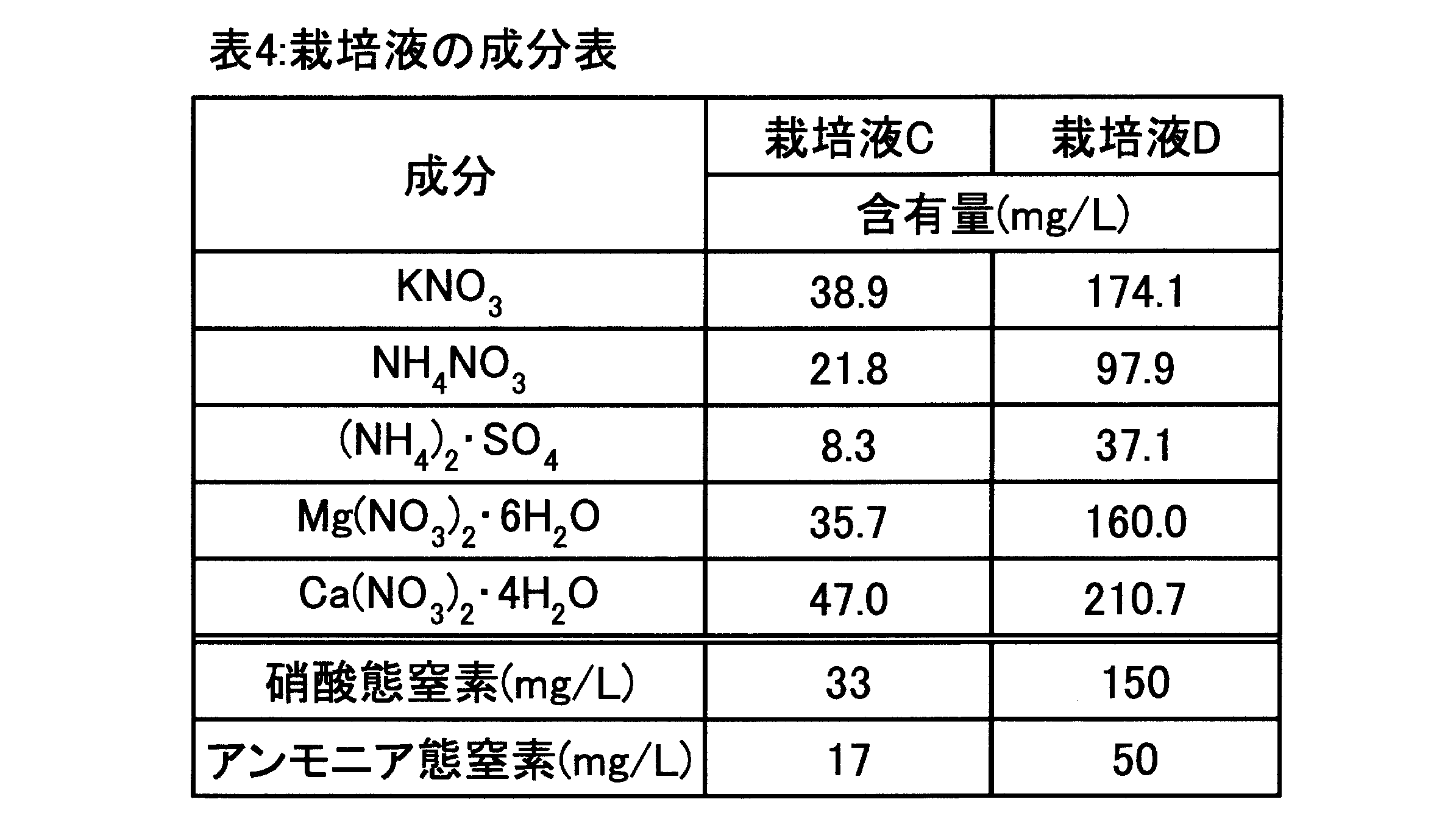
- Example 1 Cultivation of plants Rice was cultivated under the first and second cultivation conditions as described below. An outline of the cultivation schedule is shown in FIG. In addition, Table 1 shows the composition of the cultivation liquid A and the cultivation liquid B used.
- RNA content V and seed storage protein X Seed of Nipponbare, a rice variety, was sterilized with hypochlorous acid and ethanol, spread evenly in a petri dish containing sterilized water, shielded from light, and cultured at 28 degrees for 5 days.
- the nitrogen concentration in the medium was controlled by controlling the nitrogen concentration of the moisture in the cultivation bed.
- the nitrate nitrogen concentration was measured using a nitrate ion composite electrode (manufactured by Toa DKK Corporation).
- the ammonium nitrogen concentration was measured using an ammonia composite electrode (manufactured by Toa DKK Corporation).
- RNA content W and seed storage protein Y> Nipponbare seeds were sterilized with hypochlorous acid and ethanol, spread evenly on a petri dish containing sterilized water, protected from light, and cultured at 28 degrees for 5 days.
- Top fertilization was performed so that nitrogen in the soil was 50 mg / L, light conditions: temperature 28 degrees, humidity 50%, 11 hours, dark conditions: temperature 23 degrees, humidity 50%, 13 hours, cultured for 45 days, seeds Got.
- RNA analysis Preparation of microarray sample>
- RNA sample Each seed on the 20th day after flowering obtained by cultivation under the above conditions was frozen in liquid nitrogen, crushed in a mortar, treated with Fruit-mate for RNA Purification (purchased from Takara Bio Inc.), RNAiso Plus ( (Purchased from Takara Bio Inc.). Then, it is treated with Recombinant DNase I (RNase-free) (purchased from Takara Bio Inc.), purified with Oligotex TM -dT30 ⁇ Super> mRNA Purification Kit (From Total RNA) (purchased from Takara Bio Inc.), and the RNA solution is purified. Obtained.
- RNA was adjusted to 800 ng / 1 sample and dispensed into tubes so that 400 ng for cyanine 3-CTP dye label and 400 ng for cyanine 5-CTP dye label were obtained.
- Cyanine-labeled cRNA was generated using Low RNA Fluorescent Linear Amplification Kit PLUS, 2 color (purchased from Agilent Technologies), and purified using RNeasy mini kit (purchased from Qiagen).
- Cyanine 3-CTP dye-labeled cDNA 825 ng and cyanine 5-CTP dye-labeled cDNA 825 ng were each dispensed into tubes, treated with Gene Expression Hybridization Kit (purchased from Agilent Technologies), and then rice oligo DNA microarray 4 x 44K RAP. -Filled DB (purchased from Agilent Technologies) and hybridized.
- BIO-RAD BIO-RAD LABORATORIES
- BIO-RAD BIO-RAD LABORATORIES
- Isoelectric focusing for protein separation in the first dimension was carried out using PROTEAN IEF cell (purchased from BIO-RAD) and 7 cm ReadyStrip IPG Strip 3-7NL (purchased from BIO-RAD). Electrophoresis for protein separation in the second dimension was performed by equilibrating IPG Strip with equivalence buffer I and equivalence buffer II (purchased from BIO-RAD), and PROTENAN cell (purchased from BIO-RAD) and 10-20% resolving This was performed using Gel Precast Gel (purchased from BIO-RAD). Samples were run with a molecular weight marker and an isoelectric point pl calibration marker for calculation of the molecular weight and isoelectric point of the protein spot during image analysis. Immediately after the two-dimensional SDS-PAGE, Gel was infiltrated into a fixative containing 40% ethanol and 10% acetic acid for 2 hours and treated with Flamingo Gelstein (purchased from BIO-RAD).
- FIG. 2 shows an image analysis diagram of the two-dimensional gel
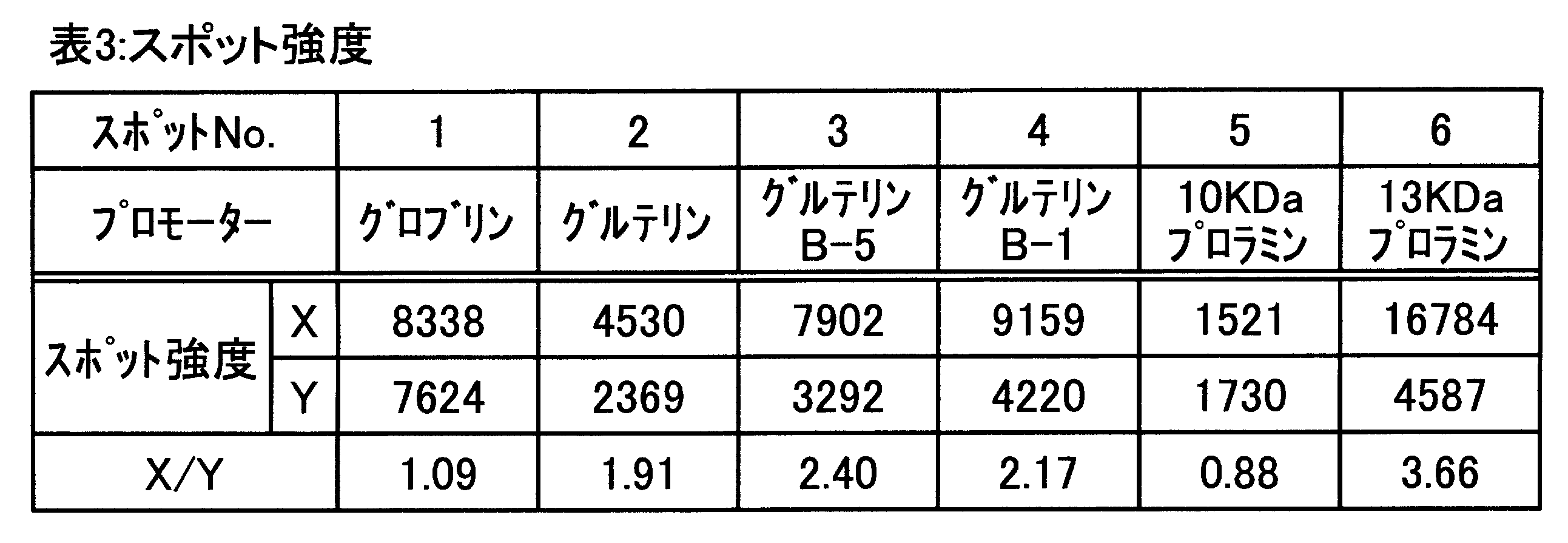
- Table 3 shows spot intensity values.
- a nucleic acid sequence around the nucleic acid encoding glutelin B-1 was searched from Rice Annotation Project Database, and a nucleic acid sequence of 1.0 kb downstream of the nucleic acid encoding glutelin B-1 was obtained as a terminator sequence.
- a PCR primer was designed based on the obtained nucleic acid sequence information, and a fragment (fragment A) containing a promoter sequence of glutelin B-1 and a signal peptide sequence of glutelin B-1 with an Sse8387I site added to the N-terminus (Primer1: CCTGCAGGACAGATTCTTTGCTACCACACA ( SEQ ID NO: 1), Primer2: CAGGAGTGTTGGAGTATCGAGGTAAAAGAA (SEQ ID NO: 2)), a fragment containing a terminator sequence of glutelin B-1 with an SacI site added to the N-terminus and an EcoRI site added to the C-terminus (fragment B) (Primer3: GAGCTCTGTTAGATTGACGA 3) Primer 4: GAATTCTCTTAACTTTTACCTATGAT (SEQ ID NO: 4)) by PCR Acquired.
- fragments A and B were E. coli using Zerobrand TOPO PCR Cloning Kit (purchased from Invitrogen). It was introduced into E. coli and amplified. Fragment A, 7crp (hay fever alleviation peptide) and fragment C (JP 2004-321079) linked with KDEL sequences were treated with NcoI (purchased from Takara Bio Inc.), and then DNA Ligation Kit (purchased from Takara Bio Inc.) Connected. Fragment B and fragment B in which fragment A and fragment C were linked were treated with SacI (purchased from Takara Bio Inc.) and then linked using DNA Ligation Kit (purchased from Takara Bio Inc.).
- ligated fragments (A, B, C) were treated with Sse8387I (purchased from Takara Bio Inc.) and EcoRI (purchased from Takara Bio Inc.), plasmid pTL7 (H. Ebinuma et al., Molecular Methods of Plant Analysis, 22:95, 2002) was linked between EcoRI-Sse8387I restriction enzyme sites using DNA Ligation Kit (purchased from Takara Bio Inc.) to construct an expression vector.
- corresponds to each in a sequence table, respectively.
- Agrobacterium tumefaciens (A. tumefaciens) strain EHA105 was added to 10 ml of YEB liquid medium (5 g / l beef extract, 1 g / l yeast extract, 5 g / l peptone, 5 g / l sucrose, 2 mM MgSO 4 , pH 7 at 22 ° C. .2 (hereinafter referred to as pH at 22 ° C. unless otherwise indicated)) and culturing at 28 ° C. until OD.630 ranges from 0.4 to 0.6. Was centrifuged at 6900 ⁇ g and 4 ° C. for 10 minutes to recover the cells.
- the collected cells are suspended in 20 ml of 10 mM HEPES (pH 8.0) and collected again by centrifugation at 6900 ⁇ g, 4 ° C. for 10 minutes, and the cells are suspended in 200 ⁇ l of YEB liquid medium.
- a bacterial solution for plasmid introduction was obtained.
- 50 ⁇ l of the above-mentioned bacterial solution for plasmid introduction and an expression vector are mixed, and expressed in A. tumefaciens EHA105 strain using electroporation method (Gen Pulser II system (purchased from BIORAD)). Vector introduction processing was performed.
- the cells after the expression vector introduction treatment were added with 200 ⁇ l of YEB liquid medium, cultured at 25 ° C. for 1 hour with shaking, and then 50 mg / l kanamycin-added YEB agar medium (agar 1.5 w / v%). The other compositions were the same as above.) And cultured at 28 ° C. for 2 days. Subsequently, the resulting bacterial colonies were transplanted into a YEB liquid medium and further cultured. Plasmids were extracted from the grown bacterial cells by the alkaline method, and it was confirmed that expression vectors were introduced into these bacterial cells.
- Agrobacterium EHA105 introduced with an expression vector cultured in a YEB agar medium (15 g / l bacto agar, other composition is the same as above) was transplanted into a YEB liquid medium and cultured overnight at 25 ° C. and 180 rpm.
- the adjusted rice germination seeds were put into a 50 ml tube, and the Agrobacterium suspension for pouring was poured and immersed for 1.5 minutes.
- N6Cl2 medium N6 inorganic salts and vitamins, 30 g.
- sucrose, 2.8 g / l proline, 0.3 g / l casamino acid, 2 mg / l 2,4-D, 4 g / l gellite, pH 5.2
- N6Cl2TCH25 medium N6 inorganic salts and vitamins, 30 g / l sucrose, 2.8 g / l proline, 0.3 g / l casamino acid, 2 mg / l 2,4-D , 500 mg / l carbenicillin, 25 mg / l hygromycin, 4 g / l gellite) and cultured.
- ⁇ Amount of functional protein (hay fever alleviation peptide: 7crp)>
- the protein in the seed and a protein marker of a known concentration were run with an SDS-PAGE kit (purchased from BIO-RAD), Gel was permeated into a fixative containing 40% ethanol and 10% acetic acid for 2 hours, and Flamingo Gelstein ( (Purchased from BIO-RAD).
- the treated gel was digitized using a Pharos FX Molecular Imager (purchased from BIO-RAD).
- the band position of 7crp was specified using Quantity One (purchased from BIO-RAD), and the weight of pollen alleviation peptide (7crp) was calculated in comparison with the band intensity of a marker of known concentration. In this way, the amount of total protein in the seed collected from the genetically modified plant and the amount of functional protein introduced by transformation were determined.
- Example 2 Except that the ammonium nitrogen content of the culture solution D was 150 mg / L, cultivation of the genetically modified plant and measurement of the protein content were performed in the same manner as in Example 1.
- Example 3 Cultivation of genetically modified plants and measurement of protein content were carried out in the same manner as in Example 1 except that the nitrate nitrogen content of the culture medium D was 50 mg / L and the ammonium nitrogen content was 150 mg / L. It was.
- Example 4 Cultivation of genetically modified plants and measurement of protein content were carried out in the same manner as in Example 1 except that the nitrate nitrogen content of the culture medium D was 600 mg / L and the ammonium nitrogen content was 200 mg / L. It was.
- Example 5 Cultivation of genetically modified plants and measurement of protein content were carried out in the same manner as in Example 1 except that the nitrate nitrogen content of the culture solution D was 70 mg / L and the ammonium nitrogen content was 70 mg / L. It was.
- Example 6 Cultivation of genetically modified plants and measurement of protein content were carried out in the same manner as in Example 1 except that the nitrate nitrogen content of the culture medium D was 750 mg / L and the ammonium nitrogen content was 750 mg / L. It was.
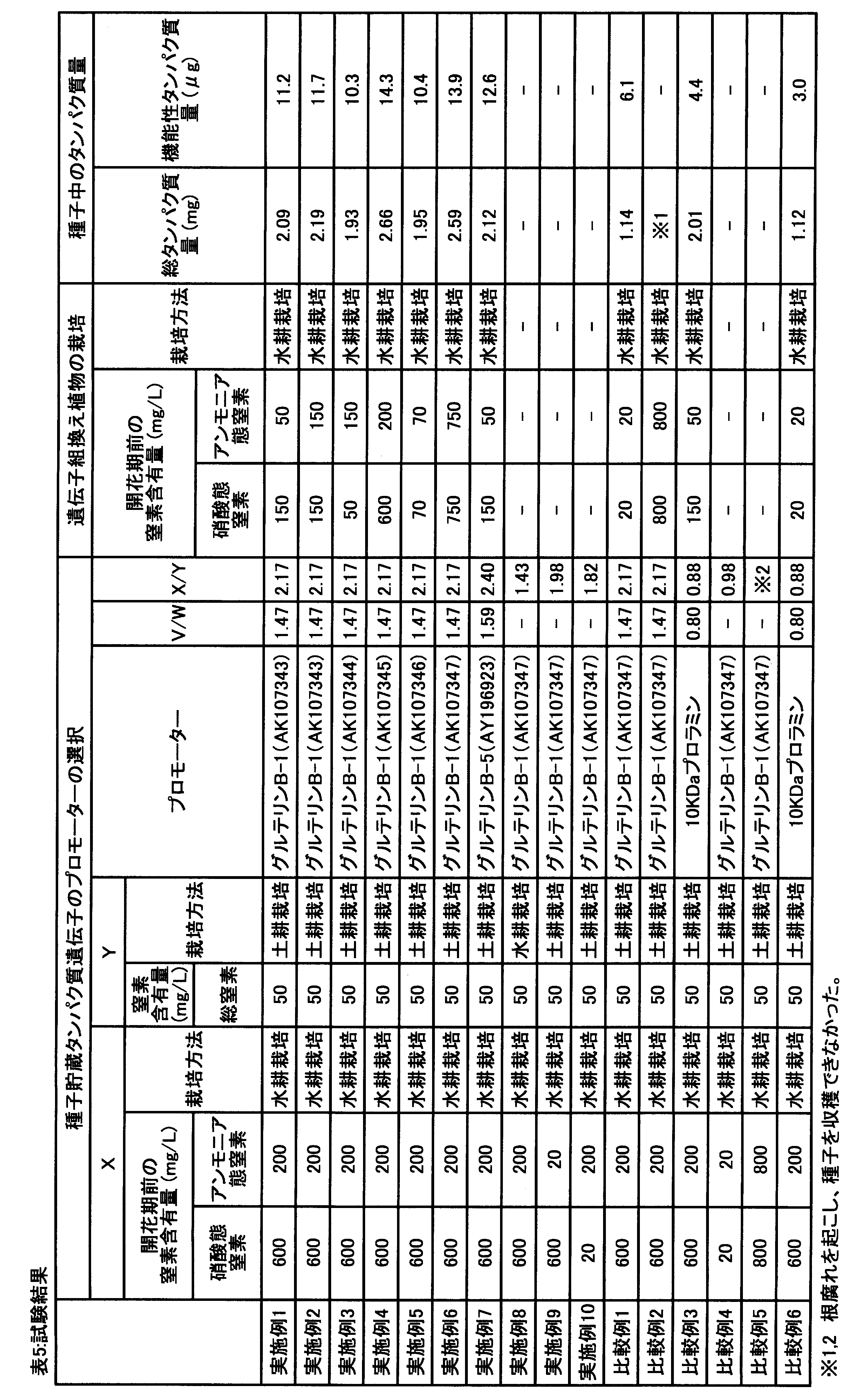
- Example 7 Except that the promoter for glutelin B-5 was used as a promoter for expression of the target protein, cultivation of the genetically modified plant and measurement of the protein content were carried out in the same manner as in Example 1.
- Example 8 Except that the cultivation condition of Y was hydroponics, cultivation of the genetically modified plant and measurement of protein content were carried out in the same manner as in Example 1.
- Example 9 Except that the ammonium nitrogen content of the culture broth B was 20 mg / L, the cultivation of the genetically modified plant and the protein content were measured in the same manner as in Example 1.
- Example 10 Except that the nitrate nitrogen content of the culture solution B was 20 mg / L, the cultivation of the genetically modified plant and the measurement of the protein content were performed in the same manner as in Example 1.
- Example 1 The cultivation of genetically modified plants and the measurement of protein content were carried out in the same manner as in Example 1 except that the nitrate nitrogen content of the culture solution D was 20 mg / L and the ammonium nitrogen content was 20 mg / L. went.
- Example 2 Cultivation of genetically modified plants and measurement of protein content were carried out in the same manner as in Example 1 except that the nitrate nitrogen content of the culture medium D was 800 mg / L and the ammonium nitrogen content was 800 mg / L. went.
- the present invention is useful in fields such as biological resource production, functional food production, biotechnology, and plant breed improvement.
- Sequence number 1 Primer 1 Sequence number 2: Primer 2 Sequence number 3: Primer 3 Sequence number 4: Primer 4
Landscapes
- Health & Medical Sciences (AREA)
- Genetics & Genomics (AREA)
- Life Sciences & Earth Sciences (AREA)
- Engineering & Computer Science (AREA)
- Biomedical Technology (AREA)
- Chemical & Material Sciences (AREA)
- Biotechnology (AREA)
- Organic Chemistry (AREA)
- General Engineering & Computer Science (AREA)
- Bioinformatics & Cheminformatics (AREA)
- Wood Science & Technology (AREA)
- Zoology (AREA)
- Molecular Biology (AREA)
- General Health & Medical Sciences (AREA)
- Physics & Mathematics (AREA)
- Biophysics (AREA)
- Plant Pathology (AREA)
- Microbiology (AREA)
- Cell Biology (AREA)
- Biochemistry (AREA)
- Nutrition Science (AREA)
- Proteomics, Peptides & Aminoacids (AREA)
- Medicinal Chemistry (AREA)
- Pharmacology & Pharmacy (AREA)
- Developmental Biology & Embryology (AREA)
- Pregnancy & Childbirth (AREA)
- Reproductive Health (AREA)
- General Chemical & Material Sciences (AREA)
- Breeding Of Plants And Reproduction By Means Of Culturing (AREA)
- Micro-Organisms Or Cultivation Processes Thereof (AREA)
Abstract
Description
V/W>1.0 ・・・(1)
(但し、式(1)において、Vは、開花予定日の30日前から開花日までの間の一定期間、硝酸態窒素が70mg/L~750mg/L、および/または、アンモニウム態窒素が70mg/L~750mg/Lとなるように調整した培地にて所定の植物を栽培した場合における該植物の種子に含まれるRNA量である。Wは、開花予定日の30日前から開花日までの間の一定期間、窒素0mg/L~50mg/Lとなるように調整した培地にて該植物を栽培した場合における該植物の種子に含まれるRNA量である。)
を満たす種子で発現するRNAの発現を調節するプロモーターと、前記プロモーターの下流に位置し目的タンパク質をコードするポリヌクレオチドとを含む発現ベクターが導入されて形質転換された遺伝子組換え植物を、該遺伝子組換え植物の開花予定日の30日前から開花日まで間の一定期間、硝酸態窒素が70mg/L~750mg/L、および/または、アンモニウム態窒素が70mg/L~750mg/Lとなるよう調整した培地にて栽培することを含む、遺伝子組換え植物の栽培方法。
〔2〕下記式(2):
X/Y>1.0 ・・・(2)
(但し、式(2)において、Xは、開花予定日の30日前から開花日までの間の一定期間、硝酸態窒素が70mg/L~750mg/L、および/または、アンモニウム態窒素が70mg/L~750mg/Lとなるように調整した培地にて所定の植物を栽培した場合における該植物の種子に含まれる種子貯蔵タンパク質の含有量である。Yは、開花予定日の30日前から開花日までの間の一定期間、窒素0mg/L~50mg/Lとなるように調整した培地にて該植物を栽培した場合における該植物の種子に含まれる該種子貯蔵タンパク質の含有量である。)
を満たす種子貯蔵タンパク質の発現を調節するプロモーターと、前記プロモーターの下流に位置し目的タンパク質をコードするポリヌクレオチドとを含む発現ベクターが導入されて形質転換された遺伝子組換え植物を、該遺伝子組換え植物の開花予定日の30日前から開花日まで間の一定期間、硝酸態窒素が70mg/L~750mg/L、および/または、アンモニウム態窒素が70mg/L~750mg/Lとなるよう調整した培地にて栽培することを含む、遺伝子組換え植物の栽培方法。
〔3〕前記所定の植物と前記遺伝子組換え植物とが、同種の植物種である、上記〔1〕および〔2〕に記載の遺伝子組換え植物の栽培方法。
〔4〕前記所定の植物がイネ科の植物であり、前記遺伝子組換え植物がイネ科の植物である、上記〔3〕に記載の遺伝子組換え植物の栽培方法。
〔5〕前記プロモーターが、グルテリン、グロブリン、およびプロラミンからなる群より選ばれる種子貯蔵タンパク質の発現を調節するプロモーターである、上記〔4〕に記載の遺伝子組換え植物の栽培方法。
〔6〕前記遺伝子組換え植物の栽培を、水耕栽培によって行う、上記〔1〕から〔5〕のいずれか一項に記載の遺伝子組換え植物の栽培方法。
〔7〕上記〔1〕から〔6〕のいずれか一項に記載の遺伝子組換え植物を栽培し、種子を採集することを含む、種子の生産方法。
〔8〕前記植物がイネであり、前記種子が米である、上記〔7〕に記載の種子の生産方法。
1.遺伝子組換え植物の作製方法
2.遺伝子組換え植物の栽培方法および種子の生産方法
本発明において用いられる遺伝子組換え植物を作製する方法は、概要として次の工程Aと工程Bの2つの工程に分けることができる。工程Aは、所定の植物において、高窒素栽培条件下で高発現するRNAおよび種子貯蔵タンパク質を検出する工程である。工程Bは、高窒素栽培条件下で高発現するRNAおよび種子貯蔵タンパク質の発現を調節するプロモーターを単離し、目的タンパク質をコードするポリヌクレオチドを含む発現ベクターを調製し、その発現ベクターを宿主植物細胞に導入して遺伝子組換え植物を作製する工程である。
工程AのRNAの検出においては、少なくとも2つの異なる窒素条件下で植物を栽培し、RNAの含有量の違いを指標として、ある植物種において所定の高窒素栽培条件下で高発現するRNAを検出するものである。
工程AのRNAの検出方法の実施形態としては、下記式(1)を満たすRNAを検出する。
V/W>1.0 ・・・(1)
(但し、式(1)において、Vは、開花予定日の30日前から開花日までの間の一定期間、硝酸態窒素が70mg/L~750mg/L、および/または、アンモニウム態窒素が70mg/L~750mg/Lとなるように調整した培地にて所定の植物を栽培した場合における該植物の種子に含まれるRNA量である。Wは、開花予定日の30日前から開花日までの間の一定期間、窒素0mg/L~50mg/Lとなるように調整した培地にて該植物を栽培した場合における該植物の種子に含まれるRNA量である。)
<工程A:種子貯蔵タンパク質の検出>
工程Aの種子貯蔵タンパク質の検出においては、少なくとも2つの異なる窒素条件下で植物を栽培し、種子貯蔵タンパク質の蓄積量の違いを指標として、ある植物種において所定の高窒素栽培条件下で高発現する種子貯蔵タンパク質を検出するものである。
工程Aの種子貯蔵タンパク質の検出方法の実施形態としては、下記式(2)を満たす種子貯蔵タンパク質を検出する。
X/Y>1.0 ・・・(2)
(但し、式(2)において、Xは、開花予定日の30日前から開花日までの間の一定期間、硝酸態窒素が70mg/L~750mg/L、および/または、アンモニウム態窒素が70mg/L~750mg/Lとなるように調整した培地で植物を栽培したときの該植物の種子貯蔵タンパク質含有量である。Yは、開花予定日の30日前から開花日までの間の一定期間、窒素0mg/L~50mg/Lとなるように調整した培地で植物を栽培したときの該植物の種子貯蔵タンパク質含有量である。)
工程Aにおける「所定の植物」とは、被検対象とする植物のことを意味する。工程Aにおいて被検対象とする植物は、RNAおよび種子貯蔵タンパク質の発現を促進するプロモーターを探索する対象とする植物であり、後に作製する遺伝子組換え植物の種類等の条件も参酌しつつ、適宜選択してよい。RNAおよび種子貯蔵タンパク質の検出対象となる植物としては、種子が形成されるものであれば、特に限定されるものではない。例えば、双子葉植物としては、タバコ、ナタネ、ダイズ等を、単子葉植物としては、イネ、トウモロコシ、オオムギ、コムギ等の穀類や、アスパラガス等を、代表的なものとして挙げることができる。これらのうちでもイネは、種子中へのタンパク質の蓄積能力が高く、種子の保存性が良好という点で好適な植物である。
被検対象となる植物は、少なくとも2つの異なる窒素条件下で栽培される。好ましい実施形態としては、第1の栽培条件および第2の栽培条件で栽培を行う。第1の栽培条件下は、供給される窒素濃度が高い条件下である。他方、第2の栽培条件は、第1の栽培条件より相対的に窒素濃度の低い条件下である。具体的には、次のような条件が例示される。
また、アンモニウム態窒素とは、窒素成分のうちアンモニウム塩の形態で存在する窒素成分のことである。
上記第1および第2の栽培条件下でそれぞれ栽培された植物から得られた種子に含まれるRNAを測定する。第1の栽培条件下で栽培された植物の種子に含まれるRNA量をV、第2の栽培条件下で栽培された植物の種子含まれるRNA量をWとする。
V/W>1.0 ・・・(1)
を満たすRNAを選抜する。式(1)を満たすということは、所定の高窒素栽培条件下において発現量が多くなるRNAである蓋然性が高い。また、このようなRNAをコードするDNAのプロモーターは、高窒素栽培条件下でタンパク質の発現をより促進する蓋然性が高い。V/Wの値は、好ましくは1.25以上であり、より好ましくは1.5以上であり、さらに好ましくは2.0以上である。他方、V/Wの値が1以下の場合、培地中の窒素量を増やしても、所望の目的タンパク質を高生産させる効果は期待できない。
上記第1および第2の栽培条件下でそれぞれ栽培された植物から得られた種子に貯蔵されるタンパク質を測定する。第1の栽培条件下で栽培された植物の種子貯蔵タンパク質含有量をX、第2の栽培条件下で栽培された植物の種子貯蔵タンパク質含有量をYとする。
X/Y>1.0 ・・・(2)
を満たす種子貯蔵タンパク質を選抜する。式(2)を満たすということは、所定の高窒素栽培条件下において発現量が多くなる種子貯蔵タンパク質である蓋然性が高い。また、このような種子貯蔵タンパク質のプロモーターは、高窒素栽培条件下でタンパク質の発現をより促進する蓋然性が高い。X/Yの値は、好ましくは1.5以上であり、より好ましくは2.0以上である。他方、X/Yの値が1以下の場合、培地中の窒素量を増やしても、所望の目的タンパク質を高生産させる効果は期待できない。
工程Bでは、まず高窒素栽培条件下で高発現するRNAおよび種子貯蔵タンパク質の発現を調節するプロモーターを単離する。このようなプロモーターは、例えば、上記工程Aで被検対象とされ、高窒素栽培条件下で高発現するRNAおよび種子貯蔵タンパク質が検出された植物から単離することができる。プロモーターは、RNAおよび種子貯蔵タンパク質をコードする核酸の上流に位置する発現調節領域から単離し得る。
目的タンパク質を発現させるための発現ベクターを構築する。発現ベクターは、少なくとも上記のようにして特定されたプロモーターと目的タンパク質をコードする核酸とを含む。発現ベクターにはその他にもターミネーター、公知の発現促進配列、マーカー配列などを挿入してもよい。
まず、ステップ(S1)として、工程Aで選抜された植物の細胞に含まれる染色体Gに含まれるプロモーター(pmr1)を単離する。プロモーター(pmr1)は、ターミネーター(tmr1)と共にタンパク質(ptn1)の発現を調整する領域を構成している。この染色体からPCRなどの手法により、プロモーター(pmr1)とターミネーター(tmr1)を増幅する。PCRプライマーは、染色体Gにおいてプロモーター(pmr1)およびターミネーター(tmr1)をそれぞれ挟む前後の配列に基づいて適宜設計できる。
上記のようにして作製されたベクターが導入される宿主としては、遺伝子組換え植物として目的タンパク質を生産する植物の細胞が用いられる。宿主とする植物の種類は、上記のプロモーターが認識され、目的タンパク質を発現し得るものであればよく、その他の点について限定されるものではない。宿主とする植物は、栽培管理の容易さ、栽培地の環境、成育期間、収穫の容易性、並びに、種子の性質、大きさ及び収量などの条件を考慮し、目的タンパクの生産面から好適なものを適宜選択してよい。また、上記にて取得したRNAおよび種子貯蔵タンパク質の発現を促進するプロモーターの由来と同じ種類の植物を宿主とすることにより、遺伝子発現システム上の弊害は避けやすい。そのため、好ましい一実施形態としては、プロモーターの由来と同じ植物種を宿主として選択する形態が挙げられる。
次に、構築した発現ベクターを用いて植物の形質転換細胞を作製する。形質転換される植物細胞は、工程の簡略化という観点からは、ホストとなる植物細胞は、これをそのまま再生し、遺伝子組換え植物として大量に栽培し得る植物であることが好ましい。
次に、上記の方法で外来遺伝子を導入した植物細胞から、組換え組織または組換え個体を培養する。遺伝子導入処理を行った細胞を、適宜、目的遺伝子や選抜マーカー遺伝子による特定形質の発現、遺伝子の欠失等による特定形質の消失などを指標として選抜を行いつつ、定法によって増殖させ、再分化させ、組換え組織または組換え個体を培養することができる。再分化して得られた植物から種子を採取し、得られた種子を利用して、遺伝子組換え体を繁殖させることができる。
本発明の遺伝子組換え植物の栽培方法は、上記「1.遺伝子組換え植物の作製方法」のようにして準備し得る遺伝子組換え植物を所定の条件下で栽培するものである。なお、具体的な実施形態については下記にて後述するが、上記「1.遺伝子組換え植物の作製方法」のようにして一旦、高窒素栽培条件下で目的タンパク質を高発現するように形質転換された遺伝子組換え植物を得た後は、上記のような工程A:RNAおよび種子貯蔵タンパク質の検出や、工程B:形質転換の作製を、必ずしもそれぞれ繰り返す必要はない。すなわち、一旦高窒素栽培条件下で目的タンパク質を高発現するように形質転換された遺伝子組換え植物を得た後は、その遺伝子組換え植物をその植物種の通常の繁殖方法にしたがって系統維持し、その植物を繰り返し栽培してもよい。
上記「1.遺伝子組換え植物の作製方法」により作製された遺伝子組換え植物を、該植物の開花予定日の30日前から開花日までの間の一定期間、硝酸態窒素が70mg/L~750mg/L、および/または、アンモニウム態窒素が70mg/L~750mg/Lとなるよう調整した培地で栽培する。
本発明で栽培された遺伝子組換え植物は、そのまま、あるいは導入された目的タンパク質を分離・精製した形で摂取して、利用することができる。
遺伝子組換え植物が種子植物である場合、本発明の遺伝子組換え植物の栽培方法は、種子の生産方法でもある。種子タンパク質の貯蔵性が高いことから、種子物としては、イネ科の植物、より好ましくはイネが挙げられる。
1.植物の栽培
下記のように第1の栽培条件および第2の栽培条件で、イネを栽培した。栽培のスケジュールの概要を図1に示す。また、用いた栽培液Aおよび栽培液Bの組成を表1に示す。

イネの一品種である日本晴の種子を次亜塩素酸とエタノールで殺菌後、滅菌水が入ったシャーレに均等に広げ、遮光した後、28度で5日間培養した。
日本晴の種子を次亜塩素酸とエタノールで殺菌後、滅菌水が入ったシャーレに均等に広げ、遮光した後、28度で5日間培養した。
<マイクロアレイ用試料の調整>
上記条件で栽培して得た開花後20日目の各々の種子を、液体窒素で凍結後、乳鉢で破砕し、Fruit-mate for RNA Purification(タカラバイオ社より購入)で処理後、RNAiso Plus(タカラバイオ社より購入)で抽出した。その後Recombinant DNase I(RNase-free)(タカラバイオ社より購入)で処理し、OligotexTM-dT30<Super>mRNA Purification Kit(From Total RNA)(タカラバイオ社より購入)で精製して、RNA溶液を得た。
シアニン 3-CTP色素ラベルしたcDNA825ngとシアニン 5-CTP色素ラベルしたcDNA825ngをそれぞれチューブに分注し、Gene Expression Hybridization Kit(アジレント・テクノロジー株式会社より購入)で処理後、イネ オリゴDNAマイクロアレイ 4 x 44K RAP-DB(アジレント・テクノロジー株式会社より購入)へ充填し、ハイブリダイゼーションさせた。
DNA マイクロアレイスキャナ(アジレント・テクノロジー株式会社製)で画像をスキャンし、スポットを数値化した。さらに、画像解析ソフトGeneSpring GX(アジレント・テクノロジー株式会社製)を用いて、V/W>1.0となるRNAを検出した。スポット強度の値を表2に示す。

<2次元ゲル用試料の調製>
上記第1および第2の栽培条件下で栽培して得た開花後45日目の各々の種子を、胚盤を取り除いた後に、マルチビーズショッカー(安井器械社製)で破砕し、8M尿素、4%(w/v)SDS、20%(w/v)グリセロール、50mMリン酸バッファーを含有する抽出溶液中にホモジナイズして、タンパク質溶液を得た。得られたタンパク質溶液をReadyPre 2-D Cleanup Kit(BIO-RAD LABORATORIES社(以下、BIO-RAD社と略称する)より購入)で精製し、ReadyStrip 7-10 Buffer(BIO-RAD社より購入)を添加した。RC DC Protein Assay(BIO-RAD社より購入)を用いて全タンパク質濃度を決定した。
1次元目のタンパク質分離用等電点電気泳動は、PROTEAN IEF cell(BIO-RAD社より購入)および7cm ReadyStrip IPG Strip 3-7NL(BIO-RAD社より購入)を用いて実施した。2次元目のタンパク質分離用電気泳動は、IPG Strip をequilibration buffer I、 equilibration buffer II(BIO-RAD社より購入) で平衡化し、PROTEAN cell(BIO-RAD社より購入)および 10-20% resolving Ready Gel Precast Gel(BIO-RAD社より購入)を用いて実施した。画像解析の際のタンパク質スポットの分子量および等電点計算のために、試料は分子量マーカー および等電点pl較正マーカーとともに泳動した。2次元SDS-PAGEの直後に、Gel を40%エタノール、10%酢酸を含有する固定液に2時間浸透し、Flamingo Gelstain(BIO-RAD社より購入)で処理した。
処理したゲルをPharos FX Molecular Imager(BIO-RAD社より購入)を用いてデジタル化した。Quantity OneおよびPDQuest(BIO-RAD社より購入)を用いて、6種類の種子貯蔵タンパク質のスポット位置をそれぞれ特定し、スポット強度を測定した。6種類の種子貯蔵タンパク質は、グロブリン、グルテリン、グルテリンB-5、グルテリンB-1、10KDaプロラミン、および13KDaプロラミンである。2次元ゲルの画像解析図を図2に、スポット強度の値を表3に示す。
<発現ベクターの作製>
上記「2.RNAの解析」「3.タンパク質の解析」の結果、V/W=1.47、X/Y=2.17であったグルテリンB-1をコードする核酸配列(GluB-1 gene:Accession No.X54314、AK107343)と、そのプロモーター配列(GluB-1 Promoter region:Accession No.AY427569)をNCBI Home Page, Nucleotide Databaseより取得した。グルテリンB-1をコードする核酸周辺の核酸配列をRice Annotation Project Databaseより検索し、グルテリンB-1をコードする核酸の下流1.0kbの核酸配列をターミネーター配列として取得した。
アグロバクテリウム ツメファシエンス(A.ツメファシエンス)EHA105株を、10mlのYEB液体培地(5g/lビーフエキス、1g/l酵母エキス、5g/lペプトン、5g/lショ糖、2mM MgSO4、22℃でのpH7.2(以下、特に示さない場合、22℃でのpHとする。))に接種し、OD.630が0.4から0.6の範囲に至るまで、28℃で培養した後、培養液を6900×g、4℃、10分間遠心して菌体を回収した。回収した菌体は、20mlの10mM HEPES(pH8.0)に懸濁して、再度6900×g、4℃、10分間遠心することにより集菌し、この菌体を200μlのYEB液体培地に懸濁して、プラスミド導入用菌液とした。 0.5mlチューブ内で、上記プラスミド導入用菌液50μlと発現ベクターとを混合し、エレクトロポレーション法(ジーンパルサーIIシステム(BIORAD社より購入))を用いて、A.ツメファシエンスEHA105株への発現ベクター導入処理を行った。発現ベクター導入処理後の菌体は、200μlのYEB液体培地を加えて25℃で、振とうしつつ1時間培養を行ってから、50mg/lカナマイシン添加YEB寒天培地(寒天1.5w/v%、他の組成は上記に同じ。)に播種し、28℃、2日間培養した。次いで、生じた菌コロニーをYEB液体培地に移植して更に培養し、増殖した菌体からアルカリ法でプラスミドを抽出して、これらの菌体に発現ベクターが導入されていることを確認した。
イネ品種「日本晴」の完熟種子を、細胞工学別冊 植物細胞工学シリーズ4 モデル植物の実験プロトコール(p93-98)の方法に従い殺菌した後、この完熟種子を、N6Cl2培地(N6無機塩類及びビタミン類(Chu C.C.、1978, Proc.Symp.Plant TissueCuture、Sience Press Peking、pp.43-50)、30g/lシュークロース、2.8g/lプロリン、0.3g/lカザミノ酸、2mg/l 2,4-D、4g/lゲルライト、pH=5.8)に置床し、サージカルテープでシールしてから28℃明所で培養して発芽させ、アグロバクテリウムEHA105による感染材料とした。YEB寒天培地(15g/lバクトアガー、他の組成は上記に同じ。)にて培養した発現ベクターを導入したアグロバクテリウムEHA105を、YEB液体培地に移植して、25℃、180rpmで一晩培養した後、3000rpm、20分間遠心して集菌し、アセトシリンゴン10mg/lを含むN6液体培地(N6無機塩類及びビタミン類、30g/lシュークロース、2mg/l 2,4-D、pH=5.8)に、OD.630=0.15となるように懸濁し、感染用アグロバクテリウム懸濁液とした。調整したイネの発芽種子を50mlチューブに入れ、感染用アグロバクテリウム懸濁液を注いで1.5分間浸漬した。浸漬後、アグロバクテリウム懸濁液を捨て、発芽種子を滅菌したろ紙の上に置いて余分な水分を除去してから、この種子を、共存培養培地N6Cl2培地(N6無機塩類及びビタミン類、30g/lシュークロース、2.8g/lプロリン、0.3g/lカザミノ酸、2mg/l 2,4-D、4g/lゲルライト、pH=5.2)に置床し、サージカルテープでシールして28℃暗所で3日間培養し、次いで、N6Cl2TCH25培地(N6無機塩類及びビタミン類、30g/lシュークロース、2.8g/lプロリン、0.3g/lカザミノ酸、2mg/l 2,4-D、500mg/lカルベニシリン、25mg/lハイグロマイシン、4g/lゲルライト)に移植して培養した。
上記N6Cl2TCH25培地での培養開始から1週間後、発芽した芽を胚盤組織から除去して、残った胚盤組織を、N6Cl4TCH25培地(N6無機塩類及びビタミン類、30g/lシュークロース、2.8g/lプロリン、0.3g/lカザミノ酸、4mg/l 2,4-D、500mg/lカルベニシリン、25mg/lハイグロマイシン、4g/lゲルライト)で1週間培養し、更に、MSRC培地(MS無機塩類及びビタミン類(Murashige、T. and Skoog、F.、1962 Physiol. Plant.、15、473)、30g/lシュークロース、30g/lソルビトール、2g/lカザミノ酸、500mg/lカルベニシリン、4g/lゲルライト)に移植して培養することにより、芽又は幼植物体を再分化させた。
上記「3.遺伝子組換え植物の作製」により得られたイネを以下の要領にて栽培した。栽培に用いた栽培液Cおよび栽培液Dの組成を表3に示す。
まず、上記「3.遺伝子組換え植物の作製」により得られた胚盤組織から再分化させた芽又は幼植物体を、発根培地に移植して背丈20cm程度の幼苗となるまで生育させた。
栽培液D(表3参照)の成分になるよう追肥を行い、明条件:気温28度、湿度50%、11時間、暗条件:気温23度、湿度50%、13時間で45日間培養した。
上記「4.遺伝子組換え植物の栽培」にて得られた植物から種子を採取し、種子中のタンパク質含有量を、下記の要領にて測定した。
<種子の総タンパク質含有量>
杯盤を除去した種子中のタンパク質含有量を、近赤外線タンパク質解析装置NIRFLEX N-500(BUCHI社製)で測定し、種子重量から総タンパク質含有量を算出した。
種子中のタンパク質と既知濃度のタンパク質マーカーをSDS-PAGEキット(BIO-RAD社より購入)で泳動し、Gel を40%エタノール、10%酢酸を含有する固定液に2時間浸透し、Flamingo Gelstain(BIO-RAD社より購入)で処理した。処理したゲルをPharos FX Molecular Imager(BIO-RAD社より購入)を用いてデジタル化した。Quantity One(BIO-RAD社より購入)を用いて7crpのバンド位置を特定し、濃度既知のマーカーのバンド強度と比較して、花粉症緩和ペプチド(7crp)の重量を算出した。このようにして、遺伝子組換え植物から採取された種子中の総タンパク質の量と、形質転換により導入された機能性タンパク質の量とを求めた。
培養液Dのアンモニウム態窒素含有量を150mg/Lとした以外は、実施例1と同様にして遺伝子組換え植物の栽培、タンパク質含有量の測定を行った。
培養液Dの硝酸態窒素含有量を50mg/Lとし、アンモニウム態窒素含有量を150mg/Lとした以外は、実施例1と同様にして遺伝子組換え植物の栽培、タンパク質含有量の測定を行った。
培養液Dの硝酸態窒素含有量を600mg/Lとし、アンモニウム態窒素含有量を200mg/Lとした以外は、実施例1と同様にして遺伝子組換え植物の栽培、タンパク質含有量の測定を行った。
培養液Dの硝酸態窒素含有量を70mg/Lとし、アンモニウム態窒素含有量を70mg/Lとした以外は、実施例1と同様にして遺伝子組換え植物の栽培、タンパク質含有量の測定を行った。
培養液Dの硝酸態窒素含有量を750mg/Lとし、アンモニウム態窒素含有量を750mg/Lとした以外は、実施例1と同様にして遺伝子組換え植物の栽培、タンパク質含有量の測定を行った。
目的タンパク質の発現用プロモーターとしてグルテリンB-5のプロモーターを用いた以外は、実施例1と同様にして、遺伝子組換え植物の栽培、タンパク質含有量の測定を行った。
Yの栽培条件を水耕栽培とした以外は、実施例1と同様にして、遺伝子組換え植物の栽培、タンパク質含有量の測定を行った。
培養液Bのアンモニウム態窒素含有量を20mg/Lとした以外は、実施例1と同様にして、遺伝子組換え植物の栽培、タンパク質含有量の測定を行った。
培養液Bの硝酸態窒素含有量を20mg/Lとした以外は、実施例1と同様にして、遺伝子組換え植物の栽培、タンパク質含有量の測定を行った。
培養液Dの硝酸態窒素含有量を20mg/Lとし、アンモニウム態窒素含有量を20mg/Lとした以外は、実施例1と同様にして、遺伝子組換え植物の栽培、タンパク質含有量の測定を行った。
培養液Dの硝酸態窒素含有量を800mg/Lとし、アンモニウム態窒素含有量を800mg/Lとした以外は、実施例1と同様にして、遺伝子組換え植物の栽培、タンパク質含有量の測定を行った。
目的タンパク質の発現用プロモーターとして10KDaプロラミンのプロモーターを用いた以外は、実施例1と同様にして、遺伝子組換え植物の栽培、タンパク質含有量の測定を行った。
培養液Bの硝酸態窒素含有量を20mg/Lとし、アンモニウム態窒素含有量を20mg/Lとした以外は、実施例1と同様にして、遺伝子組換え植物の栽培、タンパク質含有量の測定を行った。
培養液Bの硝酸態窒素含有量を800mg/Lとし、アンモニウム態窒素含有量を800mg/Lとした以外は、実施例1と同様にして、遺伝子組換え植物の栽培、タンパク質含有量の測定を行った。
[比較例6]
培養液Dの硝酸態窒素含有量を20mg/Lとし、アンモニウム態窒素含有量を20mg/Lとした以外は、比較例3と同様にして、遺伝子組換え植物の栽培、タンパク質含有量の測定を行った。
pmr1 プロモーター
ptn1、ptn2 タンパク質をコードする構造遺伝子領域
tmr1 ターミネーター
vct プラスミドベクター
配列番号2:プライマー2
配列番号3:プライマー3
配列番号4:プライマー4
Claims (8)
- 下記式(1):
V/W>1.0 ・・・(1)
(但し、式(1)において、Vは、開花予定日の30日前から開花日までの間の一定期間、硝酸態窒素が70mg/L~750mg/L、および/または、アンモニウム態窒素が70mg/L~750mg/Lとなるように調整した培地にて所定の植物を栽培した場合における該植物の種子に含まれるRNA量である。Wは、開花予定日の30日前から開花日までの間の一定期間、窒素0mg/L~50mg/Lとなるように調整した培地にて該植物を栽培した場合における該植物の種子に含まれるRNA量である。)
を満たす種子で発現するRNAの発現を調節するプロモーターと、前記プロモーターの下流に位置し目的タンパク質をコードするポリヌクレオチドとを含む発現ベクターが導入されて形質転換された遺伝子組換え植物を、該遺伝子組換え植物の開花予定日の30日前から開花日まで間の一定期間、硝酸態窒素が70mg/L~750mg/L、および/または、アンモニウム態窒素が70mg/L~750mg/Lとなるよう調整した培地にて栽培することを含む、遺伝子組換え植物の栽培方法。 - 下記式(2)
X/Y>1.0 ・・・(2)
(但し、式(2)において、Xは、開花予定日の30日前から開花日までの間の一定期間、硝酸態窒素が70mg/L~750mg/L、および/または、アンモニウム態窒素が70mg/L~750mg/Lとなるように調整した培地にて所定の植物を栽培した場合における該植物の種子に含まれる種子貯蔵タンパク質の含有量である。Yは、開花予定日の30日前から開花日までの間の一定期間、窒素0mg/L~50mg/Lとなるように調整した培地にて該植物を栽培した場合における該植物の種子に含まれる該種子貯蔵タンパク質の含有量である。)
を満たす種子貯蔵タンパク質の発現を調節するプロモーターと、前記プロモーターの下流に位置し目的タンパク質をコードするポリヌクレオチドとを含む発現ベクターが導入されて形質転換された遺伝子組換え植物を、該遺伝子組換え植物の開花予定日の30日前から開花日まで間の一定期間、硝酸態窒素が70mg/L~750mg/L、および/または、アンモニウム態窒素が70mg/L~750mg/Lとなるよう調整した培地にて栽培することを含む、遺伝子組換え植物の栽培方法。 - 前記所定の植物と前記遺伝子組換え植物とが、同種の植物種である、請求項1および請求項2に記載の遺伝子組換え植物の栽培方法。
- 前記所定の植物がイネ科の植物であり、前記遺伝子組換え植物がイネ科の植物である、請求項3に記載の遺伝子組換え植物の栽培方法。
- 前記プロモーターが、グルテリン、グロブリン、およびプロラミンからなる群より選ばれる種子貯蔵タンパク質の発現を調節するプロモーターである、請求項4に記載の遺伝子組換え植物の栽培方法。
- 前記遺伝子組換え植物の栽培を、水耕栽培によって行う、請求項1から5のいずれか一項に記載の遺伝子組換え植物の栽培方法。
- 請求項1から6のいずれか一項に記載の遺伝子組換え植物を栽培し、種子を採集することを含む、種子の生産方法。
- 前記植物がイネであり、前記種子が米である、請求項7に記載の種子の生産方法。
Priority Applications (2)
| Application Number | Priority Date | Filing Date | Title |
|---|---|---|---|
| US13/147,436 US9353379B2 (en) | 2009-02-02 | 2009-08-26 | Method for cultivation of genetically-modified plant |
| JP2010548364A JP5362748B2 (ja) | 2009-02-02 | 2009-08-26 | 遺伝子組換え植物の栽培方法 |
Applications Claiming Priority (2)
| Application Number | Priority Date | Filing Date | Title |
|---|---|---|---|
| JP2009021846 | 2009-02-02 | ||
| JP2009-021846 | 2009-02-02 |
Publications (1)
| Publication Number | Publication Date |
|---|---|
| WO2010087048A1 true WO2010087048A1 (ja) | 2010-08-05 |
Family
ID=42395316
Family Applications (1)
| Application Number | Title | Priority Date | Filing Date |
|---|---|---|---|
| PCT/JP2009/064876 Ceased WO2010087048A1 (ja) | 2009-02-02 | 2009-08-26 | 遺伝子組換え植物の栽培方法 |
Country Status (3)
| Country | Link |
|---|---|
| US (1) | US9353379B2 (ja) |
| JP (1) | JP5362748B2 (ja) |
| WO (1) | WO2010087048A1 (ja) |
Citations (2)
| Publication number | Priority date | Publication date | Assignee | Title |
|---|---|---|---|---|
| JPH07308137A (ja) * | 1994-05-18 | 1995-11-28 | Nippon Paper Ind Co Ltd | ヤマナラシ節に属する植物の植物体生産方法 |
| WO2006095749A1 (ja) * | 2005-03-07 | 2006-09-14 | National University Corporation Nagoya University | 植物でのペプチドの発現・集積方法 |
Family Cites Families (4)
| Publication number | Priority date | Publication date | Assignee | Title |
|---|---|---|---|---|
| US7348471B2 (en) * | 2003-04-03 | 2008-03-25 | Academia Sinica | Rice glutelin gene promoters |
| JP4019147B2 (ja) * | 2003-10-31 | 2007-12-12 | 独立行政法人農業生物資源研究所 | 種子特異的プロモーターおよびその利用 |
| WO2006036864A2 (en) * | 2004-09-22 | 2006-04-06 | Ceres, Inc. | Promoter, promoter control elements, and combinations, and uses thereof |
| AU2005337132B2 (en) * | 2004-12-21 | 2011-01-20 | Monsanto Technology, Llc | Transgenic plants with enhanced agronomic traits |
-
2009
- 2009-08-26 WO PCT/JP2009/064876 patent/WO2010087048A1/ja not_active Ceased
- 2009-08-26 US US13/147,436 patent/US9353379B2/en not_active Expired - Fee Related
- 2009-08-26 JP JP2010548364A patent/JP5362748B2/ja not_active Expired - Fee Related
Patent Citations (2)
| Publication number | Priority date | Publication date | Assignee | Title |
|---|---|---|---|---|
| JPH07308137A (ja) * | 1994-05-18 | 1995-11-28 | Nippon Paper Ind Co Ltd | ヤマナラシ節に属する植物の植物体生産方法 |
| WO2006095749A1 (ja) * | 2005-03-07 | 2006-09-14 | National University Corporation Nagoya University | 植物でのペプチドの発現・集積方法 |
Non-Patent Citations (2)
| Title |
|---|
| KOICHI INOUE ET AL.: "Calcium Nodo no Kotonaru Joken ni Oite, Suikoekichu no Ammonium-tai Chisso Narabini Shosantai Chisso ga Sakumotsu no Ne no Seiiku ni Oyobosu Eikyo", JAPANESE JOURNAL OF THE SCIENCE AND PLANT NUTRITION, vol. 57, no. 5, 5 October 1986 (1986-10-05), pages 493 - 502 * |
| TAIJI KAWAKATSU ET AL.: "Characterization of a new rice glutelin gene GluD-1 expressed in the starchy endosperm", JOURNAL OF EXPERIMENTAL BOTANY, vol. 59, no. 15, 2 November 2008 (2008-11-02), pages 4233 - 4245 * |
Also Published As
| Publication number | Publication date |
|---|---|
| US9353379B2 (en) | 2016-05-31 |
| JP5362748B2 (ja) | 2013-12-11 |
| JPWO2010087048A1 (ja) | 2012-07-26 |
| US20120054923A1 (en) | 2012-03-01 |
Similar Documents
| Publication | Publication Date | Title |
|---|---|---|
| US7235710B2 (en) | Regulatory sequence | |
| CN103289972B (zh) | 一种稻类长粒相关基因及其应用 | |
| CN110904071B (zh) | Raf49蛋白及其编码基因在调控植物抗旱性中的应用 | |
| WO2016050092A1 (zh) | 水稻抗高温新基因及其在作物抗高温育种中的应用 | |
| CN110734482B (zh) | 一种岷江百合WRKY转录因子基因LrWRKY4及应用 | |
| CN109111514A (zh) | 兼抗纹枯病和根腐病的转基因小麦的培育方法及其相关生物材料 | |
| CN116024260B (zh) | 拟南芥AteIF4E基因在提高植物氮素利用效率和产量中的用途 | |
| CN114032245B (zh) | 基因VLNHX3D在调节植物细胞Na+和/或K+浓度中的应用 | |
| CN112626084B (zh) | 草莓MYB转录因子FvMYB24基因、表达蛋白及应用 | |
| CN117821499B (zh) | 调控TaWRKY24蛋白编码基因表达的生物材料及其应用 | |
| JP5795705B2 (ja) | 目的タンパク質を高蓄積する遺伝子組換え植物 | |
| CN115807006B (zh) | 基因片段b在培育植物新材料中的应用 | |
| CN115948460B (zh) | 辣椒抗疫病相关基因CaWRKY66及其应用 | |
| CN116103262B (zh) | 棉花丝/苏氨酸蛋白磷酸酶GhTOPP4及其编码基因和应用 | |
| JP5362748B2 (ja) | 遺伝子組換え植物の栽培方法 | |
| US7314757B2 (en) | Drought inducible promoters and uses thereof | |
| CN116813736A (zh) | TaSPDT蛋白及其编码基因与应用 | |
| CN117088954A (zh) | 来源于谷子的蛋白质及其调控其表达的物质的应用 | |
| CN116622761A (zh) | 玉米生长素响应蛋白iaa15的用途 | |
| CN116003551B (zh) | 基因片段a在培育植物新材料中的应用 | |
| CN105753955A (zh) | 一种大豆bHLH转录因子及其编码基因与应用 | |
| CN111454346B (zh) | 一种来源于大麦的参与硝态氮调控的转录因子HvNLP2及其用途 | |
| CN121825983A (zh) | 一种百香果PeDREB1基因及其在增强温度与干旱胁迫耐受性中的应用 | |
| CN120738277A (zh) | GhPRMT5基因在调控生物油脂积累中的应用 | |
| CN119082174A (zh) | CqERF24基因在调控植物抗旱性中的应用 |
Legal Events
| Date | Code | Title | Description |
|---|---|---|---|
| 121 | Ep: the epo has been informed by wipo that ep was designated in this application |
Ref document number: 09839237 Country of ref document: EP Kind code of ref document: A1 |
|
| ENP | Entry into the national phase |
Ref document number: 2010548364 Country of ref document: JP Kind code of ref document: A |
|
| NENP | Non-entry into the national phase |
Ref country code: DE |
|
| WWE | Wipo information: entry into national phase |
Ref document number: 13147436 Country of ref document: US |
|
| 122 | Ep: pct application non-entry in european phase |
Ref document number: 09839237 Country of ref document: EP Kind code of ref document: A1 |