WO2010064429A1 - α-スルホ脂肪酸アルキルエステル(塩)製造用の脂肪酸アルキルエステルの選定方法、反応生成物の着色度の予測方法、α-スルホ脂肪酸アルキルエステル(塩)とその製造方法 - Google Patents
α-スルホ脂肪酸アルキルエステル(塩)製造用の脂肪酸アルキルエステルの選定方法、反応生成物の着色度の予測方法、α-スルホ脂肪酸アルキルエステル(塩)とその製造方法 Download PDFInfo
- Publication number
- WO2010064429A1 WO2010064429A1 PCT/JP2009/006570 JP2009006570W WO2010064429A1 WO 2010064429 A1 WO2010064429 A1 WO 2010064429A1 JP 2009006570 W JP2009006570 W JP 2009006570W WO 2010064429 A1 WO2010064429 A1 WO 2010064429A1
- Authority
- WO
- WIPO (PCT)
- Prior art keywords
- alkyl ester
- acid alkyl
- fatty acid
- salt
- sulfo
- Prior art date
- Legal status (The legal status is an assumption and is not a legal conclusion. Google has not performed a legal analysis and makes no representation as to the accuracy of the status listed.)
- Ceased
Links
Classifications
-
- C—CHEMISTRY; METALLURGY
- C07—ORGANIC CHEMISTRY
- C07C—ACYCLIC OR CARBOCYCLIC COMPOUNDS
- C07C303/00—Preparation of esters or amides of sulfuric acids; Preparation of sulfonic acids or of their esters, halides, anhydrides or amides
- C07C303/02—Preparation of esters or amides of sulfuric acids; Preparation of sulfonic acids or of their esters, halides, anhydrides or amides of sulfonic acids or halides thereof
- C07C303/04—Preparation of esters or amides of sulfuric acids; Preparation of sulfonic acids or of their esters, halides, anhydrides or amides of sulfonic acids or halides thereof by substitution of hydrogen atoms by sulfo or halosulfonyl groups
- C07C303/06—Preparation of esters or amides of sulfuric acids; Preparation of sulfonic acids or of their esters, halides, anhydrides or amides of sulfonic acids or halides thereof by substitution of hydrogen atoms by sulfo or halosulfonyl groups by reaction with sulfuric acid or sulfur trioxide
-
- C—CHEMISTRY; METALLURGY
- C07—ORGANIC CHEMISTRY
- C07C—ACYCLIC OR CARBOCYCLIC COMPOUNDS
- C07C309/00—Sulfonic acids; Halides, esters, or anhydrides thereof
- C07C309/01—Sulfonic acids
- C07C309/02—Sulfonic acids having sulfo groups bound to acyclic carbon atoms
- C07C309/03—Sulfonic acids having sulfo groups bound to acyclic carbon atoms of an acyclic saturated carbon skeleton
- C07C309/17—Sulfonic acids having sulfo groups bound to acyclic carbon atoms of an acyclic saturated carbon skeleton containing carboxyl groups bound to the carbon skeleton
Definitions
- the present invention relates to a method for selecting a fatty acid alkyl ester used as a raw material in the production of an ⁇ -sulfo fatty acid alkyl ester (salt), a method for predicting the degree of coloration of a reaction product in the production of an ⁇ -sulfo fatty acid alkyl ester (salt), and
- the present invention relates to an ⁇ -sulfo fatty acid alkyl ester (salt) and a method for producing the same.
- ⁇ -Sulfo fatty acid alkyl ester salt neutralized salt of sulfonated fatty acid alkyl ester
- an ⁇ -sulfo fatty acid alkyl ester salt As a method for producing an ⁇ -sulfo fatty acid alkyl ester salt, a method in which an ⁇ -sulfo fatty acid alkyl ester (fatty acid alkyl ester sulfonate) is obtained from a fatty acid alkyl ester as a raw material and the ⁇ -sulfo fatty acid alkyl ester is neutralized with an alkali is generally used. Is.
- the fatty acid alkyl ester used as a raw material in the production of an ⁇ -sulfo fatty acid alkyl ester salt generally obtains an oil phase containing a fatty acid lower alkyl ester by transesterifying the fat with a lower alcohol such as methanol.
- a lower alcohol or water is removed from the oil phase by topping or the like to obtain a fatty acid lower alkyl ester.
- it can be obtained by an esterification reaction from a fatty acid derived from animal or vegetable oil or fatty acid or a fatty acid derived from a synthetic fatty acid derived from an oxo method of ⁇ -olefin and a lower alcohol.
- the fatty acid lower alkyl ester thus obtained is hydrogenated and then distilled, or the fatty acid lower alkyl ester distilled by distillation is hydrogenated.
- the fatty acid alkyl ester as described above is sulfonated as it is, the resulting ⁇ -sulfo fatty acid alkyl ester usually has a remarkable coloring. Such coloring is inconvenient when the finally obtained ⁇ -sulfo fatty acid alkyl ester salt is used for a cleaning agent or the like.
- Patent Document 2 proposes that the content of the fatty acid glyceride in the raw material be a predetermined value or less
- Patent Document 3 proposes that the content of the oxo compound in the fatty acid alkyl ester is a predetermined value or less.
- Patent Document 4 proposes a method for removing polar impurities in a fatty acid alkyl ester
- Patent Document 5 proposes a method using a fatty acid alkyl ester having a glycerin and its derivative content of a predetermined value or less.
- JP-T57-126895 Japanese translation of PCT publication No. 5-505816 Japanese Patent Laid-Open No. 9-278739 JP 2005-171137 A JP 2008-024672 A
- impurities contained in the fatty acid alkyl ester are difficult to determine when the content is small, and from the quantitative value, the quality of the fatty acid alkyl ester is accurately evaluated, and ⁇ obtained from the fatty acid alkyl ester It is difficult to accurately predict the degree of coloration of the sulfo fatty acid alkyl ester. Therefore, establishment of a method capable of accurately and simply performing these evaluations and predictions has been desired.
- the present invention has been made in view of the above circumstances, and a selection method capable of accurately and simply evaluating the quality of the fatty acid alkyl ester for producing an ⁇ -sulfo fatty acid alkyl ester (salt), and utilizing the selection method, It is an object of the present invention to provide a method for predicting the degree of coloration of a reaction product in the production of an ⁇ -sulfo fatty acid alkyl ester (salt), an ⁇ -sulfo fatty acid alkyl ester (salt), and a method for producing the same.
- the present inventors have found that the amount of the substance colored by the sulfuric acid color reaction contained in the fatty acid alkyl ester is higher than the coloring degree of the ⁇ -sulfo fatty acid alkyl ester obtained from the fatty acid alkyl ester. It was found to show a correlation.
- sulfuric acid coloration conventionally, as a method for testing substances that are easily colored by sulfuric acid with a small amount of impurities contained in pharmaceuticals and cosmetic raw materials, “Cosmetic Raw Material Standards Second Edition Commentary -1984” and “Tenth The "Fifth Amendment Japanese Pharmacopoeia" stipulates the Sulfuric Acid Color Test Method.
- the sulfuric acid color product test method is a method applied to the purity test as an effective means for confirming the degree of purification of ingredients blended as they are in pharmaceuticals and cosmetics as raw materials for pharmaceuticals and cosmetics. Yes, it is not used to evaluate the quality of fatty acid alkyl ester as a raw material for producing a reaction such as sulfonation.
- a sulfonation step for sulfonating a fatty acid alkyl ester, an esterification treatment step for esterifying the product obtained in the sulfonation step with an alcohol, and a product and an alkali obtained in the esterification treatment step A method for predicting the degree of coloration of a reaction product obtained in the sulfonation step and / or the esterification treatment step in a method for producing an ⁇ -sulfo fatty acid alkyl ester (salt) comprising a neutralization step for contacting with an aqueous solution.
- the coloration property of the fatty acid alkyl ester is evaluated by the selection method described in [1], and the coloration degree of the reaction product obtained from the fatty acid alkyl ester is predicted using the coloration property as an index.
- Method. [3] A sulfonation step for sulfonating a fatty acid alkyl ester, an esterification treatment step for esterifying the product obtained in the sulfonation step with an alcohol, and a product and an alkali obtained in the esterification treatment step A method for producing an ⁇ -sulfo fatty acid alkyl ester (salt) comprising a neutralization step for contacting with an aqueous solution, wherein the fatty acid alkyl ester of the quality selected by the selection method described in [1] is used as the fatty acid alkyl ester.
- a selection method capable of accurately and simply selecting the quality of a fatty acid alkyl ester used as a raw material in the production of an ⁇ -sulfo fatty acid alkyl ester (salt), a sulfonation step and / or using the selection method
- a method for predicting the degree of coloration of the reaction product obtained in the esterification step, an ⁇ -sulfo fatty acid alkyl ester (salt), and a method for producing the same can be provided.
- the selection method of the present invention is a method for selecting a fatty acid alkyl ester used as a raw material in the production of an ⁇ -sulfo fatty acid alkyl ester (salt), wherein the fatty acid alkyl ester and sulfuric acid are mixed and sulfuric acid is colored at a predetermined temperature.
- the coloration of the fatty acid alkyl ester is selected by performing the treatment and measuring the coloration degree of the obtained sample.
- the sulfuric acid color treatment is performed by mixing and reacting the fatty acid alkyl ester to be evaluated with sulfuric acid.
- sulfuric acid sulfuric acid (aqueous solution) having a concentration of 70 to 98% by mass is preferably used.
- sulfuric acid those generally marketed as a special grade reagent (usually a concentration of about 98% by mass) or those generally used as sulfuric acid for sulfuric acid color test can be used.
- the amount of sulfuric acid used is preferably 20 to 120 parts by weight, more preferably 30 to 100 parts by weight, based on 100 parts by weight of the fatty acid alkyl ester.
- the fatty acid alkyl ester is preferably preheated to a predetermined reaction temperature in advance before mixing with sulfuric acid. Thereby, a color reaction can be performed promptly.
- the reaction temperature of the sulfuric acid color treatment is preferably a temperature equivalent to the reaction temperature of the sulfonation when the ⁇ -sulfo fatty acid alkyl ester (salt) is produced. Specifically, 60 to 100 ° C. is preferable, and 70 to 90 ° C. is more preferable.
- the reaction temperature is within the above range, there is a correlation between the coloration degree of the obtained sample and the coloration degree of the reaction product ( ⁇ -sulfo fatty acid alkyl ester) in the production of ⁇ -sulfo fatty acid alkyl ester (salt). High and excellent in the effects of the present invention.
- the reaction temperature is lower than the lower limit of the above range, the coloring may be insufficient.
- the reaction time of the sulfuric acid color treatment may be a time for sufficient coloration at the reaction temperature. For example, when the reaction temperature is 70 to 90 ° C., 0.5 to 4 hours is preferable, and 0.5 to 2 hours is more preferable. If the reaction time is short, coloration may be insufficient. If it is too long, the color change is dull and is wasted.
- the sulfuric acid coloration treatment is performed by, for example, mixing a fatty acid alkyl ester with 1 to 6 g of sulfuric acid per 5 g of the fatty acid alkyl ester and keeping the temperature at 70 to 90 ° C. for 0.5 to 4 hours.
- the practitioner can measure the degree of coloration by a method deemed appropriate.
- the treatment is performed by the above-described sulfuric acid color treatment method, the appearance of the test solution usually exhibits yellow to red. Therefore, any measurement method may be used for the measurement of the degree of coloring as long as it is a method that can determine the color and the light and shade of these color ranges.
- measurement methods examples include a spectrophotometer to measure the absorbance at a specific wavelength or a range of wavelengths, and a standard color (standard liquid (water, organic solvent, oil, etc.) that is a separately created criterion) Or a method of color determination by making a single color or multiple colors of paper, resin, fiber, etc., or coloring them with pigments, etc., and comparing the standard color with the color of the test solution
- a spectrophotometer to measure the absorbance at a specific wavelength or a range of wavelengths
- a standard color standard liquid (water, organic solvent, oil, etc.) that is a separately created criterion)
- a method of color determination by making a single color or multiple colors of paper, resin, fiber, etc., or coloring them with pigments, etc., and comparing the standard color with the color of the test solution
- the method include, but are not limited to, a method of measuring the color difference using a meter, a color difference meter, and a colorimeter (
- the sample is diluted with ethanol, and the degree of coloration of the obtained sample solution is determined using a photoelectric spectrophotometer (photoelectric colorimeter). (It is also called a photoelectric colorimeter.) It is preferable to measure with a spectrophotometer such as an ultraviolet-visible spectrophotometer.
- the measured value of the degree of coloration of the sample obtained at this time was compared with the properties generally evaluated conventionally such as iodine value, acid value, etc., by conducting a reaction such as sulfonation using the fatty acid alkyl ester as a raw material.
- -It shows a high positive correlation with the coloration degree of the reaction product ( ⁇ -sulfo fatty acid alkyl ester) produced when the sulfo fatty acid alkyl ester (salt) is produced.
- the colorability of the fatty acid alkyl ester that is, how much the fatty acid alkyl ester is colored in the process of producing the ⁇ -sulfo fatty acid alkyl ester (salt).
- the coloration degree of the reaction product in the production process can be predicted.
- the coloration degree of the sample is measured by the following measurement method (1), and from the measured value, the coloration degree (1) is obtained by the following mathematical formula (1), and the quality of the fatty acid alkyl ester is determined using the coloration degree (1) as an index.
- the selection method to evaluate is mentioned.
- Measurement method (1) The sample obtained by the sulfuric acid coloration treatment is diluted with ethanol, and the obtained sample solution is collected in a measurement cell, for example, a 10 mm optical path length cell, and the absorbance at 420 nm is measured.
- Absorbance at 420 nm can be measured using an ultraviolet-visible spectrophotometer. Commercially available measurement cells and ultraviolet-visible spectrophotometers can be used for the convenience of the practitioner.
- the coloration degree of the sample is measured by the following measurement method (2).
- the coloring degree (2) is calculated
- index is mentioned.
- Measurement method (2) The sample obtained by the sulfuric acid coloration treatment is diluted with ethanol, and the obtained sample solution is collected in a measurement cell, for example, a cell having a 40 mm optical path length, and a Cret photoelectric photometer equipped with a blue filter is attached. Measure Klett value with a meter.
- a Klett Photoelectric Colorimeter is a photoelectric photometer that uses a filter in the visible light range (red, blue, and green color filters) and is commonly used to measure the color of a liquid. It has been.
- the Krett photometer is commercially available from Bell Art, Inc., for example, as KLETT-SUMMERSON photoelectric meter.
- the filter is placed between the light source and the cell. In this embodiment, a blue filter is attached as a filter for measurement.
- the blue filter is a filter having an applicable wavelength range of 400 to 450 nm.
- “applicable wavelength range” means that the wavelength range in which the light from the light source is separated by a filter is 400 to 450 nm. Therefore, for another purpose, it is possible to measure with light separated by different filters.
- the blue filter is, for example, KLETT-SUMMERSON photoelectric photometer, filter No. A filter attached as a KS-42 filter (No. 42 blue filter) may be used, or may be purchased separately.
- Each of these coloring degrees (1) and (2) has a step of sulfonating a fatty acid alkyl ester and a step of esterifying the reaction product obtained in the sulfonation step with an alcohol.
- the correlation with the coloring degree of the reaction product obtained in the sulfonation step and / or esterification step in the method for producing a fatty acid alkyl ester (salt) is high. Also, the measuring method is simple. Therefore, the degree of coloring (1) or (2) is useful as an index indicating the colorability of the fatty acid alkyl ester.
- the colorability required by the selection method of the present invention is higher than the conventional general properties such as iodine value and acid value, and the coloration degree of the reaction product generated in the production process of ⁇ -sulfo fatty acid alkyl ester (salt). Is highly correlated. For this reason, according to the selection method of the present invention, a reaction in which a trace amount impurity that does not appear in the general characteristic value of the fatty acid alkyl ester and is difficult to determine is generated in the production process of the ⁇ -sulfo fatty acid alkyl ester (salt). The influence on the coloring degree of a product can be simply evaluated.
- the trace amount impurity derived from raw material fats and oils can be considered as a substance colored by sulfuric acid coloration contained in fatty-acid alkylester.
- Specific examples of the trace impurities include tocopherols and sterols.
- the prediction method of the present invention includes a step of sulfonating a fatty acid alkyl ester, a step of esterifying a product obtained in the sulfonation step with an alcohol, a product obtained in the esterification step and an aqueous alkaline solution.
- the coloring property of fatty acid alkyl ester is evaluated by the selection method of the present invention, and the coloring degree of the reaction product obtained from the fatty acid alkyl ester is predicted using the coloring property as an index.
- the ⁇ -sulfo fatty acid alkyl ester (salt) may be either an ⁇ -sulfo fatty acid alkyl ester or an ⁇ -sulfo fatty acid alkyl ester salt.
- the said prediction method can be implemented in the procedure shown below, for example.
- a plurality of fatty acid alkyl esters are prepared, each of which is used as a raw material, a sulfonation step of sulfonating the fatty acid alkyl ester, and an esterification treatment step of esterifying the product obtained in the sulfonation step with alcohol To implement.
- the coloring degree of the reaction product ( ⁇ -sulfo fatty acid alkyl ester) obtained in the sulfonation step and / or the esterification treatment step is measured.
- the method similar to the measurement of the coloring degree of the sample can be used for measuring the coloring degree of the reaction product.
- the sulfuric acid coloration treatment is performed at a reaction temperature (for example, 80 ° C.) at the time of sulfonation for a predetermined reaction time (for example, 1 hour). Measure the degree.
- a reaction temperature for example, 80 ° C.
- a predetermined reaction time for example, 1 hour.
- ⁇ Fatty acid alkyl ester> It is obtained by transesterification from oils and fats derived from animals and plants and lower alcohols having 1 to 3 carbon atoms. Alternatively, it can be obtained by an esterification reaction from a fatty acid derived from an animal or vegetable oil or fatty acid derived from an oxo method of an ⁇ -olefin and a fatty acid derived from a synthetic fatty acid and a lower alcohol having 1 to 3 carbon atoms.
- Fatty acid alkyl esters are derived from animal fats derived from beef tallow, fish fat, lanolin, etc., soybean oil, rapeseed oil, sunflower oil, corn oil, palm oil, palm oil, palm kernel oil, jatropha oil, sand It may be any of a vegetable oil derived from peach oil or the like, or an alkyl ester derived from a synthetic fatty acid derived from an ⁇ -olefin oxo method. In order to reduce the degree of coloration of the ⁇ -sulfo fatty acid alkyl ester (salt), it is desirable to reduce impurities contained in the raw material fatty acid alkyl ester and to use a low iodine value.
- the fats and oils and fatty acids used as raw materials may be those subjected to purification treatment by a usual method (known technique), or may be subjected to purification treatment after obtaining a fatty acid alkyl ester using a raw material.
- the purification treatment is performed to reduce impurities and increase the purity, and includes operations such as filtration, adsorption, column separation, degumming, deoxidation, decolorization, deodorization, distillation, solvent extraction, and recrystallization. These purification treatments can be used alone or in combination of a plurality of methods.
- a refining treatment is not essential unless the practitioner needs it, but an ⁇ -fatty acid alkyl ester having a lower coloring degree can be obtained more easily.
- the content of glycerin and its derivatives contained in the fatty acid alkyl ester is desirably 0.5% by weight or less.
- hydrogen is added to the unsaturated fatty acid alkyl ester contained in the presence of a catalyst (hydrogenation step) to reduce the unsaturated fatty acid alkyl ester.
- the iodine value which is an indicator of the amount of unsaturated fatty acid alkyl ester, is desirably 0.5 or less. It is desirable to select an unhydrogenated fatty acid alkyl ester having a peroxide value of 5 meq / kg or less and use it in the hydrogenation step.
- a neutralization step is generally performed after the sulfonation step and the esterification step in order to obtain an ⁇ -sulfo fatty acid alkyl ester salt.
- a bleaching step is performed because a light-colored ⁇ -sulfo fatty acid alkyl ester salt is preferred. The lighter the color of the reaction product ( ⁇ -sulfo fatty acid alkyl ester) obtained in the sulfonation step and / or esterification treatment step, the more the reaction product ( ⁇ -sulfo fatty acid alkyl ester salt) obtained in the neutralization step.
- the degree of coloration becomes light, and the load of the subsequent bleaching process is reduced. Therefore, an upper limit is set for the coloring degree of the reaction product obtained in the sulfonation step and / or the esterification treatment step, and in the prediction method, the coloring degree of the reaction product is equal to or lower than the set upper limit value.
- the fatty acid alkyl ester having the desired degree of coloring of the reaction product predicted from the degree of coloring evaluated by the selection method of the present invention (for example, the degree of coloring (1) and the degree of coloring (2)) is used as a raw material.
- the degree of coloring (1) and the degree of coloring (2) is used as a raw material.
- the production method of the present invention includes a sulfonation step of sulfonating a fatty acid alkyl ester, a step of esterifying the product obtained in the sulfonation step with an alcohol, and a product obtained in the esterification step.
- a method for producing an ⁇ -sulfo fatty acid alkyl ester (salt) comprising a neutralization step of contacting with an alkaline aqueous solution, wherein any one of the following fatty acid alkyl esters is used as the fatty acid alkyl ester.
- -Fatty acid alkyl ester whose said coloring degree (1) is 120 or less, Preferably it is 110 or less, More preferably, it is 90 or less, More preferably, it is 50 or less.
- the lower limit of the coloring degrees (1) and (2) is not particularly limited, and may be 0. However, practically, the effects of the present invention can be sufficiently obtained even when each is 10 or more.
- the coloring degrees (1) and (2) respectively correspond to the coloring degrees of the reaction products obtained in the sulfonation step and / or the esterification treatment step, as described above. Therefore, by using a fatty acid alkyl ester having a coloring degree (1) or (2) of a predetermined value or less, a product with a low coloring degree can be obtained as the reaction product. Therefore, when an optional neutralization step is performed after the esterification treatment step, a light-colored neutralized product ( ⁇ -sulfo fatty acid alkyl ester salt) is obtained, and the obtained ⁇ -sulfo fatty acid alkyl ester salt is bleached. Can also reduce the load required.
- a fatty acid alkyl ester and sulfuric acid which are raw materials, are mixed in advance, and a sulfuric acid coloration treatment is performed at a predetermined temperature to obtain a coloring degree (1) or (2) of the fatty acid alkyl ester,
- a sulfuric acid coloration treatment is performed at a predetermined temperature to obtain a coloring degree (1) or (2) of the fatty acid alkyl ester
- Raw material selection step A step of performing a sulfuric acid coloration process on a fatty acid alkyl ester as a raw material in advance and evaluating and selecting the quality based on the degree of coloration.
- B by contacting the fatty acid alkyl esters and SO 3 gas or oleum sulfonated reaction step starting materials are reacted.
- SO 3 gas is used.
- the reaction temperature is usually 50 to 120 ° C., more preferably 60 to 90 ° C. within the range of melting point + 70 ° C.
- SO 3 is used by diluting the SO 3 concentration to 3 to 30% by volume with an inert gas such as dehumidified air or nitrogen.
- the reaction mole ratio is 1.0 to 2.0 moles per mole of fatty acid alkyl ester.
- the reaction time is 5 to 120 seconds when using a thin film reactor, and 10 to 180 minutes when using a tank reactor. Is appropriate.
- a double tube type falling film reactor such as a TO reactor manufactured by Lion Corporation
- a falling film reactor such as Valestra
- a tank reactor can be used as the reactor.
- the coloring inhibitor may be added after being discharged from the outlet of the reactor.
- 0 to 30% by mass of the color inhibitor can be added after the fatty acid alkyl ester has been charged in advance.
- organic acid salts and inorganic sulfates which are monovalent metal salts are used, and inorganic sulfates are preferably used.
- organic acid salt include sodium formate, potassium formate, and sodium acetate.
- the inorganic sulfate is not particularly limited as long as it is a powdered anhydrous salt that is a monovalent metal salt, and examples thereof include sodium sulfate, potassium sulfate, and lithium sulfate.
- Inorganic sulfates are highly effective in inhibiting coloration, are often inexpensive, and are added to detergents.
- inorganic sulfates can be converted into ⁇ -sulfo fatty acids. This is preferred because it does not need to be removed from the alkyl ester salt.
- Ripening step After the sulfonation reaction step, the step is held at a predetermined temperature condition to promote the reaction.
- the holding temperature is preferably 50 to 100 ° C., and the holding time (ripening time) is preferably 1 to 120 minutes.
- Esterification step The esterification step can be carried out by adding an alcohol having 1 to 6 carbon atoms to the product obtained in the aging step and maintaining a predetermined reaction time at a predetermined reaction temperature.
- the reaction temperature is 50 to 100 ° C., preferably 50 to 90 ° C., and the reaction time is 5 to 180 minutes, preferably 10 to 60 minutes.
- the alcohol is an alcohol having 1 to 6 carbon atoms and may be linear or branched. Monohydric alcohols are preferred.
- the amount of alcohol added is preferably 1 to 10% by mass with respect to 100% by mass of the product after aging. More preferably, it is 2 to 5% by mass.
- (E) Neutralization process Neutralization can be carried out, for example, by bringing the product after the esterification process into contact with an aqueous alkaline solution.
- the alkaline aqueous solution may be any one that can form a target salt.
- an alkali metal hydroxide such as sodium hydroxide, an alkali metal carbonate, an alkaline earth metal hydroxide, Ammonia, ethanolamine and the like can be mentioned.
- the concentration of the alkaline aqueous solution is adjusted to be the AI concentration of the following neutralized product.
- AI is a compound having a function as a surfactant contained in a product.
- the product obtained by the production method of the present invention usually contains an ⁇ -sulfo fatty acid dialkali salt as a by-product in addition to the ⁇ -sulfo fatty acid alkyl ester salt.
- the ⁇ -sulfo fatty acid dialkali salt also has a function as a surfactant, like the ⁇ -sulfo fatty acid alkyl ester salt. Therefore, in the present invention, the AI concentration is determined as the total concentration of ⁇ -sulfo fatty acid alkyl ester salt and ⁇ -sulfo fatty acid dialkali salt, which is one of by-products.
- the AI concentration in the neutralized product is preferably 10 to 80% by mass. In particular, since the viscosity is moderately low and the production efficiency and handling properties are excellent, the AI concentration is more preferably from 60 to 80% by mass, and even more preferably from 62 to 75% by mass.
- the neutralization temperature is preferably 30 to 140 ° C, more preferably 50 to 140 ° C, still more preferably 30 to 80 ° C.
- the neutralization time is preferably 5 to 60 minutes, more preferably 20 to 60 minutes.
- An example of such neutralization treatment is a loop neutralization method. This method circulates part of the neutralized neutralized product (recycled neutralized product) in a looped pipe (recycle loop), and the recycled neutralized product is unneutralized after the esterification step.
- neutralization may be performed, for example, by bringing an alkaline aqueous solution into contact with a mixture of a recycled neutralized product and an unneutralized product.
- the sum product and the aqueous alkali solution may be mixed instantaneously under a strong shearing force.
- the added amount of the recycled neutralized product is preferably 5 to 25 times by mass of the total amount of the unneutralized product and the alkaline aqueous solution, and more preferably 10 to 20 times by mass.
- the ratio of the added amount of the recycle neutralized product to the total amount of the unneutralized product and the alkaline aqueous solution that is, the recycle ratio is 5 or more, the by-product formation suppression effect is excellent, and the production efficiency is 25 or less. improves.
- the neutralization step can be performed by using a solid metal carbonate or hydrogen carbonate in addition to using an alkaline aqueous solution.
- neutralization with solid metal carbonate concentrated soda ash
- the amount of water contained in the mixture is small and it becomes difficult to become strongly alkaline.
- the bleaching step may be performed after the (E) neutralization step, if desired, (D) performed after the esterification step, (F) the bleaching step, (E) the neutralization step May be implemented.
- the bleaching step can be performed by a conventional method.
- the product obtained in the previous step of the bleaching step and the bleaching agent are mixed, and the mixture is maintained at a predetermined bleaching temperature and a predetermined bleaching time.
- a predetermined bleaching temperature and a predetermined bleaching time Is called.
- the bleaching agent for example, an aqueous solution of hydrogen peroxide, hypochlorite or the like is preferably used.
- hydrogen peroxide is preferably used.
- the amount of the bleaching agent used is preferably 0.1 to 10% by mass and more preferably 0.1 to 5% by mass with respect to AI.
- the bleaching temperature may be a temperature suitable for the bleach used. For example, when hydrogen peroxide is used, it is preferably 50 to 140 ° C, more preferably 80 to 140 ° C.
- hypochlorous acid When hypochlorous acid is used, it is preferably 30 to 80 ° C.
- the bleaching time may be carried out until bleaching to a desired coloration degree, and is practically about 30 minutes to 7 days.
- the pH is preferably carried out under the condition of 4-9. Thereby, an excellent bleaching effect is exhibited, and an ⁇ -sulfo fatty acid alkyl ester salt having a good coloration degree is obtained.
- the coloring degree measurement method and the quality determination standard are items that should be adjusted as appropriate depending on the manufacturer's manufacturing equipment, target quality, economic reasons, and the like, and are not limited in any way.
- ME fatty acid methyl esters
- RBD palm stearin (Refined bleached palm stearin) is an oil obtained by purifying, bleaching, and deodorizing a solid content (palm stearin) after wintering (crystallizing and solid-liquid separation) of palm oil. is there.
- the ratio of / C18 was 65/35.
- These mixed fatty acid methyl esters were subjected to hydrogenation treatment by the following procedure to reduce the iodine value and then distilled to obtain the desired fatty acid methyl esters ME-1 to ME-9.
- the hydrogenation treatment was carried out in accordance with a conventional method using Ni catalyst (Flake Nickel Catalyst SO-850, manufactured by Sakai Chemical Industry Co., Ltd., composition: nickel-diatomaceous earth-hardened oil, metal content 20%), fatty acid methyl 0.1 mass% was added with respect to ester, and it heated up to 190 degreeC, and at the same time, hydrogen gas was blown in from the pipe
- the predetermined gas that escaped into the upper space of the reactor was sequentially discharged out of the vessel by a back pressure valve set so that the pressure in the vessel was 0.64 MPa.
- Distillation after the hydrogenation treatment was performed by heating under reduced pressure according to a conventional method.
- Nine fatty acid methyl esters ME-1 to ME-9 were obtained by appropriately adjusting the distillation rate.
- ⁇ Sulfuric acid coloration 1 (colorimetry using a UV-visible spectrophotometer of sulfuric acid coloration and calculation of coloring degree)> 1.
- 5.0 g of ME to be evaluated was collected in an Epton tube that can be plugged, immersed in a constant temperature water bath at 80 ° C., and preheated.
- 1.9 g of sulfuric acid (concentration 98%) was accurately added and shaken, and then kept in a constant temperature water bath at 80 ° C. for 1 hour. 3.
- ⁇ Sulfuric acid coloration 2 (colorimetry using a Kret photoelectric photometer for coloration of sulfuric acid and calculation of coloring degree)> 1 '.
- 5.0 g of ME to be evaluated was collected in an Epton tube that can be plugged, immersed in a constant temperature water bath at 80 ° C., and preheated. 2 '.
- 1.9 g of sulfuric acid (concentration 98%) was accurately added and shaken, and then kept in a constant temperature water bath at 80 ° C. for 1 hour. 3 '.
- the mixture was stirred for 40 minutes while maintaining at 80 ° C., and a ripening step was performed to obtain a crude ⁇ -sulfo fatty acid methyl ester.
- Methanol was added at a ratio of 3 parts by mass per 100 parts by mass of the crude ⁇ -sulfo fatty acid methyl ester, and the mixture was stirred at 80 ° C. for 30 minutes for esterification.
- the coloring degree (esterified acid color) of the obtained reaction product ( ⁇ -sulfo fatty acid methyl ester) was measured by the following procedure. A 5% by mass aqueous solution of the reaction product after the esterification reaction was collected in a cell having an optical path length of 40 mm, and a filter (filter No.
- KS-42 filter color: blue, applicable wavelength range: 400 to 450 nm, US Bell Art
- the degree of coloration was measured with a Krett photometer (KLETT-SUMMERSON photoelectric colorimeter manufactured by Bell Art Co., USA) in which a product (manufactured by Komatsu) was placed between the light source and the cell.
- the horizontal axis represents the physical property values (POV, iodine value, acid value, coloring degree (1) to (2)) of ME-1 to ME-9 obtained above, and the esterified acid color of each ME represents the vertical axis.
- a graph was prepared, and the slope of the graph was determined as a correlation coefficient between each physical property value and the correlation coefficient between the esterified acid color. The closer the value is to 1, the higher the correlation. The results are shown in Table 2.
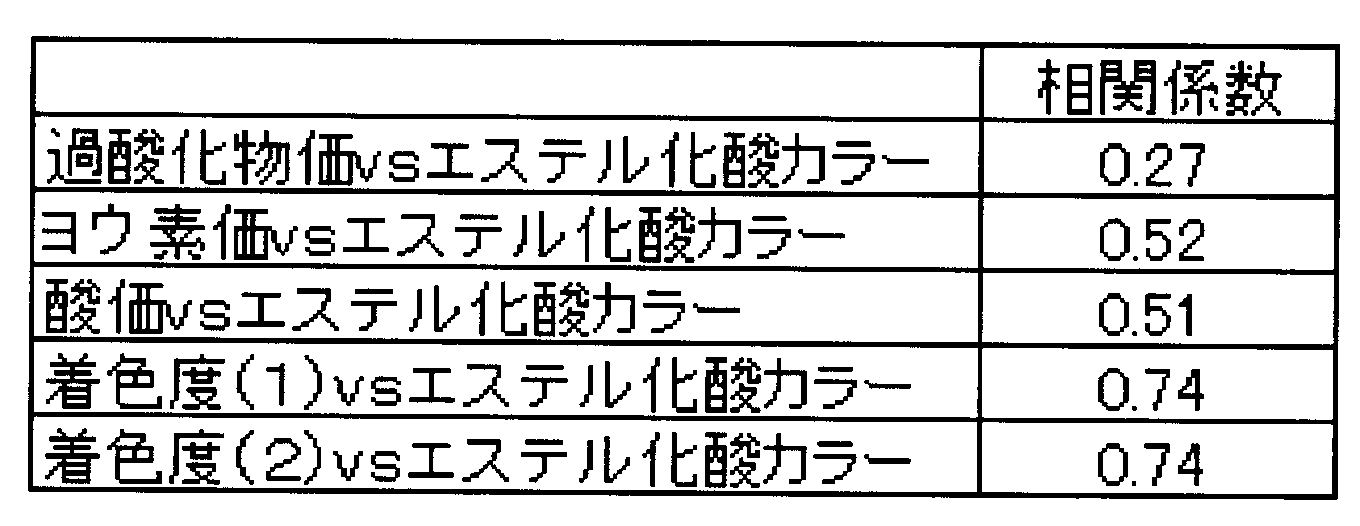
- the values of the coloring degrees (1) and (2) showed a high correlation with the esterified acid color compared to the peroxide value, iodine value and acid value.
- the esterified acid color (5% Klett value) measured in the above ⁇ Preparation of ⁇ -sulfo fatty acid alkyl ester and measurement of esterified acid color> was determined according to the following criteria. evaluated. The results are shown in Table 3. (Criteria): A and B are acceptable ranges. A: The value of the esterified acid color is less than 500. B: The esterified acid color value is 500 or more and less than 1300. C: The value of the esterified acid color is 1300 or more and less than 1500. D: The value of the esterified acid color is 1500 or more.
- ⁇ -sulfo fatty acid methyl ester using ME-3 as a raw material is adjusted to pH 7 to 8 using a 2% by mass aqueous sodium hydroxide solution.
- an aqueous slurry of ⁇ -sulfo fatty acid methyl ester salt having an AI of 70% was obtained.
- the ⁇ -sulfo fatty acid methyl ester salt in the obtained aqueous slurry was bleached using 35% hydrogen peroxide solution.
- the blending amount of hydrogen peroxide with respect to the unbleached ⁇ -sulfo fatty acid alkyl ester salt was 2% by mass as a pure component.
- the bleaching temperature was 80 ° C to 85 ° C.
- a 5% by weight aqueous solution of an ⁇ -sulfo fatty acid alkyl ester salt after 8 hours of bleaching was subjected to an optical path length of 40 mm, The color measured with a Cret photoelectric photometer using a 42 blue filter was 55 (5% Klett value).
- a light-colored ⁇ -sulfo fatty acid methyl ester is obtained by previously subjecting a fatty acid alkyl ester, which is a raw material of ⁇ -sulfo fatty acid alkyl ester (salt), to color treatment with sulfuric acid and selecting the raw material according to the degree of coloration.
- a fatty acid alkyl ester which is a raw material of ⁇ -sulfo fatty acid alkyl ester (salt)
- a fatty acid alkyl ester having a coloring degree (1) of 120 or less or a coloring degree (2) of 190 or less it is confirmed that an ⁇ -sulfo fatty acid methyl ester having an esterified acid color value of less than 1300 can be obtained. did it.
- the degree of coloration after the sulfonation reaction and the esterification reaction can be easily predicted in a short time, so that a raw material suitable for the target quality can be selected.
- the quality of the raw material can be kept constant, it is possible to reduce the labor for managing the process in order to stabilize the quality, such as eliminating the need to use the bleaching agent in the colored bleaching process more than necessary.
- a selection method capable of accurately and simply selecting the quality of a fatty acid alkyl ester used as a raw material in the production of an ⁇ -sulfo fatty acid alkyl ester (salt), a sulfonation step and / or using the selection method
- a method for predicting the degree of coloration of the reaction product obtained in the esterification step, an ⁇ -sulfo fatty acid alkyl ester (salt), and a method for producing the same can be provided.
Landscapes
- Chemical & Material Sciences (AREA)
- Organic Chemistry (AREA)
- Chemical Kinetics & Catalysis (AREA)
- Organic Low-Molecular-Weight Compounds And Preparation Thereof (AREA)
- Detergent Compositions (AREA)
Abstract
α-スルホ脂肪酸アルキルエステル(塩)の製造において原料として用いられる脂肪酸アルキルエステルの品質を正確かつ簡便に評価できる選定方法、前記選定方法を利用した、スルホン化工程および/またはエステル化処理工程で得られる反応生成物の着色度の予測方法およびα-スルホ脂肪酸アルキルエステル(塩)とその製造方法を提供する。α-スルホ脂肪酸アルキルエステル(塩)の製造において原料として用いられる脂肪酸アルキルエステルの選定方法であって、前記脂肪酸アルキルエステルに対して硫酸呈色処理を行い、得られた試料の着色度を測定することにより、前記脂肪酸アルキルエステルの着色性を評価することを特徴とする選定方法。
Description
本発明は、α-スルホ脂肪酸アルキルエステル(塩)の製造において原料として用いられる脂肪酸アルキルエステルの選定方法、α-スルホ脂肪酸アルキルエステル(塩)の製造における反応生成物の着色度の予測方法、およびα-スルホ脂肪酸アルキルエステル(塩)とその製造方法に関する。
本願は、2008年12月2日に、日本に出願された特願2008-307530号に基づき優先権を主張し、その内容をここに援用する。
本願は、2008年12月2日に、日本に出願された特願2008-307530号に基づき優先権を主張し、その内容をここに援用する。
α-スルホ脂肪酸アルキルエステル塩(脂肪酸アルキルエステルのスルホン化物の中和塩)は、耐硬水性、生分解性が良好であるうえ、洗浄力に優れ、皮膚にマイルドな界面活性剤であり、資源面からも再生可能な天然原料系でコスト的にも有利であり、地球環境保護の面からも重要視されている。
α-スルホ脂肪酸アルキルエステル塩の製造方法としては、脂肪酸アルキルエステルを原料としてα-スルホ脂肪酸アルキルエステル(脂肪酸アルキルエステルスルホネート)を得、前記α-スルホ脂肪酸アルキルエステルをアルカリによって中和する方法が一般的である。
α-スルホ脂肪酸アルキルエステル塩の製造方法としては、脂肪酸アルキルエステルを原料としてα-スルホ脂肪酸アルキルエステル(脂肪酸アルキルエステルスルホネート)を得、前記α-スルホ脂肪酸アルキルエステルをアルカリによって中和する方法が一般的である。
α-スルホ脂肪酸アルキルエステル塩の製造において原料として用いられる脂肪酸アルキルエステルは、一般的に、メタノール等の低級アルコールで油脂のエステル交換を行うことにより脂肪酸低級アルキルエステルを含む油相を得て、前記油相からトッピングなどにより低級アルコールや水分を除去して脂肪酸低級アルキルエステルを得る。あるいは、動植物油脂由来の脂肪酸やα-オレフィンのオキソ法から誘導される合成脂肪酸由来の脂肪酸と低級アルコールとからエステル化反応によって得られる。このようにして得た前記脂肪酸低級アルキルエステルを水素添加反応させてから、蒸留により留出させるか、蒸留により留出させた脂肪酸低級アルキルエステルを水素添加反応することにより製造されている。
しかし、上述のような脂肪酸アルキルエステルをそのままスルホン化した場合、得られるα-スルホ脂肪酸アルキルエステルには、通常、顕著な着色がある。このような着色は、最終的に得られるα-スルホ脂肪酸アルキルエステル塩を洗浄剤等の用途に用いるうえで不都合である。
このような問題に対し、これまで、α-スルホ脂肪酸アルキルエステル塩の着色度を改善するために、たとえばα-スルホ脂肪酸アルキルエステル塩に対して漂白処理を行う方法、脂肪酸アルキルエステルのスルホン化を着色抑制剤の存在下で行う方法等が実施されている。
しかし、上述のような脂肪酸アルキルエステルをそのままスルホン化した場合、得られるα-スルホ脂肪酸アルキルエステルには、通常、顕著な着色がある。このような着色は、最終的に得られるα-スルホ脂肪酸アルキルエステル塩を洗浄剤等の用途に用いるうえで不都合である。
このような問題に対し、これまで、α-スルホ脂肪酸アルキルエステル塩の着色度を改善するために、たとえばα-スルホ脂肪酸アルキルエステル塩に対して漂白処理を行う方法、脂肪酸アルキルエステルのスルホン化を着色抑制剤の存在下で行う方法等が実施されている。
また、原料である脂肪酸アルキルエステルの品質が、α-スルホ脂肪酸アルキルエステルの着色度に影響することが知られている。
これまで、α-スルホ脂肪酸アルキルエステルの着色度に影響するとされている脂肪酸アルキルエステルの性状として、ヨウ素価、酸価、過酸化物価、カルボニル価等が知られている。α-スルホ脂肪酸アルキルエステルの着色度を改善するために、これらの値を調節することが提案されており、たとえば特許文献1では、脂肪酸アルキルエステルの水添処理を行い、二重結合を還元し、ヨウ素価を低減することが提案されている。
また、α-スルホ脂肪酸アルキルエステルの着色度を改善するために、脂肪酸アルキルエステルに含まれる、着色度等の品質を劣化させる要因となる不純物を低減することも提案されている。たとえば特許文献2では、原料中の脂肪酸グリセリドの含有量を所定値以下とすることが提案され、特許文献3では、脂肪酸アルキルエステル中のオキソ化合物の含有量を所定値以下とすることが提案され、特許文献4では、脂肪酸アルキルエステル中の極性不純物を除去する方法が提案され、特許文献5では、グリセリンおよびその誘導体の含有量が所定値以下の脂肪酸アルキルエステルを用いる方法が提案されている。
これまで、α-スルホ脂肪酸アルキルエステルの着色度に影響するとされている脂肪酸アルキルエステルの性状として、ヨウ素価、酸価、過酸化物価、カルボニル価等が知られている。α-スルホ脂肪酸アルキルエステルの着色度を改善するために、これらの値を調節することが提案されており、たとえば特許文献1では、脂肪酸アルキルエステルの水添処理を行い、二重結合を還元し、ヨウ素価を低減することが提案されている。
また、α-スルホ脂肪酸アルキルエステルの着色度を改善するために、脂肪酸アルキルエステルに含まれる、着色度等の品質を劣化させる要因となる不純物を低減することも提案されている。たとえば特許文献2では、原料中の脂肪酸グリセリドの含有量を所定値以下とすることが提案され、特許文献3では、脂肪酸アルキルエステル中のオキソ化合物の含有量を所定値以下とすることが提案され、特許文献4では、脂肪酸アルキルエステル中の極性不純物を除去する方法が提案され、特許文献5では、グリセリンおよびその誘導体の含有量が所定値以下の脂肪酸アルキルエステルを用いる方法が提案されている。
上述したように、α-スルホ脂肪酸アルキルエステル塩の製造において原料として用いられる脂肪酸アルキルエステルの品質を評価するうえで指標となると考えられている性状はいくつか存在するが、本発明者らの検討によれば、これらの性状は、α-スルホ脂肪酸アルキルエステルの着色度との相関性が高いとはいえず、前記性状を指標として脂肪酸アルキルエステルの品質を正確に評価すること、および前記脂肪酸アルキルエステルから得られるα-スルホ脂肪酸アルキルエステルの着色度を正確に予測することは困難である。
また、脂肪酸アルキルエステル中に含まれる不純物は、その含有量が少ない場合には定量が難しく、その定量値から、脂肪酸アルキルエステルの品質を正確に評価すること、および前記脂肪酸アルキルエステルから得られるα-スルホ脂肪酸アルキルエステルの着色度を正確に予測することは困難である。
そのため、これらの評価および予測を正確かつ簡便に実施できる方法の確立が望まれていた。
本発明は、上記事情に鑑みてなされたものであって、α-スルホ脂肪酸アルキルエステル(塩)製造用の脂肪酸アルキルエステルの品質を正確かつ簡便に評価できる選定方法、前記選定方法を利用した、α-スルホ脂肪酸アルキルエステル(塩)の製造における反応生成物の着色度の予測方法およびα-スルホ脂肪酸アルキルエステル(塩)とその製造方法を提供することを目的とする。
また、脂肪酸アルキルエステル中に含まれる不純物は、その含有量が少ない場合には定量が難しく、その定量値から、脂肪酸アルキルエステルの品質を正確に評価すること、および前記脂肪酸アルキルエステルから得られるα-スルホ脂肪酸アルキルエステルの着色度を正確に予測することは困難である。
そのため、これらの評価および予測を正確かつ簡便に実施できる方法の確立が望まれていた。
本発明は、上記事情に鑑みてなされたものであって、α-スルホ脂肪酸アルキルエステル(塩)製造用の脂肪酸アルキルエステルの品質を正確かつ簡便に評価できる選定方法、前記選定方法を利用した、α-スルホ脂肪酸アルキルエステル(塩)の製造における反応生成物の着色度の予測方法およびα-スルホ脂肪酸アルキルエステル(塩)とその製造方法を提供することを目的とする。
本発明者らは、鋭意検討の結果、脂肪酸アルキルエステル中に含まれる、硫酸呈色反応により呈色する物質の量が、前記脂肪酸アルキルエステルから得られるα-スルホ脂肪酸アルキルエステルの着色度と高い相関性を示すことを見出した。
なお、硫酸呈色については、従来、医薬品や化粧品原料に含まれる微量の不純物で硫酸によって容易に着色する物質を試験する方法として、「化粧品原料基準 第二版 注解 -1984-」や「第十五改正 日本薬局方」に硫酸呈色物試験法が規定されている。ただし、前記硫酸呈色物試験法は、医薬品や化粧品原料として、薬剤や化粧品中にそのまま配合される成分について、精製の度合いを確認するのに有効な手段として純度試験に適用されている方法であり、スルホン化等の反応を行う製造原料としての脂肪酸アルキルエステルの品質を評価するためには用いられていない。
なお、硫酸呈色については、従来、医薬品や化粧品原料に含まれる微量の不純物で硫酸によって容易に着色する物質を試験する方法として、「化粧品原料基準 第二版 注解 -1984-」や「第十五改正 日本薬局方」に硫酸呈色物試験法が規定されている。ただし、前記硫酸呈色物試験法は、医薬品や化粧品原料として、薬剤や化粧品中にそのまま配合される成分について、精製の度合いを確認するのに有効な手段として純度試験に適用されている方法であり、スルホン化等の反応を行う製造原料としての脂肪酸アルキルエステルの品質を評価するためには用いられていない。
本発明は、上記知見に基づいてなされたものであり、以下の態様を有する。
[1]α-スルホ脂肪酸アルキルエステル(塩)の選定方法であって、予め原料である脂肪酸アルキルエステルと硫酸とを混合し、所定温度で硫酸呈色処理を行い、その着色度により満足する品質のものだけを選定する工程を実施することを特徴とするα-スルホ脂肪酸アルキルエステル(塩)の選定方法。
[1]α-スルホ脂肪酸アルキルエステル(塩)の選定方法であって、予め原料である脂肪酸アルキルエステルと硫酸とを混合し、所定温度で硫酸呈色処理を行い、その着色度により満足する品質のものだけを選定する工程を実施することを特徴とするα-スルホ脂肪酸アルキルエステル(塩)の選定方法。
[2]脂肪酸アルキルエステルをスルホン化するスルホン化工程と、前記スルホン化工程で得られる生成物をアルコールにてエステル化処理するエステル化処理工程と、前記エステル化処理工程で得られる生成物とアルカリ水溶液とを接触させる中和工程とを含むα-スルホ脂肪酸アルキルエステル(塩)の製造方法における前記スルホン化工程および/またはエステル化処理工程で得られる反応生成物の着色度の予測方法であって、[1]に記載の選定方法により脂肪酸アルキルエステルの着色性を評価し、前記着色性を指標として、前記脂肪酸アルキルエステルから得られる前記反応生成物の着色度を予測することを特徴とする予測方法。
[3]脂肪酸アルキルエステルをスルホン化するスルホン化工程と、前記スルホン化工程で得られる生成物をアルコールにてエステル化処理するエステル化処理工程と、前記エステル化処理工程で得られる生成物とアルカリ水溶液とを接触させる中和工程とを含むα-スルホ脂肪酸アルキルエステル(塩)の製造方法であって、前記脂肪酸アルキルエステルとして、[1]記載の選定方法により選定された品質の脂肪酸アルキルエステルを用いることを特徴とするα-スルホ脂肪酸アルキルエステル(塩)の製造方法。
[4][3]に記載の製造方法を用いて製造されたことを特徴とするα-スルホ脂肪酸アルキルエステル(塩)。
[3]脂肪酸アルキルエステルをスルホン化するスルホン化工程と、前記スルホン化工程で得られる生成物をアルコールにてエステル化処理するエステル化処理工程と、前記エステル化処理工程で得られる生成物とアルカリ水溶液とを接触させる中和工程とを含むα-スルホ脂肪酸アルキルエステル(塩)の製造方法であって、前記脂肪酸アルキルエステルとして、[1]記載の選定方法により選定された品質の脂肪酸アルキルエステルを用いることを特徴とするα-スルホ脂肪酸アルキルエステル(塩)の製造方法。
[4][3]に記載の製造方法を用いて製造されたことを特徴とするα-スルホ脂肪酸アルキルエステル(塩)。
本発明によれば、α-スルホ脂肪酸アルキルエステル(塩)の製造において原料として用いられる脂肪酸アルキルエステルの品質を正確かつ簡便に選定できる選定方法、前記選定方法を利用した、スルホン化工程および/またはエステル化処理工程で得られる反応生成物の着色度の予測方法およびα-スルホ脂肪酸アルキルエステル(塩)とその製造方法を提供できる。
<選定方法>
本発明の選定方法は、α-スルホ脂肪酸アルキルエステル(塩)の製造において原料として用いられる脂肪酸アルキルエステルの選定方法であって、前記脂肪酸アルキルエステルと硫酸とを混合し、所定温度で硫酸呈色処理を行い、得られた試料の着色度を測定することにより、前記脂肪酸アルキルエステルの着色性を選定することを特徴とする。
本発明の選定方法は、α-スルホ脂肪酸アルキルエステル(塩)の製造において原料として用いられる脂肪酸アルキルエステルの選定方法であって、前記脂肪酸アルキルエステルと硫酸とを混合し、所定温度で硫酸呈色処理を行い、得られた試料の着色度を測定することにより、前記脂肪酸アルキルエステルの着色性を選定することを特徴とする。
硫酸呈色処理は、評価対象の脂肪酸アルキルエステルと、硫酸とを混合し、反応させることにより行われる。
硫酸としては、濃度が70~98質量%の硫酸(水溶液)を用いることが好ましい。かかる硫酸としては、一般的に特級試薬として市販されているもの(通常、濃度98質量%程度)、あるいは一般的に硫酸呈色物試験用硫酸として用いられるものを用いることができる。
硫酸の使用量は、脂肪酸アルキルエステル100質量部に対して20~120質量部が好ましく、30~100質量部がより好ましい。
硫酸呈色処理の際、脂肪酸アルキルエステルは、硫酸と混合する前に、予め、所定の反応温度に予熱しておくことが好ましい。これにより、速やかに呈色反応を行うことができる。
硫酸としては、濃度が70~98質量%の硫酸(水溶液)を用いることが好ましい。かかる硫酸としては、一般的に特級試薬として市販されているもの(通常、濃度98質量%程度)、あるいは一般的に硫酸呈色物試験用硫酸として用いられるものを用いることができる。
硫酸の使用量は、脂肪酸アルキルエステル100質量部に対して20~120質量部が好ましく、30~100質量部がより好ましい。
硫酸呈色処理の際、脂肪酸アルキルエステルは、硫酸と混合する前に、予め、所定の反応温度に予熱しておくことが好ましい。これにより、速やかに呈色反応を行うことができる。
硫酸呈色処理の反応温度は、α-スルホ脂肪酸アルキルエステル(塩)を製造する際のスルホン化の反応温度と同等の温度が好ましい。具体的には、60~100℃が好ましく、70~90℃がより好ましい。反応温度が上記範囲内であると、得られた試料の着色度と、α-スルホ脂肪酸アルキルエステル(塩)の製造における反応生成物(α-スルホ脂肪酸アルキルエステル)の着色度との相関性が高く、本発明の効果に優れる。一方、反応温度が上記範囲の下限値よりも低いと、呈色が不充分になるおそれがあり、上限値よりも高いと、呈色が強すぎて比較が困難となるおそれがある。
硫酸呈色処理の反応時間は、上記反応温度で充分な呈色する時間であればよい。たとえば反応温度が70~90℃である場合、0.5~4時間が好ましく、0.5~2時間がより好ましい。反応時間が短いと、呈色が不充分になるおそれがある。長すぎても、色の変化が鈍いため無駄となる。
硫酸呈色処理の反応時間は、上記反応温度で充分な呈色する時間であればよい。たとえば反応温度が70~90℃である場合、0.5~4時間が好ましく、0.5~2時間がより好ましい。反応時間が短いと、呈色が不充分になるおそれがある。長すぎても、色の変化が鈍いため無駄となる。
硫酸呈色処理は、例えば、脂肪酸アルキルエステルと、該脂肪酸アルキルエステル5gに対して1~6gの硫酸と混合し、70~90℃で0.5~4時間保温することにより行われる。
α-スルホ脂肪酸アルキルエステル(塩)の製造において原料として用いられる脂肪酸アルキルエステルを選定する方法であるので、実施者が適当と思われる方法で着色度を測定することができる。また、その測定法により着色度の判定基準を定め、原料として使用可能かどうかを判定することができる。なお、前述の硫酸呈色処理方法により処理を行うと通常、試験液の外観は黄色~赤色を呈する。従って、着色度の測定はこれら呈色範囲について色や濃淡について判定できる方法であれば、いかなる測定法を用いても構わない。使用できる測定法の例として分光光度計を用いて、特定波長の吸光度、あるいは波長のある範囲における吸光度を測定する方法、別途作成した判定基準となる標準色(水、有機溶媒、油等の液体や紙、樹脂、繊維等を発色させたものあるいは色素等で色付けしたものでも良い)を単独または複数作成し、この標準色と試験液の着色度を比較することにより判定する方法、または測色計、色差計、色彩計(spectrophotometer、colorimeter)によって色差を測定する方法が挙げられるが、これらに限定されるものではない。
得られる測定値の正確性、測定操作の簡便さ等を考慮すると、前記試料をエタノールで希釈し、得られた試料液の着色度を、光電(分光)光度計(photoelectric spectrophotometer。光電測色計(photoelectric colorimeter)ともいう。)、紫外可視分光光度計等の分光光度計で測定することが好ましい。
得られる測定値の正確性、測定操作の簡便さ等を考慮すると、前記試料をエタノールで希釈し、得られた試料液の着色度を、光電(分光)光度計(photoelectric spectrophotometer。光電測色計(photoelectric colorimeter)ともいう。)、紫外可視分光光度計等の分光光度計で測定することが好ましい。
このとき得られた試料の着色度の測定値は、ヨウ素価、酸価等の従来一般的に評価されていた性状に比べて、前記脂肪酸アルキルエステルを原料としてスルホン化等の反応を行ってα-スルホ脂肪酸アルキルエステル(塩)を製造する際に生じる反応生成物(α-スルホ脂肪酸アルキルエステル)の着色度と高い正の相関を示す。そのため、前記測定値を指標とすることで、脂肪酸アルキルエステルの着色性、つまり前記脂肪酸アルキルエステルが、α-スルホ脂肪酸アルキルエステル(塩)を製造する過程においてどの程度着色するか、を評価できる。また、後述する本発明の予測方法に示すように、前記製造過程での反応生成物の着色度を予測することができる。
本発明において、試料の着色度の測定および前記脂肪酸アルキルエステルの着色性を評価する方法についてわかりやすくするために、実施形態の一例を具体的に示すが、本発明を制限するものではない。試料の着色度を下記測定方法(1)により測定し、その測定値から、下記数式(1)により着色度(1)を求め、前記着色度(1)を指標として前記脂肪酸アルキルエステルの品質を評価する選定方法が挙げられる。
測定方法(1):前記硫酸呈色処理により得られた試料をエタノールで希釈し、得られた試料液を測定用セル、例えば、10mm光路長のセルに採取し、420nmにおける吸光度を測定する。
測定方法(1):前記硫酸呈色処理により得られた試料をエタノールで希釈し、得られた試料液を測定用セル、例えば、10mm光路長のセルに採取し、420nmにおける吸光度を測定する。

希釈倍率(=エタノール希釈後の質量/希釈前の試料の質量)は、特に限定されず、呈色の程度に応じて、測定可能な濃度となるよう適宜設定すればよい。通常、2~5倍程度である。
420nmにおける吸光度は、紫外可視分光光度計を用いて測定できる。
測定用セルおよび紫外可視分光光度計は実施者の都合によりそれぞれ市販のものを利用できる。
420nmにおける吸光度は、紫外可視分光光度計を用いて測定できる。
測定用セルおよび紫外可視分光光度計は実施者の都合によりそれぞれ市販のものを利用できる。
また、上記実施形態以外に、本発明において、試料の着色度の測定および前記脂肪酸アルキルエステルの着色性を評価する際の好ましい実施形態として、前記試料の着色度を下記測定方法(2)により測定し、その測定値から、下記数式(2)により着色度(2)を求め、前記着色度(2)を指標として前記脂肪酸アルキルエステルの着色性を評価する方法が挙げられる。
測定方法(2):前記硫酸呈色処理により得られた試料をエタノールで希釈し、得られた試料液を測定用セル、例えば40mm光路長のセルに採取し、ブルーフィルターを取り付けたクレット光電光度計でKlett値を測定する。
測定方法(2):前記硫酸呈色処理により得られた試料をエタノールで希釈し、得られた試料液を測定用セル、例えば40mm光路長のセルに採取し、ブルーフィルターを取り付けたクレット光電光度計でKlett値を測定する。

希釈倍率(=エタノール希釈後の質量/希釈前の試料の質量)は、特に限定されず、呈色の程度に応じて、測定可能な濃度となるよう適宜設定すればよい。通常、3~10倍程度である。
クレット光電光度計(Klett Photoelectric Colorimeter)は、可視光範囲のフィルター(レッド、ブルー、グリーンのカラーフィルター)を用いて測定を行う光電光度計であり、液体の色を測定するために一般的に用いられている。
クレット光電光度計は、たとえばKLETT-SUMMERSON光電光度計として、米国ベルアート社から市販されている。
クレット光電光度計において、フィルターは、光源とセルとの間に配置される。
本実施形態においては、フィルターとして、ブルーフィルターを取り付けて測定を行う。ブルーフィルターは、適用波長範囲400~450nmのフィルターである。ここで、「適用波長範囲」とは、光源からの光をフィルターによって分光する波長範囲が400~450nmであることを意味する。よって、別の目的のためには異なるフィルターで分光した光で測定することも可能である。
前記ブルーフィルターは、たとえばKLETT-SUMMERSON光電光度計に、フィルターNo.KS-42のフィルター(No.42ブルーフィルター)として付属しているものを用いてもよく、別途購入してもよい。
クレット光電光度計(Klett Photoelectric Colorimeter)は、可視光範囲のフィルター(レッド、ブルー、グリーンのカラーフィルター)を用いて測定を行う光電光度計であり、液体の色を測定するために一般的に用いられている。
クレット光電光度計は、たとえばKLETT-SUMMERSON光電光度計として、米国ベルアート社から市販されている。
クレット光電光度計において、フィルターは、光源とセルとの間に配置される。
本実施形態においては、フィルターとして、ブルーフィルターを取り付けて測定を行う。ブルーフィルターは、適用波長範囲400~450nmのフィルターである。ここで、「適用波長範囲」とは、光源からの光をフィルターによって分光する波長範囲が400~450nmであることを意味する。よって、別の目的のためには異なるフィルターで分光した光で測定することも可能である。
前記ブルーフィルターは、たとえばKLETT-SUMMERSON光電光度計に、フィルターNo.KS-42のフィルター(No.42ブルーフィルター)として付属しているものを用いてもよく、別途購入してもよい。
これらの着色度(1)および(2)は、それぞれ、脂肪酸アルキルエステルをスルホン化する工程と、前記スルホン化工程で得られる反応生成物をアルコールにてエステル化処理する工程とを含むα-スルホ脂肪酸アルキルエステル(塩)の製造方法における前記スルホン化工程および/またはエステル化工程で得られる反応生成物の着色度との相関性が高い。また、測定方法も簡易である。そのため、着色度(1)または(2)は、脂肪酸アルキルエステルの着色性を示す指標として有用である。
上記本発明の選定方法で求められる着色性は、ヨウ素価、酸価等の従来一般的な性状と比べて、α-スルホ脂肪酸アルキルエステル(塩)の製造過程で生じる反応生成物の着色度との相関性が高い。
そのため、本発明の選定方法によれば、脂肪酸アルキルエステルの一般的な示性値には表れてこない、定量が困難な微量不純物が、α-スルホ脂肪酸アルキルエステル(塩)の製造過程で生じる反応生成物の着色度に与える影響を簡易的に評価することができる。
なお、本発明の選定方法において、脂肪酸アルキルエステル中に含まれる、硫酸呈色により呈色する物質としては、原料油脂由来の微量不純物が考えられる。前記微量不純物の具体例としては、トコフェロール類やステロール類が考えられる。
そのため、本発明の選定方法によれば、脂肪酸アルキルエステルの一般的な示性値には表れてこない、定量が困難な微量不純物が、α-スルホ脂肪酸アルキルエステル(塩)の製造過程で生じる反応生成物の着色度に与える影響を簡易的に評価することができる。
なお、本発明の選定方法において、脂肪酸アルキルエステル中に含まれる、硫酸呈色により呈色する物質としては、原料油脂由来の微量不純物が考えられる。前記微量不純物の具体例としては、トコフェロール類やステロール類が考えられる。
<予測方法>
本発明の予測方法は、脂肪酸アルキルエステルをスルホン化する工程と、前記スルホン化工程で得られる生成物をアルコールにてエステル化処理する工程と、前記エステル化処理工程で得られる生成物とアルカリ水溶液とを接触させる中和工程とを含むα-スルホ脂肪酸アルキルエステル(塩)の製造方法における前記スルホン化工程および/またはエステル化工程で得られる反応生成物の着色度の予測方法であって、前記本発明の選定方法により脂肪酸アルキルエステルの着色性を評価し、前記着色性を指標として、前記脂肪酸アルキルエステルから得られる前記反応生成物の着色度を予測することを特徴とする。
ここで、α-スルホ脂肪酸アルキルエステル(塩)は、α-スルホ脂肪酸アルキルエステルおよびα-スルホ脂肪酸アルキルエステル塩のいずれであってもよいことを示す。
本発明の予測方法は、脂肪酸アルキルエステルをスルホン化する工程と、前記スルホン化工程で得られる生成物をアルコールにてエステル化処理する工程と、前記エステル化処理工程で得られる生成物とアルカリ水溶液とを接触させる中和工程とを含むα-スルホ脂肪酸アルキルエステル(塩)の製造方法における前記スルホン化工程および/またはエステル化工程で得られる反応生成物の着色度の予測方法であって、前記本発明の選定方法により脂肪酸アルキルエステルの着色性を評価し、前記着色性を指標として、前記脂肪酸アルキルエステルから得られる前記反応生成物の着色度を予測することを特徴とする。
ここで、α-スルホ脂肪酸アルキルエステル(塩)は、α-スルホ脂肪酸アルキルエステルおよびα-スルホ脂肪酸アルキルエステル塩のいずれであってもよいことを示す。
前記予測方法は、たとえば以下に示す手順で実施できる。
まず、複数の脂肪酸アルキルエステルを用意し、それぞれを原料として、脂肪酸アルキルエステルをスルホン化するスルホン化工程と、前記スルホン化工程で得られる生成物をアルコールにてエステル化処理するエステル化処理工程とを実施する。このとき、スルホン化工程および/またはエステル化処理工程で得られた反応生成物(α-スルホ脂肪酸アルキルエステル)の着色度を測定する。このとき、反応生成物の着色度の測定には、試料の着色度の測定と同様の方法が利用できる。
別途、前記複数の脂肪酸アルキルエステルそれぞれについて、硫酸呈色処理を、スルホン化を行った際の反応温度(たとえば80℃)で所定の反応時間(たとえば1時間)行い、得られた各試料の着色度を測定する。
上記で得られた反応生成物の着色度と試料の着色度とは正の相関を示すため、上記で測定した試料の着色度の測定値と、反応生成物の着色度の測定値とから、これらの関係を示す一次相関関係式が得られる。
この一次相関関係式を検量線として用いることで、得られる反応生成物の着色度を予測することができる。
まず、複数の脂肪酸アルキルエステルを用意し、それぞれを原料として、脂肪酸アルキルエステルをスルホン化するスルホン化工程と、前記スルホン化工程で得られる生成物をアルコールにてエステル化処理するエステル化処理工程とを実施する。このとき、スルホン化工程および/またはエステル化処理工程で得られた反応生成物(α-スルホ脂肪酸アルキルエステル)の着色度を測定する。このとき、反応生成物の着色度の測定には、試料の着色度の測定と同様の方法が利用できる。
別途、前記複数の脂肪酸アルキルエステルそれぞれについて、硫酸呈色処理を、スルホン化を行った際の反応温度(たとえば80℃)で所定の反応時間(たとえば1時間)行い、得られた各試料の着色度を測定する。
上記で得られた反応生成物の着色度と試料の着色度とは正の相関を示すため、上記で測定した試料の着色度の測定値と、反応生成物の着色度の測定値とから、これらの関係を示す一次相関関係式が得られる。
この一次相関関係式を検量線として用いることで、得られる反応生成物の着色度を予測することができる。
<脂肪酸アルキルエステル>
動植物由来の油脂と炭素数1~3の低級アルコールとからエステル交換反応によって得られる。あるいは、動植物油脂由来の脂肪酸やα-オレフィンのオキソ法から誘導される合成脂肪酸由来の脂肪酸と炭素数1~3の低級アルコールとからエステル化反応によって得られる。
脂肪酸アルキルエステルは、牛脂、魚脂、ラノリンなどから誘導される動物系油脂由来、大豆油、菜種油、ひまわり油、とうもろこし油、パーム油、やし油、パーム核油、ジャトロファ(ヤトロファ)油、砂桃油などから誘導される植物系油脂由来、α-オレフィンのオキソ法から誘導される合成脂肪酸由来のアルキルエステルなどのいずれでもよい。
α-スルホ脂肪酸アルキルエステル(塩)の着色度を低くするためには、原料となる脂肪酸アルキルエステルに含まれる不純物を少なくすることと、ヨウ素価が低いものを使用することが望ましい。
原料となる油脂、脂肪酸は通常の方法(公知技術)により精製処理を行ったものでも良く、粗原料を用いて脂肪酸アルキルエステルを得てから精製処理を行っても構わない。精製処理とは不純物を少なくして純度を高めるために行うものであり、ろ過、吸着、カラム分離、脱ガム、脱酸、脱色、脱臭、蒸留、溶媒抽出、再結晶などの操作が含まれる。これら精製処理は単独、または複数の方法を組み合わせて用いることができる。実施者が必要としない限り精製処理は必須ではないが、精製処理を行うほうが着色度の低いα-脂肪酸アルキルエステルを得られやすい。
脂肪酸アルキルエステルに含まれるグリセリン及びその誘導体含量は、0.5重量%以下であることが望ましい。
脂肪酸アルキルエステルのヨウ素価を低くするためには、含まれる不飽和脂肪酸アルキルエステルに触媒存在下で水素を付加させて(水素添加工程)、不飽和脂肪酸アルキルエステルを少なくする。不飽和脂肪酸アルキルエステルの存在量の指標であるヨウ素価は0.5以下であることが望ましい。過酸化物価が5ミリ当量/kg以下の未水添脂肪酸アルキルエステルを選択して前記水素添加工程に用いるのが望ましい。
動植物由来の油脂と炭素数1~3の低級アルコールとからエステル交換反応によって得られる。あるいは、動植物油脂由来の脂肪酸やα-オレフィンのオキソ法から誘導される合成脂肪酸由来の脂肪酸と炭素数1~3の低級アルコールとからエステル化反応によって得られる。
脂肪酸アルキルエステルは、牛脂、魚脂、ラノリンなどから誘導される動物系油脂由来、大豆油、菜種油、ひまわり油、とうもろこし油、パーム油、やし油、パーム核油、ジャトロファ(ヤトロファ)油、砂桃油などから誘導される植物系油脂由来、α-オレフィンのオキソ法から誘導される合成脂肪酸由来のアルキルエステルなどのいずれでもよい。
α-スルホ脂肪酸アルキルエステル(塩)の着色度を低くするためには、原料となる脂肪酸アルキルエステルに含まれる不純物を少なくすることと、ヨウ素価が低いものを使用することが望ましい。
原料となる油脂、脂肪酸は通常の方法(公知技術)により精製処理を行ったものでも良く、粗原料を用いて脂肪酸アルキルエステルを得てから精製処理を行っても構わない。精製処理とは不純物を少なくして純度を高めるために行うものであり、ろ過、吸着、カラム分離、脱ガム、脱酸、脱色、脱臭、蒸留、溶媒抽出、再結晶などの操作が含まれる。これら精製処理は単独、または複数の方法を組み合わせて用いることができる。実施者が必要としない限り精製処理は必須ではないが、精製処理を行うほうが着色度の低いα-脂肪酸アルキルエステルを得られやすい。
脂肪酸アルキルエステルに含まれるグリセリン及びその誘導体含量は、0.5重量%以下であることが望ましい。
脂肪酸アルキルエステルのヨウ素価を低くするためには、含まれる不飽和脂肪酸アルキルエステルに触媒存在下で水素を付加させて(水素添加工程)、不飽和脂肪酸アルキルエステルを少なくする。不飽和脂肪酸アルキルエステルの存在量の指標であるヨウ素価は0.5以下であることが望ましい。過酸化物価が5ミリ当量/kg以下の未水添脂肪酸アルキルエステルを選択して前記水素添加工程に用いるのが望ましい。
α-スルホ脂肪酸アルキルエステル塩の製造においては、一般的に、上記スルホン化工程およびエステル化工程の後、α-スルホ脂肪酸アルキルエステル塩とするために、中和工程が行われる。また、洗浄剤等の用途においては、α-スルホ脂肪酸アルキルエステル塩として淡色のものが好まれるため、漂白工程が行われる。
スルホン化工程および/またはエステル化処理工程で得られた反応生成物(α-スルホ脂肪酸アルキルエステル)の着色度が淡いほど、中和工程で得られる反応生成物(α-スルホ脂肪酸アルキルエステル塩)の着色度も淡いものとなり、その後の漂白工程の負荷も低減される。
そのため、スルホン化工程および/またはエステル化処理工程で得られる反応生成物の着色度について上限値を設定しておき、上記予測方法において、前記反応生成物の着色度が、設定した上限値以下の所望の値になると予測された脂肪酸アルキルエステルを用いてα-スルホ脂肪酸アルキルエステル塩の製造を行うことで、淡色のα-スルホ脂肪酸アルキルエステル塩を効率よく製造することができる。
つまり、上記本発明の選定方法で評価した着色度(たとえば前記着色度(1)、着色度(2))から予測される前記反応生成物の着色度が所望の値となる脂肪酸アルキルエステルを原料として用いることで、淡色のα-スルホ脂肪酸アルキルエステル塩を効率よく製造することができる。
スルホン化工程および/またはエステル化処理工程で得られた反応生成物(α-スルホ脂肪酸アルキルエステル)の着色度が淡いほど、中和工程で得られる反応生成物(α-スルホ脂肪酸アルキルエステル塩)の着色度も淡いものとなり、その後の漂白工程の負荷も低減される。
そのため、スルホン化工程および/またはエステル化処理工程で得られる反応生成物の着色度について上限値を設定しておき、上記予測方法において、前記反応生成物の着色度が、設定した上限値以下の所望の値になると予測された脂肪酸アルキルエステルを用いてα-スルホ脂肪酸アルキルエステル塩の製造を行うことで、淡色のα-スルホ脂肪酸アルキルエステル塩を効率よく製造することができる。
つまり、上記本発明の選定方法で評価した着色度(たとえば前記着色度(1)、着色度(2))から予測される前記反応生成物の着色度が所望の値となる脂肪酸アルキルエステルを原料として用いることで、淡色のα-スルホ脂肪酸アルキルエステル塩を効率よく製造することができる。
<製造方法>
本発明の製造方法は、脂肪酸アルキルエステルをスルホン化するスルホン化工程と、前記スルホン化工程で得られる生成物をアルコールにてエステル化処理する工程と、前記エステル化処理工程で得られる生成物とアルカリ水溶液とを接触させる中和工程とを含むα-スルホ脂肪酸アルキルエステル(塩)の製造方法であって、前記脂肪酸アルキルエステルとして、下記のいずれかの脂肪酸アルキルエステルを用いることを特徴とする。
・前記着色度(1)が120以下、好ましくは110以下、より好ましくは90以下、さらに好ましくは50以下の脂肪酸アルキルエステル。
・前記着色度(2)が190以下、好ましくは180以下、より好ましくは160以下、さらに好ましくは100以下の脂肪酸アルキルエステル。
着色度(1)、(2)の下限は特に限定されず、0であっても良いが、実用上、それぞれ10以上であっても本発明の効果は充分に得られる。
本発明の製造方法は、脂肪酸アルキルエステルをスルホン化するスルホン化工程と、前記スルホン化工程で得られる生成物をアルコールにてエステル化処理する工程と、前記エステル化処理工程で得られる生成物とアルカリ水溶液とを接触させる中和工程とを含むα-スルホ脂肪酸アルキルエステル(塩)の製造方法であって、前記脂肪酸アルキルエステルとして、下記のいずれかの脂肪酸アルキルエステルを用いることを特徴とする。
・前記着色度(1)が120以下、好ましくは110以下、より好ましくは90以下、さらに好ましくは50以下の脂肪酸アルキルエステル。
・前記着色度(2)が190以下、好ましくは180以下、より好ましくは160以下、さらに好ましくは100以下の脂肪酸アルキルエステル。
着色度(1)、(2)の下限は特に限定されず、0であっても良いが、実用上、それぞれ10以上であっても本発明の効果は充分に得られる。
着色度(1)および(2)は、それぞれ、上述したように、スルホン化工程および/またはエステル化処理工程で得られる反応生成物の着色度に対応している。そのため、着色度(1)または(2)が所定値以下の脂肪酸アルキルエステルを用いることで、前記反応生成物として着色度の淡いものが得られる。そのため、エステル化処理工程後に任意に中和工程を行った際に、淡色の中和物(α-スルホ脂肪酸アルキルエステル塩)が得られ、また、得られたα-スルホ脂肪酸アルキルエステル塩の漂白に要する負荷も低減できる。
本発明の製造方法は、予め原料である脂肪酸アルキルエステルと硫酸とを混合し、所定温度で硫酸呈色処理を行い、前記脂肪酸アルキルエステルの着色度(1)または(2)を求め、その値が上記範囲内であるものを選択して用いることにより実施でき、それ以外は、公知のα-スルホ脂肪酸アルキルエステル(塩)の製造方法を利用できる。
以下、本発明の製造方法の好ましい工程(A)~(F)を示す。
(A)原料の選定工程
(B)スルホン化工程
(C)熟成工程
(D)エステル化工程
(E)中和工程
(F)漂白工程
あるいは、以下のように(E)中和工程の前に(F)漂白工程を行っても良い。
(A)原料の選定工程
(B)スルホン化工程
(C)熟成工程
(D)エステル化工程
(F)漂白工程
(E)中和工程
(A)原料の選定工程
(B)スルホン化工程
(C)熟成工程
(D)エステル化工程
(E)中和工程
(F)漂白工程
あるいは、以下のように(E)中和工程の前に(F)漂白工程を行っても良い。
(A)原料の選定工程
(B)スルホン化工程
(C)熟成工程
(D)エステル化工程
(F)漂白工程
(E)中和工程
以下、各工程について具体的に示す。
(A)原料の選定工程
予め、原料である脂肪酸アルキルエステルに対して硫酸呈色処理を行い、その着色度により品質を評価して選定する工程。
(B)スルホン化反応工程
原料である脂肪酸アルキルエステルとSO3ガスや発煙硫酸を接触させることにより、反応させる。好ましくはSO3ガスである。
反応温度は、融点+70℃の範囲内で通常、50~120℃、より好ましくは60~90℃である。SO3は、脱湿空気又は窒素などの不活性ガスでSO3濃度を3~30容量%に希釈して用いる。
反応モル比は、脂肪酸アルキルエステル1モルに対して、1.0~2.0モル
反応時間は、薄膜式反応器を用いる場合5~120秒、槽型反応器を用いる場合は10~180分が適当である。
反応器は、2重円管型流下薄膜式反応器(ライオン(株)社製TOリアクターなど)、流下薄膜式反応器(バレストラ社製など)や槽型反応器を用いることができる。
流下薄膜式反応器では、反応器の出口から排出されてから着色抑制剤を加えても良い。
槽型反応器では、あらかじめ脂肪酸アルキルエステルを投入した後に着色抑制剤を0~30質量%加えることができる。
着色抑制剤としては、一価の金属塩である有機酸塩、無機硫酸塩等が用いられ、好ましくは無機硫酸塩が用いられる。有機酸塩としては、例えば蟻酸ナトリウム、蟻酸カリウム、酢酸ナトリウム等を例示できる。無機硫酸塩は、一価の金属塩である粉末状の無水塩であれば特に限定されず、例えば硫酸ナトリウム、硫酸カリウム、硫酸リチウム等が挙げられる。無機硫酸塩は着色抑制効果が高く、安価なものが多く、さらに洗浄剤に配合される成分なので、洗浄剤用途のα-スルホ脂肪酸アルキルエステル塩製造の場合は、無機硫酸塩をα-スルホ脂肪酸アルキルエステル塩から除去する必要がないので好ましい。
(C)熟成工程
スルホン化反応工程を行った後、所定の温度条件で保持し、反応を促進させる工程である。
保持温度は50~100℃、保持時間(熟成時間)は1~120分が好ましい。
(D)エステル化工程
前記熟成工程で得られる生成物に対して、炭素数1~6のアルコールを添加し、所定の反応温度で所定の反応時間保持することにより行うことができる。これにより、α-スルホ脂肪酸アルキルエステルの収率が向上し、副生物の生成も抑制される。
反応温度は、50~100℃、好ましくは50~90℃であり、反応時間は、5~180分、好ましくは10~60分である。
アルコールは、炭素数1~6のアルコールで直鎖でも分岐でも構わない。1価アルコールが好ましい。
アルコール添加量は、熟成後の生成物100質量%に対して、1~10質量%が好ましい。より好ましくは、2~5質量%である。
(E)中和工程
中和は、たとえば、エステル化工程後の生成物と、アルカリ水溶液とを接触させることにより実施できる。
アルカリ水溶液としては、目的とする塩を形成することができるものであればよく、たとえば、水酸化ナトリウム等のアルカリ金属の水酸化物、アルカリ金属の炭酸塩、アルカリ土類金属の水酸化物、アンモニア、エタノールアミン等が挙げられる。 アルカリ水溶液の濃度は、下記中和物のAI濃度となるように調整する。
ここで、「AI」とは、生成物中に含まれる、界面活性剤としての機能を有する化合物である。本発明の製造方法により得られる生成物中には、通常、α-スルホ脂肪酸アルキルエステル塩のほか、副生物としてα-スルホ脂肪酸ジアルカリ塩が含まれる。α-スルホ脂肪酸ジアルカリ塩も、α-スルホ脂肪酸アルキルエステル塩と同様、界面活性剤としての機能を有している。したがって、本発明において、AI濃度は、α-スルホ脂肪酸アルキルエステル塩と、副生物の1つであるα-スルホ脂肪酸ジアルカリ塩との合計の濃度として求められる。
中和物中のAI濃度は、10~80質量%が好ましい。特に、粘度が適度に低く、製造効率、ハンドリング性ともに優れることから、AI濃度は、60~80質量%がより好ましく、62~75質量%がさらに好ましい。
中和温度は30~140℃が好ましく、より好ましくは50~140℃、さらに好ましくは30~80℃である。
中和時間は5~60分間が好ましく、より好ましくは20~60分間である。
また、中和工程においては、生成したα-スルホ脂肪酸アルキルエステル塩の加水分解とそれに伴う副生物の生成を防止するために、過激な中和操作を避け、極力マイルドな中和処理を行うことが好ましい。
かかる中和処理としては、ループ中和方式が挙げられる。この方式は、ループ状の配管(リサイクルループ)内で、中和処理した中和物の一部(リサイクル中和物)を循環させ、前記リサイクル中和物を、エステル化工程後の未中和の生成物に添加して中和を行う方式である。
ループ中和方式において、中和は、たとえばリサイクル中和物と未中和の生成物との混合物に対してアルカリ水溶液を接触させて行ってもよく、また、前記リサイクル中和物と、未中和の生成物と、アルカリ水溶液とを、強力なせん断力の元で瞬時に混合して行ってもよい。
リサイクル中和物の添加量は、未中和の生成物とアルカリ水溶液との合計量の5~25質量倍が好ましく、10~20質量倍がより好ましい。未中和の生成物とアルカリ水溶液との合計量に対するリサイクル中和物の添加量の比、すなわちリサイクル比が5以上であると副生物の生成抑制効果に優れ、25以下であると製造効率が向上する。
中和工程は、アルカリ水溶液を用いる以外に、固体の金属炭酸塩または炭酸水素塩を用いることによっても行うことができる。特に固体の金属炭酸塩(濃厚ソーダ灰)による中和は、濃厚ソーダ灰が他のアルカリよりも安価であるため好ましい。また、固体の金属炭酸塩で中和を行うと、生成物と混合した際に、その混合物に含まれる水分量が少なく強アルカリ性になりにくく、また、中和時の中和熱が金属水酸化物の場合よりも低いため、α-スルホ脂肪酸アルキルエステル塩の加水分解を抑制でき、有利である。
金属炭酸塩または炭酸水素塩としては、炭酸ナトリウム、炭酸カリウム、炭酸アンモニウム、炭酸水素ナトリウム、炭酸水素カリウム、炭酸水素アンモニウムなどの無水塩、水和塩、またはこれらの混合物などが挙げられる。
(F)漂白工程
漂白工程は、所望により(E)中和工程の後に行っても良く、(D)エステル化工程を実施後に行い、(F)漂白工程を実施し、(E)中和工程を実施しても良い。
漂白工程は、常法により行うことができ、たとえば漂白工程の前工程で得られた生成物と漂白剤を混合し、前記混合物を、所定の漂白温度で、所定の漂白時間維持する方法により行われる。
漂白剤としては、例えば過酸化水素、次亜塩素酸塩などの水溶液が好ましく用いられる。中和前に実施する場合は、過酸化水素が好ましく用いられる。漂白剤の使用量は、AIに対して純分で0.1~10質量%が好ましく、0.1~5質量%がより好ましい。 漂白温度は、使用する漂白剤に適した温度とすればよい。たとえば過酸化水素を用いる場合は50~140℃が好ましく、80~140℃がより好ましい。また、次亜塩素塩酸を用いる場合は30~80℃が好ましい。
漂白時間は、所望の着色度に漂白されるまで行えばよく、実用上は30分~7日程度が実用的である。
漂白工程を中和工程後に行う場合は、pHは4~9の条件下で行うことが好ましい。これにより、優れた漂白効果が発揮され、良好な着色度のα-スルホ脂肪酸アルキルエステル塩が得られる。
(A)原料の選定工程
予め、原料である脂肪酸アルキルエステルに対して硫酸呈色処理を行い、その着色度により品質を評価して選定する工程。
(B)スルホン化反応工程
原料である脂肪酸アルキルエステルとSO3ガスや発煙硫酸を接触させることにより、反応させる。好ましくはSO3ガスである。
反応温度は、融点+70℃の範囲内で通常、50~120℃、より好ましくは60~90℃である。SO3は、脱湿空気又は窒素などの不活性ガスでSO3濃度を3~30容量%に希釈して用いる。
反応モル比は、脂肪酸アルキルエステル1モルに対して、1.0~2.0モル
反応時間は、薄膜式反応器を用いる場合5~120秒、槽型反応器を用いる場合は10~180分が適当である。
反応器は、2重円管型流下薄膜式反応器(ライオン(株)社製TOリアクターなど)、流下薄膜式反応器(バレストラ社製など)や槽型反応器を用いることができる。
流下薄膜式反応器では、反応器の出口から排出されてから着色抑制剤を加えても良い。
槽型反応器では、あらかじめ脂肪酸アルキルエステルを投入した後に着色抑制剤を0~30質量%加えることができる。
着色抑制剤としては、一価の金属塩である有機酸塩、無機硫酸塩等が用いられ、好ましくは無機硫酸塩が用いられる。有機酸塩としては、例えば蟻酸ナトリウム、蟻酸カリウム、酢酸ナトリウム等を例示できる。無機硫酸塩は、一価の金属塩である粉末状の無水塩であれば特に限定されず、例えば硫酸ナトリウム、硫酸カリウム、硫酸リチウム等が挙げられる。無機硫酸塩は着色抑制効果が高く、安価なものが多く、さらに洗浄剤に配合される成分なので、洗浄剤用途のα-スルホ脂肪酸アルキルエステル塩製造の場合は、無機硫酸塩をα-スルホ脂肪酸アルキルエステル塩から除去する必要がないので好ましい。
(C)熟成工程
スルホン化反応工程を行った後、所定の温度条件で保持し、反応を促進させる工程である。
保持温度は50~100℃、保持時間(熟成時間)は1~120分が好ましい。
(D)エステル化工程
前記熟成工程で得られる生成物に対して、炭素数1~6のアルコールを添加し、所定の反応温度で所定の反応時間保持することにより行うことができる。これにより、α-スルホ脂肪酸アルキルエステルの収率が向上し、副生物の生成も抑制される。
反応温度は、50~100℃、好ましくは50~90℃であり、反応時間は、5~180分、好ましくは10~60分である。
アルコールは、炭素数1~6のアルコールで直鎖でも分岐でも構わない。1価アルコールが好ましい。
アルコール添加量は、熟成後の生成物100質量%に対して、1~10質量%が好ましい。より好ましくは、2~5質量%である。
(E)中和工程
中和は、たとえば、エステル化工程後の生成物と、アルカリ水溶液とを接触させることにより実施できる。
アルカリ水溶液としては、目的とする塩を形成することができるものであればよく、たとえば、水酸化ナトリウム等のアルカリ金属の水酸化物、アルカリ金属の炭酸塩、アルカリ土類金属の水酸化物、アンモニア、エタノールアミン等が挙げられる。 アルカリ水溶液の濃度は、下記中和物のAI濃度となるように調整する。
ここで、「AI」とは、生成物中に含まれる、界面活性剤としての機能を有する化合物である。本発明の製造方法により得られる生成物中には、通常、α-スルホ脂肪酸アルキルエステル塩のほか、副生物としてα-スルホ脂肪酸ジアルカリ塩が含まれる。α-スルホ脂肪酸ジアルカリ塩も、α-スルホ脂肪酸アルキルエステル塩と同様、界面活性剤としての機能を有している。したがって、本発明において、AI濃度は、α-スルホ脂肪酸アルキルエステル塩と、副生物の1つであるα-スルホ脂肪酸ジアルカリ塩との合計の濃度として求められる。
中和物中のAI濃度は、10~80質量%が好ましい。特に、粘度が適度に低く、製造効率、ハンドリング性ともに優れることから、AI濃度は、60~80質量%がより好ましく、62~75質量%がさらに好ましい。
中和温度は30~140℃が好ましく、より好ましくは50~140℃、さらに好ましくは30~80℃である。
中和時間は5~60分間が好ましく、より好ましくは20~60分間である。
また、中和工程においては、生成したα-スルホ脂肪酸アルキルエステル塩の加水分解とそれに伴う副生物の生成を防止するために、過激な中和操作を避け、極力マイルドな中和処理を行うことが好ましい。
かかる中和処理としては、ループ中和方式が挙げられる。この方式は、ループ状の配管(リサイクルループ)内で、中和処理した中和物の一部(リサイクル中和物)を循環させ、前記リサイクル中和物を、エステル化工程後の未中和の生成物に添加して中和を行う方式である。
ループ中和方式において、中和は、たとえばリサイクル中和物と未中和の生成物との混合物に対してアルカリ水溶液を接触させて行ってもよく、また、前記リサイクル中和物と、未中和の生成物と、アルカリ水溶液とを、強力なせん断力の元で瞬時に混合して行ってもよい。
リサイクル中和物の添加量は、未中和の生成物とアルカリ水溶液との合計量の5~25質量倍が好ましく、10~20質量倍がより好ましい。未中和の生成物とアルカリ水溶液との合計量に対するリサイクル中和物の添加量の比、すなわちリサイクル比が5以上であると副生物の生成抑制効果に優れ、25以下であると製造効率が向上する。
中和工程は、アルカリ水溶液を用いる以外に、固体の金属炭酸塩または炭酸水素塩を用いることによっても行うことができる。特に固体の金属炭酸塩(濃厚ソーダ灰)による中和は、濃厚ソーダ灰が他のアルカリよりも安価であるため好ましい。また、固体の金属炭酸塩で中和を行うと、生成物と混合した際に、その混合物に含まれる水分量が少なく強アルカリ性になりにくく、また、中和時の中和熱が金属水酸化物の場合よりも低いため、α-スルホ脂肪酸アルキルエステル塩の加水分解を抑制でき、有利である。
金属炭酸塩または炭酸水素塩としては、炭酸ナトリウム、炭酸カリウム、炭酸アンモニウム、炭酸水素ナトリウム、炭酸水素カリウム、炭酸水素アンモニウムなどの無水塩、水和塩、またはこれらの混合物などが挙げられる。
(F)漂白工程
漂白工程は、所望により(E)中和工程の後に行っても良く、(D)エステル化工程を実施後に行い、(F)漂白工程を実施し、(E)中和工程を実施しても良い。
漂白工程は、常法により行うことができ、たとえば漂白工程の前工程で得られた生成物と漂白剤を混合し、前記混合物を、所定の漂白温度で、所定の漂白時間維持する方法により行われる。
漂白剤としては、例えば過酸化水素、次亜塩素酸塩などの水溶液が好ましく用いられる。中和前に実施する場合は、過酸化水素が好ましく用いられる。漂白剤の使用量は、AIに対して純分で0.1~10質量%が好ましく、0.1~5質量%がより好ましい。 漂白温度は、使用する漂白剤に適した温度とすればよい。たとえば過酸化水素を用いる場合は50~140℃が好ましく、80~140℃がより好ましい。また、次亜塩素塩酸を用いる場合は30~80℃が好ましい。
漂白時間は、所望の着色度に漂白されるまで行えばよく、実用上は30分~7日程度が実用的である。
漂白工程を中和工程後に行う場合は、pHは4~9の条件下で行うことが好ましい。これにより、優れた漂白効果が発揮され、良好な着色度のα-スルホ脂肪酸アルキルエステル塩が得られる。
以下に実施例として記載するが、これらに限定されるものではない。特に着色度の測定方法と品質の判定基準は、実施者の製造設備や目標とする品質、経済的理由などの都合により適宜調整されるべき項目であり、何ら限定されるものではない。
原料として、以下の手順で9種類の脂肪酸メチルエステル(以下、MEと略記する。)(ME-1~4、7~9の脂肪酸組成はいずれもC16/C18=80/20、ME-5は70/30、ME-6は65/35)を調製し、それぞれについて、以下の物性の測定および評価を行った。結果を表1に示す。
(原料(脂肪酸メチルエステル)の調製法)
RBDパームステアリンのエステル交換反応を、メタノール(添加量:35質量%対RBDパームステアリン)を用いて、苛性ソーダ(添加量:0.25質量%対RBDパームステアリン)を触媒として、ゲージ圧0.1MPa以下において80℃、60分間撹拌することにより行った。なお、RBDパームステアリン(Refined bleached deodorized palm stearin)とは、パーム油をウインターリング(特定温度にて結晶化し固液分離)した後の固体分(パームステアリン)を精製、漂白、脱臭処理した油である。
エステル交換反応終了後、水洗し、重液を分離して、粗製脂肪酸メチルエステルを得た。得られた粗製脂肪酸メチルエステルの一部で蒸留を行い、99%のパルミチン酸メチルを得た。蒸留は、ゲージ圧0.13~0.67kPa、ボトム温度を180~220℃で実施した。
残りの粗製脂肪酸メチルエステルとパルミチン酸メチルを混合してC16/C18の比率を80/20に調整し、混合脂肪酸メチルエステルを得た。ME-5はパルミチン酸メチルとの混合比率を変えてC16/C18の比率を70/30に調整し、ME-6は粗製脂肪酸メチルエステルにパルミチン酸メチルを混合せずにそのまま用いたので、C16/C18の比率は65/35だった。
これら混合脂肪酸メチルエステルに対し、下記の手順で水素添加処理を行ってヨウ素価を低減した後、蒸留することにより、目的の脂肪酸メチルエステルME-1~ME-9を得た。
このとき、水素添加処理は、常法に従い、Ni触媒(フレークニッケル触媒SO-850、堺化学工業(株)製、組成:ニッケル-ケイソウ土-硬化油、金属含有率20%)を、脂肪酸メチルエステルに対して0.1質量%添加し、190℃まで昇温すると同時に、反応容器下方に挿入した管から水素ガスを60L/分/kgで吹き込み、この状態を1時間保持することにより実施した。吹き込みの際、反応器上部空隙に抜けた所定ガスは、容器内圧力が0.64MPaの条件となるように設定した背圧弁により、順次容器外に排出した。
水素添加処理後の蒸留は、常法に従い、減圧下で加熱して行った。留出率を適宜調整して、9種の脂肪酸メチルエステルME-1~ME-9を得た。
原料として、以下の手順で9種類の脂肪酸メチルエステル(以下、MEと略記する。)(ME-1~4、7~9の脂肪酸組成はいずれもC16/C18=80/20、ME-5は70/30、ME-6は65/35)を調製し、それぞれについて、以下の物性の測定および評価を行った。結果を表1に示す。
(原料(脂肪酸メチルエステル)の調製法)
RBDパームステアリンのエステル交換反応を、メタノール(添加量:35質量%対RBDパームステアリン)を用いて、苛性ソーダ(添加量:0.25質量%対RBDパームステアリン)を触媒として、ゲージ圧0.1MPa以下において80℃、60分間撹拌することにより行った。なお、RBDパームステアリン(Refined bleached deodorized palm stearin)とは、パーム油をウインターリング(特定温度にて結晶化し固液分離)した後の固体分(パームステアリン)を精製、漂白、脱臭処理した油である。
エステル交換反応終了後、水洗し、重液を分離して、粗製脂肪酸メチルエステルを得た。得られた粗製脂肪酸メチルエステルの一部で蒸留を行い、99%のパルミチン酸メチルを得た。蒸留は、ゲージ圧0.13~0.67kPa、ボトム温度を180~220℃で実施した。
残りの粗製脂肪酸メチルエステルとパルミチン酸メチルを混合してC16/C18の比率を80/20に調整し、混合脂肪酸メチルエステルを得た。ME-5はパルミチン酸メチルとの混合比率を変えてC16/C18の比率を70/30に調整し、ME-6は粗製脂肪酸メチルエステルにパルミチン酸メチルを混合せずにそのまま用いたので、C16/C18の比率は65/35だった。
これら混合脂肪酸メチルエステルに対し、下記の手順で水素添加処理を行ってヨウ素価を低減した後、蒸留することにより、目的の脂肪酸メチルエステルME-1~ME-9を得た。
このとき、水素添加処理は、常法に従い、Ni触媒(フレークニッケル触媒SO-850、堺化学工業(株)製、組成:ニッケル-ケイソウ土-硬化油、金属含有率20%)を、脂肪酸メチルエステルに対して0.1質量%添加し、190℃まで昇温すると同時に、反応容器下方に挿入した管から水素ガスを60L/分/kgで吹き込み、この状態を1時間保持することにより実施した。吹き込みの際、反応器上部空隙に抜けた所定ガスは、容器内圧力が0.64MPaの条件となるように設定した背圧弁により、順次容器外に排出した。
水素添加処理後の蒸留は、常法に従い、減圧下で加熱して行った。留出率を適宜調整して、9種の脂肪酸メチルエステルME-1~ME-9を得た。
<過酸化物価(POV)>
「日本油化学会制定 基準油脂分析試験法 2003年版」より、2.5.2.1.-2003 過酸化物価(酢酸―イソオクタン法)に記載の方法により測定を行った。
「日本油化学会制定 基準油脂分析試験法 2003年版」より、2.5.2.1.-2003 過酸化物価(酢酸―イソオクタン法)に記載の方法により測定を行った。
<ヨウ素価>
「日本油化学会制定 基準油脂分析試験法 2003年版」より、2.3.4.1.-1996 ヨウ素価(ウィイス-シクロヘキサン法)に記載の方法により測定を行った。
「日本油化学会制定 基準油脂分析試験法 2003年版」より、2.3.4.1.-1996 ヨウ素価(ウィイス-シクロヘキサン法)に記載の方法により測定を行った。
<酸価>
「日本油化学会制定 基準油脂分析試験法 2003年版」より、2.3.1-1996 酸価に記載の方法により測定を行った。
「日本油化学会制定 基準油脂分析試験法 2003年版」より、2.3.1-1996 酸価に記載の方法により測定を行った。
<硫酸呈色1(硫酸呈色物の紫外可視分光光度計を用いた測色および着色度の算出)>
1.栓のできるエプトン管に、評価するMEを5.0g採取し、80℃の恒温水槽に浸漬し、予熱した。
2.予熱したエプトン管内に、硫酸(濃度98%)1.9gを正確に加えて振り混ぜた後、80℃の恒温水槽で1時間保温した。
3.前記硫酸呈色処理後、エプトン管の内容物(硫酸呈色物)5.0gを栓のできる容器に採取し、エタノール(EtOH)を12.5g添加し、混合することにより試験液を調製した。
4.試験液を10mm光路長のセルに採取し、紫外可視分光光度計(島津製作所社製UV-2200)により、前記試験液の420nmにおける吸光度を測定した。
5.得られた測定値(吸光度(420nm))から、次式により、着色度(1)を求めた。
1.栓のできるエプトン管に、評価するMEを5.0g採取し、80℃の恒温水槽に浸漬し、予熱した。
2.予熱したエプトン管内に、硫酸(濃度98%)1.9gを正確に加えて振り混ぜた後、80℃の恒温水槽で1時間保温した。
3.前記硫酸呈色処理後、エプトン管の内容物(硫酸呈色物)5.0gを栓のできる容器に採取し、エタノール(EtOH)を12.5g添加し、混合することにより試験液を調製した。
4.試験液を10mm光路長のセルに採取し、紫外可視分光光度計(島津製作所社製UV-2200)により、前記試験液の420nmにおける吸光度を測定した。
5.得られた測定値(吸光度(420nm))から、次式により、着色度(1)を求めた。

<硫酸呈色2(硫酸呈色物のクレット光電光度計を用いた測色および着色度の算出)>
1’.栓のできるエプトン管に、評価するMEを5.0g採取し、80℃の恒温水槽に浸漬し、予熱した。
2’.予熱したエプトン管内に、硫酸(濃度98%)1.9gを正確に加えて振り混ぜた後、80℃の恒温水槽で1時間保温した。
3’.前記硫酸呈色処理後、エプトン管の内容物(硫酸呈色物)5.0gを栓のできる容器に採取し、エタノール(EtOH)を25.0g加えて混合することにより試験液を調製した。
4’.試験液を40mm光路長のセルに採取し、フィルター(フィルターNo.KS-42、フィルターの色:ブルー、適用波長範囲:400~450nm)を取り付けたクレット光電光度計(ベルアート社(米国)製KLETT-SUMMERSON光電測色計)を用いて、前記試験液の着色度(Klett値)を測定した。
5’.得られた測定値(Klett値)から、次式により、着色度(2)を求めた。結果を表1に示す。
1’.栓のできるエプトン管に、評価するMEを5.0g採取し、80℃の恒温水槽に浸漬し、予熱した。
2’.予熱したエプトン管内に、硫酸(濃度98%)1.9gを正確に加えて振り混ぜた後、80℃の恒温水槽で1時間保温した。
3’.前記硫酸呈色処理後、エプトン管の内容物(硫酸呈色物)5.0gを栓のできる容器に採取し、エタノール(EtOH)を25.0g加えて混合することにより試験液を調製した。
4’.試験液を40mm光路長のセルに採取し、フィルター(フィルターNo.KS-42、フィルターの色:ブルー、適用波長範囲:400~450nm)を取り付けたクレット光電光度計(ベルアート社(米国)製KLETT-SUMMERSON光電測色計)を用いて、前記試験液の着色度(Klett値)を測定した。
5’.得られた測定値(Klett値)から、次式により、着色度(2)を求めた。結果を表1に示す。

<α-スルホ脂肪酸アルキルエステルの製造およびエステル化酸カラーの測定>
原料(脂肪酸メチルエステル)として上記ME-1~9をそれぞれ用い、ジャケット付き撹拌機付き300mLガラス製反応機にて、以下の手順で、スルホン化およびエステル化処理を行った。
原料に硫酸ナトリウム(着色抑制剤)5質量%(対原料)を混合し、80℃に保った。
ここに、原料に対して1.2倍モルのSO3ガスを、窒素ガスで8容量%に希釈して、60分間かけて等速で導入し、スルホン化反応を行った。
その後、80℃に保ちながら40分間撹拌して熟成工程を行い、粗製α-スルホ脂肪酸メチルエステルを得た。
前記粗製α-スルホ脂肪酸メチルエステル100質量部当たりメタノールを3質量部の割合で添加し、80℃、30分間攪拌することでエステル化反応を行った。
得られた反応生成物(α-スルホ脂肪酸メチルエステル)の着色度(エステル化酸カラー)を以下の手順で測定した。
エステル化反応後の反応生成物の5質量%水溶液を、40mm光路長のセルに採取し、フィルター(フィルターNo.KS-42、フィルターの色:ブルー、適用波長範囲:400~450nm、米国ベルアート社製)を光源とセルとの間に配置したクレット光電光度計(ベルアート社(米国)製KLETT-SUMMERSON光電測色計)により着色度(5%Klett値)を測定した。
原料(脂肪酸メチルエステル)として上記ME-1~9をそれぞれ用い、ジャケット付き撹拌機付き300mLガラス製反応機にて、以下の手順で、スルホン化およびエステル化処理を行った。
原料に硫酸ナトリウム(着色抑制剤)5質量%(対原料)を混合し、80℃に保った。
ここに、原料に対して1.2倍モルのSO3ガスを、窒素ガスで8容量%に希釈して、60分間かけて等速で導入し、スルホン化反応を行った。
その後、80℃に保ちながら40分間撹拌して熟成工程を行い、粗製α-スルホ脂肪酸メチルエステルを得た。
前記粗製α-スルホ脂肪酸メチルエステル100質量部当たりメタノールを3質量部の割合で添加し、80℃、30分間攪拌することでエステル化反応を行った。
得られた反応生成物(α-スルホ脂肪酸メチルエステル)の着色度(エステル化酸カラー)を以下の手順で測定した。
エステル化反応後の反応生成物の5質量%水溶液を、40mm光路長のセルに採取し、フィルター(フィルターNo.KS-42、フィルターの色:ブルー、適用波長範囲:400~450nm、米国ベルアート社製)を光源とセルとの間に配置したクレット光電光度計(ベルアート社(米国)製KLETT-SUMMERSON光電測色計)により着色度(5%Klett値)を測定した。

<各物性値とエステル化酸カラーとの相関性>
上記で求めたME-1~ME-9の物性値(POV、ヨウ素価、酸価、着色度(1)~(2))をそれぞれ横軸にとり、各MEのエステル化酸カラーを縦軸にとってグラフを作成し、前記グラフの傾きを、各物性値とエステル化酸カラーとの相関係数との相関係数として求めた。前記値が1に近いほど、相関性が高い。結果を表2に示す。
上記で求めたME-1~ME-9の物性値(POV、ヨウ素価、酸価、着色度(1)~(2))をそれぞれ横軸にとり、各MEのエステル化酸カラーを縦軸にとってグラフを作成し、前記グラフの傾きを、各物性値とエステル化酸カラーとの相関係数との相関係数として求めた。前記値が1に近いほど、相関性が高い。結果を表2に示す。
上記結果に示すとおり、着色度(1)、(2)の値は、過酸化物価、ヨウ素価、酸価に比べて、エステル化酸カラーと高い相関を示していた。
上記ME-1~ME-9それぞれについて、前記<α-スルホ脂肪酸アルキルエステルの製造およびエステル化酸カラーの測定>で測定されたエステル化酸カラー(5%Klett値)を、以下の判定基準で評価した。結果を表3に示す。
(判定基準):A、Bが合格範囲。
A:エステル化酸カラーの値が500未満。
B:エステル化酸カラーの値が500以上1300未満。
C:エステル化酸カラーの値が1300以上1500未満。
D:エステル化酸カラーの値が1500以上。
(判定基準):A、Bが合格範囲。
A:エステル化酸カラーの値が500未満。
B:エステル化酸カラーの値が500以上1300未満。
C:エステル化酸カラーの値が1300以上1500未満。
D:エステル化酸カラーの値が1500以上。

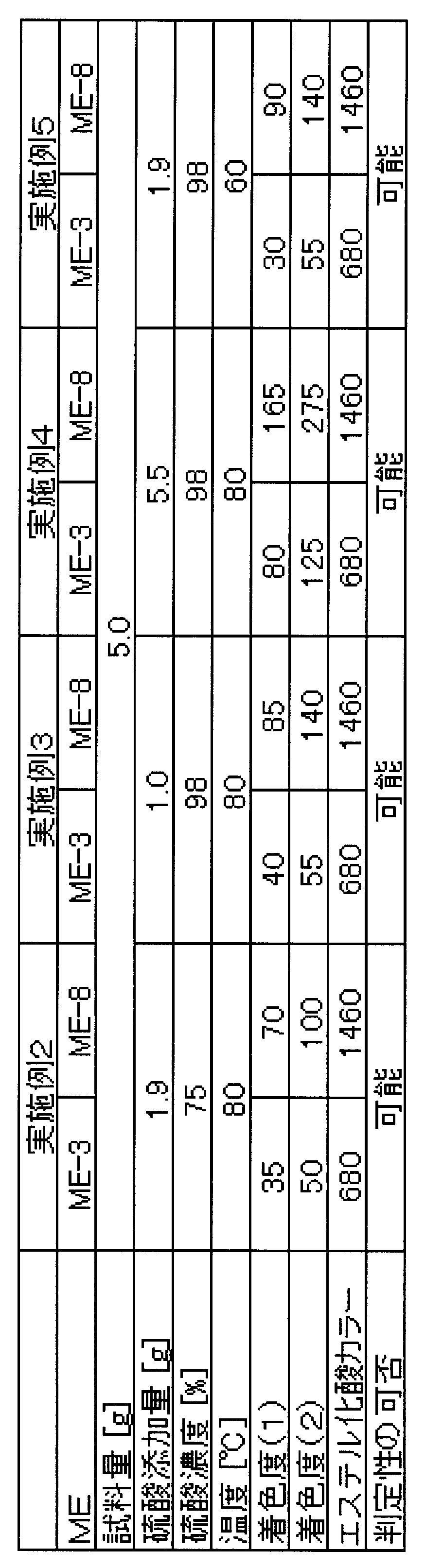
ME-3、ME-8における、硫酸添加量、硫酸濃度、硫酸呈色処理反応温度の影響の変化を調べた。尚、加温時間は1時間とした。結果を表4に示す。
上記で得られたα-スルホ脂肪酸メチルエステルのうち、原料としてME-3を用いたα-スルホ脂肪酸メチルエステルを、2質量%水酸化ナトリウム水溶液を用いて、中和液がpH7~8となるように中和し、AI70%のα-スルホ脂肪酸メチルエステル塩の水性スラリーを得た。
ついで、得られた水性スラリー中のα-スルホ脂肪酸メチルエステル塩を、35%過酸化水素水を用いて漂白した。未漂白のα-スルホ脂肪酸アルキルエステル塩に対する過酸化水素の配合量は純分として2質量%とした。漂白温度は80℃~85℃で行った。
漂白8時間後のα-スルホ脂肪酸アルキルエステル塩の5質量%水溶液を40mm光路長、No.42ブルーフィルターを用いクレット光電光度計により測定したカラーは、55(5%Klett値)であった。
ついで、得られた水性スラリー中のα-スルホ脂肪酸メチルエステル塩を、35%過酸化水素水を用いて漂白した。未漂白のα-スルホ脂肪酸アルキルエステル塩に対する過酸化水素の配合量は純分として2質量%とした。漂白温度は80℃~85℃で行った。
漂白8時間後のα-スルホ脂肪酸アルキルエステル塩の5質量%水溶液を40mm光路長、No.42ブルーフィルターを用いクレット光電光度計により測定したカラーは、55(5%Klett値)であった。
上記結果から、α-スルホ脂肪酸アルキルエステル(塩)の原料である脂肪酸アルキルエステルに対して予め硫酸呈色処理を行い、その着色度によって原料を選定することによって、淡色のα-スルホ脂肪酸メチルエステルを製造することが出来る。例えば着色度(1)が120以下または着色度(2)が190以下の脂肪酸アルキルエステルを選定することにより、エステル化酸カラーの値が1300未満のα-スルホ脂肪酸メチルエステルが得られることが確認できた。
具体的な効果としては、本方法によれば短時間で簡便にスルホン化反応とエステル化反応後における着色度を予測することができるので、目標品質に適した原料を選定することができる。また、原料の品質が一定で保つことが出来るため、着色漂白工程における漂白薬剤を必要以上に使用することがなくなるなど、品質を安定化させるために工程を管理する労力を軽減できる。
具体的な効果としては、本方法によれば短時間で簡便にスルホン化反応とエステル化反応後における着色度を予測することができるので、目標品質に適した原料を選定することができる。また、原料の品質が一定で保つことが出来るため、着色漂白工程における漂白薬剤を必要以上に使用することがなくなるなど、品質を安定化させるために工程を管理する労力を軽減できる。
本発明によれば、α-スルホ脂肪酸アルキルエステル(塩)の製造において原料として用いられる脂肪酸アルキルエステルの品質を正確かつ簡便に選定できる選定方法、前記選定方法を利用した、スルホン化工程および/またはエステル化処理工程で得られる反応生成物の着色度の予測方法およびα-スルホ脂肪酸アルキルエステル(塩)とその製造方法を提供できる。
Claims (4)
- α-スルホ脂肪酸アルキルエステル(塩)の選定方法であって、予め原料である脂肪酸アルキルエステルと硫酸とを混合し、所定温度で硫酸呈色処理を行い、その着色度により満足する品質のものだけを選定する工程を実施することを特徴とするα-スルホ脂肪酸アルキルエステル(塩)の選定方法。
- 脂肪酸アルキルエステルをスルホン化するスルホン化工程と、前記スルホン化工程で得られる生成物をアルコールにてエステル化処理するエステル化処理工程と、前記エステル化処理工程で得られる生成物とアルカリ水溶液とを接触させる中和工程とを含むα-スルホ脂肪酸アルキルエステル(塩)の製造方法における前記スルホン化工程および/またはエステル化処理工程で得られる反応生成物の着色度の予測方法であって、
請求項1に記載の選定方法により脂肪酸アルキルエステルの着色性を評価し、前記着色性を指標として、前記脂肪酸アルキルエステルから得られる前記反応生成物の着色度を予測することを特徴とする予測方法。 - 脂肪酸アルキルエステルをスルホン化するスルホン化工程と、前記スルホン化工程で得られる生成物をアルコールにてエステル化処理するエステル化処理工程と、前記エステル化処理工程で得られる生成物とアルカリ水溶液とを接触させる中和工程とを含むα-スルホ脂肪酸アルキルエステル(塩)の製造方法であって、
前記脂肪酸アルキルエステルとして、請求項1記載の選定方法により選定された品質の脂肪酸アルキルエステルを用いることを特徴とするα-スルホ脂肪酸アルキルエステル(塩)の製造方法。 - 請求項3に記載の製造方法を用いて製造されたことを特徴とするα-スルホ脂肪酸アルキルエステル(塩)。
Priority Applications (1)
| Application Number | Priority Date | Filing Date | Title |
|---|---|---|---|
| JP2010541236A JP5538236B2 (ja) | 2008-12-02 | 2009-12-02 | α−スルホ脂肪酸アルキルエステル(塩)製造用の脂肪酸アルキルエステルの選定方法、反応生成物の着色度の予測方法、α−スルホ脂肪酸アルキルエステル(塩)の製造方法 |
Applications Claiming Priority (2)
| Application Number | Priority Date | Filing Date | Title |
|---|---|---|---|
| JP2008307530 | 2008-12-02 | ||
| JP2008-307530 | 2008-12-02 |
Publications (1)
| Publication Number | Publication Date |
|---|---|
| WO2010064429A1 true WO2010064429A1 (ja) | 2010-06-10 |
Family
ID=42233087
Family Applications (1)
| Application Number | Title | Priority Date | Filing Date |
|---|---|---|---|
| PCT/JP2009/006570 Ceased WO2010064429A1 (ja) | 2008-12-02 | 2009-12-02 | α-スルホ脂肪酸アルキルエステル(塩)製造用の脂肪酸アルキルエステルの選定方法、反応生成物の着色度の予測方法、α-スルホ脂肪酸アルキルエステル(塩)とその製造方法 |
Country Status (3)
| Country | Link |
|---|---|
| JP (1) | JP5538236B2 (ja) |
| MY (1) | MY160586A (ja) |
| WO (1) | WO2010064429A1 (ja) |
Citations (4)
| Publication number | Priority date | Publication date | Assignee | Title |
|---|---|---|---|---|
| JPH06211774A (ja) * | 1993-01-20 | 1994-08-02 | Lion Corp | α−スルホ脂肪酸エステル類の漂白方法 |
| JPH09278740A (ja) * | 1996-02-09 | 1997-10-28 | Lion Corp | 淡色α−スルホ脂肪酸アルキルエステル塩およびその製造法 |
| JPH10175940A (ja) * | 1996-12-16 | 1998-06-30 | Lion Corp | 淡色α−スルホ脂肪酸アルキルエステル塩とその製造方法 |
| JP2006076906A (ja) * | 2004-09-08 | 2006-03-23 | Lion Corp | α−スルホ脂肪酸アルキルエステル塩の製造方法 |
Family Cites Families (3)
| Publication number | Priority date | Publication date | Assignee | Title |
|---|---|---|---|---|
| DE4012106A1 (de) * | 1990-04-14 | 1991-10-17 | Henkel Kgaa | Verfahren zur herstellung hellfarbiger waschaktiver alpha-sulfofettsaeureniedrigalkylester-salze |
| JPH09278739A (ja) * | 1996-04-11 | 1997-10-28 | Lion Corp | 淡色α−スルホ脂肪酸アルキルエステル塩、脂肪酸アルキルエステルおよびその製造法 |
| JP2005171137A (ja) * | 2003-12-12 | 2005-06-30 | Lion Corp | α−スルホ脂肪酸アルキルエステル塩の製造方法 |
-
2009
- 2009-12-02 JP JP2010541236A patent/JP5538236B2/ja not_active Expired - Fee Related
- 2009-12-02 MY MYPI2011002351A patent/MY160586A/en unknown
- 2009-12-02 WO PCT/JP2009/006570 patent/WO2010064429A1/ja not_active Ceased
Patent Citations (4)
| Publication number | Priority date | Publication date | Assignee | Title |
|---|---|---|---|---|
| JPH06211774A (ja) * | 1993-01-20 | 1994-08-02 | Lion Corp | α−スルホ脂肪酸エステル類の漂白方法 |
| JPH09278740A (ja) * | 1996-02-09 | 1997-10-28 | Lion Corp | 淡色α−スルホ脂肪酸アルキルエステル塩およびその製造法 |
| JPH10175940A (ja) * | 1996-12-16 | 1998-06-30 | Lion Corp | 淡色α−スルホ脂肪酸アルキルエステル塩とその製造方法 |
| JP2006076906A (ja) * | 2004-09-08 | 2006-03-23 | Lion Corp | α−スルホ脂肪酸アルキルエステル塩の製造方法 |
Also Published As
| Publication number | Publication date |
|---|---|
| MY160586A (en) | 2017-03-15 |
| JP5538236B2 (ja) | 2014-07-02 |
| JPWO2010064429A1 (ja) | 2012-05-10 |
Similar Documents
| Publication | Publication Date | Title |
|---|---|---|
| CA1167467A (en) | PREPARATION OF LIGHT-COLORED, WASH ACTIVE .alpha.- SULFOFATTY ACID ESTERS | |
| CN103649043B (zh) | 用于制备基于脂肪酰氨基羧酸的表面活性剂的方法 | |
| US20090163730A1 (en) | Process for the preparation of biodiesel | |
| Mulia et al. | Green extraction of palmitic acid from palm oil using betaine-based Natural Deep Eutectic Solvents | |
| CN103857653A (zh) | 制备基于脂肪酰氨基的表面活性剂一般方法 | |
| US20080282601A1 (en) | Hardened Vegetable Oils and Derivatives Thereof | |
| JPH0345760B2 (ja) | ||
| BR112020025643A2 (pt) | preparação e uso de esterquats de alta qualidade a partir de ácidos graxos de farelo de arroz | |
| JP5538236B2 (ja) | α−スルホ脂肪酸アルキルエステル(塩)製造用の脂肪酸アルキルエステルの選定方法、反応生成物の着色度の予測方法、α−スルホ脂肪酸アルキルエステル(塩)の製造方法 | |
| US3256303A (en) | Sulfonation of fatty acids and their esters | |
| US20200100998A1 (en) | Method for producing a light-coloured disalt | |
| EP0153036B1 (en) | Sulphonation of fatty acid esters | |
| JP2008024672A (ja) | α―スルホ脂肪酸アルキルエステル塩の製造方法 | |
| ES2828751T3 (es) | Procesamiento corriente abajo de composiciones de alcohol graso producidas por células huésped recombinantes | |
| CN104829498B (zh) | 一种椰油酰氧乙基磺酸盐的制备方法 | |
| JP5134980B2 (ja) | 脂肪酸アルキルエステルスルホネート製造用の水添脂肪酸アルキルエステルの製造方法、脂肪酸アルキルエステルスルホネートの製造方法 | |
| JP3547435B2 (ja) | スルフォン化脂肪酸アルキルエステル界面活性剤を製造するための無漂白方法 | |
| US20240117271A1 (en) | Liquid datem compositions | |
| JPH03265697A (ja) | 石鹸の連続製造方法及びその装置 | |
| JPH0881694A (ja) | α−スルホ脂肪酸エステル塩の製造方法 | |
| Niikura et al. | Coloration process in the sulfonation of fatty acid methyl ester with sulfur trioxide | |
| JPH09278739A (ja) | 淡色α−スルホ脂肪酸アルキルエステル塩、脂肪酸アルキルエステルおよびその製造法 | |
| Sani | Multistage methanolysis of crude palm oil for biodiesel production in a pilot plant | |
| JP5193865B2 (ja) | α―スルホ脂肪酸アルキルエステル塩の製造方法 | |
| JPH03265696A (ja) | 石鹸の製造方法及びその装置 |
Legal Events
| Date | Code | Title | Description |
|---|---|---|---|
| 121 | Ep: the epo has been informed by wipo that ep was designated in this application |
Ref document number: 09830199 Country of ref document: EP Kind code of ref document: A1 |
|
| WWE | Wipo information: entry into national phase |
Ref document number: 2010541236 Country of ref document: JP |
|
| NENP | Non-entry into the national phase |
Ref country code: DE |
|
| 122 | Ep: pct application non-entry in european phase |
Ref document number: 09830199 Country of ref document: EP Kind code of ref document: A1 |