WO2010061807A1 - ケトンの製造方法 - Google Patents
ケトンの製造方法 Download PDFInfo
- Publication number
- WO2010061807A1 WO2010061807A1 PCT/JP2009/069773 JP2009069773W WO2010061807A1 WO 2010061807 A1 WO2010061807 A1 WO 2010061807A1 JP 2009069773 W JP2009069773 W JP 2009069773W WO 2010061807 A1 WO2010061807 A1 WO 2010061807A1
- Authority
- WO
- WIPO (PCT)
- Prior art keywords
- group
- palladium
- olefin
- carbon
- ketone
- Prior art date
- Legal status (The legal status is an assumption and is not a legal conclusion. Google has not performed a legal analysis and makes no representation as to the accuracy of the status listed.)
- Ceased
Links
- 0 CC(*)[N+](*(C)*)[O-] Chemical compound CC(*)[N+](*(C)*)[O-] 0.000 description 1
Classifications
-
- C—CHEMISTRY; METALLURGY
- C07—ORGANIC CHEMISTRY
- C07C—ACYCLIC OR CARBOCYCLIC COMPOUNDS
- C07C45/00—Preparation of compounds having >C = O groups bound only to carbon or hydrogen atoms; Preparation of chelates of such compounds
- C07C45/27—Preparation of compounds having >C = O groups bound only to carbon or hydrogen atoms; Preparation of chelates of such compounds by oxidation
- C07C45/32—Preparation of compounds having >C = O groups bound only to carbon or hydrogen atoms; Preparation of chelates of such compounds by oxidation with molecular oxygen
- C07C45/33—Preparation of compounds having >C = O groups bound only to carbon or hydrogen atoms; Preparation of chelates of such compounds by oxidation with molecular oxygen of CHx-moieties
- C07C45/34—Preparation of compounds having >C = O groups bound only to carbon or hydrogen atoms; Preparation of chelates of such compounds by oxidation with molecular oxygen of CHx-moieties in unsaturated compounds
-
- C—CHEMISTRY; METALLURGY
- C07—ORGANIC CHEMISTRY
- C07C—ACYCLIC OR CARBOCYCLIC COMPOUNDS
- C07C2601/00—Systems containing only non-condensed rings
- C07C2601/06—Systems containing only non-condensed rings with a five-membered ring
- C07C2601/08—Systems containing only non-condensed rings with a five-membered ring the ring being saturated
-
- C—CHEMISTRY; METALLURGY
- C07—ORGANIC CHEMISTRY
- C07C—ACYCLIC OR CARBOCYCLIC COMPOUNDS
- C07C2601/00—Systems containing only non-condensed rings
- C07C2601/12—Systems containing only non-condensed rings with a six-membered ring
- C07C2601/14—The ring being saturated
Definitions
- the present invention relates to a method for producing a ketone by oxidizing an olefin.
- Carbonyl compounds such as ketones such as methyl ethyl ketone (MEK), methyl isobutyl ketone (MIBK) and acetone, and aldehydes typified by acetaldehyde are useful as solvents and chemical raw materials, and are used in various fields.
- Such a carbonyl compound is usually produced by a two-stage reaction method in which an alcohol produced by hydration of an olefin is dehydrogenated.
- a one-stage reaction method in which an olefin is directly oxidized is also known. ing.
- Non-Patent Document 1 discloses a method of oxidizing terminal and internal olefins using a palladium catalyst, a copper catalyst, polyethylene glycol and water.
- Patent Document 1 discloses palladium, oxyacid salts of metals having redox activity (copper, iron, etc.), hydroquinones, and compounds capable of converting the hydroquinones into quinones (iron In the presence of phthalocyanine, cobalt tetraphenylporphyrin and the like, a method for producing a carbonyl compound is disclosed in which an olefin is oxidized with molecular oxygen in an acidic aqueous solution.
- Patent Document 2 JP-A-5-148177 discloses a carbonyl compound that oxidizes an olefin in a solution containing water and urea in the presence of a catalyst comprising a palladium compound and a copper compound and / or an iron compound. A manufacturing method is disclosed.
- Patent Document 3 discloses a method for producing a carbonyl compound in which an olefin and water are reacted in the presence of a palladium compound, a copper compound and an organic phosphorus compound.
- Patent Document 4 an olefin and an oxygen gas are contained in a solvent comprising an oxygen-containing compound or a sulfur-containing compound in the presence of a palladium compound, a polyoxoanion compound and an iron-containing compound.
- a method for producing a carbonyl compound to be reacted is disclosed.
- Non-Patent Document 2 J. Org. Chem. 1990, 55, 2924-2927 discloses an improved Wacker method in which a cyclic or internal olefin is reacted with p-benzoquinone using a strong acid in the presence of a palladium catalyst.
- Patent Document 5 in the method for producing a ketone in which an olefinic compound is oxidized using p-benzoquinone in the presence of water and a palladium compound, the oxidation reaction is carried out with a heterogeneous strong acid ( For example, a method for producing a ketone using a sulfonic acid ion exchanger or the like is disclosed.
- Non-patent Document 3 J. Chem. Soc. , Perkin Trans. 1, 2000, 1915-1918 discloses an olefin oxidation reaction using pyridine and 2-propanol in toluene in the presence of palladium acetate.
- Patent Document 6 JP 2002-191979 discloses a method for producing a ketone in which alkenes are oxidized with molecular oxygen in the presence of an oxidation catalyst comprising a palladium compound, a heteropolyacid and a strong acid.
- Patent Document 7 JP 2008-231043 discloses a method for producing a ketone in which an olefin is reacted with molecular oxygen in the presence of a palladium source, mesoporous silicate, water and a protonic acid.
- Non-Patent Document 4 describes molecular oxygen as a reoxidant when oxidizing a terminal olefin in a polar solvent such as N, N-dimethylacetamide in the presence of a palladium catalyst.
- a method for producing ketones using is disclosed.
- This invention is made
- the present inventors have used a specific amide solvent in the presence of a palladium catalyst, water, and molecular oxygen, so that 1 can be added to a site other than the terminal in the molecule.
- a palladium catalyst e.g., palladium
- water e.g., water
- molecular oxygen e.g., molecular oxygen
- 1 can be added to a site other than the terminal in the molecule.
- the internal olefin or the cyclic olefin which is difficult to produce with high yield and high selectivity by oxidizing the internal olefin or cyclic olefin having at least one carbon-carbon double bond. It has been found that ketones can be produced with high yield and high selectivity, and the present invention has been completed.
- the method for producing the ketone of the present invention has the following formula (1):
- R 1 represents an alkyl group having 1 to 4 carbon atoms
- R 2 and R 3 each independently represents an alkyl group or aryl group having 1 to 4 carbon atoms
- R 1 and R 2 are In the case of alkyl groups, they may be bonded to each other to form a ring structure.
- the amide solvent represented by the formula in the presence of water, a palladium catalyst and molecular oxygen, an internal olefin or cyclic olefin having at least one carbon-carbon double bond at a site other than the terminal in the molecule is oxidized. In this method, an oxo group is bonded to at least one carbon atom constituting the carbon-carbon double bond.
- the concentration of the palladium catalyst is preferably 0.002 to 1 mol / L.
- the internal olefin or cyclic olefin is represented by the following formula (2):
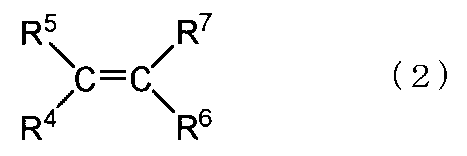
- R 4 to R 7 each independently represents one selected from the group consisting of a hydrogen atom, an alkyl group, an alkenyl group and an aryl group, and at least one of R 4 and R 5 is Any one of an alkyl group, an alkenyl group, and an aryl group, at least one of R 6 and R 7 is any one of an alkyl group, an alkenyl group, and an aryl group, and R 4 and R 6 are alkyl In the case of a group or an alkenyl group, they may be bonded to each other to form a ring structure, and in the case where R 5 and R 7 are an alkyl group or an alkenyl group, they may be bonded to each other to form a ring structure.) Are preferred, and those having no carbon-carbon double bond at the terminal in the molecule are more preferred.
- the palladium catalyst is preferably at least one palladium compound selected from the group consisting of palladium halides and nitrile complexes of palladium halides, and the amide solvents include N, N-dimethylacetamide and N-methyl. At least one selected from the group consisting of -2-pyrrolidone is preferred.
- the method for producing the ketone of the present invention comprises the following formula (1):
- R 1 represents an alkyl group having 1 to 4 carbon atoms
- R 2 and R 3 each independently represents an alkyl group or aryl group having 1 to 4 carbon atoms
- R 1 and R 2 are In the case of alkyl groups, they may be bonded to each other to form a ring structure.
- the amide solvent represented by the formula in the presence of water, a palladium catalyst and molecular oxygen, an internal olefin or cyclic olefin having at least one carbon-carbon double bond at a site other than the terminal in the molecule is oxidized. In this method, an oxo group is bonded to at least one carbon atom constituting the carbon-carbon double bond.
- the olefin used in the present invention is an internal olefin or a cyclic olefin having one or more carbon-carbon double bonds at a site other than the terminal in the molecule.
- the molecule has one or more carbon-carbon double bonds, olefins having a carbon-carbon double bond at the terminal, and olefins having no carbon-carbon double bond, It can be used as an internal olefin or a cyclic olefin.
- R 4 to R 7 each independently represents one selected from the group consisting of a hydrogen atom, an alkyl group, an alkenyl group and an aryl group, and at least one of R 4 and R 5 is Any one of an alkyl group, an alkenyl group, and an aryl group, at least one of R 6 and R 7 is any one of an alkyl group, an alkenyl group, and an aryl group, and R 4 and R 6 are alkyl In the case of a group or an alkenyl group, they may be bonded to each other to form a ring structure, and in the case where R 5 and R 7 are an alkyl group or an alkenyl group, they may be bonded to each other to form a ring structure.) The compound represented by these is preferable.
- the alkyl group and the alkenyl group may be linear, branched or cyclic.
- the carbon number of the alkyl group is preferably 1 to 12, and more preferably 4 to 12.
- a hetero atom may be contained as long as the effects of the present invention are not impaired.
- the position of the C ⁇ C bond in the alkenyl group is not particularly limited, and may be at the terminal or inside of the alkenyl group.
- an olefin having a C ⁇ C bond at the terminal of the alkenyl group becomes a polyene having a C ⁇ C bond at the terminal and inside of the molecule, and an olefin having a C ⁇ C bond inside the alkenyl group is inside the molecule.
- the aryl group include a phenyl group, a methylphenyl group, and a benzyl group, and the aryl group may contain a hetero atom as long as the effects of the present invention are not impaired.
- R 4 and R 6, and / or, R 5 and R 7 each may be bonded together to form a ring structure.
- a ring structure include cyclic olefins such as cycloalkene and cycloalkadiene.
- a C ⁇ C bond may exist in a portion other than the ring structure (for example, R 5 and / or R 7 when R 4 and R 6 are combined to form a ring structure).
- Such internal olefins include 2-butene, 2-pentene, 2-methyl-2-butene, 2-hexene, 3-hexene, 4-methyl-2-pentene, 2-heptene and 3-heptene. 5-methyl-2-hexene, 2-octene, 3-octene, 4-octene, 6-methyl-2-heptene, 2-nonene, 7-methyl-2-octene, 1-phenyl-1-propylene, -Cyclohexyl-1-propylene, 2-decene, 3-decene, 4-decene, 5-decene, 8-methyl-2-nonene, 1-phenyl-2-butene, 1-cyclohexyl-2-butene, 5-undecene Monoolefins such as 6-dodecene, 7-tetradecene, 8-hexadecene, 1,3-pentadiene, 2,4-hexadiene,
- cyclic olefin examples include cycloalkenes such as cyclopentene, cyclohexene, cyclooctene, and cyclodecene, cycloalkadienes typified by cyclooctadiene, and alkyl groups and alkenyls in these cycloalkenes and cycloalkadienes. Examples thereof include those substituted with a group (for example, vinylcyclohexene, allylcyclohexene).
- These internal olefins and cyclic olefins may be used alone or in combination of two or more.
- 2-butene, 2-pentene, 2-methyl-2-butene, 2-hexene are used from the viewpoint of increasing the yield and selectivity of the corresponding ketone to be produced.
- 3-hexene, 4-methyl-2-pentene, 2-heptene, 2-octene, 3-octene, 4-octene, 5-decene, 6-methyl-2-heptene, cyclopentene, cyclohexene, and cyclooctene are preferred.
- 3-hexene, 4-octene, 5-decene and 7-tetradecene are more preferred.
- the concentration of the internal olefin or cyclic olefin is preferably 0.01 to 5 mol / L, more preferably 0.05 to 1 mol / L. If the concentration of the olefin is less than the lower limit, the corresponding ketone tends to be unable to be obtained in high yield. On the other hand, if the concentration exceeds the upper limit, the oxidation reaction of the olefin does not proceed sufficiently, and high yield is supported. It tends to be impossible to produce ketones.
- the palladium catalyst used in the present invention is not particularly limited as long as it is a compound containing a palladium atom, and those used in the production of ordinary ketones can be used.
- Specific examples of such palladium catalysts include inorganic salts of palladium such as palladium sulfate, palladium nitrate and palladium carbonate, polyoxoanionic compounds containing palladium such as palladium heteropolyacid salt and palladium isopolyacid salt, palladium chloride and bromide.
- Palladium halides such as palladium, palladium acid salts such as sodium tetrachloropalladate, sodium tetrabromopalladate, potassium tetrachloropalladate and potassium tetrabromopalladate, ammine complexes of palladium halides such as tetraamminepalladium dichloride and diamminepalladium tetrachloride, Inorganic palladium compounds and complexes such as palladium hydroxide and palladium oxide, para acetate Palladium organic acid salts such as palladium, palladium-containing organic compounds such as palladium acetylacetonate and alkylpalladium compounds, nitrile complexes of palladium halides such as diacetonitrile palladium dichloride and dibenzonitrile palladium dichloride, and tetrakis (triphenylphosphine) palladium Palladium phosphine complexes, pal
- palladium halide and a nitrile complex of palladium halide are preferable, and palladium halide is more preferable, from the viewpoint that the yield and selectivity in the oxidation reaction of the olefin are increased.
- the palladium catalyst may be dissolved in an amide solvent described later, or may be uniformly or non-uniformly dispersed, or a combination thereof.
- a part of the palladium catalyst for example, a ligand
- the remaining components may be uniformly or non-uniformly dispersed.
- the concentration of the palladium catalyst is preferably 0.002 to 1 mol / L, more preferably 0.001 to 0.05 mol / L.
- concentration of the palladium catalyst is less than the lower limit, the oxidation reaction of the olefin does not proceed sufficiently, and the corresponding ketone tends to be unable to be produced in a high yield. A certain Pd black is produced, and the oxidation reaction of olefin does not proceed sufficiently.
- an amide solvent represented by the formula (1) is used as a solvent.
- the palladium catalyst can be efficiently reoxidized with molecular oxygen.
- R 1 represents an alkyl group having 1 to 4 carbon atoms
- R 2 and R 3 each independently represents an alkyl group or aryl group having 1 to 4 carbon atoms.
- R 1 and R 2 are alkyl groups, they may be bonded to each other to form a ring structure.
- Examples of such a ring structure include a pyrrolidone skeleton and a caprolactam skeleton.
- amide solvent used in the present invention include N, N-dimethylacetamide, N, N-diethylacetamide, N, N-dipropylacetamide, N-methyl-N-ethylacetamide, and N-butyl-N.
- -Phenylacetamide, N, N-dimethylpropanamide, N, N-diethylpropanamide, N-methyl-N-ethylpropanamide, N-methyl-2-pyrrolidone, N-methyl-2-caprolactam, N-ethyl- Examples include 2-caprolactam.
- These solvents may be used alone or in combination of two or more. In the present invention, these amide solvents and other solvents may be used in combination.
- N, N-dimethylacetamide and N-methyl-2-pyrrolidone are preferable from the viewpoint of high yield and selectivity in the olefin oxidation reaction.
- the amount of the amide solvent used in the present invention is appropriately set so that the concentrations of the olefin and the palladium catalyst are within the above range.
- the corresponding olefin is reacted with water to produce the corresponding ketone.
- the amount of water added is not particularly limited as long as it is a required amount for the reaction, and can be appropriately set depending on the type of olefin, palladium catalyst and amide solvent used, the reaction method and the conditions. Specifically, 0.5 to 70 parts by volume is preferable with respect to 100 parts by volume of the amide solvent, and 1 to 50 parts by volume is more preferable. When the amount of water added is less than the lower limit, a sufficient oxidation reaction rate cannot be obtained, and the yield of the corresponding ketone tends to decrease.
- the palladium component tends to precipitate or aggregate as metallic palladium, and the catalytic activity tends to decrease. Further, since the solubility of the olefin in water is low, the contact efficiency between the olefin and the palladium catalyst is lowered, and a sufficient oxidation reaction rate cannot be obtained, and the yield of the corresponding ketone tends to be lowered.
- the palladium catalyst after oxidizing the olefin is reoxidized using molecular oxygen.
- a cocatalyst such as a copper catalyst is not substantially used, the oxidation reaction of the olefin is not inhibited by the copper catalyst, and the corresponding ketone is produced from the internal olefin or cyclic olefin with high yield and high selectivity. It becomes possible.
- Examples of the molecular oxygen supply source include oxygen gas, oxygen-enriched air, air, a mixed gas of oxygen gas and dilution gas (collectively referred to as “oxygen-containing gas”), and the like.
- oxygen-containing gas a mixed gas of oxygen gas and dilution gas
- Examples of the dilution gas include nitrogen gas, helium gas, argon gas, and carbon dioxide, and nitrogen gas is usually used.
- these oxygen-containing gases and gases other than the dilution gas can be used in combination as long as the effects of the invention are not impaired. Further, such an oxygen-containing gas may be supplied by mixing with water or an amide solvent as necessary.
- the oxygen-containing gas is preferably supplied at an oxygen pressure of 0.1 to 1 MPa (more preferably 0.3 to 1 MPa).
- the oxygen pressure is lower than the lower limit, Pd black, which is an inert species, is generated, and there is a tendency that the corresponding ketone cannot be produced in a high yield.
- the upper limit is exceeded, oxygenation by-product is generated in some olefins. (For example, in the case of cyclohexene, 2-cyclohexen-1-one in which the allylic position is oxidized is formed).
- ⁇ Oxidation reaction> the internal olefin or cyclic olefin is oxidized in the amide solvent in the presence of water, a palladium catalyst and molecular oxygen to form a C ⁇ C bond in the olefin.
- a ketone is formed by attaching an oxo group ( ⁇ O) to at least one carbon atom. In the present specification, such a ketone is referred to as “corresponding ketone”.
- the oxidation reaction method is not particularly limited as long as the palladium catalyst and the olefin can be brought into contact with each other.
- a gas-liquid reaction and / or a liquid-liquid reaction can be performed depending on the olefin and palladium catalyst to be used. Any of the reactions can be carried out, and batch, semi-batch, semi-continuous, continuous flow, or combinations thereof can be employed.
- limiting in particular also in the supply method of each components, such as an olefin You may supply in a liquid state or a gaseous state.
- a catalyst solution prepared by mixing the palladium catalyst and the amide solvent or a mixed solution obtained by mixing the olefin with the catalyst solution and the oxygen-containing gas are charged into a batch reactor.
- Batch system for reaction, semi-batch system or semi-continuous system for continuously supplying the olefin and the oxygen-containing gas into the catalyst solution, or continuously supplying the oxygen-containing gas into the mixed solution examples thereof include a continuous flow type in which the catalyst solution, the olefin, and the oxygen-containing gas are simultaneously passed through the reaction region.
- the supply rate of the olefin is preferably 10 to 5000 mol / h per 1 mol of palladium.
- the supply rate of the olefin is less than the lower limit, the production amount of the corresponding ketone per unit time tends to decrease.
- the upper limit is exceeded, the inert species Pd Black is generated, and the corresponding ketone is produced. There is a tendency that it cannot be obtained in high yield.
- the supply rate of the oxygen-containing gas is appropriately adjusted so that the oxygen pressure in the reaction system is within the above range.
- the reaction temperature for carrying out the oxidation reaction is preferably 0 to 200 ° C, more preferably 20 to 100 ° C.
- the reaction temperature is less than the lower limit, the reaction rate is slow, and the yield of the corresponding ketone tends to decrease.
- the upper limit is exceeded, side reactions such as olefin isomerization occur, and the corresponding ketone selectivity. Tend to decrease.
- the concentration of the copper catalyst used in the conventional Wacker method is preferably 0.03 mol / L or less, more preferably 0.01 mol / L or less, and 0.003 mol / L or less. It is particularly preferred that When the concentration of the copper catalyst exceeds the upper limit, the yield of the corresponding ketone tends to decrease. From this viewpoint, in the present invention, it is most preferable to oxidize the internal olefin or the cyclic olefin in the absence of a copper catalyst. In the conventional Wacker method, the copper catalyst promotes the reoxidation of the palladium catalyst.
- the corresponding ketone thus obtained can be obtained as a single compound or a mixture having a desired purity or composition by separation and purification according to a conventional method.
- a conventional method since there are few side reactions during the oxidation reaction, unreacted raw materials can be recovered and used again for the production of ketones.
- amide solvents and palladium catalysts can be separated and recovered and used repeatedly. At this time, the palladium catalyst may be appropriately regenerated as necessary.
- Example 1 A pressure vessel was charged with palladium chloride (8.8 mg, 0.05 mmol), dimethylacetamide (DMA, 5 ml) and water (0.5 ml), and heated to 80 ° C. to dissolve palladium chloride. After the obtained solution was transferred to an autoclave reactor, oxygen gas was supplied to pressurize the reactor to 0.9 MPa and stirred for 1 hour. The inside of the reactor was depressurized, trans-4-octene (112 mg, 1.0 mmol) was added, oxygen gas was supplied, the inside of the reactor was pressurized to 0.6 MPa, and an oxidation reaction was performed at 80 ° C. for 10 hours. It was.
- trans-4-octene has the following reaction formula (I):
- Table 1 shows the yield of 4-octanone with respect to the amount of trans-4-octene charged and the selectivity of 4-octanone with respect to the total amount of products.
- Example 2 instead of trans-4-octene, trans-2-octene (112 mg, 1.0 mmol), trans-3-octene (112 mg, 1.0 mmol), trans-5-decene (140 mg, 1.0 mmol), 7-
- the oxidation reaction was carried out in the same manner as in Example 1 except that tetradecene (196 mg, 1.0 mmol) and trans-3-hexene (84 mg, 1.0 mmol) were used.
- tetradecene 196 mg, 1.0 mmol
- trans-3-hexene 84 mg, 1.0 mmol
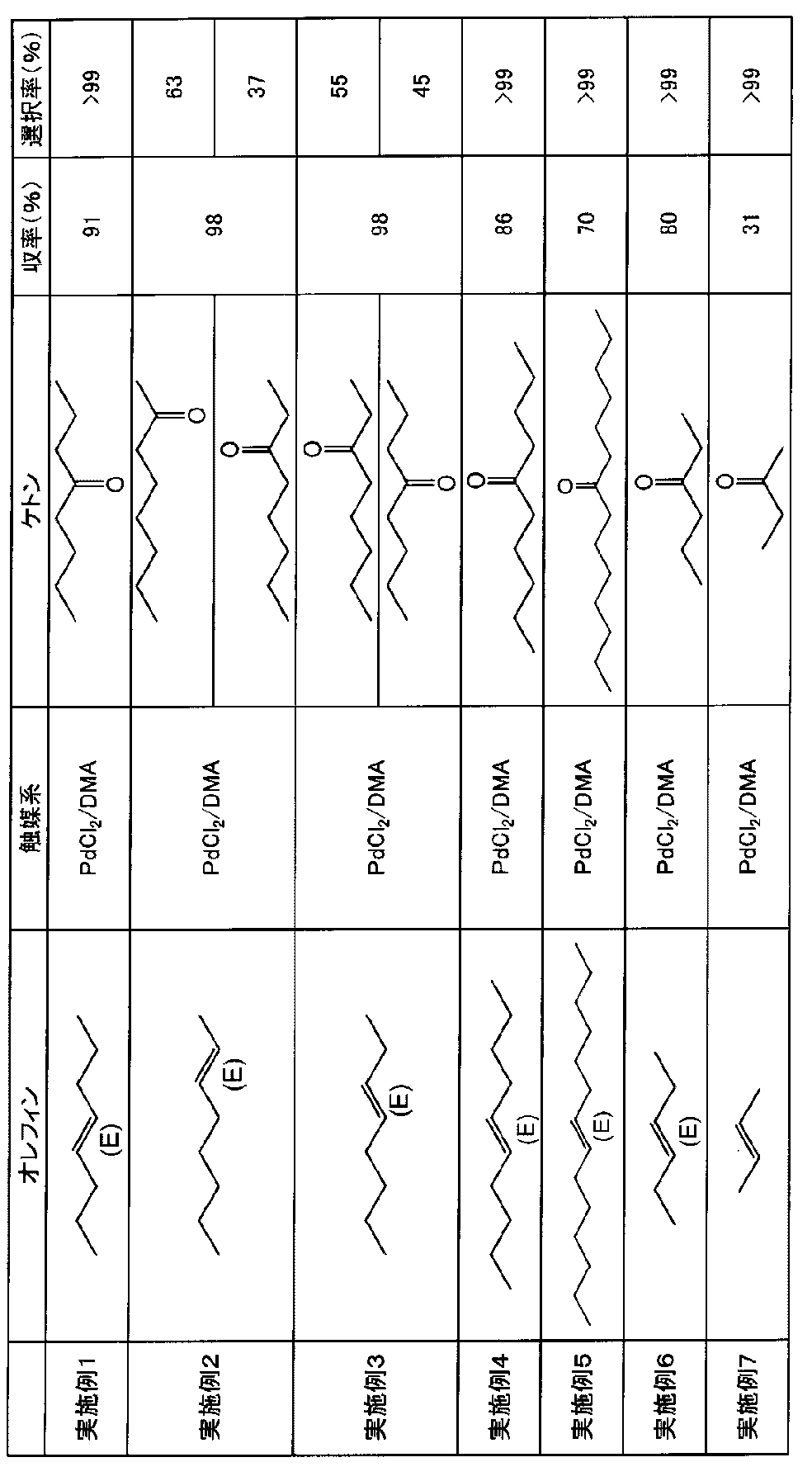
- Table 2 shows the yield of the corresponding ketone with respect to the charged amount of each internal olefin, and the selectivity of the corresponding ketone with respect to the total product amount.
- Example 7 2-butene (300 mg, 5.3 mmol) was used instead of trans-4-octene, the amount of palladium chloride was 30.4 mg (0.17 mmol), the amount of dimethylacetamide was 30 ml, the amount of water was 3.0 ml, The oxidation reaction was carried out in the same manner as in Example 1 except that the reaction time was changed to 4 hours.
- the product was analyzed in the same manner as in Example 1, it was confirmed that an oxo group ( ⁇ O) was bonded to the carbon atom in the C ⁇ C bond of 2-butene, and methyl ethyl ketone was formed.
- Table 2 shows the yield of methyl ethyl ketone relative to the amount of 2-butene charged and the selectivity of methyl ethyl ketone relative to the total amount of product.
- Table 3 shows the yields of various ketones produced from various internal olefins by the following conventional methods with respect to the amount of the internal olefins charged and the selectivity with respect to the total amount of products.
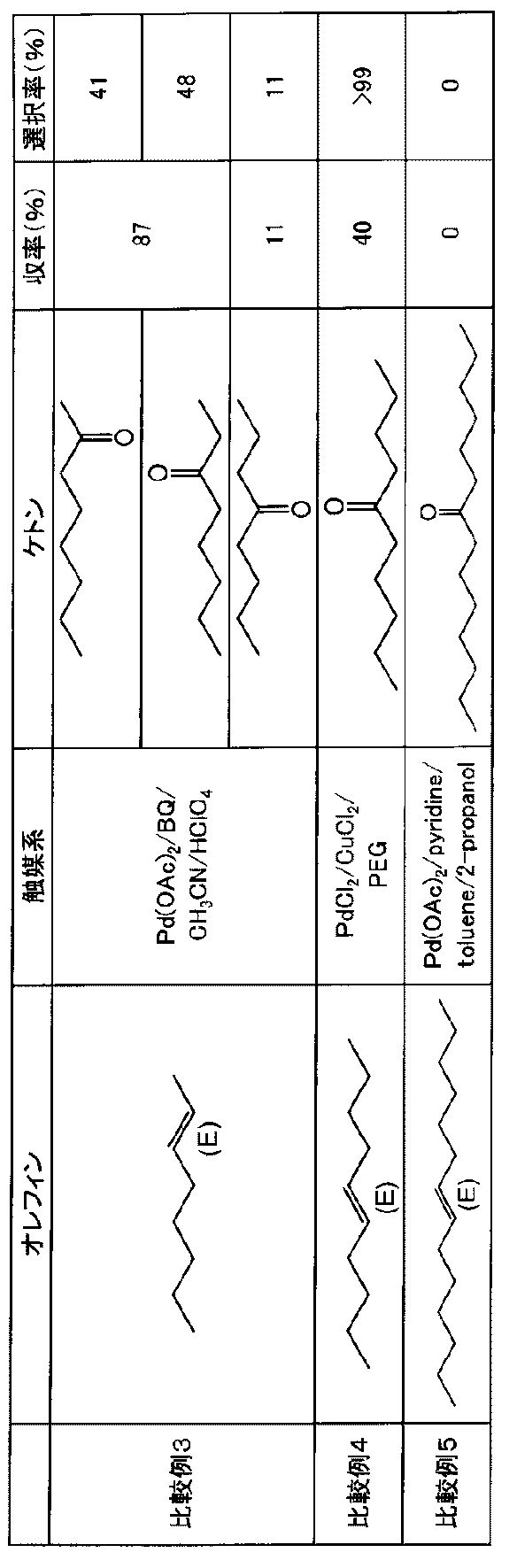
- Comparative Example 3 D. M.M. Results according to the method of Wayner et al. (J. Org. Chem. 1990, 55, 2924). J. et al. H. The results by Smith et al. (Tetrahedron Letters. 1985, 2263), Comparative Example 5 It is a result (J. Chem. Soc., Perkin Trans. 2000, 1, 1915) by the method of Uemura et al.
- Ac represents an acetyl group
- BQ represents benzoquinone
- PEG represents polyethylene glycol.
- the production method of the present invention is sufficiently superior in view of the fact that the oxidation of internal olefins hardly proceeded in the conventional method. That is, compared with the conventional method, for example, when DMF is used as a solvent and PdCl 2 / CuCl 2 is used as a catalyst at a concentration similar to that in Example 7, Example 7 has a high yield and high selectivity. It can be said that methyl ethyl ketone was successfully produced.
- Example 8 The oxidation reaction was carried out in the same manner as in Example 1 except that cyclohexene (42 mg, 0.5 mmol) was used instead of trans-4-octene and the amount of palladium chloride was changed to 17.5 mg (0.1 mmol).
- cyclohexene 42 mg, 0.5 mmol
- the amount of palladium chloride was changed to 17.5 mg (0.1 mmol).
- ⁇ O oxo group
- Table 4 shows the yield of cyclohexanone relative to the amount of cyclohexene charged and the selectivity of cyclohexanone relative to the total amount of product.
- Example 9 The oxidation reaction was carried out in the same manner as in Example 8 except that the amount of cyclohexene was changed to 82 mg (1.0 mmol) and the reaction temperature was changed to 70 ° C.
- the product was analyzed in the same manner as in Example 1, it was confirmed that an oxo group ( ⁇ O) was bonded to a carbon atom in the C ⁇ C bond of cyclohexene, and cyclohexanone was formed.
- Table 4 shows the yield of cyclohexanone relative to the amount of cyclohexene charged and the selectivity of cyclohexanone relative to the total amount of product.
- Example 10 Cyclopentene (670 mg, 9.8 mmol) was used instead of cyclohexene, the amount of palladium chloride was 28.7 mg (0.16 mmol), the amount of dimethylacetamide was 30 ml, the amount of water was 3.0 ml, and the reaction time was 4 hours.
- the oxidation reaction was carried out in the same manner as in Example 8 except that the change was made.
- the product was analyzed in the same manner as in Example 1. As a result, it was confirmed that an oxo group ( ⁇ O) was bonded to the carbon atom in the C ⁇ C bond of cyclopentene, and cyclopentanone was formed.
- Table 4 shows the yield of cyclopentanone relative to the amount of cyclopentene charged and the selectivity of cyclopentanone relative to the total amount of product.
- Example 11 Except for changing the amount of palladium chloride to 3.5 mg (0.02 mmol), the amount of trans-4-octene to 56 mg (0.5 mmol), the oxygen pressure during the oxidation reaction to 0.9 MPa, and the reaction time to 6 hours.
- the oxidation reaction was carried out in the same manner as in Example 1.
- the product was analyzed in the same manner as in Example 1. As a result, it was confirmed that an oxo group ( ⁇ O) was bonded to the carbon atom in the C ⁇ C bond of trans-4-octene and 4-octanone was formed. It was.
- Table 5 shows the 4-octanone yield relative to the trans-4-octene charge and the 4-octanone selectivity relative to the total product.
- Example 12 An oxidation reaction was carried out in the same manner as in Example 11 except that a phenylnitrile complex of palladium chloride (PdCl 2 (PhCN) 2 , 7.7 mg, 0.02 mmol) was used instead of palladium chloride.
- the product was analyzed in the same manner as in Example 1. As a result, it was confirmed that an oxo group ( ⁇ O) was bonded to the carbon atom in the C ⁇ C bond of trans-4-octene and 4-octanone was formed. It was. Table 5 shows the 4-octanone yield relative to the trans-4-octene charge and the 4-octanone selectivity relative to the total product.
- Example 13 A pressure vessel was charged with palladium chloride (8.8 mg, 0.05 mmol), copper (II) chloride (3.4 mg, 0.025 mmol), dimethylacetamide (DMA, 5 ml) and water (0.5 ml). Was changed to 0.3 MPa and the reaction time was changed to 12 hours, and the oxidation reaction was carried out in the same manner as in Example 1. The product was analyzed in the same manner as in Example 1. As a result, it was confirmed that an oxo group ( ⁇ O) was bonded to the carbon atom in the C ⁇ C bond of trans-4-octene and 4-octanone was formed. It was. Table 6 shows the yield of 4-octanone relative to the amount of trans-4-octene charged and the selectivity of 4-octanone relative to the total amount of products.
- Example 14 to 15 The oxidation reaction was carried out in the same manner as in Example 13 except that the addition amount of copper (II) chloride was changed to 6.8 mg (0.05 mmol) or 13.6 mg (0.1 mmol).
- the product was analyzed in the same manner as in Example 1. As a result, it was confirmed that an oxo group ( ⁇ O) was bonded to the carbon atom in the C ⁇ C bond of trans-4-octene and 4-octanone was formed. It was.
- Table 6 shows the yield of 4-octanone relative to the amount of trans-4-octene charged and the selectivity of 4-octanone relative to the total amount of products.
- a corresponding ketone derived from an internal olefin or cyclic olefin which has been difficult to produce with high yield and high selectivity by the conventional method, has high yield and high selectivity. Can be manufactured.
- the method for producing a ketone of the present invention is economically advantageous because the yield and selectivity of the corresponding ketone are high, and the ketone obtained by this method is useful as an industrial raw material such as a solvent or a chemical raw material. is there.
Landscapes
- Chemical & Material Sciences (AREA)
- Organic Chemistry (AREA)
- Organic Low-Molecular-Weight Compounds And Preparation Thereof (AREA)
- Low-Molecular Organic Synthesis Reactions Using Catalysts (AREA)
- Catalysts (AREA)
Abstract
Description
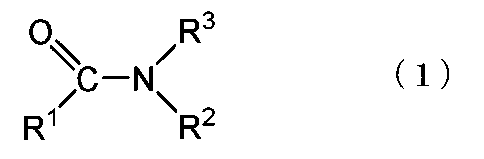
で表されるアミド系溶媒中、水、パラジウム触媒および分子状酸素の存在下で、分子内の末端以外の部位に1個以上の炭素-炭素二重結合を有する内部オレフィンまたは環状オレフィンを酸化せしめて、前記炭素-炭素二重結合を構成する少なくとも一方の炭素原子にオキソ基を結合せしめる方法である。前記パラジウム触媒の濃度としては0.002~1mol/Lが好ましい。
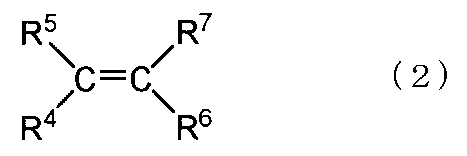
で表される化合物が好ましく、分子内の末端に炭素-炭素二重結合を有しないものがより好ましい。
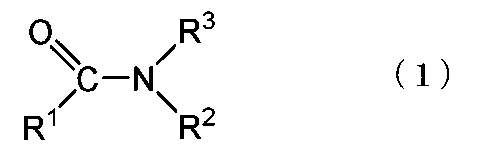
で表されるアミド系溶媒中、水、パラジウム触媒および分子状酸素の存在下で、分子内の末端以外の部位に1個以上の炭素-炭素二重結合を有する内部オレフィンまたは環状オレフィンを酸化せしめて、前記炭素-炭素二重結合を構成する少なくとも一方の炭素原子にオキソ基を結合せしめる方法である。
本発明に用いられるオレフィンは、分子内の末端以外の部位に1個以上の炭素-炭素二重結合を有する内部オレフィンまたは環状オレフィンである。また、本発明においては、分子内部に1個以上の炭素-炭素二重結合を有していれば、末端に炭素-炭素二重結合を有しているオレフィンも、有していないオレフィンも、内部オレフィンまたは環状オレフィンとして使用することができる。
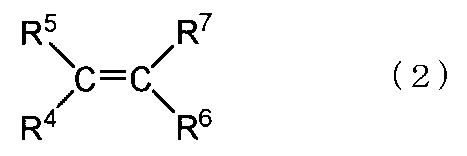
で表される化合物が好ましい。
本発明に用いられるパラジウム触媒としては、パラジウム原子を含有する化合物であれば特に制限はされず、通常のケトンの製造において用いられるものを使用することが可能である。このようなパラジウム触媒として具体的には、硫酸パラジウム、硝酸パラジウムおよび炭酸パラジウムといったパラジウムの無機塩類、ヘテロポリ酸パラジウム塩およびイソポリ酸パラジウム塩といったパラジウムを含有するポリオキソアニオン系化合物、塩化パラジウムおよび臭化パラジウムといったハロゲン化パラジウム、テトラクロロパラジウム酸ナトリウム、テトラブロモパラジウム酸ナトリウム、テトラクロロパラジウム酸カリウムおよびテトラブロモパラジウム酸カリウムといったパラジウム酸塩類、テトラアンミンパラジウムジクロリドおよびジアンミンパラジウムテトラクロリドといったハロゲン化パラジウムのアンミン錯体、水酸化パラジウムおよび酸化パラジウムといった無機系パラジウム化合物および錯体、酢酸パラジウムに代表されるパラジウム有機酸塩、パラジウムアセチルアセトナートおよびアルキルパラジウム化合物といったパラジウム含有有機化合物、ジアセトニトリルパラジウムジクロリドおよびジベンゾニトリルパラジウムジクロリドといったハロゲン化パラジウムのニトリル錯体、テトラキス(トリフェニルホスフィン)パラジウムに代表されるパラジウムホスフィン錯体、エチレンジアミン四酢酸パラジウムに代表されるパラジウムアミン錯体、トリス(ジベンジリデンアセトン)ジパラジウムのクロロホルム付加物およびシクロオクタジエンパラジウムジクロリドといった有機系パラジウム化合物および錯体、パラジウムコロイドおよび高分散パラジウム金属といった活性な金属パラジウムなどが挙げられる。また、これらの化合物の無水物、結晶水含有物も前記パラジウム触媒として使用することができる。これらのパラジウム触媒は1種を単独で用いてもまたは2種以上を併用してもよい。
本発明においては、溶媒として前記式(1)で表されるアミド系溶媒を使用する。このようなアミド系溶媒を使用することによって、分子状酸素によりパラジウム触媒を効率よく再酸化することが可能となる。
本発明においては、前記オレフィンと水とを反応させて対応するケトンを製造する。水の添加量は反応必要量であれば特に制限はなく、使用するオレフィン、パラジウム触媒およびアミド系溶媒の種類、反応方式およびその条件によって適宜設定することができる。具体的には、前記アミド系溶媒100容量部に対して0.5~70容量部が好ましく、1~50容量部がより好ましい。水の添加量が前記下限未満になると十分な酸化反応速度が得られず、対応するケトンの収率が低下する傾向にある。他方、前記上限を超えるとパラジウム成分が金属パラジウムとして沈降または凝集して触媒活性が低下する傾向にある。また、前記オレフィンの水への溶解度が低いため、前記オレフィンとパラジウム触媒との接触効率が低下して十分な酸化反応速度が得られず、対応するケトンの収率が低下する傾向にある。
本発明においては、前記オレフィンを酸化した後のパラジウム触媒を、分子状酸素を用いて再酸化する。このとき、銅触媒などの共触媒を実質的に使用しないため、前記オレフィンの酸化反応が銅触媒により阻害されず、内部オレフィンまたは環状オレフィンから対応するケトンを高収率且つ高選択性で製造することが可能となる。
本発明のケトンの製造方法においては、前記アミド系溶媒中、水、パラジウム触媒および分子状酸素の存在下で、前記内部オレフィンまたは環状オレフィンを酸化させ、このオレフィン中のC=C結合を構成する少なくとも一方の炭素原子にオキソ基(=O)を結合させることによってケトンが生成する。なお、本明細書においては、このようなケトンを「対応するケトン」という。
耐圧容器に、塩化パラジウム(8.8mg、0.05mmol)、ジメチルアセトアミド(DMA、5ml)および水(0.5ml)を仕込み、80℃に加熱して塩化パラジウムを溶解した。得られた溶液をオートクレーブ型反応器に移した後、酸素ガスを供給して反応器内を0.9MPaに加圧して1時間攪拌した。反応器内を脱圧し、トランス-4-オクテン(112mg、1.0mmol)を加えた後、酸素ガスを供給して反応器内を0.6MPaに加圧して80℃で10時間酸化反応を行なった。

ジメチルアセトアミドの代わりにジメチルホルムアミド(DMF、5ml)またはアセトニトリル(CH3CN、5ml)を用いた以外は実施例1と同様にして酸化反応を実施した。生成物を実施例1と同様に分析したところ、トランス-4-オクテンは、前記反応式(I)のように酸化されたものと推察された。また、トランス-4-オクテンの仕込量に対する4-オクタノンの収率、および全生成物量に対する4-オクタノンの選択率を表1に示す。

トランス-4-オクテンの代わりにそれぞれトランス-2-オクテン(112mg、1.0mmol)、トランス-3-オクテン(112mg、1.0mmol)、トランス-5-デセン(140mg、1.0mmol)、7-テトラデセン(196mg、1.0mmol)およびトランス-3-ヘキセン(84mg、1.0mmol)を用いた以外は実施例1と同様にして酸化反応を実施した。生成物を実施例1と同様に分析したところ、各内部オレフィンのC=C結合中の炭素原子にオキソ基(=O)が結合され、対応するケトンが生成していることが確認された。また、各内部オレフィンの仕込量に対する対応のケトンの収率、および全生成物量に対する対応のケトンの選択率を表2に示す。
トランス-4-オクテンの代わりに2-ブテン(300mg、5.3mmol)を用い、塩化パラジウムの量を30.4mg(0.17mmol)、ジメチルアセトアミドの量を30ml、水の量を3.0ml、反応時間を4時間に変更した以外は実施例1と同様にして酸化反応を実施した。生成物を実施例1と同様に分析したところ、2-ブテンのC=C結合中の炭素原子にオキソ基(=O)が結合され、メチルエチルケトンが生成していることが確認された。また、2-ブテンの仕込量に対するメチルエチルケトンの収率、および全生成物量に対するメチルエチルケトンの選択率を表2に示す。
以下の従来の方法により各種内部オレフィンから製造された各種ケトンの前記内部オレフィンの仕込量に対する収率、および全生成物量に対する選択率を表3に示す。比較例3はD.D.M.Waynerらの方法による結果(J.Org.Chem.1990,55,2924)、比較例4はD.J.H.Smithらの方法による結果(Tetrahedron Letters.1985,2263)、比較例5はS.Uemuraらの方法による結果(J.Chem.Soc.,Perkin Trans.2000,1,1915)である。なお、表3中、Acはアセチル基を表し、BQはベンゾキノンを表し、PEGはポリエチレングリコールを表す。
トランス-4-オクテンの代わりにシクロヘキセン(42mg、0.5mmol)を用い、塩化パラジウムの量を17.5mg(0.1mmol)に変更した以外は実施例1と同様にして酸化反応を実施した。生成物を実施例1と同様に分析したところ、シクロヘキセンのC=C結合中の炭素原子にオキソ基(=O)が結合され、シクロヘキサノンが生成していることが確認された。また、シクロヘキセンの仕込量に対するシクロヘキサノンの収率、および全生成物量に対するシクロヘキサノンの選択率を表4に示す。
シクロヘキセンの量を82mg(1.0mmol)に変更し、反応温度を70℃に変更した以外は実施例8と同様にして酸化反応を実施した。生成物を実施例1と同様に分析したところ、シクロヘキセンのC=C結合中の炭素原子にオキソ基(=O)が結合され、シクロヘキサノンが生成していることが確認された。また、シクロヘキセンの仕込量に対するシクロヘキサノンの収率、および全生成物量に対するシクロヘキサノンの選択率を表4に示す。
シクロヘキセンの代わりにシクロペンテン(670mg、9.8mmol)を用い、塩化パラジウムの量を28.7mg(0.16mmol)、ジメチルアセトアミドの量を30ml、水の量を3.0ml、反応時間を4時間に変更した以外は実施例8と同様にして酸化反応を実施した。生成物を実施例1と同様に分析したところ、シクロペンテンのC=C結合中の炭素原子にオキソ基(=O)が結合され、シクロペンタノンが生成していることが確認された。また、シクロペンテンの仕込量に対するシクロペンタノンの収率、および全生成物量に対するシクロペンタノンの選択率を表4示す。
塩化パラジウムの量を3.5mg(0.02mmol)、トランス-4-オクテンの量を56mg(0.5mmol)、酸化反応時の酸素圧を0.9MPaおよび反応時間を6時間に変更した以外は実施例1と同様にして酸化反応を実施した。生成物を実施例1と同様に分析したところ、トランス-4-オクテンのC=C結合中の炭素原子にオキソ基(=O)が結合され、4-オクタノンが生成していることが確認された。また、トランス-4-オクテンの仕込量に対する4-オクタノンの収率、および全生成物量に対する4-オクタノンの選択率を表5に示す。
塩化パラジウムの代わりに塩化パラジウムのフェニルニトリル錯体(PdCl2(PhCN)2、7.7mg、0.02mmol)を用いた以外は実施例11と同様にして酸化反応を実施した。生成物を実施例1と同様に分析したところ、トランス-4-オクテンのC=C結合中の炭素原子にオキソ基(=O)が結合され、4-オクタノンが生成していることが確認された。また、トランス-4-オクテンの仕込量に対する4-オクタノンの収率、および全生成物量に対する4-オクタノンの選択率を表5に示す。

耐圧容器に、塩化パラジウム(8.8mg、0.05mmol)、塩化銅(II)(3.4mg、0.025mmol)、ジメチルアセトアミド(DMA、5ml)および水(0.5ml)を仕込み、酸素圧を0.3MPaおよび反応時間を12時間に変更した以外は実施例1と同様にして酸化反応を実施した。生成物を実施例1と同様に分析したところ、トランス-4-オクテンのC=C結合中の炭素原子にオキソ基(=O)が結合され、4-オクタノンが生成していることが確認された。また、トランス-4-オクテンの仕込量に対する4-オクタノンの収率、および全生成物量に対する4-オクタノンの選択率を表6に示す。
塩化銅(II)の添加量を6.8mg(0.05mmol)または13.6mg(0.1mmol)に変更した以外は実施例13と同様にして酸化反応を実施した。生成物を実施例1と同様に分析したところ、トランス-4-オクテンのC=C結合中の炭素原子にオキソ基(=O)が結合され、4-オクタノンが生成していることが確認された。また、トランス-4-オクテンの仕込量に対する4-オクタノンの収率、および全生成物量に対する4-オクタノンの選択率を表6に示す。

Claims (7)
- 下記式(1):

で表されるアミド系溶媒中、水、パラジウム触媒および分子状酸素の存在下で、分子内の末端以外の部位に1個以上の炭素-炭素二重結合を有する内部オレフィンまたは環状オレフィンを酸化せしめて、前記炭素-炭素二重結合を構成する少なくとも一方の炭素原子にオキソ基を結合せしめるケトンの製造方法。 - 前記パラジウム触媒がハロゲン化パラジウムおよびハロゲン化パラジウムのニトリル錯体からなる群から選択される少なくとも1種のパラジウム化合物である、請求項1に記載のケトンの製造方法。
- 前記内部オレフィンまたは環状オレフィンが下記式(2):
で表される化合物である、請求項1に記載のケトンの製造方法。 - 前記内部オレフィンまたは環状オレフィンが分子内の末端に炭素-炭素二重結合を有しないものである、請求項1に記載のケトンの製造方法。
- 前記アミド系溶媒がN,N-ジメチルアセトアミドおよびN-メチル-2-ピロリドンからなる群から選択される少なくとも1種である、請求項1に記載のケトンの製造方法。
- 銅触媒の非存在下で前記内部オレフィンまたは環状オレフィンを酸化せしめる請求項1に記載のケトンの製造方法。
- 前記パラジウム触媒の濃度が0.002~1mol/Lである、請求項1に記載のケトンの製造方法。
Priority Applications (4)
| Application Number | Priority Date | Filing Date | Title |
|---|---|---|---|
| CN2009801472702A CN102224125B (zh) | 2008-11-25 | 2009-11-24 | 酮的制造方法 |
| EP09829055A EP2364965A4 (en) | 2008-11-25 | 2009-11-24 | KETONE MANUFACTURING PROCESS |
| US13/130,881 US8507728B2 (en) | 2008-11-25 | 2009-11-24 | Method for manufacturing ketone |
| JP2010540471A JP5524861B2 (ja) | 2008-11-25 | 2009-11-24 | ケトンの製造方法 |
Applications Claiming Priority (2)
| Application Number | Priority Date | Filing Date | Title |
|---|---|---|---|
| JP2008-299518 | 2008-11-25 | ||
| JP2008299518 | 2008-11-25 |
Publications (1)
| Publication Number | Publication Date |
|---|---|
| WO2010061807A1 true WO2010061807A1 (ja) | 2010-06-03 |
Family
ID=42225682
Family Applications (1)
| Application Number | Title | Priority Date | Filing Date |
|---|---|---|---|
| PCT/JP2009/069773 Ceased WO2010061807A1 (ja) | 2008-11-25 | 2009-11-24 | ケトンの製造方法 |
Country Status (5)
| Country | Link |
|---|---|
| US (1) | US8507728B2 (ja) |
| EP (1) | EP2364965A4 (ja) |
| JP (1) | JP5524861B2 (ja) |
| CN (1) | CN102224125B (ja) |
| WO (1) | WO2010061807A1 (ja) |
Cited By (3)
| Publication number | Priority date | Publication date | Assignee | Title |
|---|---|---|---|---|
| WO2019081009A1 (de) | 2017-10-25 | 2019-05-02 | Symrise Ag | Verfahren zur synthese eines ungesättigten makrozyklischen ketons |
| WO2019172360A1 (ja) * | 2018-03-09 | 2019-09-12 | ダイキン工業株式会社 | カルボニル化合物の製造方法 |
| WO2020147951A1 (de) | 2019-01-17 | 2020-07-23 | Symrise Ag | Verfahren zur herstellung ungesättigter makrozyklischer ketone (ii) |
Families Citing this family (2)
| Publication number | Priority date | Publication date | Assignee | Title |
|---|---|---|---|---|
| CN103664557B (zh) * | 2012-09-25 | 2017-04-26 | 中国石油化工股份有限公司 | 一种环戊烯氧化制备环戊酮的方法 |
| CN112299968B (zh) * | 2020-11-26 | 2022-05-06 | 广州彼西络科技有限公司 | 一种化工原料的制备方法 |
Citations (7)
| Publication number | Priority date | Publication date | Assignee | Title |
|---|---|---|---|---|
| JPH05140020A (ja) | 1991-11-15 | 1993-06-08 | Mitsubishi Kasei Corp | カルボニル化合物の製造方法 |
| JPH05148177A (ja) | 1991-04-11 | 1993-06-15 | Tosoh Corp | カルボニル化合物の製造方法 |
| JPH0717891A (ja) | 1993-07-02 | 1995-01-20 | Nippon Zeon Co Ltd | カルボニル化合物の製造法 |
| JPH07149685A (ja) | 1993-10-07 | 1995-06-13 | Idemitsu Kosan Co Ltd | カルボニル化合物の製造方法 |
| JPH0867648A (ja) | 1994-05-10 | 1996-03-12 | Basf Ag | オレフィン系不飽和化合物からのケトンの製造法 |
| JP2002191979A (ja) | 2000-12-27 | 2002-07-10 | Daicel Chem Ind Ltd | 酸化触媒及びそれを用いたカルボニル化合物の製造方法 |
| JP2008231043A (ja) | 2007-03-22 | 2008-10-02 | Sumitomo Chemical Co Ltd | ケトンの製造方法 |
Family Cites Families (1)
| Publication number | Priority date | Publication date | Assignee | Title |
|---|---|---|---|---|
| GB8605534D0 (en) * | 1986-03-06 | 1986-04-09 | Shell Int Research | Carbonyl compounds |
-
2009
- 2009-11-24 US US13/130,881 patent/US8507728B2/en not_active Expired - Fee Related
- 2009-11-24 EP EP09829055A patent/EP2364965A4/en not_active Withdrawn
- 2009-11-24 WO PCT/JP2009/069773 patent/WO2010061807A1/ja not_active Ceased
- 2009-11-24 CN CN2009801472702A patent/CN102224125B/zh not_active Expired - Fee Related
- 2009-11-24 JP JP2010540471A patent/JP5524861B2/ja not_active Expired - Fee Related
Patent Citations (7)
| Publication number | Priority date | Publication date | Assignee | Title |
|---|---|---|---|---|
| JPH05148177A (ja) | 1991-04-11 | 1993-06-15 | Tosoh Corp | カルボニル化合物の製造方法 |
| JPH05140020A (ja) | 1991-11-15 | 1993-06-08 | Mitsubishi Kasei Corp | カルボニル化合物の製造方法 |
| JPH0717891A (ja) | 1993-07-02 | 1995-01-20 | Nippon Zeon Co Ltd | カルボニル化合物の製造法 |
| JPH07149685A (ja) | 1993-10-07 | 1995-06-13 | Idemitsu Kosan Co Ltd | カルボニル化合物の製造方法 |
| JPH0867648A (ja) | 1994-05-10 | 1996-03-12 | Basf Ag | オレフィン系不飽和化合物からのケトンの製造法 |
| JP2002191979A (ja) | 2000-12-27 | 2002-07-10 | Daicel Chem Ind Ltd | 酸化触媒及びそれを用いたカルボニル化合物の製造方法 |
| JP2008231043A (ja) | 2007-03-22 | 2008-10-02 | Sumitomo Chemical Co Ltd | ケトンの製造方法 |
Non-Patent Citations (15)
| Title |
|---|
| ALPER, H. ET AL.: "Palladium chloride and polyethylene glycol promoted oxidation of terminal and internal olefins", TETRAHEDRON LETTERS, vol. 26, no. 19, 1985, pages 2263 - 2264, XP055027711 * |
| D. D. M. WAYNER ET AL., J. ORG. CHEM., vol. 55, 1990, pages 2924 |
| D. D. M. WAYNER ET AL., J. ORG. CHEM., vol. 55, 1990, pages 2924 - 2927 |
| D. J. H. SMITH ET AL., TETRAHEDRON LETTERS, 1985, pages 2263 |
| D. J. H. SMITH ET AL., TETRAHEDRON LETTERS, 1985, pages 2263 - 2264 |
| J. CHEM. SOC., PERKIN TRANS., vol. 1, 2000, pages 1915 - 1918 |
| J. ORG. CHEM., vol. 55, 1990, pages 2924 - 2927 |
| K. KANEDAETAL., ANGEW. CHEM. INT. ED., vol. 45, 2006, pages 481 - 485 |
| KEIICHI MIZUMOTO ET AL.: "PdCl2-DMA Shokubaikei ni yoru Kyoshokubai o Mochiinai Shinki Wacker Hanno no Kaihatsu", CSJ: THE CHEMICAL SOCIETY OF JAPAN KOEN YOKOSHU, vol. 89TH, no. 1, 13 March 2009 (2009-03-13), pages 536, XP008153496 * |
| MEANWHILE, ANGEW. CHEM. INT. ED., vol. 45, 2006, pages 481 - 485 |
| MITSUDOME, T. ET AL.: "Convenient and efficient Pd-catalyzed regioselective oxyfunctionalization of terminal olefins by using molecular oxygen as sole reoxidant", ANGEWANDTE CHEMIE, INTERNATIONAL EDITION, vol. 45, no. 3, 2006, pages 481 - 485, XP055027707 * |
| S. UEMURA ET AL., J. CHEM. SOC., PERKIN TRANS., vol. 1, 2000, pages 1915 |
| See also references of EP2364965A4 |
| TETRAHEDRON LETTERS, 1985, pages 2263 - 2264 |
| UEMURA ET AL., J. CHEM. SOC., PERKIN TRANS., vol. 1, 2000, pages 1915 - 1918 |
Cited By (6)
| Publication number | Priority date | Publication date | Assignee | Title |
|---|---|---|---|---|
| WO2019081009A1 (de) | 2017-10-25 | 2019-05-02 | Symrise Ag | Verfahren zur synthese eines ungesättigten makrozyklischen ketons |
| WO2019172360A1 (ja) * | 2018-03-09 | 2019-09-12 | ダイキン工業株式会社 | カルボニル化合物の製造方法 |
| JPWO2019172360A1 (ja) * | 2018-03-09 | 2021-01-07 | ダイキン工業株式会社 | カルボニル化合物の製造方法 |
| JP6989810B2 (ja) | 2018-03-09 | 2022-02-15 | ダイキン工業株式会社 | カルボニル化合物の製造方法 |
| US11261148B2 (en) | 2018-03-09 | 2022-03-01 | Daikin Industries, Ltd. | Method for producing carbonyl compound |
| WO2020147951A1 (de) | 2019-01-17 | 2020-07-23 | Symrise Ag | Verfahren zur herstellung ungesättigter makrozyklischer ketone (ii) |
Also Published As
| Publication number | Publication date |
|---|---|
| JPWO2010061807A1 (ja) | 2012-04-26 |
| EP2364965A1 (en) | 2011-09-14 |
| CN102224125A (zh) | 2011-10-19 |
| US20110288340A1 (en) | 2011-11-24 |
| JP5524861B2 (ja) | 2014-06-18 |
| EP2364965A4 (en) | 2012-07-11 |
| US8507728B2 (en) | 2013-08-13 |
| CN102224125B (zh) | 2013-11-20 |
Similar Documents
| Publication | Publication Date | Title |
|---|---|---|
| JP5524861B2 (ja) | ケトンの製造方法 | |
| US8536374B2 (en) | Method for preparation of dicarboxylic acids from saturated hydrocarbons or cycloaliphatic hydrocarbons by catalytic oxidation | |
| JP5613150B2 (ja) | ケトンの製造方法 | |
| EP0237108B1 (en) | Process for the preparation of carbonyl compounds | |
| CN102770404B (zh) | 含有α,β-不饱和键的酯化合物的制造方法 | |
| JP3132100B2 (ja) | カルボニル化合物の製造方法 | |
| JPH07149685A (ja) | カルボニル化合物の製造方法 | |
| CN1267396C (zh) | 3,5,5-三甲基-环己-2-烯-1,4-二酮的制备方法 | |
| JPWO2011043459A1 (ja) | ケトンの製造方法 | |
| JPH0551344A (ja) | カルボニル化合物の製造方法 | |
| WO2011125541A1 (ja) | 固定化パラジウム触媒およびそれを用いたケトンの製造方法 | |
| JP3750218B2 (ja) | ジカルボン酸のジエステルの製造方法 | |
| JPH0648974A (ja) | カルボニル化合物の製造方法 | |
| JP4646423B2 (ja) | カルボン酸又はそのエステルの製造方法 | |
| Matsuyama et al. | Formal 1, 2-Diketone Decarbonylation Enabled by Synergistic Catalysis of Lewis Acid-Base Pairs and Redox Properties in CeO2 | |
| JP3147422B2 (ja) | ナフタレンジカルボン酸の製造方法 | |
| JPH05148177A (ja) | カルボニル化合物の製造方法 | |
| JP2006273803A (ja) | 共役不飽和カルボニル化合物の製造法 | |
| JP2009209135A (ja) | 環状不飽和化合物の製造方法 | |
| JPH06279343A (ja) | カルボニル化合物の製造方法 |
Legal Events
| Date | Code | Title | Description |
|---|---|---|---|
| WWE | Wipo information: entry into national phase |
Ref document number: 200980147270.2 Country of ref document: CN |
|
| 121 | Ep: the epo has been informed by wipo that ep was designated in this application |
Ref document number: 09829055 Country of ref document: EP Kind code of ref document: A1 |
|
| ENP | Entry into the national phase |
Ref document number: 2010540471 Country of ref document: JP Kind code of ref document: A |
|
| NENP | Non-entry into the national phase |
Ref country code: DE |
|
| WWE | Wipo information: entry into national phase |
Ref document number: 2009829055 Country of ref document: EP |
|
| WWE | Wipo information: entry into national phase |
Ref document number: 13130881 Country of ref document: US |