WO2010053050A1 - O-アルキルセリンおよびn-ベンジル-o-アルキルセリンの製造法 - Google Patents
O-アルキルセリンおよびn-ベンジル-o-アルキルセリンの製造法 Download PDFInfo
- Publication number
- WO2010053050A1 WO2010053050A1 PCT/JP2009/068657 JP2009068657W WO2010053050A1 WO 2010053050 A1 WO2010053050 A1 WO 2010053050A1 JP 2009068657 W JP2009068657 W JP 2009068657W WO 2010053050 A1 WO2010053050 A1 WO 2010053050A1
- Authority
- WO
- WIPO (PCT)
- Prior art keywords
- alkylserine
- formula
- acid
- benzyl
- compound
- Prior art date
- Legal status (The legal status is an assumption and is not a legal conclusion. Google has not performed a legal analysis and makes no representation as to the accuracy of the status listed.)
- Ceased
Links
- 0 *C(CO)NCc1ccccc1 Chemical compound *C(CO)NCc1ccccc1 0.000 description 1
Classifications
-
- C—CHEMISTRY; METALLURGY
- C07—ORGANIC CHEMISTRY
- C07C—ACYCLIC OR CARBOCYCLIC COMPOUNDS
- C07C227/00—Preparation of compounds containing amino and carboxyl groups bound to the same carbon skeleton
- C07C227/14—Preparation of compounds containing amino and carboxyl groups bound to the same carbon skeleton from compounds containing already amino and carboxyl groups or derivatives thereof
- C07C227/18—Preparation of compounds containing amino and carboxyl groups bound to the same carbon skeleton from compounds containing already amino and carboxyl groups or derivatives thereof by reactions involving amino or carboxyl groups, e.g. hydrolysis of esters or amides, by formation of halides, salts or esters
-
- C—CHEMISTRY; METALLURGY
- C07—ORGANIC CHEMISTRY
- C07C—ACYCLIC OR CARBOCYCLIC COMPOUNDS
- C07C227/00—Preparation of compounds containing amino and carboxyl groups bound to the same carbon skeleton
- C07C227/38—Separation; Purification; Stabilisation; Use of additives
- C07C227/40—Separation; Purification
- C07C227/42—Crystallisation
-
- C—CHEMISTRY; METALLURGY
- C07—ORGANIC CHEMISTRY
- C07C—ACYCLIC OR CARBOCYCLIC COMPOUNDS
- C07C229/00—Compounds containing amino and carboxyl groups bound to the same carbon skeleton
- C07C229/02—Compounds containing amino and carboxyl groups bound to the same carbon skeleton having amino and carboxyl groups bound to acyclic carbon atoms of the same carbon skeleton
- C07C229/04—Compounds containing amino and carboxyl groups bound to the same carbon skeleton having amino and carboxyl groups bound to acyclic carbon atoms of the same carbon skeleton the carbon skeleton being acyclic and saturated
- C07C229/22—Compounds containing amino and carboxyl groups bound to the same carbon skeleton having amino and carboxyl groups bound to acyclic carbon atoms of the same carbon skeleton the carbon skeleton being acyclic and saturated the carbon skeleton being further substituted by oxygen atoms
-
- C—CHEMISTRY; METALLURGY
- C12—BIOCHEMISTRY; BEER; SPIRITS; WINE; VINEGAR; MICROBIOLOGY; ENZYMOLOGY; MUTATION OR GENETIC ENGINEERING
- C12P—FERMENTATION OR ENZYME-USING PROCESSES TO SYNTHESISE A DESIRED CHEMICAL COMPOUND OR COMPOSITION OR TO SEPARATE OPTICAL ISOMERS FROM A RACEMIC MIXTURE
- C12P13/00—Preparation of nitrogen-containing organic compounds
- C12P13/04—Alpha- or beta- amino acids
- C12P13/06—Alanine; Leucine; Isoleucine; Serine; Homoserine
Definitions
- the present invention relates to an O-alkylserine useful as a pharmaceutical intermediate and a method for producing N-benzyl-O-alkylserine useful for its production.
- N-benzyl-O-methylserine amide is prepared by optical resolution of racemic 1-benzylaziridine-2-carboxamide with amidase and then treatment with methanol in the presence of Lewis acid catalyst. To do. Subsequently, a method of producing (S) -O-methylserine hydrochloride by debenzylation by hydrogenation in the presence of a palladium catalyst and further hydrolysis (Non-patent Document 2). (3) (R) -N-chloroacetyl-O-methylserine is produced by chloroacetylating racemic O-methylserine and asymmetric hydrolysis using N-acetylamino acid amide hydrolase derived from pig kidney.
- Patent Document 1 a method for producing (R) -O-methylserine hydrochloride by hydrolysis with hydrochloric acid (Patent Document 1). (4) N-tritylation of serine benzyl ester followed by O-tosylation followed by treatment with triethylamine to produce 1-tritylaziridine-2-carboxylic acid benzyl ester. Subsequent detritylation is followed by benzyloxycarbonyl protection on the nitrogen to produce 1-benzyloxycarbonylaziridine-2-carboxylic acid benzyl ester.
- Non-Patent Document 1 has a problem in that methylation is performed using expensive silver and highly toxic methyl iodide, and the reaction requires a long time.
- the method described in Non-Patent Document 2 is not suitable for implementation on an industrial scale because it uses expensive starting materials and the process is long.
- N-chloroacetyl-O-methylserine has a high water solubility, and therefore has a problem in that a large amount of extraction solvent is required.
- the method described in Patent Document 2 is unsuitable for implementation on an industrial scale because it involves a multi-step process.
- the method described in Non-Patent Document 3 is based on an industrial scale because alkylation is performed using a large excess of ignitable sodium hydride and highly toxic alkyl iodide. Issues remain in implementation.
- the object of the present invention is to provide an O-alkylserine useful as a pharmaceutical intermediate and an N-benzyl-O-alkylserine useful for its production from an easily available starting material using an inexpensive reagent.
- the object is to provide a method which can be carried out efficiently on an industrial scale.
- the present invention has the following formula (1):
- R 1 represents an alkyl group having 1 to 5 carbon atoms
- R 1 represents an alkyl group having 1 to 5 carbon atoms
- N-benzyl-O—alkylserine represented by the formula (1) is produced, and the compound represented by the formula (1) is obtained as a crystal directly from the reaction solution. It is related with the manufacturing method characterized by separating.
- the present invention is characterized by further debenzylating the compound represented by the formula (1) obtained above, wherein the following formula (2):
- R 1 is the same as defined above, and a method for producing O-alkylserine or a salt thereof.
- R 1 represents an alkyl group having 1 to 5 carbon atoms
- N-benzyl-O-alkylserine or a salt thereof
- O-alkylserine useful as a pharmaceutical intermediate can be easily and efficiently produced on an industrial scale using a readily available and inexpensive reagent.
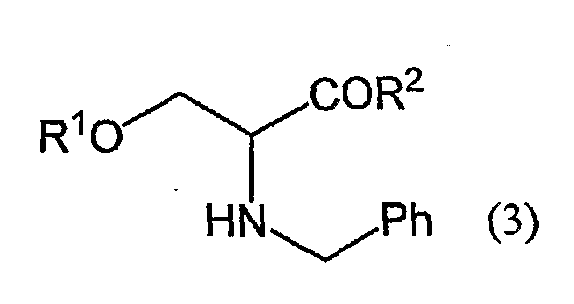
- N-benzyl-O-alkylserine derivative which is the starting compound of the present invention, has the following formula (3):
- the compound represented by the formula (3) may be referred to as the compound (3).
- R 1 represents an alkyl group having 1 to 5 carbon atoms.
- Specific examples include a methyl group, an ethyl group, an n-propyl group, an isopropyl group, an n-butyl group, a sec-butyl group, an isobutyl group, and a tert-butyl group.
- Preferably they are a methyl group, an ethyl group, and an isopropyl group, More preferably, it is a methyl group.
- R 2 represents NH 2 or OR 3 .
- R 3 represents an alkyl group having 1 to 5 carbon atoms.
- Specific examples of R 2 include an amino group, a methoxy group, an ethoxy group, an n-propoxy group, an isopropoxy group, an n-butoxy group, a sec-butoxy group, an isobutoxy group, a tert-butoxy group, and an n-pentyloxy group.
- Etc An amino group, a methoxy group, an ethoxy group, or an isopropoxy group is preferable, and an amino group or a methoxy group is more preferable.
- N-benzyl-O-alkylserine derivative represented by the above formula (3) is, for example, the following formula (4):
- N-benzyl-O-alkylserine or a salt thereof obtained by hydrolyzing compound (3) has the following formula (1):
- R 1 in the above formula (1) is the same as described above.
- the salt include salts with inorganic acids such as hydrochloride, hydrobromide, sulfate, perchlorate; formate, acetate, pivalate, oxalate, Salts with organic acids such as lactate, mandelate, tartrate, dibenzoyl tartrate, methanesulfonate, p-toluenesulfonate, camphorsulfonate; lithium salt, sodium salt, potassium salt, magnesium salt, Metal salts such as calcium salts; ammonium salts such as ammonium salts, benzylamine salts, 1-phenethylamine salts, dicyclohexylamine salts, cinchonidine salts, and phenylglycinamide salts.
- inorganic acids such as hydrochloride, hydrobromide, sulfate, perchlorate
- formate acetate, pivalate, oxalate
- Salts with organic acids such as lactate, mandelate, tartrate,
- Compound (1) is a novel compound not described in the literature.
- O-alkylserine or a salt thereof obtained by debenzylation of compound (1) has the following formula (2):
- the present inventors similarly use a Bronsted acid in place of the boron trifluoride / ethyl ether complex, that is, even when the compound (4) is allowed to act on the alcohol (5) and Bronsted acid. It has been found that high regioselectivity can be achieved, and industrial implementation has become possible.
- Examples of the alcohol (5) include methanol, ethanol, n-propanol, isopropanol, n-butanol, isobutanol, t-butanol, n-pentanol, isopentanol, and cyclopentanol.
- Methanol, ethanol, n-propanol, isopropanol, and n-butanol are preferable, and methanol is more preferable.
- the amount of the alcohol (5) used is preferably 50 times or less, more preferably 3 to 20 times the weight of the compound (4).
- Bronsted acid examples include sulfonic acids such as methanesulfonic acid, trifluoromethanesulfonic acid, benzenesulfonic acid, p-toluenesulfonic acid, camphorsulfonic acid; hydrogen chloride, hydrogen bromide, hydrogen iodide, sulfuric acid, nitric acid, Inorganic acids such as phosphoric acid and boric acid; Carboxylic acids such as formic acid, acetic acid, propionic acid, butyric acid, pivalic acid, chloroacetic acid, trichloroacetic acid, trifluoroacetic acid, benzoic acid, oxalic acid, tartaric acid, mandelic acid, aspartic acid, glutamic acid An acid etc. are mentioned. Sulfuric acid, methanesulfonic acid and p-toluenesulfonic acid are preferable, and sulfuric acid and methanesulfonic acid are more preferable.
- the amount of Bronsted acid used is preferably 1 to 10 times the molar amount, more preferably 1 to 2 times the molar amount relative to the compound (4).
- the reaction temperature is preferably 0 to 120 ° C., more preferably 30 to 80 ° C. from the viewpoint of shortening the reaction time and improving the yield.
- the reaction time is preferably 5 minutes to 20 hours, more preferably 30 minutes to 6 hours, from the viewpoint of improving the yield.
- a method for adding compound (4), alcohol (5), and Bronsted acid during the reaction is not particularly limited, but a method for adding compound (4) to a mixture of alcohol (5) and Bronsted acid. Alternatively, a method of simultaneously adding the Bronsted acid and the compound (4) to the alcohol (5) is preferable.
- the reaction solution obtained in this step is preferably used as it is in the next step, but may be post-treated as necessary.
- a general treatment for obtaining a product from the reaction solution may be performed.
- the reaction solution after completion of the reaction is neutralized by adding water or an alkaline aqueous solution such as sodium hydroxide, potassium hydroxide, sodium hydrogen carbonate or the like.
- a general extraction solvent such as ethyl acetate, diethyl ether, methyl tert-butyl ether, methylene chloride, toluene, hexane or the like is added to carry out the extraction operation.
- the reaction solvent and the extraction solvent are distilled off from the resulting extract by an operation such as heating under reduced pressure, the desired product is obtained.
- the target product thus obtained has a sufficient purity, but may be purified by a general purification method such as crystallization, fractional distillation, column chromatography or the like for the purpose of further increasing the purity.
- salt formation crystallization may be performed by forming a salt with an acid such as hydrochloric acid, sulfuric acid, acetic acid, oxalic acid, or methanesulfonic acid.
- the compound (4) in which R 2 is OR 3 is Tetrahedron Asymmetry, Vol. 3, No. 1, 1992, 51. or Organic Process Research & Development, Vol. 11, No. 4, 2007, 711.
- the compound (4) in which R 2 is NH 2 can be easily produced by reacting acrylamide and bromine to produce 2,3-dibromopropionic acid amide, followed by reaction with benzylamine. Furthermore, it can be produced by reacting the compound (4) in which R 2 is OR 3 with ammonia by the method described in Organic Process Research & Development, Vol. 11, No. 4, 2007, 711. is there.
- the method for producing the N-benzyl-O-alkylserine derivative used in this step is not particularly limited, but the method obtained from compound (4) is preferred from the viewpoint of the availability of the compound and the simplicity of the method.
- Hydrolysis is preferably performed by adding an acid or alkali for the purpose of accelerating the reaction.
- the acid is preferably hydrochloric acid, hydrobromic acid, sulfuric acid, nitric acid, methanesulfonic acid, trifluoroacetic acid or the like, and more preferably hydrochloric acid or sulfuric acid.
- the alkali is preferably lithium hydroxide, sodium hydroxide, potassium hydroxide, magnesium hydroxide, potassium carbonate or the like, more preferably sodium hydroxide or potassium hydroxide.
- the amount of acid or alkali used is preferably 0.5 to 30 times the molar amount, more preferably 1 to 5 times the molar amount relative to the compound (3).
- the amount of water used for hydrolysis is preferably 50 times or less, more preferably 5 to 20 times the weight of the compound (3).
- a solvent compatible with water may be added.
- the solvent include methanol, ethanol, isopropanol, n-butanol, acetone, acetonitrile, tetrahydrofuran and the like. Methanol or ethanol is preferred.
- the amount of solvent used is preferably 50 times or less, more preferably 5 to 20 times the weight of the compound (3).
- the reaction temperature is preferably ⁇ 10 to 120 ° C., more preferably 0 to 80 ° C. from the viewpoint of shortening the reaction time and improving the yield.
- the reaction time is preferably 5 minutes to 48 hours from the viewpoint of improving the yield, and more preferably 30 minutes to 24 hours.
- the addition method and order of addition of the compound (3), acid or alkali, water, and solvent during the reaction are not particularly limited.
- the hydrolysis may be performed by adding a microorganism-derived enzyme source for the purpose of accelerating the reaction.
- a microorganism-derived enzyme source for the purpose of accelerating the reaction.
- optically active N-benzyl-O-alkylserine can be easily obtained by using an enzyme source having the ability to selectively hydrolyze one of the three-dimensional structures.
- microorganism-derived enzyme source examples include esterase, lipase, amidase, protease and the like. From the viewpoint of usefulness of the compound, etc., it is preferably hydrolysis using an enzyme source having the ability to hydrolyze R selectively, and more preferably, R 2 of compound (3) is R 2 selectively when NH 2 is NH 2 . Hydrolysis using an enzyme source that has the ability to hydrolyze.
- the “enzyme source” includes not only the enzyme having the hydrolysis activity but also the culture of microorganisms and the treated product thereof as long as the enzyme has the hydrolysis activity.
- “Microbial culture” means a culture solution or culture containing cells
- “processed product” means, for example, a crude extract, freeze-dried microorganism, acetone-dried microorganism, or these bacteria. It means a crushed body and the like, as long as it has the hydrolysis activity.
- they can be used by immobilizing them by known means with the enzyme itself or cells. Immobilization can be performed by methods well known to those skilled in the art (for example, a crosslinking method, a physical adsorption method, a comprehensive method, etc.).
- the depository organization includes an organization corresponding to a deposit number for identifying each microorganism.
- the microorganism specified by the NBRC number is available from the National Institute of Technology and Evaluation Biological Genetic Resources Division.
- the R 2 is NH 2 the compound (3), as the enzyme source having an R selectively hydrolyzing ability, Rhodococcus (Rhodococcus) enzyme derived from the genus source of the like, preferably, Rhodococcus rhodochrous (Rhodococcus rhodochrous ) Derived enzyme source. More preferably Rhodococcus rhodochrous (Rhodococcusrhodochrous) NBRC15564.
- microorganism having the ability to produce a hydrolase derived from the microorganism may be either a wild strain or a mutant strain.
- microorganisms derived by genetic techniques such as cell fusion or gene manipulation can also be used.
- a microorganism that produces the genetically engineered enzyme is, for example, a process described in WO 98/35025 for isolating and / or purifying these enzymes to determine part or all of the amino acid sequence of the enzyme, this amino acid sequence
- a method comprising a step of obtaining a DNA sequence encoding an enzyme based on the above, a step of obtaining a recombinant microorganism by introducing this DNA into another microorganism, and a step of culturing the recombinant microorganism to obtain the enzyme, etc. (WO 98/35025).
- the recombinant microorganism as described above include a transformed microorganism transformed with a plasmid having a DNA encoding the hydrolase.
- the host microorganism is preferably Escherichia coli .
- the culture medium for the microorganism used as the enzyme source is not particularly limited as long as the microorganism can grow.
- a carbon source carbohydrates such as glucose and sucrose, alcohols such as ethanol and glycerol, fatty acids such as oleic acid and stearic acid and esters thereof, oils such as rapeseed oil and soybean oil, and ammonium sulfate as a nitrogen source , Sodium nitrate, peptone, casamino acid, corn steep liquor, bran, yeast extract, etc.
- Inorganic salts such as magnesium sulfate, sodium chloride, calcium carbonate, potassium hydrogen phosphate, potassium dihydrogen phosphate, etc.
- a normal liquid medium containing an extract, meat extract or the like can be used.
- an inducer may be added to the medium in order to induce microbial enzyme production.
- the inducer include nitriles, lactam compounds, amides and the like.
- nitriles include acetonitrile, isovaleronitrile, propionitrile, pivalonitrile, n-butyronitrile, isobutyronitrile, n-capronitrile, 3-pentenenitrile, and the like.
- lactam compounds include ⁇ -butyrolactam, ⁇ -Valerolactam, ⁇ -caprolactam, etc.
- amides include crotonamide, benzamide, propionamide, acetamide, n-butyramide, isobutyramide, n-valeramide, n-capronamide, methacrylamide, phenylacetamide, cyclohexanecarboxamide Etc.
- the amount of these inducers added to the medium is 0.05% to 2.0%, preferably 0.1% to 1.0%. Cultivation is carried out aerobically. Usually, the cultivation time is about 1 to 5 days, the pH of the medium is 3 to 9, and the cultivation temperature is 10 to 50 ° C.
- the hydrolysis reaction using an enzyme source derived from a microorganism is performed by adding the compound (3) as a substrate and the culture or treated product of the microorganism to a suitable solvent, and stirring under pH adjustment. Can do.
- the reaction conditions vary depending on the enzyme, microorganism or processed product thereof, substrate concentration, etc., but the substrate concentration is usually about 0.1 to 99% by weight, preferably 1 to 60% by weight, and the reaction temperature is 10 to 60%. C., preferably 20 to 50.degree. C., the reaction pH is 4 to 11, preferably 6 to 9, and the reaction time is 1 to 120 hours, preferably 1 to 72 hours.
- the substrate can be added in a batch or continuously. The reaction can be carried out batchwise or continuously.
- Examples of the method for isolating the compound (1) directly from the reaction solution as a crystal include a cooling crystallization method, a concentrated crystallization method, and a neutralization crystallization method.
- the compound (1) when the compound (3) is acid-hydrolyzed in the above step, the compound (1) can be isolated as a salt crystal with an acid by cooling or concentrating the reaction solution.
- the compound (3) when the compound (3) is alkali-hydrolyzed, it can also be isolated as a crystal in which the carboxylic acid of the compound (1) is converted into a salt by cooling or concentrating the reaction solution.
- an organic solvent such as methanol, ethanol, isopropanol, n-butanol, acetone, acetonitrile, tetrahydrofuran or the like may be added.
- the neutralization crystallization method is preferable from the viewpoint of removing impurities.
- the reaction liquid obtained by hydrolyzing the compound (3) with an acid or alkali is neutralized by adding an alkali or acid, and in some cases, further concentrated to precipitate the compound (1) as crystals.
- the mixed impurities can be removed in the mother liquor, and a method of isolating the compound (1) with improved purity can be employed.
- inorganic salts precipitate at the time of neutralization they may be separated before crystallization, or crystals may be precipitated together with inorganic salts and separated together.
- the isolation of compound (1) as a crystal directly from the reaction solution means that the compound (3) is hydrolyzed and then crystallized using this reaction solution as it is. It means to isolate (1).
- the alkali is preferably lithium hydroxide, sodium hydroxide, potassium hydroxide, magnesium hydroxide, potassium carbonate or the like, more preferably sodium hydroxide or potassium hydroxide.
- the acid is preferably hydrochloric acid, hydrobromic acid, sulfuric acid, nitric acid, methanesulfonic acid, trifluoroacetic acid or the like, and more preferably hydrochloric acid or sulfuric acid.
- the amount of alkali or acid used varies depending on the pH of the reaction solution.
- the pH is preferably 3 to 10, and more preferably 5 to 9.
- the temperature during crystallization is preferably 50 ° C. or less, more preferably 0 to 30 ° C.
- the solvent may be distilled off under reduced pressure to increase the crystallization concentration.
- an inorganic salt such as sodium chloride or sodium sulfate may be added to increase the salt concentration.
- the crystals of compound (1) can be separated and obtained by a method such as vacuum filtration, pressure filtration, or centrifugation. Further, when the mother liquor remains in the acquired crystal and the purity of the crystal is lowered, the quality can be improved by washing with water or an organic solvent as necessary. As a method for drying the crystals, it is desirable to dry under reduced pressure (vacuum drying) at about 60 ° C. or less while avoiding thermal decomposition and melting.
- the content of the impurity (6) is usually 5% by weight or less, and in some cases, it can be 1% by weight or less.
- the same operation as the neutralization crystallization may be performed. That is, by adding and neutralizing an alkali or an acid according to the pH after completion of the reaction, the absolute configuration is S by precipitating and separating the compound (1) having the absolute configuration R as a crystal. The compound (3) is removed from the mother liquor, and the compound (1) having an absolute configuration R can be isolated.
- the use amount, pH, crystallization temperature, separation method, drying method and the like of the alkali or acid are the same as described above.
- Examples of the debenzylation method include a hydrogenation method in the presence of a transition metal catalyst.
- the transition metal catalyst is preferably palladium, rhodium, or platinum, and more preferably palladium.
- Palladium is preferably palladium black, palladium / carbon, palladium hydroxide / carbon, and more preferably palladium / carbon.
- the amount of the transition metal catalyst used is not more than 0.1 times the molar amount relative to the compound (1), more preferably 0.05 to 0.0001 times the molar amount.
- the hydrogen pressure in this step is preferably 1 to 100 kg / cm 2 , more preferably 1 to 30 kg / cm 2 .
- reaction solvent water; alcohol solvents such as methanol, ethanol and isopropanol; ether solvents such as tetrahydrofuran, 1,4-dioxane and ethylene glycol dimethyl ether; ester solvents such as ethyl acetate and isopropyl acetate; benzene, toluene, Hydrocarbon solvents such as hexane; halogen solvents such as methylene chloride and chloroform; amide solvents such as N, N-dimethylformamide and N, N-dimethylacetamide; sulfoxide solvents such as dimethyl sulfoxide; dimethylpropylene urea and the like Urea solvents; phosphonic acid triamide solvents such as hexamethylphosphonic acid triamide may be used, and these may be used alone or in combination of two or more.
- Preferred is water; alcohol-based solvents such as methanol, ethanol, isopropanol, and more preferred are water, water
- the amount of the solvent used is preferably 50 times or less, more preferably 5 to 20 times the weight of the compound (1).
- the reaction temperature is preferably 0 to 100 ° C., more preferably 10 to 60 ° C. from the viewpoint of shortening the reaction time and improving the yield.
- the reaction time is preferably 30 minutes to 48 hours, more preferably 1 to 24 hours, from the viewpoint of improving the yield.
- a general process for obtaining a product from the reaction solution may be performed.
- the reaction solvent is distilled off by an operation such as heating under reduced pressure to obtain the desired product.
- the target product thus obtained has sufficient purity that can be used in the subsequent step, but for the purpose of further increasing the yield of the subsequent step or the purity of the compound obtained in the subsequent step, crystallization,
- the purity may be further increased by a general purification method such as fractional distillation or column chromatography.
- Example 1 Production of N-benzyl-O- methylserine methyl ester A solution consisting of 52.1 g (540 mmol) of methanesulfonic acid and 900 mL of methanol was cooled to 2 ° C., and 154.7 g of 1-benzylaziridine-2-carboxymethyl ester was obtained. A solution consisting of (540 mmol) and 100 mL of methanol was added over 0.5 hours, and then the temperature was raised to 40 ° C. After stirring for 6 hours, the reaction solution (40.7 g out of the total amount of 980.1 g) was concentrated under reduced pressure, and toluene was added.
- Example 2 Preparation of N-benzyl-O- methylserine methyl ester In a solution consisting of 230.98 g (2.36 mol) of sulfuric acid and 2061.50 g of methanol, 79% by weight of 1-benzylaziridine-2-carboxymethyl ester 378. A solution consisting of 49 g (1.57 mol) and 291.39 g of methanol was added dropwise over 1 hour, and then the temperature was raised to 50 ° C. After stirring for 2.5 hours, the mixture was cooled to 25 ° C., and 628.00 g (4.71 mol) of a 30 wt% aqueous sodium hydroxide solution was added dropwise over 1 hour.
- Example 3 Preparation of N-benzyl-O-methylserine Methanol solution containing 5.99 g (27 mmol) of N-benzyl-O-methylserine methyl ester prepared in Example 1 and 5.25 g (55 mmol) of methanesulfonic acid To 26 g, 7.29 g (55 mmol) of a 30% by weight aqueous sodium hydroxide solution was added, and the mixture was concentrated to 44.57 g under reduced pressure. To this solution were added 10.00 g of water and 7.15 g (54 mmol) of a 30% by weight aqueous sodium hydroxide solution, and the mixture was stirred at 25 ° C. for 2 hours, and then concentrated to 25.71 g under reduced pressure.
- Example 4 Production of N-benzyl-O-methylserine 30% by weight of hydroxide was added to 2516.40 g of an aqueous solution containing 285.06 g (1.28 mol) of N-benzyl-O-methylserine methyl ester produced in Example 2. 209.33 g (1.57 mol) of an aqueous sodium solution was added dropwise over 20 minutes. After stirring at 25 ° C. for 2 hours, 829.48 g of water was added to the reaction solution.
- Example 5 Production of N-benzyl-O-methylserine To 14.8 g of an aqueous solution containing 1.07 g (4.78 mmol) of N-benzyl-O-methylserine methyl ester, 0.78 g of 30% by weight aqueous sodium hydroxide solution ( 5.83 mmol) was added dropwise, followed by stirring at 25 ° C. for 2 hours. When 163 mg (1.66 mol) of sulfuric acid was added to this aqueous solution and the pH was adjusted to 7, crystals were precipitated. When the crystals were dissolved at 80 ° C. and cooled to 0 ° C., the title compound containing 2.2% by weight of 3-benzylamino-2-methoxypropionic acid was obtained as white crystals (489 mg, purity 74% by weight, recovered) Rate 36%).
- Example 6 Production of N-benzyl-O- methylserinamide From 600 mg (3.4 mmol) of 1-benzylaziridine-2-carboxamide produced in Reference Example 3, 6 mL of methanol, and 327 mg (3.4 mmol) of methanesulfonic acid The resulting solution was stirred at 60 ° C. for 3 hours. Methanol was distilled off, 6 mL of water and 471 mg (3.4 mmol) of potassium carbonate were added to the residue, and the mixture was stirred at 25 ° C. for 1 hour, and then extracted with ethyl acetate. The organic layer was concentrated and purified by silica gel column chromatography (mobile phase: ethyl acetate) to give the title compound as a pale yellow oil (391 mg, yield 55%).
- Example 7 Production of N-benzyl-O-methylserine hydrochloride A solution consisting of 439 mg (1.96 mmol) of N-benzyl-O-methylserine methyl ester produced in Example 1 and 5 mL of 6N hydrochloric acid at 90 ° C. Stir for 18 hours. The reaction mixture was concentrated to give the title compound as white crystals (498 mg, yield 100%).
- Example 8 Production of (R) -N-benzyl-O-methylserine Rhodococcus rhodochrous NBRC15564 was sterilized in a Sakaguchi flask (glycerol 1.0%, peptone 0.5%, malt extract 0.3). %, Yeast extract 0.3%, isovaleronitrile 0.1%, pH 7.0), and cultured with shaking at 30 ° C. for 72 hours. After completion of the culture, the cells were collected by centrifugation and suspended in 100 mM phosphate buffer (pH 7.0) to obtain a 20-fold concentrated cell suspension.
- Example 9 Preparation of O-methylserine A solution consisting of 3.14 g (14 mmol) of N-benzyl-O-methylserine, 14.13 g of methanol, 14.13 g of water, 314 mg of 10 wt% palladium / carbon (50% water-containing product) The mixture was stirred at 25 ° C. for 17 hours under a pressurized hydrogen atmosphere. Palladium was filtered off under reduced pressure, washed with a solution consisting of 4.95 g of methanol and 4.95 g of water, and the filtrate was concentrated to 3.31 g under reduced pressure. When 1.84 g of water and 12.72 g of ethanol were added to the residue, crystals were precipitated. After stirring at 25 ° C.
- Example 11 Production of O-methylserine A solution consisting of 19 g (9 mmol) of N-benzyl-O-methylserine, 171 g of methanol, 47.5 g of water, 1.9 g of 10% by weight palladium / carbon (containing 50% water) was obtained at atmospheric pressure. The mixture was stirred at 25 ° C. for 24 hours under an atmosphere. The palladium was filtered off under reduced pressure, washed with a mixed solvent of methanol and water (3.5 / 1 (v / v), 19 g), and the filtrate was concentrated to 24.6 g.
- Example 12 Production of O-methylserine From 14.1 g (6.7 mmol) of N-benzyl-O-methylserine, 127.1 g of methanol, 20.1 g of water, 1.4 g of 10 wt% palladium / carbon (50% water-containing product) The resulting solution was stirred at 25 ° C. for 13 hours under a normal pressure hydrogen atmosphere. The palladium was filtered off under reduced pressure, washed with a mixed solvent of methanol and water (3.5 / 1 (v / v), 14 g), and the filtrate was concentrated to 18.9 g. 10.8 g of methanol was added to 17.9 g of this concentrated liquid, and the temperature was raised to 70 ° C.
Landscapes
- Chemical & Material Sciences (AREA)
- Organic Chemistry (AREA)
- Chemical Kinetics & Catalysis (AREA)
- Zoology (AREA)
- Life Sciences & Earth Sciences (AREA)
- Engineering & Computer Science (AREA)
- Wood Science & Technology (AREA)
- Microbiology (AREA)
- General Chemical & Material Sciences (AREA)
- Biotechnology (AREA)
- Crystallography & Structural Chemistry (AREA)
- Health & Medical Sciences (AREA)
- Biochemistry (AREA)
- Bioinformatics & Cheminformatics (AREA)
- General Engineering & Computer Science (AREA)
- General Health & Medical Sciences (AREA)
- Genetics & Genomics (AREA)
- Organic Low-Molecular-Weight Compounds And Preparation Thereof (AREA)
Abstract
本願発明は、医薬中間体として有用なO-アルキルセリンおよびその製造に有用なN-ベンジル-O-アルキルセリンを、入手容易な出発原料から、安価な試剤を用いて簡便且つ効率的に工業的規模で製造できる方法を提供することを課題とする。この課題は、下記式(3)で表される化合物を加水分解し、この反応液から直接N-ベンジル-O-アルキルセリンを結晶として単離することにより解決される。特に、入手が容易な1-ベンジルアジリジン誘導体をアルコールとブレンステッド酸を用いて開環することにより式(3)で表される化合物を得るのが好ましい。また、N-ベンジル-O-アルキルセリンを脱ベンジル化することにより、O-アルキルセリンを製造することができる。
Description
本発明は、医薬中間体として有用なO-アルキルセリンとその製造に有用なN-ベンジル-O-アルキルセリンの製造法に関する。
O-アルキルセリンの製造法としては、以下の方法が知られている。
(1)(R)-N-ベンジルオキシカルボニル-セリンメチルエステルに5倍モル量の酸化銀と10倍モル量のヨウ化メチルを3日間作用させることにより、(R)-N-ベンジルオキシカルボニル-O-メチルセリンメチルエステルを製造する。続いて加水分解後、パラジウム触媒存在下に水素化することにより(R)-O-メチルセリンを製造する方法(非特許文献1)。
(2)ラセミの1-ベンジルアジリジン-2-カルボキシアミドをアミダーゼで光学分割し、次にルイス酸触媒存在下にメタノールで処理することにより、光学活性なN-ベンジル-O-メチルセリンアミドを製造する。続いてパラジウム触媒存在下に水素化することで脱ベンジル化を行い、更に加水分解することにより(S)-O-メチルセリン塩酸塩を製造する方法(非特許文献2)。
(3)ラセミのO-メチルセリンをクロロアセチル化し、豚の腎臓由来のN-アセチルアミノ酸アミドヒドロラーゼを用いて不斉水解することにより、(R)-N-クロロアセチル-O-メチルセリンを製造する。続いて塩酸で加水分解することにより(R)-O-メチルセリン塩酸塩を製造する方法(特許文献1)。
(4)セリンベンジルエステルをN-トリチル化し、次いでO-トシル化を行った後にトリエチルアミンで処理し、1-トリチルアジリジン-2-カルボン酸ベンジルエステルを製造する。続いて脱トリチル化を行った後、窒素上のベンジルオキシカルボニル保護して、1-ベンジルオキシカルボニルアジリジン-2-カルボン酸ベンジルエステルを製造する。これをイソプロピルアルコールとクロロホルムの混合溶媒中、三フッ化ホウ素・エチルエーテル錯体(BF3・OEt2)により処理した後、接触還元を行い、O-イソプロピル-L-セリンを製造する(特許文献2)。
(5)セリンをN-トリチル化した後、14倍モル量の水素化ナトリウムと、24倍モル量のヨウ化エチル、又は5倍モル量のヨウ化メチルを1日間作用させることにより、N-トリチル-O-エチルセリン、又はN-トリチル-O-メチルセリンを製造する。更に、これを酢酸で処理して脱トリチル化を行い、O-エチルセリン、又はO-メチルセリンを製造する方法(非特許文献3)。
(1)(R)-N-ベンジルオキシカルボニル-セリンメチルエステルに5倍モル量の酸化銀と10倍モル量のヨウ化メチルを3日間作用させることにより、(R)-N-ベンジルオキシカルボニル-O-メチルセリンメチルエステルを製造する。続いて加水分解後、パラジウム触媒存在下に水素化することにより(R)-O-メチルセリンを製造する方法(非特許文献1)。
(2)ラセミの1-ベンジルアジリジン-2-カルボキシアミドをアミダーゼで光学分割し、次にルイス酸触媒存在下にメタノールで処理することにより、光学活性なN-ベンジル-O-メチルセリンアミドを製造する。続いてパラジウム触媒存在下に水素化することで脱ベンジル化を行い、更に加水分解することにより(S)-O-メチルセリン塩酸塩を製造する方法(非特許文献2)。
(3)ラセミのO-メチルセリンをクロロアセチル化し、豚の腎臓由来のN-アセチルアミノ酸アミドヒドロラーゼを用いて不斉水解することにより、(R)-N-クロロアセチル-O-メチルセリンを製造する。続いて塩酸で加水分解することにより(R)-O-メチルセリン塩酸塩を製造する方法(特許文献1)。
(4)セリンベンジルエステルをN-トリチル化し、次いでO-トシル化を行った後にトリエチルアミンで処理し、1-トリチルアジリジン-2-カルボン酸ベンジルエステルを製造する。続いて脱トリチル化を行った後、窒素上のベンジルオキシカルボニル保護して、1-ベンジルオキシカルボニルアジリジン-2-カルボン酸ベンジルエステルを製造する。これをイソプロピルアルコールとクロロホルムの混合溶媒中、三フッ化ホウ素・エチルエーテル錯体(BF3・OEt2)により処理した後、接触還元を行い、O-イソプロピル-L-セリンを製造する(特許文献2)。
(5)セリンをN-トリチル化した後、14倍モル量の水素化ナトリウムと、24倍モル量のヨウ化エチル、又は5倍モル量のヨウ化メチルを1日間作用させることにより、N-トリチル-O-エチルセリン、又はN-トリチル-O-メチルセリンを製造する。更に、これを酢酸で処理して脱トリチル化を行い、O-エチルセリン、又はO-メチルセリンを製造する方法(非特許文献3)。
Tetrahedron Asymmetry, 1998, 9, 3841-3854.
Organic Letters, 2007, 9(3), 521-524.
Tetrahedron, 1983, 39(3), 475-478.
非特許文献1に記載の方法では、高価な銀と毒性が強いヨウ化メチルを用いてメチル化を行っており、更に反応に長時間必要である点に課題を有する。非特許文献2に記載の方法では、高価な出発原料を用い、更に工程が長いため工業的規模での実施に不適である。特許文献1に記載の方法においては、N-クロロアセチル-O-メチルセリンの水溶性が高いため、抽出溶剤が大量に必要な点に課題を有している。特許文献2に記載の方法は、多段階の工程を経るため、工業的規模での実施に不適である。非特許文献3に記載の方法は、発火性のある水素化ナトリウムを大過剰量使用している点と毒性が強いヨウ化アルキルを用いてアルキル化を行っている点から、工業的規模での実施に課題を残している。
上記に鑑み、本発明の目的は医薬中間体として有用なO-アルキルセリンおよびその製造に有用なN-ベンジル-O-アルキルセリンを、入手容易な出発原料から、安価な試剤を用いて簡便且つ効率的に工業的規模で実施できる方法を提供することにある。
本発明者らは鋭意検討の結果、入手容易な原料を用いて、簡便に、効率よくO-アルキルセリンおよびN-ベンジル-O-アルキルセリンを製造する方法を開発するに至った。
即ち本発明は、下記式(1):

(式中、R1は炭素数1~5のアルキル基を表す。)で表されるN-ベンジル-O-アルキルセリン又はその塩の製造法であって、下記式(3):

(式中、R1は前記に同じ、R2はNH2又はOR3を表す。ここで、R3は炭素数1~5のアルキル基を表す。)で表されるN-ベンジル-O-アルキルセリン誘導体を加水分解することにより、前記式(1)で表されるN-ベンジル-O-アルキルセリンを製造し、反応液から直接、前記式(1)で表される化合物を結晶として単離することを特徴とする製造法に関する。
また、本発明は、上記で得られた前記式(1)で表される化合物を、更に脱ベンジル化することを特徴とする、下記式(2):

(式中、R1は前記に同じ。)で表されるO-アルキルセリン又はその塩の製造法に関する。
更に本発明は、下記式(1):

(式中、R1は炭素数1~5のアルキル基を表す。)で表されるN-ベンジル-O-アルキルセリン又はその塩に関する。
本発明にかかる方法によれば、医薬中間体として有用なO-アルキルセリンを、入手容易でかつ安価な試剤を用いて、簡便かつ効率的に工業的規模で製造することが可能である。
まず、本発明で使用する化合物について説明する。
本発明の出発化合物であるN-ベンジル-O-アルキルセリン誘導体は下記式(3):

で表される(以下において、式(3)で表される化合物を化合物(3)とする場合がある)。
ここでR1は炭素数1~5のアルキル基を表す。具体的には例えば、メチル基、エチル基、n-プロピル基、イソプロピル基、n-ブチル基、sec-ブチル基、イソブチル基、tert-ブチル基等が挙げられる。好ましくはメチル基、エチル基、イソプロピル基であり、更に好ましくはメチル基である。
またR2はNH2又はOR3を表す。ここで、R3は炭素数1~5のアルキル基を表す。R2として具体的には例えば、アミノ基、メトキシ基、エトキシ基、n-プロポキシ基、イソプロポキシ基、n-ブトキシ基、sec-ブトキシ基、イソブトキシ基、tert-ブトキシ基、n-ペンチルオキシ基等が挙げられる。好ましくはアミノ基、メトキシ基、エトキシ基、又はイソプロポキシ基であり、更に好ましくはアミノ基、又はメトキシ基である。
なお、本化合物の製造法の詳細は後述するが、R2がNH2である前記化合物(3)が、R2がOR3である前記化合物(3)をアンモニアでアミノリシスすることにより製造したものであっても本発明の範囲に含まれるものとする。
上記式(3)で表されるN-ベンジル-O-アルキルセリン誘導体は、例えば、下記式(4):

で表される1-ベンジルアジリジン誘導体から製造することが可能である(以下において、式(4)で表される化合物を化合物(4)とする場合がある)。上記式(4)におけるR2は前記に同じである。
化合物(3)を加水分解して得られるN-ベンジル-O-アルキルセリン又はその塩は、下記式(1):

で表される(以下において、式(1)で表される化合物を化合物(1)とする場合がある)。上記式(1)におけるR1は前記に同じである。
また、塩としては、具体的には例えば、塩酸塩、臭化水素酸塩、硫酸塩、過塩素酸塩等の無機酸との塩;蟻酸塩、酢酸塩、ピバル酸塩、シュウ酸塩、乳酸塩、マンデル酸塩、酒石酸塩、ジベンゾイル酒石酸塩、メタンスルホン酸塩、p-トルエンスルホン酸塩、カンファースルホン酸塩等の有機酸との塩;リチウム塩、ナトリウム塩、カリウム塩、マグネシウム塩、カルシウム塩等の金属塩;アンモニウム塩、ベンジルアミン塩、1-フェネチルアミン塩、ジシクロヘキシルアミン塩、シンコニジン塩、フェニルグリシンアミド塩等のアンモニウム塩が挙げられる。
なお化合物(1)は、文献に未記載の新規化合物である。
化合物(1)を脱ベンジル化して得られるO-アルキルセリンまたはその塩は、下記式(2):

で表される(以下において、式(2)で表される化合物を化合物(2)とする場合がある)。上記式(2)におけるR1及び塩は前記に同じである。
続いて本発明の製造法について説明する。
まず、前記式(4)で表される1-ベンジルアジリジン誘導体に対し、下記式(5):

(式中、R1は前記に同じ。)で表されるアルコール(以下、アルコール(5)とする場合がある)とブレンステッド酸を作用させて開環反応を行い、前記式(3)で表されるN-ベンジル-O-アルキルセリン誘導体を製造する工程について説明する。
前記開環反応を行う方法としては、アルコールと三フッ化ホウ素・エチルエーテル錯体(BF3・OEt2)を用いる方法が知られている(Synthesis, 1992, 3, 288-292)。しかしながら、この方法においては、反応後の加水分解の際に、ガラスや金属に対して強い腐食性を示すフッ化水素酸が発生するため、工業的実施に問題がある。
本発明者らは、三フッ化ホウ素・エチルエーテル錯体の代わりにブレンステッド酸を用いても、すなわち、化合物(4)にアルコール(5)とブレンステッド酸を作用させても同様に開環反応が進行し、更には、高い位置選択性が達成できることを見出し、工業的実施を可能とした。
アルコール(5)としては、例えば、メタノール、エタノール、n-プロパノール、イソプロパノール、n-ブタノール、イソブタノール、t-ブタノール、n-ペンタノール、イソペンタノール、シクロペンタノール等が挙げられる。好ましくは、メタノール、エタノール、n-プロパノール、イソプロパノール、n-ブタノールであり、更に好ましくは、メタノールである。
アルコール(5)の使用量は、化合物(4)に対して、好ましくは50倍重量以下、更に好ましくは3~20倍重量である。
ブレンステッド酸としては、例えば、メタンスルホン酸、トリフルオロメタンスルホン酸、ベンゼンスルホン酸、p-トルエンスルホン酸、カンファースルホン酸等のスルホン酸;塩化水素、臭化水素、ヨウ化水素、硫酸、硝酸、リン酸、ホウ酸等の無機酸;蟻酸、酢酸、プロピオン酸、酪酸、ピバル酸、クロロ酢酸、トリクロロ酢酸、トリフルオロ酢酸、安息香酸、シュウ酸、酒石酸、マンデル酸、アスパラギン酸、グルタミン酸等のカルボン酸等が挙げられる。好ましくは硫酸、メタンスルホン酸、p-トルエンスルホン酸であり、更に好ましくは硫酸、メタンスルホン酸である。
ブレンステッド酸の使用量は、化合物(4)に対して、好ましくは1~10倍モル量であり、更に好ましくは1~2倍モル量である。
反応温度として好ましくは、反応時間の短縮や収率向上の観点から0~120℃であり、更に好ましくは30~80℃である。
反応時間として好ましくは、収率向上の観点から5分~20時間であり、更に好ましくは30分~6時間である。
反応の際の化合物(4)、アルコール(5)、及びブレンステッド酸の添加方法や添加順序は特に制限されないが、アルコール(5)とブレンステッド酸の混合液に化合物(4)を添加する方法、又は、アルコール(5)にブレンステッド酸と化合物(4)を各々同時に添加する方法が好ましい。
本工程で得られた反応液はそのまま次工程に用いるのが好ましいが、必要に応じて後処理を行ってもよい。
後処理としては、反応液から生成物を取得するための一般的な処理を行えばよい。例えば反応終了後の反応液に水、又は水酸化ナトリウム、水酸化カリウム、炭酸水素ナトリウム等のアルカリ水溶液を加えて中和する。次に一般的な抽出溶媒、例えば酢酸エチル、ジエチルエーテル、メチルtert-ブチルエーテル、塩化メチレン、トルエン、ヘキサン等を加えて抽出操作を行う。得られた抽出液から減圧加熱等の操作により、反応溶媒及び抽出溶媒を留去すると目的物が得られる。
このようにして得られた目的物は十分な純度を有しているが、純度をさらに高める目的で、晶析、分別蒸留、カラムクロマトグラフィー等の一般的な精製手法により精製してもよい。また塩酸、硫酸、酢酸、シュウ酸、メタンスルホン酸等の酸と塩を形成させて造塩晶析をしてもよい。
なお、化合物(4)については、R2がOR3である化合物(4)は、Tetrahedron Asymmetry, Vol.3, No.1, 1992, 51.又はOrganic Process Research & Development, Vol.11, No.4, 2007, 711.に記載の方法により製造することができる。具体的には、例えば、アクリル酸エステルと臭素を反応させて2,3-ジブロモプロピオン酸エステルを製造し、続いてベンジルアミンを反応させることにより製造することができる。
またR2がNH2である化合物(4)は、アクリルアミドと臭素を反応させて2,3-ジブロモプロピオン酸アミドを製造し、続いてベンジルアミンを反応させることにより簡便に製造することができる。更に、Organic Process Research & Development, Vol.11, No.4, 2007, 711. に記載の方法により、R2がOR3である前記化合物(4)とアンモニアを反応させて製造することも可能である。
次に、前記式(3)で表されるN-ベンジル-O-アルキルセリン誘導体を加水分解することにより、前記式(1)で表されるN-ベンジル-O-アルキルセリンを製造する工程について説明する。
本工程で用いるN-ベンジル-O-アルキルセリン誘導体の製造方法は特に問うものではないが、化合物の入手容易性や方法の簡便性等の点から、化合物(4)から得る方法が好ましい。
加水分解は、反応を加速させる目的で酸又はアルカリを添加して行うとよい。
酸として好ましくは、塩酸、臭化水素酸、硫酸、硝酸、メタンスルホン酸、トリフルオロ酢酸等であり、更に好ましくは塩酸、又は硫酸である。
アルカリとして好ましくは、水酸化リチウム、水酸化ナトリウム、水酸化カリウム、水酸化マグネシウム、炭酸カリウム等であり、更に好ましくは水酸化ナトリウム、又は水酸化カリウムである。
酸又はアルカリの使用量は、化合物(3)に対して、好ましくは0.5~30倍モル量であり、更に好ましくは1~5倍モル量である。
また加水分解に使用する水の量は化合物(3)に対して、好ましくは50倍重量以下であり、更に好ましくは5~20倍重量である。
更に、反応を加速させる目的で、水と相溶性のある溶媒を添加してもよい。前記溶媒としては例えば、メタノール、エタノール、イソプロパノール、n-ブタノール、アセトン、アセトニトリル、テトラヒドロフラン等が挙げられる。好ましくはメタノール、又はエタノールである。
溶媒の使用量は化合物(3)に対して、好ましくは50倍重量以下であり、更に好ましくは5~20倍重量である。
反応温度として好ましくは、反応時間短縮、及び収率向上の観点から-10~120℃であり、更に好ましくは0~80℃である。
反応時間として好ましくは、収率向上の観点から5分~48時間であり、更に好ましくは30分~24時間である。
反応の際の化合物(3)、酸又はアルカリ、水、及び溶媒の添加方法や添加順序は特に制限されない。
また前記加水分解は、反応を加速させる目的で微生物由来の酵素源を添加して行ってもよい。なお、後述するように、一方の立体を選択的に加水分解する能力を有する酵素源を用いることにより、光学活性N-ベンジル-O-アルキルセリンを容易に得ることができる。
微生物由来の酵素源としては、エステラーゼ、リパーゼ、アミダーゼ、プロテアーゼ等が挙げられる。化合物の有用性等の点から、好ましくはR選択的に加水分解する能力を有する酵素源を用いた加水分解であり、更に好ましくは化合物(3)のR2がNH2において、R選択的に加水分解する能力を有する酵素源を用いた加水分解である。
ここで、「酵素源」とは、前記加水分解活性を有する酵素自体はもちろんのこと、上記加水分解活性を有する限りにおいては、微生物の培養物およびその処理物も含まれる。「微生物の培養物」とは、菌体を含む培養液あるいは培養菌体を意味し、「その処理物」とは、例えば、粗抽出液、凍結乾燥微生物体、アセトン乾燥微生物体、又はそれら菌体の破砕物等を意味し、前記加水分解活性を有する限りはこれに含まれる。さらにそれらは、酵素自体あるいは菌体のまま公知の手段で固定化されて用いることができる。固定化は、当業者に周知の方法(例えば架橋法、物理的吸着法、包括法等)で行うことができる。
本明細書で後述する各微生物は、さまざまな寄託機関より当業者が特許微生物寄託機関やその他研究機関から入手可能である。寄託機関としては、各微生物を特定する受託番号に対応する機関が挙げられる。具体的には例えば、NBRC番号で特定される微生物は、独立行政法人製品評価技術基盤機構生物遺伝資源部門より入手可能である。
例えば、化合物(3)のR2がNH2において、R選択的に加水分解する能力を有する酵素源としては、ロドコッカス(Rhodococcus)属由来の酵素源が挙げられ、好ましくは、ロドコッカス ロドクロウス(Rhodococcus rhodochrous)由来の酵素源などが挙げられる。より好ましくはロドコッカス ロドクロウス(Rhodococcusrhodochrous)NBRC15564である。
また、前記微生物由来の加水分解酵素の産生能を有する微生物としては、野生株又は変異株のいずれでもよい。あるいは細胞融合又は遺伝子操作等の遺伝学的手法により誘導される微生物も用いることができる。遺伝子操作された本酵素を生産する微生物は、例えば、WO98/35025に記載の、これらの酵素を単離及び/又は精製して酵素のアミノ酸配列の一部又は全部を決定する工程、このアミノ酸配列に基づいて酵素をコードするDNA配列を得る工程、このDNAを他の微生物に導入して組換え微生物を得る工程、及びこの組換え微生物を培養して、本酵素を得る工程を含有する方法等により得ることができる(WO98/35025)。前記のような組換え微生物としては、前記加水分解酵素をコードするDNAを有するプラスミドで形質転換された形質転換微生物が挙げられる。また、宿主微生物としてはエシェリヒア・コリ(Escherichia coli)が好ましい。
酵素源として用いる微生物の為の培養培地は、その微生物が増殖し得るものである限り特に限定されない。例えば、炭素源として、グルコース、シュークロース等の糖質、エタノール、グリセロール等のアルコール類、オレイン酸、ステアリン酸等の脂肪酸及びそのエステル類、菜種油、大豆油等の油類、窒素源として、硫酸アンモニウム、硝酸ナトリウム、ペプトン、カザミノ酸、コーンスティープリカー、ふすま、酵母エキスなど、無機塩類として、硫酸マグネシウム、塩化ナトリウム、炭酸カルシウム、燐酸1水素カリウム、燐酸2水素カリウムなど、他の栄養源として、麦芽エキス、肉エキス等を含有する通常の液体培地を使用することができる。
また、微生物の酵素生産を誘導するために誘導剤を培地に添加してもよい。誘導剤としては、ニトリル、ラクタム化合物、アミド等が挙げられる。例えば、ニトリルとしては、アセトニトリル、イソバレロニトリル、プロピオニトリル、ピバロニトリル、n-ブチロニトリル、イソブチロニトリル、n-カプロニトリル、3-ペンテンニトリルなどが挙げられ、ラクタム化合物としては、γ-ブチロラクタム、δ-バレロラクタム、ε-カプロラクタムなどが挙げられ、アミドとしては、クロトンアミド、ベンズアミド、プロピオンアミド、アセトアミド、n-ブチルアミド、イソブチルアミド、n-バレルアミド、n-カプロンアミド、メタクリルアミド、フェニルアセトアミド、シクロヘキサンカルボキサミドなどが挙げられる。これら誘導剤の培地への添加量は0.05%~2.0%、好ましくは0.1%~1.0%である。培養は好気的に行い、通常、培養時間は1~5日間程度、培地のpHが3~9、培養温度は10~50℃で行うことができる。
微生物由来の酵素源を用いた加水分解反応は、適当な溶媒中に、基質である化合物(3)及び前記微生物の培養物又はその処理物等を添加し、pH調整下攪拌することにより行うことができる。
反応条件は、用いる酵素、微生物又はその処理物、基質濃度等によって異なるが、通常、基質濃度は約0.1~99重量%、好ましくは1~60重量%であり、反応温度は10~60℃、好ましくは20~50℃であり、反応のpHは4~11、好ましくは6~9であり、反応時間は1~120時間、好ましくは1~72時間で行うことができる。基質は一括、又は連続的に添加して行うことができる。反応はバッチ方式又は連続方式で行うことができる。
続いて、化合物(1)を反応液から結晶として単離する方法について説明する。
化合物(1)を反応液から直接結晶として単離する方法としては、冷却晶析法、濃縮晶析法、中和晶析法等が挙げられる。具体的には例えば、上記工程で化合物(3)を酸加水分解した場合、反応液を冷却又は濃縮することにより、化合物(1)を酸との塩結晶として単離することができる。また、化合物(3)をアルカリ加水分解した場合も、反応液を冷却又は濃縮することにより、化合物(1)のカルボン酸が塩となった結晶として単離することもできる。更に回収率を更に向上させる目的で、メタノール、エタノール、イソプロパノール、n-ブタノール、アセトン、アセトニトリル、テトラヒドロフラン等の有機溶媒を加えてもよい。
このうち、不純物除去の観点から中和晶析法が好ましい。具体的には例えば、化合物(3)を酸又はアルカリで加水分解した反応液に、アルカリ又は酸を添加して中和し、場合によっては更に濃縮することにより、化合物(1)を結晶として析出させる。続いて結晶を分離することにより、混入している不純物を母液に除去し、純度の向上した化合物(1)を単離する方法を採用することができる。また、中和時に無機塩類が析出した場合は、これを分離してから晶析を行っても良いし、無機塩とともに結晶を析出させて共に分離しても良い。
なお、本発明において、反応液から直接、化合物(1)を結晶として単離するとは、化合物(3)の加水分解を行った後、この反応液をそのまま用いて結晶化を行うことにより、化合物(1)を単離することを意味する。
ここで、前記不純物としては例えば、下記式(6):

(式中、R1は前記に同じ。)が挙げられる。この不純物は化合物(4)とアルコール(5)を反応させた際に副生した位置異性体を由来とする。
アルカリとして好ましくは、水酸化リチウム、水酸化ナトリウム、水酸化カリウム、水酸化マグネシウム、炭酸カリウム等であり、更に好ましくは水酸化ナトリウム、又は水酸化カリウムである。
酸として好ましくは、塩酸、臭化水素酸、硫酸、硝酸、メタンスルホン酸、トリフルオロ酢酸等であり、更に好ましくは塩酸、又は硫酸である。
アルカリ又は酸の使用量は、反応液のpHによって変化する。
pHとして好ましくは3~10であり、更に好ましくは5~9である。
結晶化の際の温度として好ましくは50℃以下であり、更に好ましくは0~30℃である。
また結晶の析出量を増加させる目的で、溶媒を減圧留去して晶析濃度を高めてもよい。
更に、塩化ナトリウムや硫酸ナトリウム等の無機塩を添加して塩濃度を高めてよい。
化合物(1)の結晶は、減圧濾過、加圧濾過、又は遠心分離等の方法により分離、取得することができる。また、取得結晶中に母液が残存して結晶の純度が低下する場合は必要に応じて、更に水や有機溶媒で洗浄することにより、品質を高めることもできる。結晶の乾燥方法としては、熱分解や溶融を避けて約60℃以下で、減圧乾燥(真空乾燥)するのが望ましい。
このようにして得られた化合物(1)は、不純物(6)の含有量が通常5重量%以下となり、場合によっては1重量%以下とすることも可能である。
次に、R選択的に加水分解する能力を有する酵素源を用いて加水分解することにより製造した、絶対立体配置がRの化合物(1)と絶対立体配置がSの化合物(3)の混合物から、絶対立体配置がRの化合物(1)のみを結晶として単離する場合について説明する。
この場合も前記中和晶析と同様の操作を行えばよい。即ち、反応終了後のpHに応じてアルカリ、又は酸を添加して中和することにより、絶対立体配置がRの化合物(1)を結晶として析出させて分離することにより、絶対立体配置がSの前記化合物(3)を母液に除去し、絶対立体配置がRの化合物(1)を単離することができる。前記アルカリ、又は酸の使用量、pH、晶析温度、分離方法、乾燥方法等は前記に同じである。
なお、同様に、S選択的に加水分解する能力を有する酵素源を用いて加水分解することにより、絶対立体配置がSの化合物(1)のみを結晶として単離することが可能である。
続いて、前記式(1)で表されるN-ベンジル-O-アルキルセリンを脱ベンジル化することにより、前記式(2)で表されるO-アルキルセリンまたはその塩を製造する工程について説明する。
脱ベンジル化する方法としては、遷移金属触媒存在下に水素化する方法が挙げられる。前記遷移金属触媒として好ましくは、パラジウム、ロジウム、白金であり、更に好ましくはパラジウムである。前記パラジウムとして好ましくは、パラジウムブラック、パラジウム/炭素、水酸化パラジウム/炭素であり、更に好ましくはパラジウム/炭素である。
前記遷移金属触媒の使用量は、化合物(1)に対して0.1倍モル量以下であり、更に好ましくは0.05~0.0001倍モル量である。
本工程の水素圧として好ましくは、1~100kg/cm2であり、更に好ましくは1~30kg/cm2である。
反応溶媒としては、水;メタノール、エタノール、イソプロパノール等のアルコール系溶媒;テトラヒドロフラン、1,4-ジオキサン、エチレングリコールジメチルエーテル等のエーテル系溶媒;酢酸エチル、酢酸イソプロピル等のエステル系溶媒;ベンゼン、トルエン、ヘキサン等の炭化水素系溶媒;塩化メチレン、クロロホルム等のハロゲン系溶媒;N,N-ジメチルホルムアミド、N,N-ジメチルアセトアミド等のアミド系溶媒;ジメチルスルホキシド等のスルホキシド系溶媒;ジメチルプロピレンウレア等のウレア系溶媒;ヘキサメチルホスホン酸トリアミド等のホスホン酸トリアミド系溶媒が挙げられ、これらは単独で用いてもよく、2種以上を併用してもよい。好ましくは、水;メタノール、エタノール、イソプロパノール等のアルコール系溶媒であり、更に好ましくは水、メタノール、又は水とメタノールの混合溶媒である。
前記溶媒の使用量としては、化合物(1)に対して、好ましくは50倍重量以下、更に好ましくは5~20倍重量である。
反応温度として好ましくは、反応時間短縮、及び収率向上の観点から0~100℃であり、更に好ましくは10~60℃である。
反応時間として好ましくは、収率向上の観点から30分~48時間であり、更に好ましくは1~24時間である。
反応の際の化合物(1)、遷移金属触媒、水素、及び溶媒の添加方法や添加順序は特に制限されない。
反応後の処理としては、反応液から生成物を取得するための一般的な処理を行えばよい。例えば、反応終了後の反応液から減圧濾過、若しくは加圧濾過にて遷移金属触媒を除去した後、減圧加熱等の操作により、反応溶媒を留去すると目的物が得られる。このようにして得られた目的物は、後続工程に使用できる十分な純度を有しているが、後続工程の収率、若しくは後続工程で得られる化合物の純度をさらに高める目的で、晶析、分別蒸留、カラムクロマトグラフィー等の一般的な精製方法により、さらに純度を高めても良い。
以下に実施例を挙げて、本発明を更に具体的に説明するが、本発明はこれら実施例に限定されるものではない。
参考例1 1-ベンジルアジリジン-2-カルボキシメチルエステルの製造
アクリル酸メチル50.0g(580mmol)、メタノール150mLからなる溶液に25℃にて、臭素88.0g(550mmol)を2時間かけて添加した。25℃で、13時間撹拌した後、5℃にてベンジルアミン58.9g(550mmol)を1時間かけて添加した。その後、トリエチルアミン111g(1100mmol)とメタノール110mLからなる溶液を1時間かけて添加した後、25℃にて2時間攪拌した。反応液に水150mLを滴下し、減圧下にてメタノールを留去した後、トルエン550mLを加えて抽出し、有機層を水100mLで洗浄した。この有機層を減圧濃縮し、標題化合物を淡黄色油状物として得た(96.2g、収率92%)。
アクリル酸メチル50.0g(580mmol)、メタノール150mLからなる溶液に25℃にて、臭素88.0g(550mmol)を2時間かけて添加した。25℃で、13時間撹拌した後、5℃にてベンジルアミン58.9g(550mmol)を1時間かけて添加した。その後、トリエチルアミン111g(1100mmol)とメタノール110mLからなる溶液を1時間かけて添加した後、25℃にて2時間攪拌した。反応液に水150mLを滴下し、減圧下にてメタノールを留去した後、トルエン550mLを加えて抽出し、有機層を水100mLで洗浄した。この有機層を減圧濃縮し、標題化合物を淡黄色油状物として得た(96.2g、収率92%)。
参考例2 1-ベンジルアジリジン-2-カルボキシアミドの製造
アクリルアミド1.4g(20mmol)、メタノール15mLからなる溶液に臭素3.2gを25℃、10分で添加し、1時間撹拌した後、5℃にてベンジルアミン2.1gを10分かけて添加した。更にトリエチルアミン4.0g、メタノール5mLからなる溶液を10分かけて添加した後、25℃にて3日間撹拌した。水10mLを加え、メタノールを留去した後、残渣を酢酸エチル30mLで抽出した。有機層を水10mLで洗浄後、減圧濃縮し、残渣にエタノール5mL、ヘキサン15mLを加えた。析出した結晶を減圧濾別し、ヘキサン10mLで洗浄後、真空乾燥することにより、標題化合物を白色結晶として得た(1.0g、収率29%)。
アクリルアミド1.4g(20mmol)、メタノール15mLからなる溶液に臭素3.2gを25℃、10分で添加し、1時間撹拌した後、5℃にてベンジルアミン2.1gを10分かけて添加した。更にトリエチルアミン4.0g、メタノール5mLからなる溶液を10分かけて添加した後、25℃にて3日間撹拌した。水10mLを加え、メタノールを留去した後、残渣を酢酸エチル30mLで抽出した。有機層を水10mLで洗浄後、減圧濃縮し、残渣にエタノール5mL、ヘキサン15mLを加えた。析出した結晶を減圧濾別し、ヘキサン10mLで洗浄後、真空乾燥することにより、標題化合物を白色結晶として得た(1.0g、収率29%)。
参考例3 1-ベンジルアジリジン-2-カルボキシアミドの製造
1-ベンジルアジリジン-2-カルボキシメチルエステル10.37g(50mmol)、アセトニトリル20mL、28重量%アンモニア水121g(2mol)からなる溶液を25℃、16時間攪拌した。減圧下に溶媒を留去し、残渣にエタノール20mLを加えると結晶が析出した。5℃、30分攪拌後、結晶を減圧濾別した。冷エタノール10mLで洗浄後、真空乾燥することにより、標題化合物を白色結晶として得た(3.93g、収率44%)
実施例1 N-ベンジル-O-メチルセリンメチルエステルの製造
メタンスルホン酸52.1g(540mmol)、メタノール900mLからなる溶液を2℃に冷却し、1-ベンジルアジリジン-2-カルボキシメチルエステル154.7g(540mmol)とメタノール100mLからなる溶液を0.5時間かけて添加した後、40℃まで昇温した。6時間攪拌した後、反応液(全量980.1gのうち40.7g)を減圧濃縮し、トルエンを加えた。これを5℃に冷却した後、2規定の水酸化ナトリウム水溶液を5分かけて滴下した。この反応液をトルエン50mLにより抽出し、有機層を減圧濃縮することにより、標題化合物を淡黄色油状物として得た(4.8g、収率96%)。
1H-NMR(CDCl3、400MHz/ppm):δ3.32(3H,s)、3.48(1H,t)、3.56-3.66(2H,ddd)、3.75(3H,s)、3.80(2H,dd)、7.23-7.35(5H,m)。
1-ベンジルアジリジン-2-カルボキシメチルエステル10.37g(50mmol)、アセトニトリル20mL、28重量%アンモニア水121g(2mol)からなる溶液を25℃、16時間攪拌した。減圧下に溶媒を留去し、残渣にエタノール20mLを加えると結晶が析出した。5℃、30分攪拌後、結晶を減圧濾別した。冷エタノール10mLで洗浄後、真空乾燥することにより、標題化合物を白色結晶として得た(3.93g、収率44%)
実施例1 N-ベンジル-O-メチルセリンメチルエステルの製造
メタンスルホン酸52.1g(540mmol)、メタノール900mLからなる溶液を2℃に冷却し、1-ベンジルアジリジン-2-カルボキシメチルエステル154.7g(540mmol)とメタノール100mLからなる溶液を0.5時間かけて添加した後、40℃まで昇温した。6時間攪拌した後、反応液(全量980.1gのうち40.7g)を減圧濃縮し、トルエンを加えた。これを5℃に冷却した後、2規定の水酸化ナトリウム水溶液を5分かけて滴下した。この反応液をトルエン50mLにより抽出し、有機層を減圧濃縮することにより、標題化合物を淡黄色油状物として得た(4.8g、収率96%)。
1H-NMR(CDCl3、400MHz/ppm):δ3.32(3H,s)、3.48(1H,t)、3.56-3.66(2H,ddd)、3.75(3H,s)、3.80(2H,dd)、7.23-7.35(5H,m)。
実施例2 N-ベンジル-O-メチルセリンメチルエステルの製造
硫酸230.98g(2.36mol)、メタノール2061.50gからなる溶液に、79重量%の1-ベンジルアジリジン-2-カルボキシメチルエステル378.49g(1.57mol)とメタノール291.39gからなる溶液を1時間かけて滴下した後、50℃まで昇温した。2.5時間攪拌した後、25℃に冷却して、30重量%水酸化ナトリウム水溶液628.00g(4.71mol)を1時間で滴下した。この溶液に水2294.71gを加えた後、減圧下2253.50gまで濃縮し、水262.90gを添加して、標題化合物285.06gと3-ベンジルアミノ-2-メトキシプロピオン酸59.86gを含む溶液を得た(標題化合物の収率81%)。
1H-NMR(CDCl3、400MHz/ppm):δ3.32(3H,s)、3.48(1H,t)、3.56-3.66(2H,ddd)、3.75(3H,s)、3.80(2H,dd)、7.23-7.35(5H,m)。
硫酸230.98g(2.36mol)、メタノール2061.50gからなる溶液に、79重量%の1-ベンジルアジリジン-2-カルボキシメチルエステル378.49g(1.57mol)とメタノール291.39gからなる溶液を1時間かけて滴下した後、50℃まで昇温した。2.5時間攪拌した後、25℃に冷却して、30重量%水酸化ナトリウム水溶液628.00g(4.71mol)を1時間で滴下した。この溶液に水2294.71gを加えた後、減圧下2253.50gまで濃縮し、水262.90gを添加して、標題化合物285.06gと3-ベンジルアミノ-2-メトキシプロピオン酸59.86gを含む溶液を得た(標題化合物の収率81%)。
1H-NMR(CDCl3、400MHz/ppm):δ3.32(3H,s)、3.48(1H,t)、3.56-3.66(2H,ddd)、3.75(3H,s)、3.80(2H,dd)、7.23-7.35(5H,m)。
実施例3 N-ベンジル-O-メチルセリンの製造
実施例1で製造したN-ベンジル-O-メチルセリンメチルエステル5.99g(27mmol)とメタンスルホン酸5.25g(55mmol)を含むメタノール溶液80.26gに、30重量%の水酸化ナトリウム水溶液7.29g(55mmol)を加えて、減圧下44.57gまで濃縮した。この溶液に水10.00gと30重量%の水酸化ナトリウム水溶液7.15g(54mmol)を加えて、25℃にて2時間攪拌した後、減圧下25.71gまで濃縮した。この溶液に水5.52gとトルエン30mlを加えて有機層を除いた後、水層に酢酸3.22g(54mmol)を加えてpHを6に調整すると結晶が析出した。これを25℃で1時間撹拌した後、5℃に冷却して30分間攪拌し、その後、結晶を減圧濾別した。得られた結晶にエタノール20mlを加えて、25℃で30分間攪拌した。結晶を減圧濾別し、40℃で真空乾燥することにより、3-ベンジルアミノ-2-メトキシプロピオン酸を0.5重量%含有する標題化合物を白色結晶として得た(4.01g、純度90重量%、収率65%)。
1H-NMR(D2O、400MHz/ppm):δ1.92(1H,s)、3.35(3H,s)、3.79-3.84(3H,m)、4.30(2H,q)。
実施例1で製造したN-ベンジル-O-メチルセリンメチルエステル5.99g(27mmol)とメタンスルホン酸5.25g(55mmol)を含むメタノール溶液80.26gに、30重量%の水酸化ナトリウム水溶液7.29g(55mmol)を加えて、減圧下44.57gまで濃縮した。この溶液に水10.00gと30重量%の水酸化ナトリウム水溶液7.15g(54mmol)を加えて、25℃にて2時間攪拌した後、減圧下25.71gまで濃縮した。この溶液に水5.52gとトルエン30mlを加えて有機層を除いた後、水層に酢酸3.22g(54mmol)を加えてpHを6に調整すると結晶が析出した。これを25℃で1時間撹拌した後、5℃に冷却して30分間攪拌し、その後、結晶を減圧濾別した。得られた結晶にエタノール20mlを加えて、25℃で30分間攪拌した。結晶を減圧濾別し、40℃で真空乾燥することにより、3-ベンジルアミノ-2-メトキシプロピオン酸を0.5重量%含有する標題化合物を白色結晶として得た(4.01g、純度90重量%、収率65%)。
1H-NMR(D2O、400MHz/ppm):δ1.92(1H,s)、3.35(3H,s)、3.79-3.84(3H,m)、4.30(2H,q)。
実施例4 N-ベンジル-O-メチルセリンの製造
実施例2で製造したN-ベンジル-O-メチルセリンメチルエステル285.06g(1.28mol)を含む水溶液2516.40gに、30重量%の水酸化ナトリウム水溶液209.33g(1.57mol)を20分で滴下した。25℃で2時間撹拌した後、反応液に水829.48gを加えた。
実施例2で製造したN-ベンジル-O-メチルセリンメチルエステル285.06g(1.28mol)を含む水溶液2516.40gに、30重量%の水酸化ナトリウム水溶液209.33g(1.57mol)を20分で滴下した。25℃で2時間撹拌した後、反応液に水829.48gを加えた。
この水溶液に硫酸163.21g(1.66mol)を加えてpHを7に調整すると結晶が析出した。これを25℃で13時間撹拌し、結晶を減圧濾別した。結晶を、水135mlとエタノール135mlからなる溶液で洗浄し、40℃で真空乾燥することにより、標題化合物を白色結晶として得た(160.48g、純度100重量%、収率63%、3-ベンジルアミノ-2-メトキシプロピオン酸は不検出)。
実施例5 N-ベンジル-O-メチルセリンの製造
N-ベンジル-O-メチルセリンメチルエステル1.07g(4.78mmol)を含む水溶液14.8gに、30重量%の水酸化ナトリウム水溶液0.78g(5.83mmol)を滴下した後、25℃で2時間撹拌した。この水溶液に硫酸163mg(1.66mol)を加えてpHを7に調整すると結晶が析出した。80℃にて結晶を溶解し、0℃に冷却すると、3-ベンジルアミノ-2-メトキシプロピオン酸を2.2重量%含有する標題化合物を白色結晶として得た(489mg、純度74重量%、回収率36%)。
N-ベンジル-O-メチルセリンメチルエステル1.07g(4.78mmol)を含む水溶液14.8gに、30重量%の水酸化ナトリウム水溶液0.78g(5.83mmol)を滴下した後、25℃で2時間撹拌した。この水溶液に硫酸163mg(1.66mol)を加えてpHを7に調整すると結晶が析出した。80℃にて結晶を溶解し、0℃に冷却すると、3-ベンジルアミノ-2-メトキシプロピオン酸を2.2重量%含有する標題化合物を白色結晶として得た(489mg、純度74重量%、回収率36%)。
実施例6 N-ベンジル-O-メチルセリンアミドの製造
参考例3にて製造した1-ベンジルアジリジン-2-カルボキシアミド600mg(3.4mmol)、メタノール6mL、メタンスルホン酸327mg(3.4mmol)からなる溶液を60℃で3時間撹拌した。メタノールを留去した後、残渣に水6mLと炭酸カリウム471mg(3.4mmol)を加え、25℃にて1時間撹拌した後、酢酸エチルで抽出した。有機層を濃縮し、シリカゲルカラムクロマトグラフィー(移動相:酢酸エチル)にて精製することにより、標題化合物を淡黄色油状物として得た(391mg、収率55%)。
参考例3にて製造した1-ベンジルアジリジン-2-カルボキシアミド600mg(3.4mmol)、メタノール6mL、メタンスルホン酸327mg(3.4mmol)からなる溶液を60℃で3時間撹拌した。メタノールを留去した後、残渣に水6mLと炭酸カリウム471mg(3.4mmol)を加え、25℃にて1時間撹拌した後、酢酸エチルで抽出した。有機層を濃縮し、シリカゲルカラムクロマトグラフィー(移動相:酢酸エチル)にて精製することにより、標題化合物を淡黄色油状物として得た(391mg、収率55%)。
参考例4 N-ベンジル-O-メチルセリンアミドの製造
実施例1にて製造したN-ベンジル-O-メチルセリンメチルエステル4.5g(20.2mmol)と28重量%アンモニア水36.9g(606mmol)からなる溶液を25℃にて21時間撹拌した後、減圧濃縮し、残渣に濃塩酸48gを添加しpH1.0に調整した。その混合液に水70mLを加え、水層を酢酸エチル30mLで洗浄した。得られた水層に30重量%水酸化ナトリウム水溶液25gを加え、pH10に調整した後、酢酸エチル100mLで3回抽出した。得られた有機層を濃縮すると、標題化合物を淡黄色油状物として得た(3.2g、収率81%)。
実施例1にて製造したN-ベンジル-O-メチルセリンメチルエステル4.5g(20.2mmol)と28重量%アンモニア水36.9g(606mmol)からなる溶液を25℃にて21時間撹拌した後、減圧濃縮し、残渣に濃塩酸48gを添加しpH1.0に調整した。その混合液に水70mLを加え、水層を酢酸エチル30mLで洗浄した。得られた水層に30重量%水酸化ナトリウム水溶液25gを加え、pH10に調整した後、酢酸エチル100mLで3回抽出した。得られた有機層を濃縮すると、標題化合物を淡黄色油状物として得た(3.2g、収率81%)。
実施例7 N-ベンジル-O-メチルセリン塩酸塩の製造
実施例1にて製造したN-ベンジル-O-メチルセリンメチルエステル439mg(1.96mmol)、6規定塩酸5mLからなる溶液を90℃にて18時間撹拌した。反応液を濃縮することにより、標題化合物を白色結晶として得た(498mg、収率100%)。
1H-NMR(D2O、400MHz/ppm):δ3.36(2H,s)、3.91(2H,m)、4.13(1H,dd)、4.33(2H,dd)、7.49(5H,s)。
実施例1にて製造したN-ベンジル-O-メチルセリンメチルエステル439mg(1.96mmol)、6規定塩酸5mLからなる溶液を90℃にて18時間撹拌した。反応液を濃縮することにより、標題化合物を白色結晶として得た(498mg、収率100%)。
1H-NMR(D2O、400MHz/ppm):δ3.36(2H,s)、3.91(2H,m)、4.13(1H,dd)、4.33(2H,dd)、7.49(5H,s)。
実施例8 (R)-N-ベンジル-O-メチルセリンの製造
ロドコッカス ロドクロウス(Rhodococcus rhodochrous)NBRC15564を、坂口フラスコ内で滅菌した培地(グリセロール1.0%、ペプトン0.5%、モルトエキス0.3%、イーストエキス0.3%、イソバレロニトリル0.1%、pH7.0)に植菌して、30℃で72時間、振とう培養した。培養終了後、遠心分離により菌体を集め、100mMリン酸緩衝液(pH7.0)に懸濁し、20倍濃縮菌体懸濁液を取得した。この菌体懸濁液50mlにラセミ-N-ベンジル-O-メチルセリンアミド2.49gを添加し、NaOHを用いてpH7に調整した後、30℃にて60時間振とうした。反応終了後、遠心分離にて固形物を除去し、反応液中の基質及び生成物を高速液体クロマトグラフィーにて分析することにより、変換率(%)及び光学純度(%ee)を求めたところ、変換率48.5(%)、光学純度100(%ee)であった。
ロドコッカス ロドクロウス(Rhodococcus rhodochrous)NBRC15564を、坂口フラスコ内で滅菌した培地(グリセロール1.0%、ペプトン0.5%、モルトエキス0.3%、イーストエキス0.3%、イソバレロニトリル0.1%、pH7.0)に植菌して、30℃で72時間、振とう培養した。培養終了後、遠心分離により菌体を集め、100mMリン酸緩衝液(pH7.0)に懸濁し、20倍濃縮菌体懸濁液を取得した。この菌体懸濁液50mlにラセミ-N-ベンジル-O-メチルセリンアミド2.49gを添加し、NaOHを用いてpH7に調整した後、30℃にて60時間振とうした。反応終了後、遠心分離にて固形物を除去し、反応液中の基質及び生成物を高速液体クロマトグラフィーにて分析することにより、変換率(%)及び光学純度(%ee)を求めたところ、変換率48.5(%)、光学純度100(%ee)であった。
この反応液25.9gを濃縮乾固した後、水5mLを加えて撹拌し、未反応のN-ベンジル-O-メチルセリンアミドを固体として濾別した。濾液に濃塩酸64mgを加えて濃縮すると結晶を得た。これを水2mLで洗浄の後、真空乾燥すると、標題化合物が白色結晶として得られた(132mg、純度74重量%、収率16%)。
変換率(%)=生成物量/(基質量+生成物量)×100
光学純度(%ee)=(A-B)/(A+B)×100
(A及びBは対応する鏡像異性体量を表し、A>Bである)
高速液体クロマトグラフィー分析条件
[変換率の分析]
カラム:YMC-A303(4.6mmφ×250mm、YMC社製)、溶離液:20mMリン酸水溶液(pH2.5)/アセトニトリル=9/1、流速:1.0ml/分、カラム温度:30℃、測定波長:210nm
[光学純度の分析]
カラム:SUMICHRAL OA-5000(4.6mmφ×150mm、住化分析センター社製)、溶離液:2mM硫酸銅水溶液/メタノール=7/3、流速:1.0ml/分、カラム温度:35℃、測定波長:254nm
1H-NMR(D2O、400MHz/ppm):δ1.92(1H,s)、3.35(3H,s)、3.79-3.84(3H,m)、4.30(2H,q)。
光学純度(%ee)=(A-B)/(A+B)×100
(A及びBは対応する鏡像異性体量を表し、A>Bである)
高速液体クロマトグラフィー分析条件
[変換率の分析]
カラム:YMC-A303(4.6mmφ×250mm、YMC社製)、溶離液:20mMリン酸水溶液(pH2.5)/アセトニトリル=9/1、流速:1.0ml/分、カラム温度:30℃、測定波長:210nm
[光学純度の分析]
カラム:SUMICHRAL OA-5000(4.6mmφ×150mm、住化分析センター社製)、溶離液:2mM硫酸銅水溶液/メタノール=7/3、流速:1.0ml/分、カラム温度:35℃、測定波長:254nm
1H-NMR(D2O、400MHz/ppm):δ1.92(1H,s)、3.35(3H,s)、3.79-3.84(3H,m)、4.30(2H,q)。
実施例9 O-メチルセリンの製造
N-ベンジル-O-メチルセリン3.14g(14mmol)、メタノール14.13g、水14.13g、10重量%パラジウム/炭素(50%含水品)314mgからなる溶液を常圧水素雰囲気下、25℃、17時間攪拌した。パラジウムを減圧濾別後、メタノール4.95gと水4.95gからなる溶液で洗いこみ、濾液を減圧下3.31gまで濃縮した。残渣に水1.84gとエタノール12.72gを加えると結晶が析出した。25℃で1時間撹拌し、5℃に冷却して1時間攪拌後、結晶を減圧濾別し、25℃で真空乾燥することにより標題化合物を白色結晶として得た(1.30g、純度100重量%、収率80%)。
1H-NMR(D2O、400MHz/ppm):δ3.23(3H,s)、3.62-3.64(2H,m)、3.75-3.77(1H,m)。
N-ベンジル-O-メチルセリン3.14g(14mmol)、メタノール14.13g、水14.13g、10重量%パラジウム/炭素(50%含水品)314mgからなる溶液を常圧水素雰囲気下、25℃、17時間攪拌した。パラジウムを減圧濾別後、メタノール4.95gと水4.95gからなる溶液で洗いこみ、濾液を減圧下3.31gまで濃縮した。残渣に水1.84gとエタノール12.72gを加えると結晶が析出した。25℃で1時間撹拌し、5℃に冷却して1時間攪拌後、結晶を減圧濾別し、25℃で真空乾燥することにより標題化合物を白色結晶として得た(1.30g、純度100重量%、収率80%)。
1H-NMR(D2O、400MHz/ppm):δ3.23(3H,s)、3.62-3.64(2H,m)、3.75-3.77(1H,m)。
実施例10 (R)-O-メチルセリンの製造
(R)-N-ベンジル-O-メチルセリン59mg(0.28mmol)、メタノール2mL、水1.7mL、10重量%パラジウム/炭素(50%含水品)6mgからなる溶液を常圧水素雰囲気下、25℃、17時間攪拌した。パラジウムを減圧濾別後、水1mLで洗いこみ、濾液を濃縮、真空乾燥すると、標題化合物を淡灰色結晶として得た(23mg、収率70%)。
(R)-N-ベンジル-O-メチルセリン59mg(0.28mmol)、メタノール2mL、水1.7mL、10重量%パラジウム/炭素(50%含水品)6mgからなる溶液を常圧水素雰囲気下、25℃、17時間攪拌した。パラジウムを減圧濾別後、水1mLで洗いこみ、濾液を濃縮、真空乾燥すると、標題化合物を淡灰色結晶として得た(23mg、収率70%)。
この結晶の光学純度を測定(カラム:SUMICHIRAL OA5000 4.6×150mm、溶離液:2mM硫酸銅水溶液、カラム温度:35℃、流速:1.0mL/分、検出器:UV254nm、保持時間:(S)体=7.1分、(R)体=9.4分)すると、100%eeであった。
1H-NMR(D2O、400MHz/ppm):δ3.23(3H,s)、3.62-3.64(2H,m)、3.75-3.77(1H,m)。
1H-NMR(D2O、400MHz/ppm):δ3.23(3H,s)、3.62-3.64(2H,m)、3.75-3.77(1H,m)。
実施例11 O-メチルセリンの製造
N-ベンジル-O-メチルセリン19g(9mmol)、メタノール171g、水47.5g、10重量%パラジウム/炭素(50%含水品)1.9gからなる溶液を常圧水素雰囲気下、25℃、24時間攪拌した。パラジウムを減圧濾別後、メタノールと水の混合溶媒(3.5/1(v/v)、19g)で洗いこみ、濾液を24.6gまで濃縮した。濃縮液にメタノール15gを加えて、70℃に昇温して1時間熟成後、1時間かけて60℃まで冷却した。60℃で1時間熟成後、メタノール21gを1時間かけて滴下し、同温で1時間撹拌した。8時間かけて-5℃に冷却し、1時間熟成後、結晶を分離した。湿結晶をエタノール40mlで洗浄後、真空乾燥することにより、標題化合物を白色結晶として得た(8.7g、収率81%)。
N-ベンジル-O-メチルセリン19g(9mmol)、メタノール171g、水47.5g、10重量%パラジウム/炭素(50%含水品)1.9gからなる溶液を常圧水素雰囲気下、25℃、24時間攪拌した。パラジウムを減圧濾別後、メタノールと水の混合溶媒(3.5/1(v/v)、19g)で洗いこみ、濾液を24.6gまで濃縮した。濃縮液にメタノール15gを加えて、70℃に昇温して1時間熟成後、1時間かけて60℃まで冷却した。60℃で1時間熟成後、メタノール21gを1時間かけて滴下し、同温で1時間撹拌した。8時間かけて-5℃に冷却し、1時間熟成後、結晶を分離した。湿結晶をエタノール40mlで洗浄後、真空乾燥することにより、標題化合物を白色結晶として得た(8.7g、収率81%)。
実施例12 O-メチルセリンの製造
N-ベンジル-O-メチルセリン14.1g(6.7mmol)、メタノール127.1g、水20.1g、10重量%パラジウム/炭素(50%含水品)1.4gからなる溶液を常圧水素雰囲気下、25℃、13時間攪拌した。パラジウムを減圧濾別後、メタノールと水の混合溶媒(3.5/1(v/v)、14g)で洗いこみ、濾液を18.9gまで濃縮した。この濃縮液17.9gに、メタノール10.8gを加え、70℃に昇温した。同温で1時間熟成後、1時間かけて60℃まで冷却した。60℃で1時間熟成後、エタノール5.4gを1時間かけて滴下し、同温で1時間撹拌した。6時間かけて5℃に冷却し、1時間熟成後、結晶を分離した。湿結晶をエタノール40mlで洗浄後、真空乾燥することにより、標題化合物を白色結晶として得た(5.9g、収率78%)。
N-ベンジル-O-メチルセリン14.1g(6.7mmol)、メタノール127.1g、水20.1g、10重量%パラジウム/炭素(50%含水品)1.4gからなる溶液を常圧水素雰囲気下、25℃、13時間攪拌した。パラジウムを減圧濾別後、メタノールと水の混合溶媒(3.5/1(v/v)、14g)で洗いこみ、濾液を18.9gまで濃縮した。この濃縮液17.9gに、メタノール10.8gを加え、70℃に昇温した。同温で1時間熟成後、1時間かけて60℃まで冷却した。60℃で1時間熟成後、エタノール5.4gを1時間かけて滴下し、同温で1時間撹拌した。6時間かけて5℃に冷却し、1時間熟成後、結晶を分離した。湿結晶をエタノール40mlで洗浄後、真空乾燥することにより、標題化合物を白色結晶として得た(5.9g、収率78%)。
Claims (11)
- [規則91に基づく訂正 27.11.2009]
下記式(1):

- 前記加水分解が酸またはアルカリを用いた加水分解であり、前記単離する方法が中和晶析である、請求項1に記載の製造法。
- 前記加水分解がR選択的に加水分解する能力を有する酵素源を用いた加水分解であり、前記式(3)で表される化合物を絶対立体配置がRの前記式(1)で表される化合物と絶対立体配置がSの前記式(3)で表される化合物の混合物に変換し、絶対立体配置がRの前記式(1)で表される化合物のみを結晶として単離することを特徴とする、請求項1に記載の製造法。
- R2がNH2であり、R選択的に加水分解する能力を有する酵素源がロドコッカス(Rhodococcus)属に属する微生物に由来する酵素源を用いることを特徴とする、請求項3に記載の製造法。
- R2がNH2であり、R選択的に加水分解する能力を有する酵素源がロドコッカス ロドクロウス(Rhodococcus rhodochrous)由来の酵素源である、請求項4に記載の製造法。
- 前記式(3)で表される化合物が、下記式(4):

- R1がメチル基である、請求項1~6のいずれかに記載の製造法。
- 請求項1~7のいずれかに記載の製造法で得られた前記式(1)で表される化合物を、更に脱ベンジル化することを特徴とする、下記式(2):

- 下記式(1):

- 下記式(6):

- R1がメチル基である、請求項9又は10に記載のN-ベンジル-O-アルキルセリン又はその塩。
Applications Claiming Priority (2)
| Application Number | Priority Date | Filing Date | Title |
|---|---|---|---|
| JP2008283435 | 2008-11-04 | ||
| JP2008-283435 | 2008-11-04 |
Publications (1)
| Publication Number | Publication Date |
|---|---|
| WO2010053050A1 true WO2010053050A1 (ja) | 2010-05-14 |
Family
ID=42152860
Family Applications (1)
| Application Number | Title | Priority Date | Filing Date |
|---|---|---|---|
| PCT/JP2009/068657 Ceased WO2010053050A1 (ja) | 2008-11-04 | 2009-10-30 | O-アルキルセリンおよびn-ベンジル-o-アルキルセリンの製造法 |
Country Status (1)
| Country | Link |
|---|---|
| WO (1) | WO2010053050A1 (ja) |
Cited By (10)
| Publication number | Priority date | Publication date | Assignee | Title |
|---|---|---|---|---|
| WO2020095983A1 (ja) | 2018-11-07 | 2020-05-14 | 中外製薬株式会社 | O-置換セリン誘導体の製造方法 |
| US11492369B2 (en) | 2017-12-15 | 2022-11-08 | Chugai Seiyaku Kabushiki Kaisha | Method for producing peptide, and method for processing bases |
| US11542299B2 (en) | 2017-06-09 | 2023-01-03 | Chugai Seiyaku Kabushiki Kaisha | Method for synthesizing peptide containing N-substituted amino acid |
| US11732002B2 (en) | 2018-11-30 | 2023-08-22 | Chugai Seiyaku Kabushiki Kaisha | Deprotection method and resin removal method in solid-phase reaction for peptide compound or amide compound, and method for producing peptide compound |
| WO2024024965A1 (ja) | 2022-07-29 | 2024-02-01 | 中外製薬株式会社 | O-置換セリン誘導体の製造方法 |
| US11891457B2 (en) | 2011-12-28 | 2024-02-06 | Chugai Seiyaku Kabushiki Kaisha | Peptide-compound cyclization method |
| US12071396B2 (en) | 2019-03-15 | 2024-08-27 | Chugai Seiyaku Kabushiki Kaisha | Method for preparing aromatic amino acid derivative |
| US12163134B2 (en) | 2015-03-13 | 2024-12-10 | Chugai Seiyaku Kabushiki Kaisha | Modified aminoacyl-tRNA synthetase and use thereof |
| US12371454B2 (en) | 2019-11-07 | 2025-07-29 | Chugai Seiyaku Kabushiki Kaisha | Cyclic peptide compound having Kras inhibitory action |
| US12391971B2 (en) | 2017-01-31 | 2025-08-19 | Chugai Seiyaku Kabushiki Kaisha | Method for synthesizing peptides in cell-free translation system |
Citations (5)
| Publication number | Priority date | Publication date | Assignee | Title |
|---|---|---|---|---|
| JPS4927858B1 (ja) * | 1968-12-14 | 1974-07-22 | ||
| JPS57159747A (en) * | 1981-03-27 | 1982-10-01 | Kenji Okawa | Synthesis of amino acid derivative |
| JPS58172352A (ja) * | 1982-04-05 | 1983-10-11 | Mitsui Toatsu Chem Inc | セリンの分離方法 |
| JPH10251209A (ja) * | 1997-03-07 | 1998-09-22 | Nof Corp | (メタ)アクリル酸セリンエステル、製造方法、共重合体および生体適合性材料 |
| JP2006115729A (ja) * | 2004-10-20 | 2006-05-11 | Daicel Chem Ind Ltd | 光学活性β−ヒドロキシアミノ酸の晶析方法 |
-
2009
- 2009-10-30 WO PCT/JP2009/068657 patent/WO2010053050A1/ja not_active Ceased
Patent Citations (5)
| Publication number | Priority date | Publication date | Assignee | Title |
|---|---|---|---|---|
| JPS4927858B1 (ja) * | 1968-12-14 | 1974-07-22 | ||
| JPS57159747A (en) * | 1981-03-27 | 1982-10-01 | Kenji Okawa | Synthesis of amino acid derivative |
| JPS58172352A (ja) * | 1982-04-05 | 1983-10-11 | Mitsui Toatsu Chem Inc | セリンの分離方法 |
| JPH10251209A (ja) * | 1997-03-07 | 1998-09-22 | Nof Corp | (メタ)アクリル酸セリンエステル、製造方法、共重合体および生体適合性材料 |
| JP2006115729A (ja) * | 2004-10-20 | 2006-05-11 | Daicel Chem Ind Ltd | 光学活性β−ヒドロキシアミノ酸の晶析方法 |
Cited By (19)
| Publication number | Priority date | Publication date | Assignee | Title |
|---|---|---|---|---|
| US12415835B2 (en) | 2011-12-28 | 2025-09-16 | Chugai Seiyaku Kabushiki Kaisha | Peptide-compound cyclization method |
| US11891457B2 (en) | 2011-12-28 | 2024-02-06 | Chugai Seiyaku Kabushiki Kaisha | Peptide-compound cyclization method |
| US12163134B2 (en) | 2015-03-13 | 2024-12-10 | Chugai Seiyaku Kabushiki Kaisha | Modified aminoacyl-tRNA synthetase and use thereof |
| US12391971B2 (en) | 2017-01-31 | 2025-08-19 | Chugai Seiyaku Kabushiki Kaisha | Method for synthesizing peptides in cell-free translation system |
| US11542299B2 (en) | 2017-06-09 | 2023-01-03 | Chugai Seiyaku Kabushiki Kaisha | Method for synthesizing peptide containing N-substituted amino acid |
| US11787836B2 (en) | 2017-06-09 | 2023-10-17 | Chugai Seiyaku Kabushiki Kaisha | Method for synthesizing peptide containing N-substituted amino acid |
| US12281141B2 (en) | 2017-06-09 | 2025-04-22 | Chugai Seiyaku Kabushiki Kaisha | Method for synthesizing peptide containing N-substituted amino acid |
| US11492369B2 (en) | 2017-12-15 | 2022-11-08 | Chugai Seiyaku Kabushiki Kaisha | Method for producing peptide, and method for processing bases |
| US12312297B2 (en) | 2018-11-07 | 2025-05-27 | Chugai Seiyaku Kabushiki Kaisha | O-substituted serine derivative production method |
| KR20210088619A (ko) | 2018-11-07 | 2021-07-14 | 추가이 세이야쿠 가부시키가이샤 | O-치환 세린 유도체의 제조 방법 |
| WO2020095983A1 (ja) | 2018-11-07 | 2020-05-14 | 中外製薬株式会社 | O-置換セリン誘導体の製造方法 |
| KR20250119653A (ko) | 2018-11-07 | 2025-08-07 | 추가이 세이야쿠 가부시키가이샤 | O-치환 세린 유도체의 제조 방법 |
| US11732002B2 (en) | 2018-11-30 | 2023-08-22 | Chugai Seiyaku Kabushiki Kaisha | Deprotection method and resin removal method in solid-phase reaction for peptide compound or amide compound, and method for producing peptide compound |
| US12331072B2 (en) | 2018-11-30 | 2025-06-17 | Chugai Seiyaku Kabushiki Kaisha | Deprotection method and resin removal method in solid-phase reaction for peptide compound or amide compound, and method for producing peptide compound |
| US12071396B2 (en) | 2019-03-15 | 2024-08-27 | Chugai Seiyaku Kabushiki Kaisha | Method for preparing aromatic amino acid derivative |
| US12371454B2 (en) | 2019-11-07 | 2025-07-29 | Chugai Seiyaku Kabushiki Kaisha | Cyclic peptide compound having Kras inhibitory action |
| KR20250044666A (ko) | 2022-07-29 | 2025-04-01 | 추가이 세이야쿠 가부시키가이샤 | O-치환 세린 유도체를 제조하는 방법 |
| WO2024024965A1 (ja) | 2022-07-29 | 2024-02-01 | 中外製薬株式会社 | O-置換セリン誘導体の製造方法 |
| EP4541787A4 (en) * | 2022-07-29 | 2026-07-01 | Chugai Pharmaceutical Co Ltd | PROCESS FOR PRODUCING A SERINE O-SUBSTITUTE DERIVATIVE |
Similar Documents
| Publication | Publication Date | Title |
|---|---|---|
| EP2123769B1 (en) | Method for producing optically active 3-aminopiperidine or salt thereof | |
| JP5096435B2 (ja) | 光学活性α−メチルシステイン誘導体の製造方法 | |
| KR100887777B1 (ko) | 지방족 디니트릴의 시아노 카르복실산으로의 입체선택적생물전환 | |
| KR20110025917A (ko) | 5-메틸-3-니트로메틸-헥산산 에스테르의 입체선택적 효소 가수분해 방법 | |
| US6872823B1 (en) | Process for producing benzoxazine derivative and production intermediate thereof | |
| WO2011078172A1 (ja) | 光学活性3-置換グルタル酸モノアミドの製造法 | |
| US8900830B2 (en) | Process for producing optically active succinimide derivatives | |
| TWI693286B (zh) | (±)-2-(二氟甲基)-1-(烷氧羰基)-環丙烷甲酸及(±)-2-(乙烯基)-1-(烷氧羰基)-環丙烷甲酸之酶催化製法 | |
| EP1367132B1 (en) | Process for preparation of optically active propoxyaniline derivatives | |
| JPWO2012176715A1 (ja) | 1−アミノ−2−ビニルシクロプロパンカルボン酸アミドおよびその塩、ならびにその製造方法 | |
| JPWO2009099140A1 (ja) | 光学活性インドリン−2−カルボン酸類またはその誘導体の製造方法 | |
| KR19990082197A (ko) | 광학 활성 아민의 제조 방법 | |
| KR100688770B1 (ko) | 효소적 방법에 의한 광학활성 (r)-2-아미노-1-부탄올의제조방법 | |
| CN1928102B (zh) | 一种拆分β-氨基酸的方法 | |
| US10071958B2 (en) | Method for producing alpha-substituted cysteine or salt thereof or synthetic intermediate of alpha-substituted cysteine | |
| JP2015012838A (ja) | 光学活性アミノ酸の製造法 | |
| KR100973710B1 (ko) | 효소적 방법에 의한 광학활성 엔-치환된 페닐글리신 알킬에스테르의 제조 방법 | |
| JP4544385B2 (ja) | 光学活性2,6−ジアミノヘプタン酸の製造法 | |
| KR20050042490A (ko) | 광학 활성 에리스로-3-사이클로헥실세린의 제조 방법 | |
| JP2012193135A (ja) | アミノ酸の製造方法 | |
| HK1020358A (en) | Process for producing optically active amines | |
| WO2014157651A1 (ja) | アミノ酸アミド化合物及びアミノ酸の製造方法、並びにイミダゾリジン化合物 |
Legal Events
| Date | Code | Title | Description |
|---|---|---|---|
| 121 | Ep: the epo has been informed by wipo that ep was designated in this application |
Ref document number: 09824750 Country of ref document: EP Kind code of ref document: A1 |
|
| NENP | Non-entry into the national phase |
Ref country code: DE |
|
| NENP | Non-entry into the national phase |
Ref country code: JP |
|
| 122 | Ep: pct application non-entry in european phase |
Ref document number: 09824750 Country of ref document: EP Kind code of ref document: A1 |