WO2010050325A1 - 膜分離処理方法 - Google Patents
膜分離処理方法 Download PDFInfo
- Publication number
- WO2010050325A1 WO2010050325A1 PCT/JP2009/066648 JP2009066648W WO2010050325A1 WO 2010050325 A1 WO2010050325 A1 WO 2010050325A1 JP 2009066648 W JP2009066648 W JP 2009066648W WO 2010050325 A1 WO2010050325 A1 WO 2010050325A1
- Authority
- WO
- WIPO (PCT)
- Prior art keywords
- water
- polymer compound
- phenolic
- membrane
- phenolic polymer
- Prior art date
- Legal status (The legal status is an assumption and is not a legal conclusion. Google has not performed a legal analysis and makes no representation as to the accuracy of the status listed.)
- Ceased
Links
Images


Classifications
-
- B—PERFORMING OPERATIONS; TRANSPORTING
- B01—PHYSICAL OR CHEMICAL PROCESSES OR APPARATUS IN GENERAL
- B01D—SEPARATION
- B01D61/00—Processes of separation using semi-permeable membranes, e.g. dialysis, osmosis or ultrafiltration; Apparatus, accessories or auxiliary operations specially adapted therefor
- B01D61/02—Reverse osmosis; Hyperfiltration ; Nanofiltration
- B01D61/04—Feed pretreatment
-
- B—PERFORMING OPERATIONS; TRANSPORTING
- B01—PHYSICAL OR CHEMICAL PROCESSES OR APPARATUS IN GENERAL
- B01D—SEPARATION
- B01D61/00—Processes of separation using semi-permeable membranes, e.g. dialysis, osmosis or ultrafiltration; Apparatus, accessories or auxiliary operations specially adapted therefor
- B01D61/02—Reverse osmosis; Hyperfiltration ; Nanofiltration
- B01D61/025—Reverse osmosis; Hyperfiltration
-
- B—PERFORMING OPERATIONS; TRANSPORTING
- B01—PHYSICAL OR CHEMICAL PROCESSES OR APPARATUS IN GENERAL
- B01D—SEPARATION
- B01D61/00—Processes of separation using semi-permeable membranes, e.g. dialysis, osmosis or ultrafiltration; Apparatus, accessories or auxiliary operations specially adapted therefor
- B01D61/02—Reverse osmosis; Hyperfiltration ; Nanofiltration
- B01D61/027—Nanofiltration
-
- B—PERFORMING OPERATIONS; TRANSPORTING
- B01—PHYSICAL OR CHEMICAL PROCESSES OR APPARATUS IN GENERAL
- B01D—SEPARATION
- B01D61/00—Processes of separation using semi-permeable membranes, e.g. dialysis, osmosis or ultrafiltration; Apparatus, accessories or auxiliary operations specially adapted therefor
- B01D61/14—Ultrafiltration; Microfiltration
- B01D61/145—Ultrafiltration
-
- B—PERFORMING OPERATIONS; TRANSPORTING
- B01—PHYSICAL OR CHEMICAL PROCESSES OR APPARATUS IN GENERAL
- B01D—SEPARATION
- B01D61/00—Processes of separation using semi-permeable membranes, e.g. dialysis, osmosis or ultrafiltration; Apparatus, accessories or auxiliary operations specially adapted therefor
- B01D61/14—Ultrafiltration; Microfiltration
- B01D61/147—Microfiltration
-
- B—PERFORMING OPERATIONS; TRANSPORTING
- B01—PHYSICAL OR CHEMICAL PROCESSES OR APPARATUS IN GENERAL
- B01D—SEPARATION
- B01D61/00—Processes of separation using semi-permeable membranes, e.g. dialysis, osmosis or ultrafiltration; Apparatus, accessories or auxiliary operations specially adapted therefor
- B01D61/14—Ultrafiltration; Microfiltration
- B01D61/16—Feed pretreatment
-
- C—CHEMISTRY; METALLURGY
- C02—TREATMENT OF WATER, WASTE WATER, SEWAGE, OR SLUDGE
- C02F—TREATMENT OF WATER, WASTE WATER, SEWAGE, OR SLUDGE
- C02F1/00—Treatment of water, waste water, or sewage
- C02F1/44—Treatment of water, waste water, or sewage by dialysis, osmosis or reverse osmosis
-
- B—PERFORMING OPERATIONS; TRANSPORTING
- B01—PHYSICAL OR CHEMICAL PROCESSES OR APPARATUS IN GENERAL
- B01D—SEPARATION
- B01D2311/00—Details relating to membrane separation process operations and control
- B01D2311/04—Specific process operations in the feed stream; Feed pretreatment
-
- B—PERFORMING OPERATIONS; TRANSPORTING
- B01—PHYSICAL OR CHEMICAL PROCESSES OR APPARATUS IN GENERAL
- B01D—SEPARATION
- B01D2311/00—Details relating to membrane separation process operations and control
- B01D2311/12—Addition of chemical agents
-
- B—PERFORMING OPERATIONS; TRANSPORTING
- B01—PHYSICAL OR CHEMICAL PROCESSES OR APPARATUS IN GENERAL
- B01D—SEPARATION
- B01D2311/00—Details relating to membrane separation process operations and control
- B01D2311/16—Flow or flux control
-
- B—PERFORMING OPERATIONS; TRANSPORTING
- B01—PHYSICAL OR CHEMICAL PROCESSES OR APPARATUS IN GENERAL
- B01D—SEPARATION
- B01D2311/00—Details relating to membrane separation process operations and control
- B01D2311/26—Further operations combined with membrane separation processes
- B01D2311/2642—Aggregation, sedimentation, flocculation, precipitation or coagulation
-
- C—CHEMISTRY; METALLURGY
- C02—TREATMENT OF WATER, WASTE WATER, SEWAGE, OR SLUDGE
- C02F—TREATMENT OF WATER, WASTE WATER, SEWAGE, OR SLUDGE
- C02F1/00—Treatment of water, waste water, or sewage
- C02F1/52—Treatment of water, waste water, or sewage by flocculation or precipitation of suspended impurities
- C02F1/5236—Treatment of water, waste water, or sewage by flocculation or precipitation of suspended impurities using inorganic agents
-
- C—CHEMISTRY; METALLURGY
- C02—TREATMENT OF WATER, WASTE WATER, SEWAGE, OR SLUDGE
- C02F—TREATMENT OF WATER, WASTE WATER, SEWAGE, OR SLUDGE
- C02F1/00—Treatment of water, waste water, or sewage
- C02F1/52—Treatment of water, waste water, or sewage by flocculation or precipitation of suspended impurities
- C02F1/54—Treatment of water, waste water, or sewage by flocculation or precipitation of suspended impurities using organic material
- C02F1/56—Macromolecular compounds
-
- C—CHEMISTRY; METALLURGY
- C02—TREATMENT OF WATER, WASTE WATER, SEWAGE, OR SLUDGE
- C02F—TREATMENT OF WATER, WASTE WATER, SEWAGE, OR SLUDGE
- C02F1/00—Treatment of water, waste water, or sewage
- C02F1/66—Treatment of water, waste water, or sewage by neutralisation; pH adjustment
-
- C—CHEMISTRY; METALLURGY
- C02—TREATMENT OF WATER, WASTE WATER, SEWAGE, OR SLUDGE
- C02F—TREATMENT OF WATER, WASTE WATER, SEWAGE, OR SLUDGE
- C02F9/00—Multistage treatment of water, waste water or sewage
Definitions
- the present invention relates to the production of pure water by membrane separation treatment of industrial water, or the production of pure water and / or process water by membrane separation treatment of waste water treatment water, or seawater and / or brine water as a membrane.
- the efficiency of the aggregation treatment performed prior to the membrane separation treatment is increased, and the MFF value of water supplied to the membrane separation treatment is improved.
- the present invention relates to a membrane separation processing method.
- Membrane separation treatment technology is used in many water treatment fields, such as the production of pure water from industrial water, the production of pure water and process water from wastewater treatment water, and the production of domestic and industrial water such as drinking water from seawater and brackish water. Used in.
- the water to be treated (raw water) is usually subjected to agglomeration / solid-liquid separation treatment prior to the membrane separation treatment.
- polyaluminum chloride and ferric chloride which are inorganic aggregating agents, are usually used, and an organic polymer aggregating agent is not used in combination.
- polyacrylamide anionic polymer coagulant and cationic polymer coagulant are used together with inorganic coagulant for the purpose of coarsening the coagulation floc.
- these polymer flocculants remain in the agglomeration water even in a small amount, they cause membrane contamination and lower the permeation flux (flux), so they are mostly used for agglomeration prior to membrane separation treatment. There is no.
- the pretreatment includes sodium hypochlorite, an organic disinfectant / antibacterial agent, RO membrane for preventing the growth of organisms in the system as a chemical treatment.
- a decomposition agent for residual chlorine that causes deterioration, a scale formation inhibitor for the RO membrane, and the like are appropriately added.
- This film pollutant is divided roughly into an organic substance and an inorganic substance.
- membrane-contaminated inorganic substances are scaled beyond solubility due to concentration of inorganic ions and silica in raw water by membrane separation treatment, and aluminum and iron caused by inorganic flocculants as hydroxide colloids with extremely fine particles Residual and directly contaminate the membrane and result from scaling in combination with silica in the water.
- membrane-contaminated organic matter is considered to be a polysaccharide that is metabolized by natural water microbial activity and biological treatment of wastewater.
- humic and fulvic substances derived from natural humus are also considered as membrane pollutants. It is said that.
- MFF value an index of membrane filterability (membrane contamination) of water to be subjected to membrane separation (membrane supply water).
- the measuring method of this MFF value is as follows. i) Aggregation treatment with a jar tester yields 1000 ml or more of aggregation treatment water. ii) Allow the flocculated water to stand for 30 minutes to precipitate the flocculated floc. iii) The agglomerated treated water of ii) is No. Slowly filter from the supernatant with 5A (5 ⁇ m pore) filter paper, and finally filter the entire amount of the flocculated water including the flocculated floc.
- the MFF of tap water (Nogi-cho, Tochigi Prefecture) is 1.03 to 1.06, which is 1.05 on average, and it can be said that it is an ideal water quality from the degree of organic contamination as membrane supply water.
- the applicant firstly added a polymer having a phenolic hydroxyl group to the biologically treated water.
- a method of adding a ferric chloride as an inorganic flocculant to agglomerate the membrane and subjecting the treated water to a membrane separation treatment, and a coagulation accelerator for biologically treated water comprising a vinylphenol polymer (Patent Document 1) ).
- the MFF of the membrane feed water by this method is 1.3, which is not a technique for stably obtaining a satisfactory level (MFF ⁇ 1.1).
- the polyvinylphenol polymer is expensive, even if the amount of the inorganic flocculant added can be reduced, the overall drug cost cannot be reduced sufficiently.
- Patent Document 2 describes polyvinylphenol used in Patent Document 1 as an insolubilizing agent for nonionic surfactants.
- a novolak type phenol resin having a structure similar to polyvinylphenol was evaluated. This is because the TOC (total organic carbon) of the treated water is higher than the raw water (treated water), so that it is not suitable as the treating agent. Appropriate.
- the phenol resin is inexpensive and advantageous in terms of cost compared to the polyvinylphenol polymer.
- JP 2007-7563 A Japanese Patent No. 2830201
- the present invention has been made in view of the above-described conventional situation, and after adding an alkaline solution of a phenolic polymer compound to raw water, an inorganic flocculant is added to perform agglomeration treatment, and the agglomerated water is separated into solid and liquid. And providing a membrane separation treatment method that enables stable and efficient membrane separation treatment to be carried out for a long period of time by improving the quality of the membrane feed water in the membrane separation treatment of the separated water obtained. For the purpose.
- the present inventors have diluted an alkali solution of a phenolic polymer compound having a phenolic hydroxyl group and insoluble in a neutral region and / or high salt to a predetermined concentration. It was found that the MFF value of the membrane feed water can be further improved by adding to the raw water.
- the addition amount of the molecular compound itself can also be reduced, and the amount of drug used and the cost of the drug can be reduced.
- the phenol resin is inexpensive, but by adding it, the TOC of the agglomerated treated water becomes higher than that of the raw water, which is not suitable as an aggregating agent. According to the study by the present inventors, this cause is that a large amount of the resin component itself that does not precipitate in the neutral region remains in the added phenol resin, which is thought to increase the TOC of the treated water. .
- Such a phenol resin is also sufficiently diluted according to the present invention and added to the raw water, whereby the addition amount itself is reduced, the residual amount of the phenol resin in the treated water is reduced, and the problem of TOC increase is solved.
- the aggregating agent is added to the raw water under conditions of high concentration within the physically possible range.
- a stock solution of Al 2 O 3 10 wt% is poured as it is with a pump.
- the alkaline solution of the phenolic polymer compound used in the present invention exhibits sufficient fluidity at a phenolic polymer compound concentration of 20 wt / vol%, and is usually prepared as a concentration of about 10 to 35 wt / vol%, and this is directly used as raw water. Can be added. Therefore, in the past, a phenolic polymer compound was added as an alkaline solution having such a high concentration. It has been found that when added, the MFF value of the agglomerated treated water is remarkably improved and the required addition amount can be reduced.
- the present invention has been achieved on the basis of such knowledge, and the gist thereof is as follows.
- an inorganic flocculant is added after adding an alkaline solution of a phenolic polymer compound to water to be treated which is seawater or high salt-containing water having an electric conductivity of 1000 mS / m or more.
- the phenolic polymer compound is alkali-soluble having a phenolic hydroxyl group, neutral region and / or A polymer compound that is insolubilized in the presence of a high salt, and the polymer compound is added to the water to be treated as an alkaline solution having a polymer compound concentration of 0.1 wt / vol% or less.
- the membrane separation treatment method of the second aspect after adding an alkaline solution of a phenolic polymer compound to water to be treated having an electrical conductivity of less than 1000 mS / m, an inorganic flocculant is added to perform the agglomeration treatment, and agglomeration treated water
- the phenolic polymer compound is alkali-soluble having a phenolic hydroxyl group and insoluble in the neutral region and / or in the presence of high salts. It is a molecular compound, and the polymer compound is added to the water to be treated as an alkaline solution having a polymer compound concentration of 1 wt / vol% or less.
- an alkaline solution containing 1 to 35 wt / vol% of the phenolic polymer compound is quantitatively discharged by a pump and then added to the water to be treated. It is characterized by being diluted with water immediately before being added to the water to be treated.
- a phenolic polymer compound having a phenolic hydroxyl group and insoluble in a neutral region and / or high salt hereinafter simply referred to as “phenolic polymer compound”.
- phenolic polymer compound a phenolic polymer compound having a phenolic hydroxyl group and insoluble in a neutral region and / or high salt.
- the added phenolic polymer compound is prevented from becoming a membrane-contaminating organic substance or TOC component, and a high water quality membrane having a low MFF value.
- Supply water can be obtained, thereby preventing membrane contamination, reducing the frequency of chemical cleaning and replacement of the membrane, and enabling stable and efficient membrane separation treatment over a long period of time.
- the phenolic polymer compound used in the present invention has a phenolic hydroxyl group, is alkali-soluble, and insolubilizes in the neutral region and / or in the presence of high salts. Specific examples include the following. It is done.
- phenolic resins may be novolak type, resol type, or a mixture of both. Which phenolic resin is used is selected and used more effectively depending on the type of raw water.
- the weight average molecular weight (Mw) of the novolac type phenolic resin and the resol type phenolic resin is preferably 1000 or more, for example, 1000 to 100,000, particularly preferably 1000 to 20,000.
- modified vinylphenol of (6) above examples include vinylphenols whose phenyl group is chemically modified with some compound, such as vinylphenol substituted with an alkyl group or allyl group, and halogenated vinylphenol.
- examples of the hydrophobic vinyl monomer (7) include water-insoluble or poorly water-soluble vinyl monomers such as ethylene, acrylonitrile, and methyl methacrylate.
- the ratio of vinyl phenol and / or modified vinyl phenol in the copolymer of such a hydrophobic vinyl monomer and vinyl phenol and / or modified vinyl phenol is 0.5 or more, particularly 0.7 or more in molar ratio. Preferably there is.
- the vinylphenol polymers (5) to (7) preferably have a weight average molecular weight (Mw) of 1,000 or more, for example, 1,000 to 100,000, particularly 1,000 to 20,000. Provided in powder.
- Mw weight average molecular weight
- phenolic polymer compounds may be used alone or in a combination of two or more.
- phenolic polymer compound Since the above-mentioned phenolic polymer compound is insoluble or hardly soluble in water, it is provided as a solution or emulsion by dissolving or dispersing in a solvent that can be dissolved in water.
- the solvent used include ketones such as acetone, esters such as methyl acetate, water-soluble organic solvents such as alcohols such as methanol, alkaline aqueous solutions, and amines.
- caustic soda (NaOH), caustic potash (KOH) ) Etc. to make a solution.
- the aqueous alkaline solution of the phenolic polymer compound before dilution is usually prepared with an alkali agent concentration of 3 to 25 wt / wt% and a phenolic polymer compound concentration of 10 to 35 wt / wt%.
- the phenolic polymer compound is added at a concentration of 0.1 wt / vol% in the alkaline solution of the phenolic polymer compound. Dilute to the following and add to treated water. If the concentration of the phenolic polymer compound at the time of adding the alkaline solution of the phenolic polymer compound to the water to be treated exceeds 1 wt / vol%, the above-described effect according to the present invention cannot be obtained.
- the concentration of the phenolic polymer compound at the time of adding the alkaline solution of the phenolic polymer compound may be 1 wt% / vol% or less.
- the alkaline solution of the phenolic polymer compound is diluted so as to obtain a proper concentration.
- the effectiveness by dilution is remarkable in raw water in which a phenolic polymer compound is likely to precipitate, and is particularly effective in seawater having a high salt concentration or water having a high salt concentration with an electric conductivity of 1000 mS / m or more.
- the concentration at the time of addition of the phenolic polymer compound is preferably even lower, and the concentration of the phenolic polymer compound in the alkaline solution is 0.1 wt / vol% or less, for example, 0. It is preferably about 01 to 0.1 wt / vol%.
- the concentration of the phenolic polymer compound in the alkaline solution should be about 0.1 to 1.0 wt / vol%. Is preferred.
- the concentration of the phenolic polymer compound is high, the above-described effects of the present invention cannot be sufficiently obtained. Conversely, if the concentration is too low, the amount of the diluted aqueous solution of the phenolic polymer compound added increases. It is not preferable.
- a phenolic polymer compound having a concentration of about 3 to 25 wt / wt% and an alkali agent concentration of about 10 to 35 wt / wt% is conventionally used.
- the alkaline solution of the polymer polymer is used as it is or once diluted to a phenol polymer compound concentration of about 3 to 10 wt / vol%, and discharged with a pump. It is preferable to dilute the polymer compound to a predetermined concentration or less and add it to the raw water.
- the method of preparing an alkaline solution of a phenolic polymer compound in which a phenolic polymer compound is diluted to a predetermined concentration or less in advance and adding it to raw water requires a large facility for storing and adding the diluted solution. This is not preferable because an insolubilized product is generated in the diluted solution and the aggregation effect is reduced.
- the time until the phenolic polymer compound is diluted to a predetermined concentration or less and then added to the raw water is as short as possible, and is preferably about several seconds to 10 seconds. If this time is long, an insolubilized product is generated in the diluted solution, and the aggregation effect is reduced, which is not preferable.
- the water used for dilution is water with low salt concentration, and it is preferable that it is water whose electric conductivity is 100 mS / m or less and pH 6 or more. Highly salt water such as seawater or acidic water is not preferable because the phenolic polymer compound is associated and precipitated.
- the amount of phenolic polymer compound added to the raw water varies depending on the quality of the raw water, the type of phenolic polymer compound used, the concentration of the phenolic polymer compound in the alkaline solution, etc.
- the amount of the high molecular compound added is about 0.1 to 20 mg / L, particularly about 0.3 to 10 mg / L.
- the concentration in the raw water, the phenolic high molecular compound and its alkaline solution the following It is preferable to make it an addition amount.
- reaction time after addition of phenolic polymer compound The time from the addition of the phenolic polymer compound to the raw water to the addition of the inorganic flocculant, that is, the reaction time of the phenolic polymer compound is preferably 1 minute or longer.
- the reaction time is preferably as long as the capacity of the reaction tank, storage tank, or relay tank is acceptable, and is preferably about 5 minutes to 10 hours, for example.
- an inorganic flocculant is added after adding a phenolic polymer compound to raw water.
- a phenolic polymer compound and an inorganic flocculant are added to raw water at the same time, or an inorganic flocculant is added to a location close to the addition location of the phenolic polymer compound, the phenolic polymer compound and the inorganic flocculant
- the effect of adding the phenolic polymer compound cannot be obtained, and the necessary amount of the drug added to compensate for the amount consumed by the reaction increases.
- the phenolic polymer compound is added after the inorganic flocculant, the phenolic polymer compound remains in an unaggregated state, becomes a membrane separation inhibitor, and deteriorates the MFF value.
- inorganic flocculants added after the addition of phenolic polymer compounds include aluminum flocculants such as polyaluminum chloride, aluminum sulfate, and aluminum chloride, and iron such as ferric chloride, ferric sulfate, and polyferric sulfate.
- a system flocculant can be used. These may be used alone or in combination of two or more.
- the selection of the inorganic flocculant is, for example, an inorganic flocculant that provides the best effect when the inorganic flocculant is added alone to the raw water, and the amount of addition is determined by the MFF value of the flocculated water. It is preferable to make the addition amount that does not improve even if more inorganic flocculants are added, or that only slight improvement can be obtained.
- the amount of the inorganic flocculant added depends on the quality of the raw water, the kind of the inorganic flocculant, and the required MFF value, but is usually about 30 to 500 mg / L with respect to the raw water.
- the separation membrane used for the membrane separation treatment may be any of MF (precision filtration) membrane, UF (ultrafiltration) membrane, RO (reverse osmosis) membrane, NF (nanofiltration) membrane and the like.
- the form of the membrane may be any of a flat membrane, a tubular membrane, a hollow fiber, etc., and may be an immersion membrane.
- Examples of the material of the film include, but are not limited to, PVDF (polyvinylidene fluoride), PE (polyethylene), PP (polypropylene), and the like.
- PVF2000 is used as an 18 wt / wt% aqueous solution of caustic soda
- FR6000 and FR2000 are used as an aqueous solution of 30 wt / wt% caustic soda.
- FC Ferric chloride commercial product (FeCl 3 concentration 38 wt%)
- LAC Liquid aluminum chloride commercial product (Al 2 O 3 concentration 10.4 wt%)
- LAS Liquid aluminum sulfate commercial product (Al 2 (SO 3 ) 3 concentration 27 wt%)
- PAC Polyaluminum chloride (Al 2 O 3 concentration 10.5 wt%)
- the alkaline solution of the phenolic polymer compound is sufficiently diluted, the density of the phenolic polymer compound is reduced, the probability of association between the phenolic polymer compounds is reduced, and the membrane pollutant is reached and reacts. That is, it is presumed that the membrane contaminant and the phenolic polymer compound can react with each other, and the effect of the present invention can be obtained.
- any phenolic polymer compound produces turbidity in the neutral range, but the turbidity generation is low in the alkaline range of pH 7.5 to 8.5 or higher and approaches zero.
- polyvinylphenol (PVF2000) is generated from a higher pH.
- the novolak type phenol resin (FR6000, 2000) the higher the molecular weight, the higher the turbidity value and the turbidity generation pH.
- FR6000, 2000 novolak type phenol resin
- the association and insolubilization of the phenolic polymer compounds occur in the neutral region in any phenolic polymer compound. This is presumably the reason why the MFF is further improved and the necessary addition amount is reduced when the alkaline solution of the phenolic polymer compound is added at a low concentration.
- ⁇ Experiment method> (1) The raw water is adjusted to 24 ⁇ 2 ° C., 1100 ml thereof is taken into a beaker, and agglomeration is performed by a jar test using MJS-6N manufactured by Miyamoto Seisakusho.
- the jar test agitation and reaction conditions were as follows. -The alkaline solution of the phenolic polymer compound was added with stirring at 150 rpm, and a stirring reaction was performed at 150 rpm for 5 minutes. The inorganic flocculant was added with stirring at 150 rpm, and rapid stirring for 10 minutes at 150 rpm and slow stirring for 10 minutes at 50 rpm were performed.
- the treatment pH was set to pH 6 or more in the case of an aluminum-based flocculant, and when the pH became less than 6 after the addition of the flocculant, neutralization was performed with a 5 wt / vol% aqueous sodium hydroxide solution so that the pH was approximately 6.1.
- the pH was set to 5 or more.
- neutralization was performed with a 5 wt / vol% aqueous sodium hydroxide solution so that the pH was approximately 5.2.
- the flocculated water obtained in (1) was allowed to stand for 30 minutes to precipitate the flocculated floc.
- the aggregation-treated water of (2) is No.
- the supernatant was gradually filtered with a 5 (5 ⁇ m pore) filter paper, and finally the total amount of the flocculated water was filtered, including the flocculated floc.
- 1000 ml or more of the obtained filtrate was placed in two graduated cylinders in 500 ml increments.
- Example I and Comparative Example I (Seawater)] Seawater (electric conductivity 3400 mS / m, pH 8.38) collected at Jonanjima (Jonanjima Park) in Ota-ku, Tokyo was used as raw water. Ferric chloride (FC) is suitable for this raw water coagulation treatment. When FC was used as the coagulant and the relationship between the FC addition amount and MFF was examined, it was as shown in FIG. 3, and even if the FC addition amount was increased, 1.14 was the limit for MFF. From this result, the FC addition amount in the evaluation of the phenolic polymer compound was set to 80 mg / L. The MFF at this time was 1.158.
- FC Ferric chloride
- Table 2 shows the following.
- the alkali solution concentration of the novolak-type phenol resin FR2000 is 0.03 wt / vol% (in the table, “w / v%”, the same applies hereinafter)
- 0.1 wt / vol% is 1.2 mg.
- the MFF was as good as about 1.07, and an MFF improvement rate of 50% or more was obtained with respect to the MFF of ferric chloride alone.
- the MFF improvement rate was determined by taking the difference (0.092) between the MFF (1.158) when the inorganic flocculant was used alone and the measured MFF value (1.066 in Example I-1) as the improvement value.
- concentration in the alkaline solution at the time of FR2000 addition was 0.3 wt / vol%
- MFF improvement rate was 20%
- 1.0 wt / vol% the MFF improvement rate was 4%.
- FR6000 having a large molecular weight has an MFF improvement rate of 50% or more at concentrations of 0.03 wt / vol% and 0.1 wt / vol% in an alkaline solution, but at 0.3 wt / vol% and 1.0 wt / vol%. There was little improvement. Moreover, even if the addition amount was increased to 2.4 mg / L which was doubled at 1.0 wt / vol%, no improvement effect was obtained. Polyvinylphenol PVF2000 also showed the same results as FR6000.
- LAC Liquid aluminum chloride
- Table 3 shows the following.
- the concentration of the novolak-type phenol resin FR2000 in the alkaline solution is 0.3 wt / vol% and 1 wt / vol%
- the MFF is about 1.07 with an addition amount of 2.0 mg / L.
- an MFF improvement rate of about 60% was obtained with respect to MFF of liquid aluminum chloride alone.
- the concentration in the alkaline solution when FR2000 was added was 3 wt / vol%
- the MFF improvement rate was 19%
- the concentration was 10 wt / vol%
- the MFF improvement rate was 15%.
- FR6000 having a large molecular weight has an MFF improvement rate of about 70% at a concentration of 0.3 wt / vol% and 1 wt / vol% in an alkaline solution, and an MFF improvement rate of 22 wt% at 10 wt / vol% at 3 wt / vol%.
- the improvement rate decreased to 11%.
- the concentration in the alkaline solution is 10 wt / vol%
- the addition rate must be about three times to obtain the same effect as the concentration in the alkaline solution of 0.3 to 1.0 wt / vol%. It was.
- both the UV absorbance and TOC of the agglomerated / filtered water increased as the amount added increased.
- Polyvinylphenol PVF2000 also has an MFF improvement rate of about 70% at an alkali solution concentration of 0.3 to 1.0 wt / vol% and an addition rate of 2.0 mg / L, but an MFF improvement rate of 3 to 10 wt / vol%. It decreased to 19-12%. In order to obtain the same effect as in the case of the concentration of 0.3 to 1 wt / vol% when the concentration in the alkaline solution is 10 wt / vol%, about 3 times as much addition amount was required as in the case of FR2000 and FR6000.
- Liquid aluminum sulfate is suitable for the agglomeration treatment of B factory wastewater biological carrier method treated water (after high-speed filtration, electrical conductivity 104 mS / m).
- LAS was used as the flocculant and the relationship between LAS addition amount and MFF was examined, it became as shown in FIG. It was water with a lot of substance. Therefore, the LAS addition amount in the evaluation of the phenolic polymer compound was set to 318 mg / L. The MFF at this time was 1.322.
- Table 4 shows the following.
- the concentration of the novolak-type phenol resin FR2000 in the alkaline solution is 0.3 wt / vol% and 1 wt / vol%
- the MFF is as good as about 1.1 with an addition amount of 5.0 mg / L.
- an MFF improvement rate of about 70% was obtained with respect to MFF of liquid aluminum sulfate alone.
- the concentration in the alkaline solution at the time of addition was 3 wt / vol%
- the MFF improvement rate was 42%
- when it was 10 wt / vol% the MFF improvement rate was 37%.
- FR6000 having a large molecular weight can obtain an MFF improvement rate of about 70% at concentrations of 0.3 wt / vol% and 1 wt / vol% in an alkaline solution, and an MFF improvement rate of 40% and 10 wt / vol% at 3 wt / vol%. Decreased to 30%.
- the concentration in the alkali solution is 10 wt / vol%
- the addition rate needs to be about 2 to 3 times to obtain the same effect as the concentration in the alkali solution of 0.3 to 1.0 wt / vol%. there were.
- both the UV absorbance and TOC of the agglomerated / filtered water increased greatly as the addition amount increased.
- Polyvinylphenol PVF2000 also has an MFF improvement rate of 60 to 70% at an alkali solution concentration of 0.3 to 1.0 wt / vol% and an addition rate of 5.0 mg / L, but an alkali solution concentration of 3 to 10 wt / vol. %, The MFF improvement rate decreased to 37-25%. In order to obtain the same effect as the concentration of 0.3 to 1 wt / vol% when the concentration in the alkaline solution was 10 wt / vol%, an addition amount of about 3 times was required.
- Table 5 shows the following.
- the concentration of the novolak-type phenol resin FR2000 in the alkaline solution is 0.3 wt / vol% and 1 wt / vol%
- the MFF is very low at 1.05 or less with an addition amount of 0.3 mg / L.
- the MFF improvement rate was 50% or more with respect to MFF of polyaluminum chloride alone.
- the required addition amount of the phenolic polymer compound is considerably less than 1/5 to 1/10 as compared with sewage treated water or factory wastewater biological carrier treated water.
- FR6000 having a large molecular weight also has an MFF improvement rate of 50% or more at an alkali solution concentration of 0.3 wt / vol%, 1 wt / vol%, an MFF improvement rate of 27% at 3 wt / vol%, and an MFF at 10 wt / vol%.
- the improvement rate decreased to 21%.
- the concentration in the alkaline solution was 10 wt / vol%
- the addition rate had to be about 3 times to obtain the same effect as the concentration in the alkaline solution of 0.3 to 1.0 wt / vol%. .
- the novolak type phenol resin In the novolak type phenol resin, a part of the resin component remains in the treated water after flocculation and filtration, but by adding the concentration in the alkaline solution to 1 wt / vol% or less, a very small addition amount of 0.3 mg / L Can sufficiently improve the membrane filterability, and as a result, the TOC in the treated water can be prevented from rising.
- Polyvinylphenol PVF2000 also has an MFF improvement rate of about 45% at a concentration of 0.3 to 1.0 wt / vol% in an alkaline solution and an addition rate of 0.3 mg / L, and an MFF improvement rate of 3 to 10 wt / vol%. Decreased to 24-20%.
- concentration in the alkaline solution was 10 wt / vol%, in order to obtain the same effect as the concentration of 0.3 to 1 wt / vol%, an addition amount of about 3 times was required.
- an alkaline solution of a phenolic polymer compound is added as a diluted solution having a phenolic polymer compound concentration of 1 wt / vol% or less, and an inorganic flocculant is further added.
- the MFF which is a membrane filterability index of the treated water
- the necessary addition amount for obtaining the same membrane filterability improvement rate is 3 to 2 times. According to the present invention, the amount of the phenolic polymer compound added necessary for improving the membrane filterability can be greatly reduced, so that the processing cost can be greatly reduced.
- the novolak phenol resin alkaline solution has a resin component remaining on the agglomerated treated water side, and if the amount added is large, the treated water TOC is increased. Although it was regarded as inappropriate, by adding it as a dilute solution according to the present invention, it was possible to demonstrate effectiveness as a flocculant, particularly as a pretreatment for membrane separation treatment, by reducing the required addition rate.
- the concentration of the phenolic polymer compound alkali solution is added as a more dilute solution having a concentration of 0.1 wt / vol% or less, so that the aggregation of the inorganic flocculant alone
- the membrane filterability index MFF was improved by 50 to 60% with respect to the treatment.
- the concentration of the phenolic polymer compound alkaline solution exceeded 1 wt / vol%, the MFF value could hardly be improved even when the addition amount was increased.
Landscapes
- Engineering & Computer Science (AREA)
- Water Supply & Treatment (AREA)
- Chemical & Material Sciences (AREA)
- Chemical Kinetics & Catalysis (AREA)
- Nanotechnology (AREA)
- Life Sciences & Earth Sciences (AREA)
- Hydrology & Water Resources (AREA)
- Environmental & Geological Engineering (AREA)
- Organic Chemistry (AREA)
- Separation Of Suspended Particles By Flocculating Agents (AREA)
- Separation Using Semi-Permeable Membranes (AREA)
Abstract
原水にフェノール系高分子化合物のアルカリ溶液を添加した後、無機凝集剤を添加して凝集処理し、凝集処理水を固液分離し、得られた分離水を膜分離処理するに当たり、膜供給水の水質を改善して安定かつ効率的な膜分離処理を長期間継続して行う。フェノール性水酸基を有するアルカリ可溶性で、中性域及び/又は高塩類存在下で不溶化するフェノール系高分子化合物のアルカリ溶液を、所定濃度に希釈して原水に添加する。
Description
本発明は、工業用水を膜分離処理して純水を製造する際、或いは廃水の処理水を膜分離処理して純水及び/又はプロセス用水を製造する際、或いは海水及び/又はかん水を膜分離処理して飲料水等の生活水や諸工業用水を製造する際などに、膜分離処理に先立って行なわれる凝集処理の効率を高め、膜分離処理に供される水のMFF値を改善する膜分離処理方法に関する。
膜分離処理技術は、工業用水からの純水製造、廃水処理水からの純水やプロセス用水の製造、海水やかん水からの飲料水等の生活水や工業用水の製造等、多くの水処理分野で使用されている。
これらの膜分離処理に当たっては、膜分離処理に先立ち、通常、被処理水(原水)の凝集・固液分離処理が行われている。この凝集処理には、通常、無機凝集剤であるポリ塩化アルミニウムや塩化第二鉄が用いられており、有機系高分子凝集剤の併用は行われていない。即ち、膜分離処理を伴わない通常の廃水や用水の凝集処理では、凝集フロックの粗大化を目的として、無機凝集剤と共にポリアクリルアミド系のアニオン性高分子凝集剤やカチオン系高分子凝集剤が併用されているが、これらの高分子凝集剤は微量でも凝集処理水中に残留すると、膜汚染を引き起こし、透過流束(フラックス)を低下させるため、膜分離処理に先立つ凝集処理には殆ど用いられることはない。
従って、原水をMF(精密濾過)膜、UF(限外濾過)膜、RO(逆浸透)膜などで膜分離処理する際、膜分離処理に先立つ凝集、固液分離等の前処理のプロセス及びその組み合わせは多数あるが、従来一般的に採用されている基本プロセスは、以下の通りである。
a)凝集処理プロセス
原水に無機凝集剤を添加して反応させた後、浮上装置又は沈澱装置により固液分離を行う。
b)濾過プロセス
無機凝集剤による凝集処理水を砂濾過又は二層濾過装置に通水し、粒径5μないし2~3μm程度までの微粒子の除去を行う。引き続き、溶解性有機物除去のために、活性炭吸着処理を行う場合もある。
a)凝集処理プロセス
原水に無機凝集剤を添加して反応させた後、浮上装置又は沈澱装置により固液分離を行う。
b)濾過プロセス
無機凝集剤による凝集処理水を砂濾過又は二層濾過装置に通水し、粒径5μないし2~3μm程度までの微粒子の除去を行う。引き続き、溶解性有機物除去のために、活性炭吸着処理を行う場合もある。
また、この前処理としては、凝集処理プロセスでの凝集剤添加の他、薬剤処理として、系内での生物の繁殖防止のための次亜塩素酸ナトリウム、有機系殺菌・制菌剤、RO膜劣化原因となる残留塩素の分解剤、RO膜でのスケール生成防止剤等が適宜、添加される。
これらの前処理は、原水の汚濁度と膜分離処理で予測される障害、及び最終的に求められる処理水の水準により適宜選定されて用いられる。
しかしながら、上記従来の凝集処理プロセスでは、水溶性の膜汚染物質が残留し、原水の汚濁度により程度の差はあるものの、少なからぬ膜汚染を生じ、RO膜、UF膜では処理を停止して膜の化学洗浄や、さらには膜モジュールの交換が必要となり、また、MF膜ではユニット交換が必要となる。
この膜汚染物質は有機物と無機物に大別される。
このうち、膜汚染無機物は原水中の無機イオン及びシリカが膜分離処理での濃縮により、溶解度を越えてスケール化する他、無機凝集剤に起因するアルミニウム、鉄が極微粒子の水酸化物コロイドとして残留し、直接に膜を汚染するとともに、水中のシリカと結びついてスケール化することにより生じるものである。
一方、膜汚染有機物は、自然水界微生物活動、及び廃水の生物処理に伴って代謝生成する多糖類と考えられ、この他に、自然界の腐植に起因するフミン・フルボ系物質が、膜汚染物質とされている。
このうち、膜汚染無機物は原水中の無機イオン及びシリカが膜分離処理での濃縮により、溶解度を越えてスケール化する他、無機凝集剤に起因するアルミニウム、鉄が極微粒子の水酸化物コロイドとして残留し、直接に膜を汚染するとともに、水中のシリカと結びついてスケール化することにより生じるものである。
一方、膜汚染有機物は、自然水界微生物活動、及び廃水の生物処理に伴って代謝生成する多糖類と考えられ、この他に、自然界の腐植に起因するフミン・フルボ系物質が、膜汚染物質とされている。
凝集処理プロセスでは、これらの有機系膜汚染物質をできる限り除去することが求められるが、無機凝集剤による凝集処理では、除去し得ない膜汚染物質が残留する。
その具体的物質は、荷電を持たない中性多糖類や、極僅しか荷電を有しない多糖類と推察されている。
その具体的物質は、荷電を持たない中性多糖類や、極僅しか荷電を有しない多糖類と推察されている。
ところで、膜分離処理される水(膜供給水)の膜濾過性(膜汚染性)の指標として「MFF値」がある。このMFF値の測定手法は以下の通りである。
i)ジャーテスターによる凝集処理で、凝集処理水1000ml以上を得る。
ii)凝集処理水を30分静置し凝集フロックを沈澱させる。
iii)ii)の凝集処理水をNo.5A(5μm孔)濾紙で上澄みから徐々に濾過し、最終的に凝集フロックを含め凝集処理水の全量を濾過する。
iv)得られた濾液1000ml以上を500mlずつ2本のメスシリンダーに入れる。
v)1本目のメスシリンダーの濾液500mlを、孔径0.45μm、直径47mmのニトロセルロース製メンブレンフィルターを用い、66kPa(500mmHg)の減圧化で濾過し、このときの濾過に要する時間T1を計測する。続いてもう1本のメスシリンダーの濾液500mlを同様に減圧濾過し、このときの濾過に要する時間T2を測定する。
vi)下記式でMFF値を算出する。
MFF=T2/T1
i)ジャーテスターによる凝集処理で、凝集処理水1000ml以上を得る。
ii)凝集処理水を30分静置し凝集フロックを沈澱させる。
iii)ii)の凝集処理水をNo.5A(5μm孔)濾紙で上澄みから徐々に濾過し、最終的に凝集フロックを含め凝集処理水の全量を濾過する。
iv)得られた濾液1000ml以上を500mlずつ2本のメスシリンダーに入れる。
v)1本目のメスシリンダーの濾液500mlを、孔径0.45μm、直径47mmのニトロセルロース製メンブレンフィルターを用い、66kPa(500mmHg)の減圧化で濾過し、このときの濾過に要する時間T1を計測する。続いてもう1本のメスシリンダーの濾液500mlを同様に減圧濾過し、このときの濾過に要する時間T2を測定する。
vi)下記式でMFF値を算出する。
MFF=T2/T1
この値が1.00に近い程、膜供給水として良好な水質の水であり、膜を汚染し難い水であると評価することができる、一般的にはMFF値1.1以下が膜供給水として好適であるとされている。
例えば、水道水(栃木県野木町町水)のMFFは1.03~1.06で平均1.05であり、膜供給水として有機汚染の程度からは理想的な水質であると言える。
例えば、水道水(栃木県野木町町水)のMFFは1.03~1.06で平均1.05であり、膜供給水として有機汚染の程度からは理想的な水質であると言える。
本出願人は、原水を生物処理し、生物処理水を膜分離処理する際の膜供給水の水質を改善する技術として、先に、生物処理水にフェノール性水酸基を有する高分子を添加した後、無機凝集剤である塩化第二鉄を添加して凝集処理し、その処理水を膜分離処理する方法、及びビニルフェノール系重合体からなる生物処理水用凝集促進剤を提案した(特許文献1)。
しかしながら、この方法による膜供給水のMFFは1.3で、満足すべき水準(MFF≦1.1)を安定して得る技術ではなかった。
さらにポリビニルフェノール系重合体は高価であることから、無機凝集剤の添加量を低減できるとしても、全体の薬剤コストを十分に低減できるものではなかった。
しかしながら、この方法による膜供給水のMFFは1.3で、満足すべき水準(MFF≦1.1)を安定して得る技術ではなかった。
さらにポリビニルフェノール系重合体は高価であることから、無機凝集剤の添加量を低減できるとしても、全体の薬剤コストを十分に低減できるものではなかった。
特許文献2には、ノニオン系界面活性剤の不溶化剤として、特許文献1で用いるポリビニルフェノールが記載されている。
この中でポリビニルフェノールに構造が類似したノボラック型フェノール樹脂を評価し、このものは、処理水のTOC(全有機炭素)が、原水(処理対象水)より高くなることから、同処理剤として不適当であるとしている。
ただし、フェノール樹脂は、安価であり、ポリビニルフェノール系重合体に比べてコスト面では有利である。
特開2007-7563号公報
特許第2830201号公報
この中でポリビニルフェノールに構造が類似したノボラック型フェノール樹脂を評価し、このものは、処理水のTOC(全有機炭素)が、原水(処理対象水)より高くなることから、同処理剤として不適当であるとしている。
ただし、フェノール樹脂は、安価であり、ポリビニルフェノール系重合体に比べてコスト面では有利である。
本発明は上記従来の実状に鑑みてなされたものであって、原水にフェノール系高分子化合物のアルカリ溶液を添加した後、無機凝集剤を添加して凝集処理し、凝集処理水を固液分離し、得られた分離水を膜分離処理するに当たり、膜供給水の水質を改善して安定かつ効率的な膜分離処理を長期間継続して行うことを可能とする膜分離処理方法を提供することを目的とする。
本発明者らは、上記課題を解決すべく鋭意検討した結果、フェノール水酸基を有するアルカリ可溶で中性域及び/又は高塩類下で不溶化するフェノール系高分子化合物のアルカリ溶液を所定濃度に希釈して原水に添加することにより、膜供給水のMFF値をより一層改善することができることを見出した。
即ち、フェノール系高分子化合物のアルカリ溶液を添加する凝集処理においては、このフェノール系高分子化合物が中性域で析出する性質を利用して、膜汚染有機物を凝集させて除去する。しかし、同様の理由から、析出したフェノール系高分子化合物同士が会合、析出し、被処理水中の膜汚濁物質ともはや反応しなくなり、必要なフェノール系高分子化合物の添加量が増加する問題があった。
これに対し、フェノール系高分子化合物を添加する際のフェノール系高分子化合物濃度を十分に低減し、フェノール系高分子化合物のアルカリ溶液を十分に希釈して添加することにより、凝集処理系内でのフェノール系高分子化合物同士の会合の頻度を軽減し、これが析出して凝集剤として無効になることを防止して、膜供給水のMFF値をより一層改善することができると共に、フェノール系高分子化合物の添加量自体をも低減し、薬剤使用量及び薬剤コストの低減を図ることができる。
これに対し、フェノール系高分子化合物を添加する際のフェノール系高分子化合物濃度を十分に低減し、フェノール系高分子化合物のアルカリ溶液を十分に希釈して添加することにより、凝集処理系内でのフェノール系高分子化合物同士の会合の頻度を軽減し、これが析出して凝集剤として無効になることを防止して、膜供給水のMFF値をより一層改善することができると共に、フェノール系高分子化合物の添加量自体をも低減し、薬剤使用量及び薬剤コストの低減を図ることができる。
また、フェノール樹脂は、前述の如く、安価ではあるが、これを添加することにより、原水よりも凝集処理水の方がTOCが高くなり、凝集処理剤として不適当であった。本発明者らの検討によれば、この原因は添加したフェノール樹脂中に中性域で析出しない樹脂成分そのものが多く残存することにあり、これが処理水のTOCを上昇させることになると考えられた。
このようなフェノール樹脂についても、本発明に従って十分に希釈して原水に添加することにより、添加量自体が少なくなり、処理水へのフェノール樹脂残留量が減り、TOC上昇の問題が解決される。
このようなフェノール樹脂についても、本発明に従って十分に希釈して原水に添加することにより、添加量自体が少なくなり、処理水へのフェノール樹脂残留量が減り、TOC上昇の問題が解決される。
一般に凝集処理薬剤は、物理的に可能な範囲で高濃度の条件で原水に添加される。例えば、ポリ塩化アルミニウムはAl2O310wt%の製品原液をそのままポンプで薬注される。
本発明で用いるフェノール系高分子化合物のアルカリ溶液は、フェノール系高分子化合物濃度20wt/vol%で十分な流動性を示し、通常10~35wt/vol%程度の濃度として調製され、これをそのまま原水に添加することができる。
従って、従来は、フェノール系高分子化合物をこのような濃度の高いアルカリ溶液として添加しているが、本発明者らの検討により、このフェノール系高分子化合物を従来にない低濃度に希釈して添加すると、凝集処理水のMFF値が格段に改善し、また、必要とされる添加量も低減できることが判明した。
本発明で用いるフェノール系高分子化合物のアルカリ溶液は、フェノール系高分子化合物濃度20wt/vol%で十分な流動性を示し、通常10~35wt/vol%程度の濃度として調製され、これをそのまま原水に添加することができる。
従って、従来は、フェノール系高分子化合物をこのような濃度の高いアルカリ溶液として添加しているが、本発明者らの検討により、このフェノール系高分子化合物を従来にない低濃度に希釈して添加すると、凝集処理水のMFF値が格段に改善し、また、必要とされる添加量も低減できることが判明した。
本発明はこのような知見に基いて達成されたものであり、以下を要旨とする。
第1態様の膜分離処理方法は、海水又は電気伝導度1000mS/m以上の高塩類含有水である被処理水に、フェノール系高分子化合物のアルカリ溶液を添加した後、無機凝集剤を添加して凝集処理し、凝集処理水を固液分離し、得られた分離水を膜分離処理する方法において、該フェノール系高分子化合物が、フェノール性水酸基を有するアルカリ可溶性で、中性域及び/又は高塩類存在下で不溶化する高分子化合物であり、該高分子化合物を高分子化合物濃度0.1wt/vol%以下のアルカリ溶液として該被処理水に添加することを特徴とする。
第2態様の膜分離処理方法は、電気伝導度1000mS/m未満の被処理水に、フェノール系高分子化合物のアルカリ溶液を添加した後、無機凝集剤を添加して凝集処理し、凝集処理水を固液分離し、得られた分離水を膜分離処理する方法において、該フェノール系高分子化合物が、フェノール性水酸基を有するアルカリ可溶性で、中性域及び/又は高塩類存在下で不溶化する高分子化合物であり、該高分子化合物を高分子化合物濃度1wt/vol%以下のアルカリ溶液として該被処理水に添加することを特徴とする。
第3態様の膜分離処理方法は、第1又は2態様において、前記フェノール系高分子化合物を1~35wt/vol%含むアルカリ溶液を、ポンプで定量吐出させた後、前記被処理水に添加する直前に水で希釈して該被処理水に添加することを特徴とする。
本発明によれば、原水の凝集処理剤として、フェノール水酸基を有するアルカリ可溶で中性域及び/又は高塩類下で不溶化するフェノール系高分子化合物(以下、単に「フェノール系高分子化合物」と称す場合がある。)のアルカリ溶液を、希釈して原水に添加することにより、添加したフェノール系高分子化合物が膜汚染有機物ないしはTOC成分となることが防止され、MFF値の低い高水質の膜供給水を得ることができ、これにより、膜汚染を防止して、膜の化学洗浄や交換頻度を低減し、長期に亘り安定かつ効率的な膜分離処理を行うことが可能となる。
以下に本発明の実施の形態を詳細に説明する。
[原水の種類]
本発明で処理対象とする原水としては特に制限はなく、膜分離処理に供される各種の工業用水、廃水の処理水、海水、かん水などが挙げられる。
本発明で処理対象とする原水としては特に制限はなく、膜分離処理に供される各種の工業用水、廃水の処理水、海水、かん水などが挙げられる。
[フェノール系高分子化合物の種類]
本発明において用いるフェノール系高分子化合物は、フェノール性水酸基を有し、アルカリ可溶性で、中性域及び/又は高塩類存在下で不溶化するものであり、具体的には次のようなものが挙げられる。
本発明において用いるフェノール系高分子化合物は、フェノール性水酸基を有し、アルカリ可溶性で、中性域及び/又は高塩類存在下で不溶化するものであり、具体的には次のようなものが挙げられる。
<フェノール系樹脂>
(1) フェノールとホルムアルデヒドとの縮合物
(2) クレゾールとホルムアルデヒドとの縮合物
(3) キシレノールとホルムアルデヒドとの縮合物
(4) 上記(1)~(3)のフェノール系樹脂をアルキル化して得られるアルキル変性
フェノール系樹脂
(1) フェノールとホルムアルデヒドとの縮合物
(2) クレゾールとホルムアルデヒドとの縮合物
(3) キシレノールとホルムアルデヒドとの縮合物
(4) 上記(1)~(3)のフェノール系樹脂をアルキル化して得られるアルキル変性
フェノール系樹脂
これらのフェノール系樹脂はノボラック型であってもレゾール型であっても良く、両者の混合物であっても良い。いずれかのフェノール系樹脂を用いるかは、原水の種類によって、より効果的なものが選択使用される。
なお、ノボラック型フェノール系樹脂、レゾール型フェノール系樹脂の重量平均分子量(Mw)は1000以上例えば1000~100000特に1000~20000であることが好ましい。
<ポリビニルフェノール系重合体>
(5) ビニルフェノールの単独重合体
(6) 変性ビニルフェノールの単独重合体
(7) ビニルフェノール及び/又は変性ビニルフェノールと疎水性ビニルモノマーとの
共重合体
(5) ビニルフェノールの単独重合体
(6) 変性ビニルフェノールの単独重合体
(7) ビニルフェノール及び/又は変性ビニルフェノールと疎水性ビニルモノマーとの
共重合体
上記(6)の変性ビニルフェノールとしては、例えば、アルキル基やアリル基等で置換されたビニルフェノール、ハロゲン化ビニルフェノール等、フェニル基が何らかの化合物で化学修飾されたビニルフェノールが挙げられる。
また、(7)の疎水性ビニルモノマーとしては、例えばエチレン、アクリロニトリル、メタクリル酸メチル等の水不溶性又は水難溶性のビニルモノマーが挙げられる。このような疎水性ビニルモノマーと、ビニルフェノール及び/又は変性ビニルフェノールとの共重合体中のビニルフェノール及び/又は変性ビニルフェノールの割合は、モル比で0.5以上、特に0.7以上であることが好ましい。
前記(5)~(7)のビニルフェノール系重合体は、その重量平均分子量(Mw)が1000以上例えば1000~100000特に1000~20000であることが好ましく、このような分子量の重合体は、通常、粉末で提供される。
これらのフェノール系高分子化合物は1種を単独で用いても良く、2種以上を混合して用いても良い。
[フェノール系高分子化合物のアルカリ溶液]
上述のフェノール系高分子化合物は水に不溶又は難溶であるので、水に溶解可能な溶媒に溶解ないし分散させるなどして溶液状又はエマルジョンとして提供される。使用される溶媒としてはアセトン等のケトン、酢酸メチル等のエステル、メタノール等のアルコール等の水溶性有機溶媒、アルカリ水溶液、アミン等が挙げられるが、本発明では、苛性ソーダ(NaOH)、苛性カリ(KOH)等のアルカリ剤を用いて溶液とする。
上述のフェノール系高分子化合物は水に不溶又は難溶であるので、水に溶解可能な溶媒に溶解ないし分散させるなどして溶液状又はエマルジョンとして提供される。使用される溶媒としてはアセトン等のケトン、酢酸メチル等のエステル、メタノール等のアルコール等の水溶性有機溶媒、アルカリ水溶液、アミン等が挙げられるが、本発明では、苛性ソーダ(NaOH)、苛性カリ(KOH)等のアルカリ剤を用いて溶液とする。
希釈前のフェノール系高分子化合物のアルカリ水溶液は、通常、アルカリ剤濃度3~25wt/wt%、フェノール系高分子化合物濃度10~35wt/wt%として調製される。
[フェノール系高分子化合物の添加時の濃度]
本発明においては、被処理水が海水又は電気伝導度1000mS/m以上の高塩類含有水の場合、フェノール系高分子化合物を、フェノール系高分子化合物のアルカリ溶液中濃度が0.1wt/vol%以下となるように希釈して被処理水に添加する。被処理水へのフェノール系高分子化合物のアルカリ溶液添加時のフェノール系高分子化合物濃度が1wt/vol%を超えると、本発明による前述の効果を得ることができない。
一方、被処理水が電気伝導度1000mS/m未満の水の場合は、フェノール系高分子化合物のアルカリ溶液の添加時のフェノール系高分子化合物濃度は1wt%/vol%以下でよいため、このような濃度となるように、フェノール系高分子化合物のアルカリ溶液を希釈する。
本発明においては、被処理水が海水又は電気伝導度1000mS/m以上の高塩類含有水の場合、フェノール系高分子化合物を、フェノール系高分子化合物のアルカリ溶液中濃度が0.1wt/vol%以下となるように希釈して被処理水に添加する。被処理水へのフェノール系高分子化合物のアルカリ溶液添加時のフェノール系高分子化合物濃度が1wt/vol%を超えると、本発明による前述の効果を得ることができない。
一方、被処理水が電気伝導度1000mS/m未満の水の場合は、フェノール系高分子化合物のアルカリ溶液の添加時のフェノール系高分子化合物濃度は1wt%/vol%以下でよいため、このような濃度となるように、フェノール系高分子化合物のアルカリ溶液を希釈する。
なお、希釈による有効性は、フェノール系高分子化合物が析出し易い原水において顕著であり、塩類濃度の高い海水や電気伝導度が1000mS/m以上の高塩類濃度の水において、特に有効である。
このような高塩類濃度の原水の場合、フェノール系高分子化合物添加時の濃度はより一層低いことが好ましく、アルカリ溶液中のフェノール系高分子化合物濃度は0.1wt/vol%以下、例えば0.01~0.1wt/vol%程度とすることが好ましい。
このような高塩類濃度の原水の場合、フェノール系高分子化合物添加時の濃度はより一層低いことが好ましく、アルカリ溶液中のフェノール系高分子化合物濃度は0.1wt/vol%以下、例えば0.01~0.1wt/vol%程度とすることが好ましい。
塩類濃度が海水ほど高くなく、電気伝導度が300mS/m以下の原水であれば、アルカリ溶液中のフェノール系高分子化合物の添加時濃度は0.1~1.0wt/vol%程度であることが好ましい。
いずれの場合もフェノール系高分子化合物濃度が高いと本発明による前述の効果を十分に得ることができず、逆に低過ぎると添加するフェノール系高分子化合物のアルカリ溶液の希釈水量が多くなり、好ましくない。
[フェノール系高分子化合物の希釈方法]
本発明に従って、上述のような希釈溶液を原水に添加するには、従来、アルカリ剤濃度3~25wt/wt%で、10~35wt/wt%程度のフェノール系高分子化合物濃度とされているフェノール系高分子化合物のアルカリ溶液を、そのまま、或いは、フェノール系高分子化合物濃度3~10wt/vol%程度に一旦希釈して、ポンプで定量吐出させ、原水に添加する直前に更に希釈水でフェノール系高分子化合物を所定濃度以下に希釈して原水に添加するようにすることが好ましい。一方、予めフェノール系高分子化合物を所定濃度以下に希釈したフェノール系高分子化合物のアルカリ溶液を準備して原水に添加する方法では、希釈溶液の貯留、添加に大型の設備が必要となり、また、希釈溶液中に不溶化物が生成し、凝集効果が低減するため好ましくない。
本発明に従って、上述のような希釈溶液を原水に添加するには、従来、アルカリ剤濃度3~25wt/wt%で、10~35wt/wt%程度のフェノール系高分子化合物濃度とされているフェノール系高分子化合物のアルカリ溶液を、そのまま、或いは、フェノール系高分子化合物濃度3~10wt/vol%程度に一旦希釈して、ポンプで定量吐出させ、原水に添加する直前に更に希釈水でフェノール系高分子化合物を所定濃度以下に希釈して原水に添加するようにすることが好ましい。一方、予めフェノール系高分子化合物を所定濃度以下に希釈したフェノール系高分子化合物のアルカリ溶液を準備して原水に添加する方法では、希釈溶液の貯留、添加に大型の設備が必要となり、また、希釈溶液中に不溶化物が生成し、凝集効果が低減するため好ましくない。
また、このように、フェノール系高分子化合物を所定濃度以下に希釈後、原水に添加するまでの時間は短い程好ましく、概ね数秒~10秒であることが好ましい。この時間が長いと希釈溶液中に不溶化物を生成し、凝集効果が低減するため好ましくない。
なお、希釈に用いる水は、塩類濃度の低い水であることが好ましく、電気伝導度として、100mS/m以下、pH6以上の水であることが好ましい。海水のような塩類濃度の高い水や酸性の水では、フェノール系高分子化合物が会合、析出するため好ましくない。
[フェノール系高分子化合物の添加量]
原水へのフェノール系高分子化合物の添加量は、原水の水質、用いるフェノール系高分子化合物の種類、アルカリ溶液中のフェノール系高分子化合物濃度等によっても異なり、一概には言えないが、通常フェノール系高分子化合物添加量として0.1~20mg/L、特に0.3~10mg/L程度であり、例えば、原水及びフェノール系高分子化合物及びそのアルカリ溶液中濃度に応じて、次のような添加量とすることが好ましい。
原水へのフェノール系高分子化合物の添加量は、原水の水質、用いるフェノール系高分子化合物の種類、アルカリ溶液中のフェノール系高分子化合物濃度等によっても異なり、一概には言えないが、通常フェノール系高分子化合物添加量として0.1~20mg/L、特に0.3~10mg/L程度であり、例えば、原水及びフェノール系高分子化合物及びそのアルカリ溶液中濃度に応じて、次のような添加量とすることが好ましい。

[フェノール系高分子化合物添加後の反応時間]
原水にフェノール系高分子化合物を添加してから無機凝集剤を添加するまでの時間、即ち、フェノール系高分子化合物の反応時間は1分以上とすることが好ましい。この反応時間は反応槽、貯留槽又は中継槽容量などが許容されるならば長い程好ましく、例えば5分~10時間程度とすることが好ましい。また、この反応槽は適宜攪拌することが好ましいが、最初に被処理水全体にフェノール系高分子化合物のアルカリ液を行き渡らせる混合を行えば、その後の攪拌はなくともよい。
原水にフェノール系高分子化合物を添加してから無機凝集剤を添加するまでの時間、即ち、フェノール系高分子化合物の反応時間は1分以上とすることが好ましい。この反応時間は反応槽、貯留槽又は中継槽容量などが許容されるならば長い程好ましく、例えば5分~10時間程度とすることが好ましい。また、この反応槽は適宜攪拌することが好ましいが、最初に被処理水全体にフェノール系高分子化合物のアルカリ液を行き渡らせる混合を行えば、その後の攪拌はなくともよい。
[フェノール系高分子化合物と無機凝集剤の添加順序]
本発明では、原水にフェノール系高分子化合物を添加した後無機凝集剤を添加する。原水に対して、フェノール系高分子化合物と無機凝集剤とを同時に添加したり、無機凝集剤をフェノール系高分子化合物の添加箇所に近接した箇所に添加すると、フェノール系高分子化合物と無機凝集剤とが直接反応する結果、フェノール系高分子化合物の添加効果が得られず、反応により消費された分を補うために薬剤の必要添加量が増大する。
なお、フェノール系高分子化合物を無機凝集剤よりも後に添加するとフェノール系高分子化合物が未凝集の状態で残留し、膜分離阻害物となり、MFF値を悪化させる。
本発明では、原水にフェノール系高分子化合物を添加した後無機凝集剤を添加する。原水に対して、フェノール系高分子化合物と無機凝集剤とを同時に添加したり、無機凝集剤をフェノール系高分子化合物の添加箇所に近接した箇所に添加すると、フェノール系高分子化合物と無機凝集剤とが直接反応する結果、フェノール系高分子化合物の添加効果が得られず、反応により消費された分を補うために薬剤の必要添加量が増大する。
なお、フェノール系高分子化合物を無機凝集剤よりも後に添加するとフェノール系高分子化合物が未凝集の状態で残留し、膜分離阻害物となり、MFF値を悪化させる。
[無機凝集剤]
フェノール系高分子化合物添加後に添加する無機凝集剤としては、ポリ塩化アルミニウム、硫酸アルミニウム、塩化アルミニウム等のアルミニウム系凝集剤や、塩化第二鉄、硫酸第二鉄、ポリ硫酸第二鉄等の鉄系凝集剤を用いることができる。これらは1種を単独で用いても良く、2種以上を併用しても良い。
フェノール系高分子化合物添加後に添加する無機凝集剤としては、ポリ塩化アルミニウム、硫酸アルミニウム、塩化アルミニウム等のアルミニウム系凝集剤や、塩化第二鉄、硫酸第二鉄、ポリ硫酸第二鉄等の鉄系凝集剤を用いることができる。これらは1種を単独で用いても良く、2種以上を併用しても良い。
無機凝集剤の選定は、例えば、原水に対して、当該無機凝集剤を単独で添加した場合に、最も優れた効果が得られる無機凝集剤とし、その添加量は、凝集処理水のMFF値が無機凝集剤をそれ以上添加しても改善しないか、或いは僅かの改善しか得られない添加量とすることが好ましい。
この無機凝集剤の添加量は、原水の水質や無機凝集剤の種類、要求されるMFF値によっても異なるが、通常、原水に対して30~500mg/L程度である。
[膜分離処理]
本発明において、膜分離処理に用いる分離膜としては、MF(精度濾過)膜、UF(限外濾過)膜、RO(逆浸透)膜、NF(ナノ濾過)膜などのいずれでもよい。膜の形態は、平膜、管状膜、中空糸などのいずれであっても良く、浸漬膜であっても良い。膜の材質としては、PVDF(ポリフッ化ビニリデン)、PE(ポリエチレン)、PP(ポリプロピレン)等が例示されるが、これらに限定されない。
本発明において、膜分離処理に用いる分離膜としては、MF(精度濾過)膜、UF(限外濾過)膜、RO(逆浸透)膜、NF(ナノ濾過)膜などのいずれでもよい。膜の形態は、平膜、管状膜、中空糸などのいずれであっても良く、浸漬膜であっても良い。膜の材質としては、PVDF(ポリフッ化ビニリデン)、PE(ポリエチレン)、PP(ポリプロピレン)等が例示されるが、これらに限定されない。
以下に実験例、実施例及び比較例を挙げて本発明をより具体的に説明する。
なお、以下において、フェノール系高分子化合物としては次のものを用いた。
PVF2000:ポリビニルフェノール(Mw=2000)
FR6000:ノボラック型フェノール樹脂(Mw=6000)
FR2000:ノボラック型フェノール樹脂(Mw=2000)
PVF2000:ポリビニルフェノール(Mw=2000)
FR6000:ノボラック型フェノール樹脂(Mw=6000)
FR2000:ノボラック型フェノール樹脂(Mw=2000)
上記のフェノール系高分子化合物のアルカリ溶液としては、PVF2000は、18wt/wt%の苛性ソーダ水溶液として用い、FR6000及びFR2000は30wt/wt%の苛性ソーダ水溶液として用い、これらのフェノール系高分子化合物のアルカリ溶液の希釈は、フェノール系高分子化合物の析出を防止するために純水で行い、濃度はそれぞれの実験毎に調整した。
また、無機凝集剤としては以下のものを用い、市販品を純水で製品濃度10w/v%に希釈して用いた。
FC:塩化第二鉄市販品(FeCl3濃度38wt%)
LAC:液体塩化アルミニウム市販品(Al2O3濃度10.4wt%)
LAS:液体硫酸アルミニウム市販品(Al2(SO3)3濃度27wt%)
PAC:ポリ塩化アルミニウム(Al2O3濃度10.5wt%)
FC:塩化第二鉄市販品(FeCl3濃度38wt%)
LAC:液体塩化アルミニウム市販品(Al2O3濃度10.4wt%)
LAS:液体硫酸アルミニウム市販品(Al2(SO3)3濃度27wt%)
PAC:ポリ塩化アルミニウム(Al2O3濃度10.5wt%)
[実験例1:低濃度添加による効果の実証]
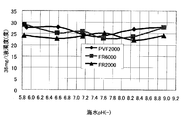
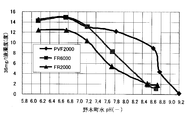
PVF2000、FR6000、及びFR2000のアルカリ水溶液を、それぞれ純水でフェノール系高分子化合物濃度3600mg/L(0.36wt/vol%)に希釈し、この希釈液1mlを、アルカリの添加により5.8~9.0の様々なpHに調整した海水又は野木町水にそれぞれ滴下して混合し、水中のフェノール系高分子化合物濃度が36mg/Lとなるようにして、それぞれpHと濁度を測定し、結果を図1(海水の場合)及び図2(野木町水)に示した。
PVF2000、FR6000、及びFR2000のアルカリ水溶液を、それぞれ純水でフェノール系高分子化合物濃度3600mg/L(0.36wt/vol%)に希釈し、この希釈液1mlを、アルカリの添加により5.8~9.0の様々なpHに調整した海水又は野木町水にそれぞれ滴下して混合し、水中のフェノール系高分子化合物濃度が36mg/Lとなるようにして、それぞれpHと濁度を測定し、結果を図1(海水の場合)及び図2(野木町水)に示した。
図1,2より次のことが分かる。
海水にフェノール系高分子化合物のアルカリ水溶液を添加するとpH5.8~9.0の条件で激しい濁り(濁度=22~30)を生じ、pHによらずその程度は同程度である。即ち、海水中の高濃度塩類の作用で、乖離していたフェノール性水酸基のマイナス荷電が封鎖され、溶解性を失い、フェノール系高分子化合物同士が会合し、不溶化して濁質を生ずる。
このように原水が海水の場合、有効成分が、本来作用させたい膜汚染物質と反応する前に添加したフェノール系高分子化合物同士が結合してしまうため、MFFの改善は得られない。
海水にフェノール系高分子化合物のアルカリ水溶液を添加するとpH5.8~9.0の条件で激しい濁り(濁度=22~30)を生じ、pHによらずその程度は同程度である。即ち、海水中の高濃度塩類の作用で、乖離していたフェノール性水酸基のマイナス荷電が封鎖され、溶解性を失い、フェノール系高分子化合物同士が会合し、不溶化して濁質を生ずる。
このように原水が海水の場合、有効成分が、本来作用させたい膜汚染物質と反応する前に添加したフェノール系高分子化合物同士が結合してしまうため、MFFの改善は得られない。
この時、フェノール系高分子化合物のアルカリ溶液を十分に希釈すると、フェノール系高分子化合物の密度が減少し、フェノール系高分子化合物同士の会合の確率が減少し、膜汚染物質に達して反応する、即ち、膜汚染物質とフェノール系高分子化合物とが反応することができるようになり、本発明による効果が得られることが推察される。
一方、野木町水の場合、中性域ではいずれのフェノール系高分子化合物も濁度を生ずるが、pH7.5~8.5或いはそれ以上のアルカリ性では濁度発生が少なく、ゼロに近づく。
濁度発生pHを比較するとポリビニルフェノール(PVF2000)がより高pHから発生する。ノボラック型フェノール樹脂(FR6000,2000)では分子量の大きい方が濁度値、濁度発生pHがやや高い。
しかし、いずれのフェノール系高分子化合物も中性域で、フェノール系高分子化合物同士の会合、不溶化が起こることが示される。
このことが、フェノール系高分子化合物のアルカリ溶液を低濃度で添加した方が、MFFがより改善し、必要な添加量も低減する理由と推察される。
濁度発生pHを比較するとポリビニルフェノール(PVF2000)がより高pHから発生する。ノボラック型フェノール樹脂(FR6000,2000)では分子量の大きい方が濁度値、濁度発生pHがやや高い。
しかし、いずれのフェノール系高分子化合物も中性域で、フェノール系高分子化合物同士の会合、不溶化が起こることが示される。
このことが、フェノール系高分子化合物のアルカリ溶液を低濃度で添加した方が、MFFがより改善し、必要な添加量も低減する理由と推察される。
[実施例及び比較例]
以下の実施例及び比較例では、以下の実験方法で行った。
以下の実施例及び比較例では、以下の実験方法で行った。
<実験方法>
(1)原水は24±2℃に調整し、その1100mlをビーカーに取り、宮本製作所製MJS-6Nを用いたジャーテストで凝集処理を行う。
ジャーテストの攪拌、反応条件は、次の通りとした。
・フェノール系高分子化合物のアルカリ溶液は、150rpm攪拌下に添加し、150rpmで5分の攪拌反応を行った。
・無機凝集剤は150rpm攪拌下に添加し、150rpmで10分の急速攪拌と50rpmで10分の緩速攪拌を行った。
・処理pHはアルミニウム系凝集剤ではpH6以上とし、凝集剤添加後pHが6未満になる場合は、概ねpH6.1になるように5wt/vol%苛性ソーダ水溶液で中和した。鉄系凝集剤ではpH5以上とし、pHが5未満になる場合は、概ねpH5.2になるように5wt/vol%苛性ソーダ水溶液で中和した。
(2)(1)で得られた凝集処理水を30分静置し、凝集フロックを沈澱させた。
(3)(2)の凝集処理水をNo.5(5μm孔)濾紙で上澄みから徐々に濾過し、最終的に凝集フロックを含め、凝集処理水の全量を濾過した。
(4)得られた濾液1000ml以上を500mlずつ2本のメスシリンダーに入れた。
(5)1本目のメスシリンダーの濾液500mlを、ミリポア社製の孔径0.45μm、直径47mmのニトロセルロース製メンブレンフィルターを用い、66kPa(500mmHg)の減圧下で濾過し、濾過に要する時間T1を計測した。続いてもう1本メスシリンダーの濾液の500mlを同様に減圧濾過し、濾過に要する時間T2を測定し、MFF=T2/T1を算出した。
水温は測定時24±2℃になるよう、実験室温度を調整するとともに、測定時水温を記録した。
なお、濾過時間は、水の粘性係数で変化する、すなわち水温で変化するが、同一温度で計測すればT2/T1=MFFは温度影響が相殺される。
(6)残余の濾液の紫外吸光度(波長260nm,50mmセル)及びTOC(全有機炭素)濃度を測定した。
260nm紫外吸光度(UV吸光度)は主にC=C二重結合を有する有機物の吸収で、フェノール系高分子化合物の処理水中の残留量の目安として計測した。
(1)原水は24±2℃に調整し、その1100mlをビーカーに取り、宮本製作所製MJS-6Nを用いたジャーテストで凝集処理を行う。
ジャーテストの攪拌、反応条件は、次の通りとした。
・フェノール系高分子化合物のアルカリ溶液は、150rpm攪拌下に添加し、150rpmで5分の攪拌反応を行った。
・無機凝集剤は150rpm攪拌下に添加し、150rpmで10分の急速攪拌と50rpmで10分の緩速攪拌を行った。
・処理pHはアルミニウム系凝集剤ではpH6以上とし、凝集剤添加後pHが6未満になる場合は、概ねpH6.1になるように5wt/vol%苛性ソーダ水溶液で中和した。鉄系凝集剤ではpH5以上とし、pHが5未満になる場合は、概ねpH5.2になるように5wt/vol%苛性ソーダ水溶液で中和した。
(2)(1)で得られた凝集処理水を30分静置し、凝集フロックを沈澱させた。
(3)(2)の凝集処理水をNo.5(5μm孔)濾紙で上澄みから徐々に濾過し、最終的に凝集フロックを含め、凝集処理水の全量を濾過した。
(4)得られた濾液1000ml以上を500mlずつ2本のメスシリンダーに入れた。
(5)1本目のメスシリンダーの濾液500mlを、ミリポア社製の孔径0.45μm、直径47mmのニトロセルロース製メンブレンフィルターを用い、66kPa(500mmHg)の減圧下で濾過し、濾過に要する時間T1を計測した。続いてもう1本メスシリンダーの濾液の500mlを同様に減圧濾過し、濾過に要する時間T2を測定し、MFF=T2/T1を算出した。
水温は測定時24±2℃になるよう、実験室温度を調整するとともに、測定時水温を記録した。
なお、濾過時間は、水の粘性係数で変化する、すなわち水温で変化するが、同一温度で計測すればT2/T1=MFFは温度影響が相殺される。
(6)残余の濾液の紫外吸光度(波長260nm,50mmセル)及びTOC(全有機炭素)濃度を測定した。
260nm紫外吸光度(UV吸光度)は主にC=C二重結合を有する有機物の吸収で、フェノール系高分子化合物の処理水中の残留量の目安として計測した。
[実施例I及び比較例I(海水)]
東京都大田区城南島(城南島公園)で採取した海水(電気伝導度3400mS/m,pH8.38)を原水とした。この原水の凝集処理には、塩化第二鉄(FC)が適切である。凝集剤としてFCを用い、FC添加量とMFFの関係を調べたところ図3のようになり、FC添加量を増加してもMFFは1.14が限界であった。この結果からフェノール系高分子化合物の評価におけるFC添加量は80mg/Lに設定した。この時のMFFは1.158であった。
東京都大田区城南島(城南島公園)で採取した海水(電気伝導度3400mS/m,pH8.38)を原水とした。この原水の凝集処理には、塩化第二鉄(FC)が適切である。凝集剤としてFCを用い、FC添加量とMFFの関係を調べたところ図3のようになり、FC添加量を増加してもMFFは1.14が限界であった。この結果からフェノール系高分子化合物の評価におけるFC添加量は80mg/Lに設定した。この時のMFFは1.158であった。
次に、フェノール系高分子化合物のアルカリ溶液を純水で希釈することにより、表2に示す各フェノール系高分子化合物濃度に調整したものを用い、フェノール系高分子化合物のアルカリ溶液を表2に示す各フェノール系高分子化合物添加量で海水に添加した後、FCを80mg/L添加するジャーテストを行い、MFF及びUV吸光度の測定を行い、MFF改善率を調べた。
これらの結果を表2に示す。
これらの結果を表2に示す。

表2より次のことが分かる。
実施例I-1,2でノボラック型フェノール樹脂FR2000のアルカリ溶液濃度を0.03wt/vol%(表中では「w/v%」、以下同様)、0.1wt/vol%とすると1.2mg/Lの添加量でMFFは1.07程度と良好になり、塩化第二鉄単独のMFFに対し、MFF改善率50%以上が得られた。
なお、MFF改善率は、無機凝集剤単独時のMFF(1.158)と計測MFF値(実施例I-1で1.066)との差(0.092)を改善値として、これを全く膜濾過阻害物がない場合のMFF1.000と無機凝集剤単独時のMFF値との差(0.158)で割り、100を乗じてMFF改善率(0.092/0.158×100=58(%))として表示した。以下においても同様である。
また、FR2000添加時のアルカリ溶液中濃度を0.3wt/vol%とすると、MFF改善率20%に、また、1.0wt/vol%とするとMFF改善率4%に低下した。
実施例I-1,2でノボラック型フェノール樹脂FR2000のアルカリ溶液濃度を0.03wt/vol%(表中では「w/v%」、以下同様)、0.1wt/vol%とすると1.2mg/Lの添加量でMFFは1.07程度と良好になり、塩化第二鉄単独のMFFに対し、MFF改善率50%以上が得られた。
なお、MFF改善率は、無機凝集剤単独時のMFF(1.158)と計測MFF値(実施例I-1で1.066)との差(0.092)を改善値として、これを全く膜濾過阻害物がない場合のMFF1.000と無機凝集剤単独時のMFF値との差(0.158)で割り、100を乗じてMFF改善率(0.092/0.158×100=58(%))として表示した。以下においても同様である。
また、FR2000添加時のアルカリ溶液中濃度を0.3wt/vol%とすると、MFF改善率20%に、また、1.0wt/vol%とするとMFF改善率4%に低下した。
分子量の大きいFR6000でも同様に、アルカリ溶液中濃度0.03wt/vol%、0.1wt/vol%ではMFF改善率50%以上であるが、0.3wt/vol%、1.0wt/vol%ではほとんど改善しなかった。また、1.0wt/vol%時に添加量を2倍の2.4mg/Lに増加しても改善効果は得られなかった。
ポリビニルフェノールのPVF2000でもFR6000と同様の結果であった。
ポリビニルフェノールのPVF2000でもFR6000と同様の結果であった。
[実施例II及び比較例II(下水処理水)]
A市標準活性汚泥法下水処理水(高速濾過後、電気伝導度58mS/m)の凝集処理には、液体塩化アルミニウム(LAC)が適切である。凝集剤としてLACを用い、LAC添加量とMFFの関係を調べたところ、図4のようになり、LAC添加量を増加してもMFFは1.18が限界であった。この結果から、フェノール系高分子化合物の評価におけるLAC添加量は100mg/Lに設定した。この時のMFFは1.178であった。
A市標準活性汚泥法下水処理水(高速濾過後、電気伝導度58mS/m)の凝集処理には、液体塩化アルミニウム(LAC)が適切である。凝集剤としてLACを用い、LAC添加量とMFFの関係を調べたところ、図4のようになり、LAC添加量を増加してもMFFは1.18が限界であった。この結果から、フェノール系高分子化合物の評価におけるLAC添加量は100mg/Lに設定した。この時のMFFは1.178であった。
次に、フェノール系高分子化合物のアルカリ溶液を純水で希釈することにより、表3に示す各フェノール系高分子化合物濃度に調整したものを用い、フェノール系高分子化合物のアルカリ溶液を表3に示す各フェノール系高分子化合物添加量で下水処理水に添加した後、LACを100mg/L添加するジャーテストを行い、MFF、及びTOCとUV吸光度測定を行い、MFF改善率を調べた。
これらの結果を表3に示す。
これらの結果を表3に示す。
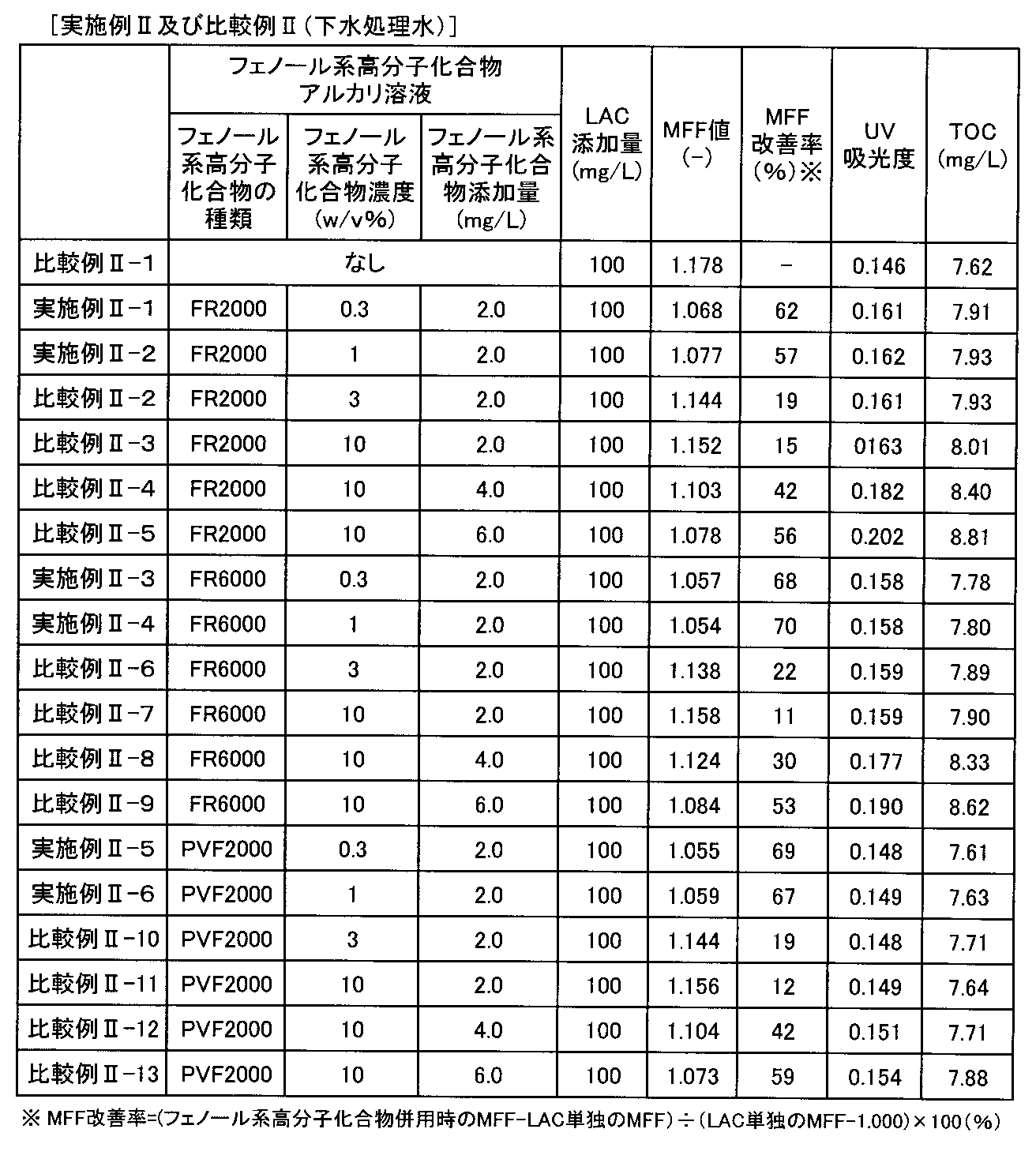
表3より次のことが分かる。
実施例II-1,2でノボラック型フェノール樹脂FR2000のアルカリ溶液中濃度を0.3wt/vol%、1wt/vol%とすると2.0mg/Lの添加量でMFFは1.07程度と良好になり、液体塩化アルミニウム単独のMFFに対し、MFF改善率は60%程度が得られた。
また、FR2000添加時のアルカリ溶液中濃度を3wt/vol%とすると、MFF改善率19%、10wt/vol%とするとMFF改善率15%に低下した。
分子量の大きいFR6000でも同様に、アルカリ溶液中濃度0.3wt/vol%、1wt/vol%でのMFF改善率70%程度が、3wt/vol%でMFF改善率22%、10wt/vol%でMFF改善率11%と低下した。
FR2000、FR6000ともに、アルカリ溶液中濃度10wt/vol%の場合、アルカリ溶液中濃度0.3~1.0wt/vol%と同等の効果を得るには、添加率を3倍程度にする必要があった。
この結果、凝集・濾過処理水のUV吸光度、TOCともに添加量増加に応じて増加した。
実施例II-1,2でノボラック型フェノール樹脂FR2000のアルカリ溶液中濃度を0.3wt/vol%、1wt/vol%とすると2.0mg/Lの添加量でMFFは1.07程度と良好になり、液体塩化アルミニウム単独のMFFに対し、MFF改善率は60%程度が得られた。
また、FR2000添加時のアルカリ溶液中濃度を3wt/vol%とすると、MFF改善率19%、10wt/vol%とするとMFF改善率15%に低下した。
分子量の大きいFR6000でも同様に、アルカリ溶液中濃度0.3wt/vol%、1wt/vol%でのMFF改善率70%程度が、3wt/vol%でMFF改善率22%、10wt/vol%でMFF改善率11%と低下した。
FR2000、FR6000ともに、アルカリ溶液中濃度10wt/vol%の場合、アルカリ溶液中濃度0.3~1.0wt/vol%と同等の効果を得るには、添加率を3倍程度にする必要があった。
この結果、凝集・濾過処理水のUV吸光度、TOCともに添加量増加に応じて増加した。
ポリビニルフェノールのPVF2000もアルカリ溶液中濃度0.3~1.0wt/vol%、添加率2.0mg/LでMFF改善率約70%が得られたが、3~10wt/vol%ではMFF改善率19~12%に低下した。
アルカリ溶液中濃度10wt/vol%の場合に濃度0.3~1wt/vol%の場合と同じ効果を得るには、FR2000、FR6000と同様に約3倍の添加量を必要とした。
アルカリ溶液中濃度10wt/vol%の場合に濃度0.3~1wt/vol%の場合と同じ効果を得るには、FR2000、FR6000と同様に約3倍の添加量を必要とした。
[実施例III及び比較例III(生物担体法処理水)]
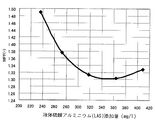
B工場廃水生物担体法処理水(高速濾過後、電気伝導度104mS/m)の凝集処理には液体硫酸アルミニウム(LAS)が適切である。凝集剤としてLASを用い、LAS添加量とMFFの関係を調べたところ図5のようになり、LAS添加量を増加してもMFFは1.30が限界で、無機凝集剤で除去できない膜汚染物質の多い水であった。
そこで、フェノール系高分子化合物の評価におけるLAS添加量は318mg/Lに設定した。この時のMFFは1.322であった。
B工場廃水生物担体法処理水(高速濾過後、電気伝導度104mS/m)の凝集処理には液体硫酸アルミニウム(LAS)が適切である。凝集剤としてLASを用い、LAS添加量とMFFの関係を調べたところ図5のようになり、LAS添加量を増加してもMFFは1.30が限界で、無機凝集剤で除去できない膜汚染物質の多い水であった。
そこで、フェノール系高分子化合物の評価におけるLAS添加量は318mg/Lに設定した。この時のMFFは1.322であった。
次に、フェノール系高分子化合物のアルカリ溶液を純水で希釈することにより、表4に示す各フェノール系高分子化合物濃度に調整したものを用い、フェノール系高分子化合物のアルカリ溶液を表4に示す各フェノール系高分子化合物添加量で生物担体法処理水に添加した後、LASを318mg/L添加するジャーテストを行い、MFF、及びTOCとUV吸光度測定を行い、MFF改善率を調べた。
これらの結果を表4に示す。
これらの結果を表4に示す。

表4より次のことが分かる。
実施例III-1,2でノボラック型フェノール樹脂FR2000のアルカリ溶液中濃度を0.3wt/vol%、1wt/vol%とすると5.0mg/Lの添加量でMFFは1.1程度と良好になり、液体硫酸アルミニウム単独のMFFに対し、MFF改善率は70%程度が得られた。
また、添加時のアルカリ溶液中濃度を3wt/vol%とすると、MFF改善率42%、10wt/vol%とするとMFF改善率37%に低下した。
実施例III-1,2でノボラック型フェノール樹脂FR2000のアルカリ溶液中濃度を0.3wt/vol%、1wt/vol%とすると5.0mg/Lの添加量でMFFは1.1程度と良好になり、液体硫酸アルミニウム単独のMFFに対し、MFF改善率は70%程度が得られた。
また、添加時のアルカリ溶液中濃度を3wt/vol%とすると、MFF改善率42%、10wt/vol%とするとMFF改善率37%に低下した。
分子量の大きいFR6000でも同様に、アルカリ溶液中濃度0.3wt/vol%、1wt/vol%でのMFF改善率70%程度が得られ、3wt/vol%でMFF改善率40%、10wt/vol%で30%と低下した。
FR2000、FR6000ともに、アルカリ溶液中濃度10wt/vol%の場合、アルカリ溶液中濃度0.3~1.0wt/vol%と同等効果を得るには、添加率を2~3倍程度にする必要があった。
この結果、凝集・濾過処理水のUV吸光度、TOCともに添加量増加に応じて大きく増加した。
FR2000、FR6000ともに、アルカリ溶液中濃度10wt/vol%の場合、アルカリ溶液中濃度0.3~1.0wt/vol%と同等効果を得るには、添加率を2~3倍程度にする必要があった。
この結果、凝集・濾過処理水のUV吸光度、TOCともに添加量増加に応じて大きく増加した。
ポリビニルフェノールのPVF2000もアルカリ溶液中濃度0.3~1.0wt/vol%、添加率5.0mg/LでMFF改善率60~70%が得られたが、アルカリ溶液中濃度3~10wt/vol%ではMFF改善率37~25%に低下した。
アルカリ溶液中濃度10wt/vol%の場合に濃度0.3~1wt/vol%と同じ効果を得るには、約3倍の添加量を必要とした。
アルカリ溶液中濃度10wt/vol%の場合に濃度0.3~1wt/vol%と同じ効果を得るには、約3倍の添加量を必要とした。
[実施例IV及び比較例IV(C市工業用水)]
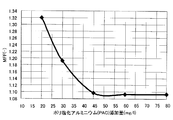
C市工業用水(電気伝導度26mS/m)の凝集処理には、ポリ塩化アルミニウム(PAC)が適切である。凝集剤としてPACを用い、PAC添加量とMFFとの関係を調べたところ、図6のようになり、PAC添加量45mg/LでMFF1.10を得た。しかしそれ以上添加量を増加してもMFFの改善は見られなかった。
そこで、フェノール系高分子化合物の評価におけるPAC添加量は45mg/Lに設定した。この時のMFFは1.097であった。
C市工業用水(電気伝導度26mS/m)の凝集処理には、ポリ塩化アルミニウム(PAC)が適切である。凝集剤としてPACを用い、PAC添加量とMFFとの関係を調べたところ、図6のようになり、PAC添加量45mg/LでMFF1.10を得た。しかしそれ以上添加量を増加してもMFFの改善は見られなかった。
そこで、フェノール系高分子化合物の評価におけるPAC添加量は45mg/Lに設定した。この時のMFFは1.097であった。
次に、フェノール系高分子化合物のアルカリ溶液を純水で希釈することにより、表5に示す各フェノール系高分子化合物濃度に調整したものを用い、フェノール系高分子化合物のアルカリ溶液を表5に示す各フェノール系高分子化合物添加量で工業用水に添加した後、PACを45mg/L添加するジャーテストを行い、MFF、及びTOCとUV吸光度測定を行い、MFF改善率を調べた。
これらの結果を表5に示す。
これらの結果を表5に示す。
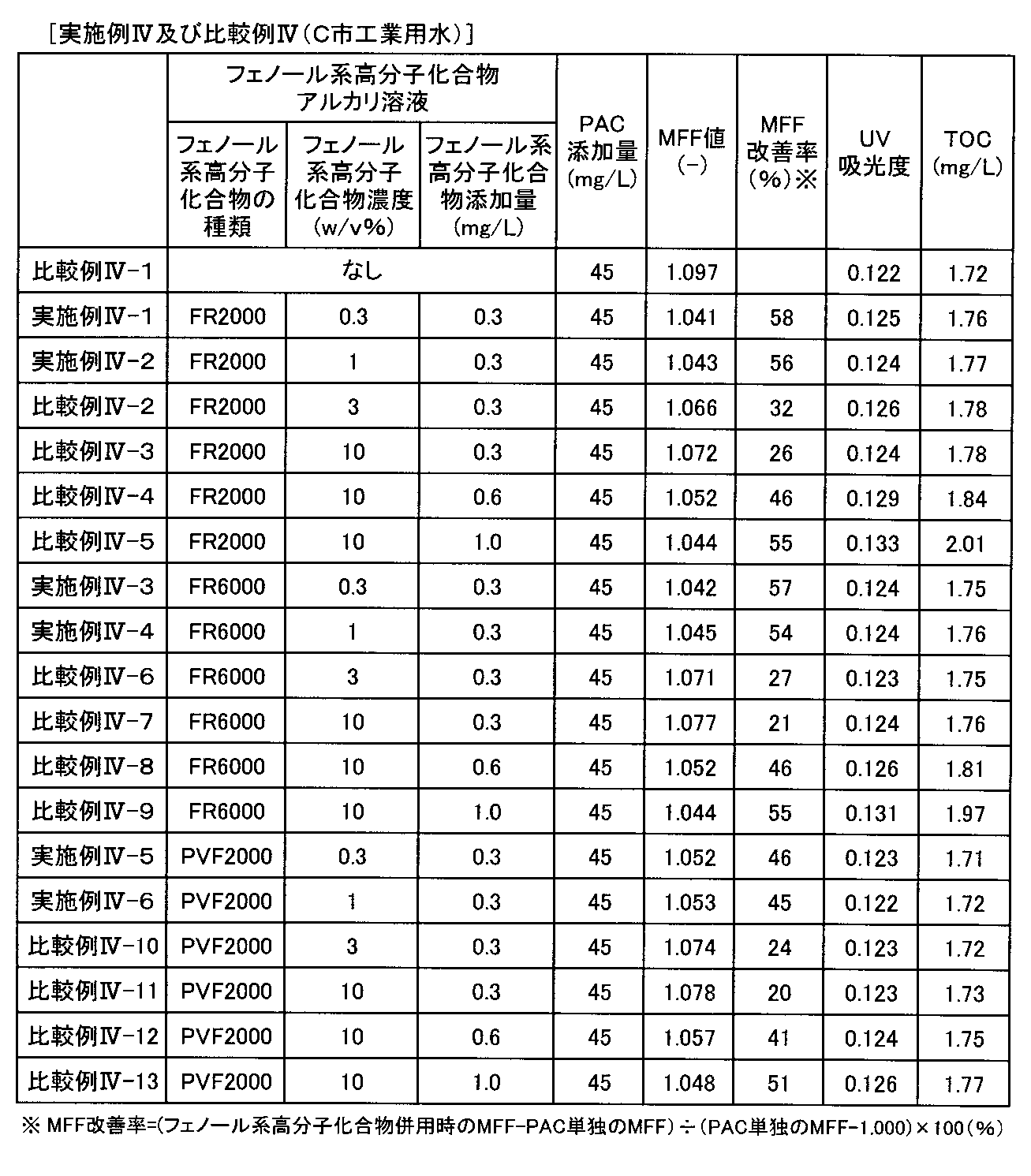
表5より次のことが分かる。
実施例IV-1,2でノボラック型フェノール樹脂FR2000のアルカリ溶液中濃度を0.3wt/vol%、1wt/vol%とすると0.3mg/Lの添加量でMFFは1.05以下と非常に良好になり、ポリ塩化アルミニウム単独のMFFに対し、MFF改善率は50%以上が得られた。
本例では、フェノール系高分子化合物の必要添加量は下水処理水や工場廃水生物担体処理水に比較して1/5~1/10と相当に少ない。これは無機凝集剤PAC単独の添加量が少なく、その達成MFFも1.0とかなり良いことから、膜汚染物質の絶対量が前2種の水より相当に少ないためと考えられる。
FR2000添加時のアルカリ溶液中濃度を3wt/vol%とすると、MFF改善率32%、10wt/vol%とするとMFF改善率26%に低下した。
実施例IV-1,2でノボラック型フェノール樹脂FR2000のアルカリ溶液中濃度を0.3wt/vol%、1wt/vol%とすると0.3mg/Lの添加量でMFFは1.05以下と非常に良好になり、ポリ塩化アルミニウム単独のMFFに対し、MFF改善率は50%以上が得られた。
本例では、フェノール系高分子化合物の必要添加量は下水処理水や工場廃水生物担体処理水に比較して1/5~1/10と相当に少ない。これは無機凝集剤PAC単独の添加量が少なく、その達成MFFも1.0とかなり良いことから、膜汚染物質の絶対量が前2種の水より相当に少ないためと考えられる。
FR2000添加時のアルカリ溶液中濃度を3wt/vol%とすると、MFF改善率32%、10wt/vol%とするとMFF改善率26%に低下した。
分子量の大きいFR6000でも同様に、アルカリ溶液中濃度0.3wt/vol%、1wt/vol%でのMFF改善率50%以上が、3wt/vol%でMFF改善率27%、10wt/vol%でMFF改善率21%と低下した。
FR2000、FR6000ともに、アルカリ溶液中濃度10wt/vol%の場合、アルカリ溶液中濃度0.3~1.0wt/vol%と同等効果を得るには、添加率を3倍程度にする必要があった。
FR2000、FR6000ともに、アルカリ溶液中濃度10wt/vol%の場合、アルカリ溶液中濃度0.3~1.0wt/vol%と同等効果を得るには、添加率を3倍程度にする必要があった。
ノボラック型フェノール樹脂では、凝集・濾過後、樹脂成分の一部が処理水中に残留するが、アルカリ溶液中濃度を1wt/vol%以下として添加することで、0.3mg/Lの極少ない添加量で十分な膜濾過性の改善が図れ、この結果、処理水中のTOCの上昇を防げることができる。
ポリビニルフェノールのPVF2000もアルカリ溶液中濃度0.3~1.0wt/vol%、添加率0.3mg/LでMFF改善率45%程度が得られ、濃度3~10wt/vol%とするとMFF改善率は24~20%に低下した。
また、アルカリ溶液中濃度10wt/vol%の場合に濃度0.3~1wt/vol%と同じ効果を得るには、約3倍の添加量を必要とした。
また、アルカリ溶液中濃度10wt/vol%の場合に濃度0.3~1wt/vol%と同じ効果を得るには、約3倍の添加量を必要とした。
以上の実施例及び比較例の結果から、次のことが分かる。
(1) 膜分離処理に先立ち行われる凝集処理において、フェノール系高分子化合物のアルカリ溶液を、フェノール系高分子化合物濃度1wt/vol%以下の希釈溶液として添加し、さらに無機凝集剤を添加して凝集処理することで、処理水の膜濾過性指標であるMFFを、無機凝集剤単独での達成値から50%以上改善することができる。
フェノール系高分子化合物添加時のアルカリ溶液中濃度が10wt/vol%の場合は、同じ膜濾過性改善率を得るための必要添加量は3倍から2倍量となる。
本発明によれば、膜濾過性改善に必要なフェノール系高分子化合物添加量が大きく低減できることで、処理費用が大きく削減できる。
(1) 膜分離処理に先立ち行われる凝集処理において、フェノール系高分子化合物のアルカリ溶液を、フェノール系高分子化合物濃度1wt/vol%以下の希釈溶液として添加し、さらに無機凝集剤を添加して凝集処理することで、処理水の膜濾過性指標であるMFFを、無機凝集剤単独での達成値から50%以上改善することができる。
フェノール系高分子化合物添加時のアルカリ溶液中濃度が10wt/vol%の場合は、同じ膜濾過性改善率を得るための必要添加量は3倍から2倍量となる。
本発明によれば、膜濾過性改善に必要なフェノール系高分子化合物添加量が大きく低減できることで、処理費用が大きく削減できる。
また、フェノール系高分子化合物のうち、ノボラック型フェノール樹脂のアルカリ溶液は、凝集処理水側に樹脂成分が残留し、添加量が多いと、処理水TOCを上昇させるため、凝集・清澄化薬剤として不適当とされていたが、本発明に従って、希薄溶液として添加することにより、必要添加率低減により、特に膜分離処理の前処理としての凝集剤として有効性を発揮することができた。
また、海水の膜分離処理の前処理としての凝集処理では、フェノール系高分子化合物アルカリ溶液の濃度を0.1wt/vol%以下の更に希薄な溶液として添加することで、無機凝集剤単独の凝集処理の場合に対して膜濾過性指標MFFを50~60%改善できた。
フェノール系高分子化合物アルカリ溶液の濃度が1wt/vol%を超える場合は、添加量を増加してもほとんどMFF値を改善することができなかった。
また、海水の膜分離処理の前処理としての凝集処理では、フェノール系高分子化合物アルカリ溶液の濃度を0.1wt/vol%以下の更に希薄な溶液として添加することで、無機凝集剤単独の凝集処理の場合に対して膜濾過性指標MFFを50~60%改善できた。
フェノール系高分子化合物アルカリ溶液の濃度が1wt/vol%を超える場合は、添加量を増加してもほとんどMFF値を改善することができなかった。
本発明を特定の態様を用いて詳細に説明したが、本発明の意図と範囲を離れることなく様々な変更が可能であることは当業者に明らかである。
なお、本出願は、2008年10月30日付で出願された日本特許出願(特願2008-280103)及び2008年11月27日付で出願された日本特許出願(特願2008-302635)に基づいており、その全体が引用により援用される。
なお、本出願は、2008年10月30日付で出願された日本特許出願(特願2008-280103)及び2008年11月27日付で出願された日本特許出願(特願2008-302635)に基づいており、その全体が引用により援用される。
Claims (5)
- 海水又は電気伝導度1000mS/m以上の高塩類含有水である被処理水に、フェノール系高分子化合物のアルカリ溶液を添加した後、無機凝集剤を添加して凝集処理し、凝集処理水を固液分離し、得られた分離水を膜分離処理する方法において、
該フェノール系高分子化合物が、フェノール性水酸基を有するアルカリ可溶性で、中性域及び/又は高塩類存在下で不溶化する高分子化合物であり、該高分子化合物を高分子化合物濃度0.1wt/vol%以下のアルカリ溶液として該被処理水に添加することを特徴とする膜分離処理方法。 - 電気伝導度1000mS/m未満の被処理水に、フェノール系高分子化合物のアルカリ溶液を添加した後、無機凝集剤を添加して凝集処理し、凝集処理水を固液分離し、得られた分離水を膜分離処理する方法において、
該フェノール系高分子化合物が、フェノール性水酸基を有するアルカリ可溶性で、中性域及び/又は高塩類存在下で不溶化する高分子化合物であり、該高分子化合物を高分子化合物濃度1wt/vol%以下のアルカリ溶液として該被処理水に添加することを特徴とする膜分離処理方法。 - 請求項1又は2において、前記フェノール系高分子化合物を1~35wt/vol%含むアルカリ溶液を、ポンプで定量吐出させた後、前記被処理水に添加する直前に水で希釈して該被処理水に添加することを特徴とする膜分離処理方法。
- 請求項1ないし3のいずれか1項において、フェノール系高分子化合物は、
フェノールとホルムアルデヒドとの縮合物、
クレゾールとホルムアルデヒドとの縮合物、
キシレノールとホルムアルデヒドとの縮合物、
フェノールとホルムアルデヒドとの縮合物をアルキル化して得られるアルキル変性フェノール系樹脂、
クレゾールとホルムアルデヒドとの縮合物をアルキル化して得られるアルキル変性フェノール系樹脂、及び
キシレノールとホルムアルデヒドとの縮合物をアルキル化して得られるアルキル変性フェノール系樹脂
よりなる群から選ばれる少なくとも1つであることを特徴とする膜分離処理方法。 - 請求項1ないし3のいずれか1項において、フェノール系高分子化合物は、
ビニルフェノールの単独重合体、
変性ビニルフェノールの単独重合体、及び
ビニルフェノール及び/又は変性ビニルフェノールと疎水性ビニルモノマーとの共重合体
よりなる群から選ばれる少なくとも1つであることを特徴とする膜分離処理方法。
Priority Applications (1)
| Application Number | Priority Date | Filing Date | Title |
|---|---|---|---|
| CN2009801437817A CN102203018A (zh) | 2008-10-30 | 2009-09-25 | 膜分离处理方法 |
Applications Claiming Priority (4)
| Application Number | Priority Date | Filing Date | Title |
|---|---|---|---|
| JP2008-280103 | 2008-10-30 | ||
| JP2008280103 | 2008-10-30 | ||
| JP2008302635A JP2010131469A (ja) | 2008-10-30 | 2008-11-27 | 膜分離処理方法 |
| JP2008-302635 | 2008-11-27 |
Publications (1)
| Publication Number | Publication Date |
|---|---|
| WO2010050325A1 true WO2010050325A1 (ja) | 2010-05-06 |
Family
ID=42128691
Family Applications (1)
| Application Number | Title | Priority Date | Filing Date |
|---|---|---|---|
| PCT/JP2009/066648 Ceased WO2010050325A1 (ja) | 2008-10-30 | 2009-09-25 | 膜分離処理方法 |
Country Status (4)
| Country | Link |
|---|---|
| JP (1) | JP2010131469A (ja) |
| CN (1) | CN102203018A (ja) |
| TW (1) | TW201026612A (ja) |
| WO (1) | WO2010050325A1 (ja) |
Families Citing this family (6)
| Publication number | Priority date | Publication date | Assignee | Title |
|---|---|---|---|---|
| JP5587240B2 (ja) * | 2011-04-21 | 2014-09-10 | 株式会社日立製作所 | 海水淡水化システムの制御装置及びその制御方法 |
| JP5616863B2 (ja) * | 2011-09-07 | 2014-10-29 | 株式会社日立製作所 | 海水淡水化システム |
| WO2013099857A1 (ja) * | 2011-12-28 | 2013-07-04 | 栗田工業株式会社 | 海水の処理方法 |
| JP6531416B2 (ja) * | 2015-02-10 | 2019-06-19 | 栗田工業株式会社 | 水中の高分子濃度の測定方法及び水処理方法 |
| JP6610158B2 (ja) * | 2015-10-19 | 2019-11-27 | 栗田工業株式会社 | 純水の製造方法及び製造装置 |
| JP6644014B2 (ja) * | 2017-03-23 | 2020-02-12 | 栗田工業株式会社 | 用水処理方法 |
Citations (5)
| Publication number | Priority date | Publication date | Assignee | Title |
|---|---|---|---|---|
| JPS51759A (ja) * | 1974-06-22 | 1976-01-06 | Kanebo Ltd | Kaimenkatsuseizaioganjusuru haisuino shorihoho |
| JPS6118408A (ja) * | 1984-04-30 | 1986-01-27 | アライド コロイズ リミテイド | 懸濁液の凝集方法 |
| JP2004113983A (ja) * | 2002-09-27 | 2004-04-15 | Japan Organo Co Ltd | フッ素またはリン含有水の処理方法 |
| JP2005205403A (ja) * | 2003-12-26 | 2005-08-04 | Sanyo Chem Ind Ltd | 高分子凝集剤 |
| JP2007007563A (ja) * | 2005-06-30 | 2007-01-18 | Kurita Water Ind Ltd | 生物処理水の高度処理方法及び生物処理水用凝集促進剤 |
-
2008
- 2008-11-27 JP JP2008302635A patent/JP2010131469A/ja active Pending
-
2009
- 2009-09-25 CN CN2009801437817A patent/CN102203018A/zh active Pending
- 2009-09-25 WO PCT/JP2009/066648 patent/WO2010050325A1/ja not_active Ceased
- 2009-10-09 TW TW098134359A patent/TW201026612A/zh unknown
Patent Citations (5)
| Publication number | Priority date | Publication date | Assignee | Title |
|---|---|---|---|---|
| JPS51759A (ja) * | 1974-06-22 | 1976-01-06 | Kanebo Ltd | Kaimenkatsuseizaioganjusuru haisuino shorihoho |
| JPS6118408A (ja) * | 1984-04-30 | 1986-01-27 | アライド コロイズ リミテイド | 懸濁液の凝集方法 |
| JP2004113983A (ja) * | 2002-09-27 | 2004-04-15 | Japan Organo Co Ltd | フッ素またはリン含有水の処理方法 |
| JP2005205403A (ja) * | 2003-12-26 | 2005-08-04 | Sanyo Chem Ind Ltd | 高分子凝集剤 |
| JP2007007563A (ja) * | 2005-06-30 | 2007-01-18 | Kurita Water Ind Ltd | 生物処理水の高度処理方法及び生物処理水用凝集促進剤 |
Also Published As
| Publication number | Publication date |
|---|---|
| JP2010131469A (ja) | 2010-06-17 |
| TW201026612A (en) | 2010-07-16 |
| CN102203018A (zh) | 2011-09-28 |
Similar Documents
| Publication | Publication Date | Title |
|---|---|---|
| CN103768947B (zh) | 膜分离方法 | |
| AU2007292849B2 (en) | Method of heavy metal removal from industrial wastewater using submerged ultrafiltration or microfiltration membranes | |
| Mateus et al. | Coagulation/flocculation with Moringa oleifera and membrane filtration for dairy wastewater treatment | |
| Farahani et al. | Recovery of cooling tower blowdown water for reuse: The investigation of different types of pretreatment prior nanofiltration and reverse osmosis | |
| JP5218731B2 (ja) | 水処理方法及び水処理装置 | |
| WO2010050325A1 (ja) | 膜分離処理方法 | |
| Zhang et al. | Application of Membrane Separation Technology in Electroplating Wastewater Treatment and Resource Recovery: A Review. | |
| JP6738492B2 (ja) | 水処理方法および水処理装置 | |
| JP2010017688A (ja) | 生物処理水の高度処理方法 | |
| WO2011039831A1 (ja) | 有機物含有水の生物処理方法 | |
| JP6287594B2 (ja) | 凝集処理方法および凝集処理装置 | |
| WO2015141567A1 (ja) | 水処理用分散剤及び水処理方法 | |
| JP4577122B2 (ja) | 生物処理水の高度処理方法及び生物処理水用凝集促進剤 | |
| JPWO2013099857A1 (ja) | 海水の処理方法 | |
| JP6687056B2 (ja) | 水処理方法及び水処理装置 | |
| JP2010247057A (ja) | 微粒子化法と膜除去法との組み合せによる水の浄化方法。 | |
| JP6015811B1 (ja) | 水処理方法及び水処理装置 | |
| Kim | In-line coagulation with quaternary amine polymer prior to microfiltration of humic-rich water | |
| JP2015157265A (ja) | 凝集固液分離方法及び凝集固液分離装置 | |
| JP2012213675A (ja) | 凝集剤の添加量決定方法及び水処理装置 | |
| JP5106182B2 (ja) | 水処理方法および水処理装置 | |
| WO2018173328A1 (ja) | 用水処理方法 | |
| JP2016187790A (ja) | 無機炭素含有水の処理方法及び装置 | |
| JP6287402B2 (ja) | 凝集固液分離方法及び凝集固液分離装置 | |
| JP2011025143A (ja) | ウィルス除去方法 |
Legal Events
| Date | Code | Title | Description |
|---|---|---|---|
| WWE | Wipo information: entry into national phase |
Ref document number: 200980143781.7 Country of ref document: CN |
|
| 121 | Ep: the epo has been informed by wipo that ep was designated in this application |
Ref document number: 09823438 Country of ref document: EP Kind code of ref document: A1 |
|
| NENP | Non-entry into the national phase |
Ref country code: DE |
|
| 122 | Ep: pct application non-entry in european phase |
Ref document number: 09823438 Country of ref document: EP Kind code of ref document: A1 |