WO2010035329A1 - 空調制御装置及び空調制御方法 - Google Patents
空調制御装置及び空調制御方法 Download PDFInfo
- Publication number
- WO2010035329A1 WO2010035329A1 PCT/JP2008/067434 JP2008067434W WO2010035329A1 WO 2010035329 A1 WO2010035329 A1 WO 2010035329A1 JP 2008067434 W JP2008067434 W JP 2008067434W WO 2010035329 A1 WO2010035329 A1 WO 2010035329A1
- Authority
- WO
- WIPO (PCT)
- Prior art keywords
- temperature
- vehicle
- learning
- air
- air conditioner
- Prior art date
- Legal status (The legal status is an assumption and is not a legal conclusion. Google has not performed a legal analysis and makes no representation as to the accuracy of the status listed.)
- Ceased
Links
Images







Classifications
-
- B—PERFORMING OPERATIONS; TRANSPORTING
- B60—VEHICLES IN GENERAL
- B60H—ARRANGEMENTS OF HEATING, COOLING, VENTILATING OR OTHER AIR-TREATING DEVICES SPECIALLY ADAPTED FOR PASSENGER OR GOODS SPACES OF VEHICLES
- B60H1/00—Heating, cooling or ventilating devices
- B60H1/00642—Control systems or circuits; Control members or indication devices for heating, cooling or ventilating devices
- B60H1/00735—Control systems or circuits characterised by their input, i.e. by the detection, measurement or calculation of particular conditions, e.g. signal treatment, dynamic models
-
- B—PERFORMING OPERATIONS; TRANSPORTING
- B60—VEHICLES IN GENERAL
- B60H—ARRANGEMENTS OF HEATING, COOLING, VENTILATING OR OTHER AIR-TREATING DEVICES SPECIALLY ADAPTED FOR PASSENGER OR GOODS SPACES OF VEHICLES
- B60H1/00—Heating, cooling or ventilating devices
- B60H1/00642—Control systems or circuits; Control members or indication devices for heating, cooling or ventilating devices
- B60H1/00735—Control systems or circuits characterised by their input, i.e. by the detection, measurement or calculation of particular conditions, e.g. signal treatment, dynamic models
- B60H1/00764—Control systems or circuits characterised by their input, i.e. by the detection, measurement or calculation of particular conditions, e.g. signal treatment, dynamic models the input being a vehicle driving condition, e.g. speed
- B60H1/00771—Control systems or circuits characterised by their input, i.e. by the detection, measurement or calculation of particular conditions, e.g. signal treatment, dynamic models the input being a vehicle driving condition, e.g. speed the input being a vehicle position or surrounding, e.g. GPS-based position or tunnel
-
- Y—GENERAL TAGGING OF NEW TECHNOLOGICAL DEVELOPMENTS; GENERAL TAGGING OF CROSS-SECTIONAL TECHNOLOGIES SPANNING OVER SEVERAL SECTIONS OF THE IPC; TECHNICAL SUBJECTS COVERED BY FORMER USPC CROSS-REFERENCE ART COLLECTIONS [XRACs] AND DIGESTS
- Y02—TECHNOLOGIES OR APPLICATIONS FOR MITIGATION OR ADAPTATION AGAINST CLIMATE CHANGE
- Y02T—CLIMATE CHANGE MITIGATION TECHNOLOGIES RELATED TO TRANSPORTATION
- Y02T10/00—Road transport of goods or passengers
- Y02T10/80—Technologies aiming to reduce greenhouse gasses emissions common to all road transportation technologies
- Y02T10/88—Optimized components or subsystems, e.g. lighting, actively controlled glasses
Definitions
- the present invention relates to an air conditioning control device, an air conditioning control method, an air conditioning control program, and a recording medium on which the air conditioning control program is recorded.
- an air conditioner (a so-called car air conditioner) is generally mounted on a vehicle in order to ensure passenger comfort in the passenger compartment. Since such a car air conditioner consumes a large amount of power, it is necessary to suppress the power consumption of the car air conditioner in order to improve the fuel consumption of the vehicle and reduce the battery consumption of the vehicle.
- Patent Document 1 hereinafter referred to as “conventional example”.
- an operation mode in which engine control is performed with priority on vehicle performance (power performance) and an operation mode in which engine control is performed with priority on fuel saving are prepared.
- energy saving mode an operation mode giving priority to energy saving
- the car air conditioner is always stopped, thereby suppressing power consumption by the car air conditioner. ing.
- the present invention has been made in view of the above circumstances, and provides an air conditioning control device and an air conditioning control method capable of reducing power consumption by the air conditioning device while maintaining comfort in the passenger compartment. With the goal.
- the present invention is an air conditioning control device that controls the operation of an air conditioning device that is mounted on a vehicle and adjusts the temperature in the vehicle interior, the first temperature detecting means for detecting the vehicle interior temperature; Second temperature detection means for detecting an outside temperature of the vehicle; a prediction means for obtaining a predicted arrival time of the vehicle at the destination; the temperature inside the vehicle and the outside temperature when the air conditioner is stopped And storage means for storing temperature transition time information required for the vehicle interior temperature to depart from a predetermined comfortable temperature range; the estimated arrival time, the vehicle interior temperature, the vehicle exterior temperature, and the In consideration of temperature transition time information, the passenger compartment temperature does not deviate from the comfortable temperature range even if the air conditioner is stopped for a period in which a passenger is estimated to stay in the passenger compartment of the vehicle.
- a control unit performs the automatic stop control for stopping the air conditioner
- is the air conditioning control device characterized in that it comprises a.
- the present invention is an air conditioning control method used in an air conditioning control device that controls the operation of an air conditioning device that is mounted on a vehicle and adjusts the temperature in the vehicle interior, wherein the vehicle interior temperature and the vehicle A temperature detecting step for detecting an outside temperature of the vehicle; a prediction step for obtaining a predicted arrival time of the vehicle at the destination in parallel with the temperature detecting step; the predicted arrival time, the temperature in the vehicle interior, and the outside of the vehicle interior
- the vehicle interior temperature stored in the storage means included in the air conditioning control device corresponds to the temperature and the vehicle interior temperature and the vehicle exterior temperature when the air conditioner is stopped.
- the passenger compartment temperature remains within the comfortable temperature range even if the air conditioner is stopped for a period during which it is estimated that a passenger stays in the passenger compartment of the vehicle.
- the air conditioning control method characterized in that it comprises a.
- the present invention is an air conditioning control program characterized by causing an arithmetic means to execute the air conditioning control method of the present invention.
- the present invention is a recording medium in which the air conditioning control program of the present invention is recorded so as to be readable by a calculation means.
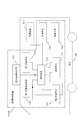
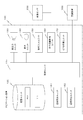
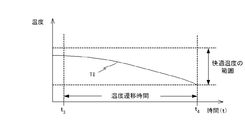
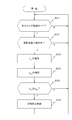
- FIG. 1 It is a figure showing roughly the composition of the air-conditioning control device concerning a 1st embodiment of the present invention. It is a figure which shows schematically the structure of the air-conditioning control apparatus which concerns on 2nd Embodiment of this invention. It is a figure which shows roughly the structure of the navigation apparatus which concerns on one Example of this invention. It is a figure for demonstrating the content of the temperature transition time information (TTI) in FIG. It is the figure for demonstrating temperature transition time (the 1). It is a figure (the 2) for demonstrating temperature transition time It is a figure for demonstrating the learning result information (SRI) in the navigation apparatus of FIG. It is a flowchart for demonstrating the learning process by the navigation apparatus of FIG.
- TTI temperature transition time information
- SRI learning result information
- an air conditioning control device 700A according to a first embodiment of the present invention will be described with reference to FIG.
- the air-conditioning control device 700A is mounted on the vehicle CR and controls the operation of the air-conditioning device 900 that adjusts the passenger compartment temperature.
- FIG. 1 is a block diagram showing a schematic configuration of the air conditioning control device 700A.
- the air conditioning control device 700 ⁇ / b> A includes a storage unit 710, a first temperature detection unit 720, and a second temperature detection unit 730. Further, the air conditioning control device 700A includes a search unit 740 and a prediction unit 750. Further, the air conditioning control device 700A includes first learning means 760 and control means 770.
- the storage means 710 has a nonvolatile rewritable storage area.
- the storage unit 710 can be accessed by the control unit 770.
- the storage area of the storage unit 710 requires the vehicle interior temperature to depart from a predetermined comfortable temperature range corresponding to the vehicle interior temperature and the vehicle exterior temperature of the vehicle CR when the air conditioner 900 is stopped. Temperature transition time information relating to time is stored. In the first embodiment, “temperature transition time information” is predetermined based on experiments, simulations, and the like.
- the “predetermined comfortable temperature range” may be determined in advance based on experience or the like, or may be set by the user.
- the temperature transition time information candidates prepared in advance corresponding to combinations of various vehicle interior temperatures and vehicle exterior temperatures at the time when the settings are performed. “Temperature transition time information” is selected from among them.
- the first temperature detecting means 720 described above includes a temperature sensor, and detects the vehicle interior temperature.
- the passenger compartment temperature detected by the first temperature detection means 720 is sent to the control means 770.
- the second temperature detecting means 730 is provided with a temperature sensor and detects the temperature outside the vehicle compartment.
- the passenger compartment temperature detected by the second temperature detection means 730 is sent to the control means 770.
- the second temperature detection means 730 can detect the outside air temperature as the vehicle compartment outside temperature.
- the search means 740 searches for the travel route of the vehicle CR to the destination.
- the destination is designated by the user.
- the search means 740 searches for a travel route to the designated destination with reference to the map data and the like.
- the search result by the search means 740 is sent to the prediction means 750.
- the above-mentioned prediction means 750 obtains the predicted arrival time at the destination based on the travel route searched by the search means 740 while taking into account travel information such as the travel speed of the vehicle CR.
- the predicted arrival time predicted by the prediction unit 750 is sent to the control unit 770.
- the first learning means 760 is in operation from the time when the vehicle CR arrives at the destination or the time when the vehicle CR stops when the control means 770 does not perform control processing in an energy saving control mode, which will be described later. 1st learning which is learning of the time until the air conditioner 900 is stopped is performed. By performing the first learning, the first learning means 760 learns the staying time in the passenger compartment of the passenger after the passenger of the vehicle CR arrives at the destination and stops the vehicle CR. The result of the first learning by the first learning means 760 is sent to the control means 770.
- the first learning means 760 learns whether the air conditioner 900 at the time when the vehicle CR arrives at the destination or when the vehicle CR stops is in a heating operation or a cooling operation. Can be. By performing learning that distinguishes between heating and cooling operations, the passenger's time in the passenger compartment after arrival at the destination reflects the passenger's personal preference for the heat and coldness of the vehicle CR. Can learn.
- the first learning means 760 can learn for each temperature outside the vehicle compartment detected by the second temperature detection means 730. By learning for each temperature outside the passenger compartment, the passenger compartment of the passenger after arrival at the destination reflects the personal behavior tendency of the passenger of the vehicle CR corresponding to the difference between the outdoor temperature and the comfortable temperature. You can learn how long you are staying at.
- the control means 770 controls the operation of the air conditioner 900 by performing control processing in the normal control mode or the energy saving control mode according to the setting by the passenger.
- the control means 770 performs start control and stop control of the air conditioner 900 according to the designation by the passenger, and designation control of the adjustment target temperature. Note that the control unit 770 reports to the first learning unit 760 that stop control has been performed in the normal control mode operation.
- the control means 770 includes (i) the predicted arrival time at the destination received from the prediction means 750 and (ii) the first The result of the first learning received from the learning means 760, (iii) the vehicle interior temperature detected by the first temperature detection means 720, (iv) the vehicle exterior temperature detected by the second temperature detection means 730, v) Based on the temperature transition time information stored in the storage unit 710, the vehicle interior temperature remains at a comfortable temperature even when the air conditioner 900 is stopped for a period during which it is estimated that the passenger stays in the vehicle interior of the vehicle CR. When it is determined not to depart from the range, automatic stop control is performed to stop the air conditioner. Details of processing in this automatic stop control will be described later.
- control means 770 adjusts the vehicle interior temperature adjustment setting by the air conditioner 900 within the comfortable temperature range along the change direction of the vehicle interior temperature when the air conditioner 900 is stopped. It can be done in stages.
- First learning process related to the time from when the vehicle CR arrives at the destination in the normal control mode or when the vehicle CR stops until the air conditioner 900 in operation is stopped will be described.
- the result of the first learning is used for automatic stop control for the air conditioner 900 in the energy saving control mode described above.
- the first learning means 760 determines that the vehicle has arrived or stopped at the destination in the normal control mode. If the result of this determination is affirmative, the first learning means 760 measures the time until the operation of the air conditioner 900 is stopped without departing from or departing from the destination.
- the air conditioner 900 is stopped in such a manner that the air conditioner 900 is stopped in response to a stop command given to the control means 770 by the passenger, or the accessory power source is operated by operating the engine key of the passenger (driver). For example, the air conditioner 900 is stopped due to the turning off.
- the first learning means 760 internally A new first learning result is calculated based on the held first learning result and the new timing result.
- the new first learning result calculated in this way is held inside the first learning means 760 and sent to the control means 770.
- the first learning means 760 When calculating a new first learning result, if the previous first learning result is not held in the first learning means 760, the first learning means 760 obtains a new timing result, It is adopted as a result of the new first learning as it is. Further, when the result of the first learning so far is held in the first learning means 760, the first learning means 760, for example, obtains a new timing result and the result of the first learning so far. By calculating the weighted average, it is possible to calculate a new first learning result.
- the first learning means 760 determines whether the air conditioner 900 at the time of arrival of the vehicle CR at the destination or when the vehicle CR is stopped is in a heating operation or in a cooling operation. It is possible to learn by distinguishing whether or not it was. In the first learning, the first learning means 760 can learn for each outside temperature detected by the second temperature detection means 730.
- Control processing in energy-saving control mode >> Next, the control process in the energy saving control mode of the first embodiment will be described mainly focusing on the automatic stop control process for the air conditioner 900 by the control means 770.
- the vehicle CR is traveling on the travel route searched by the search means 740.
- the prediction unit 750 performs a prediction process of an estimated arrival time at the destination based on the searched travel route while considering travel information such as the travel speed of the vehicle CR. It is assumed that every time an estimated arrival time is obtained, a new estimated arrival time is reported to the control means 770.
- the control means 770 arrives at the destination from the present time based on the predicted arrival time at the destination from the prediction means 750 and the result of the first learning from the first learning means 760.
- the stay time until the passenger of the vehicle CR exits from the passenger compartment is estimated.
- the control means 770 uses the vehicle interior temperature detected by the first temperature detection means 720, the vehicle exterior temperature detected by the second temperature detection means 730, and the temperature transition time information stored in the storage means 710. Based on this, the departure time that is the time from when the air conditioner 900 is stopped until the vehicle interior temperature departs from the comfortable temperature range is specified.
- the control means 770 determines whether or not the stay time is equal to or less than the departure time. If the result of this determination is negative, the control means 770 repeats the above processing. In parallel with such repeated processing, the control means 770 performs start control and stop control of the air conditioner 900 according to the designation by the passenger, and designation control of the adjustment target temperature. On the other hand, when the result of the determination becomes affirmative, the control means 770 performs automatic stop control for stopping the operation of the air conditioner 900.
- the control means 770 adjusts the vehicle interior temperature adjustment setting by the air conditioner 900 within the comfortable temperature range along the change direction of the vehicle interior temperature when the air conditioner 900 is stopped. It can also be done in stages.
- the stepwise adjustment setting of the vehicle interior temperature prior to the automatic stop control is performed according to a predetermined algorithm when it is more advantageous from the viewpoint of energy saving than the sudden automatic stop control. This “predetermined algorithm” is determined in advance based on experiments, simulations, experiences, and the like.
- the prediction unit 750 arrives at the destination based on the travel route searched by the search unit 740 while considering the travel information such as the travel speed of the vehicle CR. Find the predicted time. Further, the first learning means 760 performs the first learning on the time from when the vehicle CR arrives at the destination in the normal control mode or when the vehicle CR stops to when the operating air conditioner 900 is stopped.
- the control means 770 causes the passenger of the vehicle CR that has arrived at the destination to exit from the passenger compartment from the present time based on the predicted arrival time and the result of the first learning. Estimate the stay time until. Further, the control means 770 uses the vehicle interior temperature detected by the first temperature detection means 720, the vehicle exterior temperature detected by the second temperature detection means 730, and the temperature transition time information stored in the storage means 710. Based on this, the departure time that is the time from when the operation of the air conditioner 900 is stopped until the vehicle interior temperature departs from the comfortable temperature range is specified. Then, when it is determined that the stay time is equal to or less than the departure time, automatic stop control is performed to stop the operation of the air conditioner 900.
- an air conditioning control device 700B according to a second embodiment of the present invention will be described with reference to FIG.
- This air conditioning control device 700B is also mounted on the vehicle CR and controls the operation of the air conditioning device 900, as in the case of the air conditioning control device 700A of the first embodiment described above.
- FIG. 2 is a block diagram showing a schematic configuration of the air conditioning control device 700B. As shown in FIG. 2, the air conditioning control device 700B differs from the air conditioning control device 700A described above only in that it further includes a second learning means 780. Hereinafter, this difference will be mainly described.
- the second learning means 780 performs second learning, which is learning of the relationship between the vehicle interior temperature and the vehicle exterior temperature after the air conditioner 900 is stopped. For this second learning, the second learning means 780 reports that the control means 770 has performed stop control of the operation of the air conditioner 900 performed in response to a stop command issued by the passenger.
- second learning is learning of the relationship between the vehicle interior temperature and the vehicle exterior temperature after the air conditioner 900 is stopped. For this second learning, the second learning means 780 reports that the control means 770 has performed stop control of the operation of the air conditioner 900 performed in response to a stop command issued by the passenger.
- the second learning means 780 Upon receiving this report, the second learning means 780 performs second learning based on the vehicle interior temperature detected by the first temperature detection means 720 and the vehicle exterior temperature detected by the second temperature detection means 730 thereafter. I do. Based on the new second learning result obtained by the second learning, the second learning unit 780 updates the temperature transition time information stored in the storage unit 710.
- Second learning process Prior to the second learning process, the second learning unit 780 responds to a stop command issued by the passenger from the control unit 770 regardless of whether it is in the normal control mode or the energy saving control mode. It is determined whether or not it has been reported that the stop control of the operation of the air conditioner 900 is performed. When the result of this determination is affirmative, the second learning means 780 starts the second learning process.
- the second learning means 780 calculates the vehicle interior temperature detected by the first temperature detection means 720 and the vehicle exterior temperature detected by the second temperature detection means 730 thereafter. Collect regularly. This collection is performed, for example, until the vehicle interior temperature deviates from the comfort temperature range described above.
- the second learning means 780 extracts, for example, a characteristic parameter of a change in the vehicle interior temperature corresponding to the vehicle exterior temperature based on the current collection result. Then, the second learning unit 780 calculates, for example, a weighted average value based on the feature parameter extracted this time and the feature parameter registered in the second learning unit 780 at that time, A new feature parameter is calculated and registered inside the second learning means 780. As a result, the feature parameter registered in the second learning unit 780 is updated.
- the second learning means 780 calculates new temperature transition time information using the new feature parameter. Then, the second learning unit 780 registers new temperature transition time information in the storage unit 710. As a result, the temperature transition time information in the storage unit 710 is updated.
- the control processing in the energy saving control mode of the second embodiment is performed in the same manner as in the first embodiment described above.
- the result of the second learning by the second learning means 780 is reflected in specifying the departure time, which is the time until the vehicle interior temperature departs from the comfortable temperature range.
- the second learning means 780 is in the normal control mode or in the energy saving control mode, the relationship between the vehicle interior temperature and the vehicle exterior temperature after the air conditioner 900 is stopped is learned. Second learning is performed. And the 2nd learning means 780 updates the temperature transition time information in the memory
- the control means 770 determines that the passenger of the vehicle CR that has arrived at the destination from the present time Estimate how long you will stay before you leave. In addition, the control means 770 specifies a departure time that is a time from when the air conditioner 900 is stopped until the vehicle interior temperature departs from the comfortable temperature range. As a result, the departure time reflecting the result of the second learning by the second learning means 780 is specified.
- the second embodiment it is possible to reduce the power consumption by the air conditioner while maintaining the comfort in the passenger compartment with higher accuracy than in the case of the first embodiment.
- the air conditioning control devices 700A and 700B of the first and second embodiments described above are configured by including a computer as a calculation unit, and the storage unit 710 and the first and second temperature detection units 720 and 730 are excluded.
- the function of each means can be realized by executing a program. These programs may be acquired in the form recorded on a portable recording medium such as a CD-ROM or DVD, or may be acquired in the form of delivery via a network such as the Internet. Can do.
- FIGS. In the following description and drawings, the same or equivalent elements are denoted by the same reference numerals, and redundant description is omitted.
- FIG. 3 shows a schematic configuration of a navigation device 100 having a function as an air conditioning control device according to an embodiment.
- the navigation device 100 is an aspect of the air conditioning control device 700A (see FIG. 1) of the first embodiment described above.
- the navigation device 100 is mounted on the vehicle CR and operates the air conditioning device 900 that adjusts the cabin temperature. Control.
- the navigation device 100 is connected to a vehicle speed sensor 800 mounted on the vehicle CR separately from the navigation device 100.
- the navigation device 100 includes a control unit 110 and a storage unit 120 as a storage unit 710.
- the navigation device 100 includes a sound output unit 130, a display unit 140, and an operation input unit 150.
- the navigation device 100 includes a travel information acquisition unit 160 and a GPS (Global Positioning System) reception unit 170.
- the navigation device 100 includes a temperature detection unit 181 as the first temperature detection means 720 and a temperature detection unit 182 as the second temperature detection means 730.
- the control unit 110 controls the entire navigation device 100.
- the control unit 110 will be described later.
- the storage unit 120 includes a hard disk device that is a nonvolatile storage device.
- the storage unit 120 stores various data such as navigation information (NVI) and temperature transition time information (TTI).
- NVI navigation information
- TTI temperature transition time information
- the storage unit 120 can be accessed by the control unit 110.
- navigation information various data used for navigation such as map data, POI (Point Of Interests) data, background data, and the like are stored.
- map data In the navigation information, various data used for navigation such as map data, POI (Point Of Interests) data, background data, and the like are stored.
- POI Point Of Interests
- the “predetermined comfortable temperature range” is determined in advance based on experiments, experiences, and the like.
- the vehicle interior temperature gradually increases in a direction that deviates from the comfortable temperature range. It goes up, departing from the scope of the comfortable temperature at time t 2.
- the time (t 2 -t 1 ) is the temperature transition time.
- the vehicle interior temperature gradually increases in a direction deviating from the comfortable temperature range. Decrease and deviate from the comfortable temperature range at time t 4 .
- the time (t 4 -t 3 ) is the temperature transition time.
- a temperature transition time tt j, k the order of time, the car outdoor temperature TO k, assuming that hardly changes, the temperature transition time tt j, k is made to be required.
- the sound output unit 130 includes a speaker, and outputs sound corresponding to the sound data received from the control unit 110. Under the control of the control unit 110, the sound output unit 130 outputs guidance voices such as the traveling direction of the vehicle CR, the traveling situation, and the traffic situation regarding the navigation processing.
- the display unit 140 includes a display device such as a liquid crystal panel, and displays an image corresponding to the display data received from the control unit 110.
- the display unit 140 displays map information, images such as route information, guidance information, and the like during navigation processing under the control of the control unit 110.
- the operation input unit 150 includes a key unit provided in the main body of the navigation device 100 and / or a remote input device including the key unit.
- a key part provided in the main body part a touch panel provided in a display device of the display unit 140 can be used.
- it can replace with the structure which has a key part, or can also employ
- the operation content of the navigation device 100 is set and an operation command is performed.
- the user uses the operation input unit 150 to set a destination related to route search in navigation processing, an adjustment temperature in the passenger compartment by the air conditioner 900, and the like.
- Such input contents are sent from the operation input unit 150 to the control unit 110 as operation input data.
- the travel information acquisition unit 160 includes an acceleration sensor, an angular velocity sensor, and the like, and detects acceleration and angular velocity acting on the vehicle CR.
- the travel information acquisition unit 160 acquires speed data that is a detection result of the vehicle speed sensor 800 mounted on the vehicle CR. Each data thus obtained is sent to the control unit 110 as travel data.
- the GPS receiving unit 170 described above calculates the current position of the vehicle CR based on reception results of radio waves from a plurality of GPS satellites. Further, the GPS receiving unit 170 measures the current time based on the date / time information transmitted from the GPS satellite. Information regarding these current position and current time is sent to the control unit 110 as GPS data.
- the temperature detection unit 181 includes a first temperature sensor disposed at a predetermined position in the passenger compartment. The vehicle interior temperature detected by the first temperature sensor is sent from the temperature detection unit 181 to the control unit 110.
- the temperature detection unit 182 includes a second temperature sensor disposed at a predetermined position outside the passenger compartment.
- the passenger compartment temperature detected by the second temperature sensor is sent from the temperature detection unit 182 to the control unit 110.
- the second temperature sensor detects the outside air temperature.
- the control unit 110 includes a central processing unit (CPU) and its peripheral circuits.
- Various functions as the navigation device 100 are realized by the control unit 110 executing various programs. These functions include functions as the search means 740, the prediction means 750, the first learning means 760, and the control means 770 in the first embodiment described above.
- the control unit 110 appropriately refers to the navigation information in the storage unit 120 based on the driving data received from the driving information acquisition unit 160 and the GPS data received from the GPS receiving unit 170, and the navigation information for the user is updated. Perform the provision process.
- the navigation information providing process includes (a) a map display for displaying a map of an area specified by the user on the display device of the display unit 140, (b) where the vehicle is located on the map, Calculate which direction the vehicle is heading and display it on the display device of the display unit 140 and present it to the user. (C) Any position specified by the user from the current vehicle position.
- control unit 110 controls the operation of the air conditioner 900 in the normal control mode or the energy saving control mode.
- the normal control mode or the energy saving control mode is selected in accordance with a control mode selection command to the operation input unit 150 by the passenger.
- control unit 110 When the normal control mode is selected, the control unit 110 performs start control and stop control of the air conditioner 900 according to designation by the passenger, and designation control of the adjustment target temperature. When the energy saving control mode is selected, the control unit 110 performs automatic stop control described later in addition to the control according to the setting by the passenger similar to the case of the normal control mode.
- the control unit 110 learns the time from when the vehicle CR arrives at the destination or when the vehicle CR stops until the air conditioner 900 in operation is stopped. I do.
- the learning is performed by distinguishing between the time after cooling stop and the time after heating stop. The result of this learning is used in automatic stop control. Processing related to the learning will be described later.
- the learning result is registered in the control unit 110 as learning result information (SRI) as shown in FIG. That is, in the present embodiment, as learning result information, the registered post-cooling stop time ⁇ CL that is the learning result of the post-cooling stop time and the learning frequency N CL , and the post-registration heating stop that is the learning result of the post-heating stop time The time ⁇ WM and the learning frequency N WM are registered.
- SRI learning result information
- step S11 the control unit 110 determines whether or not the normal control mode is selected. If the result of this determination is negative (step S11: N), the process of step S11 is repeated until the result of determination in step S11 becomes affirmative.
- step S11 determines whether the vehicle CR has arrived or stopped at the destination during the operation of the air conditioner 900.
- step S12 the control unit 110 specifies whether the air conditioner 900 is performing a cooling operation or a heating operation. In this embodiment, whether or not the vehicle has arrived at the destination is determined by whether or not the vehicle has stopped at the destination when the destination is set.
- step S12 N
- the process returns to step S11. And the process of step S11, S12 is repeated until the result of determination in step S12 becomes affirmative.
- step S12 If the vehicle arrives at or stops at the destination while the normal control mode is selected and the result of the determination in step S12 is affirmative (step S12: Y), the process proceeds to step S13.
- step S13 the control unit 110 starts a time measuring operation.
- step S14 the control unit 110 determines whether or not the vehicle CR has started before the air conditioner 900 stops. If the result of this determination is affirmative (step S14: Y), the timing operation ends and the process returns to step S11.
- step S15 the control unit 110 determines whether the air conditioner 900 has been stopped. In the present embodiment, when a stop command given to the control unit 110 by the passenger is input to the operation input unit 150, or when the accessory power supply by the operation of the engine key of the passenger is turned off. In addition, the control unit 110 determines that the air conditioner 900 has been stopped.
- step S15: N If the result of the determination in step S15 is negative (step S15: N), the process returns to step S14. On the other hand, when the result of the determination in step S15 is affirmative (step S15: Y), the process proceeds to step S16. In step S16, the control unit 110 ends the time measuring operation.
- step S17 the control unit 110 performs a learning result update process based on the current timing result.
- the control unit 110 first, based on the operation mode of the air conditioner 900 specified at the time of the latest step S12, whether the air conditioner 900 before the stop was performing a cooling operation, Determine if the heating operation was performed. Subsequently, the control unit 110 obtains the current time measurement result by obtaining the elapsed time from the time measurement start time in step S13 to the time measurement end time in step S16.
- the control unit 110 updates the learning result corresponding to the operation mode of the air conditioner 900 before stopping. That is, when the air conditioner 900 before the stop is performing the cooling operation, the registered post-cooling stop time ⁇ CL and the learning count N CL in the learning result information (SRI: see FIG. 6) described above are updated.
- the control unit 110 sets a new registered post-cooling stop time, a registered post-cooling stop time ⁇ CL at that time point, and a current timing result, and a weighted average value considering the number of learning times N CL at that time point. It is obtained by calculating. Further, the control unit 110 obtains a new learning number by incrementing the learning number NCL at that time.
- the control unit 110 updates the learning result information by registering the newly registered post-cooling stop time and learning count thus obtained as the registered post-cooling stop time ⁇ CL and the learning count N CL .
- the air conditioner 900 before the stop is performing the heating operation
- the registered heating stop time ⁇ WM and the learning frequency N WM in the learning result information are updated. This update is performed in the same manner as in the case where the air conditioner 900 before stopping is performing a cooling operation.
- step S11 when the update of the learning result information is completed, the process returns to step S11. Thereafter, the processing of steps S11 to S17 is repeated, and the learning result information is updated as appropriate.
- step S21 the control unit 110 determines whether or not the energy saving control mode is selected. If the result of this determination is negative (step S21: N), the process of step S21 is repeated until the result of determination in step S21 becomes affirmative.
- step S21 If the energy saving control mode is selected and the result of determination in step S21 is affirmative (step S21: Y), the process proceeds to step S22.
- step S22 the control unit 110 determines whether or not the air conditioner 900 is operating.
- step S22 If the result of the determination in step S22 is negative (step S22: N), the process returns to step S21. And the process of step S21, S22 is repeated until the result of determination in step S22 becomes affirmative.
- the process proceeds to step S23.
- step S23 the control unit 110 estimates the stay time t ST until the passenger of the vehicle CR that has arrived at the destination leaves the passenger compartment from the present time.
- the control unit 110 first considers the travel data received from the travel information acquisition unit 160 and the GPS data received from the GPS reception unit 170 based on the travel route during travel. A predicted arrival time t AR at the destination is obtained. Then, the control unit 110 estimates the stay time t ST based on the time t R from the current time (t C ) to the predicted arrival time (t AR ) and the learning result described above.
- the control unit 110 estimates the stay time t ST by calculating the following equation (1).
- t ST t R + ⁇ CL (1)
- the control unit 110 estimates the stay time t ST by calculating the following equation (2).
- t ST t R + ⁇ WM (2)
- the control unit 110 specifies a departure time t RO that is a time from when the air conditioner 900 is stopped until the vehicle interior temperature departs from the comfortable temperature range.
- the control unit 110 detects the vehicle interior temperature (TI j ) detected by the current temperature detection unit 181 and the vehicle exterior temperature (TO k ) detected by the temperature detection unit 182. ) To get.
- the control unit 110 performs the temperature transition time tt j in the above-described temperature transition time information (TTI (see FIG. 4)) corresponding to the combination of the acquired vehicle interior temperature (TI j ) and vehicle exterior temperature (TO k ). Read k . Then, the control unit 110 specifies the read temperature transition time tt j, k as the departure time t RO at the current time.
- TTI temperature transition time information
- TO k vehicle exterior temperature
- step S25 the control unit 110 determines whether or not the staying time t ST is equal to or less than the departure time t RO. If the result of this determination is negative (step S25: N), it is determined that it is premature to automatically stop the air conditioner 900, and the process returns to step S21. Thereafter, the processes in steps S21 to S25 are repeated until the result of the determination in step S25 becomes affirmative.
- step S25 If the result of the determination in step S25 is affirmative (step S25: Y), the process proceeds to step S26.
- step S ⁇ b> 26 the control unit 110 issues a stop command to the air conditioner 900.
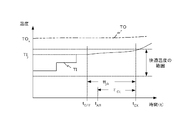
- FIG. 9 shows an example of the temporal change in the passenger compartment temperature TI from the issue time t OFF of the stop command to the exit time t EX of the passenger from the passenger compartment when the cooling operation of the air conditioner 900 is stopped. It is shown.
- control unit 110 When the energy saving control mode is selected, the control unit 110 performs the start control and stop control of the air conditioner 900 according to the designation by the passenger in parallel with the above automatic stop control process, and Performs specified control of the adjustment target temperature.
- the estimated arrival time at the destination is obtained based on the searched travel route while taking into account the travel information such as the current position of the vehicle CR and the travel speed.
- the time from when the vehicle CR arrives at the destination in the normal control mode or when the vehicle CR stops until the air conditioner 900 in operation is stopped is learned.
- the air conditioner 900 based on the predicted arrival time and the result of the learning, the stay time until the passenger of the vehicle CR that has arrived at the destination leaves the passenger compartment from the present time is estimated. . Further, based on the vehicle interior temperature detected by the temperature detection unit 181, the vehicle exterior temperature detected by the temperature detection unit 182, and the temperature transition time information (TTI) stored in the storage unit 120, the air conditioner 900 The departure time, which is the time from when the operation is stopped until the vehicle interior temperature departs from the comfortable temperature range, is specified. Then, when it is determined that the stay time is equal to or less than the departure time, automatic stop control for stopping the operation of the air conditioner 900 is performed.
- TTI temperature transition time information
- learning is performed for the time from when the vehicle CR arrives at the destination or when the vehicle CR stops until the air conditioner 900 in operation is stopped, distinguishing between cooling and heating. I do. For this reason, it is possible to learn the staying time of the passenger in the passenger compartment of the vehicle CR after arrival at the destination, reflecting the personal preference of the passenger of the vehicle CR with respect to the heat and cold.
- the automatic stop control for the air conditioner 900 is performed. I did it.
- the vehicle interior temperature adjustment setting by the air conditioner 900 is stepwise within the comfortable temperature range along the change direction of the vehicle interior temperature when the air conditioner 900 is stopped. You may make it perform.
- FIG. 10 shows an example of the change over time in the passenger compartment temperature TI up to the departure time t EX from the passenger compartment in this case when the cooling operation of the air conditioner 900 is stopped. Note that the time notation in FIG. 10 is the same as the time notation in FIG. 9 described above.
- the range of the comfortable temperature in the above embodiment can be different from each other in the case of cooling and the case of heating.
- the comfortable temperature range is about 24 ° C. to 28 ° C. for cooling, and 18 ° C. to about heating.
- the range can be about 23 ° C.
- the time from the time when the vehicle CR arrives at the destination or the time when the vehicle CR stops until the air conditioner 900 in operation is stopped is distinguished from the case of cooling and the case of heating. I decided to do learning.
- the said learning can be performed for every vehicle interior temperature at the time of the air conditioning apparatus 900 being stopped. In this case, the passenger's stay time in the passenger compartment after arrival at the destination is reflected, reflecting the personal behavior tendency of the passenger of the vehicle CR corresponding to the difference between the outside temperature and the comfortable temperature. be able to.
- the temperature transition time information can be updated as in the second embodiment.
- An example of such an update process will be described with reference to FIG.
- the above-described control unit 110 also functions as the second learning unit 780.
- step 31 the control unit 110 determines whether or not the air conditioner 900 is stopped regardless of whether it is the normal control mode or the energy saving control mode. If the result of this determination is negative (step S31: N), the process of step S31 is repeated.
- step S31 If the air conditioner 900 is stopped and the result of the determination in step S31 is affirmative (step S31: Y), the process proceeds to step S32.
- step S ⁇ b> 32 the control unit 110 collects the vehicle compartment outside temperature TO detected at that time by the temperature detection unit 182.
- step S33 the control unit 110 starts collecting the vehicle interior temperature TI detected by the temperature detection unit 181.
- the collection of the passenger compartment temperature by the collecting operation is periodically performed until the collecting operation is finished in step S35 described later.
- step S34 it is determined whether or not the vehicle interior temperature TI has deviated from the comfortable temperature range. If the result of this determination is negative (step S34: N), the process of step S34 is repeated.
- step S34 If the vehicle interior temperature TI deviates from the comfortable temperature range and the result of determination in step S34 is affirmative (step S34: Y), the process proceeds to step S35.
- step S35 the control unit 110 ends the collection operation of the vehicle interior temperature TI.
- step S36 the control unit 110 corresponds to the combination of the vehicle exterior temperature and the vehicle interior temperature when the air conditioner 900 is stopped based on the collected results of the vehicle interior temperature and the vehicle interior temperature.
- a characteristic parameter of a change in the passenger compartment temperature after the air conditioner 900 is stopped is extracted.
- the control unit 110 calculates a new feature parameter, for example, by calculating a weighted average value based on the feature parameter extracted this time and the feature parameter registered in the control unit 110 at that time. Is calculated and registered internally. As a result, the characteristic parameter registered in the control unit 110 is updated.
- step S37 the control unit 110 calculates new temperature transition time information using the new feature parameter. Then, the control unit 110 registers new temperature transition time information (TTI) in the storage unit 120. As a result, the temperature transition time information in the storage unit 120 is updated.
- TTI temperature transition time information
- the functions of the respective means except the storage means and the first and second temperature detection means are realized by execution of a program by a computer. All or part of the configuration may be configured by hardware using a dedicated LSI (Large Scale Integrated Circuit) or the like.
Landscapes
- Engineering & Computer Science (AREA)
- Physics & Mathematics (AREA)
- Thermal Sciences (AREA)
- Mechanical Engineering (AREA)
- Radar, Positioning & Navigation (AREA)
- Remote Sensing (AREA)
- Air-Conditioning For Vehicles (AREA)
- Navigation (AREA)
Abstract
Description
まず、本発明の第1実施形態の空調制御装置700Aについて、図1を参照して説明する。この空調制御装置700Aは、車両CRに搭載され、車室内温度の調整を行う空調装置900の動作を制御するようになっている。
図1には、空調制御装置700Aの概略的な構成がブロック図にて示されている。この図1に示されるように、この空調制御装置700Aは、記憶手段710と、第1温度検出手段720と、第2温度検出手段730とを備えている。また、空調制御装置700Aは、探索手段740と、予測手段750とを備えている。さらに、空調制御装置700Aは、第1学習手段760と、制御手段770とを備えている。
次に、上述のように構成された空調制御装置700Aの動作について、省エネルギ制御モードにおける空調装置900に対する制御処理に主に着目して、説明する。
まず、上述した通常制御モードにおける車両CRの目的地への到着時点又は車両CRの停車時点から、動作中の空調装置900が停止されるまでの時間に関する第1学習処理について、説明する。この第1学習の結果は、上述した省エネルギ制御モードにおける空調装置900に対する自動停止制御に利用される。
次に、本第1実施形態の省エネルギ制御モードにおける制御処理について、制御手段770による空調装置900に対する自動停止制御の処理について主に着目して説明する。
まず、本発明の第2実施形態の空調制御装置700Bについて、図2を参照して説明する。この空調制御装置700Bも、上述した第1実施形態の空調制御装置700Aの場合と同様に、車両CRに搭載され、空調装置900の動作を制御するようになっている。
図2には、空調制御装置700Bの概略的な構成がブロック図にて示されている。この図2に示されるように、空調制御装置700Bは、上述した空調制御装置700Aと比べて、第2学習手段780を更に備える点のみが異なっている。以下、この相違点に主に着目して説明する。
次に、上記のように構成された空調制御装置700Bの動作について、第2学習処理、及び、第2学習の結果の利用について主に着目して説明する。
第2学習処理に先立って、通常制御モード時であるか、省エネルギ制御モード時であるかにかかわらず、第2学習手段780は、制御手段770から、搭乗者により行われた停止指令に応答して行われる空調装置900の動作の停止制御を行った旨が報告されたか否かを判定する。この判定の結果が肯定的となった時点で、第2学習手段780は、第2学習処理を開始する。
次に、本第2実施形態の省エネルギ制御モードにおける制御処理について説明する。
図3に示されるように、ナビゲーション装置100は、制御ユニット110と、記憶手段710としての記憶ユニット120とを備えている。また、ナビゲーション装置100は、音出力ユニット130と、表示ユニット140と、操作入力ユニット150とを備えている。また、ナビゲーション装置100は、走行情報取得ユニット160と、GPS(Global Positioning System)受信ユニット170とを備えている。さらに、ナビゲーション装置100は、第1温度検出手段720としての温度検出ユニット181と、第2温度検出手段730としての温度検出ユニット182とを備えている。
次に、上記のように構成されたナビゲーション装置100の動作について、省エネルギ制御モード時における空調装置900に対する自動停止制御の処理に主に着目して説明する。
まず、車両CRの目的地への到着時点又は車両CRの停車時点から、動作中の空調装置900が停止されるまでの時間の学習処理について、説明する。
次に、自動停止制御処理について、説明する。なお、車両CRは、予め探索された走行ルートを走行しているものとする。
tST=tR+τCL …(1)
tST=tR+τWM …(2)
本発明は、上記の実施例に限定されるものではなく、様々な変形が可能である。
Claims (11)
- 車両に搭載され、車室内温度を調整する空調装置の動作を制御する空調制御装置であって、
前記車室内温度を検出する第1温度検出手段と;
前記車両の車室外温度を検出する第2温度検出手段と;
前記車両の目的地への到着予測時刻を求める予測手段と;
前記空調装置が停止されたときの前記車室内温度と前記車室外温度とに対応して、前記車室内温度が所定の快適温度範囲を逸脱するまでに要する温度遷移時間情報が記憶された記憶手段と、
前記到着予測時刻、前記車室内温度、前記車室外温度及び前記温度遷移時間情報を考慮して、前記車両の車室内に搭乗者が滞在すると推定される期間について、前記空調装置が停止されても前記車室内温度が前記快適温度範囲を逸脱することがないと判断された時点で、前記空調装置を停止させる自動停止制御を行う制御手段と;
を備えることを特徴とする空調制御装置。 - 前記車室外温度は外気温度である、ことを特徴とする請求項1に記載の空調制御装置。
- 前記制御手段による前記自動停止制御を行わない場合に、前記目的地への到着時点又は前記車両の停車時点から、動作中の前記空調装置が停止されるまでの時間を学習する第1学習手段を更に備え、
前記制御手段は、前記第1学習手段による学習結果を更に考慮して、前記自動停止制御を行う、
ことを特徴とする請求項1又は2に記載の空調制御装置。 - 前記第1学習手段は、前記空調装置が冷房動作中である場合と、暖房動作中である場合とを区別して、前記学習を行う、ことを特徴とする請求項3に記載の空調制御装置。
- 前記第1学習手段は、前記第2温度検出手段により検出された車室外温度ごとに、前記学習を行う、ことを特徴とする請求項3に記載の空調制御装置。
- 前記空調装置の停止後における前記車室内温度と前記車室外温度との関係を学習し、学習結果に基づいて、前記温度遷移時間情報を更新する第2学習手段を更に備える、ことを特徴とする請求項1~5のいずれか一項に記載の空調制御装置。
- 前記制御手段は、前記自動停止制御に先立って、前記空調装置による前記車室内温度の調整設定を、前記空調装置が停止されたときの前記車室内温度の変化方向に沿って、前記快適温度範囲内において段階的に行う、ことを特徴とする請求項1~6のいずれか一項に記載の空調制御装置。
- 前記目的地までの走行ルートを探索する探索手段を更に備え、
前記予測手段は、前記探索された走行ルートに基づいて、前記到着予測時刻を求める、
ことを特徴とする請求項1~7のいずれか一項に記載の空調制御装置。 - 車両に搭載され、車室内温度を調整する空調装置の動作を制御する空調制御装置で使用される空調制御方法であって、
前記車室内温度及び前記車両の車室外温度を検出する温度検出工程と;
前記温度検出工程と並行して、前記車両の目的地への到着予測時刻を求める予測工程と;
前記到着予測時刻、前記車室内温度及び前記車室外温度、並びに、前記空調装置が停止されたときの前記車室内温度と前記車室外温度とに対応して、前記空調制御装置が備える記憶手段に記憶された前記車室内温度が所定の快適温度範囲を逸脱するまでに要する温度遷移時間情報を考慮して、前記車両の車室内に搭乗者が滞在すると推定される期間について、前記空調装置が停止されても前記車室内温度が前記快適温度範囲を逸脱することがないと判断された時点で、前記空調装置の動作を停止させる自動停止制御工程と;
を備えることを特徴とする空調制御方法。 - 請求項9に記載の空調制御方法を演算手段に実行させる、ことを特徴とする空調制御プログラム。
- 請求項10に記載の空調制御プログラムが、演算手段により読み取り可能に記録されている、ことを特徴とする記録媒体。
Priority Applications (3)
| Application Number | Priority Date | Filing Date | Title |
|---|---|---|---|
| US13/063,471 US20110172880A1 (en) | 2008-09-26 | 2008-09-26 | Air conditioning control device and air conditioning control method |
| PCT/JP2008/067434 WO2010035329A1 (ja) | 2008-09-26 | 2008-09-26 | 空調制御装置及び空調制御方法 |
| JP2010530660A JP5020381B2 (ja) | 2008-09-26 | 2008-09-26 | 空調制御装置及び空調制御方法 |
Applications Claiming Priority (1)
| Application Number | Priority Date | Filing Date | Title |
|---|---|---|---|
| PCT/JP2008/067434 WO2010035329A1 (ja) | 2008-09-26 | 2008-09-26 | 空調制御装置及び空調制御方法 |
Publications (1)
| Publication Number | Publication Date |
|---|---|
| WO2010035329A1 true WO2010035329A1 (ja) | 2010-04-01 |
Family
ID=42059347
Family Applications (1)
| Application Number | Title | Priority Date | Filing Date |
|---|---|---|---|
| PCT/JP2008/067434 Ceased WO2010035329A1 (ja) | 2008-09-26 | 2008-09-26 | 空調制御装置及び空調制御方法 |
Country Status (3)
| Country | Link |
|---|---|
| US (1) | US20110172880A1 (ja) |
| JP (1) | JP5020381B2 (ja) |
| WO (1) | WO2010035329A1 (ja) |
Cited By (5)
| Publication number | Priority date | Publication date | Assignee | Title |
|---|---|---|---|---|
| JP2012136076A (ja) * | 2010-12-24 | 2012-07-19 | Autonetworks Technologies Ltd | 車両用空気調和制御装置及び車両用空気調和装置 |
| JP2013018361A (ja) * | 2011-07-11 | 2013-01-31 | Denso Corp | エアコン制御装置 |
| CN103209845A (zh) * | 2010-08-05 | 2013-07-17 | 日产自动车株式会社 | 车辆加热和空调系统 |
| CN105291760A (zh) * | 2015-11-10 | 2016-02-03 | 北京汽车研究总院有限公司 | 一种车载空调的控制方法、装置及系统 |
| US10486489B2 (en) | 2016-01-07 | 2019-11-26 | Mitsubishi Electric Corporation | Vehicle air-conditioning system |
Families Citing this family (21)
| Publication number | Priority date | Publication date | Assignee | Title |
|---|---|---|---|---|
| US8626381B2 (en) * | 2010-12-16 | 2014-01-07 | GM Global Technology Operations LLC | Increasing vehicle range by minimizing trapped HVAC energy |
| GB201400573D0 (en) * | 2014-01-14 | 2014-03-05 | Jaguar Land Rover Ltd | Temperature control system for use in a vehicle |
| DE102014210736B4 (de) * | 2014-06-05 | 2024-10-17 | Volkswagen Aktiengesellschaft | Klimatisierungsvorrichtung für ein Kraftfahrzeug und Verfahren für deren Betrieb |
| US9764618B2 (en) | 2014-11-25 | 2017-09-19 | Ford Global Technologies, Llc | HVAC system with travel time based control |
| GB2539873B (en) | 2015-06-12 | 2017-11-15 | Jaguar Land Rover Ltd | Automated climate control system |
| FR3040658B1 (fr) * | 2015-09-08 | 2018-12-07 | Valeo Systemes Thermiques | Systeme de gestion thermique pour vehicule automobile et procede de gestion thermique correspondant |
| US10196994B2 (en) | 2016-05-16 | 2019-02-05 | Ford Global Technologies, Llc | Powertrain control system |
| US10246073B2 (en) | 2016-05-16 | 2019-04-02 | Ford Global Technologies, Llc | Control system for a hybrid-electric vehicle |
| US9682609B1 (en) * | 2016-06-07 | 2017-06-20 | Ford Global Technologies, Llc | Autonomous vehicle dynamic climate control |
| US10759255B2 (en) * | 2016-07-20 | 2020-09-01 | Ford Global Technologies, Llc | Autonomous-vehicle climate-control system |
| US10214076B2 (en) | 2016-12-09 | 2019-02-26 | Cummins Inc. | HVAC heating of vehicles and during road emergencies |
| US10675939B2 (en) * | 2017-01-17 | 2020-06-09 | International Business Machines Corporation | Pre-cooling and pre-heating transportation vehicles using predictive crowd estimation techniques |
| US10828959B2 (en) * | 2017-09-15 | 2020-11-10 | International Business Machines Corporation | Controlling in-vehicle air quality |
| JP2019162919A (ja) * | 2018-03-19 | 2019-09-26 | 本田技研工業株式会社 | 制御装置、制御方法及びプログラム |
| US10821969B2 (en) * | 2018-12-18 | 2020-11-03 | Toyota Research Institute, Inc. | Systems and methods to improve ride comfort for users within a vehicle during operation of the vehicle |
| US10857852B2 (en) * | 2019-05-01 | 2020-12-08 | GM Global Technology Operations LLC | Adaptive radiant heating for a vehicle |
| US10857853B2 (en) * | 2019-05-01 | 2020-12-08 | GM Global Technology Operations LLC | Adaptive radiant heating system and method for achieving vehicle occupant thermal comfort |
| EP3738802B1 (en) * | 2019-05-13 | 2024-09-11 | Volvo Car Corporation | Automatic temperature adjustment of vehicle compartment components |
| CN112924034B (zh) * | 2021-01-26 | 2023-10-20 | 江苏霆善科技有限公司 | 一种基于机器视觉的热源检测系统及方法 |
| DE102021125409A1 (de) | 2021-09-30 | 2023-03-30 | Ford Global Technologies, Llc | Steuern der Temperatur im Innenraum eines Fahrzeugs |
| CN117183656B (zh) * | 2023-08-02 | 2025-10-31 | 中印云端(深圳)科技有限公司 | 一种新能源汽车供暖系统 |
Citations (2)
| Publication number | Priority date | Publication date | Assignee | Title |
|---|---|---|---|---|
| JPH04143115A (ja) * | 1990-10-05 | 1992-05-18 | Zexel Corp | 車両用空調装置 |
| JP2003306021A (ja) * | 2002-04-15 | 2003-10-28 | Denso Corp | 車両用空調装置 |
Family Cites Families (15)
| Publication number | Priority date | Publication date | Assignee | Title |
|---|---|---|---|---|
| JP2000264049A (ja) * | 1999-03-17 | 2000-09-26 | Bosch Automotive Systems Corp | 車両用空調装置 |
| JP4104780B2 (ja) * | 1999-05-25 | 2008-06-18 | カルソニックカンセイ株式会社 | 車両用空調装置 |
| DE19953511A1 (de) * | 1999-11-06 | 2001-05-23 | Bosch Gmbh Robert | Verfahren zur Steuerung/Regelung von Wärmeströmen im Kraftfahrzeug |
| EP1221390B1 (de) * | 2001-01-05 | 2006-03-01 | Behr GmbH & Co. KG | Klimaanlage für ein Kraftfahrzeug |
| JP2003094926A (ja) * | 2001-09-20 | 2003-04-03 | Denso Corp | 車両用空調装置 |
| JP4093079B2 (ja) * | 2003-02-25 | 2008-05-28 | 株式会社デンソー | 車両用空調装置およびその制御プログラム |
| DE10338790B3 (de) * | 2003-08-23 | 2004-11-18 | Bayerische Motoren Werke Ag | Verfahren zum Betreiben einer Klimaanlage und Klimaanlage für ein Verkehrsmittel |
| US7246499B2 (en) * | 2003-10-14 | 2007-07-24 | Visteon Global Technologies, Inc. | Adaptive automotive climate control with variable learning rate |
| JP2006290245A (ja) * | 2005-04-13 | 2006-10-26 | Toyota Motor Corp | 車両用空調装置 |
| US20060259219A1 (en) * | 2005-05-16 | 2006-11-16 | Denso Corporation | Vehicle climate control apparatus and method |
| KR20060132107A (ko) * | 2005-06-17 | 2006-12-21 | 현대자동차주식회사 | 텔레매틱스를 이용한 자동차 공조장치의 습기 제거 시스템및 방법 |
| US20080083834A1 (en) * | 2006-10-04 | 2008-04-10 | Steve Krebs | System and method for selecting an operating level of a heating, ventilation, and air conditioning system |
| JP4360409B2 (ja) * | 2007-02-13 | 2009-11-11 | 株式会社デンソー | 車両用空調装置、車両用空調装置の制御方法および制御装置 |
| DE102008033439A1 (de) * | 2007-07-20 | 2009-01-29 | Denso Corporation, Kariya | Fahrzeugklimaanlage und Verfahren zur Steuerung der Fahrzeugklimaanlage |
| JP4990115B2 (ja) * | 2007-12-06 | 2012-08-01 | 株式会社デンソー | 位置範囲設定装置、移動物体搭載装置の制御方法および制御装置、ならびに車両用空調装置の制御方法および制御装置 |
-
2008
- 2008-09-26 US US13/063,471 patent/US20110172880A1/en not_active Abandoned
- 2008-09-26 JP JP2010530660A patent/JP5020381B2/ja not_active Expired - Fee Related
- 2008-09-26 WO PCT/JP2008/067434 patent/WO2010035329A1/ja not_active Ceased
Patent Citations (2)
| Publication number | Priority date | Publication date | Assignee | Title |
|---|---|---|---|---|
| JPH04143115A (ja) * | 1990-10-05 | 1992-05-18 | Zexel Corp | 車両用空調装置 |
| JP2003306021A (ja) * | 2002-04-15 | 2003-10-28 | Denso Corp | 車両用空調装置 |
Cited By (7)
| Publication number | Priority date | Publication date | Assignee | Title |
|---|---|---|---|---|
| CN103209845A (zh) * | 2010-08-05 | 2013-07-17 | 日产自动车株式会社 | 车辆加热和空调系统 |
| CN103209845B (zh) * | 2010-08-05 | 2016-06-22 | 日产自动车株式会社 | 车辆加热和空调系统 |
| US9475361B2 (en) | 2010-08-05 | 2016-10-25 | Nissan Motor Co., Ltd. | Vehicle heating and air conditioning system |
| JP2012136076A (ja) * | 2010-12-24 | 2012-07-19 | Autonetworks Technologies Ltd | 車両用空気調和制御装置及び車両用空気調和装置 |
| JP2013018361A (ja) * | 2011-07-11 | 2013-01-31 | Denso Corp | エアコン制御装置 |
| CN105291760A (zh) * | 2015-11-10 | 2016-02-03 | 北京汽车研究总院有限公司 | 一种车载空调的控制方法、装置及系统 |
| US10486489B2 (en) | 2016-01-07 | 2019-11-26 | Mitsubishi Electric Corporation | Vehicle air-conditioning system |
Also Published As
| Publication number | Publication date |
|---|---|
| US20110172880A1 (en) | 2011-07-14 |
| JPWO2010035329A1 (ja) | 2012-02-16 |
| JP5020381B2 (ja) | 2012-09-05 |
Similar Documents
| Publication | Publication Date | Title |
|---|---|---|
| JP5020381B2 (ja) | 空調制御装置及び空調制御方法 | |
| JP4858573B2 (ja) | エアコン制御装置 | |
| US8165791B2 (en) | Vehicular fuel consumption notification apparatus and in-vehicle system | |
| TWI773880B (zh) | 車輛油耗預測方法、車輛導航方法及電子設備 | |
| CN111964215A (zh) | 一种预约开机方法、控制装置及空调器 | |
| US7088266B2 (en) | Map image display device | |
| JP4293242B2 (ja) | 車両用ナビゲーション装置 | |
| JP2012189427A (ja) | 空調設備起動システム、空調設備起動装置、空調設備起動方法及びコンピュータプログラム | |
| CN105764736A (zh) | 用于运行车辆的方法和装置 | |
| CN113242824A (zh) | 用于为任务准备车辆的系统和方法 | |
| JP2007322172A (ja) | 迂回路提案システム及び迂回路提案方法 | |
| JP5184613B2 (ja) | ナビサーバ、ナビ装置およびナビシステム | |
| JP4637073B2 (ja) | ナビゲーション装置、方法およびプログラム | |
| JP4817070B2 (ja) | ナビゲーション装置及びナビゲーション方法 | |
| JP6088082B2 (ja) | 管理装置及び端末装置、並びに、経路管理方法及び経路取得方法 | |
| JP2010256554A (ja) | 情報処理装置及び画像表示制御方法 | |
| JP2012202894A (ja) | ナビゲーション装置 | |
| JP2009229199A (ja) | 到着予定時間算出装置、及び到着予定時間算出方法等 | |
| JP5099019B2 (ja) | 走行案内装置、走行案内方法及びコンピュータプログラム | |
| JP2008121916A (ja) | 車両用空調システム | |
| JP5983518B2 (ja) | 制御装置 | |
| JP2015148528A (ja) | 消費電力予測装置およびこれを用いたナビゲーション装置、消費電力予測方法 | |
| JP2005061918A (ja) | 車載情報装置 | |
| JP4442405B2 (ja) | 経路出力装置およびプログラム | |
| CN110892229B (zh) | 通知控制装置及通知控制方法 |
Legal Events
| Date | Code | Title | Description |
|---|---|---|---|
| 121 | Ep: the epo has been informed by wipo that ep was designated in this application |
Ref document number: 08877069 Country of ref document: EP Kind code of ref document: A1 |
|
| WWE | Wipo information: entry into national phase |
Ref document number: 2010530660 Country of ref document: JP |
|
| WWE | Wipo information: entry into national phase |
Ref document number: 13063471 Country of ref document: US |
|
| NENP | Non-entry into the national phase |
Ref country code: DE |
|
| 122 | Ep: pct application non-entry in european phase |
Ref document number: 08877069 Country of ref document: EP Kind code of ref document: A1 |